
Hoarder's Overflow
Uncommon · Enchantment
2.0WeakRank 244 of 261
45.4%Rank 263 of 265 by win rate, card in hand · set average: 56.0%
How are these measures computed?
Pick rating. The pick rating estimates what a card is worth when you choose it, before there are results: it combines several signals (expert evaluations, the choices of strong players, characteristics of the card such as its cost and rarity) and was tuned on the results of decks of strong players. It is for comparing cards while you draft.
Observed strength. The observed strength is the win rate of the games in which the card was in hand at some point (opening hand or drawn), from hundreds of thousands of real games of online draft players since the set came out. The rank compares the cards seen in at least 1,000 games. It does not correct for the strength of the deck the card is played in, and a result stays uncertain for a card that is played little (about 1.6 points of margin at 1,000 games).
Not good filler and often gets cut (2.0/10).
Why. An enchantment that gets a stash counter on entering, then another whenever you expend four. You can later discard your hand to draw that many cards. A slow, very situational draw effect.
Risks. It does nothing for the board, and discarding your whole hand is costly. You need to spend a lot of mana each turn for it to pay off.
In the draft. Probably a sideboard card. It only works in a red deck that empties its hand very fast; otherwise it has little room.
Win rate of the card
Percentage of games won by the decks that play this card, depending on when it shows up, from the real games of the set.
Gap when it is drawn, against the games where it is not : -6.4 win-rate points
Its place in the set
- Uncommon: rank 98 of 100
- Red: rank 37 of 41
- Cost 2: rank 80 of 82
- Average pick: 10.6 (1 = taken first from a pack; the lower the number, the earlier players choose it)
Win rate by colour pair
Percentage of games won by the decks of each pair that play the card, with the number of games. The pairs are the two main colors of the deck: when the card has a color outside the pair, the deck plays it as a splash (marked “splash”). A pair that has an archetype in this set leads to its guide.


Win rate: strong players and all players
Percentage of games won when the card is in hand; strong players are those ranked diamond or mythic online.
Win rate on the play and on the draw
Win rate by number of copies in the deck
- 1 copy49.4 % · 9,970 games
- 2 copies47.8 % · 370 games
Win rate since the set came out (card in hand)
- First two weeks44.6 % · 2,626 games
- Next two weeks45.4 % · 1,043 games
- After that46.6 % · 496 games
Win rate alongside other cards
Win rate of the decks that play both cards, compared with the one you would expect from what each card gets alone. At least 150 games together.
Cards it wins more with
- Clifftop Lookout831 games · 53.5 % (instead of 48.1% expected)
- Bonebind Orator678 games · 55.0 % (instead of 49.9% expected)
- Dragonhawk, Fate's Tempest876 games · 55.8 % (instead of 51.2% expected)
- Valley Mightcaller532 games · 55.6 % (instead of 51.1% expected)
Cards it wins less with
- Seedglaive Mentor545 games · 42.9 % (instead of 48.7% expected)
- Thistledown Players582 games · 44.0 % (instead of 48.3% expected)
- Intrepid Rabbit599 games · 46.2 % (instead of 50.5% expected)
Other cards of the same cost and colours

1. Gev, Scaled Scorch
9.4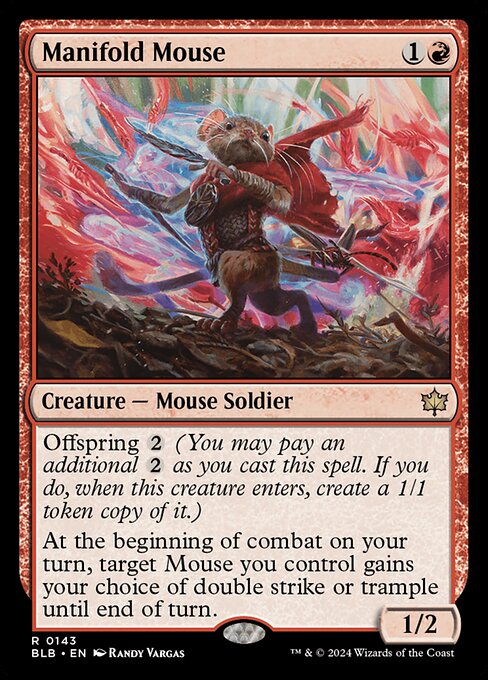
8. Manifold Mouse
8.7
27. Emberheart Challenger
7.4
33. Fireglass Mentor
7.3
Intrinsic ratings: they do not take into account the cards you have already picked. They matter most for the first pick of the first pack.