Card ranking · Bloomburrow (BLB)
← Bloomburrow261 cards
- Bomb > 8.4
- Very good ≥ 7.2
- Good ≥ 6.2
- Playable ≥ 5.0
- Weak < 5.0
Ratings are out of 10. They combine experts' opinions, the statistics of thousands of drafts by experienced players (when a card is taken, played, and the wins of the decks that play it) and what is printed on the card. Click a card to enlarge it.
 Rating9.4Bomb
Why this rating?
The best card of the set (9.4/10).
Why. A two-mana 3/2 that rewards every point of life your opponent loses: creatures you cast afterward enter with an extra +1/+1 counter, and each Lizard spell pings the opponent for 1. In an aggressive deck the following turns snowball fast.
Risks. A 3/2 is still fragile against blockers and removal, even with Ward (pay 2 life). Without Lizards or early pressure, its bonuses rarely turn on.
In the draft. A very high pick for an aggressive black-red deck. Collect Lizards and cheap creatures around it; outside those two colors it does not make your deck.
Results in the games of the set
When it is in hand, the deck wins 61.3% of its games (set average: 56.0%, 19th of 265 cards).
In the opening hand: 64.7% wins (55.0% on average).
Drawn during the game: 58.4% (56.6% on average).
When it is drawn, the deck wins 6.5 points more than when it is not.
When it is drafted, it is played 67% of the time (set average: 62%).
Taken as the first pick (88 drafts), it ends in the deck 69% of the time.
It is played mostly in B/R decks (38% of them).
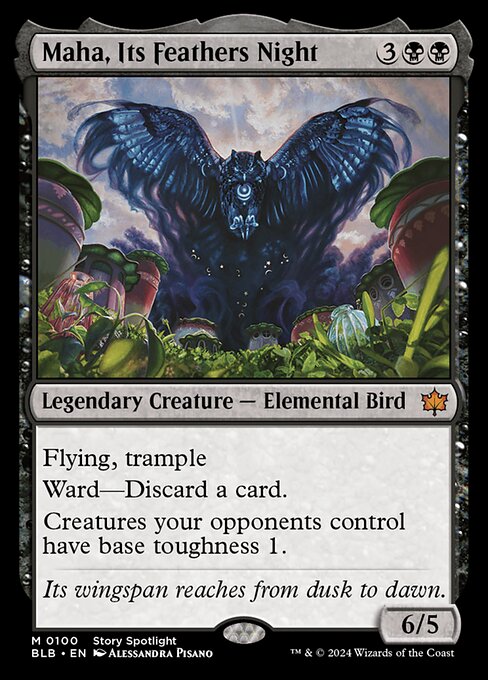 Rating9.3Bomb
Why this rating?
One of the 3 best cards of the set (9.3/10).
Why. A five-mana 6/5 flying trampler with ward (discard a card) that sets the base toughness of your opponents' creatures to 1. Any damage then kills their creatures, and nothing blocks a flying 6/5 well.
Risks. It needs two black mana. A sacrifice effect or a removal that does not target gets around the ward, and against an empty board the toughness effect does nothing.
In the draft. A bomb: first pick whenever you are black, whatever your second color. It fits nearly every black deck.
Results in the games of the set
When it is in hand, the deck wins 63.4% of its games (set average: 56.0%, 7th of 265 cards).
In the opening hand: 61.3% wins (55.0% on average).
Drawn during the game: 64.8% (56.6% on average).
When it is drawn, the deck wins 9.9 points more than when it is not.
When it is drafted, it is played 93% of the time (set average: 62%).
Taken as the first pick (39 drafts), it ends in the deck 90% of the time.
It is played about as much in every archetype.
 Rating9.1Bomb
Why this rating?
One of the 3 best cards of the set (9.1/10).
Why. A two-mana 2/3 that gives other Rabbits, Bats, Birds and Mice +1/+1 and scries 1 whenever one of them enters. In a deck packed with those types it is good on turn 2 and still good on turn 6.
Risks. Alone it is just a decent 2/3. It loses a lot of value if your deck has few Rabbits, Bats, Birds or Mice.
In the draft. A bomb for a white tribal deck; it pairs with green, black or red depending on the animals you collect. Prioritize creatures of those types afterward.
Results in the games of the set
When it is in hand, the deck wins 64.1% of its games (set average: 56.0%, 4th of 265 cards).
In the opening hand: 66.1% wins (55.0% on average).
Drawn during the game: 62.6% (56.6% on average).
When it is drawn, the deck wins 10.4 points more than when it is not.
When it is drafted, it is played 90% of the time (set average: 62%).
Taken as the first pick (110 drafts), it ends in the deck 91% of the time.
It is played about as much in every archetype.

4. Hired Claw
Rating9.0BombWhy this rating?
One of the 10 best cards of the set (9.0/10).
Why. A one-mana 1/2 that pings your opponent for 1 whenever you attack with a Lizard (it is one itself), then gets a +1/+1 counter for two mana if the opponent lost life this turn, once each turn. It quickly becomes a real threat.
Risks. To trigger the ping you must attack with a Lizard, which exposes it to blockers, and a 1/2 dies to almost anything. Without pressure, its growth stops.
In the draft. A strong early pick in an aggressive red deck, especially with other Lizards. Without Lizards it loses a lot of value, so look for them alongside.
Results in the games of the set
When it is in hand, the deck wins 60.2% of its games (set average: 56.0%, 31st of 265 cards).
In the opening hand: 66.4% wins (55.0% on average).
Drawn during the game: 55.0% (56.6% on average).
When it is drawn, the deck wins 5.8 points more than when it is not.
When it is drafted, it is played 80% of the time (set average: 62%).
Taken as the first pick (107 drafts), it ends in the deck 86% of the time.
It is played about as much in every archetype.
 Rating8.9Bomb
Why this rating?
One of the 10 best cards of the set (8.9/10).
Why. A four-mana 4/5 whose enter effect makes up for every way you are behind: a Treasure if you have fewer lands, 4 life if you have less life, two 1/1 blue Fish creature tokens if you have fewer creatures, a card if you have fewer cards in hand.
Risks. If you are ahead, the enter effect does almost nothing and you are left with a plain 4/5. It needs two white mana.
In the draft. A very good pick in a white deck, especially if you like solid four-drops. It stays useful with no deficit thanks to its body.
Results in the games of the set
When it is in hand, the deck wins 62.6% of its games (set average: 56.0%, 12th of 265 cards).
In the opening hand: 62.3% wins (55.0% on average).
Drawn during the game: 62.8% (56.6% on average).
When it is drawn, the deck wins 9.3 points more than when it is not.
When it is drafted, it is played 87% of the time (set average: 62%).
Taken as the first pick (63 drafts), it ends in the deck 92% of the time.
It is played about as much in every archetype.
 Rating8.8Bomb
Why this rating?
One of the 10 best cards of the set (8.8/10).
Why. For two mana, it puts a +1/+1 counter on one of your creatures at the beginning of every combat. Level 2 gives ward 1 to your permanents with counters, level 3 doubles all counters you place. It takes over a game slowly but surely.
Risks. It does nothing without a creature. The levels cost extra mana, and an opponent who kills your creature in response limits the effect.
In the draft. A strong early pick in a green deck with cheap creatures: it grows your board turn after turn. Take it early.
Results in the games of the set
When it is in hand, the deck wins 62.7% of its games (set average: 56.0%, 11th of 265 cards).
In the opening hand: 65.4% wins (55.0% on average).
Drawn during the game: 60.7% (56.6% on average).
When it is drawn, the deck wins 10.1 points more than when it is not.
When it is drafted, it is played 94% of the time (set average: 62%).
Taken as the first pick (109 drafts), it ends in the deck 90% of the time.
It is played about as much in every archetype.
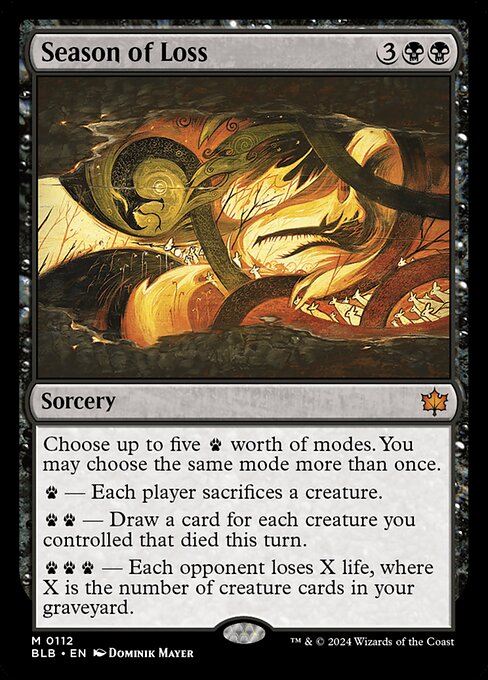 Rating8.7Bomb
Why this rating?
One of the 10 best cards of the set (8.7/10).
Why. A very flexible five-mana sorcery: you split up to five points of modes to make each player sacrifice a creature, draw for each creature that died under your control, or drain life based on the creature cards in your graveyard. Built well, it wins games.
Risks. Each player sacrifices: if you have no creature, or fewer than your opponent, the effect costs you too. The life-loss mode depends on your graveyard.
In the draft. A bomb for a black deck with enough creatures, including cheap ones you are happy to sacrifice. Take it high.
Results in the games of the set
When it is in hand, the deck wins 65.7% of its games (set average: 56.0%, 1st of 265 cards).
In the opening hand: 62.1% wins (55.0% on average).
Drawn during the game: 68.1% (56.6% on average).
When it is drawn, the deck wins 13.4 points more than when it is not.
When it is drafted, it is played 89% of the time (set average: 62%).
Taken as the first pick (80 drafts), it ends in the deck 94% of the time.
It is played about as much in every archetype.
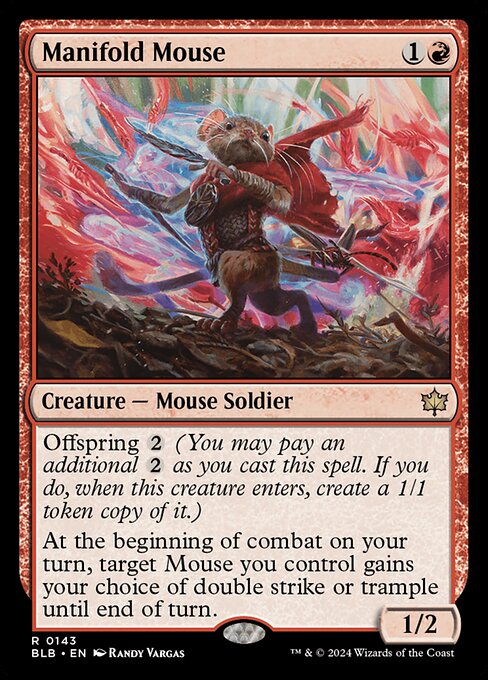 Rating8.7Bomb
Why this rating?
One of the 10 best cards of the set (8.7/10).
Why. A two-mana 1/2 that gives a Mouse double strike or trample every combat. With Offspring, two Mice arrive at once and the next turn one of them can hit twice.
Risks. Alone it is a 1/2 with little reach. It depends on Mice: without another Mouse it can only buff itself.
In the draft. A high pick for a red Mouse deck, especially with white. Take it early and then look for more Mice.
Results in the games of the set
When it is in hand, the deck wins 63.1% of its games (set average: 56.0%, 9th of 265 cards).
In the opening hand: 63.8% wins (55.0% on average).
Drawn during the game: 62.5% (56.6% on average).
When it is drawn, the deck wins 10.0 points more than when it is not.
When it is drafted, it is played 79% of the time (set average: 62%).
Taken as the first pick (93 drafts), it ends in the deck 85% of the time.
It is played mostly in R/W decks (26% of them).
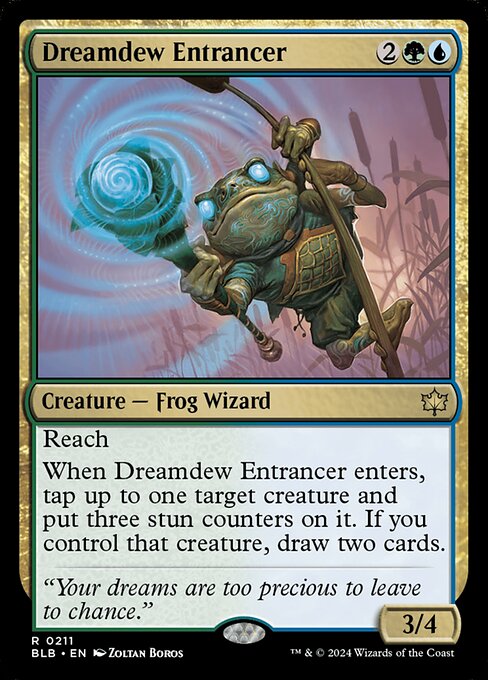 Rating8.6Bomb
Why this rating?
One of the 10 best cards of the set (8.6/10).
Why. A four-mana 3/4 with reach that taps a creature and puts three stun counters on it, keeping it down for a long time. If you target your own creature instead, you draw two cards. Two uses in one body.
Risks. With no interesting opposing creature to freeze, the effect is weaker. Stun counters do not answer a threat forever, and it requires both green and blue.
In the draft. A bomb for a green-blue deck. Take it very high; it gives tempo or cards depending on the board.
Results in the games of the set
When it is in hand, the deck wins 65.1% of its games (set average: 56.0%, 3rd of 265 cards).
In the opening hand: 62.7% wins (55.0% on average).
Drawn during the game: 66.5% (56.6% on average).
When it is drawn, the deck wins 13.4 points more than when it is not.
When it is drafted, it is played 82% of the time (set average: 62%).
Taken as the first pick (140 drafts), it ends in the deck 84% of the time.
It is played mostly in G/U decks (27% of them).
 Rating8.5Bomb
Why this rating?
One of the 10 best cards of the set (8.5/10).
Why. A five-mana sorcery that mixes 1/1 white Rabbit creature tokens, exile of a nonland permanent (its controller draws a card) and a return of a permanent with mana value 3 or less from your graveyard with an indestructible counter. You build the answer the game needs.
Risks. The removal mode gives your opponent a card. Five points of modes go quickly: choosing between removal and value takes thought.
In the draft. A bomb to take high in a white deck. The flexible removal and the tokens justify its slot; it pairs well with green or black.
Results in the games of the set
When it is in hand, the deck wins 61.7% of its games (set average: 56.0%, 15th of 265 cards).
In the opening hand: 59.9% wins (55.0% on average).
Drawn during the game: 63.0% (56.6% on average).
When it is drawn, the deck wins 8.4 points more than when it is not.
When it is drafted, it is played 87% of the time (set average: 62%).
Taken as the first pick (50 drafts), it ends in the deck 82% of the time.
It is played about as much in every archetype.
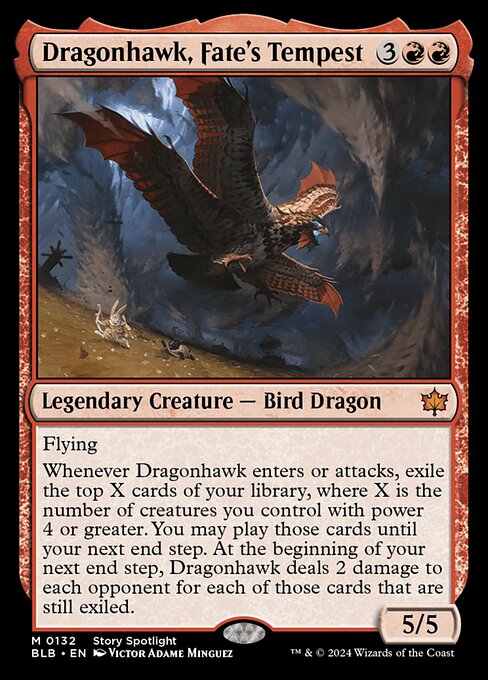
11. Dragonhawk, Fate's Tempest
Rating8.4BombWhy this rating?
One of the very best mythics of the format (8.4/10).
Why. A five-mana 5/5 flier that exiles cards from your library on entering and on every attack, based on the number of your creatures with power 4 or greater, itself included. You may play them until your next end step, so in practice this turn; each card left exiled deals 2 damage to the opponent.
Risks. After paying five mana you have little left to play the exiled cards. It is strongest on later attacks, when you have mana available, and it dies to removal.
In the draft. A very good pick for a red deck with enough high-power creatures. A flying 5/5 is already a good reason to take it.
Results in the games of the set
When it is in hand, the deck wins 62.3% of its games (set average: 56.0%, 13th of 265 cards).
In the opening hand: 60.1% wins (55.0% on average).
Drawn during the game: 63.8% (56.6% on average).
When it is drawn, the deck wins 10.1 points more than when it is not.
When it is drafted, it is played 86% of the time (set average: 62%).
Taken as the first pick (58 drafts), it ends in the deck 79% of the time.
It is played about as much in every archetype.
 Rating8.3Very good
Why this rating?
One of the very best rares of the format (8.4/10).
Why. A three-mana 3/3 that gives other Mice +1/+1 and creates an Equipment artifact token granting +1/+1, vigilance, trample and haste. A good body and a free Equipment: the value is immediate.
Risks. It needs two exact colors, red and white. Outside a Mouse deck its bonus is limited, and moving the Equipment costs two mana.
In the draft. A high pick for a red-white deck, by far its most played pair. The other Mice in your deck benefit from its bonus.
Results in the games of the set
When it is in hand, the deck wins 63.9% of its games (set average: 56.0%, 6th of 265 cards).
In the opening hand: 64.7% wins (55.0% on average).
Drawn during the game: 63.3% (56.6% on average).
When it is drawn, the deck wins 11.6 points more than when it is not.
When it is drafted, it is played 74% of the time (set average: 62%).
Taken as the first pick (100 drafts), it ends in the deck 75% of the time.
It is played mostly in R/W decks (27% of them).
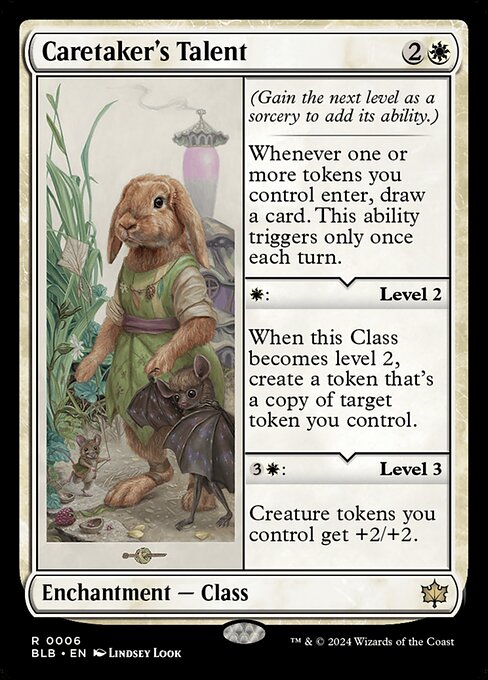 Rating8.3Very good
Why this rating?
One of the very best rares of the format (8.3/10).
Why. For three mana, it draws a card the first time each turn one or more tokens enter under your control. Level 2 copies one of your tokens, and level 3 gives your creature tokens +2/+2.
Risks. Without tokens it does nothing. It does not defend the board and value comes slowly: in a deck without token makers it sits idle.
In the draft. Playable in a white deck that makes tokens regularly; do not take it high without that base. Find the token sources first.
Results in the games of the set
When it is in hand, the deck wins 58.3% of its games (set average: 56.0%, 58th of 265 cards).
In the opening hand: 57.2% wins (55.0% on average).
Drawn during the game: 59.1% (56.6% on average).
When it is drawn, the deck wins 4.2 points more than when it is not.
When it is drafted, it is played 71% of the time (set average: 62%).
Taken as the first pick (99 drafts), it ends in the deck 76% of the time.
It is played about as much in every archetype.
 Rating8.2Very good
Why this rating?
One of the very best rares of the format (8.2/10).
Why. A three-mana 3/3 with flying and vigilance that gains you 1 life whenever a Bat attacks. On entering and on attacking, you may pay a white mana, a black mana and 2 life to return a nonland permanent with mana value 3 or less from your graveyard, with a finality counter.
Risks. The return costs mana and life, and only works if there is a target in your graveyard. It needs white and black, and a 3/3 flier dies to removal.
In the draft. A high pick in a white-black deck, its main pair. It already does the job as a 3/3 flier; the extra value is a bonus.
Results in the games of the set
When it is in hand, the deck wins 62.2% of its games (set average: 56.0%, 14th of 265 cards).
In the opening hand: 60.1% wins (55.0% on average).
Drawn during the game: 63.6% (56.6% on average).
When it is drawn, the deck wins 9.5 points more than when it is not.
When it is drafted, it is played 80% of the time (set average: 62%).
Taken as the first pick (119 drafts), it ends in the deck 76% of the time.
It is played about as much in every archetype.
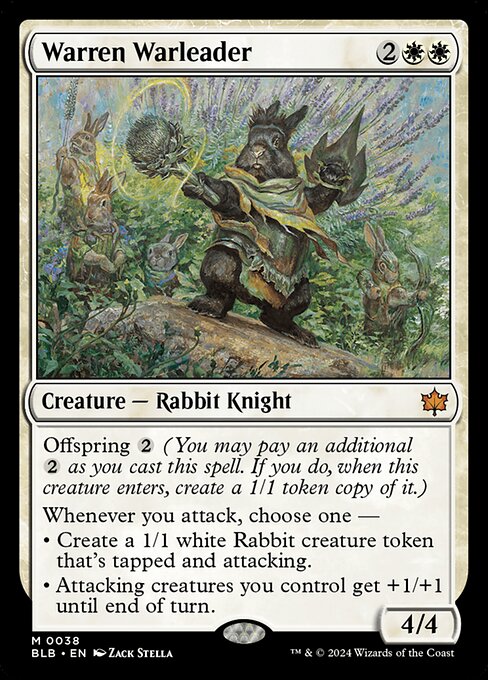
15. Warren Warleader
Rating8.1Very goodWhy this rating?
One of the very best mythics of the format (8.1/10).
Why. A four-mana 4/4 that, whenever you attack, creates a tapped and attacking 1/1 white Rabbit creature token or gives your attackers +1/+1. With Offspring, the 1/1 copy has this ability too: two triggers on every attack.
Risks. It pushes you to attack: against a good blocking opponent you expose your creatures. It needs two white mana, and removal stops it before the first attack.
In the draft. A high pick for an aggressive or token-based white deck. Take it early; the deck around it needs creatures to send into combat.
Results in the games of the set
When it is in hand, the deck wins 63.2% of its games (set average: 56.0%, 8th of 265 cards).
In the opening hand: 61.2% wins (55.0% on average).
Drawn during the game: 64.6% (56.6% on average).
When it is drawn, the deck wins 9.9 points more than when it is not.
When it is drafted, it is played 87% of the time (set average: 62%).
Taken as the first pick (52 drafts), it ends in the deck 85% of the time.
It is played about as much in every archetype.
 Rating8.1Very good
Why this rating?
One of the very best rares of the format (8.1/10).
Why. A two-mana 2/2 with reach and vigilance that puts a +1/+1 counter on each of your other creatures that is a token or a Rabbit whenever it attacks. If your creatures total 10 power or more, you draw. It takes over within a few turns.
Risks. It has only 2 toughness and depends on tokens or Rabbits to shine. It needs green and white: poorly supported, it is a small 2/2.
In the draft. A good pick, but only for a green-white deck full of tokens and Rabbits. Build around it if you have it early.
Results in the games of the set
When it is in hand, the deck wins 60.1% of its games (set average: 56.0%, 32nd of 265 cards).
In the opening hand: 62.1% wins (55.0% on average).
Drawn during the game: 58.6% (56.6% on average).
When it is drawn, the deck wins 6.8 points more than when it is not.
When it is drafted, it is played 73% of the time (set average: 62%).
Taken as the first pick (113 drafts), it ends in the deck 86% of the time.
It is played about as much in every archetype.
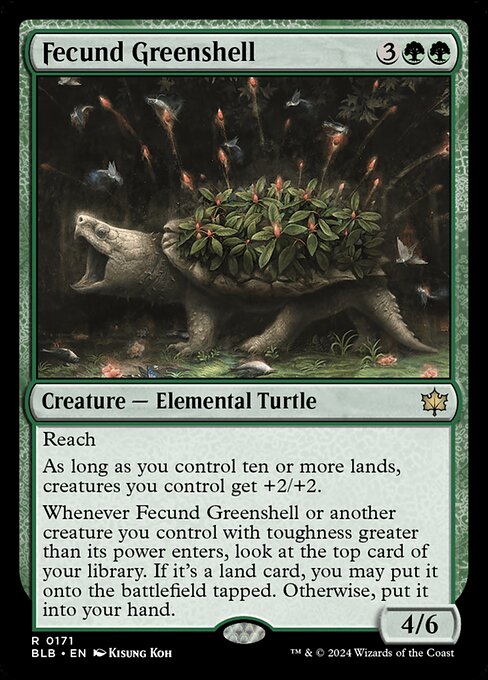 Rating8.0Very good
Why this rating?
One of the very best rares of the format (8.0/10).
Why. A five-mana 4/6 with reach. Whenever a creature with toughness greater than its power enters (itself included), look at your top card: a land may go onto the battlefield tapped, anything else goes to your hand. With ten lands, your creatures get +2/+2.
Risks. It needs two green mana, and its card advantage depends on having other creatures with toughness greater than power. Ten lands is far away in a normal game.
In the draft. A good high pick for a green deck with high-toughness creatures. It gives a body and card advantage.
Results in the games of the set
When it is in hand, the deck wins 64.0% of its games (set average: 56.0%, 5th of 265 cards).
In the opening hand: 61.6% wins (55.0% on average).
Drawn during the game: 65.4% (56.6% on average).
When it is drawn, the deck wins 11.4 points more than when it is not.
When it is drafted, it is played 93% of the time (set average: 62%).
Taken as the first pick (175 drafts), it ends in the deck 90% of the time.
It is played about as much in every archetype.
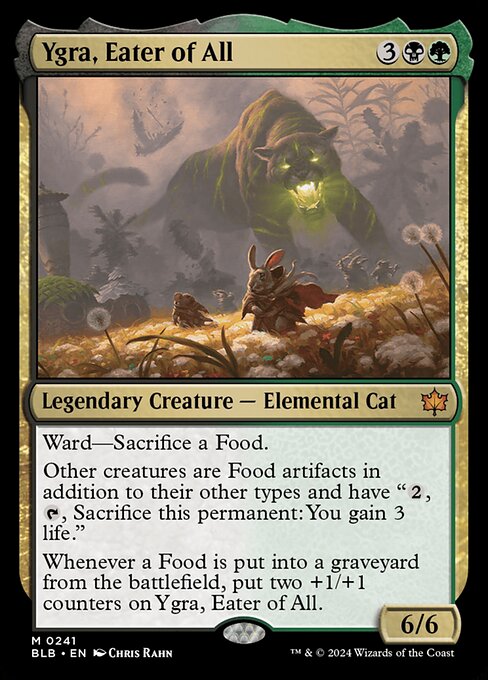 Rating7.9Very good
Why this rating?
One of the very best mythics of the format (7.9/10).
Why. A five-mana 6/6 with ward (sacrifice a Food) that turns every other creature into a Food artifact. Each Food that goes from the battlefield to a graveyard gives it two +1/+1 counters: creatures that die, and ones you sacrifice, make it grow.
Risks. Opposing creatures become Foods too: they pay its ward easily and can be sacrificed (two mana, tap) to gain 3 life. It also needs black and green.
In the draft. A high pick in a black-green deck. A big threat that grows with every trade; its huge body already justifies it.
Results in the games of the set
When it is in hand, the deck wins 62.8% of its games (set average: 56.0%, 10th of 265 cards).
In the opening hand: 61.4% wins (55.0% on average).
Drawn during the game: 63.7% (56.6% on average).
When it is drawn, the deck wins 10.8 points more than when it is not.
When it is drafted, it is played 85% of the time (set average: 62%).
Taken as the first pick (63 drafts), it ends in the deck 81% of the time.
It is played about as much in every archetype.
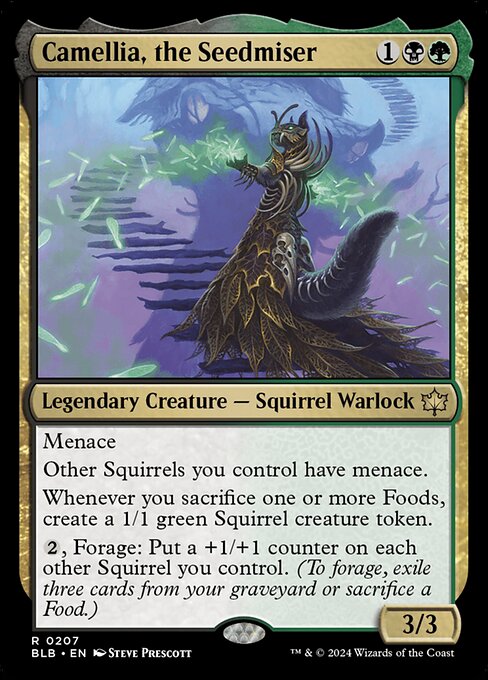 Rating7.8Very good
Why this rating?
One of the very best rares of the format (7.8/10).
Why. A three-mana 3/3 with menace that gives other Squirrels menace and creates a 1/1 green Squirrel creature token whenever you sacrifice Foods. For two mana plus a Forage, it puts a +1/+1 counter on each other Squirrel.
Risks. It needs Squirrels and Foods to really work. Without them it is a plain 3/3 with menace. It requires black and green.
In the draft. A solid, fairly high pick in a black-green Squirrel and Food deck. Look alongside it for Food makers and Squirrels.
Results in the games of the set
When it is in hand, the deck wins 61.1% of its games (set average: 56.0%, 20th of 265 cards).
In the opening hand: 58.9% wins (55.0% on average).
Drawn during the game: 62.7% (56.6% on average).
When it is drawn, the deck wins 8.6 points more than when it is not.
When it is drafted, it is played 77% of the time (set average: 62%).
Taken as the first pick (145 drafts), it ends in the deck 79% of the time.
It is played mostly in B/G decks (28% of them).
 Rating7.7Very good
Why this rating?
One of the very best mythics of the format (7.7/10).
Why. A three-mana 2/4 with deathtouch that lets you look at your top card, play lands and spells with mana value 4 or greater from your library, and tap to surveil 2. A powerful card engine in long games.
Risks. It asks for three colors, black, green and blue, which is hard without strong fixing. It dies to removal, and its engine is slow.
In the draft. A good pick only if you already have two of the three colors and can find the third. Otherwise let it go.
Results in the games of the set
When it is in hand, the deck wins 61.3% of its games (set average: 56.0%, 18th of 265 cards).
In the opening hand: 58.5% wins (55.0% on average).
Drawn during the game: 63.0% (56.6% on average).
When it is drawn, the deck wins 11.0 points more than when it is not.
When it is drafted, it is played 79% of the time (set average: 62%).
Taken as the first pick (64 drafts), it ends in the deck 84% of the time.
It is played about as much in every archetype.
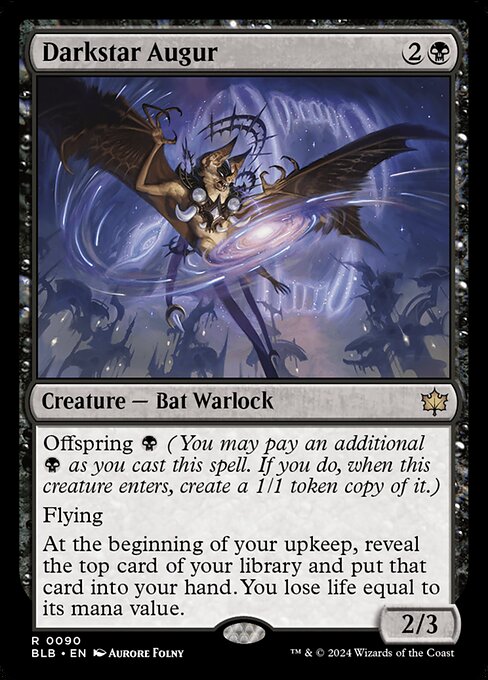
21. Darkstar Augur
Rating7.7Very goodWhy this rating?
One of the very best rares of the format (7.7/10).
Why. A three-mana 2/3 flier that puts the top card of your library into your hand each upkeep, at the cost of life equal to its mana value. With Offspring, a second body doubles the card flow. A big advantage as long as your cards are cheap.
Risks. Life loss adds up fast in an expensive deck, and the Offspring copy doubles it. The engine is fragile against aggressive pressure.
In the draft. A good pick in a black deck with a low curve. Avoid it in a deck loaded with expensive cards.
Results in the games of the set
When it is in hand, the deck wins 60.4% of its games (set average: 56.0%, 27th of 265 cards).
In the opening hand: 60.5% wins (55.0% on average).
Drawn during the game: 60.3% (56.6% on average).
When it is drawn, the deck wins 6.4 points more than when it is not.
When it is drafted, it is played 88% of the time (set average: 62%).
Taken as the first pick (154 drafts), it ends in the deck 89% of the time.
It is played about as much in every archetype.
 Rating7.6Very good
Why this rating?
One of the very best mythics of the format (7.6/10).
Why. A two-mana 1/3 with vigilance and prowess that can tap to loot, or, if its power is 3 or more, copy an instant or sorcery spell you control for two mana. A steady card filter in a spell-heavy deck.
Risks. It needs instants and sorceries, and reaching power 3 takes two noncreature spells in one turn. Alone it is a small defensive body.
In the draft. A middling pick, reserved for blue decks rich in instants and sorceries. Otherwise leave it.
Results in the games of the set
When it is in hand, the deck wins 58.5% of its games (set average: 56.0%, 52nd of 265 cards).
In the opening hand: 60.0% wins (55.0% on average).
Drawn during the game: 57.5% (56.6% on average).
When it is drawn, the deck wins 7.4 points more than when it is not.
When it is drafted, it is played 83% of the time (set average: 62%).
Taken as the first pick (59 drafts), it ends in the deck 90% of the time.
It is played about as much in every archetype.

23. Pawpatch Recruit
Rating7.6Very goodWhy this rating?
One of the very best rares of the format (7.6/10).
Why. A one-mana 2/1 with trample that becomes two bodies with Offspring. Whenever an opponent targets one of your creatures, another creature of yours gets a +1/+1 counter.
Risks. Alone it is a fragile 2/1 that falls behind later. Its trigger depends on opposing targeting effects, and you do not control how often they happen.
In the draft. A solid pick in a green deck that wants cheap creatures. Playable in almost every green deck.
Results in the games of the set
When it is in hand, the deck wins 59.6% of its games (set average: 56.0%, 35th of 265 cards).
In the opening hand: 59.9% wins (55.0% on average).
Drawn during the game: 59.4% (56.6% on average).
When it is drawn, the deck wins 6.4 points more than when it is not.
When it is drafted, it is played 91% of the time (set average: 62%).
Taken as the first pick (146 drafts), it ends in the deck 95% of the time.
It is played about as much in every archetype.
 Rating7.6Very good
Why this rating?
One of the very best rares of the format (7.6/10).
Why. For one mana, it creates a 1/1 blue and red Otter creature token with prowess. Level 2 returns an instant or sorcery from your graveyard to your hand, and level 3 creates an Otter whenever you cast one. Slow but real value.
Risks. Levels 2 and 3 cost a lot of mana, and without instants and sorceries they give nothing. The first Otter stays small.
In the draft. A middling pick for a blue deck with many spells, especially blue-red. Outside a spell deck it is weak.
Results in the games of the set
When it is in hand, the deck wins 58.8% of its games (set average: 56.0%, 48th of 265 cards).
In the opening hand: 57.5% wins (55.0% on average).
Drawn during the game: 59.5% (56.6% on average).
When it is drawn, the deck wins 7.4 points more than when it is not.
When it is drafted, it is played 69% of the time (set average: 62%).
Taken as the first pick (96 drafts), it ends in the deck 73% of the time.
It is played mostly in R/U decks (25% of them).
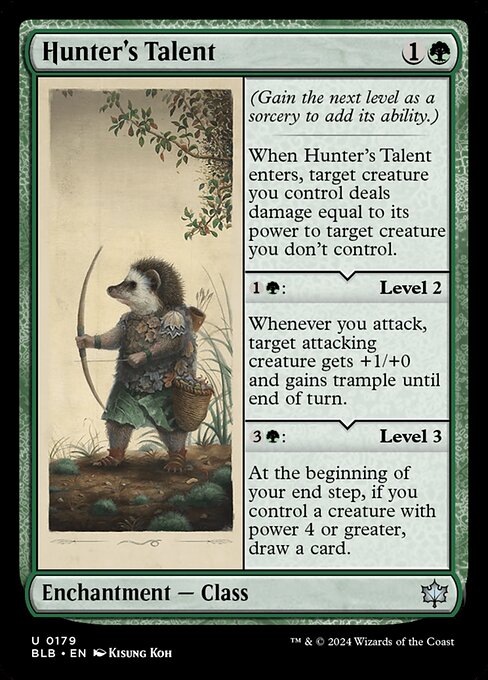
25. Hunter's Talent
Rating7.5Very goodWhy this rating?
One of the very best uncommons of the format (7.6/10).
Why. A two-mana removal on entering: your creature deals damage equal to its power to a creature you do not control. Level 2 gives an attacker +1/+0 and trample, and level 3 draws a card at end step if you control a creature with power 4 or greater.
Risks. You need your own creature to kill something, and if it goes away in response, the removal fizzles. The later levels cost mana without an immediate effect.
In the draft. A high pick for any green deck: cheap removal with value afterward. Take it without hesitation; all its green pairs are good.
Results in the games of the set
When it is in hand, the deck wins 61.4% of its games (set average: 56.0%, 17th of 265 cards).
In the opening hand: 59.4% wins (55.0% on average).
Drawn during the game: 62.9% (56.6% on average).
When it is drawn, the deck wins 7.7 points more than when it is not.
When it is drafted, it is played 92% of the time (set average: 62%).
Taken as the first pick (450 drafts), it ends in the deck 94% of the time.
It is played mostly in B/G decks (28% of them) and G/R (28%).
 Rating7.5Very good
Why this rating?
A solid uncommon of the format (7.5/10).
Why. A two-mana creature with trample whose power and toughness equal the number of creatures you control (itself included). With a wide board of small creatures it gets huge quickly, without needing any extra spell.
Risks. Alone on the battlefield it is a 1/1. It follows your board: a sweeper or a removal shrinks it immediately.
In the draft. A good pick for a green-white deck that plays many creatures and tokens. Take it as a second priority, not a first.
Results in the games of the set
When it is in hand, the deck wins 60.6% of its games (set average: 56.0%, 25th of 265 cards).
In the opening hand: 61.5% wins (55.0% on average).
Drawn during the game: 59.9% (56.6% on average).
When it is drawn, the deck wins 5.7 points more than when it is not.
When it is drafted, it is played 71% of the time (set average: 62%).
Taken as the first pick (180 drafts), it ends in the deck 85% of the time.
It is played mostly in G/W decks (52% of them).
 Rating7.4Very good
Why this rating?
A very good rare of the format (7.4/10).
Why. A two-mana 2/2 with haste and prowess that exiles your top card, playable this turn, the first time each turn you target it (Valiant). An aggressive attack from turn 2.
Risks. It needs targeting spells and noncreature spells to turn on its bonuses. Otherwise it is a 2/2 that at best trades with a creature of its size.
In the draft. A middling pick for an aggressive red deck with targeting spells and instants. Avoid it without that base.
Results in the games of the set
When it is in hand, the deck wins 58.1% of its games (set average: 56.0%, 63rd of 265 cards).
In the opening hand: 59.3% wins (55.0% on average).
Drawn during the game: 57.0% (56.6% on average).
When it is drawn, the deck wins 4.4 points more than when it is not.
When it is drafted, it is played 84% of the time (set average: 62%).
Taken as the first pick (104 drafts), it ends in the deck 88% of the time.
It is played about as much in every archetype.
 Rating7.4Very good
Why this rating?
A very good rare of the format (7.4/10).
Why. A two-mana 3/3 that can exile a card from a graveyard for one mana. If the cards it exiled cover four or more card types, it gets +4/+4 and trample, making it a 7/7. A big early body that also disrupts the opposing graveyard.
Risks. Reaching four types takes time and varied cards in the graveyards. It needs two green mana on turn 2.
In the draft. A good pick for a green deck that wants a solid two-drop. It stays a decent 3/3 even when the bonus is not reached.
Results in the games of the set
When it is in hand, the deck wins 58.9% of its games (set average: 56.0%, 44th of 265 cards).
In the opening hand: 57.7% wins (55.0% on average).
Drawn during the game: 59.7% (56.6% on average).
When it is drawn, the deck wins 5.5 points more than when it is not.
When it is drafted, it is played 90% of the time (set average: 62%).
Taken as the first pick (141 drafts), it ends in the deck 91% of the time.
It is played about as much in every archetype.
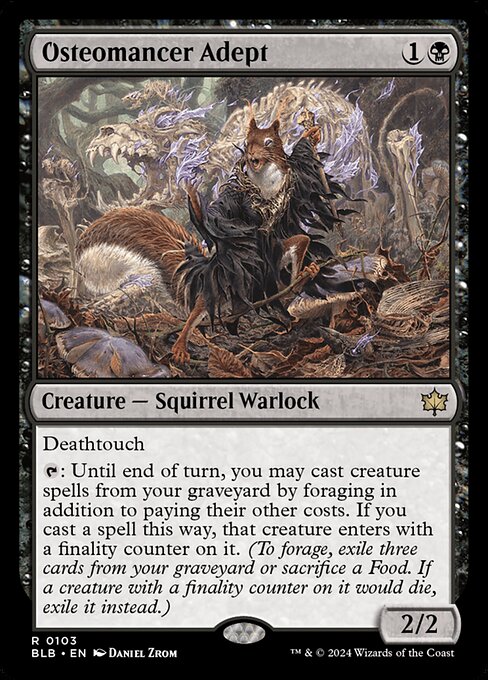 Rating7.4Very good
Why this rating?
A very good rare of the format (7.4/10).
Why. A two-mana 2/2 with deathtouch that can tap to let you cast creature spells from your graveyard by foraging. Those creatures enter with a finality counter. A good blocker that doubles as a value engine.
Risks. It needs creatures in your graveyard and something to forage with. The effect costs extra mana, and a 2/2 dies easily to removal.
In the draft. A solid, fairly high pick in a black deck, especially black-green. Deathtouch keeps it useful even without foraging.
Results in the games of the set
When it is in hand, the deck wins 59.0% of its games (set average: 56.0%, 43rd of 265 cards).
In the opening hand: 58.6% wins (55.0% on average).
Drawn during the game: 59.3% (56.6% on average).
When it is drawn, the deck wins 4.8 points more than when it is not.
When it is drafted, it is played 90% of the time (set average: 62%).
Taken as the first pick (153 drafts), it ends in the deck 92% of the time.
It is played about as much in every archetype.
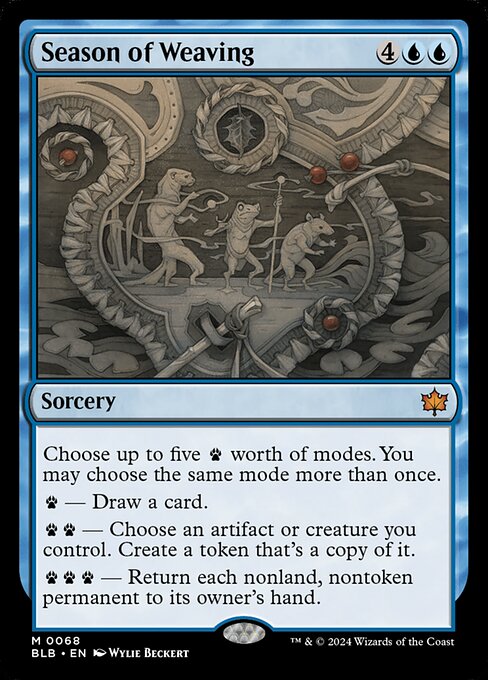 Rating7.4Very good
Why this rating?
A very good mythic of the format (7.4/10).
Why. A six-mana sorcery that lets you draw cards, copy one of your artifacts or creatures as a token, or bounce every nonland, nontoken permanent. Very flexible: a big board effect, or pure value.
Risks. Six mana is expensive and the mass bounce hits your own permanents too. You need a board worth copying.
In the draft. A middling pick in a blue late-game deck, especially blue-green. Do not take it ahead of good cheap creatures.
Results in the games of the set
When it is in hand, the deck wins 60.7% of its games (set average: 56.0%, 24th of 265 cards).
In the opening hand: 56.7% wins (55.0% on average).
Drawn during the game: 63.0% (56.6% on average).
When it is drawn, the deck wins 9.7 points more than when it is not.
When it is drafted, it is played 85% of the time (set average: 62%).
Taken as the first pick (63 drafts), it ends in the deck 89% of the time.
It is played about as much in every archetype.
 Rating7.4Very good
Why this rating?
A very good rare of the format (7.4/10).
Why. A two-mana 2/2 that taps for green mana or, by foraging, for two mana in any combination of colors. For four mana it can also search for a Squirrel. A useful accelerator and fixer.
Risks. A tapped 2/2 does not block, and foraging costs graveyard cards or a Food. It dies to any removal.
In the draft. A solid pick in a green deck, especially black-green with Squirrels. Useful for fixing a splash.
Results in the games of the set
When it is in hand, the deck wins 58.8% of its games (set average: 56.0%, 46th of 265 cards).
In the opening hand: 60.0% wins (55.0% on average).
Drawn during the game: 58.0% (56.6% on average).
When it is drawn, the deck wins 5.1 points more than when it is not.
When it is drafted, it is played 89% of the time (set average: 62%).
Taken as the first pick (136 drafts), it ends in the deck 88% of the time.
It is played about as much in every archetype.
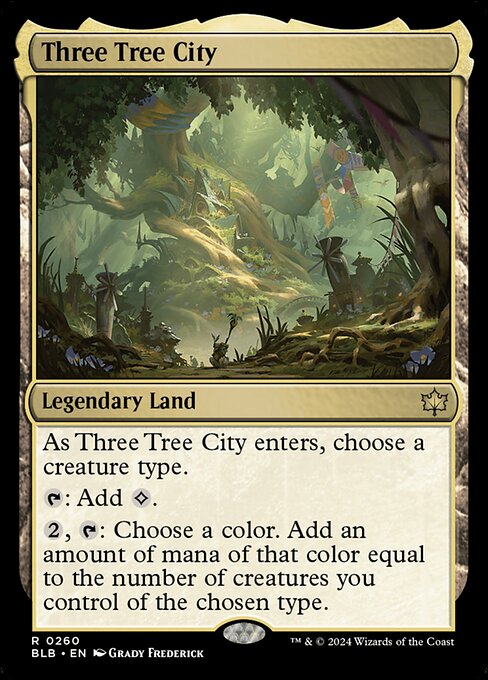
32. Three Tree City
Rating7.4Very goodWhy this rating?
A very good rare of the format (7.4/10).
Why. A legendary land that taps for one colorless mana. For two mana, it instead makes as much mana of a chosen color as you control creatures of the type chosen as it entered. In a very tribal deck, it works as a late-game accelerator.
Risks. Without the activation it makes no colored mana, which can hurt your mana base. You need at least three creatures of the chosen type to profit, and in a deck without a dominant type its effect is weak.
In the draft. A late pick, only for a truly tribal deck. Otherwise a basic land does the same job.
Results in the games of the set
When it is in hand, the deck wins 51.8% of its games (set average: 56.0%, 238th of 265 cards).
In the opening hand: 49.8% wins (55.0% on average).
Drawn during the game: 53.1% (56.6% on average).
When it is drawn, the deck wins 0.6 points more than when it is not.
When it is drafted, it is played only 14% of the time (set average: 62%): it almost always ends in the sideboard.
Taken among the first three picks (36 drafts), it ends in the deck 28% of the time.

33. Fireglass Mentor
Rating7.3Very goodWhy this rating?
A solid uncommon of the format (7.3/10).
Why. A two-mana 2/1 that, in your second main phase, if an opponent lost life this turn, exiles the top two cards of your library and lets you play one of them. If you attack regularly, it is a steady stream of cards.
Risks. It needs the opponent to have lost life, so constant pressure. A 2/1 is fragile and easily blocked or killed.
In the draft. A middling pick in an aggressive black-red deck, its most played pair. Outside an aggro deck it loses a lot.
Results in the games of the set
When it is in hand, the deck wins 58.0% of its games (set average: 56.0%, 64th of 265 cards).
In the opening hand: 59.3% wins (55.0% on average).
Drawn during the game: 57.0% (56.6% on average).
When it is drawn, the deck wins 2.1 points more than when it is not.
When it is drafted, it is played 58% of the time (set average: 62%).
Taken as the first pick (117 drafts), it ends in the deck 86% of the time.
It is played mostly in B/R decks (62% of them).
 Rating7.3Very good
Why this rating?
A very good rare of the format (7.3/10).
Why. A one-mana 1/1 with trample that gets a +1/+1 counter whenever another Frog, Rabbit, Raccoon or Squirrel enters under your control. In a deck full of those types it grows fast from turn 1.
Risks. Alone it is a weak 1/1, and it depends on your creature types. Against an opponent who kills early, it disappears before growing.
In the draft. A solid, fairly high pick in a green deck with plenty of those types. Worse in a green deck without them.
Results in the games of the set
When it is in hand, the deck wins 60.4% of its games (set average: 56.0%, 28th of 265 cards).
In the opening hand: 66.0% wins (55.0% on average).
Drawn during the game: 56.3% (56.6% on average).
When it is drawn, the deck wins 6.9 points more than when it is not.
When it is drafted, it is played 92% of the time (set average: 62%).
Taken as the first pick (145 drafts), it ends in the deck 94% of the time.
It is played about as much in every archetype.
 Rating7.2Very good
Why this rating?
A very good rare of the format (7.2/10).
Why. A one-drop that pings the opponent whenever a land enters under your control. Played early it chips away every turn, and late in the game Offspring turns it into two sources of damage for a fair price.
Risks. A 1/2 is fragile and blocks poorly. If your hand has no lands left to play, it stops doing anything.
In the draft. A good pick for aggressive black decks that curve out and hit land drops. Take it right after your removal.
Results in the games of the set
When it is in hand, the deck wins 58.2% of its games (set average: 56.0%, 61st of 265 cards).
In the opening hand: 58.2% wins (55.0% on average).
Drawn during the game: 58.1% (56.6% on average).
When it is drawn, the deck wins 4.7 points more than when it is not.
When it is drafted, it is played 86% of the time (set average: 62%).
Taken as the first pick (123 drafts), it ends in the deck 92% of the time.
It is played about as much in every archetype.

36. Mistbreath Elder
Rating7.2Very goodWhy this rating?
A very good rare of the format (7.2/10).
Why. A one-mana 2/2 that grows each turn by returning another creature you control to hand. The rhythm is demanding, but if your creatures have enter effects you replay them for value while the Elder gains a counter.
Risks. The bounce is mandatory: replaying a creature every turn costs mana and tempo. With no other creature it may return itself and loses its counters.
In the draft. Take it in a green deck full of creatures with enter effects; otherwise it is an average card. Less appealing in a pure speed deck.
Results in the games of the set
When it is in hand, the deck wins 58.1% of its games (set average: 56.0%, 62nd of 265 cards).
In the opening hand: 59.5% wins (55.0% on average).
Drawn during the game: 57.2% (56.6% on average).
When it is drawn, the deck wins 5.8 points more than when it is not.
When it is drafted, it is played 82% of the time (set average: 62%).
Taken as the first pick (130 drafts), it ends in the deck 86% of the time.
It is played about as much in every archetype.

37. Vinereap Mentor
Rating7.2Very goodWhy this rating?
A solid uncommon of the format (7.2/10).
Why. A 3/2 for two that leaves a Food token when it enters and another when it dies. It attacks, blocks or trades without ever being a bad trade, and the Food helps with Forage or life gain.
Risks. It is gold, so locked to black-green. Two toughness makes it vulnerable in small combats.
In the draft. A very good uncommon for black-green; take it high if those colours are open. Its main value is filling the two-drop slot with a body that trades well.
Results in the games of the set
When it is in hand, the deck wins 61.7% of its games (set average: 56.0%, 16th of 265 cards).
In the opening hand: 62.8% wins (55.0% on average).
Drawn during the game: 60.9% (56.6% on average).
When it is drawn, the deck wins 7.9 points more than when it is not.
When it is drafted, it is played 74% of the time (set average: 62%).
Taken as the first pick (250 drafts), it ends in the deck 84% of the time.
It is played mostly in B/G decks (54% of them).
 Rating7.2Good
Why this rating?
A very good mythic of the format (7.2/10).
Why. A flexible six-mana sorcery: counters on a creature, destroying all artifacts or all enchantments, or drawing cards equal to your biggest creature's power. With a big attacker, the draw mode alone can win the game.
Risks. It does little without a creature. The destruction mode also hits your own permanents, and six mana is heavy.
In the draft. Take it as a value top-end in a green deck with big creatures. One copy is plenty; do not pay too much for it.
Results in the games of the set
When it is in hand, the deck wins 60.8% of its games (set average: 56.0%, 23rd of 265 cards).
In the opening hand: 56.7% wins (55.0% on average).
Drawn during the game: 63.3% (56.6% on average).
When it is drawn, the deck wins 8.8 points more than when it is not.
When it is drafted, it is played 93% of the time (set average: 62%).
Taken as the first pick (71 drafts), it ends in the deck 87% of the time.
It is played about as much in every archetype.

39. Scrapshooter
Rating7.1GoodWhy this rating?
A very good rare of the format (7.1/10).
Why. A 4/4 with reach for three mana is a great body that controls the ground and the air. With the Gift, the opponent draws a card but you destroy an artifact or enchantment, which is worth it when there is a useful target.
Risks. It needs two green mana. Promising the Gift hands a card over, so do it only for a real target.
In the draft. A solid pick in any green deck and a great mid-curve body. Get into green early.
Results in the games of the set
When it is in hand, the deck wins 57.6% of its games (set average: 56.0%, 74th of 265 cards).
In the opening hand: 57.4% wins (55.0% on average).
Drawn during the game: 57.8% (56.6% on average).
When it is drawn, the deck wins 4.0 points more than when it is not.
When it is drafted, it is played 90% of the time (set average: 62%).
Taken as the first pick (170 drafts), it ends in the deck 95% of the time.
It is played about as much in every archetype.
 Rating7.0Good
Why this rating?
A very good rare of the format (7.0/10).
Why. A two-mana 1/3 with vigilance that creatures with power 2 or greater cannot block. Each attack it can neutralise an opposing artifact, creature or planeswalker: a creature loses its abilities and becomes a base 2/2 until your next turn.
Risks. It has one power, so it adds little pressure on its own. The effect wears off at your next turn.
In the draft. A fine pick in a blue control or tempo deck. Best when the opponent's board has a single big threat.
Results in the games of the set
When it is in hand, the deck wins 59.5% of its games (set average: 56.0%, 38th of 265 cards).
In the opening hand: 60.2% wins (55.0% on average).
Drawn during the game: 59.0% (56.6% on average).
When it is drawn, the deck wins 8.6 points more than when it is not.
When it is drafted, it is played 83% of the time (set average: 62%).
Taken as the first pick (118 drafts), it ends in the deck 85% of the time.
It is played about as much in every archetype.
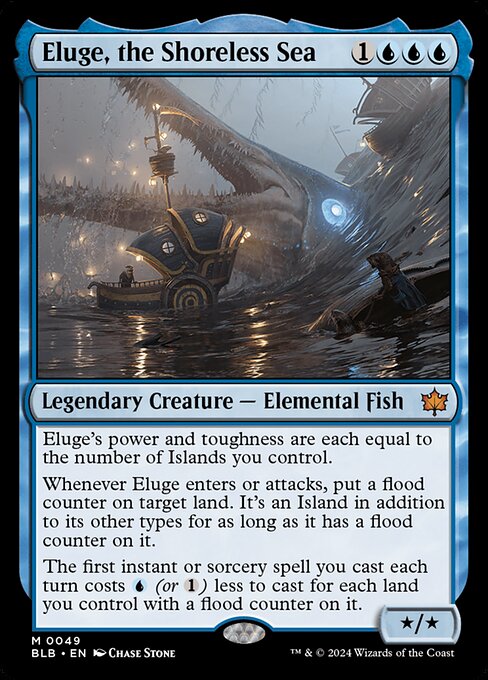 Rating7.0Good
Why this rating?
A very good mythic of the format (7.0/10).
Why. A creature that grows with your Islands and turns each targeted land into an extra Island. It arrives bigger than it looks and discounts the first instant or sorcery you cast each turn.
Risks. Three blue mana to cast: very demanding. In a two-colour deck it is often small, and it dies like any creature.
In the draft. Reserve it for heavy-blue decks with many Islands and spells. Otherwise let it go.
Results in the games of the set
When it is in hand, the deck wins 54.4% of its games (set average: 56.0%, 172nd of 265 cards).
In the opening hand: 53.8% wins (55.0% on average).
Drawn during the game: 54.7% (56.6% on average).
When it is drawn, the deck wins 6.4 points more than when it is not.
When it is drafted, it is played 44% of the time (set average: 62%).
Taken among the first three picks (85 drafts), it ends in the deck 61% of the time.
It is played about as much in every archetype.

42. Hop to It
Rating7.0GoodWhy this rating?
A solid uncommon of the format (7.0/10).
Why. Three 1/1 white Rabbit creature tokens for three mana in one spell. That gives you three bodies to block, to swarm with, or to feed effects that count your creatures and tokens.
Risks. They are 1/1s: a sweeper or a big creature stops them. By itself the spell does not win the game.
In the draft. A very good white uncommon, especially in decks that like tokens. A solid mid-pack pick.
Results in the games of the set
When it is in hand, the deck wins 58.8% of its games (set average: 56.0%, 45th of 265 cards).
In the opening hand: 58.0% wins (55.0% on average).
Drawn during the game: 59.5% (56.6% on average).
When it is drawn, the deck wins 3.5 points more than when it is not.
When it is drafted, it is played 83% of the time (set average: 62%).
Taken as the first pick (220 drafts), it ends in the deck 88% of the time.
It is played mostly in G/W decks (47% of them) and R/W (36%).
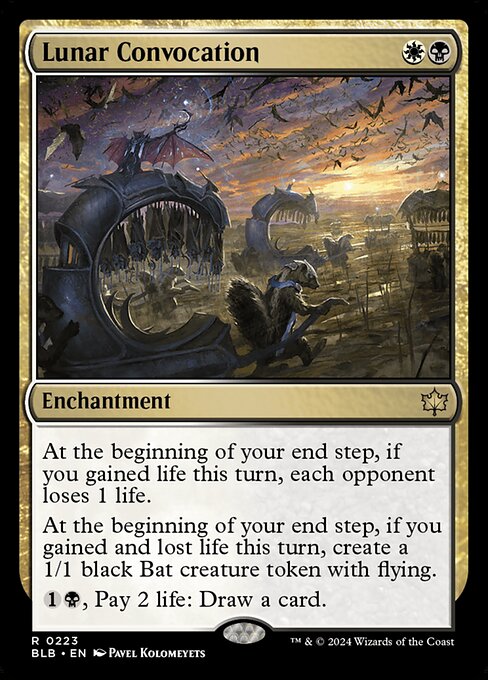 Rating7.0Good
Why this rating?
A very good rare of the format (7.0/10).
Why. A white-black enchantment that rewards lifegain: at your end step, if you gained life each opponent loses 1 life, and if you also lost life you create a 1/1 black Bat creature token with flying. It also lets you draw for two mana and 2 life.
Risks. Without regular lifegain it does almost nothing. It does not affect the board the turn you cast it and stays slow.
In the draft. Reserve it for a white-black deck that gains and loses life regularly. Otherwise skip it.
Results in the games of the set
When it is in hand, the deck wins 53.4% of its games (set average: 56.0%, 207th of 265 cards).
In the opening hand: 51.2% wins (55.0% on average).
Drawn during the game: 55.0% (56.6% on average).
When it is drawn, the deck wins 0.4 points less than when it is not.
When it is drafted, it is played 65% of the time (set average: 62%).
Taken as the first pick (49 drafts), it ends in the deck 78% of the time.
It is played about as much in every archetype.
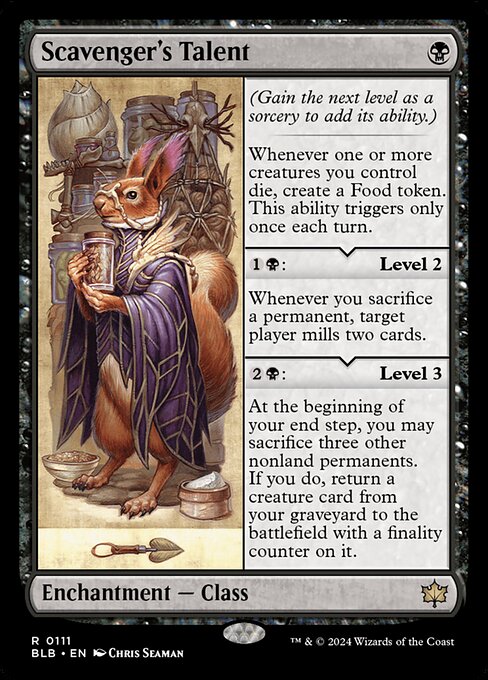 Rating7.0Good
Why this rating?
A very good rare of the format (7.0/10).
Why. A one-mana black Class that creates a Food token when one or more of your creatures die, once each turn. Level 2 mills two cards whenever you sacrifice a permanent; level 3 returns a creature from your graveyard by sacrificing three other nonland permanents.
Risks. Level 1 does not affect the board, and levels 2 and 3 are slow and expensive. The value comes slowly.
In the draft. A pick for black decks with sacrifice or a lot of Food. It is fine mid-pack, but do not count on levels 2 and 3 too early.
Results in the games of the set
When it is in hand, the deck wins 56.3% of its games (set average: 56.0%, 121st of 265 cards).
In the opening hand: 53.0% wins (55.0% on average).
Drawn during the game: 58.5% (56.6% on average).
When it is drawn, the deck wins 3.6 points more than when it is not.
When it is drafted, it is played 76% of the time (set average: 62%).
Taken as the first pick (104 drafts), it ends in the deck 80% of the time.
It is played about as much in every archetype.
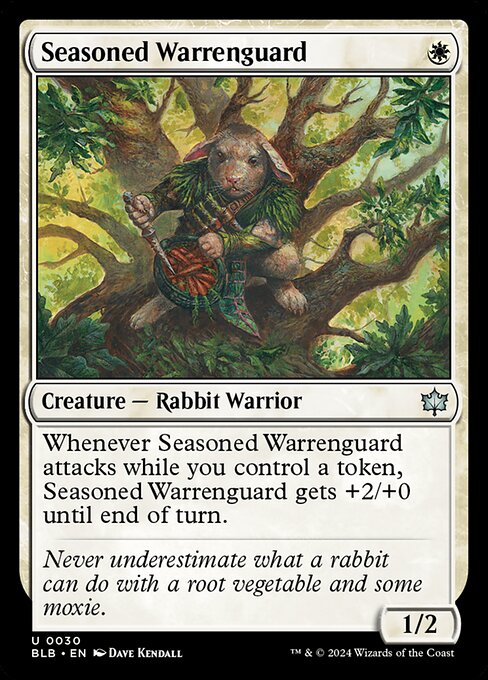 Rating7.0Good
Why this rating?
A solid uncommon of the format (7.0/10).
Why. A one-mana 1/2 that becomes 3/2 when it attacks while you control a token. Any token counts, Food, Treasure or creature, making it easy to turn on in a white tokens deck.
Risks. Without a token it is a very modest 1/2. It loses value against blockers with three or more toughness.
In the draft. A good uncommon in white token decks or with small attackers. Take it when you already have several token sources.
Results in the games of the set
When it is in hand, the deck wins 57.1% of its games (set average: 56.0%, 85th of 265 cards).
In the opening hand: 60.3% wins (55.0% on average).
Drawn during the game: 54.5% (56.6% on average).
When it is drawn, the deck wins 1.3 points more than when it is not.
When it is drafted, it is played 62% of the time (set average: 62%).
Taken as the first pick (71 drafts), it ends in the deck 85% of the time.
It is played mostly in G/W decks (40% of them).

46. Tender Wildguide
Rating7.0GoodWhy this rating?
A very good rare of the format (7.0/10).
Why. A two-mana 2/2 that taps for a mana of any colour or grows with a counter. It fixes your mana, speeds up your development, and Offspring gives you a second body later.
Risks. It must tap to act, so it waits a turn before helping, and a removal spell takes its counters with it. It is slow to become a real threat.
In the draft. A quality pick in any green deck, particularly for fixing. It fits both ramp and value decks.
Results in the games of the set
When it is in hand, the deck wins 60.9% of its games (set average: 56.0%, 21st of 265 cards).
In the opening hand: 62.1% wins (55.0% on average).
Drawn during the game: 60.0% (56.6% on average).
When it is drawn, the deck wins 8.0 points more than when it is not.
When it is drafted, it is played 92% of the time (set average: 62%).
Taken as the first pick (153 drafts), it ends in the deck 94% of the time.
It is played about as much in every archetype.
 Rating7.0Good
Why this rating?
A solid uncommon of the format (7.0/10).
Why. A three-mana 2/2 menace that makes the opponent discard when it enters. If they lost life this turn, they reveal their hand and you pick the nonland card: real card advantage and information.
Risks. If the opponent has not lost life this turn they choose their own discard. The 2/2 body is fragile.
In the draft. A very good black uncommon to take fairly high. Cast it after combat to get the full effect.
Results in the games of the set
When it is in hand, the deck wins 60.8% of its games (set average: 56.0%, 22nd of 265 cards).
In the opening hand: 61.3% wins (55.0% on average).
Drawn during the game: 60.5% (56.6% on average).
When it is drawn, the deck wins 6.3 points more than when it is not.
When it is drafted, it is played 90% of the time (set average: 62%).
Taken as the first pick (439 drafts), it ends in the deck 92% of the time.
It is played mostly in B/R decks (41% of them) and B/U (40%).
 Rating7.0Good
Why this rating?
A very good rare of the format (7.0/10).
Why. A 1/2 that looks at the top four cards of your library to take a noncreature, nonland card. With Offspring the effect triggers twice: for six mana in total you get two bodies and two looks.
Risks. The body is small, and the deck needs enough noncreature cards to find something. The doubled effect is expensive.
In the draft. A fair pick in a blue deck with many instants and sorceries. Weaker in a creature-heavy deck.
Results in the games of the set
When it is in hand, the deck wins 57.7% of its games (set average: 56.0%, 73rd of 265 cards).
In the opening hand: 55.4% wins (55.0% on average).
Drawn during the game: 59.1% (56.6% on average).
When it is drawn, the deck wins 6.1 points more than when it is not.
When it is drafted, it is played 76% of the time (set average: 62%).
Taken as the first pick (81 drafts), it ends in the deck 89% of the time.
It is played about as much in every archetype.
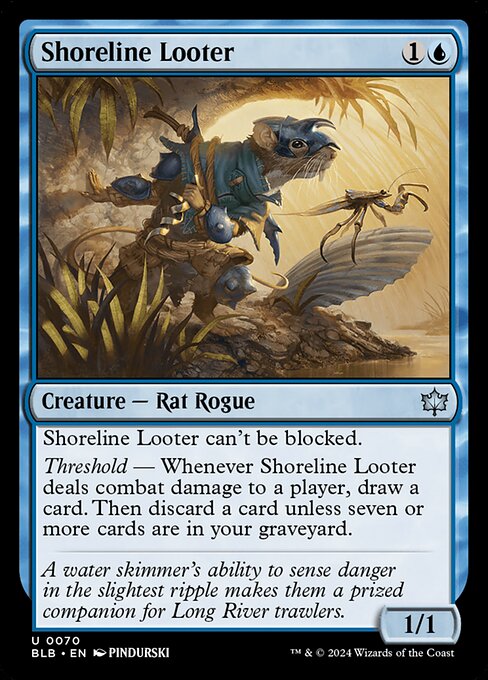
49. Shoreline Looter
Rating6.9GoodWhy this rating?
A solid uncommon of the format (6.9/10).
Why. A two-mana 1/1 that can't be blocked: it connects every turn and draws a card. Threshold removes the discard once your graveyard is full, so it gets better as the game goes on.
Risks. A 1/1 blocks poorly and dies to everything. While the graveyard is small you must discard a card after drawing.
In the draft. A very good blue uncommon for tempo or value decks. Worth taking fairly high, and easy to cast early.
Results in the games of the set
When it is in hand, the deck wins 60.4% of its games (set average: 56.0%, 26th of 265 cards).
In the opening hand: 61.9% wins (55.0% on average).
Drawn during the game: 59.4% (56.6% on average).
When it is drawn, the deck wins 8.2 points more than when it is not.
When it is drafted, it is played 81% of the time (set average: 62%).
Taken as the first pick (257 drafts), it ends in the deck 91% of the time.
It is played mostly in B/U decks (47% of them) and R/U (38%).

50. Harvestrite Host
Rating6.8GoodWhy this rating?
A solid uncommon of the format (6.8/10).
Why. A three-mana 3/3 that gives +1/+0 to a creature whenever a Rabbit enters. If that happens twice in a turn you draw a card: a solid body that can become a value engine.
Risks. Without other Rabbits it is a plain 3/3. The combat bonuses are temporary.
In the draft. A good white uncommon, especially in a deck with Rabbits. It does its job even as a simple mid-curve body.
Results in the games of the set
When it is in hand, the deck wins 59.0% of its games (set average: 56.0%, 42nd of 265 cards).
In the opening hand: 60.3% wins (55.0% on average).
Drawn during the game: 58.0% (56.6% on average).
When it is drawn, the deck wins 3.2 points more than when it is not.
When it is drafted, it is played 82% of the time (set average: 62%).
Taken as the first pick (266 drafts), it ends in the deck 89% of the time.
It is played mostly in G/W decks (46% of them) and R/W (39%).
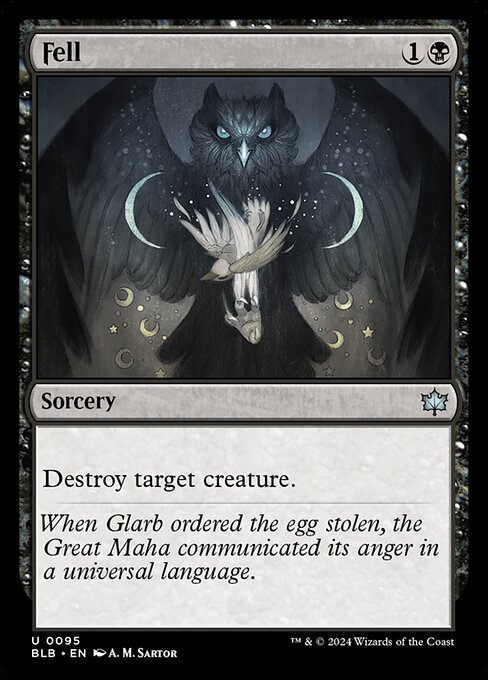
51. Fell
Rating6.8GoodWhy this rating?
A solid uncommon of the format (6.8/10).
Why. Destroys any creature for two mana. Simple and effective: a cheap removal that answers almost any threat regardless of size.
Risks. It is a sorcery, so it cannot answer on the opponent's turn. It cannot target a creature with hexproof, and ward makes it cost more.
In the draft. Take it high in any black deck. Removal of this quality does not last long in a pack.
Results in the games of the set
When it is in hand, the deck wins 59.5% of its games (set average: 56.0%, 37th of 265 cards).
In the opening hand: 57.6% wins (55.0% on average).
Drawn during the game: 60.9% (56.6% on average).
When it is drawn, the deck wins 5.9 points more than when it is not.
When it is drafted, it is played 92% of the time (set average: 62%).
Taken as the first pick (397 drafts), it ends in the deck 94% of the time.
It is played mostly in B/R decks (28% of them) and B/W (28%).
 Rating6.8Good
Why this rating?
A very good rare of the format (6.8/10).
Why. A 2/4 that adds red or green mana at the beginning of your first main phase, one for each Raccoon you control, itself included. If you spend a lot, Expend gains you 3 life, then lets you play exiled cards.
Risks. It is gold, red-green, and its mana vanishes at the end of the phase, so you must spend it right away. It costs three mana without immediate pressure.
In the draft. Play it in a red-green deck that can use the mana. Otherwise it is still a decent body.
Results in the games of the set
When it is in hand, the deck wins 58.0% of its games (set average: 56.0%, 65th of 265 cards).
In the opening hand: 60.1% wins (55.0% on average).
Drawn during the game: 56.4% (56.6% on average).
When it is drawn, the deck wins 6.3 points more than when it is not.
When it is drafted, it is played 59% of the time (set average: 62%).
Taken as the first pick (73 drafts), it ends in the deck 67% of the time.
It is played mostly in G/R decks (31% of them).

53. Patchwork Banner
Rating6.8GoodWhy this rating?
A solid uncommon of the format (6.8/10).
Why. A three-mana artifact that gives +1/+1 to your creatures of a chosen type and taps for a mana of any colour. It does the job of fixing and a team bonus in one slot.
Risks. The bonus only helps one creature type, chosen as it enters, so it is weak if your creatures are varied. It is vulnerable to artifact removal.
In the draft. A good pick in a deck with several creatures of the same type. It also helps stabilise a three-colour mana base.
Results in the games of the set
When it is in hand, the deck wins 59.0% of its games (set average: 56.0%, 41st of 265 cards).
In the opening hand: 59.5% wins (55.0% on average).
Drawn during the game: 58.7% (56.6% on average).
When it is drawn, the deck wins 4.6 points more than when it is not.
When it is drafted, it is played 92% of the time (set average: 62%).
Taken as the first pick (336 drafts), it ends in the deck 94% of the time.
It is played about as much in every archetype.
 Rating6.8Good
Why this rating?
A very good rare of the format (6.8/10).
Why. A three-mana 3/3 that adds 1 damage to every Lizard, Mouse, Otter or Raccoon you control, itself included. It hits like a 4/3 and improves all your small creatures of those types.
Risks. Only creatures of those four types benefit. Without them it is an ordinary 3/3.
In the draft. A quality pick for red decks with several of these animals. Stronger in an aggressive deck.
Results in the games of the set
When it is in hand, the deck wins 57.1% of its games (set average: 56.0%, 87th of 265 cards).
In the opening hand: 58.1% wins (55.0% on average).
Drawn during the game: 56.3% (56.6% on average).
When it is drawn, the deck wins 3.1 points more than when it is not.
When it is drafted, it is played 85% of the time (set average: 62%).
Taken as the first pick (115 drafts), it ends in the deck 88% of the time.
It is played about as much in every archetype.
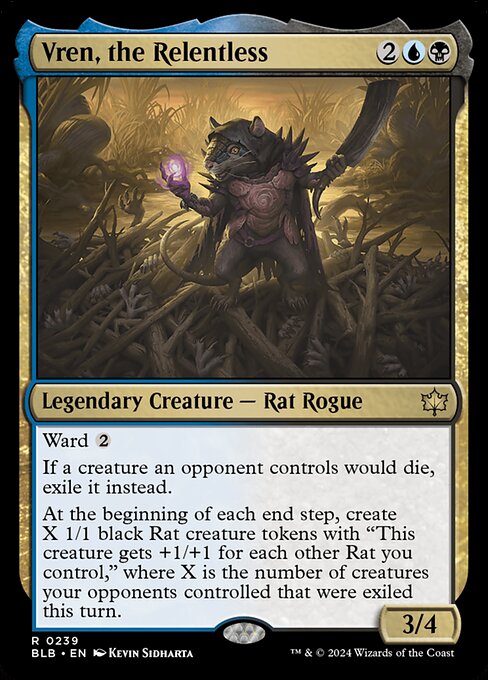 Rating6.8Good
Why this rating?
A very good rare of the format (6.8/10).
Why. A four-mana 3/4 with ward 2 that exiles opposing creatures that would die and creates, at each end step, as many black Rat creature tokens as were exiled this turn. Each Rat gets +1/+1 for each other Rat you control.
Risks. It is gold, blue-black, and only makes tokens when opposing creatures are exiled. Otherwise it is a solid 3/4.
In the draft. Take it in a blue-black deck with removal or favourable combats. It is also fine in a blue-black-green deck.
Results in the games of the set
When it is in hand, the deck wins 60.3% of its games (set average: 56.0%, 30th of 265 cards).
In the opening hand: 59.5% wins (55.0% on average).
Drawn during the game: 60.7% (56.6% on average).
When it is drawn, the deck wins 10.4 points more than when it is not.
When it is drafted, it is played 79% of the time (set average: 62%).
Taken as the first pick (155 drafts), it ends in the deck 80% of the time.
It is played mostly in B/U decks (34% of them).
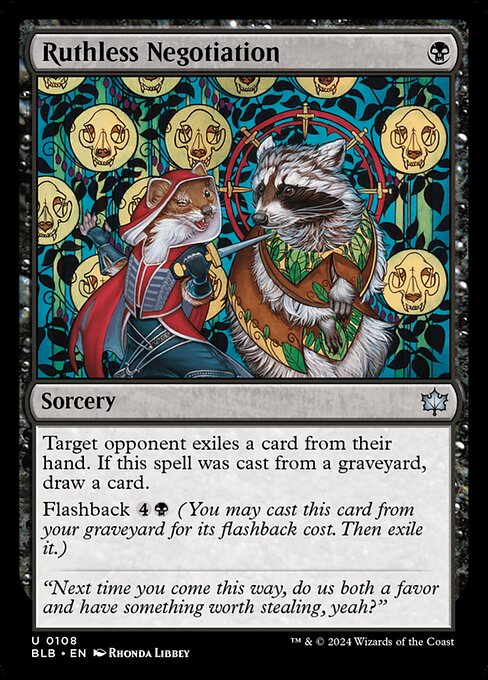 Rating6.8Good
Why this rating?
A solid uncommon of the format (6.8/10).
Why. A one-mana sorcery that makes the opponent exile a card from hand, then comes back from the graveyard with flashback to draw a card. Cheap attrition that slows the opponent a little.
Risks. The opponent chooses the card, so they lose the least useful one. Little impact on the board.
In the draft. A filler pick in a black control deck. Do not take it over your creatures and removal.
Results in the games of the set
When it is in hand, the deck wins 58.0% of its games (set average: 56.0%, 66th of 265 cards).
In the opening hand: 58.0% wins (55.0% on average).
Drawn during the game: 58.0% (56.6% on average).
When it is drawn, the deck wins 2.9 points more than when it is not.
When it is drafted, it is played 60% of the time (set average: 62%).
Taken as the first pick (73 drafts), it ends in the deck 81% of the time.
It is played mostly in B/U decks (26% of them).

57. Valley Rotcaller
Rating6.7GoodWhy this rating?
A very good rare of the format (6.7/10).
Why. A two-mana 1/3 menace that drains the opponent each attack based on your other Squirrels, Bats, Lizards and Rats. In a deck full of those types, it is a steady drain.
Risks. Alone it drains nothing and stays a small body. You must attack to trigger the effect.
In the draft. Take it in a black deck that plays many of these animals. More modest in a deck without them.
Results in the games of the set
When it is in hand, the deck wins 58.6% of its games (set average: 56.0%, 50th of 265 cards).
In the opening hand: 58.9% wins (55.0% on average).
Drawn during the game: 58.4% (56.6% on average).
When it is drawn, the deck wins 5.1 points more than when it is not.
When it is drafted, it is played 91% of the time (set average: 62%).
Taken as the first pick (133 drafts), it ends in the deck 91% of the time.
It is played about as much in every archetype.

58. Kitnap
Rating6.6GoodWhy this rating?
A very good rare of the format (6.6/10).
Why. A four-mana Aura that steals a creature of your choice from the opponent. Without the Gift the creature is tapped and gets three stun counters; with it the opponent draws and the creature stays tapped until your next untap step. Removal plus a reinforcement.
Risks. Both modes cost something: three turns of waiting or a card given away. If the creature dies you lose the card, and if the Aura leaves, it goes back to the opponent.
In the draft. A quality pick for a blue deck, counted as removal. Control decks like it especially.
Results in the games of the set
When it is in hand, the deck wins 57.5% of its games (set average: 56.0%, 77th of 265 cards).
In the opening hand: 54.6% wins (55.0% on average).
Drawn during the game: 59.2% (56.6% on average).
When it is drawn, the deck wins 6.0 points more than when it is not.
When it is drafted, it is played 82% of the time (set average: 62%).
Taken as the first pick (126 drafts), it ends in the deck 89% of the time.
It is played about as much in every archetype.
 Rating6.6Good
Why this rating?
A very good rare of the format (6.6/10).
Why. A three-mana 4/3 that turns your untapped tokens into mana, cards or counters: you tap two, three or four of them at a time. In a deck full of tokens it can draw cards and grow, but it is hard to build around.
Risks. Three colours for three mana, and it needs many tokens to act. Without them it is a 4/3 with no effect.
In the draft. Not a pick for most decks. Only take it if you are already in these three colours with tokens.
Results in the games of the set
When it is in hand, the deck wins 51.4% of its games (set average: 56.0%, 243rd of 265 cards).
In the opening hand: 49.6% wins (55.0% on average).
Drawn during the game: 52.6% (56.6% on average).
When it is drawn, the deck wins 0.4 points less than when it is not.
When it is drafted, it is played 31% of the time (set average: 62%).
Taken among the first three picks (110 drafts), it ends in the deck 58% of the time.
 Rating6.6Good
Why this rating?
A very good rare of the format (6.6/10).
Why. A three-mana 3/3 with vigilance that can return one of your creatures with lesser mana value to hand each time one of your creatures enters. That replays your enter effects, and Frogs make mana to cast creatures.
Risks. It is gold, green-blue, and bouncing costs tempo. The Frogs' mana can only be used for creatures.
In the draft. A good pick in a green-blue deck with enter effects and Frogs. Otherwise it is still a decent 3/3.
Results in the games of the set
When it is in hand, the deck wins 57.2% of its games (set average: 56.0%, 83rd of 265 cards).
In the opening hand: 54.9% wins (55.0% on average).
Drawn during the game: 58.6% (56.6% on average).
When it is drawn, the deck wins 5.2 points more than when it is not.
When it is drafted, it is played 73% of the time (set average: 62%).
Taken as the first pick (97 drafts), it ends in the deck 71% of the time.
It is played mostly in G/U decks (27% of them).
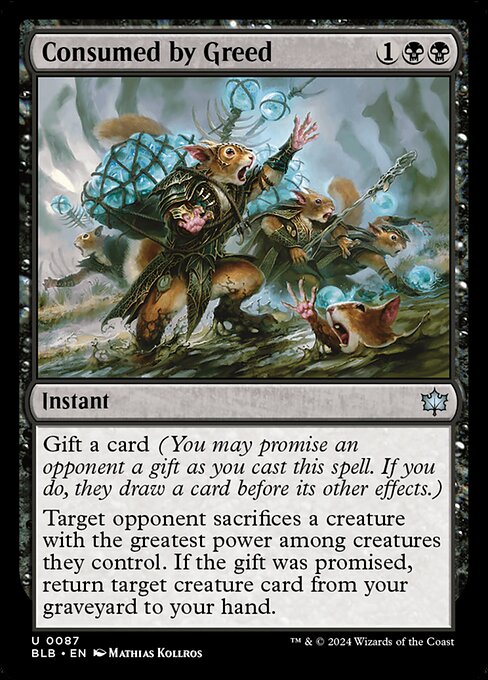 Rating6.6Good
Why this rating?
A solid uncommon of the format (6.6/10).
Why. An instant that forces the opponent to sacrifice their highest-power creature, even one with hexproof. With the Gift they draw first, but you return a creature card from your graveyard to hand.
Risks. It needs two black mana. The opponent chooses on ties, and the effect is less precise than targeted destruction.
In the draft. A good black removal to take high in the pack. Especially good against a single big threat.
Results in the games of the set
When it is in hand, the deck wins 58.8% of its games (set average: 56.0%, 47th of 265 cards).
In the opening hand: 55.9% wins (55.0% on average).
Drawn during the game: 60.7% (56.6% on average).
When it is drawn, the deck wins 4.5 points more than when it is not.
When it is drafted, it is played 89% of the time (set average: 62%).
Taken as the first pick (286 drafts), it ends in the deck 94% of the time.
It is played mostly in B/G decks (32% of them) and B/U (31%).
 Rating6.6Good
Why this rating?
A solid uncommon of the format (6.6/10).
Why. A four-mana 4/2 with flash that can kill an opposing creature that was dealt damage, or give -1/-1 to finish a small creature. Cast as an ambush after a block, it is removal and a body at once.
Risks. Two toughness makes it fragile. It needs a damaged or small target for the effect.
In the draft. A very good black uncommon to take high. Keep four mana open to use it at the best moment.
Results in the games of the set
When it is in hand, the deck wins 59.6% of its games (set average: 56.0%, 34th of 265 cards).
In the opening hand: 58.1% wins (55.0% on average).
Drawn during the game: 60.7% (56.6% on average).
When it is drawn, the deck wins 4.9 points more than when it is not.
When it is drafted, it is played 88% of the time (set average: 62%).
Taken as the first pick (323 drafts), it ends in the deck 93% of the time.
It is played mostly in B/G decks (34% of them) and B/R (34%).
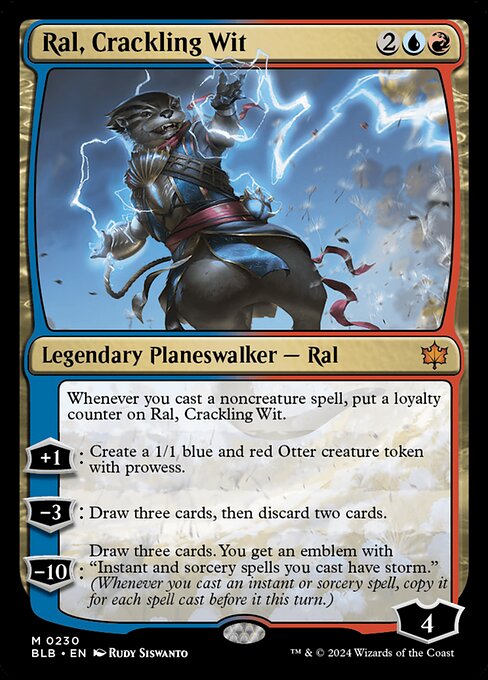 Rating6.6Good
Why this rating?
A very good mythic of the format (6.6/10).
Why. A planeswalker that makes a 1/1 blue and red Otter creature token with prowess every turn and gains a loyalty counter whenever you cast a noncreature spell. It can also draw three cards and discard two, for filtering.
Risks. It is gold, blue-red, and needs creatures to protect it. Without noncreature spells it builds up slowly.
In the draft. Take it in a blue-red deck with many instants and sorceries. Less strong in a creature deck.
Results in the games of the set
When it is in hand, the deck wins 59.5% of its games (set average: 56.0%, 36th of 265 cards).
In the opening hand: 58.6% wins (55.0% on average).
Drawn during the game: 60.1% (56.6% on average).
When it is drawn, the deck wins 11.1 points more than when it is not.
When it is drafted, it is played 70% of the time (set average: 62%).
Taken as the first pick (44 drafts), it ends in the deck 66% of the time.
It is played about as much in every archetype.
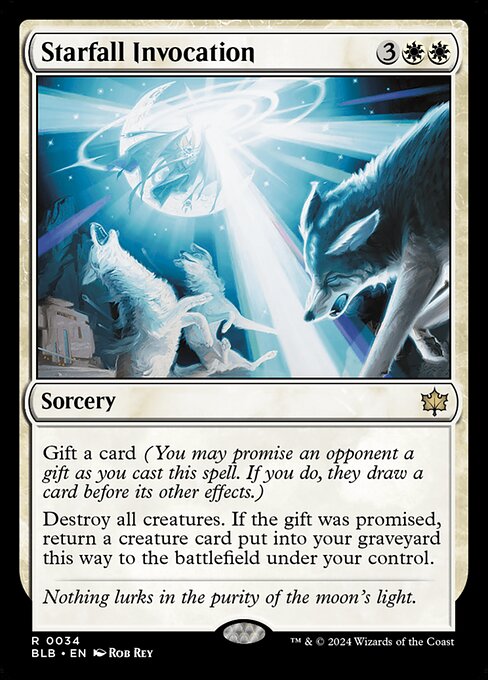 Rating6.6Good
Why this rating?
A very good rare of the format (6.6/10).
Why. A five-mana sorcery that destroys all creatures. With the Gift the opponent draws first, but you return one of your creatures destroyed this way to the battlefield, leaving you ahead after the sweep.
Risks. It also destroys your own creatures. In an aggressive deck it has no place.
In the draft. A white control pick, especially if you lack removal. Take it fairly high in a slow deck.
Results in the games of the set
When it is in hand, the deck wins 57.0% of its games (set average: 56.0%, 92nd of 265 cards).
In the opening hand: 54.6% wins (55.0% on average).
Drawn during the game: 58.6% (56.6% on average).
When it is drawn, the deck wins 4.3 points more than when it is not.
When it is drafted, it is played 79% of the time (set average: 62%).
Taken as the first pick (101 drafts), it ends in the deck 87% of the time.
It is played about as much in every archetype.
 Rating6.6Good
Why this rating?
A very good mythic of the format (6.6/10).
Why. A three-mana 3/3 menace that, on combat damage, exiles the top nonland card of your library and lets you cast it by discarding a card. It turns a card in hand into a fresh spell.
Risks. It must connect and you need a card to discard. It is gold and dies like any 3/3.
In the draft. A quality pick for aggressive black-red. Less convincing in practice than on paper.
Results in the games of the set
When it is in hand, the deck wins 54.7% of its games (set average: 56.0%, 162nd of 265 cards).
In the opening hand: 56.5% wins (55.0% on average).
Drawn during the game: 53.4% (56.6% on average).
When it is drawn, the deck wins 1.3 points more than when it is not.
When it is drafted, it is played 68% of the time (set average: 62%).
Taken as the first pick (56 drafts), it ends in the deck 70% of the time.
It is played about as much in every archetype.
 Rating6.6Good
Why this rating?
A solid uncommon of the format (6.6/10).
Why. A two-mana red-green 2/2 that taps for mana and gains a counter when you spend your fourth mana of the turn. It ramps you and becomes a real threat over time.
Risks. It is gold and must tap to make mana. A 2/2 stays fragile early.
In the draft. A good pick in a red-green deck, once you have ways to spend your mana. Take it fairly high.
Results in the games of the set
When it is in hand, the deck wins 58.4% of its games (set average: 56.0%, 54th of 265 cards).
In the opening hand: 63.0% wins (55.0% on average).
Drawn during the game: 54.7% (56.6% on average).
When it is drawn, the deck wins 5.3 points more than when it is not.
When it is drafted, it is played 53% of the time (set average: 62%).
Taken as the first pick (95 drafts), it ends in the deck 80% of the time.
It is played mostly in G/R decks (59% of them).
 Rating6.6Good
Why this rating?
A very good rare of the format (6.6/10).
Why. A four-mana 3/4 that, through Valiant, looks at the top five cards for a creature with mana value 3 or less. That creature goes onto the battlefield if it is your turn, otherwise into your hand.
Risks. You must target it with your own spells or abilities. Without that, it is a 3/4 with no effect.
In the draft. A pick for white decks with spells that target your creatures. Weaker without them.
Results in the games of the set
When it is in hand, the deck wins 56.0% of its games (set average: 56.0%, 126th of 265 cards).
In the opening hand: 55.8% wins (55.0% on average).
Drawn during the game: 56.2% (56.6% on average).
When it is drawn, the deck wins 2.2 points more than when it is not.
When it is drafted, it is played 85% of the time (set average: 62%).
Taken as the first pick (145 drafts), it ends in the deck 87% of the time.
It is played about as much in every archetype.
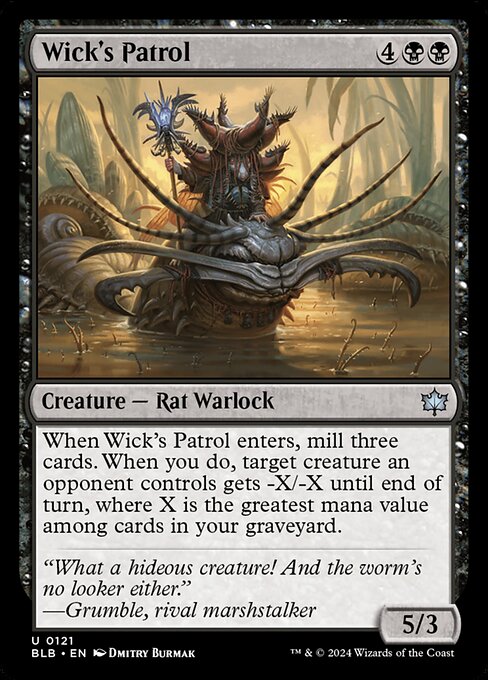
68. Wick's Patrol
Rating6.6GoodWhy this rating?
A solid uncommon of the format (6.6/10).
Why. A six-mana 5/3 that mills three cards then gives -X/-X to an opposing creature, X being the greatest mana value in your graveyard. Removal and a body in one card.
Risks. It costs two black mana and six in total. X depends on what you mill: if the graveyard holds only cheap cards or lands, X stays low.
In the draft. A very good black uncommon to take fairly high. Ideal as a top-end in a midrange deck.
Results in the games of the set
When it is in hand, the deck wins 60.3% of its games (set average: 56.0%, 29th of 265 cards).
In the opening hand: 57.8% wins (55.0% on average).
Drawn during the game: 61.9% (56.6% on average).
When it is drawn, the deck wins 6.3 points more than when it is not.
When it is drafted, it is played 87% of the time (set average: 62%).
Taken as the first pick (332 drafts), it ends in the deck 92% of the time.
It is played mostly in B/U decks (42% of them) and B/G (38%).
 Rating6.6Good
Why this rating?
A very good rare of the format (6.6/10).
Why. A token-deck sorcery: for twice X plus a green mana you copy a token X times, make all your tokens indestructible until your next turn and gain 1 life per token. After a big copy, the opponent's next attack gets very awkward.
Risks. With no tokens it does nothing. It is expensive for what it makes and depends on the best token you happen to control. If the targeted token disappears in response, the spell is lost.
In the draft. Only take it in a deck that already makes plenty of tokens. Anywhere else it stays in the sideboard.
Results in the games of the set
When it is in hand, the deck wins 45.6% of its games (set average: 56.0%, 262nd of 265 cards).
In the opening hand: 45.9% wins (55.0% on average).
Drawn during the game: 45.3% (56.6% on average).
When it is drawn, the deck wins 4.3 points less than when it is not.
When it is drafted, it is played only 9% of the time (set average: 62%): it almost always ends in the sideboard.
Taken among the first three picks (34 drafts), it ends in the deck 24% of the time.
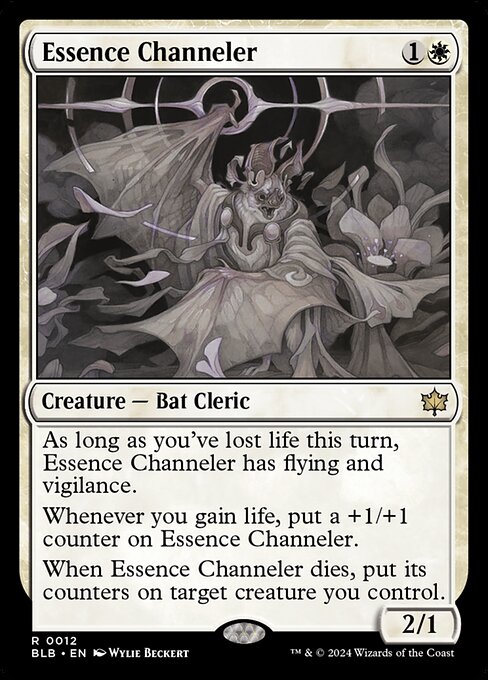 Rating6.5Good
Why this rating?
Good playable that always makes the cut (6.5/10).
Why. A two-drop that grows whenever you gain life and picks up flying and vigilance on turns you have lost life. When it dies, its counters move to another creature you control, so the value is not lost.
Risks. It stays a 2/1 unless your deck makes you lose or gain life. It dies to everything, and its counters only matter if you have another creature.
In the draft. Take it in decks that gain life regularly. Without that support it is just a small body.
Results in the games of the set
When it is in hand, the deck wins 57.0% of its games (set average: 56.0%, 90th of 265 cards).
In the opening hand: 57.8% wins (55.0% on average).
Drawn during the game: 56.4% (56.6% on average).
When it is drawn, the deck wins 4.5 points more than when it is not.
When it is drafted, it is played 77% of the time (set average: 62%).
Taken as the first pick (89 drafts), it ends in the deck 85% of the time.
It is played about as much in every archetype.
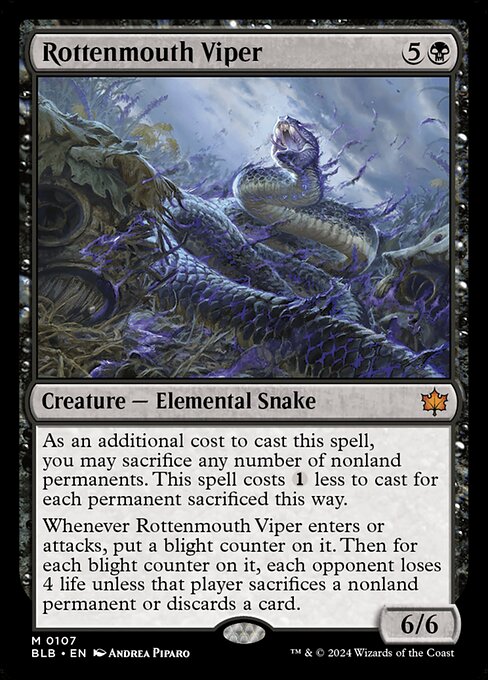 Rating6.4Good
Why this rating?
Good playable that always makes the cut (6.4/10).
Why. A 6/6 that can cost much less if you sacrifice nonland permanents. It gets a counter when it enters and each time it attacks, and for each counter every opponent must lose 4 life, sacrifice a nonland permanent or discard a card. The pressure climbs with every attack.
Risks. It costs six mana with no sacrifice, so it comes down late. The opponent can pay by discarding a spare card, and removal before the attack stops the snowball.
In the draft. A good black finisher, with or without sacrifice. Tokens or Food to sacrifice let you cast it earlier.
Results in the games of the set
When it is in hand, the deck wins 59.2% of its games (set average: 56.0%, 40th of 265 cards).
In the opening hand: 57.2% wins (55.0% on average).
Drawn during the game: 60.4% (56.6% on average).
When it is drawn, the deck wins 6.6 points more than when it is not.
When it is drafted, it is played 93% of the time (set average: 62%).
Taken as the first pick (45 drafts), it ends in the deck 82% of the time.
It is played about as much in every archetype.
 Rating6.4Good
Why this rating?
Good playable that always makes the cut (6.4/10).
Why. A one-mana 1/1 that draws a card for 1 life, but only on turns when three cards left your graveyard or you sacrificed a Food. Forage meets the condition every time, and it can then draw each turn.
Risks. Without Food or forage it never draws, and it must wait a turn after arriving before it can tap. A 1/1 is fragile.
In the draft. Take it in a black-green deck with Food and forage effects, where it is very good. Elsewhere it is a small body with no effect.
Results in the games of the set
When it is in hand, the deck wins 56.5% of its games (set average: 56.0%, 109th of 265 cards).
In the opening hand: 57.7% wins (55.0% on average).
Drawn during the game: 55.7% (56.6% on average).
When it is drawn, the deck wins 2.4 points more than when it is not.
When it is drafted, it is played 59% of the time (set average: 62%).
Taken as the first pick (67 drafts), it ends in the deck 78% of the time.
It is played mostly in B/G decks (51% of them).
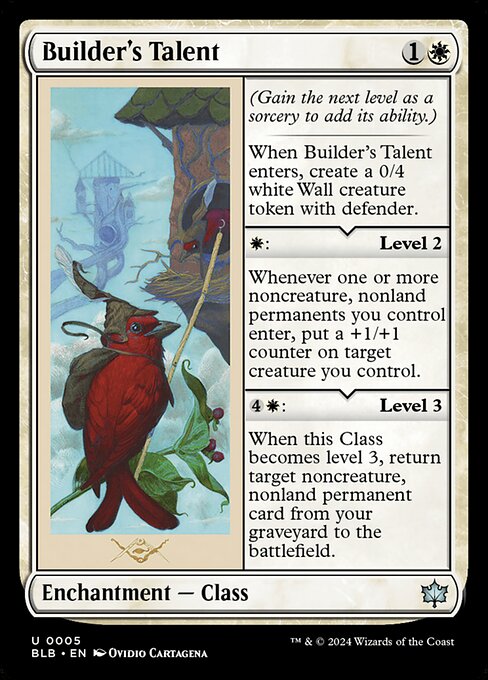
73. Builder's Talent
Rating6.4GoodWhy this rating?
Good playable that always makes the cut (6.4/10).
Why. A Class that gives a 0/4 white Wall token with defender at level 1, a solid blocker on turn 2. Level 2 puts a +1/+1 counter on one of your creatures whenever a noncreature, nonland permanent of yours enters, and level 3 returns one from your graveyard to the battlefield.
Risks. Level 1 alone is modest and level 3 costs five mana. Levels 2 and 3 depend on a deck with enchantments, artifacts or Food.
In the draft. A good card for a patient white deck, not a first pick. Play it with plenty of noncreature permanents to use the levels.
Results in the games of the set
When it is in hand, the deck wins 56.8% of its games (set average: 56.0%, 97th of 265 cards).
In the opening hand: 56.1% wins (55.0% on average).
Drawn during the game: 57.3% (56.6% on average).
When it is drawn, the deck wins 3.5 points more than when it is not.
When it is drafted, it is played 60% of the time (set average: 62%).
Taken as the first pick (113 drafts), it ends in the deck 77% of the time.
It is played about as much in every archetype.

74. Dour Port-Mage
Rating6.4GoodWhy this rating?
Good playable that always makes the cut (6.4/10).
Why. A two-drop with a simple engine: for two mana you tap it to return another creature you control to hand, and you draw a card because that creature left the battlefield without dying. In response to removal, it also saves your creature.
Risks. It does nothing alone, and the engine costs mana every turn. A 1/3 is easy to kill or attack past.
In the draft. Take it in a blue deck with creatures that have enter effects. Without those targets it is a small body.
Results in the games of the set
When it is in hand, the deck wins 58.5% of its games (set average: 56.0%, 53rd of 265 cards).
In the opening hand: 57.6% wins (55.0% on average).
Drawn during the game: 59.0% (56.6% on average).
When it is drawn, the deck wins 7.1 points more than when it is not.
When it is drafted, it is played 84% of the time (set average: 62%).
Taken as the first pick (122 drafts), it ends in the deck 86% of the time.
It is played mostly in G/U decks (25% of them).
 Rating6.4Good
Why this rating?
Good playable that always makes the cut (6.4/10).
Why. A flash Aura that draws a card when it enters and gives +1/+0 and flying. In combat it wins a trade by giving an attacker flying or dodging a blocker, and it does not cost you a card.
Risks. If the targeted creature is killed in response, the Aura never enters, so you lose it and the card it would have drawn. It is useless without a creature to enchant.
In the draft. A card for an aggressive white deck, fine at a mid pick. Play it with creatures that benefit from flying.
Results in the games of the set
When it is in hand, the deck wins 57.1% of its games (set average: 56.0%, 86th of 265 cards).
In the opening hand: 55.7% wins (55.0% on average).
Drawn during the game: 58.1% (56.6% on average).
When it is drawn, the deck wins 2.0 points more than when it is not.
When it is drafted, it is played 73% of the time (set average: 62%).
Taken as the first pick (100 drafts), it ends in the deck 88% of the time.
It is played mostly in R/W decks (29% of them).

76. Feed the Cycle
Rating6.4GoodWhy this rating?
Good playable that always makes the cut (6.4/10).
Why. An instant-speed removal that destroys a creature or planeswalker. If you forage you cast it for two mana; otherwise it costs three, two of them black. Either way it is clean, unconditional removal.
Risks. Foraging needs a full graveyard or a Food, so early in the game you usually pay the extra mana. It is one-for-one with no side effect.
In the draft. A black removal spell worth taking fairly high. The more your deck forages, the better it gets.
Results in the games of the set
When it is in hand, the deck wins 58.6% of its games (set average: 56.0%, 51st of 265 cards).
In the opening hand: 56.2% wins (55.0% on average).
Drawn during the game: 60.2% (56.6% on average).
When it is drawn, the deck wins 4.9 points more than when it is not.
When it is drafted, it is played 90% of the time (set average: 62%).
Taken as the first pick (353 drafts), it ends in the deck 94% of the time.
It is played mostly in B/U decks (29% of them) and B/G (28%).
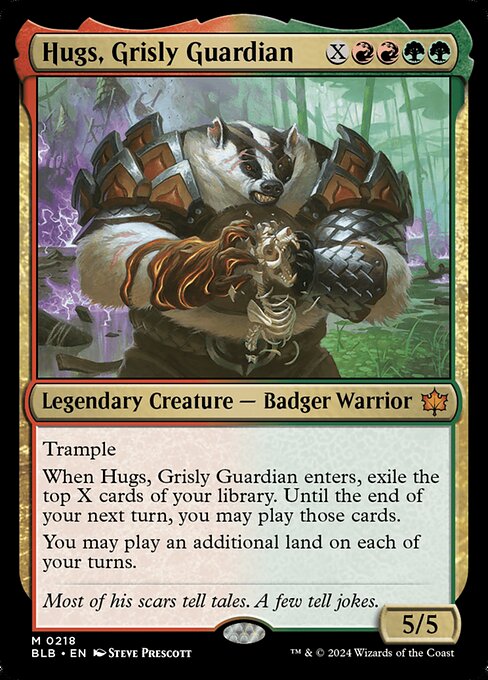 Rating6.4Good
Why this rating?
Good playable that always makes the cut (6.4/10).
Why. A 5/5 trampler for four mana that also gives you extra cards: pay X to exile the top X cards of your library and play them until the end of your next turn. It also lets you play an additional land each turn.
Risks. It needs two red and two green mana, so both colours must be in place. Exiled cards are lost if you cannot play them in time.
In the draft. A good card for a red-green deck. With enough lands, the effect gets stronger the larger X is.
Results in the games of the set
When it is in hand, the deck wins 58.4% of its games (set average: 56.0%, 56th of 265 cards).
In the opening hand: 56.6% wins (55.0% on average).
Drawn during the game: 59.6% (56.6% on average).
When it is drawn, the deck wins 7.0 points more than when it is not.
When it is drafted, it is played 60% of the time (set average: 62%).
Taken as the first pick (35 drafts), it ends in the deck 69% of the time.
It is played about as much in every archetype.

78. Lumra, Bellow of the Woods
Rating6.4GoodWhy this rating?
Good playable that always makes the cut (6.4/10).
Why. A big creature with reach and vigilance whose power and toughness equal the number of lands you control. When it enters you mill four, then every land card in your graveyard returns tapped, so it can arrive huge.
Risks. It costs six mana and is a one-shot: removal takes it. Your land count decides its size, and the milled cards are random.
In the draft. A solid green finisher, all the better when lands are already in the graveyard.
Results in the games of the set
When it is in hand, the deck wins 59.8% of its games (set average: 56.0%, 33rd of 265 cards).
In the opening hand: 57.7% wins (55.0% on average).
Drawn during the game: 61.1% (56.6% on average).
When it is drawn, the deck wins 7.6 points more than when it is not.
When it is drafted, it is played 91% of the time (set average: 62%).
Taken as the first pick (69 drafts), it ends in the deck 90% of the time.
It is played about as much in every archetype.

79. Rabid Gnaw
Rating6.4GoodWhy this rating?
Good playable that always makes the cut (6.4/10).
Why. A two-mana instant-speed removal: your creature gets +1/+0, then deals damage equal to its power to a creature you do not control. Your creature takes no damage back.
Risks. You need a creature, and it needs enough power. If the opponent kills your creature in response, the spell does nothing.
In the draft. A good red removal spell, worth taking fairly high. The more big creatures your deck has, the better it works.
Results in the games of the set
When it is in hand, the deck wins 58.4% of its games (set average: 56.0%, 55th of 265 cards).
In the opening hand: 57.8% wins (55.0% on average).
Drawn during the game: 58.9% (56.6% on average).
When it is drawn, the deck wins 4.5 points more than when it is not.
When it is drafted, it is played 84% of the time (set average: 62%).
Taken as the first pick (224 drafts), it ends in the deck 92% of the time.
It is played mostly in B/R decks (37% of them) and G/R (37%).

80. Jackdaw Savior
Rating6.3GoodWhy this rating?
Good playable that always makes the cut (6.3/10).
Why. A 3/1 flier for three: when it or another flying creature you control dies, another creature card of lesser mana value comes back from your graveyard to the battlefield. It fits a deck of fliers and returns value after a trade.
Risks. With 1 toughness it dies easily. The target must have a strictly lower mana value than the creature that died, so small fliers bring back little.
In the draft. A good card for a white deck with several fliers. It shines when the deck also has good creatures to bring back.
Results in the games of the set
When it is in hand, the deck wins 56.5% of its games (set average: 56.0%, 108th of 265 cards).
In the opening hand: 55.3% wins (55.0% on average).
Drawn during the game: 57.4% (56.6% on average).
When it is drawn, the deck wins 2.7 points more than when it is not.
When it is drafted, it is played 85% of the time (set average: 62%).
Taken as the first pick (128 drafts), it ends in the deck 89% of the time.
It is played about as much in every archetype.
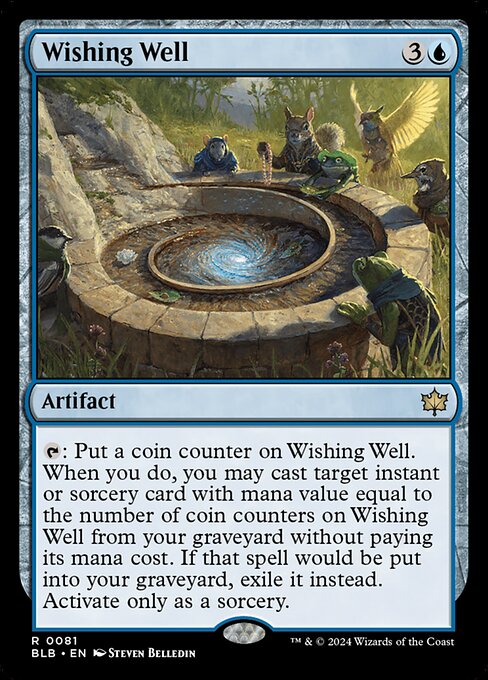
81. Wishing Well
Rating6.3GoodWhy this rating?
Good playable that always makes the cut (6.3/10).
Why. An artifact that casts an instant or sorcery from your graveyard for free, with mana value equal to its number of coin counters. Each activation adds one, so it starts with one-mana spells and moves up a step every time.
Risks. It costs four mana and only activates at sorcery speed. The counter is added even with no target, so you need instants and sorceries spread across the right mana values or activations are wasted.
In the draft. A card for a blue deck with many instants and sorceries. In other decks, leave it.
Results in the games of the set
When it is in hand, the deck wins 56.6% of its games (set average: 56.0%, 106th of 265 cards).
In the opening hand: 50.2% wins (55.0% on average).
Drawn during the game: 60.0% (56.6% on average).
When it is drawn, the deck wins 5.5 points more than when it is not.
When it is drafted, it is played only 7% of the time (set average: 62%): it almost always ends in the sideboard.
Taken among the first three picks (32 drafts), it ends in the deck 41% of the time.
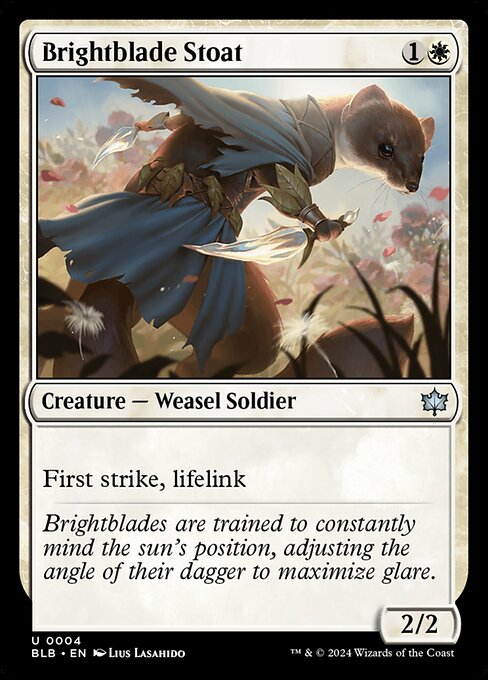 Rating6.2Good
Why this rating?
Good playable that always makes the cut (6.2/10).
Why. A two-mana 2/2 with first strike and lifelink. It blocks small creatures well, attacks early without fearing trades and gains life with every hit.
Risks. It is still a 2/2 that dies to any removal. It loses value against bigger creatures or fliers.
In the draft. A good white two-drop, an easy pick in a deck that wants to attack or gain life. It is always playable in white.
Results in the games of the set
When it is in hand, the deck wins 57.9% of its games (set average: 56.0%, 69th of 265 cards).
In the opening hand: 59.9% wins (55.0% on average).
Drawn during the game: 56.2% (56.6% on average).
When it is drawn, the deck wins 3.5 points more than when it is not.
When it is drafted, it is played 88% of the time (set average: 62%).
Taken as the first pick (260 drafts), it ends in the deck 94% of the time.
It is played mostly in U/W decks (29% of them) and B/W (28%).
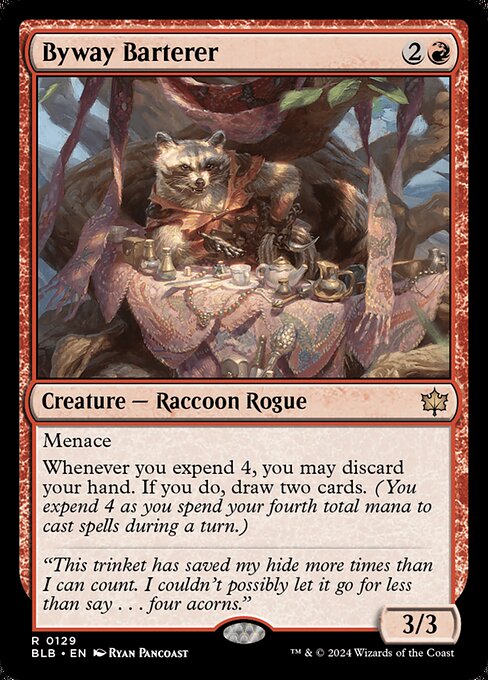
83. Byway Barterer
Rating6.2GoodWhy this rating?
Good playable that always makes the cut (6.2/10).
Why. A three-mana 3/3 with menace, already a good body. Expend 4 lets you discard your hand to draw two, useful when your hand is empty or weak late in the game.
Risks. The effect is optional but costly if you are holding good cards. You must spend four mana on spells in a turn to trigger it.
In the draft. A good red creature, playable in almost any red deck. Play it even without synergy: the body is enough.
Results in the games of the set
When it is in hand, the deck wins 56.9% of its games (set average: 56.0%, 96th of 265 cards).
In the opening hand: 56.8% wins (55.0% on average).
Drawn during the game: 57.0% (56.6% on average).
When it is drawn, the deck wins 3.0 points more than when it is not.
When it is drafted, it is played 83% of the time (set average: 62%).
Taken as the first pick (109 drafts), it ends in the deck 86% of the time.
It is played about as much in every archetype.

84. Heirloom Epic
Rating6.2GoodWhy this rating?
Good playable that always makes the cut (6.2/10).
Why. A one-mana artifact that draws a card for four mana, each of which can be paid by tapping an untapped creature instead. It gives a steady source of cards in a slow deck, or in a deck with many small creatures going unused.
Risks. It is costly to activate, and only at sorcery speed. Creatures tapped to pay for it cannot block on the opponent's turn.
In the draft. A filler card for long games. Take it late, mainly in a defensive deck with many small creatures.
Results in the games of the set
When it is in hand, the deck wins 53.8% of its games (set average: 56.0%, 193rd of 265 cards).
In the opening hand: 52.8% wins (55.0% on average).
Drawn during the game: 54.5% (56.6% on average).
When it is drawn, the deck wins 1.1 points less than when it is not.
When it is drafted, it is played 27% of the time (set average: 62%).
Taken among the first three picks (53 drafts), it ends in the deck 70% of the time.
 Rating6.2Good
Why this rating?
Good playable that always makes the cut (6.2/10).
Why. A three-mana 1/3 that, every time you cast a creature spell with mana value 4 or more, draws a card, gains you 1 life and grows by a counter. It also makes mana for those big creatures, which speeds up the top of your curve.
Risks. It needs three colours. At 1 power it makes little mana to start, and it is slow until you have big creatures.
In the draft. A card for a three-colour deck with many big creatures. Outside that setup it is too hard to cast.
Results in the games of the set
When it is in hand, the deck wins 54.3% of its games (set average: 56.0%, 176th of 265 cards).
In the opening hand: 53.1% wins (55.0% on average).
Drawn during the game: 55.1% (56.6% on average).
When it is drawn, the deck wins 6.0 points more than when it is not.
When it is drafted, it is played 34% of the time (set average: 62%).
Taken among the first three picks (75 drafts), it ends in the deck 45% of the time.

86. Mockingbird
Rating6.2GoodWhy this rating?
Good playable that always makes the cut (6.2/10).
Why. A 1/1 flier that can enter as a copy of a creature on the battlefield whose mana value is at most the mana spent, which is X plus one blue mana. You pick the strongest creature within reach, and the copy keeps flying on top.
Risks. If the battlefield is empty or the creatures are small, you get a weak 1/1. Copying a big creature costs a lot of mana.
In the draft. A flexible blue card, good once you can pay enough. Keep it for the late game rather than casting it too early.
Results in the games of the set
When it is in hand, the deck wins 56.7% of its games (set average: 56.0%, 103rd of 265 cards).
In the opening hand: 53.0% wins (55.0% on average).
Drawn during the game: 58.8% (56.6% on average).
When it is drawn, the deck wins 5.4 points more than when it is not.
When it is drafted, it is played 85% of the time (set average: 62%).
Taken as the first pick (112 drafts), it ends in the deck 89% of the time.
It is played about as much in every archetype.
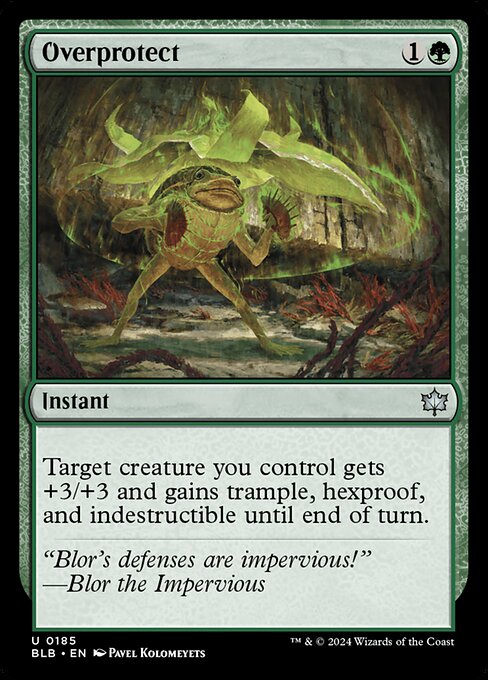
87. Overprotect
Rating6.2GoodWhy this rating?
Good playable that always makes the cut (6.2/10).
Why. A two-mana instant that gives +3/+3, trample, hexproof and indestructible. It saves your creature from removal or wins a combat, and can even finish the game on offence.
Risks. If the opponent answers with removal before it resolves you lose both cards. You also need a creature worth protecting.
In the draft. A good green protection spell, worth taking fairly high. Play it with key creatures you want to keep alive.
Results in the games of the set
When it is in hand, the deck wins 58.2% of its games (set average: 56.0%, 60th of 265 cards).
In the opening hand: 55.6% wins (55.0% on average).
Drawn during the game: 59.8% (56.6% on average).
When it is drawn, the deck wins 4.2 points more than when it is not.
When it is drafted, it is played 89% of the time (set average: 62%).
Taken as the first pick (227 drafts), it ends in the deck 94% of the time.
It is played mostly in G/R decks (28% of them) and G/U (27%).
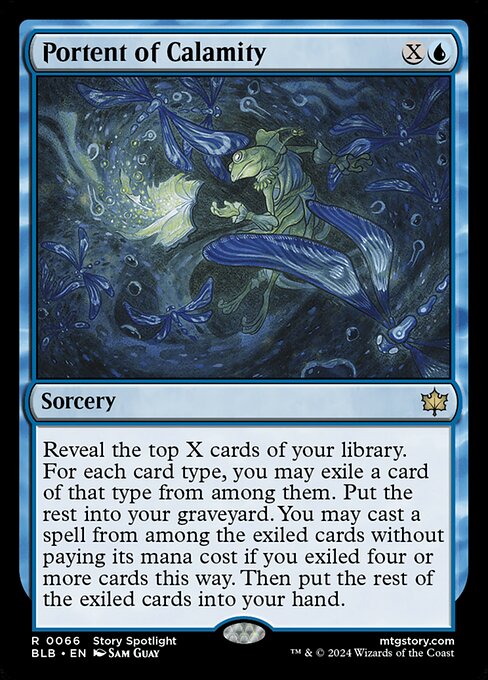 Rating6.2Good
Why this rating?
Good playable that always makes the cut (6.2/10).
Why. A variable-X sorcery: you reveal the top X cards, exile one per card type, put the rest in your graveyard, then put the exiled cards in your hand. If you exile four or more, you also cast one of the exiled spells for free.
Risks. To really pay off it needs a high cost and varied card types in your library. Cards put into the graveyard are lost if your deck gets nothing from them.
In the draft. A specialised card, weak in an ordinary deck. Only take it in a deliberately built graveyard deck; otherwise leave it.
Results in the games of the set
When it is in hand, the deck wins 52.8% of its games (set average: 56.0%, 218th of 265 cards).
In the opening hand: 49.0% wins (55.0% on average).
Drawn during the game: 55.0% (56.6% on average).
When it is drawn, the deck wins 2.8 points more than when it is not.
When it is drafted, it is played 21% of the time (set average: 62%).
Taken among the first three picks (61 drafts), it ends in the deck 62% of the time.

89. Repel Calamity
Rating6.2GoodWhy this rating?
Good playable that always makes the cut (6.2/10).
Why. A two-mana instant-speed removal that destroys a creature with power or toughness 4 or greater. It takes out the big threats at a very low price.
Risks. It cannot hit small creatures, so it is dead against a deck of small attackers. Its condition makes it less flexible than unconditional removal.
In the draft. A good white removal spell, worth taking fairly high when you lack answers to big creatures. Avoid playing too many.
Results in the games of the set
When it is in hand, the deck wins 57.1% of its games (set average: 56.0%, 88th of 265 cards).
In the opening hand: 56.1% wins (55.0% on average).
Drawn during the game: 57.7% (56.6% on average).
When it is drawn, the deck wins 2.7 points more than when it is not.
When it is drafted, it is played 83% of the time (set average: 62%).
Taken as the first pick (146 drafts), it ends in the deck 93% of the time.
It is played mostly in U/W decks (25% of them).

90. Salvation Swan
Rating6.2GoodWhy this rating?
Good playable that always makes the cut (6.2/10).
Why. A 3/3 flash flier for four mana that can also exile one of your creatures without flying and return it with a flying counter at the end of the turn. This saves the creature from removal or gives it its enter effect again.
Risks. The creature only comes back at end of turn, so it is not around to block or attack before then. You need creatures without flying in play to benefit.
In the draft. A good white card, flexible thanks to flash. Play it with creatures that have enter effects to get the most out of it.
Results in the games of the set
When it is in hand, the deck wins 56.8% of its games (set average: 56.0%, 99th of 265 cards).
In the opening hand: 54.6% wins (55.0% on average).
Drawn during the game: 58.3% (56.6% on average).
When it is drawn, the deck wins 3.4 points more than when it is not.
When it is drafted, it is played 88% of the time (set average: 62%).
Taken as the first pick (127 drafts), it ends in the deck 90% of the time.
It is played about as much in every archetype.

91. Tangle Tumbler
Rating6.2GoodWhy this rating?
Good playable that always makes the cut (6.2/10).
Why. A 6/6 Vehicle with vigilance that becomes an artifact creature until end of turn by tapping two of your tokens. For three mana it can also put a +1/+1 counter on a creature, making it a useful mana sink even without tokens.
Risks. It needs tokens to attack or block. Without them it only makes counters, slowly. Tapping two tokens costs tempo.
In the draft. A card for a deck with plenty of tokens. In other decks, only take it late.
Results in the games of the set
When it is in hand, the deck wins 53.8% of its games (set average: 56.0%, 191st of 265 cards).
In the opening hand: 52.6% wins (55.0% on average).
Drawn during the game: 54.7% (56.6% on average).
When it is drawn, the deck wins 0.7 points less than when it is not.
When it is drafted, it is played 28% of the time (set average: 62%).
Taken among the first three picks (86 drafts), it ends in the deck 64% of the time.
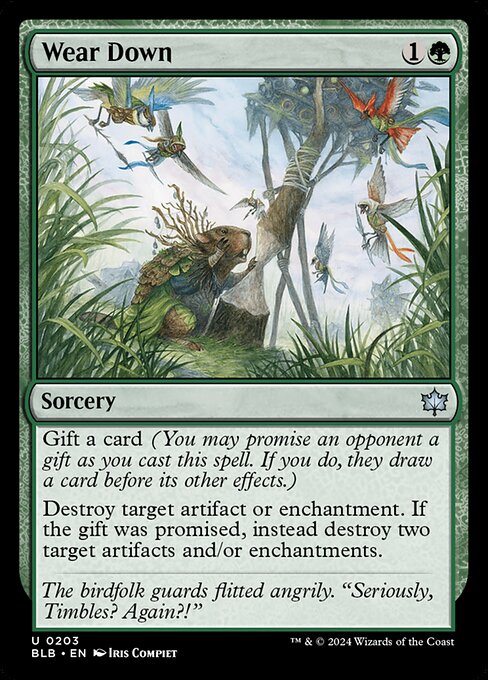
92. Wear Down
Rating6.2GoodWhy this rating?
Good playable that always makes the cut (6.2/10).
Why. A two-mana sorcery that destroys an artifact or enchantment, or two if you promise a Gift (the opponent draws a card). It answers a specific threat and nothing else.
Risks. It is dead most of the time. Against a deck without good artifacts or enchantments it is a wasted card. The Gift gives the opponent a card.
In the draft. A sideboard card: do not play it main deck. Only take it if you have seen specific targets.
Results in the games of the set
When it is in hand, the deck wins 44.7% of its games (set average: 56.0%, 264th of 265 cards).
In the opening hand: 41.4% wins (55.0% on average).
Drawn during the game: 46.6% (56.6% on average).
When it is drawn, the deck wins 4.5 points less than when it is not.
When it is drafted, it is played only 2% of the time (set average: 62%): it almost always ends in the sideboard.
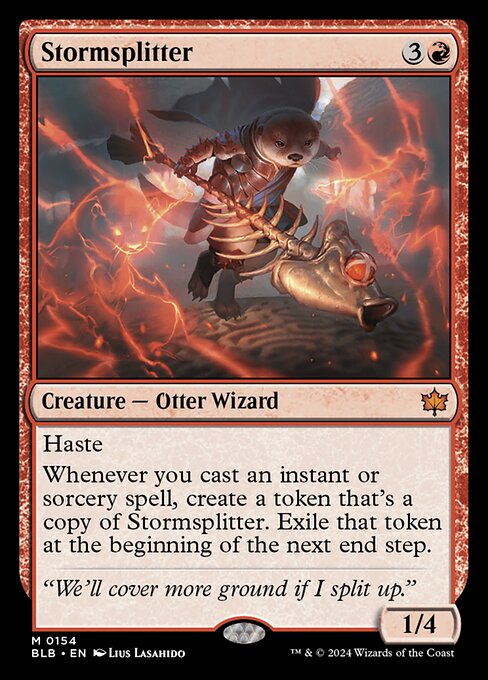
93. Stormsplitter
Rating6.1PlayableWhy this rating?
Good playable that always makes the cut (6.1/10).
Why. A 1/4 with haste that creates a token copy of itself whenever you cast an instant or sorcery, exiled at the beginning of the next end step. In a spell-heavy deck it can make many copies, which themselves trigger the ability.
Risks. It needs lots of instants and sorceries, and a lone 1/4 does little. The tokens vanish at end of turn, so the gain is temporary.
In the draft. A very specialised card that demands many spells. In other decks it is weak. Do not take it early.
Results in the games of the set
When it is in hand, the deck wins 42.8% of its games (set average: 56.0%, 265th of 265 cards).
In the opening hand: 40.9% wins (55.0% on average).
Drawn during the game: 43.9% (56.6% on average).
When it is drawn, the deck wins 7.6 points less than when it is not.
When it is drafted, it is played 17% of the time (set average: 62%).
Taken among the first three picks (47 drafts), it ends in the deck 38% of the time.
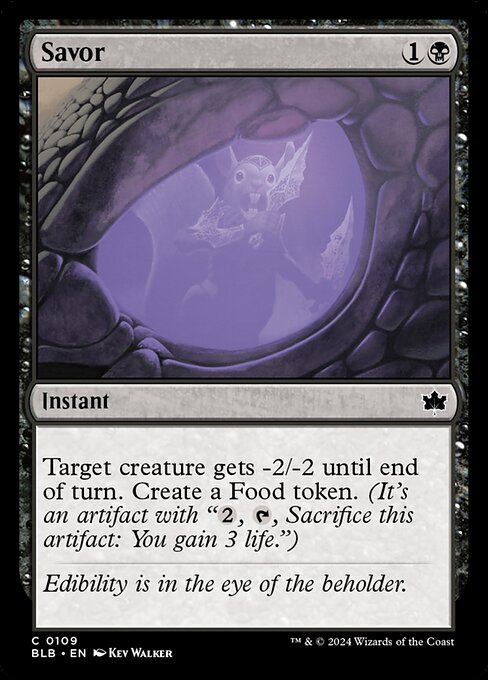
94. Savor
Rating6.0PlayableWhy this rating?
Good playable that always makes the cut (6.1/10).
Why. A two-mana instant that gives -2/-2 to a creature and makes a Food. It kills many small creatures and leaves you an artifact that gains life or feeds forage.
Risks. It does not kill big creatures, and -2/-2 is limited. Its value depends on what the opponent plays.
In the draft. A good black common removal spell, worth taking fairly high. It is best in a deck that forages or sacrifices Food.
Results in the games of the set
When it is in hand, the deck wins 59.3% of its games (set average: 56.0%, 39th of 265 cards).
In the opening hand: 58.1% wins (55.0% on average).
Drawn during the game: 60.1% (56.6% on average).
When it is drawn, the deck wins 4.9 points more than when it is not.
When it is drafted, it is played 89% of the time (set average: 62%).
Taken as the first pick (666 drafts), it ends in the deck 94% of the time.
It is played mostly in B/U decks (71% of them) and B/G (64%).
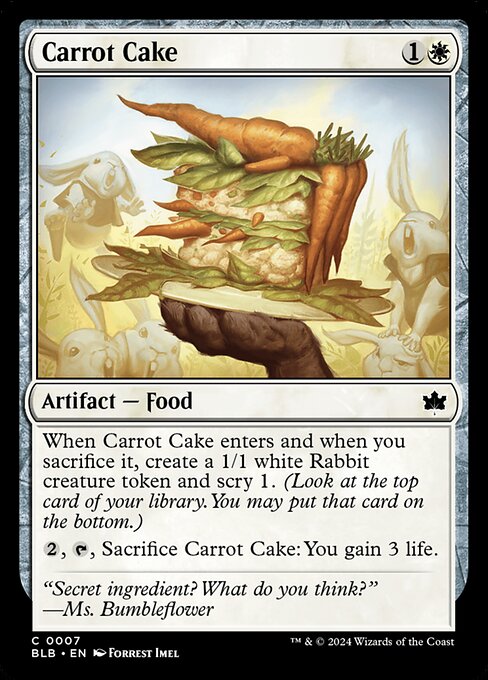
95. Carrot Cake
Rating6.0PlayableWhy this rating?
Good playable that always makes the cut (6.0/10).
Why. A Food that creates a 1/1 white Rabbit creature token and scry 1 when it enters, then another Rabbit and scry when you sacrifice it. Two mana gets one body and selection; two more to sacrifice it gets a second body, a second scry and 3 life.
Risks. A small 1/1 is not very threatening. To get the second Rabbit you must pay two more mana, or sacrifice the Food some other way.
In the draft. A good white common for a token or Food deck. It fills the curve and makes foraging cheap.
Results in the games of the set
When it is in hand, the deck wins 58.3% of its games (set average: 56.0%, 59th of 265 cards).
In the opening hand: 57.3% wins (55.0% on average).
Drawn during the game: 59.1% (56.6% on average).
When it is drawn, the deck wins 2.8 points more than when it is not.
When it is drafted, it is played 84% of the time (set average: 62%).
Taken as the first pick (479 drafts), it ends in the deck 92% of the time.
It is played mostly in G/W decks (81% of them) and B/W (69%).

96. Daring Waverider
Rating6.0PlayableWhy this rating?
Good playable that always makes the cut (6.0/10).
Why. A six-mana 4/4 that casts an instant or sorcery with mana value 4 or less from your graveyard for free. It is a 4/4 and a spell in one, and can replay your best removal.
Risks. It costs six mana and is just a 4/4 if your graveyard has no good spell. The spell you cast is exiled instead of going to the graveyard.
In the draft. A good blue top-end card for a deck with several instants and sorceries. One copy is enough.
Results in the games of the set
When it is in hand, the deck wins 57.4% of its games (set average: 56.0%, 79th of 265 cards).
In the opening hand: 52.6% wins (55.0% on average).
Drawn during the game: 59.9% (56.6% on average).
When it is drawn, the deck wins 5.6 points more than when it is not.
When it is drafted, it is played 58% of the time (set average: 62%).
Taken as the first pick (106 drafts), it ends in the deck 80% of the time.
It is played mostly in R/U decks (41% of them) and B/U (40%).

97. Fabled Passage
Rating6.0PlayableWhy this rating?
Good playable that always makes the cut (6.0/10).
Why. A fixing land that you sacrifice to search for a basic land and put it onto the battlefield tapped, then untaps it if you control four or more lands. It helps fix your colours and stabilises a two-colour base.
Risks. Before your fourth land, the basic enters tapped, so you gain no mana that turn.
In the draft. A good land in a two- or three-colour deck. It also sends a card to the graveyard, which helps Threshold.
Results in the games of the set
When it is in hand, the deck wins 56.2% of its games (set average: 56.0%, 123rd of 265 cards).
In the opening hand: 56.7% wins (55.0% on average).
Drawn during the game: 55.7% (56.6% on average).
When it is drawn, the deck wins 1.7 points more than when it is not.
When it is drafted, it is played 97% of the time (set average: 62%).
Taken as the first pick (70 drafts), it ends in the deck 100% of the time.

98. Flamecache Gecko
Rating6.0PlayableWhy this rating?
Good playable that always makes the cut (6.0/10).
Why. A two-mana 2/2 that adds a black and a red mana when it enters if an opponent lost life this turn. You can cast another spell right away, and discard a spare card to draw a fresh one.
Risks. If the opponent has not lost life, it is just a 2/2. The discard ability costs two mana each use.
In the draft. A good two-drop for an aggressive red-black deck. Cast it after combat, once the opponent has lost life.
Results in the games of the set
When it is in hand, the deck wins 56.3% of its games (set average: 56.0%, 118th of 265 cards).
In the opening hand: 56.9% wins (55.0% on average).
Drawn during the game: 55.9% (56.6% on average).
When it is drawn, the deck wins 0.8 points more than when it is not.
When it is drafted, it is played 75% of the time (set average: 62%).
Taken as the first pick (129 drafts), it ends in the deck 90% of the time.
It is played mostly in B/R decks (51% of them) and G/R (29%).
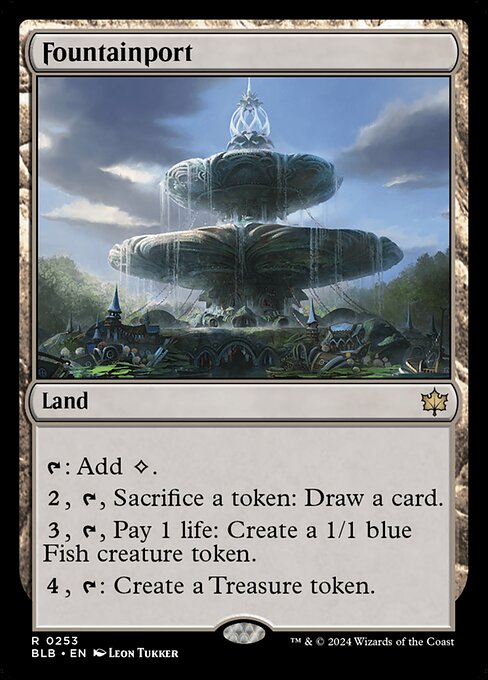
99. Fountainport
Rating6.0PlayableWhy this rating?
Good playable that always makes the cut (6.0/10).
Why. A utility land that taps for colourless mana and offers three abilities: draw by sacrificing a token, make a 1/1 blue Fish for 1 life, or make a Treasure. It is a source of value for long games.
Risks. It makes colourless mana, which hurts a multicolour deck. Each activation costs several mana and taps the land.
In the draft. A good land in a deck with tokens to sacrifice. Take it fairly high, without overdoing it.
Results in the games of the set
When it is in hand, the deck wins 56.5% of its games (set average: 56.0%, 113th of 265 cards).
In the opening hand: 54.8% wins (55.0% on average).
Drawn during the game: 57.6% (56.6% on average).
When it is drawn, the deck wins 3.0 points more than when it is not.
When it is drafted, it is played 88% of the time (set average: 62%).
Taken as the first pick (68 drafts), it ends in the deck 88% of the time.

100. Hivespine Wolverine
Rating6.0PlayableWhy this rating?
Good playable that always makes the cut (6.0/10).
Why. A five-mana 5/4 whose enter effect has three modes: a +1/+1 counter on a creature, a fight with a creature token, or destroying an artifact or enchantment. It nearly always fits the game.
Risks. It costs five mana with two green. The last two modes are conditional, and if neither is useful it only adds a +1/+1 counter.
In the draft. A good green creature, worth taking fairly high. It fits in almost every green deck.
Results in the games of the set
When it is in hand, the deck wins 57.6% of its games (set average: 56.0%, 76th of 265 cards).
In the opening hand: 55.6% wins (55.0% on average).
Drawn during the game: 58.8% (56.6% on average).
When it is drawn, the deck wins 3.5 points more than when it is not.
When it is drafted, it is played 89% of the time (set average: 62%).
Taken as the first pick (222 drafts), it ends in the deck 92% of the time.
It is played mostly in G/R decks (27% of them).
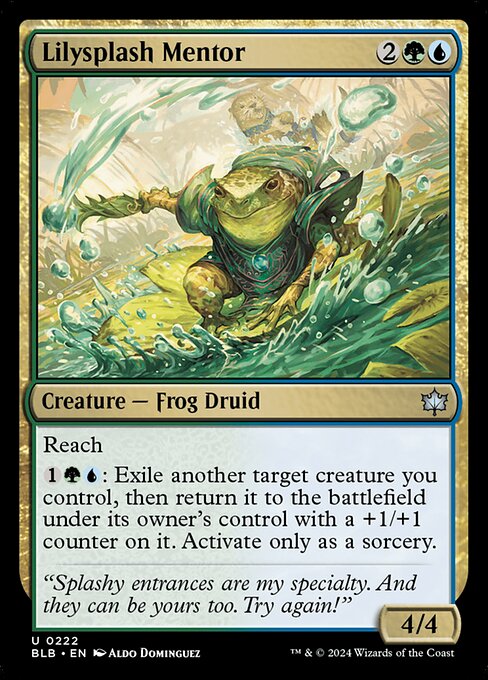
101. Lilysplash Mentor
Rating6.0PlayableWhy this rating?
Good playable that always makes the cut (6.0/10).
Why. A four-mana 4/4 with reach that holds off both the air and the ground. Its ability blinks another creature you control and returns it with a +1/+1 counter, so spare mana grows your board and replays enter effects.
Risks. The ability is sorcery speed and costs three mana, so it slows your development if you pay for it too early. With no other creature to target, it is just a big body.
In the draft. A strong uncommon in green-blue, where it finds the most creatures worth blinking. Take it over ordinary creatures.
Results in the games of the set
When it is in hand, the deck wins 58.4% of its games (set average: 56.0%, 57th of 265 cards).
In the opening hand: 54.7% wins (55.0% on average).
Drawn during the game: 60.5% (56.6% on average).
When it is drawn, the deck wins 6.2 points more than when it is not.
When it is drafted, it is played 74% of the time (set average: 62%).
Taken as the first pick (189 drafts), it ends in the deck 90% of the time.
It is played mostly in G/U decks (60% of them).

102. Ravine Raider
Rating6.0PlayableWhy this rating?
Good playable that always makes the cut (6.0/10).
Why. A one-mana black creature with menace that stays relevant all game: with spare mana it becomes a hard-to-block attacker that grows on demand. It is also a Lizard, which matters in decks built around them.
Risks. On its own it is a 1/1 that does nothing unless you invest mana, and any removal kills it. It wants a deck with mana to spare.
In the draft. A good common for an aggressive black deck, especially black-red. No need to take it early, but do not let it slip by in the late picks.
Results in the games of the set
When it is in hand, the deck wins 55.3% of its games (set average: 56.0%, 150th of 265 cards).
In the opening hand: 57.4% wins (55.0% on average).
Drawn during the game: 53.5% (56.6% on average).
When it is drawn, the deck wins 0.0 points more than when it is not.
When it is drafted, it is played 44% of the time (set average: 62%).
Taken as the first pick (59 drafts), it ends in the deck 93% of the time.
It is played mostly in B/R decks (83% of them).

103. Scales of Shale
Rating6.0PlayableWhy this rating?
Good playable that always makes the cut (6.0/10).
Why. A three-mana combat instant that gets cheaper with Lizards. It gives +2/+0, lifelink and indestructible, so it wins a combat, saves your creature from destroy effects and gains you life.
Risks. It is a trick, so if your target is killed in response you lose both the creature and the card. It does nothing without a creature on the battlefield.
In the draft. A solid trick for a black deck with good creatures. Take it higher if you have several Lizards that let you cast it for very little.
Results in the games of the set
When it is in hand, the deck wins 57.7% of its games (set average: 56.0%, 72nd of 265 cards).
In the opening hand: 55.8% wins (55.0% on average).
Drawn during the game: 59.0% (56.6% on average).
When it is drawn, the deck wins 3.2 points more than when it is not.
When it is drafted, it is played 59% of the time (set average: 62%).
Taken as the first pick (122 drafts), it ends in the deck 89% of the time.
It is played mostly in B/R decks (82% of them) and B/W (40%).

104. Splash Portal
Rating6.0PlayableWhy this rating?
Good playable that always makes the cut (6.0/10).
Why. A one-mana sorcery that blinks your creature: it comes back with a fresh enter effect, and if it is a Bird, Frog, Otter or Rat you draw a card. In the right deck, it is very cheap value.
Risks. It does nothing without a good target and does not affect the opponent's board. With a creature that has no enter effect or is another type, you get very little.
In the draft. A card for a blue-green deck with plenty of creatures that have enter effects. Outside that archetype, let it go.
Results in the games of the set
When it is in hand, the deck wins 55.2% of its games (set average: 56.0%, 151st of 265 cards).
In the opening hand: 51.9% wins (55.0% on average).
Drawn during the game: 57.0% (56.6% on average).
When it is drawn, the deck wins 3.6 points more than when it is not.
When it is drafted, it is played 58% of the time (set average: 62%).
Taken as the first pick (62 drafts), it ends in the deck 84% of the time.
It is played mostly in G/U decks (39% of them).

105. Starscape Cleric
Rating6.0PlayableWhy this rating?
Good playable that always makes the cut (6.0/10).
Why. A two-mana black flyer that can also be cast later with Offspring for two flying bodies. Every time you gain life, each opponent loses 1, which turns a lifegain deck into a source of direct damage.
Risks. It can't block, so it does nothing to defend you. Without lifegain in your deck, it is only a small 2/1 flyer.
In the draft. A good uncommon for an aggressive black deck, especially white-black with lifegain. Take it if you already have a few ways to gain life.
Results in the games of the set
When it is in hand, the deck wins 56.7% of its games (set average: 56.0%, 102nd of 265 cards).
In the opening hand: 56.0% wins (55.0% on average).
Drawn during the game: 57.3% (56.6% on average).
When it is drawn, the deck wins 2.9 points more than when it is not.
When it is drafted, it is played 78% of the time (set average: 62%).
Taken as the first pick (168 drafts), it ends in the deck 88% of the time.
It is played mostly in B/W decks (44% of them).

106. Lilypad Village
Rating5.9PlayableWhy this rating?
Good playable that always makes the cut (5.9/10).
Why. A utility land that taps for colorless mana, or for blue mana that only casts creature spells. With a blue mana it can surveil 2, but only if a Bird, Frog, Otter or Rat entered under your control this turn.
Risks. The blue mana only pays for creatures, so it does not help your blue instants and sorceries. The surveil needs a specific trigger every turn.
In the draft. Play it in a blue deck with many creatures of those types, especially blue-green. Do not take it over good playables.
Results in the games of the set
When it is in hand, the deck wins 53.4% of its games (set average: 56.0%, 205th of 265 cards).
In the opening hand: 52.2% wins (55.0% on average).
Drawn during the game: 54.2% (56.6% on average).
When it is drawn, the deck wins 0.8 points more than when it is not.
When it is drafted, it is played 39% of the time (set average: 62%).
Taken among the first three picks (52 drafts), it ends in the deck 77% of the time.

107. Pawpatch Formation
Rating5.8PlayableWhy this rating?
Good playable that always makes the cut (5.9/10).
Why. A flexible two-mana green instant: destroy a creature with flying, destroy an enchantment, or draw a card and create a Food token. There is almost always a useful mode, and the first is real removal against flyers.
Risks. Against an opponent with no flyers or relevant enchantments, it falls back on the draw mode, which is fine but has no direct impact on the board.
In the draft. A good mid-pack card for any green deck, especially one short on answers to flyers. Fine in your main deck from the start.
Results in the games of the set
When it is in hand, the deck wins 55.7% of its games (set average: 56.0%, 139th of 265 cards).
In the opening hand: 53.8% wins (55.0% on average).
Drawn during the game: 57.1% (56.6% on average).
When it is drawn, the deck wins 2.5 points more than when it is not.
When it is drafted, it is played 72% of the time (set average: 62%).
Taken as the first pick (76 drafts), it ends in the deck 87% of the time.
It is played about as much in every archetype.
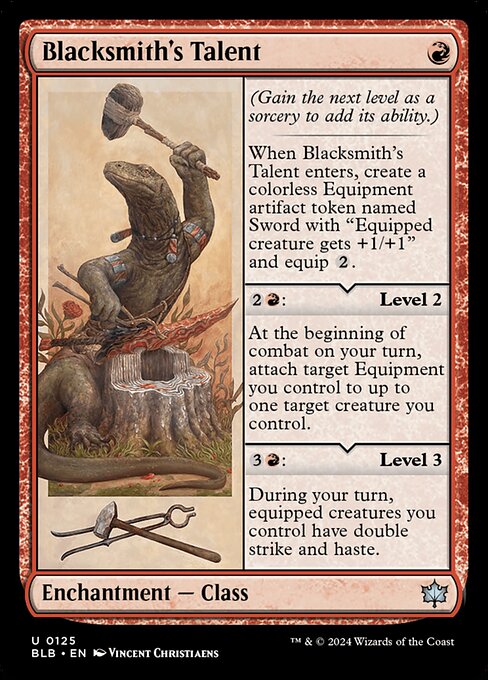
108. Blacksmith's Talent
Rating5.8PlayableWhy this rating?
Good playable that always makes the cut (5.8/10).
Why. For a single red mana you get a Sword Equipment token giving +1/+1, then you can level up: level 2 attaches an Equipment to a creature at the start of combat, and level 3 gives equipped creatures double strike and haste on your turn.
Risks. The first level is modest, and the later levels cost mana that does not develop your board. The deck needs creatures to carry the Equipment.
In the draft. Interesting in a red deck with cheap creatures and other Equipment. A bit slow for a pure aggro deck.
Results in the games of the set
When it is in hand, the deck wins 54.8% of its games (set average: 56.0%, 158th of 265 cards).
In the opening hand: 55.9% wins (55.0% on average).
Drawn during the game: 53.9% (56.6% on average).
When it is drawn, the deck wins 0.4 points more than when it is not.
When it is drafted, it is played 72% of the time (set average: 62%).
Taken as the first pick (121 drafts), it ends in the deck 88% of the time.
It is played mostly in R/W decks (34% of them) and B/R (27%).

109. Cache Grab
Rating5.8PlayableWhy this rating?
Good playable that always makes the cut (5.8/10).
Why. A two-mana green instant that mills four and lets you take a permanent from among them. It creates a Food token if you control a Squirrel or take one. Selection, card advantage, and a filled graveyard for Threshold.
Risks. It does nothing to the board and may find no permanent. In a deck with no graveyard to feed, it is a slow spell.
In the draft. A good common for black-green and Threshold decks. Take it without hesitation there, but not over a good creature.
Results in the games of the set
When it is in hand, the deck wins 57.7% of its games (set average: 56.0%, 71st of 265 cards).
In the opening hand: 56.3% wins (55.0% on average).
Drawn during the game: 58.7% (56.6% on average).
When it is drawn, the deck wins 3.6 points more than when it is not.
When it is drafted, it is played 69% of the time (set average: 62%).
Taken as the first pick (271 drafts), it ends in the deck 89% of the time.
It is played mostly in B/G decks (80% of them) and G/R (39%).
 Rating5.8Playable
Why this rating?
Good playable that always makes the cut (5.8/10).
Why. A one-mana white creature you can cast later with Offspring for two bodies. With Valiant, the first time each turn one of your spells or abilities targets it, your Mice get +1/+0 until end of turn.
Risks. A 1/2 is fragile and relies on other Mice and targeting spells to be effective. Without them, it is an unimpressive creature.
In the draft. Play it in a white-red Mice deck with several targeting spells. Elsewhere it is too specialized to take early.
Results in the games of the set
When it is in hand, the deck wins 54.5% of its games (set average: 56.0%, 168th of 265 cards).
In the opening hand: 55.6% wins (55.0% on average).
Drawn during the game: 53.6% (56.6% on average).
When it is drawn, the deck wins 0.3 points less than when it is not.
When it is drafted, it is played 69% of the time (set average: 62%).
Taken as the first pick (110 drafts), it ends in the deck 91% of the time.
It is played mostly in R/W decks (51% of them).

111. Hazel's Nocturne
Rating5.8PlayableWhy this rating?
Good playable that always makes the cut (5.8/10).
Why. A four-mana black instant that returns up to two creature cards from your graveyard to your hand, then drains for 2. That is two cards of value and a small life swing in one spell, castable at the end of the opponent's turn.
Risks. It does nothing for the board and depends on already having lost creatures. With no targets in the graveyard, it only drains.
In the draft. A decent value card for late-game black decks. Take it in the middle of the pack, after the good creatures.
Results in the games of the set
When it is in hand, the deck wins 56.4% of its games (set average: 56.0%, 115th of 265 cards).
In the opening hand: 52.4% wins (55.0% on average).
Drawn during the game: 58.8% (56.6% on average).
When it is drawn, the deck wins 2.5 points more than when it is not.
When it is drafted, it is played 73% of the time (set average: 62%).
Taken as the first pick (98 drafts), it ends in the deck 85% of the time.
It is played about as much in every archetype.

112. Heartfire Hero
Rating5.8PlayableWhy this rating?
Good playable that always makes the cut (5.8/10).
Why. A one-mana red creature that, with Valiant, gets a +1/+1 counter the first time each turn you target it, and deals damage equal to its power to each opponent when it dies. It is awkward to deal with: killing it late is expensive.
Risks. On its own it is a 1/1 with no evasion that dies to anything. It relies on spells or abilities that target it, and removal in response denies the bonus.
In the draft. A good choice in an aggressive red-white deck with tricks. In a deck with no targeting spells, it loses almost all its value.
Results in the games of the set
When it is in hand, the deck wins 56.7% of its games (set average: 56.0%, 104th of 265 cards).
In the opening hand: 60.9% wins (55.0% on average).
Drawn during the game: 53.1% (56.6% on average).
When it is drawn, the deck wins 2.2 points more than when it is not.
When it is drafted, it is played 76% of the time (set average: 62%).
Taken as the first pick (150 drafts), it ends in the deck 86% of the time.
It is played mostly in R/W decks (45% of them) and G/R (28%).

113. Hearthborn Battler
Rating5.8PlayableWhy this rating?
Good playable that always makes the cut (5.8/10).
Why. A three-mana red 2/3 with haste. Whenever a player casts their second spell each turn, it deals 2 damage to target opponent, which adds up fast in a low-curve deck, and your opponents trigger it too.
Risks. The trigger needs two spells in a turn, which is hard with expensive cards. The body is modest and it has no evasion.
In the draft. A playable card for an aggressive red deck with many cheap spells. Do not take it over good removal.
Results in the games of the set
When it is in hand, the deck wins 53.6% of its games (set average: 56.0%, 201st of 265 cards).
In the opening hand: 52.3% wins (55.0% on average).
Drawn during the game: 54.6% (56.6% on average).
When it is drawn, the deck wins 0.1 points less than when it is not.
When it is drafted, it is played 82% of the time (set average: 62%).
Taken as the first pick (82 drafts), it ends in the deck 90% of the time.
It is played about as much in every archetype.

114. Into the Flood Maw
Rating5.8PlayableWhy this rating?
Good playable that always makes the cut (5.8/10).
Why. For one blue mana, this instant bounces an opposing creature, a good tempo swing. With the Gift, the opponent gets a tapped 1/1 Fish creature token and you can instead target any nonland permanent they control.
Risks. It destroys nothing, so the opponent can recast the card. With the Gift, you hand over a 1/1 Fish that may become a small blocker.
In the draft. A good tempo tool for an aggressive blue deck, notably blue-green. Best against a creature carrying auras or counters.
Results in the games of the set
When it is in hand, the deck wins 56.5% of its games (set average: 56.0%, 112th of 265 cards).
In the opening hand: 53.3% wins (55.0% on average).
Drawn during the game: 58.2% (56.6% on average).
When it is drawn, the deck wins 5.1 points more than when it is not.
When it is drafted, it is played 53% of the time (set average: 62%).
Taken as the first pick (39 drafts), it ends in the deck 85% of the time.
It is played mostly in R/U decks (33% of them).
 Rating5.8Playable
Why this rating?
Good playable that always makes the cut (5.8/10).
Why. A five-mana 4/5 flyer that is a Bird itself. When one or more Birds you control deal combat damage to a player, choose: put a Bird from your hand or graveyard onto the battlefield, +1/+1 counters on your Birds, or draw a card. It can take over a game if it survives.
Risks. It needs a white-blue deck with enough Birds for the counters or the return to matter. Five mana in two colors is demanding, and removal stops it.
In the draft. Very good in a white-blue Birds deck; with few Birds it is still a big flyer. Take it if you are in those colors.
Results in the games of the set
When it is in hand, the deck wins 56.5% of its games (set average: 56.0%, 110th of 265 cards).
In the opening hand: 54.2% wins (55.0% on average).
Drawn during the game: 58.0% (56.6% on average).
When it is drawn, the deck wins 6.2 points more than when it is not.
When it is drafted, it is played 67% of the time (set average: 62%).
Taken as the first pick (101 drafts), it ends in the deck 70% of the time.
It is played mostly in U/W decks (41% of them).

116. Mindwhisker
Rating5.8PlayableWhy this rating?
Good playable that always makes the cut (5.8/10).
Why. A three-mana blue 3/2 that surveils 1 each upkeep and fills your graveyard. With Threshold, creatures your opponents control get -1/-0, which helps both your blocks and your attacks.
Risks. The bonus needs seven cards in your graveyard, which takes time. The body is fragile and it is slower than aggressive creatures.
In the draft. A good uncommon for a blue deck with Threshold, notably blue-black or blue-green. Take it in the middle of the pack.
Results in the games of the set
When it is in hand, the deck wins 57.3% of its games (set average: 56.0%, 82nd of 265 cards).
In the opening hand: 54.4% wins (55.0% on average).
Drawn during the game: 59.0% (56.6% on average).
When it is drawn, the deck wins 5.3 points more than when it is not.
When it is drafted, it is played 72% of the time (set average: 62%).
Taken as the first pick (130 drafts), it ends in the deck 85% of the time.
It is played mostly in B/U decks (51% of them) and G/U (28%).
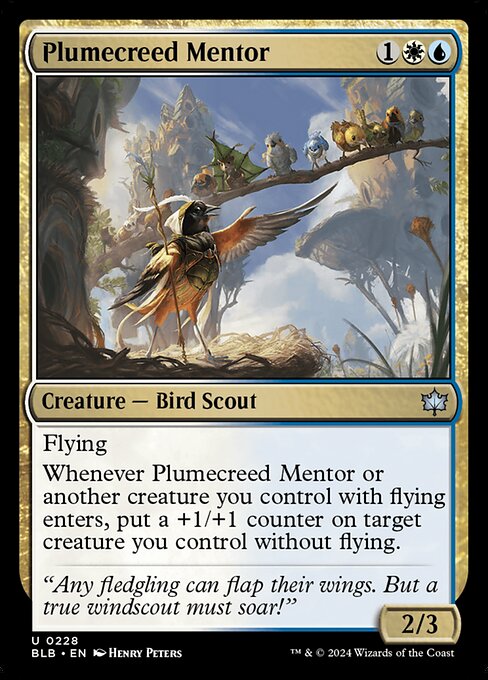
117. Plumecreed Mentor
Rating5.8PlayableWhy this rating?
Good playable that always makes the cut (5.8/10).
Why. A three-mana 2/3 flyer that puts a +1/+1 counter on a creature you control without flying when it enters, and again whenever another creature with flying enters under your control. It improves your board all game long.
Risks. It needs two specific colors and enough creatures both with and without flying. With no non-flying target, its ability does nothing.
In the draft. A good choice for a white-blue deck with flyers. If you are not in these colors, it does not merit a high pick.
Results in the games of the set
When it is in hand, the deck wins 55.8% of its games (set average: 56.0%, 134th of 265 cards).
In the opening hand: 55.6% wins (55.0% on average).
Drawn during the game: 56.0% (56.6% on average).
When it is drawn, the deck wins 5.1 points more than when it is not.
When it is drafted, it is played 42% of the time (set average: 62%).
Taken as the first pick (70 drafts), it ends in the deck 80% of the time.
It is played mostly in U/W decks (62% of them).

118. Season of the Bold
Rating5.8PlayableWhy this rating?
Good playable that always makes the cut (5.8/10).
Why. A flexible five-mana red sorcery: you spend up to five pawprints' worth of modes on tapped Treasures, two exiled cards you may play until the end of your next turn, or an effect that deals 2 damage to a creature whenever you cast a spell. Depending on the game it is value or removal spread over two turns.
Risks. Five mana with no immediate effect on the board, and the damage mode needs spells to cast afterward. It is slow.
In the draft. Playable in a midrange red deck with many cheap spells. It is not a good pick over solid creatures.
Results in the games of the set
When it is in hand, the deck wins 53.6% of its games (set average: 56.0%, 199th of 265 cards).
In the opening hand: 52.1% wins (55.0% on average).
Drawn during the game: 54.7% (56.6% on average).
When it is drawn, the deck wins 0.9 points more than when it is not.
When it is drafted, it is played 77% of the time (set average: 62%).
Taken as the first pick (49 drafts), it ends in the deck 86% of the time.
It is played about as much in every archetype.

119. Tidecaller Mentor
Rating5.8PlayableWhy this rating?
Good playable that always makes the cut (5.8/10).
Why. A three-mana 3/3 with menace, which is already solid. With Threshold on entering, it returns a nonland permanent to its owner's hand, adding a tempo play once your graveyard is full.
Risks. Threshold needs seven cards in your graveyard, which does not happen before the mid-game. It is gold, so limited to blue-black.
In the draft. A good pick for a blue-black Threshold deck. Once you are in those colors, prefer it over comparable creatures.
Results in the games of the set
When it is in hand, the deck wins 56.5% of its games (set average: 56.0%, 111th of 265 cards).
In the opening hand: 52.6% wins (55.0% on average).
Drawn during the game: 58.8% (56.6% on average).
When it is drawn, the deck wins 5.4 points more than when it is not.
When it is drafted, it is played 47% of the time (set average: 62%).
Taken as the first pick (56 drafts), it ends in the deck 86% of the time.
It is played mostly in B/U decks (55% of them).
 Rating5.8Playable
Why this rating?
Good playable that always makes the cut (5.8/10).
Why. A four-mana black 2/4: when Wick or another Rat enters, it creates a 1/1 black Snail creature token if you don't control one, otherwise it puts a +1/+1 counter on your Snail. You build one big token as Rats arrive.
Risks. The sacrifice ability needs blue, black and red mana, so it is out of reach for most decks. Without other Rats, you only get a 1/1 Snail and a 2/4.
In the draft. A good body in a black deck with several Rats, notably blue-black. Take it in the middle or late in the pack, as its effect is slow.
Results in the games of the set
When it is in hand, the deck wins 54.9% of its games (set average: 56.0%, 154th of 265 cards).
In the opening hand: 52.1% wins (55.0% on average).
Drawn during the game: 56.7% (56.6% on average).
When it is drawn, the deck wins 4.4 points more than when it is not.
When it is drafted, it is played 64% of the time (set average: 62%).
Taken as the first pick (66 drafts), it ends in the deck 76% of the time.
It is played about as much in every archetype.

121. Lupinflower Village
Rating5.8PlayableWhy this rating?
Good playable that always makes the cut (5.8/10).
Why. A utility land that taps for colorless mana, or for white mana that only casts creature spells, and can later sacrifice itself to dig through the top six cards for a Bat, Bird, Mouse or Rabbit.
Risks. The white mana only pays for creatures, so your white spells need other lands. The dig costs two mana and the land itself.
In the draft. Play it in a white deck with many creatures of those types, such as white-green or white-black. Otherwise it is an optional last utility land.
Results in the games of the set
When it is in hand, the deck wins 56.9% of its games (set average: 56.0%, 95th of 265 cards).
In the opening hand: 56.7% wins (55.0% on average).
Drawn during the game: 57.1% (56.6% on average).
When it is drawn, the deck wins 1.1 points more than when it is not.
When it is drafted, it is played 66% of the time (set average: 62%).
Taken among the first three picks (120 drafts), it ends in the deck 93% of the time.
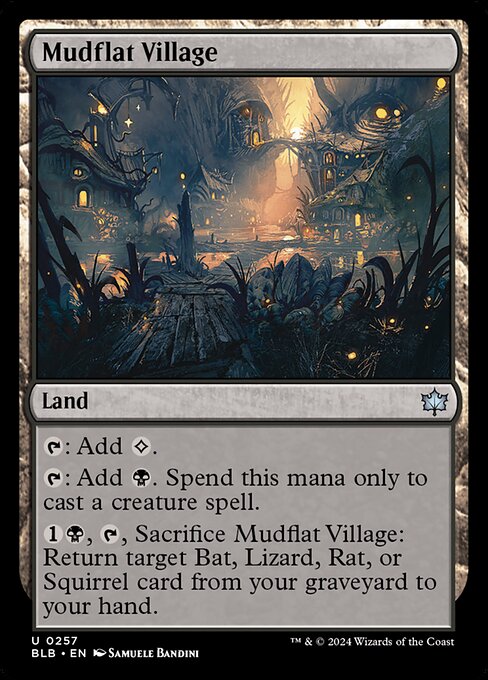
122. Mudflat Village
Rating5.7PlayableWhy this rating?
Good playable that always makes the cut (5.7/10).
Why. A utility land that taps for colorless mana, or for black mana that only casts creature spells, and can sacrifice itself to return a Bat, Lizard, Rat or Squirrel card from your graveyard to your hand. Late-game value without taking a spell slot.
Risks. The black mana only pays for creatures. The return needs a creature of those types already in your graveyard, and costs you the land.
In the draft. A good inclusion in any black deck with creatures of those types. Take the good spells first.
Results in the games of the set
When it is in hand, the deck wins 57.5% of its games (set average: 56.0%, 78th of 265 cards).
In the opening hand: 56.3% wins (55.0% on average).
Drawn during the game: 58.4% (56.6% on average).
When it is drawn, the deck wins 2.3 points more than when it is not.
When it is drafted, it is played 73% of the time (set average: 62%).
Taken as the first pick (44 drafts), it ends in the deck 89% of the time.

123. Driftgloom Coyote
Rating5.6PlayableWhy this rating?
Good playable that always makes the cut (5.6/10).
Why. A five-mana white 3/4 whose entry exiles an opposing creature for as long as the Coyote stays on the battlefield. If that creature had power 2 or less, it gets a +1/+1 counter: removal attached to a body.
Risks. The exile is temporary: if the Coyote dies, the creature comes back. It needs two white mana, and removal in response to its ability stops it from doing its job.
In the draft. A good removal-on-a-body for any white deck. Take it over featureless five-drops.
Results in the games of the set
When it is in hand, the deck wins 57.2% of its games (set average: 56.0%, 84th of 265 cards).
In the opening hand: 55.5% wins (55.0% on average).
Drawn during the game: 58.4% (56.6% on average).
When it is drawn, the deck wins 3.1 points more than when it is not.
When it is drafted, it is played 85% of the time (set average: 62%).
Taken as the first pick (215 drafts), it ends in the deck 91% of the time.
It is played mostly in U/W decks (29% of them) and G/W (26%).

124. Brazen Collector
Rating5.6PlayableWhy this rating?
Good playable that always makes the cut (5.6/10).
Why. A two-mana red 2/1 with first strike that adds a red mana when it attacks, and that mana does not empty until end of turn. It accelerates your turn and wins combats against small creatures.
Risks. It is still a 2/1 that dies to a lot, and it has to attack to pay off. Against solid blockers, attacking is not safe.
In the draft. A good two-drop for an aggressive red deck with spells to cast after combat. Take it in the middle of the pack.
Results in the games of the set
When it is in hand, the deck wins 54.8% of its games (set average: 56.0%, 157th of 265 cards).
In the opening hand: 57.9% wins (55.0% on average).
Drawn during the game: 52.2% (56.6% on average).
When it is drawn, the deck wins 0.1 points more than when it is not.
When it is drafted, it is played 83% of the time (set average: 62%).
Taken as the first pick (170 drafts), it ends in the deck 92% of the time.
It is played mostly in G/R decks (38% of them) and R/W (38%).

125. Coiling Rebirth
Rating5.6PlayableWhy this rating?
Good playable that always makes the cut (5.6/10).
Why. A five-mana black sorcery that returns a creature card from your graveyard to the battlefield. With the Gift, the opponent draws a card and you also get a 1/1 token copy of that creature, if it is not legendary.
Risks. Five mana for one card, and with no good creature in the graveyard it is weak. The Gift hands a card to your opponent.
In the draft. A value card for a late-game black deck with creatures that have enter effects. Not a priority, but playable as a final slot.
Results in the games of the set
When it is in hand, the deck wins 53.6% of its games (set average: 56.0%, 197th of 265 cards).
In the opening hand: 49.7% wins (55.0% on average).
Drawn during the game: 56.0% (56.6% on average).
When it is drawn, the deck wins 1.3 points more than when it is not.
When it is drafted, it is played 63% of the time (set average: 62%).
Taken as the first pick (40 drafts), it ends in the deck 75% of the time.
It is played about as much in every archetype.
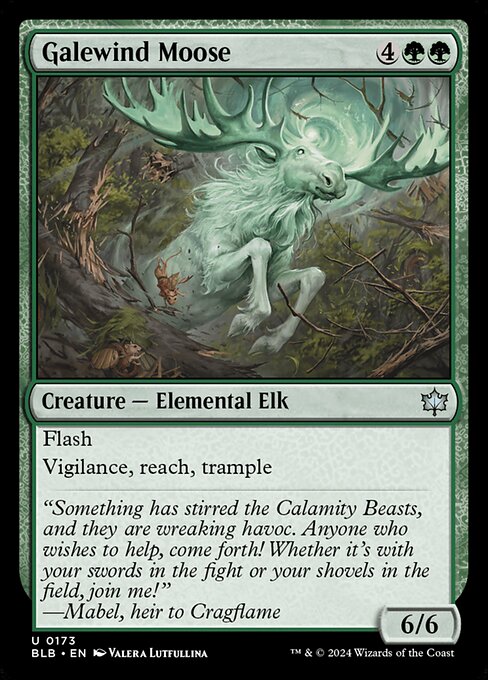
126. Galewind Moose
Rating5.6PlayableWhy this rating?
Good playable that always makes the cut (5.6/10).
Why. A green 6/6 with flash, reach, vigilance and trample. Cast it at the end of the opponent's turn or as a surprise blocker: it eats an attacker, then attacks while still defending.
Risks. Six mana with two green is expensive, and it has no enter effect. A single removal spell answers it.
In the draft. A good green top-end, playable in every pair containing green. Take it over most expensive creatures.
Results in the games of the set
When it is in hand, the deck wins 57.6% of its games (set average: 56.0%, 75th of 265 cards).
In the opening hand: 55.1% wins (55.0% on average).
Drawn during the game: 59.1% (56.6% on average).
When it is drawn, the deck wins 4.1 points more than when it is not.
When it is drafted, it is played 90% of the time (set average: 62%).
Taken as the first pick (294 drafts), it ends in the deck 95% of the time.
It is played mostly in G/R decks (31% of them) and B/G (26%).

127. Intrepid Rabbit
Rating5.6PlayableWhy this rating?
Good playable that always makes the cut (5.6/10).
Why. A three-mana white 3/2 that gives one of your creatures +1/+1 until end of turn when it enters. With Offspring it leaves a 1/1 token copy that gives a second bonus: a good common for a white creature deck.
Risks. The body is small and the bonus lasts only a turn. It does nothing against a well-held defense and has no evasion.
In the draft. A good common for any white deck, especially white-green. Take it as a solid curve filler, not a priority pick.
Results in the games of the set
When it is in hand, the deck wins 57.9% of its games (set average: 56.0%, 68th of 265 cards).
In the opening hand: 56.9% wins (55.0% on average).
Drawn during the game: 58.7% (56.6% on average).
When it is drawn, the deck wins 2.6 points more than when it is not.
When it is drafted, it is played 87% of the time (set average: 62%).
Taken as the first pick (613 drafts), it ends in the deck 94% of the time.
It is played mostly in G/W decks (72% of them) and B/W (71%).

128. Long River Lurker
Rating5.6PlayableWhy this rating?
Good playable that always makes the cut (5.6/10).
Why. A blue 2/3 with ward 1 that also gives other Frogs ward 1. When it enters, one of your creatures can't be blocked this turn, and if it deals combat damage you may blink it to replay its enter effect.
Risks. Its value depends on having a good creature to target. The body is modest, and ward 1 costs the opponent only one extra mana.
In the draft. A good uncommon for a blue-green deck with Frogs and enter effects. Outside that base it is average.
Results in the games of the set
When it is in hand, the deck wins 57.0% of its games (set average: 56.0%, 89th of 265 cards).
In the opening hand: 53.7% wins (55.0% on average).
Drawn during the game: 59.0% (56.6% on average).
When it is drawn, the deck wins 4.9 points more than when it is not.
When it is drafted, it is played 74% of the time (set average: 62%).
Taken as the first pick (140 drafts), it ends in the deck 87% of the time.
It is played mostly in G/U decks (52% of them).

129. Moonstone Harbinger
Rating5.6PlayableWhy this rating?
Good playable that always makes the cut (5.6/10).
Why. A three-mana black 1/3 with flying and deathtouch: it blocks almost anything in the air and kills what it touches. When you gain or lose life during your turn, your Bats get +1/+0 and deathtouch until end of turn.
Risks. With 1 power, it deals little damage to the opponent. Its bonus relies on life gain or loss during your turn.
In the draft. A very good blocker for a black deck, particularly white-black with Bats. Take it as solid defense.
Results in the games of the set
When it is in hand, the deck wins 56.2% of its games (set average: 56.0%, 122nd of 265 cards).
In the opening hand: 55.1% wins (55.0% on average).
Drawn during the game: 57.1% (56.6% on average).
When it is drawn, the deck wins 3.1 points more than when it is not.
When it is drafted, it is played 72% of the time (set average: 62%).
Taken as the first pick (115 drafts), it ends in the deck 90% of the time.
It is played mostly in B/W decks (45% of them).

130. Playful Shove
Rating5.6PlayableWhy this rating?
Good playable that always makes the cut (5.6/10).
Why. A two-mana red sorcery that deals 1 damage to any target and draws a card. It replaces itself and kills the smallest creatures, those with 1 toughness.
Risks. 1 damage kills almost nothing important. With no small target, it is a two-mana cantrip.
In the draft. A decent filler for a red deck, useful against small creatures. Take it late in the pack, not over real removal.
Results in the games of the set
When it is in hand, the deck wins 54.1% of its games (set average: 56.0%, 181st of 265 cards).
In the opening hand: 53.0% wins (55.0% on average).
Drawn during the game: 54.9% (56.6% on average).
When it is drawn, the deck wins 0.7 points more than when it is not.
When it is drafted, it is played 58% of the time (set average: 62%).
Taken as the first pick (55 drafts), it ends in the deck 84% of the time.
It is played mostly in R/U decks (34% of them).

131. Quaketusk Boar
Rating5.6PlayableWhy this rating?
Good playable that always makes the cut (5.6/10).
Why. A five-mana red 5/5 with reach, trample and haste. It hits immediately, defends against flyers, and ends games quickly when the opponent is behind.
Risks. It has no enter effect and needs two red mana. Removal stops it, and it can be double-blocked.
In the draft. A good top-end for a red deck, whatever its second color. Take it over less efficient five-drops.
Results in the games of the set
When it is in hand, the deck wins 56.0% of its games (set average: 56.0%, 125th of 265 cards).
In the opening hand: 55.2% wins (55.0% on average).
Drawn during the game: 56.6% (56.6% on average).
When it is drawn, the deck wins 2.5 points more than when it is not.
When it is drafted, it is played 80% of the time (set average: 62%).
Taken as the first pick (149 drafts), it ends in the deck 88% of the time.
It is played mostly in G/R decks (36% of them) and R/W (34%).
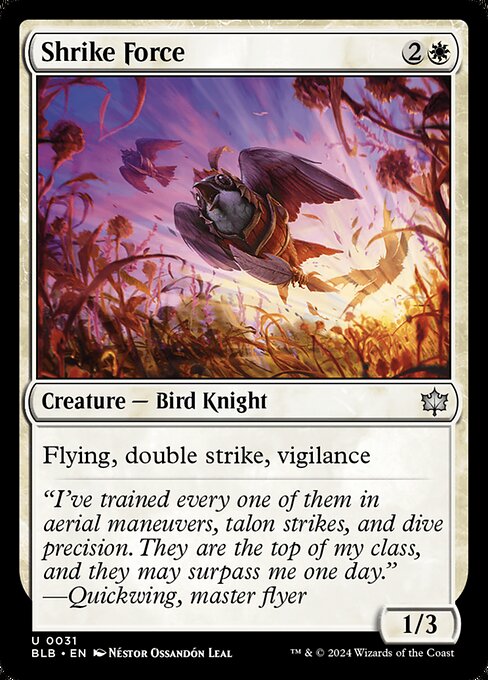
132. Shrike Force
Rating5.6PlayableWhy this rating?
Good playable that always makes the cut (5.6/10).
Why. A three-mana white 1/3 with flying, double strike and vigilance. It deals 2 damage per attack, attacks without exposing you and blocks small creatures well.
Risks. Three toughness is still fragile, and any counter or aura on it is risky. Against bigger flyers it loses its edge.
In the draft. A good choice for any white deck, especially with pump spells or counters. Take it over ordinary white creatures.
Results in the games of the set
When it is in hand, the deck wins 55.5% of its games (set average: 56.0%, 144th of 265 cards).
In the opening hand: 55.8% wins (55.0% on average).
Drawn during the game: 55.4% (56.6% on average).
When it is drawn, the deck wins 1.0 points more than when it is not.
When it is drafted, it is played 80% of the time (set average: 62%).
Taken as the first pick (125 drafts), it ends in the deck 90% of the time.
It is played mostly in U/W decks (28% of them).

133. Splash Lasher
Rating5.6PlayableWhy this rating?
Good playable that always makes the cut (5.6/10).
Why. A four-mana blue 3/3 that taps a creature and puts a stun counter on it, so it does not untap next turn. With Offspring you get a second body and a second enter effect.
Risks. It is expensive with Offspring, and stun does not answer the creature, only its next turn. You pay a lot for a temporary effect.
In the draft. A solid uncommon for a blue tempo deck, notably blue-green. Take it in the middle of the pack.
Results in the games of the set
When it is in hand, the deck wins 57.4% of its games (set average: 56.0%, 80th of 265 cards).
In the opening hand: 53.1% wins (55.0% on average).
Drawn during the game: 59.7% (56.6% on average).
When it is drawn, the deck wins 5.4 points more than when it is not.
When it is drafted, it is played 80% of the time (set average: 62%).
Taken as the first pick (165 drafts), it ends in the deck 87% of the time.
It is played mostly in G/U decks (46% of them) and B/U (31%).

134. Stargaze
Rating5.6PlayableWhy this rating?
Good playable that always makes the cut (5.6/10).
Why. A black X sorcery that looks at twice X cards, puts X into your hand and the rest into your graveyard. It is flexible card selection that also fills your graveyard for Threshold and scales with your mana.
Risks. You lose X life and do not affect the board. It is expensive on the turn it matters, and slow against an aggressive deck.
In the draft. Playable in a black control or Threshold deck. Not a priority pick, but a decent late option.
Results in the games of the set
When it is in hand, the deck wins 54.5% of its games (set average: 56.0%, 169th of 265 cards).
In the opening hand: 51.5% wins (55.0% on average).
Drawn during the game: 56.4% (56.6% on average).
When it is drawn, the deck wins 1.5 points more than when it is not.
When it is drafted, it is played 40% of the time (set average: 62%).
Taken among the first three picks (136 drafts), it ends in the deck 74% of the time.
It is played about as much in every archetype.

135. Take Out the Trash
Rating5.6PlayableWhy this rating?
Good playable that always makes the cut (5.6/10).
Why. A two-mana removal that kills most early and mid-game creatures at instant speed. With a Raccoon out, you can also loot away a dead card for a fresh one.
Risks. Three damage doesn't answer the big creatures, and the bonus only works with a Raccoon on the battlefield. Without one it is simply a solid removal.
In the draft. A good common removal: take it happily, especially in red. It goes ahead of most average creatures.
Results in the games of the set
When it is in hand, the deck wins 56.9% of its games (set average: 56.0%, 94th of 265 cards).
In the opening hand: 56.8% wins (55.0% on average).
Drawn during the game: 57.0% (56.6% on average).
When it is drawn, the deck wins 2.8 points more than when it is not.
When it is drafted, it is played 84% of the time (set average: 62%).
Taken as the first pick (386 drafts), it ends in the deck 94% of the time.
It is played mostly in R/U decks (69% of them) and R/W (67%).

136. Wildfire Howl
Rating5.6PlayableWhy this rating?
Good playable that always makes the cut (5.6/10).
Why. A three-mana sweeper dealing two damage to each creature. Against an opponent flooding the board with small creatures it can swing the game, especially if your own creatures survive.
Risks. It hits your creatures too. Promising the Gift hands the opponent a card for an extra targeted point of damage, which is a steep price.
In the draft. A control-deck pick, with creatures of three toughness or more. Don't take it early in an aggressive deck.
Results in the games of the set
When it is in hand, the deck wins 53.6% of its games (set average: 56.0%, 198th of 265 cards).
In the opening hand: 51.6% wins (55.0% on average).
Drawn during the game: 55.0% (56.6% on average).
When it is drawn, the deck wins 2.8 points more than when it is not.
When it is drafted, it is played 33% of the time (set average: 62%).
Taken as the first pick (34 drafts), it ends in the deck 79% of the time.
It is played mostly in R/U decks (25% of them).

137. Sunspine Lynx
Rating5.5PlayableWhy this rating?
Good playable that always makes the cut (5.5/10).
Why. A 5/4 for four mana, a very solid rate. Its text also shuts off life gain and damage prevention, and when it enters it hurts each player according to their nonbasic lands.
Risks. You can't gain life either, and the damage on entering counts your own nonbasic lands as well as your opponent's.
In the draft. Play it in red for the body, and skip it in a lifegain deck. A good body, not a card to force.
Results in the games of the set
When it is in hand, the deck wins 51.3% of its games (set average: 56.0%, 246th of 265 cards).
In the opening hand: 50.8% wins (55.0% on average).
Drawn during the game: 51.6% (56.6% on average).
When it is drawn, the deck wins 2.2 points less than when it is not.
When it is drafted, it is played 64% of the time (set average: 62%).
Taken as the first pick (38 drafts), it ends in the deck 79% of the time.
It is played about as much in every archetype.
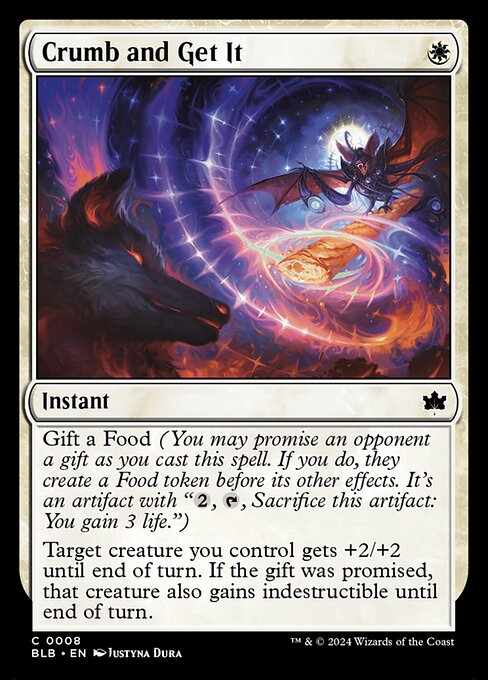
138. Crumb and Get It
Rating5.5PlayableWhy this rating?
A solid playable that rarely gets cut (5.5/10).
Why. A one-mana instant giving +2/+2: a combat won, or an opposing damage spell blanked for almost nothing. With the Gift, the creature also gains indestructible until end of turn.
Risks. It's a combat trick: with no creature it does nothing, and the opponent can respond by killing the target. The Gift gives the opponent a Food token.
In the draft. A good common trick for creature decks, but don't take it ahead of removal or solid creatures.
Results in the games of the set
When it is in hand, the deck wins 55.7% of its games (set average: 56.0%, 138th of 265 cards).
In the opening hand: 55.2% wins (55.0% on average).
Drawn during the game: 56.1% (56.6% on average).
When it is drawn, the deck wins 0.9 points more than when it is not.
When it is drafted, it is played 78% of the time (set average: 62%).
Taken as the first pick (190 drafts), it ends in the deck 95% of the time.
It is played mostly in G/W decks (61% of them) and R/W (58%).

139. Blooming Blast
Rating5.4PlayableWhy this rating?
A solid playable that rarely gets cut (5.4/10).
Why. A two-mana instant-speed removal that kills small creatures. With the Gift, it also deals three damage to the creature's controller: handy in an aggressive deck that wants to close out.
Risks. Only two damage: it can't answer big bodies. The Gift gives the opponent a Treasure token, which speeds them up.
In the draft. A decent removal for an aggressive red deck. Take it after the more powerful removal.
Results in the games of the set
When it is in hand, the deck wins 54.1% of its games (set average: 56.0%, 179th of 265 cards).
In the opening hand: 52.3% wins (55.0% on average).
Drawn during the game: 55.5% (56.6% on average).
When it is drawn, the deck wins 0.8 points more than when it is not.
When it is drafted, it is played 76% of the time (set average: 62%).
Taken as the first pick (93 drafts), it ends in the deck 85% of the time.
It is played mostly in R/U decks (34% of them) and B/R (29%).

140. Brambleguard Veteran
Rating5.4PlayableWhy this rating?
A solid playable that rarely gets cut (5.4/10).
Why. A 3/4 for three mana, a body that blocks and attacks well. Whenever you expend 4, your Raccoons get bigger and gain vigilance, so they can attack without leaving you open.
Risks. Without other Raccoons the ability only improves itself. It needs you to spend four mana on spells in a single turn.
In the draft. A good body for a green deck with several Raccoons. Take it gladly mid-pack.
Results in the games of the set
When it is in hand, the deck wins 55.9% of its games (set average: 56.0%, 129th of 265 cards).
In the opening hand: 56.5% wins (55.0% on average).
Drawn during the game: 55.5% (56.6% on average).
When it is drawn, the deck wins 1.8 points more than when it is not.
When it is drafted, it is played 79% of the time (set average: 62%).
Taken as the first pick (161 drafts), it ends in the deck 87% of the time.
It is played mostly in G/R decks (53% of them).

141. Bushy Bodyguard
Rating5.4PlayableWhy this rating?
A solid playable that rarely gets cut (5.4/10).
Why. A flexible two-drop: with Forage it comes in as a 4/3 for two mana, otherwise it stays a 2/1, and Offspring adds a second body for four mana in total. It plays at several stages of the game.
Risks. Forage needs three cards in the graveyard or a Food, which isn't always possible early. Without it, it's a small fragile 2/1.
In the draft. A good card for a green deck with Food or a graveyard that fills up. It gains value late in the game.
Results in the games of the set
When it is in hand, the deck wins 56.0% of its games (set average: 56.0%, 127th of 265 cards).
In the opening hand: 53.7% wins (55.0% on average).
Drawn during the game: 57.6% (56.6% on average).
When it is drawn, the deck wins 1.6 points more than when it is not.
When it is drafted, it is played 85% of the time (set average: 62%).
Taken as the first pick (189 drafts), it ends in the deck 88% of the time.
It is played mostly in B/G decks (39% of them) and G/R (25%).
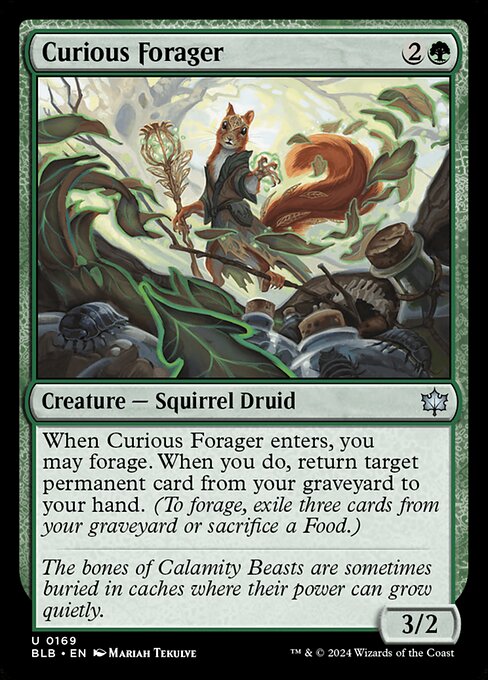
142. Curious Forager
Rating5.4PlayableWhy this rating?
A solid playable that rarely gets cut (5.4/10).
Why. A 3/2 for three mana that, with Forage, rebuys a permanent from your graveyard: a dead creature, an enchantment, a land. It is clean card advantage.
Risks. Forage needs three cards in the graveyard or a Food, so the effect often comes fairly late. The 3/2 body is modest.
In the draft. A good value card for a green deck with Food or lots of trades. Take it when nothing better is on offer mid-pack.
Results in the games of the set
When it is in hand, the deck wins 55.6% of its games (set average: 56.0%, 142nd of 265 cards).
In the opening hand: 51.9% wins (55.0% on average).
Drawn during the game: 58.0% (56.6% on average).
When it is drawn, the deck wins 1.0 points more than when it is not.
When it is drafted, it is played 86% of the time (set average: 62%).
Taken as the first pick (181 drafts), it ends in the deck 94% of the time.
It is played mostly in B/G decks (39% of them).
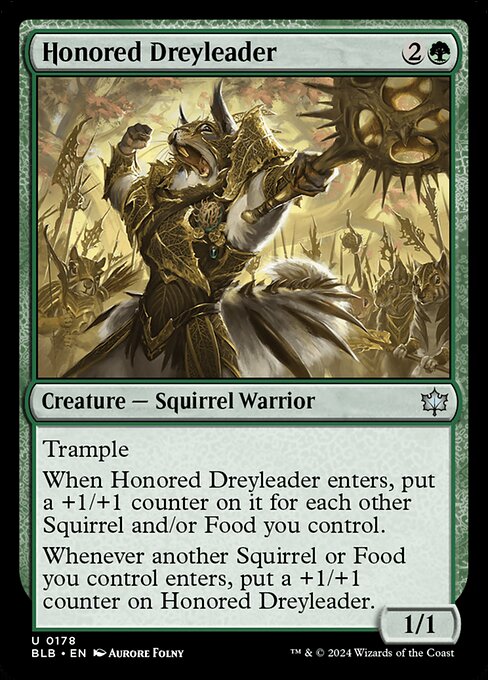
143. Honored Dreyleader
Rating5.4PlayableWhy this rating?
A solid playable that rarely gets cut (5.4/10).
Why. A creature that enters as a 1/1 and grows with each other Squirrel or Food you control, both when it arrives and afterwards. In a deck full of Squirrels and Food, it becomes a big trampler.
Risks. In a deck without those types it stays a 1/1. It depends entirely on your deck's makeup.
In the draft. A card for a green deck with Food and Squirrels. Only take it high if you already have several.
Results in the games of the set
When it is in hand, the deck wins 55.5% of its games (set average: 56.0%, 147th of 265 cards).
In the opening hand: 53.6% wins (55.0% on average).
Drawn during the game: 56.7% (56.6% on average).
When it is drawn, the deck wins 2.0 points more than when it is not.
When it is drafted, it is played 68% of the time (set average: 62%).
Taken as the first pick (92 drafts), it ends in the deck 88% of the time.
It is played mostly in B/G decks (49% of them).

144. Jolly Gerbils
Rating5.4PlayableWhy this rating?
A solid playable that rarely gets cut (5.4/10).
Why. A 2/3 for two mana, a good defensive body, that draws a card each time you give a gift. With Gift spells, it pays back the card you hand the opponent.
Risks. Without Gift spells it's a vanilla 2/3. Giving gifts also helps the opponent.
In the draft. A good pick for a white deck with several Gift spells. Otherwise it's a decent body for the curve.
Results in the games of the set
When it is in hand, the deck wins 54.9% of its games (set average: 56.0%, 156th of 265 cards).
In the opening hand: 55.9% wins (55.0% on average).
Drawn during the game: 54.0% (56.6% on average).
When it is drawn, the deck wins 0.0 points more than when it is not.
When it is drafted, it is played 69% of the time (set average: 62%).
Taken as the first pick (107 drafts), it ends in the deck 85% of the time.
It is played about as much in every archetype.
 Rating5.4Playable
Why this rating?
A solid playable that rarely gets cut (5.4/10).
Why. A 3/1 for two mana that grows with each other Rat. With Threshold, when you attack with Rats, it returns from the graveyard tapped and attacking, making it very sticky in a Rat deck.
Risks. Only one toughness: it dies to anything. Coming back needs seven cards in the graveyard and three mana, so only in the mid-game.
In the draft. A good card for a black Rat deck. Take it higher if you already have several.
Results in the games of the set
When it is in hand, the deck wins 56.0% of its games (set average: 56.0%, 128th of 265 cards).
In the opening hand: 55.3% wins (55.0% on average).
Drawn during the game: 56.4% (56.6% on average).
When it is drawn, the deck wins 2.0 points more than when it is not.
When it is drafted, it is played 70% of the time (set average: 62%).
Taken as the first pick (120 drafts), it ends in the deck 82% of the time.
It is played mostly in B/U decks (54% of them) and B/R (25%).

146. Spellgyre
Rating5.4PlayableWhy this rating?
A solid playable that rarely gets cut (5.4/10).
Why. A two-mode instant: counter a spell, or surveil 2 then draw two cards. It lets you choose between defense and card advantage depending on the situation.
Risks. Four mana with two blue, so it costs you a whole turn. Countering means keeping mana open for an answer.
In the draft. A good spell for a slower blue deck. Take it after threats and removal.
Results in the games of the set
When it is in hand, the deck wins 55.9% of its games (set average: 56.0%, 130th of 265 cards).
In the opening hand: 52.8% wins (55.0% on average).
Drawn during the game: 57.6% (56.6% on average).
When it is drawn, the deck wins 4.9 points more than when it is not.
When it is drafted, it is played 53% of the time (set average: 62%).
Taken as the first pick (46 drafts), it ends in the deck 91% of the time.
It is played mostly in R/U decks (35% of them) and B/U (31%).
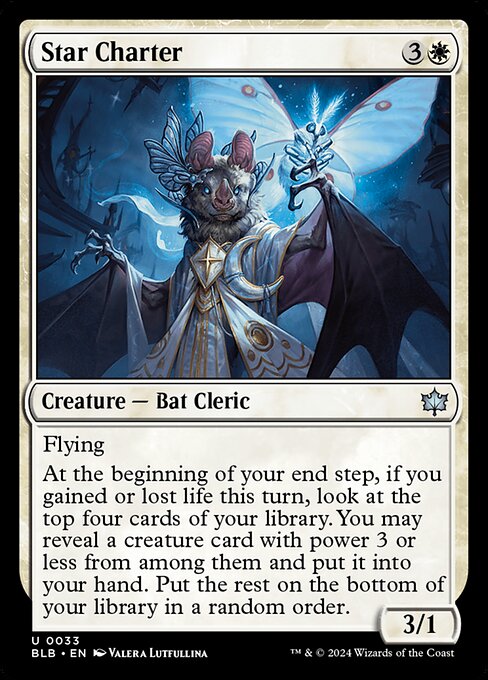
147. Star Charter
Rating5.4PlayableWhy this rating?
A solid playable that rarely gets cut (5.4/10).
Why. A 3/1 flyer for four mana that, at your end step, looks through the top four cards for a creature with power 3 or less if you gained or lost life that turn. A steady stream of value.
Risks. Only one toughness. The ability needs you to gain or lose life during the turn, which isn't guaranteed without the right deck.
In the draft. A good pick for a white-black deck that gains or loses life. Otherwise it's a fragile flying body.
Results in the games of the set
When it is in hand, the deck wins 54.1% of its games (set average: 56.0%, 180th of 265 cards).
In the opening hand: 52.3% wins (55.0% on average).
Drawn during the game: 55.4% (56.6% on average).
When it is drawn, the deck wins 0.4 points more than when it is not.
When it is drafted, it is played 69% of the time (set average: 62%).
Taken as the first pick (104 drafts), it ends in the deck 85% of the time.
It is played mostly in B/W decks (47% of them).

148. Three Tree Scribe
Rating5.4PlayableWhy this rating?
A solid playable that rarely gets cut (5.4/10).
Why. A 2/3 for two mana that puts a +1/+1 counter on a target creature you control each time one of your creatures leaves the battlefield without dying.
Risks. The ability only triggers when a creature leaves without dying: exile, bounce and the like. In a deck without that, it's a plain 2/3.
In the draft. A good defensive two-drop for a green-blue deck. Take it gladly mid-pack.
Results in the games of the set
When it is in hand, the deck wins 56.8% of its games (set average: 56.0%, 98th of 265 cards).
In the opening hand: 57.3% wins (55.0% on average).
Drawn during the game: 56.5% (56.6% on average).
When it is drawn, the deck wins 3.8 points more than when it is not.
When it is drafted, it is played 79% of the time (set average: 62%).
Taken as the first pick (152 drafts), it ends in the deck 88% of the time.
It is played mostly in G/U decks (51% of them).

149. Valley Floodcaller
Rating5.4PlayableWhy this rating?
A solid playable that rarely gets cut (5.4/10).
Why. A 2/2 with flash that lets you cast noncreature spells as though they had flash, and untaps and pumps your Birds, Frogs, Otters and Rats each time. In a spell-heavy deck it's an engine.
Risks. The 2/2 body is fragile, and the ability needs lots of noncreature spells and those creature types. Without them it does little.
In the draft. A card for a blue deck with lots of instants and sorceries. Don't take it high in a creature deck.
Results in the games of the set
When it is in hand, the deck wins 55.1% of its games (set average: 56.0%, 152nd of 265 cards).
In the opening hand: 53.0% wins (55.0% on average).
Drawn during the game: 56.4% (56.6% on average).
When it is drawn, the deck wins 4.2 points more than when it is not.
When it is drafted, it is played 79% of the time (set average: 62%).
Taken as the first pick (66 drafts), it ends in the deck 92% of the time.
It is played about as much in every archetype.

150. Bark-Knuckle Boxer
Rating5.3PlayableWhy this rating?
A solid playable that rarely gets cut (5.3/10).
Why. A 3/2 for two mana: an aggressive rate. When you expend 4, it gains indestructible until end of turn, which helps it attack if you cast your spells before combat.
Risks. You must spend four mana on spells in a single turn. Two toughness makes it fragile to damage effects.
In the draft. A good two-drop for an aggressive green deck. Take it after the removal.
Results in the games of the set
When it is in hand, the deck wins 56.3% of its games (set average: 56.0%, 119th of 265 cards).
In the opening hand: 57.4% wins (55.0% on average).
Drawn during the game: 55.5% (56.6% on average).
When it is drawn, the deck wins 1.7 points more than when it is not.
When it is drafted, it is played 83% of the time (set average: 62%).
Taken as the first pick (164 drafts), it ends in the deck 92% of the time.
It is played mostly in G/R decks (40% of them).

151. Nocturnal Hunger
Rating5.3PlayableWhy this rating?
A solid playable that rarely gets cut (5.3/10).
Why. An unconditional instant-speed removal: it destroys any creature for three mana. If you promise the Gift, you avoid losing two life.
Risks. Without the Gift you lose two life. With the Gift, the opponent gets a Food token and can gain life.
In the draft. A reliable common removal: take it ahead of most creatures if you play black.
Results in the games of the set
When it is in hand, the deck wins 57.0% of its games (set average: 56.0%, 91st of 265 cards).
In the opening hand: 54.4% wins (55.0% on average).
Drawn during the game: 58.8% (56.6% on average).
When it is drawn, the deck wins 3.0 points more than when it is not.
When it is drafted, it is played 90% of the time (set average: 62%).
Taken as the first pick (584 drafts), it ends in the deck 93% of the time.
It is played mostly in B/U decks (62% of them) and B/R (57%).

152. Banishing Light
Rating5.2PlayableWhy this rating?
A solid playable that rarely gets cut (5.2/10).
Why. A versatile three-mana removal: it exiles any nonland permanent an opponent controls. It handles creatures, but also artifacts and enchantments.
Risks. It's an enchantment: if the opponent destroys it, the target returns. It only comes down at sorcery speed, so it can't answer a threat mid-combat.
In the draft. A solid removal for any white deck. Take it like a good common removal.
Results in the games of the set
When it is in hand, the deck wins 55.8% of its games (set average: 56.0%, 137th of 265 cards).
In the opening hand: 54.0% wins (55.0% on average).
Drawn during the game: 57.0% (56.6% on average).
When it is drawn, the deck wins 1.0 points more than when it is not.
When it is drafted, it is played 89% of the time (set average: 62%).
Taken as the first pick (445 drafts), it ends in the deck 93% of the time.
It is played mostly in G/W decks (54% of them) and U/W (54%).
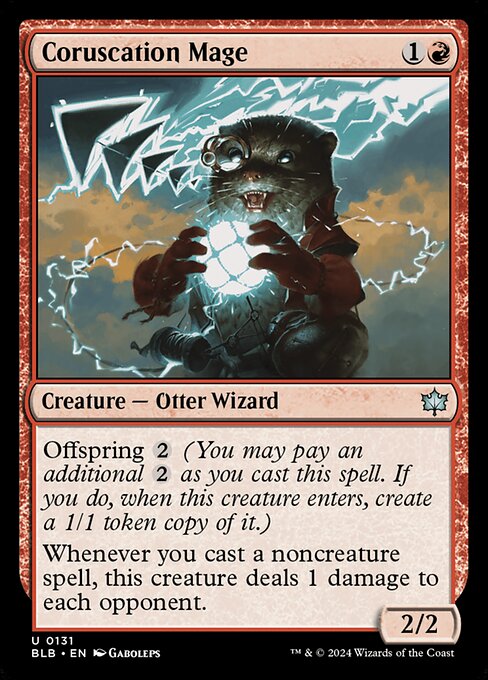
153. Coruscation Mage
Rating5.2PlayableWhy this rating?
A solid playable that rarely gets cut (5.2/10).
Why. A 2/2 for two mana that deals one damage to the opponent whenever you cast a noncreature spell. With Offspring, for four mana, it becomes two bodies that punish every spell.
Risks. It needs lots of noncreature spells to matter. In a creature-heavy deck it's just a 2/2.
In the draft. A card for a red deck with plenty of instants and sorceries. Take it after the removal.
Results in the games of the set
When it is in hand, the deck wins 54.4% of its games (set average: 56.0%, 171st of 265 cards).
In the opening hand: 54.1% wins (55.0% on average).
Drawn during the game: 54.6% (56.6% on average).
When it is drawn, the deck wins 1.8 points more than when it is not.
When it is drafted, it is played 69% of the time (set average: 62%).
Taken as the first pick (94 drafts), it ends in the deck 82% of the time.
It is played mostly in R/U decks (59% of them) and B/R (26%).

154. Cruelclaw's Heist
Rating5.2PlayableWhy this rating?
A solid playable that rarely gets cut (5.2/10).
Why. A two-black-mana discard spell: you look at the opponent's hand and exile a nonland card. With the Gift, you can cast it yourself, using any type of mana.
Risks. It does nothing to the board, and the Gift hands the opponent a card. It's slow against a fast deck.
In the draft. A pick for a slower black control deck. Don't take it ahead of removal and good creatures.
Results in the games of the set
When it is in hand, the deck wins 53.2% of its games (set average: 56.0%, 213th of 265 cards).
In the opening hand: 50.6% wins (55.0% on average).
Drawn during the game: 55.0% (56.6% on average).
When it is drawn, the deck wins 1.8 points more than when it is not.
When it is drafted, it is played 67% of the time (set average: 62%).
Taken as the first pick (47 drafts), it ends in the deck 85% of the time.
It is played about as much in every archetype.

155. Dewdrop Cure
Rating5.2PlayableWhy this rating?
A solid playable that rarely gets cut (5.2/10).
Why. A three-mana sorcery that returns two creatures with mana value 2 or less from your graveyard, or three with the Gift. In a deck full of small creatures it's clean card advantage.
Risks. It needs creatures with mana value 2 or less already in the graveyard. The Gift gives the opponent a card, and the spell is dead without targets.
In the draft. A niche card for a white deck of small creatures. Don't take it high.
Results in the games of the set
When it is in hand, the deck wins 50.4% of its games (set average: 56.0%, 250th of 265 cards).
In the opening hand: 48.5% wins (55.0% on average).
Drawn during the game: 51.6% (56.6% on average).
When it is drawn, the deck wins 3.7 points less than when it is not.
When it is drafted, it is played 23% of the time (set average: 62%).
Taken among the first three picks (41 drafts), it ends in the deck 51% of the time.

156. Diresight
Rating5.2PlayableWhy this rating?
A solid playable that rarely gets cut (5.2/10).
Why. A three-mana sorcery: surveil 2, then draw two cards. It improves the quality of your draws and fills the graveyard, useful for Threshold and Forage.
Risks. It does nothing on the board and costs you two life. In an aggressive deck it's a slow card.
In the draft. A good draw spell for a midrange black deck. Take it after removal and good creatures.
Results in the games of the set
When it is in hand, the deck wins 54.5% of its games (set average: 56.0%, 170th of 265 cards).
In the opening hand: 52.4% wins (55.0% on average).
Drawn during the game: 55.9% (56.6% on average).
When it is drawn, the deck wins 1.4 points more than when it is not.
When it is drafted, it is played 35% of the time (set average: 62%).
Taken among the first three picks (141 drafts), it ends in the deck 63% of the time.
It is played mostly in B/U decks (35% of them) and B/W (35%).

157. Hazardroot Herbalist
Rating5.2PlayableWhy this rating?
A solid playable that rarely gets cut (5.2/10).
Why. A 1/4 for three mana that gives +1/+0 to a creature you control when you attack, and deathtouch if it is a token. With tokens, it makes your attacks much more dangerous.
Risks. It does little without tokens, and its 1/4 body attacks poorly. It needs a deck that makes tokens.
In the draft. A card for a green-white token deck. Don't take it high in any other deck.
Results in the games of the set
When it is in hand, the deck wins 51.4% of its games (set average: 56.0%, 242nd of 265 cards).
In the opening hand: 50.6% wins (55.0% on average).
Drawn during the game: 52.1% (56.6% on average).
When it is drawn, the deck wins 2.4 points less than when it is not.
When it is drafted, it is played 46% of the time (set average: 62%).
Taken as the first pick (30 drafts), it ends in the deck 77% of the time.
It is played mostly in G/W decks (25% of them).
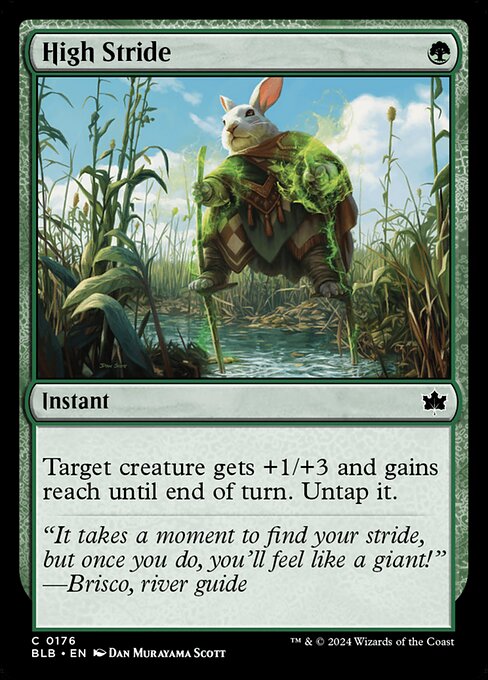
158. High Stride
Rating5.2PlayableWhy this rating?
A solid playable that rarely gets cut (5.2/10).
Why. A one-mana instant: +1/+3, reach and untap for the creature. It wins a combat, surprise-blocks a flyer, or keeps a creature that attacked back as a blocker.
Risks. It's a combat trick: it only shines with good creatures, and the opponent can respond by killing the target.
In the draft. A decent trick for a green creature deck. Take it late, after removal and good bodies.
Results in the games of the set
When it is in hand, the deck wins 54.4% of its games (set average: 56.0%, 174th of 265 cards).
In the opening hand: 53.7% wins (55.0% on average).
Drawn during the game: 54.8% (56.6% on average).
When it is drawn, the deck wins 1.1 points more than when it is not.
When it is drafted, it is played 29% of the time (set average: 62%).
Taken among the first three picks (98 drafts), it ends in the deck 62% of the time.

159. Plumecreed Escort
Rating5.2PlayableWhy this rating?
A solid playable that rarely gets cut (5.2/10).
Why. A 2/1 flash flyer for two mana: good evasive pressure, and in response to an opposing removal it grants hexproof to your creature. A very flexible card.
Risks. Only one toughness, and the hexproof lasts a single turn. It doesn't protect against a sweeper.
In the draft. A good flying two-drop for a blue deck. Take it as one of the set's good creatures.
Results in the games of the set
When it is in hand, the deck wins 56.3% of its games (set average: 56.0%, 117th of 265 cards).
In the opening hand: 54.0% wins (55.0% on average).
Drawn during the game: 57.8% (56.6% on average).
When it is drawn, the deck wins 4.4 points more than when it is not.
When it is drafted, it is played 78% of the time (set average: 62%).
Taken as the first pick (133 drafts), it ends in the deck 90% of the time.
It is played mostly in U/W decks (43% of them) and B/U (36%).

160. Rabbit Response
Rating5.2PlayableWhy this rating?
A solid playable that rarely gets cut (5.2/10).
Why. A four-mana instant giving +2/+1 to all your creatures: a big attacking turn, or a winning block. With a Rabbit, you also scry 2.
Risks. It does nothing without several creatures, and the opponent can respond by killing one of them. An expensive combat trick.
In the draft. A card for a white deck of Rabbits or many small creatures. Don't take it ahead of removal.
Results in the games of the set
When it is in hand, the deck wins 54.7% of its games (set average: 56.0%, 164th of 265 cards).
In the opening hand: 52.7% wins (55.0% on average).
Drawn during the game: 55.9% (56.6% on average).
When it is drawn, the deck wins 0.7 points less than when it is not.
When it is drafted, it is played 51% of the time (set average: 62%).
Taken as the first pick (53 drafts), it ends in the deck 83% of the time.
It is played mostly in G/W decks (74% of them) and R/W (54%).

161. Reptilian Recruiter
Rating5.2PlayableWhy this rating?
A solid playable that rarely gets cut (5.2/10).
Why. A 4/2 trampler for five mana whose arrival steals a creature with power 2 or less for the turn, or any creature if you control another Lizard. It sets up a big attack.
Risks. Five mana for two toughness is fragile and costly. The steal only lasts a turn and can't take big creatures without another Lizard.
In the draft. A niche finisher for an aggressive black-red deck. Don't take it high.
Results in the games of the set
When it is in hand, the deck wins 53.3% of its games (set average: 56.0%, 209th of 265 cards).
In the opening hand: 51.7% wins (55.0% on average).
Drawn during the game: 54.3% (56.6% on average).
When it is drawn, the deck wins 0.7 points less than when it is not.
When it is drafted, it is played 43% of the time (set average: 62%).
Taken among the first three picks (155 drafts), it ends in the deck 81% of the time.
It is played mostly in B/R decks (36% of them).

162. Rockface Village
Rating5.2PlayableWhy this rating?
A solid playable that rarely gets cut (5.2/10).
Why. A utility land that enters untapped: it taps for colorless mana, or red mana for creature spells only. It can also give a Lizard, Mouse, Otter or Raccoon +1/+0 and haste.
Risks. The red mana only works for creatures, so it can't pay the red part of your other spells. It doesn't replace a Mountain in a deck with many spells.
In the draft. A good land for a red creature deck. Take it fairly late, mid-pack.
Results in the games of the set
When it is in hand, the deck wins 54.3% of its games (set average: 56.0%, 177th of 265 cards).
In the opening hand: 55.4% wins (55.0% on average).
Drawn during the game: 53.4% (56.6% on average).
When it is drawn, the deck wins 0.8 points less than when it is not.
When it is drafted, it is played 66% of the time (set average: 62%).
Taken among the first three picks (152 drafts), it ends in the deck 96% of the time.

163. Teapot Slinger
Rating5.2PlayableWhy this rating?
A solid playable that rarely gets cut (5.2/10).
Why. A 3/4 with menace for four mana that deals two damage to the opponent whenever you expend 4. A good body that speeds up the end of the game.
Risks. It needs you to spend four mana on spells in a single turn to trigger. A plain 3/4 while it doesn't.
In the draft. A good creature for an aggressive or midrange red deck. Take it after the removal.
Results in the games of the set
When it is in hand, the deck wins 53.6% of its games (set average: 56.0%, 200th of 265 cards).
In the opening hand: 54.0% wins (55.0% on average).
Drawn during the game: 53.4% (56.6% on average).
When it is drawn, the deck wins 0.2 points more than when it is not.
When it is drafted, it is played 69% of the time (set average: 62%).
Taken as the first pick (69 drafts), it ends in the deck 81% of the time.
It is played mostly in G/R decks (39% of them) and B/R (29%).

164. Valley Rally
Rating5.2PlayableWhy this rating?
A solid playable that rarely gets cut (5.2/10).
Why. A three-mana instant: +2/+0 to all your creatures. With the Gift, one creature also gains first strike, enabling a big attack that can end a game.
Risks. It does nothing without several creatures, and the opponent can respond by killing one of them. The Gift gives the opponent a Food token.
In the draft. A card for a very aggressive red-white deck. Don't take it high elsewhere.
Results in the games of the set
When it is in hand, the deck wins 51.4% of its games (set average: 56.0%, 241st of 265 cards).
In the opening hand: 50.5% wins (55.0% on average).
Drawn during the game: 52.1% (56.6% on average).
When it is drawn, the deck wins 2.1 points less than when it is not.
When it is drafted, it is played 34% of the time (set average: 62%).
Taken among the first three picks (101 drafts), it ends in the deck 63% of the time.
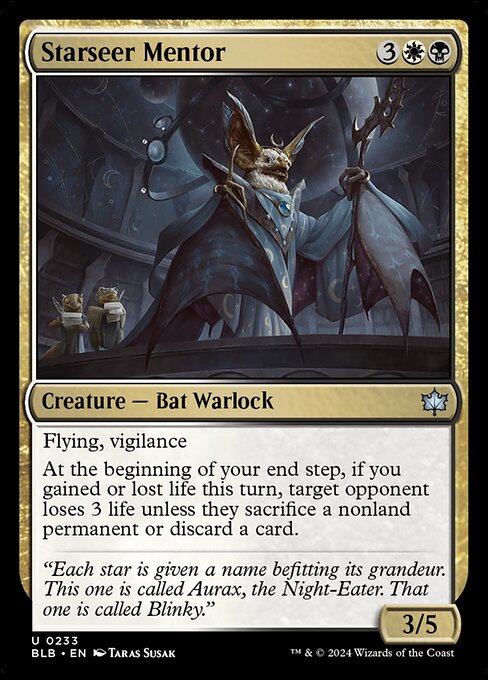
165. Starseer Mentor
Rating5.2PlayableWhy this rating?
A solid playable that rarely gets cut (5.2/10).
Why. A 3/5 with flying and vigilance for five mana: a good body. If you gained or lost life this turn, the opponent loses three life unless they sacrifice a nonland permanent of their choice or discard a card.
Risks. It is two-color and expensive. The ability needs you to gain or lose life, which depends on your deck.
In the draft. A good card for a white-black deck. Take it gladly if you are in those colors.
Results in the games of the set
When it is in hand, the deck wins 56.0% of its games (set average: 56.0%, 124th of 265 cards).
In the opening hand: 54.0% wins (55.0% on average).
Drawn during the game: 57.5% (56.6% on average).
When it is drawn, the deck wins 2.9 points more than when it is not.
When it is drafted, it is played 68% of the time (set average: 62%).
Taken as the first pick (136 drafts), it ends in the deck 84% of the time.
It is played mostly in B/W decks (54% of them).

166. Druid of the Spade
Rating5.1PlayableWhy this rating?
A solid playable that rarely gets cut (5.1/10).
Why. A 2/3 for three mana that becomes a 4/3 trampler as long as you control a token. In a token-making deck, it attacks like a big creature.
Risks. Without a token it's a mediocre 2/3 for its cost. It relies on your deck to have a token in play.
In the draft. A card for a green-white token deck. Don't take it high elsewhere.
Results in the games of the set
When it is in hand, the deck wins 54.1% of its games (set average: 56.0%, 184th of 265 cards).
In the opening hand: 53.6% wins (55.0% on average).
Drawn during the game: 54.5% (56.6% on average).
When it is drawn, the deck wins 0.7 points less than when it is not.
When it is drafted, it is played 47% of the time (set average: 62%).
Taken as the first pick (49 drafts), it ends in the deck 78% of the time.
It is played mostly in G/W decks (74% of them).

167. Warren Elder
Rating5.0PlayableWhy this rating?
A solid playable that rarely gets cut (5.0/10).
Why. A 2/2 for two mana with a late-game ability: pay four mana and your creatures get +1/+1 until end of turn. It gives you a use for spare mana.
Risks. The 2/2 body is fragile, and the ability is costly for a small gain. On its own it doesn't win the game.
In the draft. A good two-drop for a white creature deck. Take it mid-pick.
Results in the games of the set
When it is in hand, the deck wins 55.5% of its games (set average: 56.0%, 143rd of 265 cards).
In the opening hand: 55.0% wins (55.0% on average).
Drawn during the game: 56.0% (56.6% on average).
When it is drawn, the deck wins 0.1 points less than when it is not.
When it is drafted, it is played 84% of the time (set average: 62%).
Taken as the first pick (270 drafts), it ends in the deck 93% of the time.
It is played mostly in G/W decks (71% of them) and R/W (68%).
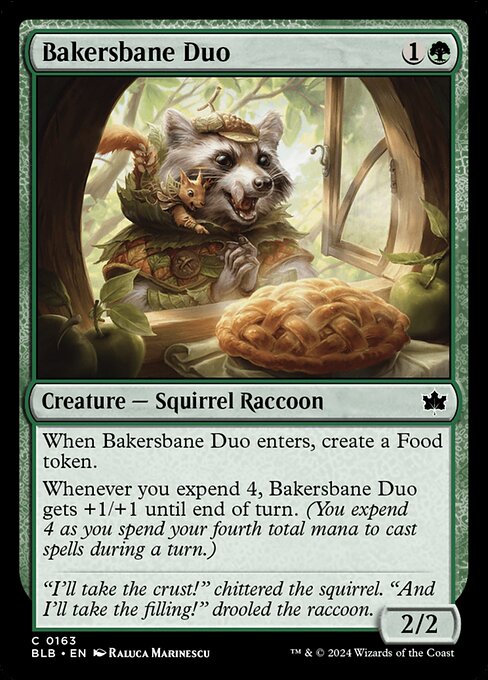
168. Bakersbane Duo
Rating5.0PlayableWhy this rating?
A solid playable that rarely gets cut (5.0/10).
Why. A 2/2 for two mana that creates a Food token on entering, then gets +1/+1 when you expend 4. It brings life gain and value for a low cost, and it feeds Forage.
Risks. The body stays small, and expending 4 needs you to spend four mana on spells in a single turn.
In the draft. A good common creature for a green deck. Take it gladly among the green commons.
Results in the games of the set
When it is in hand, the deck wins 57.3% of its games (set average: 56.0%, 81st of 265 cards).
In the opening hand: 57.8% wins (55.0% on average).
Drawn during the game: 57.0% (56.6% on average).
When it is drawn, the deck wins 2.9 points more than when it is not.
When it is drafted, it is played 90% of the time (set average: 62%).
Taken as the first pick (586 drafts), it ends in the deck 96% of the time.
It is played mostly in B/G decks (66% of them) and G/R (61%).

169. Calamitous Tide
Rating5.0PlayableWhy this rating?
A solid playable that rarely gets cut (5.0/10).
Why. A six-mana sorcery that bounces up to two creatures, then draws you two cards and makes you discard one. It gains a lot of tempo when the opponent has invested in expensive creatures.
Risks. Six mana and nothing dies: the opponent just recasts their creatures and you spent a whole turn. Against cheap creatures the effect is weak.
In the draft. A fine one-of in a slower, defensive blue deck. Do not take it over your removal or solid creatures.
Results in the games of the set
When it is in hand, the deck wins 55.9% of its games (set average: 56.0%, 131st of 265 cards).
In the opening hand: 51.8% wins (55.0% on average).
Drawn during the game: 58.0% (56.6% on average).
When it is drawn, the deck wins 4.9 points more than when it is not.
When it is drafted, it is played 48% of the time (set average: 62%).
Taken as the first pick (53 drafts), it ends in the deck 85% of the time.
It is played mostly in R/U decks (33% of them).

170. Oakhollow Village
Rating5.0PlayableWhy this rating?
A solid playable that rarely gets cut (5.0/10).
Why. A land that taps for colorless, or for green mana restricted to creature spells, and for one green mana puts a +1/+1 counter on each Frog, Rabbit, Raccoon or Squirrel that entered this turn. In a green deck full of those types, it adds real value to your deploy turns.
Risks. The green mana only pays for creatures, and the ability only hits the listed types on the turn they arrive. In a deck of mixed creatures, the effect is occasional.
In the draft. A utility land worth playing if you are green with plenty of those creature types. It is not a reason to change plans.
Results in the games of the set
When it is in hand, the deck wins 53.9% of its games (set average: 56.0%, 188th of 265 cards).
In the opening hand: 54.5% wins (55.0% on average).
Drawn during the game: 53.5% (56.6% on average).
When it is drawn, the deck wins 1.3 points less than when it is not.
When it is drafted, it is played 80% of the time (set average: 62%).
Taken as the first pick (43 drafts), it ends in the deck 88% of the time.
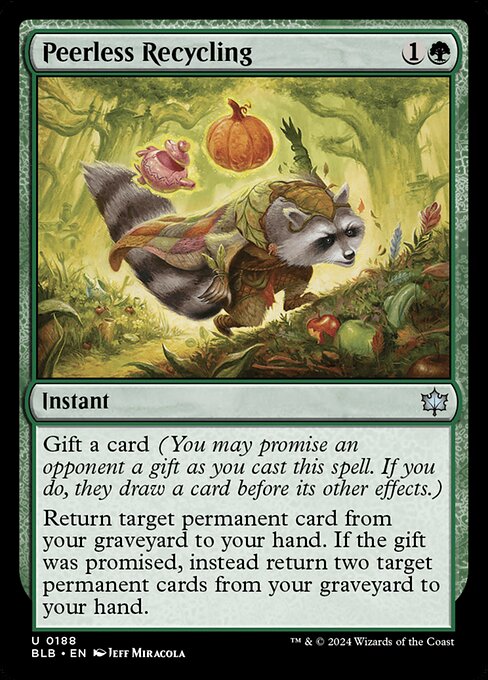
171. Peerless Recycling
Rating5.0PlayableWhy this rating?
A solid playable that rarely gets cut (5.0/10).
Why. A two-mana instant that returns a permanent card from your graveyard to hand, or two if you promise a Gift, in which case the opponent draws a card. It rebuys a key creature or a land in the middle of a game.
Risks. With no good target in the graveyard it does nothing. Promising the Gift hands the opponent a card, which costs real value.
In the draft. A value-deck card that likes creatures with enter effects. Take it late, after your creatures and removal.
Results in the games of the set
When it is in hand, the deck wins 51.3% of its games (set average: 56.0%, 245th of 265 cards).
In the opening hand: 47.7% wins (55.0% on average).
Drawn during the game: 53.5% (56.6% on average).
When it is drawn, the deck wins 1.1 points less than when it is not.
When it is drafted, it is played 37% of the time (set average: 62%).
Taken among the first three picks (79 drafts), it ends in the deck 68% of the time.

172. Pond Prophet
Rating5.0PlayableWhy this rating?
A solid playable that rarely gets cut (5.0/10).
Why. A hybrid green or blue 1/1 for two mana that draws a card when it enters. It replaces itself, gives you a chump blocker, and slots into any green or blue deck without effort.
Risks. A 1/1 does little on board and cannot hold off the attackers of an aggressive deck. The value is modest.
In the draft. A good filler piece, very flexible thanks to the hybrid cost. Take it over creatures with no effect.
Results in the games of the set
When it is in hand, the deck wins 58.0% of its games (set average: 56.0%, 67th of 265 cards).
In the opening hand: 57.6% wins (55.0% on average).
Drawn during the game: 58.2% (56.6% on average).
When it is drawn, the deck wins 5.2 points more than when it is not.
When it is drafted, it is played 78% of the time (set average: 62%).
Taken as the first pick (330 drafts), it ends in the deck 92% of the time.
It is played mostly in G/U decks (82% of them) and B/G (30%).
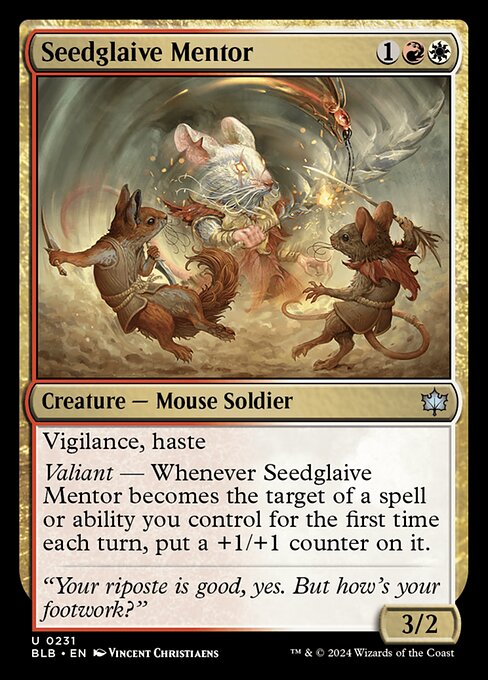
173. Seedglaive Mentor
Rating5.0PlayableWhy this rating?
A solid playable that rarely gets cut (5.0/10).
Why. A three-mana 3/2 with vigilance and haste: it attacks right away and still defends. With Valiant, each spell or ability that targets it puts a +1/+1 counter on it, so it grows turn after turn.
Risks. It needs targeting effects to grow and is fragile at two toughness. It is red and white, which commits you firmly.
In the draft. A good pick in an aggressive red-white deck with combat tricks. It has little value outside that pair.
Results in the games of the set
When it is in hand, the deck wins 53.3% of its games (set average: 56.0%, 210th of 265 cards).
In the opening hand: 54.3% wins (55.0% on average).
Drawn during the game: 52.4% (56.6% on average).
When it is drawn, the deck wins 1.4 points less than when it is not.
When it is drafted, it is played 64% of the time (set average: 62%).
Taken as the first pick (94 drafts), it ends in the deck 87% of the time.
It is played mostly in R/W decks (57% of them).

174. Sonar Strike
Rating5.0PlayableWhy this rating?
A solid playable that rarely gets cut (5.0/10).
Why. A two-mana instant that deals 4 damage to an attacking, blocking or tapped creature, and gains you 3 life if you control a Bat. It is cheap removal that answers nearly anything that matters in combat.
Risks. It cannot hit an untapped creature that stays home. A careful opponent can play around it.
In the draft. Solid conditional removal, worth taking early in white. The Bat bonus is a perk, not a reason to look for Bats.
Results in the games of the set
When it is in hand, the deck wins 55.8% of its games (set average: 56.0%, 136th of 265 cards).
In the opening hand: 54.5% wins (55.0% on average).
Drawn during the game: 56.7% (56.6% on average).
When it is drawn, the deck wins 1.5 points more than when it is not.
When it is drafted, it is played 77% of the time (set average: 62%).
Taken as the first pick (155 drafts), it ends in the deck 92% of the time.
It is played mostly in B/W decks (63% of them) and U/W (44%).

175. Stocking the Pantry
Rating5.0PlayableWhy this rating?
A solid playable that rarely gets cut (5.0/10).
Why. A one-mana enchantment that collects a supply counter whenever you put a +1/+1 counter on a creature you control, then lets you draw a card for two mana by removing one. It is a slow card engine.
Risks. It does nothing on board and only works if your deck puts +1/+1 counters regularly. Without that, it is a dead card.
In the draft. Only for a green deck built around counters. Otherwise leave it in the sideboard.
Results in the games of the set
When it is in hand, the deck wins 49.2% of its games (set average: 56.0%, 255th of 265 cards).
In the opening hand: 48.2% wins (55.0% on average).
Drawn during the game: 49.8% (56.6% on average).
When it is drawn, the deck wins 3.3 points less than when it is not.
When it is drafted, it is played 21% of the time (set average: 62%).
Taken among the first three picks (64 drafts), it ends in the deck 52% of the time.

176. Sugar Coat
Rating5.0PlayableWhy this rating?
A solid playable that rarely gets cut (5.0/10).
Why. A flash Aura that turns a creature into a colorless Food artifact that loses its other types and abilities. It is lasting removal for three mana, castable in the middle of an attack.
Risks. The opponent can pay two mana and sacrifice the Food to gain 3 life, a small consolation. Removing the Aura undoes it.
In the draft. Flash removal in blue is valuable at this price: take it over average creatures.
Results in the games of the set
When it is in hand, the deck wins 54.9% of its games (set average: 56.0%, 153rd of 265 cards).
In the opening hand: 51.9% wins (55.0% on average).
Drawn during the game: 56.6% (56.6% on average).
When it is drawn, the deck wins 3.3 points more than when it is not.
When it is drafted, it is played 70% of the time (set average: 62%).
Taken as the first pick (79 drafts), it ends in the deck 87% of the time.
It is played mostly in B/U decks (32% of them) and R/U (32%).

177. Sunshower Druid
Rating5.0PlayableWhy this rating?
A solid playable that rarely gets cut (5.0/10).
Why. A one-mana 0/2 that puts a +1/+1 counter on a target creature and gains you 1 life. It plays early as a blocker, or later as a small boost that sets up an attack.
Risks. A 0/2 does not attack and is a weak body. Its value depends on the counter it places on another creature.
In the draft. A decent support card in green, but not a priority. A mid-pack pick.
Results in the games of the set
When it is in hand, the deck wins 56.3% of its games (set average: 56.0%, 120th of 265 cards).
In the opening hand: 55.7% wins (55.0% on average).
Drawn during the game: 56.7% (56.6% on average).
When it is drawn, the deck wins 3.8 points more than when it is not.
When it is drafted, it is played 58% of the time (set average: 62%).
Taken as the first pick (99 drafts), it ends in the deck 85% of the time.
It is played mostly in G/U decks (81% of them).

178. Longstalk Brawl
Rating5.0WeakWhy this rating?
A solid playable that rarely gets cut (5.0/10).
Why. A one-mana sorcery that makes one of your creatures fight one of theirs. With the Gift, the opponent gets a tapped 1/1 Fish creature token and your creature gains a +1/+1 counter before the fight: green removal for a single mana.
Risks. If your creature is smaller, it may die. The Gift hands the opponent a small body, and removal in response loses you the card.
In the draft. A good green removal spell, worth taking early if your deck has big creatures. It gets mediocre without them.
Results in the games of the set
When it is in hand, the deck wins 55.9% of its games (set average: 56.0%, 133rd of 265 cards).
In the opening hand: 54.5% wins (55.0% on average).
Drawn during the game: 56.7% (56.6% on average).
When it is drawn, the deck wins 1.8 points more than when it is not.
When it is drafted, it is played 88% of the time (set average: 62%).
Taken as the first pick (391 drafts), it ends in the deck 94% of the time.
It is played mostly in G/U decks (64% of them) and B/G (54%).

179. Dire Downdraft
Rating4.9WeakWhy this rating?
A solid playable that rarely gets cut (4.9/10).
Why. An instant that costs one less if its target is attacking or tapped, and pushes the creature to the top or bottom of its owner's library, their choice. It is often a three-mana removal spell.
Risks. The owner can put it on top and replay it, costing only a draw step. It is less clean than true removal.
In the draft. A good blue removal spell, worth taking in the first half of the pack.
Results in the games of the set
When it is in hand, the deck wins 56.6% of its games (set average: 56.0%, 105th of 265 cards).
In the opening hand: 53.7% wins (55.0% on average).
Drawn during the game: 58.3% (56.6% on average).
When it is drawn, the deck wins 4.5 points more than when it is not.
When it is drafted, it is played 59% of the time (set average: 62%).
Taken as the first pick (89 drafts), it ends in the deck 89% of the time.
It is played mostly in R/U decks (72% of them) and B/U (61%).
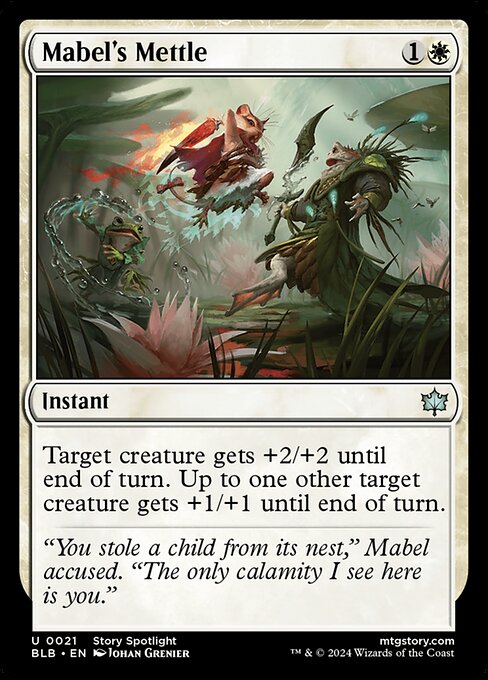
180. Mabel's Mettle
Rating4.8WeakWhy this rating?
A solid playable that rarely gets cut (4.8/10).
Why. A two-mana instant that gives one creature +2/+2 and another +1/+1 until end of turn. It wins a combat or ambushes a blocker, and can trigger Valiant on two creatures at once.
Risks. A combat trick that loses a card to removal in response. It does nothing without creatures on board.
In the draft. A decent trick in an aggressive white deck with Valiant creatures. Take it after your creatures.
Results in the games of the set
When it is in hand, the deck wins 53.2% of its games (set average: 56.0%, 214th of 265 cards).
In the opening hand: 52.2% wins (55.0% on average).
Drawn during the game: 53.9% (56.6% on average).
When it is drawn, the deck wins 1.1 points less than when it is not.
When it is drafted, it is played 69% of the time (set average: 62%).
Taken as the first pick (67 drafts), it ends in the deck 84% of the time.
It is played mostly in R/W decks (34% of them).
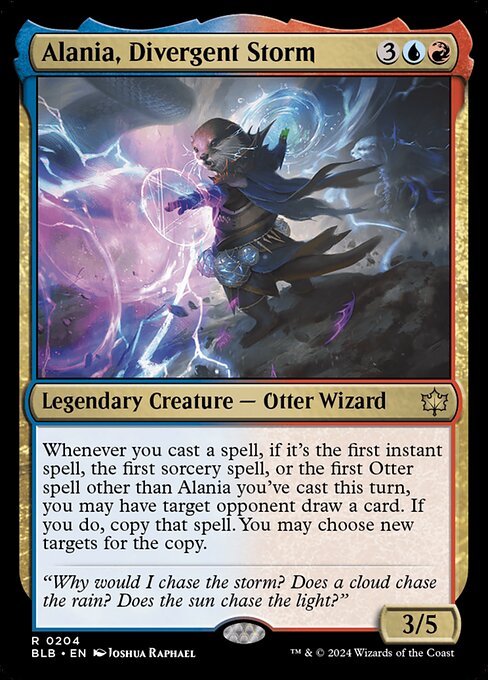 Rating4.8Weak
Why this rating?
A solid playable that rarely gets cut (4.8/10).
Why. A five-mana red and blue 3/5 that copies the first instant, the first sorcery and the first Otter spell you cast each turn, if you let the opponent draw a card. In a spell-heavy deck, copying a removal or a draw spell is strong.
Risks. It feeds the opponent a card on every copy, and the deck must be built for it. With too few spells it is just an expensive 3/5.
In the draft. For a blue-red spells deck only. Outside that archetype, do not take it.
Results in the games of the set
When it is in hand, the deck wins 49.9% of its games (set average: 56.0%, 253rd of 265 cards).
In the opening hand: 47.4% wins (55.0% on average).
Drawn during the game: 51.2% (56.6% on average).
When it is drawn, the deck wins 1.1 points more than when it is not.
When it is drafted, it is played 38% of the time (set average: 62%).
Taken among the first three picks (107 drafts), it ends in the deck 65% of the time.
It is played mostly in R/U decks (29% of them).

182. Cindering Cutthroat
Rating4.8WeakWhy this rating?
A solid playable that rarely gets cut (4.8/10).
Why. A three-mana 3/2 with a hybrid black or red mana in its cost that enters with a +1/+1 counter if an opponent lost life this turn, and gains menace for two mana. Cast after an attack on turn 3, it is an aggressive 4/3.
Risks. Without opposing life loss, it is a plain 3/2. The menace ability costs mana that slows your other plans.
In the draft. A good aggressive creature in black-red, playable in any black or red deck. A mid-pack pick.
Results in the games of the set
When it is in hand, the deck wins 53.4% of its games (set average: 56.0%, 206th of 265 cards).
In the opening hand: 53.2% wins (55.0% on average).
Drawn during the game: 53.5% (56.6% on average).
When it is drawn, the deck wins 1.6 points less than when it is not.
When it is drafted, it is played 55% of the time (set average: 62%).
Taken as the first pick (89 drafts), it ends in the deck 83% of the time.
It is played mostly in B/R decks (77% of them) and G/R (28%).

183. Eddymurk Crab
Rating4.8WeakWhy this rating?
A solid playable that rarely gets cut (4.8/10).
Why. A flash 5/5 that costs one less for each instant and sorcery in your graveyard, and taps up to two creatures when it enters. Cast before the opponent's attacks, it stops two creatures from attacking.
Risks. It costs seven mana at base: in a deck with few spells it rots in hand. It enters tapped if it is not your turn.
In the draft. Good in a blue deck full of instants and sorceries. In a low-spell deck, let it pass.
Results in the games of the set
When it is in hand, the deck wins 56.8% of its games (set average: 56.0%, 100th of 265 cards).
In the opening hand: 51.7% wins (55.0% on average).
Drawn during the game: 59.4% (56.6% on average).
When it is drawn, the deck wins 6.0 points more than when it is not.
When it is drafted, it is played 59% of the time (set average: 62%).
Taken as the first pick (87 drafts), it ends in the deck 85% of the time.
It is played mostly in R/U decks (56% of them) and B/U (38%).

184. Festival of Embers
Rating4.8WeakWhy this rating?
A solid playable that rarely gets cut (4.8/10).
Why. A five-mana enchantment that lets you cast instants and sorceries from your graveyard again by paying 1 life each, and exiles anything that would go there. In a spells deck, it is a long-term value engine.
Risks. Five mana with no immediate board effect. Your new spells go to exile instead of the graveyard, so it only replays what is already there, and it hurts Threshold.
In the draft. A niche card for a red deck with lots of spells. In any other deck, do not play it.
Results in the games of the set
When it is in hand, the deck wins 48.1% of its games (set average: 56.0%, 260th of 265 cards).
In the opening hand: 45.0% wins (55.0% on average).
Drawn during the game: 49.9% (56.6% on average).
When it is drawn, the deck wins 0.4 points less than when it is not.
When it is drafted, it is played only 5% of the time (set average: 62%): it almost always ends in the sideboard.

185. Lifecreed Duo
Rating4.8WeakWhy this rating?
A solid playable that rarely gets cut (4.8/10).
Why. A two-mana 1/2 flyer that gains you 1 life whenever another creature enters under your control. It blocks small flyers, chips in the air, and counts as a Bat for other cards.
Risks. A 1/2 stays small and dies to any damage spell. The life gain does not win games alone.
In the draft. A good two-drop, especially in white-black. A solid pick, ahead of truly average cards.
Results in the games of the set
When it is in hand, the deck wins 55.5% of its games (set average: 56.0%, 145th of 265 cards).
In the opening hand: 55.8% wins (55.0% on average).
Drawn during the game: 55.3% (56.6% on average).
When it is drawn, the deck wins 1.7 points more than when it is not.
When it is drafted, it is played 78% of the time (set average: 62%).
Taken as the first pick (214 drafts), it ends in the deck 93% of the time.
It is played mostly in B/W decks (76% of them) and U/W (45%).
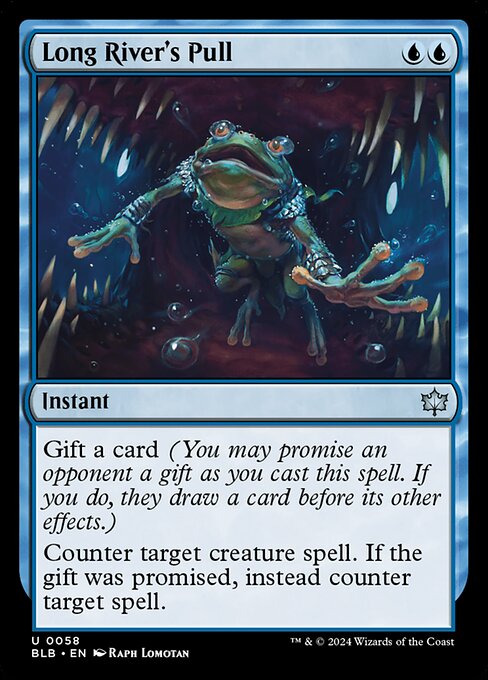
186. Long River's Pull
Rating4.8WeakWhy this rating?
A solid playable that rarely gets cut (4.8/10).
Why. A two-blue-mana instant that counters a creature spell, or any spell if you promise a Gift, in which case the opponent draws a card. It stops an opposing key spell at the right moment.
Risks. It requires keeping two blue mana open, which slows your tempo. The Gift gives the opponent a card.
In the draft. A fine counterspell for a blue control deck. Take it after your creatures and removal.
Results in the games of the set
When it is in hand, the deck wins 54.7% of its games (set average: 56.0%, 160th of 265 cards).
In the opening hand: 52.3% wins (55.0% on average).
Drawn during the game: 56.2% (56.6% on average).
When it is drawn, the deck wins 5.1 points more than when it is not.
When it is drafted, it is played 38% of the time (set average: 62%).
Taken among the first three picks (121 drafts), it ends in the deck 71% of the time.

187. Pearl of Wisdom
Rating4.8WeakWhy this rating?
A solid playable that rarely gets cut (4.8/10).
Why. A sorcery that draws two cards for three mana, or two mana if you control an Otter. Simple, reliable card draw that turns one card into two.
Risks. It does nothing on board and costs you a turn of action. Great against slow decks, too slow under pressure.
In the draft. A good value card in blue, especially in an Otter deck. A mid-pack pick.
Results in the games of the set
When it is in hand, the deck wins 56.4% of its games (set average: 56.0%, 116th of 265 cards).
In the opening hand: 54.0% wins (55.0% on average).
Drawn during the game: 57.8% (56.6% on average).
When it is drawn, the deck wins 5.8 points more than when it is not.
When it is drafted, it is played 37% of the time (set average: 62%).
Taken as the first pick (62 drafts), it ends in the deck 85% of the time.
It is played mostly in R/U decks (79% of them) and B/U (30%).

188. Polliwallop
Rating4.8WeakWhy this rating?
A solid playable that rarely gets cut (4.8/10).
Why. An instant that has one of your creatures deal damage equal to twice its power to an opposing creature, with no damage back. With affinity for Frogs, it costs one less for each Frog you control.
Risks. You need a creature with real power, and removal in response loses the card. Without Frogs it costs four mana.
In the draft. A good green removal spell, worth taking fairly early. It shines with Frogs and big creatures.
Results in the games of the set
When it is in hand, the deck wins 56.7% of its games (set average: 56.0%, 101st of 265 cards).
In the opening hand: 53.9% wins (55.0% on average).
Drawn during the game: 58.4% (56.6% on average).
When it is drawn, the deck wins 2.8 points more than when it is not.
When it is drafted, it is played 86% of the time (set average: 62%).
Taken as the first pick (384 drafts), it ends in the deck 92% of the time.
It is played mostly in G/U decks (75% of them) and B/G (59%).

189. Stormcatch Mentor
Rating4.8WeakWhy this rating?
A solid playable that rarely gets cut (4.8/10).
Why. A two-mana 1/1 Otter with haste and prowess that makes your instants and sorceries cost one less. In a spells deck, it lightens the whole curve.
Risks. A 1/1 is fragile, and the card does nothing without enough spells. It needs two colors, blue and red.
In the draft. For a blue-red spells deck only. Outside that archetype, it is weak.
Results in the games of the set
When it is in hand, the deck wins 52.8% of its games (set average: 56.0%, 217th of 265 cards).
In the opening hand: 53.0% wins (55.0% on average).
Drawn during the game: 52.7% (56.6% on average).
When it is drawn, the deck wins 2.5 points more than when it is not.
When it is drafted, it is played 34% of the time (set average: 62%).
Taken among the first three picks (115 drafts), it ends in the deck 83% of the time.
It is played mostly in R/U decks (70% of them).

190. Treeguard Duo
Rating4.8WeakWhy this rating?
A solid playable that rarely gets cut (4.8/10).
Why. A four-mana 3/4 whose enter trigger gives one of your creatures vigilance and +X/+X, X being your creature count. It is a solid body and a surprise attack on the turn it arrives.
Risks. The bonus lasts one turn and depends on your creature count. On an empty board it is just a 3/4.
In the draft. A good green common, playable in the usual green pairs. An easy take among the commons.
Results in the games of the set
When it is in hand, the deck wins 57.0% of its games (set average: 56.0%, 93rd of 265 cards).
In the opening hand: 54.7% wins (55.0% on average).
Drawn during the game: 58.4% (56.6% on average).
When it is drawn, the deck wins 2.8 points more than when it is not.
When it is drafted, it is played 89% of the time (set average: 62%).
Taken as the first pick (406 drafts), it ends in the deck 96% of the time.
It is played mostly in G/U decks (72% of them) and G/W (58%).

191. Lightshell Duo
Rating4.8WeakWhy this rating?
A solid playable that rarely gets cut (4.8/10).
Why. A four-mana 3/4 with prowess that surveils 2 when it enters. It gives a good mid-curve body and filters your draws while filling the graveyard.
Risks. The body is fine but unremarkable, with no flying or strong effect. Prowess only matters with noncreature spells.
In the draft. A solid blue creature for a spells or graveyard deck. A filler pick.
Results in the games of the set
When it is in hand, the deck wins 55.6% of its games (set average: 56.0%, 141st of 265 cards).
In the opening hand: 53.4% wins (55.0% on average).
Drawn during the game: 56.9% (56.6% on average).
When it is drawn, the deck wins 4.5 points more than when it is not.
When it is drafted, it is played 40% of the time (set average: 62%).
Taken as the first pick (53 drafts), it ends in the deck 85% of the time.
It is played mostly in R/U decks (54% of them) and B/U (53%).
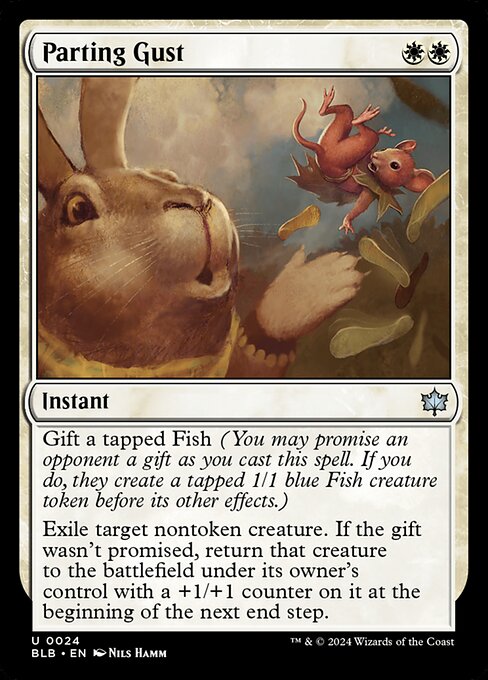
192. Parting Gust
Rating4.7WeakWhy this rating?
A solid playable that rarely gets cut (4.7/10).
Why. A two-white-mana instant that exiles a nontoken creature: for good with the Gift, the opponent getting a tapped 1/1 Fish, or temporarily without it, the creature returning with a +1/+1 counter. It removes a blocker or saves your own creature.
Risks. It needs two white mana. Without the Gift, the opponent gets their creature back stronger. With it, they get a small body.
In the draft. A flexible white removal spell for a heavily white deck, but with no urgency.
Results in the games of the set
When it is in hand, the deck wins 53.7% of its games (set average: 56.0%, 196th of 265 cards).
In the opening hand: 52.1% wins (55.0% on average).
Drawn during the game: 54.8% (56.6% on average).
When it is drawn, the deck wins 0.5 points more than when it is not.
When it is drafted, it is played 74% of the time (set average: 62%).
Taken as the first pick (75 drafts), it ends in the deck 87% of the time.
It is played about as much in every archetype.
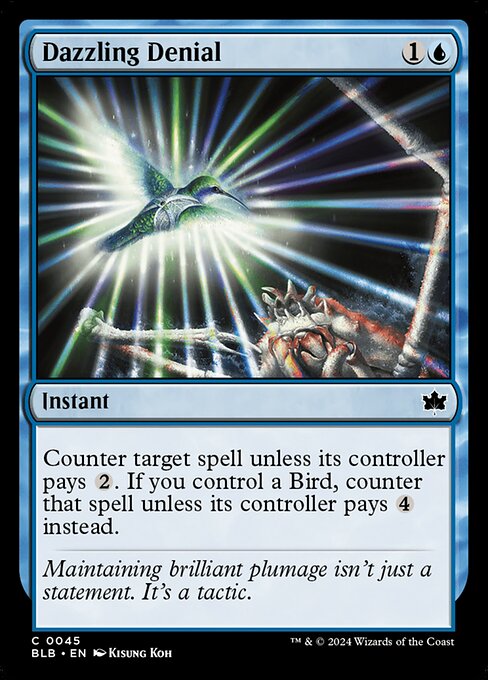
193. Dazzling Denial
Rating4.6WeakWhy this rating?
A solid playable that rarely gets cut (4.6/10).
Why. A two-mana instant that counters a spell unless its controller pays two, or four if you control a Bird. It punishes an opponent who taps out or plays with no spare mana.
Risks. An opponent who holds extra mana shuts it down. It forces you to keep two mana open, which slows your own development.
In the draft. A middling counterspell, playable in a blue control deck. Take it after your creatures and removal.
Results in the games of the set
When it is in hand, the deck wins 55.3% of its games (set average: 56.0%, 148th of 265 cards).
In the opening hand: 54.6% wins (55.0% on average).
Drawn during the game: 55.8% (56.6% on average).
When it is drawn, the deck wins 4.2 points more than when it is not.
When it is drafted, it is played 46% of the time (set average: 62%).
Taken as the first pick (67 drafts), it ends in the deck 81% of the time.
It is played mostly in R/U decks (65% of them) and U/W (64%).

194. Bandit's Talent
Rating4.6WeakWhy this rating?
A solid playable that rarely gets cut (4.6/10).
Why. A two-mana Class that makes the opponent discard two cards or one nonland card. Later levels punish an opponent who empties their hand: life loss at their upkeep, then extra cards for you.
Risks. It does nothing to the board, and the opponent picks their discard. Levels two and three are slow.
In the draft. A niche card for an aggressive black deck that empties its hand. In a control deck, do not play it.
Results in the games of the set
When it is in hand, the deck wins 52.6% of its games (set average: 56.0%, 223rd of 265 cards).
In the opening hand: 49.5% wins (55.0% on average).
Drawn during the game: 54.7% (56.6% on average).
When it is drawn, the deck wins 0.4 points more than when it is not.
When it is drafted, it is played 53% of the time (set average: 62%).
Taken as the first pick (45 drafts), it ends in the deck 82% of the time.
It is played about as much in every archetype.

195. Bonebind Orator
Rating4.6WeakWhy this rating?
A solid playable that rarely gets cut (4.6/10).
Why. A two-mana 2/2 that, once in the graveyard, can exile itself for four mana to return another creature card to your hand. A fine two-drop with a second life late in the game.
Risks. A plain 2/2 gets outclassed, and the graveyard ability costs a lot of mana for little immediate effect.
In the draft. A good black two-drop, playable in every black deck. A mid-pack pick.
Results in the games of the set
When it is in hand, the deck wins 55.3% of its games (set average: 56.0%, 149th of 265 cards).
In the opening hand: 54.6% wins (55.0% on average).
Drawn during the game: 55.8% (56.6% on average).
When it is drawn, the deck wins 0.2 points more than when it is not.
When it is drafted, it is played 80% of the time (set average: 62%).
Taken as the first pick (162 drafts), it ends in the deck 91% of the time.
It is played mostly in B/G decks (64% of them) and B/R (62%).

196. Glidedive Duo
Rating4.6WeakWhy this rating?
A solid playable that rarely gets cut (4.6/10).
Why. A five-mana 3/3 flyer: when it enters, each opponent loses 2 life and you gain 2. A decent aerial threat that buys time in a race.
Risks. Five mana for a 3/3 whose enter effect is light. Removal kills it.
In the draft. A decent black common, especially in white-black, black-green and black-red. Take it among the black commons.
Results in the games of the set
When it is in hand, the deck wins 56.6% of its games (set average: 56.0%, 107th of 265 cards).
In the opening hand: 53.8% wins (55.0% on average).
Drawn during the game: 58.4% (56.6% on average).
When it is drawn, the deck wins 2.1 points more than when it is not.
When it is drafted, it is played 77% of the time (set average: 62%).
Taken as the first pick (167 drafts), it ends in the deck 90% of the time.
It is played mostly in B/G decks (64% of them) and B/W (62%).
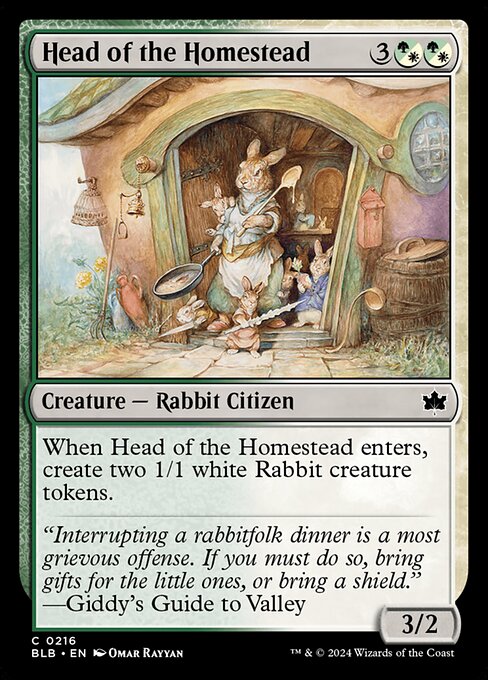 Rating4.6Weak
Why this rating?
A solid playable that rarely gets cut (4.6/10).
Why. A five-mana hybrid green or white 3/2 that creates two 1/1 white Rabbit creature tokens. Three bodies for one card: good with team effects, and resilient to spot removal.
Risks. The bodies are small and fall to a sweeper or big blockers. Five mana for five total power is expensive.
In the draft. A solid midrange creature for green or white decks. A fine pick, better with go-wide bonuses.
Results in the games of the set
When it is in hand, the deck wins 55.9% of its games (set average: 56.0%, 132nd of 265 cards).
In the opening hand: 54.5% wins (55.0% on average).
Drawn during the game: 56.8% (56.6% on average).
When it is drawn, the deck wins 1.1 points more than when it is not.
When it is drafted, it is played 79% of the time (set average: 62%).
Taken as the first pick (282 drafts), it ends in the deck 90% of the time.
It is played mostly in G/W decks (79% of them) and R/W (47%).

198. Might of the Meek
Rating4.6WeakWhy this rating?
A solid playable that rarely gets cut (4.6/10).
Why. A one-mana instant that gives a creature trample, +1/+0 if you control a Mouse, and draws you a card. It replaces itself and pushes damage through.
Risks. The effect is weak outside a Mouse deck. It does nothing without a creature to target.
In the draft. A fine support card in a red-white Mouse deck. Take it late.
Results in the games of the set
When it is in hand, the deck wins 52.8% of its games (set average: 56.0%, 219th of 265 cards).
In the opening hand: 52.4% wins (55.0% on average).
Drawn during the game: 53.2% (56.6% on average).
When it is drawn, the deck wins 1.0 points less than when it is not.
When it is drafted, it is played 42% of the time (set average: 62%).
Taken among the first three picks (195 drafts), it ends in the deck 79% of the time.
It is played mostly in R/W decks (63% of them) and R/U (41%).
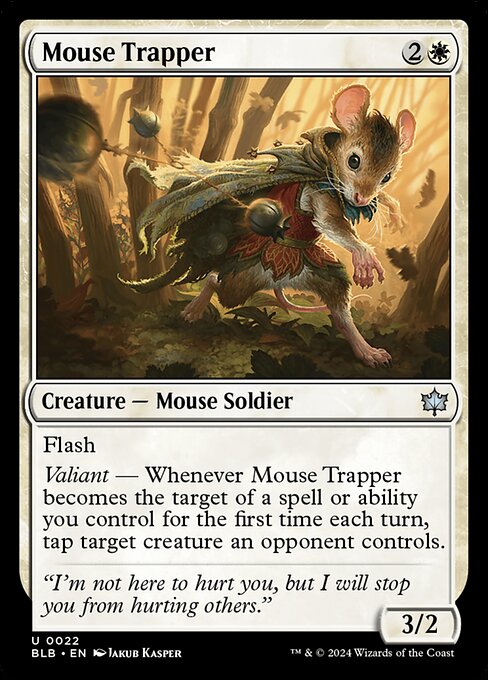
199. Mouse Trapper
Rating4.6WeakWhy this rating?
A solid playable that rarely gets cut (4.6/10).
Why. A three-mana 3/2 with flash: with Valiant, when a spell or ability you control targets it for the first time each turn, it taps an opposing creature. It ambushes an attacker or sets up your own attack.
Risks. You need targeting spells to use its effect, and it is fragile at two toughness. Without tricks it is just a flash 3/2.
In the draft. A fine choice in a white Valiant deck, notably red-white. Outside that archetype, it is average.
Results in the games of the set
When it is in hand, the deck wins 51.8% of its games (set average: 56.0%, 237th of 265 cards).
In the opening hand: 51.9% wins (55.0% on average).
Drawn during the game: 51.8% (56.6% on average).
When it is drawn, the deck wins 2.7 points less than when it is not.
When it is drafted, it is played 61% of the time (set average: 62%).
Taken as the first pick (61 drafts), it ends in the deck 87% of the time.
It is played mostly in R/W decks (40% of them).

200. Pileated Provisioner
Rating4.6WeakWhy this rating?
A solid playable that rarely gets cut (4.6/10).
Why. A five-mana 3/4 flyer that puts a +1/+1 counter on one of your creatures without flying. A solid aerial body that also upgrades another creature.
Risks. Five mana for a 3/4, and without another creature that lacks flying, the counter is lost.
In the draft. A decent top-end creature in white. Take it among the white commons for its flying and toughness.
Results in the games of the set
When it is in hand, the deck wins 53.5% of its games (set average: 56.0%, 203rd of 265 cards).
In the opening hand: 52.3% wins (55.0% on average).
Drawn during the game: 54.3% (56.6% on average).
When it is drawn, the deck wins 0.2 points more than when it is not.
When it is drafted, it is played 36% of the time (set average: 62%).
Taken among the first three picks (154 drafts), it ends in the deck 62% of the time.
It is played mostly in U/W decks (37% of them) and G/W (31%).

201. Short Bow
Rating4.6WeakWhy this rating?
A solid playable that rarely gets cut (4.6/10).
Why. A cheap-to-equip Equipment giving +1/+1, reach and vigilance. It turns an ordinary creature into an attacker that still holds the ground, and it shuts down a small flyer.
Risks. It does nothing alone and needs a creature to carry it. The bonus is modest: it doesn't replace a real threat or removal.
In the draft. Playable filler in a deck with plenty of small creatures. Take it late, after your creatures and interaction.
Results in the games of the set
When it is in hand, the deck wins 52.6% of its games (set average: 56.0%, 222nd of 265 cards).
In the opening hand: 52.2% wins (55.0% on average).
Drawn during the game: 52.8% (56.6% on average).
When it is drawn, the deck wins 0.8 points less than when it is not.
When it is drafted, it is played 54% of the time (set average: 62%).
Taken as the first pick (34 drafts), it ends in the deck 85% of the time.
It is played about as much in every archetype.

202. Nettle Guard
Rating4.5WeakWhy this rating?
A solid playable that rarely gets cut (4.5/10).
Why. A two-mana 3/1 that attacks well early. Valiant gives it +0/+2 when you target it, and it can sacrifice itself to destroy an artifact or enchantment.
Risks. With one toughness it dies to everything. Valiant needs spells that target it, and the sacrifice mode sometimes has no target.
In the draft. A good two-drop for an aggressive white deck with tricks and Equipment. Otherwise just curve filler.
Results in the games of the set
When it is in hand, the deck wins 54.6% of its games (set average: 56.0%, 165th of 265 cards).
In the opening hand: 56.0% wins (55.0% on average).
Drawn during the game: 53.4% (56.6% on average).
When it is drawn, the deck wins 0.8 points less than when it is not.
When it is drafted, it is played 77% of the time (set average: 62%).
Taken as the first pick (176 drafts), it ends in the deck 91% of the time.
It is played mostly in R/W decks (72% of them) and G/W (71%).

203. Agate-Blade Assassin
Rating4.5WeakWhy this rating?
A good playable, but is sometimes cut (4.5/10).
Why. A two-mana 1/3 that blocks small creatures and drains on each attack. The drain adds up slowly and matters in racing decks.
Risks. Attacking with a 1/3 is risky once the opponent has a decent blocker. It does not shape the board.
In the draft. A solid two-drop for an aggressive or drain-oriented black deck. Not a reason to change plans, but it does its job.
Results in the games of the set
When it is in hand, the deck wins 54.8% of its games (set average: 56.0%, 159th of 265 cards).
In the opening hand: 56.0% wins (55.0% on average).
Drawn during the game: 53.8% (56.6% on average).
When it is drawn, the deck wins 0.3 points more than when it is not.
When it is drafted, it is played 64% of the time (set average: 62%).
Taken as the first pick (94 drafts), it ends in the deck 93% of the time.
It is played mostly in B/R decks (79% of them) and B/W (55%).

204. Agate Assault
Rating4.4WeakWhy this rating?
A good playable, but is sometimes cut (4.4/10).
Why. A three-mana red removal: 4 damage to a creature, exiled if it would die. The second mode exiles an artifact, which occasionally matters.
Risks. It's a sorcery, so you can't react mid-combat. It does not kill big creatures.
In the draft. Decent removal; take it without hesitation if your red deck needs some. Take it over filler, but not over more efficient removal.
Results in the games of the set
When it is in hand, the deck wins 54.3% of its games (set average: 56.0%, 178th of 265 cards).
In the opening hand: 53.1% wins (55.0% on average).
Drawn during the game: 55.2% (56.6% on average).
When it is drawn, the deck wins 0.6 points more than when it is not.
When it is drafted, it is played 77% of the time (set average: 62%).
Taken as the first pick (191 drafts), it ends in the deck 90% of the time.
It is played mostly in R/U decks (66% of them) and G/R (58%).

205. Fountainport Bell
Rating4.4WeakWhy this rating?
A good playable, but is sometimes cut (4.4/10).
Why. For one mana it puts a basic land from your library on top. For one more you sacrifice it and draw that land: it replaces itself and smooths your draws.
Risks. No effect on the board, and two mana in total for a card that doesn't advance your plan. In a fast deck it's a lost turn.
In the draft. Late-pack filler for slower decks that like to draw. Take it only when you lack playables.
Results in the games of the set
When it is in hand, the deck wins 53.9% of its games (set average: 56.0%, 189th of 265 cards).
In the opening hand: 52.8% wins (55.0% on average).
Drawn during the game: 54.7% (56.6% on average).
When it is drawn, the deck wins 0.0 points more than when it is not.
When it is drafted, it is played 62% of the time (set average: 62%).
Taken as the first pick (45 drafts), it ends in the deck 78% of the time.
It is played mostly in B/U decks (30% of them) and G/U (25%).

206. Hidden Grotto
Rating4.4WeakWhy this rating?
A good playable, but is sometimes cut (4.4/10).
Why. A land that surveils 1 on entering and taps for colorless. For an extra mana it makes any color: slow fixing, but useful.
Risks. On its own it only taps for colorless; getting a color costs an extra mana, so you lose tempo. In a deck with demanding color requirements it can get in the way.
In the draft. A utility land for a three-color deck or a splash. In a two-color deck it does not replace a basic land.
Results in the games of the set
When it is in hand, the deck wins 54.6% of its games (set average: 56.0%, 166th of 265 cards).
In the opening hand: 53.5% wins (55.0% on average).
Drawn during the game: 55.4% (56.6% on average).
When it is drawn, the deck wins 0.7 points more than when it is not.
When it is drafted, it is played 71% of the time (set average: 62%).
Taken as the first pick (46 drafts), it ends in the deck 89% of the time.

207. Moonrise Cleric
Rating4.4WeakWhy this rating?
A good playable, but is sometimes cut (4.4/10).
Why. A three-mana 2/3 flyer that gains 1 life when it attacks. It blocks opposing flyers and attacks safely.
Risks. Its hybrid cost needs white or black mana. Nothing spectacular, and it's fragile against removal.
In the draft. Good filler for a white or black deck: take it for the curve and air presence. Not worth an early pick.
Results in the games of the set
When it is in hand, the deck wins 55.6% of its games (set average: 56.0%, 140th of 265 cards).
In the opening hand: 55.2% wins (55.0% on average).
Drawn during the game: 56.0% (56.6% on average).
When it is drawn, the deck wins 1.6 points more than when it is not.
When it is drafted, it is played 68% of the time (set average: 62%).
Taken as the first pick (152 drafts), it ends in the deck 81% of the time.
It is played mostly in B/W decks (75% of them).

208. Otterball Antics
Rating4.4WeakWhy this rating?
A good playable, but is sometimes cut (4.4/10).
Why. A two-mana sorcery that creates a 1/1 blue and red Otter creature token with prowess. Flashback costs four mana and gives a token with a +1/+1 counter: two bodies from one card.
Risks. A 1/1 token is fragile, and the card only shines in a deck with plenty of noncreature spells to trigger prowess.
In the draft. Interesting in a blue-red spells deck. Outside that plan it's weak: don't take it early.
Results in the games of the set
When it is in hand, the deck wins 54.0% of its games (set average: 56.0%, 185th of 265 cards).
In the opening hand: 51.1% wins (55.0% on average).
Drawn during the game: 55.8% (56.6% on average).
When it is drawn, the deck wins 3.4 points more than when it is not.
When it is drafted, it is played 43% of the time (set average: 62%).
Taken as the first pick (43 drafts), it ends in the deck 93% of the time.
It is played mostly in R/U decks (57% of them).

209. Run Away Together
Rating4.4WeakWhy this rating?
A good playable, but is sometimes cut (4.4/10).
Why. A two-mana instant that returns two creatures controlled by different players to their owners' hands. You can rebuy an enters-the-battlefield creature and cost the opponent tempo.
Risks. You need a creature on each side, and one of yours always goes back. It's tempo, not a permanent answer.
In the draft. A good tool in a blue-green deck with enters-the-battlefield creatures. Elsewhere it's tempo filler: take it late.
Results in the games of the set
When it is in hand, the deck wins 53.6% of its games (set average: 56.0%, 202nd of 265 cards).
In the opening hand: 49.4% wins (55.0% on average).
Drawn during the game: 55.8% (56.6% on average).
When it is drawn, the deck wins 2.2 points more than when it is not.
When it is drafted, it is played 39% of the time (set average: 62%).
Taken as the first pick (36 drafts), it ends in the deck 78% of the time.
It is played mostly in G/U decks (66% of them) and R/U (31%).
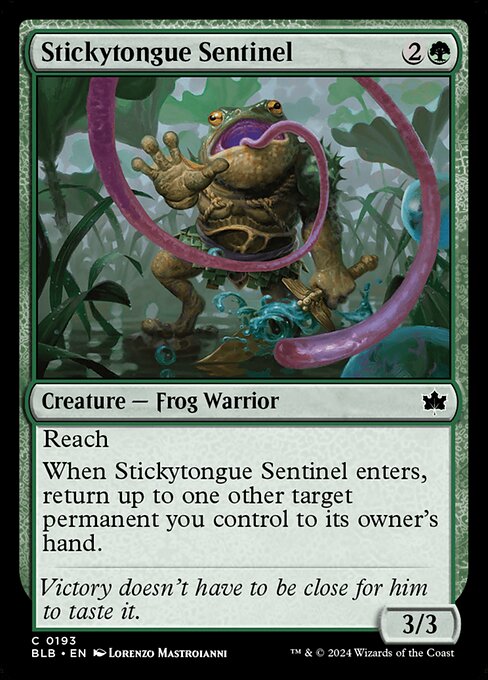 Rating4.4Weak
Why this rating?
A good playable, but is sometimes cut (4.4/10).
Why. A three-mana 3/3 with reach: a solid body that blocks on the ground and in the air. Its optional enters effect lets you rebuy an enters-the-battlefield permanent or save one under threat.
Risks. With no other permanent to return the effect is dead. A three-mana 3/3 is still ordinary.
In the draft. A good green common that fits almost any green deck. Take it for the curve, without forcing it.
Results in the games of the set
When it is in hand, the deck wins 55.8% of its games (set average: 56.0%, 135th of 265 cards).
In the opening hand: 53.4% wins (55.0% on average).
Drawn during the game: 57.4% (56.6% on average).
When it is drawn, the deck wins 1.5 points more than when it is not.
When it is drafted, it is played 81% of the time (set average: 62%).
Taken as the first pick (260 drafts), it ends in the deck 92% of the time.
It is played mostly in G/U decks (78% of them) and B/G (60%).

211. Waterspout Warden
Rating4.4WeakWhy this rating?
A good playable, but is sometimes cut (4.4/10).
Why. A three-mana 3/2 that gains flying when it attacks if another creature entered under your control this turn. With cheap creatures it becomes an evasive attacker.
Risks. You must cast a creature before combat, and the 3/2 body is fragile. Without that it's an unexciting ground creature.
In the draft. Weak; it only earns a slot in a blue deck with lots of cheap or token-making creatures. Otherwise pass.
Results in the games of the set
When it is in hand, the deck wins 52.2% of its games (set average: 56.0%, 229th of 265 cards).
In the opening hand: 50.6% wins (55.0% on average).
Drawn during the game: 53.2% (56.6% on average).
When it is drawn, the deck wins 0.7 points more than when it is not.
When it is drafted, it is played 24% of the time (set average: 62%).
Taken among the first three picks (85 drafts), it ends in the deck 68% of the time.
It is played mostly in G/U decks (51% of them) and U/W (26%).
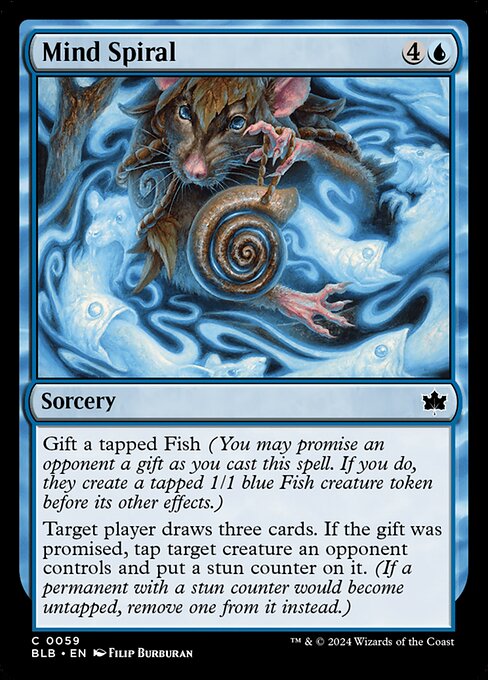
212. Mind Spiral
Rating4.4WeakWhy this rating?
A good playable, but is sometimes cut (4.4/10).
Why. A five-mana sorcery that draws three cards. With the gift, the opponent gets a tapped 1/1 blue Fish creature token, and one of their creatures is tapped with a stun counter: welcome tempo.
Risks. Five mana to do nothing on the board is slow. The gift hands the opponent a token.
In the draft. A fine tool for slower, defensive blue decks. In an aggressive deck, leave it.
Results in the games of the set
When it is in hand, the deck wins 54.0% of its games (set average: 56.0%, 187th of 265 cards).
In the opening hand: 49.9% wins (55.0% on average).
Drawn during the game: 56.2% (56.6% on average).
When it is drawn, the deck wins 3.0 points more than when it is not.
When it is drafted, it is played 29% of the time (set average: 62%).
Taken among the first three picks (124 drafts), it ends in the deck 68% of the time.
It is played mostly in R/U decks (42% of them) and B/U (33%).

213. Shore Up
Rating4.3WeakWhy this rating?
A good playable, but is sometimes cut (4.3/10).
Why. A one-mana instant giving your creature +1/+1 and hexproof, and untapping it. It counters targeted removal and can win a combat.
Risks. It does nothing without a creature and without an opposing removal to answer. It's a response, not a card-advantage engine.
In the draft. A good tool for blue decks with valuable or Valiant creatures. Otherwise late-pack filler.
Results in the games of the set
When it is in hand, the deck wins 54.3% of its games (set average: 56.0%, 175th of 265 cards).
In the opening hand: 50.7% wins (55.0% on average).
Drawn during the game: 56.4% (56.6% on average).
When it is drawn, the deck wins 3.6 points more than when it is not.
When it is drafted, it is played 48% of the time (set average: 62%).
Taken as the first pick (44 drafts), it ends in the deck 82% of the time.
It is played mostly in R/U decks (56% of them) and B/U (55%).

214. Knightfisher
Rating4.2WeakWhy this rating?
A good playable, but is sometimes cut (4.2/10).
Why. A five-mana 4/5 flyer: a big body that rules the skies and blocks nearly everything. It makes a 1/1 blue Fish creature token whenever another nontoken Bird you control enters.
Risks. Two blue mana and five total: it's slow. The Fish bonus depends on having other Birds.
In the draft. A good finisher for a blue deck, even without other Birds. Take it at a mid pick for a flyers deck.
Results in the games of the set
When it is in hand, the deck wins 54.7% of its games (set average: 56.0%, 163rd of 265 cards).
In the opening hand: 52.5% wins (55.0% on average).
Drawn during the game: 55.8% (56.6% on average).
When it is drawn, the deck wins 4.7 points more than when it is not.
When it is drafted, it is played 49% of the time (set average: 62%).
Taken as the first pick (51 drafts), it ends in the deck 71% of the time.
It is played mostly in U/W decks (49% of them).
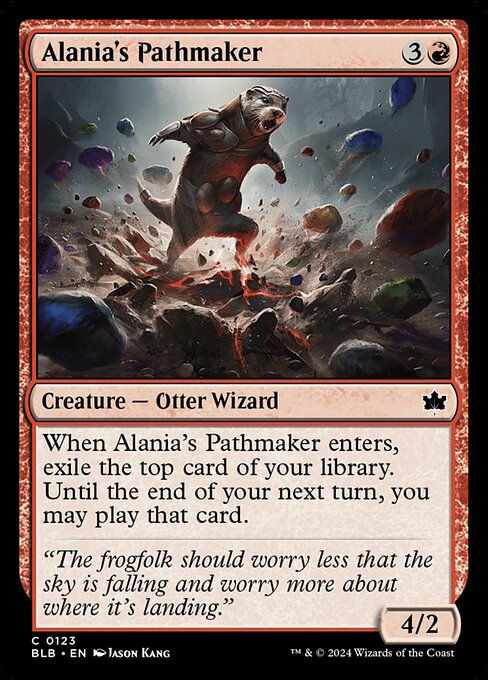
215. Alania's Pathmaker
Rating4.2WeakWhy this rating?
A good playable, but is sometimes cut (4.2/10).
Why. A four-mana 4/2 that exiles the top card of your library and lets you play it until the end of your next turn. A body and a possible card in one slot.
Risks. Two toughness makes it fragile. If you can't play the exiled card by the end of your next turn (too expensive, land drop already used), it's lost.
In the draft. Good red filler. Take it for the curve, after your removal.
Results in the games of the set
When it is in hand, the deck wins 53.8% of its games (set average: 56.0%, 194th of 265 cards).
In the opening hand: 52.9% wins (55.0% on average).
Drawn during the game: 54.4% (56.6% on average).
When it is drawn, the deck wins 0.2 points less than when it is not.
When it is drafted, it is played 56% of the time (set average: 62%).
Taken as the first pick (96 drafts), it ends in the deck 86% of the time.
It is played mostly in G/R decks (59% of them) and B/R (50%).

216. Brambleguard Captain
Rating4.2WeakWhy this rating?
A good playable, but is sometimes cut (4.2/10).
Why. At the beginning of combat, a creature you control gets +X/+0, where X is the Captain's power. It can target itself and attack as a 4/3, or boost an evasive creature.
Risks. The 2/3 body is modest for four mana, and the effect needs another creature to boost to be really good.
In the draft. A good tool for aggressive red decks with lots of small creatures. Take it at a mid pick.
Results in the games of the set
When it is in hand, the deck wins 53.9% of its games (set average: 56.0%, 190th of 265 cards).
In the opening hand: 53.2% wins (55.0% on average).
Drawn during the game: 54.4% (56.6% on average).
When it is drawn, the deck wins 0.3 points less than when it is not.
When it is drafted, it is played 74% of the time (set average: 62%).
Taken as the first pick (102 drafts), it ends in the deck 86% of the time.
It is played mostly in R/W decks (43% of them) and G/R (28%).

217. Clifftop Lookout
Rating4.2WeakWhy this rating?
A good playable, but is sometimes cut (4.2/10).
Why. A 1/2 reach that reveals cards until a land and puts it onto the battlefield tapped. It ramps your mana and takes a land out of your library.
Risks. A weak 1/2 body for three mana. It does nothing but ramp, and the land enters tapped.
In the draft. A ramp tool for green decks with expensive cards. Otherwise, filler.
Results in the games of the set
When it is in hand, the deck wins 53.2% of its games (set average: 56.0%, 211th of 265 cards).
In the opening hand: 53.0% wins (55.0% on average).
Drawn during the game: 53.4% (56.6% on average).
When it is drawn, the deck wins 0.2 points more than when it is not.
When it is drafted, it is played 74% of the time (set average: 62%).
Taken as the first pick (95 drafts), it ends in the deck 89% of the time.
It is played mostly in G/U decks (27% of them).
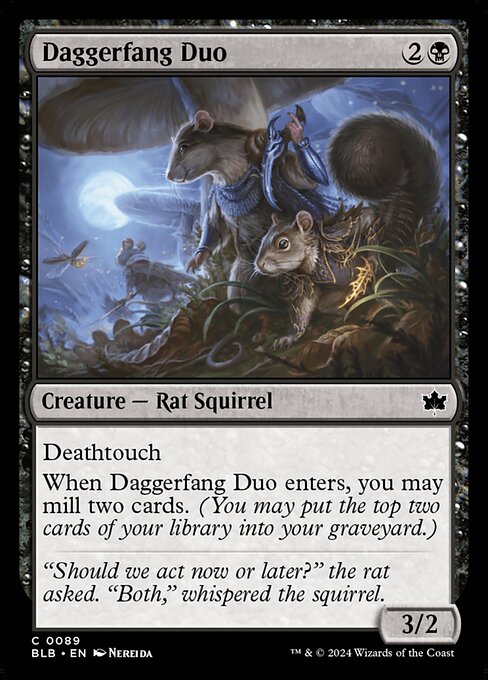
218. Daggerfang Duo
Rating4.2WeakWhy this rating?
A good playable, but is sometimes cut (4.2/10).
Why. A three-mana 3/2 with deathtouch. It deters attacks and trades with almost any creature, and the optional mill feeds Threshold.
Risks. Two toughness means small burn kills it, and the mill can cost you a useful card.
In the draft. A good black common to take for the curve, especially in a Threshold deck. A solid mid-pack card.
Results in the games of the set
When it is in hand, the deck wins 55.5% of its games (set average: 56.0%, 146th of 265 cards).
In the opening hand: 53.9% wins (55.0% on average).
Drawn during the game: 56.6% (56.6% on average).
When it is drawn, the deck wins 1.9 points more than when it is not.
When it is drafted, it is played 76% of the time (set average: 62%).
Taken as the first pick (167 drafts), it ends in the deck 88% of the time.
It is played mostly in B/U decks (71% of them) and B/G (64%).
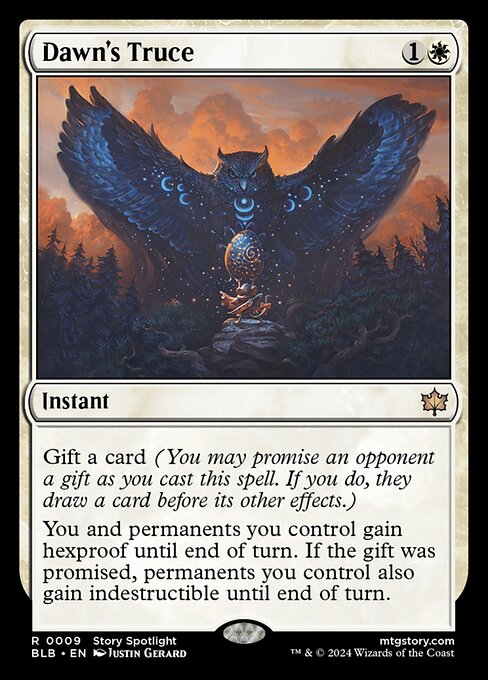
219. Dawn's Truce
Rating4.2WeakWhy this rating?
A good playable, but is sometimes cut (4.2/10).
Why. A two-mana instant giving you and your permanents hexproof. With the gift, your permanents also gain indestructible: a counter to targeted removal and destroy-based sweepers.
Risks. Reactive and situational: it does nothing if the opponent has no removal, and the gift gives them a card.
In the draft. A niche card for a deck with a few key creatures. Generally pass it.
Results in the games of the set
When it is in hand, the deck wins 48.7% of its games (set average: 56.0%, 258th of 265 cards).
In the opening hand: 47.7% wins (55.0% on average).
Drawn during the game: 49.4% (56.6% on average).
When it is drawn, the deck wins 2.2 points less than when it is not.
When it is drafted, it is played 20% of the time (set average: 62%).

220. Steampath Charger
Rating4.2WeakWhy this rating?
A good playable, but is sometimes cut (4.2/10).
Why. A two-mana 2/1 that deals 1 damage to a player when it dies. For two more mana, Offspring adds a 1/1 token copy, which has that ability too.
Risks. One toughness is fragile, and Offspring costs four mana in total. A small body with a small effect.
In the draft. Filler for aggressive red decks. Not a priority.
Results in the games of the set
When it is in hand, the deck wins 52.2% of its games (set average: 56.0%, 230th of 265 cards).
In the opening hand: 51.6% wins (55.0% on average).
Drawn during the game: 52.7% (56.6% on average).
When it is drawn, the deck wins 2.8 points less than when it is not.
When it is drafted, it is played 55% of the time (set average: 62%).
Taken as the first pick (69 drafts), it ends in the deck 87% of the time.
It is played mostly in B/R decks (70% of them) and G/R (46%).
 Rating4.2Weak
Why this rating?
A good playable, but is sometimes cut (4.2/10).
Why. A two-mana 1/3 that taps for one mana of any color. It accelerates you into turn three or four and fixes your colors.
Risks. A small body that doesn't win the game alone. It gets weak late, when you no longer need mana.
In the draft. Good fixing and ramp for green decks in two or three colors. Take it at a mid pick.
Results in the games of the set
When it is in hand, the deck wins 54.9% of its games (set average: 56.0%, 155th of 265 cards).
In the opening hand: 56.7% wins (55.0% on average).
Drawn during the game: 53.5% (56.6% on average).
When it is drawn, the deck wins 1.2 points more than when it is not.
When it is drafted, it is played 79% of the time (set average: 62%).
Taken as the first pick (235 drafts), it ends in the deck 91% of the time.
It is played mostly in G/R decks (55% of them) and G/U (51%).

222. Wax-Wane Witness
Rating4.2WeakWhy this rating?
A good playable, but is sometimes cut (4.2/10).
Why. A four-mana 2/4 flyer with vigilance. It attacks and blocks, and gets +1/+0 when you gain or lose life during your turn.
Risks. Its power of 2 is low without life gained or lost on your turn. It doesn't win the game alone.
In the draft. A good common for white or black decks with life gain. A fair pick for the curve.
Results in the games of the set
When it is in hand, the deck wins 54.1% of its games (set average: 56.0%, 183rd of 265 cards).
In the opening hand: 53.1% wins (55.0% on average).
Drawn during the game: 54.8% (56.6% on average).
When it is drawn, the deck wins 0.7 points more than when it is not.
When it is drafted, it is played 51% of the time (set average: 62%).
Taken as the first pick (43 drafts), it ends in the deck 81% of the time.
It is played mostly in B/W decks (75% of them).

223. Sinister Monolith
Rating4.1WeakWhy this rating?
A good playable, but is sometimes cut (4.1/10).
Why. A four-mana artifact that drains 1 life at the beginning of combat on your turn. You can sacrifice it to draw two cards by paying 2 life, only at sorcery speed.
Risks. Slow, with no board impact: it doesn't protect you from creatures. A wasted investment if you fall behind.
In the draft. Weak, except in a black control deck. Take it late.
Results in the games of the set
When it is in hand, the deck wins 51.3% of its games (set average: 56.0%, 247th of 265 cards).
In the opening hand: 48.5% wins (55.0% on average).
Drawn during the game: 53.2% (56.6% on average).
When it is drawn, the deck wins 1.1 points less than when it is not.
When it is drafted, it is played 49% of the time (set average: 62%).
Taken as the first pick (44 drafts), it ends in the deck 75% of the time.
It is played mostly in B/W decks (29% of them).
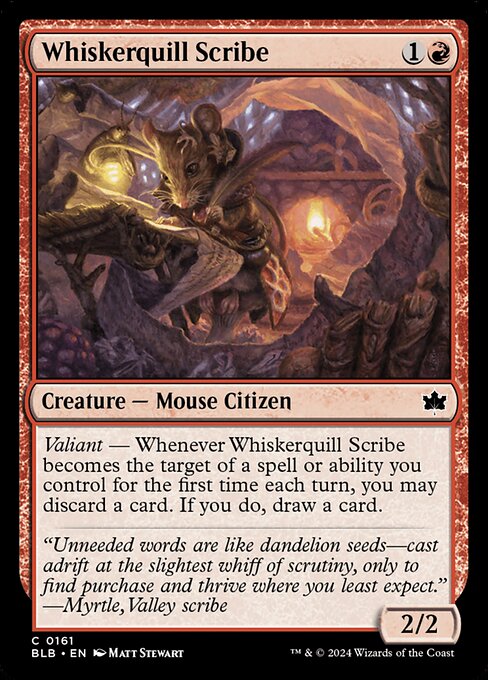
224. Whiskerquill Scribe
Rating4.0WeakWhy this rating?
A good playable, but is sometimes cut (4.1/10).
Why. A two-mana 2/2. Valiant lets you discard a card to draw a card, filtering your hand when a spell targets it.
Risks. A plain 2/2 body, and the effect needs spells that target it. Without them it's a vanilla creature.
In the draft. Filler for red or white decks with tricks. Not a priority.
Results in the games of the set
When it is in hand, the deck wins 51.8% of its games (set average: 56.0%, 239th of 265 cards).
In the opening hand: 53.2% wins (55.0% on average).
Drawn during the game: 50.6% (56.6% on average).
When it is drawn, the deck wins 3.3 points less than when it is not.
When it is drafted, it is played 45% of the time (set average: 62%).
Taken as the first pick (53 drafts), it ends in the deck 79% of the time.
It is played mostly in R/W decks (70% of them) and G/R (37%).
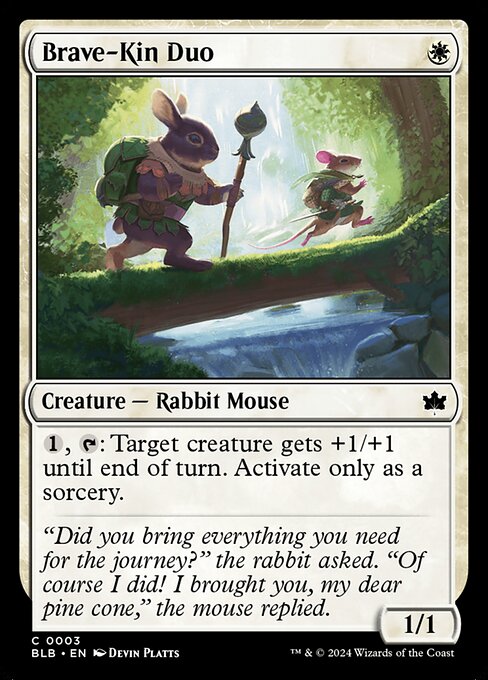
225. Brave-Kin Duo
Rating4.0WeakWhy this rating?
A good playable, but is sometimes cut (4.0/10).
Why. A one-mana 1/1 that, for one more mana, taps to give a creature +1/+1, at sorcery speed. It can win a combat every turn.
Risks. A tapped 1/1 doesn't block well, and the bonus only works on your turn. Rarely impactful.
In the draft. Filler for an aggressive white deck. It doesn't deserve an early pick.
Results in the games of the set
When it is in hand, the deck wins 52.0% of its games (set average: 56.0%, 235th of 265 cards).
In the opening hand: 53.8% wins (55.0% on average).
Drawn during the game: 50.4% (56.6% on average).
When it is drawn, the deck wins 2.8 points less than when it is not.
When it is drafted, it is played 51% of the time (set average: 62%).
Taken as the first pick (66 drafts), it ends in the deck 82% of the time.
It is played mostly in R/W decks (68% of them) and G/W (50%).
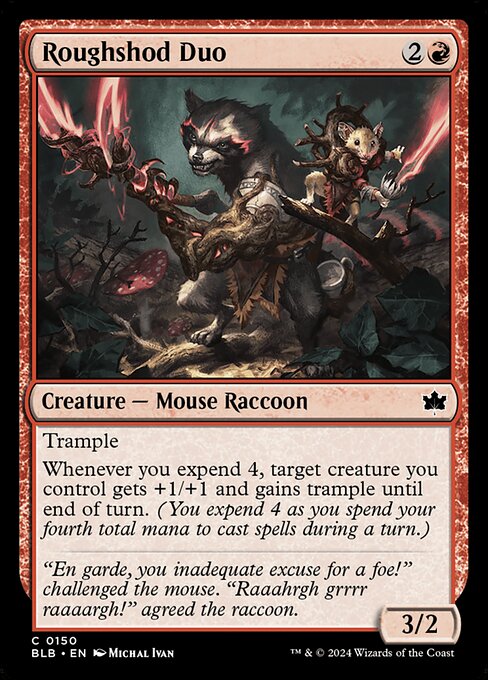
226. Roughshod Duo
Rating4.0WeakWhy this rating?
A good playable, but is sometimes cut (4.0/10).
Why. A three-mana 3/2 with trample. Expend 4 gives a creature +1/+1 and trample, which helps push through a block.
Risks. It requires spending four mana on spells in a turn, and its 3/2 body is still fragile.
In the draft. Decent red filler for the curve. Take it late.
Results in the games of the set
When it is in hand, the deck wins 53.2% of its games (set average: 56.0%, 212th of 265 cards).
In the opening hand: 53.7% wins (55.0% on average).
Drawn during the game: 52.8% (56.6% on average).
When it is drawn, the deck wins 1.7 points less than when it is not.
When it is drafted, it is played 65% of the time (set average: 62%).
Taken as the first pick (94 drafts), it ends in the deck 85% of the time.
It is played mostly in G/R decks (74% of them) and R/W (57%).

227. Thistledown Players
Rating4.0WeakWhy this rating?
A good playable, but is sometimes cut (4.0/10).
Why. A three-mana 3/3: a decent body. When it attacks it untaps a nonland permanent: itself to stay back as a blocker, or one tapped for an ability.
Risks. The effect is minor and its usefulness depends on your other permanents. Mostly a vanilla 3/3.
In the draft. White filler for the curve. Take it when you lack creatures.
Results in the games of the set
When it is in hand, the deck wins 52.4% of its games (set average: 56.0%, 226th of 265 cards).
In the opening hand: 53.5% wins (55.0% on average).
Drawn during the game: 51.6% (56.6% on average).
When it is drawn, the deck wins 1.6 points less than when it is not.
When it is drafted, it is played 44% of the time (set average: 62%).
Taken as the first pick (40 drafts), it ends in the deck 73% of the time.
It is played mostly in R/W decks (67% of them) and G/W (37%).
 Rating4.0Weak
Why this rating?
A good playable, but is sometimes cut (4.0/10).
Why. A four-mana 4/3. When it enters, the opponent loses 3 life unless they sacrifice a nonland permanent or discard a card. A good body that takes something.
Risks. The opponent chooses: they often discard a spare card. Offspring costs seven mana in total, which is slow.
In the draft. A fair black common to take for the curve. A mid-pack pick.
Results in the games of the set
When it is in hand, the deck wins 54.5% of its games (set average: 56.0%, 167th of 265 cards).
In the opening hand: 52.4% wins (55.0% on average).
Drawn during the game: 55.9% (56.6% on average).
When it is drawn, the deck wins 2.0 points more than when it is not.
When it is drafted, it is played 43% of the time (set average: 62%).
Taken as the first pick (34 drafts), it ends in the deck 74% of the time.
It is played mostly in B/U decks (42% of them) and B/R (40%).

229. Thought Shucker
Rating4.0WeakWhy this rating?
A good playable, but is sometimes cut (4.0/10).
Why. A two-mana 1/3 that blocks small creatures. With Threshold it gets a +1/+1 counter and draws you a card, once only.
Risks. Threshold is slow to reach and the effect happens only once. Before that, it's a 1/3 with no value.
In the draft. Weak outside a blue-black Threshold deck. Take it late.
Results in the games of the set
When it is in hand, the deck wins 52.2% of its games (set average: 56.0%, 227th of 265 cards).
In the opening hand: 48.5% wins (55.0% on average).
Drawn during the game: 54.7% (56.6% on average).
When it is drawn, the deck wins 1.8 points more than when it is not.
When it is drafted, it is played 24% of the time (set average: 62%).
Taken among the first three picks (110 drafts), it ends in the deck 78% of the time.
It is played mostly in B/U decks (61% of them).

230. Barkform Harvester
Rating4.0WeakWhy this rating?
A good playable, but is sometimes cut (4.0/10).
Why. A three-mana 2/3 artifact creature with reach and changeling, playable in any deck. For two mana it puts a card from your graveyard on the bottom of your library.
Risks. A small body with no impact and an ability that doesn't win games. It also shrinks your graveyard, bad for Threshold.
In the draft. Colorless filler as a last resort.
Results in the games of the set
When it is in hand, the deck wins 52.1% of its games (set average: 56.0%, 231st of 265 cards).
In the opening hand: 48.6% wins (55.0% on average).
Drawn during the game: 54.5% (56.6% on average).
When it is drawn, the deck wins 0.5 points less than when it is not.
When it is drafted, it is played 22% of the time (set average: 62%).
Taken among the first three picks (45 drafts), it ends in the deck 58% of the time.
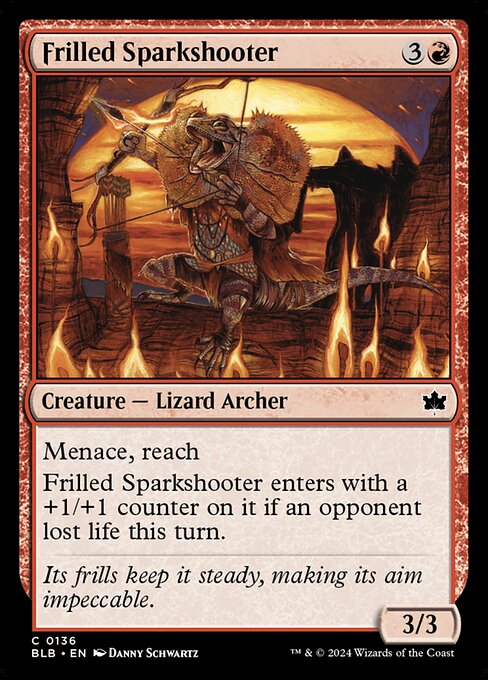
231. Frilled Sparkshooter
Rating3.9WeakWhy this rating?
A good playable, but is sometimes cut (3.9/10).
Why. A four-mana 3/3 with reach and menace. It enters with a +1/+1 counter if an opponent lost life this turn, making it a 4/4.
Risks. You need to have dealt life loss before casting it. Otherwise a four-mana 3/3 is unappealing.
In the draft. Red filler, a bit better in a black-red drain deck. Take it late.
Results in the games of the set
When it is in hand, the deck wins 52.1% of its games (set average: 56.0%, 232nd of 265 cards).
In the opening hand: 51.7% wins (55.0% on average).
Drawn during the game: 52.4% (56.6% on average).
When it is drawn, the deck wins 2.0 points less than when it is not.
When it is drafted, it is played 36% of the time (set average: 62%).
Taken among the first three picks (156 drafts), it ends in the deck 76% of the time.
It is played mostly in B/R decks (59% of them) and G/R (30%).
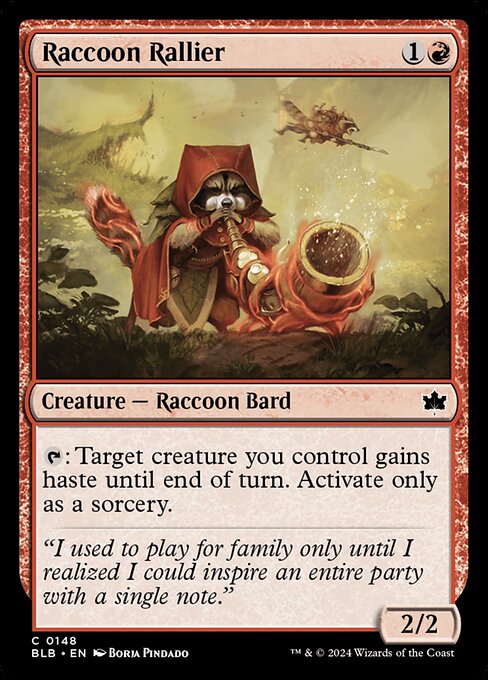
232. Raccoon Rallier
Rating3.8WeakWhy this rating?
A good playable, but is sometimes cut (3.8/10).
Why. A two-mana 2/2 that gives a creature haste, at sorcery speed. It lets a creature attack the turn it arrives.
Risks. It's little more than a vanilla 2/2, and haste adds nothing to a creature that is already ready. Little impact.
In the draft. Weak: last-resort red filler.
Results in the games of the set
When it is in hand, the deck wins 51.4% of its games (set average: 56.0%, 244th of 265 cards).
In the opening hand: 53.1% wins (55.0% on average).
Drawn during the game: 49.9% (56.6% on average).
When it is drawn, the deck wins 3.5 points less than when it is not.
When it is drafted, it is played 55% of the time (set average: 62%).
Taken as the first pick (69 drafts), it ends in the deck 87% of the time.
It is played mostly in G/R decks (68% of them) and R/W (54%).

233. Huskburster Swarm
Rating3.8WeakWhy this rating?
A good playable, but is sometimes cut (3.8/10).
Why. A 6/6 with menace and deathtouch. Its cost drops by one mana for each creature card you own in exile and in your graveyard: late in the game it becomes cheap.
Risks. It costs eight mana to start and is unplayable early. It needs a graveyard full of creatures.
In the draft. A finisher for black decks that fill their graveyard. Outside that plan, pass.
Results in the games of the set
When it is in hand, the deck wins 53.7% of its games (set average: 56.0%, 195th of 265 cards).
In the opening hand: 50.4% wins (55.0% on average).
Drawn during the game: 55.7% (56.6% on average).
When it is drawn, the deck wins 1.2 points more than when it is not.
When it is drafted, it is played 62% of the time (set average: 62%).
Taken as the first pick (67 drafts), it ends in the deck 73% of the time.
It is played mostly in B/U decks (30% of them).

234. Treetop Sentries
Rating3.8WeakWhy this rating?
A good playable, but is sometimes cut (3.8/10).
Why. A four-mana 2/4 with reach, a good blocker. With Forage it draws you a card, replacing itself.
Risks. Forage needs three cards in the graveyard or a Food, which isn't always available. Without it, it's just a blocker.
In the draft. A fair green common for defense, especially with Food. Take it at a mid pick.
Results in the games of the set
When it is in hand, the deck wins 54.7% of its games (set average: 56.0%, 161st of 265 cards).
In the opening hand: 51.9% wins (55.0% on average).
Drawn during the game: 56.5% (56.6% on average).
When it is drawn, the deck wins 0.3 points more than when it is not.
When it is drafted, it is played 65% of the time (set average: 62%).
Taken as the first pick (115 drafts), it ends in the deck 79% of the time.
It is played mostly in B/G decks (74% of them) and G/R (37%).
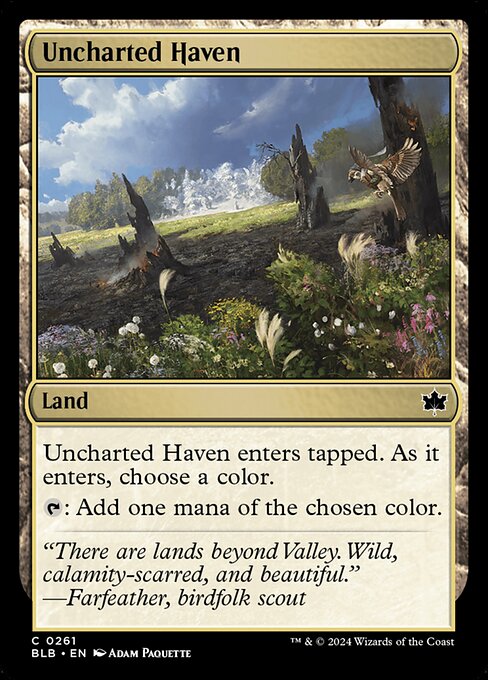
235. Uncharted Haven
Rating3.8WeakWhy this rating?
A good playable, but is sometimes cut (3.8/10).
Why. A land that enters tapped and taps for the colour you choose as it arrives. It is pure fixing: it smooths out a three-colour deck or a splash and does nothing else.
Risks. It enters tapped, which costs tempo in an aggressive deck, and it makes only one colour, so it is no substitute for a real dual land.
In the draft. Play it only if your deck actually needs fixing or a splash. Take it late, after the playables are in hand.
Results in the games of the set
When it is in hand, the deck wins 54.0% of its games (set average: 56.0%, 186th of 265 cards).
In the opening hand: 55.6% wins (55.0% on average).
Drawn during the game: 52.7% (56.6% on average).
When it is drawn, the deck wins 0.9 points less than when it is not.
When it is drafted, it is played 86% of the time (set average: 62%).
Taken as the first pick (91 drafts), it ends in the deck 89% of the time.
 Rating3.5Weak
Why this rating?
Filler card but sometimes gets cut (3.5/10).
Why. A 2/3 for three that gets a +1/+1 counter each combat in which you forage. With a Food or a well-stocked graveyard it quickly outgrows other creatures at its cost.
Risks. Without Food or a full graveyard it is just a plain 2/3. Foraging eats resources, and removal in response to the trigger undoes the investment.
In the draft. Fine in a black-green deck that makes Food. Elsewhere it is filler: take it after your removal and your solid creatures.
Results in the games of the set
When it is in hand, the deck wins 53.8% of its games (set average: 56.0%, 192nd of 265 cards).
In the opening hand: 51.9% wins (55.0% on average).
Drawn during the game: 55.1% (56.6% on average).
When it is drawn, the deck wins 0.1 points less than when it is not.
When it is drafted, it is played 66% of the time (set average: 62%).
Taken as the first pick (150 drafts), it ends in the deck 85% of the time.
It is played mostly in B/G decks (80% of them).

237. Bellowing Crier
Rating3.2WeakWhy this rating?
Filler card but sometimes gets cut (3.2/10).
Why. A 2/1 for two that filters your hand by drawing then discarding. It smooths your draws and can discard an extra land to feed a graveyard.
Risks. The body is small and blocks little. You gain no card advantage: it is a one-for-one with a bit of filtering.
In the draft. A filler blue playable that helps the curve. Take it late unless your deck wants a two-drop or a fuller graveyard.
Results in the games of the set
When it is in hand, the deck wins 53.4% of its games (set average: 56.0%, 208th of 265 cards).
In the opening hand: 52.1% wins (55.0% on average).
Drawn during the game: 54.3% (56.6% on average).
When it is drawn, the deck wins 1.6 points more than when it is not.
When it is drafted, it is played 47% of the time (set average: 62%).
Taken as the first pick (50 drafts), it ends in the deck 76% of the time.
It is played mostly in G/U decks (72% of them) and B/U (55%).
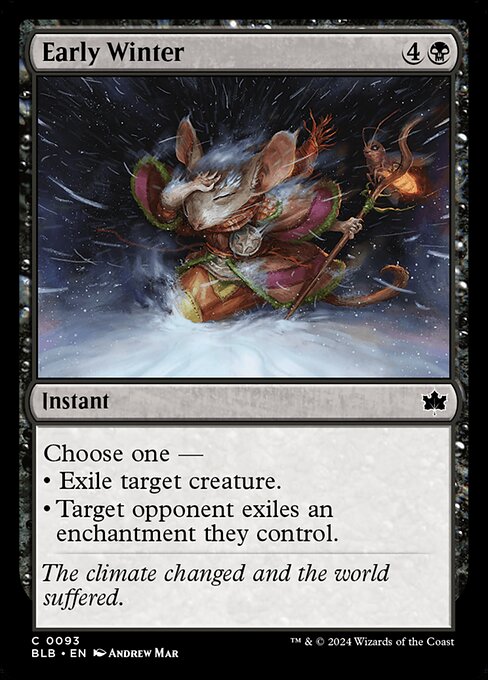
238. Early Winter
Rating2.9WeakWhy this rating?
Filler card but sometimes gets cut (2.9/10).
Why. An instant removal that exiles any creature, with no size restriction. The other mode, making the opponent exile an enchantment they control, is a situational bonus.
Risks. Five mana is slow and expensive: you take pressure while you wait to cast it, and the opponent picks which enchantment to exile.
In the draft. Second-tier removal: play it if you lack answers, but take cheaper removal first. It suits slower decks.
Results in the games of the set
When it is in hand, the deck wins 53.5% of its games (set average: 56.0%, 204th of 265 cards).
In the opening hand: 50.6% wins (55.0% on average).
Drawn during the game: 55.3% (56.6% on average).
When it is drawn, the deck wins 1.4 points more than when it is not.
When it is drafted, it is played 45% of the time (set average: 62%).
Taken as the first pick (58 drafts), it ends in the deck 81% of the time.
It is played mostly in B/U decks (37% of them) and B/R (29%).
 Rating2.5Weak
Why this rating?
Not good filler and often gets cut (2.5/10).
Why. For two mana you get a Food token and, later, the option to destroy a nonland permanent for five more. Slow, flexible removal.
Risks. The total investment is heavy and does nothing to the board for several turns. The activation works only at sorcery speed.
In the draft. Playable in slower decks or ones that use Food. Take it late rather than as a priority pick.
Results in the games of the set
When it is in hand, the deck wins 52.9% of its games (set average: 56.0%, 216th of 265 cards).
In the opening hand: 48.9% wins (55.0% on average).
Drawn during the game: 55.6% (56.6% on average).
When it is drawn, the deck wins 1.0 points more than when it is not.
When it is drafted, it is played 38% of the time (set average: 62%).
Taken among the first three picks (159 drafts), it ends in the deck 74% of the time.
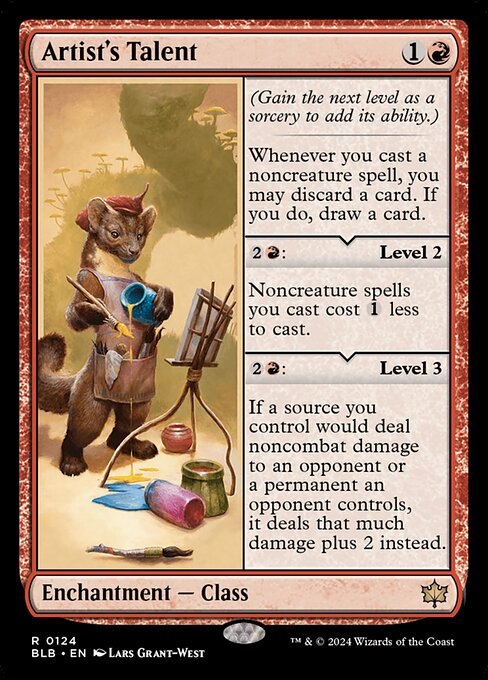
240. Artist's Talent
Rating2.1WeakWhy this rating?
Not good filler and often gets cut (2.1/10).
Why. A cheap red Class that loots on every noncreature spell, then cuts their cost, then adds bonus damage. The final level is strong in a deck packed with spells.
Risks. It does nothing for the board and needs many noncreature spells to pay off its levels. In an ordinary creature deck it stays slow and weak.
In the draft. Reserve it for a red deck full of instants and sorceries. Otherwise pass it: it is tempting but does not hold the board.
Results in the games of the set
When it is in hand, the deck wins 46.0% of its games (set average: 56.0%, 261st of 265 cards).
In the opening hand: 43.1% wins (55.0% on average).
Drawn during the game: 47.9% (56.6% on average).
When it is drawn, the deck wins 1.9 points less than when it is not.
When it is drafted, it is played 18% of the time (set average: 62%).
Taken among the first three picks (60 drafts), it ends in the deck 67% of the time.
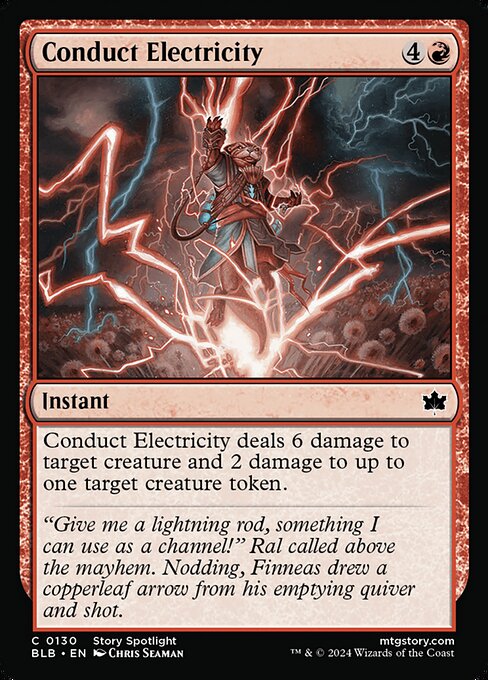
241. Conduct Electricity
Rating2.0WeakWhy this rating?
Not good filler and often gets cut (2.0/10).
Why. An instant removal that deals 6 damage to a creature, handling most threats, plus 2 damage to a creature token if you choose one. Handy against decks that make tokens.
Risks. Five mana is a lot for a red removal, and the second part matters only if there is a target. It does not kill anything with more than 6 toughness.
In the draft. An honest filler removal in a red deck. Take it after cheaper options, especially if you lack answers to big creatures.
Results in the games of the set
When it is in hand, the deck wins 52.5% of its games (set average: 56.0%, 224th of 265 cards).
In the opening hand: 50.3% wins (55.0% on average).
Drawn during the game: 54.0% (56.6% on average).
When it is drawn, the deck wins 1.3 points more than when it is not.
When it is drafted, it is played 27% of the time (set average: 62%).
Taken among the first three picks (80 drafts), it ends in the deck 56% of the time.
It is played mostly in R/U decks (38% of them) and G/R (36%).

242. Gossip's Talent
Rating2.0WeakWhy this rating?
Not good filler and often gets cut (2.0/10).
Why. A blue Class that surveils whenever a creature you control enters, then makes an attacking creature with power 3 or less unblockable, then recycles creatures that connect. Each level adds value over time.
Risks. It does nothing on its own: you need creatures and lots of mana, and level one is weak. The pace is too slow for what you get.
In the draft. An ambitious filler card. Take it only in a blue deck with many small creatures. Otherwise leave it.
Results in the games of the set
When it is in hand, the deck wins 48.9% of its games (set average: 56.0%, 257th of 265 cards).
In the opening hand: 44.2% wins (55.0% on average).
Drawn during the game: 51.7% (56.6% on average).
When it is drawn, the deck wins 1.7 points less than when it is not.
When it is drafted, it is played 32% of the time (set average: 62%).
Taken among the first three picks (106 drafts), it ends in the deck 68% of the time.

243. Heaped Harvest
Rating2.0WeakWhy this rating?
Not good filler and often gets cut (2.0/10).
Why. A Food that fetches a basic land tapped when it enters and another when you sacrifice it. It is ramp and fixing, and it also feeds your foraging.
Risks. It does nothing on the board and slows your development. In a deck without payoffs, it is too passive.
In the draft. For green decks with Food payoffs or ramp. Take it late, after creatures and removal.
Results in the games of the set
When it is in hand, the deck wins 52.7% of its games (set average: 56.0%, 220th of 265 cards).
In the opening hand: 52.4% wins (55.0% on average).
Drawn during the game: 52.9% (56.6% on average).
When it is drawn, the deck wins 0.8 points more than when it is not.
When it is drafted, it is played 56% of the time (set average: 62%).
Taken as the first pick (120 drafts), it ends in the deck 78% of the time.
It is played mostly in B/G decks (49% of them) and G/R (40%).

244. Hoarder's Overflow
Rating2.0WeakWhy this rating?
Not good filler and often gets cut (2.0/10).
Why. An enchantment that gets a stash counter on entering, then another whenever you expend four. You can later discard your hand to draw that many cards. A slow, very situational draw effect.
Risks. It does nothing for the board, and discarding your whole hand is costly. You need to spend a lot of mana each turn for it to pay off.
In the draft. Probably a sideboard card. It only works in a red deck that empties its hand very fast; otherwise it has little room.
Results in the games of the set
When it is in hand, the deck wins 45.4% of its games (set average: 56.0%, 263rd of 265 cards).
In the opening hand: 43.3% wins (55.0% on average).
Drawn during the game: 47.0% (56.6% on average).
When it is drawn, the deck wins 6.4 points less than when it is not.
When it is drafted, it is played only 12% of the time (set average: 62%): it almost always ends in the sideboard.

245. Mind Drill Assailant
Rating2.0WeakWhy this rating?
Not good filler and often gets cut (2.0/10).
Why. A 2/5 for four that blocks well and becomes a 5/5 with Threshold. Its surveil ability helps fill the graveyard to get there.
Risks. Without Threshold it is a mild wall. Reaching seven cards in the graveyard takes time, and the ability costs three mana for a modest gain.
In the draft. A mid-curve creature that fits a blue-black graveyard deck. Take it without hurry, as solid filler.
Results in the games of the set
When it is in hand, the deck wins 52.2% of its games (set average: 56.0%, 228th of 265 cards).
In the opening hand: 49.1% wins (55.0% on average).
Drawn during the game: 54.1% (56.6% on average).
When it is drawn, the deck wins 2.1 points more than when it is not.
When it is drafted, it is played 29% of the time (set average: 62%).
Taken among the first three picks (124 drafts), it ends in the deck 74% of the time.
It is played mostly in B/U decks (73% of them).

246. Psychic Whorl
Rating2.0WeakWhy this rating?
Not good filler and often gets cut (2.0/10).
Why. A sorcery that makes the opponent discard two cards, with a surveil 2 on top if you control a Rat. For three mana it is slow but real card advantage.
Risks. It does nothing to the board and the opponent chooses what to discard, usually their worst cards. It is weak late, when hands are empty.
In the draft. A filler sorcery for a slow black deck. Take it late, and prefer creatures or removal if you have the choice.
Results in the games of the set
When it is in hand, the deck wins 52.9% of its games (set average: 56.0%, 215th of 265 cards).
In the opening hand: 50.8% wins (55.0% on average).
Drawn during the game: 54.3% (56.6% on average).
When it is drawn, the deck wins 3.0 points more than when it is not.
When it is drafted, it is played only 12% of the time (set average: 62%): it almost always ends in the sideboard.
Taken among the first three picks (50 drafts), it ends in the deck 58% of the time.
It is played mostly in B/U decks (31% of them).
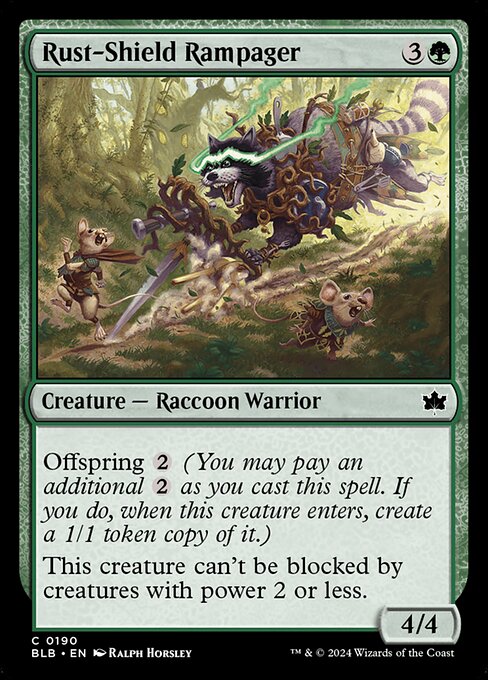
247. Rust-Shield Rampager
Rating2.0WeakWhy this rating?
Not good filler and often gets cut (2.0/10).
Why. A 4/4 for four that cannot be blocked by creatures with power 2 or less, with Offspring for a small second body at six mana. A solid green threat for its price.
Risks. Creatures with power 3 or more can block it normally, and removal handles it easily. The Offspring cost is steep.
In the draft. A good green playable, worth taking without hurry among commons. It fits any green deck, aggressive or ramp.
Results in the games of the set
When it is in hand, the deck wins 54.4% of its games (set average: 56.0%, 173rd of 265 cards).
In the opening hand: 52.7% wins (55.0% on average).
Drawn during the game: 55.5% (56.6% on average).
When it is drawn, the deck wins 0.7 points more than when it is not.
When it is drafted, it is played 59% of the time (set average: 62%).
Taken as the first pick (84 drafts), it ends in the deck 80% of the time.
It is played mostly in G/R decks (86% of them) and G/W (34%).
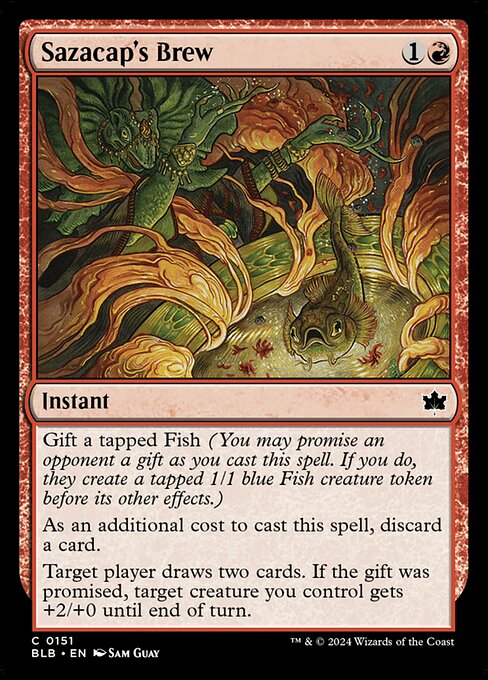
248. Sazacap's Brew
Rating2.0WeakWhy this rating?
Not good filler and often gets cut (2.0/10).
Why. A two-mana instant that costs a discard to make the target player draw two, and gives a creature of yours +2/+0 if you promise the Gift. Flexible card flow in a spell-heavy deck.
Risks. You must discard a card and the Gift hands the opponent a tapped 1/1 Fish. The bonus only matters if you have a creature to pump.
In the draft. Playable in red if you can pitch dead cards. Take it late; it is filler more than an engine.
Results in the games of the set
When it is in hand, the deck wins 50.8% of its games (set average: 56.0%, 249th of 265 cards).
In the opening hand: 50.4% wins (55.0% on average).
Drawn during the game: 51.1% (56.6% on average).
When it is drawn, the deck wins 2.3 points less than when it is not.
When it is drafted, it is played 28% of the time (set average: 62%).
Taken among the first three picks (108 drafts), it ends in the deck 70% of the time.
It is played mostly in R/U decks (40% of them) and R/W (27%).

249. Seedpod Squire
Rating2.0WeakWhy this rating?
Not good filler and often gets cut (2.0/10).
Why. A 3/3 flyer for four that also gives +1/+1 to one of your creatures without flying when it attacks. A decent aerial body that helps your ground attacks.
Risks. Four mana for a 3/3 is the going rate and the ability requires attacking. Removal or a flying blocker stops it.
In the draft. A solid filler playable in white or blue decks. Take it without hurry as a common flyer.
Results in the games of the set
When it is in hand, the deck wins 52.6% of its games (set average: 56.0%, 221st of 265 cards).
In the opening hand: 51.1% wins (55.0% on average).
Drawn during the game: 53.5% (56.6% on average).
When it is drawn, the deck wins 0.4 points more than when it is not.
When it is drafted, it is played 42% of the time (set average: 62%).
Taken among the first three picks (149 drafts), it ends in the deck 74% of the time.
It is played mostly in U/W decks (58% of them) and R/W (25%).

250. Skyskipper Duo
Rating2.0WeakWhy this rating?
Not good filler and often gets cut (2.0/10).
Why. A 3/3 flyer for five that can exile one of your other creatures and bring it back at the beginning of the next end step, replaying its enter effect.
Risks. Five mana for a 3/3 is steep, and the enter effect is pointless without another creature worth recycling.
In the draft. Playable in a blue deck with enter-effect creatures. Otherwise it is just a flying body: take it late.
Results in the games of the set
When it is in hand, the deck wins 54.1% of its games (set average: 56.0%, 182nd of 265 cards).
In the opening hand: 50.3% wins (55.0% on average).
Drawn during the game: 56.1% (56.6% on average).
When it is drawn, the deck wins 2.3 points more than when it is not.
When it is drafted, it is played 44% of the time (set average: 62%).
Taken as the first pick (40 drafts), it ends in the deck 83% of the time.
It is played mostly in G/U decks (72% of them) and U/W (43%).
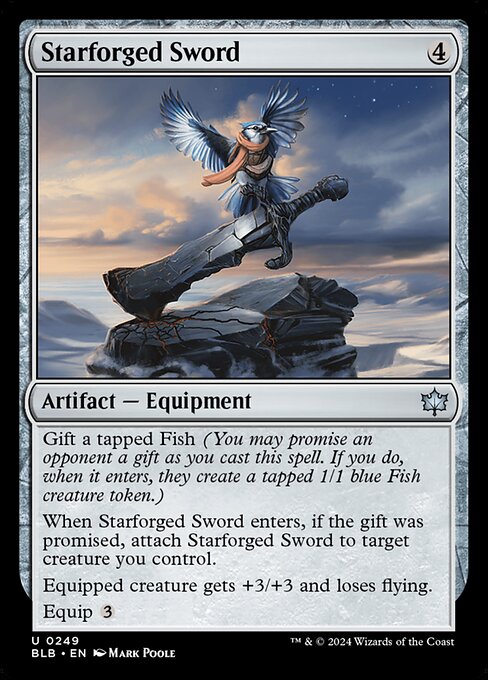
251. Starforged Sword
Rating2.0WeakWhy this rating?
Not good filler and often gets cut (2.0/10).
Why. An Equipment that gives +3/+3 but removes flying, and attaches to one of your creatures on entering if you promise the Gift. It makes a mid-game creature much bigger.
Risks. Four mana plus a tapped Fish for the opponent, then three more to re-equip. On a flyer, losing flying is a real cost.
In the draft. A playable in red or white decks with many small creatures. Take it late: it is not worth real removal.
Results in the games of the set
When it is in hand, the deck wins 48.7% of its games (set average: 56.0%, 259th of 265 cards).
In the opening hand: 47.8% wins (55.0% on average).
Drawn during the game: 49.3% (56.6% on average).
When it is drawn, the deck wins 3.4 points less than when it is not.
When it is drafted, it is played 19% of the time (set average: 62%).
Taken among the first three picks (33 drafts), it ends in the deck 55% of the time.

252. Starlit Soothsayer
Rating2.0WeakWhy this rating?
Not good filler and often gets cut (2.0/10).
Why. A 2/2 flyer for three that surveils at your end step if you gained or lost life this turn. A small aerial body that works well in a black-white life-gain deck.
Risks. The body is small and the surveil depends on your life total changing. Without lifelink or damage taken, it does not trigger.
In the draft. A decent playable in a black-white deck. Otherwise it is a filler 2/2 flyer to take late.
Results in the games of the set
When it is in hand, the deck wins 51.6% of its games (set average: 56.0%, 240th of 265 cards).
In the opening hand: 50.0% wins (55.0% on average).
Drawn during the game: 52.9% (56.6% on average).
When it is drawn, the deck wins 0.9 points less than when it is not.
When it is drafted, it is played 34% of the time (set average: 62%).
Taken among the first three picks (128 drafts), it ends in the deck 69% of the time.
It is played mostly in B/W decks (68% of them).
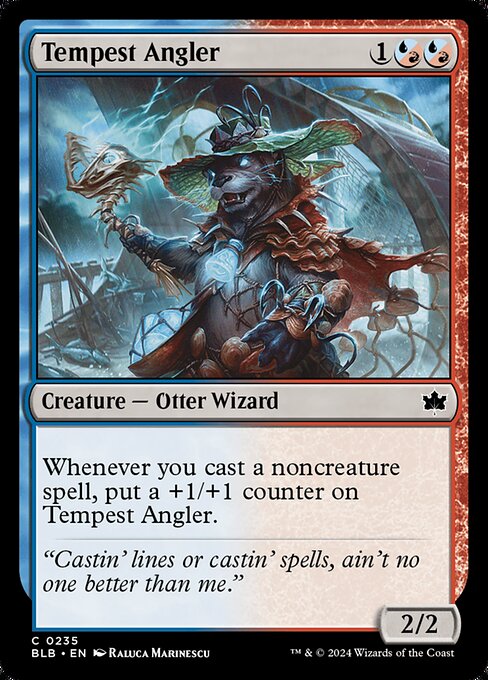
253. Tempest Angler
Rating2.0WeakWhy this rating?
Not good filler and often gets cut (2.0/10).
Why. A 2/2 for three, castable in blue or red, that gets a +1/+1 counter whenever you cast a noncreature spell. In a deck full of instants and sorceries it can grow large enough to dominate.
Risks. Without enough noncreature spells it is a plain 2/2. It is also vulnerable before it has grown.
In the draft. Play it only in a blue or red deck with plenty of spells. Otherwise let it go.
Results in the games of the set
When it is in hand, the deck wins 51.9% of its games (set average: 56.0%, 236th of 265 cards).
In the opening hand: 50.8% wins (55.0% on average).
Drawn during the game: 52.6% (56.6% on average).
When it is drawn, the deck wins 1.9 points more than when it is not.
When it is drafted, it is played 33% of the time (set average: 62%).
Taken as the first pick (36 drafts), it ends in the deck 92% of the time.
It is played mostly in R/U decks (78% of them).

254. Three Tree Mascot
Rating2.0WeakWhy this rating?
Not good filler and often gets cut (2.0/10).
Why. A two-mana artifact creature 2/1 with changeling that can make one mana of any colour for one. A small body that helps fix a three-colour deck.
Risks. The body is weak, and the ability makes no net mana: it only converts. A two-mana creature remains filler.
In the draft. A useful filler in splash or three-colour decks. Take it late, once the quality cards are in hand.
Results in the games of the set
When it is in hand, the deck wins 52.1% of its games (set average: 56.0%, 233rd of 265 cards).
In the opening hand: 52.2% wins (55.0% on average).
Drawn during the game: 52.0% (56.6% on average).
When it is drawn, the deck wins 0.6 points less than when it is not.
When it is drafted, it is played 39% of the time (set average: 62%).
Taken among the first three picks (153 drafts), it ends in the deck 57% of the time.

255. Veteran Guardmouse
Rating2.0WeakWhy this rating?
Not good filler and often gets cut (2.0/10).
Why. A 3/4 for four that blocks well and, with Valiant, gets +1/+0 and first strike plus a scry 1. A sturdy body, especially alongside effects that target it.
Risks. Without spells or abilities that target it, Valiant never triggers and it is a plain 3/4. It is slow for an aggressive deck.
In the draft. A decent playable in a red or white deck, best in red-white. Take it as mid-curve filler, higher if you have targeting effects.
Results in the games of the set
When it is in hand, the deck wins 52.0% of its games (set average: 56.0%, 234th of 265 cards).
In the opening hand: 52.0% wins (55.0% on average).
Drawn during the game: 52.0% (56.6% on average).
When it is drawn, the deck wins 1.9 points less than when it is not.
When it is drafted, it is played 42% of the time (set average: 62%).
Taken among the first three picks (161 drafts), it ends in the deck 80% of the time.
It is played mostly in R/W decks (63% of them).
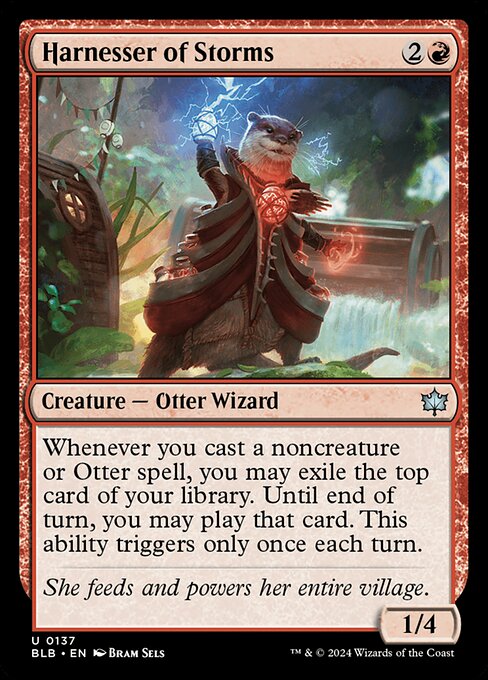
256. Harnesser of Storms
Rating1.9WeakWhy this rating?
Not good filler and often gets cut (2.0/10).
Why. A 1/4 for three that exiles the top card of your library when you cast a noncreature or Otter spell and lets you play it this turn. Value in a spell-heavy deck.
Risks. The body threatens nothing. The exiled card is lost if you cannot play it, and the trigger works only once a turn.
In the draft. Reserve it for a red deck of spells and Otters, often blue-red. In any other deck it is too slow: leave it.
Results in the games of the set
When it is in hand, the deck wins 50.1% of its games (set average: 56.0%, 252nd of 265 cards).
In the opening hand: 49.0% wins (55.0% on average).
Drawn during the game: 50.9% (56.6% on average).
When it is drawn, the deck wins 0.9 points less than when it is not.
When it is drafted, it is played 37% of the time (set average: 62%).
Taken as the first pick (30 drafts), it ends in the deck 80% of the time.
It is played mostly in R/U decks (54% of them).

257. Junkblade Bruiser
Rating1.7WeakWhy this rating?
Not good filler and often gets cut (1.7/10).
Why. A 4/5 trampler for five that gets +2/+1 until end of turn when you expend four. A big, sturdy body that hits hard.
Risks. Five mana with no enter effect, and the ability requires spending mana before attacking. Removal or a double block neutralises it.
In the draft. A filler playable in a red-green deck. Take it as a big top-of-curve creature, but do not rank it very high.
Results in the games of the set
When it is in hand, the deck wins 52.5% of its games (set average: 56.0%, 225th of 265 cards).
In the opening hand: 51.6% wins (55.0% on average).
Drawn during the game: 53.1% (56.6% on average).
When it is drawn, the deck wins 0.1 points more than when it is not.
When it is drafted, it is played 42% of the time (set average: 62%).
Taken as the first pick (36 drafts), it ends in the deck 86% of the time.
It is played mostly in G/R decks (73% of them).
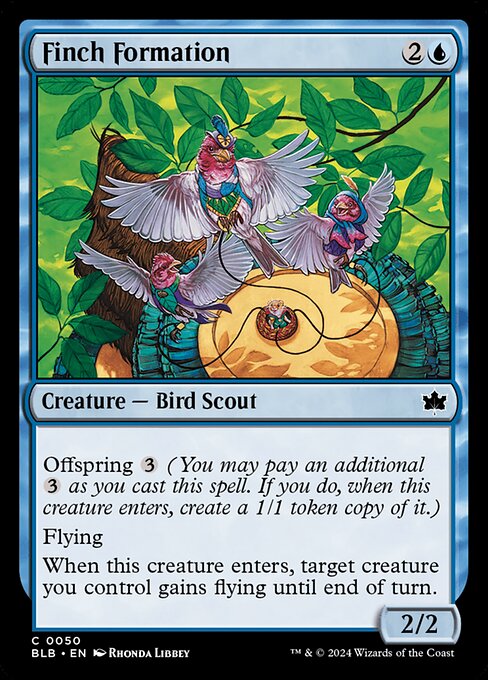
258. Finch Formation
Rating1.5WeakWhy this rating?
Almost unplayable and mostly sideboard material (1.5/10).
Why. A 2/2 flyer for three that, when it enters, gives one of your creatures flying until end of turn. With Offspring you also get a small 1/1 flying body.
Risks. The body is small, Offspring costs three more mana, and the enter effect lasts only one turn. A slow deck will struggle to use it.
In the draft. Filler for a blue flyers deck. Take it late, unless you have ground creatures that benefit from an aerial attack.
Results in the games of the set
When it is in hand, the deck wins 51.0% of its games (set average: 56.0%, 248th of 265 cards).
In the opening hand: 47.5% wins (55.0% on average).
Drawn during the game: 53.1% (56.6% on average).
When it is drawn, the deck wins 1.0 points more than when it is not.
When it is drafted, it is played 21% of the time (set average: 62%).
Taken among the first three picks (91 drafts), it ends in the deck 58% of the time.
It is played mostly in U/W decks (59% of them) and G/U (25%).
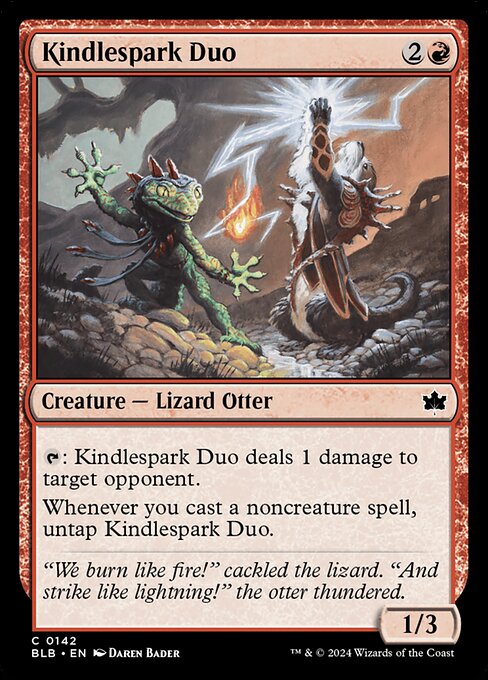
259. Kindlespark Duo
Rating1.4WeakWhy this rating?
Almost unplayable and mostly sideboard material (1.4/10).
Why. A 1/3 for three that pings the opponent for 1 when it taps and untaps whenever you cast a noncreature spell. A steady ping in a spell-heavy deck.
Risks. The body is weak and the ping does not win the game alone. It blocks poorly if it taps each turn, and you lose tempo.
In the draft. A low-end playable, only in a red deck with lots of spells. Otherwise leave it in the sideboard.
Results in the games of the set
When it is in hand, the deck wins 49.4% of its games (set average: 56.0%, 254th of 265 cards).
In the opening hand: 48.9% wins (55.0% on average).
Drawn during the game: 49.7% (56.6% on average).
When it is drawn, the deck wins 2.0 points less than when it is not.
When it is drafted, it is played 35% of the time (set average: 62%).
Taken as the first pick (46 drafts), it ends in the deck 91% of the time.
It is played mostly in R/U decks (70% of them) and B/R (37%).

260. Nightwhorl Hermit
Rating1.4WeakWhy this rating?
Almost unplayable and mostly sideboard material (1.4/10).
Why. A 1/4 with vigilance for three that, with Threshold, gets +1/+0 and can't be blocked. A good blocker early, then an evasive threat late.
Risks. Threshold needs seven cards in the graveyard, which takes time, and the 1/4 attacks weakly before then. It offers no other value.
In the draft. A filler playable in a blue-black graveyard deck. Take it late: it does not earn a slot without support.
Results in the games of the set
When it is in hand, the deck wins 50.2% of its games (set average: 56.0%, 251st of 265 cards).
In the opening hand: 45.8% wins (55.0% on average).
Drawn during the game: 52.9% (56.6% on average).
When it is drawn, the deck wins 1.5 points more than when it is not.
When it is drafted, it is played 15% of the time (set average: 62%).
Taken among the first three picks (46 drafts), it ends in the deck 65% of the time.
It is played mostly in B/U decks (54% of them).

261. War Squeak
Rating1.4WeakWhy this rating?
Almost unplayable and mostly sideboard material (1.4/10).
Why. A one-mana Aura that gives +1/+1 and haste and stops an opposing creature from blocking this turn. It can push an attack through, but only for one turn.
Risks. An Aura risks a two-for-one against removal, and the blocking effect lasts only a turn. It is weak on a stalled board.
In the draft. Only in a very aggressive red deck. Otherwise pass it: it does not replace a real creature.
Results in the games of the set
When it is in hand, the deck wins 48.9% of its games (set average: 56.0%, 256th of 265 cards).
In the opening hand: 47.6% wins (55.0% on average).
Drawn during the game: 49.8% (56.6% on average).
When it is drawn, the deck wins 3.1 points less than when it is not.
When it is drafted, it is played 15% of the time (set average: 62%).
Taken among the first three picks (37 drafts), it ends in the deck 65% of the time.
It is played mostly in R/W decks (28% of them).
Intrinsic ratings: they do not take into account the cards you have already picked. They matter most for the first pick of the first pack.