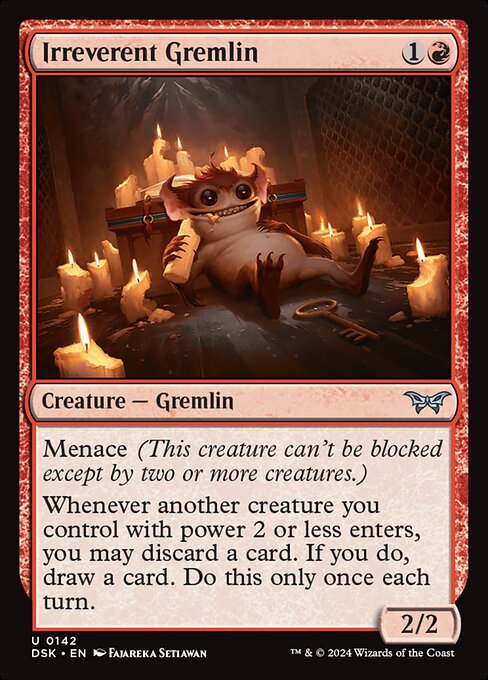
Irreverent Gremlin
Uncommon · Creature — Gremlin
6.6GoodRank 66 of 271
57.6%Rank 62 of 269 by win rate, card in hand · set average: 55.9%
How are these measures computed?
Pick rating. The pick rating estimates what a card is worth when you choose it, before there are results: it combines several signals (expert evaluations, the choices of strong players, characteristics of the card such as its cost and rarity) and was tuned on the results of decks of strong players. It is for comparing cards while you draft.
Observed strength. The observed strength is the win rate of the games in which the card was in hand at some point (opening hand or drawn), from hundreds of thousands of real games of online draft players since the set came out. The rank compares the cards seen in at least 1,000 games. It does not correct for the strength of the deck the card is played in, and a result stays uncertain for a card that is played little (about 1.6 points of margin at 1,000 games).
A solid uncommon of the format (6.6/10).
Why. A two-mana 2/2 with menace that lets you loot (discard, then draw) whenever another creature with power 2 or less enters, once per turn. Good for smoothing the hand of a deck full of small creatures.
Risks. A small body that is easy to kill, and the loot depends on creatures with power 2 or less. It is mediocre in a deck of big creatures.
In the draft. A good pick for an aggressive red low-curve deck. Take it over plain creatures; stronger with many small creatures.
Win rate of the card
Percentage of games won by the decks that play this card, depending on when it shows up, from the real games of the set.
Gap when it is drawn, against the games where it is not : +1.5 win-rate points
Its place in the set
- Uncommon: rank 26 of 100
- Red: rank 7 of 41
- Cost 2: rank 23 of 66
- Average pick: 4.2 (1 = taken first from a pack; the lower the number, the earlier players choose it)
Win rate by colour pair
Percentage of games won by the decks of each pair that play the card, with the number of games. The pairs are the two main colors of the deck: when the card has a color outside the pair, the deck plays it as a splash (marked “splash”). A pair that has an archetype in this set leads to its guide.


Win rate: strong players and all players
Percentage of games won when the card is in hand; strong players are those ranked diamond or mythic online.
Win rate on the play and on the draw
Win rate by number of copies in the deck
- 1 copy55.8 % · 100,510 games
- 2 copies57.9 % · 19,466 games
- 3 copies60.0 % · 2,525 games
- 4 copies or more65.0 % · 294 games
Win rate since the set came out (card in hand)
- First two weeks57.9 % · 31,594 games
- Next two weeks56.5 % · 16,796 games
- After that56.3 % · 6,068 games
Win rate alongside other cards
Win rate of the decks that play both cards, compared with the one you would expect from what each card gets alone. At least 150 games together.
Cards it wins more with
- Leyline of Resonance160 games · 49.4 % (instead of 45.8% expected)
- Orphans of the Wheat9,255 games · 57.7 % (instead of 55.8% expected)
- Overlord of the Balemurk1,747 games · 59.7 % (instead of 57.9% expected)
Cards it wins less with
- Grievous Wound213 games · 40.8 % (instead of 45.8% expected)
- Altanak, the Thrice-Called4,178 games · 52.7 % (instead of 55.7% expected)
- Keys to the House2,878 games · 50.2 % (instead of 53.1% expected)
Where it is played
R/W · 46 %B/R · 37 %
Played in 12% of the decks of the set
Other cards of the same cost and colours
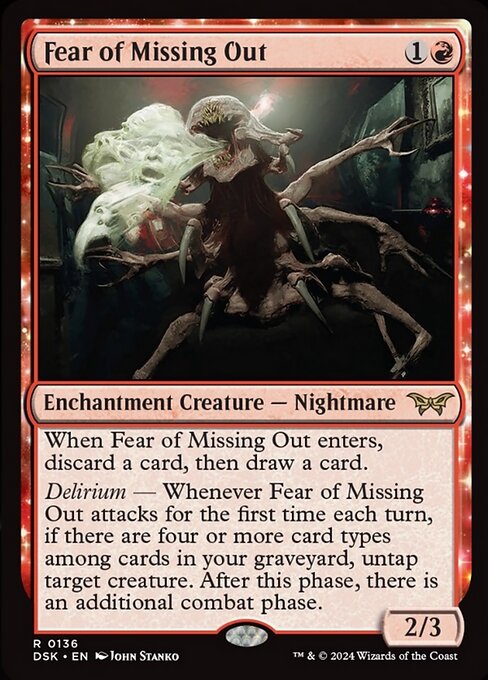
23. Fear of Missing Out
7.6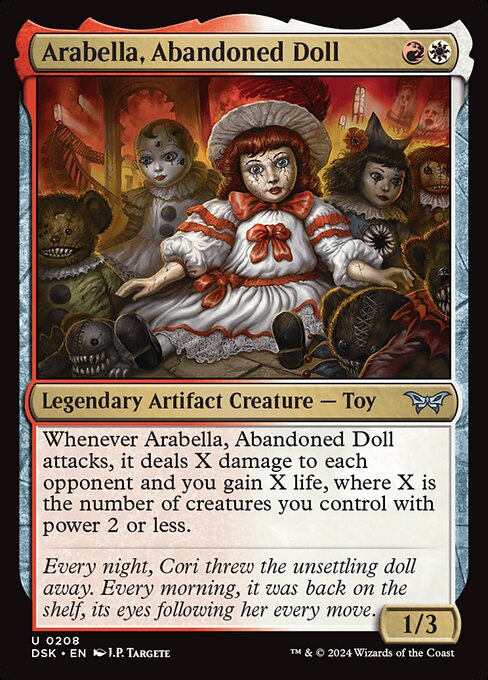
26. Arabella, Abandoned Doll
7.5
28. Chainsaw
7.4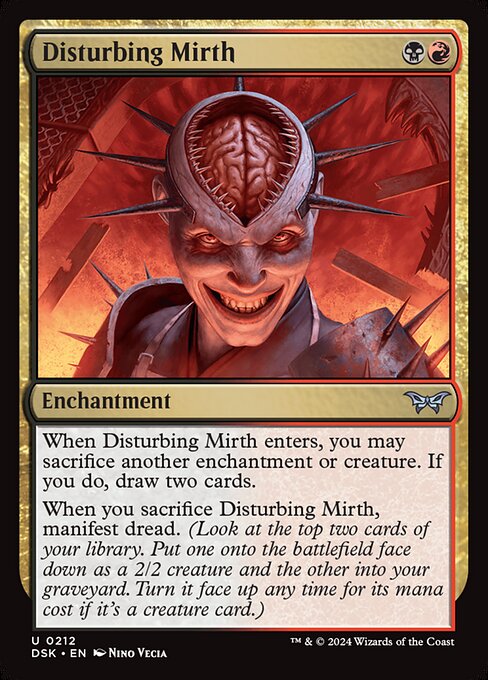
29. Disturbing Mirth
7.4
Intrinsic ratings: they do not take into account the cards you have already picked. They matter most for the first pick of the first pack.