Card ranking · Duskmourn: House of Horror (DSK)
← Duskmourn: House of Horror271 cards
- Bomb > 8.4
- Very good ≥ 7.2
- Good ≥ 6.2
- Playable ≥ 5.0
- Weak < 5.0
Ratings are out of 10. They combine experts' opinions, the statistics of thousands of drafts by experienced players (when a card is taken, played, and the wins of the decks that play it) and what is printed on the card. Click a card to enlarge it.
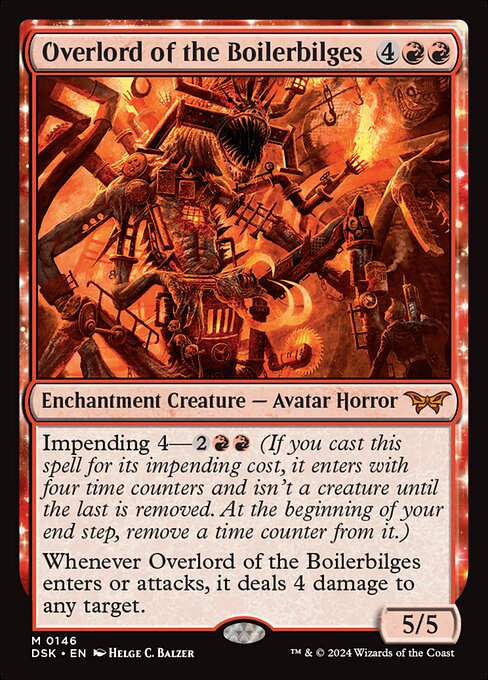
1. Overlord of the Boilerbilges
Rating9.4BombWhy this rating?
The best card of the set (9.4/10).
Why. A removal spell and a threat in one card. When it enters and every time it attacks, it deals 4 damage to any target. Cast with Impending on turn 4, it already kills something, then turns into a 5/5 that repeats the effect on each attack.
Risks. While Impending, it is not a creature and cannot attack, so only the enter effect matters for four turns. At full price it costs six mana, with two red among them.
In the draft. First pick if you are red, in any deck. It goes into every red deck without asking for anything else.
Results in the games of the set
When it is in hand, the deck wins 64.4% of its games (set average: 55.9%, 6th of 269 cards).
In the opening hand: 62.8% wins (55.0% on average).
Drawn during the game: 65.5% (56.6% on average).
When it is drawn, the deck wins 10.0 points more than when it is not.
When it is drafted, it is played 94% of the time (set average: 62%).
Taken as the first pick (88 drafts), it ends in the deck 94% of the time.
It is played about as much in every archetype.
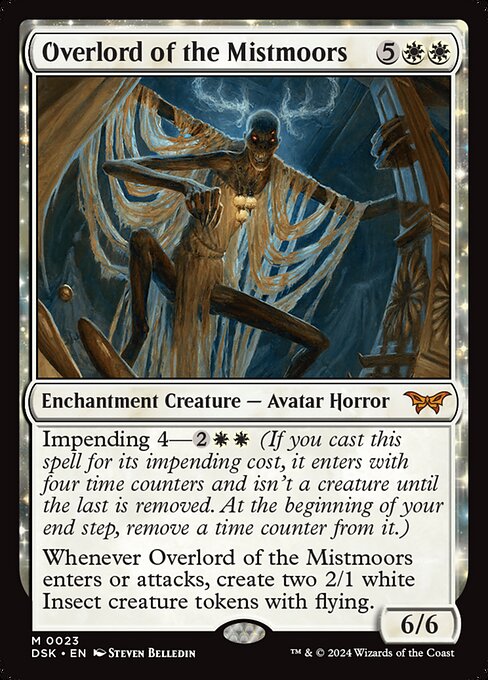 Rating9.3Bomb
Why this rating?
One of the 3 best cards of the set (9.3/10).
Why. Two 2/1 white Insect creature tokens with flying on entering, and two more each time it attacks: it fills the sky by itself. With Impending on turn 4, you get two flying attackers now and a big threat arriving later.
Risks. Full price is seven mana, and while Impending it only gives its first two tokens. The 2/1 tokens die to a sweeper or to any small flying blocker.
In the draft. A very high pick in white. This is a bomb that wins alone if it stays on the battlefield a few turns.
Results in the games of the set
When it is in hand, the deck wins 68.2% of its games (set average: 55.9%, 1st of 269 cards).
In the opening hand: 68.0% wins (55.0% on average).
Drawn during the game: 68.4% (56.6% on average).
When it is drawn, the deck wins 15.8 points more than when it is not.
When it is drafted, it is played 92% of the time (set average: 62%).
Taken as the first pick (45 drafts), it ends in the deck 89% of the time.
It is played about as much in every archetype.
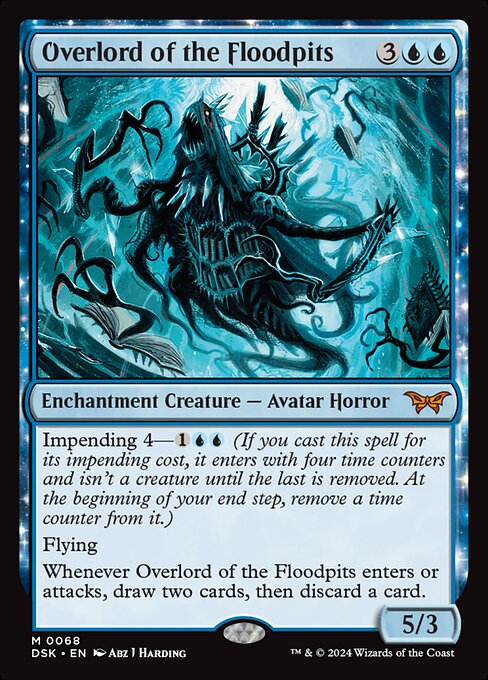 Rating9.1Bomb
Why this rating?
One of the 3 best cards of the set (9.1/10).
Why. A 5/3 flier that draws two cards then discards one when it enters, and does it again each attack. With Impending for three mana, you draw right away and get a big flier a few turns later.
Risks. Only three toughness: a removal spell or a damage spell kills it once it is a creature. It asks for two blue mana even for Impending.
In the draft. A very high pick in blue, especially in a deck that defends well while waiting. It is reason enough to be blue.
Results in the games of the set
When it is in hand, the deck wins 63.0% of its games (set average: 55.9%, 8th of 269 cards).
In the opening hand: 62.1% wins (55.0% on average).
Drawn during the game: 63.6% (56.6% on average).
When it is drawn, the deck wins 10.7 points more than when it is not.
When it is drafted, it is played 91% of the time (set average: 62%).
Taken as the first pick (87 drafts), it ends in the deck 94% of the time.
It is played about as much in every archetype.
 Rating9.0Bomb
Why this rating?
One of the 10 best cards of the set (9.0/10).
Why. A sorcery that scales with your mana. With X equal to two, five mana makes two face-down 4/4 creatures. At seven mana, three 5/5s. Each Manifest dread also puts a card into the graveyard.
Risks. Expensive early, and your creatures are face-down cards: a removal spell takes them out one by one, and turning one face up swaps its 2/2 base for the real card. With no creature card to turn up, they are just enlarged 2/2s.
In the draft. A very good pick in green, stronger as the game goes long. Take it early and cast it from five mana.
Results in the games of the set
When it is in hand, the deck wins 66.1% of its games (set average: 55.9%, 2nd of 269 cards).
In the opening hand: 63.6% wins (55.0% on average).
Drawn during the game: 67.8% (56.6% on average).
When it is drawn, the deck wins 14.3 points more than when it is not.
When it is drafted, it is played 95% of the time (set average: 62%).
Taken as the first pick (178 drafts), it ends in the deck 90% of the time.
It is played about as much in every archetype.
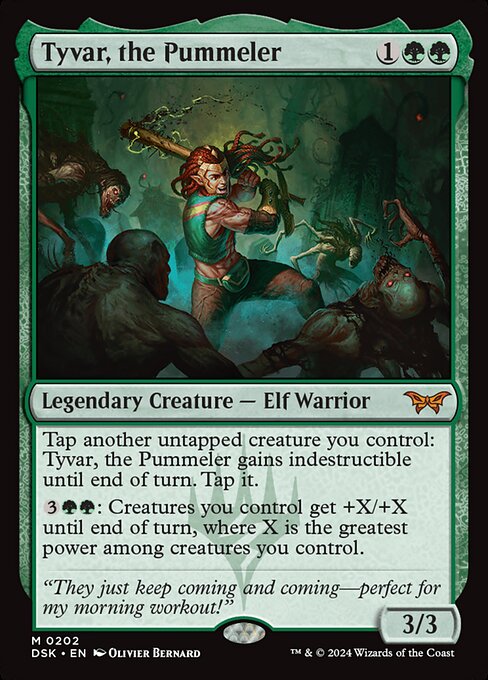 Rating8.9Bomb
Why this rating?
One of the 10 best cards of the set (8.9/10).
Why. A 3/3 for three that becomes indestructible by tapping another untapped creature: it survives damage and destroy effects. Its second ability, at five mana, gives your whole team a bonus equal to the greatest power: a finisher in a green deck with big bodies.
Risks. To make it indestructible you tap another creature and Tyvar himself, so neither blocks afterwards. It does not protect against exile or sacrifice effects.
In the draft. A very good pick in green creature decks. Look for big creatures and defense to use the pump in long games.
Results in the games of the set
When it is in hand, the deck wins 63.5% of its games (set average: 55.9%, 7th of 269 cards).
In the opening hand: 62.6% wins (55.0% on average).
Drawn during the game: 64.2% (56.6% on average).
When it is drawn, the deck wins 10.1 points more than when it is not.
When it is drafted, it is played 92% of the time (set average: 62%).
Taken as the first pick (91 drafts), it ends in the deck 88% of the time.
It is played about as much in every archetype.
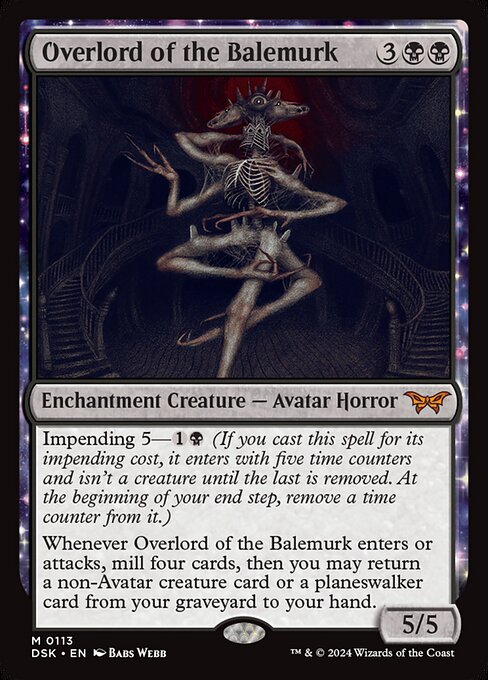 Rating8.8Bomb
Why this rating?
One of the 10 best cards of the set (8.8/10).
Why. A 5/5 for five mana, or just two with Impending. Each time it enters or attacks, you mill four cards and may return a non-Avatar creature or a planeswalker card from your graveyard to your hand: steady value.
Risks. Nothing guarantees a good target among the milled cards, and you empty your library faster. While Impending, it is not a creature for five turns.
In the draft. A high pick in black. It pays off most in a deck with valuable creatures to get back.
Results in the games of the set
When it is in hand, the deck wins 62.1% of its games (set average: 55.9%, 11th of 269 cards).
In the opening hand: 63.0% wins (55.0% on average).
Drawn during the game: 61.5% (56.6% on average).
When it is drawn, the deck wins 10.5 points more than when it is not.
When it is drafted, it is played 90% of the time (set average: 62%).
Taken as the first pick (78 drafts), it ends in the deck 90% of the time.
It is played about as much in every archetype.
 Rating8.8Bomb
Why this rating?
One of the 10 best cards of the set (8.8/10).
Why. A flexible mass removal: X damage to each of up to X target creatures, which you choose. With Delirium, the noncombat damage you deal is doubled, turning X equal to two into four damage per target.
Risks. It costs X plus three mana, so five for just two damage, and it can also hit your own creatures. Without Delirium it misses big creatures, and it is cast at sorcery speed.
In the draft. A very good pick in red. It is better in a deck with many card types in the graveyard, but works as removal even without that.
Results in the games of the set
When it is in hand, the deck wins 60.4% of its games (set average: 55.9%, 26th of 269 cards).
In the opening hand: 56.3% wins (55.0% on average).
Drawn during the game: 63.0% (56.6% on average).
When it is drawn, the deck wins 7.7 points more than when it is not.
When it is drafted, it is played 95% of the time (set average: 62%).
Taken as the first pick (105 drafts), it ends in the deck 92% of the time.
It is played about as much in every archetype.
 Rating8.7Bomb
Why this rating?
One of the 10 best cards of the set (8.7/10).
Why. A two-mana removal: when it enters, the Aura exiles a nonland permanent an opponent controls. Your creature also gets +1/+0, lifelink and ward 2, making it hard to target. An excellent ratio of cost to effect.
Risks. If the enchanted creature dies, the Aura leaves and the opponent's permanent returns. You need a creature of your own on the battlefield, and a removal spell in response costs you two cards.
In the draft. A very high pick in white, a high quality removal for its price. Put it on a creature that survives or that benefits from lifelink.
Results in the games of the set
When it is in hand, the deck wins 61.6% of its games (set average: 55.9%, 17th of 269 cards).
In the opening hand: 59.8% wins (55.0% on average).
Drawn during the game: 62.8% (56.6% on average).
When it is drawn, the deck wins 7.9 points more than when it is not.
When it is drafted, it is played 91% of the time (set average: 62%).
Taken as the first pick (502 drafts), it ends in the deck 93% of the time.
It is played mostly in U/W decks (30% of them) and B/W (29%).
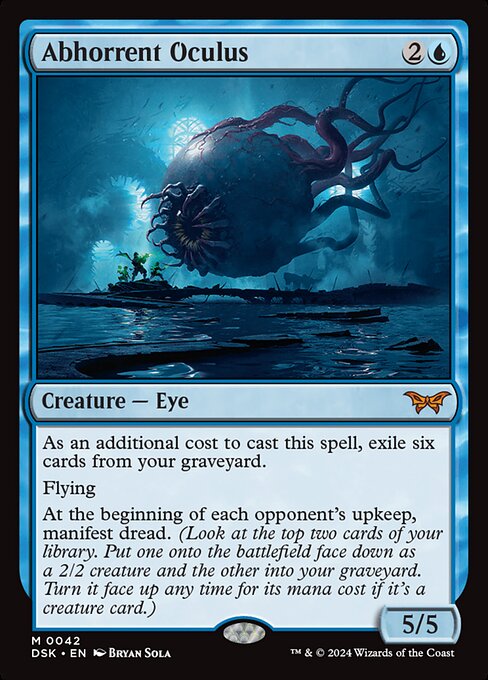 Rating8.6Bomb
Why this rating?
One of the 10 best cards of the set (8.6/10).
Why. A 5/5 flier for three mana, an outsized rate. At the beginning of each opponent's upkeep, you Manifest dread: another 2/2 creature and a fuller graveyard. This is a bomb that ends the game fast once cast.
Risks. The additional cost is exiling six cards from your graveyard, which only happens in the middle or late game. A deck with no way to fill the graveyard rarely casts it.
In the draft. Take it if you are blue and the deck fills the graveyard. Otherwise leave it out of the deck.
Results in the games of the set
When it is in hand, the deck wins 59.6% of its games (set average: 55.9%, 36th of 269 cards).
In the opening hand: 56.9% wins (55.0% on average).
Drawn during the game: 61.3% (56.6% on average).
When it is drawn, the deck wins 5.7 points more than when it is not.
When it is drafted, it is played 94% of the time (set average: 62%).
Taken as the first pick (106 drafts), it ends in the deck 94% of the time.
It is played about as much in every archetype.

10. The Swarmweaver
Rating8.5BombWhy this rating?
One of the 10 best cards of the set (8.5/10).
Why. Four mana for a 2/3 and two black and green 1/1 Insect creature tokens with flying: a good body with enter value. With Delirium, Insects and Spiders get +1/+1 and deathtouch, making flying attackers that kill what they fight.
Risks. It is two-coloured, black and green, and the bonus depends on Delirium. The small Insects are fragile to sweepers and cheap removal.
In the draft. A high pick if you are black-green. Even without Delirium, it makes three bodies for four mana.
Results in the games of the set
When it is in hand, the deck wins 64.7% of its games (set average: 55.9%, 4th of 269 cards).
In the opening hand: 63.5% wins (55.0% on average).
Drawn during the game: 65.5% (56.6% on average).
When it is drawn, the deck wins 13.1 points more than when it is not.
When it is drafted, it is played 90% of the time (set average: 62%).
Taken as the first pick (241 drafts), it ends in the deck 90% of the time.
It is played about as much in every archetype.
 Rating8.5Bomb
Why this rating?
One of the very best mythics of the format (8.5/10).
Why. A 3/4 that creates two Shard tokens, enchantments that let you scry 1 then draw for two mana and a sacrifice. Its ability exiles one of your nonlegendary creatures until the next end step to replay it, and the Shards become copies of that creature until then.
Risks. A two-colour white-blue card that costs four mana. Its ability is only really good with nonlegendary creatures that do something when they enter, and each Shard needs two mana.
In the draft. A good pick in white-blue. In other decks it stays a solid 3/4, but the colour pair makes it better.
Results in the games of the set
When it is in hand, the deck wins 59.8% of its games (set average: 55.9%, 34th of 269 cards).
In the opening hand: 59.2% wins (55.0% on average).
Drawn during the game: 60.1% (56.6% on average).
When it is drawn, the deck wins 7.8 points more than when it is not.
When it is drafted, it is played 87% of the time (set average: 62%).
Taken as the first pick (111 drafts), it ends in the deck 87% of the time.
It is played about as much in every archetype.

12. Ghostly Dancers
Rating8.4Very goodWhy this rating?
One of the very best rares of the format (8.4/10).
Why. A 2/5 flier for five mana that returns an enchantment from your graveyard or unlocks a door of a Room. With Eerie, each enchantment that enters under your control gives you a 3/1 white Spirit creature token with flying. It defends well and attacks in the air.
Risks. Without enchantments, it is just a 2/5 flier for five. It does little on its own.
In the draft. A high pick in a white deck with enchantments and Rooms. Not for a deck with few enchantments.
Results in the games of the set
When it is in hand, the deck wins 64.4% of its games (set average: 55.9%, 5th of 269 cards).
In the opening hand: 62.4% wins (55.0% on average).
Drawn during the game: 65.7% (56.6% on average).
When it is drawn, the deck wins 11.8 points more than when it is not.
When it is drafted, it is played 91% of the time (set average: 62%).
Taken as the first pick (178 drafts), it ends in the deck 93% of the time.
It is played about as much in every archetype.
 Rating8.3Very good
Why this rating?
One of the very best mythics of the format (8.3/10).
Why. A 3/3 with haste for three mana that the opponent must avoid blocking or targeting with damage: everything dealt to it is sent to another target, and a player hit can no longer gain life. It dominates combat trades.
Risks. It is weak to exile, sacrifice, destroy effects and toughness reduction. The opponent can also simply not block it.
In the draft. A high pick in red. A quality card that disrupts the opponent's plans as soon as it enters.
Results in the games of the set
When it is in hand, the deck wins 61.8% of its games (set average: 55.9%, 13th of 269 cards).
In the opening hand: 61.8% wins (55.0% on average).
Drawn during the game: 61.7% (56.6% on average).
When it is drawn, the deck wins 7.8 points more than when it is not.
When it is drafted, it is played 93% of the time (set average: 62%).
Taken as the first pick (105 drafts), it ends in the deck 90% of the time.
It is played about as much in every archetype.

14. Dollmaker's Shop // Porcelain Gallery
Rating8.2Very goodWhy this rating?
One of the very best mythics of the format (8.2/10).
Why. A two-door Room. The first door, for two mana, creates a 1/1 white Toy artifact creature token whenever non-Toy creatures you control attack a player. The second, for six mana, sets the base power and toughness of your creatures to the number of creatures you control.
Risks. You must attack for the first door to pay off, and the second is expensive. Against a deck that blocks well, the 1/1 Toys are fragile.
In the draft. A good pick in an aggressive white deck with many creatures. Look for cheap creatures to benefit.
Results in the games of the set
When it is in hand, the deck wins 62.8% of its games (set average: 55.9%, 9th of 269 cards).
In the opening hand: 63.2% wins (55.0% on average).
Drawn during the game: 62.6% (56.6% on average).
When it is drawn, the deck wins 10.1 points more than when it is not.
When it is drafted, it is played 91% of the time (set average: 62%).
Taken as the first pick (79 drafts), it ends in the deck 84% of the time.
It is played about as much in every archetype.
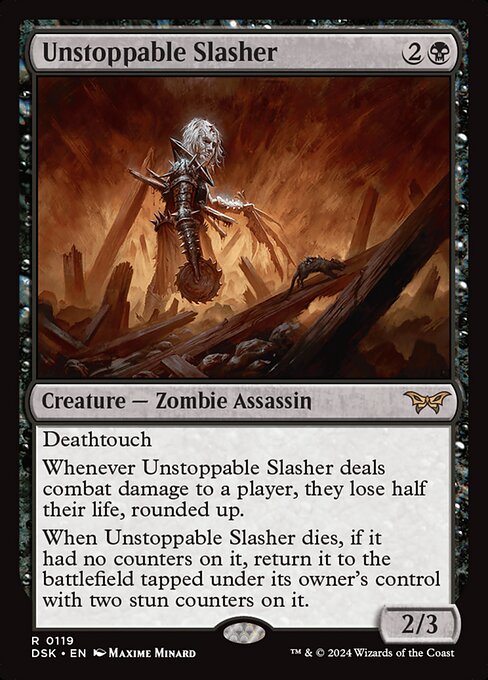 Rating8.2Very good
Why this rating?
One of the very best rares of the format (8.2/10).
Why. A 2/3 with deathtouch for three mana, which the opponent is wary of blocking or attacking into. If it connects, the player loses half their life, rounded up, and if it dies with no counters on it, it comes back tapped with two stun counters.
Risks. Exile stops it from coming back, and it only returns once: if it dies with a counter on it, it stays in the graveyard. It comes back tapped and does not block right away.
In the draft. A good pick in black. A good blocker and a threat at the same time for three mana.
Results in the games of the set
When it is in hand, the deck wins 61.7% of its games (set average: 55.9%, 14th of 269 cards).
In the opening hand: 63.7% wins (55.0% on average).
Drawn during the game: 60.2% (56.6% on average).
When it is drawn, the deck wins 10.1 points more than when it is not.
When it is drafted, it is played 92% of the time (set average: 62%).
Taken as the first pick (148 drafts), it ends in the deck 93% of the time.
It is played about as much in every archetype.
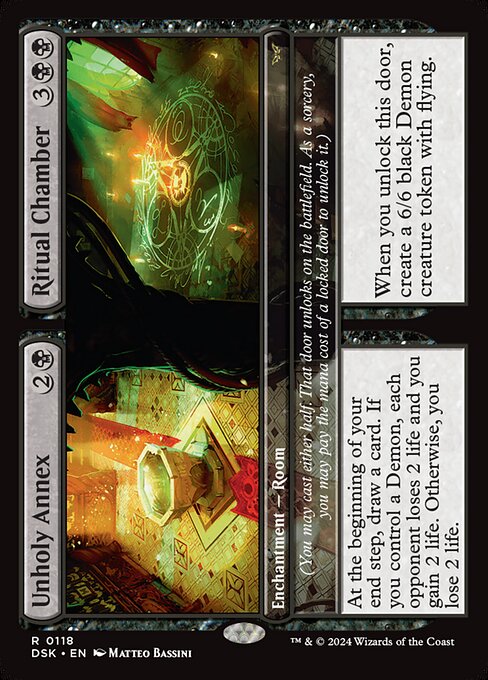
16. Unholy Annex // Ritual Chamber
Rating8.1Very goodWhy this rating?
One of the very best rares of the format (8.1/10).
Why. A Room with great value. The first door draws a card each of your end steps, but costs you 2 life without a Demon. The second, for five mana, creates a 6/6 black Demon creature token with flying, and the first door then drains for 2 each turn.
Risks. Without a Demon, the first door costs you life each turn, a problem against an aggressive deck. The two doors together need a lot of mana.
In the draft. A high pick in black: it wins alone in the midgame. Play it with a decent defense to survive before the Demon.
Results in the games of the set
When it is in hand, the deck wins 64.9% of its games (set average: 55.9%, 3rd of 269 cards).
In the opening hand: 64.3% wins (55.0% on average).
Drawn during the game: 65.3% (56.6% on average).
When it is drawn, the deck wins 14.5 points more than when it is not.
When it is drafted, it is played 90% of the time (set average: 62%).
Taken as the first pick (204 drafts), it ends in the deck 85% of the time.
It is played about as much in every archetype.
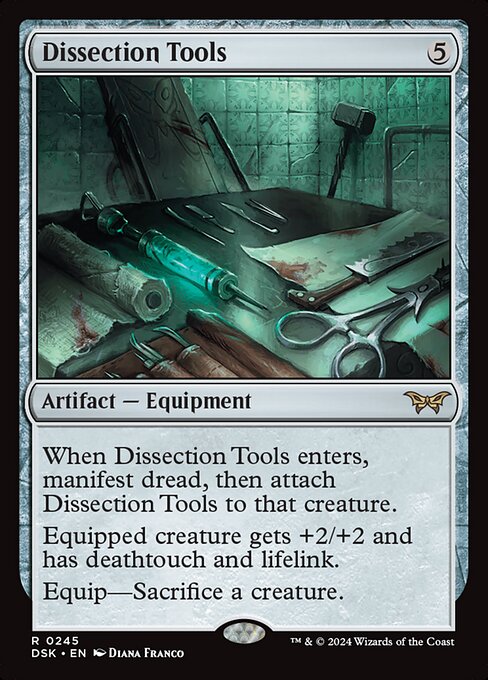
17. Dissection Tools
Rating8.0Very goodWhy this rating?
One of the very best rares of the format (8.0/10).
Why. When it enters, you Manifest dread and attach the Equipment to that creature, which becomes a 4/4 with deathtouch and lifelink for five mana. A solid body that stabilises the board and restores your life.
Risks. Five mana, and re-equipping means sacrificing a creature. If the creature is killed in response, the Equipment stays on the battlefield with no immediate value.
In the draft. A decent pick in any deck: the artifact is colourless, so playable anywhere. It is best in a deck that controls the board.
Results in the games of the set
When it is in hand, the deck wins 62.3% of its games (set average: 55.9%, 10th of 269 cards).
In the opening hand: 60.6% wins (55.0% on average).
Drawn during the game: 63.5% (56.6% on average).
When it is drawn, the deck wins 9.1 points more than when it is not.
When it is drafted, it is played 99% of the time (set average: 62%).
Taken as the first pick (172 drafts), it ends in the deck 100% of the time.
It is played about as much in every archetype.
 Rating7.9Very good
Why this rating?
One of the very best rares of the format (7.9/10).
Why. A 4/3 with flash for four mana, drawing a card whenever one of your creatures deals combat damage to a player. If it dies, it comes back as an enchantment that keeps drawing: double the value in one card.
Risks. Exile and bounce neutralise it. Once an enchantment, it no longer attacks or blocks, and drawing needs creatures to connect.
In the draft. A good pick in blue, in an offensive creature deck. Its resilience to removal makes it valuable.
Results in the games of the set
When it is in hand, the deck wins 60.6% of its games (set average: 55.9%, 24th of 269 cards).
In the opening hand: 61.2% wins (55.0% on average).
Drawn during the game: 60.3% (56.6% on average).
When it is drawn, the deck wins 7.7 points more than when it is not.
When it is drafted, it is played 90% of the time (set average: 62%).
Taken as the first pick (203 drafts), it ends in the deck 91% of the time.
It is played about as much in every archetype.
 Rating7.9Very good
Why this rating?
One of the very best rares of the format (7.9/10).
Why. A flying Vehicle that exiles a creature with toughness 5 or less when it enters, for three mana. It is a removal spell that is also a flying attacker, with just Crew 1.
Risks. If the Vehicle leaves the battlefield, the exiled card's owner manifests dread and gets a 2/2 creature. You also need a creature to crew it to attack.
In the draft. A good pick in white. Cheap removal with a flying body behind it, in white-blue as in white-red.
Results in the games of the set
When it is in hand, the deck wins 61.1% of its games (set average: 55.9%, 19th of 269 cards).
In the opening hand: 60.3% wins (55.0% on average).
Drawn during the game: 61.7% (56.6% on average).
When it is drawn, the deck wins 7.3 points more than when it is not.
When it is drafted, it is played 87% of the time (set average: 62%).
Taken as the first pick (193 drafts), it ends in the deck 86% of the time.
It is played about as much in every archetype.
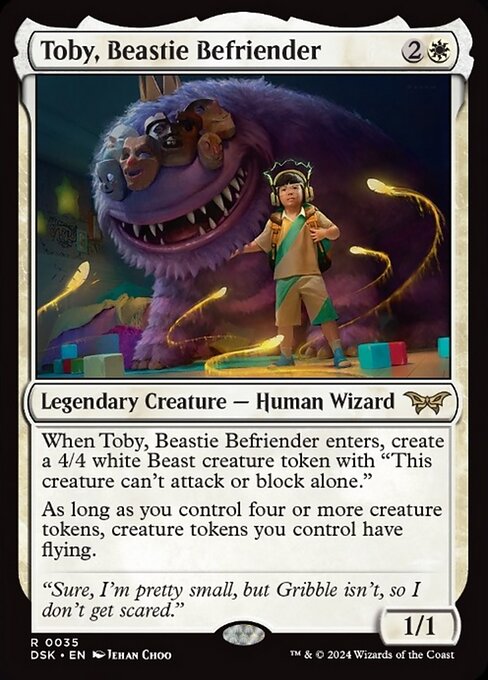 Rating7.8Very good
Why this rating?
One of the very best rares of the format (7.8/10).
Why. Three mana for a 1/1 and a 4/4 white Beast creature token, a good rate. With four or more creature tokens, all your creature tokens have flying, turning a token army into an air force.
Risks. The Beast cannot attack or block alone, and Toby is a fragile 1/1: if he dies, it depends on another creature. The four tokens need other sources.
In the draft. A good pick in white, especially with cheap creatures or tokens. It is weaker in a deck with few creatures.
Results in the games of the set
When it is in hand, the deck wins 61.6% of its games (set average: 55.9%, 16th of 269 cards).
In the opening hand: 62.6% wins (55.0% on average).
Drawn during the game: 60.8% (56.6% on average).
When it is drawn, the deck wins 7.6 points more than when it is not.
When it is drafted, it is played 90% of the time (set average: 62%).
Taken as the first pick (194 drafts), it ends in the deck 91% of the time.
It is played about as much in every archetype.

21. Entity Tracker
Rating7.7Very goodWhy this rating?
One of the very best rares of the format (7.7/10).
Why. A 2/3 with flash for three mana, which draws with Eerie whenever an enchantment enters under your control or a Room is fully unlocked. Flash allows a surprise block or casting at the end of the opponent's turn.
Risks. Without enchantments, it is a 2/3 with flash and nothing more. It stays a modest body that removes nothing.
In the draft. A good pick in a blue deck with enchantments and Rooms. In a deck without them it loses a lot.
Results in the games of the set
When it is in hand, the deck wins 61.7% of its games (set average: 55.9%, 15th of 269 cards).
In the opening hand: 63.9% wins (55.0% on average).
Drawn during the game: 60.2% (56.6% on average).
When it is drawn, the deck wins 9.3 points more than when it is not.
When it is drafted, it is played 93% of the time (set average: 62%).
Taken as the first pick (234 drafts), it ends in the deck 92% of the time.
It is played about as much in every archetype.
 Rating7.6Very good
Why this rating?
One of the very best uncommons of the format (7.6/10).
Why. A one-mana creature that, with Eerie, puts a +1/+1 counter on a creature of your choice whenever an enchantment enters under your control or a Room is fully unlocked. Good on turn 1 and steady value in a white enchantment deck.
Risks. A 1/1 with no enchantments does nothing and loses value late. Its counters only matter if enchantments are plentiful.
In the draft. A decent pick in white in a deck with many enchantments and Rooms. Otherwise it is average.
Results in the games of the set
When it is in hand, the deck wins 60.7% of its games (set average: 55.9%, 22nd of 269 cards).
In the opening hand: 64.7% wins (55.0% on average).
Drawn during the game: 57.6% (56.6% on average).
When it is drawn, the deck wins 6.0 points more than when it is not.
When it is drafted, it is played 86% of the time (set average: 62%).
Taken as the first pick (467 drafts), it ends in the deck 90% of the time.
It is played mostly in U/W decks (37% of them) and R/W (33%).
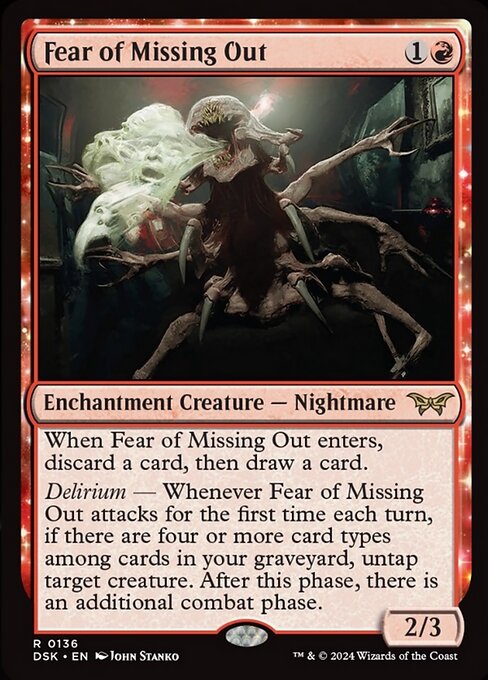 Rating7.6Very good
Why this rating?
One of the very best rares of the format (7.6/10).
Why. A 2/3 for two mana that filters your hand on entering, discarding then drawing. With Delirium, its first attack each turn untaps a creature and gives an additional combat phase: a big attacking turn.
Risks. Without Delirium, it is a 2/3 that filters and nothing more. It needs four card types in the graveyard for the second effect.
In the draft. Decent in red in an aggressive deck. The discard helps Delirium, so it is better with varied card types.
Results in the games of the set
When it is in hand, the deck wins 59.9% of its games (set average: 55.9%, 32nd of 269 cards).
In the opening hand: 60.2% wins (55.0% on average).
Drawn during the game: 59.7% (56.6% on average).
When it is drawn, the deck wins 5.7 points more than when it is not.
When it is drafted, it is played 93% of the time (set average: 62%).
Taken as the first pick (235 drafts), it ends in the deck 94% of the time.
It is played about as much in every archetype.

24. Midnight Mayhem
Rating7.6Very goodWhy this rating?
One of the very best uncommons of the format (7.6/10).
Why. A sorcery that creates three 1/1 red Gremlin creature tokens with menace, lifelink and haste until end of turn. They attack right away: up to three damage and three life, and three bodies that stay.
Risks. A two-colour red-white card. The 1/1 Gremlins stay fragile and the bonus lasts only a turn, so it is weaker if the opponent's board is full of blockers.
In the draft. A good pick in red-white, a powerful uncommon. It needs few creatures to be useful.
Results in the games of the set
When it is in hand, the deck wins 61.2% of its games (set average: 55.9%, 18th of 269 cards).
In the opening hand: 59.5% wins (55.0% on average).
Drawn during the game: 62.5% (56.6% on average).
When it is drawn, the deck wins 5.3 points more than when it is not.
When it is drafted, it is played 72% of the time (set average: 62%).
Taken as the first pick (291 drafts), it ends in the deck 83% of the time.
It is played mostly in R/W decks (58% of them).
 Rating7.6Very good
Why this rating?
One of the very best rares of the format (7.6/10).
Why. A 1/1 that cannot be blocked for two mana. Each time it hits the player, you choose a mode not yet chosen: two +1/+1 counters, draw a card, or become a copy of another creature of yours. It improves with every hit.
Risks. It stays a 1/1 until it connects, and removal or a damage spell stops it before that. Each mode is usable only once.
In the draft. A decent pick in blue in an aggressive deck. Better early in the game, weaker once the opponent already has a full board.
Results in the games of the set
When it is in hand, the deck wins 60.6% of its games (set average: 55.9%, 25th of 269 cards).
In the opening hand: 63.1% wins (55.0% on average).
Drawn during the game: 58.9% (56.6% on average).
When it is drawn, the deck wins 7.9 points more than when it is not.
When it is drafted, it is played 92% of the time (set average: 62%).
Taken as the first pick (211 drafts), it ends in the deck 92% of the time.
It is played about as much in every archetype.
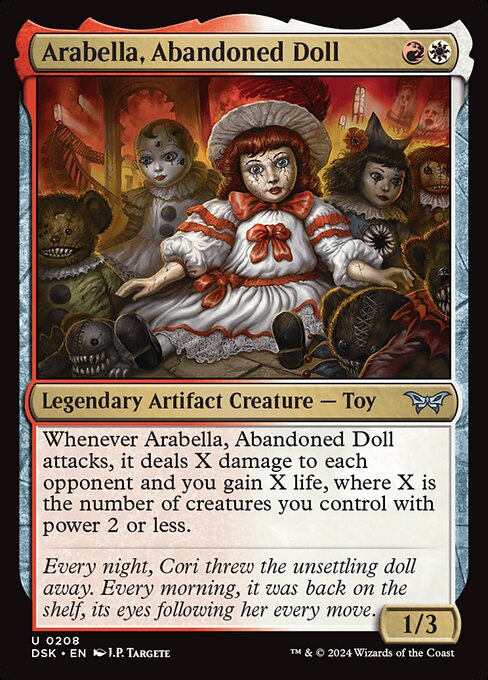 Rating7.5Very good
Why this rating?
One of the very best uncommons of the format (7.6/10).
Why. A 1/3 for two mana that, on each attack, deals damage to each opponent and gains you life based on the number of creatures you control with power 2 or less. It counts itself, and the effect triggers before blocks.
Risks. A two-colour red-white card, needing many small creatures. A 1/3 attacking into big bodies gets killed.
In the draft. A good pick in red-white in a deck of small creatures. Weaker in a deck of big bodies.
Results in the games of the set
When it is in hand, the deck wins 59.4% of its games (set average: 55.9%, 38th of 269 cards).
In the opening hand: 60.7% wins (55.0% on average).
Drawn during the game: 58.4% (56.6% on average).
When it is drawn, the deck wins 3.2 points more than when it is not.
When it is drafted, it is played 75% of the time (set average: 62%).
Taken as the first pick (229 drafts), it ends in the deck 87% of the time.
It is played mostly in R/W decks (56% of them).
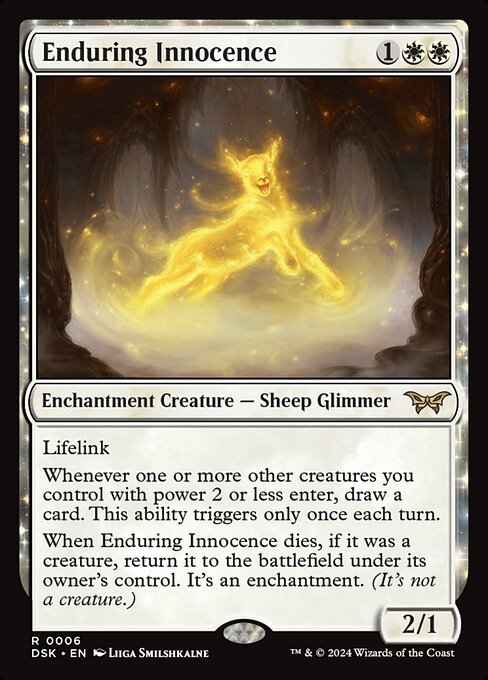 Rating7.5Very good
Why this rating?
A very good rare of the format (7.5/10).
Why. A 2/1 with lifelink for three mana, drawing when other creatures with power 2 or less enter under your control, once each turn. If it dies, it comes back as an enchantment and keeps drawing.
Risks. A 2/1 is fragile in combat, and the draw needs creatures with low power. Once an enchantment, it no longer fights.
In the draft. A decent pick in white in a deck of small creatures. It is best as a recurring source of card draw.
Results in the games of the set
When it is in hand, the deck wins 59.9% of its games (set average: 55.9%, 33rd of 269 cards).
In the opening hand: 61.4% wins (55.0% on average).
Drawn during the game: 58.8% (56.6% on average).
When it is drawn, the deck wins 5.5 points more than when it is not.
When it is drafted, it is played 89% of the time (set average: 62%).
Taken as the first pick (183 drafts), it ends in the deck 90% of the time.
It is played about as much in every archetype.

28. Chainsaw
Rating7.4Very goodWhy this rating?
A very good rare of the format (7.4/10).
Why. Two mana for 3 damage to a creature on entering: cheap removal, with an Equipment behind it. Each time one or more creatures die, it gets a rev counter and the equipped creature gains that much power.
Risks. Equip costs three mana, so the Equipment is expensive to use. The power gain needs creatures to die.
In the draft. A good pick in red: cheap removal stays useful even without equipping. Take it before average creatures.
Results in the games of the set
When it is in hand, the deck wins 60.2% of its games (set average: 55.9%, 29th of 269 cards).
In the opening hand: 60.6% wins (55.0% on average).
Drawn during the game: 59.9% (56.6% on average).
When it is drawn, the deck wins 6.5 points more than when it is not.
When it is drafted, it is played 94% of the time (set average: 62%).
Taken as the first pick (215 drafts), it ends in the deck 95% of the time.
It is played about as much in every archetype.
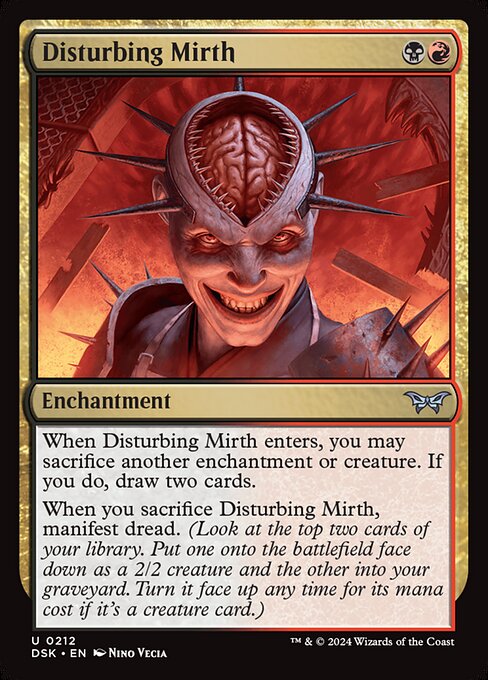
29. Disturbing Mirth
Rating7.4Very goodWhy this rating?
A solid uncommon of the format (7.4/10).
Why. A two-mana black-red enchantment: when it enters, you may sacrifice another enchantment or creature to draw two cards. If you sacrifice it, you Manifest dread. A good source of cards in a sacrifice deck.
Risks. It needs material to sacrifice, and its second effect requires another way to sacrifice the enchantment itself. Without that, it does nothing on the board.
In the draft. A middling pick in black-red, useful with low-value creatures. Do not take it ahead of direct value.
Results in the games of the set
When it is in hand, the deck wins 60.0% of its games (set average: 55.9%, 30th of 269 cards).
In the opening hand: 58.1% wins (55.0% on average).
Drawn during the game: 61.4% (56.6% on average).
When it is drawn, the deck wins 6.9 points more than when it is not.
When it is drafted, it is played 64% of the time (set average: 62%).
Taken as the first pick (211 drafts), it ends in the deck 83% of the time.
It is played mostly in B/R decks (76% of them).
 Rating7.4Very good
Why this rating?
A very good mythic of the format (7.4/10).
Why. A planeswalker that is a 3/4 Ninja with hexproof during your turn. It can give you an emblem, surveil 2 then draw if an opponent lost life, or tap a creature and put two stun counters on it.
Risks. A blue-black card, expensive to cast. It is a creature only during your turn and remains vulnerable to opposing attacks.
In the draft. A decent pick in blue-black, better in an offensive deck. The emblem helps Kaito himself during your turn, and any other Ninjas.
Results in the games of the set
When it is in hand, the deck wins 58.5% of its games (set average: 55.9%, 47th of 269 cards).
In the opening hand: 57.1% wins (55.0% on average).
Drawn during the game: 59.5% (56.6% on average).
When it is drawn, the deck wins 8.7 points more than when it is not.
When it is drafted, it is played 77% of the time (set average: 62%).
Taken as the first pick (62 drafts), it ends in the deck 84% of the time.
It is played about as much in every archetype.
 Rating7.4Very good
Why this rating?
A solid uncommon of the format (7.4/10).
Why. A 2/3 for two mana that may draw each end step, with no discard if a permanent entered face down or you turned a permanent face up this turn. A good defensive body with regular hand filtering.
Risks. A green-blue card, two colours from turn 2. With no face-down permanent, you discard a card, making it a simple filter.
In the draft. A good pick in green-blue, especially with many Manifest dread effects. It brings a solid body for little.
Results in the games of the set
When it is in hand, the deck wins 60.6% of its games (set average: 55.9%, 23rd of 269 cards).
In the opening hand: 62.9% wins (55.0% on average).
Drawn during the game: 59.2% (56.6% on average).
When it is drawn, the deck wins 7.0 points more than when it is not.
When it is drafted, it is played 78% of the time (set average: 62%).
Taken as the first pick (380 drafts), it ends in the deck 84% of the time.
It is played mostly in G/U decks (61% of them).
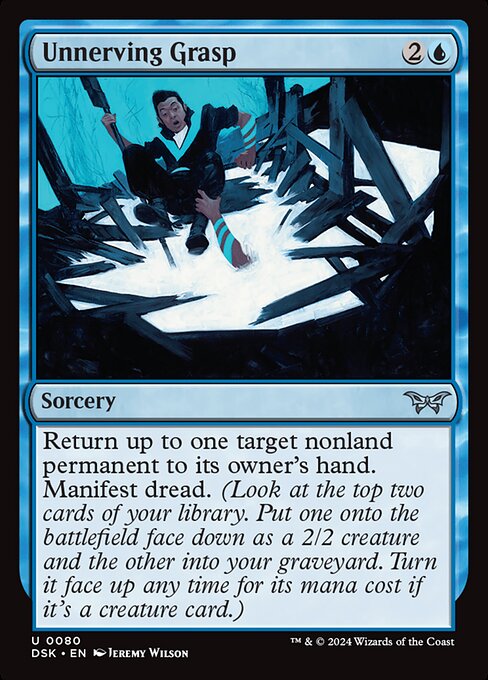
32. Unnerving Grasp
Rating7.4Very goodWhy this rating?
A solid uncommon of the format (7.4/10).
Why. A three-mana sorcery that returns a nonland permanent to hand, then Manifests dread. You gain tempo and a 2/2 body for one card. Good for bouncing an opposing Aura or a creature that just got well equipped.
Risks. It is not removal: the opponent recasts their card. A slow sorcery that gains almost nothing if the opponent has no good target.
In the draft. A decent pick in blue, especially in blue-white or blue-green. Useful in a tempo deck.
Results in the games of the set
When it is in hand, the deck wins 60.8% of its games (set average: 55.9%, 20th of 269 cards).
In the opening hand: 58.8% wins (55.0% on average).
Drawn during the game: 62.1% (56.6% on average).
When it is drawn, the deck wins 6.9 points more than when it is not.
When it is drafted, it is played 90% of the time (set average: 62%).
Taken as the first pick (529 drafts), it ends in the deck 93% of the time.
It is played mostly in G/U decks (38% of them) and B/U (33%).
 Rating7.4Very good
Why this rating?
A very good rare of the format (7.4/10).
Why. A 1/1 that, at your end step, creates a legendary Fractal creature token with as many +1/+1 counters as you have lands, if you played a land this turn and the number is prime. Cast on turn 3 with a land drop, it gives a 3/3 right away.
Risks. Zimone is a fragile 1/1, and the Fractal only appears if your land count is prime, so not at four or six. You also need a land drop each turn, and since the Fractal is legendary, a new one replaces the old.
In the draft. A good pick in green-blue: a great turn 3 if it survives. It loses power if your mana is uneven.
Results in the games of the set
When it is in hand, the deck wins 61.8% of its games (set average: 55.9%, 12th of 269 cards).
In the opening hand: 65.2% wins (55.0% on average).
Drawn during the game: 59.5% (56.6% on average).
When it is drawn, the deck wins 9.6 points more than when it is not.
When it is drafted, it is played 85% of the time (set average: 62%).
Taken as the first pick (219 drafts), it ends in the deck 84% of the time.
It is played about as much in every archetype.
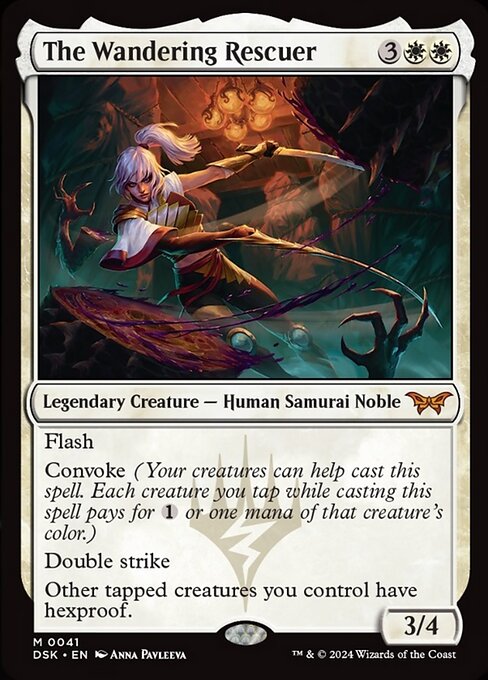 Rating7.4Very good
Why this rating?
A very good mythic of the format (7.4/10).
Why. A 3/4 with flash, convoke and double strike, where other tapped creatures you control have hexproof. Cast at the end of the opponent's turn by tapping your creatures, it surprises the opponent and hits twice.
Risks. Five mana, or many creatures to tap, which stops them from attacking if you cast it on your own turn. A single removal spell takes it out.
In the draft. A decent pick in white, especially in white-red or white-blue. A good card for an aggressive deck with cheap creatures.
Results in the games of the set
When it is in hand, the deck wins 58.9% of its games (set average: 55.9%, 42nd of 269 cards).
In the opening hand: 58.6% wins (55.0% on average).
Drawn during the game: 59.1% (56.6% on average).
When it is drawn, the deck wins 6.1 points more than when it is not.
When it is drafted, it is played 87% of the time (set average: 62%).
Taken as the first pick (77 drafts), it ends in the deck 86% of the time.
It is played about as much in every archetype.

35. Gremlin Tamer
Rating7.3Very goodWhy this rating?
A solid uncommon of the format (7.3/10).
Why. A two-drop that turns every Eerie trigger into a 1/1 red Gremlin creature token: each enchantment entering, each Room fully unlocked. In an enchantment-heavy deck it floods the board with small bodies.
Risks. On its own it is a vanilla 2/2. It needs exactly two colours and a decent enchantment count; without them it produces very little.
In the draft. A high pick if you are in both colours and already have enchantments and Rooms. Value those enchantments more once you have it: each one now pays you back.
Results in the games of the set
When it is in hand, the deck wins 60.0% of its games (set average: 55.9%, 31st of 269 cards).
In the opening hand: 61.8% wins (55.0% on average).
Drawn during the game: 58.8% (56.6% on average).
When it is drawn, the deck wins 6.0 points more than when it is not.
When it is drafted, it is played 80% of the time (set average: 62%).
Taken as the first pick (381 drafts), it ends in the deck 83% of the time.
It is played mostly in U/W decks (54% of them).
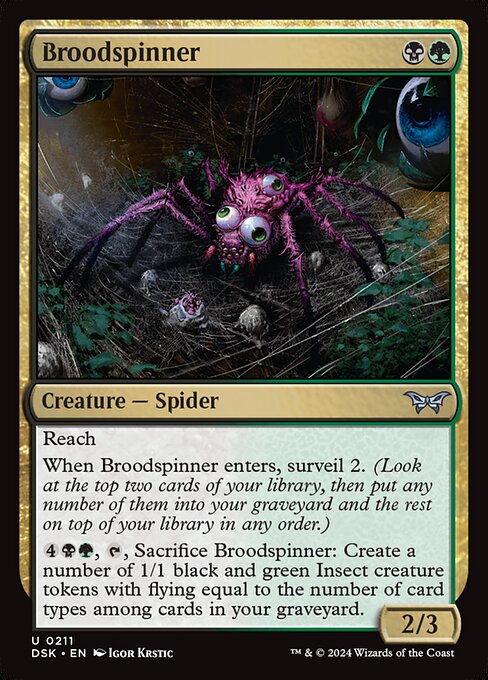
36. Broodspinner
Rating7.2Very goodWhy this rating?
A solid uncommon of the format (7.2/10).
Why. A two-mana 2/3 with reach that surveils 2 on entry: a solid blocker that smooths your draws. Late in the game you tap and sacrifice it for a swarm of 1/1 flying Insect creature tokens, bigger the more varied your graveyard is.
Risks. The activation costs six mana and its size depends on the card types in your graveyard. Against a fast deck you may never get the time to use it.
In the draft. A good two-drop for decks in both of its colours. It is best when you have ways to fill your graveyard; otherwise it is just a solid blocker.
Results in the games of the set
When it is in hand, the deck wins 59.7% of its games (set average: 55.9%, 35th of 269 cards).
In the opening hand: 58.9% wins (55.0% on average).
Drawn during the game: 60.3% (56.6% on average).
When it is drawn, the deck wins 6.7 points more than when it is not.
When it is drafted, it is played 79% of the time (set average: 62%).
Taken as the first pick (344 drafts), it ends in the deck 88% of the time.
It is played mostly in B/G decks (63% of them).
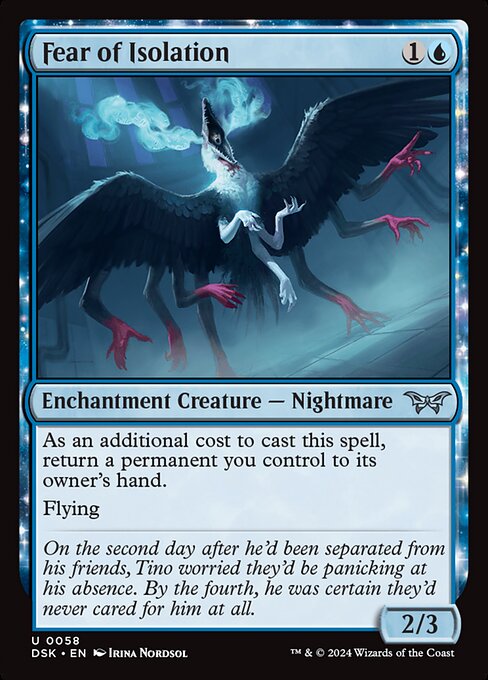 Rating7.2Very good
Why this rating?
A solid uncommon of the format (7.2/10).
Why. A two-mana 2/3 flier, which is excellent for the cost. The additional cost of returning a permanent to hand is paid by bouncing a well-placed land or by replaying a permanent with an enters-the-battlefield effect.
Risks. You need a permanent to return: on turn two that is a land, which can slow your development. Decks with enters-the-battlefield effects get more from it.
In the draft. A good pick for blue evasive decks. Take it over a ground body of similar size; it is even better alongside permanents that give value on entry.
Results in the games of the set
When it is in hand, the deck wins 59.6% of its games (set average: 55.9%, 37th of 269 cards).
In the opening hand: 56.4% wins (55.0% on average).
Drawn during the game: 61.6% (56.6% on average).
When it is drawn, the deck wins 5.3 points more than when it is not.
When it is drafted, it is played 90% of the time (set average: 62%).
Taken as the first pick (428 drafts), it ends in the deck 96% of the time.
It is played mostly in U/W decks (38% of them) and R/U (35%).
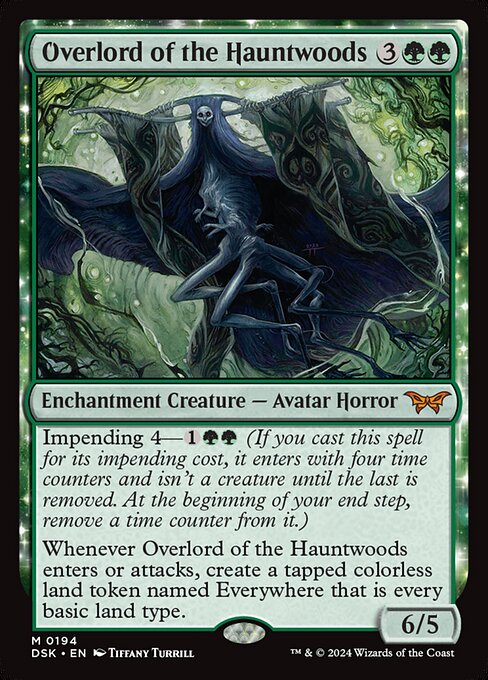
38. Overlord of the Hauntwoods
Rating7.2Very goodWhy this rating?
A very good mythic of the format (7.2/10).
Why. Two modes: on turn three with Impending it makes a tapped Everywhere land token on entry; later it is a 6/5 that makes one more whenever it attacks. You ramp and fix your colours with no effort.
Risks. With Impending it is not a creature for four of your end steps, so it neither blocks nor attacks. The full five-mana price is steep, with two green mana required.
In the draft. A good mythic, not a must-take. Pick it in a green deck that wants fixing and ramp: it is ramp first, a big body later.
Results in the games of the set
When it is in hand, the deck wins 56.7% of its games (set average: 55.9%, 88th of 269 cards).
In the opening hand: 57.2% wins (55.0% on average).
Drawn during the game: 56.3% (56.6% on average).
When it is drawn, the deck wins 4.6 points more than when it is not.
When it is drafted, it is played 91% of the time (set average: 62%).
Taken as the first pick (81 drafts), it ends in the deck 94% of the time.
It is played about as much in every archetype.
 Rating7.2Good
Why this rating?
A very good mythic of the format (7.2/10).
Why. A three-mana 3/3 that manifests dread each time it attacks: you add a 2/2 and fill your graveyard for Delirium. Over several turns the value stacks fast. Its two-mana ability reveals a face-down permanent and turns it face up for free if it is a creature card.
Risks. It has to attack to produce, so it is exposed to blockers: against good defenders it stays home. Two green mana on turn three is a real constraint.
In the draft. A good pick for aggressive green decks or Delirium decks. Better with many creature cards, since the face-down permanents can then be turned up more often.
Results in the games of the set
When it is in hand, the deck wins 57.6% of its games (set average: 55.9%, 60th of 269 cards).
In the opening hand: 58.0% wins (55.0% on average).
Drawn during the game: 57.4% (56.6% on average).
When it is drawn, the deck wins 4.0 points more than when it is not.
When it is drafted, it is played 90% of the time (set average: 62%).
Taken as the first pick (81 drafts), it ends in the deck 89% of the time.
It is played about as much in every archetype.

40. Balustrade Wurm
Rating7.1GoodWhy this rating?
A very good rare of the format (7.1/10).
Why. A five-mana 5/5 with trample and haste that cannot be countered: it hits right away. With Delirium it returns from the graveyard for four mana, at sorcery speed, with a finality counter.
Risks. Five mana with two green, and the recursion needs four card types in your graveyard. The finality counter means it only comes back once, and exile-based removal shuts it down.
In the draft. A good top-end for green, especially with Delirium. Take it over plain big bodies; one copy is enough for a healthy curve.
Results in the games of the set
When it is in hand, the deck wins 58.9% of its games (set average: 55.9%, 44th of 269 cards).
In the opening hand: 56.7% wins (55.0% on average).
Drawn during the game: 60.3% (56.6% on average).
When it is drawn, the deck wins 4.2 points more than when it is not.
When it is drafted, it is played 92% of the time (set average: 62%).
Taken as the first pick (175 drafts), it ends in the deck 90% of the time.
It is played about as much in every archetype.
 Rating7.0Good
Why this rating?
A solid uncommon of the format (7.0/10).
Why. A two-mana 3/2 with haste that becomes a 4/3 with trample once Delirium is on. Good in an aggressive red-green deck: it hits hard from turn two.
Risks. Only 2 toughness without Delirium, so it is fragile to small blockers and spells. It loses value late in the game against bigger creatures.
In the draft. Very good in an aggressive red-green deck. Take it reasonably early to support a low curve; it is a minor card outside those two colours.
Results in the games of the set
When it is in hand, the deck wins 59.0% of its games (set average: 55.9%, 40th of 269 cards).
In the opening hand: 59.4% wins (55.0% on average).
Drawn during the game: 58.7% (56.6% on average).
When it is drawn, the deck wins 4.2 points more than when it is not.
When it is drafted, it is played 74% of the time (set average: 62%).
Taken as the first pick (263 drafts), it ends in the deck 85% of the time.
It is played mostly in G/R decks (58% of them).
 Rating7.0Good
Why this rating?
A solid uncommon of the format (7.0/10).
Why. A two-mana instant-speed removal that deals 5 damage to a creature and exiles it if it would die. It kills almost any creature, and you choose between sacrificing a creature or enchantment or paying two extra mana.
Risks. Without a sacrifice it costs four mana, which makes it far less efficient. It does not kill the very biggest creatures.
In the draft. A good removal for a red deck, to take early. It is especially good if you have creatures or enchantments you do not mind sacrificing.
Results in the games of the set
When it is in hand, the deck wins 57.9% of its games (set average: 55.9%, 51st of 269 cards).
In the opening hand: 55.7% wins (55.0% on average).
Drawn during the game: 59.6% (56.6% on average).
When it is drawn, the deck wins 3.2 points more than when it is not.
When it is drafted, it is played 92% of the time (set average: 62%).
Taken as the first pick (446 drafts), it ends in the deck 96% of the time.
It is played mostly in B/R decks (36% of them) and G/R (33%).

43. Exorcise
Rating7.0GoodWhy this rating?
A solid uncommon of the format (7.0/10).
Why. A two-mana sorcery that exiles an artifact, an enchantment, or a creature with power 4 or greater. It answers the biggest threats as well as problematic Rooms and Auras for very little mana.
Risks. It is conditional: it cannot hit creatures with power 3 or less, and it can be left without a target against an opponent with only small creatures.
In the draft. A good flexible removal for a white deck. Take it after unconditional removal; it rises in value when the table has big creatures and enchantments.
Results in the games of the set
When it is in hand, the deck wins 56.6% of its games (set average: 55.9%, 93rd of 269 cards).
In the opening hand: 55.0% wins (55.0% on average).
Drawn during the game: 57.7% (56.6% on average).
When it is drawn, the deck wins 2.0 points more than when it is not.
When it is drafted, it is played 88% of the time (set average: 62%).
Taken as the first pick (254 drafts), it ends in the deck 93% of the time.
It is played mostly in B/W decks (28% of them) and U/W (26%).
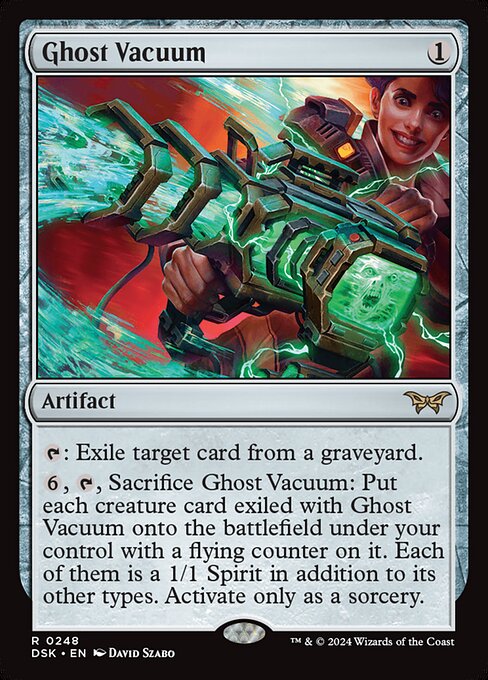
44. Ghost Vacuum
Rating7.0GoodWhy this rating?
A very good rare of the format (7.0/10).
Why. A one-mana artifact that taps to exile cards from graveyards. It cuts off opposing Delirium and recursion, and late in the game, for six mana, it brings the creature cards exiled with it back as 1/1 flying Spirits.
Risks. It does nothing on the battlefield in the short term, and its payoff depends on what dies. Against decks that ignore the graveyard it is weak.
In the draft. A specific deck-building choice rather than a priority pick. Take it mid-pack if you want a tool against graveyard decks.
Results in the games of the set
When it is in hand, the deck wins 56.6% of its games (set average: 55.9%, 92nd of 269 cards).
In the opening hand: 56.8% wins (55.0% on average).
Drawn during the game: 56.5% (56.6% on average).
When it is drawn, the deck wins 3.8 points more than when it is not.
When it is drafted, it is played 89% of the time (set average: 62%).
Taken as the first pick (143 drafts), it ends in the deck 90% of the time.
It is played about as much in every archetype.
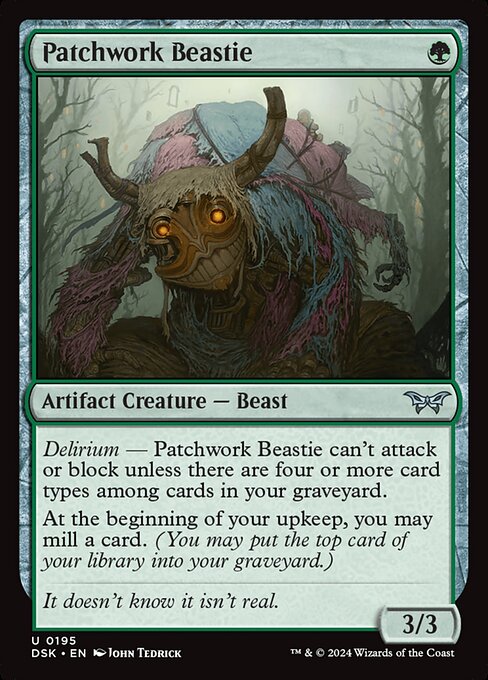 Rating7.0Good
Why this rating?
A solid uncommon of the format (7.0/10).
Why. A one-mana 3/3 that fills your graveyard: on each upkeep you may mill a card. Once Delirium is on, it is a very efficient attacker for next to no mana.
Risks. It cannot attack or block without Delirium: early on it is a useless body that does not defend. It needs a real graveyard plan.
In the draft. A good pick for a green Delirium deck. Avoid it if your deck cannot fill the graveyard; it is poor in a build without synergy.
Results in the games of the set
When it is in hand, the deck wins 58.1% of its games (set average: 55.9%, 49th of 269 cards).
In the opening hand: 60.5% wins (55.0% on average).
Drawn during the game: 56.2% (56.6% on average).
When it is drawn, the deck wins 3.2 points more than when it is not.
When it is drafted, it is played 86% of the time (set average: 62%).
Taken as the first pick (333 drafts), it ends in the deck 94% of the time.
It is played mostly in G/R decks (43% of them) and B/G (39%).
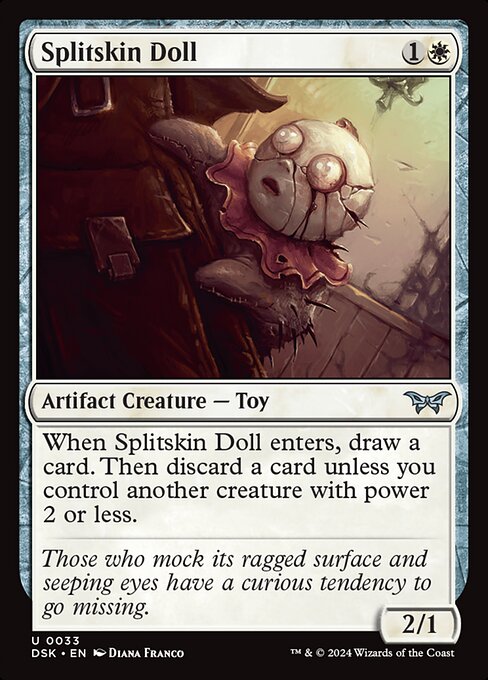
46. Splitskin Doll
Rating7.0GoodWhy this rating?
A solid uncommon of the format (7.0/10).
Why. A two-mana 2/1 that draws a card on entry, then discards a card unless you control another creature with power 2 or less. A clean card replacement for decks full of small creatures.
Risks. Only 1 toughness and little impact on offence. Without another small creature you have to discard a card.
In the draft. A good pick for white low-curve decks. An aggro deck should take it over vanilla bodies; it is weaker in slow decks.
Results in the games of the set
When it is in hand, the deck wins 59.0% of its games (set average: 55.9%, 41st of 269 cards).
In the opening hand: 58.7% wins (55.0% on average).
Drawn during the game: 59.2% (56.6% on average).
When it is drawn, the deck wins 3.3 points more than when it is not.
When it is drafted, it is played 89% of the time (set average: 62%).
Taken as the first pick (377 drafts), it ends in the deck 96% of the time.
It is played mostly in R/W decks (37% of them) and B/W (30%).
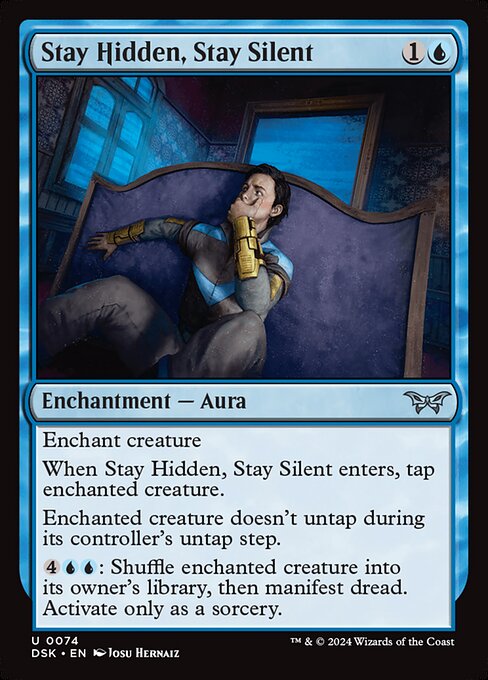 Rating7.0Good
Why this rating?
A solid uncommon of the format (7.0/10).
Why. A two-mana Aura that taps the enchanted creature and keeps it from untapping: a cheap removal. Later, for six mana, you shuffle that creature into its owner's library and manifest dread.
Risks. The creature keeps its static, triggered, and non-tap abilities. Removing the Aura or bouncing the creature frees it.
In the draft. A good pick for blue control, to take fairly early. It acts as cheap removal; even better if you want the late-game mode.
Results in the games of the set
When it is in hand, the deck wins 58.8% of its games (set average: 55.9%, 45th of 269 cards).
In the opening hand: 56.1% wins (55.0% on average).
Drawn during the game: 60.6% (56.6% on average).
When it is drawn, the deck wins 5.1 points more than when it is not.
When it is drafted, it is played 91% of the time (set average: 62%).
Taken as the first pick (435 drafts), it ends in the deck 95% of the time.
It is played mostly in B/U decks (36% of them) and R/U (35%).

48. Twitching Doll
Rating7.0GoodWhy this rating?
A very good rare of the format (7.0/10).
Why. A two-mana 2/2 that makes mana of any colour and collects nest counters. Late in the game you sacrifice it for as many 2/2 green Spider creature tokens with reach as it has counters. Great fixing and ramp.
Risks. Tapping for mana stops it from attacking or blocking, and the sacrifice only works at sorcery speed. It is a fragile body.
In the draft. A good pick for any green deck, especially three-colour ones. Take it even before your colours are settled; it solves your mana problems.
Results in the games of the set
When it is in hand, the deck wins 58.0% of its games (set average: 55.9%, 50th of 269 cards).
In the opening hand: 60.4% wins (55.0% on average).
Drawn during the game: 56.2% (56.6% on average).
When it is drawn, the deck wins 5.4 points more than when it is not.
When it is drafted, it is played 91% of the time (set average: 62%).
Taken as the first pick (199 drafts), it ends in the deck 92% of the time.
It is played about as much in every archetype.

49. Under the Skin
Rating7.0GoodWhy this rating?
A solid uncommon of the format (7.0/10).
Why. A three-mana sorcery that manifests dread and can return a permanent card from your graveyard to hand. You get a 2/2 and a replacement card, and your graveyard fills up.
Risks. If your graveyard holds no permanent card the second half does nothing. It is a slow sorcery that does not answer an opposing threat.
In the draft. A good value pick for a green deck. Take it in a midrange deck; less pressing in a very aggressive one.
Results in the games of the set
When it is in hand, the deck wins 60.3% of its games (set average: 55.9%, 28th of 269 cards).
In the opening hand: 57.9% wins (55.0% on average).
Drawn during the game: 61.9% (56.6% on average).
When it is drawn, the deck wins 6.7 points more than when it is not.
When it is drafted, it is played 92% of the time (set average: 62%).
Taken as the first pick (519 drafts), it ends in the deck 95% of the time.
It is played mostly in B/G decks (38% of them) and G/U (35%).
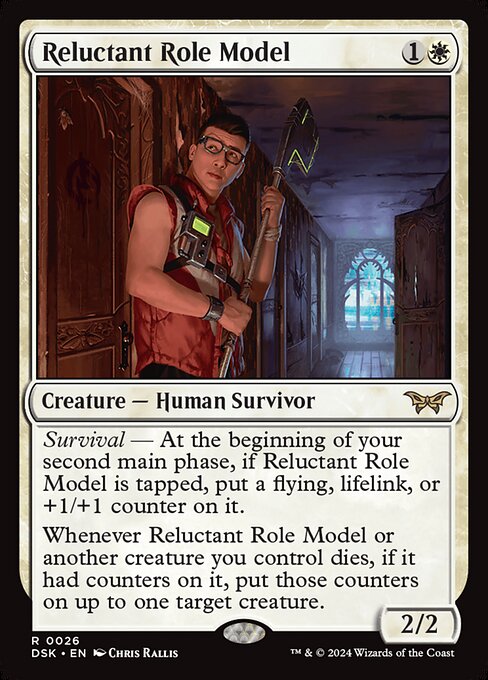 Rating7.0Good
Why this rating?
A very good rare of the format (7.0/10).
Why. A two-mana 2/2 with Survival: each turn it is tapped in your second main phase, you put a flying, lifelink, or +1/+1 counter on it. When a creature with counters dies, those counters move to a target creature. It grows over the course of the game.
Risks. It must be tapped in your second main phase, so it has to attack and survive. Early removal reduces it to nothing.
In the draft. A fair pick for an aggressive white deck. Take it if you have ways to protect your creatures; secondary otherwise.
Results in the games of the set
When it is in hand, the deck wins 56.7% of its games (set average: 55.9%, 87th of 269 cards).
In the opening hand: 59.6% wins (55.0% on average).
Drawn during the game: 54.4% (56.6% on average).
When it is drawn, the deck wins 2.1 points more than when it is not.
When it is drafted, it is played 88% of the time (set average: 62%).
Taken as the first pick (148 drafts), it ends in the deck 89% of the time.
It is played about as much in every archetype.
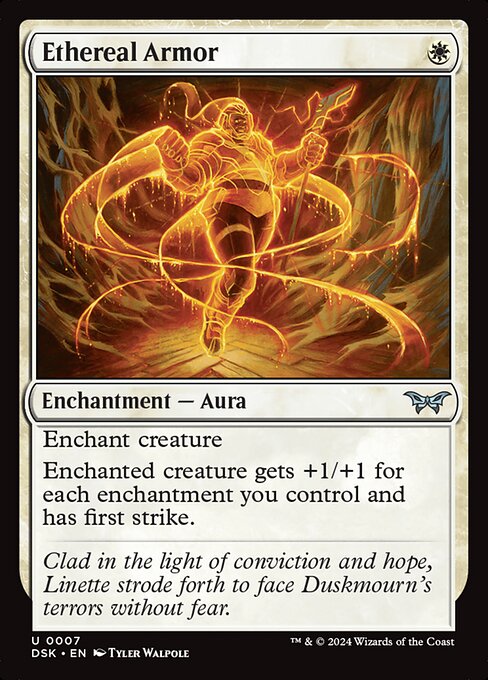
51. Ethereal Armor
Rating6.9GoodWhy this rating?
A solid uncommon of the format (6.9/10).
Why. A one-mana Aura that gives +1/+1 for each enchantment you control (it counts itself) and first strike. In an enchantment deck, an ordinary creature quickly becomes a major threat.
Risks. Like any Aura, removal or a clever block costs you two cards for one. It depends on your enchantment count.
In the draft. A good pick in a white enchantment deck. Skip it in a deck with few enchantments; take it after your quality creatures.
Results in the games of the set
When it is in hand, the deck wins 57.4% of its games (set average: 55.9%, 68th of 269 cards).
In the opening hand: 55.8% wins (55.0% on average).
Drawn during the game: 58.5% (56.6% on average).
When it is drawn, the deck wins 3.0 points more than when it is not.
When it is drafted, it is played 80% of the time (set average: 62%).
Taken as the first pick (229 drafts), it ends in the deck 87% of the time.
It is played mostly in U/W decks (32% of them).
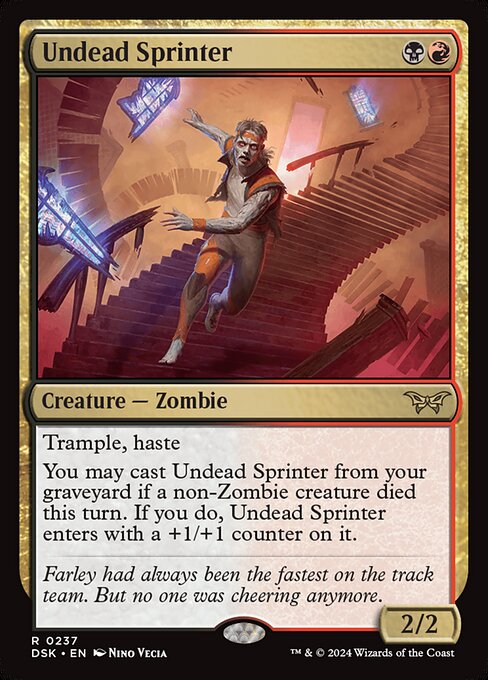
52. Undead Sprinter
Rating6.8GoodWhy this rating?
A very good rare of the format (6.8/10).
Why. A two-mana 2/2 with trample and haste that can be cast from the graveyard with a +1/+1 counter if a non-Zombie creature died this turn. An aggressive, resilient threat.
Risks. Low toughness, and it relies on a non-Zombie creature dying to come back. Without that it is an ordinary 2/2.
In the draft. A good pick for an aggressive black-red deck. Take it fairly early if you are in those two colours; otherwise it has no place.
Results in the games of the set
When it is in hand, the deck wins 57.4% of its games (set average: 55.9%, 70th of 269 cards).
In the opening hand: 59.0% wins (55.0% on average).
Drawn during the game: 56.2% (56.6% on average).
When it is drawn, the deck wins 4.0 points more than when it is not.
When it is drafted, it is played 71% of the time (set average: 62%).
Taken as the first pick (125 drafts), it ends in the deck 85% of the time.
It is played mostly in B/R decks (30% of them).

53. Insidious Fungus
Rating6.8GoodWhy this rating?
A solid uncommon of the format (6.8/10).
Why. A one-mana 1/2 with three sacrifice uses: destroy an artifact, destroy an enchantment, or draw a card and then put a land from your hand onto the battlefield tapped. Its flexibility makes it useful at any moment.
Risks. A very small body, and it costs two mana to activate. The cost is low, but it has little board impact.
In the draft. A mid-pack pick for green decks. It is mainly worth it for the destroy modes against opposing Rooms, enchantments, and artifacts.
Results in the games of the set
When it is in hand, the deck wins 56.7% of its games (set average: 55.9%, 90th of 269 cards).
In the opening hand: 56.4% wins (55.0% on average).
Drawn during the game: 56.9% (56.6% on average).
When it is drawn, the deck wins 2.5 points more than when it is not.
When it is drafted, it is played 87% of the time (set average: 62%).
Taken as the first pick (216 drafts), it ends in the deck 96% of the time.
It is played mostly in B/G decks (28% of them) and G/R (27%).
 Rating6.8Good
Why this rating?
A very good rare of the format (6.8/10).
Why. A three-mana 2/4 that, with Delirium, spreads two +1/+1 counters among one or two target creatures when it enters and each time it attacks; with six types it doubles the +1/+1 counters on them. A sturdy body that builds value quickly.
Risks. Without Delirium it is a simple 2/4. Its power depends entirely on the graveyard, and removal on the creature cuts off the value.
In the draft. A good pick for green Delirium decks. Take it after your graveyard-filling tools; decent as a blocker otherwise.
Results in the games of the set
When it is in hand, the deck wins 57.8% of its games (set average: 55.9%, 54th of 269 cards).
In the opening hand: 54.9% wins (55.0% on average).
Drawn during the game: 59.8% (56.6% on average).
When it is drawn, the deck wins 4.0 points more than when it is not.
When it is drafted, it is played 93% of the time (set average: 62%).
Taken as the first pick (201 drafts), it ends in the deck 94% of the time.
It is played about as much in every archetype.

55. Roaring Furnace // Steaming Sauna
Rating6.8GoodWhy this rating?
A very good rare of the format (6.8/10).
Why. A two-door Room: one door deals damage equal to the number of cards in your hand to an opposing creature, the other, later, draws you a card each end step and removes your maximum hand size. You get two effects from one card, with Eerie triggers on top.
Risks. The first door depends on your hand: late in the game it kills almost nothing. The second costs five mana with two blue.
In the draft. A good pick for a blue-red control deck. Take it fairly early if you want value and Eerie triggers; less useful without that base.
Results in the games of the set
When it is in hand, the deck wins 60.3% of its games (set average: 55.9%, 27th of 269 cards).
In the opening hand: 60.8% wins (55.0% on average).
Drawn during the game: 60.0% (56.6% on average).
When it is drawn, the deck wins 10.2 points more than when it is not.
When it is drafted, it is played 82% of the time (set average: 62%).
Taken as the first pick (205 drafts), it ends in the deck 85% of the time.
It is played mostly in R/U decks (32% of them).

56. Threats Around Every Corner
Rating6.8GoodWhy this rating?
A solid uncommon of the format (6.8/10).
Why. A four-mana enchantment that manifests dread, then puts a basic land from your library onto the battlefield tapped each time a face-down permanent enters under your control. It gives you a 2/2 and ramps your mana throughout the game.
Risks. Four mana for a 2/2 and a land: without other face-down sources it returns little more. Slow against an aggressive deck.
In the draft. A useful pick for green decks with other cards that manifest dread. Take it after your best creatures; it helps with fixing.
Results in the games of the set
When it is in hand, the deck wins 58.6% of its games (set average: 55.9%, 46th of 269 cards).
In the opening hand: 59.1% wins (55.0% on average).
Drawn during the game: 58.2% (56.6% on average).
When it is drawn, the deck wins 5.5 points more than when it is not.
When it is drafted, it is played 86% of the time (set average: 62%).
Taken as the first pick (390 drafts), it ends in the deck 89% of the time.
It is played mostly in G/U decks (41% of them) and B/G (31%).
 Rating6.8Good
Why this rating?
A very good mythic of the format (6.8/10).
Why. A 9/9 with flying, lifelink, and ward (sacrifice three nonland permanents) that exiles cards headed to the opponent's graveyard and lets you play them on your turn by paying life. If it lands, the game is nearly won.
Risks. It costs nine mana with three black, so in most games it never gets cast. A huge investment for a draft deck.
In the draft. Take it only as a last top-end card in a slow black deck. One copy at most; do not take it over real playables.
Results in the games of the set
When it is in hand, the deck wins 54.9% of its games (set average: 55.9%, 144th of 269 cards).
In the opening hand: 52.7% wins (55.0% on average).
Drawn during the game: 56.1% (56.6% on average).
When it is drawn, the deck wins 3.1 points more than when it is not.
When it is drafted, it is played 75% of the time (set average: 62%).
Taken as the first pick (68 drafts), it ends in the deck 74% of the time.
It is played about as much in every archetype.
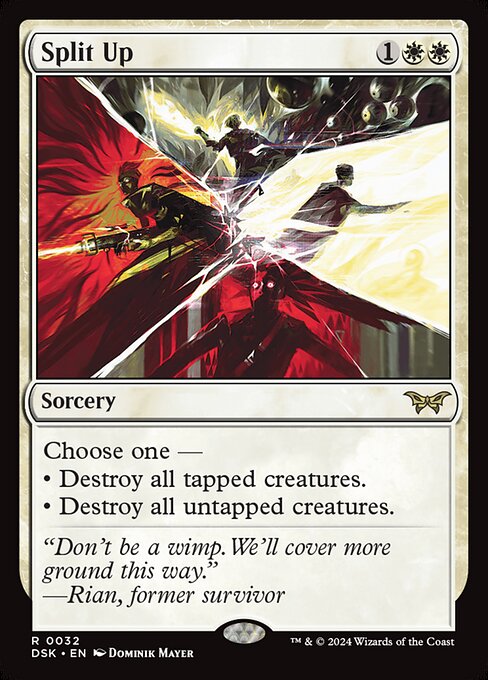
58. Split Up
Rating6.8GoodWhy this rating?
A very good rare of the format (6.8/10).
Why. A three-mana sorcery that destroys all tapped creatures or all untapped creatures, your choice. Used well, a one-sided sweeper: you pick the mode that spares your creatures.
Risks. It also destroys your own creatures on the chosen side. It needs careful planning around when to attack, and two white mana.
In the draft. A good pick for a white control deck. Aggressive decks will have a harder time using it; take it later if you are building an aggro deck.
Results in the games of the set
When it is in hand, the deck wins 57.7% of its games (set average: 55.9%, 57th of 269 cards).
In the opening hand: 55.6% wins (55.0% on average).
Drawn during the game: 59.2% (56.6% on average).
When it is drawn, the deck wins 4.8 points more than when it is not.
When it is drafted, it is played 84% of the time (set average: 62%).
Taken as the first pick (127 drafts), it ends in the deck 91% of the time.
It is played about as much in every archetype.
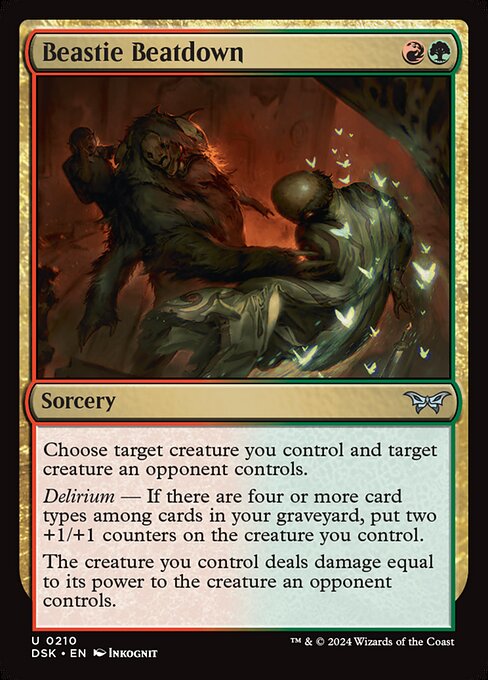
59. Beastie Beatdown
Rating6.7GoodWhy this rating?
A solid uncommon of the format (6.7/10).
Why. A two-mana sorcery that works as a one-sided fight: your creature deals damage equal to its power to an opposing creature. With Delirium it first gets two +1/+1 counters.
Risks. You need a creature of your own and an opposing target, and a response can blow you out. With no creature it is dead.
In the draft. A good removal for a red-green deck with big creatures. Take it fairly early if you have the Delirium plan; best against medium-sized creatures.
Results in the games of the set
When it is in hand, the deck wins 57.9% of its games (set average: 55.9%, 53rd of 269 cards).
In the opening hand: 55.5% wins (55.0% on average).
Drawn during the game: 59.6% (56.6% on average).
When it is drawn, the deck wins 4.0 points more than when it is not.
When it is drafted, it is played 75% of the time (set average: 62%).
Taken as the first pick (254 drafts), it ends in the deck 92% of the time.
It is played mostly in G/R decks (52% of them).
 Rating6.6Good
Why this rating?
A solid uncommon of the format (6.6/10).
Why. A two-mana 2/1 with flash and vigilance that taps an opposing creature and puts a stun counter on it. Later it can shuffle itself and that creature into their owners' libraries. Tempo and removal in one card.
Risks. It has only 1 toughness, and the activation needs two mana and tapping it. If the opponent gets rid of the counter or kills it first, the removal never comes.
In the draft. A good pick for a blue tempo deck. Take it fairly early; it works both on offence and as a surprise defender.
Results in the games of the set
When it is in hand, the deck wins 59.1% of its games (set average: 55.9%, 39th of 269 cards).
In the opening hand: 56.0% wins (55.0% on average).
Drawn during the game: 60.9% (56.6% on average).
When it is drawn, the deck wins 5.1 points more than when it is not.
When it is drafted, it is played 90% of the time (set average: 62%).
Taken as the first pick (430 drafts), it ends in the deck 93% of the time.
It is played mostly in B/U decks (38% of them) and G/U (34%).

61. Come Back Wrong
Rating6.6GoodWhy this rating?
A very good rare of the format (6.6/10).
Why. A three-mana sorcery that destroys a creature, and if it was a creature card you take it under your control; it is sacrificed at the next end step. A removal with a small bonus: a body to sacrifice or an enters-the-battlefield effect.
Risks. The bonus is temporary, the creature cannot attack this turn unless it has haste, and a three-mana sorcery is pricier than cheap removal.
In the draft. A decent removal for a black deck. Take it after the best cheap removal; it is better if you have ways to sacrifice.
Results in the games of the set
When it is in hand, the deck wins 56.4% of its games (set average: 55.9%, 98th of 269 cards).
In the opening hand: 53.2% wins (55.0% on average).
Drawn during the game: 58.5% (56.6% on average).
When it is drawn, the deck wins 5.5 points more than when it is not.
When it is drafted, it is played 90% of the time (set average: 62%).
Taken as the first pick (146 drafts), it ends in the deck 90% of the time.
It is played about as much in every archetype.
 Rating6.6Good
Why this rating?
A solid uncommon of the format (6.6/10).
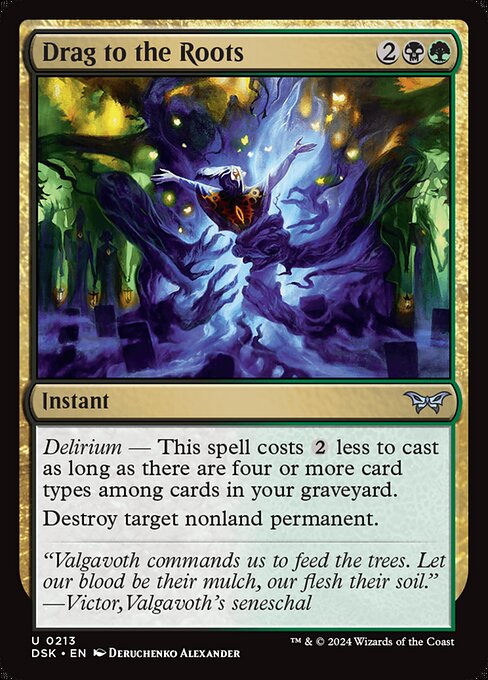
Why. An instant that destroys any nonland permanent. At four mana it is expensive; with Delirium it costs two. Its flexibility makes it an answer to almost anything.
Risks. Without Delirium it costs four mana, which is slow. It needs two specific colours.
In the draft. A good removal for a black-green deck. Take it fairly early if you have Delirium; otherwise cheaper removal comes first.
Results in the games of the set
When it is in hand, the deck wins 57.2% of its games (set average: 55.9%, 73rd of 269 cards).
In the opening hand: 54.0% wins (55.0% on average).
Drawn during the game: 59.3% (56.6% on average).
When it is drawn, the deck wins 4.2 points more than when it is not.
When it is drafted, it is played 77% of the time (set average: 62%).
Taken as the first pick (202 drafts), it ends in the deck 89% of the time.
It is played mostly in B/G decks (53% of them).
63. Final Vengeance
Rating6.6GoodWhy this rating?
One of the best commons of the format (6.6/10).
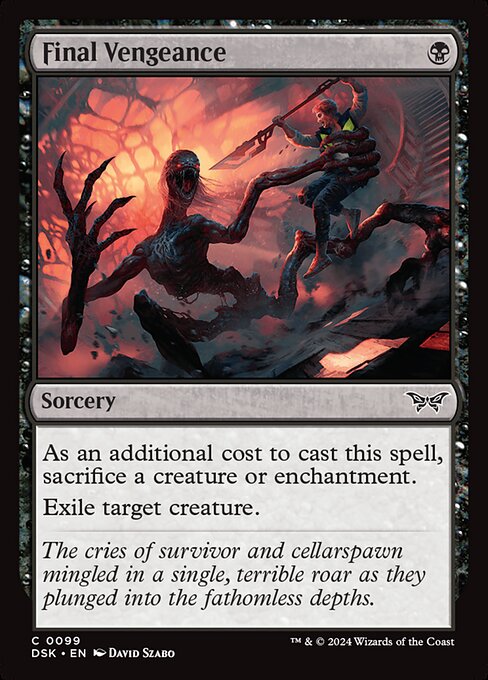
Why. A one-mana sorcery that exiles a creature, at the cost of sacrificing a creature or an enchantment. Unconditional removal that is very light on mana.
Risks. You have to sacrifice a permanent, so you lose another card. It has no value without something to sacrifice.
In the draft. A good common removal for a black deck. Take it after the best removal; it is much better with creatures or enchantments you are happy to lose.
Results in the games of the set
When it is in hand, the deck wins 56.8% of its games (set average: 55.9%, 82nd of 269 cards).
In the opening hand: 53.9% wins (55.0% on average).
Drawn during the game: 58.7% (56.6% on average).
When it is drawn, the deck wins 4.3 points more than when it is not.
When it is drafted, it is played 71% of the time (set average: 62%).
Taken as the first pick (272 drafts), it ends in the deck 94% of the time.
It is played mostly in B/R decks (84% of them) and B/G (57%).
64. Growing Dread
Rating6.6GoodWhy this rating?
A solid uncommon of the format (6.6/10).
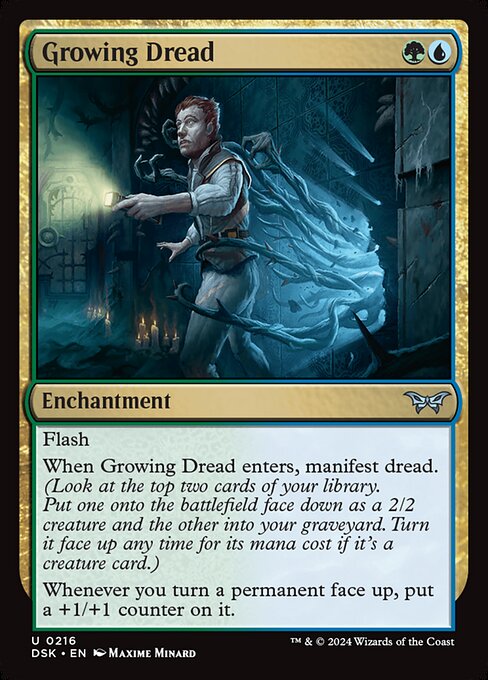
Why. A two-mana enchantment with flash that manifests dread, then puts a +1/+1 counter on any permanent you turn face up. It makes a 2/2 at instant speed and grows it when you flip it.
Risks. A 2/2 that costs a card, with a conditional bonus. If the manifested card is not a creature card, it stays a plain 2/2.
In the draft. A good pick for a blue-green deck with face-down cards. Take it over plain creatures; it does best with many creature cards.
Results in the games of the set
When it is in hand, the deck wins 58.1% of its games (set average: 55.9%, 48th of 269 cards).
In the opening hand: 57.8% wins (55.0% on average).
Drawn during the game: 58.3% (56.6% on average).
When it is drawn, the deck wins 4.8 points more than when it is not.
When it is drafted, it is played 76% of the time (set average: 62%).
Taken as the first pick (212 drafts), it ends in the deck 88% of the time.
It is played mostly in G/U decks (60% of them).
 Rating6.6Good
Why this rating?
A solid uncommon of the format (6.6/10).
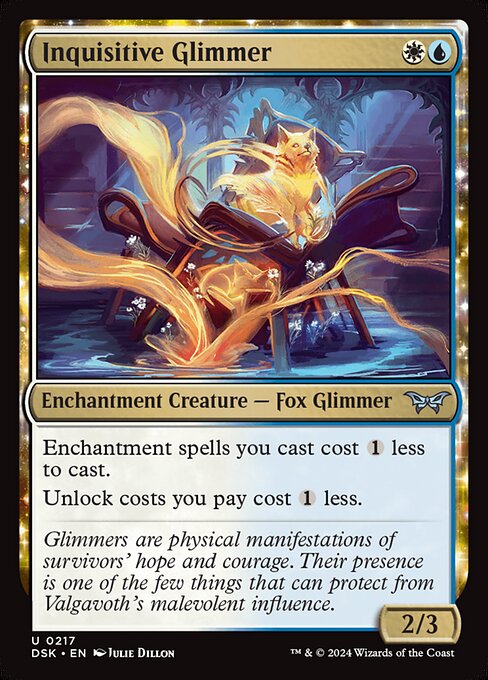
Why. A two-mana 2/3 that makes the enchantments you cast and your unlock costs cost one less. In an enchantment and Rooms deck it lets you cast more of them each turn.
Risks. Without enchantments it is a plain 2/3. It needs two specific colours and a focused build.
In the draft. A fair pick for a white-blue enchantment deck. Take it after your best cards; outside that plan it is a decent body.
Results in the games of the set
When it is in hand, the deck wins 57.5% of its games (set average: 55.9%, 65th of 269 cards).
In the opening hand: 58.6% wins (55.0% on average).
Drawn during the game: 56.7% (56.6% on average).
When it is drawn, the deck wins 2.9 points more than when it is not.
When it is drafted, it is played 76% of the time (set average: 62%).
Taken as the first pick (251 drafts), it ends in the deck 83% of the time.
It is played mostly in U/W decks (45% of them).
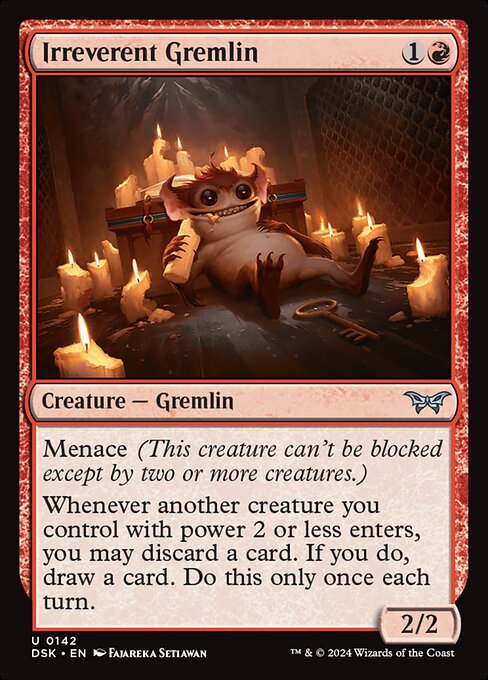 Rating6.6Good
Why this rating?
A solid uncommon of the format (6.6/10).
Why. A two-mana 2/2 with menace that lets you loot (discard, then draw) whenever another creature with power 2 or less enters, once per turn. Good for smoothing the hand of a deck full of small creatures.
Risks. A small body that is easy to kill, and the loot depends on creatures with power 2 or less. It is mediocre in a deck of big creatures.
In the draft. A good pick for an aggressive red low-curve deck. Take it over plain creatures; stronger with many small creatures.
Results in the games of the set
When it is in hand, the deck wins 57.6% of its games (set average: 55.9%, 62nd of 269 cards).
In the opening hand: 58.9% wins (55.0% on average).
Drawn during the game: 56.6% (56.6% on average).
When it is drawn, the deck wins 1.5 points more than when it is not.
When it is drafted, it is played 91% of the time (set average: 62%).
Taken as the first pick (340 drafts), it ends in the deck 94% of the time.
It is played mostly in R/W decks (46% of them) and B/R (37%).
 Rating6.6Good
Why this rating?
A solid uncommon of the format (6.6/10).
Why. A five-mana 4/4 with haste that creates a 1/1 red Gremlin creature token whenever you attack. It hits right away and its army grows with each combat.
Risks. Five mana is top-end, and with no evasion the 4/4 can be blocked or removed. Haste guarantees at least one token if it survives to attack.
In the draft. A good top-end for a red deck, to take fairly early. Stronger in an attacking deck, but fine in any red deck.
Results in the games of the set
When it is in hand, the deck wins 58.9% of its games (set average: 55.9%, 43rd of 269 cards).
In the opening hand: 57.3% wins (55.0% on average).
Drawn during the game: 60.0% (56.6% on average).
When it is drawn, the deck wins 3.5 points more than when it is not.
When it is drafted, it is played 91% of the time (set average: 62%).
Taken as the first pick (443 drafts), it ends in the deck 94% of the time.
It is played mostly in R/W decks (39% of them) and B/R (37%).
 Rating6.6Good
Why this rating?
One of the best commons of the format (6.6/10).
Why. A two-mana instant that deals 3 damage to a creature or planeswalker, exiling it if it would die. Efficient, versatile, cheap removal that kills a large share of creatures.
Risks. Three damage does not handle big creatures, and it cannot hit players. An opposing combat trick can blank it.
In the draft. A solid removal common to take in a red deck. Take it over average creatures; it is good in any pairing with red.
Results in the games of the set
When it is in hand, the deck wins 57.4% of its games (set average: 55.9%, 67th of 269 cards).
In the opening hand: 57.1% wins (55.0% on average).
Drawn during the game: 57.7% (56.6% on average).
When it is drawn, the deck wins 2.8 points more than when it is not.
When it is drafted, it is played 92% of the time (set average: 62%).
Taken as the first pick (1070 drafts), it ends in the deck 96% of the time.
It is played mostly in R/W decks (67% of them) and G/R (63%).
 Rating6.6Good
Why this rating?
A solid uncommon of the format (6.6/10).
Why. For a single white mana it shields a creature from removal: cast in response to a targeted spell, it grants hexproof and the spell fizzles. The +1/+1 stays afterwards and can swing a combat.
Risks. It is an Aura: if the creature dies anyway (a block, a spell that does not target), you lose two cards for one. With no creature on the battlefield it does nothing.
In the draft. A filler pick, taken after good creatures and removal. It earns a slot in a white deck with creatures worth protecting.
Results in the games of the set
When it is in hand, the deck wins 56.4% of its games (set average: 55.9%, 100th of 269 cards).
In the opening hand: 55.9% wins (55.0% on average).
Drawn during the game: 56.6% (56.6% on average).
When it is drawn, the deck wins 1.6 points more than when it is not.
When it is drafted, it is played 85% of the time (set average: 62%).
Taken as the first pick (245 drafts), it ends in the deck 92% of the time.
It is played mostly in U/W decks (32% of them) and G/W (29%).
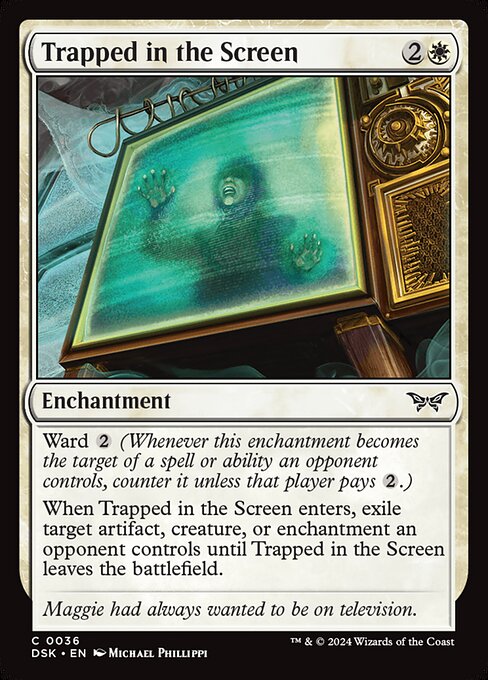 Rating6.6Good
Why this rating?
One of the best commons of the format (6.6/10).
Why. A three-mana removal that exiles an opposing artifact, creature or enchantment, and it protects itself with ward 2. It answers threats of every type at a fair price.
Risks. The exile lasts only while the enchantment stays on the battlefield: if the opponent destroys it, their card comes back. Ward 2 makes that costly for them, not impossible.
In the draft. A good removal common for any white deck. Take it ahead of average creatures.
Results in the games of the set
When it is in hand, the deck wins 57.6% of its games (set average: 55.9%, 64th of 269 cards).
In the opening hand: 55.3% wins (55.0% on average).
Drawn during the game: 59.1% (56.6% on average).
When it is drawn, the deck wins 3.1 points more than when it is not.
When it is drafted, it is played 91% of the time (set average: 62%).
Taken as the first pick (837 drafts), it ends in the deck 95% of the time.
It is played mostly in U/W decks (58% of them) and G/W (57%).
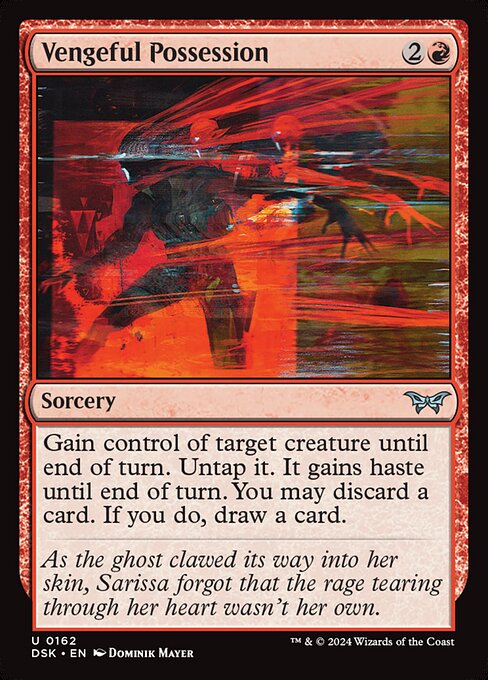 Rating6.6Good
Why this rating?
A solid uncommon of the format (6.6/10).
Why. A finisher sorcery: you take their best creature, untap it, and it attacks for you with haste. You may also discard a card to draw one.
Risks. Nothing is solved: the creature goes back to the opponent at end of turn. Without a decisive attack or a plan to cash in, it is three mana for nothing.
In the draft. A mid-pack pick for aggressive red decks that can turn the attack into a win. One copy is enough.
Results in the games of the set
When it is in hand, the deck wins 57.2% of its games (set average: 55.9%, 74th of 269 cards).
In the opening hand: 54.0% wins (55.0% on average).
Drawn during the game: 59.3% (56.6% on average).
When it is drawn, the deck wins 3.1 points more than when it is not.
When it is drafted, it is played 57% of the time (set average: 62%).
Taken as the first pick (121 drafts), it ends in the deck 84% of the time.
It is played mostly in B/R decks (57% of them).

72. Piggy Bank
Rating6.5GoodWhy this rating?
A solid uncommon of the format (6.5/10).
Why. A 3/2 for two that leaves behind a Treasure token when it dies. It happily trades up with a pricier creature and hands back mana to accelerate your next turn.
Risks. Two toughness makes it fragile, and it does nothing beyond the body: if your game is not fast, it loses value late.
In the draft. A good two-drop for red decks that curve out. Take it without urgency; the deck also wants heavier threats.
Results in the games of the set
When it is in hand, the deck wins 57.7% of its games (set average: 55.9%, 56th of 269 cards).
In the opening hand: 59.7% wins (55.0% on average).
Drawn during the game: 56.1% (56.6% on average).
When it is drawn, the deck wins 2.6 points more than when it is not.
When it is drafted, it is played 92% of the time (set average: 62%).
Taken as the first pick (389 drafts), it ends in the deck 97% of the time.
It is played mostly in B/R decks (38% of them) and G/R (35%).

73. Glimmer Seeker
Rating6.5GoodWhy this rating?
Good playable that always makes the cut (6.5/10).
Why. A 3/3 for three whose Survival makes value: if it is tapped in your second main phase, you draw a card if you control a Glimmer creature, otherwise you create a 1/1 white Glimmer enchantment creature token.
Risks. It has to attack and survive to end up tapped, so on a board where attacking is impossible it loses its value. With no vigilance, it does not defend after attacking.
In the draft. A good three-drop for aggressive white decks. Take it over vanilla three-drops.
Results in the games of the set
When it is in hand, the deck wins 57.1% of its games (set average: 55.9%, 76th of 269 cards).
In the opening hand: 58.7% wins (55.0% on average).
Drawn during the game: 55.9% (56.6% on average).
When it is drawn, the deck wins 2.1 points more than when it is not.
When it is drafted, it is played 88% of the time (set average: 62%).
Taken as the first pick (287 drafts), it ends in the deck 92% of the time.
It is played mostly in G/W decks (34% of them) and B/W (28%).
 Rating6.4Good
Why this rating?
Good playable that always makes the cut (6.4/10).
Why. A three-mana instant with three modes: exile an artifact, exile an enchantment, or Manifest dread for a face-down 2/2 and a fuller graveyard. It is rarely dead in hand.
Risks. No mode answers an opposing creature. The third mode alone is a slightly pricey 2/2 for three; the rest depends on what the opponent plays.
In the draft. A flexible green card. Play one copy, more for the instant-speed flexibility than for raw power.
Results in the games of the set
When it is in hand, the deck wins 55.9% of its games (set average: 55.9%, 107th of 269 cards).
In the opening hand: 53.7% wins (55.0% on average).
Drawn during the game: 57.4% (56.6% on average).
When it is drawn, the deck wins 2.0 points more than when it is not.
When it is drafted, it is played 88% of the time (set average: 62%).
Taken as the first pick (238 drafts), it ends in the deck 95% of the time.
It is played mostly in G/U decks (34% of them) and B/G (30%).
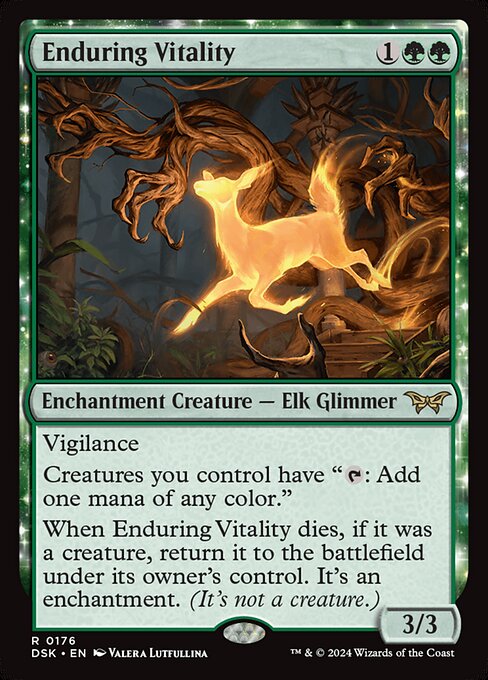 Rating6.4Good
Why this rating?
Good playable that always makes the cut (6.4/10).
Why. A 3/3 vigilance for three that gives all your creatures the ability to tap for one mana of any color. It fixes your mana, accelerates, and returns as an enchantment when it dies.
Risks. A creature that just arrived cannot tap for mana. When it comes back as an enchantment it keeps the ability but is no longer a body. Exile deals with it for good.
In the draft. A good mid-curve body for green decks, especially multicolor ones.
Results in the games of the set
When it is in hand, the deck wins 56.5% of its games (set average: 55.9%, 94th of 269 cards).
In the opening hand: 56.7% wins (55.0% on average).
Drawn during the game: 56.4% (56.6% on average).
When it is drawn, the deck wins 4.1 points more than when it is not.
When it is drafted, it is played 90% of the time (set average: 62%).
Taken as the first pick (165 drafts), it ends in the deck 90% of the time.
It is played about as much in every archetype.
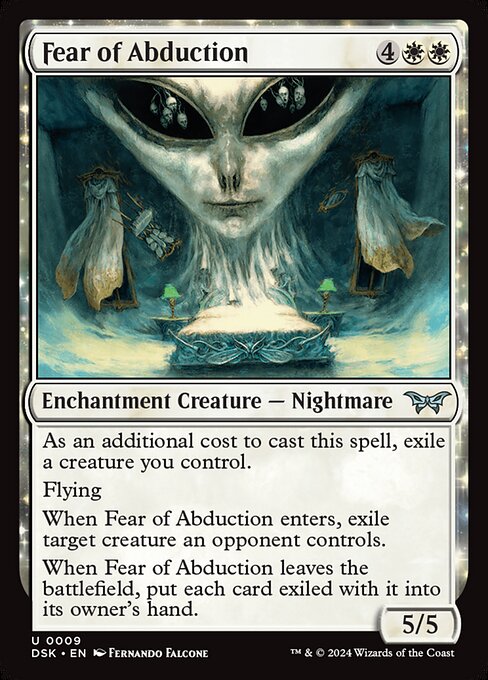 Rating6.4Good
Why this rating?
Good playable that always makes the cut (6.4/10).
Why. A six-mana 5/5 flyer that also exiles an opposing creature. The price is exiling one of your own creatures as an additional cost: a removal spell and a finisher in one body.
Risks. You need a creature to exile. If it leaves the battlefield, the opponent's creature and yours each return to their owner's hand, which can end up in their favor.
In the draft. A good top-end card for white decks with cheap creatures to exile. Skip it if you lack small bodies.
Results in the games of the set
When it is in hand, the deck wins 56.2% of its games (set average: 55.9%, 103rd of 269 cards).
In the opening hand: 53.4% wins (55.0% on average).
Drawn during the game: 57.9% (56.6% on average).
When it is drawn, the deck wins 2.3 points more than when it is not.
When it is drafted, it is played 80% of the time (set average: 62%).
Taken as the first pick (253 drafts), it ends in the deck 86% of the time.
It is played mostly in B/W decks (28% of them) and G/W (27%).
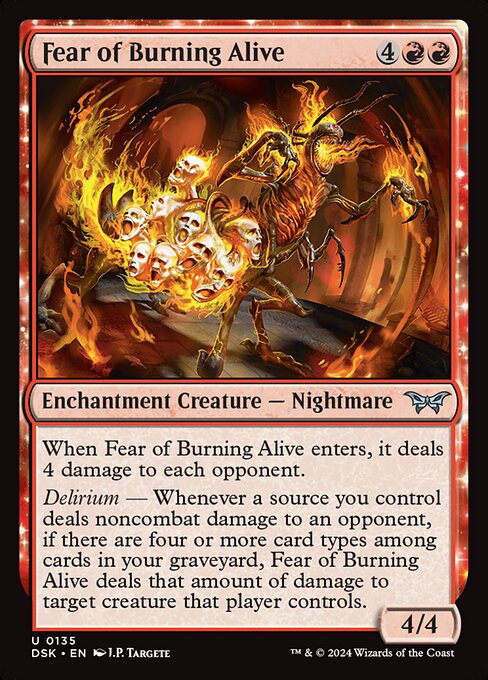 Rating6.4Good
Why this rating?
Good playable that always makes the cut (6.4/10).
Why. A six-mana 4/4 that deals 4 damage to the opponent on entering. With Delirium, any noncombat damage you deal to them, this one included, is repeated on one of their creatures: a removal spell and a finisher at once.
Risks. Six mana for a 4/4 without evasion. Without Delirium it is a body and 4 direct damage; the creature effect needs four card types in your graveyard.
In the draft. A good red finisher. Play it if your deck can fill the graveyard; otherwise stick to a single copy.
Results in the games of the set
When it is in hand, the deck wins 57.8% of its games (set average: 55.9%, 55th of 269 cards).
In the opening hand: 54.2% wins (55.0% on average).
Drawn during the game: 60.1% (56.6% on average).
When it is drawn, the deck wins 3.3 points more than when it is not.
When it is drafted, it is played 88% of the time (set average: 62%).
Taken as the first pick (397 drafts), it ends in the deck 93% of the time.
It is played mostly in G/R decks (36% of them) and B/R (30%).

78. Nowhere to Run
Rating6.4GoodWhy this rating?
Good playable that always makes the cut (6.4/10).
Why. A two-mana removal with flash: -3/-3 on an opposing creature. On top of that, your spells can target their creatures despite hexproof, and their ward does not trigger.
Risks. -3/-3 only kills creatures with three toughness or less, unless combat helps. It does little against big creatures.
In the draft. A good black removal, cheap and flexible. Take it early; it is even better against hexproof decks.
Results in the games of the set
When it is in hand, the deck wins 57.9% of its games (set average: 55.9%, 52nd of 269 cards).
In the opening hand: 56.5% wins (55.0% on average).
Drawn during the game: 58.9% (56.6% on average).
When it is drawn, the deck wins 6.2 points more than when it is not.
When it is drafted, it is played 90% of the time (set average: 62%).
Taken as the first pick (389 drafts), it ends in the deck 90% of the time.
It is played mostly in B/G decks (32% of them) and B/R (32%).
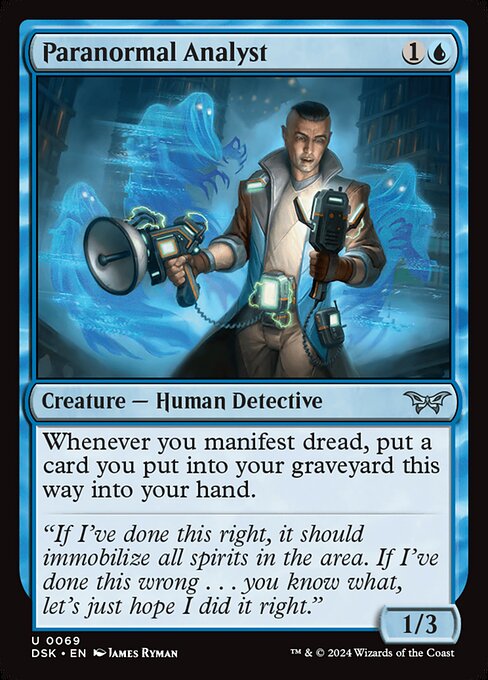 Rating6.4Good
Why this rating?
Good playable that always makes the cut (6.4/10).
Why. A 1/3 for two that puts the card sent to your graveyard into your hand whenever you Manifest dread. It is reliable card advantage if you have ways to trigger it.
Risks. Without Manifest dread, it is a 1/3 that only blocks. It dies to any removal and its power is too low to attack.
In the draft. Take it if your deck has several ways to Manifest dread. Otherwise it belongs in the sideboard.
Results in the games of the set
When it is in hand, the deck wins 56.8% of its games (set average: 55.9%, 85th of 269 cards).
In the opening hand: 57.2% wins (55.0% on average).
Drawn during the game: 56.5% (56.6% on average).
When it is drawn, the deck wins 3.1 points more than when it is not.
When it is drafted, it is played 72% of the time (set average: 62%).
Taken as the first pick (251 drafts), it ends in the deck 81% of the time.
It is played mostly in G/U decks (46% of them).
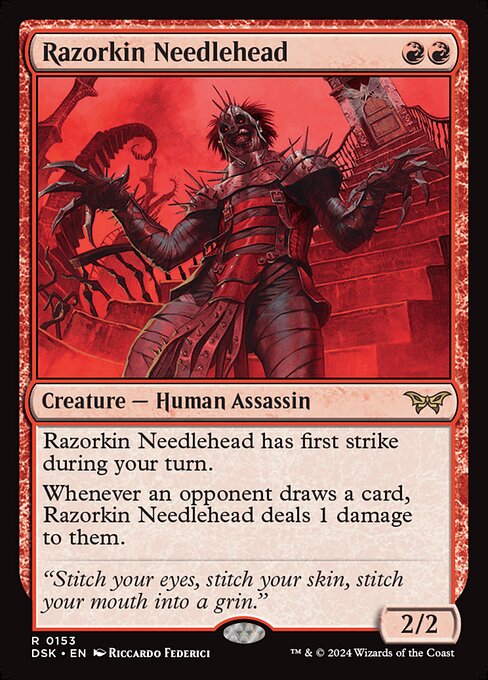 Rating6.4Good
Why this rating?
Good playable that always makes the cut (6.4/10).
Why. A 2/2 for two red mana that has first strike on your turn and deals 1 damage to the opponent whenever they draw a card. Every turn it drains a life point with no effort from you.
Risks. It needs two red mana right away. With no first strike on their turn, it loses combats when it blocks. A 2/2 body is fragile.
In the draft. A threat for aggressive red decks. Take it for the constant pressure; less useful in a controlling deck.
Results in the games of the set
When it is in hand, the deck wins 56.2% of its games (set average: 55.9%, 102nd of 269 cards).
In the opening hand: 57.0% wins (55.0% on average).
Drawn during the game: 55.6% (56.6% on average).
When it is drawn, the deck wins 2.1 points more than when it is not.
When it is drafted, it is played 88% of the time (set average: 62%).
Taken as the first pick (134 drafts), it ends in the deck 95% of the time.
It is played about as much in every archetype.
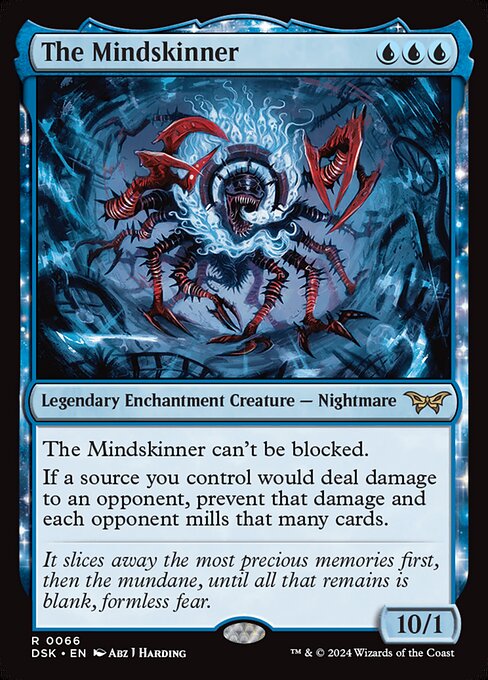
81. The Mindskinner
Rating6.4GoodWhy this rating?
Good playable that always makes the cut (6.4/10).
Why. A 10/1 for three blue mana, unblockable, that turns all damage you deal to the opponent into milling that many cards. One attack mills ten: a library win within a few turns.
Risks. One toughness, and three blue mana up front. Your damage no longer kills the opponent: if the mill plan is stopped, you have no other way to win.
In the draft. Take it only in a heavy blue deck with ways to protect it. Otherwise it stays a gamble.
Results in the games of the set
When it is in hand, the deck wins 55.8% of its games (set average: 55.9%, 108th of 269 cards).
In the opening hand: 53.7% wins (55.0% on average).
Drawn during the game: 57.2% (56.6% on average).
When it is drawn, the deck wins 4.0 points more than when it is not.
When it is drafted, it is played 68% of the time (set average: 62%).
Taken as the first pick (76 drafts), it ends in the deck 79% of the time.
It is played about as much in every archetype.

82. Waltz of Rage
Rating6.4GoodWhy this rating?
Good playable that always makes the cut (6.4/10).
Why. A five-mana sorcery that makes your target creature deal damage equal to its power to each other creature. With a big creature, it sweeps the battlefield and partly replaces your losses.
Risks. It also hits your own creatures, and it needs a creature of yours. With no big body, it is a five-mana sorcery that hurts your own side.
In the draft. A red sweeper to take in a deck with a few big creatures. Avoid it in a deck of small creatures.
Results in the games of the set
When it is in hand, the deck wins 56.7% of its games (set average: 55.9%, 89th of 269 cards).
In the opening hand: 55.2% wins (55.0% on average).
Drawn during the game: 57.7% (56.6% on average).
When it is drawn, the deck wins 4.1 points more than when it is not.
When it is drafted, it is played 76% of the time (set average: 62%).
Taken as the first pick (146 drafts), it ends in the deck 78% of the time.
It is played about as much in every archetype.
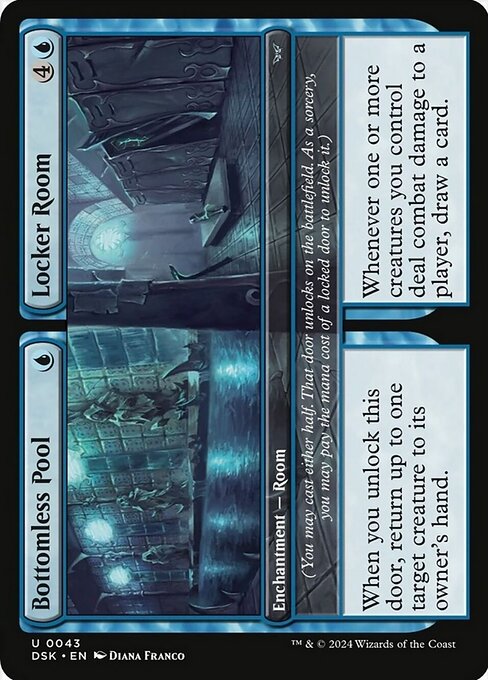
83. Bottomless Pool // Locker Room
Rating6.3GoodWhy this rating?
Good playable that always makes the cut (6.3/10).
Why. A flexible Room: for one blue mana, the first half bounces a creature when it unlocks; the second half, for five mana, draws a card whenever your creatures connect. You play one then the other as the game demands.
Risks. Each half is modest alone. The bounce is only a tempo gain, and the second half needs your creatures to connect.
In the draft. A good blue uncommon for decks that attack. Take it for the flexibility; it is easy to sequence.
Results in the games of the set
When it is in hand, the deck wins 57.7% of its games (set average: 55.9%, 58th of 269 cards).
In the opening hand: 54.6% wins (55.0% on average).
Drawn during the game: 59.6% (56.6% on average).
When it is drawn, the deck wins 4.9 points more than when it is not.
When it is drafted, it is played 91% of the time (set average: 62%).
Taken as the first pick (420 drafts), it ends in the deck 95% of the time.
It is played mostly in B/U decks (38% of them) and R/U (33%).

84. Veteran Survivor
Rating6.3GoodWhy this rating?
Good playable that always makes the cut (6.3/10).
Why. A 2/1 for one white mana whose Survival exiles cards from graveyards. With three cards exiled it becomes a 5/4 with hexproof, which dominates combat and protects itself.
Risks. It has to attack to end up tapped, and it needs three Survival triggers: early on it is a fragile 2/1 of little worth.
In the draft. A good one-drop for aggressive white decks. Take it early in a deck that attacks from the start.
Results in the games of the set
When it is in hand, the deck wins 56.4% of its games (set average: 55.9%, 96th of 269 cards).
In the opening hand: 60.0% wins (55.0% on average).
Drawn during the game: 53.4% (56.6% on average).
When it is drawn, the deck wins 1.1 points more than when it is not.
When it is drafted, it is played 78% of the time (set average: 62%).
Taken as the first pick (172 drafts), it ends in the deck 89% of the time.
It is played mostly in G/W decks (31% of them) and R/W (26%).
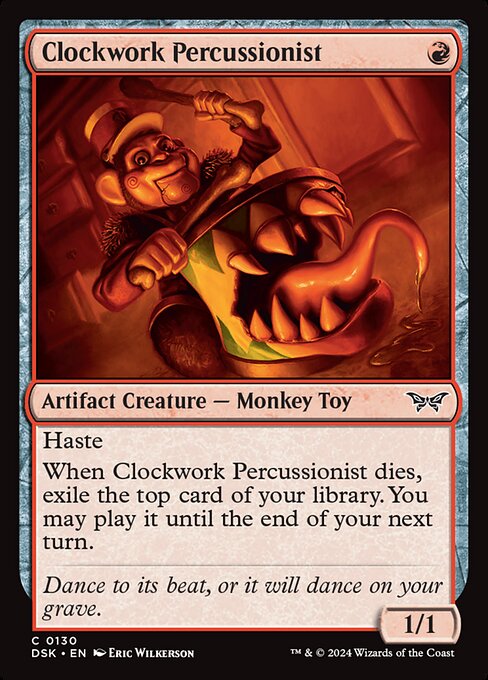 Rating6.2Good
Why this rating?
Good playable that always makes the cut (6.2/10).
Why. A 1/1 haste for one red mana that replaces itself when it dies: you exile the top card of your library and may play it until the end of your next turn. It rarely costs you a card.
Risks. A 1/1 is quickly outclassed. It does not hold up in combat, and the exiled card has to be playable this turn or the next.
In the draft. A good one-drop for aggressive red decks. Take it without urgency; it gains value from trading.
Results in the games of the set
When it is in hand, the deck wins 57.1% of its games (set average: 55.9%, 75th of 269 cards).
In the opening hand: 58.7% wins (55.0% on average).
Drawn during the game: 55.8% (56.6% on average).
When it is drawn, the deck wins 1.2 points more than when it is not.
When it is drafted, it is played 82% of the time (set average: 62%).
Taken as the first pick (437 drafts), it ends in the deck 95% of the time.
It is played mostly in B/R decks (78% of them) and R/W (77%).
 Rating6.2Good
Why this rating?
Good playable that always makes the cut (6.2/10).
Why. A three-mana sorcery that looks at the top four cards, keeps one, and puts the rest into your graveyard, with three life on top. It picks the best card and feeds Delirium.
Risks. It does nothing on the battlefield and costs tempo. The cards sent to the graveyard are lost if you have no recursion.
In the draft. A good black uncommon for Delirium or controlling decks. Weaker in an aggro deck that wants to act right away.
Results in the games of the set
When it is in hand, the deck wins 56.8% of its games (set average: 55.9%, 83rd of 269 cards).
In the opening hand: 54.4% wins (55.0% on average).
Drawn during the game: 58.4% (56.6% on average).
When it is drawn, the deck wins 5.4 points more than when it is not.
When it is drafted, it is played 55% of the time (set average: 62%).
Taken as the first pick (97 drafts), it ends in the deck 80% of the time.
It is played mostly in B/W decks (37% of them) and B/G (30%).
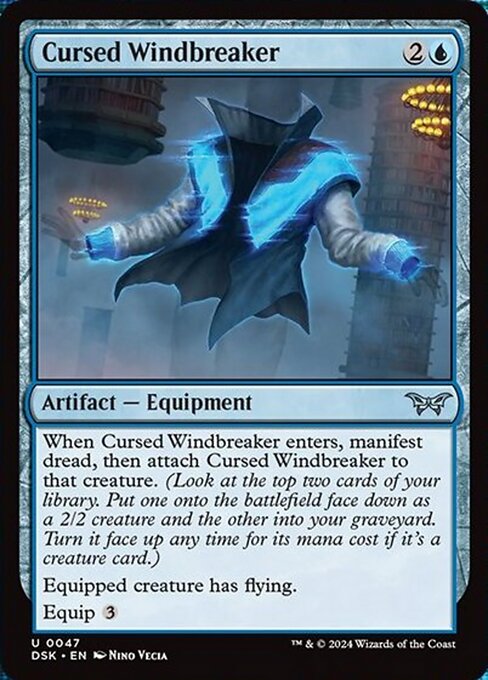 Rating6.2Good
Why this rating?
Good playable that always makes the cut (6.2/10).
Why. A three-mana Equipment that Manifests dread and attaches itself to that creature, which gains flying. You get a face-down 2/2 flyer and a card in your graveyard from a single spell.
Risks. If the creature dies, the Equipment stays but re-equipping costs three. The manifested creature is just a plain 2/2.
In the draft. A good blue uncommon for decks that want flying attackers. Take it without urgency; best in an aerial deck.
Results in the games of the set
When it is in hand, the deck wins 57.3% of its games (set average: 55.9%, 71st of 269 cards).
In the opening hand: 55.2% wins (55.0% on average).
Drawn during the game: 58.6% (56.6% on average).
When it is drawn, the deck wins 3.3 points more than when it is not.
When it is drafted, it is played 79% of the time (set average: 62%).
Taken as the first pick (214 drafts), it ends in the deck 87% of the time.
It is played mostly in G/U decks (32% of them).

88. Enduring Courage
Rating6.2GoodWhy this rating?
Good playable that always makes the cut (6.2/10).
Why. A 3/3 for four that gives each other creature entering under your control +2/+0 and haste. It turns every new creature into an immediate threat, and returns as an enchantment when it dies.
Risks. It needs two red mana, and with no creatures to cast afterwards it does nothing. Once back as an enchantment, it is no longer a body.
In the draft. A good rare for aggressive red decks with many creatures. Play it, but do not overpay for it.
Results in the games of the set
When it is in hand, the deck wins 56.4% of its games (set average: 55.9%, 99th of 269 cards).
In the opening hand: 55.5% wins (55.0% on average).
Drawn during the game: 56.9% (56.6% on average).
When it is drawn, the deck wins 2.4 points more than when it is not.
When it is drafted, it is played 92% of the time (set average: 62%).
Taken as the first pick (179 drafts), it ends in the deck 95% of the time.
It is played about as much in every archetype.
 Rating6.2Good
Why this rating?
Good playable that always makes the cut (6.2/10).
Why. A 4/2 haste for three that must be blocked if able. The opponent has to put a creature in front of it, so you force a combat at the time of your choice.
Risks. Two toughness means it dies to a small blocker. It needs two red mana, and the trade is not always in your favor.
In the draft. A good aggressive creature for red. Take it early in a deck that wants to force combats.
Results in the games of the set
When it is in hand, the deck wins 57.0% of its games (set average: 55.9%, 78th of 269 cards).
In the opening hand: 57.2% wins (55.0% on average).
Drawn during the game: 56.8% (56.6% on average).
When it is drawn, the deck wins 1.7 points more than when it is not.
When it is drafted, it is played 87% of the time (set average: 62%).
Taken as the first pick (316 drafts), it ends in the deck 92% of the time.
It is played mostly in R/W decks (39% of them) and B/R (38%).

90. Glimmerburst
Rating6.2GoodWhy this rating?
Good playable that always makes the cut (6.2/10).
Why. A four-mana instant that draws two cards and creates a 1/1 white Glimmer enchantment creature token. It replaces itself, nets a card and leaves a body, at any moment.
Risks. A little slow at four mana, and it does nothing for the board right away. The 1/1 token stays fragile.
In the draft. A solid common for blue decks. Take it over filler, without playing too many copies.
Results in the games of the set
When it is in hand, the deck wins 57.6% of its games (set average: 55.9%, 61st of 269 cards).
In the opening hand: 55.5% wins (55.0% on average).
Drawn during the game: 59.0% (56.6% on average).
When it is drawn, the deck wins 3.5 points more than when it is not.
When it is drafted, it is played 77% of the time (set average: 62%).
Taken as the first pick (284 drafts), it ends in the deck 92% of the time.
It is played mostly in U/W decks (78% of them) and G/U (70%).
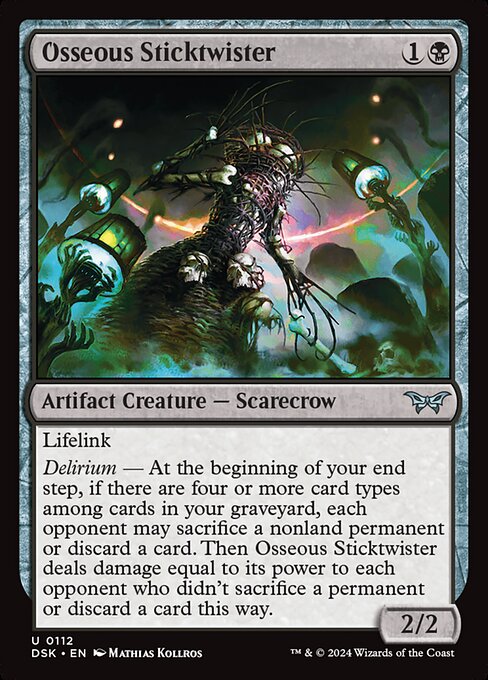 Rating6.2Good
Why this rating?
Good playable that always makes the cut (6.2/10).
Why. A 2/2 lifelink for two. With Delirium, at your end step the opponent chooses: sacrifice a nonland permanent, discard a card, or take damage equal to its power. It forces a painful choice every turn.
Risks. Without Delirium it is a plain 2/2 lifelinker. The card types take time to assemble, and the opponent picks the lesser evil.
In the draft. A good black two-drop, fine even without Delirium. Take it for the curve; the bonus is a plus.
Results in the games of the set
When it is in hand, the deck wins 56.8% of its games (set average: 55.9%, 84th of 269 cards).
In the opening hand: 55.3% wins (55.0% on average).
Drawn during the game: 57.8% (56.6% on average).
When it is drawn, the deck wins 3.8 points more than when it is not.
When it is drafted, it is played 88% of the time (set average: 62%).
Taken as the first pick (319 drafts), it ends in the deck 93% of the time.
It is played mostly in B/G decks (33% of them) and B/R (30%).

92. Surgical Suite // Hospital Room
Rating6.2GoodWhy this rating?
Good playable that always makes the cut (6.2/10).
Why. A two-faced Room: the first half, at two mana, brings back a creature with mana value 3 or less from your graveyard; the second, at four, puts a +1/+1 counter on an attacker every time you attack. Card advantage first, then constant pressure.
Risks. The first half does nothing without a creature in your graveyard. The second needs you to attack, so creatures that survive.
In the draft. A good white uncommon for aggro decks. Take it for the versatility; you often play both halves in two steps.
Results in the games of the set
When it is in hand, the deck wins 57.6% of its games (set average: 55.9%, 63rd of 269 cards).
In the opening hand: 56.1% wins (55.0% on average).
Drawn during the game: 58.6% (56.6% on average).
When it is drawn, the deck wins 3.1 points more than when it is not.
When it is drafted, it is played 88% of the time (set average: 62%).
Taken as the first pick (367 drafts), it ends in the deck 93% of the time.
It is played mostly in U/W decks (28% of them) and B/W (27%).

93. Turn Inside Out
Rating6.2GoodWhy this rating?
Good playable that always makes the cut (6.2/10).
Why. A one-mana instant that gives a creature +3/+0 until end of turn. If it dies this turn, you Manifest dread. A combat won, or a trade that leaves a 2/2.
Risks. With no creature to back up, it is a dead card. It does not protect a creature from removal and is only worth it in combat.
In the draft. A good common for aggressive red decks. Take it without urgency; two copies at most.
Results in the games of the set
When it is in hand, the deck wins 57.0% of its games (set average: 55.9%, 79th of 269 cards).
In the opening hand: 56.3% wins (55.0% on average).
Drawn during the game: 57.4% (56.6% on average).
When it is drawn, the deck wins 1.0 points more than when it is not.
When it is drafted, it is played 71% of the time (set average: 62%).
Taken as the first pick (216 drafts), it ends in the deck 88% of the time.
It is played mostly in R/W decks (75% of them) and G/R (62%).
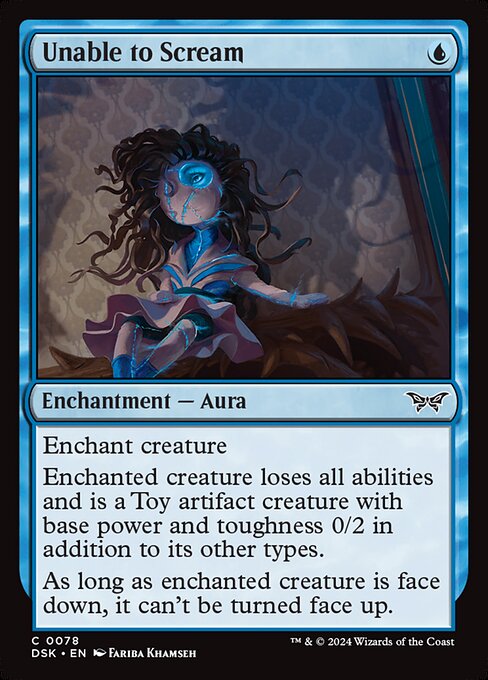
94. Unable to Scream
Rating6.2GoodWhy this rating?
Good playable that always makes the cut (6.2/10).
Why. A one-mana Aura that strips all abilities from a creature and turns it into a 0/2 Toy artifact creature on top of its other types. It neutralizes a big threat for next to nothing, even a manifested creature, which can no longer be turned face up.
Risks. The creature stays on the battlefield: it can still block or be sacrificed, and the Aura is wasted if the opponent gets rid of it. It loses its abilities, but a 0/2 body remains.
In the draft. A cheap blue pseudo-removal. Play it without shame in any blue deck.
Results in the games of the set
When it is in hand, the deck wins 57.1% of its games (set average: 55.9%, 77th of 269 cards).
In the opening hand: 54.9% wins (55.0% on average).
Drawn during the game: 58.5% (56.6% on average).
When it is drawn, the deck wins 3.2 points more than when it is not.
When it is drafted, it is played 90% of the time (set average: 62%).
Taken as the first pick (563 drafts), it ends in the deck 97% of the time.
It is played mostly in U/W decks (67% of them) and B/U (63%).
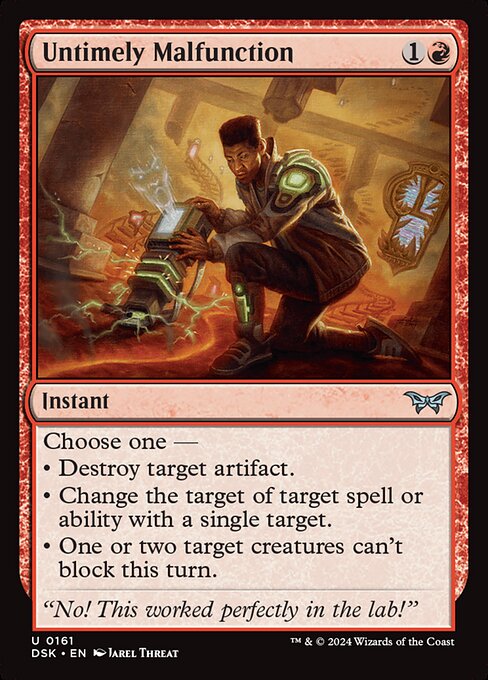 Rating6.2Good
Why this rating?
Good playable that always makes the cut (6.2/10).
Why. A two-mana instant with three modes: destroy an artifact, redirect a spell or ability with a single target, or stop one or two creatures from blocking. Useful only now and then.
Risks. No mode removes a creature. Every mode is situational, and the deck does not always have a target: it is often a dead card.
In the draft. A weak red uncommon, to leave in the sideboard unless the opponent runs many artifacts. Take it late.
Results in the games of the set
When it is in hand, the deck wins 52.8% of its games (set average: 55.9%, 213th of 269 cards).
In the opening hand: 50.8% wins (55.0% on average).
Drawn during the game: 54.2% (56.6% on average).
When it is drawn, the deck wins 0.1 points more than when it is not.
When it is drafted, it is played 25% of the time (set average: 62%).
Taken among the first three picks (101 drafts), it ends in the deck 55% of the time.

96. Live or Die
Rating6.2PlayableWhy this rating?
Good playable that always makes the cut (6.2/10).
Why. A five-mana instant with two modes: destroy a creature, or return a creature card from your graveyard to the battlefield. You choose by the game state: removal or value.
Risks. Five mana is a lot for removal, and the return mode needs a creature in your graveyard. A slower removal than the color's other options.
In the draft. A fine black removal, played as a second or third removal. Take it after cheaper removal.
Results in the games of the set
When it is in hand, the deck wins 55.2% of its games (set average: 55.9%, 132nd of 269 cards).
In the opening hand: 51.1% wins (55.0% on average).
Drawn during the game: 57.8% (56.6% on average).
When it is drawn, the deck wins 4.5 points more than when it is not.
When it is drafted, it is played 81% of the time (set average: 62%).
Taken as the first pick (233 drafts), it ends in the deck 87% of the time.
It is played mostly in B/W decks (41% of them) and B/G (33%).
 Rating6.1Playable
Why this rating?
Good playable that always makes the cut (6.1/10).
Why. A three-mana instant that destroys a creature or an enchantment, at the cost of two life. Unconditional removal that handles most threats, including ones other removal cannot touch.
Risks. The two life matters against an aggressive deck. At three mana it is fine, not a bargain.
In the draft. A decent black removal, to take after the cheaper ones. Its flexibility makes up for the life cost; two copies are fine.
Results in the games of the set
When it is in hand, the deck wins 54.1% of its games (set average: 55.9%, 169th of 269 cards).
In the opening hand: 51.0% wins (55.0% on average).
Drawn during the game: 56.2% (56.6% on average).
When it is drawn, the deck wins 2.4 points more than when it is not.
When it is drafted, it is played 87% of the time (set average: 62%).
Taken as the first pick (246 drafts), it ends in the deck 90% of the time.
It is played mostly in B/G decks (30% of them) and B/U (29%).
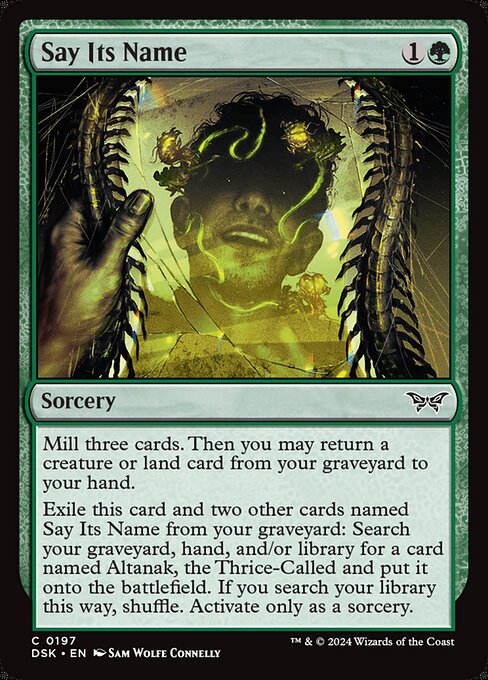
98. Say Its Name
Rating6.0PlayableWhy this rating?
Good playable that always makes the cut (6.0/10).
Why. A two-mana sorcery that mills three, then returns a creature or land card to your hand. It feeds Delirium and gets back what fell. Its second ability needs three copies in the graveyard and one specific card: do not count on it.
Risks. You mill three with no immediate effect on the board, and it is slow. With no creature or land in the graveyard, it returns nothing.
In the draft. A green filler common, useful in Delirium decks. Take it late, as a synergy tool.
Results in the games of the set
When it is in hand, the deck wins 55.7% of its games (set average: 55.9%, 111th of 269 cards).
In the opening hand: 54.1% wins (55.0% on average).
Drawn during the game: 56.9% (56.6% on average).
When it is drawn, the deck wins 1.4 points more than when it is not.
When it is drafted, it is played 67% of the time (set average: 62%).
Taken as the first pick (289 drafts), it ends in the deck 80% of the time.
It is played mostly in B/G decks (65% of them) and G/R (62%).
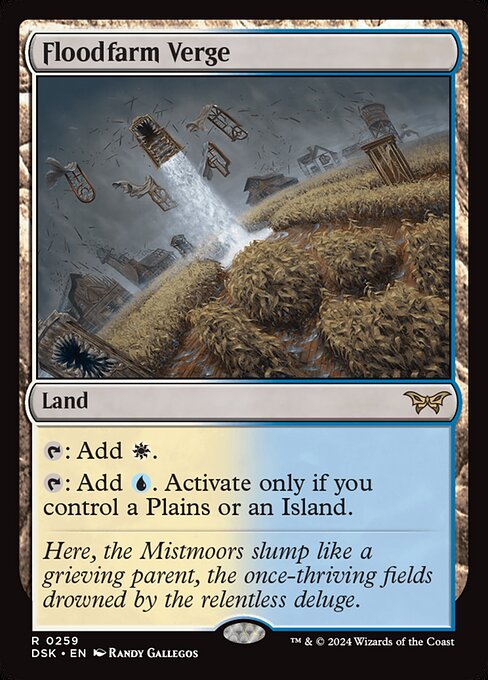
99. Floodfarm Verge
Rating6.0PlayableWhy this rating?
Good playable that always makes the cut (6.0/10).
Why. A land that always taps for white mana, and for blue mana only if you control a Plains or an Island. It enters untapped and fixes a white-blue deck's mana.
Risks. Without a Plains or an Island, it only makes white mana, so it fixes nothing early on. It has no effect beyond mana.
In the draft. Play it in a white-blue deck as an untapped dual land. Take it mid-pack; it is worth little to any other deck.
Results in the games of the set
When it is in hand, the deck wins 55.3% of its games (set average: 55.9%, 128th of 269 cards).
In the opening hand: 55.6% wins (55.0% on average).
Drawn during the game: 55.1% (56.6% on average).
When it is drawn, the deck wins 0.9 points more than when it is not.
When it is drafted, it is played 67% of the time (set average: 62%).
Taken as the first pick (41 drafts), it ends in the deck 76% of the time.

100. Funeral Room // Awakening Hall
Rating6.0PlayableWhy this rating?
Good playable that always makes the cut (6.0/10).
Why. A mythic Room: at three mana, the first half drains one life whenever one of your creatures dies. The second half, at eight mana, returns all creature cards from your graveyard to the battlefield.
Risks. The second half is very expensive and needs a full graveyard. The first half alone does not win the game, and it is slow in a deck without trades.
In the draft. A card for slow black decks. Take it for the late-game power; play it if your deck lives long.
Results in the games of the set
When it is in hand, the deck wins 55.4% of its games (set average: 55.9%, 121st of 269 cards).
In the opening hand: 50.0% wins (55.0% on average).
Drawn during the game: 58.9% (56.6% on average).
When it is drawn, the deck wins 5.0 points more than when it is not.
When it is drafted, it is played 78% of the time (set average: 62%).
Taken as the first pick (75 drafts), it ends in the deck 81% of the time.
It is played about as much in every archetype.

101. Glassworks // Shattered Yard
Rating6.0PlayableWhy this rating?
Good playable that always makes the cut (6.0/10).
Why. A flexible Room that doubles as removal. For three mana, the first door deals 4 damage to an opposing creature when it unlocks, which handles most commons. The second door can be unlocked later and pings the opponent every turn.
Risks. Four damage will not kill the big bodies, and the second door is slow: five mana for 1 damage a turn is a late-game finisher, not a defense. It works at sorcery speed, so no combat tricks.
In the draft. A solid removal spell for any red deck, a mid-first-pack pick rather than a top one. With Eerie, unlocking the second door later counts as an extra trigger.
Results in the games of the set
When it is in hand, the deck wins 57.2% of its games (set average: 55.9%, 72nd of 269 cards).
In the opening hand: 55.6% wins (55.0% on average).
Drawn during the game: 58.4% (56.6% on average).
When it is drawn, the deck wins 3.3 points more than when it is not.
When it is drafted, it is played 90% of the time (set average: 62%).
Taken as the first pick (749 drafts), it ends in the deck 96% of the time.
It is played mostly in R/U decks (71% of them) and G/R (57%).

102. Glimmerlight
Rating6.0PlayableWhy this rating?
Good playable that always makes the cut (6.0/10).
Why. Two cards in one: an Equipment that makes a 1/1 Glimmer enchantment creature token on entering, then gives +1/+1 for a single mana to equip. It is colorless, so it fits any deck, and the token is an enchantment for Eerie.
Risks. The token is a 1/1 that dies to almost anything, and the Equipment is left alone on the battlefield. The bonus is modest: this is filler that does not win games by itself.
In the draft. A fine playable for aggressive or Eerie decks. Take it mid-pack, once the removal and the good creatures are gone.
Results in the games of the set
When it is in hand, the deck wins 56.8% of its games (set average: 55.9%, 86th of 269 cards).
In the opening hand: 56.2% wins (55.0% on average).
Drawn during the game: 57.2% (56.6% on average).
When it is drawn, the deck wins 0.8 points more than when it is not.
When it is drafted, it is played 80% of the time (set average: 62%).
Taken as the first pick (272 drafts), it ends in the deck 95% of the time.
It is played mostly in R/W decks (76% of them) and U/W (60%).
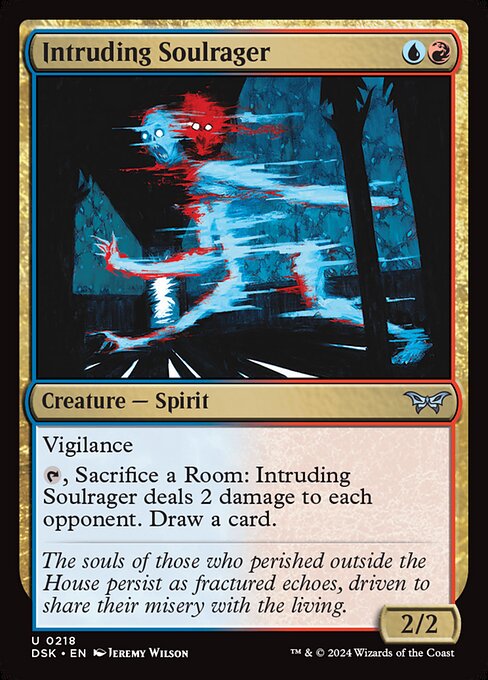
103. Intruding Soulrager
Rating6.0PlayableWhy this rating?
Good playable that always makes the cut (6.0/10).
Why. A 2-mana 2/2 with vigilance that turns a Room into 2 damage to the opponent and a card drawn. Vigilance lets it attack, then tap after combat to use its ability.
Risks. It needs Rooms in your deck and a sacrifice: without them, it is a plain 2/2 vigilance. It is also gold, so it only fits two specific colors.
In the draft. Play it if you are blue-red with several Rooms. Otherwise take it late; do not pick it over removal or a good creature.
Results in the games of the set
When it is in hand, the deck wins 53.1% of its games (set average: 55.9%, 206th of 269 cards).
In the opening hand: 51.7% wins (55.0% on average).
Drawn during the game: 54.0% (56.6% on average).
When it is drawn, the deck wins 2.6 points more than when it is not.
When it is drafted, it is played 35% of the time (set average: 62%).
Taken as the first pick (43 drafts), it ends in the deck 79% of the time.
It is played mostly in R/U decks (56% of them).

104. Jump Scare
Rating6.0PlayableWhy this rating?
Good playable that always makes the cut (6.0/10).
Why. A one-mana trick: +2/+2 and flying until end of turn, at instant speed. It swings a combat, makes a creature evasive for one hit, or saves it from a damage spell.
Risks. A combat trick can turn into a 2-for-1 against you if the opponent responds. It does nothing without a creature, and the effect ends with the turn.
In the draft. Fine in an aggressive white deck with plenty of creatures; take it mid-pack, after your removal. Do not run more than one or two.
Results in the games of the set
When it is in hand, the deck wins 55.3% of its games (set average: 55.9%, 125th of 269 cards).
In the opening hand: 54.2% wins (55.0% on average).
Drawn during the game: 56.1% (56.6% on average).
When it is drawn, the deck wins 0.2 points less than when it is not.
When it is drafted, it is played 47% of the time (set average: 62%).
Taken as the first pick (40 drafts), it ends in the deck 70% of the time.
It is played mostly in R/W decks (50% of them) and G/W (42%).

105. Mirror Room // Fractured Realm
Rating6.0PlayableWhy this rating?
Good playable that always makes the cut (6.0/10).
Why. The first door copies one of your creatures with a token, often doubling an enters-the-battlefield creature for three mana. The second door doubles all your triggered abilities, but its seven-mana price makes it impractical.
Risks. It does nothing without a good creature to copy, and the copy is a token that is fragile against removal. The second door is too expensive to matter before the late game.
In the draft. Good in a deck with enters-the-battlefield creatures; take it ahead of filler but not ahead of removal. Otherwise it is situational.
Results in the games of the set
When it is in hand, the deck wins 55.6% of its games (set average: 55.9%, 114th of 269 cards).
In the opening hand: 51.2% wins (55.0% on average).
Drawn during the game: 58.2% (56.6% on average).
When it is drawn, the deck wins 4.0 points more than when it is not.
When it is drafted, it is played 81% of the time (set average: 62%).
Taken as the first pick (58 drafts), it ends in the deck 88% of the time.
It is played about as much in every archetype.
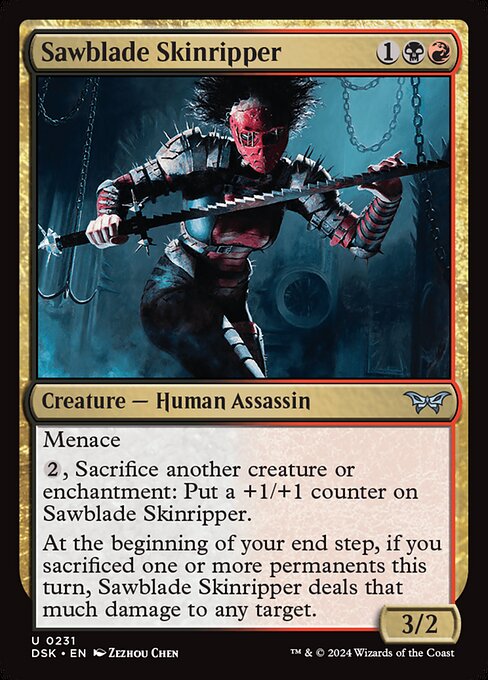
106. Sawblade Skinripper
Rating6.0PlayableWhy this rating?
Good playable that always makes the cut (6.0/10).
Why. A 3-mana 3/2 menace that rewards sacrifice: for two mana, sacrifice another creature or an enchantment to put a +1/+1 counter on it. At your end step it deals damage to any target equal to the permanents you sacrificed this turn.
Risks. It is black-red gold and has 2 toughness, so even a small removal spell kills it. Without sacrifice fodder, it is just a decent 3/2 menace.
In the draft. Play it in a black-red deck with tokens or Rooms. Take it fairly high if you are in those colors, later otherwise.
Results in the games of the set
When it is in hand, the deck wins 56.0% of its games (set average: 55.9%, 106th of 269 cards).
In the opening hand: 53.9% wins (55.0% on average).
Drawn during the game: 57.5% (56.6% on average).
When it is drawn, the deck wins 2.3 points more than when it is not.
When it is drafted, it is played 65% of the time (set average: 62%).
Taken as the first pick (175 drafts), it ends in the deck 85% of the time.
It is played mostly in B/R decks (60% of them).

107. Seized from Slumber
Rating6.0PlayableWhy this rating?
Good playable that always makes the cut (6.0/10).
Why. An unconditional instant-speed removal that destroys any creature. Against a tapped creature it costs only two mana, which makes it very fast after an opposing attack.
Risks. It costs five mana against an untapped creature, which is heavy. An opponent who does not attack, or who has vigilance, takes away its discount.
In the draft. A strong removal spell to take early in any white deck. It is best against aggressive decks that attack.
Results in the games of the set
When it is in hand, the deck wins 56.3% of its games (set average: 55.9%, 101st of 269 cards).
In the opening hand: 54.0% wins (55.0% on average).
Drawn during the game: 57.8% (56.6% on average).
When it is drawn, the deck wins 2.4 points more than when it is not.
When it is drafted, it is played 74% of the time (set average: 62%).
Taken as the first pick (166 drafts), it ends in the deck 85% of the time.
It is played mostly in U/W decks (45% of them) and B/W (44%).
 Rating6.0Playable
Why this rating?
Good playable that always makes the cut (6.0/10).
Why. A 2/1 that fetches a basic land into your hand: solid card advantage for three mana. With Delirium, it becomes a 3/3 with vigilance.
Risks. A 2/1 stays fragile and blocks poorly until Delirium is on. Delirium needs four card types in the graveyard, which takes time.
In the draft. A good green playable that fixes your colors and feeds Delirium decks. Take it around the middle of the first pack.
Results in the games of the set
When it is in hand, the deck wins 57.4% of its games (set average: 55.9%, 69th of 269 cards).
In the opening hand: 56.3% wins (55.0% on average).
Drawn during the game: 58.3% (56.6% on average).
When it is drawn, the deck wins 3.4 points more than when it is not.
When it is drafted, it is played 88% of the time (set average: 62%).
Taken as the first pick (609 drafts), it ends in the deck 95% of the time.
It is played mostly in G/R decks (73% of them) and B/G (68%).
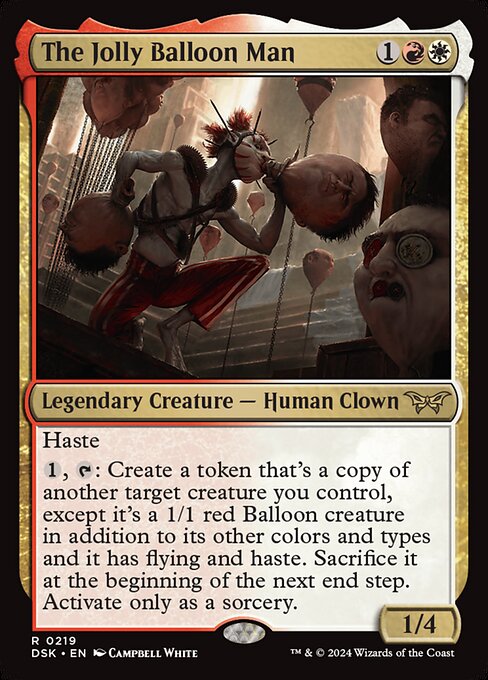 Rating6.0Playable
Why this rating?
Good playable that always makes the cut (6.0/10).
Why. A 1/4 with haste that, for one mana and a tap, copies another creature you control as a 1/1 red Balloon token with flying and haste. Each turn it adds an evasive attacker plus whatever enters-the-battlefield effect the copied creature has.
Risks. It is red-white gold, and the token is sacrificed at the next end step. It only works at sorcery speed and does nothing without another creature, and a 1/4 is not a threat on its own.
In the draft. Play it in a red-white deck with enters-the-battlefield creatures. A fair mid-pack pick in those colors, lower otherwise.
Results in the games of the set
When it is in hand, the deck wins 54.3% of its games (set average: 55.9%, 163rd of 269 cards).
In the opening hand: 52.9% wins (55.0% on average).
Drawn during the game: 55.4% (56.6% on average).
When it is drawn, the deck wins 0.5 points more than when it is not.
When it is drafted, it is played 77% of the time (set average: 62%).
Taken as the first pick (129 drafts), it ends in the deck 77% of the time.
It is played about as much in every archetype.

110. Grab the Prize
Rating5.9PlayableWhy this rating?
Good playable that always makes the cut (5.9/10).
Why. A two-mana draw spell: discard a card, draw two, and if the discard was not a land, the opponent takes 2 damage. It filters your hand and feeds Delirium.
Risks. It does not affect the board, so it is weak in a deck that needs to control combat. The card cost is real if you have nothing good to discard.
In the draft. A late-pick playable for aggressive or Delirium red decks. Do not take it ahead of creatures and removal.
Results in the games of the set
When it is in hand, the deck wins 53.2% of its games (set average: 55.9%, 200th of 269 cards).
In the opening hand: 51.8% wins (55.0% on average).
Drawn during the game: 54.3% (56.6% on average).
When it is drawn, the deck wins 0.3 points less than when it is not.
When it is drafted, it is played 23% of the time (set average: 62%).
Taken among the first three picks (79 drafts), it ends in the deck 52% of the time.
 Rating5.8Playable
Why this rating?
Good playable that always makes the cut (5.9/10).
Why. A one-mana removal in a color that often lacks it: one or two of your untapped creatures tap and hit an opposing creature for their power. With two big creatures, it kills almost anything.
Risks. It needs untapped creatures, which keeps them from attacking that turn. With no good power on the board, it does nothing, and it works at sorcery speed.
In the draft. Take it in a green deck full of creatures with good power, mid-pack. It is weaker if your deck is light on creatures.
Results in the games of the set
When it is in hand, the deck wins 55.7% of its games (set average: 55.9%, 110th of 269 cards).
In the opening hand: 54.5% wins (55.0% on average).
Drawn during the game: 56.5% (56.6% on average).
When it is drawn, the deck wins 2.8 points more than when it is not.
When it is drafted, it is played 80% of the time (set average: 62%).
Taken as the first pick (188 drafts), it ends in the deck 91% of the time.
It is played mostly in G/W decks (38% of them).
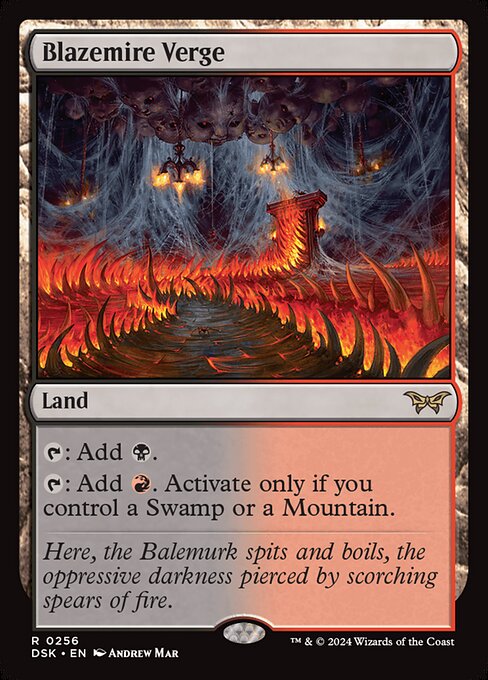
112. Blazemire Verge
Rating5.8PlayableWhy this rating?
Good playable that always makes the cut (5.8/10).
Why. A land that taps for black mana unconditionally, and for red mana if you control a Swamp or a Mountain. It enters untapped, avoiding the tempo cost of a tapped land.
Risks. It is less reliable than a basic if you have not yet found a Swamp or a Mountain. It only fixes in one direction, black to red.
In the draft. Good fixing for a black-red deck; take it late unless you are already in those colors. Do not pick it over a good spell.
Results in the games of the set
When it is in hand, the deck wins 54.7% of its games (set average: 55.9%, 150th of 269 cards).
In the opening hand: 54.2% wins (55.0% on average).
Drawn during the game: 55.0% (56.6% on average).
When it is drawn, the deck wins 1.8 points more than when it is not.
When it is drafted, it is played 57% of the time (set average: 62%).
Taken as the first pick (39 drafts), it ends in the deck 79% of the time.

113. Found Footage
Rating5.8PlayableWhy this rating?
Good playable that always makes the cut (5.8/10).
Why. A one-mana artifact Clue that lets you look at opposing face-down creatures, handy against Manifest dread. For two mana it sacrifices to surveil 2 and then draw a card.
Risks. It does nothing immediately and costs three mana in total for a card. It only shines in a deck that wants Delirium or filtering.
In the draft. A late-pick filler; take it for decks that want to fill the graveyard with different card types.
Results in the games of the set
When it is in hand, the deck wins 54.4% of its games (set average: 55.9%, 160th of 269 cards).
In the opening hand: 52.6% wins (55.0% on average).
Drawn during the game: 55.7% (56.6% on average).
When it is drawn, the deck wins 0.7 points more than when it is not.
When it is drafted, it is played 15% of the time (set average: 62%).
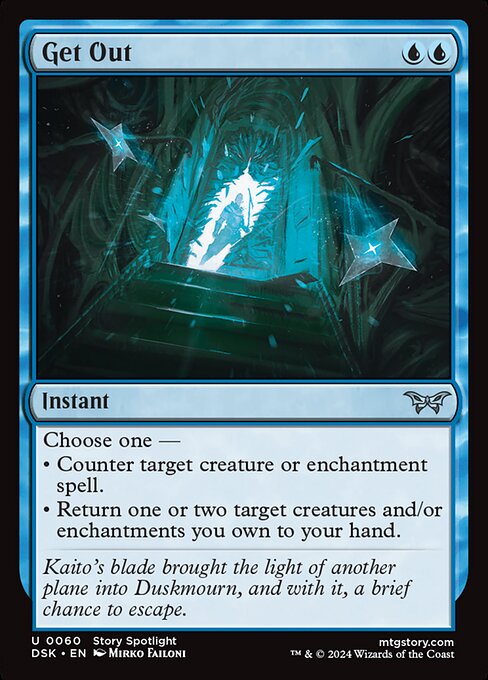
114. Get Out
Rating5.8PlayableWhy this rating?
Good playable that always makes the cut (5.8/10).
Why. A flexible two-mana instant: counter a creature or enchantment spell, or return one or two of your own creatures and enchantments to hand. It protects your cards from removal or replays an enters-the-battlefield effect.
Risks. It needs two blue mana and cannot counter instants, sorceries or artifacts. The return mode does nothing useful when you have nothing to save.
In the draft. Fine in a blue tempo or control deck. Take it mid-pack, after the removal and the best creatures.
Results in the games of the set
When it is in hand, the deck wins 55.2% of its games (set average: 55.9%, 131st of 269 cards).
In the opening hand: 52.8% wins (55.0% on average).
Drawn during the game: 56.7% (56.6% on average).
When it is drawn, the deck wins 2.2 points more than when it is not.
When it is drafted, it is played 64% of the time (set average: 62%).
Taken as the first pick (122 drafts), it ends in the deck 79% of the time.
It is played mostly in R/U decks (33% of them) and B/U (31%).
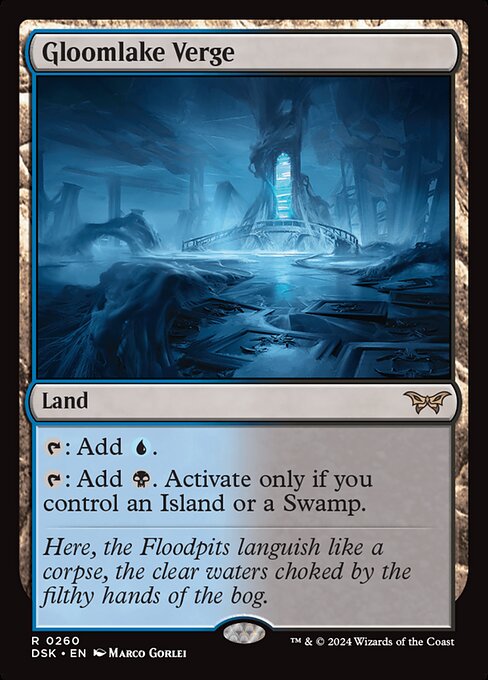
115. Gloomlake Verge
Rating5.8PlayableWhy this rating?
Good playable that always makes the cut (5.8/10).
Why. A land that taps for blue mana unconditionally, and for black mana if you control an Island or a Swamp. It enters untapped and fixes comfortably in a blue-black deck.
Risks. Without an Island or a Swamp on the battlefield, it only makes blue. It fixes in one direction only.
In the draft. Useful fixing in blue-black; take it late, after your spells. It is not a reason to change colors.
Results in the games of the set
When it is in hand, the deck wins 53.8% of its games (set average: 55.9%, 181st of 269 cards).
In the opening hand: 53.3% wins (55.0% on average).
Drawn during the game: 54.2% (56.6% on average).
When it is drawn, the deck wins 2.9 points more than when it is not.
When it is drafted, it is played 54% of the time (set average: 62%).
Taken as the first pick (39 drafts), it ends in the deck 64% of the time.
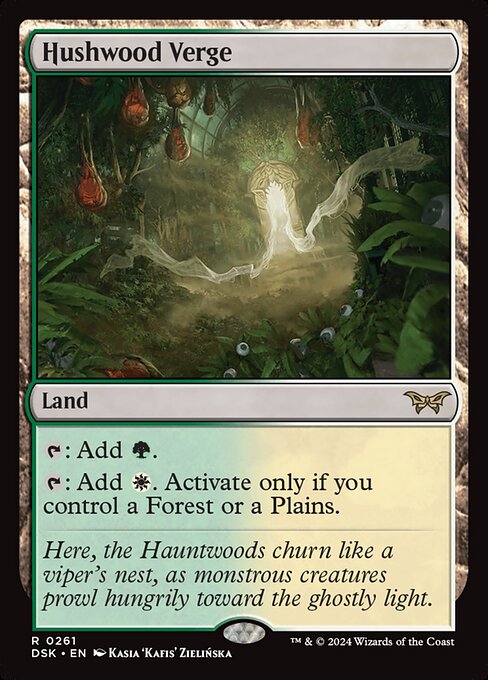
116. Hushwood Verge
Rating5.8PlayableWhy this rating?
Good playable that always makes the cut (5.8/10).
Why. A land that taps for green mana unconditionally, and for white mana if you control a Forest or a Plains. It enters untapped, with no tempo cost.
Risks. Without a Forest or a Plains, it only makes green. It fixes in one direction, green to white.
In the draft. Decent fixing for a green-white deck; take it late, after your spells and creatures.
Results in the games of the set
When it is in hand, the deck wins 53.5% of its games (set average: 55.9%, 193rd of 269 cards).
In the opening hand: 53.6% wins (55.0% on average).
Drawn during the game: 53.4% (56.6% on average).
When it is drawn, the deck wins 1.5 points more than when it is not.
When it is drafted, it is played 46% of the time (set average: 62%).
Taken among the first three picks (116 drafts), it ends in the deck 62% of the time.
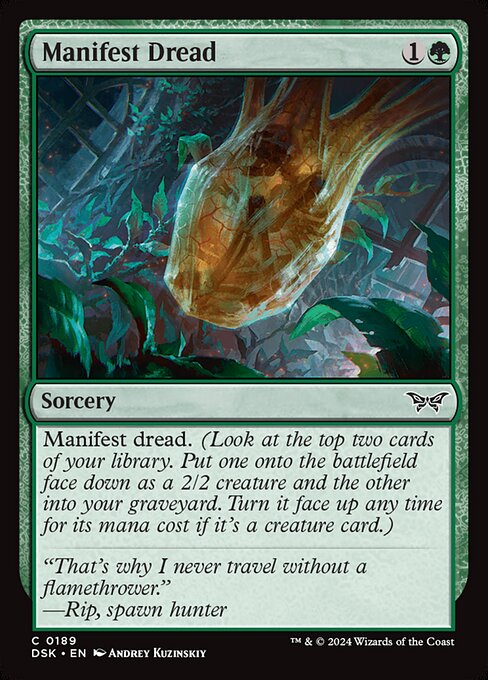
117. Manifest Dread
Rating5.8PlayableWhy this rating?
Good playable that always makes the cut (5.8/10).
Why. For two mana you get a face-down 2/2 and a card in the graveyard. It is a fine cheap body with a chance of flipping a good creature later, and it feeds Delirium.
Risks. A bare 2/2 is still vulnerable, and if neither card is a creature, it can never be turned face up. It is a sorcery: no effect during combat.
In the draft. A good green playable to take mid-pack, ahead of filler. It is best in decks that want to fill the graveyard.
Results in the games of the set
When it is in hand, the deck wins 56.4% of its games (set average: 55.9%, 97th of 269 cards).
In the opening hand: 55.9% wins (55.0% on average).
Drawn during the game: 56.7% (56.6% on average).
When it is drawn, the deck wins 2.0 points more than when it is not.
When it is drafted, it is played 84% of the time (set average: 62%).
Taken as the first pick (308 drafts), it ends in the deck 93% of the time.
It is played mostly in B/G decks (72% of them) and G/R (70%).

118. Monstrous Emergence
Rating5.8PlayableWhy this rating?
Good playable that always makes the cut (5.8/10).
Why. A two-mana removal: it deals damage to the target creature equal to the power of a creature you control or reveal from your hand. With a big body it kills almost anything, without exposing your creature.
Risks. It needs a creature with decent power in hand or on the battlefield, and it is a sorcery. With no creature, you cannot cast it.
In the draft. Take it fairly high in a green deck full of creatures with good power. A cheap removal that is welcome in most decks.
Results in the games of the set
When it is in hand, the deck wins 56.4% of its games (set average: 55.9%, 95th of 269 cards).
In the opening hand: 54.6% wins (55.0% on average).
Drawn during the game: 57.7% (56.6% on average).
When it is drawn, the deck wins 2.4 points more than when it is not.
When it is drafted, it is played 87% of the time (set average: 62%).
Taken as the first pick (458 drafts), it ends in the deck 93% of the time.
It is played mostly in G/U decks (63% of them) and B/G (58%).
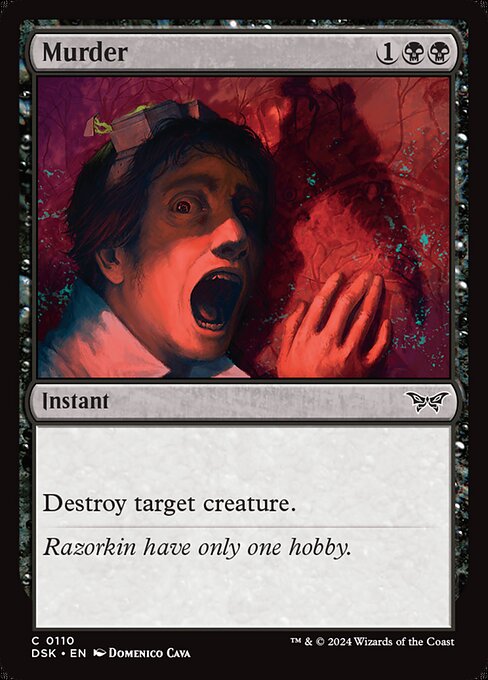
119. Murder
Rating5.8PlayableWhy this rating?
Good playable that always makes the cut (5.8/10).
Why. An unconditional instant-speed removal: destroy any creature for three mana. It answers the opponent's most dangerous threats with no strings attached.
Risks. It needs two black mana, which makes it hard to splash. It costs more than narrower removal, and does nothing against noncreature threats.
In the draft. A reliable removal spell to take early in any black deck, ahead of most ordinary creatures.
Results in the games of the set
When it is in hand, the deck wins 55.2% of its games (set average: 55.9%, 130th of 269 cards).
In the opening hand: 52.2% wins (55.0% on average).
Drawn during the game: 57.2% (56.6% on average).
When it is drawn, the deck wins 3.9 points more than when it is not.
When it is drafted, it is played 80% of the time (set average: 62%).
Taken as the first pick (306 drafts), it ends in the deck 89% of the time.
It is played mostly in B/G decks (55% of them) and B/R (55%).
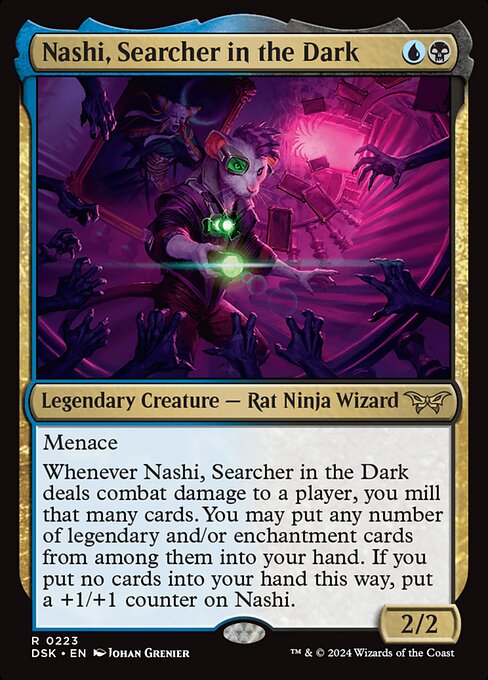
120. Nashi, Searcher in the Dark
Rating5.8PlayableWhy this rating?
Good playable that always makes the cut (5.8/10).
Why. A two-mana 2/2 menace that mills that many cards when it deals combat damage to a player. You may take legendary and enchantment cards from among them; if you take none, it gets a +1/+1 counter.
Risks. It is blue-black gold, and a 2/2 dies to almost anything. It is much less powerful in a deck with few enchantments or legends, where the card advantage is rare.
In the draft. Play it in a blue-black deck with enchantments. An average pick, to take after the removal.
Results in the games of the set
When it is in hand, the deck wins 53.6% of its games (set average: 55.9%, 188th of 269 cards).
In the opening hand: 54.9% wins (55.0% on average).
Drawn during the game: 52.8% (56.6% on average).
When it is drawn, the deck wins 5.2 points more than when it is not.
When it is drafted, it is played 52% of the time (set average: 62%).
Taken as the first pick (45 drafts), it ends in the deck 80% of the time.
It is played mostly in B/U decks (26% of them).
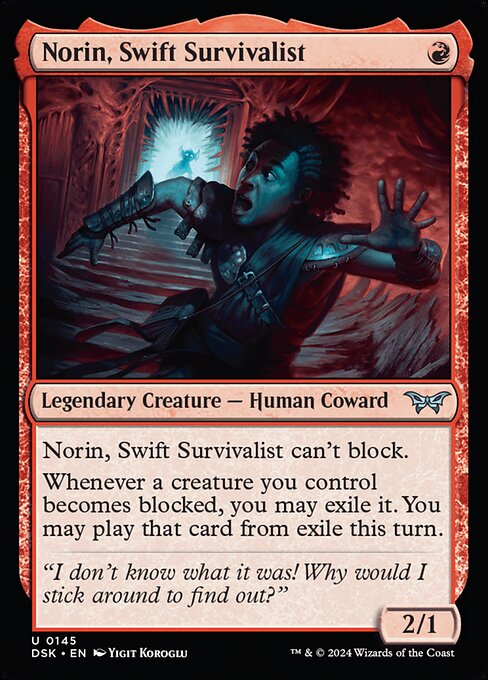 Rating5.8Playable
Why this rating?
Good playable that always makes the cut (5.8/10).
Why. A one-mana 2/1 for an aggressive deck. When one of your creatures becomes blocked, you may exile it and replay it this turn by paying its cost, dodging the block and reusing its enters-the-battlefield effects.
Risks. It cannot block and has only 1 toughness. An exiled token is gone for good, and the replayed card must be paid for again.
In the draft. A card for aggressive decks, especially red-white. Take it late unless your deck is very aggressive.
Results in the games of the set
When it is in hand, the deck wins 54.2% of its games (set average: 55.9%, 166th of 269 cards).
In the opening hand: 56.5% wins (55.0% on average).
Drawn during the game: 52.3% (56.6% on average).
When it is drawn, the deck wins 1.7 points less than when it is not.
When it is drafted, it is played 60% of the time (set average: 62%).
Taken as the first pick (100 drafts), it ends in the deck 78% of the time.
It is played mostly in R/W decks (37% of them).

122. Rip, Spawn Hunter
Rating5.8PlayableWhy this rating?
Good playable that always makes the cut (5.8/10).
Why. A 4-mana 4/4, big for its cost. With Survival, it reveals cards equal to its power and gives you creatures and Vehicles with different powers.
Risks. It is green-white gold, and Survival needs it tapped, meaning you attack with a 4/4 and expose it to combat. Without enough creatures in the deck, the ability gives little.
In the draft. A good body for a green-white deck, a mid-pack pick. Lower outside those colors.
Results in the games of the set
When it is in hand, the deck wins 53.8% of its games (set average: 55.9%, 180th of 269 cards).
In the opening hand: 52.9% wins (55.0% on average).
Drawn during the game: 54.5% (56.6% on average).
When it is drawn, the deck wins 3.0 points more than when it is not.
When it is drafted, it is played 58% of the time (set average: 62%).
Taken as the first pick (71 drafts), it ends in the deck 79% of the time.
It is played mostly in G/W decks (29% of them).

123. Sporogenic Infection
Rating5.8PlayableWhy this rating?
Good playable that always makes the cut (5.8/10).
Why. An odd two-mana Aura: on entering, a player sacrifices a creature of their choice other than the enchanted one, and the enchanted creature is destroyed when dealt damage. It removes one creature and traps another.
Risks. The player chooses the creature to sacrifice, so they lose their worst one. If the opponent has no other creature, the sacrifice does nothing, and without damage the enchanted creature stays.
In the draft. A conditional removal, fine in black. Take it mid-pack, after the simpler removal spells.
Results in the games of the set
When it is in hand, the deck wins 56.0% of its games (set average: 55.9%, 105th of 269 cards).
In the opening hand: 54.3% wins (55.0% on average).
Drawn during the game: 57.2% (56.6% on average).
When it is drawn, the deck wins 4.1 points more than when it is not.
When it is drafted, it is played 80% of the time (set average: 62%).
Taken as the first pick (202 drafts), it ends in the deck 89% of the time.
It is played mostly in B/W decks (30% of them) and B/U (28%).

124. Vanish from Sight
Rating5.8PlayableWhy this rating?
Good playable that always makes the cut (5.8/10).
Why. A four-mana instant that sends any nonland permanent into its owner's library, top or bottom at their choice, then surveil 1. It answers any kind of threat.
Risks. The owner can put it on top and redraw it: you gain tempo, not a true answer. It costs four mana.
In the draft. A good blue tempo spell to take mid-pack. Best in a deck that wins through tempo.
Results in the games of the set
When it is in hand, the deck wins 56.8% of its games (set average: 55.9%, 81st of 269 cards).
In the opening hand: 54.1% wins (55.0% on average).
Drawn during the game: 58.5% (56.6% on average).
When it is drawn, the deck wins 2.3 points more than when it is not.
When it is drafted, it is played 62% of the time (set average: 62%).
Taken as the first pick (94 drafts), it ends in the deck 88% of the time.
It is played mostly in G/U decks (75% of them) and U/W (59%).
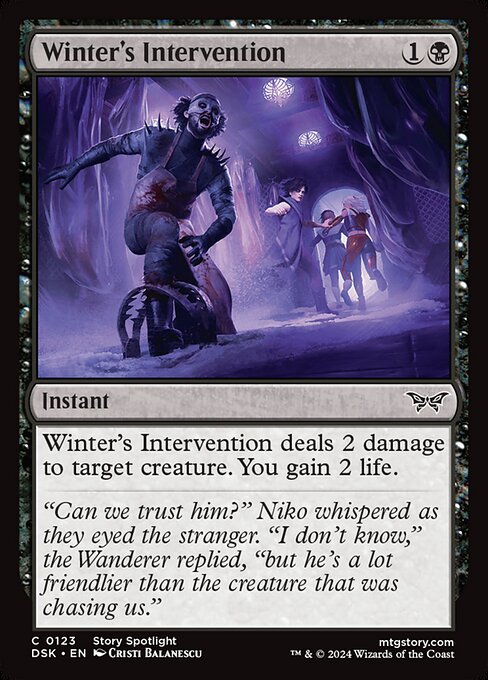 Rating5.8Playable
Why this rating?
Good playable that always makes the cut (5.8/10).
Why. A two-mana instant removal: 2 damage to a creature and you gain 2 life. It kills small creatures and can finish off one wounded in combat.
Risks. Only 2 damage: creatures with 3 toughness or more survive. It is limited in a format of big creatures.
In the draft. A decent cheap removal to take mid-pack in black decks. Later if you already have removal.
Results in the games of the set
When it is in hand, the deck wins 55.1% of its games (set average: 55.9%, 136th of 269 cards).
In the opening hand: 54.0% wins (55.0% on average).
Drawn during the game: 55.8% (56.6% on average).
When it is drawn, the deck wins 3.1 points more than when it is not.
When it is drafted, it is played 61% of the time (set average: 62%).
Taken as the first pick (121 drafts), it ends in the deck 80% of the time.
It is played mostly in B/U decks (50% of them) and B/W (49%).
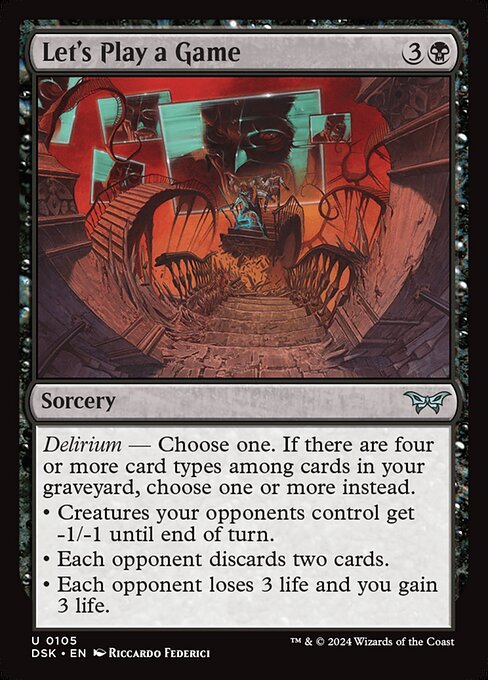
126. Let's Play a Game
Rating5.7PlayableWhy this rating?
Good playable that always makes the cut (5.7/10).
Why. A four-mana sorcery with three modes: -1/-1 to all opposing creatures, two discards, or draining 3 life. With Delirium, you choose one or more modes at once.
Risks. Without Delirium, it is one mode for four mana, which is weak. The -1/-1 only kills small creatures.
In the draft. Take it in a black Delirium deck, mid-pack. Otherwise it stays mediocre.
Results in the games of the set
When it is in hand, the deck wins 56.1% of its games (set average: 55.9%, 104th of 269 cards).
In the opening hand: 52.5% wins (55.0% on average).
Drawn during the game: 58.5% (56.6% on average).
When it is drawn, the deck wins 4.6 points more than when it is not.
When it is drafted, it is played 45% of the time (set average: 62%).
Taken as the first pick (51 drafts), it ends in the deck 76% of the time.
It is played about as much in every archetype.

127. Thornspire Verge
Rating5.7PlayableWhy this rating?
Good playable that always makes the cut (5.7/10).
Why. A land that taps for red mana unconditionally, and for green mana if you control a Mountain or a Forest. It enters untapped and fixes at no cost.
Risks. Without a Mountain or a Forest, it only makes red. It fixes in one direction, red to green.
In the draft. Useful fixing in red-green; take it late, after spells. It is not a reason to change colors.
Results in the games of the set
When it is in hand, the deck wins 54.1% of its games (set average: 55.9%, 171st of 269 cards).
In the opening hand: 55.7% wins (55.0% on average).
Drawn during the game: 52.8% (56.6% on average).
When it is drawn, the deck wins 0.1 points less than when it is not.
When it is drafted, it is played 62% of the time (set average: 62%).
Taken as the first pick (46 drafts), it ends in the deck 74% of the time.
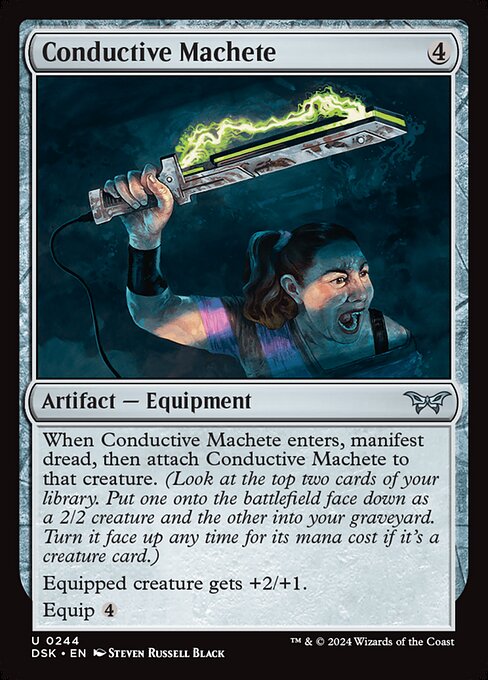
128. Conductive Machete
Rating5.6PlayableWhy this rating?
Good playable that always makes the cut (5.6/10).
Why. Four mana to manifest dread: a face-down 2/2 that enters already equipped with +2/+1, so an immediate 4/3, plus a card in the graveyard. If the manifested card is a creature, you may flip it later.
Risks. The four-mana equip cost is steep: if the creature dies, the Equipment is expensive to reattach. The 4/3 is still vulnerable to removal.
In the draft. A good mid-pick for creature decks. Take it mid-pack, ahead of filler.
Results in the games of the set
When it is in hand, the deck wins 55.3% of its games (set average: 55.9%, 127th of 269 cards).
In the opening hand: 53.4% wins (55.0% on average).
Drawn during the game: 56.6% (56.6% on average).
When it is drawn, the deck wins 0.8 points more than when it is not.
When it is drafted, it is played 84% of the time (set average: 62%).
Taken as the first pick (189 drafts), it ends in the deck 88% of the time.
It is played about as much in every archetype.

129. Cynical Loner
Rating5.6PlayableWhy this rating?
Good playable that always makes the cut (5.6/10).
Why. An aggressive 2-mana 3/1 that cannot be blocked by Glimmers. With Survival, it searches your library for any card and puts it into the graveyard, which feeds Delirium.
Risks. Just 1 toughness: it dies to almost anything. Survival puts the card in the graveyard, not your hand, so it does not give you a card.
In the draft. Play it in an aggressive or Delirium black deck. An average pick, after the removal.
Results in the games of the set
When it is in hand, the deck wins 54.8% of its games (set average: 55.9%, 146th of 269 cards).
In the opening hand: 55.8% wins (55.0% on average).
Drawn during the game: 54.0% (56.6% on average).
When it is drawn, the deck wins 2.7 points more than when it is not.
When it is drafted, it is played 68% of the time (set average: 62%).
Taken as the first pick (111 drafts), it ends in the deck 79% of the time.
It is played mostly in B/W decks (40% of them).
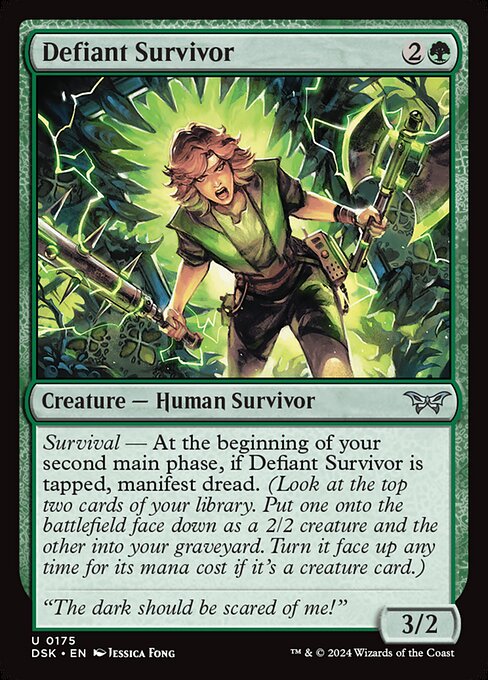
130. Defiant Survivor
Rating5.6PlayableWhy this rating?
Good playable that always makes the cut (5.6/10).
Why. A 3-mana 3/2 that, with Survival, manifests dread every turn it is tapped after attacking. Each attack gives you another face-down 2/2.
Risks. It must attack and survive to trigger Survival: a 3/2 is fragile on offense. If the opponent blocks and kills it, you lose the effect.
In the draft. A good aggressive green playable. Take it mid-pack; it is best against opponents who do not block well.
Results in the games of the set
When it is in hand, the deck wins 55.3% of its games (set average: 55.9%, 126th of 269 cards).
In the opening hand: 55.9% wins (55.0% on average).
Drawn during the game: 54.8% (56.6% on average).
When it is drawn, the deck wins 1.5 points more than when it is not.
When it is drafted, it is played 89% of the time (set average: 62%).
Taken as the first pick (294 drafts), it ends in the deck 93% of the time.
It is played mostly in G/W decks (35% of them) and G/U (27%).

131. Don't Make a Sound
Rating5.6PlayableWhy this rating?
Good playable that always makes the cut (5.6/10).
Why. A two-mana counterspell: counter a spell unless its controller pays two. If they pay, you surveil 2, so it is useful even when it fails.
Risks. An opponent with two spare mana gets out of it, and it is only strong early in the game. It forces you to hold mana open.
In the draft. Fine in a blue tempo deck, but not essential. Take it late in the pack, after creatures and removal.
Results in the games of the set
When it is in hand, the deck wins 55.2% of its games (set average: 55.9%, 134th of 269 cards).
In the opening hand: 55.0% wins (55.0% on average).
Drawn during the game: 55.3% (56.6% on average).
When it is drawn, the deck wins 2.0 points more than when it is not.
When it is drafted, it is played 31% of the time (set average: 62%).
Taken as the first pick (31 drafts), it ends in the deck 65% of the time.
It is played mostly in R/U decks (31% of them) and B/U (29%).

132. Fear of Falling
Rating5.6PlayableWhy this rating?
Good playable that always makes the cut (5.6/10).
Why. A five-mana 4/4 flier that, when it attacks, gives a creature the defender controls -2/-0 and removes its flying. It nearly always gets through the air and keeps the blocker from being effective.
Risks. Five mana including two blue, and 4 toughness: removal kills it. Its effect is temporary, lasting until your next turn.
In the draft. A good aerial threat to take mid-pack in a blue deck. Lower priority than removal.
Results in the games of the set
When it is in hand, the deck wins 55.4% of its games (set average: 55.9%, 120th of 269 cards).
In the opening hand: 52.2% wins (55.0% on average).
Drawn during the game: 57.3% (56.6% on average).
When it is drawn, the deck wins 1.8 points more than when it is not.
When it is drafted, it is played 85% of the time (set average: 62%).
Taken as the first pick (227 drafts), it ends in the deck 96% of the time.
It is played mostly in B/U decks (33% of them) and U/W (33%).
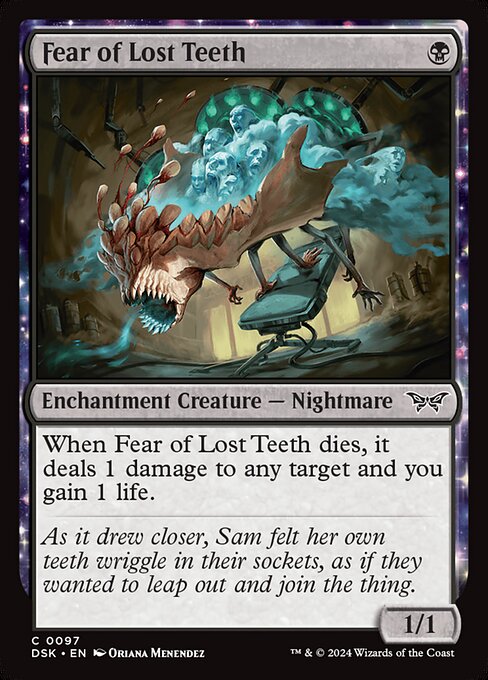
133. Fear of Lost Teeth
Rating5.6PlayableWhy this rating?
Good playable that always makes the cut (5.6/10).
Why. A one-mana 1/1 that, when it dies, deals 1 damage to any target and you gain 1 life. It is an enchantment creature: it triggers Eerie on entering and leaves a last ping behind when it blocks and dies.
Risks. Its impact is very low: a 1/1 that rarely changes a game. It is nearly useless against bigger creatures.
In the draft. A late-pick for enchantment or sacrifice decks. Take it late, after better creatures.
Results in the games of the set
When it is in hand, the deck wins 54.5% of its games (set average: 55.9%, 156th of 269 cards).
In the opening hand: 54.1% wins (55.0% on average).
Drawn during the game: 54.7% (56.6% on average).
When it is drawn, the deck wins 2.1 points more than when it is not.
When it is drafted, it is played 57% of the time (set average: 62%).
Taken as the first pick (88 drafts), it ends in the deck 86% of the time.
It is played mostly in B/R decks (68% of them) and B/W (67%).
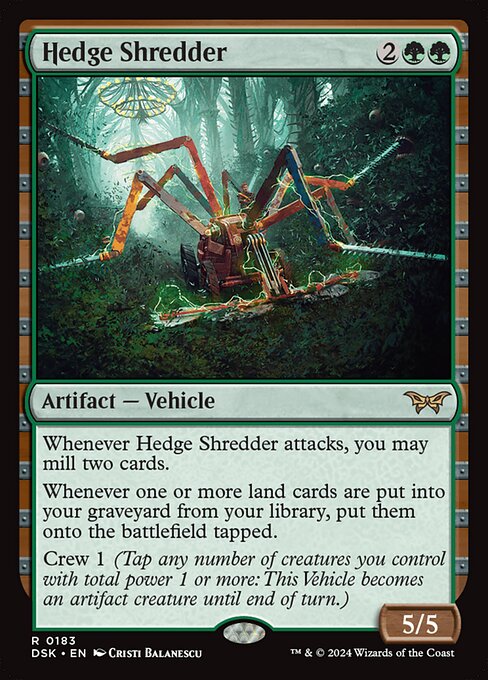
134. Hedge Shredder
Rating5.6PlayableWhy this rating?
Good playable that always makes the cut (5.6/10).
Why. A four-mana 5/5 Vehicle with Crew 1. When it attacks, it can mill two cards, and any land put into your graveyard that way enters the battlefield tapped. It ramps your mana and feeds Delirium.
Risks. It needs a creature to crew it, and a Vehicle is vulnerable to artifact removal. The land gain is random.
In the draft. A good green pick, especially with Delirium. Take it fairly high if you have creatures to crew it.
Results in the games of the set
When it is in hand, the deck wins 53.0% of its games (set average: 55.9%, 207th of 269 cards).
In the opening hand: 52.9% wins (55.0% on average).
Drawn during the game: 53.1% (56.6% on average).
When it is drawn, the deck wins 0.5 points more than when it is not.
When it is drafted, it is played 85% of the time (set average: 62%).
Taken as the first pick (132 drafts), it ends in the deck 84% of the time.
It is played about as much in every archetype.

135. Overgrown Zealot
Rating5.6PlayableWhy this rating?
Good playable that always makes the cut (5.6/10).
Why. A 0/4 for two that taps for any color: it walls the ground and fixes your mana. The second ability makes two mana of one color, but only to turn permanents face up, which pairs nicely with Manifest dread.
Risks. It never attacks, and the second ability does nothing without a face-down permanent to flip. In a deck that does not manifest, it is just a defensive fixer.
In the draft. A solid mid-pack pick for a green deck playing two or three colors. Take it higher if you already have several cards that manifest.
Results in the games of the set
When it is in hand, the deck wins 55.0% of its games (set average: 55.9%, 143rd of 269 cards).
In the opening hand: 56.9% wins (55.0% on average).
Drawn during the game: 53.5% (56.6% on average).
When it is drawn, the deck wins 2.0 points more than when it is not.
When it is drafted, it is played 85% of the time (set average: 62%).
Taken as the first pick (226 drafts), it ends in the deck 85% of the time.
It is played mostly in G/R decks (26% of them) and G/U (26%).
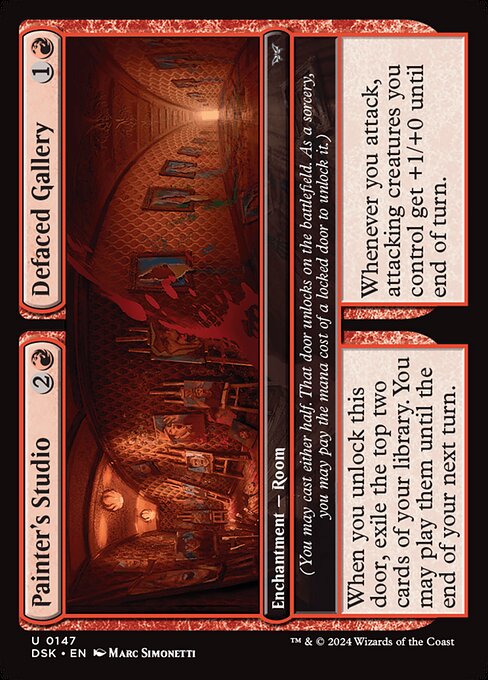
136. Painter's Studio // Defaced Gallery
Rating5.6PlayableWhy this rating?
Good playable that always makes the cut (5.6/10).
Why. A flexible Room with two uses. Painter's Studio exiles the top two cards of your library and lets you play them until the end of your next turn, which is real card advantage. Defaced Gallery gives your attackers +1/+0 every time you attack, which suits an aggressive deck.
Risks. Neither half does anything on its own: Studio needs mana to play the exiled cards, Gallery needs creatures. Exiled cards are lost if you cannot play them in time.
In the draft. A good pick for red decks, especially aggressive ones. Both doors are cheap so it fits the curve easily; unlock the second half when you have spare mana.
Results in the games of the set
When it is in hand, the deck wins 57.4% of its games (set average: 55.9%, 66th of 269 cards).
In the opening hand: 55.9% wins (55.0% on average).
Drawn during the game: 58.6% (56.6% on average).
When it is drawn, the deck wins 2.2 points more than when it is not.
When it is drafted, it is played 85% of the time (set average: 62%).
Taken as the first pick (341 drafts), it ends in the deck 91% of the time.
It is played mostly in R/W decks (35% of them) and R/U (32%).

137. Peer Past the Veil
Rating5.6PlayableWhy this rating?
Good playable that always makes the cut (5.6/10).
Why. An instant that discards your hand, then draws a card for each card type in your graveyard. With a varied graveyard you draw several cards at once, a big swing late in the game.
Risks. It discards your whole hand, so any good spells in it are lost, and with a thin graveyard you draw very little. It does nothing on the board.
In the draft. A niche pick for a red-green deck built around delirium. Without several ways to fill your graveyard, let it go.
Results in the games of the set
When it is in hand, the deck wins 53.0% of its games (set average: 55.9%, 208th of 269 cards).
In the opening hand: 49.5% wins (55.0% on average).
Drawn during the game: 55.5% (56.6% on average).
When it is drawn, the deck wins 0.4 points less than when it is not.
When it is drafted, it is played 55% of the time (set average: 62%).
Taken as the first pick (41 drafts), it ends in the deck 73% of the time.
It is played about as much in every archetype.

138. Pyroclasm
Rating5.6PlayableWhy this rating?
Good playable that always makes the cut (5.6/10).
Why. A two-mana sweeper dealing 2 damage to each creature. It wipes out small creatures, which is excellent against a deck that goes wide with little bodies.
Risks. It hits your own creatures too, and it kills nothing with more than two toughness. In a deck of average-sized creatures it hurts you as much as your opponent.
In the draft. Take it if you are building a deck of high-toughness creatures or a control deck. Otherwise it is a sideboard card: do not take it over real removal.
Results in the games of the set
When it is in hand, the deck wins 52.4% of its games (set average: 55.9%, 223rd of 269 cards).
In the opening hand: 50.1% wins (55.0% on average).
Drawn during the game: 54.0% (56.6% on average).
When it is drawn, the deck wins 2.7 points more than when it is not.
When it is drafted, it is played 33% of the time (set average: 62%).
Taken as the first pick (43 drafts), it ends in the deck 74% of the time.
It is played mostly in R/U decks (26% of them).

139. Saw
Rating5.6PlayableWhy this rating?
Good playable that always makes the cut (5.6/10).
Why. A two-mana Equipment giving +2/+0, with equip two. Each attack lets you sacrifice a permanent (other than the equipped creature and the Equipment) to draw a card, a good way to cash in spare lands or doomed creatures.
Risks. It does nothing by itself and costs mana each turn to move around. Sacrificing a permanent is only worth it when you have fodder to convert.
In the draft. A decent pick for aggressive decks or sacrifice decks. Take it mid-pack, behind good removal or a good creature.
Results in the games of the set
When it is in hand, the deck wins 52.7% of its games (set average: 55.9%, 217th of 269 cards).
In the opening hand: 51.2% wins (55.0% on average).
Drawn during the game: 53.7% (56.6% on average).
When it is drawn, the deck wins 0.9 points less than when it is not.
When it is drafted, it is played 22% of the time (set average: 62%).
Taken among the first three picks (65 drafts), it ends in the deck 66% of the time.
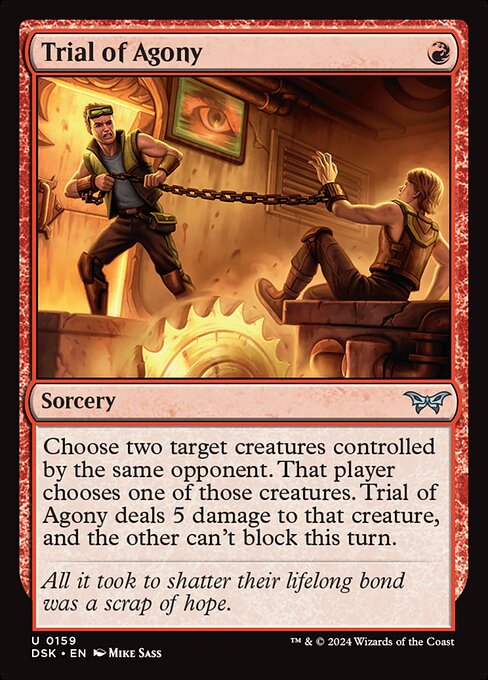
140. Trial of Agony
Rating5.6PlayableWhy this rating?
Good playable that always makes the cut (5.6/10).
Why. A one-mana sorcery: you choose two creatures controlled by one opponent, they choose one to take 5 damage, and the other cannot block this turn. For one mana you kill a creature and clear the way for an attack.
Risks. It needs your opponent to have two creatures, and they pick which one dies, so they will give up the worse one. Against a single creature you cannot cast it.
In the draft. A good removal spell for aggressive red decks. Take it over filler, but after removal that lets you choose the target.
Results in the games of the set
When it is in hand, the deck wins 53.6% of its games (set average: 55.9%, 189th of 269 cards).
In the opening hand: 51.7% wins (55.0% on average).
Drawn during the game: 54.9% (56.6% on average).
When it is drawn, the deck wins 0.8 points less than when it is not.
When it is drafted, it is played 59% of the time (set average: 62%).
Taken as the first pick (93 drafts), it ends in the deck 78% of the time.
It is played mostly in R/W decks (25% of them).

141. Valgavoth's Faithful
Rating5.6PlayableWhy this rating?
Good playable that always makes the cut (5.6/10).
Why. A one-mana 1/1 that you can sacrifice, for four mana, to return a creature card from your graveyard to the battlefield. A good late-game value tool when it brings back a big creature at a fair price.
Risks. A 1/1 does nothing else on the board, and the activation is slow and only works at sorcery speed. You need a good creature in your graveyard for it to matter.
In the draft. A pick for black value decks, especially with plenty of big creatures. It has no place in a deck without quality creatures.
Results in the games of the set
When it is in hand, the deck wins 54.1% of its games (set average: 55.9%, 172nd of 269 cards).
In the opening hand: 51.1% wins (55.0% on average).
Drawn during the game: 56.1% (56.6% on average).
When it is drawn, the deck wins 2.7 points more than when it is not.
When it is drafted, it is played 69% of the time (set average: 62%).
Taken as the first pick (159 drafts), it ends in the deck 83% of the time.
It is played mostly in B/W decks (44% of them) and B/G (29%).

142. Altanak, the Thrice-Called
Rating5.6PlayableWhy this rating?
Good playable that always makes the cut (5.6/10).
Why. A 9/9 trampler that draws you a card each time an opponent targets it, so targeted removal is a poor trade. If you are short on lands, you can discard it for two mana to return a land from your graveyard to the battlefield tapped.
Risks. Seven mana is a lot, and the discard ability only helps if a land is already in your graveyard. Effects that do not target (sacrifice, sweepers) answer it without giving you a card.
In the draft. A reasonable top-end for slow green decks, in a single copy. Do not load up on it in a fast deck.
Results in the games of the set
When it is in hand, the deck wins 54.2% of its games (set average: 55.9%, 167th of 269 cards).
In the opening hand: 51.5% wins (55.0% on average).
Drawn during the game: 55.9% (56.6% on average).
When it is drawn, the deck wins 0.0 points more than when it is not.
When it is drafted, it is played 80% of the time (set average: 62%).
Taken as the first pick (249 drafts), it ends in the deck 88% of the time.
It is played mostly in B/G decks (29% of them).
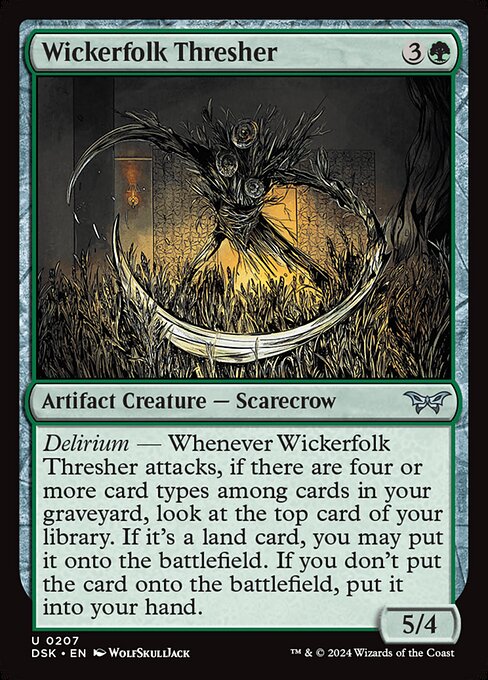
143. Wickerfolk Thresher
Rating5.5PlayableWhy this rating?
A solid playable that rarely gets cut (5.5/10).
Why. A 5/4 for four mana, a huge body for the price. With delirium, each attack looks at the top card of your library: if it is a land you may put it onto the battlefield, otherwise the card goes to your hand.
Risks. Without delirium it is just a big body with no ability. It dies to removal or a double block, and the bonus needs a varied graveyard.
In the draft. A good pick for green decks, with or without delirium. Green pairs like red-green and blue-green play it well.
Results in the games of the set
When it is in hand, the deck wins 55.0% of its games (set average: 55.9%, 137th of 269 cards).
In the opening hand: 53.6% wins (55.0% on average).
Drawn during the game: 56.0% (56.6% on average).
When it is drawn, the deck wins 0.8 points more than when it is not.
When it is drafted, it is played 92% of the time (set average: 62%).
Taken as the first pick (355 drafts), it ends in the deck 96% of the time.
It is played mostly in B/G decks (30% of them) and G/R (28%).
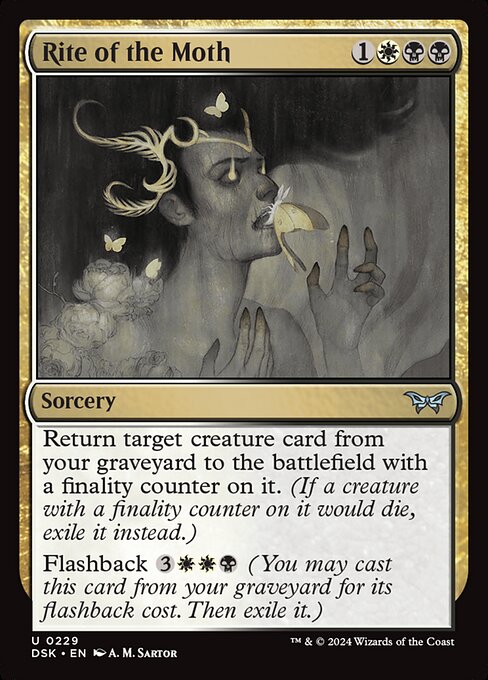
144. Rite of the Moth
Rating5.4PlayableWhy this rating?
A solid playable that rarely gets cut (5.4/10).
Why. A sorcery that returns a creature card from your graveyard to the battlefield with a finality counter, then can be cast again from the graveyard with flashback. Two creatures back for one card is solid value in a white-black deck.
Risks. It needs a good target in your graveyard and costs four mana the first time and six for flashback. It is slow, and without a creature in the graveyard it sits in your hand.
In the draft. A pick for white-black value decks. Take it higher if you have many big creatures; otherwise it is filler.
Results in the games of the set
When it is in hand, the deck wins 54.7% of its games (set average: 55.9%, 151st of 269 cards).
In the opening hand: 50.9% wins (55.0% on average).
Drawn during the game: 57.0% (56.6% on average).
When it is drawn, the deck wins 4.5 points more than when it is not.
When it is drafted, it is played 55% of the time (set average: 62%).
Taken as the first pick (106 drafts), it ends in the deck 88% of the time.
It is played mostly in B/W decks (59% of them).

145. Cathartic Parting
Rating5.4PlayableWhy this rating?
A solid playable that rarely gets cut (5.4/10).
Why. A two-mana sorcery that makes the owner of an opposing artifact or enchantment shuffle it into their library, and lets you shuffle up to four cards from your graveyard into yours. A conditional removal with a small recycling bonus.
Risks. It needs an artifact or enchantment as a target, which is often missing. Your opponent can draw the card again, so it is not a permanent answer.
In the draft. A sideboard card: take it late, or when you know your opponents have important artifacts or enchantments. Not a default main-deck pick.
Results in the games of the set
When it is in hand, the deck wins 54.1% of its games (set average: 55.9%, 170th of 269 cards).
In the opening hand: 51.4% wins (55.0% on average).
Drawn during the game: 55.8% (56.6% on average).
When it is drawn, the deck wins 1.1 points more than when it is not.
When it is drafted, it is played 60% of the time (set average: 62%).
Taken as the first pick (81 drafts), it ends in the deck 89% of the time.
It is played about as much in every archetype.

146. Fear of Surveillance
Rating5.4PlayableWhy this rating?
A solid playable that rarely gets cut (5.4/10).
Why. A two-mana 2/2 with vigilance that surveils 1 each time it attacks. It attacks without giving up defense and gradually improves your draws while filling the graveyard for delirium.
Risks. A 2/2 is fragile and gets blocked by anything bigger. The effect is subtle, so it will not win the game alone.
In the draft. A good common two-drop for white decks, especially aggressive ones like white-red or white-blue. Take it as curve filler after removal and the best creatures.
Results in the games of the set
When it is in hand, the deck wins 55.5% of its games (set average: 55.9%, 118th of 269 cards).
In the opening hand: 56.2% wins (55.0% on average).
Drawn during the game: 54.9% (56.6% on average).
When it is drawn, the deck wins 0.0 points more than when it is not.
When it is drafted, it is played 90% of the time (set average: 62%).
Taken as the first pick (352 drafts), it ends in the deck 94% of the time.
It is played mostly in U/W decks (63% of them) and G/W (62%).

147. Impossible Inferno
Rating5.4PlayableWhy this rating?
A solid playable that rarely gets cut (5.4/10).
Why. A five-mana instant dealing 6 damage to a creature, which kills almost anything. With delirium you also exile the top card of your library and can play it until the end of your next turn, a nice extra card.
Risks. Five mana is expensive and slow, taking most of your turn. The delirium bonus tends to arrive late in the game.
In the draft. A solid common removal spell for any red deck. Take it fairly early, though not ahead of cheaper removal.
Results in the games of the set
When it is in hand, the deck wins 54.0% of its games (set average: 55.9%, 176th of 269 cards).
In the opening hand: 51.2% wins (55.0% on average).
Drawn during the game: 55.9% (56.6% on average).
When it is drawn, the deck wins 0.3 points more than when it is not.
When it is drafted, it is played 43% of the time (set average: 62%).
Taken as the first pick (40 drafts), it ends in the deck 75% of the time.
It is played mostly in G/R decks (49% of them) and R/U (26%).
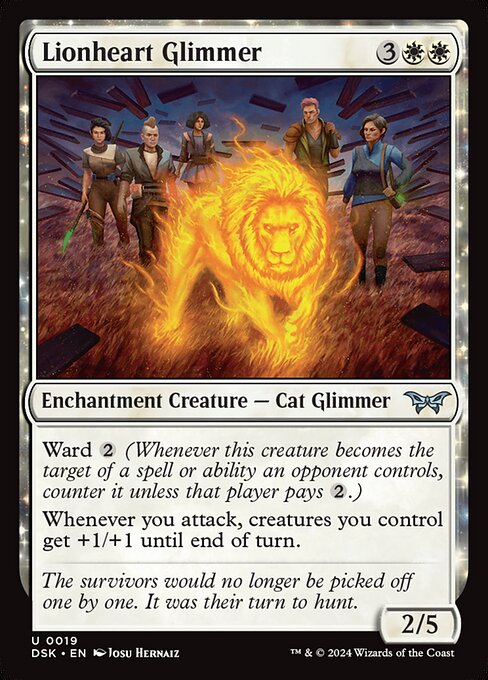
148. Lionheart Glimmer
Rating5.4PlayableWhy this rating?
A solid playable that rarely gets cut (5.4/10).
Why. A 2/5 with ward 2 that gives all your creatures +1/+1 until end of turn whenever you attack. In a deck with several attackers it tilts each combat in your favor.
Risks. Five mana for a 2/5 that does not hit hard itself; without other creatures its effect is almost nothing. Ward 2 taxes removal, but an opponent with spare mana can pay.
In the draft. A good uncommon for white decks with lots of small creatures or tokens, especially white-blue and white-red.
Results in the games of the set
When it is in hand, the deck wins 55.6% of its games (set average: 55.9%, 113th of 269 cards).
In the opening hand: 54.3% wins (55.0% on average).
Drawn during the game: 56.4% (56.6% on average).
When it is drawn, the deck wins 1.1 points more than when it is not.
When it is drafted, it is played 84% of the time (set average: 62%).
Taken as the first pick (201 drafts), it ends in the deck 93% of the time.
It is played mostly in U/W decks (27% of them) and R/W (26%).

149. Patched Plaything
Rating5.4PlayableWhy this rating?
A solid playable that rarely gets cut (5.4/10).
Why. A three-mana 4/3 with double strike, but cast from your hand it enters with two -1/-1 counters and becomes a 2/1 double striker. That small body still hits twice, which punishes blockers.
Risks. A 2/1 dies to nearly anything, including a simple block or a damage spell. It only keeps its full size if it enters from somewhere other than your hand.
In the draft. A good pick for aggressive white decks, notably white-red, its best pair. Otherwise it is an average creature.
Results in the games of the set
When it is in hand, the deck wins 54.1% of its games (set average: 55.9%, 168th of 269 cards).
In the opening hand: 54.0% wins (55.0% on average).
Drawn during the game: 54.2% (56.6% on average).
When it is drawn, the deck wins 0.9 points less than when it is not.
When it is drafted, it is played 81% of the time (set average: 62%).
Taken as the first pick (201 drafts), it ends in the deck 92% of the time.
It is played mostly in B/W decks (31% of them) and G/W (26%).

150. Popular Egotist
Rating5.4PlayableWhy this rating?
A solid playable that rarely gets cut (5.4/10).
Why. A three-mana 3/2 that drains your opponent for 1 whenever you sacrifice a permanent. For two mana you can also sacrifice another creature or an enchantment to make it indestructible and tap it.
Risks. A 3/2 is fragile, and its activations cost you value: sacrificing your own permanents only makes sense with fodder such as tokens or creatures about to die.
In the draft. A pick for black sacrifice decks, with red as a second color. Without sacrifice fodder it is a fine creature and nothing more.
Results in the games of the set
When it is in hand, the deck wins 54.6% of its games (set average: 55.9%, 155th of 269 cards).
In the opening hand: 51.9% wins (55.0% on average).
Drawn during the game: 56.4% (56.6% on average).
When it is drawn, the deck wins 1.6 points more than when it is not.
When it is drafted, it is played 64% of the time (set average: 62%).
Taken as the first pick (116 drafts), it ends in the deck 85% of the time.
It is played mostly in B/R decks (48% of them).

151. Shroudstomper
Rating5.4PlayableWhy this rating?
A solid playable that rarely gets cut (5.4/10).
Why. A 5/5 deathtouch that makes each opponent lose 2 life, gains you 2 and draws a card both when it enters and whenever it attacks. A value engine that takes over the game if it survives.
Risks. Seven mana with two white and two black mana is very expensive and demanding, unplayable outside white-black. Removal stops it, even though its enter effect already drew you a card.
In the draft. A top-end for slow white-black decks. Only take it if you are already in those two colors.
Results in the games of the set
When it is in hand, the deck wins 55.2% of its games (set average: 55.9%, 129th of 269 cards).
In the opening hand: 51.7% wins (55.0% on average).
Drawn during the game: 57.4% (56.6% on average).
When it is drawn, the deck wins 4.7 points more than when it is not.
When it is drafted, it is played 58% of the time (set average: 62%).
Taken as the first pick (120 drafts), it ends in the deck 86% of the time.
It is played mostly in B/W decks (66% of them).

152. Twist Reality
Rating5.4PlayableWhy this rating?
A solid playable that rarely gets cut (5.4/10).
Why. A flexible three-mana instant: counter a spell, or manifest dread for a face-down 2/2 and a filled graveyard. The creature mode guarantees you can use it even when your opponent plays nothing important.
Risks. Two blue mana needs a solid blue base, and the counterspell mode requires leaving mana open. A 2/2 for three is modest if you just use it as a body.
In the draft. A good common for blue decks, especially blue-green and white-blue. Take it as a steady value card for decks that like to play reactively.
Results in the games of the set
When it is in hand, the deck wins 55.5% of its games (set average: 55.9%, 117th of 269 cards).
In the opening hand: 52.7% wins (55.0% on average).
Drawn during the game: 57.2% (56.6% on average).
When it is drawn, the deck wins 2.1 points more than when it is not.
When it is drafted, it is played 50% of the time (set average: 62%).
Taken as the first pick (57 drafts), it ends in the deck 84% of the time.
It is played mostly in G/U decks (58% of them) and R/U (35%).

153. Unsettling Twins
Rating5.4PlayableWhy this rating?
A solid playable that rarely gets cut (5.4/10).
Why. A four-mana 2/2 that manifests dread when it enters, giving you two bodies for one card. It also fills your graveyard, and the face-down 2/2 can be flipped if it is a creature card.
Risks. Four mana for two 2/2s is an average rate, and the bodies are small. It does not hold up against a sweeper or bigger attackers.
In the draft. A reliable white common for creature decks, notably white-red and white-blue. Take it as good curve filler.
Results in the games of the set
When it is in hand, the deck wins 56.9% of its games (set average: 55.9%, 80th of 269 cards).
In the opening hand: 56.3% wins (55.0% on average).
Drawn during the game: 57.3% (56.6% on average).
When it is drawn, the deck wins 1.8 points more than when it is not.
When it is drafted, it is played 70% of the time (set average: 62%).
Taken as the first pick (174 drafts), it ends in the deck 88% of the time.
It is played mostly in R/W decks (63% of them) and B/W (54%).

154. Violent Urge
Rating5.4PlayableWhy this rating?
A solid playable that rarely gets cut (5.4/10).
Why. A one-mana instant giving a creature +1/+0 and first strike until end of turn, or double strike with delirium. A cheap combat trick that can win a fight or finish off an opponent.
Risks. A combat trick does nothing on its own, and you lose the card if they respond by killing the creature. The double strike mode needs a varied graveyard.
In the draft. A pick for aggressive red decks, mid to late in the pack. Do not take it over creatures and removal.
Results in the games of the set
When it is in hand, the deck wins 53.1% of its games (set average: 55.9%, 204th of 269 cards).
In the opening hand: 52.1% wins (55.0% on average).
Drawn during the game: 53.9% (56.6% on average).
When it is drawn, the deck wins 0.8 points less than when it is not.
When it is drafted, it is played 49% of the time (set average: 62%).
Taken as the first pick (58 drafts), it ends in the deck 76% of the time.
It is played mostly in G/R decks (26% of them).

155. House Cartographer
Rating5.4PlayableWhy this rating?
A solid playable that rarely gets cut (5.4/10).
Why. A two-mana 2/2 with survival: if it is tapped during your second main phase, you reveal cards until a land, put it into your hand and the rest on the bottom of your library. Each attack gets you an extra land.
Risks. It must be tapped to trigger, so it has to attack and stay exposed, or you need another way to tap it. A 2/2 is easy to block or kill.
In the draft. A good two-drop for green decks, especially if your curve runs high and you never want to miss a land drop. Take it as a value creature.
Results in the games of the set
When it is in hand, the deck wins 54.6% of its games (set average: 55.9%, 152nd of 269 cards).
In the opening hand: 56.3% wins (55.0% on average).
Drawn during the game: 53.3% (56.6% on average).
When it is drawn, the deck wins 1.2 points more than when it is not.
When it is drafted, it is played 82% of the time (set average: 62%).
Taken as the first pick (187 drafts), it ends in the deck 95% of the time.
It is played mostly in G/W decks (35% of them).

156. Fear of Infinity
Rating5.3PlayableWhy this rating?
A solid playable that rarely gets cut (5.3/10).
Why. A three-mana 2/2 with flying and lifelink that cannot block. With eerie, you may return it from your graveyard to your hand whenever an enchantment enters under your control or you fully unlock a Room.
Risks. It cannot block, so it does not defend you, and its recursion depends on enchantments or Rooms the deck must have in numbers. A 2/2 is fragile against removal.
In the draft. A pick for blue-black decks with enchantments. Outside that plan it is only a small evasive threat.
Results in the games of the set
When it is in hand, the deck wins 54.0% of its games (set average: 55.9%, 174th of 269 cards).
In the opening hand: 52.5% wins (55.0% on average).
Drawn during the game: 55.0% (56.6% on average).
When it is drawn, the deck wins 3.3 points more than when it is not.
When it is drafted, it is played 60% of the time (set average: 62%).
Taken as the first pick (120 drafts), it ends in the deck 79% of the time.
It is played mostly in B/U decks (59% of them).

157. Wary Watchdog
Rating5.2PlayableWhy this rating?
A solid playable that rarely gets cut (5.2/10).
Why. A two-mana 3/1 that surveils 1 when it enters and when it dies. It hits hard early and improves your draws twice for a single body.
Risks. One toughness makes it die to almost anything, and it trades even with a small blocker. Both surveils are modest, and it ages poorly.
In the draft. A good common two-drop for aggressive green decks, in any green pair. Take it as curve filler.
Results in the games of the set
When it is in hand, the deck wins 55.8% of its games (set average: 55.9%, 109th of 269 cards).
In the opening hand: 56.0% wins (55.0% on average).
Drawn during the game: 55.6% (56.6% on average).
When it is drawn, the deck wins 1.4 points more than when it is not.
When it is drafted, it is played 84% of the time (set average: 62%).
Taken as the first pick (256 drafts), it ends in the deck 90% of the time.
It is played mostly in B/G decks (61% of them) and G/R (61%).

158. Bear Trap
Rating5.2PlayableWhy this rating?
A solid playable that rarely gets cut (5.2/10).
Why. A one-mana artifact with flash: pay three more, tap it and sacrifice it to deal 3 damage to a creature. You can put it down ahead of time cheaply and trigger it when needed.
Risks. Four mana total for 3 damage is expensive, paid in two steps, and 3 damage does not kill big creatures.
In the draft. A last-resort removal for any deck. Take it late, once the good creatures and more efficient removal are gone.
Results in the games of the set
When it is in hand, the deck wins 51.5% of its games (set average: 55.9%, 234th of 269 cards).
In the opening hand: 50.5% wins (55.0% on average).
Drawn during the game: 52.3% (56.6% on average).
When it is drawn, the deck wins 0.2 points less than when it is not.
When it is drafted, it is played only 10% of the time (set average: 62%): it almost always ends in the sideboard.

159. Defiled Crypt // Cadaver Lab
Rating5.2PlayableWhy this rating?
A solid playable that rarely gets cut (5.2/10).
Why. A black Room. Cadaver Lab, for a black mana, returns a creature card from your graveyard to your hand: a cheap little recursion. Defiled Crypt creates a 2/2 black Horror enchantment creature token whenever cards leave your graveyard, once each turn.
Risks. Defiled Crypt needs cards to leave your graveyard, which does not happen often without support, and it costs four mana. One token per turn is a small flow.
In the draft. A pick for black decks that replay their creatures. Take it mid-pack, mostly for the cheap Cadaver Lab door.
Results in the games of the set
When it is in hand, the deck wins 53.7% of its games (set average: 55.9%, 184th of 269 cards).
In the opening hand: 49.9% wins (55.0% on average).
Drawn during the game: 56.1% (56.6% on average).
When it is drawn, the deck wins 3.1 points more than when it is not.
When it is drafted, it is played 72% of the time (set average: 62%).
Taken as the first pick (205 drafts), it ends in the deck 83% of the time.
It is played mostly in B/G decks (28% of them) and B/W (27%).
 Rating5.2Playable
Why this rating?
A solid playable that rarely gets cut (5.2/10).
Why. An Aura that lets you control the enchanted creature, which gets -3/-0 and loses all abilities. It takes your opponent's best creature and keeps it as a blocker, a good answer to a big threat.
Risks. Six mana is very expensive, and the creature stays on the battlefield: destroying the Aura hands it back to your opponent with its abilities. It loses power but can still block.
In the draft. A decent pick for slow blue decks. Take it as backup removal, not over cheaper removal.
Results in the games of the set
When it is in hand, the deck wins 55.0% of its games (set average: 55.9%, 142nd of 269 cards).
In the opening hand: 51.4% wins (55.0% on average).
Drawn during the game: 57.0% (56.6% on average).
When it is drawn, the deck wins 2.4 points more than when it is not.
When it is drafted, it is played 49% of the time (set average: 62%).
Taken as the first pick (66 drafts), it ends in the deck 80% of the time.
It is played about as much in every archetype.
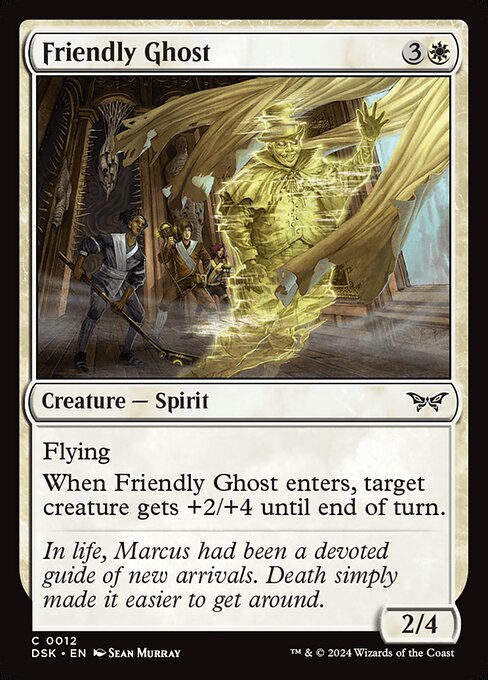
161. Friendly Ghost
Rating5.2PlayableWhy this rating?
A solid playable that rarely gets cut (5.2/10).
Why. A four-mana 2/4 flyer that gives a creature +2/+4 until end of turn when it enters. It works like a combat trick: it wins a fight for you or saves a creature from damage-based removal.
Risks. Four mana for a 2/4 is fine and no more, and the bonus is mostly useful if you have another creature. A 2/4 flyer does not attack hard.
In the draft. A reliable white common for creature decks, notably white-red and white-blue. Take it as an evasive value creature.
Results in the games of the set
When it is in hand, the deck wins 55.6% of its games (set average: 55.9%, 115th of 269 cards).
In the opening hand: 54.4% wins (55.0% on average).
Drawn during the game: 56.4% (56.6% on average).
When it is drawn, the deck wins 0.8 points more than when it is not.
When it is drafted, it is played 52% of the time (set average: 62%).
Taken as the first pick (66 drafts), it ends in the deck 86% of the time.
It is played mostly in G/W decks (48% of them) and R/W (45%).

162. Horrid Vigor
Rating5.2PlayableWhy this rating?
A solid playable that rarely gets cut (5.2/10).
Why. A two-mana instant giving a creature deathtouch and indestructible until end of turn. It wins combat against almost any creature, or saves yours from destroy-based removal.
Risks. A combat trick that loses a card if the opponent responds by killing the creature, and it does not protect from exile or sacrifice effects. It does nothing without a creature.
In the draft. A pick for green decks with good creatures, mid to late in the pack. Play one or two at most.
Results in the games of the set
When it is in hand, the deck wins 53.7% of its games (set average: 55.9%, 186th of 269 cards).
In the opening hand: 52.2% wins (55.0% on average).
Drawn during the game: 54.7% (56.6% on average).
When it is drawn, the deck wins 1.7 points more than when it is not.
When it is drafted, it is played 24% of the time (set average: 62%).
Taken among the first three picks (76 drafts), it ends in the deck 50% of the time.
It is played mostly in G/W decks (51% of them).

163. Innocuous Rat
Rating5.2PlayableWhy this rating?
A solid playable that rarely gets cut (5.2/10).
Why. A two-mana 1/1 that manifests dread when it dies: you get a face-down 2/2 and fill your graveyard. A good trade, since it blocks, dies and leaves a bigger body.
Risks. The 1/1 itself is very weak; its value comes entirely from dying. It is poor in a deck without a sacrifice or trading plan.
In the draft. A good black common for decks that sacrifice or trade, notably black-red. Take it mid-pack.
Results in the games of the set
When it is in hand, the deck wins 55.7% of its games (set average: 55.9%, 112th of 269 cards).
In the opening hand: 55.0% wins (55.0% on average).
Drawn during the game: 56.2% (56.6% on average).
When it is drawn, the deck wins 2.6 points more than when it is not.
When it is drafted, it is played 71% of the time (set average: 62%).
Taken as the first pick (161 drafts), it ends in the deck 90% of the time.
It is played mostly in B/R decks (76% of them) and B/G (61%).

164. Orphans of the Wheat
Rating5.2PlayableWhy this rating?
A solid playable that rarely gets cut (5.2/10).
Why. A two-mana 2/1 that, when it attacks, taps any number of untapped creatures you control and gets +1/+1 for each. With many small creatures it suddenly becomes a big threat.
Risks. Tapped creatures cannot block, so you open yourself to a counterattack. A 2/1 is easy to block or kill before it attacks.
In the draft. A pick for aggressive white decks with many small creatures, notably white-red. Otherwise it is an average creature.
Results in the games of the set
When it is in hand, the deck wins 53.1% of its games (set average: 55.9%, 203rd of 269 cards).
In the opening hand: 54.4% wins (55.0% on average).
Drawn during the game: 52.1% (56.6% on average).
When it is drawn, the deck wins 1.4 points less than when it is not.
When it is drafted, it is played 69% of the time (set average: 62%).
Taken as the first pick (108 drafts), it ends in the deck 88% of the time.
It is played mostly in G/W decks (38% of them) and R/W (26%).

165. Piranha Fly
Rating5.2PlayableWhy this rating?
A solid playable that rarely gets cut (5.2/10).
Why. A two-mana 2/1 flyer. It enters tapped, but attacks in the air starting next turn and adds pressure in a tempo deck. For two mana, an evasive threat is valuable.
Risks. A 2/1 dies to almost anything, and entering tapped keeps it from blocking the turn it arrives. It does little against decks with flyers or reach creatures.
In the draft. A good blue two-drop, especially in white-blue. Take it as a mid-pack evasive creature.
Results in the games of the set
When it is in hand, the deck wins 54.4% of its games (set average: 55.9%, 157th of 269 cards).
In the opening hand: 54.8% wins (55.0% on average).
Drawn during the game: 54.1% (56.6% on average).
When it is drawn, the deck wins 0.4 points more than when it is not.
When it is drafted, it is played 46% of the time (set average: 62%).
Taken as the first pick (48 drafts), it ends in the deck 88% of the time.
It is played mostly in R/U decks (40% of them) and U/W (37%).

166. Restricted Office // Lecture Hall
Rating5.2PlayableWhy this rating?
A solid playable that rarely gets cut (5.2/10).
Why. A rare Room. Restricted Office destroys all creatures with power 3 or greater for four mana, a powerful sweeper against big threats. Lecture Hall, later on, gives your other permanents hexproof.
Risks. The sweeper also hits your own creatures with power 3 or more, and it does nothing against small bodies. Lecture Hall costs seven mana, which is a lot.
In the draft. A pick for white control decks, mostly in white-blue. Take it if you have small creatures or removal for little bodies; otherwise it can backfire.
Results in the games of the set
When it is in hand, the deck wins 55.0% of its games (set average: 55.9%, 141st of 269 cards).
In the opening hand: 52.3% wins (55.0% on average).
Drawn during the game: 56.7% (56.6% on average).
When it is drawn, the deck wins 1.5 points more than when it is not.
When it is drafted, it is played 71% of the time (set average: 62%).
Taken as the first pick (88 drafts), it ends in the deck 82% of the time.
It is played about as much in every archetype.

167. Rootwise Survivor
Rating5.2PlayableWhy this rating?
A solid playable that rarely gets cut (5.2/10).
Why. A five-mana 3/4 with haste. With survival, if it is tapped during your second main phase, it puts three +1/+1 counters on one of your lands, which becomes a 0/0 Elemental creature with haste until your next turn. That is a 3/3 body, and you can repeat it.
Risks. The land creature can die, costing you a land. It must attack to get tapped, which exposes it, and five mana for a 3/4 is expensive.
In the draft. A modest top-end for a midrange green deck. Take it mid-pack, after the better creatures.
Results in the games of the set
When it is in hand, the deck wins 54.3% of its games (set average: 55.9%, 164th of 269 cards).
In the opening hand: 52.9% wins (55.0% on average).
Drawn during the game: 55.2% (56.6% on average).
When it is drawn, the deck wins 1.1 points more than when it is not.
When it is drafted, it is played 57% of the time (set average: 62%).
Taken as the first pick (72 drafts), it ends in the deck 76% of the time.
It is played mostly in G/W decks (31% of them).

168. Tunnel Surveyor
Rating5.2PlayableWhy this rating?
A solid playable that rarely gets cut (5.2/10).
Why. A three-mana 2/2 that also creates a 1/1 white Glimmer enchantment creature token: two bodies for one card. The token is an enchantment, which triggers eerie.
Risks. Two small bodies are fragile against sweepers, and the rate is average. It has no powerful effect on its own.
In the draft. A reliable blue common, very good in white-blue. Take it as good curve filler, especially in a deck that likes enchantments.
Results in the games of the set
When it is in hand, the deck wins 55.5% of its games (set average: 55.9%, 116th of 269 cards).
In the opening hand: 54.4% wins (55.0% on average).
Drawn during the game: 56.3% (56.6% on average).
When it is drawn, the deck wins 1.4 points more than when it is not.
When it is drafted, it is played 73% of the time (set average: 62%).
Taken as the first pick (186 drafts), it ends in the deck 89% of the time.
It is played mostly in U/W decks (67% of them) and B/U (61%).

169. Unwilling Vessel
Rating5.2PlayableWhy this rating?
A solid playable that rarely gets cut (5.2/10).
Why. A 3/2 vigilance for three that quietly grows: every enchantment you control that enters and every Room you fully unlock adds a counter. When it dies, it leaves a flying Spirit as big as the number of counters.
Risks. Without enchantments it is a plain 3/2 that leaves a tiny Spirit or nothing. You need a deck that really plays Eerie for the death trigger to pay off.
In the draft. Fine in a blue Rooms and enchantments deck, where it pays off. Do not take it early in a deck without enchantments.
Results in the games of the set
When it is in hand, the deck wins 53.4% of its games (set average: 55.9%, 198th of 269 cards).
In the opening hand: 52.2% wins (55.0% on average).
Drawn during the game: 54.2% (56.6% on average).
When it is drawn, the deck wins 0.5 points more than when it is not.
When it is drafted, it is played 85% of the time (set average: 62%).
Taken as the first pick (199 drafts), it ends in the deck 91% of the time.
It is played mostly in U/W decks (35% of them) and B/U (30%).
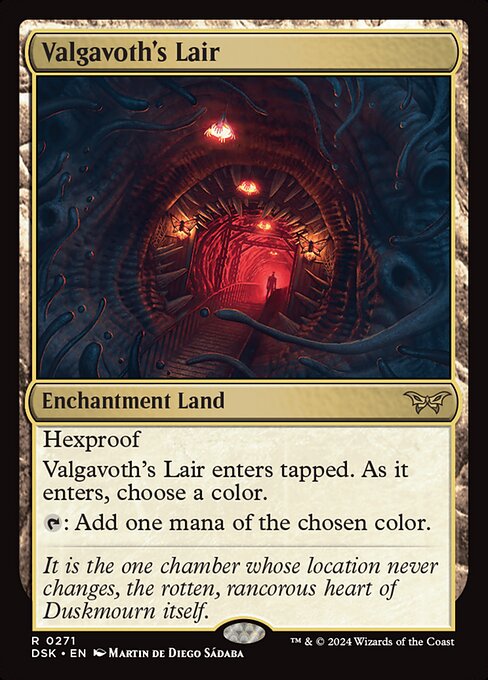
170. Valgavoth's Lair
Rating5.2PlayableWhy this rating?
A solid playable that rarely gets cut (5.2/10).
Why. A utility land: it enters tapped, you choose a color, and it taps for that color. It has hexproof and counts as an enchantment, so it turns on Eerie when it arrives.
Risks. It always enters tapped and makes only one color, chosen once: it is not a real dual land. Hexproof does not save it from enchantment removal that does not target it.
In the draft. A fine last slot in an Eerie deck, otherwise just another land. Do not take it over real playables.
Results in the games of the set
When it is in hand, the deck wins 53.5% of its games (set average: 55.9%, 192nd of 269 cards).
In the opening hand: 54.5% wins (55.0% on average).
Drawn during the game: 52.7% (56.6% on average).
When it is drawn, the deck wins 0.4 points less than when it is not.
When it is drafted, it is played 96% of the time (set average: 62%).
Taken as the first pick (86 drafts), it ends in the deck 95% of the time.
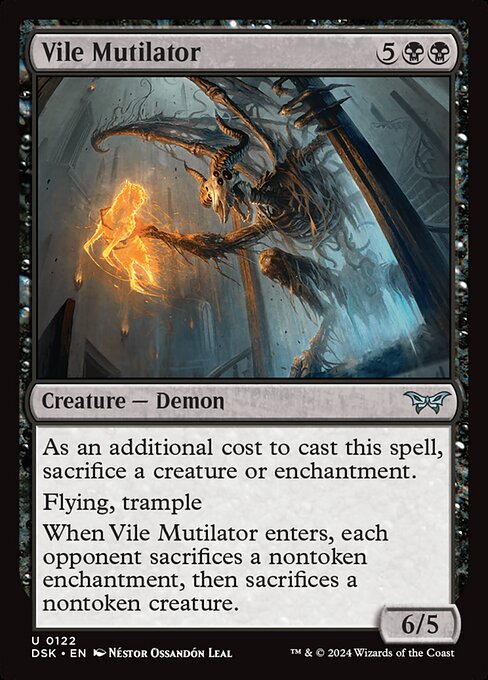
171. Vile Mutilator
Rating5.2PlayableWhy this rating?
A solid playable that rarely gets cut (5.2/10).
Why. A 6/5 with flying and trample whose arrival makes the opponent sacrifice a nontoken enchantment, then a nontoken creature, of their choice. When it lands, the swing is huge.
Risks. Seven mana plus a mandatory sacrifice of a creature or enchantment: slow, and it costs you a permanent too. The opponent picks what to sacrifice and can give up their worst creature.
In the draft. A top end for slower decks. Take one or two if you have fodder for the cost (tokens, small creatures), but do not overpay early.
Results in the games of the set
When it is in hand, the deck wins 55.2% of its games (set average: 55.9%, 133rd of 269 cards).
In the opening hand: 52.3% wins (55.0% on average).
Drawn during the game: 56.9% (56.6% on average).
When it is drawn, the deck wins 3.7 points more than when it is not.
When it is drafted, it is played 76% of the time (set average: 62%).
Taken as the first pick (186 drafts), it ends in the deck 87% of the time.
It is played mostly in B/W decks (42% of them) and B/G (32%).

172. Skullsnap Nuisance
Rating5.1PlayableWhy this rating?
A solid playable that rarely gets cut (5.1/10).
Why. A 1/4 flyer for two, a solid air blocker on turn 2. Through Eerie it surveils 1 whenever an enchantment enters or a Room is unlocked, which smooths your draws.
Risks. It hardly attacks and needs both blue and black early. Without enchantments, the surveil trigger is rare.
In the draft. A decent support piece for a defensive blue-black deck. Outside those two colors, ignore it.
Results in the games of the set
When it is in hand, the deck wins 52.4% of its games (set average: 55.9%, 224th of 269 cards).
In the opening hand: 52.0% wins (55.0% on average).
Drawn during the game: 52.6% (56.6% on average).
When it is drawn, the deck wins 2.8 points more than when it is not.
When it is drafted, it is played 42% of the time (set average: 62%).
Taken as the first pick (48 drafts), it ends in the deck 81% of the time.
It is played mostly in B/U decks (54% of them).

173. Fear of Impostors
Rating5.1PlayableWhy this rating?
A solid playable that rarely gets cut (5.1/10).
Why. A 3/2 with flash that counters a spell on arrival; its controller manifests dread and keeps a face-down 2/2. A flexible answer that also leaves a body, and an enchantment creature.
Risks. Countering the spell gives its controller a 2/2, so the trade is not free. You must keep three mana open, two of them blue, and cast it on the opponent's turn.
In the draft. A fair playable in blue decks that like to act on the opponent's turn. It is best against an expensive spell.
Results in the games of the set
When it is in hand, the deck wins 53.8% of its games (set average: 55.9%, 182nd of 269 cards).
In the opening hand: 51.5% wins (55.0% on average).
Drawn during the game: 55.3% (56.6% on average).
When it is drawn, the deck wins 1.0 points more than when it is not.
When it is drafted, it is played 67% of the time (set average: 62%).
Taken as the first pick (91 drafts), it ends in the deck 80% of the time.
It is played mostly in U/W decks (28% of them) and B/U (26%).

174. Boilerbilges Ripper
Rating5.0PlayableWhy this rating?
A solid playable that rarely gets cut (5.0/10).
Why. A 4/4 for five whose enter trigger can sacrifice another creature or enchantment to deal 2 damage to any target. A good-sized body with an optional small removal.
Risks. The sacrifice is a real card cost, and 2 damage only kills small creatures. With nothing to sacrifice it is a vanilla 4/4 for five.
In the draft. A fair playable for a red deck with tokens or spare enchantments. Take it after removal and better creatures.
Results in the games of the set
When it is in hand, the deck wins 53.2% of its games (set average: 55.9%, 201st of 269 cards).
In the opening hand: 51.1% wins (55.0% on average).
Drawn during the game: 54.5% (56.6% on average).
When it is drawn, the deck wins 0.1 points more than when it is not.
When it is drafted, it is played 19% of the time (set average: 62%).
Taken among the first three picks (73 drafts), it ends in the deck 62% of the time.
It is played mostly in B/R decks (38% of them).

175. Central Elevator // Promising Stairs
Rating5.0PlayableWhy this rating?
A solid playable that rarely gets cut (5.0/10).
Why. A utility Room: the first door searches for another Room and puts it in your hand, the second surveils 1 each upkeep and wins you the game at eight different unlocked door names.
Risks. The win condition is unrealistic in draft and the rest is slow. You need Rooms in your deck, and the first door has no immediate board impact.
In the draft. Only in a blue deck packed with Rooms, where the first door stays a fair card engine. Otherwise leave it.
Results in the games of the set
When it is in hand, the deck wins 52.1% of its games (set average: 55.9%, 227th of 269 cards).
In the opening hand: 47.2% wins (55.0% on average).
Drawn during the game: 54.9% (56.6% on average).
When it is drawn, the deck wins 4.6 points more than when it is not.
When it is drafted, it is played 40% of the time (set average: 62%).
Taken as the first pick (44 drafts), it ends in the deck 66% of the time.
It is played about as much in every archetype.

176. Enduring Tenacity
Rating5.0PlayableWhy this rating?
A solid playable that rarely gets cut (5.0/10).
Why. A 4/3 for four that comes back as an enchantment when it dies, and makes the opponent lose as much life as you gain. It keeps that effect even after dying.
Risks. It needs life gain sources to shine, and the enchantment that returns is not a creature. The double black cost strains your mana.
In the draft. A fair body for a black deck that gains life. Without that, it is an average 4/3 that leaves an enchantment behind.
Results in the games of the set
When it is in hand, the deck wins 51.3% of its games (set average: 55.9%, 239th of 269 cards).
In the opening hand: 47.1% wins (55.0% on average).
Drawn during the game: 53.9% (56.6% on average).
When it is drawn, the deck wins 2.5 points more than when it is not.
When it is drafted, it is played 65% of the time (set average: 62%).
Taken as the first pick (57 drafts), it ends in the deck 68% of the time.
It is played about as much in every archetype.
 Rating5.0Playable
Why this rating?
A solid playable that rarely gets cut (5.0/10).
Why. A 2/2 for four that makes each player discard, then draws you a card if you discarded. Useful in a deck that wants to fill the graveyard for delirium.
Risks. A small body for four mana, and the discard hits the opponent too. If your hand is empty you draw nothing.
In the draft. A playable filler to take late, mostly for decks counting on delirium. The card swap itself is modest.
Results in the games of the set
When it is in hand, the deck wins 55.0% of its games (set average: 55.9%, 140th of 269 cards).
In the opening hand: 53.4% wins (55.0% on average).
Drawn during the game: 56.0% (56.6% on average).
When it is drawn, the deck wins 3.5 points more than when it is not.
When it is drafted, it is played 38% of the time (set average: 62%).
Taken as the first pick (44 drafts), it ends in the deck 82% of the time.
It is played mostly in B/W decks (67% of them) and B/G (33%).

178. Frantic Strength
Rating5.0PlayableWhy this rating?
A solid playable that rarely gets cut (5.0/10).
Why. An Aura with flash that gives +2/+2 and trample. Cast in combat, it wins a trade or kills a blocker with the element of surprise.
Risks. Like any Aura, it risks a two-for-one if the target is removed in response. It does nothing without a creature on the battlefield.
In the draft. A fair trick in an aggressive green deck with plenty of creatures. Do not take it over quality creatures.
Results in the games of the set
When it is in hand, the deck wins 53.7% of its games (set average: 55.9%, 185th of 269 cards).
In the opening hand: 51.4% wins (55.0% on average).
Drawn during the game: 55.3% (56.6% on average).
When it is drawn, the deck wins 1.3 points more than when it is not.
When it is drafted, it is played 21% of the time (set average: 62%).
Taken among the first three picks (53 drafts), it ends in the deck 66% of the time.
It is played mostly in G/W decks (36% of them).

179. Grand Entryway // Elegant Rotunda
Rating5.0PlayableWhy this rating?
A solid playable that rarely gets cut (5.0/10).
Why. A cheap white Room: the first door creates a 1/1 white Glimmer enchantment creature token, the second puts a +1/+1 counter on each of up to two target creatures. Two effects for little mana, and each door triggers Eerie.
Risks. Each effect is modest alone. It loses value with no creatures on board for the second door.
In the draft. A fair playable for white Rooms and enchantment decks, a mid-pack pick. Look for other Rooms and Eerie payoffs.
Results in the games of the set
When it is in hand, the deck wins 54.6% of its games (set average: 55.9%, 154th of 269 cards).
In the opening hand: 52.9% wins (55.0% on average).
Drawn during the game: 55.8% (56.6% on average).
When it is drawn, the deck wins 0.6 points less than when it is not.
When it is drafted, it is played 84% of the time (set average: 62%).
Taken as the first pick (344 drafts), it ends in the deck 92% of the time.
It is played mostly in U/W decks (58% of them) and G/W (57%).
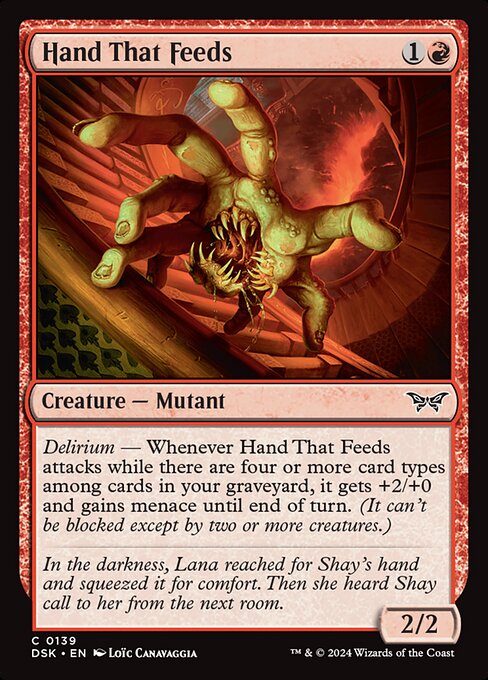
180. Hand That Feeds
Rating5.0PlayableWhy this rating?
A solid playable that rarely gets cut (5.0/10).
Why. A 2/2 for two that becomes a 4/2 with menace when attacking if your graveyard holds four card types. A good aggressive start once delirium is on.
Risks. Delirium comes late, and without it this is a plain 2/2. It dies to any blocker or removal.
In the draft. A playable two-drop for an aggressive red deck. Better with spells of varied types and ways to fill the graveyard.
Results in the games of the set
When it is in hand, the deck wins 54.7% of its games (set average: 55.9%, 148th of 269 cards).
In the opening hand: 54.3% wins (55.0% on average).
Drawn during the game: 55.1% (56.6% on average).
When it is drawn, the deck wins 0.5 points less than when it is not.
When it is drafted, it is played 72% of the time (set average: 62%).
Taken as the first pick (157 drafts), it ends in the deck 91% of the time.
It is played mostly in G/R decks (66% of them) and B/R (63%).
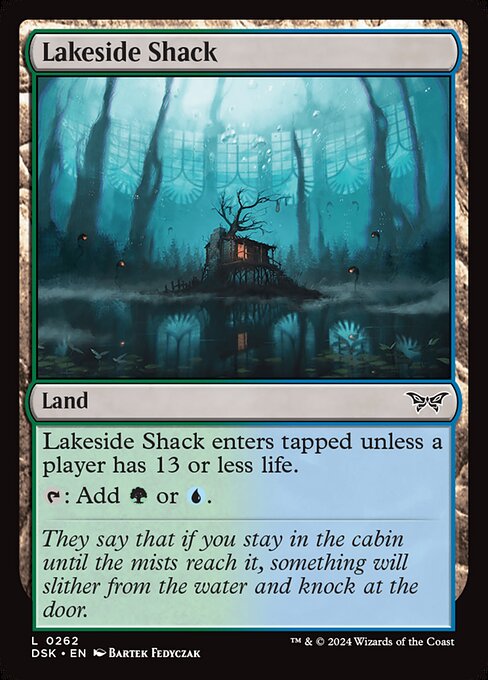
181. Lakeside Shack
Rating5.0PlayableWhy this rating?
A solid playable that rarely gets cut (5.0/10).
Why. A green-blue dual land that enters untapped if a player has 13 or less life. It fixes your mana without taking a playable slot.
Risks. It enters tapped early in the game, when tempo matters. It adds no effect.
In the draft. A late pick for a green-blue deck, free fixing. Never over a good playable.
Results in the games of the set
When it is in hand, the deck wins 55.3% of its games (set average: 55.9%, 123rd of 269 cards).
In the opening hand: 56.2% wins (55.0% on average).
Drawn during the game: 54.7% (56.6% on average).
When it is drawn, the deck wins 1.0 points more than when it is not.
When it is drafted, it is played 64% of the time (set average: 62%).
Taken as the first pick (55 drafts), it ends in the deck 80% of the time.
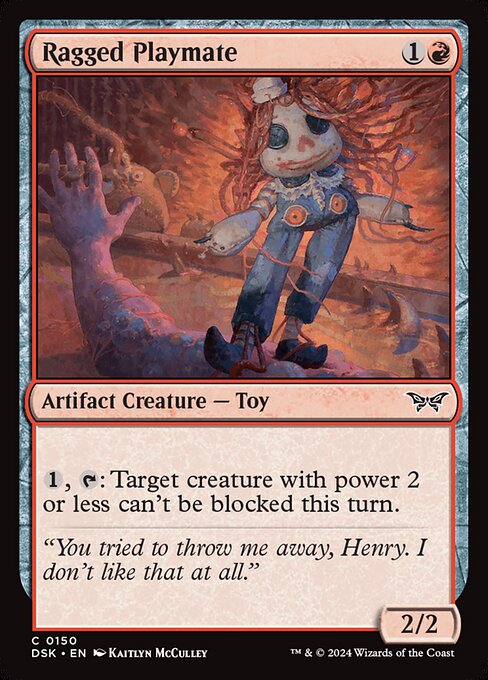
182. Ragged Playmate
Rating5.0PlayableWhy this rating?
A solid playable that rarely gets cut (5.0/10).
Why. A 2/2 for two that makes a creature with power 2 or less unblockable this turn, for one mana. It turns a small ally into an evasive attacker in an aggro deck.
Risks. It must tap to act, so it does not attack the same turn, and its own attacks never benefit from its ability. It does nothing for big creatures.
In the draft. A fair two-drop for an aggressive red deck with lots of small creatures. Look for a plan built on small attackers.
Results in the games of the set
When it is in hand, the deck wins 54.6% of its games (set average: 55.9%, 153rd of 269 cards).
In the opening hand: 54.7% wins (55.0% on average).
Drawn during the game: 54.5% (56.6% on average).
When it is drawn, the deck wins 1.7 points less than when it is not.
When it is drafted, it is played 63% of the time (set average: 62%).
Taken as the first pick (86 drafts), it ends in the deck 80% of the time.
It is played mostly in R/W decks (73% of them) and B/R (56%).

183. Stalked Researcher
Rating5.0PlayableWhy this rating?
A solid playable that rarely gets cut (5.0/10).
Why. A 3/3 for two, a good early blocker. Eerie lets it attack this turn whenever an enchantment enters or you fully unlock a Room.
Risks. It has defender: without enchantments it only defends. Attacking depends on your enchantments.
In the draft. A good defensive two-drop for a blue Rooms and enchantments deck. Outside that theme it stays fine but passive.
Results in the games of the set
When it is in hand, the deck wins 54.1% of its games (set average: 55.9%, 173rd of 269 cards).
In the opening hand: 54.0% wins (55.0% on average).
Drawn during the game: 54.1% (56.6% on average).
When it is drawn, the deck wins 0.5 points more than when it is not.
When it is drafted, it is played 59% of the time (set average: 62%).
Taken as the first pick (68 drafts), it ends in the deck 88% of the time.
It is played mostly in U/W decks (57% of them) and R/U (55%).
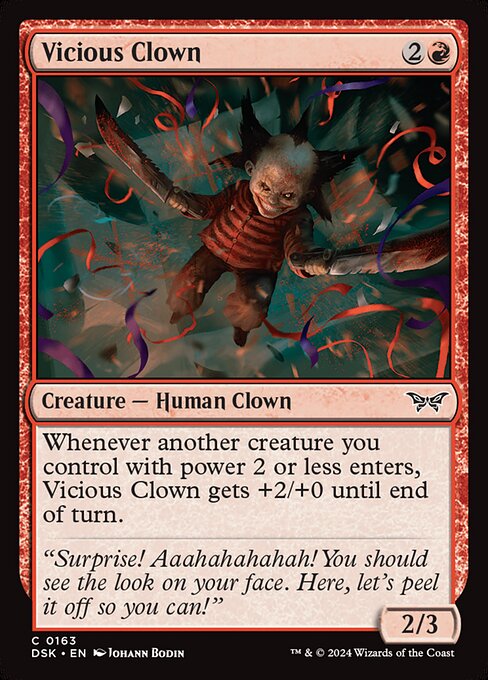
184. Vicious Clown
Rating5.0PlayableWhy this rating?
A solid playable that rarely gets cut (5.0/10).
Why. A 2/3 for three that gets +2/+0 whenever another creature with power 2 or less enters under your control. Ideal in a deck full of small creatures and tokens.
Risks. The bonus lasts only until end of turn and depends on your own creatures. Alone, it is a 2/3 with no impact.
In the draft. Fine in an aggressive red deck of small creatures. Take it after removal and the best creatures.
Results in the games of the set
When it is in hand, the deck wins 53.4% of its games (set average: 55.9%, 195th of 269 cards).
In the opening hand: 53.7% wins (55.0% on average).
Drawn during the game: 53.2% (56.6% on average).
When it is drawn, the deck wins 2.5 points less than when it is not.
When it is drafted, it is played 45% of the time (set average: 62%).
Taken as the first pick (46 drafts), it ends in the deck 83% of the time.
It is played mostly in R/W decks (65% of them) and B/R (28%).
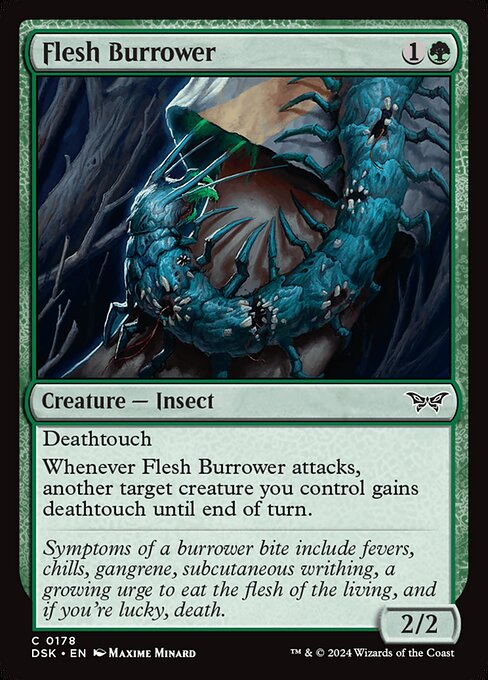
185. Flesh Burrower
Rating5.0WeakWhy this rating?
A solid playable that rarely gets cut (5.0/10).
Why. A 2/2 deathtouch for two that gives another creature deathtouch when it attacks. It discourages blocks and lets you attack with a big creature without fear.
Risks. It is small and dies to almost anything. Its bonus needs another creature to matter.
In the draft. A solid two-drop for any green deck, especially with big creatures. A good mid-pack pick.
Results in the games of the set
When it is in hand, the deck wins 54.4% of its games (set average: 55.9%, 158th of 269 cards).
In the opening hand: 54.0% wins (55.0% on average).
Drawn during the game: 54.7% (56.6% on average).
When it is drawn, the deck wins 0.9 points more than when it is not.
When it is drafted, it is played 76% of the time (set average: 62%).
Taken as the first pick (146 drafts), it ends in the deck 89% of the time.
It is played mostly in B/G decks (79% of them) and G/W (61%).

186. Ripchain Razorkin
Rating4.9WeakWhy this rating?
A solid playable that rarely gets cut (4.9/10).
Why. A 5/3 with reach for four, a big body that blocks flyers. Its ability lets you sacrifice a land to draw when you are flooding.
Risks. Three toughness makes it fragile, and sacrificing a land costs tempo. A deck short on lands will not use it.
In the draft. A fair playable for a red deck, not a priority. Mostly useful against flyers.
Results in the games of the set
When it is in hand, the deck wins 52.8% of its games (set average: 55.9%, 214th of 269 cards).
In the opening hand: 50.5% wins (55.0% on average).
Drawn during the game: 54.4% (56.6% on average).
When it is drawn, the deck wins 0.3 points less than when it is not.
When it is drafted, it is played 18% of the time (set average: 62%).
Taken among the first three picks (66 drafts), it ends in the deck 48% of the time.

187. Enter the Enigma
Rating4.8WeakWhy this rating?
A solid playable that rarely gets cut (4.8/10).
Why. A one-mana sorcery that makes a creature unblockable this turn, then draws a card. It replaces itself and can close out a game.
Risks. It has no lasting effect and only works in a very aggressive deck. On defense it just draws a card.
In the draft. A marginal playable. Take it only late for an aggressive blue deck.
Results in the games of the set
When it is in hand, the deck wins 50.5% of its games (set average: 55.9%, 251st of 269 cards).
In the opening hand: 46.2% wins (55.0% on average).
Drawn during the game: 53.2% (56.6% on average).
When it is drawn, the deck wins 0.1 points less than when it is not.
When it is drafted, it is played only 7% of the time (set average: 62%): it almost always ends in the sideboard.
Taken among the first three picks (30 drafts), it ends in the deck 47% of the time.

188. Abandoned Campground
Rating4.8WeakWhy this rating?
A solid playable that rarely gets cut (4.8/10).
Why. A white-blue dual land that enters untapped if a player has 13 or less life. It fixes your mana without using a playable slot.
Risks. It enters tapped early, when tempo matters. It adds no effect.
In the draft. A late pick for a white-blue deck, free fixing. Never over a good playable.
Results in the games of the set
When it is in hand, the deck wins 55.0% of its games (set average: 55.9%, 138th of 269 cards).
In the opening hand: 56.3% wins (55.0% on average).
Drawn during the game: 54.0% (56.6% on average).
When it is drawn, the deck wins 0.2 points more than when it is not.
When it is drafted, it is played 65% of the time (set average: 62%).
Taken as the first pick (47 drafts), it ends in the deck 81% of the time.
 Rating4.8Weak
Why this rating?
A solid playable that rarely gets cut (4.8/10).
Why. A 2/2 for two that gets a flying counter, once, if it is tapped at the beginning of your second main phase. It becomes an aerial attacker after a single attack.
Risks. It must attack and survive once to get flying, which is risky against blockers. A 2/2 without flying stays weak.
In the draft. A fair two-drop for an aggressive white deck. Better if you can protect that first attack.
Results in the games of the set
When it is in hand, the deck wins 53.4% of its games (set average: 55.9%, 194th of 269 cards).
In the opening hand: 54.4% wins (55.0% on average).
Drawn during the game: 52.6% (56.6% on average).
When it is drawn, the deck wins 1.4 points less than when it is not.
When it is drafted, it is played 67% of the time (set average: 62%).
Taken as the first pick (113 drafts), it ends in the deck 86% of the time.
It is played mostly in R/W decks (67% of them) and G/W (59%).
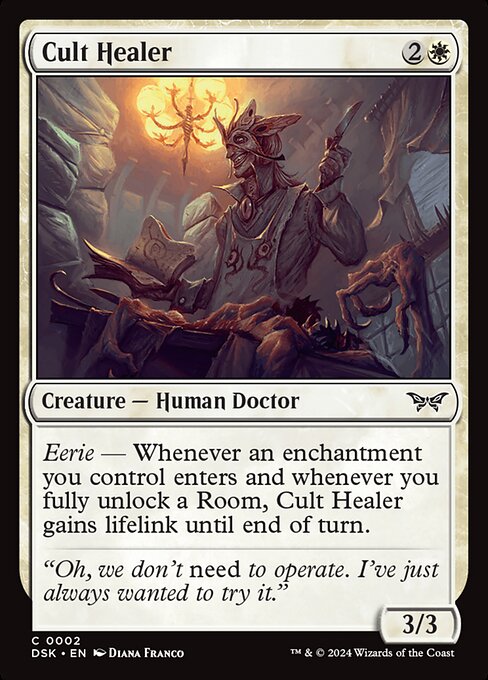
190. Cult Healer
Rating4.8WeakWhy this rating?
A solid playable that rarely gets cut (4.8/10).
Why. A 3/3 for three that gains lifelink until end of turn through Eerie. A good body for the price, with a small bonus in an enchantment deck.
Risks. Without enchantments it is a vanilla 3/3. The lifelink rarely turns on.
In the draft. A solid playable for a white Rooms deck. Take it as a filler, not a priority.
Results in the games of the set
When it is in hand, the deck wins 53.1% of its games (set average: 55.9%, 202nd of 269 cards).
In the opening hand: 52.9% wins (55.0% on average).
Drawn during the game: 53.3% (56.6% on average).
When it is drawn, the deck wins 0.8 points less than when it is not.
When it is drafted, it is played 38% of the time (set average: 62%).
Taken among the first three picks (205 drafts), it ends in the deck 69% of the time.
It is played mostly in U/W decks (37% of them) and B/W (31%).

191. Diversion Specialist
Rating4.8WeakWhy this rating?
A solid playable that rarely gets cut (4.8/10).
Why. A 4/3 with menace for four, hard to block. Its ability sacrifices a creature or enchantment to exile the top card and play it this turn, giving value to tokens and doomed creatures.
Risks. The sacrifice is a real cost, and the exiled card is lost if you cannot play it this turn. A 4/3 is fragile against removal.
In the draft. A fair playable for a red deck with tokens. A mid-pack pick.
Results in the games of the set
When it is in hand, the deck wins 53.3% of its games (set average: 55.9%, 199th of 269 cards).
In the opening hand: 51.6% wins (55.0% on average).
Drawn during the game: 54.4% (56.6% on average).
When it is drawn, the deck wins 0.6 points less than when it is not.
When it is drafted, it is played 62% of the time (set average: 62%).
Taken as the first pick (109 drafts), it ends in the deck 87% of the time.
It is played mostly in B/R decks (32% of them).

192. Fear of Exposure
Rating4.8WeakWhy this rating?
A solid playable that rarely gets cut (4.8/10).
Why. A 5/4 with trample for three: huge size for the price that dominates the early game if you can pay the cost.
Risks. The additional cost taps two untapped creatures and/or lands on top of the three mana: impossible on turn 3 without a creature. It costs a lot of tempo.
In the draft. A good body for a green deck that can cast it without slowing down too much. Better later, once you have more lands.
Results in the games of the set
When it is in hand, the deck wins 52.8% of its games (set average: 55.9%, 215th of 269 cards).
In the opening hand: 51.5% wins (55.0% on average).
Drawn during the game: 53.7% (56.6% on average).
When it is drawn, the deck wins 1.1 points less than when it is not.
When it is drafted, it is played 83% of the time (set average: 62%).
Taken as the first pick (143 drafts), it ends in the deck 94% of the time.
It is played mostly in G/W decks (34% of them).

193. Fear of Immobility
Rating4.8WeakWhy this rating?
A solid playable that rarely gets cut (4.8/10).
Why. A 4/4 for five whose enter trigger taps a target creature and, if an opponent controls it, puts a stun counter on it. It can neither block this turn nor attack on its next turn: a small respite on a good body.
Risks. It only buys time: the creature comes back later. Five mana is a lot for a 4/4 with no evasion.
In the draft. A fair playable for any white deck, especially a tempo deck. A mid-curve filler.
Results in the games of the set
When it is in hand, the deck wins 55.0% of its games (set average: 55.9%, 139th of 269 cards).
In the opening hand: 52.8% wins (55.0% on average).
Drawn during the game: 56.4% (56.6% on average).
When it is drawn, the deck wins 0.3 points more than when it is not.
When it is drafted, it is played 60% of the time (set average: 62%).
Taken as the first pick (65 drafts), it ends in the deck 80% of the time.
It is played mostly in U/W decks (51% of them) and G/W (44%).

194. Ghostly Keybearer
Rating4.8WeakWhy this rating?
A solid playable that rarely gets cut (4.8/10).
Why. A 3/3 flyer for four, a decent aerial attacker. When it deals combat damage to a player, it unlocks a locked door of a Room you control.
Risks. Its effect needs a half-locked Room, so a dedicated deck. It dies to ordinary removal and the body stays simple.
In the draft. A fair playable for any blue deck, with a bonus if you have Rooms. A mid-pack pick.
Results in the games of the set
When it is in hand, the deck wins 52.9% of its games (set average: 55.9%, 209th of 269 cards).
In the opening hand: 50.2% wins (55.0% on average).
Drawn during the game: 54.6% (56.6% on average).
When it is drawn, the deck wins 1.8 points more than when it is not.
When it is drafted, it is played 70% of the time (set average: 62%).
Taken as the first pick (136 drafts), it ends in the deck 79% of the time.
It is played mostly in R/U decks (35% of them) and U/W (28%).

195. Meat Locker // Drowned Diner
Rating4.8WeakWhy this rating?
A solid playable that rarely gets cut (4.8/10).
Why. A two-purpose blue Room: the first door taps a creature and puts two stun counters on it, buying several turns; the second draws three cards, then discards one. Each door triggers Eerie.
Risks. It is not permanent removal, and both doors are slow. Getting the draw afterwards costs five mana.
In the draft. A fair card for a blue tempo or Rooms deck. Take it for control and value, but not too high.
Results in the games of the set
When it is in hand, the deck wins 55.4% of its games (set average: 55.9%, 119th of 269 cards).
In the opening hand: 51.2% wins (55.0% on average).
Drawn during the game: 58.2% (56.6% on average).
When it is drawn, the deck wins 2.7 points more than when it is not.
When it is drafted, it is played 83% of the time (set average: 62%).
Taken as the first pick (321 drafts), it ends in the deck 93% of the time.
It is played mostly in B/U decks (68% of them) and R/U (66%).
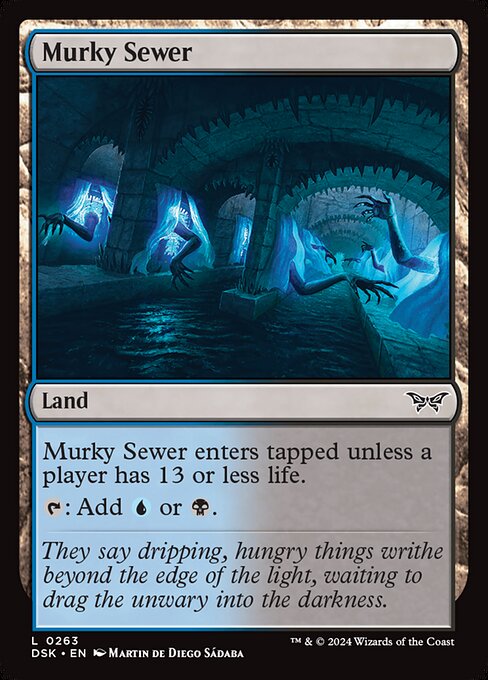
196. Murky Sewer
Rating4.8WeakWhy this rating?
A solid playable that rarely gets cut (4.8/10).
Why. A blue-black dual land that enters untapped if a player has 13 or less life. It fixes your mana without using a playable slot.
Risks. It enters tapped early, when tempo matters. It adds no effect.
In the draft. A late pick for a blue-black deck, free fixing. Never over a good playable.
Results in the games of the set
When it is in hand, the deck wins 54.0% of its games (set average: 55.9%, 175th of 269 cards).
In the opening hand: 54.1% wins (55.0% on average).
Drawn during the game: 53.9% (56.6% on average).
When it is drawn, the deck wins 2.1 points more than when it is not.
When it is drafted, it is played 51% of the time (set average: 62%).
Taken as the first pick (53 drafts), it ends in the deck 81% of the time.
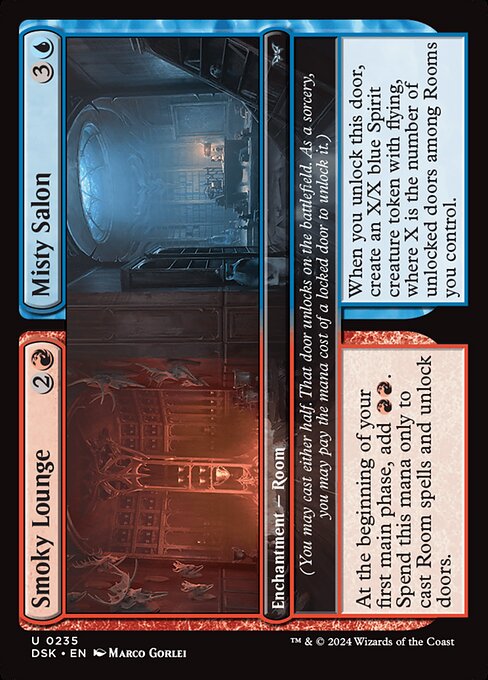
197. Smoky Lounge // Misty Salon
Rating4.8WeakWhy this rating?
A solid playable that rarely gets cut (4.8/10).
Why. A red-blue Room: the first door adds two red mana at the beginning of your first main phase, spendable only on Room spells and unlocking doors; the second creates an X/X blue Spirit creature token with flying, X being the number of unlocked doors among your Rooms. An engine for a Rooms deck if everything lines up.
Risks. It needs two colors and many Rooms to run. Without other Rooms the mana is wasted and the Spirit stays small.
In the draft. Only in a blue-red Rooms deck. Otherwise skip it: too dependent on its theme.
Results in the games of the set
When it is in hand, the deck wins 53.4% of its games (set average: 55.9%, 197th of 269 cards).
In the opening hand: 50.2% wins (55.0% on average).
Drawn during the game: 55.4% (56.6% on average).
When it is drawn, the deck wins 5.7 points more than when it is not.
When it is drafted, it is played 49% of the time (set average: 62%).
Taken as the first pick (122 drafts), it ends in the deck 82% of the time.
It is played mostly in R/U decks (77% of them).

198. Terramorphic Expanse
Rating4.8WeakWhy this rating?
A solid playable that rarely gets cut (4.8/10).
Why. A fixing land: it sacrifices itself to fetch a basic land that enters tapped, then shuffles. It helps you play two colors or splash a third.
Risks. It costs tempo, since the basic enters tapped, and adds no effect. It also fills the graveyard, but only with a land.
In the draft. An acceptable land in any deck with two or more colors. Take it late in a pack, without making it a priority.
Results in the games of the set
When it is in hand, the deck wins 55.3% of its games (set average: 55.9%, 124th of 269 cards).
In the opening hand: 56.7% wins (55.0% on average).
Drawn during the game: 54.2% (56.6% on average).
When it is drawn, the deck wins 0.7 points more than when it is not.
When it is drafted, it is played 96% of the time (set average: 62%).
Taken as the first pick (358 drafts), it ends in the deck 99% of the time.

199. Raucous Carnival
Rating4.7WeakWhy this rating?
A solid playable that rarely gets cut (4.7/10).
Why. A red-white dual land that enters untapped if a player has 13 or less life. It fixes your mana without using a playable slot.
Risks. It enters tapped early, when tempo matters. It adds no effect.
In the draft. A late pick for a red-white deck, free fixing. Never over a good playable.
Results in the games of the set
When it is in hand, the deck wins 53.9% of its games (set average: 55.9%, 177th of 269 cards).
In the opening hand: 55.5% wins (55.0% on average).
Drawn during the game: 52.7% (56.6% on average).
When it is drawn, the deck wins 1.5 points less than when it is not.
When it is drafted, it is played 56% of the time (set average: 62%).
Taken as the first pick (45 drafts), it ends in the deck 71% of the time.
 Rating4.7Weak
Why this rating?
A solid playable that rarely gets cut (4.7/10).
Why. A five-mana sorcery that returns a creature card from your graveyard to the battlefield and gains you 3 life. It is best when your best creature has died.
Risks. It does nothing without a creature in the graveyard, and it is slow. The creature's enter triggers fire again, but it kills nothing.
In the draft. A top-end playable for a white deck that trades a lot of creatures. Take it late in a pack.
Results in the games of the set
When it is in hand, the deck wins 54.4% of its games (set average: 55.9%, 159th of 269 cards).
In the opening hand: 50.6% wins (55.0% on average).
Drawn during the game: 56.6% (56.6% on average).
When it is drawn, the deck wins 4.1 points more than when it is not.
When it is drafted, it is played 38% of the time (set average: 62%).
Taken as the first pick (64 drafts), it ends in the deck 84% of the time.
It is played mostly in B/W decks (76% of them).

201. Grasping Longneck
Rating4.6WeakWhy this rating?
A solid playable that rarely gets cut (4.6/10).
Why. A 4/2 for three mana with reach: it hits hard and walls off fliers. When it dies you gain 2 life, which softens the trade.
Risks. Only two toughness, so any small blocker or damage spell takes it down. It trades honestly and does nothing more.
In the draft. Fine filler for a green deck that wants curve and an answer to fliers. Take it after your removal and your better creatures.
Results in the games of the set
When it is in hand, the deck wins 53.5% of its games (set average: 55.9%, 190th of 269 cards).
In the opening hand: 52.4% wins (55.0% on average).
Drawn during the game: 54.4% (56.6% on average).
When it is drawn, the deck wins 0.2 points less than when it is not.
When it is drafted, it is played 50% of the time (set average: 62%).
Taken as the first pick (36 drafts), it ends in the deck 86% of the time.
It is played mostly in B/G decks (39% of them) and G/R (35%).
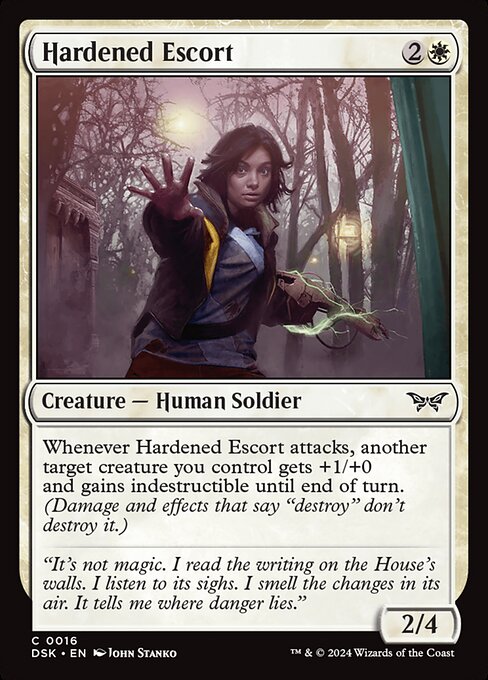
202. Hardened Escort
Rating4.6WeakWhy this rating?
A solid playable that rarely gets cut (4.6/10).
Why. A sturdy 2/4 that, when it attacks, gives another creature +1/+0 and indestructible. In an aggressive deck it lets your best attacker run into blockers without fear of dying in combat.
Risks. It does nothing alone: you need another creature to protect. Indestructible does not stop exile or sacrifice, and the Escort itself is exposed when it attacks with just 2 power.
In the draft. A good support piece for an aggressive white deck, especially with red. Take it in the middle of the pack, after removal and stronger creatures.
Results in the games of the set
When it is in hand, the deck wins 53.9% of its games (set average: 55.9%, 178th of 269 cards).
In the opening hand: 54.4% wins (55.0% on average).
Drawn during the game: 53.5% (56.6% on average).
When it is drawn, the deck wins 0.6 points less than when it is not.
When it is drafted, it is played 46% of the time (set average: 62%).
Taken as the first pick (38 drafts), it ends in the deck 87% of the time.
It is played mostly in R/W decks (53% of them) and G/W (52%).

203. Keys to the House
Rating4.6WeakWhy this rating?
A solid playable that rarely gets cut (4.6/10).
Why. A one-mana artifact that, for one more mana, sacrifices itself to put a basic land in your hand: light fixing and insurance against missing land drops. Its second mode locks or unlocks a door of a Room you control for three mana, at sorcery speed only.
Risks. It has no impact on the battlefield and costs tempo for a modest result. Without Rooms in your deck the second mode is dead.
In the draft. A late-pack pick, playable mainly in a multicolour deck or one with many Rooms. A normal deck wants a real action card instead.
Results in the games of the set
When it is in hand, the deck wins 51.3% of its games (set average: 55.9%, 236th of 269 cards).
In the opening hand: 50.5% wins (55.0% on average).
Drawn during the game: 51.9% (56.6% on average).
When it is drawn, the deck wins 0.9 points less than when it is not.
When it is drafted, it is played 44% of the time (set average: 62%).
Taken among the first three picks (128 drafts), it ends in the deck 67% of the time.
It is played about as much in every archetype.

204. Killer's Mask
Rating4.6WeakWhy this rating?
A solid playable that rarely gets cut (4.6/10).
Why. It brings a body immediately: manifest dread makes a face-down 2/2 and the Equipment attaches to it, granting menace. Afterwards the mask stays around and can give menace to another creature.
Risks. Three mana for a 2/2 with menace is inefficient, and moving the Equipment costs two more. If the creature dies you are left with a modest accessory.
In the draft. Playable in black when you are short on creatures. Do not take it over removal or good creatures.
Results in the games of the set
When it is in hand, the deck wins 51.5% of its games (set average: 55.9%, 235th of 269 cards).
In the opening hand: 50.3% wins (55.0% on average).
Drawn during the game: 52.3% (56.6% on average).
When it is drawn, the deck wins 0.2 points more than when it is not.
When it is drafted, it is played 29% of the time (set average: 62%).
Taken among the first three picks (96 drafts), it ends in the deck 61% of the time.

205. Most Valuable Slayer
Rating4.6WeakWhy this rating?
A solid playable that rarely gets cut (4.6/10).
Why. A 2/4 that, whenever you attack, gives an attacking creature +1/+0 and first strike. In a deck that attacks a lot it wins combats and makes every block awkward for the opponent.
Risks. It is not threatening on its own, and its effect needs at least one attacker: with no attack plan it is just a wall. Four mana is a lot for a 2/4.
In the draft. A passable common for aggressive decks, especially red-white. Take it at a late pick, once your removal and better creatures are secured.
Results in the games of the set
When it is in hand, the deck wins 54.7% of its games (set average: 55.9%, 149th of 269 cards).
In the opening hand: 53.7% wins (55.0% on average).
Drawn during the game: 55.4% (56.6% on average).
When it is drawn, the deck wins 0.4 points less than when it is not.
When it is drafted, it is played 79% of the time (set average: 62%).
Taken as the first pick (247 drafts), it ends in the deck 94% of the time.
It is played mostly in B/R decks (75% of them) and G/R (73%).

206. Possessed Goat
Rating4.6WeakWhy this rating?
A solid playable that rarely gets cut (4.6/10).
Why. A one-mana 1/1 that becomes a 4/4 for three mana and a discarded card. It is a flexible late-game threat and a way to turn an extra land into a big body.
Risks. The transformation costs you a card, and the Goat is fragile before then: a 1/1 dies to anything. The ability works only once.
In the draft. Late-pack filler. Playable in a low-curve white deck, rarely a card to look for.
Results in the games of the set
When it is in hand, the deck wins 52.3% of its games (set average: 55.9%, 226th of 269 cards).
In the opening hand: 53.0% wins (55.0% on average).
Drawn during the game: 51.7% (56.6% on average).
When it is drawn, the deck wins 1.0 points more than when it is not.
When it is drafted, it is played 21% of the time (set average: 62%).
Taken among the first three picks (90 drafts), it ends in the deck 71% of the time.
It is played mostly in B/W decks (50% of them).

207. Scrabbling Skullcrab
Rating4.6WeakWhy this rating?
A solid playable that rarely gets cut (4.6/10).
Why. A one-mana 0/3 that blocks small creatures and, on each Eerie trigger, puts the top two cards of a player's library into their graveyard. It is a niche deck tool, not an efficient card on its own.
Risks. Without many enchantments or Rooms it almost never triggers, and even then it does not win the game. With 0 power it cannot attack.
In the draft. Let it go, except in a blue-white deck built around enchantments, and even then late in the pack.
Results in the games of the set
When it is in hand, the deck wins 51.8% of its games (set average: 55.9%, 230th of 269 cards).
In the opening hand: 50.7% wins (55.0% on average).
Drawn during the game: 52.5% (56.6% on average).
When it is drawn, the deck wins 1.4 points more than when it is not.
When it is drafted, it is played 59% of the time (set average: 62%).
Taken as the first pick (107 drafts), it ends in the deck 75% of the time.
It is played about as much in every archetype.

208. Underwater Tunnel // Slimy Aquarium
Rating4.6WeakWhy this rating?
A solid playable that rarely gets cut (4.6/10).
Why. A two-faced Room: the first door, for a single mana, surveils 2; the second, at four mana, manifests dread and adds a +1/+1 counter, making a face-down 3/3. Two effects on one card, plus an enchantment that triggers Eerie.
Risks. Each half is modest alone, and paying for both takes a lot of mana overall. While face down, the 3/3 has no abilities.
In the draft. A decent common to play in blue, especially with white. Take it mid to late in the pack: it fills the curve at two points of the game.
Results in the games of the set
When it is in hand, the deck wins 54.8% of its games (set average: 55.9%, 145th of 269 cards).
In the opening hand: 52.9% wins (55.0% on average).
Drawn during the game: 56.0% (56.6% on average).
When it is drawn, the deck wins 1.5 points more than when it is not.
When it is drafted, it is played 79% of the time (set average: 62%).
Taken as the first pick (158 drafts), it ends in the deck 94% of the time.
It is played mostly in R/U decks (62% of them) and G/U (56%).
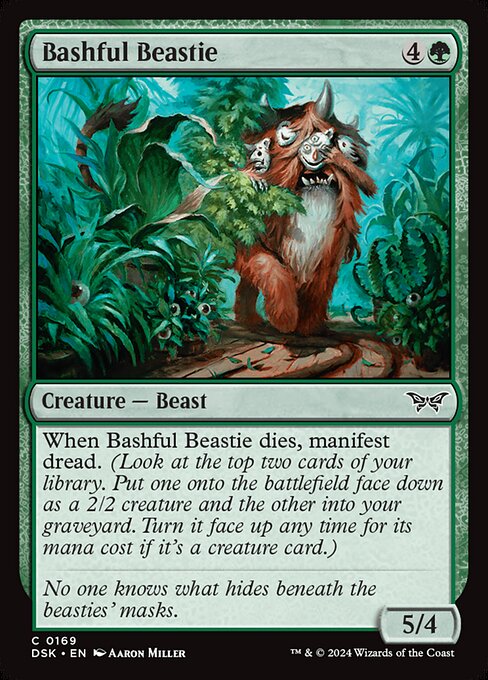
209. Bashful Beastie
Rating4.6WeakWhy this rating?
A solid playable that rarely gets cut (4.6/10).
Why. A 5/4 for five that leaves a face-down 2/2 behind (manifest dread) when it dies. It demands removal or an expensive trade, and even then it leaves a body.
Risks. No evasion, and five mana is a real cost. An exile effect denies you the value on death.
In the draft. A solid mid-curve creature for green. Take it after your removal; one or two copies are enough.
Results in the games of the set
When it is in hand, the deck wins 55.1% of its games (set average: 55.9%, 135th of 269 cards).
In the opening hand: 53.4% wins (55.0% on average).
Drawn during the game: 56.2% (56.6% on average).
When it is drawn, the deck wins 1.0 points more than when it is not.
When it is drafted, it is played 74% of the time (set average: 62%).
Taken as the first pick (107 drafts), it ends in the deck 88% of the time.
It is played mostly in G/U decks (64% of them) and B/G (56%).

210. Baseball Bat
Rating4.5WeakWhy this rating?
A solid playable that rarely gets cut (4.5/10).
Why. It attaches for free when it enters, gives +1/+1 and, whenever the carrier attacks, taps a target creature, which removes an opposing blocker. For two mana it is a recurring tempo effect.
Risks. It needs exactly green and white, and re-equipping costs three. It adds little if the carrier cannot attack without dying.
In the draft. Take it only if you are already green-white and want aggression. Mid to late pack.
Results in the games of the set
When it is in hand, the deck wins 51.0% of its games (set average: 55.9%, 245th of 269 cards).
In the opening hand: 49.0% wins (55.0% on average).
Drawn during the game: 52.5% (56.6% on average).
When it is drawn, the deck wins 0.1 points more than when it is not.
When it is drafted, it is played 36% of the time (set average: 62%).
Taken as the first pick (42 drafts), it ends in the deck 76% of the time.
It is played mostly in G/W decks (57% of them).
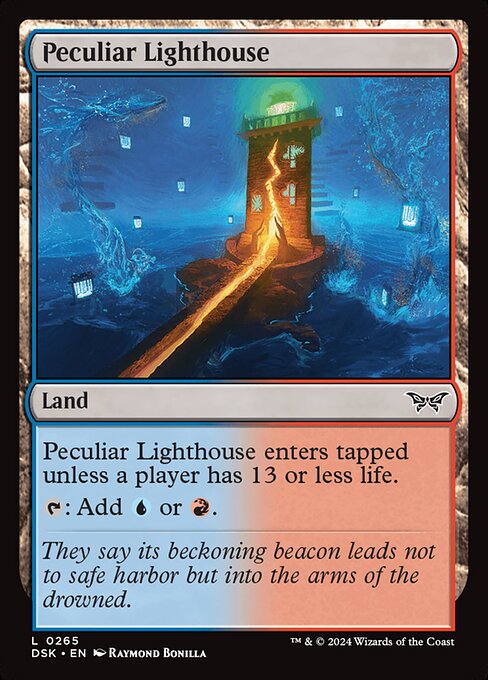
211. Peculiar Lighthouse
Rating4.4WeakWhy this rating?
A good playable, but is sometimes cut (4.4/10).
Why. A blue-red land that enters untapped if a player has 13 or less life, tapped otherwise. It fixes those two colours and does nothing else.
Risks. Early in the game it enters tapped, costing tempo on your curve. It does nothing beyond being a two-colour land.
In the draft. Pick it late, once you are blue-red. Never prefer it to a playable spell.
Results in the games of the set
When it is in hand, the deck wins 53.8% of its games (set average: 55.9%, 179th of 269 cards).
In the opening hand: 54.3% wins (55.0% on average).
Drawn during the game: 53.5% (56.6% on average).
When it is drawn, the deck wins 1.5 points more than when it is not.
When it is drafted, it is played 48% of the time (set average: 62%).
Taken as the first pick (35 drafts), it ends in the deck 86% of the time.
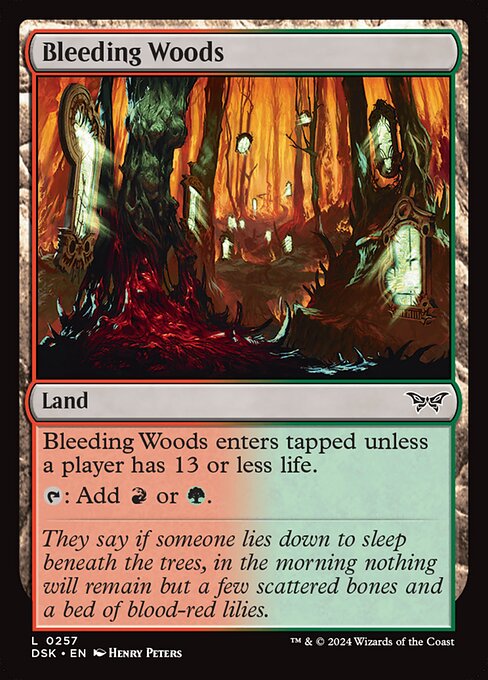
212. Bleeding Woods
Rating4.4WeakWhy this rating?
A good playable, but is sometimes cut (4.4/10).
Why. A red-green land that enters untapped if a player has 13 or less life, tapped otherwise. It fixes those two colours and does nothing else.
Risks. Early in the game it enters tapped, costing tempo. It does nothing beyond being a two-colour land.
In the draft. Pick it late, once you are red-green. Do not prefer it to a playable spell.
Results in the games of the set
When it is in hand, the deck wins 53.7% of its games (set average: 55.9%, 183rd of 269 cards).
In the opening hand: 54.7% wins (55.0% on average).
Drawn during the game: 52.9% (56.6% on average).
When it is drawn, the deck wins 1.0 points less than when it is not.
When it is drafted, it is played 62% of the time (set average: 62%).
Taken as the first pick (45 drafts), it ends in the deck 82% of the time.

213. Cracked Skull
Rating4.4WeakWhy this rating?
A good playable, but is sometimes cut (4.4/10).
Why. First it is a targeted discard: you look at a player's hand and choose a nonland card. After that, the enchanted creature is destroyed as soon as it is dealt damage. On an opposing creature it is slow removal that turns any damage into destruction.
Risks. You need a separate source of damage, otherwise it only discards. On an opposing creature it does nothing until something hurts it.
In the draft. Playable in black if you have ways to deal damage. Mid to late pack, never over real removal.
Results in the games of the set
When it is in hand, the deck wins 52.3% of its games (set average: 55.9%, 225th of 269 cards).
In the opening hand: 50.1% wins (55.0% on average).
Drawn during the game: 53.7% (56.6% on average).
When it is drawn, the deck wins 1.4 points more than when it is not.
When it is drafted, it is played 18% of the time (set average: 62%).
Taken among the first three picks (68 drafts), it ends in the deck 60% of the time.

214. Dashing Bloodsucker
Rating4.4WeakWhy this rating?
A good playable, but is sometimes cut (4.4/10).
Why. A 2/5 that blocks well and, on each Eerie trigger, gets +2/+0 and lifelink for the turn. In a deck full of enchantments or Rooms it attacks and gains life.
Risks. Without enchantments it is a vanilla-ish 2/5 for four mana. The bonus lasts only one turn.
In the draft. Playable in black in a Rooms or enchantment deck. Otherwise a late-pack pick.
Results in the games of the set
When it is in hand, the deck wins 52.6% of its games (set average: 55.9%, 218th of 269 cards).
In the opening hand: 51.4% wins (55.0% on average).
Drawn during the game: 53.3% (56.6% on average).
When it is drawn, the deck wins 3.1 points more than when it is not.
When it is drafted, it is played 50% of the time (set average: 62%).
Taken as the first pick (49 drafts), it ends in the deck 78% of the time.
It is played mostly in B/U decks (39% of them) and B/W (35%).

215. Haunted Screen
Rating4.4WeakWhy this rating?
A good playable, but is sometimes cut (4.4/10).
Why. A three-mana mana rock that makes every colour: white and black for free, the other three for a point of life. Late in the game it becomes a 7/7 for seven mana.
Risks. A three-mana rock slows your development and does nothing early. The 7/7 is expensive and still exposed to removal.
In the draft. Useful in a three-colour deck or for a splash, especially around white and black. Otherwise take a creature.
Results in the games of the set
When it is in hand, the deck wins 52.4% of its games (set average: 55.9%, 222nd of 269 cards).
In the opening hand: 50.4% wins (55.0% on average).
Drawn during the game: 53.8% (56.6% on average).
When it is drawn, the deck wins 2.5 points more than when it is not.
When it is drafted, it is played 37% of the time (set average: 62%).
Taken among the first three picks (143 drafts), it ends in the deck 64% of the time.
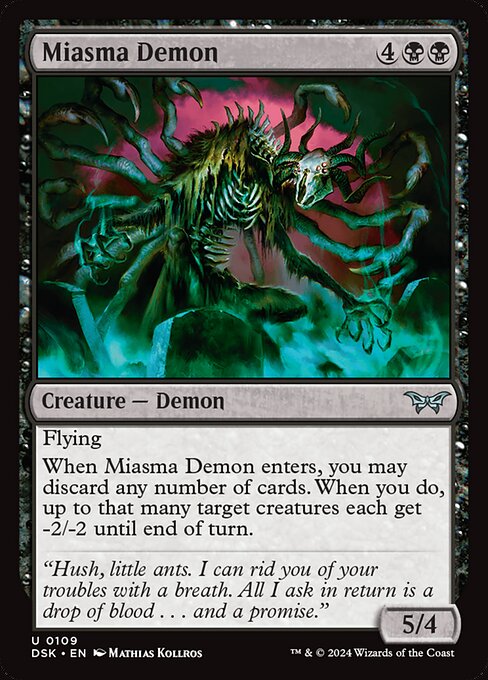
216. Miasma Demon
Rating4.4WeakWhy this rating?
A good playable, but is sometimes cut (4.4/10).
Why. A 5/4 flier for six whose enters trigger can sweep small creatures: each discarded card gives a targeted creature -2/-2. With spare lands in hand it is a two-for-one.
Risks. Six mana including two black is expensive, and the -2/-2 costs you cards. A 5/4 is still fragile against removal.
In the draft. A decent finisher for a slow black deck. Take it mid pack, after a removal spell; one copy, two at most.
Results in the games of the set
When it is in hand, the deck wins 53.4% of its games (set average: 55.9%, 196th of 269 cards).
In the opening hand: 50.8% wins (55.0% on average).
Drawn during the game: 55.0% (56.6% on average).
When it is drawn, the deck wins 2.4 points more than when it is not.
When it is drafted, it is played 54% of the time (set average: 62%).
Taken as the first pick (80 drafts), it ends in the deck 83% of the time.
It is played about as much in every archetype.

217. Razortrap Gorge
Rating4.4WeakWhy this rating?
A good playable, but is sometimes cut (4.4/10).
Why. A black-red land that enters untapped if a player has 13 or less life, tapped otherwise. It fixes those two colours and does nothing else.
Risks. Early in the game it enters tapped, costing tempo. It does nothing beyond being a two-colour land.
In the draft. Pick it late, once you are black-red. Do not prefer it to a playable spell.
Results in the games of the set
When it is in hand, the deck wins 53.5% of its games (set average: 55.9%, 191st of 269 cards).
In the opening hand: 54.4% wins (55.0% on average).
Drawn during the game: 52.9% (56.6% on average).
When it is drawn, the deck wins 0.0 points more than when it is not.
When it is drafted, it is played 54% of the time (set average: 62%).
Taken as the first pick (43 drafts), it ends in the deck 79% of the time.
 Rating4.4Weak
Why this rating?
A good playable, but is sometimes cut (4.4/10).
Why. A 7/6 with trample that, when you are short on lands or it is too expensive, can be discarded for two mana to fetch a Forest. It is almost never a dead card.
Risks. Six mana including two green: it is slow, and a 7/6 still dies to good removal or a clever block. The cycling only gets you a land.
In the draft. A decent common for green. Take it mid to late in the pack; one or two copies in a green deck.
Results in the games of the set
When it is in hand, the deck wins 54.2% of its games (set average: 55.9%, 165th of 269 cards).
In the opening hand: 52.1% wins (55.0% on average).
Drawn during the game: 55.8% (56.6% on average).
When it is drawn, the deck wins 0.2 points less than when it is not.
When it is drafted, it is played 69% of the time (set average: 62%).
Taken as the first pick (65 drafts), it ends in the deck 85% of the time.
It is played mostly in B/G decks (56% of them) and G/R (47%).

219. Strangled Cemetery
Rating4.4WeakWhy this rating?
A good playable, but is sometimes cut (4.4/10).
Why. A black-green land that enters untapped if a player has 13 or less life, tapped otherwise. It fixes those two colours and does nothing else.
Risks. Early in the game it enters tapped, costing tempo. It does nothing beyond being a two-colour land.
In the draft. Pick it late, once you are black-green. Do not prefer it to a playable spell.
Results in the games of the set
When it is in hand, the deck wins 54.3% of its games (set average: 55.9%, 162nd of 269 cards).
In the opening hand: 54.8% wins (55.0% on average).
Drawn during the game: 53.9% (56.6% on average).
When it is drawn, the deck wins 0.1 points more than when it is not.
When it is drafted, it is played 64% of the time (set average: 62%).
Taken as the first pick (67 drafts), it ends in the deck 78% of the time.
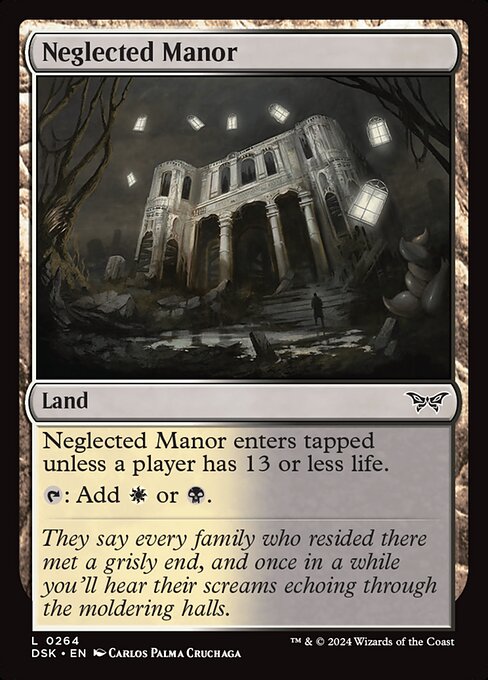
220. Neglected Manor
Rating4.4WeakWhy this rating?
A good playable, but is sometimes cut (4.4/10).
Why. A white-black land that enters untapped if a player has 13 or less life, tapped otherwise. It fixes those two colours and does nothing else.
Risks. Early in the game it enters tapped, costing tempo. It does nothing beyond being a two-colour land.
In the draft. Pick it late, once you are white-black. Do not prefer it to a playable spell.
Results in the games of the set
When it is in hand, the deck wins 52.9% of its games (set average: 55.9%, 211th of 269 cards).
In the opening hand: 52.7% wins (55.0% on average).
Drawn during the game: 53.0% (56.6% on average).
When it is drawn, the deck wins 2.0 points more than when it is not.
When it is drafted, it is played 49% of the time (set average: 62%).
Taken as the first pick (33 drafts), it ends in the deck 79% of the time.

221. Meathook Massacre II
Rating4.3WeakWhy this rating?
A good playable, but is sometimes cut (4.3/10).
Why. A flexible sweeper: each player sacrifices X creatures. After that, your dead creatures can come back for 3 life, and the opponent's come to you if they refuse to pay. The ceiling is high, but only when everything lines up.
Risks. Four black mana are mandatory and X is paid double: an X of two needs eight mana. You also sacrifice X creatures, and the life payments add up.
In the draft. Inefficient in draft: very expensive and demanding in black. Take it late, only in a heavy black deck with few creatures.
Results in the games of the set
When it is in hand, the deck wins 49.2% of its games (set average: 55.9%, 263rd of 269 cards).
In the opening hand: 44.4% wins (55.0% on average).
Drawn during the game: 52.1% (56.6% on average).
When it is drawn, the deck wins 0.5 points less than when it is not.
When it is drafted, it is played 54% of the time (set average: 62%).
Taken as the first pick (33 drafts), it ends in the deck 67% of the time.
It is played about as much in every archetype.

222. Erratic Apparition
Rating4.2WeakWhy this rating?
A good playable, but is sometimes cut (4.2/10).
Why. A 1/3 with flying and vigilance: it blocks in the air and attacks without giving up defence. Each Eerie trigger gives it +1/+1 for the turn.
Risks. With 1 power it deals little damage. It needs many Rooms or enchantments to become a real threat.
In the draft. A decent common for a blue-white Rooms deck. Mid to late pack; otherwise a fine aerial blocker.
Results in the games of the set
When it is in hand, the deck wins 52.9% of its games (set average: 55.9%, 210th of 269 cards).
In the opening hand: 51.4% wins (55.0% on average).
Drawn during the game: 54.0% (56.6% on average).
When it is drawn, the deck wins 0.5 points more than when it is not.
When it is drafted, it is played 40% of the time (set average: 62%).
Taken among the first three picks (153 drafts), it ends in the deck 84% of the time.
It is played mostly in U/W decks (38% of them) and R/U (31%).

223. Cautious Survivor
Rating4.2WeakWhy this rating?
A good playable, but is sometimes cut (4.2/10).
Why. A 4/4 for four: a good body for the price. If it attacked and is still tapped, Survival gains you 2 life in your second main phase.
Risks. No ability that changes a combat, and the life gain is modest. Attacking taps it and leaves you without a blocker.
In the draft. Solid filler for any green deck that needs bodies at four mana. Take it when nothing better is on offer.
Results in the games of the set
When it is in hand, the deck wins 52.5% of its games (set average: 55.9%, 221st of 269 cards).
In the opening hand: 51.3% wins (55.0% on average).
Drawn during the game: 53.3% (56.6% on average).
When it is drawn, the deck wins 0.6 points less than when it is not.
When it is drafted, it is played 28% of the time (set average: 62%).
Taken among the first three picks (92 drafts), it ends in the deck 71% of the time.
It is played mostly in G/W decks (47% of them).

224. Cryptid Inspector
Rating4.2WeakWhy this rating?
A good playable, but is sometimes cut (4.2/10).
Why. A 2/3 with vigilance that gets a +1/+1 counter whenever a face-down permanent enters under your control or a permanent is turned face up. With manifest dread it grows quickly.
Risks. If your deck manifests little, it stays an ordinary 2/3. It loses its value if killed before it has grown.
In the draft. Good in a green deck that manifests dread, notably green-blue. Mid pack, after your removal.
Results in the games of the set
When it is in hand, the deck wins 52.5% of its games (set average: 55.9%, 220th of 269 cards).
In the opening hand: 51.5% wins (55.0% on average).
Drawn during the game: 53.1% (56.6% on average).
When it is drawn, the deck wins 1.0 points less than when it is not.
When it is drafted, it is played 57% of the time (set average: 62%).
Taken as the first pick (67 drafts), it ends in the deck 88% of the time.
It is played mostly in G/U decks (73% of them) and G/W (28%).
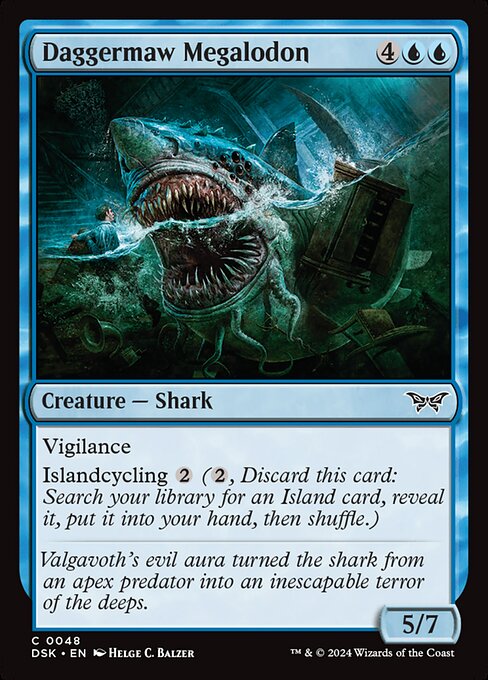
225. Daggermaw Megalodon
Rating4.2WeakWhy this rating?
A good playable, but is sometimes cut (4.2/10).
Why. A 5/7 with vigilance: it attacks while staying an excellent blocker. Islandcycling fetches an Island for two mana, so the card is never dead in hand.
Risks. Six mana including two blue, with no evasion: an opponent with fliers or removal gets around it.
In the draft. Take it as a blue finisher mid to late in the pack; one copy. Its cycling makes it safe to play in a slower deck.
Results in the games of the set
When it is in hand, the deck wins 52.9% of its games (set average: 55.9%, 212th of 269 cards).
In the opening hand: 50.6% wins (55.0% on average).
Drawn during the game: 54.3% (56.6% on average).
When it is drawn, the deck wins 0.3 points less than when it is not.
When it is drafted, it is played 41% of the time (set average: 62%).
Taken among the first three picks (131 drafts), it ends in the deck 73% of the time.
It is played mostly in B/U decks (35% of them) and R/U (34%).
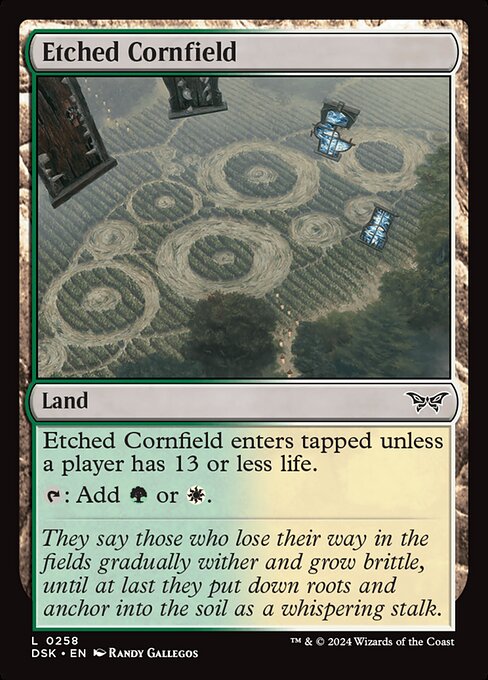
226. Etched Cornfield
Rating4.2WeakWhy this rating?
A good playable, but is sometimes cut (4.2/10).
Why. A green-white land that enters untapped if a player has 13 or less life, tapped otherwise. It fixes those two colours and does nothing else.
Risks. Early in the game it enters tapped, costing tempo. It does nothing beyond being a two-colour land.
In the draft. Pick it late, once you are green-white. Do not prefer it to a playable spell.
Results in the games of the set
When it is in hand, the deck wins 52.7% of its games (set average: 55.9%, 216th of 269 cards).
In the opening hand: 54.2% wins (55.0% on average).
Drawn during the game: 51.5% (56.6% on average).
When it is drawn, the deck wins 0.6 points more than when it is not.
When it is drafted, it is played 44% of the time (set average: 62%).
Taken among the first three picks (162 drafts), it ends in the deck 75% of the time.

227. Friendly Teddy
Rating4.2WeakWhy this rating?
A good playable, but is sometimes cut (4.2/10).
Why. A colourless 2/2 for two that fits in any deck. When it dies each player draws a card: a neutral exchange that simply gives you a body for tempo.
Risks. The opponent draws too, so the value is symmetrical. With no other effect it is a mediocre creature.
In the draft. Late-pack filler for decks short on two-drops. Otherwise pass.
Results in the games of the set
When it is in hand, the deck wins 51.7% of its games (set average: 55.9%, 231st of 269 cards).
In the opening hand: 51.4% wins (55.0% on average).
Drawn during the game: 51.9% (56.6% on average).
When it is drawn, the deck wins 1.4 points less than when it is not.
When it is drafted, it is played 23% of the time (set average: 62%).
Taken among the first three picks (62 drafts), it ends in the deck 50% of the time.

228. Give In to Violence
Rating4.2WeakWhy this rating?
A good playable, but is sometimes cut (4.2/10).
Why. An instant that gives +2/+2 and lifelink: a combat trick that wins a trade and gains life.
Risks. It depends on a creature on the battlefield: if it is killed in response, the spell is wasted. One turn of lifelink does not win the game.
In the draft. A late-pack trick, playable only in an aggressive black deck with plenty of creatures. Do not take it over a playable creature.
Results in the games of the set
When it is in hand, the deck wins 50.2% of its games (set average: 55.9%, 258th of 269 cards).
In the opening hand: 48.2% wins (55.0% on average).
Drawn during the game: 51.5% (56.6% on average).
When it is drawn, the deck wins 1.4 points more than when it is not.
When it is drafted, it is played only 8% of the time (set average: 62%): it almost always ends in the sideboard.
 Rating4.2Weak
Why this rating?
A good playable, but is sometimes cut (4.2/10).
Why. A colourless 2/2 for two that gains the activated abilities of your other creatures, as long as they do not share its name, so it can use them too. With the right creatures it is real value; without them it stays a 2/2.
Risks. Its abilities depend on your deck: if you have few creatures with activated abilities, it is a plain 2/2.
In the draft. A late-pack pick. Take it only if your deck has several creatures with activated abilities; otherwise it is just curve filler.
Results in the games of the set
When it is in hand, the deck wins 50.5% of its games (set average: 55.9%, 252nd of 269 cards).
In the opening hand: 49.0% wins (55.0% on average).
Drawn during the game: 51.8% (56.6% on average).
When it is drawn, the deck wins 0.9 points less than when it is not.
When it is drafted, it is played 31% of the time (set average: 62%).
Taken among the first three picks (75 drafts), it ends in the deck 52% of the time.
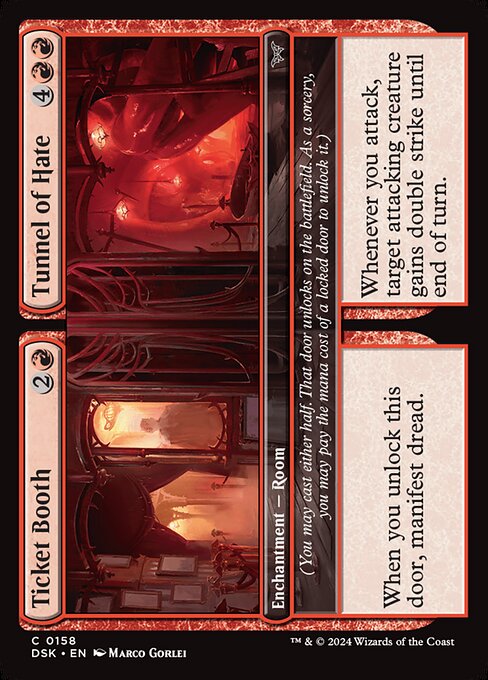
230. Ticket Booth // Tunnel of Hate
Rating4.2WeakWhy this rating?
A good playable, but is sometimes cut (4.2/10).
Why. The first door, at three mana, manifests dread: a face-down 2/2 and an enchantment that triggers Eerie. The second, at six mana, gives an attacker double strike whenever you attack. Two effects on one card, and a late-game plan.
Risks. The second door is expensive, and the first is just a 2/2 with no extras. Double strike only helps if you have a big attacker.
In the draft. A decent common for aggressive red decks, with white, green or black. Take it at a late pick.
Results in the games of the set
When it is in hand, the deck wins 55.4% of its games (set average: 55.9%, 122nd of 269 cards).
In the opening hand: 54.1% wins (55.0% on average).
Drawn during the game: 56.3% (56.6% on average).
When it is drawn, the deck wins 1.3 points more than when it is not.
When it is drafted, it is played 65% of the time (set average: 62%).
Taken as the first pick (136 drafts), it ends in the deck 86% of the time.
It is played mostly in R/U decks (59% of them) and G/R (43%).

231. Infernal Phantom
Rating4.2WeakWhy this rating?
A good playable, but is sometimes cut (4.2/10).
Why. A 2/3 that leaves removal behind when it dies: it deals damage equal to its power to any target. If Eerie triggered this turn, the +2/+0 raises that damage.
Risks. Without Eerie it deals only 2 damage when it dies. Four mana for a 2/3 is steep, and the opponent can simply ignore it or exile it.
In the draft. Playable in red in a Rooms deck. Take it at a mid to late pick.
Results in the games of the set
When it is in hand, the deck wins 51.2% of its games (set average: 55.9%, 240th of 269 cards).
In the opening hand: 49.9% wins (55.0% on average).
Drawn during the game: 52.2% (56.6% on average).
When it is drawn, the deck wins 1.1 points less than when it is not.
When it is drafted, it is played 55% of the time (set average: 62%).
Taken as the first pick (85 drafts), it ends in the deck 82% of the time.
It is played mostly in R/U decks (28% of them).
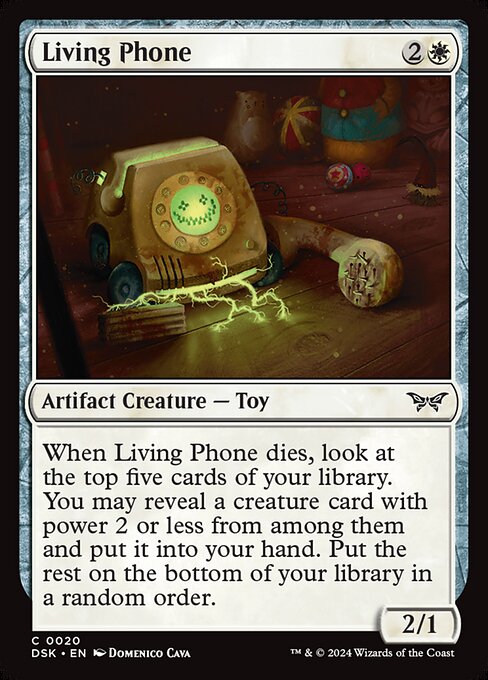
232. Living Phone
Rating4.1WeakWhy this rating?
A good playable, but is sometimes cut (4.1/10).
Why. A 2/1 that replaces itself when it dies: you look at the top five cards of your library and may take a creature with power 2 or less. It trades well with an opposing creature and hands you a body back.
Risks. Three mana for a 2/1 is weak, and the search can whiff if no creature with power 2 or less is on top. No value if it is exiled.
In the draft. Filler for a white deck with small creatures. Take it at a late pick.
Results in the games of the set
When it is in hand, the deck wins 51.2% of its games (set average: 55.9%, 242nd of 269 cards).
In the opening hand: 50.2% wins (55.0% on average).
Drawn during the game: 51.9% (56.6% on average).
When it is drawn, the deck wins 3.2 points less than when it is not.
When it is drafted, it is played 15% of the time (set average: 62%).
Taken among the first three picks (65 drafts), it ends in the deck 58% of the time.
It is played mostly in R/W decks (28% of them).

233. Shrewd Storyteller
Rating4.0WeakWhy this rating?
A good playable, but is sometimes cut (4.0/10).
Why. A 3/3 for three, a good body for the curve. Each turn it attacked and is still tapped, Survival puts a +1/+1 counter on a creature of your choice.
Risks. It needs exactly green and white. It must attack to trigger Survival, which is not always safe, and tapping leaves you without a blocker.
In the draft. Take it only if you are already green-white. Otherwise a more flexible single-colour creature is better.
Results in the games of the set
When it is in hand, the deck wins 50.7% of its games (set average: 55.9%, 249th of 269 cards).
In the opening hand: 51.6% wins (55.0% on average).
Drawn during the game: 50.0% (56.6% on average).
When it is drawn, the deck wins 0.9 points less than when it is not.
When it is drafted, it is played 42% of the time (set average: 62%).
Taken as the first pick (52 drafts), it ends in the deck 77% of the time.
It is played mostly in G/W decks (63% of them).
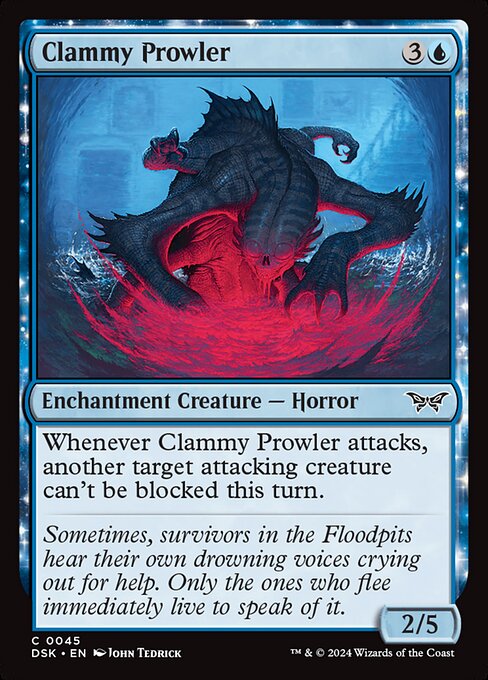
234. Clammy Prowler
Rating4.0WeakWhy this rating?
A good playable, but is sometimes cut (4.0/10).
Why. A 2/5 that makes another attacking creature unblockable each time it attacks. It is also a good blocker, and being an enchantment it triggers your other Eerie cards when it enters.
Risks. It has only 2 power, so it attacks poorly alone. It needs a big attacker to help, and four mana for a conditional effect is steep.
In the draft. Playable in blue-white. Take it mid pack if you have a creature to support.
Results in the games of the set
When it is in hand, the deck wins 51.1% of its games (set average: 55.9%, 243rd of 269 cards).
In the opening hand: 48.4% wins (55.0% on average).
Drawn during the game: 52.8% (56.6% on average).
When it is drawn, the deck wins 0.1 points less than when it is not.
When it is drafted, it is played 17% of the time (set average: 62%).
Taken among the first three picks (68 drafts), it ends in the deck 71% of the time.

235. Derelict Attic // Widow's Walk
Rating4.0WeakWhy this rating?
A good playable, but is sometimes cut (4.0/10).
Why. Three mana for two cards at the cost of 2 life is plain value, and it also triggers Eerie. The other door gives +1/+0 and deathtouch to a creature attacking alone, but it needs a very specific board.
Risks. It does nothing to the board the turn you cast it, and the 2 life hurts against aggressive decks. The second half is too narrow to count on.
In the draft. A late playable for a black deck that can already hold the ground. Take it after your creatures and removal.
Results in the games of the set
When it is in hand, the deck wins 53.6% of its games (set average: 55.9%, 187th of 269 cards).
In the opening hand: 51.7% wins (55.0% on average).
Drawn during the game: 55.0% (56.6% on average).
When it is drawn, the deck wins 3.0 points more than when it is not.
When it is drafted, it is played 38% of the time (set average: 62%).
Taken as the first pick (30 drafts), it ends in the deck 73% of the time.
It is played mostly in B/W decks (43% of them) and B/U (39%).

236. Moldering Gym // Weight Room
Rating4.0WeakWhy this rating?
A good playable, but is sometimes cut (4.0/10).
Why. Three mana fetches a basic land that enters tapped, which smooths your mana. The other door, at six mana, manifests dread and puts three +1/+1 counters on that creature, giving you a big late-game threat.
Risks. The first door does nothing on the board. The second is expensive and hands you a creature that dies to a single removal spell.
In the draft. A fair filler for a slower green deck. Don't take it over your good creatures; it is the sort of card that rounds out the last slots.
Results in the games of the set
When it is in hand, the deck wins 54.7% of its games (set average: 55.9%, 147th of 269 cards).
In the opening hand: 53.7% wins (55.0% on average).
Drawn during the game: 55.4% (56.6% on average).
When it is drawn, the deck wins 2.2 points more than when it is not.
When it is drafted, it is played 71% of the time (set average: 62%).
Taken as the first pick (164 drafts), it ends in the deck 84% of the time.
It is played mostly in G/U decks (56% of them) and G/R (48%).

237. Resurrected Cultist
Rating4.0WeakWhy this rating?
A good playable, but is sometimes cut (4.0/10).
Why. A 4/1 for three that happily trades with something more expensive. With Delirium you can bring it back from the graveyard for four mana with a finality counter, so it returns but only once.
Risks. One toughness means it dies to any block and most small effects. Delirium needs four card types in the graveyard, which does not always happen.
In the draft. Filler for an aggressive black deck. If your deck fills the graveyard it gets a little better; otherwise it is a late pick.
Results in the games of the set
When it is in hand, the deck wins 51.8% of its games (set average: 55.9%, 229th of 269 cards).
In the opening hand: 49.6% wins (55.0% on average).
Drawn during the game: 53.4% (56.6% on average).
When it is drawn, the deck wins 0.9 points less than when it is not.
When it is drafted, it is played 33% of the time (set average: 62%).
Taken among the first three picks (111 drafts), it ends in the deck 68% of the time.
It is played mostly in B/R decks (35% of them) and B/G (31%).

238. Victor, Valgavoth's Seneschal
Rating4.0WeakWhy this rating?
A good playable, but is sometimes cut (4.0/10).
Why. A 3/3 for three, solid on its own. Eerie gives it three tiers of value in a single turn: surveil 2, then a discard for the opponent, then reanimating a creature from a graveyard.
Risks. You need to trigger it three times in one turn, which takes a lot of enchantments or Rooms. Without that it is a two-colour 3/3.
In the draft. A good body for a white-black deck full of enchantments, otherwise just a playable 3/3. Don't pick it for the ability alone.
Results in the games of the set
When it is in hand, the deck wins 51.2% of its games (set average: 55.9%, 241st of 269 cards).
In the opening hand: 49.6% wins (55.0% on average).
Drawn during the game: 52.2% (56.6% on average).
When it is drawn, the deck wins 2.3 points more than when it is not.
When it is drafted, it is played 58% of the time (set average: 62%).
Taken as the first pick (63 drafts), it ends in the deck 70% of the time.
It is played mostly in B/W decks (35% of them).

239. Demonic Counsel
Rating4.0WeakWhy this rating?
A good playable, but is sometimes cut (4.0/10).
Why. Two mana for a tutor. With Delirium it fetches any card from your library, such as your best removal spell or your best finisher.
Risks. It only replaces itself: you spend a card and a turn to get another one. Without Delirium it only finds a Demon, which is very often nothing.
In the draft. Only in a black deck that fills its graveyard and holds a real target. In most decks, leave it out.
Results in the games of the set
When it is in hand, the deck wins 51.3% of its games (set average: 55.9%, 237th of 269 cards).
In the opening hand: 47.1% wins (55.0% on average).
Drawn during the game: 54.0% (56.6% on average).
When it is drawn, the deck wins 1.7 points more than when it is not.
When it is drafted, it is played only 10% of the time (set average: 62%): it almost always ends in the sideboard.
Taken among the first three picks (43 drafts), it ends in the deck 44% of the time.

240. Creeping Peeper
Rating3.9WeakWhy this rating?
A good playable, but is sometimes cut (3.9/10).
Why. A 2/1 for two whose mana only pays for enchantment spells, unlocking doors and turning permanents face up. In a Room-heavy deck it works as a real accelerant.
Risks. The mana is very restricted: it pays for no instants and most creatures. The 2/1 body is fragile, and in a deck without enchantments it is nearly useless.
In the draft. For a blue deck that really plays a lot of enchantments. Otherwise it is filler.
Results in the games of the set
When it is in hand, the deck wins 51.6% of its games (set average: 55.9%, 232nd of 269 cards).
In the opening hand: 51.2% wins (55.0% on average).
Drawn during the game: 51.9% (56.6% on average).
When it is drawn, the deck wins 0.4 points less than when it is not.
When it is drafted, it is played 47% of the time (set average: 62%).
Taken as the first pick (51 drafts), it ends in the deck 75% of the time.
It is played mostly in U/W decks (74% of them) and R/U (53%).

241. Savior of the Small
Rating3.8WeakWhy this rating?
A good playable, but is sometimes cut (3.8/10).
Why. A 3/4 for four that holds the ground well. With Survival, if it is tapped in your second main phase, you return a creature card with mana value 3 or less from your graveyard to your hand.
Risks. It has no vigilance: to use Survival you need to tap it, so you must attack, and a 3/4 is easy to block. The value comes slowly.
In the draft. A fair uncommon rather than a reason to change colours. It shines in a deck full of cheap creatures that die often.
Results in the games of the set
When it is in hand, the deck wins 50.9% of its games (set average: 55.9%, 248th of 269 cards).
In the opening hand: 49.9% wins (55.0% on average).
Drawn during the game: 51.6% (56.6% on average).
When it is drawn, the deck wins 1.9 points less than when it is not.
When it is drafted, it is played 60% of the time (set average: 62%).
Taken as the first pick (77 drafts), it ends in the deck 87% of the time.
It is played mostly in G/W decks (32% of them).
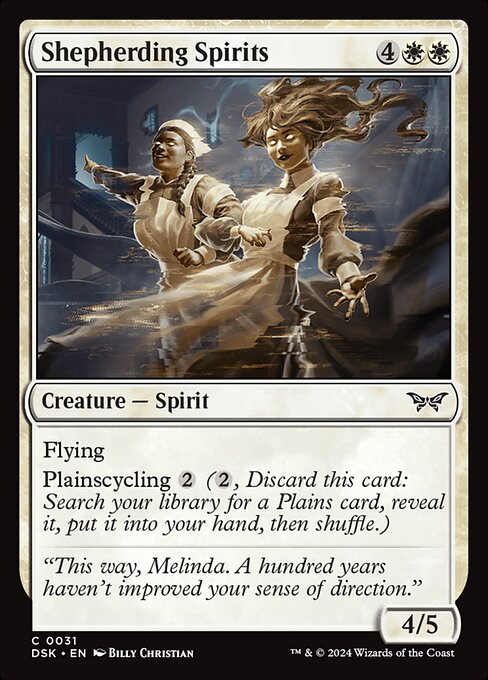
242. Shepherding Spirits
Rating3.8WeakWhy this rating?
A good playable, but is sometimes cut (3.8/10).
Why. A 4/5 flyer for six, but above all a card that is never dead: plainscycling for two mana fixes land problems early in the game.
Risks. Six mana with two white is slow, and a 4/5 flyer is not a decisive threat. As a finisher it is solid and no more.
In the draft. A good last slot for a white deck because it fills two roles. Don't take it over your good creatures and removal.
Results in the games of the set
When it is in hand, the deck wins 52.0% of its games (set average: 55.9%, 228th of 269 cards).
In the opening hand: 49.5% wins (55.0% on average).
Drawn during the game: 53.8% (56.6% on average).
When it is drawn, the deck wins 0.5 points less than when it is not.
When it is drafted, it is played 40% of the time (set average: 62%).
Taken among the first three picks (160 drafts), it ends in the deck 74% of the time.
It is played mostly in B/W decks (47% of them) and G/W (30%).

243. Spectral Snatcher
Rating3.8WeakWhy this rating?
A good playable, but is sometimes cut (3.8/10).
Why. A 6/5 for six with ward (discard a card), which protects it well against targeted removal. Swampcycling for two mana keeps it from being dead in hand.
Risks. It costs six with two black, and has no flying or evasion. Double blocks or non-targeted removal get around it.
In the draft. An acceptable common finisher for a black deck. Take it once you already have your two or three removal spells.
Results in the games of the set
When it is in hand, the deck wins 52.6% of its games (set average: 55.9%, 219th of 269 cards).
In the opening hand: 50.2% wins (55.0% on average).
Drawn during the game: 54.2% (56.6% on average).
When it is drawn, the deck wins 0.8 points more than when it is not.
When it is drafted, it is played 55% of the time (set average: 62%).
Taken as the first pick (43 drafts), it ends in the deck 91% of the time.
It is played mostly in B/W decks (63% of them) and B/U (48%).

244. Unwanted Remake
Rating3.8WeakWhy this rating?
A good playable, but is sometimes cut (3.8/10).
Why. A one-mana removal that destroys any creature, very efficient on tempo. It answers a big threat for almost nothing.
Risks. The opponent manifests dread: they get a face-down 2/2 and fill their graveyard. Against a small creature that is a poor trade.
In the draft. Play it in a white deck, but save it for a real threat rather than a 2/2. It is worth an honest pick, nothing more.
Results in the games of the set
When it is in hand, the deck wins 47.8% of its games (set average: 55.9%, 265th of 269 cards).
In the opening hand: 46.3% wins (55.0% on average).
Drawn during the game: 48.8% (56.6% on average).
When it is drawn, the deck wins 3.2 points less than when it is not.
When it is drafted, it is played 18% of the time (set average: 62%).
Taken among the first three picks (75 drafts), it ends in the deck 56% of the time.

245. Appendage Amalgam
Rating3.5WeakWhy this rating?
A good playable, but is sometimes cut (3.5/10).
Why. A 3/2 with flash for three: you can ambush a smaller attacker or cast it at the end of the opponent's turn. Each attack gives you surveil 1.
Risks. Two toughness means it dies to nearly any block. The surveil 1 is a small bonus, not a reason to play it.
In the draft. Black filler: take it if you lack three-drops. It is also an enchantment, which counts for Eerie.
Results in the games of the set
When it is in hand, the deck wins 51.5% of its games (set average: 55.9%, 233rd of 269 cards).
In the opening hand: 50.2% wins (55.0% on average).
Drawn during the game: 52.4% (56.6% on average).
When it is drawn, the deck wins 1.0 points more than when it is not.
When it is drafted, it is played 40% of the time (set average: 62%).
Taken as the first pick (31 drafts), it ends in the deck 90% of the time.
It is played mostly in B/W decks (57% of them) and B/U (55%).

246. Fear of Failed Tests
Rating3.2WeakWhy this rating?
Filler card but sometimes gets cut (3.2/10).
Why. A 2/7 for five that walls off the ground. If it connects with a player you draw cards equal to the damage, so two cards per successful attack.
Risks. With two power it is easy to block and almost never connects against an opponent with creatures. Without evasion the card draw stays theoretical.
In the draft. A late pick for a defensive blue deck. Don't count on the card draw; treat it as a wall.
Results in the games of the set
When it is in hand, the deck wins 51.0% of its games (set average: 55.9%, 244th of 269 cards).
In the opening hand: 49.6% wins (55.0% on average).
Drawn during the game: 51.9% (56.6% on average).
When it is drawn, the deck wins 0.7 points more than when it is not.
When it is drafted, it is played 25% of the time (set average: 62%).
Taken among the first three picks (86 drafts), it ends in the deck 56% of the time.
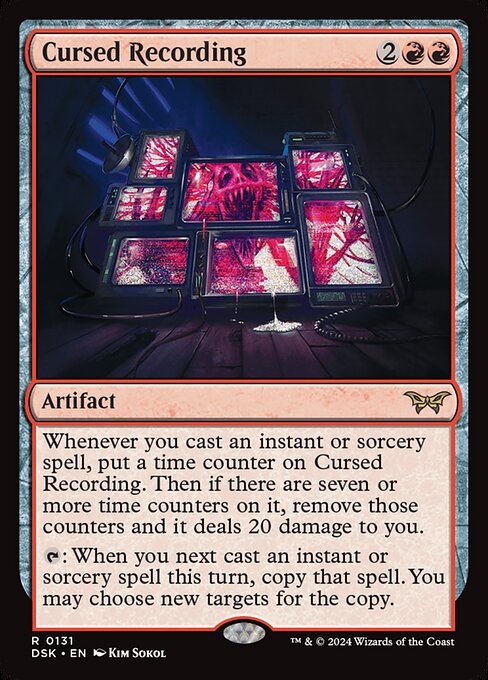
247. Cursed Recording
Rating2.9WeakWhy this rating?
Filler card but sometimes gets cut (2.9/10).
Why. Tap it and it copies the next instant or sorcery you cast this turn, with new targets allowed. In a spell-heavy deck that is real value.
Risks. Each instant or sorcery you cast adds a time counter, and at seven you take 20 damage, which kills you. It does nothing without spells, and four mana for that is a lot.
In the draft. A rare that asks too much of the format: you need a red deck packed with instants and sorceries. Usually leave it in the sideboard.
Results in the games of the set
When it is in hand, the deck wins 50.2% of its games (set average: 55.9%, 256th of 269 cards).
In the opening hand: 49.9% wins (55.0% on average).
Drawn during the game: 50.4% (56.6% on average).
When it is drawn, the deck wins 2.4 points less than when it is not.
When it is drafted, it is played 26% of the time (set average: 62%).
Taken as the first pick (32 drafts), it ends in the deck 63% of the time.
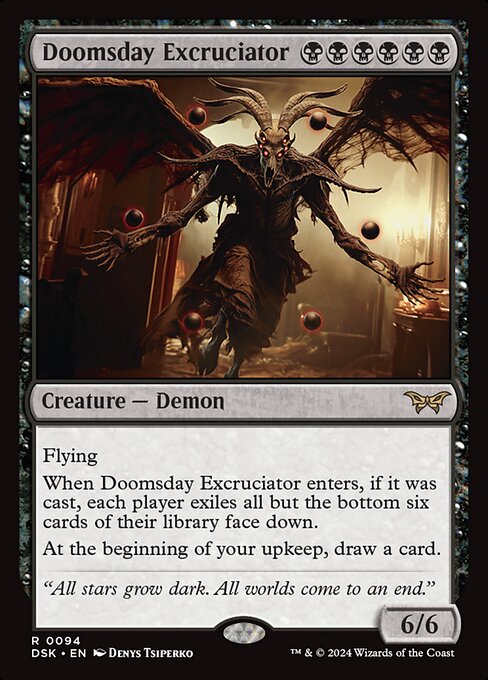
248. Doomsday Excruciator
Rating2.5WeakWhy this rating?
Filler card but sometimes gets cut (2.5/10).
Why. A 6/6 flyer for six black mana with an extra draw each upkeep. In practice it is a combo-style card: each player is left with only six cards in the library.
Risks. Six black mana is nearly impossible outside a near mono-black deck. After it enters, the game ends within a few turns, and you draw two cards a turn, so you can lose before the opponent does.
In the draft. Not a normal draft card. Play it only in a near mono-black deck that can win in a few attacks.
Results in the games of the set
When it is in hand, the deck wins 44.2% of its games (set average: 55.9%, 267th of 269 cards).
In the opening hand: 40.8% wins (55.0% on average).
Drawn during the game: 46.2% (56.6% on average).
When it is drawn, the deck wins 4.8 points less than when it is not.
When it is drafted, it is played 21% of the time (set average: 62%).
Taken among the first three picks (70 drafts), it ends in the deck 64% of the time.

249. Anthropede
Rating2.1WeakWhy this rating?
Not good filler and often gets cut (2.2/10).
Why. A 3/4 with reach for four, a solid defensive body. When it enters you may discard a card or pay two mana to destroy a Room.
Risks. The destruction only matters if there is a Room to hit. With no target it is a plain 3/4 for four.
In the draft. A late playable for a green deck, especially if you see many Rooms at the table. Don't take it early.
Results in the games of the set
When it is in hand, the deck wins 50.2% of its games (set average: 55.9%, 259th of 269 cards).
In the opening hand: 47.8% wins (55.0% on average).
Drawn during the game: 51.8% (56.6% on average).
When it is drawn, the deck wins 1.9 points less than when it is not.
When it is drafted, it is played only 14% of the time (set average: 62%): it almost always ends in the sideboard.
Taken among the first three picks (45 drafts), it ends in the deck 44% of the time.

250. Attack-in-the-Box
Rating2.0WeakWhy this rating?
Not good filler and often gets cut (2.0/10).
Why. A colourless 2/4 for three that fits any deck. When it attacks it can become a 6/4 for the turn, but at that price you sacrifice it at end of turn.
Risks. The +4/+0 option is one-way: one attack and the toy is gone. Without it you have a plain defensive 2/4.
In the draft. Filler for an aggressive deck that wants to close out a game. Take it only to round out your curve.
Results in the games of the set
When it is in hand, the deck wins 50.5% of its games (set average: 55.9%, 253rd of 269 cards).
In the opening hand: 49.4% wins (55.0% on average).
Drawn during the game: 51.4% (56.6% on average).
When it is drawn, the deck wins 2.0 points less than when it is not.
When it is drafted, it is played 17% of the time (set average: 62%).
Taken among the first three picks (32 drafts), it ends in the deck 41% of the time.

251. Balemurk Leech
Rating2.0WeakWhy this rating?
Not good filler and often gets cut (2.0/10).
Why. A 2/2 for two that makes each opponent lose 1 life with Eerie, whenever an enchantment enters or a Room is fully unlocked.
Risks. Without many enchantments it is a vanilla 2/2. The drain is slow and does not replace a good body or removal.
In the draft. Only in a black deck full of enchantments and Rooms. Otherwise don't take it over your better two-drops.
Results in the games of the set
When it is in hand, the deck wins 50.6% of its games (set average: 55.9%, 250th of 269 cards).
In the opening hand: 49.8% wins (55.0% on average).
Drawn during the game: 51.1% (56.6% on average).
When it is drawn, the deck wins 0.6 points more than when it is not.
When it is drafted, it is played 36% of the time (set average: 62%).
Taken as the first pick (33 drafts), it ends in the deck 70% of the time.
It is played mostly in B/U decks (74% of them) and B/W (55%).

252. Bedhead Beastie
Rating2.0WeakWhy this rating?
Not good filler and often gets cut (2.0/10).
Why. A 5/6 with menace for six: a hefty finisher that forces a double block. Mountaincycling for two mana keeps you from getting stuck with it in hand.
Risks. Six mana with two red is slow, and a well-placed removal spell handles it. It has no flying or trample.
In the draft. An acceptable common finisher for a red deck. It does the job, but you will find stronger cards before it.
Results in the games of the set
When it is in hand, the deck wins 50.9% of its games (set average: 55.9%, 246th of 269 cards).
In the opening hand: 48.8% wins (55.0% on average).
Drawn during the game: 52.5% (56.6% on average).
When it is drawn, the deck wins 1.5 points less than when it is not.
When it is drafted, it is played 26% of the time (set average: 62%).
Taken among the first three picks (62 drafts), it ends in the deck 53% of the time.
It is played mostly in B/R decks (30% of them) and G/R (26%).

253. Fear of the Dark
Rating2.0WeakWhy this rating?
Not good filler and often gets cut (2.0/10).
Why. A 5/5 for five that gains menace and deathtouch when it attacks, as long as the defender has no Glimmer creatures. It is very hard to block well.
Risks. Five mana for a body with no permanent evasion, and a removal spell answers it. If the opponent has a Glimmer creature, you lose the bonuses.
In the draft. A playable for a black deck that needs a five-drop. Nothing more: take your removal first.
Results in the games of the set
When it is in hand, the deck wins 50.9% of its games (set average: 55.9%, 247th of 269 cards).
In the opening hand: 48.5% wins (55.0% on average).
Drawn during the game: 52.4% (56.6% on average).
When it is drawn, the deck wins 1.7 points more than when it is not.
When it is drafted, it is played 23% of the time (set average: 62%).
Taken among the first three picks (47 drafts), it ends in the deck 60% of the time.
It is played mostly in B/U decks (40% of them) and B/W (33%).
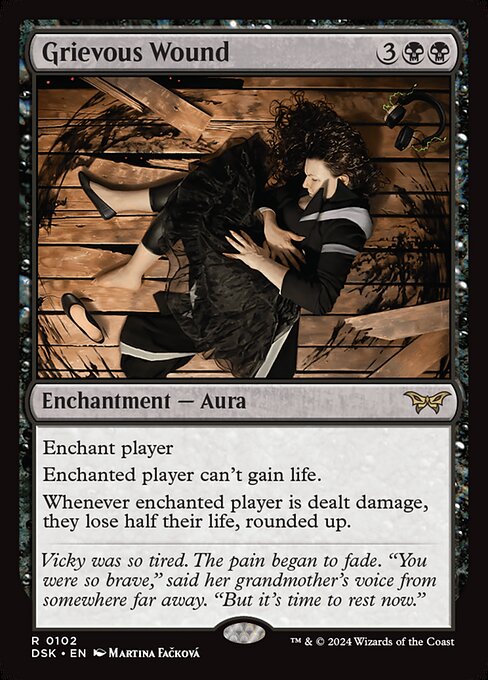
254. Grievous Wound
Rating2.0WeakWhy this rating?
Not good filler and often gets cut (2.0/10).
Why. An Aura placed on the opposing player: no life gain, and each time they are dealt damage they lose half their life. In theory it is a way to close a game.
Risks. Five mana for no effect on the board, and the opponent must already be taking damage. When it is useful, you are already winning.
In the draft. Leave it out of nearly every deck. Don't take it except out of curiosity.
Results in the games of the set
When it is in hand, the deck wins 43.3% of its games (set average: 55.9%, 268th of 269 cards).
In the opening hand: 42.6% wins (55.0% on average).
Drawn during the game: 43.8% (56.6% on average).
When it is drawn, the deck wins 1.7 points less than when it is not.
When it is drafted, it is played only 7% of the time (set average: 62%): it almost always ends in the sideboard.
Taken among the first three picks (35 drafts), it ends in the deck 29% of the time.
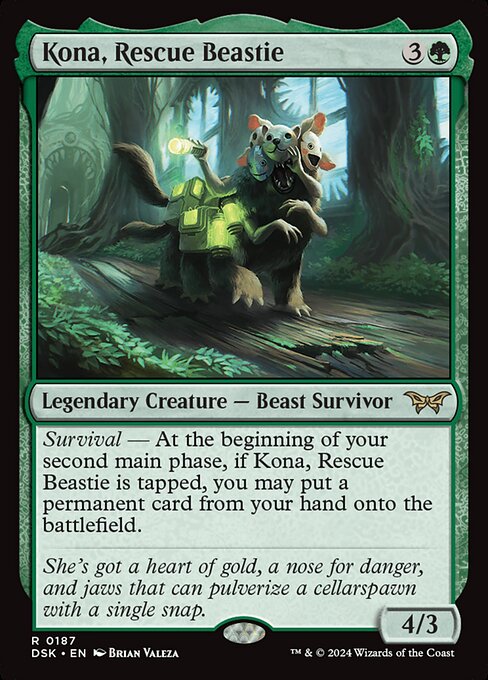
255. Kona, Rescue Beastie
Rating2.0WeakWhy this rating?
Not good filler and often gets cut (2.0/10).
Why. A 4/3 for four. With Survival, if it is tapped in your second main phase, you put a permanent card from your hand onto the battlefield for free: an extra land, or a big permanent.
Risks. It has to attack (no vigilance) and survive, with only three toughness. The ability helps only if you hold the right permanent.
In the draft. A good four-drop for a green deck with big permanents. Otherwise it is a fair 4/3, nothing more.
Results in the games of the set
When it is in hand, the deck wins 50.3% of its games (set average: 55.9%, 255th of 269 cards).
In the opening hand: 48.8% wins (55.0% on average).
Drawn during the game: 51.4% (56.6% on average).
When it is drawn, the deck wins 0.6 points less than when it is not.
When it is drafted, it is played 79% of the time (set average: 62%).
Taken as the first pick (73 drafts), it ends in the deck 82% of the time.
It is played about as much in every archetype.

256. Leyline of Hope
Rating2.0WeakWhy this rating?
Not good filler and often gets cut (2.0/10).
Why. An enchantment that adds 1 to every life gain, and gives your creatures +2/+2 once you are at least 7 life above your starting total. It assumes a lifegain deck.
Risks. It does nothing on the board alone, and you need a deck that gains a lot of life. Even from the opening hand it doesn't stop opposing creatures.
In the draft. Don't play it, except in a heavily lifegain deck. It takes the slot of a card that actually does something.
Results in the games of the set
When it is drafted, it is played only 1% of the time (set average: 62%): it almost always ends in the sideboard.

257. Leyline of Mutation
Rating2.0WeakWhy this rating?
Not good filler and often gets cut (2.0/10).
Why. It lets you cast spells by paying one mana of each colour instead of their cost. That is only useful in a five-colour deck.
Risks. Five colours is almost impossible to build in draft, and it does nothing else. You waste a turn with no effect on the game.
In the draft. Don't take it. It doesn't earn a slot in a limited deck.
Results in the games of the set
When it is drafted, it is played only 0% of the time (set average: 62%): it almost always ends in the sideboard.
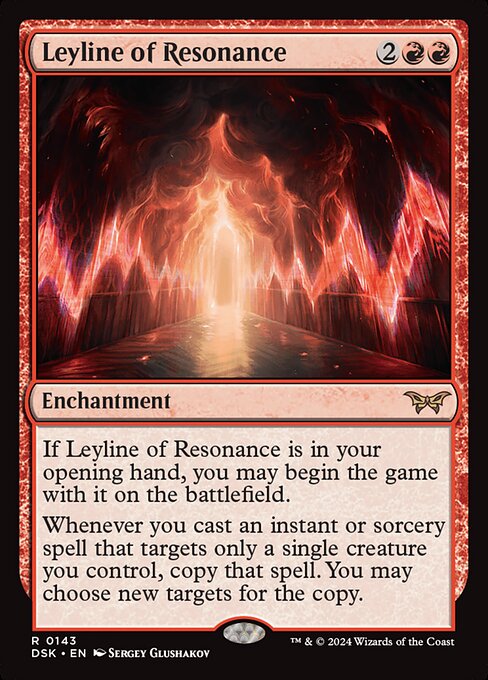
258. Leyline of Resonance
Rating2.0WeakWhy this rating?
Not good filler and often gets cut (2.0/10).
Why. It copies your instants and sorceries that target only a single creature you control: pump spells and protection. A small engine for a very focused spell deck.
Risks. You need many spells that target your own creatures, which is rare in draft. Without them it does nothing.
In the draft. Don't play it unless you know your deck is full of pump spells. For most decks it is a dead card.
Results in the games of the set
When it is drafted, it is played only 1% of the time (set average: 62%): it almost always ends in the sideboard.
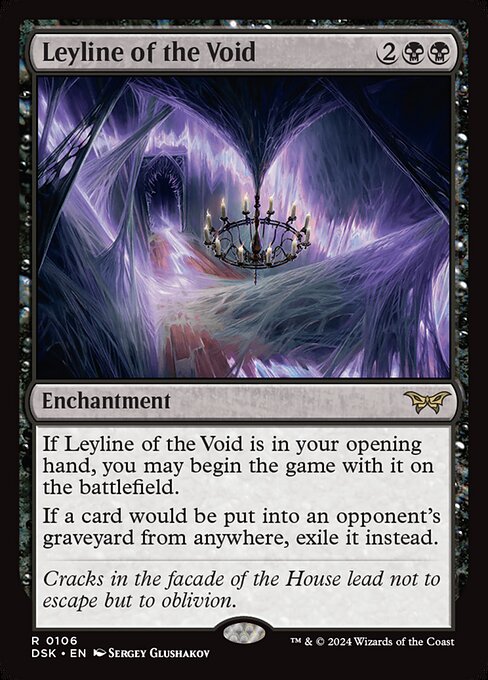
259. Leyline of the Void
Rating2.0WeakWhy this rating?
Not good filler and often gets cut (2.0/10).
Why. It exiles cards that would go to the opponent's graveyard. It is a sideboard card against decks that rely on the graveyard: Delirium, reanimation.
Risks. It does nothing against decks that don't use the graveyard, and never affects the board. In hand it just takes up a slot.
In the draft. A sideboard card, not a main deck one. Pick it late, if you expect to face recursion.
Results in the games of the set
When it is drafted, it is played only 0% of the time (set average: 62%): it almost always ends in the sideboard.
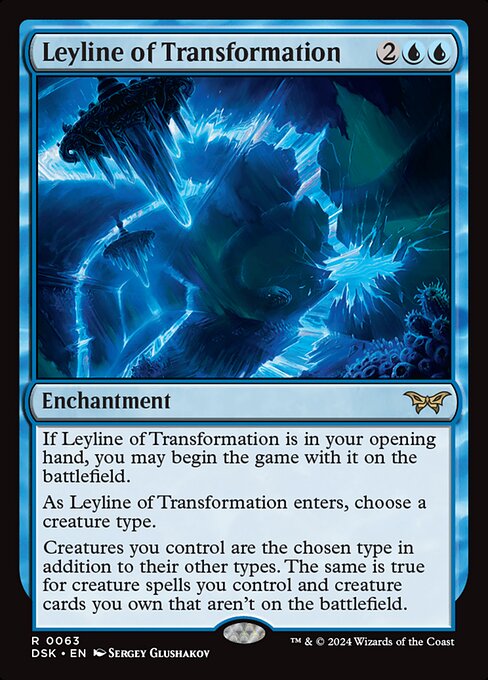
260. Leyline of Transformation
Rating2.0WeakWhy this rating?
Not good filler and often gets cut (2.0/10).
Why. It adds a chosen creature type to your creatures, your creature spells and your creature cards that aren't on the battlefield. It changes neither their stats nor their abilities.
Risks. It only matters in a very specific tribal deck. In a normal deck you pay four mana for nothing.
In the draft. Don't take it. It does nothing useful in a draft deck.
Results in the games of the set
When it is drafted, it is played only 0% of the time (set average: 62%): it almost always ends in the sideboard.
 Rating2.0Weak
Why this rating?
Not good filler and often gets cut (2.0/10).
Why. A colourless 4/4 flyer for six that fits any deck. For two mana you put a card from a graveyard on the bottom of its owner's library, handy against Delirium.
Risks. Six mana for a 4/4 flyer is expensive, and the ability does nothing for the board. It costs you a full turn.
In the draft. Filler top-end for any deck. Better to take it late, after your real cards.
Results in the games of the set
When it is in hand, the deck wins 51.3% of its games (set average: 55.9%, 238th of 269 cards).
In the opening hand: 47.2% wins (55.0% on average).
Drawn during the game: 53.6% (56.6% on average).
When it is drawn, the deck wins 1.9 points less than when it is not.
When it is drafted, it is played 20% of the time (set average: 62%).
Taken among the first three picks (35 drafts), it ends in the deck 71% of the time.
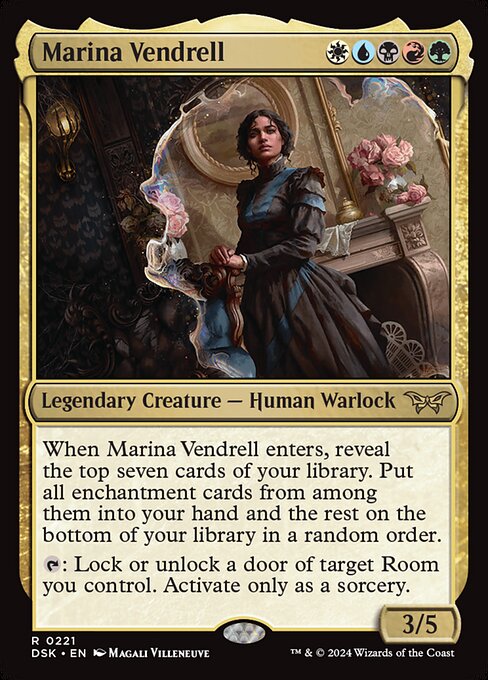
262. Marina Vendrell
Rating2.0WeakWhy this rating?
Not good filler and often gets cut (2.0/10).
Why. A five-colour 3/5 for five. When it enters you reveal seven cards and keep the enchantments. Tapped, it locks or unlocks a door of one of your Rooms.
Risks. The five-colour cost is a real obstacle: without five colours it stays in hand. Even played well it only brings you a few enchantments.
In the draft. Play it only in a five-colour deck built around it. In every other case, leave it.
Results in the games of the set
When it is in hand, the deck wins 50.4% of its games (set average: 55.9%, 254th of 269 cards).
In the opening hand: 46.4% wins (55.0% on average).
Drawn during the game: 52.7% (56.6% on average).
When it is drawn, the deck wins 8.8 points more than when it is not.
When it is drafted, it is played 16% of the time (set average: 62%).
Taken among the first three picks (51 drafts), it ends in the deck 55% of the time.

263. The Tale of Tamiyo
Rating2.0WeakWhy this rating?
Not good filler and often gets cut (2.0/10).
Why. A three-mana Saga that mills you two cards each chapter, with extra draws if they share a card type. It fills the graveyard for Delirium.
Risks. It does nothing on the board for three turns and can mill your good cards. The last chapter needs instants and sorceries in the graveyard.
In the draft. A very specific card for a blue spell deck. For most decks, don't take it over your creatures.
Results in the games of the set
When it is in hand, the deck wins 47.4% of its games (set average: 55.9%).
Drawn during the game: 0.0% (56.6% on average).
When it is drawn, the deck wins 1.7 points more than when it is not.
When it is drafted, it is played only 2% of the time (set average: 62%): it almost always ends in the sideboard.

264. Walk-In Closet // Forgotten Cellar
Rating2.0WeakWhy this rating?
Not good filler and often gets cut (2.0/10).
Why. The first door lets you play lands from your graveyard; the second, at five mana, lets you cast spells from your graveyard for a turn. A value engine for a graveyard deck.
Risks. Neither door acts on the board, and you need lands or spells to replay. It is very slow and depends on your deck.
In the draft. A mythic that is too specialised: play it only in a green graveyard deck. Otherwise leave it.
Results in the games of the set
When it is in hand, the deck wins 50.2% of its games (set average: 55.9%, 257th of 269 cards).
In the opening hand: 46.6% wins (55.0% on average).
Drawn during the game: 52.3% (56.6% on average).
When it is drawn, the deck wins 2.1 points more than when it is not.
When it is drafted, it is played 20% of the time (set average: 62%).
Taken among the first three picks (42 drafts), it ends in the deck 43% of the time.

265. Winter, Misanthropic Guide
Rating2.0WeakWhy this rating?
Not good filler and often gets cut (2.0/10).
Why. A 3/4 with ward 2 for four. At each upkeep every player draws two cards. With Delirium, the opponent's maximum hand size drops.
Risks. It needs three colours, and the card draw benefits the opponent too. It only helps whoever uses their cards better.
In the draft. Take it only if you are already in these three colours. Elsewhere it is an awkward 3/4.
Results in the games of the set
When it is in hand, the deck wins 48.5% of its games (set average: 55.9%, 264th of 269 cards).
In the opening hand: 47.0% wins (55.0% on average).
Drawn during the game: 49.4% (56.6% on average).
When it is drawn, the deck wins 0.3 points less than when it is not.
When it is drafted, it is played 17% of the time (set average: 62%).
Taken among the first three picks (50 drafts), it ends in the deck 50% of the time.

266. Charred Foyer // Warped Space
Rating1.9WeakWhy this rating?
Not good filler and often gets cut (1.9/10).
Why. The first door exiles the top card of your library each upkeep and lets you play it that turn: a slow but solid value engine. The second lets you cast one spell from exile for free each turn.
Risks. No effect on the board the turn you cast it, and an exiled card you can't play is lost. Both doors cost ten mana together.
In the draft. A late playable in a red deck that already controls the board. Take it after your creatures and removal.
Results in the games of the set
When it is in hand, the deck wins 49.7% of its games (set average: 55.9%, 260th of 269 cards).
In the opening hand: 48.1% wins (55.0% on average).
Drawn during the game: 50.8% (56.6% on average).
When it is drawn, the deck wins 1.2 points less than when it is not.
When it is drafted, it is played 72% of the time (set average: 62%).
Taken as the first pick (57 drafts), it ends in the deck 81% of the time.
It is played about as much in every archetype.
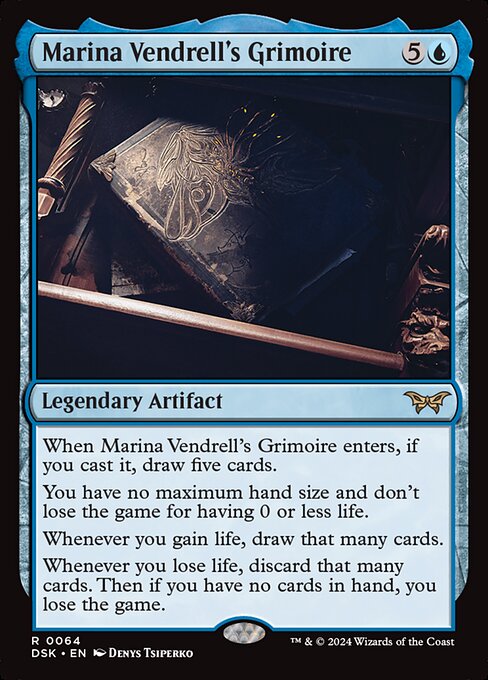
267. Marina Vendrell's Grimoire
Rating1.7WeakWhy this rating?
Not good filler and often gets cut (1.7/10).
Why. Six mana to draw five cards, with no maximum hand size, and you don't lose at 0 life. Each life gained draws you cards. A very specialised card.
Risks. Each life you lose makes you discard that many cards, and if your hand is empty you lose the game. One damage spell can cost you the game.
In the draft. A trap. Don't play it in a normal draft.
Results in the games of the set
When it is drafted, it is played only 1% of the time (set average: 62%): it almost always ends in the sideboard.

268. Dazzling Theater // Prop Room
Rating1.5WeakWhy this rating?
Almost unplayable and mostly sideboard material (1.5/10).
Why. The first door gives convoke to your creature spells, so you can cast them by tapping creatures. The second untaps your creatures during the opponent's untap step, so they attack and still block.
Risks. Neither half affects the board directly, and both do almost nothing useful in a normal deck. They cost you a turn.
In the draft. Leave it out. It doesn't earn a place in your deck.
Results in the games of the set
When it is in hand, the deck wins 39.8% of its games (set average: 55.9%, 269th of 269 cards).
In the opening hand: 37.2% wins (55.0% on average).
Drawn during the game: 41.7% (56.6% on average).
When it is drawn, the deck wins 8.7 points less than when it is not.
When it is drafted, it is played only 10% of the time (set average: 62%): it almost always ends in the sideboard.
Taken among the first three picks (59 drafts), it ends in the deck 29% of the time.
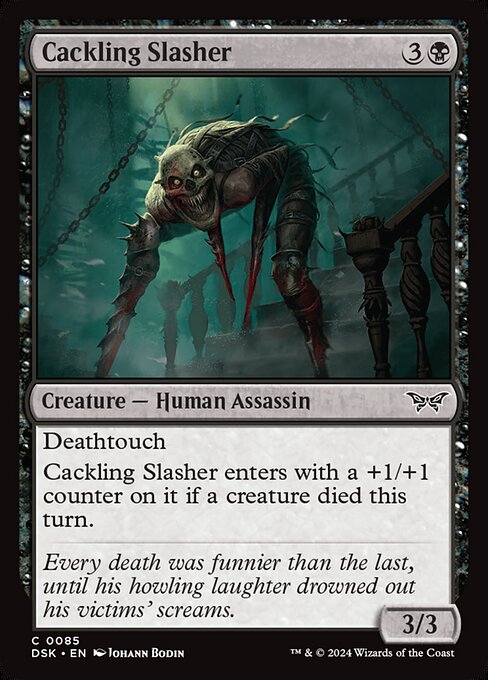
269. Cackling Slasher
Rating1.4WeakWhy this rating?
Almost unplayable and mostly sideboard material (1.4/10).
Why. A 3/3 deathtouch for four mana: a fine blocker that makes opponents think twice about attacking. Cast after a creature died this turn, it enters with a +1/+1 counter as a 4/4, which happens after combat or a removal spell.
Risks. The bonus is purely about timing and often goes unused if you cast it into a quiet board. Without it, this is a fairly ordinary four-drop, and removal or a well-placed block trades with it easily.
In the draft. Playable black filler, the kind of card that rounds out a deck rather than one you chase. Take it after your removal and better creatures, particularly if your curve is short on four-drops.
Results in the games of the set
When it is in hand, the deck wins 46.5% of its games (set average: 55.9%, 266th of 269 cards).
In the opening hand: 44.9% wins (55.0% on average).
Drawn during the game: 47.5% (56.6% on average).
When it is drawn, the deck wins 1.9 points less than when it is not.
When it is drafted, it is played only 4% of the time (set average: 62%): it almost always ends in the sideboard.

270. Greenhouse // Rickety Gazebo
Rating1.4WeakWhy this rating?
Almost unplayable and mostly sideboard material (1.4/10).
Why. A two-door Room: Greenhouse lets your lands tap for any color, while Rickety Gazebo mills four and returns up to two permanent cards to your hand. It gives you fixing or card advantage, and as an enchantment it triggers eerie.
Risks. Neither door affects the board directly: you spend a whole turn on fixing or recursion. Gazebo is random (you need permanents among the four cards) and Greenhouse only matters in a truly multicolor deck.
In the draft. A support card, not a priority. It fits a three-color green deck or one that rewards Rooms and eerie; otherwise let it go by without regret.
Results in the games of the set
When it is in hand, the deck wins 49.6% of its games (set average: 55.9%, 261st of 269 cards).
In the opening hand: 46.1% wins (55.0% on average).
Drawn during the game: 52.0% (56.6% on average).
When it is drawn, the deck wins 1.6 points more than when it is not.
When it is drafted, it is played 24% of the time (set average: 62%).
Taken among the first three picks (100 drafts), it ends in the deck 63% of the time.

271. Rampaging Soulrager
Rating1.4WeakWhy this rating?
Almost unplayable and mostly sideboard material (1.4/10).
Why. A 1/4 for three that blocks small creatures well. With two or more unlocked doors among your Rooms it becomes a 4/4 and starts attacking in earnest, making it a solid body in a Rooms deck.
Risks. Without Rooms it is just a 1/4, too passive to win games. It needs two unlocked doors, so one fully unlocked Room or two Rooms on the battlefield, and that takes time.
In the draft. Filler until you have Rooms. Move it up only if your deck runs several, in red with a partner that likes Rooms; otherwise it is a late-pack card.
Results in the games of the set
When it is in hand, the deck wins 49.4% of its games (set average: 55.9%, 262nd of 269 cards).
In the opening hand: 47.0% wins (55.0% on average).
Drawn during the game: 51.0% (56.6% on average).
When it is drawn, the deck wins 0.4 points more than when it is not.
When it is drafted, it is played 19% of the time (set average: 62%).
Taken among the first three picks (64 drafts), it ends in the deck 75% of the time.
It is played mostly in R/U decks (84% of them).
Intrinsic ratings: they do not take into account the cards you have already picked. They matter most for the first pick of the first pack.