Card ranking · Marvel's Spider-Man (SPM)
← Marvel's Spider-Man188 cards
- Bomb > 8.4
- Very good ≥ 7.2
- Good ≥ 6.2
- Playable ≥ 5.0
- Weak < 5.0
Ratings are out of 10. They combine experts' opinions, the statistics of thousands of drafts by experienced players (when a card is taken, played, and the wins of the decks that play it) and what is printed on the card. Click a card to enlarge it.

1. Morlun, Devourer of Spiders
Rating9.4BombWhy this rating?
The best card of the set (9.4/10).
Why. A flexible bomb: you pick X to suit the game. On turn five it is a lifelinker with three counters that also burns the opponent for three; late in the game a big X can end things on the spot.
Risks. He enters with X counters but still dies to removal in response, and the two black mana in the cost rule out a splash. Pouring all your mana into him leaves the board empty if he is answered.
In the draft. Take him very early if you are black: he is good at every stage of the game. Look for cheap creatures and removal to survive until X is big.

2. Norman Osborn // Green Goblin
Rating9.2BombWhy this rating?
One of the 3 best cards of the set (9.2/10).
Why. A two-mana creature that cannot be blocked and connives on every hit, filtering your hand and growing if you discard a nonland card. Transformed, it flies, has menace, makes graveyard spells cheaper and gives every nonland card Mayhem.
Risks. It is tiny and dies to anything. Transforming costs four mana at sorcery speed and needs three colours, blue, black and red. Without that you simply have a small, efficient blue creature.
In the draft. A great early pick even if you never reach all three colours: the front face is already good in blue. It shines in a discard-based deck that can actually go after the transformation.
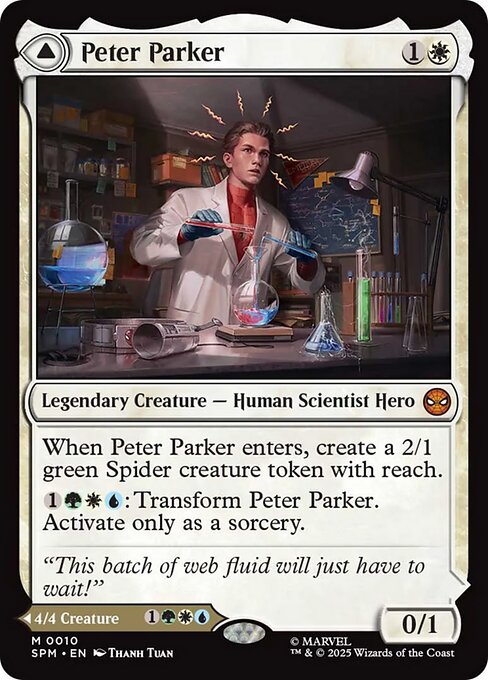
3. Peter Parker // Amazing Spider-Man
Rating9.0BombWhy this rating?
One of the 3 best cards of the set (9.0/10).
Why. For two mana you get two bodies: the 0/1 and a 2/1 Spider creature token with reach. Transformed, it has vigilance and reach and gives every coloured legendary spell you cast Web-slinging for green, white and blue.
Risks. The front face alone is modest. Transforming costs four mana including a green, a white and a blue, so three colours, and only at sorcery speed.
In the draft. A very good two-drop even without transforming; take it high if you are white. The back face needs a green-white-blue deck with many legendary creatures to pay off.
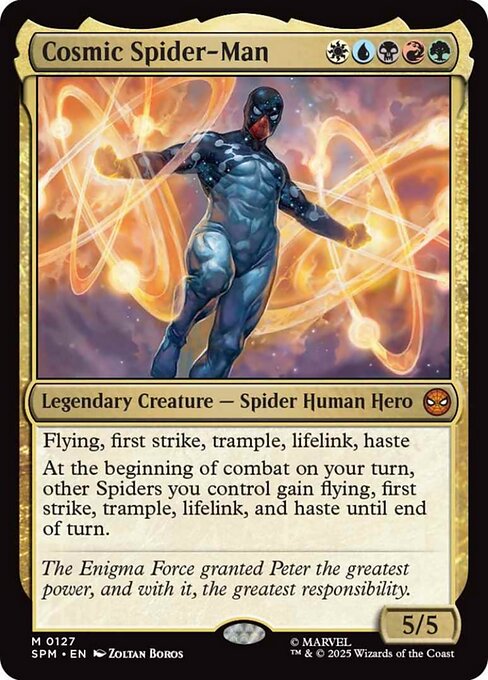 Rating8.9Bomb
Why this rating?
One of the 10 best cards of the set (8.9/10).
Why. A 5/5 with flying, first strike, trample, lifelink and haste: it dominates combat the turn it lands. At the beginning of combat on your turn, every other Spider you control gets the same abilities.
Risks. The cost needs all five colours, so it only fits a heavily stretched deck with serious fixing. It still dies to removal.
In the draft. Only take it if you are really building five colours, or close, with fixing lands. Otherwise it is an enthusiast card and passing it is fine in a normal deck.
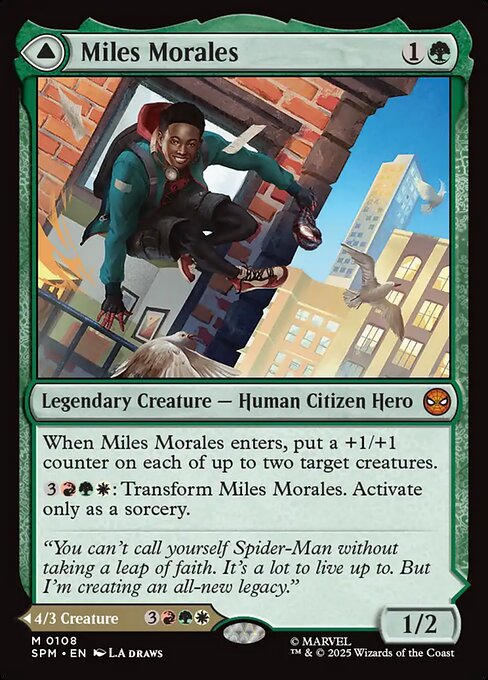
5. Miles Morales // Ultimate Spider-Man
Rating8.8BombWhy this rating?
One of the 10 best cards of the set (8.8/10).
Why. A green two-drop that puts a +1/+1 counter on up to two creatures, itself included: immediate value. Transformed, it has first strike and haste and doubles the counters on each Spider and legendary creature when you attack, which gets out of hand quickly.
Risks. Transforming costs six mana across red, green and white, and only at sorcery speed. The front face is a small body that stands poorly alone with no other creatures to boost.
In the draft. A good early pick in green: the enters effect is useful in any creature deck. It shines with plenty of counters and Spiders; transforming is a bonus if you have the colours.
 Rating8.7Bomb
Why this rating?
One of the 10 best cards of the set (8.7/10).
Why. Three chapters for two mana: a 2/1 Spider token with reach, a +1/+1 counter that also makes a creature a legendary Spider Hero, then double strike for a turn. You get a body right away and an attack finisher later.
Risks. It does nothing powerful before the third chapter, which needs a good creature to attack with. The Saga is then sacrificed; the token and the counter are the lasting gains.
In the draft. An excellent white pick: a good token early and a good attack later. It pushes your Spiders and legendary creatures; play it on turn two or three so chapter three lines up with a big attack.

7. Sandman, Shifting Scoundrel
Rating8.6BombWhy this rating?
One of the 10 best cards of the set (8.6/10).
Why. A three-drop that grows with your lands: a 4/4 on turn four, a 5/5 on turn five, and blockers with power 2 or less cannot stop it. Later, recurring it from the graveyard with a land makes it a lasting threat.
Risks. It needs two green mana. Removal kills it, and if you stumble on lands it stays small. Bringing it back costs five mana.
In the draft. Take it high in green: a cheap attacker that grows enormous with no effort. It fits every green deck, especially ones that rarely miss land drops.
 Rating8.4Bomb
Why this rating?
One of the 10 best cards of the set (8.5/10).
Why. A one-drop with reach and deathtouch: it blocks and kills nearly anything. Its sacrifice ability tutors a Spider Hero, turning a cheap card into the exact card your deck needs.
Risks. It is a 1/1, so any removal or light damage spell kills it. The search only finds Spider Heroes, so your deck needs to contain them; otherwise it remains a good defensive blocker.
In the draft. Take it high in a green deck with several Spider Heroes: a great first play plus a search. Without them it is just a blocker, but still a solid one.
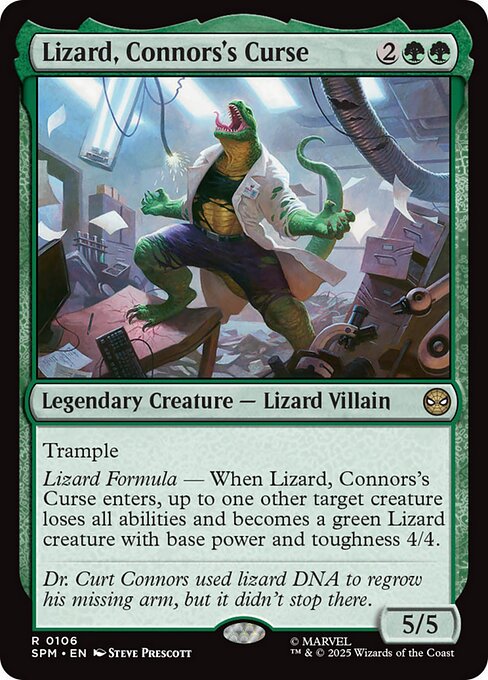 Rating8.3Very good
Why this rating?
One of the 10 best cards of the set (8.3/10).
Why. A 5/5 trampler for four mana, which is already huge. When it enters, it can turn another creature, usually an opposing one, into a green 4/4 Lizard with no abilities, often neutralising the opponent's best ability.
Risks. The target becomes a 4/4: if it was small, you upgrade it. It needs two green mana and still dies to removal. The effect is optional.
In the draft. A very strong early green pick. Use the effect on a creature with a dangerous ability that is not big enough to become better than yours.

10. Silk, Web Weaver
Rating8.2Very goodWhy this rating?
One of the 10 best cards of the set (8.2/10).
Why. A 3/5 that makes a 1/1 Human Citizen token each time you cast a creature spell, so your board widens every turn. Web-slinging makes it cheaper when you have a tapped creature to return, and its five-mana ability gives the whole team +2/+2 and vigilance.
Risks. It needs both green and white, and Web-slinging forces you to return a tapped creature, which costs tempo. With few creatures, the token engine is slow.
In the draft. A very high pick for a green-white creature deck. It wins long games alone through tokens and the team pump; look for as many cheap creatures as possible.

11. Spider-Woman, Stunning Savior
Rating8.1Very goodWhy this rating?
One of the very best rares of the format (8.1/10).
Why. A two-drop with flying and a hybrid white or blue cost, so it fits more decks. Its ability makes your opponents' creatures and artifacts enter tapped: they cannot block right away, which greatly helps your tempo.
Risks. This 2/2 dies to plenty of things, and its ability does nothing to permanents already in play.
In the draft. A good pick for an aggressive white or blue deck. Easy to cast, attacking in the air from turn three, and it slows opponents who rely on fresh blockers.

12. Doctor Octopus, Master Planner
Rating8.0Very goodWhy this rating?
One of the very best mythics of the format (8.0/10).
Why. A 4/8 that draws you up to eight cards at each of your end steps: it refills your hand and wins almost any game it survives. It also gives your other Villains +2/+2.
Risks. Seven mana across two colours is very heavy, and you have to survive until then. If the opponent kills or exiles it, you spent a whole turn for nothing. You need Villains for the bonus.
In the draft. A finisher for a slow blue-black deck with good blockers and removal. A solid mid-to-high pick; play one copy and make sure you have enough lands.
 Rating7.9Very good
Why this rating?
One of the very best rares of the format (7.9/10).
Why. A two-mana 3/2 with flash: you can ambush with it or play it at the end of the opponent's turn. For one mana it flies, and sacrificing it gives your whole team hexproof and indestructible.
Risks. A 3/2 dies to a lot of things. The protection costs the creature itself, so you lose a body to save the others. Flying costs one mana each turn.
In the draft. A very good white aggro card, a solid mid-to-high pick. It is versatile: aerial attacker, ambusher or insurance against a mass removal spell or a damage spell.
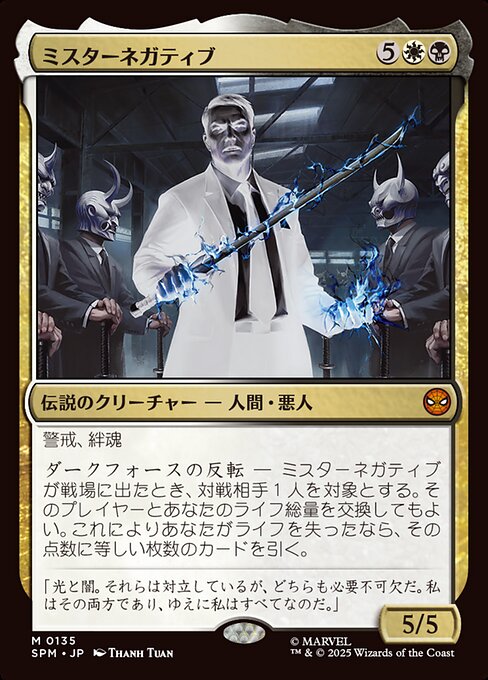
14. Mister Negative
Rating7.8Very goodWhy this rating?
One of the very best mythics of the format (7.8/10).
Why. A 5/5 with vigilance and lifelink. When it enters, you may exchange life totals with the opponent: if you lose life, you draw that many cards. Behind, the swap puts you back in front; ahead, it draws you cards.
Risks. Seven mana in white and black is very expensive. The swap is optional and only draws if you lose life, so it either catches you up or draws you cards. It still dies to removal.
In the draft. A finisher for a slow white-black deck, only one copy. Take it at a middling pick: even without the swap it is a big lifelinking body.
 Rating7.7Very good
Why this rating?
One of the very best rares of the format (7.7/10).
Why. An Aura that enchants a land and creates three 1/1 Human Citizen creature tokens: four mana for three bodies. The land's ability gives one creature +1/+1 for each creature you control until end of turn, which makes your attacks bigger.
Risks. It does nothing against a board wipe, and the land's ability can only be used at sorcery speed. If the enchanted land goes away it takes the ability with it, though not the tokens.
In the draft. A good card for white creature decks, taken at a middling pick. It is best with team pump or token synergies.
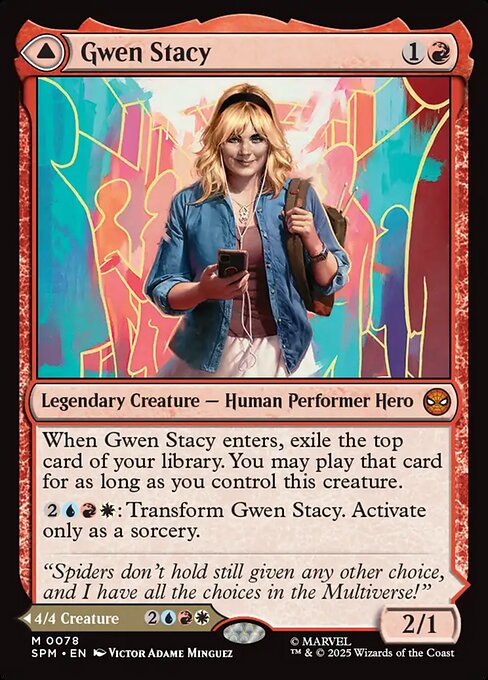
16. Gwen Stacy // Ghost-Spider
Rating7.6Very goodWhy this rating?
One of the very best mythics of the format (7.6/10).
Why. A red two-drop that exiles the top card of your library and lets you play it as long as Gwen stays on the battlefield: cheap card advantage. Transformed, she flies, has vigilance and haste, and grows as you play cards from exile.
Risks. A fragile 2/1: if she dies, you lose the right to play the exiled card. Transforming costs five mana including blue, red and white, so three colours.
In the draft. A good mid-to-high pick in red. Play her early so the exiled card gets used quickly; transforming is a bonus in a three-colour deck.
 Rating7.6Very good
Why this rating?
One of the very best rares of the format (7.6/10).
Why. A 4/4 that, on entering, exiles a nonland permanent and a nonland permanent card from a graveyard: removal and a body in one card. If he dies, he goes to the bottom of the library and the exiled cards return to their owners' hands.
Risks. Five mana in white and black. If he is killed, the exiled cards go back to their owners' hands, so the removal is temporary in that case. Both targets are optional.
In the draft. A very good pick for white-black: a solid body plus removal. Aim at the opponent's best threats, keeping in mind that an opponent who can kill him gets the card back.
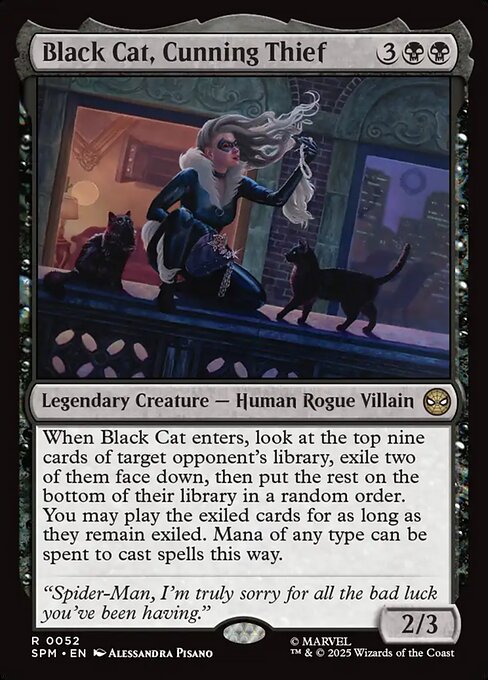 Rating7.6Very good
Why this rating?
One of the very best rares of the format (7.6/10).
Why. A 2/3 that gives you access to two cards from among the top nine of the opponent's library, playable with any type of mana. It is pure card advantage, and it denies the opponent their best cards.
Risks. Five mana for a modest body, and the gain only arrives if you have the mana to play the cards. You do not control what sits on top of the opponent's library.
In the draft. A middling pick for a black control or value deck. It does not win the game alone, but it makes up for a card trade well and gives you options late.

19. Mary Jane Watson
Rating7.5Very goodWhy this rating?
A very good rare of the format (7.5/10).
Why. A two-mana 2/2 that draws a card, once each turn, whenever a Spider enters under your control. In a deck full of Spiders and Spider tokens, it is a steady card engine.
Risks. Without Spiders she is a vanilla 2/2. She only draws once per turn, so a deck that makes many tokens gets no extra from her.
In the draft. Take her based on how many Spiders you have: good in green-white with Spider creatures. With a hybrid green or white cost she fits either colour easily.

20. Cheering Crowd
Rating7.4Very goodWhy this rating?
A very good rare of the format (7.4/10).
Why. A 2/2 that grows on every player's turn: at the start of their first main phase, that player may put a +1/+1 counter on it and add one colourless mana for each counter. On your turns it is a ramp creature that keeps growing.
Risks. The bonus also benefits the opponent, who can add a counter and get colourless mana on their turn. That symmetry is dangerous in a deck with no clear plan, and it dies quickly.
In the draft. A niche card to take late: playable in a red or green deck, but you have to know how to use it. Avoid it if your deck cannot use the extra mana.
 Rating7.4Very good
Why this rating?
A solid uncommon of the format (7.4/10).
Why. A green-white two-drop that flies during your turn and leaves a 1/1 Human Citizen token behind when it leaves the battlefield. It attacks in the air and gives you value if it dies.
Risks. It only flies on your turn: it blocks like a normal 2/2. It needs both colours, green and white, which limits the decks that can play it.
In the draft. A good uncommon for green-white, taken at a middling pick. It is solid at any point in the game and leaves a body behind.
 Rating7.4Very good
Why this rating?
A very good rare of the format (7.4/10).
Why. A green two-drop that creates a Food token and gives your other Spiders and a long list of animals +1/+1. In a deck with many Spiders, it is an effective lord.
Risks. Without other Spiders or animals, it only gives a 2/2 and a Food. It stays fragile, and the bonus vanishes if he dies.
In the draft. A good card for a green deck of Spiders or small creatures. Take it at a middling pick; the Food also gives longevity against aggressive decks.
 Rating7.4Very good
Why this rating?
A very good mythic of the format (7.4/10).
Why. An enchantment with convoke that, at the beginning of combat on each of your turns, looks at the top five cards and puts a creature onto the battlefield for free. Late in the game it is a continuous source of creatures.
Risks. Eight mana on paper: only convoke makes it castable, and you need creatures to pay for it. It does nothing at once and does not defend against the opponent's attacks.
In the draft. A card for a green deck with many creatures, taken late. Only play it if your deck fills the battlefield easily, otherwise it sits stuck in your hand.

24. Villainous Wrath
Rating7.3Very goodWhy this rating?
A very good rare of the format (7.3/10).
Why. A five-mana board wipe that, before destroying all creatures, makes the opponent lose life equal to the number of creatures they control. Against an opponent with many creatures, it is a big swing.
Risks. It also destroys your creatures. It is only good when you are behind on board, and it is a sorcery: you have to survive until you cast it. An aggressive deck does not want it.
In the draft. A good sweeper for a black control deck, taken at a middling pick. Do not play it in a creature deck, but it can rescue a lost game.
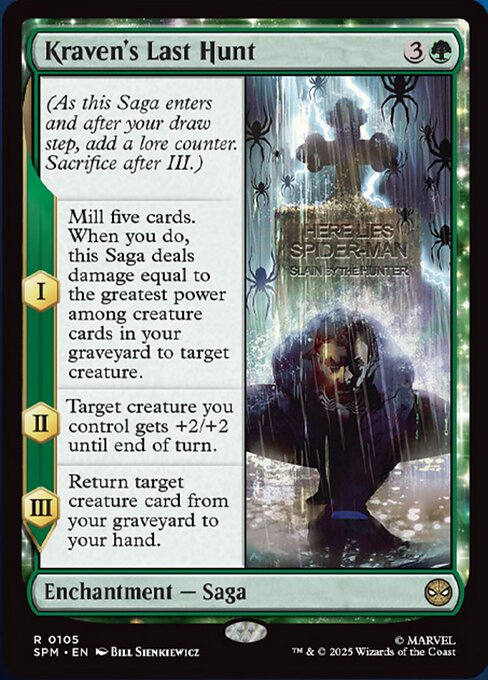 Rating7.2Very good
Why this rating?
A very good rare of the format (7.2/10).
Why. A three-step green Saga: the first chapter mills five cards and deals damage to a creature equal to the greatest power among creature cards in your graveyard, then +2/+2, then a creature returns to your hand.
Risks. The first chapter depends on what lands in the graveyard: with few big creatures the removal is weak. It does nothing against an opponent with no creatures, and it is slow.
In the draft. A good value card for a green deck of big creatures, middling pick. The bigger your creatures, the better the removal; the last chapter makes up for a loss.

26. Sudden Strike
Rating7.2Very goodWhy this rating?
A solid uncommon of the format (7.2/10).
Why. A two-mana instant removal spell that destroys any creature that attacks or blocks. It is efficient and cheap, especially against creatures that cost more than what you paid.
Risks. It only hits a creature in combat: a creature that stays back or a threat that does not fight escapes it. You have to wait for the right moment.
In the draft. A good white uncommon, taken at a middling pick. Its low price makes it easy to slot into any white deck.
 Rating7.2Very good
Why this rating?
A very good rare of the format (7.2/10).
Why. A hybrid black-or-blue 2/4 that, when it deals combat damage to a player, looks at that many cards, puts one into your hand and the rest into your graveyard. If it dies, it can exile itself from the graveyard to give its abilities to another creature.
Risks. It has to connect to be useful, so you must play around blockers. The graveyard activation costs three mana and only works at sorcery speed.
In the draft. A good middling choice for a blue or black deck: it fits either colour, and both of its effects give value even after it dies.
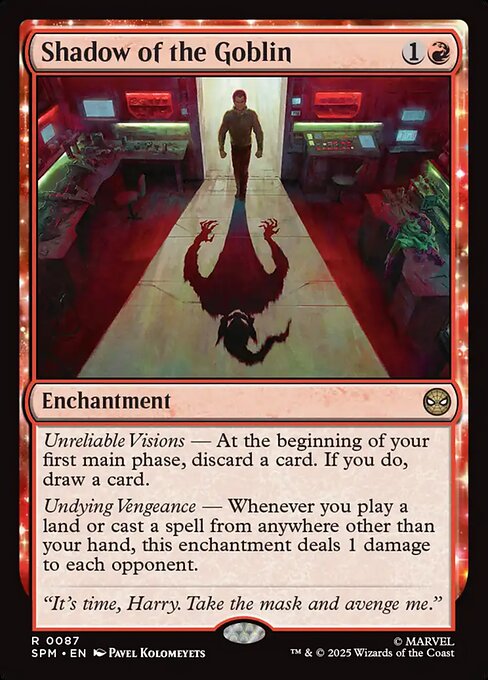 Rating7.1Good
Why this rating?
A very good rare of the format (7.1/10).
Why. A red enchantment that has you discard a card to draw one each turn, and deals one damage to the opponent whenever you play a land or cast a spell from anywhere other than your hand. It is an engine for a Mayhem deck.
Risks. On its own it does nothing visible: you simply swap cards. Without ways to play from the graveyard or exile, the damage almost never triggers.
In the draft. A specialist-deck card, taken late. Only play it if you have enough cards that play from the graveyard or exile, Mayhem first.
 Rating7.0Good
Why this rating?
A very good rare of the format (7.0/10).
Why. A white-blue Equipment that attaches itself to a creature when it enters and gives it +2/+2. Whenever that creature deals combat damage to a player, you draw a card for each modified creature you control, which adds up to big draws.
Risks. You need a creature that connects, and a blocker or removal denies you the gain. Four mana for two colours, and the payoff relies on modified creatures.
In the draft. A good card for a blue-white deck with modified creatures or evasion. Take it at a middling pick; it is better with flying attackers.
 Rating7.0Good
Why this rating?
A very good mythic of the format (7.0/10).
Why. A 4/4 with deathtouch and lifelink: it blocks and attacks very well. When it attacks, you may play cards from the top of your library, paying life equal to a spell's mana value instead of its cost; lifelink offsets part of it.
Risks. Five mana with two black mana in the cost. Paying life can be dangerous against an aggressive deck. It dies to removal like anything else.
In the draft. A solid body rather than a priority: it defends and attacks very well even without its ability. A middling to late pick in a black deck.
 Rating7.0Good
Why this rating?
A very good rare of the format (7.0/10).
Why. A blue instant with X that exiles X target artifacts and/or creatures and returns them at the next end step. It is a trick: save your creatures from removal, clear blockers before an attack or replay an enters effect.
Risks. It is not permanent removal: everything comes back at the next end step, and an exiled token never returns. Each target costs one more mana.
In the draft. A trick for a blue tempo deck or one with many enters effects. Take it late or at a middling pick, depending on your deck.
 Rating7.0Good
Why this rating?
A very good rare of the format (7.0/10).
Why. A 4/3 trampler for three mana, well above the curve. It draws a card and grows when the opponent's creature with the greatest power dies, which rewards trading.
Risks. It needs both colours, black and green. Its toughness of three makes it vulnerable to damage. The trigger depends on the opponent's biggest creature dying.
In the draft. A good body for three mana, but it needs two specific colours: a filler pick in a black-green deck, even if its ability does not always trigger.

33. Mysterio, Master of Illusion
Rating7.0GoodWhy this rating?
A very good rare of the format (7.0/10).
Why. A 3/3 that creates a 3/3 blue Illusion Villain creature token for each nontoken Villain you control, himself included: for four mana, at least two 3/3 bodies. They are exiled if he leaves the battlefield.
Risks. The tokens are exiled if he leaves: removal on him wipes it all. The bonus depends on other Villains, so he is stronger in a deck with several.
In the draft. A late pick for a blue deck with Villains. Even on his own, he brings two bodies for four mana.

34. Terrific Team-Up
Rating7.0GoodWhy this rating?
A solid uncommon of the format (7.0/10).
Why. A green instant that has one or two of your creatures (with +1/+0) deal damage equal to their power to an opposing creature, with no damage coming back. It is one-sided removal, and costs two less if you control a permanent with mana value 4 or greater.
Risks. You need a creature on the battlefield with enough power to kill the target. If the opponent removes your creature in response, it fizzles. At four mana with no discount, it is less efficient.
In the draft. A playable but conditional green removal spell, taken late. It is better with big creatures and expensive permanents to enable the discount.
 Rating7.0Good
Why this rating?
One of the best commons of the format (7.0/10).
Why. A two-mana instant with two jobs. It kills a creature with power 4 or greater, or protects one of yours by giving it a +1/+1 counter and hexproof until end of turn.
Risks. The removal mode only reaches big creatures, so small threats slip by. The protection mode needs a creature worth saving on your side of the table.
In the draft. A solid white inclusion once you already hold some broader removal. Hold it for the opponent's biggest threat, or to answer a removal spell aimed at your best creature.
 Rating6.9Good
Why this rating?
A very good rare of the format (6.9/10).
Why. Removal spread over three chapters. The first destroys a creature of your choice, which pays for the card by itself. The second adds pressure and the third clears graveyards.
Risks. Chapter II hits you too: each player may discard, and anyone who doesn't loses 3 life. Chapter III rarely matters unless graveyards are doing something.
In the draft. Take it as a three-mana black removal spell and don't overrate the rest. Chapter II is better when you have a spare card to discard.
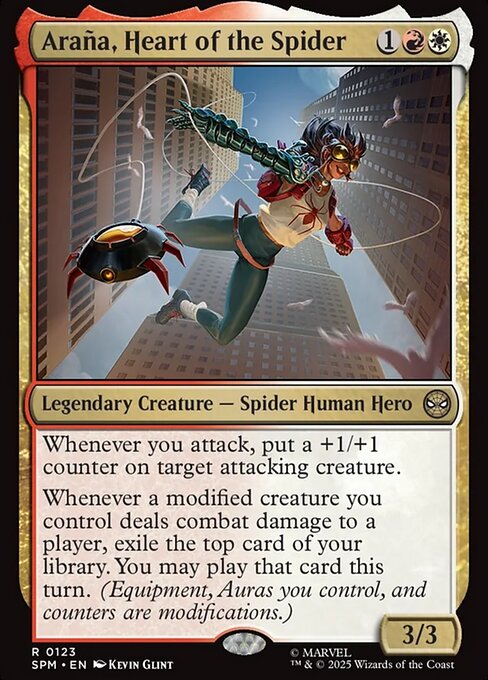
37. Araña, Heart of the Spider
Rating6.8GoodWhy this rating?
A very good rare of the format (6.8/10).
Why. A three-mana 3/3 that grows an attacker every time you attack. When a modified creature connects with the opponent, you exile the top card and may play it this turn, which keeps the cards flowing.
Risks. She asks for both red and white. Without regular attacks or modified creatures, the second ability rarely fires, and she trades easily in combat.
In the draft. A good gold card for an aggressive red-white deck. Look for Equipment, Auras or counter effects so that you have modified creatures.

38. Aunt May
Rating6.8GoodWhy this rating?
A solid uncommon of the format (6.8/10).
Why. A one-mana creature that gains you 1 life whenever another creature enters, plus a +1/+1 counter if it is a Spider. In a deck full of Spiders the counter is a real bonus.
Risks. A 0/2 body does nothing alone. Outside a deck packed with creatures and Spiders, it is a small life-gain engine that barely changes the game.
In the draft. A late-pack pick for a white Spider deck. In other decks, don't play it until you have enough creatures to justify it.
 Rating6.8Good
Why this rating?
A solid uncommon of the format (6.8/10).
Why. A four-mana 3/3 with a choice on arrival: return a card with mana value 4 or greater from your graveyard to your hand, or exile an artifact or enchantment.
Risks. The graveyard mode needs a big card to have died already, and the exile mode is not always live. At worst it is a vanilla 3/3 for four.
In the draft. A good support piece in green. Take it without hurry, especially if your deck has several cards with mana value 4 or greater. It stays playable without a target.
 Rating6.8Good
Why this rating?
A solid uncommon of the format (6.8/10).
Why. A fair two-mana 2/3 and a late-game payoff with web-slinging: for six mana, you return a tapped creature to hand, gain 3 life and create two 2/1 green Spider creature tokens with reach.
Risks. Web-slinging is expensive and needs a tapped creature to return. If you cast it just for the body, you lose the effect that gives it value.
In the draft. A flexible green card: fine on turn two, better late. It shines most with creatures whose enter-the-battlefield effects you want to replay.

41. The Soul Stone
Rating6.7GoodWhy this rating?
A very good mythic of the format (6.7/10).
Why. An indestructible black mana rock for two that accelerates your deck. Late in the game, for seven mana and an exiled creature, it brings a creature back from your graveyard every upkeep.
Risks. The harness cost is huge and eats a creature. In a normal game you mostly play it as a mana rock, and it is easy to never get it online.
In the draft. It speeds up a black deck but won't win games alone. Take it if you lack acceleration; otherwise it ranks behind good creatures and removal.
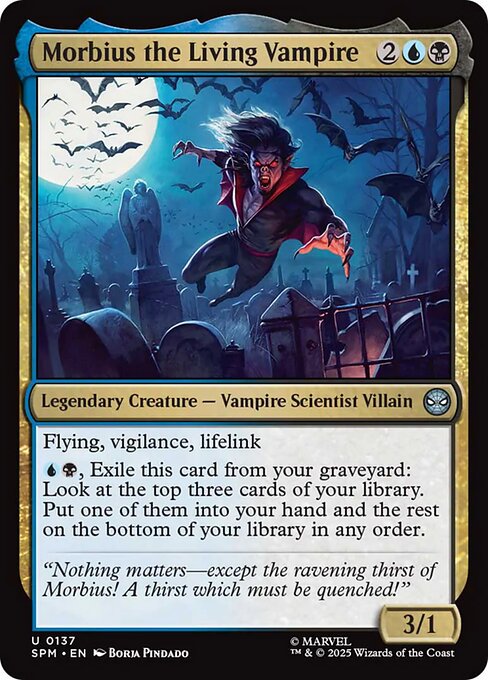
42. Morbius the Living Vampire
Rating6.6GoodWhy this rating?
A solid uncommon of the format (6.6/10).
Why. A four-mana 3/1 with flying, vigilance and lifelink: it attacks and defends at once and gains you life when it deals damage. If it dies, its graveyard ability still gives you a card.
Risks. One toughness is very fragile: any small spell or a block kills it. It also needs both blue and black.
In the draft. A good blue-black gold card to take in those colours. Cast it when the opponent has no open answer.
 Rating6.6Good
Why this rating?
A very good mythic of the format (6.6/10).
Why. A seven-mana sorcery that returns up to six creature cards with different names from your graveyard to the battlefield. At its best it is a huge swing that ends the game.
Risks. You need several different creatures already in the graveyard and seven mana: slow and specific. With a half-empty graveyard it does almost nothing.
In the draft. A specialised card: only play it in a reanimator deck already built to fill the graveyard. Otherwise leave it.
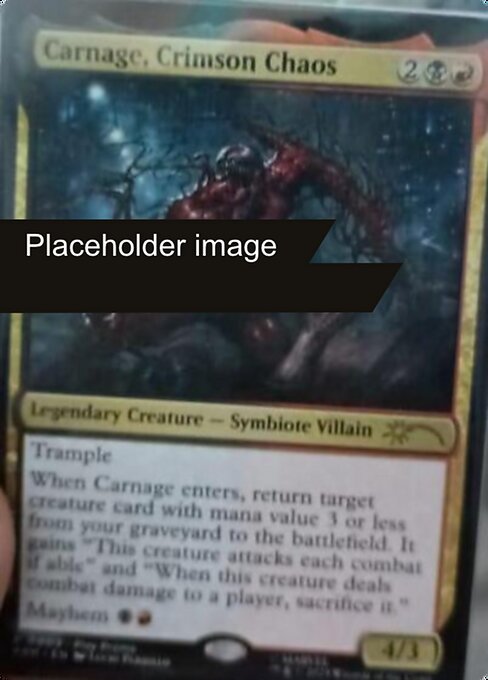 Rating6.6Good
Why this rating?
A very good rare of the format (6.6/10).
Why. A four-mana 4/3 with trample that, on arrival, returns a creature with mana value 3 or less from your graveyard: two bodies for one card. Mayhem also lets you cast it from the graveyard for two mana if you discarded it this turn.
Risks. The returned creature must attack each combat and is sacrificed when it deals combat damage to a player, so it's a temporary bonus. Carnage himself is fragile with 3 toughness.
In the draft. A strong black-red gold card if you have cheap creatures for the graveyard. Take it in those colours; mayhem is a bonus when you discard.

45. Eddie Brock // Venom, Lethal Protector
Rating6.6GoodWhy this rating?
A very good mythic of the format (6.6/10).
Why. A three-mana black 3/3 that returns a creature with mana value 1 or less from your graveyard. It is a fine body, and Venom waits behind it for six mana and three colours.
Risks. Transforming needs black, red and green, which is very hard to reach in draft. Without it, Eddie is a 3/3 whose effect often has no target.
In the draft. Play it as a decent three-mana 3/3, with the transformation as a rare bonus. Don't build your deck around it.

46. Flash Thompson, Spider-Fan
Rating6.6GoodWhy this rating?
A solid uncommon of the format (6.6/10).
Why. A 2/2 with flash that can, on arrival, tap a creature, untap a creature, or both. It acts as a combat trick: an ambush blocker, or a way to set up an attack.
Risks. A 2/2 doesn't last long alone, and the effect kills nothing. It loses much of its value if the opponent has few creatures that matter.
In the draft. A good white tempo card, to play on defence or to open an attack. Best in an aggressive deck that wants to tap blockers.

47. Iron Spider, Stark Upgrade
Rating6.6GoodWhy this rating?
A very good rare of the format (6.6/10).
Why. A colourless three-mana 2/3 with vigilance that puts a +1/+1 counter on each artifact creature and Vehicle you control, itself included. It attacks and still taps for its ability, and can trade counters for cards.
Risks. Without other artifacts it only grows itself, and it is fragile before it does. Drawing costs two mana and two counters.
In the draft. It fits any deck but only gets strong with artifacts around it. Take it as a good colourless body and aim for a few artifacts.

48. Scarlet Spider, Ben Reilly
Rating6.6GoodWhy this rating?
A very good rare of the format (6.6/10).
Why. A three-mana 4/3 with trample, with a two-mana option through web-slinging that adds counters: the more expensive the returned creature, the bigger he gets. Strong tempo.
Risks. He needs red and green, and with no tapped creature to return, he gets no counters. Casting him cheaply also costs you the tempo of the returned creature.
In the draft. A good gold card for red-green. Take it early and look for creatures with enter effects: returning a big creature makes him huge.

49. Spider-UK
Rating6.6GoodWhy this rating?
A solid uncommon of the format (6.6/10).
Why. A solid four-mana 3/4 that web-slinging brings down to three. At your end step, if two or more creatures entered under your control this turn, you draw a card and gain 2 life.
Risks. The trigger needs two creatures entering in one turn, which isn't easy. If web-slinging returns a useful creature, you lose a bit of tempo.
In the draft. A good white uncommon: even without the trigger, it is a big body. It is best with cheap creatures that turn on the draw.

50. Flying Octobot
Rating6.6GoodWhy this rating?
A solid uncommon of the format (6.6/10).
Why. A two-mana 1/1 flier that gets a +1/+1 counter when another Villain enters under your control, once per turn. In a deck full of Villains it is a steadily growing flier.
Risks. Without other Villains it is a 1/1 flier for two, weak and fragile. It only grows once per turn, however many Villains you play.
In the draft. A card for a Villain deck. Don't take it early without Villains; with them it becomes decent.
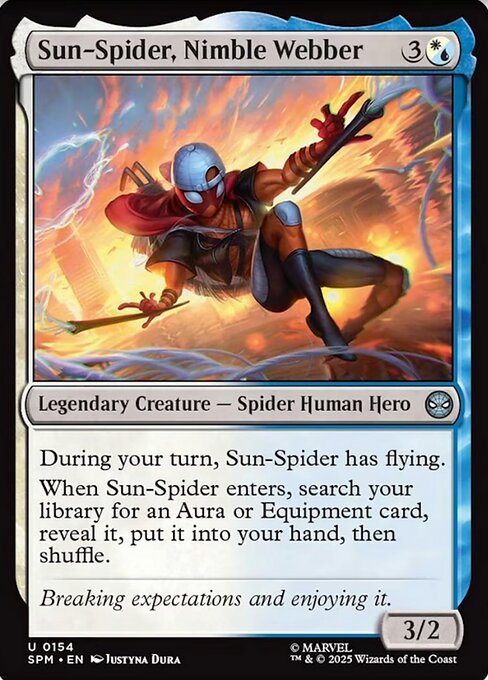 Rating6.5Good
Why this rating?
Good playable that always makes the cut (6.5/10).
Why. A four-mana 3/2 that flies during your turn and searches for an Aura or Equipment on arrival. That replaces itself and feeds your modified creatures.
Risks. With no Auras or Equipment in the deck, the search does nothing. It only flies on your turn, so it blocks as a plain 3/2.
In the draft. A good card for a white or blue deck with several Auras or Equipment. Without them it is too average to play.

52. City Pigeon
Rating6.4GoodWhy this rating?
Good playable that always makes the cut (6.4/10).
Why. A one-mana 1/1 flier that leaves a Food token when it leaves the battlefield. It is a small attacker or chump blocker that partly replaces itself.
Risks. The body is tiny and the impact is low. In a slow deck it is outclassed, and the Food token costs two mana to gain 3 life.
In the draft. Filler for an aggressive white deck. Take it late, after removal and better creatures.
 Rating6.4Good
Why this rating?
Good playable that always makes the cut (6.4/10).
Why. A two-mana 1/3 flier with vigilance: it blocks small fliers well and attacks without losing its defence. It is also a Villain, which matters in a deck that rewards them.
Risks. Each attack puts a card from your own library into your graveyard, which eats into your library in long games. One power deals little damage.
In the draft. A fine blue role-player: defensive, decent in control or Villain decks. Take it as a mid-pack common.
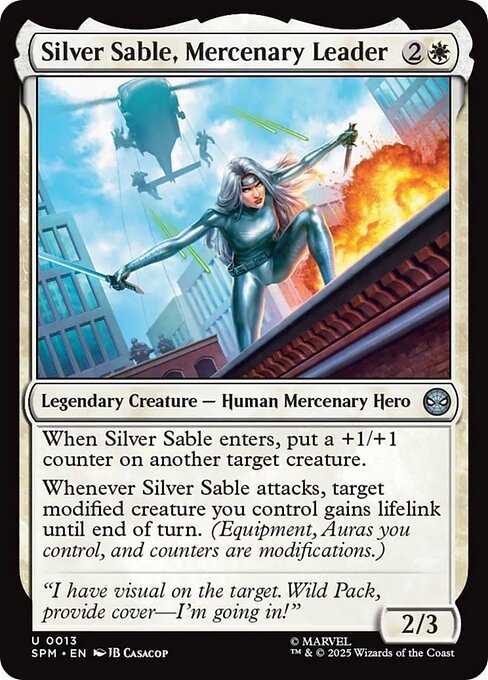
54. Silver Sable, Mercenary Leader
Rating6.4GoodWhy this rating?
Good playable that always makes the cut (6.4/10).
Why. A three-mana 2/3 that puts a +1/+1 counter on another creature when it enters, making that creature modified. When Silver Sable attacks, a modified creature you control gains lifelink until end of turn.
Risks. You need another creature for the enter effect. Silver Sable is a 2/3 that attacks poorly, so the lifelink mostly goes to someone else.
In the draft. A good card for a white creature deck. It is best in a deck that already has several counter or Equipment effects.
 Rating6.4Good
Why this rating?
Good playable that always makes the cut (6.4/10).
Why. A three-mana 2/2 that returns a nonland permanent of your choice to its owner's hand when it enters. It is a tempo effect, and you can also bounce your own permanent to replay its effect.
Risks. It kills nothing, and the body is small for the cost. Against cheap permanents the bounce gains little.
In the draft. A decent blue tempo card, to take without excitement. It gets better in a deck with enter-the-battlefield creatures.
 Rating6.4Good
Why this rating?
Good playable that always makes the cut (6.4/10).
Why. A three-mana instant that puts a creature of your choice on the bottom of its owner's library: clean removal that doesn't care about power or toughness.
Risks. You lose 2 life unless you control a Villain, a real cost in an aggressive deck. It costs more than some other removal.
In the draft. A good black removal spell to take fairly early. It is better with a few Villains so that you avoid the life loss.

57. Wall Crawl
Rating6.4GoodWhy this rating?
Good playable that always makes the cut (6.4/10).
Why. A four-mana enchantment that creates a 2/1 green Spider creature token with reach, gains you 1 life for each Spider you control, and gives +1/+1 to all your Spiders. They also can't be blocked by creatures with defender.
Risks. Without other Spiders, it is a 3/2 token for four mana, which is weak. The enchantment can also be hit by enchantment removal.
In the draft. A good card for a green Spider deck. Don't play it in a deck with only a few Spiders.
 Rating6.3Good
Why this rating?
Good playable that always makes the cut (6.3/10).
Why. A three-mana 2/3 with menace that connives whenever another Villain enters under your control. You filter your hand and, if you discard a nonland card, it grows.
Risks. Without other Villains it is a 2/3 with menace for three. The connive also depends on what you discard.
In the draft. A good card for a blue-black Villain deck. It is better when you have several creatures of that type.
 Rating6.2Good
Why this rating?
Good playable that always makes the cut (6.2/10).
Why. A three-mana 3/3, or just one white mana with web-slinging. As it enters, you look at the opponent's hand and choose a noncreature card type whose spells cost one more.
Risks. The tax applies to your own spells of the chosen type too. To cast it for one mana you need a tapped creature to return.
In the draft. A good white creature to take fairly early. It gives information, a big body and strong tempo.

60. Gallant Citizen
Rating6.2GoodWhy this rating?
Good playable that always makes the cut (6.2/10).
Why. A 1/1 for two green-white hybrid mana that draws a card when it enters, so it replaces itself. It slots into any green or white deck with ease.
Risks. The body is tiny and adds no pressure. It is filler that does nothing beyond its draw.
In the draft. A late-pack pick for any green or white deck. It is better with effects that replay creatures, like web-slinging.
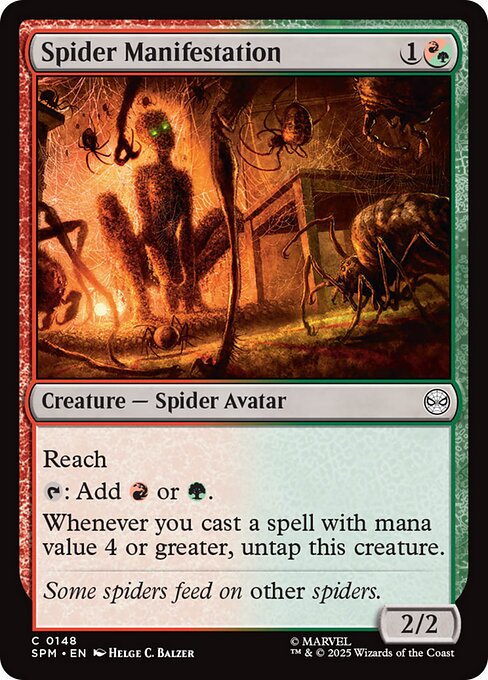 Rating6.2Good
Why this rating?
Good playable that always makes the cut (6.2/10).
Why. A 2/2 with reach for two hybrid mana that taps for red or green mana and untaps when you cast a spell with mana value 4 or greater. It is acceleration that also defends against fliers.
Risks. A 2/2 is fragile, and the card has little impact late in the game. If you tap it for mana, it can't block.
In the draft. A good common for a red-green deck with expensive cards. Take it mid-pack; it is playable in mono red or green too.

62. Spider-Man India
Rating6.2GoodWhy this rating?
Good playable that always makes the cut (6.2/10).
Why. A 4/4 that costs five mana, or three with web-slinging. Whenever you cast a creature spell, it puts a +1/+1 counter on a creature you control, which gains flying until end of turn.
Risks. It needs both green and white, and is slow at full price. Without creatures to cast afterwards, its trigger does almost nothing.
In the draft. A good green-white gold card for a creature-heavy deck. Take it in those colours without making it an absolute priority.
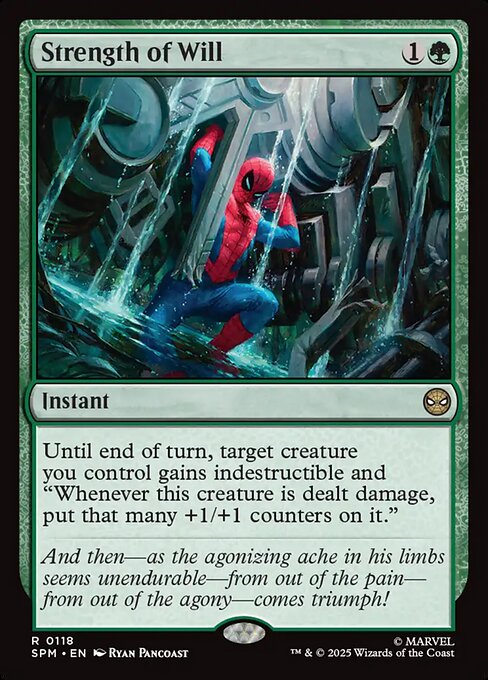
63. Strength of Will
Rating6.2GoodWhy this rating?
Good playable that always makes the cut (6.2/10).
Why. A two-mana instant that makes one of your creatures indestructible and gives it a +1/+1 counter for each point of damage it takes. In combat it survives and grows enormous.
Risks. It doesn't save you from exile, bounce or toughness-shrinking effects. It is a trick: without a decent creature it has no value.
In the draft. A decent green combat trick. Take it once you already have enough creatures and removal.

64. The Clone Saga
Rating6.2GoodWhy this rating?
Good playable that always makes the cut (6.2/10).
Why. A four-mana three-chapter Saga: surveil 3 first, then a nonlegendary copy of the next creature spell you cast that turn, then a card drawn whenever a creature with the chosen name deals combat damage to a player.
Risks. You need a creature to cast on chapter II or the effect is wasted. Chapter III depends on combat damage to a player, which is uncertain.
In the draft. An interesting card in a blue deck full of good creatures, but slow. Take it behind removal and solid creatures.

65. Urban Retreat
Rating6.2GoodWhy this rating?
Good playable that always makes the cut (6.2/10).
Why. A land that enters tapped and taps for green, white or blue: valuable fixing for three colours. It can also arrive from your hand for two mana by returning a tapped creature, at sorcery speed.
Risks. It always enters tapped, which costs tempo in an aggressive deck. It isn't worth a slot unless you play at least two of its three colours.
In the draft. Take it if you play two or three of those colours; otherwise it is just another land. Don't take it ahead of good playables.

66. Web Up
Rating6.2GoodWhy this rating?
Good playable that always makes the cut (6.2/10).
Why. A three-mana enchantment that exiles a nonland permanent an opponent controls for as long as it stays on the battlefield. It is a common removal spell that answers almost any threat.
Risks. If the enchantment leaves the battlefield, the permanent returns. An opponent with enchantment removal can undo your work.
In the draft. A solid white removal spell to take early among the commons. It is safer against opponents with little enchantment removal.

67. Spider-Slayer, Hatred Honed
Rating6.1PlayableWhy this rating?
Good playable that always makes the cut (6.1/10).
Why. A colourless two-mana 2/1 that destroys any Spider it deals damage to. From the graveyard, for six mana, it makes two tapped 1/1 colorless Robot artifact creature tokens with flying.
Risks. Against an opponent with no Spiders it is a mediocre 2/1. The graveyard ability costs six mana, a big late-game investment.
In the draft. A good late pick if you see many Spiders across the table, since it deters them like removal. It is also a Villain for decks that care.

68. Scorpion's Sting
Rating6.0PlayableWhy this rating?
Good playable that always makes the cut (6.0/10).
Why. A two-mana instant that gives a creature -3/-3: cheap removal that kills most small and medium creatures and doubles as a combat trick.
Risks. It doesn't kill creatures with more than 3 toughness. The opponent can also blunt it by protecting the creature.
In the draft. A good common removal spell to take in black. The more small creatures in the format, the better it gets.
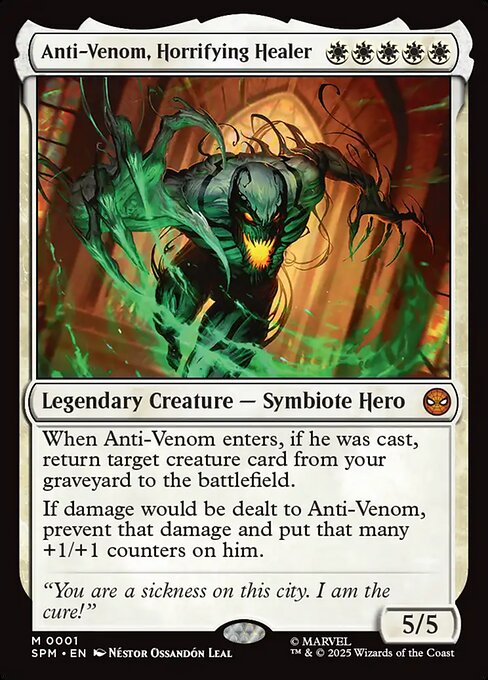
69. Anti-Venom, Horrifying Healer
Rating6.0PlayableWhy this rating?
Good playable that always makes the cut (6.0/10).
Why. A 5/5 that returns a creature card from your graveyard when cast, and turns every point of damage dealt to it into +1/+1 counters instead of dying. On the ground it is nearly impossible to beat through combat or damage spells.
Risks. Five white mana means a mono-white or very heavy white deck. Removal that destroys, exiles or forces a sacrifice goes around its protection, and the recursion needs a creature already in the graveyard.
In the draft. Take it when you are already firmly white and can run a lot of Plains. Outside that shell it usually stays in the sideboard.

70. Costume Closet
Rating6.0PlayableWhy this rating?
Good playable that always makes the cut (6.0/10).
Why. For two mana it enters with two +1/+1 counters that you move onto your creatures, one per turn, at sorcery speed. When a modified creature you control leaves the battlefield, it gains a counter back.
Risks. It does nothing on its own and blocks nothing. It is only as good as your creatures: without good targets it is two counters sitting around. Slow against aggressive decks.
In the draft. Playable in a white creature deck that benefits from modified creatures. A mid-pack pick, not a priority.
 Rating6.0Playable
Why this rating?
Good playable that always makes the cut (6.0/10).
Why. It costs one mana, and whenever a creature with mana value 5 or greater enters you may attach it for free, giving +4/+4. On a big creature that is a huge threat without spending a turn.
Risks. Without creatures of mana value 5 or more, you must pay five to equip it, which is very slow. It does nothing the turn it lands. A heavy-deck card only.
In the draft. Play it if your curve has several big creatures. In a fast deck, skip it: the five-mana equip is too expensive.
 Rating6.0Playable
Why this rating?
Good playable that always makes the cut (6.0/10).
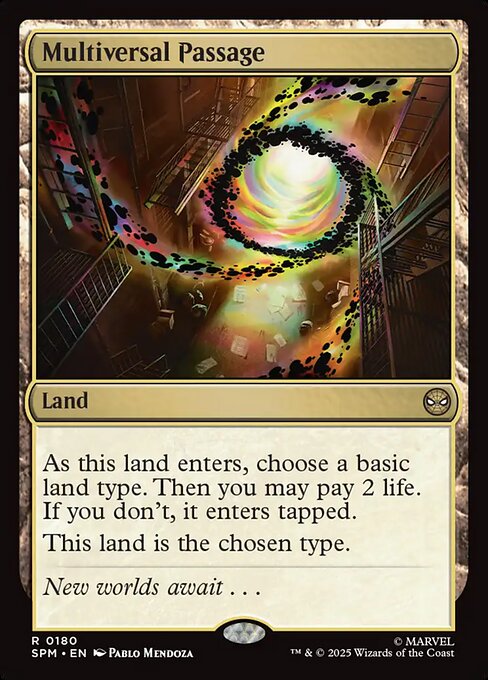
Why. A land that becomes whichever basic land type you choose, so the colour you are missing. You pay 2 life to have it enter untapped, otherwise it enters tapped: flexible fixing.
Risks. It only makes one colour, chosen as it enters. The 2 life hurts in a tight game against a fast opponent.
In the draft. Decent fixing land, not a reason to change colours. Take it when you have two established colours or a light splash.
 Rating6.0Playable
Why this rating?
Good playable that always makes the cut (6.0/10).
Why. For three mana you look at the top five cards and keep up to two creature cards: value and consistency. Later, for one mana, you can sacrifice it for a Treasure token.
Risks. It does nothing on the battlefield the turn you cast it. In a deck with few creatures, you often whiff on the search.
In the draft. A fine mid-list pick in a green deck with lots of creatures. The more creatures your deck has, the better it performs.

74. Rent Is Due
Rating6.0PlayableWhy this rating?
Good playable that always makes the cut (6.0/10).
Why. For one white mana you draw a card at your end step by tapping two creatures or Treasures. In a deck that does not attack with everything, it is a steady card engine.
Risks. Each turn you need two untapped creatures or Treasures, or you sacrifice the enchantment. Tapping creatures at end of turn also leaves them unable to block until your next untap.
In the draft. A niche pick: play it in a white deck with many small creatures or Treasures. Otherwise, pass it.
 Rating6.0Playable
Why this rating?
Good playable that always makes the cut (6.0/10).
Why. A 5/4 for three mana with two black-or-red hybrid symbols, so very easy to cast. Each upkeep you discard a card and get a Treasure token, which fuels your mana and feeds Mayhem.
Risks. The forced discard drains your hand, and over time you run out of cards to play. Cheap removal hurts a lot, and the discard forces awkward choices.
In the draft. Take it in an aggressive black or red deck that can use Mayhem. In a deck that needs its hand, it is riskier.

76. Electro, Assaulting Battery
Rating6.0PlayableWhy this rating?
Good playable that always makes the cut (6.0/10).
Why. A 2/3 flier for three mana that keeps its red mana from one phase to the next and adds a red mana whenever you cast an instant or sorcery. When it leaves the battlefield, you may pay X to deal X damage to a player.
Risks. It needs plenty of instants and sorceries to shine. Without them it is a fair 2/3 flier that dies to small removal. It asks for two red mana on turn three.
In the draft. A good pick in a red spells deck. In a deck without instants or sorceries it settles for being an average flier.

77. Rhino's Rampage
Rating5.9PlayableWhy this rating?
Good playable that always makes the cut (5.9/10).
Why. One red-or-green hybrid mana: your creature gets +1/+0 and fights an opposing creature. If excess damage is dealt, you also destroy a noncreature artifact with mana value 3 or less.
Risks. It is a sorcery: you need a big enough creature, and an opposing response to your target blows you out. It does nothing without a creature.
In the draft. A cheap removal for a red or green deck with big creatures. Take it as a supplement, not ahead of unconditional removal.

78. Agent Venom
Rating5.8PlayableWhy this rating?
Good playable that always makes the cut (5.8/10).
Why. A 2/3 with flash and menace for three mana: it ambushes an attacker or comes in at end of turn. Whenever another nontoken creature you control dies, you draw a card.
Risks. Each draw costs 1 life, which adds up in a deck that trades a lot. The 2/3 body does not survive removal.
In the draft. A solid mid-list pick for a black deck that trades creatures. Keep it for decks that want trades.

79. Interdimensional Web Watch
Rating5.8PlayableWhy this rating?
Good playable that always makes the cut (5.8/10).
Why. It exiles the top two cards of your library that you may play until the end of your next turn, and taps for two mana of any colours to cast spells from exile. A card-advantage burst that helps with fixing.
Risks. Four mana for an effect that does nothing to the board. If you cannot play the exiled cards they are lost, and the mana has a single use.
In the draft. A pick for slow, value-oriented decks. In a deck that needs to protect its life total, it arrives too late.
 Rating5.8Playable
Why this rating?
Good playable that always makes the cut (5.8/10).
Why. A tapped land that makes blue, black or red, handy for a three-colour deck. With Mayhem you can play it from the graveyard if you discarded it this turn.
Risks. It enters tapped and costs 2 life if it arrives from the graveyard. It is useless outside those three colours.
In the draft. Take it if you play two of those three colours or a splash. Otherwise it is just another land.

81. Robotics Mastery
Rating5.8PlayableWhy this rating?
Good playable that always makes the cut (5.8/10).
Why. A flash Aura that creates two 1/1 colorless Robot artifact creature tokens with flying, then gives +2/+2 to a creature. Two flying bodies and a size boost in a single spell.
Risks. Five mana, and the Aura targets a creature: if the target disappears in response, you lose the whole spell. It remains slow.
In the draft. A fine mid-list pick in a patient blue deck. Flash lets you cast it at the end of your opponent's turn.

82. Rocket-Powered Goblin Glider
Rating5.8PlayableWhy this rating?
Good playable that always makes the cut (5.8/10).
Why. An Equipment that gives +2/+0, flying and haste, with a two-mana equip. If you discarded it this turn, Mayhem lets you cast it from the graveyard for two and attach it directly.
Risks. It does nothing without a creature, and the initial three mana is slow. The equipped creature stays exposed to removal in response to equipping.
In the draft. A decent pick for aggressive decks of any colour, since it is colorless. Medium priority.

83. Spider-Punk
Rating5.8PlayableWhy this rating?
Good playable that always makes the cut (5.8/10).
Why. A 2/1 for two mana with riot: a +1/+1 counter or haste. Your other Spiders gain riot too, and spells and abilities can't be countered, and damage can't be prevented.
Risks. A small body, vulnerable to trades. The Spider effect only matters if you have other Spiders in the deck.
In the draft. A decent red two-drop in an aggressive deck. It improves with other Spiders but does not work miracles on its own.
 Rating5.8Playable
Why this rating?
Good playable that always makes the cut (5.8/10).
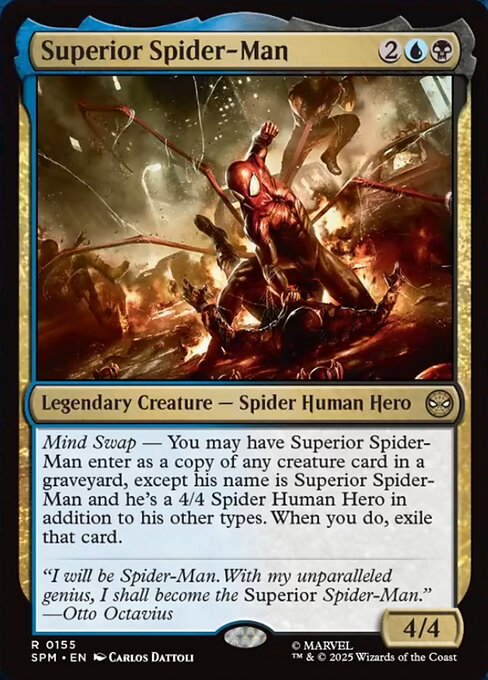
Why. A 4/4 for four mana that enters as a copy of any creature card in a graveyard, exiling that card. It can take the abilities of an opposing creature or one of your own.
Risks. Two specific colours, blue and black. You need a graveyard with an interesting target: without one it stays a plain 4/4.
In the draft. A pick for blue-black decks. Its flexibility makes it playable, without making it a priority.

85. Thwip!
Rating5.8PlayableWhy this rating?
Good playable that always makes the cut (5.8/10).
Why. A one-mana white instant: +2/+2 and flying until end of turn, with a bonus 2 life on a Spider. It works as a combat trick or an evasion burst on offense.
Risks. A combat trick that loses a card if the opponent responds by killing the target. Weak in a deck without good creatures.
In the draft. A late-pack pick for an aggressive white deck, especially with Spiders.
 Rating5.8Playable
Why this rating?
Good playable that always makes the cut (5.8/10).
Why. A two-mana instant: a player draws, then one of your creatures connives, possibly gaining a +1/+1 counter. It replaces itself and grows a creature.
Risks. It does not affect the board by itself, and the connive discard costs you a card if you have nothing spare. Weak without creatures.
In the draft. A mid-pack pick in a blue deck with creatures. Pitching a spare land costs nothing, but only a nonland discard grows the creature.

87. Whoosh!
Rating5.8PlayableWhy this rating?
Good playable that always makes the cut (5.8/10).
Why. A two-mana instant that returns a nonland permanent to its owner's hand. With kicker you pay two more mana and draw a card: flexible tempo, useful on defense or offense.
Risks. Bouncing never solves anything permanently. Against a token it is clean removal, but otherwise the opponent just replays the card.
In the draft. A playable late-list pick for a blue tempo deck. Kicker keeps it useful even late in the game.

88. Ezekiel Sims, Spider-Totem
Rating5.7PlayableWhy this rating?
Good playable that always makes the cut (5.7/10).
Why. A 3/5 with reach for five mana: a good defense against fliers. At the beginning of combat on your turn, a Spider you control gets +2/+2, Ezekiel himself included.
Risks. Five mana for a defensive body. Without another Spider, the trigger only pumps Ezekiel himself, and only on your turn.
In the draft. A mid-pack pick in a green deck with Spiders. Elsewhere its value is more modest.
 Rating5.6Playable
Why this rating?
Good playable that always makes the cut (5.6/10).
Why. A three-mana modal instant: counter a spell, tap one or two creatures, or both. It works as a counterspell or a way to stop an attack.
Risks. Two blue mana on turn three is demanding, and the counter mode needs open mana. A deck that taps out on its own turn cannot use it well.
In the draft. A decent pick for a blue control or tempo deck. Aggressive decks will prefer creatures.
 Rating5.6Playable
Why this rating?
Good playable that always makes the cut (5.6/10).
Why. A land that makes a colorless mana, or filters one mana into any colour. It also gives menace to a legendary creature until end of turn, at sorcery speed.
Risks. The filter needs another mana to pay for it and does not ramp. Its second ability is situational and also costs a mana.
In the draft. A late pick, useful for splashing. Do not take it ahead of a good playable.
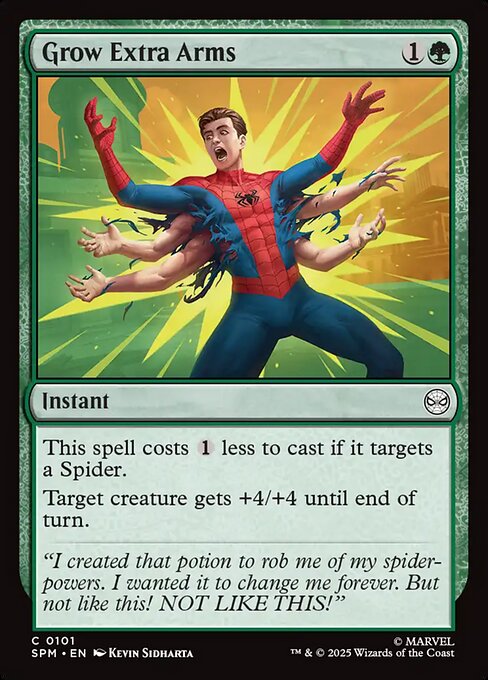
91. Grow Extra Arms
Rating5.6PlayableWhy this rating?
Good playable that always makes the cut (5.6/10).
Why. An instant that gives +4/+4 until end of turn, and costs one less on a Spider. A big combat trick that wins a combat.
Risks. It loses a card if the opponent responds by killing the target, and does nothing without a creature. Worse without Spiders.
In the draft. A second-half-of-the-pack pick for an aggressive green deck, especially one with Spiders.
 Rating5.6Playable
Why this rating?
Good playable that always makes the cut (5.6/10).
Why. A 2/2 for two blue mana that gets +1/+1 whenever you cast a blue spell. At your end step it untaps and becomes a land that makes blue until your next turn: it provides mana on your opponent's turn, then comes back as a creature.
Risks. It cannot block while it is a land, which is during your opponent's turn. Two blue mana is demanding.
In the draft. A pick for a heavy blue deck with instants or flash. On defense it is not worth much.
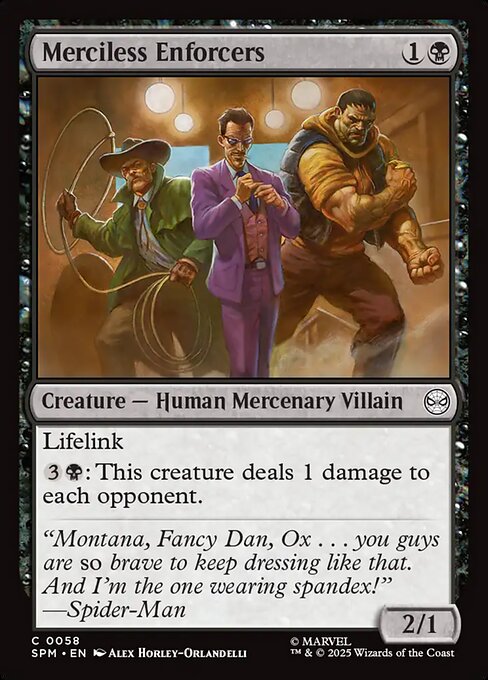 Rating5.6Playable
Why this rating?
Good playable that always makes the cut (5.6/10).
Why. A 2/1 with lifelink for two mana that also deals 1 damage to each opponent for four mana. A decent two-drop that still does something late.
Risks. A small body that dies to almost anything. The late-game effect is slow and expensive.
In the draft. Good curve filler for a black deck. Take it mid-pack.

94. Sinister Hideout
Rating5.6PlayableWhy this rating?
Good playable that always makes the cut (5.6/10).
Why. A tapped land that makes blue or black. For four mana plus tapping it, you can surveil 1, which helps sort your library and fill the graveyard.
Risks. It enters tapped and its ability is expensive. Useless outside blue-black.
In the draft. Take it if you are blue-black. Otherwise, pass.
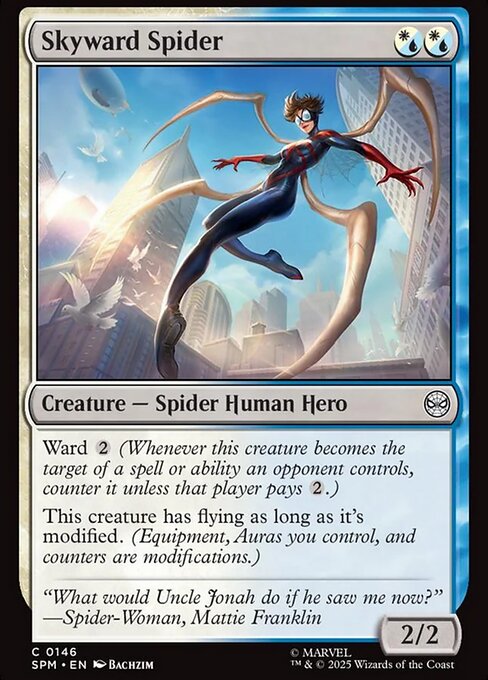
95. Skyward Spider
Rating5.6PlayableWhy this rating?
Good playable that always makes the cut (5.6/10).
Why. A 2/2 for two hybrid white-or-blue mana with ward 2. It has flying as long as it is modified, which makes it an aerial threat with a counter or equipment.
Risks. Unmodified, it is just a 2/2 on the ground. It needs counters, Auras or Equipment.
In the draft. A fair two-drop for a white or blue deck that modifies its creatures. The hybrid cost makes it easy to cast.
 Rating5.6Playable
Why this rating?
Good playable that always makes the cut (5.6/10).
Why. A tapped land that makes green or white. For four mana it lets you surveil 1, a late-game utility.
Risks. It enters tapped and its ability is slow. No interest outside green-white.
In the draft. Take it if you play green-white. Otherwise, pass.
 Rating5.6Playable
Why this rating?
Good playable that always makes the cut (5.6/10).
Why. A 3/3 for three mana, solid on the battlefield. It taps two untapped creatures to add a mana of any colour: fixing and acceleration.
Risks. Tapping two creatures stops them from attacking or blocking. It is mostly worth its body.
In the draft. A solid three-mana body, useful for splashing. An average mid-pack pick.

98. Tombstone, Career Criminal
Rating5.6PlayableWhy this rating?
Good playable that always makes the cut (5.6/10).
Why. A 2/2 for three mana that returns a Villain card from your graveyard to your hand when it enters, and makes your Villain spells cost one less. Two value effects in a deck full of Villains.
Risks. Without a Villain in the graveyard, the trigger does nothing. A small body in a deck without enough Villains.
In the draft. Take it in a black Villain deck. Outside that plan its effect is too situational.

99. Scout the City
Rating5.5PlayableWhy this rating?
Good playable that always makes the cut (5.5/10).
Why. A two-mana sorcery with two modes: mill three cards to take a permanent card into your hand and gain 3 life, or destroy a creature with flying. The second mode is real removal against one kind of threat.
Risks. The removal mode only hits fliers. The other mode is slow and gives little direct advantage.
In the draft. A good green deck pick against fliers, or a sideboard card. More interesting if your table plays many of them.
 Rating5.4Playable
Why this rating?
A solid playable that rarely gets cut (5.4/10).
Why. A 4/4 for four mana that creates a Treasure token when it enters and can't be blocked by more than one creature. The Treasure offsets the cost.
Risks. A body with no evasion or standout combat ability. Removal takes it out easily.
In the draft. A solid green common for a balanced curve. Take it when you lack a four-drop.
 Rating5.4Playable
Why this rating?
A solid playable that rarely gets cut (5.4/10).
Why. A 2/3 for four mana with a choice on entering: a +1/+1 counter on each of up to two creatures, or return a creature card with mana value 2 or less from your graveyard to your hand. Two flexible modes.
Risks. A small body for four mana that depends on its targets. Slow tempo for an aggressive deck.
In the draft. Decent filler for a white creature deck. Not a priority pick.
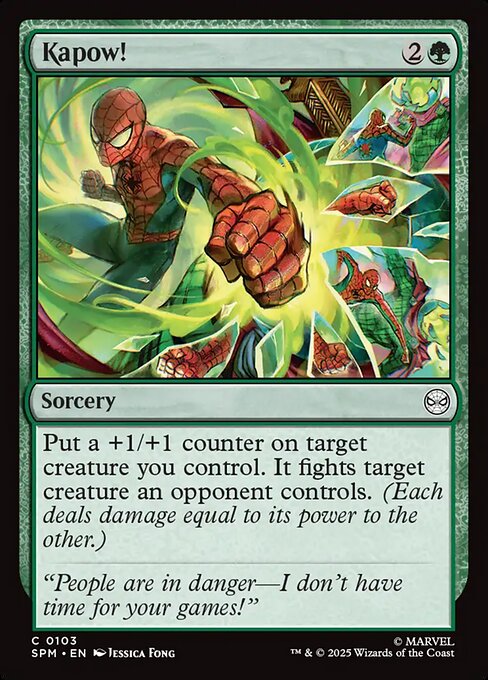
102. Kapow!
Rating5.4PlayableWhy this rating?
A solid playable that rarely gets cut (5.4/10).
Why. A three-mana sorcery: a +1/+1 counter on your creature, then it fights an opposing creature. The counter stays, tilting the fight in your favour.
Risks. You need a creature of your own. An opposing response to your target loses you the card, and the sorcery is slow.
In the draft. A fine fight-style removal for a green deck. Take it mid-pack with good creatures.
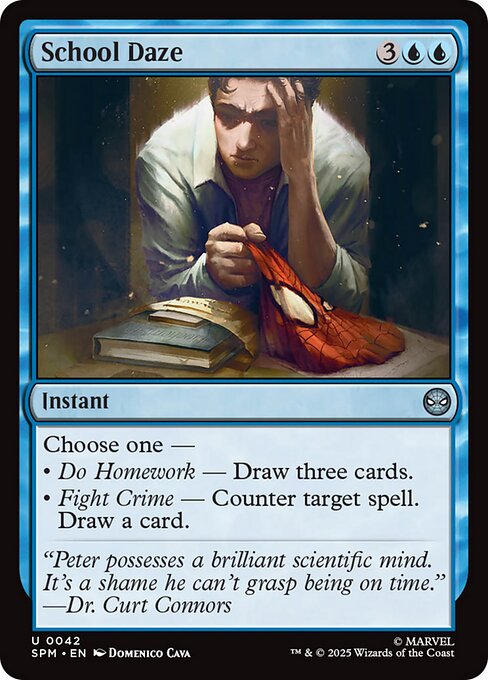
103. School Daze
Rating5.4PlayableWhy this rating?
A solid playable that rarely gets cut (5.4/10).
Why. A two-faced instant: draw three cards, for instance at the end of the opponent's turn, or counter a spell and draw a card. The flexibility makes it playable against both slow decks and a key threat.
Risks. It costs five mana, with two blue, and if you cast it without countering anything you do nothing on the board that turn. It is not removal and does little against an opponent who is pressuring you.
In the draft. A decent support card for a slower blue control or tempo deck. One or two copies are plenty; take creatures and interaction first.

104. University Campus
Rating5.4PlayableWhy this rating?
A solid playable that rarely gets cut (5.4/10).
Why. A white-blue dual land that enters tapped and taps for either color. Late in the game, four mana lets you surveil 1 to smooth your draws.
Risks. It enters tapped, which costs tempo in an aggressive deck. Outside those two colors it is worse than a basic land.
In the draft. Take it if you are white-blue, at a late pick. It is not a reason to move into those colors.
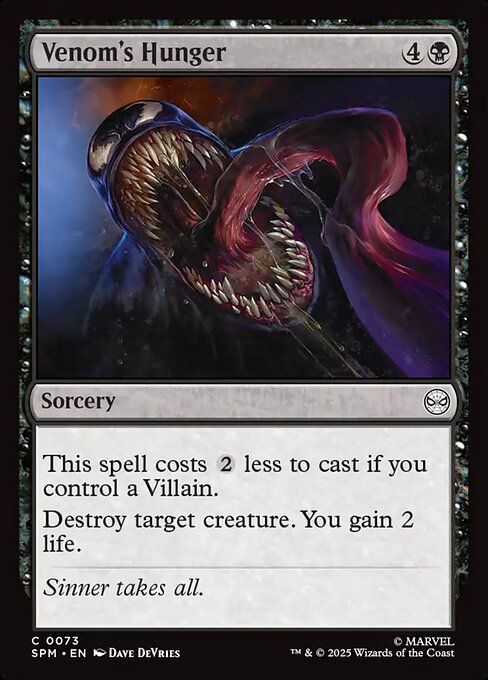
105. Venom's Hunger
Rating5.4PlayableWhy this rating?
A solid playable that rarely gets cut (5.4/10).
Why. A sorcery that destroys any creature and gains you 2 life. If you control a Villain it costs two less: three mana for unconditional removal.
Risks. Without a Villain it is five mana for a sorcery, slow and expensive. You need a Villain on the battlefield when you cast it, so you have a creature to protect.
In the draft. Black removal worth taking as soon as you are black, even if the discount is not guaranteed. Count the Villains in your deck so it is often cheap.

106. Vibrant Cityscape
Rating5.4PlayableWhy this rating?
A solid playable that rarely gets cut (5.4/10).
Why. A fixing land: tap and sacrifice it to fetch any basic land, which enters tapped. It smooths your colors and thins your library a little.
Risks. It makes no mana while it sits on the battlefield and the fetched land enters tapped, a real tempo cost. In a well-built two-color deck it adds little.
In the draft. Take it late, for a splash or three-color deck. It should never take the place of a real playable.

107. Web-Warriors
Rating5.4PlayableWhy this rating?
A solid playable that rarely gets cut (5.4/10).
Why. A 4/3 for five whose arrival puts a +1/+1 counter on each of your other creatures. The wider your board, the better it gets, and it is still a fair body alone.
Risks. Five mana, three toughness, and an effect that depends on what you already control. On an empty board it is an average creature.
In the draft. Playable in a creature deck in green or white, since its cost accepts either color. Take it to round out the top of your curve.

108. Bagel and Schmear
Rating5.4PlayableWhy this rating?
A solid playable that rarely gets cut (5.4/10).
Why. A one-mana Food with two modes: for a white mana, a +1/+1 counter and a card (only when you could cast a sorcery), or for two mana, 3 life and a card. Either way it replaces itself.
Risks. It does nothing on the board right away and spreads its mana over several turns. The first mode needs white.
In the draft. A small piece of value, best in white. Play it if you lack cheap cards, but do not take it before your creatures.
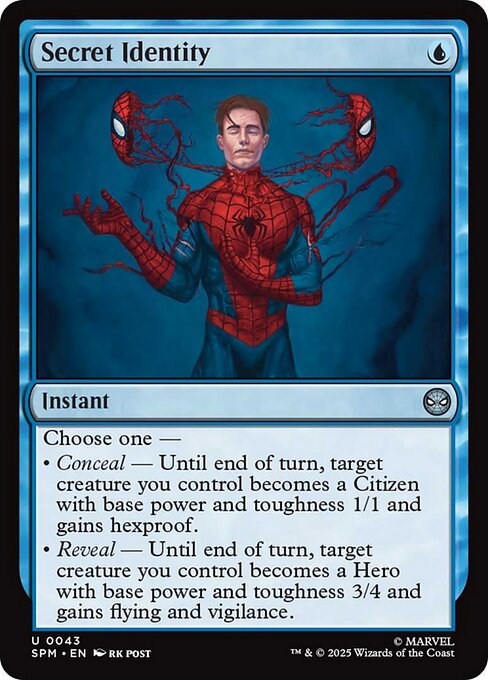
109. Secret Identity
Rating5.3PlayableWhy this rating?
A solid playable that rarely gets cut (5.3/10).
Why. A one-mana instant with two uses: one of your creatures becomes a 1/1 Citizen with hexproof to dodge targeted removal, or a 3/4 Hero with flying and vigilance to win a combat.
Risks. A trick: with no creature that matters, it does nothing. To save a creature from removal you must cast it in response, and the creature is only a 1/1 until end of turn.
In the draft. Fine in blue creature decks, but not essential. Take it after your best creatures and removal.

110. Eerie Gravestone
Rating5.2PlayableWhy this rating?
A solid playable that rarely gets cut (5.2/10).
Why. A two-mana artifact that draws a card when it enters. For two mana including a black one, you can sacrifice it to mill four and put a creature from among them into your hand.
Risks. No effect on the board, and the second mode needs black and a real investment. It does not help against pressure.
In the draft. An acceptable filler for black graveyard decks. Play it as a last choice of the color, not a priority.
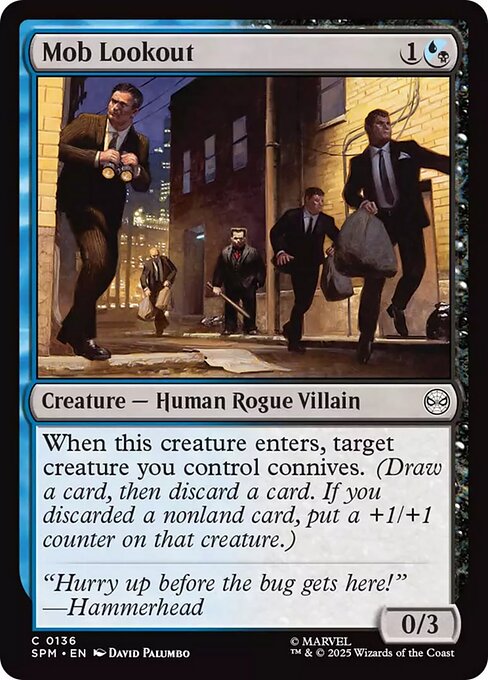
111. Mob Lookout
Rating5.2PlayableWhy this rating?
A solid playable that rarely gets cut (5.2/10).
Why. A 0/3 for two mana whose arrival makes a creature you control connive: a filtered draw, and a +1/+1 counter if you discard a nonland card. It blocks small attackers well.
Risks. It does not attack and only slows the smallest creatures. With no good creature to boost, the effect is modest.
In the draft. A small support Villain, playable in blue or black, a late pick for decks that reward Villains. Do not rank it above your best creatures.

112. Pumpkin Bombardment
Rating5.2PlayableWhy this rating?
A solid playable that rarely gets cut (5.2/10).
Why. A one-mana sorcery (black or red) that deals 3 damage to a creature. You must discard a card or pay two more: paying makes it flexible removal for three mana.
Risks. The additional cost is real: discarding costs card value, and paying two slows your turn. It does not kill big creatures.
In the draft. Honest removal for a black or red deck. Take it over filler creatures, after your best removal.

113. Raging Goblinoids
Rating5.2PlayableWhy this rating?
A solid playable that rarely gets cut (5.2/10).
Why. A 5/4 with haste for five mana: it hits right away. If you discarded it this turn, mayhem lets you cast it from the graveyard for three mana.
Risks. Without any other ability, it is a big five-mana body that dies to removal, sometimes after hitting only once. Mayhem needs a discard.
In the draft. A decent red top-end, one copy is fine. Take it if your deck has ways to discard cards.
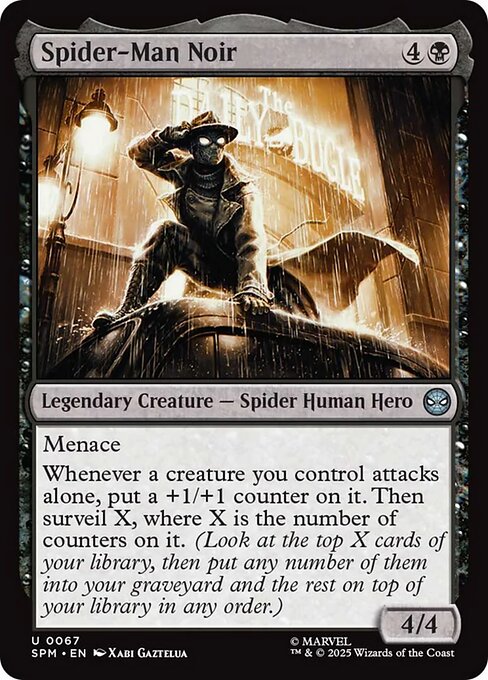
114. Spider-Man Noir
Rating5.2PlayableWhy this rating?
A solid playable that rarely gets cut (5.2/10).
Why. A 4/4 with menace for five mana. When a creature you control attacks alone, it gets a +1/+1 counter, then you surveil for the number of counters on it, improving your draws.
Risks. The effect needs a lone attacker, limiting your pressure. Five mana for a 4/4 is still vulnerable to removal.
In the draft. A decent black top-end for decks that attack with one big creature. It brings value on its own; no need to rush it.
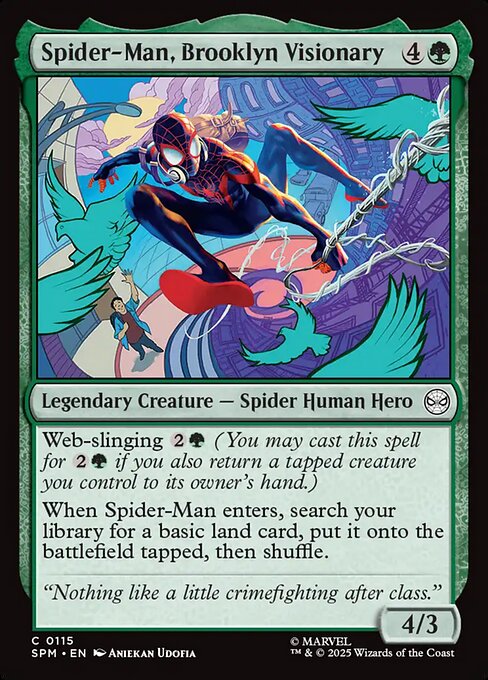
115. Spider-Man, Brooklyn Visionary
Rating5.2PlayableWhy this rating?
A solid playable that rarely gets cut (5.2/10).
Why. A 4/3 that fetches a basic land onto the battlefield tapped. With web-slinging it costs three if you return a tapped creature to hand.
Risks. Five mana without web-slinging is slow for three toughness. Returning a tapped creature to hand costs tempo.
In the draft. A decent green creature that fixes and ramps. Play it in a green deck, but not before your best removal.

116. Spider-Mobile
Rating5.2PlayableWhy this rating?
A solid playable that rarely gets cut (5.2/10).
Why. A 3/3 Vehicle with trample for three and crew 2. When it attacks or blocks it gets +1/+1 for each Spider you control: much bigger in a deck full of Spiders.
Risks. You need to tap creatures with total power 2 to animate it, and it is inert without them. With no Spiders, it is an average 3/3 trampler.
In the draft. Play it in a deck with plenty of Spiders. Otherwise it is a middling choice to take after your creatures.

117. Superior Foes of Spider-Man
Rating5.2PlayableWhy this rating?
A solid playable that rarely gets cut (5.2/10).
Why. A 3/3 with trample for three mana, a fair body. Whenever you cast a spell with mana value 4 or greater, you may exile the top card of your library and play it until you exile another card with this creature.
Risks. The effect only triggers on expensive spells, and the exiled card can go unused if you cannot play it in time. It dies to removal like any 3/3.
In the draft. A decent red Villain for the middle of the curve, better with a top-heavy curve. Take it, but not over your removal.

118. Wisecrack
Rating5.2PlayableWhy this rating?
A solid playable that rarely gets cut (5.2/10).
Why. A three-mana instant: the target creature deals damage equal to its power to itself. It handles big creatures, and if the creature is attacking its controller also takes 2 damage.
Risks. It does not kill a creature whose power is below its toughness, so it is weak against small ones. It can also target your own creatures, so misuse hurts.
In the draft. Conditional but useful removal, strongest against big creatures. Take it mid-pack, with other options for small creatures.
 Rating5.2Playable
Why this rating?
A solid playable that rarely gets cut (5.2/10).
Why. A 1/1 that enters with a +1/+1 counter, so a 2/2 for two mana. If it leaves the battlefield its counters move to a creature you control, so its death is never a total loss.
Risks. A 2/2 body with no immediate ability. You need another creature in play to take the counters.
In the draft. A decent white early drop, for an aggressive deck. Take it later if you lack two-drops.

120. Venomized Cat
Rating5.1PlayableWhy this rating?
A solid playable that rarely gets cut (5.1/10).
Why. A 2/3 with deathtouch for three mana: it blocks and kills any enemy creature. Its arrival mills two cards from your library, which can help a graveyard deck.
Risks. Only 2 power, so it threatens little on offense. Fliers get over the top of it.
In the draft. A decent black defender, no need to rush it. Best in control or graveyard decks.

121. Common Crook
Rating5.0PlayableWhy this rating?
A solid playable that rarely gets cut (5.0/10).
Why. A 2/2 for two mana that creates a Treasure token when it dies. It happily trades with another attacker and gives mana back.
Risks. A small body with no evasion that matters little late. The Treasure does not replace a card.
In the draft. A small early black Villain, useful in Villain decks. Take it late: it has no decisive effect.
 Rating5.0Playable
Why this rating?
A solid playable that rarely gets cut (5.0/10).
Why. A three-mana creature with vigilance whose power equals the greatest mana value among permanents you control. It is at least a 3/4 by itself, and bigger as you play bigger permanents.
Risks. It needs red and green, limiting access. It remains a 3/4 without evasion and dies to removal.
In the draft. A good body for a red-green deck that scales up. Take it if you are in those colors, otherwise pass it.

123. Kraven's Cats
Rating5.0PlayableWhy this rating?
A solid playable that rarely gets cut (5.0/10).
Why. A 2/2 for two mana that can get +2/+2 for three mana, once per turn. With three mana to spare it is a 4/4 that wins combats.
Risks. Spending three mana on the ability slows you, and it is vulnerable in response to the activation. With no spare mana it is a small 2/2.
In the draft. A decent green early drop that keeps value later. Take it mid-pack or later.

124. Molten Man, Inferno Incarnate
Rating5.0PlayableWhy this rating?
A solid playable that rarely gets cut (5.0/10).
Why. A three-mana creature that fetches a basic Mountain onto the battlefield tapped and gets +1/+1 for each Mountain you control. In a heavily red deck it grows fast.
Risks. It is a base 0/0: with no Mountain already in play, it dies before its ability resolves. When it leaves the battlefield you sacrifice a land, which costs a lot.
In the draft. An option for a nearly mono-red deck. In a two-color deck it is much less reliable.

125. Shriek, Treblemaker
Rating5.0PlayableWhy this rating?
A solid playable that rarely gets cut (5.0/10).
Why. A 2/3 for three mana (black or red) that, by discarding a card, stops a creature from blocking. Whenever an enemy creature dies, Shriek deals 1 damage to its controller.
Risks. Discarding a card each turn quickly costs value. The 2/3 body is modest and the damage is slow.
In the draft. A Villain that helps aggressive black-red decks that discard. Take it mid-pack or later, not as a priority.
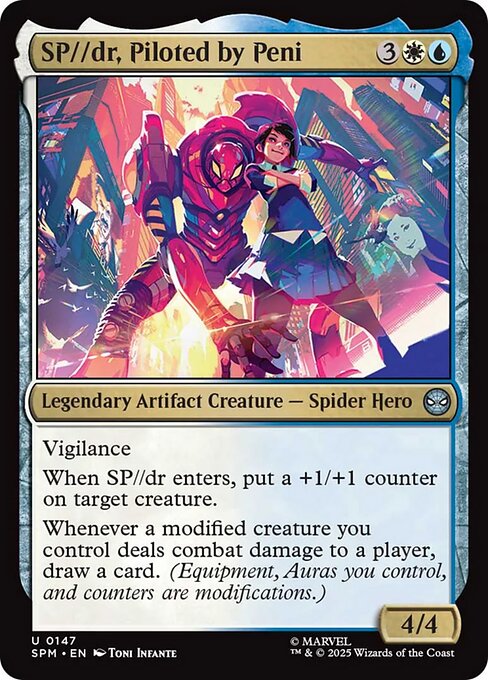 Rating5.0Playable
Why this rating?
A solid playable that rarely gets cut (5.0/10).
Why. A 4/4 with vigilance for five mana that puts a +1/+1 counter on a creature when it enters, itself included. Each modified creature you control that damages a player draws you a card.
Risks. It needs white and blue, five mana, and stays vulnerable to removal. The draw needs a modified creature to connect with a player, which is not guaranteed.
In the draft. A good white-blue top-end. Take it if you are in those colors, especially with counters or Equipment.

127. Spider-Bot
Rating5.0PlayableWhy this rating?
A solid playable that rarely gets cut (5.0/10).
Why. A 2/1 artifact creature with reach for two mana. It blocks fliers, and its arrival lets you put a basic land on top of your library, securing your next land drop.
Risks. A one-toughness body that dies to nearly anything. The effect does not draw you an extra card.
In the draft. A small colorless filler playable in any color. Take it late to complete your curve.
 Rating5.0Playable
Why this rating?
A solid playable that rarely gets cut (5.0/10).
Why. A 3/3 for three mana with no extra ability. With web-slinging it costs one white mana if you return a tapped creature to hand, leaving mana to cast something else the same turn.
Risks. A plain body with nothing else. Web-slinging forces you to bounce a tapped creature, losing a bit of tempo.
In the draft. An honest white body. Take it for an ordinary curve, but do not prefer it to a stronger card.

129. Swarm, Being of Bees
Rating4.9WeakWhy this rating?
A solid playable that rarely gets cut (4.9/10).
Why. A 2/2 with flash and flying for three mana: it ambushes an attacker or adds an air threat at end of turn. With mayhem you recast it for a black mana if you discarded it this turn.
Risks. A 2/2 body that dies easily. Mayhem needs a discard, which not every deck has.
In the draft. A small black flier, playable in a tempo deck. Take it late in the pack.
 Rating4.8Weak
Why this rating?
A solid playable that rarely gets cut (4.8/10).
Why. A 3/3 with flying for four mana, a fair air body. From the graveyard, two mana puts a +1/+1 counter on a creature and gives it flying until end of turn, extending its value.
Risks. Four mana, a single color, and the graveyard ability is sorcery speed only. It dies to removal like any 3/3.
In the draft. A decent blue flier for a creature deck. Take it late in the pack.
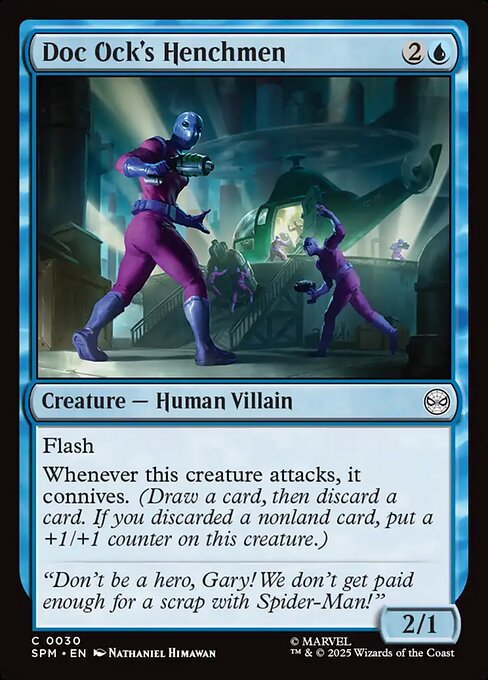
131. Doc Ock's Henchmen
Rating4.8WeakWhy this rating?
A solid playable that rarely gets cut (4.8/10).
Why. A 2/1 with flash for three mana that connives each time it attacks: it filters your draws and can grow. Flash can ambush an enemy attacker.
Risks. Only 1 toughness, so fragile. It has to attack to be useful, which exposes it to blockers.
In the draft. A middling blue Villain for a tempo deck. Take it late; do not rank it above your best creatures.

132. Lurking Lizards
Rating4.8WeakWhy this rating?
A solid playable that rarely gets cut (4.8/10).
Why. A 1/3 with trample for two mana. Whenever you cast a spell with mana value 4 or greater it gets a +1/+1 counter, so it grows with a top-heavy curve.
Risks. Without expensive spells it is a small defensive body. It is slow to become a threat and dies to removal.
In the draft. A decent green early drop for a deck with big spells. Take it late in the pack.

133. News Helicopter
Rating4.8WeakWhy this rating?
A solid playable that rarely gets cut (4.8/10).
Why. A 1/1 artifact creature with flying for three mana that creates a 1/1 green and white Human Citizen creature token. Two bodies for one card, useful for crewing a Vehicle.
Risks. Two small 1/1 bodies that die to almost anything. The package has little impact alone.
In the draft. A colorless filler playable in any deck. Take it late, for decks that count creatures.

134. Shock
Rating4.8WeakWhy this rating?
A solid playable that rarely gets cut (4.8/10).
Why. A one-mana instant that deals 2 damage to any target. Cheap, it kills small creatures or finishes an opponent.
Risks. Only 2 damage: it does not kill creatures that matter. Against a plain creature it is a simple one-for-one.
In the draft. Supplementary red removal, playable anytime. Take it mid-pack; it is not the best answer in the set.

135. Spider-Man No More
Rating4.8WeakWhy this rating?
A solid playable that rarely gets cut (4.8/10).
Why. A two-mana Aura that turns the enchanted creature into a Citizen with base power and toughness 1/1, with defender and no other abilities. It neutralizes a big threat or a creature with a dangerous ability.
Risks. The creature stays on the battlefield, can still block, and keeps its counters and Equipment bonuses. If the Aura goes away, it gets everything back.
In the draft. Cheap blue pseudo-removal. Take it after your best cards, as an answer to big creatures.

136. Subway Train
Rating4.8WeakWhy this rating?
A solid playable that rarely gets cut (4.8/10).
Why. A 3/1 Vehicle for two mana with crew 2. By paying a green mana when it enters, you search for a basic land and put it in your hand, securing your land drops.
Risks. It needs creatures with total power 2 to crew it, it is inert without them, and its 1 toughness is very low. The bonus needs green.
In the draft. A weak card, playable mostly in an aggressive green deck. Take it as a last choice, after your creatures.

137. Wraith, Vicious Vigilante
Rating4.8WeakWhy this rating?
A solid playable that rarely gets cut (4.8/10).
Why. An unblockable creature with double strike: it connects twice every turn and the opponent cannot stop it in combat. At 1 power that is a guaranteed 2 damage per attack.
Risks. It is a 1/1 for three mana in two colours: any removal kills it, and it protects nothing on defence. Without a way to grow it, the clock is slow.
In the draft. A white-blue deck card that wants to make the creature bigger (Equipment, counters). Otherwise it is filler: do not take it over removal or solid creatures.

138. Lady Octopus, Inspired Inventor
Rating4.8WeakWhy this rating?
A solid playable that rarely gets cut (4.8/10).
Why. For one mana she gets an ingenuity counter whenever you draw your first or second card each turn, then casts an artifact from your hand for free if its mana value is at most her counters. In an artifact-heavy deck she saves a lot of mana.
Risks. She does nothing without artifacts in hand, and you need a good number of them. A 0/2 that taps does not block, and the counters take several turns to build up.
In the draft. Only in a blue deck that already has several expensive artifacts; otherwise leave her. A build-around, not a first pick.
 Rating4.6Weak
Why this rating?
A solid playable that rarely gets cut (4.6/10).
Why. For one mana you get three uses: pay two mana, tap it and remove a film counter to copy an activated or triggered ability you control, with new targets if you like. If one of your abilities is powerful, the copy doubles its value.
Risks. It does nothing on its own and costs mana for every copy, with only three counters. Without strong abilities to repeat, it is a dead card in hand.
In the draft. Play it only if your deck has several strong abilities worth copying. Too specialised for an early pick.

140. Hobgoblin, Mantled Marauder
Rating4.6WeakWhy this rating?
A solid playable that rarely gets cut (4.6/10).
Why. A 1/2 with flying and haste for two mana: it hits the turn it lands and gets over blockers. Each discard gives it +2/+0 until end of turn, so with Mayhem cards it becomes a real threat.
Risks. Without discards it hits for 1, which is little, and it dies to almost anything. It does not hold the ground against bigger creatures.
In the draft. Playable in an aggressive red deck with discard or Mayhem effects. Elsewhere it is weak.
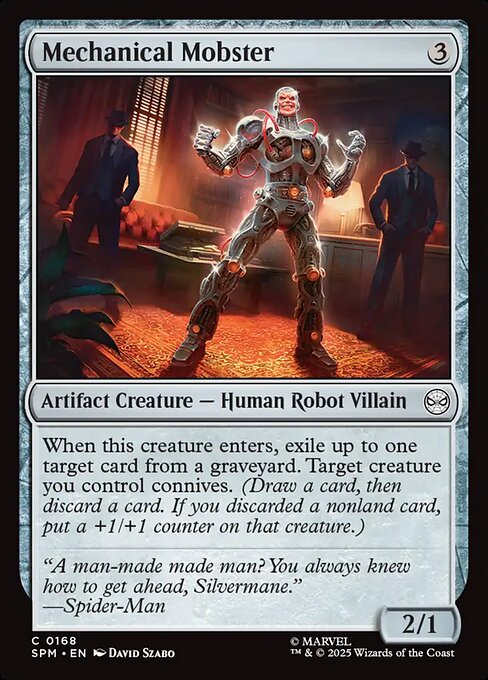
141. Mechanical Mobster
Rating4.6WeakWhy this rating?
A solid playable that rarely gets cut (4.6/10).
Why. A 2/1 artifact creature for three mana that exiles a card from a graveyard, then makes a creature you control connive (itself if need be). You filter your hand and gain a +1/+1 counter if you discard a nonland card.
Risks. The body is small and the effect does not swing a game. Connive draws then discards, so you gain no card, and the filtering is best with spare lands or Mayhem cards.
In the draft. Playable filler in any colour, best in a discard or graveyard deck. Take it late.

142. Savage Mansion
Rating4.6WeakWhy this rating?
A solid playable that rarely gets cut (4.6/10).
Why. A red-green land that enters tapped: it fixes both colours of a red-green deck. Later, for four mana and tapping it, you can Surveil 1 to improve your draws.
Risks. It enters tapped, which costs tempo in an aggressive deck. It only matters if you are really red-green.
In the draft. Take it only if you are red-green or heading there. Otherwise do not play it.
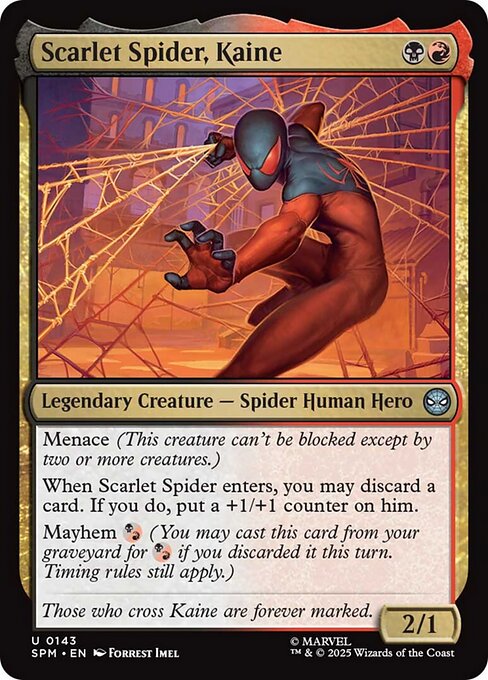 Rating4.6Weak
Why this rating?
A solid playable that rarely gets cut (4.6/10).
Why. A 2/1 menace for two mana: it is hard to block and can become a 3/2 by discarding a card when it enters. With Mayhem you can recast it from the graveyard for one black or red mana if you discarded it this turn.
Risks. It needs both black and red and is fragile: a 2/1 dies to any removal. The counter costs you a card.
In the draft. A decent card for an aggressive black-red deck with discard effects. Otherwise it is an average creature.
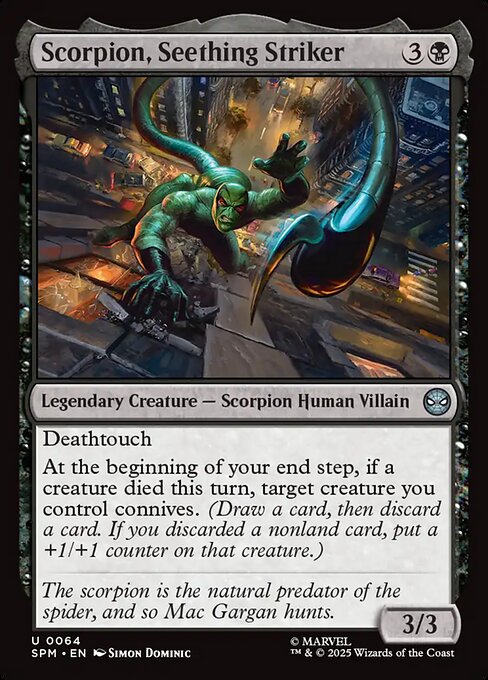
144. Scorpion, Seething Striker
Rating4.6WeakWhy this rating?
A solid playable that rarely gets cut (4.6/10).
Why. A 3/3 deathtouch for four mana that few creatures want to block or attack into. If a creature died this turn, it makes a creature you control connive at your end step: you filter and may grow something.
Risks. The trigger needs a creature to have died, which is not guaranteed. A 3/3 for four is still ordinary against removal.
In the draft. A decent black mid-curve creature for a controlling or trading deck. Take it after removal.
 Rating4.6Weak
Why this rating?
A solid playable that rarely gets cut (4.6/10).
Why. A 6/6 with reach, trample and ward 2: it blocks fliers, tramples through blockers and is not easy to remove. For six mana it is a common finisher that dominates the board.
Risks. It costs six mana including two green: it arrives late and has no enter effect. An opponent willing to pay the ward can still remove it or trade with it.
In the draft. A fine finisher for a slower green deck. Do not take too many: one or two are enough.

146. Chameleon, Master of Disguise
Rating4.5WeakWhy this rating?
A good playable, but is sometimes cut (4.5/10).
Why. He can enter as a copy of a creature you control (his name becomes Chameleon, Master of Disguise), doubling your best creature along with its enter triggers. With Mayhem he can come back from the graveyard for three mana.
Risks. With no good creature to copy, he is a 2/3 for four, which is weak. He depends entirely on your board.
In the draft. Fine in a blue deck with creatures that have enter triggers. Otherwise pick something else.
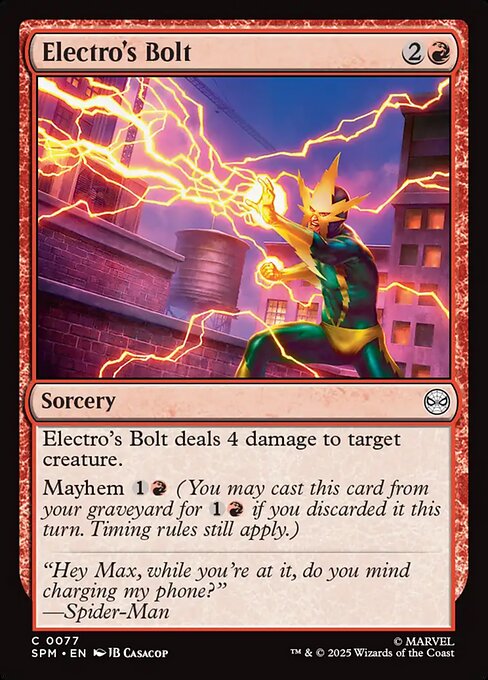
147. Electro's Bolt
Rating4.4WeakWhy this rating?
A good playable, but is sometimes cut (4.4/10).
Why. A three-mana red sorcery that deals 4 damage to a creature, enough to kill most mid-sized creatures. With Mayhem you can recast it from the graveyard for two mana if you discarded it this turn.
Risks. It is a sorcery, so it cannot answer mid-combat. It only hits creatures, never players or non-creature permanents.
In the draft. A decent removal: take it over ordinary creatures in a red deck, especially with discard effects.
 Rating4.4Weak
Why this rating?
A good playable, but is sometimes cut (4.4/10).
Why. A 6/7 with vigilance, trample and haste: it attacks the turn it lands and defends just as well. If you cast a spell with mana value 4 or greater this turn, it draws a card whenever it attacks.
Risks. Seven mana with two red and two green: very expensive, close to unplayable without a good mana base. Removal answers it and you get nothing back.
In the draft. A top-end finisher for red-green only. One copy is plenty, and do not take it before you are in those two colours.

149. Shocker, Unshakable
Rating4.4WeakWhy this rating?
A good playable, but is sometimes cut (4.4/10).
Why. A 5/5 for six whose enter trigger is a partial removal: 2 damage to a creature and 2 to its controller. During your turn it has first strike, so it wins most combats when attacking.
Risks. Six mana with two red is expensive, and 2 damage only kills small creatures. It does not have first strike on defence.
In the draft. A decent finisher for a red deck that can afford a high curve. Take it after removal and cheaper quality creatures.

150. Spider-Verse
Rating4.4WeakWhy this rating?
A good playable, but is sometimes cut (4.4/10).
Why. This enchantment lets you copy a spell cast from anywhere other than your hand, once each turn, and a copied permanent gains haste. The legend rule stops applying to your Spiders, so you can run several.
Risks. It does nothing without spells cast from the graveyard or exile, and you spend five mana for no immediate effect. It is a very specific build-around.
In the draft. Only if your deck has many Mayhem or cast-from-elsewhere effects. Otherwise leave it.
 Rating4.4Weak
Why this rating?
A good playable, but is sometimes cut (4.4/10).
Why. A 4/5 deathtouch for five mana: a good blocker and a solid threat. Even dead it keeps working: for three mana, exiled from the graveyard, it puts two +1/+1 counters on a creature and gives it deathtouch until end of turn, at sorcery speed.
Risks. It is expensive and has no enter ability. Effects that exile your graveyard take away its second ability.
In the draft. A decent black mid-curve creature. Take it among the black commons without overpaying.

152. Web-Shooters
Rating4.4WeakWhy this rating?
A good playable, but is sometimes cut (4.4/10).
Why. A two-mana Equipment that gives +1/+1 and reach, and taps a creature the opponent controls whenever the equipped creature attacks. It removes a blocker every combat, which is valuable in an aggressive deck.
Risks. Equipping costs two mana at sorcery speed, and you need a creature to carry it. If the creature dies, you pay that cost again.
In the draft. A good accessory for an aggressive white deck with evasive creatures. A mid-pack pick.

153. Doc Ock, Sinister Scientist
Rating4.3WeakWhy this rating?
A good playable, but is sometimes cut (4.3/10).
Why. A 4/5 for five that becomes a base 8/8 when you have eight or more cards in your graveyard. With another Villain it has hexproof, which makes it very hard to remove.
Risks. Eight cards in the graveyard comes late without discard or self-mill. With no other Villain it is vulnerable to targeted removal.
In the draft. A reasonable card for a long-game blue deck that fills its graveyard or plays Villains. Take it mid-pack.

154. Wild Pack Squad
Rating4.2WeakWhy this rating?
A good playable, but is sometimes cut (4.2/10).
Why. A 2/3 for three that, at the beginning of combat on your turn, gives first strike and vigilance to a creature until end of turn. Your attacker wins most fights against blockers of its size and stays untapped to defend.
Risks. The body is modest and the effect only matters when you have an attacker. It does nothing on the opponent's turn.
In the draft. A playable white common for an attacking deck. Take it late.
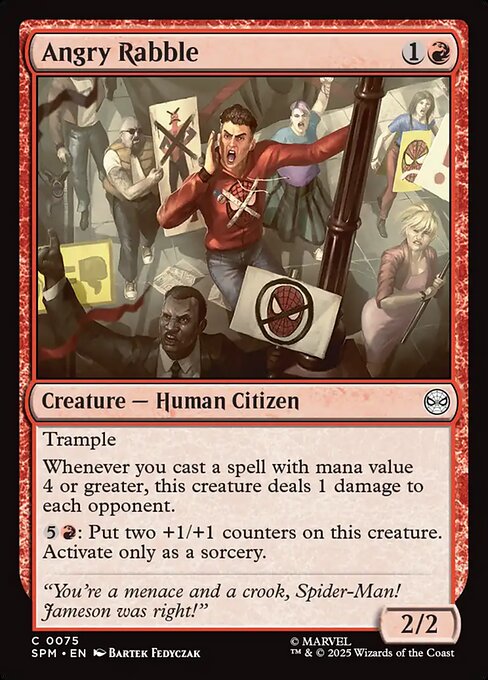
155. Angry Rabble
Rating4.2WeakWhy this rating?
A good playable, but is sometimes cut (4.2/10).
Why. A 2/2 trampler for two that deals 1 damage to each opponent whenever you cast a spell with mana value 4 or greater. Late in the game, six mana gives it two +1/+1 counters at sorcery speed.
Risks. The body is small and the effect relies on expensive spells. The activation cost is high and slow.
In the draft. A decent two-drop for a red deck with several spells of mana value 4 or more. Otherwise a weak pick.

156. J. Jonah Jameson
Rating4.2WeakWhy this rating?
A good playable, but is sometimes cut (4.2/10).
Why. When he enters, he suspects a creature: it gains menace and cannot block. Whenever a creature you control with menace attacks, you create a Treasure token, so suspecting your own creature gives you mana.
Risks. The body is a plain 2/2, and the suspected creature cannot block. Without creatures that have menace, he loses part of his appeal.
In the draft. A decent pick in a red deck with menace creatures. Otherwise he is passable.

157. Ominous Asylum
Rating4.2WeakWhy this rating?
A good playable, but is sometimes cut (4.2/10).
Why. A black-red land that enters tapped: it fixes both colours of a black-red deck. Later, for four mana and tapping it, it lets you Surveil 1.
Risks. It enters tapped, which costs tempo in an aggressive deck. It only matters if you are black-red.
In the draft. Take it only if you are black-red or heading there. Otherwise do not play it.

158. Prison Break
Rating4.2WeakWhy this rating?
A good playable, but is sometimes cut (4.2/10).
Why. A sorcery that returns a creature from your graveyard to the battlefield with an additional +1/+1 counter. With Mayhem you can recast it from the graveyard for four mana if you discarded it this turn.
Risks. Five mana for an effect that depends on a good creature having died. With no creature in your graveyard, the card is dead.
In the draft. A value play for a long-game black deck with good creatures. Otherwise leave it.

159. Vulture, Scheming Scavenger
Rating4.2WeakWhy this rating?
A good playable, but is sometimes cut (4.2/10).
Why. A 4/6 flyer for six mana: it blocks aerial attackers and hits hard. When it attacks, your other Villains gain flying until end of turn and get past defences.
Risks. Six mana is heavy, and the effect only matters with other Villains. Removal kills it before it does anything.
In the draft. A reasonable finisher for a blue-black deck with several Villains. The hybrid cost makes it playable in either colour.

160. Risky Research
Rating4.2WeakWhy this rating?
A good playable, but is sometimes cut (4.2/10).
Why. A three-mana black sorcery: Surveil 2, then draw two cards and lose 2 life. It sorts your library and fills the graveyard at the same time.
Risks. It does nothing on the battlefield: a turn without development, and 2 life less. It is worse in a deck already under pressure.
In the draft. A decent card-draw tool for a black control deck, especially with a graveyard that matters. Take it after removal and creatures.

161. Guy in the Chair
Rating4.1WeakWhy this rating?
A good playable, but is sometimes cut (4.1/10).
Why. A 2/3 for three that taps for one mana of any colour: it fixes and ramps. For three mana it can also put a +1/+1 counter on a Spider, at sorcery speed.
Risks. It taps for mana, so it does not block well. Without Spiders, its second ability does nothing.
In the draft. A decent green fixer for a three-colour deck or a splash. Take it when you need mana, not before.
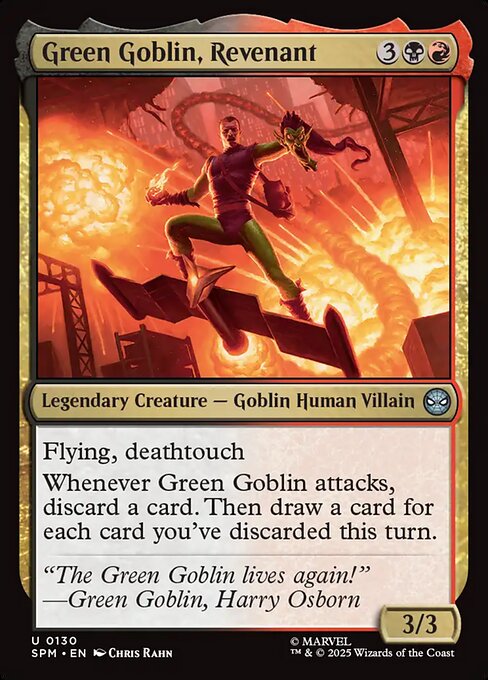 Rating4.0Weak
Why this rating?
A good playable, but is sometimes cut (4.0/10).
Why. A 3/3 with flying and deathtouch for five mana: hard to block and hard to fight. When it attacks, you discard a card, then draw a card for each card you've discarded this turn. With Mayhem, that can turn into a big advantage.
Risks. It needs black and red, and attacking forces you to discard before you draw. With an empty hand, the effect shrinks.
In the draft. A decent finisher for a black-red discard deck. Take it over plain creatures in those colours.

163. Parker Luck
Rating4.0WeakWhy this rating?
A good playable, but is sometimes cut (4.0/10).
Why. At the beginning of your end step, two target players each reveal the top card of their library and lose life equal to the mana value of the other player's card. They then put their revealed card into hand: if you are one of them, you gain a card every turn.
Risks. The effect is random and symmetrical: if you target the opponent and yourself, they gain a card too, and you may lose life. Risky for a defensive deck.
In the draft. A build-around for an aggressive black deck that thrives on variance. Otherwise leave it.

164. Romantic Rendezvous
Rating4.0WeakWhy this rating?
A good playable, but is sometimes cut (4.0/10).
Why. A two-mana red sorcery: discard a card, then draw two cards. You gain a card in hand and trigger effects that reward discarding.
Risks. It does nothing on the battlefield. Without a card to discard, or without discard payoffs, the advantage is small.
In the draft. A decent filter for a red discard or Mayhem deck. Otherwise a late pick.
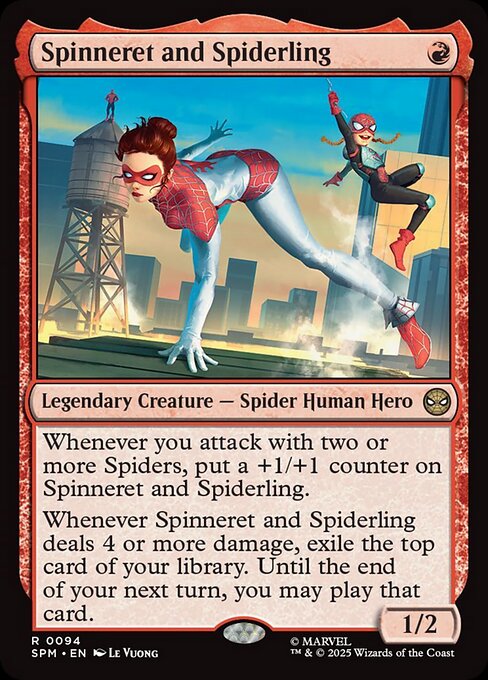 Rating4.0Weak
Why this rating?
A good playable, but is sometimes cut (4.0/10).
Why. A 1/2 for one red mana that gets a +1/+1 counter whenever you attack with two or more Spiders. When it deals 4 or more damage, you exile the top card of your library and may play it until the end of your next turn.
Risks. You need several Spiders to grow it, and 4 damage takes a big creature. On its own it stays a 1/2 with no impact.
In the draft. Only in a red deck with plenty of Spiders. Otherwise leave it.

166. Spider-Islanders
Rating4.0WeakWhy this rating?
A good playable, but is sometimes cut (4.0/10).
Why. A vanilla 4/3 for four mana that does its job as a solid body. With Mayhem you can recast it from the graveyard for two mana if you discarded it this turn.
Risks. A four-mana vanilla is ordinary: it does nothing when it enters and trades with cheaper creatures.
In the draft. Red filler, better in a discard deck that makes use of Mayhem. Take it late.

167. Spider-Man 2099
Rating3.9WeakWhy this rating?
A good playable, but is sometimes cut (3.9/10).
Why. A 2/3 with double strike and vigilance for two mana: it attacks and defends well. At the beginning of your end step, if you played a land or cast a spell from anywhere other than your hand this turn, it deals damage equal to its power to any target.
Risks. You cannot cast it during your first three turns, so it arrives late. Its effect needs spells cast from the graveyard, exile or another zone than your hand.
In the draft. A decent pick for a blue-red deck with Mayhem. Without that, it is a fine but delayed body.
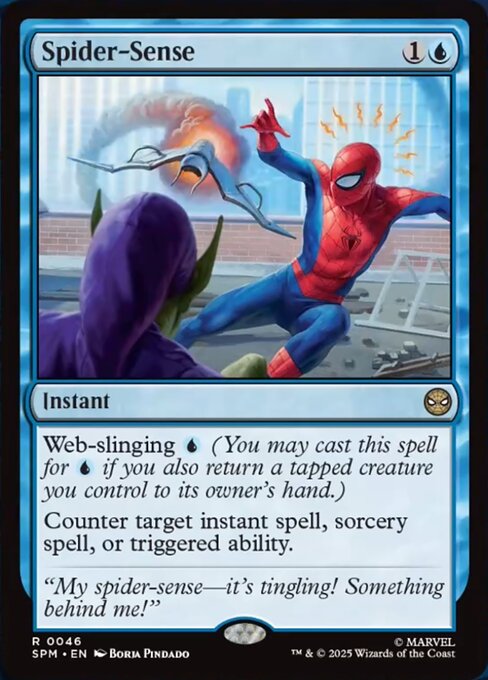
168. Spider-Sense
Rating3.8WeakWhy this rating?
A good playable, but is sometimes cut (3.8/10).
Why. An instant that counters an instant spell, a sorcery spell or a triggered ability. With Web-slinging, you can cast it for one blue mana by returning a tapped creature you control to its owner's hand.
Risks. It cannot counter creature spells, which are most of the threats. It also forces you to keep mana open.
In the draft. A narrow counter for a blue control deck. More often than not, it stays in the sideboard.
 Rating3.8Weak
Why this rating?
A good playable, but is sometimes cut (3.8/10).
Why. A 3/4 flyer for five mana: an aerial threat and a good blocker. When it enters, another creature you control gains flying until end of turn, which sets up a stronger swing that turn.
Risks. Five mana for a 3/4 is ordinary. The temporary flying only helps if you have a big ground creature.
In the draft. An acceptable white creature for an air-focused or midrange deck. Take it late.

170. Jackal, Genius Geneticist
Rating3.5WeakWhy this rating?
A good playable, but is sometimes cut (3.5/10).
Why. A 1/1 trampler: whenever you cast a creature spell with mana value equal to its power, you copy it (the copy is not legendary) and Jackal gets a +1/+1 counter. It starts with a mana value 1 spell, then 2, 3...
Risks. It needs a very precise creature curve. The 1/1 dies to almost anything, and without the right mana values it does nothing.
In the draft. A build-around for a green-blue deck with creatures at every mana value. Otherwise do not play it.

171. Maximum Carnage
Rating3.1WeakWhy this rating?
Filler card but sometimes gets cut (3.1/10).
Why. A three-turn Saga: chapter I forces every creature to attack, chapter II gives you three red mana, and chapter III deals 5 damage to each opponent. It only really belongs in a deck that wants to close the game fast.
Risks. Five mana for an effect that does not develop your board. Chapter I also forces your own creatures to attack, and the mana from chapter II is wasted if you have nothing to cast.
In the draft. A filler card you can pass unless you are a very aggressive red deck looking for reach to finish. Do not play it by default.
 Rating2.6Weak
Why this rating?
Filler card but sometimes gets cut (2.6/10).
Why. A 3/4 for four mana that blocks well and attacks decently. Discarding a card gives it +1/+0 and menace until end of turn, which lets you push damage through or get rid of an extra land.
Risks. The ability can only be activated at sorcery speed, and each activation costs you a card. With no spare card in hand it is just a 3/4 with no evasion.
In the draft. A mid-pack body for a black deck, handy for rounding out the curve. Take it after your removal and your better creatures.

173. Alien Symbiosis
Rating2.0WeakWhy this rating?
Not good filler and often gets cut (2.0/10).
Why. A two-mana Aura that gives +1/+1 and menace and can be recast from your graveyard by discarding a card. It survives the death of the creature, at the cost of a card.
Risks. A +1/+1 bonus is thin for an Aura: removal on the enchanted creature puts you behind, even if the recursion softens the blow. It also needs a creature on the battlefield.
In the draft. Only playable in a black deck that likes Auras or modified creatures. Otherwise it is a last pick.

174. Heroes' Hangout
Rating2.0WeakWhy this rating?
Not good filler and often gets cut (2.0/10).
Why. A one-mana sorcery with two modes: exile the top two cards and play one of them through the end of your next turn, or give one or two creatures +1/+0 and first strike to win a combat.
Risks. Neither mode changes the game. The first gains little if you lack mana for the card you pick, and the second needs creatures already in play and an opponent who blocks.
In the draft. A support card for an aggressive red deck with plenty of creatures. Take it late, after your creatures and removal.

175. Impostor Syndrome
Rating2.0WeakWhy this rating?
Not good filler and often gets cut (2.0/10).
Why. Whenever a nontoken creature you control deals combat damage to a player, you create a token that is a copy of it, minus the legendary status. If your attacks connect, the board snowballs.
Risks. Six mana for an enchantment that does nothing alone: you already need creatures that connect with your opponent. When you are behind on board, it comes too late to matter.
In the draft. Too slow for most decks. Only play it in a blue deck with many evasive creatures, and never as an early pick.

176. Living Brain, Mechanical Marvel
Rating2.0WeakWhy this rating?
Not good filler and often gets cut (2.0/10).
Why. A 3/3 for four mana that, at the beginning of combat, turns a non-Equipment artifact you control into an artifact creature with base 3/3 until end of turn and untaps it. With other artifacts, it adds an attacker without casting a creature.
Risks. With no other artifacts it is a mediocre four-mana 3/3. It is legendary, and its ability only targets non-Equipment artifacts.
In the draft. Reserve it for decks that already run several artifacts, such as Vehicles or Treasures. Otherwise let it go.

177. Masked Meower
Rating2.0WeakWhy this rating?
Not good filler and often gets cut (2.0/10).
Why. A 1/1 haste for one red mana that can sacrifice itself, discarding a card, to draw a card. It filters your hand or turns a doomed creature into a card.
Risks. A 1/1 does little on the board, and the ability trades two cards for one. You gain quality, not quantity.
In the draft. Filler you can easily do without. Playable in a very low-curve red deck, but never a priority.

178. Sandman's Quicksand
Rating2.0WeakWhy this rating?
Not good filler and often gets cut (2.0/10).
Why. A sorcery that gives every creature -2/-2. With Mayhem, if you discarded it this turn, you cast it from your graveyard for four mana (one of them black) and only your opponents' creatures are affected.
Risks. Without Mayhem, it hits your own creatures too and can cost you as much as it costs them. Mayhem requires discarding the card the right turn, so you need a discard outlet.
In the draft. A situational sweeper, fine against decks of small creatures. Only play it if your deck already discards, and not ahead of good creatures.
 Rating2.0Weak
Why this rating?
Not good filler and often gets cut (2.0/10).
Why. A legendary 2/3 reach for three mana that may discard a card to draw a card whenever it becomes tapped. Attacking improves your hand each turn, and it blocks fliers well.
Risks. A 2/3 attacks poorly into solid blockers. The ability only triggers when it becomes tapped, so it has to attack or be tapped another way, which exposes it.
In the draft. A decent three-drop for a red deck that wants to smooth its hand. Take it as curve filler.

180. Spider-Suit
Rating2.0WeakWhy this rating?
Not good filler and often gets cut (2.0/10).
Why. A one-mana Equipment that gives +2/+2 and makes the creature modified. It turns any small creature into a real threat once equipped.
Risks. Equipping costs three mana, which slows every new attachment. If an equipped creature dies to removal, you pay again.
In the draft. Playable in a modified-creatures deck, but slow. A mid-to-late pick, never before your good creatures.

181. Steel Wrecking Ball
Rating2.0WeakWhy this rating?
Not good filler and often gets cut (2.0/10).
Why. A colorless five-mana artifact that deals 5 damage to target creature when it enters: removal any deck can play. Discarding it from your hand for two mana, one of them red, destroys target artifact.
Risks. Five mana is expensive and slow, and the effect is dead without a creature to target. The discard ability requires red mana.
In the draft. Backup removal that any deck can play. Take it as a third or fourth removal spell, ahead of mediocre creatures.
 Rating2.0Weak
Why this rating?
Not good filler and often gets cut (2.0/10).
Why. A legendary 5/4 menace for five mana. When needed, Dinosaur Formula discards it for two mana, one of them red: a creature you control gets +3/+1 until end of turn and becomes a Dinosaur. Two uses for one card.
Risks. Five mana is heavy. Discarding the card means giving up the 5/4, and the effect only lasts a turn.
In the draft. A solid top-end creature for a red deck. Take it as a five-mana finisher, but do not overdo it.

183. Taxi Driver
Rating2.0WeakWhy this rating?
Not good filler and often gets cut (2.0/10).
Why. A 3/1 for two mana that can pay one mana and tap to give a target creature haste. It applies early pressure and lets your big creatures attack the turn they arrive.
Risks. One toughness means it dies to almost anything, and its ability taps it. It does not block well and is only worth it if you have good creatures to speed up.
In the draft. A mid-pack red two-drop. It fits a very aggressive deck but does not deserve a high pick.
 Rating2.0Weak
Why this rating?
Not good filler and often gets cut (2.0/10).
Why. A four-mana Aura for a creature you control: +2/+2 for each Aura and Equipment attached to it, itself included, and all damage that would be dealt to you is dealt to that creature instead. It makes one creature a huge wall protecting your life.
Risks. Putting all your eggs in one creature is risky: removal costs you the Aura and the creature. The size boost is modest without other Auras or Equipment, and the redirection can kill the creature.
In the draft. A gamble for a white deck loaded with Auras and Equipment. Otherwise it is a weak pick to avoid.

185. Hot Dog Cart
Rating1.6WeakWhy this rating?
Not good filler and often gets cut (1.6/10).
Why. A three-mana artifact that creates a Food token when it enters and taps for one mana of any color. It ramps and fixes, which helps a two-color deck or a splash.
Risks. It does nothing on the board and slows you down if you have no good play next turn. An artifact that does not win games on its own.
In the draft. A good late pick for a three-color deck, or to splash a powerful card of another color. Otherwise skip it.
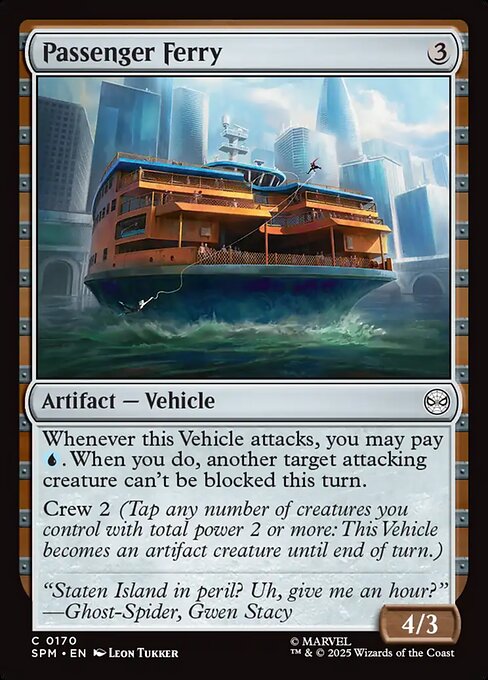
186. Passenger Ferry
Rating1.6WeakWhy this rating?
Not good filler and often gets cut (1.6/10).
Why. A three-mana 4/3 Vehicle with crew 2. When it attacks, you may pay a blue mana so that another attacking creature can't be blocked this turn.
Risks. You have to tap creatures with total power 2 to crew it, and removal on the crew neutralizes it easily. The evasion effect needs blue mana.
In the draft. Playable in a blue deck with strong creatures that need evasion. Otherwise it is an average late pick.
 Rating1.4Weak
Why this rating?
Almost unplayable and mostly sideboard material (1.4/10).
Why. A six-mana 4/4 that lets you look at the top card of your library any time and cast Spider spells and noncreature spells from it. It generates value as long as it stays on the battlefield.
Risks. Six mana for a creature that does not protect the board when it enters, and it dies to removal before it does anything. It only covers Spider and noncreature spells, so the payoff depends on your deck.
In the draft. A control finisher for a blue deck with many noncreature spells and Spiders. Otherwise pass on it.

188. Oscorp Research Team
Rating1.4WeakWhy this rating?
Almost unplayable and mostly sideboard material (1.4/10).
Why. A four-mana 1/5 that blocks small creatures well and can pay seven mana to draw two cards late in the game. It holds the ground and then provides value in slow games.
Risks. It does not attack and its ability is very expensive: seven mana for two cards. It can't block fliers, and an aggressive deck gets around it.
In the draft. A late-pack wall for a blue control deck. Only take it if you lack blockers.
Intrinsic ratings: they do not take into account the cards you have already picked. They matter most for the first pick of the first pack.