Card ranking · Edge of Eternities (EOE)
← Edge of Eternities261 cards
- Bomb > 8.4
- Very good ≥ 7.2
- Good ≥ 6.2
- Playable ≥ 5.0
- Weak < 5.0
Ratings are out of 10. They combine experts' opinions, the statistics of thousands of drafts by experienced players (when a card is taken, played, and the wins of the decks that play it) and what is printed on the card. Click a card to enlarge it.

1. Ouroboroid
Rating9.4BombWhy this rating?
The best card of the set (9.4/10).
Why. A 1-power creature that doubles its own power every combat on your turn and puts that many counters on each creature you control. Left alive for two turns, it takes over the whole board.
Risks. Only 3 toughness: removal before your combat stops it from triggering at all. It is at its most dangerous with other creatures to grow.
In the draft. A bomb: take it very high whatever your second colour. It needs two green mana, so it wants a real green deck, not a splash. Having other creatures to protect makes it even better.
Results in the games of the set
When it is in hand, the deck wins 66.1% of its games (set average: 56.0%, 1st of 287 cards).
In the opening hand: 66.0% wins (54.8% on average).
Drawn during the game: 66.2% (56.8% on average).
When it is drawn, the deck wins 12.3 points more than when it is not.
When it is drafted, it is played 93% of the time (set average: 62%).
Taken as the first pick (40 drafts), it ends in the deck 83% of the time.
It is played about as much in every archetype.

2. The Seriema
Rating9.3BombWhy this rating?
One of the 3 best cards of the set (9.3/10).
Why. For three mana, a tutor for a legendary creature that replaces itself, plus a Spacecraft that, at 7 counters, becomes a 5/5 flier and makes your other tapped legendary creatures indestructible.
Risks. With no legendary creature left in the library, the tutor finds nothing. Station needs 7 counters, which is a lot of tapped power: until then it is not a creature and gives no effect.
In the draft. A bomb in a deck with several legendary creatures, far weaker otherwise. Count your legends before playing it. It needs two white mana.
Results in the games of the set
When it is in hand, the deck wins 60.1% of its games (set average: 56.0%, 17th of 287 cards).
In the opening hand: 61.2% wins (54.8% on average).
Drawn during the game: 59.4% (56.8% on average).
When it is drawn, the deck wins 6.3 points more than when it is not.
When it is drafted, it is played 67% of the time (set average: 62%).
Taken as the first pick (79 drafts), it ends in the deck 70% of the time.
It is played about as much in every archetype.
 Rating9.1Bomb
Why this rating?
One of the 3 best cards of the set (9.1/10).
Why. A 4/4 lifelinker for four that draws whenever your creatures connect with a player. Void: at your end step, if a nonland permanent left the battlefield or a spell was warped this turn, it creates a 2/2 colorless Robot artifact creature token.
Risks. Two black mana, and a removal spell handles it cleanly. The card draw needs damage to connect, so a stalled board slows it, and each draw costs you 1 life.
In the draft. A bomb: first pick in black. It wants attackers around it, so look for aggressive creatures and ways to trigger Void.
Results in the games of the set
When it is in hand, the deck wins 64.7% of its games (set average: 56.0%, 3rd of 287 cards).
In the opening hand: 64.6% wins (54.8% on average).
Drawn during the game: 64.8% (56.8% on average).
When it is drawn, the deck wins 12.3 points more than when it is not.
When it is drafted, it is played 93% of the time (set average: 62%).
Taken as the first pick (114 drafts), it ends in the deck 89% of the time.
It is played about as much in every archetype.
 Rating9.0Bomb
Why this rating?
One of the 10 best cards of the set (9.0/10).
Why. A 4/6 flier that draws when it enters: a huge body that replaces itself. When your hand is nearly empty, every draw gets one extra card. Warp lets you cast it for two, draw, then recast it later.
Risks. The draw bonus only works with one or fewer cards in hand. It needs two blue mana, and when cast with Warp it goes back to exile at end of turn without blocking or attacking.
In the draft. A bomb: take it very high in a blue deck. It likes low-curve decks that empty their hand. Save Warp for turns when you have spare mana.
Results in the games of the set
When it is in hand, the deck wins 65.9% of its games (set average: 56.0%, 2nd of 287 cards).
In the opening hand: 63.8% wins (54.8% on average).
Drawn during the game: 67.2% (56.8% on average).
When it is drawn, the deck wins 14.4 points more than when it is not.
When it is drafted, it is played 93% of the time (set average: 62%).
Taken as the first pick (35 drafts), it ends in the deck 91% of the time.
It is played about as much in every archetype.
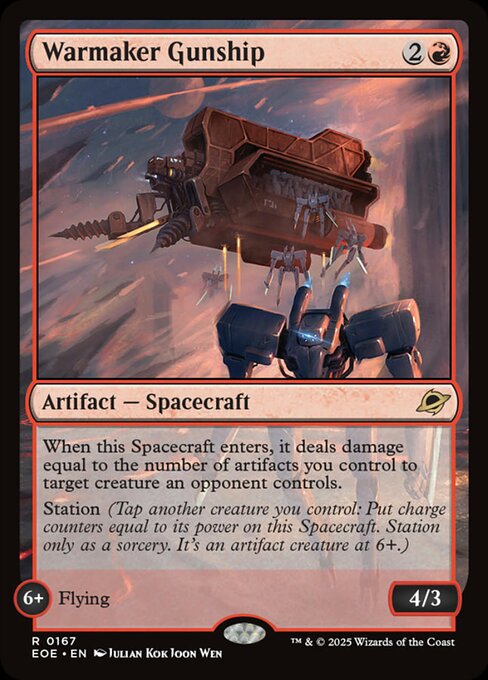 Rating8.9Bomb
Why this rating?
One of the 10 best cards of the set (8.9/10).
Why. Three mana for an enters removal: it deals damage equal to the number of artifacts you control, itself included, so at least 1. After that it is a Station sink and becomes a 4/3 flier at 6 counters.
Risks. Alone it deals only 1 damage, so you need artifacts beside it, such as Lander or Robot tokens. It is not a creature until Station is done.
In the draft. A bomb in a red artifact deck, much more modest without artifacts. Take it high and look for cheap artifacts to go with it.
Results in the games of the set
When it is in hand, the deck wins 61.6% of its games (set average: 56.0%, 8th of 287 cards).
In the opening hand: 61.4% wins (54.8% on average).
Drawn during the game: 61.7% (56.8% on average).
When it is drawn, the deck wins 8.1 points more than when it is not.
When it is drafted, it is played 90% of the time (set average: 62%).
Taken as the first pick (97 drafts), it ends in the deck 96% of the time.
It is played about as much in every archetype.
 Rating8.8Bomb
Why this rating?
One of the 10 best cards of the set (8.8/10).
Why. A 2/4 for three that, whenever you cast your second spell each turn, lets you choose between two 1/1 white Human Soldier creature tokens or a +1/+1 counter on each creature you control. A two-spell turn becomes very profitable.
Risks. It needs two spells in one turn, so without cheap spells it is an ordinary 2/4. A removal spell before it produces anything leaves you with little.
In the draft. A bomb in a low-curve white deck full of one- and two-mana spells. The more cheap spells you have, the better it gets.
Results in the games of the set
When it is in hand, the deck wins 63.6% of its games (set average: 56.0%, 4th of 287 cards).
In the opening hand: 64.0% wins (54.8% on average).
Drawn during the game: 63.2% (56.8% on average).
When it is drawn, the deck wins 10.9 points more than when it is not.
When it is drafted, it is played 94% of the time (set average: 62%).
Taken as the first pick (30 drafts), it ends in the deck 93% of the time.
It is played about as much in every archetype.
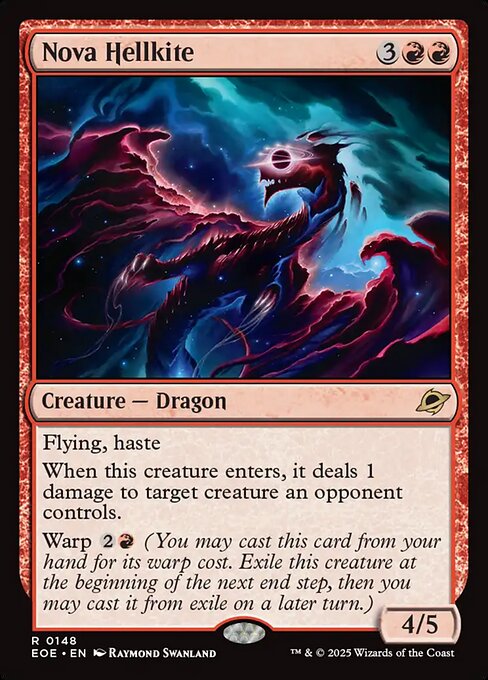 Rating8.7Bomb
Why this rating?
One of the 10 best cards of the set (8.7/10).
Why. A 4/5 flier with haste that deals 1 damage to an opposing creature on entering: an immediate big threat that also finishes off small creatures. With Warp you cast it for three and hit right away.
Risks. Five mana with two red mana is heavy. With Warp it leaves for exile at end of turn, so you attack once and must recast it next turn.
In the draft. A bomb: a top red pick. It is a great finisher for aggro or midrange, and Warp makes it playable earlier than its cost suggests.
Results in the games of the set
When it is in hand, the deck wins 62.2% of its games (set average: 56.0%, 5th of 287 cards).
In the opening hand: 60.0% wins (54.8% on average).
Drawn during the game: 63.7% (56.8% on average).
When it is drawn, the deck wins 9.6 points more than when it is not.
When it is drafted, it is played 91% of the time (set average: 62%).
Taken as the first pick (97 drafts), it ends in the deck 95% of the time.
It is played about as much in every archetype.
 Rating8.7Bomb
Why this rating?
One of the 10 best cards of the set (8.7/10).
Why. A 4/1 for two with menace and ward (discard a card): it hits hard from turn 2, and targeting it costs a card. A very good attacker for an aggressive deck.
Risks. Every attack puts a +1/+1 counter on an opposing creature, which slowly becomes a better blocker. With 1 toughness, a simple block or a minor effect kills it.
In the draft. A high pick in an aggressive black deck, much worse in a slow one. Use it early, and stop attacking once the counter costs too much.
Results in the games of the set
When it is in hand, the deck wins 61.6% of its games (set average: 56.0%, 7th of 287 cards).
In the opening hand: 63.9% wins (54.8% on average).
Drawn during the game: 60.0% (56.8% on average).
When it is drawn, the deck wins 8.1 points more than when it is not.
When it is drafted, it is played 88% of the time (set average: 62%).
Taken as the first pick (122 drafts), it ends in the deck 86% of the time.
It is played about as much in every archetype.
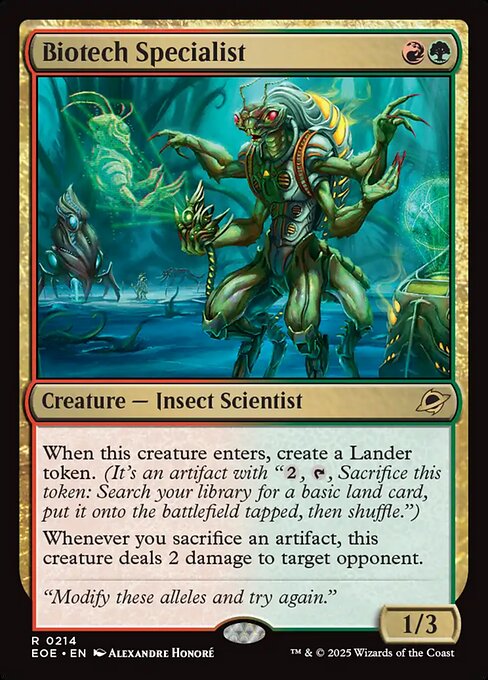 Rating8.6Bomb
Why this rating?
One of the 10 best cards of the set (8.6/10).
Why. A 1/3 for two that creates a Lander token on entering: ramp and fixing. Each artifact you sacrifice, that Lander included, makes it deal 2 damage to the opponent.
Risks. It is gold and only plays in a red-green deck. With 1 power it does little alone: you need more artifacts to sacrifice beyond its first Lander.
In the draft. A good red-green card, best taken when you are already in those colours. More Lander tokens increase its value.
Results in the games of the set
When it is in hand, the deck wins 60.0% of its games (set average: 56.0%, 18th of 287 cards).
In the opening hand: 60.2% wins (54.8% on average).
Drawn during the game: 59.9% (56.8% on average).
When it is drawn, the deck wins 5.9 points more than when it is not.
When it is drafted, it is played 79% of the time (set average: 62%).
Taken as the first pick (88 drafts), it ends in the deck 90% of the time.
It is played mostly in G/R decks (25% of them).

10. Sunstar Chaplain
Rating8.5BombWhy this rating?
One of the 10 best cards of the set (8.5/10).
Why. A 3/2 for two that puts a +1/+1 counter on one of your creatures at your end step when you control two or more tapped creatures. Later, for two mana, it removes a counter from a creature you control to tap any artifact or creature.
Risks. The first ability needs two tapped creatures, which Station or attacking provides, but you need creatures. With 2 toughness it dies easily.
In the draft. A good high pick in an aggressive or Station-based white deck. It gains a lot of value in a long game.
Results in the games of the set
When it is in hand, the deck wins 60.7% of its games (set average: 56.0%, 11th of 287 cards).
In the opening hand: 61.3% wins (54.8% on average).
Drawn during the game: 60.3% (56.8% on average).
When it is drawn, the deck wins 6.5 points more than when it is not.
When it is drafted, it is played 89% of the time (set average: 62%).
Taken as the first pick (104 drafts), it ends in the deck 88% of the time.
It is played about as much in every archetype.
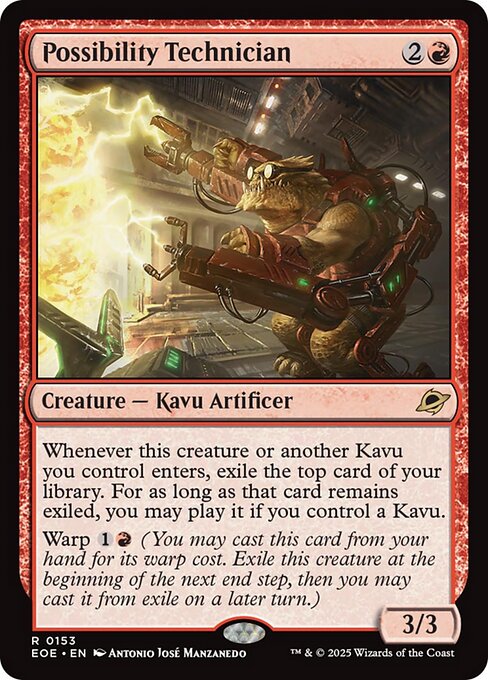 Rating8.4Bomb
Why this rating?
One of the very best rares of the format (8.4/10).
Why. A 3/3 Kavu for three: when it or another Kavu enters, it exiles the top card of your library, and you may play that card while you control a Kavu. It is one itself, so it is a solid body that generates value.
Risks. Cast with Warp, it goes back to exile at end of turn, so play the exiled card that turn or you will need another Kavu. Without another Kavu, casting it normally is far better.
In the draft. A solid to good red pick. Play it on turn 3 without Warp unless you have a specific need. Other Kavu are a bonus.
Results in the games of the set
When it is in hand, the deck wins 60.8% of its games (set average: 56.0%, 10th of 287 cards).
In the opening hand: 61.6% wins (54.8% on average).
Drawn during the game: 60.3% (56.8% on average).
When it is drawn, the deck wins 6.9 points more than when it is not.
When it is drafted, it is played 89% of the time (set average: 62%).
Taken as the first pick (127 drafts), it ends in the deck 91% of the time.
It is played about as much in every archetype.

12. Syr Vondam, Sunstar Exemplar
Rating8.3Very goodWhy this rating?
One of the very best rares of the format (8.4/10).
Why. A 2/2 vigilance menace for two that grows and gains you 1 life whenever another creature you control dies or is exiled. At 4 power or more, its death destroys a nonland permanent.
Risks. It is white-black gold and does little alone. With 2 toughness it dies fast before growing, and the final removal needs 4 power.
In the draft. Very good in an aggressive white-black deck with lots of creature trades. Elsewhere, do not take it until you are sure of your colours.
Results in the games of the set
When it is in hand, the deck wins 59.4% of its games (set average: 56.0%, 25th of 287 cards).
In the opening hand: 59.5% wins (54.8% on average).
Drawn during the game: 59.3% (56.8% on average).
When it is drawn, the deck wins 6.5 points more than when it is not.
When it is drafted, it is played 74% of the time (set average: 62%).
Taken as the first pick (65 drafts), it ends in the deck 83% of the time.
It is played mostly in B/W decks (26% of them).
 Rating8.3Very good
Why this rating?
One of the very best rares of the format (8.3/10).
Why. For two mana, this Spacecraft gives +1/+1 to your other creatures at 2 counters, one Station with a 2-power creature. A very cheap anthem for a deck with lots of creatures.
Risks. It is not a creature until Station reaches 12, so it does not block. The effect disappears if the artifact is destroyed, and tapping creatures for Station keeps them from attacking.
In the draft. A good high pick in a white deck with many small creatures. It is weaker in a slow deck with few creatures.
Results in the games of the set
When it is in hand, the deck wins 60.2% of its games (set average: 56.0%, 16th of 287 cards).
In the opening hand: 62.5% wins (54.8% on average).
Drawn during the game: 58.5% (56.8% on average).
When it is drawn, the deck wins 6.7 points more than when it is not.
When it is drafted, it is played 91% of the time (set average: 62%).
Taken as the first pick (94 drafts), it ends in the deck 90% of the time.
It is played about as much in every archetype.

14. Beyond the Quiet
Rating8.2Very goodWhy this rating?
One of the very best rares of the format (8.2/10).
Why. A five-mana sorcery that exiles all creatures and Spacecraft. When you are behind on board, it resets everything and gets around death-based effects.
Risks. It also hits your own creatures and Spacecraft. It is dead in an aggressive deck and costs you your turn-5 play.
In the draft. Take it for a white control or value deck with few creatures. In an aggro deck, pass it: it does more harm than good.
Results in the games of the set
When it is in hand, the deck wins 59.4% of its games (set average: 56.0%, 27th of 287 cards).
In the opening hand: 57.1% wins (54.8% on average).
Drawn during the game: 60.9% (56.8% on average).
When it is drawn, the deck wins 5.6 points more than when it is not.
When it is drafted, it is played 79% of the time (set average: 62%).
Taken as the first pick (75 drafts), it ends in the deck 85% of the time.
It is played about as much in every archetype.
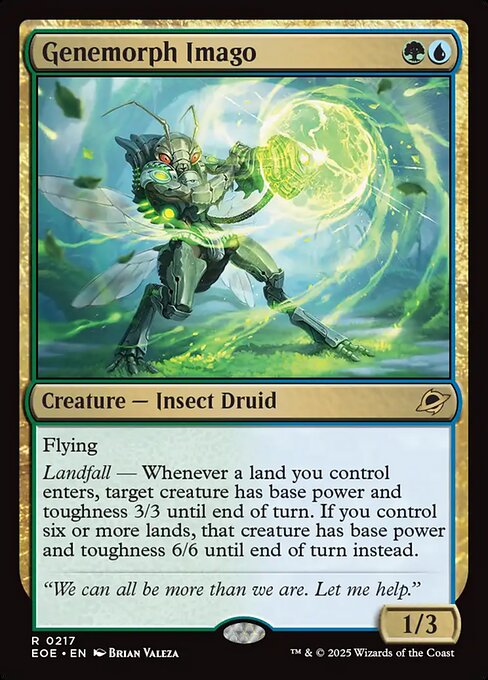
15. Genemorph Imago
Rating8.1Very goodWhy this rating?
One of the very best rares of the format (8.1/10).
Why. A 1/3 flier for two. With Landfall, each land makes a creature a 3/3 base until end of turn, and a 6/6 base once you control six lands. It can target itself and become a 3/3 flier.
Risks. It is green-blue gold and relies on lands: with no land to play it is just a 1/3 flier. Setting base power and toughness can also shrink a big creature, so aim it carefully.
In the draft. Very good in a green-blue deck. Take it high if you are in those colours, and play enough lands to feed it.
Results in the games of the set
When it is in hand, the deck wins 61.8% of its games (set average: 56.0%, 6th of 287 cards).
In the opening hand: 62.1% wins (54.8% on average).
Drawn during the game: 61.7% (56.8% on average).
When it is drawn, the deck wins 8.4 points more than when it is not.
When it is drafted, it is played 85% of the time (set average: 62%).
Taken as the first pick (112 drafts), it ends in the deck 88% of the time.
It is played about as much in every archetype.
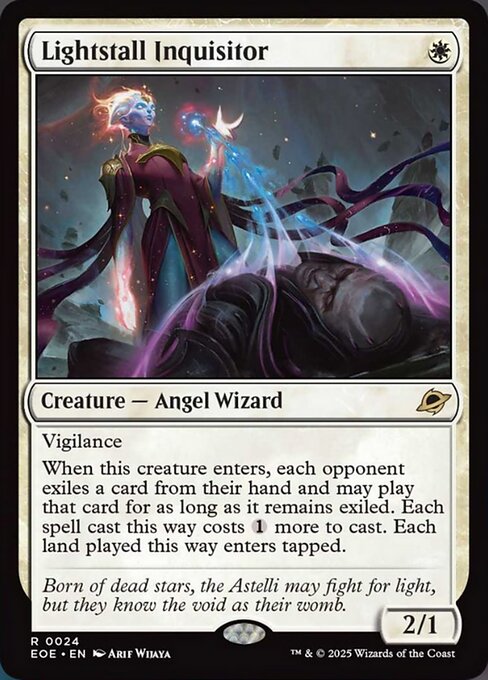 Rating8.1Very good
Why this rating?
One of the very best rares of the format (8.1/10).
Why. A 2/1 vigilance for one mana that makes the opponent exile a card from their hand: they may play it later, but it costs one more mana (and a land enters tapped). Mostly a slowdown.
Risks. The opponent chooses the card and keeps it playable, so you do not really remove it. With 1 toughness it dies to anything, and it is weak late in the game.
In the draft. A decent cheap attacker for an aggressive white deck, nothing more. Take it mid-pack, not over real removal.
Results in the games of the set
When it is in hand, the deck wins 57.9% of its games (set average: 56.0%, 57th of 287 cards).
In the opening hand: 61.7% wins (54.8% on average).
Drawn during the game: 54.9% (56.8% on average).
When it is drawn, the deck wins 3.3 points more than when it is not.
When it is drafted, it is played 81% of the time (set average: 62%).
Taken as the first pick (50 drafts), it ends in the deck 88% of the time.
It is played about as much in every archetype.
 Rating8.0Very good
Why this rating?
One of the very best rares of the format (8.0/10).
Why. A 3/3 for three that gains you 1 life whenever a creature or artifact enters under your control. If you gained 3 life this turn, it draws a card at your end step.
Risks. To draw, you must gain 3 life in one turn, which needs several permanents or lifelink. Alone it is just a solid 3/3.
In the draft. Good in a white deck with many cheap creatures and artifacts. The one-mana Warp cost lets you make a big multi-spell turn.
Results in the games of the set
When it is in hand, the deck wins 60.0% of its games (set average: 56.0%, 19th of 287 cards).
In the opening hand: 59.4% wins (54.8% on average).
Drawn during the game: 60.4% (56.8% on average).
When it is drawn, the deck wins 6.6 points more than when it is not.
When it is drafted, it is played 91% of the time (set average: 62%).
Taken as the first pick (102 drafts), it ends in the deck 96% of the time.
It is played about as much in every archetype.
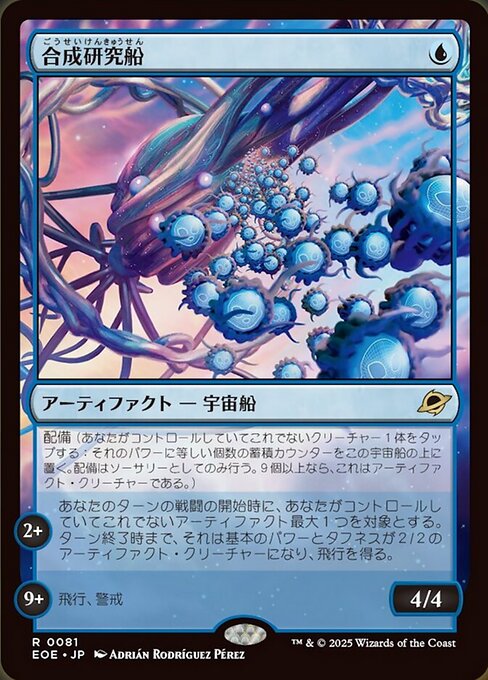 Rating7.9Very good
Why this rating?
One of the very best rares of the format (7.9/10).
Why. A one-mana Spacecraft: at 2 counters, at the beginning of combat, another artifact becomes a 2/2 flier until end of turn. It makes any artifact an attacker and becomes a 4/4 flying vigilance creature at 9.
Risks. It does nothing without an artifact to animate, and 9 counters is very heavy. Until Station is done, it is just a noncreature artifact.
In the draft. Fine in a blue artifact deck, weak otherwise. Take it mid-pack, earlier if you already have tokens or artifacts to animate.
Results in the games of the set
When it is in hand, the deck wins 59.6% of its games (set average: 56.0%, 24th of 287 cards).
In the opening hand: 62.4% wins (54.8% on average).
Drawn during the game: 57.9% (56.8% on average).
When it is drawn, the deck wins 6.7 points more than when it is not.
When it is drafted, it is played 88% of the time (set average: 62%).
Taken as the first pick (121 drafts), it ends in the deck 88% of the time.
It is played about as much in every archetype.
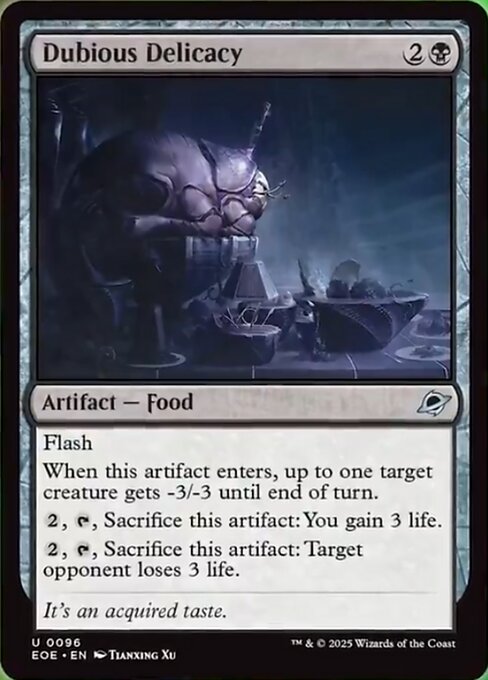
19. Dubious Delicacy
Rating7.8Very goodWhy this rating?
One of the very best uncommons of the format (7.8/10).
Why. A flexible flash removal spell: -3/-3 on a creature, then a Food artifact you can sacrifice to gain 3 life or make the opponent lose 3 life. It kills small creatures and leaves value behind.
Risks. -3/-3 does not deal with big creatures, and the second half costs two more mana. Artifact removal can take the Food away in response.
In the draft. A very good uncommon to take fairly high in any black deck. Flash it in to ambush an attacker or swing a combat.
Results in the games of the set
When it is in hand, the deck wins 60.6% of its games (set average: 56.0%, 12th of 287 cards).
In the opening hand: 58.3% wins (54.8% on average).
Drawn during the game: 62.1% (56.8% on average).
When it is drawn, the deck wins 6.9 points more than when it is not.
When it is drafted, it is played 91% of the time (set average: 62%).
Taken as the first pick (318 drafts), it ends in the deck 93% of the time.
It is played mostly in B/U decks (33% of them) and B/G (31%).

20. Exalted Sunborn
Rating7.7Very goodWhy this rating?
One of the very best mythics of the format (7.7/10).
Why. A 4/5 flying lifelinker for five: a huge body that dominates air combat. It also doubles the tokens you create. Warp lets you cast it for two.
Risks. The token doubling only matters if your deck makes tokens. It needs two white mana, and without tokens it is a good five-drop that dies to removal.
In the draft. Take it in a white deck, especially one that makes many tokens. Otherwise it is a decent finisher, not a pick over removal.
Results in the games of the set
When it is in hand, the deck wins 57.6% of its games (set average: 56.0%, 64th of 287 cards).
In the opening hand: 55.9% wins (54.8% on average).
Drawn during the game: 58.7% (56.8% on average).
When it is drawn, the deck wins 4.8 points more than when it is not.
When it is drafted, it is played 87% of the time (set average: 62%).
Taken as the first pick (41 drafts), it ends in the deck 83% of the time.
It is played about as much in every archetype.
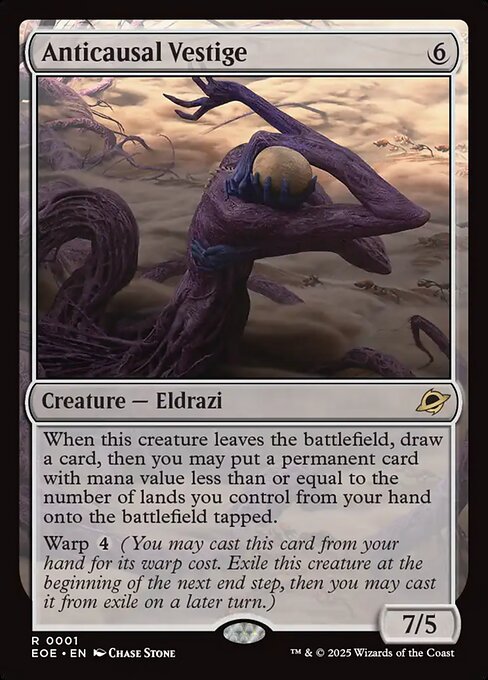 Rating7.7Very good
Why this rating?
One of the very best rares of the format (7.7/10).
Why. A colorless 7/5 that, when it leaves the battlefield, draws you a card, then lets you put a permanent from your hand onto the battlefield tapped if its mana value is at most the number of lands you control. With Warp for four mana, it leaves at end of turn and triggers.
Risks. Six mana to cast it normally is heavy. If your hand has no permanent cheap enough, the second half does nothing.
In the draft. A good colorless finisher for almost any slow deck. Take it mid-pack; it is better with a few expensive permanents in hand.
Results in the games of the set
When it is in hand, the deck wins 59.4% of its games (set average: 56.0%, 26th of 287 cards).
In the opening hand: 59.1% wins (54.8% on average).
Drawn during the game: 59.6% (56.8% on average).
When it is drawn, the deck wins 6.1 points more than when it is not.
When it is drafted, it is played 99% of the time (set average: 62%).
Taken as the first pick (42 drafts), it ends in the deck 100% of the time.
It is played about as much in every archetype.
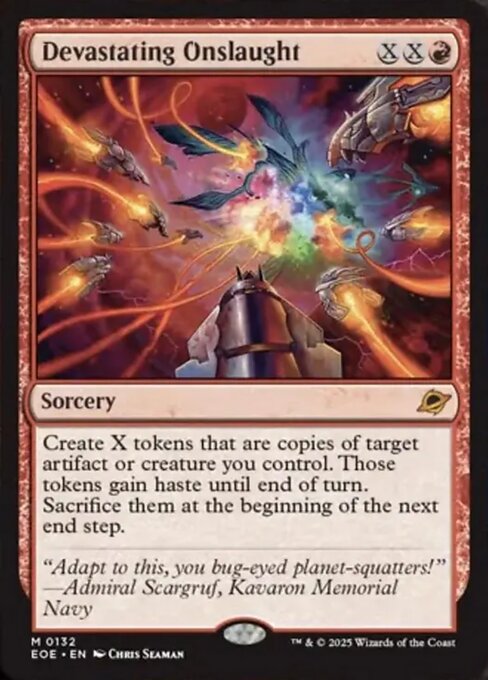 Rating7.6Very good
Why this rating?
One of the very best mythics of the format (7.6/10).
Why. An X sorcery that creates X token copies of an artifact or creature with haste, sacrificed at end of turn. With a creature that has an enters ability, you get that ability X times, and the copies hit right away.
Risks. It costs twice X plus a red mana and depends on a good target. Without enters abilities you only get one turn of damage, and removal on the target in response blanks it.
In the draft. Specialised: take it only if you have creatures with enters abilities to copy. Otherwise let it go.
Results in the games of the set
When it is in hand, the deck wins 57.6% of its games (set average: 56.0%, 63rd of 287 cards).
In the opening hand: 54.2% wins (54.8% on average).
Drawn during the game: 59.9% (56.8% on average).
When it is drawn, the deck wins 4.7 points more than when it is not.
When it is drafted, it is played 85% of the time (set average: 62%).
Taken as the first pick (39 drafts), it ends in the deck 85% of the time.
It is played about as much in every archetype.

23. Dyadrine, Synthesis Amalgam
Rating7.6Very goodWhy this rating?
One of the very best rares of the format (7.6/10).
Why. An X artifact creature that enters with counters equal to the mana spent: at four mana (X equal to 2), it is a 4/5 trampler. When you attack, you may remove a counter from each of two of your creatures to draw a card and create a 2/2 colorless Robot artifact creature token.
Risks. It costs a green and a white mana, so it is strictly two colours. Removing counters weakens your creatures, and without several creatures the attack trigger is weak.
In the draft. Good in a green-white deck. It scales with your curve, so it is useful at every stage, but do not take it over removal.
Results in the games of the set
When it is in hand, the deck wins 57.5% of its games (set average: 56.0%, 68th of 287 cards).
In the opening hand: 56.5% wins (54.8% on average).
Drawn during the game: 58.2% (56.8% on average).
When it is drawn, the deck wins 3.7 points more than when it is not.
When it is drafted, it is played 73% of the time (set average: 62%).
Taken as the first pick (71 drafts), it ends in the deck 76% of the time.
It is played mostly in G/W decks (27% of them).

24. Rust Harvester
Rating7.6Very goodWhy this rating?
One of the very best rares of the format (7.6/10).
Why. A one-mana 1/1 menace artifact creature. Its ability lets you deal damage to any target by exiling an artifact card from your graveyard, and each activation makes it bigger.
Risks. It needs artifact cards in your graveyard, which fills slowly, and the ability taps it, so it waits a turn. With 1 toughness it is very fragile.
In the draft. A niche card, to take mid-pack in a red artifact deck. Outside that deck, pass it.
Results in the games of the set
When it is in hand, the deck wins 58.2% of its games (set average: 56.0%, 50th of 287 cards).
In the opening hand: 58.1% wins (54.8% on average).
Drawn during the game: 58.2% (56.8% on average).
When it is drawn, the deck wins 5.6 points more than when it is not.
When it is drafted, it is played 84% of the time (set average: 62%).
Taken as the first pick (79 drafts), it ends in the deck 78% of the time.
It is played about as much in every archetype.
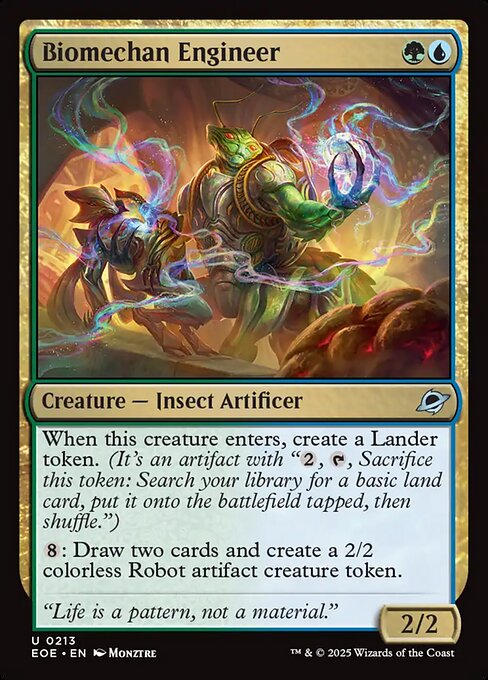 Rating7.5Very good
Why this rating?
One of the very best uncommons of the format (7.6/10).
Why. A 2/2 for two that creates a Lander token on entering: mana setup and fixing. Late in the game, eight mana gives you two cards and a 2/2 colorless Robot artifact creature token.
Risks. It is green-blue gold and the 2/2 body is modest. The eight-mana ability is slow to come online.
In the draft. A very good green-blue uncommon. Take it fairly high: it improves your mana and gives a late-game mana sink.
Results in the games of the set
When it is in hand, the deck wins 60.4% of its games (set average: 56.0%, 13th of 287 cards).
In the opening hand: 61.3% wins (54.8% on average).
Drawn during the game: 59.7% (56.8% on average).
When it is drawn, the deck wins 5.8 points more than when it is not.
When it is drafted, it is played 85% of the time (set average: 62%).
Taken as the first pick (242 drafts), it ends in the deck 91% of the time.
It is played mostly in G/U decks (53% of them) and B/G (25%).
 Rating7.5Very good
Why this rating?
A solid uncommon of the format (7.5/10).
Why. A three-mana Spacecraft: you may sacrifice a land or a Lander to search for two basic lands and put them onto the battlefield tapped. Fixing and ramp that becomes a 3/3 flier at 7 counters.
Risks. It is not a creature before Station reaches 7, so it does not block until then and your turn 3 defends nothing. Station to 7 is a big investment.
In the draft. Good in a green deck with big finishers. It also helps splash fixing. Take it mid-pack.
Results in the games of the set
When it is in hand, the deck wins 59.2% of its games (set average: 56.0%, 29th of 287 cards).
In the opening hand: 60.6% wins (54.8% on average).
Drawn during the game: 58.2% (56.8% on average).
When it is drawn, the deck wins 4.3 points more than when it is not.
When it is drafted, it is played 91% of the time (set average: 62%).
Taken as the first pick (280 drafts), it ends in the deck 94% of the time.
It is played mostly in B/G decks (35% of them) and G/R (34%).
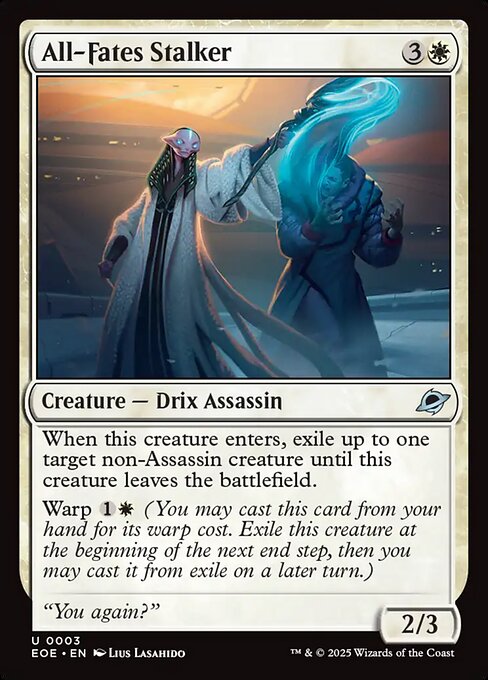 Rating7.4Very good
Why this rating?
A solid uncommon of the format (7.4/10).
Why. A removal spell on a body: a non-Assassin creature is exiled until this one leaves the battlefield. A 2/3 for four that deals with an opposing threat and blocks.
Risks. The removal is temporary: if the Stalker dies or leaves, the creature comes back. With Warp it leaves at end of turn, so the exiled creature returns right away.
In the draft. A very good white uncommon to take early. Cast it normally for lasting removal; Warp only removes a blocker for a turn, but recasting it from exile exiles another creature.
Results in the games of the set
When it is in hand, the deck wins 59.8% of its games (set average: 56.0%, 20th of 287 cards).
In the opening hand: 57.7% wins (54.8% on average).
Drawn during the game: 61.3% (56.8% on average).
When it is drawn, the deck wins 5.1 points more than when it is not.
When it is drafted, it is played 89% of the time (set average: 62%).
Taken as the first pick (270 drafts), it ends in the deck 93% of the time.
It is played mostly in U/W decks (36% of them) and B/W (33%).
 Rating7.4Very good
Why this rating?
A very good rare of the format (7.4/10).
Why. An eight-mana Spacecraft: it destroys a noncreature permanent and deals 4 damage to each creature. At 5 Station counters it becomes a 10/10 flying trampler. It is a sweeper and a big threat.
Risks. Eight mana is a lot. It also kills your creatures, and Station then needs creatures with total power of 5.
In the draft. A finisher for slow decks with ramp. Take it mid-pack, never in an aggro deck.
Results in the games of the set
When it is in hand, the deck wins 57.5% of its games (set average: 56.0%, 67th of 287 cards).
In the opening hand: 53.6% wins (54.8% on average).
Drawn during the game: 59.8% (56.8% on average).
When it is drawn, the deck wins 4.1 points more than when it is not.
When it is drafted, it is played 92% of the time (set average: 62%).
Taken as the first pick (94 drafts), it ends in the deck 93% of the time.
It is played about as much in every archetype.
 Rating7.4Very good
Why this rating?
A very good mythic of the format (7.4/10).
Why. A Planet land that enters tapped and taps for red mana. After Station reaches 12 counters, for two mana including a red one it can sacrifice a land to make a 2/2 colorless Robot artifact creature token and give your creatures +1/+0 and haste.
Risks. It enters tapped, which costs tempo, and it only makes red mana. Station to 12 is slow, and sacrificing a land on each activation is costly.
In the draft. A land for a red deck if you have room: a red source with a bit of utility. Do not take it over good spells.
Results in the games of the set
When it is in hand, the deck wins 57.6% of its games (set average: 56.0%, 62nd of 287 cards).
In the opening hand: 59.9% wins (54.8% on average).
Drawn during the game: 55.9% (56.8% on average).
When it is drawn, the deck wins 2.9 points more than when it is not.
When it is drafted, it is played 82% of the time (set average: 62%).
Taken as the first pick (49 drafts), it ends in the deck 86% of the time.
 Rating7.4Very good
Why this rating?
A very good rare of the format (7.4/10).
Why. A seven-mana sorcery: you destroy creatures with odd or even mana value, then steal every survivor, untap them and give them haste. A sweep followed by an attack that can end the game.
Risks. Seven mana with two black and two red is heavy and demanding on colours. It can also destroy your own creatures, and choosing parity needs a readable board.
In the draft. A finisher for black-red control. It needs a deck that holds the game long; otherwise do not take it high.
Results in the games of the set
When it is in hand, the deck wins 59.6% of its games (set average: 56.0%, 23rd of 287 cards).
In the opening hand: 55.7% wins (54.8% on average).
Drawn during the game: 62.1% (56.8% on average).
When it is drawn, the deck wins 6.9 points more than when it is not.
When it is drafted, it is played 73% of the time (set average: 62%).
Taken as the first pick (68 drafts), it ends in the deck 84% of the time.
It is played mostly in B/R decks (29% of them).

31. Seedship Impact
Rating7.4Very goodWhy this rating?
A solid uncommon of the format (7.4/10).
Why. A two-mana instant that destroys an artifact or enchantment, and gives you a Lander token if its mana value was 2 or less. In a set full of artifacts, it often finds a target.
Risks. Very situational: with no target in the opposing deck it stays in hand. It never answers a creature unless that creature is an artifact.
In the draft. A sideboard card to take late, or earlier if you see many artifacts or Spacecraft going around. Otherwise do not count on it in your main deck.
Results in the games of the set
When it is in hand, the deck wins 58.1% of its games (set average: 56.0%, 51st of 287 cards).
In the opening hand: 57.0% wins (54.8% on average).
Drawn during the game: 58.9% (56.8% on average).
When it is drawn, the deck wins 2.8 points more than when it is not.
When it is drafted, it is played 84% of the time (set average: 62%).
Taken as the first pick (144 drafts), it ends in the deck 92% of the time.
It is played mostly in G/R decks (32% of them) and G/U (28%).
 Rating7.4Very good
Why this rating?
A solid uncommon of the format (7.4/10).
Why. A 2/1 Kavu for two that lets the opponent choose: two Lander tokens for you, or two +1/+1 counters on it (a 4/3). Either way, you come out ahead.
Risks. If the opponent picks the tokens, you have a fragile 2/1 body. If they decline, a 4/3 for two still dies to removal or a trade.
In the draft. A good red uncommon, to take fairly high in a low-curve red deck. An extra Kavu for cards that care about them.
Results in the games of the set
When it is in hand, the deck wins 59.7% of its games (set average: 56.0%, 22nd of 287 cards).
In the opening hand: 62.4% wins (54.8% on average).
Drawn during the game: 57.7% (56.8% on average).
When it is drawn, the deck wins 5.2 points more than when it is not.
When it is drafted, it is played 88% of the time (set average: 62%).
Taken as the first pick (265 drafts), it ends in the deck 92% of the time.
It is played mostly in B/R decks (35% of them) and G/R (35%).
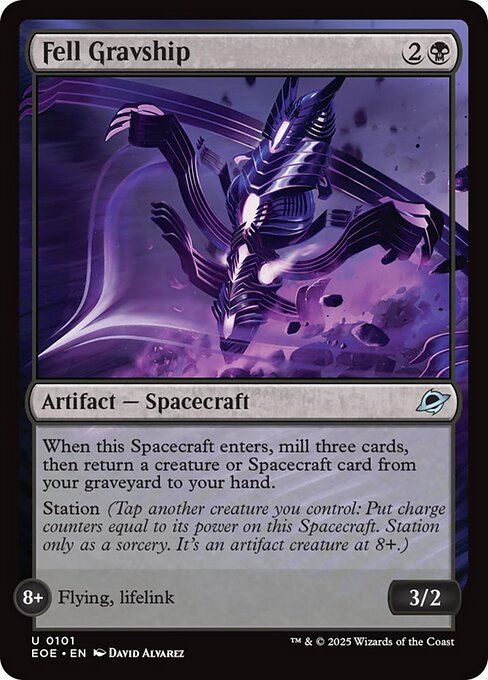
33. Fell Gravship
Rating7.3Very goodWhy this rating?
A solid uncommon of the format (7.3/10).
Why. A three-mana Spacecraft: it mills three cards, then returns a creature or Spacecraft card from your graveyard to your hand. Card advantage on entering, even without Station.
Risks. It is not a creature until Station reaches 8. The return depends on what is in the graveyard, and milling three cards can cost you good ones.
In the draft. A very good black uncommon, to take fairly high. It works well in a deck with many creatures to bring back.
Results in the games of the set
When it is in hand, the deck wins 60.3% of its games (set average: 56.0%, 14th of 287 cards).
In the opening hand: 58.7% wins (54.8% on average).
Drawn during the game: 61.3% (56.8% on average).
When it is drawn, the deck wins 5.9 points more than when it is not.
When it is drafted, it is played 88% of the time (set average: 62%).
Taken as the first pick (261 drafts), it ends in the deck 93% of the time.
It is played mostly in B/W decks (36% of them) and B/U (35%).
 Rating7.3Very good
Why this rating?
A very good rare of the format (7.3/10).
Why. A 5/4 flier for five that, on entering, returns a noncreature, nonland permanent card from your graveyard to the battlefield with mana value up to X, X being the mana spent. A solid aerial body.
Risks. The ability depends on a target in the graveyard, and early in the game there is none. It needs two white mana, and Warp limits the mana value to 3.
In the draft. A decent white flying finisher, but not a priority. Its value depends on your artifacts and enchantments: take it mid-pack.
Results in the games of the set
When it is in hand, the deck wins 56.4% of its games (set average: 56.0%, 105th of 287 cards).
In the opening hand: 52.4% wins (54.8% on average).
Drawn during the game: 59.0% (56.8% on average).
When it is drawn, the deck wins 2.6 points more than when it is not.
When it is drafted, it is played 84% of the time (set average: 62%).
Taken as the first pick (76 drafts), it ends in the deck 89% of the time.
It is played about as much in every archetype.
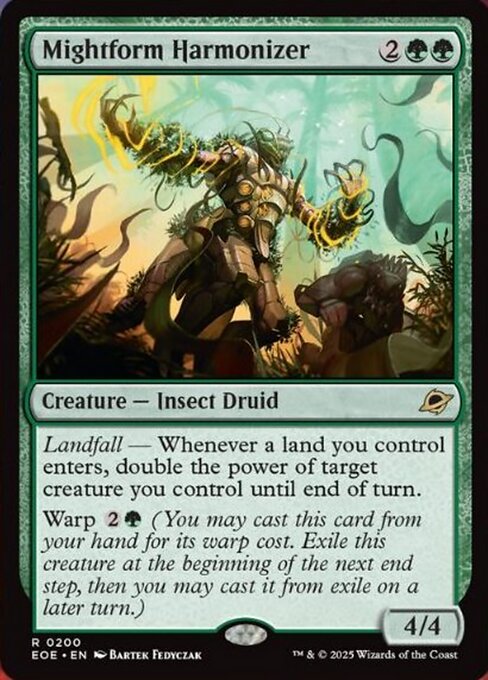 Rating7.2Very good
Why this rating?
A very good rare of the format (7.2/10).
Why. A 4/4 for four whose Landfall doubles the power of one of your creatures each time. With a land drop every turn, attacks get heavy fast. Warp lets you cast it cheaply for one turn of damage, then recast it later.
Risks. With no land to play that turn it is just a decent 4/4. The doubling only lasts until end of turn and a removal in response blanks it.
In the draft. A good rare to take in green, especially with extra land sources such as Lander tokens. It goes behind your best removal.
Results in the games of the set
When it is in hand, the deck wins 58.6% of its games (set average: 56.0%, 39th of 287 cards).
In the opening hand: 57.2% wins (54.8% on average).
Drawn during the game: 59.6% (56.8% on average).
When it is drawn, the deck wins 4.6 points more than when it is not.
When it is drafted, it is played 93% of the time (set average: 62%).
Taken as the first pick (97 drafts), it ends in the deck 93% of the time.
It is played about as much in every archetype.
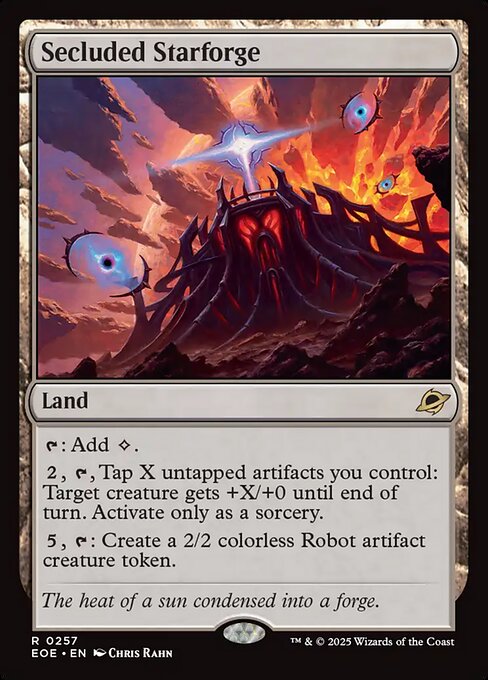 Rating7.2Very good
Why this rating?
A very good rare of the format (7.2/10).
Why. A land that becomes a late-game mana sink: for five mana and by tapping itself, it makes a 2/2 colorless Robot artifact creature token every turn. It can also pump a creature if you control artifacts.
Risks. It only taps for colorless mana, which hurts decks with demanding colored costs. The pump works only at sorcery speed and needs untapped artifacts.
In the draft. Play it as an extra land in decks that go long. Take it mid-to-late in the pack: it wins slow games, not fast ones.
Results in the games of the set
When it is in hand, the deck wins 58.6% of its games (set average: 56.0%, 40th of 287 cards).
In the opening hand: 56.0% wins (54.8% on average).
Drawn during the game: 60.3% (56.8% on average).
When it is drawn, the deck wins 4.2 points more than when it is not.
When it is drafted, it is played 98% of the time (set average: 62%).
Taken as the first pick (124 drafts), it ends in the deck 98% of the time.
 Rating7.2Very good
Why this rating?
A very good rare of the format (7.2/10).
Why. A three-mana Spacecraft that becomes a flying 4/5 artifact creature once it has seven charge counters. Once it is a creature, every attack puts a creature card from your hand onto the battlefield for free, so your biggest threats cost nothing.
Risks. It does nothing until it has enough charge counters, and Station taps your creatures. It is slow, and artifact removal shuts it off.
In the draft. For green decks with high-power creatures and big hits in hand. Skip it in a low curve.
Results in the games of the set
When it is in hand, the deck wins 57.0% of its games (set average: 56.0%, 82nd of 287 cards).
In the opening hand: 58.1% wins (54.8% on average).
Drawn during the game: 56.1% (56.8% on average).
When it is drawn, the deck wins 2.9 points more than when it is not.
When it is drafted, it is played 80% of the time (set average: 62%).
Taken as the first pick (57 drafts), it ends in the deck 86% of the time.
It is played about as much in every archetype.
 Rating7.2Good
Why this rating?
A very good rare of the format (7.2/10).
Why. A flexible sweeper: you pick X to destroy low-toughness creatures while sparing your bigger ones. At X of six or more you also bring one of the destroyed creatures back under your control, which can flip a lost game.
Risks. It also kills your own small creatures and costs you life equal to X. It is a sorcery and gets expensive when you need to go big.
In the draft. Take it in black control or big-creature decks. Worse in aggressive decks that want to keep their creatures.
Results in the games of the set
When it is in hand, the deck wins 57.8% of its games (set average: 56.0%, 59th of 287 cards).
In the opening hand: 54.9% wins (54.8% on average).
Drawn during the game: 59.6% (56.8% on average).
When it is drawn, the deck wins 5.3 points more than when it is not.
When it is drafted, it is played 91% of the time (set average: 62%).
Taken as the first pick (104 drafts), it ends in the deck 93% of the time.
It is played about as much in every archetype.
 Rating7.1Good
Why this rating?
A solid uncommon of the format (7.1/10).
Why. For one mana, your creature fights an opposing creature right away and gets two extra toughness to survive it. A very cheap removal in a deck with high-power creatures. It also can no longer be blocked by more than one creature.
Risks. It is an Aura: if the opponent kills your creature in response, you lose two cards. The fight is pointless if your creature is too small.
In the draft. Play it in green with good creatures. Take it after real removal, not before.
Results in the games of the set
When it is in hand, the deck wins 58.7% of its games (set average: 56.0%, 38th of 287 cards).
In the opening hand: 57.7% wins (54.8% on average).
Drawn during the game: 59.3% (56.8% on average).
When it is drawn, the deck wins 3.4 points more than when it is not.
When it is drafted, it is played 90% of the time (set average: 62%).
Taken as the first pick (219 drafts), it ends in the deck 96% of the time.
It is played mostly in G/R decks (33% of them) and G/U (33%).
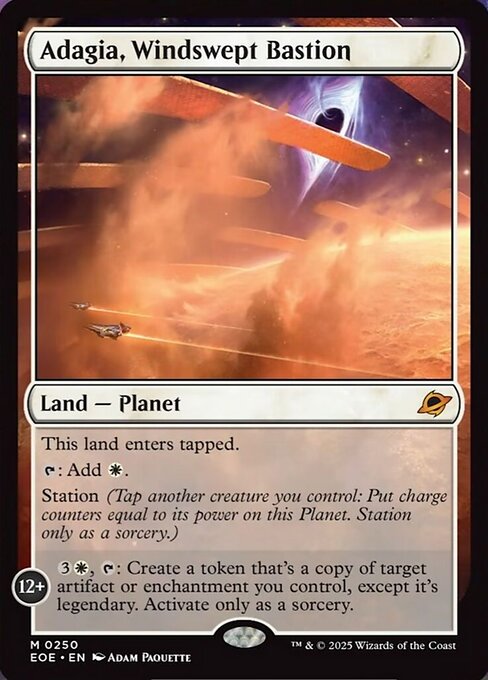 Rating7.0Good
Why this rating?
A very good mythic of the format (7.0/10).
Why. A white land that enters tapped and can become a late-game engine: once stationed, it copies an artifact or enchantment you control. In a deck full of good permanents of those types, that is free value.
Risks. It enters tapped, Station taps your creatures and the threshold needs a lot of charge counters. Without good targets it is just a slow white land.
In the draft. Take it late as a white land; it only becomes great with strong artifacts or enchantments.
Results in the games of the set
When it is in hand, the deck wins 55.5% of its games (set average: 56.0%, 144th of 287 cards).
In the opening hand: 56.9% wins (54.8% on average).
Drawn during the game: 54.4% (56.8% on average).
When it is drawn, the deck wins 0.5 points more than when it is not.
When it is drafted, it is played 84% of the time (set average: 62%).
Taken as the first pick (40 drafts), it ends in the deck 98% of the time.

41. Banishing Light
Rating7.0GoodWhy this rating?
One of the best commons of the format (7.0/10).
Why. For three mana it exiles any nonland permanent an opponent controls: creature, artifact or enchantment. A universal removal that answers threats which would not die otherwise.
Risks. If the enchantment is destroyed or bounced, the permanent comes back. It is not instant-speed and cannot touch lands.
In the draft. A very good white common, and flexible: take it fairly high and play it in any white deck.
Results in the games of the set
When it is in hand, the deck wins 58.3% of its games (set average: 56.0%, 46th of 287 cards).
In the opening hand: 55.6% wins (54.8% on average).
Drawn during the game: 60.0% (56.8% on average).
When it is drawn, the deck wins 3.7 points more than when it is not.
When it is drafted, it is played 88% of the time (set average: 62%).
Taken as the first pick (431 drafts), it ends in the deck 95% of the time.
It is played mostly in U/W decks (62% of them) and B/W (57%).
 Rating7.0Good
Why this rating?
A solid uncommon of the format (7.0/10).
Why. A 2/1 that filters your draws: look at two cards, keep the best and put the other in the graveyard. Its warp cost equals its normal cost, so you get the effect right away, then a second time when you recast it from exile.
Risks. The body is fragile and does not affect the board. Paying three mana twice is slow.
In the draft. A good blue uncommon: steady value at a low price that blue decks want. Take it mid-pack.
Results in the games of the set
When it is in hand, the deck wins 59.8% of its games (set average: 56.0%, 21st of 287 cards).
In the opening hand: 58.3% wins (54.8% on average).
Drawn during the game: 60.7% (56.8% on average).
When it is drawn, the deck wins 5.9 points more than when it is not.
When it is drafted, it is played 92% of the time (set average: 62%).
Taken as the first pick (334 drafts), it ends in the deck 95% of the time.
It is played mostly in B/U decks (40% of them) and R/U (38%).
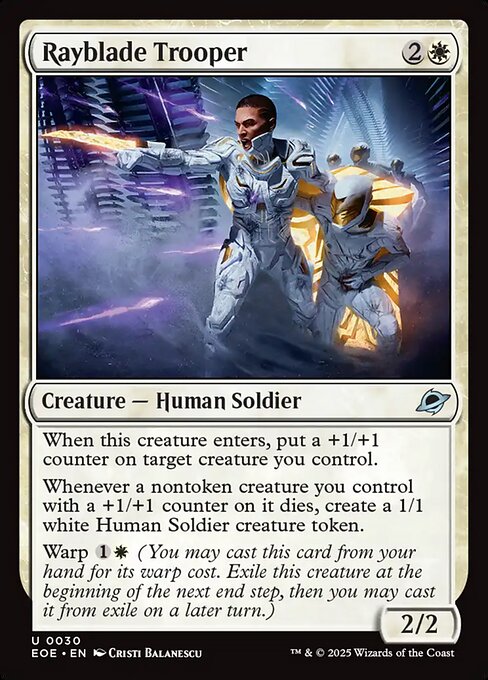
43. Rayblade Trooper
Rating7.0GoodWhy this rating?
A solid uncommon of the format (7.0/10).
Why. A 2/2 that puts a +1/+1 counter on a creature when it enters, itself included. When a nontoken creature with a +1/+1 counter dies you get a 1/1 white Human Soldier creature token, so value stays on the board. Warp makes it flexible.
Risks. The effects are modest if you have no other creatures to boost. Cast with warp, it goes back to exile at end of turn.
In the draft. A good white uncommon, especially with other counter sources. Take it mid-pack.
Results in the games of the set
When it is in hand, the deck wins 58.6% of its games (set average: 56.0%, 41st of 287 cards).
In the opening hand: 58.6% wins (54.8% on average).
Drawn during the game: 58.5% (56.8% on average).
When it is drawn, the deck wins 3.8 points more than when it is not.
When it is drafted, it is played 88% of the time (set average: 62%).
Taken as the first pick (182 drafts), it ends in the deck 97% of the time.
It is played mostly in G/W decks (35% of them) and U/W (35%).
 Rating7.0Good
Why this rating?
A very good rare of the format (7.0/10).
Why. A sorcery that mills a target player for a number of cards equal to your life total. It is a mill-deck card: it wins when their library is small and your life stays high.
Risks. It does nothing on the board and almost never wins a normal game. Four mana for an effect that hinges on your life total is very slow.
In the draft. Leave it unless you are deliberately building a mill deck. In an ordinary white-blue deck, play real cards.
Results in the games of the set
When it is in hand, the deck wins 55.6% of its games (set average: 56.0%, 139th of 287 cards).
In the opening hand: 51.6% wins (54.8% on average).
Drawn during the game: 57.9% (56.8% on average).
When it is drawn, the deck wins 4.9 points more than when it is not.
When it is drafted, it is played 34% of the time (set average: 62%).
Taken among the first three picks (85 drafts), it ends in the deck 67% of the time.

45. Station Monitor
Rating7.0GoodWhy this rating?
A solid uncommon of the format (7.0/10).
Why. A two-mana 2/2 that makes a 1/1 colorless Drone artifact creature token with flying each time you cast your second spell in a turn. In a low curve with cheap spells and warp, it builds a small air force fast.
Risks. You must cast two spells in the same turn. The Drones can only block fliers, and the 2/2 body is fragile. It is two colors.
In the draft. Play it in a low-curve white-blue deck. Outside those colors it is unplayable.
Results in the games of the set
When it is in hand, the deck wins 59.0% of its games (set average: 56.0%, 32nd of 287 cards).
In the opening hand: 58.6% wins (54.8% on average).
Drawn during the game: 59.3% (56.8% on average).
When it is drawn, the deck wins 6.3 points more than when it is not.
When it is drafted, it is played 68% of the time (set average: 62%).
Taken as the first pick (154 drafts), it ends in the deck 81% of the time.
It is played mostly in U/W decks (72% of them).
 Rating7.0Good
Why this rating?
A very good rare of the format (7.0/10).
Why. A six-mana colorless artifact that gives your Slivers double strike and haste and creates two 1/1 colorless Sliver creature tokens at each upkeep. If the opponent has no answer, it floods the board in a few turns.
Risks. Nothing happens the turn it lands: it only produces on your next upkeep. Artifact removal shuts it off, and six mana is slow.
In the draft. Colorless, so it fits any deck that can survive to six mana. One copy is plenty as a finisher.
Results in the games of the set
When it is in hand, the deck wins 57.7% of its games (set average: 56.0%, 60th of 287 cards).
In the opening hand: 56.6% wins (54.8% on average).
Drawn during the game: 58.5% (56.8% on average).
When it is drawn, the deck wins 4.1 points more than when it is not.
When it is drafted, it is played 98% of the time (set average: 62%).
Taken as the first pick (88 drafts), it ends in the deck 98% of the time.
It is played about as much in every archetype.
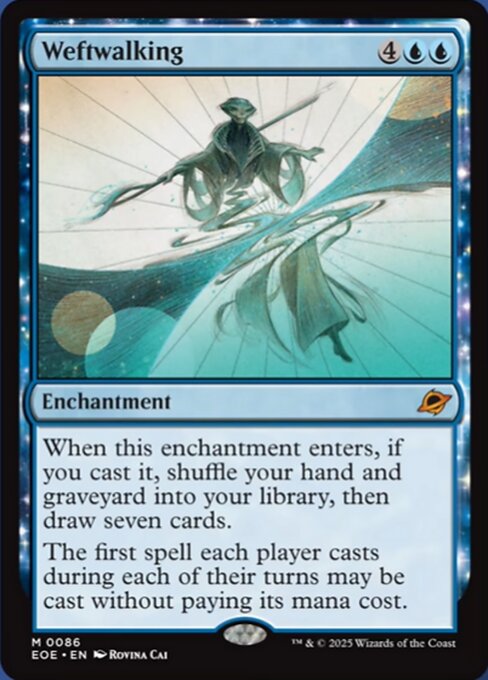
47. Weftwalking
Rating7.0GoodWhy this rating?
A very good mythic of the format (7.0/10).
Why. You shuffle your hand and graveyard into your library and draw seven. After that, the first spell each player casts on their turn can be cast for free. With big spells in hand, the game can swing at once.
Risks. The bonus is symmetric: the opponent also gets free spells. Six mana with no immediate effect on the board.
In the draft. A situational card: play it in a deck of big spells, do not take it high. A mid-pack pick, no more.
Results in the games of the set
When it is in hand, the deck wins 58.6% of its games (set average: 56.0%, 42nd of 287 cards).
In the opening hand: 52.9% wins (54.8% on average).
Drawn during the game: 61.8% (56.8% on average).
When it is drawn, the deck wins 5.9 points more than when it is not.
When it is drafted, it is played 85% of the time (set average: 62%).
Taken as the first pick (60 drafts), it ends in the deck 87% of the time.
It is played about as much in every archetype.
 Rating7.0Good
Why this rating?
A very good rare of the format (7.0/10).
Why. A sweeper that destroys all creatures, then makes each player you target mill half their library, rounded down. You choose who, possibly nobody. In a control deck it resets the game.
Risks. Six mana with two black mana, and it also kills your own creatures. A gold card, so only for blue-black decks.
In the draft. A strong top-end for blue-black control. One copy is enough; do not take it over good removal.
Results in the games of the set
When it is in hand, the deck wins 59.1% of its games (set average: 56.0%, 31st of 287 cards).
In the opening hand: 54.9% wins (54.8% on average).
Drawn during the game: 61.4% (56.8% on average).
When it is drawn, the deck wins 7.8 points more than when it is not.
When it is drafted, it is played 78% of the time (set average: 62%).
Taken as the first pick (114 drafts), it ends in the deck 82% of the time.
It is played about as much in every archetype.
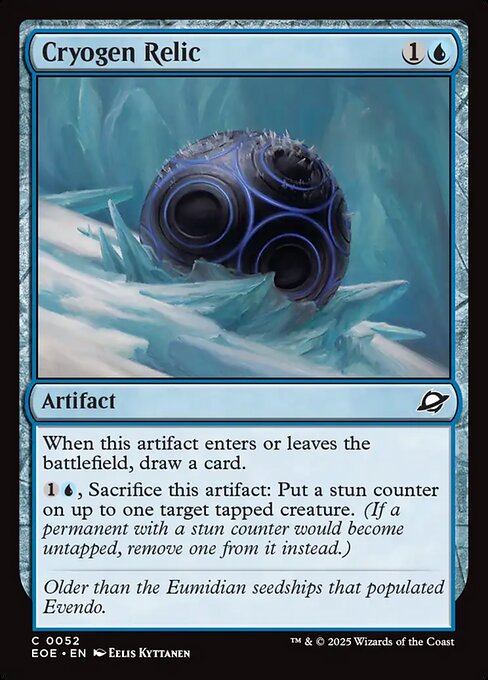
49. Cryogen Relic
Rating6.9GoodWhy this rating?
One of the best commons of the format (6.9/10).
Why. A two-mana artifact that draws a card both when it enters and when it leaves the battlefield, so sacrificing it draws two cards in total. It can also stun a tapped creature to buy a turn.
Risks. It has no weight on the board, and stun only buys tempo. It costs four mana total for the two cards.
In the draft. A good blue common, handy in artifact decks. Take it mid-pack, after removal.
Results in the games of the set
When it is in hand, the deck wins 59.1% of its games (set average: 56.0%, 30th of 287 cards).
In the opening hand: 58.4% wins (54.8% on average).
Drawn during the game: 59.6% (56.8% on average).
When it is drawn, the deck wins 5.4 points more than when it is not.
When it is drafted, it is played 89% of the time (set average: 62%).
Taken as the first pick (555 drafts), it ends in the deck 93% of the time.
It is played mostly in B/U decks (74% of them) and R/U (70%).
 Rating6.8Good
Why this rating?
A very good rare of the format (6.8/10).
Why. An instant that looks at as many cards as you have lands and takes one: the later the game, the better it digs. Kicked, it takes two. Good for finding what you need in the late game.
Risks. Weak early, when you have few lands. It changes nothing on the board, and the rest go to the bottom in a random order.
In the draft. Playable in blue control decks that want to dig deeper. Take it late; do not pick it over creatures or removal.
Results in the games of the set
When it is in hand, the deck wins 56.0% of its games (set average: 56.0%, 121st of 287 cards).
In the opening hand: 52.5% wins (54.8% on average).
Drawn during the game: 58.3% (56.8% on average).
When it is drawn, the deck wins 3.2 points more than when it is not.
When it is drafted, it is played 89% of the time (set average: 62%).
Taken as the first pick (103 drafts), it ends in the deck 90% of the time.
It is played about as much in every archetype.

51. Alpharael, Dreaming Acolyte
Rating6.8GoodWhy this rating?
A solid uncommon of the format (6.8/10).
Why. A 2/3 for three that draws two cards on entering; you discard two cards unless you discard an artifact, which leaves you with card advantage. It has deathtouch during your turn, so it attacks with little risk.
Risks. With no artifact to discard, you draw two and discard two: mostly filtering. Deathtouch does not apply on defense, and it is a gold card.
In the draft. A good blue-black uncommon, worth a mid-pack pick if you have artifacts.
Results in the games of the set
When it is in hand, the deck wins 58.7% of its games (set average: 56.0%, 36th of 287 cards).
In the opening hand: 58.2% wins (54.8% on average).
Drawn during the game: 59.0% (56.8% on average).
When it is drawn, the deck wins 6.4 points more than when it is not.
When it is drafted, it is played 62% of the time (set average: 62%).
Taken as the first pick (86 drafts), it ends in the deck 90% of the time.
It is played mostly in B/U decks (56% of them).
 Rating6.8Good
Why this rating?
A solid uncommon of the format (6.8/10).
Why. A six-mana 4/4 flyer that enters with a combat effect: +X/+0 on your creature and -0/-X on an opposing creature, where X is your artifact count, itself included. It can kill a small creature or win a trade.
Risks. Expensive, with two black mana. Without other artifacts X stays low, and the effect lasts only until end of turn.
In the draft. A good black top-end; one copy is enough. It improves with artifacts but does not require them.
Results in the games of the set
When it is in hand, the deck wins 58.8% of its games (set average: 56.0%, 35th of 287 cards).
In the opening hand: 55.0% wins (54.8% on average).
Drawn during the game: 61.0% (56.8% on average).
When it is drawn, the deck wins 5.1 points more than when it is not.
When it is drafted, it is played 87% of the time (set average: 62%).
Taken as the first pick (248 drafts), it ends in the deck 89% of the time.
It is played mostly in B/U decks (36% of them) and B/R (30%).
 Rating6.8Good
Why this rating?
A very good rare of the format (6.8/10).
Why. A three-mana 3/3 that makes a 1/1 colorless Drone artifact creature token with flying each time you cast an artifact spell. Its warp cost is only one mana, leaving mana to cast an artifact and make a Drone the same turn.
Risks. The engine needs many artifacts, and without them it is an ordinary 3/3. It is blue-red.
In the draft. Reserved for blue-red decks with plenty of artifacts. Elsewhere, let it go by.
Results in the games of the set
When it is in hand, the deck wins 58.4% of its games (set average: 56.0%, 43rd of 287 cards).
In the opening hand: 58.0% wins (54.8% on average).
Drawn during the game: 58.6% (56.8% on average).
When it is drawn, the deck wins 8.4 points more than when it is not.
When it is drafted, it is played 72% of the time (set average: 62%).
Taken as the first pick (71 drafts), it ends in the deck 82% of the time.
It is played mostly in R/U decks (32% of them).
 Rating6.8Good
Why this rating?
A solid uncommon of the format (6.8/10).
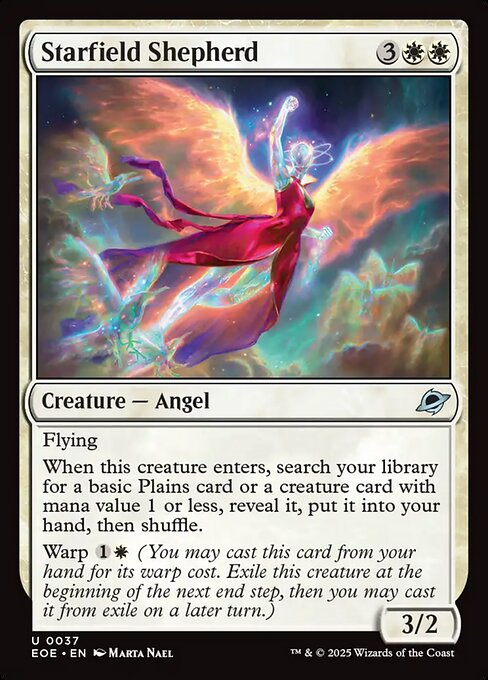
Why. A five-mana 3/2 flyer that replaces itself: it searches for a basic Plains or a creature with mana value 1 or less. With warp for two mana it is a cheap tutor, then it returns later as an aerial threat.
Risks. Two white mana and a fragile body for five. With no one-drop creatures, you often fetch just a Plains.
In the draft. A good white uncommon, taken fairly high in any white deck.
Results in the games of the set
When it is in hand, the deck wins 58.7% of its games (set average: 56.0%, 37th of 287 cards).
In the opening hand: 58.2% wins (54.8% on average).
Drawn during the game: 59.1% (56.8% on average).
When it is drawn, the deck wins 4.4 points more than when it is not.
When it is drafted, it is played 87% of the time (set average: 62%).
Taken as the first pick (207 drafts), it ends in the deck 90% of the time.
It is played mostly in U/W decks (35% of them) and B/W (34%).

55. Stomping Ground
Rating6.8GoodWhy this rating?
A very good rare of the format (6.8/10).
Why. A red-green dual land: it enters untapped if you pay two life, otherwise tapped. It fixes both colors perfectly and lets you choose between tempo and life.
Risks. It is only useful in decks playing both colors, and the life payment can hurt against an aggressive deck.
In the draft. Take it late, except in red-green, where it makes the mana a little more reliable. Do not skip a good card for it.
Results in the games of the set
When it is in hand, the deck wins 55.6% of its games (set average: 56.0%, 136th of 287 cards).
In the opening hand: 57.1% wins (54.8% on average).
Drawn during the game: 54.5% (56.8% on average).
When it is drawn, the deck wins 1.5 points more than when it is not.
When it is drafted, it is played 67% of the time (set average: 62%).
Taken as the first pick (42 drafts), it ends in the deck 83% of the time.
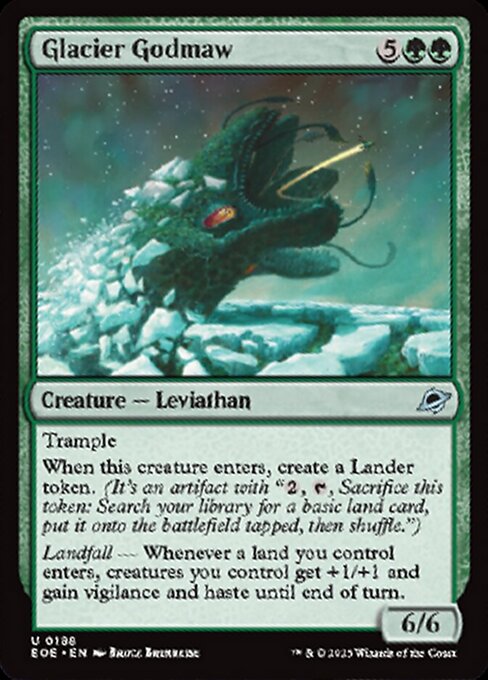
56. Glacier Godmaw
Rating6.8GoodWhy this rating?
A solid uncommon of the format (6.8/10).
Why. A seven-mana 6/6 trampler that arrives with a Lander token. Each Landfall gives your creatures +1/+1, vigilance and haste until end of turn, and the Lander token triggers one as soon as you have two mana.
Risks. Seven mana is expensive, and a removal on the Godmaw leaves you only the Lander token. The Landfall bonus needs land drops.
In the draft. A strong green top-end; one copy is enough. It fits decks that fetch extra lands.
Results in the games of the set
When it is in hand, the deck wins 59.4% of its games (set average: 56.0%, 28th of 287 cards).
In the opening hand: 55.7% wins (54.8% on average).
Drawn during the game: 61.8% (56.8% on average).
When it is drawn, the deck wins 4.7 points more than when it is not.
When it is drafted, it is played 92% of the time (set average: 62%).
Taken as the first pick (280 drafts), it ends in the deck 96% of the time.
It is played mostly in B/G decks (32% of them) and G/R (32%).
 Rating6.7Good
Why this rating?
A solid uncommon of the format (6.7/10).
Why. For one black mana, -2/-2 kills a small creature. If a nonland permanent left the battlefield this turn or a spell was warped this turn, Void makes it -10/-10: near-universal removal.
Risks. It is a sorcery, so it only works on your turn. Without Void it kills just small creatures, so you need to set the turn up.
In the draft. A good cheap removal for black decks with warp cards or trades. Take it fairly high.
Results in the games of the set
When it is in hand, the deck wins 57.4% of its games (set average: 56.0%, 70th of 287 cards).
In the opening hand: 54.9% wins (54.8% on average).
Drawn during the game: 59.0% (56.8% on average).
When it is drawn, the deck wins 3.9 points more than when it is not.
When it is drafted, it is played 92% of the time (set average: 62%).
Taken as the first pick (245 drafts), it ends in the deck 96% of the time.
It is played mostly in B/W decks (32% of them) and B/U (31%).
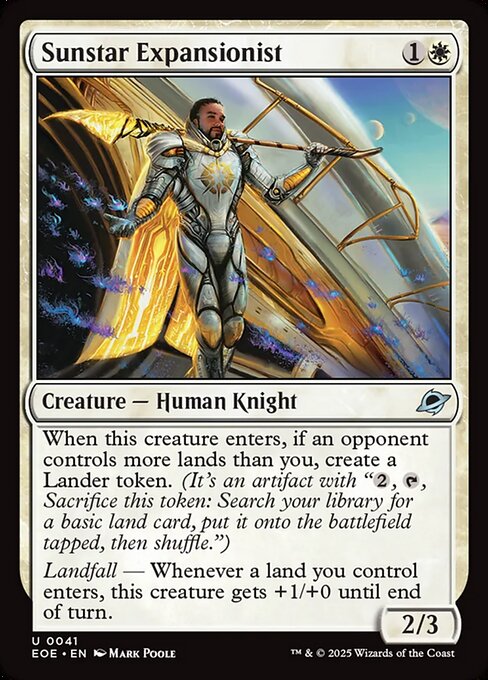 Rating6.6Good
Why this rating?
A solid uncommon of the format (6.6/10).
Why. A two-mana 2/3 that holds the ground well. If the opponent controls more lands than you, it makes a Lander token that fixes a mana deficit. The Landfall bonus adds a little power.
Risks. The Lander token only comes if you are behind on lands. The bonus is small and the body has no evasion.
In the draft. A decent white two-drop. Take it mid-pack.
Results in the games of the set
When it is in hand, the deck wins 57.5% of its games (set average: 56.0%, 66th of 287 cards).
In the opening hand: 58.6% wins (54.8% on average).
Drawn during the game: 56.7% (56.8% on average).
When it is drawn, the deck wins 2.9 points more than when it is not.
When it is drafted, it is played 89% of the time (set average: 62%).
Taken as the first pick (171 drafts), it ends in the deck 95% of the time.
It is played mostly in U/W decks (36% of them) and R/W (34%).
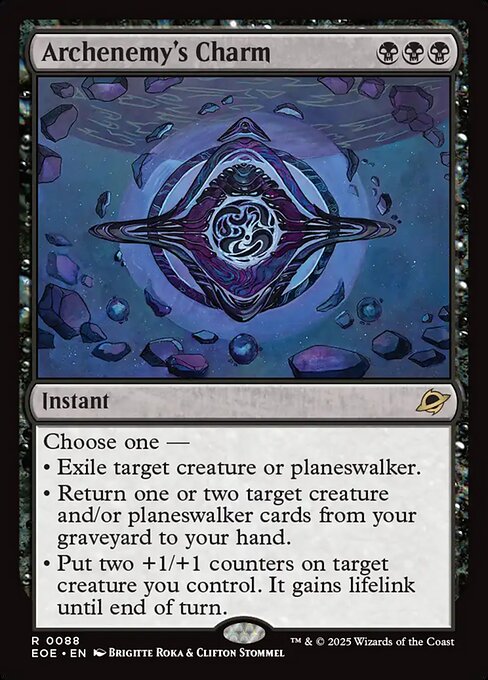 Rating6.6Good
Why this rating?
A very good rare of the format (6.6/10).
Why. A modal instant: exile a creature or planeswalker, return up to two creature or planeswalker cards from your graveyard to hand, or put two +1/+1 counters on your creature, which gains lifelink until end of turn. All three modes are useful.
Risks. It needs three black mana, which is hard in a two-color deck or on a splash. It has no target if the opponent has no creature or planeswalker.
In the draft. Take it fairly high if black is your main color. Let it go if you play little black.
Results in the games of the set
When it is in hand, the deck wins 56.9% of its games (set average: 56.0%, 87th of 287 cards).
In the opening hand: 53.4% wins (54.8% on average).
Drawn during the game: 59.0% (56.8% on average).
When it is drawn, the deck wins 4.2 points more than when it is not.
When it is drafted, it is played 80% of the time (set average: 62%).
Taken as the first pick (64 drafts), it ends in the deck 91% of the time.
It is played about as much in every archetype.

60. Breeding Pool
Rating6.6GoodWhy this rating?
A very good rare of the format (6.6/10).
Why. A green-blue dual land: it enters untapped if you pay two life, otherwise tapped. It fixes both colors with ease.
Risks. It is only useful in decks playing these colors, and the life lost hurts against aggressive decks.
In the draft. Take it late, except in green-blue, where it improves reliability a bit. Never before a good playable.
Results in the games of the set
When it is in hand, the deck wins 56.6% of its games (set average: 56.0%, 100th of 287 cards).
In the opening hand: 57.3% wins (54.8% on average).
Drawn during the game: 56.0% (56.8% on average).
When it is drawn, the deck wins 2.4 points more than when it is not.
When it is drafted, it is played 73% of the time (set average: 62%).
Taken as the first pick (44 drafts), it ends in the deck 82% of the time.

61. Edge Rover
Rating6.6GoodWhy this rating?
A solid uncommon of the format (6.6/10).
Why. A one-mana 2/2 with reach, a good start to the curve. When it dies, each player creates a Lander token, so you also get a way to fetch a land.
Risks. The opponent also gets a Lander token, which speeds up their mana. The body is otherwise ordinary.
In the draft. A decent green one-drop, taken mid-pack. It suits decks that profit from extra lands.
Results in the games of the set
When it is in hand, the deck wins 57.4% of its games (set average: 56.0%, 71st of 287 cards).
In the opening hand: 60.2% wins (54.8% on average).
Drawn during the game: 55.2% (56.8% on average).
When it is drawn, the deck wins 1.9 points more than when it is not.
When it is drafted, it is played 91% of the time (set average: 62%).
Taken as the first pick (190 drafts), it ends in the deck 96% of the time.
It is played mostly in G/R decks (33% of them) and G/U (30%).

62. Emissary Escort
Rating6.6GoodWhy this rating?
A very good rare of the format (6.6/10).
Why. A two-mana 0/4: a good early blocker. With another high-mana-value artifact, its power grows to match and it becomes a threat too.
Risks. Without an expensive artifact it has no power. Tokens have mana value zero and add nothing.
In the draft. Only in a blue deck rich in expensive artifacts. Otherwise it is not worth a pick.
Results in the games of the set
When it is in hand, the deck wins 56.6% of its games (set average: 56.0%, 95th of 287 cards).
In the opening hand: 56.2% wins (54.8% on average).
Drawn during the game: 56.9% (56.8% on average).
When it is drawn, the deck wins 4.9 points more than when it is not.
When it is drafted, it is played 85% of the time (set average: 62%).
Taken as the first pick (91 drafts), it ends in the deck 90% of the time.
It is played about as much in every archetype.
 Rating6.6Good
Why this rating?
A solid uncommon of the format (6.6/10).
Why. A 3/1 that destroys another creature on entering: removal on a body for three mana. If the creature was dealt damage this turn, its controller draws nothing, so pair it with combat.
Risks. With no damage dealt, its controller draws two cards, which erases the advantage. The 3/1 is fragile.
In the draft. A decent black uncommon, taken mid-pack. Set up the damage before casting it.
Results in the games of the set
When it is in hand, the deck wins 58.0% of its games (set average: 56.0%, 53rd of 287 cards).
In the opening hand: 55.7% wins (54.8% on average).
Drawn during the game: 59.5% (56.8% on average).
When it is drawn, the deck wins 3.8 points more than when it is not.
When it is drafted, it is played 88% of the time (set average: 62%).
Taken as the first pick (185 drafts), it ends in the deck 93% of the time.
It is played mostly in B/R decks (37% of them) and B/W (34%).
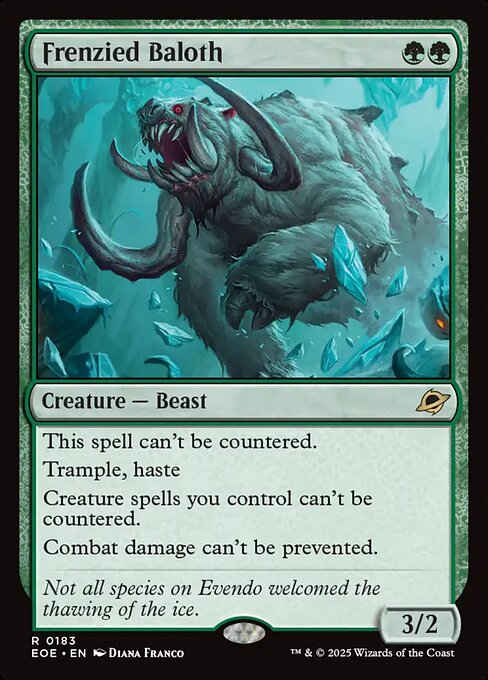
64. Frenzied Baloth
Rating6.6GoodWhy this rating?
A very good rare of the format (6.6/10).
Why. A two-mana 3/2 with trample and haste that cannot be countered. It hits as soon as it lands and drives an aggressive deck.
Risks. It needs two green mana and has a small body. Its protections (uncounterable creature spells, unpreventable combat damage) rarely matter in draft.
In the draft. A good aggressive green play, filler elsewhere. Take it late outside a fast deck.
Results in the games of the set
When it is in hand, the deck wins 56.3% of its games (set average: 56.0%, 112th of 287 cards).
In the opening hand: 57.1% wins (54.8% on average).
Drawn during the game: 55.6% (56.8% on average).
When it is drawn, the deck wins 2.6 points more than when it is not.
When it is drafted, it is played 80% of the time (set average: 62%).
Taken as the first pick (34 drafts), it ends in the deck 91% of the time.
It is played about as much in every archetype.

65. Godless Shrine
Rating6.6GoodWhy this rating?
A very good rare of the format (6.6/10).
Why. A white-black dual land: it enters untapped if you pay two life, otherwise tapped. It fixes both colors with ease.
Risks. It is only useful in white-black decks, and the life lost hurts against aggressive decks.
In the draft. Take it late, except in white-black, where it improves reliability a bit. Never before a good playable.
Results in the games of the set
When it is in hand, the deck wins 54.2% of its games (set average: 56.0%, 182nd of 287 cards).
In the opening hand: 55.4% wins (54.8% on average).
Drawn during the game: 53.3% (56.8% on average).
When it is drawn, the deck wins 0.2 points less than when it is not.
When it is drafted, it is played 58% of the time (set average: 62%).
Taken as the first pick (31 drafts), it ends in the deck 71% of the time.

66. Systems Override
Rating6.6GoodWhy this rating?
A solid uncommon of the format (6.6/10).
Why. A sorcery that steals temporarily: you take an opposing creature or artifact, untap it and give it haste. It is used for a big hit or to close the game. On a Spacecraft, it activates it for an attack.
Risks. The effect lasts one turn and does not remove anything by itself. Without something to finish, it is only a tempo spell.
In the draft. For aggressive red decks, mid-pack. Elsewhere it is worth less than real removal.
Results in the games of the set
When it is in hand, the deck wins 56.0% of its games (set average: 56.0%, 124th of 287 cards).
In the opening hand: 51.7% wins (54.8% on average).
Drawn during the game: 58.7% (56.8% on average).
When it is drawn, the deck wins 3.0 points more than when it is not.
When it is drafted, it is played 33% of the time (set average: 62%).
Taken as the first pick (32 drafts), it ends in the deck 66% of the time.
It is played mostly in B/R decks (27% of them).

67. Tractor Beam
Rating6.6GoodWhy this rating?
A solid uncommon of the format (6.6/10).
Why. This Aura taps an opposing creature or Spacecraft, gives you control of it and stops it from untapping. For four mana you neutralize the threat and the opponent loses it.
Risks. It needs two blue mana. If the Aura leaves the battlefield, the opponent gets their card back. You get no useful attacker, since the target stays tapped.
In the draft. A good blue removal, taken fairly high in blue decks.
Results in the games of the set
When it is in hand, the deck wins 58.2% of its games (set average: 56.0%, 49th of 287 cards).
In the opening hand: 55.2% wins (54.8% on average).
Drawn during the game: 59.9% (56.8% on average).
When it is drawn, the deck wins 4.7 points more than when it is not.
When it is drafted, it is played 88% of the time (set average: 62%).
Taken as the first pick (273 drafts), it ends in the deck 93% of the time.
It is played mostly in B/U decks (33% of them) and G/U (31%).

68. Watery Grave
Rating6.6GoodWhy this rating?
A very good rare of the format (6.6/10).
Why. A blue-black dual land: it enters untapped if you pay two life, otherwise tapped. It fixes both colors with ease.
Risks. It is only useful in blue-black decks, and the life lost hurts against aggressive decks.
In the draft. Take it late, except in blue-black, where it improves reliability a bit. Never before a good playable.
Results in the games of the set
When it is in hand, the deck wins 54.9% of its games (set average: 56.0%, 160th of 287 cards).
In the opening hand: 55.4% wins (54.8% on average).
Drawn during the game: 54.6% (56.8% on average).
When it is drawn, the deck wins 2.3 points more than when it is not.
When it is drafted, it is played 67% of the time (set average: 62%).
Taken as the first pick (44 drafts), it ends in the deck 75% of the time.
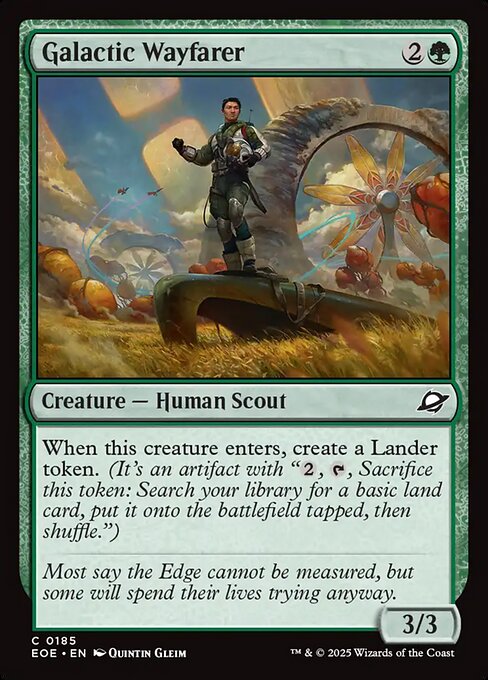 Rating6.6Good
Why this rating?
One of the best commons of the format (6.6/10).
Why. A 3/3 for three that also leaves behind a Lander. You get a real body on turn three and ramp or fixing right after.
Risks. Cracking the Lander costs two mana, so using it too early can slow your development. The body itself is a vanilla 3/3 and does nothing special on the board.
In the draft. A good green common, playable in any green deck. It also suits a deck that wants to splash, thanks to the Lander.
Results in the games of the set
When it is in hand, the deck wins 58.2% of its games (set average: 56.0%, 48th of 287 cards).
In the opening hand: 58.9% wins (54.8% on average).
Drawn during the game: 57.7% (56.8% on average).
When it is drawn, the deck wins 2.8 points more than when it is not.
When it is drafted, it is played 91% of the time (set average: 62%).
Taken as the first pick (589 drafts), it ends in the deck 94% of the time.
It is played mostly in B/G decks (69% of them) and G/R (69%).
 Rating6.5Good
Why this rating?
Good playable that always makes the cut (6.5/10).
Why. Its power and toughness equal the number of lands you control, so on turn five it is already a 5/5 with ward 2. The longer the game goes, the bigger it gets.
Risks. Edict effects still answer it, and an opponent who pays two extra mana can target it despite ward 2. It is weak if you stumble on lands.
In the draft. A good green top-end card, worth taking if you are green. Cards that find lands make it even bigger.
Results in the games of the set
When it is in hand, the deck wins 58.3% of its games (set average: 56.0%, 45th of 287 cards).
In the opening hand: 56.7% wins (54.8% on average).
Drawn during the game: 59.4% (56.8% on average).
When it is drawn, the deck wins 3.1 points more than when it is not.
When it is drafted, it is played 89% of the time (set average: 62%).
Taken as the first pick (222 drafts), it ends in the deck 95% of the time.
It is played mostly in G/R decks (37% of them) and G/U (34%).

71. Honor
Rating6.4GoodWhy this rating?
Good playable that always makes the cut (6.4/10).
Why. A one-mana sorcery that puts a +1/+1 counter on a creature and draws a card, so it replaces itself while improving your best creature. It adds efficiency in a creature-heavy deck.
Risks. It does nothing without a creature to target, and since it is a sorcery your creature can be killed in response. On its own it does not change the game.
In the draft. A useful support card in a creature-heavy white deck, but not a priority. Take it after removal and good creatures.
Results in the games of the set
When it is in hand, the deck wins 56.1% of its games (set average: 56.0%, 118th of 287 cards).
In the opening hand: 55.6% wins (54.8% on average).
Drawn during the game: 56.5% (56.8% on average).
When it is drawn, the deck wins 1.3 points more than when it is not.
When it is drafted, it is played 76% of the time (set average: 62%).
Taken as the first pick (71 drafts), it ends in the deck 92% of the time.
It is played mostly in U/W decks (31% of them) and G/W (30%).
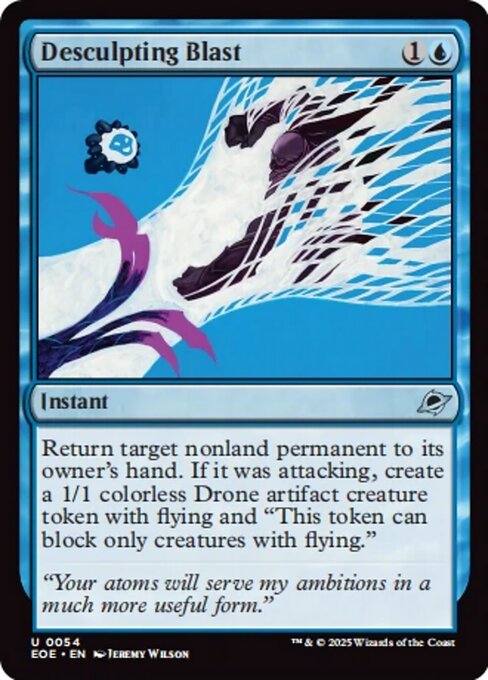 Rating6.4Good
Why this rating?
Good playable that always makes the cut (6.4/10).
Why. A two-mana instant that bounces any nonland permanent. If the target was attacking, you also get a 1/1 colorless Drone artifact creature token with flying, so it is both defense and tempo.
Risks. The permanent only goes back to its owner's hand, so it is true removal only against tokens; against a big creature it just buys time. The Drone can block only creatures with flying.
In the draft. A solid tempo tool for aggressive or light-control blue decks. Take it after your best removal and threats.
Results in the games of the set
When it is in hand, the deck wins 57.2% of its games (set average: 56.0%, 75th of 287 cards).
In the opening hand: 53.9% wins (54.8% on average).
Drawn during the game: 59.2% (56.8% on average).
When it is drawn, the deck wins 3.2 points more than when it is not.
When it is drafted, it is played 84% of the time (set average: 62%).
Taken as the first pick (130 drafts), it ends in the deck 92% of the time.
It is played mostly in B/U decks (31% of them) and R/U (31%).
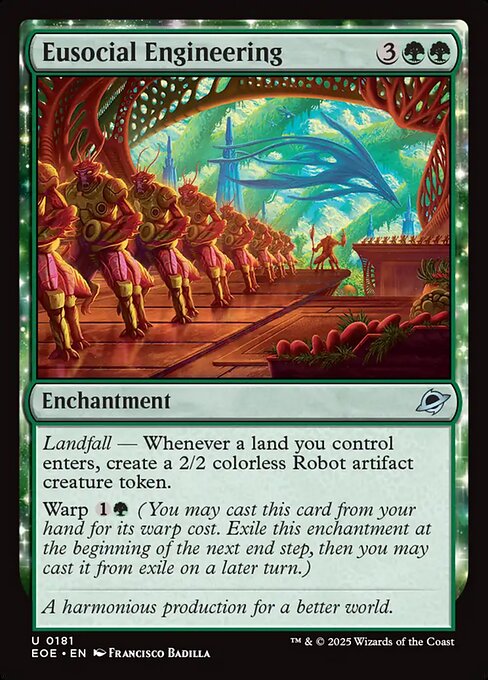 Rating6.4Good
Why this rating?
Good playable that always makes the cut (6.4/10).
Why. Every land that enters under your control creates a 2/2 colorless Robot artifact creature token, so Landfall turns the enchantment into a steady stream of bodies. Warp for two mana lets you cast it early, grab a land trigger, then recast it later.
Risks. You need lands to play: with no land drop nothing happens. At full cost it is slow, and it does nothing the turn you cast it if you have already played your land.
In the draft. A good value card for green decks, especially with land-fetching effects. Cast it before making your land drop.
Results in the games of the set
When it is in hand, the deck wins 56.7% of its games (set average: 56.0%, 91st of 287 cards).
In the opening hand: 57.2% wins (54.8% on average).
Drawn during the game: 56.3% (56.8% on average).
When it is drawn, the deck wins 1.9 points more than when it is not.
When it is drafted, it is played 85% of the time (set average: 62%).
Taken as the first pick (178 drafts), it ends in the deck 91% of the time.
It is played mostly in G/R decks (31% of them) and G/U (29%).
 Rating6.4Good
Why this rating?
Good playable that always makes the cut (6.4/10).
Why. A land that taps for a green mana and can become a huge mana source through Station. Once the Planet is charged, it adds a green mana for each creature you control.
Risks. It enters tapped, and Station means tapping other creatures, which delays your attacks. The big payoff comes only after several turns of investment.
In the draft. Play it in a green deck with plenty of creatures as a land that enters tapped. Do not build around it.
Results in the games of the set
When it is in hand, the deck wins 51.7% of its games (set average: 56.0%, 242nd of 287 cards).
In the opening hand: 52.9% wins (54.8% on average).
Drawn during the game: 50.8% (56.8% on average).
When it is drawn, the deck wins 0.8 points less than when it is not.
When it is drafted, it is played 41% of the time (set average: 62%).

75. Focus Fire
Rating6.4GoodWhy this rating?
Good playable that always makes the cut (6.4/10).
Why. A one-mana instant that deals damage to an attacking or blocking creature, scaling with how many creatures and Spacecraft you control. Cheap, efficient combat removal that often gains tempo.
Risks. It only hits creatures in combat, so anything that stays home is out of reach. With few creatures the damage is modest.
In the draft. A good white common for creature-heavy decks. A comfortable mid-pack pick.
Results in the games of the set
When it is in hand, the deck wins 56.9% of its games (set average: 56.0%, 86th of 287 cards).
In the opening hand: 55.2% wins (54.8% on average).
Drawn during the game: 58.1% (56.8% on average).
When it is drawn, the deck wins 1.9 points more than when it is not.
When it is drafted, it is played 81% of the time (set average: 62%).
Taken as the first pick (164 drafts), it ends in the deck 94% of the time.
It is played mostly in B/W decks (68% of them) and U/W (64%).
 Rating6.4Good
Why this rating?
Good playable that always makes the cut (6.4/10).
Why. For two mana you get two 1/1 bodies: the Knight-Captain and a Human Soldier creature token. Later it can sacrifice itself to fetch an Equipment in the late game.
Risks. Two 1/1s are small on their own, and the sacrifice ability costs six mana. Without Equipment in your deck, it loses part of its appeal.
In the draft. A good card for white decks that play Equipment or go wide. Otherwise it is a decent two-for-one at two mana.
Results in the games of the set
When it is in hand, the deck wins 56.5% of its games (set average: 56.0%, 101st of 287 cards).
In the opening hand: 56.4% wins (54.8% on average).
Drawn during the game: 56.6% (56.8% on average).
When it is drawn, the deck wins 1.9 points more than when it is not.
When it is drafted, it is played 80% of the time (set average: 62%).
Taken as the first pick (101 drafts), it ends in the deck 86% of the time.
It is played mostly in U/W decks (35% of them) and B/W (33%).
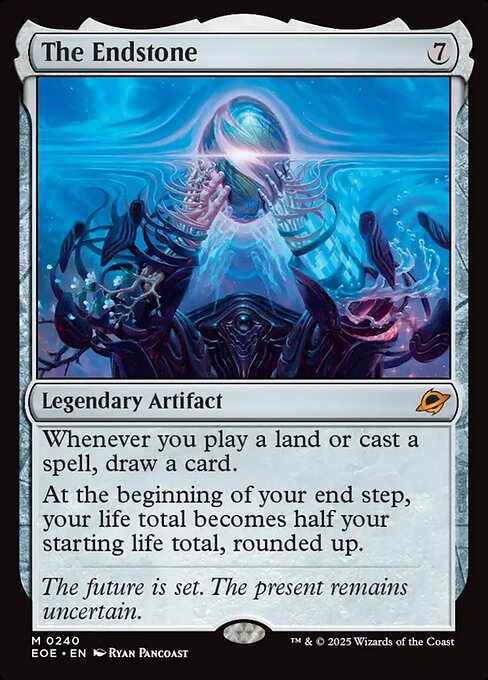
77. The Endstone
Rating6.4GoodWhy this rating?
Good playable that always makes the cut (6.4/10).
Why. For seven mana, you draw a card each time you play a land or cast a spell, an enormous card flow. If you hold on, you quickly outpace your opponent.
Risks. At the beginning of your end step, your life total becomes half your starting life total, rounded up: a big loss if you were above it. And seven mana is a heavy cost.
In the draft. A niche card for slow decks that control the board. Take it only if your deck can use it; an aggressive deck does not want it.
Results in the games of the set
When it is in hand, the deck wins 56.1% of its games (set average: 56.0%, 117th of 287 cards).
In the opening hand: 53.3% wins (54.8% on average).
Drawn during the game: 57.8% (56.8% on average).
When it is drawn, the deck wins 3.0 points more than when it is not.
When it is drafted, it is played 93% of the time (set average: 62%).
Taken as the first pick (45 drafts), it ends in the deck 91% of the time.
It is played about as much in every archetype.
 Rating6.4Good
Why this rating?
Good playable that always makes the cut (6.4/10).
Why. A 3/2 for two mana, a good attacker from turn two. Its ability sacrifices another creature or an artifact to surveil 1, a useful way to get value from a creature that is about to die.
Risks. With no other creature or artifact to sacrifice, the ability does nothing, and sacrificing otherwise loses value. Three power is great at this cost, but two toughness is fragile.
In the draft. A good two-drop for aggressive black decks, especially with artifacts or tokens. Take it as an efficient cheap body.
Results in the games of the set
When it is in hand, the deck wins 57.4% of its games (set average: 56.0%, 69th of 287 cards).
In the opening hand: 57.6% wins (54.8% on average).
Drawn during the game: 57.3% (56.8% on average).
When it is drawn, the deck wins 3.5 points more than when it is not.
When it is drafted, it is played 90% of the time (set average: 62%).
Taken as the first pick (191 drafts), it ends in the deck 96% of the time.
It is played mostly in B/R decks (44% of them) and B/W (38%).
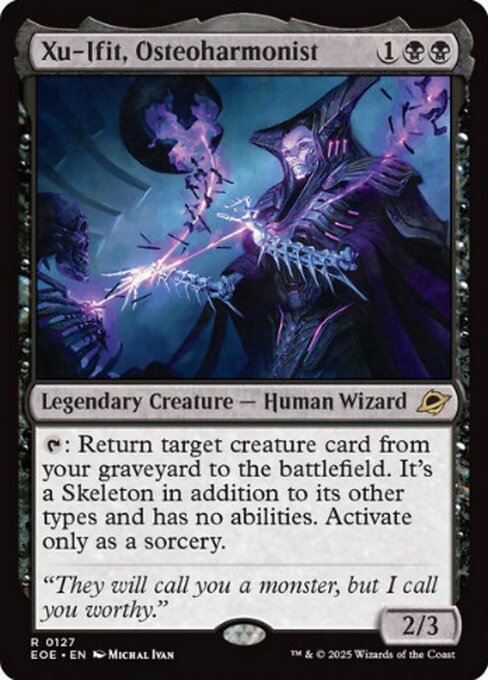 Rating6.4Good
Why this rating?
Good playable that always makes the cut (6.4/10).
Why. Each turn it can tap, only as a sorcery, to return a creature card from your graveyard to the battlefield as a Skeleton with no abilities. It is a slow but steady value engine.
Risks. The creature comes back without its abilities, which limits what you recover, and you must wait a turn to activate it. With no good creature in your graveyard it does almost nothing.
In the draft. A rare for value-oriented black decks with big bodies, since the creature returns with no abilities. It is less appealing in an aggressive deck.
Results in the games of the set
When it is in hand, the deck wins 54.6% of its games (set average: 56.0%, 167th of 287 cards).
In the opening hand: 53.4% wins (54.8% on average).
Drawn during the game: 55.3% (56.8% on average).
When it is drawn, the deck wins 1.7 points more than when it is not.
When it is drafted, it is played 84% of the time (set average: 62%).
Taken as the first pick (66 drafts), it ends in the deck 94% of the time.
It is played about as much in every archetype.
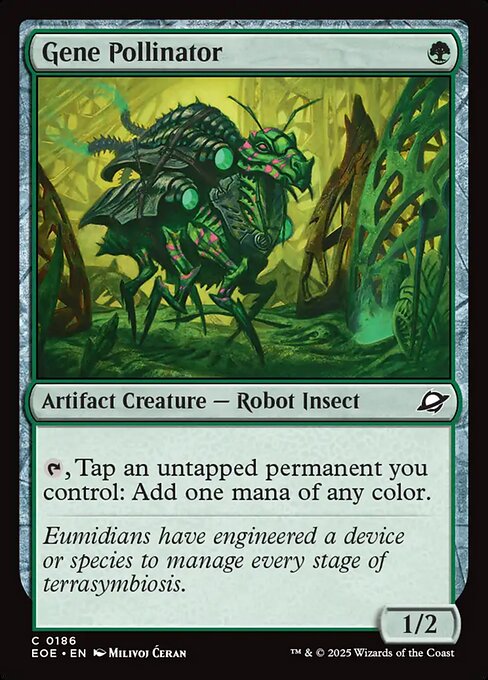
80. Gene Pollinator
Rating6.3GoodWhy this rating?
Good playable that always makes the cut (6.3/10).
Why. A one-mana 1/2 that makes a mana of any color, but only by tapping another untapped permanent: it is mostly fixing for two-color and splash decks.
Risks. Tapping a land for a mana of another color adds nothing: it only ramps with a permanent that makes no mana, such as a creature that just arrived. The body is small.
In the draft. A good green common pick for a deck that wants fixing or a splash. Otherwise, do not take it over removal.
Results in the games of the set
When it is in hand, the deck wins 57.2% of its games (set average: 56.0%, 73rd of 287 cards).
In the opening hand: 60.6% wins (54.8% on average).
Drawn during the game: 54.5% (56.8% on average).
When it is drawn, the deck wins 1.9 points more than when it is not.
When it is drafted, it is played 86% of the time (set average: 62%).
Taken as the first pick (310 drafts), it ends in the deck 92% of the time.
It is played mostly in B/G decks (72% of them) and G/R (65%).
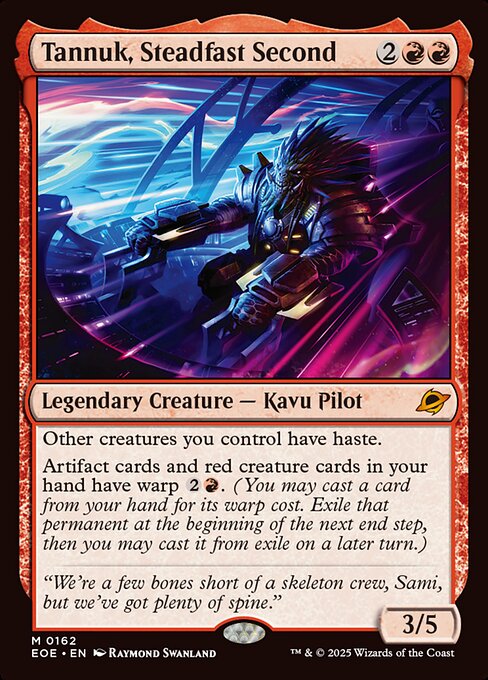 Rating6.3Good
Why this rating?
Good playable that always makes the cut (6.3/10).
Why. A sturdy 3/5 for four that gives your other creatures haste. Artifact cards and red creature cards in your hand gain Warp for three mana: with haste, they attack right away before being exiled at end of turn.
Risks. A card cast with Warp is exiled at end of turn, so you must cast it again later. The deck needs enough artifacts and red creatures.
In the draft. A good red rare for aggressive decks full of red creatures and artifacts. Without enough of them it is still a decent red body.
Results in the games of the set
When it is in hand, the deck wins 54.4% of its games (set average: 56.0%, 172nd of 287 cards).
In the opening hand: 51.9% wins (54.8% on average).
Drawn during the game: 56.1% (56.8% on average).
When it is drawn, the deck wins 1.1 points more than when it is not.
When it is drafted, it is played 81% of the time (set average: 62%).
Taken as the first pick (37 drafts), it ends in the deck 89% of the time.
It is played about as much in every archetype.
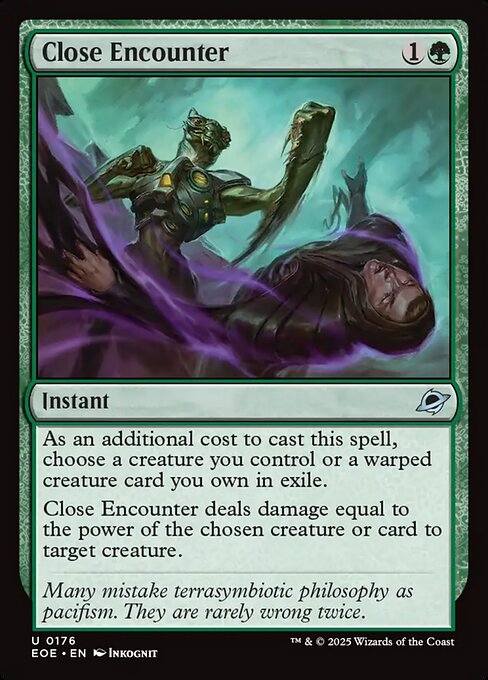
82. Close Encounter
Rating6.2GoodWhy this rating?
Good playable that always makes the cut (6.2/10).
Why. A two-mana instant: as an additional cost you choose one of your creatures (or a warped creature card in exile), and the target takes damage equal to its power. Your creature takes no damage back.
Risks. Without a high-power creature the damage is low, and you need a creature you control or a warped creature card in exile when you cast it. It hits only creatures.
In the draft. A good green removal for decks with big creatures. Take it fairly high if you are green with good creatures.
Results in the games of the set
When it is in hand, the deck wins 56.4% of its games (set average: 56.0%, 109th of 287 cards).
In the opening hand: 54.2% wins (54.8% on average).
Drawn during the game: 57.9% (56.8% on average).
When it is drawn, the deck wins 1.1 points more than when it is not.
When it is drafted, it is played 89% of the time (set average: 62%).
Taken as the first pick (194 drafts), it ends in the deck 94% of the time.
It is played mostly in G/R decks (30% of them) and G/U (29%).
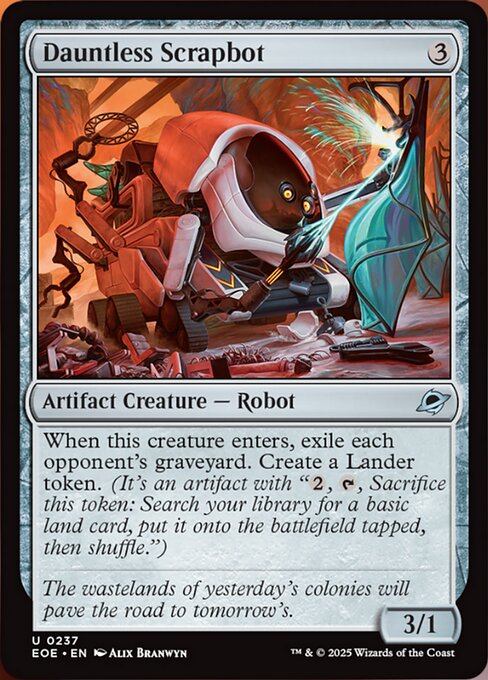 Rating6.2Good
Why this rating?
Good playable that always makes the cut (6.2/10).
Why. A 3/1 artifact creature for three that exiles each opponent's graveyard and leaves a Lander behind. It is an aggressive body that adds value through the Lander.
Risks. One toughness is very fragile, and exiling the graveyard matters only against some decks. The Lander needs two mana before it helps.
In the draft. A colorless card playable in almost any deck. Take it as a solid three-mana artifact; the graveyard exile is a bonus.
Results in the games of the set
When it is in hand, the deck wins 56.9% of its games (set average: 56.0%, 83rd of 287 cards).
In the opening hand: 56.3% wins (54.8% on average).
Drawn during the game: 57.4% (56.8% on average).
When it is drawn, the deck wins 2.4 points more than when it is not.
When it is drafted, it is played 97% of the time (set average: 62%).
Taken as the first pick (241 drafts), it ends in the deck 98% of the time.
It is played about as much in every archetype.

84. Divert Disaster
Rating6.2GoodWhy this rating?
Good playable that always makes the cut (6.2/10).
Why. A two-mana counterspell: the opponent must pay two more mana. If they pay, you create a Lander; if they do not, the spell is countered. Either way you get something.
Risks. An opponent with two spare mana pays easily, especially early, and you only get a Lander. It is not a hard counter late.
In the draft. A reasonable counterspell for blue tempo and control decks. Take it as a supporting piece, not a priority.
Results in the games of the set
When it is in hand, the deck wins 56.7% of its games (set average: 56.0%, 90th of 287 cards).
In the opening hand: 56.3% wins (54.8% on average).
Drawn during the game: 57.0% (56.8% on average).
When it is drawn, the deck wins 2.7 points more than when it is not.
When it is drafted, it is played 46% of the time (set average: 62%).
Taken as the first pick (46 drafts), it ends in the deck 78% of the time.
It is played mostly in B/U decks (57% of them) and U/W (35%).
 Rating6.2Good
Why this rating?
Good playable that always makes the cut (6.2/10).
Why. A 6/6 flier with ward 2 for seven mana that also gives your opponents' creatures -3/-0 until your next turn. It holds the ground, rules the air, and ends the game quickly.
Risks. Seven mana is heavy: you must survive and hit your land drops. Edicts still answer it, and an opponent who pays two extra mana can target it despite ward 2.
In the draft. A blue top-end finisher. One copy is enough in a deck able to survive the early game.
Results in the games of the set
When it is in hand, the deck wins 58.1% of its games (set average: 56.0%, 52nd of 287 cards).
In the opening hand: 53.8% wins (54.8% on average).
Drawn during the game: 60.5% (56.8% on average).
When it is drawn, the deck wins 4.0 points more than when it is not.
When it is drafted, it is played 85% of the time (set average: 62%).
Taken as the first pick (203 drafts), it ends in the deck 93% of the time.
It is played mostly in B/U decks (40% of them) and R/U (37%).
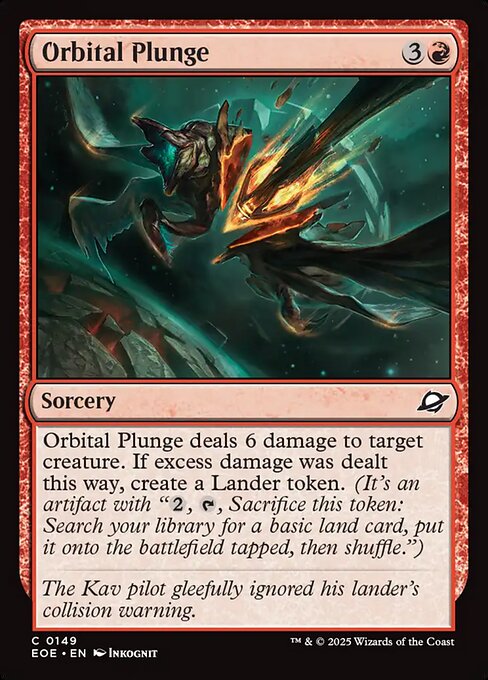
86. Orbital Plunge
Rating6.2GoodWhy this rating?
Good playable that always makes the cut (6.2/10).
Why. A four-mana sorcery that deals six damage to a creature, killing almost anything. If excess damage is dealt, you also create a Lander.
Risks. It is a sorcery, so it cannot answer an attacker mid-combat. Four mana is a bit pricey, and it hits only creatures.
In the draft. A good red common removal. Take it fairly high: it is a reliable answer to big threats.
Results in the games of the set
When it is in hand, the deck wins 57.2% of its games (set average: 56.0%, 76th of 287 cards).
In the opening hand: 55.0% wins (54.8% on average).
Drawn during the game: 58.6% (56.8% on average).
When it is drawn, the deck wins 2.7 points more than when it is not.
When it is drafted, it is played 87% of the time (set average: 62%).
Taken as the first pick (376 drafts), it ends in the deck 94% of the time.
It is played mostly in B/R decks (77% of them) and G/R (68%).

87. Sacred Foundry
Rating6.2GoodWhy this rating?
Good playable that always makes the cut (6.2/10).
Why. A Mountain Plains land that taps for red or white mana, fixing both colors of a red-white deck. By paying two life, it enters untapped.
Risks. If you do not pay, it enters tapped; if you do, you lose life, which matters against aggressive decks. It has value only in a red-white deck.
In the draft. Take it only if you play red and white, where it smooths your mana. In any other deck it is dead.
Results in the games of the set
When it is in hand, the deck wins 53.0% of its games (set average: 56.0%, 212th of 287 cards).
In the opening hand: 53.1% wins (54.8% on average).
Drawn during the game: 52.9% (56.8% on average).
When it is drawn, the deck wins 0.2 points less than when it is not.
When it is drafted, it is played 44% of the time (set average: 62%).
Taken among the first three picks (81 drafts), it ends in the deck 59% of the time.
 Rating6.2Good
Why this rating?
Good playable that always makes the cut (6.2/10).
Why. A one-mana Equipment with flash: it attaches to a creature on entering, which gains first strike until end of turn, and gives +1/+0. It can win a combat as a surprise trick.
Risks. Re-equipping costs three mana, which is steep. The effect is minor: +1/+0 does not matter much if you lack creatures.
In the draft. A filler card for creature-heavy white decks. Take it late, after the more powerful cards.
Results in the games of the set
When it is in hand, the deck wins 53.6% of its games (set average: 56.0%, 196th of 287 cards).
In the opening hand: 52.2% wins (54.8% on average).
Drawn during the game: 54.6% (56.8% on average).
When it is drawn, the deck wins 0.2 points more than when it is not.
When it is drafted, it is played only 12% of the time (set average: 62%): it almost always ends in the sideboard.
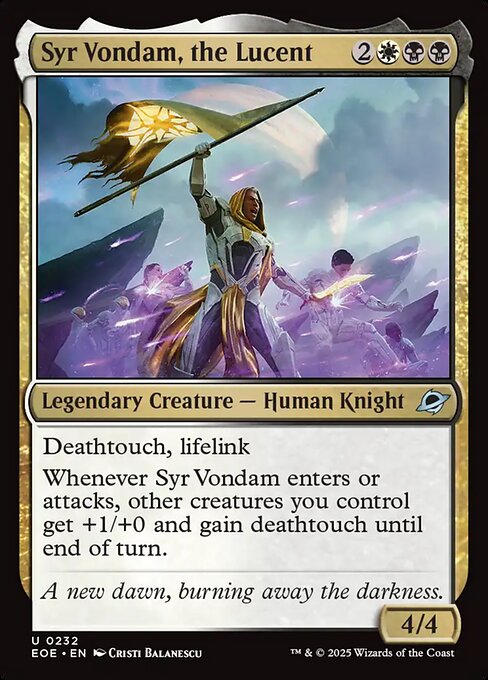 Rating6.2Good
Why this rating?
Good playable that always makes the cut (6.2/10).
Why. A 4/4 with deathtouch and lifelink that gives your other creatures +1/+0 and deathtouch when it enters or attacks. Each attack becomes dangerous for your opponent.
Risks. It needs two black mana and a white one on top of two generic, so the mana is demanding, and a removal spell kills it. It needs other creatures to shine.
In the draft. A good gold uncommon for white-black decks. Take it if you are in those colors; otherwise it is unplayable.
Results in the games of the set
When it is in hand, the deck wins 56.9% of its games (set average: 56.0%, 84th of 287 cards).
In the opening hand: 54.2% wins (54.8% on average).
Drawn during the game: 58.7% (56.8% on average).
When it is drawn, the deck wins 3.3 points more than when it is not.
When it is drafted, it is played 65% of the time (set average: 62%).
Taken as the first pick (98 drafts), it ends in the deck 90% of the time.
It is played mostly in B/W decks (53% of them).

90. Timeline Culler
Rating6.2GoodWhy this rating?
Good playable that always makes the cut (6.2/10).
Why. A 2/2 with haste that can be cast from your graveyard via Warp for a black mana and 2 life. It hits right away, is exiled at end of turn, and can be cast again later.
Risks. The life cost hurts against aggressive decks, and a 2/2 is fragile.
In the draft. A good black uncommon for aggressive or sacrifice decks. Take it happily in a black-red deck.
Results in the games of the set
When it is in hand, the deck wins 56.6% of its games (set average: 56.0%, 98th of 287 cards).
In the opening hand: 56.8% wins (54.8% on average).
Drawn during the game: 56.4% (56.8% on average).
When it is drawn, the deck wins 2.2 points more than when it is not.
When it is drafted, it is played 78% of the time (set average: 62%).
Taken as the first pick (89 drafts), it ends in the deck 90% of the time.
It is played mostly in B/R decks (30% of them) and B/W (30%).
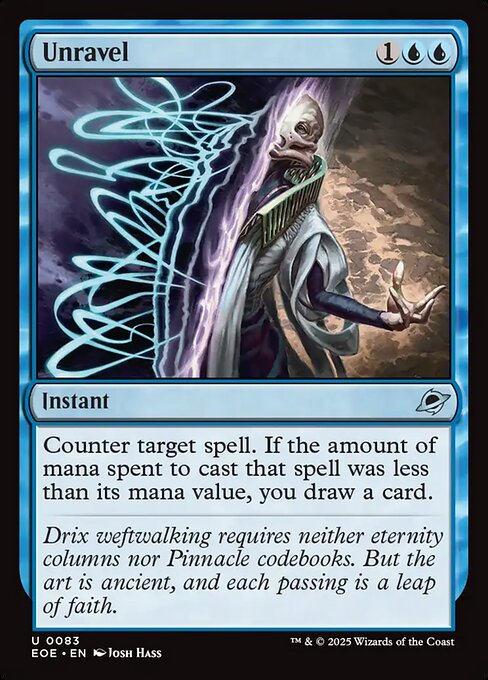
91. Unravel
Rating6.2GoodWhy this rating?
Good playable that always makes the cut (6.2/10).
Why. A clean three-mana counterspell that answers any spell. You draw a card if less mana was spent on the spell than its mana value, such as with Warp.
Risks. You must keep three mana open, which costs tempo. It is weaker against a deck of small spells, since you trade a card for little.
In the draft. A decent counterspell for blue control decks. Take it after removal and finishers.
Results in the games of the set
When it is in hand, the deck wins 55.4% of its games (set average: 56.0%, 146th of 287 cards).
In the opening hand: 52.3% wins (54.8% on average).
Drawn during the game: 57.3% (56.8% on average).
When it is drawn, the deck wins 2.8 points more than when it is not.
When it is drafted, it is played 41% of the time (set average: 62%).
Taken as the first pick (30 drafts), it ends in the deck 77% of the time.
It is played about as much in every archetype.
 Rating6.2Good
Why this rating?
Good playable that always makes the cut (6.2/10).
Why. A 2/4 for three that makes the second spell you cast each turn cost two less. It lets you double-spell and speeds up value turns.
Risks. It does nothing without cheap spells or a second spell to cast. The body is defensive and does not attack well.
In the draft. A good blue body for decks with plenty of cheap spells. Take it mid-pack; it is solid on defense.
Results in the games of the set
When it is in hand, the deck wins 57.4% of its games (set average: 56.0%, 72nd of 287 cards).
In the opening hand: 57.0% wins (54.8% on average).
Drawn during the game: 57.6% (56.8% on average).
When it is drawn, the deck wins 3.9 points more than when it is not.
When it is drafted, it is played 84% of the time (set average: 62%).
Taken as the first pick (174 drafts), it ends in the deck 93% of the time.
It is played mostly in U/W decks (44% of them) and R/U (32%).
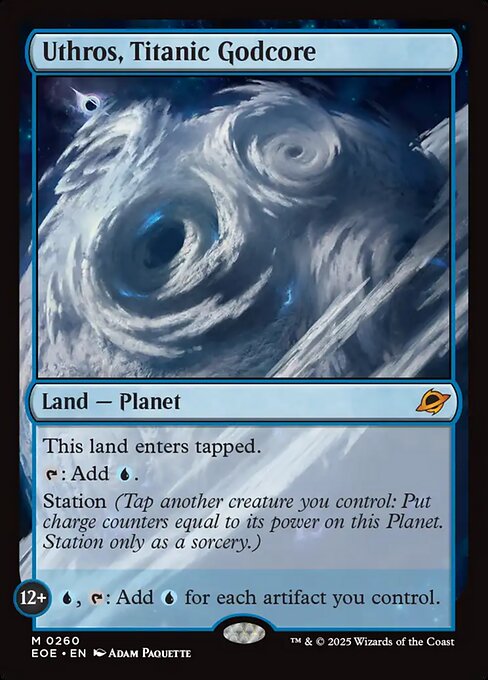 Rating6.1Playable
Why this rating?
Good playable that always makes the cut (6.1/10).
Why. A land that taps for blue mana and can be charged with Station to make blue mana based on your artifacts. It is a potential mana engine for a deck with plenty of artifacts.
Risks. It enters tapped, and Station means tapping your creatures. Without many artifacts, the final payoff is small.
In the draft. Play it as a blue mana source that enters tapped, in a blue deck with artifacts. Do not build your deck around it.
Results in the games of the set
When it is in hand, the deck wins 51.3% of its games (set average: 56.0%, 250th of 287 cards).
In the opening hand: 49.6% wins (54.8% on average).
Drawn during the game: 52.5% (56.8% on average).
When it is drawn, the deck wins 1.9 points more than when it is not.
When it is drafted, it is played 26% of the time (set average: 62%).

94. Dual-Sun Adepts
Rating6.0PlayableWhy this rating?
Good playable that always makes the cut (6.1/10).
Why. A 2/2 with double strike for three mana that beats most early creatures in combat. Late in the game, it pumps your whole team +1/+1 until end of turn for five mana.
Risks. It is still a 2/2 that dies to removal and deathtouch blockers. The late-game ability is expensive.
In the draft. A good white uncommon for aggressive decks. Take it as a solid three-mana attacker.
Results in the games of the set
When it is in hand, the deck wins 56.8% of its games (set average: 56.0%, 89th of 287 cards).
In the opening hand: 56.1% wins (54.8% on average).
Drawn during the game: 57.3% (56.8% on average).
When it is drawn, the deck wins 2.3 points more than when it is not.
When it is drafted, it is played 86% of the time (set average: 62%).
Taken as the first pick (127 drafts), it ends in the deck 94% of the time.
It is played mostly in R/W decks (35% of them) and U/W (33%).
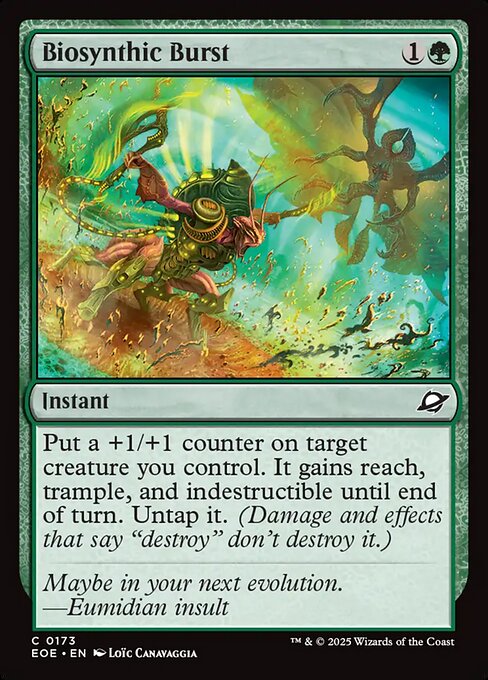
95. Biosynthic Burst
Rating6.0PlayableWhy this rating?
Good playable that always makes the cut (6.0/10).
Why. A two-mana instant: a +1/+1 counter, reach, trample and indestructible until end of turn, and the creature untaps. It wins a combat, undoes destroy-based removal and leaves a permanent counter.
Risks. You need a creature on the board, and it does not stop exile or sacrifice. Used too early, it can be wasted.
In the draft. A good green combat trick. Take it mid-pack, after removal and the best creatures.
Results in the games of the set
When it is in hand, the deck wins 56.8% of its games (set average: 56.0%, 88th of 287 cards).
In the opening hand: 54.6% wins (54.8% on average).
Drawn during the game: 58.4% (56.8% on average).
When it is drawn, the deck wins 1.6 points more than when it is not.
When it is drafted, it is played 67% of the time (set average: 62%).
Taken as the first pick (70 drafts), it ends in the deck 89% of the time.
It is played mostly in G/W decks (65% of them) and G/R (54%).
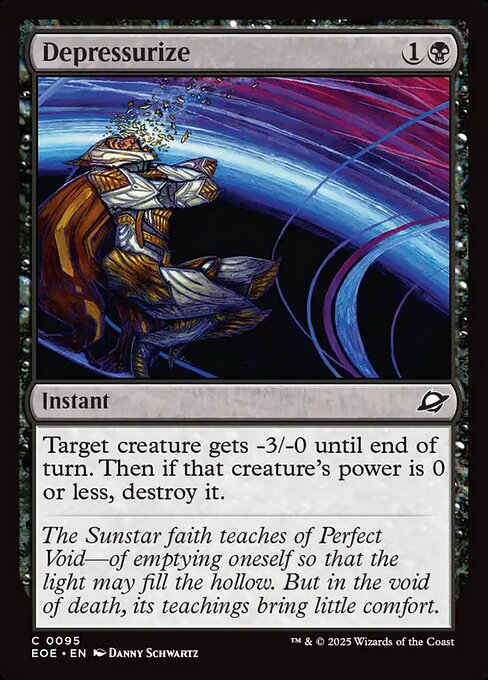
96. Depressurize
Rating6.0PlayableWhy this rating?
Good playable that always makes the cut (6.0/10).
Why. A two-mana instant that gives a creature -3/-0 and destroys it if its power drops to zero or less. It kills creatures with power 3 or less, and blunts an attack otherwise.
Risks. It does not kill creatures with 4 or more power; it only reduces their damage this turn. It is limited to smaller targets.
In the draft. A decent black removal against small creatures. Take it mid-pack; it fills your curve well.
Results in the games of the set
When it is in hand, the deck wins 56.5% of its games (set average: 56.0%, 102nd of 287 cards).
In the opening hand: 54.7% wins (54.8% on average).
Drawn during the game: 57.7% (56.8% on average).
When it is drawn, the deck wins 3.0 points more than when it is not.
When it is drafted, it is played 88% of the time (set average: 62%).
Taken as the first pick (365 drafts), it ends in the deck 93% of the time.
It is played mostly in B/U decks (62% of them) and B/R (60%).

97. Hemosymbic Mite
Rating6.0PlayableWhy this rating?
Good playable that always makes the cut (6.0/10).
Why. A one-mana 1/1 that gives another creature +X/+X whenever it becomes tapped, where X is its power. Attacking with it can pump another creature.
Risks. The body is tiny and fragile, and the bonus is small while its power stays at 1. It depends on another creature to buff.
In the draft. A low-power support card, playable only in aggressive green-white decks. Take it late.
Results in the games of the set
When it is in hand, the deck wins 53.6% of its games (set average: 56.0%, 197th of 287 cards).
In the opening hand: 55.9% wins (54.8% on average).
Drawn during the game: 51.8% (56.8% on average).
When it is drawn, the deck wins 0.2 points less than when it is not.
When it is drafted, it is played 35% of the time (set average: 62%).
Taken among the first three picks (88 drafts), it ends in the deck 68% of the time.
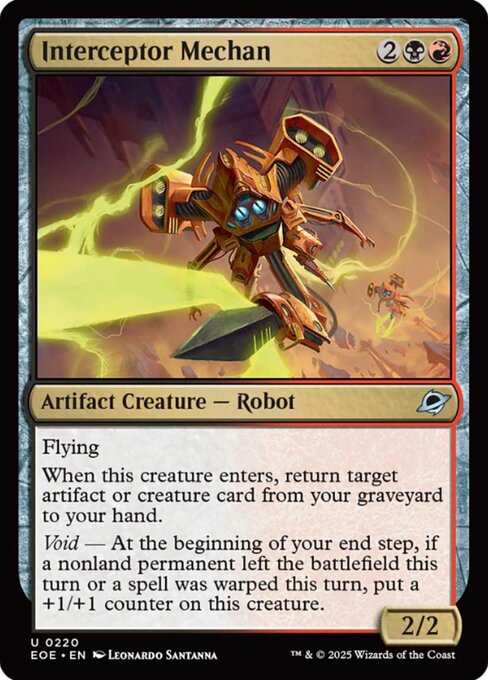 Rating6.0Playable
Why this rating?
Good playable that always makes the cut (6.0/10).
Why. A 2/2 flier for four mana that, when it enters, returns an artifact or creature card from your graveyard to your hand. Void gives it a +1/+1 counter if a nonland permanent left the battlefield or a spell was warped this turn.
Risks. It needs two colors, black and red, and its end-step bonus is not guaranteed. The starting body is small.
In the draft. A good black-red uncommon for value decks. Take it if you are in those colors.
Results in the games of the set
When it is in hand, the deck wins 57.8% of its games (set average: 56.0%, 58th of 287 cards).
In the opening hand: 54.5% wins (54.8% on average).
Drawn during the game: 60.0% (56.8% on average).
When it is drawn, the deck wins 4.9 points more than when it is not.
When it is drafted, it is played 75% of the time (set average: 62%).
Taken as the first pick (139 drafts), it ends in the deck 89% of the time.
It is played mostly in B/R decks (49% of them).
 Rating6.0Playable
Why this rating?
Good playable that always makes the cut (6.0/10).
Why. A two-mana instant that deals 3 damage to a creature, or 5 if you control a Spacecraft. A cheap and flexible removal spell.
Risks. Three damage will not kill big creatures, and the bonus requires a Spacecraft. Without Spacecraft it is a limited burn spell.
In the draft. A decent red removal to take mid-pack. It is better in a deck with Spacecraft.
Results in the games of the set
When it is in hand, the deck wins 55.6% of its games (set average: 56.0%, 137th of 287 cards).
In the opening hand: 54.6% wins (54.8% on average).
Drawn during the game: 56.4% (56.8% on average).
When it is drawn, the deck wins 1.4 points more than when it is not.
When it is drafted, it is played 86% of the time (set average: 62%).
Taken as the first pick (138 drafts), it ends in the deck 89% of the time.
It is played mostly in R/U decks (31% of them) and R/W (28%).

100. Kavaron Harrier
Rating6.0PlayableWhy this rating?
Good playable that always makes the cut (6.0/10).
Why. A one-mana 2/1 that, whenever it attacks, can pay two to create a 2/2 colorless Robot artifact creature token tapped and attacking, sacrificed at end of combat. An aggressive attacker that scales with your mana.
Risks. One toughness means it dies to any block, and the token disappears at end of combat. It loses value when the board stalls.
In the draft. An aggressive red card for decks that attack. Take it as a good one-drop, but not before removal.
Results in the games of the set
When it is in hand, the deck wins 56.2% of its games (set average: 56.0%, 114th of 287 cards).
In the opening hand: 58.2% wins (54.8% on average).
Drawn during the game: 54.7% (56.8% on average).
When it is drawn, the deck wins 3.0 points more than when it is not.
When it is drafted, it is played 76% of the time (set average: 62%).
Taken as the first pick (68 drafts), it ends in the deck 88% of the time.
It is played mostly in R/U decks (36% of them) and B/R (33%).

101. Knight Luminary
Rating6.0PlayableWhy this rating?
Good playable that always makes the cut (6.0/10).
Why. A 3/2 for four that leaves a 1/1 Human Soldier creature token behind: two bodies from one card. With Warp for two mana you can drop the token early, then recast it from exile on a later turn for a second token.
Risks. A 3/2 dies to nearly anything, and 1/1 tokens are modest on their own. Warp costs you some tempo if you just want a solid body on board.
In the draft. A solid white common and a reliable filler pick. It fits any white deck that wants to go wide.
Results in the games of the set
When it is in hand, the deck wins 57.5% of its games (set average: 56.0%, 65th of 287 cards).
In the opening hand: 57.4% wins (54.8% on average).
Drawn during the game: 57.6% (56.8% on average).
When it is drawn, the deck wins 2.3 points more than when it is not.
When it is drafted, it is played 83% of the time (set average: 62%).
Taken as the first pick (204 drafts), it ends in the deck 97% of the time.
It is played mostly in B/W decks (76% of them) and R/W (69%).
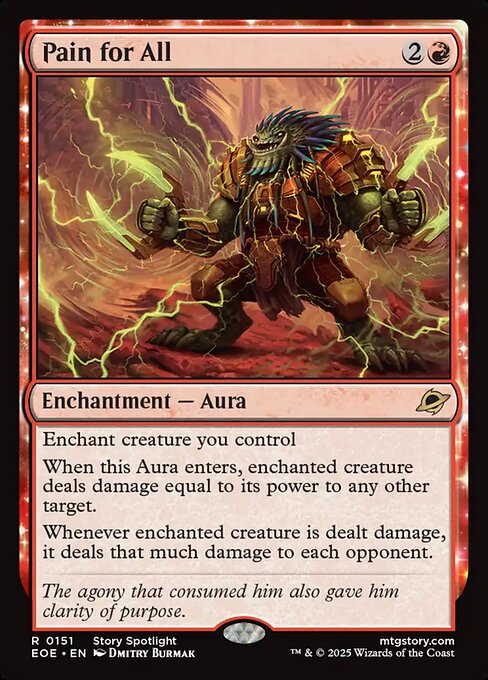
102. Pain for All
Rating6.0PlayableWhy this rating?
Good playable that always makes the cut (6.0/10).
Why. A three-mana Aura that doubles as removal: when it enters, the enchanted creature deals damage equal to its power to another target. After that, every point of damage the creature takes is also dealt to your opponent.
Risks. It needs a creature with real power, and a removal spell in response costs you both cards. With no big creature the enter effect is weak.
In the draft. Take it in a red deck with real creatures, especially RG. Otherwise let it pass for simpler removal.
Results in the games of the set
When it is in hand, the deck wins 54.5% of its games (set average: 56.0%, 169th of 287 cards).
In the opening hand: 51.7% wins (54.8% on average).
Drawn during the game: 56.3% (56.8% on average).
When it is drawn, the deck wins 1.8 points more than when it is not.
When it is drafted, it is played 82% of the time (set average: 62%).
Taken as the first pick (73 drafts), it ends in the deck 92% of the time.
It is played about as much in every archetype.
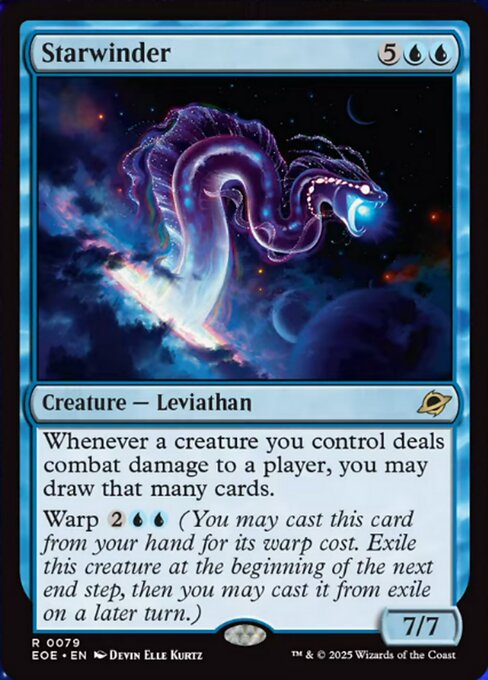
103. Starwinder
Rating6.0PlayableWhy this rating?
Good playable that always makes the cut (6.0/10).
Why. A 7/7 that turns every creature that connects with a player into cards, as many as the damage dealt. Warp for four mana lets you cast it precombat so your other creatures that connect draw you cards that same turn.
Risks. Seven mana to hard-cast, and the draw only works if a creature connects with the player. It does nothing against a stalled battlefield or a removal spell.
In the draft. A decent top end for slower blue decks, especially UG. Don't take it over your creatures and interaction.
Results in the games of the set
When it is in hand, the deck wins 56.6% of its games (set average: 56.0%, 96th of 287 cards).
In the opening hand: 53.3% wins (54.8% on average).
Drawn during the game: 58.4% (56.8% on average).
When it is drawn, the deck wins 4.8 points more than when it is not.
When it is drafted, it is played 86% of the time (set average: 62%).
Taken as the first pick (96 drafts), it ends in the deck 82% of the time.
It is played about as much in every archetype.

104. Susur Secundi, Void Altar
Rating6.0PlayableWhy this rating?
Good playable that always makes the cut (6.0/10).
Why. A land that enters tapped and taps for a black mana. With Station it becomes a card engine: once charged to 12 counters, you sacrifice a creature to draw cards equal to its power.
Risks. It enters tapped, and Station requires tapping creatures that won't attack that turn. The threshold fills slowly, and every activation also costs 2 life.
In the draft. A playable black land in decks with high-power creatures, especially WB. Don't take it over good removal.
Results in the games of the set
When it is in hand, the deck wins 52.8% of its games (set average: 56.0%, 216th of 287 cards).
In the opening hand: 53.5% wins (54.8% on average).
Drawn during the game: 52.3% (56.8% on average).
When it is drawn, the deck wins 1.1 points less than when it is not.
When it is drafted, it is played 78% of the time (set average: 62%).
Taken among the first three picks (72 drafts), it ends in the deck 83% of the time.

105. Uthros Scanship
Rating6.0PlayableWhy this rating?
Good playable that always makes the cut (6.0/10).
Why. A four-mana artifact that draws two then discards one the moment it lands, which is already value. Charged with Station up to 8 counters, it becomes a 4/4 flyer.
Risks. It is not a creature before the threshold, and Station costs you attacks from your creatures. The 4/4 is often too slow to be the main plan.
In the draft. A good uncommon for blue decks with high-power creatures. Take it as a card source, with the flying threat as a bonus.
Results in the games of the set
When it is in hand, the deck wins 57.0% of its games (set average: 56.0%, 81st of 287 cards).
In the opening hand: 55.2% wins (54.8% on average).
Drawn during the game: 58.0% (56.8% on average).
When it is drawn, the deck wins 3.6 points more than when it is not.
When it is drafted, it is played 77% of the time (set average: 62%).
Taken as the first pick (101 drafts), it ends in the deck 87% of the time.
It is played mostly in B/U decks (27% of them) and R/U (27%).
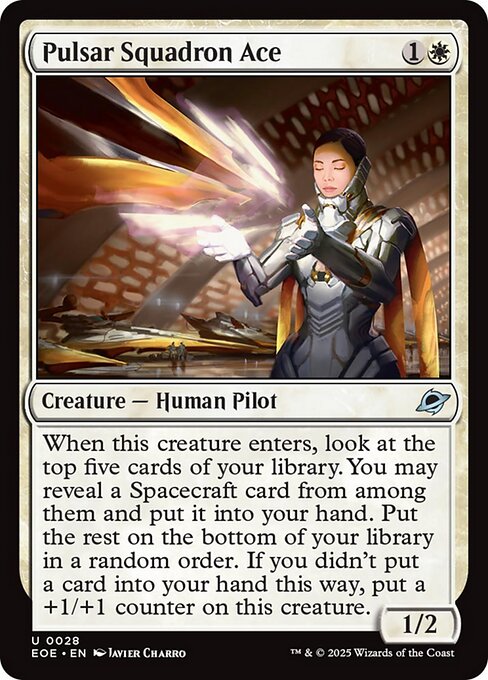
106. Pulsar Squadron Ace
Rating5.9PlayableWhy this rating?
Good playable that always makes the cut (5.9/10).
Why. A two-drop that looks at the top five for a Spacecraft; if you miss, it gets a +1/+1 counter and becomes a decent 2/3. Either way your turn two is not wasted.
Risks. It needs Spacecraft in your deck to shine, otherwise it is a plain 2/3. The other cards go to the bottom of your library.
In the draft. Play it in white decks with at least two or three Spacecraft. Otherwise it is a fine two-drop but not a priority pick.
Results in the games of the set
When it is in hand, the deck wins 55.4% of its games (set average: 56.0%, 147th of 287 cards).
In the opening hand: 55.9% wins (54.8% on average).
Drawn during the game: 55.0% (56.8% on average).
When it is drawn, the deck wins 0.6 points more than when it is not.
When it is drafted, it is played 81% of the time (set average: 62%).
Taken as the first pick (99 drafts), it ends in the deck 92% of the time.
It is played mostly in U/W decks (31% of them) and B/W (30%).
 Rating5.8Playable
Why this rating?
Good playable that always makes the cut (5.9/10).
Why. A two-mana 2/3 that blocks well and gains you 1 life on every land. In a Landfall deck it holds the ground early and gives you a life buffer against aggressive decks.
Risks. The life gain is small and doesn't affect the battlefield. On its own it is a solid body but not a threat.
In the draft. A good green two-drop for Landfall decks, especially UG or RG. Take it when you need curve, not as a first choice.
Results in the games of the set
When it is in hand, the deck wins 56.4% of its games (set average: 56.0%, 104th of 287 cards).
In the opening hand: 57.8% wins (54.8% on average).
Drawn during the game: 55.4% (56.8% on average).
When it is drawn, the deck wins 1.5 points more than when it is not.
When it is drafted, it is played 91% of the time (set average: 62%).
Taken as the first pick (159 drafts), it ends in the deck 96% of the time.
It is played mostly in G/U decks (31% of them) and G/R (28%).

108. Cut Propulsion
Rating5.8PlayableWhy this rating?
Good playable that always makes the cut (5.8/10).
Why. A three-mana instant-speed removal: the targeted creature deals damage to itself equal to its power, doubled if it flies. It kills any creature whose power reaches its toughness, and flyers die much more easily.
Risks. It does nothing against a creature with low power and high toughness, and a protection trick in response blanks it. That makes it less reliable than direct removal.
In the draft. A good red removal, especially in RG. Take it when you lack answers to flyers and big threats.
Results in the games of the set
When it is in hand, the deck wins 55.8% of its games (set average: 56.0%, 128th of 287 cards).
In the opening hand: 53.2% wins (54.8% on average).
Drawn during the game: 57.6% (56.8% on average).
When it is drawn, the deck wins 1.6 points more than when it is not.
When it is drafted, it is played 87% of the time (set average: 62%).
Taken as the first pick (131 drafts), it ends in the deck 95% of the time.
It is played mostly in G/R decks (29% of them) and R/U (29%).

109. Embrace Oblivion
Rating5.8PlayableWhy this rating?
Good playable that always makes the cut (5.8/10).
Why. A one-mana black removal that destroys a creature or Spacecraft. The additional cost is sacrificing an artifact or creature: a token or a cheap artifact makes it nearly free.
Risks. It costs an extra card, which makes it a two-for-one against you if you have nothing to sacrifice. It is a sorcery, so you can only cast it on your own turn.
In the draft. A good black removal if your deck has tokens or artifacts to sacrifice. Take it after removal that carries no extra cost.
Results in the games of the set
When it is in hand, the deck wins 55.9% of its games (set average: 56.0%, 127th of 287 cards).
In the opening hand: 52.9% wins (54.8% on average).
Drawn during the game: 57.7% (56.8% on average).
When it is drawn, the deck wins 2.3 points more than when it is not.
When it is drafted, it is played 75% of the time (set average: 62%).
Taken as the first pick (126 drafts), it ends in the deck 90% of the time.
It is played mostly in B/R decks (67% of them) and B/U (62%).
 Rating5.8Playable
Why this rating?
Good playable that always makes the cut (5.8/10).
Why. A two-colour 3/3 that puts a +1/+1 counter on a creature you control when it enters and each time it attacks. Whenever your creatures with counters connect, you draw a card, so your team grows while generating card advantage.
Risks. It needs two white mana and a green one, which is demanding. If it dies before attacking, you mostly paid five mana for one counter.
In the draft. Play it in WG with creatures that survive combat. A good uncommon, without being a first pick.
Results in the games of the set
When it is in hand, the deck wins 55.2% of its games (set average: 56.0%, 150th of 287 cards).
In the opening hand: 54.0% wins (54.8% on average).
Drawn during the game: 56.0% (56.8% on average).
When it is drawn, the deck wins 1.4 points more than when it is not.
When it is drafted, it is played 63% of the time (set average: 62%).
Taken as the first pick (80 drafts), it ends in the deck 71% of the time.
It is played mostly in G/W decks (56% of them).
 Rating5.8Playable
Why this rating?
Good playable that always makes the cut (5.8/10).
Why. For a single white mana, it exiles an opponent's creature for as long as the Aura stays in play, and the enchanted artifact gains ward 1. Very efficient removal, but only if you have an artifact.
Risks. It must enchant an artifact you control: with no artifact it cannot be cast. If the artifact or the Aura leaves the battlefield, the creature comes back.
In the draft. Take it only if your deck has artifacts, for example in WU or WB. Otherwise it stays in the sideboard.
Results in the games of the set
When it is in hand, the deck wins 52.1% of its games (set average: 56.0%, 234th of 287 cards).
In the opening hand: 48.9% wins (54.8% on average).
Drawn during the game: 54.2% (56.8% on average).
When it is drawn, the deck wins 1.3 points more than when it is not.
When it is drafted, it is played 45% of the time (set average: 62%).
Taken among the first three picks (72 drafts), it ends in the deck 68% of the time.
It is played about as much in every archetype.

112. Lost in Space
Rating5.8PlayableWhy this rating?
Good playable that always makes the cut (5.8/10).
Why. A four-mana instant that sends an artifact or creature to the top or bottom of its owner's library (their choice), then surveils 1. Against a big threat it is flexible removal.
Risks. The owner chooses: if they put it on top they redraw it and you only gained tempo. Four mana is a lot for this effect.
In the draft. A good blue common, especially in UG. Take it as tempo removal, after permanent removal.
Results in the games of the set
When it is in hand, the deck wins 56.3% of its games (set average: 56.0%, 111th of 287 cards).
In the opening hand: 52.8% wins (54.8% on average).
Drawn during the game: 58.4% (56.8% on average).
When it is drawn, the deck wins 1.7 points more than when it is not.
When it is drafted, it is played 48% of the time (set average: 62%).
Taken as the first pick (58 drafts), it ends in the deck 81% of the time.
It is played mostly in B/U decks (62% of them) and U/W (43%).

113. Plasma Bolt
Rating5.8PlayableWhy this rating?
Good playable that always makes the cut (5.8/10).
Why. A one-mana red sorcery that deals 2 damage to any target, or 3 with Void. It kills small creatures very cheaply.
Risks. Only 2 damage most of the time: it doesn't touch bigger creatures. Void isn't always active.
In the draft. A solid red common for aggressive decks, especially BR or RG. Take it as curve-friendly removal.
Results in the games of the set
When it is in hand, the deck wins 55.7% of its games (set average: 56.0%, 133rd of 287 cards).
In the opening hand: 54.0% wins (54.8% on average).
Drawn during the game: 56.9% (56.8% on average).
When it is drawn, the deck wins 1.5 points more than when it is not.
When it is drafted, it is played 78% of the time (set average: 62%).
Taken as the first pick (175 drafts), it ends in the deck 93% of the time.
It is played mostly in R/U decks (64% of them) and R/W (58%).

114. Requiem Monolith
Rating5.8PlayableWhy this rating?
Good playable that always makes the cut (5.8/10).
Why. A three-mana artifact that, by tapping, gives a creature until end of turn an ability that makes its controller draw cards when it is dealt damage, with equal life loss. Its controller may also have the artifact deal 1 damage to it.
Risks. It can only be used on your turn, once per turn, and it costs you life: it is slow. It does not change the battlefield.
In the draft. A niche card for black decks that absorb damage well. Usually let it pass for removal or a creature.
Results in the games of the set
When it is in hand, the deck wins 55.3% of its games (set average: 56.0%, 148th of 287 cards).
In the opening hand: 55.4% wins (54.8% on average).
Drawn during the game: 55.2% (56.8% on average).
When it is drawn, the deck wins 3.0 points more than when it is not.
When it is drafted, it is played 85% of the time (set average: 62%).
Taken as the first pick (72 drafts), it ends in the deck 89% of the time.
It is played about as much in every archetype.

115. Seam Rip
Rating5.8PlayableWhy this rating?
Good playable that always makes the cut (5.8/10).
Why. For one white mana, it exiles an opponent's nonland permanent with mana value 2 or less for as long as it stays in play. It is efficient removal against small threats.
Risks. It is limited to permanents of mana value 2 or less and cannot handle big creatures. If the enchantment leaves, the permanent comes back.
In the draft. Niche white removal, good against aggro decks and cheap threats. Take it after broader removal.
Results in the games of the set
When it is in hand, the deck wins 54.2% of its games (set average: 56.0%, 181st of 287 cards).
In the opening hand: 53.3% wins (54.8% on average).
Drawn during the game: 54.8% (56.8% on average).
When it is drawn, the deck wins 0.7 points more than when it is not.
When it is drafted, it is played 48% of the time (set average: 62%).
Taken as the first pick (35 drafts), it ends in the deck 77% of the time.
It is played about as much in every archetype.
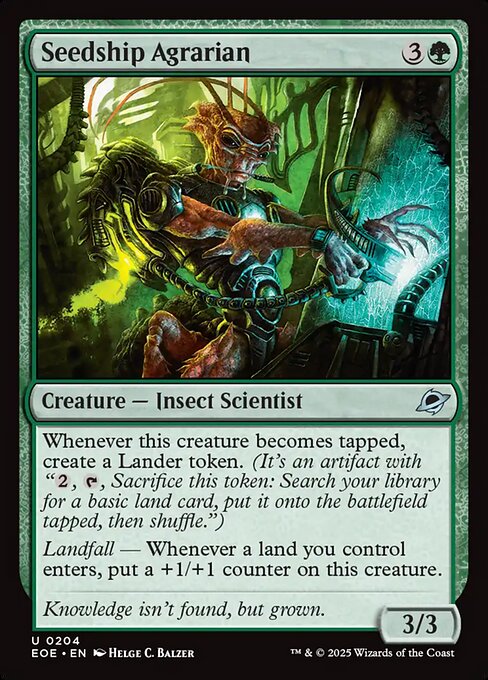
116. Seedship Agrarian
Rating5.8PlayableWhy this rating?
Good playable that always makes the cut (5.8/10).
Why. A four-mana 3/3 that creates a Lander token each time it becomes tapped and gets a +1/+1 counter with every Landfall. It ramps you and grows by itself.
Risks. To make a Lander, it has to become tapped, so it must attack or be tapped by an effect. Activating the Lander costs two mana.
In the draft. A good green uncommon, especially in UG or RG. Take it in any green Landfall deck.
Results in the games of the set
When it is in hand, the deck wins 56.4% of its games (set average: 56.0%, 107th of 287 cards).
In the opening hand: 55.6% wins (54.8% on average).
Drawn during the game: 56.9% (56.8% on average).
When it is drawn, the deck wins 2.0 points more than when it is not.
When it is drafted, it is played 94% of the time (set average: 62%).
Taken as the first pick (227 drafts), it ends in the deck 96% of the time.
It is played mostly in G/R decks (31% of them) and G/W (29%).
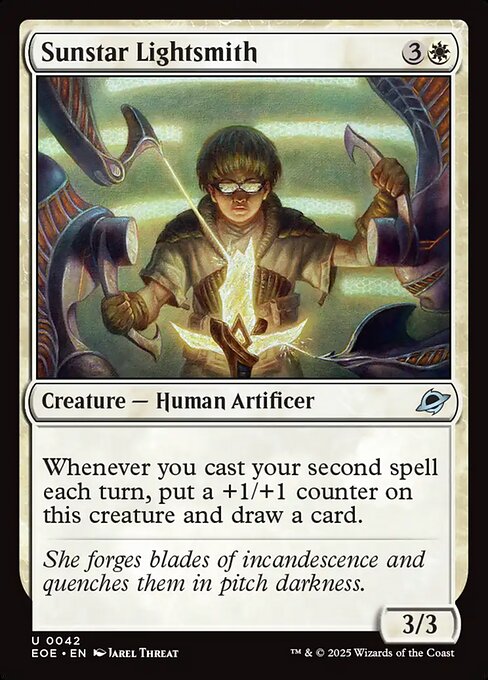
117. Sunstar Lightsmith
Rating5.8PlayableWhy this rating?
Good playable that always makes the cut (5.8/10).
Why. A four-mana 3/3 that gets a +1/+1 counter and draws a card whenever you cast your second spell each turn. In a deck with many cheap spells it grows into a real threat and a card source.
Risks. Without a second spell each turn it is just a plain 3/3. It is vulnerable to removal before it grows.
In the draft. A good white uncommon for low-curve decks, for example WU. Look for ways to cast two spells per turn.
Results in the games of the set
When it is in hand, the deck wins 56.6% of its games (set average: 56.0%, 99th of 287 cards).
In the opening hand: 55.8% wins (54.8% on average).
Drawn during the game: 57.1% (56.8% on average).
When it is drawn, the deck wins 2.1 points more than when it is not.
When it is drafted, it is played 87% of the time (set average: 62%).
Taken as the first pick (148 drafts), it ends in the deck 93% of the time.
It is played mostly in U/W decks (39% of them) and G/W (27%).
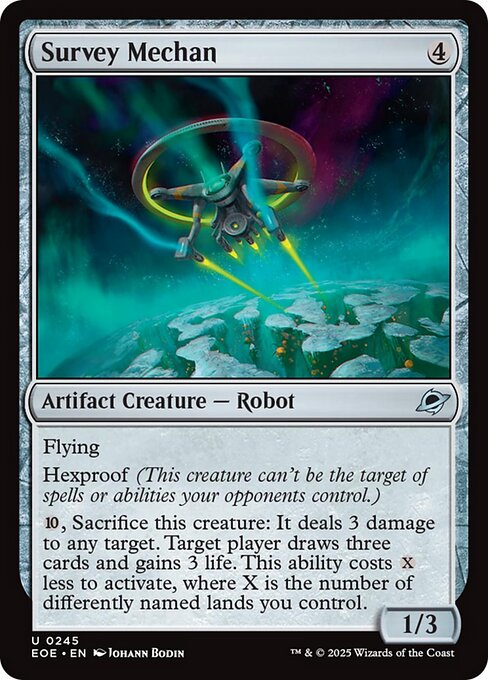
118. Survey Mechan
Rating5.8PlayableWhy this rating?
Good playable that always makes the cut (5.8/10).
Why. A four-mana 1/3 flyer with hexproof, so the opponent can't target it. Its sacrifice ability is expensive but deals 3 damage, draws three and gains 3 life, and it gets cheaper with differently named lands.
Risks. A body with 1 power does little on its own. The final ability is very expensive without several differently named lands.
In the draft. A good colourless uncommon for decks with varied lands, especially UG. Take it as a reliable air blocker.
Results in the games of the set
When it is in hand, the deck wins 56.4% of its games (set average: 56.0%, 108th of 287 cards).
In the opening hand: 52.7% wins (54.8% on average).
Drawn during the game: 58.7% (56.8% on average).
When it is drawn, the deck wins 2.8 points more than when it is not.
When it is drafted, it is played 69% of the time (set average: 62%).
Taken as the first pick (98 drafts), it ends in the deck 79% of the time.
It is played about as much in every archetype.
 Rating5.8Playable
Why this rating?
Good playable that always makes the cut (5.8/10).
Why. A three-mana 2/4 whose Landfall deals 1 damage to each opponent per land, and draws you a card the second time in a turn. With effects that put lands into play it pressures and draws.
Risks. It needs extra lands to draw, so ramp effects. Alone it deals just 1 damage per turn.
In the draft. A good RG uncommon in decks with ramp and Landfall. Outside that deck it is less exciting.
Results in the games of the set
When it is in hand, the deck wins 56.0% of its games (set average: 56.0%, 123rd of 287 cards).
In the opening hand: 55.3% wins (54.8% on average).
Drawn during the game: 56.6% (56.8% on average).
When it is drawn, the deck wins 1.4 points more than when it is not.
When it is drafted, it is played 75% of the time (set average: 62%).
Taken as the first pick (122 drafts), it ends in the deck 88% of the time.
It is played mostly in G/R decks (48% of them).
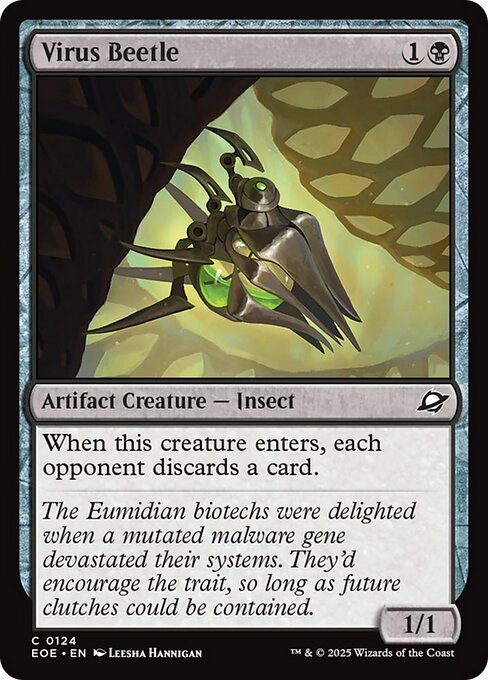
120. Virus Beetle
Rating5.8PlayableWhy this rating?
Good playable that always makes the cut (5.8/10).
Why. A two-mana 1/1 artifact creature that makes each opponent discard a card when it enters. A modest two-for-one, reliable and playable early.
Risks. The 1/1 body is outclassed quickly, and if the opponent has no hand the effect does nothing. It doesn't affect the battlefield.
In the draft. A good black filler common that helps your curve. Take it also as a creature to sacrifice.
Results in the games of the set
When it is in hand, the deck wins 57.1% of its games (set average: 56.0%, 77th of 287 cards).
In the opening hand: 56.8% wins (54.8% on average).
Drawn during the game: 57.3% (56.8% on average).
When it is drawn, the deck wins 3.5 points more than when it is not.
When it is drafted, it is played 87% of the time (set average: 62%).
Taken as the first pick (389 drafts), it ends in the deck 93% of the time.
It is played mostly in B/R decks (71% of them) and B/U (68%).

121. Illvoi Light Jammer
Rating5.8PlayableWhy this rating?
Good playable that always makes the cut (5.8/10).
Why. An Equipment with flash that attaches to one of your creatures when it enters and gives it hexproof until end of turn. After that, the equipped creature gets +1/+2: a good way to save a creature from removal in response.
Risks. Equip costs three, which is steep for a modest bonus. It does nothing without a creature.
In the draft. A decent protection trick for blue, especially in UG or WU. It is better as protection than as a lasting Equipment.
Results in the games of the set
When it is in hand, the deck wins 55.1% of its games (set average: 56.0%, 153rd of 287 cards).
In the opening hand: 53.2% wins (54.8% on average).
Drawn during the game: 56.3% (56.8% on average).
When it is drawn, the deck wins 2.3 points more than when it is not.
When it is drafted, it is played 27% of the time (set average: 62%).
Taken among the first three picks (79 drafts), it ends in the deck 70% of the time.
It is played mostly in R/U decks (32% of them).

122. Hylderblade
Rating5.7PlayableWhy this rating?
Good playable that always makes the cut (5.7/10).
Why. A one-mana black Equipment that gives +3/+1. With Void it attaches itself at end of turn, which avoids the steep equip cost.
Risks. Equipping by hand costs four, and Void needs a nonland permanent to leave the battlefield or a spell to be warped. It is unreliable without that.
In the draft. Play it in black decks with plenty of trades or Warp, like WB. Otherwise it is a late-pack pick.
Results in the games of the set
When it is in hand, the deck wins 54.5% of its games (set average: 56.0%, 171st of 287 cards).
In the opening hand: 54.5% wins (54.8% on average).
Drawn during the game: 54.4% (56.8% on average).
When it is drawn, the deck wins 1.6 points more than when it is not.
When it is drafted, it is played 55% of the time (set average: 62%).
Taken as the first pick (40 drafts), it ends in the deck 78% of the time.
It is played mostly in B/W decks (25% of them).
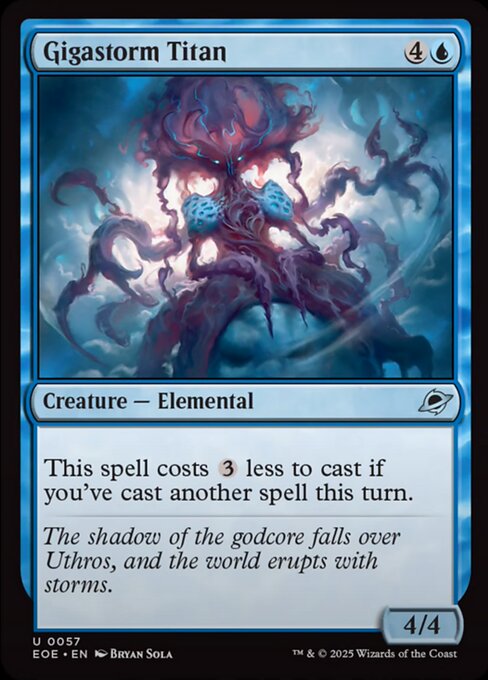
123. Gigastorm Titan
Rating5.6PlayableWhy this rating?
Good playable that always makes the cut (5.6/10).
Why. A five-mana 4/4 that costs three less if you've cast another spell this turn. On turn four, a cheap spell and then the Titan for two is a huge tempo swing.
Risks. Without a second spell, five mana for a plain 4/4 is mediocre. It needs a curve full of cheap spells.
In the draft. A good blue uncommon, especially in WU or UG. Look for cheap spells to enable it.
Results in the games of the set
When it is in hand, the deck wins 56.7% of its games (set average: 56.0%, 92nd of 287 cards).
In the opening hand: 55.6% wins (54.8% on average).
Drawn during the game: 57.3% (56.8% on average).
When it is drawn, the deck wins 3.2 points more than when it is not.
When it is drafted, it is played 87% of the time (set average: 62%).
Taken as the first pick (226 drafts), it ends in the deck 96% of the time.
It is played mostly in U/W decks (46% of them) and R/U (32%).
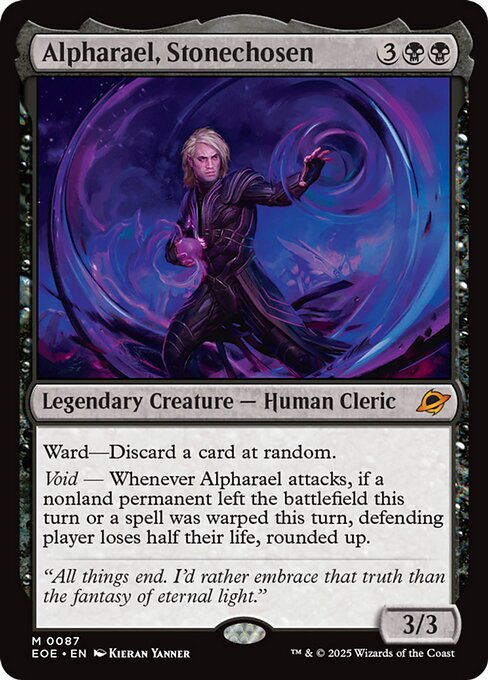 Rating5.6Playable
Why this rating?
Good playable that always makes the cut (5.6/10).
Why. A five-mana mythic 3/3 with ward (discard a card at random). With Void, its attack makes the defending player lose half their life, rounded up.
Risks. A five-mana 3/3 is fragile, and Void has to be active on the attack. Without it, it is just an average body.
In the draft. Playable in a black deck with plenty of trades or Warp. Don't take it over good removal.
Results in the games of the set
When it is in hand, the deck wins 50.4% of its games (set average: 56.0%, 263rd of 287 cards).
In the opening hand: 47.6% wins (54.8% on average).
Drawn during the game: 52.3% (56.8% on average).
When it is drawn, the deck wins 0.3 points more than when it is not.
When it is drafted, it is played 53% of the time (set average: 62%).
Taken among the first three picks (48 drafts), it ends in the deck 73% of the time.
It is played about as much in every archetype.

125. Diplomatic Relations
Rating5.6PlayableWhy this rating?
Good playable that always makes the cut (5.6/10).
Why. A three-mana instant: your creature gets +1/+0 and vigilance, then deals damage equal to its power to an opposing creature. One-sided removal that risks nothing in combat.
Risks. It needs a creature with good power, and an opposing answer on your creature costs you both cards. It is useless without a creature.
In the draft. A good green common, especially in UG, RG or WG. Take it whenever you have solid creatures.
Results in the games of the set
When it is in hand, the deck wins 56.6% of its games (set average: 56.0%, 93rd of 287 cards).
In the opening hand: 54.6% wins (54.8% on average).
Drawn during the game: 58.1% (56.8% on average).
When it is drawn, the deck wins 1.6 points more than when it is not.
When it is drafted, it is played 88% of the time (set average: 62%).
Taken as the first pick (292 drafts), it ends in the deck 95% of the time.
It is played mostly in B/G decks (66% of them) and G/R (63%).
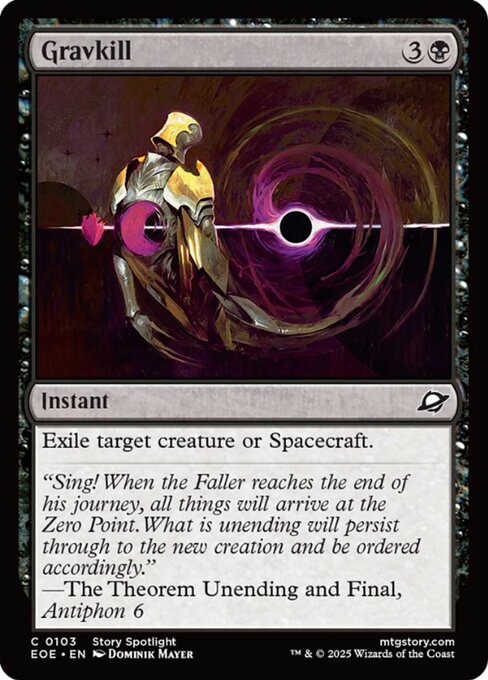
126. Gravkill
Rating5.6PlayableWhy this rating?
Good playable that always makes the cut (5.6/10).
Why. A four-mana instant that exiles a creature or Spacecraft. Clean, unconditional removal that handles almost any creature.
Risks. Four mana is not cheap, and it does nothing to a permanent that isn't a creature or Spacecraft.
In the draft. Reliable black removal and a pick for any black deck. Take it before filler.
Results in the games of the set
When it is in hand, the deck wins 56.1% of its games (set average: 56.0%, 119th of 287 cards).
In the opening hand: 52.9% wins (54.8% on average).
Drawn during the game: 58.1% (56.8% on average).
When it is drawn, the deck wins 3.2 points more than when it is not.
When it is drafted, it is played 91% of the time (set average: 62%).
Taken as the first pick (428 drafts), it ends in the deck 93% of the time.
It is played mostly in B/U decks (58% of them) and B/W (58%).

127. Gravpack Monoist
Rating5.6PlayableWhy this rating?
Good playable that always makes the cut (5.6/10).
Why. A three-mana 2/1 flyer that leaves a tapped 2/2 colorless Robot artifact creature token when it dies. It attacks in the air and leaves a body even if it is killed.
Risks. Its low toughness makes it an easy target, and the Robot arrives tapped. A blocker with flying or reach stops it.
In the draft. A good black common for any black deck. It is also a good creature to sacrifice.
Results in the games of the set
When it is in hand, the deck wins 57.0% of its games (set average: 56.0%, 80th of 287 cards).
In the opening hand: 56.2% wins (54.8% on average).
Drawn during the game: 57.5% (56.8% on average).
When it is drawn, the deck wins 2.9 points more than when it is not.
When it is drafted, it is played 84% of the time (set average: 62%).
Taken as the first pick (172 drafts), it ends in the deck 95% of the time.
It is played mostly in B/W decks (68% of them) and B/R (67%).
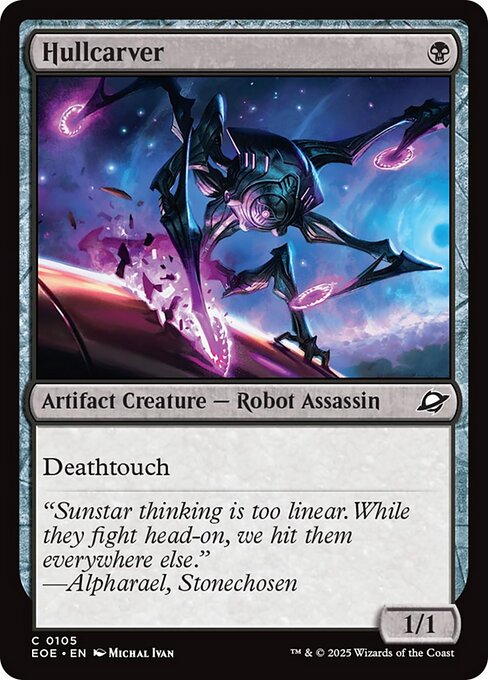
128. Hullcarver
Rating5.6PlayableWhy this rating?
Good playable that always makes the cut (5.6/10).
Why. A one-mana black 1/1 artifact creature with deathtouch. It deters any attack and trades with a much more expensive creature.
Risks. A 1/1 dies to everything and does nothing else. It is mostly good on defense.
In the draft. A good black defensive common that doubles as a creature to sacrifice. Take it mid-pack.
Results in the games of the set
When it is in hand, the deck wins 55.6% of its games (set average: 56.0%, 134th of 287 cards).
In the opening hand: 56.1% wins (54.8% on average).
Drawn during the game: 55.3% (56.8% on average).
When it is drawn, the deck wins 2.1 points more than when it is not.
When it is drafted, it is played 70% of the time (set average: 62%).
Taken as the first pick (55 drafts), it ends in the deck 89% of the time.
It is played mostly in B/W decks (48% of them) and B/U (46%).
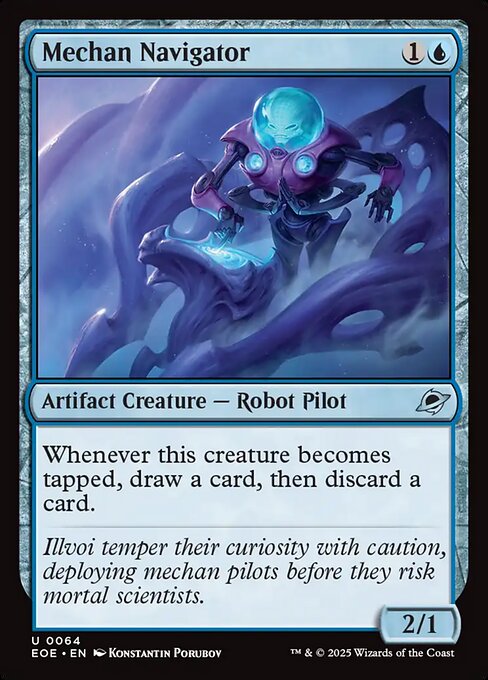
129. Mechan Navigator
Rating5.6PlayableWhy this rating?
Good playable that always makes the cut (5.6/10).
Why. A two-mana 2/1 artifact creature that draws then discards a card each time it becomes tapped. Attacking improves your hand.
Risks. It must tap, so attack, with a body of 1 toughness. It dies quickly, on defense or offense.
In the draft. A good blue two-drop, especially in UB or UG. Not a priority, but a decent hand filter.
Results in the games of the set
When it is in hand, the deck wins 55.2% of its games (set average: 56.0%, 149th of 287 cards).
In the opening hand: 55.5% wins (54.8% on average).
Drawn during the game: 55.0% (56.8% on average).
When it is drawn, the deck wins 2.1 points more than when it is not.
When it is drafted, it is played 81% of the time (set average: 62%).
Taken as the first pick (90 drafts), it ends in the deck 91% of the time.
It is played mostly in R/U decks (35% of them) and B/U (31%).
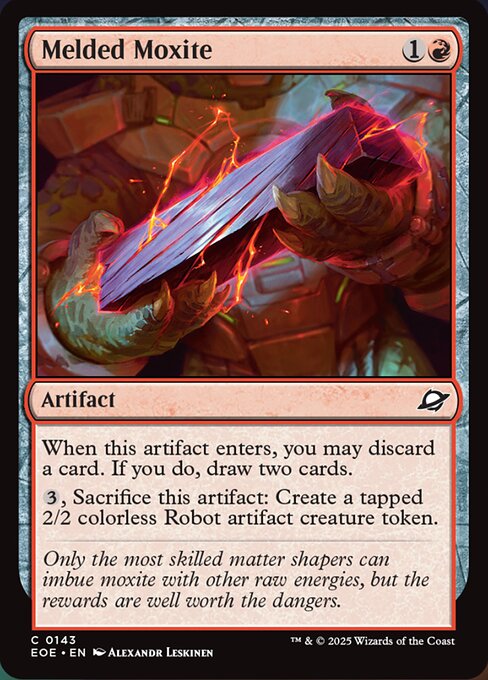
130. Melded Moxite
Rating5.6PlayableWhy this rating?
Good playable that always makes the cut (5.6/10).
Why. A two-mana artifact that lets you discard a card to draw two, then can be sacrificed for three mana to create a tapped 2/2 colorless Robot artifact creature token. Hand filtering with a body in reserve.
Risks. You need a card to discard, and the Robot costs three more mana. It does not affect the battlefield right away.
In the draft. A good red common for sacrifice decks, especially BR. Take it as a card source and an artifact to sacrifice.
Results in the games of the set
When it is in hand, the deck wins 56.0% of its games (set average: 56.0%, 122nd of 287 cards).
In the opening hand: 55.6% wins (54.8% on average).
Drawn during the game: 56.4% (56.8% on average).
When it is drawn, the deck wins 1.9 points more than when it is not.
When it is drafted, it is played 62% of the time (set average: 62%).
Taken as the first pick (61 drafts), it ends in the deck 85% of the time.
It is played mostly in R/U decks (58% of them) and B/R (54%).

131. Memorial Vault
Rating5.6PlayableWhy this rating?
Good playable that always makes the cut (5.6/10).
Why. A four-mana artifact that sacrifices another artifact to exile cards from the top of your library, which you may play this turn. It converts artifacts into cards.
Risks. It needs lots of artifacts to sacrifice and does nothing without them. Four mana for a slow effect is expensive.
In the draft. A niche card for an artifact-heavy deck. Otherwise leave it.
Results in the games of the set
When it is in hand, the deck wins 50.7% of its games (set average: 56.0%, 261st of 287 cards).
In the opening hand: 46.5% wins (54.8% on average).
Drawn during the game: 53.3% (56.8% on average).
When it is drawn, the deck wins 0.3 points more than when it is not.
When it is drafted, it is played 22% of the time (set average: 62%).
Taken among the first three picks (59 drafts), it ends in the deck 47% of the time.

132. Nebula Dragon
Rating5.6PlayableWhy this rating?
Good playable that always makes the cut (5.6/10).
Why. A 4/4 flying Dragon that deals 3 damage to any target when it enters: a powerful late-game two-for-one. It kills a creature and leaves a big flyer.
Risks. Seven mana is a lot. Early in the game it is dead in your hand.
In the draft. A reliable red top-end common, especially in RG. Take only one or two.
Results in the games of the set
When it is in hand, the deck wins 56.2% of its games (set average: 56.0%, 113th of 287 cards).
In the opening hand: 52.4% wins (54.8% on average).
Drawn during the game: 58.7% (56.8% on average).
When it is drawn, the deck wins 1.6 points more than when it is not.
When it is drafted, it is played 47% of the time (set average: 62%).
Taken as the first pick (44 drafts), it ends in the deck 89% of the time.
It is played mostly in G/R decks (57% of them) and B/R (38%).
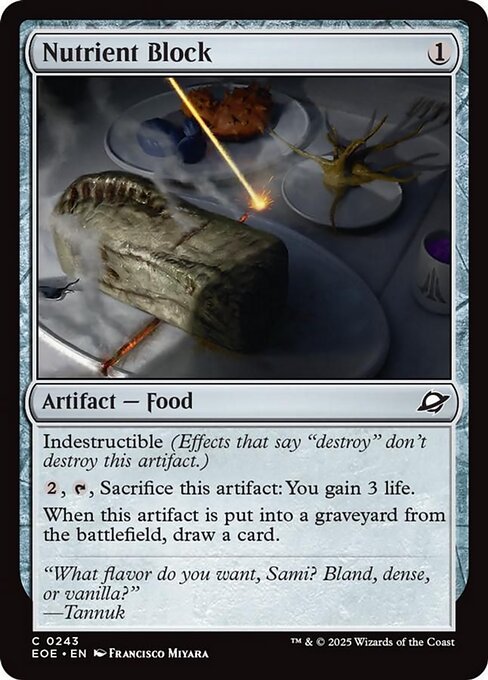
133. Nutrient Block
Rating5.6PlayableWhy this rating?
Good playable that always makes the cut (5.6/10).
Why. A one-mana indestructible Food artifact that gains 3 life for two mana and draws you a card when it goes from the battlefield to the graveyard. Value plus something to sacrifice.
Risks. It does nothing on the battlefield, and it costs several mana in total to gain life. It is slow.
In the draft. A good artifact to sacrifice for sacrifice decks, especially UB and BR. Take it as a useful filler card.
Results in the games of the set
When it is in hand, the deck wins 55.0% of its games (set average: 56.0%, 158th of 287 cards).
In the opening hand: 53.4% wins (54.8% on average).
Drawn during the game: 56.1% (56.8% on average).
When it is drawn, the deck wins 1.5 points more than when it is not.
When it is drafted, it is played 59% of the time (set average: 62%).
Taken as the first pick (54 drafts), it ends in the deck 80% of the time.
It is played mostly in B/U decks (35% of them) and R/U (30%).
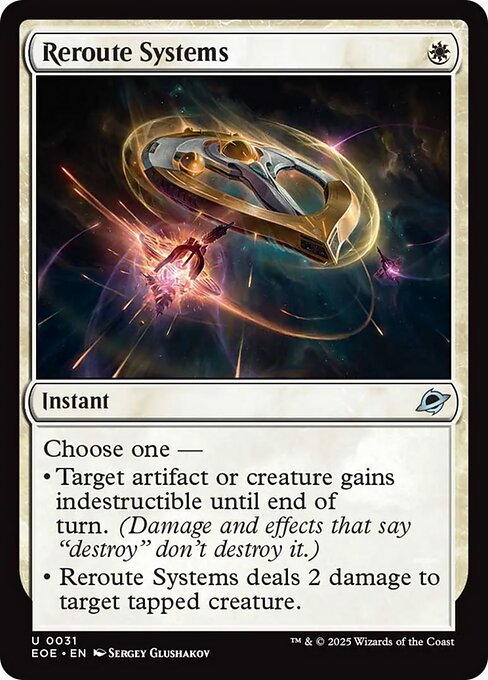
134. Reroute Systems
Rating5.6PlayableWhy this rating?
Good playable that always makes the cut (5.6/10).
Why. A one-mana white instant with two modes: indestructible for an artifact or creature, or 2 damage to a tapped creature. It protects against a removal spell or finishes a creature that attacked.
Risks. It is conditional: the damage mode needs a tapped target and the protection doesn't stop exile. It is situational.
In the draft. A decent white combat trick for WU, WG or WB. Take it late in the pack.
Results in the games of the set
When it is in hand, the deck wins 52.7% of its games (set average: 56.0%, 222nd of 287 cards).
In the opening hand: 51.3% wins (54.8% on average).
Drawn during the game: 53.8% (56.8% on average).
When it is drawn, the deck wins 0.3 points less than when it is not.
When it is drafted, it is played 51% of the time (set average: 62%).
Taken as the first pick (31 drafts), it ends in the deck 87% of the time.
It is played about as much in every archetype.
 Rating5.6Playable
Why this rating?
Good playable that always makes the cut (5.6/10).
Why. Each time one of your creatures dies, your opponent chooses a creature they control and exiles it, so trades and sacrifices become a slow removal engine. If a player has no creatures at your end step, you sacrifice it and take one of the creatures it exiled, with two extra +1/+1 counters.
Risks. Your opponent picks which creature goes, so they give up the worst one. If your creatures are not dying it does nothing, and the payoff needs an empty board on one side, which is not guaranteed.
In the draft. Fair in an aggressive or sacrifice deck that is happy to lose creatures. In a controlling build with few creatures it rots in your hand. Take it if you are black with plenty of small creatures.
Results in the games of the set
When it is in hand, the deck wins 52.6% of its games (set average: 56.0%, 225th of 287 cards).
In the opening hand: 51.3% wins (54.8% on average).
Drawn during the game: 53.4% (56.8% on average).
When it is drawn, the deck wins 1.4 points more than when it is not.
When it is drafted, it is played 83% of the time (set average: 62%).
Taken as the first pick (34 drafts), it ends in the deck 88% of the time.
It is played about as much in every archetype.

136. Vote Out
Rating5.6PlayableWhy this rating?
Good playable that always makes the cut (5.6/10).
Why. Unconditional removal that destroys any creature, at four mana without help. With convoke, a creature-heavy deck often casts it for next to nothing by tapping its creatures.
Risks. It is a sorcery, so it cannot answer a threat mid-attack. Tapping creatures to pay for it can cost you your attack or your blockers for the turn.
In the draft. A good pick for a black deck with cheap creatures. Reliable removal goes ahead of average creatures, and a second copy is welcome.
Results in the games of the set
When it is in hand, the deck wins 55.7% of its games (set average: 56.0%, 131st of 287 cards).
In the opening hand: 53.1% wins (54.8% on average).
Drawn during the game: 57.4% (56.8% on average).
When it is drawn, the deck wins 2.5 points more than when it is not.
When it is drafted, it is played 90% of the time (set average: 62%).
Taken as the first pick (173 drafts), it ends in the deck 90% of the time.
It is played mostly in B/G decks (26% of them) and B/U (26%).
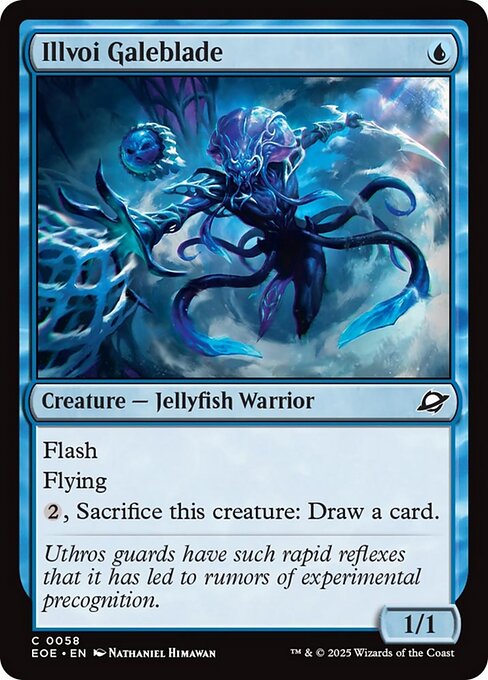
137. Illvoi Galeblade
Rating5.5PlayableWhy this rating?
Good playable that always makes the cut (5.5/10).
Why. A tiny flash flyer for one blue mana. It chips in or blocks in the air, and can sacrifice itself for two mana to draw a card when the opponent aims removal at it or when you no longer need it.
Risks. It is only a 1/1, so it wins almost no fights against a real blocker. On its own it will not turn a game around.
In the draft. A decent filler in a blue tempo deck, especially with white. Do not take it over removal or a solid creature.
Results in the games of the set
When it is in hand, the deck wins 54.7% of its games (set average: 56.0%, 163rd of 287 cards).
In the opening hand: 54.0% wins (54.8% on average).
Drawn during the game: 55.2% (56.8% on average).
When it is drawn, the deck wins 1.9 points more than when it is not.
When it is drafted, it is played 43% of the time (set average: 62%).
Taken as the first pick (31 drafts), it ends in the deck 77% of the time.
It is played mostly in U/W decks (74% of them) and B/U (30%).

138. Thawbringer
Rating5.5PlayableWhy this rating?
A solid playable that rarely gets cut (5.5/10).
Why. A 4/2 for three that smooths your draws both on entering and on dying, since you surveil 1 each time. It is an aggressive body that does not lose value when it trades.
Risks. Two toughness means it dies to almost anything and often trades with something smaller. It is not much help on defense.
In the draft. A fine mid-curve creature for an aggressive green deck, working with any green pair. A reliable common to fill the curve, but not over removal.
Results in the games of the set
When it is in hand, the deck wins 55.6% of its games (set average: 56.0%, 140th of 287 cards).
In the opening hand: 54.9% wins (54.8% on average).
Drawn during the game: 56.0% (56.8% on average).
When it is drawn, the deck wins 0.4 points less than when it is not.
When it is drafted, it is played 63% of the time (set average: 62%).
Taken as the first pick (73 drafts), it ends in the deck 90% of the time.
It is played mostly in G/W decks (68% of them) and G/R (61%).
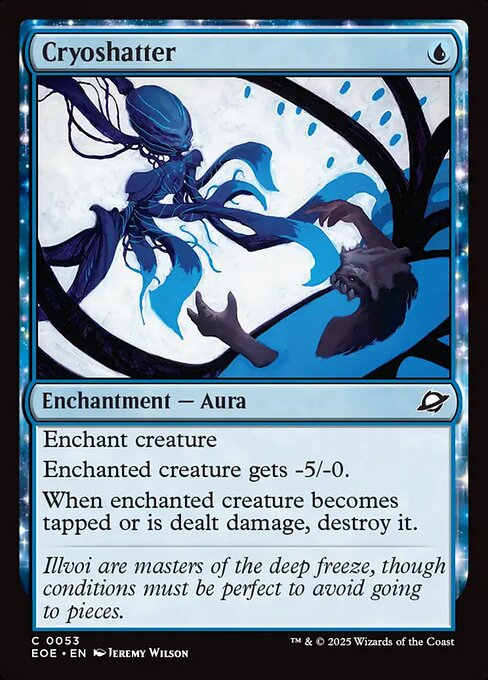
139. Cryoshatter
Rating5.4PlayableWhy this rating?
A solid playable that rarely gets cut (5.4/10).
Why. For one blue mana, this Aura gives -5/-0 and destroys the creature as soon as it taps or is dealt damage. It shuts down most attackers and blockers for almost nothing.
Risks. It does not remove the creature immediately: the opponent can leave it untapped and keep its static abilities and any that do not require tapping. A creature that never attacks or blocks stays useful.
In the draft. A cheap conditional removal, good in a blue deck, especially a tempo one. Think twice before putting it on a creature that does not need to attack.
Results in the games of the set
When it is in hand, the deck wins 56.1% of its games (set average: 56.0%, 120th of 287 cards).
In the opening hand: 53.3% wins (54.8% on average).
Drawn during the game: 57.7% (56.8% on average).
When it is drawn, the deck wins 2.1 points more than when it is not.
When it is drafted, it is played 83% of the time (set average: 62%).
Taken as the first pick (200 drafts), it ends in the deck 95% of the time.
It is played mostly in R/U decks (65% of them) and U/W (63%).
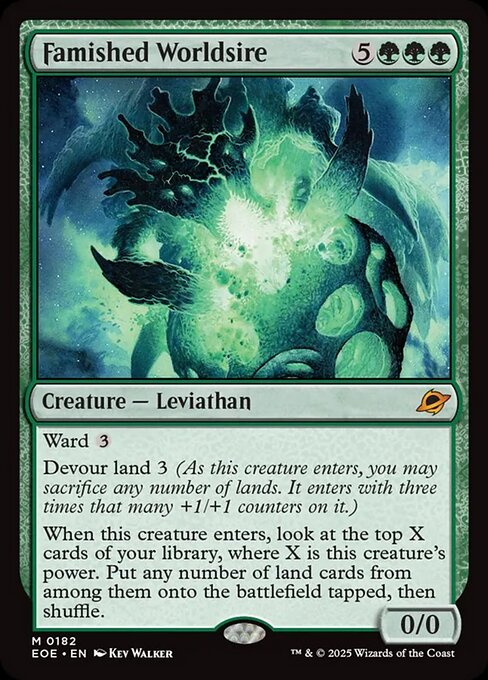
140. Famished Worldsire
Rating5.4PlayableWhy this rating?
A solid playable that rarely gets cut (5.4/10).
Why. A giant finisher: you sacrifice lands to make it larger (three +1/+1 counters per land), then it looks at the top of your library and puts the lands it finds onto the battlefield tapped to make up for them. With ward 3 it is hard to remove.
Risks. Eight mana with three green is very heavy. With no land sacrificed it is a 0/0 that dies at once, and sacrificing lands exposes you if the game does not end soon after.
In the draft. A late-game finisher for a slow green deck with mana acceleration. Take at most one, once your curve is secure.
Results in the games of the set
When it is in hand, the deck wins 54.3% of its games (set average: 56.0%, 174th of 287 cards).
In the opening hand: 51.4% wins (54.8% on average).
Drawn during the game: 56.3% (56.8% on average).
When it is drawn, the deck wins 1.5 points more than when it is not.
When it is drafted, it is played 79% of the time (set average: 62%).
Taken as the first pick (37 drafts), it ends in the deck 100% of the time.
It is played about as much in every archetype.
 Rating5.4Playable
Why this rating?
A solid playable that rarely gets cut (5.4/10).
Why. A 3/3 for three, with decent stats for the cost. At your end step it gains you 2 life if you control two or more tapped creatures, which happens after you attack.
Risks. The ability only triggers after tapping several creatures and stays modest. It is mostly just a body.
In the draft. A fair filler common for an aggressive white deck. Take it after your removal and your best creatures.
Results in the games of the set
When it is in hand, the deck wins 54.8% of its games (set average: 56.0%, 162nd of 287 cards).
In the opening hand: 54.8% wins (54.8% on average).
Drawn during the game: 54.8% (56.8% on average).
When it is drawn, the deck wins 0.7 points more than when it is not.
When it is drafted, it is played 27% of the time (set average: 62%).
Taken among the first three picks (63 drafts), it ends in the deck 70% of the time.
It is played mostly in R/W decks (26% of them).

142. Kav Landseeker
Rating5.4PlayableWhy this rating?
A solid playable that rarely gets cut (5.4/10).
Why. A 4/3 menace for four that makes a Lander token when it enters. Paying two puts a basic land onto the battlefield tapped, which improves your mana for the following turn.
Risks. The token is sacrificed at the end of your next turn, so you must use it in time or lose the land. Three toughness is not much against mid-sized creatures.
In the draft. A good aggressive common in a red deck, especially with green or black. A mid-curve pick that also ramps you.
Results in the games of the set
When it is in hand, the deck wins 56.4% of its games (set average: 56.0%, 110th of 287 cards).
In the opening hand: 54.9% wins (54.8% on average).
Drawn during the game: 57.3% (56.8% on average).
When it is drawn, the deck wins 1.4 points more than when it is not.
When it is drafted, it is played 78% of the time (set average: 62%).
Taken as the first pick (159 drafts), it ends in the deck 95% of the time.
It is played mostly in B/R decks (75% of them) and G/R (64%).

143. Radiant Strike
Rating5.4PlayableWhy this rating?
A solid playable that rarely gets cut (5.4/10).
Why. An instant that destroys an artifact or a tapped creature and gains you 3 life. Attackers are easy targets, and it also handles Spacecraft.
Risks. It cannot hit an untapped creature, so an opponent who stays home dodges it. Four mana is a bit expensive for a conditional answer.
In the draft. A fair removal in a white deck, better against opponents who attack a lot. Take it after more flexible removal.
Results in the games of the set
When it is in hand, the deck wins 55.9% of its games (set average: 56.0%, 126th of 287 cards).
In the opening hand: 53.2% wins (54.8% on average).
Drawn during the game: 57.6% (56.8% on average).
When it is drawn, the deck wins 2.1 points more than when it is not.
When it is drafted, it is played 64% of the time (set average: 62%).
Taken as the first pick (64 drafts), it ends in the deck 80% of the time.
It is played mostly in U/W decks (49% of them) and B/W (43%).
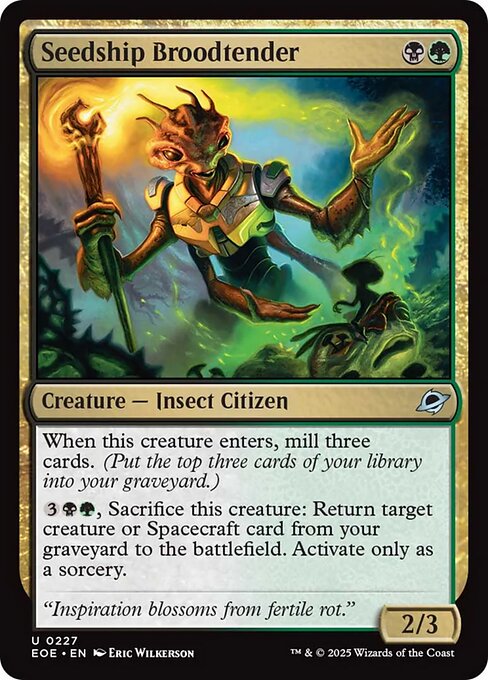
144. Seedship Broodtender
Rating5.4PlayableWhy this rating?
A solid playable that rarely gets cut (5.4/10).
Why. A 2/3 for two that mills three cards. Later you can sacrifice it for five mana to bring a creature or Spacecraft back from your graveyard to the battlefield, at sorcery speed.
Risks. It is two-colored and the second ability costs five mana. Without a worthwhile target in the graveyard it is just a small body.
In the draft. A fine pick for a black-green deck that wants long-term value. Unplayable outside those colors, so take it only if you are already there.
Results in the games of the set
When it is in hand, the deck wins 55.2% of its games (set average: 56.0%, 151st of 287 cards).
In the opening hand: 54.2% wins (54.8% on average).
Drawn during the game: 55.8% (56.8% on average).
When it is drawn, the deck wins 2.7 points more than when it is not.
When it is drafted, it is played 53% of the time (set average: 62%).
Taken as the first pick (69 drafts), it ends in the deck 86% of the time.
It is played mostly in B/G decks (56% of them).

145. Selfcraft Mechan
Rating5.4PlayableWhy this rating?
A solid playable that rarely gets cut (5.4/10).
Why. A solid 3/4 for four. If you sacrifice an artifact on entering, it puts a +1/+1 counter on target creature and draws a card, a nice bonus with a Lander token or any spare artifact.
Risks. With no artifact you want to give up it is just a body. The sacrifice (even of the creature itself) costs you a resource.
In the draft. A safe blue common that fits almost any blue deck. It goes after removal, but move it up as soon as your deck has a few artifacts.
Results in the games of the set
When it is in hand, the deck wins 56.4% of its games (set average: 56.0%, 106th of 287 cards).
In the opening hand: 54.2% wins (54.8% on average).
Drawn during the game: 57.7% (56.8% on average).
When it is drawn, the deck wins 2.8 points more than when it is not.
When it is drafted, it is played 75% of the time (set average: 62%).
Taken as the first pick (193 drafts), it ends in the deck 84% of the time.
It is played mostly in B/U decks (68% of them) and U/W (68%).
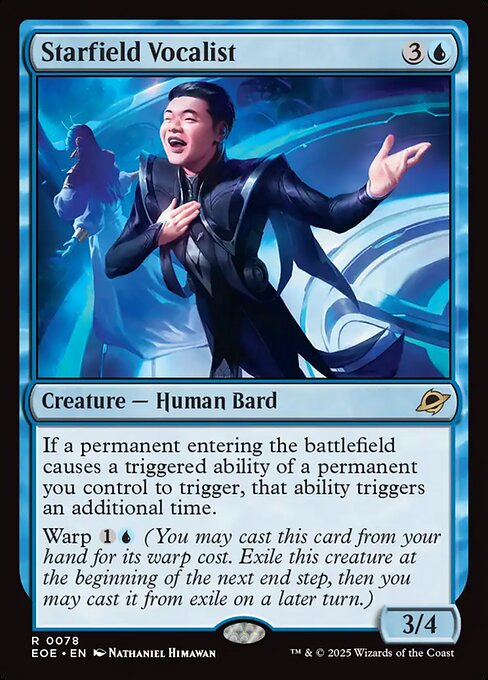
146. Starfield Vocalist
Rating5.4PlayableWhy this rating?
A solid playable that rarely gets cut (5.4/10).
Why. A 3/4 for four that makes triggered abilities of your permanents trigger an additional time when a permanent entering causes them, good with enter-the-battlefield effects or Landfall. Warp lets you cast it for two mana and recast it from exile later.
Risks. It does nothing without triggers that care about permanents entering. With no synergy it is a decent body and no more.
In the draft. A rare for a blue deck full of enter-the-battlefield effects, paired with green, black or white. Take it if your deck can make use of it.
Results in the games of the set
When it is in hand, the deck wins 53.8% of its games (set average: 56.0%, 192nd of 287 cards).
In the opening hand: 50.9% wins (54.8% on average).
Drawn during the game: 55.5% (56.8% on average).
When it is drawn, the deck wins 1.4 points more than when it is not.
When it is drafted, it is played 88% of the time (set average: 62%).
Taken as the first pick (95 drafts), it ends in the deck 89% of the time.
It is played about as much in every archetype.
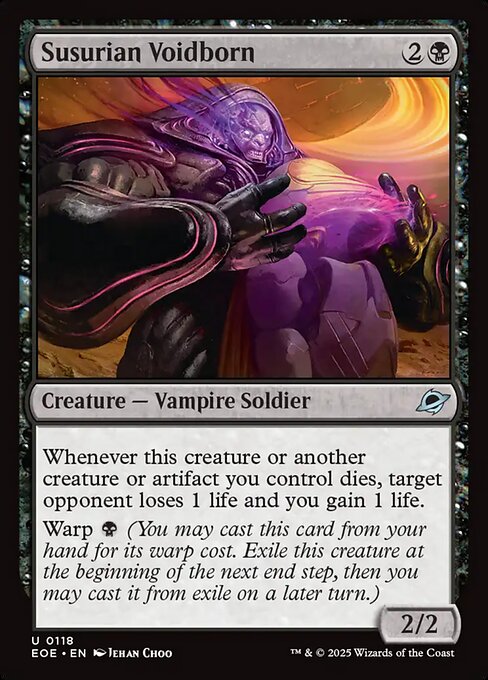
147. Susurian Voidborn
Rating5.4PlayableWhy this rating?
A solid playable that rarely gets cut (5.4/10).
Why. A 2/2 for three that drains 1 life whenever it or another creature or artifact you control dies. Warp for one black mana lets you play it early and recast it later.
Risks. A small body that dies easily, and the drain is modest. It needs many deaths to matter.
In the draft. A fair uncommon for an aggressive or trading black deck, with red or white. Not a priority, but useful when your deck trades a lot.
Results in the games of the set
When it is in hand, the deck wins 55.1% of its games (set average: 56.0%, 155th of 287 cards).
In the opening hand: 52.8% wins (54.8% on average).
Drawn during the game: 56.5% (56.8% on average).
When it is drawn, the deck wins 2.6 points more than when it is not.
When it is drafted, it is played 80% of the time (set average: 62%).
Taken as the first pick (90 drafts), it ends in the deck 90% of the time.
It is played mostly in B/W decks (33% of them) and B/R (28%).
 Rating5.4Playable
Why this rating?
A solid playable that rarely gets cut (5.4/10).
Why. A colorless three-mana planeswalker that gains a loyalty counter whenever an artifact enters under your control and untaps an artifact or creature. It can also fetch an artifact with mana value 1 or less.
Risks. It does not protect itself, does nothing in combat, and its ultimate is far away. Without artifacts it is fragile and underwhelming.
In the draft. A rare that is only good with plenty of artifacts. Take it for an artifact deck in blue-black, blue-red or black-red; otherwise it does not fit most decks.
Results in the games of the set
When it is in hand, the deck wins 52.0% of its games (set average: 56.0%, 236th of 287 cards).
In the opening hand: 50.8% wins (54.8% on average).
Drawn during the game: 52.8% (56.8% on average).
When it is drawn, the deck wins 0.4 points more than when it is not.
When it is drafted, it is played 91% of the time (set average: 62%).
Taken among the first three picks (142 drafts), it ends in the deck 89% of the time.
It is played about as much in every archetype.
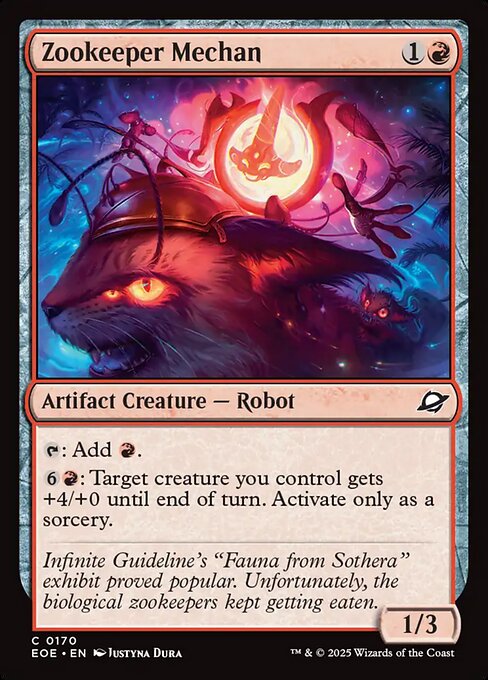
149. Zookeeper Mechan
Rating5.4PlayableWhy this rating?
A solid playable that rarely gets cut (5.4/10).
Why. A two-mana mana creature in a 1/3 body. Later it gives a creature +4/+0 for seven mana, which can end a stalled game.
Risks. The late ability costs seven mana and is sorcery-speed only. The 1/3 body barely attacks and scares nobody.
In the draft. A mana common for a top-heavy red deck. Take it as a supporting piece, not ahead of combat creatures.
Results in the games of the set
When it is in hand, the deck wins 56.1% of its games (set average: 56.0%, 116th of 287 cards).
In the opening hand: 57.7% wins (54.8% on average).
Drawn during the game: 55.0% (56.8% on average).
When it is drawn, the deck wins 1.7 points more than when it is not.
When it is drafted, it is played 85% of the time (set average: 62%).
Taken as the first pick (315 drafts), it ends in the deck 95% of the time.
It is played mostly in B/R decks (72% of them) and R/U (71%).
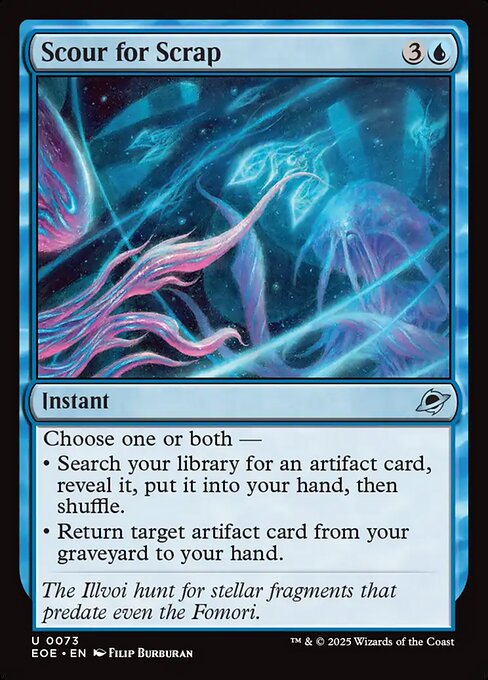
150. Scour for Scrap
Rating5.3PlayableWhy this rating?
A solid playable that rarely gets cut (5.3/10).
Why. An instant that tutors an artifact from your library, returns one from your graveyard, or both. A value tool that finds the card you need in an artifact deck.
Risks. Four mana for one or two cards with no effect on the board. In a deck with few artifacts it finds nothing.
In the draft. A specialist uncommon for a blue artifact deck, where it fetches your best Spacecraft or key artifact. Otherwise let it go.
Results in the games of the set
When it is in hand, the deck wins 54.6% of its games (set average: 56.0%, 165th of 287 cards).
In the opening hand: 50.3% wins (54.8% on average).
Drawn during the game: 57.0% (56.8% on average).
When it is drawn, the deck wins 3.1 points more than when it is not.
When it is drafted, it is played 38% of the time (set average: 62%).
Taken as the first pick (30 drafts), it ends in the deck 70% of the time.
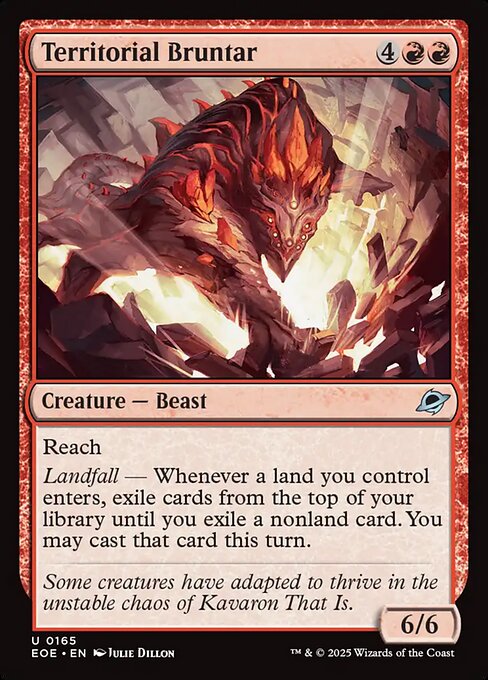
151. Territorial Bruntar
Rating5.3PlayableWhy this rating?
A solid playable that rarely gets cut (5.3/10).
Why. A 6/6 reach for six mana, a very large body. With Landfall, each land exiles cards from the top of your library until a nonland card you may cast this turn, so it is extra value with every land.
Risks. Six mana with two red, so it arrives late. The exiled card is lost if you cannot pay for it.
In the draft. An uncommon for a top-heavy red deck, strong when you have lands to play. Take it if you can survive until turn six.
Results in the games of the set
When it is in hand, the deck wins 55.8% of its games (set average: 56.0%, 130th of 287 cards).
In the opening hand: 53.1% wins (54.8% on average).
Drawn during the game: 57.5% (56.8% on average).
When it is drawn, the deck wins 2.2 points more than when it is not.
When it is drafted, it is played 75% of the time (set average: 62%).
Taken as the first pick (100 drafts), it ends in the deck 87% of the time.
It is played mostly in G/R decks (32% of them) and B/R (26%).
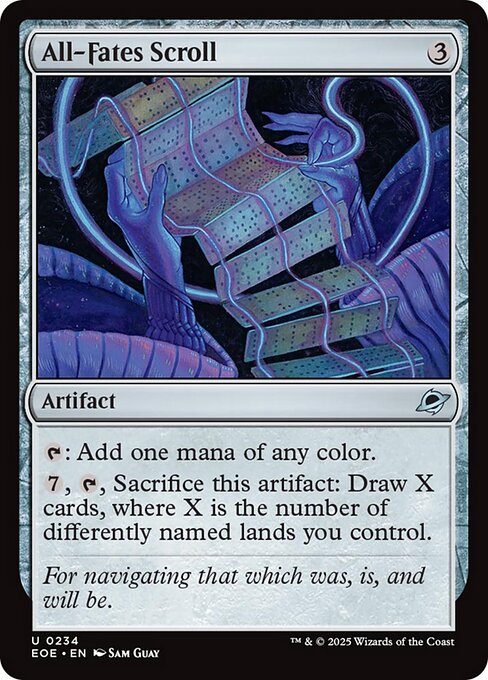
152. All-Fates Scroll
Rating5.2PlayableWhy this rating?
A solid playable that rarely gets cut (5.2/10).
Why. A three-mana rock that makes one mana of any color, useful fixing for a three-color deck. Late in the game it sacrifices to draw cards equal to your differently named lands.
Risks. It does nothing to the board and slows your tempo. The late ability costs seven mana and draws little with basic lands.
In the draft. Reasonable fixing for a slow or splash deck. Take it after good creatures and removal.
Results in the games of the set
When it is in hand, the deck wins 55.0% of its games (set average: 56.0%, 156th of 287 cards).
In the opening hand: 53.5% wins (54.8% on average).
Drawn during the game: 56.0% (56.8% on average).
When it is drawn, the deck wins 2.2 points more than when it is not.
When it is drafted, it is played 61% of the time (set average: 62%).
Taken as the first pick (73 drafts), it ends in the deck 79% of the time.
It is played about as much in every archetype.

153. Auxiliary Boosters
Rating5.2PlayableWhy this rating?
A solid playable that rarely gets cut (5.2/10).
Why. Five mana gets you an Equipment and a 2/2 Robot token that gets +1/+2 and flying, a 3/4 flyer on arrival. The Equipment can later move to another creature for three.
Risks. Expensive and slow in the early game. If the token is removed the Equipment stays, but you lose the free body.
In the draft. A solid white common for slower decks, good with black, green or blue. Take it after removal.
Results in the games of the set
When it is in hand, the deck wins 54.9% of its games (set average: 56.0%, 161st of 287 cards).
In the opening hand: 52.3% wins (54.8% on average).
Drawn during the game: 56.6% (56.8% on average).
When it is drawn, the deck wins 0.1 points less than when it is not.
When it is drafted, it is played 54% of the time (set average: 62%).
Taken as the first pick (41 drafts), it ends in the deck 88% of the time.
It is played mostly in R/W decks (48% of them) and B/W (45%).

154. Blooming Stinger
Rating5.2PlayableWhy this rating?
A solid playable that rarely gets cut (5.2/10).
Why. A 2/2 deathtouch for two that also gives another of your creatures deathtouch until end of turn. It discourages attacks, and the enter trigger can set up a double kill on an attack.
Risks. A small body: it dies to almost anything, and the opponent can simply ignore it.
In the draft. A good green common for both defense and offense, in any green pair. Take it ahead of most other two-drops.
Results in the games of the set
When it is in hand, the deck wins 55.5% of its games (set average: 56.0%, 143rd of 287 cards).
In the opening hand: 55.8% wins (54.8% on average).
Drawn during the game: 55.3% (56.8% on average).
When it is drawn, the deck wins 0.0 points more than when it is not.
When it is drafted, it is played 78% of the time (set average: 62%).
Taken as the first pick (77 drafts), it ends in the deck 92% of the time.
It is played mostly in B/G decks (58% of them) and G/U (56%).

155. Cerebral Download
Rating5.2PlayableWhy this rating?
A solid playable that rarely gets cut (5.2/10).
Why. An instant that draws three cards after surveilling X, where X is the number of artifacts you control. At five mana it is a big refuel for an artifact or control deck.
Risks. It has no board effect and costs five. Without artifacts it is just an expensive draw spell.
In the draft. A card-draw uncommon for a blue artifact or control deck. Take it after removal and good creatures.
Results in the games of the set
When it is in hand, the deck wins 55.1% of its games (set average: 56.0%, 154th of 287 cards).
In the opening hand: 51.3% wins (54.8% on average).
Drawn during the game: 57.3% (56.8% on average).
When it is drawn, the deck wins 2.1 points more than when it is not.
When it is drafted, it is played 67% of the time (set average: 62%).
Taken as the first pick (87 drafts), it ends in the deck 83% of the time.
It is played mostly in R/U decks (30% of them) and B/U (28%).

156. Comet Crawler
Rating5.2PlayableWhy this rating?
A solid playable that rarely gets cut (5.2/10).
Why. A 2/3 lifelink for three. When it attacks you may sacrifice another creature or an artifact to give it +2/+0 until end of turn.
Risks. The sacrifice costs a card, and the body is small. Without sacrificing, the attack is weak.
In the draft. A filler black common for a sacrifice or aggressive deck. Best with tokens or artifacts to feed it; otherwise pass.
Results in the games of the set
When it is in hand, the deck wins 53.8% of its games (set average: 56.0%, 191st of 287 cards).
In the opening hand: 53.0% wins (54.8% on average).
Drawn during the game: 54.4% (56.8% on average).
When it is drawn, the deck wins 1.2 points more than when it is not.
When it is drafted, it is played 32% of the time (set average: 62%).
Taken among the first three picks (83 drafts), it ends in the deck 71% of the time.
It is played mostly in B/W decks (32% of them) and B/R (30%).

157. Cosmogoyf
Rating5.2PlayableWhy this rating?
A solid playable that rarely gets cut (5.2/10).
Why. A two-mana, two-color creature whose power equals the number of cards you own in exile, and whose toughness is that number plus 1. With Warp and other exile effects it can grow, but most of the time it is a 0/1.
Risks. With no exiled cards it is very weak and stays small for a long time. Many decks never fill your exile zone.
In the draft. A rare that only works in a black-green deck that exiles lots of cards, such as with Warp effects. In an ordinary deck it is a tiny body, so do not take it early.
Results in the games of the set
When it is drafted, it is played only 1% of the time (set average: 62%): it almost always ends in the sideboard.
 Rating5.2Playable
Why this rating?
A solid playable that rarely gets cut (5.2/10).
Why. A 3/10 Spacecraft for four. As soon as it has a charge counter your opponent loses 3 life whenever they discard, and at 8 counters it becomes a flying, deathtouch creature that forces discards when it attacks.
Risks. It only becomes a creature after a lot of charge counters, which means tapping creatures with real power, and only at sorcery speed. Until then it is not a creature, so it cannot block.
In the draft. A slow, demanding rare that wants creatures with high power in your deck. Take it if you are black and have enough ways to station it.
Results in the games of the set
When it is in hand, the deck wins 52.5% of its games (set average: 56.0%, 226th of 287 cards).
In the opening hand: 51.3% wins (54.8% on average).
Drawn during the game: 53.2% (56.8% on average).
When it is drawn, the deck wins 1.9 points more than when it is not.
When it is drafted, it is played 73% of the time (set average: 62%).
Taken as the first pick (47 drafts), it ends in the deck 83% of the time.
It is played about as much in every archetype.

159. Icecave Crasher
Rating5.2PlayableWhy this rating?
A solid playable that rarely gets cut (5.2/10).
Why. A 4/4 trampler for four, a big body for the slot. Each land you play gives it +1/+0 until end of turn through Landfall, so it hits harder after a land drop.
Risks. It has no evasion beyond trample: a bigger blocker or a removal stops it. The bonus relies on your land drops.
In the draft. A good green common in any green pair. Take it as a reliable combat creature.
Results in the games of the set
When it is in hand, the deck wins 55.5% of its games (set average: 56.0%, 142nd of 287 cards).
In the opening hand: 54.7% wins (54.8% on average).
Drawn during the game: 56.1% (56.8% on average).
When it is drawn, the deck wins 0.4 points less than when it is not.
When it is drafted, it is played 67% of the time (set average: 62%).
Taken as the first pick (59 drafts), it ends in the deck 88% of the time.
It is played mostly in B/G decks (68% of them) and G/R (64%).

160. Lashwhip Predator
Rating5.2PlayableWhy this rating?
A solid playable that rarely gets cut (5.2/10).
Why. A 5/7 reach, an enormous body that costs two less if your opponents control three or more creatures. It stops nearly every attacker and blocks flyers.
Risks. At six mana without the discount it is slow, and the opponent can stay under three creatures. It does not win the game by itself.
In the draft. A green control or midrange uncommon. Take it as a defensive finisher, behind removal.
Results in the games of the set
When it is in hand, the deck wins 54.6% of its games (set average: 56.0%, 166th of 287 cards).
In the opening hand: 52.4% wins (54.8% on average).
Drawn during the game: 56.0% (56.8% on average).
When it is drawn, the deck wins 0.6 points more than when it is not.
When it is drafted, it is played 75% of the time (set average: 62%).
Taken as the first pick (99 drafts), it ends in the deck 84% of the time.
It is played mostly in G/R decks (26% of them).
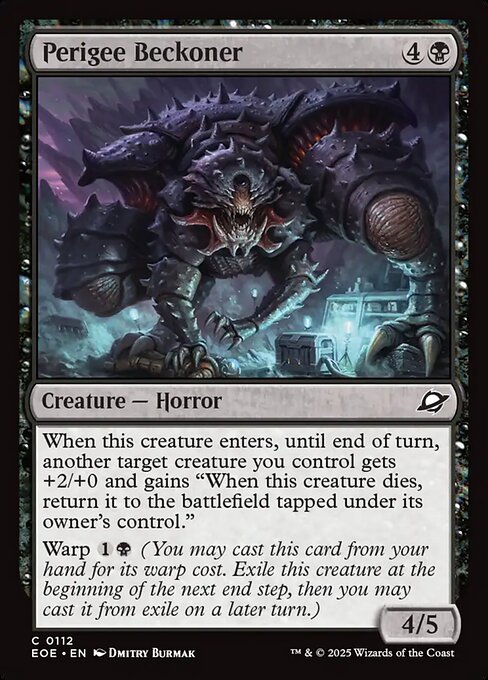
161. Perigee Beckoner
Rating5.2PlayableWhy this rating?
A solid playable that rarely gets cut (5.2/10).
Why. A 4/5 for five, but the real appeal is Warp for two: another creature of yours gets +2/+0 until end of turn and, if it dies, returns to the battlefield tapped. It is exiled at end of turn, then recast later as a big body.
Risks. It needs another creature for the enter effect to matter. On the warp turn it is not on the battlefield to defend.
In the draft. A flexible black common that works in nearly every black pair. Take it as a reliable filler creature.
Results in the games of the set
When it is in hand, the deck wins 56.6% of its games (set average: 56.0%, 94th of 287 cards).
In the opening hand: 54.0% wins (54.8% on average).
Drawn during the game: 58.2% (56.8% on average).
When it is drawn, the deck wins 2.5 points more than when it is not.
When it is drafted, it is played 73% of the time (set average: 62%).
Taken as the first pick (133 drafts), it ends in the deck 90% of the time.
It is played mostly in B/W decks (68% of them) and B/R (59%).

162. Slagdrill Scrapper
Rating5.2PlayableWhy this rating?
A solid playable that rarely gets cut (5.2/10).
Why. A 1/2 for one that can, for two mana, tap and sacrifice another artifact or land to draw a card. It turns a Lander token or a spare artifact into a card.
Risks. A small body with little board impact, and each draw costs two mana. Sacrificing lands slows your development.
In the draft. A filler common for a red artifact deck. Not a priority; play it only if you have things to sacrifice.
Results in the games of the set
When it is in hand, the deck wins 54.2% of its games (set average: 56.0%, 176th of 287 cards).
In the opening hand: 53.7% wins (54.8% on average).
Drawn during the game: 54.6% (56.8% on average).
When it is drawn, the deck wins 0.7 points more than when it is not.
When it is drafted, it is played 45% of the time (set average: 62%).
Taken among the first three picks (149 drafts), it ends in the deck 80% of the time.
It is played mostly in R/U decks (54% of them) and B/R (48%).
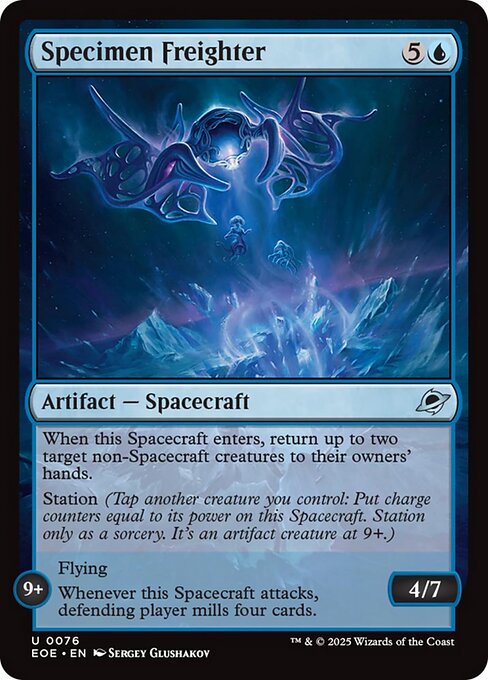
163. Specimen Freighter
Rating5.2PlayableWhy this rating?
A solid playable that rarely gets cut (5.2/10).
Why. A 4/7 Spacecraft for six that returns up to two non-Spacecraft creatures to their owners' hands, a big tempo swing. Once stationed to 9 it flies and mills the defending player for four cards when it attacks.
Risks. Six mana, and it only becomes a creature after a lot of charge counters. Bouncing does not remove creatures, it only slows them.
In the draft. A blue tempo uncommon, fine in a slow deck. Take it as a control card, with the blue pairs.
Results in the games of the set
When it is in hand, the deck wins 55.9% of its games (set average: 56.0%, 125th of 287 cards).
In the opening hand: 52.2% wins (54.8% on average).
Drawn during the game: 58.1% (56.8% on average).
When it is drawn, the deck wins 3.0 points more than when it is not.
When it is drafted, it is played 80% of the time (set average: 62%).
Taken as the first pick (136 drafts), it ends in the deck 87% of the time.
It is played mostly in B/U decks (28% of them) and R/U (28%).

164. Starport Security
Rating5.2PlayableWhy this rating?
A solid playable that rarely gets cut (5.2/10).
Why. A 1/1 for one that taps itself to tap another creature, for four mana, or two if you control a creature with a +1/+1 counter. A tool for neutralizing a blocker or an attacker.
Risks. Expensive to activate, and the body is tiny. Without +1/+1 counters the effect is slow.
In the draft. A white common for a slow or +1/+1 counter deck. Take it late in the pack.
Results in the games of the set
When it is in hand, the deck wins 53.7% of its games (set average: 56.0%, 195th of 287 cards).
In the opening hand: 53.8% wins (54.8% on average).
Drawn during the game: 53.6% (56.8% on average).
When it is drawn, the deck wins 0.0 points more than when it is not.
When it is drafted, it is played 37% of the time (set average: 62%).
Taken among the first three picks (84 drafts), it ends in the deck 76% of the time.
It is played mostly in G/W decks (42% of them) and U/W (32%).

165. Mental Modulation
Rating5.2PlayableWhy this rating?
A solid playable that rarely gets cut (5.2/10).
Why. An instant that taps an artifact or creature and draws a card, for two mana, or one during your turn. It replaces itself and can prevent a block or an attack.
Risks. It does not remove the creature, which untaps next turn. A small tempo effect with no lasting board impact.
In the draft. A blue tempo common for decks that attack, especially with white. Take it as filler.
Results in the games of the set
When it is in hand, the deck wins 53.4% of its games (set average: 56.0%, 207th of 287 cards).
In the opening hand: 50.4% wins (54.8% on average).
Drawn during the game: 55.3% (56.8% on average).
When it is drawn, the deck wins 0.9 points more than when it is not.
When it is drafted, it is played 26% of the time (set average: 62%).
Taken among the first three picks (81 drafts), it ends in the deck 70% of the time.
It is played mostly in U/W decks (59% of them).

166. Wedgelight Rammer
Rating5.1PlayableWhy this rating?
A solid playable that rarely gets cut (5.1/10).
Why. A 3/4 Spacecraft for four that makes a 2/2 Robot artifact creature token on entering, a real creature right away for a single spell. With Station it later becomes a flying first striker.
Risks. It only becomes a creature after lots of charge counters. Before that it neither attacks nor blocks.
In the draft. A fair white uncommon. Take it with high-power creatures that can station it, after your removal.
Results in the games of the set
When it is in hand, the deck wins 54.7% of its games (set average: 56.0%, 164th of 287 cards).
In the opening hand: 53.6% wins (54.8% on average).
Drawn during the game: 55.4% (56.8% on average).
When it is drawn, the deck wins 1.4 points more than when it is not.
When it is drafted, it is played 65% of the time (set average: 62%).
Taken as the first pick (66 drafts), it ends in the deck 83% of the time.
It is played about as much in every archetype.
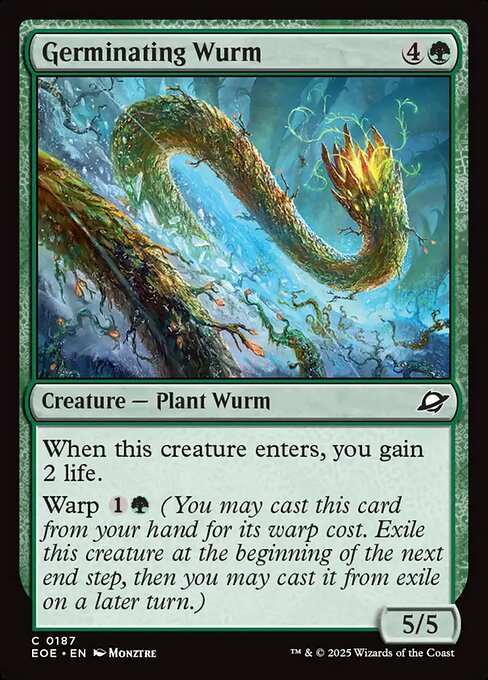
167. Germinating Wurm
Rating5.0PlayableWhy this rating?
A solid playable that rarely gets cut (5.0/10).
Why. A 5/5 for five that gains 2 life on entering, or a tempo play through Warp for two. A very large body for the cost.
Risks. It has no evasion, so removal or a double block stops it. A simple creature with no other ability.
In the draft. A good green common, better with blue or red. Take it as a solid combat creature.
Results in the games of the set
When it is in hand, the deck wins 55.7% of its games (set average: 56.0%, 132nd of 287 cards).
In the opening hand: 53.7% wins (54.8% on average).
Drawn during the game: 57.1% (56.8% on average).
When it is drawn, the deck wins 0.4 points more than when it is not.
When it is drafted, it is played 69% of the time (set average: 62%).
Taken as the first pick (78 drafts), it ends in the deck 90% of the time.
It is played mostly in B/G decks (61% of them) and G/U (60%).
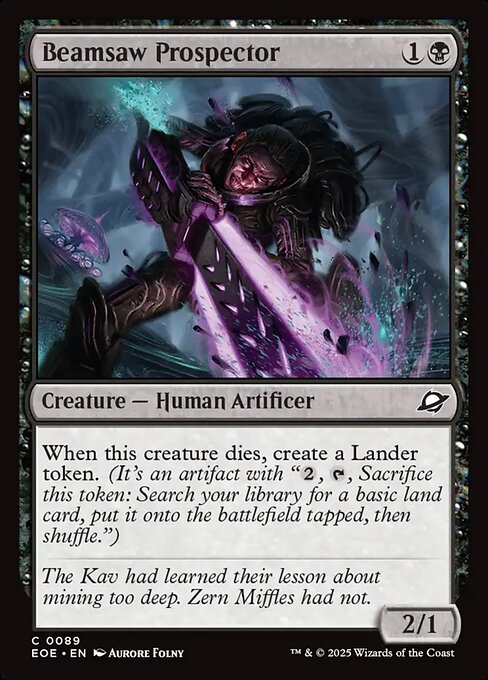
168. Beamsaw Prospector
Rating5.0PlayableWhy this rating?
A solid playable that rarely gets cut (5.0/10).
Why. A 2/1 for two that makes a Lander token when it dies. It trades well, and the land the token can fetch makes up for the loss.
Risks. A small body that dies to anything. The Lander token costs two mana to be useful.
In the draft. A filler black common, fine in an aggressive or trading deck. Take it as a reliable two-drop.
Results in the games of the set
When it is in hand, the deck wins 54.9% of its games (set average: 56.0%, 159th of 287 cards).
In the opening hand: 55.1% wins (54.8% on average).
Drawn during the game: 54.8% (56.8% on average).
When it is drawn, the deck wins 1.4 points more than when it is not.
When it is drafted, it is played 82% of the time (set average: 62%).
Taken as the first pick (125 drafts), it ends in the deck 93% of the time.
It is played mostly in B/R decks (66% of them) and B/W (66%).

169. Bombard
Rating5.0PlayableWhy this rating?
A solid playable that rarely gets cut (5.0/10).
Why. Clean, instant-speed removal: four damage for three mana deals with most creatures on the table, mid-combat included. No conditions, no extra cost.
Risks. It won't kill the biggest creatures or anything that has already grown past four toughness. It can't touch a Spacecraft that isn't a creature yet.
In the draft. A reliable removal spell to take happily in any red deck, though don't pass a much stronger card for it. You want several in your final deck.
Results in the games of the set
When it is in hand, the deck wins 54.2% of its games (set average: 56.0%, 177th of 287 cards).
In the opening hand: 52.1% wins (54.8% on average).
Drawn during the game: 55.6% (56.8% on average).
When it is drawn, the deck wins 0.8 points more than when it is not.
When it is drafted, it is played 77% of the time (set average: 62%).
Taken as the first pick (156 drafts), it ends in the deck 94% of the time.
It is played mostly in R/U decks (60% of them) and G/R (55%).

170. Emergency Eject
Rating5.0PlayableWhy this rating?
A solid playable that rarely gets cut (5.0/10).
Why. Three-mana instant-speed removal that hits any nonland permanent: creature, artifact or enchantment. It answers almost any threat.
Risks. The destroyed permanent's controller gets a Lander token, so they can fetch a basic land for two mana, a little free development for them. Using it on a small permanent is a poor trade.
In the draft. A good flexible answer for white decks: take it after your best creatures. Save it for real threats rather than burning it on a cheap target.
Results in the games of the set
When it is in hand, the deck wins 53.2% of its games (set average: 56.0%, 209th of 287 cards).
In the opening hand: 49.9% wins (54.8% on average).
Drawn during the game: 55.5% (56.8% on average).
When it is drawn, the deck wins 0.6 points more than when it is not.
When it is drafted, it is played 66% of the time (set average: 62%).
Taken as the first pick (45 drafts), it ends in the deck 91% of the time.
It is played about as much in every archetype.
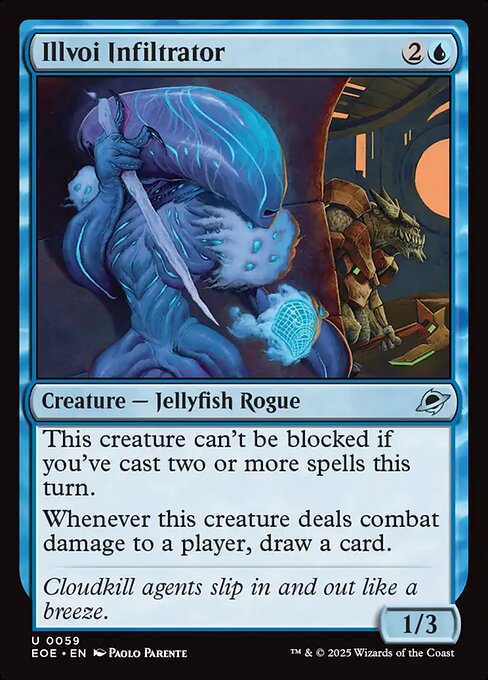
171. Illvoi Infiltrator
Rating5.0PlayableWhy this rating?
A solid playable that rarely gets cut (5.0/10).
Why. A three-mana 1/3 that becomes unblockable on turns where you cast two spells, drawing a card on each hit. With cheap spells, it's a steady card engine.
Risks. On its own it's a small body that doesn't attack well. It needs two-spell turns, which a slower deck won't manage every turn.
In the draft. A card for blue decks with plenty of cheap instants and small creatures. Playable, but not a high pick if your curve is top-heavy.
Results in the games of the set
When it is in hand, the deck wins 54.5% of its games (set average: 56.0%, 170th of 287 cards).
In the opening hand: 55.0% wins (54.8% on average).
Drawn during the game: 54.2% (56.8% on average).
When it is drawn, the deck wins 2.1 points more than when it is not.
When it is drafted, it is played 79% of the time (set average: 62%).
Taken as the first pick (142 drafts), it ends in the deck 87% of the time.
It is played mostly in U/W decks (40% of them) and B/U (26%).

172. Intrepid Tenderfoot
Rating5.0PlayableWhy this rating?
A solid playable that rarely gets cut (5.0/10).
Why. A two-mana 2/2 that stays relevant late: for three mana you add a +1/+1 counter, at sorcery speed only. In long games it turns spare mana into a growing threat.
Risks. Each counter costs most of a turn's mana and leaves the creature exposed to removal. It's slow when you're behind on board.
In the draft. A good green two-drop for the curve and for grindy games. Fine to take in the middle of a pack.
Results in the games of the set
When it is in hand, the deck wins 54.2% of its games (set average: 56.0%, 179th of 287 cards).
In the opening hand: 54.2% wins (54.8% on average).
Drawn during the game: 54.2% (56.8% on average).
When it is drawn, the deck wins 1.1 points less than when it is not.
When it is drafted, it is played 66% of the time (set average: 62%).
Taken as the first pick (41 drafts), it ends in the deck 90% of the time.
It is played mostly in G/R decks (49% of them) and G/W (45%).

173. Molecular Modifier
Rating5.0PlayableWhy this rating?
A solid playable that rarely gets cut (5.0/10).
Why. A three-mana 2/2 that gives one of your creatures +1/+0 and first strike at the start of combat on your turn, itself included. It makes your attacks and combats much more favourable.
Risks. The body is small and the bonus is only as good as the creature you boost. Kill it and the whole effect is gone.
In the draft. A good support piece for aggressive red decks with plenty of creatures. Not a first pick, but useful in the middle of a pack.
Results in the games of the set
When it is in hand, the deck wins 54.4% of its games (set average: 56.0%, 173rd of 287 cards).
In the opening hand: 53.8% wins (54.8% on average).
Drawn during the game: 54.8% (56.8% on average).
When it is drawn, the deck wins 0.8 points more than when it is not.
When it is drafted, it is played 68% of the time (set average: 62%).
Taken as the first pick (54 drafts), it ends in the deck 85% of the time.
It is played mostly in R/W decks (30% of them).
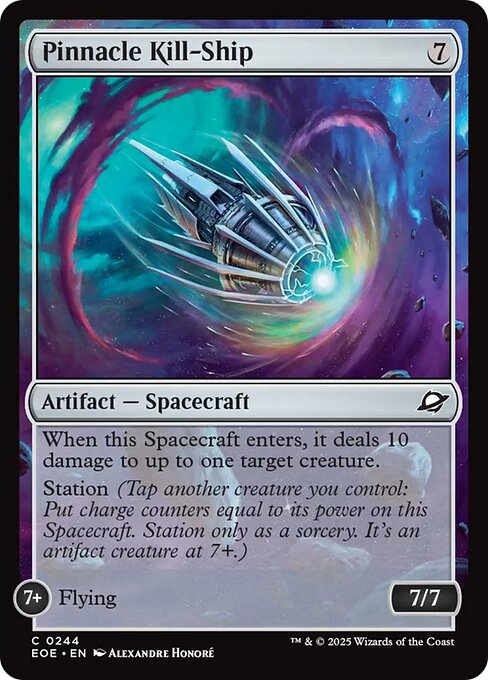
174. Pinnacle Kill-Ship
Rating5.0PlayableWhy this rating?
A solid playable that rarely gets cut (5.0/10).
Why. Seven mana, but the Spacecraft deals ten damage to a creature when it enters, which answers almost anything. After that it becomes a 7/7 flyer once Station has put seven charge counters on it.
Risks. Seven mana is a lot; against a fast deck it arrives too late. Until it is animated it's just an artifact.
In the draft. A fine top-end card, one copy, in decks that expect long games. Don't take it ahead of cheap removal.
Results in the games of the set
When it is in hand, the deck wins 56.6% of its games (set average: 56.0%, 97th of 287 cards).
In the opening hand: 52.9% wins (54.8% on average).
Drawn during the game: 58.8% (56.8% on average).
When it is drawn, the deck wins 2.3 points more than when it is not.
When it is drafted, it is played 75% of the time (set average: 62%).
Taken as the first pick (115 drafts), it ends in the deck 91% of the time.
It is played mostly in G/R decks (37% of them) and G/U (36%).

175. Sami's Curiosity
Rating5.0PlayableWhy this rating?
A solid playable that rarely gets cut (5.0/10).
Why. For one green mana you gain two life and create a Lander token, which fetches a basic land for two mana. It's cheap fixing and ramp that helps you reach your expensive cards.
Risks. On its own it does nothing to the board, and it slows your development if it replaces a real creature. An aggressive deck doesn't want it.
In the draft. A useful tool for green decks with top-end cards or a splash. Take it late, one or two copies.
Results in the games of the set
When it is in hand, the deck wins 53.8% of its games (set average: 56.0%, 193rd of 287 cards).
In the opening hand: 55.7% wins (54.8% on average).
Drawn during the game: 52.3% (56.8% on average).
When it is drawn, the deck wins 0.5 points less than when it is not.
When it is drafted, it is played 69% of the time (set average: 62%).
Taken as the first pick (99 drafts), it ends in the deck 85% of the time.
It is played mostly in B/G decks (62% of them) and G/W (53%).

176. Weftstalker Ardent
Rating5.0PlayableWhy this rating?
A solid playable that rarely gets cut (5.0/10).
Why. A three-mana 2/3 that deals one damage to each opponent whenever another creature or artifact enters under your control. With warp for one red mana, it can also come down very early.
Risks. Each ping is small: without plenty of creatures and artifacts, it does little. The body only holds off small attackers.
In the draft. A decent support card for aggressive red decks with many cheap creatures. Take it in the middle of a pack, and don't pay extra for it.
Results in the games of the set
When it is in hand, the deck wins 53.4% of its games (set average: 56.0%, 205th of 287 cards).
In the opening hand: 53.0% wins (54.8% on average).
Drawn during the game: 53.7% (56.8% on average).
When it is drawn, the deck wins 0.8 points more than when it is not.
When it is drafted, it is played 61% of the time (set average: 62%).
Taken as the first pick (37 drafts), it ends in the deck 86% of the time.
It is played mostly in R/W decks (25% of them).

177. Zealous Display
Rating5.0PlayableWhy this rating?
A solid playable that rarely gets cut (5.0/10).
Why. A three-mana instant that gives all your creatures +2/+0. If it isn't your turn, it untaps them too: cast before blocks, it puts your creatures that attacked back on defence.
Risks. It does nothing without several creatures on the battlefield, and it's a dead card if the board is cleared. Slower decks can't use it well.
In the draft. A finisher for very aggressive white decks with many small creatures. Otherwise leave it at the bottom of the pack.
Results in the games of the set
When it is in hand, the deck wins 51.9% of its games (set average: 56.0%, 238th of 287 cards).
In the opening hand: 49.0% wins (54.8% on average).
Drawn during the game: 53.9% (56.8% on average).
When it is drawn, the deck wins 1.7 points less than when it is not.
When it is drafted, it is played only 8% of the time (set average: 62%): it almost always ends in the sideboard.
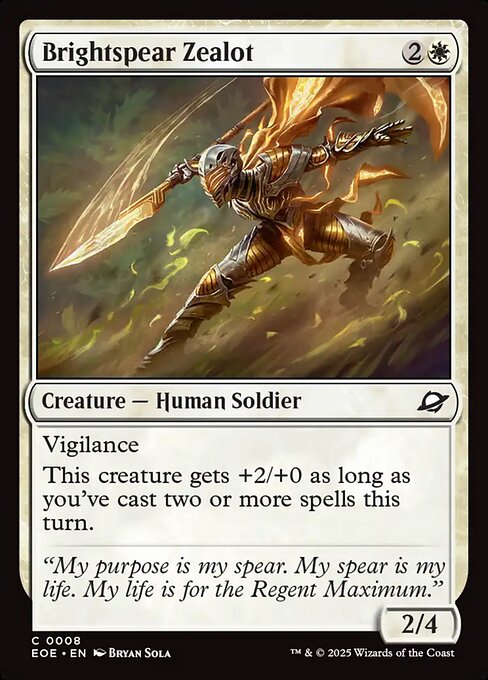
178. Brightspear Zealot
Rating5.0WeakWhy this rating?
A solid playable that rarely gets cut (5.0/10).
Why. A three-mana 2/4 with vigilance: it attacks and defends in the same turn, and becomes a 4/4 on turns where you cast two spells. A sturdy body that holds the ground.
Risks. Alone, it hits softly and can't block flyers. It needs a deck with plenty of cheap spells to reach its full size.
In the draft. A good white three-drop filler, especially in white-blue with cheap spells. Take it in the middle of a pack.
Results in the games of the set
When it is in hand, the deck wins 53.4% of its games (set average: 56.0%, 204th of 287 cards).
In the opening hand: 53.1% wins (54.8% on average).
Drawn during the game: 53.7% (56.8% on average).
When it is drawn, the deck wins 0.1 points less than when it is not.
When it is drafted, it is played 23% of the time (set average: 62%).
Taken among the first three picks (57 drafts), it ends in the deck 60% of the time.
It is played mostly in U/W decks (28% of them).
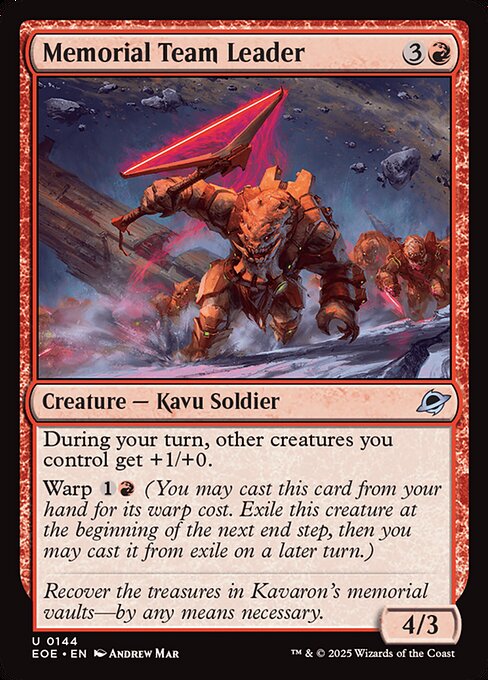
179. Memorial Team Leader
Rating4.9WeakWhy this rating?
A solid playable that rarely gets cut (4.9/10).
Why. A four-mana 4/3 that gives your other creatures +1/+0 during your turn. With warp for two mana, you can cast it early to pump your other creatures for one attack, then recast it later from exile.
Risks. It has low toughness and does nothing on defence. Without many creatures alongside it, the bonus is small.
In the draft. A good choice for aggressive red decks with plenty of creatures. Take it in the middle of a pack; it's not a first pick.
Results in the games of the set
When it is in hand, the deck wins 53.5% of its games (set average: 56.0%, 202nd of 287 cards).
In the opening hand: 52.2% wins (54.8% on average).
Drawn during the game: 54.5% (56.8% on average).
When it is drawn, the deck wins 0.4 points more than when it is not.
When it is drafted, it is played 49% of the time (set average: 62%).
Taken among the first three picks (131 drafts), it ends in the deck 73% of the time.
It is played mostly in R/W decks (26% of them).
 Rating4.8Weak
Why this rating?
A solid playable that rarely gets cut (4.8/10).
Why. A discard sorcery: your opponent reveals their hand and you choose a nonland card for them to discard. With Void it costs two less, so just one mana, and chains easily into another spell.
Risks. Discard doesn't affect the board, and it's weak against an opponent who has already emptied their hand. Void isn't always on.
In the draft. A niche card, mostly for black decks with warp or permanents that leave the battlefield. Rarely more than a last pick.
Results in the games of the set
When it is in hand, the deck wins 50.7% of its games (set average: 56.0%, 260th of 287 cards).
In the opening hand: 49.0% wins (54.8% on average).
Drawn during the game: 51.8% (56.8% on average).
When it is drawn, the deck wins 1.4 points more than when it is not.
When it is drafted, it is played only 4% of the time (set average: 62%): it almost always ends in the sideboard.
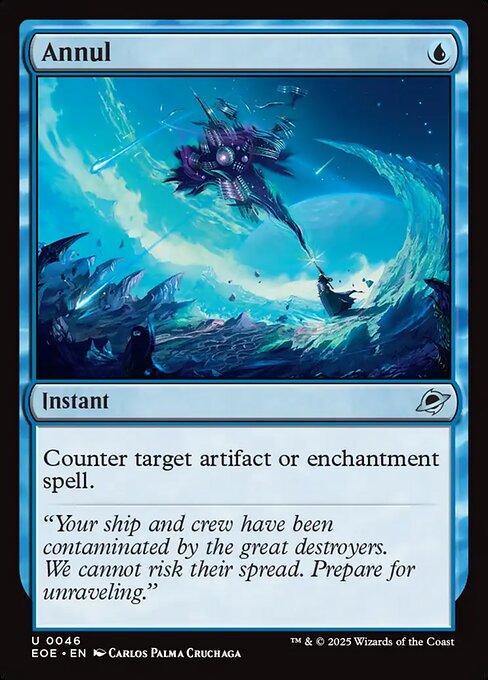
181. Annul
Rating4.8WeakWhy this rating?
A solid playable that rarely gets cut (4.8/10).
Why. For one blue mana it counters an artifact or enchantment spell. In a set where Spacecraft are artifacts, it has targets, but only if the opponent plays the right cards.
Risks. It's dead when your opponent plays no artifacts or enchantments, and it does nothing on its own. A purely reactive card.
In the draft. A sideboard card: don't main-deck it. Take it only as a last pick, if you see opponents playing artifacts.
Results in the games of the set
When it is in hand, the deck wins 51.0% of its games (set average: 56.0%, 255th of 287 cards).
In the opening hand: 48.5% wins (54.8% on average).
Drawn during the game: 52.6% (56.8% on average).
When it is drawn, the deck wins 1.1 points more than when it is not.
When it is drafted, it is played 21% of the time (set average: 62%).
Taken among the first three picks (61 drafts), it ends in the deck 72% of the time.

182. Chrome Companion
Rating4.8WeakWhy this rating?
A solid playable that rarely gets cut (4.8/10).
Why. A colourless two-mana 2/1 that gains you a life each time it becomes tapped, attacking included, and for two mana can put a graveyard card on the bottom of its owner's library. It fits in any deck.
Risks. It's small and fragile, and the lifegain is minor. The graveyard ability is slow: two mana and a tap for a small gain.
In the draft. A filler two-drop for every colour. Take it late to fill out the curve.
Results in the games of the set
When it is in hand, the deck wins 53.2% of its games (set average: 56.0%, 210th of 287 cards).
In the opening hand: 52.4% wins (54.8% on average).
Drawn during the game: 53.8% (56.8% on average).
When it is drawn, the deck wins 0.1 points less than when it is not.
When it is drafted, it is played 32% of the time (set average: 62%).
Taken among the first three picks (62 drafts), it ends in the deck 63% of the time.
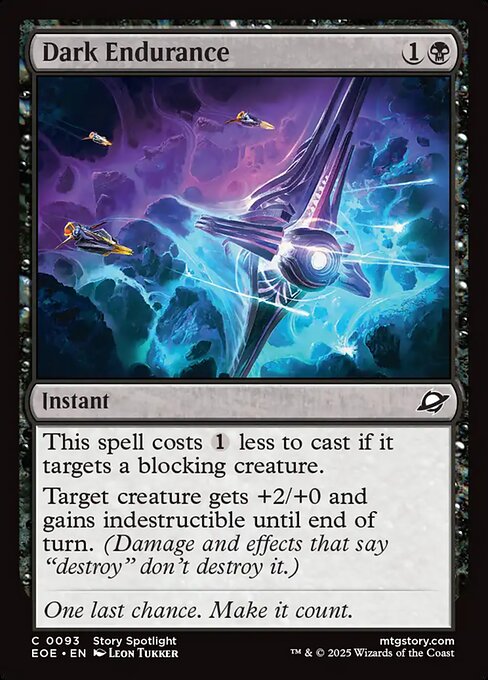
183. Dark Endurance
Rating4.8WeakWhy this rating?
A solid playable that rarely gets cut (4.8/10).
Why. An instant that gives +2/+0 and indestructible: it turns a bad combat into a good trade, or protects a creature from destroy effects. It costs one less if it targets a blocking creature.
Risks. It needs a creature to protect and doesn't stop exile or sacrifice. It's a combat trick, with the usual risk of a two-for-one if answered.
In the draft. A passable trick for creature-heavy black decks, but not one to chase. Take it late, behind your creatures and removal.
Results in the games of the set
When it is in hand, the deck wins 51.9% of its games (set average: 56.0%, 237th of 287 cards).
In the opening hand: 48.0% wins (54.8% on average).
Drawn during the game: 54.6% (56.8% on average).
When it is drawn, the deck wins 0.5 points more than when it is not.
When it is drafted, it is played only 4% of the time (set average: 62%): it almost always ends in the sideboard.

184. Dockworker Drone
Rating4.8WeakWhy this rating?
A solid playable that rarely gets cut (4.8/10).
Why. A two-mana artifact creature: a 1/1 that enters with a +1/+1 counter, so a 2/2. When it dies it puts its counters on a creature you control, which softens the trade.
Risks. A 2/2 is still a small body, and it does nothing against bigger creatures. The transfer does nothing if you have no other creature.
In the draft. A solid two-drop that fits many white decks, especially those with other counters. Take it in the middle of a pack.
Results in the games of the set
When it is in hand, the deck wins 54.3% of its games (set average: 56.0%, 175th of 287 cards).
In the opening hand: 54.2% wins (54.8% on average).
Drawn during the game: 54.3% (56.8% on average).
When it is drawn, the deck wins 0.4 points less than when it is not.
When it is drafted, it is played 80% of the time (set average: 62%).
Taken as the first pick (71 drafts), it ends in the deck 97% of the time.
It is played mostly in G/W decks (69% of them) and B/W (59%).
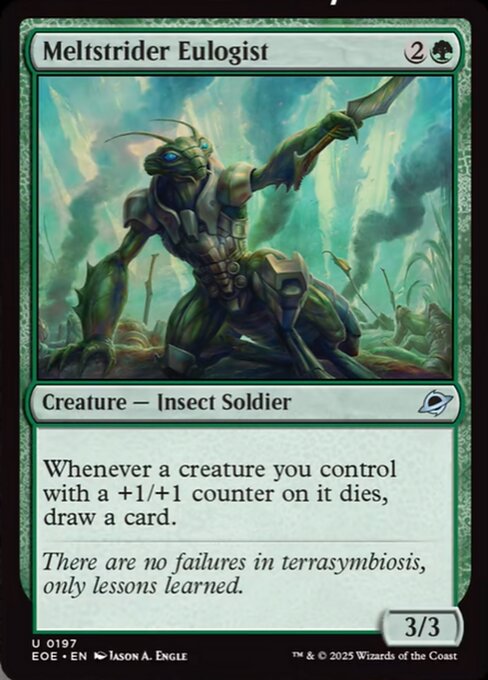
185. Meltstrider Eulogist
Rating4.8WeakWhy this rating?
A solid playable that rarely gets cut (4.8/10).
Why. A three-mana 3/3, already a good body, that draws a card whenever one of your creatures with a +1/+1 counter dies. In a counters deck every loss is paid back with a card.
Risks. Without counters in your deck it's just a vanilla 3/3. If it's killed first, it draws nothing.
In the draft. A good green three-drop, especially alongside white and its counters. Take it in the middle of a pack, higher if you already have several counter creatures.
Results in the games of the set
When it is in hand, the deck wins 52.9% of its games (set average: 56.0%, 214th of 287 cards).
In the opening hand: 52.5% wins (54.8% on average).
Drawn during the game: 53.2% (56.8% on average).
When it is drawn, the deck wins 0.9 points less than when it is not.
When it is drafted, it is played 62% of the time (set average: 62%).
Taken as the first pick (53 drafts), it ends in the deck 79% of the time.
It is played mostly in G/W decks (35% of them).
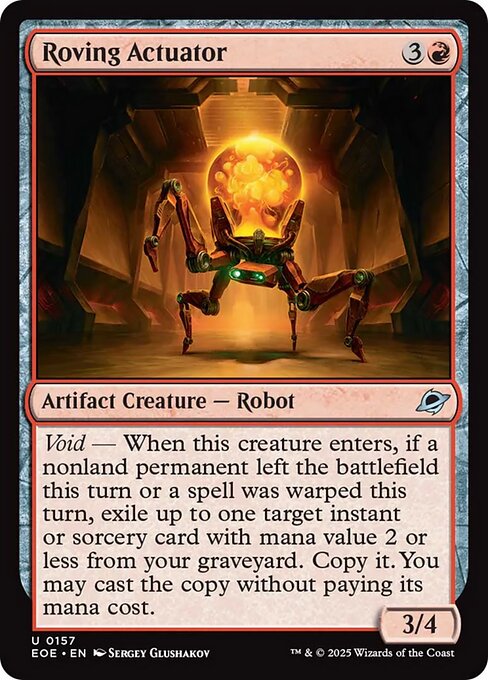
186. Roving Actuator
Rating4.8WeakWhy this rating?
A solid playable that rarely gets cut (4.8/10).
Why. A four-mana artifact 3/4, a sturdy body, that can recast an instant or sorcery with mana value two or less from your graveyard for free if Void is on. A fine way to replay cheap removal.
Risks. Void needs a nonland permanent to have left the battlefield or a warped spell this turn, and you need a good spell already in the graveyard. Without that it's a plain 3/4.
In the draft. A good pick for red decks with cheap spells and warp. Take it in the middle of a pack.
Results in the games of the set
When it is in hand, the deck wins 52.3% of its games (set average: 56.0%, 231st of 287 cards).
In the opening hand: 49.6% wins (54.8% on average).
Drawn during the game: 54.1% (56.8% on average).
When it is drawn, the deck wins 0.7 points less than when it is not.
When it is drafted, it is played 27% of the time (set average: 62%).
Taken among the first three picks (64 drafts), it ends in the deck 59% of the time.

187. Shattered Wings
Rating4.8WeakWhy this rating?
A solid playable that rarely gets cut (4.8/10).
Why. A three-mana sorcery that destroys an artifact, an enchantment or a creature with flying, then surveils 1. Against Spacecraft or flyers it has good targets.
Risks. It's very conditional: against a deck with no flyers, artifacts or enchantments it's dead in hand. It's also slow, at sorcery speed.
In the draft. A fine sideboard card, or maindeck if opponents are playing Spacecraft. Take it late, one copy.
Results in the games of the set
When it is in hand, the deck wins 51.5% of its games (set average: 56.0%, 249th of 287 cards).
In the opening hand: 48.8% wins (54.8% on average).
Drawn during the game: 53.5% (56.8% on average).
When it is drawn, the deck wins 0.8 points less than when it is not.
When it is drafted, it is played 21% of the time (set average: 62%).
Taken among the first three picks (36 drafts), it ends in the deck 69% of the time.

188. Skystinger
Rating4.8WeakWhy this rating?
A solid playable that rarely gets cut (4.8/10).
Why. A three-mana 3/3 with reach, already a good body. When it blocks a creature with flying it gets +5/+0 and kills nearly anything it blocks.
Risks. Against decks without flyers it's just a 3/3 that does nothing special. It needs the opponent to attack in the air.
In the draft. A good green three-drop, especially against flyers. Take it in the middle of a pack, higher if the sky worries you.
Results in the games of the set
When it is in hand, the deck wins 52.8% of its games (set average: 56.0%, 217th of 287 cards).
In the opening hand: 51.9% wins (54.8% on average).
Drawn during the game: 53.4% (56.8% on average).
When it is drawn, the deck wins 0.9 points less than when it is not.
When it is drafted, it is played 20% of the time (set average: 62%).
Taken among the first three picks (66 drafts), it ends in the deck 59% of the time.

189. Starfighter Pilot
Rating4.8WeakWhy this rating?
A solid playable that rarely gets cut (4.8/10).
Why. A two-mana 2/2 that surveils 1 each time it becomes tapped, whether attacking or for Station. It steadily improves your draws.
Risks. A 2/2 stays fragile and does nothing decisive. Surveil 1 is a small edge that won't win the game alone.
In the draft. A good white two-drop, all the more with Spacecraft to charge up. Take it in the middle of a pack for the curve.
Results in the games of the set
When it is in hand, the deck wins 54.1% of its games (set average: 56.0%, 184th of 287 cards).
In the opening hand: 55.1% wins (54.8% on average).
Drawn during the game: 53.4% (56.8% on average).
When it is drawn, the deck wins 0.3 points less than when it is not.
When it is drafted, it is played 61% of the time (set average: 62%).
Taken as the first pick (44 drafts), it ends in the deck 77% of the time.
It is played mostly in R/W decks (58% of them) and B/W (57%).

190. Susurian Dirgecraft
Rating4.8WeakWhy this rating?
A solid playable that rarely gets cut (4.8/10).
Why. Five mana, and when it enters each opponent sacrifices a nontoken creature of their choice. It's removal that doesn't miss against an opponent with a single creature, and the Spacecraft stays behind.
Risks. The opponent chooses: with several creatures, they sacrifice the weakest, and tokens don't count. Until it has seven charge counters it isn't a creature.
In the draft. A good black removal spell for decks that make plenty of trades. Take it fairly high in the middle of a pack, especially against lone threats.
Results in the games of the set
When it is in hand, the deck wins 54.1% of its games (set average: 56.0%, 186th of 287 cards).
In the opening hand: 50.9% wins (54.8% on average).
Drawn during the game: 56.0% (56.8% on average).
When it is drawn, the deck wins 1.9 points more than when it is not.
When it is drafted, it is played 66% of the time (set average: 62%).
Taken as the first pick (59 drafts), it ends in the deck 83% of the time.
It is played about as much in every archetype.

191. Lithobraking
Rating4.8WeakWhy this rating?
A solid playable that rarely gets cut (4.8/10).
Why. A three-mana instant: you create a Lander token, then you may sacrifice an artifact, the Lander included, to deal two damage to each creature. A sweeper for small creatures that costs you an artifact.
Risks. It hits every creature, yours too, and two damage only kills small bodies. In a creature deck it costs you as well.
In the draft. A card for red control decks or decks with big creatures. Take it late, unless the table is full of small creatures.
Results in the games of the set
When it is in hand, the deck wins 51.6% of its games (set average: 56.0%, 246th of 287 cards).
In the opening hand: 49.3% wins (54.8% on average).
Drawn during the game: 53.3% (56.8% on average).
When it is drawn, the deck wins 0.8 points less than when it is not.
When it is drafted, it is played 26% of the time (set average: 62%).
Taken among the first three picks (67 drafts), it ends in the deck 66% of the time.

192. Remnant Elemental
Rating4.7WeakWhy this rating?
A solid playable that rarely gets cut (4.7/10).
Why. A two-mana 0/4 with reach: an excellent early blocker on the ground and in the air. Each land that enters under your control (Landfall) gives it +2/+0 until end of turn, which can turn it into an attacker.
Risks. With no land to play, it doesn't attack, and the bonus only lasts the turn. It does nothing offensive on its own.
In the draft. A good early play for defensive red-green decks with ways to put extra lands onto the battlefield. Take it in the middle of a pack.
Results in the games of the set
When it is in hand, the deck wins 52.0% of its games (set average: 56.0%, 235th of 287 cards).
In the opening hand: 53.7% wins (54.8% on average).
Drawn during the game: 50.7% (56.8% on average).
When it is drawn, the deck wins 1.4 points less than when it is not.
When it is drafted, it is played 29% of the time (set average: 62%).
Taken among the first three picks (63 drafts), it ends in the deck 67% of the time.
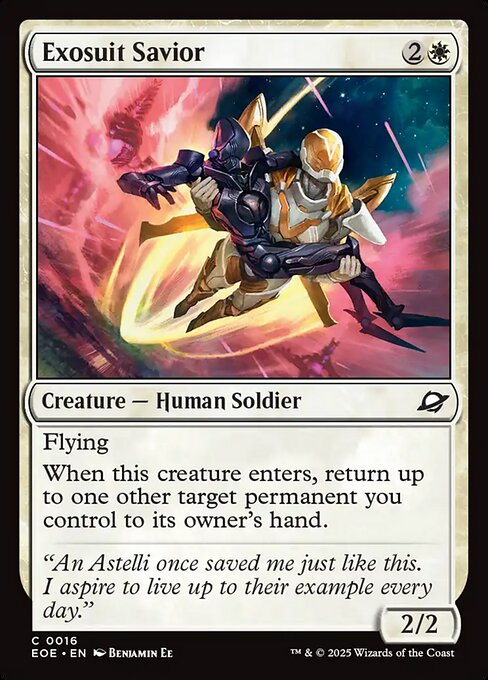
193. Exosuit Savior
Rating4.6WeakWhy this rating?
A solid playable that rarely gets cut (4.6/10).
Why. A three-mana 2/2 with flying that can return another permanent you control to your hand when it enters. You can reuse an enter effect or save a threatened permanent while keeping an evasive body.
Risks. The body is fragile and the effect is optional. Without a good target, it's just a 2/2 flyer.
In the draft. A good white three-drop, especially with enter-the-battlefield effects. Take it in the middle of a pack.
Results in the games of the set
When it is in hand, the deck wins 52.4% of its games (set average: 56.0%, 227th of 287 cards).
In the opening hand: 49.8% wins (54.8% on average).
Drawn during the game: 54.2% (56.8% on average).
When it is drawn, the deck wins 1.7 points less than when it is not.
When it is drafted, it is played 42% of the time (set average: 62%).
Taken among the first three picks (141 drafts), it ends in the deck 76% of the time.
It is played mostly in B/W decks (45% of them) and U/W (37%).
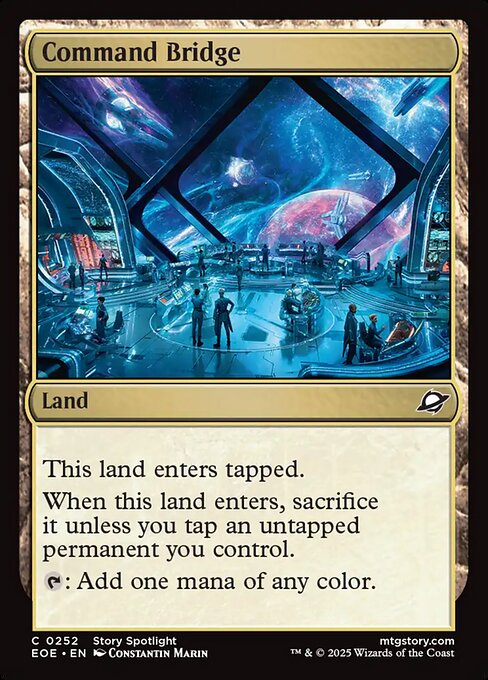
194. Command Bridge
Rating4.6WeakWhy this rating?
A solid playable that rarely gets cut (4.6/10).
Why. A land that taps for one mana of any colour: good fixing for three-colour decks or a splash. The price is entering tapped and tapping an untapped permanent as it arrives.
Risks. If you have no untapped permanent to tap, you sacrifice it, so it's poor on an empty board in the early turns.
In the draft. A fixing land to take in decks with several colours. In a straight two-colour deck it is rarely useful.
Results in the games of the set
When it is in hand, the deck wins 52.9% of its games (set average: 56.0%, 213th of 287 cards).
In the opening hand: 52.6% wins (54.8% on average).
Drawn during the game: 53.2% (56.8% on average).
When it is drawn, the deck wins 0.5 points less than when it is not.
When it is drafted, it is played 72% of the time (set average: 62%).
Taken as the first pick (50 drafts), it ends in the deck 88% of the time.

195. Fungal Colossus
Rating4.6WeakWhy this rating?
A solid playable that rarely gets cut (4.6/10).
Why. A 5/5 that costs seven mana, minus one for each differently named land you control. With several land types, nonbasic lands or Landers to fetch them, it lands much earlier as a big body.
Risks. With only two basic land types it still costs five, and removal on it is a bad trade for you. It has no other ability.
In the draft. A good top-end for green decks with fixing and varied lands. Take it in the middle of a pack, one copy.
Results in the games of the set
When it is in hand, the deck wins 55.4% of its games (set average: 56.0%, 145th of 287 cards).
In the opening hand: 53.5% wins (54.8% on average).
Drawn during the game: 56.7% (56.8% on average).
When it is drawn, the deck wins 0.9 points more than when it is not.
When it is drafted, it is played 46% of the time (set average: 62%).
Taken as the first pick (32 drafts), it ends in the deck 69% of the time.
It is played mostly in B/G decks (50% of them) and G/R (31%).
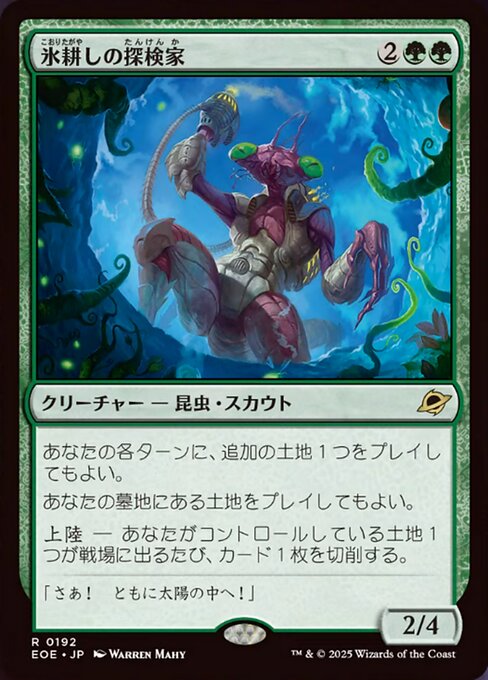
196. Icetill Explorer
Rating4.6WeakWhy this rating?
A solid playable that rarely gets cut (4.6/10).
Why. A four-mana 2/4 that lets you play an extra land each turn and play lands from your graveyard. Each land that enters also mills a card from your library (Landfall), which feeds its own graveyard lands.
Risks. It does almost nothing without payoffs for the extra lands, and its Landfall mills your own library. The body doesn't attack well.
In the draft. A card for very specialised land decks. Leave it out of most decks; take it late if you already have several Landfall cards.
Results in the games of the set
When it is in hand, the deck wins 51.8% of its games (set average: 56.0%, 239th of 287 cards).
In the opening hand: 51.0% wins (54.8% on average).
Drawn during the game: 52.4% (56.8% on average).
When it is drawn, the deck wins 0.4 points less than when it is not.
When it is drafted, it is played 76% of the time (set average: 62%).
Taken as the first pick (33 drafts), it ends in the deck 85% of the time.
It is played about as much in every archetype.

197. Illvoi Operative
Rating4.6WeakWhy this rating?
A solid playable that rarely gets cut (4.6/10).
Why. A two-mana 2/1 that gets a +1/+1 counter each time you cast your second spell in a turn. With cheap spells it grows every two-spell turn and becomes a real threat.
Risks. A 2/1 is fragile before it grows, and it needs two-spell turns. In a slow deck it stays small.
In the draft. A good blue two-drop for fast decks with many cheap spells. Take it in the middle of a pack.
Results in the games of the set
When it is in hand, the deck wins 53.9% of its games (set average: 56.0%, 187th of 287 cards).
In the opening hand: 53.5% wins (54.8% on average).
Drawn during the game: 54.2% (56.8% on average).
When it is drawn, the deck wins 1.1 points more than when it is not.
When it is drafted, it is played 46% of the time (set average: 62%).
Taken as the first pick (34 drafts), it ends in the deck 85% of the time.
It is played mostly in U/W decks (76% of them).

198. Lightless Evangel
Rating4.6WeakWhy this rating?
A solid playable that rarely gets cut (4.6/10).
Why. A two-mana 2/2 that gets a +1/+1 counter whenever you sacrifice another creature or artifact. With Landers to sacrifice, it can grow quickly.
Risks. Without sacrifice outlets it's a plain 2/2. It's fragile and does nothing if it's killed before the sacrifices.
In the draft. A good black two-drop for sacrifice decks, especially with red. Take it in the middle of a pack, higher if you already have artifacts to sacrifice.
Results in the games of the set
When it is in hand, the deck wins 53.6% of its games (set average: 56.0%, 200th of 287 cards).
In the opening hand: 53.6% wins (54.8% on average).
Drawn during the game: 53.6% (56.8% on average).
When it is drawn, the deck wins 0.1 points more than when it is not.
When it is drafted, it is played 71% of the time (set average: 62%).
Taken as the first pick (57 drafts), it ends in the deck 86% of the time.
It is played mostly in B/W decks (31% of them) and B/R (30%).

199. Vaultguard Trooper
Rating4.6WeakWhy this rating?
A solid playable that rarely gets cut (4.6/10).
Why. A five-mana 5/5, a big body for its cost. At the beginning of your end step, if you control two or more tapped creatures, you may discard your hand and draw two cards.
Risks. Discarding your hand only makes sense when it's nearly empty. The body has no evasion, and removal on it costs you a big turn.
In the draft. A good red five-drop, especially in aggressive decks that empty their hand. Take it in the middle of a pack.
Results in the games of the set
When it is in hand, the deck wins 53.9% of its games (set average: 56.0%, 189th of 287 cards).
In the opening hand: 51.5% wins (54.8% on average).
Drawn during the game: 55.4% (56.8% on average).
When it is drawn, the deck wins 0.0 points more than when it is not.
When it is drafted, it is played 56% of the time (set average: 62%).
Taken among the first three picks (140 drafts), it ends in the deck 79% of the time.
It is played mostly in R/W decks (28% of them).
 Rating4.6Weak
Why this rating?
A solid playable that rarely gets cut (4.6/10).
Why. A two-mana enchantment that creates a colorless artifact token named Munitions whenever a nontoken artifact enters under your control. When that token leaves the battlefield, it deals two damage to any target.
Risks. It needs plenty of nontoken artifacts in your deck, and it does nothing on board by itself. In an ordinary deck it's a dead card.
In the draft. A card for a very specialised artifact deck. Don't play it without at least half a dozen nontoken artifacts; otherwise leave it.
Results in the games of the set
When it is in hand, the deck wins 48.6% of its games (set average: 56.0%, 276th of 287 cards).
In the opening hand: 48.7% wins (54.8% on average).
Drawn during the game: 48.5% (56.8% on average).
When it is drawn, the deck wins 0.6 points less than when it is not.
When it is drafted, it is played 40% of the time (set average: 62%).
Taken among the first three picks (91 drafts), it ends in the deck 62% of the time.
It is played about as much in every archetype.
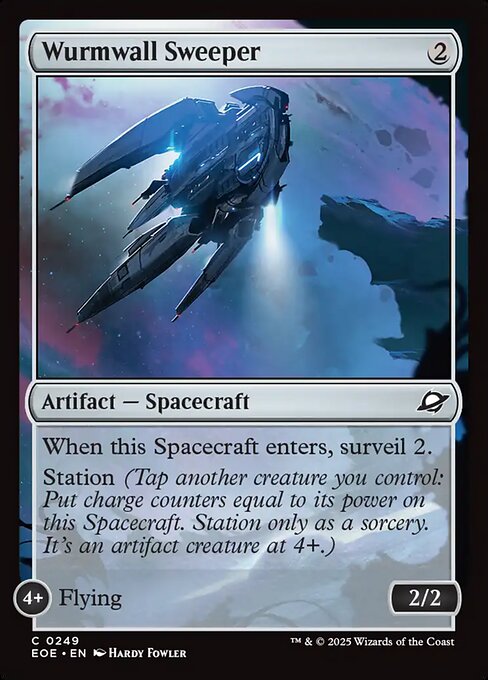
201. Wurmwall Sweeper
Rating4.6WeakWhy this rating?
A solid playable that rarely gets cut (4.6/10).
Why. A two-mana artifact that surveils 2 on entry, so it smooths your draws at almost no tempo cost. With Station it can later turn into a flying artifact creature.
Risks. On its own it does nothing: you need creatures to tap to reach the threshold, and it only works at sorcery speed. The 2/2 flyer takes a while to show up.
In the draft. Decent filler in a deck that already has solid creatures to tap. Take it after your removal and your good creatures.
Results in the games of the set
When it is in hand, the deck wins 54.1% of its games (set average: 56.0%, 185th of 287 cards).
In the opening hand: 53.4% wins (54.8% on average).
Drawn during the game: 54.6% (56.8% on average).
When it is drawn, the deck wins 0.3 points more than when it is not.
When it is drafted, it is played 51% of the time (set average: 62%).
Taken as the first pick (36 drafts), it ends in the deck 75% of the time.
It is played mostly in R/W decks (26% of them).
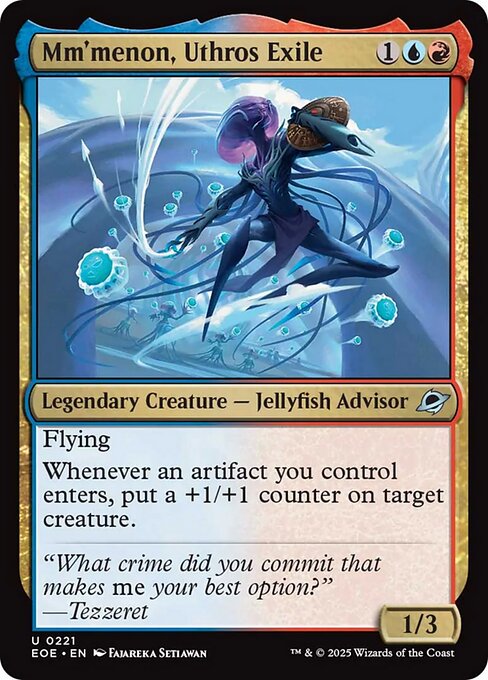 Rating4.5Weak
Why this rating?
A solid playable that rarely gets cut (4.5/10).
Why. A 1/3 flyer for three that holds the air well. Each artifact that enters under your control puts a +1/+1 counter on a creature of your choice.
Risks. The body is small and the payoff depends on how many artifacts your deck has. It is gold, so it needs blue and red by turn three.
In the draft. Playable in a blue-red deck with a handful of artifacts. A mid-pack pick, not a reason to move into these colours.
Results in the games of the set
When it is in hand, the deck wins 53.3% of its games (set average: 56.0%, 208th of 287 cards).
In the opening hand: 52.7% wins (54.8% on average).
Drawn during the game: 53.7% (56.8% on average).
When it is drawn, the deck wins 2.2 points more than when it is not.
When it is drafted, it is played 61% of the time (set average: 62%).
Taken as the first pick (80 drafts), it ends in the deck 90% of the time.
It is played mostly in R/U decks (63% of them).

203. Infinite Guideline Station
Rating4.5WeakWhy this rating?
A good playable, but is sometimes cut (4.5/10).
Why. A legendary five-colour Spacecraft. If you control many multicolored permanents it makes Robot tokens and draws cards on attack. A very specific gamble.
Risks. It costs all five colours and the Station threshold is huge. You need a deck full of gold cards, which almost always wrecks your mana.
In the draft. Only play it in a five-colour deck you already built for fun. In a normal deck it stays in the sideboard.
Results in the games of the set
When it is in hand, the deck wins 48.3% of its games (set average: 56.0%).
Drawn during the game: 0.0% (56.8% on average).
When it is drawn, the deck wins 0.0 points more than when it is not.
When it is drafted, it is played only 4% of the time (set average: 62%): it almost always ends in the sideboard.

204. Blade of the Swarm
Rating4.4WeakWhy this rating?
A good playable, but is sometimes cut (4.4/10).
Why. A four-mana body that becomes a 5/3 with its two counters, which makes it an honest creature. The second mode puts an exiled card with warp on the bottom of its owner's library.
Risks. The second mode needs a warp card sitting in exile, yours or an opponent's, so it is a situational bonus. As a plain 5/3 with no other effect, it stays average.
In the draft. A black filler creature, fine in a deck that wants bodies. Take it after your removal and your better creatures.
Results in the games of the set
When it is in hand, the deck wins 52.1% of its games (set average: 56.0%, 232nd of 287 cards).
In the opening hand: 50.9% wins (54.8% on average).
Drawn during the game: 52.9% (56.8% on average).
When it is drawn, the deck wins 0.2 points more than when it is not.
When it is drafted, it is played 16% of the time (set average: 62%).
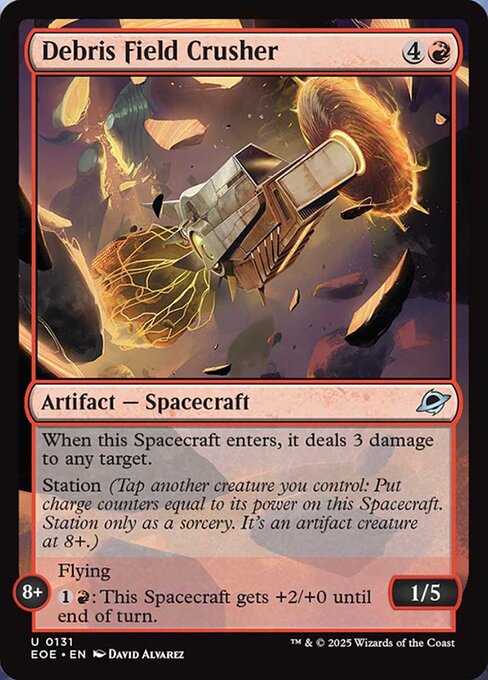
205. Debris Field Crusher
Rating4.4WeakWhy this rating?
A good playable, but is sometimes cut (4.4/10).
Why. Five mana for 3 damage to any target, so it is a removal spell first. The Spacecraft then stays around and can become a 1/5 flyer with Station, getting +2/+0 for two mana.
Risks. It is expensive and slow, and the Station threshold is high: often it will just be a turn-five removal spell. Three damage will not kill the large creatures.
In the draft. A playable red removal spell, to take without urgency after the best cards. Better in a deck that can feed Station.
Results in the games of the set
When it is in hand, the deck wins 52.7% of its games (set average: 56.0%, 219th of 287 cards).
In the opening hand: 50.0% wins (54.8% on average).
Drawn during the game: 54.6% (56.8% on average).
When it is drawn, the deck wins 0.6 points more than when it is not.
When it is drafted, it is played 52% of the time (set average: 62%).
Taken as the first pick (46 drafts), it ends in the deck 72% of the time.
It is played about as much in every archetype.

206. Dual-Sun Technique
Rating4.4WeakWhy this rating?
A good playable, but is sometimes cut (4.4/10).
Why. A two-mana instant that gives double strike to one of your creatures, a combat surprise. If it has a +1/+1 counter, you also draw a card.
Risks. It is a combat trick: if the opponent answers with removal, you lose the card and the creature. With no counters there is no card draw.
In the draft. Only in a white deck that puts plenty of +1/+1 counters on creatures. Otherwise it is a card to pass.
Results in the games of the set
When it is in hand, the deck wins 51.0% of its games (set average: 56.0%, 253rd of 287 cards).
In the opening hand: 47.6% wins (54.8% on average).
Drawn during the game: 53.3% (56.8% on average).
When it is drawn, the deck wins 1.9 points less than when it is not.
When it is drafted, it is played 32% of the time (set average: 62%).
Taken among the first three picks (57 drafts), it ends in the deck 70% of the time.

207. Nanoform Sentinel
Rating4.4WeakWhy this rating?
A good playable, but is sometimes cut (4.4/10).
Why. A three-mana 3/2 that untaps another permanent whenever it becomes tapped, once per turn. Attacking with it can untap a land to cast a spell after combat, or another creature to keep it back on defence.
Risks. The ability is subtle to use well and the body is fragile. It untaps another permanent, not itself, so it does not act like vigilance.
In the draft. A playable blue common, worth more for the 3/2 body than for the effect. Take it as curve filler.
Results in the games of the set
When it is in hand, the deck wins 54.2% of its games (set average: 56.0%, 178th of 287 cards).
In the opening hand: 52.5% wins (54.8% on average).
Drawn during the game: 55.3% (56.8% on average).
When it is drawn, the deck wins 2.0 points more than when it is not.
When it is drafted, it is played 36% of the time (set average: 62%).
Taken among the first three picks (108 drafts), it ends in the deck 73% of the time.
It is played mostly in R/U decks (40% of them) and B/U (36%).
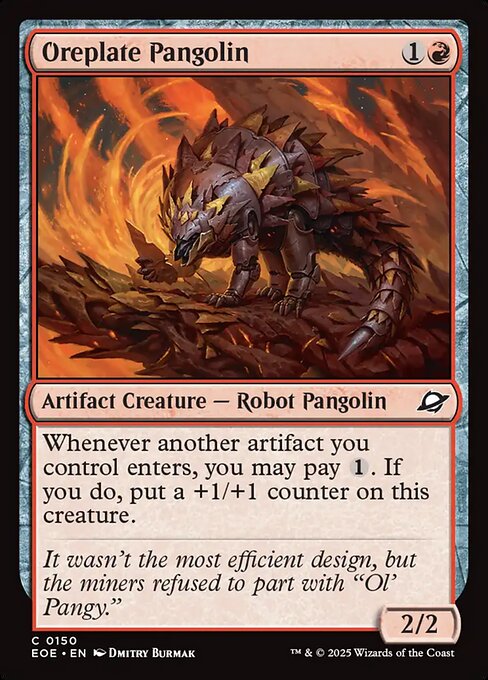
208. Oreplate Pangolin
Rating4.4WeakWhy this rating?
A good playable, but is sometimes cut (4.4/10).
Why. A two-mana 2/2 that grows by a counter each time another artifact enters, for one mana. In a deck with artifacts it quickly outgrows a normal two-drop.
Risks. With no artifacts it is a vanilla 2/2. Each counter costs a mana, which slows down your busy turns.
In the draft. A fine red two-drop for the curve. Better if your deck has several artifacts; otherwise it stays filler.
Results in the games of the set
When it is in hand, the deck wins 53.9% of its games (set average: 56.0%, 188th of 287 cards).
In the opening hand: 54.4% wins (54.8% on average).
Drawn during the game: 53.5% (56.8% on average).
When it is drawn, the deck wins 0.3 points more than when it is not.
When it is drafted, it is played 79% of the time (set average: 62%).
Taken as the first pick (93 drafts), it ends in the deck 94% of the time.
It is played mostly in R/U decks (74% of them) and R/W (65%).

209. Rescue Skiff
Rating4.4WeakWhy this rating?
A good playable, but is sometimes cut (4.4/10).
Why. Six mana to return a creature or enchantment card from your graveyard to the battlefield: late-game value. The Spacecraft can then become a big flyer.
Risks. The cost is high and so is the Station threshold. If your graveyard has no good target, you pay six mana for almost nothing.
In the draft. A top-end white uncommon, one copy at most in a deck that loses creatures along the way. Take it late.
Results in the games of the set
When it is in hand, the deck wins 52.7% of its games (set average: 56.0%, 221st of 287 cards).
In the opening hand: 48.7% wins (54.8% on average).
Drawn during the game: 55.3% (56.8% on average).
When it is drawn, the deck wins 0.6 points more than when it is not.
When it is drafted, it is played 54% of the time (set average: 62%).
Taken as the first pick (53 drafts), it ends in the deck 87% of the time.
It is played about as much in every archetype.
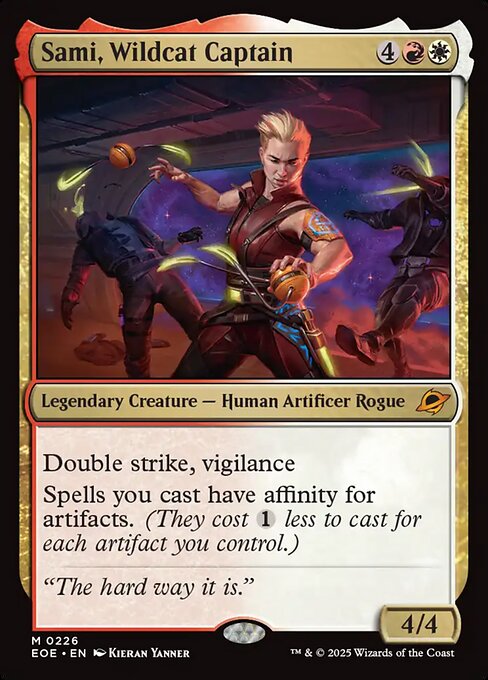 Rating4.4Weak
Why this rating?
A good playable, but is sometimes cut (4.4/10).
Why. A six-mana 4/4 with double strike and vigilance: it attacks and defends, and a fight against it goes badly fast. It also reduces the cost of your spells by the number of artifacts you control.
Risks. It is gold and expensive, and the discount depends on how many artifacts you have. A removal spell answers it before it deals any damage.
In the draft. Playable in red-white as a top-end finisher even without many artifacts. Do not take it over good removal.
Results in the games of the set
When it is in hand, the deck wins 50.9% of its games (set average: 56.0%, 258th of 287 cards).
In the opening hand: 49.2% wins (54.8% on average).
Drawn during the game: 52.0% (56.8% on average).
When it is drawn, the deck wins 1.8 points more than when it is not.
When it is drafted, it is played 36% of the time (set average: 62%).
Taken among the first three picks (58 drafts), it ends in the deck 53% of the time.

211. Steelswarm Operator
Rating4.4WeakWhy this rating?
A good playable, but is sometimes cut (4.4/10).
Why. A two-mana 1/1 flyer that taps for blue mana to cast artifact spells, or for two blue mana to activate abilities of artifact sources. In an artifact-heavy deck it accelerates a lot.
Risks. The mana is very restricted and the body dies to anything. Without artifacts it is just a small flyer.
In the draft. A blue uncommon for artifact decks. Take it if you already have several artifacts; otherwise pass it.
Results in the games of the set
When it is in hand, the deck wins 52.4% of its games (set average: 56.0%, 230th of 287 cards).
In the opening hand: 51.8% wins (54.8% on average).
Drawn during the game: 52.7% (56.8% on average).
When it is drawn, the deck wins 0.9 points more than when it is not.
When it is drafted, it is played 62% of the time (set average: 62%).
Taken as the first pick (50 drafts), it ends in the deck 84% of the time.
It is played mostly in R/U decks (37% of them) and B/U (27%).

212. Tapestry Warden
Rating4.4WeakWhy this rating?
A good playable, but is sometimes cut (4.4/10).
Why. A four-mana 3/4 with vigilance that deals 4 combat damage thanks to its own ability. That ability applies to every creature you control with toughness greater than power, which makes them more dangerous on attack.
Risks. The ability does nothing for creatures whose power is equal to or greater than their toughness. Removal takes away the whole advantage, and the body alone stays average.
In the draft. A good green body, better with high-toughness creatures. Take it as a mid-curve creature.
Results in the games of the set
When it is in hand, the deck wins 53.6% of its games (set average: 56.0%, 201st of 287 cards).
In the opening hand: 51.7% wins (54.8% on average).
Drawn during the game: 54.8% (56.8% on average).
When it is drawn, the deck wins 0.8 points more than when it is not.
When it is drafted, it is played 46% of the time (set average: 62%).
Taken as the first pick (30 drafts), it ends in the deck 67% of the time.
It is played about as much in every archetype.

213. Decode Transmissions
Rating4.3WeakWhy this rating?
A good playable, but is sometimes cut (4.3/10).
Why. A three-mana sorcery that draws two cards. If a nonland permanent left the battlefield this turn or a spell was warped, you skip the life loss and each opponent loses 2 life.
Risks. It adds nothing to the board, so it is slow when you are behind. The Void bonus needs good timing.
In the draft. Fine card draw in a stable black deck. Take it after your creatures and removal, never before.
Results in the games of the set
When it is in hand, the deck wins 52.8% of its games (set average: 56.0%, 218th of 287 cards).
In the opening hand: 49.6% wins (54.8% on average).
Drawn during the game: 54.8% (56.8% on average).
When it is drawn, the deck wins 0.1 points more than when it is not.
When it is drafted, it is played 38% of the time (set average: 62%).
Taken among the first three picks (110 drafts), it ends in the deck 76% of the time.
It is played mostly in B/W decks (41% of them) and B/G (29%).
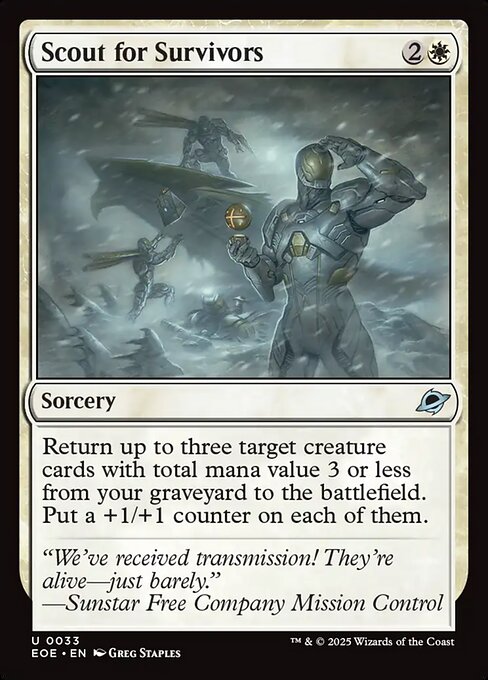
214. Scout for Survivors
Rating4.2WeakWhy this rating?
A good playable, but is sometimes cut (4.2/10).
Why. A three-mana sorcery that returns up to three creature cards with total mana value 3 or less from your graveyard, each with a +1/+1 counter. After small creatures trade, the gain can be big.
Risks. You need cheap creatures in the graveyard, otherwise the card is dead. Early in the game it does nothing.
In the draft. Only in a white deck with many small creatures. Otherwise take something better.
Results in the games of the set
When it is in hand, the deck wins 51.6% of its games (set average: 56.0%, 248th of 287 cards).
In the opening hand: 47.2% wins (54.8% on average).
Drawn during the game: 54.3% (56.8% on average).
When it is drawn, the deck wins 0.7 points less than when it is not.
When it is drafted, it is played 28% of the time (set average: 62%).
Taken among the first three picks (63 drafts), it ends in the deck 60% of the time.

215. Kavaron Turbodrone
Rating4.2WeakWhy this rating?
A good playable, but is sometimes cut (4.2/10).
Why. A three-mana 2/3 that taps to give +1/+1 and haste to a creature you control, at sorcery speed. It lets a big creature attack the turn it arrives.
Risks. It taps to help another creature, so it does not attack itself. Without a good creature to boost, it is an average body.
In the draft. Red filler. It helps aggressive decks with creatures that arrive late; do not take it early.
Results in the games of the set
When it is in hand, the deck wins 51.7% of its games (set average: 56.0%, 244th of 287 cards).
In the opening hand: 51.3% wins (54.8% on average).
Drawn during the game: 52.0% (56.8% on average).
When it is drawn, the deck wins 0.7 points less than when it is not.
When it is drafted, it is played 34% of the time (set average: 62%).
Taken among the first three picks (91 drafts), it ends in the deck 75% of the time.
It is played mostly in R/W decks (44% of them) and R/U (38%).
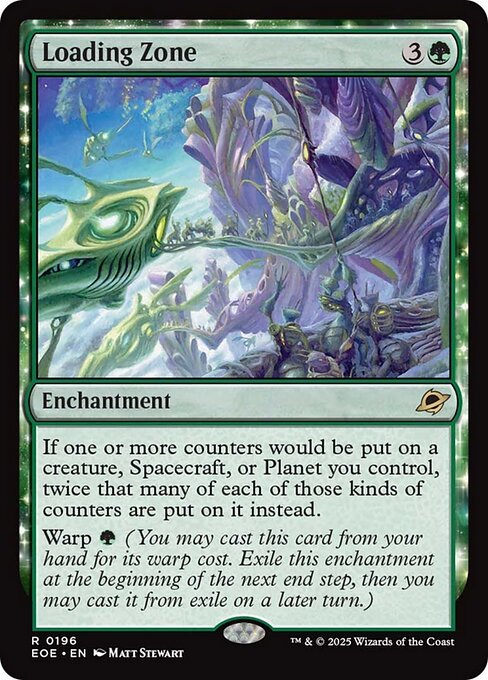
216. Loading Zone
Rating4.2WeakWhy this rating?
A good playable, but is sometimes cut (4.2/10).
Why. An enchantment that doubles counters put on your creatures, Spacecraft or Planets, including Station charge counters. It is a payoff for a counters deck, not a board-impact card.
Risks. It does nothing alone and adds no creature. Without many counters it is dead, and the one-mana warp does not change much.
In the draft. Only in a green deck built around counters. For everyone else, leave it in the sideboard.
Results in the games of the set
When it is in hand, the deck wins 41.2% of its games (set average: 56.0%, 286th of 287 cards).
In the opening hand: 38.9% wins (54.8% on average).
Drawn during the game: 42.8% (56.8% on average).
When it is drawn, the deck wins 8.5 points less than when it is not.
When it is drafted, it is played only 13% of the time (set average: 62%): it almost always ends in the sideboard.

217. Mechanozoa
Rating4.2WeakWhy this rating?
A good playable, but is sometimes cut (4.2/10).
Why. Six mana for a 5/5 that taps an opposing artifact or creature and puts a stun counter on it. Warped for three mana, it delays the target, and you can recast the creature later.
Risks. The full cost is heavy and the double blue strains two-colour decks. The stun does not get rid of the target, it only holds it back.
In the draft. A solid blue common, flexible between tempo and finisher. Take it as a top-of-curve creature.
Results in the games of the set
When it is in hand, the deck wins 55.1% of its games (set average: 56.0%, 152nd of 287 cards).
In the opening hand: 51.0% wins (54.8% on average).
Drawn during the game: 57.6% (56.8% on average).
When it is drawn, the deck wins 2.5 points more than when it is not.
When it is drafted, it is played 67% of the time (set average: 62%).
Taken as the first pick (61 drafts), it ends in the deck 84% of the time.
It is played mostly in R/U decks (60% of them) and B/U (58%).

218. Monoist Sentry
Rating4.2WeakWhy this rating?
A good playable, but is sometimes cut (4.2/10).
Why. A one-mana defender with 4 power: it trades with almost any attacker. That 4 power also makes it good fuel for Station, since it can tap without ever attacking.
Risks. It cannot attack, and its 1 toughness means it dies to any damage. It does not win the game by itself.
In the draft. A small black defender for control or Spacecraft decks. Take it late, as a support card.
Results in the games of the set
When it is in hand, the deck wins 52.9% of its games (set average: 56.0%, 215th of 287 cards).
In the opening hand: 51.6% wins (54.8% on average).
Drawn during the game: 53.7% (56.8% on average).
When it is drawn, the deck wins 1.5 points more than when it is not.
When it is drafted, it is played 43% of the time (set average: 62%).
Taken among the first three picks (111 drafts), it ends in the deck 67% of the time.
It is played about as much in every archetype.
 Rating4.2Weak
Why this rating?
A good playable, but is sometimes cut (4.2/10).
Why. A two-mana 2/2 that makes your artifacts Foods: each can gain 3 life, or be sacrificed to deal 3 damage to each opponent for one mana. It untaps if you gained life this turn.
Risks. It needs lots of artifacts to work, and each activation costs you cards. Gold and fragile, it wants a dedicated deck.
In the draft. Take it in a red-white artifact deck as a slow finisher. Otherwise it is a 2/2 that often sits idle.
Results in the games of the set
When it is in hand, the deck wins 51.0% of its games (set average: 56.0%, 256th of 287 cards).
In the opening hand: 50.4% wins (54.8% on average).
Drawn during the game: 51.4% (56.8% on average).
When it is drawn, the deck wins 0.1 points less than when it is not.
When it is drafted, it is played 30% of the time (set average: 62%).
Taken among the first three picks (68 drafts), it ends in the deck 56% of the time.
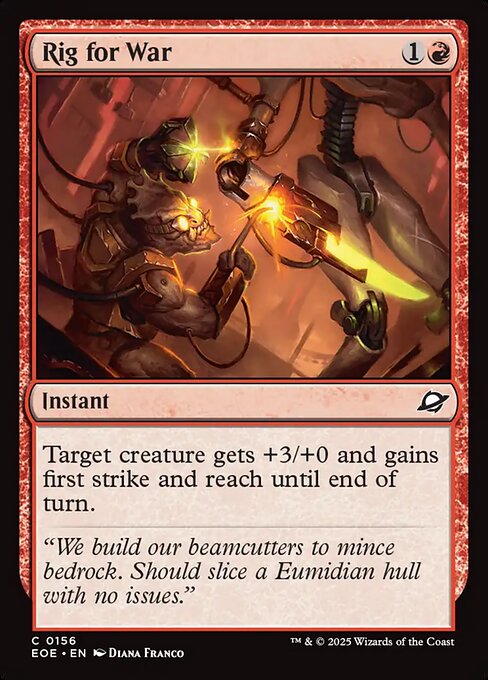
220. Rig for War
Rating4.2WeakWhy this rating?
A good playable, but is sometimes cut (4.2/10).
Why. A two-mana instant that gives +3/+0, reach and first strike to a creature: on defence it can turn a block into a win. On attack, it punishes a block.
Risks. Like any trick, it loses a card if the opponent responds. It is worthless without a creature in play.
In the draft. A red combat trick, playable in small numbers in an aggressive deck. It comes after creatures and removal.
Results in the games of the set
When it is in hand, the deck wins 50.9% of its games (set average: 56.0%, 257th of 287 cards).
In the opening hand: 48.6% wins (54.8% on average).
Drawn during the game: 52.6% (56.8% on average).
When it is drawn, the deck wins 1.8 points less than when it is not.
When it is drafted, it is played only 6% of the time (set average: 62%): it almost always ends in the sideboard.

221. Voidforged Titan
Rating4.2WeakWhy this rating?
A good playable, but is sometimes cut (4.2/10).
Why. A five-mana 5/4 that draws a card at your end step if a nonland permanent left the battlefield or a spell was warped. It is a big body that is decent for its price.
Risks. The draw depends on an event: without it, it is a vanilla 5/4. You also lose 1 life each time you draw.
In the draft. A good black mid-curve body, especially in a deck with warp or many trades. Take it as a solid creature.
Results in the games of the set
When it is in hand, the deck wins 52.7% of its games (set average: 56.0%, 220th of 287 cards).
In the opening hand: 50.3% wins (54.8% on average).
Drawn during the game: 54.2% (56.8% on average).
When it is drawn, the deck wins 0.3 points more than when it is not.
When it is drafted, it is played 81% of the time (set average: 62%).
Taken as the first pick (87 drafts), it ends in the deck 91% of the time.
It is played mostly in B/W decks (28% of them) and B/U (27%).
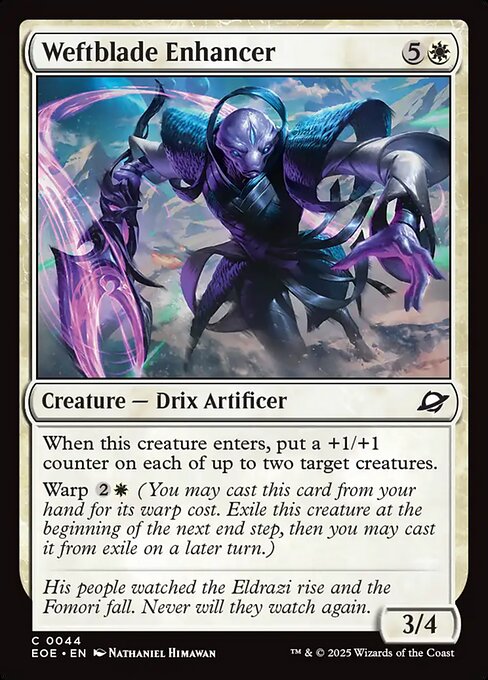
222. Weftblade Enhancer
Rating4.2WeakWhy this rating?
A good playable, but is sometimes cut (4.2/10).
Why. Six mana for a 3/4 that puts a +1/+1 counter on each of up to two creatures. Warping it for three mana lets you play it earlier, then recast it later for a second trigger.
Risks. If you do not have two other creatures, the effect loses value. The 3/4 body is modest for the full price.
In the draft. A white top-end common that gives value, fine in a creature deck. Take it as a support card.
Results in the games of the set
When it is in hand, the deck wins 53.5% of its games (set average: 56.0%, 203rd of 287 cards).
In the opening hand: 50.9% wins (54.8% on average).
Drawn during the game: 55.2% (56.8% on average).
When it is drawn, the deck wins 0.1 points less than when it is not.
When it is drafted, it is played 53% of the time (set average: 62%).
Taken among the first three picks (186 drafts), it ends in the deck 82% of the time.
It is played mostly in G/W decks (60% of them) and B/W (48%).
 Rating4.1Weak
Why this rating?
A good playable, but is sometimes cut (4.1/10).
Why. A five-mana artifact that taps for three colorless mana: huge acceleration on paper. Station can later make it produce lots of mana of one colour.
Risks. It costs five and does nothing else: next turn you have at least eight mana but probably nothing big enough to cast. The Station threshold is unrealistic in draft.
In the draft. Do not play it in a normal draft deck. It only makes sense in a very top-heavy deck with several huge finishers.
Results in the games of the set
When it is in hand, the deck wins 41.9% of its games (set average: 56.0%).
Drawn during the game: 0.0% (56.8% on average).
When it is drawn, the deck wins 7.5 points less than when it is not.
When it is drafted, it is played only 2% of the time (set average: 62%): it almost always ends in the sideboard.

224. Broodguard Elite
Rating4.0WeakWhy this rating?
A good playable, but is sometimes cut (4.1/10).
Why. An X creature you size to the game, whose counters pass to another creature when it leaves. Warped for X plus a green mana, it gives a burst of counters before coming back later.
Risks. If you have no other creature, the counters are lost when it leaves. The double green cost strains a two-colour deck.
In the draft. A flexible green uncommon, fine in a deck that likes counters. Take it as a filler creature.
Results in the games of the set
When it is in hand, the deck wins 52.7% of its games (set average: 56.0%, 224th of 287 cards).
In the opening hand: 50.5% wins (54.8% on average).
Drawn during the game: 54.2% (56.8% on average).
When it is drawn, the deck wins 0.0 points more than when it is not.
When it is drafted, it is played 75% of the time (set average: 62%).
Taken as the first pick (68 drafts), it ends in the deck 94% of the time.
It is played mostly in G/W decks (25% of them).
 Rating4.0Weak
Why this rating?
A good playable, but is sometimes cut (4.0/10).
Why. Five mana for a +1/+1 counter on each of your creatures, plus a Spacecraft that can become a 5/4 flying trampler. Best when you already have several creatures.
Risks. With no creatures in play the effect is nil, and the Station threshold is high. You pay a lot for a slow board effect.
In the draft. A good effect in a green deck with many small creatures. Otherwise it is filler.
Results in the games of the set
When it is in hand, the deck wins 50.5% of its games (set average: 56.0%, 262nd of 287 cards).
In the opening hand: 47.5% wins (54.8% on average).
Drawn during the game: 52.6% (56.8% on average).
When it is drawn, the deck wins 1.8 points less than when it is not.
When it is drafted, it is played 63% of the time (set average: 62%).
Taken as the first pick (75 drafts), it ends in the deck 83% of the time.
It is played mostly in G/W decks (25% of them).

226. Drix Fatemaker
Rating4.0WeakWhy this rating?
A good playable, but is sometimes cut (4.0/10).
Why. A four-mana 3/2 that puts a +1/+1 counter on a creature and gives trample to those that carry one. Warped for two mana, it gives the counter early and comes back later.
Risks. A 3/2 body dies easily, and the effect is small. It needs other creatures to be worth much.
In the draft. A fine green common in a counters deck. Take it as solid filler, never over good removal.
Results in the games of the set
When it is in hand, the deck wins 53.6% of its games (set average: 56.0%, 199th of 287 cards).
In the opening hand: 52.1% wins (54.8% on average).
Drawn during the game: 54.6% (56.8% on average).
When it is drawn, the deck wins 0.1 points more than when it is not.
When it is drafted, it is played 62% of the time (set average: 62%).
Taken as the first pick (44 drafts), it ends in the deck 75% of the time.
It is played mostly in G/R decks (58% of them) and G/W (57%).

227. Hymn of the Faller
Rating4.0WeakWhy this rating?
A good playable, but is sometimes cut (4.0/10).
Why. A two-mana sorcery that surveils 1, then draws a card at the cost of 1 life. With Void it draws one more card. A small cantrip that smooths your draws.
Risks. It does nothing on the board, and the life loss matters against an aggressive deck. The Void bonus needs good timing.
In the draft. Black filler, playable as one copy. Take it late, after your creatures.
Results in the games of the set
When it is in hand, the deck wins 51.6% of its games (set average: 56.0%, 247th of 287 cards).
In the opening hand: 48.3% wins (54.8% on average).
Drawn during the game: 53.8% (56.8% on average).
When it is drawn, the deck wins 1.2 points less than when it is not.
When it is drafted, it is played 67% of the time (set average: 62%).
Taken as the first pick (47 drafts), it ends in the deck 87% of the time.
It is played mostly in B/W decks (26% of them).
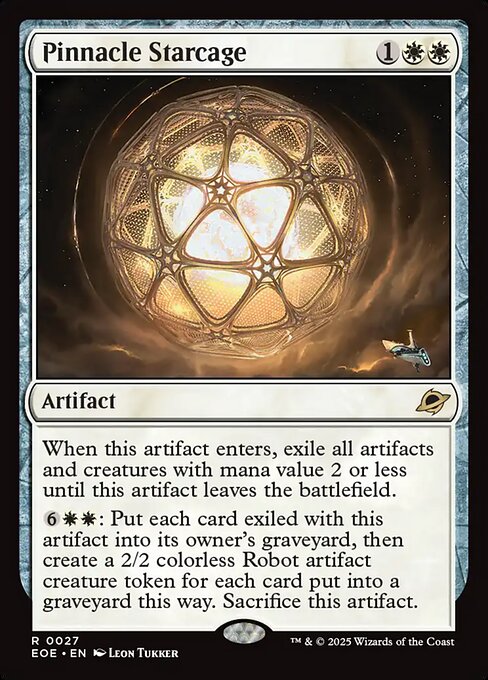
228. Pinnacle Starcage
Rating4.0WeakWhy this rating?
A good playable, but is sometimes cut (4.0/10).
Why. A three-mana sweeper: on entry it exiles all artifacts and creatures with mana value 2 or less, yours included. For eight mana it can put them into the graveyard and create a 2/2 Robot token for each, but that is very expensive.
Risks. The sweep hits your own small cards. If the opponent destroys the artifact, everything comes back. The activation costs eight mana.
In the draft. Only in a white deck of big creatures, against an opponent full of small cards. In a normal deck, let it go.
Results in the games of the set
When it is in hand, the deck wins 47.4% of its games (set average: 56.0%, 282nd of 287 cards).
In the opening hand: 45.7% wins (54.8% on average).
Drawn during the game: 48.6% (56.8% on average).
When it is drawn, the deck wins 2.8 points less than when it is not.
When it is drafted, it is played 16% of the time (set average: 62%).
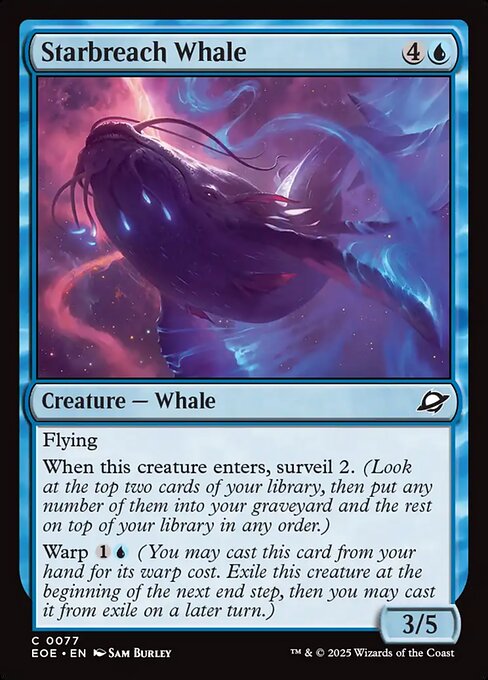
229. Starbreach Whale
Rating4.0WeakWhy this rating?
A good playable, but is sometimes cut (4.0/10).
Why. A five-mana 3/5 flyer that surveils 2 on entry: a good air blocker that holds up against many attackers. Warped for two mana, it surveils early and comes back later.
Risks. It is slow and hits softly for its price. It does nothing against an opponent who avoids combat.
In the draft. A good blue common for the middle of the curve, solid in a control deck. Take it as a staple creature.
Results in the games of the set
When it is in hand, the deck wins 53.2% of its games (set average: 56.0%, 211th of 287 cards).
In the opening hand: 49.7% wins (54.8% on average).
Drawn during the game: 55.4% (56.8% on average).
When it is drawn, the deck wins 1.1 points more than when it is not.
When it is drafted, it is played 42% of the time (set average: 62%).
Taken as the first pick (32 drafts), it ends in the deck 63% of the time.
It is played mostly in B/U decks (39% of them) and U/W (35%).

230. Terrasymbiosis
Rating4.0WeakWhy this rating?
A good playable, but is sometimes cut (4.0/10).
Why. A three-mana enchantment: whenever you put +1/+1 counters on a creature, you may draw that many cards, once each turn. It rewards a deck built on counters.
Risks. It does nothing alone and has no effect on the board. Without many counters it sits dead in your hand.
In the draft. Only in a green counters deck with ways to place them every turn. Otherwise leave it.
Results in the games of the set
When it is in hand, the deck wins 48.1% of its games (set average: 56.0%, 278th of 287 cards).
In the opening hand: 48.3% wins (54.8% on average).
Drawn during the game: 47.9% (56.8% on average).
When it is drawn, the deck wins 3.1 points less than when it is not.
When it is drafted, it is played 40% of the time (set average: 62%).
Taken among the first three picks (55 drafts), it ends in the deck 71% of the time.
It is played about as much in every archetype.

231. Full Bore
Rating3.9WeakWhy this rating?
A good playable, but is sometimes cut (3.9/10).
Why. A one-mana instant that gives +3/+2 to a creature: a cheap combat trick. If the creature was cast for its warp cost, it also gains trample and haste.
Risks. A trick goes wrong if the opponent responds. With no creature to boost, it is useless.
In the draft. A small red trick for an aggressive deck with warp. Take it late, after the creatures.
Results in the games of the set
When it is in hand, the deck wins 51.2% of its games (set average: 56.0%, 252nd of 287 cards).
In the opening hand: 49.4% wins (54.8% on average).
Drawn during the game: 52.5% (56.8% on average).
When it is drawn, the deck wins 0.3 points less than when it is not.
When it is drafted, it is played 17% of the time (set average: 62%).
Taken among the first three picks (41 drafts), it ends in the deck 61% of the time.

232. Mechan Shieldmate
Rating3.8WeakWhy this rating?
A good playable, but is sometimes cut (3.8/10).
Why. A two-mana 3/2 with defender that can attack if an artifact entered under your control this turn. It is a solid blocker from turn two.
Risks. Without artifacts it never attacks. The body is fragile and a bigger attacker gets past it.
In the draft. A blue blocker for an artifact deck. Take it late, as a curve support card.
Results in the games of the set
When it is in hand, the deck wins 52.7% of its games (set average: 56.0%, 223rd of 287 cards).
In the opening hand: 51.8% wins (54.8% on average).
Drawn during the game: 53.3% (56.8% on average).
When it is drawn, the deck wins 1.1 points more than when it is not.
When it is drafted, it is played 35% of the time (set average: 62%).
Taken among the first three picks (85 drafts), it ends in the deck 72% of the time.
It is played mostly in R/U decks (55% of them) and B/U (41%).

233. Bioengineered Future
Rating3.8WeakWhy this rating?
A good playable, but is sometimes cut (3.8/10).
Why. A three-mana enchantment that creates a Lander token, which can fetch a basic land for two mana. Each creature that enters gets an extra +1/+1 counter for each land that entered under your control this turn.
Risks. You need a land to enter and a creature to be cast on the same turn to benefit. The effect is small and the Lander does not change the board.
In the draft. Avoid it in most decks. If you play it, it is in green with plenty of cheap creatures.
Results in the games of the set
When it is in hand, the deck wins 43.9% of its games (set average: 56.0%, 285th of 287 cards).
In the opening hand: 43.8% wins (54.8% on average).
Drawn during the game: 44.0% (56.8% on average).
When it is drawn, the deck wins 6.6 points less than when it is not.
When it is drafted, it is played 37% of the time (set average: 62%).
Taken among the first three picks (40 drafts), it ends in the deck 68% of the time.

234. Swarm Culler
Rating3.8WeakWhy this rating?
A good playable, but is sometimes cut (3.8/10).
Why. A four-mana 2/4 flyer: a good air blocker. Whenever it becomes tapped, you may sacrifice another creature or artifact to draw a card.
Risks. Sacrificing a permanent for a card is only worthwhile if the permanent is already lost or low value. Its attack is weak.
In the draft. A decent black flyer, especially in a deck with expendable artifacts. Take it as a filler body.
Results in the games of the set
When it is in hand, the deck wins 52.4% of its games (set average: 56.0%, 228th of 287 cards).
In the opening hand: 49.9% wins (54.8% on average).
Drawn during the game: 54.0% (56.8% on average).
When it is drawn, the deck wins 0.4 points less than when it is not.
When it is drafted, it is played 47% of the time (set average: 62%).
Taken among the first three picks (150 drafts), it ends in the deck 79% of the time.
It is played mostly in B/W decks (56% of them) and B/R (46%).

235. Terminal Velocity
Rating3.8WeakWhy this rating?
A good playable, but is sometimes cut (3.8/10).
Why. A six-mana sorcery that puts an artifact or creature from your hand onto the battlefield for free, with haste. At end of turn it is sacrificed and deals damage equal to its mana value to each creature, so it works like a sweeper in disguise.
Risks. You pay six mana for a one-turn effect and keep nothing on the battlefield. With no big card in hand it does nothing, and the damage hits your own creatures too.
In the draft. Sideboard material in most decks. Only a red deck full of huge artifacts or creatures can make something of it, and even then it is a stretch.
Results in the games of the set
When it is in hand, the deck wins 45.8% of its games (set average: 56.0%, 283rd of 287 cards).
In the opening hand: 46.0% wins (54.8% on average).
Drawn during the game: 45.7% (56.8% on average).
When it is drawn, the deck wins 4.1 points less than when it is not.
When it is drafted, it is played only 10% of the time (set average: 62%): it almost always ends in the sideboard.
Taken among the first three picks (34 drafts), it ends in the deck 59% of the time.

236. Meltstrider's Gear
Rating3.5WeakWhy this rating?
Filler card but sometimes gets cut (3.5/10).
Why. For one green mana it attaches itself to a creature, giving +2/+1 and reach. That turns a small body into a decent blocker against fliers, and it can win a combat on turn 2.
Risks. The equip cost is five mana, so if the creature dies the Equipment is nearly dead weight. It is a fragile bonus that does little if you have no creature to carry it.
In the draft. A late-pack playable for an aggressive green deck or one short on air defence. Do not take it over a real creature or removal.
Results in the games of the set
When it is in hand, the deck wins 47.9% of its games (set average: 56.0%, 279th of 287 cards).
In the opening hand: 48.1% wins (54.8% on average).
Drawn during the game: 47.8% (56.8% on average).
When it is drawn, the deck wins 1.7 points less than when it is not.
When it is drafted, it is played only 2% of the time (set average: 62%): it almost always ends in the sideboard.

237. Kavaron Skywarden
Rating3.2WeakWhy this rating?
Filler card but sometimes gets cut (3.2/10).
Why. A 4/5 reach body for five mana: a solid wall that blocks fliers and survives most combats. With Void, it gets a +1/+1 counter at your end step if a nonland permanent left the battlefield or a spell was warped this turn.
Risks. Five mana for a defensive body with no offensive ability. Void needs help from the rest of the deck; on its own it stays a 4/5.
In the draft. A solid red playable, fine in the middle of the pack. It likes decks with trades or warp spells, but it should not be a priority.
Results in the games of the set
When it is in hand, the deck wins 51.8% of its games (set average: 56.0%, 240th of 287 cards).
In the opening hand: 50.1% wins (54.8% on average).
Drawn during the game: 52.9% (56.8% on average).
When it is drawn, the deck wins 0.0 points more than when it is not.
When it is drafted, it is played 15% of the time (set average: 62%).
 Rating2.9Weak
Why this rating?
Filler card but sometimes gets cut (2.9/10).
Why. A 2/4 for four that makes a tapped 2/2 Robot artifact creature token at each end step where you control two or more tapped creatures. If you attack with two creatures, she replaces your losses and fills the board.
Risks. She needs you to attack: two tapped creatures is hard to reach on a stalled board. Gold and with no immediate impact, she does nothing alone.
In the draft. A fine playable for an aggressive red-white deck that attacks every turn. Elsewhere she is not worth the pick.
Results in the games of the set
When it is in hand, the deck wins 51.3% of its games (set average: 56.0%, 251st of 287 cards).
In the opening hand: 51.2% wins (54.8% on average).
Drawn during the game: 51.4% (56.8% on average).
When it is drawn, the deck wins 0.9 points less than when it is not.
When it is drafted, it is played 38% of the time (set average: 62%).
Taken among the first three picks (105 drafts), it ends in the deck 66% of the time.
It is played mostly in R/W decks (48% of them).

239. Mechan Assembler
Rating2.5WeakWhy this rating?
Not good filler and often gets cut (2.5/10).
Why. A 4/4 for five whose ability creates a 2/2 Robot artifact creature token whenever another artifact enters, once each turn. With a few artifacts it is a big body that keeps generating value.
Risks. You need artifacts to play, otherwise it is a plain 4/4 for five. And the big body dies to removal before it has done anything.
In the draft. Fine in a blue artifact-themed deck, mediocre otherwise. Look for cheap artifacts alongside it, and do not take it early without them.
Results in the games of the set
When it is in hand, the deck wins 53.6% of its games (set average: 56.0%, 198th of 287 cards).
In the opening hand: 50.5% wins (54.8% on average).
Drawn during the game: 55.3% (56.8% on average).
When it is drawn, the deck wins 2.3 points more than when it is not.
When it is drafted, it is played 83% of the time (set average: 62%).
Taken as the first pick (118 drafts), it ends in the deck 83% of the time.
It is played mostly in R/U decks (40% of them) and B/U (34%).

240. Luxknight Breacher
Rating2.1WeakWhy this rating?
Not good filler and often gets cut (2.1/10).
Why. It enters with a +1/+1 counter for each other creature and/or artifact you control. In a deck that already has bodies on the battlefield, it becomes a decently sized creature for four mana.
Risks. On an empty board it is a 2/2 for four, which is frankly bad. It depends on what you have already played and does nothing more afterwards.
In the draft. White filler, best played once your board is already stocked, in a deck that makes lots of small creatures or artifacts. Easy to replace.
Results in the games of the set
When it is in hand, the deck wins 51.0% of its games (set average: 56.0%, 254th of 287 cards).
In the opening hand: 49.0% wins (54.8% on average).
Drawn during the game: 52.3% (56.8% on average).
When it is drawn, the deck wins 0.5 points less than when it is not.
When it is drafted, it is played 19% of the time (set average: 62%).
Taken among the first three picks (41 drafts), it ends in the deck 71% of the time.
It is played mostly in G/W decks (26% of them).

241. Atomic Microsizer
Rating2.0WeakWhy this rating?
Not good filler and often gets cut (2.0/10).
Why. A one-mana Equipment giving +1/+0 and, whenever the equipped creature attacks, making a creature of your choice unblockable with base power and toughness 1/1 until end of turn. It mostly helps get a creature through, even a shrunken one.
Risks. The target becomes a base 1/1, so you gain little with a creature that hits hard. Equipping costs two mana, and the effect stays thin.
In the draft. A late-pack playable, for a blue evasion or artifact deck. Do not take it over removal or a good creature.
Results in the games of the set
When it is in hand, the deck wins 49.1% of its games (set average: 56.0%, 273rd of 287 cards).
In the opening hand: 45.4% wins (54.8% on average).
Drawn during the game: 51.4% (56.8% on average).
When it is drawn, the deck wins 2.1 points less than when it is not.
When it is drafted, it is played only 8% of the time (set average: 62%): it almost always ends in the sideboard.

242. Chorale of the Void
Rating2.0WeakWhy this rating?
Not good filler and often gets cut (2.0/10).
Why. An Aura that, whenever the enchanted creature attacks, brings a creature card from the defending player's graveyard onto the battlefield under your control, tapped and attacking. If it sticks, it is a value engine.
Risks. Its Void ability sacrifices it at the beginning of your end step unless a nonland permanent left the battlefield or a spell was warped this turn. It also needs a stocked opposing graveyard and a creature that survives to attack: too many conditions.
In the draft. Too demanding for most decks. Only play it in a black deck that triggers Void every turn, and do not take it early.
Results in the games of the set
When it is in hand, the deck wins 47.8% of its games (set average: 56.0%, 281st of 287 cards).
In the opening hand: 42.9% wins (54.8% on average).
Drawn during the game: 50.8% (56.8% on average).
When it is drawn, the deck wins 2.9 points less than when it is not.
When it is drafted, it is played 55% of the time (set average: 62%).
Taken among the first three picks (111 drafts), it ends in the deck 77% of the time.
It is played about as much in every archetype.
 Rating2.0Weak
Why this rating?
Not good filler and often gets cut (2.0/10).
Why. A 1/4 flier for three that gets +1/+0 as long as you control an artifact. It blocks aerial attackers very well and makes small evasive hits.
Risks. It hits weakly: a 1/4 without an artifact does not advance the game. It remains a defensive body more than a real attacker.
In the draft. Decent blue filler for a defensive or artifact deck. Take it mid-pack after removal and the better creatures.
Results in the games of the set
When it is in hand, the deck wins 51.6% of its games (set average: 56.0%, 245th of 287 cards).
In the opening hand: 50.0% wins (54.8% on average).
Drawn during the game: 52.7% (56.8% on average).
When it is drawn, the deck wins 1.4 points more than when it is not.
When it is drafted, it is played 19% of the time (set average: 62%).
Taken among the first three picks (42 drafts), it ends in the deck 69% of the time.
It is played mostly in R/U decks (31% of them) and B/U (27%).
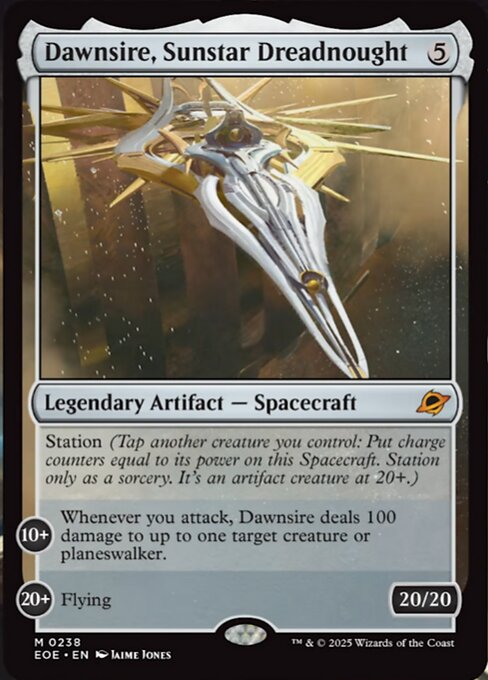
244. Dawnsire, Sunstar Dreadnought
Rating2.0WeakWhy this rating?
Not good filler and often gets cut (2.0/10).
Why. A huge five-mana Spacecraft. With Station, at ten charge counters it deals 100 damage to a creature or planeswalker whenever you attack; at twenty it becomes a flying 20/20 artifact creature.
Risks. You must tap creatures whose total power reaches ten, which takes several turns and only works at sorcery speed. Meanwhile it does nothing and your creatures are tapped instead of defending.
In the draft. Too slow and too demanding for most decks. Only a deck of big green creatures gets much from it. Do not take it early.
Results in the games of the set
When it is in hand, the deck wins 48.4% of its games (set average: 56.0%, 277th of 287 cards).
In the opening hand: 45.5% wins (54.8% on average).
Drawn during the game: 50.2% (56.8% on average).
When it is drawn, the deck wins 2.9 points less than when it is not.
When it is drafted, it is played 86% of the time (set average: 62%).
Taken among the first three picks (113 drafts), it ends in the deck 83% of the time.
It is played about as much in every archetype.

245. Dawnstrike Vanguard
Rating2.0WeakWhy this rating?
Not good filler and often gets cut (2.0/10).
Why. A 4/5 lifelinker for six. If you control two or more tapped creatures at your end step, each other creature gets a +1/+1 counter, growing an entire army as you attack.
Risks. Six mana for a body is slow, and the ability needs you to attack with several creatures. In a stalled game it is just a big lifelinker.
In the draft. A decent white top-end card, mostly in a creature deck that attacks in numbers. One copy is enough.
Results in the games of the set
When it is in hand, the deck wins 52.1% of its games (set average: 56.0%, 233rd of 287 cards).
In the opening hand: 50.1% wins (54.8% on average).
Drawn during the game: 53.4% (56.8% on average).
When it is drawn, the deck wins 1.0 points less than when it is not.
When it is drafted, it is played 61% of the time (set average: 62%).
Taken as the first pick (59 drafts), it ends in the deck 80% of the time.
It is played about as much in every archetype.

246. Galvanizing Sawship
Rating2.0WeakWhy this rating?
Not good filler and often gets cut (2.0/10).
Why. A 6/5 Spacecraft for six mana. With Station, three charge counters make it a flying, hasty artifact creature; a single creature with power three powers it on the turn it arrives.
Risks. You need another creature to tap, even though the threshold of three is low. Six mana is expensive, and the ship is vulnerable once it becomes a creature.
In the draft. A playable red finisher, not exciting. The threshold is low, so a deck with power-three creatures uses it well. One or two copies is plenty.
Results in the games of the set
When it is in hand, the deck wins 50.1% of its games (set average: 56.0%, 266th of 287 cards).
In the opening hand: 46.3% wins (54.8% on average).
Drawn during the game: 52.5% (56.8% on average).
When it is drawn, the deck wins 2.0 points less than when it is not.
When it is drafted, it is played 44% of the time (set average: 62%).
Taken as the first pick (36 drafts), it ends in the deck 86% of the time.
It is played about as much in every archetype.

247. Gravblade Heavy
Rating2.0WeakWhy this rating?
Not good filler and often gets cut (2.0/10).
Why. A 3/4 for four that, as long as you control an artifact, gets +1/+0 and deathtouch. With an artifact it is a deterring blocker and a decent attacker.
Risks. Without an artifact it is a vanilla 3/4. The ability depends on your artifacts and disappears if the last one is destroyed.
In the draft. Honest black filler in a deck with a few artifacts. Easy to replace, to take mid or late in the pack.
Results in the games of the set
When it is in hand, the deck wins 50.8% of its games (set average: 56.0%, 259th of 287 cards).
In the opening hand: 49.5% wins (54.8% on average).
Drawn during the game: 51.6% (56.8% on average).
When it is drawn, the deck wins 0.2 points more than when it is not.
When it is drafted, it is played only 9% of the time (set average: 62%): it almost always ends in the sideboard.
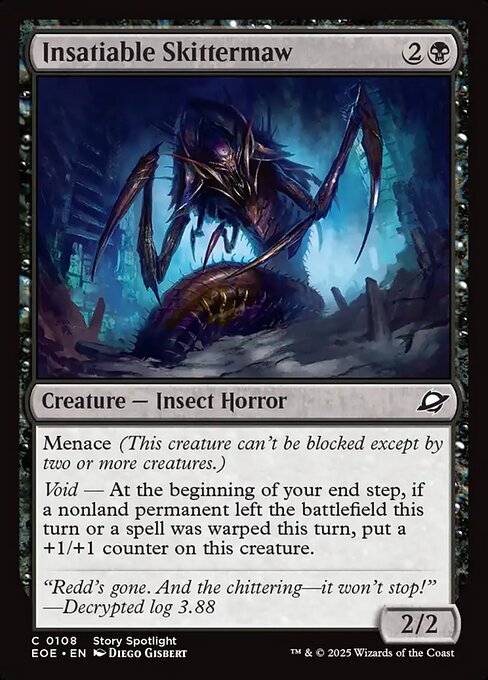 Rating2.0Weak
Why this rating?
Not good filler and often gets cut (2.0/10).
Why. A 2/2 menace creature for three. Its Void ability gives it a +1/+1 counter at your end step if a nonland permanent left the battlefield or a spell was warped this turn. In a deck that trades creatures, it grows steadily.
Risks. When Void does not trigger it stays a small 2/2 that dies easily. The ability depends on the game and does not work every turn.
In the draft. Playable black filler, fine for an attacking trade deck. Take it mid-pack, but do not count on it.
Results in the games of the set
When it is in hand, the deck wins 51.7% of its games (set average: 56.0%, 243rd of 287 cards).
In the opening hand: 50.5% wins (54.8% on average).
Drawn during the game: 52.5% (56.8% on average).
When it is drawn, the deck wins 0.0 points more than when it is not.
When it is drafted, it is played 26% of the time (set average: 62%).
Taken among the first three picks (53 drafts), it ends in the deck 81% of the time.
It is played mostly in B/W decks (29% of them) and B/R (25%).
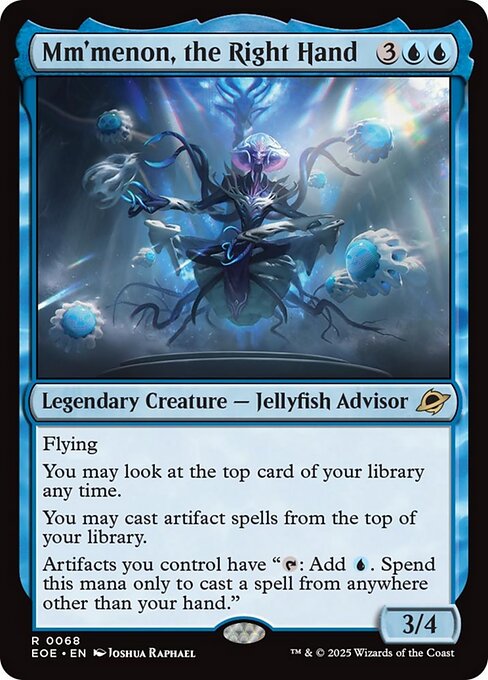 Rating2.0Weak
Why this rating?
Not good filler and often gets cut (2.0/10).
Why. A 3/4 flier for five that lets you cast artifacts from the top of your library and look at that card at any time. Your artifacts also tap for blue mana, but only for spells cast from somewhere other than your hand.
Risks. The mana it produces is very restricted: it only pays for spells cast from somewhere other than your hand, such as the library or exile. Without many artifacts it is a plain 3/4 flier for five that needs two blue mana.
In the draft. A blue playable for an artifact-heavy deck. In other decks it is a decent flying body; do not take it early.
Results in the games of the set
When it is in hand, the deck wins 50.4% of its games (set average: 56.0%, 265th of 287 cards).
In the opening hand: 45.9% wins (54.8% on average).
Drawn during the game: 52.9% (56.8% on average).
When it is drawn, the deck wins 0.4 points more than when it is not.
When it is drafted, it is played 74% of the time (set average: 62%).
Taken as the first pick (41 drafts), it ends in the deck 78% of the time.
It is played about as much in every archetype.

250. Moonlit Meditation
Rating2.0WeakWhy this rating?
Not good filler and often gets cut (2.0/10).
Why. A three-mana Aura: the first time each turn you would create tokens, you may instead create that many copies of the enchanted permanent. With a good permanent and a source of tokens, it adds value.
Risks. It does nothing without a source of tokens, and if the enchanted permanent goes away the Aura goes with it. Casting it does nothing right away: it is very slow.
In the draft. Leave it in the sideboard unless you have a very specific token deck. In draft, the card is frankly weak.
Results in the games of the set
When it is in hand, the deck wins 39.9% of its games (set average: 56.0%, 287th of 287 cards).
In the opening hand: 37.5% wins (54.8% on average).
Drawn during the game: 41.4% (56.8% on average).
When it is drawn, the deck wins 8.3 points less than when it is not.
When it is drafted, it is played only 9% of the time (set average: 62%): it almost always ends in the sideboard.
 Rating2.0Weak
Why this rating?
Not good filler and often gets cut (2.0/10).
Why. A five-mana sorcery that returns up to two nonland permanent cards from your graveyard to your hand, then up to two lands from the graveyard to the battlefield tapped. It is value recursion.
Risks. Five mana with no immediate impact on the board, and its value depends on what has died. Early in the game there is nothing to get back.
In the draft. A mid-game green playable, mostly as a late pick. Not for a hurried deck. One copy at most.
Results in the games of the set
When it is in hand, the deck wins 50.0% of its games (set average: 56.0%, 267th of 287 cards).
In the opening hand: 46.7% wins (54.8% on average).
Drawn during the game: 52.1% (56.8% on average).
When it is drawn, the deck wins 1.8 points less than when it is not.
When it is drafted, it is played only 13% of the time (set average: 62%): it almost always ends in the sideboard.

252. Ruinous Rampage
Rating2.0WeakWhy this rating?
Not good filler and often gets cut (2.0/10).
Why. A three-mana sorcery with two modes: three damage to each opponent, or exile all artifacts with mana value three or less. The second mode can be a blowout against an opponent playing many artifacts.
Risks. The three damage to the opponent hits no creature, and the exile mode also hits your own artifacts. In most games neither mode is very useful.
In the draft. A sideboard card to keep against a deck full of cheap artifacts. Do not main-deck it.
Results in the games of the set
When it is in hand, the deck wins 42.6% of its games (set average: 56.0%).
In the opening hand: 0.0% wins (54.8% on average).
Drawn during the game: 0.0% (56.8% on average).
When it is drawn, the deck wins 2.4 points less than when it is not.
When it is drafted, it is played only 1% of the time (set average: 62%): it almost always ends in the sideboard.
 Rating2.0Weak
Why this rating?
Not good filler and often gets cut (2.0/10).
Why. A three-mana sorcery: sacrifice an artifact or creature, return a creature or Spacecraft card with mana value five or less from your graveyard to the battlefield, then create a Lander token. The token partly makes up for the sacrificed card.
Risks. You must sacrifice a permanent and have a good target in the graveyard, otherwise the card is dead. You lose a card to get one back: the gain is small.
In the draft. Black filler for a trade deck. Not before you have your creatures and removal, and a late pick.
Results in the games of the set
When it is in hand, the deck wins 49.1% of its games (set average: 56.0%, 274th of 287 cards).
In the opening hand: 45.5% wins (54.8% on average).
Drawn during the game: 51.3% (56.8% on average).
When it is drawn, the deck wins 2.4 points less than when it is not.
When it is drafted, it is played 30% of the time (set average: 62%).
Taken among the first three picks (65 drafts), it ends in the deck 55% of the time.

254. Thaumaton Torpedo
Rating2.0WeakWhy this rating?
Not good filler and often gets cut (2.0/10).
Why. A one-mana artifact that destroys any nonland permanent, but activating it costs six, or three less if you attacked with a Spacecraft this turn. It is universal removal, but slow.
Risks. Activating costs six mana, which is very slow unless a Spacecraft attacked this turn. You also have to have cast it first, and it is sacrificed in the process.
In the draft. Last-resort removal for a deck that is short on answers. Better with Spacecraft; without them, a late-pack pick.
Results in the games of the set
When it is in hand, the deck wins 49.7% of its games (set average: 56.0%, 269th of 287 cards).
In the opening hand: 45.9% wins (54.8% on average).
Drawn during the game: 52.2% (56.8% on average).
When it is drawn, the deck wins 1.4 points less than when it is not.
When it is drafted, it is played only 8% of the time (set average: 62%): it almost always ends in the sideboard.
 Rating2.0Weak
Why this rating?
Not good filler and often gets cut (2.0/10).
Why. A two-mana Equipment that gives +1/+1 and is cheap to equip. Its ability to control an opponent during their next turn costs fifteen mana, reduced by the equipped creature's power.
Risks. You need a creature with high power for the ability to become realistic, and the effect is a slow one-shot. In most games it is just a +1/+1 to equip.
In the draft. A last-choice playable that can work in a deck of big green creatures. Do not take it for the control effect.
Results in the games of the set
When it is in hand, the deck wins 49.4% of its games (set average: 56.0%, 271st of 287 cards).
In the opening hand: 45.1% wins (54.8% on average).
Drawn during the game: 52.4% (56.8% on average).
When it is drawn, the deck wins 1.6 points less than when it is not.
When it is drafted, it is played 35% of the time (set average: 62%).
Taken among the first three picks (34 drafts), it ends in the deck 62% of the time.

256. Sinister Cryologist
Rating1.9WeakWhy this rating?
Not good filler and often gets cut (2.0/10).
Why. A 2/3 for three whose enter trigger gives -3/-0 to an opposing creature until end of turn. With Warp for one blue mana, it is a small play to ease an attack, and you can recast it later.
Risks. The effect lasts only a turn and kills nothing. A 2/3 with little else: low value, and the card does not change the course of a game.
In the draft. Blue filler to take late, for a deck that likes Warp or tempo. Easy to replace.
Results in the games of the set
When it is in hand, the deck wins 47.9% of its games (set average: 56.0%, 280th of 287 cards).
In the opening hand: 44.2% wins (54.8% on average).
Drawn during the game: 50.3% (56.8% on average).
When it is drawn, the deck wins 1.6 points less than when it is not.
When it is drafted, it is played only 3% of the time (set average: 62%): it almost always ends in the sideboard.

257. Drill Too Deep
Rating1.7WeakWhy this rating?
Not good filler and often gets cut (1.7/10).
Why. A two-mana instant with two modes: five charge counters on a Spacecraft or Planet you control, or destroy target artifact. The first mode activates a Spacecraft in one go.
Risks. Both modes are conditional: you need your own Spacecraft or Planet, or an artifact to destroy. With no target the card is dead in hand.
In the draft. A sideboard card, or one for a Spacecraft deck. Do not play it without several Spacecraft or knowing the opponent runs artifacts.
Results in the games of the set
When it is in hand, the deck wins 48.8% of its games (set average: 56.0%, 275th of 287 cards).
In the opening hand: 46.4% wins (54.8% on average).
Drawn during the game: 50.4% (56.8% on average).
When it is drawn, the deck wins 0.2 points more than when it is not.
When it is drafted, it is played only 3% of the time (set average: 62%): it almost always ends in the sideboard.
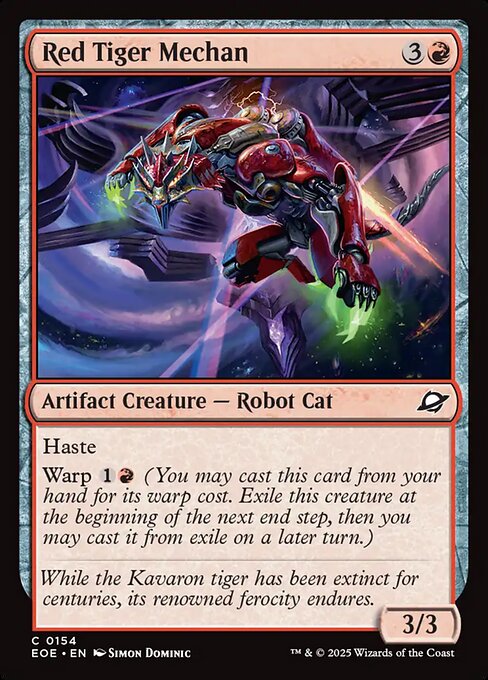
258. Red Tiger Mechan
Rating1.5WeakWhy this rating?
Almost unplayable and mostly sideboard material (1.5/10).
Why. A 3/3 artifact creature with haste for four mana, or two mana with Warp to hit right away before it is exiled and recast later. A decent attacker, playable at several points of the curve.
Risks. It is a plain 3/3 with no particular impact. Cast with Warp, it disappears at end of turn and you pay again later.
In the draft. Late-pack red filler, for an aggressive deck. A creature to take when there is nothing better.
Results in the games of the set
When it is in hand, the deck wins 49.4% of its games (set average: 56.0%, 272nd of 287 cards).
In the opening hand: 47.4% wins (54.8% on average).
Drawn during the game: 50.7% (56.8% on average).
When it is drawn, the deck wins 0.6 points less than when it is not.
When it is drafted, it is played 16% of the time (set average: 62%).
It is played mostly in B/R decks (27% of them) and R/W (25%).
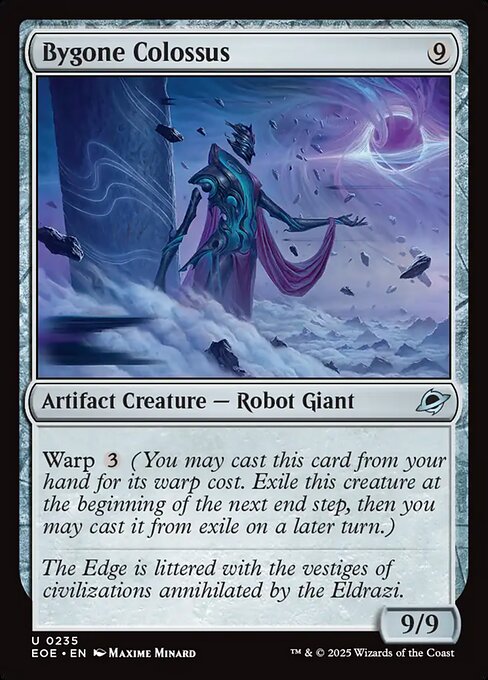
259. Bygone Colossus
Rating1.4WeakWhy this rating?
Almost unplayable and mostly sideboard material (1.4/10).
Why. A 9/9 artifact creature for nine mana, or three mana with Warp. If the game goes long it is a huge finisher.
Risks. Nine mana is out of reach in nearly every game. With Warp it has no haste, cannot attack that turn and is exiled at end of turn: it does almost nothing.
In the draft. Avoid it in most decks. One copy can be justified in a slow deck with plenty of ramp, but it stays weak.
Results in the games of the set
When it is in hand, the deck wins 44.7% of its games (set average: 56.0%, 284th of 287 cards).
In the opening hand: 40.5% wins (54.8% on average).
Drawn during the game: 47.3% (56.8% on average).
When it is drawn, the deck wins 3.5 points less than when it is not.
When it is drafted, it is played only 6% of the time (set average: 62%): it almost always ends in the sideboard.

260. Frontline War-Rager
Rating1.4WeakWhy this rating?
Almost unplayable and mostly sideboard material (1.4/10).
Why. A 2/3 for three that gets a +1/+1 counter at end step if you control two or more tapped creatures. When you attack with several creatures, it grows every turn.
Risks. You must attack with two creatures, which is risky on a stalled board. Without that, it is a small 2/3 that does nothing more.
In the draft. Red filler for an aggressive deck. It fits a low curve, but you replace it without regret.
Results in the games of the set
When it is in hand, the deck wins 49.8% of its games (set average: 56.0%, 268th of 287 cards).
In the opening hand: 49.6% wins (54.8% on average).
Drawn during the game: 50.0% (56.8% on average).
When it is drawn, the deck wins 1.8 points less than when it is not.
When it is drafted, it is played only 12% of the time (set average: 62%): it almost always ends in the sideboard.
It is played mostly in R/W decks (28% of them).

261. Virulent Silencer
Rating1.4WeakWhy this rating?
Almost unplayable and mostly sideboard material (1.4/10).
Why. A colorless 2/3 artifact creature for three. Whenever a nontoken artifact creature you control deals combat damage to a player, that player gets two poison counters.
Risks. Ten poison counters is far away: you need many artifact creatures connecting. Most of the time it is just a 2/3.
In the draft. Colorless filler, to play in an artifact deck. Poison is a slow bonus, not a plan. A late pick.
Results in the games of the set
When it is in hand, the deck wins 49.7% of its games (set average: 56.0%, 270th of 287 cards).
In the opening hand: 48.5% wins (54.8% on average).
Drawn during the game: 50.5% (56.8% on average).
When it is drawn, the deck wins 1.2 points more than when it is not.
When it is drafted, it is played 18% of the time (set average: 62%).
Intrinsic ratings: they do not take into account the cards you have already picked. They matter most for the first pick of the first pack.