Card ranking · Aetherdrift (DFT)
← Aetherdrift271 cards
- Bomb > 8.4
- Very good ≥ 7.2
- Good ≥ 6.2
- Playable ≥ 5.0
- Weak < 5.0
Ratings are out of 10. They combine experts' opinions, the statistics of thousands of drafts by experienced players (when a card is taken, played, and the wins of the decks that play it) and what is printed on the card. Click a card to enlarge it.
 Rating9.4Bomb
Why this rating?
The best card of the set (9.4/10).
Why. A 2/5 with double strike and prowess that, on entering, puts a nonland permanent of your choice an opponent controls third from the top of its owner's library. A big tempo swing, and the body holds the ground on its own.
Risks. The cost demands two white and two blue mana, so you need a true white-blue deck. The permanent comes back in three draws, so this is not permanent removal; only a token is gone for good.
In the draft. Take it first in white-blue without thinking twice. Outside those colors don't force it; you want both colors at full strength and some noncreature spells for prowess.
Results in the games of the set
When it is in hand, the deck wins 63.0% of its games (set average: 55.7%, 7th of 273 cards).
In the opening hand: 61.4% wins (54.9% on average).
Drawn during the game: 64.2% (56.3% on average).
When it is drawn, the deck wins 15.0 points more than when it is not.
When it is drafted, it is played 69% of the time (set average: 63%).
Taken as the first pick (46 drafts), it ends in the deck 80% of the time.
It is played about as much in every archetype.
 Rating9.3Bomb
Why this rating?
One of the 3 best cards of the set (9.3/10).
Why. Four mana gets you a 2/4 plus a colorless 3/2 Vehicle artifact token with crew 1, which flies thanks to her. Whenever one or more creatures with flying you control deal combat damage to a player, you draw, so card advantage comes fast.
Risks. If she dies, the Vehicle loses flying and the draws stop. An opponent with flying or reach blockers also slows your attacks.
In the draft. A bomb in blue: take her very early. She pairs with any flier or Vehicle beyond her own token, so look for Vehicles and evasive creatures on the side.
Results in the games of the set
When it is in hand, the deck wins 65.3% of its games (set average: 55.7%, 4th of 273 cards).
In the opening hand: 65.5% wins (54.9% on average).
Drawn during the game: 65.1% (56.3% on average).
When it is drawn, the deck wins 13.3 points more than when it is not.
When it is drafted, it is played 94% of the time (set average: 63%).
Taken as the first pick (52 drafts), it ends in the deck 96% of the time.
It is played about as much in every archetype.
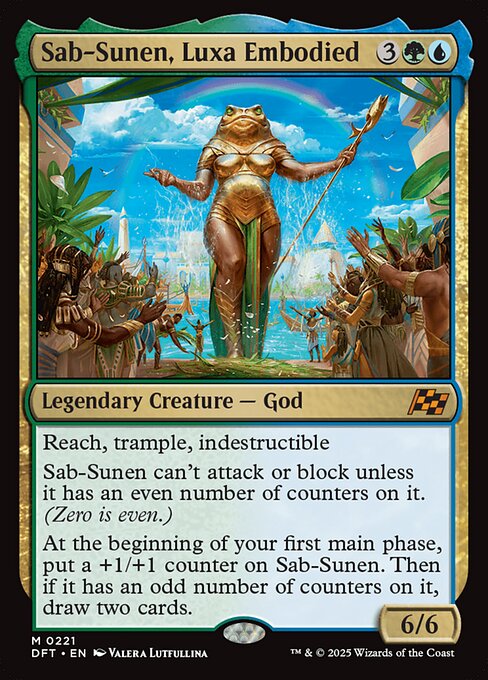 Rating9.1Bomb
Why this rating?
One of the 3 best cards of the set (9.1/10).
Why. A 6/6 with reach, trample and indestructible for five. Each first main phase it gets a counter: with an odd total you draw two cards, with an even total it can attack and block. It almost never dies in combat.
Risks. Every other turn it can neither attack nor block, leaving holes in your defense. Exile, bounce and forced sacrifice beat it, since indestructible doesn't cover everything.
In the draft. A bomb: first pick in green-blue. It is still excellent in green with another color; just plan around the off turns.
Results in the games of the set
When it is in hand, the deck wins 68.0% of its games (set average: 55.7%, 1st of 273 cards).
In the opening hand: 67.7% wins (54.9% on average).
Drawn during the game: 68.1% (56.3% on average).
When it is drawn, the deck wins 15.4 points more than when it is not.
When it is drafted, it is played 97% of the time (set average: 63%).
Taken as the first pick (53 drafts), it ends in the deck 100% of the time.
It is played about as much in every archetype.
 Rating9.0Bomb
Why this rating?
One of the 10 best cards of the set (9.0/10).
Why. A 2/4 with double strike, vigilance and haste for five, plus three Exhaust abilities: three mana of one color, three cards drawn, or three damage to any target. Haste lets you use one the turn it lands.
Risks. It needs green, blue and red: very hard to cast outside a well-fixed deck. Each Exhaust ability works once and taps Loot, so you get one effect per turn, and removal can take it before you finish.
In the draft. A bomb, but only if you are already in two of its colors with a way to fix the third. Otherwise let it pass or take it as a gamble.
Results in the games of the set
When it is in hand, the deck wins 64.1% of its games (set average: 55.7%, 6th of 273 cards).
In the opening hand: 61.5% wins (54.9% on average).
Drawn during the game: 65.8% (56.3% on average).
When it is drawn, the deck wins 12.2 points more than when it is not.
When it is drafted, it is played 87% of the time (set average: 63%).
Taken as the first pick (69 drafts), it ends in the deck 93% of the time.
It is played about as much in every archetype.
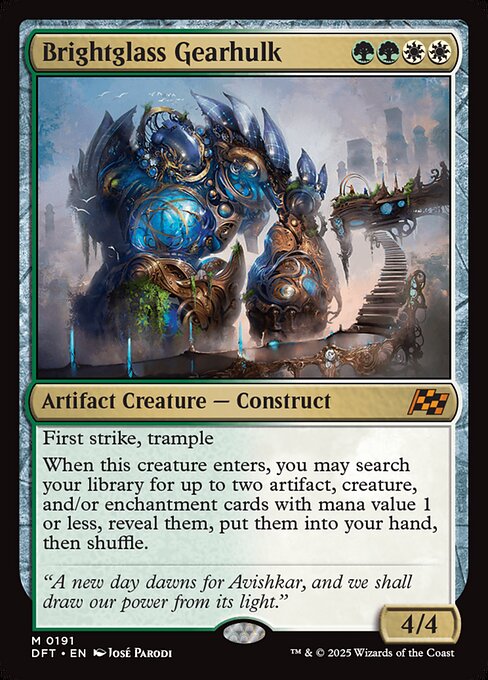 Rating8.9Bomb
Why this rating?
One of the 10 best cards of the set (8.9/10).
Why. A 4/4 with first strike and trample for four mana that searches for up to two artifact, creature and/or enchantment cards with mana value 1 or less and puts them into your hand. An efficient body and card advantage in one spell.
Risks. Its enters trigger is worth only what your deck holds at mana value 1 or less; with few cheap cards it finds almost nothing. Two green and two white mana also demand a solid mana base.
In the draft. A very good pick in green-white: collect good one-mana cards so it always finds two targets. Don't play it outside those colors.
Results in the games of the set
When it is in hand, the deck wins 60.6% of its games (set average: 55.7%, 17th of 273 cards).
In the opening hand: 60.3% wins (54.9% on average).
Drawn during the game: 60.9% (56.3% on average).
When it is drawn, the deck wins 6.8 points more than when it is not.
When it is drafted, it is played 59% of the time (set average: 63%).
Taken as the first pick (32 drafts), it ends in the deck 59% of the time.
It is played about as much in every archetype.
 Rating8.8Bomb
Why this rating?
One of the 10 best cards of the set (8.8/10).
Why. A three-mana Vehicle that fetches a basic land onto the battlefield tapped when it enters and again each time it attacks. Its power equals your lands, so it grows by itself and ramps you into your top end.
Risks. Crew 4 is heavy: you need big creatures or several small ones to tap. Until then it is just a one-shot ramp spell.
In the draft. A very good pick for any green deck with sturdy creatures. Take it early and build a deck that can really crew it.
Results in the games of the set
When it is in hand, the deck wins 65.4% of its games (set average: 55.7%, 3rd of 273 cards).
In the opening hand: 70.0% wins (54.9% on average).
Drawn during the game: 62.0% (56.3% on average).
When it is drawn, the deck wins 11.5 points more than when it is not.
When it is drafted, it is played 92% of the time (set average: 63%).
Taken as the first pick (119 drafts), it ends in the deck 95% of the time.
It is played about as much in every archetype.
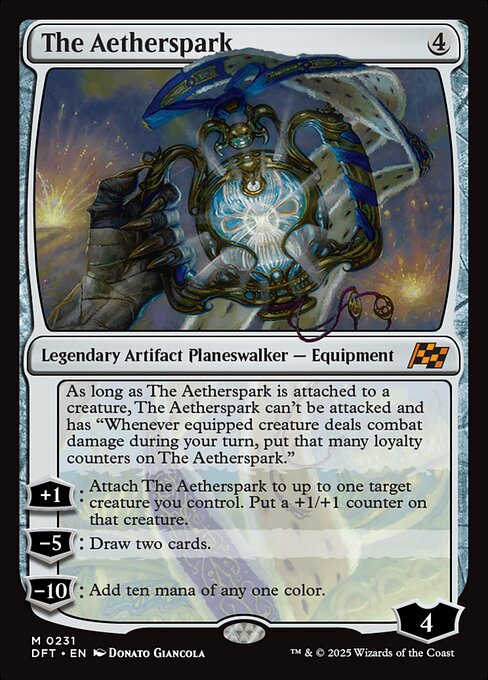 Rating8.8Bomb
Why this rating?
One of the 10 best cards of the set (8.8/10).
Why. A colorless planeswalker Equipment for four mana: the plus ability attaches it to a creature and puts a +1/+1 counter on it. While attached it can't be attacked and gains loyalty when the equipped creature deals combat damage during your turn. It eventually draws you two.
Risks. With no creature to equip it can be attacked and does almost nothing. If the equipped creature dies or can't connect, loyalty stalls, and as an artifact it is exposed to artifact removal.
In the draft. A colorless bomb: it fits every color, so take it high from the start of the draft. It likes creature-heavy decks with evasive attackers to run its loyalty up.
Results in the games of the set
When it is in hand, the deck wins 60.9% of its games (set average: 55.7%, 15th of 273 cards).
In the opening hand: 61.7% wins (54.9% on average).
Drawn during the game: 60.4% (56.3% on average).
When it is drawn, the deck wins 8.9 points more than when it is not.
When it is drafted, it is played 99% of the time (set average: 63%).
Taken among the first three picks (225 drafts), it ends in the deck 99% of the time.
It is played about as much in every archetype.
 Rating8.7Bomb
Why this rating?
One of the 10 best cards of the set (8.7/10).
Why. A 6/6 trample Vehicle for four mana that makes each opponent lose 3 life and gains you 3 the moment it enters. Even without attacking it already does part of the job, and once it attacks it ends games.
Risks. Crew 2 needs a creature with power 2 or more, or several small ones. It does nothing uncrewed, and as an artifact it is exposed to artifact removal. Two colors are mandatory, black and green.
In the draft. A black-green bomb: take it very early. Keep enough creatures with power 2 or more to crew it every turn.
Results in the games of the set
When it is in hand, the deck wins 61.4% of its games (set average: 55.7%, 13th of 273 cards).
In the opening hand: 60.4% wins (54.9% on average).
Drawn during the game: 62.2% (56.3% on average).
When it is drawn, the deck wins 7.9 points more than when it is not.
When it is drafted, it is played 85% of the time (set average: 63%).
Taken as the first pick (156 drafts), it ends in the deck 84% of the time.
It is played about as much in every archetype.
 Rating8.6Bomb
Why this rating?
One of the 10 best cards of the set (8.6/10).
Why. An 8/8 trampler for five that also cycles: for two generic mana and a green mana you draw and put two +1/+1 counters on a creature or Vehicle, which gains trample and indestructible until end of turn. Flexible at every stage.
Risks. It needs two green mana to cast, and an 8/8 is still exposed to removal, exile and bounce. Cycling it means losing the body.
In the draft. A green bomb: take it early, it is good at every stage of the game. It slots into any green deck with creatures to put the counters on.
Results in the games of the set
When it is in hand, the deck wins 64.3% of its games (set average: 55.7%, 5th of 273 cards).
In the opening hand: 63.4% wins (54.9% on average).
Drawn during the game: 64.9% (56.3% on average).
When it is drawn, the deck wins 10.0 points more than when it is not.
When it is drafted, it is played 94% of the time (set average: 63%).
Taken as the first pick (103 drafts), it ends in the deck 93% of the time.
It is played about as much in every archetype.
 Rating8.5Bomb
Why this rating?
One of the 10 best cards of the set (8.5/10).
Why. A two-mana 2/2 that turns into a late-game engine: one Exhaust for a red mana gives your other creatures haste and puts a +1/+1 counter on it, the other costs four and makes a 4/4 red Dinosaur Dragon creature token with flying.
Risks. Each Exhaust is once only, and the 2/2 body is fragile: if it dies before you reach four mana, the Dragon never shows up.
In the draft. A very good pick in red, especially in aggressive decks. Take it early and play it early so the Dragon arrives in the midgame.
Results in the games of the set
When it is in hand, the deck wins 61.8% of its games (set average: 55.7%, 11th of 273 cards).
In the opening hand: 61.8% wins (54.9% on average).
Drawn during the game: 61.7% (56.3% on average).
When it is drawn, the deck wins 8.6 points more than when it is not.
When it is drafted, it is played 92% of the time (set average: 63%).
Taken as the first pick (106 drafts), it ends in the deck 92% of the time.
It is played about as much in every archetype.

11. Howlsquad Heavy
Rating8.5BombWhy this rating?
One of the very best rares of the format (8.5/10).
Why. A Goblin factory for three mana: each combat you create a 1/1 red Goblin creature token that must attack that turn, and your other Goblins have haste. At max speed it taps for a red mana per Goblin you control.
Risks. Each token must attack the turn it is created and often dies alone into a blocker. Start your engines! only advances when an opponent loses life, and one removal spell shuts the production off.
In the draft. A good pick in red, especially in aggressive decks. It is best with other Goblins and cheap ways to make the opponent lose life.
Results in the games of the set
When it is in hand, the deck wins 61.8% of its games (set average: 55.7%, 10th of 273 cards).
In the opening hand: 65.4% wins (54.9% on average).
Drawn during the game: 59.3% (56.3% on average).
When it is drawn, the deck wins 8.9 points more than when it is not.
When it is drafted, it is played 87% of the time (set average: 63%).
Taken as the first pick (110 drafts), it ends in the deck 79% of the time.
It is played about as much in every archetype.
 Rating8.4Very good
Why this rating?
One of the very best rares of the format (8.4/10).
Why. A 1/1 menace creature for one red mana that pumps +1/+0 for two and has double strike at max speed. It starts your engine on turn 1 and can become a real threat late.
Risks. A 1/1 that needs mana invested to matter dies to anything. Without max speed it is just a small menace creature, and a slow deck never gets it there.
In the draft. Fine in an aggressive red deck, with evasion and burn to make the opponent lose life. Take it after your removal.
Results in the games of the set
When it is in hand, the deck wins 59.2% of its games (set average: 55.7%, 34th of 273 cards).
In the opening hand: 64.2% wins (54.9% on average).
Drawn during the game: 55.6% (56.3% on average).
When it is drawn, the deck wins 6.0 points more than when it is not.
When it is drafted, it is played 85% of the time (set average: 63%).
Taken as the first pick (80 drafts), it ends in the deck 91% of the time.
It is played about as much in every archetype.

13. Perilous Snare
Rating8.3Very goodWhy this rating?
One of the very best rares of the format (8.3/10).
Why. A three-mana removal spell that exiles an opponent's nonland permanent as long as the artifact stays on the battlefield. At max speed it then adds a +1/+1 counter to a creature or Vehicle, at sorcery speed, so it stays useful for a long time.
Risks. If the artifact is destroyed or bounced, the opposing permanent returns. Max speed only comes if an opponent loses life.
In the draft. A very good pick in white, so it goes in every deck of that colour. Take it high among removal.
Results in the games of the set
When it is in hand, the deck wins 62.1% of its games (set average: 55.7%, 9th of 273 cards).
In the opening hand: 59.9% wins (54.9% on average).
Drawn during the game: 63.5% (56.3% on average).
When it is drawn, the deck wins 9.1 points more than when it is not.
When it is drafted, it is played 92% of the time (set average: 63%).
Taken as the first pick (123 drafts), it ends in the deck 90% of the time.
It is played about as much in every archetype.
 Rating8.2Very good
Why this rating?
One of the very best mythics of the format (8.2/10).
Why. A six-mana enchantment that gives all your creatures base power and toughness 6/6, and creates a 3/3 green Elephant creature token whenever an opponent casts a spell on a turn that isn't theirs. It takes over the game if you already have creatures, even small ones.
Risks. Three green mana and six total: slow, and it does nothing without creatures. The Elephant tokens are occasional, since the opponent must cast spells during your turn.
In the draft. Good if you are heavily green with plenty of creatures. A high pick in green, but not for a deck with few creatures.
Results in the games of the set
When it is in hand, the deck wins 62.7% of its games (set average: 55.7%, 8th of 273 cards).
In the opening hand: 60.6% wins (54.9% on average).
Drawn during the game: 64.0% (56.3% on average).
When it is drawn, the deck wins 8.9 points more than when it is not.
When it is drafted, it is played 90% of the time (set average: 63%).
Taken as the first pick (51 drafts), it ends in the deck 92% of the time.
It is played about as much in every archetype.
 Rating8.2Very good
Why this rating?
One of the very best mythics of the format (8.2/10).
Why. A 7/7 with vigilance and menace for six mana that gives your other creatures +2/+2, vigilance and menace until end of turn, and stops damage from being prevented this turn. It is a finisher: with a board of creatures a single attack can end the game.
Risks. Two red and two green mana at six mana: expensive and color-hungry. With no other creatures it is just a big body.
In the draft. A finisher for red-green decks, to take after your good cheaper cards.
Results in the games of the set
When it is in hand, the deck wins 60.9% of its games (set average: 55.7%, 16th of 273 cards).
In the opening hand: 56.7% wins (54.9% on average).
Drawn during the game: 63.7% (56.3% on average).
When it is drawn, the deck wins 8.4 points more than when it is not.
When it is drafted, it is played 78% of the time (set average: 63%).
Taken as the first pick (36 drafts), it ends in the deck 78% of the time.
It is played about as much in every archetype.
 Rating8.1Very good
Why this rating?
One of the very best rares of the format (8.1/10).
Why. A 5/5 Vehicle for five mana that, on entering, steals an opponent's creature of your choice, which can't attack or block as long as you control the Vehicle. It is removal and a big body in one, and the stolen creature can still crew.
Risks. Crew 3 is costly, and if the Vehicle is destroyed or bounced the opponent gets the creature back. It also needs two blue mana.
In the draft. A very good pick in blue, playable in every blue deck. Keep enough creatures to crew it so it can attack as well.
Results in the games of the set
When it is in hand, the deck wins 60.3% of its games (set average: 55.7%, 19th of 273 cards).
In the opening hand: 57.4% wins (54.9% on average).
Drawn during the game: 62.2% (56.3% on average).
When it is drawn, the deck wins 8.2 points more than when it is not.
When it is drafted, it is played 92% of the time (set average: 63%).
Taken as the first pick (149 drafts), it ends in the deck 92% of the time.
It is played about as much in every archetype.
 Rating8.0Very good
Why this rating?
One of the very best rares of the format (8.0/10).
Why. A three-mana 4/2 that grows to 6/4 with its Exhaust, and comes back from the graveyard whenever you activate an Exhaust ability. In a deck with other Exhaust abilities it often returns after dying.
Risks. With no other Exhaust source it almost never returns, and a 4/2 dies to a small blocker. Its own Exhaust can't bring it back, since it is in the graveyard by then.
In the draft. Fine, playable in any green deck but best with other Exhaust cards. A mid-pack pick, nothing more.
Results in the games of the set
When it is in hand, the deck wins 59.1% of its games (set average: 55.7%, 35th of 273 cards).
In the opening hand: 60.4% wins (54.9% on average).
Drawn during the game: 58.2% (56.3% on average).
When it is drawn, the deck wins 4.1 points more than when it is not.
When it is drafted, it is played 92% of the time (set average: 63%).
Taken as the first pick (123 drafts), it ends in the deck 93% of the time.
It is played about as much in every archetype.

18. Caradora, Heart of Alacria
Rating7.9Very goodWhy this rating?
One of the very best rares of the format (7.9/10).
Why. A four-mana 4/2 that searches for a Mount or Vehicle and adds an extra counter every time you put +1/+1 counters on a creature or Vehicle. A good two-for-one in a deck that uses counters.
Risks. Its enters trigger depends on how many Mounts and Vehicles are in your deck, and 2 toughness dies too easily. Without counters its second ability does nothing.
In the draft. A good pick in green-white if you have several Mounts or Vehicles. Otherwise it stays an average 4/2, so build up your targets first.
Results in the games of the set
When it is in hand, the deck wins 57.9% of its games (set average: 55.7%, 53rd of 273 cards).
In the opening hand: 56.8% wins (54.9% on average).
Drawn during the game: 58.6% (56.3% on average).
When it is drawn, the deck wins 3.3 points more than when it is not.
When it is drafted, it is played 75% of the time (set average: 63%).
Taken as the first pick (60 drafts), it ends in the deck 87% of the time.
It is played mostly in G/W decks (28% of them).
 Rating7.9Very good
Why this rating?
One of the very best mythics of the format (7.9/10).
Why. A three-mana 5/5 trample Vehicle: each other creature or Vehicle you control enters with an extra +1/+1 counter if its mana value is 4 or less, or three extra counters if it is higher. Your creatures grow every time you cast one.
Risks. Crew 3 is heavy early, and if the Vehicle is destroyed before you land several creatures it only served as a speed bump. It also needs two green mana.
In the draft. Decent, especially in a green deck with many creatures to crew it. Not a high pick: you already need a solid creature base.
Results in the games of the set
When it is in hand, the deck wins 57.3% of its games (set average: 55.7%, 68th of 273 cards).
In the opening hand: 56.8% wins (54.9% on average).
Drawn during the game: 57.8% (56.3% on average).
When it is drawn, the deck wins 2.9 points more than when it is not.
When it is drafted, it is played 90% of the time (set average: 63%).
Taken as the first pick (36 drafts), it ends in the deck 92% of the time.
It is played about as much in every archetype.
 Rating7.8Very good
Why this rating?
One of the very best mythics of the format (7.8/10).
Why. A four-mana planeswalker whose zero ability creates a colorless 3/2 Vehicle artifact token with crew 1, and which turns one of your Vehicles into a haste artifact creature each combat. Its plus ability turns a sacrificed artifact or a discarded card into a new card.
Risks. You need creatures to crew your Vehicles and to defend her. Without Vehicles she loses most of her value.
In the draft. Good in a red deck with Vehicles or artifacts, to take behind the strongest cards.
Results in the games of the set
When it is in hand, the deck wins 58.5% of its games (set average: 55.7%, 43rd of 273 cards).
In the opening hand: 57.9% wins (54.9% on average).
Drawn during the game: 58.9% (56.3% on average).
When it is drawn, the deck wins 5.9 points more than when it is not.
When it is drafted, it is played 94% of the time (set average: 63%).
Taken as the first pick (41 drafts), it ends in the deck 95% of the time.
It is played about as much in every archetype.

21. Salvation Engine
Rating7.7Very goodWhy this rating?
One of the very best mythics of the format (7.7/10).
Why. A five-mana 6/10 Vehicle that gives your other artifact creatures +2/+2 and returns an artifact card from your graveyard to the battlefield when it attacks. The power is there, but it depends on very specific conditions.
Risks. Crew 6 is nearly unplayable without several big creatures, and your other artifact creatures are rare. Five mana for an effect that needs a whole deck built around it.
In the draft. Weak, to be played only in a deck with plenty of artifacts and big creatures. Usually let it pass.
Results in the games of the set
When it is in hand, the deck wins 55.2% of its games (set average: 55.7%, 138th of 273 cards).
In the opening hand: 53.1% wins (54.9% on average).
Drawn during the game: 56.5% (56.3% on average).
When it is drawn, the deck wins 5.4 points more than when it is not.
When it is drafted, it is played 88% of the time (set average: 63%).
Taken as the first pick (41 drafts), it ends in the deck 88% of the time.
It is played about as much in every archetype.

22. District Mascot
Rating7.6Very goodWhy this rating?
One of the very best rares of the format (7.6/10).
Why. A one-mana green 1/1 that grows by attacking while saddled and can destroy an artifact by removing two counters. Saddle 1 is paid by any other creature with power 1 or more, and the artifact destruction is a good backup plan.
Risks. It enters with a single counter, so to destroy an artifact it must first grow by attacking saddled. Without opposing artifacts the ability is dead.
In the draft. A decent playable in green, a mid-pack pick. A good choice if you see many artifacts across the table.
Results in the games of the set
When it is in hand, the deck wins 58.4% of its games (set average: 55.7%, 45th of 273 cards).
In the opening hand: 63.8% wins (54.9% on average).
Drawn during the game: 54.3% (56.3% on average).
When it is drawn, the deck wins 3.0 points more than when it is not.
When it is drafted, it is played 89% of the time (set average: 63%).
Taken as the first pick (110 drafts), it ends in the deck 95% of the time.
It is played about as much in every archetype.

23. Basri, Tomorrow's Champion
Rating7.6Very goodWhy this rating?
One of the very best rares of the format (7.6/10).
Why. A one-mana white 2/1 that, for a white mana, taps and stays tapped through your next untap step to make a 1/1 white Cat creature token with lifelink. Cycled from hand, it gives your Cats hexproof and indestructible.
Risks. A 2/1 dies to anything, and it makes a token only every other turn. Cycling only protects against removal if you have Cats.
In the draft. A decent white playable, a mid-pack pick. Best in aggressive white decks or those that like small tokens.
Results in the games of the set
When it is in hand, the deck wins 57.4% of its games (set average: 55.7%, 66th of 273 cards).
In the opening hand: 61.9% wins (54.9% on average).
Drawn during the game: 54.1% (56.3% on average).
When it is drawn, the deck wins 4.1 points more than when it is not.
When it is drafted, it is played 81% of the time (set average: 63%).
Taken as the first pick (75 drafts), it ends in the deck 83% of the time.
It is played about as much in every archetype.

24. Boommobile
Rating7.6Very goodWhy this rating?
One of the very best rares of the format (7.6/10).
Why. A four-mana 5/5 Vehicle that adds four mana of one color, spendable only on abilities, when it enters. Its Exhaust deals X damage to any target and adds a counter; that mana pays for an activation with X equal to 1, or more with your other mana.
Risks. Crew 2 needs a creature, and the Vehicle doesn't attack uncrewed. Its Exhaust works once, and the cost requires two red mana.
In the draft. A good pick in red, serving as both a threat and removal. It gets stronger with a few creatures to crew it.
Results in the games of the set
When it is in hand, the deck wins 58.3% of its games (set average: 55.7%, 47th of 273 cards).
In the opening hand: 57.0% wins (54.9% on average).
Drawn during the game: 59.2% (56.3% on average).
When it is drawn, the deck wins 5.3 points more than when it is not.
When it is drafted, it is played 89% of the time (set average: 63%).
Taken as the first pick (99 drafts), it ends in the deck 87% of the time.
It is played about as much in every archetype.
 Rating7.6Very good
Why this rating?
One of the very best rares of the format (7.6/10).
Why. A three-mana 4/4 flying Vehicle with crew 2 that creates a 1/1 colorless Thopter artifact creature token with flying whenever you draw your second card each turn. A good aerial body.
Risks. The trigger needs extra card draw, such as cycling, so many decks never see it. It also needs a crew with total power 2.
In the draft. A fine playable in blue, stronger with draw effects. Take it mainly for the evasive body.
Results in the games of the set
When it is in hand, the deck wins 59.6% of its games (set average: 55.7%, 28th of 273 cards).
In the opening hand: 59.4% wins (54.9% on average).
Drawn during the game: 59.7% (56.3% on average).
When it is drawn, the deck wins 8.3 points more than when it is not.
When it is drafted, it is played 92% of the time (set average: 63%).
Taken as the first pick (133 drafts), it ends in the deck 92% of the time.
It is played about as much in every archetype.
 Rating7.5Very good
Why this rating?
One of the very best mythics of the format (7.6/10).
Why. A two-mana 5/3 indestructible haste creature that can't attack or block until you have max speed. Once speed reaches 4 it becomes a threat that is very hard to deal with.
Risks. You need max speed, which takes several turns of the opponent losing life. Until then she only makes a small creature unblockable, and a slow deck never gets her there.
In the draft. Only in a very aggressive red deck. In a normal deck she is too slow; take her lower.
Results in the games of the set
When it is in hand, the deck wins 57.9% of its games (set average: 55.7%, 54th of 273 cards).
In the opening hand: 56.7% wins (54.9% on average).
Drawn during the game: 58.7% (56.3% on average).
When it is drawn, the deck wins 5.6 points more than when it is not.
When it is drafted, it is played 88% of the time (set average: 63%).
Taken as the first pick (44 drafts), it ends in the deck 91% of the time.
It is played about as much in every archetype.
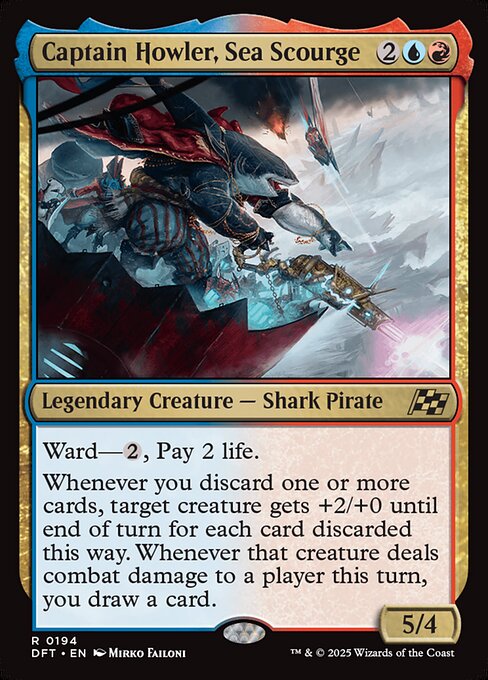
27. Captain Howler, Sea Scourge
Rating7.5Very goodWhy this rating?
A very good rare of the format (7.5/10).
Why. A four-mana 5/4 with ward—pay 2 mana and 2 life. Whenever you discard, a creature gets +2/+0 for each card discarded, and you draw if it deals combat damage to a player. In a deck that discards (cycling, looting) it builds advantage.
Risks. Without ways to discard it is just a decent 5/4. It also needs two colors, blue and red.
In the draft. A decent pick in blue-red, a bit higher with cycling cards. Outside that deck, leave it.
Results in the games of the set
When it is in hand, the deck wins 58.8% of its games (set average: 55.7%, 38th of 273 cards).
In the opening hand: 59.4% wins (54.9% on average).
Drawn during the game: 58.5% (56.3% on average).
When it is drawn, the deck wins 8.2 points more than when it is not.
When it is drafted, it is played 76% of the time (set average: 63%).
Taken as the first pick (94 drafts), it ends in the deck 86% of the time.
It is played mostly in R/U decks (32% of them).
 Rating7.4Very good
Why this rating?
A solid uncommon of the format (7.4/10).
Why. A two-mana 2/3 that deals 1 damage to an opponent and gains you 1 life on entering, which advances your speed. At max speed it has deathtouch and haste.
Risks. Two colors are mandatory, black and red. Its 2/3 body is modest and doesn't change a game alone.
In the draft. A good pick for black-red, especially in a speed deck. A good two-drop, no more.
Results in the games of the set
When it is in hand, the deck wins 59.8% of its games (set average: 55.7%, 22nd of 273 cards).
In the opening hand: 61.4% wins (54.9% on average).
Drawn during the game: 58.7% (56.3% on average).
When it is drawn, the deck wins 6.0 points more than when it is not.
When it is drafted, it is played 61% of the time (set average: 63%).
Taken as the first pick (110 drafts), it ends in the deck 88% of the time.
It is played mostly in B/R decks (63% of them).
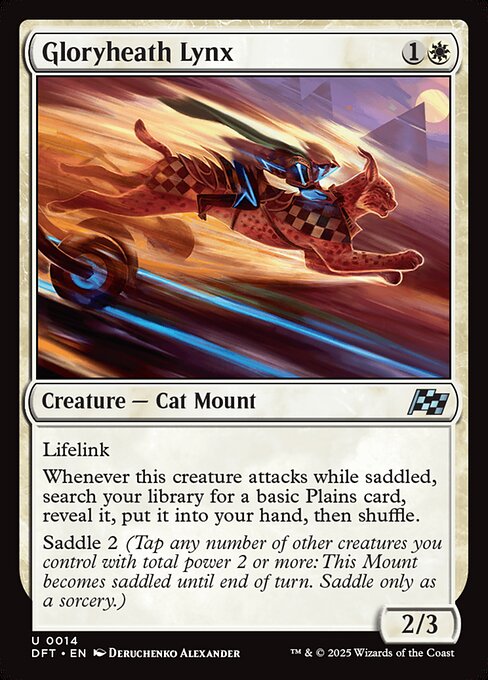
29. Gloryheath Lynx
Rating7.4Very goodWhy this rating?
A solid uncommon of the format (7.4/10).
Why. A two-mana 2/3 lifelinker that fetches a basic Plains into your hand when it attacks saddled. Saddle 2 means tapping other creatures with total power 2, and the land keeps your land drops coming.
Risks. To use its ability you must attack saddled, which taps other creatures and exposes the Lynx. A 2/3 is modest in combat.
In the draft. A good pick for white decks, a very solid two-drop. Playable in every pair that includes white.
Results in the games of the set
When it is in hand, the deck wins 59.6% of its games (set average: 55.7%, 26th of 273 cards).
In the opening hand: 63.4% wins (54.9% on average).
Drawn during the game: 56.8% (56.3% on average).
When it is drawn, the deck wins 5.3 points more than when it is not.
When it is drafted, it is played 83% of the time (set average: 63%).
Taken as the first pick (191 drafts), it ends in the deck 90% of the time.
It is played mostly in G/W decks (38% of them) and R/W (38%).
 Rating7.4Very good
Why this rating?
A very good rare of the format (7.4/10).
Why. A one-mana blue 1/1 whose Exhaust draws X cards and puts a +1/+1 counter on each Merfolk you control. The longer the game goes, the more it draws: a cheap late-game engine.
Risks. A 1/1 that does nothing until you have enough mana, and its Exhaust works only once. It needs two blue mana on top of X.
In the draft. A decent playable in blue, a mid-pack pick. Best in slow or control decks.
Results in the games of the set
When it is in hand, the deck wins 59.7% of its games (set average: 55.7%, 25th of 273 cards).
In the opening hand: 60.3% wins (54.9% on average).
Drawn during the game: 59.3% (56.3% on average).
When it is drawn, the deck wins 6.6 points more than when it is not.
When it is drafted, it is played 90% of the time (set average: 63%).
Taken as the first pick (142 drafts), it ends in the deck 89% of the time.
It is played about as much in every archetype.
 Rating7.4Very good
Why this rating?
A very good rare of the format (7.4/10).
Why. A two-mana 2/3 whose Exhaust, for X plus two green and one blue mana, puts X counters on her and can set the base power and toughness of your other creatures to her power for the turn. A possible finisher with a wide board.
Risks. Its Exhaust is expensive and works only once, and the 2/3 is modest before then. She needs a wide board to be decisive.
In the draft. A good pick for green-blue, especially as a two-drop. Better with a wide creature base.
Results in the games of the set
When it is in hand, the deck wins 60.3% of its games (set average: 55.7%, 20th of 273 cards).
In the opening hand: 58.9% wins (54.9% on average).
Drawn during the game: 61.2% (56.3% on average).
When it is drawn, the deck wins 6.8 points more than when it is not.
When it is drafted, it is played 80% of the time (set average: 63%).
Taken as the first pick (112 drafts), it ends in the deck 86% of the time.
It is played about as much in every archetype.
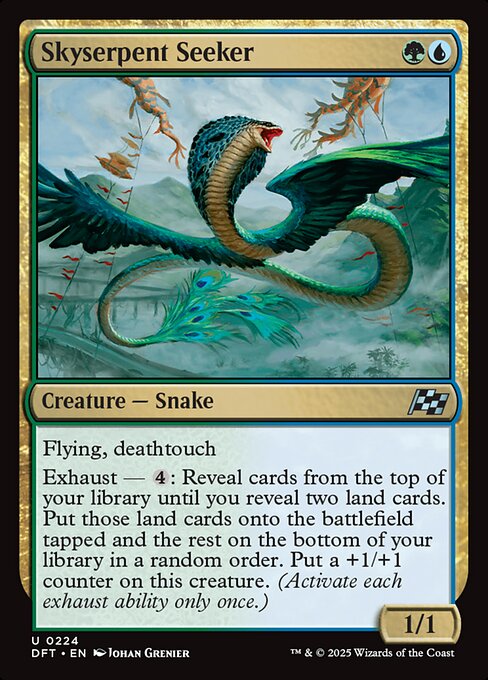 Rating7.4Very good
Why this rating?
A solid uncommon of the format (7.4/10).
Why. A two-mana 1/1 with flying and deathtouch that deters almost any attack. Its four-mana Exhaust puts two lands onto the battlefield tapped and gives it a +1/+1 counter, which accelerates your mana.
Risks. A 1/1 dies to any damage, even if deathtouch lets it take a big creature with it. Two colors are mandatory, green and blue.
In the draft. A very good pick for green-blue, an excellent defensive two-drop. Take it without hesitation in that pair.
Results in the games of the set
When it is in hand, the deck wins 59.2% of its games (set average: 55.7%, 33rd of 273 cards).
In the opening hand: 58.9% wins (54.9% on average).
Drawn during the game: 59.4% (56.3% on average).
When it is drawn, the deck wins 4.4 points more than when it is not.
When it is drafted, it is played 80% of the time (set average: 63%).
Taken as the first pick (222 drafts), it ends in the deck 86% of the time.
It is played mostly in G/U decks (48% of them).
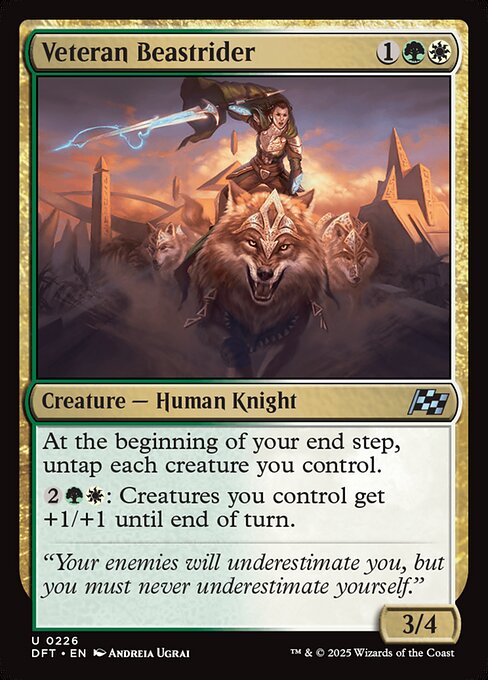 Rating7.4Very good
Why this rating?
A solid uncommon of the format (7.4/10).
Why. A three-mana 3/4 that untaps all your creatures at your end step, so they attack and then block as if they had vigilance. For four mana your whole team gets +1/+1 until end of turn.
Risks. Two colors are mandatory, green and white. Without other creatures its abilities do almost nothing, and the body is modest.
In the draft. A good pick for green-white, very solid in creature decks.
Results in the games of the set
When it is in hand, the deck wins 59.7% of its games (set average: 55.7%, 24th of 273 cards).
In the opening hand: 59.5% wins (54.9% on average).
Drawn during the game: 59.8% (56.3% on average).
When it is drawn, the deck wins 4.6 points more than when it is not.
When it is drafted, it is played 72% of the time (set average: 63%).
Taken as the first pick (135 drafts), it ends in the deck 82% of the time.
It is played mostly in G/W decks (60% of them).
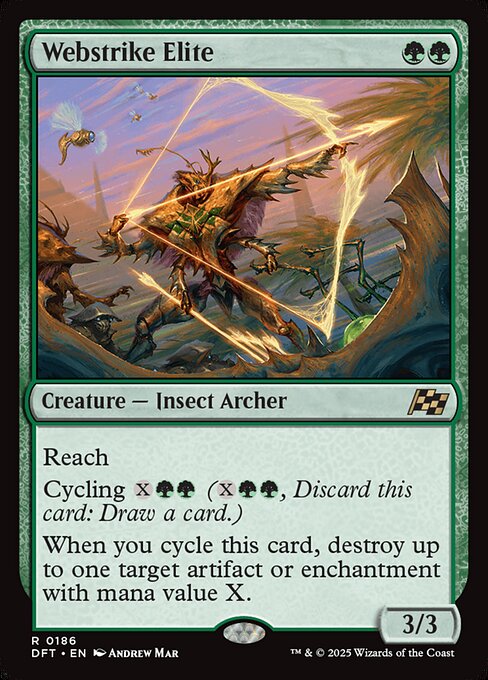
34. Webstrike Elite
Rating7.4Very goodWhy this rating?
A very good rare of the format (7.4/10).
Why. A two-mana 3/3 with reach that cycles to destroy an artifact or enchantment with mana value X. A good early body, and a flexible answer later.
Risks. It needs two green mana early, and the destruction needs a target with mana value exactly X; with no target you still draw, but lose the body.
In the draft. A decent playable in green, especially against Vehicle decks. A mid-pack pick, no more.
Results in the games of the set
When it is in hand, the deck wins 57.6% of its games (set average: 55.7%, 61st of 273 cards).
In the opening hand: 57.2% wins (54.9% on average).
Drawn during the game: 57.8% (56.3% on average).
When it is drawn, the deck wins 2.0 points more than when it is not.
When it is drafted, it is played 94% of the time (set average: 63%).
Taken as the first pick (130 drafts), it ends in the deck 96% of the time.
It is played about as much in every archetype.
 Rating7.3Very good
Why this rating?
A very good rare of the format (7.3/10).
Why. A slow but steady recursion engine: each turn you give embalm to a creature card in your graveyard and it returns as a white Zombie token copy. Zombies get +1/+1, so the copy comes back bigger.
Risks. It does nothing on the battlefield by itself, and you repay the creature's full mana cost. Embalm only works at sorcery speed.
In the draft. A good pick for a grindy black deck with creatures worth replaying. Worse in an aggressive deck.
Results in the games of the set
When it is in hand, the deck wins 58.9% of its games (set average: 55.7%, 37th of 273 cards).
In the opening hand: 55.4% wins (54.9% on average).
Drawn during the game: 61.2% (56.3% on average).
When it is drawn, the deck wins 5.2 points more than when it is not.
When it is drafted, it is played 91% of the time (set average: 63%).
Taken as the first pick (127 drafts), it ends in the deck 91% of the time.
It is played about as much in every archetype.

36. Transit Mage
Rating7.2Very goodWhy this rating?
A solid uncommon of the format (7.2/10).
Why. A 2/2 for three that fetches an artifact with mana value 4 or 5: if you have targets, it is two cards for one.
Risks. With no artifact of mana value 4 or 5 in the deck, it is a vanilla 2/2. Its value depends entirely on your list.
In the draft. Play it only with two or three artifacts at that cost (Vehicles included). Mid pick, higher if you already have big Vehicles.
Results in the games of the set
When it is in hand, the deck wins 59.0% of its games (set average: 55.7%, 36th of 273 cards).
In the opening hand: 58.2% wins (54.9% on average).
Drawn during the game: 59.5% (56.3% on average).
When it is drawn, the deck wins 5.0 points more than when it is not.
When it is drafted, it is played 79% of the time (set average: 63%).
Taken as the first pick (241 drafts), it ends in the deck 86% of the time.
It is played mostly in U/W decks (38% of them) and B/U (37%).

37. Bulwark Ox
Rating7.2Very goodWhy this rating?
A very good rare of the format (7.2/10).
Why. A 2/2 for two that puts a +1/+1 counter on a creature whenever it attacks saddled. Sacrificing it gives hexproof and indestructible to your creatures with counters, which can beat destroy removal, damage or a sweeper.
Risks. You need to tap another creature to saddle it (Saddle 1), and attacking with a 2/2 is risky. The protection only covers creatures with counters.
In the draft. Good in a counters deck, especially green-white. A mid pick in a white deck with no counters plan.
Results in the games of the set
When it is in hand, the deck wins 55.5% of its games (set average: 55.7%, 124th of 273 cards).
In the opening hand: 58.0% wins (54.9% on average).
Drawn during the game: 53.5% (56.3% on average).
When it is drawn, the deck wins 1.4 points more than when it is not.
When it is drafted, it is played 83% of the time (set average: 63%).
Taken as the first pick (79 drafts), it ends in the deck 89% of the time.
It is played about as much in every archetype.
 Rating7.2Very good
Why this rating?
A very good rare of the format (7.2/10).
Why. A creature that scales with your mana: a small body early, a big one later, and a four-mana sink for more counters. When it dies, you draw a card for each +1/+1 counter on it.
Risks. For two mana it is a 1/1; for four, a 2/2. Exile avoids the draw on death, and bounce makes it lose its counters.
In the draft. A solid midrange include that fits any deck since it is colourless. Take it without urgency, but it is never dead.
Results in the games of the set
When it is in hand, the deck wins 56.6% of its games (set average: 55.7%, 84th of 273 cards).
In the opening hand: 55.7% wins (54.9% on average).
Drawn during the game: 57.2% (56.3% on average).
When it is drawn, the deck wins 2.9 points more than when it is not.
When it is drafted, it is played 98% of the time (set average: 63%).
Taken as the first pick (83 drafts), it ends in the deck 99% of the time.
It is played about as much in every archetype.

39. The Speed Demon
Rating7.2GoodWhy this rating?
A very good mythic of the format (7.2/10).
Why. A 5/5 with flying and trample that draws at least one card at the end of each of your turns once it lands, and more as your speed climbs. A value engine that also closes the game in the air.
Risks. You lose as much life as the cards you draw, up to four per turn at max speed. Against an aggressive deck it can kill you itself. It needs two black mana.
In the draft. A very good pick to take early, especially in a deck that holds the board and has some life gain.
Results in the games of the set
When it is in hand, the deck wins 60.4% of its games (set average: 55.7%, 18th of 273 cards).
In the opening hand: 59.3% wins (54.9% on average).
Drawn during the game: 61.2% (56.3% on average).
When it is drawn, the deck wins 6.7 points more than when it is not.
When it is drafted, it is played 92% of the time (set average: 63%).
Taken as the first pick (62 drafts), it ends in the deck 95% of the time.
It is played about as much in every archetype.

40. Oildeep Gearhulk
Rating7.1GoodWhy this rating?
A very good mythic of the format (7.1/10).
Why. A 4/4 with lifelink and ward 1 that lets you pick a card from the opponent's hand: they discard it and draw a replacement. A solid body that disrupts and that cheap removal struggles to answer.
Risks. Two blue mana and two black mana: it locks you into blue-black. The opponent redraws in exchange, so the effect alone is not card advantage.
In the draft. A fair pick for any blue-black deck. If you are not in those colours, pass it.
Results in the games of the set
When it is in hand, the deck wins 58.7% of its games (set average: 55.7%, 41st of 273 cards).
In the opening hand: 56.9% wins (54.9% on average).
Drawn during the game: 59.9% (56.3% on average).
When it is drawn, the deck wins 8.4 points more than when it is not.
When it is drafted, it is played 77% of the time (set average: 63%).
Taken as the first pick (37 drafts), it ends in the deck 86% of the time.
It is played about as much in every archetype.
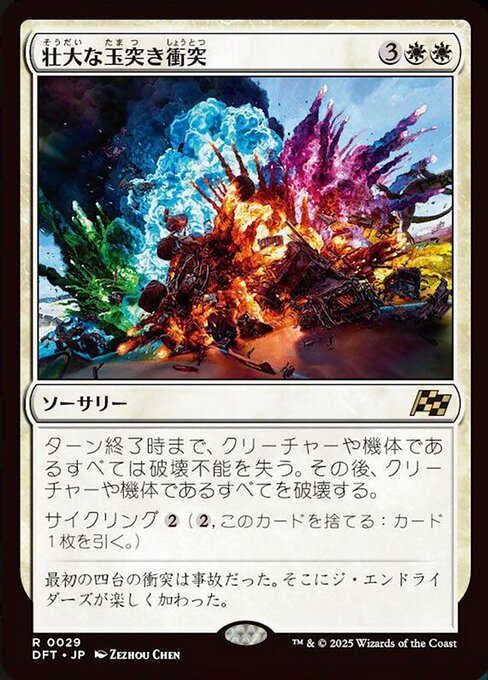 Rating7.0Good
Why this rating?
A very good rare of the format (7.0/10).
Why. A sweeper that destroys all creatures and Vehicles, even indestructible ones. At worst, it cycles for two mana and keeps you from getting stuck.
Risks. It also destroys your own creatures and is a sorcery. An aggressive or Vehicles deck does not want it.
In the draft. A card for a white control deck that can get ahead on cards afterward. In a creature deck, it is an option to take mid-pack.
Results in the games of the set
When it is in hand, the deck wins 55.9% of its games (set average: 55.7%, 108th of 273 cards).
In the opening hand: 53.6% wins (54.9% on average).
Drawn during the game: 57.5% (56.3% on average).
When it is drawn, the deck wins 3.0 points more than when it is not.
When it is drafted, it is played 77% of the time (set average: 63%).
Taken as the first pick (73 drafts), it ends in the deck 84% of the time.
It is played about as much in every archetype.
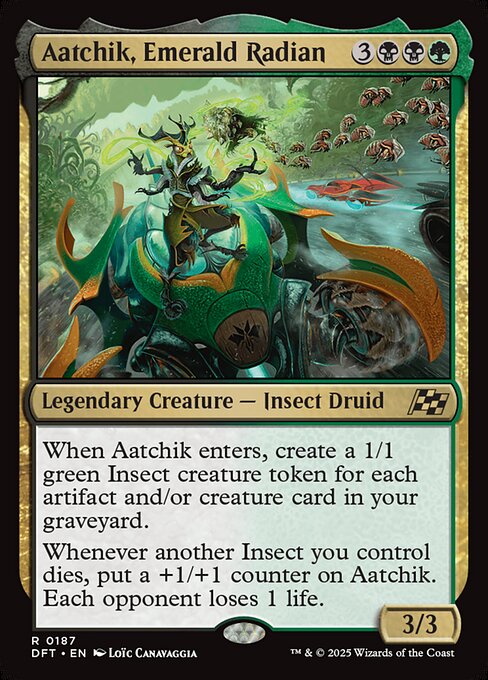 Rating7.0Good
Why this rating?
A very good rare of the format (7.0/10).
Why. A late-game card: on entering, it makes a 1/1 green Insect creature token for each artifact and/or creature card in your graveyard. Each other Insect that dies puts a counter on it and drains the opponent for 1.
Risks. Six mana, and an empty graveyard leaves a mediocre 3/3. It does little early.
In the draft. A good pick for a grindy black-green deck that loses creatures and plays long games. One copy is plenty.
Results in the games of the set
When it is in hand, the deck wins 58.3% of its games (set average: 55.7%, 46th of 273 cards).
In the opening hand: 53.6% wins (54.9% on average).
Drawn during the game: 61.3% (56.3% on average).
When it is drawn, the deck wins 3.6 points more than when it is not.
When it is drafted, it is played 84% of the time (set average: 63%).
Taken as the first pick (105 drafts), it ends in the deck 87% of the time.
It is played about as much in every archetype.
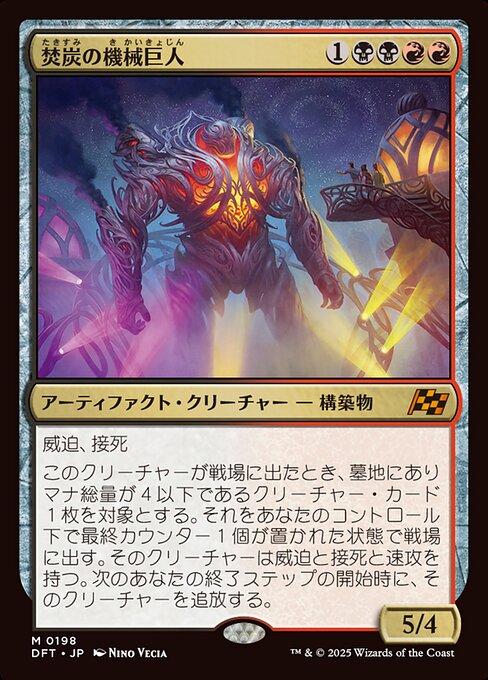 Rating7.0Good
Why this rating?
A very good mythic of the format (7.0/10).
Why. A 5/4 with menace and deathtouch that also brings back a creature with mana value 4 or less from a graveyard, with menace, deathtouch and haste, for one attack.
Risks. The reanimated creature is exiled at your next end step, so the bonus is temporary. It needs a graveyard target, and the cost asks for two black mana and two red mana.
In the draft. A good finisher for a black-red deck. Its value depends on creatures already dead: a mid-pack pick.
Results in the games of the set
When it is in hand, the deck wins 55.5% of its games (set average: 55.7%, 120th of 273 cards).
In the opening hand: 52.4% wins (54.9% on average).
Drawn during the game: 57.5% (56.3% on average).
When it is drawn, the deck wins 3.4 points more than when it is not.
When it is drafted, it is played 62% of the time (set average: 63%).
Taken as the first pick (37 drafts), it ends in the deck 73% of the time.
It is played about as much in every archetype.
 Rating7.0Good
Why this rating?
A solid uncommon of the format (7.0/10).
Why. Three mana for two bodies: a 1/2 and a 2/2 black Zombie creature token. At max speed, each creature of yours that dies drains for 1, which suits a deck that trades its creatures.
Risks. Two colours, and the bodies are small. Without max speed it is simply a good three-drop.
In the draft. A good pick for white-black, especially an aggressive build. Look for other ways to make the opponent lose life so you reach max speed.
Results in the games of the set
When it is in hand, the deck wins 59.3% of its games (set average: 55.7%, 32nd of 273 cards).
In the opening hand: 58.4% wins (54.9% on average).
Drawn during the game: 59.9% (56.3% on average).
When it is drawn, the deck wins 5.6 points more than when it is not.
When it is drafted, it is played 63% of the time (set average: 63%).
Taken as the first pick (89 drafts), it ends in the deck 81% of the time.
It is played mostly in B/W decks (68% of them).

45. Gas Guzzler
Rating7.0GoodWhy this rating?
A very good rare of the format (7.0/10).
Why. A one-mana creature that enters tapped and only becomes useful at max speed, when it turns another creature or a Vehicle into a card for a black mana.
Risks. The 2/1 is fragile and the ability needs max speed, which does not always arrive. Without it, it is just a small body that enters tapped.
In the draft. A fine include in an aggressive black deck that trades its creatures. Mid to late pick.
Results in the games of the set
When it is in hand, the deck wins 56.5% of its games (set average: 55.7%, 85th of 273 cards).
In the opening hand: 59.8% wins (54.9% on average).
Drawn during the game: 54.2% (56.3% on average).
When it is drawn, the deck wins 2.2 points more than when it is not.
When it is drafted, it is played 84% of the time (set average: 63%).
Taken as the first pick (63 drafts), it ends in the deck 81% of the time.
It is played about as much in every archetype.

46. Mendicant Core, Guidelight
Rating7.0GoodWhy this rating?
A very good rare of the format (7.0/10).
Why. A two-drop with 3 toughness whose power equals the number of artifacts you control, itself included. At max speed, it copies your artifact spells for one more mana.
Risks. With few artifacts it is a small 1/3, and its copy ability needs max speed. It loses almost all its value in a deck with few artifacts.
In the draft. A card for a white-blue artifacts and Vehicles deck. Without that plan, pass it.
Results in the games of the set
When it is in hand, the deck wins 56.3% of its games (set average: 55.7%, 93rd of 273 cards).
In the opening hand: 56.6% wins (54.9% on average).
Drawn during the game: 56.1% (56.3% on average).
When it is drawn, the deck wins 5.0 points more than when it is not.
When it is drafted, it is played 71% of the time (set average: 63%).
Taken as the first pick (63 drafts), it ends in the deck 81% of the time.
It is played mostly in U/W decks (28% of them).
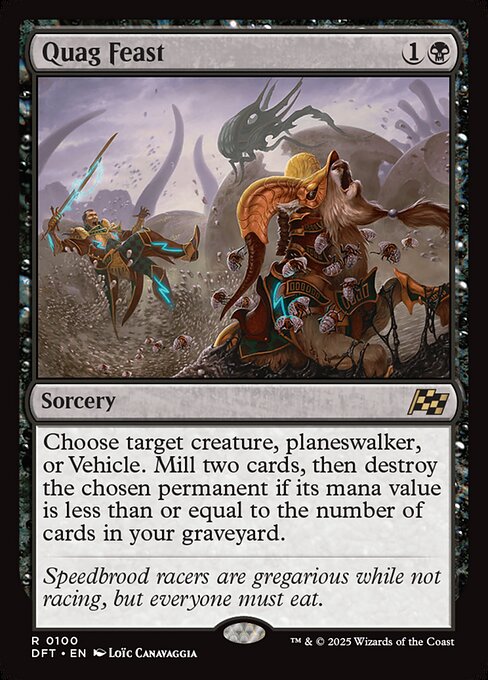
47. Quag Feast
Rating7.0GoodWhy this rating?
A very good rare of the format (7.0/10).
Why. A two-mana removal that destroys a creature, planeswalker or Vehicle, if its mana value is at most the number of cards in your graveyard after milling two.
Risks. Early in the game your graveyard is almost empty: it only kills small targets. You choose the target before knowing whether it dies.
In the draft. Good removal that gets stronger as the game goes on. Best in a black deck that fills its graveyard.
Results in the games of the set
When it is in hand, the deck wins 58.2% of its games (set average: 55.7%, 49th of 273 cards).
In the opening hand: 55.9% wins (54.9% on average).
Drawn during the game: 59.7% (56.3% on average).
When it is drawn, the deck wins 3.7 points more than when it is not.
When it is drafted, it is played 92% of the time (set average: 63%).
Taken as the first pick (125 drafts), it ends in the deck 94% of the time.
It is played about as much in every archetype.

48. Road Rage
Rating7.0GoodWhy this rating?
A solid uncommon of the format (7.0/10).
Why. For one red mana this instant deals 2 damage to a creature or planeswalker, plus one for each Mount or Vehicle you control. Cheap removal that gets much stronger with Vehicles.
Risks. With no Mounts or Vehicles, it is plain 2 damage, which kills little.
In the draft. A good pick for any red deck. Look for Vehicles to raise its damage.
Results in the games of the set
When it is in hand, the deck wins 56.0% of its games (set average: 55.7%, 103rd of 273 cards).
In the opening hand: 56.1% wins (54.9% on average).
Drawn during the game: 55.9% (56.3% on average).
When it is drawn, the deck wins 1.8 points more than when it is not.
When it is drafted, it is played 86% of the time (set average: 63%).
Taken as the first pick (153 drafts), it ends in the deck 93% of the time.
It is played mostly in R/W decks (34% of them) and B/R (31%).
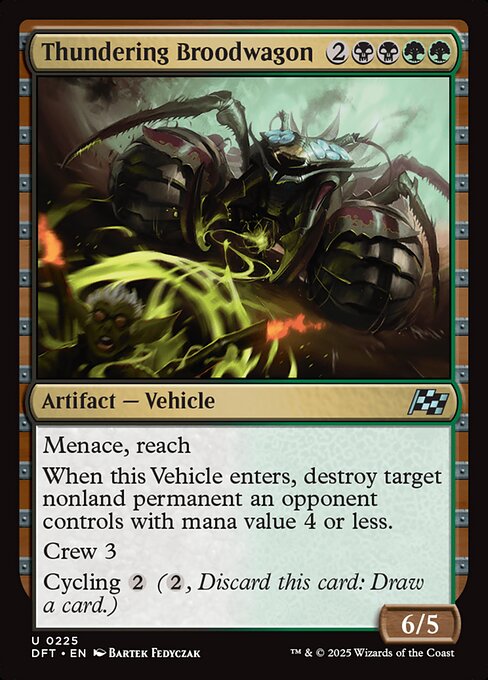 Rating7.0Good
Why this rating?
A solid uncommon of the format (7.0/10).
Why. A 6/5 Vehicle with reach and menace that destroys an opponent's nonland permanent with mana value 4 or less on entering: removal and a big threat in one card. Cycling keeps it from rotting in hand.
Risks. Six mana with two black mana and two green mana, and Crew 3 needs creatures. If you cycle it, you lose the removal.
In the draft. A very good pick for black-green, a card you almost always play. Take it above most other Vehicles.
Results in the games of the set
When it is in hand, the deck wins 61.1% of its games (set average: 55.7%, 14th of 273 cards).
In the opening hand: 58.8% wins (54.9% on average).
Drawn during the game: 62.7% (56.3% on average).
When it is drawn, the deck wins 5.9 points more than when it is not.
When it is drafted, it is played 82% of the time (set average: 63%).
Taken as the first pick (244 drafts), it ends in the deck 90% of the time.
It is played mostly in B/G decks (49% of them).
 Rating7.0Good
Why this rating?
A solid uncommon of the format (7.0/10).
Why. Five damage for three mana to a creature or planeswalker, with a loot: an instant removal that kills almost anything.
Risks. It is locked to blue-red and leaves no body on the battlefield.
In the draft. A good pick for blue-red. If you are in other colours, take it only for a possible splash.
Results in the games of the set
When it is in hand, the deck wins 58.2% of its games (set average: 55.7%, 48th of 273 cards).
In the opening hand: 55.4% wins (54.9% on average).
Drawn during the game: 59.9% (56.3% on average).
When it is drawn, the deck wins 5.4 points more than when it is not.
When it is drafted, it is played 76% of the time (set average: 63%).
Taken as the first pick (158 drafts), it ends in the deck 81% of the time.
It is played mostly in R/U decks (52% of them).

51. Voyager Glidecar
Rating6.9GoodWhy this rating?
A very good rare of the format (6.9/10).
Why. A one-mana Vehicle with Crew 1: an easy-to-crew 2/3 with a scry on entering. By tapping three other creatures, it becomes a flying creature and gets a +1/+1 counter.
Risks. It needs creatures to crew it, and the flying mode costs three tapped creatures. With no creatures it is dead.
In the draft. Good in a white deck with lots of small creatures. Mid pick, lower with few creatures.
Results in the games of the set
When it is in hand, the deck wins 56.4% of its games (set average: 55.7%, 88th of 273 cards).
In the opening hand: 57.4% wins (54.9% on average).
Drawn during the game: 55.6% (56.3% on average).
When it is drawn, the deck wins 3.5 points more than when it is not.
When it is drafted, it is played 82% of the time (set average: 63%).
Taken as the first pick (57 drafts), it ends in the deck 91% of the time.
It is played about as much in every archetype.
 Rating6.8Good
Why this rating?
A solid uncommon of the format (6.8/10).
Why. A two-mana 3/3 Vehicle that draws a card whenever you activate an exhaust ability, its own included. For four mana it permanently becomes an artifact creature and gets a +1/+1 counter.
Risks. Before Exhaust it needs Crew 2, and Exhaust costs four mana and works only once. Removal in response wastes the investment.
In the draft. A good pick in a blue deck, especially with other Exhaust cards.
Results in the games of the set
When it is in hand, the deck wins 59.4% of its games (set average: 55.7%, 30th of 273 cards).
In the opening hand: 59.1% wins (54.9% on average).
Drawn during the game: 59.5% (56.3% on average).
When it is drawn, the deck wins 5.1 points more than when it is not.
When it is drafted, it is played 91% of the time (set average: 63%).
Taken as the first pick (347 drafts), it ends in the deck 94% of the time.
It is played mostly in B/U decks (37% of them) and G/U (36%).

53. Demonic Junker
Rating6.8GoodWhy this rating?
A very good rare of the format (6.8/10).
Why. A Vehicle that destroys an opposing creature on entering, and one of yours too if you choose, to gain two +1/+1 counters. Its cost drops for each artifact you control.
Risks. Seven mana without artifacts is too expensive, and a Crew 2 4/3 is an average body.
In the draft. Fine with several artifacts in the deck. Otherwise skip it: it is slow removal.
Results in the games of the set
When it is in hand, the deck wins 57.0% of its games (set average: 55.7%, 75th of 273 cards).
In the opening hand: 53.0% wins (54.9% on average).
Drawn during the game: 59.6% (56.3% on average).
When it is drawn, the deck wins 3.5 points more than when it is not.
When it is drafted, it is played 92% of the time (set average: 63%).
Taken as the first pick (117 drafts), it ends in the deck 95% of the time.
It is played about as much in every archetype.
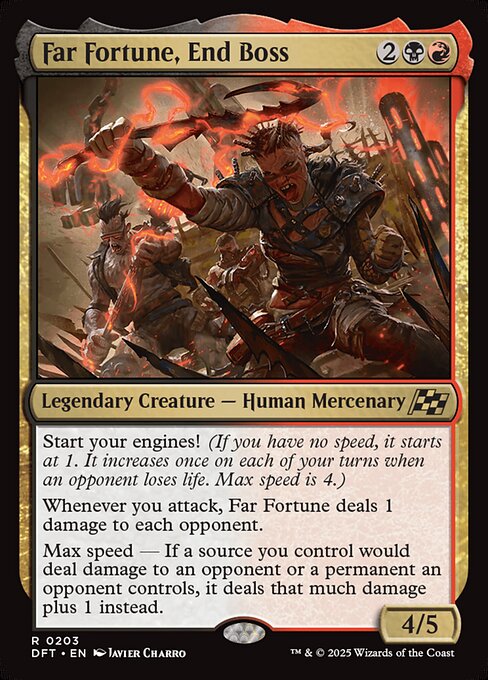 Rating6.8Good
Why this rating?
A very good rare of the format (6.8/10).
Why. A 4/5 for four that deals 1 damage to the opponent whenever you attack, which pushes your speed up. At max speed, your sources dealing damage to the opponent or their permanents deal 1 extra.
Risks. Two colours, and it is an obvious removal target. It loses value if killed before you attack.
In the draft. A good pick for aggressive black-red. You play it on turn 4 as a good 4/5 even without the speed.
Results in the games of the set
When it is in hand, the deck wins 59.5% of its games (set average: 55.7%, 29th of 273 cards).
In the opening hand: 57.9% wins (54.9% on average).
Drawn during the game: 60.6% (56.3% on average).
When it is drawn, the deck wins 7.1 points more than when it is not.
When it is drafted, it is played 79% of the time (set average: 63%).
Taken as the first pick (96 drafts), it ends in the deck 79% of the time.
It is played mostly in B/R decks (30% of them).
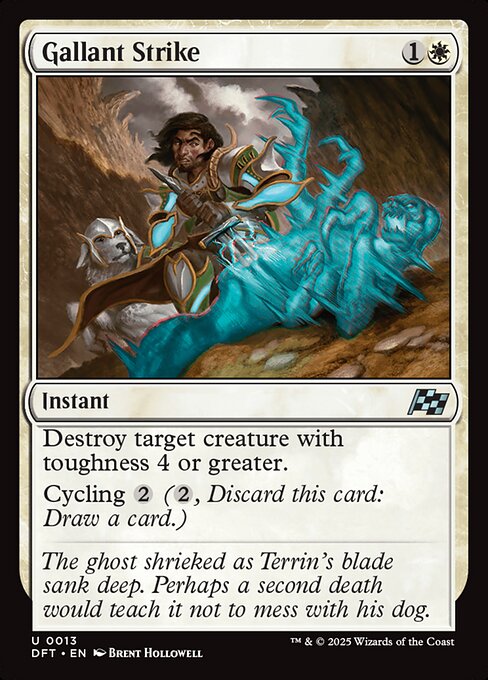
55. Gallant Strike
Rating6.8GoodWhy this rating?
A solid uncommon of the format (6.8/10).
Why. A two-mana instant that destroys a creature with toughness 4 or greater, so the big targets. It cycles for two mana.
Risks. It does not hit small creatures, and its value depends on the opposing deck. Cycling means it is rarely dead.
In the draft. A fine card, better against opponents with big creatures. Mid to late pick otherwise.
Results in the games of the set
When it is in hand, the deck wins 57.0% of its games (set average: 55.7%, 74th of 273 cards).
In the opening hand: 54.9% wins (54.9% on average).
Drawn during the game: 58.5% (56.3% on average).
When it is drawn, the deck wins 2.2 points more than when it is not.
When it is drafted, it is played 86% of the time (set average: 63%).
Taken as the first pick (106 drafts), it ends in the deck 93% of the time.
It is played mostly in U/W decks (34% of them) and G/W (31%).

56. Guardian Sunmare
Rating6.8GoodWhy this rating?
A very good rare of the format (6.8/10).
Why. A 5/5 with ward 2, solid even without saddling. When it attacks saddled, it searches for a nonland permanent with mana value 3 or less and puts it onto the battlefield.
Risks. Saddle 4 needs creatures with total power 4 and works only at sorcery speed. It is already pricey at five mana with two white mana.
In the draft. A good pick for white, especially green-white. A good body even unsaddled, so it is playable in any white deck.
Results in the games of the set
When it is in hand, the deck wins 58.8% of its games (set average: 55.7%, 40th of 273 cards).
In the opening hand: 58.7% wins (54.9% on average).
Drawn during the game: 58.8% (56.3% on average).
When it is drawn, the deck wins 6.3 points more than when it is not.
When it is drafted, it is played 83% of the time (set average: 63%).
Taken as the first pick (83 drafts), it ends in the deck 88% of the time.
It is played about as much in every archetype.
 Rating6.8Good
Why this rating?
A solid uncommon of the format (6.8/10).
Why. A 4/4 for five that bounces an opposing creature or Vehicle. It also lowers the opponent's speed if it is strictly the highest. A good tempo play with a good body.
Risks. The bounce is temporary: the opponent replays the card. Five mana for a tempo effect.
In the draft. A good blue uncommon, playable in any blue deck. Take it before most commons.
Results in the games of the set
When it is in hand, the deck wins 59.4% of its games (set average: 55.7%, 31st of 273 cards).
In the opening hand: 57.7% wins (54.9% on average).
Drawn during the game: 60.4% (56.3% on average).
When it is drawn, the deck wins 5.8 points more than when it is not.
When it is drafted, it is played 93% of the time (set average: 63%).
Taken as the first pick (349 drafts), it ends in the deck 95% of the time.
It is played mostly in B/U decks (39% of them) and U/W (34%).
 Rating6.8Good
Why this rating?
A very good rare of the format (6.8/10).
Why. A 2/3 with vigilance that taps for two mana of one colour, usable only to activate abilities. The twelve-mana Exhaust puts permanents from your hand onto the battlefield, but is almost never reached.
Risks. Its mana only pays for abilities, so it does not help cast spells. The Exhaust is too expensive for most games.
In the draft. Weak in most decks. Play it only with many abilities to activate, otherwise pass it.
Results in the games of the set
When it is in hand, the deck wins 54.3% of its games (set average: 55.7%, 175th of 273 cards).
In the opening hand: 56.4% wins (54.9% on average).
Drawn during the game: 52.6% (56.3% on average).
When it is drawn, the deck wins 0.3 points more than when it is not.
When it is drafted, it is played 60% of the time (set average: 63%).
Taken as the first pick (31 drafts), it ends in the deck 81% of the time.
It is played about as much in every archetype.
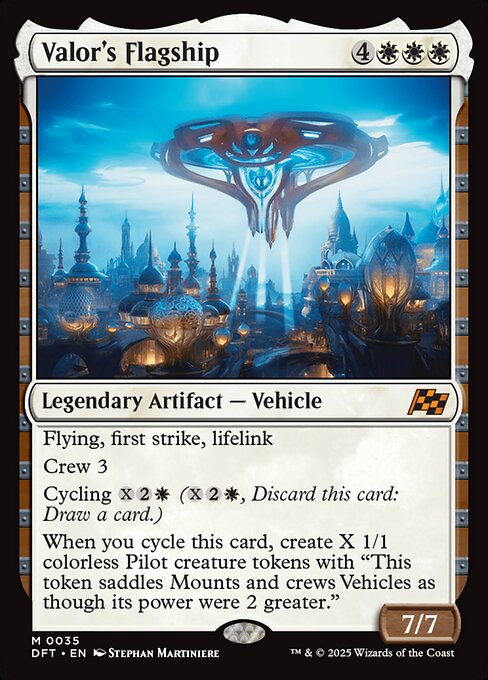
59. Valor's Flagship
Rating6.7GoodWhy this rating?
A very good mythic of the format (6.7/10).
Why. A huge 7/7 Vehicle with flying, first strike and lifelink. Its real use is cycling: it creates X 1/1 colorless Pilot creature tokens that count as having 2 more power for Crew and Saddle.
Risks. Seven mana with three white mana and Crew 3: casting it is rarely realistic. Cycling costs X plus three mana.
In the draft. A flexible card mostly played as a late cycle. Mid pick for a white Vehicles deck.
Results in the games of the set
When it is in hand, the deck wins 56.4% of its games (set average: 55.7%, 91st of 273 cards).
In the opening hand: 53.2% wins (54.9% on average).
Drawn during the game: 58.4% (56.3% on average).
When it is drawn, the deck wins 5.1 points more than when it is not.
When it is drafted, it is played 84% of the time (set average: 63%).
Taken as the first pick (38 drafts), it ends in the deck 84% of the time.
It is played about as much in every archetype.

60. Nesting Bot
Rating6.6GoodWhy this rating?
A solid uncommon of the format (6.6/10).
Why. A one-mana 1/1 that leaves a 1/1 colorless Servo artifact creature token when it dies, so two bodies. It becomes a 2/1 at max speed. A decent start for an aggressive deck.
Risks. It is weak late in the game and blocks poorly. It has no notable effect on its own.
In the draft. Filler for an aggressive white deck. Take it late.
Results in the games of the set
When it is in hand, the deck wins 56.0% of its games (set average: 55.7%, 104th of 273 cards).
In the opening hand: 58.6% wins (54.9% on average).
Drawn during the game: 54.1% (56.3% on average).
When it is drawn, the deck wins 2.0 points more than when it is not.
When it is drafted, it is played 66% of the time (set average: 63%).
Taken as the first pick (67 drafts), it ends in the deck 81% of the time.
It is played mostly in U/W decks (33% of them) and B/W (31%).
 Rating6.6Good
Why this rating?
A very good rare of the format (6.6/10).
Why. A five-mana sweeper that deals 4 damage to each creature, after exiling up to one artifact or creature that returns at the next end step: you can shelter one of your own permanents that way.
Risks. It hits your own creatures too and only kills those with toughness 4 or less. The card is locked to red-white.
In the draft. A red-white control tool. Take it mid-pack only if you are in those colours.
Results in the games of the set
When it is in hand, the deck wins 55.8% of its games (set average: 55.7%, 111th of 273 cards).
In the opening hand: 53.5% wins (54.9% on average).
Drawn during the game: 57.3% (56.3% on average).
When it is drawn, the deck wins 4.3 points more than when it is not.
When it is drafted, it is played 64% of the time (set average: 63%).
Taken as the first pick (60 drafts), it ends in the deck 92% of the time.
It is played mostly in R/W decks (26% of them).
 Rating6.6Good
Why this rating?
A very good rare of the format (6.6/10).
Why. A 4/2 Vehicle with trample and haste that is a creature the turn it enters, so it attacks right away. It can come back from the graveyard for three mana and a discard.
Risks. Only 2 toughness, and Crew 2 needs creatures on later turns. Coming back costs a card from your hand.
In the draft. A good include in an aggressive red deck. Mid pick.
Results in the games of the set
When it is in hand, the deck wins 55.6% of its games (set average: 55.7%, 118th of 273 cards).
In the opening hand: 55.9% wins (54.9% on average).
Drawn during the game: 55.4% (56.3% on average).
When it is drawn, the deck wins 2.7 points more than when it is not.
When it is drafted, it is played 88% of the time (set average: 63%).
Taken as the first pick (68 drafts), it ends in the deck 91% of the time.
It is played about as much in every archetype.
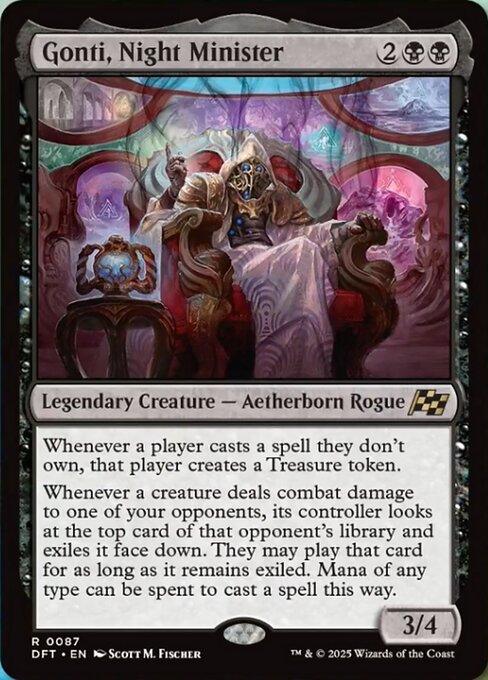 Rating6.6Good
Why this rating?
A very good rare of the format (6.6/10).
Why. A 3/4 for four: whenever a creature deals combat damage to an opponent, its controller exiles the top card of that library face down and may play it, spending mana of any type. A card advantage engine.
Risks. Creatures need to connect, and its first ability matters little. Two black mana makes it a demanding cost.
In the draft. A good pick for an aggressive or midrange black deck. A solid 3/4 even without the rest.
Results in the games of the set
When it is in hand, the deck wins 58.0% of its games (set average: 55.7%, 51st of 273 cards).
In the opening hand: 57.7% wins (54.9% on average).
Drawn during the game: 58.1% (56.3% on average).
When it is drawn, the deck wins 4.3 points more than when it is not.
When it is drafted, it is played 90% of the time (set average: 63%).
Taken as the first pick (128 drafts), it ends in the deck 87% of the time.
It is played about as much in every archetype.
 Rating6.6Good
Why this rating?
A solid uncommon of the format (6.6/10).
Why. A two-mana 1/1 flyer that, when attacking saddled, puts a +1/+1 counter on each of up to two target Mounts and/or Vehicles. A small engine for a Vehicles deck.
Risks. A very fragile 1/1, and Saddle 1 needs another creature to tap. With few Mounts or Vehicles, it can hardly grow anything but itself.
In the draft. A niche card for a green-white Vehicles deck. Take it if you already have several Vehicles or Mounts.
Results in the games of the set
When it is in hand, the deck wins 55.4% of its games (set average: 55.7%, 129th of 273 cards).
In the opening hand: 58.6% wins (54.9% on average).
Drawn during the game: 52.9% (56.3% on average).
When it is drawn, the deck wins 0.5 points more than when it is not.
When it is drafted, it is played 65% of the time (set average: 63%).
Taken as the first pick (71 drafts), it ends in the deck 83% of the time.
It is played mostly in G/W decks (65% of them).
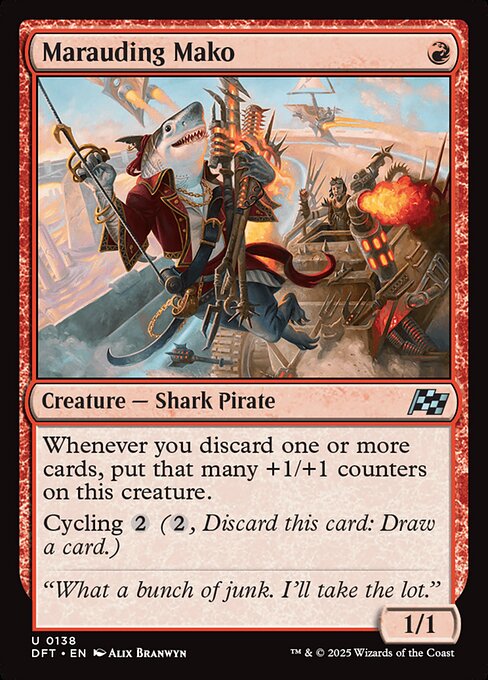
65. Marauding Mako
Rating6.6GoodWhy this rating?
A solid uncommon of the format (6.6/10).
Why. A one-mana 1/1 that gets a +1/+1 counter for each card you discard. Cycling or looting other cards makes it grow; it can cycle itself for two mana, without triggering itself.
Risks. Without discards, it is a 1/1 that does nothing. It needs cards to discard in order to grow.
In the draft. A good include in a red deck with looting and cycling, especially blue-red. Elsewhere, a late pick.
Results in the games of the set
When it is in hand, the deck wins 56.2% of its games (set average: 55.7%, 98th of 273 cards).
In the opening hand: 58.5% wins (54.9% on average).
Drawn during the game: 54.8% (56.3% on average).
When it is drawn, the deck wins 4.1 points more than when it is not.
When it is drafted, it is played 68% of the time (set average: 63%).
Taken as the first pick (101 drafts), it ends in the deck 90% of the time.
It is played mostly in R/U decks (58% of them) and B/R (29%).

66. Momentum Breaker
Rating6.6GoodWhy this rating?
A solid uncommon of the format (6.6/10).
Why. For two mana, each opponent sacrifices a creature or Vehicle of their choice, or discards a card if they cannot. It can later be sacrificed to gain life equal to your speed.
Risks. The opponent chooses their worst creature, so it is weak against a wide board or tokens.
In the draft. Good removal early in the game. A good pick in any black deck.
Results in the games of the set
When it is in hand, the deck wins 56.8% of its games (set average: 55.7%, 79th of 273 cards).
In the opening hand: 57.0% wins (54.9% on average).
Drawn during the game: 56.7% (56.3% on average).
When it is drawn, the deck wins 2.5 points more than when it is not.
When it is drafted, it is played 86% of the time (set average: 63%).
Taken as the first pick (174 drafts), it ends in the deck 95% of the time.
It is played mostly in B/R decks (31% of them) and B/W (28%).
 Rating6.6Good
Why this rating?
A very good rare of the format (6.6/10).
Why. A 5/4 for three: huge stats for the price, bigger than most opposing creatures. It also boosts your other Dinosaurs.
Risks. It asks for two green mana and has no other ability: removal handles it like any other body.
In the draft. Take it in any green deck. Just as good as a plain big body as in a Dinosaurs deck.
Results in the games of the set
When it is in hand, the deck wins 57.7% of its games (set average: 55.7%, 58th of 273 cards).
In the opening hand: 59.1% wins (54.9% on average).
Drawn during the game: 56.7% (56.3% on average).
When it is drawn, the deck wins 2.1 points more than when it is not.
When it is drafted, it is played 92% of the time (set average: 63%).
Taken as the first pick (105 drafts), it ends in the deck 96% of the time.
It is played about as much in every archetype.
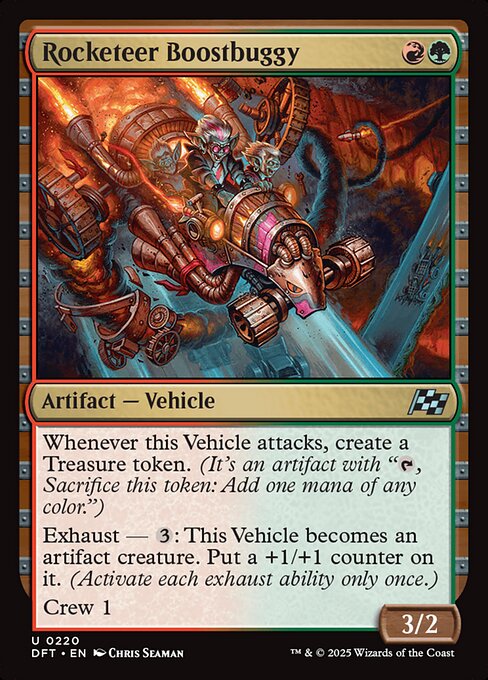 Rating6.6Good
Why this rating?
A solid uncommon of the format (6.6/10).
Why. A two-mana 3/2 Vehicle that creates a Treasure token each time it attacks. For three mana, Exhaust makes it permanently an artifact creature with a +1/+1 counter.
Risks. Crew 1 needs a creature, and 2 toughness makes it fragile. It is locked to red-green.
In the draft. A good include for red-green, especially an Exhaust deck. Mid pick.
Results in the games of the set
When it is in hand, the deck wins 56.4% of its games (set average: 55.7%, 89th of 273 cards).
In the opening hand: 60.0% wins (54.9% on average).
Drawn during the game: 53.7% (56.3% on average).
When it is drawn, the deck wins 1.5 points more than when it is not.
When it is drafted, it is played 67% of the time (set average: 63%).
Taken as the first pick (104 drafts), it ends in the deck 86% of the time.
It is played mostly in G/R decks (52% of them).

69. Sunbillow Verge
Rating6.6GoodWhy this rating?
A very good rare of the format (6.6/10).
Why. A red-white fixing land that always taps for white and makes red only if you control a Plains or a Mountain. In a proper red-white deck it replaces a basic for free, since it enters untapped.
Risks. With neither a Plains nor a Mountain out, it only gives white. A clumsy draw or a deck short on basics can leave it half-working.
In the draft. Take it late if you are red-white or still deciding between the two colours. Outside those colours it is no better than a basic, so leave it in the sideboard.
Results in the games of the set
When it is in hand, the deck wins 52.7% of its games (set average: 55.7%, 218th of 273 cards).
In the opening hand: 54.6% wins (54.9% on average).
Drawn during the game: 51.3% (56.3% on average).
When it is drawn, the deck wins 0.3 points less than when it is not.
When it is drafted, it is played 51% of the time (set average: 63%).
Taken among the first three picks (74 drafts), it ends in the deck 73% of the time.
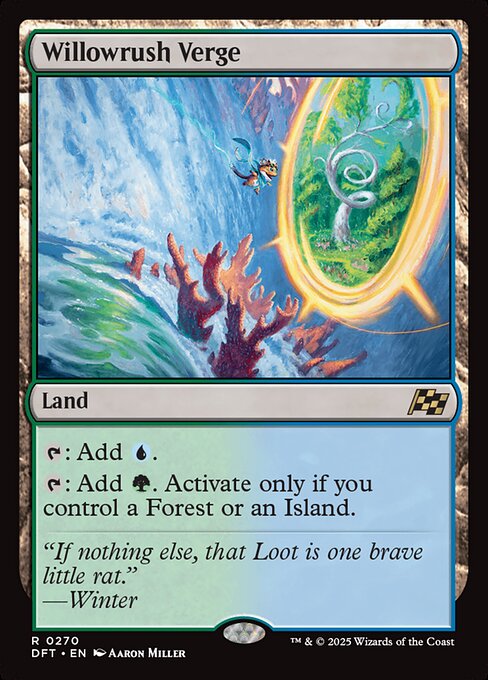
70. Willowrush Verge
Rating6.6GoodWhy this rating?
A very good rare of the format (6.6/10).
Why. A blue-green fixing land: it always taps for blue and also makes green once you control a Forest or an Island. It enters untapped, so it smooths out a blue-green deck at no cost.
Risks. With no Forest or Island in play it only makes blue. It does nothing for a deck that is not truly blue-green.
In the draft. A fair mid-pack pick if you are blue-green, but do not take it over a good removal spell or a solid creature. Outside those two colours, skip it.
Results in the games of the set
When it is in hand, the deck wins 55.8% of its games (set average: 55.7%, 112th of 273 cards).
In the opening hand: 56.5% wins (54.9% on average).
Drawn during the game: 55.2% (56.3% on average).
When it is drawn, the deck wins 1.9 points more than when it is not.
When it is drafted, it is played 68% of the time (set average: 63%).
Taken as the first pick (36 drafts), it ends in the deck 78% of the time.
 Rating6.6Good
Why this rating?
A very good rare of the format (6.6/10).
Why. A two-mana body for white-black that turns losses into value. Sacrificing another creature surveils 1 once each turn, and at max speed every nontoken creature that dies leaves you a tapped 2/2 black Zombie creature token.
Risks. Reaching max speed needs your opponent to lose life over several turns, and Zahur only has 2 toughness. With no other creature to sacrifice, the first ability does nothing.
In the draft. A good card for an aggressive white-black deck or one full of small creatures. Take it over ordinary creatures of those colours if your picks are heading that way.
Results in the games of the set
When it is in hand, the deck wins 57.1% of its games (set average: 55.7%, 73rd of 273 cards).
In the opening hand: 57.2% wins (54.9% on average).
Drawn during the game: 57.0% (56.3% on average).
When it is drawn, the deck wins 4.6 points more than when it is not.
When it is drafted, it is played 64% of the time (set average: 63%).
Taken as the first pick (50 drafts), it ends in the deck 66% of the time.
It is played mostly in B/W decks (34% of them).
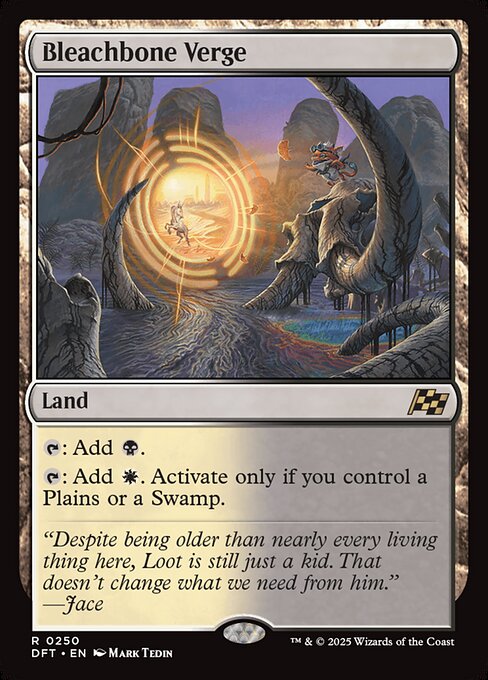
72. Bleachbone Verge
Rating6.5GoodWhy this rating?
A very good rare of the format (6.5/10).
Why. A white-black fixing land: it always taps for black and also makes white once you control a Plains or a Swamp. It enters untapped, so your curve is not slowed.
Risks. With no Plains or Swamp it only makes black. Pointless if you are not really white-black.
In the draft. Take it late in the pack if you are white-black. Do not reach for it ahead of a good playable.
Results in the games of the set
When it is in hand, the deck wins 54.8% of its games (set average: 55.7%, 158th of 273 cards).
In the opening hand: 54.6% wins (54.9% on average).
Drawn during the game: 54.9% (56.3% on average).
When it is drawn, the deck wins 1.1 points more than when it is not.
When it is drafted, it is played 62% of the time (set average: 63%).
Taken among the first three picks (102 drafts), it ends in the deck 68% of the time.
 Rating6.5Good
Why this rating?
Good playable that always makes the cut (6.5/10).
Why. A flexible two-drop. Early on it gives a creature trample for a green mana, and later its Exhaust turns it into a 5/5 for four mana, a worthwhile late-game sink.
Risks. While it is a 2/2 it is fragile and not very threatening. Exhaust only works once and takes most of your turn once you reach four mana.
In the draft. A good card for any green deck: it holds the curve early and stays relevant late. Take it above ordinary green creatures.
Results in the games of the set
When it is in hand, the deck wins 58.2% of its games (set average: 55.7%, 50th of 273 cards).
In the opening hand: 58.7% wins (54.9% on average).
Drawn during the game: 57.8% (56.3% on average).
When it is drawn, the deck wins 2.6 points more than when it is not.
When it is drafted, it is played 94% of the time (set average: 63%).
Taken as the first pick (285 drafts), it ends in the deck 98% of the time.
It is played mostly in G/R decks (31% of them) and G/W (30%).
 Rating6.4Good
Why this rating?
Good playable that always makes the cut (6.4/10).
Why. A two-mana enchantment that fills your graveyard and gets you a card back: mill four, then take an artifact, creature or land from among them. You also gain 1 life whenever artifact and/or creature cards leave your graveyard, including that one.
Risks. It is slow value with no board presence. The life gain is a minor bonus, and milling four does nothing if your deck cannot use the graveyard.
In the draft. A mid-pack pick, mostly in black-green, where it is played the most. If your deck is short on time, prefer a creature or a removal spell.
Results in the games of the set
When it is in hand, the deck wins 57.3% of its games (set average: 55.7%, 71st of 273 cards).
In the opening hand: 57.3% wins (54.9% on average).
Drawn during the game: 57.3% (56.3% on average).
When it is drawn, the deck wins 1.1 points more than when it is not.
When it is drafted, it is played 70% of the time (set average: 63%).
Taken as the first pick (104 drafts), it ends in the deck 89% of the time.
It is played mostly in B/G decks (51% of them).
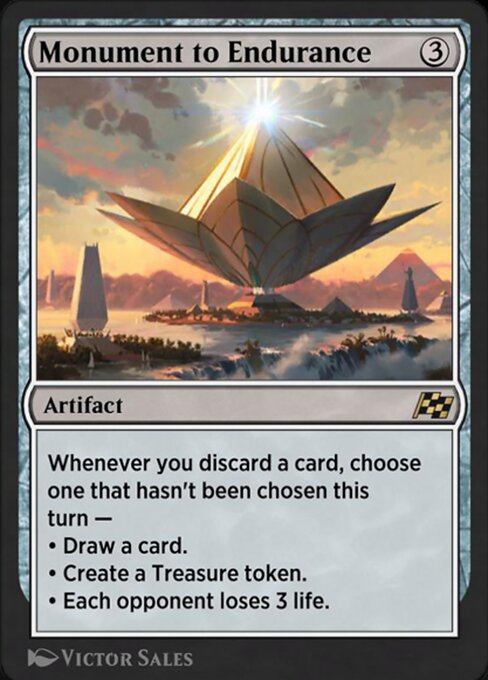 Rating6.4Good
Why this rating?
Good playable that always makes the cut (6.4/10).
Why. A three-mana artifact that rewards discarding: each discard lets you choose a mode not yet chosen this turn, draw a card, create a Treasure token, or make each opponent lose 3 life. With plenty of Cycling or discard it keeps generating value.
Risks. It does nothing on its own and has no effect on combat. Without enough ways to discard cards it is a dead three-mana permanent.
In the draft. Only play it if you already have several discard outlets. Take it late, and only for a blue-red deck that has a use for it.
Results in the games of the set
When it is in hand, the deck wins 51.5% of its games (set average: 55.7%, 239th of 273 cards).
In the opening hand: 48.0% wins (54.9% on average).
Drawn during the game: 53.6% (56.3% on average).
When it is drawn, the deck wins 1.9 points more than when it is not.
When it is drafted, it is played 67% of the time (set average: 63%).
Taken as the first pick (48 drafts), it ends in the deck 79% of the time.
It is played mostly in R/U decks (27% of them).

76. Plow Through
Rating6.4GoodWhy this rating?
Good playable that always makes the cut (6.4/10).
Why. A one-mana sorcery that works as removal but depends on your creature: it fights an opposing creature. The second mode destroys a Vehicle, handy against decks that play them.
Risks. Fighting is risky: your opponent can respond by killing your creature or with a combat trick. You need a creature bigger than the target, since yours takes damage too.
In the draft. A good conditional removal spell for any green deck, to take ahead of filler creatures. Run one or two, no more: without good creatures these cards are worthless.
Results in the games of the set
When it is in hand, the deck wins 55.4% of its games (set average: 55.7%, 130th of 273 cards).
In the opening hand: 53.4% wins (54.9% on average).
Drawn during the game: 56.8% (56.3% on average).
When it is drawn, the deck wins 0.1 points more than when it is not.
When it is drafted, it is played 89% of the time (set average: 63%).
Taken as the first pick (146 drafts), it ends in the deck 97% of the time.
It is played about as much in every archetype.

77. Riverpyre Verge
Rating6.4GoodWhy this rating?
Good playable that always makes the cut (6.4/10).
Why. A blue-red fixing land: it always taps for red and also makes blue once you control an Island or a Mountain. It enters untapped, which matters for a deck that wants consistency.
Risks. With no Island or Mountain in play it only makes red. It adds nothing for a deck that is not truly blue-red.
In the draft. Take it late if you are blue-red. Do not pick it over a good playable.
Results in the games of the set
When it is in hand, the deck wins 54.7% of its games (set average: 55.7%, 159th of 273 cards).
In the opening hand: 55.0% wins (54.9% on average).
Drawn during the game: 54.5% (56.3% on average).
When it is drawn, the deck wins 1.3 points more than when it is not.
When it is drafted, it is played 64% of the time (set average: 63%).
Taken among the first three picks (123 drafts), it ends in the deck 78% of the time.
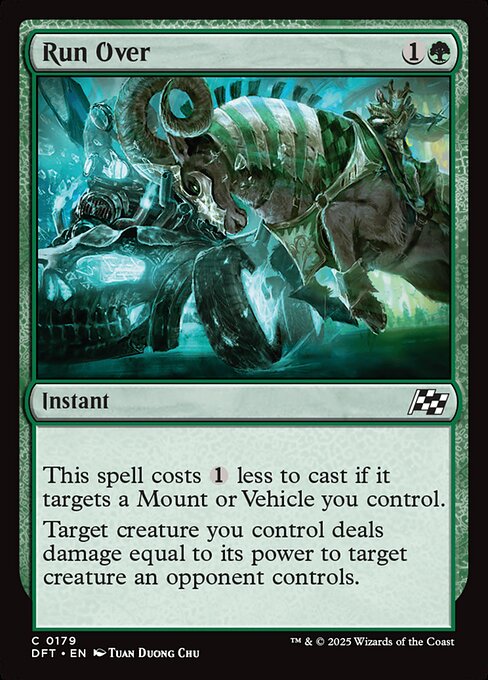
78. Run Over
Rating6.4GoodWhy this rating?
Good playable that always makes the cut (6.4/10).
Why. A two-mana instant removal spell that avoids combat risk: your creature deals damage equal to its power to an opposing creature, taking nothing back. It costs one less if it targets a Mount or Vehicle you control.
Risks. You need a creature with decent power, and your opponent can respond by killing it, which fizzles the spell. With small creatures it kills nothing.
In the draft. A good common removal spell, to take early in green decks. Play two with solid creatures; avoid it in a deck of small creatures.
Results in the games of the set
When it is in hand, the deck wins 57.4% of its games (set average: 55.7%, 65th of 273 cards).
In the opening hand: 55.5% wins (54.9% on average).
Drawn during the game: 58.6% (56.3% on average).
When it is drawn, the deck wins 1.6 points more than when it is not.
When it is drafted, it is played 93% of the time (set average: 63%).
Taken as the first pick (587 drafts), it ends in the deck 96% of the time.
It is played mostly in B/G decks (62% of them) and G/R (61%).
 Rating6.4Good
Why this rating?
Good playable that always makes the cut (6.4/10).
Why. A two-mana white Vehicle, a 3/3 flier with Crew 2. It can attack in the air the turn after you cast it, and its 2-mana tax on activated abilities of the chosen card name can hurt an opponent.
Risks. It needs creatures to crew it and can only block if you crew it. The tax only hits one card name and does almost nothing against a deck with no key activated ability.
In the draft. A good card for a white deck with several small creatures. A mid-pack pick, ahead of ordinary creatures of the colour.
Results in the games of the set
When it is in hand, the deck wins 54.8% of its games (set average: 55.7%, 157th of 273 cards).
In the opening hand: 55.1% wins (54.9% on average).
Drawn during the game: 54.6% (56.3% on average).
When it is drawn, the deck wins 0.7 points more than when it is not.
When it is drafted, it is played 70% of the time (set average: 63%).
Taken as the first pick (32 drafts), it ends in the deck 81% of the time.
It is played about as much in every archetype.

80. Stock Up
Rating6.4GoodWhy this rating?
Good playable that always makes the cut (6.4/10).
Why. A three-mana blue sorcery that digs through the top five cards of your library and keeps two. You get selection and card advantage at once, making it a good consistency engine.
Risks. It does nothing on the battlefield: the turn you cast it, you develop nothing. In a very aggressive deck it is too slow.
In the draft. A mid-pack pick for a blue deck that plays the long game. It is best in a deck full of good cards to find.
Results in the games of the set
When it is in hand, the deck wins 59.6% of its games (set average: 55.7%, 27th of 273 cards).
In the opening hand: 57.5% wins (54.9% on average).
Drawn during the game: 61.0% (56.3% on average).
When it is drawn, the deck wins 5.6 points more than when it is not.
When it is drafted, it is played 89% of the time (set average: 63%).
Taken as the first pick (287 drafts), it ends in the deck 95% of the time.
It is played mostly in B/U decks (38% of them) and R/U (34%).

81. Wastewood Verge
Rating6.4GoodWhy this rating?
Good playable that always makes the cut (6.4/10).
Why. A black-green fixing land: it always taps for green and also makes black once you control a Swamp or a Forest. It enters untapped and supports a black-green deck's consistency.
Risks. With no Swamp or Forest in play it only makes green. It adds nothing for a deck that is not truly black-green.
In the draft. Take it late if you are black-green or close to it. Do not prefer it to a playable.
Results in the games of the set
When it is in hand, the deck wins 55.4% of its games (set average: 55.7%, 132nd of 273 cards).
In the opening hand: 56.4% wins (54.9% on average).
Drawn during the game: 54.6% (56.3% on average).
When it is drawn, the deck wins 0.4 points more than when it is not.
When it is drafted, it is played 69% of the time (set average: 63%).
Taken among the first three picks (121 drafts), it ends in the deck 79% of the time.
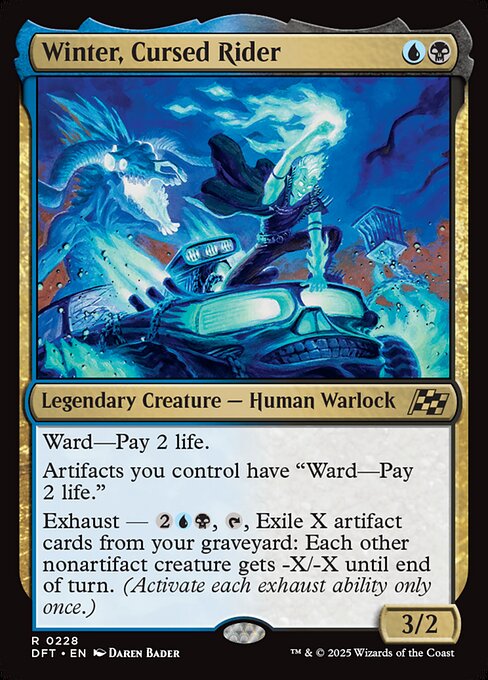 Rating6.4Good
Why this rating?
Good playable that always makes the cut (6.4/10).
Why. A two-mana blue-black 3/2 with ward: targeting it costs 2 life, and your artifacts get the same ward. Its Exhaust costs four mana: exile X artifact cards from your graveyard to give each other nonartifact creature -X/-X.
Risks. The Exhaust ability needs artifacts in your graveyard, and it also hits your own nonartifact creatures. Without that, it is a 3/2 with ward for two mana, fine but unremarkable.
In the draft. Best in blue-black decks with plenty of artifacts. Outside that, it is a decent creature, to take without urgency.
Results in the games of the set
When it is in hand, the deck wins 55.5% of its games (set average: 55.7%, 119th of 273 cards).
In the opening hand: 54.8% wins (54.9% on average).
Drawn during the game: 56.0% (56.3% on average).
When it is drawn, the deck wins 3.8 points more than when it is not.
When it is drafted, it is played 67% of the time (set average: 63%).
Taken as the first pick (46 drafts), it ends in the deck 80% of the time.
It is played about as much in every archetype.
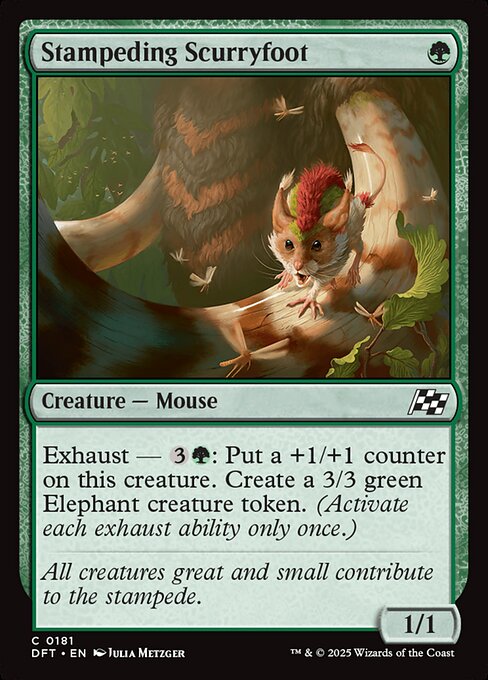 Rating6.3Good
Why this rating?
Good playable that always makes the cut (6.3/10).
Why. A one-mana 1/1 that does two things with Exhaust: it gets a +1/+1 counter and creates a 3/3 green Elephant creature token. For four more mana you get two bodies, which makes it a good curve filler.
Risks. Until you hit four mana it is a 1/1 with no impact. Exhaust works once, and your opponent can kill the 1/1 in response: you lose the counter but keep the token.
In the draft. A good common for any green deck. Take it over ordinary green creatures; it plays well early or late.
Results in the games of the set
When it is in hand, the deck wins 58.6% of its games (set average: 55.7%, 42nd of 273 cards).
In the opening hand: 59.8% wins (54.9% on average).
Drawn during the game: 57.8% (56.3% on average).
When it is drawn, the deck wins 2.5 points more than when it is not.
When it is drafted, it is played 93% of the time (set average: 63%).
Taken as the first pick (540 drafts), it ends in the deck 97% of the time.
It is played mostly in B/G decks (74% of them) and G/R (71%).
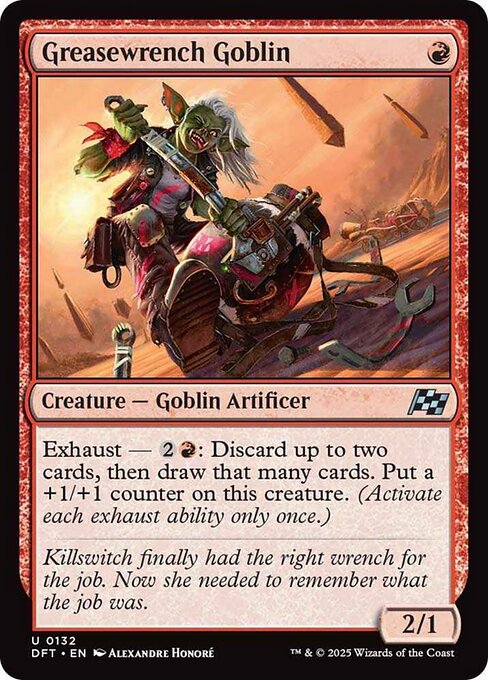 Rating6.3Good
Why this rating?
Good playable that always makes the cut (6.3/10).
Why. A one-mana 2/1 that improves with Exhaust: discard up to two cards, draw that many, and it gets a +1/+1 counter. It turns dead cards into live ones and grows into a 3/2.
Risks. A 2/1 dies to almost anything, and Exhaust costs three mana for a modest payoff. On its own it has little impact.
In the draft. A good card for an aggressive red deck, especially with cards that benefit from discarding. A mid-pack pick.
Results in the games of the set
When it is in hand, the deck wins 57.5% of its games (set average: 55.7%, 63rd of 273 cards).
In the opening hand: 60.0% wins (54.9% on average).
Drawn during the game: 55.7% (56.3% on average).
When it is drawn, the deck wins 3.5 points more than when it is not.
When it is drafted, it is played 86% of the time (set average: 63%).
Taken as the first pick (134 drafts), it ends in the deck 92% of the time.
It is played mostly in B/R decks (34% of them) and R/U (33%).

85. Autarch Mammoth
Rating6.2GoodWhy this rating?
Good playable that always makes the cut (6.2/10).
Why. A six-mana Mount, a 5/5 that creates a 3/3 green Elephant creature token when it enters, then another each time it attacks while saddled. One turn puts two big bodies on the table, and each saddled attack adds another.
Risks. It costs six mana, with two green, and Saddle 5 needs you to tap other creatures with total power 5 (the Elephant token helps). In a deck of small creatures it will be saddled late.
In the draft. A good top-end card for a green deck. One or two copies, no more: at six mana it stays expensive.
Results in the games of the set
When it is in hand, the deck wins 58.4% of its games (set average: 55.7%, 44th of 273 cards).
In the opening hand: 56.6% wins (54.9% on average).
Drawn during the game: 59.6% (56.3% on average).
When it is drawn, the deck wins 2.7 points more than when it is not.
When it is drafted, it is played 93% of the time (set average: 63%).
Taken as the first pick (291 drafts), it ends in the deck 97% of the time.
It is played mostly in G/W decks (32% of them) and B/G (30%).

86. Back on Track
Rating6.2GoodWhy this rating?
Good playable that always makes the cut (6.2/10).
Why. A five-mana black sorcery that returns a creature or Vehicle card from your graveyard to the battlefield and creates a 1/1 colorless Pilot creature token. You get two bodies for one card, and the Pilot helps saddle Mounts and crew Vehicles.
Risks. It needs a good target in the graveyard, otherwise it does almost nothing. At five mana it is slow and does not disrupt your opponent.
In the draft. A good value tool for a black deck with quality creatures. A mid-pack pick, but only if you have worthwhile targets.
Results in the games of the set
When it is in hand, the deck wins 57.8% of its games (set average: 55.7%, 56th of 273 cards).
In the opening hand: 55.1% wins (54.9% on average).
Drawn during the game: 59.5% (56.3% on average).
When it is drawn, the deck wins 3.1 points more than when it is not.
When it is drafted, it is played 78% of the time (set average: 63%).
Taken as the first pick (178 drafts), it ends in the deck 83% of the time.
It is played mostly in B/G decks (34% of them).

87. Carrion Cruiser
Rating6.2GoodWhy this rating?
Good playable that always makes the cut (6.2/10).
Why. A three-mana black Vehicle: when it enters it mills two cards, then returns a creature or Vehicle card from your graveyard to your hand. It is a 3/2 with Crew 1, and the value pays for the card on its own.
Risks. It only hits if you have a creature to crew it, and a 3/2 is fragile. With no good card to recover, the effect is modest.
In the draft. A good value card for any black deck. Take it over ordinary creatures of the colour.
Results in the games of the set
When it is in hand, the deck wins 56.9% of its games (set average: 55.7%, 77th of 273 cards).
In the opening hand: 54.6% wins (54.9% on average).
Drawn during the game: 58.5% (56.3% on average).
When it is drawn, the deck wins 2.3 points more than when it is not.
When it is drafted, it is played 84% of the time (set average: 63%).
Taken as the first pick (172 drafts), it ends in the deck 90% of the time.
It is played mostly in B/G decks (29% of them) and B/W (26%).

88. Dune Drifter
Rating6.2GoodWhy this rating?
Good playable that always makes the cut (6.2/10).
Why. A white-black Vehicle with a variable cost: when it enters it returns an artifact or creature card with mana value X or less from your graveyard to the battlefield. The more you pay, the bigger the target, and it stays a 3/3 with Crew 2.
Risks. It needs both white and black, and with no target in the graveyard it is just an expensive Vehicle. Early in the game the graveyard is empty.
In the draft. A good mid-game card for a white-black deck. A mid-pack pick, in a deck with good targets to bring back.
Results in the games of the set
When it is in hand, the deck wins 54.1% of its games (set average: 55.7%, 177th of 273 cards).
In the opening hand: 51.2% wins (54.9% on average).
Drawn during the game: 56.0% (56.3% on average).
When it is drawn, the deck wins 0.8 points more than when it is not.
When it is drafted, it is played 53% of the time (set average: 63%).
Taken as the first pick (57 drafts), it ends in the deck 84% of the time.
It is played mostly in B/W decks (52% of them).
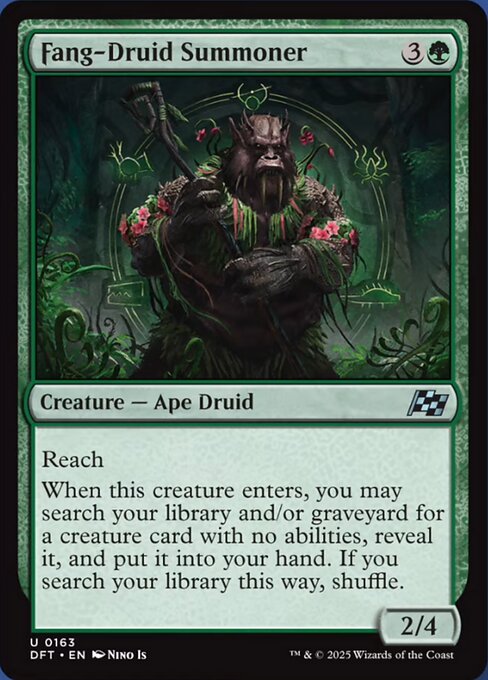 Rating6.2Good
Why this rating?
Good playable that always makes the cut (6.2/10).
Why. A 2/4 with reach that searches your library or graveyard for a creature with no abilities. You get a good blocker and a card of advantage in a single card.
Risks. You need creatures with no abilities in your deck, otherwise the search finds nothing. At four mana the body is defensive and does not pressure your opponent.
In the draft. A good card for a green deck that plays a few creatures with no abilities. A mid-pack pick; count them before running it.
Results in the games of the set
When it is in hand, the deck wins 57.9% of its games (set average: 55.7%, 52nd of 273 cards).
In the opening hand: 57.4% wins (54.9% on average).
Drawn during the game: 58.2% (56.3% on average).
When it is drawn, the deck wins 1.4 points more than when it is not.
When it is drafted, it is played 69% of the time (set average: 63%).
Taken as the first pick (177 drafts), it ends in the deck 77% of the time.
It is played mostly in G/W decks (34% of them) and G/U (29%).
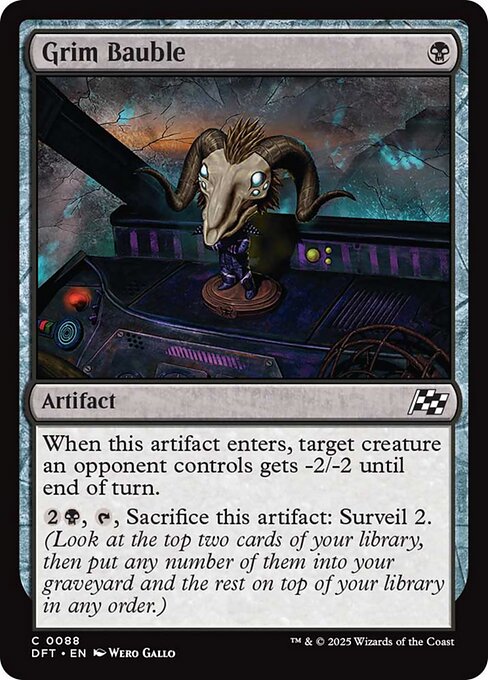
90. Grim Bauble
Rating6.2GoodWhy this rating?
Good playable that always makes the cut (6.2/10).
Why. A one-mana black artifact that gives an opposing creature -2/-2 when it enters, killing small creatures for almost nothing. Later, for three mana, you can tap and sacrifice it to surveil 2.
Risks. It only kills small creatures, and the -2/-2 lasts only until end of turn. Against big creatures it does almost nothing.
In the draft. A decent common removal spell for black decks. Take it over ordinary creatures; two copies are not too many.
Results in the games of the set
When it is in hand, the deck wins 57.6% of its games (set average: 55.7%, 60th of 273 cards).
In the opening hand: 57.1% wins (54.9% on average).
Drawn during the game: 57.9% (56.3% on average).
When it is drawn, the deck wins 2.8 points more than when it is not.
When it is drafted, it is played 88% of the time (set average: 63%).
Taken as the first pick (348 drafts), it ends in the deck 91% of the time.
It is played mostly in B/U decks (64% of them) and B/R (63%).
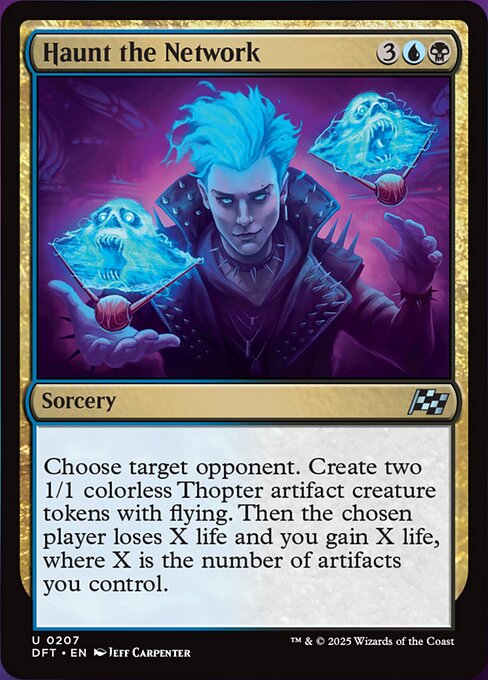 Rating6.2Good
Why this rating?
Good playable that always makes the cut (6.2/10).
Why. A five-mana blue-black sorcery that creates two 1/1 colorless Thopter artifact creature tokens with flying, then drains your opponent for as much life as you control artifacts. The tokens count, so the drain is immediate.
Risks. It needs both blue and black, and the drain depends on your artifacts. In a deck with few of them it is an expensive sorcery with two small bodies.
In the draft. A good late-game card for a blue-black deck, especially with artifacts. A mid-pack pick.
Results in the games of the set
When it is in hand, the deck wins 59.8% of its games (set average: 55.7%, 23rd of 273 cards).
In the opening hand: 54.5% wins (54.9% on average).
Drawn during the game: 63.0% (56.3% on average).
When it is drawn, the deck wins 7.7 points more than when it is not.
When it is drafted, it is played 81% of the time (set average: 63%).
Taken as the first pick (239 drafts), it ends in the deck 89% of the time.
It is played mostly in B/U decks (66% of them) and U/W (28%).
 Rating6.2Good
Why this rating?
Good playable that always makes the cut (6.2/10).
Why. A one-mana black sorcery that shows your opponent's hand and exiles an artifact or creature card of your choice. You remove their best threat before it lands, and Cycling keeps it from being a dead card.
Risks. It can only take artifacts and creatures, and does nothing about what is already in play. Late in the game the opposing hand is often empty.
In the draft. A fair card for a black deck, to take late in the pack. Stronger early, while your opponent still has creatures in hand.
Results in the games of the set
When it is in hand, the deck wins 55.0% of its games (set average: 55.7%, 150th of 273 cards).
In the opening hand: 56.7% wins (54.9% on average).
Drawn during the game: 53.7% (56.3% on average).
When it is drawn, the deck wins 0.4 points more than when it is not.
When it is drafted, it is played 56% of the time (set average: 63%).
Taken as the first pick (45 drafts), it ends in the deck 78% of the time.
It is played about as much in every archetype.
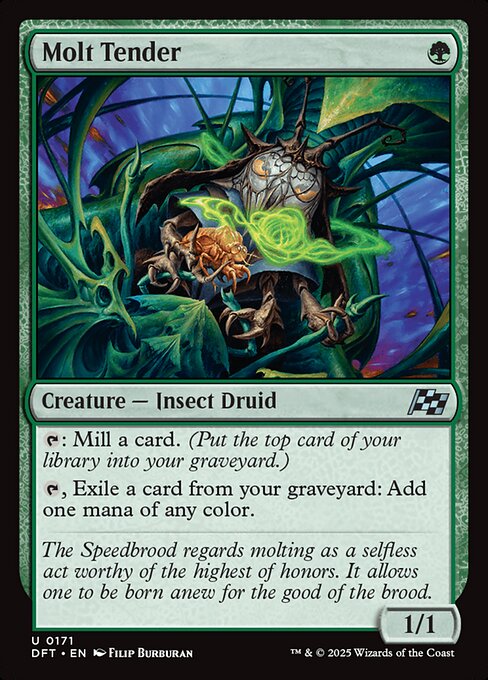
93. Molt Tender
Rating6.2GoodWhy this rating?
Good playable that always makes the cut (6.2/10).
Why. A one-mana green 1/1 that mills a card from your library by tapping, or makes one mana of any colour by exiling a card from your graveyard. It fixes and accelerates in a deck that feeds it.
Risks. A 1/1 is fragile, and milling yourself matters in long games. With an empty graveyard you must first tap it for a turn to get mana, since both abilities tap it.
In the draft. A good card for a green deck with a splash, or one that uses the graveyard. A mid-pack pick.
Results in the games of the set
When it is in hand, the deck wins 57.5% of its games (set average: 55.7%, 64th of 273 cards).
In the opening hand: 61.6% wins (54.9% on average).
Drawn during the game: 54.3% (56.3% on average).
When it is drawn, the deck wins 1.2 points more than when it is not.
When it is drafted, it is played 88% of the time (set average: 63%).
Taken as the first pick (191 drafts), it ends in the deck 95% of the time.
It is played mostly in B/G decks (38% of them) and G/U (26%).
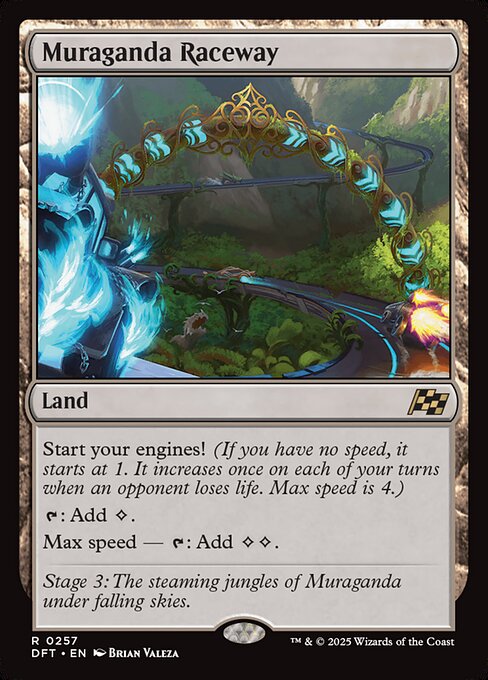 Rating6.2Good
Why this rating?
Good playable that always makes the cut (6.2/10).
Why. A colourless land that accelerates: it makes one colourless mana, and two at max speed. It helps you cast your biggest spells if your opponent loses life quickly enough.
Risks. It only makes colourless and does nothing to fix your colours. Reaching max speed is slow in a deck that does not pressure your opponent.
In the draft. A land to take late, only in an aggressive deck without demanding colour costs. Otherwise skip it.
Results in the games of the set
When it is in hand, the deck wins 51.2% of its games (set average: 55.7%, 247th of 273 cards).
In the opening hand: 51.9% wins (54.9% on average).
Drawn during the game: 50.8% (56.3% on average).
When it is drawn, the deck wins 1.7 points less than when it is not.
When it is drafted, it is played 21% of the time (set average: 63%).
 Rating6.2Good
Why this rating?
Good playable that always makes the cut (6.2/10).
Why. A two-mana 1/2 flier that gets as many +1/+1 counters as the cards you discard. It becomes an aerial threat quickly in a deck with discard outlets, including the Cycling of other cards.
Risks. Without discard it is a 1/2 flier with little impact. It is also fragile against small damage.
In the draft. A good card for a blue-red deck with discard, to take mid-pack. Outside those decks, a decent creature but not essential.
Results in the games of the set
When it is in hand, the deck wins 56.4% of its games (set average: 55.7%, 86th of 273 cards).
In the opening hand: 56.7% wins (54.9% on average).
Drawn during the game: 56.2% (56.3% on average).
When it is drawn, the deck wins 5.1 points more than when it is not.
When it is drafted, it is played 70% of the time (set average: 63%).
Taken as the first pick (120 drafts), it ends in the deck 86% of the time.
It is played mostly in R/U decks (55% of them).
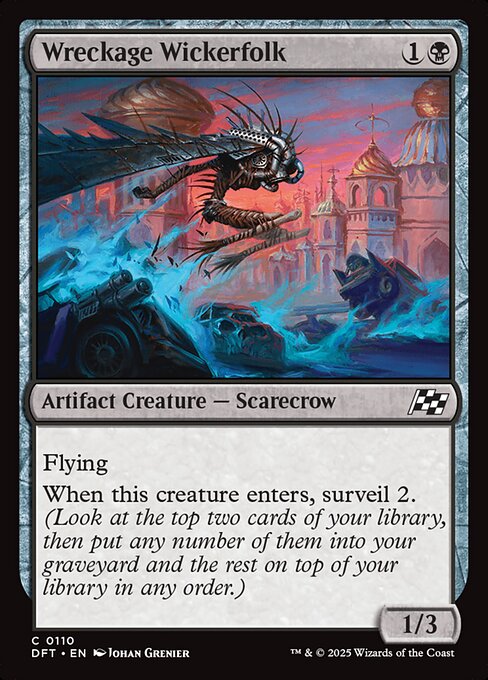 Rating6.2Playable
Why this rating?
Good playable that always makes the cut (6.2/10).
Why. A two-mana black 1/3 flier that surveils 2 when it enters. It blocks small fliers well, chips in from the air, and improves your next draws.
Risks. It only has 1 power, so it hits for little. It is a support card more than a threat.
In the draft. A good common for black decks, to take over ordinary creatures. It is also an artifact, which can matter in a deck that cares.
Results in the games of the set
When it is in hand, the deck wins 57.7% of its games (set average: 55.7%, 57th of 273 cards).
In the opening hand: 57.8% wins (54.9% on average).
Drawn during the game: 57.7% (56.3% on average).
When it is drawn, the deck wins 2.6 points more than when it is not.
When it is drafted, it is played 89% of the time (set average: 63%).
Taken as the first pick (385 drafts), it ends in the deck 94% of the time.
It is played mostly in B/R decks (75% of them) and B/W (70%).

97. Locust Spray
Rating6.1PlayableWhy this rating?
Good playable that always makes the cut (6.1/10).
Why. A one-mana black instant that gives a creature -1/-1: it kills the smallest ones and works as a combat trick. Cycling lets you draw later if it has no target.
Risks. A -1/-1 is rarely enough, and it does not deal with real threats. It is mostly a last-resort tool.
In the draft. A late-pack card, to play only if you already have enough removal or your opponents run many small creatures.
Results in the games of the set
When it is in hand, the deck wins 53.4% of its games (set average: 55.7%, 200th of 273 cards).
In the opening hand: 52.8% wins (54.9% on average).
Drawn during the game: 53.8% (56.3% on average).
When it is drawn, the deck wins 0.8 points less than when it is not.
When it is drafted, it is played 39% of the time (set average: 63%).
Taken among the first three picks (115 drafts), it ends in the deck 63% of the time.

98. Bounce Off
Rating6.0PlayableWhy this rating?
Good playable that always makes the cut (6.0/10).
Why. A one-mana blue instant that returns a creature or Vehicle to its owner's hand. It gains tempo, saves your creature from removal, or undoes an opposing aura or pump.
Risks. It is a temporary answer: your opponent replays the card. Against a cheap creature it costs you more tempo than them.
In the draft. A good tempo tool for blue decks, to take mid-pack. Stronger in a blue-green deck that capitalises on a board lead.
Results in the games of the set
When it is in hand, the deck wins 55.9% of its games (set average: 55.7%, 110th of 273 cards).
In the opening hand: 52.5% wins (54.9% on average).
Drawn during the game: 58.0% (56.3% on average).
When it is drawn, the deck wins 1.6 points more than when it is not.
When it is drafted, it is played 69% of the time (set average: 63%).
Taken as the first pick (123 drafts), it ends in the deck 86% of the time.
It is played mostly in R/U decks (62% of them) and B/U (54%).
 Rating6.0Playable
Why this rating?
Good playable that always makes the cut (6.0/10).
Why. A two-mana red-white 3/1 that scries 2 when it enters. By tapping, it creates a 1/1 colorless Pilot creature token for each Mount or Vehicle that entered under your control this turn, so it works after you cast Vehicles.
Risks. It only has 1 toughness, and it must have been in play since the start of the turn to tap. In a deck without Mounts or Vehicles it is a plain 3/1.
In the draft. A niche card for a red-white deck with several Vehicles. A mid-pack pick only if you already have some.
Results in the games of the set
When it is in hand, the deck wins 54.4% of its games (set average: 55.7%, 171st of 273 cards).
In the opening hand: 56.4% wins (54.9% on average).
Drawn during the game: 52.9% (56.3% on average).
When it is drawn, the deck wins 2.1 points more than when it is not.
When it is drafted, it is played 45% of the time (set average: 63%).
Taken as the first pick (36 drafts), it ends in the deck 78% of the time.
It is played mostly in R/W decks (62% of them).

100. Defend the Rider
Rating6.0PlayableWhy this rating?
Good playable that always makes the cut (6.0/10).
Why. A one-mana green instant with two modes: give a permanent hexproof and indestructible until end of turn, or create a 1/1 colorless Pilot creature token. It either protects a good permanent or supplies a crew member.
Risks. The first mode needs a good permanent to protect, and the Pilot token is a small body. It does not answer opposing threats.
In the draft. A support card, to take late for a green deck with Vehicles or good creatures. Do not prefer it to a removal spell or a good creature.
Results in the games of the set
When it is in hand, the deck wins 55.6% of its games (set average: 55.7%, 117th of 273 cards).
In the opening hand: 54.6% wins (54.9% on average).
Drawn during the game: 56.3% (56.3% on average).
When it is drawn, the deck wins 0.2 points more than when it is not.
When it is drafted, it is played 77% of the time (set average: 63%).
Taken as the first pick (68 drafts), it ends in the deck 93% of the time.
It is played mostly in G/W decks (26% of them).

101. Lightning Strike
Rating6.0PlayableWhy this rating?
Good playable that always makes the cut (6.0/10).
Why. The simplest red removal: three damage to any target for two mana, at instant speed. It kills most early creatures, or finishes an opponent when the game speeds up.
Risks. Three damage won't handle big Vehicles or high-toughness creatures. It only answers a mid-sized threat.
In the draft. A solid pick in red, not a top priority: take it after the best threats. Every red deck wants several copies.
Results in the games of the set
When it is in hand, the deck wins 54.8% of its games (set average: 55.7%, 155th of 273 cards).
In the opening hand: 53.6% wins (54.9% on average).
Drawn during the game: 55.7% (56.3% on average).
When it is drawn, the deck wins 0.9 points more than when it is not.
When it is drafted, it is played 89% of the time (set average: 63%).
Taken as the first pick (299 drafts), it ends in the deck 94% of the time.
It is played mostly in B/R decks (62% of them) and R/W (62%).
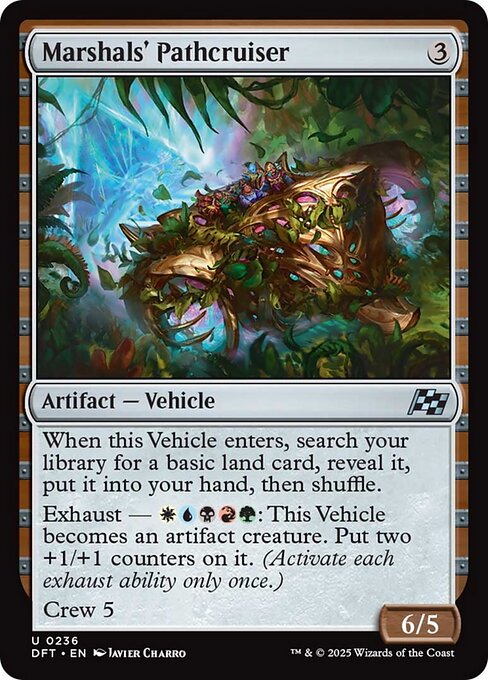 Rating6.0Playable
Why this rating?
Good playable that always makes the cut (6.0/10).
Why. For three mana you fetch a basic land into your hand and keep a 6/5 in reserve. The Exhaust ability makes it an artifact creature with two +1/+1 counters, but it needs one mana of each of the five colors.
Risks. Crew 5 is very heavy: you tap several creatures, so your attack gets weaker. The Exhaust ability is almost unplayable outside a five-color deck.
In the draft. A decent playable that smooths your mana. Take it if you already have big creatures to crew it, otherwise let it go.
Results in the games of the set
When it is in hand, the deck wins 58.8% of its games (set average: 55.7%, 39th of 273 cards).
In the opening hand: 58.2% wins (54.9% on average).
Drawn during the game: 59.3% (56.3% on average).
When it is drawn, the deck wins 4.5 points more than when it is not.
When it is drafted, it is played 72% of the time (set average: 63%).
Taken as the first pick (121 drafts), it ends in the deck 90% of the time.
It is played about as much in every archetype.
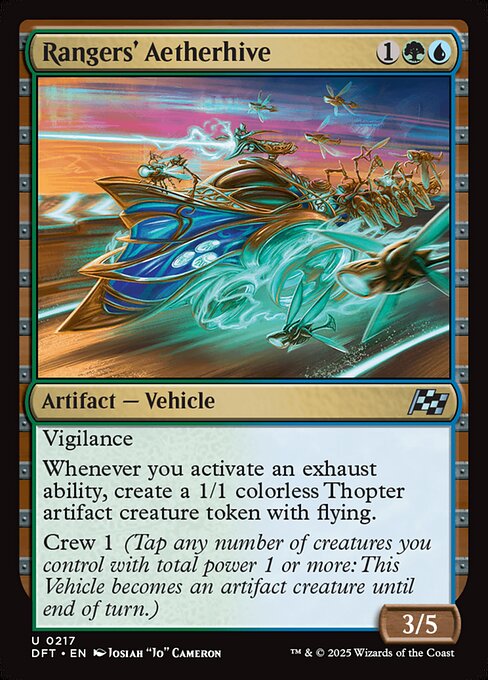
103. Rangers' Aetherhive
Rating6.0PlayableWhy this rating?
Good playable that always makes the cut (6.0/10).
Why. A cheap Vehicle with vigilance that a single creature can crew, so it attacks without giving up blocking. Each time you activate an exhaust ability you get a 1/1 colorless Thopter artifact creature token with flying.
Risks. It's close to a plain Vehicle unless your deck has other exhaust abilities. Removal in response to crewing costs you tempo.
In the draft. Best in a green-blue deck with several exhaust cards. Without them it's an average Vehicle, a mid-to-late pick.
Results in the games of the set
When it is in hand, the deck wins 54.9% of its games (set average: 55.7%, 154th of 273 cards).
In the opening hand: 54.6% wins (54.9% on average).
Drawn during the game: 55.0% (56.3% on average).
When it is drawn, the deck wins 0.2 points more than when it is not.
When it is drafted, it is played 67% of the time (set average: 63%).
Taken as the first pick (137 drafts), it ends in the deck 86% of the time.
It is played mostly in G/U decks (47% of them).
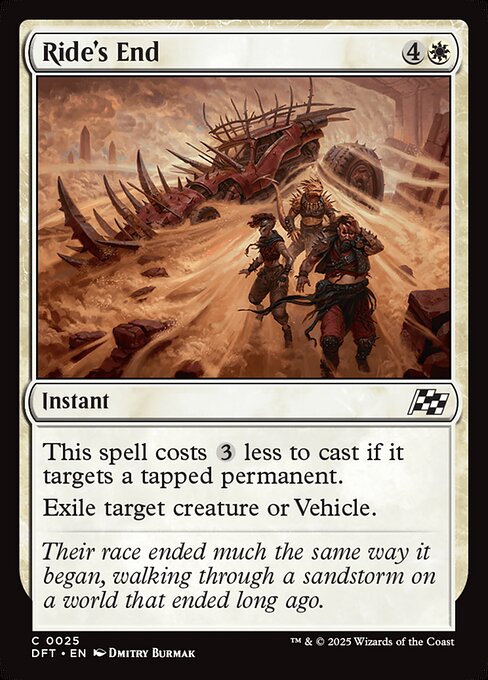
104. Ride's End
Rating6.0PlayableWhy this rating?
Good playable that always makes the cut (6.0/10).
Why. Exile target creature or Vehicle at instant speed. Against a tapped target, such as an attacker or a crewed Vehicle, it costs only two mana: clean, efficient removal.
Risks. Without a tapped target it costs five mana, which is slow and expensive. You want to cast it during or after the opponent's attack.
In the draft. A good white removal spell worth a fairly high pick. It goes in any white deck, and it gets better the more Vehicles your opponents play.
Results in the games of the set
When it is in hand, the deck wins 57.3% of its games (set average: 55.7%, 69th of 273 cards).
In the opening hand: 55.0% wins (54.9% on average).
Drawn during the game: 58.9% (56.3% on average).
When it is drawn, the deck wins 3.3 points more than when it is not.
When it is drafted, it is played 85% of the time (set average: 63%).
Taken as the first pick (298 drafts), it ends in the deck 94% of the time.
It is played mostly in G/W decks (70% of them) and U/W (59%).

105. Roadside Blowout
Rating6.0PlayableWhy this rating?
Good playable that always makes the cut (6.0/10).
Why. A sorcery that bounces an opposing creature or Vehicle and draws you a card. Against a mana value 1 target it costs a single blue mana, a huge tempo swing.
Risks. It doesn't solve the problem: the card comes back. Against a big permanent you just gain a turn and a card.
In the draft. A good tempo tool for an aggressive blue deck or one with many Vehicles. Take it after the real removal.
Results in the games of the set
When it is in hand, the deck wins 56.4% of its games (set average: 55.7%, 90th of 273 cards).
In the opening hand: 53.8% wins (54.9% on average).
Drawn during the game: 58.0% (56.3% on average).
When it is drawn, the deck wins 1.7 points more than when it is not.
When it is drafted, it is played 85% of the time (set average: 63%).
Taken as the first pick (167 drafts), it ends in the deck 92% of the time.
It is played mostly in U/W decks (32% of them) and B/U (29%).

106. Skycrash
Rating6.0PlayableWhy this rating?
Good playable that always makes the cut (6.0/10).
Why. Destroy target artifact at instant speed, and in this set Vehicles are artifacts, so it can remove an opponent's best Vehicle. Cycling for a single red mana keeps it from rotting in hand.
Risks. It does nothing against non-artifact creatures. With no artifact to hit, you just cycle it.
In the draft. A sideboard-style or late-pick card. Take it mostly if you've seen powerful Vehicles on the other side.
Results in the games of the set
When it is in hand, the deck wins 54.5% of its games (set average: 55.7%, 169th of 273 cards).
In the opening hand: 52.7% wins (54.9% on average).
Drawn during the game: 55.8% (56.3% on average).
When it is drawn, the deck wins 1.0 points more than when it is not.
When it is drafted, it is played 76% of the time (set average: 63%).
Taken as the first pick (97 drafts), it ends in the deck 88% of the time.
It is played mostly in R/U decks (34% of them) and B/R (25%).

107. Spin Out
Rating6.0PlayableWhy this rating?
Good playable that always makes the cut (6.0/10).
Why. Destroy target creature or Vehicle at instant speed, with no condition. It handles almost any threat, whatever its size.
Risks. The two black mana in its cost make it awkward in a deck that is only lightly black. It does nothing against a permanent that is neither a creature nor a Vehicle.
In the draft. A solid black removal spell and a high pick among the commons. Almost any black deck plays it.
Results in the games of the set
When it is in hand, the deck wins 57.2% of its games (set average: 55.7%, 72nd of 273 cards).
In the opening hand: 54.6% wins (54.9% on average).
Drawn during the game: 59.0% (56.3% on average).
When it is drawn, the deck wins 2.6 points more than when it is not.
When it is drafted, it is played 91% of the time (set average: 63%).
Taken as the first pick (591 drafts), it ends in the deck 95% of the time.
It is played mostly in B/G decks (60% of them) and B/R (59%).

108. Sundial, Dawn Tyrant
Rating6.0PlayableWhy this rating?
Good playable that always makes the cut (6.0/10).
Why. A 3/3 for two mana: early on it dominates the battlefield. It's a legendary artifact creature, so it can also crew a Vehicle.
Risks. Legendary: a second copy is dead weight. And a 3/3 loses value as creatures get bigger.
In the draft. A good creature for a low-curve white deck. Take it if you're short on two-mana plays.
Results in the games of the set
When it is in hand, the deck wins 55.3% of its games (set average: 55.7%, 136th of 273 cards).
In the opening hand: 56.8% wins (54.9% on average).
Drawn during the game: 54.2% (56.3% on average).
When it is drawn, the deck wins 0.8 points more than when it is not.
When it is drafted, it is played 82% of the time (set average: 63%).
Taken as the first pick (99 drafts), it ends in the deck 89% of the time.
It is played mostly in U/W decks (34% of them) and R/W (31%).

109. Wind-Scarred Crag
Rating6.0PlayableWhy this rating?
Good playable that always makes the cut (6.0/10).
Why. A red-white dual land: it enters tapped, gains you 1 life, and taps for red or white mana. It fixes your colors in a red-white deck.
Risks. Entering tapped costs tempo in a fast deck. Outside red-white it does nothing.
In the draft. Take it late, only if you are red-white or still choosing between the two colors.
Results in the games of the set
When it is in hand, the deck wins 52.6% of its games (set average: 55.7%, 220th of 273 cards).
In the opening hand: 54.6% wins (54.9% on average).
Drawn during the game: 51.1% (56.3% on average).
When it is drawn, the deck wins 0.1 points less than when it is not.
When it is drafted, it is played 47% of the time (set average: 63%).
Taken among the first three picks (75 drafts), it ends in the deck 87% of the time.
 Rating5.9Playable
Why this rating?
Good playable that always makes the cut (5.9/10).
Why. A 3/3 haste for three mana that also gives your Vehicles haste. When a Pirate and a Vehicle attack together you draw three cards, then discard two, a net gain of a card. It is a Pirate itself.
Risks. It needs a Vehicle in the same combat, so your deck must be built for it. It's two colors and dies to any removal.
In the draft. For a blue-red deck with Vehicles. Without them, it's a fine 3/3 haste, nothing more.
Results in the games of the set
When it is in hand, the deck wins 55.5% of its games (set average: 55.7%, 121st of 273 cards).
In the opening hand: 55.3% wins (54.9% on average).
Drawn during the game: 55.6% (56.3% on average).
When it is drawn, the deck wins 4.4 points more than when it is not.
When it is drafted, it is played 65% of the time (set average: 63%).
Taken as the first pick (46 drafts), it ends in the deck 85% of the time.
It is played mostly in R/U decks (25% of them).
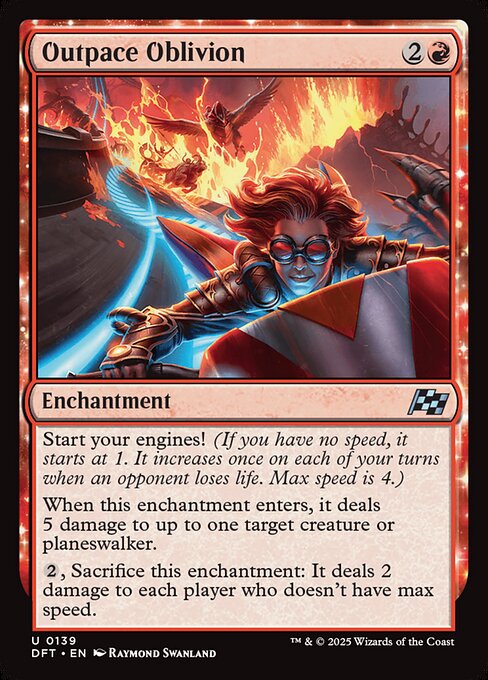
111. Outpace Oblivion
Rating5.8PlayableWhy this rating?
Good playable that always makes the cut (5.9/10).
Why. Five damage to a creature or planeswalker when it enters is real removal for three mana, and Start your engines! starts your speed. Later you can sacrifice it for two mana to deal two damage to each player without max speed.
Risks. On entering it can only hit a creature or planeswalker, never a player. The second effect is weak once both players reach max speed.
In the draft. A good red removal spell, to take as soon as you're short on removal. Every red deck plays it.
Results in the games of the set
When it is in hand, the deck wins 55.2% of its games (set average: 55.7%, 142nd of 273 cards).
In the opening hand: 53.8% wins (54.9% on average).
Drawn during the game: 56.1% (56.3% on average).
When it is drawn, the deck wins 1.5 points more than when it is not.
When it is drafted, it is played 91% of the time (set average: 63%).
Taken as the first pick (193 drafts), it ends in the deck 91% of the time.
It is played mostly in R/W decks (34% of them) and B/R (33%).

112. Apocalypse Runner
Rating5.8PlayableWhy this rating?
Good playable that always makes the cut (5.8/10).
Why. A 6/5 Vehicle whose tap ability, with no crewing needed, gives a creature with power 2 or less lifelink and makes it unblockable this turn. A small creature that couldn't attack profitably becomes a real threat.
Risks. Crew 3 is costly, and the ability taps the Vehicle: it can't use it and attack in the same turn. Its two colors also limit where it fits.
In the draft. A niche black-red pick. Take it if you already have plenty of small creatures; otherwise let it go.
Results in the games of the set
When it is in hand, the deck wins 53.7% of its games (set average: 55.7%, 190th of 273 cards).
In the opening hand: 51.8% wins (54.9% on average).
Drawn during the game: 54.9% (56.3% on average).
When it is drawn, the deck wins 0.1 points more than when it is not.
When it is drafted, it is played 40% of the time (set average: 63%).
Taken as the first pick (32 drafts), it ends in the deck 69% of the time.
It is played mostly in B/R decks (49% of them).

113. Bloodfell Caves
Rating5.8PlayableWhy this rating?
Good playable that always makes the cut (5.8/10).
Why. A black-red dual land: it enters tapped, gains you 1 life, and taps for black or red mana. It fixes your colors in a black-red deck.
Risks. Entering tapped costs tempo in a fast deck. Outside black-red it does nothing.
In the draft. Take it late, only if you are black-red or still choosing between the two colors.
Results in the games of the set
When it is in hand, the deck wins 54.1% of its games (set average: 55.7%, 180th of 273 cards).
In the opening hand: 56.2% wins (54.9% on average).
Drawn during the game: 52.4% (56.3% on average).
When it is drawn, the deck wins 0.0 points more than when it is not.
When it is drafted, it is played 52% of the time (set average: 63%).
Taken as the first pick (31 drafts), it ends in the deck 77% of the time.

114. Blossoming Sands
Rating5.8PlayableWhy this rating?
Good playable that always makes the cut (5.8/10).
Why. A green-white dual land: it enters tapped, gains you 1 life, and taps for green or white mana. It fixes your colors in a green-white deck.
Risks. Entering tapped costs tempo in a fast deck. Outside green-white it does nothing.
In the draft. Take it late, only if you are green-white or still choosing between the two colors.
Results in the games of the set
When it is in hand, the deck wins 54.9% of its games (set average: 55.7%, 153rd of 273 cards).
In the opening hand: 57.0% wins (54.9% on average).
Drawn during the game: 53.2% (56.3% on average).
When it is drawn, the deck wins 0.7 points less than when it is not.
When it is drafted, it is played 58% of the time (set average: 63%).
Taken among the first three picks (108 drafts), it ends in the deck 74% of the time.
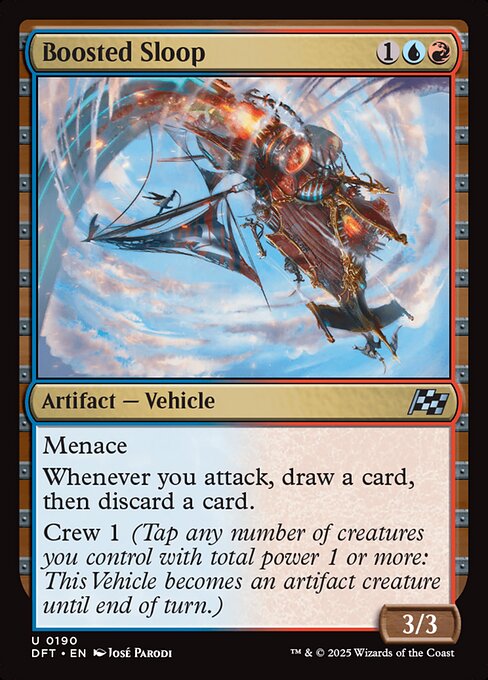
115. Boosted Sloop
Rating5.8PlayableWhy this rating?
Good playable that always makes the cut (5.8/10).
Why. A 3/3 Vehicle with menace that one creature can crew. Whenever you attack you draw, then discard, a card: steady filtering that smooths your hand.
Risks. The quality gain is modest, and the Vehicle itself needs a creature to tap in order to attack. Removal in response to crewing costs you tempo.
In the draft. An honest playable for blue-red, a notch below the best Vehicles. Take it if you have a curve of small creatures.
Results in the games of the set
When it is in hand, the deck wins 54.1% of its games (set average: 55.7%, 182nd of 273 cards).
In the opening hand: 52.5% wins (54.9% on average).
Drawn during the game: 55.0% (56.3% on average).
When it is drawn, the deck wins 2.5 points more than when it is not.
When it is drafted, it is played 59% of the time (set average: 63%).
Taken as the first pick (73 drafts), it ends in the deck 75% of the time.
It is played mostly in R/U decks (50% of them).

116. Broodheart Engine
Rating5.8PlayableWhy this rating?
Good playable that always makes the cut (5.8/10).
Why. It surveils 1 at each of your upkeeps, improving your draws. Later, for four mana you sacrifice it to return a creature or Vehicle card from your graveyard to the battlefield.
Risks. It does nothing immediate and needs a good target already in your graveyard. Its ability only works at sorcery speed, never mid-combat.
In the draft. For a black-green deck with good creatures to bring back. A good second choice, not a card to force.
Results in the games of the set
When it is in hand, the deck wins 56.8% of its games (set average: 55.7%, 78th of 273 cards).
In the opening hand: 55.4% wins (54.9% on average).
Drawn during the game: 57.8% (56.3% on average).
When it is drawn, the deck wins 1.7 points more than when it is not.
When it is drafted, it is played 77% of the time (set average: 63%).
Taken as the first pick (127 drafts), it ends in the deck 84% of the time.
It is played mostly in B/G decks (59% of them).

117. Canyon Vaulter
Rating5.8PlayableWhy this rating?
Good playable that always makes the cut (5.8/10).
Why. A 3/1 for two mana: when it crews a Vehicle or saddles a Mount during your main phase, that Vehicle or Mount gains flying until end of turn. That gives a big body an aerial attack.
Risks. With only one toughness it dies to almost anything. Its ability needs a Vehicle or Mount in your deck.
In the draft. For a white deck with several Vehicles. Without them it's a small 3/1 filler.
Results in the games of the set
When it is in hand, the deck wins 54.7% of its games (set average: 55.7%, 161st of 273 cards).
In the opening hand: 55.0% wins (54.9% on average).
Drawn during the game: 54.4% (56.3% on average).
When it is drawn, the deck wins 0.1 points more than when it is not.
When it is drafted, it is played 78% of the time (set average: 63%).
Taken as the first pick (61 drafts), it ends in the deck 89% of the time.
It is played mostly in R/W decks (42% of them) and G/W (39%).

118. Earthrumbler
Rating5.8PlayableWhy this rating?
Good playable that always makes the cut (5.8/10).
Why. A 7/6 Vehicle with vigilance and trample. You can make it a creature by exiling an artifact or creature card from your graveyard instead of crewing it, which helps once your creatures are dead.
Risks. It costs five mana, and it only becomes a creature through Crew 3 or by exiling a card from your graveyard. Removal in response wastes the exiled card.
In the draft. A decent top-end for green decks. Take it if you already have creatures to tap, but not ahead of removal.
Results in the games of the set
When it is in hand, the deck wins 55.7% of its games (set average: 55.7%, 115th of 273 cards).
In the opening hand: 54.1% wins (54.9% on average).
Drawn during the game: 56.7% (56.3% on average).
When it is drawn, the deck wins 0.8 points more than when it is not.
When it is drafted, it is played 91% of the time (set average: 63%).
Taken as the first pick (180 drafts), it ends in the deck 97% of the time.
It is played mostly in B/G decks (26% of them).

119. Engine Rat
Rating5.8PlayableWhy this rating?
Good playable that always makes the cut (5.8/10).
Why. A one-mana creature with deathtouch: on defense it discourages almost any attack. Late in the game, six mana makes each opponent lose 2 life, a steady source of reach.
Risks. A 1/1 dies to any removal or sweeper. Its ability is expensive for what it does.
In the draft. A good one-mana black playable, a fairly high pick among the commons. Any black deck can play it.
Results in the games of the set
When it is in hand, the deck wins 57.8% of its games (set average: 55.7%, 55th of 273 cards).
In the opening hand: 58.3% wins (54.9% on average).
Drawn during the game: 57.5% (56.3% on average).
When it is drawn, the deck wins 2.7 points more than when it is not.
When it is drafted, it is played 83% of the time (set average: 63%).
Taken as the first pick (193 drafts), it ends in the deck 94% of the time.
It is played mostly in B/R decks (65% of them) and B/W (64%).

120. Guidelight Pathmaker
Rating5.8PlayableWhy this rating?
Good playable that always makes the cut (5.8/10).
Why. A 6/5 Vehicle with vigilance. When it enters you search for an artifact: if its mana value is two or less it goes straight to the battlefield, otherwise to your hand. You get value on top of the body.
Risks. Six mana, in two specific colors. Your deck needs artifacts or the search finds nothing.
In the draft. For a white-blue deck with artifacts. Otherwise six mana for a crewable 6/5 is expensive.
Results in the games of the set
When it is in hand, the deck wins 56.8% of its games (set average: 55.7%, 80th of 273 cards).
In the opening hand: 53.4% wins (54.9% on average).
Drawn during the game: 58.8% (56.3% on average).
When it is drawn, the deck wins 5.7 points more than when it is not.
When it is drafted, it is played 66% of the time (set average: 63%).
Taken as the first pick (112 drafts), it ends in the deck 91% of the time.
It is played mostly in U/W decks (54% of them).

121. Jungle Hollow
Rating5.8PlayableWhy this rating?
Good playable that always makes the cut (5.8/10).
Why. A black-green dual land: it enters tapped, gains you 1 life, and taps for black or green mana. It fixes your colors in a black-green deck.
Risks. Entering tapped costs tempo in a fast deck. Outside black-green it does nothing.
In the draft. Take it late, only if you are black-green or still choosing between the two colors.
Results in the games of the set
When it is in hand, the deck wins 55.5% of its games (set average: 55.7%, 122nd of 273 cards).
In the opening hand: 57.3% wins (54.9% on average).
Drawn during the game: 54.0% (56.3% on average).
When it is drawn, the deck wins 0.4 points less than when it is not.
When it is drafted, it is played 69% of the time (set average: 63%).
Taken among the first three picks (172 drafts), it ends in the deck 86% of the time.

122. Riverchurn Monument
Rating5.8PlayableWhy this rating?
Good playable that always makes the cut (5.8/10).
Why. A two-mana artifact that mills any number of target players. Its Exhaust ability mills each of them cards equal to the number in their graveyard, a way to empty a library.
Risks. It does nothing for you unless your deck cares about the graveyard. It is slow and needs a specific plan to win.
In the draft. A specialist card, only worth playing if you have the support. Otherwise pass it.
Results in the games of the set
When it is in hand, the deck wins 59.9% of its games (set average: 55.7%, 21st of 273 cards).
In the opening hand: 56.6% wins (54.9% on average).
Drawn during the game: 62.0% (56.3% on average).
When it is drawn, the deck wins 7.4 points more than when it is not.
When it is drafted, it is played 88% of the time (set average: 63%).
Taken as the first pick (147 drafts), it ends in the deck 89% of the time.
It is played about as much in every archetype.

123. Rugged Highlands
Rating5.8PlayableWhy this rating?
Good playable that always makes the cut (5.8/10).
Why. A red-green dual land: it enters tapped, gains you 1 life, and taps for red or green mana. It fixes your colors in a red-green deck.
Risks. Entering tapped costs tempo in a fast deck. Outside red-green it does nothing.
In the draft. Take it late, only if you are red-green or still choosing between the two colors.
Results in the games of the set
When it is in hand, the deck wins 54.6% of its games (set average: 55.7%, 167th of 273 cards).
In the opening hand: 56.8% wins (54.9% on average).
Drawn during the game: 52.8% (56.3% on average).
When it is drawn, the deck wins 0.7 points less than when it is not.
When it is drafted, it is played 62% of the time (set average: 63%).
Taken among the first three picks (142 drafts), it ends in the deck 75% of the time.

124. Scoured Barrens
Rating5.8PlayableWhy this rating?
Good playable that always makes the cut (5.8/10).
Why. A white-black dual land: it enters tapped, gains you 1 life, and taps for white or black mana. It fixes your colors in a white-black deck.
Risks. Entering tapped costs tempo in a fast deck. Outside white-black it does nothing.
In the draft. Take it late, only if you are white-black or still choosing between the two colors.
Results in the games of the set
When it is in hand, the deck wins 55.2% of its games (set average: 55.7%, 143rd of 273 cards).
In the opening hand: 56.5% wins (54.9% on average).
Drawn during the game: 54.2% (56.3% on average).
When it is drawn, the deck wins 1.0 points more than when it is not.
When it is drafted, it is played 57% of the time (set average: 63%).
Taken as the first pick (32 drafts), it ends in the deck 78% of the time.

125. Tranquil Cove
Rating5.8PlayableWhy this rating?
Good playable that always makes the cut (5.8/10).
Why. A white-blue dual land: it enters tapped, gains you 1 life, and taps for white or blue mana. It fixes your colors in a white-blue deck.
Risks. Entering tapped costs tempo in a fast deck. Outside white-blue it does nothing.
In the draft. Take it late, only if you are white-blue or still choosing between the two colors.
Results in the games of the set
When it is in hand, the deck wins 55.3% of its games (set average: 55.7%, 135th of 273 cards).
In the opening hand: 56.3% wins (54.9% on average).
Drawn during the game: 54.6% (56.3% on average).
When it is drawn, the deck wins 1.9 points more than when it is not.
When it is drafted, it is played 58% of the time (set average: 63%).
Taken among the first three picks (168 drafts), it ends in the deck 81% of the time.

126. Dismal Backwater
Rating5.7PlayableWhy this rating?
Good playable that always makes the cut (5.7/10).
Why. A blue-black dual land: it enters tapped, gains you 1 life, and taps for blue or black mana. It fixes your colors in a blue-black deck.
Risks. Entering tapped costs tempo in a fast deck. Outside blue-black it does nothing.
In the draft. Take it late, only if you are blue-black or still choosing between the two colors.
Results in the games of the set
When it is in hand, the deck wins 55.5% of its games (set average: 55.7%, 123rd of 273 cards).
In the opening hand: 56.4% wins (54.9% on average).
Drawn during the game: 54.8% (56.3% on average).
When it is drawn, the deck wins 1.8 points more than when it is not.
When it is drafted, it is played 67% of the time (set average: 63%).
Taken as the first pick (43 drafts), it ends in the deck 81% of the time.

127. Swiftwater Cliffs
Rating5.7PlayableWhy this rating?
Good playable that always makes the cut (5.7/10).
Why. A blue-red dual land: it enters tapped, gains you 1 life, and taps for blue or red mana. It fixes your colors in a blue-red deck.
Risks. Entering tapped costs tempo in a fast deck. Outside blue-red it does nothing.
In the draft. Take it late, only if you are blue-red or still choosing between the two colors.
Results in the games of the set
When it is in hand, the deck wins 55.0% of its games (set average: 55.7%, 149th of 273 cards).
In the opening hand: 56.5% wins (54.9% on average).
Drawn during the game: 54.0% (56.3% on average).
When it is drawn, the deck wins 1.4 points more than when it is not.
When it is drafted, it is played 63% of the time (set average: 63%).
Taken among the first three picks (159 drafts), it ends in the deck 81% of the time.

128. Country Roads
Rating5.6PlayableWhy this rating?
Good playable that always makes the cut (5.6/10).
Why. A white land that enters tapped unless you control a Mount or Vehicle. Later you can sacrifice it for two mana to create a 1/1 colorless Pilot creature token that crews and saddles as though its power were 2 greater.
Risks. No fixing: it only makes white mana. Without a Vehicle it enters tapped, and the token is a fragile little creature.
In the draft. A useful land in a white deck with Vehicles, turning into a Pilot when needed. Take it late otherwise.
Results in the games of the set
When it is in hand, the deck wins 53.5% of its games (set average: 55.7%, 196th of 273 cards).
In the opening hand: 54.3% wins (54.9% on average).
Drawn during the game: 53.0% (56.3% on average).
When it is drawn, the deck wins 2.2 points less than when it is not.
When it is drafted, it is played 45% of the time (set average: 63%).

129. Fang Guardian
Rating5.6PlayableWhy this rating?
Good playable that always makes the cut (5.6/10).
Why. A 4/2 with flash: when it enters, another target creature or Vehicle you control gets +2/+2 until end of turn. In combat the flash surprise wins an exchange.
Risks. Its toughness is low and the effect needs another target. With no other creature it's only a body.
In the draft. A good green creature for any attacking deck. A middling-high pick, and it pairs fine with Vehicles.
Results in the games of the set
When it is in hand, the deck wins 56.6% of its games (set average: 55.7%, 83rd of 273 cards).
In the opening hand: 55.1% wins (54.9% on average).
Drawn during the game: 57.7% (56.3% on average).
When it is drawn, the deck wins 0.7 points more than when it is not.
When it is drafted, it is played 90% of the time (set average: 63%).
Taken as the first pick (186 drafts), it ends in the deck 95% of the time.
It is played mostly in G/R decks (32% of them) and G/W (30%).

130. Hellish Sideswipe
Rating5.6PlayableWhy this rating?
Good playable that always makes the cut (5.6/10).
Why. For a single black mana you destroy a creature or Vehicle, at the cost of sacrificing an artifact or creature. If the sacrificed permanent was a Vehicle, you draw a card.
Risks. The additional cost is real: you lose a permanent. It's a sorcery, so it's awkward against an attack.
In the draft. Conditional removal, for a black deck with tokens or artifacts to sacrifice. Otherwise prefer removal with no cost.
Results in the games of the set
When it is in hand, the deck wins 54.5% of its games (set average: 55.7%, 170th of 273 cards).
In the opening hand: 51.3% wins (54.9% on average).
Drawn during the game: 56.5% (56.3% on average).
When it is drawn, the deck wins 1.1 points more than when it is not.
When it is drafted, it is played 72% of the time (set average: 63%).
Taken as the first pick (70 drafts), it ends in the deck 84% of the time.
It is played about as much in every archetype.
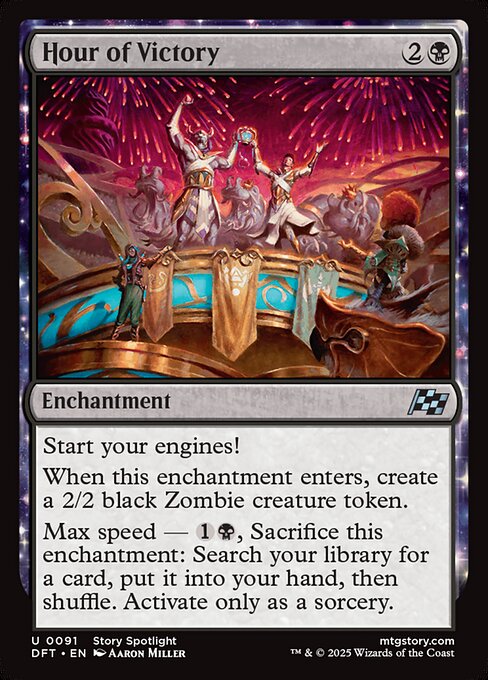
131. Hour of Victory
Rating5.6PlayableWhy this rating?
Good playable that always makes the cut (5.6/10).
Why. It makes a 2/2 black Zombie creature token on entering, and Start your engines! starts your speed. At max speed you can sacrifice it to search for any card in your library.
Risks. The search needs max speed, which isn't guaranteed. Before that, the 2/2 Zombie is its main value.
In the draft. A good black three-drop for an aggressive deck. Not an urgent pick, but it gives a body and speed.
Results in the games of the set
When it is in hand, the deck wins 55.2% of its games (set average: 55.7%, 137th of 273 cards).
In the opening hand: 53.7% wins (54.9% on average).
Drawn during the game: 56.2% (56.3% on average).
When it is drawn, the deck wins 0.9 points more than when it is not.
When it is drafted, it is played 70% of the time (set average: 63%).
Taken as the first pick (62 drafts), it ends in the deck 87% of the time.
It is played mostly in B/W decks (32% of them) and B/R (30%).
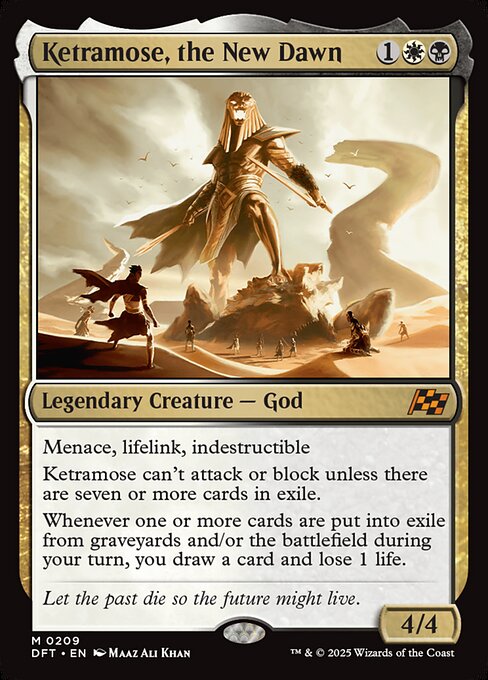 Rating5.6Playable
Why this rating?
Good playable that always makes the cut (5.6/10).
Why. A 4/4 with menace, lifelink and indestructible for three mana. It can't attack or block unless there are seven or more cards in exile; meanwhile, whenever cards are exiled from graveyards or the battlefield during your turn, you draw a card and lose 1 life.
Risks. Seven cards in exile is very hard in a normal deck, and each draw costs you 1 life. Most of the time it's an inactive body.
In the draft. A specialist card for white-black with exile effects. Without that, it's a very risky pick.
Results in the games of the set
When it is in hand, the deck wins 46.8% of its games (set average: 55.7%).
Drawn during the game: 0.0% (56.3% on average).
When it is drawn, the deck wins 0.6 points less than when it is not.
When it is drafted, it is played 15% of the time (set average: 63%).

133. Lightshield Parry
Rating5.6PlayableWhy this rating?
Good playable that always makes the cut (5.6/10).
Why. A one-mana white instant giving +2/+2 to win a combat. If you don't need it, its two-mana Cycling turns it into a card drawn.
Risks. A plain combat trick that does nothing without a good creature. Removal in response blows you out.
In the draft. Late-pick filler for a combat-oriented white deck. Take it late.
Results in the games of the set
When it is in hand, the deck wins 51.4% of its games (set average: 55.7%, 240th of 273 cards).
In the opening hand: 50.5% wins (54.9% on average).
Drawn during the game: 52.1% (56.3% on average).
When it is drawn, the deck wins 2.8 points less than when it is not.
When it is drafted, it is played only 14% of the time (set average: 63%): it almost always ends in the sideboard.
It is played mostly in G/W decks (31% of them).
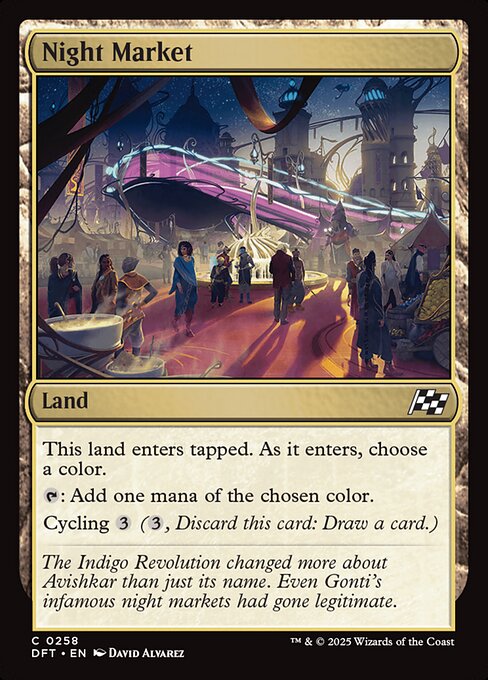
134. Night Market
Rating5.6PlayableWhy this rating?
Good playable that always makes the cut (5.6/10).
Why. A land that enters tapped and makes one mana of the color you choose as it enters, with Cycling 3. It replaces a basic land in any deck and turns into a card late in the game.
Risks. It enters tapped, and makes a single color: it isn't real fixing. Cycling costs three mana.
In the draft. An acceptable land to take late, playable in any deck. It protects you against flooding.
Results in the games of the set
When it is in hand, the deck wins 55.4% of its games (set average: 55.7%, 126th of 273 cards).
In the opening hand: 56.0% wins (54.9% on average).
Drawn during the game: 55.0% (56.3% on average).
When it is drawn, the deck wins 0.2 points less than when it is not.
When it is drafted, it is played 96% of the time (set average: 63%).
Taken as the first pick (181 drafts), it ends in the deck 97% of the time.
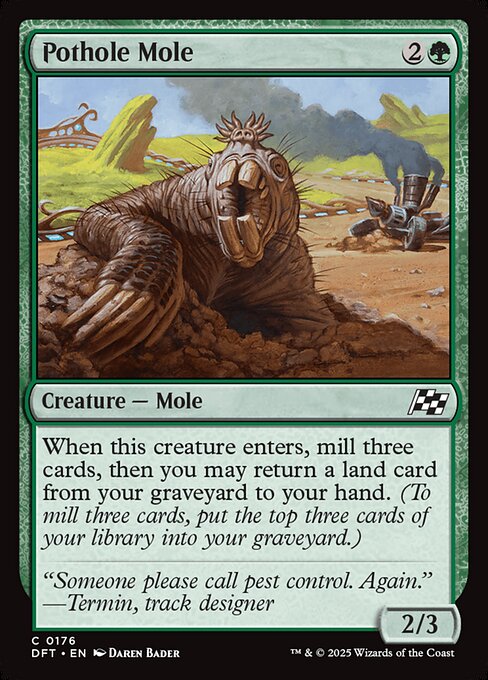
135. Pothole Mole
Rating5.6PlayableWhy this rating?
Good playable that always makes the cut (5.6/10).
Why. A 2/3 for three that nearly replaces itself: it mills three, then you may get a land back. It holds the ground early and keeps your land drops on track.
Risks. The mill is random and can bin your best cards for nothing. If no land shows up, you are left with a plain 2/3.
In the draft. A solid green role-player, taken for consistency rather than power. It fits in most green decks.
Results in the games of the set
When it is in hand, the deck wins 56.7% of its games (set average: 55.7%, 81st of 273 cards).
In the opening hand: 57.3% wins (54.9% on average).
Drawn during the game: 56.3% (56.3% on average).
When it is drawn, the deck wins 0.1 points more than when it is not.
When it is drafted, it is played 83% of the time (set average: 63%).
Taken as the first pick (263 drafts), it ends in the deck 93% of the time.
It is played mostly in B/G decks (77% of them) and G/U (56%).

136. Rocky Roads
Rating5.6PlayableWhy this rating?
Good playable that always makes the cut (5.6/10).
Why. A red land that enters untapped if you control a Mount or Vehicle. Late in the game it sacrifices itself for two mana, one of them red, to make a Pilot, a creature token that crews as though its power were 2 greater.
Risks. It enters tapped without a Mount or Vehicle, which costs tempo. The Pilot is only a 1/1: with no Vehicles, this is just a land.
In the draft. Play it in red with a few Vehicles or Mounts. Without them it is a plain land, so take it late.
Results in the games of the set
When it is in hand, the deck wins 52.4% of its games (set average: 55.7%, 222nd of 273 cards).
In the opening hand: 54.3% wins (54.9% on average).
Drawn during the game: 51.1% (56.3% on average).
When it is drawn, the deck wins 2.1 points less than when it is not.
When it is drafted, it is played 42% of the time (set average: 63%).

137. Silken Strength
Rating5.6PlayableWhy this rating?
Good playable that always makes the cut (5.6/10).
Why. A two-mana Aura with flash that untaps the target and gives +1/+2 and reach. In combat it turns a trade in your favour or lets a blocker eat an attacker.
Risks. Like any Aura, you can get blown out if the target is removed in response. The bonus is modest and will not win the game alone.
In the draft. A decent green trick, not a priority. Take it after your creatures and removal.
Results in the games of the set
When it is in hand, the deck wins 54.6% of its games (set average: 55.7%, 163rd of 273 cards).
In the opening hand: 53.4% wins (54.9% on average).
Drawn during the game: 55.5% (56.3% on average).
When it is drawn, the deck wins 0.1 points less than when it is not.
When it is drafted, it is played 25% of the time (set average: 63%).
Taken among the first three picks (48 drafts), it ends in the deck 67% of the time.
 Rating5.6Playable
Why this rating?
Good playable that always makes the cut (5.6/10).
Why. A cheap counterspell for creatures and artifacts that you can hold up for two mana. The opponent must pay four more or the spell is countered.
Risks. It only hits artifacts and creatures, and an opponent with spare mana simply pays. Holding it up slows your own development.
In the draft. Fits blue control or tempo decks. One or two copies at most; never a first pick.
Results in the games of the set
When it is in hand, the deck wins 56.2% of its games (set average: 55.7%, 95th of 273 cards).
In the opening hand: 55.9% wins (54.9% on average).
Drawn during the game: 56.4% (56.3% on average).
When it is drawn, the deck wins 2.1 points more than when it is not.
When it is drafted, it is played 60% of the time (set average: 63%).
Taken as the first pick (71 drafts), it ends in the deck 86% of the time.
It is played mostly in R/U decks (53% of them) and B/U (47%).

139. The Last Ride
Rating5.6PlayableWhy this rating?
Good playable that always makes the cut (5.6/10).
Why. For one black mana it is mostly a card engine: three mana, one of them black, and two life to draw, with no need to crew. As your life drops, it also turns into a real creature.
Risks. It gets -X/-X where X is your life total, so while you are at 13 life or more it dies as soon as it becomes a creature. Paying life to draw leaves you exposed to aggressive decks.
In the draft. Only for black decks that can afford to live low. In a controlling deck, play it just for the card draw.
Results in the games of the set
When it is in hand, the deck wins 52.9% of its games (set average: 55.7%, 211th of 273 cards).
In the opening hand: 51.6% wins (54.9% on average).
Drawn during the game: 53.8% (56.3% on average).
When it is drawn, the deck wins 0.4 points less than when it is not.
When it is drafted, it is played 73% of the time (set average: 63%).
Taken among the first three picks (102 drafts), it ends in the deck 74% of the time.
It is played about as much in every archetype.

140. Thornwood Falls
Rating5.6PlayableWhy this rating?
Good playable that always makes the cut (5.6/10).
Why. A green-blue dual land that enters tapped and gains you 1 life. It smooths your mana in a green-blue deck at almost no cost.
Risks. It enters tapped, which hurts a deck that wants a tight curve. In a two-colour deck, one dual land does not move the needle much.
In the draft. Take it late once you lean green-blue. Past the first copy, only take it with a splash in mind.
Results in the games of the set
When it is in hand, the deck wins 56.2% of its games (set average: 55.7%, 97th of 273 cards).
In the opening hand: 57.7% wins (54.9% on average).
Drawn during the game: 55.1% (56.3% on average).
When it is drawn, the deck wins 0.9 points more than when it is not.
When it is drafted, it is played 69% of the time (set average: 63%).
Taken as the first pick (45 drafts), it ends in the deck 87% of the time.
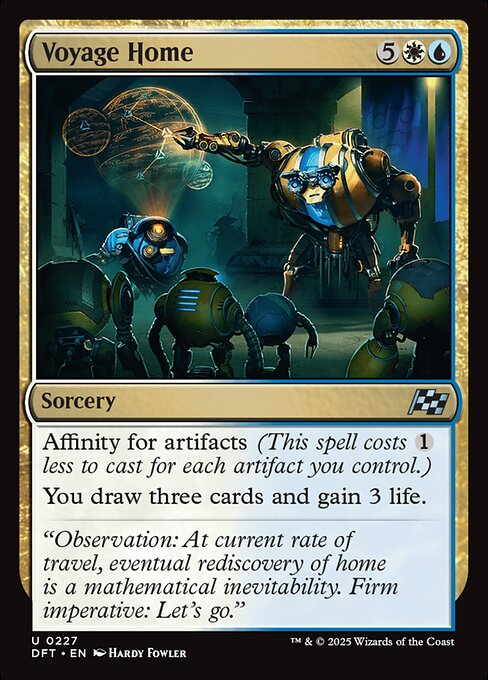
141. Voyage Home
Rating5.6PlayableWhy this rating?
Good playable that always makes the cut (5.6/10).
Why. Seven mana to draw three cards and gain 3 life. With affinity for artifacts it often costs much less, five mana with two artifacts. In a deck full of Vehicles, it is a big refill.
Risks. Without artifacts it is slow and does nothing to the board. It needs exactly white and blue, which narrows its decks.
In the draft. A good value play in a white-blue artifact deck. Outside that shell, skip it.
Results in the games of the set
When it is in hand, the deck wins 56.2% of its games (set average: 55.7%, 99th of 273 cards).
In the opening hand: 51.3% wins (54.9% on average).
Drawn during the game: 59.1% (56.3% on average).
When it is drawn, the deck wins 3.4 points more than when it is not.
When it is drafted, it is played 63% of the time (set average: 63%).
Taken as the first pick (66 drafts), it ends in the deck 82% of the time.
It is played mostly in U/W decks (64% of them).

142. Collision Course
Rating5.6PlayableWhy this rating?
Good playable that always makes the cut (5.6/10).
Why. A two-mana sorcery removal that deals as much damage as the number of creatures and Vehicles you control. With a stocked board it kills nearly anything. The second mode destroys an artifact, handy against a Vehicle.
Risks. On an empty board it does nothing. If you fall behind, you lack the permanents to kill the target.
In the draft. A conditional removal for an aggressive white deck with board presence. Take it mid-pack.
Results in the games of the set
When it is in hand, the deck wins 53.9% of its games (set average: 55.7%, 185th of 273 cards).
In the opening hand: 52.0% wins (54.9% on average).
Drawn during the game: 55.3% (56.3% on average).
When it is drawn, the deck wins 0.2 points more than when it is not.
When it is drafted, it is played 61% of the time (set average: 63%).
Taken as the first pick (55 drafts), it ends in the deck 82% of the time.
It is played mostly in U/W decks (63% of them) and R/W (57%).
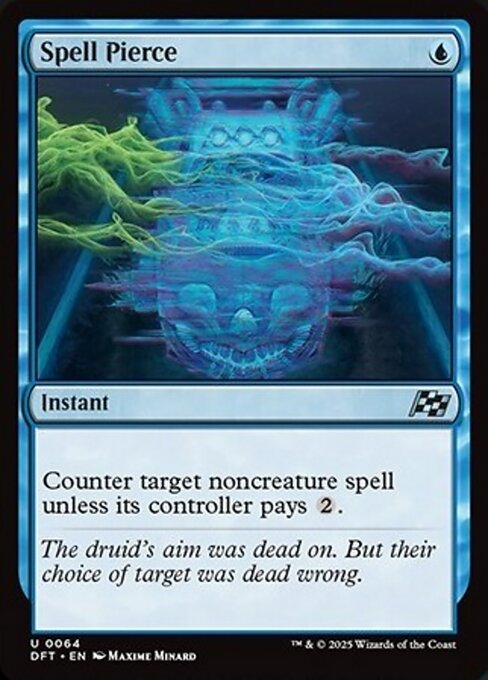
143. Spell Pierce
Rating5.5PlayableWhy this rating?
A solid playable that rarely gets cut (5.5/10).
Why. A one-mana counter for noncreature spells, as long as the opponent cannot pay two more. It works against a removal spell or Aura cast while tapped out.
Risks. Most spells that matter in draft are creatures, which this cannot hit. An opponent who keeps two mana open blanks it.
In the draft. A sideboard-quality counter in limited. Avoid it except in a very specific tempo deck, and very late in the pack.
Results in the games of the set
When it is in hand, the deck wins 49.3% of its games (set average: 55.7%, 265th of 273 cards).
In the opening hand: 48.0% wins (54.9% on average).
Drawn during the game: 50.2% (56.3% on average).
When it is drawn, the deck wins 0.2 points more than when it is not.
When it is drafted, it is played only 7% of the time (set average: 63%): it almost always ends in the sideboard.

144. Rise from the Wreck
Rating5.4PlayableWhy this rating?
A solid playable that rarely gets cut (5.4/10).
Why. A three-mana sorcery that can return up to four cards to hand: a creature, a Mount, a Vehicle and a creature with no abilities. Late in the game it can be a huge card-advantage swing.
Risks. You need a graveyard full of varied targets. Early it is a dead card, and all four targets are rarely there at once.
In the draft. A value card for a green deck that trades a lot. Take it after your good creatures, not before.
Results in the games of the set
When it is in hand, the deck wins 53.9% of its games (set average: 55.7%, 187th of 273 cards).
In the opening hand: 49.9% wins (54.9% on average).
Drawn during the game: 56.5% (56.3% on average).
When it is drawn, the deck wins 1.3 points less than when it is not.
When it is drafted, it is played 60% of the time (set average: 63%).
Taken as the first pick (44 drafts), it ends in the deck 82% of the time.
It is played mostly in B/G decks (26% of them).
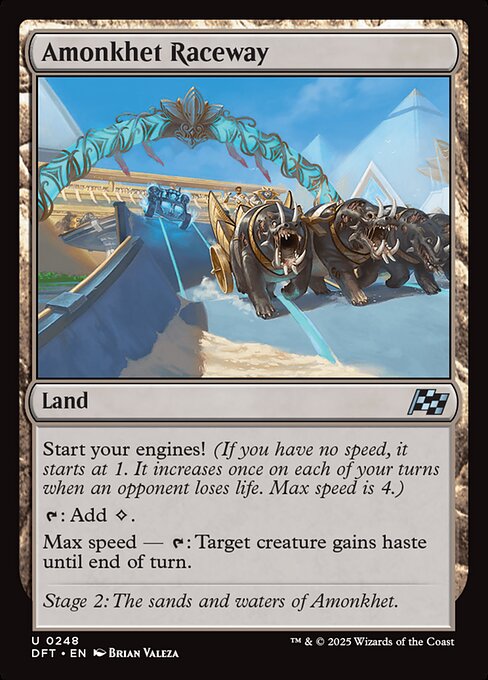
145. Amonkhet Raceway
Rating5.4PlayableWhy this rating?
A solid playable that rarely gets cut (5.4/10).
Why. A colourless land that starts your engines. At max speed it taps to give a creature haste, setting up a surprise attack with a freshly cast big creature.
Risks. It only makes colourless mana, which strains a two-colour deck. Reaching max speed means making the opponent lose life on several of your turns.
In the draft. Only in an aggressive deck, and never ahead of your good dual lands. Take it late.
Results in the games of the set
When it is in hand, the deck wins 52.1% of its games (set average: 55.7%, 229th of 273 cards).
In the opening hand: 51.1% wins (54.9% on average).
Drawn during the game: 52.8% (56.3% on average).
When it is drawn, the deck wins 2.3 points less than when it is not.
When it is drafted, it is played 15% of the time (set average: 63%).

146. Bestow Greatness
Rating5.4PlayableWhy this rating?
A solid playable that rarely gets cut (5.4/10).
Why. A three-mana trick: +4/+4 and trample until end of turn at instant speed. It wins a combat the opponent thought they had or closes the game with a big swing.
Risks. A one-shot trick that loses you the card if they respond with removal. It does nothing without a creature.
In the draft. A fine trick in a green deck with quality creatures. Take it after your creatures and removal.
Results in the games of the set
When it is in hand, the deck wins 55.8% of its games (set average: 55.7%, 114th of 273 cards).
In the opening hand: 52.8% wins (54.9% on average).
Drawn during the game: 57.8% (56.3% on average).
When it is drawn, the deck wins 0.0 points more than when it is not.
When it is drafted, it is played 48% of the time (set average: 63%).
Taken among the first three picks (149 drafts), it ends in the deck 81% of the time.
It is played mostly in G/W decks (47% of them) and G/R (45%).

147. Cryptcaller Chariot
Rating5.4PlayableWhy this rating?
A solid playable that rarely gets cut (5.4/10).
Why. A 5/5 menace Vehicle for four with crew 2. Whenever you discard one or more cards, it makes that many tapped 2/2 black Zombie creature tokens. With cycling, it becomes a token engine.
Risks. You need discard sources to justify the text: otherwise it is a Vehicle that needs two power to attack. Artifact removal kills it.
In the draft. A good pick in a black deck with discard or cycling. Otherwise it is an average Vehicle, taken mid-pack.
Results in the games of the set
When it is in hand, the deck wins 51.9% of its games (set average: 55.7%, 230th of 273 cards).
In the opening hand: 50.0% wins (54.9% on average).
Drawn during the game: 53.1% (56.3% on average).
When it is drawn, the deck wins 1.7 points more than when it is not.
When it is drafted, it is played 67% of the time (set average: 63%).
Taken as the first pick (79 drafts), it ends in the deck 65% of the time.
It is played mostly in B/R decks (25% of them).

148. Foul Roads
Rating5.4PlayableWhy this rating?
A solid playable that rarely gets cut (5.4/10).
Why. A black land that enters untapped if you control a Mount or Vehicle. Late game, it sacrifices itself for two mana, one of them black, to make a Pilot, a creature token that crews as though its power were 2 greater.
Risks. It enters tapped without a Mount or Vehicle. The Pilot is a plain 1/1, so with no Vehicles its value is low.
In the draft. A good black add with Vehicles. Take it late unless you already have several.
Results in the games of the set
When it is in hand, the deck wins 55.0% of its games (set average: 55.7%, 151st of 273 cards).
In the opening hand: 55.6% wins (54.9% on average).
Drawn during the game: 54.4% (56.3% on average).
When it is drawn, the deck wins 0.8 points less than when it is not.
When it is drafted, it is played 52% of the time (set average: 63%).

149. Hazard of the Dunes
Rating5.4PlayableWhy this rating?
A solid playable that rarely gets cut (5.4/10).
Why. A 4/4 with reach and trample for four: it blocks fliers and attacks on the ground with little risk. At seven mana, Exhaust puts three +1/+1 counters on it, handy late.
Risks. It has no ability that swings a combat early, and the Exhaust is expensive. Removal handles it easily.
In the draft. A solid green workhorse, take it happily. It fits every green pair.
Results in the games of the set
When it is in hand, the deck wins 57.0% of its games (set average: 55.7%, 76th of 273 cards).
In the opening hand: 55.9% wins (54.9% on average).
Drawn during the game: 57.7% (56.3% on average).
When it is drawn, the deck wins 0.9 points more than when it is not.
When it is drafted, it is played 94% of the time (set average: 63%).
Taken as the first pick (490 drafts), it ends in the deck 96% of the time.
It is played mostly in G/R decks (68% of them) and B/G (66%).

150. Migrating Ketradon
Rating5.4PlayableWhy this rating?
A solid playable that rarely gets cut (5.4/10).
Why. A 6/6 with reach that gains 4 life on arrival and cycles for two. It is flexible: keep it as a late-game finisher or cycle it when you need lands or cards.
Risks. It costs six with two green mana, too slow to act early. Cycling it gives up the big body.
In the draft. A good top-end for green, never dead thanks to cycling. Take it happily.
Results in the games of the set
When it is in hand, the deck wins 57.5% of its games (set average: 55.7%, 62nd of 273 cards).
In the opening hand: 55.0% wins (54.9% on average).
Drawn during the game: 59.3% (56.3% on average).
When it is drawn, the deck wins 1.3 points more than when it is not.
When it is drafted, it is played 91% of the time (set average: 63%).
Taken as the first pick (439 drafts), it ends in the deck 96% of the time.
It is played mostly in B/G decks (68% of them) and G/U (65%).
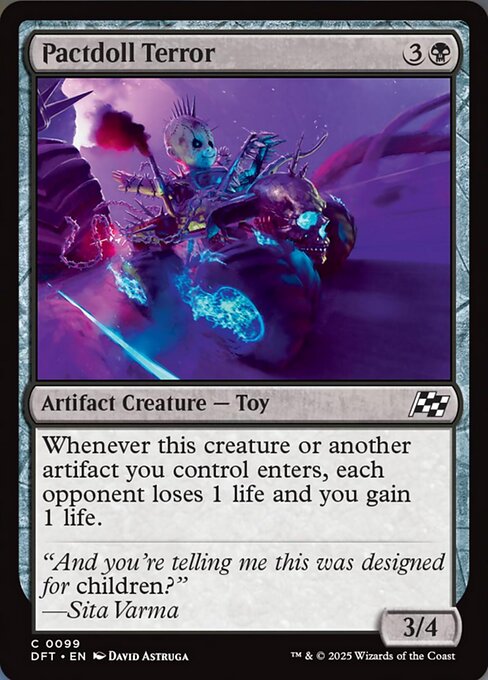
151. Pactdoll Terror
Rating5.4PlayableWhy this rating?
A solid playable that rarely gets cut (5.4/10).
Why. A 3/4 for four that drains 1 life on arrival and whenever another artifact you control enters. It holds the ground well, and the life it makes them lose raises your speed if you have one (Start your engines!).
Risks. Without artifacts the drain stays small. A 3/4 with no evasion does not win alone.
In the draft. A good black common, especially with Vehicles and artifacts. Take it as a quality body with a small bonus.
Results in the games of the set
When it is in hand, the deck wins 57.6% of its games (set average: 55.7%, 59th of 273 cards).
In the opening hand: 55.7% wins (54.9% on average).
Drawn during the game: 58.9% (56.3% on average).
When it is drawn, the deck wins 4.2 points more than when it is not.
When it is drafted, it is played 85% of the time (set average: 63%).
Taken as the first pick (468 drafts), it ends in the deck 93% of the time.
It is played mostly in B/U decks (81% of them) and B/W (77%).

152. Reef Roads
Rating5.4PlayableWhy this rating?
A solid playable that rarely gets cut (5.4/10).
Why. A blue land that enters untapped if you control a Mount or Vehicle. Later it sacrifices itself for two mana, one of them blue, to make a Pilot, a creature token that crews as though its power were 2 greater.
Risks. It enters tapped without a Mount or Vehicle. The Pilot is only a 1/1: with no Vehicles it stays an ordinary land.
In the draft. A good blue add with Vehicles. Take it late unless you lack useful lands.
Results in the games of the set
When it is in hand, the deck wins 55.1% of its games (set average: 55.7%, 146th of 273 cards).
In the opening hand: 54.3% wins (54.9% on average).
Drawn during the game: 55.6% (56.3% on average).
When it is drawn, the deck wins 0.7 points more than when it is not.
When it is drafted, it is played 51% of the time (set average: 63%).

153. Roadside Assistance
Rating5.4PlayableWhy this rating?
A solid playable that rarely gets cut (5.4/10).
Why. A three-mana Aura that also makes a Pilot, a colorless 1/1 creature token, and gives a creature or Vehicle +1/+1 and lifelink. The extra body softens the risk of a two-for-one.
Risks. An Aura is still exposed to removal in response, and the 1/1 body does not always make up for it. The effect is modest for the cost.
In the draft. Fine in a white deck with Vehicles, otherwise disappointing. Take it mid-pack.
Results in the games of the set
When it is in hand, the deck wins 53.1% of its games (set average: 55.7%, 205th of 273 cards).
In the opening hand: 52.6% wins (54.9% on average).
Drawn during the game: 53.5% (56.3% on average).
When it is drawn, the deck wins 0.4 points less than when it is not.
When it is drafted, it is played 31% of the time (set average: 63%).
Taken among the first three picks (74 drafts), it ends in the deck 68% of the time.
 Rating5.4Playable
Why this rating?
A solid playable that rarely gets cut (5.4/10).
Why. A 9/7 for five: a huge frame that dominates the board the moment it lands. Its cost needs three green mana, which restricts it to heavily green decks.
Risks. Three green mana makes it hard to cast in a two-colour deck. A removal spell or a chump block neutralises it, and it is legendary.
In the draft. A powerful finisher for a green deck with a solid base. Take it if you are green, and read its full text.
Results in the games of the set
When it is in hand, the deck wins 56.7% of its games (set average: 55.7%, 82nd of 273 cards).
In the opening hand: 55.8% wins (54.9% on average).
Drawn during the game: 57.4% (56.3% on average).
When it is drawn, the deck wins 1.0 points more than when it is not.
When it is drafted, it is played 86% of the time (set average: 63%).
Taken as the first pick (182 drafts), it ends in the deck 91% of the time.
It is played mostly in G/W decks (33% of them) and B/G (28%).
155. Avishkar Raceway
Rating5.4PlayableWhy this rating?
A solid playable that rarely gets cut (5.4/10).
Why. A colourless land that starts your engines. At max speed it lets you discard a card to draw a card for three mana, a useful late-game filter.
Risks. It only makes colourless mana, which strains a two-colour deck. Reaching max speed means making the opponent lose life.
In the draft. For aggressive decks that want to filter their draws. Take it late, rarely as a priority.
Results in the games of the set
When it is in hand, the deck wins 52.8% of its games (set average: 55.7%, 215th of 273 cards).
In the opening hand: 52.2% wins (54.9% on average).
Drawn during the game: 53.2% (56.3% on average).
When it is drawn, the deck wins 0.7 points less than when it is not.
When it is drafted, it is played 25% of the time (set average: 63%).
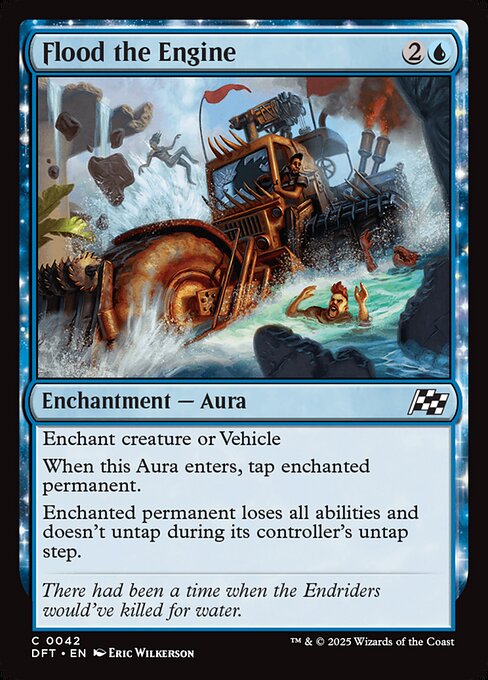
156. Flood the Engine
Rating5.3PlayableWhy this rating?
A solid playable that rarely gets cut (5.3/10).
Why. A three-mana Aura that taps the target, strips all its abilities and keeps it from untapping. It is efficient pseudo-removal against a creature or a Vehicle at a fair price.
Risks. The target stays on the battlefield and can still be sacrificed by the opponent. If the Aura is destroyed or the target bounced, the effect ends.
In the draft. Solid blue pseudo-removal, worth taking fairly high. Look for evasive creatures to go with it.
Results in the games of the set
When it is in hand, the deck wins 56.2% of its games (set average: 55.7%, 96th of 273 cards).
In the opening hand: 53.1% wins (54.9% on average).
Drawn during the game: 58.1% (56.3% on average).
When it is drawn, the deck wins 1.9 points more than when it is not.
When it is drafted, it is played 91% of the time (set average: 63%).
Taken as the first pick (361 drafts), it ends in the deck 95% of the time.
It is played mostly in B/U decks (64% of them) and R/U (64%).

157. Wild Roads
Rating5.2PlayableWhy this rating?
A solid playable that rarely gets cut (5.2/10).
Why. A green land that enters untapped if you control a Mount or Vehicle. Late game it sacrifices itself for two mana, one of them green, to make a Pilot, a creature token that crews as though its power were 2 greater.
Risks. It enters tapped without a Mount or Vehicle. The Pilot is only a 1/1, so without Vehicles it is hardly more than a land.
In the draft. A good green add with Vehicles. Take it late without making it a priority.
Results in the games of the set
When it is in hand, the deck wins 55.4% of its games (set average: 55.7%, 128th of 273 cards).
In the opening hand: 56.2% wins (54.9% on average).
Drawn during the game: 54.9% (56.3% on average).
When it is drawn, the deck wins 1.3 points less than when it is not.
When it is drafted, it is played 60% of the time (set average: 63%).

158. Broadcast Rambler
Rating5.2PlayableWhy this rating?
A solid playable that rarely gets cut (5.2/10).
Why. A 5/4 Vehicle for five that comes with a colorless 1/1 Thopter artifact creature token with flying. The Thopter alone can crew it (crew 1), giving you two threats from one card.
Risks. Five mana for a 5/4 that does not protect its token: if the Thopter dies you need another creature. Artifact removal is a threat.
In the draft. A good white common, fine in every pair. Take it readily in a Vehicle deck.
Results in the games of the set
When it is in hand, the deck wins 56.1% of its games (set average: 55.7%, 102nd of 273 cards).
In the opening hand: 54.3% wins (54.9% on average).
Drawn during the game: 57.3% (56.3% on average).
When it is drawn, the deck wins 1.9 points more than when it is not.
When it is drafted, it is played 65% of the time (set average: 63%).
Taken as the first pick (78 drafts), it ends in the deck 92% of the time.
It is played mostly in B/W decks (62% of them) and R/W (58%).

159. Broken Wings
Rating5.2PlayableWhy this rating?
A solid playable that rarely gets cut (5.2/10).
Why. A three-mana instant removal that destroys an artifact, an enchantment or a creature with flying. In a format full of Vehicles and fliers, it has plenty of targets.
Risks. It is conditional: without a valid target it rots in hand. Ordinary ground creatures escape it.
In the draft. A good maindeck card if you see lots of Vehicles or fliers; otherwise a sideboard pick. Take it mid-pack.
Results in the games of the set
When it is in hand, the deck wins 55.1% of its games (set average: 55.7%, 147th of 273 cards).
In the opening hand: 53.2% wins (54.9% on average).
Drawn during the game: 56.3% (56.3% on average).
When it is drawn, the deck wins 0.4 points less than when it is not.
When it is drafted, it is played 65% of the time (set average: 63%).
Taken as the first pick (39 drafts), it ends in the deck 90% of the time.
It is played mostly in G/U decks (45% of them) and G/W (42%).

160. Detention Chariot
Rating5.2PlayableWhy this rating?
A solid playable that rarely gets cut (5.2/10).
Why. A removal spell on a 6/6 Vehicle: when it arrives it exiles an opposing artifact or creature until it leaves the battlefield. It cycles for a white mana when you do not need six.
Risks. Six mana with two white is late. If the Vehicle is destroyed, the target returns. Crew 3 needs a board to attack.
In the draft. A good flexible removal for any white deck. Take it fairly high; the cycling means it is never dead.
Results in the games of the set
When it is in hand, the deck wins 56.0% of its games (set average: 55.7%, 106th of 273 cards).
In the opening hand: 54.3% wins (54.9% on average).
Drawn during the game: 57.2% (56.3% on average).
When it is drawn, the deck wins 3.0 points more than when it is not.
When it is drafted, it is played 82% of the time (set average: 63%).
Taken as the first pick (121 drafts), it ends in the deck 88% of the time.
It is played mostly in R/W decks (39% of them) and B/W (34%).
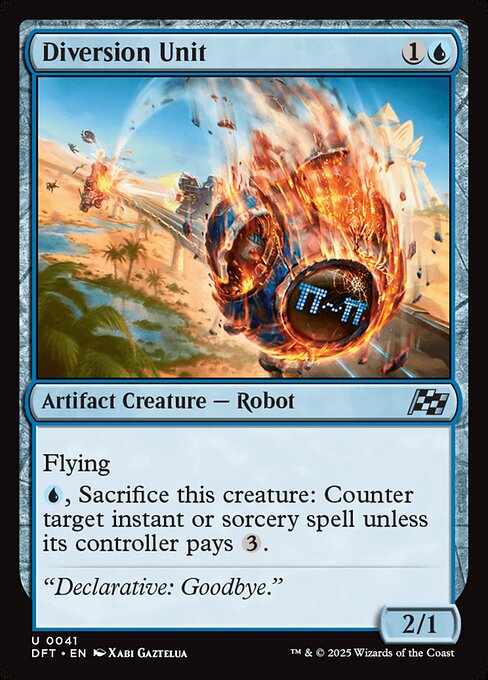
161. Diversion Unit
Rating5.2PlayableWhy this rating?
A solid playable that rarely gets cut (5.2/10).
Why. A 2/1 flier for two that can sacrifice itself for a blue mana to counter an instant or sorcery unless its controller pays three. It attacks as long as you keep the mana up.
Risks. With 1 toughness it dies to almost anything, and the counter is easy to play around for an opponent with spare mana.
In the draft. A good little flier for aggressive or tempo blue decks. Take it mid-pack.
Results in the games of the set
When it is in hand, the deck wins 55.9% of its games (set average: 55.7%, 109th of 273 cards).
In the opening hand: 55.6% wins (54.9% on average).
Drawn during the game: 56.1% (56.3% on average).
When it is drawn, the deck wins 2.2 points more than when it is not.
When it is drafted, it is played 89% of the time (set average: 63%).
Taken as the first pick (180 drafts), it ends in the deck 93% of the time.
It is played mostly in U/W decks (32% of them) and B/U (28%).

162. Dynamite Diver
Rating5.2PlayableWhy this rating?
A solid playable that rarely gets cut (5.2/10).
Why. A 1/1 for one red mana that crews as though its power were 2 greater, making it a very cheap pilot for a Vehicle. When it dies, it deals 1 damage to any target.
Risks. A 1/1 that cannot attack well alone, and 1 damage is small. It has little appeal without Vehicles.
In the draft. For a red Vehicle deck. Otherwise take it late.
Results in the games of the set
When it is in hand, the deck wins 52.7% of its games (set average: 55.7%, 219th of 273 cards).
In the opening hand: 54.9% wins (54.9% on average).
Drawn during the game: 51.0% (56.3% on average).
When it is drawn, the deck wins 0.5 points less than when it is not.
When it is drafted, it is played 28% of the time (set average: 63%).
Taken among the first three picks (61 drafts), it ends in the deck 79% of the time.
It is played mostly in R/W decks (40% of them) and B/R (38%).
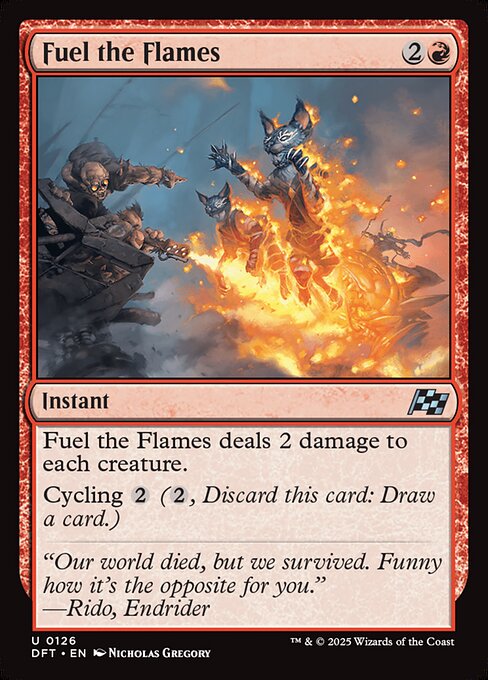
163. Fuel the Flames
Rating5.2PlayableWhy this rating?
A solid playable that rarely gets cut (5.2/10).
Why. A three-mana instant sweeper: 2 damage to each creature. It wipes out small boards and cycles for two if the moment is wrong.
Risks. It also hits your own creatures. Creatures with 3 or more toughness survive it.
In the draft. For a red deck with big creatures or a control plan. One copy at most; the cycling keeps it from being dead.
Results in the games of the set
When it is in hand, the deck wins 53.6% of its games (set average: 55.7%, 195th of 273 cards).
In the opening hand: 52.2% wins (54.9% on average).
Drawn during the game: 54.4% (56.3% on average).
When it is drawn, the deck wins 1.0 points more than when it is not.
When it is drafted, it is played 38% of the time (set average: 63%).
Taken among the first three picks (100 drafts), it ends in the deck 69% of the time.
It is played mostly in R/U decks (26% of them).

164. Jibbirik Omnivore
Rating5.2PlayableWhy this rating?
A solid playable that rarely gets cut (5.2/10).
Why. A 3/2 for two: an aggressive body that comes down on turn two and applies pressure. The card as shown lists no other ability.
Risks. With 2 toughness it dies easily in combat. It loses value in the mid-game.
In the draft. A fine two-drop for an aggressive green deck. Take it mid-pack, and read its full text.
Results in the games of the set
When it is in hand, the deck wins 55.3% of its games (set average: 55.7%, 133rd of 273 cards).
In the opening hand: 57.0% wins (54.9% on average).
Drawn during the game: 54.0% (56.3% on average).
When it is drawn, the deck wins 1.1 points less than when it is not.
When it is drafted, it is played 76% of the time (set average: 63%).
Taken as the first pick (125 drafts), it ends in the deck 86% of the time.
It is played mostly in G/W decks (64% of them) and G/R (58%).

165. Lifecraft Engine
Rating5.2PlayableWhy this rating?
A solid playable that rarely gets cut (5.2/10).
Why. A 4/4 Vehicle for three: you choose a creature type, your Vehicles have that type too while they are creatures, and every other creature you control of that type gets +1/+1. In a tribal deck it is a permanent bonus.
Risks. Crew 3 is heavy for a small board, and the bonus depends on a well-chosen type. A deck with no type coherence gets almost nothing.
In the draft. For a deck with a dominant creature type or several Vehicles. Otherwise an average Vehicle, taken late.
Results in the games of the set
When it is in hand, the deck wins 51.7% of its games (set average: 55.7%, 234th of 273 cards).
In the opening hand: 50.7% wins (54.9% on average).
Drawn during the game: 52.3% (56.3% on average).
When it is drawn, the deck wins 0.2 points more than when it is not.
When it is drafted, it is played 71% of the time (set average: 63%).
Taken as the first pick (42 drafts), it ends in the deck 79% of the time.
It is played about as much in every archetype.

166. Maximum Overdrive
Rating5.2PlayableWhy this rating?
A solid playable that rarely gets cut (5.2/10).
Why. A two-mana instant trick: a +1/+1 counter, deathtouch and indestructible until end of turn. It wins almost any combat and protects a creature from damage-based or destroy-based removal.
Risks. It is dead without a creature and you lose the card if they respond with exile or bounce. It does not stop a sacrifice effect.
In the draft. A versatile black trick, taken after your creatures and removal. It is good in aggro decks.
Results in the games of the set
When it is in hand, the deck wins 56.2% of its games (set average: 55.7%, 100th of 273 cards).
In the opening hand: 54.4% wins (54.9% on average).
Drawn during the game: 57.3% (56.3% on average).
When it is drawn, the deck wins 2.0 points more than when it is not.
When it is drafted, it is played 60% of the time (set average: 63%).
Taken as the first pick (59 drafts), it ends in the deck 90% of the time.
It is played mostly in B/R decks (59% of them) and B/W (54%).

167. Radiant Lotus
Rating5.2PlayableWhy this rating?
A solid playable that rarely gets cut (5.2/10).
Why. A six-mana artifact: tap it and sacrifice artifacts so the target player adds three mana of the chosen colour for each one. It is a theoretical combo piece, not a common draft tool.
Risks. Six mana to do nothing on its own. You need several artifacts to sacrifice, and the payoff only matters if you have something to spend the mana on.
In the draft. Ignore it in draft, barring a very unusual artifact deck. Only take it at the very end of a pack.
Results in the games of the set
When it is drafted, it is played only 0% of the time (set average: 63%): it almost always ends in the sideboard.
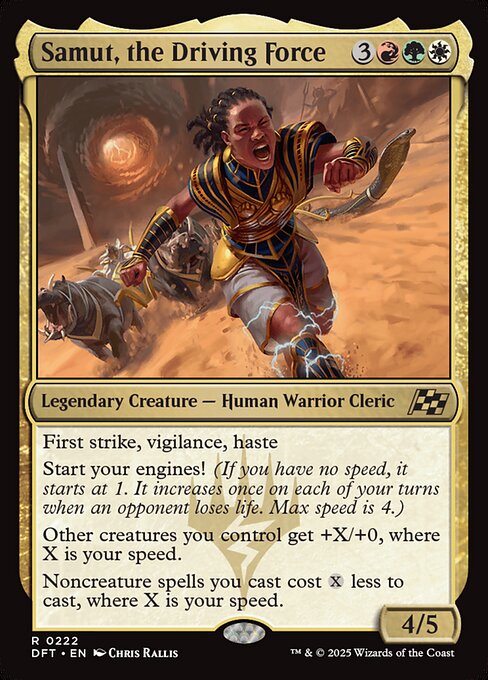 Rating5.2Playable
Why this rating?
A solid playable that rarely gets cut (5.2/10).
Why. A 4/5 with first strike, vigilance and haste for six. It gives your other creatures +X/+0 where X is your speed and makes your noncreature spells cheaper. It attacks right away and feeds Start your engines!
Risks. Three colours, green, red and white: the cost is very hard to assemble. The bonus relies on speed, which needs the opponent to lose life.
In the draft. Only in a true green-red-white deck. In two colours or with a single splash, pass.
Results in the games of the set
When it is in hand, the deck wins 56.2% of its games (set average: 55.7%, 94th of 273 cards).
In the opening hand: 54.9% wins (54.9% on average).
Drawn during the game: 57.1% (56.3% on average).
When it is drawn, the deck wins 3.8 points more than when it is not.
When it is drafted, it is played 61% of the time (set average: 63%).
Taken as the first pick (43 drafts), it ends in the deck 81% of the time.
It is played about as much in every archetype.

169. Veloheart Bike
Rating5.2PlayableWhy this rating?
A solid playable that rarely gets cut (5.2/10).
Why. A 4/2 Vehicle for three that gains 2 life on entering. It taps for mana of any color without being crewed, so it fixes and ramps even with no creature; once crewed it is a decent attacker.
Risks. Crew 2 needs creatures with total power 2 or more, and 2 toughness makes it fragile once animated. Crewing it taps a creature that could have attacked or blocked.
In the draft. A solid support piece for green decks that want to fix a splash. Take it mid-pack, after your removal and best creatures.
Results in the games of the set
When it is in hand, the deck wins 55.6% of its games (set average: 55.7%, 116th of 273 cards).
In the opening hand: 55.9% wins (54.9% on average).
Drawn during the game: 55.4% (56.3% on average).
When it is drawn, the deck wins 0.3 points more than when it is not.
When it is drafted, it is played 72% of the time (set average: 63%).
Taken as the first pick (118 drafts), it ends in the deck 83% of the time.
It is played mostly in G/R decks (84% of them) and G/W (50%).

170. Venomsac Lagac
Rating5.2PlayableWhy this rating?
A solid playable that rarely gets cut (5.2/10).
Why. A two-mana Mount with deathtouch: it deters most attacks and kills whatever it blocks or touches. Saddled, it attacks as a 2/4.
Risks. It has 1 toughness at rest, so any small spell kills it. Saddle 2 taps other creatures, which is not always worth it.
In the draft. A good two-drop for green decks. Take it around mid-pack, earlier if your deck is aggressive.
Results in the games of the set
When it is in hand, the deck wins 56.0% of its games (set average: 55.7%, 105th of 273 cards).
In the opening hand: 56.7% wins (54.9% on average).
Drawn during the game: 55.5% (56.3% on average).
When it is drawn, the deck wins 0.1 points less than when it is not.
When it is drafted, it is played 92% of the time (set average: 63%).
Taken as the first pick (182 drafts), it ends in the deck 97% of the time.
It is played mostly in G/W decks (64% of them) and G/U (54%).
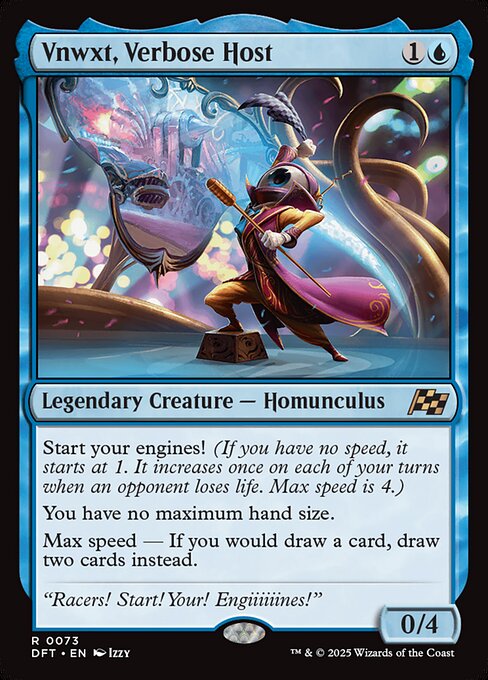
171. Vnwxt, Verbose Host
Rating5.2PlayableWhy this rating?
A solid playable that rarely gets cut (5.2/10).
Why. A 0/4 for two that blocks early attackers well. At max speed it doubles every draw, which can win the game if the board is stable.
Risks. It does not attack, and reaching max speed means hurting the opponent over several turns, which a defensive deck does badly. Without speed it is just a wall.
In the draft. A late pick for aggro or tempo blue decks. Only play it if you have ways to deal damage consistently.
Results in the games of the set
When it is in hand, the deck wins 53.5% of its games (set average: 55.7%, 199th of 273 cards).
In the opening hand: 51.8% wins (54.9% on average).
Drawn during the game: 54.6% (56.3% on average).
When it is drawn, the deck wins 2.1 points more than when it is not.
When it is drafted, it is played 83% of the time (set average: 63%).
Taken as the first pick (67 drafts), it ends in the deck 90% of the time.
It is played about as much in every archetype.
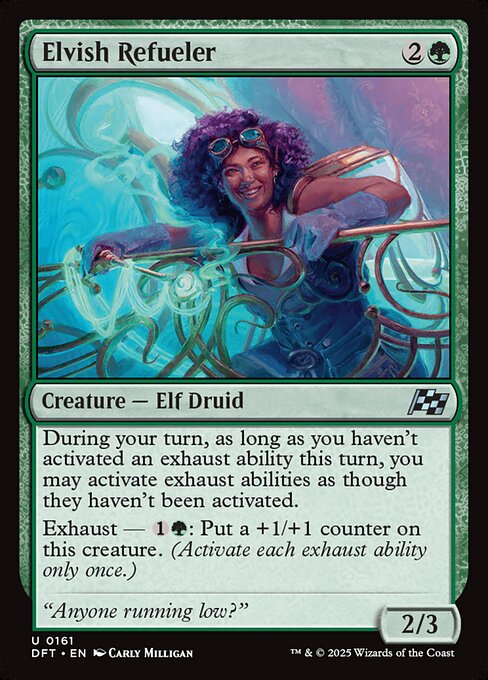
172. Elvish Refueler
Rating5.1PlayableWhy this rating?
A solid playable that rarely gets cut (5.1/10).
Why. A 2/3 for three that becomes a 3/4 with its Exhaust ability. As long as you have not activated an Exhaust ability this turn, it also lets you activate one you already used again. In a deck full of them, value stacks fast.
Risks. On its own it is a decent but unremarkable body. The re-activation is only worth something alongside other permanents with Exhaust.
In the draft. A mid-pack play in green. Move it up if you already have several Exhaust cards; otherwise take it as a plain curve creature.
Results in the games of the set
When it is in hand, the deck wins 55.4% of its games (set average: 55.7%, 125th of 273 cards).
In the opening hand: 54.4% wins (54.9% on average).
Drawn during the game: 56.2% (56.3% on average).
When it is drawn, the deck wins 0.2 points more than when it is not.
When it is drafted, it is played 91% of the time (set average: 63%).
Taken as the first pick (224 drafts), it ends in the deck 93% of the time.
It is played mostly in G/R decks (32% of them) and G/U (30%).

173. Gastal Raider
Rating5.1PlayableWhy this rating?
A solid playable that rarely gets cut (5.1/10).
Why. A 2/1 for three that takes an instant or sorcery from the opponent's hand when it enters, and becomes a 3/2 with menace at max speed. An honest two-for-one that can strip a removal spell before it matters.
Risks. A small body with 1 toughness, very vulnerable. If the opponent holds no instant or sorcery, the enter effect does nothing.
In the draft. A fine playable for aggressive black decks. Take it mid-pack, after your removal and best creatures.
Results in the games of the set
When it is in hand, the deck wins 55.4% of its games (set average: 55.7%, 127th of 273 cards).
In the opening hand: 55.3% wins (54.9% on average).
Drawn during the game: 55.5% (56.3% on average).
When it is drawn, the deck wins 0.9 points more than when it is not.
When it is drafted, it is played 79% of the time (set average: 63%).
Taken as the first pick (104 drafts), it ends in the deck 88% of the time.
It is played mostly in B/R decks (29% of them) and B/W (28%).

174. Aether Syphon
Rating5.0PlayableWhy this rating?
A solid playable that rarely gets cut (5.0/10).
Why. An artifact that converts mana into cards: two mana and a tap to draw. At max speed each draw also mills the opponent for two, which can eventually deck them.
Risks. It does nothing on the board and costs mana every turn, so it slows your development. The max speed bonus arrives late and does not win on its own.
In the draft. A pick for slower blue control decks, take it mid or late pack. Skip it in an aggressive build.
Results in the games of the set
When it is in hand, the deck wins 55.9% of its games (set average: 55.7%, 107th of 273 cards).
In the opening hand: 52.7% wins (54.9% on average).
Drawn during the game: 58.0% (56.3% on average).
When it is drawn, the deck wins 3.6 points more than when it is not.
When it is drafted, it is played 75% of the time (set average: 63%).
Taken as the first pick (150 drafts), it ends in the deck 86% of the time.
It is played mostly in B/U decks (31% of them) and U/W (27%).
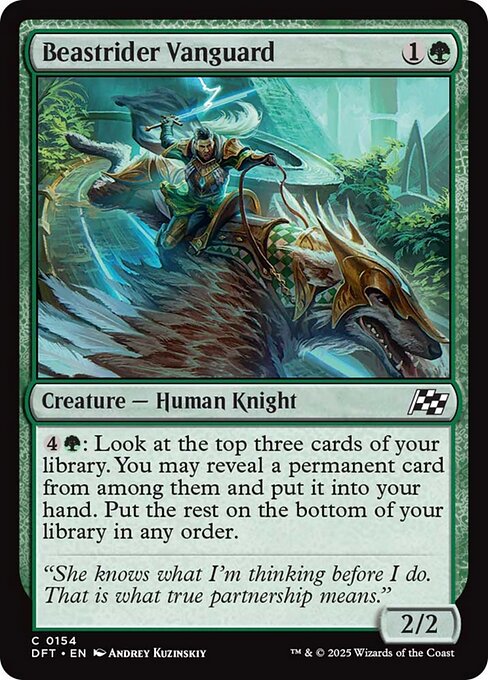
175. Beastrider Vanguard
Rating5.0PlayableWhy this rating?
A solid playable that rarely gets cut (5.0/10).
Why. A 2/2 for two that becomes a late-game value engine: five mana to look at three cards and take a permanent. It plays early and stays relevant late.
Risks. The activation is expensive and does not always find a card. The 2/2 body gets outclassed fast.
In the draft. A good green two-drop that stays useful late. Take it as a curve filler without moving it up too high.
Results in the games of the set
When it is in hand, the deck wins 56.3% of its games (set average: 55.7%, 92nd of 273 cards).
In the opening hand: 55.7% wins (54.9% on average).
Drawn during the game: 56.8% (56.3% on average).
When it is drawn, the deck wins 0.1 points less than when it is not.
When it is drafted, it is played 88% of the time (set average: 63%).
Taken as the first pick (200 drafts), it ends in the deck 96% of the time.
It is played mostly in B/G decks (63% of them) and G/W (63%).
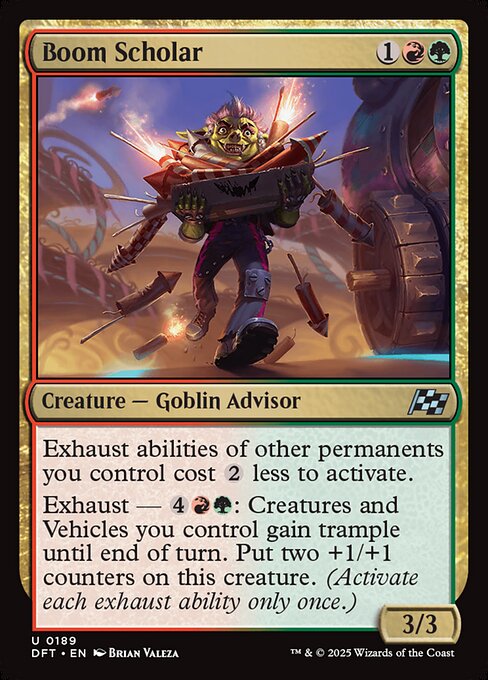
176. Boom Scholar
Rating5.0PlayableWhy this rating?
A solid playable that rarely gets cut (5.0/10).
Why. A 3/3 for three in two colors: Exhaust abilities of your other permanents cost two less. Its own Exhaust ability gives your creatures and Vehicles trample for the turn and puts two +1/+1 counters on it.
Risks. Its ability costs six mana and does not benefit from its own discount, which only applies to other permanents. It needs both colors, and the ability only works once.
In the draft. A red-green filler, take it late only if you are already in those colors. The 3/3 for three is enough to justify it.
Results in the games of the set
When it is in hand, the deck wins 53.7% of its games (set average: 55.7%, 188th of 273 cards).
In the opening hand: 53.6% wins (54.9% on average).
Drawn during the game: 53.8% (56.3% on average).
When it is drawn, the deck wins 0.7 points less than when it is not.
When it is drafted, it is played 66% of the time (set average: 63%).
Taken as the first pick (72 drafts), it ends in the deck 86% of the time.
It is played mostly in G/R decks (54% of them).
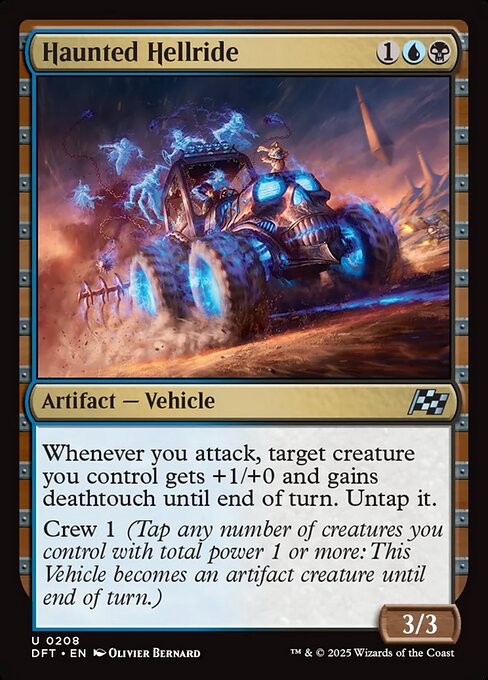
177. Haunted Hellride
Rating5.0PlayableWhy this rating?
A solid playable that rarely gets cut (5.0/10).
Why. A 3/3 Vehicle for three with Crew 1. Whenever you attack, it gives one of your creatures +1/+0 and deathtouch and untaps it, so the same creature can attack and still defend.
Risks. It needs two specific colors, and its effect only works with at least one creature on the battlefield. An uncrewed Vehicle does not block.
In the draft. A mid-pack blue-black play. Its real strength needs several solid creatures; without them it stays average.
Results in the games of the set
When it is in hand, the deck wins 53.1% of its games (set average: 55.7%, 207th of 273 cards).
In the opening hand: 51.3% wins (54.9% on average).
Drawn during the game: 54.2% (56.3% on average).
When it is drawn, the deck wins 1.6 points more than when it is not.
When it is drafted, it is played 50% of the time (set average: 63%).
Taken as the first pick (57 drafts), it ends in the deck 88% of the time.
It is played mostly in B/U decks (39% of them).

178. Leonin Surveyor
Rating5.0PlayableWhy this rating?
A solid playable that rarely gets cut (5.0/10).
Why. A 2/2 for two with first strike during your turn, which helps it attack into smaller creatures. At max speed it can be exiled from the graveyard for three mana to draw a card.
Risks. A small body with little impact, and the graveyard ability comes late. It loses first strike when you defend.
In the draft. A filler white two-drop. Take it late only to round out an aggressive curve.
Results in the games of the set
When it is in hand, the deck wins 52.3% of its games (set average: 55.7%, 226th of 273 cards).
In the opening hand: 54.2% wins (54.9% on average).
Drawn during the game: 50.8% (56.3% on average).
When it is drawn, the deck wins 1.8 points less than when it is not.
When it is drafted, it is played 54% of the time (set average: 63%).
Taken as the first pick (40 drafts), it ends in the deck 93% of the time.
It is played mostly in B/W decks (66% of them) and R/W (56%).

179. Nimble Thopterist
Rating5.0PlayableWhy this rating?
A solid playable that rarely gets cut (5.0/10).
Why. A 3/2 for four that comes with a 1/1 colorless Thopter artifact creature token with flying. Two bodies for one card: one attacks, the other flies.
Risks. The 3/2 is fragile and the Thopter does little damage. No ability that swings a game.
In the draft. A solid mid-pack blue card. It fits any blue deck, and artifact-heavy ones even more.
Results in the games of the set
When it is in hand, the deck wins 55.4% of its games (set average: 55.7%, 131st of 273 cards).
In the opening hand: 53.4% wins (54.9% on average).
Drawn during the game: 56.7% (56.3% on average).
When it is drawn, the deck wins 1.7 points more than when it is not.
When it is drafted, it is played 70% of the time (set average: 63%).
Taken as the first pick (100 drafts), it ends in the deck 89% of the time.
It is played mostly in B/U decks (59% of them) and U/W (56%).
 Rating5.0Playable
Why this rating?
A solid playable that rarely gets cut (5.0/10).
Why. A rare that gives trample to every creature attacking your opponents. For one green mana and a tap, it puts a creature or Vehicle card from your hand onto the battlefield, with two +1/+1 counters if it is an artifact.
Risks. A 1/2 that dies easily. Activating it requires tapping it, so it cannot be used until the turn after it enters. Trample alone does not win games.
In the draft. A pick for green decks with many big Vehicles or big creatures. Outside that plan, take it late.
Results in the games of the set
When it is in hand, the deck wins 53.2% of its games (set average: 55.7%, 204th of 273 cards).
In the opening hand: 52.2% wins (54.9% on average).
Drawn during the game: 54.0% (56.3% on average).
When it is drawn, the deck wins 0.4 points more than when it is not.
When it is drafted, it is played 59% of the time (set average: 63%).
Taken among the first three picks (100 drafts), it ends in the deck 79% of the time.
It is played about as much in every archetype.

181. Pedal to the Metal
Rating5.0PlayableWhy this rating?
A solid playable that rarely gets cut (5.0/10).
Why. A variable-cost instant: +X/+0 and first strike on a creature. It is a combat trick that wins a block or protects an attack, and X scales with your mana.
Risks. It does nothing without a creature, and you get blown out if the opponent removes the target in response. The card has no lasting effect.
In the draft. A late pick, only for a red deck that fights a lot in combat. Otherwise leave it.
Results in the games of the set
When it is in hand, the deck wins 51.3% of its games (set average: 55.7%, 243rd of 273 cards).
In the opening hand: 48.9% wins (54.9% on average).
Drawn during the game: 53.0% (56.3% on average).
When it is drawn, the deck wins 2.4 points less than when it is not.
When it is drafted, it is played 21% of the time (set average: 63%).
Taken among the first three picks (31 drafts), it ends in the deck 65% of the time.
It is played mostly in G/R decks (28% of them) and B/R (27%).
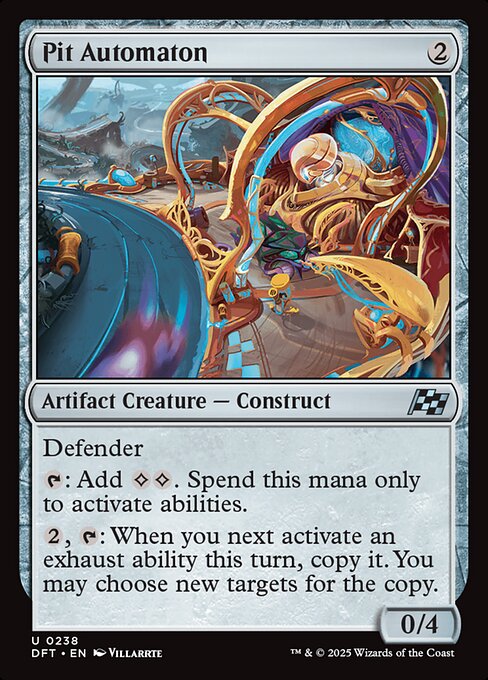
182. Pit Automaton
Rating5.0PlayableWhy this rating?
A solid playable that rarely gets cut (5.0/10).
Why. A 0/4 defender for two that taps for two colorless mana usable only on abilities. It powers Exhaust abilities, and can copy one as well.
Risks. It does not attack and does nothing without abilities to pay for. Copying costs two mana and its tap, so it cannot make mana that turn.
In the draft. A niche pick for decks built around Exhaust abilities. Otherwise take it late, or not at all.
Results in the games of the set
When it is in hand, the deck wins 54.1% of its games (set average: 55.7%, 179th of 273 cards).
In the opening hand: 53.7% wins (54.9% on average).
Drawn during the game: 54.4% (56.3% on average).
When it is drawn, the deck wins 0.9 points less than when it is not.
When it is drafted, it is played 52% of the time (set average: 63%).
Taken as the first pick (31 drafts), it ends in the deck 71% of the time.
It is played about as much in every archetype.

183. Waxen Shapethief
Rating5.0PlayableWhy this rating?
A solid playable that rarely gets cut (5.0/10).
Why. A flash creature that enters as a copy of an artifact or creature you control, with Cycling 2 so it is never dead in hand. It copies your best threat, even as a surprise.
Risks. Without a good target it dies on arrival as a 0/0. Its value depends entirely on what you already control.
In the draft. A mid-pack pick for blue decks with good creatures. Cycling makes it playable in almost any blue list.
Results in the games of the set
When it is in hand, the deck wins 52.7% of its games (set average: 55.7%, 216th of 273 cards).
In the opening hand: 49.5% wins (54.9% on average).
Drawn during the game: 54.7% (56.3% on average).
When it is drawn, the deck wins 0.7 points more than when it is not.
When it is drafted, it is played 83% of the time (set average: 63%).
Taken as the first pick (61 drafts), it ends in the deck 92% of the time.
It is played about as much in every archetype.

184. Wretched Doll
Rating5.0PlayableWhy this rating?
A solid playable that rarely gets cut (5.0/10).
Why. A 3/1 artifact creature for two that attacks early, with an ability to surveil 1 for a black mana. It fits well in aggressive decks and improves the quality of your draws.
Risks. Only 1 toughness: it trades badly with bigger creatures and dies to anything. Surveil costs a black mana and a tap.
In the draft. An honest aggressive black two-drop. Take it mid-pack.
Results in the games of the set
When it is in hand, the deck wins 55.1% of its games (set average: 55.7%, 145th of 273 cards).
In the opening hand: 55.1% wins (54.9% on average).
Drawn during the game: 55.2% (56.3% on average).
When it is drawn, the deck wins 0.6 points more than when it is not.
When it is drafted, it is played 87% of the time (set average: 63%).
Taken as the first pick (116 drafts), it ends in the deck 92% of the time.
It is played mostly in B/U decks (29% of them) and B/G (27%).

185. Guidelight Synergist
Rating5.0WeakWhy this rating?
A solid playable that rarely gets cut (5.0/10).
Why. A four-mana 0/4 artifact creature with flying that gets +1/+0 for each artifact you control, itself included. With a few artifacts, it is an aerial threat.
Risks. Alone it only counts itself: a 1/4 flyer that barely hurts. Without other artifacts, it is mostly an aerial blocker.
In the draft. A pick for white or white-blue decks with many artifacts. In other decks, it is weak.
Results in the games of the set
When it is in hand, the deck wins 55.2% of its games (set average: 55.7%, 144th of 273 cards).
In the opening hand: 52.7% wins (54.9% on average).
Drawn during the game: 56.7% (56.3% on average).
When it is drawn, the deck wins 2.6 points more than when it is not.
When it is drafted, it is played 71% of the time (set average: 63%).
Taken as the first pick (67 drafts), it ends in the deck 88% of the time.
It is played mostly in U/W decks (50% of them) and B/W (42%).

186. Brightfield Glider
Rating4.9WeakWhy this rating?
A solid playable that rarely gets cut (4.9/10).
Why. A one-mana Mount with vigilance that becomes a 2/3 flyer when it attacks saddled. A small play that improves in a creature-heavy deck.
Risks. Saddle 3 is heavy: you must tap creatures with total power 3. Unsaddled it is a 1/1 with no impact.
In the draft. A late pick for an aggressive white deck. By itself it does not do much.
Results in the games of the set
When it is in hand, the deck wins 52.7% of its games (set average: 55.7%, 217th of 273 cards).
In the opening hand: 54.8% wins (54.9% on average).
Drawn during the game: 51.0% (56.3% on average).
When it is drawn, the deck wins 1.1 points less than when it is not.
When it is drafted, it is played 29% of the time (set average: 63%).
Taken among the first three picks (75 drafts), it ends in the deck 79% of the time.
It is played mostly in G/W decks (57% of them) and R/W (43%).

187. Guidelight Matrix
Rating4.8WeakWhy this rating?
A solid playable that rarely gets cut (4.8/10).
Why. A two-mana artifact that draws a card on entering, then lets you saddle a Mount or animate a Vehicle for two mana and a tap. It replaces itself and supports Vehicle decks.
Risks. With no Mount or Vehicle, you pay two mana to draw a card and nothing more. It does not develop your board.
In the draft. A support piece for decks with Vehicles or Mounts. Outside those decks, it is a late pick.
Results in the games of the set
When it is in hand, the deck wins 53.1% of its games (set average: 55.7%, 206th of 273 cards).
In the opening hand: 51.6% wins (54.9% on average).
Drawn during the game: 54.2% (56.3% on average).
When it is drawn, the deck wins 0.3 points more than when it is not.
When it is drafted, it is played 20% of the time (set average: 63%).
Taken among the first three picks (40 drafts), it ends in the deck 75% of the time.

188. Burner Rocket
Rating4.8WeakWhy this rating?
A solid playable that rarely gets cut (4.8/10).
Why. A 3/1 Vehicle with flash, which gives one of your creatures +2/+0 and trample when it enters. It can surprise in combat while leaving an attacker behind.
Risks. It has 1 toughness and needs a crew. The enter effect only matters during a combat.
In the draft. A late aggressive red play. It matters most in a list with many small creatures.
Results in the games of the set
When it is in hand, the deck wins 51.7% of its games (set average: 55.7%, 232nd of 273 cards).
In the opening hand: 50.9% wins (54.9% on average).
Drawn during the game: 52.2% (56.3% on average).
When it is drawn, the deck wins 1.8 points less than when it is not.
When it is drafted, it is played 26% of the time (set average: 63%).
Taken among the first three picks (84 drafts), it ends in the deck 60% of the time.
It is played mostly in R/W decks (38% of them) and B/R (33%).

189. Crash and Burn
Rating4.8WeakWhy this rating?
A solid playable that rarely gets cut (4.8/10).
Why. A flexible four-mana instant: six damage to a creature or planeswalker, or destroy a Vehicle. A removal spell that beats almost every creature.
Risks. It is expensive for a removal spell and cannot hit the player. The Vehicle mode is situational.
In the draft. A fine red removal spell, take it mid-pack. It is a good addition to any red deck.
Results in the games of the set
When it is in hand, the deck wins 53.6% of its games (set average: 55.7%, 191st of 273 cards).
In the opening hand: 51.0% wins (54.9% on average).
Drawn during the game: 55.3% (56.3% on average).
When it is drawn, the deck wins 0.2 points less than when it is not.
When it is drafted, it is played 80% of the time (set average: 63%).
Taken as the first pick (158 drafts), it ends in the deck 97% of the time.
It is played mostly in G/R decks (57% of them) and B/R (56%).
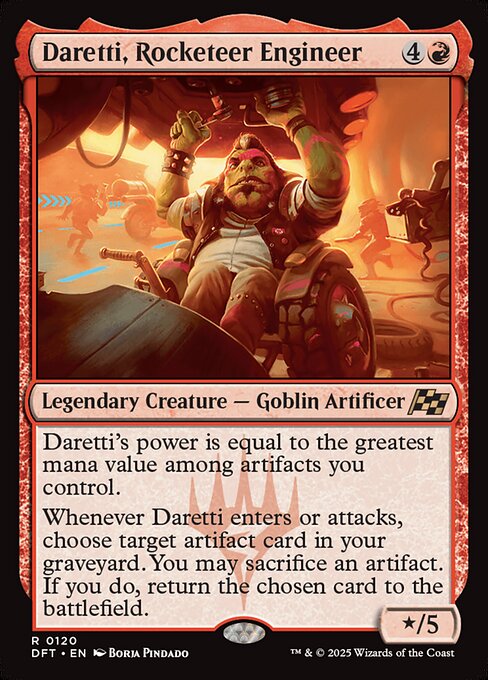
190. Daretti, Rocketeer Engineer
Rating4.8WeakWhy this rating?
A solid playable that rarely gets cut (4.8/10).
Why. A */5 for five whose power equals the greatest mana value among your artifacts. When it enters or attacks, it can bring back an artifact from the graveyard by sacrificing an artifact.
Risks. With no artifacts, its power is zero. It needs a very artifact-focused list to work.
In the draft. A niche rare for a red deck full of artifacts. Otherwise let it pass.
Results in the games of the set
When it is in hand, the deck wins 51.6% of its games (set average: 55.7%, 236th of 273 cards).
In the opening hand: 47.6% wins (54.9% on average).
Drawn during the game: 54.1% (56.3% on average).
When it is drawn, the deck wins 1.5 points more than when it is not.
When it is drafted, it is played 47% of the time (set average: 63%).
Taken as the first pick (36 drafts), it ends in the deck 64% of the time.
It is played about as much in every archetype.
 Rating4.8Weak
Why this rating?
A solid playable that rarely gets cut (4.8/10).
Why. A 2/3 for two that gives haste to your Mounts and Vehicles, saddles every Mount that enters, and animates every Vehicle that enters. They attack the turn they arrive.
Risks. It requires both red and white and a deck full of Vehicles and Mounts. Without them it is a plain 2/3.
In the draft. A niche red-white pick. Only take it if you already have several Mounts and Vehicles.
Results in the games of the set
When it is in hand, the deck wins 51.2% of its games (set average: 55.7%, 246th of 273 cards).
In the opening hand: 51.9% wins (54.9% on average).
Drawn during the game: 50.7% (56.3% on average).
When it is drawn, the deck wins 0.9 points more than when it is not.
When it is drafted, it is played 55% of the time (set average: 63%).
Taken among the first three picks (97 drafts), it ends in the deck 72% of the time.
It is played mostly in R/W decks (34% of them).

192. Repurposing Bay
Rating4.8WeakWhy this rating?
A solid playable that rarely gets cut (4.8/10).
Why. A three-mana artifact that sacrifices another artifact to search your library for an artifact with mana value one higher and put it onto the battlefield. It is a tool for artifact chains.
Risks. It needs several well-chosen artifacts and does nothing on the board. In a normal deck it is a dead card.
In the draft. Reserved for a very specialized artifact deck. In almost every case, do not play it.
Results in the games of the set
When it is in hand, the deck wins 46.8% of its games (set average: 55.7%, 270th of 273 cards).
In the opening hand: 0.0% wins (54.9% on average).
Drawn during the game: 49.2% (56.3% on average).
When it is drawn, the deck wins 2.3 points less than when it is not.
When it is drafted, it is played only 6% of the time (set average: 63%): it almost always ends in the sideboard.

193. Risky Shortcut
Rating4.8WeakWhy this rating?
A solid playable that rarely gets cut (4.8/10).
Why. A three-mana sorcery that draws two cards, with each player losing 2 life. The opponent's life loss can advance your speed.
Risks. It does not affect the board and also costs you 2 life. Against an aggressive deck it gets dangerous.
In the draft. A mid-pack pick for aggressive or value-oriented black decks. Not a priority over removal or good creatures.
Results in the games of the set
When it is in hand, the deck wins 54.6% of its games (set average: 55.7%, 162nd of 273 cards).
In the opening hand: 52.5% wins (54.9% on average).
Drawn during the game: 56.1% (56.3% on average).
When it is drawn, the deck wins 0.7 points more than when it is not.
When it is drafted, it is played 35% of the time (set average: 63%).
Taken among the first three picks (91 drafts), it ends in the deck 74% of the time.
It is played mostly in B/W decks (43% of them) and B/R (38%).

194. Scrap Compactor
Rating4.8WeakWhy this rating?
A solid playable that rarely gets cut (4.8/10).
Why. A colorless one-mana artifact that works as removal: three mana to deal 3 damage to a creature, or six mana to destroy a creature or Vehicle. It fits in any deck.
Risks. Each activation sacrifices it: three more mana for only 3 damage, six to destroy anything. It is slow and expensive.
In the draft. A colorless removal spell playable anywhere, take it mid-pack. A good fit for decks short on removal.
Results in the games of the set
When it is in hand, the deck wins 53.9% of its games (set average: 55.7%, 186th of 273 cards).
In the opening hand: 51.7% wins (54.9% on average).
Drawn during the game: 55.4% (56.3% on average).
When it is drawn, the deck wins 0.1 points less than when it is not.
When it is drafted, it is played 59% of the time (set average: 63%).
Taken as the first pick (33 drafts), it ends in the deck 67% of the time.
It is played mostly in U/W decks (36% of them) and B/U (35%).

195. Skystreak Engineer
Rating4.8WeakWhy this rating?
A solid playable that rarely gets cut (4.8/10).
Why. A 1/3 flyer for two that becomes a 3/5 flyer with its Exhaust ability. It blocks well early, then turns into an aerial threat.
Risks. At first it deals only one damage. Exhaust costs five mana and works once.
In the draft. A fine blue common. Take it over filler cards, especially in blue-green.
Results in the games of the set
When it is in hand, the deck wins 55.8% of its games (set average: 55.7%, 113th of 273 cards).
In the opening hand: 54.7% wins (54.9% on average).
Drawn during the game: 56.5% (56.3% on average).
When it is drawn, the deck wins 2.0 points more than when it is not.
When it is drafted, it is played 80% of the time (set average: 63%).
Taken as the first pick (147 drafts), it ends in the deck 84% of the time.
It is played mostly in G/U decks (67% of them) and U/W (62%).

196. Spotcycle Scouter
Rating4.8WeakWhy this rating?
A solid playable that rarely gets cut (4.8/10).
Why. A 3/2 Vehicle for two with Crew 1 that scries 2 when it enters. It gives a cheap attacker and improves your next draws.
Risks. It needs a crew, has 2 toughness, and does not block unless animated. You need creatures to benefit.
In the draft. A late aggressive white play. It matters most in a low-curve deck.
Results in the games of the set
When it is in hand, the deck wins 51.3% of its games (set average: 55.7%, 244th of 273 cards).
In the opening hand: 51.8% wins (54.9% on average).
Drawn during the game: 50.9% (56.3% on average).
When it is drawn, the deck wins 1.2 points less than when it is not.
When it is drafted, it is played 17% of the time (set average: 63%).
Taken among the first three picks (46 drafts), it ends in the deck 74% of the time.
It is played mostly in R/W decks (34% of them).

197. Tune Up
Rating4.8WeakWhy this rating?
A solid playable that rarely gets cut (4.8/10).
Why. A four-mana sorcery that returns an artifact from your graveyard to the battlefield; if it is a Vehicle, it becomes an artifact creature. It is a way to recover a good card.
Risks. With no good artifact in the graveyard, the card does nothing. It costs four mana for a recursion effect.
In the draft. Reserved for a white deck with good artifacts. In any other case, leave it.
Results in the games of the set
When it is in hand, the deck wins 52.8% of its games (set average: 55.7%, 214th of 273 cards).
In the opening hand: 49.9% wins (54.9% on average).
Drawn during the game: 54.7% (56.3% on average).
When it is drawn, the deck wins 1.1 points more than when it is not.
When it is drafted, it is played 35% of the time (set average: 63%).
Taken among the first three picks (104 drafts), it ends in the deck 66% of the time.

198. Unstoppable Plan
Rating4.8WeakWhy this rating?
A solid playable that rarely gets cut (4.8/10).
Why. A three-mana enchantment that untaps all your nonland permanents at the beginning of your end step. It lets the same creatures attack and defend.
Risks. It does nothing on the board alone and needs a strong board to give value. Too slow an effect for draft games.
In the draft. Do not play it in a normal deck. It is only worth a pick as a last resort.
Results in the games of the set
When it is in hand, the deck wins 37.7% of its games (set average: 55.7%).
Drawn during the game: 0.0% (56.3% on average).
When it is drawn, the deck wins 3.5 points less than when it is not.
When it is drafted, it is played only 1% of the time (set average: 63%): it almost always ends in the sideboard.

199. Lotusguard Disciple
Rating4.7WeakWhy this rating?
A solid playable that rarely gets cut (4.7/10).
Why. A 2/2 flyer for three that gives lifelink and indestructible until end of turn to a creature or Vehicle when it enters. It provides an aerial body, and the trick can win a combat.
Risks. The 2/2 body is fragile, and the enter effect only helps if a combat happens. It is not a replacement for removal.
In the draft. A good mid-pack white play. Take it mostly in white-green, where it fits best.
Results in the games of the set
When it is in hand, the deck wins 53.0% of its games (set average: 55.7%, 208th of 273 cards).
In the opening hand: 51.7% wins (54.9% on average).
Drawn during the game: 54.0% (56.3% on average).
When it is drawn, the deck wins 1.4 points less than when it is not.
When it is drafted, it is played 40% of the time (set average: 63%).
Taken among the first three picks (84 drafts), it ends in the deck 85% of the time.
It is played mostly in G/W decks (52% of them) and R/W (47%).

200. Hulldrifter
Rating4.7WeakWhy this rating?
A solid playable that rarely gets cut (4.7/10).
Why. A 3/2 flying Vehicle for five that draws two cards when it enters. Even uncrewed, it pays for itself, and attacking it is an aerial threat.
Risks. Crew 3 is costly, and 2 toughness makes it fragile. Five mana for an effect that does not change the board right away.
In the draft. A good blue value common, take it mid-pack. It fits decks that like to draw cards.
Results in the games of the set
When it is in hand, the deck wins 55.3% of its games (set average: 55.7%, 134th of 273 cards).
In the opening hand: 52.5% wins (54.9% on average).
Drawn during the game: 57.1% (56.3% on average).
When it is drawn, the deck wins 2.5 points more than when it is not.
When it is drafted, it is played 62% of the time (set average: 63%).
Taken as the first pick (80 drafts), it ends in the deck 80% of the time.
It is played mostly in U/W decks (48% of them) and B/U (46%).

201. Cloudspire Skycycle
Rating4.6WeakWhy this rating?
A solid playable that rarely gets cut (4.6/10).
Why. A 2/3 flying Vehicle for four with Crew 1, so almost any creature can get it attacking. When it enters, it distributes two +1/+1 counters among one or two other Vehicles or creatures you control, which makes it better in a deck with plenty of creatures.
Risks. It is two colours, so it only fits one pair. With no other creature or Vehicle in play, the counters are wasted, and it is exposed to removal once crewed.
In the draft. A late-pack card for a red-white deck with plenty of creatures. Do not take it before you are committed to both colours.
Results in the games of the set
When it is in hand, the deck wins 50.4% of its games (set average: 55.7%, 257th of 273 cards).
In the opening hand: 48.3% wins (54.9% on average).
Drawn during the game: 51.9% (56.3% on average).
When it is drawn, the deck wins 0.6 points less than when it is not.
When it is drafted, it is played 42% of the time (set average: 63%).
Taken among the first three picks (104 drafts), it ends in the deck 88% of the time.
It is played mostly in R/W decks (58% of them).
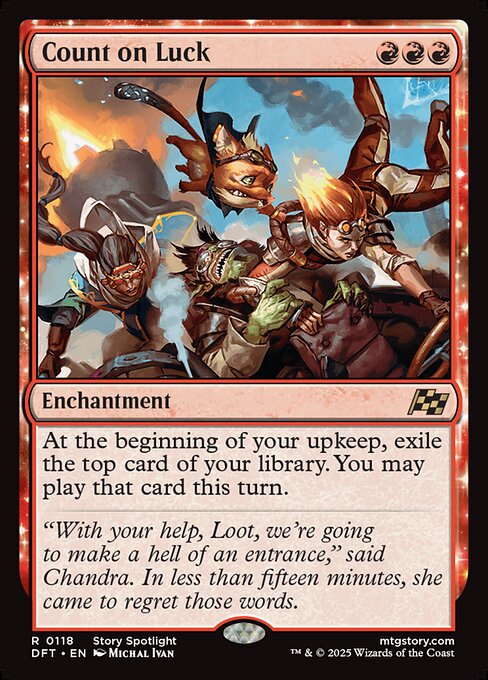
202. Count on Luck
Rating4.6WeakWhy this rating?
A solid playable that rarely gets cut (4.6/10).
Why. At the beginning of each of your upkeeps you exile the top card of your library and may play it that turn. It is a card advantage engine: the longer the game runs, the more it pays back.
Risks. It costs three red mana and does nothing on the battlefield the turn it lands. If you cannot play the exiled card (land drop used, not enough mana), it is lost. A two-colour deck struggles to cast it on time.
In the draft. Only in a nearly mono-red deck that can survive to the long game. Otherwise leave it: it is too slow and too demanding on red mana.
Results in the games of the set
When it is in hand, the deck wins 49.9% of its games (set average: 55.7%, 260th of 273 cards).
In the opening hand: 50.3% wins (54.9% on average).
Drawn during the game: 49.6% (56.3% on average).
When it is drawn, the deck wins 2.9 points less than when it is not.
When it is drafted, it is played 24% of the time (set average: 63%).
Taken among the first three picks (55 drafts), it ends in the deck 60% of the time.
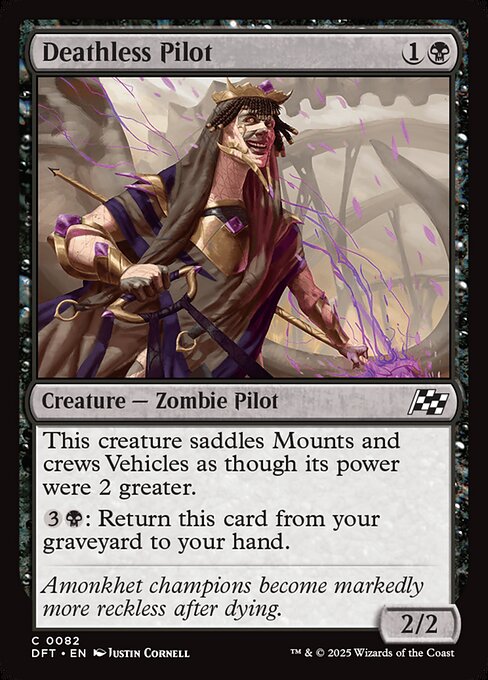
203. Deathless Pilot
Rating4.6WeakWhy this rating?
A solid playable that rarely gets cut (4.6/10).
Why. A 2/2 for two that saddles Mounts and crews Vehicles as though its power were 2 greater. It can also come back from the graveyard to your hand for four mana.
Risks. It is an ordinary body in combat: the upside only matters if you have Vehicles or Mounts. Recursion is expensive and slow.
In the draft. In a black deck with several Vehicles it gets value. Otherwise it is a filler two-drop to pick late.
Results in the games of the set
When it is in hand, the deck wins 53.6% of its games (set average: 55.7%, 193rd of 273 cards).
In the opening hand: 53.8% wins (54.9% on average).
Drawn during the game: 53.5% (56.3% on average).
When it is drawn, the deck wins 1.4 points less than when it is not.
When it is drafted, it is played 58% of the time (set average: 63%).
Taken as the first pick (37 drafts), it ends in the deck 84% of the time.
It is played mostly in B/G decks (49% of them) and B/W (44%).

204. Howler's Heavy
Rating4.6WeakWhy this rating?
A solid playable that rarely gets cut (4.6/10).
Why. A 3/4 for four that holds the ground well. You can also cycle it for two mana, and when you do, target creature or Vehicle an opponent controls gets -3/-0 until end of turn: a small combat trick that replaces itself.
Risks. Nothing special once on the battlefield, and no evasion. The -3/-0 only lasts this turn, so it is a timing effect and not removal.
In the draft. A solid card for any blue deck: fine as a body, flexible as a cycler. Take it when nothing better is on offer.
Results in the games of the set
When it is in hand, the deck wins 55.0% of its games (set average: 55.7%, 148th of 273 cards).
In the opening hand: 52.3% wins (54.9% on average).
Drawn during the game: 56.7% (56.3% on average).
When it is drawn, the deck wins 1.7 points more than when it is not.
When it is drafted, it is played 56% of the time (set average: 63%).
Taken as the first pick (54 drafts), it ends in the deck 87% of the time.
It is played mostly in R/U decks (72% of them) and G/U (35%).

205. Ripclaw Wrangler
Rating4.6WeakWhy this rating?
A solid playable that rarely gets cut (4.6/10).
Why. A 4/3 Vehicle for four that makes each opponent discard a card when it enters, a one-for-one trade before you ever attack. Crew 2 is reasonable.
Risks. If the opponent's hand is empty, the discard does nothing. It only has 3 toughness and can only block if it has been crewed.
In the draft. Decent in a black deck with enough creatures to crew it. A filler choice, not a priority.
Results in the games of the set
When it is in hand, the deck wins 51.7% of its games (set average: 55.7%, 233rd of 273 cards).
In the opening hand: 49.8% wins (54.9% on average).
Drawn during the game: 52.9% (56.3% on average).
When it is drawn, the deck wins 0.8 points less than when it is not.
When it is drafted, it is played only 13% of the time (set average: 63%): it almost always ends in the sideboard.
Taken among the first three picks (43 drafts), it ends in the deck 47% of the time.

206. Thunderhead Gunner
Rating4.6WeakWhy this rating?
A solid playable that rarely gets cut (4.6/10).
Why. A 4/5 with reach for five that stops both flyers and ground attackers. Once each turn, at sorcery speed, you can discard a card to draw one, which keeps you from clogging on extra lands.
Risks. Five mana for a body without evasion. The looting only works on your turn and needs a card to discard.
In the draft. A solid top-end filler for red decks. Take it without excitement, but gladly when the pack is thin.
Results in the games of the set
When it is in hand, the deck wins 56.1% of its games (set average: 55.7%, 101st of 273 cards).
In the opening hand: 54.1% wins (54.9% on average).
Drawn during the game: 57.4% (56.3% on average).
When it is drawn, the deck wins 2.4 points more than when it is not.
When it is drafted, it is played 80% of the time (set average: 63%).
Taken as the first pick (247 drafts), it ends in the deck 92% of the time.
It is played mostly in R/U decks (70% of them) and B/R (65%).

207. Trip Up
Rating4.6WeakWhy this rating?
A solid playable that rarely gets cut (4.6/10).
Why. A four-mana instant that makes the owner of any nonland permanent put it on the top or bottom of their library, their choice. It buys tempo, though in practice the opponent puts it on top and redraws it. It cycles for two.
Risks. It is temporary removal: the opponent replays the card and the threat is not answered for good. Tokens do vanish for good. Four mana is a lot for a tempo play.
In the draft. A decent choice for a blue tempo or control deck. Cycling keeps it from rotting in hand.
Results in the games of the set
When it is in hand, the deck wins 54.6% of its games (set average: 55.7%, 164th of 273 cards).
In the opening hand: 51.6% wins (54.9% on average).
Drawn during the game: 56.4% (56.3% on average).
When it is drawn, the deck wins 0.5 points more than when it is not.
When it is drafted, it is played 51% of the time (set average: 63%).
Taken as the first pick (35 drafts), it ends in the deck 77% of the time.
It is played mostly in R/U decks (51% of them) and G/U (40%).
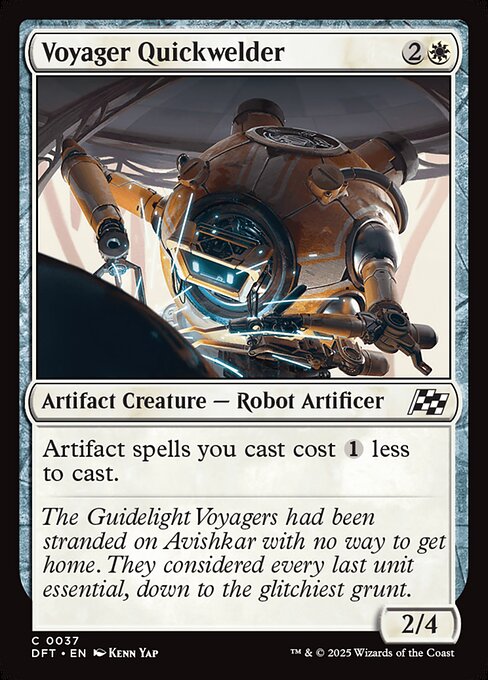
208. Voyager Quickwelder
Rating4.6WeakWhy this rating?
A solid playable that rarely gets cut (4.6/10).
Why. A 2/4 for three that blocks well, and whose effect makes your artifact spells cost one less. With Vehicles and other artifacts it speeds up your development.
Risks. Without artifacts in the deck, it is just a decent wall. The body does not attack well.
In the draft. Take it when your white or blue deck has a handful of artifacts. Otherwise it is defensive filler for late in the pack.
Results in the games of the set
When it is in hand, the deck wins 55.2% of its games (set average: 55.7%, 140th of 273 cards).
In the opening hand: 55.0% wins (54.9% on average).
Drawn during the game: 55.3% (56.3% on average).
When it is drawn, the deck wins 2.3 points more than when it is not.
When it is drafted, it is played 52% of the time (set average: 63%).
Taken as the first pick (51 drafts), it ends in the deck 84% of the time.
It is played mostly in U/W decks (79% of them) and B/W (69%).

209. Midnight Mangler
Rating4.6WeakWhy this rating?
A solid playable that rarely gets cut (4.6/10).
Why. A 3/3 Vehicle for two that is an artifact creature during other players' turns, so it blocks without needing a crew. On your turn you must crew it with total power two to attack.
Risks. Since it is a creature on the opponent's turn, it is exposed to removal then. You also need to tap a creature to attack with it.
In the draft. A decent defensive two-drop that turns into an attacker in decks with creatures. Take it mid-pack in a blue deck.
Results in the games of the set
When it is in hand, the deck wins 54.1% of its games (set average: 55.7%, 178th of 273 cards).
In the opening hand: 53.7% wins (54.9% on average).
Drawn during the game: 54.3% (56.3% on average).
When it is drawn, the deck wins 0.8 points more than when it is not.
When it is drafted, it is played 62% of the time (set average: 63%).
Taken as the first pick (74 drafts), it ends in the deck 85% of the time.
It is played mostly in B/U decks (55% of them) and U/W (52%).

210. Endrider Catalyzer
Rating4.5WeakWhy this rating?
A solid playable that rarely gets cut (4.5/10).
Why. A 3/1 for two that suits aggro. Once you reach max speed from Start your engines!, it taps to add two red mana, a big mana jump later in the game.
Risks. With 1 toughness, almost anything kills it. Max speed needs you to hurt the opponent across several turns, and the payoff comes late.
In the draft. A two-drop for aggressive red decks, rarely exciting. Take it for the curve, not for the mana ability.
Results in the games of the set
When it is in hand, the deck wins 53.6% of its games (set average: 55.7%, 194th of 273 cards).
In the opening hand: 54.9% wins (54.9% on average).
Drawn during the game: 52.6% (56.3% on average).
When it is drawn, the deck wins 0.7 points less than when it is not.
When it is drafted, it is played 59% of the time (set average: 63%).
Taken as the first pick (51 drafts), it ends in the deck 90% of the time.
It is played mostly in B/R decks (66% of them) and R/W (59%).

211. Bloodghast
Rating4.4WeakWhy this rating?
A good playable, but is sometimes cut (4.4/10).
Why. A 2/1 for two black mana that returns from the graveyard to the battlefield whenever a land enters under your control. It is a recurring threat and a fine sacrifice target, and it has haste as long as an opponent has 10 or less life.
Risks. It cannot block, so it is a pure attacker and useless on defence. The body is fragile, and the double black weighs on two-colour decks.
In the draft. For an aggressive black deck or one with sacrifice. In a more controlling deck it matters less; take it without hurry.
Results in the games of the set
When it is in hand, the deck wins 49.0% of its games (set average: 55.7%, 267th of 273 cards).
In the opening hand: 48.8% wins (54.9% on average).
Drawn during the game: 49.2% (56.3% on average).
When it is drawn, the deck wins 4.4 points less than when it is not.
When it is drafted, it is played 41% of the time (set average: 63%).
Taken among the first three picks (81 drafts), it ends in the deck 64% of the time.
It is played about as much in every archetype.
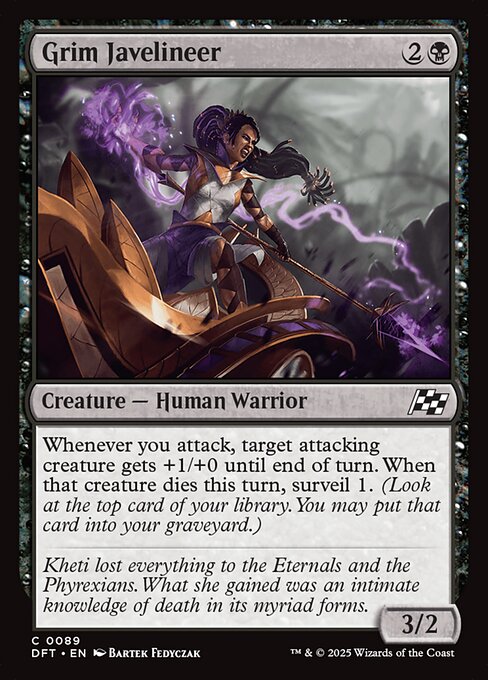
212. Grim Javelineer
Rating4.4WeakWhy this rating?
A good playable, but is sometimes cut (4.4/10).
Why. A 3/2 for three that, whenever you attack, gives target attacking creature +1/+0. If that creature dies this turn, you surveil 1. It pushes attacks through and adds a little value.
Risks. With only 2 toughness it dies in the first trade. Its effect only matters when you attack, and the bonus lasts a single turn.
In the draft. A decent mid-curve body for aggressive black decks. Not a priority, but a steady playable.
Results in the games of the set
When it is in hand, the deck wins 54.4% of its games (set average: 55.7%, 174th of 273 cards).
In the opening hand: 53.5% wins (54.9% on average).
Drawn during the game: 55.0% (56.3% on average).
When it is drawn, the deck wins 0.0 points more than when it is not.
When it is drafted, it is played 45% of the time (set average: 63%).
Taken among the first three picks (173 drafts), it ends in the deck 83% of the time.
It is played mostly in B/R decks (50% of them) and B/W (46%).

213. Kalakscion, Hunger Tyrant
Rating4.4WeakWhy this rating?
A good playable, but is sometimes cut (4.4/10).
Why. A 7/2 for three with no abilities. It hits very hard from turn three and forces the opponent to answer it or block with a decent body.
Risks. With 2 toughness, it dies to the first block or damage spell. The double black cost strains your mana.
In the draft. An aggressive attacker for a black deck built on pressure. Take it for its curve, not as a value card.
Results in the games of the set
When it is in hand, the deck wins 52.1% of its games (set average: 55.7%, 228th of 273 cards).
In the opening hand: 51.9% wins (54.9% on average).
Drawn during the game: 52.3% (56.3% on average).
When it is drawn, the deck wins 1.3 points less than when it is not.
When it is drafted, it is played 30% of the time (set average: 63%).
Taken among the first three picks (50 drafts), it ends in the deck 70% of the time.
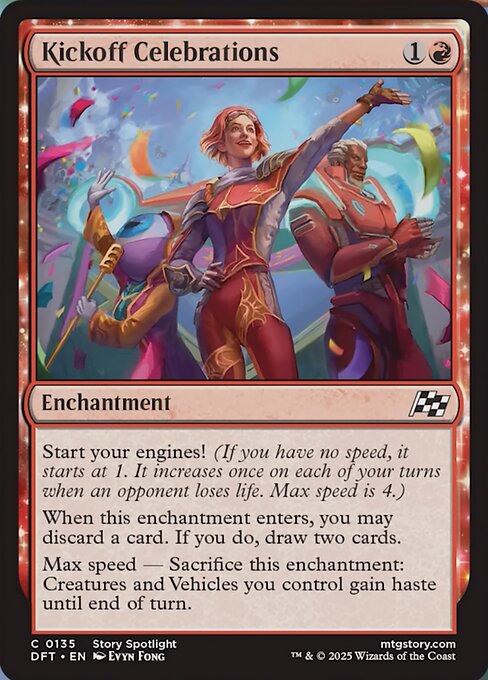
214. Kickoff Celebrations
Rating4.4WeakWhy this rating?
A good playable, but is sometimes cut (4.4/10).
Why. A two-mana enchantment: when it enters, you may discard a card to draw two. At max speed you can sacrifice it to give your creatures and Vehicles haste until end of turn.
Risks. It does nothing on the battlefield, so it is a turn two without pressure. Max speed takes several turns of damage, and the haste effect works only once.
In the draft. A filler tool, not an engine. Play it in an aggressive red deck only if you are short on better cards.
Results in the games of the set
When it is in hand, the deck wins 51.4% of its games (set average: 55.7%, 241st of 273 cards).
In the opening hand: 49.6% wins (54.9% on average).
Drawn during the game: 52.5% (56.3% on average).
When it is drawn, the deck wins 1.0 points less than when it is not.
When it is drafted, it is played 33% of the time (set average: 63%).
Taken among the first three picks (104 drafts), it ends in the deck 76% of the time.
It is played mostly in R/U decks (59% of them) and B/R (42%).
 Rating4.4Weak
Why this rating?
A good playable, but is sometimes cut (4.4/10).
Why. A one-mana Aura giving +1/+1 and vigilance to a creature or Vehicle. At max speed you can cast it again from the graveyard.
Risks. Auras risk a two-for-one: if the target dies in response, you lose the card. The effect is weak for the deck slot it takes.
In the draft. Almost always sideboard material. Only take it for a white deck leaning hard into Vehicles, and very late.
Results in the games of the set
When it is in hand, the deck wins 48.7% of its games (set average: 55.7%, 268th of 273 cards).
In the opening hand: 48.1% wins (54.9% on average).
Drawn during the game: 49.1% (56.3% on average).
When it is drawn, the deck wins 3.9 points less than when it is not.
When it is drafted, it is played only 6% of the time (set average: 63%): it almost always ends in the sideboard.

216. Magmakin Artillerist
Rating4.4WeakWhy this rating?
A good playable, but is sometimes cut (4.4/10).
Why. A 1/4 for three that deals damage to each opponent equal to the number of cards you discard. It also cycles for two and deals 1 damage to each opponent when you do. It is a direct damage plan inside a cycling deck.
Risks. It does little with 1 power, and it needs discards to pay off. Without them it is a small wall.
In the draft. An option for a blue-red deck with many cards to cycle. Otherwise let it go.
Results in the games of the set
When it is in hand, the deck wins 50.6% of its games (set average: 55.7%, 254th of 273 cards).
In the opening hand: 47.1% wins (54.9% on average).
Drawn during the game: 52.7% (56.3% on average).
When it is drawn, the deck wins 0.2 points less than when it is not.
When it is drafted, it is played 41% of the time (set average: 63%).
Taken as the first pick (37 drafts), it ends in the deck 84% of the time.
It is played mostly in R/U decks (77% of them) and B/R (38%).
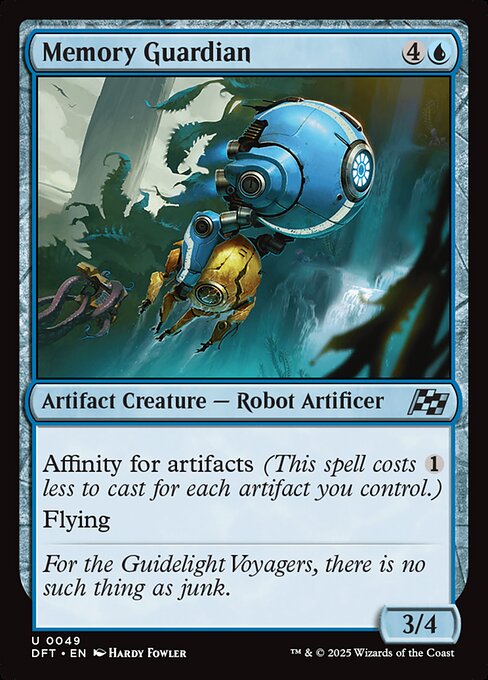
217. Memory Guardian
Rating4.4WeakWhy this rating?
A good playable, but is sometimes cut (4.4/10).
Why. A 3/4 flying artifact creature for five, costing one less for each artifact you control. With a few artifacts it arrives early and rules the sky.
Risks. Without artifacts it is an expensive, ordinary flyer. It dies to removal like any creature.
In the draft. A good pick in a blue deck with artifacts. Less exciting without them, but a 3/4 flyer is still playable.
Results in the games of the set
When it is in hand, the deck wins 56.4% of its games (set average: 55.7%, 87th of 273 cards).
In the opening hand: 53.6% wins (54.9% on average).
Drawn during the game: 58.1% (56.3% on average).
When it is drawn, the deck wins 4.7 points more than when it is not.
When it is drafted, it is played 83% of the time (set average: 63%).
Taken as the first pick (133 drafts), it ends in the deck 90% of the time.
It is played mostly in U/W decks (41% of them) and B/U (38%).

218. Racers' Scoreboard
Rating4.4WeakWhy this rating?
A good playable, but is sometimes cut (4.4/10).
Why. A four-mana artifact: when it enters, you draw two cards, then discard one. At max speed your spells cost one less.
Risks. It does nothing on the battlefield and leaves you with no pressure on turn four. Max speed comes late, if at all.
In the draft. A slow filler tool, below most creatures. Avoid it except in a very specific control deck.
Results in the games of the set
When it is in hand, the deck wins 48.5% of its games (set average: 55.7%, 269th of 273 cards).
In the opening hand: 45.0% wins (54.9% on average).
Drawn during the game: 50.6% (56.3% on average).
When it is drawn, the deck wins 1.1 points less than when it is not.
When it is drafted, it is played only 8% of the time (set average: 63%): it almost always ends in the sideboard.

219. Risen Necroregent
Rating4.4WeakWhy this rating?
A good playable, but is sometimes cut (4.4/10).
Why. A 5/4 for five that is solid on the battlefield. At max speed, at the beginning of your end step, it creates a 2/2 black Zombie creature token, a threat that grows your army.
Risks. Reaching max speed needs you to hurt the opponent over several turns. Without it, it is a big five-mana body vulnerable to removal.
In the draft. A good five-drop for a black deck, especially an aggressive one. Take it mid-pack.
Results in the games of the set
When it is in hand, the deck wins 53.9% of its games (set average: 55.7%, 184th of 273 cards).
In the opening hand: 50.8% wins (54.9% on average).
Drawn during the game: 55.9% (56.3% on average).
When it is drawn, the deck wins 0.5 points more than when it is not.
When it is drafted, it is played 81% of the time (set average: 63%).
Taken as the first pick (158 drafts), it ends in the deck 85% of the time.
It is played mostly in B/W decks (36% of them) and B/R (33%).

220. Point the Way
Rating4.4WeakWhy this rating?
A good playable, but is sometimes cut (4.4/10).
Why. A one-mana enchantment. For four mana you sacrifice it and fetch up to as many basic lands as your speed, which enter tapped.
Risks. You pay one mana to cast it, then four more for a tiny gain if your speed is low. It does nothing on the battlefield.
In the draft. One of the weakest cards in the set for a normal draft deck. Avoid it.
Results in the games of the set
When it is in hand, the deck wins 43.7% of its games (set average: 55.7%, 273rd of 273 cards).
In the opening hand: 40.9% wins (54.9% on average).
Drawn during the game: 45.9% (56.3% on average).
When it is drawn, the deck wins 6.1 points less than when it is not.
When it is drafted, it is played only 6% of the time (set average: 63%): it almost always ends in the sideboard.

221. Clamorous Ironclad
Rating4.3WeakWhy this rating?
A good playable, but is sometimes cut (4.3/10).
Why. A 6/3 Vehicle with menace for four, a big attacker once crewed. It cycles for one red mana, so it is rarely dead in hand.
Risks. Crew 3 asks for total power three, which often costs two creatures. With 3 toughness, one removal spell answers it.
In the draft. A decent pick for a red deck with power-3 creatures, or two small ones to crew it. One-mana cycling makes it flexible.
Results in the games of the set
When it is in hand, the deck wins 53.5% of its games (set average: 55.7%, 198th of 273 cards).
In the opening hand: 51.6% wins (54.9% on average).
Drawn during the game: 54.7% (56.3% on average).
When it is drawn, the deck wins 1.4 points more than when it is not.
When it is drafted, it is played 53% of the time (set average: 63%).
Taken as the first pick (61 drafts), it ends in the deck 92% of the time.
It is played mostly in R/U decks (70% of them) and R/W (63%).

222. Starting Column
Rating4.2WeakWhy this rating?
A good playable, but is sometimes cut (4.2/10).
Why. A three-mana artifact that taps for one mana of any colour: fixing and ramp. At max speed you can tap and sacrifice it to draw two cards, then discard one.
Risks. A turn three with no board development. It slows the deck down, and max speed does not always come.
In the draft. A fixing tool for a three-colour deck or one with a heavy top end. Otherwise prefer a creature.
Results in the games of the set
When it is in hand, the deck wins 54.2% of its games (set average: 55.7%, 176th of 273 cards).
In the opening hand: 53.9% wins (54.9% on average).
Drawn during the game: 54.4% (56.3% on average).
When it is drawn, the deck wins 1.1 points more than when it is not.
When it is drafted, it is played 47% of the time (set average: 63%).
Taken as the first pick (37 drafts), it ends in the deck 81% of the time.
It is played mostly in B/W decks (27% of them) and U/W (25%).
 Rating4.2Weak
Why this rating?
A good playable, but is sometimes cut (4.2/10).
Why. A 0/8 for two with no abilities. It is a huge wall that blocks any ground attacker from turn two without risk of dying.
Risks. It deals no damage and cannot win the game alone. With zero power it does not help crew a Vehicle either.
In the draft. A wall for a blue control or tempo deck that wants to hold on. Take it late, and play it only if your deck has finishers.
Results in the games of the set
When it is in hand, the deck wins 53.6% of its games (set average: 55.7%, 192nd of 273 cards).
In the opening hand: 53.0% wins (54.9% on average).
Drawn during the game: 54.0% (56.3% on average).
When it is drawn, the deck wins 1.0 points more than when it is not.
When it is drafted, it is played 27% of the time (set average: 63%).
Taken among the first three picks (70 drafts), it ends in the deck 64% of the time.

224. Dracosaur Auxiliary
Rating4.2WeakWhy this rating?
A good playable, but is sometimes cut (4.2/10).
Why. A 4/4 flying Mount with haste for six, an immediate threat. When it attacks saddled it also deals 2 damage to any target.
Risks. Six mana with two red. Saddle 3 asks you to tap other creatures with total power three, and only when you could cast a sorcery.
In the draft. A decent finisher for a red deck with creatures to tap. Take it mid-pack.
Results in the games of the set
When it is in hand, the deck wins 54.7% of its games (set average: 55.7%, 160th of 273 cards).
In the opening hand: 52.4% wins (54.9% on average).
Drawn during the game: 56.1% (56.3% on average).
When it is drawn, the deck wins 1.5 points more than when it is not.
When it is drafted, it is played 77% of the time (set average: 63%).
Taken as the first pick (94 drafts), it ends in the deck 84% of the time.
It is played mostly in R/W decks (32% of them) and G/R (30%).
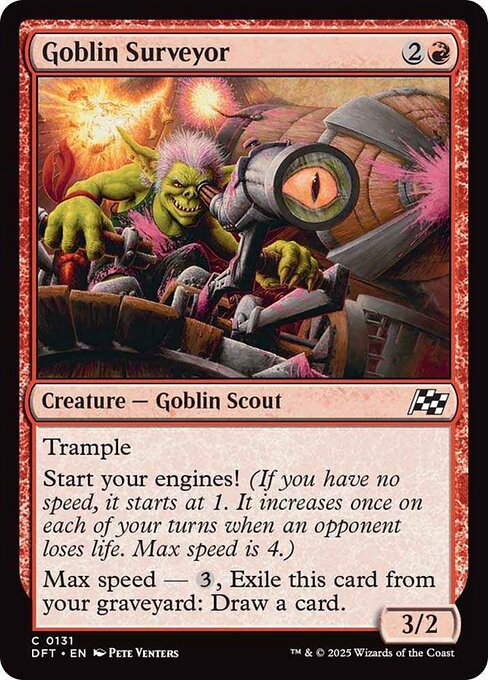
225. Goblin Surveyor
Rating4.2WeakWhy this rating?
A good playable, but is sometimes cut (4.2/10).
Why. A 3/2 trampler for three, fine for attacking. At max speed you can exile it from your graveyard for three mana to draw a card.
Risks. 2 toughness makes it fragile. The draw ability first needs max speed, which is not guaranteed.
In the draft. Mid-curve filler for an aggressive red deck. Take it without excitement.
Results in the games of the set
When it is in hand, the deck wins 51.6% of its games (set average: 55.7%, 237th of 273 cards).
In the opening hand: 51.3% wins (54.9% on average).
Drawn during the game: 51.7% (56.3% on average).
When it is drawn, the deck wins 2.4 points less than when it is not.
When it is drafted, it is played 35% of the time (set average: 63%).
Taken among the first three picks (92 drafts), it ends in the deck 71% of the time.
It is played mostly in B/R decks (56% of them) and R/W (47%).
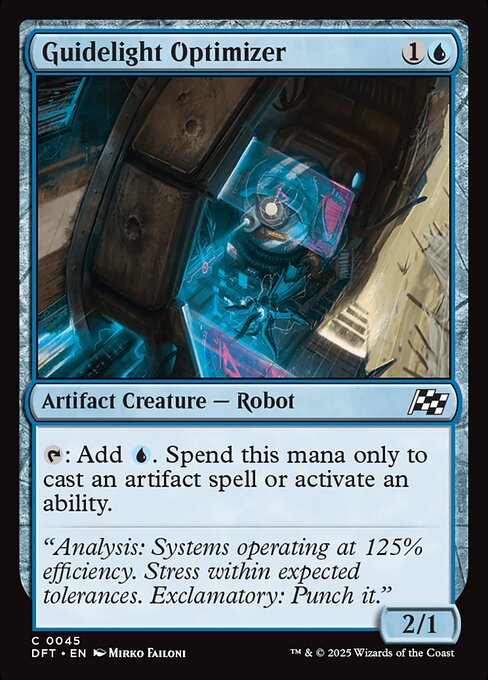
226. Guidelight Optimizer
Rating4.2WeakWhy this rating?
A good playable, but is sometimes cut (4.2/10).
Why. A 2/1 artifact creature for two that taps for blue mana, spent only on artifact spells or to activate abilities. It is acceleration for an artifact deck.
Risks. The mana cannot pay for spells that are not artifacts. 1 toughness is fragile, and the body attacks poorly.
In the draft. For a blue deck with several artifacts or abilities to pay for. Otherwise a filler two-drop.
Results in the games of the set
When it is in hand, the deck wins 54.4% of its games (set average: 55.7%, 172nd of 273 cards).
In the opening hand: 54.8% wins (54.9% on average).
Drawn during the game: 54.1% (56.3% on average).
When it is drawn, the deck wins 1.0 points more than when it is not.
When it is drafted, it is played 70% of the time (set average: 63%).
Taken as the first pick (79 drafts), it ends in the deck 89% of the time.
It is played mostly in B/U decks (70% of them) and U/W (69%).

227. Loxodon Surveyor
Rating4.2WeakWhy this rating?
A good playable, but is sometimes cut (4.2/10).
Why. A 3/3 for three: a solid base body. At max speed you can exile it from your graveyard for three mana to draw a card.
Risks. No evasion and little effect. The draw first needs max speed.
In the draft. A green deck wants bodies like this to fill the curve. Take it late in the pack.
Results in the games of the set
When it is in hand, the deck wins 53.9% of its games (set average: 55.7%, 183rd of 273 cards).
In the opening hand: 54.3% wins (54.9% on average).
Drawn during the game: 53.7% (56.3% on average).
When it is drawn, the deck wins 1.8 points less than when it is not.
When it is drafted, it is played 52% of the time (set average: 63%).
Taken among the first three picks (229 drafts), it ends in the deck 74% of the time.
It is played mostly in G/W decks (35% of them) and G/R (34%).

228. Mutant Surveyor
Rating4.2WeakWhy this rating?
A good playable, but is sometimes cut (4.2/10).
Why. A 2/3 for three that can gain +1/+1 until end of turn for two mana, a useful late-game mana sink. At max speed you can exile it from your graveyard for three mana to draw a card.
Risks. A modest starting body. The boost costs mana each time and only lasts a turn.
In the draft. A black filler that does its job in a defensive or midrange deck. Take it late.
Results in the games of the set
When it is in hand, the deck wins 54.5% of its games (set average: 55.7%, 168th of 273 cards).
In the opening hand: 53.9% wins (54.9% on average).
Drawn during the game: 55.0% (56.3% on average).
When it is drawn, the deck wins 0.2 points less than when it is not.
When it is drafted, it is played 62% of the time (set average: 63%).
Taken as the first pick (49 drafts), it ends in the deck 90% of the time.
It is played mostly in B/R decks (65% of them) and B/W (59%).

229. Rover Blades
Rating4.2WeakWhy this rating?
A good playable, but is sometimes cut (4.2/10).
Why. A colourless 2/2 Equipment Vehicle with double strike for three: once crewed, it hits twice. You can also equip it to a creature for four mana, which then has double strike.
Risks. Equipping for four is very expensive, and a 2/2 body is weak. Crewing taps a creature, which lowers your own attack.
In the draft. A slow card, only for a deck with several creatures worth equipping. Otherwise avoid it.
Results in the games of the set
When it is in hand, the deck wins 49.8% of its games (set average: 55.7%, 261st of 273 cards).
In the opening hand: 48.5% wins (54.9% on average).
Drawn during the game: 50.7% (56.3% on average).
When it is drawn, the deck wins 2.4 points less than when it is not.
When it is drafted, it is played 34% of the time (set average: 63%).
Taken among the first three picks (52 drafts), it ends in the deck 69% of the time.

230. Tyrox, Saurid Tyrant
Rating4.2WeakWhy this rating?
A good playable, but is sometimes cut (4.2/10).
Why. A 4/1 for two with no abilities. An aggressive attacker that makes the opponent react early.
Risks. 1 toughness: it dies to any block or damage spell. It is very poor on defence.
In the draft. A two-drop for an aggressive red deck. Take it for the curve, not for the value.
Results in the games of the set
When it is in hand, the deck wins 53.3% of its games (set average: 55.7%, 201st of 273 cards).
In the opening hand: 54.7% wins (54.9% on average).
Drawn during the game: 52.3% (56.3% on average).
When it is drawn, the deck wins 0.6 points less than when it is not.
When it is drafted, it is played 50% of the time (set average: 63%).
Taken among the first three picks (88 drafts), it ends in the deck 83% of the time.
It is played about as much in every archetype.
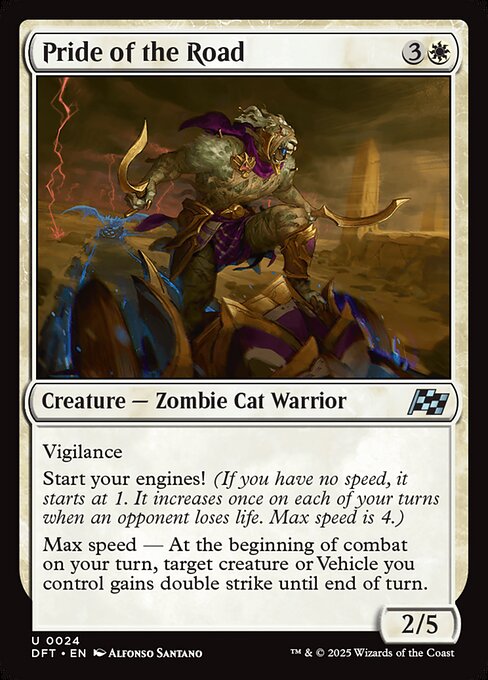
231. Pride of the Road
Rating4.2WeakWhy this rating?
A good playable, but is sometimes cut (4.2/10).
Why. A 2/5 with vigilance for four: it attacks without giving up defence. At max speed, at the beginning of combat on your turn, a creature or Vehicle you control gains double strike until end of turn.
Risks. Little offence on its own. Max speed needs damage on several turns, and the effect stays conditional.
In the draft. A decent defensive body for a white deck. Take it mid or late in the pack, with good creatures alongside.
Results in the games of the set
When it is in hand, the deck wins 52.1% of its games (set average: 55.7%, 227th of 273 cards).
In the opening hand: 50.6% wins (54.9% on average).
Drawn during the game: 53.2% (56.3% on average).
When it is drawn, the deck wins 1.0 points less than when it is not.
When it is drafted, it is played 60% of the time (set average: 63%).
Taken as the first pick (31 drafts), it ends in the deck 74% of the time.
It is played mostly in B/W decks (32% of them) and R/W (26%).
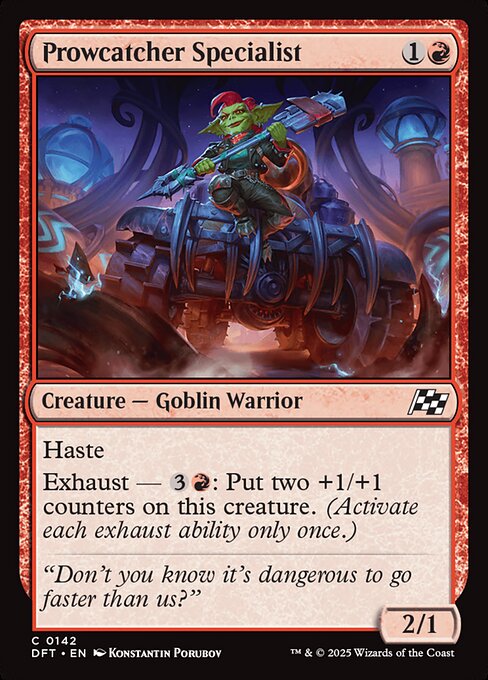 Rating4.1Weak
Why this rating?
A good playable, but is sometimes cut (4.1/10).
Why. A 2/1 with haste for two: it hits on turn two. Its Exhaust ability puts two +1/+1 counters on itself for four mana, making a late 4/3.
Risks. A fragile 2/1 at the start, and the activation costs four mana for a single use. It is easy to kill before it grows.
In the draft. An aggressive red two-drop, fine for the curve. Take it mid or late in the pack.
Results in the games of the set
When it is in hand, the deck wins 52.4% of its games (set average: 55.7%, 225th of 273 cards).
In the opening hand: 52.7% wins (54.9% on average).
Drawn during the game: 52.1% (56.3% on average).
When it is drawn, the deck wins 1.4 points less than when it is not.
When it is drafted, it is played 57% of the time (set average: 63%).
Taken as the first pick (46 drafts), it ends in the deck 87% of the time.
It is played mostly in B/R decks (67% of them) and G/R (66%).

233. Air Response Unit
Rating4.0WeakWhy this rating?
A good playable, but is sometimes cut (4.0/10).
Why. A 3/3 flying Vehicle with vigilance for three, with Crew 1: any creature can get it attacking. It is cheap evasion.
Risks. It only blocks once crewed, which taps one of your creatures. A crewed Vehicle is exposed to the opponent's spells.
In the draft. A playable pick for a white deck with several creatures. Take it late in the pack.
Results in the games of the set
When it is in hand, the deck wins 51.1% of its games (set average: 55.7%, 248th of 273 cards).
In the opening hand: 50.9% wins (54.9% on average).
Drawn during the game: 51.2% (56.3% on average).
When it is drawn, the deck wins 1.7 points less than when it is not.
When it is drafted, it is played 43% of the time (set average: 63%).
Taken among the first three picks (95 drafts), it ends in the deck 80% of the time.
It is played mostly in R/W decks (30% of them).
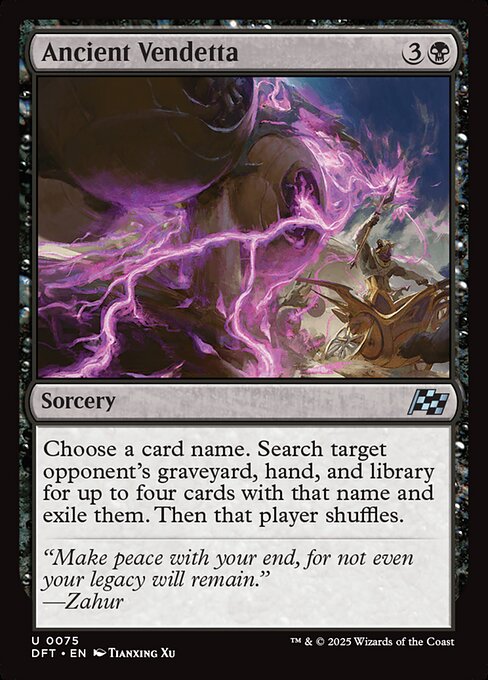
234. Ancient Vendetta
Rating4.0WeakWhy this rating?
A good playable, but is sometimes cut (4.0/10).
Why. A four-mana sorcery: you name a card and exile up to four copies from a target opponent's hand, graveyard and library. In a draft it almost never has a useful target.
Risks. A draft deck seldom holds four copies of one name, so the effect is minimal. You spend a turn and a card without touching the board.
In the draft. Do not pick it: it has no use in a draft deck. Even in the sideboard it has no clear role.
Results in the games of the set
When it is drafted, it is played only 0% of the time (set average: 63%): it almost always ends in the sideboard.

235. Chitin Gravestalker
Rating4.0WeakWhy this rating?
A good playable, but is sometimes cut (4.0/10).
Why. A 5/4 for six that costs one less for each artifact and/or creature card in your graveyard. In a deck where creatures trade a lot, it comes down well before turn 6. Cycling keeps it playable when the graveyard is empty.
Risks. Early on it costs six and sits in hand, where Cycling turns it into a plain draw. A 5/4 with no other ability will not win the game alone.
In the draft. An honest black filler, taken late. It is better in a deck that trades creatures a lot; two copies at most.
Results in the games of the set
When it is in hand, the deck wins 53.7% of its games (set average: 55.7%, 189th of 273 cards).
In the opening hand: 51.9% wins (54.9% on average).
Drawn during the game: 55.0% (56.3% on average).
When it is drawn, the deck wins 0.1 points less than when it is not.
When it is drafted, it is played 46% of the time (set average: 63%).
Taken among the first three picks (155 drafts), it ends in the deck 74% of the time.
It is played mostly in B/G decks (64% of them) and B/R (34%).
236. Ooze Patrol
Rating4.0WeakWhy this rating?
A good playable, but is sometimes cut (4.0/10).
Why. A 2/2 for four that mills two cards, then gets a +1/+1 counter for each artifact and/or creature card in your graveyard. The fuller the graveyard, the bigger it gets, so results swing a lot from game to game.
Risks. With an empty graveyard you get a 2/2 for four, helped only by the two cards you just milled. It does nothing else.
In the draft. A green filler, taken late. It improves in a deck heavy on creatures and artifacts, but does not deserve an early pick.
Results in the games of the set
When it is in hand, the deck wins 54.6% of its games (set average: 55.7%, 165th of 273 cards).
In the opening hand: 52.8% wins (54.9% on average).
Drawn during the game: 55.8% (56.3% on average).
When it is drawn, the deck wins 0.1 points more than when it is not.
When it is drafted, it is played 66% of the time (set average: 63%).
Taken as the first pick (41 drafts), it ends in the deck 83% of the time.
It is played mostly in B/G decks (41% of them).

237. Slick Imitator
Rating4.0WeakWhy this rating?
A good playable, but is sometimes cut (4.0/10).
Why. A 1/3 for two that blocks well early. At max speed you can sacrifice it for one mana to copy a spell you control, such as a removal spell or a creature with an enter effect.
Risks. Reaching max speed means the opponent must lose life on several of your turns, which a defensive deck rarely manages. Without a good spell to copy, it is just a small body.
In the draft. A niche blue playable, taken late. Better suited to an aggressive deck that pressures the opponent's life total.
Results in the games of the set
When it is in hand, the deck wins 52.4% of its games (set average: 55.7%, 224th of 273 cards).
In the opening hand: 52.5% wins (54.9% on average).
Drawn during the game: 52.3% (56.3% on average).
When it is drawn, the deck wins 0.2 points more than when it is not.
When it is drafted, it is played 54% of the time (set average: 63%).
Taken as the first pick (58 drafts), it ends in the deck 74% of the time.
It is played about as much in every archetype.
238. Syphon Fuel
Rating4.0WeakWhy this rating?
A good playable, but is sometimes cut (4.0/10).
Why. An instant-speed removal spell that gives -6/-6 to a creature and gains you 2 life. It kills almost anything the opponent can cast, and instant timing lets you respond in combat.
Risks. Five mana is expensive for a removal spell: you spend your turn without adding to the battlefield. Nothing makes it cheaper.
In the draft. A solid but costly black removal spell: take it from the middle of the pack, after cheaper removal. It is playable in any black deck.
Results in the games of the set
When it is in hand, the deck wins 54.6% of its games (set average: 55.7%, 166th of 273 cards).
In the opening hand: 51.0% wins (54.9% on average).
Drawn during the game: 56.9% (56.3% on average).
When it is drawn, the deck wins 1.1 points more than when it is not.
When it is drafted, it is played 57% of the time (set average: 63%).
Taken as the first pick (57 drafts), it ends in the deck 89% of the time.
It is played mostly in B/G decks (40% of them) and B/U (40%).
 Rating4.0Weak
Why this rating?
A good playable, but is sometimes cut (4.0/10).
Why. A 3/4 with reach for four, so it blocks well as soon as it lands. At max speed you exile the top card of your library each upkeep and may play it that turn, which becomes a real card source.
Risks. Max speed needs the opponent to lose life on several of your turns. Without it, this is a decent defensive body and little more.
In the draft. A good red filler taken in the middle of the pack. It suits a deck that attacks and makes the opponent lose life.
Results in the games of the set
When it is in hand, the deck wins 52.9% of its games (set average: 55.7%, 212th of 273 cards).
In the opening hand: 52.3% wins (54.9% on average).
Drawn during the game: 53.2% (56.3% on average).
When it is drawn, the deck wins 0.9 points less than when it is not.
When it is drafted, it is played 81% of the time (set average: 63%).
Taken as the first pick (93 drafts), it ends in the deck 89% of the time.
It is played mostly in B/R decks (39% of them) and R/W (36%).

240. Shefet Archfiend
Rating3.9WeakWhy this rating?
A good playable, but is sometimes cut (3.9/10).
Why. A 5/5 flyer for seven whose enter trigger gives all other creatures -2/-2 until end of turn. It is a partial sweeper that leaves a finisher behind, and Cycling keeps it from rotting in hand.
Risks. Seven mana is late, and the effect hits your own creatures too. Against a deck of big creatures the -2/-2 does almost nothing.
In the draft. A top-end black finisher; one copy is enough. Take it in the middle of the pack if you play black with a controlling plan.
Results in the games of the set
When it is in hand, the deck wins 55.2% of its games (set average: 55.7%, 139th of 273 cards).
In the opening hand: 53.1% wins (54.9% on average).
Drawn during the game: 56.7% (56.3% on average).
When it is drawn, the deck wins 0.9 points more than when it is not.
When it is drafted, it is played 55% of the time (set average: 63%).
Taken as the first pick (43 drafts), it ends in the deck 72% of the time.
It is played about as much in every archetype.

241. Adrenaline Jockey
Rating3.8WeakWhy this rating?
A good playable, but is sometimes cut (3.8/10).
Why. A 3/3 for three whose ability punishes a player who casts a spell on someone else's turn: they take 4 damage. That deters the opponent's instants, but it applies to you too. Each time you activate an Exhaust ability it gets a +1/+1 counter.
Risks. The trigger hits you too: casting an instant on the opponent's turn costs you 4 life. The bonus only works if you have Exhaust abilities.
In the draft. A fine three-mana 3/3, taken late. Play it mainly if you have several Exhaust abilities.
Results in the games of the set
When it is in hand, the deck wins 51.2% of its games (set average: 55.7%, 245th of 273 cards).
In the opening hand: 51.4% wins (54.9% on average).
Drawn during the game: 51.1% (56.3% on average).
When it is drawn, the deck wins 2.0 points less than when it is not.
When it is drafted, it is played 56% of the time (set average: 63%).
Taken as the first pick (38 drafts), it ends in the deck 74% of the time.
It is played mostly in G/R decks (33% of them).

242. Daring Mechanic
Rating3.8WeakWhy this rating?
A good playable, but is sometimes cut (3.8/10).
Why. A 3/3 for three: the body is honest. For four mana it can put a +1/+1 counter on a Mount or Vehicle, which gives a late-game use if you run some.
Risks. Without a Mount or Vehicle the ability has no target and this is a plain 3/3. Four mana per counter is slow.
In the draft. White filler, taken late. It gains some value if your deck contains several Vehicles or Mounts.
Results in the games of the set
When it is in hand, the deck wins 51.0% of its games (set average: 55.7%, 251st of 273 cards).
In the opening hand: 51.2% wins (54.9% on average).
Drawn during the game: 50.8% (56.3% on average).
When it is drawn, the deck wins 2.8 points less than when it is not.
When it is drafted, it is played 28% of the time (set average: 63%).
Taken among the first three picks (53 drafts), it ends in the deck 77% of the time.
It is played mostly in G/W decks (57% of them) and R/W (51%).

243. Gastal Blockbuster
Rating3.8WeakWhy this rating?
A good playable, but is sometimes cut (3.8/10).
Why. A 3/2 for three. When it enters, you may sacrifice a creature or Vehicle to destroy an artifact an opponent controls. That can remove an opposing Vehicle or an annoying artifact.
Risks. Sacrificing a creature to destroy an artifact is a poor trade unless the target is very valuable. With no opposing artifact the ability is unusable and it is a plain 3/2.
In the draft. Red filler, taken late. It gets more interesting against an opponent who plays many artifacts and Vehicles.
Results in the games of the set
When it is in hand, the deck wins 51.1% of its games (set average: 55.7%, 249th of 273 cards).
In the opening hand: 49.6% wins (54.9% on average).
Drawn during the game: 52.1% (56.3% on average).
When it is drawn, the deck wins 1.9 points less than when it is not.
When it is drafted, it is played 20% of the time (set average: 63%).
Taken among the first three picks (47 drafts), it ends in the deck 64% of the time.
It is played mostly in R/W decks (32% of them) and B/R (28%).
244. Ticket Tortoise
Rating3.8WeakWhy this rating?
A good playable, but is sometimes cut (3.8/10).
Why. A 3/1 defender for two: it cannot attack, but it blocks early and trades with an aggressive opponent. If an opponent controls more lands than you, you create a Treasure token.
Risks. It can never attack, and with 1 toughness it dies to almost anything. The Treasure only arrives when the opponent has more lands, so rarely when you are ahead.
In the draft. A colorless defensive playable, taken late. It suits a controlling deck that wants to survive the first turns.
Results in the games of the set
When it is in hand, the deck wins 53.3% of its games (set average: 55.7%, 202nd of 273 cards).
In the opening hand: 51.7% wins (54.9% on average).
Drawn during the game: 54.5% (56.3% on average).
When it is drawn, the deck wins 0.4 points less than when it is not.
When it is drafted, it is played 36% of the time (set average: 63%).
Taken among the first three picks (58 drafts), it ends in the deck 66% of the time.
It is played mostly in U/W decks (29% of them) and B/U (28%).
245. Pacesetter Paragon
Rating3.5WeakWhy this rating?
A good playable, but is sometimes cut (3.5/10).
Why. A 2/3 for three. Its Exhaust costs three: it gets a +1/+1 counter and gains double strike until end of turn, which makes for one big attack.
Risks. Exhaust activates only once, and the three-mana cost eats a turn. The starting 2/3 is fragile against removal or a good block.
In the draft. Red filler for an aggressive deck, taken late. Do not expect a decisive effect.
Results in the games of the set
When it is in hand, the deck wins 51.5% of its games (set average: 55.7%, 238th of 273 cards).
In the opening hand: 50.6% wins (54.9% on average).
Drawn during the game: 52.2% (56.3% on average).
When it is drawn, the deck wins 2.4 points less than when it is not.
When it is drafted, it is played 60% of the time (set average: 63%).
Taken as the first pick (34 drafts), it ends in the deck 88% of the time.
It is played mostly in G/R decks (33% of them) and R/W (28%).

246. Swiftwing Assailant
Rating3.2WeakWhy this rating?
Filler card but sometimes gets cut (3.2/10).
Why. A 3/3 flyer for four, a solid body for the price. At max speed it gets +0/+1 and vigilance, so it attacks and still stays back to block.
Risks. It has no game-changing ability. Max speed needs the opponent to lose life on several of your turns.
In the draft. A decent white playable, taken late. It fills out the curve of an aerial deck.
Results in the games of the set
When it is in hand, the deck wins 53.3% of its games (set average: 55.7%, 203rd of 273 cards).
In the opening hand: 51.9% wins (54.9% on average).
Drawn during the game: 54.2% (56.3% on average).
When it is drawn, the deck wins 0.4 points less than when it is not.
When it is drafted, it is played 26% of the time (set average: 63%).
Taken among the first three picks (48 drafts), it ends in the deck 65% of the time.
It is played mostly in B/W decks (44% of them) and G/W (29%).

247. Cloudspire Captain
Rating2.9WeakWhy this rating?
Filler card but sometimes gets cut (2.9/10).
Why. A 2/3 for three that gives your Mounts and Vehicles +1/+1 and saddles and crews as though its power were 2 greater. It makes those permanents bigger and easier to activate.
Risks. With no Mounts or Vehicles in the deck it is a 2/3 with no effect. It is only worth playing in a deck built around them.
In the draft. A specialist card, taken late in white. Play it only if you already have several Vehicles or Mounts.
Results in the games of the set
When it is in hand, the deck wins 51.8% of its games (set average: 55.7%, 231st of 273 cards).
In the opening hand: 51.7% wins (54.9% on average).
Drawn during the game: 51.8% (56.3% on average).
When it is drawn, the deck wins 1.6 points less than when it is not.
When it is drafted, it is played 72% of the time (set average: 63%).
Taken as the first pick (43 drafts), it ends in the deck 81% of the time.
It is played mostly in R/W decks (46% of them) and G/W (35%).
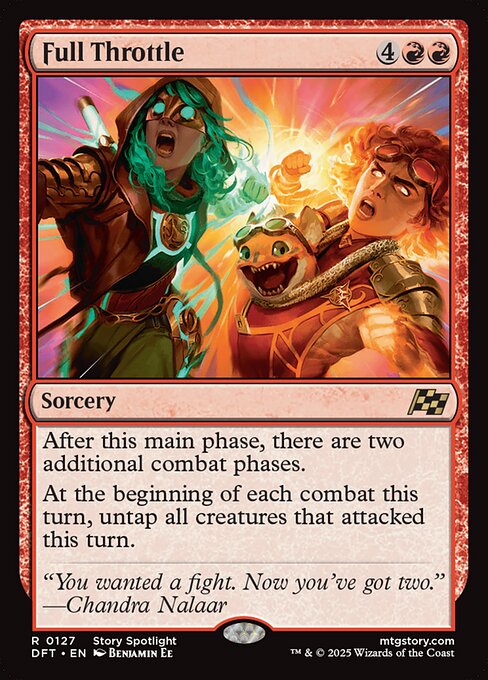
248. Full Throttle
Rating2.5WeakWhy this rating?
Filler card but sometimes gets cut (2.5/10).
Why. A six-mana sorcery that adds two extra combat phases and, at the beginning of each combat, untaps creatures that attacked. With a wide board already out, that can mean three attacks in one turn.
Risks. Six mana for an effect that does nothing on its own: with no creatures or good blockers across the table the card is dead. A removal spell on your best creature ruins it.
In the draft. A gamble card to avoid in most decks. Play it only in a very aggressive red deck with many creatures, and take it very late.
Results in the games of the set
When it is in hand, the deck wins 45.6% of its games (set average: 55.7%, 272nd of 273 cards).
In the opening hand: 46.2% wins (54.9% on average).
Drawn during the game: 45.2% (56.3% on average).
When it is drawn, the deck wins 5.5 points less than when it is not.
When it is drafted, it is played only 9% of the time (set average: 63%): it almost always ends in the sideboard.

249. Gilded Ghoda
Rating2.1WeakWhy this rating?
Not good filler and often gets cut (2.2/10).
Why. A 2/2 Mount for two with Saddle 1: tapping one other creature with power 1 or more saddles it. When it attacks saddled, you create a Treasure token, which speeds up your development.
Risks. You must tap another creature, and a 2/2 that attacks dies to almost any block. It needs a deck of cheap creatures.
In the draft. A plain little red playable, taken late. Useful for an aggro deck that can use the Treasure tokens.
Results in the games of the set
When it is in hand, the deck wins 52.8% of its games (set average: 55.7%, 213th of 273 cards).
In the opening hand: 54.9% wins (54.9% on average).
Drawn during the game: 51.3% (56.3% on average).
When it is drawn, the deck wins 0.9 points less than when it is not.
When it is drafted, it is played 66% of the time (set average: 63%).
Taken as the first pick (57 drafts), it ends in the deck 86% of the time.
It is played mostly in G/R decks (55% of them) and R/W (55%).
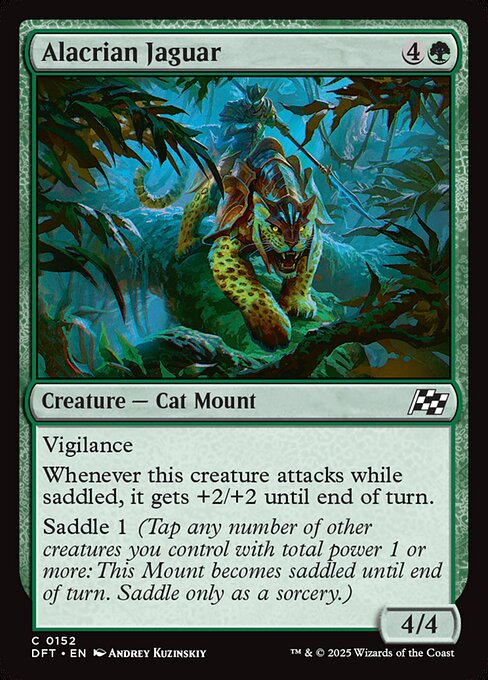
250. Alacrian Jaguar
Rating2.0WeakWhy this rating?
Not good filler and often gets cut (2.0/10).
Why. A 4/4 Mount with vigilance for five: a decent body that attacks and blocks. Saddled, it attacks as a 6/6.
Risks. Saddle 1 taps another creature, costing you a blocker or an attacker. Without that it is a five-mana 4/4 with nothing else.
In the draft. Green filler, taken late. It is a good blocker and an honest attacker but does not warrant a high pick.
Results in the games of the set
When it is in hand, the deck wins 50.8% of its games (set average: 55.7%, 253rd of 273 cards).
In the opening hand: 50.3% wins (54.9% on average).
Drawn during the game: 51.1% (56.3% on average).
When it is drawn, the deck wins 3.0 points less than when it is not.
When it is drafted, it is played 21% of the time (set average: 63%).
Taken among the first three picks (32 drafts), it ends in the deck 41% of the time.
It is played mostly in G/W decks (26% of them).
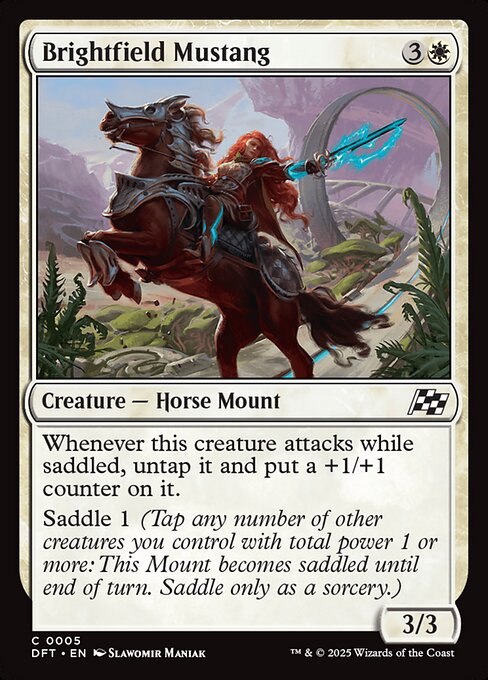
251. Brightfield Mustang
Rating2.0WeakWhy this rating?
Not good filler and often gets cut (2.0/10).
Why. A 3/3 Mount for four. When it attacks saddled, it untaps and gets a +1/+1 counter, so it grows each attack while still being available to block.
Risks. A four-mana 3/3 is weak, and Saddle 1 taps another creature. Removal or a bigger blocker stops it before it grows.
In the draft. White filler, taken late. It works well only in a deck with several small creatures to saddle it.
Results in the games of the set
When it is in hand, the deck wins 50.2% of its games (set average: 55.7%, 258th of 273 cards).
In the opening hand: 50.5% wins (54.9% on average).
Drawn during the game: 50.0% (56.3% on average).
When it is drawn, the deck wins 2.8 points less than when it is not.
When it is drafted, it is played 22% of the time (set average: 63%).
Taken among the first three picks (41 drafts), it ends in the deck 66% of the time.
It is played mostly in G/W decks (53% of them) and R/W (39%).

252. Camera Launcher
Rating2.0WeakWhy this rating?
Not good filler and often gets cut (2.0/10).
Why. A colorless 2/2 for three. Its Exhaust costs three: it gets a +1/+1 counter and you create a 1/1 colorless Thopter artifact creature token with flying. That gives two bodies for six mana spread over two turns.
Risks. The starting 2/2 is weak and Exhaust is slow, and it works only once.
In the draft. A colorless playable that fits any deck, taken in the middle or late in the pack. Fine for a deck that wants value and can wait.
Results in the games of the set
When it is in hand, the deck wins 53.5% of its games (set average: 55.7%, 197th of 273 cards).
In the opening hand: 51.1% wins (54.9% on average).
Drawn during the game: 55.2% (56.3% on average).
When it is drawn, the deck wins 0.4 points more than when it is not.
When it is drafted, it is played 41% of the time (set average: 63%).
Taken among the first three picks (78 drafts), it ends in the deck 68% of the time.
It is played mostly in B/U decks (28% of them).
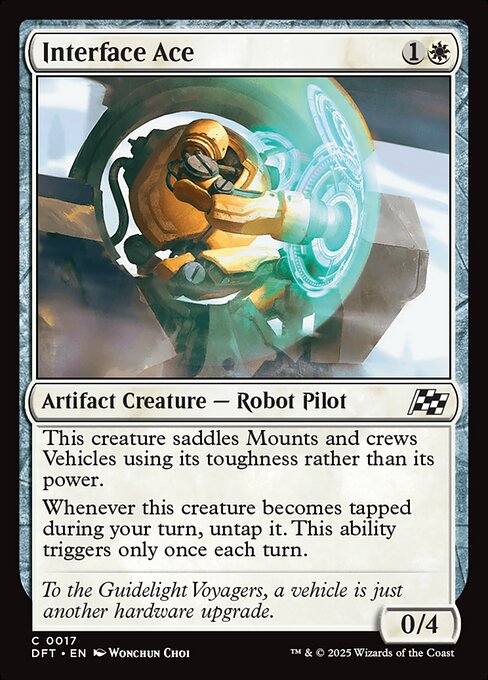
253. Interface Ace
Rating2.0WeakWhy this rating?
Not good filler and often gets cut (2.0/10).
Why. A 0/4 for two that blocks small creatures well. It saddles and crews using its toughness, so it activates Mounts and Vehicles despite having no power, and it untaps the first time each turn it becomes tapped on your turn.
Risks. It deals no damage. Without Mounts or Vehicles it is just a wall.
In the draft. A specialist card, taken late. Play it only if you have several Vehicles or Mounts to activate.
Results in the games of the set
When it is in hand, the deck wins 49.4% of its games (set average: 55.7%, 263rd of 273 cards).
In the opening hand: 48.7% wins (54.9% on average).
Drawn during the game: 49.9% (56.3% on average).
When it is drawn, the deck wins 2.9 points less than when it is not.
When it is drafted, it is played 27% of the time (set average: 63%).
Taken among the first three picks (67 drafts), it ends in the deck 73% of the time.
It is played mostly in U/W decks (46% of them) and R/W (38%).
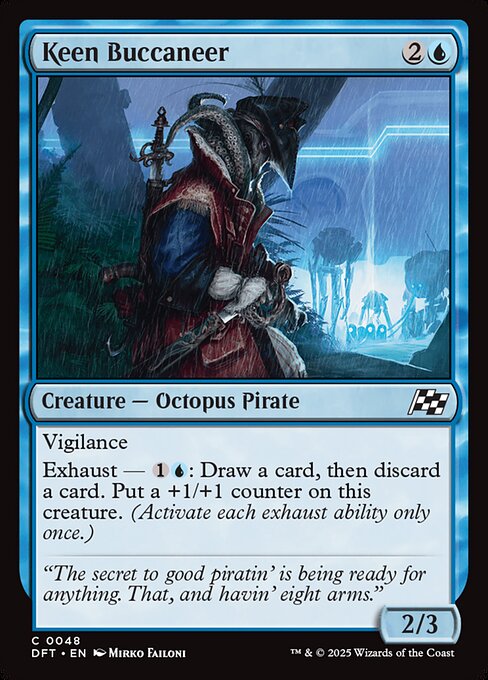
254. Keen Buccaneer
Rating2.0WeakWhy this rating?
Not good filler and often gets cut (2.0/10).
Why. A 2/3 with vigilance for three. Its Exhaust costs two: you draw then discard a card, and it gets a +1/+1 counter. It filters your hand and becomes a 3/4.
Risks. It does nothing impressive on its own and Exhaust activates only once. It is vulnerable to removal before it grows.
In the draft. Decent blue filler, taken late. It fits nearly every blue deck.
Results in the games of the set
When it is in hand, the deck wins 55.2% of its games (set average: 55.7%, 141st of 273 cards).
In the opening hand: 53.6% wins (54.9% on average).
Drawn during the game: 56.2% (56.3% on average).
When it is drawn, the deck wins 1.5 points more than when it is not.
When it is drafted, it is played 80% of the time (set average: 63%).
Taken as the first pick (134 drafts), it ends in the deck 93% of the time.
It is played mostly in R/U decks (74% of them) and B/U (65%).
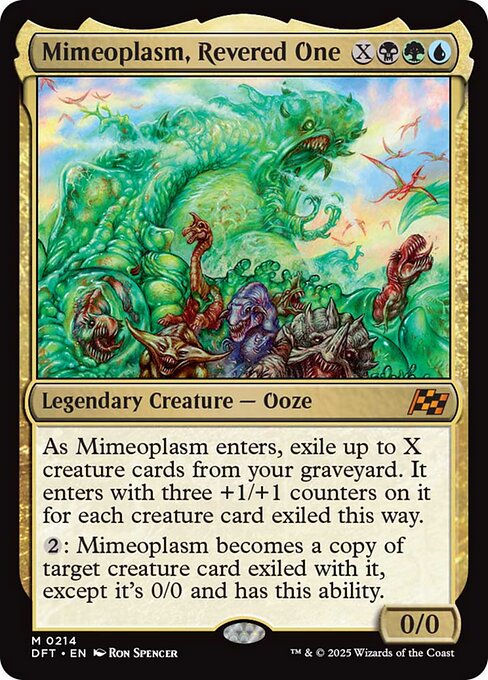 Rating2.0Weak
Why this rating?
Not good filler and often gets cut (2.0/10).
Why. A three-color creature with X in its cost: it exiles up to X creature cards from your graveyard and enters with three +1/+1 counters for each card exiled. Later, for two mana, it can become a copy of one of those cards, except it is 0/0.
Risks. It needs black, green and blue, and creatures in the graveyard: with nothing exiled it dies at once as a 0/0. The card cost is high.
In the draft. A gamble card, taken very late and only in a three-color deck with many creatures. Do not bend your deck for it.
Results in the games of the set
When it is in hand, the deck wins 51.0% of its games (set average: 55.7%, 250th of 273 cards).
In the opening hand: 46.1% wins (54.9% on average).
Drawn during the game: 54.1% (56.3% on average).
When it is drawn, the deck wins 0.3 points more than when it is not.
When it is drafted, it is played 49% of the time (set average: 63%).
Taken among the first three picks (73 drafts), it ends in the deck 66% of the time.
It is played about as much in every archetype.

256. Push the Limit
Rating2.0WeakWhy this rating?
Not good filler and often gets cut (2.0/10).
Why. A seven-mana sorcery that returns all Mount and Vehicle cards from your graveyard to the battlefield, then sacrifices them at the next end step. Your Vehicles become artifact creatures and your creatures gain haste.
Risks. Seven mana, and you need Mounts or Vehicles in the graveyard already. The payoff is a single attack, and what returns is sacrificed.
In the draft. A very specialized card, usually best avoided. Play it only in a red deck with many Vehicles and Mounts.
Results in the games of the set
When it is in hand, the deck wins 54.4% of its games (set average: 55.7%, 173rd of 273 cards).
In the opening hand: 48.0% wins (54.9% on average).
Drawn during the game: 57.8% (56.3% on average).
When it is drawn, the deck wins 4.9 points more than when it is not.
When it is drafted, it is played 29% of the time (set average: 63%).
Taken as the first pick (30 drafts), it ends in the deck 73% of the time.
It is played mostly in R/W decks (42% of them).
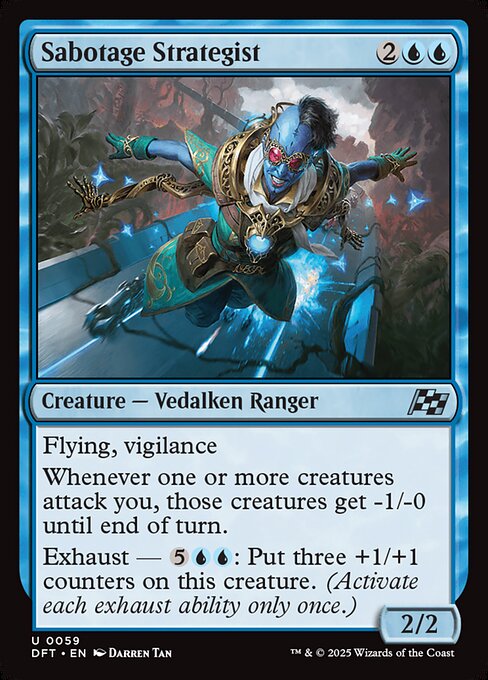
257. Sabotage Strategist
Rating2.0WeakWhy this rating?
Not good filler and often gets cut (2.0/10).
Why. A 2/2 with flying and vigilance for four. Creatures that attack you get -1/-0, which protects your life total. Late in the game its Exhaust puts three +1/+1 counters on it for seven mana.
Risks. A 2/2 for four is expensive for what it does early. Exhaust costs seven, which is slow. It is fragile before it grows.
In the draft. A decent blue playable, taken late. It makes a good aerial blocker in a defensive deck.
Results in the games of the set
When it is in hand, the deck wins 54.8% of its games (set average: 55.7%, 156th of 273 cards).
In the opening hand: 51.8% wins (54.9% on average).
Drawn during the game: 56.6% (56.3% on average).
When it is drawn, the deck wins 2.5 points more than when it is not.
When it is drafted, it is played 80% of the time (set average: 63%).
Taken as the first pick (107 drafts), it ends in the deck 82% of the time.
It is played mostly in G/U decks (26% of them) and U/W (26%).

258. Skybox Ferry
Rating2.0WeakWhy this rating?
Not good filler and often gets cut (2.0/10).
Why. A 4/4 flying Vehicle for five with Crew 2. It can attack through the air and be Cycled for two if you do not need it.
Risks. It needs five mana and then creatures to tap to crew it, which slows your game. If you run short of creatures it does nothing.
In the draft. Colorless filler, taken late. It suits a deck with many small creatures best.
Results in the games of the set
When it is in hand, the deck wins 50.4% of its games (set average: 55.7%, 256th of 273 cards).
In the opening hand: 47.4% wins (54.9% on average).
Drawn during the game: 52.4% (56.3% on average).
When it is drawn, the deck wins 0.0 points more than when it is not.
When it is drafted, it is played 19% of the time (set average: 63%).
Taken among the first three picks (39 drafts), it ends in the deck 67% of the time.
It is played mostly in R/W decks (31% of them).
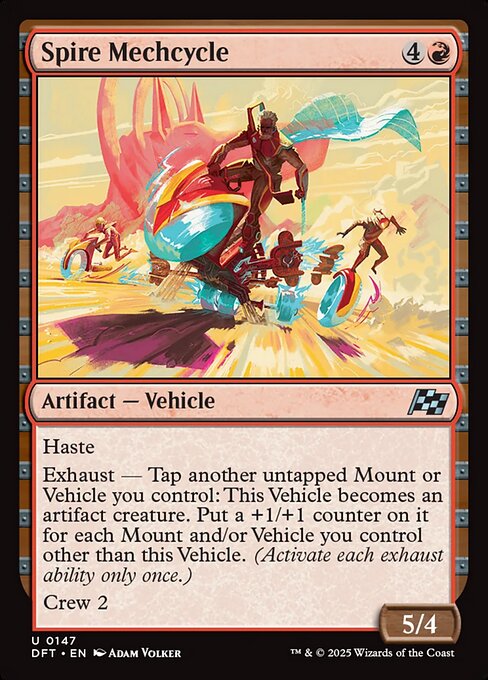
259. Spire Mechcycle
Rating2.0WeakWhy this rating?
Not good filler and often gets cut (2.0/10).
Why. A 5/4 Vehicle with haste for five and Crew 2. Its Exhaust makes it a creature by tapping another untapped Mount or Vehicle, and gives it a +1/+1 counter for each other Mount and/or Vehicle you control.
Risks. It often needs other Mounts or Vehicles to be worth its price. On its own it costs five and needs creatures to crew it.
In the draft. A card for Vehicle decks, taken late. Play it only if you already have several Mounts or Vehicles.
Results in the games of the set
When it is in hand, the deck wins 49.9% of its games (set average: 55.7%, 259th of 273 cards).
In the opening hand: 48.4% wins (54.9% on average).
Drawn during the game: 50.9% (56.3% on average).
When it is drawn, the deck wins 2.6 points less than when it is not.
When it is drafted, it is played 59% of the time (set average: 63%).
Taken as the first pick (39 drafts), it ends in the deck 77% of the time.
It is played mostly in R/W decks (27% of them).
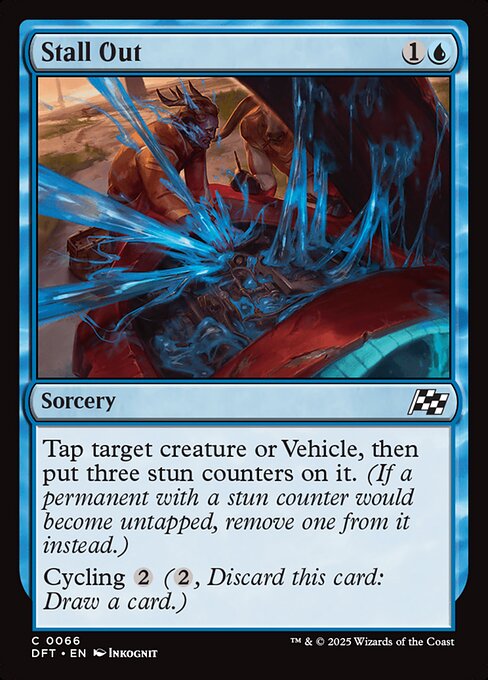
260. Stall Out
Rating2.0WeakWhy this rating?
Not good filler and often gets cut (2.0/10).
Why. A two-mana sorcery that taps a creature or Vehicle and puts three stun counters on it. It neutralizes the target for several turns, which opens a window to attack. Cycling makes it flexible.
Risks. The effect is only temporary and does not remove the target. It gains no lasting value and does not protect you from a long-term threat.
In the draft. A middling blue tempo card, taken late. It suits an aggressive deck that wants to win the race.
Results in the games of the set
When it is in hand, the deck wins 49.1% of its games (set average: 55.7%, 266th of 273 cards).
In the opening hand: 45.5% wins (54.9% on average).
Drawn during the game: 51.3% (56.3% on average).
When it is drawn, the deck wins 0.5 points less than when it is not.
When it is drafted, it is played only 14% of the time (set average: 63%): it almost always ends in the sideboard.
It is played mostly in R/U decks (30% of them).

261. Streaking Oilgorger
Rating2.0WeakWhy this rating?
Not good filler and often gets cut (2.0/10).
Why. A 3/3 with flying and haste for five, so it hits immediately. At max speed it has lifelink, which helps win a race.
Risks. Five mana for a 3/3 is pricey, and it dies to almost any removal. Max speed needs the opponent to lose life on several of your turns.
In the draft. A decent black playable, taken late. It fits an aggressive deck.
Results in the games of the set
When it is in hand, the deck wins 54.1% of its games (set average: 55.7%, 181st of 273 cards).
In the opening hand: 51.1% wins (54.9% on average).
Drawn during the game: 56.1% (56.3% on average).
When it is drawn, the deck wins 0.7 points more than when it is not.
When it is drafted, it is played 37% of the time (set average: 63%).
Taken among the first three picks (119 drafts), it ends in the deck 77% of the time.
It is played mostly in B/R decks (50% of them) and B/W (50%).

262. Unswerving Sloth
Rating2.0WeakWhy this rating?
Not good filler and often gets cut (2.0/10).
Why. A 5/5 Mount for five. When it attacks saddled, it gains indestructible and untaps all your creatures. That lets you attack with everything while keeping blockers.
Risks. Saddle 4 requires tapping creatures with total power 4 or more, which is heavy. Without it this is a plain 5/5.
In the draft. A big white body, taken late. It works best in a deck with several mid-power creatures.
Results in the games of the set
When it is in hand, the deck wins 53.0% of its games (set average: 55.7%, 210th of 273 cards).
In the opening hand: 51.7% wins (54.9% on average).
Drawn during the game: 53.8% (56.3% on average).
When it is drawn, the deck wins 0.2 points less than when it is not.
When it is drafted, it is played 57% of the time (set average: 63%).
Taken as the first pick (36 drafts), it ends in the deck 89% of the time.
It is played mostly in G/W decks (35% of them) and R/W (32%).

263. Walking Sarcophagus
Rating2.0WeakWhy this rating?
Not good filler and often gets cut (2.0/10).
Why. A colorless 2/1 for two. At max speed it becomes a 3/3, which makes it decent in an aggressive deck and easy to cast early.
Risks. With 1 toughness it dies to almost anything, and max speed is slow to reach. Without it, it stays a small body.
In the draft. Colorless filler, taken late. It fits any deck that needs a two-mana creature.
Results in the games of the set
When it is in hand, the deck wins 53.0% of its games (set average: 55.7%, 209th of 273 cards).
In the opening hand: 52.7% wins (54.9% on average).
Drawn during the game: 53.2% (56.3% on average).
When it is drawn, the deck wins 0.7 points less than when it is not.
When it is drafted, it is played 42% of the time (set average: 63%).
Taken among the first three picks (78 drafts), it ends in the deck 74% of the time.
It is played mostly in B/R decks (26% of them) and B/W (26%).
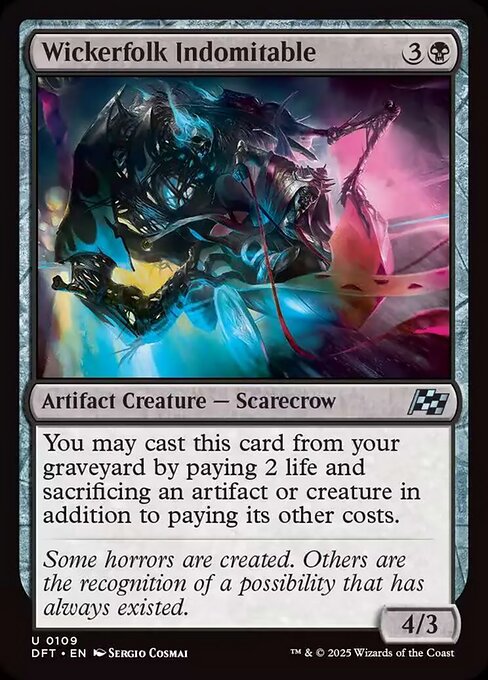 Rating2.0Weak
Why this rating?
Not good filler and often gets cut (2.0/10).
Why. A 4/3 for four that can be cast from your graveyard by paying 2 life and sacrificing an artifact or creature. It is a recurring threat as long as you have fuel to sacrifice.
Risks. Each recast costs a creature or artifact plus 2 life, on top of the four mana. That is expensive in cards and life.
In the draft. Black filler, taken late. It suits a deck with cheap artifacts or creatures to sacrifice.
Results in the games of the set
When it is in hand, the deck wins 50.5% of its games (set average: 55.7%, 255th of 273 cards).
In the opening hand: 48.3% wins (54.9% on average).
Drawn during the game: 52.0% (56.3% on average).
When it is drawn, the deck wins 2.5 points less than when it is not.
When it is drafted, it is played 25% of the time (set average: 63%).
Taken among the first three picks (67 drafts), it ends in the deck 57% of the time.

265. Wreck Remover
Rating2.0WeakWhy this rating?
Not good filler and often gets cut (2.0/10).
Why. A colorless 3/4 for four. When it enters or attacks, it exiles a card from a graveyard and you gain 1 life. The body is solid for the price and Cycling keeps it from rotting in hand.
Risks. The effect is minor in most games. It is a good body, nothing more.
In the draft. Colorless filler, taken in the middle or late in the pack. It fits nearly every deck.
Results in the games of the set
When it is in hand, the deck wins 52.6% of its games (set average: 55.7%, 221st of 273 cards).
In the opening hand: 50.3% wins (54.9% on average).
Drawn during the game: 54.1% (56.3% on average).
When it is drawn, the deck wins 0.0 points more than when it is not.
When it is drafted, it is played 26% of the time (set average: 63%).
Taken among the first three picks (38 drafts), it ends in the deck 58% of the time.
 Rating1.9Weak
Why this rating?
Not good filler and often gets cut (1.9/10).
Why. A 2/2 flyer for three. At max speed, you can pay three and exile it from your graveyard to draw a card. That gives it a last bit of value after it dies.
Risks. A 2/2 is easy to kill, and max speed is slow to reach. The draw costs three mana.
In the draft. Blue filler, taken late. It suits an aerial, aggressive deck.
Results in the games of the set
When it is in hand, the deck wins 51.3% of its games (set average: 55.7%, 242nd of 273 cards).
In the opening hand: 50.0% wins (54.9% on average).
Drawn during the game: 52.2% (56.3% on average).
When it is drawn, the deck wins 0.5 points less than when it is not.
When it is drafted, it is played 23% of the time (set average: 63%).
Taken among the first three picks (57 drafts), it ends in the deck 65% of the time.
It is played mostly in B/U decks (28% of them).

267. Alacrian Armory
Rating1.7WeakWhy this rating?
Not good filler and often gets cut (1.7/10).
Why. A four-mana artifact that gives your creatures +0/+1 and vigilance. At the beginning of combat on your turn it saddles a Mount or turns a Vehicle into a creature, without tapping any creature.
Risks. It adds no creature to the battlefield, and without Mounts or Vehicles half its effect disappears. The bonus is small for four mana.
In the draft. A specialist card, taken very late. Play it only in a white deck full of Mounts and Vehicles.
Results in the games of the set
When it is in hand, the deck wins 46.5% of its games (set average: 55.7%, 271st of 273 cards).
In the opening hand: 45.3% wins (54.9% on average).
Drawn during the game: 47.4% (56.3% on average).
When it is drawn, the deck wins 4.1 points less than when it is not.
When it is drafted, it is played 19% of the time (set average: 63%).
Taken among the first three picks (40 drafts), it ends in the deck 63% of the time.

268. Reckless Velocitaur
Rating1.5WeakWhy this rating?
Almost unplayable and mostly sideboard material (1.5/10).
Why. A 3/3 for four that gives +2/+0 and trample to a Mount or Vehicle it saddles or crews during your main phase. That makes attacks more dangerous.
Risks. It is only worth anything if a Mount or Vehicle is there to activate. Otherwise it is a four-mana 3/3 with no effect.
In the draft. A specialist card, taken very late. Play it only in a red deck with several Mounts and Vehicles.
Results in the games of the set
When it is in hand, the deck wins 49.3% of its games (set average: 55.7%, 264th of 273 cards).
In the opening hand: 47.7% wins (54.9% on average).
Drawn during the game: 50.5% (56.3% on average).
When it is drawn, the deck wins 2.5 points less than when it is not.
When it is drafted, it is played 25% of the time (set average: 63%).
Taken among the first three picks (44 drafts), it ends in the deck 66% of the time.
269. Aetherjacket
Rating1.4WeakWhy this rating?
Almost unplayable and mostly sideboard material (1.4/10).
Why. Colorless filler that fits in any deck: a 2/1 with flying and vigilance for three mana that can attack in the air and still stay back to block. The sacrifice ability is a small bonus when the opponent plays an annoying artifact.
Risks. It has one toughness, so any damage effect or an air blocker kills it. The ability works only at sorcery speed, costs two mana and hits only another artifact, so it is often dead text.
In the draft. A late-pack pick, good when you are short on three-drops or evasive attackers. Never take it over a solid card in your colors.
Results in the games of the set
When it is in hand, the deck wins 50.9% of its games (set average: 55.7%, 252nd of 273 cards).
In the opening hand: 49.2% wins (54.9% on average).
Drawn during the game: 52.1% (56.3% on average).
When it is drawn, the deck wins 0.9 points less than when it is not.
When it is drafted, it is played 29% of the time (set average: 63%).
Taken among the first three picks (35 drafts), it ends in the deck 63% of the time.
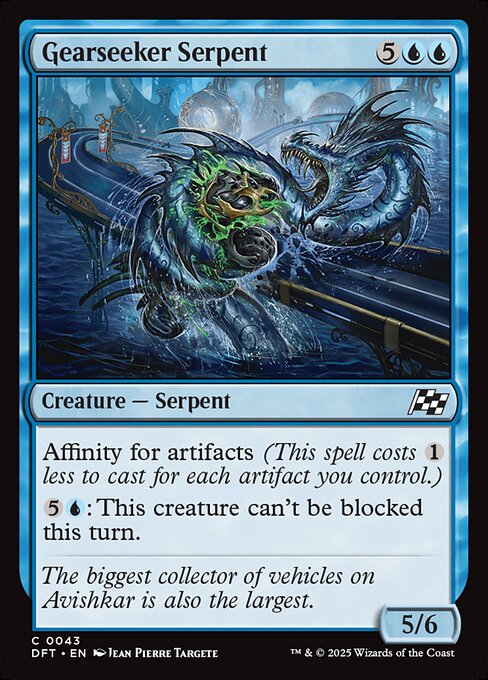
270. Gearseeker Serpent
Rating1.4WeakWhy this rating?
Almost unplayable and mostly sideboard material (1.4/10).
Why. A big 5/6 body that becomes affordable in an artifact-heavy deck thanks to affinity. Late in the game, the six-mana ability makes it unblockable and it can close the game by itself.
Risks. Without artifacts it costs seven mana for a creature with no immediate effect, which is very slow. Using its ability takes your whole turn, and a removal spell stops it cold.
In the draft. Only playable if you already have several artifacts, such as Vehicles and artifact creatures. Take it mid to late in the pack as a top-end finisher, not as a build-around.
Results in the games of the set
When it is in hand, the deck wins 52.4% of its games (set average: 55.7%, 223rd of 273 cards).
In the opening hand: 48.5% wins (54.9% on average).
Drawn during the game: 54.7% (56.3% on average).
When it is drawn, the deck wins 0.6 points more than when it is not.
When it is drafted, it is played 41% of the time (set average: 63%).
Taken among the first three picks (137 drafts), it ends in the deck 74% of the time.
It is played mostly in B/U decks (49% of them) and U/W (46%).
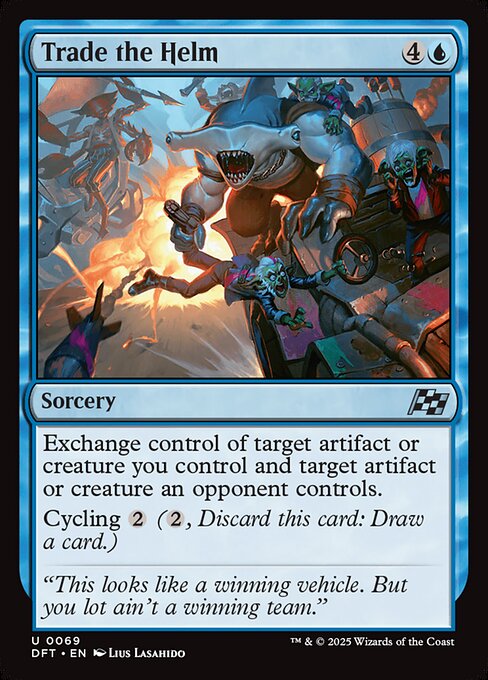
271. Trade the Helm
Rating1.4WeakWhy this rating?
Almost unplayable and mostly sideboard material (1.4/10).
Why. A control swap: you hand over your worst artifact or creature and take the opponent's best one. With a mediocre creature to give, the gain is huge, and the two-mana Cycling keeps it from rotting in your hand.
Risks. Five mana at sorcery speed, and you need both something to give and a worthwhile target across the table. If the opponent can get their permanent back, or your offering is nearly as good, the trade is poor.
In the draft. A situational card, best as a single copy in a blue deck. Take it after your removal and your good creatures.
Results in the games of the set
When it is in hand, the deck wins 51.7% of its games (set average: 55.7%, 235th of 273 cards).
In the opening hand: 47.8% wins (54.9% on average).
Drawn during the game: 54.1% (56.3% on average).
When it is drawn, the deck wins 0.9 points more than when it is not.
When it is drafted, it is played 44% of the time (set average: 63%).
Taken among the first three picks (134 drafts), it ends in the deck 69% of the time.
It is played about as much in every archetype.
Intrinsic ratings: they do not take into account the cards you have already picked. They matter most for the first pick of the first pack.