Card ranking · Teenage Mutant Ninja Turtles (TMT)
← Teenage Mutant Ninja Turtles190 cards
- Bomb > 8.4
- Very good ≥ 7.2
- Good ≥ 6.2
- Playable ≥ 5.0
- Weak < 5.0
Ratings are out of 10. They combine experts' opinions, the statistics of thousands of drafts by experienced players (when a card is taken, played, and the wins of the decks that play it) and what is printed on the card. Click a card to enlarge it.
 Rating9.4Bomb
Why this rating?
The best card of the set (9.4/10).
Why. For a single black mana you get a flier, a drain of one life and a scry. It slots into any curve, starts attacking in the air the next turn and smooths your draws right as it lands.
Risks. It only deals one damage a turn and dies to any damage spell. Late in the game the enter effect is minor.
In the draft. One of the best picks in the set; put it in any black deck without hesitation. It is best in an aggressive plan but fine everywhere.
Results in the games of the set
When it is in hand, the deck wins 64.0% of its games (set average: 57.7%, 6th of 184 cards).
In the opening hand: 68.1% wins (56.4% on average).
Drawn during the game: 61.0% (58.6% on average).
When it is drawn, the deck wins 7.4 points more than when it is not.
When it is drafted, it is played 87% of the time (set average: 61%).
Taken as the first pick (110 drafts), it ends in the deck 95% of the time.
It is played mostly in B/W decks (44% of them) and B/R (27%).
 Rating9.2Bomb
Why this rating?
One of the 3 best cards of the set (9.2/10).
Why. Four mana buys two bodies: the creature and a 2/2 Mutant token. Since the token enters after it, it already triggers Alliance and you put a +1/+1 counter on the creature of your choice, and every creature after that keeps growing your board.
Risks. The 2/1 body is fragile and the cost needs two white mana. With no creatures behind it, Alliance does nothing.
In the draft. A very good uncommon for creature-heavy white decks. Take it high and look for plenty of cheap bodies to go with it.
Results in the games of the set
When it is in hand, the deck wins 65.0% of its games (set average: 57.7%, 3rd of 184 cards).
In the opening hand: 66.3% wins (56.4% on average).
Drawn during the game: 64.1% (58.6% on average).
When it is drawn, the deck wins 8.4 points more than when it is not.
When it is drafted, it is played 90% of the time (set average: 61%).
Taken as the first pick (162 drafts), it ends in the deck 92% of the time.
It is played mostly in G/W decks (42% of them) and R/W (41%).
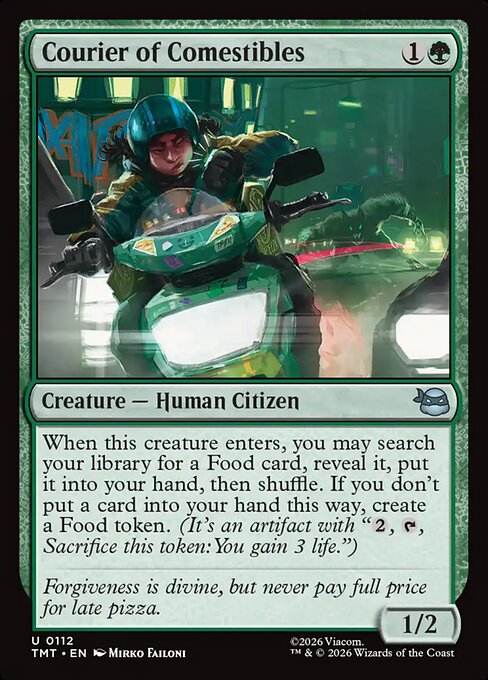 Rating9.0Bomb
Why this rating?
One of the 3 best cards of the set (9.0/10).
Why. A two-drop that never loses value: either you fetch a Food card from your library or you create a Food token. Either way the 1/2 body is a bonus and the card replaces itself.
Risks. The body is small and does not win games alone. With no Food card in your deck you just get a Food token: fine, nothing more.
In the draft. A very good support uncommon for green, worth taking fairly high. Good removal or a quality creature comes first, but it easily earns a slot.
Results in the games of the set
When it is in hand, the deck wins 62.8% of its games (set average: 57.7%, 9th of 184 cards).
In the opening hand: 61.7% wins (56.4% on average).
Drawn during the game: 63.6% (58.6% on average).
When it is drawn, the deck wins 8.3 points more than when it is not.
When it is drafted, it is played 84% of the time (set average: 61%).
Taken as the first pick (125 drafts), it ends in the deck 87% of the time.
It is played mostly in B/G decks (60% of them) and G/U (52%).
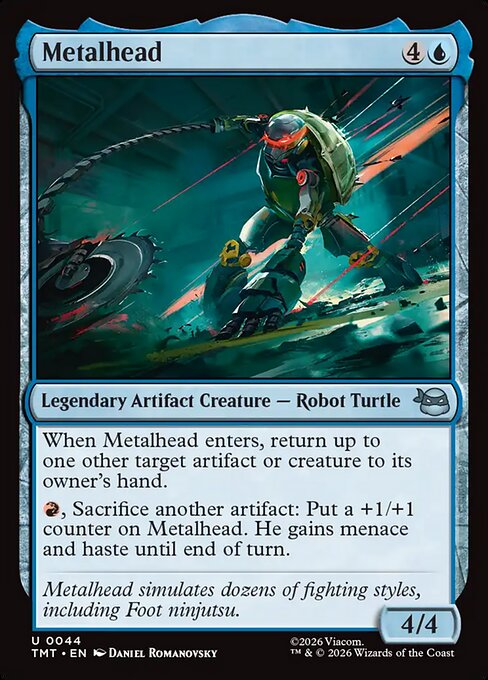
4. Metalhead
Rating8.9BombWhy this rating?
One of the 10 best cards of the set (8.9/10).
Why. A 4/4 for five that bounces an artifact or another creature on arrival, a clean tempo swing against a big threat. With red you can sacrifice artifacts to grow it and give it haste and menace.
Risks. The ability needs a red mana: the enter effect alone is fine, but the full power needs artifacts to sacrifice. The bounce is tempo, not removal.
In the draft. A very good uncommon for blue-red. In other pairings it is still a tempo 4/4, just less special.
Results in the games of the set
When it is in hand, the deck wins 62.2% of its games (set average: 57.7%, 15th of 184 cards).
In the opening hand: 59.3% wins (56.4% on average).
Drawn during the game: 63.9% (58.6% on average).
When it is drawn, the deck wins 6.6 points more than when it is not.
When it is drafted, it is played 92% of the time (set average: 61%).
Taken as the first pick (147 drafts), it ends in the deck 95% of the time.
It is played mostly in R/U decks (51% of them) and G/U (40%).

5. Casey Jones, Jury-Rig Justiciar
Rating8.8BombWhy this rating?
One of the 10 best cards of the set (8.8/10).
Why. A two-drop with haste that looks at the top four cards and can reveal an artifact card to put in your hand. In an artifact-heavy deck it is an immediate attacker that can also replace itself.
Risks. With few artifacts it is just a 2/1 haste, and the rest going to the bottom in random order costs you a bit of control. The body is fragile.
In the draft. Take it in a red deck with a healthy artifact count, especially blue-red. Without that it drops down your list.
Results in the games of the set
When it is in hand, the deck wins 61.4% of its games (set average: 57.7%, 23rd of 184 cards).
In the opening hand: 61.6% wins (56.4% on average).
Drawn during the game: 61.2% (58.6% on average).
When it is drawn, the deck wins 4.4 points more than when it is not.
When it is drafted, it is played 83% of the time (set average: 61%).
Taken as the first pick (81 drafts), it ends in the deck 93% of the time.
It is played mostly in R/U decks (54% of them) and R/W (39%).
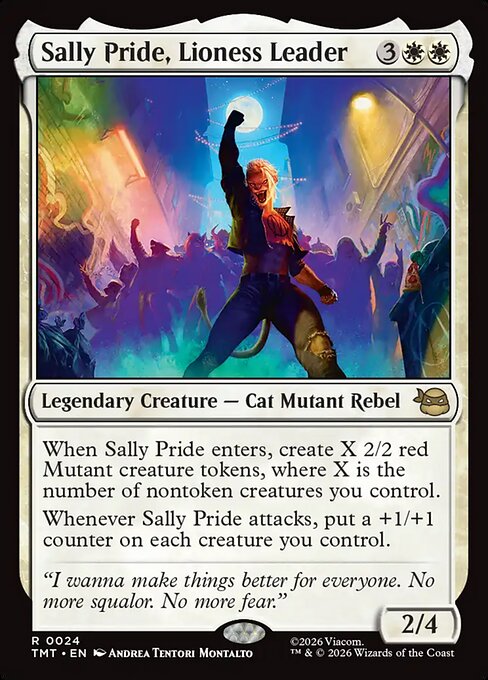
6. Sally Pride, Lioness Leader
Rating8.7BombWhy this rating?
One of the 10 best cards of the set (8.7/10).
Why. She enters with as many 2/2 Mutant tokens as you control nontoken creatures, herself included. Whenever she attacks, each of your creatures gets a +1/+1 counter: on a developed board the game turns in one swing.
Risks. Alone on an empty board she makes only one token. She costs five with two white mana, and removal on her in response to the enter trigger leaves you fewer tokens.
In the draft. A very strong rare; take it high in any white creature deck. Keep plenty of cheap creatures around to maximize the enter effect.
Results in the games of the set
When it is in hand, the deck wins 69.8% of its games (set average: 57.7%, 1st of 184 cards).
In the opening hand: 69.0% wins (56.4% on average).
Drawn during the game: 70.4% (58.6% on average).
When it is drawn, the deck wins 14.8 points more than when it is not.
When it is drafted, it is played 91% of the time (set average: 61%).
Taken as the first pick (42 drafts), it ends in the deck 98% of the time.
It is played about as much in every archetype.
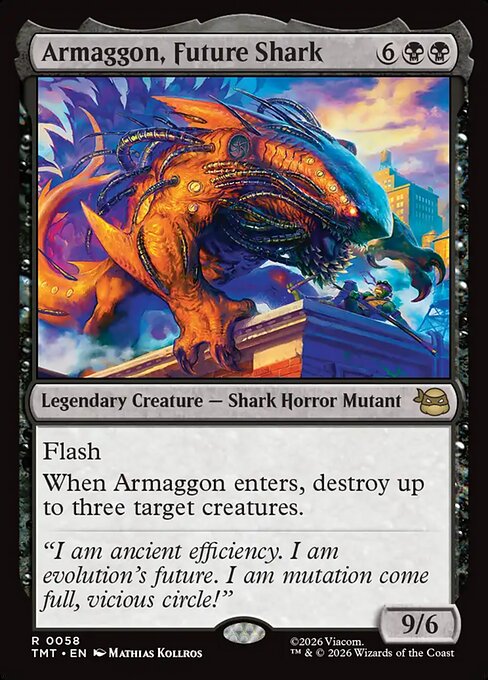 Rating8.6Bomb
Why this rating?
One of the 10 best cards of the set (8.6/10).
Why. A 9/6 with flash that destroys up to three creatures when it enters. Once you reach eight mana it swings the game, even on your opponent's turn.
Risks. Eight mana is expensive: you have to survive until then, and a fast deck will punish you. It also needs two black mana.
In the draft. A formidable finisher, but not an automatic pick. Excellent in a slower black deck with ways to survive and ramp; in aggro, let it go.
Results in the games of the set
When it is in hand, the deck wins 64.7% of its games (set average: 57.7%, 4th of 184 cards).
In the opening hand: 59.1% wins (56.4% on average).
Drawn during the game: 67.8% (58.6% on average).
When it is drawn, the deck wins 11.4 points more than when it is not.
When it is drafted, it is played 87% of the time (set average: 61%).
Taken as the first pick (44 drafts), it ends in the deck 80% of the time.
It is played about as much in every archetype.
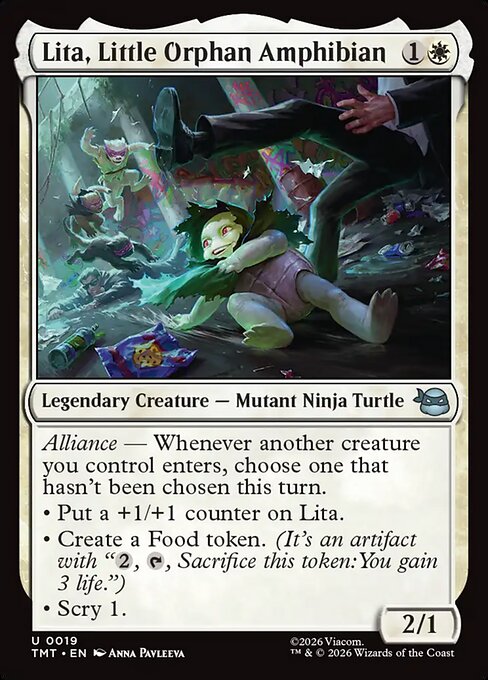
8. Lita, Little Orphan Amphibian
Rating8.5BombWhy this rating?
One of the 10 best cards of the set (8.5/10).
Why. A two-drop that gets value out of every creature you play: +1/+1 counter, Food or scry, with a different mode each time within the same turn. With a cheap creature curve it pays off every turn.
Risks. On its own it is a vanilla 2/1. You need creatures arriving regularly, and it dies easily before it generates value.
In the draft. Very good in a white deck with many creatures, especially a low-curve aggro build. Weaker in slow decks or ones short on bodies.
Results in the games of the set
When it is in hand, the deck wins 58.8% of its games (set average: 57.7%, 54th of 184 cards).
In the opening hand: 61.6% wins (56.4% on average).
Drawn during the game: 56.6% (58.6% on average).
When it is drawn, the deck wins 1.8 points more than when it is not.
When it is drafted, it is played 92% of the time (set average: 61%).
Taken as the first pick (100 drafts), it ends in the deck 97% of the time.
It is played mostly in B/W decks (42% of them) and R/W (36%).
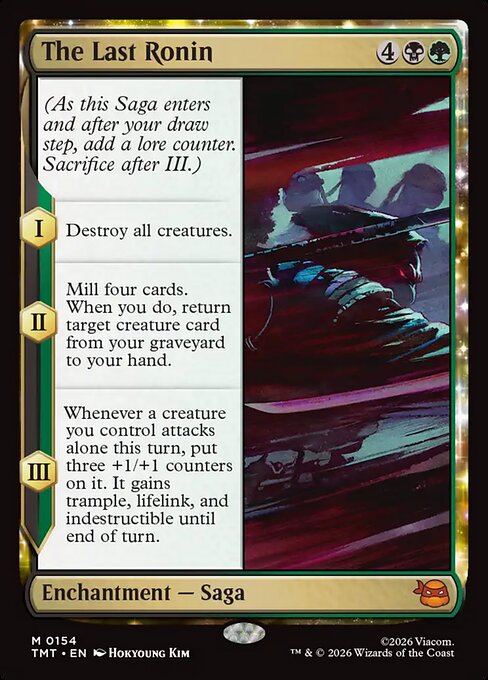 Rating8.3Very good
Why this rating?
One of the 10 best cards of the set (8.4/10).
Why. A three-chapter Saga: a sweep of every creature, then you mill four cards and return a creature card from your graveyard to your hand, then a lone attacker gets three +1/+1 counters, trample, lifelink and indestructible. One permanent flips a whole game.
Risks. Six mana, two colors, and the sweep also hits your own creatures. If you are ahead on board, chapter one costs you more than it gives.
In the draft. A bomb for a black-green deck that can play control. Take it high, but do not force it if your deck is built around creatures.
Results in the games of the set
When it is in hand, the deck wins 69.5% of its games (set average: 57.7%, 2nd of 184 cards).
In the opening hand: 66.2% wins (56.4% on average).
Drawn during the game: 71.6% (58.6% on average).
When it is drawn, the deck wins 17.1 points more than when it is not.
When it is drafted, it is played 91% of the time (set average: 61%).
Taken among the first three picks (100 drafts), it ends in the deck 90% of the time.
It is played about as much in every archetype.
 Rating8.3Very good
Why this rating?
One of the 10 best cards of the set (8.3/10).
Why. A one-mana 2/1 that can gain first strike for two. Cast through Sneak (five mana), it enters tapped and attacking and your whole team gets +2/+0 that turn: an attack that can end the game.
Risks. A one-mana 2/1 is fragile, and Sneak requires returning an unblocked attacker to hand, which costs tempo. Without a good attack under way you just have a small body.
In the draft. A very good uncommon for an aggressive white deck, especially white-black. Take it high if you already have a base of cheap creatures.
Results in the games of the set
When it is in hand, the deck wins 59.2% of its games (set average: 57.7%, 45th of 184 cards).
In the opening hand: 62.3% wins (56.4% on average).
Drawn during the game: 56.8% (58.6% on average).
When it is drawn, the deck wins 1.4 points more than when it is not.
When it is drafted, it is played 89% of the time (set average: 61%).
Taken as the first pick (72 drafts), it ends in the deck 92% of the time.
It is played mostly in B/W decks (47% of them) and R/W (39%).
 Rating8.1Very good
Why this rating?
One of the very best rares of the format (8.1/10).
Why. A 1/5 that blocks well and, at your end step, draws a card for each card type among spells you cast that turn. A creature plus an instant, or an artifact plus a sorcery, draws two.
Risks. If you do not cast several types of spells in one turn, it draws one card or none. It barely attacks and needs a well-rounded deck.
In the draft. Good in a blue deck with varied card types, especially blue-red. Take it fairly high, but not over a removal.
Results in the games of the set
When it is in hand, the deck wins 64.5% of its games (set average: 57.7%, 5th of 184 cards).
In the opening hand: 65.0% wins (56.4% on average).
Drawn during the game: 64.2% (58.6% on average).
When it is drawn, the deck wins 11.0 points more than when it is not.
When it is drafted, it is played 94% of the time (set average: 61%).
Taken as the first pick (55 drafts), it ends in the deck 87% of the time.
It is played about as much in every archetype.
 Rating8.0Very good
Why this rating?
One of the very best uncommons of the format (8.0/10).
Why. A 2/1 flier for three that exiles another creature when it enters. It comes back at end of turn unless you pay three and a black mana: early it is a tempo play, late it is removal on a flying body.
Risks. Paying costs four more mana than the spell itself, so the permanent exile comes late and only with black. Otherwise the creature returns. The body is fragile.
In the draft. Very good in white-black, where it becomes removal on a flier. Outside black it is only a tempo effect.
Results in the games of the set
When it is in hand, the deck wins 58.5% of its games (set average: 57.7%, 59th of 184 cards).
In the opening hand: 56.8% wins (56.4% on average).
Drawn during the game: 59.7% (58.6% on average).
When it is drawn, the deck wins 0.5 points more than when it is not.
When it is drafted, it is played 88% of the time (set average: 61%).
Taken as the first pick (99 drafts), it ends in the deck 93% of the time.
It is played mostly in B/W decks (46% of them) and G/W (29%).
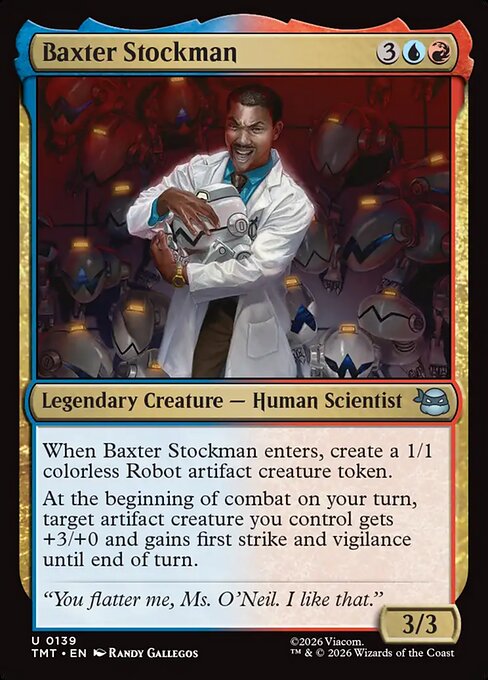
13. Baxter Stockman
Rating7.9Very goodWhy this rating?
One of the very best uncommons of the format (7.9/10).
Why. A 3/3 that creates a 1/1 Robot token on entering, then gives +3/+0, first strike and vigilance to an artifact creature at the beginning of combat. The Robot token becomes a 4/1 first striker that attacks at little risk every turn.
Risks. It needs blue and red and costs five. Without an artifact creature its ability does nothing, and removal on the token leaves it without a target.
In the draft. A good uncommon for blue-red artifact decks. In other decks, let it go.
Results in the games of the set
When it is in hand, the deck wins 59.8% of its games (set average: 57.7%, 37th of 184 cards).
In the opening hand: 56.5% wins (56.4% on average).
Drawn during the game: 61.7% (58.6% on average).
When it is drawn, the deck wins 4.0 points more than when it is not.
When it is drafted, it is played 83% of the time (set average: 61%).
Taken as the first pick (83 drafts), it ends in the deck 90% of the time.
It is played mostly in R/U decks (55% of them).

14. Ooze Spill
Rating7.8Very goodWhy this rating?
One of the very best uncommons of the format (7.8/10).
Why. An unconditional three-mana counterspell that leaves you a Mutagen token. You keep some value even when countering something small, because the Mutagen can later grow a creature.
Risks. You must leave three mana open, two of them blue, which costs tempo. In draft a reactive counterspell is weaker than removal.
In the draft. A good card for a blue-red control deck. Do not take it over removal or your best creatures.
Results in the games of the set
When it is in hand, the deck wins 60.6% of its games (set average: 57.7%, 29th of 184 cards).
In the opening hand: 57.9% wins (56.4% on average).
Drawn during the game: 62.2% (58.6% on average).
When it is drawn, the deck wins 5.0 points more than when it is not.
When it is drafted, it is played 71% of the time (set average: 61%).
Taken as the first pick (58 drafts), it ends in the deck 84% of the time.
It is played mostly in R/U decks (47% of them) and G/U (32%).

15. The Last Ronin's Technique
Rating7.7Very goodWhy this rating?
One of the very best uncommons of the format (7.7/10).
Why. An instant that creates three 1/1 Ninja Turtle Spirit tokens, as ambush blockers or at the end of your opponent's turn. With Sneak it costs two and the tokens enter tapped and attacking, at the price of the attacker you return to hand.
Risks. Sneak costs tempo, since you must return an unblocked attacker to hand. Otherwise four mana for three small bodies is fine, nothing more.
In the draft. Good in a white creature deck, notably white-black. Take it in the middle of your white picks.
Results in the games of the set
When it is in hand, the deck wins 59.5% of its games (set average: 57.7%, 41st of 184 cards).
In the opening hand: 59.6% wins (56.4% on average).
Drawn during the game: 59.4% (58.6% on average).
When it is drawn, the deck wins 1.4 points more than when it is not.
When it is drafted, it is played 89% of the time (set average: 61%).
Taken as the first pick (86 drafts), it ends in the deck 95% of the time.
It is played mostly in B/W decks (42% of them) and R/W (37%).
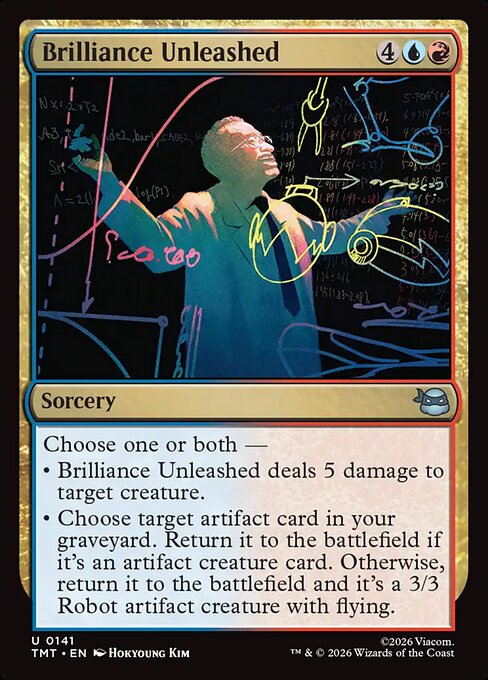 Rating7.6Very good
Why this rating?
One of the very best uncommons of the format (7.6/10).
Why. A six-mana sorcery that deals 5 damage to a creature and can also bring back an artifact from your graveyard, as a 3/3 flying Robot if it was not already a creature. Removal and a body in one card.
Risks. Six mana and two colors is heavy, and the second mode needs an artifact in your graveyard. The first mode is enough but slow.
In the draft. A good removal in blue-red. Take it fairly high in those colors, but do not force it elsewhere.
Results in the games of the set
When it is in hand, the deck wins 62.2% of its games (set average: 57.7%, 14th of 184 cards).
In the opening hand: 57.6% wins (56.4% on average).
Drawn during the game: 64.9% (58.6% on average).
When it is drawn, the deck wins 5.7 points more than when it is not.
When it is drafted, it is played 89% of the time (set average: 61%).
Taken as the first pick (160 drafts), it ends in the deck 93% of the time.
It is played mostly in R/U decks (59% of them) and G/U (30%).
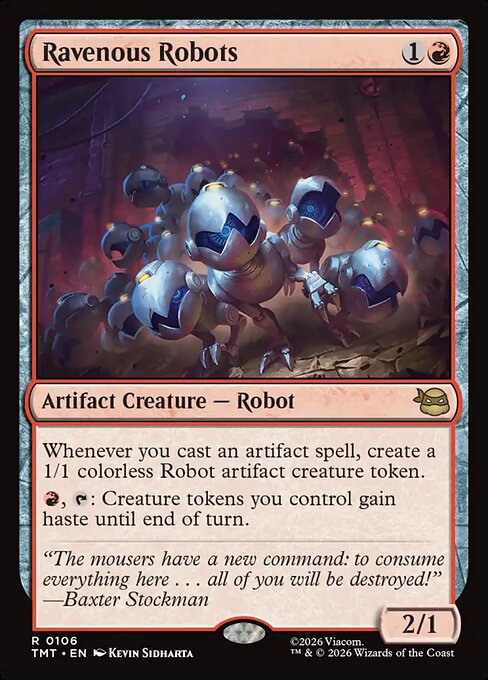
17. Ravenous Robots
Rating7.6Very goodWhy this rating?
One of the very best rares of the format (7.6/10).
Why. A two-mana 2/1 that creates a 1/1 Robot token each time you cast an artifact spell. In an artifact deck it keeps adding bodies to your board, and for a red mana it gives haste to your creature tokens.
Risks. Without artifacts it is a vanilla 2/1. It is fragile and does nothing until you cast artifact spells.
In the draft. A good rare in red artifact decks, especially blue-red. Outside that plan it is mediocre.
Results in the games of the set
When it is in hand, the deck wins 61.6% of its games (set average: 57.7%, 20th of 184 cards).
In the opening hand: 65.2% wins (56.4% on average).
Drawn during the game: 59.3% (58.6% on average).
When it is drawn, the deck wins 6.9 points more than when it is not.
When it is drafted, it is played 90% of the time (set average: 61%).
Taken as the first pick (40 drafts), it ends in the deck 93% of the time.
It is played about as much in every archetype.
 Rating7.6Very good
Why this rating?
One of the very best uncommons of the format (7.6/10).
Why. A two-mana 1/3 with menace, or one black mana through Sneak, that gives other Ninjas you control +1/+1. It anchors a Ninja deck: a good defensive body and a cheap surprise attacker.
Risks. Alone, it lacks power. The bonus only matters if you run enough Ninjas, and Sneak costs tempo.
In the draft. Good in a black deck with Ninjas, notably white-black. Without Ninjas it is a decent body, not a priority.
Results in the games of the set
When it is in hand, the deck wins 59.0% of its games (set average: 57.7%, 51st of 184 cards).
In the opening hand: 60.5% wins (56.4% on average).
Drawn during the game: 57.8% (58.6% on average).
When it is drawn, the deck wins 1.6 points more than when it is not.
When it is drafted, it is played 85% of the time (set average: 61%).
Taken as the first pick (59 drafts), it ends in the deck 95% of the time.
It is played mostly in B/W decks (52% of them).
 Rating7.5Very good
Why this rating?
One of the very best mythics of the format (7.5/10).
Why. A two-mana 1/3 that gives deathtouch to your attacking Ninjas and creates a 1/1 Ninja token when it connects. Its Sneak cost equals its normal cost, so it can enter tapped and attacking for the same price. With five Ninjas, the damaged player loses half their life.
Risks. Its main effect needs to connect with the player, and it only has 1 power. It is fragile.
In the draft. A good mythic in a white-black Ninja deck. Outside those colors it is unplayable.
Results in the games of the set
When it is in hand, the deck wins 62.7% of its games (set average: 57.7%, 11th of 184 cards).
In the opening hand: 65.5% wins (56.4% on average).
Drawn during the game: 60.7% (58.6% on average).
When it is drawn, the deck wins 6.7 points more than when it is not.
When it is drafted, it is played 88% of the time (set average: 61%).
Taken among the first three picks (52 drafts), it ends in the deck 83% of the time.
It is played about as much in every archetype.
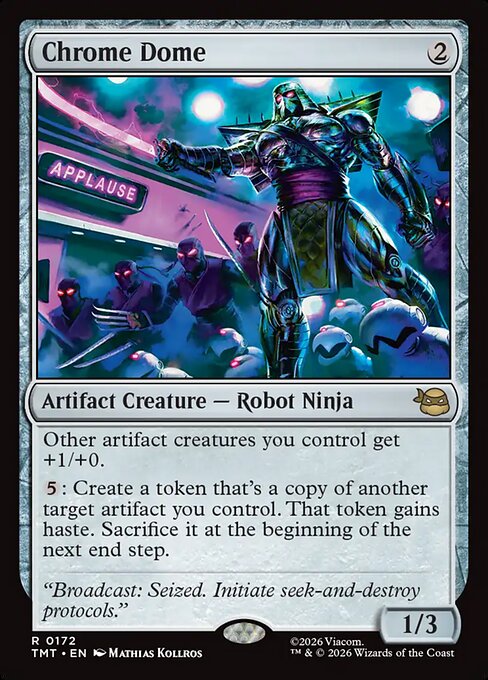
20. Chrome Dome
Rating7.4Very goodWhy this rating?
A very good rare of the format (7.4/10).
Why. A two-mana 1/3 artifact creature that gives other artifact creatures you control +1/+0. Later, five mana copies another artifact for a turn, a mana sink in the late game.
Risks. Without other artifact creatures it is a plain 1/3. The copy is expensive and only worthwhile with good artifacts.
In the draft. A useful rare in artifact decks, especially blue-red. Otherwise it is playable as a colorless body.
Results in the games of the set
When it is in hand, the deck wins 60.9% of its games (set average: 57.7%, 28th of 184 cards).
In the opening hand: 58.1% wins (56.4% on average).
Drawn during the game: 62.8% (58.6% on average).
When it is drawn, the deck wins 5.8 points more than when it is not.
When it is drafted, it is played 94% of the time (set average: 61%).
Taken as the first pick (48 drafts), it ends in the deck 96% of the time.
It is played about as much in every archetype.
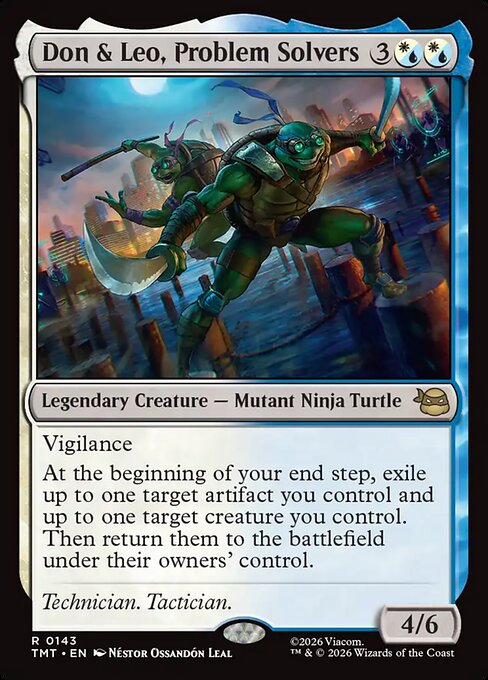
21. Don & Leo, Problem Solvers
Rating7.4Very goodWhy this rating?
A very good rare of the format (7.4/10).
Why. A 4/6 with vigilance that, at your end step, exiles and returns an artifact and a creature you control, of your choice. Every enter effect is replayed, and the sturdy body blocks as well as it attacks.
Risks. You need creatures or artifacts with enter effects for the ability to matter, and an exiled token does not come back. Five mana with a hybrid white or blue cost.
In the draft. A good body in white or blue decks, stronger with enter effects. The hybrid cost makes it easy to cast.
Results in the games of the set
When it is in hand, the deck wins 62.8% of its games (set average: 57.7%, 10th of 184 cards).
In the opening hand: 61.6% wins (56.4% on average).
Drawn during the game: 63.5% (58.6% on average).
When it is drawn, the deck wins 8.9 points more than when it is not.
When it is drafted, it is played 99% of the time (set average: 61%).
Taken as the first pick (33 drafts), it ends in the deck 97% of the time.
It is played about as much in every archetype.
 Rating7.4Very good
Why this rating?
A solid uncommon of the format (7.4/10).
Why. A one-mana 0/2 flier that leaves a Food behind when it leaves the battlefield. It blocks small fliers and can chump block for a bit of value.
Risks. It deals no damage and has little board impact. Mostly filler.
In the draft. A late pick, only for white decks short on small bodies. Avoid taking it early.
Results in the games of the set
When it is in hand, the deck wins 57.3% of its games (set average: 57.7%, 86th of 184 cards).
In the opening hand: 60.5% wins (56.4% on average).
Drawn during the game: 54.6% (58.6% on average).
When it is drawn, the deck wins 0.7 points less than when it is not.
When it is drafted, it is played 75% of the time (set average: 61%).
Taken among the first three picks (161 drafts), it ends in the deck 86% of the time.
It is played mostly in B/W decks (55% of them).

23. Frog Butler
Rating7.4Very goodWhy this rating?
One of the best commons of the format (7.4/10).
Why. A two-mana 1/1 deathtouch that taps for a mana of any color. It ramps, fixes colors and deters attacks. For two mana it gains reach against fliers.
Risks. It dies easily and deals little damage. Tapping for mana means it cannot block while it stays tapped.
In the draft. A good common for three-color green decks. Take it fairly high if you want a stable mana base.
Results in the games of the set
When it is in hand, the deck wins 61.4% of its games (set average: 57.7%, 22nd of 184 cards).
In the opening hand: 62.4% wins (56.4% on average).
Drawn during the game: 60.7% (58.6% on average).
When it is drawn, the deck wins 8.0 points more than when it is not.
When it is drafted, it is played 92% of the time (set average: 61%).
Taken as the first pick (254 drafts), it ends in the deck 96% of the time.
It is played mostly in B/G decks (79% of them) and G/U (78%).
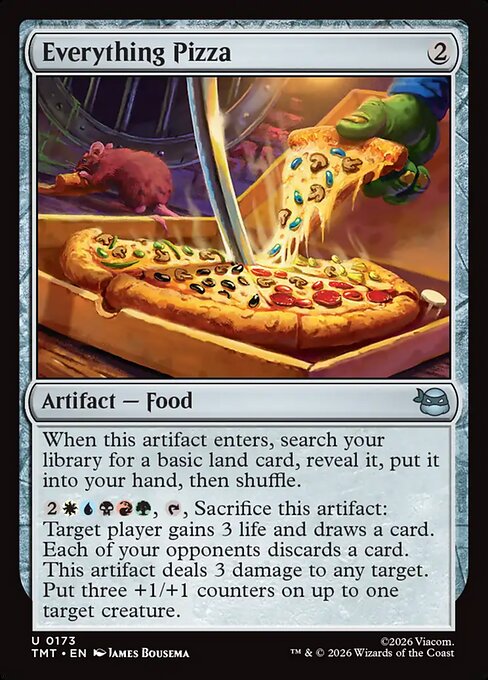
24. Everything Pizza
Rating7.4Very goodWhy this rating?
A solid uncommon of the format (7.4/10).
Why. A two-mana Food artifact that searches for a basic land card and puts it in your hand: a card that replaces itself and helps your colors. The five-color ability is a bonus for decks playing several colors.
Risks. It does nothing on board and the ability needs seven mana across all five colors. In a two-color deck it is just a card that finds a land.
In the draft. Useful in decks with three or more colors. Do not take it over good creatures or removal.
Results in the games of the set
When it is in hand, the deck wins 64.0% of its games (set average: 57.7%, 8th of 184 cards).
In the opening hand: 61.2% wins (56.4% on average).
Drawn during the game: 65.9% (58.6% on average).
When it is drawn, the deck wins 10.8 points more than when it is not.
When it is drafted, it is played 80% of the time (set average: 61%).
Taken as the first pick (114 drafts), it ends in the deck 93% of the time.
It is played mostly in G/U decks (59% of them) and B/G (43%).

25. Kitsune, Dragon's Daughter
Rating7.3Very goodWhy this rating?
A very good rare of the format (7.3/10).
Why. A 6/6 with vigilance that swaps control of two other creatures controlled by different players, when it enters and each time it deals combat damage to a player. You give away your worst creature and take their best.
Risks. Six mana with two blue. The swap needs an opposing creature and one of yours other than it: without them it does nothing.
In the draft. A powerful rare for a slower blue deck. Take it high, but keep some defense to survive until then.
Results in the games of the set
When it is in hand, the deck wins 61.8% of its games (set average: 57.7%, 19th of 184 cards).
In the opening hand: 57.5% wins (56.4% on average).
Drawn during the game: 64.1% (58.6% on average).
When it is drawn, the deck wins 7.2 points more than when it is not.
When it is drafted, it is played 90% of the time (set average: 61%).
Taken as the first pick (61 drafts), it ends in the deck 93% of the time.
It is played about as much in every archetype.

26. Agent Bishop, Man in Black
Rating7.2Very goodWhy this rating?
A very good rare of the format (7.2/10).
Why. At the beginning of your combat, two creatures get a permanent +1/+1 counter. In a few turns your board outgrows your opponent's without any extra cards.
Risks. The 1/2 body is fragile, and the ability depends on having creatures to upgrade. Early removal on it slows everything down.
In the draft. A solid rare for a white creature deck. Take it fairly high, especially in white-black.
Results in the games of the set
When it is in hand, the deck wins 64.0% of its games (set average: 57.7%, 7th of 184 cards).
In the opening hand: 65.5% wins (56.4% on average).
Drawn during the game: 63.0% (58.6% on average).
When it is drawn, the deck wins 8.9 points more than when it is not.
When it is drafted, it is played 95% of the time (set average: 61%).
Taken as the first pick (32 drafts), it ends in the deck 97% of the time.
It is played about as much in every archetype.
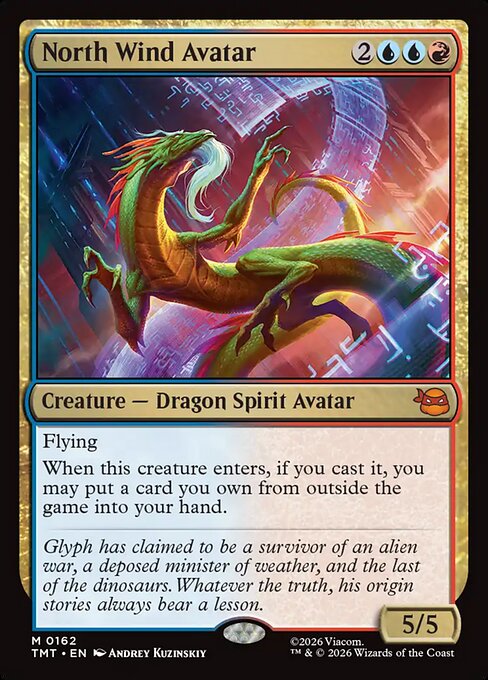 Rating7.2Very good
Why this rating?
A very good mythic of the format (7.2/10).
Why. A five-mana 5/5 flier: an efficient aerial threat that dominates combat. Its effect on a card from outside the game depends on the event and often does nothing online: do not count on it, the body is enough.
Risks. It needs two blue mana and a red one, which ties it to blue-red. Removal is its only real answer.
In the draft. A good finisher for a blue-red deck. Take it in those colors, but do not overvalue it.
Results in the games of the set
When it is in hand, the deck wins 62.0% of its games (set average: 57.7%, 16th of 184 cards).
In the opening hand: 58.1% wins (56.4% on average).
Drawn during the game: 64.2% (58.6% on average).
When it is drawn, the deck wins 7.4 points more than when it is not.
When it is drafted, it is played 87% of the time (set average: 61%).
Taken among the first three picks (76 drafts), it ends in the deck 87% of the time.
It is played about as much in every archetype.
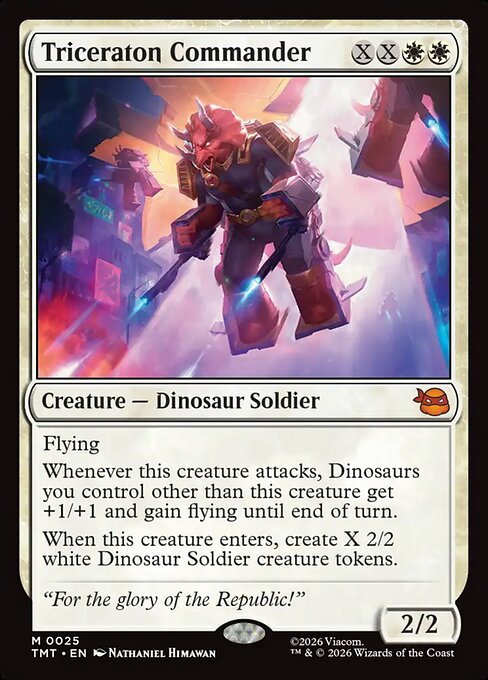 Rating7.1Good
Why this rating?
A very good mythic of the format (7.1/10).
Why. A flier whose enter effect scales with your mana: at four it is a 2/2 flier plus a 2/2 Dinosaur Soldier token; at six, three bodies. When it attacks, your other Dinosaurs get +1/+1 and fly.
Risks. The X cost with two white mana means the full effect comes late, and removal on it leaves only small tokens with no bonus.
In the draft. A flexible mythic for a white creature deck. Good at any point in the game, but not an absolute priority.
Results in the games of the set
When it is in hand, the deck wins 62.0% of its games (set average: 57.7%, 18th of 184 cards).
In the opening hand: 60.3% wins (56.4% on average).
Drawn during the game: 63.1% (58.6% on average).
When it is drawn, the deck wins 6.9 points more than when it is not.
When it is drafted, it is played 92% of the time (set average: 61%).
Taken among the first three picks (89 drafts), it ends in the deck 89% of the time.
It is played about as much in every archetype.

29. Tainted Treats
Rating7.0GoodWhy this rating?
A solid uncommon of the format (7.0/10).
Why. A three-mana instant that destroys an artifact or creature with no condition, and gives you a Food if its mana value was four or less. A clean, flexible removal.
Risks. It needs black and green, which limits it to a few decks. It is still a single-target removal.
In the draft. A very good removal in black-green; take it high in those colors. Outside them, let it go.
Results in the games of the set
When it is in hand, the deck wins 61.0% of its games (set average: 57.7%, 27th of 184 cards).
In the opening hand: 57.6% wins (56.4% on average).
Drawn during the game: 63.1% (58.6% on average).
When it is drawn, the deck wins 7.7 points more than when it is not.
When it is drafted, it is played 88% of the time (set average: 61%).
Taken as the first pick (97 drafts), it ends in the deck 96% of the time.
It is played mostly in B/G decks (54% of them) and G/U (27%).
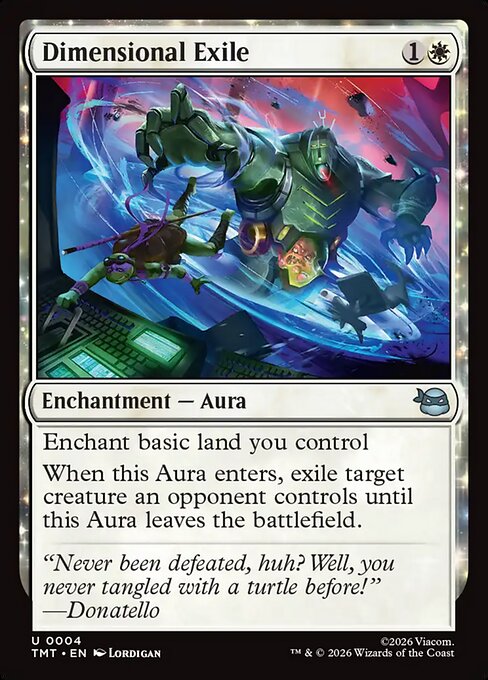 Rating7.0Good
Why this rating?
A solid uncommon of the format (7.0/10).
Why. A two-mana removal: the Aura enchants one of your basic lands and exiles an opposing creature as long as the Aura stays on the battlefield. Cheap removal that answers almost any threat.
Risks. The opponent can destroy the enchantment or remove the land, and the creature comes back. You also need a basic land.
In the draft. A good white removal to take fairly high. It works well in white decks, notably white-black.
Results in the games of the set
When it is in hand, the deck wins 58.8% of its games (set average: 57.7%, 55th of 184 cards).
In the opening hand: 57.7% wins (56.4% on average).
Drawn during the game: 59.5% (58.6% on average).
When it is drawn, the deck wins 1.0 points more than when it is not.
When it is drafted, it is played 91% of the time (set average: 61%).
Taken as the first pick (96 drafts), it ends in the deck 96% of the time.
It is played mostly in U/W decks (36% of them) and B/W (35%).
 Rating7.0Good
Why this rating?
A solid uncommon of the format (7.0/10).
Why. A three-mana 3/3 that returns a creature card from your graveyard when she hits a player, or puts it straight onto the battlefield if her Sneak cost was paid this turn. She holds the ground and generates value on offense.
Risks. She must connect and needs two colors. A solid blocker or removal stops her, and Sneak costs tempo.
In the draft. A good body for white-black. Take her in the middle of your creature picks in those colors.
Results in the games of the set
When it is in hand, the deck wins 57.7% of its games (set average: 57.7%, 77th of 184 cards).
In the opening hand: 56.9% wins (56.4% on average).
Drawn during the game: 58.3% (58.6% on average).
When it is drawn, the deck wins 0.7 points less than when it is not.
When it is drafted, it is played 86% of the time (set average: 61%).
Taken as the first pick (79 drafts), it ends in the deck 97% of the time.
It is played mostly in B/W decks (55% of them).
 Rating7.0Good
Why this rating?
A solid uncommon of the format (7.0/10).
Why. A four-mana sorcery that draws three cards and may put a land from your hand onto the battlefield tapped. A good refuel card for a slower green-blue deck.
Risks. It has no board impact and costs you a turn with nothing added to the battlefield. It needs green and blue.
In the draft. A value card for a slow, reactive deck. Take it after your best creatures and removal.
Results in the games of the set
When it is in hand, the deck wins 60.4% of its games (set average: 57.7%, 32nd of 184 cards).
In the opening hand: 58.3% wins (56.4% on average).
Drawn during the game: 61.6% (58.6% on average).
When it is drawn, the deck wins 7.8 points more than when it is not.
When it is drafted, it is played 82% of the time (set average: 61%).
Taken as the first pick (72 drafts), it ends in the deck 90% of the time.
It is played mostly in G/U decks (52% of them) and B/G (32%).

33. Novel Nunchaku
Rating7.0GoodWhy this rating?
A solid uncommon of the format (7.0/10).
Why. On entering, it attaches to one of your creatures, which then fights an opposing creature with the +1/+1 already applied, and gains trample. A conditional removal on an Equipment that stays around.
Risks. The fight depends on how big your creature is, and you need a creature in play. Re-equipping costs three.
In the draft. A good tool in a green deck with solid creatures. Not a priority, but it stands in for removal.
Results in the games of the set
When it is in hand, the deck wins 58.7% of its games (set average: 57.7%, 57th of 184 cards).
In the opening hand: 54.8% wins (56.4% on average).
Drawn during the game: 60.9% (58.6% on average).
When it is drawn, the deck wins 5.9 points more than when it is not.
When it is drafted, it is played 85% of the time (set average: 61%).
Taken as the first pick (85 drafts), it ends in the deck 96% of the time.
It is played mostly in G/U decks (39% of them) and B/G (35%).

34. Turtle Blimp
Rating7.0GoodWhy this rating?
A solid uncommon of the format (7.0/10).
Why. A colorless 3/4 flying Vehicle that creates a 2/2 Mutant token when it enters, which can crew it right away. You get two bodies for five mana, playable in any deck.
Risks. Five mana is expensive, and the Vehicle only hits when crewed. Removal on the token leaves it idle until you find another crew.
In the draft. A solid mid-list pick, playable anywhere. Take it when you need a body or an aerial threat.
Results in the games of the set
When it is in hand, the deck wins 59.2% of its games (set average: 57.7%, 44th of 184 cards).
In the opening hand: 56.5% wins (56.4% on average).
Drawn during the game: 61.0% (58.6% on average).
When it is drawn, the deck wins 1.7 points more than when it is not.
When it is drafted, it is played 79% of the time (set average: 61%).
Taken as the first pick (42 drafts), it ends in the deck 95% of the time.
It is played mostly in R/U decks (33% of them) and B/W (25%).

35. Weather Maker
Rating7.0GoodWhy this rating?
A very good rare of the format (7.0/10).
Why. A three-mana artifact that fixes every color and grows with your land drops. Each land you play adds a charge counter, which you can later turn into two colorless mana or 3 damage to any target.
Risks. Every ability needs it tapped, so you can't make mana and deal damage in the same turn. The damage costs three counters, so it takes several land drops before it matters.
In the draft. A solid fixer that doubles as a late removal spell. It fits almost any deck, especially two-color decks looking to splash.
Results in the games of the set
When it is in hand, the deck wins 60.5% of its games (set average: 57.7%, 30th of 184 cards).
In the opening hand: 62.8% wins (56.4% on average).
Drawn during the game: 59.0% (58.6% on average).
When it is drawn, the deck wins 6.7 points more than when it is not.
When it is drafted, it is played 94% of the time (set average: 61%).
Taken as the first pick (44 drafts), it ends in the deck 93% of the time.
It is played about as much in every archetype.
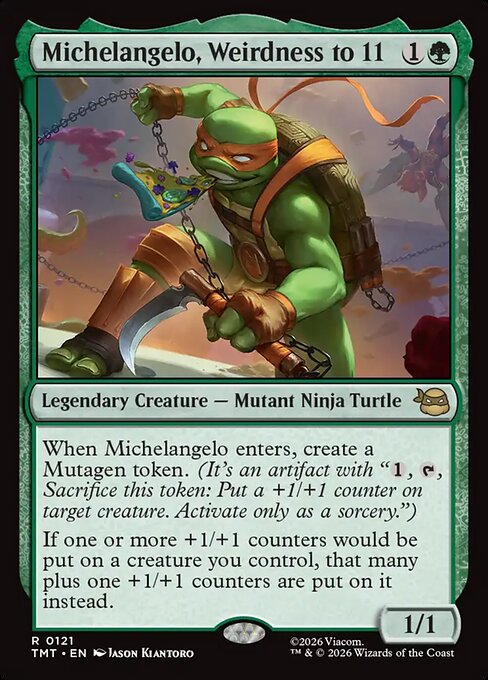
36. Michelangelo, Weirdness to 11
Rating6.9GoodWhy this rating?
A very good rare of the format (6.9/10).
Why. A two-drop that leaves a Mutagen token behind and makes every +1/+1 counter more generous: one counter becomes two. Spending the Mutagen therefore puts two counters on a creature at once.
Risks. It's a fragile 1/1, and its static effect is worth little without other counter sources. The Mutagen costs a mana to use and only works at sorcery speed.
In the draft. A good early play in green decks that care about counters. Take it happily in a Mutagen deck, but not ahead of a quality removal spell.
Results in the games of the set
When it is in hand, the deck wins 60.5% of its games (set average: 57.7%, 31st of 184 cards).
In the opening hand: 59.6% wins (56.4% on average).
Drawn during the game: 61.1% (58.6% on average).
When it is drawn, the deck wins 9.1 points more than when it is not.
When it is drafted, it is played 94% of the time (set average: 61%).
Taken as the first pick (36 drafts), it ends in the deck 100% of the time.
It is played about as much in every archetype.
 Rating6.8Good
Why this rating?
A very good rare of the format (6.8/10).
Why. A mana value 8 creature whose cost drops by one for each artifact you control. In an artifact-heavy deck it lands early, refills your hand, and gets +1/+0 for each other artifact.
Risks. Without artifacts, it's a 1/4 for eight mana. The draw only happens if you hold fewer than four cards, so it's weak when your hand is full.
In the draft. Reserve it for decks with plenty of artifacts, especially blue-red. Elsewhere, let it go by.
Results in the games of the set
When it is in hand, the deck wins 59.2% of its games (set average: 57.7%, 48th of 184 cards).
In the opening hand: 54.0% wins (56.4% on average).
Drawn during the game: 62.0% (58.6% on average).
When it is drawn, the deck wins 3.9 points more than when it is not.
When it is drafted, it is played 92% of the time (set average: 61%).
Taken as the first pick (48 drafts), it ends in the deck 96% of the time.
It is played about as much in every archetype.
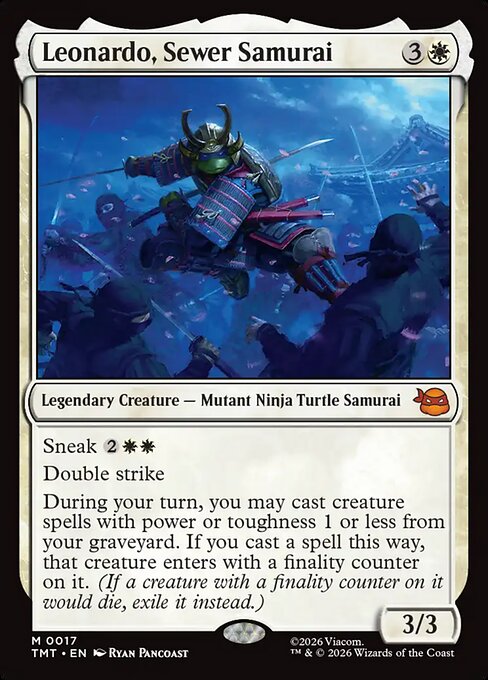 Rating6.8Good
Why this rating?
A very good mythic of the format (6.8/10).
Why. A 3/3 with double strike for four mana, which wins most combats. Its Sneak costs four mana as well but makes it enter tapped and attacking. During your turn you can also cast creatures with power or toughness 1 or less from your graveyard.
Risks. Removal handles it, and its graveyard ability only works with creatures that have power or toughness 1 or less. Sneak requires returning an unblocked attacker to your hand.
In the draft. A good white four-drop, especially if you have small creatures to recast. Take it without waiting too long.
Results in the games of the set
When it is in hand, the deck wins 61.1% of its games (set average: 57.7%, 25th of 184 cards).
In the opening hand: 59.4% wins (56.4% on average).
Drawn during the game: 62.3% (58.6% on average).
When it is drawn, the deck wins 4.7 points more than when it is not.
When it is drafted, it is played 93% of the time (set average: 61%).
Taken among the first three picks (63 drafts), it ends in the deck 95% of the time.
It is played about as much in every archetype.
 Rating6.8Good
Why this rating?
One of the best commons of the format (6.8/10).
Why. Two bodies for two mana: a 1/1 and a colorless 1/1 Robot artifact creature token. It's a red-or-white hybrid, so it slots in easily. The token entering triggers Alliance and feeds artifact decks.
Risks. Two small 1/1s are fragile and poor against bigger creatures. It doesn't win games alone.
In the draft. A good common two-drop for red and white decks. A mid-pack pick, and higher in an artifact deck.
Results in the games of the set
When it is in hand, the deck wins 58.3% of its games (set average: 57.7%, 67th of 184 cards).
In the opening hand: 59.0% wins (56.4% on average).
Drawn during the game: 57.7% (58.6% on average).
When it is drawn, the deck wins 0.9 points more than when it is not.
When it is drafted, it is played 91% of the time (set average: 61%).
Taken as the first pick (141 drafts), it ends in the deck 97% of the time.
It is played mostly in R/W decks (77% of them) and B/W (75%).
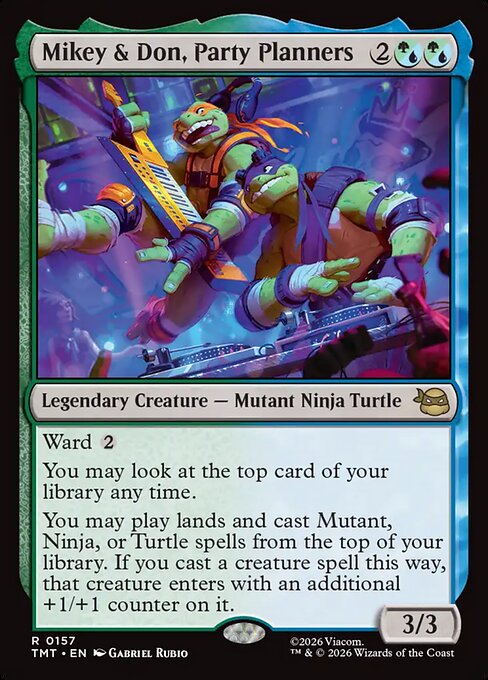
40. Mikey & Don, Party Planners
Rating6.8GoodWhy this rating?
A very good rare of the format (6.8/10).
Why. A 3/3 with ward 2 for four mana that generates value every turn: you can play lands and cast Mutant, Ninja, or Turtle spells from the top of your library. Creatures cast this way come in with an extra +1/+1 counter.
Risks. You need plenty of Mutants, Ninjas, or Turtles to get the full effect. A removal spell whose ward 2 is paid still deals with it.
In the draft. Its hybrid cost lets it fit any green or blue deck, and it is better with many of those creature types. Even without them it's a protected body that generates card advantage.
Results in the games of the set
When it is in hand, the deck wins 62.0% of its games (set average: 57.7%, 17th of 184 cards).
In the opening hand: 59.1% wins (56.4% on average).
Drawn during the game: 63.8% (58.6% on average).
When it is drawn, the deck wins 9.5 points more than when it is not.
When it is drafted, it is played 93% of the time (set average: 61%).
Taken as the first pick (34 drafts), it ends in the deck 97% of the time.
It is played about as much in every archetype.
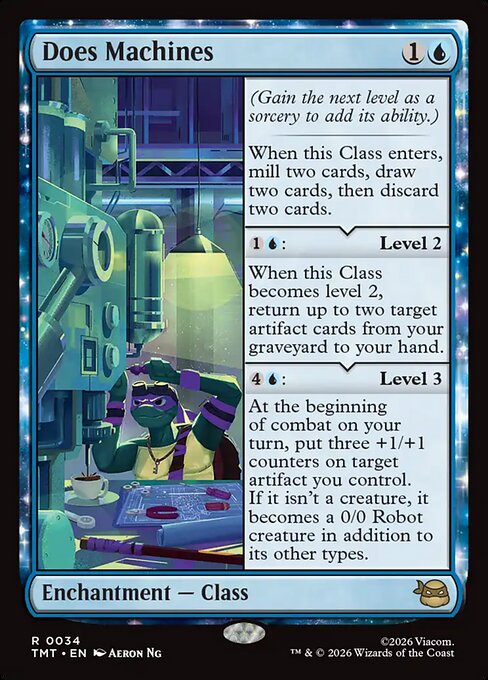
41. Does Machines
Rating6.8GoodWhy this rating?
A very good rare of the format (6.8/10).
Why. A flexible Class: level 1 filters your hand (mill two, draw two, discard two). Level 2 returns up to two artifact cards from your graveyard, and level 3 puts three +1/+1 counters on an artifact each turn, making it a Robot creature if it isn't one.
Risks. You need artifacts for levels 2 and 3 to matter. Level 3 costs five mana to unlock, which is slow.
In the draft. A good pick in an artifact deck, especially blue-red. In a deck without artifacts it's only a filter.
Results in the games of the set
When it is in hand, the deck wins 62.3% of its games (set average: 57.7%, 13th of 184 cards).
In the opening hand: 58.7% wins (56.4% on average).
Drawn during the game: 64.6% (58.6% on average).
When it is drawn, the deck wins 7.4 points more than when it is not.
When it is drafted, it is played 88% of the time (set average: 61%).
Taken as the first pick (35 drafts), it ends in the deck 94% of the time.
It is played about as much in every archetype.

42. General Traag, Heart of Stone
Rating6.7GoodWhy this rating?
A solid uncommon of the format (6.7/10).
Why. A 4/3 trampler for five mana whose enter trigger can kill a creature: sacrifice another artifact and it deals 4 damage to target creature. It is a good trade if the sacrificed artifact is a token or a low-value card.
Risks. Without another artifact to sacrifice, it's a plain 4/3. It needs two red mana, which limits splashing.
In the draft. A good uncommon for red decks with artifacts. Keep Robot tokens or cheap artifacts around to fuel the ability.
Results in the games of the set
When it is in hand, the deck wins 57.7% of its games (set average: 57.7%, 79th of 184 cards).
In the opening hand: 54.3% wins (56.4% on average).
Drawn during the game: 59.8% (58.6% on average).
When it is drawn, the deck wins 1.8 points more than when it is not.
When it is drafted, it is played 75% of the time (set average: 61%).
Taken as the first pick (42 drafts), it ends in the deck 86% of the time.
It is played mostly in R/U decks (52% of them) and R/W (36%).

43. April O'Neil, Kunoichi Trainee
Rating6.6GoodWhy this rating?
One of the best commons of the format (6.6/10).
Why. A two-drop that scries 2 on entering, then often attacks unblocked: creatures with power 3 or greater can't block it. It smooths your draws and makes a reliable attacker for Sneak.
Risks. A 2/2 that isn't strong in combat. Creatures with power 2 or less can still block it.
In the draft. A good common for white decks that use Sneak, since it connects often. Take it at a mid pick.
Results in the games of the set
When it is in hand, the deck wins 57.9% of its games (set average: 57.7%, 74th of 184 cards).
In the opening hand: 59.5% wins (56.4% on average).
Drawn during the game: 56.5% (58.6% on average).
When it is drawn, the deck wins 0.1 points less than when it is not.
When it is drafted, it is played 84% of the time (set average: 61%).
Taken as the first pick (74 drafts), it ends in the deck 96% of the time.
It is played mostly in B/W decks (80% of them) and R/W (70%).

44. Manhole Missile
Rating6.6GoodWhy this rating?
One of the best commons of the format (6.6/10).
Why. A two-mana instant that deals 3 damage to a creature, then lets you put a card from your hand on the bottom of your library to draw a fresh one. It's cheap removal that also improves your hand.
Risks. Three damage doesn't stop large creatures. The draw effect replaces a card rather than adding one.
In the draft. A solid common removal spell. Take it fairly early if you're red, ahead of average creatures.
Results in the games of the set
When it is in hand, the deck wins 59.8% of its games (set average: 57.7%, 36th of 184 cards).
In the opening hand: 59.1% wins (56.4% on average).
Drawn during the game: 60.2% (58.6% on average).
When it is drawn, the deck wins 3.5 points more than when it is not.
When it is drafted, it is played 86% of the time (set average: 61%).
Taken as the first pick (157 drafts), it ends in the deck 95% of the time.
It is played mostly in R/U decks (77% of them) and G/R (71%).

45. Prehistoric Pet
Rating6.6GoodWhy this rating?
A very good rare of the format (6.6/10).
Why. A one-mana 1/2 that creatures with greater power can't block. For two mana it taps during your turn to return another creature you control to hand, letting you replay enter effects.
Risks. A small body that deals little damage alone. Each activation costs two mana and taps it.
In the draft. A useful tool for white decks with creatures that have enter effects. Without them it's mediocre.
Results in the games of the set
When it is in hand, the deck wins 58.0% of its games (set average: 57.7%, 71st of 184 cards).
In the opening hand: 61.2% wins (56.4% on average).
Drawn during the game: 55.4% (58.6% on average).
When it is drawn, the deck wins 1.5 points more than when it is not.
When it is drafted, it is played 88% of the time (set average: 61%).
Taken among the first three picks (112 drafts), it ends in the deck 92% of the time.
It is played about as much in every archetype.
 Rating6.6Good
Why this rating?
A solid uncommon of the format (6.6/10).
Why. A one-mana Equipment that gives +1/+1 and, whenever the equipped creature deals combat damage, untaps it and gains you 2 life. It attaches for free whenever a Ninja enters.
Risks. An Equipment does nothing alone, and otherwise you pay two to equip. It's weak in a deck with few creatures.
In the draft. A good pick in a white deck with many Ninjas. Without them, it loses much of its value.
Results in the games of the set
When it is in hand, the deck wins 56.8% of its games (set average: 57.7%, 102nd of 184 cards).
In the opening hand: 58.6% wins (56.4% on average).
Drawn during the game: 55.4% (58.6% on average).
When it is drawn, the deck wins 1.0 points less than when it is not.
When it is drafted, it is played 80% of the time (set average: 61%).
Taken as the first pick (45 drafts), it ends in the deck 93% of the time.
It is played mostly in B/W decks (50% of them) and R/W (25%).
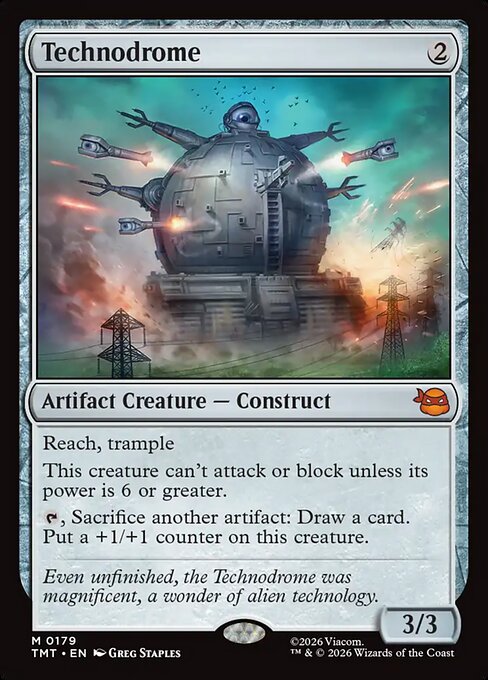
47. Technodrome
Rating6.6GoodWhy this rating?
A very good mythic of the format (6.6/10).
Why. A two-mana 3/3 with reach and trample, but it can't attack or block until its power reaches 6. Each activation sacrifices another artifact to draw a card and add a counter, so it's slow.
Risks. It does nothing until it gains three counters, and it eats your artifacts. It's a specialized card.
In the draft. Only in a very dense artifact deck. Otherwise, skip it.
Results in the games of the set
When it is in hand, the deck wins 58.9% of its games (set average: 57.7%, 52nd of 184 cards).
In the opening hand: 60.6% wins (56.4% on average).
Drawn during the game: 57.9% (58.6% on average).
When it is drawn, the deck wins 4.3 points more than when it is not.
When it is drafted, it is played 83% of the time (set average: 61%).
Taken among the first three picks (88 drafts), it ends in the deck 85% of the time.
It is played about as much in every archetype.
 Rating6.6Good
Why this rating?
A very good mythic of the format (6.6/10).
Why. A six-mana Saga that makes three token copies: chapter I exiles a creature card from your graveyard and copies it, then the next two each copy the exiled card. With a strong creature in the yard, it's a huge value play.
Risks. If you have no creature card in your graveyard when it enters, it does nothing. Six mana is a lot, and early on the graveyard is often empty.
In the draft. A good pick in slower black decks. It's best in the second half of the game, once your graveyard has filled up.
Results in the games of the set
When it is in hand, the deck wins 61.1% of its games (set average: 57.7%, 26th of 184 cards).
In the opening hand: 57.1% wins (56.4% on average).
Drawn during the game: 63.5% (58.6% on average).
When it is drawn, the deck wins 6.4 points more than when it is not.
When it is drafted, it is played 90% of the time (set average: 61%).
Taken among the first three picks (91 drafts), it ends in the deck 91% of the time.
It is played about as much in every archetype.
 Rating6.6Good
Why this rating?
A very good rare of the format (6.6/10).
Why. A 0/4 flier for three mana that taps for two mana of any one color. It blocks fliers well, accelerates you toward your expensive cards, and helps with fixing.
Risks. It doesn't attack, and a removal spell deprives you of the ramp. It can't make mana until the turn after it enters.
In the draft. A good pick in green decks with high mana value cards. In an aggro deck it's weaker.
Results in the games of the set
When it is in hand, the deck wins 59.6% of its games (set average: 57.7%, 40th of 184 cards).
In the opening hand: 59.8% wins (56.4% on average).
Drawn during the game: 59.5% (58.6% on average).
When it is drawn, the deck wins 7.4 points more than when it is not.
When it is drafted, it is played 87% of the time (set average: 61%).
Taken as the first pick (41 drafts), it ends in the deck 88% of the time.
It is played about as much in every archetype.
 Rating6.6Good
Why this rating?
A very good rare of the format (6.6/10).
Why. A three-mana 3/2 that exiles an opposing creature when it enters, for as long as it stays on the battlefield. With Sneak the cost is four mana and the exile becomes permanent.
Risks. The temporary exile ends if it leaves the battlefield, and a 3/2 is fragile. Sneak needs black mana and returning an unblocked attacker.
In the draft. A good pick for white decks, better still with black. It's removal on a body, but only temporary without Sneak.
Results in the games of the set
When it is in hand, the deck wins 62.6% of its games (set average: 57.7%, 12th of 184 cards).
In the opening hand: 62.0% wins (56.4% on average).
Drawn during the game: 63.0% (58.6% on average).
When it is drawn, the deck wins 6.4 points more than when it is not.
When it is drafted, it is played 92% of the time (set average: 61%).
Taken as the first pick (34 drafts), it ends in the deck 94% of the time.
It is played about as much in every archetype.
 Rating6.5Good
Why this rating?
A solid uncommon of the format (6.5/10).
Why. A 6/4 deathtouch for five mana, or four through Sneak. When it enters and each time it attacks, another creature you control gains deathtouch until end of turn, making your attacks very hard to block.
Risks. It's expensive and removal handles it. A blocker with deathtouch trades with it for a much cheaper card.
In the draft. A good pick in black tempo decks. It's especially strong in Sneak decks, where it comes in cheaply.
Results in the games of the set
When it is in hand, the deck wins 56.8% of its games (set average: 57.7%, 100th of 184 cards).
In the opening hand: 55.9% wins (56.4% on average).
Drawn during the game: 57.4% (58.6% on average).
When it is drawn, the deck wins 0.3 points more than when it is not.
When it is drafted, it is played 79% of the time (set average: 61%).
Taken among the first three picks (137 drafts), it ends in the deck 88% of the time.
It is played mostly in B/W decks (35% of them).
 Rating6.4Good
Why this rating?
Good playable that always makes the cut (6.4/10).
Why. A two-mana instant that exiles a creature with mana value 3 or less. Exile gets around graveyard recursion, and plenty of creatures are valid targets for the price.
Risks. It can't touch large creatures, which are the ones that cause the most trouble. Some opposing decks give it few targets.
In the draft. A fine removal spell to take fairly early if you're black. It's good against cheap threats.
Results in the games of the set
When it is in hand, the deck wins 58.1% of its games (set average: 57.7%, 69th of 184 cards).
In the opening hand: 57.4% wins (56.4% on average).
Drawn during the game: 58.7% (58.6% on average).
When it is drawn, the deck wins 2.3 points more than when it is not.
When it is drafted, it is played 90% of the time (set average: 61%).
Taken as the first pick (68 drafts), it ends in the deck 94% of the time.
It is played mostly in B/R decks (35% of them) and B/U (33%).
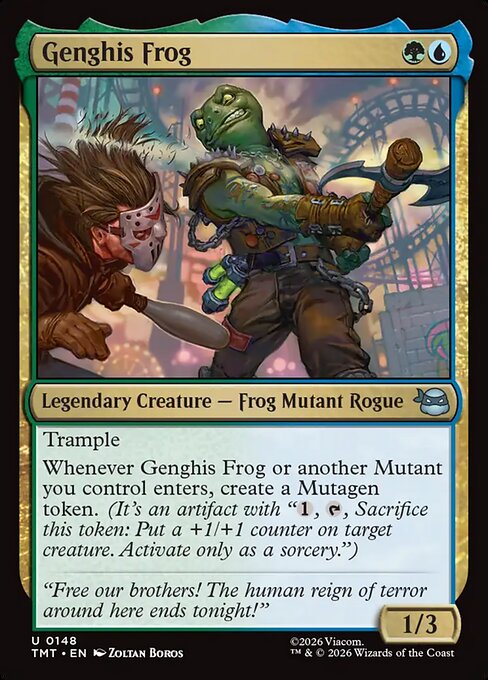
53. Genghis Frog
Rating6.4GoodWhy this rating?
Good playable that always makes the cut (6.4/10).
Why. A two-mana 1/3 trampler that creates a Mutagen token when it enters and whenever another Mutant you control enters. It provides +1/+1 counters as long as you play Mutants.
Risks. A small body with little damage potential, and the effect wants several Mutants. It requires exactly green and blue.
In the draft. A good pick in green-blue decks built around Mutants and counters. Outside of that deck it's weaker.
Results in the games of the set
When it is in hand, the deck wins 58.1% of its games (set average: 57.7%, 70th of 184 cards).
In the opening hand: 57.5% wins (56.4% on average).
Drawn during the game: 58.4% (58.6% on average).
When it is drawn, the deck wins 6.5 points more than when it is not.
When it is drafted, it is played 79% of the time (set average: 61%).
Taken as the first pick (45 drafts), it ends in the deck 91% of the time.
It is played mostly in G/U decks (61% of them).

54. Mouser Foundry
Rating6.4GoodWhy this rating?
Good playable that always makes the cut (6.4/10).
Why. A two-mana artifact that gives you a 1/1 Robot token when it enters and another when it leaves. For five mana you can sacrifice it to deal 3 damage to a creature: two bodies and a removal spell in one card.
Risks. The removal is slow and expensive. The 1/1 tokens are fragile.
In the draft. A good common for red artifact decks. Take it ahead of average creatures.
Results in the games of the set
When it is in hand, the deck wins 59.7% of its games (set average: 57.7%, 38th of 184 cards).
In the opening hand: 59.2% wins (56.4% on average).
Drawn during the game: 60.1% (58.6% on average).
When it is drawn, the deck wins 3.5 points more than when it is not.
When it is drafted, it is played 85% of the time (set average: 61%).
Taken as the first pick (142 drafts), it ends in the deck 93% of the time.
It is played mostly in R/W decks (86% of them) and R/U (84%).
 Rating6.4Good
Why this rating?
Good playable that always makes the cut (6.4/10).
Why. A four-mana 3/3 flier that leaves a Mutagen token behind. For two mana you can remove a +1/+1 counter from a creature you control to draw a card, turning counters into cards.
Risks. Removal on a 3/3 is a fair trade. The draw ability needs counters, so the Mutagen alone isn't always enough.
In the draft. A good blue uncommon for counter or Mutagen decks. Even without them, it's a solid flier.
Results in the games of the set
When it is in hand, the deck wins 56.8% of its games (set average: 57.7%, 98th of 184 cards).
In the opening hand: 53.0% wins (56.4% on average).
Drawn during the game: 59.1% (58.6% on average).
When it is drawn, the deck wins 3.5 points more than when it is not.
When it is drafted, it is played 75% of the time (set average: 61%).
Taken as the first pick (51 drafts), it ends in the deck 90% of the time.
It is played mostly in G/U decks (37% of them) and R/U (28%).
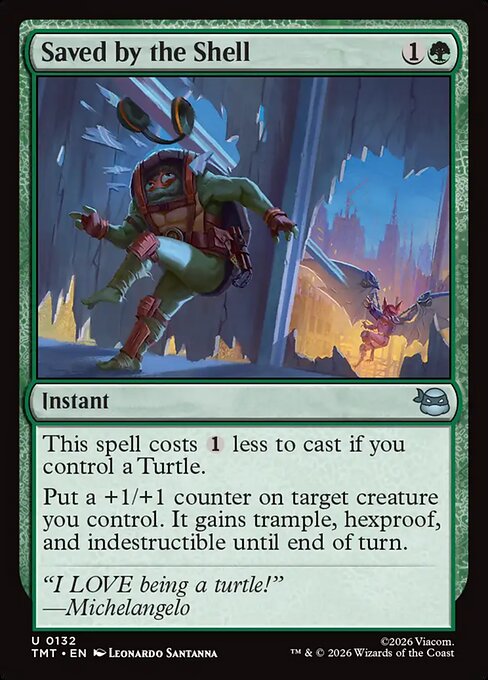 Rating6.4Good
Why this rating?
Good playable that always makes the cut (6.4/10).
Why. An instant that puts a +1/+1 counter on your creature and gives it trample, hexproof, and indestructible until end of turn. It costs one less if you control a Turtle.
Risks. It's a conditional card: without a good target, it does nothing. It only protects for the turn.
In the draft. A good support spell for green decks that play Turtles. Take it at a mid pick.
Results in the games of the set
When it is in hand, the deck wins 58.2% of its games (set average: 57.7%, 68th of 184 cards).
In the opening hand: 54.2% wins (56.4% on average).
Drawn during the game: 60.5% (58.6% on average).
When it is drawn, the deck wins 5.7 points more than when it is not.
When it is drafted, it is played 73% of the time (set average: 61%).
Taken as the first pick (35 drafts), it ends in the deck 86% of the time.
It is played mostly in G/W decks (34% of them) and G/U (31%).

57. Super Shredder
Rating6.4GoodWhy this rating?
Good playable that always makes the cut (6.4/10).
Why. A two-mana 1/1 with menace that gets a +1/+1 counter whenever another permanent leaves the battlefield, whoever controls it. As the game goes on, it can become huge.
Risks. A vulnerable 1/1 at first: removal or an early block kills it before it grows. Its growth depends on what happens on the battlefield.
In the draft. A good pick in black decks with trades and sacrifices. It's stronger in an interactive deck.
Results in the games of the set
When it is in hand, the deck wins 59.4% of its games (set average: 57.7%, 42nd of 184 cards).
In the opening hand: 58.1% wins (56.4% on average).
Drawn during the game: 60.3% (58.6% on average).
When it is drawn, the deck wins 4.6 points more than when it is not.
When it is drafted, it is played 93% of the time (set average: 61%).
Taken among the first three picks (63 drafts), it ends in the deck 90% of the time.
It is played about as much in every archetype.
 Rating6.4Good
Why this rating?
Good playable that always makes the cut (6.4/10).
Why. A three-mana Food artifact that deals 4 damage to any target when it enters, but 3 damage to you. It works as removal or a finisher, and can later gain you 3 life.
Risks. The 3 damage you take matters against aggressive decks. It can only be cast at sorcery speed, and regaining the life costs two more mana.
In the draft. A decent red removal spell to take at a mid pick. It's especially good in an artifact deck.
Results in the games of the set
When it is in hand, the deck wins 57.2% of its games (set average: 57.7%, 89th of 184 cards).
In the opening hand: 55.3% wins (56.4% on average).
Drawn during the game: 58.4% (58.6% on average).
When it is drawn, the deck wins 1.2 points more than when it is not.
When it is drafted, it is played 90% of the time (set average: 61%).
Taken as the first pick (81 drafts), it ends in the deck 91% of the time.
It is played mostly in G/R decks (48% of them) and R/U (46%).
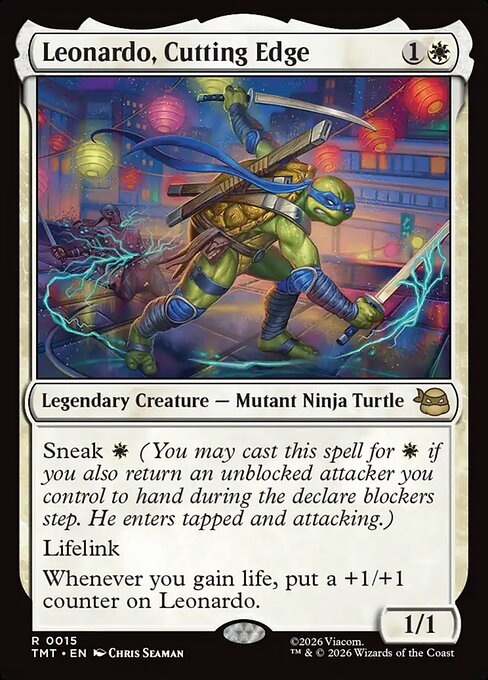 Rating6.3Good
Why this rating?
Good playable that always makes the cut (6.3/10).
Why. A two-mana 1/1 lifelink, or one mana through Sneak. Each life gain puts a +1/+1 counter on it, so it grows as it deals damage.
Risks. A small fragile body that only grows if it deals damage or you gain life elsewhere. It has to survive to grow.
In the draft. A mid pick for aggressive white decks. It's better with other life-gain effects.
Results in the games of the set
When it is in hand, the deck wins 56.2% of its games (set average: 57.7%, 110th of 184 cards).
In the opening hand: 56.0% wins (56.4% on average).
Drawn during the game: 56.4% (58.6% on average).
When it is drawn, the deck wins 0.2 points more than when it is not.
When it is drafted, it is played 92% of the time (set average: 61%).
Taken among the first three picks (88 drafts), it ends in the deck 98% of the time.
It is played about as much in every archetype.
 Rating6.2Good
Why this rating?
Good playable that always makes the cut (6.2/10).
Why. A white-black sorcery that can give a creature +3/+3, give another creature -3/-3, or do both. It can kill a small creature and win a combat with a single card.
Risks. It needs two specific colors and is a sorcery, so it can't react. Sneak lowers the cost but requires returning an unblocked attacker.
In the draft. A good uncommon for white-black decks. Take it at a mid pick.
Results in the games of the set
When it is in hand, the deck wins 57.2% of its games (set average: 57.7%, 90th of 184 cards).
In the opening hand: 56.5% wins (56.4% on average).
Drawn during the game: 57.6% (58.6% on average).
When it is drawn, the deck wins 1.3 points less than when it is not.
When it is drafted, it is played 84% of the time (set average: 61%).
Taken as the first pick (46 drafts), it ends in the deck 85% of the time.
It is played mostly in B/W decks (48% of them).
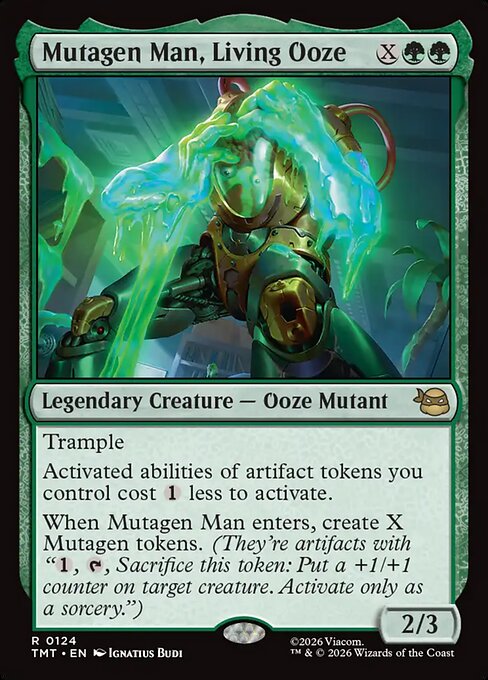 Rating6.2Good
Why this rating?
Good playable that always makes the cut (6.2/10).
Why. An X spell: it enters as a 2/3 trampler and creates X Mutagen tokens. Their activation then costs nothing thanks to its discount, giving you lots of counters at once.
Risks. It needs two green mana plus X. It's slow early in the game.
In the draft. A good pick for counter decks. It's best in the late game when X is large.
Results in the games of the set
When it is in hand, the deck wins 58.7% of its games (set average: 57.7%, 56th of 184 cards).
In the opening hand: 54.7% wins (56.4% on average).
Drawn during the game: 61.1% (58.6% on average).
When it is drawn, the deck wins 6.4 points more than when it is not.
When it is drafted, it is played 91% of the time (set average: 61%).
Taken as the first pick (31 drafts), it ends in the deck 94% of the time.
It is played about as much in every archetype.

62. Nobody
Rating6.2GoodWhy this rating?
Good playable that always makes the cut (6.2/10).
Why. A blue-or-red hybrid 3/2 for three mana that can return another artifact you control to hand, then scry 1. This lets you replay an artifact's enter effect.
Risks. A 3/2 without evasion that only scries 1 if you have no other artifact. Bouncing is optional but costs tempo.
In the draft. A fine common for blue-red artifact decks. Take it at a mid pick.
Results in the games of the set
When it is in hand, the deck wins 58.3% of its games (set average: 57.7%, 65th of 184 cards).
In the opening hand: 56.0% wins (56.4% on average).
Drawn during the game: 59.8% (58.6% on average).
When it is drawn, the deck wins 1.7 points more than when it is not.
When it is drafted, it is played 81% of the time (set average: 61%).
Taken as the first pick (74 drafts), it ends in the deck 97% of the time.
It is played mostly in R/U decks (87% of them) and R/W (42%).
 Rating6.2Good
Why this rating?
Good playable that always makes the cut (6.2/10).
Why. A five-mana 2/4 that creates a Food token. Its Disappear puts three +1/+1 counters on another artifact or creature at your end step if a permanent left the battlefield under your control. Sacrificing the Food is enough to turn it on.
Risks. It's expensive for a 2/4 and needs black and green. If none of your permanents leaves, it puts no counters.
In the draft. A good uncommon in black-green decks that sacrifice permanents. Take it at a mid pick.
Results in the games of the set
When it is in hand, the deck wins 57.1% of its games (set average: 57.7%, 93rd of 184 cards).
In the opening hand: 53.1% wins (56.4% on average).
Drawn during the game: 59.6% (58.6% on average).
When it is drawn, the deck wins 5.5 points more than when it is not.
When it is drafted, it is played 84% of the time (set average: 61%).
Taken as the first pick (78 drafts), it ends in the deck 97% of the time.
It is played mostly in B/G decks (50% of them).
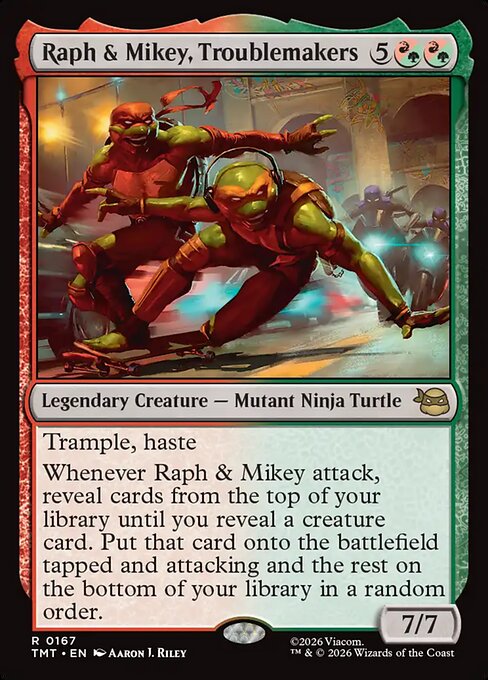
64. Raph & Mikey, Troublemakers
Rating6.2GoodWhy this rating?
Good playable that always makes the cut (6.2/10).
Why. A seven-mana 7/7 with trample and haste that attacks the turn it enters. Each attack also puts a creature from your library onto the battlefield, tapped and attacking. It ends games fast.
Risks. Seven mana is a lot, and instant-speed removal can kill it before it attacks. The creature you get depends on your deck.
In the draft. A top-end finisher. It's a red-or-green hybrid, so it fits any deck in either color. One copy is enough.
Results in the games of the set
When it is in hand, the deck wins 61.2% of its games (set average: 57.7%, 24th of 184 cards).
In the opening hand: 57.3% wins (56.4% on average).
Drawn during the game: 63.5% (58.6% on average).
When it is drawn, the deck wins 8.3 points more than when it is not.
When it is drafted, it is played 94% of the time (set average: 61%).
Taken as the first pick (39 drafts), it ends in the deck 95% of the time.
It is played about as much in every archetype.
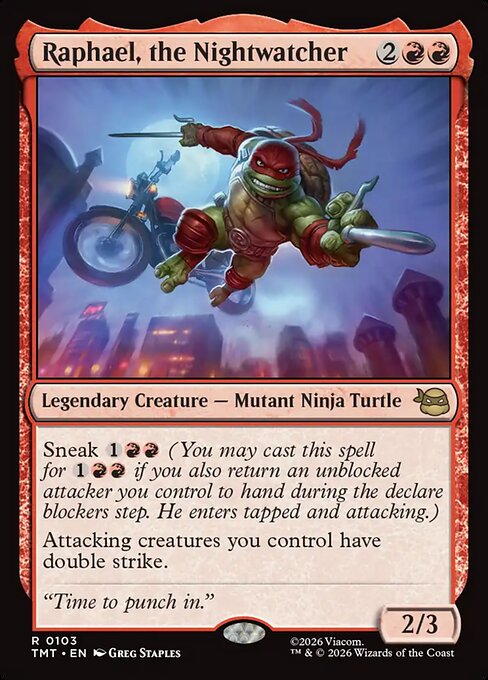 Rating6.2Good
Why this rating?
Good playable that always makes the cut (6.2/10).
Why. A four-mana 2/3, or three with Sneak, that gives double strike to all your attacking creatures, itself included. It doubles your team's combat damage.
Risks. Its body is modest and removal handles it. It needs two red mana.
In the draft. A good pick in aggressive red decks with many small creatures. Take it at a mid pick.
Results in the games of the set
When it is in hand, the deck wins 58.9% of its games (set average: 57.7%, 53rd of 184 cards).
In the opening hand: 57.0% wins (56.4% on average).
Drawn during the game: 60.2% (58.6% on average).
When it is drawn, the deck wins 4.9 points more than when it is not.
When it is drafted, it is played 88% of the time (set average: 61%).
Taken among the first three picks (92 drafts), it ends in the deck 89% of the time.
It is played about as much in every archetype.
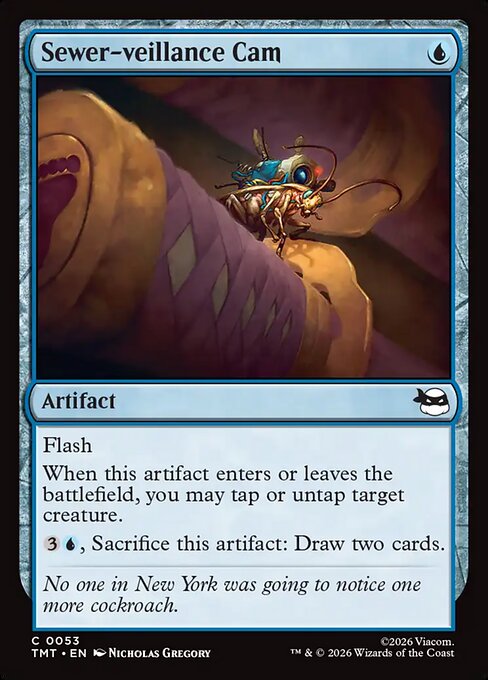 Rating6.2Good
Why this rating?
Good playable that always makes the cut (6.2/10).
Why. A one-mana artifact with flash that taps or untaps a creature when it enters and leaves. For four mana you can sacrifice it to draw two cards: value and tempo in one.
Risks. It has no direct board impact and its card draw is expensive. It requires blue.
In the draft. A good common for blue decks, more so with artifacts. Take it at a mid pick.
Results in the games of the set
When it is in hand, the deck wins 59.4% of its games (set average: 57.7%, 43rd of 184 cards).
In the opening hand: 54.7% wins (56.4% on average).
Drawn during the game: 62.3% (58.6% on average).
When it is drawn, the deck wins 3.6 points more than when it is not.
When it is drafted, it is played 82% of the time (set average: 61%).
Taken as the first pick (119 drafts), it ends in the deck 96% of the time.
It is played mostly in R/U decks (80% of them) and U/W (68%).

67. West Wind Avatar
Rating6.2GoodWhy this rating?
Good playable that always makes the cut (6.2/10).
Why. A seven-mana 7/7 trampler. When it enters and each time it attacks, you may sacrifice a token or land to gain 3 life, which also turns on its Disappear: you draw a card.
Risks. Seven mana is slow and you give up a permanent to gain life. Removal handles it.
In the draft. A decent finisher for slow green decks. One copy is enough.
Results in the games of the set
When it is in hand, the deck wins 57.8% of its games (set average: 57.7%, 76th of 184 cards).
In the opening hand: 52.2% wins (56.4% on average).
Drawn during the game: 60.9% (58.6% on average).
When it is drawn, the deck wins 5.1 points more than when it is not.
When it is drafted, it is played 84% of the time (set average: 61%).
Taken as the first pick (66 drafts), it ends in the deck 94% of the time.
It is played mostly in B/G decks (38% of them) and G/U (35%).

68. Squirrelanoids
Rating6.1PlayableWhy this rating?
Good playable that always makes the cut (6.1/10).
Why. A one-mana 1/1 with deathtouch. It trades with almost any creature, so it holds back larger attackers.
Risks. A tiny body that dies to anything. It does nothing but trade.
In the draft. A fine common for black decks. Take it at a mid pick.
Results in the games of the set
When it is in hand, the deck wins 57.6% of its games (set average: 57.7%, 81st of 184 cards).
In the opening hand: 59.8% wins (56.4% on average).
Drawn during the game: 55.9% (58.6% on average).
When it is drawn, the deck wins 0.6 points more than when it is not.
When it is drafted, it is played 81% of the time (set average: 61%).
Taken as the first pick (50 drafts), it ends in the deck 92% of the time.
It is played mostly in B/W decks (66% of them) and B/G (49%).

69. Buzz Bots
Rating6.0PlayableWhy this rating?
Good playable that always makes the cut (6.0/10).
Why. A 1/1 flier with vigilance for two mana that attacks in the air while still holding the ground, and draws you a card when it dies. Opponents have a hard time trading well with it.
Risks. One power is small, and it will not win a game alone unless your deck can pump or equip it.
In the draft. A solid blue common for low-curve decks. Take it happily, but not over your removal.
Results in the games of the set
When it is in hand, the deck wins 59.0% of its games (set average: 57.7%, 50th of 184 cards).
In the opening hand: 57.9% wins (56.4% on average).
Drawn during the game: 59.8% (58.6% on average).
When it is drawn, the deck wins 3.7 points more than when it is not.
When it is drafted, it is played 83% of the time (set average: 61%).
Taken as the first pick (100 drafts), it ends in the deck 94% of the time.
It is played mostly in R/U decks (74% of them) and U/W (69%).
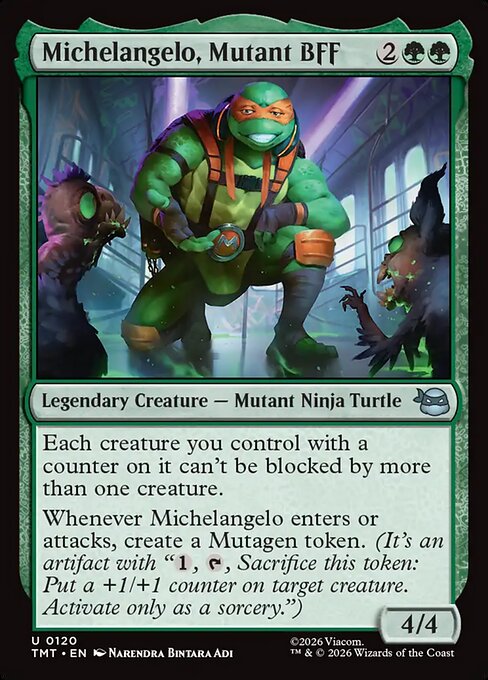 Rating6.0Playable
Why this rating?
Good playable that always makes the cut (6.0/10).
Why. A 4/4 for four that makes a Mutagen token when it enters and every time it attacks. The resulting +1/+1 counters keep growing your team and make it hard to gang-block.
Risks. Needs two green mana on turn four. Mutagen costs mana and only works at sorcery speed, so the payoff is slow when you are under pressure.
In the draft. A good green pick in the middle of the pack. Best in decks that attack every turn, since each attack adds a Mutagen.
Results in the games of the set
When it is in hand, the deck wins 58.5% of its games (set average: 57.7%, 61st of 184 cards).
In the opening hand: 56.4% wins (56.4% on average).
Drawn during the game: 59.7% (58.6% on average).
When it is drawn, the deck wins 6.1 points more than when it is not.
When it is drafted, it is played 90% of the time (set average: 61%).
Taken as the first pick (61 drafts), it ends in the deck 93% of the time.
It is played mostly in G/U decks (40% of them) and B/G (35%).

71. Oroku Saki, Shredder Rising
Rating6.0PlayableWhy this rating?
Good playable that always makes the cut (6.0/10).
Why. A 3/1 for three that draws a card when it connects. With Sneak for two mana it can come in attacking by returning an unblocked creature to hand, letting you reuse that creature's enter effects.
Risks. One toughness means any block or cheap removal kills it. Each card drawn also costs you a life point.
In the draft. A good black common for aggressive decks. Take it higher if you have evasive creatures to trigger the draw.
Results in the games of the set
When it is in hand, the deck wins 57.7% of its games (set average: 57.7%, 80th of 184 cards).
In the opening hand: 58.7% wins (56.4% on average).
Drawn during the game: 56.9% (58.6% on average).
When it is drawn, the deck wins 0.2 points less than when it is not.
When it is drafted, it is played 81% of the time (set average: 61%).
Taken as the first pick (89 drafts), it ends in the deck 91% of the time.
It is played mostly in B/W decks (78% of them) and B/R (49%).
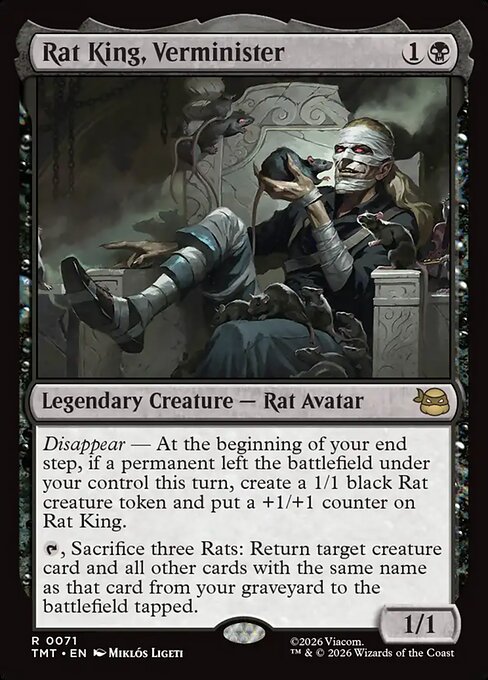 Rating6.0Playable
Why this rating?
Good playable that always makes the cut (6.0/10).
Why. For two mana it grows and makes a 1/1 Rat creature token at each end step where a permanent left the battlefield under your control. Sacrificing three Rats brings a creature back from your graveyard, tapped.
Risks. A 1/1 that does nothing if nothing leaves your side. You need sacrifices, trades or chump blocks for Disappear to turn on.
In the draft. Take it in a black deck that likes to trade creatures. It takes some planning, but it snowballs fast when it works.
Results in the games of the set
When it is in hand, the deck wins 59.9% of its games (set average: 57.7%, 34th of 184 cards).
In the opening hand: 59.1% wins (56.4% on average).
Drawn during the game: 60.3% (58.6% on average).
When it is drawn, the deck wins 5.1 points more than when it is not.
When it is drafted, it is played 92% of the time (set average: 61%).
Taken as the first pick (41 drafts), it ends in the deck 93% of the time.
It is played about as much in every archetype.

73. Savanti Romero, Time's Exile
Rating6.0PlayableWhy this rating?
Good playable that always makes the cut (6.0/10).
Why. A 4/4 trampler that gets a counter and draws at the start of each combat: one card the first time, then two, then three. Left alone, it takes over the game.
Risks. Every draw also costs that much life, so the pressure builds on you too. Five mana with two black, and a removal answers it.
In the draft. A strong black pick, especially if you can protect your life total. It rewards decks that can control the board.
Results in the games of the set
When it is in hand, the deck wins 59.8% of its games (set average: 57.7%, 35th of 184 cards).
In the opening hand: 57.7% wins (56.4% on average).
Drawn during the game: 61.1% (58.6% on average).
When it is drawn, the deck wins 5.3 points more than when it is not.
When it is drafted, it is played 92% of the time (set average: 61%).
Taken as the first pick (46 drafts), it ends in the deck 93% of the time.
It is played about as much in every archetype.
 Rating6.0Playable
Why this rating?
Good playable that always makes the cut (6.0/10).
Why. A sorcery-speed removal that destroys a creature or an enchantment for three mana. With Sneak it costs only a black mana if you return an unblocked attacker.
Risks. Destroying an enchantment costs you two life. Outside of Sneak it can only be cast at sorcery speed.
In the draft. A solid black removal spell worth taking fairly early. Better in decks with enter-the-battlefield creatures you want to replay.
Results in the games of the set
When it is in hand, the deck wins 57.4% of its games (set average: 57.7%, 84th of 184 cards).
In the opening hand: 54.8% wins (56.4% on average).
Drawn during the game: 59.1% (58.6% on average).
When it is drawn, the deck wins 1.2 points more than when it is not.
When it is drafted, it is played 93% of the time (set average: 61%).
Taken as the first pick (86 drafts), it ends in the deck 98% of the time.
It is played mostly in B/W decks (32% of them) and B/G (30%).
 Rating6.0Playable
Why this rating?
Good playable that always makes the cut (6.0/10).
Why. A 2/4 for three, castable in mono-white or mono-black thanks to the hybrid cost. It doubles triggered abilities of your Ninjas, and can make a Ninja unblockable for two mana including a blue one.
Risks. Without Ninjas that have triggered abilities, it is just a decent blocker. The unblockable ability needs blue mana.
In the draft. Fine in a deck full of Ninjas, taken from the middle of the pack. Skip it without several Ninjas with triggers.
Results in the games of the set
When it is in hand, the deck wins 55.4% of its games (set average: 57.7%, 123rd of 184 cards).
In the opening hand: 54.6% wins (56.4% on average).
Drawn during the game: 56.0% (58.6% on average).
When it is drawn, the deck wins 0.3 points more than when it is not.
When it is drafted, it is played 83% of the time (set average: 61%).
Taken among the first three picks (85 drafts), it ends in the deck 86% of the time.
It is played about as much in every archetype.
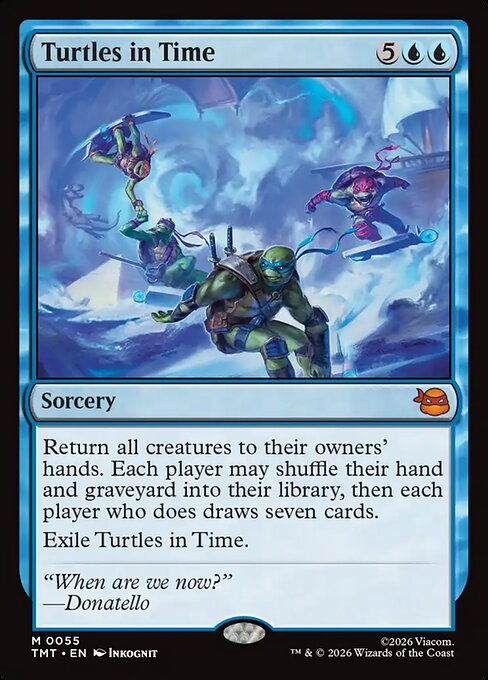
76. Turtles in Time
Rating6.0PlayableWhy this rating?
Good playable that always makes the cut (6.0/10).
Why. Seven mana to bounce every creature, then each player may shuffle their hand and graveyard into their library and draw seven. A symmetric reset that rarely favors you.
Risks. Seven mana, and your opponent benefits as much as you do. You bounce your own creatures too, for no guaranteed gain.
In the draft. Pass it in nearly every deck. At best, a last-ditch play in a slow deck that is behind on board.
Results in the games of the set
Drawn during the game: 0.0% (58.6% on average).
When it is drafted, it is played only 10% of the time (set average: 61%): it almost always ends in the sideboard.

77. Donatello, Way with Machines
Rating6.0PlayableWhy this rating?
Good playable that always makes the cut (6.0/10).
Why. A 1/2 flier for three that gets a +1/+1 counter whenever an artifact enters under your control. In an artifact-heavy deck it quickly becomes a real aerial threat.
Risks. With no artifacts it is a small 1/2 that deals little damage. Fragile before it grows.
In the draft. A good pick for a blue artifact deck. Do not take it early without several artifacts already in your pool.
Results in the games of the set
When it is in hand, the deck wins 56.4% of its games (set average: 57.7%, 107th of 184 cards).
In the opening hand: 55.7% wins (56.4% on average).
Drawn during the game: 56.8% (58.6% on average).
When it is drawn, the deck wins 2.2 points more than when it is not.
When it is drafted, it is played 86% of the time (set average: 61%).
Taken as the first pick (50 drafts), it ends in the deck 94% of the time.
It is played mostly in R/U decks (41% of them) and U/W (26%).

78. Turtle Lair
Rating5.8PlayableWhy this rating?
Good playable that always makes the cut (5.9/10).
Why. A land that taps for colorless, or for any color to cast a Ninja or Turtle spell. For three mana it also makes a Ninja or Turtle unblockable.
Risks. The colored mana is limited to Ninja or Turtle spells; for everything else it only makes colorless.
In the draft. Useful fixing in a deck full of Ninjas and Turtles, played in place of a basic land. Worse if you have few such creatures.
Results in the games of the set
When it is in hand, the deck wins 57.2% of its games (set average: 57.7%, 91st of 184 cards).
In the opening hand: 57.0% wins (56.4% on average).
Drawn during the game: 57.3% (58.6% on average).
When it is drawn, the deck wins 0.7 points more than when it is not.
When it is drafted, it is played 68% of the time (set average: 61%).
Taken among the first three picks (48 drafts), it ends in the deck 94% of the time.

79. Donatello, Mutant Mechanic
Rating5.8PlayableWhy this rating?
Good playable that always makes the cut (5.8/10).
Why. A 3/5 for four that, at sorcery speed, puts three +1/+1 counters on an artifact. If it is not a creature it becomes a 0/0 Robot creature, turning any artifact into a big threat. If that artifact goes to the graveyard, its counters move to another target.
Risks. It needs artifacts to upgrade and must be untapped to activate, so not the turn it arrives. It is still a creature that removal can answer.
In the draft. A good pick for an artifact deck. Without artifacts, it is mostly a solid 3/5 body.
Results in the games of the set
When it is in hand, the deck wins 59.1% of its games (set average: 57.7%, 49th of 184 cards).
In the opening hand: 57.7% wins (56.4% on average).
Drawn during the game: 59.9% (58.6% on average).
When it is drawn, the deck wins 5.6 points more than when it is not.
When it is drafted, it is played 94% of the time (set average: 61%).
Taken among the first three picks (60 drafts), it ends in the deck 90% of the time.
It is played about as much in every archetype.
 Rating5.8Playable
Why this rating?
Good playable that always makes the cut (5.8/10).
Why. A 3/4 for four that draws a card when it enters if you control an artifact. A sturdy body plus card advantage that stonewalls small creatures.
Risks. Without an artifact you lose the draw and it is a vanilla 3/4. No evasion.
In the draft. A good blue common for a deck with a few artifacts. Play enough artifacts so the draw is reliable.
Results in the games of the set
When it is in hand, the deck wins 58.5% of its games (set average: 57.7%, 60th of 184 cards).
In the opening hand: 56.2% wins (56.4% on average).
Drawn during the game: 59.9% (58.6% on average).
When it is drawn, the deck wins 2.9 points more than when it is not.
When it is drafted, it is played 74% of the time (set average: 61%).
Taken as the first pick (44 drafts), it ends in the deck 93% of the time.
It is played mostly in R/U decks (80% of them) and U/W (63%).

81. Fugitive Droid
Rating5.8PlayableWhy this rating?
Good playable that always makes the cut (5.8/10).
Why. A one-mana 1/1 that cannot be blocked if an artifact entered under your control this turn. It can also sacrifice itself to counter a spell targeting one of your artifacts or creatures.
Risks. A 1/1 that only gets through on turns an artifact arrives. The counter only works against targeting spells, and its cost is the creature itself.
In the draft. An artifact-deck card to take in the middle of the pack. Leave it without artifacts.
Results in the games of the set
When it is in hand, the deck wins 56.2% of its games (set average: 57.7%, 111th of 184 cards).
In the opening hand: 56.2% wins (56.4% on average).
Drawn during the game: 56.1% (58.6% on average).
When it is drawn, the deck wins 2.6 points more than when it is not.
When it is drafted, it is played 63% of the time (set average: 61%).
Taken as the first pick (30 drafts), it ends in the deck 77% of the time.
It is played mostly in R/U decks (36% of them) and B/U (25%).
 Rating5.8Playable
Why this rating?
Good playable that always makes the cut (5.8/10).
Why. An 8/8 trampler for six mana. Each land you tap for mana also adds an extra green, which speeds up your mana a lot.
Risks. Six mana with two green: it is slow, and removal neutralizes it.
In the draft. A green top-end finisher for a deck that survives to six mana. One copy is usually enough.
Results in the games of the set
When it is in hand, the deck wins 58.5% of its games (set average: 57.7%, 62nd of 184 cards).
In the opening hand: 55.1% wins (56.4% on average).
Drawn during the game: 60.4% (58.6% on average).
When it is drawn, the deck wins 5.5 points more than when it is not.
When it is drafted, it is played 89% of the time (set average: 61%).
Taken as the first pick (30 drafts), it ends in the deck 90% of the time.
It is played about as much in every archetype.
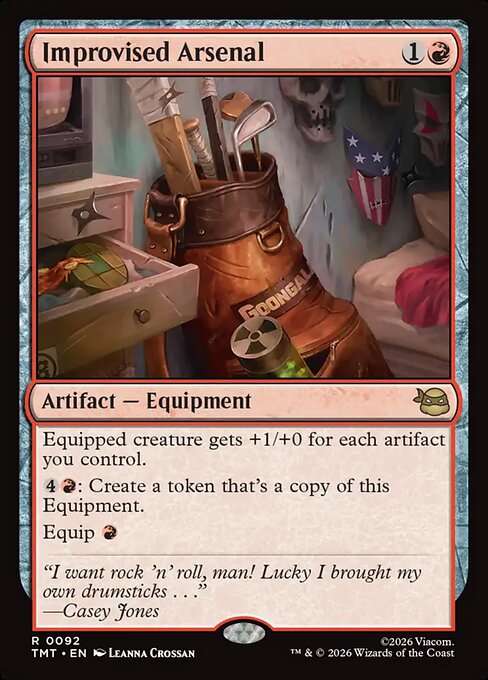 Rating5.8Playable
Why this rating?
Good playable that always makes the cut (5.8/10).
Why. A two-mana Equipment giving +1/+0 for each artifact you control, itself included, with a one-red-mana equip. For five mana it makes a token copy of itself.
Risks. Without artifacts the bonus is modest. It gives no toughness and relies on a creature surviving to attack.
In the draft. Good in a red artifact deck, picked without being a priority. Weaker in a deck with few artifacts.
Results in the games of the set
When it is in hand, the deck wins 57.8% of its games (set average: 57.7%, 75th of 184 cards).
In the opening hand: 55.6% wins (56.4% on average).
Drawn during the game: 59.3% (58.6% on average).
When it is drawn, the deck wins 3.7 points more than when it is not.
When it is drafted, it is played 85% of the time (set average: 61%).
Taken among the first three picks (108 drafts), it ends in the deck 88% of the time.
It is played about as much in every archetype.

84. Lord Dregg, Insect Invader
Rating5.8PlayableWhy this rating?
Good playable that always makes the cut (5.8/10).
Why. A 3/2 flier for four. With Disappear, it makes a 1/1 black Insect Warrior creature token with flying at each end step where a permanent left your battlefield.
Risks. Two toughness means cheap removal kills it. The token needs something to leave your side, which does not always happen.
In the draft. A decent black uncommon for a flying deck. With green, four mana lets you sacrifice a token to draw a card.
Results in the games of the set
When it is in hand, the deck wins 57.4% of its games (set average: 57.7%, 85th of 184 cards).
In the opening hand: 55.2% wins (56.4% on average).
Drawn during the game: 58.7% (58.6% on average).
When it is drawn, the deck wins 2.9 points more than when it is not.
When it is drafted, it is played 81% of the time (set average: 61%).
Taken as the first pick (39 drafts), it ends in the deck 95% of the time.
It is played mostly in B/G decks (37% of them) and B/W (27%).

85. Mutant Town
Rating5.8PlayableWhy this rating?
Good playable that always makes the cut (5.8/10).
Why. A green and blue dual land that enters tapped and gains you a life. It fixes your mana for a green-blue deck.
Risks. It enters tapped and does nothing else. It slows a deck that wants to curve out.
In the draft. Play it in a green-blue deck or one with both colors. Do not take it early unless your colors are set.
Results in the games of the set
When it is in hand, the deck wins 59.2% of its games (set average: 57.7%, 47th of 184 cards).
In the opening hand: 58.4% wins (56.4% on average).
Drawn during the game: 59.6% (58.6% on average).
When it is drawn, the deck wins 5.2 points more than when it is not.
When it is drafted, it is played 76% of the time (set average: 61%).
Taken as the first pick (35 drafts), it ends in the deck 89% of the time.

86. Ninja Teen
Rating5.8PlayableWhy this rating?
Good playable that always makes the cut (5.8/10).
Why. A three-mana Class: at level 1, each creature leaving your battlefield makes the opponent lose a life. Level 2 gives your creatures +1/+0 and menace; level 3 lets you recast creatures from your graveyard with Sneak.
Risks. It does nothing on board at first, and every level costs mana. Levels can only be gained at sorcery speed.
In the draft. A good pick for a black deck that attacks or trades often. Level 3 is a real source of late-game value.
Results in the games of the set
When it is in hand, the deck wins 59.6% of its games (set average: 57.7%, 39th of 184 cards).
In the opening hand: 56.2% wins (56.4% on average).
Drawn during the game: 62.0% (58.6% on average).
When it is drawn, the deck wins 5.1 points more than when it is not.
When it is drafted, it is played 86% of the time (set average: 61%).
Taken among the first three picks (121 drafts), it ends in the deck 86% of the time.
It is played about as much in every archetype.
 Rating5.8Playable
Why this rating?
Good playable that always makes the cut (5.8/10).
Why. A four-mana instant that makes a creature's owner put it on the top or bottom of their library, and gives you a Mutagen token. A good tempo play against big threats.
Risks. The owner chooses: on top, they simply redraw the creature next turn. It is not a permanent answer.
In the draft. A blue common to take as an answer, especially in tempo decks. A little expensive, but the Mutagen softens that.
Results in the games of the set
When it is in hand, the deck wins 59.2% of its games (set average: 57.7%, 46th of 184 cards).
In the opening hand: 56.0% wins (56.4% on average).
Drawn during the game: 61.0% (58.6% on average).
When it is drawn, the deck wins 3.4 points more than when it is not.
When it is drafted, it is played 68% of the time (set average: 61%).
Taken as the first pick (47 drafts), it ends in the deck 100% of the time.
It is played mostly in R/U decks (91% of them) and G/U (63%).
 Rating5.8Playable
Why this rating?
Good playable that always makes the cut (5.8/10).
Why. A 3/4 deathtouch for four that gains you life when your other creatures die and drains the opponent whenever you gain life. A fine blocker that also punishes combat.
Risks. One removal stops it, and it only shines when creatures die or you gain life. It does little in a slow game.
In the draft. A good black card for a defensive deck. It gets better with other lifegain sources.
Results in the games of the set
When it is in hand, the deck wins 55.8% of its games (set average: 57.7%, 120th of 184 cards).
In the opening hand: 52.7% wins (56.4% on average).
Drawn during the game: 57.7% (58.6% on average).
When it is drawn, the deck wins 1.9 points more than when it is not.
When it is drafted, it is played 89% of the time (set average: 61%).
Taken among the first three picks (92 drafts), it ends in the deck 98% of the time.
It is played about as much in every archetype.
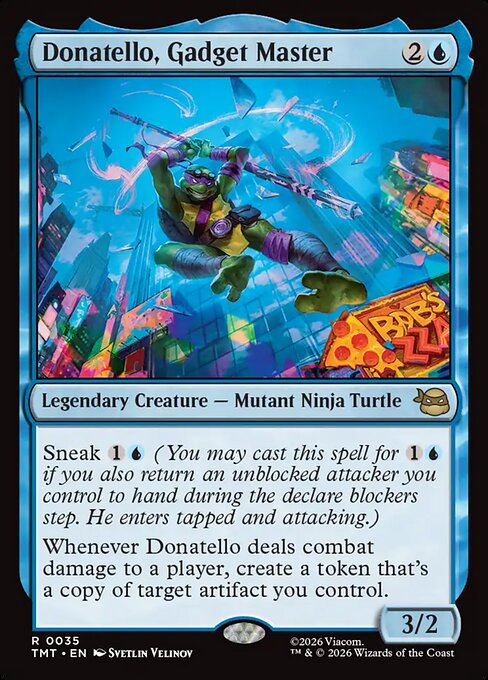 Rating5.7Playable
Why this rating?
Good playable that always makes the cut (5.7/10).
Why. A 3/2 for three that can come in attacking with Sneak for two mana. When it connects, it creates a token copy of one of your artifacts.
Risks. Two toughness and no evasion: the attack must go through, and you need an artifact worth copying.
In the draft. A good pick for a blue artifact deck. It loses a lot of value without quality artifacts.
Results in the games of the set
When it is in hand, the deck wins 57.2% of its games (set average: 57.7%, 92nd of 184 cards).
In the opening hand: 54.8% wins (56.4% on average).
Drawn during the game: 58.6% (58.6% on average).
When it is drawn, the deck wins 3.4 points more than when it is not.
When it is drafted, it is played 89% of the time (set average: 61%).
Taken as the first pick (32 drafts), it ends in the deck 94% of the time.
It is played about as much in every archetype.
 Rating5.6Playable
Why this rating?
Good playable that always makes the cut (5.6/10).
Why. A 7/5 for three, castable with black or green thanks to the hybrid cost. Its size dominates the board very early.
Risks. Every time it attacks or blocks, you must sacrifice a permanent or discard a card. That cost drains your hand and board quickly.
In the draft. An aggressive card for a deck that wants to finish fast. In a slow deck, the recurring cost keeps it from paying off.
Results in the games of the set
When it is in hand, the deck wins 56.5% of its games (set average: 57.7%, 106th of 184 cards).
In the opening hand: 54.9% wins (56.4% on average).
Drawn during the game: 57.5% (58.6% on average).
When it is drawn, the deck wins 4.6 points more than when it is not.
When it is drafted, it is played 65% of the time (set average: 61%).
Taken among the first three picks (41 drafts), it ends in the deck 76% of the time.
It is played about as much in every archetype.

91. Bespoke Bō
Rating5.6PlayableWhy this rating?
Good playable that always makes the cut (5.6/10).
Why. A three-mana Equipment that returns up to one other nonland permanent, yours or your opponent's, to hand when it enters. It gives +2/+1 and vigilance to the equipped creature. Good for tempo or replaying enter effects.
Risks. Three mana to cast and three to equip is slow. Without a good target to bounce, it loses much of its appeal.
In the draft. A useful tempo piece for a blue deck, taken in the middle of the pack. In a deck without enter effects, it is fine but unexciting.
 Rating5.6Playable
Why this rating?
Good playable that always makes the cut (5.6/10).
Why. A black and green dual land that enters tapped and gains you a life. It fixes your mana for a black-green deck.
Risks. It enters tapped and does nothing else. It slows a deck that wants to curve out.
In the draft. Play it in a black-green deck. Do not take it over good spells unless your colors are set.
Results in the games of the set
When it is in hand, the deck wins 58.6% of its games (set average: 57.7%, 58th of 184 cards).
In the opening hand: 57.7% wins (56.4% on average).
Drawn during the game: 59.2% (58.6% on average).
When it is drawn, the deck wins 3.8 points more than when it is not.
When it is drafted, it is played 78% of the time (set average: 61%).
Taken among the first three picks (132 drafts), it ends in the deck 88% of the time.
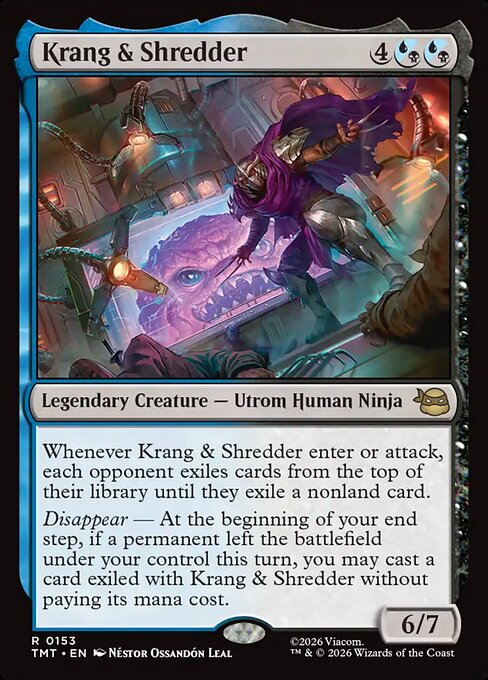
93. Krang & Shredder
Rating5.6PlayableWhy this rating?
Good playable that always makes the cut (5.6/10).
Why. A 6/7 for six, castable with blue or black thanks to the hybrid cost. When it enters and each time it attacks, the opponent exiles cards from the top of their library until a nonland card; with Disappear you may cast a card exiled this way for free.
Risks. Six mana and little protection: a removal answers it. Disappear needs a permanent to leave your battlefield.
In the draft. A decent top-end finisher for a blue or black deck. One copy is usually enough.
Results in the games of the set
When it is in hand, the deck wins 56.6% of its games (set average: 57.7%, 104th of 184 cards).
In the opening hand: 53.0% wins (56.4% on average).
Drawn during the game: 58.7% (58.6% on average).
When it is drawn, the deck wins 1.9 points more than when it is not.
When it is drafted, it is played 97% of the time (set average: 61%).
Taken as the first pick (51 drafts), it ends in the deck 96% of the time.
It is played about as much in every archetype.
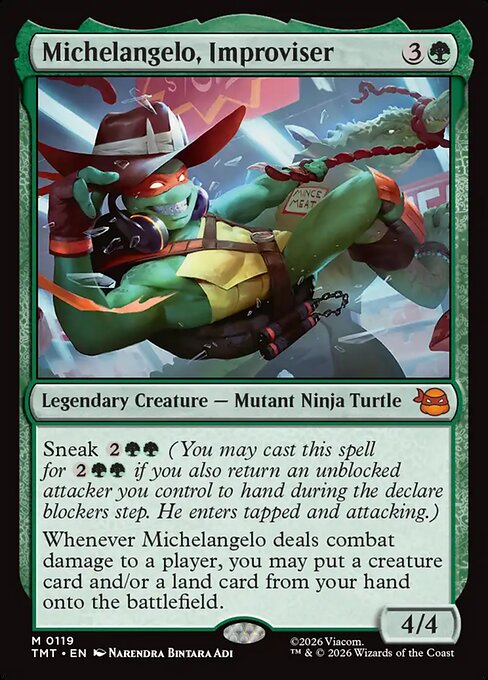 Rating5.6Playable
Why this rating?
Good playable that always makes the cut (5.6/10).
Why. A 4/4 for four that can enter attacking with Sneak. If it connects, you may put a creature and/or a land card from your hand onto the battlefield, a big tempo gain.
Risks. It must connect with the player, so being blocked shuts off the trigger. It needs a well-stocked hand to shine.
In the draft. A fine green 4/4, but the trigger comes up less often in practice. Do not take it for the bonus alone.
Results in the games of the set
When it is in hand, the deck wins 56.8% of its games (set average: 57.7%, 101st of 184 cards).
In the opening hand: 54.5% wins (56.4% on average).
Drawn during the game: 58.2% (58.6% on average).
When it is drawn, the deck wins 6.0 points more than when it is not.
When it is drafted, it is played 88% of the time (set average: 61%).
Taken among the first three picks (47 drafts), it ends in the deck 94% of the time.
It is played about as much in every archetype.
 Rating5.6Playable
Why this rating?
Good playable that always makes the cut (5.6/10).
Why. A 1/3 reach creature for three that taps for mana of one color equal to its power: it fixes, and accelerates a lot if it grows.
Risks. With 1 power it only makes one mana, a modest accelerator until it grows.
In the draft. A good pick for a green deck that can grow it. Without that, it is a decent reach blocker.
Results in the games of the set
When it is in hand, the deck wins 56.1% of its games (set average: 57.7%, 112th of 184 cards).
In the opening hand: 54.8% wins (56.4% on average).
Drawn during the game: 57.0% (58.6% on average).
When it is drawn, the deck wins 3.3 points more than when it is not.
When it is drafted, it is played 84% of the time (set average: 61%).
Taken as the first pick (52 drafts), it ends in the deck 98% of the time.
It is played mostly in B/G decks (36% of them) and G/R (32%).

96. Northampton Farm
Rating5.6PlayableWhy this rating?
Good playable that always makes the cut (5.6/10).
Why. A colorless land that lets you exile one of your creatures for one mana, then bring it back by sacrificing the land. It saves a creature from removal or replays an enter effect.
Risks. Colorless mana can strain a two-color deck, and the exile costs tempo. The land is sacrificed to bring the creature back.
In the draft. A utility land to take late in a deck with enter-effect creatures. Not essential.
Results in the games of the set
When it is in hand, the deck wins 55.8% of its games (set average: 57.7%, 119th of 184 cards).
In the opening hand: 54.3% wins (56.4% on average).
Drawn during the game: 56.8% (58.6% on average).
When it is drawn, the deck wins 1.2 points more than when it is not.
When it is drafted, it is played 56% of the time (set average: 61%).
Taken among the first three picks (31 drafts), it ends in the deck 81% of the time.
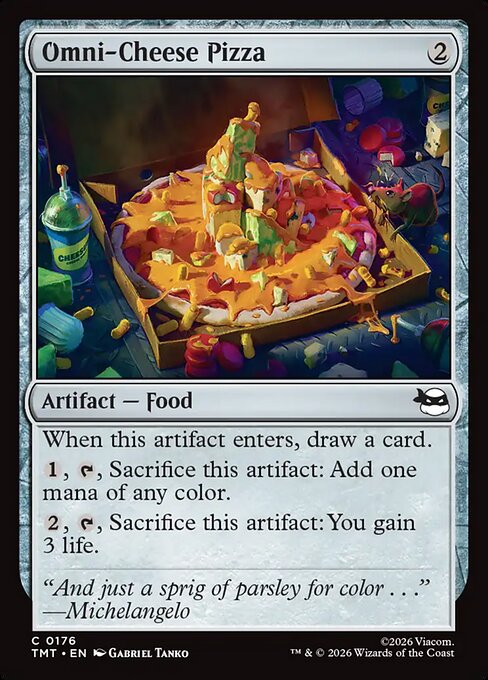 Rating5.6Playable
Why this rating?
Good playable that always makes the cut (5.6/10).
Why. A two-mana Food artifact that draws a card when it enters, then can be sacrificed for one mana of any color or to gain three life. A cheap artifact that replaces itself.
Risks. It does nothing on the board. Its effects only support the rest of your deck.
In the draft. A good common for artifact decks: easy to cast and one more artifact for your count. Otherwise, solid filler.
Results in the games of the set
When it is in hand, the deck wins 58.5% of its games (set average: 57.7%, 63rd of 184 cards).
In the opening hand: 55.9% wins (56.4% on average).
Drawn during the game: 60.3% (58.6% on average).
When it is drawn, the deck wins 3.3 points more than when it is not.
When it is drafted, it is played 69% of the time (set average: 61%).
Taken as the first pick (41 drafts), it ends in the deck 85% of the time.
It is played mostly in G/U decks (62% of them) and B/G (55%).

98. TCRI Building
Rating5.6PlayableWhy this rating?
Good playable that always makes the cut (5.6/10).
Why. A blue and red dual land that enters tapped and gains you a life. It fixes your mana for a blue-red deck.
Risks. It enters tapped and does nothing else. It slows a deck that wants to curve out.
In the draft. Play it in a blue-red deck. Do not take it over good spells unless your colors are set.
Results in the games of the set
When it is in hand, the deck wins 60.2% of its games (set average: 57.7%, 33rd of 184 cards).
In the opening hand: 60.3% wins (56.4% on average).
Drawn during the game: 60.1% (58.6% on average).
When it is drawn, the deck wins 4.4 points more than when it is not.
When it is drafted, it is played 79% of the time (set average: 61%).
Taken among the first three picks (155 drafts), it ends in the deck 90% of the time.

99. The Neutrinos
Rating5.6PlayableWhy this rating?
Good playable that always makes the cut (5.6/10).
Why. A 2/4 flier for four that gets +1/+0 until end of turn from Alliance. Each time it attacks, it exiles one of your creatures and returns it tapped and attacking, replaying its enter effects.
Risks. It needs two specific colors, red and white. Without creatures that have enter effects, its attack ability does little.
In the draft. A red-white-only pick, fairly late. A solid flying blocker, but little damage on its own.
Results in the games of the set
When it is in hand, the deck wins 54.0% of its games (set average: 57.7%, 139th of 184 cards).
In the opening hand: 53.9% wins (56.4% on average).
Drawn during the game: 54.0% (58.6% on average).
When it is drawn, the deck wins 0.8 points less than when it is not.
When it is drafted, it is played 62% of the time (set average: 61%).
Taken as the first pick (35 drafts), it ends in the deck 89% of the time.
It is played mostly in R/W decks (59% of them).

100. Uneasy Alliance
Rating5.5PlayableWhy this rating?
Good playable that always makes the cut (5.5/10).
Why. A two-mana Aura that stops the enchanted creature from attacking or blocking. Later, for five mana at sorcery speed, you can sacrifice it to exile the creature and get a 1/1 black Ninja creature token.
Risks. The creature's abilities still work. If the creature is bounced or sacrificed, you lose the Aura.
In the draft. A decent, cheap removal spell, but do not rank it very high. The Ninja token is a bonus in a Ninja deck.
Results in the games of the set
When it is in hand, the deck wins 57.0% of its games (set average: 57.7%, 95th of 184 cards).
In the opening hand: 55.5% wins (56.4% on average).
Drawn during the game: 58.2% (58.6% on average).
When it is drawn, the deck wins 1.0 points less than when it is not.
When it is drafted, it is played 83% of the time (set average: 61%).
Taken as the first pick (66 drafts), it ends in the deck 92% of the time.
It is played mostly in B/W decks (71% of them) and R/W (66%).

101. Madame Null, Power Broker
Rating5.4PlayableWhy this rating?
A solid playable that rarely gets cut (5.4/10).
Why. A three-mana 1/3 deathtouch that blocks well and grows your later creatures: pay life equal to a creature's power as it enters and it gets that many +1/+1 counters. That doubles the power of your big threats.
Risks. The bonus costs life, which gets risky against aggressive decks. On its own it does nothing offensive, and removal takes all the value away.
In the draft. A solid mid-pack pick for a creature-heavy deck. It is happiest in a controlling deck that can afford to pay the life.
Results in the games of the set
When it is in hand, the deck wins 56.8% of its games (set average: 57.7%, 99th of 184 cards).
In the opening hand: 56.3% wins (56.4% on average).
Drawn during the game: 57.1% (58.6% on average).
When it is drawn, the deck wins 3.9 points more than when it is not.
When it is drafted, it is played 91% of the time (set average: 61%).
Taken as the first pick (33 drafts), it ends in the deck 91% of the time.
It is played about as much in every archetype.
 Rating5.4Playable
Why this rating?
A solid playable that rarely gets cut (5.4/10).
Why. Unconditional removal on an artifact: when it enters it destroys target creature, whatever its size. It then sticks around and can be sacrificed later to gain 3 life.
Risks. Four mana with two black is slow and hard to splash. It handles a single creature and does nothing against indestructible or hexproof.
In the draft. Take it without hesitation in a black deck; common removal like this is the backbone of a good deck. Do not pass it for an average creature.
Results in the games of the set
When it is in hand, the deck wins 57.2% of its games (set average: 57.7%, 87th of 184 cards).
In the opening hand: 54.2% wins (56.4% on average).
Drawn during the game: 59.3% (58.6% on average).
When it is drawn, the deck wins 2.6 points more than when it is not.
When it is drafted, it is played 86% of the time (set average: 61%).
Taken as the first pick (156 drafts), it ends in the deck 90% of the time.
It is played mostly in B/U decks (72% of them) and B/G (70%).

103. Dimension X
Rating5.4PlayableWhy this rating?
A solid playable that rarely gets cut (5.4/10).
Why. A red-white dual land that enters tapped and gains you 1 life. It smooths the mana of a two-color deck at almost no cost.
Risks. Entering tapped costs tempo in a deck that wants to curve out, and it only helps if you really are in these two colors.
In the draft. A late pick, mostly once you are red-white; if you already have the colors, take it over filler.
Results in the games of the set
When it is in hand, the deck wins 56.5% of its games (set average: 57.7%, 105th of 184 cards).
In the opening hand: 57.5% wins (56.4% on average).
Drawn during the game: 55.7% (58.6% on average).
When it is drawn, the deck wins 1.1 points more than when it is not.
When it is drafted, it is played 52% of the time (set average: 61%).
Taken among the first three picks (72 drafts), it ends in the deck 83% of the time.
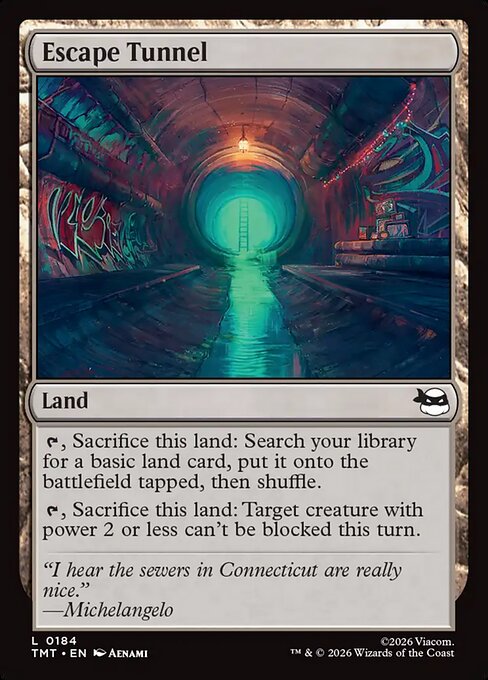
104. Escape Tunnel
Rating5.4PlayableWhy this rating?
A solid playable that rarely gets cut (5.4/10).
Why. A utility land that taps for no mana: sacrifice it to fetch a basic land onto the battlefield tapped, or to make a creature with power 2 or less unblockable this turn. It fixes your mana or breaks a board stall.
Risks. It produces no mana and costs you a land drop's worth of tempo when you sacrifice it. Playing several would hurt your curve.
In the draft. A good late pick for a two or three color deck, or one with small creatures. One copy is enough.
Results in the games of the set
When it is in hand, the deck wins 57.7% of its games (set average: 57.7%, 78th of 184 cards).
In the opening hand: 57.5% wins (56.4% on average).
Drawn during the game: 57.9% (58.6% on average).
When it is drawn, the deck wins 1.4 points more than when it is not.
When it is drafted, it is played 93% of the time (set average: 61%).
Taken as the first pick (33 drafts), it ends in the deck 97% of the time.
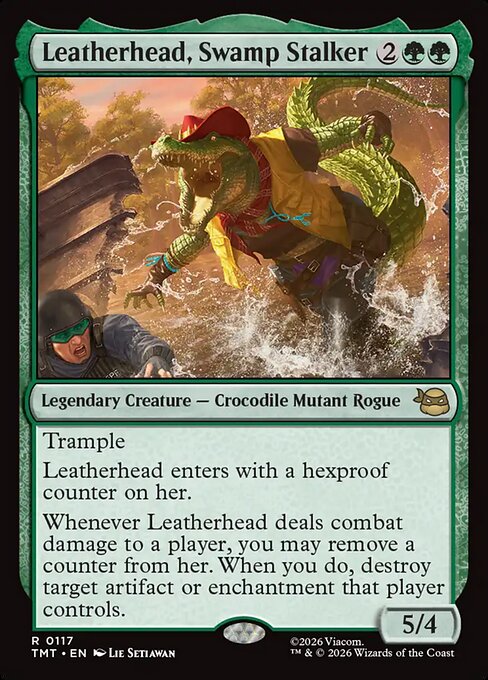
105. Leatherhead, Swamp Stalker
Rating5.4PlayableWhy this rating?
A solid playable that rarely gets cut (5.4/10).
Why. A four-mana 5/4 trampler, well above the rate for its cost. She enters with a hexproof counter and, when she deals combat damage to a player, you may remove a counter to destroy an artifact or enchantment that player controls.
Risks. Once the counter is removed she loses her hexproof and is exposed to removal. Two green mana means you need to be properly in the color.
In the draft. A good creature to take ahead of average cards if you are green. She dominates the board from turn four, and hexproof protects her at first.
Results in the games of the set
When it is in hand, the deck wins 61.4% of its games (set average: 57.7%, 21st of 184 cards).
In the opening hand: 61.3% wins (56.4% on average).
Drawn during the game: 61.5% (58.6% on average).
When it is drawn, the deck wins 9.3 points more than when it is not.
When it is drafted, it is played 85% of the time (set average: 61%).
Taken as the first pick (43 drafts), it ends in the deck 93% of the time.
It is played about as much in every archetype.
 Rating5.4Playable
Why this rating?
A solid playable that rarely gets cut (5.4/10).
Why. A three-mana 1/3 that gets +1/+0 for each other creature you control. In a creature-heavy deck it quickly becomes a real threat. Sneak for one white mana puts it onto the battlefield tapped and attacking, by returning an unblocked attacker to your hand.
Risks. Alone it does very little: a 1/3 that can't really attack. It loses its point if your creatures die or you play few of them.
In the draft. A good common for a white deck with lots of creatures, especially one that wants to be fast. Not a card to force.
Results in the games of the set
When it is in hand, the deck wins 56.0% of its games (set average: 57.7%, 114th of 184 cards).
In the opening hand: 55.7% wins (56.4% on average).
Drawn during the game: 56.3% (58.6% on average).
When it is drawn, the deck wins 1.8 points less than when it is not.
When it is drafted, it is played 78% of the time (set average: 61%).
Taken as the first pick (35 drafts), it ends in the deck 89% of the time.
It is played mostly in B/W decks (80% of them) and R/W (72%).

107. Paramecia Coloniex
Rating5.4PlayableWhy this rating?
A solid playable that rarely gets cut (5.4/10).
Why. A two-mana 2/2 that puts the top three cards of your library into your graveyard on entering. When it dies you may exile it to put a creature card from your graveyard on top of your library: a small blocker that replaces itself.
Risks. Milling yourself is a cost, and a 2/2 is fragile in combat. With no creature card in the graveyard the second ability does nothing.
In the draft. A mid-pack pick for a black deck that likes slow value. Do not take it over a good removal.
Results in the games of the set
When it is in hand, the deck wins 53.8% of its games (set average: 57.7%, 141st of 184 cards).
In the opening hand: 54.7% wins (56.4% on average).
Drawn during the game: 53.1% (58.6% on average).
When it is drawn, the deck wins 1.2 points less than when it is not.
When it is drafted, it is played 36% of the time (set average: 61%).
Taken among the first three picks (42 drafts), it ends in the deck 71% of the time.
It is played mostly in B/W decks (25% of them).

108. Shark Shredder, Killer Clone
Rating5.4PlayableWhy this rating?
A solid playable that rarely gets cut (5.4/10).
Why. A four-mana 4/4 first striker, already hard to fight in combat. If it deals combat damage to a player, you put a creature card from that player's graveyard onto the battlefield under your control, tapped and attacking: every successful hit adds more.
Risks. It has to deal damage to a player, and the opponent can block or kill it first. If their graveyard has no creature card, the trigger does nothing.
In the draft. A good black rare to take fairly early in a deck that attacks. Sneak for five mana puts it onto the battlefield tapped and attacking mid-game.
Results in the games of the set
When it is in hand, the deck wins 58.3% of its games (set average: 57.7%, 66th of 184 cards).
In the opening hand: 56.6% wins (56.4% on average).
Drawn during the game: 59.4% (58.6% on average).
When it is drawn, the deck wins 3.1 points more than when it is not.
When it is drafted, it is played 97% of the time (set average: 61%).
Taken as the first pick (35 drafts), it ends in the deck 97% of the time.
It is played about as much in every archetype.

109. Tenderize
Rating5.4PlayableWhy this rating?
A solid playable that rarely gets cut (5.4/10).
Why. One-sided removal for two mana: your creature deals damage equal to its power to an opponent's creature, and takes none back. As an instant it can be cast in response, and it costs next to nothing.
Risks. You need a creature, and the bigger it is the better the spell works. If the opponent responds by killing your creature, you lose the spell.
In the draft. A good removal for a green deck with real creatures. Take it at a fair pick, especially if you lack removal.
Results in the games of the set
When it is in hand, the deck wins 57.6% of its games (set average: 57.7%, 82nd of 184 cards).
In the opening hand: 53.6% wins (56.4% on average).
Drawn during the game: 60.0% (58.6% on average).
When it is drawn, the deck wins 4.6 points more than when it is not.
When it is drafted, it is played 82% of the time (set average: 61%).
Taken as the first pick (83 drafts), it ends in the deck 90% of the time.
It is played mostly in G/U decks (71% of them) and B/G (65%).

110. Jennika, Bad Apple Big Sister
Rating5.3PlayableWhy this rating?
A solid playable that rarely gets cut (5.3/10).
Why. A flexible card: five mana for a 3/3 and a 2/2 red Mutant creature token, two bodies in one card. If you are short on lands, plainscycling for two lets you discard it to search for a Plains.
Risks. Five mana for five total power is a fair rate, nothing more. It is slow against aggressive decks and does nothing unique.
In the draft. A solid common for white decks: take it for the value, but not ahead of removal or a good cheap creature.
Results in the games of the set
When it is in hand, the deck wins 56.0% of its games (set average: 57.7%, 113th of 184 cards).
In the opening hand: 55.3% wins (56.4% on average).
Drawn during the game: 56.6% (58.6% on average).
When it is drawn, the deck wins 1.7 points less than when it is not.
When it is drafted, it is played 59% of the time (set average: 61%).
Taken among the first three picks (82 drafts), it ends in the deck 84% of the time.
It is played mostly in B/W decks (72% of them) and R/W (63%).
 Rating5.2Playable
Why this rating?
A solid playable that rarely gets cut (5.2/10).
Why. A three-mana 2/4 with menace: a sturdy body that is hard to block. When it attacks, the next noncreature spell you cast this turn has affinity for artifacts, which rewards an artifact-heavy deck.
Risks. The bonus only matters if you have artifacts and noncreature spells to cast. Without them it is a plain 2/4 menace.
In the draft. A card for a blue or red deck built around artifacts. Elsewhere it is weak, so take it only when you know what you are building.
Results in the games of the set
When it is in hand, the deck wins 52.1% of its games (set average: 57.7%, 159th of 184 cards).
In the opening hand: 51.4% wins (56.4% on average).
Drawn during the game: 52.6% (58.6% on average).
When it is drawn, the deck wins 1.0 points less than when it is not.
When it is drafted, it is played 62% of the time (set average: 61%).
Taken among the first three picks (37 drafts), it ends in the deck 86% of the time.
It is played about as much in every archetype.

112. Foot Headquarters
Rating5.2PlayableWhy this rating?
A solid playable that rarely gets cut (5.2/10).
Why. A white-black dual land that enters tapped and gains you 1 life. It steadies your mana in a deck of those two colors.
Risks. Entering tapped costs tempo if you want to curve out, and it offers nothing outside these two colors.
In the draft. Pick it once you are white-black, late in the pack; before that, prefer playables.
Results in the games of the set
When it is in hand, the deck wins 57.1% of its games (set average: 57.7%, 94th of 184 cards).
In the opening hand: 58.8% wins (56.4% on average).
Drawn during the game: 55.7% (58.6% on average).
When it is drawn, the deck wins 0.8 points less than when it is not.
When it is drafted, it is played 75% of the time (set average: 61%).
Taken among the first three picks (96 drafts), it ends in the deck 84% of the time.

113. Foot Ninjas
Rating5.2PlayableWhy this rating?
A solid playable that rarely gets cut (5.2/10).
Why. A 5/5 that costs six mana at full price, but Sneak puts it onto the battlefield for four mana, tapped and attacking, by returning an unblocked attacker to your hand. It gains you 3 life on entering, which helps you stabilize.
Risks. The full cost is high, and Sneak needs an unblocked attacker to return to hand. A 5/5 with no evasion is still vulnerable to removal.
In the draft. A good white-black common: a big top-end creature. Two copies in a deck are plenty.
Results in the games of the set
When it is in hand, the deck wins 55.8% of its games (set average: 57.7%, 116th of 184 cards).
In the opening hand: 54.1% wins (56.4% on average).
Drawn during the game: 57.0% (58.6% on average).
When it is drawn, the deck wins 2.1 points less than when it is not.
When it is drafted, it is played 67% of the time (set average: 61%).
Taken as the first pick (32 drafts), it ends in the deck 97% of the time.
It is played mostly in B/W decks (72% of them).

114. Jennika's Technique
Rating5.2PlayableWhy this rating?
A solid playable that rarely gets cut (5.2/10).
Why. An instant dealing 2 damage to each creature, yours included, for three mana, or for a single red mana with Sneak. Against an opponent flooding the board with small creatures, it can swing the game.
Risks. It also hits your own creatures. It does nothing against big creatures and you need to build around it.
In the draft. A specialized card, good in a red deck with big creatures. Skip it if your deck is full of small creatures.
Results in the games of the set
When it is in hand, the deck wins 56.7% of its games (set average: 57.7%, 103rd of 184 cards).
In the opening hand: 55.7% wins (56.4% on average).
Drawn during the game: 57.3% (58.6% on average).
When it is drawn, the deck wins 5.3 points more than when it is not.
When it is drafted, it is played 17% of the time (set average: 61%).

115. Mikey & Leo, Chaos & Order
Rating5.2PlayableWhy this rating?
A solid playable that rarely gets cut (5.2/10).
Why. A two-mana 2/2 that draws a card whenever you put a counter on a creature you control, once per turn. In a deck that makes counters it is a very cheap card engine.
Risks. Without counters it does nothing: a 2/2 with no useful ability. It is fragile and must survive to pay off.
In the draft. Take it in a green or white deck built around counters. Otherwise let it go.
Results in the games of the set
When it is in hand, the deck wins 56.3% of its games (set average: 57.7%, 108th of 184 cards).
In the opening hand: 56.1% wins (56.4% on average).
Drawn during the game: 56.4% (58.6% on average).
When it is drawn, the deck wins 3.1 points more than when it is not.
When it is drafted, it is played 87% of the time (set average: 61%).
Taken among the first three picks (92 drafts), it ends in the deck 91% of the time.
It is played about as much in every archetype.
 Rating5.2Playable
Why this rating?
A solid playable that rarely gets cut (5.2/10).
Why. A three-mana instant that turns the target into an artifact creature with base power and toughness 4/5 until end of turn, and draws you a card. It can turn a small creature into a good blocker or attacker, or shrink an oversized enemy mid-combat.
Risks. The effect lasts only this turn and kills nothing on its own. It needs a good read of combat to matter.
In the draft. A fair pick for a blue deck that likes combat tricks. Do not take it over removal.
Results in the games of the set
When it is in hand, the deck wins 57.2% of its games (set average: 57.7%, 88th of 184 cards).
In the opening hand: 53.8% wins (56.4% on average).
Drawn during the game: 59.3% (58.6% on average).
When it is drawn, the deck wins 1.9 points more than when it is not.
When it is drafted, it is played 34% of the time (set average: 61%).
Taken among the first three picks (67 drafts), it ends in the deck 79% of the time.
It is played mostly in R/U decks (52% of them) and U/W (40%).

117. Mouser Mark III
Rating5.2PlayableWhy this rating?
A solid playable that rarely gets cut (5.2/10).
Why. A two-mana 2/3 artifact creature: a good early blocker that holds off small attackers.
Risks. It cannot attack unless you control another artifact, so it often stays on defense. In a deck without artifacts it is just a wall.
In the draft. A fair common for a blue or red deck with artifacts; elsewhere, leave it for late in the pack.
Results in the games of the set
When it is in hand, the deck wins 55.4% of its games (set average: 57.7%, 124th of 184 cards).
In the opening hand: 54.2% wins (56.4% on average).
Drawn during the game: 56.1% (58.6% on average).
When it is drawn, the deck wins 0.4 points more than when it is not.
When it is drafted, it is played 48% of the time (set average: 61%).
Taken among the first three picks (97 drafts), it ends in the deck 78% of the time.
It is played mostly in R/U decks (74% of them) and B/U (28%).

118. Primordial Pachyderm
Rating5.2PlayableWhy this rating?
A solid playable that rarely gets cut (5.2/10).
Why. A four-mana 4/4 with reach and trample that gains 2 life on entering. It blocks fliers and hits hard on defense and offense alike: very good for its cost.
Risks. It has no other ability: it stays exposed to removal and can be slowed by a sacrificed blocker. It is just a big body.
In the draft. A good base for a green deck, to take fairly quickly among the commons. It earns a slot in your curve.
Results in the games of the set
When it is in hand, the deck wins 57.9% of its games (set average: 57.7%, 73rd of 184 cards).
In the opening hand: 55.2% wins (56.4% on average).
Drawn during the game: 59.4% (58.6% on average).
When it is drawn, the deck wins 4.1 points more than when it is not.
When it is drafted, it is played 74% of the time (set average: 61%).
Taken as the first pick (46 drafts), it ends in the deck 89% of the time.
It is played mostly in B/G decks (66% of them) and G/R (61%).

119. Stomped by the Foot
Rating5.2PlayableWhy this rating?
A solid playable that rarely gets cut (5.2/10).
Why. Flexible two-mana removal you can cast in response: -2/-2 kills small creatures, and by sacrificing an artifact or creature it becomes -5/-5, which handles nearly any creature.
Risks. Unkicked it only reaches small targets. The sacrifice is a real cost, and it can cost you a card to take one.
In the draft. A good black common to take fairly early, ahead of average creatures, especially if you have tokens to sacrifice.
Results in the games of the set
When it is in hand, the deck wins 57.5% of its games (set average: 57.7%, 83rd of 184 cards).
In the opening hand: 55.5% wins (56.4% on average).
Drawn during the game: 58.9% (58.6% on average).
When it is drawn, the deck wins 1.3 points more than when it is not.
When it is drafted, it is played 85% of the time (set average: 61%).
Taken as the first pick (77 drafts), it ends in the deck 94% of the time.
It is played mostly in B/W decks (68% of them) and B/R (63%).
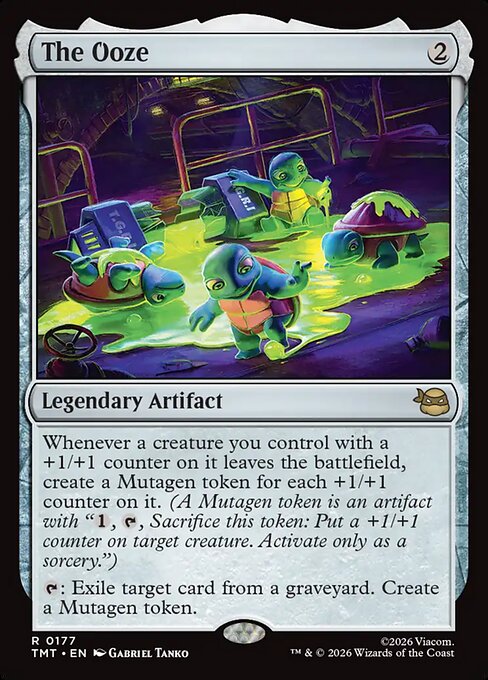
120. The Ooze
Rating5.2PlayableWhy this rating?
A solid playable that rarely gets cut (5.2/10).
Why. A two-mana legendary artifact that taps to exile a card from a graveyard and create a Mutagen token. For one mana that token puts a +1/+1 counter on a creature, whenever you could cast a sorcery. When a creature of yours with +1/+1 counters leaves the battlefield, you create a Mutagen for each counter.
Risks. It needs cards in graveyards and does nothing for your board on its own. Each counter costs mana, so it is slow against an aggressive deck.
In the draft. A good long-term value card, worth taking in almost any deck with creatures. It shines in games that drag on.
Results in the games of the set
When it is in hand, the deck wins 58.4% of its games (set average: 57.7%, 64th of 184 cards).
In the opening hand: 57.5% wins (56.4% on average).
Drawn during the game: 59.0% (58.6% on average).
When it is drawn, the deck wins 4.3 points more than when it is not.
When it is drafted, it is played 97% of the time (set average: 61%).
Taken among the first three picks (138 drafts), it ends in the deck 95% of the time.
It is played about as much in every archetype.

121. Turtle Power!
Rating5.1PlayableWhy this rating?
A solid playable that rarely gets cut (5.1/10).
Why. A flash enchantment that gives Turtles you control +2/+2. In a deck full of Turtles it is a strong team effect to spring mid-combat.
Risks. It does nothing without Turtles on the battlefield. In a normal deck it is a dead card.
In the draft. Let it pass unless you already have many Turtles. It is too narrow for a standard deck.
Results in the games of the set
When it is in hand, the deck wins 45.2% of its games (set average: 57.7%).
Drawn during the game: 0.0% (58.6% on average).
When it is drawn, the deck wins 4.4 points less than when it is not.
When it is drafted, it is played only 5% of the time (set average: 61%): it almost always ends in the sideboard.

122. EPF Point Squad
Rating5.0PlayableWhy this rating?
A solid playable that rarely gets cut (5.0/10).
Why. A three-mana 2/1 that gets a +1/+1 counter whenever another creature enters under your control, thanks to Alliance. In a creature-heavy deck it grows each turn.
Risks. Three mana for a 2/1 is expensive, and it dies quickly before growing. It is weak against removal or a sweeper.
In the draft. Filler for a creature deck. Only with a low curve; otherwise leave it.
Results in the games of the set
When it is in hand, the deck wins 52.7% of its games (set average: 57.7%, 152nd of 184 cards).
In the opening hand: 53.4% wins (56.4% on average).
Drawn during the game: 52.1% (58.6% on average).
When it is drawn, the deck wins 3.1 points less than when it is not.
When it is drafted, it is played 42% of the time (set average: 61%).
Taken among the first three picks (73 drafts), it ends in the deck 74% of the time.
It is played mostly in R/W decks (70% of them).
 Rating5.0Playable
Why this rating?
A solid playable that rarely gets cut (5.0/10).
Why. A one-mana instant: +1/+3 and flying until end of turn, with scry 1. It saves a creature in combat or lets an attack go over the blockers.
Risks. It is a trick with no lasting effect, and does nothing alone. The opponent can respond by killing the target.
In the draft. A late-pack card for a white deck, except with lots of aggressive creatures. Not before removal.
Results in the games of the set
When it is in hand, the deck wins 55.9% of its games (set average: 57.7%, 115th of 184 cards).
In the opening hand: 54.7% wins (56.4% on average).
Drawn during the game: 56.9% (58.6% on average).
When it is drawn, the deck wins 2.3 points less than when it is not.
When it is drafted, it is played 21% of the time (set average: 61%).
It is played mostly in B/W decks (27% of them).

124. Kitsune's Technique
Rating5.0PlayableWhy this rating?
A solid playable that rarely gets cut (5.0/10).
Why. An instant that makes the opponent mill half their library, rounded up. It costs only two mana with Sneak, but six otherwise.
Risks. It does not win the game unless you already have a plan to finish. In a normal deck it is too slow and has no impact on the board.
In the draft. Pass it in almost every deck. Only a deck built around this kind of effect can play it.
Results in the games of the set
When it is drafted, it is played only 1% of the time (set average: 61%): it almost always ends in the sideboard.

125. Mondo Gecko
Rating5.0PlayableWhy this rating?
A solid playable that rarely gets cut (5.0/10).
Why. A three-mana 2/3 that draws a card for each color among your permanents when it hits a player. For one mana and a discarded card, it becomes a color of your choice and gains hexproof from that color until end of turn: a good way to dodge removal.
Risks. It must connect to draw, and the protection costs a card. It needs two blue mana.
In the draft. A fair card in a multicolor blue deck that benefits from permanents of different colors. Do not force it.
Results in the games of the set
When it is in hand, the deck wins 54.0% of its games (set average: 57.7%, 138th of 184 cards).
In the opening hand: 52.8% wins (56.4% on average).
Drawn during the game: 54.8% (58.6% on average).
When it is drawn, the deck wins 2.2 points more than when it is not.
When it is drafted, it is played 73% of the time (set average: 61%).
Taken among the first three picks (43 drafts), it ends in the deck 81% of the time.
It is played about as much in every archetype.

126. Purple Dragon Punks
Rating5.0PlayableWhy this rating?
A solid playable that rarely gets cut (5.0/10).
Why. A two-mana 2/2 that taps for red mana, spendable only on artifact spells or to activate abilities. It accelerates an artifact deck.
Risks. The mana is very limited: without artifacts or abilities to pay for, it is a plain 2/2. It is fragile.
In the draft. A late-pack pick for a red artifact deck. Otherwise it has no appeal.
Results in the games of the set
When it is in hand, the deck wins 54.3% of its games (set average: 57.7%, 133rd of 184 cards).
In the opening hand: 53.8% wins (56.4% on average).
Drawn during the game: 54.7% (58.6% on average).
When it is drawn, the deck wins 0.1 points more than when it is not.
When it is drafted, it is played 21% of the time (set average: 61%).
Taken among the first three picks (30 drafts), it ends in the deck 77% of the time.
It is played mostly in R/U decks (41% of them) and B/R (27%).

127. Ragamuffin Raptor
Rating5.0PlayableWhy this rating?
A solid playable that rarely gets cut (5.0/10).
Why. A five-mana 4/3 that returns a creature or Food card from your graveyard to your hand when it enters. It is a two-for-one that replaces a dead creature.
Risks. It is slow, and without a target in the graveyard it loses half its value. A 4/3 for five is unexciting.
In the draft. A good green common for value: take it as a mid-curve creature, after the best cards.
Results in the games of the set
When it is in hand, the deck wins 56.9% of its games (set average: 57.7%, 96th of 184 cards).
In the opening hand: 51.6% wins (56.4% on average).
Drawn during the game: 59.9% (58.6% on average).
When it is drawn, the deck wins 2.9 points more than when it is not.
When it is drafted, it is played 74% of the time (set average: 61%).
Taken among the first three picks (194 drafts), it ends in the deck 95% of the time.
It is played mostly in B/G decks (75% of them) and G/R (60%).

128. Raph & Leo, Sibling Rivals
Rating5.0PlayableWhy this rating?
A solid playable that rarely gets cut (5.0/10).
Why. A three-mana 2/4 that, in the first combat of the turn, untaps one or two attacking creatures and adds an extra combat phase. It doubles your attacks and keeps your creatures free to block.
Risks. You need attackers to untap, and it has to attack itself. A 2/4 on offense is exposed to a bigger blocker.
In the draft. An aggressive rare to take in a red or white deck with many attackers. Outside that plan it is average.
Results in the games of the set
When it is in hand, the deck wins 54.4% of its games (set average: 57.7%, 132nd of 184 cards).
In the opening hand: 56.3% wins (56.4% on average).
Drawn during the game: 53.0% (58.6% on average).
When it is drawn, the deck wins 0.9 points more than when it is not.
When it is drafted, it is played 86% of the time (set average: 61%).
Taken among the first three picks (80 drafts), it ends in the deck 88% of the time.
It is played about as much in every archetype.
 Rating5.0Playable
Why this rating?
A solid playable that rarely gets cut (5.0/10).
Why. A four-mana 4/4 that must be blocked if able. Whenever it is dealt damage, you add that much red mana, which lasts until end of turn: an engine to cast more spells after combat.
Risks. It must be blocked, which exposes it to a bigger blocker or a trap. The mana only matters if you have something to spend it on.
In the draft. A very specialized card and rather weak: take it in a red deck with nothing better, not before good removal.
Results in the games of the set
When it is in hand, the deck wins 50.9% of its games (set average: 57.7%, 174th of 184 cards).
In the opening hand: 52.5% wins (56.4% on average).
Drawn during the game: 49.8% (58.6% on average).
When it is drawn, the deck wins 1.2 points less than when it is not.
When it is drafted, it is played 51% of the time (set average: 61%).
It is played about as much in every archetype.

130. Action News Crew
Rating5.0WeakWhy this rating?
A solid playable that rarely gets cut (5.0/10).
Why. A two-mana 2/2 with vigilance, fine early. Later you can discard it for six mana: a +1/+1 counter on each creature you control and you draw a card.
Risks. A 2/2 gets weak as the game goes on, and the channel ability is expensive. It is better with several creatures.
In the draft. A flexible white common filler, useful in a deck with many creatures. Take it mid-pack.
Results in the games of the set
When it is in hand, the deck wins 53.9% of its games (set average: 57.7%, 140th of 184 cards).
In the opening hand: 53.6% wins (56.4% on average).
Drawn during the game: 54.1% (58.6% on average).
When it is drawn, the deck wins 4.0 points less than when it is not.
When it is drafted, it is played 60% of the time (set average: 61%).
Taken among the first three picks (92 drafts), it ends in the deck 79% of the time.
It is played mostly in R/W decks (60% of them) and B/W (51%).

131. Go Ninja Go
Rating4.8WeakWhy this rating?
A solid playable that rarely gets cut (4.8/10).
Why. A two-mana sorcery with two modes you can combine: exile one of your creatures and return it to the battlefield, and deal damage equal to the greatest power among your creatures to an opponent's creature. With a big creature it is cheap removal.
Risks. You need a creature for it to work, and it is slow as a sorcery. Without a big creature it loses nearly all of its appeal.
In the draft. A fair red-white card to take as conditional removal. It needs both colors.
Results in the games of the set
When it is in hand, the deck wins 53.0% of its games (set average: 57.7%, 150th of 184 cards).
In the opening hand: 53.0% wins (56.4% on average).
Drawn during the game: 53.0% (58.6% on average).
When it is drawn, the deck wins 2.5 points less than when it is not.
When it is drafted, it is played 51% of the time (set average: 61%).
Taken among the first three picks (71 drafts), it ends in the deck 79% of the time.
It is played mostly in R/W decks (53% of them).
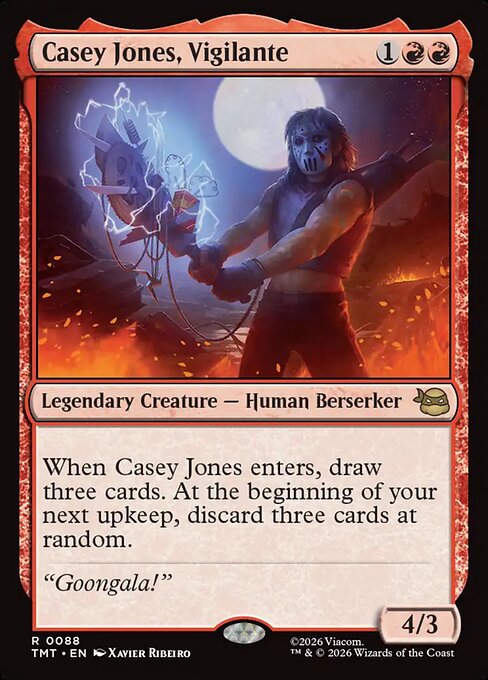 Rating4.8Weak
Why this rating?
A solid playable that rarely gets cut (4.8/10).
Why. A three-mana 4/3 that draws three cards when it enters: a big body and a full hand for a low price.
Risks. At the beginning of your next upkeep you discard three cards at random, which largely cancels the gain unless you empty your hand fast. You must play out your hand.
In the draft. A risky card for very aggressive red decks that empty their hand. In a slow deck it is bad.
Results in the games of the set
When it is in hand, the deck wins 51.1% of its games (set average: 57.7%, 171st of 184 cards).
In the opening hand: 48.2% wins (56.4% on average).
Drawn during the game: 53.0% (58.6% on average).
When it is drawn, the deck wins 0.6 points less than when it is not.
When it is drafted, it is played 35% of the time (set average: 61%).

133. Foot Elite
Rating4.8WeakWhy this rating?
A solid playable that rarely gets cut (4.8/10).
Why. A three-mana 2/4 whose attack trigger gives another creature you control +1/+0 and indestructible until end of turn. It protects a key attacker in combat or boosts the attack.
Risks. It has to attack to trigger, exposing a modest 2/4. Without another creature to support it does nothing.
In the draft. A decent white-black common for a creature deck. Take it mid-pack.
Results in the games of the set
When it is in hand, the deck wins 54.0% of its games (set average: 57.7%, 137th of 184 cards).
In the opening hand: 54.1% wins (56.4% on average).
Drawn during the game: 54.0% (58.6% on average).
When it is drawn, the deck wins 2.3 points less than when it is not.
When it is drafted, it is played 40% of the time (set average: 61%).
Taken among the first three picks (43 drafts), it ends in the deck 67% of the time.
It is played mostly in B/W decks (49% of them).
 Rating4.8Weak
Why this rating?
A solid playable that rarely gets cut (4.8/10).
Why. A one-mana Food with flash: a creature gets +2/+2 and untaps. It works as a surprise trick to win a combat, then can be sacrificed to gain 3 life.
Risks. It is a trick that depends on a creature in combat, and the life gain costs two mana. The effect is weak on its own.
In the draft. A fair green card as a cheap trick. Take it late in the pack, after creatures and removal.
Results in the games of the set
When it is in hand, the deck wins 54.5% of its games (set average: 57.7%, 130th of 184 cards).
In the opening hand: 50.9% wins (56.4% on average).
Drawn during the game: 56.8% (58.6% on average).
When it is drawn, the deck wins 3.6 points more than when it is not.
When it is drafted, it is played 26% of the time (set average: 61%).
It is played mostly in B/G decks (41% of them) and G/U (33%).
 Rating4.8Weak
Why this rating?
A solid playable that rarely gets cut (4.8/10).
Why. A 4/4 for five that makes a hasty 2/2 red Mutant creature token at the start of each of your combats. You get an extra attacker every turn without spending a card, which keeps the pressure on.
Risks. The token is destroyed at end of turn, so it never defends. The white ability that makes it indestructible only matters if you are white, and it costs extra mana.
In the draft. A solid five-drop for aggressive decks, clearly better with white. Take it mid-pack if you are red, without overpaying.
Results in the games of the set
When it is in hand, the deck wins 51.9% of its games (set average: 57.7%, 162nd of 184 cards).
In the opening hand: 50.7% wins (56.4% on average).
Drawn during the game: 52.7% (58.6% on average).
When it is drawn, the deck wins 0.8 points less than when it is not.
When it is drafted, it is played 46% of the time (set average: 61%).
Taken among the first three picks (68 drafts), it ends in the deck 82% of the time.
It is played mostly in R/W decks (46% of them) and B/R (31%).
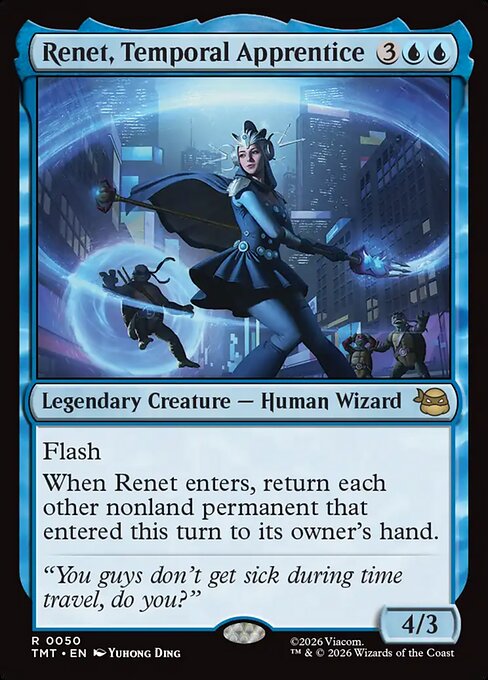
136. Renet, Temporal Apprentice
Rating4.8WeakWhy this rating?
A solid playable that rarely gets cut (4.8/10).
Why. A 4/3 with flash for five. Its best use is on the opponent's turn, right after they cast a nonland permanent, bouncing it and wasting their mana for the turn.
Risks. It also returns your own nonland permanents that entered this turn. If the opponent played nothing, you just have an expensive 4/3. The double blue cost strains two-colour decks.
In the draft. Playable in blue tempo decks that like flash creatures. Not a priority pick: take it after removal and good creatures.
Results in the games of the set
When it is in hand, the deck wins 52.1% of its games (set average: 57.7%, 160th of 184 cards).
In the opening hand: 48.9% wins (56.4% on average).
Drawn during the game: 53.9% (58.6% on average).
When it is drawn, the deck wins 0.3 points less than when it is not.
When it is drafted, it is played 53% of the time (set average: 61%).
Taken among the first three picks (53 drafts), it ends in the deck 62% of the time.
It is played about as much in every archetype.

137. Slithering Cryptid
Rating4.8WeakWhy this rating?
A solid playable that rarely gets cut (4.8/10).
Why. A 2/3 for three that leaves behind a Mutagen token. A fine blocker, and the +1/+1 counter later gives a small bonus. The hybrid cost makes it playable in green or blue decks alike.
Risks. The Mutagen costs a mana to use, and only when you could cast a sorcery. Nothing here decides a game by itself.
In the draft. An honest curve filler, easy to play in any green or blue deck. Take it once the removal and better creatures are gone.
Results in the games of the set
When it is in hand, the deck wins 55.7% of its games (set average: 57.7%, 121st of 184 cards).
In the opening hand: 53.9% wins (56.4% on average).
Drawn during the game: 56.9% (58.6% on average).
When it is drawn, the deck wins 2.6 points more than when it is not.
When it is drafted, it is played 59% of the time (set average: 61%).
Taken among the first three picks (88 drafts), it ends in the deck 74% of the time.
It is played mostly in G/U decks (64% of them) and B/G (43%).

138. Tunnel Rats
Rating4.8WeakWhy this rating?
A solid playable that rarely gets cut (4.8/10).
Why. A 2/2 for two that can come back from the graveyard tapped for five mana. Late in the game it keeps replacing itself, making it a recurring blocker and good sacrifice fodder.
Risks. A bare 2/2 is small, and the recursion is expensive and returns it tapped. You spend a turn to get a modest body back.
In the draft. A decent two-drop for slower black decks or ones that use the graveyard. Take it mid-pack, never ahead of real removal.
Results in the games of the set
When it is in hand, the deck wins 54.1% of its games (set average: 57.7%, 135th of 184 cards).
In the opening hand: 53.4% wins (56.4% on average).
Drawn during the game: 54.6% (58.6% on average).
When it is drawn, the deck wins 1.0 points less than when it is not.
When it is drafted, it is played 38% of the time (set average: 61%).
Taken among the first three picks (47 drafts), it ends in the deck 64% of the time.
It is played mostly in B/W decks (47% of them) and B/G (39%).

139. Turtle Van
Rating4.8WeakWhy this rating?
A solid playable that rarely gets cut (4.8/10).
Why. A 4/4 Vehicle for three with crew 1, so any small creature can crew it. Each attack puts a +1/+1 counter on a creature that crewed it, then doubles all its counters if it is a Mutant, Ninja, or Turtle. The value snowballs quickly.
Risks. You need a creature to crew it, and it is exposed to artifact removal, and to any removal once it becomes a creature. With no creatures, it does nothing.
In the draft. Good in creature-heavy decks, especially with Mutants, Ninjas, or Turtles. Take it mid-pack once you already have a decent number of bodies.
Results in the games of the set
When it is in hand, the deck wins 57.9% of its games (set average: 57.7%, 72nd of 184 cards).
In the opening hand: 60.3% wins (56.4% on average).
Drawn during the game: 56.3% (58.6% on average).
When it is drawn, the deck wins 3.5 points more than when it is not.
When it is drafted, it is played 99% of the time (set average: 61%).
Taken as the first pick (30 drafts), it ends in the deck 97% of the time.
It is played about as much in every archetype.

140. High-Flying Ace
Rating4.7WeakWhy this rating?
A solid playable that rarely gets cut (4.7/10).
Why. A 2/3 flier for three: it blocks fliers and attacks in the air comfortably. Later, its ability grants flying to a creature without flying until end of turn, before combat, which can break a stalled board.
Risks. The ability costs four mana and can only be used at sorcery speed, so it eats your tempo. A 2-power body is modest.
In the draft. A good white common, solid in decks that want to win in the air. Take it freely after the removal.
Results in the games of the set
When it is in hand, the deck wins 54.6% of its games (set average: 57.7%, 129th of 184 cards).
In the opening hand: 54.2% wins (56.4% on average).
Drawn during the game: 54.9% (58.6% on average).
When it is drawn, the deck wins 2.2 points less than when it is not.
When it is drafted, it is played 47% of the time (set average: 61%).
Taken among the first three picks (43 drafts), it ends in the deck 81% of the time.
It is played mostly in R/W decks (48% of them) and B/W (45%).

141. Grounded for Life
Rating4.6WeakWhy this rating?
A solid playable that rarely gets cut (4.6/10).
Why. An unconditional instant-speed removal: destroy target creature for five, or for just two if it is tapped. After the opponent attacks, it is often very cheap removal.
Risks. The full five-mana price is steep, especially against creatures that stay untapped. You lose tempo if there is no tapped target.
In the draft. Solid removal worth taking in white, ahead of most creatures of similar quality.
Results in the games of the set
When it is in hand, the deck wins 55.8% of its games (set average: 57.7%, 117th of 184 cards).
In the opening hand: 55.0% wins (56.4% on average).
Drawn during the game: 56.4% (58.6% on average).
When it is drawn, the deck wins 1.2 points less than when it is not.
When it is drafted, it is played 65% of the time (set average: 61%).
Taken among the first three picks (139 drafts), it ends in the deck 86% of the time.
It is played mostly in B/W decks (61% of them) and R/W (48%).

142. Henchbots
Rating4.6WeakWhy this rating?
A solid playable that rarely gets cut (4.6/10).
Why. A 2/3 for four that exiles a tapped creature an opponent controls for as long as it stays on the battlefield. After a creature has attacked, it is removal and a body in one card.
Risks. If it dies, the creature comes back. It also needs a tapped creature as a target: against a passive opponent, the text does nothing.
In the draft. A good colourless tool that goes into any deck. Treat it as conditional removal and take it after the real destroy effects.
Results in the games of the set
When it is in hand, the deck wins 51.4% of its games (set average: 57.7%, 166th of 184 cards).
In the opening hand: 48.3% wins (56.4% on average).
Drawn during the game: 53.4% (58.6% on average).
When it is drawn, the deck wins 1.4 points less than when it is not.
When it is drafted, it is played 36% of the time (set average: 61%).
Taken among the first three picks (35 drafts), it ends in the deck 71% of the time.
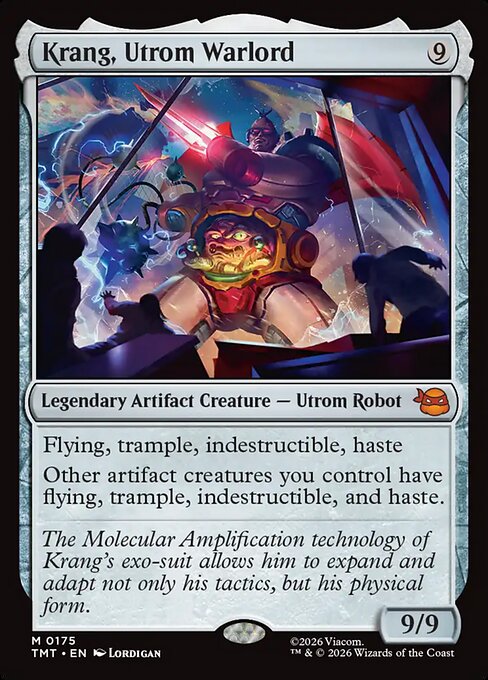
143. Krang, Utrom Warlord
Rating4.6WeakWhy this rating?
A solid playable that rarely gets cut (4.6/10).
Why. A 9/9 with flying, trample, indestructible, and haste: if you cast it, the game ends almost at once. It also hands those abilities to your other artifact creatures.
Risks. It costs nine mana. In a normal deck you will only reach it very late, and the game is often decided by then. Exile and bounce still answer it.
In the draft. Only for slow decks with mana acceleration and plenty of artifacts. Elsewhere, do not play it and do not take it before the end of the pack.
Results in the games of the set
When it is in hand, the deck wins 55.1% of its games (set average: 57.7%, 127th of 184 cards).
In the opening hand: 52.3% wins (56.4% on average).
Drawn during the game: 56.6% (58.6% on average).
When it is drawn, the deck wins 4.9 points more than when it is not.
When it is drafted, it is played 60% of the time (set average: 61%).
Taken among the first three picks (39 drafts), it ends in the deck 72% of the time.
It is played about as much in every archetype.
 Rating4.6Weak
Why this rating?
A solid playable that rarely gets cut (4.6/10).
Why. A sorcery that looks at the top eight cards and puts up to two creature cards with total mana value 6 or less onto the battlefield. In a well-built deck it puts two bodies out at once. With Sneak, it costs four instead of five.
Risks. Everything depends on creature density: without enough targets, you get little. It can whiff entirely if the top of your library is poor.
In the draft. Playable in green decks heavy on creatures. Do not take it high: a normal deck rarely has enough creatures to make it shine.
Results in the games of the set
When it is in hand, the deck wins 55.2% of its games (set average: 57.7%, 125th of 184 cards).
In the opening hand: 52.8% wins (56.4% on average).
Drawn during the game: 56.7% (58.6% on average).
When it is drawn, the deck wins 5.6 points more than when it is not.
When it is drafted, it is played 48% of the time (set average: 61%).
It is played about as much in every archetype.
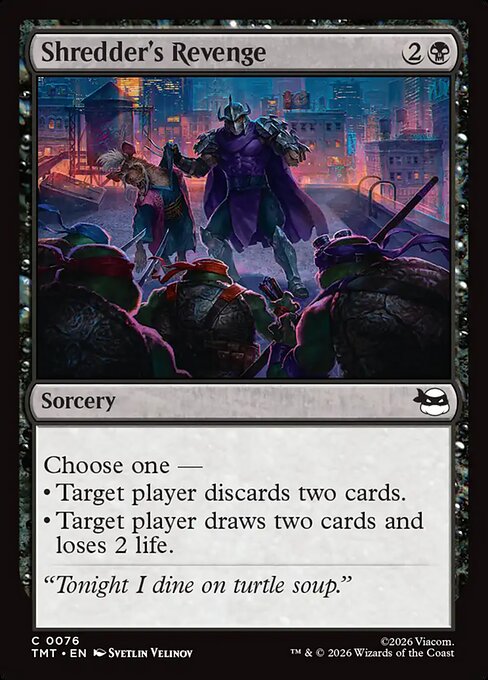
145. Shredder's Revenge
Rating4.6WeakWhy this rating?
A solid playable that rarely gets cut (4.6/10).
Why. A flexible three-mana sorcery: a target player discards two cards, or draws two and loses 2 life. The first mode hits the opponent, the second gives you card advantage without disrupting your curve.
Risks. It does nothing to the board. Against an opponent who has emptied their hand, the first mode is dead, and the second costs life in aggressive matchups.
In the draft. A good black filler spell: take it mid-pack, after removal and quality creatures.
Results in the games of the set
When it is in hand, the deck wins 55.8% of its games (set average: 57.7%, 118th of 184 cards).
In the opening hand: 54.4% wins (56.4% on average).
Drawn during the game: 56.7% (58.6% on average).
When it is drawn, the deck wins 0.1 points less than when it is not.
When it is drafted, it is played 29% of the time (set average: 61%).
It is played mostly in B/W decks (30% of them).

146. Wingnut, Bat on the Belfry
Rating4.6WeakWhy this rating?
A solid playable that rarely gets cut (4.6/10).
Why. A 1/2 for two that adapts: whenever another creature enters, it gains flying, menace, or haste until end of turn. When it attacks, your other attackers get +1/+0, which helps aggressive decks.
Risks. A 1/2 dies to everything and attacks poorly without creature support. It needs a steady stream of creatures to trigger Alliance.
In the draft. For red decks with many creatures and a low curve. Otherwise it is a middling pick; take it after the best creatures.
Results in the games of the set
When it is in hand, the deck wins 52.6% of its games (set average: 57.7%, 154th of 184 cards).
In the opening hand: 53.8% wins (56.4% on average).
Drawn during the game: 51.7% (58.6% on average).
When it is drawn, the deck wins 1.6 points less than when it is not.
When it is drafted, it is played 49% of the time (set average: 61%).
Taken among the first three picks (69 drafts), it ends in the deck 84% of the time.
It is played mostly in R/W decks (46% of them).

147. New Generation's Technique
Rating4.5WeakWhy this rating?
A solid playable that rarely gets cut (4.6/10).
Why. A ramp sorcery: two basic lands onto the battlefield tapped, for four mana, or three with Sneak. It helps you reach your big cards and fix your colours.
Risks. No direct effect on the board and slow: casting it on turn four does not advance your game against an aggressive opponent.
In the draft. Only playable in slow green decks with expensive cards to cast. Take it late, and do not build your deck around it.
Results in the games of the set
When it is in hand, the deck wins 52.8% of its games (set average: 57.7%, 151st of 184 cards).
In the opening hand: 51.6% wins (56.4% on average).
Drawn during the game: 53.5% (58.6% on average).
When it is drawn, the deck wins 1.7 points more than when it is not.
When it is drafted, it is played 32% of the time (set average: 61%).
Taken among the first three picks (34 drafts), it ends in the deck 47% of the time.

148. Leader's Talent
Rating4.4WeakWhy this rating?
A good playable, but is sometimes cut (4.4/10).
Why. A two-mana Class: whenever you attack, a +1/+1 counter goes on a target attacking creature. Level 2 gains you 2 life when a creature with a counter leaves the battlefield, and level 3 puts a counter on each of your creatures whenever you cast a spell.
Risks. It does nothing without an attacker, and the levels cost mana. A faster opponent can stop it from developing.
In the draft. A good permanent for aggressive white decks: take it mid-pack, especially with many small creatures.
Results in the games of the set
When it is in hand, the deck wins 55.5% of its games (set average: 57.7%, 122nd of 184 cards).
In the opening hand: 55.0% wins (56.4% on average).
Drawn during the game: 55.9% (58.6% on average).
When it is drawn, the deck wins 0.7 points more than when it is not.
When it is drafted, it is played 90% of the time (set average: 61%).
Taken among the first three picks (104 drafts), it ends in the deck 92% of the time.
It is played about as much in every archetype.

149. Broadcast Takeover
Rating4.4WeakWhy this rating?
A good playable, but is sometimes cut (4.4/10).
Why. A sorcery that takes control of all artifacts your opponents control until end of turn, untaps them, and gives them haste. If an opponent has artifact creatures, you can turn them against that player for an explosive combat.
Risks. Five mana with three red, no lasting effect, and nothing happens if the opponents have no artifacts. If you do not close out the game that turn, you have wasted your turn.
In the draft. Close to unplayable in normal draft. Only take it as a curiosity, very late, if plenty of artifacts are going by in the packs.
Results in the games of the set
When it is drafted, it is played only 0% of the time (set average: 61%): it almost always ends in the sideboard.

150. East Wind Avatar
Rating4.4WeakWhy this rating?
A good playable, but is sometimes cut (4.4/10).
Why. A 2/4 with flying and vigilance for four: it attacks in the air and stays untapped to block. With Alliance, it gets +1/+0 when another creature enters, which makes its attacks better.
Risks. A 2/4 hits softly without support. It does not win the game alone and remains exposed to removal.
In the draft. A good white common in the mid-curve, particularly in air-based decks. Take it fairly readily after the removal.
Results in the games of the set
When it is in hand, the deck wins 53.4% of its games (set average: 57.7%, 146th of 184 cards).
In the opening hand: 53.0% wins (56.4% on average).
Drawn during the game: 53.6% (58.6% on average).
When it is drawn, the deck wins 2.0 points less than when it is not.
When it is drafted, it is played 31% of the time (set average: 61%).
Taken among the first three picks (32 drafts), it ends in the deck 69% of the time.
It is played mostly in R/W decks (42% of them) and B/W (32%).

151. Ice Cream Kitty
Rating4.4WeakWhy this rating?
A good playable, but is sometimes cut (4.4/10).
Why. A 1/3 artifact creature for two: a good early blocker. For two mana it can sacrifice another creature or token to draw a card (only when you could cast a sorcery), or sacrifice itself to gain 3 life. It squeezes value from creatures that are about to die.
Risks. It attacks poorly and has almost no offensive impact. Each activation costs two mana, and drawing by sacrificing a creature costs you a body.
In the draft. A support card for black-green sacrifice decks. Take it at a modest price, after sturdier creatures.
Results in the games of the set
When it is in hand, the deck wins 54.7% of its games (set average: 57.7%, 128th of 184 cards).
In the opening hand: 52.4% wins (56.4% on average).
Drawn during the game: 56.2% (58.6% on average).
When it is drawn, the deck wins 1.2 points more than when it is not.
When it is drafted, it is played 63% of the time (set average: 61%).
Taken among the first three picks (116 drafts), it ends in the deck 88% of the time.
It is played mostly in B/G decks (61% of them) and B/U (38%).
 Rating4.4Weak
Why this rating?
A good playable, but is sometimes cut (4.4/10).
Why. A 7/5 for five: huge for the cost. Each attack creates a 2/2 red Mutant creature token, and each other creature entering deals 2 damage to each opponent. The board and the opponent's life total melt away quickly.
Risks. It costs two red mana and has neither flying nor ward. Removal stops it before it attacks, a multi-block can bring it down, and the token is no substitute for a real blocker.
In the draft. A good red rare to take without much hesitation, even if your second colour is unsettled. Look for cheap creatures to pair with it.
Results in the games of the set
When it is in hand, the deck wins 56.8% of its games (set average: 57.7%, 97th of 184 cards).
In the opening hand: 55.8% wins (56.4% on average).
Drawn during the game: 57.5% (58.6% on average).
When it is drawn, the deck wins 2.9 points more than when it is not.
When it is drafted, it is played 86% of the time (set average: 61%).
Taken among the first three picks (101 drafts), it ends in the deck 88% of the time.
It is played about as much in every archetype.

153. Utrom Scientists
Rating4.4WeakWhy this rating?
A good playable, but is sometimes cut (4.4/10).
Why. A 2/2 artifact creature for three: on entering, it taps up to one target creature and puts a stun counter on it. That creature stays tapped through its controller's next untap step, so no attacking or blocking until then. It is a good tempo play.
Risks. A temporary effect, then a plain 2/2. It does not deal with the threat for good and is useless on a board where nobody attacks.
In the draft. A decent blue common for tempo decks, notably alongside red. Take it after permanent removal.
Results in the games of the set
When it is in hand, the deck wins 54.1% of its games (set average: 57.7%, 136th of 184 cards).
In the opening hand: 50.9% wins (56.4% on average).
Drawn during the game: 56.1% (58.6% on average).
When it is drawn, the deck wins 1.2 points more than when it is not.
When it is drafted, it is played 42% of the time (set average: 61%).
Taken among the first three picks (67 drafts), it ends in the deck 75% of the time.
It is played mostly in R/U decks (68% of them) and U/W (42%).

154. Venus, Torn Between Worlds
Rating4.4WeakWhy this rating?
A good playable, but is sometimes cut (4.4/10).
Why. A 5/5 for five that gets +1/+1 counters equal to the damage it takes, provided it survives. Each hit makes it bigger. Whenever a creature of yours with a counter deals combat damage to a player, you may pay a blue mana to draw.
Risks. It dies to removal or a big block that finishes it. Its card draw needs blue mana, so a specific second colour.
In the draft. A good green five-drop body, especially with blue. Take it at a middling pick, with other +1/+1 counter sources alongside.
Results in the games of the set
When it is in hand, the deck wins 52.6% of its games (set average: 57.7%, 155th of 184 cards).
In the opening hand: 49.3% wins (56.4% on average).
Drawn during the game: 54.6% (58.6% on average).
When it is drawn, the deck wins 1.5 points more than when it is not.
When it is drafted, it is played 53% of the time (set average: 61%).
Taken among the first three picks (68 drafts), it ends in the deck 85% of the time.
It is played mostly in G/U decks (34% of them).

155. Skateboard
Rating4.3WeakWhy this rating?
A good playable, but is sometimes cut (4.3/10).
Why. A one-mana Equipment: on entering, it taps a target permanent, such as a blocker. Equipped, it gives +1/+0 and haste for one mana to equip. It is a small aggressive tempo play.
Risks. It has no lasting effect on the board and deals little damage. In a slow deck it is nearly worthless.
In the draft. Only playable in very aggressive decks with lots of small creatures. Take it late, as filler of last resort.
Results in the games of the set
When it is in hand, the deck wins 51.6% of its games (set average: 57.7%, 163rd of 184 cards).
In the opening hand: 48.5% wins (56.4% on average).
Drawn during the game: 53.9% (58.6% on average).
When it is drawn, the deck wins 1.8 points less than when it is not.
When it is drafted, it is played 19% of the time (set average: 61%).
 Rating4.2Weak
Why this rating?
A good playable, but is sometimes cut (4.2/10).
Why. A sorcery that draws two cards for three, or for just one blue mana with Sneak. If you have an unblocked attacker to return to hand, it is very cheap card draw.
Risks. It does nothing to the board, and Sneak forces you to bounce an attacker, which costs tempo. At full price, it is slow card draw.
In the draft. A decent addition to aggressive blue decks. Take it mid-pack, after creatures and removal.
Results in the games of the set
When it is in hand, the deck wins 52.5% of its games (set average: 57.7%, 156th of 184 cards).
In the opening hand: 49.8% wins (56.4% on average).
Drawn during the game: 54.1% (58.6% on average).
When it is drawn, the deck wins 0.8 points more than when it is not.
When it is drafted, it is played 33% of the time (set average: 61%).
Taken among the first three picks (34 drafts), it ends in the deck 59% of the time.
It is played mostly in B/U decks (25% of them).
 Rating4.2Weak
Why this rating?
A good playable, but is sometimes cut (4.2/10).
Why. A 4/3 with menace for four. Each time another creature enters, you may exile your top card, and you can play it when Raphael attacks. It generates card advantage if you keep deploying creatures.
Risks. Exiled cards can only be played on a turn he attacks, so he must survive and you need the mana. Fragile against removal.
In the draft. A good red body that improves in a creature-packed deck. Take it at a middling spot, after the best removal.
Results in the games of the set
When it is in hand, the deck wins 51.1% of its games (set average: 57.7%, 172nd of 184 cards).
In the opening hand: 51.3% wins (56.4% on average).
Drawn during the game: 50.9% (58.6% on average).
When it is drawn, the deck wins 3.1 points less than when it is not.
When it is drafted, it is played 39% of the time (set average: 61%).
Taken among the first three picks (31 drafts), it ends in the deck 81% of the time.
It is played mostly in R/W decks (32% of them) and B/R (31%).
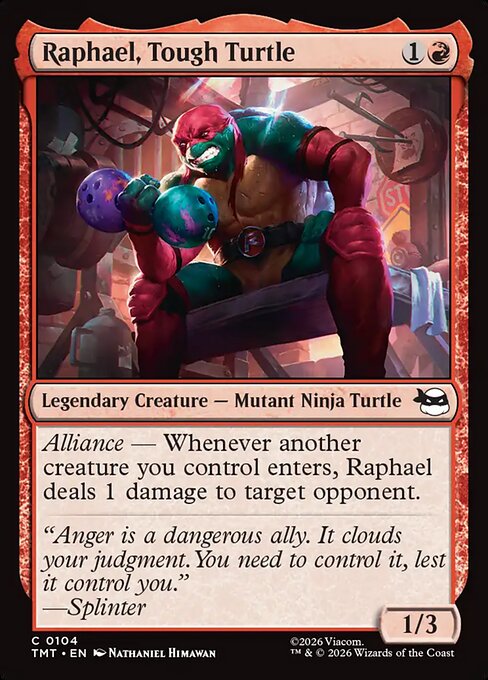 Rating4.2Weak
Why this rating?
A good playable, but is sometimes cut (4.2/10).
Why. A 1/3 for two that deals 1 damage to a target opponent whenever another creature you control enters. A good early blocker that adds up over time with many creatures.
Risks. A 1/3 has almost no offensive weight. Without a steady flow of creatures, it deals little damage.
In the draft. An honest two-drop for low-curve aggressive red decks. Take it mid-pack.
Results in the games of the set
When it is in hand, the deck wins 53.5% of its games (set average: 57.7%, 145th of 184 cards).
In the opening hand: 54.4% wins (56.4% on average).
Drawn during the game: 52.9% (58.6% on average).
When it is drawn, the deck wins 1.1 points less than when it is not.
When it is drafted, it is played 50% of the time (set average: 61%).
Taken among the first three picks (97 drafts), it ends in the deck 81% of the time.
It is played mostly in R/W decks (82% of them) and B/R (50%).

159. Splinter's Technique
Rating4.2WeakWhy this rating?
A good playable, but is sometimes cut (4.2/10).
Why. A sorcery that searches your library for any card for four mana, or two with Sneak. It finds your removal or best threat at the right moment.
Risks. It changes nothing on the board and costs a turn of tempo. Without a great card to fetch, it is slow.
In the draft. Of little use in draft: a tutor with no immediate effect. Take it late and only play it if you are short on playables.
Results in the games of the set
When it is in hand, the deck wins 50.0% of its games (set average: 57.7%, 178th of 184 cards).
In the opening hand: 47.5% wins (56.4% on average).
Drawn during the game: 51.6% (58.6% on average).
When it is drawn, the deck wins 3.4 points less than when it is not.
When it is drafted, it is played 40% of the time (set average: 61%).
It is played about as much in every archetype.
 Rating4.2Weak
Why this rating?
A good playable, but is sometimes cut (4.2/10).
Why. A 3/4 flier for five: a good aerial threat that loots as it enters. With Islandcycling, it can also be cycled for two to find an Island when you are short on lands.
Risks. Five mana for a 3-power body is a bit pricey. The cycling only helps if you play Islands.
In the draft. A flexible blue common: take it in any blue deck, after the removal. It is rarely a dead card in hand.
Results in the games of the set
When it is in hand, the deck wins 53.7% of its games (set average: 57.7%, 142nd of 184 cards).
In the opening hand: 50.1% wins (56.4% on average).
Drawn during the game: 55.9% (58.6% on average).
When it is drawn, the deck wins 1.5 points more than when it is not.
When it is drafted, it is played 17% of the time (set average: 61%).
It is played mostly in B/U decks (27% of them).

161. Zoo Escapees
Rating4.2WeakWhy this rating?
A good playable, but is sometimes cut (4.2/10).
Why. A 2/2 for two that leaves behind a Mutagen token when it leaves the battlefield. If it trades in combat, you are left with a Mutagen for a future +1/+1 counter. A good body to trade with.
Risks. A plain 2/2 stays small, and the Mutagen needs another mana and can only be used when you could cast a sorcery. The body has no offensive ability.
In the draft. A clean two-drop for green decks, especially black-green. Take it mid-pack.
Results in the games of the set
When it is in hand, the deck wins 53.6% of its games (set average: 57.7%, 144th of 184 cards).
In the opening hand: 53.5% wins (56.4% on average).
Drawn during the game: 53.6% (58.6% on average).
When it is drawn, the deck wins 2.3 points more than when it is not.
When it is drafted, it is played 43% of the time (set average: 61%).
Taken among the first three picks (52 drafts), it ends in the deck 67% of the time.
It is played mostly in B/G decks (63% of them) and G/U (46%).

162. Leonardo's Technique
Rating4.2WeakWhy this rating?
A good playable, but is sometimes cut (4.2/10).
Why. A sorcery that returns one or two creature cards with mana value 3 or less from your graveyard to the battlefield. With Sneak it costs only two and can put two bodies back at once.
Risks. You need cheap creatures in your graveyard: early in the game, it is dead. The full four-mana cost is inefficient.
In the draft. Playable in low-curve white decks. Take it late; it only works if you already run many small creatures.
Results in the games of the set
When it is in hand, the deck wins 52.0% of its games (set average: 57.7%, 161st of 184 cards).
In the opening hand: 48.7% wins (56.4% on average).
Drawn during the game: 54.5% (58.6% on average).
When it is drawn, the deck wins 2.1 points less than when it is not.
When it is drafted, it is played 72% of the time (set average: 61%).
Taken among the first three picks (36 drafts), it ends in the deck 81% of the time.
It is played about as much in every archetype.

163. Make Your Move
Rating4.1WeakWhy this rating?
A good playable, but is sometimes cut (4.1/10).
Why. A three-mana instant-speed removal that destroys an artifact, an enchantment, or a creature with power 4 or greater. It handles big threats and Vehicles at a very reasonable price.
Risks. It does not touch small creatures, and some games offer no valid target. It is very conditional.
In the draft. A decent conditional removal in white. Take it over average creatures, but after unconditional removal.
Results in the games of the set
When it is in hand, the deck wins 54.2% of its games (set average: 57.7%, 134th of 184 cards).
In the opening hand: 52.5% wins (56.4% on average).
Drawn during the game: 55.4% (58.6% on average).
When it is drawn, the deck wins 1.8 points less than when it is not.
When it is drafted, it is played 45% of the time (set average: 61%).
Taken among the first three picks (63 drafts), it ends in the deck 68% of the time.
It is played mostly in B/W decks (45% of them) and R/W (42%).
 Rating4.0Weak
Why this rating?
A good playable, but is sometimes cut (4.0/10).
Why. A 2/4 with trample for three: a sturdy body that blocks well. Alliance gives it +1/+0 each time another creature enters, so it can hit harder.
Risks. A 2/4 does not attack hard without support, and the bonus is temporary. No deep ability.
In the draft. An honest red common for creature decks. Take it mid-pack, without making it a priority.
Results in the games of the set
When it is in hand, the deck wins 53.1% of its games (set average: 57.7%, 149th of 184 cards).
In the opening hand: 53.8% wins (56.4% on average).
Drawn during the game: 52.5% (58.6% on average).
When it is drawn, the deck wins 1.3 points less than when it is not.
When it is drafted, it is played only 12% of the time (set average: 61%): it almost always ends in the sideboard.
It is played mostly in R/W decks (39% of them).

165. Null Group Biological Assets
Rating4.0WeakWhy this rating?
A good playable, but is sometimes cut (4.0/10).
Why. A 3/1 for three with first strike during your turn: it wins many combats on offence. Whenever it attacks, you may discard a card to draw a card.
Risks. 1 toughness: it dies to any block or damage spell, and it only has first strike on your turn. It is weak on defence.
In the draft. A decent red attacker for aggressive decks. Take it late, after sturdier creatures.
Results in the games of the set
When it is in hand, the deck wins 52.4% of its games (set average: 57.7%, 157th of 184 cards).
In the opening hand: 52.5% wins (56.4% on average).
Drawn during the game: 52.2% (58.6% on average).
When it is drawn, the deck wins 2.5 points less than when it is not.
When it is drafted, it is played only 11% of the time (set average: 61%): it almost always ends in the sideboard.
It is played mostly in R/W decks (34% of them) and B/R (31%).

166. Pain 101
Rating4.0WeakWhy this rating?
A good playable, but is sometimes cut (4.0/10).
Why. A two-mana instant that gives a creature deathtouch until end of turn and returns it tapped if it dies. In combat, it can flip a trade for little mana.
Risks. It is a combat trick, not removal: it does nothing without a creature to boost, and an opponent who avoids combat can ignore it.
In the draft. An honest combat trick in black decks, notably white-black. Take it late, after creatures and removal.
Results in the games of the set
When it is in hand, the deck wins 52.2% of its games (set average: 57.7%, 158th of 184 cards).
In the opening hand: 50.9% wins (56.4% on average).
Drawn during the game: 53.0% (58.6% on average).
When it is drawn, the deck wins 3.1 points less than when it is not.
When it is drafted, it is played 22% of the time (set average: 61%).
It is played mostly in B/W decks (27% of them).

167. Retro-Mutation
Rating4.0WeakWhy this rating?
A good playable, but is sometimes cut (4.0/10).
Why. A three-mana Aura with flash that turns a creature into a 0/1 Turtle with no abilities that cannot attack. It is near-complete removal, and you can cast it during an opposing attack.
Risks. The creature stays on the battlefield and can still block. It remains exposed to bounce or enchantment removal.
In the draft. A good blue pseudo-removal: take it after direct removal.
Results in the games of the set
When it is in hand, the deck wins 55.1% of its games (set average: 57.7%, 126th of 184 cards).
In the opening hand: 51.2% wins (56.4% on average).
Drawn during the game: 57.4% (58.6% on average).
When it is drawn, the deck wins 3.0 points more than when it is not.
When it is drafted, it is played 38% of the time (set average: 61%).
Taken among the first three picks (64 drafts), it ends in the deck 73% of the time.
It is played mostly in R/U decks (44% of them) and G/U (43%).

168. Shredder's Armor
Rating3.9WeakWhy this rating?
A good playable, but is sometimes cut (3.9/10).
Why. A two-mana Equipment: it attaches to a creature of yours for free on entering and gives +2/+1. The bonus is real and can turn a small body into a real attacker.
Risks. Moving it requires sacrificing another nonland permanent, once per turn, which is costly. It has no value without a creature.
In the draft. Weak in ordinary draft. Only play it in a sacrifice deck; otherwise it is a last pick.
Results in the games of the set
When it is in hand, the deck wins 46.5% of its games (set average: 57.7%, 182nd of 184 cards).
In the opening hand: 42.4% wins (56.4% on average).
Drawn during the game: 49.2% (58.6% on average).
When it is drawn, the deck wins 6.9 points less than when it is not.
When it is drafted, it is played only 6% of the time (set average: 61%): it almost always ends in the sideboard.
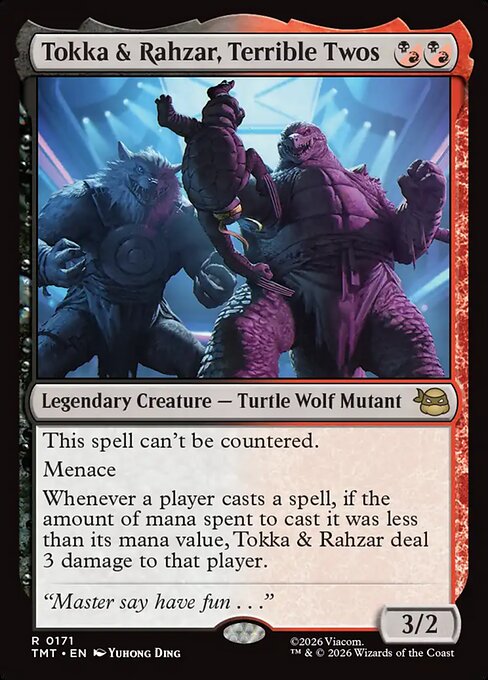
169. Tokka & Rahzar, Terrible Twos
Rating3.8WeakWhy this rating?
A good playable, but is sometimes cut (3.8/10).
Why. A 3/2 with menace for two mana that can't be countered. Its trigger hits any player who casts a spell for less than its mana value: cost reductions, alternative costs like Sneak, free spells.
Risks. It hits you too. If your deck uses Sneak or cost reducers, you burn yourself. Against an opponent paying full price, it is just a fragile 3/2.
In the draft. A decent aggressive two-drop, playable in a black or red deck thanks to its hybrid cost. A comfortable pick, best when your own deck has no discounted spells.
Results in the games of the set
When it is in hand, the deck wins 51.6% of its games (set average: 57.7%, 164th of 184 cards).
In the opening hand: 54.3% wins (56.4% on average).
Drawn during the game: 49.5% (58.6% on average).
When it is drawn, the deck wins 1.0 points less than when it is not.
When it is drafted, it is played 51% of the time (set average: 61%).
Taken among the first three picks (36 drafts), it ends in the deck 67% of the time.
It is played about as much in every archetype.

170. Foot Mystic
Rating3.8WeakWhy this rating?
A good playable, but is sometimes cut (3.8/10).
Why. A 2/4 lifelinker for four that blocks well and gains life. If a permanent left the battlefield under your control this turn, Disappear also brings a 1/1 black Ninja creature token, which makes it a better rate.
Risks. If no permanent left the battlefield this turn, you only get a 2/4 body: sturdy, but not threatening. Disappear needs you to lose or sacrifice a permanent the same turn.
In the draft. A fine filler common for a defensive black deck. Take it as a mid-curve four-drop, behind removal and stronger creatures.
Results in the games of the set
When it is in hand, the deck wins 50.4% of its games (set average: 57.7%, 177th of 184 cards).
In the opening hand: 46.9% wins (56.4% on average).
Drawn during the game: 52.8% (58.6% on average).
When it is drawn, the deck wins 2.4 points less than when it is not.
When it is drafted, it is played only 12% of the time (set average: 61%): it almost always ends in the sideboard.
 Rating3.8Weak
Why this rating?
A good playable, but is sometimes cut (3.8/10).
Why. A 2/2 flyer for three, a baseline evasive body. If a permanent left the battlefield under your control this turn, Disappear gives you a scry 1 at end of turn.
Risks. A 2/2 body dies to almost anything, and the scry needs a permanent to have left, which does not happen every turn. Otherwise it is ordinary.
In the draft. A black flyer to fill the curve. It plays better in a deck that regularly sacrifices or loses permanents.
Results in the games of the set
When it is in hand, the deck wins 51.6% of its games (set average: 57.7%, 165th of 184 cards).
In the opening hand: 49.0% wins (56.4% on average).
Drawn during the game: 53.4% (58.6% on average).
When it is drawn, the deck wins 1.6 points less than when it is not.
When it is drafted, it is played 15% of the time (set average: 61%).
It is played mostly in B/W decks (26% of them).

172. Michelangelo, Game Master
Rating3.4WeakWhy this rating?
Filler card but sometimes gets cut (3.4/10).
Why. A 3/3 for three, a decent body at that cost. If a permanent left the battlefield under your control this turn, it gets a +1/+1 counter at end of turn.
Risks. It has no combat ability of its own: without Disappear it is a plain 3/3, exposed to removal. It only grows if you lose a permanent.
In the draft. An honest green common, a mid-pack pick as a solid three-drop. Look alongside it for ways to make your permanents leave, such as sacrifice.
Results in the games of the set
When it is in hand, the deck wins 54.4% of its games (set average: 57.7%, 131st of 184 cards).
In the opening hand: 52.3% wins (56.4% on average).
Drawn during the game: 55.7% (58.6% on average).
When it is drawn, the deck wins 1.9 points more than when it is not.
When it is drafted, it is played 63% of the time (set average: 61%).
Taken among the first three picks (68 drafts), it ends in the deck 91% of the time.
It is played mostly in B/G decks (71% of them) and G/U (66%).

173. April, Reporter of the Weird
Rating3.0WeakWhy this rating?
Filler card but sometimes gets cut (3.0/10).
Why. A 2/2 for three that turns every hit into cards: when it deals combat damage to a player, you draw that many cards, then discard one. If it connects, the value is strong.
Risks. It has no evasion and no protection: a 2/2 for three is easily blocked or killed. It does nothing until it connects.
In the draft. A card for a blue deck with evasion or tempo. Only take it if you can get it through, otherwise it just sits in hand.
Results in the games of the set
When it is in hand, the deck wins 49.6% of its games (set average: 57.7%, 179th of 184 cards).
In the opening hand: 47.0% wins (56.4% on average).
Drawn during the game: 51.4% (58.6% on average).
When it is drawn, the deck wins 0.4 points less than when it is not.
When it is drafted, it is played only 12% of the time (set average: 61%): it almost always ends in the sideboard.

174. Raphael's Technique
Rating2.5WeakWhy this rating?
Not good filler and often gets cut (2.5/10).
Why. A symmetrical instant: each player may discard their hand and draw seven cards. With Sneak, the cost drops to three mana, and it works as a reload when your hand is nearly empty.
Risks. It is symmetrical: your opponent may draw as well. At full price, six mana for no board impact is far too slow. Sneak needs an unblocked attacker to return to hand.
In the draft. A niche effect for a deck that has emptied its hand. It will rarely make the main deck: do not take it over playable creatures.
Results in the games of the set
When it is drafted, it is played only 2% of the time (set average: 61%): it almost always ends in the sideboard.
 Rating2.0Weak
Why this rating?
Not good filler and often gets cut (2.0/10).
Why. A 5/4 with menace for five, hard to block. Its swampcycling 2 makes it flexible: early it finds you a Swamp, late it comes down as a big body.
Risks. Five mana for a body with no other useful ability. Against cheap removal, you lose your turn.
In the draft. A decent black common for the middle of a pack. It fits almost any black deck that wants a big creature without risking land problems.
Results in the games of the set
When it is in hand, the deck wins 52.7% of its games (set average: 57.7%, 153rd of 184 cards).
In the opening hand: 50.4% wins (56.4% on average).
Drawn during the game: 54.2% (58.6% on average).
When it is drawn, the deck wins 0.5 points less than when it is not.
When it is drafted, it is played 20% of the time (set average: 61%).
It is played mostly in B/G decks (32% of them) and B/R (27%).

176. Bot Bashing Time
Rating2.0WeakWhy this rating?
Not good filler and often gets cut (2.0/10).
Why. A sorcery that deals 6 damage to a target creature for four mana and exiles it if it would die this turn. It answers almost any creature you will face in draft.
Risks. Four mana at sorcery speed: slow against aggro. It cannot touch any permanent that isn't a creature, and a creature with more than six toughness survives it.
In the draft. Reliable but pricey red removal. Take it after the best cards, but ahead of mediocre creatures: it keeps your deck sturdier.
Results in the games of the set
When it is in hand, the deck wins 53.3% of its games (set average: 57.7%, 147th of 184 cards).
In the opening hand: 50.8% wins (56.4% on average).
Drawn during the game: 54.9% (58.6% on average).
When it is drawn, the deck wins 0.1 points less than when it is not.
When it is drafted, it is played 40% of the time (set average: 61%).
Taken among the first three picks (53 drafts), it ends in the deck 75% of the time.
It is played mostly in R/U decks (58% of them) and B/R (46%).
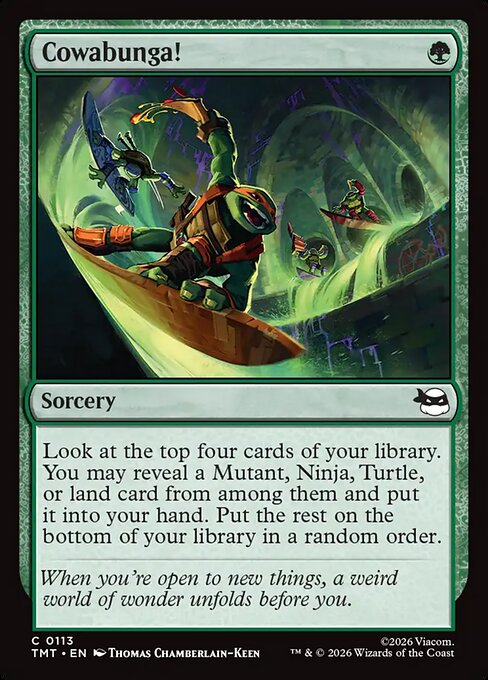
177. Cowabunga!
Rating2.0WeakWhy this rating?
Not good filler and often gets cut (2.0/10).
Why. A one-mana sorcery that looks at the top four cards and lets you take a Mutant, Ninja, Turtle or land. Cheap selection that helps you find your land drops.
Risks. It gives nothing if none of the four cards has a valid type, and the rest goes to the bottom of your library. It does nothing on the battlefield.
In the draft. Filler for a green deck packed with Mutants, Ninjas or Turtles. In a normal deck it mostly finds a land: only take it late.
Results in the games of the set
When it is in hand, the deck wins 53.3% of its games (set average: 57.7%, 148th of 184 cards).
In the opening hand: 51.7% wins (56.4% on average).
Drawn during the game: 54.3% (58.6% on average).
When it is drawn, the deck wins 0.9 points more than when it is not.
When it is drafted, it is played 15% of the time (set average: 61%).

178. Crustacean Commando
Rating2.0WeakWhy this rating?
Not good filler and often gets cut (2.0/10).
Why. A 0/3 for two that walls small creatures and creates a Mutagen token. Later, that token puts a +1/+1 counter on a creature for one mana, at sorcery speed.
Risks. It cannot attack: zero power. The payoff is slow and relies on a creature that benefits. It does not win the game alone.
In the draft. A defensive two-drop for a blue deck that wants to reach the mid-game. A late pick to fill out the curve.
Results in the games of the set
When it is in hand, the deck wins 51.0% of its games (set average: 57.7%, 173rd of 184 cards).
In the opening hand: 48.4% wins (56.4% on average).
Drawn during the game: 52.7% (58.6% on average).
When it is drawn, the deck wins 1.2 points more than when it is not.
When it is drafted, it is played 18% of the time (set average: 61%).
It is played mostly in G/U decks (38% of them) and B/U (34%).

179. Mouser Attack!
Rating2.0WeakWhy this rating?
Not good filler and often gets cut (2.0/10).
Why. An instant with two modes: create a 1/1 colorless Robot artifact creature token, or give a creature +3/+0 and first strike until end of turn. The second mode can win a combat on the spot.
Risks. The token is small, and the trick can blow up if your opponent responds by killing the target. Nothing powerful.
In the draft. A fine trick for an aggressive red deck. Take it late, after removal and good creatures.
Results in the games of the set
When it is in hand, the deck wins 49.4% of its games (set average: 57.7%, 180th of 184 cards).
In the opening hand: 48.8% wins (56.4% on average).
Drawn during the game: 49.8% (58.6% on average).
When it is drawn, the deck wins 1.9 points less than when it is not.
When it is drafted, it is played only 5% of the time (set average: 61%): it almost always ends in the sideboard.

180. Negate
Rating2.0WeakWhy this rating?
Not good filler and often gets cut (2.0/10).
Why. A two-mana counterspell that only hits noncreature spells: removal, sorceries, instants, enchantments. It protects you from a decisive spell.
Risks. It cannot touch creatures, and you must keep two mana untapped. A reactive counter loses value against creature decks.
In the draft. A sideboard card more than a maindeck one. Do not take it over playable creatures unless you know your opponent plays many noncreature spells.
Results in the games of the set
When it is in hand, the deck wins 46.4% of its games (set average: 57.7%, 183rd of 184 cards).
In the opening hand: 43.7% wins (56.4% on average).
Drawn during the game: 48.1% (58.6% on average).
When it is drawn, the deck wins 0.2 points more than when it is not.
When it is drafted, it is played only 2% of the time (set average: 61%): it almost always ends in the sideboard.

181. Party Dude
Rating2.0WeakWhy this rating?
Not good filler and often gets cut (2.0/10).
Why. A one-mana Class enchantment: each player creates a Food token. Level 2 draws you a card when an opposing artifact goes to a graveyard, and level 3 gives an attacker +X/+X, where X is the cards in your hand.
Risks. The first level helps your opponent too, and the levels cost a lot of mana for a slow effect. Level 2 depends on opposing artifacts, their Food included.
In the draft. A heavy niche card. Take it late, and only in a green deck that can use the levels.
Results in the games of the set
When it is in hand, the deck wins 51.2% of its games (set average: 57.7%, 168th of 184 cards).
In the opening hand: 48.4% wins (56.4% on average).
Drawn during the game: 53.0% (58.6% on average).
When it is drawn, the deck wins 2.6 points more than when it is not.
When it is drafted, it is played 50% of the time (set average: 61%).
Taken among the first three picks (35 drafts), it ends in the deck 69% of the time.
It is played about as much in every archetype.

182. Punk Frogs
Rating2.0WeakWhy this rating?
Not good filler and often gets cut (2.0/10).
Why. A 4/5 with ward 3 for five. A big body that is hard to target: the opponent must pay three more mana or their removal is countered.
Risks. Five mana for a body with no other ability, and the hybrid cost needs you in green or blue. Non-targeted effects still handle it.
In the draft. A good five-drop in a green or blue deck. Take it after removal, ahead of smaller creatures.
Results in the games of the set
When it is in hand, the deck wins 50.5% of its games (set average: 57.7%, 176th of 184 cards).
In the opening hand: 47.6% wins (56.4% on average).
Drawn during the game: 52.2% (58.6% on average).
When it is drawn, the deck wins 0.0 points more than when it is not.
When it is drafted, it is played only 4% of the time (set average: 61%): it almost always ends in the sideboard.

183. Rock Soldiers
Rating2.0WeakWhy this rating?
Not good filler and often gets cut (2.0/10).
Why. A 4/3 for four that destroys up to one noncreature artifact when it enters. A decent body with a bonus when the opponent has a useful artifact.
Risks. The ability is optional and often has no target, leaving a vanilla 4/3. An artifact creature is not a valid target.
In the draft. Red four-drop filler. Take it as a mid-curve creature, higher if opponents show equipment.
Results in the games of the set
When it is in hand, the deck wins 51.3% of its games (set average: 57.7%, 167th of 184 cards).
In the opening hand: 50.2% wins (56.4% on average).
Drawn during the game: 52.1% (58.6% on average).
When it is drawn, the deck wins 0.2 points more than when it is not.
When it is drafted, it is played only 8% of the time (set average: 61%): it almost always ends in the sideboard.

184. Rocksteady, Crash Courser
Rating2.0WeakWhy this rating?
Not good filler and often gets cut (2.0/10).
Why. A 7/7 for six that can't be blocked by more than one creature, so it can't be gang-blocked. Its forestcycling 2 protects against land-light hands.
Risks. Six mana including two green is expensive, and removal kills it before it does anything. A single chump blocker still stops it for a turn.
In the draft. A playable green finisher, a mid-pack pick. The cycling makes a single copy easy to include.
Results in the games of the set
When it is in hand, the deck wins 53.6% of its games (set average: 57.7%, 143rd of 184 cards).
In the opening hand: 49.4% wins (56.4% on average).
Drawn during the game: 56.2% (58.6% on average).
When it is drawn, the deck wins 1.5 points more than when it is not.
When it is drafted, it is played 42% of the time (set average: 61%).
Taken among the first three picks (38 drafts), it ends in the deck 79% of the time.
It is played mostly in B/G decks (53% of them) and G/R (41%).

185. Turtles Forever
Rating2.0WeakWhy this rating?
Not good filler and often gets cut (2.0/10).
Why. A four-mana instant that searches for exactly four legendary creature cards you own with different names, then your opponent chooses two for your hand. In theory, card advantage.
Risks. You need four legendary creatures with different names or the search is weakened. And your opponent chooses: you often get the two weakest.
In the draft. Do not take it to play. It only deserves a slot if your deck is full of legendary creatures, which is rare.
Results in the games of the set
When it is in hand, the deck wins 51.8% of its games (set average: 57.7%).
In the opening hand: 0.0% wins (56.4% on average).
Drawn during the game: 51.0% (58.6% on average).
When it is drawn, the deck wins 4.5 points less than when it is not.
When it is drafted, it is played only 13% of the time (set average: 61%): it almost always ends in the sideboard.
 Rating2.0Weak
Why this rating?
Not good filler and often gets cut (2.0/10).
Why. A 5/4 with reach and trample for five. When it enters, it stops a target creature from blocking this turn, and its mountaincycling 2 means it is never dead in hand.
Risks. Five mana for a body with no other ability, and the enter effect lasts only one turn. Removal costs you a whole turn.
In the draft. A decent red common for the middle of a pack. It fits almost any red deck thanks to the cycling.
Results in the games of the set
When it is in hand, the deck wins 51.2% of its games (set average: 57.7%, 169th of 184 cards).
In the opening hand: 50.1% wins (56.4% on average).
Drawn during the game: 51.9% (58.6% on average).
When it is drawn, the deck wins 0.8 points less than when it is not.
When it is drafted, it is played only 10% of the time (set average: 61%): it almost always ends in the sideboard.
It is played mostly in B/R decks (31% of them) and G/R (26%).
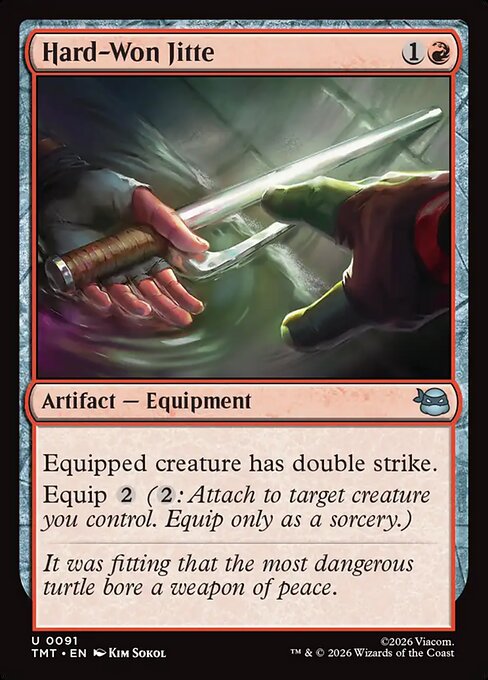
187. Hard-Won Jitte
Rating1.8WeakWhy this rating?
Not good filler and often gets cut (1.8/10).
Why. A two-mana Equipment: the equipped creature has double strike. Doubling a big creature's damage hurts, and the Equipment stays after the creature dies.
Risks. It does nothing alone, and equipping costs two each time, at sorcery speed. On a small creature the gain is slight, and a removal in response costs you tempo.
In the draft. A late pick, for a red deck with big creatures or evasion. Not ahead of playable creatures.
Results in the games of the set
When it is in hand, the deck wins 46.2% of its games (set average: 57.7%, 184th of 184 cards).
In the opening hand: 44.1% wins (56.4% on average).
Drawn during the game: 47.6% (58.6% on average).
When it is drawn, the deck wins 4.0 points less than when it is not.
When it is drafted, it is played only 9% of the time (set average: 61%): it almost always ends in the sideboard.
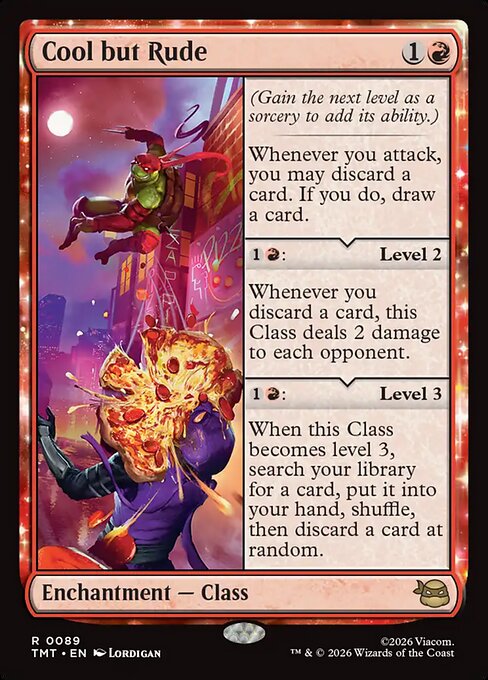
188. Cool but Rude
Rating1.4WeakWhy this rating?
Almost unplayable and mostly sideboard material (1.4/10).
Why. A two-mana Class enchantment that filters your hand: when you attack, you may discard to draw. Level 2 deals two damage to each opponent for each discard, and level 3 searches your library for any card.
Risks. Nothing happens on the battlefield, and you need to attack every turn. Each level costs two more mana, and level 3 then discards a card at random.
In the draft. A slow card for an aggressive red deck. Take it late and not ahead of creatures.
Results in the games of the set
When it is in hand, the deck wins 50.5% of its games (set average: 57.7%, 175th of 184 cards).
In the opening hand: 48.5% wins (56.4% on average).
Drawn during the game: 51.9% (58.6% on average).
When it is drawn, the deck wins 1.2 points less than when it is not.
When it is drafted, it is played 46% of the time (set average: 61%).
It is played about as much in every archetype.
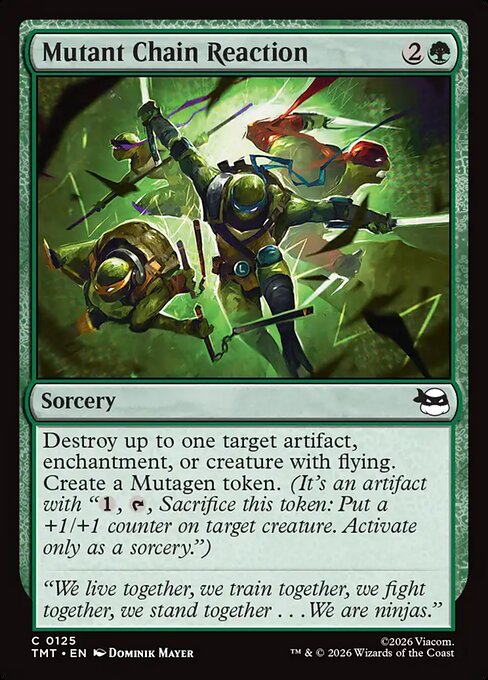 Rating1.4Weak
Why this rating?
Almost unplayable and mostly sideboard material (1.4/10).
Why. A three-mana sorcery that destroys up to one artifact, enchantment or creature with flying, and creates a Mutagen token. You get a targeted answer and a small bonus.
Risks. The targets are narrow: without an opposing artifact, enchantment or flyer, you only get a Mutagen token for three mana. It can rot in hand.
In the draft. More of a sideboard card. Take it if you see many flyers or equipment, otherwise let it go.
Results in the games of the set
When it is in hand, the deck wins 51.1% of its games (set average: 57.7%, 170th of 184 cards).
In the opening hand: 48.2% wins (56.4% on average).
Drawn during the game: 52.9% (58.6% on average).
When it is drawn, the deck wins 2.3 points more than when it is not.
When it is drafted, it is played only 11% of the time (set average: 61%): it almost always ends in the sideboard.

190. Putrid Pals
Rating1.4WeakWhy this rating?
Almost unplayable and mostly sideboard material (1.4/10).
Why. A 3/3 deathtouch for four, a good blocker. If a permanent left the battlefield under your control this turn, Disappear makes it enter with two +1/+1 counters: a 5/5 deathtouch.
Risks. The hybrid cost needs two black or green mana. If no permanent left this turn, it is just a 3/3, and Disappear needs setup.
In the draft. An average common for a black-green deck that can enable Disappear. A mid-pack pick.
Results in the games of the set
When it is in hand, the deck wins 48.5% of its games (set average: 57.7%, 181st of 184 cards).
In the opening hand: 46.8% wins (56.4% on average).
Drawn during the game: 49.6% (58.6% on average).
When it is drawn, the deck wins 1.4 points less than when it is not.
When it is drafted, it is played only 10% of the time (set average: 61%): it almost always ends in the sideboard.
It is played mostly in B/G decks (29% of them).
Intrinsic ratings: they do not take into account the cards you have already picked. They matter most for the first pick of the first pack.