Card ranking · Secrets of Strixhaven (SOS)
← Secrets of Strixhaven266 cards
- Bomb > 8.4
- Very good ≥ 7.2
- Good ≥ 6.2
- Playable ≥ 5.0
- Weak < 5.0
Ratings are out of 10. They combine experts' opinions, the statistics of thousands of drafts by experienced players (when a card is taken, played, and the wins of the decks that play it) and what is printed on the card. Click a card to enlarge it.
 Rating9.4Bomb
Why this rating?
The best card of the set (9.4/10).
Why. A three-mana sorcery that puts a +1/+1 counter on each creature a target player controls (you, usually), then gives one creature double strike or lifelink for the turn. With flashback you get two mass effects out of one card, which makes this one of the best cards in the set.
Risks. It does nothing without creatures on the battlefield, and the creature you pick can be removed in response. A deck light on bodies leaves it stranded in hand.
In the draft. Take it very highly in a white deck full of creatures, especially an aggressive one. Look for cheap creatures and a smooth curve so both casts get full value.
Results in the games of the set
When it is in hand, the deck wins 64.7% of its games (set average: 56.3%, 2nd of 319 cards).
In the opening hand: 62.7% wins (54.9% on average).
Drawn during the game: 66.0% (57.2% on average).
When it is drawn, the deck wins 9.8 points more than when it is not.
When it is drafted, it is played 92% of the time (set average: 63%).
Taken as the first pick (92 drafts), it ends in the deck 93% of the time.
It is played about as much in every archetype.
 Rating9.3Bomb
Why this rating?
One of the 3 best cards of the set (9.3/10).
Why. Two 2/2 red and white Spirit creature tokens for three mana. Cast with flashback, it makes two more, then puts a +1/+1 counter on each Spirit you control, the old ones included. Four bodies from one card.
Risks. The flashback costs six mana, so the second half comes late. The two white mana in the cost makes it demanding on turn three.
In the draft. A strong early pick if you are white. It is good in every white pair, red-white first.
Results in the games of the set
When it is in hand, the deck wins 64.2% of its games (set average: 56.3%, 4th of 319 cards).
In the opening hand: 65.2% wins (54.9% on average).
Drawn during the game: 63.5% (57.2% on average).
When it is drawn, the deck wins 9.0 points more than when it is not.
When it is drafted, it is played 91% of the time (set average: 63%).
Taken as the first pick (112 drafts), it ends in the deck 91% of the time.
It is played about as much in every archetype.
 Rating9.1Bomb
Why this rating?
One of the 3 best cards of the set (9.1/10).
Why. A flexible planeswalker: it can gain you 3 life, draw a card for 1 life, or destroy a creature. The built-in removal means it is never dead in hand, and the draw ability gives steady advantage as long as it is not attacked.
Risks. It needs both black and green, so you must be in that exact pair. Without board protection, ground pressure kills it quickly, and using the removal costs three loyalty counters.
In the draft. A great pick for a black-green deck, taken highly. Outside those colours do not force it, however tempting the removal looks.
Results in the games of the set
When it is in hand, the deck wins 62.7% of its games (set average: 56.3%, 7th of 319 cards).
In the opening hand: 60.6% wins (54.9% on average).
Drawn during the game: 64.0% (57.2% on average).
When it is drawn, the deck wins 11.7 points more than when it is not.
When it is drafted, it is played 86% of the time (set average: 63%).
Taken as the first pick (42 drafts), it ends in the deck 79% of the time.
It is played about as much in every archetype.
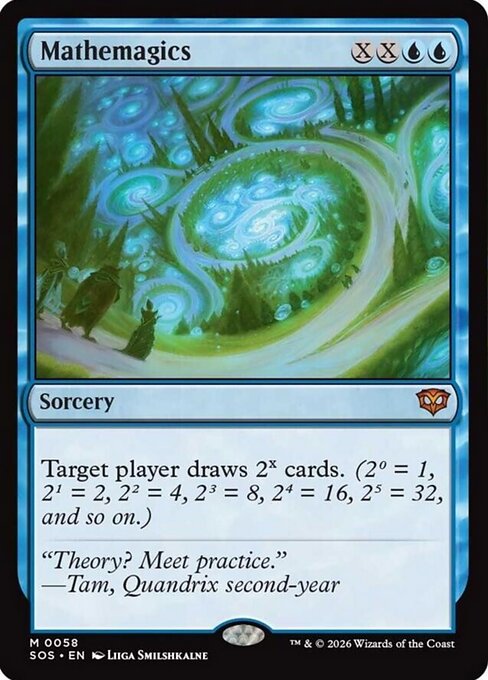
4. Mathemagics
Rating9.0BombWhy this rating?
One of the 10 best cards of the set (9.0/10).
Why. A draw sorcery that scales very fast: at six mana it draws four cards, at eight mana it draws eight, so it can win a long game on its own. You can also aim it at an opponent.
Risks. It does nothing to the board and is expensive for what it gives early. If you are already behind, drawing cards is not enough.
In the draft. A high-upside pick for blue decks, as long as your deck can survive long enough to use it. It needs two blue mana and a lot of mana overall.
Results in the games of the set
When it is in hand, the deck wins 61.9% of its games (set average: 56.3%, 11th of 319 cards).
In the opening hand: 53.4% wins (54.9% on average).
Drawn during the game: 66.3% (57.2% on average).
When it is drawn, the deck wins 12.7 points more than when it is not.
When it is drafted, it is played 87% of the time (set average: 63%).
Taken as the first pick (37 drafts), it ends in the deck 97% of the time.
It is played about as much in every archetype.
 Rating8.9Bomb
Why this rating?
One of the 10 best cards of the set (8.9/10).
Why. A small flier with lifelink that also blocks well on the ground thanks to its toughness. With Repartee, every instant or sorcery that targets a creature puts a +1/+1 counter on each creature you control.
Risks. It has only 1 power, so without spells that target creatures it stays modest. Cheap removal deals with it easily.
In the draft. An excellent white pick if your deck has several spells that target creatures, combat tricks included. It is still fine on its own thanks to flying and lifelink.
Results in the games of the set
When it is in hand, the deck wins 62.7% of its games (set average: 56.3%, 8th of 319 cards).
In the opening hand: 63.2% wins (54.9% on average).
Drawn during the game: 62.3% (57.2% on average).
When it is drawn, the deck wins 7.7 points more than when it is not.
When it is drafted, it is played 92% of the time (set average: 63%).
Taken as the first pick (97 drafts), it ends in the deck 90% of the time.
It is played about as much in every archetype.
 Rating8.8Bomb
Why this rating?
One of the 10 best cards of the set (8.8/10).
Why. A one-drop that grows whenever you cast a spell that costs enough, thanks to Increment. If it dies with counters, you get a green and blue Fractal creature token that keeps them, so removal does not wipe out all its value.
Risks. It only grows when the mana you spend beats its power or toughness, so cheap spells do nothing for it. As a plain 1/1 it dies to anything.
In the draft. A very good green pick to play on turn one, especially with a rising curve. It rewards decks that cast a spell every turn.
Results in the games of the set
When it is in hand, the deck wins 60.4% of its games (set average: 56.3%, 20th of 319 cards).
In the opening hand: 63.3% wins (54.9% on average).
Drawn during the game: 58.5% (57.2% on average).
When it is drawn, the deck wins 8.5 points more than when it is not.
When it is drafted, it is played 88% of the time (set average: 63%).
Taken as the first pick (76 drafts), it ends in the deck 96% of the time.
It is played about as much in every archetype.
 Rating8.8Bomb
Why this rating?
One of the 10 best cards of the set (8.8/10).
Why. A one-drop that mills a player of your choice each time you cast an instant or sorcery: three cards, or ten if the spell cost five mana or more. You can target an opponent for a decking plan, or yourself.
Risks. On its own it does not affect the board and the mill does nothing without a clear plan. A 0/2 blocks a little but does not matter in combat.
In the draft. A specialist card: take it highly only if your deck has plenty of instants and sorceries. Otherwise it is filler.
Results in the games of the set
When it is in hand, the deck wins 60.3% of its games (set average: 56.3%, 22nd of 319 cards).
In the opening hand: 56.7% wins (54.9% on average).
Drawn during the game: 62.3% (57.2% on average).
When it is drawn, the deck wins 9.6 points more than when it is not.
When it is drafted, it is played 88% of the time (set average: 63%).
Taken as the first pick (83 drafts), it ends in the deck 92% of the time.
It is played about as much in every archetype.

8. Emeritus of Ideation // Ancestral Recall
Rating8.7BombWhy this rating?
One of the 10 best cards of the set (8.7/10).
Why. A 5/5 flier with ward 2 for five mana that enters prepared: for one blue mana you can cast its copy and have a player draw three cards. It wins the game through its size, and the draw more than pays back its price.
Risks. It costs five with two blue mana, and removal that gets around ward answers it. Preparing it again by attacking means exiling eight cards from your graveyard, which takes a long time.
In the draft. A very strong blue pick, almost always taken highly.
Results in the games of the set
When it is in hand, the deck wins 64.5% of its games (set average: 56.3%, 3rd of 319 cards).
In the opening hand: 61.5% wins (54.9% on average).
Drawn during the game: 66.1% (57.2% on average).
When it is drawn, the deck wins 14.5 points more than when it is not.
When it is drafted, it is played 89% of the time (set average: 63%).
Taken as the first pick (39 drafts), it ends in the deck 90% of the time.
It is played about as much in every archetype.
 Rating8.6Bomb
Why this rating?
One of the 10 best cards of the set (8.6/10).
Why. A two-mana red-white creature with flying and haste that attacks right away. Discarding a card gives it lifelink until end of turn, and whenever cards leave your graveyard it puts a +1/+1 counter on a creature you control.
Risks. It is fragile at 1 toughness and needs both colours on turn two. Its last ability depends on effects that take cards out of the graveyard.
In the draft. An excellent card for an aggressive red-white deck, taken highly in that pair. Outside those colours it cannot be played.
Results in the games of the set
When it is in hand, the deck wins 60.6% of its games (set average: 56.3%, 19th of 319 cards).
In the opening hand: 61.7% wins (54.9% on average).
Drawn during the game: 60.0% (57.2% on average).
When it is drawn, the deck wins 5.2 points more than when it is not.
When it is drafted, it is played 83% of the time (set average: 63%).
Taken as the first pick (84 drafts), it ends in the deck 86% of the time.
It is played about as much in every archetype.
 Rating8.5Bomb
Why this rating?
One of the 10 best cards of the set (8.5/10).
Why. A huge seven-mana sorcery: you exile cards until their total mana value is at least 4 and cast any of the spells for free. After that you may cast a free copy at the start of each of your first main phases, a late-game bomb.
Risks. Seven mana takes a while, and the result is random: you can exile lands or weak spells. Your deck has to survive until then.
In the draft. Take it in a slower red deck with good value spells. In an aggressive deck it is too expensive.
Results in the games of the set
When it is in hand, the deck wins 62.5% of its games (set average: 56.3%, 10th of 319 cards).
In the opening hand: 60.8% wins (54.9% on average).
Drawn during the game: 63.4% (57.2% on average).
When it is drawn, the deck wins 11.3 points more than when it is not.
When it is drafted, it is played 87% of the time (set average: 63%).
Taken as the first pick (44 drafts), it ends in the deck 89% of the time.
It is played about as much in every archetype.
 Rating8.4Bomb
Why this rating?
One of the very best rares of the format (8.5/10).
Why. A two-mana white creature with vigilance that can attack without giving up defence. With Repartee, every instant or sorcery that targets a creature creates a 1/1 white and black Inkling creature token with flying.
Risks. On its own it is a plain 2/2. Without spells that target creatures, Repartee never pays off.
In the draft. A very good white two-drop in a deck with spells that target creatures. Weaker in a deck without instants or sorceries.
Results in the games of the set
When it is in hand, the deck wins 61.5% of its games (set average: 56.3%, 14th of 319 cards).
In the opening hand: 63.2% wins (54.9% on average).
Drawn during the game: 60.3% (57.2% on average).
When it is drawn, the deck wins 6.2 points more than when it is not.
When it is drafted, it is played 93% of the time (set average: 63%).
Taken as the first pick (81 drafts), it ends in the deck 93% of the time.
It is played about as much in every archetype.
 Rating8.4Very good
Why this rating?
One of the very best rares of the format (8.4/10).
Why. An aggressive two-drop: each time it attacks, each opponent loses 1 life and you gain 1. It returns from the graveyard to the battlefield for two mana by exiling an instant or sorcery card from your graveyard, so it keeps coming back after removal.
Risks. It cannot block, so it does nothing for you when you are under pressure. Coming back requires an instant or sorcery card in your graveyard.
In the draft. A good black pick for an aggressive deck with several instants and sorceries. In a defensive deck it loses much of its value.
Results in the games of the set
When it is in hand, the deck wins 60.1% of its games (set average: 56.3%, 25th of 319 cards).
In the opening hand: 63.5% wins (54.9% on average).
Drawn during the game: 57.5% (57.2% on average).
When it is drawn, the deck wins 4.9 points more than when it is not.
When it is drafted, it is played 86% of the time (set average: 63%).
Taken as the first pick (68 drafts), it ends in the deck 94% of the time.
It is played about as much in every archetype.

13. Ark of Hunger
Rating8.3Very goodWhy this rating?
One of the very best rares of the format (8.3/10).
Why. An artifact that generates value every turn: tap it to mill a card and you may play that card this turn. Whenever cards leave your graveyard it deals 1 damage to each opponent and you gain 1 life.
Risks. It does nothing to the board and does not stop an attack. A card you cannot play this turn (land drop used, not enough mana) simply stays in the graveyard.
In the draft. An excellent pick for red-white, taken fairly highly. Outside that pair it is too specific.
Results in the games of the set
When it is in hand, the deck wins 63.1% of its games (set average: 56.3%, 6th of 319 cards).
In the opening hand: 62.3% wins (54.9% on average).
Drawn during the game: 63.6% (57.2% on average).
When it is drawn, the deck wins 9.4 points more than when it is not.
When it is drafted, it is played 92% of the time (set average: 63%).
Taken as the first pick (113 drafts), it ends in the deck 87% of the time.
It is played about as much in every archetype.
 Rating8.2Very good
Why this rating?
One of the very best rares of the format (8.2/10).
Why. A seven-mana sorcery with up to four modes, repeatable: destroy a nonland permanent, or return a nonland permanent card from your graveyard to the battlefield. Depending on the board it is a string of removal or a huge comeback.
Risks. It costs seven mana including two white and two black, so it is very slow. The turn you cast it you do nothing else.
In the draft. A good pick for a white-black control deck. One copy is enough, and it is not worth forcing that deck.
Results in the games of the set
When it is in hand, the deck wins 63.3% of its games (set average: 56.3%, 5th of 319 cards).
In the opening hand: 58.9% wins (54.9% on average).
Drawn during the game: 65.9% (57.2% on average).
When it is drawn, the deck wins 9.9 points more than when it is not.
When it is drafted, it is played 83% of the time (set average: 63%).
Taken as the first pick (94 drafts), it ends in the deck 89% of the time.
It is played about as much in every archetype.

15. Together as One
Rating8.1Very goodWhy this rating?
One of the very best rares of the format (8.1/10).
Why. A colourless six-mana sorcery whose effect depends on how many colours of mana you spent, thanks to Converge: a player draws X cards, it deals X damage to any target and you gain X life. With three colours it is a very big effect.
Risks. It costs six mana and does not stop the opponent's pressure. In two colours, X cannot go above 2.
In the draft. It shines with three-colour mana but stays decent in two colours. Take it at a middling to high pick.
Results in the games of the set
When it is in hand, the deck wins 65.6% of its games (set average: 56.3%, 1st of 319 cards).
In the opening hand: 61.5% wins (54.9% on average).
Drawn during the game: 67.9% (57.2% on average).
When it is drawn, the deck wins 16.0 points more than when it is not.
When it is drafted, it is played 90% of the time (set average: 63%).
Taken as the first pick (111 drafts), it ends in the deck 92% of the time.
It is played about as much in every archetype.
 Rating8.1Very good
Why this rating?
One of the very best rares of the format (8.1/10).
Why. A 3/3 with ward 1 and haste for three mana. With Opus, each instant or sorcery gives it +1/+1 until end of turn, and with five mana or more you also create a token that is a copy of this creature.
Risks. It needs both blue and red, and its value depends on how many instants and sorceries you have. Without them it is just a solid 3/3.
In the draft. A very good pick for a blue-red deck with instants and sorceries. Less useful if your deck is short on them.
Results in the games of the set
When it is in hand, the deck wins 62.5% of its games (set average: 56.3%, 9th of 319 cards).
In the opening hand: 61.9% wins (54.9% on average).
Drawn during the game: 62.9% (57.2% on average).
When it is drawn, the deck wins 12.1 points more than when it is not.
When it is drafted, it is played 87% of the time (set average: 63%).
Taken as the first pick (91 drafts), it ends in the deck 91% of the time.
It is played about as much in every archetype.
 Rating8.0Very good
Why this rating?
One of the very best uncommons of the format (8.0/10).
Why. A two-mana 2/2 that puts a basic land into your hand when it enters. It smooths your mana, helps fix colours and leaves a useful body.
Risks. Its power is limited: it is a 2/2 that finds a land. In a deck with few basic lands it loses some value.
In the draft. A good green uncommon for multicolour decks, taken at a middling pick. It helps most in green pairs with a splash.
Results in the games of the set
When it is in hand, the deck wins 61.1% of its games (set average: 56.3%, 17th of 319 cards).
In the opening hand: 62.3% wins (54.9% on average).
Drawn during the game: 60.2% (57.2% on average).
When it is drawn, the deck wins 9.0 points more than when it is not.
When it is drafted, it is played 86% of the time (set average: 63%).
Taken as the first pick (170 drafts), it ends in the deck 91% of the time.
It is played mostly in G/R decks (42% of them) and G/U (36%).
 Rating7.9Very good
Why this rating?
One of the very best rares of the format (7.9/10).
Why. A three-mana 2/1 flier that comes with a 1/1 black and green Pest creature token, which gains you 1 life when it attacks. With Infusion, if you gained life this turn, you return a creature card from your graveyard to the battlefield at end step, with mana value up to the life you gained.
Risks. It is fragile at 1 toughness. Without lifegain beyond the Pest, Infusion only brings back creatures with mana value 1.
In the draft. A good black pick in a deck with lifegain. Even without it, two bodies for three mana make a fine play.
Results in the games of the set
When it is in hand, the deck wins 60.1% of its games (set average: 56.3%, 27th of 319 cards).
In the opening hand: 59.5% wins (54.9% on average).
Drawn during the game: 60.4% (57.2% on average).
When it is drawn, the deck wins 5.8 points more than when it is not.
When it is drafted, it is played 88% of the time (set average: 63%).
Taken as the first pick (84 drafts), it ends in the deck 88% of the time.
It is played about as much in every archetype.
 Rating7.8Very good
Why this rating?
One of the very best rares of the format (7.8/10).
Why. A three-mana 3/4 that blocks and attacks well. Whenever you gain life, it puts a +1/+1 counter on each Pest, Bat, Insect, Snake and Spider you control, itself included.
Risks. Without lifegain it is just a sturdy body. It needs black and green, so you must be in that pair.
In the draft. A decent pick for a black-green deck with lifegain. Otherwise it is playable for the body but no more.
Results in the games of the set
When it is in hand, the deck wins 59.1% of its games (set average: 56.3%, 40th of 319 cards).
In the opening hand: 59.9% wins (54.9% on average).
Drawn during the game: 58.6% (57.2% on average).
When it is drawn, the deck wins 7.1 points more than when it is not.
When it is drafted, it is played 75% of the time (set average: 63%).
Taken as the first pick (43 drafts), it ends in the deck 88% of the time.
It is played about as much in every archetype.
 Rating7.8Very good
Why this rating?
One of the very best mythics of the format (7.8/10).
Why. A five-mana sorcery that puts two +1/+1 counters on each creature you control. After it first resolves, you may cast a free copy at the start of each of your first main phases, so the effect repeats every turn.
Risks. Without creatures it does nothing, and removal in response makes it much worse. It needs two green mana.
In the draft. A decent pick for a green deck with many small creatures. In a lighter deck it is just average.
Results in the games of the set
When it is in hand, the deck wins 58.4% of its games (set average: 56.3%, 65th of 319 cards).
In the opening hand: 56.0% wins (54.9% on average).
Drawn during the game: 60.0% (57.2% on average).
When it is drawn, the deck wins 7.9 points more than when it is not.
When it is drafted, it is played 87% of the time (set average: 63%).
Taken among the first three picks (131 drafts), it ends in the deck 82% of the time.
It is played about as much in every archetype.
 Rating7.7Very good
Why this rating?
One of the very best rares of the format (7.7/10).
Why. An X instant: it deals X damage to any target, then you draw two cards and discard one. It is flexible removal that doubles as a finisher and as card filtering.
Risks. It needs both blue and red, and the bigger X is, the more it costs. A small X makes it inefficient.
In the draft. A good pick for a blue-red deck, taken at a middling to high pick. Outside those colours it cannot be played.
Results in the games of the set
When it is in hand, the deck wins 60.3% of its games (set average: 56.3%, 23rd of 319 cards).
In the opening hand: 56.3% wins (54.9% on average).
Drawn during the game: 62.5% (57.2% on average).
When it is drawn, the deck wins 9.8 points more than when it is not.
When it is drafted, it is played 92% of the time (set average: 63%).
Taken as the first pick (97 drafts), it ends in the deck 97% of the time.
It is played about as much in every archetype.
 Rating7.6Very good
Why this rating?
One of the very best rares of the format (7.6/10).
Why. A 6/6 that costs X plus a green mana. At X of 3 you get a 6/6 right away for four mana; with a smaller X it enters tapped with stun counters, so it arrives later.
Risks. It is slow at low X and vulnerable while it is tapped. Removal at that point wastes all the mana you put in.
In the draft. A good green pick as a flexible big body. It fits any curve, from turn four to the late game.
Results in the games of the set
When it is in hand, the deck wins 59.1% of its games (set average: 56.3%, 43rd of 319 cards).
In the opening hand: 61.6% wins (54.9% on average).
Drawn during the game: 57.4% (57.2% on average).
When it is drawn, the deck wins 6.8 points more than when it is not.
When it is drafted, it is played 87% of the time (set average: 63%).
Taken as the first pick (65 drafts), it ends in the deck 97% of the time.
It is played about as much in every archetype.

23. Emeritus of Abundance // Regrowth
Rating7.6Very goodWhy this rating?
One of the very best mythics of the format (7.6/10).
Why. A three-mana 3/4 with vigilance that enters prepared: for two mana you can cast its copy and return any card from your graveyard to your hand. A good body with built-in value.
Risks. Its re-preparing ability is hard to turn on: you need eight or more lands. The body is solid, nothing more.
In the draft. A good green pick, taken at a middling pick. Best in a deck with valuable cards to recover.
Results in the games of the set
When it is in hand, the deck wins 59.3% of its games (set average: 56.3%, 38th of 319 cards).
In the opening hand: 55.7% wins (54.9% on average).
Drawn during the game: 61.5% (57.2% on average).
When it is drawn, the deck wins 7.8 points more than when it is not.
When it is drafted, it is played 86% of the time (set average: 63%).
Taken as the first pick (37 drafts), it ends in the deck 84% of the time.
It is played about as much in every archetype.

24. Impractical Joke
Rating7.6Very goodWhy this rating?
One of the very best uncommons of the format (7.6/10).
Why. A one-mana sorcery that deals 3 damage to a creature or planeswalker, and stops damage from being prevented this turn. It is very efficient and leaves mana to develop your board.
Risks. It is a sorcery, so you can only cast it on your own turn, in a main phase. It does not kill big creatures.
In the draft. A good uncommon to take early in a red deck. Cheap removal is always useful.
Results in the games of the set
When it is in hand, the deck wins 58.5% of its games (set average: 56.3%, 62nd of 319 cards).
In the opening hand: 56.9% wins (54.9% on average).
Drawn during the game: 59.5% (57.2% on average).
When it is drawn, the deck wins 4.8 points more than when it is not.
When it is drafted, it is played 93% of the time (set average: 63%).
Taken as the first pick (161 drafts), it ends in the deck 99% of the time.
It is played mostly in R/W decks (27% of them) and R/U (26%).

25. Scheming Silvertongue // Sign in Blood
Rating7.6Very goodWhy this rating?
One of the very best rares of the format (7.6/10).
Why. A two-mana 1/3 with flying and lifelink, a good blocker. If you gained 2 or more life this turn it becomes prepared in your second main phase, letting you cast its copy for two black mana: a player draws two cards and loses 2 life.
Risks. With 1 power its lifelink only gains 1 life, so you need another lifegain source to prepare it.
In the draft. A decent pick for a black deck with lifegain. Otherwise a 1/3 flying lifelinker is useful on defence.
Results in the games of the set
When it is in hand, the deck wins 59.0% of its games (set average: 56.3%, 44th of 319 cards).
In the opening hand: 60.4% wins (54.9% on average).
Drawn during the game: 58.0% (57.2% on average).
When it is drawn, the deck wins 4.9 points more than when it is not.
When it is drafted, it is played 88% of the time (set average: 63%).
Taken as the first pick (79 drafts), it ends in the deck 92% of the time.
It is played about as much in every archetype.
 Rating7.5Very good
Why this rating?
One of the very best rares of the format (7.5/10).
Why. A two-mana 2/2 with menace. With Opus, each instant or sorcery puts a +1/+1 counter on it, and with five mana or more you also add red mana equal to its power.
Risks. Without instants and sorceries it is a plain 2/2. It dies easily if you do not grow it early.
In the draft. A good red pick for a deck with many instants and sorceries. Take it at a middling pick otherwise.
Results in the games of the set
When it is in hand, the deck wins 59.7% of its games (set average: 56.3%, 33rd of 319 cards).
In the opening hand: 60.8% wins (54.9% on average).
Drawn during the game: 59.0% (57.2% on average).
When it is drawn, the deck wins 6.9 points more than when it is not.
When it is drafted, it is played 94% of the time (set average: 63%).
Taken as the first pick (91 drafts), it ends in the deck 93% of the time.
It is played about as much in every archetype.

27. Emeritus of Woe // Demonic Tutor
Rating7.4Very goodWhy this rating?
A very good mythic of the format (7.4/10).
Why. A four-mana 5/4 that enters prepared: for two mana you can cast its copy and search your library for any card. A big body with a tutor within reach.
Risks. Getting prepared again needs two or more creatures to have died in the turn, which is not common. It is still vulnerable to removal.
In the draft. A good black pick, taken at a middling to high pick. The body and the tutor justify playing it in any black deck.
Results in the games of the set
When it is in hand, the deck wins 59.0% of its games (set average: 56.3%, 46th of 319 cards).
In the opening hand: 57.4% wins (54.9% on average).
Drawn during the game: 59.9% (57.2% on average).
When it is drawn, the deck wins 5.6 points more than when it is not.
When it is drafted, it is played 90% of the time (set average: 63%).
Taken as the first pick (31 drafts), it ends in the deck 90% of the time.
It is played about as much in every archetype.

28. Emeritus of Truce // Swords to Plowshares
Rating7.4Very goodWhy this rating?
A very good mythic of the format (7.4/10).
Why. A three-mana 3/3 that has a target player (you, usually) create a 1/1 white and black Inkling creature token with flying. If an opponent then controls more creatures than you, it becomes prepared: you can cast its copy for one white mana to exile a creature, whose controller gains life equal to its power.
Risks. It needs two white mana on turn three, and it only becomes prepared if an opponent controls more creatures than you. The removal gives the opponent some life.
In the draft. A good white pick, especially in a deck that falls behind on board. The 3/3 and the token are already worth the card.
Results in the games of the set
When it is in hand, the deck wins 58.5% of its games (set average: 56.3%, 64th of 319 cards).
In the opening hand: 59.2% wins (54.9% on average).
Drawn during the game: 58.0% (57.2% on average).
When it is drawn, the deck wins 3.4 points more than when it is not.
When it is drafted, it is played 89% of the time (set average: 63%).
Taken as the first pick (40 drafts), it ends in the deck 95% of the time.
It is played about as much in every archetype.
 Rating7.4Very good
Why this rating?
A very good mythic of the format (7.4/10).
Why. A six-mana 6/6 Dragon with flying and trample and cascade, which casts a cheaper spell for free. Your instants and sorceries cast from hand also gain cascade, so each spell casts a second one.
Risks. It needs green and blue and six mana. If it is removed you still keep the free spell, but the tempo loss is heavy.
In the draft. A very good green-blue pick, taken at a middling to high pick. Its size alone can win the game even without instants or sorceries.
Results in the games of the set
When it is in hand, the deck wins 61.2% of its games (set average: 56.3%, 16th of 319 cards).
In the opening hand: 58.1% wins (54.9% on average).
Drawn during the game: 62.9% (57.2% on average).
When it is drawn, the deck wins 11.6 points more than when it is not.
When it is drafted, it is played 89% of the time (set average: 63%).
Taken as the first pick (38 drafts), it ends in the deck 89% of the time.
It is played about as much in every archetype.
 Rating7.4Very good
Why this rating?
A solid uncommon of the format (7.4/10).
Why. A two-mana white-black instant with three modes: two +1/+1 counters on a creature, exile a creature with power 2 or less, or drain 3 life. It adapts to the situation.
Risks. It needs both colours. The removal only hits small creatures, so it does not answer big threats.
In the draft. A good uncommon for white-black, taken at a middling to high pick. Outside that pair it does not get played.
Results in the games of the set
When it is in hand, the deck wins 59.5% of its games (set average: 56.3%, 35th of 319 cards).
In the opening hand: 58.0% wins (54.9% on average).
Drawn during the game: 60.5% (57.2% on average).
When it is drawn, the deck wins 2.7 points more than when it is not.
When it is drafted, it is played 78% of the time (set average: 63%).
Taken as the first pick (86 drafts), it ends in the deck 93% of the time.
It is played mostly in B/W decks (53% of them).
 Rating7.4Very good
Why this rating?
A very good rare of the format (7.4/10).
Why. A five-mana blue-red sorcery with two modes: draw four cards, or deal 4 damage to each creature and planeswalker. It adapts to the board and can turn around a game that started badly.
Risks. The sweeper also hits your own creatures and planeswalkers. It costs five with two blue and two red mana, so it is demanding.
In the draft. A good pick for a blue-red control deck. One copy is often enough.
Results in the games of the set
When it is in hand, the deck wins 61.0% of its games (set average: 56.3%, 18th of 319 cards).
In the opening hand: 57.7% wins (54.9% on average).
Drawn during the game: 62.8% (57.2% on average).
When it is drawn, the deck wins 11.0 points more than when it is not.
When it is drafted, it is played 87% of the time (set average: 63%).
Taken as the first pick (95 drafts), it ends in the deck 92% of the time.
It is played about as much in every archetype.

32. Vicious Rivalry
Rating7.4Very goodWhy this rating?
A very good rare of the format (7.4/10).
Why. A four-mana black-green sorcery: you pay X life to destroy all artifacts and creatures with mana value X or less. You pick the threshold based on the board.
Risks. It also destroys your own creatures and artifacts and costs life. On the wrong board it is risky.
In the draft. A good black-green pick for a control deck. Keep it for games where you are behind.
Results in the games of the set
When it is in hand, the deck wins 58.9% of its games (set average: 56.3%, 49th of 319 cards).
In the opening hand: 56.7% wins (54.9% on average).
Drawn during the game: 60.3% (57.2% on average).
When it is drawn, the deck wins 7.3 points more than when it is not.
When it is drafted, it is played 80% of the time (set average: 63%).
Taken as the first pick (91 drafts), it ends in the deck 88% of the time.
It is played about as much in every archetype.

33. Snarl Song
Rating7.4Very goodWhy this rating?
A solid uncommon of the format (7.4/10).
Why. A six-mana green uncommon sorcery with Converge: you create two green and blue Fractal creature tokens with X +1/+1 counters each and gain X life. With three colours, that is two 3/3s and 3 life.
Risks. It costs six mana, which is slow. In two colours, X cannot go above 2.
In the draft. A good pick for a multicolour green deck. It gains value with well-fixed mana.
Results in the games of the set
When it is in hand, the deck wins 61.7% of its games (set average: 56.3%, 12th of 319 cards).
In the opening hand: 56.8% wins (54.9% on average).
Drawn during the game: 64.4% (57.2% on average).
When it is drawn, the deck wins 11.2 points more than when it is not.
When it is drafted, it is played 83% of the time (set average: 63%).
Taken as the first pick (172 drafts), it ends in the deck 91% of the time.
It is played mostly in G/U decks (57% of them) and G/R (49%).

34. Molten Note
Rating7.3Very goodWhy this rating?
A solid uncommon of the format (7.3/10).
Why. An X red-white sorcery that deals damage to a creature equal to the mana spent, then untaps all your creatures. Its eight-mana flashback gives you a second use late in the game.
Risks. It needs both colours, and killing a big creature costs as much mana as its toughness. You can only cast it on your own turn, in a main phase.
In the draft. A good uncommon for red-white, taken at a middling to high pick. Outside that pair it is unplayable.
Results in the games of the set
When it is in hand, the deck wins 59.4% of its games (set average: 56.3%, 37th of 319 cards).
In the opening hand: 56.9% wins (54.9% on average).
Drawn during the game: 60.8% (57.2% on average).
When it is drawn, the deck wins 4.0 points more than when it is not.
When it is drafted, it is played 86% of the time (set average: 63%).
Taken as the first pick (119 drafts), it ends in the deck 96% of the time.
It is played mostly in R/W decks (45% of them).
 Rating7.2Very good
Why this rating?
A very good mythic of the format (7.2/10).
Why. For six mana you copy your best creature, then Paradigm hands you a free extra copy every turn. In a deck full of creatures with enter effects, it is a value engine that wins long games.
Risks. With no good creature to copy it does nothing. Six mana for a sorcery that does not touch the opposing board is slow against aggression.
In the draft. One copy is plenty, in a blue deck with valuable creatures. Take it mid-pack, and skip it if your creatures are plain.
Results in the games of the set
When it is in hand, the deck wins 57.9% of its games (set average: 56.3%, 75th of 319 cards).
In the opening hand: 53.5% wins (54.9% on average).
Drawn during the game: 60.5% (57.2% on average).
When it is drawn, the deck wins 8.8 points more than when it is not.
When it is drafted, it is played 88% of the time (set average: 63%).
Taken as the first pick (37 drafts), it ends in the deck 89% of the time.
It is played about as much in every archetype.

36. Applied Geometry
Rating7.2Very goodWhy this rating?
A very good rare of the format (7.2/10).
Why. For four mana you get a token copy of one of your permanents, turned into a 6/6 Fractal creature that keeps its original abilities. Copying a creature with a strong enter effect gives you a big threat at once.
Risks. It needs a non-Aura permanent to copy: aimed at a weak one, it is just a 6/6. A removal on the token undoes your turn.
In the draft. Good in green-blue with creatures worth copying. Take it in the middle of the pack, after your removal.
Results in the games of the set
When it is in hand, the deck wins 57.9% of its games (set average: 56.3%, 77th of 319 cards).
In the opening hand: 55.2% wins (54.9% on average).
Drawn during the game: 59.5% (57.2% on average).
When it is drawn, the deck wins 7.8 points more than when it is not.
When it is drafted, it is played 86% of the time (set average: 63%).
Taken as the first pick (72 drafts), it ends in the deck 90% of the time.
It is played about as much in every archetype.

37. End of the Hunt
Rating7.2Very goodWhy this rating?
A solid uncommon of the format (7.2/10).
Why. For two mana, your opponent must exile their creature or planeswalker with the highest mana value. It does not target, so it gets around hexproof and ward, and it usually hits their best threat.
Risks. Ties are the opponent's choice, and against a board of small creatures you only remove an average card. It is a sorcery, so it cannot answer what comes later.
In the draft. A very good cheap removal for black, worth taking fairly high. The more big targets the opponent has, the better it gets.
Results in the games of the set
When it is in hand, the deck wins 58.3% of its games (set average: 56.3%, 66th of 319 cards).
In the opening hand: 56.5% wins (54.9% on average).
Drawn during the game: 59.5% (57.2% on average).
When it is drawn, the deck wins 3.7 points more than when it is not.
When it is drafted, it is played 88% of the time (set average: 63%).
Taken as the first pick (123 drafts), it ends in the deck 98% of the time.
It is played mostly in B/U decks (39% of them) and B/W (26%).

38. Great Hall of the Biblioplex
Rating7.2Very goodWhy this rating?
A very good rare of the format (7.2/10).
Why. A land that taps for colorless, or for one life any color, but only to cast an instant or sorcery: strong fixing for a spell-heavy deck. For five mana it becomes a 2/4 Wizard creature.
Risks. It cannot cast your colored creatures, and colorless alone will not pay for colored spells. The life payment adds up against aggressive decks.
In the draft. Take it in a deck with plenty of instants and sorceries, especially a two-color deck with a splash. It beats a basic land.
Results in the games of the set
When it is in hand, the deck wins 58.8% of its games (set average: 56.3%, 51st of 319 cards).
In the opening hand: 56.4% wins (54.9% on average).
Drawn during the game: 60.4% (57.2% on average).
When it is drawn, the deck wins 5.9 points more than when it is not.
When it is drafted, it is played 90% of the time (set average: 63%).
Taken as the first pick (57 drafts), it ends in the deck 98% of the time.
 Rating7.1Good
Why this rating?
A solid uncommon of the format (7.1/10).
Why. A two-mana creature with menace that grows with every instant or sorcery targeting a creature, thanks to Repartee. If it dies, its counters move to another creature, so the opponent never quite wins the trade.
Risks. It stays a 2/2 without spells that target a creature, and it is fragile before it grows. It needs both colors on turn two.
In the draft. A very good uncommon for white-black, worth taking fairly high if you have spells that target creatures. Outside that deck it loses a lot.
Results in the games of the set
When it is in hand, the deck wins 60.4% of its games (set average: 56.3%, 21st of 319 cards).
In the opening hand: 62.9% wins (54.9% on average).
Drawn during the game: 58.6% (57.2% on average).
When it is drawn, the deck wins 3.6 points more than when it is not.
When it is drafted, it is played 82% of the time (set average: 63%).
Taken as the first pick (114 drafts), it ends in the deck 93% of the time.
It is played mostly in B/W decks (46% of them).
 Rating7.1Good
Why this rating?
A very good rare of the format (7.1/10).
Why. A green-blue land that enters untapped if you control two or more other lands, so it rarely slows your curve once the game is under way.
Risks. It enters tapped on turns one and two, which can cost tempo in a hand with no early plays. It does nothing outside green-blue.
In the draft. Nice fixing but not a priority pick: take it if you are green-blue and the pack offers nothing better.
Results in the games of the set
When it is in hand, the deck wins 56.6% of its games (set average: 56.3%, 124th of 319 cards).
In the opening hand: 55.0% wins (54.9% on average).
Drawn during the game: 57.6% (57.2% on average).
When it is drawn, the deck wins 5.2 points more than when it is not.
When it is drafted, it is played 83% of the time (set average: 63%).
Taken as the first pick (37 drafts), it ends in the deck 86% of the time.

41. Arcane Omens
Rating7.0GoodWhy this rating?
A solid uncommon of the format (7.0/10).
Why. Converge makes the target discard as many cards as colors of mana spent. In a three-color deck you can strip two or three cards from the opponent's hand for five mana.
Risks. In a two-color deck you take only two cards, and a five-mana sorcery that leaves the board alone is slow. An opponent who has emptied their hand loses nothing.
In the draft. A late pick for a deck with three or more colors, never a first choice. In a two-color deck it is filler.
Results in the games of the set
When it is in hand, the deck wins 59.8% of its games (set average: 56.3%, 31st of 319 cards).
In the opening hand: 56.5% wins (54.9% on average).
Drawn during the game: 61.6% (57.2% on average).
When it is drawn, the deck wins 9.0 points more than when it is not.
When it is drafted, it is played 67% of the time (set average: 63%).
Taken as the first pick (104 drafts), it ends in the deck 87% of the time.
It is played mostly in B/U decks (50% of them) and G/U (33%).
 Rating7.0Good
Why this rating?
A very good rare of the format (7.0/10).
Why. A 4/3 that draws a card on entering, and whose Repartee exiles a creature until the end step: you remove a blocker or save your own from a removal. The body and value already justify four mana.
Risks. Its cost of two white and two black mana is heavy, so it only fits a real white-black deck. Each player loses 1 life on entering, which can hurt you too.
In the draft. A good rare for white-black, worth taking fairly high even with few targeting spells. Do not take it if you are unsure of both colors.
Results in the games of the set
When it is in hand, the deck wins 59.7% of its games (set average: 56.3%, 32nd of 319 cards).
In the opening hand: 58.9% wins (54.9% on average).
Drawn during the game: 60.2% (57.2% on average).
When it is drawn, the deck wins 4.0 points more than when it is not.
When it is drafted, it is played 81% of the time (set average: 63%).
Taken as the first pick (71 drafts), it ends in the deck 93% of the time.
It is played about as much in every archetype.

43. Jadzi, Steward of Fate // Oracle's Gift
Rating7.0GoodWhy this rating?
A very good rare of the format (7.0/10).
Why. A 2/4 for three that filters your hand by drawing two cards and then discarding two, and enters prepared. Later, Oracle's Gift turns a lot of mana into several Fractals, each with several counters.
Risks. The filter costs value if your hand is already good, and a 2/4 body is not much on offense. The second half needs a lot of mana to be decisive.
In the draft. A good rare for blue: it holds the ground early and finishes late. Take it over most ordinary creatures, but not over a strong removal.
Results in the games of the set
When it is in hand, the deck wins 59.5% of its games (set average: 56.3%, 36th of 319 cards).
In the opening hand: 57.3% wins (54.9% on average).
Drawn during the game: 60.8% (57.2% on average).
When it is drawn, the deck wins 8.3 points more than when it is not.
When it is drafted, it is played 92% of the time (set average: 63%).
Taken as the first pick (87 drafts), it ends in the deck 94% of the time.
It is played about as much in every archetype.

44. Mind into Matter
Rating7.0GoodWhy this rating?
A very good rare of the format (7.0/10).
Why. An X spell that draws X cards, then puts a permanent from your hand with mana value X or less onto the battlefield. At five or six mana it is often a big draw plus a free big permanent.
Risks. You need a good target in hand or to draw one, and the permanent enters tapped. At small values of X it is a poor draw for its price.
In the draft. Best in a green-blue deck with several big permanents. Take it mid-pack, over filler creatures.
Results in the games of the set
When it is in hand, the deck wins 57.9% of its games (set average: 56.3%, 79th of 319 cards).
In the opening hand: 54.0% wins (54.9% on average).
Drawn during the game: 60.2% (57.2% on average).
When it is drawn, the deck wins 7.6 points more than when it is not.
When it is drafted, it is played 85% of the time (set average: 63%).
Taken as the first pick (71 drafts), it ends in the deck 90% of the time.
It is played about as much in every archetype.
 Rating7.0Good
Why this rating?
A very good rare of the format (7.0/10).
Why. A 0/2 creature that grows through Increment when you cast spells for more mana than its power or toughness, and draws a card each time it gets a counter. It becomes a steady card source if you cast spells every turn.
Risks. On its own it is a 0/2 with no impact: you must cast spells after it, and the bigger it gets, the more those spells must cost to keep growing it. An early removal stops it before it pays off.
In the draft. Very good in a blue deck with a full curve. Take it fairly high and play it early so it has time to draw.
Results in the games of the set
When it is in hand, the deck wins 58.6% of its games (set average: 56.3%, 58th of 319 cards).
In the opening hand: 57.4% wins (54.9% on average).
Drawn during the game: 59.4% (57.2% on average).
When it is drawn, the deck wins 8.4 points more than when it is not.
When it is drafted, it is played 89% of the time (set average: 63%).
Taken as the first pick (78 drafts), it ends in the deck 91% of the time.
It is played about as much in every archetype.
 Rating7.0Good
Why this rating?
A very good mythic of the format (7.0/10).
Why. For seven mana you return a nonland permanent card from your graveyard to the battlefield, then Paradigm repeats the effect for free every turn. A dead big creature keeps coming back.
Risks. Seven mana is very heavy, and with no good target in your graveyard it is dead. Your deck must survive until it arrives.
In the draft. A slow finisher pick for a white control deck with valuable creatures. Do not take it early in an aggressive deck.
Results in the games of the set
When it is in hand, the deck wins 57.4% of its games (set average: 56.3%, 88th of 319 cards).
In the opening hand: 54.1% wins (54.9% on average).
Drawn during the game: 59.4% (57.2% on average).
When it is drawn, the deck wins 4.6 points more than when it is not.
When it is drafted, it is played 84% of the time (set average: 63%).
Taken as the first pick (35 drafts), it ends in the deck 83% of the time.
It is played about as much in every archetype.
 Rating7.0Good
Why this rating?
A very good rare of the format (7.0/10).
Why. A blue-red land that enters untapped if you control two or more other lands, so it is rarely a tempo problem after the opening turns.
Risks. It enters tapped on the first two turns, which can cost tempo. It does nothing outside blue-red.
In the draft. Decent fixing, not a priority pick: take it if you are blue-red and no playable is waiting for you.
Results in the games of the set
When it is in hand, the deck wins 56.9% of its games (set average: 56.3%, 110th of 319 cards).
In the opening hand: 55.3% wins (54.9% on average).
Drawn during the game: 58.0% (57.2% on average).
When it is drawn, the deck wins 5.4 points more than when it is not.
When it is drafted, it is played 84% of the time (set average: 63%).
Taken as the first pick (45 drafts), it ends in the deck 93% of the time.

48. Stress Dream
Rating7.0GoodWhy this rating?
A solid uncommon of the format (7.0/10).
Why. A five-mana instant that deals 5 damage to a creature and lets you look at the top two cards of your library and keep one. A removal that nearly replaces itself.
Risks. Five mana, and it needs both blue and red. Creatures with more than 5 toughness escape it.
In the draft. A very good pick for blue-red, worth taking fairly high. A removal with value attached, castable at instant speed on the opponent's turn.
Results in the games of the set
When it is in hand, the deck wins 60.1% of its games (set average: 56.3%, 26th of 319 cards).
In the opening hand: 56.5% wins (54.9% on average).
Drawn during the game: 62.0% (57.2% on average).
When it is drawn, the deck wins 8.6 points more than when it is not.
When it is drafted, it is played 90% of the time (set average: 63%).
Taken as the first pick (165 drafts), it ends in the deck 93% of the time.
It is played mostly in R/U decks (41% of them).
 Rating7.0Good
Why this rating?
A solid uncommon of the format (7.0/10).
Why. An X instant that returns up to X instants and/or sorceries from your graveyard to your hand, then exiles itself. When your graveyard is full of good spells, it is a lot of value in one card.
Risks. It does nothing without targets in your graveyard, and its doubled X cost climbs quickly. It leaves you behind on board.
In the draft. For a blue-red deck with many instants and sorceries. A mid-pack pick, not an opening choice.
Results in the games of the set
When it is in hand, the deck wins 58.0% of its games (set average: 56.3%, 73rd of 319 cards).
In the opening hand: 51.6% wins (54.9% on average).
Drawn during the game: 61.3% (57.2% on average).
When it is drawn, the deck wins 6.9 points more than when it is not.
When it is drafted, it is played 76% of the time (set average: 63%).
Taken as the first pick (93 drafts), it ends in the deck 88% of the time.
It is played mostly in R/U decks (33% of them) and G/U (30%).
 Rating6.9Good
Why this rating?
A solid uncommon of the format (6.9/10).
Why. A 3/2 flying Vehicle for three that puts a basic land into your hand on entering. It fixes your mana and adds an aerial threat in almost any deck.
Risks. It needs crew 2, so creatures with total power 2 must tap to animate it. It is fragile against artifact removal and aerial blockers.
In the draft. A very good pick for aggro or three-color decks, playable in every color. Take it over average creatures.
Results in the games of the set
When it is in hand, the deck wins 58.9% of its games (set average: 56.3%, 48th of 319 cards).
In the opening hand: 58.0% wins (54.9% on average).
Drawn during the game: 59.5% (57.2% on average).
When it is drawn, the deck wins 4.3 points more than when it is not.
When it is drafted, it is played 89% of the time (set average: 63%).
Taken as the first pick (171 drafts), it ends in the deck 95% of the time.
It is played about as much in every archetype.

51. Erode
Rating6.8GoodWhy this rating?
A very good rare of the format (6.8/10).
Why. For a single white mana, you destroy a creature or planeswalker at instant speed. The cost is so low you can still develop your board the same turn.
Risks. The opponent may put a basic land onto the battlefield tapped, which helps them ramp. Against a cheap card, it is a poor trade.
In the draft. An efficient white removal, worth taking fairly high. Save it for big targets rather than small creatures.
Results in the games of the set
When it is in hand, the deck wins 56.2% of its games (set average: 56.3%, 142nd of 319 cards).
In the opening hand: 52.9% wins (54.9% on average).
Drawn during the game: 58.2% (57.2% on average).
When it is drawn, the deck wins 1.6 points more than when it is not.
When it is drafted, it is played 90% of the time (set average: 63%).
Taken as the first pick (49 drafts), it ends in the deck 94% of the time.
It is played about as much in every archetype.
 Rating6.8Good
Why this rating?
A very good rare of the format (6.8/10).
Why. Each creature you lose drains the opponent for 1 life. For three mana and a sacrificed creature, you return another creature card from your graveyard to the battlefield at sorcery speed.
Risks. It does nothing on the board when it arrives, and it needs plenty of creatures and mana. A deck with no good creature to bring back uses it poorly.
In the draft. A pick for a value-oriented black-green deck with many creatures. Avoid it if you want a fast curve.
Results in the games of the set
When it is in hand, the deck wins 54.9% of its games (set average: 56.3%, 190th of 319 cards).
In the opening hand: 51.4% wins (54.9% on average).
Drawn during the game: 57.4% (57.2% on average).
When it is drawn, the deck wins 3.2 points more than when it is not.
When it is drafted, it is played 78% of the time (set average: 63%).
Taken as the first pick (38 drafts), it ends in the deck 92% of the time.
It is played about as much in every archetype.

53. Mana Sculpt
Rating6.8GoodWhy this rating?
A very good rare of the format (6.8/10).
Why. A three-mana counterspell that, if you control a Wizard, gives back colorless mana equal to the mana spent on the countered spell at the start of your next main phase. Countering a big spell lets you cast your own right behind it.
Risks. It requires holding up three mana including two blue, which is awkward when you want to develop. Without a Wizard, it is a plain counterspell.
In the draft. For a controlling blue deck with several Wizards. Take it mid-pack, after the creatures and removal that drive your game.
Results in the games of the set
When it is in hand, the deck wins 57.9% of its games (set average: 56.3%, 74th of 319 cards).
In the opening hand: 53.9% wins (54.9% on average).
Drawn during the game: 60.2% (57.2% on average).
When it is drawn, the deck wins 7.8 points more than when it is not.
When it is drafted, it is played 79% of the time (set average: 63%).
Taken as the first pick (52 drafts), it ends in the deck 83% of the time.
It is played about as much in every archetype.
 Rating6.8Good
Why this rating?
A very good rare of the format (6.8/10).
Why. A white-black land that enters untapped if you control two or more other lands, so it rarely causes a tempo problem after the opening turns.
Risks. It enters tapped on the first two turns. It has no use outside white-black.
In the draft. Decent fixing for white-black, to take when no stronger playable is available.
Results in the games of the set
When it is in hand, the deck wins 57.2% of its games (set average: 56.3%, 98th of 319 cards).
In the opening hand: 57.5% wins (54.9% on average).
Drawn during the game: 57.1% (57.2% on average).
When it is drawn, the deck wins 3.2 points more than when it is not.
When it is drafted, it is played 77% of the time (set average: 63%).
Taken as the first pick (45 drafts), it ends in the deck 93% of the time.

55. Sundown Pass
Rating6.8GoodWhy this rating?
A very good rare of the format (6.8/10).
Why. A red-white land that enters untapped if you control two or more other lands, so it rarely causes a tempo problem after the opening turns.
Risks. It enters tapped on the first two turns. It does nothing outside red-white.
In the draft. Decent fixing for red-white, to take when no playable stands out.
Results in the games of the set
When it is in hand, the deck wins 57.1% of its games (set average: 56.3%, 100th of 319 cards).
In the opening hand: 56.6% wins (54.9% on average).
Drawn during the game: 57.5% (57.2% on average).
When it is drawn, the deck wins 3.3 points more than when it is not.
When it is drafted, it is played 84% of the time (set average: 63%).
Taken as the first pick (47 drafts), it ends in the deck 91% of the time.
 Rating6.8Good
Why this rating?
A very good rare of the format (6.8/10).
Why. A three-mana instant that exiles a nonland permanent and the top card of your library. Each owner may play their card until the end of their next turn: mostly a tempo play, or a way to save your own permanent.
Risks. It is not permanent removal: the opponent can replay their card. The exiled library card is lost if you do not play it in time.
In the draft. A good tempo card for red-white, not a removal. Take it mid-pack.
Results in the games of the set
When it is in hand, the deck wins 57.3% of its games (set average: 56.3%, 93rd of 319 cards).
In the opening hand: 56.1% wins (54.9% on average).
Drawn during the game: 58.1% (57.2% on average).
When it is drawn, the deck wins 2.3 points more than when it is not.
When it is drafted, it is played 76% of the time (set average: 63%).
Taken as the first pick (63 drafts), it ends in the deck 81% of the time.
It is played about as much in every archetype.

57. Elite Interceptor // Rejoinder
Rating6.8GoodWhy this rating?
One of the best commons of the format (6.8/10).
Why. A one-mana 1/2 that enters prepared: you can then cast Rejoinder to tap or untap a creature and draw a card. Two effects for a low price, playable in nearly every white deck.
Risks. The 1/2 body is weak, and Rejoinder removes nothing from the board. It does not win the game alone.
In the draft. A good common for white, to take early for a white-black or white-red deck. Let it go if you are not white.
Results in the games of the set
When it is in hand, the deck wins 59.2% of its games (set average: 56.3%, 39th of 319 cards).
In the opening hand: 60.8% wins (54.9% on average).
Drawn during the game: 58.2% (57.2% on average).
When it is drawn, the deck wins 1.8 points more than when it is not.
When it is drafted, it is played 90% of the time (set average: 63%).
Taken as the first pick (300 drafts), it ends in the deck 97% of the time.
It is played mostly in B/W decks (72% of them) and R/W (61%).

58. Pursue the Past
Rating6.7GoodWhy this rating?
One of the best commons of the format (6.7/10).
Why. A two-mana sorcery that gains 2 life, turns a dead card into two fresh ones, then comes back with flashback. The life gain also turns on Infusion.
Risks. It does nothing on the board and needs both red and white. Against an aggressive deck it slows your development.
In the draft. A solid common for red-white, especially with cards that need a life gain. Take it mid-pack.
Results in the games of the set
When it is in hand, the deck wins 59.1% of its games (set average: 56.3%, 41st of 319 cards).
In the opening hand: 58.3% wins (54.9% on average).
Drawn during the game: 59.6% (57.2% on average).
When it is drawn, the deck wins 3.1 points more than when it is not.
When it is drafted, it is played 71% of the time (set average: 63%).
Taken as the first pick (123 drafts), it ends in the deck 91% of the time.
It is played mostly in R/W decks (72% of them).

59. Withering Curse
Rating6.6GoodWhy this rating?
A very good mythic of the format (6.6/10).
Why. A three-mana sweeper giving all creatures -2/-2. With Infusion it destroys all creatures: a life gain turns it into a full reset.
Risks. It also hits your own creatures. If the opponent only has big creatures, its base effect barely matters.
In the draft. Take it in a black control deck with life gain. It plays poorly in a deck with many creatures.
Results in the games of the set
When it is in hand, the deck wins 53.5% of its games (set average: 56.3%, 231st of 319 cards).
In the opening hand: 50.8% wins (54.9% on average).
Drawn during the game: 55.3% (57.2% on average).
When it is drawn, the deck wins 2.1 points more than when it is not.
When it is drafted, it is played 62% of the time (set average: 63%).
Taken among the first three picks (89 drafts), it ends in the deck 72% of the time.
It is played about as much in every archetype.

60. Deathcap Glade
Rating6.6GoodWhy this rating?
A very good rare of the format (6.6/10).
Why. A black-green land that enters untapped if you control two or more other lands, so it rarely causes a tempo problem after the opening turns.
Risks. It enters tapped on the first two turns. It has no use outside black-green.
In the draft. Decent fixing for black-green, to take when no stronger playable is available.
Results in the games of the set
When it is in hand, the deck wins 55.7% of its games (set average: 56.3%, 159th of 319 cards).
In the opening hand: 55.3% wins (54.9% on average).
Drawn during the game: 56.0% (57.2% on average).
When it is drawn, the deck wins 3.1 points more than when it is not.
When it is drafted, it is played 80% of the time (set average: 63%).
Taken among the first three picks (101 drafts), it ends in the deck 89% of the time.
 Rating6.6Good
Why this rating?
A very good mythic of the format (6.6/10).
Why. A five-mana sorcery: the target player draws two cards and loses 2 life. Paradigm recasts it for free every turn, which becomes a steady stream of cards.
Risks. Five mana to change nothing on board is heavy, and the life loss hits you if you target yourself. Against aggression you do not have the time.
In the draft. For a black control or value deck. A mid-pack pick, after removal and solid creatures.
Results in the games of the set
When it is in hand, the deck wins 56.2% of its games (set average: 56.3%, 141st of 319 cards).
In the opening hand: 54.0% wins (54.9% on average).
Drawn during the game: 57.6% (57.2% on average).
When it is drawn, the deck wins 3.3 points more than when it is not.
When it is drafted, it is played 83% of the time (set average: 63%).
Taken among the first three picks (103 drafts), it ends in the deck 83% of the time.
It is played about as much in every archetype.

62. Flashback
Rating6.6GoodWhy this rating?
A very good rare of the format (6.6/10).
Why. For a single red mana, an instant or sorcery in your graveyard gains flashback until end of turn at its mana cost. You recast your best spell, but it is one more card to pay for.
Risks. It does nothing without a good spell in your graveyard, and you pay twice. It cannot stand alone: it is a conditional card.
In the draft. For a red deck with many strong instants and sorceries. Otherwise leave it out.
Results in the games of the set
When it is in hand, the deck wins 54.2% of its games (set average: 56.3%, 210th of 319 cards).
In the opening hand: 48.5% wins (54.9% on average).
Drawn during the game: 57.4% (57.2% on average).
When it is drawn, the deck wins 2.3 points more than when it is not.
When it is drafted, it is played 62% of the time (set average: 63%).
Taken among the first three picks (105 drafts), it ends in the deck 80% of the time.
It is played about as much in every archetype.

63. Foolish Fate
Rating6.6GoodWhy this rating?
A solid uncommon of the format (6.6/10).
Why. A three-mana instant that destroys a creature with no restriction on size. With Infusion, its controller also loses 3 life.
Risks. It does not hit planeswalkers or artifacts. The Infusion bonus needs a life gain this turn.
In the draft. A very solid black removal: take it fairly high in any black deck, even better with life gain.
Results in the games of the set
When it is in hand, the deck wins 58.6% of its games (set average: 56.3%, 60th of 319 cards).
In the opening hand: 55.8% wins (54.9% on average).
Drawn during the game: 60.3% (57.2% on average).
When it is drawn, the deck wins 4.0 points more than when it is not.
When it is drafted, it is played 93% of the time (set average: 63%).
Taken as the first pick (160 drafts), it ends in the deck 97% of the time.
It is played mostly in B/U decks (29% of them) and B/W (26%).

64. Pestbrood Sloth
Rating6.6GoodWhy this rating?
A solid uncommon of the format (6.6/10).
Why. A 4/4 with reach for four that, when it dies, leaves two 1/1 black and green Pest creature tokens that gain 1 life when they attack. It holds the ground well and gives you value even if it is killed.
Risks. It has no flying or trample, so it mostly holds the line. The tokens are small and not very threatening.
In the draft. A good uncommon for green, worth taking fairly high in black-green or blue-green. A solid second or third pick in the color.
Results in the games of the set
When it is in hand, the deck wins 58.8% of its games (set average: 56.3%, 52nd of 319 cards).
In the opening hand: 58.5% wins (54.9% on average).
Drawn during the game: 59.0% (57.2% on average).
When it is drawn, the deck wins 5.9 points more than when it is not.
When it is drafted, it is played 86% of the time (set average: 63%).
Taken as the first pick (92 drafts), it ends in the deck 93% of the time.
It is played mostly in B/G decks (30% of them) and G/U (26%).
 Rating6.6Good
Why this rating?
A solid uncommon of the format (6.6/10).
Why. A 3/2 first strike for three that makes a noncreature, nonland card in your graveyard castable until the end of your next turn. A body that wins combat and an extra card.
Risks. It needs red and white and a noncreature, nonland card in your graveyard. Its 2 toughness is still fragile.
In the draft. A very good uncommon for red-white, worth taking fairly high. Better if you have many spells worth getting back.
Results in the games of the set
When it is in hand, the deck wins 59.0% of its games (set average: 56.3%, 45th of 319 cards).
In the opening hand: 56.0% wins (54.9% on average).
Drawn during the game: 60.8% (57.2% on average).
When it is drawn, the deck wins 3.1 points more than when it is not.
When it is drafted, it is played 85% of the time (set average: 63%).
Taken as the first pick (151 drafts), it ends in the deck 89% of the time.
It is played mostly in R/W decks (49% of them).
 Rating6.6Good
Why this rating?
A very good mythic of the format (6.6/10).
Why. A three-mana planeswalker that improves your draws with Surveil 2, makes players discard, or returns a creature with mana value 3 or less from your graveyard. It gives value from the first turn and the opponent must attack it.
Risks. It does not protect itself or your board, and does nothing against a real army. Its ultimate takes many turns to reach.
In the draft. A mid-pack pick for black, especially with cheap creatures in your graveyard. Do not take it over a removal.
Results in the games of the set
When it is in hand, the deck wins 54.6% of its games (set average: 56.3%, 202nd of 319 cards).
In the opening hand: 53.5% wins (54.9% on average).
Drawn during the game: 55.3% (57.2% on average).
When it is drawn, the deck wins 2.1 points more than when it is not.
When it is drafted, it is played 79% of the time (set average: 63%).
Taken among the first three picks (86 drafts), it ends in the deck 79% of the time.
It is played about as much in every archetype.

67. Vibrant Outburst
Rating6.6GoodWhy this rating?
A solid uncommon of the format (6.6/10).
Why. A two-mana instant that deals 3 damage to any target and taps a creature. It kills a small creature, finishes a player, or sets up an attack.
Risks. It does not kill creatures with more than 3 toughness and needs both colors. The tap on its own does nothing more.
In the draft. A cheap, flexible removal for blue-red, worth taking fairly high.
Results in the games of the set
When it is in hand, the deck wins 58.8% of its games (set average: 56.3%, 55th of 319 cards).
In the opening hand: 55.3% wins (54.9% on average).
Drawn during the game: 60.7% (57.2% on average).
When it is drawn, the deck wins 7.4 points more than when it is not.
When it is drafted, it is played 87% of the time (set average: 63%).
Taken as the first pick (114 drafts), it ends in the deck 93% of the time.
It is played mostly in R/U decks (40% of them).
 Rating6.6Good
Why this rating?
A very good rare of the format (6.6/10).
Why. A 0/0 with reach and trample that enters with one counter per color of mana spent, and gives extra counters to your later creatures. In a multicolor deck it grows fast and rewards every creature you cast afterwards.
Risks. In a one-color deck it is a cheap 1/1. It does not protect against removal, and a poorly fixed deck cannot use it.
In the draft. For a green deck with three or more colors, never a first choice. Look for fixing before taking it.
Results in the games of the set
When it is in hand, the deck wins 56.4% of its games (set average: 56.3%, 131st of 319 cards).
In the opening hand: 56.6% wins (54.9% on average).
Drawn during the game: 56.3% (57.2% on average).
When it is drawn, the deck wins 5.4 points more than when it is not.
When it is drafted, it is played 88% of the time (set average: 63%).
Taken as the first pick (52 drafts), it ends in the deck 83% of the time.
It is played about as much in every archetype.

69. Wisdom of Ages
Rating6.6GoodWhy this rating?
A very good rare of the format (6.6/10).
Why. A late-game sorcery that returns every instant and sorcery from your graveyard to your hand, and you have no maximum hand size afterward. In a deck packed with spells, that is a huge refill in a single turn.
Risks. It costs seven mana with three blue pips and does nothing to the board. With few spells in the graveyard it is a dead card, and replaying them all takes you another turn.
In the draft. A single copy at the top of the curve for a blue deck with plenty of instants and sorceries. Take it after creatures and removal, not before.
Results in the games of the set
When it is in hand, the deck wins 57.7% of its games (set average: 56.3%, 82nd of 319 cards).
In the opening hand: 49.8% wins (54.9% on average).
Drawn during the game: 61.7% (57.2% on average).
When it is drawn, the deck wins 7.1 points more than when it is not.
When it is drafted, it is played 75% of the time (set average: 63%).
Taken as the first pick (56 drafts), it ends in the deck 86% of the time.
It is played about as much in every archetype.
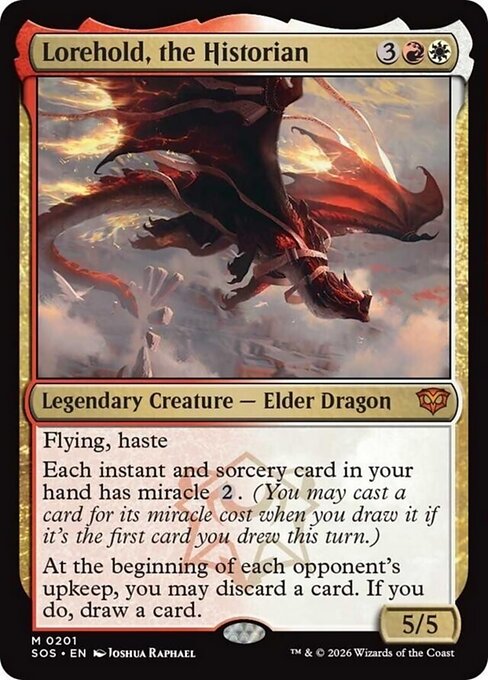 Rating6.6Good
Why this rating?
A very good mythic of the format (6.6/10).
Why. A five-mana 5/5 with flying and haste that hits the turn it lands. At the beginning of each opponent's upkeep you may discard a dead card and draw a fresh one, every turn they take.
Risks. It needs both red and white, and a single removal answers it cleanly. The miracle clause on your instants and sorceries depends on the draw, so don't build around it.
In the draft. An evasive top-end that needs no synergy to work: take it if you are red-white or close. Outside those colors it is hard to cast.
Results in the games of the set
When it is in hand, the deck wins 57.9% of its games (set average: 56.3%, 78th of 319 cards).
In the opening hand: 55.6% wins (54.9% on average).
Drawn during the game: 59.2% (57.2% on average).
When it is drawn, the deck wins 5.4 points more than when it is not.
When it is drafted, it is played 90% of the time (set average: 63%).
Taken as the first pick (45 drafts), it ends in the deck 87% of the time.
It is played about as much in every archetype.
 Rating6.5Good
Why this rating?
A solid uncommon of the format (6.5/10).
Why. An enchantment that brings a 3/3 Fractal creature token and then puts a +1/+1 counter on one of your creatures each combat. Your team grows by itself, and the free vigilance lets you attack without losing a blocker.
Risks. Five mana for a permanent that doesn't block on its own; the token alone is just an average 3/3. The repeating effect needs a creature to target, and removal in response costs you the counter.
In the draft. A solid green uncommon for decks that play on the ground and win the long game. Take it over filler creatures, below removal.
Results in the games of the set
When it is in hand, the deck wins 57.3% of its games (set average: 56.3%, 95th of 319 cards).
In the opening hand: 55.4% wins (54.9% on average).
Drawn during the game: 58.5% (57.2% on average).
When it is drawn, the deck wins 5.2 points more than when it is not.
When it is drafted, it is played 80% of the time (set average: 63%).
Taken as the first pick (97 drafts), it ends in the deck 93% of the time.
It is played mostly in G/U decks (30% of them) and B/G (25%).
 Rating6.4Good
Why this rating?
Good playable that always makes the cut (6.4/10).
Why. Three mana for a 3/1 plus a 1/1 Pest creature token that gains you 1 life when it attacks. If one of your creatures died this turn, the token included, you draw a card at the beginning of your end step.
Risks. A one-toughness body that dies to anything. The cost needs both black and green, which makes it rigid, and the draw requires one of your creatures to have died that turn.
In the draft. A good card for black-green, especially if you like trading creatures. Other decks have no reason to play it.
Results in the games of the set
When it is in hand, the deck wins 58.0% of its games (set average: 56.3%, 71st of 319 cards).
In the opening hand: 58.6% wins (54.9% on average).
Drawn during the game: 57.6% (57.2% on average).
When it is drawn, the deck wins 4.8 points more than when it is not.
When it is drafted, it is played 77% of the time (set average: 63%).
Taken as the first pick (59 drafts), it ends in the deck 86% of the time.
It is played mostly in B/G decks (39% of them).

73. Flow State
Rating6.4GoodWhy this rating?
Good playable that always makes the cut (6.4/10).
Why. A two-mana sorcery that looks at your top three cards, puts one in your hand and the rest on the bottom. With an instant and a sorcery in your graveyard you take two.
Risks. It does nothing on the board and gives you one card most of the time; without a stocked graveyard the effect is small. In an aggressive deck it is a lost turn.
In the draft. A support card for blue decks with plenty of instants and sorceries. Take it late, after creatures and removal.
Results in the games of the set
When it is in hand, the deck wins 56.8% of its games (set average: 56.3%, 116th of 319 cards).
In the opening hand: 53.0% wins (54.9% on average).
Drawn during the game: 59.0% (57.2% on average).
When it is drawn, the deck wins 5.5 points more than when it is not.
When it is drafted, it is played 85% of the time (set average: 63%).
Taken as the first pick (91 drafts), it ends in the deck 87% of the time.
It is played mostly in R/U decks (29% of them).

74. Group Project
Rating6.4GoodWhy this rating?
Good playable that always makes the cut (6.4/10).
Why. Two mana for a 2/2 Spirit creature token, then a second one later by tapping three untapped creatures. Two bodies from a single card, and the flashback costs no mana.
Risks. The flashback needs three untapped creatures, so an established board, and they can't attack that turn. Alone, the first token is just an ordinary 2/2.
In the draft. A good card for white decks with lots of small creatures. Take it over mediocre creatures; it shines in red-white or white-black.
Results in the games of the set
When it is in hand, the deck wins 56.7% of its games (set average: 56.3%, 118th of 319 cards).
In the opening hand: 57.7% wins (54.9% on average).
Drawn during the game: 56.0% (57.2% on average).
When it is drawn, the deck wins 0.6 points less than when it is not.
When it is drafted, it is played 83% of the time (set average: 63%).
Taken as the first pick (77 drafts), it ends in the deck 90% of the time.
It is played mostly in R/W decks (38% of them).
 Rating6.4Good
Why this rating?
Good playable that always makes the cut (6.4/10).
Why. A two-mana sorcery that gives a creature +1/+1 and draws a card, so it replaces itself. When your creatures deal combat damage to a player, you pay one mana to return it to your hand and cast it again.
Risks. The +1/+1 bonus is tiny and doesn't replace removal. The recursion needs combat damage to a player, so it only works when your attacks are getting through.
In the draft. A glue card for aggressive white-black decks, good with Repartee creatures. Take it after your quality creatures.
Results in the games of the set
When it is in hand, the deck wins 56.5% of its games (set average: 56.3%, 126th of 319 cards).
In the opening hand: 56.0% wins (54.9% on average).
Drawn during the game: 56.9% (57.2% on average).
When it is drawn, the deck wins 0.1 points less than when it is not.
When it is drafted, it is played 76% of the time (set average: 63%).
Taken as the first pick (76 drafts), it ends in the deck 95% of the time.
It is played mostly in B/W decks (40% of them).
 Rating6.4Good
Why this rating?
Good playable that always makes the cut (6.4/10).
Why. A one-mana creature that gets a +1/+1 counter every time you cast an instant or sorcery that targets a creature, thanks to Repartee. In a deck full of removal, it becomes a real threat for almost nothing.
Risks. It's a 1/1 with nothing else: without spells that target a creature it stays useless. It dies to the slightest damage and depends on your draws.
In the draft. A fine playable in a white-black deck with plenty of removal. Take it in the middle of the pack, not ahead of your best cards.
Results in the games of the set
When it is in hand, the deck wins 58.1% of its games (set average: 56.3%, 69th of 319 cards).
In the opening hand: 60.9% wins (54.9% on average).
Drawn during the game: 55.8% (57.2% on average).
When it is drawn, the deck wins 1.3 points more than when it is not.
When it is drafted, it is played 82% of the time (set average: 63%).
Taken as the first pick (97 drafts), it ends in the deck 95% of the time.
It is played mostly in B/W decks (43% of them).

77. Sanar, Unfinished Genius // Wild Idea
Rating6.4GoodWhy this rating?
Good playable that always makes the cut (6.4/10).
Why. A two-mana 0/4 that enters prepared: for five mana its spell searches your library for an instant or sorcery. If you've cast one of those spells this turn, you can tap it to make a Treasure token.
Risks. It doesn't attack, and it only makes a Treasure if you've cast an instant or sorcery this turn. The prepared spell is expensive and slow.
In the draft. A playable for blue-red decks with many instants and sorceries. An early wall that brings value and mana later on.
Results in the games of the set
When it is in hand, the deck wins 58.8% of its games (set average: 56.3%, 53rd of 319 cards).
In the opening hand: 59.5% wins (54.9% on average).
Drawn during the game: 58.4% (57.2% on average).
When it is drawn, the deck wins 7.6 points more than when it is not.
When it is drafted, it is played 85% of the time (set average: 63%).
Taken as the first pick (119 drafts), it ends in the deck 87% of the time.
It is played mostly in R/U decks (39% of them).

78. Silverquill, the Disputant
Rating6.4GoodWhy this rating?
Good playable that always makes the cut (6.4/10).
Why. A four-mana 4/4 with flying and vigilance that attacks and defends at the same time. It gives your instants and sorceries casualty 1: sacrifice a creature to copy a removal spell or a draw spell.
Risks. It needs both white and black. Casualty requires sacrificing a creature with power 1 or greater, a real cost, and it is exposed to removal.
In the draft. A good evasive body for white-black, even if you never use the second ability. Take it in those colors.
Results in the games of the set
When it is in hand, the deck wins 55.2% of its games (set average: 56.3%, 181st of 319 cards).
In the opening hand: 54.0% wins (54.9% on average).
Drawn during the game: 56.0% (57.2% on average).
When it is drawn, the deck wins 2.1 points more than when it is not.
When it is drafted, it is played 81% of the time (set average: 63%).
Taken among the first three picks (107 drafts), it ends in the deck 81% of the time.
It is played about as much in every archetype.
 Rating6.4Good
Why this rating?
Good playable that always makes the cut (6.4/10).
Why. For three mana, this artifact mills the top card of your library and lets you play it this turn, then taps for red mana, or two for instants and sorceries. It's ramp for a spell-heavy deck.
Risks. It does nothing on the board. If the milled card is a land and you've already made your land drop, you lose the upside.
In the draft. A fine tool for a red deck with plenty of instants and sorceries. An aggressive deck can skip it; take it late.
Results in the games of the set
When it is in hand, the deck wins 56.7% of its games (set average: 56.3%, 120th of 319 cards).
In the opening hand: 54.8% wins (54.9% on average).
Drawn during the game: 57.8% (57.2% on average).
When it is drawn, the deck wins 4.2 points more than when it is not.
When it is drafted, it is played 73% of the time (set average: 63%).
Taken as the first pick (91 drafts), it ends in the deck 81% of the time.
It is played mostly in R/U decks (28% of them).

80. Vastlands Scavenger // Bind to Life
Rating6.4GoodWhy this rating?
Good playable that always makes the cut (6.4/10).
Why. A three-mana 4/4 with deathtouch: a huge body that stops almost anything. It enters prepared, so you also have a five-mana instant that mills seven cards and puts a creature from among them onto the battlefield.
Risks. It needs two green mana. The prepared spell is random and finds nothing if no creature shows up among the seven milled cards.
In the draft. A good green body, playable in any deck that uses green. Take it without counting on the spell.
Results in the games of the set
When it is in hand, the deck wins 57.1% of its games (set average: 56.3%, 102nd of 319 cards).
In the opening hand: 55.8% wins (54.9% on average).
Drawn during the game: 57.9% (57.2% on average).
When it is drawn, the deck wins 4.9 points more than when it is not.
When it is drafted, it is played 84% of the time (set average: 63%).
Taken as the first pick (52 drafts), it ends in the deck 92% of the time.
It is played about as much in every archetype.

81. Proctor's Gaze
Rating6.4GoodWhy this rating?
Good playable that always makes the cut (6.4/10).
Why. An instant that returns a nonland permanent to its owner's hand and puts a basic land onto the battlefield tapped. It sets the opponent back and ramps you in a single card.
Risks. Four mana for a tempo effect, not removal. Opposing tokens vanish, but anything else simply comes back.
In the draft. A good tool for green-blue, especially with enter-the-battlefield creatures. Take it in the middle of the pack, after your removal.
Results in the games of the set
When it is in hand, the deck wins 57.8% of its games (set average: 56.3%, 80th of 319 cards).
In the opening hand: 54.5% wins (54.9% on average).
Drawn during the game: 59.8% (57.2% on average).
When it is drawn, the deck wins 6.1 points more than when it is not.
When it is drafted, it is played 83% of the time (set average: 63%).
Taken as the first pick (84 drafts), it ends in the deck 92% of the time.
It is played mostly in G/U decks (43% of them).
 Rating6.3Good
Why this rating?
Good playable that always makes the cut (6.3/10).
Why. A 2/2 with reach and trample that enters with a +1/+1 counter for each color of mana spent to cast it (Converge). Whenever you cast an instant or sorcery, your creatures get +1/+0 for each color of mana spent on that spell.
Risks. In a two-color deck it tops out at a 4/4; paid with three red mana it is a 3/3. The team bonus needs instants and sorceries to trigger.
In the draft. A fine pick for red with a second color. Best in red-white; don't take it only for the promise of a big body.
Results in the games of the set
When it is in hand, the deck wins 56.7% of its games (set average: 56.3%, 122nd of 319 cards).
In the opening hand: 54.1% wins (54.9% on average).
Drawn during the game: 58.1% (57.2% on average).
When it is drawn, the deck wins 4.8 points more than when it is not.
When it is drafted, it is played 88% of the time (set average: 63%).
Taken as the first pick (72 drafts), it ends in the deck 89% of the time.
It is played about as much in every archetype.

83. Emeritus of Conflict // Lightning Bolt
Rating6.2GoodWhy this rating?
Good playable that always makes the cut (6.2/10).
Why. A two-mana 2/2 with first strike that becomes prepared when you cast your third spell each turn. Its spell is a Lightning Bolt: three damage to any target for one red mana, excellent removal.
Risks. Casting three spells in one turn is uncommon, so the prepare trigger rarely happens in practice. The 2/2 remains fragile against removal.
In the draft. A good red two-drop for low-curve decks. You play it for the first-strike body, and the Bolt is an occasional bonus.
Results in the games of the set
When it is in hand, the deck wins 54.6% of its games (set average: 56.3%, 197th of 319 cards).
In the opening hand: 54.0% wins (54.9% on average).
Drawn during the game: 55.1% (57.2% on average).
When it is drawn, the deck wins 1.9 points more than when it is not.
When it is drafted, it is played 87% of the time (set average: 63%).
Taken as the first pick (35 drafts), it ends in the deck 89% of the time.
It is played about as much in every archetype.
 Rating6.2Good
Why this rating?
Good playable that always makes the cut (6.2/10).
Why. A one-mana instant that drains one life, gives one creature +1/+1 and another -1/-1. It kills a small creature, wins a combat, or triggers your instant effects, all while gaining you life.
Risks. It only kills one-toughness creatures. The effect is small, and it is no substitute for real removal.
In the draft. A flexible card for white-black, ideal with Repartee and Infusion. Take it after your quality removal.
Results in the games of the set
When it is in hand, the deck wins 58.0% of its games (set average: 56.3%, 70th of 319 cards).
In the opening hand: 57.5% wins (54.9% on average).
Drawn during the game: 58.4% (57.2% on average).
When it is drawn, the deck wins 2.8 points more than when it is not.
When it is drafted, it is played 77% of the time (set average: 63%).
Taken as the first pick (49 drafts), it ends in the deck 94% of the time.
It is played mostly in B/W decks (26% of them).

85. Last Gasp
Rating6.2GoodWhy this rating?
Good playable that always makes the cut (6.2/10).
Why. A two-mana instant removal that gives a creature -3/-3. It kills most early and mid-game creatures, and you can cast it in response or in the middle of combat.
Risks. It leaves bigger creatures alive. The effect only lasts until end of turn, so a toughness boost in response saves the target.
In the draft. A reliable common removal in black. Take it ahead of average creatures.
Results in the games of the set
When it is in hand, the deck wins 57.4% of its games (set average: 56.3%, 92nd of 319 cards).
In the opening hand: 56.0% wins (54.9% on average).
Drawn during the game: 58.3% (57.2% on average).
When it is drawn, the deck wins 2.4 points more than when it is not.
When it is drafted, it is played 89% of the time (set average: 63%).
Taken as the first pick (204 drafts), it ends in the deck 93% of the time.
It is played mostly in B/U decks (58% of them) and B/W (57%).

86. Living History
Rating6.2GoodWhy this rating?
Good playable that always makes the cut (6.2/10).
Why. A two-mana enchantment that makes a 2/2 Spirit creature token, then gives an attacker +2/+0 whenever you attack if a card left your graveyard this turn. A fine two-drop with some speed.
Risks. The bonus needs a card to leave your graveyard, which isn't common. Without it, this is mostly a 2/2 for two mana.
In the draft. A fine pick for aggressive red-white, better with flashback cards. Take it after your best creatures.
Results in the games of the set
When it is in hand, the deck wins 56.3% of its games (set average: 56.3%, 133rd of 319 cards).
In the opening hand: 56.8% wins (54.9% on average).
Drawn during the game: 56.1% (57.2% on average).
When it is drawn, the deck wins 1.2 points less than when it is not.
When it is drafted, it is played 71% of the time (set average: 63%).
Taken as the first pick (90 drafts), it ends in the deck 96% of the time.
It is played mostly in R/W decks (42% of them).
 Rating6.2Good
Why this rating?
Good playable that always makes the cut (6.2/10).
Why. A three-mana 2/2 that bounces another creature when it enters: tempo, or a way to get rid of a blocker. It can't be blocked that turn if you cast a spell with X in its cost.
Risks. A small body, and the bounce kills nothing: the opponent just replays the creature. The second effect needs X spells.
In the draft. A good tempo play for blue. Best with enter-the-battlefield effects of your own; take it in the middle of the pack.
Results in the games of the set
When it is in hand, the deck wins 58.2% of its games (set average: 56.3%, 67th of 319 cards).
In the opening hand: 54.9% wins (54.9% on average).
Drawn during the game: 60.1% (57.2% on average).
When it is drawn, the deck wins 5.6 points more than when it is not.
When it is drafted, it is played 87% of the time (set average: 63%).
Taken as the first pick (120 drafts), it ends in the deck 96% of the time.
It is played mostly in G/U decks (32% of them) and R/U (28%).

88. Paradox Surveyor
Rating6.2GoodWhy this rating?
Good playable that always makes the cut (6.2/10).
Why. A three-mana 3/3 with reach that looks at your top five cards and lets you take a land or a card with X in its cost. A solid body that smooths your land drops.
Risks. The search is narrow: with no land or X card among the five you just get the body. Its cost needs both green and blue.
In the draft. A good green-blue body, ideal on turn three. Take it over neutral creatures.
Results in the games of the set
When it is in hand, the deck wins 58.5% of its games (set average: 56.3%, 61st of 319 cards).
In the opening hand: 57.3% wins (54.9% on average).
Drawn during the game: 59.3% (57.2% on average).
When it is drawn, the deck wins 6.5 points more than when it is not.
When it is drafted, it is played 77% of the time (set average: 63%).
Taken as the first pick (79 drafts), it ends in the deck 90% of the time.
It is played mostly in G/U decks (39% of them).
 Rating6.2Good
Why this rating?
Good playable that always makes the cut (6.2/10).
Why. A sorcery that sacrifices two lands to put four basic lands onto the battlefield tapped, a net gain of two lands. It's massive ramp for top-heavy or X-spell decks.
Risks. Four mana for nothing else: you lose a turn of development. Without big spells to cast afterward, it's a dead card.
In the draft. A niche card for green decks aiming at expensive spells. Take it late, only if you have a plan for the mana.
Results in the games of the set
When it is in hand, the deck wins 55.9% of its games (set average: 56.3%, 151st of 319 cards).
In the opening hand: 54.5% wins (54.9% on average).
Drawn during the game: 56.8% (57.2% on average).
When it is drawn, the deck wins 6.3 points more than when it is not.
When it is drafted, it is played 55% of the time (set average: 63%).
Taken among the first three picks (81 drafts), it ends in the deck 75% of the time.
It is played about as much in every archetype.

90. Resonating Lute
Rating6.2GoodWhy this rating?
Good playable that always makes the cut (6.2/10).
Why. An artifact that lets your lands tap for two mana of one color, to be spent only on instants and sorceries. With seven or more cards in hand you can also tap it to draw. It accelerates a spell-heavy deck.
Risks. Four mana for an artifact that does nothing on the board. The mana only pays for instants and sorceries; without them, it is dead.
In the draft. For a blue-red deck packed with instants and sorceries, and almost nowhere else. Take it late.
Results in the games of the set
When it is in hand, the deck wins 56.1% of its games (set average: 56.3%, 145th of 319 cards).
In the opening hand: 54.2% wins (54.9% on average).
Drawn during the game: 57.2% (57.2% on average).
When it is drawn, the deck wins 6.7 points more than when it is not.
When it is drafted, it is played 77% of the time (set average: 63%).
Taken as the first pick (74 drafts), it ends in the deck 88% of the time.
It is played about as much in every archetype.

91. Skycoach Conductor // All Aboard
Rating6.2GoodWhy this rating?
Good playable that always makes the cut (6.2/10).
Why. A three-mana 2/3 with flash, flying and vigilance: it ambushes attackers or attacks in the air. It enters prepared, and its one-mana instant exiles one of your non-Pilot creatures, then returns it to the battlefield.
Risks. The prepared spell can't target a Pilot creature, this body included. A three-toughness creature dies to removal, and the spell only shines with enter-the-battlefield creatures.
In the draft. A good evasive body for blue. Take it over neutral creatures; it's better with enter-the-battlefield effects.
Results in the games of the set
When it is in hand, the deck wins 57.0% of its games (set average: 56.3%, 104th of 319 cards).
In the opening hand: 55.1% wins (54.9% on average).
Drawn during the game: 58.1% (57.2% on average).
When it is drawn, the deck wins 5.8 points more than when it is not.
When it is drafted, it is played 85% of the time (set average: 63%).
Taken as the first pick (46 drafts), it ends in the deck 80% of the time.
It is played about as much in every archetype.
 Rating6.2Good
Why this rating?
Good playable that always makes the cut (6.2/10).
Why. A three-mana instant that destroys a creature with power 3 or greater. It handles the real threats, the biggest ones included, with no upper limit.
Risks. It can't touch creatures with power 2 or less. Against a deck of small creatures, it can rot in your hand.
In the draft. A solid white removal. Take it ahead of average creatures, especially against decks with big bodies.
Results in the games of the set
When it is in hand, the deck wins 57.0% of its games (set average: 56.3%, 103rd of 319 cards).
In the opening hand: 54.8% wins (54.9% on average).
Drawn during the game: 58.5% (57.2% on average).
When it is drawn, the deck wins 1.2 points more than when it is not.
When it is drafted, it is played 86% of the time (set average: 63%).
Taken as the first pick (97 drafts), it ends in the deck 92% of the time.
It is played mostly in B/W decks (25% of them).

93. Tome Blast
Rating6.2GoodWhy this rating?
Good playable that always makes the cut (6.2/10).
Why. A two-mana sorcery that deals two damage to any target, then can be cast again from the graveyard with flashback. Two uses from one card, one of them able to finish the game.
Risks. Two damage only kills small creatures, and flashback costs five mana. Little value against big bodies.
In the draft. A fine common removal in red, playable in nearly every red deck. Take it over filler creatures.
Results in the games of the set
When it is in hand, the deck wins 57.3% of its games (set average: 56.3%, 94th of 319 cards).
In the opening hand: 54.9% wins (54.9% on average).
Drawn during the game: 58.8% (57.2% on average).
When it is drawn, the deck wins 3.0 points more than when it is not.
When it is drafted, it is played 90% of the time (set average: 63%).
Taken as the first pick (254 drafts), it ends in the deck 96% of the time.
It is played mostly in R/U decks (69% of them) and R/W (54%).
 Rating6.2Playable
Why this rating?
Good playable that always makes the cut (6.2/10).
Why. A five-mana 4/5 that looks at as many cards as you control creatures, puts one in your hand and the rest into your graveyard. A big body that often replaces itself.
Risks. Its cost needs white and black, with a hybrid symbol. With few creatures, the dig is shallow.
In the draft. A good card for white-black decks with lots of creatures. Take it in the middle of the pack, in those colors only.
Results in the games of the set
When it is in hand, the deck wins 57.9% of its games (set average: 56.3%, 76th of 319 cards).
In the opening hand: 56.3% wins (54.9% on average).
Drawn during the game: 58.9% (57.2% on average).
When it is drawn, the deck wins 1.1 points more than when it is not.
When it is drafted, it is played 76% of the time (set average: 63%).
Taken as the first pick (78 drafts), it ends in the deck 87% of the time.
It is played mostly in B/W decks (54% of them).

95. Quill-Blade Laureate // Twofold Intent
Rating6.1PlayableWhy this rating?
Good playable that always makes the cut (6.1/10).
Why. A two-mana 1/1 with double strike that enters prepared. Its spell is a sorcery that gives a creature +1/+0 and double strike: extra damage to close out a game.
Risks. The 1/1 body is fragile. The prepared spell is a sorcery, so it comes before blocks, and it is only good on a creature that can really use double strike.
In the draft. A good card for white, particularly in white-black or red-white. Take it in the middle of the pack.
Results in the games of the set
When it is in hand, the deck wins 56.9% of its games (set average: 56.3%, 109th of 319 cards).
In the opening hand: 57.1% wins (54.9% on average).
Drawn during the game: 56.8% (57.2% on average).
When it is drawn, the deck wins 0.0 points more than when it is not.
When it is drafted, it is played 91% of the time (set average: 63%).
Taken as the first pick (99 drafts), it ends in the deck 92% of the time.
It is played mostly in B/W decks (32% of them).

96. Potioner's Trove
Rating6.0PlayableWhy this rating?
Good playable that always makes the cut (6.0/10).
Why. A three-mana artifact that taps for one mana of any color, and gains you 2 life if you've cast an instant or sorcery this turn. It helps fix multicolor decks.
Risks. An artifact that does nothing on the board, and a lost development turn. The life gain isn't reliable.
In the draft. A tool for decks with three colors or more. Take it late; otherwise a creature is almost always better.
Results in the games of the set
When it is in hand, the deck wins 57.4% of its games (set average: 56.3%, 90th of 319 cards).
In the opening hand: 56.1% wins (54.9% on average).
Drawn during the game: 58.2% (57.2% on average).
When it is drawn, the deck wins 6.1 points more than when it is not.
When it is drafted, it is played 80% of the time (set average: 63%).
Taken as the first pick (254 drafts), it ends in the deck 89% of the time.
It is played mostly in R/U decks (72% of them) and G/U (63%).

97. Artistic Process
Rating6.0PlayableWhy this rating?
Good playable that always makes the cut (6.0/10).
Why. A three-mode sorcery: six damage to a creature, two damage to each creature you don't control, or a 3/3 Elemental creature token with flying that has haste until end of turn. It answers almost any situation.
Risks. It costs five mana, with two red pips. The sweep mode only deals two damage, so it only clears small creatures.
In the draft. A red uncommon playable in every red deck. Take it over average creatures.
Results in the games of the set
When it is in hand, the deck wins 56.8% of its games (set average: 56.3%, 115th of 319 cards).
In the opening hand: 53.2% wins (54.9% on average).
Drawn during the game: 58.8% (57.2% on average).
When it is drawn, the deck wins 3.7 points more than when it is not.
When it is drafted, it is played 86% of the time (set average: 63%).
Taken as the first pick (82 drafts), it ends in the deck 93% of the time.
It is played mostly in R/U decks (31% of them).

98. Brush Off
Rating6.0PlayableWhy this rating?
Good playable that always makes the cut (6.0/10).
Why. An instant that counters any spell, and costs two less if it targets an instant or sorcery. Flexible: it stops a threat or a removal spell, at a reduced cost.
Risks. Four mana to counter any spell is expensive: you do nothing else with your turn. Counterspells don't replace a real play.
In the draft. A good card for blue decks that play reactively. Take it in the middle of the pack; tempo decks use it less.
Results in the games of the set
When it is in hand, the deck wins 58.0% of its games (set average: 56.3%, 72nd of 319 cards).
In the opening hand: 53.3% wins (54.9% on average).
Drawn during the game: 60.7% (57.2% on average).
When it is drawn, the deck wins 6.8 points more than when it is not.
When it is drafted, it is played 75% of the time (set average: 63%).
Taken as the first pick (67 drafts), it ends in the deck 93% of the time.
It is played mostly in R/U decks (28% of them) and G/U (26%).
 Rating6.0Playable
Why this rating?
Good playable that always makes the cut (6.0/10).
Why. A six-mana 6/6 that deals 3 damage to each opponent and gains you 3 life when it enters. When it dies, you can discard cards to draw that many plus one.
Risks. Six mana, with both red and white. Removal handles it, though it still leaves a little value behind.
In the draft. A solid top-end for red-white. Take it in those colors; it isn't worth a splash.
Results in the games of the set
When it is in hand, the deck wins 58.5% of its games (set average: 56.3%, 63rd of 319 cards).
In the opening hand: 55.5% wins (54.9% on average).
Drawn during the game: 60.2% (57.2% on average).
When it is drawn, the deck wins 3.4 points more than when it is not.
When it is drafted, it is played 84% of the time (set average: 63%).
Taken as the first pick (110 drafts), it ends in the deck 90% of the time.
It is played mostly in R/W decks (42% of them).

100. Fields of Strife
Rating6.0PlayableWhy this rating?
Good playable that always makes the cut (6.0/10).
Why. A red-white land that enters tapped and taps for either color. It fixes your mana, and its four-mana ability lets you surveil 1: look at the top card and, if you want, send it to the graveyard.
Risks. It enters tapped, which costs tempo early. The late-game ability is slow and expensive.
In the draft. Take it late for a red-white deck; it has no value in other colors.
Results in the games of the set
When it is in hand, the deck wins 56.9% of its games (set average: 56.3%, 107th of 319 cards).
In the opening hand: 57.5% wins (54.9% on average).
Drawn during the game: 56.5% (57.2% on average).
When it is drawn, the deck wins 2.5 points more than when it is not.
When it is drafted, it is played 81% of the time (set average: 63%).
Taken as the first pick (78 drafts), it ends in the deck 94% of the time.

101. Garrison Excavator
Rating6.0PlayableWhy this rating?
Good playable that always makes the cut (6.0/10).
Why. A 3/4 with menace for four mana, fine on its own. Whenever cards leave your graveyard you get a 2/2 red and white Spirit creature token, so a deck that recycles its graveyard gets a steady stream of bodies.
Risks. Without effects that remove cards from your graveyard, it is just a 3/4 menace. The trigger depends entirely on the rest of your deck.
In the draft. A good mid-curve red play if you have a few graveyard-emptying cards. Otherwise an honest filler pick, nothing more.
Results in the games of the set
When it is in hand, the deck wins 56.7% of its games (set average: 56.3%, 117th of 319 cards).
In the opening hand: 55.7% wins (54.9% on average).
Drawn during the game: 57.4% (57.2% on average).
When it is drawn, the deck wins 0.4 points more than when it is not.
When it is drafted, it is played 77% of the time (set average: 63%).
Taken as the first pick (79 drafts), it ends in the deck 91% of the time.
It is played mostly in R/W decks (54% of them).

102. Geometer's Arthropod
Rating6.0PlayableWhy this rating?
Good playable that always makes the cut (6.0/10).
Why. A 1/4 for two mana that blocks small creatures well. Whenever you cast a spell with X in its cost, you look at the top X cards of your library and put one of them into your hand.
Risks. You need spells with X for the ability to matter. In a deck without them it is a two-mana wall and little else.
In the draft. Take it if you already have several X spells, in green-blue. Otherwise let it go without regret.
Results in the games of the set
When it is in hand, the deck wins 54.8% of its games (set average: 56.3%, 193rd of 319 cards).
In the opening hand: 54.6% wins (54.9% on average).
Drawn during the game: 55.0% (57.2% on average).
When it is drawn, the deck wins 2.8 points more than when it is not.
When it is drafted, it is played 41% of the time (set average: 63%).
Taken among the first three picks (84 drafts), it ends in the deck 70% of the time.
It is played about as much in every archetype.

103. Quandrix Charm
Rating6.0PlayableWhy this rating?
Good playable that always makes the cut (6.0/10).
Why. A three-mode instant for two mana: counter a spell unless its controller pays two, destroy an enchantment, or give a creature base power and toughness of 5/5 until end of turn as a surprise combat trick.
Risks. No mode is great. The counter is easy to pay for late in the game, and the 5/5 mode can shrink a bigger creature.
In the draft. A solid support card in green-blue, taken mid-pack. It does not deserve an early pick.
Results in the games of the set
When it is in hand, the deck wins 57.6% of its games (set average: 56.3%, 84th of 319 cards).
In the opening hand: 55.0% wins (54.9% on average).
Drawn during the game: 59.1% (57.2% on average).
When it is drawn, the deck wins 6.2 points more than when it is not.
When it is drafted, it is played 68% of the time (set average: 63%).
Taken as the first pick (42 drafts), it ends in the deck 90% of the time.
It is played mostly in G/U decks (39% of them).

104. Spectacle Summit
Rating6.0PlayableWhy this rating?
Good playable that always makes the cut (6.0/10).
Why. A blue-red dual land that enters tapped and offers some late-game utility: for four mana and a tap, surveil 1.
Risks. It enters tapped, which costs tempo in an aggressive deck. The four-mana ability only matters late.
In the draft. Play it if you are blue-red: it smooths your mana for almost nothing. Do not take it over real spells.
Results in the games of the set
When it is in hand, the deck wins 56.4% of its games (set average: 56.3%, 130th of 319 cards).
In the opening hand: 55.7% wins (54.9% on average).
Drawn during the game: 56.8% (57.2% on average).
When it is drawn, the deck wins 3.7 points more than when it is not.
When it is drafted, it is played 84% of the time (set average: 63%).
Taken as the first pick (110 drafts), it ends in the deck 95% of the time.

105. Startled Relic Sloth
Rating6.0PlayableWhy this rating?
Good playable that always makes the cut (6.0/10).
Why. A 4/4 with trample and lifelink for four mana: it wins combats and gains you life. At the beginning of combat on your turn it can also exile a card from a graveyard, which bothers decks that rely on one.
Risks. Two colors, red and white, are required. A removal spell handles it and it has no flying.
In the draft. A good red-white card, an easy pick in those colors, earlier if you are already committed.
Results in the games of the set
When it is in hand, the deck wins 57.3% of its games (set average: 56.3%, 96th of 319 cards).
In the opening hand: 56.6% wins (54.9% on average).
Drawn during the game: 57.7% (57.2% on average).
When it is drawn, the deck wins 1.3 points more than when it is not.
When it is drafted, it is played 84% of the time (set average: 63%).
Taken as the first pick (108 drafts), it ends in the deck 91% of the time.
It is played mostly in R/W decks (50% of them).

106. Terramorphic Expanse
Rating6.0PlayableWhy this rating?
Good playable that always makes the cut (6.0/10).
Why. A fixing land: tap and sacrifice it to fetch a basic land onto the battlefield tapped. It helps you play two or three colors and thins your library slightly.
Risks. It costs tempo: the basic land arrives tapped, so it fits poorly in an aggressive deck.
In the draft. A late-pack pick for a three-color deck or a splash. In a stable two-color deck it adds almost nothing.
Results in the games of the set
When it is in hand, the deck wins 56.3% of its games (set average: 56.3%, 135th of 319 cards).
In the opening hand: 56.6% wins (54.9% on average).
Drawn during the game: 56.0% (57.2% on average).
When it is drawn, the deck wins 2.6 points more than when it is not.
When it is drafted, it is played 94% of the time (set average: 63%).
Taken as the first pick (129 drafts), it ends in the deck 95% of the time.

107. Unsubtle Mockery
Rating6.0PlayableWhy this rating?
Good playable that always makes the cut (6.0/10).
Why. A three-mana instant removal that deals 4 damage to a creature, with surveil 1 as a bonus. 4 damage kills most creatures, and you can cast it in response to a spell.
Risks. It does not answer the biggest creatures, and three mana is a bit pricier than a two-mana removal.
In the draft. A good common removal, to take early in red. Take it over average creatures.
Results in the games of the set
When it is in hand, the deck wins 57.5% of its games (set average: 56.3%, 87th of 319 cards).
In the opening hand: 55.6% wins (54.9% on average).
Drawn during the game: 58.6% (57.2% on average).
When it is drawn, the deck wins 3.9 points more than when it is not.
When it is drafted, it is played 92% of the time (set average: 63%).
Taken as the first pick (285 drafts), it ends in the deck 94% of the time.
It is played mostly in R/U decks (53% of them) and R/W (47%).

108. Forum of Amity
Rating5.9PlayableWhy this rating?
Good playable that always makes the cut (5.9/10).
Why. A white-black dual land that enters tapped, with late-game utility: for four mana and a tap, surveil 1.
Risks. It enters tapped, which costs tempo. The ability only matters late.
In the draft. Play it in white-black: it smooths your mana for little. Take it after the good cards, not before.
Results in the games of the set
When it is in hand, the deck wins 55.9% of its games (set average: 56.3%, 155th of 319 cards).
In the opening hand: 57.0% wins (54.9% on average).
Drawn during the game: 55.0% (57.2% on average).
When it is drawn, the deck wins 1.0 points more than when it is not.
When it is drafted, it is played 75% of the time (set average: 63%).
Taken as the first pick (80 drafts), it ends in the deck 90% of the time.

109. Render Speechless
Rating5.8PlayableWhy this rating?
Good playable that always makes the cut (5.9/10).
Why. A four-mana sorcery with two effects: the opponent reveals their hand and discards a nonland card of your choice, then you put two +1/+1 counters on up to one target creature. Steady value.
Risks. It does not change the board right away, and at four mana it is slow. The counters need a creature of yours.
In the draft. A good white-black common, taken mid-pack. It is better in a controlling deck.
Results in the games of the set
When it is in hand, the deck wins 57.4% of its games (set average: 56.3%, 89th of 319 cards).
In the opening hand: 56.2% wins (54.9% on average).
Drawn during the game: 58.2% (57.2% on average).
When it is drawn, the deck wins 0.5 points more than when it is not.
When it is drafted, it is played 57% of the time (set average: 63%).
Taken as the first pick (79 drafts), it ends in the deck 94% of the time.
It is played mostly in B/W decks (81% of them).
 Rating5.8Playable
Why this rating?
Good playable that always makes the cut (5.8/10).
Why. A 1/4 that grows through Increment: whenever +1/+1 counters are put on it, it adds one mana of any color. It can also create a 0/0 green and blue Fractal creature token with X +1/+1 counters.
Risks. It is slow and depends on what you cast. The token costs X and taps Berta.
In the draft. A decent value card in green-blue but not urgent: take it mid-pack.
Results in the games of the set
When it is in hand, the deck wins 55.3% of its games (set average: 56.3%, 173rd of 319 cards).
In the opening hand: 53.2% wins (54.9% on average).
Drawn during the game: 56.5% (57.2% on average).
When it is drawn, the deck wins 5.4 points more than when it is not.
When it is drafted, it is played 86% of the time (set average: 63%).
Taken as the first pick (76 drafts), it ends in the deck 91% of the time.
It is played about as much in every archetype.

111. Dig Site Inventory
Rating5.8PlayableWhy this rating?
Good playable that always makes the cut (5.8/10).
Why. A one-mana sorcery that puts a +1/+1 counter on a creature you control, which gains vigilance until end of turn, then comes back from the graveyard through flashback for one mana. Two counters for very little mana.
Risks. It does nothing without a creature of yours, and a removal spell in response loses you the value. Low impact alone.
In the draft. A filler for a white creature deck, a late pick. Do not play it in a deck short on creatures.
Results in the games of the set
When it is in hand, the deck wins 55.4% of its games (set average: 56.3%, 168th of 319 cards).
In the opening hand: 54.7% wins (54.9% on average).
Drawn during the game: 55.8% (57.2% on average).
When it is drawn, the deck wins 0.8 points less than when it is not.
When it is drafted, it is played 66% of the time (set average: 63%).
Taken as the first pick (50 drafts), it ends in the deck 88% of the time.
It is played mostly in B/W decks (53% of them) and R/W (44%).

112. Essence Scatter
Rating5.8PlayableWhy this rating?
Good playable that always makes the cut (5.8/10).
Why. A two-mana instant counterspell that stops a creature spell. Cheap, it lets you develop your board while holding mana up.
Risks. It only counters creatures, so it is dead against sorceries or instants. You need to keep mana open.
In the draft. A good common counterspell for a slower blue deck. Take it after removal and the good creatures.
Results in the games of the set
When it is in hand, the deck wins 57.0% of its games (set average: 56.3%, 106th of 319 cards).
In the opening hand: 54.9% wins (54.9% on average).
Drawn during the game: 58.2% (57.2% on average).
When it is drawn, the deck wins 5.4 points more than when it is not.
When it is drafted, it is played 78% of the time (set average: 63%).
Taken as the first pick (130 drafts), it ends in the deck 91% of the time.
It is played mostly in R/U decks (56% of them) and G/U (53%).

113. Grave Researcher // Reanimate
Rating5.8PlayableWhy this rating?
Good playable that always makes the cut (5.8/10).
Why. A 3/3 for three mana that surveils 1 at the beginning of your upkeep, which fills the graveyard. Once three or more creature cards are in your graveyard it becomes prepared: you can cast a one-mana sorcery that puts a creature card from any graveyard onto the battlefield under your control.
Risks. You need three creatures in the graveyard, and the sorcery makes you lose life equal to that card's mana value. Just a 3/3 until it is set up.
In the draft. Good in a black deck that trades creatures. Take it mid-pack: the body already holds up alone.
Results in the games of the set
When it is in hand, the deck wins 55.5% of its games (set average: 56.3%, 162nd of 319 cards).
In the opening hand: 55.6% wins (54.9% on average).
Drawn during the game: 55.5% (57.2% on average).
When it is drawn, the deck wins 1.5 points more than when it is not.
When it is drafted, it is played 91% of the time (set average: 63%).
Taken as the first pick (58 drafts), it ends in the deck 95% of the time.
It is played about as much in every archetype.

114. Harmonized Trio // Brainstorm
Rating5.8PlayableWhy this rating?
Good playable that always makes the cut (5.8/10).
Why. A one-mana 1/1 that can become prepared by tapping itself and two other creatures you control. The copied spell is a one-mana instant: draw three cards, then put two back on top of your library.
Risks. Tapping three creatures each time is a big tempo cost, and the body is fragile. Weak in practice.
In the draft. A weak pick, only for a blue deck full of small creatures. It often goes late.
Results in the games of the set
When it is in hand, the deck wins 53.3% of its games (set average: 56.3%, 236th of 319 cards).
In the opening hand: 53.2% wins (54.9% on average).
Drawn during the game: 53.3% (57.2% on average).
When it is drawn, the deck wins 3.7 points more than when it is not.
When it is drafted, it is played 57% of the time (set average: 63%).
Taken among the first three picks (103 drafts), it ends in the deck 68% of the time.
It is played about as much in every archetype.

115. Interjection
Rating5.8PlayableWhy this rating?
Good playable that always makes the cut (5.8/10).
Why. A one-mana instant: +2/+2 and first strike until end of turn. It wins a combat out of nowhere, and since it targets a creature it triggers Repartee.
Risks. A combat trick is exposed to removal in response, and it does nothing without a creature. Weak outside creature decks.
In the draft. A fine white addition, a late pick. More interesting in a deck with many Repartee cards.
Results in the games of the set
When it is in hand, the deck wins 55.6% of its games (set average: 56.3%, 161st of 319 cards).
In the opening hand: 54.4% wins (54.9% on average).
Drawn during the game: 56.4% (57.2% on average).
When it is drawn, the deck wins 0.3 points less than when it is not.
When it is drafted, it is played 26% of the time (set average: 63%).
Taken among the first three picks (76 drafts), it ends in the deck 64% of the time.
It is played mostly in B/W decks (41% of them).

116. Joined Researchers // Secret Rendezvous
Rating5.8PlayableWhy this rating?
Good playable that always makes the cut (5.8/10).
Why. A two-mana 2/2 with first strike that becomes prepared at each end step where an opponent has more cards in hand than you. The copied sorcery makes you and the opponent each draw three cards, useful when your hand is empty.
Risks. The sorcery is symmetrical and gives as much to the opponent. It only becomes prepared when you have fewer cards in hand.
In the draft. A decent two-mana body in white, a mid to late pick. The bonus spell matters mostly in an aggressive deck.
Results in the games of the set
When it is in hand, the deck wins 54.9% of its games (set average: 56.3%, 191st of 319 cards).
In the opening hand: 55.7% wins (54.9% on average).
Drawn during the game: 54.3% (57.2% on average).
When it is drawn, the deck wins 1.5 points less than when it is not.
When it is drafted, it is played 76% of the time (set average: 63%).
Taken among the first three picks (114 drafts), it ends in the deck 85% of the time.
It is played about as much in every archetype.

117. Kirol, History Buff // Pack a Punch
Rating5.8PlayableWhy this rating?
Good playable that always makes the cut (5.8/10).
Why. A two-mana 2/3 in red-white. Whenever cards leave your graveyard it becomes prepared: for three mana you mill a card, then put two +1/+1 counters on a creature, which gains trample until end of turn.
Risks. You need effects that make cards leave the graveyard to prepare it. Two colors are required, and the body is modest.
In the draft. A good red-white two-drop, taken mid-pack. It improves with cards that use the graveyard.
Results in the games of the set
When it is in hand, the deck wins 55.7% of its games (set average: 56.3%, 160th of 319 cards).
In the opening hand: 56.3% wins (54.9% on average).
Drawn during the game: 55.2% (57.2% on average).
When it is drawn, the deck wins 1.0 points less than when it is not.
When it is drafted, it is played 78% of the time (set average: 63%).
Taken as the first pick (69 drafts), it ends in the deck 94% of the time.
It is played mostly in R/W decks (50% of them).

118. Paradox Gardens
Rating5.8PlayableWhy this rating?
Good playable that always makes the cut (5.8/10).
Why. A green-blue dual land that enters tapped, with late-game utility: for four mana and a tap, surveil 1.
Risks. It enters tapped, which costs tempo. The ability only matters late.
In the draft. Play it in green-blue: it smooths your mana for little. Take it after the good cards.
Results in the games of the set
When it is in hand, the deck wins 56.2% of its games (set average: 56.3%, 139th of 319 cards).
In the opening hand: 55.6% wins (54.9% on average).
Drawn during the game: 56.6% (57.2% on average).
When it is drawn, the deck wins 4.2 points more than when it is not.
When it is drafted, it is played 82% of the time (set average: 63%).
Taken as the first pick (86 drafts), it ends in the deck 94% of the time.

119. Prismari Charm
Rating5.8PlayableWhy this rating?
Good playable that always makes the cut (5.8/10).
Why. A two-mana instant with three flexible modes: surveil 2 then draw, 1 damage to each of one or two targets, or return a nonland permanent to its owner's hand. It adapts to the situation.
Risks. Every mode is modest. It only kills very small creatures, and it needs two colors.
In the draft. A good tempo tool in blue-red, a mid-pack pick. Better in a deck rich in spells.
Results in the games of the set
When it is in hand, the deck wins 56.7% of its games (set average: 56.3%, 121st of 319 cards).
In the opening hand: 54.0% wins (54.9% on average).
Drawn during the game: 58.2% (57.2% on average).
When it is drawn, the deck wins 4.9 points more than when it is not.
When it is drafted, it is played 78% of the time (set average: 63%).
Taken as the first pick (57 drafts), it ends in the deck 98% of the time.
It is played mostly in R/U decks (37% of them).

120. Rubble Rouser
Rating5.8PlayableWhy this rating?
Good playable that always makes the cut (5.8/10).
Why. A three-mana 1/4 that filters your hand on entering: discard a card to draw one. It blocks well and can later exile a card from your graveyard to add a red mana and deal 1 damage to each opponent.
Risks. Its attack is weak, and its mana ability needs cards in your graveyard.
In the draft. A good red common, fine at every stage of the draft. Take it mid-pack, earlier in a controlling deck.
Results in the games of the set
When it is in hand, the deck wins 57.8% of its games (set average: 56.3%, 81st of 319 cards).
In the opening hand: 58.4% wins (54.9% on average).
Drawn during the game: 57.5% (57.2% on average).
When it is drawn, the deck wins 2.4 points more than when it is not.
When it is drafted, it is played 80% of the time (set average: 63%).
Taken as the first pick (166 drafts), it ends in the deck 95% of the time.
It is played mostly in R/W decks (77% of them) and R/U (40%).

121. Snooping Page
Rating5.8PlayableWhy this rating?
Good playable that always makes the cut (5.8/10).
Why. A three-mana 2/3 that draws a card whenever it deals combat damage to a player, at the cost of 1 life. With Repartee it can't be blocked this turn when you cast an instant or sorcery that targets a creature.
Risks. Without a spell that targets a creature it often gets blocked. Two colors, white and black, are required.
In the draft. A good white-black uncommon, a mid-pack pick. Take it earlier if your deck has spells that target creatures.
Results in the games of the set
When it is in hand, the deck wins 55.8% of its games (set average: 56.3%, 156th of 319 cards).
In the opening hand: 56.9% wins (54.9% on average).
Drawn during the game: 55.1% (57.2% on average).
When it is drawn, the deck wins 0.4 points less than when it is not.
When it is drafted, it is played 82% of the time (set average: 63%).
Taken as the first pick (78 drafts), it ends in the deck 91% of the time.
It is played mostly in B/W decks (43% of them).

122. Studious First-Year // Rampant Growth
Rating5.8PlayableWhy this rating?
Good playable that always makes the cut (5.8/10).
Why. A one-mana 1/1 that enters prepared: for two mana you search for a basic land and put it onto the battlefield tapped. You get ramp and fixing plus a body.
Risks. The body is tiny, and casting the spell costs two mana of your turn. No pressure on the opponent.
In the draft. A good green common for a two-color ramp deck. Take it mid-pack.
Results in the games of the set
When it is in hand, the deck wins 56.9% of its games (set average: 56.3%, 112th of 319 cards).
In the opening hand: 59.4% wins (54.9% on average).
Drawn during the game: 55.1% (57.2% on average).
When it is drawn, the deck wins 5.3 points more than when it is not.
When it is drafted, it is played 85% of the time (set average: 63%).
Taken as the first pick (186 drafts), it ends in the deck 92% of the time.
It is played mostly in G/U decks (66% of them) and B/G (61%).

123. Sundering Archaic
Rating5.8PlayableWhy this rating?
Good playable that always makes the cut (5.8/10).
Why. A colorless 3/3 for six mana. With Converge it exiles a nonland permanent an opponent controls with mana value up to the number of colors spent: with three or four colors it can answer a big threat. For two mana it also puts a card from a graveyard on the bottom of its owner's library.
Risks. Six mana for a 3/3 is expensive. In a two-color deck it only hits permanents with mana value 2 or less.
In the draft. A good choice in a deck with three or more colors. Otherwise it is much less interesting.
Results in the games of the set
When it is in hand, the deck wins 58.8% of its games (set average: 56.3%, 50th of 319 cards).
In the opening hand: 53.7% wins (54.9% on average).
Drawn during the game: 61.6% (57.2% on average).
When it is drawn, the deck wins 6.9 points more than when it is not.
When it is drafted, it is played 78% of the time (set average: 63%).
Taken as the first pick (116 drafts), it ends in the deck 88% of the time.
It is played mostly in G/R decks (39% of them) and G/U (35%).
 Rating5.7Playable
Why this rating?
Good playable that always makes the cut (5.7/10).
Why. A three-mana 3/3 with haste that hits right away. Its looting ability lets you discard a spare card to draw one, by tapping it.
Risks. Looting taps it, so it neither attacks nor blocks meanwhile. It has no evasion and a 3/3 gets stopped by a block.
In the draft. A good three-drop for an aggressive red deck. Take it mid-pack.
Results in the games of the set
When it is in hand, the deck wins 56.8% of its games (set average: 56.3%, 114th of 319 cards).
In the opening hand: 56.5% wins (54.9% on average).
Drawn during the game: 57.0% (57.2% on average).
When it is drawn, the deck wins 1.9 points more than when it is not.
When it is drafted, it is played 80% of the time (set average: 63%).
Taken as the first pick (67 drafts), it ends in the deck 93% of the time.
It is played mostly in R/W decks (31% of them).

125. Tragedy Feaster
Rating5.6PlayableWhy this rating?
Good playable that always makes the cut (5.6/10).
Why. A four-mana 7/6 with trample and ward, paid by discarding a card. It overwhelms the board when it lands and threatens to end the game in a few hits.
Risks. With Infusion you sacrifice a permanent at the end of each of your turns unless you gained life: without lifegain it eats your own permanents. It needs two black mana.
In the draft. A gamble in black: great with lifegain, dangerous without it. Do not play it in a deck that does not gain life.
Results in the games of the set
When it is in hand, the deck wins 55.1% of its games (set average: 56.3%, 183rd of 319 cards).
In the opening hand: 54.3% wins (54.9% on average).
Drawn during the game: 55.6% (57.2% on average).
When it is drawn, the deck wins 1.3 points more than when it is not.
When it is drafted, it is played 79% of the time (set average: 63%).
Taken as the first pick (38 drafts), it ends in the deck 89% of the time.
It is played about as much in every archetype.

126. Ajani's Response
Rating5.6PlayableWhy this rating?
Good playable that always makes the cut (5.6/10).
Why. An instant that destroys any creature. At five mana, it costs three less when it targets a tapped creature: two mana to kill an attacker, which makes it a flexible removal.
Risks. It is expensive against an untapped creature. It puts you under pressure if you must pay full price.
In the draft. A good white common removal, taken fairly early. It is better in a deck that lets the opponent attack.
Results in the games of the set
When it is in hand, the deck wins 57.6% of its games (set average: 56.3%, 83rd of 319 cards).
In the opening hand: 55.2% wins (54.9% on average).
Drawn during the game: 59.0% (57.2% on average).
When it is drawn, the deck wins 1.8 points more than when it is not.
When it is drafted, it is played 83% of the time (set average: 63%).
Taken as the first pick (160 drafts), it ends in the deck 91% of the time.
It is played mostly in R/W decks (46% of them) and B/W (44%).

127. Archaic's Agony
Rating5.6PlayableWhy this rating?
Good playable that always makes the cut (5.6/10).
Why. A five-mana sorcery that deals X damage to a creature, X being the number of colors of mana spent (Converge). Excess damage exiles that many cards from the top of your library, which you may play until the end of your next turn.
Risks. In a two-color deck it only deals 2 damage for five mana, which is very weak. It needs three colors to be good.
In the draft. Take it only for a three-color red deck. Otherwise avoid it.
Results in the games of the set
When it is in hand, the deck wins 56.1% of its games (set average: 56.3%, 144th of 319 cards).
In the opening hand: 51.2% wins (54.9% on average).
Drawn during the game: 58.8% (57.2% on average).
When it is drawn, the deck wins 5.4 points more than when it is not.
When it is drafted, it is played 54% of the time (set average: 63%).
Taken as the first pick (35 drafts), it ends in the deck 66% of the time.
It is played mostly in G/R decks (44% of them) and R/U (28%).

128. Cost of Brilliance
Rating5.6PlayableWhy this rating?
Good playable that always makes the cut (5.6/10).
Why. A three-mana sorcery: target player draws two cards and loses 2 life (you can target yourself), then up to one target creature gets a +1/+1 counter. Steady value.
Risks. It barely affects the board. Losing 2 life matters against an aggressive deck.
In the draft. A good black common for slower decks. Take it mid-pack.
Results in the games of the set
When it is in hand, the deck wins 57.4% of its games (set average: 56.3%, 91st of 319 cards).
In the opening hand: 56.5% wins (54.9% on average).
Drawn during the game: 58.0% (57.2% on average).
When it is drawn, the deck wins 1.4 points more than when it is not.
When it is drafted, it is played 68% of the time (set average: 63%).
Taken as the first pick (72 drafts), it ends in the deck 93% of the time.
It is played mostly in B/W decks (64% of them) and B/G (31%).

129. Cuboid Colony
Rating5.6PlayableWhy this rating?
Good playable that always makes the cut (5.6/10).
Why. A two-mana 1/1 with flash, flying and trample that grows through Increment whenever you cast a spell that costs more than its power or toughness. It can ambush as a blocker, then become an aerial threat.
Risks. A 1/1 is fragile before it grows, and it needs two colors, green and blue.
In the draft. A good uncommon for a green-blue deck with expensive spells. Take it mid-pack.
Results in the games of the set
When it is in hand, the deck wins 56.2% of its games (set average: 56.3%, 138th of 319 cards).
In the opening hand: 55.8% wins (54.9% on average).
Drawn during the game: 56.5% (57.2% on average).
When it is drawn, the deck wins 5.0 points more than when it is not.
When it is drafted, it is played 73% of the time (set average: 63%).
Taken as the first pick (43 drafts), it ends in the deck 88% of the time.
It is played mostly in G/U decks (46% of them).

130. Duel Tactics
Rating5.6PlayableWhy this rating?
Good playable that always makes the cut (5.6/10).
Why. A one-mana sorcery: 1 damage to a creature, which can't block this turn. With flashback you cast it again from the graveyard for two mana, killing two small creatures or opening two attacks.
Risks. It only kills creatures with 1 toughness and its impact is limited.
In the draft. A weak pick, only for an aggressive red deck. Take it late.
Results in the games of the set
When it is in hand, the deck wins 54.7% of its games (set average: 56.3%, 195th of 319 cards).
In the opening hand: 52.8% wins (54.9% on average).
Drawn during the game: 55.8% (57.2% on average).
When it is drawn, the deck wins 0.4 points more than when it is not.
When it is drafted, it is played 35% of the time (set average: 63%).
Taken among the first three picks (57 drafts), it ends in the deck 68% of the time.

131. Grapple with Death
Rating5.6PlayableWhy this rating?
Good playable that always makes the cut (5.6/10).
Why. A three-mana sorcery that destroys an artifact or creature, and you gain 1 life, which also turns on Infusion. An efficient removal with no other condition.
Risks. It needs two colors, black and green, and you can only cast it on your own turn.
In the draft. A good black-green common removal, taken early in those colors.
Results in the games of the set
When it is in hand, the deck wins 56.4% of its games (set average: 56.3%, 129th of 319 cards).
In the opening hand: 53.2% wins (54.9% on average).
Drawn during the game: 58.5% (57.2% on average).
When it is drawn, the deck wins 3.8 points more than when it is not.
When it is drafted, it is played 84% of the time (set average: 63%).
Taken as the first pick (153 drafts), it ends in the deck 95% of the time.
It is played mostly in B/G decks (62% of them) and G/U (45%).
 Rating5.6Playable
Why this rating?
Good playable that always makes the cut (5.6/10).
Why. A four-mana 3/4 with ward 2, hard for the opponent to target. With Repartee it gets +1/+0 and lifelink until end of turn when you cast an instant or sorcery that targets a creature.
Risks. Without spells that target a creature it is a 3/4 with no evasion. It stays vulnerable to untargeted effects.
In the draft. A good white body, taken mid-pack. Better with spells that target creatures.
Results in the games of the set
When it is in hand, the deck wins 56.5% of its games (set average: 56.3%, 127th of 319 cards).
In the opening hand: 56.8% wins (54.9% on average).
Drawn during the game: 56.3% (57.2% on average).
When it is drawn, the deck wins 0.1 points more than when it is not.
When it is drafted, it is played 79% of the time (set average: 63%).
Taken as the first pick (78 drafts), it ends in the deck 91% of the time.
It is played mostly in B/W decks (30% of them).

133. Lluwen, Exchange Student // Pest Friend
Rating5.6PlayableWhy this rating?
Good playable that always makes the cut (5.6/10).
Why. A four-mana 3/4 that enters prepared: for one mana you create a 1/1 black and green Pest creature token. Lluwen becomes prepared again if you exile a creature card from your graveyard, at sorcery speed. Solid body and repeatable value.
Risks. The Pest token is small, and the next preparation needs a creature in your graveyard. Two colors, black and green.
In the draft. A good black-green uncommon, taken mid-pack in those colors. The body holds up alone.
Results in the games of the set
When it is in hand, the deck wins 55.9% of its games (set average: 56.3%, 154th of 319 cards).
In the opening hand: 53.6% wins (54.9% on average).
Drawn during the game: 57.4% (57.2% on average).
When it is drawn, the deck wins 3.2 points more than when it is not.
When it is drafted, it is played 73% of the time (set average: 63%).
Taken as the first pick (45 drafts), it ends in the deck 89% of the time.
It is played mostly in B/G decks (36% of them).

134. Lorehold Charm
Rating5.6PlayableWhy this rating?
Good playable that always makes the cut (5.6/10).
Why. A two-mana instant with three modes: each opponent sacrifices a nontoken artifact, you return an artifact or creature card with mana value 2 or less from your graveyard to the battlefield, or your creatures get +1/+1 and trample until end of turn.
Risks. Every mode is situational. The first depends on opposing artifacts and the second on your graveyard. Weak in a deck without creatures.
In the draft. A support card in red-white, a late pick. The last mode matters mostly in a creature deck.
Results in the games of the set
When it is in hand, the deck wins 53.5% of its games (set average: 56.3%, 230th of 319 cards).
In the opening hand: 51.3% wins (54.9% on average).
Drawn during the game: 54.9% (57.2% on average).
When it is drawn, the deck wins 1.1 points less than when it is not.
When it is drafted, it is played 44% of the time (set average: 63%).
Taken among the first three picks (96 drafts), it ends in the deck 72% of the time.
It is played about as much in every archetype.

135. Masterful Flourish
Rating5.6PlayableWhy this rating?
Good playable that always makes the cut (5.6/10).
Why. A one-mana black instant that either saves a creature from damage or destroy effects or wins a combat: +1/+0 and indestructible until end of turn. Well timed, it blows out a block or an attack and often trades one card for two.
Risks. It does nothing on its own, and it will not save you from exile, sacrifice or -X/-X, since indestructible only covers destruction and damage. If they kill the creature in response, you simply lose the card.
In the draft. A fine last trick slot in a deck with enough creatures worth protecting. Take it after your removal and your good creatures.
Results in the games of the set
When it is in hand, the deck wins 56.1% of its games (set average: 56.3%, 147th of 319 cards).
In the opening hand: 55.0% wins (54.9% on average).
Drawn during the game: 56.8% (57.2% on average).
When it is drawn, the deck wins 0.6 points more than when it is not.
When it is drafted, it is played 38% of the time (set average: 63%).
Taken among the first three picks (85 drafts), it ends in the deck 75% of the time.
It is played mostly in B/W decks (45% of them).

136. Primary Research
Rating5.6PlayableWhy this rating?
Good playable that always makes the cut (5.6/10).
Why. A five-mana enchantment that returns a nonland permanent with mana value 3 or less from your graveyard, then draws you a card at end of turn because a card left it. Two cards of value in one slot when your graveyard is stocked.
Risks. You need a target in your graveyard, so it is dead early. Five mana to bring back a cheap permanent is slow against an aggressive opponent.
In the draft. Reasonable if you run cheap creatures that trade readily or cards that fill the graveyard. A mid pick, never ahead of good creatures or removal.
Results in the games of the set
When it is in hand, the deck wins 54.9% of its games (set average: 56.3%, 189th of 319 cards).
In the opening hand: 53.2% wins (54.9% on average).
Drawn during the game: 55.9% (57.2% on average).
When it is drawn, the deck wins 0.9 points less than when it is not.
When it is drafted, it is played 71% of the time (set average: 63%).
Taken as the first pick (67 drafts), it ends in the deck 85% of the time.
It is played mostly in R/W decks (34% of them).

137. Titan's Grave
Rating5.6PlayableWhy this rating?
Good playable that always makes the cut (5.6/10).
Why. A black-green dual that enters tapped, with a late-game ability: pay four mana and tap it to surveil 1. It fixes two colors and smooths your draws in a long game.
Risks. Entering tapped costs tempo in an aggressive deck. The ability is expensive and only smooths draws; it will not win a game on its own.
In the draft. Play it if you are black-green, or splashing one of those colors. A fixing land to take mid-pack, never over a real playable.
Results in the games of the set
When it is in hand, the deck wins 55.3% of its games (set average: 56.3%, 171st of 319 cards).
In the opening hand: 55.7% wins (54.9% on average).
Drawn during the game: 55.1% (57.2% on average).
When it is drawn, the deck wins 2.2 points more than when it is not.
When it is drafted, it is played 79% of the time (set average: 63%).
Taken as the first pick (74 drafts), it ends in the deck 88% of the time.

138. Wilt in the Heat
Rating5.6PlayableWhy this rating?
Good playable that always makes the cut (5.6/10).
Why. A red-white instant removal spell: five damage to a creature, with exile if it would die. It costs two less when a card left your graveyard this turn, which makes it very efficient in the right deck.
Risks. At full price it is a four-mana removal spell, solid but not a bargain. It is gold, so it commits you to two colors.
In the draft. Take it early if you are red-white; it is dependable removal. Outside those colors it does not deserve a high pick.
Results in the games of the set
When it is in hand, the deck wins 56.9% of its games (set average: 56.3%, 113th of 319 cards).
In the opening hand: 54.8% wins (54.9% on average).
Drawn during the game: 58.0% (57.2% on average).
When it is drawn, the deck wins 1.5 points more than when it is not.
When it is drafted, it is played 77% of the time (set average: 63%).
Taken as the first pick (138 drafts), it ends in the deck 94% of the time.
It is played mostly in R/W decks (75% of them).

139. Stone Docent
Rating5.6PlayableWhy this rating?
Good playable that always makes the cut (5.6/10).
Why. A two-mana 3/1 for early attacks that leaves value behind: from the graveyard, for a white mana and exiling itself, it gains you 2 life and surveils 1. It also turns on Infusion for your later spells that turn.
Risks. One toughness means it dies to nearly anything, and the activation works only at sorcery speed. It blocks poorly.
In the draft. A good two-drop for an aggressive deck, especially red-white or white-black. Take it to fill your curve, but do not pay a premium.
Results in the games of the set
When it is in hand, the deck wins 56.5% of its games (set average: 56.3%, 128th of 319 cards).
In the opening hand: 57.7% wins (54.9% on average).
Drawn during the game: 55.6% (57.2% on average).
When it is drawn, the deck wins 1.0 points less than when it is not.
When it is drafted, it is played 81% of the time (set average: 63%).
Taken as the first pick (123 drafts), it ends in the deck 88% of the time.
It is played mostly in R/W decks (62% of them) and B/W (42%).

140. Aziza, Mage Tower Captain
Rating5.5PlayableWhy this rating?
Good playable that always makes the cut (5.5/10).
Why. A two-mana red-white 2/2 that copies your instants and sorceries if you tap three untapped creatures. In a deck full of small creatures and efficient spells, copying a removal spell or a draw spell is a big swing in value.
Risks. Tapping three creatures has a real cost: they cannot attack or block. Without three creatures to tap and enough spells, Aziza is just a 2/2.
In the draft. Take it in a red-white deck with many creatures and instants or sorceries. Otherwise it is a disappointing rare that does not justify a high pick.
Results in the games of the set
When it is in hand, the deck wins 53.2% of its games (set average: 56.3%, 239th of 319 cards).
In the opening hand: 54.1% wins (54.9% on average).
Drawn during the game: 52.6% (57.2% on average).
When it is drawn, the deck wins 1.1 points less than when it is not.
When it is drafted, it is played 70% of the time (set average: 63%).
Taken as the first pick (39 drafts), it ends in the deck 90% of the time.
It is played about as much in every archetype.

141. Imperious Inkmage
Rating5.4PlayableWhy this rating?
A solid playable that rarely gets cut (5.4/10).
Why. A three-mana 3/3 with vigilance that surveils 2 on entering. It attacks while still defending, improves your draws and fills the graveyard. A solid, efficient body on the curve.
Risks. It is white-black gold and has no removal or special pressure. A 3/3 gets outclassed by bigger midgame creatures.
In the draft. A good addition to a white-black deck; take it ahead of most average creatures. Being gold, it cannot be played outside those colors.
Results in the games of the set
When it is in hand, the deck wins 57.2% of its games (set average: 56.3%, 97th of 319 cards).
In the opening hand: 58.2% wins (54.9% on average).
Drawn during the game: 56.6% (57.2% on average).
When it is drawn, the deck wins 0.2 points less than when it is not.
When it is drafted, it is played 62% of the time (set average: 63%).
Taken as the first pick (38 drafts), it ends in the deck 100% of the time.
It is played mostly in B/W decks (79% of them).

142. Ancestral Anger
Rating5.4PlayableWhy this rating?
A solid playable that rarely gets cut (5.4/10).
Why. A one-mana red sorcery that gives a creature trample and +1/+0, then draws a card. Each copy already in your graveyard increases the bonus. It replaces itself and pushes damage.
Risks. It needs a creature to be useful, and it is weak alone. The bonus is small, and as a sorcery it can never be cast mid-combat to turn a fight.
In the draft. Filler for a very aggressive red deck with many instants and sorceries. Take it late in the pack, after your real cards.
Results in the games of the set
When it is in hand, the deck wins 52.8% of its games (set average: 56.3%, 249th of 319 cards).
In the opening hand: 51.7% wins (54.9% on average).
Drawn during the game: 53.5% (57.2% on average).
When it is drawn, the deck wins 0.3 points less than when it is not.
When it is drafted, it is played 16% of the time (set average: 63%).
Taken among the first three picks (60 drafts), it ends in the deck 62% of the time.

143. Burrog Barrage
Rating5.4PlayableWhy this rating?
A solid playable that rarely gets cut (5.4/10).
Why. A two-mana green instant: your creature gets +1/+0 if you cast another instant or sorcery this turn, then deals damage equal to its power to a creature an opponent controls. It is cheap removal when you have a big body.
Risks. It does nothing without a creature, and if the opponent kills yours in response the spell is wasted. With no opposing creature to target, it only gives a minor bonus.
In the draft. Cheap removal for green decks with big creatures. Take it fairly early, but not ahead of a real unconditional removal spell.
Results in the games of the set
When it is in hand, the deck wins 55.2% of its games (set average: 56.3%, 180th of 319 cards).
In the opening hand: 52.2% wins (54.9% on average).
Drawn during the game: 57.2% (57.2% on average).
When it is drawn, the deck wins 2.5 points more than when it is not.
When it is drafted, it is played 66% of the time (set average: 63%).
Taken as the first pick (53 drafts), it ends in the deck 89% of the time.
It is played mostly in G/U decks (49% of them) and B/G (46%).

144. Infirmary Healer // Stream of Life
Rating5.4PlayableWhy this rating?
A solid playable that rarely gets cut (5.4/10).
Why. A two-mana 2/3 that enters prepared: you can then cast Stream of Life, a sorcery that gains a player X life. It turns on Infusion, with all that implies for your other life-gain payoffs.
Risks. Life gain alone does not win games, and the body is modest. You pay twice, the body then the spell, for a defensive effect.
In the draft. A support piece for a green deck that benefits from Infusion. A mid-to-late pick, after creatures that affect the board.
Results in the games of the set
When it is in hand, the deck wins 53.6% of its games (set average: 56.3%, 227th of 319 cards).
In the opening hand: 51.6% wins (54.9% on average).
Drawn during the game: 55.0% (57.2% on average).
When it is drawn, the deck wins 0.5 points more than when it is not.
When it is drafted, it is played 69% of the time (set average: 63%).
Taken as the first pick (34 drafts), it ends in the deck 85% of the time.
It is played mostly in B/G decks (25% of them).

145. Inkling Mascot
Rating5.4PlayableWhy this rating?
A solid playable that rarely gets cut (5.4/10).
Why. A two-mana white-black 2/2 whose Repartee gives it flying until end of turn and surveils 1 whenever you cast an instant or sorcery that targets a creature. It makes a fine evasive attacker and smooths your draws.
Risks. Without spells that target a creature it is a vanilla 2/2. Its flying depends on your hand, and it stays fragile in combat.
In the draft. A good two-drop for a white-black deck with a normal count of tricks and removal. Take it over comparable neutral creatures.
Results in the games of the set
When it is in hand, the deck wins 56.1% of its games (set average: 56.3%, 146th of 319 cards).
In the opening hand: 57.5% wins (54.9% on average).
Drawn during the game: 55.0% (57.2% on average).
When it is drawn, the deck wins 1.6 points less than when it is not.
When it is drafted, it is played 69% of the time (set average: 63%).
Taken as the first pick (60 drafts), it ends in the deck 92% of the time.
It is played mostly in B/W decks (75% of them).
 Rating5.4Playable
Why this rating?
A solid playable that rarely gets cut (5.4/10).
Why. A three-mana black 2/2 whose Infusion gives an opposing creature -4/-4 on entering if you gained life this turn. In a deck that gains life reliably, it is removal attached to a body.
Risks. With no life gain this turn it does nothing. It demands good turn planning, otherwise you have a 2/2 for three mana.
In the draft. Take it if you have several life-gain sources, especially in black-green or white-black. Otherwise do not prioritize it.
Results in the games of the set
When it is in hand, the deck wins 55.3% of its games (set average: 56.3%, 177th of 319 cards).
In the opening hand: 54.6% wins (54.9% on average).
Drawn during the game: 55.7% (57.2% on average).
When it is drawn, the deck wins 1.1 points more than when it is not.
When it is drafted, it is played 71% of the time (set average: 63%).
Taken as the first pick (47 drafts), it ends in the deck 87% of the time.
It is played mostly in B/G decks (36% of them).

147. Run Behind
Rating5.4PlayableWhy this rating?
A solid playable that rarely gets cut (5.4/10).
Why. A blue instant that puts a creature on the top or bottom of its owner's library, their choice. It costs one less if it targets an attacking creature. A flexible tempo removal spell that hits any creature.
Risks. The owner chooses, so they may put the creature on top and replay it, which is only a tempo gain. Against a big threat it is not a real answer.
In the draft. A good blue removal spell mid-pack, better in control or tempo decks. Take it ahead of filler.
Results in the games of the set
When it is in hand, the deck wins 57.1% of its games (set average: 56.3%, 101st of 319 cards).
In the opening hand: 53.5% wins (54.9% on average).
Drawn during the game: 59.1% (57.2% on average).
When it is drawn, the deck wins 4.9 points more than when it is not.
When it is drafted, it is played 73% of the time (set average: 63%).
Taken as the first pick (49 drafts), it ends in the deck 84% of the time.
It is played mostly in G/U decks (50% of them) and R/U (50%).

148. Send in the Pest
Rating5.4PlayableWhy this rating?
A solid playable that rarely gets cut (5.4/10).
Why. A two-mana black sorcery: each opponent discards a card and you create a 1/1 black and green Pest creature token that gains you 1 life when it attacks. Two effects for a small price, with a token that turns on Infusion.
Risks. A small token and a discard the opponent chooses: the board impact is low. Against an opponent with an empty hand, the discard does nothing.
In the draft. A good mid-pack sorcery for black decks, especially black-green and white-black. It sets up Infusion without giving up value.
Results in the games of the set
When it is in hand, the deck wins 55.0% of its games (set average: 56.3%, 187th of 319 cards).
In the opening hand: 55.1% wins (54.9% on average).
Drawn during the game: 54.9% (57.2% on average).
When it is drawn, the deck wins 0.6 points more than when it is not.
When it is drafted, it is played 61% of the time (set average: 63%).
Taken as the first pick (52 drafts), it ends in the deck 83% of the time.
It is played mostly in B/G decks (51% of them) and B/W (26%).

149. Steal the Show
Rating5.4PlayableWhy this rating?
A solid playable that rarely gets cut (5.4/10).
Why. A flexible three-mana red sorcery: one mode has a player discard any number of cards and draw that many, the other deals damage to a creature or planeswalker equal to the instants and sorceries in your graveyard. Both modes together give removal and card filtering.
Risks. In a deck with few instants and sorceries the damage mode is weak early. It is slow and does little on its own.
In the draft. Take it in a red deck with many instants and sorceries. Otherwise it is a middling pick you should not prioritize.
Results in the games of the set
When it is in hand, the deck wins 54.5% of its games (set average: 56.3%, 203rd of 319 cards).
In the opening hand: 49.9% wins (54.9% on average).
Drawn during the game: 57.1% (57.2% on average).
When it is drawn, the deck wins 3.0 points more than when it is not.
When it is drafted, it is played 56% of the time (set average: 63%).
Taken among the first three picks (91 drafts), it ends in the deck 84% of the time.
It is played about as much in every archetype.

150. Teacher's Pest
Rating5.4PlayableWhy this rating?
A solid playable that rarely gets cut (5.4/10).
Why. A two-mana black-green 1/1 with menace that gains you 1 life each attack and returns from the graveyard tapped for two mana. It is hard to kill for good and feeds Infusion.
Risks. A 1/1 is weak in combat and does not pressure the board. Recurring it costs mana you would rather spend on stronger cards.
In the draft. A good support card for black-green decks, to take mid-pack. Outside those colors it is not worth the slot.
Results in the games of the set
When it is in hand, the deck wins 54.6% of its games (set average: 56.3%, 198th of 319 cards).
In the opening hand: 55.4% wins (54.9% on average).
Drawn during the game: 54.0% (57.2% on average).
When it is drawn, the deck wins 1.0 points more than when it is not.
When it is drafted, it is played 80% of the time (set average: 63%).
Taken as the first pick (44 drafts), it ends in the deck 100% of the time.
It is played mostly in B/G decks (40% of them).

151. Thornfist Striker
Rating5.4PlayableWhy this rating?
A solid playable that rarely gets cut (5.4/10).
Why. A three-mana green 3/3 with ward 1, whose Infusion gives your creatures +1/+0 and trample if you gained life this turn. A good body on the curve that becomes a team threat in a life-gain deck.
Risks. Without life gain it is a 3/3 with a small ward. Ward 1 barely slows an opponent with mana available.
In the draft. A good three-drop for green decks, especially black-green with life gain. Take it ahead of average creatures at the same cost.
Results in the games of the set
When it is in hand, the deck wins 56.0% of its games (set average: 56.3%, 149th of 319 cards).
In the opening hand: 56.0% wins (54.9% on average).
Drawn during the game: 56.0% (57.2% on average).
When it is drawn, the deck wins 2.9 points more than when it is not.
When it is drafted, it is played 66% of the time (set average: 63%).
Taken as the first pick (34 drafts), it ends in the deck 88% of the time.
It is played mostly in B/G decks (35% of them).

152. Transcendent Archaic
Rating5.4PlayableWhy this rating?
A solid playable that rarely gets cut (5.4/10).
Why. A seven-mana 6/6 with vigilance whose Converge lets you draw as many cards as colors spent, then discard two. With three or more colors you draw at least three for two discarded: a big body that turns excess lands into cards late.
Risks. Seven mana is very expensive, and with one or two colors drawing only to discard two is not worth it (the draw is optional). It is vulnerable to removal for its price.
In the draft. A decent finisher for three-color or slow decks. Do not take it early and play only one.
Results in the games of the set
When it is in hand, the deck wins 57.0% of its games (set average: 56.3%, 105th of 319 cards).
In the opening hand: 52.0% wins (54.9% on average).
Drawn during the game: 59.6% (57.2% on average).
When it is drawn, the deck wins 6.8 points more than when it is not.
When it is drafted, it is played 60% of the time (set average: 63%).
Taken as the first pick (36 drafts), it ends in the deck 81% of the time.
It is played mostly in G/R decks (33% of them) and G/U (29%).

153. Spirit Mascot
Rating5.3PlayableWhy this rating?
A solid playable that rarely gets cut (5.3/10).
Why. A two-mana red-white 2/2 that gets a +1/+1 counter whenever one or more cards leave your graveyard. In a deck that uses its graveyard regularly, it grows fast and becomes a real threat.
Risks. Without ways to make cards leave the graveyard it is just a 2/2. It is gold, so limited to red-white.
In the draft. A good two-drop for red-white, to take ahead of most creatures at the same cost. Look for cards that empty the graveyard alongside it.
Results in the games of the set
When it is in hand, the deck wins 55.5% of its games (set average: 56.3%, 164th of 319 cards).
In the opening hand: 56.2% wins (54.9% on average).
Drawn during the game: 55.0% (57.2% on average).
When it is drawn, the deck wins 1.6 points less than when it is not.
When it is drafted, it is played 74% of the time (set average: 63%).
Taken as the first pick (98 drafts), it ends in the deck 95% of the time.
It is played mostly in R/W decks (82% of them).

154. Melancholic Poet
Rating5.3PlayableWhy this rating?
A solid playable that rarely gets cut (5.3/10).
Why. A two-mana black 2/2 whose Repartee drains each opponent for 1 and gains you 1 life whenever you cast an instant or sorcery that targets a creature. A small body that is useful for Infusion and for incremental pressure.
Risks. The effect is small and relies on your targeting spells. Without them it is a plain 2/2.
In the draft. A good support two-drop for black decks with life gain, especially white-black. Take it at a mid pick.
Results in the games of the set
When it is in hand, the deck wins 56.0% of its games (set average: 56.3%, 150th of 319 cards).
In the opening hand: 56.2% wins (54.9% on average).
Drawn during the game: 55.8% (57.2% on average).
When it is drawn, the deck wins 0.6 points less than when it is not.
When it is drafted, it is played 80% of the time (set average: 63%).
Taken as the first pick (96 drafts), it ends in the deck 97% of the time.
It is played mostly in B/W decks (63% of them) and B/G (32%).

155. Abigale, Poet Laureate // Heroic Stanza
Rating5.2PlayableWhy this rating?
A solid playable that rarely gets cut (5.2/10).
Why. A three-mana 2/3 flyer that becomes prepared whenever you cast a creature spell: you can then cast Heroic Stanza, a sorcery that puts a +1/+1 counter on a creature. An evasive body that accumulates value.
Risks. The sorcery is small and Abigale stays a fragile 2/3. You must cast creatures to prepare her, and each copy costs mana.
In the draft. A good pick for a white-black deck with many creatures. A mid pick, after removal.
Results in the games of the set
When it is in hand, the deck wins 54.6% of its games (set average: 56.3%, 200th of 319 cards).
In the opening hand: 54.6% wins (54.9% on average).
Drawn during the game: 54.6% (57.2% on average).
When it is drawn, the deck wins 1.6 points less than when it is not.
When it is drafted, it is played 77% of the time (set average: 63%).
Taken as the first pick (53 drafts), it ends in the deck 91% of the time.
It is played mostly in B/W decks (37% of them).

156. Bogwater Lumaret
Rating5.2PlayableWhy this rating?
A solid playable that rarely gets cut (5.2/10).
Why. A two-mana black-green 2/2 that gains you 1 life whenever it or another creature you control enters. It turns on Infusion almost automatically as soon as you play creatures.
Risks. A plain 2/2 with no pressure or evasion. The life gain is small and does not make up for a poorly built deck.
In the draft. A good support card for black-green decks that exploit Infusion. Take it over creatures with no effect, but after your best cards.
Results in the games of the set
When it is in hand, the deck wins 55.1% of its games (set average: 56.3%, 186th of 319 cards).
In the opening hand: 55.7% wins (54.9% on average).
Drawn during the game: 54.6% (57.2% on average).
When it is drawn, the deck wins 1.7 points more than when it is not.
When it is drafted, it is played 77% of the time (set average: 63%).
Taken as the first pick (97 drafts), it ends in the deck 98% of the time.
It is played mostly in B/G decks (72% of them).

157. Chase Inspiration
Rating5.2PlayableWhy this rating?
A solid playable that rarely gets cut (5.2/10).
Why. A one-mana blue instant: a creature you control gets +0/+3 and hexproof until end of turn. It protects against targeted removal and damage, and can save a combat at very low cost.
Risks. It only stops targeted effects and does nothing without a creature. It rarely wins a combat on its own and is a pure reaction card.
In the draft. A filler trick for a blue deck with instants and sorceries. Take it late, after your real cards.
Results in the games of the set
When it is in hand, the deck wins 54.3% of its games (set average: 56.3%, 207th of 319 cards).
In the opening hand: 51.0% wins (54.9% on average).
Drawn during the game: 56.2% (57.2% on average).
When it is drawn, the deck wins 3.1 points more than when it is not.
When it is drafted, it is played 22% of the time (set average: 63%).
 Rating5.2Playable
Why this rating?
A solid playable that rarely gets cut (5.2/10).
Why. A two-mana red 2/2 whose Opus gives it +1/+1 for each instant or sorcery cast, and double strike if five or more mana was spent. With spells it attacks as a threat bigger than expected.
Risks. Without instants and sorceries it is a plain 2/2. The bonuses last only until end of turn and it stays fragile in combat.
In the draft. A good two-drop for a red deck with many spells, in red-white or blue-red. Take it at a mid pick.
Results in the games of the set
When it is in hand, the deck wins 55.3% of its games (set average: 56.3%, 176th of 319 cards).
In the opening hand: 56.2% wins (54.9% on average).
Drawn during the game: 54.7% (57.2% on average).
When it is drawn, the deck wins 1.0 points more than when it is not.
When it is drafted, it is played 59% of the time (set average: 63%).
Taken as the first pick (50 drafts), it ends in the deck 86% of the time.
It is played mostly in R/U decks (38% of them) and R/W (37%).

159. Fractalize
Rating5.2PlayableWhy this rating?
A solid playable that rarely gets cut (5.2/10).
Why. A blue instant where you choose X: until end of turn, a creature becomes a green and blue Fractal with base power and toughness each equal to X plus 1. A combat removal against a big creature, or an offensive trick on your own.
Risks. A temporary effect: it destroys nothing, and it takes a lot of mana to be strong. Creatures carrying counters stay bigger than the base.
In the draft. A niche card for a blue deck that likes tricks. Take it late, after your real removal.
Results in the games of the set
When it is in hand, the deck wins 51.4% of its games (set average: 56.3%, 275th of 319 cards).
In the opening hand: 47.1% wins (54.9% on average).
Drawn during the game: 54.1% (57.2% on average).
When it is drawn, the deck wins 2.4 points more than when it is not.
When it is drafted, it is played 16% of the time (set average: 63%).

160. Graduation Day
Rating5.2PlayableWhy this rating?
A solid playable that rarely gets cut (5.2/10).
Why. A one-mana white enchantment whose Repartee puts a +1/+1 counter on a creature you control whenever you cast an instant or sorcery that targets a creature. In a trick-heavy deck, it builds an army.
Risks. It does nothing by itself and depends entirely on a high count of targeting spells. In a normal deck it is too slow.
In the draft. A niche card for a white-black deck heavy on spells. Take it very late, or not at all.
Results in the games of the set
When it is in hand, the deck wins 51.0% of its games (set average: 56.3%, 282nd of 319 cards).
In the opening hand: 52.2% wins (54.9% on average).
Drawn during the game: 50.1% (57.2% on average).
When it is drawn, the deck wins 2.9 points less than when it is not.
When it is drafted, it is played 34% of the time (set average: 63%).
Taken among the first three picks (67 drafts), it ends in the deck 66% of the time.

161. Homesickness
Rating5.2PlayableWhy this rating?
A solid playable that rarely gets cut (5.2/10).
Why. A six-mana blue instant: a player draws two cards, then up to two creatures are tapped and get a stun counter. It buys a turn of tempo while drawing cards, which can be decisive late.
Risks. Six mana with two blue mana is expensive for an instant that kills nothing. The creatures come back afterwards, and it is slow.
In the draft. A tempo card for blue control decks. Take it at a mid pick; one copy is enough.
Results in the games of the set
When it is in hand, the deck wins 55.8% of its games (set average: 56.3%, 157th of 319 cards).
In the opening hand: 51.3% wins (54.9% on average).
Drawn during the game: 58.4% (57.2% on average).
When it is drawn, the deck wins 5.4 points more than when it is not.
When it is drafted, it is played 71% of the time (set average: 63%).
Taken as the first pick (43 drafts), it ends in the deck 91% of the time.
It is played mostly in R/U decks (26% of them).

162. Mind Roots
Rating5.2PlayableWhy this rating?
A solid playable that rarely gets cut (5.2/10).
Why. A three-mana black-green sorcery: a player discards two cards, and you may put a discarded land onto the battlefield tapped under your control. It cuts the opponent's hand and can accelerate your mana, even targeting yourself.
Risks. Against a fast opponent it is too slow and does nothing to the board. The opponent chooses what to discard unless they hold two cards or fewer, so the land is rare.
In the draft. A niche card for slow black-green decks. Take it late, after your creatures and removal.
Results in the games of the set
When it is in hand, the deck wins 53.1% of its games (set average: 56.3%, 244th of 319 cards).
In the opening hand: 52.4% wins (54.9% on average).
Drawn during the game: 53.5% (57.2% on average).
When it is drawn, the deck wins 1.4 points more than when it is not.
When it is drafted, it is played 57% of the time (set average: 63%).
Taken among the first three picks (104 drafts), it ends in the deck 84% of the time.
It is played mostly in B/G decks (25% of them).
 Rating5.2Playable
Why this rating?
A solid playable that rarely gets cut (5.2/10).
Why. A three-mana white-black 2/3 that puts a +1/+1 counter on each creature you control whenever you cast a spell you don't own. For two mana and by sacrificing another creature, it steals an instant or sorcery from the opponent's graveyard and casts it.
Risks. The first effect mostly triggers off its own ability, which costs mana and a creature at sorcery speed. Without that it is a passable 2/3 for three mana.
In the draft. A niche card for a creature-based white-black deck. Do not take it for its text alone; treat it as a body.
Results in the games of the set
When it is in hand, the deck wins 51.4% of its games (set average: 56.3%, 276th of 319 cards).
In the opening hand: 50.3% wins (54.9% on average).
Drawn during the game: 52.2% (57.2% on average).
When it is drawn, the deck wins 2.3 points less than when it is not.
When it is drafted, it is played 46% of the time (set average: 63%).
Taken among the first three picks (61 drafts), it ends in the deck 70% of the time.
It is played about as much in every archetype.

164. Prismari, the Inspiration
Rating5.2PlayableWhy this rating?
A solid playable that rarely gets cut (5.2/10).
Why. A seven-mana 7/7 flying Dragon with ward (pay 5 life) that gives your instants and sorceries storm. A huge body that threatens to win in three attacks, and each later spell copies itself several times.
Risks. Seven mana with two specific colors is very heavy, and ward does not stop effects that do not target. Against a fast opponent you die before casting it.
In the draft. A finisher for a slow blue-red deck. Take it at a mid pick and play only one.
Results in the games of the set
When it is in hand, the deck wins 54.2% of its games (set average: 56.3%, 211th of 319 cards).
In the opening hand: 48.5% wins (54.9% on average).
Drawn during the game: 57.1% (57.2% on average).
When it is drawn, the deck wins 5.5 points more than when it is not.
When it is drafted, it is played 81% of the time (set average: 63%).
Taken as the first pick (30 drafts), it ends in the deck 90% of the time.
It is played about as much in every archetype.

165. Rapier Wit
Rating5.2PlayableWhy this rating?
A solid playable that rarely gets cut (5.2/10).
Why. A two-mana white instant that taps a creature, puts a stun counter on it if it is your turn, and draws a card. It replaces itself, triggers Repartee, and gains you an attack.
Risks. It kills nothing; the creature stays. Without the stun counter (outside your turn), it only neutralizes the creature for that turn.
In the draft. A good tempo spell for an aggressive white deck, especially white-black. Take it at a mid pick.
Results in the games of the set
When it is in hand, the deck wins 54.2% of its games (set average: 56.3%, 209th of 319 cards).
In the opening hand: 52.1% wins (54.9% on average).
Drawn during the game: 55.7% (57.2% on average).
When it is drawn, the deck wins 0.8 points less than when it is not.
When it is drafted, it is played 29% of the time (set average: 63%).
Taken among the first three picks (72 drafts), it ends in the deck 69% of the time.
It is played mostly in B/W decks (38% of them).

166. The Dawning Archaic
Rating5.2PlayableWhy this rating?
A solid playable that rarely gets cut (5.2/10).
Why. A ten-mana 7/7 with reach that costs one less for each instant and sorcery in your graveyard and casts one free from your graveyard each attack. In a spell-heavy deck, it is a finisher that dominates the game.
Risks. Ten mana is unrealistic without a stocked graveyard, and casting it late often gives the opponent too much time. One removal spell undoes it.
In the draft. Reserved for blue-red spell decks with many instants and sorceries. A mid pick and only one copy.
Results in the games of the set
When it is in hand, the deck wins 53.8% of its games (set average: 56.3%, 224th of 319 cards).
In the opening hand: 47.4% wins (54.9% on average).
Drawn during the game: 56.9% (57.2% on average).
When it is drawn, the deck wins 3.8 points more than when it is not.
When it is drafted, it is played 83% of the time (set average: 63%).
Taken among the first three picks (101 drafts), it ends in the deck 84% of the time.
It is played about as much in every archetype.

167. Thunderdrum Soloist
Rating5.2PlayableWhy this rating?
A solid playable that rarely gets cut (5.2/10).
Why. A two-mana red 1/3 with reach whose Opus deals 1 damage to each opponent for each instant or sorcery cast, and 3 if five or more mana was spent. It defends well and deals steady damage in a spell deck.
Risks. A 1/3 attacks poorly, and without spells it does nothing. The damage accumulates slowly.
In the draft. A good two-drop for a red spell deck, in blue-red or red-white. Take it at a mid pick.
Results in the games of the set
When it is in hand, the deck wins 55.3% of its games (set average: 56.3%, 178th of 319 cards).
In the opening hand: 54.1% wins (54.9% on average).
Drawn during the game: 56.0% (57.2% on average).
When it is drawn, the deck wins 3.0 points more than when it is not.
When it is drafted, it is played 73% of the time (set average: 63%).
Taken as the first pick (47 drafts), it ends in the deck 89% of the time.
It is played mostly in R/U decks (25% of them).

168. Witherbloom Charm
Rating5.2PlayableWhy this rating?
A solid playable that rarely gets cut (5.2/10).
Why. A two-mana black-green instant with three modes: sacrifice a permanent to draw two cards, gain 5 life, or destroy a nonland permanent with mana value 2 or less. It is flexible, and the life gain turns on Infusion.
Risks. Each mode is situational, and none is very powerful. It is gold, so limited to black-green.
In the draft. A versatile mid-pack spell for black-green. Take it over filler cards.
Results in the games of the set
When it is in hand, the deck wins 53.9% of its games (set average: 56.3%, 220th of 319 cards).
In the opening hand: 52.1% wins (54.9% on average).
Drawn during the game: 55.1% (57.2% on average).
When it is drawn, the deck wins 0.3 points more than when it is not.
When it is drafted, it is played 67% of the time (set average: 63%).
Taken among the first three picks (121 drafts), it ends in the deck 83% of the time.
It is played mostly in B/G decks (32% of them).

169. Wander Off
Rating5.1PlayableWhy this rating?
A solid playable that rarely gets cut (5.1/10).
Why. Unconditional exile on any creature, at instant speed. It handles big bodies, recursive creatures and anything that leaves value behind when it dies, with no restriction on the target.
Risks. Four mana for an answer with no side effect, so you lose tempo when you are under pressure. It only hits creatures.
In the draft. A solid removal spell you take without hesitation when nothing better is in the pack. Black decks want it, white-black in particular.
Results in the games of the set
When it is in hand, the deck wins 55.8% of its games (set average: 56.3%, 158th of 319 cards).
In the opening hand: 53.0% wins (54.9% on average).
Drawn during the game: 57.6% (57.2% on average).
When it is drawn, the deck wins 1.9 points more than when it is not.
When it is drafted, it is played 87% of the time (set average: 63%).
Taken as the first pick (144 drafts), it ends in the deck 94% of the time.
It is played mostly in B/U decks (54% of them) and B/W (48%).

170. Seize the Spoils
Rating5.0PlayableWhy this rating?
A solid playable that rarely gets cut (5.1/10).
Why. You discard a card to draw two and create a Treasure token: a weak card or an extra land becomes two fresh cards and a one-shot mana. It smooths your hand for three mana.
Risks. It does nothing on the board and costs you a turn. With an empty hand or nothing worth discarding, it loses its point.
In the draft. A fair filler for red decks that already have enough creatures. Do not take it over your removal or your good threats.
Results in the games of the set
When it is in hand, the deck wins 54.9% of its games (set average: 56.3%, 188th of 319 cards).
In the opening hand: 52.8% wins (54.9% on average).
Drawn during the game: 56.3% (57.2% on average).
When it is drawn, the deck wins 3.0 points more than when it is not.
When it is drafted, it is played 51% of the time (set average: 63%).
Taken among the first three picks (139 drafts), it ends in the deck 74% of the time.
It is played mostly in R/W decks (38% of them) and R/U (37%).

171. Banishing Betrayal
Rating5.0PlayableWhy this rating?
A solid playable that rarely gets cut (5.0/10).
Why. A two-mana bounce on any nonland permanent with a surveil 1 on top. At instant speed it saves your permanent from a removal spell, or costs the opponent a turn when their permanent is expensive.
Risks. Bounce does not solve the problem: the opponent replays the card. Against cheap creatures you mostly buy a little time.
In the draft. A cheap tempo instant, fine in blue decks with plenty of spells. Take it after your best creatures and your removal.
Results in the games of the set
When it is in hand, the deck wins 55.2% of its games (set average: 56.3%, 179th of 319 cards).
In the opening hand: 50.7% wins (54.9% on average).
Drawn during the game: 57.9% (57.2% on average).
When it is drawn, the deck wins 4.4 points more than when it is not.
When it is drafted, it is played 55% of the time (set average: 63%).
Taken among the first three picks (140 drafts), it ends in the deck 81% of the time.
It is played mostly in G/U decks (38% of them) and R/U (38%).

172. Eager Glyphmage
Rating5.0PlayableWhy this rating?
A solid playable that rarely gets cut (5.0/10).
Why. Two bodies for four mana: a solid 3/3 and a 1/1 Inkling creature token with flying. The token gives you an evasive attacker, a target for a buff, or a throwaway blocker.
Risks. Nothing flashy, and a sweeper or two removal spells undo it. The token is fragile.
In the draft. A mid-curve creature that does its job in any white deck. Take it when you are short on four-drops.
Results in the games of the set
When it is in hand, the deck wins 56.0% of its games (set average: 56.3%, 148th of 319 cards).
In the opening hand: 55.7% wins (54.9% on average).
Drawn during the game: 56.1% (57.2% on average).
When it is drawn, the deck wins 1.1 points less than when it is not.
When it is drafted, it is played 57% of the time (set average: 63%).
Taken as the first pick (40 drafts), it ends in the deck 78% of the time.
It is played mostly in R/W decks (48% of them) and B/W (43%).

173. Embrace the Paradox
Rating5.0PlayableWhy this rating?
A solid playable that rarely gets cut (5.0/10).
Why. Draw three at instant speed, and a land from your hand can come in tapped: you ramp and refill your hand with one spell.
Risks. Five mana and two specific colours with no impact on the board. You need a land in hand to get the bonus.
In the draft. Play it in a green-blue deck that wants value and control. Anywhere else it is too slow and too costly, so take it late.
Results in the games of the set
When it is in hand, the deck wins 56.3% of its games (set average: 56.3%, 134th of 319 cards).
In the opening hand: 52.0% wins (54.9% on average).
Drawn during the game: 58.8% (57.2% on average).
When it is drawn, the deck wins 5.2 points more than when it is not.
When it is drafted, it is played 64% of the time (set average: 63%).
Taken as the first pick (39 drafts), it ends in the deck 95% of the time.
It is played mostly in G/U decks (59% of them) and R/U (34%).

174. Eternal Student
Rating5.0PlayableWhy this rating?
A solid playable that rarely gets cut (5.0/10).
Why. A 4/2 for four that trades well with an opposing creature. Once it is in the graveyard, you pay two mana for two 1/1 Inkling creature tokens with flying, so it stays useful after it dies.
Risks. Two toughness means it dies to almost anything. The value arrives late: it has to be in the graveyard first, then you pay two mana.
In the draft. A decent value card for a black deck that likes to trade creatures. Take it when no removal is within reach.
Results in the games of the set
When it is in hand, the deck wins 54.2% of its games (set average: 56.3%, 208th of 319 cards).
In the opening hand: 53.1% wins (54.9% on average).
Drawn during the game: 55.0% (57.2% on average).
When it is drawn, the deck wins 1.1 points less than when it is not.
When it is drafted, it is played 68% of the time (set average: 63%).
Taken as the first pick (41 drafts), it ends in the deck 90% of the time.
It is played mostly in B/W decks (27% of them).

175. Heated Argument
Rating5.0PlayableWhy this rating?
A solid playable that rarely gets cut (5.0/10).
Why. Six damage to a creature at instant speed, which kills nearly anything. If you exile a card from your graveyard, it also deals two damage to that creature's controller.
Risks. Five mana is expensive and slow. You spend a whole turn on a single answer.
In the draft. A fair removal spell that you take after the cheap removal. It answers the big threats, and white-red decks use it well.
Results in the games of the set
When it is in hand, the deck wins 55.5% of its games (set average: 56.3%, 165th of 319 cards).
In the opening hand: 51.8% wins (54.9% on average).
Drawn during the game: 57.5% (57.2% on average).
When it is drawn, the deck wins 2.7 points more than when it is not.
When it is drafted, it is played 73% of the time (set average: 63%).
Taken as the first pick (69 drafts), it ends in the deck 86% of the time.
It is played mostly in R/U decks (46% of them) and R/W (36%).

176. Noxious Newt
Rating5.0PlayableWhy this rating?
A solid playable that rarely gets cut (5.0/10).
Why. A two-drop that blocks very well thanks to deathtouch and ramps your green mana. It discourages attacks while setting up a five-mana turn four.
Risks. A tiny 1/2: it adds nothing on offence and falls to any spell. It is a blocker, not a threat.
In the draft. A good supporting card for green, playable in nearly every deck that has it. Take it around the middle of the pack.
Results in the games of the set
When it is in hand, the deck wins 55.4% of its games (set average: 56.3%, 167th of 319 cards).
In the opening hand: 55.6% wins (54.9% on average).
Drawn during the game: 55.3% (57.2% on average).
When it is drawn, the deck wins 3.0 points more than when it is not.
When it is drafted, it is played 84% of the time (set average: 63%).
Taken as the first pick (87 drafts), it ends in the deck 92% of the time.
It is played mostly in G/U decks (62% of them) and B/G (44%).

177. Shattered Acolyte
Rating5.0PlayableWhy this rating?
A solid playable that rarely gets cut (5.0/10).
Why. A 2/2 lifelinker for two that holds the ground early. Against an annoying artifact or enchantment it becomes an answer for one mana and its own sacrifice.
Risks. A small body that does not win the game alone. The destruction ability only matters if the opponent plays artifacts or enchantments.
In the draft. A solid white two-drop, especially in white-black and white-red. Take it for your curve, not higher.
Results in the games of the set
When it is in hand, the deck wins 55.9% of its games (set average: 56.3%, 152nd of 319 cards).
In the opening hand: 56.8% wins (54.9% on average).
Drawn during the game: 55.2% (57.2% on average).
When it is drawn, the deck wins 1.0 points less than when it is not.
When it is drafted, it is played 71% of the time (set average: 63%).
Taken as the first pick (71 drafts), it ends in the deck 83% of the time.
It is played mostly in R/W decks (55% of them) and B/W (48%).

178. Skycoach Waypoint
Rating5.0PlayableWhy this rating?
A solid playable that rarely gets cut (5.0/10).
Why. A colourless land that makes a creature prepared for three mana. It is useful if you have several Prepared creatures, because it lets you recast their spells.
Risks. It taps for colourless and its ability is expensive. Without Prepared creatures it is just a colourless land that hurts your mana.
In the draft. Only for decks with several Prepared creatures. Otherwise leave it in the pack.
Results in the games of the set
When it is in hand, the deck wins 49.7% of its games (set average: 56.3%, 303rd of 319 cards).
In the opening hand: 49.3% wins (54.9% on average).
Drawn during the game: 49.9% (57.2% on average).
When it is drawn, the deck wins 2.1 points less than when it is not.
When it is drafted, it is played only 12% of the time (set average: 63%): it almost always ends in the sideboard.

179. Soaring Stoneglider
Rating5.0PlayableWhy this rating?
A solid playable that rarely gets cut (5.0/10).
Why. A 4/3 with flying and vigilance for three if you exile two cards from your graveyard, otherwise five. It attacks and defends at once: an efficient aerial threat.
Risks. You need two cards in the graveyard at the right moment, or pay two extra mana. At five mana it is much less appealing.
In the draft. A fair pick in white decks, especially if you fill your graveyard. Take it over plain mid-curve creatures.
Results in the games of the set
When it is in hand, the deck wins 53.7% of its games (set average: 56.3%, 225th of 319 cards).
In the opening hand: 51.6% wins (54.9% on average).
Drawn during the game: 55.1% (57.2% on average).
When it is drawn, the deck wins 1.1 points less than when it is not.
When it is drafted, it is played 71% of the time (set average: 63%).
Taken as the first pick (49 drafts), it ends in the deck 88% of the time.
It is played about as much in every archetype.
 Rating5.0Playable
Why this rating?
A solid playable that rarely gets cut (5.0/10).
Why. A 1/1 for two with Increment: it grows when you cast spells that cost more than its power or toughness. At the beginning of combat you can pay X to move X +1/+1 counters onto another creature.
Risks. It starts tiny, and moving counters strips its own growth. It needs spells expensive enough to feed it.
In the draft. A card for blue decks with many spells, playable in blue-green or blue-red. Not a priority: take it after your good creatures.
Results in the games of the set
When it is in hand, the deck wins 53.9% of its games (set average: 56.3%, 218th of 319 cards).
In the opening hand: 53.8% wins (54.9% on average).
Drawn during the game: 54.1% (57.2% on average).
When it is drawn, the deck wins 3.2 points more than when it is not.
When it is drafted, it is played 66% of the time (set average: 63%).
Taken as the first pick (41 drafts), it ends in the deck 78% of the time.
It is played mostly in G/U decks (30% of them).

181. Zimone's Experiment
Rating5.0PlayableWhy this rating?
A solid playable that rarely gets cut (5.0/10).
Why. You look at five cards and keep up to two creatures or lands: lands enter tapped, creatures go to your hand. It gives mana and card advantage in one spell.
Risks. Four mana for a variable result: with few creatures or lands in the top five, it does nothing useful. It does not affect the board.
In the draft. A slow card, fine in a green deck full of creatures. Generally let it go for better cards.
Results in the games of the set
When it is in hand, the deck wins 52.3% of its games (set average: 56.3%, 260th of 319 cards).
In the opening hand: 49.4% wins (54.9% on average).
Drawn during the game: 54.0% (57.2% on average).
When it is drawn, the deck wins 2.6 points more than when it is not.
When it is drafted, it is played 33% of the time (set average: 63%).
Taken among the first three picks (53 drafts), it ends in the deck 74% of the time.

182. Owlin Historian
Rating4.9WeakWhy this rating?
A solid playable that rarely gets cut (4.9/10).
Why. A 2/3 flyer for three with surveil 1 on entering: a good evasive body. It gets +1/+1 until end of turn when cards leave your graveyard.
Risks. The bonus depends on cards leaving your graveyard; without it, it is a plain 2/3. Any ordinary removal answers it.
In the draft. A fine white common, especially in white-red. Take it for your curve.
Results in the games of the set
When it is in hand, the deck wins 55.4% of its games (set average: 56.3%, 169th of 319 cards).
In the opening hand: 55.3% wins (54.9% on average).
Drawn during the game: 55.4% (57.2% on average).
When it is drawn, the deck wins 1.0 points less than when it is not.
When it is drafted, it is played 61% of the time (set average: 63%).
Taken as the first pick (44 drafts), it ends in the deck 86% of the time.
It is played mostly in R/W decks (59% of them) and B/W (25%).

183. Topiary Lecturer
Rating4.9WeakWhy this rating?
A solid playable that rarely gets cut (4.9/10).
Why. A three-mana mana creature with Increment: it grows with your spells and taps for as much green mana as its power. It accelerates quickly toward your big spells.
Risks. It starts as a 1/2 producing one mana. It is fragile and needs expensive enough spells to grow.
In the draft. A ramp card for green decks aiming at expensive spells. Take it if your deck has big spells to cast.
Results in the games of the set
When it is in hand, the deck wins 54.5% of its games (set average: 56.3%, 204th of 319 cards).
In the opening hand: 54.2% wins (54.9% on average).
Drawn during the game: 54.8% (57.2% on average).
When it is drawn, the deck wins 4.2 points more than when it is not.
When it is drafted, it is played 67% of the time (set average: 63%).
Taken as the first pick (42 drafts), it ends in the deck 83% of the time.
It is played mostly in G/U decks (30% of them).
 Rating4.8Weak
Why this rating?
A solid playable that rarely gets cut (4.8/10).
Why. A 3/4 flyer for five that puts a +1/+1 counter on another creature you control when it enters. At the beginning of combat it also exiles a card from a graveyard, handy against recursion.
Risks. Five mana is heavy, and the counter needs another creature. A removal spell costs you a whole turn.
In the draft. A fair aerial top-end common for white, especially white-red. One or two copies are plenty.
Results in the games of the set
When it is in hand, the deck wins 55.3% of its games (set average: 56.3%, 172nd of 319 cards).
In the opening hand: 53.5% wins (54.9% on average).
Drawn during the game: 56.4% (57.2% on average).
When it is drawn, the deck wins 0.9 points less than when it is not.
When it is drafted, it is played 55% of the time (set average: 63%).
Taken as the first pick (34 drafts), it ends in the deck 76% of the time.
It is played mostly in R/W decks (57% of them).

185. Burrog Banemaker
Rating4.8WeakWhy this rating?
A solid playable that rarely gets cut (4.8/10).
Why. A one-drop with deathtouch: it blocks or attacks while forcing the opponent to think. With two mana it gets +1/+1, which helps it survive.
Risks. It is tiny, so a single spell or block kills it. Its ability soaks up mana late in the game.
In the draft. A good defensive card for black decks. Take it for your curve, behind the removal.
Results in the games of the set
When it is in hand, the deck wins 54.4% of its games (set average: 56.3%, 205th of 319 cards).
In the opening hand: 55.4% wins (54.9% on average).
Drawn during the game: 53.7% (57.2% on average).
When it is drawn, the deck wins 0.7 points more than when it is not.
When it is drafted, it is played 56% of the time (set average: 63%).
Taken among the first three picks (136 drafts), it ends in the deck 80% of the time.
It is played mostly in B/G decks (38% of them) and B/W (35%).

186. Campus Composer // Aqueous Aria
Rating4.8WeakWhy this rating?
A solid playable that rarely gets cut (4.8/10).
Why. A 3/4 with ward 2 that enters prepared: you can later cast its spell for five mana, which creates a 3/3 Elemental creature token with flying. You get two bodies from one card.
Risks. Each half is costly: four mana then five. You lose tempo if the opponent has answers.
In the draft. Good value in blue decks that can be patient. It works in blue-red or blue-green; take it over ordinary cards.
Results in the games of the set
When it is in hand, the deck wins 54.0% of its games (set average: 56.3%, 217th of 319 cards).
In the opening hand: 51.0% wins (54.9% on average).
Drawn during the game: 55.7% (57.2% on average).
When it is drawn, the deck wins 2.7 points more than when it is not.
When it is drafted, it is played 69% of the time (set average: 63%).
Taken as the first pick (37 drafts), it ends in the deck 92% of the time.
It is played mostly in R/U decks (28% of them).
 Rating4.8Weak
Why this rating?
A solid playable that rarely gets cut (4.8/10).
Why. A 3/3 for three that gives trample to your creatures with +1/+1 counters. Later it makes a Fractal creature token that grows with the number of differently named lands.
Risks. The ability costs five mana and taps Emil each time. With basic lands only, the token stays small.
In the draft. A good body for green decks that use counters. Take it for the curve, then look for lands that improve the token.
Results in the games of the set
When it is in hand, the deck wins 53.0% of its games (set average: 56.3%, 247th of 319 cards).
In the opening hand: 50.6% wins (54.9% on average).
Drawn during the game: 54.5% (57.2% on average).
When it is drawn, the deck wins 1.9 points more than when it is not.
When it is drafted, it is played 73% of the time (set average: 63%).
Taken as the first pick (33 drafts), it ends in the deck 88% of the time.
It is played about as much in every archetype.

188. Lumaret's Favor
Rating4.8WeakWhy this rating?
A solid playable that rarely gets cut (4.8/10).
Why. A two-mana combat trick: +2/+4 to a creature, and with Infusion the spell gets copied. A good way to win a combat by surprise.
Risks. A trick has no value by itself: if the opponent kills the creature in response, you lose a card. The copy requires gaining life.
In the draft. A support card for black-green decks that gain life. Outside that plan, let it go.
Results in the games of the set
When it is in hand, the deck wins 52.8% of its games (set average: 56.3%, 248th of 319 cards).
In the opening hand: 50.9% wins (54.9% on average).
Drawn during the game: 54.2% (57.2% on average).
When it is drawn, the deck wins 0.3 points more than when it is not.
When it is drafted, it is played 17% of the time (set average: 63%).

189. Old-Growth Educator
Rating4.8WeakWhy this rating?
A solid playable that rarely gets cut (4.8/10).
Why. A 4/4 with reach and vigilance for four, getting two +1/+1 counters (a 6/6) with Infusion. A solid body that blocks flyers and attacks without giving up defence.
Risks. It needs two specific colours, black and green. Without life gained this turn, it is just a decent 4/4.
In the draft. A good mid-curve card for black-green. Take it if you are in those colours.
Results in the games of the set
When it is in hand, the deck wins 53.9% of its games (set average: 56.3%, 222nd of 319 cards).
In the opening hand: 52.9% wins (54.9% on average).
Drawn during the game: 54.5% (57.2% on average).
When it is drawn, the deck wins 0.5 points more than when it is not.
When it is drafted, it is played 69% of the time (set average: 63%).
Taken as the first pick (35 drafts), it ends in the deck 91% of the time.
It is played mostly in B/G decks (36% of them).

190. Procrastinate
Rating4.8WeakWhy this rating?
A solid playable that rarely gets cut (4.8/10).
Why. You choose X: the creature taps and gets twice X stun counters, so it misses that many untap steps. It neutralises a key attacker or blocker long enough to win the race.
Risks. It does not solve the problem permanently, only buys time. Costly for a tempo effect.
In the draft. Decent tempo in aggressive blue decks, but replaceable elsewhere. Take it after your creatures and removal.
Results in the games of the set
When it is in hand, the deck wins 52.2% of its games (set average: 56.3%, 261st of 319 cards).
In the opening hand: 48.1% wins (54.9% on average).
Drawn during the game: 54.7% (57.2% on average).
When it is drawn, the deck wins 2.6 points more than when it is not.
When it is drafted, it is played 31% of the time (set average: 63%).
Taken among the first three picks (41 drafts), it ends in the deck 59% of the time.
It is played mostly in G/U decks (30% of them) and R/U (30%).

191. Quick Study
Rating4.8WeakWhy this rating?
A solid playable that rarely gets cut (4.8/10).
Why. Two cards at instant speed for three mana: simple and effective at keeping your hand full. It also triggers your spell-based effects.
Risks. No impact on the board, so it does not save you from fast pressure. Pure card advantage.
In the draft. A fine draw spell for blue decks with many spells. Do not take it ahead of creatures and removal.
Results in the games of the set
When it is in hand, the deck wins 56.1% of its games (set average: 56.3%, 143rd of 319 cards).
In the opening hand: 53.7% wins (54.9% on average).
Drawn during the game: 57.6% (57.2% on average).
When it is drawn, the deck wins 5.1 points more than when it is not.
When it is drafted, it is played 57% of the time (set average: 63%).
Taken among the first three picks (153 drafts), it ends in the deck 83% of the time.
It is played mostly in R/U decks (36% of them) and B/U (35%).

192. Rehearsed Debater
Rating4.8WeakWhy this rating?
A solid playable that rarely gets cut (4.8/10).
Why. A 3/3 with vigilance for three mana: a good mid-curve body. With Repartee it gets +1/+1 until end of turn when you cast an instant or sorcery that targets a creature.
Risks. The Repartee bonus needs spells that target a creature. Without them, it is simply fine.
In the draft. A good three-drop for white decks, especially white-black. Take it for the curve.
Results in the games of the set
When it is in hand, the deck wins 54.7% of its games (set average: 56.3%, 194th of 319 cards).
In the opening hand: 55.6% wins (54.9% on average).
Drawn during the game: 54.0% (57.2% on average).
When it is drawn, the deck wins 1.8 points less than when it is not.
When it is drafted, it is played 46% of the time (set average: 63%).
Taken among the first three picks (144 drafts), it ends in the deck 74% of the time.
It is played mostly in B/W decks (64% of them) and R/W (32%).

193. Summoned Dromedary
Rating4.8WeakWhy this rating?
A solid playable that rarely gets cut (4.8/10).
Why. A 4/3 with vigilance for four that can return from the graveyard to your hand for two mana, at sorcery speed. It offers a steady stream of solid bodies.
Risks. It costs four mana every time and two more to return. It is slow against a pressing opponent.
In the draft. A grindy card for white that does well against slower decks. Take it for long-term value.
Results in the games of the set
When it is in hand, the deck wins 54.2% of its games (set average: 56.3%, 212th of 319 cards).
In the opening hand: 53.2% wins (54.9% on average).
Drawn during the game: 54.8% (57.2% on average).
When it is drawn, the deck wins 1.2 points less than when it is not.
When it is drafted, it is played 69% of the time (set average: 63%).
Taken as the first pick (46 drafts), it ends in the deck 87% of the time.
It is played mostly in R/W decks (26% of them).

194. Witherbloom, the Balancer
Rating4.8WeakWhy this rating?
A solid playable that rarely gets cut (4.8/10).
Why. A 5/5 with flying and deathtouch whose cost drops by one for each creature you control, and your instants and sorceries gain affinity for creatures too. With a full board it comes down early.
Risks. With no creatures it costs eight mana, which is prohibitive. It needs two colours and a creature-focused plan.
In the draft. A powerful but demanding finisher for a black-green deck with many cheap creatures. In a deck with few creatures it sits stuck in your hand.
Results in the games of the set
When it is in hand, the deck wins 50.5% of its games (set average: 56.3%, 292nd of 319 cards).
In the opening hand: 47.7% wins (54.9% on average).
Drawn during the game: 52.2% (57.2% on average).
When it is drawn, the deck wins 0.3 points more than when it is not.
When it is drafted, it is played 73% of the time (set average: 63%).
Taken among the first three picks (51 drafts), it ends in the deck 67% of the time.
It is played about as much in every archetype.

195. Petrified Hamlet
Rating4.8WeakWhy this rating?
A solid playable that rarely gets cut (4.8/10).
Why. A colourless land that names a land when it enters: activated abilities of sources with that name cannot be activated except mana abilities, and lands with that name gain a colourless mana ability. A very narrow card.
Risks. It taps for colourless and its effect is rarely relevant in draft. It hurts your mana for a very situational effect.
In the draft. Pass it: it does not belong in a normal draft deck.
Results in the games of the set
When it is drafted, it is played only 0% of the time (set average: 63%): it almost always ends in the sideboard.

196. Muse Seeker
Rating4.7WeakWhy this rating?
A solid playable that rarely gets cut (4.7/10).
Why. A 1/2 for two with Opus: each instant or sorcery makes you draw, then discard unless five or more mana was spent. It improves the quality of your hand.
Risks. A fragile little body that only matters in a spell-heavy deck. Without spells it is a 1/2 with no impact.
In the draft. For blue decks with many instants and sorceries. Take it only if your deck is built for it.
Results in the games of the set
When it is in hand, the deck wins 52.6% of its games (set average: 56.3%, 257th of 319 cards).
In the opening hand: 50.7% wins (54.9% on average).
Drawn during the game: 53.8% (57.2% on average).
When it is drawn, the deck wins 2.2 points more than when it is not.
When it is drafted, it is played 65% of the time (set average: 63%).
Taken as the first pick (32 drafts), it ends in the deck 91% of the time.
It is played mostly in R/U decks (31% of them).

197. Visionary's Dance
Rating4.6WeakWhy this rating?
A solid playable that rarely gets cut (4.6/10).
Why. Two 3/3 Elemental creature tokens with flying for seven mana: a huge tempo swing, but late. In a slow game it often wins by itself. When you need something earlier, you can discard it for two mana and pick one of the top two cards.
Risks. Seven mana is very heavy, and two colours. A sorcery does not protect you from fast pressure.
In the draft. A decent top-end card in a patient blue-red deck. The discard option keeps it playable, but do not take it over your good creatures.
Results in the games of the set
When it is in hand, the deck wins 56.4% of its games (set average: 56.3%, 132nd of 319 cards).
In the opening hand: 51.9% wins (54.9% on average).
Drawn during the game: 59.0% (57.2% on average).
When it is drawn, the deck wins 5.6 points more than when it is not.
When it is drafted, it is played 77% of the time (set average: 63%).
Taken as the first pick (85 drafts), it ends in the deck 96% of the time.
It is played mostly in R/U decks (63% of them) and G/U (33%).

198. Diary of Dreams
Rating4.6WeakWhy this rating?
A solid playable that rarely gets cut (4.6/10).
Why. A two-mana artifact that gets a page counter whenever you cast an instant or sorcery. Its draw ability then gets cheaper and cheaper.
Risks. It does nothing on the board and it is slow. Without many spells, you pay five mana to draw a card.
In the draft. Only for decks with many instants and sorceries. Otherwise it is too slow: leave it.
Results in the games of the set
When it is in hand, the deck wins 51.7% of its games (set average: 56.3%, 271st of 319 cards).
In the opening hand: 48.7% wins (54.9% on average).
Drawn during the game: 53.6% (57.2% on average).
When it is drawn, the deck wins 0.4 points more than when it is not.
When it is drafted, it is played 54% of the time (set average: 63%).
Taken among the first three picks (108 drafts), it ends in the deck 80% of the time.
It is played about as much in every archetype.

199. Elemental Mascot
Rating4.6WeakWhy this rating?
A solid playable that rarely gets cut (4.6/10).
Why. A 1/4 with flying and vigilance for three: it blocks well and attacks in the air. With Opus, each instant or sorcery gives it +1/+0; with five or more mana, you exile the top card and may play it.
Risks. It needs two colours, blue and red. Without spells it is a small creature that hits for one.
In the draft. A fine card for a blue-red spells deck. Take it if you are in those colours.
Results in the games of the set
When it is in hand, the deck wins 54.6% of its games (set average: 56.3%, 201st of 319 cards).
In the opening hand: 52.7% wins (54.9% on average).
Drawn during the game: 55.6% (57.2% on average).
When it is drawn, the deck wins 3.5 points more than when it is not.
When it is drafted, it is played 54% of the time (set average: 63%).
Taken among the first three picks (130 drafts), it ends in the deck 92% of the time.
It is played mostly in R/U decks (54% of them).

200. Follow the Lumarets
Rating4.6WeakWhy this rating?
A solid playable that rarely gets cut (4.6/10).
Why. You look at four cards and keep a creature or land; with Infusion, you keep two. A cheap way to find your creatures.
Risks. It does nothing on the board, and two mana for a single card is weak without life gain. The result depends on what you reveal.
In the draft. A filler card for black-green decks that gain life. Do not take it ahead of your creatures and removal.
Results in the games of the set
When it is in hand, the deck wins 51.7% of its games (set average: 56.3%, 270th of 319 cards).
In the opening hand: 50.4% wins (54.9% on average).
Drawn during the game: 52.7% (57.2% on average).
When it is drawn, the deck wins 0.8 points less than when it is not.
When it is drafted, it is played 24% of the time (set average: 63%).
Taken among the first three picks (44 drafts), it ends in the deck 73% of the time.
It is played mostly in B/G decks (30% of them).

201. Goblin Glasswright // Craft with Pride
Rating4.6WeakWhy this rating?
A solid playable that rarely gets cut (4.6/10).
Why. A 2/2 for two that enters prepared: for one more red mana you get a Treasure token. Honest filler that ramps or fixes a colour.
Risks. The body is ordinary and the Treasure token will not swing a game by itself. Once the Prepared half is used, it is just a 2/2.
In the draft. A late pick to round out your curve, especially if you lack two-drops. Do not take it over good removal or real threats.
Results in the games of the set
When it is in hand, the deck wins 53.9% of its games (set average: 56.3%, 219th of 319 cards).
In the opening hand: 53.6% wins (54.9% on average).
Drawn during the game: 54.1% (57.2% on average).
When it is drawn, the deck wins 1.6 points more than when it is not.
When it is drafted, it is played 68% of the time (set average: 63%).
Taken as the first pick (69 drafts), it ends in the deck 88% of the time.
It is played mostly in R/U decks (51% of them) and R/W (48%).
 Rating4.6Weak
Why this rating?
A solid playable that rarely gets cut (4.6/10).
Why. A 4/4 for four with ward, pay 3 life, so opponents think twice before targeting it. The body alone earns it a slot in a red deck.
Risks. Its ability needs you to sacrifice an artifact when you cast an instant or sorcery, and you will have few. Without artifacts it is a big body with ward: fine, not exciting.
In the draft. Playable in red as a mid-curve creature. Do not build around the ability; take it when nothing better is on offer.
Results in the games of the set
When it is in hand, the deck wins 53.0% of its games (set average: 56.3%, 245th of 319 cards).
In the opening hand: 50.6% wins (54.9% on average).
Drawn during the game: 54.4% (57.2% on average).
When it is drawn, the deck wins 1.3 points more than when it is not.
When it is drafted, it is played 26% of the time (set average: 63%).
Taken among the first three picks (37 drafts), it ends in the deck 51% of the time.

203. Orysa, Tide Choreographer
Rating4.6WeakWhy this rating?
A solid playable that rarely gets cut (4.6/10).
Why. Draw two cards off a 2/2 body: steady value. If your creatures have total toughness of 10 or more, it costs only two mana, which happens late in the game.
Risks. Five mana for a small body is slow, and the discount is unreliable before the midgame. It does nothing for the board.
In the draft. A fine five-drop for a slower blue deck. Take it after your removal and your best creatures.
Results in the games of the set
When it is in hand, the deck wins 53.3% of its games (set average: 56.3%, 235th of 319 cards).
In the opening hand: 50.0% wins (54.9% on average).
Drawn during the game: 55.2% (57.2% on average).
When it is drawn, the deck wins 3.3 points more than when it is not.
When it is drafted, it is played 46% of the time (set average: 63%).
Taken among the first three picks (85 drafts), it ends in the deck 76% of the time.
It is played about as much in every archetype.

204. Spiritcall Enthusiast // Scrollboost
Rating4.6WeakWhy this rating?
A solid playable that rarely gets cut (4.6/10).
Why. A solid 3/3 for three that becomes prepared whenever one or more tokens enter under your control. The spell, for two mana, gives +2/+2 to one or two creatures until end of turn: useful to win a combat on offence.
Risks. It needs tokens to get prepared, otherwise it is a plain 3/3. The spell is a sorcery, so you cannot cast it in response to removal.
In the draft. Fine in a white deck that makes tokens. Otherwise it is mid-pile filler.
Results in the games of the set
When it is in hand, the deck wins 51.9% of its games (set average: 56.3%, 267th of 319 cards).
In the opening hand: 52.0% wins (54.9% on average).
Drawn during the game: 51.9% (57.2% on average).
When it is drawn, the deck wins 3.0 points less than when it is not.
When it is drafted, it is played 39% of the time (set average: 63%).
Taken among the first three picks (82 drafts), it ends in the deck 62% of the time.

205. Wild Hypothesis
Rating4.6WeakWhy this rating?
A solid playable that rarely gets cut (4.6/10).
Why. A flexible spell: for X mana plus a green mana you create a Fractal creature token with X +1/+1 counters, then surveil 2. It scales with your curve.
Risks. It is a sorcery, so the token arrives slowly, and a small X gives a weak body. It is no substitute for real removal.
In the draft. A green playable, best in green-blue, to round out a deck. Not a card to take early.
Results in the games of the set
When it is in hand, the deck wins 52.2% of its games (set average: 56.3%, 262nd of 319 cards).
In the opening hand: 48.2% wins (54.9% on average).
Drawn during the game: 54.7% (57.2% on average).
When it is drawn, the deck wins 2.7 points more than when it is not.
When it is drafted, it is played 28% of the time (set average: 63%).
It is played mostly in G/U decks (34% of them).

206. Adventurous Eater // Have a Bite
Rating4.5WeakWhy this rating?
A solid playable that rarely gets cut (4.5/10).
Why. A 3/2 for three that enters prepared: for one black mana you put a +1/+1 counter on a creature and gain 1 life. A body and a small value effect right away.
Risks. The body is fragile, with only 2 toughness. The spell is a sorcery and the gain is modest.
In the draft. Decent black filler, handy if you play life gain. A mid-pack pick.
Results in the games of the set
When it is in hand, the deck wins 54.0% of its games (set average: 56.3%, 216th of 319 cards).
In the opening hand: 53.0% wins (54.9% on average).
Drawn during the game: 54.7% (57.2% on average).
When it is drawn, the deck wins 1.0 points less than when it is not.
When it is drafted, it is played 65% of the time (set average: 63%).
Taken as the first pick (39 drafts), it ends in the deck 85% of the time.
It is played mostly in B/W decks (49% of them) and B/G (35%).

207. Leech Collector // Bloodletting
Rating4.5WeakWhy this rating?
A good playable, but is sometimes cut (4.5/10).
Why. A 2/2 for two that becomes prepared the first time you gain life each turn. The spell makes each opponent lose 2 life for one black mana.
Risks. It needs steady life gain for the Prepared half to matter, and the spell only hits the player, not the board. Without that it is a vanilla 2/2.
In the draft. For a black deck already running several life gain sources. Otherwise let it go by.
Results in the games of the set
When it is in hand, the deck wins 51.8% of its games (set average: 56.3%, 268th of 319 cards).
In the opening hand: 51.4% wins (54.9% on average).
Drawn during the game: 52.1% (57.2% on average).
When it is drawn, the deck wins 2.4 points less than when it is not.
When it is drafted, it is played 68% of the time (set average: 63%).
Taken as the first pick (33 drafts), it ends in the deck 85% of the time.
It is played mostly in B/G decks (27% of them).

208. Fractal Tender
Rating4.4WeakWhy this rating?
A good playable, but is sometimes cut (4.4/10).
Why. A 3/3 for five with ward 2. Thanks to Increment, it grows when you spend more mana than its power or toughness; if it got a counter this turn, it creates a 3/3 Fractal creature token at the beginning of each end step. Late in the game the threat is real.
Risks. Five mana for a 3/3 with no immediate effect is slow, and it needs big spells to grow. Two specific colours.
In the draft. A playable for a slower green-blue deck. Do not take it over your removal.
Results in the games of the set
When it is in hand, the deck wins 53.3% of its games (set average: 56.3%, 237th of 319 cards).
In the opening hand: 50.9% wins (54.9% on average).
Drawn during the game: 54.6% (57.2% on average).
When it is drawn, the deck wins 3.4 points more than when it is not.
When it is drafted, it is played 63% of the time (set average: 63%).
Taken as the first pick (31 drafts), it ends in the deck 77% of the time.
It is played mostly in G/U decks (38% of them).

209. Honorbound Page // Forum's Favor
Rating4.4WeakWhy this rating?
A good playable, but is sometimes cut (4.4/10).
Why. A 3/3 first strike for four that enters prepared. The spell, for one white mana, gives a creature +1/+0 and flying, a good way to push damage.
Risks. Four mana for a 3/3 with no enter effect is a bit pricey. The spell is a sorcery, so no combat reaction.
In the draft. A solid mid-curve body in white, especially with black. Take it when you need creatures.
Results in the games of the set
When it is in hand, the deck wins 53.1% of its games (set average: 56.3%, 241st of 319 cards).
In the opening hand: 51.4% wins (54.9% on average).
Drawn during the game: 54.2% (57.2% on average).
When it is drawn, the deck wins 2.5 points less than when it is not.
When it is drafted, it is played 37% of the time (set average: 63%).
Taken among the first three picks (96 drafts), it ends in the deck 66% of the time.
It is played mostly in B/W decks (46% of them).

210. Mage Tower Referee
Rating4.4WeakWhy this rating?
A good playable, but is sometimes cut (4.4/10).
Why. A colourless 2/1 artifact creature for two that fits in any deck. It gets a +1/+1 counter whenever you cast a multicolored spell.
Risks. It needs multicolored spells, which are rare in a two-colour deck. Without them it is a small, dull 2/1.
In the draft. An acceptable colourless two-drop. Best in a three-colour deck or one heavy on multicolored cards.
Results in the games of the set
When it is in hand, the deck wins 53.8% of its games (set average: 56.3%, 223rd of 319 cards).
In the opening hand: 53.5% wins (54.9% on average).
Drawn during the game: 54.0% (57.2% on average).
When it is drawn, the deck wins 0.5 points less than when it is not.
When it is drafted, it is played 29% of the time (set average: 63%).
Taken among the first three picks (37 drafts), it ends in the deck 59% of the time.

211. Page, Loose Leaf
Rating4.4WeakWhy this rating?
A good playable, but is sometimes cut (4.4/10).
Why. A 0/2 for two that taps for colourless mana: ramp for a slow deck, and it can block a small attacker.
Risks. It cannot attack, and its colourless mana fixes nothing. Grandeur needs a second copy of the same name, which is very rare.
In the draft. Late-pack filler, only for a deck full of big spells. Most decks prefer a real two-drop.
Results in the games of the set
When it is in hand, the deck wins 52.7% of its games (set average: 56.3%, 250th of 319 cards).
In the opening hand: 51.8% wins (54.9% on average).
Drawn during the game: 53.3% (57.2% on average).
When it is drawn, the deck wins 1.1 points more than when it is not.
When it is drafted, it is played 18% of the time (set average: 63%).

212. Pull from the Grave
Rating4.4WeakWhy this rating?
A good playable, but is sometimes cut (4.4/10).
Why. A sorcery that returns up to two creature cards from your graveyard to your hand and gains you 2 life. Useful in the midgame with clear card advantage.
Risks. It does nothing to the board the turn you cast it, and it gains you almost nothing with an empty graveyard. It is slow.
In the draft. A black playable for a grindy or control deck. Take it late.
Results in the games of the set
When it is in hand, the deck wins 52.7% of its games (set average: 56.3%, 252nd of 319 cards).
In the opening hand: 49.1% wins (54.9% on average).
Drawn during the game: 55.0% (57.2% on average).
When it is drawn, the deck wins 0.0 points more than when it is not.
When it is drafted, it is played 30% of the time (set average: 63%).
Taken among the first three picks (49 drafts), it ends in the deck 59% of the time.
It is played mostly in B/G decks (29% of them).

213. Rabid Attack
Rating4.4WeakWhy this rating?
A good playable, but is sometimes cut (4.4/10).
Why. A two-mana instant: any number of target creatures you control get +1/+0, and you draw a card whenever one of them dies. It works for an all-out attack or to force trades.
Risks. Without a wide board it does very little. It is not removal, and it loses value if the opponent does not block.
In the draft. A trick for an aggressive black deck. Do not take it early; have plenty of creatures first.
Results in the games of the set
When it is in hand, the deck wins 50.4% of its games (set average: 56.3%, 294th of 319 cards).
In the opening hand: 48.0% wins (54.9% on average).
Drawn during the game: 52.0% (57.2% on average).
When it is drawn, the deck wins 2.7 points less than when it is not.
When it is drafted, it is played 19% of the time (set average: 63%).
Taken among the first three picks (37 drafts), it ends in the deck 51% of the time.

214. Rapturous Moment
Rating4.4WeakWhy this rating?
A good playable, but is sometimes cut (4.4/10).
Why. Draw three cards, discard two, and add two blue and three red mana. The mana returns almost its whole cost, so this is mostly card filtering.
Risks. Six mana for a sorcery that does nothing to the board, and the mana is wasted if you have nothing to cast. Little tempo.
In the draft. A playable for a blue-red deck packed with instants and sorceries. Otherwise leave it.
Results in the games of the set
When it is in hand, the deck wins 53.3% of its games (set average: 56.3%, 233rd of 319 cards).
In the opening hand: 49.1% wins (54.9% on average).
Drawn during the game: 55.7% (57.2% on average).
When it is drawn, the deck wins 3.9 points more than when it is not.
When it is drafted, it is played 46% of the time (set average: 63%).
Taken among the first three picks (100 drafts), it ends in the deck 85% of the time.
It is played mostly in R/U decks (28% of them).

215. Social Snub
Rating4.4WeakWhy this rating?
A good playable, but is sometimes cut (4.4/10).
Why. Each player sacrifices a creature of their choice. If you control a creature on cast, you may copy the spell, and you gain 1 life while the opponent loses 1.
Risks. You sacrifice too, and the opponent picks their worst creature. It is imprecise removal and needs white and black.
In the draft. Playable in white-black, especially with small creatures to sacrifice. Not a priority.
Results in the games of the set
When it is in hand, the deck wins 51.2% of its games (set average: 56.3%, 281st of 319 cards).
In the opening hand: 49.5% wins (54.9% on average).
Drawn during the game: 52.3% (57.2% on average).
When it is drawn, the deck wins 0.6 points less than when it is not.
When it is drafted, it is played only 9% of the time (set average: 63%): it almost always ends in the sideboard.

216. Pest Mascot
Rating4.4WeakWhy this rating?
A good playable, but is sometimes cut (4.4/10).
Why. A 2/3 trampler for three that gets a +1/+1 counter whenever you gain life. In a black-green deck with life gain it quickly becomes a real threat.
Risks. Without life gain it is an average 2/3. Two colours required, and it dies to removal.
In the draft. A decent common for a black-green deck with life gain. Take it in the middle of the pack.
Results in the games of the set
When it is in hand, the deck wins 53.2% of its games (set average: 56.3%, 238th of 319 cards).
In the opening hand: 53.3% wins (54.9% on average).
Drawn during the game: 53.2% (57.2% on average).
When it is drawn, the deck wins 0.4 points less than when it is not.
When it is drafted, it is played 68% of the time (set average: 63%).
Taken as the first pick (57 drafts), it ends in the deck 91% of the time.
It is played mostly in B/G decks (68% of them).

217. Rancorous Archaic
Rating4.3WeakWhy this rating?
A good playable, but is sometimes cut (4.3/10).
Why. A colourless five-drop with reach and trample. It enters with a +1/+1 counter for each colour of mana spent: a 4/4 with two colours, a 5/5 with three.
Risks. Five mana is slow. With only one colour of mana spent it is just a 3/3, and colourless mana does not count.
In the draft. Top-end filler, best in a three-colour deck. Take it late.
Results in the games of the set
When it is in hand, the deck wins 53.6% of its games (set average: 56.3%, 226th of 319 cards).
In the opening hand: 48.8% wins (54.9% on average).
Drawn during the game: 56.2% (57.2% on average).
When it is drawn, the deck wins 4.6 points more than when it is not.
When it is drafted, it is played 28% of the time (set average: 63%).
Taken among the first three picks (32 drafts), it ends in the deck 72% of the time.
It is played mostly in G/R decks (32% of them) and G/U (28%).

218. Hydro-Channeler
Rating4.2WeakWhy this rating?
A good playable, but is sometimes cut (4.2/10).
Why. A 1/3 for two that blocks well early and makes blue mana for your instants and sorceries. For one more mana it fixes any colour, still only for those spells.
Risks. The mana is limited to instants and sorceries, and it barely attacks. Little impact without plenty of spells.
In the draft. Useful filler in a blue deck full of instants and sorceries. Not elsewhere.
Results in the games of the set
When it is in hand, the deck wins 54.8% of its games (set average: 56.3%, 192nd of 319 cards).
In the opening hand: 54.4% wins (54.9% on average).
Drawn during the game: 55.1% (57.2% on average).
When it is drawn, the deck wins 3.1 points more than when it is not.
When it is drafted, it is played 75% of the time (set average: 63%).
Taken as the first pick (35 drafts), it ends in the deck 89% of the time.
It is played mostly in R/U decks (48% of them) and G/U (46%).

219. Choreographed Sparks
Rating4.2WeakWhy this rating?
A good playable, but is sometimes cut (4.2/10).
Why. A two-mana red instant that copies an instant or sorcery spell you control, or a creature spell (the copy gains haste and is sacrificed at end step), or both. It is a combo-style effect.
Risks. It does nothing alone. It needs a good spell of yours on the stack, and is very weak otherwise.
In the draft. Pass it unless you have plenty of good spells to copy. Even then it is a marginal playable.
Results in the games of the set
When it is in hand, the deck wins 44.3% of its games (set average: 56.3%, 319th of 319 cards).
In the opening hand: 40.4% wins (54.9% on average).
Drawn during the game: 46.6% (57.2% on average).
When it is drawn, the deck wins 2.3 points less than when it is not.
When it is drafted, it is played only 5% of the time (set average: 63%): it almost always ends in the sideboard.
 Rating4.2Weak
Why this rating?
A good playable, but is sometimes cut (4.2/10).
Why. A 1/1 for two that can exile another creature you control; it returns at the next end step, retriggering its enter effects. Ennis then gets a +1/+1 counter.
Risks. A fragile 1/1, and without creatures that have enter effects the payoff is small. It is slow to become useful.
In the draft. A bottom-of-pile playable, handy with white enter effects. Do not take it early.
Results in the games of the set
When it is in hand, the deck wins 50.0% of its games (set average: 56.3%, 301st of 319 cards).
In the opening hand: 48.2% wins (54.9% on average).
Drawn during the game: 51.2% (57.2% on average).
When it is drawn, the deck wins 5.0 points less than when it is not.
When it is drafted, it is played 45% of the time (set average: 63%).
Taken among the first three picks (95 drafts), it ends in the deck 69% of the time.
It is played about as much in every archetype.

221. Maelstrom Artisan // Rocket Volley
Rating4.2WeakWhy this rating?
A good playable, but is sometimes cut (4.2/10).
Why. A 3/2 haste for three that enters prepared. The body attacks right away, which is fine for an aggressive deck.
Risks. The spell only destroys a nonbasic land, which is nearly useless. The double red needs a solid red deck.
In the draft. Aggressive red filler. Take it late, for the body only.
Results in the games of the set
When it is in hand, the deck wins 51.2% of its games (set average: 56.3%, 280th of 319 cards).
In the opening hand: 49.7% wins (54.9% on average).
Drawn during the game: 52.2% (57.2% on average).
When it is drawn, the deck wins 0.1 points more than when it is not.
When it is drafted, it is played 32% of the time (set average: 63%).
Taken among the first three picks (33 drafts), it ends in the deck 64% of the time.

222. Mindful Biomancer
Rating4.2WeakWhy this rating?
A good playable, but is sometimes cut (4.2/10).
Why. A 2/2 for two that gains you 1 life on arrival and can become a 4/4 for three mana, once each turn. It attacks or blocks well above its weight.
Risks. It needs open mana to be effective, and a removal spell in response to the activation blows you out.
In the draft. A good green two-drop. Take it early among common playables if you are green.
Results in the games of the set
When it is in hand, the deck wins 53.4% of its games (set average: 56.3%, 232nd of 319 cards).
In the opening hand: 52.6% wins (54.9% on average).
Drawn during the game: 53.9% (57.2% on average).
When it is drawn, the deck wins 0.6 points more than when it is not.
When it is drafted, it is played 52% of the time (set average: 63%).
Taken among the first three picks (102 drafts), it ends in the deck 86% of the time.
It is played mostly in B/G decks (49% of them).

223. Pterafractyl
Rating4.2WeakWhy this rating?
A good playable, but is sometimes cut (4.2/10).
Why. A flexible X creature: it flies and enters with X +1/+1 counters, then you gain 2 life. It scales with the mana you have.
Risks. Its 1/0 base dies if X is zero, and it is slow at small X. It costs two colours.
In the draft. A good late-game playable for green-blue. Take it in the middle of the pack.
Results in the games of the set
When it is in hand, the deck wins 53.6% of its games (set average: 56.3%, 228th of 319 cards).
In the opening hand: 49.0% wins (54.9% on average).
Drawn during the game: 56.3% (57.2% on average).
When it is drawn, the deck wins 3.2 points more than when it is not.
When it is drafted, it is played 52% of the time (set average: 63%).
Taken among the first three picks (95 drafts), it ends in the deck 87% of the time.
It is played mostly in G/U decks (61% of them).

224. Root Manipulation
Rating4.2WeakWhy this rating?
A good playable, but is sometimes cut (4.2/10).
Why. A five-mana sorcery: your creatures get +2/+2 and menace until end of turn, and you gain 1 life for each creature that attacks. It can end a game on a wide board.
Risks. It does nothing without creatures, and five mana for a trick is expensive. As a sorcery it cannot react.
In the draft. A card for a black-green deck full of creatures. Do not take it early.
Results in the games of the set
When it is in hand, the deck wins 52.7% of its games (set average: 56.3%, 253rd of 319 cards).
In the opening hand: 49.8% wins (54.9% on average).
Drawn during the game: 54.6% (57.2% on average).
When it is drawn, the deck wins 0.7 points more than when it is not.
When it is drafted, it is played 35% of the time (set average: 63%).
Taken among the first three picks (51 drafts), it ends in the deck 65% of the time.
 Rating4.2Weak
Why this rating?
A good playable, but is sometimes cut (4.2/10).
Why. A 5/7 for seven. Once each turn you cast an instant or sorcery from hand without paying its mana cost: the value can be huge late in the game.
Risks. Seven mana is late, and without instants or sorceries in hand its ability does nothing. It also needs two specific colours.
In the draft. A marginal finisher for a slow blue-red deck. Take it late.
Results in the games of the set
When it is in hand, the deck wins 51.5% of its games (set average: 56.3%, 273rd of 319 cards).
In the opening hand: 46.4% wins (54.9% on average).
Drawn during the game: 54.2% (57.2% on average).
When it is drawn, the deck wins 2.8 points more than when it is not.
When it is drafted, it is played 43% of the time (set average: 63%).
Taken among the first three picks (60 drafts), it ends in the deck 82% of the time.
It is played about as much in every archetype.

226. Zealous Lorecaster
Rating4.2WeakWhy this rating?
A good playable, but is sometimes cut (4.2/10).
Why. A 4/4 for six that returns an instant or sorcery from your graveyard to your hand. A solid body plus card advantage.
Risks. Six mana is slow, and it needs a spell in the graveyard. Without a target it is an expensive 4/4.
In the draft. A good red top-end in a deck full of instants and sorceries. A mid-pack pick.
Results in the games of the set
When it is in hand, the deck wins 54.6% of its games (set average: 56.3%, 196th of 319 cards).
In the opening hand: 49.2% wins (54.9% on average).
Drawn during the game: 57.5% (57.2% on average).
When it is drawn, the deck wins 2.1 points more than when it is not.
When it is drafted, it is played 53% of the time (set average: 63%).
Taken among the first three picks (130 drafts), it ends in the deck 74% of the time.
It is played mostly in R/U decks (37% of them) and R/W (36%).

227. Landscape Painter // Vibrant Idea
Rating4.1WeakWhy this rating?
A good playable, but is sometimes cut (4.1/10).
Why. A 2/1 for two that enters prepared: five more mana to draw two cards. It gives a body early and value later.
Risks. The body is weak with 1 toughness, and the spell is expensive. Slow in both modes.
In the draft. Decent blue filler for a control deck. Take it late.
Results in the games of the set
When it is in hand, the deck wins 53.6% of its games (set average: 56.3%, 229th of 319 cards).
In the opening hand: 50.6% wins (54.9% on average).
Drawn during the game: 55.4% (57.2% on average).
When it is drawn, the deck wins 2.6 points more than when it is not.
When it is drafted, it is played 55% of the time (set average: 63%).
Taken among the first three picks (128 drafts), it ends in the deck 84% of the time.
It is played mostly in R/U decks (48% of them) and G/U (35%).

228. Abstract Paintmage
Rating4.1WeakWhy this rating?
A good playable, but is sometimes cut (4.1/10).
Why. A 2/2 for three that adds a blue and a red mana at the beginning of your first main phase, for instants and sorceries. It helps cast several spells a turn.
Risks. The mana only pays for instants and sorceries, and the body is modest. Without plenty of spells it is mediocre.
In the draft. Only for blue-red decks full of instants and sorceries. Otherwise leave it.
Results in the games of the set
When it is in hand, the deck wins 50.2% of its games (set average: 56.3%, 297th of 319 cards).
In the opening hand: 49.6% wins (54.9% on average).
Drawn during the game: 50.6% (57.2% on average).
When it is drawn, the deck wins 0.4 points more than when it is not.
When it is drafted, it is played 41% of the time (set average: 63%).
Taken among the first three picks (72 drafts), it ends in the deck 78% of the time.
It is played mostly in R/U decks (31% of them).

229. Arnyn, Deathbloom Botanist
Rating4.0WeakWhy this rating?
A good playable, but is sometimes cut (4.0/10).
Why. A 2/2 deathtouch for three that blocks very well. When a creature you control with power or toughness 1 or less dies, target opponent loses 2 life and you gain 2.
Risks. The ability needs small creatures, which limits the decks that want it. The body is modest and dies to removal.
In the draft. A passable black playable for the deathtouch. Take it late unless you have small creatures.
Results in the games of the set
When it is in hand, the deck wins 50.5% of its games (set average: 56.3%, 293rd of 319 cards).
In the opening hand: 48.8% wins (54.9% on average).
Drawn during the game: 51.8% (57.2% on average).
When it is drawn, the deck wins 2.1 points less than when it is not.
When it is drafted, it is played 47% of the time (set average: 63%).
Taken among the first three picks (72 drafts), it ends in the deck 65% of the time.
It is played about as much in every archetype.

230. Deluge Virtuoso
Rating4.0WeakWhy this rating?
A good playable, but is sometimes cut (4.0/10).
Why. A 2/2 for three that taps an opposing creature and puts a stun counter on it: tempo on arrival. Opus makes it grow when you cast an instant or sorcery.
Risks. The body is small, and the tempo effect lasts a turn. It is limited if you play few instants and sorceries.
In the draft. Decent blue filler for a tempo deck. A late-pack pick.
Results in the games of the set
When it is in hand, the deck wins 51.9% of its games (set average: 56.3%, 266th of 319 cards).
In the opening hand: 49.3% wins (54.9% on average).
Drawn during the game: 53.5% (57.2% on average).
When it is drawn, the deck wins 1.8 points more than when it is not.
When it is drafted, it is played 31% of the time (set average: 63%).
Taken among the first three picks (56 drafts), it ends in the deck 73% of the time.
It is played mostly in R/U decks (40% of them) and G/U (26%).

231. Muse's Encouragement
Rating4.0WeakWhy this rating?
A good playable, but is sometimes cut (4.0/10).
Why. A five-mana instant that creates a 3/3 Elemental creature token with flying, then surveil 2. You can cast it at the end of the opponent's turn.
Risks. Five mana for a 3/3 is expensive and slow, and the instant does not solve a board problem. Removal is better.
In the draft. A blue playable for a slow deck. Take it after your removal and best creatures.
Results in the games of the set
When it is in hand, the deck wins 52.6% of its games (set average: 56.3%, 255th of 319 cards).
In the opening hand: 48.3% wins (54.9% on average).
Drawn during the game: 55.0% (57.2% on average).
When it is drawn, the deck wins 3.3 points more than when it is not.
When it is drafted, it is played 33% of the time (set average: 63%).
Taken among the first three picks (52 drafts), it ends in the deck 73% of the time.
It is played mostly in R/U decks (38% of them).

232. Shopkeeper's Bane
Rating4.0WeakWhy this rating?
A good playable, but is sometimes cut (4.0/10).
Why. A 4/2 trampler for three that gains you 2 life each time it attacks. It applies pressure and pays you back in life.
Risks. With 2 toughness it trades with nearly anything, even a small creature. It attacks poorly into a stalled board.
In the draft. A good aggressive green three-drop. A mid-pack pick.
Results in the games of the set
When it is in hand, the deck wins 53.1% of its games (set average: 56.3%, 242nd of 319 cards).
In the opening hand: 52.8% wins (54.9% on average).
Drawn during the game: 53.3% (57.2% on average).
When it is drawn, the deck wins 0.1 points more than when it is not.
When it is drafted, it is played 45% of the time (set average: 63%).
Taken among the first three picks (67 drafts), it ends in the deck 87% of the time.
It is played mostly in B/G decks (45% of them).

233. Stadium Tidalmage
Rating4.0WeakWhy this rating?
A good playable, but is sometimes cut (4.0/10).
Why. A 4/4 for four, big for its cost, that loots whenever it enters or attacks. It is solid the moment it lands.
Risks. Two colours required, and it dies to removal. The loot is optional but useful.
In the draft. A solid blue-red common four-drop. Take it ahead of filler.
Results in the games of the set
When it is in hand, the deck wins 54.1% of its games (set average: 56.3%, 215th of 319 cards).
In the opening hand: 51.9% wins (54.9% on average).
Drawn during the game: 55.3% (57.2% on average).
When it is drawn, the deck wins 3.1 points more than when it is not.
When it is drafted, it is played 37% of the time (set average: 63%).
Taken among the first three picks (51 drafts), it ends in the deck 86% of the time.
It is played mostly in R/U decks (46% of them).

234. Tam, Observant Sequencer // Deep Sight
Rating4.0WeakWhy this rating?
A good playable, but is sometimes cut (4.0/10).
Why. A 4/3 for four whose Landfall makes it prepared whenever a land enters. The spell, for two mana, draws a card and gains 1 life: repeatable value.
Risks. It needs land drops, and becomes prepared again only if you play lands. Two specific colours, and the spell is a sorcery.
In the draft. A good green-blue playable for a value deck. A mid-pack pick.
Results in the games of the set
When it is in hand, the deck wins 52.4% of its games (set average: 56.3%, 258th of 319 cards).
In the opening hand: 48.9% wins (54.9% on average).
Drawn during the game: 54.5% (57.2% on average).
When it is drawn, the deck wins 2.3 points more than when it is not.
When it is drafted, it is played 73% of the time (set average: 63%).
Taken as the first pick (42 drafts), it ends in the deck 93% of the time.
It is played mostly in G/U decks (36% of them).

235. Pigment Wrangler // Striking Palette
Rating3.9WeakWhy this rating?
A good playable, but is sometimes cut (3.9/10).
Why. A five-mana 4/4 flyer that enters prepared. Its prepared side costs a single red mana: cast it right before an instant or sorcery to copy that spell, choosing new targets if you like.
Risks. Five mana for a 4/4 flyer is a fair rate, nothing more. The copy only matters if you have a good spell to duplicate that turn, and removal on the creature leaves you behind.
In the draft. A playable evasive body in a red deck with a fair number of instants and sorceries. A late pick, taken when there is no removal or better creature on offer.
Results in the games of the set
When it is in hand, the deck wins 51.0% of its games (set average: 56.3%, 283rd of 319 cards).
In the opening hand: 48.3% wins (54.9% on average).
Drawn during the game: 52.6% (57.2% on average).
When it is drawn, the deck wins 0.4 points less than when it is not.
When it is drafted, it is played 65% of the time (set average: 63%).
Taken as the first pick (34 drafts), it ends in the deck 91% of the time.
It is played mostly in R/U decks (26% of them).

236. Spectacular Skywhale
Rating3.9WeakWhy this rating?
A good playable, but is sometimes cut (3.9/10).
Why. A four-mana 1/4 flyer that becomes a real threat with every instant or sorcery (Opus): +3/+0 for the turn, or three permanent +1/+1 counters when the spell cost five or more. In a spell-heavy deck it hits hard in the air.
Risks. Without spells it is a defensive 1/4. It only grows for good on expensive spells, and a sorcery has to be cast before combat to get the bonus.
In the draft. Meant for blue-red decks full of instants and sorceries. In a creature deck it is mediocre. A late pick, behind removal and good creatures.
Results in the games of the set
When it is in hand, the deck wins 52.2% of its games (set average: 56.3%, 264th of 319 cards).
In the opening hand: 49.2% wins (54.9% on average).
Drawn during the game: 53.8% (57.2% on average).
When it is drawn, the deck wins 2.2 points more than when it is not.
When it is drafted, it is played 70% of the time (set average: 63%).
Taken as the first pick (35 drafts), it ends in the deck 91% of the time.
It is played mostly in R/U decks (37% of them).

237. Comforting Counsel
Rating3.8WeakWhy this rating?
A good playable, but is sometimes cut (3.8/10).
Why. A two-mana enchantment that gets a growth counter whenever you gain life, and gives your creatures +3/+3 once it has five. The payoff is huge, but you have to reach it.
Risks. It does nothing without steady life gain, and even with it you need several turns to reach five counters. It is a slow plan that blocks nothing.
In the draft. A gamble for a green deck built around life gain. In a normal deck, leave it in the sideboard. Do not take it before you have several sources of life gain.
Results in the games of the set
When it is in hand, the deck wins 45.2% of its games (set average: 56.3%, 318th of 319 cards).
In the opening hand: 44.1% wins (54.9% on average).
Drawn during the game: 46.1% (57.2% on average).
When it is drawn, the deck wins 6.5 points less than when it is not.
When it is drafted, it is played 33% of the time (set average: 63%).
Taken among the first three picks (32 drafts), it ends in the deck 56% of the time.

238. Fix What's Broken
Rating3.8WeakWhy this rating?
A good playable, but is sometimes cut (3.8/10).
Why. A mass reanimation sorcery: you pay X life, and every artifact and creature card with mana value X in your graveyard returns to the battlefield. If your graveyard holds several cards of the same mana value, the return can be huge.
Risks. You need to have already lost permanents of the right mana value, and the life payment hurts. In a normal game it often brings back a single creature for four mana.
In the draft. A highly specialised card, not a natural pick. Take it late, and only if you play many creatures at the same mana value.
Results in the games of the set
When it is in hand, the deck wins 46.4% of its games (set average: 56.3%, 314th of 319 cards).
In the opening hand: 43.0% wins (54.9% on average).
Drawn during the game: 48.6% (57.2% on average).
When it is drawn, the deck wins 5.1 points less than when it is not.
When it is drafted, it is played only 12% of the time (set average: 63%): it almost always ends in the sideboard.

239. Fractal Mascot
Rating3.8WeakWhy this rating?
A good playable, but is sometimes cut (3.8/10).
Why. A 6/6 with trample that taps an opposing creature and puts a stun counter on it when it enters. For six mana you get a turn of breathing room and a big body.
Risks. Six mana and two colours: you play it late, and removal leaves you little value. The stun does not solve the targeted creature for good.
In the draft. A fine top end for a green-blue deck. A mid-pack pick if you lack a top end, but one or two cards at this cost are plenty.
Results in the games of the set
When it is in hand, the deck wins 54.1% of its games (set average: 56.3%, 213th of 319 cards).
In the opening hand: 49.5% wins (54.9% on average).
Drawn during the game: 56.7% (57.2% on average).
When it is drawn, the deck wins 3.6 points more than when it is not.
When it is drafted, it is played 42% of the time (set average: 63%).
Taken among the first three picks (52 drafts), it ends in the deck 81% of the time.
It is played mostly in G/U decks (59% of them).

240. Pox Plague
Rating3.6WeakWhy this rating?
A good playable, but is sometimes cut (3.7/10).
Why. Each player loses half their life, discards half their hand and sacrifices half their permanents, rounding down. A symmetric effect that only makes sense in a deck built on purpose to profit from it.
Risks. Five black mana: practically uncastable outside a nearly mono-coloured deck. The effect hits both players, so it only favours whoever is already behind.
In the draft. Let it go by. This is not a good pick for a normal draft deck.
Results in the games of the set
When it is drafted, it is played only 1% of the time (set average: 63%): it almost always ends in the sideboard.

241. Tackle Artist
Rating3.4WeakWhy this rating?
Filler card but sometimes gets cut (3.4/10).
Why. A four-mana 4/3 with trample that gets a +1/+1 counter for each instant or sorcery (Opus), and two if that spell cost five or more. In a spell deck it quickly becomes imposing.
Risks. A 4/3 is fragile against cheap removal and blockers. It only grows when you have spells to cast, and a creature-heavy deck takes away most of its appeal.
In the draft. A passable filler creature for a red deck with spells. A late pick, taken when there is no removal on offer.
Results in the games of the set
When it is in hand, the deck wins 52.7% of its games (set average: 56.3%, 251st of 319 cards).
In the opening hand: 51.0% wins (54.9% on average).
Drawn during the game: 53.7% (57.2% on average).
When it is drawn, the deck wins 1.0 points more than when it is not.
When it is drafted, it is played 40% of the time (set average: 63%).
Taken among the first three picks (71 drafts), it ends in the deck 69% of the time.
It is played mostly in R/U decks (30% of them).

242. Forum Necroscribe
Rating3.0WeakWhy this rating?
Filler card but sometimes gets cut (3.1/10).
Why. A six-mana 5/4 with ward (discard a card) that returns a creature card from your graveyard to the battlefield each time Repartee triggers. If you have spells that target creatures, it can generate a lot of value.
Risks. Six mana is heavy, and you need spells that target a creature to trigger Repartee. Without a stocked graveyard or those spells, it is a big body with no effect.
In the draft. A decent top end for a black deck with targeted removal. Take it fairly late; one copy is plenty.
Results in the games of the set
When it is in hand, the deck wins 51.3% of its games (set average: 56.3%, 279th of 319 cards).
In the opening hand: 48.9% wins (54.9% on average).
Drawn during the game: 52.8% (57.2% on average).
When it is drawn, the deck wins 1.9 points less than when it is not.
When it is drafted, it is played 66% of the time (set average: 63%).
Taken as the first pick (40 drafts), it ends in the deck 88% of the time.
It is played mostly in B/W decks (25% of them).

243. Dina's Guidance
Rating2.7WeakWhy this rating?
Filler card but sometimes gets cut (2.7/10).
Why. A three-mana instant that searches your library for any creature card and puts it into your hand or graveyard. It finds the right creature, or stocks the graveyard in a reanimation deck.
Risks. It does nothing on the battlefield: you spend a card and three mana to get another card. There is no tempo gain, and the two-colour cost makes it clunky.
In the draft. A late pick, for a black-green deck with a real graveyard plan. In other decks, do not play it.
Results in the games of the set
When it is in hand, the deck wins 45.4% of its games (set average: 56.3%, 317th of 319 cards).
In the opening hand: 43.6% wins (54.9% on average).
Drawn during the game: 46.5% (57.2% on average).
When it is drawn, the deck wins 3.3 points less than when it is not.
When it is drafted, it is played only 5% of the time (set average: 63%): it almost always ends in the sideboard.

244. Textbook Tabulator
Rating2.3WeakWhy this rating?
Not good filler and often gets cut (2.3/10).
Why. A three-mana 0/3 that surveils 2 when it enters. With Increment, its power of 0 lets it grow on nearly any spell you cast at first, then more slowly. It arrives small, but it eventually becomes decent.
Risks. It does not hit at all at first, and the bigger it gets, the more mana you need to spend to keep growing it. Against an aggressive deck it takes too long to matter.
In the draft. A blue filler for midrange decks. A late pick, but it does more than a creature with no ability.
Results in the games of the set
When it is in hand, the deck wins 53.0% of its games (set average: 56.3%, 246th of 319 cards).
In the opening hand: 51.0% wins (54.9% on average).
Drawn during the game: 54.3% (57.2% on average).
When it is drawn, the deck wins 3.4 points more than when it is not.
When it is drafted, it is played 29% of the time (set average: 63%).
Taken among the first three picks (45 drafts), it ends in the deck 62% of the time.

245. Aberrant Manawurm
Rating2.0WeakWhy this rating?
Not good filler and often gets cut (2.0/10).
Why. A 2/5 with trample that gets +X/+0 for each instant or sorcery, where X is the mana spent on it. With a four-mana spell, it attacks as a 6/5 trampler.
Risks. Without instants or sorceries it is a mediocre 2/5. A sorcery has to be cast before combat, which limits your options; only instants can pump it mid-combat.
In the draft. A green creature for a deck with lots of spells. In a creature deck, let it pass.
Results in the games of the set
When it is in hand, the deck wins 50.9% of its games (set average: 56.3%, 284th of 319 cards).
In the opening hand: 48.6% wins (54.9% on average).
Drawn during the game: 52.4% (57.2% on average).
When it is drawn, the deck wins 1.2 points more than when it is not.
When it is drafted, it is played 37% of the time (set average: 63%).
Taken among the first three picks (39 drafts), it ends in the deck 69% of the time.

246. Blazing Firesinger // Seething Song
Rating2.0WeakWhy this rating?
Not good filler and often gets cut (2.0/10).
Why. A three-mana 2/3 that enters prepared. Its prepared side costs three mana and adds five red mana at once: a net gain of two mana, enough to enable a big turn.
Risks. The body is modest, and the prepared side is only worth it if you have a spell to cast right after with that mana. Otherwise it is an uninteresting 2/3.
In the draft. A late pick, for a red deck with big cards and expensive spells. Otherwise, do not worry about it.
Results in the games of the set
When it is in hand, the deck wins 49.8% of its games (set average: 56.3%, 302nd of 319 cards).
In the opening hand: 49.1% wins (54.9% on average).
Drawn during the game: 50.3% (57.2% on average).
When it is drawn, the deck wins 0.8 points less than when it is not.
When it is drafted, it is played 33% of the time (set average: 63%).
Taken among the first three picks (60 drafts), it ends in the deck 67% of the time.

247. Borrowed Knowledge
Rating2.0WeakWhy this rating?
Not good filler and often gets cut (2.0/10).
Why. A four-mana sorcery with two modes: discard your hand and draw as many cards as the opponent has in hand, or as many as you discarded. It refills a nearly empty hand.
Risks. It does nothing on the battlefield, and spending four mana without developing is a big tempo cost. With a full hand you just swap your cards for nothing gained.
In the draft. A very late pick, or one to skip. Do not play it unless your deck is very unusual.
Results in the games of the set
When it is in hand, the deck wins 46.1% of its games (set average: 56.3%, 315th of 319 cards).
In the opening hand: 45.8% wins (54.9% on average).
Drawn during the game: 46.3% (57.2% on average).
When it is drawn, the deck wins 2.3 points less than when it is not.
When it is drafted, it is played only 1% of the time (set average: 63%): it almost always ends in the sideboard.

248. Cheerful Osteomancer // Raise Dead
Rating2.0WeakWhy this rating?
Not good filler and often gets cut (2.0/10).
Why. A four-mana 4/2 that enters prepared. Its prepared side costs a single black mana and returns a creature card from your graveyard to your hand, so it replaces a lost card.
Risks. A 4/2 dies to almost anything and has no evasion. The prepared side is useless while your graveyard has no creature card.
In the draft. A passable black filler: a late-pack pick when nothing better is available. A black-green or black-white deck plays it without issue.
Results in the games of the set
When it is in hand, the deck wins 51.4% of its games (set average: 56.3%, 277th of 319 cards).
In the opening hand: 48.6% wins (54.9% on average).
Drawn during the game: 53.3% (57.2% on average).
When it is drawn, the deck wins 2.0 points less than when it is not.
When it is drafted, it is played 44% of the time (set average: 63%).
Taken among the first three picks (104 drafts), it ends in the deck 75% of the time.
It is played mostly in B/G decks (34% of them) and B/W (33%).

249. Chelonian Tackle
Rating2.0WeakWhy this rating?
Not good filler and often gets cut (2.0/10).
Why. A three-mana sorcery: your creature gets +0/+10 and then fights an opposing creature. With a big creature it works as removal; the extra toughness protects it during the fight.
Risks. You need a creature with real power, or the fight kills nothing. It is a sorcery: removal or a trick in response costs you two cards.
In the draft. A fair conditional removal for a green deck with big creatures. A late-pack pick.
Results in the games of the set
When it is in hand, the deck wins 50.2% of its games (set average: 56.3%, 298th of 319 cards).
In the opening hand: 47.5% wins (54.9% on average).
Drawn during the game: 51.9% (57.2% on average).
When it is drawn, the deck wins 1.5 points less than when it is not.
When it is drafted, it is played 29% of the time (set average: 63%).
Taken among the first three picks (30 drafts), it ends in the deck 63% of the time.

250. Daydream
Rating2.0WeakWhy this rating?
Not good filler and often gets cut (2.0/10).
Why. A one-mana sorcery that exiles your creature and returns it with a +1/+1 counter, with flashback. It also replays an enters ability, and you can cast it twice.
Risks. A small bonus for one mana, and its value depends on your creatures. Without an enters ability to replay, the gain is too small.
In the draft. A late pick, for a white deck with creatures that have enters abilities. Otherwise, ignore it.
Results in the games of the set
When it is in hand, the deck wins 48.8% of its games (set average: 56.3%, 309th of 319 cards).
In the opening hand: 47.7% wins (54.9% on average).
Drawn during the game: 49.6% (57.2% on average).
When it is drawn, the deck wins 3.9 points less than when it is not.
When it is drafted, it is played 20% of the time (set average: 63%).
Taken among the first three picks (40 drafts), it ends in the deck 45% of the time.

251. Encouraging Aviator // Jump
Rating2.0WeakWhy this rating?
Not good filler and often gets cut (2.0/10).
Why. A three-mana 2/3 flyer that becomes prepared when it attacks. Its prepared side costs a single blue mana and gives a creature flying until end of turn: sometimes a boost for a big ground creature.
Risks. A small body. The prepared side is weak, and the creature only becomes prepared again by attacking again.
In the draft. A playable blue filler for the flyer. A late pick, taken for lack of better.
Results in the games of the set
When it is in hand, the deck wins 50.4% of its games (set average: 56.3%, 295th of 319 cards).
In the opening hand: 47.9% wins (54.9% on average).
Drawn during the game: 51.9% (57.2% on average).
When it is drawn, the deck wins 1.0 points more than when it is not.
When it is drafted, it is played 40% of the time (set average: 63%).
Taken among the first three picks (56 drafts), it ends in the deck 73% of the time.
It is played about as much in every archetype.

252. Fractal Anomaly
Rating2.0WeakWhy this rating?
Not good filler and often gets cut (2.0/10).
Why. A one-mana instant that creates a green and blue Fractal creature token with a +1/+1 counter for each card you have drawn this turn. On your turn, with only your normal draw, it is a 1/1.
Risks. Without extra card draw it is a tiny token, and on the opponent's turn with no draw it is a 0/0 that dies at once. It needs a deck that draws a lot, which is rare in draft.
In the draft. Let it pass, except in a blue card-draw deck. A very late pick.
Results in the games of the set
When it is in hand, the deck wins 48.5% of its games (set average: 56.3%, 310th of 319 cards).
In the opening hand: 42.0% wins (54.9% on average).
Drawn during the game: 52.1% (57.2% on average).
When it is drawn, the deck wins 2.9 points more than when it is not.
When it is drafted, it is played only 6% of the time (set average: 63%): it almost always ends in the sideboard.

253. Growth Curve
Rating2.0WeakWhy this rating?
Not good filler and often gets cut (2.0/10).
Why. A two-mana sorcery that puts a +1/+1 counter on your creature, then doubles the counters on it. On a creature with no counters that is +2/+2; on one already loaded, it is stronger.
Risks. It is a sorcery that improves a single creature: removal in response costs you two cards. Without counters to start with, the gain stays modest.
In the draft. A late pick, only for a green-blue deck that plays lots of counters.
Results in the games of the set
When it is in hand, the deck wins 47.8% of its games (set average: 56.3%, 311th of 319 cards).
In the opening hand: 46.2% wins (54.9% on average).
Drawn during the game: 48.7% (57.2% on average).
When it is drawn, the deck wins 0.7 points less than when it is not.
When it is drafted, it is played only 8% of the time (set average: 63%): it almost always ends in the sideboard.

254. Oracle's Restoration
Rating2.0WeakWhy this rating?
Not good filler and often gets cut (2.0/10).
Why. A one-mana sorcery: your creature gets +1/+1 until end of turn, you draw a card and gain 1 life. It replaces itself and can turn on Infusion.
Risks. A small effect that does not change the game. It needs a creature on the battlefield, and the life gain is minor.
In the draft. A filler to play only for life-gain synergies. A late pick.
Results in the games of the set
When it is in hand, the deck wins 49.4% of its games (set average: 56.3%, 307th of 319 cards).
In the opening hand: 48.3% wins (54.9% on average).
Drawn during the game: 50.2% (57.2% on average).
When it is drawn, the deck wins 1.6 points less than when it is not.
When it is drafted, it is played only 12% of the time (set average: 63%): it almost always ends in the sideboard.

255. Rearing Embermare
Rating2.0WeakWhy this rating?
Not good filler and often gets cut (2.0/10).
Why. A five-mana 4/5 with reach and haste. It blocks flyers, hits right away and holds the ground well.
Risks. No extra ability: it is a big body with no effect at five mana. Removal handles it and you get no value in return.
In the draft. A passable red body at the top of the curve. A late-pack pick, playable in a red deck short on creatures.
Results in the games of the set
When it is in hand, the deck wins 49.7% of its games (set average: 56.3%, 304th of 319 cards).
In the opening hand: 47.7% wins (54.9% on average).
Drawn during the game: 50.9% (57.2% on average).
When it is drawn, the deck wins 0.8 points less than when it is not.
When it is drafted, it is played only 7% of the time (set average: 63%): it almost always ends in the sideboard.

256. Scathing Shadelock // Venomous Words
Rating2.0WeakWhy this rating?
Not good filler and often gets cut (2.0/10).
Why. A five-mana 4/6 that becomes prepared at the beginning of your first main phase. Its prepared side gives one of your creatures +2/+0 and deathtouch: a good attack turn.
Risks. Five mana is expensive, and the prepared side only helps if you have a creature that can attack. A big body, but without evasion.
In the draft. A passable black body for a control or combat deck. A late-pack pick, better in black-white decks.
Results in the games of the set
When it is in hand, the deck wins 52.4% of its games (set average: 56.3%, 259th of 319 cards).
In the opening hand: 51.3% wins (54.9% on average).
Drawn during the game: 53.1% (57.2% on average).
When it is drawn, the deck wins 1.2 points less than when it is not.
When it is drafted, it is played 51% of the time (set average: 63%).
Taken among the first three picks (82 drafts), it ends in the deck 74% of the time.
It is played about as much in every archetype.

257. Sneering Shadewriter
Rating2.0WeakWhy this rating?
Not good filler and often gets cut (2.0/10).
Why. A five-mana 3/3 flyer that drains two life when it enters. It combines evasion and life gain, which also turns on Infusion.
Risks. Five mana for a 3/3: fine, no more, and fragile to removal. The drain stays modest.
In the draft. A passable black common, playable in nearly every black deck. A late-pack pick.
Results in the games of the set
When it is in hand, the deck wins 52.7% of its games (set average: 56.3%, 254th of 319 cards).
In the opening hand: 50.3% wins (54.9% on average).
Drawn during the game: 54.3% (57.2% on average).
When it is drawn, the deck wins 0.9 points less than when it is not.
When it is drafted, it is played 40% of the time (set average: 63%).
Taken among the first three picks (88 drafts), it ends in the deck 76% of the time.
It is played mostly in B/G decks (35% of them).

258. Spellbook Seeker // Careful Study
Rating2.0WeakWhy this rating?
Not good filler and often gets cut (2.0/10).
Why. A four-mana 3/3 flyer that enters prepared. Its prepared side costs a single blue mana: draw two cards then discard two, good for filtering your hand or stocking the graveyard.
Risks. A decent body, but the prepared side gives you no extra card: you discard as many as you draw. A four-mana 3/3 flyer is still vulnerable to removal.
In the draft. A playable blue flyer, taken late in the pack. Best in a deck that needs evasion.
Results in the games of the set
When it is in hand, the deck wins 50.6% of its games (set average: 56.3%, 289th of 319 cards).
In the opening hand: 47.2% wins (54.9% on average).
Drawn during the game: 52.6% (57.2% on average).
When it is drawn, the deck wins 1.6 points more than when it is not.
When it is drafted, it is played 20% of the time (set average: 63%).
Taken among the first three picks (36 drafts), it ends in the deck 50% of the time.
It is played mostly in R/U decks (25% of them).

259. Strife Scholar // Awaken the Ages
Rating2.0WeakWhy this rating?
Not good filler and often gets cut (2.0/10).
Why. A three-mana 3/2 with ward (pay 2 life) that enters prepared. Its prepared side costs six mana and creates two 2/2 red and white Spirit creature tokens: a lot of late-game value.
Risks. The body is fragile, and the prepared side is expensive. You need six mana available to cast it and get the value.
In the draft. A passable red common for a midrange deck. A late-pack pick, especially in a red-white deck.
Results in the games of the set
When it is in hand, the deck wins 50.9% of its games (set average: 56.3%, 285th of 319 cards).
In the opening hand: 49.5% wins (54.9% on average).
Drawn during the game: 51.8% (57.2% on average).
When it is drawn, the deck wins 0.8 points less than when it is not.
When it is drafted, it is played 20% of the time (set average: 63%).
Taken among the first three picks (35 drafts), it ends in the deck 46% of the time.

260. Tenured Concocter
Rating2.0WeakWhy this rating?
Not good filler and often gets cut (2.0/10).
Why. A five-mana 4/5 with vigilance that may draw you a card when an opponent targets it, and gets +2/+0 with Infusion. A solid body that attacks and defends at once.
Risks. It has no evasion and remains a big body at five mana. Infusion needs life gain, which is not guaranteed in every green deck.
In the draft. A passable green common, especially in a green-black deck with life gain. A late-pack pick.
Results in the games of the set
When it is in hand, the deck wins 52.2% of its games (set average: 56.3%, 263rd of 319 cards).
In the opening hand: 49.7% wins (54.9% on average).
Drawn during the game: 53.7% (57.2% on average).
When it is drawn, the deck wins 0.4 points more than when it is not.
When it is drafted, it is played 32% of the time (set average: 63%).
Taken among the first three picks (33 drafts), it ends in the deck 85% of the time.
It is played mostly in B/G decks (34% of them).

261. Harsh Annotation
Rating1.9WeakWhy this rating?
Not good filler and often gets cut (1.9/10).
Why. A two-mana instant that destroys any creature. Its controller creates a 1/1 white and black Inkling creature token with flying, so you trade a big problem for a small one.
Risks. The opponent keeps a flying token, a real drawback especially if the destroyed creature was not very threatening. This removal is less clean than it looks.
In the draft. Cheap removal for a white deck, worth taking if you lack answers. It is best against big threats.
Results in the games of the set
When it is in hand, the deck wins 50.0% of its games (set average: 56.3%, 299th of 319 cards).
In the opening hand: 47.7% wins (54.9% on average).
Drawn during the game: 51.6% (57.2% on average).
When it is drawn, the deck wins 1.9 points less than when it is not.
When it is drafted, it is played 19% of the time (set average: 63%).

262. Efflorescence
Rating1.7WeakWhy this rating?
Not good filler and often gets cut (1.7/10).
Why. A three-mana instant that puts two +1/+1 counters on a creature. With Infusion the creature also gains trample and indestructible until end of turn, which can save it from destruction or damage.
Risks. A combat trick that loses to removal in response. Without life gain it is a permanent +2/+2 for three mana, fairly average.
In the draft. A late pick for a green deck with life gain. In other decks it is filler.
Results in the games of the set
When it is in hand, the deck wins 49.4% of its games (set average: 56.3%, 306th of 319 cards).
In the opening hand: 46.4% wins (54.9% on average).
Drawn during the game: 51.5% (57.2% on average).
When it is drawn, the deck wins 0.4 points less than when it is not.
When it is drafted, it is played only 6% of the time (set average: 63%): it almost always ends in the sideboard.

263. Hungry Graffalon
Rating1.5WeakWhy this rating?
Almost unplayable and mostly sideboard material (1.5/10).
Why. A four-mana 3/4 with reach that grows through Increment whenever you cast a spell that costs more than its power or toughness, so four mana or more at first. A good blocker against flyers that gains size over time.
Risks. It is slow to become a threat, since it needs expensive spells. No evasion, and removal handles it.
In the draft. A decent green filler. A late-pack pick, played if you lack a four-drop.
Results in the games of the set
When it is in hand, the deck wins 50.7% of its games (set average: 56.3%, 287th of 319 cards).
In the opening hand: 48.3% wins (54.9% on average).
Drawn during the game: 52.3% (57.2% on average).
When it is drawn, the deck wins 1.0 points more than when it is not.
When it is drafted, it is played only 10% of the time (set average: 63%): it almost always ends in the sideboard.
 Rating1.4Weak
Why this rating?
Almost unplayable and mostly sideboard material (1.4/10).
Why. A colourless four-mana 3/4 artifact creature. When it enters, it can either make a creature prepared or unprepared, so it fits any deck but only matters with creatures that have Prepared, yours or your opponent's.
Risks. Without Prepared creatures, it is a 3/4 with no effect for four mana. The ability is only worth it in a deck with many of them, or against an opponent who has them.
In the draft. A late-pack pick. Take it only if you lack a creature, otherwise ignore it.
Results in the games of the set
When it is in hand, the deck wins 45.5% of its games (set average: 56.3%, 316th of 319 cards).
In the opening hand: 40.2% wins (54.9% on average).
Drawn during the game: 48.6% (57.2% on average).
When it is drawn, the deck wins 2.5 points less than when it is not.
When it is drafted, it is played only 2% of the time (set average: 63%): it almost always ends in the sideboard.

265. Glorious Decay
Rating1.4WeakWhy this rating?
Almost unplayable and mostly sideboard material (1.4/10).
Why. A two-mana instant with three modes: destroy an artifact, deal 4 damage to a creature with flying, or exile a card from a graveyard and draw. A flexible sideboard tool.
Risks. Two of its three modes are conditional, and the third is only a small cantrip. With no artifact or flyer opposite, it comes down to that last mode.
In the draft. A good sideboard pick, but not for the main deck unless you see many flyers. Take it late.
Results in the games of the set
When it is in hand, the deck wins 51.3% of its games (set average: 56.3%, 278th of 319 cards).
In the opening hand: 47.8% wins (54.9% on average).
Drawn during the game: 53.5% (57.2% on average).
When it is drawn, the deck wins 2.4 points more than when it is not.
When it is drafted, it is played only 5% of the time (set average: 63%): it almost always ends in the sideboard.

266. Ulna Alley Shopkeep
Rating1.4WeakWhy this rating?
Almost unplayable and mostly sideboard material (1.4/10).
Why. A three-mana 2/3 with menace that gets +2/+0 with Infusion. With life gain it hits like a 4/3 with menace.
Risks. Without life gain it is a 2/3 with menace that hits softly. It needs life-gain sources, and a 2/3 stays fragile.
In the draft. A black filler for a deck with life gain. A late pick, mostly for a black-green deck.
Results in the games of the set
When it is in hand, the deck wins 49.0% of its games (set average: 56.3%, 308th of 319 cards).
In the opening hand: 49.3% wins (54.9% on average).
Drawn during the game: 48.7% (57.2% on average).
When it is drawn, the deck wins 2.4 points less than when it is not.
When it is drafted, it is played only 10% of the time (set average: 63%): it almost always ends in the sideboard.
Intrinsic ratings: they do not take into account the cards you have already picked. They matter most for the first pick of the first pack.