Card ranking · Tarkir: Dragonstorm (TDM)
← Tarkir: Dragonstorm271 cards
- Bomb > 8.4
- Very good ≥ 7.2
- Good ≥ 6.2
- Playable ≥ 5.0
- Weak < 5.0
Ratings are out of 10. They combine experts' opinions, the statistics of thousands of drafts by experienced players (when a card is taken, played, and the wins of the decks that play it) and what is printed on the card. Click a card to enlarge it.
 Rating9.4Bomb
Why this rating?
The best card of the set (9.4/10).
Why. A sweeper that turns into a win condition. It deals 3 damage to each creature and each planeswalker when it enters, then every time a land enters under your control you create a 4/4 red Dragon creature token with flying. Two or three land drops later, the opponent is buried.
Risks. It hits your own creatures too and leaves no body behind on the turn you cast it. It needs three colours and six mana, and it is weak when you have no lands left to play.
In the draft. A first pick if you are close to green, blue and red. Look for fixing and creatures with at least 4 toughness so the sweeper works in your favour.
Results in the games of the set
When it is in hand, the deck wins 67.5% of its games (set average: 56.0%, 4th of 274 cards).
In the opening hand: 66.3% wins (54.9% on average).
Drawn during the game: 68.2% (56.7% on average).
When it is drawn, the deck wins 18.9 points more than when it is not.
When it is drafted, it is played 94% of the time (set average: 65%).
Taken as the first pick (43 drafts), it ends in the deck 95% of the time.
It is played about as much in every archetype.
 Rating9.3Bomb
Why this rating?
One of the 3 best cards of the set (9.3/10).
Why. A finisher that clears the board on arrival: it deals X damage, divided as you choose among creatures and planeswalkers your opponents control, where X is the number of lands you control. It then stays as a 10/10 flier with protection from white and from black. One resolution can decide the game.
Risks. Eight mana and three colours: it comes down late, and a counterspell or a removal that is neither white nor black stops it. The damage depends on how many lands you control.
In the draft. A bomb for green-blue-red decks. One copy is enough as your top end; make sure you have enough lands and fixing to cast it.
Results in the games of the set
When it is in hand, the deck wins 67.3% of its games (set average: 56.0%, 5th of 274 cards).
In the opening hand: 61.6% wins (54.9% on average).
Drawn during the game: 70.5% (56.7% on average).
When it is drawn, the deck wins 17.6 points more than when it is not.
When it is drafted, it is played 95% of the time (set average: 65%).
Taken as the first pick (63 drafts), it ends in the deck 97% of the time.
It is played about as much in every archetype.
 Rating9.1Bomb
Why this rating?
One of the 3 best cards of the set (9.1/10).
Why. A 2/3 flier with lifelink for three mana, already excellent on its own. If you have cast another spell this turn, you get a copy as well, so two creatures for the price of one. It blocks, attacks and wins races.
Risks. A 2/3 dies to removal and to any trade in the air. Getting the copy means casting another spell first, which asks for a curve full of cheap spells.
In the draft. A bomb in white: take it very high. Look for cheap spells to trigger the copy regularly.
Results in the games of the set
When it is in hand, the deck wins 64.5% of its games (set average: 56.0%, 8th of 274 cards).
In the opening hand: 64.1% wins (54.9% on average).
Drawn during the game: 64.8% (56.7% on average).
When it is drawn, the deck wins 10.6 points more than when it is not.
When it is drafted, it is played 97% of the time (set average: 65%).
Taken as the first pick (107 drafts), it ends in the deck 97% of the time.
It is played about as much in every archetype.

4. Marang River Regent // Coil and Catch
Rating9.0BombWhy this rating?
One of the 10 best cards of the set (9.0/10).
Why. Two cards in one. The Dragon is a 6/7 flier that returns up to two other nonland permanents to their owners' hands when it enters, a huge tempo swing. When the game is tight, the Omen half Coil and Catch draws three cards, then discards one, for four mana at instant speed.
Risks. Six mana with two blue mana, and bouncing is not removal: the opponent just replays the permanents. The Omen half leaves nothing on the table.
In the draft. A bomb in blue, take it very high. It is useful at every stage of the game, so it fits any blue deck.
Results in the games of the set
When it is in hand, the deck wins 67.7% of its games (set average: 56.0%, 3rd of 274 cards).
In the opening hand: 63.6% wins (54.9% on average).
Drawn during the game: 69.9% (56.7% on average).
When it is drawn, the deck wins 16.5 points more than when it is not.
When it is drafted, it is played 96% of the time (set average: 65%).
Taken as the first pick (97 drafts), it ends in the deck 98% of the time.
It is played about as much in every archetype.
 Rating8.9Bomb
Why this rating?
One of the 10 best cards of the set (8.9/10).
Why. A colourless planeswalker that goes in any deck. When you cast it, it exiles up to one target coloured permanent; after that, every colourless spell you cast exiles another. Its +2 gains you 3 life and draws a card, and its 0 adds three colourless mana.
Risks. Seven mana: you have to survive until then, and it does not protect the board by itself. It only exiles coloured permanents, so it misses colourless targets.
In the draft. A bomb that fits any slower deck. Take it high without worrying about colours, but keep your curve low enough to reach seven mana alive.
Results in the games of the set
When it is in hand, the deck wins 68.3% of its games (set average: 56.0%, 2nd of 274 cards).
In the opening hand: 64.4% wins (54.9% on average).
Drawn during the game: 70.7% (56.7% on average).
When it is drawn, the deck wins 18.3 points more than when it is not.
When it is drafted, it is played 98% of the time (set average: 65%).
Taken among the first three picks (220 drafts), it ends in the deck 97% of the time.
It is played about as much in every archetype.
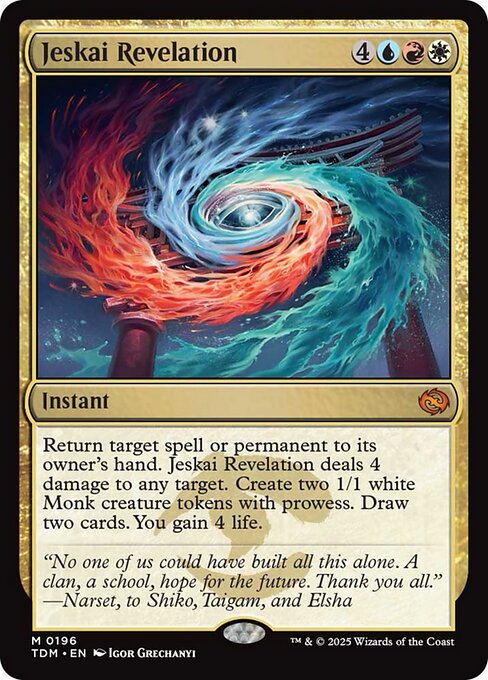 Rating8.8Bomb
Why this rating?
One of the 10 best cards of the set (8.8/10).
Why. An instant that does it all: it returns a spell or permanent to its owner's hand, deals 4 damage to any target, creates two 1/1 white Monk creature tokens with prowess, draws two cards and gains 4 life. One card nearly replaces a full turn.
Risks. Seven mana across three colours, and it does not always solve the real problem: the bounce is temporary. It comes down late.
In the draft. A bomb for white-blue-red decks. Take it high if you have fixing; otherwise it stays hard to cast.
Results in the games of the set
When it is in hand, the deck wins 68.5% of its games (set average: 56.0%, 1st of 274 cards).
In the opening hand: 63.4% wins (54.9% on average).
Drawn during the game: 71.2% (56.7% on average).
When it is drawn, the deck wins 18.0 points more than when it is not.
When it is drafted, it is played 93% of the time (set average: 65%).
Taken as the first pick (64 drafts), it ends in the deck 89% of the time.
It is played about as much in every archetype.
 Rating8.8Bomb
Why this rating?
One of the 10 best cards of the set (8.8/10).
Why. A planeswalker that doubles all your tokens. Its +1 therefore creates two 1/1 white Soldier creature tokens each turn, its 0 puts a +1/+1 counter on each creature you control and gives them flying until your next turn, and its -3 destroys an opponent's creature with mana value 3 or greater.
Risks. Five mana with two white mana and a board to protect: it falls quickly if you are behind. Its 0 does nothing without creatures.
In the draft. A bomb in white, take it very high. It shines with anything that makes tokens, and it protects itself by creating blockers.
Results in the games of the set
When it is in hand, the deck wins 67.1% of its games (set average: 56.0%, 6th of 274 cards).
In the opening hand: 64.7% wins (54.9% on average).
Drawn during the game: 68.7% (56.7% on average).
When it is drawn, the deck wins 14.9 points more than when it is not.
When it is drafted, it is played 96% of the time (set average: 65%).
Taken among the first three picks (187 drafts), it ends in the deck 94% of the time.
It is played about as much in every archetype.
 Rating8.7Bomb
Why this rating?
One of the 10 best cards of the set (8.7/10).
Why. A 5/7 flier for five mana, already a very good threat. At your end step, if creatures you control have total toughness 10 or greater, you draw a card; at 20 you untap your creatures; at 40 each opponent loses half their life, rounded up.
Risks. Exactly three colours (white, black and green), and a deck that must line up big bodies to reach its thresholds. Alone, it is not a replacement for removal.
In the draft. Take it early if you are white, black and green. Otherwise it is difficult to play; total toughness matters more than the number of creatures.
Results in the games of the set
When it is in hand, the deck wins 61.9% of its games (set average: 56.0%, 11th of 274 cards).
In the opening hand: 60.1% wins (54.9% on average).
Drawn during the game: 63.0% (56.7% on average).
When it is drawn, the deck wins 11.5 points more than when it is not.
When it is drafted, it is played 91% of the time (set average: 65%).
Taken as the first pick (44 drafts), it ends in the deck 89% of the time.
It is played about as much in every archetype.
 Rating8.6Bomb
Why this rating?
One of the 10 best cards of the set (8.6/10).
Why. A 4/5 flier with vigilance that replays a spell. When it enters, you exile a nonland card with mana value 3 or less from your graveyard, copy it, then may cast the copy for free: a removal spell or a good play comes back.
Risks. Six mana and three colours. With no target in your graveyard, you only have a 4/5 flier, fine but expensive.
In the draft. A good choice for white-blue-red decks. Look for efficient cheap instants and sorceries so that the enter trigger gives a result.
Results in the games of the set
When it is in hand, the deck wins 62.7% of its games (set average: 56.0%, 9th of 274 cards).
In the opening hand: 59.5% wins (54.9% on average).
Drawn during the game: 64.6% (56.7% on average).
When it is drawn, the deck wins 11.9 points more than when it is not.
When it is drafted, it is played 92% of the time (set average: 65%).
Taken as the first pick (51 drafts), it ends in the deck 88% of the time.
It is played about as much in every archetype.
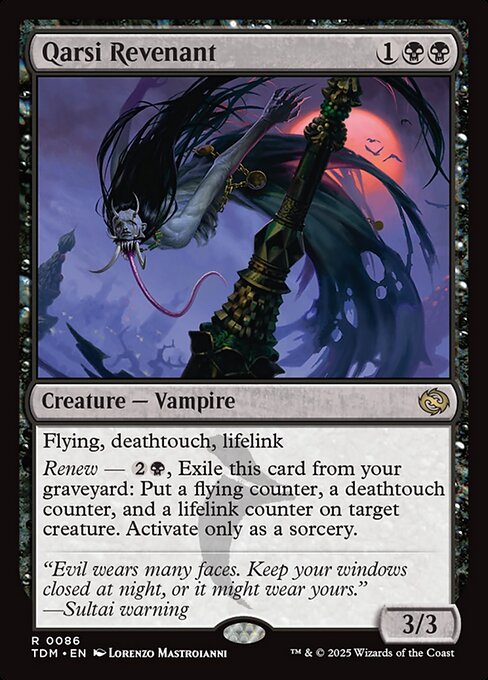
10. Qarsi Revenant
Rating8.5BombWhy this rating?
One of the 10 best cards of the set (8.5/10).
Why. Three mana for a 3/3 with flying, deathtouch and lifelink: it attacks, blocks and wins the race. Even dead, it keeps its value: with Renew, you exile it from your graveyard to put a flying counter, a deathtouch counter and a lifelink counter on target creature.
Risks. Two black mana by turn three, and 3 toughness makes it an easy target for removal. Renew can only be used at sorcery speed and costs three mana.
In the draft. A bomb in black, take it without hesitation. It works in every black deck, whatever the second colour.
Results in the games of the set
When it is in hand, the deck wins 61.1% of its games (set average: 56.0%, 16th of 274 cards).
In the opening hand: 60.8% wins (54.9% on average).
Drawn during the game: 61.3% (56.7% on average).
When it is drawn, the deck wins 7.6 points more than when it is not.
When it is drafted, it is played 90% of the time (set average: 65%).
Taken as the first pick (80 drafts), it ends in the deck 90% of the time.
It is played about as much in every archetype.
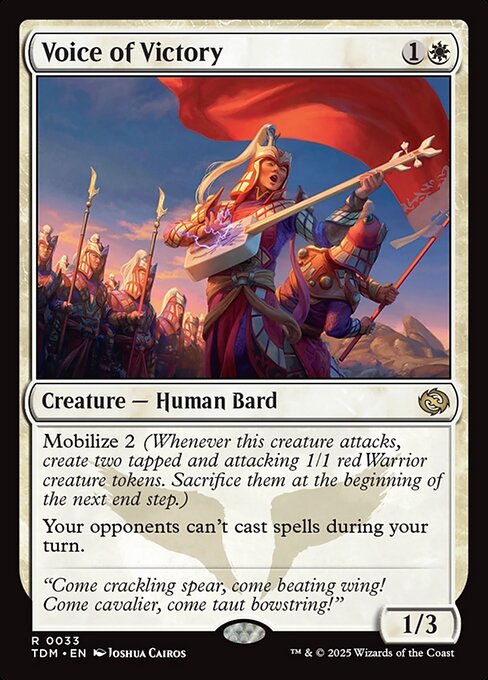
11. Voice of Victory
Rating8.5BombWhy this rating?
One of the very best rares of the format (8.5/10).
Why. A 1/3 for two mana with Mobilize 2: each attack adds two tapped and attacking 1/1 red Warrior creature tokens. On top of that, your opponents can't cast spells during your turn, so no instant can save them in combat.
Risks. The tokens are sacrificed at end of turn, and attacking with a 1/3 into a blocker is risky. Without pressure, it is just a small body.
In the draft. Very good in aggressive white decks. Take it high if you like to attack and want to deny your opponent any combat response.
Results in the games of the set
When it is in hand, the deck wins 60.2% of its games (set average: 56.0%, 22nd of 274 cards).
In the opening hand: 63.5% wins (54.9% on average).
Drawn during the game: 57.7% (56.7% on average).
When it is drawn, the deck wins 5.6 points more than when it is not.
When it is drafted, it is played 92% of the time (set average: 65%).
Taken as the first pick (90 drafts), it ends in the deck 92% of the time.
It is played about as much in every archetype.
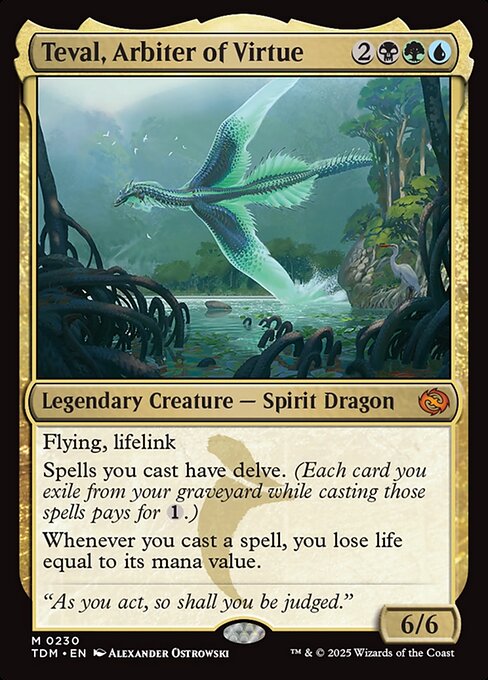 Rating8.4Very good
Why this rating?
One of the very best mythics of the format (8.4/10).
Why. A 6/6 flier with lifelink for five mana, huge even without its bonus. Your spells also have delve: you can exile cards from your graveyard to pay for them, which speeds up your late game.
Risks. Each spell you cast costs you life equal to its mana value. Against an aggressive deck, that can kill you. It needs three colours: black, green and blue.
In the draft. Take it early if you play black, green and blue. The lifelink offsets the life loss, but prefer cheap spells.
Results in the games of the set
When it is in hand, the deck wins 61.2% of its games (set average: 56.0%, 13th of 274 cards).
In the opening hand: 58.5% wins (54.9% on average).
Drawn during the game: 62.9% (56.7% on average).
When it is drawn, the deck wins 10.3 points more than when it is not.
When it is drafted, it is played 92% of the time (set average: 65%).
Taken as the first pick (55 drafts), it ends in the deck 85% of the time.
It is played about as much in every archetype.

13. All-Out Assault
Rating8.3Very goodWhy this rating?
One of the very best mythics of the format (8.3/10).
Why. An enchantment that gives all your creatures +1/+1 and deathtouch. If it enters during your main phase, it also adds an extra combat, and the next time you attack this turn you untap your creatures. On a wide board, it is a double turn.
Risks. It does nothing without creatures and needs three colours: red, white and black. Five mana for an effect that mostly rewards a board already in place.
In the draft. A good payoff for a Mardu deck with many small creatures, but not a first pick. Play it only if your deck has the board to take advantage.
Results in the games of the set
When it is in hand, the deck wins 59.7% of its games (set average: 56.0%, 29th of 274 cards).
In the opening hand: 58.3% wins (54.9% on average).
Drawn during the game: 60.8% (56.7% on average).
When it is drawn, the deck wins 6.4 points more than when it is not.
When it is drafted, it is played 82% of the time (set average: 65%).
Taken as the first pick (41 drafts), it ends in the deck 85% of the time.
It is played about as much in every archetype.
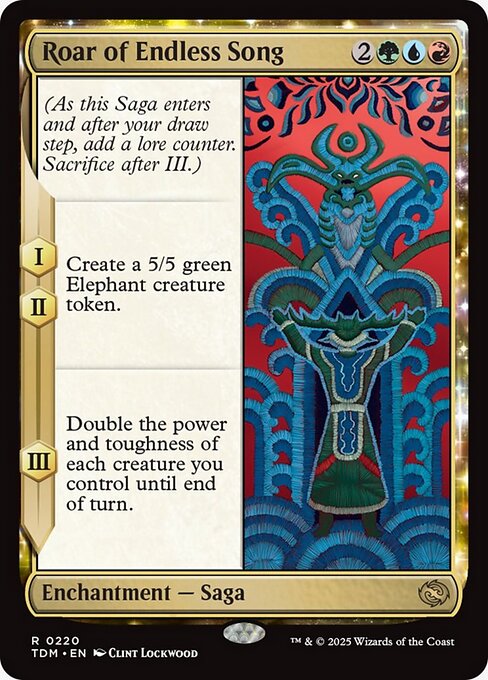 Rating8.2Very good
Why this rating?
One of the very best rares of the format (8.2/10).
Why. A Saga that creates a 5/5 green Elephant creature token with chapters I and II, then doubles the power and toughness of each creature you control until end of turn with chapter III. Two big bodies for five mana, with an explosive finish on the third turn.
Risks. Three colours (green, blue and red), so you need fixing to cast it on time. The Elephant tokens can still be hit by removal, and chapter III only lasts until end of turn.
In the draft. An excellent pick for a green-blue-red deck. Take it high.
Results in the games of the set
When it is in hand, the deck wins 65.1% of its games (set average: 56.0%, 7th of 274 cards).
In the opening hand: 64.1% wins (54.9% on average).
Drawn during the game: 65.7% (56.7% on average).
When it is drawn, the deck wins 14.2 points more than when it is not.
When it is drafted, it is played 94% of the time (set average: 65%).
Taken as the first pick (126 drafts), it ends in the deck 94% of the time.
It is played about as much in every archetype.
 Rating8.2Very good
Why this rating?
One of the very best rares of the format (8.2/10).
Why. A cheap Equipment that gives +1/+1, trample and haste. With Flurry, your second spell each turn creates a 1/1 white Monk creature token with prowess, and you may attach the Equipment to it. It is a token source in a deck with cheap spells.
Risks. Without a second spell each turn it is slow, and re-equipping costs two mana. In a deck without cheap spells, it is mediocre.
In the draft. A good card for aggressive red decks with cheap spells. A little worse if you are short on creatures.
Results in the games of the set
When it is in hand, the deck wins 59.8% of its games (set average: 56.0%, 28th of 274 cards).
In the opening hand: 60.4% wins (54.9% on average).
Drawn during the game: 59.3% (56.7% on average).
When it is drawn, the deck wins 6.3 points more than when it is not.
When it is drafted, it is played 95% of the time (set average: 65%).
Taken as the first pick (118 drafts), it ends in the deck 92% of the time.
It is played about as much in every archetype.
 Rating8.1Very good
Why this rating?
One of the very best rares of the format (8.1/10).
Why. A 1/3 flier for two mana that grows: each attack makes you lose 1 life and the creature endures 1, either a +1/+1 counter or a 1/1 white Spirit creature token. The choice adapts to the game.
Risks. The life loss on each attack adds up in a race. The starting 1/3 body stays fragile against removal.
In the draft. A good two-drop for fairly aggressive black decks. Take it at a fair price; it is worse in a control deck that cannot afford to lose life.
Results in the games of the set
When it is in hand, the deck wins 60.2% of its games (set average: 56.0%, 23rd of 274 cards).
In the opening hand: 64.7% wins (54.9% on average).
Drawn during the game: 56.8% (56.7% on average).
When it is drawn, the deck wins 6.7 points more than when it is not.
When it is drafted, it is played 91% of the time (set average: 65%).
Taken as the first pick (86 drafts), it ends in the deck 95% of the time.
It is played about as much in every archetype.
 Rating8.0Very good
Why this rating?
One of the very best rares of the format (8.0/10).
Why. A 2/2 that gets a +1/+1 counter at each of your end steps, and makes every other nontoken creature you control endure X as it enters, where X is the number of counters on it. Played early, each creature that follows arrives with counters or a white Spirit creature token.
Risks. At first it is a 2/2 that dies to any removal. If you have no nontoken creatures to play afterwards, the effect stays small.
In the draft. Very good in green with a creature-heavy curve. Plan it as a turn-three play; it is worse in a deck full of spells.
Results in the games of the set
When it is in hand, the deck wins 61.3% of its games (set average: 56.0%, 12th of 274 cards).
In the opening hand: 63.0% wins (54.9% on average).
Drawn during the game: 60.1% (56.7% on average).
When it is drawn, the deck wins 9.3 points more than when it is not.
When it is drafted, it is played 96% of the time (set average: 65%).
Taken as the first pick (77 drafts), it ends in the deck 94% of the time.
It is played about as much in every archetype.
 Rating7.9Very good
Why this rating?
One of the very best rares of the format (7.9/10).
Why. A 1/1 for one red mana with Mobilize 1: when it attacks, it adds a tapped and attacking 1/1 red Warrior creature token. Later, two mana and its sacrifice deal damage equal to the number of creatures you control to a target creature: a hidden removal.
Risks. A 1/1 that attacks is quickly blocked and killed. The removal depends on your board and loses value if it is small.
In the draft. A good card for aggressive red decks. Take it at a fair price; it is worse in a deck with few creatures.
Results in the games of the set
When it is in hand, the deck wins 58.5% of its games (set average: 56.0%, 47th of 274 cards).
In the opening hand: 60.2% wins (54.9% on average).
Drawn during the game: 57.0% (56.7% on average).
When it is drawn, the deck wins 2.4 points more than when it is not.
When it is drafted, it is played 89% of the time (set average: 65%).
Taken as the first pick (63 drafts), it ends in the deck 98% of the time.
It is played about as much in every archetype.
 Rating7.9Very good
Why this rating?
One of the very best rares of the format (7.9/10).
Why. A Saga that creates three 1/1 white Spirit creature tokens with chapter I, distributes three +1/+1 counters with chapter II, then gives your creatures trample and lifelink with chapter III. Over three turns it provides a whole board.
Risks. Three colours (white, black and green) for a slow effect. Chapter III does nothing without creatures to attack with.
In the draft. A good choice for an Abzan deck that likes many creatures. Take it at a fair price, but not before your removal.
Results in the games of the set
When it is in hand, the deck wins 61.2% of its games (set average: 56.0%, 15th of 274 cards).
In the opening hand: 60.9% wins (54.9% on average).
Drawn during the game: 61.4% (56.7% on average).
When it is drawn, the deck wins 8.7 points more than when it is not.
When it is drafted, it is played 83% of the time (set average: 65%).
Taken as the first pick (76 drafts), it ends in the deck 83% of the time.
It is played about as much in every archetype.
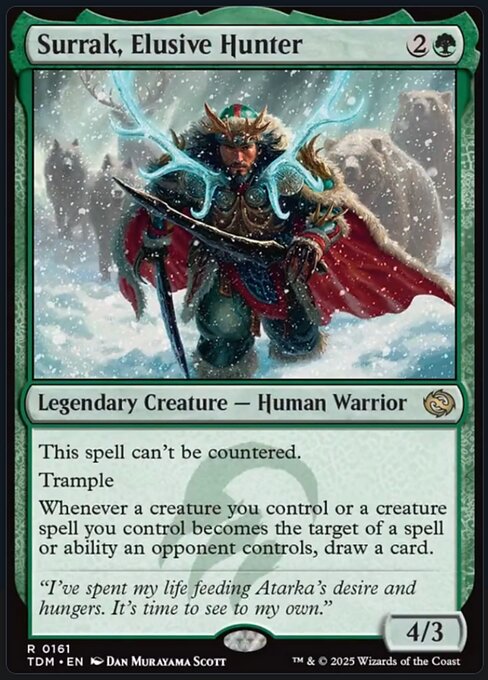 Rating7.8Very good
Why this rating?
One of the very best rares of the format (7.8/10).
Why. A 4/3 with trample for three mana, which is efficient from turn three. It can't be countered, and whenever an opponent targets one of your creatures (or a creature spell), you draw a card.
Risks. Three toughness, so it is vulnerable to small damage spells and combat. A targeted removal spell kills it but at least draws you a card.
In the draft. A good green creature, take it early. It fits almost every green deck.
Results in the games of the set
When it is in hand, the deck wins 60.7% of its games (set average: 56.0%, 20th of 274 cards).
In the opening hand: 61.8% wins (54.9% on average).
Drawn during the game: 59.9% (56.7% on average).
When it is drawn, the deck wins 8.5 points more than when it is not.
When it is drafted, it is played 96% of the time (set average: 65%).
Taken as the first pick (100 drafts), it ends in the deck 98% of the time.
It is played about as much in every archetype.
 Rating7.7Very good
Why this rating?
One of the very best rares of the format (7.7/10).
Why. A 3/3 with haste for three mana. When it enters, you discard up to two cards, then draw that many: good filtering for extra lands. Whenever it attacks with seven or more cards in your graveyard, you exile one at random and may play it this turn.
Risks. The graveyard effect is slow and random. It is mostly a solid body with a small bonus; it does not swing a game alone.
In the draft. A good mid-curve body for red decks. Take it at a fair price, behind your removal and your best threats.
Results in the games of the set
When it is in hand, the deck wins 58.1% of its games (set average: 56.0%, 50th of 274 cards).
In the opening hand: 57.5% wins (54.9% on average).
Drawn during the game: 58.5% (56.7% on average).
When it is drawn, the deck wins 3.9 points more than when it is not.
When it is drafted, it is played 95% of the time (set average: 65%).
Taken as the first pick (87 drafts), it ends in the deck 97% of the time.
It is played about as much in every archetype.

22. Taigam, Master Opportunist
Rating7.6Very goodWhy this rating?
One of the very best mythics of the format (7.6/10).
Why. A 2/2 for two mana with Flurry: when you cast your second spell each turn, you copy it and the original goes into exile with four time counters. You get the copy's effect now, and the original spell comes back a few turns later.
Risks. The body is small and the trigger requires two spells in a turn, which is hard without a very low curve. The original arrives four turns late.
In the draft. A niche card: play it only in a deck with cheap spells. Do not take it before good creatures.
Results in the games of the set
When it is in hand, the deck wins 55.2% of its games (set average: 56.0%, 149th of 274 cards).
In the opening hand: 54.8% wins (54.9% on average).
Drawn during the game: 55.5% (56.7% on average).
When it is drawn, the deck wins 4.0 points more than when it is not.
When it is drafted, it is played 93% of the time (set average: 65%).
Taken as the first pick (43 drafts), it ends in the deck 93% of the time.
It is played about as much in every archetype.
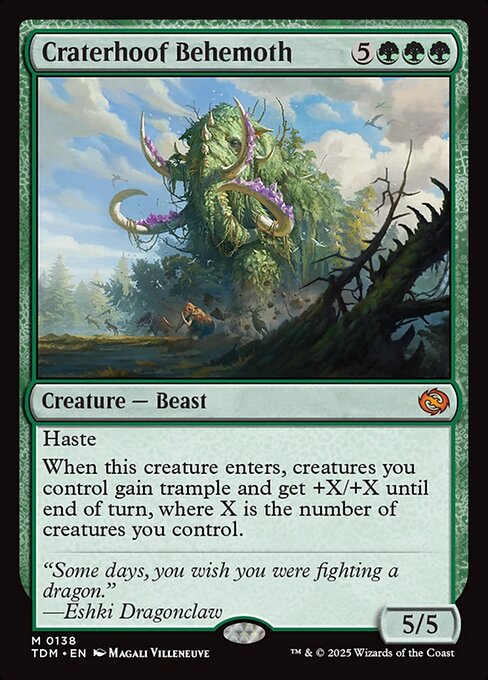 Rating7.6Very good
Why this rating?
One of the very best mythics of the format (7.6/10).
Why. A 5/5 with haste that, when it enters, gives all your creatures trample and +X/+X, where X is the number of creatures you control. With a wide board, it is a one-turn finish.
Risks. Eight mana with three green mana: it arrives very late and does nothing if your board is small. It only rewards a game you are already winning.
In the draft. Not a first pick: one copy in a green deck that fields many small creatures. Otherwise it stays stuck in hand.
Results in the games of the set
When it is in hand, the deck wins 57.0% of its games (set average: 56.0%, 78th of 274 cards).
In the opening hand: 51.0% wins (54.9% on average).
Drawn during the game: 60.6% (56.7% on average).
When it is drawn, the deck wins 6.6 points more than when it is not.
When it is drafted, it is played 85% of the time (set average: 65%).
Taken as the first pick (49 drafts), it ends in the deck 90% of the time.
It is played about as much in every archetype.
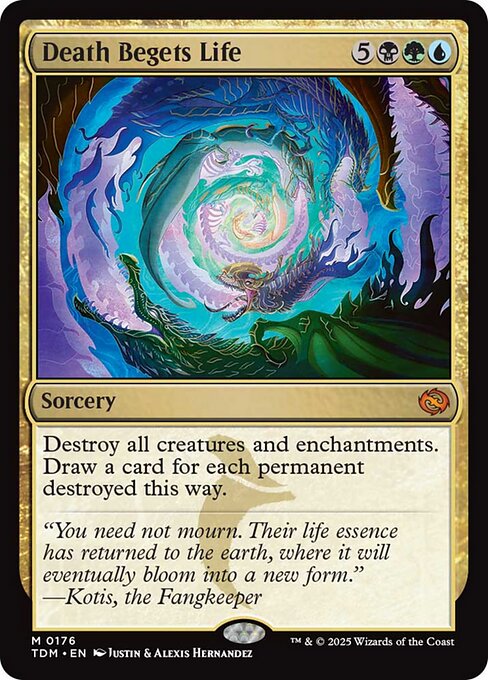 Rating7.6Very good
Why this rating?
One of the very best mythics of the format (7.6/10).
Why. A sorcery that destroys all creatures and enchantments, then draws you a card for each permanent destroyed. It can refill your hand if you are behind on board.
Risks. Eight mana and three colours (black, green and blue): it arrives very late, and it destroys your creatures too. It only fits a patient deck.
In the draft. A control finisher for a black-green-blue deck. Take it in moderation: you need a plan to survive until you can cast it.
Results in the games of the set
When it is in hand, the deck wins 61.2% of its games (set average: 56.0%, 14th of 274 cards).
In the opening hand: 56.1% wins (54.9% on average).
Drawn during the game: 64.3% (56.7% on average).
When it is drawn, the deck wins 10.1 points more than when it is not.
When it is drafted, it is played 89% of the time (set average: 65%).
Taken as the first pick (48 drafts), it ends in the deck 92% of the time.
It is played about as much in every archetype.
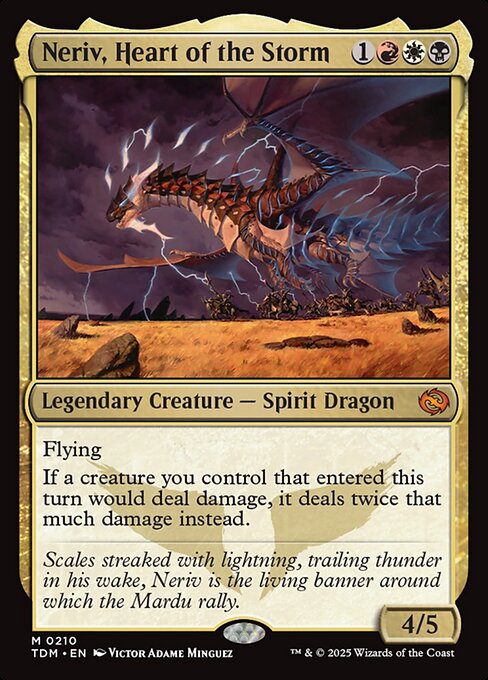 Rating7.6Very good
Why this rating?
One of the very best mythics of the format (7.6/10).
Why. A 4/5 flier for four mana, which is a good body. Its ability doubles the damage of creatures that entered this turn, which helps haste creatures and tokens that come in attacking.
Risks. Three colours (red, white and black) for a bonus that is rarely relevant: it enters without haste itself. Without the right partners, it is a 4/5 flier that is costly in colours.
In the draft. Play it if you are Mardu, mostly for its body. Do not take it for its ability; good removal comes first.
Results in the games of the set
When it is in hand, the deck wins 56.3% of its games (set average: 56.0%, 100th of 274 cards).
In the opening hand: 54.4% wins (54.9% on average).
Drawn during the game: 57.7% (56.7% on average).
When it is drawn, the deck wins 1.8 points more than when it is not.
When it is drafted, it is played 83% of the time (set average: 65%).
Taken as the first pick (33 drafts), it ends in the deck 85% of the time.
It is played about as much in every archetype.

26. Dragonologist
Rating7.5Very goodWhy this rating?
One of the very best rares of the format (7.6/10).
Why. A 1/3 for three mana that looks at the top six cards of your library and lets you take an instant, a sorcery or a Dragon. It can find a good spell, and it gives your untapped Dragons hexproof.
Risks. The body is small and the effect is only good if the deck has enough spells and Dragons. In a deck without them, it is an average 1/3.
In the draft. A good card for a blue deck with spells and Dragons. Take it at a fair price, but not ahead of your best threats.
Results in the games of the set
When it is in hand, the deck wins 59.3% of its games (set average: 56.0%, 31st of 274 cards).
In the opening hand: 56.7% wins (54.9% on average).
Drawn during the game: 60.9% (56.7% on average).
When it is drawn, the deck wins 7.1 points more than when it is not.
When it is drafted, it is played 92% of the time (set average: 65%).
Taken as the first pick (118 drafts), it ends in the deck 94% of the time.
It is played about as much in every archetype.

27. Scavenger Regent // Exude Toxin
Rating7.5Very goodWhy this rating?
A very good rare of the format (7.5/10).
Why. Two cards in one. The Dragon is a 4/4 flier for four mana with ward (discard a card). The Omen half Exude Toxin is a sorcery that gives each non-Dragon creature -X/-X: a flexible sweeper you pick at the right moment.
Risks. Ward does not protect the Dragon from a sweeper, and the Omen half also hits your own non-Dragon creatures. The Omen half needs two black mana, plus X.
In the draft. A good flexible black card. Take it fairly high: it works as a threat or an answer as needed.
Results in the games of the set
When it is in hand, the deck wins 60.1% of its games (set average: 56.0%, 25th of 274 cards).
In the opening hand: 57.2% wins (54.9% on average).
Drawn during the game: 61.8% (56.7% on average).
When it is drawn, the deck wins 7.5 points more than when it is not.
When it is drafted, it is played 94% of the time (set average: 65%).
Taken as the first pick (85 drafts), it ends in the deck 93% of the time.
It is played about as much in every archetype.
 Rating7.4Very good
Why this rating?
A very good rare of the format (7.4/10).
Why. A 5/9 with ward 2 for five mana, a huge wall. When it attacks, you draw three cards but it gets three stun counters; casting a Turtle spell untaps it.
Risks. After attacking, it stays tapped for a long time and no longer blocks. Without Turtles to cast, you mostly use it to draw three cards once in a while.
In the draft. A good blue card: it blocks, protects and draws. Take it at a fair price, and look for Turtles to untap it.
Results in the games of the set
When it is in hand, the deck wins 59.6% of its games (set average: 56.0%, 30th of 274 cards).
In the opening hand: 57.6% wins (54.9% on average).
Drawn during the game: 60.8% (56.7% on average).
When it is drawn, the deck wins 8.0 points more than when it is not.
When it is drafted, it is played 94% of the time (set average: 65%).
Taken as the first pick (130 drafts), it ends in the deck 92% of the time.
It is played about as much in every archetype.
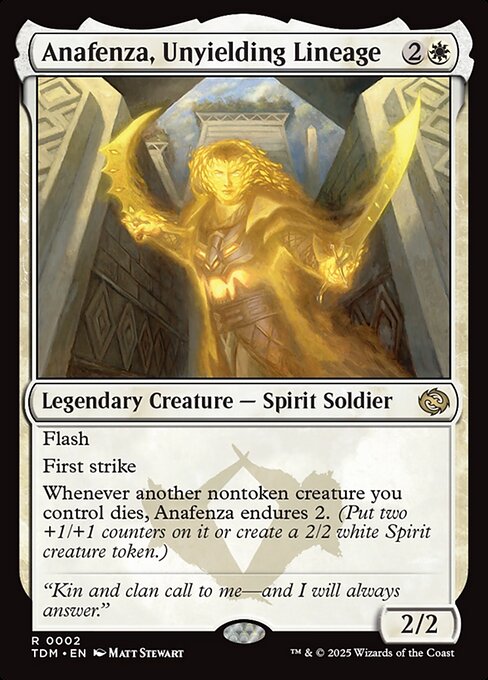
29. Anafenza, Unyielding Lineage
Rating7.4Very goodWhy this rating?
A very good rare of the format (7.4/10).
Why. A 2/2 with flash and first strike for three mana. It ambushes attackers, and whenever another nontoken creature you control dies, it endures 2: two +1/+1 counters or a 2/2 white Spirit creature token.
Risks. The body is small and its value depends on your creatures dying. It does not win a game alone.
In the draft. A fine white card for a creature curve. Play it as a decent third choice, behind your removal.
Results in the games of the set
When it is in hand, the deck wins 56.1% of its games (set average: 56.0%, 107th of 274 cards).
In the opening hand: 56.4% wins (54.9% on average).
Drawn during the game: 55.9% (56.7% on average).
When it is drawn, the deck wins 1.9 points more than when it is not.
When it is drafted, it is played 91% of the time (set average: 65%).
Taken as the first pick (61 drafts), it ends in the deck 93% of the time.
It is played about as much in every archetype.
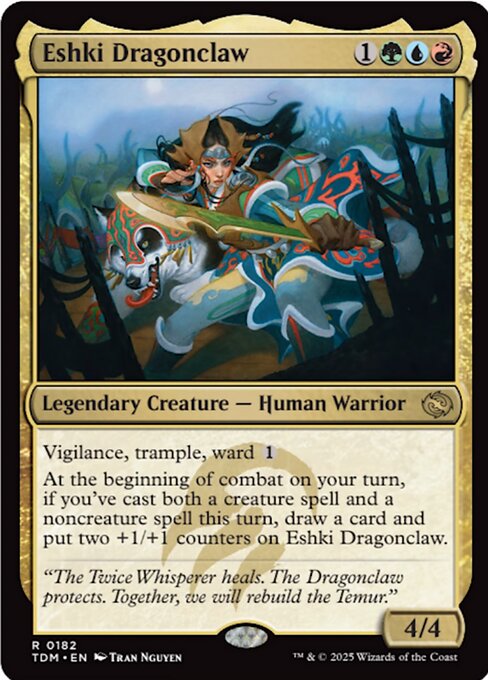
30. Eshki Dragonclaw
Rating7.4Very goodWhy this rating?
A very good rare of the format (7.4/10).
Why. A 4/4 with vigilance, trample and ward 1 for four mana. At the beginning of combat on your turn, if you have cast both a creature spell and a noncreature spell this turn, it draws a card and gets two +1/+1 counters.
Risks. Three colours (green, blue and red). Its bonus requires casting two kinds of spells in the same turn before combat, which does not always happen.
In the draft. A good body for green-blue-red decks. Take it at a fair price and look for noncreature spells to trigger its bonus.
Results in the games of the set
When it is in hand, the deck wins 60.7% of its games (set average: 56.0%, 19th of 274 cards).
In the opening hand: 59.4% wins (54.9% on average).
Drawn during the game: 61.4% (56.7% on average).
When it is drawn, the deck wins 9.7 points more than when it is not.
When it is drafted, it is played 92% of the time (set average: 65%).
Taken as the first pick (129 drafts), it ends in the deck 95% of the time.
It is played about as much in every archetype.
 Rating7.4Very good
Why this rating?
A very good rare of the format (7.4/10).
Why. A 3/3 with flash for four mana, and a choice when it enters: gain 3 life and surveil 3, destroy target enchantment, or counter target creature spell. It can be played as a surprise and adapts to the situation.
Risks. Three colours (black, green and blue). Countering a spell means keeping four mana open at the right time, and the other modes are modest.
In the draft. A good card for a black-green-blue deck. Take it at a fair price; it is useful even without a specific target.
Results in the games of the set
When it is in hand, the deck wins 61.0% of its games (set average: 56.0%, 17th of 274 cards).
In the opening hand: 58.8% wins (54.9% on average).
Drawn during the game: 62.3% (56.7% on average).
When it is drawn, the deck wins 9.0 points more than when it is not.
When it is drafted, it is played 91% of the time (set average: 65%).
Taken as the first pick (95 drafts), it ends in the deck 95% of the time.
It is played about as much in every archetype.
 Rating7.4Very good
Why this rating?
A very good rare of the format (7.4/10).
Why. A 4/5 flier for four mana, a very good body in red. When it enters, it destroys a nonbasic land an opponent controls: they must search for a basic land that comes in tapped with a stun counter on it.
Risks. Two red mana. Its effect only matters if the opponent plays a nonbasic land; otherwise it is just a 4/5 flier.
In the draft. A good red Dragon, take it fairly early. It is playable in every red deck.
Results in the games of the set
When it is in hand, the deck wins 58.5% of its games (set average: 56.0%, 46th of 274 cards).
In the opening hand: 57.0% wins (54.9% on average).
Drawn during the game: 59.4% (56.7% on average).
When it is drawn, the deck wins 5.0 points more than when it is not.
When it is drafted, it is played 93% of the time (set average: 65%).
Taken as the first pick (98 drafts), it ends in the deck 98% of the time.
It is played about as much in every archetype.
 Rating7.4Very good
Why this rating?
A very good rare of the format (7.4/10).
Why. A sorcery that draws three cards for three mana, then asks you to discard two cards unless you discard a creature card. With Harmonize, you can cast it again from your graveyard for five mana, less by tapping a creature.
Risks. It does nothing on the board, and the discard costs you cards. In a fast deck, it comes too slowly.
In the draft. A good value tool for blue decks. Take it at a fair price; it is better with creatures to discard or to tap.
Results in the games of the set
When it is in hand, the deck wins 60.5% of its games (set average: 56.0%, 21st of 274 cards).
In the opening hand: 59.1% wins (54.9% on average).
Drawn during the game: 61.3% (56.7% on average).
When it is drawn, the deck wins 7.5 points more than when it is not.
When it is drafted, it is played 95% of the time (set average: 65%).
Taken as the first pick (137 drafts), it ends in the deck 99% of the time.
It is played about as much in every archetype.
 Rating7.4Very good
Why this rating?
A very good rare of the format (7.4/10).
Why. An instant that exiles any nonland permanent and can't be countered; its controller loses 3 life and you gain 3. It is nearly unconditional removal and very flexible.
Risks. Three colours (red, white and black) for four mana. It cannot deal with lands or spells on the stack.
In the draft. A good removal spell for a red-white-black deck. Take it fairly high.
Results in the games of the set
When it is in hand, the deck wins 60.2% of its games (set average: 56.0%, 24th of 274 cards).
In the opening hand: 57.4% wins (54.9% on average).
Drawn during the game: 62.0% (56.7% on average).
When it is drawn, the deck wins 5.8 points more than when it is not.
When it is drafted, it is played 85% of the time (set average: 65%).
Taken as the first pick (83 drafts), it ends in the deck 83% of the time.
It is played about as much in every archetype.

35. Windcrag Siege
Rating7.3Very goodWhy this rating?
A very good rare of the format (7.3/10).
Why. An enchantment with two modes, chosen as it enters. The Jeskai mode creates a 1/1 red Goblin creature token each upkeep that gains lifelink and haste until end of turn, a steady stream of value. The Mardu mode makes triggered abilities set off by an attacking creature trigger one extra time.
Risks. The Mardu mode only matters if your permanents have attack triggers, otherwise it does nothing. The Jeskai mode is no substitute for removal or a big creature.
In the draft. Take it in a red-white deck, or a three-colour deck with those two colours, mainly for the Jeskai mode. A good mid-pack pick, but not above a removal spell.
Results in the games of the set
When it is in hand, the deck wins 58.4% of its games (set average: 56.0%, 48th of 274 cards).
In the opening hand: 61.4% wins (54.9% on average).
Drawn during the game: 56.3% (56.7% on average).
When it is drawn, the deck wins 3.6 points more than when it is not.
When it is drafted, it is played 92% of the time (set average: 65%).
Taken as the first pick (86 drafts), it ends in the deck 90% of the time.
It is played about as much in every archetype.
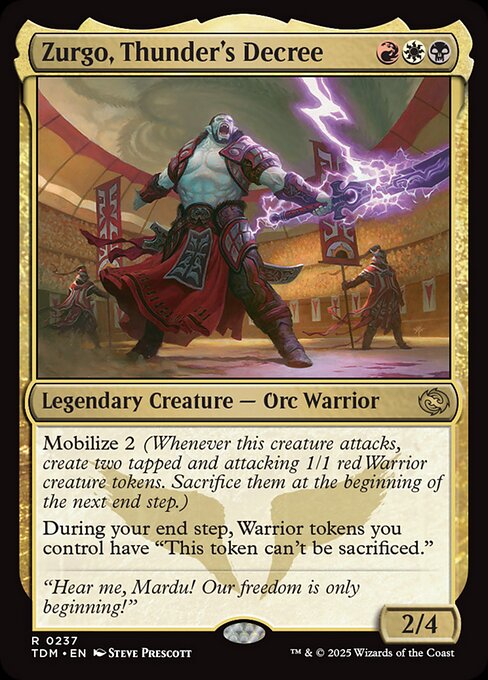 Rating7.2Very good
Why this rating?
A very good rare of the format (7.2/10).
Why. A sturdy 2/4 for three mana with Mobilize 2. Its second ability stops Warrior tokens from being sacrificed during your end step, so the two Warriors created each attack stay on the battlefield and pile up.
Risks. It needs three exact colours on turn three, so the mana base has to be tight. A 2/4 attacks poorly into bigger creatures: the tokens stay, but Zurgo itself can die attacking.
In the draft. Take it if you are already in red-white-black, or close to it. Outside those colours, let it go: it cannot be splashed.
Results in the games of the set
When it is in hand, the deck wins 57.0% of its games (set average: 56.0%, 79th of 274 cards).
In the opening hand: 59.1% wins (54.9% on average).
Drawn during the game: 55.3% (56.7% on average).
When it is drawn, the deck wins 2.8 points more than when it is not.
When it is drafted, it is played 83% of the time (set average: 65%).
Taken as the first pick (62 drafts), it ends in the deck 79% of the time.
It is played about as much in every archetype.
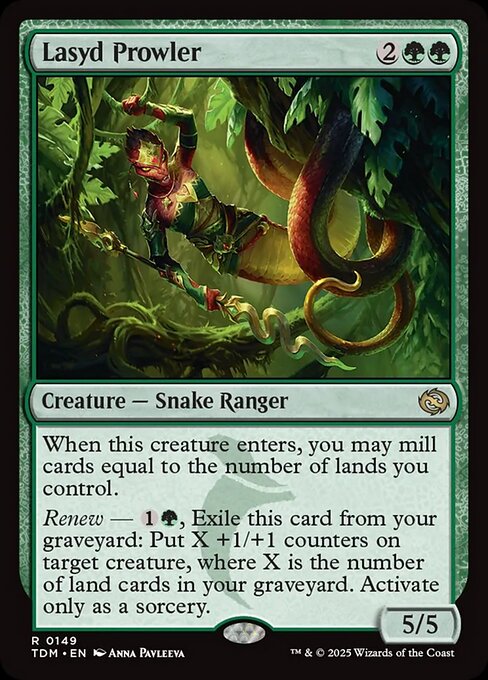
37. Lasyd Prowler
Rating7.2Very goodWhy this rating?
A very good rare of the format (7.2/10).
Why. A 5/5 for four mana outclasses most creatures at that cost. When it enters, you may mill as many cards as you control lands. Once it is in the graveyard, Renew puts +1/+1 counters on a creature, one per land card there.
Risks. Two green mana on turn four limits multicolour decks. Milling yourself is optional, but it burns through your library, so don't overdo it in a short deck.
In the draft. A very good green pick at a fair price, especially in a midrange deck. Milled lands feed Renew, but the 5/5 body is already enough.
Results in the games of the set
When it is in hand, the deck wins 58.0% of its games (set average: 56.0%, 51st of 274 cards).
In the opening hand: 57.7% wins (54.9% on average).
Drawn during the game: 58.3% (56.7% on average).
When it is drawn, the deck wins 5.0 points more than when it is not.
When it is drafted, it is played 93% of the time (set average: 65%).
Taken as the first pick (89 drafts), it ends in the deck 96% of the time.
It is played about as much in every archetype.
 Rating7.2Very good
Why this rating?
A very good rare of the format (7.2/10).
Why. A 4/3 for three mana that already counts itself: during your turn, each spell you cast costs one generic mana less for every creature you control with power 4 or greater. With several big creatures, your turns chain together very fast.
Risks. Three exact colours make it demanding, and the discount only reduces generic mana. Without other big creatures it is just a decent 4/3 that dies easily.
In the draft. Take it only in a green-blue-red deck with several creatures of power 4 or more. A good pick, but not a card worth changing colours for.
Results in the games of the set
When it is in hand, the deck wins 58.7% of its games (set average: 56.0%, 40th of 274 cards).
In the opening hand: 58.4% wins (54.9% on average).
Drawn during the game: 58.9% (56.7% on average).
When it is drawn, the deck wins 6.3 points more than when it is not.
When it is drafted, it is played 83% of the time (set average: 65%).
Taken as the first pick (110 drafts), it ends in the deck 89% of the time.
It is played about as much in every archetype.
 Rating7.2Good
Why this rating?
A very good rare of the format (7.2/10).
Why. A 3/3 white Dragon with flying for three mana is a good creature at that price. Its second ability stops activated abilities of artifacts, creatures and planeswalkers from being activated, which shuts down many of your opponent's tools.
Risks. It hurts you too: your own such activated abilities, mana included (Treasures, creatures that tap for mana), are blocked. Check that your deck does not depend on them.
In the draft. A good white pick for a straightforward attacking deck. Less appealing if you have many artifacts or creatures with activated abilities.
Results in the games of the set
When it is in hand, the deck wins 56.6% of its games (set average: 56.0%, 90th of 274 cards).
In the opening hand: 56.8% wins (54.9% on average).
Drawn during the game: 56.4% (56.7% on average).
When it is drawn, the deck wins 1.9 points more than when it is not.
When it is drafted, it is played 88% of the time (set average: 65%).
Taken as the first pick (81 drafts), it ends in the deck 93% of the time.
It is played about as much in every archetype.
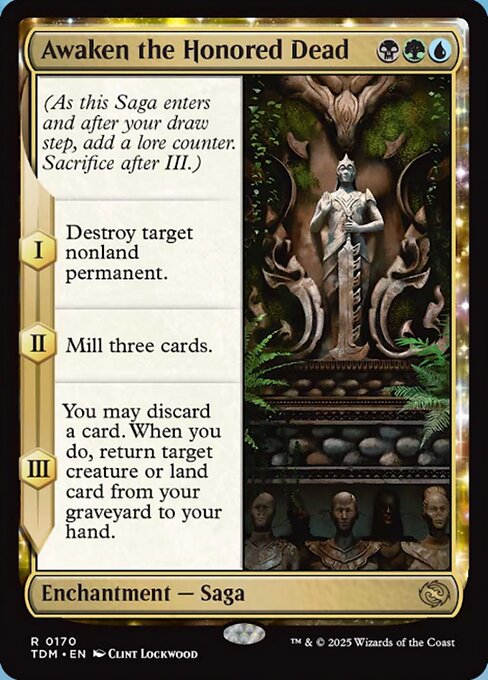 Rating7.1Good
Why this rating?
A very good rare of the format (7.1/10).
Why. Removal that keeps working: chapter I destroys a nonland permanent, chapter II mills three cards, and chapter III lets you discard a card to return a creature or land card from your graveyard to your hand. All for three mana.
Risks. Three exact colours. Chapter II does nothing by itself and can be risky if your library is short; only chapter I affects the board.
In the draft. A good pick in a blue-black-green deck: removal with a small value payoff. Don't take it if you are not already in those colours.
Results in the games of the set
When it is in hand, the deck wins 60.0% of its games (set average: 56.0%, 26th of 274 cards).
In the opening hand: 57.0% wins (54.9% on average).
Drawn during the game: 61.9% (56.7% on average).
When it is drawn, the deck wins 8.2 points more than when it is not.
When it is drafted, it is played 90% of the time (set average: 65%).
Taken as the first pick (119 drafts), it ends in the deck 91% of the time.
It is played about as much in every archetype.
 Rating7.0Good
Why this rating?
A very good rare of the format (7.0/10).
Why. A land that taps for red mana and enters untapped if you control a Plains or an Island. For four mana and a tap, you exile the top card of your library and may play it until the end of your next turn: late-game value.
Risks. It enters tapped without a Plains or an Island, which costs tempo. The activation is expensive and only pays off when you have spare mana.
In the draft. A good inclusion in a red-white or red-blue deck: a red land that adds late-game value. Take it after your good spells.
Results in the games of the set
When it is in hand, the deck wins 58.6% of its games (set average: 56.0%, 42nd of 274 cards).
In the opening hand: 58.2% wins (54.9% on average).
Drawn during the game: 58.9% (56.7% on average).
When it is drawn, the deck wins 3.2 points more than when it is not.
When it is drafted, it is played 90% of the time (set average: 65%).
Taken as the first pick (48 drafts), it ends in the deck 96% of the time.
 Rating7.0Good
Why this rating?
A solid uncommon of the format (7.0/10).
Why. A one-mana 2/1 that stays relevant late. Each time it attacks, you may pay two mana, one of them white, to Endure 1: a +1/+1 counter or a 1/1 white Spirit creature token. It grows or spreads out depending on the board.
Risks. A 2/1 dies to almost anything, and attacking with it early is risky. The effect costs mana on every attack, which slows you down.
In the draft. A good aggressive card for a white-red deck. Take it at a fair price, after the removal spells.
Results in the games of the set
When it is in hand, the deck wins 58.2% of its games (set average: 56.0%, 49th of 274 cards).
In the opening hand: 62.3% wins (54.9% on average).
Drawn during the game: 54.7% (56.7% on average).
When it is drawn, the deck wins 1.8 points more than when it is not.
When it is drafted, it is played 89% of the time (set average: 65%).
Taken as the first pick (148 drafts), it ends in the deck 95% of the time.
It is played mostly in R/W decks (34% of them) and B/W (31%).
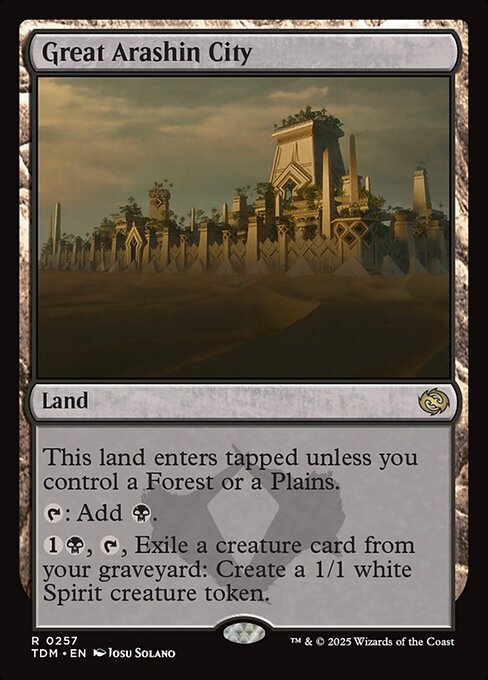 Rating7.0Good
Why this rating?
A very good rare of the format (7.0/10).
Why. A land that taps for black mana and enters untapped if you control a Forest or a Plains. Later, two mana, a tap and a creature card exiled from your graveyard create a 1/1 white Spirit creature token: late-game value.
Risks. It enters tapped without a Forest or a Plains. The effect needs creature cards in your graveyard, so it takes time to become useful.
In the draft. A good land for black-white or black-green decks. Take it as a mana bonus, not as a main card.
Results in the games of the set
When it is in hand, the deck wins 57.1% of its games (set average: 56.0%, 77th of 274 cards).
In the opening hand: 56.9% wins (54.9% on average).
Drawn during the game: 57.2% (56.7% on average).
When it is drawn, the deck wins 2.3 points more than when it is not.
When it is drafted, it is played 74% of the time (set average: 65%).
Taken among the first three picks (100 drafts), it ends in the deck 90% of the time.
 Rating7.0Good
Why this rating?
A very good rare of the format (7.0/10).
Why. A 3/6 lifelink body for five mana: a good blocker that stabilises the game. When it enters, you search your library for a black card, a green card and a blue card and put them into your graveyard, filling it in one go.
Risks. It puts no cards in your hand, so the ability only matters if your deck uses the graveyard. Three exact colours and a five-mana cost.
In the draft. A late pick for a blue-black-green deck, more a good blocker than a real source of value. Take it after your removal and threats.
Results in the games of the set
When it is in hand, the deck wins 57.9% of its games (set average: 56.0%, 54th of 274 cards).
In the opening hand: 54.4% wins (54.9% on average).
Drawn during the game: 59.9% (56.7% on average).
When it is drawn, the deck wins 5.8 points more than when it is not.
When it is drafted, it is played 76% of the time (set average: 65%).
Taken as the first pick (72 drafts), it ends in the deck 88% of the time.
It is played about as much in every archetype.
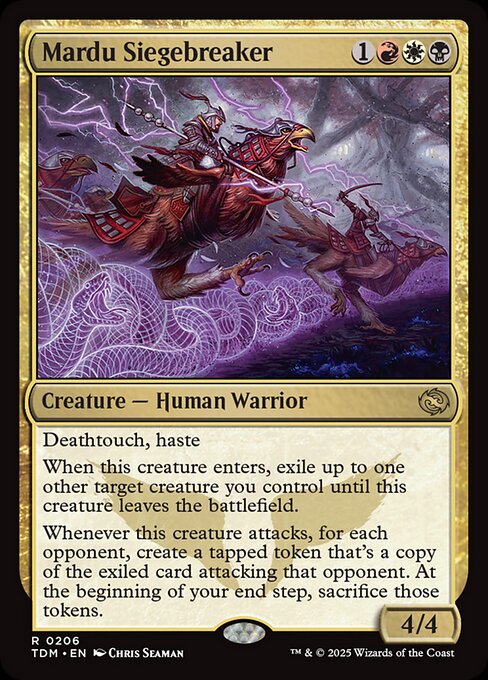 Rating7.0Good
Why this rating?
A very good rare of the format (7.0/10).
Why. A 4/4 with deathtouch and haste for four mana, already strong on its own. When it enters, it exiles another creature you control until it leaves the battlefield; whenever it attacks, it creates a tapped and attacking token copy of that creature, sacrificed at the beginning of the next end step.
Risks. You need another creature to exile, and that creature is gone while Mardu Siegebreaker is on the battlefield. If it dies, it returns the creature, but you lose tempo. Three exact colours.
In the draft. A good pick for a red-white-black deck with creatures that have useful enter effects. Worse without them: take it after the removal spells.
Results in the games of the set
When it is in hand, the deck wins 54.8% of its games (set average: 56.0%, 168th of 274 cards).
In the opening hand: 53.6% wins (54.9% on average).
Drawn during the game: 55.6% (56.7% on average).
When it is drawn, the deck wins 1.3 points more than when it is not.
When it is drafted, it is played 84% of the time (set average: 65%).
Taken as the first pick (64 drafts), it ends in the deck 86% of the time.
It is played about as much in every archetype.
 Rating7.0Good
Why this rating?
A very good rare of the format (7.0/10).
Why. A Saga that sorts your library: chapters I and II let you look at the top three cards, keep one in hand and put the rest on the bottom. At chapter III, each noncreature spell you cast this turn gives a target creature double strike until end of turn.
Risks. It adds nothing to the board before chapter III, and three exact colours for a selection effect is demanding. It does not win the game alone.
In the draft. A good pick in a white-blue-red deck with many noncreature spells. In a creature deck it is fine, not essential.
Results in the games of the set
When it is in hand, the deck wins 58.9% of its games (set average: 56.0%, 35th of 274 cards).
In the opening hand: 56.4% wins (54.9% on average).
Drawn during the game: 60.4% (56.7% on average).
When it is drawn, the deck wins 6.9 points more than when it is not.
When it is drafted, it is played 77% of the time (set average: 65%).
Taken as the first pick (78 drafts), it ends in the deck 88% of the time.
It is played about as much in every archetype.
 Rating7.0Good
Why this rating?
A very good rare of the format (7.0/10).
Why. A two-mana 2/2 that becomes a threat with Dragons. When it enters, you may behold a Dragon; if you do, you create a Treasure token. Each Dragon that enters afterwards gives it a +1/+1 counter, and it becomes a Dragon with flying until end of turn.
Risks. Without a Dragon in hand or on the battlefield, it is just a plain 2/2. Everything depends on the number of Dragons in your deck.
In the draft. Take it in a red deck with several Dragons. Otherwise it is too dependent: pass it for more reliable cards.
Results in the games of the set
When it is in hand, the deck wins 56.4% of its games (set average: 56.0%, 95th of 274 cards).
In the opening hand: 56.7% wins (54.9% on average).
Drawn during the game: 56.2% (56.7% on average).
When it is drawn, the deck wins 3.4 points more than when it is not.
When it is drafted, it is played 84% of the time (set average: 65%).
Taken as the first pick (84 drafts), it ends in the deck 89% of the time.
It is played about as much in every archetype.
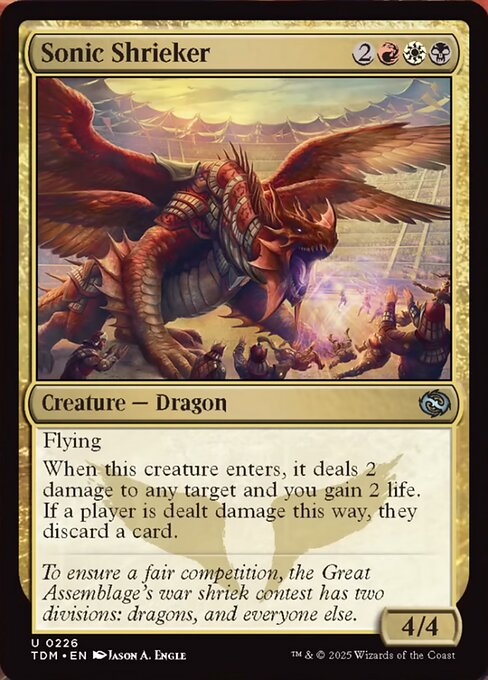
48. Sonic Shrieker
Rating7.0GoodWhy this rating?
A solid uncommon of the format (7.0/10).
Why. A 4/4 Dragon with flying for six mana that does a lot at once. When it enters, it deals 2 damage to any target and you gain 2 life; if a player is dealt damage, they discard a card. It kills a small creature or chips the opponent.
Risks. Six mana and three exact colours: your mana has to be right. At that cost, removal on it costs you tempo.
In the draft. A very good uncommon for a red-white-black deck. Happily take it in those colours.
Results in the games of the set
When it is in hand, the deck wins 60.9% of its games (set average: 56.0%, 18th of 274 cards).
In the opening hand: 59.0% wins (54.9% on average).
Drawn during the game: 62.3% (56.7% on average).
When it is drawn, the deck wins 6.9 points more than when it is not.
When it is drafted, it is played 87% of the time (set average: 65%).
Taken as the first pick (223 drafts), it ends in the deck 90% of the time.
It is played mostly in R/W decks (38% of them) and B/W (36%).
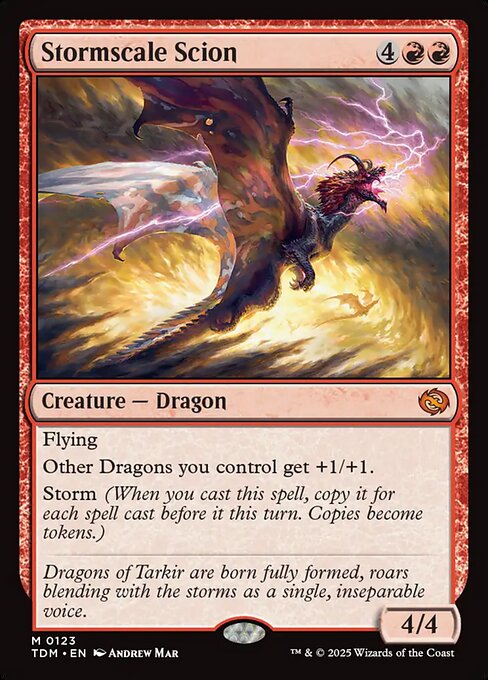
49. Stormscale Scion
Rating7.0GoodWhy this rating?
A very good mythic of the format (7.0/10).
Why. A 4/4 Dragon with flying for six mana that gives other Dragons +1/+1. Storm copies it for each spell cast before it this turn: with cheap spells cast first, you get several Dragons at once.
Risks. Six mana for a 4/4, and you must cast other spells before it the same turn to benefit from Storm. Without that, it is just an expensive Dragon.
In the draft. A late pick for a red deck full of Dragons. Otherwise it is too expensive: pass it for cards that play on turn four or five.
Results in the games of the set
When it is in hand, the deck wins 56.7% of its games (set average: 56.0%, 87th of 274 cards).
In the opening hand: 51.2% wins (54.9% on average).
Drawn during the game: 59.9% (56.7% on average).
When it is drawn, the deck wins 5.6 points more than when it is not.
When it is drafted, it is played 88% of the time (set average: 65%).
Taken as the first pick (37 drafts), it ends in the deck 76% of the time.
It is played about as much in every archetype.

50. Bloomvine Regent // Claim Territory
Rating7.0GoodWhy this rating?
A very good rare of the format (7.0/10).
Why. A 4/5 Dragon with flying for five mana that gains you 3 life whenever it or another Dragon enters under your control. Its Omen, Claim Territory, fetches up to two basic Forests, one onto the battlefield tapped and the other to your hand, then the card is shuffled into your library.
Risks. The Omen shuffles the card back into the library, so you redraw it later, not right away. The Dragon needs two green mana.
In the draft. A good green rare: early mana acceleration, then a big Dragon later. Play it in green decks.
Results in the games of the set
When it is in hand, the deck wins 58.9% of its games (set average: 56.0%, 36th of 274 cards).
In the opening hand: 54.9% wins (54.9% on average).
Drawn during the game: 61.2% (56.7% on average).
When it is drawn, the deck wins 7.3 points more than when it is not.
When it is drafted, it is played 96% of the time (set average: 65%).
Taken as the first pick (108 drafts), it ends in the deck 98% of the time.
It is played about as much in every archetype.
 Rating6.9Good
Why this rating?
A very good rare of the format (6.9/10).
Why. A clone for four mana: it may enter as a copy of any creature on the battlefield, yours or your opponent's. From the graveyard, Renew puts a +1/+1 counter on a nonlegendary creature you control and turns your other creatures into copies of it for the turn.
Risks. If there is no good creature to copy, it enters as a 0/0 and dies (or settles for a small copy). It depends entirely on the board.
In the draft. A reasonable blue clone, worth taking for a deck of solid creatures. Not a priority, especially into many weak creatures.
Results in the games of the set
When it is in hand, the deck wins 56.3% of its games (set average: 56.0%, 101st of 274 cards).
In the opening hand: 52.1% wins (54.9% on average).
Drawn during the game: 58.8% (56.7% on average).
When it is drawn, the deck wins 3.3 points more than when it is not.
When it is drafted, it is played 96% of the time (set average: 65%).
Taken as the first pick (105 drafts), it ends in the deck 97% of the time.
It is played about as much in every archetype.
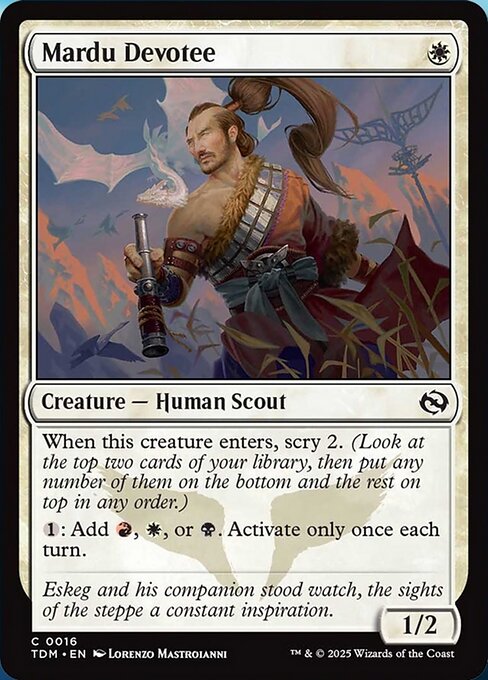
52. Mardu Devotee
Rating6.8GoodWhy this rating?
One of the best commons of the format (6.8/10).
Why. A one-mana 1/2 that scries 2 when it enters, then filters: pay one mana to add red, white or black mana, once per turn. It smooths both the draws and the mana of a red-white-black deck.
Risks. A 1/2 that deals almost no damage. It only makes red, white or black mana, and only after you pay one mana first.
In the draft. A good common for a red-white-black or red-white deck. Take it after the removal spells and the good creatures.
Results in the games of the set
When it is in hand, the deck wins 58.0% of its games (set average: 56.0%, 52nd of 274 cards).
In the opening hand: 60.3% wins (54.9% on average).
Drawn during the game: 56.0% (56.7% on average).
When it is drawn, the deck wins 1.2 points more than when it is not.
When it is drafted, it is played 83% of the time (set average: 65%).
Taken as the first pick (201 drafts), it ends in the deck 97% of the time.
It is played mostly in R/W decks (67% of them) and B/W (59%).
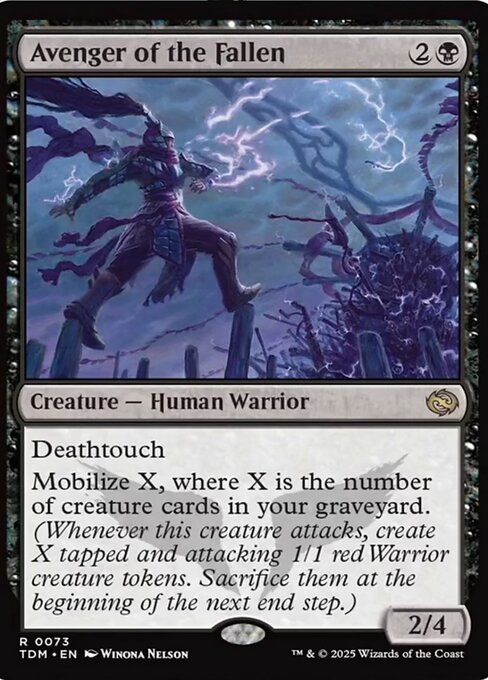 Rating6.8Good
Why this rating?
A very good rare of the format (6.8/10).
Why. A 2/4 with deathtouch for three mana, a solid blocker. Its Mobilize is X, the number of creature cards in your graveyard: late in the game, each attack creates several Warriors.
Risks. Early on, the graveyard is empty and Mobilize does almost nothing. It only becomes threatening once your creatures start dying.
In the draft. A decent black pick for a midrange deck, more a good blocker than an early threat. Take it after the removal spells.
Results in the games of the set
When it is in hand, the deck wins 55.0% of its games (set average: 56.0%, 159th of 274 cards).
In the opening hand: 54.0% wins (54.9% on average).
Drawn during the game: 55.7% (56.7% on average).
When it is drawn, the deck wins 2.4 points more than when it is not.
When it is drafted, it is played 90% of the time (set average: 65%).
Taken as the first pick (56 drafts), it ends in the deck 89% of the time.
It is played about as much in every archetype.
 Rating6.8Good
Why this rating?
A very good rare of the format (6.8/10).
Why. A land that taps for white mana and enters untapped if you control a Swamp or a Mountain. For three mana and a tap, whenever you attack this turn, you create two 1/1 red Warrior creature tokens tapped and attacking: extra offence.
Risks. It enters tapped without a Swamp or a Mountain. The activation costs three mana on top of tapping the land and only pays off if you attack.
In the draft. A good land for an attacking white-red or white-black deck. Take it as a land bonus, after your good spells.
Results in the games of the set
When it is in hand, the deck wins 56.1% of its games (set average: 56.0%, 110th of 274 cards).
In the opening hand: 56.9% wins (54.9% on average).
Drawn during the game: 55.5% (56.7% on average).
When it is drawn, the deck wins 0.2 points less than when it is not.
When it is drafted, it is played 85% of the time (set average: 65%).
Taken as the first pick (36 drafts), it ends in the deck 97% of the time.
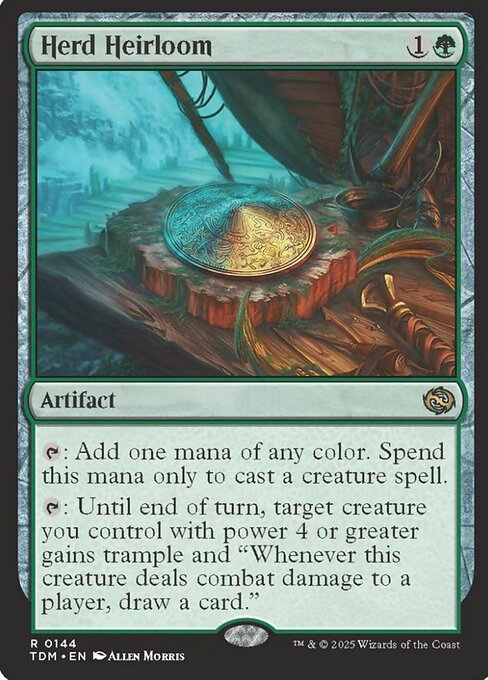
55. Herd Heirloom
Rating6.8GoodWhy this rating?
A very good rare of the format (6.8/10).
Why. A two-mana artifact with two jobs: tap for mana of any colour to cast creature spells, or give a creature with power 4 or greater trample and a card draw when it deals combat damage to a player, until end of turn.
Risks. Both abilities need a tap, so only one per turn. The mana is for creature spells only, and the draw needs a creature with power 4 or more.
In the draft. A good pick for a green deck with big creatures and varied colours. Not a priority if you have few big creatures.
Results in the games of the set
When it is in hand, the deck wins 56.8% of its games (set average: 56.0%, 86th of 274 cards).
In the opening hand: 58.8% wins (54.9% on average).
Drawn during the game: 55.3% (56.7% on average).
When it is drawn, the deck wins 4.7 points more than when it is not.
When it is drafted, it is played 91% of the time (set average: 65%).
Taken as the first pick (99 drafts), it ends in the deck 92% of the time.
It is played about as much in every archetype.

56. Songcrafter Mage
Rating6.8GoodWhy this rating?
A very good rare of the format (6.8/10).
Why. A 3/2 with flash for three mana. When it enters, an instant or sorcery card in your graveyard gains Harmonize until end of turn, with its mana cost as the Harmonize cost: tapping a creature reduces that cost by its power.
Risks. It needs an instant or sorcery in your graveyard, otherwise it is just a 3/2. Three exact colours.
In the draft. A mid-pack pick for a green-blue-red deck with plenty of spells. Without them, it loses most of its value.
Results in the games of the set
When it is in hand, the deck wins 56.0% of its games (set average: 56.0%, 112th of 274 cards).
In the opening hand: 51.5% wins (54.9% on average).
Drawn during the game: 58.7% (56.7% on average).
When it is drawn, the deck wins 3.4 points more than when it is not.
When it is drafted, it is played 80% of the time (set average: 65%).
Taken as the first pick (81 drafts), it ends in the deck 85% of the time.
It is played about as much in every archetype.
 Rating6.8Good
Why this rating?
A solid uncommon of the format (6.8/10).
Why. A 2/3 for two mana, a good early body. Whenever it becomes tapped, by attacking for instance, you look at the top card: if it is a land you may reveal it and put it into your hand; if you don't take it, you may put it into your graveyard.
Risks. It does nothing unless it taps, so you need to attack with it (it has no vigilance), which puts it at risk. It only finds lands.
In the draft. A good green pick for a midrange deck that wants consistency. Take it in green decks.
Results in the games of the set
When it is in hand, the deck wins 58.9% of its games (set average: 56.0%, 37th of 274 cards).
In the opening hand: 61.7% wins (54.9% on average).
Drawn during the game: 56.9% (56.7% on average).
When it is drawn, the deck wins 5.6 points more than when it is not.
When it is drafted, it is played 95% of the time (set average: 65%).
Taken as the first pick (264 drafts), it ends in the deck 96% of the time.
It is played mostly in B/G decks (28% of them) and G/R (27%).
 Rating6.8Good
Why this rating?
A solid uncommon of the format (6.8/10).
Why. A two-mana 3/1 that taps for red mana, so it accelerates your deck. Later, it sacrifices itself to deal 6 damage to a creature with flying, answering a Dragon.
Risks. A 3/1 dies to almost anything. It only answers creatures with flying, and the activation costs three mana plus a tap.
In the draft. A good red pick to ramp and to answer creatures with flying. Take it at a fair price, after the removal spells.
Results in the games of the set
When it is in hand, the deck wins 57.5% of its games (set average: 56.0%, 64th of 274 cards).
In the opening hand: 59.2% wins (54.9% on average).
Drawn during the game: 56.2% (56.7% on average).
When it is drawn, the deck wins 2.2 points more than when it is not.
When it is drafted, it is played 93% of the time (set average: 65%).
Taken as the first pick (190 drafts), it ends in the deck 92% of the time.
It is played mostly in G/R decks (30% of them) and R/W (27%).
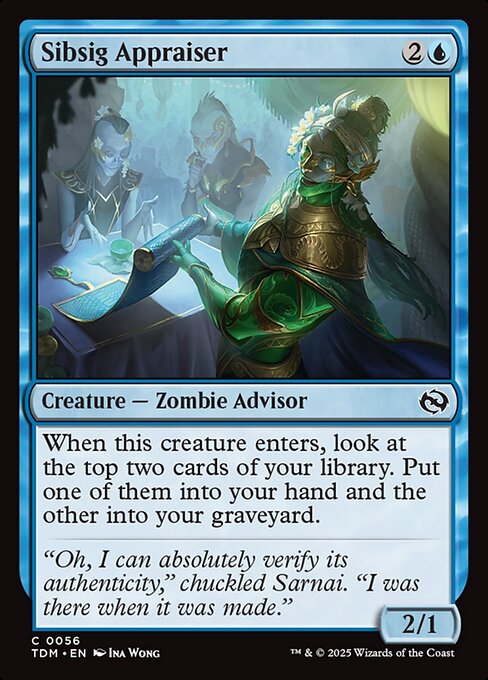
59. Sibsig Appraiser
Rating6.7GoodWhy this rating?
One of the best commons of the format (6.7/10).
Why. A 2/1 for three mana that sorts your cards: when it enters, you look at the top two cards, put one in your hand and the other in your graveyard. A good selection tool for a blue deck.
Risks. A 2/1 for three mana is a small body. The effect is fine, but it does not swing a game by itself.
In the draft. A good blue common for a control or midrange deck. Take it after the removal spells and the better creatures.
Results in the games of the set
When it is in hand, the deck wins 59.1% of its games (set average: 56.0%, 33rd of 274 cards).
In the opening hand: 57.7% wins (54.9% on average).
Drawn during the game: 59.9% (56.7% on average).
When it is drawn, the deck wins 5.6 points more than when it is not.
When it is drafted, it is played 94% of the time (set average: 65%).
Taken as the first pick (549 drafts), it ends in the deck 97% of the time.
It is played mostly in R/U decks (65% of them) and B/U (59%).

60. Karakyk Guardian
Rating6.6GoodWhy this rating?
A solid uncommon of the format (6.6/10).
Why. A 6/5 Dragon with flying, vigilance and trample: it attacks and defends at once. It has hexproof until it has dealt damage, so your opponent cannot target it before its first attack.
Risks. Six mana and three exact colours. Once it has dealt damage, it is vulnerable to removal again.
In the draft. A good uncommon for a green-blue-red deck. Take it in those colours: it closes out games.
Results in the games of the set
When it is in hand, the deck wins 59.8% of its games (set average: 56.0%, 27th of 274 cards).
In the opening hand: 56.1% wins (54.9% on average).
Drawn during the game: 61.9% (56.7% on average).
When it is drawn, the deck wins 8.3 points more than when it is not.
When it is drafted, it is played 92% of the time (set average: 65%).
Taken as the first pick (260 drafts), it ends in the deck 94% of the time.
It is played mostly in G/R decks (38% of them) and R/U (37%).
 Rating6.6Good
Why this rating?
A solid uncommon of the format (6.6/10).
Why. A 0/4 with vigilance and Mobilize 3 for three mana: each attack creates three tapped and attacking 1/1 red Warrior creature tokens. Thanks to vigilance, it attacks and stays back to defend.
Risks. Its power is 0: all the damage comes from the tokens, which are sacrificed at end of turn. Blockers or a sweep of small creatures neutralise them.
In the draft. A good pick for an aggressive white-red deck. Take it without too much hesitation in those colours.
Results in the games of the set
When it is in hand, the deck wins 56.6% of its games (set average: 56.0%, 88th of 274 cards).
In the opening hand: 57.7% wins (54.9% on average).
Drawn during the game: 55.8% (56.7% on average).
When it is drawn, the deck wins 1.3 points more than when it is not.
When it is drafted, it is played 90% of the time (set average: 65%).
Taken as the first pick (137 drafts), it ends in the deck 96% of the time.
It is played mostly in B/W decks (29% of them) and R/W (29%).
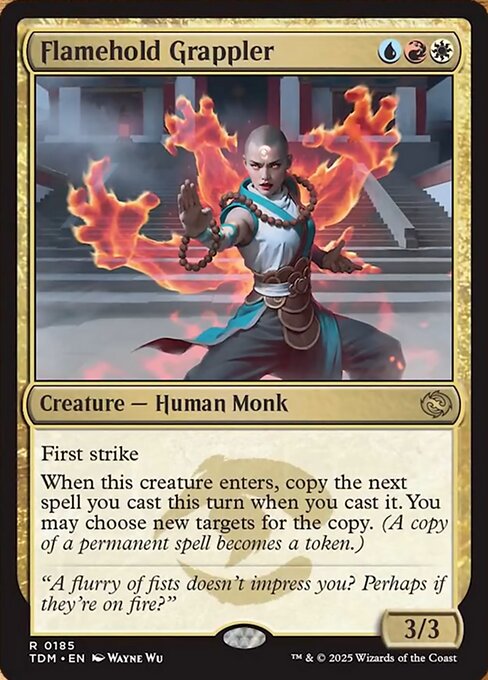 Rating6.6Good
Why this rating?
A very good rare of the format (6.6/10).
Why. A 3/3 with first strike for three mana, a good body. When it enters, it copies the next spell you cast this turn, with new targets allowed: twice the effect of a removal or value spell.
Risks. The copy needs you to have mana for another spell the same turn, otherwise it is just a 3/3. Three exact colours.
In the draft. A mid-pack pick for a white-blue-red deck with value spells. Take it after the removal spells.
Results in the games of the set
When it is in hand, the deck wins 55.3% of its games (set average: 56.0%, 143rd of 274 cards).
In the opening hand: 52.7% wins (54.9% on average).
Drawn during the game: 56.8% (56.7% on average).
When it is drawn, the deck wins 3.8 points more than when it is not.
When it is drafted, it is played 78% of the time (set average: 65%).
Taken as the first pick (59 drafts), it ends in the deck 83% of the time.
It is played about as much in every archetype.
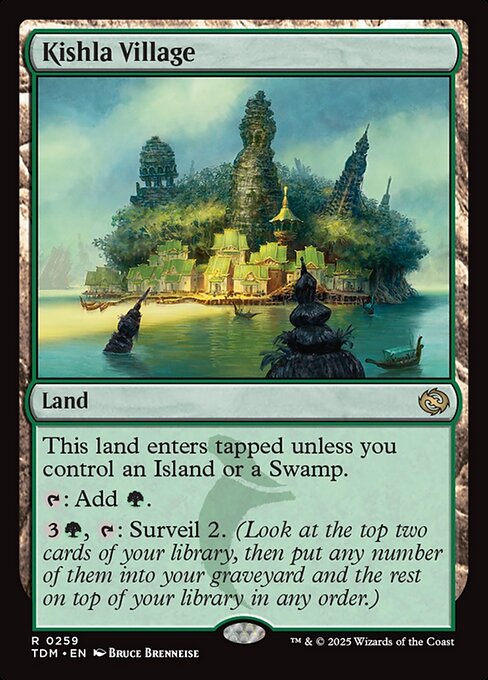
63. Kishla Village
Rating6.6GoodWhy this rating?
A very good rare of the format (6.6/10).
Why. A land that taps for green mana and enters untapped if you control an Island or a Swamp. For four mana and a tap, you surveil 2: look at the top two cards, put any number into the graveyard and the rest back on top. Late-game smoothing.
Risks. It enters tapped without an Island or a Swamp. The activation is expensive and only pays off when you have spare mana.
In the draft. A good land for a green-blue or green-black deck. Take it as a mana bonus, after your good spells.
Results in the games of the set
When it is in hand, the deck wins 56.1% of its games (set average: 56.0%, 109th of 274 cards).
In the opening hand: 55.0% wins (54.9% on average).
Drawn during the game: 56.9% (56.7% on average).
When it is drawn, the deck wins 2.3 points more than when it is not.
When it is drafted, it is played 78% of the time (set average: 65%).
Taken among the first three picks (71 drafts), it ends in the deck 96% of the time.

64. Maelstrom of the Spirit Dragon
Rating6.6GoodWhy this rating?
A very good rare of the format (6.6/10).
Why. A land that taps for colourless mana, or for any colour to cast a Dragon or an Omen spell. For four mana and a tap, you sacrifice it to search for a Dragon and put it in your hand: it fixes your Dragons and finds them.
Risks. Colourless mana does not fix your other spells, and the coloured mana is reserved for Dragon and Omen spells. It is mediocre without Dragons.
In the draft. A good pick for a deck with several Dragons. Otherwise leave it: it does nothing else.
Results in the games of the set
When it is in hand, the deck wins 57.2% of its games (set average: 56.0%, 70th of 274 cards).
In the opening hand: 55.4% wins (54.9% on average).
Drawn during the game: 58.4% (56.7% on average).
When it is drawn, the deck wins 5.5 points more than when it is not.
When it is drafted, it is played 54% of the time (set average: 65%).
Taken among the first three picks (59 drafts), it ends in the deck 92% of the time.

65. Mardu Monument
Rating6.6GoodWhy this rating?
A solid uncommon of the format (6.6/10).
Why. A two-mana artifact that fetches a basic Mountain, Plains or Swamp into your hand when it enters, fixing your mana. Later, for five mana and a tap, you sacrifice it for three 1/1 red Warrior creature tokens with menace and haste until end of turn.
Risks. The late activation needs red, white and black mana, and only works at sorcery speed. Without them, it is just two-mana fixing.
In the draft. A good pick for a red-white-black deck: fixing early, then a finishing blow. Take it in those colours.
Results in the games of the set
When it is in hand, the deck wins 58.8% of its games (set average: 56.0%, 38th of 274 cards).
In the opening hand: 58.8% wins (54.9% on average).
Drawn during the game: 58.8% (56.7% on average).
When it is drawn, the deck wins 2.6 points more than when it is not.
When it is drafted, it is played 76% of the time (set average: 65%).
Taken as the first pick (97 drafts), it ends in the deck 79% of the time.
It is played mostly in R/W decks (41% of them) and B/W (33%).
 Rating6.6Good
Why this rating?
A solid uncommon of the format (6.6/10).
Why. A two-mana enchantment that draws two cards then discards one: cheap selection. When a Dragon enters under your control, it returns to your hand, and you can replay it to start again.
Risks. It does nothing on the battlefield. Without Dragons, it never returns to hand and is just a one-shot looting effect.
In the draft. A good pick for a blue deck with Dragons. Take it at a modest price, after the creatures and removal spells.
Results in the games of the set
When it is in hand, the deck wins 58.8% of its games (set average: 56.0%, 39th of 274 cards).
In the opening hand: 57.4% wins (54.9% on average).
Drawn during the game: 59.6% (56.7% on average).
When it is drawn, the deck wins 6.3 points more than when it is not.
When it is drafted, it is played 88% of the time (set average: 65%).
Taken as the first pick (235 drafts), it ends in the deck 91% of the time.
It is played mostly in B/U decks (34% of them) and G/U (32%).
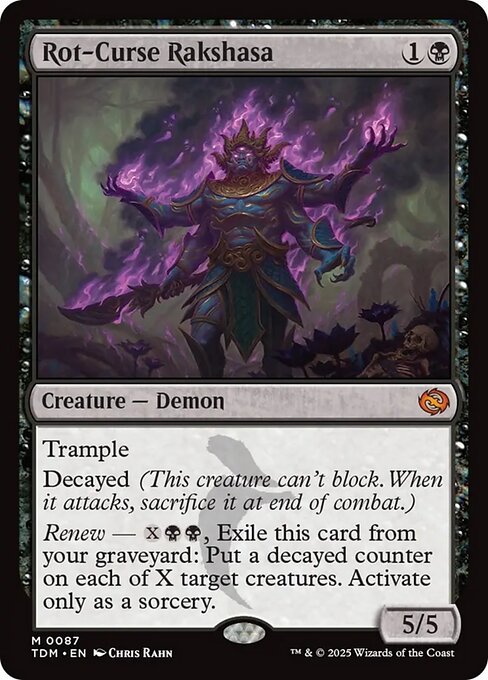 Rating6.6Good
Why this rating?
A very good mythic of the format (6.6/10).
Why. A 5/5 for two mana with trample, but decayed: it cannot block and is sacrificed at end of combat after it attacks. Renew later lets you put a decayed counter on each of X target creatures.
Risks. A single hit of 5 damage, then it is gone. It cannot block, so it does not help you defend. Renew is expensive and situational.
In the draft. A late pick for a very aggressive black deck. In most decks it is too weak to play: take it last.
Results in the games of the set
When it is in hand, the deck wins 52.2% of its games (set average: 56.0%, 234th of 274 cards).
In the opening hand: 50.3% wins (54.9% on average).
Drawn during the game: 53.7% (56.7% on average).
When it is drawn, the deck wins 1.4 points less than when it is not.
When it is drafted, it is played 84% of the time (set average: 65%).
Taken among the first three picks (80 drafts), it ends in the deck 93% of the time.
It is played about as much in every archetype.

68. Severance Priest
Rating6.6GoodWhy this rating?
A very good rare of the format (6.6/10).
Why. A 3/3 with deathtouch for three mana. When it enters, your opponent reveals their hand and you may exile a nonland card of your choice: you take their best card before it is used.
Risks. When it leaves the battlefield, the exiled card's owner creates an X/X white Spirit creature token, where X is that card's mana value. Three exact colours.
In the draft. A good pick for a white-black-green deck. Take it after the removal spells, especially if you want a good body with information.
Results in the games of the set
When it is in hand, the deck wins 55.6% of its games (set average: 56.0%, 121st of 274 cards).
In the opening hand: 55.4% wins (54.9% on average).
Drawn during the game: 55.8% (56.7% on average).
When it is drawn, the deck wins 3.4 points more than when it is not.
When it is drafted, it is played 49% of the time (set average: 65%).
Taken among the first three picks (62 drafts), it ends in the deck 79% of the time.
It is played about as much in every archetype.
 Rating6.6Good
Why this rating?
A solid uncommon of the format (6.6/10).
Why. A two-mana 1/3 with reach that holds off small fliers and pings the opponent for 1 whenever another creature enters under your control. With token makers, the damage adds up fast.
Risks. On its own it doesn't attack and doesn't win games. In a deck light on creatures the trigger rarely happens.
In the draft. A solid two-drop for a red deck with plenty of creatures and tokens. Take it after the removal, before the filler.
Results in the games of the set
When it is in hand, the deck wins 57.8% of its games (set average: 56.0%, 56th of 274 cards).
In the opening hand: 59.0% wins (54.9% on average).
Drawn during the game: 56.8% (56.7% on average).
When it is drawn, the deck wins 1.8 points more than when it is not.
When it is drafted, it is played 90% of the time (set average: 65%).
Taken as the first pick (162 drafts), it ends in the deck 93% of the time.
It is played mostly in R/W decks (37% of them) and B/R (33%).
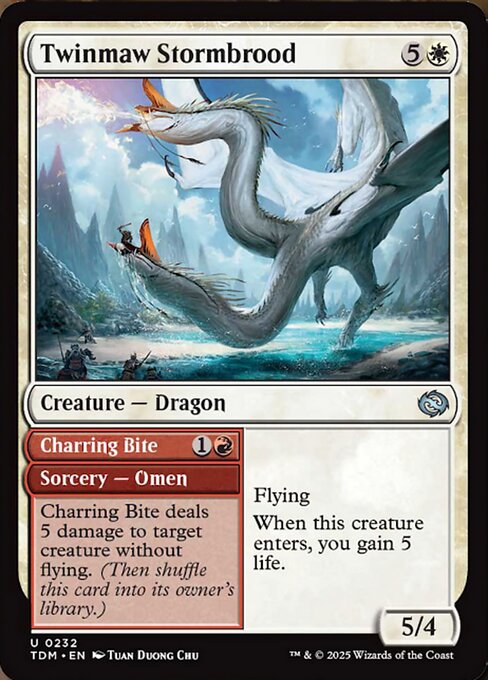
70. Twinmaw Stormbrood // Charring Bite
Rating6.6GoodWhy this rating?
A solid uncommon of the format (6.6/10).
Why. Two cards in one. The Omen is a two-mana sorcery dealing 5 damage to a creature without flying: cheap removal, and the card then shuffles back into your library. Later, the six-mana 5/4 Dragon lands with flying and gains you 5 life.
Risks. The halves are in different colours: the Omen needs red, the Dragon needs white. The Omen can't hit fliers.
In the draft. Good in a white-red deck where both halves are castable. Outside red it loses its best feature and is just a slow top-end flier.
Results in the games of the set
When it is in hand, the deck wins 59.0% of its games (set average: 56.0%, 34th of 274 cards).
In the opening hand: 55.9% wins (54.9% on average).
Drawn during the game: 60.8% (56.7% on average).
When it is drawn, the deck wins 5.3 points more than when it is not.
When it is drafted, it is played 97% of the time (set average: 65%).
Taken as the first pick (323 drafts), it ends in the deck 98% of the time.
It is played mostly in U/W decks (33% of them) and R/W (27%).
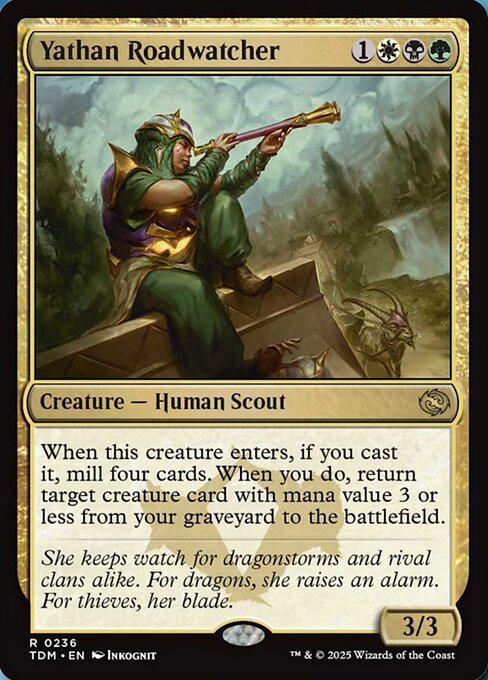 Rating6.6Good
Why this rating?
A very good rare of the format (6.6/10).
Why. A four-mana 3/3 that mills four cards, then returns a creature card with mana value 3 or less from your graveyard to the battlefield, possibly one it just milled. Two bodies for one card.
Risks. Three colours by turn four is hard to hit on time. It must be cast from your hand, and with no creature card of mana value 3 or less in the graveyard it is just a 3/3.
In the draft. Only take it if you're already set up in white, black and green. Otherwise it isn't worth the mana demands.
Results in the games of the set
When it is in hand, the deck wins 56.9% of its games (set average: 56.0%, 82nd of 274 cards).
In the opening hand: 55.5% wins (54.9% on average).
Drawn during the game: 57.8% (56.7% on average).
When it is drawn, the deck wins 3.8 points more than when it is not.
When it is drafted, it is played 68% of the time (set average: 65%).
Taken as the first pick (46 drafts), it ends in the deck 78% of the time.
It is played about as much in every archetype.

72. Frontline Rush
Rating6.5GoodWhy this rating?
A solid uncommon of the format (6.5/10).
Why. A flexible two-mana instant: two 1/1 red Goblin creature tokens to fill the board, or +X/+X in combat where X is the number of creatures you control. The second mode can swing a fight at the right moment.
Risks. It needs both colours. The pump mode is weak on an empty board, though the token mode always works.
In the draft. A good pick for a red-white deck with lots of creatures. The tokens keep it playable even when the pump isn't relevant.
Results in the games of the set
When it is in hand, the deck wins 57.6% of its games (set average: 56.0%, 63rd of 274 cards).
In the opening hand: 57.3% wins (54.9% on average).
Drawn during the game: 57.7% (56.7% on average).
When it is drawn, the deck wins 0.7 points more than when it is not.
When it is drafted, it is played 87% of the time (set average: 65%).
Taken as the first pick (114 drafts), it ends in the deck 91% of the time.
It is played mostly in R/W decks (43% of them).
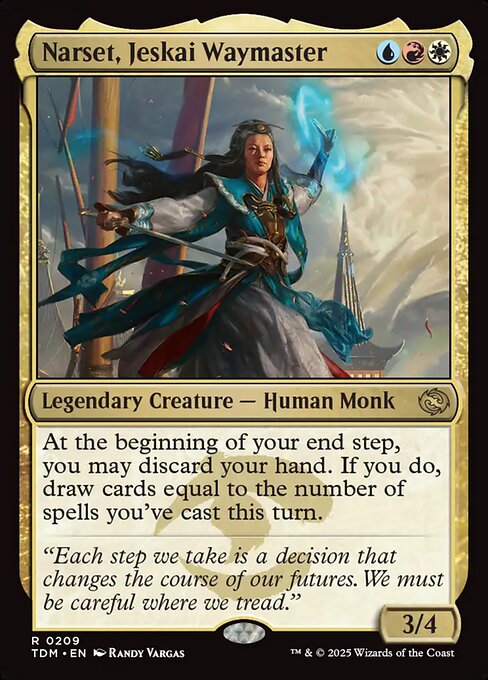 Rating6.5Good
Why this rating?
Good playable that always makes the cut (6.5/10).
Why. A reasonable three-mana 3/4 that, at your end step, can discard your hand to draw as many cards as spells you cast this turn. After a turn where you emptied your hand, it refuels you.
Risks. Three colours, and a body that does nothing special without the ability. If you hold a useful hand or only cast one spell, you simply decline the discard.
In the draft. Only for a three-colour deck that empties its hand early. Don't take it over stronger cards of its archetype.
Results in the games of the set
When it is in hand, the deck wins 56.1% of its games (set average: 56.0%, 108th of 274 cards).
In the opening hand: 54.3% wins (54.9% on average).
Drawn during the game: 57.2% (56.7% on average).
When it is drawn, the deck wins 4.7 points more than when it is not.
When it is drafted, it is played 71% of the time (set average: 65%).
Taken as the first pick (45 drafts), it ends in the deck 91% of the time.
It is played about as much in every archetype.

74. Dragon Sniper
Rating6.4GoodWhy this rating?
Good playable that always makes the cut (6.4/10).
Why. A one-mana 1/1 with reach, vigilance and deathtouch: it blocks nearly anything, threatens to trade with the opponent's biggest creature, and can attack without ceasing to defend.
Risks. It's a 1/1: any minor damage spell kills it, and it brings no offensive pressure. It won't win the game alone.
In the draft. A good one-drop for a green deck, especially a defensive or controlling one. It isn't worth taking over a good creature or removal.
Results in the games of the set
When it is in hand, the deck wins 57.5% of its games (set average: 56.0%, 65th of 274 cards).
In the opening hand: 57.1% wins (54.9% on average).
Drawn during the game: 57.7% (56.7% on average).
When it is drawn, the deck wins 3.9 points more than when it is not.
When it is drafted, it is played 93% of the time (set average: 65%).
Taken as the first pick (119 drafts), it ends in the deck 97% of the time.
It is played about as much in every archetype.
 Rating6.4Good
Why this rating?
Good playable that always makes the cut (6.4/10).
Why. A two-drop with Endure 1, your choice: a 2/3 with a counter, or a 1/2 plus a 1/1 white Spirit creature token. In a creature deck the token counts for anything that counts your creatures.
Risks. Modest body either way. Without synergies for counters or wide boards it just fills a two-mana slot.
In the draft. A fine common for an aggressive white deck. Take it as curve filler after the removal and the better creatures.
Results in the games of the set
When it is in hand, the deck wins 56.8% of its games (set average: 56.0%, 83rd of 274 cards).
In the opening hand: 58.3% wins (54.9% on average).
Drawn during the game: 55.7% (56.7% on average).
When it is drawn, the deck wins 0.1 points more than when it is not.
When it is drafted, it is played 86% of the time (set average: 65%).
Taken as the first pick (148 drafts), it ends in the deck 94% of the time.
It is played mostly in B/W decks (69% of them) and R/W (66%).
 Rating6.4Good
Why this rating?
Good playable that always makes the cut (6.4/10).
Why. A two-mana sorcery that draws and lets you discard: if you discard a nonland card, it deals 3 damage to a creature. Harmonize lets you cast it again later for a second removal.
Risks. You need a nonland card you are willing to discard to trigger the damage. It's a sorcery, so it can't answer a threat in the middle of combat.
In the draft. A good blue-red uncommon: filtering and removal in one card, with a late-game second use. Take it fairly high in those colours.
Results in the games of the set
When it is in hand, the deck wins 58.5% of its games (set average: 56.0%, 45th of 274 cards).
In the opening hand: 57.0% wins (54.9% on average).
Drawn during the game: 59.5% (56.7% on average).
When it is drawn, the deck wins 5.2 points more than when it is not.
When it is drafted, it is played 90% of the time (set average: 65%).
Taken as the first pick (168 drafts), it ends in the deck 94% of the time.
It is played mostly in R/U decks (39% of them).
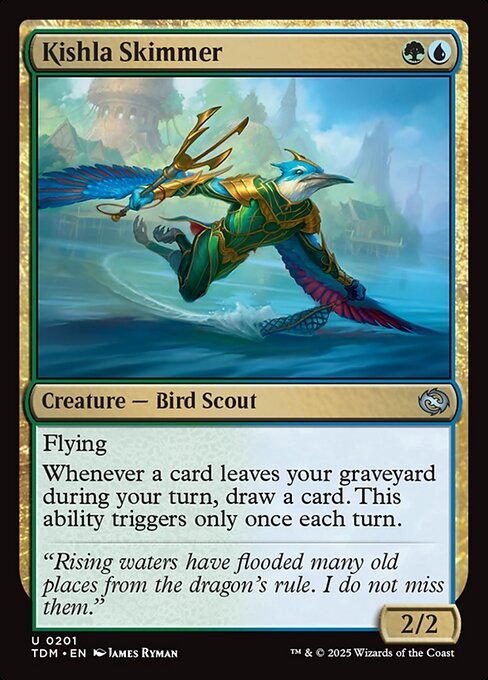
77. Kishla Skimmer
Rating6.4GoodWhy this rating?
Good playable that always makes the cut (6.4/10).
Why. A two-mana 2/2 flier that draws a card whenever a card leaves your graveyard during your turn, once per turn. With Harmonize, Renew or other graveyard effects, it becomes a card engine.
Risks. Without cards leaving the graveyard, it's just a small flier. It needs two specific colours and dies to anything that hits a 2/2.
In the draft. A good uncommon for a green-blue deck that uses its graveyard. A two-mana flier is still playable even without the draw.
Results in the games of the set
When it is in hand, the deck wins 57.6% of its games (set average: 56.0%, 61st of 274 cards).
In the opening hand: 56.6% wins (54.9% on average).
Drawn during the game: 58.2% (56.7% on average).
When it is drawn, the deck wins 4.9 points more than when it is not.
When it is drafted, it is played 89% of the time (set average: 65%).
Taken as the first pick (168 drafts), it ends in the deck 93% of the time.
It is played mostly in G/U decks (40% of them).
 Rating6.4Good
Why this rating?
Good playable that always makes the cut (6.4/10).
Why. A three-mode instant: two 1/1 white Monk creature tokens with prowess, +2/+2 to up to two of your creatures, or destroy a creature with power 4 or greater. It costs two less if you've already cast another spell this turn.
Risks. The destroy mode only hits big creatures. At the full four-mana price it's expensive for the effect.
In the draft. Very versatile: removal, trick or reinforcements. Take it fairly high in a white deck that often casts two spells a turn.
Results in the games of the set
When it is in hand, the deck wins 59.1% of its games (set average: 56.0%, 32nd of 274 cards).
In the opening hand: 57.8% wins (54.9% on average).
Drawn during the game: 59.9% (56.7% on average).
When it is drawn, the deck wins 3.7 points more than when it is not.
When it is drafted, it is played 93% of the time (set average: 65%).
Taken as the first pick (217 drafts), it ends in the deck 97% of the time.
It is played mostly in U/W decks (32% of them) and R/W (30%).

79. Shock Brigade
Rating6.4GoodWhy this rating?
Good playable that always makes the cut (6.4/10).
Why. A two-mana 1/3 with menace and Mobilize 1: each attack adds a tapped and attacking 1/1 red Warrior creature token. It brings two attackers for one card and absorbs small creatures well.
Risks. It has only 1 power, and the token disappears at end of turn: its pressure rests on menace and a fast board.
In the draft. A fine common for an aggressive red deck as a two-drop. Never take it over a removal spell.
Results in the games of the set
When it is in hand, the deck wins 56.0% of its games (set average: 56.0%, 113th of 274 cards).
In the opening hand: 57.6% wins (54.9% on average).
Drawn during the game: 54.7% (56.7% on average).
When it is drawn, the deck wins 0.7 points less than when it is not.
When it is drafted, it is played 86% of the time (set average: 65%).
Taken as the first pick (203 drafts), it ends in the deck 95% of the time.
It is played mostly in R/W decks (69% of them) and B/R (59%).

80. Smile at Death
Rating6.4GoodWhy this rating?
Good playable that always makes the cut (6.4/10).
Why. Each upkeep, it returns up to two creature cards with power 2 or less from your graveyard, each with a +1/+1 counter. If the game goes long and your graveyard is full, it's an enormous value engine.
Risks. Five mana for an enchantment that does nothing the turn it arrives. You need creature cards with power 2 or less in your graveyard already, and it does nothing to the board until your next turn.
In the draft. Slow and graveyard-dependent. Only take it in a grindy deck with many small creatures, and never early.
Results in the games of the set
When it is in hand, the deck wins 51.7% of its games (set average: 56.0%, 245th of 274 cards).
In the opening hand: 48.8% wins (54.9% on average).
Drawn during the game: 53.7% (56.7% on average).
When it is drawn, the deck wins 2.3 points less than when it is not.
When it is drafted, it is played 82% of the time (set average: 65%).
Taken among the first three picks (79 drafts), it ends in the deck 85% of the time.
It is played about as much in every archetype.

81. Sunpearl Kirin
Rating6.4GoodWhy this rating?
Good playable that always makes the cut (6.4/10).
Why. A two-mana 2/1 flash flier. When it enters, it returns another nonland permanent you control to your hand, and you draw if it was a token. It can save a creature from removal or replay an enters effect.
Risks. A fragile 2/1. Without a permanent to return the bonus is lost, and drawing off a token is a niche case.
In the draft. A good tempo two-drop for an aggressive white deck. Take it as a flash flier with a bonus effect.
Results in the games of the set
When it is in hand, the deck wins 56.9% of its games (set average: 56.0%, 80th of 274 cards).
In the opening hand: 56.6% wins (54.9% on average).
Drawn during the game: 57.2% (56.7% on average).
When it is drawn, the deck wins 1.1 points more than when it is not.
When it is drafted, it is played 92% of the time (set average: 65%).
Taken as the first pick (136 drafts), it ends in the deck 96% of the time.
It is played mostly in B/W decks (31% of them) and R/W (28%).
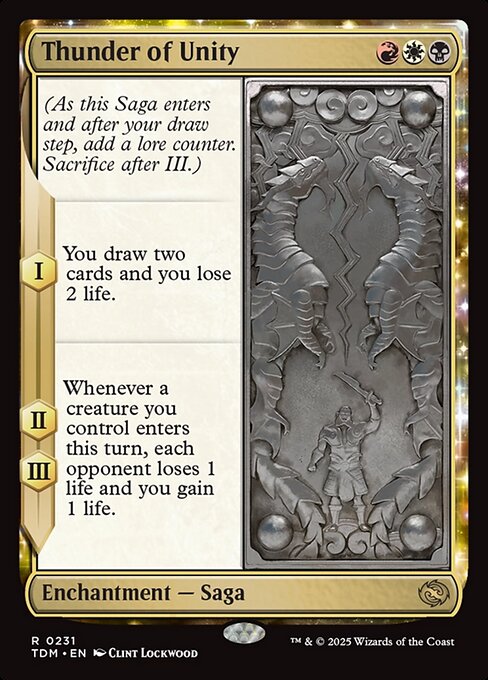
82. Thunder of Unity
Rating6.4GoodWhy this rating?
Good playable that always makes the cut (6.4/10).
Why. A three-chapter Saga: you draw two cards and lose 2 life, then on the next two turns each creature that enters under your control makes each opponent lose 1 life and you gain 1. Card draw and drain in one.
Risks. Three colours for a slow card, with chapters II and III only mattering if you deploy creatures. The first chapter does nothing for the board.
In the draft. Only for a white-black-red deck with a full creature curve. Otherwise the card draw alone doesn't justify the cost.
Results in the games of the set
When it is in hand, the deck wins 53.5% of its games (set average: 56.0%, 208th of 274 cards).
In the opening hand: 52.8% wins (54.9% on average).
Drawn during the game: 54.0% (56.7% on average).
When it is drawn, the deck wins 1.2 points less than when it is not.
When it is drafted, it is played 70% of the time (set average: 65%).
Taken among the first three picks (126 drafts), it ends in the deck 85% of the time.
It is played about as much in every archetype.
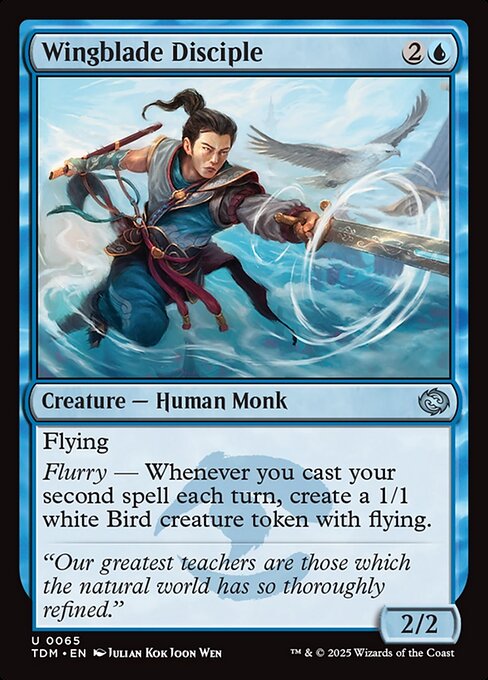 Rating6.3Good
Why this rating?
Good playable that always makes the cut (6.3/10).
Why. A three-mana 2/2 flier with Flurry: each time you cast your second spell in a turn you create a 1/1 white Bird creature token with flying. In a deck of cheap spells, it fills the skies.
Risks. Without two-spell turns it's just a 2/2 flier for three. Fragile.
In the draft. A good blue uncommon for a deck of cheap spells. Take it higher if you already have plenty of instants and sorceries.
Results in the games of the set
When it is in hand, the deck wins 57.6% of its games (set average: 56.0%, 62nd of 274 cards).
In the opening hand: 55.1% wins (54.9% on average).
Drawn during the game: 59.1% (56.7% on average).
When it is drawn, the deck wins 5.0 points more than when it is not.
When it is drafted, it is played 89% of the time (set average: 65%).
Taken as the first pick (195 drafts), it ends in the deck 91% of the time.
It is played mostly in R/U decks (43% of them) and U/W (38%).

84. Zurgo's Vanguard
Rating6.3GoodWhy this rating?
Good playable that always makes the cut (6.3/10).
Why. A three-mana */3 whose power equals the number of creatures you control. With Mobilize 1 the token counts immediately: it attacks as at least a 2/3 and grows with the board.
Risks. Alone it hits weakly, and its power depends on a populated board. It dislikes sweepers.
In the draft. A good three-drop for a red deck with many creatures. The more tokens in your deck, the better it gets.
Results in the games of the set
When it is in hand, the deck wins 56.0% of its games (set average: 56.0%, 115th of 274 cards).
In the opening hand: 57.7% wins (54.9% on average).
Drawn during the game: 54.6% (56.7% on average).
When it is drawn, the deck wins 0.2 points less than when it is not.
When it is drafted, it is played 84% of the time (set average: 65%).
Taken as the first pick (108 drafts), it ends in the deck 91% of the time.
It is played mostly in R/W decks (35% of them) and B/R (29%).
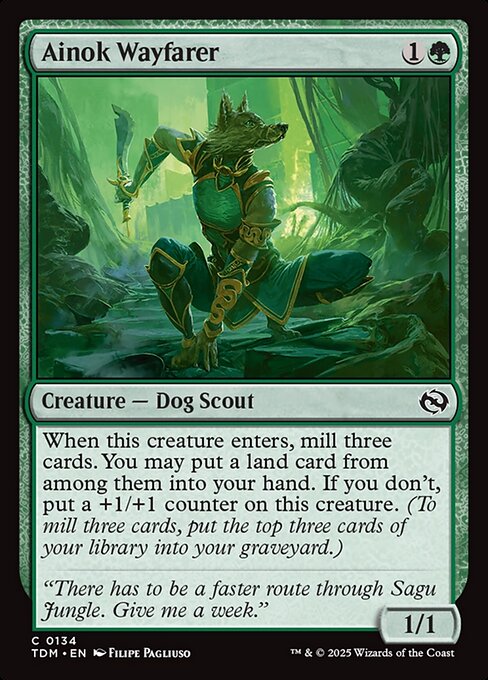
85. Ainok Wayfarer
Rating6.2GoodWhy this rating?
Good playable that always makes the cut (6.2/10).
Why. A two-drop that mills three: you may put a land card from among them into your hand, otherwise it gets a +1/+1 counter. It smooths your land drops and fills your graveyard for Harmonize.
Risks. A small body, and the mill can put good cards into the graveyard. No direct impact on the board.
In the draft. A decent filler common for a green deck. Take it for consistency, after the more powerful cards.
Results in the games of the set
When it is in hand, the deck wins 57.2% of its games (set average: 56.0%, 72nd of 274 cards).
In the opening hand: 57.3% wins (54.9% on average).
Drawn during the game: 57.0% (56.7% on average).
When it is drawn, the deck wins 2.8 points more than when it is not.
When it is drafted, it is played 87% of the time (set average: 65%).
Taken as the first pick (183 drafts), it ends in the deck 98% of the time.
It is played mostly in G/U decks (55% of them) and B/G (53%).
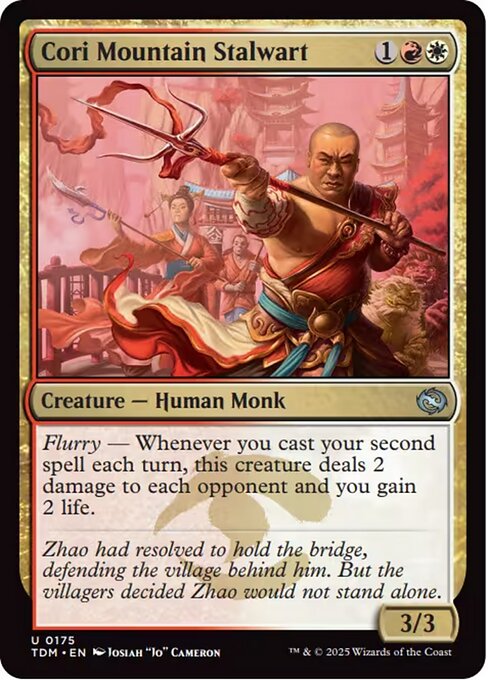 Rating6.2Good
Why this rating?
Good playable that always makes the cut (6.2/10).
Why. A three-mana 3/3 with Flurry: each second spell in a turn deals 2 damage to each opponent and gains you 2 life. A good base body with an ability that pays off in two-spell turns.
Risks. It requires two colours and the trigger depends on two-spell turns. Without them, it's a vanilla 3/3.
In the draft. A good red-white uncommon for a deck of cheap spells. Take it for the sturdy body and treat Flurry as a bonus.
Results in the games of the set
When it is in hand, the deck wins 56.3% of its games (set average: 56.0%, 97th of 274 cards).
In the opening hand: 56.4% wins (54.9% on average).
Drawn during the game: 56.3% (56.7% on average).
When it is drawn, the deck wins 1.2 points more than when it is not.
When it is drafted, it is played 87% of the time (set average: 65%).
Taken as the first pick (124 drafts), it ends in the deck 98% of the time.
It is played mostly in R/W decks (35% of them).
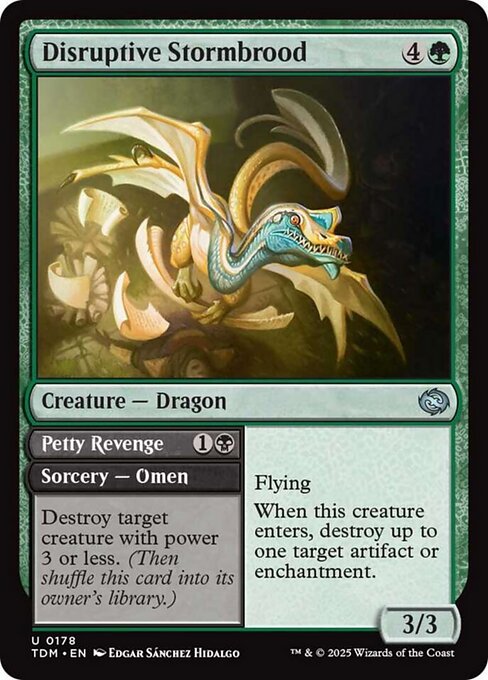
87. Disruptive Stormbrood // Petty Revenge
Rating6.2GoodWhy this rating?
Good playable that always makes the cut (6.2/10).
Why. Two cards in one. The Omen is a two-mana sorcery that destroys a creature with power 3 or less, and the card then shuffles back into your library. Later, the five-mana 3/3 Dragon lands with flying and can destroy an artifact or enchantment.
Risks. The Omen needs black and the Dragon needs green: you need both to get the full value. The Omen can't hit creatures with power 4 or more.
In the draft. Good in a green-black deck, where it's removal then a finisher. Take it fairly high in those colours.
Results in the games of the set
When it is in hand, the deck wins 58.7% of its games (set average: 56.0%, 41st of 274 cards).
In the opening hand: 55.0% wins (54.9% on average).
Drawn during the game: 60.6% (56.7% on average).
When it is drawn, the deck wins 6.8 points more than when it is not.
When it is drafted, it is played 95% of the time (set average: 65%).
Taken as the first pick (239 drafts), it ends in the deck 97% of the time.
It is played mostly in B/G decks (28% of them) and G/W (27%).
 Rating6.2Good
Why this rating?
Good playable that always makes the cut (6.2/10).
Why. A one-mana 0/3 whose ability (two mana and a tap) only searches for two specific named cards in your library. It blocks small creatures, but its role depends on having those exact cards in your deck.
Risks. Without those cards in your deck it does nothing but block. With 0 power it's a wall that never pressures anyone.
In the draft. A niche card: only take it if you already have one of its two targets. Otherwise, let it go.
Results in the games of the set
When it is in hand, the deck wins 56.2% of its games (set average: 56.0%, 105th of 274 cards).
In the opening hand: 57.8% wins (54.9% on average).
Drawn during the game: 55.2% (56.7% on average).
When it is drawn, the deck wins 4.9 points more than when it is not.
When it is drafted, it is played 44% of the time (set average: 65%).
Taken as the first pick (91 drafts), it ends in the deck 47% of the time.
It is played mostly in B/U decks (38% of them) and G/U (32%).
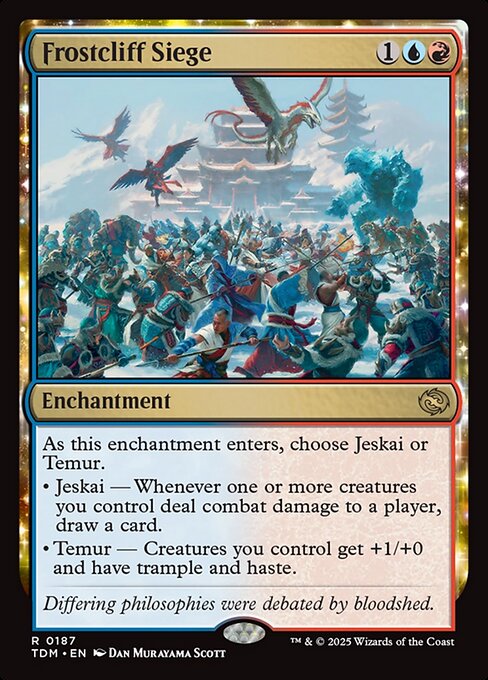
89. Frostcliff Siege
Rating6.2GoodWhy this rating?
Good playable that always makes the cut (6.2/10).
Why. An enchantment with two modes chosen as it enters: Jeskai draws a card whenever one or more of your creatures deal combat damage to a player, and Temur gives all your creatures +1/+0, trample and haste.
Risks. It does nothing the turn it lands and relies on an aggressive board. It needs both colours, and the mode is locked in on entering.
In the draft. Works in an aggressive or wide blue-red deck. Take it as an engine, after the sounder cards.
Results in the games of the set
When it is in hand, the deck wins 54.2% of its games (set average: 56.0%, 185th of 274 cards).
In the opening hand: 51.5% wins (54.9% on average).
Drawn during the game: 56.0% (56.7% on average).
When it is drawn, the deck wins 3.4 points more than when it is not.
When it is drafted, it is played 83% of the time (set average: 65%).
Taken as the first pick (65 drafts), it ends in the deck 86% of the time.
It is played about as much in every archetype.

90. Jeskai Monument
Rating6.2GoodWhy this rating?
Good playable that always makes the cut (6.2/10).
Why. A two-mana artifact that fetches a basic Island, Mountain or Plains card to your hand, fixing your colours. Later it sacrifices itself for two 1/1 white Bird creature tokens with flying, at sorcery speed.
Risks. The activation costs four mana across three colours and only works at sorcery speed. It does little beyond fixing and two small fliers.
In the draft. Good in a three-colour deck or wider: fixing, then value. Take it in Jeskai decks; elsewhere it loses almost all its appeal.
Results in the games of the set
When it is in hand, the deck wins 57.7% of its games (set average: 56.0%, 57th of 274 cards).
In the opening hand: 56.6% wins (54.9% on average).
Drawn during the game: 58.5% (56.7% on average).
When it is drawn, the deck wins 4.5 points more than when it is not.
When it is drafted, it is played 73% of the time (set average: 65%).
Taken as the first pick (82 drafts), it ends in the deck 89% of the time.
It is played mostly in R/U decks (43% of them) and U/W (35%).
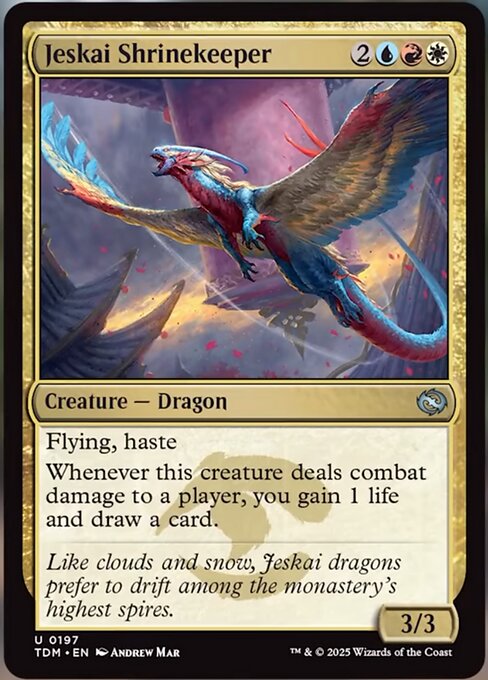 Rating6.2Good
Why this rating?
Good playable that always makes the cut (6.2/10).
Why. A five-mana 3/3 Dragon with flying and haste. When it deals combat damage to a player, you gain 1 life and draw a card: it attacks the turn it arrives, then feeds your hand each hit.
Risks. Five mana in three colours, and only 3 toughness. An aerial blocker or cheap removal stops it.
In the draft. A good Jeskai top-end. It counts as a Dragon for Behold. Take it if you're already in all three colours.
Results in the games of the set
When it is in hand, the deck wins 57.6% of its games (set average: 56.0%, 60th of 274 cards).
In the opening hand: 54.4% wins (54.9% on average).
Drawn during the game: 59.5% (56.7% on average).
When it is drawn, the deck wins 6.3 points more than when it is not.
When it is drafted, it is played 88% of the time (set average: 65%).
Taken as the first pick (167 drafts), it ends in the deck 93% of the time.
It is played mostly in R/U decks (41% of them) and U/W (40%).

92. Kishla Trawlers
Rating6.2GoodWhy this rating?
Good playable that always makes the cut (6.2/10).
Why. A three-mana 3/2 that, by exiling a creature card from your graveyard, returns an instant or sorcery card from your graveyard to your hand. A decent body and a recovered spell.
Risks. You need a creature in your graveyard and a spell target: on turn three that's rarely the case. A 3/2 dies easily.
In the draft. A good value card for a blue deck with lots of spells. Take it as a late two-for-one, not over a removal.
Results in the games of the set
When it is in hand, the deck wins 56.9% of its games (set average: 56.0%, 81st of 274 cards).
In the opening hand: 52.3% wins (54.9% on average).
Drawn during the game: 59.6% (56.7% on average).
When it is drawn, the deck wins 3.5 points more than when it is not.
When it is drafted, it is played 88% of the time (set average: 65%).
Taken as the first pick (151 drafts), it ends in the deck 89% of the time.
It is played mostly in B/U decks (30% of them) and R/U (29%).
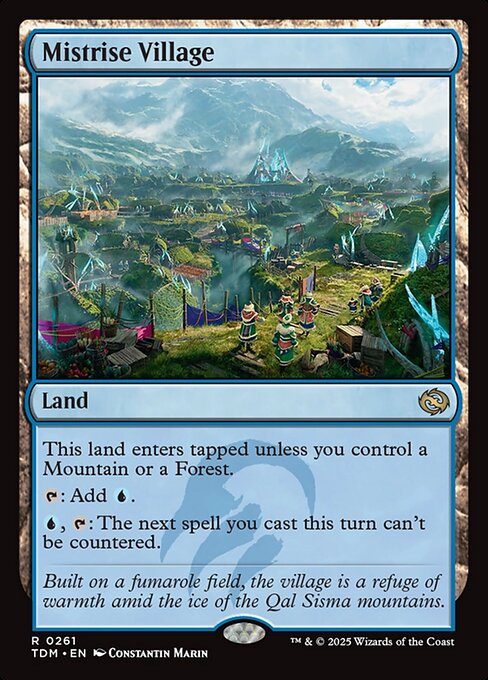
93. Mistrise Village
Rating6.2GoodWhy this rating?
Good playable that always makes the cut (6.2/10).
Why. A land that taps for blue mana, enters tapped unless you control a Mountain or Forest, and can make your next spell uncounterable. Utility against opposing counterspells.
Risks. It enters tapped without a Mountain or Forest and makes only blue: no colour fixing. The utility is niche and costs an extra blue mana.
In the draft. Take it late, only in a blue-red or blue-green deck that wants to protect its spells. Otherwise a basic Island does the job.
Results in the games of the set
When it is in hand, the deck wins 51.7% of its games (set average: 56.0%, 248th of 274 cards).
In the opening hand: 51.5% wins (54.9% on average).
Drawn during the game: 51.8% (56.7% on average).
When it is drawn, the deck wins 2.0 points more than when it is not.
When it is drafted, it is played 19% of the time (set average: 65%).

94. Molten Exhale
Rating6.2GoodWhy this rating?
Good playable that always makes the cut (6.2/10).
Why. A two-mana sorcery that deals 4 damage to a creature or planeswalker, and can be cast with flash if you behold a Dragon as an additional cost. Cheap removal that handles most threats.
Risks. Without a Dragon to behold it can't respond mid-combat. It leaves creatures with 5 toughness or more alive.
In the draft. A very good removal common: take it high in any red deck. With a few Dragons it gets flash flexibility.
Results in the games of the set
When it is in hand, the deck wins 57.5% of its games (set average: 56.0%, 67th of 274 cards).
In the opening hand: 56.0% wins (54.9% on average).
Drawn during the game: 58.4% (56.7% on average).
When it is drawn, the deck wins 3.2 points more than when it is not.
When it is drafted, it is played 96% of the time (set average: 65%).
Taken as the first pick (642 drafts), it ends in the deck 98% of the time.
It is played mostly in G/R decks (59% of them) and R/U (57%).
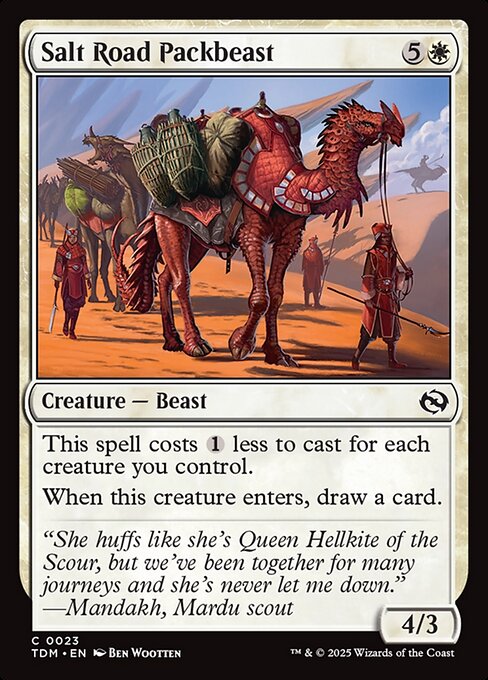 Rating6.2Good
Why this rating?
Good playable that always makes the cut (6.2/10).
Why. A 4/3 that draws a card when it enters and costs 1 less for each creature you control. With a developed board it comes down for three or four mana as a body and a card.
Risks. At full price, six mana for a 4/3 is steep. It relies on an existing board.
In the draft. A good common for a white deck with many creatures or tokens. Take it as a cheap two-for-one, after the removal.
Results in the games of the set
When it is in hand, the deck wins 57.7% of its games (set average: 56.0%, 58th of 274 cards).
In the opening hand: 56.7% wins (54.9% on average).
Drawn during the game: 58.5% (56.7% on average).
When it is drawn, the deck wins 1.3 points more than when it is not.
When it is drafted, it is played 89% of the time (set average: 65%).
Taken as the first pick (250 drafts), it ends in the deck 96% of the time.
It is played mostly in B/W decks (69% of them) and R/W (67%).
 Rating6.2Playable
Why this rating?
Good playable that always makes the cut (6.2/10).
Why. A three-mana sorcery: put a +1/+1 counter on your creature, then it deals damage equal to its power to an opponent's creature. Unlike a fight, your creature takes nothing back.
Risks. You need a creature of your own, and the damage scales with its power. If it is killed in response, the spell does nothing.
In the draft. Good green removal: take it in a green deck with big creatures. The bigger they are, the better it gets.
Results in the games of the set
When it is in hand, the deck wins 58.6% of its games (set average: 56.0%, 43rd of 274 cards).
In the opening hand: 56.6% wins (54.9% on average).
Drawn during the game: 59.9% (56.7% on average).
When it is drawn, the deck wins 5.6 points more than when it is not.
When it is drafted, it is played 93% of the time (set average: 65%).
Taken as the first pick (166 drafts), it ends in the deck 97% of the time.
It is played mostly in B/G decks (32% of them) and G/R (30%).

97. Perennation
Rating6.1PlayableWhy this rating?
Good playable that always makes the cut (6.1/10).
Why. A six-mana sorcery that returns a permanent card from your graveyard with a hexproof counter and an indestructible counter. Your best permanent comes back and becomes very hard to remove.
Risks. Six mana in three colours for a spell that does nothing without a good target in the graveyard. It's slow and returns only one permanent.
In the draft. Very niche and demanding. Only take it in a three-colour deck with big permanents, and never over cards that act right away.
Results in the games of the set
When it is in hand, the deck wins 54.2% of its games (set average: 56.0%, 186th of 274 cards).
In the opening hand: 50.8% wins (54.9% on average).
Drawn during the game: 56.5% (56.7% on average).
When it is drawn, the deck wins 4.7 points more than when it is not.
When it is drafted, it is played 73% of the time (set average: 65%).
Taken among the first three picks (121 drafts), it ends in the deck 79% of the time.
It is played about as much in every archetype.

98. Hollowmurk Siege
Rating6.0PlayableWhy this rating?
Good playable that always makes the cut (6.0/10).
Why. A two-mana enchantment with two modes chosen as it enters: Sultai draws a card whenever a counter is put on a creature you control (once each turn), and Abzan puts a +1/+1 counter on an attacker, which gains menace.
Risks. It does nothing the turn it lands, and both modes rely on counters or steady attacks. Without those, it sits idle.
In the draft. A decent engine card for a black-green deck with counters. Take it after the removal; it's mostly playable in its archetype.
Results in the games of the set
When it is in hand, the deck wins 55.3% of its games (set average: 56.0%, 142nd of 274 cards).
In the opening hand: 54.9% wins (54.9% on average).
Drawn during the game: 55.5% (56.7% on average).
When it is drawn, the deck wins 3.2 points more than when it is not.
When it is drafted, it is played 85% of the time (set average: 65%).
Taken as the first pick (57 drafts), it ends in the deck 84% of the time.
It is played about as much in every archetype.
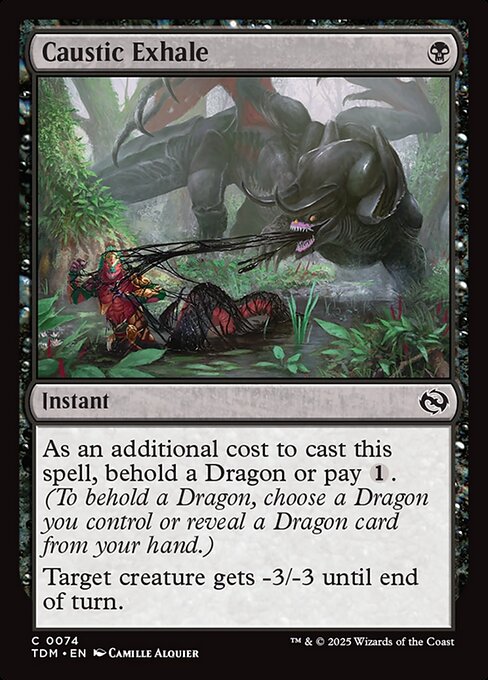
99. Caustic Exhale
Rating6.0PlayableWhy this rating?
Good playable that always makes the cut (6.0/10).
Why. A one-mana instant giving a creature -3/-3, with an extra mana to pay unless you behold a Dragon. Cheap, fast removal that kills most small creatures and wins a combat.
Risks. It doesn't handle creatures with 4 toughness or more. Without a Dragon it costs two mana and loses some efficiency.
In the draft. A good black removal common. Take it in any black deck, even more so with a few Dragons.
Results in the games of the set
When it is in hand, the deck wins 57.2% of its games (set average: 56.0%, 69th of 274 cards).
In the opening hand: 55.6% wins (54.9% on average).
Drawn during the game: 58.3% (56.7% on average).
When it is drawn, the deck wins 3.8 points more than when it is not.
When it is drafted, it is played 90% of the time (set average: 65%).
Taken as the first pick (333 drafts), it ends in the deck 95% of the time.
It is played mostly in B/U decks (69% of them) and B/G (57%).

100. Channeled Dragonfire
Rating6.0PlayableWhy this rating?
Good playable that always makes the cut (6.0/10).
Why. A one-mana sorcery that deals 2 damage to any target, and can be cast again later with Harmonize. A good tool against small creatures and a way to finish the opponent.
Risks. Only 2 damage: it leaves bigger bodies alone. The Harmonize cost is high without a large creature to tap.
In the draft. Cheap removal for any red deck. Take it after the better removal, as an efficient spell that pays off again late.
Results in the games of the set
When it is in hand, the deck wins 56.8% of its games (set average: 56.0%, 84th of 274 cards).
In the opening hand: 55.1% wins (54.9% on average).
Drawn during the game: 57.9% (56.7% on average).
When it is drawn, the deck wins 1.7 points more than when it is not.
When it is drafted, it is played 87% of the time (set average: 65%).
Taken as the first pick (118 drafts), it ends in the deck 92% of the time.
It is played mostly in G/R decks (25% of them) and R/U (25%).

101. Dispelling Exhale
Rating6.0PlayableWhy this rating?
Good playable that always makes the cut (6.0/10).
Why. A cheap two-mana counter: the opponent has to pay two more or lose the spell. If you behold a Dragon the tax jumps to four, which catches nearly everything. It shines when the opponent is tapping out to develop.
Risks. It is a soft counter, so an opponent holding spare mana shrugs it off. It also asks you to keep two mana up, which slows your own development.
In the draft. A good fit for a blue control-leaning deck, especially with a few Dragons to behold. A solid common to take mid-pack, behind your creatures and removal.
Results in the games of the set
When it is in hand, the deck wins 57.9% of its games (set average: 56.0%, 55th of 274 cards).
In the opening hand: 56.5% wins (54.9% on average).
Drawn during the game: 58.7% (56.7% on average).
When it is drawn, the deck wins 4.9 points more than when it is not.
When it is drafted, it is played 87% of the time (set average: 65%).
Taken as the first pick (248 drafts), it ends in the deck 95% of the time.
It is played mostly in R/U decks (75% of them) and B/U (58%).

102. Dragonbroods' Relic
Rating6.0PlayableWhy this rating?
Good playable that always makes the cut (6.0/10).
Why. A mana rock that fixes every color, as long as you also tap a creature each time. For eight mana including all five colors you can sacrifice it for a 4/4 Dragon token with flying, lifelink and 3 damage to any target when it enters, at sorcery speed.
Risks. It costs you a turn of development and taps a creature on every use, which cuts into your attacks. The Dragon needs all five colors, so it almost never happens outside very greedy decks.
In the draft. Take it for a green deck in three or four colors that mostly wants consistency. In a two-color deck it is mediocre filler.
Results in the games of the set
When it is in hand, the deck wins 58.0% of its games (set average: 56.0%, 53rd of 274 cards).
In the opening hand: 54.9% wins (54.9% on average).
Drawn during the game: 59.9% (56.7% on average).
When it is drawn, the deck wins 6.1 points more than when it is not.
When it is drafted, it is played 79% of the time (set average: 65%).
Taken as the first pick (165 drafts), it ends in the deck 93% of the time.
It is played mostly in G/U decks (40% of them) and G/R (35%).
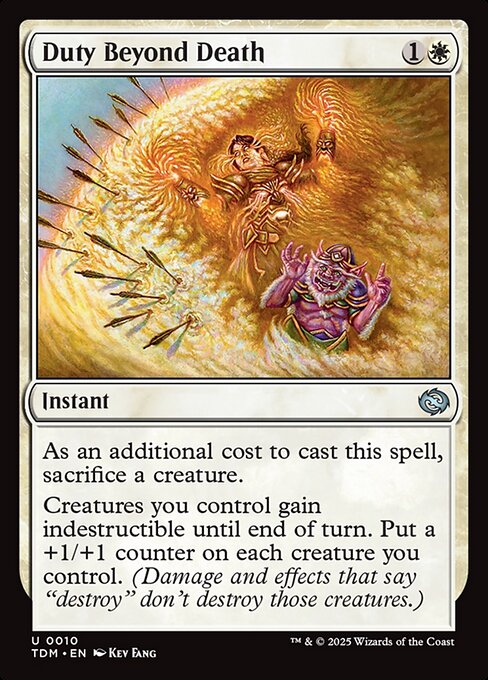
103. Duty Beyond Death
Rating6.0PlayableWhy this rating?
Good playable that always makes the cut (6.0/10).
Why. A two-mana combat trick: you sacrifice a creature, then all your others gain indestructible this turn and a +1/+1 counter each. Mid-combat, you can sacrifice a creature that was about to die and swing the board.
Risks. It costs a creature, so you need one to lose. With only a couple of creatures out it does little. It does not stop exile or forced sacrifice.
In the draft. Best in an aggressive deck with lots of small creatures or tokens. A mid-pack pick rather than a first choice.
Results in the games of the set
When it is in hand, the deck wins 55.6% of its games (set average: 56.0%, 123rd of 274 cards).
In the opening hand: 54.8% wins (54.9% on average).
Drawn during the game: 56.2% (56.7% on average).
When it is drawn, the deck wins 0.9 points less than when it is not.
When it is drafted, it is played 77% of the time (set average: 65%).
Taken as the first pick (72 drafts), it ends in the deck 99% of the time.
It is played mostly in R/W decks (31% of them) and B/W (29%).
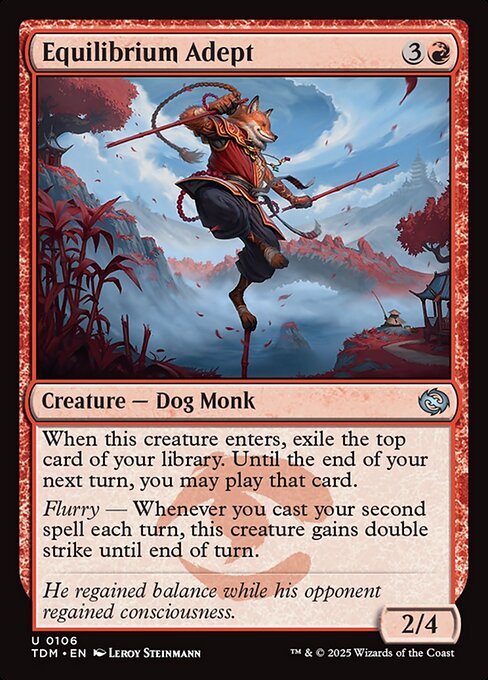
104. Equilibrium Adept
Rating6.0PlayableWhy this rating?
Good playable that always makes the cut (6.0/10).
Why. A value creature: it enters and exiles the top card of your library, playable until the end of your next turn. With Flurry it gains double strike and becomes a real threat on offense.
Risks. A 2/4 for four mana does not do much on its own. The exiled card is lost if you cannot afford to play it, especially a land you cannot play.
In the draft. A decent four-drop for a red deck that often casts two spells in a turn. A mid-pack pick.
Results in the games of the set
When it is in hand, the deck wins 56.2% of its games (set average: 56.0%, 104th of 274 cards).
In the opening hand: 55.4% wins (54.9% on average).
Drawn during the game: 56.8% (56.7% on average).
When it is drawn, the deck wins 0.9 points more than when it is not.
When it is drafted, it is played 85% of the time (set average: 65%).
Taken as the first pick (94 drafts), it ends in the deck 95% of the time.
It is played mostly in R/U decks (30% of them) and R/W (26%).

105. Felothar, Dawn of the Abzan
Rating6.0PlayableWhy this rating?
Good playable that always makes the cut (6.0/10).
Why. A three-mana 3/3 with trample, already a solid body. Whenever it enters or attacks you may sacrifice a nonland permanent to put a +1/+1 counter on each creature you control. With tokens or spare permanents it grows your whole team.
Risks. It needs three specific colors, so it only fits a tightly built deck. The sacrifice is a real cost: without token makers it eats your own cards.
In the draft. A pick for a three-color deck, and only if you are already firmly in those colors. Otherwise let it go.
Results in the games of the set
When it is in hand, the deck wins 52.6% of its games (set average: 56.0%, 224th of 274 cards).
In the opening hand: 52.8% wins (54.9% on average).
Drawn during the game: 52.4% (56.7% on average).
When it is drawn, the deck wins 0.8 points more than when it is not.
When it is drafted, it is played 67% of the time (set average: 65%).
Taken among the first three picks (119 drafts), it ends in the deck 78% of the time.
It is played about as much in every archetype.

106. Fleeting Effigy
Rating6.0PlayableWhy this rating?
Good playable that always makes the cut (6.0/10).
Why. A one-mana haste creature that returns to your hand at your end step. It rarely dies to removal, and it attacks every turn for 2, or more with its three-mana pump that gives +2/+0.
Risks. It never blocks, never stays on the battlefield and costs you a mana every turn. Against a deck with good blockers it runs into a wall.
In the draft. A card for very aggressive decks, red ones especially. Slower decks can skip it. A mid-pack pick.
Results in the games of the set
When it is in hand, the deck wins 55.3% of its games (set average: 56.0%, 141st of 274 cards).
In the opening hand: 56.0% wins (54.9% on average).
Drawn during the game: 54.7% (56.7% on average).
When it is drawn, the deck wins 0.5 points less than when it is not.
When it is drafted, it is played 64% of the time (set average: 65%).
Taken as the first pick (43 drafts), it ends in the deck 93% of the time.
It is played mostly in R/W decks (29% of them) and R/U (25%).

107. Furious Forebear
Rating6.0PlayableWhy this rating?
Good playable that always makes the cut (6.0/10).
Why. A two-mana 3/1 that comes back from the graveyard: when a creature you control dies, you pay one white mana and one more to return it to your hand. It is a recurring threat in an aggressive deck.
Risks. A 3/1 dies to nearly anything and blocks poorly. It only returns if other creatures of yours die, and every time it costs two mana.
In the draft. A good two-drop for an aggressive white deck that trades a lot. A fair pick mid-pack.
Results in the games of the set
When it is in hand, the deck wins 54.9% of its games (set average: 56.0%, 163rd of 274 cards).
In the opening hand: 56.7% wins (54.9% on average).
Drawn during the game: 53.5% (56.7% on average).
When it is drawn, the deck wins 1.4 points less than when it is not.
When it is drafted, it is played 83% of the time (set average: 65%).
Taken as the first pick (86 drafts), it ends in the deck 93% of the time.
It is played mostly in B/W decks (30% of them) and R/W (27%).

108. Mox Jasper
Rating6.0PlayableWhy this rating?
Good playable that always makes the cut (6.0/10).
Why. A free artifact that taps for one mana of any color, but only if you control a Dragon. With a Dragon on the battlefield it is zero-cost acceleration and fixing.
Risks. Without a Dragon it does nothing. It is no replacement for a real mana source and is a dead card in any deck that plays few Dragons.
In the draft. Only for a deck with several Dragons. Otherwise leave it out, and take it only very late.
Results in the games of the set
When it is drafted, it is played only 4% of the time (set average: 65%): it almost always ends in the sideboard.

109. Nature's Rhythm
Rating6.0PlayableWhy this rating?
Good playable that always makes the cut (6.0/10).
Why. A flexible sorcery: pay X plus two green mana and search for a creature with mana value X or less, putting it straight onto the battlefield. With Harmonize you can recast it later from the graveyard for a second creature.
Risks. It is slow and expensive: you pay a lot for a creature you could simply have cast. It demands plenty of green mana, especially with Harmonize.
In the draft. A tool for a green deck with a few big creatures worth fetching. Otherwise it is too slow: take it late.
Results in the games of the set
When it is in hand, the deck wins 52.5% of its games (set average: 56.0%, 228th of 274 cards).
In the opening hand: 48.9% wins (54.9% on average).
Drawn during the game: 54.8% (56.7% on average).
When it is drawn, the deck wins 1.2 points more than when it is not.
When it is drafted, it is played 16% of the time (set average: 65%).
 Rating5.9Playable
Why this rating?
Good playable that always makes the cut (5.9/10).
Why. A four-mana 3/3 with Mobilize 1, so it attacks alongside an extra 1/1 red Warrior token. Whenever a creature you control dies, the sacrificed token included, each opponent loses 1 life and you gain 1.
Risks. A 3/3 for four is an average body. The drain is small on its own: creatures need to die regularly for the card to matter.
In the draft. A good uncommon for an attacking black deck, and at home in decks with plenty of creature trades. A mid-pack pick.
Results in the games of the set
When it is in hand, the deck wins 55.0% of its games (set average: 56.0%, 157th of 274 cards).
In the opening hand: 54.3% wins (54.9% on average).
Drawn during the game: 55.5% (56.7% on average).
When it is drawn, the deck wins 0.8 points more than when it is not.
When it is drafted, it is played 75% of the time (set average: 65%).
Taken as the first pick (50 drafts), it ends in the deck 92% of the time.
It is played mostly in B/W decks (33% of them) and B/R (32%).

111. Piercing Exhale
Rating5.8PlayableWhy this rating?
Good playable that always makes the cut (5.9/10).
Why. A two-mana removal: one of your creatures deals damage equal to its power to a target creature or planeswalker, and takes none back. If you behold a Dragon you also surveil 2.
Risks. You need a creature, and if the opponent kills it in response the spell does nothing. With a low-power creature it is a weak removal.
In the draft. A good common removal for any green deck with sizable creatures. Take it ahead of filler cards.
Results in the games of the set
When it is in hand, the deck wins 57.3% of its games (set average: 56.0%, 68th of 274 cards).
In the opening hand: 54.4% wins (54.9% on average).
Drawn during the game: 59.2% (56.7% on average).
When it is drawn, the deck wins 4.1 points more than when it is not.
When it is drafted, it is played 89% of the time (set average: 65%).
Taken as the first pick (239 drafts), it ends in the deck 96% of the time.
It is played mostly in G/U decks (53% of them) and G/R (51%).

112. Dragonfire Blade
Rating5.8PlayableWhy this rating?
Good playable that always makes the cut (5.8/10).
Why. A one-mana Equipment giving +2/+2 and hexproof from monocolored sources. Equip costs one less per color of the targeted creature, so it is cheaper on multicolored creatures.
Risks. Equipping is expensive, four mana minus one per color of the target, so often three on a monocolored creature. It is slow, and colorless or multicolored removal ignores it.
In the draft. A fair Equipment in a deck with multicolored creatures. In a two-color deck it is a mid-pack pick.
Results in the games of the set
When it is in hand, the deck wins 53.0% of its games (set average: 56.0%, 216th of 274 cards).
In the opening hand: 51.6% wins (54.9% on average).
Drawn during the game: 54.0% (56.7% on average).
When it is drawn, the deck wins 1.4 points more than when it is not.
When it is drafted, it is played 85% of the time (set average: 65%).
Taken as the first pick (45 drafts), it ends in the deck 76% of the time.
It is played about as much in every archetype.
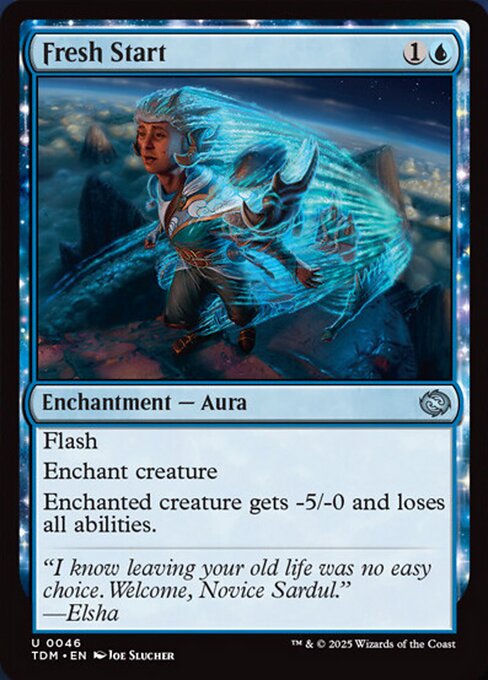
113. Fresh Start
Rating5.8PlayableWhy this rating?
Good playable that always makes the cut (5.8/10).
Why. A two-mana Aura with flash: the enchanted creature gets -5/-0 and loses all abilities. It neutralizes nearly any threat without killing it, even mid-combat thanks to flash.
Risks. The creature stays on the battlefield and can still block. Anything that removes the Aura frees it, and you do not gain a card.
In the draft. A good blue answer, close to a removal. Take it early in a blue deck, ahead of unremarkable creatures.
Results in the games of the set
When it is in hand, the deck wins 57.1% of its games (set average: 56.0%, 76th of 274 cards).
In the opening hand: 53.9% wins (54.9% on average).
Drawn during the game: 59.1% (56.7% on average).
When it is drawn, the deck wins 3.9 points more than when it is not.
When it is drafted, it is played 92% of the time (set average: 65%).
Taken as the first pick (152 drafts), it ends in the deck 99% of the time.
It is played mostly in R/U decks (28% of them).

114. Frontier Bivouac
Rating5.8PlayableWhy this rating?
Good playable that always makes the cut (5.8/10).
Why. A three-color land that enters tapped and taps for green, blue or red. It fixes decks combining these colors and lets you stretch from two to three colors at low risk.
Risks. It enters tapped, which costs tempo in an aggressive deck. It is worthless if you are not playing its colors.
In the draft. Take it if you are in two of the three colors and may add the third. Otherwise let it pass.
Results in the games of the set
When it is in hand, the deck wins 55.5% of its games (set average: 56.0%, 130th of 274 cards).
In the opening hand: 56.9% wins (54.9% on average).
Drawn during the game: 54.5% (56.7% on average).
When it is drawn, the deck wins 2.0 points more than when it is not.
When it is drafted, it is played 95% of the time (set average: 65%).
Taken as the first pick (146 drafts), it ends in the deck 96% of the time.

115. Mystic Monastery
Rating5.8PlayableWhy this rating?
Good playable that always makes the cut (5.8/10).
Why. A three-color land that enters tapped and taps for blue, red or white. It fixes decks in those colors and helps cast a splash cleanly.
Risks. It enters tapped, a real tempo cost for an aggressive deck. Outside its colors it is a dead land.
In the draft. A useful pick if you play two of its colors. Take it after your good playables and before filler.
Results in the games of the set
When it is in hand, the deck wins 55.3% of its games (set average: 56.0%, 138th of 274 cards).
In the opening hand: 56.5% wins (54.9% on average).
Drawn during the game: 54.4% (56.7% on average).
When it is drawn, the deck wins 1.4 points more than when it is not.
When it is drafted, it is played 94% of the time (set average: 65%).
Taken as the first pick (137 drafts), it ends in the deck 96% of the time.

116. New Way Forward
Rating5.8PlayableWhy this rating?
Good playable that always makes the cut (5.8/10).
Why. A three-color instant: you pick a source, and the next time it would damage you this turn that damage is prevented, the opponent takes that much and you draw that many cards. Against a big attack the swing is huge.
Risks. It costs five mana and three exact colors, and does nothing while no source threatens you. It is a reactive and heavy card.
In the draft. Only for a blue-red-white deck or something close. Take it late: the mana cost makes it hard to cast.
Results in the games of the set
When it is in hand, the deck wins 54.6% of its games (set average: 56.0%, 174th of 274 cards).
In the opening hand: 51.0% wins (54.9% on average).
Drawn during the game: 56.8% (56.7% on average).
When it is drawn, the deck wins 4.7 points more than when it is not.
When it is drafted, it is played 67% of the time (set average: 65%).
Taken as the first pick (36 drafts), it ends in the deck 83% of the time.
It is played about as much in every archetype.
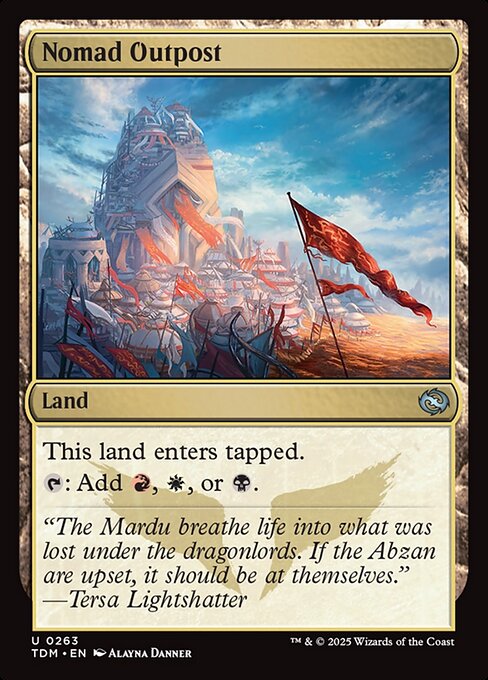
117. Nomad Outpost
Rating5.8PlayableWhy this rating?
Good playable that always makes the cut (5.8/10).
Why. A three-color land that enters tapped and taps for red, white or black. It fixes decks in these colors and sets up a painless splash.
Risks. It enters tapped, a real tempo cost in an aggressive deck. If you are not in its colors it does nothing.
In the draft. Take it if you are in two of its three colors. Not before your good spells.
Results in the games of the set
When it is in hand, the deck wins 54.6% of its games (set average: 56.0%, 176th of 274 cards).
In the opening hand: 56.6% wins (54.9% on average).
Drawn during the game: 52.9% (56.7% on average).
When it is drawn, the deck wins 0.4 points less than when it is not.
When it is drafted, it is played 93% of the time (set average: 65%).
Taken as the first pick (97 drafts), it ends in the deck 98% of the time.

118. Opulent Palace
Rating5.8PlayableWhy this rating?
Good playable that always makes the cut (5.8/10).
Why. A three-color land that enters tapped and taps for black, green or blue. It fixes a deck in these colors and helps cast a splash.
Risks. It enters tapped, which slows a fast deck. Outside its colors it is a useless land.
In the draft. A good pick if you play two of its colors. Take it after your important playables.
Results in the games of the set
When it is in hand, the deck wins 55.2% of its games (set average: 56.0%, 150th of 274 cards).
In the opening hand: 56.2% wins (54.9% on average).
Drawn during the game: 54.4% (56.7% on average).
When it is drawn, the deck wins 1.4 points more than when it is not.
When it is drafted, it is played 94% of the time (set average: 65%).
Taken as the first pick (113 drafts), it ends in the deck 98% of the time.
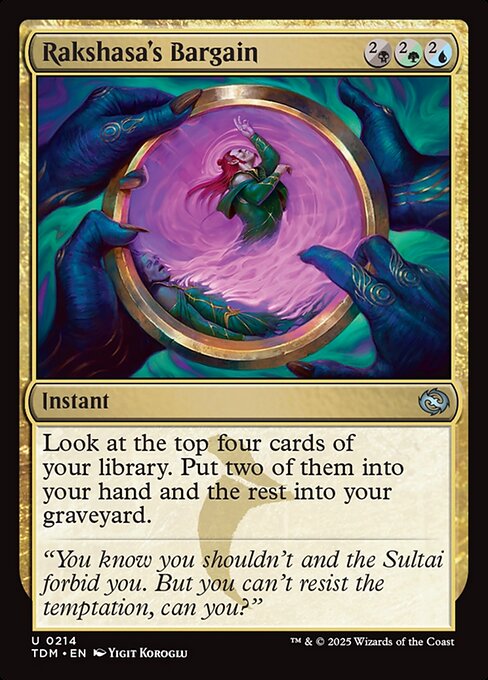
119. Rakshasa's Bargain
Rating5.8PlayableWhy this rating?
Good playable that always makes the cut (5.8/10).
Why. An instant that looks at the top four cards of your library, puts two in your hand and the other two into the graveyard. Its hybrid cost is three colored mana (black, green, blue) or, for each one, two generic mana: up to six in all.
Risks. It is expensive outside black, green and blue, and has no effect on the board. In a fast deck it arrives too late.
In the draft. A card-advantage piece for a slower deck, preferably blue, black or green. Take it for the value, not for tempo.
Results in the games of the set
When it is in hand, the deck wins 58.6% of its games (set average: 56.0%, 44th of 274 cards).
In the opening hand: 55.9% wins (54.9% on average).
Drawn during the game: 60.3% (56.7% on average).
When it is drawn, the deck wins 5.5 points more than when it is not.
When it is drafted, it is played 85% of the time (set average: 65%).
Taken as the first pick (117 drafts), it ends in the deck 93% of the time.
It is played mostly in G/U decks (35% of them) and B/G (32%).

120. Runescale Stormbrood // Chilling Screech
Rating5.8PlayableWhy this rating?
Good playable that always makes the cut (5.8/10).
Why. A four-mana 2/4 flying Dragon that gets +2/+0 whenever you cast a noncreature spell or a Dragon spell. Its Omen half is a two-mana instant countering a spell with mana value 2 or less, then the card is shuffled back.
Risks. Only 2 power without a trigger makes for a weak attack. The Omen only counters small spells and costs you a turn of development.
In the draft. A flexible pick for a blue-red deck that casts spells. Take it mid-pack for two uses in one card.
Results in the games of the set
When it is in hand, the deck wins 55.3% of its games (set average: 56.0%, 135th of 274 cards).
In the opening hand: 52.7% wins (54.9% on average).
Drawn during the game: 56.8% (56.7% on average).
When it is drawn, the deck wins 3.2 points more than when it is not.
When it is drafted, it is played 89% of the time (set average: 65%).
Taken as the first pick (84 drafts), it ends in the deck 89% of the time.
It is played mostly in G/R decks (29% of them) and R/U (28%).
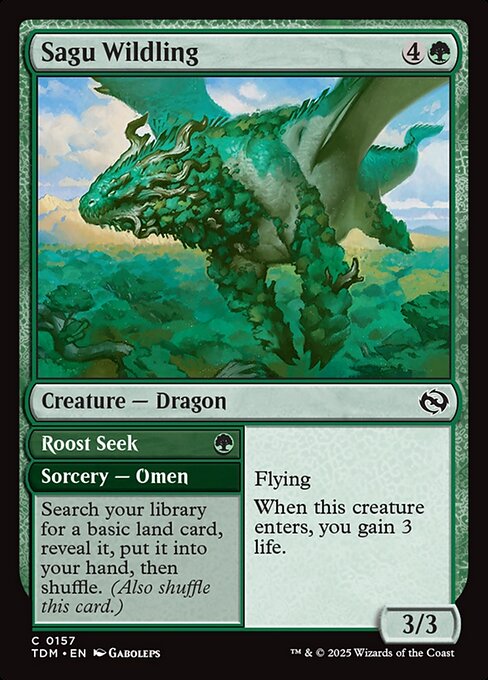
121. Sagu Wildling // Roost Seek
Rating5.8PlayableWhy this rating?
Good playable that always makes the cut (5.8/10).
Why. A five-mana 3/3 flying Dragon that gains you 3 life on entering. Its Omen half is a one-mana green sorcery fetching a basic land to your hand; the card is then shuffled into your library, so you may draw it again later.
Risks. A 3/3 for five is modest, and the Omen does not change the board. It does not save you against a faster deck.
In the draft. A good green common: two jobs in one card, fixing included. Take it mid-pack for your green deck.
Results in the games of the set
When it is in hand, the deck wins 56.6% of its games (set average: 56.0%, 89th of 274 cards).
In the opening hand: 53.2% wins (54.9% on average).
Drawn during the game: 58.5% (56.7% on average).
When it is drawn, the deck wins 4.1 points more than when it is not.
When it is drafted, it is played 96% of the time (set average: 65%).
Taken as the first pick (360 drafts), it ends in the deck 97% of the time.
It is played mostly in G/R decks (63% of them) and G/U (59%).
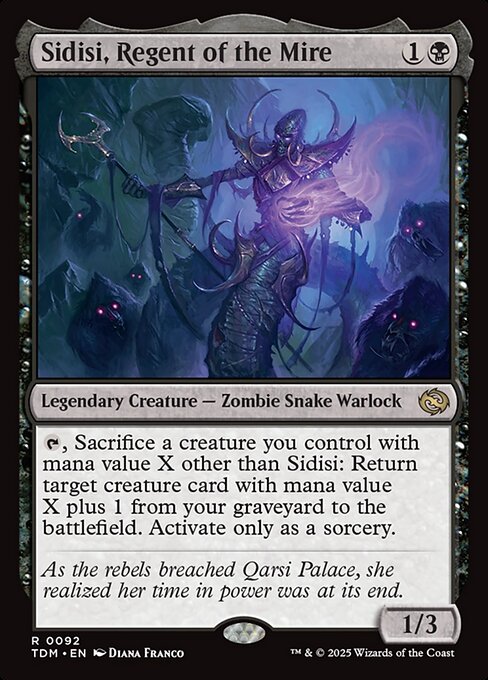
122. Sidisi, Regent of the Mire
Rating5.8PlayableWhy this rating?
Good playable that always makes the cut (5.8/10).
Why. A two-mana 1/3 that reanimates: tap it and sacrifice a creature with mana value X to return a creature card with mana value X plus one from your graveyard to the battlefield. It turns small creatures into bigger ones, once a turn at sorcery speed.
Risks. It needs a creature to sacrifice, a precise target in the graveyard, and a turn of waiting since it taps. Without the right mana values it does nothing, and a 1/3 body is not scary.
In the draft. A niche card for a black deck with a well-built creature curve. Take it late.
Results in the games of the set
When it is in hand, the deck wins 51.8% of its games (set average: 56.0%, 242nd of 274 cards).
In the opening hand: 51.4% wins (54.9% on average).
Drawn during the game: 52.2% (56.7% on average).
When it is drawn, the deck wins 1.0 points less than when it is not.
When it is drafted, it is played 48% of the time (set average: 65%).
Taken among the first three picks (47 drafts), it ends in the deck 79% of the time.
It is played about as much in every archetype.

123. Spectral Denial
Rating5.8PlayableWhy this rating?
Good playable that always makes the cut (5.8/10).
Why. An X counter: the opponent has to pay X or their spell is countered. It costs one less for each creature you control with power 4 or greater, so it gets cheap in a deck with big creatures.
Risks. It is a soft counter, which the opponent dodges by holding mana. If you pay a lot, you are not developing your board.
In the draft. A good pick for a blue deck with big creatures. Take it ahead of filler, after your removal.
Results in the games of the set
When it is in hand, the deck wins 57.2% of its games (set average: 56.0%, 71st of 274 cards).
In the opening hand: 55.1% wins (54.9% on average).
Drawn during the game: 58.4% (56.7% on average).
When it is drawn, the deck wins 4.2 points more than when it is not.
When it is drafted, it is played 71% of the time (set average: 65%).
Taken as the first pick (59 drafts), it ends in the deck 92% of the time.
It is played about as much in every archetype.

124. Teeming Dragonstorm
Rating5.8PlayableWhy this rating?
Good playable that always makes the cut (5.8/10).
Why. A four-mana enchantment that makes two 2/2 white Soldier creature tokens when it enters. When a Dragon you control enters, it returns to your hand, so you can replay it for two more Soldiers.
Risks. Without a Dragon it is just two 2/2s for four mana, fine and nothing more. The tokens die to any sweeper.
In the draft. A good uncommon for a white deck, better with Dragons. A mid-pack pick.
Results in the games of the set
When it is in hand, the deck wins 56.6% of its games (set average: 56.0%, 91st of 274 cards).
In the opening hand: 55.8% wins (54.9% on average).
Drawn during the game: 57.1% (56.7% on average).
When it is drawn, the deck wins 2.6 points more than when it is not.
When it is drafted, it is played 88% of the time (set average: 65%).
Taken as the first pick (232 drafts), it ends in the deck 91% of the time.
It is played mostly in U/W decks (45% of them) and G/W (33%).

125. War Effort
Rating5.8PlayableWhy this rating?
Good playable that always makes the cut (5.8/10).
Why. A four-mana enchantment: your creatures get +1/+0, and whenever you attack you create a tapped and attacking 1/1 red Warrior creature token, sacrificed at end of turn. The more creatures you have, the harder it hits.
Risks. It does nothing by itself and needs creatures to attack with. With no creatures on the board, it is four wasted mana.
In the draft. A pick for an aggressive red deck with lots of small creatures. A mid-pack pick.
Results in the games of the set
When it is in hand, the deck wins 56.3% of its games (set average: 56.0%, 102nd of 274 cards).
In the opening hand: 55.3% wins (54.9% on average).
Drawn during the game: 57.0% (56.7% on average).
When it is drawn, the deck wins 0.3 points more than when it is not.
When it is drafted, it is played 83% of the time (set average: 65%).
Taken as the first pick (139 drafts), it ends in the deck 96% of the time.
It is played mostly in R/W decks (39% of them) and B/R (28%).

126. Sandsteppe Citadel
Rating5.7PlayableWhy this rating?
Good playable that always makes the cut (5.7/10).
Why. A three-color land that enters tapped and taps for white, black or green. It fixes a deck in these colors and helps cast a splash.
Risks. It enters tapped, a real tempo cost for an aggressive deck. Outside its colors it does nothing.
In the draft. Take it if you play two of its colors. After your good spells.
Results in the games of the set
When it is in hand, the deck wins 54.1% of its games (set average: 56.0%, 193rd of 274 cards).
In the opening hand: 55.8% wins (54.9% on average).
Drawn during the game: 52.7% (56.7% on average).
When it is drawn, the deck wins 0.3 points more than when it is not.
When it is drafted, it is played 92% of the time (set average: 65%).
Taken as the first pick (90 drafts), it ends in the deck 99% of the time.

127. Barrensteppe Siege
Rating5.7PlayableWhy this rating?
Good playable that always makes the cut (5.7/10).
Why. A four-mana enchantment with a choice as it enters. Abzan puts a +1/+1 counter on each of your creatures at the beginning of your end step. Mardu makes the opponent sacrifice a creature of their choice if one of yours died this turn.
Risks. It needs creatures, and the Mardu mode needs one of yours to die. It also asks for two specific colors, white and black.
In the draft. A pick for a white-black deck with many creatures, especially in Abzan mode. A mid-pack pick.
Results in the games of the set
When it is in hand, the deck wins 52.2% of its games (set average: 56.0%, 235th of 274 cards).
In the opening hand: 52.1% wins (54.9% on average).
Drawn during the game: 52.2% (56.7% on average).
When it is drawn, the deck wins 0.0 points more than when it is not.
When it is drafted, it is played 90% of the time (set average: 65%).
Taken as the first pick (54 drafts), it ends in the deck 87% of the time.
It is played about as much in every archetype.

128. Bearer of Glory
Rating5.6PlayableWhy this rating?
Good playable that always makes the cut (5.6/10).
Why. A two-mana 2/1 with first strike during your turn, so it attacks into small creatures without dying. Its five-mana ability gives all your creatures +1/+1, a fine way to spend mana late.
Risks. A 2/1 stays fragile on defense, since it has no first strike on the opponent's turn. The late-game ability is expensive.
In the draft. A decent white two-drop in an aggressive deck. A filler common, taken mid-pack.
Results in the games of the set
When it is in hand, the deck wins 54.6% of its games (set average: 56.0%, 178th of 274 cards).
In the opening hand: 55.2% wins (54.9% on average).
Drawn during the game: 54.1% (56.7% on average).
When it is drawn, the deck wins 1.8 points less than when it is not.
When it is drafted, it is played 82% of the time (set average: 65%).
Taken as the first pick (101 drafts), it ends in the deck 96% of the time.
It is played mostly in B/W decks (64% of them) and R/W (64%).

129. Evolving Wilds
Rating5.6PlayableWhy this rating?
Good playable that always makes the cut (5.6/10).
Why. A simple fixing land: tap and sacrifice it to fetch a basic land onto the battlefield tapped. It helps you reach two or three colors and thins your deck slightly.
Risks. It costs you tempo: it never taps for mana itself, and the land it fetches enters tapped. It adds nothing to a mono-color deck.
In the draft. A good land for a three-color or splash deck. Take it late: you will see plenty.
Results in the games of the set
When it is in hand, the deck wins 55.2% of its games (set average: 56.0%, 147th of 274 cards).
In the opening hand: 56.2% wins (54.9% on average).
Drawn during the game: 54.4% (56.7% on average).
When it is drawn, the deck wins 0.4 points more than when it is not.
When it is drafted, it is played 98% of the time (set average: 65%).
Taken as the first pick (143 drafts), it ends in the deck 100% of the time.

130. Jeskai Devotee
Rating5.6PlayableWhy this rating?
Good playable that always makes the cut (5.6/10).
Why. A two-mana 2/2 that gets +1/+1 with Flurry, and that can produce blue, red or white mana once each turn by paying one. It smooths the mana of a multicolor deck.
Risks. The mana it makes is not free: you spend one to get one, so it is fixing and not acceleration. A 2/2 is modest.
In the draft. A two-drop for a red deck with a blue or white base. A mid-pack pick.
Results in the games of the set
When it is in hand, the deck wins 54.1% of its games (set average: 56.0%, 191st of 274 cards).
In the opening hand: 54.6% wins (54.9% on average).
Drawn during the game: 53.7% (56.7% on average).
When it is drawn, the deck wins 1.1 points less than when it is not.
When it is drafted, it is played 68% of the time (set average: 65%).
Taken as the first pick (56 drafts), it ends in the deck 84% of the time.
It is played mostly in R/U decks (62% of them) and R/W (60%).

131. Lie in Wait
Rating5.6PlayableWhy this rating?
Good playable that always makes the cut (5.6/10).
Why. A three-color sorcery that returns a creature card from your graveyard to your hand, then deals damage equal to that card's power to a target creature. You get a card and a removal in one.
Risks. It needs a creature in your graveyard, so it is dead early, and it asks for three exact colors. The damage depends on the power of the creature you pick.
In the draft. A good pick for a black-green-blue deck with high-power creatures. A mid-pack pick.
Results in the games of the set
When it is in hand, the deck wins 57.1% of its games (set average: 56.0%, 74th of 274 cards).
In the opening hand: 52.5% wins (54.9% on average).
Drawn during the game: 59.9% (56.7% on average).
When it is drawn, the deck wins 4.9 points more than when it is not.
When it is drafted, it is played 84% of the time (set average: 65%).
Taken as the first pick (101 drafts), it ends in the deck 90% of the time.
It is played mostly in G/U decks (39% of them) and B/G (35%).

132. Purging Stormbrood // Absorb Essence
Rating5.6PlayableWhy this rating?
Good playable that always makes the cut (5.6/10).
Why. A five-mana 4/4 flying Dragon with ward (pay 2 life) that also removes all counters from a target creature. Its Omen half is a two-mana instant giving +2/+2, lifelink and hexproof for a turn, which saves a creature in combat.
Risks. Five mana for a 4/4 is still pricey, and removing counters is rarely useful. The Omen needs white and costs you a turn of development.
In the draft. A good, flexible uncommon: a finisher or a combat trick. Take it mid-pack for a black-white deck; only the Dragon half is castable in black alone.
Results in the games of the set
When it is in hand, the deck wins 56.5% of its games (set average: 56.0%, 93rd of 274 cards).
In the opening hand: 53.5% wins (54.9% on average).
Drawn during the game: 58.3% (56.7% on average).
When it is drawn, the deck wins 3.6 points more than when it is not.
When it is drafted, it is played 90% of the time (set average: 65%).
Taken as the first pick (125 drafts), it ends in the deck 94% of the time.
It is played mostly in B/W decks (26% of them) and B/U (25%).

133. Riverwheel Sweep
Rating5.6PlayableWhy this rating?
Good playable that always makes the cut (5.6/10).
Why. A three-color sorcery: it taps a creature and puts three stun counters on it, shutting it down for several turns, then you exile two cards and choose one to play until the end of your next turn. Tempo and a card in one.
Risks. The creature is not killed and is still there once the counters are gone. The hybrid cost needs three colors to cast cheaply, and the exiled card is lost if you do not play it.
In the draft. A good pick for a blue-red-white deck or close. A mid-pack pick.
Results in the games of the set
When it is in hand, the deck wins 57.7% of its games (set average: 56.0%, 59th of 274 cards).
In the opening hand: 54.0% wins (54.9% on average).
Drawn during the game: 59.9% (56.7% on average).
When it is drawn, the deck wins 3.7 points more than when it is not.
When it is drafted, it is played 75% of the time (set average: 65%).
Taken as the first pick (68 drafts), it ends in the deck 84% of the time.
It is played mostly in R/U decks (36% of them) and U/W (33%).

134. Rugged Highlands
Rating5.6PlayableWhy this rating?
Good playable that always makes the cut (5.6/10).
Why. A two-color land that enters tapped, gains you 1 life when it enters, and taps for red or green. It fixes a red-green deck with a small bonus.
Risks. It enters tapped, a tempo cost in a fast deck. Outside its colors it adds little.
In the draft. Take it if you play red and green, or one of them with another color. A good land to take late.
Results in the games of the set
When it is in hand, the deck wins 55.6% of its games (set average: 56.0%, 126th of 274 cards).
In the opening hand: 56.0% wins (54.9% on average).
Drawn during the game: 55.3% (56.7% on average).
When it is drawn, the deck wins 2.0 points more than when it is not.
When it is drafted, it is played 85% of the time (set average: 65%).
Taken as the first pick (59 drafts), it ends in the deck 90% of the time.
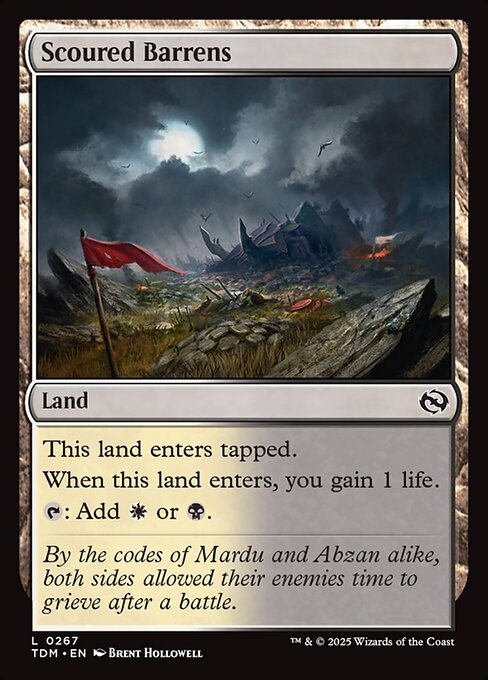
135. Scoured Barrens
Rating5.6PlayableWhy this rating?
Good playable that always makes the cut (5.6/10).
Why. A white-black dual land that enters tapped, gains a life on entry and taps for either mana. It smooths the mana of a two- or three-colour deck for the price of a tempo.
Risks. It enters tapped, so on turn two or three it can wreck your curve. The life gain is minor.
In the draft. Take it late, once you know you are white and black. Never over a real spell, but it earns its slot in the deck if you play both colours.
Results in the games of the set
When it is in hand, the deck wins 53.9% of its games (set average: 56.0%, 197th of 274 cards).
In the opening hand: 55.6% wins (54.9% on average).
Drawn during the game: 52.4% (56.7% on average).
When it is drawn, the deck wins 1.1 points less than when it is not.
When it is drafted, it is played 83% of the time (set average: 65%).
Taken as the first pick (51 drafts), it ends in the deck 100% of the time.

136. Static Snare
Rating5.6PlayableWhy this rating?
Good playable that always makes the cut (5.6/10).
Why. A flash removal that exiles an opposing artifact or creature for as long as the enchantment stays. It costs one less per attacking creature, yours or your opponent's, so in the middle of combat it comes down very cheaply.
Risks. At full price it is five mana, which is steep for removal the opponent can undo by destroying the enchantment: the target then comes back.
In the draft. A fine uncommon removal spell, better in a deck that attacks or pushes the opponent to attack. Take it after your cheaper removal.
Results in the games of the set
When it is in hand, the deck wins 56.3% of its games (set average: 56.0%, 99th of 274 cards).
In the opening hand: 54.5% wins (54.9% on average).
Drawn during the game: 57.6% (56.7% on average).
When it is drawn, the deck wins 1.5 points more than when it is not.
When it is drafted, it is played 93% of the time (set average: 65%).
Taken as the first pick (180 drafts), it ends in the deck 94% of the time.
It is played about as much in every archetype.

137. Swiftwater Cliffs
Rating5.6PlayableWhy this rating?
Good playable that always makes the cut (5.6/10).
Why. A blue-red dual land that enters tapped, gains a life and taps for either mana. It helps a multicolour deck avoid stumbling on its mana.
Risks. It enters tapped, which costs tempo in a deck that wants to curve out. The life gain barely matters.
In the draft. Take it late if you are blue and red, or if those two colours are part of a three-colour deck. Never over a good spell.
Results in the games of the set
When it is in hand, the deck wins 55.6% of its games (set average: 56.0%, 125th of 274 cards).
In the opening hand: 56.4% wins (54.9% on average).
Drawn during the game: 55.0% (56.7% on average).
When it is drawn, the deck wins 1.6 points more than when it is not.
When it is drafted, it is played 90% of the time (set average: 65%).
Taken as the first pick (96 drafts), it ends in the deck 94% of the time.

138. Thornwood Falls
Rating5.6PlayableWhy this rating?
Good playable that always makes the cut (5.6/10).
Why. A green-blue dual land that enters tapped, gains a life and taps for either mana. It makes the colours of a two- or three-colour deck more reliable.
Risks. Entering tapped hurts a deck that wants to curve out, and the life gain is negligible.
In the draft. A late-pack pick if you are green and blue, or if those colours anchor a three-colour deck. A good spell always comes first.
Results in the games of the set
When it is in hand, the deck wins 56.0% of its games (set average: 56.0%, 114th of 274 cards).
In the opening hand: 56.4% wins (54.9% on average).
Drawn during the game: 55.6% (56.7% on average).
When it is drawn, the deck wins 1.9 points more than when it is not.
When it is drafted, it is played 93% of the time (set average: 65%).
Taken as the first pick (119 drafts), it ends in the deck 94% of the time.

139. Unending Whisper
Rating5.6PlayableWhy this rating?
Good playable that always makes the cut (5.6/10).
Why. A one-mana sorcery that draws a card, then comes back from the graveyard with Harmonize to draw again. Two cards for the price of one spell, with a cost that drops if a big creature is willing to tap.
Risks. It is a cantrip with no board impact, which slows a deck that needs to push the pace. The second use is slower than it looks if your creatures are small.
In the draft. A respectable filler for a tempo or control blue deck. Take it after your threats and removal, as one of the last pieces of the curve.
Results in the games of the set
When it is in hand, the deck wins 56.5% of its games (set average: 56.0%, 92nd of 274 cards).
In the opening hand: 54.8% wins (54.9% on average).
Drawn during the game: 57.6% (56.7% on average).
When it is drawn, the deck wins 3.2 points more than when it is not.
When it is drafted, it is played 65% of the time (set average: 65%).
Taken as the first pick (53 drafts), it ends in the deck 91% of the time.
It is played mostly in R/U decks (55% of them) and U/W (43%).

140. Ureni's Rebuff
Rating5.6PlayableWhy this rating?
Good playable that always makes the cut (5.6/10).
Why. A two-mana sorcery that bounces a creature to its owner's hand, then returns from the graveyard with Harmonize to do it again. It buys you tempo twice and wipes any counters or auras on the target.
Risks. It does not solve anything for good, since the opponent just replays the creature. As a sorcery, it cannot be cast in response to anything.
In the draft. A tempo card for an aggressive blue deck. It is fine, not essential; take it after your threats and real removal.
Results in the games of the set
When it is in hand, the deck wins 56.4% of its games (set average: 56.0%, 94th of 274 cards).
In the opening hand: 53.0% wins (54.9% on average).
Drawn during the game: 58.5% (56.7% on average).
When it is drawn, the deck wins 3.0 points more than when it is not.
When it is drafted, it is played 83% of the time (set average: 65%).
Taken as the first pick (84 drafts), it ends in the deck 92% of the time.
It is played mostly in R/U decks (26% of them).

141. Wind-Scarred Crag
Rating5.6PlayableWhy this rating?
Good playable that always makes the cut (5.6/10).
Why. A red-white dual land that enters tapped, gains a life and taps for either mana. It suits an aggressive deck that wants both its colours.
Risks. It enters tapped, which costs tempo to an aggressive deck that wants to curve out.
In the draft. Take it late if you are red and white. In a very aggressive deck a basic land is sometimes better so you do not miss a turn.
Results in the games of the set
When it is in hand, the deck wins 54.8% of its games (set average: 56.0%, 166th of 274 cards).
In the opening hand: 56.2% wins (54.9% on average).
Drawn during the game: 53.7% (56.7% on average).
When it is drawn, the deck wins 0.5 points less than when it is not.
When it is drafted, it is played 90% of the time (set average: 65%).
Taken as the first pick (74 drafts), it ends in the deck 93% of the time.
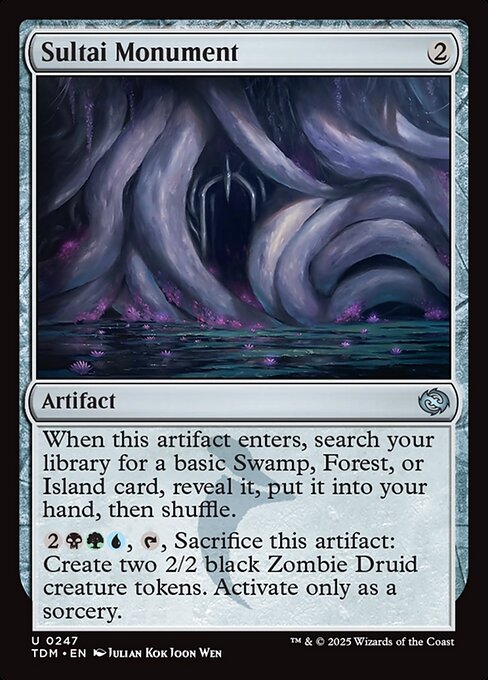
142. Sultai Monument
Rating5.6PlayableWhy this rating?
Good playable that always makes the cut (5.6/10).
Why. A two-mana artifact that fetches a basic Swamp, Forest or Island to your hand, fixing your colours as early as turn two. Late in the game you sacrifice it to create two 2/2 black Zombie Druid creature tokens.
Risks. The final ability needs three colours plus two generic mana, and only works at sorcery speed. In a two-colour deck it is just fixing.
In the draft. In a black-green-blue deck it is a good fixer with a useful late mode. Take it mid-pack, higher if you are already in those three colours.
Results in the games of the set
When it is in hand, the deck wins 57.1% of its games (set average: 56.0%, 75th of 274 cards).
In the opening hand: 56.1% wins (54.9% on average).
Drawn during the game: 57.8% (56.7% on average).
When it is drawn, the deck wins 3.6 points more than when it is not.
When it is drafted, it is played 77% of the time (set average: 65%).
Taken as the first pick (65 drafts), it ends in the deck 88% of the time.
It is played mostly in B/U decks (34% of them) and B/G (31%).
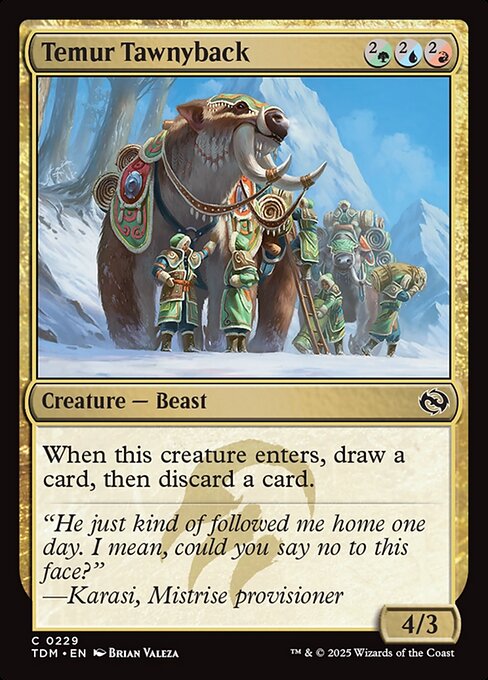
143. Temur Tawnyback
Rating5.5PlayableWhy this rating?
A solid playable that rarely gets cut (5.5/10).
Why. A 4/3 for three mana that loots on entry: you draw, then discard. For its price it is a solid body that improves your hand and matters on the board right away.
Risks. Its hybrid cost is only three mana with all three colours: in a two-colour deck it costs four, which is far less attractive. With no evasion, the 4/3 is exposed to a single removal spell.
In the draft. A good card for a green-blue-red deck, where it comes down on turn three. In a two-colour deck it is still playable at four mana, nothing more.
Results in the games of the set
When it is in hand, the deck wins 57.2% of its games (set average: 56.0%, 73rd of 274 cards).
In the opening hand: 55.8% wins (54.9% on average).
Drawn during the game: 58.0% (56.7% on average).
When it is drawn, the deck wins 3.8 points more than when it is not.
When it is drafted, it is played 75% of the time (set average: 65%).
Taken as the first pick (86 drafts), it ends in the deck 95% of the time.
It is played mostly in G/U decks (67% of them) and R/U (58%).

144. Snakeskin Veil
Rating5.4PlayableWhy this rating?
A solid playable that rarely gets cut (5.4/10).
Why. A one-mana instant that puts a +1/+1 counter on your creature and gives it hexproof until end of turn. It counters a targeted removal spell while permanently growing the creature.
Risks. It does nothing without a target or an opposing removal spell to counter. On a small creature early in the game it is just a minor bonus.
In the draft. A cheap, good green trick; play two or three at most, after your creatures and removal. It shines in a deck relying on a few big threats.
Results in the games of the set
When it is in hand, the deck wins 56.2% of its games (set average: 56.0%, 106th of 274 cards).
In the opening hand: 54.4% wins (54.9% on average).
Drawn during the game: 57.3% (56.7% on average).
When it is drawn, the deck wins 3.2 points more than when it is not.
When it is drafted, it is played 64% of the time (set average: 65%).
Taken as the first pick (50 drafts), it ends in the deck 90% of the time.
It is played mostly in B/G decks (65% of them) and G/R (51%).
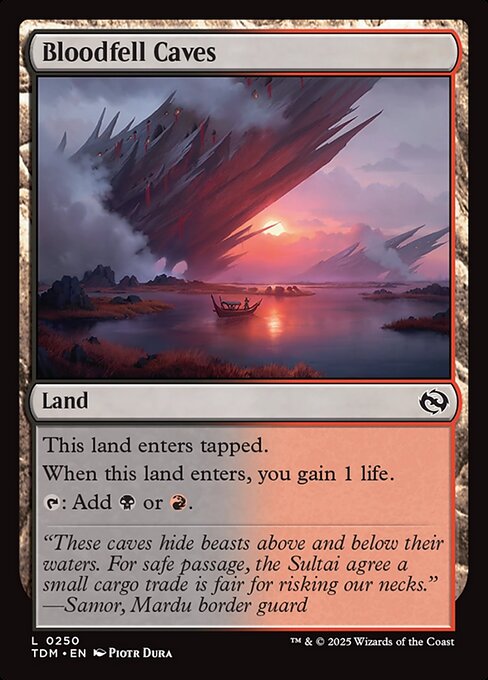
145. Bloodfell Caves
Rating5.4PlayableWhy this rating?
A solid playable that rarely gets cut (5.4/10).
Why. A black-red dual land that enters tapped, gains a life and taps for either mana. It stabilizes a black-red deck or a three-colour build.
Risks. It enters tapped, costing a turn of tempo. The life gain hardly counts.
In the draft. Take it late in the pack if you are black and red, or if those colours anchor a three-colour deck. A good spell goes first.
Results in the games of the set
When it is in hand, the deck wins 54.7% of its games (set average: 56.0%, 170th of 274 cards).
In the opening hand: 56.0% wins (54.9% on average).
Drawn during the game: 53.7% (56.7% on average).
When it is drawn, the deck wins 0.0 points more than when it is not.
When it is drafted, it is played 78% of the time (set average: 65%).
Taken as the first pick (54 drafts), it ends in the deck 87% of the time.

146. Coordinated Maneuver
Rating5.4PlayableWhy this rating?
A solid playable that rarely gets cut (5.4/10).
Why. A flexible two-mana instant: it deals damage to a creature or planeswalker equal to the number of creatures you control, or destroys an enchantment. In a deck with many creatures it is cheap, efficient removal.
Risks. With few creatures the damage falls short, and it is poor when behind on board. The enchantment mode is situational.
In the draft. A decent removal spell for a white deck full of creatures or tokens. Take it mid-pack, higher in an aggressive deck.
Results in the games of the set
When it is in hand, the deck wins 55.1% of its games (set average: 56.0%, 152nd of 274 cards).
In the opening hand: 54.3% wins (54.9% on average).
Drawn during the game: 55.7% (56.7% on average).
When it is drawn, the deck wins 1.3 points less than when it is not.
When it is drafted, it is played 74% of the time (set average: 65%).
Taken as the first pick (71 drafts), it ends in the deck 93% of the time.
It is played mostly in R/W decks (60% of them) and B/W (46%).

147. Dismal Backwater
Rating5.4PlayableWhy this rating?
A solid playable that rarely gets cut (5.4/10).
Why. A blue-black dual land that enters tapped, gains a life and taps for either mana. It makes a two- or three-colour deck more reliable.
Risks. It enters tapped, a lost turn for a tight curve. The life gain is minor.
In the draft. A late-pack land if you are blue and black, or if those colours are your base. Never over a useful spell.
Results in the games of the set
When it is in hand, the deck wins 55.9% of its games (set average: 56.0%, 119th of 274 cards).
In the opening hand: 55.8% wins (54.9% on average).
Drawn during the game: 55.9% (56.7% on average).
When it is drawn, the deck wins 2.4 points more than when it is not.
When it is drafted, it is played 80% of the time (set average: 65%).
Taken as the first pick (56 drafts), it ends in the deck 96% of the time.

148. Humbling Elder
Rating5.4PlayableWhy this rating?
A solid playable that rarely gets cut (5.4/10).
Why. A one-mana creature with flash: on entry, an opposing creature gets -2/-0 until end of turn. Cast during combat, it blows out an attack or turns a block into a winning one, and leaves a 1/2 behind.
Risks. The 1/2 body is small and the effect lasts a single turn: it wins a combat rather than killing anything. It struggles in a deck that wants real pressure.
In the draft. A small trick on legs for a tempo blue deck. Take it late, as a final piece of the curve, never over removal or real threats.
Results in the games of the set
When it is in hand, the deck wins 54.6% of its games (set average: 56.0%, 175th of 274 cards).
In the opening hand: 53.0% wins (54.9% on average).
Drawn during the game: 55.7% (56.7% on average).
When it is drawn, the deck wins 2.3 points more than when it is not.
When it is drafted, it is played 20% of the time (set average: 65%).
It is played mostly in R/U decks (35% of them) and U/W (28%).

149. Jungle Hollow
Rating5.4PlayableWhy this rating?
A solid playable that rarely gets cut (5.4/10).
Why. A black-green dual land that enters tapped, gains a life and taps for either mana. It makes a black-green or three-colour deck more reliable.
Risks. It enters tapped, which costs tempo. The life gain barely matters.
In the draft. Take it late in the pack if you are black and green. A playable spell always comes first.
Results in the games of the set
When it is in hand, the deck wins 55.1% of its games (set average: 56.0%, 155th of 274 cards).
In the opening hand: 55.7% wins (54.9% on average).
Drawn during the game: 54.6% (56.7% on average).
When it is drawn, the deck wins 1.2 points more than when it is not.
When it is drafted, it is played 89% of the time (set average: 65%).
Taken as the first pick (65 drafts), it ends in the deck 97% of the time.

150. Reigning Victor
Rating5.4PlayableWhy this rating?
A solid playable that rarely gets cut (5.4/10).
Why. A three-mana 3/3 with Mobilize 1: each attack adds a tapped and attacking 1/1 red Warrior creature token. On entry, a creature gets +1/+0 and indestructible until end of turn, enough to save an ally from removal or win a combat.
Risks. Its hybrid cost is paid with three colours: without red, white and black it becomes very expensive. The 3/3 remains fragile against removal.
In the draft. A good mid-curve card for an aggressive red-white-black deck. Take it mid-pack in those colours and barely at all outside them.
Results in the games of the set
When it is in hand, the deck wins 55.5% of its games (set average: 56.0%, 127th of 274 cards).
In the opening hand: 55.9% wins (54.9% on average).
Drawn during the game: 55.2% (56.7% on average).
When it is drawn, the deck wins 1.3 points less than when it is not.
When it is drafted, it is played 54% of the time (set average: 65%).
Taken among the first three picks (131 drafts), it ends in the deck 86% of the time.
It is played mostly in R/W decks (64% of them) and B/W (60%).

151. Synchronized Charge
Rating5.4PlayableWhy this rating?
A solid playable that rarely gets cut (5.4/10).
Why. A two-mana sorcery that spreads two +1/+1 counters over one or two of your creatures; all your creatures with counters gain vigilance and trample this turn. With Harmonize it comes back later to repeat: two effects from one card.
Risks. It needs creatures on the battlefield and does nothing alone. If the opponent kills the target in response, the counters are lost.
In the draft. A support card for a green deck with many creatures. Take it after your best creatures and removal, never as a first choice.
Results in the games of the set
When it is in hand, the deck wins 56.8% of its games (set average: 56.0%, 85th of 274 cards).
In the opening hand: 55.1% wins (54.9% on average).
Drawn during the game: 57.9% (56.7% on average).
When it is drawn, the deck wins 2.9 points more than when it is not.
When it is drafted, it is played 70% of the time (set average: 65%).
Taken as the first pick (54 drafts), it ends in the deck 89% of the time.
It is played mostly in B/G decks (38% of them).
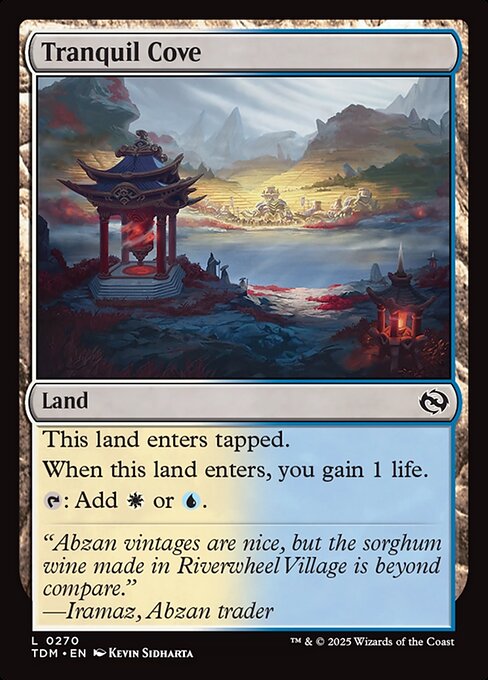
152. Tranquil Cove
Rating5.4PlayableWhy this rating?
A solid playable that rarely gets cut (5.4/10).
Why. A white-blue dual land that enters tapped, gains a life and taps for either mana. It steadies the colours of a white-blue or three-colour deck.
Risks. It enters tapped, which can ruin a key turn. The life gain is negligible.
In the draft. A late-pack land for a white-blue deck. A useful spell comes first.
Results in the games of the set
When it is in hand, the deck wins 55.5% of its games (set average: 56.0%, 128th of 274 cards).
In the opening hand: 55.7% wins (54.9% on average).
Drawn during the game: 55.4% (56.7% on average).
When it is drawn, the deck wins 2.0 points more than when it is not.
When it is drafted, it is played 78% of the time (set average: 65%).
Taken as the first pick (52 drafts), it ends in the deck 87% of the time.
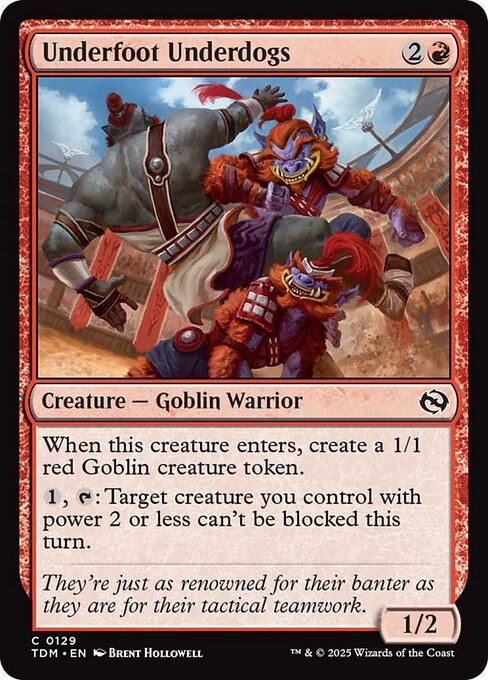
153. Underfoot Underdogs
Rating5.4PlayableWhy this rating?
A solid playable that rarely gets cut (5.4/10).
Why. A three-mana 1/2 that creates a 1/1 red Goblin creature token on entry: two bodies from one card. Its ability makes a creature with power 2 or less unblockable this turn, which opens the road for fragile attackers.
Risks. Both bodies are small, and the ability costs a mana and a tap each turn. Without suitable creatures it is a slow plan.
In the draft. Support for a red deck with many small attackers, where unblockable damage makes a difference. Take it after your best threats.
Results in the games of the set
When it is in hand, the deck wins 54.2% of its games (set average: 56.0%, 188th of 274 cards).
In the opening hand: 54.5% wins (54.9% on average).
Drawn during the game: 53.9% (56.7% on average).
When it is drawn, the deck wins 2.6 points less than when it is not.
When it is drafted, it is played 48% of the time (set average: 65%).
Taken among the first three picks (128 drafts), it ends in the deck 85% of the time.
It is played mostly in R/W decks (54% of them) and B/R (32%).

154. Wayspeaker Bodyguard
Rating5.4PlayableWhy this rating?
A solid playable that rarely gets cut (5.4/10).
Why. A four-mana 3/4 that, on entry, returns a nonland permanent card with mana value 2 or less from your graveyard to your hand. Its Flurry taps an opposing creature whenever you cast your second spell each turn: a solid body with value and pressure.
Risks. The return depends on what died earlier, and Flurry needs two spells in a turn, which does not always happen. The body is still exposed to removal.
In the draft. A decent uncommon for a low-curve white deck that chains spells. Take it at a mid pick, without making it a priority.
Results in the games of the set
When it is in hand, the deck wins 55.0% of its games (set average: 56.0%, 158th of 274 cards).
In the opening hand: 54.1% wins (54.9% on average).
Drawn during the game: 55.7% (56.7% on average).
When it is drawn, the deck wins 1.1 points less than when it is not.
When it is drafted, it is played 73% of the time (set average: 65%).
Taken as the first pick (51 drafts), it ends in the deck 90% of the time.
It is played about as much in every archetype.

155. Dragonstorm Globe
Rating5.4PlayableWhy this rating?
A solid playable that rarely gets cut (5.4/10).
Why. A three-mana artifact that taps for one mana of any colour and gives each Dragon you control an extra +1/+1 counter as it enters. It accelerates into your big spells and fixes your mana.
Risks. Three mana for an artifact that does nothing on the board leaves you behind against an aggressive deck. The bonus only matters if you play Dragons.
In the draft. A fixing piece for a multicolour deck with some Dragons and expensive spells. Take it late unless your deck is full of Dragons.
Results in the games of the set
When it is in hand, the deck wins 55.7% of its games (set average: 56.0%, 120th of 274 cards).
In the opening hand: 56.0% wins (54.9% on average).
Drawn during the game: 55.6% (56.7% on average).
When it is drawn, the deck wins 3.6 points more than when it is not.
When it is drafted, it is played 85% of the time (set average: 65%).
Taken as the first pick (321 drafts), it ends in the deck 93% of the time.
It is played mostly in G/U decks (83% of them) and B/U (78%).

156. Skirmish Rhino
Rating5.3PlayableWhy this rating?
A solid playable that rarely gets cut (5.3/10).
Why. A three-mana 3/4 with trample that drains each opponent for two life on entry. For its price it is a solid body that plays well on the board and swings a race your way.
Risks. It needs white, black and green on turn three, which is very demanding. Outside those colours it is unplayable.
In the draft. Take it only if you are already white, black and green, or ready to be. Otherwise do not spend a pick on it.
Results in the games of the set
When it is in hand, the deck wins 55.0% of its games (set average: 56.0%, 160th of 274 cards).
In the opening hand: 53.9% wins (54.9% on average).
Drawn during the game: 55.8% (56.7% on average).
When it is drawn, the deck wins 2.1 points more than when it is not.
When it is drafted, it is played 59% of the time (set average: 65%).
Taken among the first three picks (115 drafts), it ends in the deck 79% of the time.
It is played mostly in B/G decks (39% of them) and B/W (31%).
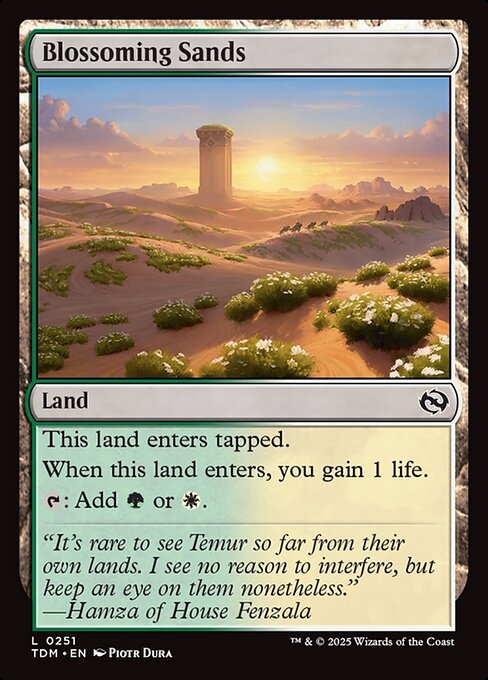
157. Blossoming Sands
Rating5.2PlayableWhy this rating?
A solid playable that rarely gets cut (5.2/10).
Why. A green-white dual land that enters tapped, gains a life and taps for either mana. It makes a green-white or three-colour deck more reliable.
Risks. It enters tapped, a lost turn. The life gain changes nothing in a game.
In the draft. Take it late in the pack if you are green and white. A playable spell goes first.
Results in the games of the set
When it is in hand, the deck wins 54.5% of its games (set average: 56.0%, 181st of 274 cards).
In the opening hand: 54.8% wins (54.9% on average).
Drawn during the game: 54.2% (56.7% on average).
When it is drawn, the deck wins 1.2 points more than when it is not.
When it is drafted, it is played 75% of the time (set average: 65%).
Taken as the first pick (34 drafts), it ends in the deck 94% of the time.
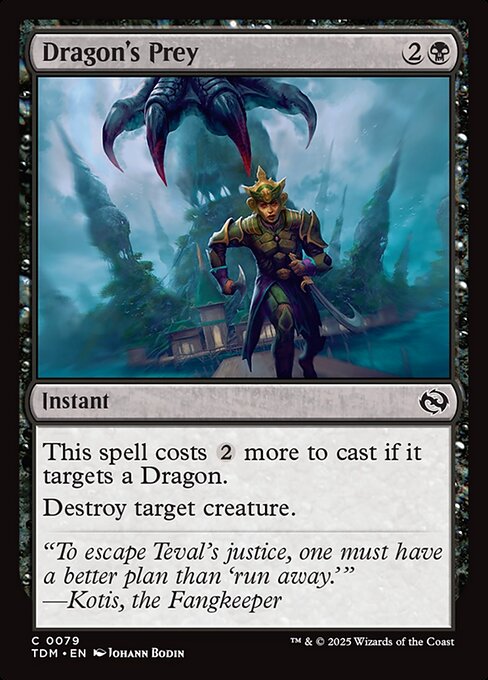
158. Dragon's Prey
Rating5.2PlayableWhy this rating?
A solid playable that rarely gets cut (5.2/10).
Why. A three-mana instant removal that destroys any creature, with no size or colour restriction. A simple, reliable answer you can cast at any time.
Risks. It costs two more if it targets a Dragon, so against the set's biggest threats it gets expensive. It only answers a creature.
In the draft. A decent common removal spell to take in black. Take it ahead of filler, after your better removal.
Results in the games of the set
When it is in hand, the deck wins 55.3% of its games (set average: 56.0%, 137th of 274 cards).
In the opening hand: 53.0% wins (54.9% on average).
Drawn during the game: 56.8% (56.7% on average).
When it is drawn, the deck wins 2.1 points more than when it is not.
When it is drafted, it is played 92% of the time (set average: 65%).
Taken as the first pick (265 drafts), it ends in the deck 96% of the time.
It is played mostly in B/U decks (54% of them) and B/G (52%).

159. Formation Breaker
Rating5.2PlayableWhy this rating?
A solid playable that rarely gets cut (5.2/10).
Why. A two-mana 2/1 that creatures with lower power cannot block. With a counter on one of your creatures it becomes a 3/3, hard for small enemy creatures to stop.
Risks. Without a counter it is a fragile 2/1. It relies on your deck to place counters, and a creature with equal or greater power can block it.
In the draft. A good attacker for a green deck that places counters, with Endure or similar effects. Without those, pass it.
Results in the games of the set
When it is in hand, the deck wins 54.7% of its games (set average: 56.0%, 169th of 274 cards).
In the opening hand: 55.8% wins (54.9% on average).
Drawn during the game: 53.9% (56.7% on average).
When it is drawn, the deck wins 1.1 points more than when it is not.
When it is drafted, it is played 74% of the time (set average: 65%).
Taken as the first pick (52 drafts), it ends in the deck 88% of the time.
It is played mostly in B/G decks (45% of them) and G/W (33%).
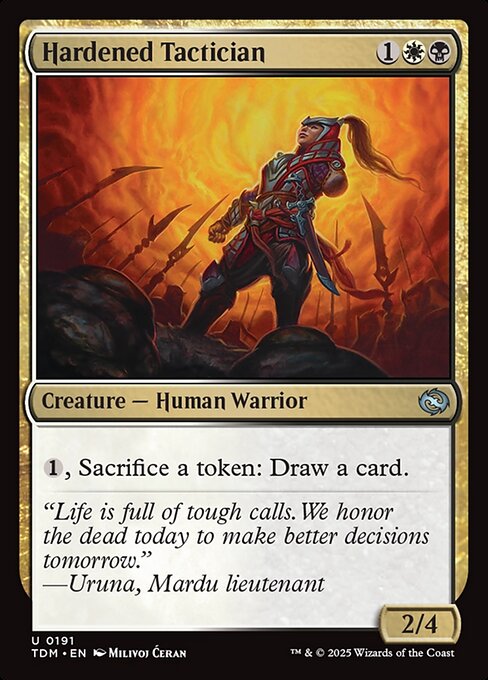
160. Hardened Tactician
Rating5.2PlayableWhy this rating?
A solid playable that rarely gets cut (5.2/10).
Why. A three-mana 2/4 that sacrifices a token for one mana to draw a card. In a deck that makes many tokens, it is a card engine and a good blocker.
Risks. Without tokens it does nothing but block. Its cost needs both white and black, and it does not attack well.
In the draft. Take it only in a white-black deck that produces tokens, for example with Mobilize or Endure. Otherwise do not play it.
Results in the games of the set
When it is in hand, the deck wins 51.7% of its games (set average: 56.0%, 244th of 274 cards).
In the opening hand: 52.0% wins (54.9% on average).
Drawn during the game: 51.6% (56.7% on average).
When it is drawn, the deck wins 3.1 points less than when it is not.
When it is drafted, it is played 63% of the time (set average: 65%).
Taken as the first pick (39 drafts), it ends in the deck 85% of the time.
It is played mostly in B/W decks (35% of them).

161. Iridescent Tiger
Rating5.2PlayableWhy this rating?
A solid playable that rarely gets cut (5.2/10).
Why. A five-mana 3/4 that, if you cast it, adds one mana of each of the five colours on entry. That mana lets you cast another spell immediately, sometimes a big one, in the same turn.
Risks. The mana disappears at the end of the phase and only matters if you have a spell to cast. Otherwise it is a 3/4 with no ability for five mana, so expensive.
In the draft. A mediocre uncommon to take only in a multicolour deck with expensive spells to chain. It plays best as a last piece of the curve.
Results in the games of the set
When it is in hand, the deck wins 55.9% of its games (set average: 56.0%, 116th of 274 cards).
In the opening hand: 53.6% wins (54.9% on average).
Drawn during the game: 57.4% (56.7% on average).
When it is drawn, the deck wins 3.4 points more than when it is not.
When it is drafted, it is played 54% of the time (set average: 65%).
Taken as the first pick (33 drafts), it ends in the deck 88% of the time.
It is played about as much in every archetype.

162. Kin-Tree Nurturer
Rating5.2PlayableWhy this rating?
A solid playable that rarely gets cut (5.2/10).
Why. A three-mana 2/1 with lifelink that endures 1 on entry: take a +1/+1 counter for a 3/2 lifelinker, or a 1/1 white Spirit creature token for a second body. It adapts to the plan of the moment.
Risks. The body is small for three mana and dies to anything. It is filler with no game-changing effect.
In the draft. A playable for a black deck; take it late. It is better with token or counter synergies.
Results in the games of the set
When it is in hand, the deck wins 54.2% of its games (set average: 56.0%, 184th of 274 cards).
In the opening hand: 54.3% wins (54.9% on average).
Drawn during the game: 54.2% (56.7% on average).
When it is drawn, the deck wins 0.4 points more than when it is not.
When it is drafted, it is played 44% of the time (set average: 65%).
Taken among the first three picks (83 drafts), it ends in the deck 70% of the time.
It is played mostly in B/W decks (52% of them) and B/G (39%).
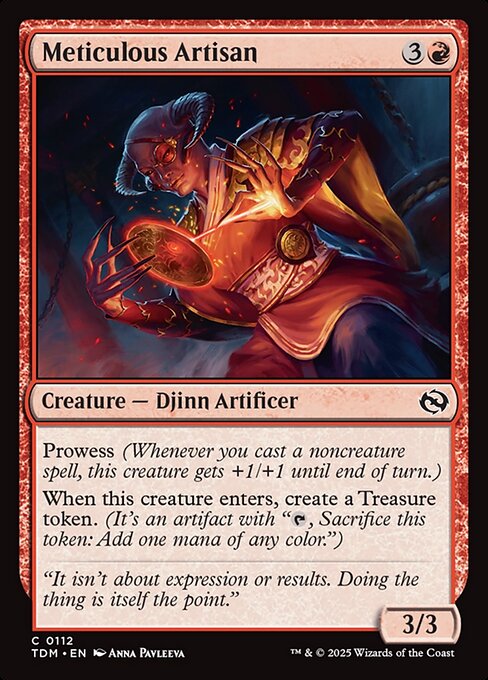
163. Meticulous Artisan
Rating5.2PlayableWhy this rating?
A solid playable that rarely gets cut (5.2/10).
Why. A four-mana 3/3 with prowess that creates a Treasure token on entry. The Treasure speeds up your following turn, and prowess rewards a deck that casts noncreature spells.
Risks. A 3/3 for four is ordinary, and without noncreature spells prowess stays dormant. The Treasure token is a one-shot.
In the draft. A decent playable for a red deck with a few instants and sorceries. Take it mid-pack or late.
Results in the games of the set
When it is in hand, the deck wins 54.7% of its games (set average: 56.0%, 171st of 274 cards).
In the opening hand: 54.3% wins (54.9% on average).
Drawn during the game: 54.9% (56.7% on average).
When it is drawn, the deck wins 1.1 points more than when it is not.
When it is drafted, it is played 22% of the time (set average: 65%).
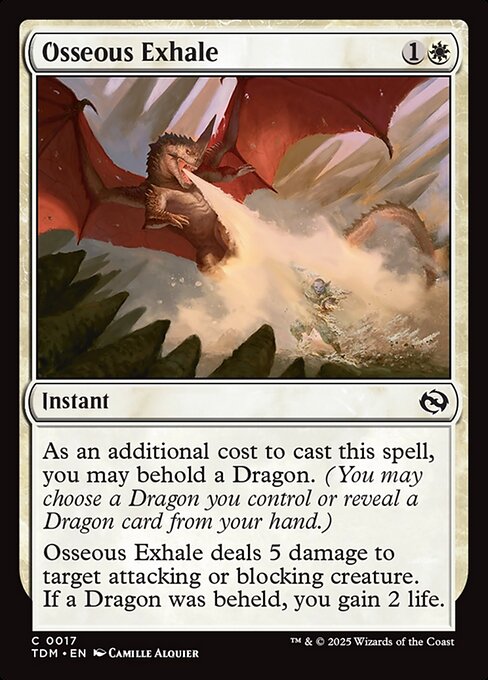
164. Osseous Exhale
Rating5.2PlayableWhy this rating?
A solid playable that rarely gets cut (5.2/10).
Why. A two-mana instant that deals 5 damage to an attacking or blocking creature. If you behold a Dragon, you also gain 2 life. It handles most creatures for a very low price.
Risks. It only hits creatures that attack or block, so one that stays back escapes it. The life bonus needs a Dragon.
In the draft. A good common removal spell to take in white, ahead of filler. It is better in a deck that attacks or blocks a lot.
Results in the games of the set
When it is in hand, the deck wins 54.9% of its games (set average: 56.0%, 164th of 274 cards).
In the opening hand: 52.9% wins (54.9% on average).
Drawn during the game: 56.2% (56.7% on average).
When it is drawn, the deck wins 1.3 points more than when it is not.
When it is drafted, it is played 76% of the time (set average: 65%).
Taken as the first pick (94 drafts), it ends in the deck 79% of the time.
It is played mostly in U/W decks (56% of them) and G/W (47%).
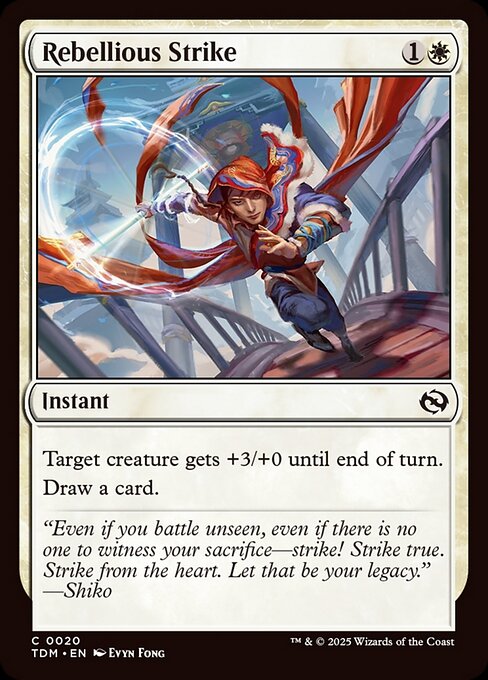
165. Rebellious Strike
Rating5.2PlayableWhy this rating?
A solid playable that rarely gets cut (5.2/10).
Why. A two-mana instant that gives a creature +3/+0 until end of turn and draws a card. The trick wins a combat, and the drawn card replaces the spell.
Risks. It needs a creature in play and does not protect it from removal. A trick is always less safe than removal.
In the draft. A good trick for an aggressive white deck; run one or two after your creatures and removal.
Results in the games of the set
When it is in hand, the deck wins 55.5% of its games (set average: 56.0%, 131st of 274 cards).
In the opening hand: 54.8% wins (54.9% on average).
Drawn during the game: 56.0% (56.7% on average).
When it is drawn, the deck wins 1.6 points less than when it is not.
When it is drafted, it is played 50% of the time (set average: 65%).
Taken among the first three picks (118 drafts), it ends in the deck 89% of the time.
It is played mostly in R/W decks (56% of them) and B/W (30%).

166. Riverwalk Technique
Rating5.2PlayableWhy this rating?
A solid playable that rarely gets cut (5.2/10).
Why. A four-mana instant with two modes: a nonland permanent goes to the top or bottom of its owner's library, owner's choice, or a noncreature spell is countered. It answers nearly anything at instant speed.
Risks. The owner chooses, so a good card often goes back on top. Four mana is a lot for an effect that kills nothing.
In the draft. A flexible control card for a blue deck. Take it mid-pack, after your threats.
Results in the games of the set
When it is in hand, the deck wins 56.4% of its games (set average: 56.0%, 96th of 274 cards).
In the opening hand: 52.2% wins (54.9% on average).
Drawn during the game: 58.8% (56.7% on average).
When it is drawn, the deck wins 3.2 points more than when it is not.
When it is drafted, it is played 67% of the time (set average: 65%).
Taken as the first pick (39 drafts), it ends in the deck 90% of the time.
It is played mostly in R/U decks (59% of them) and G/U (41%).
 Rating5.2Playable
Why this rating?
A solid playable that rarely gets cut (5.2/10).
Why. A three-mana enchantment that exiles an opposing nonland permanent for as long as the enchantment stays. A universal removal spell: creature, artifact, enchantment or planeswalker.
Risks. If the enchantment is destroyed or bounced, the permanent returns. It is slow against an urgent threat, since it is sorcery speed.
In the draft. A decent common removal spell to take in white, ahead of filler.
Results in the games of the set
When it is in hand, the deck wins 55.4% of its games (set average: 56.0%, 134th of 274 cards).
In the opening hand: 53.4% wins (54.9% on average).
Drawn during the game: 56.8% (56.7% on average).
When it is drawn, the deck wins 1.0 points more than when it is not.
When it is drafted, it is played 92% of the time (set average: 65%).
Taken as the first pick (243 drafts), it ends in the deck 95% of the time.
It is played mostly in G/W decks (48% of them) and B/W (47%).

168. Sultai Devotee
Rating5.2PlayableWhy this rating?
A solid playable that rarely gets cut (5.2/10).
Why. A two-mana 2/1 with deathtouch that turns one mana into black, green or blue mana once per turn. It blocks big attackers effectively and fixes colours in a three-colour deck.
Risks. It dies to anything and does not attack well. Its mana ability does nothing useful outside those three colours.
In the draft. A good two-drop for a green deck with black or blue. Take it mid-pack.
Results in the games of the set
When it is in hand, the deck wins 55.3% of its games (set average: 56.0%, 139th of 274 cards).
In the opening hand: 54.7% wins (54.9% on average).
Drawn during the game: 55.7% (56.7% on average).
When it is drawn, the deck wins 1.8 points more than when it is not.
When it is drafted, it is played 85% of the time (set average: 65%).
Taken as the first pick (86 drafts), it ends in the deck 87% of the time.
It is played mostly in B/G decks (57% of them) and G/U (53%).

169. Temur Monument
Rating5.2PlayableWhy this rating?
A solid playable that rarely gets cut (5.2/10).
Why. For two mana it fetches a basic Forest, Island or Mountain to your hand, smoothing your colours or guaranteeing the next land drop. Late, it sacrifices itself for a 5/5 green Elephant creature token, giving it real late-game value.
Risks. The token costs six mana across all three colours, plus tapping, and only at sorcery speed, so it is slow and demanding. Without all three colours it is just fixing that costs you tempo.
In the draft. A fine inclusion in green-blue-red decks. Not a priority: take it when nothing better shows up, and skip it outside those colours.
Results in the games of the set
When it is in hand, the deck wins 56.1% of its games (set average: 56.0%, 111th of 274 cards).
In the opening hand: 54.3% wins (54.9% on average).
Drawn during the game: 57.3% (56.7% on average).
When it is drawn, the deck wins 3.3 points more than when it is not.
When it is drafted, it is played 82% of the time (set average: 65%).
Taken as the first pick (87 drafts), it ends in the deck 92% of the time.
It is played mostly in G/U decks (32% of them) and R/U (32%).

170. Unsparing Boltcaster
Rating5.2PlayableWhy this rating?
A solid playable that rarely gets cut (5.2/10).
Why. A 3/3 for three that deals 5 damage to an opposing creature, as long as it was already dealt damage this turn. After combat or a small damage spell, it is a removal spell and a body in one card.
Risks. If no opposing creature has been dealt damage, the trigger does nothing, so you must set it up. It often wants to be cast after combat.
In the draft. Good in red decks that trade in combat or run damage spells. Take it over vanilla three-drops, but after unconditional removal.
Results in the games of the set
When it is in hand, the deck wins 53.2% of its games (set average: 56.0%, 215th of 274 cards).
In the opening hand: 53.8% wins (54.9% on average).
Drawn during the game: 52.7% (56.7% on average).
When it is drawn, the deck wins 2.9 points less than when it is not.
When it is drafted, it is played 60% of the time (set average: 65%).
Taken among the first three picks (118 drafts), it ends in the deck 84% of the time.
It is played about as much in every archetype.

171. Whirlwing Stormbrood // Dynamic Soar
Rating5.2PlayableWhy this rating?
A solid playable that rarely gets cut (5.2/10).
Why. A 4/3 flash flier for five: ambush an attacking flier or land it at the end of the opponent's turn. It also lets you cast sorceries and Dragon spells as though they had flash. The Omen puts three +1/+1 counters on a creature for three mana, then the card is shuffled back.
Risks. Five mana for a 4/3 is expensive, and the extra flash effect gives little without sorceries or other Dragons. The Omen needs a creature to buff.
In the draft. A decent Dragon in blue, playable with green too thanks to the Omen half. Do not take it over removal.
Results in the games of the set
When it is in hand, the deck wins 55.1% of its games (set average: 56.0%, 153rd of 274 cards).
In the opening hand: 51.2% wins (54.9% on average).
Drawn during the game: 57.2% (56.7% on average).
When it is drawn, the deck wins 4.2 points more than when it is not.
When it is drafted, it is played 90% of the time (set average: 65%).
Taken as the first pick (125 drafts), it ends in the deck 94% of the time.
It is played about as much in every archetype.
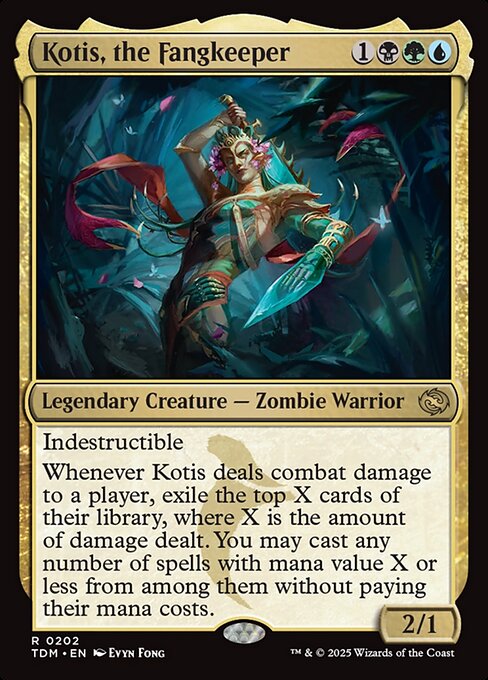 Rating5.1Playable
Why this rating?
A solid playable that rarely gets cut (5.1/10).
Why. A four-mana indestructible 2/1 that, on connecting, exiles cards from the top of the defender's library and lets you cast spells from among them for free, up to the damage dealt in mana value. When it hits, it can swing the game.
Risks. It needs exactly three colours, and a 2/1 with no evasion is easy to block: indestructible keeps it alive, not unblocked. Its damage stays low.
In the draft. Only for a deck that is already blue-black-green. Not an early pick: everything rests on it connecting with the player.
Results in the games of the set
When it is in hand, the deck wins 53.0% of its games (set average: 56.0%, 217th of 274 cards).
In the opening hand: 51.2% wins (54.9% on average).
Drawn during the game: 54.2% (56.7% on average).
When it is drawn, the deck wins 2.5 points more than when it is not.
When it is drafted, it is played 73% of the time (set average: 65%).
Taken as the first pick (30 drafts), it ends in the deck 87% of the time.
It is played about as much in every archetype.

173. Champion of Dusan
Rating5.1PlayableWhy this rating?
A solid playable that rarely gets cut (5.1/10).
Why. A three-mana 4/2 with trample makes for an aggressive turn-three play. From the graveyard, Renew gives it a second life: for two mana, put a +1/+1 counter and a trample counter on a creature.
Risks. Two toughness means it dies to almost anything and trades with any creature. Renew only works at sorcery speed.
In the draft. A solid green common for aggressive decks. Take it over a vanilla two-drop, after your removal and best creatures.
Results in the games of the set
When it is in hand, the deck wins 55.5% of its games (set average: 56.0%, 129th of 274 cards).
In the opening hand: 54.9% wins (54.9% on average).
Drawn during the game: 56.0% (56.7% on average).
When it is drawn, the deck wins 1.5 points more than when it is not.
When it is drafted, it is played 79% of the time (set average: 65%).
Taken as the first pick (67 drafts), it ends in the deck 94% of the time.
It is played mostly in B/G decks (71% of them) and G/R (57%).
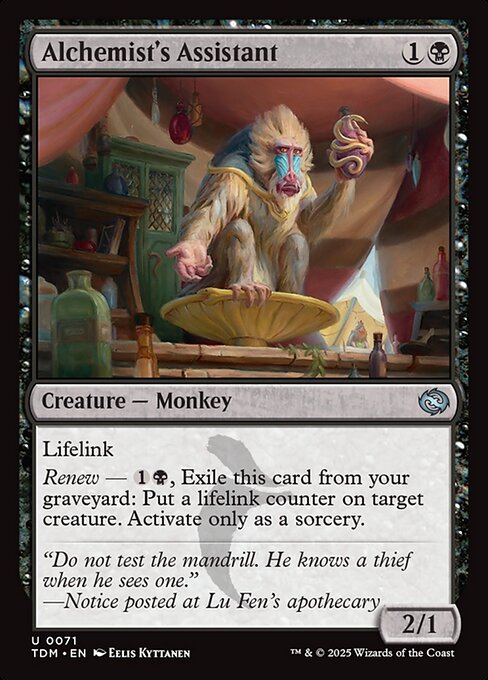 Rating5.0Playable
Why this rating?
A solid playable that rarely gets cut (5.0/10).
Why. A two-mana 2/1 with lifelink, decent for holding the early game. Later, Renew puts a lifelink counter on a bigger creature for two mana.
Risks. A 2/1 stays small and blocks poorly. The effect is modest outside an attacking deck.
In the draft. A filler pick for black decks. It gains value when you have large creatures to put the counter on.
Results in the games of the set
When it is in hand, the deck wins 54.1% of its games (set average: 56.0%, 190th of 274 cards).
In the opening hand: 54.6% wins (54.9% on average).
Drawn during the game: 53.7% (56.7% on average).
When it is drawn, the deck wins 0.6 points more than when it is not.
When it is drafted, it is played 76% of the time (set average: 65%).
Taken as the first pick (32 drafts), it ends in the deck 91% of the time.
It is played mostly in B/G decks (27% of them).
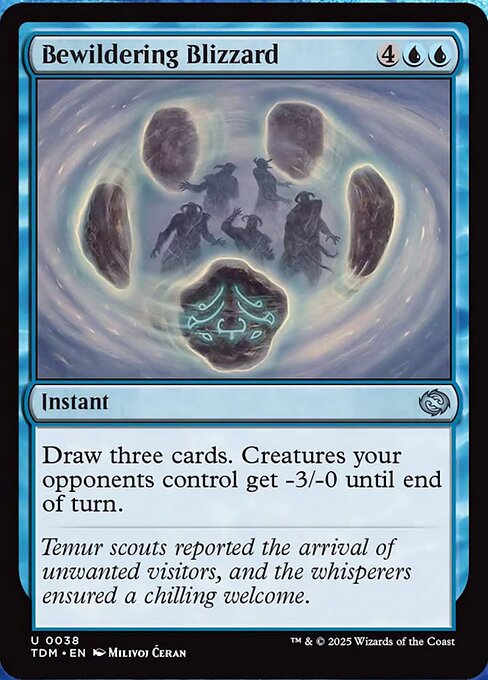
175. Bewildering Blizzard
Rating5.0PlayableWhy this rating?
A solid playable that rarely gets cut (5.0/10).
Why. A six-mana instant that draws three cards and gives creatures your opponents control -3/-0 until end of turn. Cast during their attack, it sharply cuts their damage and puts you ahead on cards.
Risks. Six mana for an effect that kills nothing: it does not improve your board. It doesn't rescue a game already lost on tempo.
In the draft. A good value spell for slower blue decks. It doesn't go over removal; take it when you lack card advantage.
Results in the games of the set
When it is in hand, the deck wins 56.3% of its games (set average: 56.0%, 103rd of 274 cards).
In the opening hand: 51.9% wins (54.9% on average).
Drawn during the game: 58.8% (56.7% on average).
When it is drawn, the deck wins 3.9 points more than when it is not.
When it is drafted, it is played 77% of the time (set average: 65%).
Taken as the first pick (82 drafts), it ends in the deck 91% of the time.
It is played mostly in R/U decks (28% of them).
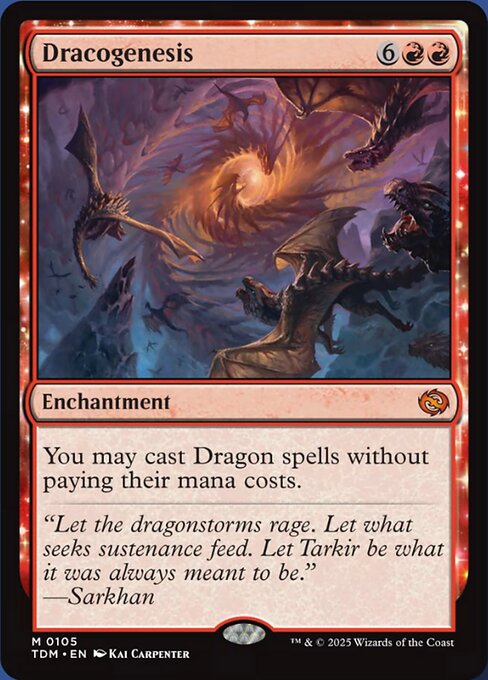
176. Dracogenesis
Rating5.0PlayableWhy this rating?
A solid playable that rarely gets cut (5.0/10).
Why. An eight-mana enchantment that lets you cast Dragon spells without paying their mana costs. Once it is out, every Dragon in hand arrives for free, which is huge in a deck packed with Dragons.
Risks. Eight mana, and it does nothing by itself: with no Dragons in hand you wasted your turn. In draft you rarely have enough Dragons to make it reliable.
In the draft. Avoid it in most decks. Only a red deck full of Dragons can consider it; otherwise leave it.
Results in the games of the set
When it is drafted, it is played only 1% of the time (set average: 65%): it almost always ends in the sideboard.

177. Gurmag Rakshasa
Rating5.0PlayableWhy this rating?
A solid playable that rarely gets cut (5.0/10).
Why. A six-mana 5/5 with menace that, on entering, gives an opposing creature -2/-2 and one of yours +2/+2 until end of turn. It can kill a small creature and swing a combat.
Risks. Six mana is heavy, and killing the target is not guaranteed. A removal spell on it costs you tempo.
In the draft. A good top-end black card. Take it if you have few six-drops and enough mana to cast it.
Results in the games of the set
When it is in hand, the deck wins 54.9% of its games (set average: 56.0%, 162nd of 274 cards).
In the opening hand: 51.8% wins (54.9% on average).
Drawn during the game: 57.1% (56.7% on average).
When it is drawn, the deck wins 1.2 points more than when it is not.
When it is drafted, it is played 46% of the time (set average: 65%).
Taken among the first three picks (74 drafts), it ends in the deck 70% of the time.
It is played about as much in every archetype.

178. Iceridge Serpent
Rating5.0PlayableWhy this rating?
A solid playable that rarely gets cut (5.0/10).
Why. A five-mana 3/3 that returns an opposing creature to its owner's hand on entering. It is a tempo swing, especially against an expensive creature or one wearing an Aura.
Risks. It solves nothing permanently: the opponent just replays the creature. Five mana for a 3/3 is steep against an aggressive opponent.
In the draft. A decent blue common, especially in tempo decks. Take it after removal and the better Dragons.
Results in the games of the set
When it is in hand, the deck wins 55.4% of its games (set average: 56.0%, 133rd of 274 cards).
In the opening hand: 52.0% wins (54.9% on average).
Drawn during the game: 57.5% (56.7% on average).
When it is drawn, the deck wins 2.5 points more than when it is not.
When it is drafted, it is played 45% of the time (set average: 65%).
Taken among the first three picks (56 drafts), it ends in the deck 79% of the time.
It is played mostly in R/U decks (32% of them) and U/W (30%).

179. Marshal of the Lost
Rating5.0PlayableWhy this rating?
A solid playable that rarely gets cut (5.0/10).
Why. A four-mana 3/3 with deathtouch. Whenever you attack, a target creature gets +X/+X where X is the number of attackers, so with a wide board it turns an attack into a blowout.
Risks. It needs an aggressive deck attacking with several creatures, and exactly two colours. Alone it just brings deathtouch.
In the draft. A good pick in an aggressive white-black deck. Look for cheap creatures and tokens alongside.
Results in the games of the set
When it is in hand, the deck wins 53.8% of its games (set average: 56.0%, 198th of 274 cards).
In the opening hand: 53.0% wins (54.9% on average).
Drawn during the game: 54.5% (56.7% on average).
When it is drawn, the deck wins 0.4 points less than when it is not.
When it is drafted, it is played 72% of the time (set average: 65%).
Taken as the first pick (41 drafts), it ends in the deck 80% of the time.
It is played mostly in B/W decks (33% of them).

180. Sage of the Fang
Rating5.0PlayableWhy this rating?
A solid playable that rarely gets cut (5.0/10).
Why. A 2/2 that puts a +1/+1 counter on a creature when it enters, then gives value later: Renew adds a counter to a target and then doubles its counters, which can produce a very large creature.
Risks. A 2/2 body for three is modest. Renew costs four mana at sorcery speed, and is only really strong on a creature that already holds counters.
In the draft. A decent uncommon for green counter decks. Take it over creatures without abilities.
Results in the games of the set
When it is in hand, the deck wins 54.7% of its games (set average: 56.0%, 172nd of 274 cards).
In the opening hand: 53.7% wins (54.9% on average).
Drawn during the game: 55.4% (56.7% on average).
When it is drawn, the deck wins 1.3 points more than when it is not.
When it is drafted, it is played 88% of the time (set average: 65%).
Taken as the first pick (76 drafts), it ends in the deck 96% of the time.
It is played mostly in B/G decks (35% of them) and G/W (25%).
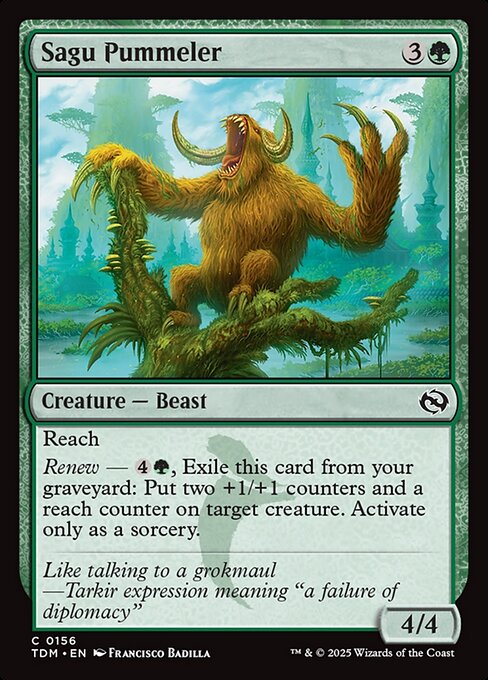
181. Sagu Pummeler
Rating5.0PlayableWhy this rating?
A solid playable that rarely gets cut (5.0/10).
Why. A four-mana 4/4 with reach: a solid body that blocks fliers and holds the board well. Later, Renew gives two +1/+1 counters and a reach counter to a creature.
Risks. It has no offensive ability beyond its stats. Renew costs five mana, which is slow.
In the draft. A good green common for defence and the midgame. Take it readily if you are green.
Results in the games of the set
When it is in hand, the deck wins 55.2% of its games (set average: 56.0%, 146th of 274 cards).
In the opening hand: 53.3% wins (54.9% on average).
Drawn during the game: 56.5% (56.7% on average).
When it is drawn, the deck wins 1.3 points more than when it is not.
When it is drafted, it is played 84% of the time (set average: 65%).
Taken as the first pick (72 drafts), it ends in the deck 96% of the time.
It is played mostly in B/G decks (51% of them) and G/R (50%).

182. Stillness in Motion
Rating5.0PlayableWhy this rating?
A solid playable that rarely gets cut (5.0/10).
Why. A two-mana enchantment that mills three cards each upkeep. If your library is empty, it exiles itself and puts five cards from your graveyard back on top: in a deck built for it, a strange engine.
Risks. It does nothing useful on its own, it pushes you toward decking, and it doesn't support your board. Without a precise plan it is a dead card.
In the draft. Leave it out of almost every deck. Only play it if you built the deck around it.
Results in the games of the set
When it is in hand, the deck wins 45.1% of its games (set average: 56.0%).
Drawn during the game: 0.0% (56.7% on average).
When it is drawn, the deck wins 1.1 points less than when it is not.
When it is drafted, it is played only 2% of the time (set average: 65%): it almost always ends in the sideboard.

183. Stormshriek Feral // Flush Out
Rating5.0PlayableWhy this rating?
A solid playable that rarely gets cut (5.0/10).
Why. A five-mana 3/3 Dragon with flying and haste that can pump +1/+0 for two mana. It attacks right away. The Omen lets you discard a card to draw two for two mana.
Risks. Five mana for a 3/3 is steep, and three toughness dies to a lot of removal. The Omen needs a card to discard.
In the draft. A decent flexible red Dragon, worth taking over average creatures. It fits any red deck.
Results in the games of the set
When it is in hand, the deck wins 54.3% of its games (set average: 56.0%, 183rd of 274 cards).
In the opening hand: 51.8% wins (54.9% on average).
Drawn during the game: 55.8% (56.7% on average).
When it is drawn, the deck wins 0.9 points more than when it is not.
When it is drafted, it is played 79% of the time (set average: 65%).
Taken as the first pick (76 drafts), it ends in the deck 88% of the time.
It is played mostly in G/R decks (50% of them) and B/R (41%).

184. Temur Devotee
Rating5.0PlayableWhy this rating?
A solid playable that rarely gets cut (5.0/10).
Why. A two-mana 3/3 defender: a sturdy early wall. For one mana it adds green, blue or red mana once each turn, so it fixes your colours.
Risks. It never attacks, and its ability turns one mana into another: it does not ramp. In a fast deck it is too passive.
In the draft. A good common for green-blue-red decks. A fair pick, though it won't win on its own.
Results in the games of the set
When it is in hand, the deck wins 54.6% of its games (set average: 56.0%, 177th of 274 cards).
In the opening hand: 53.6% wins (54.9% on average).
Drawn during the game: 55.2% (56.7% on average).
When it is drawn, the deck wins 1.4 points more than when it is not.
When it is drafted, it is played 60% of the time (set average: 65%).
Taken among the first three picks (156 drafts), it ends in the deck 84% of the time.
It is played mostly in R/U decks (48% of them) and G/U (45%).

185. Constrictor Sage
Rating5.0WeakWhy this rating?
A solid playable that rarely gets cut (5.0/10).
Why. A five-mana 4/4 that taps an opposing creature and puts a stun counter on it as it enters, so it stays tapped through its next untap step. Renew repeats the effect from the graveyard for three mana.
Risks. The stun is temporary and doesn't solve the threat. Five mana is a bit expensive for pure tempo.
In the draft. A good blue uncommon that gives two uses from one card. Take it in an aggressive or controlling blue deck.
Results in the games of the set
When it is in hand, the deck wins 54.1% of its games (set average: 56.0%, 192nd of 274 cards).
In the opening hand: 49.9% wins (54.9% on average).
Drawn during the game: 56.7% (56.7% on average).
When it is drawn, the deck wins 1.3 points more than when it is not.
When it is drafted, it is played 71% of the time (set average: 65%).
Taken as the first pick (50 drafts), it ends in the deck 88% of the time.
It is played about as much in every archetype.

186. United Battlefront
Rating4.9WeakWhy this rating?
A solid playable that rarely gets cut (4.9/10).
Why. A four-mana sorcery that looks at seven cards and puts up to two noncreature, nonland permanents with mana value 3 or less onto the battlefield. In a deck full of artifacts and enchantments it can give a big edge.
Risks. In draft there are few good targets, so it may find nothing. A miss costs you a turn for next to nothing.
In the draft. Leave it out of most decks. Only a white deck with many artifacts and enchantments can play it.
Results in the games of the set
When it is drafted, it is played only 2% of the time (set average: 65%): it almost always ends in the sideboard.
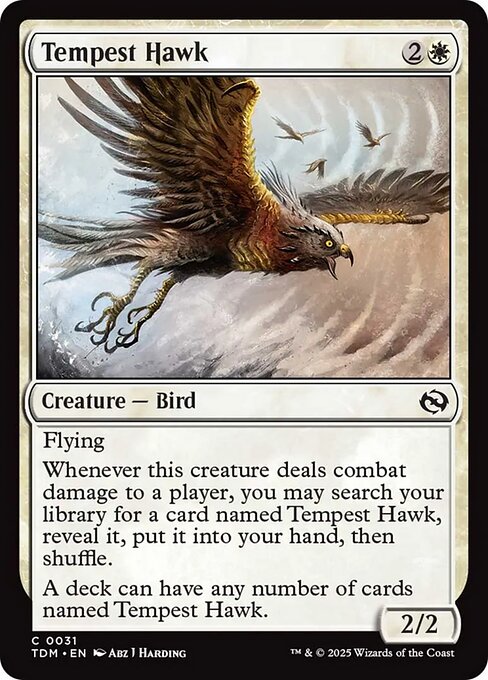
187. Tempest Hawk
Rating4.8WeakWhy this rating?
A solid playable that rarely gets cut (4.8/10).
Why. A three-mana 2/2 flier. If it hits the opponent, it searches for another copy, and a deck may contain any number of them. In a deck full of copies it becomes an offensive engine.
Risks. In draft you will have only a few copies, so the search rarely matters. A 2/2 flier dies to an aerial blocker or the first removal.
In the draft. An average white common, useful in aggressive decks. Take it as an evasive creature and don't count on the search.
Results in the games of the set
When it is in hand, the deck wins 52.2% of its games (set average: 56.0%, 233rd of 274 cards).
In the opening hand: 52.9% wins (54.9% on average).
Drawn during the game: 51.7% (56.7% on average).
When it is drawn, the deck wins 1.0 points more than when it is not.
When it is drafted, it is played 24% of the time (set average: 65%).
Taken among the first three picks (110 drafts), it ends in the deck 57% of the time.
 Rating4.8Weak
Why this rating?
A solid playable that rarely gets cut (4.8/10).
Why. A three-mana sorcery that exiles a nonland card of your choice from the opponent's hand and puts a +1/+1 counter on one of your creatures, if you have one. You see their hand and neutralise a threat before it lands.
Risks. It doesn't touch what the opponent has already played, and it does nothing to the board. Late in the game their hand may be empty or weak.
In the draft. Playable in black control or value decks. Take it after removal, since it doesn't change the board directly.
Results in the games of the set
When it is in hand, the deck wins 54.9% of its games (set average: 56.0%, 161st of 274 cards).
In the opening hand: 54.0% wins (54.9% on average).
Drawn during the game: 55.6% (56.7% on average).
When it is drawn, the deck wins 1.4 points more than when it is not.
When it is drafted, it is played 34% of the time (set average: 65%).
Taken among the first three picks (65 drafts), it ends in the deck 82% of the time.
It is played mostly in B/G decks (51% of them) and B/W (26%).
189. Auroral Procession
Rating4.8WeakWhy this rating?
A solid playable that rarely gets cut (4.8/10).
Why. A two-mana green-blue instant that returns a card from your graveyard to your hand. It can get back a removal spell or key creature, at the best moment.
Risks. It does nothing on its own: you spend two mana and a card to get another one back. With no good target in your graveyard, it is weak.
In the draft. Filler for green-blue decks. Don't take it over real creatures or removal.
Results in the games of the set
When it is in hand, the deck wins 53.9% of its games (set average: 56.0%, 195th of 274 cards).
In the opening hand: 48.5% wins (54.9% on average).
Drawn during the game: 57.1% (56.7% on average).
When it is drawn, the deck wins 2.0 points more than when it is not.
When it is drafted, it is played 56% of the time (set average: 65%).
Taken among the first three picks (112 drafts), it ends in the deck 88% of the time.
It is played about as much in every archetype.

190. Dirgur Island Dragon // Skimming Strike
Rating4.8WeakWhy this rating?
A solid playable that rarely gets cut (4.8/10).
Why. A six-mana 4/4 Dragon with flying and ward 2: an aerial threat that resists cheap removal. The Omen taps a creature and draws a card for two mana, then the card is shuffled back.
Risks. Six mana is heavy. Removal whose controller can pay for ward, or bigger fliers, can stop it.
In the draft. A good blue common, flexible early or late. Take it in any blue deck that needs a finisher.
Results in the games of the set
When it is in hand, the deck wins 55.6% of its games (set average: 56.0%, 124th of 274 cards).
In the opening hand: 51.1% wins (54.9% on average).
Drawn during the game: 57.8% (56.7% on average).
When it is drawn, the deck wins 3.6 points more than when it is not.
When it is drafted, it is played 89% of the time (set average: 65%).
Taken as the first pick (104 drafts), it ends in the deck 97% of the time.
It is played mostly in R/U decks (54% of them) and U/W (50%).

191. Fire-Rim Form
Rating4.8WeakWhy this rating?
A solid playable that rarely gets cut (4.8/10).
Why. A two-mana Aura with flash: when it enters, the enchanted creature gains first strike until end of turn, and it gets +2/+0 for as long as the Aura stays. In combat it wins a surprise trade, then stays stronger.
Risks. You risk a two-for-one if the opponent responds with removal. An Aura needs a creature.
In the draft. A card for aggressive red-white decks. Take it late, after creatures and removal.
Results in the games of the set
When it is in hand, the deck wins 52.9% of its games (set average: 56.0%, 219th of 274 cards).
In the opening hand: 52.3% wins (54.9% on average).
Drawn during the game: 53.3% (56.7% on average).
When it is drawn, the deck wins 2.6 points less than when it is not.
When it is drafted, it is played 18% of the time (set average: 65%).

192. Gurmag Nightwatch
Rating4.8WeakWhy this rating?
A solid playable that rarely gets cut (4.8/10).
Why. A 3/3 with three hybrid symbols. When it enters, look at the top three cards, keep one on top and put the rest into your graveyard. It improves your draws and feeds the graveyard.
Risks. Each hybrid symbol is paid with its colour or two mana of any type, so it is sometimes expensive. It is best in decks that use the graveyard.
In the draft. A good common for black-green-blue decks. Take it as a mid-curve creature that doesn't cost you a card.
Results in the games of the set
When it is in hand, the deck wins 55.6% of its games (set average: 56.0%, 122nd of 274 cards).
In the opening hand: 54.4% wins (54.9% on average).
Drawn during the game: 56.4% (56.7% on average).
When it is drawn, the deck wins 2.7 points more than when it is not.
When it is drafted, it is played 31% of the time (set average: 65%).
It is played mostly in B/U decks (36% of them) and G/U (34%).

193. Inspirited Vanguard
Rating4.8WeakWhy this rating?
A solid playable that rarely gets cut (4.8/10).
Why. A five-mana 3/2 that endures 2 when it enters and each time it attacks. You pick two +1/+1 counters or a 2/2 white Spirit creature token, so it grows or widens your board every attack.
Risks. Five mana for a 3/2 is steep, and it is a fragile body to send into combat. The trigger happens before blocks, but the 3/2 can still be blocked afterwards.
In the draft. A good green uncommon for value decks. Take it over plain creatures, after your removal.
Results in the games of the set
When it is in hand, the deck wins 55.2% of its games (set average: 56.0%, 148th of 274 cards).
In the opening hand: 53.7% wins (54.9% on average).
Drawn during the game: 56.2% (56.7% on average).
When it is drawn, the deck wins 2.7 points more than when it is not.
When it is drafted, it is played 75% of the time (set average: 65%).
Taken as the first pick (42 drafts), it ends in the deck 88% of the time.
It is played mostly in G/W decks (26% of them).

194. Mammoth Bellow
Rating4.8WeakWhy this rating?
A solid playable that rarely gets cut (4.8/10).
Why. A five-mana sorcery that creates a 5/5 green Elephant creature token, and it can be cast again from your graveyard with Harmonize. Two 5/5s from one card is real value.
Risks. It needs exactly three colours and a high cost, and Harmonize is pricier still, even reduced by tapping a creature. A sorcery has no surprise.
In the draft. Good in a green-blue-red deck that wants big things. Outside those colours, skip it.
Results in the games of the set
When it is in hand, the deck wins 54.4% of its games (set average: 56.0%, 182nd of 274 cards).
In the opening hand: 51.1% wins (54.9% on average).
Drawn during the game: 56.3% (56.7% on average).
When it is drawn, the deck wins 2.2 points more than when it is not.
When it is drafted, it is played 80% of the time (set average: 65%).
Taken as the first pick (83 drafts), it ends in the deck 89% of the time.
It is played mostly in G/U decks (34% of them) and R/U (28%).

195. Rescue Leopard
Rating4.8WeakWhy this rating?
A solid playable that rarely gets cut (4.8/10).
Why. A three-mana 4/2 that, whenever it becomes tapped, lets you discard a card to draw one. It hits hard and filters your hand.
Risks. Two toughness means it dies to any block. The filtering only matters if you have dead cards to discard.
In the draft. A decent red common for aggressive decks, especially red-white. Take it as a three-drop, behind removal.
Results in the games of the set
When it is in hand, the deck wins 53.2% of its games (set average: 56.0%, 214th of 274 cards).
In the opening hand: 53.4% wins (54.9% on average).
Drawn during the game: 53.0% (56.7% on average).
When it is drawn, the deck wins 1.3 points less than when it is not.
When it is drafted, it is played 37% of the time (set average: 65%).
Taken among the first three picks (61 drafts), it ends in the deck 69% of the time.
It is played mostly in G/R decks (42% of them) and R/W (27%).

196. Salt Road Skirmish
Rating4.8WeakWhy this rating?
A solid playable that rarely gets cut (4.8/10).
Why. A four-mana sorcery that destroys a creature and creates two 1/1 red Warrior creature tokens with haste, sacrificed at the next end step. A true unconditional removal spell with a little bonus damage.
Risks. It is pricey for removal and slow. The tokens don't stay, so the bonus is small.
In the draft. Take it in a black deck: unconditional removal is valuable. The token bonus helps an aggressive deck.
Results in the games of the set
When it is in hand, the deck wins 54.8% of its games (set average: 56.0%, 167th of 274 cards).
In the opening hand: 52.1% wins (54.9% on average).
Drawn during the game: 56.7% (56.7% on average).
When it is drawn, the deck wins 1.7 points more than when it is not.
When it is drafted, it is played 84% of the time (set average: 65%).
Taken as the first pick (75 drafts), it ends in the deck 88% of the time.
It is played mostly in B/R decks (28% of them) and B/W (25%).

197. Starry-Eyed Skyrider
Rating4.8WeakWhy this rating?
A solid playable that rarely gets cut (4.8/10).
Why. A three-mana 1/3 flier. When it attacks, another creature gains flying, and your attacking tokens have flying: in a token deck your attacks become much harder to block.
Risks. A 1/3 deals almost no damage, and it is only good in a deck with tokens or big creatures to send into the air.
In the draft. A niche white uncommon for token decks, especially red-white. Without tokens, leave it.
Results in the games of the set
When it is in hand, the deck wins 51.7% of its games (set average: 56.0%, 247th of 274 cards).
In the opening hand: 50.7% wins (54.9% on average).
Drawn during the game: 52.4% (56.7% on average).
When it is drawn, the deck wins 3.3 points less than when it is not.
When it is drafted, it is played 77% of the time (set average: 65%).
Taken as the first pick (62 drafts), it ends in the deck 94% of the time.
It is played about as much in every archetype.

198. Wail of War
Rating4.8WeakWhy this rating?
A solid playable that rarely gets cut (4.8/10).
Why. A three-mana instant with two modes: creatures target opponent controls get -1/-1 until end of turn, or return up to two creature cards from your graveyard to your hand. It works as a trick against small creatures or as value recovery.
Risks. Neither mode is direct removal. The first only kills tiny creatures, the second needs a stocked graveyard.
In the draft. A decent black value uncommon. Take it after removal, especially if your deck trades creatures often.
Results in the games of the set
When it is in hand, the deck wins 55.2% of its games (set average: 56.0%, 144th of 274 cards).
In the opening hand: 51.5% wins (54.9% on average).
Drawn during the game: 57.7% (56.7% on average).
When it is drawn, the deck wins 2.2 points more than when it is not.
When it is drafted, it is played 48% of the time (set average: 65%).
Taken among the first three picks (78 drafts), it ends in the deck 77% of the time.
It is played about as much in every archetype.

199. Riling Dawnbreaker // Signaling Roar
Rating4.7WeakWhy this rating?
A solid playable that rarely gets cut (4.7/10).
Why. A five-mana 3/4 Dragon with flying and vigilance: it attacks while still defending. At the beginning of your combat, another creature gets +1/+0. The Omen creates a 2/2 white Soldier creature token for two mana.
Risks. Five mana for a 3/4 is expensive and deals modest damage alone. It is best with other attackers.
In the draft. A decent white Dragon, especially in red-white. Take it as a flexible evasive creature, after removal.
Results in the games of the set
When it is in hand, the deck wins 53.4% of its games (set average: 56.0%, 210th of 274 cards).
In the opening hand: 52.0% wins (54.9% on average).
Drawn during the game: 54.3% (56.7% on average).
When it is drawn, the deck wins 1.1 points less than when it is not.
When it is drafted, it is played 83% of the time (set average: 65%).
Taken as the first pick (114 drafts), it ends in the deck 97% of the time.
It is played mostly in G/W decks (45% of them) and U/W (44%).

200. Dragonclaw Strike
Rating4.7WeakWhy this rating?
A solid playable that rarely gets cut (4.7/10).
Why. A sorcery with three hybrid symbols that doubles the power and toughness of your creature, then has it fight an opposing creature. With an average creature, it is removal at a fair price.
Risks. You need a creature, and the opponent can kill yours in response. It handles very big creatures poorly.
In the draft. A good fight removal spell in green, blue and red decks. Take it fairly high if you already have good creatures.
Results in the games of the set
When it is in hand, the deck wins 56.3% of its games (set average: 56.0%, 98th of 274 cards).
In the opening hand: 52.0% wins (54.9% on average).
Drawn during the game: 58.9% (56.7% on average).
When it is drawn, the deck wins 3.9 points more than when it is not.
When it is drafted, it is played 74% of the time (set average: 65%).
Taken as the first pick (50 drafts), it ends in the deck 88% of the time.
It is played mostly in G/R decks (31% of them) and G/U (28%).

201. Embermouth Sentinel
Rating4.6WeakWhy this rating?
A solid playable that rarely gets cut (4.6/10).
Why. A two-mana artifact 2/1 that fetches a basic land and puts it on top of your library, so your next draw is the colour you need. If you control a Dragon, the land goes straight onto the battlefield tapped instead.
Risks. The body is small and blocks nothing relevant. Without a Dragon you are just trading your next draw for a land, which is neutral if you did not need one.
In the draft. Useful filler for a three-colour deck that wants its mana to work. Take it late, after your removal and your good creatures.
Results in the games of the set
When it is in hand, the deck wins 53.9% of its games (set average: 56.0%, 196th of 274 cards).
In the opening hand: 53.5% wins (54.9% on average).
Drawn during the game: 54.2% (56.7% on average).
When it is drawn, the deck wins 0.4 points more than when it is not.
When it is drafted, it is played 48% of the time (set average: 65%).
Taken among the first three picks (68 drafts), it ends in the deck 84% of the time.
It is played mostly in B/U decks (26% of them) and G/R (25%).
 Rating4.6Weak
Why this rating?
A solid playable that rarely gets cut (4.6/10).
Why. For four mana you put two basic lands onto the battlefield tapped: a clean ramp jump for heavy decks. When a Dragon enters, the enchantment goes back to your hand so you can do it again.
Risks. It does nothing on the board on turn four, and you fall behind against an aggressive deck. Without a Dragon it is just a slow ramp spell.
In the draft. Only for a green top-end deck with several Dragons and expensive cards to cast. Otherwise leave it in the sideboard.
Results in the games of the set
When it is in hand, the deck wins 53.7% of its games (set average: 56.0%, 202nd of 274 cards).
In the opening hand: 52.7% wins (54.9% on average).
Drawn during the game: 54.4% (56.7% on average).
When it is drawn, the deck wins 2.0 points more than when it is not.
When it is drafted, it is played 69% of the time (set average: 65%).
Taken as the first pick (99 drafts), it ends in the deck 86% of the time.
It is played mostly in G/R decks (28% of them) and G/U (25%).

203. Kheru Goldkeeper
Rating4.6WeakWhy this rating?
A solid playable that rarely gets cut (4.6/10).
Why. A four-mana 3/3 flier is already a fine body. Whenever cards leave your graveyard during your turn, you create a Treasure token, and from the graveyard, Renew puts two +1/+1 counters and a flying counter on a creature.
Risks. It asks for three colours, so the mana is very demanding. The Treasures need effects that take cards out of your graveyard, which your deck has to provide.
In the draft. A good card for an established black-green-blue deck. Take it for the flying body and do not count on the Treasures.
Results in the games of the set
When it is in hand, the deck wins 54.6% of its games (set average: 56.0%, 179th of 274 cards).
In the opening hand: 51.8% wins (54.9% on average).
Drawn during the game: 56.4% (56.7% on average).
When it is drawn, the deck wins 2.3 points more than when it is not.
When it is drafted, it is played 82% of the time (set average: 65%).
Taken as the first pick (50 drafts), it ends in the deck 88% of the time.
It is played mostly in B/U decks (32% of them) and B/G (31%).

204. Kin-Tree Severance
Rating4.6WeakWhy this rating?
A solid playable that rarely gets cut (4.6/10).
Why. An instant-speed removal that exiles any permanent with mana value 3 or greater: creature, artifact, enchantment, planeswalker. It answers threats that ordinary damage spells cannot.
Risks. The hybrid cost is heavy: it is three mana only if you have white, black and green, and otherwise climbs up to six. It cannot touch small creatures.
In the draft. Good in a white-black-green deck where it costs three. Outside those colours it gets too expensive and deserves a lower pick.
Results in the games of the set
When it is in hand, the deck wins 55.9% of its games (set average: 56.0%, 118th of 274 cards).
In the opening hand: 52.9% wins (54.9% on average).
Drawn during the game: 57.9% (56.7% on average).
When it is drawn, the deck wins 3.1 points more than when it is not.
When it is drafted, it is played 86% of the time (set average: 65%).
Taken as the first pick (64 drafts), it ends in the deck 94% of the time.
It is played mostly in B/G decks (32% of them) and B/W (27%).

205. Strategic Betrayal
Rating4.6WeakWhy this rating?
A solid playable that rarely gets cut (4.6/10).
Why. For two mana, the opponent exiles a creature of their choice and their graveyard. When they control only one creature it is clean removal, and the graveyard exile also shuts off their recursion.
Risks. The opponent chooses: against several creatures they exile the weakest. A sorcery that comes down late on a crowded board loses almost all its value.
In the draft. Play it in an aggressive deck that keeps the opponent down to one creature, or as a filler removal. Take it without hurry.
Results in the games of the set
When it is in hand, the deck wins 55.0% of its games (set average: 56.0%, 156th of 274 cards).
In the opening hand: 53.2% wins (54.9% on average).
Drawn during the game: 56.4% (56.7% on average).
When it is drawn, the deck wins 2.5 points more than when it is not.
When it is drafted, it is played 62% of the time (set average: 65%).
Taken among the first three picks (113 drafts), it ends in the deck 82% of the time.
It is played about as much in every archetype.

206. The Sibsig Ceremony
Rating4.6WeakWhy this rating?
A solid playable that rarely gets cut (4.6/10).
Why. Creature spells cost two less, but every creature you cast is destroyed as it enters and replaced by a 2/2 black Zombie Druid creature token. It is a combo engine for creatures that want to die.
Risks. It demands three black mana right away and does nothing until your deck has creatures that profit from dying. Otherwise every creature you cast turns into a mediocre 2/2, which is a liability in a normal deck.
In the draft. A niche card. Take it only if you are building a heavily black deck around death triggers, never as a baseline playable.
Results in the games of the set
When it is drafted, it is played only 0% of the time (set average: 65%): it almost always ends in the sideboard.

207. Veteran Ice Climber
Rating4.6WeakWhy this rating?
A solid playable that rarely gets cut (4.6/10).
Why. A 1/3 with vigilance that cannot be blocked: it attacks freely and still holds the ground. Each attack mills a card from a player's library, which can also feed graveyard effects of your own.
Risks. It deals very little damage, so it does not win the game alone. It is support rather than a threat and only matters in a deck that uses the graveyard.
In the draft. A late pick for a graveyard archetype. Otherwise do not take it over your better creatures.
Results in the games of the set
When it is in hand, the deck wins 53.8% of its games (set average: 56.0%, 200th of 274 cards).
In the opening hand: 52.6% wins (54.9% on average).
Drawn during the game: 54.7% (56.7% on average).
When it is drawn, the deck wins 2.2 points more than when it is not.
When it is drafted, it is played 58% of the time (set average: 65%).
Taken as the first pick (34 drafts), it ends in the deck 97% of the time.
It is played about as much in every archetype.
 Rating4.6Weak
Why this rating?
A solid playable that rarely gets cut (4.6/10).
Why. A three-mana artifact 3/2 that mills two cards from a player's library and gains you 2 life. It fits in any colour with no mana requirement.
Risks. The body is modest and the effect barely changes the game. It is marginal value, quickly outclassed by a real card in your colours.
In the draft. Filler, to take late in the pack. Its main use is feeding a graveyard when you have cards that use it.
Results in the games of the set
When it is in hand, the deck wins 53.4% of its games (set average: 56.0%, 211th of 274 cards).
In the opening hand: 51.5% wins (54.9% on average).
Drawn during the game: 54.7% (56.7% on average).
When it is drawn, the deck wins 1.0 points more than when it is not.
When it is drafted, it is played only 6% of the time (set average: 65%): it almost always ends in the sideboard.
209. Undergrowth Leopard
Rating4.6WeakWhy this rating?
A solid playable that rarely gets cut (4.6/10).
Why. A two-mana 2/2 with vigilance that attacks and blocks. It can also sacrifice itself to destroy an artifact or enchantment, which makes it a flexible answer to an annoying card.
Risks. The body is ordinary from the mid-game on. The destroy option only matters if the opponent plays a target.
In the draft. A fair green two-drop for your curve, to take late. It does its job and can deal with an annoying card.
Results in the games of the set
When it is in hand, the deck wins 54.0% of its games (set average: 56.0%, 194th of 274 cards).
In the opening hand: 53.1% wins (54.9% on average).
Drawn during the game: 54.7% (56.7% on average).
When it is drawn, the deck wins 1.0 points more than when it is not.
When it is drafted, it is played 56% of the time (set average: 65%).
Taken among the first three picks (62 drafts), it ends in the deck 82% of the time.
It is played mostly in B/G decks (37% of them) and G/R (36%).
 Rating4.5Weak
Why this rating?
A solid playable that rarely gets cut (4.5/10).
Why. A four-mana 4/4 in practice, since it enters with two +1/+1 counters. When it or another creature you control with counters dies, those counters move to a creature you control, so the loss is cushioned.
Risks. A four-mana 4/4 without evasion is easy to block or ignore. You need counters elsewhere for the second ability to matter.
In the draft. A solid body for a black-green deck, better if you already have counters around. Without them it is a decent 4/4 and nothing more.
Results in the games of the set
When it is in hand, the deck wins 54.2% of its games (set average: 56.0%, 187th of 274 cards).
In the opening hand: 53.4% wins (54.9% on average).
Drawn during the game: 54.7% (56.7% on average).
When it is drawn, the deck wins 1.7 points more than when it is not.
When it is drafted, it is played 77% of the time (set average: 65%).
Taken as the first pick (52 drafts), it ends in the deck 85% of the time.
It is played mostly in B/G decks (42% of them).

211. Nightblade Brigade
Rating4.4WeakWhy this rating?
A good playable, but is sometimes cut (4.4/10).
Why. A 1/3 with deathtouch that discourages attacks. Mobilize 1 adds a tapped and attacking 1/1 red Warrior creature token each time it attacks, and the surveil on entering smooths your draw a little.
Risks. It deals little damage when attacking, and a blocker with power 3 or more kills it, even if it takes the blocker with it. The Warrior token disappears at the end of the turn.
In the draft. A plus for an aggressive white-black-red deck, fine otherwise. Take it late; its real job is blocking with deathtouch.
Results in the games of the set
When it is in hand, the deck wins 52.5% of its games (set average: 56.0%, 225th of 274 cards).
In the opening hand: 52.2% wins (54.9% on average).
Drawn during the game: 52.8% (56.7% on average).
When it is drawn, the deck wins 0.6 points less than when it is not.
When it is drafted, it is played 44% of the time (set average: 65%).
Taken among the first three picks (85 drafts), it ends in the deck 72% of the time.
It is played mostly in B/W decks (52% of them) and B/R (48%).

212. Abzan Devotee
Rating4.4WeakWhy this rating?
A good playable, but is sometimes cut (4.4/10).
Why. A two-mana 2/1 that turns one mana into white, black or green, once a turn: light fixing. It returns to your hand from the graveyard for three mana, so it never really goes away.
Risks. The body is weak, and the mana ability gives no net mana: it converts one mana into another colour. Bringing it back is expensive in tempo.
In the draft. Mana help for a three-colour deck in the white-black-green family. A low-end card; take it if your fixing has holes.
Results in the games of the set
When it is in hand, the deck wins 52.6% of its games (set average: 56.0%, 223rd of 274 cards).
In the opening hand: 53.1% wins (54.9% on average).
Drawn during the game: 52.3% (56.7% on average).
When it is drawn, the deck wins 1.0 points less than when it is not.
When it is drafted, it is played 56% of the time (set average: 65%).
Taken among the first three picks (121 drafts), it ends in the deck 88% of the time.
It is played mostly in B/G decks (65% of them) and B/W (58%).

213. Attuned Hunter
Rating4.4WeakWhy this rating?
A good playable, but is sometimes cut (4.4/10).
Why. A three-mana 3/3 with trample is already a good body. It gets a +1/+1 counter whenever cards leave your graveyard during your turn.
Risks. The bonus depends on effects that take cards out of your graveyard, so it often sits idle. Without them it is an honest 3/3 with trample and nothing more.
In the draft. A good green body for the curve that improves with Renew or Harmonize effects. A late-pack pick.
Results in the games of the set
When it is in hand, the deck wins 53.5% of its games (set average: 56.0%, 209th of 274 cards).
In the opening hand: 52.1% wins (54.9% on average).
Drawn during the game: 54.4% (56.7% on average).
When it is drawn, the deck wins 1.3 points more than when it is not.
When it is drafted, it is played 70% of the time (set average: 65%).
Taken as the first pick (45 drafts), it ends in the deck 89% of the time.
It is played about as much in every archetype.

214. Devoted Duelist
Rating4.4WeakWhy this rating?
A good playable, but is sometimes cut (4.4/10).
Why. A two-mana 2/1 with haste that deals 1 damage to each opponent whenever you cast your second spell each turn (Flurry). It does best in a deck full of cheap spells.
Risks. Very fragile, and any creature blocks or kills it. The Flurry trigger needs two spells in a turn, which is costly in tempo.
In the draft. A fine aggressive two-drop for a fast red-white deck. In a slow deck, do not play it.
Results in the games of the set
When it is in hand, the deck wins 52.5% of its games (set average: 56.0%, 227th of 274 cards).
In the opening hand: 52.8% wins (54.9% on average).
Drawn during the game: 52.3% (56.7% on average).
When it is drawn, the deck wins 2.1 points less than when it is not.
When it is drafted, it is played 47% of the time (set average: 65%).
Taken among the first three picks (109 drafts), it ends in the deck 81% of the time.
It is played mostly in R/U decks (42% of them) and R/W (40%).

215. Dusyut Earthcarver
Rating4.4WeakWhy this rating?
A good playable, but is sometimes cut (4.4/10).
Why. A six-mana 4/4 with reach that endures 3 as it enters: you choose three +1/+1 counters on it, or a 3/3 white Spirit creature token beside it. The result is a big presence that also blocks fliers.
Risks. Six mana is heavy. With the counters, a single removal takes everything; the Spirit token avoids that trap but makes a smaller body.
In the draft. A decent top end, to play in one or two copies. Take it when you need a green finisher and the pack offers nothing better.
Results in the games of the set
When it is in hand, the deck wins 55.2% of its games (set average: 56.0%, 145th of 274 cards).
In the opening hand: 51.6% wins (54.9% on average).
Drawn during the game: 57.5% (56.7% on average).
When it is drawn, the deck wins 2.8 points more than when it is not.
When it is drafted, it is played 40% of the time (set average: 65%).
Taken among the first three picks (53 drafts), it ends in the deck 81% of the time.
It is played mostly in G/R decks (29% of them) and G/W (28%).

216. Narset's Rebuke
Rating4.4WeakWhy this rating?
A good playable, but is sometimes cut (4.4/10).
Why. A five-mana instant that deals 5 damage to a creature, exiles it if it would die, and adds one blue, one red and one white mana. You can follow it with another spell the same turn.
Risks. Five mana is expensive for removal, and the mana you gain only matters if you have something to cast with it. It will not kill the very biggest creatures.
In the draft. A solid removal for a three-colour red deck, especially blue-white-red. Take it as a supplement, not as your first removal.
Results in the games of the set
When it is in hand, the deck wins 55.5% of its games (set average: 56.0%, 132nd of 274 cards).
In the opening hand: 52.1% wins (54.9% on average).
Drawn during the game: 57.4% (56.7% on average).
When it is drawn, the deck wins 2.5 points more than when it is not.
When it is drafted, it is played 69% of the time (set average: 65%).
Taken as the first pick (60 drafts), it ends in the deck 88% of the time.
It is played mostly in R/U decks (59% of them) and R/W (52%).
217. Sarkhan's Resolve
Rating4.4WeakWhy this rating?
A good playable, but is sometimes cut (4.4/10).
Why. A two-mana green instant with two modes: a combat trick that gives +3/+3, or destroying a creature with flying. One wins a fight, the other answers the aerial threats green struggles with.
Risks. The destroy mode is conditional, and the trick mode exposes you to a response. Neither mode kills a ground creature outright.
In the draft. A good support card for green. Its anti-flier mode covers the colour's weakness; a mid-pack pick.
Results in the games of the set
When it is in hand, the deck wins 55.9% of its games (set average: 56.0%, 117th of 274 cards).
In the opening hand: 52.6% wins (54.9% on average).
Drawn during the game: 58.0% (56.7% on average).
When it is drawn, the deck wins 3.7 points more than when it is not.
When it is drafted, it is played 53% of the time (set average: 65%).
Taken among the first three picks (130 drafts), it ends in the deck 83% of the time.
It is played mostly in G/R decks (42% of them) and B/G (40%).

218. Stalwart Successor
Rating4.4WeakWhy this rating?
A good playable, but is sometimes cut (4.4/10).
Why. A three-mana 3/2 with menace: each time one of your creatures first receives counters in a turn, it gets an extra +1/+1 counter. With counter effects around, your creatures grow quickly.
Risks. The body is fragile without counters, and the bonus relies on cards that place them. In a deck without counters it stays a 3/2 with menace.
In the draft. Take it in a black-green counters deck. Otherwise it is a decent playable that you should not overrate.
Results in the games of the set
When it is in hand, the deck wins 53.6% of its games (set average: 56.0%, 205th of 274 cards).
In the opening hand: 53.6% wins (54.9% on average).
Drawn during the game: 53.7% (56.7% on average).
When it is drawn, the deck wins 0.3 points more than when it is not.
When it is drafted, it is played 77% of the time (set average: 65%).
Taken as the first pick (43 drafts), it ends in the deck 88% of the time.
It is played mostly in B/G decks (45% of them).

219. Twin Bolt
Rating4.4WeakWhy this rating?
A good playable, but is sometimes cut (4.4/10).
Why. A two-mana instant that deals 2 damage divided as you choose among one or two targets. It kills two small creatures, one creature with toughness 2, or finishes an opponent.
Risks. Only 2 damage: it lacks power against bigger bodies. It does little against a deck of large creatures.
In the draft. A decent low-end removal for a red deck. Not a priority; take it mid-pack when you are short on removal.
Results in the games of the set
When it is in hand, the deck wins 53.0% of its games (set average: 56.0%, 218th of 274 cards).
In the opening hand: 51.1% wins (54.9% on average).
Drawn during the game: 54.3% (56.7% on average).
When it is drawn, the deck wins 0.3 points less than when it is not.
When it is drafted, it is played 27% of the time (set average: 65%).
Taken among the first three picks (42 drafts), it ends in the deck 64% of the time.
It is played mostly in R/U decks (25% of them).

220. Armament Dragon
Rating4.4WeakWhy this rating?
A good playable, but is sometimes cut (4.4/10).
Why. A six-mana 3/4 Dragon with flying that distributes three +1/+1 counters among one, two or three of your creatures as it enters. It gives you an aerial presence and improves your board at once.
Risks. It needs three colours and six mana, so the mana is very demanding. Piling the counters on a single creature exposes you to losing everything to a removal.
In the draft. A solid top end for an established white-black-green deck. A mid-pack pick; do not count on it in any other deck.
Results in the games of the set
When it is in hand, the deck wins 54.9% of its games (set average: 56.0%, 165th of 274 cards).
In the opening hand: 51.7% wins (54.9% on average).
Drawn during the game: 56.9% (56.7% on average).
When it is drawn, the deck wins 3.7 points more than when it is not.
When it is drafted, it is played 78% of the time (set average: 65%).
Taken as the first pick (74 drafts), it ends in the deck 88% of the time.
It is played mostly in B/G decks (39% of them) and B/W (34%).
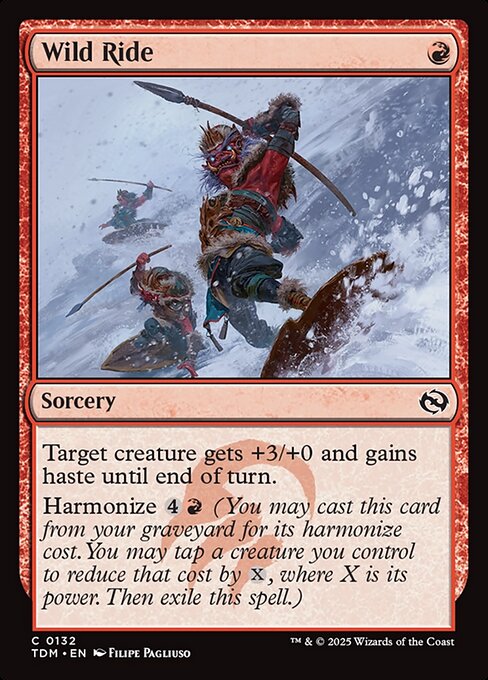
221. Wild Ride
Rating4.3WeakWhy this rating?
A good playable, but is sometimes cut (4.3/10).
Why. A one-mana sorcery that gives +3/+0 and haste to a creature for the turn. With Harmonize you can recast it from the graveyard by tapping a creature to reduce the cost.
Risks. A conditional spell that does nothing alone. It needs a creature in play and goes badly if the opponent has a response.
In the draft. A last-pick card, only for a very aggressive red deck with many creatures. In other decks it does not deserve a slot.
Results in the games of the set
When it is in hand, the deck wins 51.1% of its games (set average: 56.0%, 258th of 274 cards).
In the opening hand: 49.9% wins (54.9% on average).
Drawn during the game: 52.0% (56.7% on average).
When it is drawn, the deck wins 3.0 points less than when it is not.
When it is drafted, it is played 18% of the time (set average: 65%).
Taken among the first three picks (31 drafts), it ends in the deck 65% of the time.

222. Abzan Monument
Rating4.2WeakWhy this rating?
A good playable, but is sometimes cut (4.2/10).
Why. A two-mana artifact that fetches a basic Plains, Swamp or Forest into your hand. Later you can sacrifice it to create a white Spirit creature token whose size equals the greatest toughness among your creatures.
Risks. It does nothing on the board, and the activation costs four mana in three specific colours. It mostly smooths your mana.
In the draft. A support card for a white-black-green deck. Take it late, after your creatures and removal.
Results in the games of the set
When it is in hand, the deck wins 53.8% of its games (set average: 56.0%, 199th of 274 cards).
In the opening hand: 52.7% wins (54.9% on average).
Drawn during the game: 54.7% (56.7% on average).
When it is drawn, the deck wins 0.8 points more than when it is not.
When it is drafted, it is played 58% of the time (set average: 65%).
Taken among the first three picks (105 drafts), it ends in the deck 84% of the time.
It is played mostly in B/G decks (33% of them) and B/W (28%).
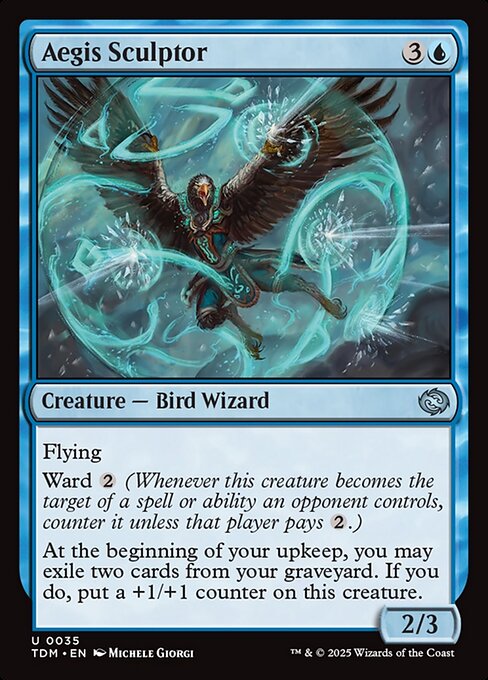
223. Aegis Sculptor
Rating4.2WeakWhy this rating?
A good playable, but is sometimes cut (4.2/10).
Why. A four-mana 2/3 flier with ward 2, so targeting it costs the opponent two more mana. At your upkeep you may exile two cards from your graveyard to put a +1/+1 counter on it, and it grows over time.
Risks. For four mana the body is modest, and its growth depends on how full your graveyard is. It is still vulnerable to effects that do not target.
In the draft. A fair flier for blue, a late-pack pick. It does its job in a deck that fills its graveyard.
Results in the games of the set
When it is in hand, the deck wins 53.7% of its games (set average: 56.0%, 203rd of 274 cards).
In the opening hand: 51.5% wins (54.9% on average).
Drawn during the game: 55.1% (56.7% on average).
When it is drawn, the deck wins 2.7 points more than when it is not.
When it is drafted, it is played 50% of the time (set average: 65%).
Taken among the first three picks (84 drafts), it ends in the deck 82% of the time.
It is played about as much in every archetype.

224. Bone-Cairn Butcher
Rating4.2WeakWhy this rating?
A good playable, but is sometimes cut (4.2/10).
Why. A four-mana 4/4 with Mobilize 2: each attack adds two tapped and attacking 1/1 red Warrior creature tokens, and attacking tokens you control have deathtouch. The opponent rarely blocks without losing something.
Risks. Three demanding colours for a card that has to attack to be useful. An opponent who kills it before the attack cancels its whole point.
In the draft. A good pick for an aggressive white-black-red deck. Outside that trio it is too hard to cast to deserve a high pick.
Results in the games of the set
When it is in hand, the deck wins 52.1% of its games (set average: 56.0%, 237th of 274 cards).
In the opening hand: 51.7% wins (54.9% on average).
Drawn during the game: 52.4% (56.7% on average).
When it is drawn, the deck wins 2.4 points less than when it is not.
When it is drafted, it is played 66% of the time (set average: 65%).
Taken as the first pick (39 drafts), it ends in the deck 82% of the time.
It is played mostly in B/W decks (38% of them) and R/W (28%).

225. Desperate Measures
Rating4.2WeakWhy this rating?
A good playable, but is sometimes cut (4.2/10).
Why. A one-mana instant that gives a creature +1/-1; if it dies under your control this turn, you draw two cards. It kills a creature with toughness 1, or turns one of your own into card advantage.
Risks. Highly situational: it kills little on its own and the creature has to die under your control. More often than not it rots in your hand.
In the draft. A niche card for a black deck that uses creature deaths. Do not take it before your good cards.
Results in the games of the set
When it is in hand, the deck wins 52.5% of its games (set average: 56.0%, 226th of 274 cards).
In the opening hand: 51.8% wins (54.9% on average).
Drawn during the game: 53.1% (56.7% on average).
When it is drawn, the deck wins 0.8 points less than when it is not.
When it is drafted, it is played 32% of the time (set average: 65%).
Taken among the first three picks (32 drafts), it ends in the deck 69% of the time.
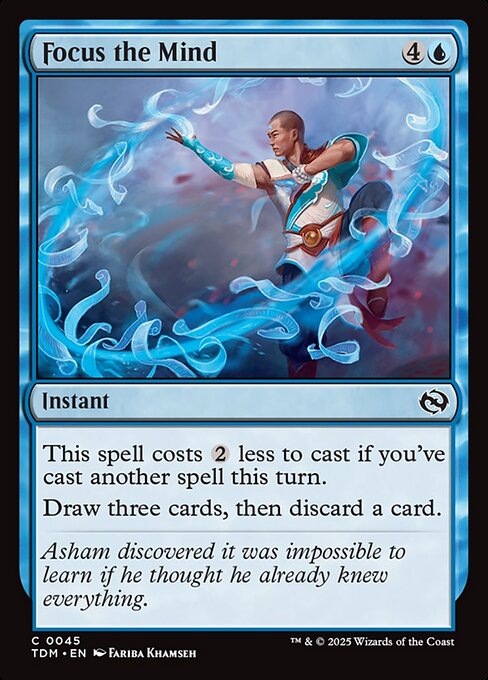
226. Focus the Mind
Rating4.2WeakWhy this rating?
A good playable, but is sometimes cut (4.2/10).
Why. An instant that draws three cards then discards one, costing two less if you have already cast another spell this turn. It refills your hand and works well with Flurry.
Risks. Five mana with no other spell that turn is slow and does nothing on the board. It is a value spell that does not help when you are under pressure.
In the draft. A good card engine for a blue deck that often casts two spells a turn. A mid-pack pick, but not above your removal.
Results in the games of the set
When it is in hand, the deck wins 55.3% of its games (set average: 56.0%, 140th of 274 cards).
In the opening hand: 51.9% wins (54.9% on average).
Drawn during the game: 57.3% (56.7% on average).
When it is drawn, the deck wins 3.1 points more than when it is not.
When it is drafted, it is played 65% of the time (set average: 65%).
Taken as the first pick (54 drafts), it ends in the deck 93% of the time.
It is played mostly in R/U decks (52% of them) and U/W (50%).

227. Jade-Cast Sentinel
Rating4.2WeakWhy this rating?
A good playable, but is sometimes cut (4.2/10).
Why. A four-mana artifact 1/5 with reach that blocks ground and air attackers well. For two mana and by tapping, it puts a card from a graveyard on the bottom of its owner's library.
Risks. It deals almost no damage and does not win the game. The graveyard ability is a detail, not a reason to play it.
In the draft. A defensive wall, to be played only in a control deck. Take it late and do not give it more credit than that.
Results in the games of the set
When it is in hand, the deck wins 52.3% of its games (set average: 56.0%, 231st of 274 cards).
In the opening hand: 48.3% wins (54.9% on average).
Drawn during the game: 54.7% (56.7% on average).
When it is drawn, the deck wins 1.5 points more than when it is not.
When it is drafted, it is played only 8% of the time (set average: 65%): it almost always ends in the sideboard.
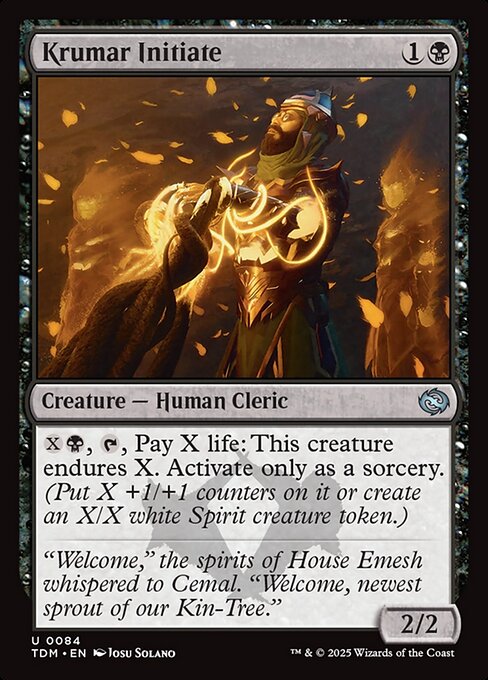
228. Krumar Initiate
Rating4.2WeakWhy this rating?
A good playable, but is sometimes cut (4.2/10).
Why. A two-mana black 2/2 that can endure X: by paying X mana plus a black mana, X life and tapping, it gets X +1/+1 counters or makes an X/X white Spirit creature token, at sorcery speed.
Risks. The ability costs life and mana, and only works at sorcery speed. Against a fast deck you lose tempo and life for a slow gain.
In the draft. Playable filler in a black late-game deck that wants to turn mana into threats. Otherwise, take a better card.
Results in the games of the set
When it is in hand, the deck wins 52.5% of its games (set average: 56.0%, 229th of 274 cards).
In the opening hand: 53.2% wins (54.9% on average).
Drawn during the game: 51.9% (56.7% on average).
When it is drawn, the deck wins 0.8 points less than when it is not.
When it is drafted, it is played 62% of the time (set average: 65%).
Taken among the first three picks (101 drafts), it ends in the deck 80% of the time.
It is played about as much in every archetype.

229. Overwhelming Surge
Rating4.2WeakWhy this rating?
A good playable, but is sometimes cut (4.2/10).
Why. A three-mana instant that deals 3 damage to a creature, destroys a noncreature artifact, or does both. It handles mid-sized creatures well.
Risks. Only 3 damage, so it does not kill big creatures. The artifact mode only matters if the opponent plays one.
In the draft. A fair removal for red. Take it mid-pack; it fills the removal slot without flair.
Results in the games of the set
When it is in hand, the deck wins 53.8% of its games (set average: 56.0%, 201st of 274 cards).
In the opening hand: 52.2% wins (54.9% on average).
Drawn during the game: 54.9% (56.7% on average).
When it is drawn, the deck wins 0.7 points more than when it is not.
When it is drafted, it is played 81% of the time (set average: 65%).
Taken as the first pick (64 drafts), it ends in the deck 86% of the time.
It is played about as much in every archetype.

230. Snowmelt Stag
Rating4.2WeakWhy this rating?
A good playable, but is sometimes cut (4.2/10).
Why. A vigilant elk that is a 5/2 on your turn for attacking and a 2/5 on the opponent's for blocking. It plays both roles with one body, and its ability makes it unblockable late in the game.
Risks. It is a fragile 5/2 when attacking and dies to almost anything. The unblockable ability costs seven mana, too much to use regularly.
In the draft. Solid filler for blue, in one or two copies. Take it when you are short a four-drop.
Results in the games of the set
When it is in hand, the deck wins 53.6% of its games (set average: 56.0%, 207th of 274 cards).
In the opening hand: 50.8% wins (54.9% on average).
Drawn during the game: 55.2% (56.7% on average).
When it is drawn, the deck wins 2.0 points more than when it is not.
When it is drafted, it is played only 13% of the time (set average: 65%): it almost always ends in the sideboard.

231. Lightfoot Technique
Rating4.2WeakWhy this rating?
A good playable, but is sometimes cut (4.2/10).
Why. A two-mana instant that puts a +1/+1 counter on a creature and gives it flying and indestructible until end of turn. It wins a combat, protects against destroy removal, or pushes damage in the air.
Risks. It is a combat trick: it does nothing without a creature, and you lose a card if the opponent responds. The counter is the only lasting effect.
In the draft. A fair trick for an aggressive white-red deck. In a slow deck it does not deserve a slot; take it late in the pack.
Results in the games of the set
When it is in hand, the deck wins 52.3% of its games (set average: 56.0%, 230th of 274 cards).
In the opening hand: 51.2% wins (54.9% on average).
Drawn during the game: 53.2% (56.7% on average).
When it is drawn, the deck wins 2.1 points less than when it is not.
When it is drafted, it is played 23% of the time (set average: 65%).
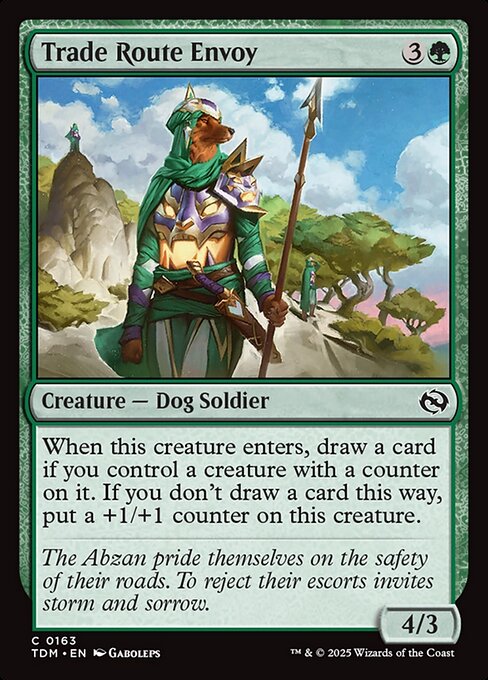
232. Trade Route Envoy
Rating4.1WeakWhy this rating?
A good playable, but is sometimes cut (4.1/10).
Why. A four-mana 4/3. When it enters you draw a card if you control a creature with a counter on it; otherwise it puts a +1/+1 counter on itself and becomes a 5/4.
Risks. With no evasion it gets blocked or traded off. The upside depends on your counters, or else you just get a plain 5/4.
In the draft. A solid, flexible green body to take without hurry. It is better in a counters deck but does not require one.
Results in the games of the set
When it is in hand, the deck wins 53.3% of its games (set average: 56.0%, 213th of 274 cards).
In the opening hand: 51.8% wins (54.9% on average).
Drawn during the game: 54.3% (56.7% on average).
When it is drawn, the deck wins 0.3 points more than when it is not.
When it is drafted, it is played 53% of the time (set average: 65%).
Taken among the first three picks (135 drafts), it ends in the deck 82% of the time.
It is played mostly in B/G decks (56% of them) and G/W (48%).
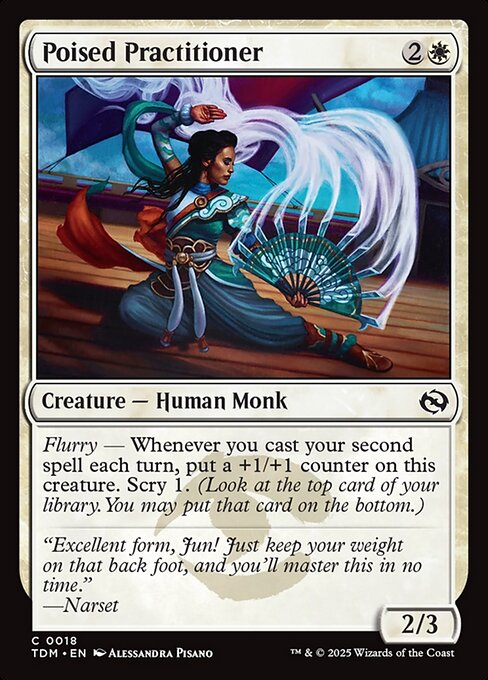
233. Poised Practitioner
Rating4.0WeakWhy this rating?
A good playable, but is sometimes cut (4.0/10).
Why. A three-mana 2/3 that gets a +1/+1 counter and lets you scry 1 whenever you cast your second spell each turn (Flurry). It grows when you chain spells.
Risks. Without two spells a turn it is an ordinary 2/3 for three. Flurry needs a specific curve and cheap spells.
In the draft. An average card for white, more interesting in a white-red deck of cheap spells. A mid-to-late pick.
Results in the games of the set
When it is in hand, the deck wins 52.8% of its games (set average: 56.0%, 221st of 274 cards).
In the opening hand: 53.1% wins (54.9% on average).
Drawn during the game: 52.5% (56.7% on average).
When it is drawn, the deck wins 1.3 points less than when it is not.
When it is drafted, it is played 29% of the time (set average: 65%).
Taken among the first three picks (70 drafts), it ends in the deck 61% of the time.
It is played mostly in U/W decks (25% of them).

234. Adorned Crocodile
Rating4.0WeakWhy this rating?
A good playable, but is sometimes cut (4.0/10).
Why. A five-mana 5/3 that leaves behind a 2/2 black Zombie Druid creature token when it dies, so it trades for two bodies. From the graveyard, Renew turns the card into a +1/+1 counter for a single black mana.
Risks. Five mana for a 5/3 without evasion is slow, and it trades with a lesser creature. It is solid but unexciting.
In the draft. Decent black filler for a deck that wants resilient creatures. Take it late, after your removal and your better creatures.
Results in the games of the set
When it is in hand, the deck wins 52.1% of its games (set average: 56.0%, 236th of 274 cards).
In the opening hand: 50.0% wins (54.9% on average).
Drawn during the game: 53.6% (56.7% on average).
When it is drawn, the deck wins 1.3 points less than when it is not.
When it is drafted, it is played 16% of the time (set average: 65%).
 Rating4.0Weak
Why this rating?
A good playable, but is sometimes cut (4.0/10).
Why. A 1/4 flyer for three that holds the ground and the air, and your second spell each turn costs one less. In a deck full of cheap spells, double-spell turns come easily.
Risks. It barely attacks, and the discount does nothing if you only cast one spell a turn. Without cheap spells it is just a flying wall.
In the draft. Playable, not a priority. Take it in a blue deck with lots of small spells, or as a defensive body late in a pack.
Results in the games of the set
When it is in hand, the deck wins 51.5% of its games (set average: 56.0%, 252nd of 274 cards).
In the opening hand: 49.0% wins (54.9% on average).
Drawn during the game: 53.1% (56.7% on average).
When it is drawn, the deck wins 2.1 points more than when it is not.
When it is drafted, it is played only 12% of the time (set average: 65%): it almost always ends in the sideboard.
It is played mostly in R/U decks (30% of them).

236. Rainveil Rejuvenator
Rating4.0WeakWhy this rating?
A good playable, but is sometimes cut (4.0/10).
Why. A 2/4 that taps for two green mana, a real jump toward your expensive cards. The mill of three on entering is optional, which helps decks that use the graveyard.
Risks. Four mana for a body that only makes mana, and only green at that. Milling yourself can hurt a deck with no graveyard payoff.
In the draft. Fine in a green deck with top-end to cast. Otherwise it is filler, so take it late.
Results in the games of the set
When it is in hand, the deck wins 50.8% of its games (set average: 56.0%, 261st of 274 cards).
In the opening hand: 50.3% wins (54.9% on average).
Drawn during the game: 51.2% (56.7% on average).
When it is drawn, the deck wins 0.6 points less than when it is not.
When it is drafted, it is played 35% of the time (set average: 65%).
Taken among the first three picks (49 drafts), it ends in the deck 82% of the time.

237. Seize Opportunity
Rating4.0WeakWhy this rating?
A good playable, but is sometimes cut (4.0/10).
Why. A flexible instant: either exile the top two cards of your library to play until the end of your next turn, or give two creatures +2/+1 for a combat. In an aggressive red deck the combat mode can swing a fight.
Risks. The card mode only pays off if you can play those cards in time, or they are lost. The combat mode does nothing without creatures.
In the draft. A decent include, never a priority. It plays best in creature-heavy red-white decks, but find creatures and removal first.
Results in the games of the set
When it is in hand, the deck wins 51.8% of its games (set average: 56.0%, 243rd of 274 cards).
In the opening hand: 50.3% wins (54.9% on average).
Drawn during the game: 52.8% (56.7% on average).
When it is drawn, the deck wins 3.5 points less than when it is not.
When it is drafted, it is played 21% of the time (set average: 65%).
It is played mostly in R/W decks (27% of them).

238. Yathan Tombguard
Rating4.0WeakWhy this rating?
A good playable, but is sometimes cut (4.0/10).
Why. A 2/3 with menace for three that draws a card whenever one of your creatures with a counter deals combat damage to a player. With counter-makers around it becomes a real card engine, though it needs a counter on itself to draw off its own hits.
Risks. Without counters in the deck it is just a 2/3 with menace. Each draw costs a life, and the creature has to actually hit the opponent.
In the draft. Take it in a black deck with several counter sources, such as Endure. In a deck without them it is playable but unremarkable.
Results in the games of the set
When it is in hand, the deck wins 51.5% of its games (set average: 56.0%, 253rd of 274 cards).
In the opening hand: 50.9% wins (54.9% on average).
Drawn during the game: 52.0% (56.7% on average).
When it is drawn, the deck wins 1.6 points less than when it is not.
When it is drafted, it is played 66% of the time (set average: 65%).
Taken as the first pick (41 drafts), it ends in the deck 80% of the time.
It is played mostly in B/G decks (34% of them).

239. Rite of Renewal
Rating4.0WeakWhy this rating?
A good playable, but is sometimes cut (4.0/10).
Why. A value sorcery that returns up to two permanent cards from your graveyard to your hand, while a target player shuffles up to four cards from their graveyard into their library. In a long game it replaces cards you lost.
Risks. Four mana to change nothing on the battlefield the turn you cast it. It is slow against aggression and nearly useless with an empty graveyard.
In the draft. A late-pack playable for green value decks. Do not take it before your creatures and removal.
Results in the games of the set
When it is in hand, the deck wins 53.3% of its games (set average: 56.0%, 212th of 274 cards).
In the opening hand: 48.4% wins (54.9% on average).
Drawn during the game: 56.3% (56.7% on average).
When it is drawn, the deck wins 1.7 points more than when it is not.
When it is drafted, it is played 31% of the time (set average: 65%).
Taken among the first three picks (37 drafts), it ends in the deck 86% of the time.

240. Monastery Messenger
Rating3.9WeakWhy this rating?
A good playable, but is sometimes cut (3.9/10).
Why. A 2/3 flyer with vigilance that can put a noncreature, nonland card from your graveyard on top of your library. A good evasive body that can also give you a removal spell back.
Risks. The hybrid cost is easy in a three-colour deck and expensive otherwise. The trigger does nothing without a target in your graveyard.
In the draft. Solid in three-colour decks, especially blue-red-white. Outside that it is clunky, so do not take it early.
Results in the games of the set
When it is in hand, the deck wins 52.9% of its games (set average: 56.0%, 220th of 274 cards).
In the opening hand: 49.1% wins (54.9% on average).
Drawn during the game: 55.2% (56.7% on average).
When it is drawn, the deck wins 0.8 points more than when it is not.
When it is drafted, it is played 38% of the time (set average: 65%).
Taken among the first three picks (64 drafts), it ends in the deck 80% of the time.
It is played mostly in R/U decks (42% of them) and U/W (41%).
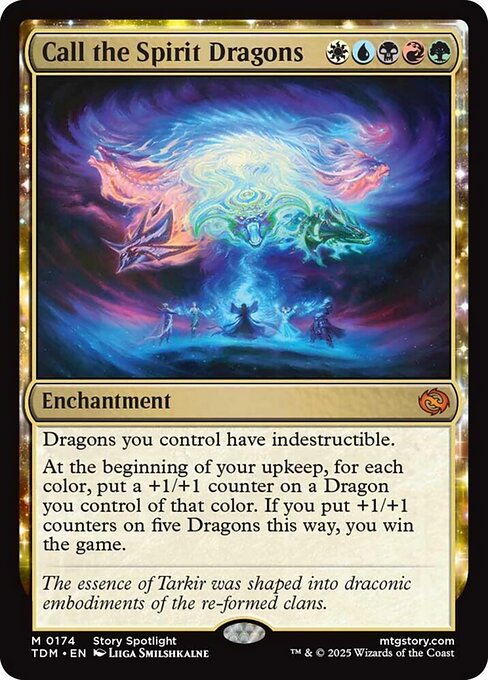 Rating3.8Weak
Why this rating?
A good playable, but is sometimes cut (3.8/10).
Why. A five-colour dream: your Dragons are indestructible, and each upkeep a Dragon of each colour gets a +1/+1 counter, with an instant win if five Dragons get counters. It is an extreme build-around, not a normal draft card.
Risks. You need all five colours, five Dragons of different colours and five mana, and nothing changes on the battlefield the turn you cast it. In practice it is nearly always too slow.
In the draft. Only take it if you are already building a five-colour deck with plenty of Dragons. Otherwise let it go.
Results in the games of the set
When it is in hand, the deck wins 45.6% of its games (set average: 56.0%, 274th of 274 cards).
In the opening hand: 39.9% wins (54.9% on average).
Drawn during the game: 49.1% (56.7% on average).
When it is drawn, the deck wins 0.8 points less than when it is not.
When it is drafted, it is played 28% of the time (set average: 65%).
Taken among the first three picks (46 drafts), it ends in the deck 50% of the time.

242. Agent of Kotis
Rating3.8WeakWhy this rating?
A good playable, but is sometimes cut (3.8/10).
Why. A 2/1 for two that gives a second life through Renew: from the graveyard it puts two +1/+1 counters on a creature, at sorcery speed. A small card that never goes fully to waste.
Risks. A 2/1 is fragile and unimpressive, and Renew costs four mana for a modest effect. It does little late in the game.
In the draft. Useful curve filler in a blue deck. Take it when you need two-drops.
Results in the games of the set
When it is in hand, the deck wins 52.0% of its games (set average: 56.0%, 238th of 274 cards).
In the opening hand: 50.7% wins (54.9% on average).
Drawn during the game: 52.9% (56.7% on average).
When it is drawn, the deck wins 0.8 points less than when it is not.
When it is drafted, it is played 34% of the time (set average: 65%).
Taken among the first three picks (30 drafts), it ends in the deck 77% of the time.
It is played mostly in B/U decks (31% of them) and G/U (27%).

243. Dragonback Lancer
Rating3.8WeakWhy this rating?
A good playable, but is sometimes cut (3.8/10).
Why. A 3/3 flyer for four that, through Mobilize, adds a tapped and attacking 1/1 red Warrior creature token each attack. A good evasive body for an aggressive white deck with a little extra damage.
Risks. Four mana for a 3/3 means it dies to cheap removal, and the token does not stick around. It is average in a defensive game.
In the draft. Honest filler in white, especially red-white, thanks to Mobilize. Take it as a mid-pack evasive creature.
Results in the games of the set
When it is in hand, the deck wins 51.0% of its games (set average: 56.0%, 260th of 274 cards).
In the opening hand: 50.5% wins (54.9% on average).
Drawn during the game: 51.4% (56.7% on average).
When it is drawn, the deck wins 3.4 points less than when it is not.
When it is drafted, it is played 34% of the time (set average: 65%).
Taken among the first three picks (66 drafts), it ends in the deck 65% of the time.
It is played mostly in B/W decks (29% of them).

244. Worthy Cost
Rating3.8WeakWhy this rating?
A good playable, but is sometimes cut (3.8/10).
Why. A one-mana removal: sacrifice a creature to exile a creature or planeswalker. It costs almost nothing in mana and answers even a huge threat.
Risks. The extra creature cost makes it a two-for-one against you, and it is dead without a creature to sacrifice. It is poor in a deck with no cheap creatures or tokens.
In the draft. Take it in a black deck with many small creatures or tokens. Otherwise it is filler that costs you value.
Results in the games of the set
When it is in hand, the deck wins 51.0% of its games (set average: 56.0%, 259th of 274 cards).
In the opening hand: 49.3% wins (54.9% on average).
Drawn during the game: 52.2% (56.7% on average).
When it is drawn, the deck wins 1.9 points less than when it is not.
When it is drafted, it is played 33% of the time (set average: 65%).
Taken among the first three picks (46 drafts), it ends in the deck 72% of the time.
It is played mostly in B/W decks (40% of them) and B/R (35%).

245. Glacierwood Siege
Rating3.5WeakWhy this rating?
A good playable, but is sometimes cut (3.5/10).
Why. A two-colour enchantment with a choice: Temur mills a player for four whenever you cast an instant or sorcery, Sultai lets you play lands from your graveyard. Both are very narrow deck effects.
Risks. Neither mode gives you a creature or removal. You spend three mana and change nothing on the battlefield, which is slow.
In the draft. Avoid it unless you already have a blue-green deck built around the graveyard. Otherwise leave it in the sideboard.
Results in the games of the set
When it is in hand, the deck wins 49.6% of its games (set average: 56.0%, 268th of 274 cards).
In the opening hand: 43.9% wins (54.9% on average).
Drawn during the game: 52.9% (56.7% on average).
When it is drawn, the deck wins 3.2 points more than when it is not.
When it is drafted, it is played 41% of the time (set average: 65%).
Taken among the first three picks (68 drafts), it ends in the deck 75% of the time.
It is played about as much in every archetype.

246. Arashin Sunshield
Rating3.2WeakWhy this rating?
Filler card but sometimes gets cut (3.2/10).
Why. A 3/4 for four that can tap a target creature for one white mana each turn. The ability makes it a good combat controller, and the toughness blocks well.
Risks. It taps itself to use the ability, so it neither attacks nor blocks that turn, and it cannot use it the turn it arrives. It has no evasion, and the graveyard exile is mostly incidental.
In the draft. A playable mid-pack in white, especially red-white. Take it when you need a solid body with some utility.
Results in the games of the set
When it is in hand, the deck wins 51.2% of its games (set average: 56.0%, 257th of 274 cards).
In the opening hand: 50.0% wins (54.9% on average).
Drawn during the game: 52.1% (56.7% on average).
When it is drawn, the deck wins 3.0 points less than when it is not.
When it is drafted, it is played only 9% of the time (set average: 65%): it almost always ends in the sideboard.
 Rating2.9Weak
Why this rating?
Filler card but sometimes gets cut (2.9/10).
Why. A 3/5 for five that puts a +1/+1 counter on another of your creatures at the beginning of your combat. Over several turns it grows your team, and the toughness makes it hard to kill.
Risks. Five mana for a 3/5 with no evasion is expensive. You need other creatures to benefit from the counters.
In the draft. Five-mana filler in white. Take it if you have a decent creature base and room in the curve.
Results in the games of the set
When it is in hand, the deck wins 52.3% of its games (set average: 56.0%, 232nd of 274 cards).
In the opening hand: 50.9% wins (54.9% on average).
Drawn during the game: 53.2% (56.7% on average).
When it is drawn, the deck wins 0.8 points less than when it is not.
When it is drafted, it is played 51% of the time (set average: 65%).
Taken among the first three picks (94 drafts), it ends in the deck 80% of the time.
It is played about as much in every archetype.

248. Unburied Earthcarver
Rating2.5WeakWhy this rating?
Filler card but sometimes gets cut (2.5/10).
Why. A 2/2 for two that can pay two mana and sacrifice another creature to get a +1/+1 counter. In a token deck it turns spare bodies into permanent counters.
Risks. It needs other creatures to sacrifice, and each sacrifice is lost card value. Without that it is a plain 2/2 with no useful ability.
In the draft. Black filler for a sacrifice deck. In other decks let it go.
Results in the games of the set
When it is in hand, the deck wins 50.5% of its games (set average: 56.0%, 263rd of 274 cards).
In the opening hand: 51.1% wins (54.9% on average).
Drawn during the game: 49.9% (56.7% on average).
When it is drawn, the deck wins 3.0 points less than when it is not.
When it is drafted, it is played 22% of the time (set average: 65%).
It is played mostly in B/R decks (33% of them) and B/W (32%).

249. Effortless Master
Rating2.1WeakWhy this rating?
Not good filler and often gets cut (2.2/10).
Why. A 4/3 with vigilance and menace for four that enters with two +1/+1 counters if you have cast two or more spells this turn. The base body is already fine, and on a good turn it becomes a 6/5 that is hard to block.
Risks. It needs blue and red, and you must cast another spell the same turn before it, which often takes a later turn. In a slow deck it stays a slightly fragile 4/3.
In the draft. A reasonable playable in blue-red decks with cheap spells. Take it as a body for the curve.
Results in the games of the set
When it is in hand, the deck wins 51.6% of its games (set average: 56.0%, 251st of 274 cards).
In the opening hand: 48.3% wins (54.9% on average).
Drawn during the game: 53.6% (56.7% on average).
When it is drawn, the deck wins 1.8 points more than when it is not.
When it is drafted, it is played 48% of the time (set average: 65%).
Taken among the first three picks (65 drafts), it ends in the deck 80% of the time.
It is played mostly in R/U decks (34% of them).

250. Boulderborn Dragon
Rating2.0WeakWhy this rating?
Not good filler and often gets cut (2.0/10).
Why. A colourless 3/3 artifact Dragon with flying and vigilance that surveils 1 on each attack. It fits in any deck, and it is one more Dragon for cards that ask for them.
Risks. Five mana for a 3/3 is expensive for what you get. It is slow in an aggressive deck.
In the draft. Evasive filler any deck can play. Take it if you need a flying body or one more Dragon.
Results in the games of the set
When it is in hand, the deck wins 51.6% of its games (set average: 56.0%, 250th of 274 cards).
In the opening hand: 47.1% wins (54.9% on average).
Drawn during the game: 54.4% (56.7% on average).
When it is drawn, the deck wins 0.2 points more than when it is not.
When it is drafted, it is played 42% of the time (set average: 65%).
Taken among the first three picks (88 drafts), it ends in the deck 83% of the time.
It is played mostly in B/U decks (52% of them) and U/W (41%).
 Rating2.0Weak
Why this rating?
Not good filler and often gets cut (2.0/10).
Why. An enchantment that, on entering, exiles cards from the top of your library until a nonland card, then lets you cast it for free or put it in your hand. It returns to your hand when a Dragon you control enters, so you can reuse it.
Risks. Five mana for a random result, and you do not choose the card. Without Dragons it never comes back to hand.
In the draft. A gamble in red decks with several Dragons. Otherwise it is too random and too slow.
Results in the games of the set
When it is in hand, the deck wins 51.9% of its games (set average: 56.0%, 241st of 274 cards).
In the opening hand: 48.4% wins (54.9% on average).
Drawn during the game: 54.1% (56.7% on average).
When it is drawn, the deck wins 1.1 points more than when it is not.
When it is drafted, it is played 57% of the time (set average: 65%).
Taken as the first pick (38 drafts), it ends in the deck 87% of the time.
It is played mostly in G/R decks (32% of them).

252. Cruel Truths
Rating2.0WeakWhy this rating?
Not good filler and often gets cut (2.0/10).
Why. A card-draw instant: surveil 2, then draw two cards and lose 2 life. You can cast it at the end of the opponent's turn to refill your hand.
Risks. Four mana for card draw is slow, and it changes nothing on the battlefield. Against an aggressive opponent the life loss matters.
In the draft. Draw filler for slower black decks. Take creatures and removal before it.
Results in the games of the set
When it is in hand, the deck wins 49.6% of its games (set average: 56.0%, 269th of 274 cards).
In the opening hand: 46.4% wins (54.9% on average).
Drawn during the game: 51.8% (56.7% on average).
When it is drawn, the deck wins 2.6 points less than when it is not.
When it is drafted, it is played only 11% of the time (set average: 65%): it almost always ends in the sideboard.
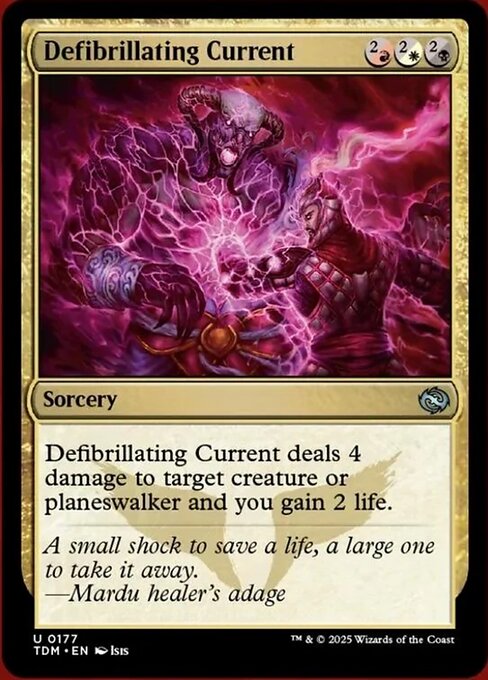 Rating2.0Weak
Why this rating?
Not good filler and often gets cut (2.0/10).
Why. A sorcery-speed removal: four damage to a creature or planeswalker, and you gain 2 life. It kills most midsize threats and has no extra condition.
Risks. The hybrid cost is cheap in a three-colour deck and gets very expensive elsewhere. It does not handle the biggest creatures.
In the draft. A good removal to take in a red, white or black deck, especially white-black-red.
Results in the games of the set
When it is in hand, the deck wins 53.6% of its games (set average: 56.0%, 204th of 274 cards).
In the opening hand: 52.2% wins (54.9% on average).
Drawn during the game: 54.7% (56.7% on average).
When it is drawn, the deck wins 0.4 points less than when it is not.
When it is drafted, it is played 65% of the time (set average: 65%).
Taken among the first three picks (101 drafts), it ends in the deck 87% of the time.
It is played mostly in B/W decks (25% of them).

254. Delta Bloodflies
Rating2.0WeakWhy this rating?
Not good filler and often gets cut (2.0/10).
Why. A 1/2 flyer for two that makes the opponent lose 1 life when it attacks, if you control a creature with a counter. A small air threat for a counters deck.
Risks. The body is tiny and dies to almost anything. Without counters it just deals 1 in the air.
In the draft. Black filler for a counters deck. Take it late unless you need two-drops.
Results in the games of the set
When it is in hand, the deck wins 51.2% of its games (set average: 56.0%, 256th of 274 cards).
In the opening hand: 51.5% wins (54.9% on average).
Drawn during the game: 51.1% (56.7% on average).
When it is drawn, the deck wins 2.5 points less than when it is not.
When it is drafted, it is played 26% of the time (set average: 65%).
Taken among the first three picks (37 drafts), it ends in the deck 84% of the time.
It is played mostly in B/G decks (38% of them).

255. Essence Anchor
Rating2.0WeakWhy this rating?
Not good filler and often gets cut (2.0/10).
Why. An artifact that surveils 1 each upkeep and can create a 2/2 black Zombie Druid creature token if a card left your graveyard this turn. It gives a trickle of tokens in a deck with Renew or Harmonize.
Risks. You need cards leaving the graveyard or it produces nothing, and the token can only be made during your turn. It also wants a deck ready to use its graveyard.
In the draft. A gamble in blue decks that use the graveyard. Without that, let it go.
Results in the games of the set
When it is in hand, the deck wins 52.7% of its games (set average: 56.0%, 222nd of 274 cards).
In the opening hand: 49.5% wins (54.9% on average).
Drawn during the game: 54.7% (56.7% on average).
When it is drawn, the deck wins 2.6 points more than when it is not.
When it is drafted, it is played 27% of the time (set average: 65%).
Taken among the first three picks (78 drafts), it ends in the deck 71% of the time.

256. Feral Deathgorger // Dusk Sight
Rating2.0WeakWhy this rating?
Not good filler and often gets cut (2.0/10).
Why. A 3/5 Dragon with flying and deathtouch for six, or an Omen for two that adds a +1/+1 counter and draws a card. The Omen gives an early draw, and the Dragon is a good evasive finisher.
Risks. Six mana for the Dragon is slow, and the Omen is modest. The card is average if you only need one of the two halves.
In the draft. A good card in black: take it mid-pack, especially in a slower deck. Its flexibility is where the value is.
Results in the games of the set
When it is in hand, the deck wins 53.6% of its games (set average: 56.0%, 206th of 274 cards).
In the opening hand: 50.2% wins (54.9% on average).
Drawn during the game: 55.6% (56.7% on average).
When it is drawn, the deck wins 2.2 points more than when it is not.
When it is drafted, it is played 64% of the time (set average: 65%).
Taken among the first three picks (131 drafts), it ends in the deck 91% of the time.
It is played mostly in B/U decks (43% of them) and B/G (41%).
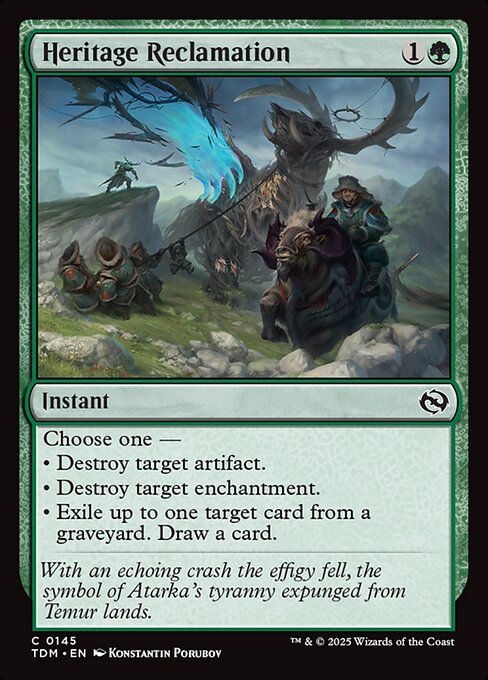
257. Heritage Reclamation
Rating2.0WeakWhy this rating?
Not good filler and often gets cut (2.0/10).
Why. A two-mana instant with three modes: destroy an artifact, destroy an enchantment, or exile a card from a graveyard and draw. The last mode makes it a cheap cantrip even without a target.
Risks. It touches no creatures, and its targets are rare. Often it is just a filler cantrip.
In the draft. A sideboard or late-pack card in green. Only take it when nothing better is available.
Results in the games of the set
When it is in hand, the deck wins 50.4% of its games (set average: 56.0%, 264th of 274 cards).
In the opening hand: 47.6% wins (54.9% on average).
Drawn during the game: 52.2% (56.7% on average).
When it is drawn, the deck wins 0.6 points less than when it is not.
When it is drafted, it is played only 11% of the time (set average: 65%): it almost always ends in the sideboard.
 Rating2.0Weak
Why this rating?
Not good filler and often gets cut (2.0/10).
Why. A 4/2 for four that you can recast from the graveyard with a finality counter, and that becomes a 6/6 with three kinds of counters. It offers a second life, so it brings value.
Risks. A 4/2 dies to almost anything, and the bonus needs three kinds of counters, which is rare. It is mediocre without that.
In the draft. Decent black filler, especially for counters decks. Take it as a mid-curve creature.
Results in the games of the set
When it is in hand, the deck wins 49.5% of its games (set average: 56.0%, 270th of 274 cards).
In the opening hand: 47.8% wins (54.9% on average).
Drawn during the game: 50.8% (56.7% on average).
When it is drawn, the deck wins 3.7 points less than when it is not.
When it is drafted, it is played 40% of the time (set average: 65%).
Taken among the first three picks (44 drafts), it ends in the deck 86% of the time.
It is played about as much in every archetype.
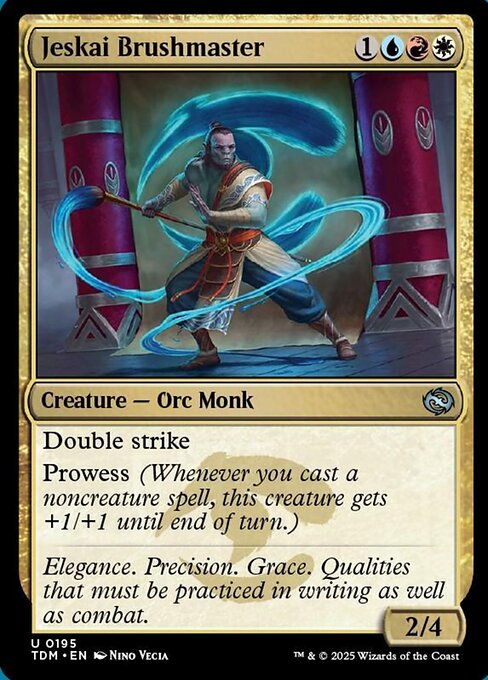
259. Jeskai Brushmaster
Rating2.0WeakWhy this rating?
Not good filler and often gets cut (2.0/10).
Why. A 2/4 with double strike and prowess for four: it blocks very well and hits hard when you cast a noncreature spell. In a deck full of sorceries and instants it becomes a real threat.
Risks. It needs three colours and noncreature spells to become threatening. Without them it deals only four damage per unblocked attack.
In the draft. A gamble in blue-red-white decks with lots of spells. Outside that, let it go.
Results in the games of the set
When it is in hand, the deck wins 51.4% of its games (set average: 56.0%, 255th of 274 cards).
In the opening hand: 49.4% wins (54.9% on average).
Drawn during the game: 52.5% (56.7% on average).
When it is drawn, the deck wins 0.4 points more than when it is not.
When it is drafted, it is played 34% of the time (set average: 65%).
Taken among the first three picks (47 drafts), it ends in the deck 72% of the time.

260. Krotiq Nestguard
Rating2.0WeakWhy this rating?
Not good filler and often gets cut (2.0/10).
Why. A 4/4 defender for three, a very solid wall that can attack by paying three mana including a green one. It holds the ground early and can attack later.
Risks. It only attacks by paying each time, which is expensive. It is a mid-game wall, not a threat.
In the draft. Defensive filler for a slow green deck. Take it late unless you need bodies to hold the ground.
Results in the games of the set
When it is in hand, the deck wins 51.4% of its games (set average: 56.0%, 254th of 274 cards).
In the opening hand: 49.2% wins (54.9% on average).
Drawn during the game: 52.9% (56.7% on average).
When it is drawn, the deck wins 0.2 points less than when it is not.
When it is drafted, it is played only 10% of the time (set average: 65%): it almost always ends in the sideboard.
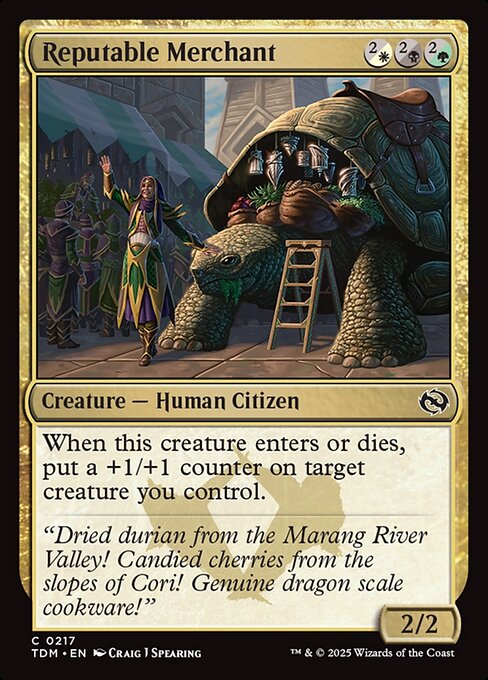
261. Reputable Merchant
Rating2.0WeakWhy this rating?
Not good filler and often gets cut (2.0/10).
Why. A 2/2 that puts a +1/+1 counter on one of your creatures when it enters (it can target itself) and when it dies. It brings value twice, good support for a counters deck.
Risks. The hybrid cost is expensive outside three colours, and a 2/2 is fragile. When it dies, the counter needs another creature.
In the draft. A good support piece in white-black-green decks. Take it if your deck likes counters.
Results in the games of the set
When it is in hand, the deck wins 51.7% of its games (set average: 56.0%, 249th of 274 cards).
In the opening hand: 51.4% wins (54.9% on average).
Drawn during the game: 51.9% (56.7% on average).
When it is drawn, the deck wins 1.0 points less than when it is not.
When it is drafted, it is played 20% of the time (set average: 65%).
It is played mostly in B/G decks (46% of them) and B/W (33%).
 Rating2.0Weak
Why this rating?
Not good filler and often gets cut (2.0/10).
Why. A one-mana Aura that taps a creature and keeps it from untapping unless its controller pays five. Against a big threat it is a very cheap pseudo-removal.
Risks. The opponent can pay five to untap the creature, and its abilities stay active. An Aura is lost if they respond by killing or bouncing the creature.
In the draft. An acceptable pseudo-removal in blue. Take it after your real removal.
Results in the games of the set
When it is in hand, the deck wins 51.7% of its games (set average: 56.0%, 246th of 274 cards).
In the opening hand: 49.9% wins (54.9% on average).
Drawn during the game: 52.8% (56.7% on average).
When it is drawn, the deck wins 1.3 points more than when it is not.
When it is drafted, it is played only 14% of the time (set average: 65%): it almost always ends in the sideboard.

263. Roamer's Routine
Rating2.0WeakWhy this rating?
Not good filler and often gets cut (2.0/10).
Why. A sorcery that fetches a basic land onto the battlefield tapped, then can be recast from the graveyard through Harmonize. It fixes your colours and ramps toward your big cards, twice.
Risks. It does nothing on the battlefield and is poor in an aggressive deck. The land comes in tapped.
In the draft. Useful green filler for a multicolour deck. Take it late unless you want fixing.
Results in the games of the set
When it is in hand, the deck wins 52.0% of its games (set average: 56.0%, 239th of 274 cards).
In the opening hand: 51.1% wins (54.9% on average).
Drawn during the game: 52.6% (56.7% on average).
When it is drawn, the deck wins 0.3 points less than when it is not.
When it is drafted, it is played 39% of the time (set average: 65%).
Taken among the first three picks (67 drafts), it ends in the deck 64% of the time.
It is played mostly in G/R decks (32% of them) and G/W (30%).
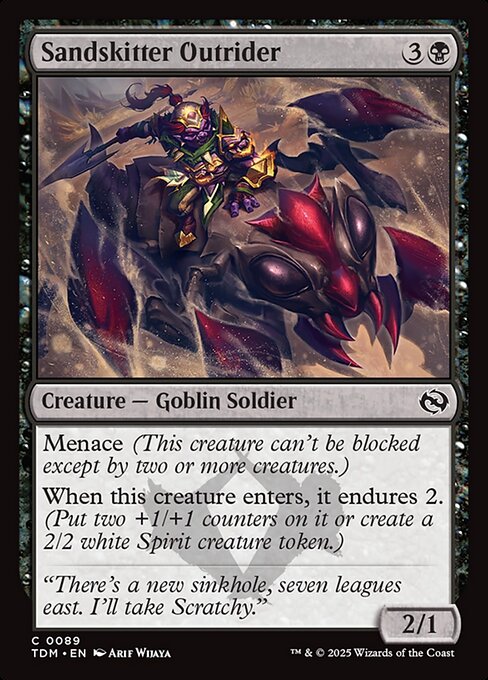
264. Sandskitter Outrider
Rating2.0WeakWhy this rating?
Not good filler and often gets cut (2.0/10).
Why. A 2/1 with menace for four that gets Endure 2 on arrival: two counters, or a 2/2 white Spirit creature token. Either two bodies, or a 4/3 with menace, depending on the board.
Risks. Four mana for a modest body, and fragile if you pick the token. It does little against an opponent who blocks well.
In the draft. Acceptable black filler, especially in a counters deck. Take it as a mid-curve creature.
Results in the games of the set
When it is in hand, the deck wins 51.9% of its games (set average: 56.0%, 240th of 274 cards).
In the opening hand: 51.4% wins (54.9% on average).
Drawn during the game: 52.3% (56.7% on average).
When it is drawn, the deck wins 1.1 points less than when it is not.
When it is drafted, it is played 18% of the time (set average: 65%).
It is played mostly in B/W decks (28% of them).

265. Summit Intimidator
Rating2.0WeakWhy this rating?
Not good filler and often gets cut (2.0/10).
Why. A 4/3 with reach for four that stops a creature from blocking this turn. It opens an attack or blocks flyers, with a solid body.
Risks. The effect happens only once, and a 4/3 is still fragile. It is weaker in a defensive deck.
In the draft. A reasonable playable in an aggressive red deck, especially red-white. Take it as a mid-pack creature.
Results in the games of the set
When it is in hand, the deck wins 50.7% of its games (set average: 56.0%, 262nd of 274 cards).
In the opening hand: 49.2% wins (54.9% on average).
Drawn during the game: 51.7% (56.7% on average).
When it is drawn, the deck wins 2.8 points less than when it is not.
When it is drafted, it is played 15% of the time (set average: 65%).

266. Wingspan Stride
Rating1.9WeakWhy this rating?
Not good filler and often gets cut (1.9/10).
Why. A one-mana Aura that gives +1/+1 and flying to a creature, and can return to hand for three mana. It makes a big creature evasive.
Risks. An Aura risks a two-for-one if the creature is killed in response, and it does nothing alone. It is very weak as a draft card.
In the draft. Let it pass unless you have lots of big ground creatures. Do not take it before ordinary filler.
Results in the games of the set
When it is in hand, the deck wins 48.9% of its games (set average: 56.0%, 273rd of 274 cards).
In the opening hand: 45.8% wins (54.9% on average).
Drawn during the game: 51.0% (56.7% on average).
When it is drawn, the deck wins 1.4 points more than when it is not.
When it is drafted, it is played only 3% of the time (set average: 65%): it almost always ends in the sideboard.
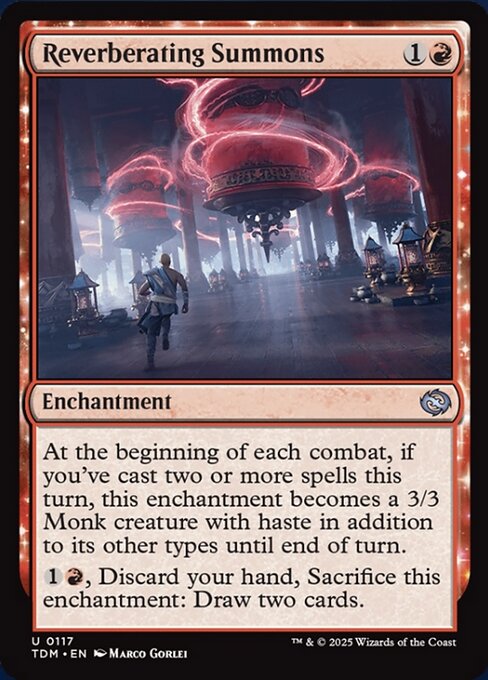 Rating1.7Weak
Why this rating?
Not good filler and often gets cut (1.7/10).
Why. A two-mana enchantment that becomes a 3/3 with haste if you have cast two spells this turn, and can be sacrificed to draw two cards. In a deck full of cheap spells it can hit hard.
Risks. It does nothing most of the time, and you cannot always cast two spells. The draw makes you discard your whole hand.
In the draft. A niche card for very aggressive red decks with many cheap spells. Otherwise leave it.
Results in the games of the set
When it is in hand, the deck wins 49.1% of its games (set average: 56.0%, 271st of 274 cards).
In the opening hand: 47.4% wins (54.9% on average).
Drawn during the game: 50.4% (56.7% on average).
When it is drawn, the deck wins 4.2 points less than when it is not.
When it is drafted, it is played 22% of the time (set average: 65%).
Taken among the first three picks (38 drafts), it ends in the deck 55% of the time.

268. Alesha's Legacy
Rating1.5WeakWhy this rating?
Almost unplayable and mostly sideboard material (1.5/10).
Why. A two-mana instant that gives a creature of yours deathtouch and indestructible until end of turn. It can win a combat or save a creature from destroy-based removal.
Risks. It is a combat trick that does nothing alone, and it loses to exile or sacrifice effects. It exposes you to a two-for-one.
In the draft. A late-pack card in black. Only play it in a deck with a good combat plan.
Results in the games of the set
When it is in hand, the deck wins 50.3% of its games (set average: 56.0%, 265th of 274 cards).
In the opening hand: 47.7% wins (54.9% on average).
Drawn during the game: 52.1% (56.7% on average).
When it is drawn, the deck wins 1.3 points less than when it is not.
When it is drafted, it is played only 11% of the time (set average: 65%): it almost always ends in the sideboard.
 Rating1.4Weak
Why this rating?
Almost unplayable and mostly sideboard material (1.4/10).
Why. For two mana you drain 2 and surveil 2. It is a small bit of value with no effect on the battlefield. When a Dragon you control enters, the enchantment goes back to your hand so you can reuse it.
Risks. It does nothing for your board and costs you tempo when you are under pressure. Without enough Dragons, the return-to-hand clause almost never happens.
In the draft. Filler. Only play it in a deck with several Dragons, as a last-slot card. Take any creature or removal over it.
Results in the games of the set
When it is in hand, the deck wins 49.6% of its games (set average: 56.0%, 267th of 274 cards).
In the opening hand: 45.3% wins (54.9% on average).
Drawn during the game: 52.7% (56.7% on average).
When it is drawn, the deck wins 0.3 points less than when it is not.
When it is drafted, it is played 39% of the time (set average: 65%).
Taken among the first three picks (70 drafts), it ends in the deck 71% of the time.

270. Stormbeacon Blade
Rating1.4WeakWhy this rating?
Almost unplayable and mostly sideboard material (1.4/10).
Why. A two-mana Equipment that gives +3/+0, turning a small creature into a real attacker. If you attack with three or more creatures, it draws a card each time the equipped creature attacks.
Risks. It adds no toughness, so the carrier dies just as easily, and moving it costs two mana each time. In a slower deck the draw rarely turns on.
In the draft. Playable in an aggressive deck with lots of small creatures. Take it after your good creatures and removal, and skip it in a controlling or midrange build.
Results in the games of the set
When it is in hand, the deck wins 50.0% of its games (set average: 56.0%, 266th of 274 cards).
In the opening hand: 49.9% wins (54.9% on average).
Drawn during the game: 50.0% (56.7% on average).
When it is drawn, the deck wins 5.4 points less than when it is not.
When it is drafted, it is played 38% of the time (set average: 65%).
Taken among the first three picks (61 drafts), it ends in the deck 82% of the time.

271. Unrooted Ancestor
Rating1.4WeakWhy this rating?
Almost unplayable and mostly sideboard material (1.4/10).
Why. A three-mana 3/2 with flash: fine for ambushing an attacker or deploying at the end of the opponent's turn. The sacrifice ability protects it from damage and destroy effects, at the cost of another creature.
Risks. Protecting it costs you another creature, and it also taps; that is rarely a good trade. With only 2 toughness it dies easily in combat.
In the draft. A playable filler body in a black deck. Do not take it over your better three-drops; it mostly earns its slot for the flash and a balanced curve.
Results in the games of the set
When it is in hand, the deck wins 49.0% of its games (set average: 56.0%, 272nd of 274 cards).
In the opening hand: 48.9% wins (54.9% on average).
Drawn during the game: 49.0% (56.7% on average).
When it is drawn, the deck wins 3.5 points less than when it is not.
When it is drafted, it is played 18% of the time (set average: 65%).
Intrinsic ratings: they do not take into account the cards you have already picked. They matter most for the first pick of the first pack.