Card ranking · Marvel Super Heroes (MSH)
← Marvel Super Heroes276 cards
- Bomb > 8.4
- Very good ≥ 7.2
- Good ≥ 6.2
- Playable ≥ 5.0
- Weak < 5.0
Ratings are out of 10. They combine experts' opinions, the statistics of thousands of drafts by experienced players (when a card is taken, played, and the wins of the decks that play it) and what is printed on the card. Click a card to enlarge it.

1. Captain Marvel, Earth's Protector
Rating9.4BombWhy this rating?
The best card of the set (9.4/10).
Why. A 5/4 with flying and lifelink that also has flash. Ambush a flying attacker, or drop it at the end of the opponent's turn and start swinging and gaining life right away.
Risks. It needs two white mana and is still a 5/4, so a clean removal answers it. The Power-up is very expensive, even reduced on the turn it arrives, and only matters in long games.
In the draft. A white bomb, take it very early. It does best in white-blue decks; do not treat it as a splash.
Results in the games of the set
When it is in hand, the deck wins 68.1% of its games (set average: 56.8%, 2nd of 273 cards).
In the opening hand: 64.9% wins (55.6% on average).
Drawn during the game: 70.0% (57.5% on average).
When it is drawn, the deck wins 13.3 points more than when it is not.
When it is drafted, it is played 96% of the time (set average: 63%).
Taken as the first pick (34 drafts), it ends in the deck 100% of the time.
It is played about as much in every archetype.
 Rating9.3Bomb
Why this rating?
One of the 3 best cards of the set (9.3/10).
Why. A 5/5 flier that pays off every noncreature spell: it deals damage equal to that spell's mana value to any target. Its enter ability also lets you replay an Equipment, instant or sorcery from your graveyard.
Risks. Without enough noncreature spells it is just a big flier for five, and it needs two red mana. If it is killed before you cast a spell, you only got the enter ability.
In the draft. A red bomb, take it very high. Keep a healthy count of removal and spells alongside it so its ability keeps firing.
Results in the games of the set
When it is in hand, the deck wins 62.7% of its games (set average: 56.8%, 16th of 273 cards).
In the opening hand: 59.7% wins (55.6% on average).
Drawn during the game: 64.5% (57.5% on average).
When it is drawn, the deck wins 11.1 points more than when it is not.
When it is drafted, it is played 91% of the time (set average: 63%).
Taken among the first three picks (136 drafts), it ends in the deck 91% of the time.
It is played about as much in every archetype.
 Rating9.1Bomb
Why this rating?
One of the 3 best cards of the set (9.1/10).
Why. A Saga that does everything over three turns: two 2/1 black Villain creature tokens with menace, then 2 damage to each non-Villain creature and each opponent, then a Treasure for each Villain. Your tokens survive the sweep; small opposing creatures do not.
Risks. Chapter II also hits your own non-Villain creatures. It is slow to come online and needs black and red; if your tokens die first, chapter III pays little.
In the draft. A bomb for black-red, take it early. Avoid too many fragile non-Villain creatures so chapter II stays one-sided.
Results in the games of the set
When it is in hand, the deck wins 63.8% of its games (set average: 56.8%, 7th of 273 cards).
In the opening hand: 63.6% wins (55.6% on average).
Drawn during the game: 63.9% (57.5% on average).
When it is drawn, the deck wins 12.3 points more than when it is not.
When it is drafted, it is played 81% of the time (set average: 63%).
Taken as the first pick (66 drafts), it ends in the deck 79% of the time.
It is played mostly in B/R decks (29% of them).
 Rating9.0Bomb
Why this rating?
One of the 10 best cards of the set (9.0/10).
Why. A Saga that opens by destroying any nonland permanent, makes the opponent lose 2 life twice, then creates Galactus, a 16/16 token with flying and trample that destroys a land whenever it attacks. A clock few decks can stop.
Risks. Five mana with two black and one green, and the token takes four turns to arrive. A fast deck can kill you first, and the token is still exposed to exile or sacrifice effects.
In the draft. A black-green bomb, take it early. Your deck needs to hold the board while waiting for the final chapter.
Results in the games of the set
When it is in hand, the deck wins 62.9% of its games (set average: 56.8%, 13th of 273 cards).
In the opening hand: 61.7% wins (55.6% on average).
Drawn during the game: 63.6% (57.5% on average).
When it is drawn, the deck wins 10.9 points more than when it is not.
When it is drafted, it is played 90% of the time (set average: 63%).
Taken as the first pick (37 drafts), it ends in the deck 86% of the time.
It is played about as much in every archetype.
 Rating8.9Bomb
Why this rating?
One of the 10 best cards of the set (8.9/10).
Why. An enchantment with flash that gives all your Heroes +2/+2 and draws a card at each end step if a Hero attacked or entered that turn. Cast mid-combat it flips a fight, then keeps refilling your hand.
Risks. Five mana for a permanent that does nothing without Heroes: you need a deck full of them. Removal on your Heroes before or after the cast undoes most of its value.
In the draft. A bomb in a Hero deck, take it early. With few Heroes, collect them first or lower it in your pick order.
Results in the games of the set
When it is in hand, the deck wins 64.0% of its games (set average: 56.8%, 5th of 273 cards).
In the opening hand: 63.1% wins (55.6% on average).
Drawn during the game: 64.5% (57.5% on average).
When it is drawn, the deck wins 10.0 points more than when it is not.
When it is drafted, it is played 94% of the time (set average: 63%).
Taken as the first pick (31 drafts), it ends in the deck 90% of the time.
It is played about as much in every archetype.

6. M.O.D.O.K.
Rating8.8BombWhy this rating?
One of the 10 best cards of the set (8.8/10).
Why. A 2/2 flier with lifelink that shrinks the whole opposing board, since their creatures get -1/-1. It can also connive by paying life on your turn, filtering your hand and growing.
Risks. The body is fragile and it costs five with two black. Each connive costs three life, which gets risky in a tight race.
In the draft. A black bomb, take it early, especially against decks full of small creatures. It slots into most black pairs.
Results in the games of the set
When it is in hand, the deck wins 63.3% of its games (set average: 56.8%, 9th of 273 cards).
In the opening hand: 61.3% wins (55.6% on average).
Drawn during the game: 64.5% (57.5% on average).
When it is drawn, the deck wins 11.5 points more than when it is not.
When it is drafted, it is played 92% of the time (set average: 63%).
Taken as the first pick (38 drafts), it ends in the deck 87% of the time.
It is played about as much in every archetype.
 Rating8.8Bomb
Why this rating?
One of the 10 best cards of the set (8.8/10).
Why. Removal that stays on the battlefield: 4 damage to a creature on entering, then it doubles damage from the equipped creature and equips for one mana onto a worthy creature. You can also discard it from hand to deal 2 damage to each creature.
Risks. Only red and/or white legendary non-Villains are worthy, so without them the Equipment sits idle. The sweep hits your own creatures too and costs three.
In the draft. A bomb in a red deck with legendary white or red creatures, take it early. In another deck it is still good red removal, but no longer a top pick.
Results in the games of the set
When it is in hand, the deck wins 58.4% of its games (set average: 56.8%, 63rd of 273 cards).
In the opening hand: 56.3% wins (55.6% on average).
Drawn during the game: 59.8% (57.5% on average).
When it is drawn, the deck wins 6.4 points more than when it is not.
When it is drafted, it is played 87% of the time (set average: 63%).
Taken as the first pick (30 drafts), it ends in the deck 93% of the time.
It is played about as much in every archetype.
 Rating8.7Bomb
Why this rating?
One of the 10 best cards of the set (8.7/10).
Why. A 4/5 flier for four that blocks and attacks better than nearly anything at its cost. The Power-up can give you an extra turn, finishing games you already control.
Risks. The Power-up needs three blue mana and eight in total, only four on the turn he arrives. He also needs two blue mana on turn four, which hurts lightly blue decks.
In the draft. A blue bomb, take it very high. The body alone earns the pick; the extra turn is a late-game bonus.
Results in the games of the set
When it is in hand, the deck wins 61.2% of its games (set average: 56.8%, 21st of 273 cards).
In the opening hand: 56.7% wins (55.6% on average).
Drawn during the game: 63.8% (57.5% on average).
When it is drawn, the deck wins 7.0 points more than when it is not.
When it is drafted, it is played 93% of the time (set average: 63%).
Taken as the first pick (38 drafts), it ends in the deck 92% of the time.
It is played about as much in every archetype.

9. Doctor Doom
Rating8.6BombWhy this rating?
One of the 10 best cards of the set (8.6/10).
Why. Six mana for three bodies: Doctor Doom and two 3/3 colorless Robot Villain artifact creature tokens named Doombot. While you control an artifact creature or a Plan he is indestructible, and he draws you a card every end step.
Risks. It costs six and he makes you lose 1 life each end step. Exile or sacrifice effects answer him, and a sweeper that kills the Doombots also strips his indestructibility.
In the draft. A black bomb, take it early. Treat it as a finisher in slower decks that can hold the board.
Results in the games of the set
When it is in hand, the deck wins 64.9% of its games (set average: 56.8%, 4th of 273 cards).
In the opening hand: 63.7% wins (55.6% on average).
Drawn during the game: 65.7% (57.5% on average).
When it is drawn, the deck wins 12.9 points more than when it is not.
When it is drafted, it is played 94% of the time (set average: 63%).
Taken among the first three picks (167 drafts), it ends in the deck 92% of the time.
It is played about as much in every archetype.

10. Elektra, Daughter of the Hand
Rating8.6BombWhy this rating?
One of the 10 best cards of the set (8.6/10).
Why. A 3/3 that destroys an opposing creature with power 3 or less when it enters: removal stapled to a solid body. With Sneak you cast her cheaper by returning an unblocked attacker to your hand, and she enters tapped and attacking.
Risks. The removal misses bigger creatures. Sneak needs an unblocked attacker to bounce, which costs tempo unless it has a good enter ability.
In the draft. Excellent, take it early: a clean two-for-one in black. It fits all the good black pairs without needing special support.
Results in the games of the set
When it is in hand, the deck wins 62.8% of its games (set average: 56.8%, 14th of 273 cards).
In the opening hand: 62.6% wins (55.6% on average).
Drawn during the game: 63.0% (57.5% on average).
When it is drawn, the deck wins 11.0 points more than when it is not.
When it is drafted, it is played 89% of the time (set average: 63%).
Taken as the first pick (66 drafts), it ends in the deck 92% of the time.
It is played about as much in every archetype.
 Rating8.5Bomb
Why this rating?
One of the very best rares of the format (8.5/10).
Why. A five-mana Saga that steals up to two creatures with total mana value 6 or less for as long as it stays on the battlefield, pumps your team with vigilance, then ends with a fight. The tempo swing is huge.
Risks. Once the Saga is sacrificed after chapter III you lose control of the stolen creatures. It costs red and white, and the best use needs good targets.
In the draft. A great pick for red-white, take it high. Do not splash it: it wants both colours early.
Results in the games of the set
When it is in hand, the deck wins 69.3% of its games (set average: 56.8%, 1st of 273 cards).
In the opening hand: 66.5% wins (55.6% on average).
Drawn during the game: 71.1% (57.5% on average).
When it is drawn, the deck wins 16.8 points more than when it is not.
When it is drafted, it is played 95% of the time (set average: 63%).
Taken as the first pick (78 drafts), it ends in the deck 92% of the time.
It is played mostly in R/W decks (25% of them).
 Rating8.4Very good
Why this rating?
One of the very best rares of the format (8.4/10).
Why. A 1/3 that works as an engine: at the start of each of your combats one of your creatures connives, and every connive is preceded by a draw. You filter your hand, grow creatures and draw extra every turn.
Risks. The body is weak and it needs two blue mana. It is slow against aggressive decks, and counters only come when you discard nonland cards.
In the draft. Very good in blue, take it early. It improves further in decks with other connive sources alongside.
Results in the games of the set
When it is in hand, the deck wins 67.4% of its games (set average: 56.8%, 3rd of 273 cards).
In the opening hand: 66.9% wins (55.6% on average).
Drawn during the game: 67.7% (57.5% on average).
When it is drawn, the deck wins 14.4 points more than when it is not.
When it is drafted, it is played 94% of the time (set average: 63%).
Taken as the first pick (109 drafts), it ends in the deck 93% of the time.
It is played about as much in every archetype.
 Rating8.3Very good
Why this rating?
One of the very best rares of the format (8.3/10).
Why. A creature with X: it enters with X +1/+1 counters and you pick up to X effects from four, including destroying a token, making the opponent lose 2 life, or having each player sacrifice a creature. It scales to any point of the game.
Risks. Each extra effect costs one more mana, so the best use comes late. The sacrifice hits your own creatures too, possibly itself, and you need both colours.
In the draft. Very flexible, take it in black-red or any black deck. It loses value without red.
Results in the games of the set
When it is in hand, the deck wins 61.5% of its games (set average: 56.8%, 19th of 273 cards).
In the opening hand: 59.6% wins (55.6% on average).
Drawn during the game: 62.6% (57.5% on average).
When it is drawn, the deck wins 9.4 points more than when it is not.
When it is drafted, it is played 82% of the time (set average: 63%).
Taken as the first pick (58 drafts), it ends in the deck 91% of the time.
It is played mostly in B/R decks (25% of them).

14. Cosmic Cube
Rating8.3Very goodWhy this rating?
One of the very best mythics of the format (8.3/10).
Why. A colorless artifact that turns every attack into a chance to cast a free spell from the top six cards of your library, as long as its mana value is no more than the greatest power among attackers. It also has ward 2.
Risks. Five mana for a permanent that does nothing alone: you need attackers. The result depends on the top of your library, and a deck without big creatures under-uses it.
In the draft. Very good in creature decks with high power; a notch under the best cards. Avoid it in a defensive deck.
Results in the games of the set
When it is in hand, the deck wins 61.9% of its games (set average: 56.8%, 17th of 273 cards).
In the opening hand: 60.4% wins (55.6% on average).
Drawn during the game: 62.9% (57.5% on average).
When it is drawn, the deck wins 8.2 points more than when it is not.
When it is drafted, it is played 99% of the time (set average: 63%).
Taken as the first pick (33 drafts), it ends in the deck 100% of the time.
It is played about as much in every archetype.

15. Monica Rambeau // Photon, Living Light
Rating8.2Very goodWhy this rating?
One of the very best mythics of the format (8.2/10).
Why. A 3/3 flier with prowess for three: a very good creature even without its back face. Transformed, Photon gains hexproof and puts a +1/+1 counter on each of your other creatures whenever you cast a noncreature spell.
Risks. Transforming costs five and needs red. Without red it is a 3/3 flier, and removal in response to the transformation still works.
In the draft. A good pick in white, white-blue or white-green. Do not count on the transformation unless you already play red.
Results in the games of the set
When it is in hand, the deck wins 62.8% of its games (set average: 56.8%, 15th of 273 cards).
In the opening hand: 61.2% wins (55.6% on average).
Drawn during the game: 63.8% (57.5% on average).
When it is drawn, the deck wins 9.3 points more than when it is not.
When it is drafted, it is played 96% of the time (set average: 63%).
Taken as the first pick (43 drafts), it ends in the deck 91% of the time.
It is played about as much in every archetype.

16. Jennifer Walters // The Sensational She-Hulk
Rating8.1Very goodWhy this rating?
One of the very best mythics of the format (8.1/10).
Why. A two-mana 2/3 that stops your opponents from casting spells on your turn: no tricks or flash in combat. Transformed, She-Hulk has reach and trample and can send damage dealt to your creatures at any target, once each turn.
Risks. Transforming costs six and needs green and white. Without green it is a useful but modest 2/3.
In the draft. A good cheap card, best in green-white. A solid pick in white decks that attack a lot.
Results in the games of the set
When it is in hand, the deck wins 63.9% of its games (set average: 56.8%, 6th of 273 cards).
In the opening hand: 63.9% wins (55.6% on average).
Drawn during the game: 63.9% (57.5% on average).
When it is drawn, the deck wins 9.0 points more than when it is not.
When it is drafted, it is played 94% of the time (set average: 63%).
Taken as the first pick (39 drafts), it ends in the deck 92% of the time.
It is played about as much in every archetype.
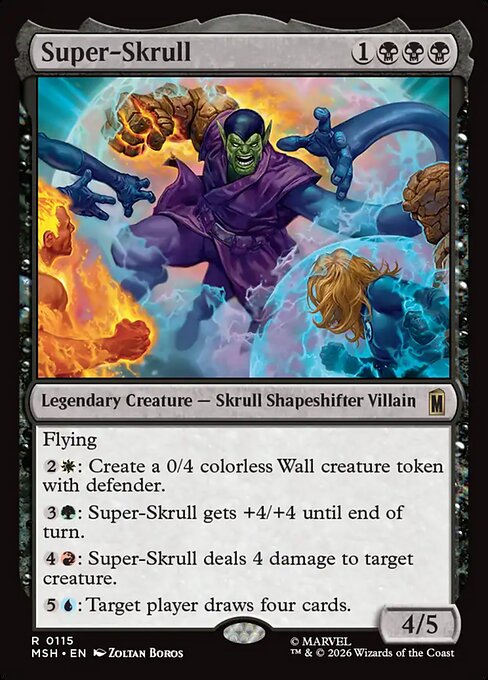
17. Super-Skrull
Rating8.0Very goodWhy this rating?
One of the very best rares of the format (8.0/10).
Why. A 4/5 flier for four, already solid: it blocks and attacks. Depending on your colours it adds late-game abilities: a 0/4 Wall token, +4/+4, 4 damage to a creature, or drawing four cards.
Risks. It needs three black mana up front, and its abilities require other colours and plenty of mana. In an almost mono-black deck it is just a solid flier.
In the draft. A solid black pick, upper-middle of the pack. The more colours you play, the more it becomes a flexible finisher.
Results in the games of the set
When it is in hand, the deck wins 59.1% of its games (set average: 56.8%, 47th of 273 cards).
In the opening hand: 56.3% wins (55.6% on average).
Drawn during the game: 60.7% (57.5% on average).
When it is drawn, the deck wins 7.2 points more than when it is not.
When it is drafted, it is played 88% of the time (set average: 63%).
Taken as the first pick (70 drafts), it ends in the deck 91% of the time.
It is played about as much in every archetype.
 Rating8.0Very good
Why this rating?
One of the very best rares of the format (8.0/10).
Why. A 2/2 with reach and first strike that gets better on offence: whenever it becomes tapped you pay one mana per mode, up to three, to stop a block, deal 2 damage to a player or discard then draw.
Risks. The modes cost mana each turn and cannot hit creatures, so it does not replace removal. The 2/2 body trades easily, and you need an attacking deck.
In the draft. A good two-drop for an aggressive red deck, especially red-white. A mid-list pick, nothing more.
Results in the games of the set
When it is in hand, the deck wins 58.7% of its games (set average: 56.8%, 56th of 273 cards).
In the opening hand: 59.6% wins (55.6% on average).
Drawn during the game: 58.0% (57.5% on average).
When it is drawn, the deck wins 6.1 points more than when it is not.
When it is drafted, it is played 85% of the time (set average: 63%).
Taken as the first pick (62 drafts), it ends in the deck 89% of the time.
It is played about as much in every archetype.
 Rating7.9Very good
Why this rating?
One of the very best rares of the format (7.9/10).
Why. A 3/5 with haste that fights another creature when it enters: removal stapled to a body. Its ability heals earlier damage whenever it takes new damage, so only one big hit kills it.
Risks. It needs red and green. The fight does not handle a creature with power 5 or more or with deathtouch, and it is still weak to removal that does not use damage.
In the draft. A very good pick for red-green, take it high. It also shows up in green decks with a red splash.
Results in the games of the set
When it is in hand, the deck wins 63.7% of its games (set average: 56.8%, 8th of 273 cards).
In the opening hand: 63.5% wins (55.6% on average).
Drawn during the game: 63.8% (57.5% on average).
When it is drawn, the deck wins 9.7 points more than when it is not.
When it is drafted, it is played 88% of the time (set average: 63%).
Taken as the first pick (73 drafts), it ends in the deck 84% of the time.
It is played mostly in G/R decks (28% of them).
 Rating7.8Very good
Why this rating?
One of the very best rares of the format (7.8/10).
Why. A 2/1 flier with flash for two: when it enters it can tap a creature, which loses all abilities for as long as the Wasp stays on the battlefield. It works as an evasive attacker, a tempo play, or a way to neutralize a threat.
Risks. It dies to almost everything, and the creature regains its abilities as soon as the Wasp leaves. Protect it if it is neutralizing a real threat.
In the draft. A very good blue two-drop, take it early. It is especially strong in blue-white tempo decks.
Results in the games of the set
When it is in hand, the deck wins 63.2% of its games (set average: 56.8%, 11th of 273 cards).
In the opening hand: 62.3% wins (55.6% on average).
Drawn during the game: 63.8% (57.5% on average).
When it is drawn, the deck wins 8.2 points more than when it is not.
When it is drafted, it is played 95% of the time (set average: 63%).
Taken as the first pick (94 drafts), it ends in the deck 97% of the time.
It is played about as much in every archetype.
 Rating7.8Very good
Why this rating?
One of the very best mythics of the format (7.8/10).
Why. A six-mana sorcery that reveals eight cards and puts a creature onto the battlefield; with Teamwork you put as many creatures as you want. It can swing a game in a creature-heavy deck.
Risks. The rest go to the graveyard, so you lose cards, and the result depends on creature density. Teamwork taps your creatures, and without it this is six mana of variance.
In the draft. A card for green creature decks, mid-pack: take it if you already have plenty of creatures. Otherwise pass.
Results in the games of the set
When it is in hand, the deck wins 58.2% of its games (set average: 56.8%, 64th of 273 cards).
In the opening hand: 56.4% wins (55.6% on average).
Drawn during the game: 59.4% (57.5% on average).
When it is drawn, the deck wins 4.4 points more than when it is not.
When it is drafted, it is played 84% of the time (set average: 63%).
Taken as the first pick (36 drafts), it ends in the deck 83% of the time.
It is played about as much in every archetype.

22. Tony Stark // The Invincible Iron Man
Rating7.7Very goodWhy this rating?
One of the very best mythics of the format (7.7/10).
Why. A two-mana 1/3 that digs through the top four cards of your library for artifacts. Transformed, it flies with haste and can put an artifact from your hand onto the battlefield at the start of each of your combats.
Risks. Without artifacts it does little, and the transformation costs six and needs blue and red. Until then the body is just a blocker.
In the draft. A card for blue-red artifact decks, middling. Only take it if you already have artifacts to find.
Results in the games of the set
When it is in hand, the deck wins 59.9% of its games (set average: 56.8%, 33rd of 273 cards).
In the opening hand: 58.6% wins (55.6% on average).
Drawn during the game: 60.7% (57.5% on average).
When it is drawn, the deck wins 7.8 points more than when it is not.
When it is drafted, it is played 89% of the time (set average: 63%).
Taken as the first pick (46 drafts), it ends in the deck 83% of the time.
It is played about as much in every archetype.

23. Absorbing Man
Rating7.6Very goodWhy this rating?
One of the very best rares of the format (7.6/10).
Why. A 4/4 with vigilance for three, an excellent rate. Each turn it can also copy an artifact, non-Aura enchantment or land while keeping its 4/4 body, gaining a useful ability.
Risks. It needs green and blue, and it is legendary. With no targets to copy it is just a 4/4 with vigilance, which is already fine.
In the draft. A good pick for blue-green, take it fairly high. The body alone justifies the card.
Results in the games of the set
When it is in hand, the deck wins 60.0% of its games (set average: 56.8%, 31st of 273 cards).
In the opening hand: 61.4% wins (55.6% on average).
Drawn during the game: 59.2% (57.5% on average).
When it is drawn, the deck wins 5.4 points more than when it is not.
When it is drafted, it is played 72% of the time (set average: 63%).
Taken as the first pick (64 drafts), it ends in the deck 81% of the time.
It is played mostly in G/U decks (25% of them).
 Rating7.6Very good
Why this rating?
One of the very best rares of the format (7.6/10).
Why. A 2/2 with vigilance for two: it attacks without tapping, then you tap it to put a +1/+1 counter on each other Hero. It grows an entire team turn after turn.
Risks. With no other Heroes it is just a 2/2 with vigilance. It is fragile to removal, and its ability needs it under your control since the start of the turn.
In the draft. Very good in a Hero deck, take it early. The more Heroes you have, the more it is worth the pick.
Results in the games of the set
When it is in hand, the deck wins 63.3% of its games (set average: 56.8%, 10th of 273 cards).
In the opening hand: 67.0% wins (55.6% on average).
Drawn during the game: 60.9% (57.5% on average).
When it is drawn, the deck wins 9.2 points more than when it is not.
When it is drafted, it is played 95% of the time (set average: 63%).
Taken as the first pick (101 drafts), it ends in the deck 94% of the time.
It is played about as much in every archetype.

25. Vision Quest
Rating7.6Very goodWhy this rating?
One of the very best rares of the format (7.6/10).
Why. A sorcery with X that searches your library and/or graveyard for an artifact creature with mana value X or less and puts it onto the battlefield with X additional +1/+1 counters, with haste if X is four or more. A flexible search.
Risks. With no artifact creatures in the deck it does nothing. It needs blue and red, and X has to be chosen well.
In the draft. A card for blue-red artifact decks, middling. Skip it if you have too few artifact creatures.
Results in the games of the set
When it is in hand, the deck wins 60.8% of its games (set average: 56.8%, 23rd of 273 cards).
In the opening hand: 56.5% wins (55.6% on average).
Drawn during the game: 63.4% (57.5% on average).
When it is drawn, the deck wins 7.5 points more than when it is not.
When it is drafted, it is played 76% of the time (set average: 63%).
Taken as the first pick (98 drafts), it ends in the deck 84% of the time.
It is played mostly in R/U decks (27% of them).

26. King T'Challa // Black Panther, Hope Enduring
Rating7.6Very goodWhy this rating?
One of the very best mythics of the format (7.6/10).
Why. A 3/2 with flash for three that draws you a card whenever a player draws their second card each turn. Transformed into Black Panther it has double strike, takes no damage, and draws a card whenever it deals combat damage to a player.
Risks. It needs white and blue, and two toughness makes it fragile before transforming. Transforming costs six, which is slow.
In the draft. A strong card for blue-white, upper mid-list. It likes decks that draw an extra card.
Results in the games of the set
When it is in hand, the deck wins 60.5% of its games (set average: 56.8%, 25th of 273 cards).
In the opening hand: 60.3% wins (55.6% on average).
Drawn during the game: 60.6% (57.5% on average).
When it is drawn, the deck wins 6.7 points more than when it is not.
When it is drafted, it is played 94% of the time (set average: 63%).
Taken as the first pick (38 drafts), it ends in the deck 95% of the time.
It is played about as much in every archetype.

27. The Vision
Rating7.5Very goodWhy this rating?
One of the very best rares of the format (7.5/10).
Why. A colorless 2/5 with flying and vigilance that fits any deck. Each noncreature spell gives it double strike or indestructible, or draws you a card: an excellent blocker and an aerial threat.
Risks. It costs four for two power, so it is not fast. It depends on noncreature spells for value, and exile answers it.
In the draft. A solid pick for all colours, very good in decks with spells. Take it in the upper half of the mid-list.
Results in the games of the set
When it is in hand, the deck wins 58.8% of its games (set average: 56.8%, 54th of 273 cards).
In the opening hand: 58.5% wins (55.6% on average).
Drawn during the game: 58.9% (57.5% on average).
When it is drawn, the deck wins 4.7 points more than when it is not.
When it is drafted, it is played 99% of the time (set average: 63%).
Taken as the first pick (55 drafts), it ends in the deck 98% of the time.
It is played about as much in every archetype.

28. Epic Fight
Rating7.4Very goodWhy this rating?
A very good rare of the format (7.4/10).
Why. A three-mana green sorcery: double a creature's power and toughness, make one of your creatures fight an opposing one, or both. With both modes the fight is almost always won.
Risks. It is a sorcery, so the opponent can respond by killing your creature, and you lose two cards for one. You also need a creature already on the battlefield.
In the draft. A fair removal for green, middling. Play one or two in a deck with good creatures.
Results in the games of the set
When it is in hand, the deck wins 57.6% of its games (set average: 56.8%, 77th of 273 cards).
In the opening hand: 55.2% wins (55.6% on average).
Drawn during the game: 59.1% (57.5% on average).
When it is drawn, the deck wins 3.4 points more than when it is not.
When it is drafted, it is played 88% of the time (set average: 63%).
Taken as the first pick (71 drafts), it ends in the deck 90% of the time.
It is played about as much in every archetype.

29. Captain America, Super-Soldier
Rating7.4Very goodWhy this rating?
A very good mythic of the format (7.4/10).
Why. A 3/2 with first strike and a shield counter for three. As long as the shield stays, you and your other Heroes have hexproof, which protects your best Heroes from removal.
Risks. It needs two white mana. Once the shield is removed the hexproof goes away, and it does little in a deck without Heroes.
In the draft. A good card for a white Hero deck, take it high there. Without Heroes it is a decent 3/2, no more.
Results in the games of the set
When it is in hand, the deck wins 59.1% of its games (set average: 56.8%, 49th of 273 cards).
In the opening hand: 59.1% wins (55.6% on average).
Drawn during the game: 59.0% (57.5% on average).
When it is drawn, the deck wins 4.5 points more than when it is not.
When it is drafted, it is played 96% of the time (set average: 63%).
Taken as the first pick (38 drafts), it ends in the deck 95% of the time.
It is played about as much in every archetype.

30. Captain America, Wings of Freedom
Rating7.4Very goodWhy this rating?
A very good rare of the format (7.4/10).
Why. A 3/1 with flying, first strike and ward 1 for three. When it attacks, each other Hero gets +X/+X where X is its toughness, so +1/+1 here. An evasive attack that backs the whole team.
Risks. One toughness makes it fragile to damage that gets past the ward. The bonus is small, and it needs a deck that attacks with several Heroes.
In the draft. A good card for a white Hero deck, take it high. White-blue and white-green serve it best.
Results in the games of the set
When it is in hand, the deck wins 61.3% of its games (set average: 56.8%, 20th of 273 cards).
In the opening hand: 62.5% wins (55.6% on average).
Drawn during the game: 60.5% (57.5% on average).
When it is drawn, the deck wins 6.0 points more than when it is not.
When it is drafted, it is played 94% of the time (set average: 63%).
Taken as the first pick (101 drafts), it ends in the deck 94% of the time.
It is played about as much in every archetype.

31. Iron Man Armor
Rating7.4Very goodWhy this rating?
A very good mythic of the format (7.4/10).
Why. A three-mana Equipment that attaches free to one of your creatures on entering: +2/+1 and flying. It can also become a flying creature itself for a turn, bigger with more artifacts.
Risks. It needs a creature on the battlefield. If the opponent kills it in response, the Equipment is not attached, and re-equipping costs two. An equipped flier draws removal.
In the draft. A fine mid-list Equipment, especially white-blue. Take it if your deck lacks aerial threats.
Results in the games of the set
When it is in hand, the deck wins 58.8% of its games (set average: 56.8%, 53rd of 273 cards).
In the opening hand: 56.1% wins (55.6% on average).
Drawn during the game: 60.6% (57.5% on average).
When it is drawn, the deck wins 5.3 points more than when it is not.
When it is drafted, it is played 98% of the time (set average: 63%).
Taken as the first pick (33 drafts), it ends in the deck 100% of the time.
It is played about as much in every archetype.
 Rating7.4Very good
Why this rating?
A very good mythic of the format (7.4/10).
Why. A 4/4 with deathtouch and lifelink for only three: a huge body. An excellent combat creature, hard to attack into or block.
Risks. It needs red, white and black, which makes the deck very demanding. The Power-up needs all five colours and a colorless mana, so never count on it.
In the draft. Only play it if you are already in red, white and black. Otherwise a three-mana 4/4 is not worth the detour.
Results in the games of the set
When it is in hand, the deck wins 57.5% of its games (set average: 56.8%, 79th of 273 cards).
In the opening hand: 54.7% wins (55.6% on average).
Drawn during the game: 59.2% (57.5% on average).
When it is drawn, the deck wins 8.7 points more than when it is not.
When it is drafted, it is played 61% of the time (set average: 63%).
Taken among the first three picks (68 drafts), it ends in the deck 79% of the time.
It is played about as much in every archetype.

33. The Mighty Thor, Jane Foster
Rating7.4Very goodWhy this rating?
A very good rare of the format (7.4/10).
Why. A 3/3 flier for three. Each attack it exiles a nontoken artifact or creature, which comes back tapped: you replay an enter ability or remove an opposing blocker for a turn. It also draws when an Equipment enters under your control.
Risks. It needs white and blue. The returned card comes back tapped, so your own creature cannot block afterwards, and the effect is weak without good targets.
In the draft. A very good pick for white-blue, upper mid-list. It is better with creatures that have enter abilities.
Results in the games of the set
When it is in hand, the deck wins 60.4% of its games (set average: 56.8%, 27th of 273 cards).
In the opening hand: 60.6% wins (55.6% on average).
Drawn during the game: 60.2% (57.5% on average).
When it is drawn, the deck wins 5.5 points more than when it is not.
When it is drafted, it is played 89% of the time (set average: 63%).
Taken as the first pick (101 drafts), it ends in the deck 91% of the time.
It is played about as much in every archetype.

34. The Unbeatable Squirrel Girl
Rating7.4Very goodWhy this rating?
A very good rare of the format (7.4/10).
Why. A 4/4 that creates a 1/1 green Squirrel creature token when it enters and every time it attacks. For four mana you can then double the Squirrels: an army that grows very fast in the late game.
Risks. It needs three green mana, which rules out light-green decks. The tokens are weak to sweepers, and killing her quickly stops the production.
In the draft. A strong card for a heavy green deck, upper mid-list. It wins long games on its own.
Results in the games of the set
When it is in hand, the deck wins 59.2% of its games (set average: 56.8%, 44th of 273 cards).
In the opening hand: 57.8% wins (55.6% on average).
Drawn during the game: 60.0% (57.5% on average).
When it is drawn, the deck wins 4.2 points more than when it is not.
When it is drafted, it is played 88% of the time (set average: 63%).
Taken as the first pick (86 drafts), it ends in the deck 86% of the time.
It is played about as much in every archetype.

35. Dark Deed
Rating7.3Very goodWhy this rating?
A solid uncommon of the format (7.3/10).
Why. A two-mana removal spell you can cast at instant speed. Minus four on both stats kills most early and midgame creatures, and the low cost lets you develop a creature in the same turn.
Risks. It does not answer big creatures. The effect only lasts until end of turn, so in combat the opponent can respond with a toughness boost.
In the draft. A solid removal spell to take without hesitation in any black deck. It is fine to take it over an average creature.
Results in the games of the set
When it is in hand, the deck wins 59.4% of its games (set average: 56.8%, 40th of 273 cards).
In the opening hand: 57.9% wins (55.6% on average).
Drawn during the game: 60.3% (57.5% on average).
When it is drawn, the deck wins 6.3 points more than when it is not.
When it is drafted, it is played 91% of the time (set average: 63%).
Taken as the first pick (186 drafts), it ends in the deck 94% of the time.
It is played mostly in B/G decks (31% of them) and B/U (30%).

36. Bruce Banner // The Incredible Hulk
Rating7.3Very goodWhy this rating?
A very good mythic of the format (7.3/10).
Why. For a single blue mana, a draw engine: as soon as you have two mana available you tap Bruce to draw a card, and the draw scales with your mana. The Incredible Hulk side is a rare bonus.
Risks. He must wait a turn before tapping, only activates on your turn, and this 1/1 dies to almost anything. Transforming takes two red and two green mana, so do not plan around it.
In the draft. A good card in a blue deck that wants card flow; take it as a value engine, not a threat. Play it early and draw on every slow turn.
Results in the games of the set
When it is in hand, the deck wins 60.7% of its games (set average: 56.8%, 24th of 273 cards).
In the opening hand: 62.7% wins (55.6% on average).
Drawn during the game: 59.4% (57.5% on average).
When it is drawn, the deck wins 6.2 points more than when it is not.
When it is drafted, it is played 93% of the time (set average: 63%).
Taken as the first pick (49 drafts), it ends in the deck 88% of the time.
It is played about as much in every archetype.
 Rating7.2Very good
Why this rating?
A very good rare of the format (7.2/10).
Why. A three-mana sweeper: three damage to each creature, yours included. It can also destroy a land, but its controller fetches a tapped basic, so that mostly matters against an important nonbasic land.
Risks. It hits your own creatures too, and anything with four toughness or more survives it. It is bad in a deck that attacks with small creatures.
In the draft. A card for control decks or decks with big creatures. If you are aggro, leave it in the pile.
Results in the games of the set
When it is in hand, the deck wins 54.4% of its games (set average: 56.8%, 172nd of 273 cards).
In the opening hand: 52.9% wins (55.6% on average).
Drawn during the game: 55.5% (57.5% on average).
When it is drawn, the deck wins 3.7 points more than when it is not.
When it is drafted, it is played 54% of the time (set average: 63%).
Taken among the first three picks (96 drafts), it ends in the deck 67% of the time.
It is played about as much in every archetype.

38. Cloak and Dagger, Entwined
Rating7.2Very goodWhy this rating?
A very good rare of the format (7.2/10).
Why. Deathtouch and lifelink on a three-mana body already make a great blocker. On top of that, when it enters it exiles a nonland card from the opponent's hand or one of their creatures while it stays on the battlefield.
Risks. It needs both a white and a black mana and is only a 2/2: if it dies, the exiled card or creature comes back. It stays fragile to damage.
In the draft. A high pick in a white-black deck. It is worth an early pick even before you are settled in those colours.
Results in the games of the set
When it is in hand, the deck wins 61.7% of its games (set average: 56.8%, 18th of 273 cards).
In the opening hand: 60.6% wins (55.6% on average).
Drawn during the game: 62.3% (57.5% on average).
When it is drawn, the deck wins 7.9 points more than when it is not.
When it is drafted, it is played 82% of the time (set average: 63%).
Taken as the first pick (73 drafts), it ends in the deck 89% of the time.
It is played mostly in B/W decks (25% of them).
 Rating7.2Very good
Why this rating?
A solid uncommon of the format (7.2/10).
Why. A 2/2 flyer that bounces a nonland, nontoken permanent when it enters. Against an opponent it gains tempo; on your own permanents it replays an enters effect. Whenever another nonland permanent you control returns to hand, it gets a +1/+1 counter.
Risks. It has low toughness, and it loses value if there is no good target. It cannot target a token.
In the draft. A good blue uncommon, especially in a deck with creatures that have enters effects. Take it with no second thought.
Results in the games of the set
When it is in hand, the deck wins 63.0% of its games (set average: 56.8%, 12th of 273 cards).
In the opening hand: 61.4% wins (55.6% on average).
Drawn during the game: 63.9% (57.5% on average).
When it is drawn, the deck wins 7.4 points more than when it is not.
When it is drafted, it is played 95% of the time (set average: 63%).
Taken as the first pick (309 drafts), it ends in the deck 96% of the time.
It is played mostly in U/W decks (34% of them) and G/U (33%).

40. Killmonger, Scourge of Wakanda
Rating7.2GoodWhy this rating?
A solid uncommon of the format (7.2/10).
Why. A four-mana creature that can destroy any nonland permanent the opponent controls by sacrificing another creature. Once two creature cards are in your graveyard, it becomes a serious 5/4.
Risks. You need another creature to sacrifice for the destruction, and that costs you a card. With no fodder, it is just a four-mana 3/3.
In the draft. Excellent in a black-green deck with small creatures or tokens to sacrifice. More modest elsewhere.
Results in the games of the set
When it is in hand, the deck wins 60.3% of its games (set average: 56.8%, 30th of 273 cards).
In the opening hand: 57.9% wins (55.6% on average).
Drawn during the game: 61.7% (57.5% on average).
When it is drawn, the deck wins 6.2 points more than when it is not.
When it is drafted, it is played 78% of the time (set average: 63%).
Taken as the first pick (125 drafts), it ends in the deck 96% of the time.
It is played mostly in B/G decks (59% of them).

41. The Mind Stone
Rating7.1GoodWhy this rating?
A very good mythic of the format (7.1/10).
Why. A two-mana indestructible artifact that taps for white, which accelerates your turn three. Late in the game, for six mana, you harness it and it replays an enters effect at the start of each of your end steps.
Risks. It only makes white and does nothing to the board. The late ability is slow and needs permanents with enters effects.
In the draft. A playable card in a white deck with expensive spells, never a priority. Take it after your removal and your good creatures.
Results in the games of the set
When it is in hand, the deck wins 56.2% of its games (set average: 56.8%, 122nd of 273 cards).
In the opening hand: 57.1% wins (55.6% on average).
Drawn during the game: 55.6% (57.5% on average).
When it is drawn, the deck wins 2.5 points more than when it is not.
When it is drafted, it is played 84% of the time (set average: 63%).
Taken as the first pick (41 drafts), it ends in the deck 83% of the time.
It is played about as much in every archetype.

42. Storm, Windrider
Rating7.0GoodWhy this rating?
A very good rare of the format (7.0/10).
Why. A 4/4 flyer for four mana, which is a formidable blocker. Creatures with flying cannot attack you or block your creatures, locking the skies. Your spells that target creatures give them flying until end of turn.
Risks. It costs two white mana and a green one, and its lockdown effect only helps if the opponent plays creatures with flying.
In the draft. A good card for a white-green deck. Take it over an ordinary four-drop.
Results in the games of the set
When it is in hand, the deck wins 59.5% of its games (set average: 56.8%, 38th of 273 cards).
In the opening hand: 57.8% wins (55.6% on average).
Drawn during the game: 60.6% (57.5% on average).
When it is drawn, the deck wins 5.5 points more than when it is not.
When it is drafted, it is played 86% of the time (set average: 63%).
Taken as the first pick (91 drafts), it ends in the deck 93% of the time.
It is played about as much in every archetype.
 Rating7.0Good
Why this rating?
A very good mythic of the format (7.0/10).
Why. A 2/1 menace for two mana, hard to block. When it connects, the opponent exiles cards from the top of their library until a nonland card, and you choose between a +1/+1 counter or casting that card until end of turn with any type of mana.
Risks. Her toughness is low and she dies to a double block. Without a clear path, she needs protecting.
In the draft. A good offensive card in an aggressive black deck. Take it if you already have removal to clear the way.
Results in the games of the set
When it is in hand, the deck wins 57.9% of its games (set average: 56.8%, 66th of 273 cards).
In the opening hand: 60.4% wins (55.6% on average).
Drawn during the game: 56.2% (57.5% on average).
When it is drawn, the deck wins 5.4 points more than when it is not.
When it is drafted, it is played 88% of the time (set average: 63%).
Taken as the first pick (34 drafts), it ends in the deck 88% of the time.
It is played about as much in every archetype.
 Rating7.0Good
Why this rating?
A solid uncommon of the format (7.0/10).
Why. Five mana for a 3/2 plus a 2/2 Cat creature token that gets a +1/+1 counter whenever a land enters. You see the top of your library and can play lands from it, so every land on top is a free card.
Risks. He is expensive and the body is fragile. If he dies, you keep the token, but the engine is gone.
In the draft. A very good green uncommon. Take it in any green deck.
Results in the games of the set
When it is in hand, the deck wins 61.0% of its games (set average: 56.8%, 22nd of 273 cards).
In the opening hand: 59.4% wins (55.6% on average).
Drawn during the game: 62.0% (57.5% on average).
When it is drawn, the deck wins 5.5 points more than when it is not.
When it is drafted, it is played 92% of the time (set average: 63%).
Taken as the first pick (230 drafts), it ends in the deck 95% of the time.
It is played mostly in G/W decks (37% of them) and B/G (35%).
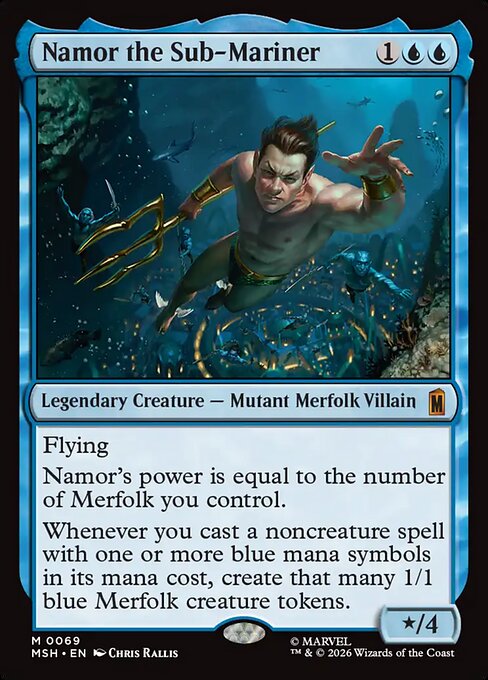 Rating7.0Good
Why this rating?
A very good mythic of the format (7.0/10).
Why. A three-mana flyer with four toughness, which blocks very well. In a deck full of blue noncreature spells, each one creates as many 1/1 Merfolk creature tokens as it has blue mana symbols and raises Namor's power.
Risks. He needs two blue mana and plenty of blue noncreature spells to show his value. Without them, he barely attacks.
In the draft. A deck-dependent card: strong in a blue deck full of instants and sorceries, average otherwise. Do not take it as a first pick.
Results in the games of the set
When it is in hand, the deck wins 56.4% of its games (set average: 56.8%, 115th of 273 cards).
In the opening hand: 55.5% wins (55.6% on average).
Drawn during the game: 57.0% (57.5% on average).
When it is drawn, the deck wins 4.6 points more than when it is not.
When it is drafted, it is played 74% of the time (set average: 63%).
Taken among the first three picks (116 drafts), it ends in the deck 75% of the time.
It is played about as much in every archetype.

46. Red Guardian, Super-Soldier
Rating7.0GoodWhy this rating?
A solid uncommon of the format (7.0/10).
Why. A 2/2 with flash that destroys an opposing creature that dealt damage this turn. Cast after a block or an opposing attack, it gives you removal and a body for three mana.
Risks. An opposing creature has to have already dealt damage, so it is conditional. With no combat and no damage, it has no target.
In the draft. A good white uncommon: take it early, it works as a combat surprise and as removal.
Results in the games of the set
When it is in hand, the deck wins 58.4% of its games (set average: 56.8%, 62nd of 273 cards).
In the opening hand: 57.2% wins (55.6% on average).
Drawn during the game: 59.3% (57.5% on average).
When it is drawn, the deck wins 2.7 points more than when it is not.
When it is drafted, it is played 91% of the time (set average: 63%).
Taken as the first pick (179 drafts), it ends in the deck 95% of the time.
It is played mostly in R/W decks (26% of them).
 Rating7.0Good
Why this rating?
A very good rare of the format (7.0/10).
Why. A 3/3 flying Vehicle with flash and crew 1. It can arrive in response to removal: you exile your creature and it returns at the beginning of the next end step. That protects it and replays its enters effect.
Risks. You need a creature to crew it or it does nothing on offence. It does little without a creature to save or to pilot it.
In the draft. A good card in a blue deck with creatures that have enters effects. Without them, it is still a decent 3/3 flyer.
Results in the games of the set
When it is in hand, the deck wins 58.9% of its games (set average: 56.8%, 51st of 273 cards).
In the opening hand: 56.1% wins (55.6% on average).
Drawn during the game: 60.6% (57.5% on average).
When it is drawn, the deck wins 4.9 points more than when it is not.
When it is drafted, it is played 93% of the time (set average: 63%).
Taken as the first pick (109 drafts), it ends in the deck 95% of the time.
It is played about as much in every archetype.

48. Secret Invasion
Rating7.0GoodWhy this rating?
A very good rare of the format (7.0/10).
Why. A three-mana Aura that exiles another creature while the Aura stays on the battlefield, and turns your enchanted creature into a copy of it with ward 2. It is removal and an upgrade in one card.
Risks. If the enchanted creature dies, the Aura goes with it and the exiled creature comes back. You risk a two-for-one against removal.
In the draft. A good card in a blue deck with good creatures. Take it over conditional removal, but not over clean removal.
Results in the games of the set
When it is in hand, the deck wins 59.6% of its games (set average: 56.8%, 37th of 273 cards).
In the opening hand: 54.7% wins (55.6% on average).
Drawn during the game: 62.4% (57.5% on average).
When it is drawn, the deck wins 5.1 points more than when it is not.
When it is drafted, it is played 90% of the time (set average: 63%).
Taken as the first pick (84 drafts), it ends in the deck 90% of the time.
It is played about as much in every archetype.
 Rating7.0Good
Why this rating?
A solid uncommon of the format (7.0/10).
Why. A 4/4 with reach and trample for four mana: very solid on both offence and defence. Her Power-up destroys an artifact or enchantment and gives her a +1/+1 counter, and it is much cheaper the turn she arrives.
Risks. She has no flying, so she is exposed to removal and double blocks. The Power-up is expensive to activate later.
In the draft. A good green uncommon to take without much hesitation in a green deck. Her Power-up also answers a troublesome artifact or enchantment.
Results in the games of the set
When it is in hand, the deck wins 60.4% of its games (set average: 56.8%, 28th of 273 cards).
In the opening hand: 58.4% wins (55.6% on average).
Drawn during the game: 61.7% (57.5% on average).
When it is drawn, the deck wins 4.7 points more than when it is not.
When it is drafted, it is played 87% of the time (set average: 63%).
Taken as the first pick (109 drafts), it ends in the deck 96% of the time.
It is played mostly in G/W decks (36% of them) and B/G (35%).

50. Web Up
Rating7.0GoodWhy this rating?
One of the best commons of the format (7.0/10).
Why. A common universal removal for three mana: it exiles any nonland permanent the opponent controls. It handles creatures, artifacts and enchantments, which makes it very flexible.
Risks. It is an enchantment: if the opponent destroys it, the exiled permanent comes back. It is slow, since it has no flash.
In the draft. A good removal spell to take early in a white deck. Take several and play them all.
Results in the games of the set
When it is in hand, the deck wins 59.3% of its games (set average: 56.8%, 41st of 273 cards).
In the opening hand: 56.5% wins (55.6% on average).
Drawn during the game: 61.1% (57.5% on average).
When it is drawn, the deck wins 3.9 points more than when it is not.
When it is drafted, it is played 93% of the time (set average: 63%).
Taken as the first pick (539 drafts), it ends in the deck 94% of the time.
It is played mostly in G/W decks (53% of them) and U/W (52%).
 Rating7.0Good
Why this rating?
A very good rare of the format (7.0/10).
Why. A two-mana Saga that chains a scry 2, then a free Hero creature with mana value 3 or less from your hand (or, failing that, a draw), then a +1/+1 counter on each of your creatures.
Risks. It is slow and relies on a board already in place for the final chapter. With no Hero in hand, chapter two is just a draw.
In the draft. A card for a white deck with many Heroes. In a deck without them, it is far too slow.
Results in the games of the set
When it is in hand, the deck wins 57.6% of its games (set average: 56.8%, 76th of 273 cards).
In the opening hand: 57.8% wins (55.6% on average).
Drawn during the game: 57.4% (57.5% on average).
When it is drawn, the deck wins 3.3 points more than when it is not.
When it is drafted, it is played 90% of the time (set average: 63%).
Taken as the first pick (74 drafts), it ends in the deck 96% of the time.
It is played about as much in every archetype.
 Rating6.9Good
Why this rating?
A solid uncommon of the format (6.9/10).
Why. Five mana for a 3/4 flyer and a 1/1 flying Bird Scout creature token that surveils 1 when it attacks. Two flying bodies from one card gives you steady air pressure.
Risks. He is expensive, and removal on the main body leaves only the small token. He arrives late, so it helps to have stabilised the board already.
In the draft. A good blue uncommon for the top of the curve. Take it after your removal, especially in a tempo or flyers deck.
Results in the games of the set
When it is in hand, the deck wins 59.7% of its games (set average: 56.8%, 34th of 273 cards).
In the opening hand: 57.2% wins (55.6% on average).
Drawn during the game: 61.2% (57.5% on average).
When it is drawn, the deck wins 3.6 points more than when it is not.
When it is drafted, it is played 89% of the time (set average: 63%).
Taken as the first pick (170 drafts), it ends in the deck 94% of the time.
It is played mostly in U/W decks (31% of them) and B/U (30%).

53. Punishing Punch
Rating6.8GoodWhy this rating?
A solid uncommon of the format (6.8/10).
Why. A one-sided instant-speed removal: your creature deals damage equal to twice its power to the opposing creature, with no damage coming back. With two creature cards in your graveyard, it costs two less.
Risks. You need a creature with some power on the battlefield. If it is killed in response, the spell does nothing.
In the draft. A good green removal spell to take early. Look for big creatures to go with it.
Results in the games of the set
When it is in hand, the deck wins 59.7% of its games (set average: 56.8%, 35th of 273 cards).
In the opening hand: 57.6% wins (55.6% on average).
Drawn during the game: 61.1% (57.5% on average).
When it is drawn, the deck wins 4.4 points more than when it is not.
When it is drafted, it is played 90% of the time (set average: 63%).
Taken as the first pick (157 drafts), it ends in the deck 92% of the time.
It is played mostly in B/G decks (34% of them) and G/R (33%).

54. Agent Maria Hill
Rating6.8GoodWhy this rating?
A solid uncommon of the format (6.8/10).
Why. A one-mana 2/1 that gets a +1/+1 counter and draws whenever it taps to pay a Teamwork cost. In a deck full of Teamwork spells, it is a very cheap engine.
Risks. Without Teamwork spells, it is just a plain 2/1. It dies to any small removal or a block.
In the draft. A good card for a Teamwork deck. Take it when you already have several spells with that mechanic.
Results in the games of the set
When it is in hand, the deck wins 59.1% of its games (set average: 56.8%, 45th of 273 cards).
In the opening hand: 62.1% wins (55.6% on average).
Drawn during the game: 57.1% (57.5% on average).
When it is drawn, the deck wins 2.1 points more than when it is not.
When it is drafted, it is played 85% of the time (set average: 63%).
Taken as the first pick (157 drafts), it ends in the deck 90% of the time.
It is played mostly in G/W decks (30% of them) and B/W (28%).

55. Daredevil, Man Without Fear
Rating6.8GoodWhy this rating?
A very good rare of the format (6.8/10).
Why. A 3/4 with vigilance and haste that attacks the turn it arrives. On each attack, you may exile the top card and play it this turn, and Daredevil gets +2/+1 if it is a Hero. A solid card-advantage engine.
Risks. It costs red and white, and the exiled card is lost if you cannot play it. It is vulnerable to removal, like any four-mana rare.
In the draft. A good red-white card, especially with many Heroes. Weaker in other colour pairs, since it needs both.
Results in the games of the set
When it is in hand, the deck wins 57.8% of its games (set average: 56.8%, 68th of 273 cards).
In the opening hand: 56.2% wins (55.6% on average).
Drawn during the game: 58.9% (57.5% on average).
When it is drawn, the deck wins 4.0 points more than when it is not.
When it is drafted, it is played 85% of the time (set average: 63%).
Taken as the first pick (92 drafts), it ends in the deck 84% of the time.
It is played about as much in every archetype.
 Rating6.8Good
Why this rating?
A very good rare of the format (6.8/10).
Why. A two-mana 2/1 that draws a card when a player or permanent becomes the target of an ability you control, once each turn. With enters effects that target, it is a card-advantage engine.
Risks. Without targeting abilities, it is nothing more than a 2/1. It is fragile.
In the draft. A card for a blue deck with targeting enters effects. Take it when you already have such effects, not before.
Results in the games of the set
When it is in hand, the deck wins 58.7% of its games (set average: 56.8%, 55th of 273 cards).
In the opening hand: 58.9% wins (55.6% on average).
Drawn during the game: 58.6% (57.5% on average).
When it is drawn, the deck wins 4.5 points more than when it is not.
When it is drafted, it is played 91% of the time (set average: 63%).
Taken as the first pick (96 drafts), it ends in the deck 92% of the time.
It is played about as much in every archetype.
 Rating6.8Good
Why this rating?
A solid uncommon of the format (6.8/10).
Why. A one-mana Plan enchantment: each creature you control that enters gives a scry 1 and adds a plan counter. On the fourth, you sacrifice it, draw a card and put a +1/+1 counter on each of your creatures.
Risks. It needs four creatures to finish, and does nothing against an opponent who is beating you. It has no immediate effect on the board.
In the draft. A good card for a white deck with many creatures. Play it early for the most value.
Results in the games of the set
When it is in hand, the deck wins 59.2% of its games (set average: 56.8%, 43rd of 273 cards).
In the opening hand: 63.5% wins (55.6% on average).
Drawn during the game: 56.2% (57.5% on average).
When it is drawn, the deck wins 3.1 points more than when it is not.
When it is drafted, it is played 87% of the time (set average: 63%).
Taken as the first pick (139 drafts), it ends in the deck 93% of the time.
It is played mostly in U/W decks (29% of them) and G/W (28%).

58. Winter Soldier, Icy Assassin
Rating6.8GoodWhy this rating?
A very good rare of the format (6.8/10).
Why. A 2/2 with vigilance and menace for two mana that gets +2/+0 for each Equipment attached. It comes back from the graveyard for five mana with a finality counter, which makes it a late threat.
Risks. It costs a white and a black mana and is much stronger with Equipment. Without any, it is a two-mana 2/2.
In the draft. A good card for a white-black deck, better with Equipment. Without it, a decent two-drop.
Results in the games of the set
When it is in hand, the deck wins 58.6% of its games (set average: 56.8%, 57th of 273 cards).
In the opening hand: 58.7% wins (55.6% on average).
Drawn during the game: 58.5% (57.5% on average).
When it is drawn, the deck wins 6.1 points more than when it is not.
When it is drafted, it is played 59% of the time (set average: 63%).
Taken as the first pick (31 drafts), it ends in the deck 84% of the time.
It is played mostly in B/W decks (44% of them).
 Rating6.8Good
Why this rating?
A very good rare of the format (6.8/10).
Why. A 3/4 with deathtouch for three mana: it blocks nearly anything and is hard to target, since its ward gives the opponent five poison counters. Whenever another of your creatures with deathtouch dies, each opponent sacrifices a nontoken creature.
Risks. Its sacrifice effect needs other creatures with deathtouch. The opponent can pay the ward, but doing it twice is enough to lose the game.
In the draft. A good card for a black-green deck. Take it if you have or are looking for creatures with deathtouch.
Results in the games of the set
When it is in hand, the deck wins 56.5% of its games (set average: 56.8%, 111th of 273 cards).
In the opening hand: 55.0% wins (55.6% on average).
Drawn during the game: 57.5% (57.5% on average).
When it is drawn, the deck wins 3.4 points more than when it is not.
When it is drafted, it is played 62% of the time (set average: 63%).
Taken among the first three picks (92 drafts), it ends in the deck 83% of the time.
It is played mostly in B/G decks (27% of them).
 Rating6.7Good
Why this rating?
One of the best commons of the format (6.7/10).
Why. A common two-mana sorcery that exiles a big creature (toughness 4 or greater) or an enchantment with mana value 4 or more. With Teamwork (tapping creatures with total power 4 or more), it handles both targets at once.
Risks. It only touches big creatures and expensive enchantments: small ones escape the removal. It does nothing if the opponent only has small creatures.
In the draft. A conditional but efficient white removal spell: take it early. Complete the picture with other removal for small creatures.
Results in the games of the set
When it is in hand, the deck wins 59.7% of its games (set average: 56.8%, 36th of 273 cards).
In the opening hand: 57.0% wins (55.6% on average).
Drawn during the game: 61.4% (57.5% on average).
When it is drawn, the deck wins 3.5 points more than when it is not.
When it is drafted, it is played 89% of the time (set average: 63%).
Taken as the first pick (276 drafts), it ends in the deck 95% of the time.
It is played mostly in U/W decks (62% of them) and G/W (57%).

61. Super-Adaptoid
Rating6.6GoodWhy this rating?
A very good rare of the format (6.6/10).
Why. A colourless two-mana robot whose power equals the number of legendary creatures you control (itself included). When it enters or attacks, it gains keyword counters from another target creature: flying, menace, deathtouch...
Risks. It is weak without legendary creatures, and with no other creature with keywords, it adds nothing more. Its toughness is low.
In the draft. A card for a deck with plenty of legends. It plays in any colour, but do not take it before your good creatures.
Results in the games of the set
When it is in hand, the deck wins 57.3% of its games (set average: 56.8%, 85th of 273 cards).
In the opening hand: 57.1% wins (55.6% on average).
Drawn during the game: 57.5% (57.5% on average).
When it is drawn, the deck wins 3.9 points more than when it is not.
When it is drafted, it is played 96% of the time (set average: 63%).
Taken as the first pick (59 drafts), it ends in the deck 95% of the time.
It is played about as much in every archetype.
 Rating6.6Good
Why this rating?
A solid uncommon of the format (6.6/10).
Why. A three-mana 3/2 that makes a Clue whenever one of your creatures attacks alone. It rewards a lone attacker, especially against a stalled board.
Risks. It is not useful if you attack with a group. Its 3/2 body is fragile.
In the draft. A good card for a white tempo or value deck. Take it when you have evasion to attack alone.
Results in the games of the set
When it is in hand, the deck wins 58.6% of its games (set average: 56.8%, 58th of 273 cards).
In the opening hand: 58.5% wins (55.6% on average).
Drawn during the game: 58.6% (57.5% on average).
When it is drawn, the deck wins 2.6 points more than when it is not.
When it is drafted, it is played 93% of the time (set average: 63%).
Taken as the first pick (231 drafts), it ends in the deck 97% of the time.
It is played mostly in B/W decks (31% of them) and G/W (29%).

63. Ares, God of War
Rating6.6GoodWhy this rating?
A very good rare of the format (6.6/10).
Why. A three-mana 4/3 that must attack each combat. Whenever an attacking creature you control dies, itself included, that card returns to your hand. An aggressive creature that is hard to remove for good.
Risks. It attacks even when the block is bad, and you lose tempo replaying it. It never defends, so it does not protect you.
In the draft. A card for an aggressive black-red deck. In a control deck, leave it.
Results in the games of the set
When it is in hand, the deck wins 56.4% of its games (set average: 56.8%, 113th of 273 cards).
In the opening hand: 56.0% wins (55.6% on average).
Drawn during the game: 56.7% (57.5% on average).
When it is drawn, the deck wins 5.7 points more than when it is not.
When it is drafted, it is played 67% of the time (set average: 63%).
Taken among the first three picks (130 drafts), it ends in the deck 85% of the time.
It is played about as much in every archetype.
 Rating6.6Good
Why this rating?
A very good rare of the format (6.6/10).
Why. An indestructible two-mana Equipment: the equipped creature gets +0/+8 and vigilance, and taps a creature the defending player controls whenever it attacks. It becomes a huge blocker that still attacks.
Risks. Without power on the creature, the Shield kills nothing. It costs two to equip, and it does not protect against removal that skips damage.
In the draft. A good Equipment, playable in any colour, especially with already strong creatures. Weaker with 1-power creatures.
Results in the games of the set
When it is in hand, the deck wins 56.9% of its games (set average: 56.8%, 97th of 273 cards).
In the opening hand: 54.7% wins (55.6% on average).
Drawn during the game: 58.4% (57.5% on average).
When it is drawn, the deck wins 4.2 points more than when it is not.
When it is drafted, it is played 97% of the time (set average: 63%).
Taken as the first pick (57 drafts), it ends in the deck 100% of the time.
It is played about as much in every archetype.

65. Cruel Alliance
Rating6.6GoodWhy this rating?
One of the best commons of the format (6.6/10).
Why. A common three-mana sorcery that exiles a creature with mana value 3 or less. With Teamwork, it exiles any creature and you gain three life.
Risks. Without Teamwork, it only handles small creatures, and it is slow. To be at its best, you must tap creatures with total power 2 or more.
In the draft. A very decent black removal spell: take it early. It becomes excellent with small creatures to pay the cost.
Results in the games of the set
When it is in hand, the deck wins 59.1% of its games (set average: 56.8%, 46th of 273 cards).
In the opening hand: 55.9% wins (55.6% on average).
Drawn during the game: 61.1% (57.5% on average).
When it is drawn, the deck wins 5.5 points more than when it is not.
When it is drafted, it is played 91% of the time (set average: 63%).
Taken as the first pick (340 drafts), it ends in the deck 97% of the time.
It is played mostly in B/U decks (61% of them) and B/G (59%).

66. Hero in Training
Rating6.6GoodWhy this rating?
One of the best commons of the format (6.6/10).
Why. A common 2/2 that draws a card when it enters, and gains you two life if you control another Hero. The card replacement is reliable, and the Hero type fits several effects in the set.
Risks. Its body is small and does not change the board. With no other Hero, the life gain is lost.
In the draft. A good white common, a solid turn-three play once you have your removal.
Results in the games of the set
When it is in hand, the deck wins 60.5% of its games (set average: 56.8%, 26th of 273 cards).
In the opening hand: 59.4% wins (55.6% on average).
Drawn during the game: 61.1% (57.5% on average).
When it is drawn, the deck wins 3.4 points more than when it is not.
When it is drafted, it is played 94% of the time (set average: 63%).
Taken as the first pick (570 drafts), it ends in the deck 97% of the time.
It is played mostly in U/W decks (73% of them) and G/W (64%).

67. Moon Girl and Devil Dinosaur
Rating6.6GoodWhy this rating?
A very good rare of the format (6.6/10).
Why. A three-mana 2/2 whose base power and toughness become 6/6 with trample until end of turn when you draw your second card each turn. Each artifact that enters under your control makes you draw, once each turn.
Risks. You need draw effects or artifacts to trigger her. Without them, she is a three-mana 2/2 with no impact.
In the draft. A card for a green-blue deck with card draw and artifacts. Otherwise, leave her.
Results in the games of the set
When it is in hand, the deck wins 55.0% of its games (set average: 56.8%, 159th of 273 cards).
In the opening hand: 55.7% wins (55.6% on average).
Drawn during the game: 54.6% (57.5% on average).
When it is drawn, the deck wins 1.8 points more than when it is not.
When it is drafted, it is played 65% of the time (set average: 63%).
Taken as the first pick (49 drafts), it ends in the deck 82% of the time.
It is played about as much in every archetype.

68. Nick Fury, Agent of S.H.I.E.L.D.
Rating6.6GoodWhy this rating?
A very good rare of the format (6.6/10).
Why. A one-mana 2/1. His Power-up gives him two +1/+1 counters, looks at seven cards and puts a Hero, Equipment or Vehicle onto the battlefield, but it needs a mana of each of the five colours.
Risks. Outside a five-colour deck, the Power-up will never be activated, leaving a mediocre 2/1. He dies to almost anything.
In the draft. A card for a five-colour deck, or just a filler 2/1. Take it late.
Results in the games of the set
When it is in hand, the deck wins 56.6% of its games (set average: 56.8%, 109th of 273 cards).
In the opening hand: 57.2% wins (55.6% on average).
Drawn during the game: 56.2% (57.5% on average).
When it is drawn, the deck wins 1.1 points more than when it is not.
When it is drafted, it is played 65% of the time (set average: 63%).
Taken as the first pick (34 drafts), it ends in the deck 74% of the time.
It is played about as much in every archetype.

69. Shang-Chi, Master of Kung Fu
Rating6.6GoodWhy this rating?
A very good mythic of the format (6.6/10).
Why. A two-mana 2/2 that lets your creatures use any activated ability the turn they arrive, tap symbols included. It also taps for two mana of one color, usable only on creature abilities.
Risks. Without activated abilities in your deck it is a plain 2/2 whose mana does nothing. It is fragile and trades off quickly.
In the draft. A build-around for decks full of activated abilities, Power-ups above all. Take it late if you lack payoffs; in green, only play it when you have enough targets.
Results in the games of the set
When it is in hand, the deck wins 53.0% of its games (set average: 56.8%, 199th of 273 cards).
In the opening hand: 54.5% wins (55.6% on average).
Drawn during the game: 51.9% (57.5% on average).
When it is drawn, the deck wins 0.5 points more than when it is not.
When it is drafted, it is played 74% of the time (set average: 63%).
Taken among the first three picks (66 drafts), it ends in the deck 85% of the time.
It is played about as much in every archetype.

70. Spider-Woman, Secret Agent
Rating6.6GoodWhy this rating?
A solid uncommon of the format (6.6/10).
Why. Removal in disguise on a sturdy body. With flash you can tap an opposing creature before it attacks, and it stays tapped as long as you keep Spider-Woman. The 1/4 body blocks well.
Risks. If she dies or gets bounced, the creature is freed. She does nothing against abilities that do not need to tap, or against a creature that is already attacking.
In the draft. A good uncommon to take fairly high, castable in white or blue thanks to her hybrid cost. Save her for the opponent's best creature instead of firing her off on reflex.
Results in the games of the set
When it is in hand, the deck wins 58.8% of its games (set average: 56.8%, 52nd of 273 cards).
In the opening hand: 55.8% wins (55.6% on average).
Drawn during the game: 60.7% (57.5% on average).
When it is drawn, the deck wins 2.9 points more than when it is not.
When it is drafted, it is played 95% of the time (set average: 63%).
Taken as the first pick (217 drafts), it ends in the deck 96% of the time.
It is played mostly in U/W decks (25% of them).

71. The Ten Rings
Rating6.6GoodWhy this rating?
A very good mythic of the format (6.6/10).
Why. At eight mana it refills your hand up to ten cards every end step. If the game drags on, you bury the opponent in resources.
Risks. Eight mana with no immediate effect on the board: in a normal game you are already dead or already winning. It does nothing against a fast clock.
In the draft. Pass it in nearly every deck. Only a very slow control deck with plenty of ramp should consider a copy late in the pool.
Results in the games of the set
When it is in hand, the deck wins 49.1% of its games (set average: 56.8%).
In the opening hand: 0.0% wins (55.6% on average).
Drawn during the game: 49.5% (57.5% on average).
When it is drawn, the deck wins 4.8 points less than when it is not.
When it is drafted, it is played only 13% of the time (set average: 63%): it almost always ends in the sideboard.
 Rating6.6Good
Why this rating?
One of the best commons of the format (6.6/10).
Why. A tempo removal that handles a big threat without killing it: the owner puts it second from the top or on the bottom of their library. Then you can connive one of your creatures, which improves your hand and can grow it.
Risks. A four-mana sorcery, and if the creature goes second from the top the opponent redraws it in two turns. The connive needs a creature of your own.
In the draft. A good common removal, worth taking fairly high in blue. It is best in a deck that wins the tempo race.
Results in the games of the set
When it is in hand, the deck wins 60.4% of its games (set average: 56.8%, 29th of 273 cards).
In the opening hand: 57.3% wins (55.6% on average).
Drawn during the game: 62.1% (57.5% on average).
When it is drawn, the deck wins 4.3 points more than when it is not.
When it is drafted, it is played 90% of the time (set average: 63%).
Taken as the first pick (336 drafts), it ends in the deck 96% of the time.
It is played mostly in U/W decks (69% of them) and G/U (65%).
 Rating6.6Good
Why this rating?
A very good rare of the format (6.6/10).
Why. A three-mana 1/4 with reach and vigilance: a great blocker that still lets you attack. Each spell that targets one of your creatures draws a card, and her base power then equals your hand size until end of turn.
Risks. She needs spells that target your creatures, or she stays a wall with no impact. She never gains power on her own.
In the draft. A card for a blue deck built around targeted spells; otherwise a decent mid-pool playable. Look for tricks and auras to go with her.
Results in the games of the set
When it is in hand, the deck wins 55.3% of its games (set average: 56.8%, 153rd of 273 cards).
In the opening hand: 56.1% wins (55.6% on average).
Drawn during the game: 54.7% (57.5% on average).
When it is drawn, the deck wins 2.1 points more than when it is not.
When it is drafted, it is played 58% of the time (set average: 63%).
Taken as the first pick (42 drafts), it ends in the deck 76% of the time.
It is played about as much in every archetype.
 Rating6.5Good
Why this rating?
Good playable that always makes the cut (6.5/10).
Why. A three-mana 3/3 that becomes removal if you have Equipment: sacrificing the one attached to him gives a target creature -4/-4 at sorcery speed. He also pays life to help cast and equip your Equipment.
Risks. Without Equipment he is just a fine 3/3. The removal costs you an Equipment, taps Ronin, and only works at sorcery speed.
In the draft. A good card for a black deck with several Equipment; otherwise a playable body. White-black pairs seem to suit him.
Results in the games of the set
When it is in hand, the deck wins 55.5% of its games (set average: 56.8%, 140th of 273 cards).
In the opening hand: 55.4% wins (55.6% on average).
Drawn during the game: 55.6% (57.5% on average).
When it is drawn, the deck wins 1.1 points more than when it is not.
When it is drafted, it is played 32% of the time (set average: 63%).
Taken among the first three picks (75 drafts), it ends in the deck 65% of the time.
It is played mostly in B/W decks (43% of them).
 Rating6.4Good
Why this rating?
Good playable that always makes the cut (6.4/10).
Why. A two-mana removal with flash: it exiles a tapped creature, so ideally one that is attacking. Very efficient for its cost, and it plays well both on defense and for tempo.
Risks. It only hits tapped creatures: anything with vigilance, or that never taps, slips past. If the enchantment is destroyed or bounced, the creature returns.
In the draft. A good removal uncommon to take fairly high in white. Let the opponent attack before you cast it.
Results in the games of the set
When it is in hand, the deck wins 56.2% of its games (set average: 56.8%, 121st of 273 cards).
In the opening hand: 54.3% wins (55.6% on average).
Drawn during the game: 57.4% (57.5% on average).
When it is drawn, the deck wins 1.8 points more than when it is not.
When it is drafted, it is played 91% of the time (set average: 63%).
Taken as the first pick (136 drafts), it ends in the deck 91% of the time.
It is played about as much in every archetype.

76. Captain America, Living Legend
Rating6.4GoodWhy this rating?
Good playable that always makes the cut (6.4/10).
Why. A three-mana 3/4 with vigilance: your creatures untap the first time they become tapped during your turn. They attack without leaving gaps in your defense, and their tap abilities can be used twice.
Risks. It is two colors, white and blue, so it is harder to cast on turn three. It does nothing without attackers or tap abilities, and nothing on the opponent's turn.
In the draft. A good gold uncommon that rewards a coherent white-blue deck; do not take it over real removal in your colors.
Results in the games of the set
When it is in hand, the deck wins 57.5% of its games (set average: 56.8%, 80th of 273 cards).
In the opening hand: 57.1% wins (55.6% on average).
Drawn during the game: 57.7% (57.5% on average).
When it is drawn, the deck wins 1.5 points more than when it is not.
When it is drafted, it is played 82% of the time (set average: 63%).
Taken as the first pick (140 drafts), it ends in the deck 91% of the time.
It is played mostly in U/W decks (42% of them).

77. Depower
Rating6.4GoodWhy this rating?
Good playable that always makes the cut (6.4/10).
Why. A flexible instant: -4/-0 on a creature and you draw a card. On an attacker it costs just one blue mana, so it can win a combat for almost nothing and replaces itself.
Risks. It kills nothing, and does not stop effects that ignore power. Outside of combat it is three mana for a small effect.
In the draft. A decent blue playable, but not a priority. Take it after your best creatures and removal.
Results in the games of the set
When it is in hand, the deck wins 56.1% of its games (set average: 56.8%, 124th of 273 cards).
In the opening hand: 53.5% wins (55.6% on average).
Drawn during the game: 57.8% (57.5% on average).
When it is drawn, the deck wins 1.9 points more than when it is not.
When it is drafted, it is played 40% of the time (set average: 63%).
Taken among the first three picks (169 drafts), it ends in the deck 70% of the time.
It is played mostly in B/U decks (42% of them) and U/W (31%).

78. Go Nuts!
Rating6.4GoodWhy this rating?
Good playable that always makes the cut (6.4/10).
Why. For a single green mana, a +1/+1 counter or a fight between your creature and theirs. With Teamwork 3 you do both: the counter first, then the fight, for very cheap removal.
Risks. It is a sorcery, so the opponent can respond by killing your creature, and the fight goes badly without a creature of decent power. Teamwork means tapping creatures with total power 3.
In the draft. A good green common that works as cheap removal; take it fairly high if you are green, with creatures of decent power.
Results in the games of the set
When it is in hand, the deck wins 57.8% of its games (set average: 56.8%, 72nd of 273 cards).
In the opening hand: 56.0% wins (55.6% on average).
Drawn during the game: 59.0% (57.5% on average).
When it is drawn, the deck wins 2.1 points more than when it is not.
When it is drafted, it is played 85% of the time (set average: 63%).
Taken as the first pick (235 drafts), it ends in the deck 94% of the time.
It is played mostly in B/G decks (61% of them) and G/R (60%).

79. Madame Masque
Rating6.4GoodWhy this rating?
Good playable that always makes the cut (6.4/10).
Why. A five-drop that replaces itself at once: she connives, and cast on your own turn that draw is normally your second card, so she makes a 2/1 black Villain creature token with menace. Every later turn's second draw makes another.
Risks. A 3/2 for five mana is fragile. Without other draw effects she makes just one token, since the trigger only works once each turn.
In the draft. A good uncommon in a deck that draws more than one card per turn; blue-black seems to suit her best.
Results in the games of the set
When it is in hand, the deck wins 58.5% of its games (set average: 56.8%, 59th of 273 cards).
In the opening hand: 56.1% wins (55.6% on average).
Drawn during the game: 59.9% (57.5% on average).
When it is drawn, the deck wins 5.5 points more than when it is not.
When it is drafted, it is played 87% of the time (set average: 63%).
Taken as the first pick (126 drafts), it ends in the deck 96% of the time.
It is played mostly in B/U decks (40% of them) and B/R (35%).
 Rating6.4Good
Why this rating?
Good playable that always makes the cut (6.4/10).
Why. A flexible sorcery: for two red mana plus X, it deals 1 damage to a target creature and then X copies each deal 1 damage and can choose new targets. It cleans up several small creatures or piles the damage onto one.
Risks. It is expensive for what it does: killing a five-toughness creature takes 5 damage, so six mana. It does not answer a big threat cheaply.
In the draft. A good red uncommon against small creatures; do not take it over real removal, but it is a solid playable.
Results in the games of the set
When it is in hand, the deck wins 56.1% of its games (set average: 56.8%, 125th of 273 cards).
In the opening hand: 52.9% wins (55.6% on average).
Drawn during the game: 58.2% (57.5% on average).
When it is drawn, the deck wins 3.1 points more than when it is not.
When it is drafted, it is played 74% of the time (set average: 63%).
Taken as the first pick (63 drafts), it ends in the deck 87% of the time.
It is played mostly in G/R decks (40% of them) and B/R (30%).
 Rating6.4Good
Why this rating?
Good playable that always makes the cut (6.4/10).
Why. A two-mana 1/1 that grows every time you draw a card, so by at least one counter per turn. Later you remove the counters to make that many 1/1 green Insect creature tokens.
Risks. He is tiny early and dies to anything before he grows. He is also two colors, green and blue, and his activation costs three mana and taps him.
In the draft. A good rare in a green-blue deck that draws a lot; look for draw effects and ways to protect him.
Results in the games of the set
When it is in hand, the deck wins 56.6% of its games (set average: 56.8%, 107th of 273 cards).
In the opening hand: 59.6% wins (55.6% on average).
Drawn during the game: 54.6% (57.5% on average).
When it is drawn, the deck wins 3.1 points more than when it is not.
When it is drafted, it is played 72% of the time (set average: 63%).
Taken as the first pick (46 drafts), it ends in the deck 83% of the time.
It is played mostly in G/U decks (29% of them).

82. The Sentry, Golden Guardian
Rating6.4GoodWhy this rating?
Good playable that always makes the cut (6.4/10).
Why. A four-mana 5/5 with flying, vigilance, and indestructible: it attacks and blocks without risk. The price is that the opponent gets The Void, a legendary 5/5 black creature token with flying and indestructible that must attack each combat.
Risks. You hand the opponent a huge threat. If The Sentry is exiled or bounced, The Void hits you in the air with nothing to block it.
In the draft. Thanks to vigilance it can attack and still block The Void, with neither one dying. It stays a gamble: take it after good, simpler cards, especially if you cannot protect it.
Results in the games of the set
When it is in hand, the deck wins 53.1% of its games (set average: 56.8%, 198th of 273 cards).
In the opening hand: 51.6% wins (55.6% on average).
Drawn during the game: 54.1% (57.5% on average).
When it is drawn, the deck wins 0.0 points more than when it is not.
When it is drafted, it is played 83% of the time (set average: 63%).
Taken as the first pick (40 drafts), it ends in the deck 83% of the time.
It is played about as much in every archetype.

83. Ultron, Artificial Malevolence
Rating6.4GoodWhy this rating?
Good playable that always makes the cut (6.4/10).
Why. A three-mana 2/4 that copies each other nontoken artifact you control for two more mana; if the token is not a creature, it becomes a 2/2 Robot Villain creature. With a few artifacts, it doubles each one's value.
Risks. Without artifacts he is a mediocre colorless 2/4. He is costly to run, since every copy costs two more mana.
In the draft. A card for an artifact deck: only take it high if you already have artifacts, otherwise it is a late-pool body.
Results in the games of the set
When it is in hand, the deck wins 52.9% of its games (set average: 56.8%, 200th of 273 cards).
In the opening hand: 52.0% wins (55.6% on average).
Drawn during the game: 53.6% (57.5% on average).
When it is drawn, the deck wins 1.4 points more than when it is not.
When it is drafted, it is played 85% of the time (set average: 63%).
Taken among the first three picks (110 drafts), it ends in the deck 84% of the time.
It is played about as much in every archetype.
 Rating6.4Good
Why this rating?
Good playable that always makes the cut (6.4/10).
Why. A three-mana 1/5 with extort, a good wall that drains the opponent for every spell you pay for. When you attack, paying 2 life makes your creatures with toughness greater than power deal damage equal to toughness: if he attacks, he hits for five.
Risks. He is two colors, white and black, and extort asks for extra mana. Without high-toughness creatures his second effect does little.
In the draft. A good rare for a white-black deck; creatures with big toughness make him even better.
Results in the games of the set
When it is in hand, the deck wins 57.0% of its games (set average: 56.8%, 96th of 273 cards).
In the opening hand: 56.4% wins (55.6% on average).
Drawn during the game: 57.3% (57.5% on average).
When it is drawn, the deck wins 4.2 points more than when it is not.
When it is drafted, it is played 67% of the time (set average: 63%).
Taken as the first pick (35 drafts), it ends in the deck 89% of the time.
It is played mostly in B/W decks (27% of them).
85. World War Hulk
Rating6.3GoodWhy this rating?
Good playable that always makes the cut (6.3/10).
Why. A five-mana Saga whose three chapters chain together: your next red or green creature spell this turn is free, then three +1/+1 counters on a creature, then a creature doubles its power and toughness and gains trample. One big attacker can end the game.
Risks. Chapter one is only worth it if you hold a red or green creature in hand. The other two chapters target a creature and are vulnerable to removal.
In the draft. A situational late-pool playable in green, in a deck full of creatures. Do not take it before good creatures.
Results in the games of the set
When it is in hand, the deck wins 52.8% of its games (set average: 56.8%, 206th of 273 cards).
In the opening hand: 50.7% wins (55.6% on average).
Drawn during the game: 54.3% (57.5% on average).
When it is drawn, the deck wins 0.8 points more than when it is not.
When it is drafted, it is played 72% of the time (set average: 63%).
Taken as the first pick (33 drafts), it ends in the deck 85% of the time.
It is played about as much in every archetype.

86. Jessica Jones, Private Eye
Rating6.2GoodWhy this rating?
Good playable that always makes the cut (6.2/10).
Why. A three-mana 2/3 that generates value: tapping her exiles cards from the top of your library equal to her power, two to start with, and you may play them this turn. The stun counter makes her skip an untap, so at best every other turn.
Risks. Exiled cards you do not play are lost, and you only get one land drop per turn. Activating costs you attacking and blocking, and a 2/3 dies easily.
In the draft. A good value uncommon in red, especially with a low curve that lets you play the exiled cards. Take her in the middle of the pack.
Results in the games of the set
When it is in hand, the deck wins 57.8% of its games (set average: 56.8%, 71st of 273 cards).
In the opening hand: 57.8% wins (55.6% on average).
Drawn during the game: 57.8% (57.5% on average).
When it is drawn, the deck wins 3.7 points more than when it is not.
When it is drafted, it is played 78% of the time (set average: 63%).
Taken as the first pick (112 drafts), it ends in the deck 88% of the time.
It is played mostly in R/W decks (38% of them) and G/R (36%).

87. Abomination, Terrifying Titan
Rating6.2GoodWhy this rating?
Good playable that always makes the cut (6.2/10).
Why. A four-mana 4/4 with trample: a solid body on the table. Later, his Power-up gives him a +1/+1 counter and makes him fight an opposing creature, with a reduced cost if he just arrived.
Risks. The Power-up is very expensive and can only be used once. His hybrid cost makes him castable in a red or green deck, but he always needs one of those two colors.
In the draft. A solid uncommon, worth taking fairly high in red or green; the hybrid cost makes him easy to cast.
Results in the games of the set
When it is in hand, the deck wins 56.7% of its games (set average: 56.8%, 106th of 273 cards).
In the opening hand: 53.8% wins (55.6% on average).
Drawn during the game: 58.6% (57.5% on average).
When it is drawn, the deck wins 2.2 points more than when it is not.
When it is drafted, it is played 85% of the time (set average: 63%).
Taken as the first pick (98 drafts), it ends in the deck 88% of the time.
It is played mostly in G/R decks (35% of them).
 Rating6.2Good
Why this rating?
Good playable that always makes the cut (6.2/10).
Why. A two-mana Equipment that attaches itself when it enters: +1/+1, flying, and ward 1. It turns any creature into an evasive attacker that is awkward to target.
Risks. With no creature in play when it enters it attaches to nothing, and equipping later costs three mana. It does nothing against effects that do not target.
In the draft. A good blue playable, especially in white-blue with plenty of creatures; take it fairly high for an aerial plan.
Results in the games of the set
When it is in hand, the deck wins 57.3% of its games (set average: 56.8%, 84th of 273 cards).
In the opening hand: 54.4% wins (55.6% on average).
Drawn during the game: 59.2% (57.5% on average).
When it is drawn, the deck wins 2.9 points more than when it is not.
When it is drafted, it is played 74% of the time (set average: 63%).
Taken as the first pick (68 drafts), it ends in the deck 93% of the time.
It is played about as much in every archetype.

89. Fin Fang Foom
Rating6.2GoodWhy this rating?
Good playable that always makes the cut (6.2/10).
Why. A four-mana 3/5 with flying: a very good aerial body. Its trigger only works on instants and sorceries that target an artifact or land: it then copies the spell and gets two +1/+1 counters.
Risks. That ability will rarely come up, so he is mostly a 3/5 flier. He needs two red mana.
In the draft. A good red playable on the strength of his body alone; do not count on the synergy, and take him in the middle of the pack.
Results in the games of the set
When it is in hand, the deck wins 53.9% of its games (set average: 56.8%, 183rd of 273 cards).
In the opening hand: 52.3% wins (55.6% on average).
Drawn during the game: 54.9% (57.5% on average).
When it is drawn, the deck wins 2.0 points more than when it is not.
When it is drafted, it is played 77% of the time (set average: 63%).
Taken as the first pick (44 drafts), it ends in the deck 86% of the time.
It is played about as much in every archetype.

90. Heroic Feast
Rating6.2GoodWhy this rating?
Good playable that always makes the cut (6.2/10).
Why. A three-mana enchantment that creates a Food token, and whenever you gain life it puts a +1/+1 counter on up to that many creatures. With several lifegain sources it can grow your whole team.
Risks. It does nothing to the board by itself, and the Food gives only one life gain. Without other lifegain sources it stays weak.
In the draft. Avoid unless you are in a green deck built around lifegain. Take it after good creatures.
Results in the games of the set
When it is in hand, the deck wins 52.8% of its games (set average: 56.8%, 207th of 273 cards).
In the opening hand: 50.8% wins (55.6% on average).
Drawn during the game: 54.1% (57.5% on average).
When it is drawn, the deck wins 0.6 points more than when it is not.
When it is drafted, it is played 51% of the time (set average: 63%).
Taken among the first three picks (79 drafts), it ends in the deck 70% of the time.
It is played about as much in every archetype.

91. Hour of Defeat
Rating6.2GoodWhy this rating?
Good playable that always makes the cut (6.2/10).
Why. Unconditional removal: it destroys any creature at instant speed, and you surveil 1 on top of it. It answers the opponent's best creature with no strings attached.
Risks. Four mana is a bit expensive, and it does nothing against an indestructible creature.
In the draft. A very solid common removal, to take high in black. It pairs well with blue, white, or green.
Results in the games of the set
When it is in hand, the deck wins 56.7% of its games (set average: 56.8%, 104th of 273 cards).
In the opening hand: 53.3% wins (55.6% on average).
Drawn during the game: 58.8% (57.5% on average).
When it is drawn, the deck wins 3.8 points more than when it is not.
When it is drafted, it is played 89% of the time (set average: 63%).
Taken as the first pick (223 drafts), it ends in the deck 96% of the time.
It is played mostly in B/R decks (59% of them) and B/U (59%).
 Rating6.2Good
Why this rating?
Good playable that always makes the cut (6.2/10).
Why. A five-mana 6/5 with reach and trample: he dominates combat on the ground, and his reach stops fliers. He also cuts the cost of your other creatures' Power-ups, and can gain five counters through his own.
Risks. He is two colors, red and green, and five mana is heavy. His own Power-up is very expensive.
In the draft. A good uncommon for a red-green deck, especially one with other Power-ups. Take him fairly high if you are in those colors.
Results in the games of the set
When it is in hand, the deck wins 55.4% of its games (set average: 56.8%, 147th of 273 cards).
In the opening hand: 53.0% wins (55.6% on average).
Drawn during the game: 57.0% (57.5% on average).
When it is drawn, the deck wins 2.3 points more than when it is not.
When it is drafted, it is played 55% of the time (set average: 63%).
Taken among the first three picks (119 drafts), it ends in the deck 77% of the time.
It is played mostly in G/R decks (60% of them).
 Rating6.2Good
Why this rating?
Good playable that always makes the cut (6.2/10).
Why. At seven mana it copies each nontoken creature you control, minus the legendary status. With a board full of creatures, it doubles your forces in one go.
Risks. Seven mana for an effect that does nothing on its own. If you are behind on board it comes too late, and it only rewards a position you are already winning.
In the draft. Rather weak: a late-pool playable, only in a slow blue deck with good creatures. Do not take it before a normal playable.
Results in the games of the set
When it is in hand, the deck wins 51.5% of its games (set average: 56.8%, 242nd of 273 cards).
In the opening hand: 47.3% wins (55.6% on average).
Drawn during the game: 53.9% (57.5% on average).
When it is drawn, the deck wins 1.0 points more than when it is not.
When it is drafted, it is played 64% of the time (set average: 63%).
Taken among the first three picks (83 drafts), it ends in the deck 75% of the time.
It is played about as much in every archetype.

94. Night Nurse, Healer of Heroes
Rating6.2GoodWhy this rating?
Good playable that always makes the cut (6.2/10).
Why. A two-mana 2/1 with flash and lifelink. When she enters she returns to your hand a permanent card that hit the graveyard this turn, such as a creature that died in combat: value and an ambush blocker.
Risks. A 2/1 is fragile, and her effect needs a permanent card to have just hit the graveyard this turn. Otherwise she is a small body.
In the draft. A good uncommon to take fairly high in white: she wins a creature trade. She is especially good in white-blue.
Results in the games of the set
When it is in hand, the deck wins 57.6% of its games (set average: 56.8%, 74th of 273 cards).
In the opening hand: 56.1% wins (55.6% on average).
Drawn during the game: 58.7% (57.5% on average).
When it is drawn, the deck wins 1.7 points more than when it is not.
When it is drafted, it is played 93% of the time (set average: 63%).
Taken as the first pick (200 drafts), it ends in the deck 97% of the time.
It is played mostly in B/W decks (29% of them) and G/W (26%).
 Rating6.2Good
Why this rating?
Good playable that always makes the cut (6.2/10).
Why. A four-mana 3/2 that brings two 1/1 white Soldier creature tokens, three bodies from one card. Your attacking creature tokens have first strike, which makes them better on offense.
Risks. A 3/2 dies easily, and 1/1 tokens stay fragile against a bigger opposing board. First strike only matters on attack.
In the draft. A good white uncommon, worth taking fairly high; she fits aggro decks, notably white-blue.
Results in the games of the set
When it is in hand, the deck wins 58.5% of its games (set average: 56.8%, 60th of 273 cards).
In the opening hand: 57.3% wins (55.6% on average).
Drawn during the game: 59.2% (57.5% on average).
When it is drawn, the deck wins 2.8 points more than when it is not.
When it is drafted, it is played 89% of the time (set average: 63%).
Taken as the first pick (164 drafts), it ends in the deck 92% of the time.
It is played mostly in G/W decks (31% of them) and U/W (27%).

96. S.H.I.E.L.D. Deployment Drone
Rating6.2GoodWhy this rating?
Good playable that always makes the cut (6.2/10).
Why. A three-mana 2/2 with flying that arrives with a 1/1 white Soldier creature token: two bodies from one card, one of them in the air. An efficient, solid common for a blue deck.
Risks. Both bodies are small and die to any sweeper. He will not win alone against a bigger board.
In the draft. A good common to take fairly high in blue, especially white-blue. It is also an artifact.
Results in the games of the set
When it is in hand, the deck wins 59.5% of its games (set average: 56.8%, 39th of 273 cards).
In the opening hand: 58.6% wins (55.6% on average).
Drawn during the game: 60.1% (57.5% on average).
When it is drawn, the deck wins 3.4 points more than when it is not.
When it is drafted, it is played 92% of the time (set average: 63%).
Taken as the first pick (390 drafts), it ends in the deck 97% of the time.
It is played mostly in B/U decks (66% of them) and U/W (66%).
 Rating6.2Good
Why this rating?
Good playable that always makes the cut (6.2/10).
Why. A one-mana 1/1 that cannot be blocked while her power is 1 or less: she hits early and safely. Later her Power-up is a mana sink that makes her grow.
Risks. As soon as she has more than 1 power she can be blocked again, so her Power-up costs her evasion. It works only once, and a 1/1 dies to everything.
In the draft. A very playable blue uncommon, ideal for an aggressive start. She stays useful late in the game.
Results in the games of the set
When it is in hand, the deck wins 59.1% of its games (set average: 56.8%, 48th of 273 cards).
In the opening hand: 59.2% wins (55.6% on average).
Drawn during the game: 59.0% (57.5% on average).
When it is drawn, the deck wins 2.9 points more than when it is not.
When it is drafted, it is played 84% of the time (set average: 63%).
Taken as the first pick (117 drafts), it ends in the deck 91% of the time.
It is played mostly in U/W decks (31% of them) and G/U (28%).
 Rating6.2Playable
Why this rating?
Good playable that always makes the cut (6.2/10).
Why. A five-mana 4/4 with flying: a good aerial body. Each noncreature spell lets him temporarily exile another nonland, nontoken permanent, which clears a blocker or saves one of yours.
Risks. Five mana is heavy, and his effect depends on your noncreature spells. The exile only lasts until the next end step.
In the draft. A good blue uncommon, especially in white-blue with plenty of spells. Take him as an aerial finisher.
Results in the games of the set
When it is in hand, the deck wins 55.3% of its games (set average: 56.8%, 152nd of 273 cards).
In the opening hand: 51.9% wins (55.6% on average).
Drawn during the game: 57.2% (57.5% on average).
When it is drawn, the deck wins 0.5 points more than when it is not.
When it is drafted, it is played 70% of the time (set average: 63%).
Taken as the first pick (49 drafts), it ends in the deck 84% of the time.
It is played about as much in every archetype.

99. Borough Backup
Rating6.1PlayableWhy this rating?
Good playable that always makes the cut (6.1/10).
Why. A five-mana sorcery that creates two 3/2 white Hero creature tokens with vigilance. Thanks to basic landcycling you can also discard it for two mana to fetch a basic land: never a dead card.
Risks. It is slow: the tokens cannot attack the turn you cast it. A sweeper kills both tokens.
In the draft. A good, flexible white common, worth taking fairly high; it also keeps you from missing land drops early.
Results in the games of the set
When it is in hand, the deck wins 57.9% of its games (set average: 56.8%, 65th of 273 cards).
In the opening hand: 56.2% wins (55.6% on average).
Drawn during the game: 59.1% (57.5% on average).
When it is drawn, the deck wins 1.3 points more than when it is not.
When it is drafted, it is played 87% of the time (set average: 63%).
Taken as the first pick (195 drafts), it ends in the deck 95% of the time.
It is played mostly in U/W decks (64% of them) and R/W (61%).

100. Armor Wars
Rating6.0PlayableWhy this rating?
Good playable that always makes the cut (6.0/10).
Why. A four-mana red-blue Saga that draws for each artifact, cheapens your artifacts, then deals damage to the opponent. It only works in a deck full of artifacts.
Risks. It also draws the opponent a card on chapter one, and does nothing for your board. Without artifacts it is nearly a dead card.
In the draft. Avoid it in almost every deck; only a very specific artifact deck should look at it, at the very end of the pool.
Results in the games of the set
When it is in hand, the deck wins 48.2% of its games (set average: 56.8%, 267th of 273 cards).
In the opening hand: 45.9% wins (55.6% on average).
Drawn during the game: 49.8% (57.5% on average).
When it is drawn, the deck wins 0.4 points less than when it is not.
When it is drafted, it is played 26% of the time (set average: 63%).
Taken among the first three picks (41 drafts), it ends in the deck 71% of the time.
 Rating6.0Playable
Why this rating?
Good playable that always makes the cut (6.0/10).
Why. A 4/4 for four that gains value whenever another nontoken Hero enters: either a 1/1 white Soldier creature token or +1/+1 for your whole team until end of turn. The body alone already earns its slot.
Risks. Green-white gold, so it is unplayable outside those colors. With no other Heroes it is just a big body with no ability to speak of, and a removal spell answers it cleanly.
In the draft. A fair pick for green-white decks, especially with several cheap Heroes to trigger it in the following turns.
Results in the games of the set
When it is in hand, the deck wins 55.1% of its games (set average: 56.8%, 158th of 273 cards).
In the opening hand: 54.0% wins (55.6% on average).
Drawn during the game: 55.7% (57.5% on average).
When it is drawn, the deck wins 0.3 points less than when it is not.
When it is drafted, it is played 73% of the time (set average: 63%).
Taken as the first pick (81 drafts), it ends in the deck 94% of the time.
It is played mostly in G/W decks (48% of them).

102. Futurist Forge
Rating6.0PlayableWhy this rating?
Good playable that always makes the cut (6.0/10).
Why. A two-mana artifact that pays for itself right away: it draws when it enters, then can be sacrificed later to draw two more. Three cards for one slot.
Risks. It does nothing on the battlefield: it neither blocks nor slows anyone down. The sacrifice costs four mana, which is a lot when you also need to develop your board.
In the draft. A good filler for a slower blue deck. Take it after your removal and your good creatures.
Results in the games of the set
When it is in hand, the deck wins 57.8% of its games (set average: 56.8%, 67th of 273 cards).
In the opening hand: 55.9% wins (55.6% on average).
Drawn during the game: 59.1% (57.5% on average).
When it is drawn, the deck wins 2.6 points more than when it is not.
When it is drafted, it is played 72% of the time (set average: 63%).
Taken as the first pick (85 drafts), it ends in the deck 93% of the time.
It is played mostly in R/U decks (62% of them) and B/U (55%).

103. Helicarrier Strike
Rating6.0PlayableWhy this rating?
Good playable that always makes the cut (6.0/10).
Why. A one-mana white removal spell limited to attacking or blocking creatures. By tapping creatures with total power two for Teamwork, it deals four damage and kills far bigger things.
Risks. It cannot touch a creature that stays home. Teamwork has a real cost: tapped creatures cannot attack or block this turn, which limits when you can use it.
In the draft. A good support removal spell for a white deck. Take it after your unconditional removal, especially with small creatures that are easy to tap.
Results in the games of the set
When it is in hand, the deck wins 56.8% of its games (set average: 56.8%, 100th of 273 cards).
In the opening hand: 55.2% wins (55.6% on average).
Drawn during the game: 57.8% (57.5% on average).
When it is drawn, the deck wins 0.8 points more than when it is not.
When it is drafted, it is played 85% of the time (set average: 63%).
Taken as the first pick (147 drafts), it ends in the deck 90% of the time.
It is played mostly in G/W decks (54% of them) and U/W (54%).

104. Ironheart, Clever Champion
Rating6.0PlayableWhy this rating?
Good playable that always makes the cut (6.0/10).
Why. A 3/4 flier for five that plays fine on its own. Its last ability gives your noncreature spells improvise, so with artifacts you can pay for them by tapping those.
Risks. Five mana for a 3/4 is an average rate, and the bonus only matters if you control artifacts. Without them it is a plain flier.
In the draft. Take it as a decent blue flier, with more upside if you have several artifacts. Otherwise it goes behind good removal.
Results in the games of the set
When it is in hand, the deck wins 52.5% of its games (set average: 56.8%, 216th of 273 cards).
In the opening hand: 50.0% wins (55.6% on average).
Drawn during the game: 53.9% (57.5% on average).
When it is drawn, the deck wins 1.1 points more than when it is not.
When it is drafted, it is played 57% of the time (set average: 63%).
Taken among the first three picks (87 drafts), it ends in the deck 80% of the time.
It is played about as much in every archetype.
 Rating6.0Playable
Why this rating?
Good playable that always makes the cut (6.0/10).
Why. A 2/2 for two that protects your team: for two mana and a tap, it gives another creature +2/+0 and hexproof until end of turn. It blanks a removal spell or wins a combat.
Risks. It has to tap to act, so it cannot attack as well, and each activation costs two mana. It cannot protect itself and stays a fragile 2/2.
In the draft. A good two-drop for a white deck built around its creatures. Take it ahead of plain filler.
Results in the games of the set
When it is in hand, the deck wins 57.0% of its games (set average: 56.8%, 94th of 273 cards).
In the opening hand: 57.2% wins (55.6% on average).
Drawn during the game: 56.8% (57.5% on average).
When it is drawn, the deck wins 0.8 points more than when it is not.
When it is drafted, it is played 91% of the time (set average: 63%).
Taken as the first pick (129 drafts), it ends in the deck 95% of the time.
It is played mostly in G/W decks (30% of them) and U/W (30%).

106. Reptil, Dinomorpher
Rating6.0PlayableWhy this rating?
Good playable that always makes the cut (6.0/10).
Why. A one-mana green 1/2 that stays useful at every stage: for three mana it becomes a 3/5 with reach and vigilance, for six a 6/6 with trample. It blocks well and can attack without giving up its defense.
Risks. Each activation lasts a single turn and eats your mana: unpaid, it is a 1/2 with no impact. Removal in response to an activation wastes that mana.
In the draft. A good green pick, especially in a deck with mana to spend late. It comes down on turn one and becomes a fine blocker once you have three mana.
Results in the games of the set
When it is in hand, the deck wins 56.6% of its games (set average: 56.8%, 110th of 273 cards).
In the opening hand: 56.9% wins (55.6% on average).
Drawn during the game: 56.3% (57.5% on average).
When it is drawn, the deck wins 1.4 points more than when it is not.
When it is drafted, it is played 43% of the time (set average: 63%).
Taken among the first three picks (65 drafts), it ends in the deck 78% of the time.
It is played about as much in every archetype.
 Rating6.0Playable
Why this rating?
Good playable that always makes the cut (6.0/10).
Why. For four colorless mana you get two 1/1 white Soldier creature tokens right away, plus a 4/5 flying Vehicle that can become a big attacker. It fits in any color.
Risks. Crew 6 is heavy: the two tokens only make two power, so you need four more. Until you have enough creatures, you paid four mana for two 1/1s.
In the draft. Good in a deck with plenty of creatures of decent power. In a deck of small creatures it is only a middling pick.
Results in the games of the set
When it is in hand, the deck wins 57.4% of its games (set average: 56.8%, 81st of 273 cards).
In the opening hand: 54.7% wins (55.6% on average).
Drawn during the game: 59.1% (57.5% on average).
When it is drawn, the deck wins 2.8 points more than when it is not.
When it is drafted, it is played 21% of the time (set average: 63%).
Taken among the first three picks (33 drafts), it ends in the deck 58% of the time.

108. Taskmaster, Mercenary Mimic
Rating6.0PlayableWhy this rating?
Good playable that always makes the cut (6.0/10).
Why. A solid 3/5 for four that, at the beginning of your first main phase and until your next turn, becomes a copy of a creature of your choice on the battlefield or in a graveyard. It adapts to the game: flying, size or a useful ability, depending on what is out there.
Risks. Blue-black gold, so harder to cast. With no good target it stays a 3/5, and your opponent sees the chosen copy before responding.
In the draft. Take it in a blue-black deck, after your good removal. The more strong creatures on the table or in graveyards, the better it gets.
Results in the games of the set
When it is in hand, the deck wins 54.1% of its games (set average: 56.8%, 179th of 273 cards).
In the opening hand: 51.3% wins (55.6% on average).
Drawn during the game: 55.7% (57.5% on average).
When it is drawn, the deck wins 2.6 points more than when it is not.
When it is drafted, it is played 64% of the time (set average: 63%).
Taken as the first pick (43 drafts), it ends in the deck 84% of the time.
It is played about as much in every archetype.
 Rating6.0Playable
Why this rating?
Good playable that always makes the cut (6.0/10).
Why. A 3/2 that arrives with a colorless Equipment artifact token already attached: +1/+2, so effectively a 4/4 for four. If the creature dies, the Equipment stays behind. The hybrid cost makes it playable in white or black.
Risks. The base body is a fragile 3/2. Afterwards the Equipment only helps if you pay two to move it to another creature.
In the draft. A good pick for a white or black deck, with no need to be two-color. Take it around the middle of the pack.
Results in the games of the set
When it is in hand, the deck wins 56.9% of its games (set average: 56.8%, 98th of 273 cards).
In the opening hand: 55.2% wins (55.6% on average).
Drawn during the game: 57.9% (57.5% on average).
When it is drawn, the deck wins 1.8 points more than when it is not.
When it is drafted, it is played 90% of the time (set average: 63%).
Taken as the first pick (138 drafts), it ends in the deck 92% of the time.
It is played mostly in B/W decks (33% of them).

110. Undercover Skrull
Rating6.0PlayableWhy this rating?
Good playable that always makes the cut (6.0/10).
Why. A two-mana creature that taps for any color: it fixes your colors or enables a splash. With two creature cards in your graveyard it becomes a 3/3 that counts as every creature type.
Risks. Early on it is a 1/1, and tapped for mana it neither attacks nor blocks. It dies easily, and its +2/+2 depends on your graveyard.
In the draft. Useful for fixing: take it in a green deck, especially if you want a splash. The more your creatures die, the better it gets.
Results in the games of the set
When it is in hand, the deck wins 59.0% of its games (set average: 56.8%, 50th of 273 cards).
In the opening hand: 62.0% wins (55.6% on average).
Drawn during the game: 56.8% (57.5% on average).
When it is drawn, the deck wins 3.0 points more than when it is not.
When it is drafted, it is played 89% of the time (set average: 63%).
Taken as the first pick (342 drafts), it ends in the deck 94% of the time.
It is played mostly in G/W decks (77% of them) and B/G (69%).
 Rating6.0Playable
Why this rating?
Good playable that always makes the cut (6.0/10).
Why. A two-mana 2/2 that turns into two threats later: its Power-up costs six, reduced to four if she entered this turn, and adds a +1/+1 counter and a 4/4 creature token that cannot be blocked by more than one creature.
Risks. The Power-up can only be activated once and is expensive late. Before that, she is an ordinary 2/2.
In the draft. A good green pick, useful early and again late. Take it fairly early in a green deck.
Results in the games of the set
When it is in hand, the deck wins 57.3% of its games (set average: 56.8%, 87th of 273 cards).
In the opening hand: 56.2% wins (55.6% on average).
Drawn during the game: 58.2% (57.5% on average).
When it is drawn, the deck wins 1.6 points more than when it is not.
When it is drafted, it is played 87% of the time (set average: 63%).
Taken as the first pick (83 drafts), it ends in the deck 90% of the time.
It is played mostly in G/R decks (35% of them) and B/G (33%).
 Rating5.9Playable
Why this rating?
Good playable that always makes the cut (5.9/10).
Why. Every land entering under your control creates a 1/1 creature token: with a land drop each turn you build an army. You can also play lands from your graveyard, which keeps the tokens coming.
Risks. It is a 1/1 for three that does nothing alone, and tokens arrive slowly, one per land. An army of 1/1s stays vulnerable to sweepers.
In the draft. Take it in a green deck that makes its land drop every turn. Slower and less reliable than a good plain creature.
Results in the games of the set
When it is in hand, the deck wins 54.0% of its games (set average: 56.8%, 181st of 273 cards).
In the opening hand: 53.7% wins (55.6% on average).
Drawn during the game: 54.3% (57.5% on average).
When it is drawn, the deck wins 0.8 points more than when it is not.
When it is drafted, it is played 67% of the time (set average: 63%).
Taken among the first three picks (116 drafts), it ends in the deck 87% of the time.
It is played about as much in every archetype.

113. We Say Thee Nay!
Rating5.8PlayableWhy this rating?
Good playable that always makes the cut (5.9/10).
Why. A conditional two-mana counterspell: the opponent must pay two, or four if you tapped creatures with total power two for Teamwork. On development turns it can make them miss their turn.
Risks. It only works if the opponent is short on spare mana: late in the game they simply pay. Holding up two mana slows your own development.
In the draft. Good in a blue tempo deck, mainly early and mid game. Take it after your removal.
Results in the games of the set
When it is in hand, the deck wins 59.3% of its games (set average: 56.8%, 42nd of 273 cards).
In the opening hand: 59.1% wins (55.6% on average).
Drawn during the game: 59.4% (57.5% on average).
When it is drawn, the deck wins 3.6 points more than when it is not.
When it is drafted, it is played 87% of the time (set average: 63%).
Taken as the first pick (250 drafts), it ends in the deck 95% of the time.
It is played mostly in B/U decks (61% of them) and U/W (60%).

114. A.I.M. Scientists
Rating5.8PlayableWhy this rating?
Good playable that always makes the cut (5.8/10).
Why. A 3/3 that enters with Connive: draw then discard, with a +1/+1 counter if you discard a nonland card. If you are short on lands, you can cycle it for two mana to find a basic land.
Risks. Nothing spectacular: a 3/3 for four with no evasion. The cycling is slow and does not replace a real creature.
In the draft. An excellent filler that is never dead: a land early, a creature late. Take it for a blue deck that wants a stable curve.
Results in the games of the set
When it is in hand, the deck wins 56.8% of its games (set average: 56.8%, 99th of 273 cards).
In the opening hand: 55.7% wins (55.6% on average).
Drawn during the game: 57.6% (57.5% on average).
When it is drawn, the deck wins 1.1 points more than when it is not.
When it is drafted, it is played 66% of the time (set average: 63%).
Taken as the first pick (54 drafts), it ends in the deck 83% of the time.
It is played mostly in B/U decks (59% of them) and U/W (47%).

115. Attuma, Atlantean Warlord
Rating5.8PlayableWhy this rating?
Good playable that always makes the cut (5.8/10).
Why. A 3/4 for four that is itself a Merfolk: you draw a card when your Merfolk, himself included, attack a player, and other Merfolk get +1/+1. Even alone, he is an attacker that draws.
Risks. He must attack to draw you a card, which exposes him in combat. He needs two blue mana, and the bonus for other Merfolk depends on having other Merfolk.
In the draft. Good in a blue deck that can attack without much risk. Take it after your removal.
Results in the games of the set
When it is in hand, the deck wins 54.8% of its games (set average: 56.8%, 168th of 273 cards).
In the opening hand: 54.7% wins (55.6% on average).
Drawn during the game: 54.8% (57.5% on average).
When it is drawn, the deck wins 1.9 points more than when it is not.
When it is drafted, it is played 45% of the time (set average: 63%).
Taken as the first pick (35 drafts), it ends in the deck 83% of the time.
It is played mostly in B/U decks (30% of them).
 Rating5.8Playable
Why this rating?
Good playable that always makes the cut (5.8/10).
Why. A 2/3 for three that deals two damage to any target when it enters, by sacrificing an artifact or discarding a nonland card. The ability can be reused later for three mana, tapping him and paying the same cost.
Risks. Each use costs a card: it is one-for-one with no net gain. Discarding a nonland card for two damage is bad when your hand is good.
In the draft. Play it in a black or red deck (the hybrid cost is enough). Best with artifacts to sacrifice or weak cards to discard.
Results in the games of the set
When it is in hand, the deck wins 54.2% of its games (set average: 56.8%, 177th of 273 cards).
In the opening hand: 53.1% wins (55.6% on average).
Drawn during the game: 54.9% (57.5% on average).
When it is drawn, the deck wins 2.3 points more than when it is not.
When it is drafted, it is played 71% of the time (set average: 63%).
Taken as the first pick (48 drafts), it ends in the deck 81% of the time.
It is played mostly in B/R decks (31% of them).

117. Doom Reigns Supreme
Rating5.8PlayableWhy this rating?
Good playable that always makes the cut (5.8/10).
Why. A two-mana Plan enchantment: each Villain that enters drains each opponent for one life. On the fifth counter, it lets you cast up to two spells for free from the top five cards of the opponent's library, exiled.
Risks. It does nothing on the battlefield and needs five Villains for its final effect: it is slow. Without many Villains it never finishes.
In the draft. Reserve it for a black deck full of Villains. In an ordinary deck it is a weak pick.
Results in the games of the set
When it is in hand, the deck wins 53.3% of its games (set average: 56.8%, 194th of 273 cards).
In the opening hand: 55.1% wins (55.6% on average).
Drawn during the game: 52.0% (57.5% on average).
When it is drawn, the deck wins 2.5 points more than when it is not.
When it is drafted, it is played 77% of the time (set average: 63%).
Taken as the first pick (41 drafts), it ends in the deck 85% of the time.
It is played about as much in every archetype.

118. Guerrilla Gorilla
Rating5.8PlayableWhy this rating?
Good playable that always makes the cut (5.8/10).
Why. A two-mana 2/2 with reach that blocks fliers and can sacrifice itself to destroy a noncreature artifact or enchantment. Handy against Equipment and Auras.
Risks. The sacrifice only works at sorcery speed. If the opponent has no target, it is an ordinary 2/2.
In the draft. A decent green filler. The option against artifacts and enchantments is a small bonus. Take it after your removal and strong creatures.
Results in the games of the set
When it is in hand, the deck wins 55.8% of its games (set average: 56.8%, 132nd of 273 cards).
In the opening hand: 55.7% wins (55.6% on average).
Drawn during the game: 55.9% (57.5% on average).
When it is drawn, the deck wins 0.0 points more than when it is not.
When it is drafted, it is played 63% of the time (set average: 63%).
Taken as the first pick (32 drafts), it ends in the deck 84% of the time.
It is played mostly in G/W decks (50% of them) and B/G (48%).

119. Hellcat, Undying Vigilante
Rating5.8PlayableWhy this rating?
Good playable that always makes the cut (5.8/10).
Why. A two-mana 2/2 with haste that comes back when it dies: as a 3/3 with a +1/+1 counter, with no ability other than haste. The opponent has to deal with it twice.
Risks. Two green mana on turn two calls for a heavily green deck. Exile, or anything that does not make it die, avoids the return. It comes back without its abilities.
In the draft. A good pick for an aggressive green deck. Take it early if you are heavily green.
Results in the games of the set
When it is in hand, the deck wins 56.2% of its games (set average: 56.8%, 123rd of 273 cards).
In the opening hand: 57.4% wins (55.6% on average).
Drawn during the game: 55.3% (57.5% on average).
When it is drawn, the deck wins 1.5 points more than when it is not.
When it is drafted, it is played 63% of the time (set average: 63%).
Taken as the first pick (43 drafts), it ends in the deck 79% of the time.
It is played mostly in G/W decks (29% of them) and G/R (28%).

120. Iron Lad, Diverging Destiny
Rating5.8PlayableWhy this rating?
Good playable that always makes the cut (5.8/10).
Why. A 2/2 flier with vigilance for three: it attacks without giving up defense. Looking at the top card any time helps planning, and it can draw if it is an artifact.
Risks. If it taps to reveal, it stops blocking. The draw is rare without many artifacts, and the body is fragile.
In the draft. A good cheap flier for a blue deck, better with several artifacts. Acceptable without.
Results in the games of the set
When it is in hand, the deck wins 54.9% of its games (set average: 56.8%, 165th of 273 cards).
In the opening hand: 54.0% wins (55.6% on average).
Drawn during the game: 55.5% (57.5% on average).
When it is drawn, the deck wins 1.6 points more than when it is not.
When it is drafted, it is played 69% of the time (set average: 63%).
Taken as the first pick (55 drafts), it ends in the deck 85% of the time.
It is played mostly in R/U decks (45% of them).

121. Iron Man, Master of Machines
Rating5.8PlayableWhy this rating?
Good playable that always makes the cut (5.8/10).
Why. A 1/4 flier with vigilance that gets +1/+0 for each other artifact you control and draws when it attacks if an artifact entered this turn. In an artifact-heavy deck it is a real engine.
Risks. Without artifacts it is a 1/4 flier: a good blocker, a weak attacker. It needs blue and red, and the draw requires an artifact that arrived this turn.
In the draft. For a blue-red deck with artifacts. Otherwise, do not take it high in the pack.
Results in the games of the set
When it is in hand, the deck wins 54.9% of its games (set average: 56.8%, 166th of 273 cards).
In the opening hand: 53.7% wins (55.6% on average).
Drawn during the game: 55.6% (57.5% on average).
When it is drawn, the deck wins 2.8 points more than when it is not.
When it is drafted, it is played 58% of the time (set average: 63%).
Taken as the first pick (40 drafts), it ends in the deck 80% of the time.
It is played mostly in R/U decks (64% of them).

122. Lightning Strike
Rating5.8PlayableWhy this rating?
Good playable that always makes the cut (5.8/10).
Why. A simple, efficient removal spell: three damage to any target for two mana, at instant speed. It kills most early and mid-game creatures, or finishes the opponent.
Risks. Three damage is not enough against big creatures, and you need red. It loses value against a deck of large bodies.
In the draft. A good removal spell in any red deck. Take it ahead of ordinary creatures; it goes behind more powerful removal.
Results in the games of the set
When it is in hand, the deck wins 55.5% of its games (set average: 56.8%, 142nd of 273 cards).
In the opening hand: 53.7% wins (55.6% on average).
Drawn during the game: 56.7% (57.5% on average).
When it is drawn, the deck wins 2.7 points more than when it is not.
When it is drafted, it is played 81% of the time (set average: 63%).
Taken as the first pick (208 drafts), it ends in the deck 81% of the time.
It is played mostly in R/W decks (53% of them) and B/R (52%).

123. Rapid Rescue
Rating5.8PlayableWhy this rating?
Good playable that always makes the cut (5.8/10).
Why. A one-mana green instant that mills two cards and lets you take a permanent from among them, with two life on top. It is small value, and it feeds the graveyard.
Risks. It does nothing on the board, and the permanent is luck: you may find nothing. The milled cards are gone from your library.
In the draft. Filler for a green deck, better if your deck uses the graveyard. Take it late.
Results in the games of the set
When it is in hand, the deck wins 57.8% of its games (set average: 56.8%, 70th of 273 cards).
In the opening hand: 57.0% wins (55.6% on average).
Drawn during the game: 58.4% (57.5% on average).
When it is drawn, the deck wins 1.0 points more than when it is not.
When it is drafted, it is played 28% of the time (set average: 63%).
Taken among the first three picks (50 drafts), it ends in the deck 66% of the time.
It is played mostly in B/G decks (29% of them) and G/W (27%).

124. Take Up the Shield
Rating5.8PlayableWhy this rating?
Good playable that always makes the cut (5.8/10).
Why. A two-mana instant that does several jobs: a lasting +1/+1 counter, then lifelink and indestructible until end of turn. It saves a creature from destroy or damage-based removal, or wins a combat.
Risks. It is a trick: with no creature on the table it is dead. If the opponent responds by killing the creature, you lose the spell too; exile and -X/-X effects ignore indestructible.
In the draft. A good white trick, to take after removal and good creatures. Best in an aggressive white deck.
Results in the games of the set
When it is in hand, the deck wins 58.5% of its games (set average: 56.8%, 61st of 273 cards).
In the opening hand: 55.4% wins (55.6% on average).
Drawn during the game: 60.3% (57.5% on average).
When it is drawn, the deck wins 2.8 points more than when it is not.
When it is drafted, it is played 86% of the time (set average: 63%).
Taken as the first pick (204 drafts), it ends in the deck 94% of the time.
It is played mostly in G/W decks (65% of them) and U/W (56%).
 Rating5.8Playable
Why this rating?
Good playable that always makes the cut (5.8/10).
Why. A 5/5 for three, with an added cost of discarding a card or paying two more: without discarding, it is a 5/5 for five. Its ward, costing a card or two mana, protects it well.
Risks. It costs either a card or two extra mana, which makes it slower or more expensive. A 5/5 with no evasion can be chump-blocked.
In the draft. Take it in a black or green deck (the hybrid cost is enough). Very strong on turn three if you have a card to discard, turn five otherwise.
Results in the games of the set
When it is in hand, the deck wins 56.2% of its games (set average: 56.8%, 119th of 273 cards).
In the opening hand: 56.6% wins (55.6% on average).
Drawn during the game: 55.9% (57.5% on average).
When it is drawn, the deck wins 3.2 points more than when it is not.
When it is drafted, it is played 82% of the time (set average: 63%).
Taken as the first pick (53 drafts), it ends in the deck 96% of the time.
It is played mostly in B/G decks (28% of them).

126. Wakandan Drone Flock
Rating5.8PlayableWhy this rating?
Good playable that always makes the cut (5.8/10).
Why. A 3/3 flier for four, with scry 2 as a bonus. Fliers of this size dominate draft games, and the scry improves your following draws.
Risks. It stays vulnerable to removal and bigger fliers. As an artifact, it can also be destroyed by effects that hit artifacts.
In the draft. A solid pick for a white deck, to take fairly high among white commons.
Results in the games of the set
When it is in hand, the deck wins 57.1% of its games (set average: 56.8%, 91st of 273 cards).
In the opening hand: 54.8% wins (55.6% on average).
Drawn during the game: 58.5% (57.5% on average).
When it is drawn, the deck wins 0.6 points more than when it is not.
When it is drafted, it is played 60% of the time (set average: 63%).
Taken as the first pick (58 drafts), it ends in the deck 88% of the time.
It is played mostly in U/W decks (50% of them) and B/W (40%).

127. Widow's Bite
Rating5.8PlayableWhy this rating?
Good playable that always makes the cut (5.8/10).
Why. A flexible two-mana instant: -2/-2 to kill a small creature, or deathtouch on a creature, usually yours, to win a combat. With Teamwork, you choose both modes.
Risks. -2/-2 only kills small creatures, and tapping creatures with total power three is a real cost. With no creature, the deathtouch mode is useless.
In the draft. A good removal-trick for a black deck. Take it after more reliable removal.
Results in the games of the set
When it is in hand, the deck wins 56.0% of its games (set average: 56.8%, 126th of 273 cards).
In the opening hand: 54.3% wins (55.6% on average).
Drawn during the game: 57.1% (57.5% on average).
When it is drawn, the deck wins 3.1 points more than when it is not.
When it is drafted, it is played 78% of the time (set average: 63%).
Taken as the first pick (121 drafts), it ends in the deck 92% of the time.
It is played mostly in B/R decks (57% of them) and B/U (57%).
 Rating5.8Playable
Why this rating?
Good playable that always makes the cut (5.8/10).
Why. A colorless 2/1 flier that replaces itself when it enters and can put a tapped land from your hand onto the battlefield, which ramps you. It fits in any color.
Risks. It is a small, fragile body for four mana. The land gain only matters if you have a land in hand.
In the draft. Good filler for any deck, more useful in a deck that wants to ramp. Take it after your removal.
Results in the games of the set
When it is in hand, the deck wins 57.5% of its games (set average: 56.8%, 78th of 273 cards).
In the opening hand: 55.7% wins (55.6% on average).
Drawn during the game: 58.7% (57.5% on average).
When it is drawn, the deck wins 1.7 points more than when it is not.
When it is drafted, it is played 86% of the time (set average: 63%).
Taken as the first pick (175 drafts), it ends in the deck 96% of the time.
It is played mostly in B/U decks (49% of them) and G/U (43%).

129. Frozen in Ice
Rating5.7PlayableWhy this rating?
Good playable that always makes the cut (5.7/10).
Why. A three-mana removal: the creature is tapped, loses all abilities and cannot untap. It handles most creatures, including big bodies, and shuts off their abilities.
Risks. The creature stays on the battlefield: the opponent can sacrifice it or bounce it. If it leaves, you lose the Aura.
In the draft. Solid removal for any blue deck, to take ahead of most creatures.
Results in the games of the set
When it is in hand, the deck wins 57.4% of its games (set average: 56.8%, 83rd of 273 cards).
In the opening hand: 53.9% wins (55.6% on average).
Drawn during the game: 59.4% (57.5% on average).
When it is drawn, the deck wins 2.2 points more than when it is not.
When it is drafted, it is played 92% of the time (set average: 63%).
Taken as the first pick (253 drafts), it ends in the deck 93% of the time.
It is played mostly in B/U decks (60% of them) and U/W (57%).

130. Atlantis Attacks
Rating5.6PlayableWhy this rating?
Good playable that always makes the cut (5.6/10).
Why. Seven mana, but a very strong effect: a 6/5 creature token with hexproof, or return one or two nonland permanents to hand. With Teamwork you get both for a huge swing.
Risks. At seven mana you may cast it too late. Teamwork requires four power tapped at the moment you need it most.
In the draft. A finisher for a slow blue deck: one copy is usually enough. Take it around the middle of the pack.
Results in the games of the set
When it is in hand, the deck wins 56.7% of its games (set average: 56.8%, 103rd of 273 cards).
In the opening hand: 52.9% wins (55.6% on average).
Drawn during the game: 59.0% (57.5% on average).
When it is drawn, the deck wins 1.3 points more than when it is not.
When it is drafted, it is played 65% of the time (set average: 63%).
Taken as the first pick (75 drafts), it ends in the deck 93% of the time.
It is played mostly in B/U decks (60% of them) and U/W (56%).

131. Alien Invasion
Rating5.6PlayableWhy this rating?
Good playable that always makes the cut (5.6/10).
Why. An enchantment that creates an Alien creature token each combat, each bigger than the last: 1/1, then 2/2, then 3/3... After a few turns you have a growing army.
Risks. The tokens must attack every combat, and an opponent who blocks well wears them down. It needs two red mana and a green, four mana in total.
In the draft. Keep it for a red-green deck that survives the early turns. Otherwise, pass.
Results in the games of the set
When it is in hand, the deck wins 50.8% of its games (set average: 56.8%, 250th of 273 cards).
In the opening hand: 51.8% wins (55.6% on average).
Drawn during the game: 50.1% (57.5% on average).
When it is drawn, the deck wins 1.0 points less than when it is not.
When it is drafted, it is played 67% of the time (set average: 63%).
Taken as the first pick (45 drafts), it ends in the deck 73% of the time.
It is played mostly in G/R decks (29% of them).
132. Baron Helmut Zemo
Rating5.6PlayableWhy this rating?
Good playable that always makes the cut (5.6/10).
Why. A 3/3 for three black mana that connives whenever you cast a black spell from your hand. The filtering and +1/+1 counters give it weight in a heavily black deck.
Risks. Three black mana on turn three requires an almost mono-black deck. Its late-game ability, which needs fifteen black symbols, is almost never reachable.
In the draft. Take it only if you are heavily black. Otherwise, pass.
Results in the games of the set
When it is in hand, the deck wins 51.9% of its games (set average: 56.8%, 232nd of 273 cards).
In the opening hand: 51.3% wins (55.6% on average).
Drawn during the game: 52.3% (57.5% on average).
When it is drawn, the deck wins 2.8 points more than when it is not.
When it is drafted, it is played 44% of the time (set average: 63%).
Taken among the first three picks (53 drafts), it ends in the deck 77% of the time.
It is played about as much in every archetype.

133. Black Widow, Double Agent
Rating5.6PlayableWhy this rating?
Good playable that always makes the cut (5.6/10).
Why. A 3/2 deathtouch for three: it deters blocks. When a creature attacks alone it gains first strike and menace, which mostly benefits herself: very hard to block.
Risks. White-black gold with two toughness: fragile to removal and damage. The bonus only applies when a single creature attacks.
In the draft. Take it in a white-black deck; solid on defense too. A middle-of-the-pack pick.
Results in the games of the set
When it is in hand, the deck wins 55.2% of its games (set average: 56.8%, 155th of 273 cards).
In the opening hand: 53.6% wins (55.6% on average).
Drawn during the game: 56.2% (57.5% on average).
When it is drawn, the deck wins 2.2 points more than when it is not.
When it is drafted, it is played 61% of the time (set average: 63%).
Taken as the first pick (37 drafts), it ends in the deck 84% of the time.
It is played mostly in B/W decks (46% of them).

134. Bold Biochemist
Rating5.6PlayableWhy this rating?
Good playable that always makes the cut (5.6/10).
Why. A two-mana 1/3 that blocks small creatures and becomes a card engine: its Power-up costs six, or four if it entered this turn, for a +1/+1 counter and two cards drawn.
Risks. The Power-up only activates once and is slow. Before you pay it, it is a 1/3 applying no pressure, and afterwards just a small body.
In the draft. A good blue common for a control deck: value from two mana. Take it fairly quickly among the blue commons.
Results in the games of the set
When it is in hand, the deck wins 57.4% of its games (set average: 56.8%, 82nd of 273 cards).
In the opening hand: 55.3% wins (55.6% on average).
Drawn during the game: 58.7% (57.5% on average).
When it is drawn, the deck wins 0.7 points more than when it is not.
When it is drafted, it is played 77% of the time (set average: 63%).
Taken as the first pick (93 drafts), it ends in the deck 91% of the time.
It is played mostly in B/U decks (61% of them) and G/U (60%).

135. Colleen Wing, Street Samurai
Rating5.6PlayableWhy this rating?
Good playable that always makes the cut (5.6/10).
Why. A two-mana 2/2 that grows each time you cast a spell targeting a creature you control, and you scry 1 each time. With auras, combat tricks or targeted effects she quickly outgrows the early game.
Risks. Without spells that target your creatures she is a plain 2/2. If the opponent kills her in response to your spell, you lose the counter and the scry.
In the draft. A card for decks full of targeted spells, not a priority pick in a pure creature deck. Play her once you already have several such spells.
Results in the games of the set
When it is in hand, the deck wins 55.0% of its games (set average: 56.8%, 160th of 273 cards).
In the opening hand: 56.5% wins (55.6% on average).
Drawn during the game: 53.9% (57.5% on average).
When it is drawn, the deck wins 0.0 points more than when it is not.
When it is drafted, it is played 66% of the time (set average: 63%).
Taken as the first pick (45 drafts), it ends in the deck 71% of the time.
It is played mostly in R/W decks (27% of them).
 Rating5.6Playable
Why this rating?
Good playable that always makes the cut (5.6/10).
Why. A 3/2 flyer with flash that taps or untaps a nonland permanent when it enters. Ambushing at end of turn gives value, and mid-combat it can tap an attacker or untap one of your blockers.
Risks. Only two toughness, so small removal or an aerial block handles it. The tap effect solves nothing permanently.
In the draft. A good blue common, solid in tempo or control decks. Happy mid-pack pick, best in decks that like to act on the opponent's turn.
Results in the games of the set
When it is in hand, the deck wins 57.6% of its games (set average: 56.8%, 75th of 273 cards).
In the opening hand: 53.9% wins (55.6% on average).
Drawn during the game: 59.8% (57.5% on average).
When it is drawn, the deck wins 1.8 points more than when it is not.
When it is drafted, it is played 53% of the time (set average: 63%).
Taken among the first three picks (210 drafts), it ends in the deck 81% of the time.
It is played mostly in U/W decks (44% of them) and B/U (35%).
 Rating5.6Playable
Why this rating?
Good playable that always makes the cut (5.6/10).
Why. A three-mana 2/2 that makes a target player reveal a number of cards from hand equal to one plus the creature cards in your graveyard; you choose which one they discard. Discard on demand that improves as the game goes on.
Risks. The opponent picks which cards to reveal, so early on they show one card and you get no choice. The 2/2 body is modest, and the effect does nothing against an empty hand.
In the draft. Playable in black decks that trade creatures. A fine mid-pack pick, not a card that defines your deck.
Results in the games of the set
When it is in hand, the deck wins 56.8% of its games (set average: 56.8%, 101st of 273 cards).
In the opening hand: 55.1% wins (55.6% on average).
Drawn during the game: 57.9% (57.5% on average).
When it is drawn, the deck wins 2.9 points more than when it is not.
When it is drafted, it is played 85% of the time (set average: 63%).
Taken as the first pick (112 drafts), it ends in the deck 97% of the time.
It is played mostly in B/R decks (36% of them) and B/G (35%).

138. Mister Hyde, Monster Within
Rating5.6PlayableWhy this rating?
Good playable that always makes the cut (5.6/10).
Why. Every upkeep it either grows or turns a counter on one of your creatures into a drawn card. Left alive, it becomes a big threat or a slow card engine.
Risks. It is a plain 2/2 on the turn it arrives with no immediate effect. Any cheap removal kills it before it pays you back.
In the draft. Fine in green, especially with other +1/+1 counters in the deck. A mid-pack pick to take when nothing better shows up.
Results in the games of the set
When it is in hand, the deck wins 55.2% of its games (set average: 56.8%, 154th of 273 cards).
In the opening hand: 55.6% wins (55.6% on average).
Drawn during the game: 54.9% (57.5% on average).
When it is drawn, the deck wins 1.4 points more than when it is not.
When it is drafted, it is played 79% of the time (set average: 63%).
Taken as the first pick (62 drafts), it ends in the deck 92% of the time.
It is played mostly in G/R decks (33% of them) and G/U (33%).

139. Pet Avengers
Rating5.6PlayableWhy this rating?
Good playable that always makes the cut (5.6/10).
Why. A 4/4 reach for four, a very sturdy body for a common, with a late-game Power-up that adds a counter and a 3/2 white Hero creature token with vigilance. It blocks both fliers and ground creatures well.
Risks. The Power-up is expensive (seven mana) and works only once. Without it, it is a vanilla 4/4 with no protection from removal.
In the draft. A good green common, worth taking fairly high among commons. It holds the board in any deck with green.
Results in the games of the set
When it is in hand, the deck wins 56.7% of its games (set average: 56.8%, 105th of 273 cards).
In the opening hand: 54.6% wins (55.6% on average).
Drawn during the game: 58.1% (57.5% on average).
When it is drawn, the deck wins 0.4 points more than when it is not.
When it is drafted, it is played 66% of the time (set average: 63%).
Taken as the first pick (60 drafts), it ends in the deck 90% of the time.
It is played mostly in G/W decks (58% of them) and B/G (51%).

140. Spider-Man, To the Rescue
Rating5.6PlayableWhy this rating?
Good playable that always makes the cut (5.6/10).
Why. A hybrid green or white 3/2 with flash, reach and vigilance. It can arrive at the right moment to block, and its enter effect gives indestructible to another nonattacking creature you control to blank a destroy effect or win a combat.
Risks. Only two toughness. To protect another creature it has to tap itself, which stops it from blocking that turn.
In the draft. Playable in any green or white deck and handy as a tempo play. Take it as a solid support card, not a key card.
Results in the games of the set
When it is in hand, the deck wins 54.8% of its games (set average: 56.8%, 167th of 273 cards).
In the opening hand: 53.5% wins (55.6% on average).
Drawn during the game: 55.7% (57.5% on average).
When it is drawn, the deck wins 1.0 points less than when it is not.
When it is drafted, it is played 88% of the time (set average: 63%).
Taken as the first pick (106 drafts), it ends in the deck 92% of the time.
It is played mostly in G/W decks (27% of them).

141. Super-Soldier Serum
Rating5.6PlayableWhy this rating?
Good playable that always makes the cut (5.6/10).
Why. A two-mana aura giving +2/+2, first strike and vigilance. A small creature turns into a fearsome attacker and good blocker, and your Equipment reattaches automatically whenever it attacks or blocks.
Risks. Like any aura, it risks a two-for-one if the creature is killed in response. It needs a deck with good targets.
In the draft. A card for white decks with good attackers and Equipment. Without them, let it go by.
Results in the games of the set
When it is in hand, the deck wins 53.7% of its games (set average: 56.8%, 186th of 273 cards).
In the opening hand: 52.6% wins (55.6% on average).
Drawn during the game: 54.5% (57.5% on average).
When it is drawn, the deck wins 2.5 points more than when it is not.
When it is drafted, it is played 68% of the time (set average: 63%).
Taken among the first three picks (83 drafts), it ends in the deck 76% of the time.
It is played about as much in every archetype.

142. Swordsman, Sharp Scoundrel
Rating5.6PlayableWhy this rating?
Good playable that always makes the cut (5.6/10).
Why. A two-mana 2/2 that rewards Equipment: an equipped creature that attacks connives, filtering your hand and growing. It also attaches an Equipment to one of your creatures each time another Villain arrives.
Risks. Without Equipment or Villains it is just a 2/2. The trigger also needs an equipped creature to attack, which exposes it to blockers.
In the draft. A build-around for decks with Equipment and Villains. Otherwise a late pick.
Results in the games of the set
When it is in hand, the deck wins 55.8% of its games (set average: 56.8%, 131st of 273 cards).
In the opening hand: 56.4% wins (55.6% on average).
Drawn during the game: 55.4% (57.5% on average).
When it is drawn, the deck wins 2.7 points more than when it is not.
When it is drafted, it is played 53% of the time (set average: 63%).
Taken as the first pick (37 drafts), it ends in the deck 68% of the time.
It is played mostly in B/W decks (49% of them).
 Rating5.6Playable
Why this rating?
Good playable that always makes the cut (5.6/10).
Why. A four-mana 2/3 with two enter options: a +1/+1 counter on each of up to two target creatures, or return an artifact or enchantment card from your graveyard to your hand. A value card that adapts to the board.
Risks. The body is weak for four mana, and the payoff depends on your other creatures or a good permanent in the graveyard.
In the draft. A good support card in white, especially in decks with plenty of creatures. A mid-pack pick.
Results in the games of the set
When it is in hand, the deck wins 55.3% of its games (set average: 56.8%, 151st of 273 cards).
In the opening hand: 52.7% wins (55.6% on average).
Drawn during the game: 56.9% (57.5% on average).
When it is drawn, the deck wins 0.0 points more than when it is not.
When it is drafted, it is played 85% of the time (set average: 63%).
Taken as the first pick (105 drafts), it ends in the deck 90% of the time.
It is played mostly in U/W decks (25% of them).

144. Worlds Within Worlds
Rating5.6PlayableWhy this rating?
Good playable that always makes the cut (5.6/10).
Why. A seven-mana sorcery that exiles all creatures, lets each player put creature cards from hand onto the battlefield, then returns the exiled cards to their owners. A very expensive sweeper that helps the opponent as much as you.
Risks. Seven mana in two colors, a symmetrical effect and no net card gain. It takes your whole turn and pays off only if you hold creature cards.
In the draft. Weak in draft, only for a very specific control deck. Let it go.
Results in the games of the set
When it is drafted, it is played only 1% of the time (set average: 63%): it almost always ends in the sideboard.

145. Baron Strucker, HYDRA Overlord
Rating5.5PlayableWhy this rating?
Good playable that always makes the cut (5.5/10).
Why. A three-mana 2/2 that makes your Villain spells cost one less and lets other Villains connive once each turn. In a deck full of Villains it smooths your curve and filters your draws.
Risks. Without Villains he does nothing. The 2/2 body is fragile for the price.
In the draft. A build-around for black Villain decks. Otherwise take him late.
Results in the games of the set
When it is in hand, the deck wins 56.4% of its games (set average: 56.8%, 117th of 273 cards).
In the opening hand: 57.5% wins (55.6% on average).
Drawn during the game: 55.7% (57.5% on average).
When it is drawn, the deck wins 4.7 points more than when it is not.
When it is drafted, it is played 84% of the time (set average: 63%).
Taken as the first pick (80 drafts), it ends in the deck 94% of the time.
It is played mostly in B/R decks (42% of them) and B/U (42%).

146. HYDRA Infiltration
Rating5.5PlayableWhy this rating?
A solid playable that rarely gets cut (5.5/10).
Why. An enchantment that makes the opponent discard two cards when it enters, then drains 1 each time a creature you control attacks alone. An immediate two-for-one with a background effect for decks that attack with a single creature.
Risks. The drain only works when you attack with one creature, which limits your pace. Against an opponent who has already emptied their hand, the discard is worth little.
In the draft. A good black common, best against slower opponents. A value pick for control or grind decks.
Results in the games of the set
When it is in hand, the deck wins 56.4% of its games (set average: 56.8%, 116th of 273 cards).
In the opening hand: 54.1% wins (55.6% on average).
Drawn during the game: 57.8% (57.5% on average).
When it is drawn, the deck wins 2.6 points more than when it is not.
When it is drafted, it is played 31% of the time (set average: 63%).
Taken among the first three picks (80 drafts), it ends in the deck 70% of the time.
It is played mostly in B/W decks (37% of them) and B/U (27%).

147. Hercules, Prince of Power
Rating5.4PlayableWhy this rating?
A solid playable that rarely gets cut (5.4/10).
Why. A three-mana 3/3, a good body for the cost. Its Power-up adds a +1/+1 counter and gives vigilance, indestructible and haste for a turn, and it is cheaper the turn it arrives.
Risks. The Power-up is expensive in the mid-game and works once. It does nothing against exile or effects that do not destroy.
In the draft. A solid green creature that always makes the deck. A fair mid-pack pick, no more.
Results in the games of the set
When it is in hand, the deck wins 54.6% of its games (set average: 56.8%, 171st of 273 cards).
In the opening hand: 53.7% wins (55.6% on average).
Drawn during the game: 55.2% (57.5% on average).
When it is drawn, the deck wins 0.6 points less than when it is not.
When it is drafted, it is played 59% of the time (set average: 63%).
Taken as the first pick (38 drafts), it ends in the deck 84% of the time.
It is played mostly in G/R decks (33% of them) and G/W (29%).

148. Hidden Lair
Rating5.4PlayableWhy this rating?
A solid playable that rarely gets cut (5.4/10).
Why. A blue-black land that always taps for colorless, and for blue or black if it entered this turn or you control a basic land. It enters untapped and fixes both colors at no tempo cost.
Risks. Without a basic land it only makes colorless after the turn it enters. It matters only in a blue-black deck or a splash of those colors.
In the draft. Take it in blue-black or for a splash. Outside those colors it does not deserve a pick.
Results in the games of the set
When it is in hand, the deck wins 56.5% of its games (set average: 56.8%, 112th of 273 cards).
In the opening hand: 56.2% wins (55.6% on average).
Drawn during the game: 56.6% (57.5% on average).
When it is drawn, the deck wins 3.4 points more than when it is not.
When it is drafted, it is played 65% of the time (set average: 63%).
Taken among the first three picks (97 drafts), it ends in the deck 84% of the time.

149. HULK SMASH!
Rating5.4PlayableWhy this rating?
A solid playable that rarely gets cut (5.4/10).
Why. A two-mana instant that has your creature deal damage equal to its power to an opposing creature, or destroys a noncreature artifact. With Teamwork you get both, making it a flexible removal in a deck with big creatures.
Risks. It needs a powerful creature of yours, and the removal fails if it dies in response. Without an artifact target the artifact mode is dead.
In the draft. A good red common if your deck has strong creatures. Take it fairly early, but it is weaker in decks of small creatures.
Results in the games of the set
When it is in hand, the deck wins 55.4% of its games (set average: 56.8%, 146th of 273 cards).
In the opening hand: 53.2% wins (55.6% on average).
Drawn during the game: 56.9% (57.5% on average).
When it is drawn, the deck wins 2.7 points more than when it is not.
When it is drafted, it is played 68% of the time (set average: 63%).
Taken as the first pick (70 drafts), it ends in the deck 90% of the time.
It is played mostly in G/R decks (59% of them) and R/W (56%).

150. I Am Iron Man
Rating5.4PlayableWhy this rating?
A solid playable that rarely gets cut (5.4/10).
Why. A three-mana instant that turns an artifact or creature into a 4/4 flying artifact creature until end of turn, then draws a card. It replaces itself, wins a combat by surprise or pushes an aerial attack.
Risks. The effect ends at end of turn and solves nothing permanently. It needs a target already on the battlefield.
In the draft. A decent trick in a blue creature deck, nothing more. A mid-pack pick.
Results in the games of the set
When it is in hand, the deck wins 55.4% of its games (set average: 56.8%, 144th of 273 cards).
In the opening hand: 52.6% wins (55.6% on average).
Drawn during the game: 57.2% (57.5% on average).
When it is drawn, the deck wins 1.8 points more than when it is not.
When it is drafted, it is played 33% of the time (set average: 63%).
Taken among the first three picks (70 drafts), it ends in the deck 80% of the time.
It is played mostly in R/U decks (28% of them) and U/W (25%).

151. Misty Knight, Hero for Hire
Rating5.4PlayableWhy this rating?
A solid playable that rarely gets cut (5.4/10).
Why. A two-mana 3/1 that filters your hand: for two mana and a tap, discard a card and draw a card for each card you have discarded this turn. It suits a deck with cards you want to cycle.
Risks. Only one toughness, so any small blocker or removal stops it. The draw effect is slow and costly.
In the draft. A marginal card, playable in aggressive red if you have cheap creatures. Take it fairly late.
Results in the games of the set
When it is in hand, the deck wins 53.3% of its games (set average: 56.8%, 192nd of 273 cards).
In the opening hand: 54.2% wins (55.6% on average).
Drawn during the game: 52.6% (57.5% on average).
When it is drawn, the deck wins 0.6 points less than when it is not.
When it is drafted, it is played 47% of the time (set average: 63%).
Taken among the first three picks (93 drafts), it ends in the deck 83% of the time.
It is played mostly in R/W decks (27% of them).

152. Quake, Agent of S.H.I.E.L.D.
Rating5.4PlayableWhy this rating?
A solid playable that rarely gets cut (5.4/10).
Why. A three-mana 3/3, a solid body that taps a creature or land whenever you cast a noncreature spell. In a deck with instants and sorceries it opens attacks or slows the opponent.
Risks. The trigger depends on how many noncreature spells you cast: in a creature-heavy deck it stays a plain 3/3.
In the draft. A good body for a white deck with spells, a mid-pack pick. Better with plenty of instants.
Results in the games of the set
When it is in hand, the deck wins 55.1% of its games (set average: 56.8%, 156th of 273 cards).
In the opening hand: 54.8% wins (55.6% on average).
Drawn during the game: 55.3% (57.5% on average).
When it is drawn, the deck wins 0.4 points less than when it is not.
When it is drafted, it is played 65% of the time (set average: 63%).
Taken as the first pick (39 drafts), it ends in the deck 92% of the time.
It is played about as much in every archetype.
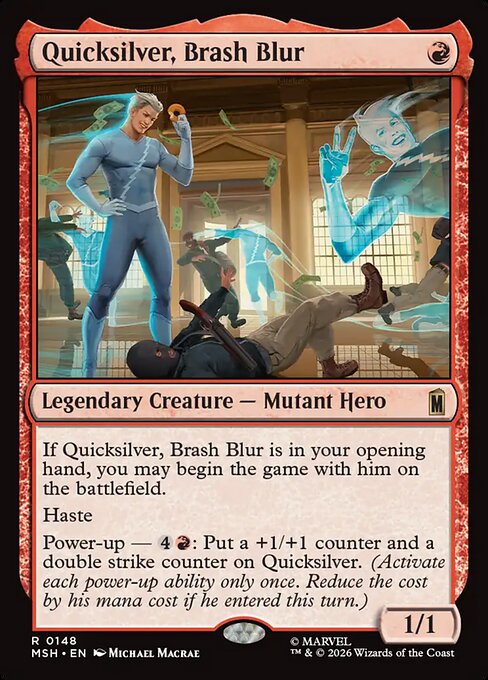 Rating5.4Playable
Why this rating?
A solid playable that rarely gets cut (5.4/10).
Why. A one-mana 1/1 with haste that can start the game on the battlefield if it is in your opening hand. Its late-game Power-up gives it a +1/+1 counter and a double strike counter.
Risks. A 1/1 does little and the Power-up costs five mana, so it is weak when drawn late. It dies to almost anything.
In the draft. Reserved for a very aggressive red deck. In other decks do not take it early.
Results in the games of the set
When it is in hand, the deck wins 51.0% of its games (set average: 56.8%, 249th of 273 cards).
In the opening hand: 52.0% wins (55.6% on average).
Drawn during the game: 50.2% (57.5% on average).
When it is drawn, the deck wins 1.4 points more than when it is not.
When it is drafted, it is played 27% of the time (set average: 63%).

154. Red Hulk
Rating5.4PlayableWhy this rating?
A solid playable that rarely gets cut (5.4/10).
Why. A six-mana 6/7 with reach and trample that grows and deals damage to another target whenever it is dealt damage. It dominates blocks and punishes combat damage against it.
Risks. Six mana with two red mana is heavy, and removal that does not use damage (exile, destroy) kills it without triggering the effect. It is slow against aggressive decks.
In the draft. A fair finisher in red, one or two copies in a control or midrange deck. Not a priority.
Results in the games of the set
When it is in hand, the deck wins 52.2% of its games (set average: 56.8%, 223rd of 273 cards).
In the opening hand: 50.2% wins (55.6% on average).
Drawn during the game: 53.6% (57.5% on average).
When it is drawn, the deck wins 1.6 points more than when it is not.
When it is drafted, it is played 56% of the time (set average: 63%).
Taken as the first pick (33 drafts), it ends in the deck 88% of the time.
It is played mostly in G/R decks (27% of them).

155. Rick Jones, Destined Sidekick
Rating5.4PlayableWhy this rating?
A solid playable that rarely gets cut (5.4/10).
Why. A one-mana 0/3 that blocks small creatures, with an ability that for three mana mills four cards and lets you take a Hero or enchantment card from among them. Slow value.
Risks. It does not attack, and the ability needs targets among the four cards: a deck without enough Heroes or enchantments makes it clunky. It also fills your graveyard.
In the draft. Only in a green deck with many Heroes or enchantments. Otherwise a late pick.
Results in the games of the set
When it is in hand, the deck wins 54.2% of its games (set average: 56.8%, 173rd of 273 cards).
In the opening hand: 55.3% wins (55.6% on average).
Drawn during the game: 53.4% (57.5% on average).
When it is drawn, the deck wins 0.4 points more than when it is not.
When it is drafted, it is played only 11% of the time (set average: 63%): it almost always ends in the sideboard.

156. S.H.I.E.L.D. Spy Kit
Rating5.4PlayableWhy this rating?
A solid playable that rarely gets cut (5.4/10).
Why. A one-mana Equipment with a one-mana equip cost: +1/+1, and when the creature attacks alone it untaps and you scry 1. Cheap, it keeps the creature back on defense while attacking and improves your draws.
Risks. It does nothing without a creature, and its untap bonus only works when attacking alone. Artifact removal neutralizes it.
In the draft. A good white common. Take it fairly early, especially with evasive creatures that attack alone.
Results in the games of the set
When it is in hand, the deck wins 57.8% of its games (set average: 56.8%, 69th of 273 cards).
In the opening hand: 57.9% wins (55.6% on average).
Drawn during the game: 57.8% (57.5% on average).
When it is drawn, the deck wins 1.6 points more than when it is not.
When it is drafted, it is played 75% of the time (set average: 63%).
Taken as the first pick (150 drafts), it ends in the deck 91% of the time.
It is played mostly in B/W decks (73% of them) and U/W (61%).

157. Savage Land Dinosaur
Rating5.4PlayableWhy this rating?
A solid playable that rarely gets cut (5.4/10).
Why. A 7/6 with trample for six mana, a huge late-game threat, and when you are short on lands you can cycle it into a basic land for two mana. Never a dead card.
Risks. Six mana with two green is heavy and vulnerable to removal. Once cycled away, it is only a land.
In the draft. A good green common, a finisher with flexibility. A mid-pack pick in any green deck.
Results in the games of the set
When it is in hand, the deck wins 55.5% of its games (set average: 56.8%, 143rd of 273 cards).
In the opening hand: 53.9% wins (55.6% on average).
Drawn during the game: 56.6% (57.5% on average).
When it is drawn, the deck wins 0.1 points more than when it is not.
When it is drafted, it is played 67% of the time (set average: 63%).
Taken as the first pick (38 drafts), it ends in the deck 82% of the time.
It is played mostly in B/G decks (56% of them) and G/R (54%).

158. Truck Toss
Rating5.4PlayableWhy this rating?
A solid playable that rarely gets cut (5.4/10).
Why. A red instant that deals 4 damage to any target, creature or player. With a Vehicle it costs two less and becomes very efficient.
Risks. Without a Vehicle, four mana with two red is pricey for a one-shot removal. Four damage does not kill big creatures.
In the draft. A playable removal in red, better in decks with Vehicles. Take it as extra removal.
Results in the games of the set
When it is in hand, the deck wins 52.2% of its games (set average: 56.8%, 224th of 273 cards).
In the opening hand: 49.7% wins (55.6% on average).
Drawn during the game: 53.9% (57.5% on average).
When it is drawn, the deck wins 0.1 points more than when it is not.
When it is drafted, it is played 68% of the time (set average: 63%).
Taken among the first three picks (167 drafts), it ends in the deck 86% of the time.
It is played mostly in R/W decks (25% of them).
 Rating5.3Playable
Why this rating?
A solid playable that rarely gets cut (5.3/10).
Why. A three-mana 1/4 with vigilance that copies an activated or triggered ability from one of your creatures for one mana and a tap. With enter effects it doubles their value.
Risks. Without good abilities to copy it is a 1/4 that does not attack. It needs creatures with triggered or activated effects.
In the draft. A build-around for value archetypes, often blue-white. Otherwise a late pick.
Results in the games of the set
When it is in hand, the deck wins 52.8% of its games (set average: 56.8%, 202nd of 273 cards).
In the opening hand: 51.1% wins (55.6% on average).
Drawn during the game: 53.9% (57.5% on average).
When it is drawn, the deck wins 2.7 points less than when it is not.
When it is drafted, it is played 59% of the time (set average: 63%).
Taken as the first pick (31 drafts), it ends in the deck 87% of the time.
It is played about as much in every archetype.

160. Ant-Man's Army
Rating5.2PlayableWhy this rating?
A solid playable that rarely gets cut (5.2/10).
Why. A three-mana 3/2 that creates a Food token or a Treasure token when it enters. The body is fine and the token adds value: ramp or life gain.
Risks. Only two toughness with no evasion or combat ability. It remains a simple card that does not win the game alone.
In the draft. A good green common, solid in any deck. An easy mid-pack pick, better still in decks that use artifacts.
Results in the games of the set
When it is in hand, the deck wins 56.8% of its games (set average: 56.8%, 102nd of 273 cards).
In the opening hand: 56.9% wins (55.6% on average).
Drawn during the game: 56.7% (57.5% on average).
When it is drawn, the deck wins 0.6 points more than when it is not.
When it is drafted, it is played 70% of the time (set average: 63%).
Taken as the first pick (74 drafts), it ends in the deck 82% of the time.
It is played mostly in G/W decks (68% of them) and B/G (61%).

161. Brave Brawler
Rating5.2PlayableWhy this rating?
A solid playable that rarely gets cut (5.2/10).
Why. A two-mana 2/1 with lifelink and a Power-up that adds two +1/+1 counters later in the game. It is a good early play and then grows to stay relevant.
Risks. One toughness: a small blocker or removal kills it. The Power-up costs five mana.
In the draft. A good white common. Take it fairly high in an aggressive or midrange white deck.
Results in the games of the set
When it is in hand, the deck wins 57.7% of its games (set average: 56.8%, 73rd of 273 cards).
In the opening hand: 58.2% wins (55.6% on average).
Drawn during the game: 57.3% (57.5% on average).
When it is drawn, the deck wins 0.6 points more than when it is not.
When it is drafted, it is played 91% of the time (set average: 63%).
Taken as the first pick (208 drafts), it ends in the deck 94% of the time.
It is played mostly in G/W decks (62% of them) and U/W (61%).

162. Captain Mar-Vell, Space-Born
Rating5.2PlayableWhy this rating?
A solid playable that rarely gets cut (5.2/10).
Why. A five-mana 4/4 with flying and vigilance, a very efficient body that attacks and defends at once. It also lets you cast spells as though they had flash once the opponent has cast a spell this turn.
Risks. Five mana for a body with no enter effect, vulnerable to removal. The flash bonus depends on what the opponent does.
In the draft. A good white finisher for most white decks. A mid-pack pick.
Results in the games of the set
When it is in hand, the deck wins 54.0% of its games (set average: 56.8%, 182nd of 273 cards).
In the opening hand: 51.8% wins (55.6% on average).
Drawn during the game: 55.3% (57.5% on average).
When it is drawn, the deck wins 0.2 points less than when it is not.
When it is drafted, it is played 60% of the time (set average: 63%).
Taken among the first three picks (120 drafts), it ends in the deck 76% of the time.
It is played about as much in every archetype.

163. Doc Samson, Super Psychiatrist
Rating5.2PlayableWhy this rating?
A solid playable that rarely gets cut (5.2/10).
Why. A five-mana 3/6 that adds one extra counter whenever counters are put on your permanents, and taps for as much mana of one color as its power. A sturdy body and an engine for a counters deck.
Risks. Without counters in the deck the replacement effect does almost nothing. It is slow and does not attack well.
In the draft. A build-around for +1/+1 counters in green. Otherwise a late pick.
Results in the games of the set
When it is in hand, the deck wins 52.5% of its games (set average: 56.8%, 213th of 273 cards).
In the opening hand: 52.4% wins (55.6% on average).
Drawn during the game: 52.7% (57.5% on average).
When it is drawn, the deck wins 0.8 points less than when it is not.
When it is drafted, it is played 53% of the time (set average: 63%).
Taken as the first pick (36 drafts), it ends in the deck 78% of the time.
It is played mostly in G/R decks (25% of them).

164. Gathering Place
Rating5.2PlayableWhy this rating?
A solid playable that rarely gets cut (5.2/10).
Why. A green-white land that always taps for colorless, and for green or white if it entered this turn or you control a basic land. It enters untapped and fixes both colors at no tempo cost.
Risks. Without a basic land it only makes colorless after the turn it enters. It matters only in a green-white deck or a splash of those colors.
In the draft. Take it in green-white or for a splash. Outside those colors it does not deserve a pick.
Results in the games of the set
When it is in hand, the deck wins 55.6% of its games (set average: 56.8%, 138th of 273 cards).
In the opening hand: 55.5% wins (55.6% on average).
Drawn during the game: 55.6% (57.5% on average).
When it is drawn, the deck wins 0.6 points more than when it is not.
When it is drafted, it is played 71% of the time (set average: 63%).
Taken among the first three picks (86 drafts), it ends in the deck 81% of the time.

165. Gleaming Bastion
Rating5.2PlayableWhy this rating?
A solid playable that rarely gets cut (5.2/10).
Why. A white-blue land that always taps for colorless, and for white or blue if it entered this turn or you control a basic land. It enters untapped and fixes both colors at no tempo cost.
Risks. Without a basic land it only makes colorless after the turn it enters. It matters only in a white-blue deck or a splash of those colors.
In the draft. Take it in white-blue or for a splash. Outside those colors it does not deserve a pick.
Results in the games of the set
When it is in hand, the deck wins 57.1% of its games (set average: 56.8%, 92nd of 273 cards).
In the opening hand: 57.3% wins (55.6% on average).
Drawn during the game: 56.9% (57.5% on average).
When it is drawn, the deck wins 1.1 points more than when it is not.
When it is drafted, it is played 79% of the time (set average: 63%).
Taken among the first three picks (125 drafts), it ends in the deck 85% of the time.

166. Human Torch, Johnny Storm
Rating5.2PlayableWhy this rating?
A solid playable that rarely gets cut (5.2/10).
Why. A three-mana 2/2 flyer that deals 1 damage to the opponent whenever you draw a card, if you control another Hero. Its late-game Power-up adds three +1/+1 counters.
Risks. It needs another Hero and cards to draw for its effect. The 2/2 is fragile, and the Power-up costs seven mana.
In the draft. A decent aerial attacker for a red deck with Heroes. Otherwise do not take it early.
Results in the games of the set
When it is in hand, the deck wins 52.3% of its games (set average: 56.8%, 221st of 273 cards).
In the opening hand: 49.7% wins (55.6% on average).
Drawn during the game: 54.2% (57.5% on average).
When it is drawn, the deck wins 0.1 points more than when it is not.
When it is drafted, it is played 47% of the time (set average: 63%).
Taken among the first three picks (104 drafts), it ends in the deck 80% of the time.
It is played mostly in R/W decks (31% of them) and G/R (25%).
 Rating5.2Playable
Why this rating?
A solid playable that rarely gets cut (5.2/10).
Why. A four-mana blue-black 3/4 that connives each time it attacks, filtering your hand and growing. That draw is normally your second card of the turn, so the opponent loses 1 life and you gain 1 life on every attack.
Risks. Two colors limit its place in decks. It has to attack to trigger its effects, which exposes it to blockers and removal.
In the draft. A good card for a blue-black deck that draws. A mid-pack pick if you are in those colors.
Results in the games of the set
When it is in hand, the deck wins 55.4% of its games (set average: 56.8%, 145th of 273 cards).
In the opening hand: 54.0% wins (55.6% on average).
Drawn during the game: 56.2% (57.5% on average).
When it is drawn, the deck wins 4.6 points more than when it is not.
When it is drafted, it is played 58% of the time (set average: 63%).
Taken as the first pick (44 drafts), it ends in the deck 91% of the time.
It is played mostly in B/U decks (53% of them).

168. Mister Fantastic, Reed Richards
Rating5.2PlayableWhy this rating?
A solid playable that rarely gets cut (5.2/10).
Why. A four-mana 2/4 with reach that lets you draw whenever one or more tokens enter under your control. A good blocker and a card source in a tokens deck.
Risks. Without tokens it draws nothing and is a passive 2/4. The body does not attack.
In the draft. A build-around for tokens decks in blue. Otherwise a late pick.
Results in the games of the set
When it is in hand, the deck wins 52.7% of its games (set average: 56.8%, 209th of 273 cards).
In the opening hand: 51.1% wins (55.6% on average).
Drawn during the game: 53.7% (57.5% on average).
When it is drawn, the deck wins 0.5 points less than when it is not.
When it is drafted, it is played 36% of the time (set average: 63%).
Taken among the first three picks (107 drafts), it ends in the deck 72% of the time.

169. Scientist Supreme of A.I.M.
Rating5.2PlayableWhy this rating?
A solid playable that rarely gets cut (5.2/10).
Why. A two-mana 2/2 whose ability only matters if you control artifacts with an activated or triggered ability: pay two life and copy it once per turn. With the right artifact it is repeatable value.
Risks. Without useful artifacts it is a vanilla gold 2/2. It only works on your turn, and the life payments add up.
In the draft. Only play it in a blue-black deck with several artifacts that have abilities. Otherwise let it go by.
Results in the games of the set
When it is in hand, the deck wins 52.0% of its games (set average: 56.8%, 230th of 273 cards).
In the opening hand: 51.8% wins (55.6% on average).
Drawn during the game: 52.1% (57.5% on average).
When it is drawn, the deck wins 1.0 points more than when it is not.
When it is drafted, it is played 26% of the time (set average: 63%).
Taken among the first three picks (57 drafts), it ends in the deck 54% of the time.
 Rating5.2Playable
Why this rating?
A solid playable that rarely gets cut (5.2/10).
Why. A two-mana 2/1 that makes your artifact spells cost one less. Its second ability turns one artifact into a copy of another until end of turn, which gives flexibility once you have a few.
Risks. Fragile, and dead weight in a deck without artifacts. The copy only lasts a turn and can only be activated at sorcery speed.
In the draft. A good pick if you already have a decent artifact count. Otherwise it is a fine two-drop body and nothing more.
Results in the games of the set
When it is in hand, the deck wins 55.0% of its games (set average: 56.8%, 161st of 273 cards).
In the opening hand: 56.6% wins (55.6% on average).
Drawn during the game: 53.9% (57.5% on average).
When it is drawn, the deck wins 1.5 points more than when it is not.
When it is drafted, it is played 61% of the time (set average: 63%).
Taken as the first pick (50 drafts), it ends in the deck 92% of the time.
It is played mostly in R/U decks (45% of them).

171. The Masters of Evil
Rating5.2PlayableWhy this rating?
A solid playable that rarely gets cut (5.2/10).
Why. A six-mana 5/6 that gives your other Villains +2/+1. It also has a flexible mode: for two mana, discard it and fetch a Plan card, so it is never dead in hand.
Risks. Six mana is heavy, and the bonus depends on how many Villains you run. Without Plan cards the search does nothing.
In the draft. Take it in a black deck with Villains and at least one Plan. Without those it is just a big, ordinary body.
Results in the games of the set
When it is in hand, the deck wins 53.7% of its games (set average: 56.8%, 190th of 273 cards).
In the opening hand: 48.9% wins (55.6% on average).
Drawn during the game: 56.5% (57.5% on average).
When it is drawn, the deck wins 2.9 points more than when it is not.
When it is drafted, it is played 72% of the time (set average: 63%).
Taken as the first pick (48 drafts), it ends in the deck 94% of the time.
It is played mostly in B/R decks (40% of them) and B/U (35%).

172. The Thing, Ben Grimm
Rating5.2PlayableWhy this rating?
A solid playable that rarely gets cut (5.2/10).
Why. A six-mana 7/7 trampler that grows by two counters whenever Heroes you control deal damage to a player. Once on the battlefield it overpowers most blocks and keeps growing.
Risks. Six mana for one creature: a removal spell costs you a whole turn. The counters need Heroes to connect with the opponent.
In the draft. A fine top-end for a green deck with Heroes. One or two copies is plenty, after your good curve cards.
Results in the games of the set
When it is in hand, the deck wins 52.7% of its games (set average: 56.8%, 211th of 273 cards).
In the opening hand: 50.6% wins (55.6% on average).
Drawn during the game: 54.1% (57.5% on average).
When it is drawn, the deck wins 0.2 points less than when it is not.
When it is drafted, it is played 54% of the time (set average: 63%).
Taken among the first three picks (94 drafts), it ends in the deck 87% of the time.
It is played mostly in G/R decks (28% of them) and G/W (26%).

173. Training Compound
Rating5.2PlayableWhy this rating?
A solid playable that rarely gets cut (5.2/10).
Why. A land that always makes colorless, and red or green if it entered this turn or you control a basic land. It comes in untapped and fixes without costing tempo.
Risks. The colored mana is off if you control no basic land and it did not enter this turn. It improves consistency modestly and adds no power.
In the draft. Play it in red-green, or when splashing one of those colors. Take it late, after your playables.
Results in the games of the set
When it is in hand, the deck wins 55.6% of its games (set average: 56.8%, 137th of 273 cards).
In the opening hand: 56.2% wins (55.6% on average).
Drawn during the game: 55.1% (57.5% on average).
When it is drawn, the deck wins 0.3 points more than when it is not.
When it is drafted, it is played 65% of the time (set average: 63%).
Taken among the first three picks (73 drafts), it ends in the deck 82% of the time.

174. Whiplash, Vengeful Engineer
Rating5.2PlayableWhy this rating?
A solid playable that rarely gets cut (5.2/10).
Why. A one-mana 2/2 that enters tapped. If it attacks while equipped, each opponent loses life equal to the Equipment attached and you gain that much, which becomes a steady drain.
Risks. Without Equipment it is just another 2/2. It enters tapped, so it misses the turn it is cast.
In the draft. Take it in black decks with a few Equipment. In a deck without Equipment it is only curve filler.
Results in the games of the set
When it is in hand, the deck wins 57.0% of its games (set average: 56.8%, 95th of 273 cards).
In the opening hand: 59.5% wins (55.6% on average).
Drawn during the game: 55.2% (57.5% on average).
When it is drawn, the deck wins 4.3 points more than when it is not.
When it is drafted, it is played 52% of the time (set average: 63%).
Taken among the first three picks (111 drafts), it ends in the deck 81% of the time.
It is played mostly in B/W decks (47% of them).
 Rating5.2Playable
Why this rating?
A solid playable that rarely gets cut (5.2/10).
Why. A 1/3 that taps an opposing creature for two mana, one less if its power is 3 or less. It neutralizes one attacker or blocker per turn, a good tempo tool.
Risks. It eats mana every turn and its body is small. Bigger creatures cost more to tap down.
In the draft. A decent common for white tempo or control decks, especially blue-white. Take it without urgency, after your better removal.
Results in the games of the set
When it is in hand, the deck wins 57.2% of its games (set average: 56.8%, 89th of 273 cards).
In the opening hand: 56.8% wins (55.6% on average).
Drawn during the game: 57.5% (57.5% on average).
When it is drawn, the deck wins 0.0 points more than when it is not.
When it is drafted, it is played 87% of the time (set average: 63%).
Taken as the first pick (216 drafts), it ends in the deck 96% of the time.
It is played mostly in U/W decks (70% of them) and B/W (63%).

176. Castle Doom
Rating5.1PlayableWhy this rating?
A solid playable that rarely gets cut (5.1/10).
Why. A land that taps for colorless, or for any color to cast an artifact spell. For three mana, tapping it and sacrificing an artifact, it creates a 3/3 Doombot token at sorcery speed.
Risks. The colored mana only works for artifacts. With no artifacts to sacrifice its ability is dead and you are playing a colorless land.
In the draft. Only for an artifact deck. Otherwise skip it: a colorless land just strains your mana.
Results in the games of the set
When it is in hand, the deck wins 52.2% of its games (set average: 56.8%, 225th of 273 cards).
In the opening hand: 50.5% wins (55.6% on average).
Drawn during the game: 53.3% (57.5% on average).
When it is drawn, the deck wins 1.7 points more than when it is not.
When it is drafted, it is played 46% of the time (set average: 63%).
Taken among the first three picks (56 drafts), it ends in the deck 82% of the time.

177. Aerial Doombot
Rating5.0PlayableWhy this rating?
A solid playable that rarely gets cut (5.0/10).
Why. A one-mana 1/1 flyer that scales with Power-up: six mana (one of it blue) puts three +1/+1 counters on it and makes a 4/4 flyer. It helps early and stays relevant late.
Risks. A 1/1 dies to anything, and Power-up is a big mana investment. Each Power-up can be used only once.
In the draft. A solid common for blue decks, especially blue-white. No need to rush it, but it almost always makes the deck.
Results in the games of the set
When it is in hand, the deck wins 57.3% of its games (set average: 56.8%, 86th of 273 cards).
In the opening hand: 56.9% wins (55.6% on average).
Drawn during the game: 57.6% (57.5% on average).
When it is drawn, the deck wins 2.2 points more than when it is not.
When it is drafted, it is played 75% of the time (set average: 63%).
Taken as the first pick (84 drafts), it ends in the deck 94% of the time.
It is played mostly in R/U decks (54% of them) and U/W (53%).

178. Crossbones, Malicious Mercenary
Rating5.0PlayableWhy this rating?
A solid playable that rarely gets cut (5.0/10).
Why. A four-mana 3/3 deathtouch. Each time another Villain enters (once per turn), it gets a +1/+1 counter and deals 2 damage to each opponent.
Risks. It needs several Villains to use its ability. On its own it is a decent deathtouch 3/3 and nothing more.
In the draft. A good pick in a black deck with several Villains. Without them it is just an average four-drop body.
Results in the games of the set
When it is in hand, the deck wins 52.9% of its games (set average: 56.8%, 201st of 273 cards).
In the opening hand: 51.0% wins (55.6% on average).
Drawn during the game: 54.1% (57.5% on average).
When it is drawn, the deck wins 2.0 points more than when it is not.
When it is drafted, it is played 73% of the time (set average: 63%).
Taken as the first pick (40 drafts), it ends in the deck 95% of the time.
It is played mostly in B/R decks (35% of them) and B/U (30%).
 Rating5.0Playable
Why this rating?
A solid playable that rarely gets cut (5.0/10).
Why. A one-mana 1/2 that taps to give +1/+0 to a creature attacking alone and gain 1 life. Useful in a deck that attacks with one creature at a time.
Risks. It needs a solo attack, and the body is small enough that it does little by itself.
In the draft. An acceptable filler for white decks that attack with one creature at a time. Take it as a curve play, with no urgency.
Results in the games of the set
When it is in hand, the deck wins 55.9% of its games (set average: 56.8%, 130th of 273 cards).
In the opening hand: 57.4% wins (55.6% on average).
Drawn during the game: 54.7% (57.5% on average).
When it is drawn, the deck wins 0.4 points less than when it is not.
When it is drafted, it is played 34% of the time (set average: 63%).
Taken among the first three picks (88 drafts), it ends in the deck 73% of the time.
It is played mostly in B/W decks (25% of them).

180. Dark Fortress
Rating5.0PlayableWhy this rating?
A solid playable that rarely gets cut (5.0/10).
Why. A land that always makes colorless, and black or red if it entered this turn or you control a basic land. It enters untapped and fixes at no tempo cost.
Risks. The colored mana is off if you control no basic land and it did not enter this turn. It improves consistency modestly and adds no power.
In the draft. Play it in black-red, or when splashing one of those colors. Take it late, after your playables.
Results in the games of the set
When it is in hand, the deck wins 54.7% of its games (set average: 56.8%, 169th of 273 cards).
In the opening hand: 55.1% wins (55.6% on average).
Drawn during the game: 54.4% (57.5% on average).
When it is drawn, the deck wins 1.9 points more than when it is not.
When it is drafted, it is played 65% of the time (set average: 63%).
Taken among the first three picks (91 drafts), it ends in the deck 76% of the time.

181. Giant Growth
Rating5.0PlayableWhy this rating?
A solid playable that rarely gets cut (5.0/10).
Why. A one-mana instant that gives a creature +3/+3 until end of turn. It wins a combat or blanks a damage-based removal for almost nothing.
Risks. It is a one-for-one at best, and it fizzles if your target is removed in response. It does nothing without a creature.
In the draft. A fair trick for aggressive green decks. Take it after your creatures and removal, and play one or two at most.
Results in the games of the set
When it is in hand, the deck wins 55.0% of its games (set average: 56.8%, 162nd of 273 cards).
In the opening hand: 51.9% wins (55.6% on average).
Drawn during the game: 57.1% (57.5% on average).
When it is drawn, the deck wins 0.9 points more than when it is not.
When it is drafted, it is played 22% of the time (set average: 63%).
It is played mostly in G/R decks (29% of them).

182. Hawkeye's Bow
Rating5.0PlayableWhy this rating?
A solid playable that rarely gets cut (5.0/10).
Why. A one-mana Equipment that gives +1/+0 and reach. Whenever the equipped creature becomes tapped, it deals 1 damage to each opponent. Equipping costs only one mana.
Risks. A small bonus that rarely changes combat. The damage only happens when the creature taps, not when it stays home on defense.
In the draft. A filler for aggressive red decks with many small creatures. Pass it if you can take more powerful cards.
Results in the games of the set
When it is in hand, the deck wins 52.8% of its games (set average: 56.8%, 208th of 273 cards).
In the opening hand: 50.7% wins (55.6% on average).
Drawn during the game: 54.2% (57.5% on average).
When it is drawn, the deck wins 2.6 points more than when it is not.
When it is drafted, it is played 23% of the time (set average: 63%).
Taken among the first three picks (58 drafts), it ends in the deck 71% of the time.
It is played mostly in R/U decks (27% of them).

183. Panther Pounce
Rating5.0PlayableWhy this rating?
A solid playable that rarely gets cut (5.0/10).
Why. A one-mana instant: the target player investigates (creates a Clue), and a creature gets +1/+0 and flying until end of turn, then untaps. The Clue pays it back in a card, and the creature can surprise in attack or dodge a block.
Risks. The size boost is small, and it is a trick that needs a creature. It takes two more mana to draw from the Clue.
In the draft. A decent trick for white decks. Take it as a late addition to the deck, not as a first pick.
Results in the games of the set
When it is in hand, the deck wins 54.1% of its games (set average: 56.8%, 180th of 273 cards).
In the opening hand: 50.6% wins (55.6% on average).
Drawn during the game: 56.3% (57.5% on average).
When it is drawn, the deck wins 0.1 points less than when it is not.
When it is drafted, it is played 27% of the time (set average: 63%).
Taken among the first three picks (37 drafts), it ends in the deck 81% of the time.
It is played mostly in R/W decks (34% of them).

184. Super Suit
Rating5.0PlayableWhy this rating?
A solid playable that rarely gets cut (5.0/10).
Why. An Equipment with flash: it attaches to a creature you control when it enters, untaps it, and gives +1/+2. It works as a combat trick on either side and then stays on the battlefield.
Risks. Two mana for a small bonus, and Equipment is only as good as the creature holding it. Re-equipping costs two mana.
In the draft. A good tempo tool for blue decks, especially blue-white. Take it as a second-tier common, after your creatures.
Results in the games of the set
When it is in hand, the deck wins 55.8% of its games (set average: 56.8%, 134th of 273 cards).
In the opening hand: 54.1% wins (55.6% on average).
Drawn during the game: 56.9% (57.5% on average).
When it is drawn, the deck wins 2.8 points more than when it is not.
When it is drafted, it is played 28% of the time (set average: 63%).
Taken among the first three picks (56 drafts), it ends in the deck 64% of the time.
It is played mostly in R/U decks (28% of them).

185. The Scarlet Witch
Rating5.0PlayableWhy this rating?
A solid playable that rarely gets cut (5.0/10).
Why. A three-mana 2/3 that makes your instants and sorceries with mana value 4 or greater cost less by her power. At two power, your big spells cost two less.
Risks. She does nothing without expensive spells, and the body is modest. Her effect is highly situational.
In the draft. Only in a red deck with several expensive instants and sorceries. Otherwise let her go by.
Results in the games of the set
When it is in hand, the deck wins 47.5% of its games (set average: 56.8%, 269th of 273 cards).
In the opening hand: 46.1% wins (55.6% on average).
Drawn during the game: 48.5% (57.5% on average).
When it is drawn, the deck wins 3.7 points less than when it is not.
When it is drafted, it is played only 12% of the time (set average: 63%): it almost always ends in the sideboard.

186. Thirst for Knowledge
Rating5.0PlayableWhy this rating?
A solid playable that rarely gets cut (5.0/10).
Why. A three-mana instant that draws three cards, then makes you discard two cards, or just one if it is an artifact. With artifacts to discard it is real card advantage.
Risks. Without artifacts you net only one card for three mana and do nothing to the board. Expensive for what it does.
In the draft. Play it only in a blue deck full of artifacts. Otherwise it is not efficient enough.
Results in the games of the set
When it is in hand, the deck wins 51.6% of its games (set average: 56.8%, 237th of 273 cards).
In the opening hand: 48.1% wins (55.6% on average).
Drawn during the game: 53.9% (57.5% on average).
When it is drawn, the deck wins 0.8 points more than when it is not.
When it is drafted, it is played 25% of the time (set average: 63%).
Taken among the first three picks (44 drafts), it ends in the deck 61% of the time.

187. Tigra, Feline Fury
Rating5.0PlayableWhy this rating?
A solid playable that rarely gets cut (5.0/10).
Why. A two-mana 2/1 with flash and trample that gets a +1/+1 counter whenever you gain life. Cast at the end of the opponent's turn or as an ambush, it can catch an attacker off guard.
Risks. Fragile on arrival, and it needs life gain to grow. Without that, it is just a small 2/1.
In the draft. A good two-drop in green-white with life gain. Otherwise it is still playable as a curve body with flash.
Results in the games of the set
When it is in hand, the deck wins 53.2% of its games (set average: 56.8%, 197th of 273 cards).
In the opening hand: 54.5% wins (55.6% on average).
Drawn during the game: 52.2% (57.5% on average).
When it is drawn, the deck wins 1.1 points less than when it is not.
When it is drafted, it is played 44% of the time (set average: 63%).
Taken among the first three picks (80 drafts), it ends in the deck 78% of the time.
It is played about as much in every archetype.

188. Viv Vision, Teen Synthezoid
Rating5.0PlayableWhy this rating?
A solid playable that rarely gets cut (5.0/10).
Why. A three-mana colorless 2/2 flyer that draws a card when it attacks if her power is 4 or greater. Power-up costs seven for two counters, or four if she entered this turn, which makes her a 4/4 that draws.
Risks. She draws nothing until Power-up is used, and that cost is heavy. Until then she is just a small flyer.
In the draft. A good colorless body that fits almost any deck, especially with another way to grow her. Take her with your curve cards.
Results in the games of the set
When it is in hand, the deck wins 53.3% of its games (set average: 56.8%, 193rd of 273 cards).
In the opening hand: 51.2% wins (55.6% on average).
Drawn during the game: 54.7% (57.5% on average).
When it is drawn, the deck wins 0.0 points more than when it is not.
When it is drafted, it is played 65% of the time (set average: 63%).
Taken among the first three picks (127 drafts), it ends in the deck 81% of the time.
It is played about as much in every archetype.

189. Speed, Young Avenger
Rating4.9WeakWhy this rating?
A solid playable that rarely gets cut (4.9/10).
Why. A two-mana 2/2 with haste. Whenever you cast a noncreature spell, you may pay one mana: a target creature with haste then can't be blocked except by creatures with haste.
Risks. The ability needs noncreature spells, and its one guaranteed target is Speed himself, who is fragile. Without it, this is only a hasty 2/2.
In the draft. A fair choice for aggressive red decks with several noncreature spells and hasty creatures. Otherwise it is a plain 2/2 for the curve.
Results in the games of the set
When it is in hand, the deck wins 53.3% of its games (set average: 56.8%, 196th of 273 cards).
In the opening hand: 55.5% wins (55.6% on average).
Drawn during the game: 51.5% (57.5% on average).
When it is drawn, the deck wins 0.9 points less than when it is not.
When it is drafted, it is played 30% of the time (set average: 63%).
Taken among the first three picks (43 drafts), it ends in the deck 65% of the time.
It is played mostly in R/W decks (27% of them).

190. Agent of Atlas
Rating4.8WeakWhy this rating?
A solid playable that rarely gets cut (4.9/10).
Why. A two-mana 2/2 with prowess. In a deck with plenty of instants, sorceries and Equipment, it attacks as a 3/3 or 4/4 and stays a good turn-two play.
Risks. Without enough noncreature spells it is a bland 2/2. It loses value quickly against larger blockers.
In the draft. A good two-drop for white decks, especially blue-white with tricks and artifacts. Take it without urgency.
Results in the games of the set
When it is in hand, the deck wins 55.7% of its games (set average: 56.8%, 136th of 273 cards).
In the opening hand: 57.1% wins (55.6% on average).
Drawn during the game: 54.7% (57.5% on average).
When it is drawn, the deck wins 1.2 points less than when it is not.
When it is drafted, it is played 65% of the time (set average: 63%).
Taken as the first pick (59 drafts), it ends in the deck 76% of the time.
It is played mostly in U/W decks (56% of them) and R/W (46%).

191. Arc Reactor
Rating4.8WeakWhy this rating?
A solid playable that rarely gets cut (4.8/10).
Why. A five-mana artifact with improvise that enters tapped and taps for three colorless mana. It lets you cast very large spells, but only in a deck built for it.
Risks. It does nothing on the board, and it enters tapped, costing you a whole turn. The mana is colorless only.
In the draft. Reserved for very slow decks with huge spells. For most decks, let it go by.
Results in the games of the set
When it is in hand, the deck wins 42.8% of its games (set average: 56.8%).
Drawn during the game: 44.5% (57.5% on average).
When it is drawn, the deck wins 5.4 points less than when it is not.
When it is drafted, it is played only 7% of the time (set average: 63%): it almost always ends in the sideboard.

192. Dependable Quinjet
Rating4.8WeakWhy this rating?
A solid playable that rarely gets cut (4.8/10).
Why. A three-mana 3/3 flying Vehicle that also taps for one mana of any color. Even uncrewed, it works as fixing and ramp.
Risks. Crew 4 asks for a lot of power, which makes attacking heavy. It only blocks if you can crew it in time.
In the draft. A good mana tool for two-color decks or splashes. Take it as decent fixing, not as a threat.
Results in the games of the set
When it is in hand, the deck wins 54.1% of its games (set average: 56.8%, 178th of 273 cards).
In the opening hand: 53.0% wins (55.6% on average).
Drawn during the game: 54.9% (57.5% on average).
When it is drawn, the deck wins 1.1 points more than when it is not.
When it is drafted, it is played 33% of the time (set average: 63%).
Taken among the first three picks (95 drafts), it ends in the deck 66% of the time.

193. Hydraulic Helper
Rating4.8WeakWhy this rating?
A solid playable that rarely gets cut (4.8/10).
Why. A two-mana 2/3 defender that taps for blue mana that can't be spent on nonartifact spells. It blocks well early and ramps your artifacts.
Risks. It can't attack, and its mana can't pay for any nonartifact spell. Without artifacts it is a plain wall.
In the draft. A good defensive body for a blue deck full of artifacts. Otherwise it merely holds the line.
Results in the games of the set
When it is in hand, the deck wins 54.6% of its games (set average: 56.8%, 170th of 273 cards).
In the opening hand: 54.3% wins (55.6% on average).
Drawn during the game: 54.8% (57.5% on average).
When it is drawn, the deck wins 1.1 points more than when it is not.
When it is drafted, it is played 37% of the time (set average: 63%).
Taken among the first three picks (97 drafts), it ends in the deck 93% of the time.
It is played mostly in R/U decks (65% of them).

194. Kree Sentinel
Rating4.8WeakWhy this rating?
A solid playable that rarely gets cut (4.8/10).
Why. A five-mana 5/5 with reach that can also be discarded for two mana to fetch a basic land (basic landcycling). It fixes land trouble early and arrives as a big blocker later.
Risks. A 5/5 reach without other abilities is slow and does not win the game alone.
In the draft. A fine common choice for red decks. It does not shine, but it keeps you out of land-light hands.
Results in the games of the set
When it is in hand, the deck wins 53.9% of its games (set average: 56.8%, 184th of 273 cards).
In the opening hand: 52.2% wins (55.6% on average).
Drawn during the game: 55.1% (57.5% on average).
When it is drawn, the deck wins 0.7 points more than when it is not.
When it is drafted, it is played 60% of the time (set average: 63%).
Taken among the first three picks (150 drafts), it ends in the deck 89% of the time.
It is played mostly in R/U decks (53% of them) and B/R (51%).

195. Roxxon Brutes
Rating4.8WeakWhy this rating?
A solid playable that rarely gets cut (4.8/10).
Why. A five-mana 4/4 with menace and basic landcycling for two mana. Whenever you draw your second card each turn, it puts a +1/+1 counter on a target creature.
Risks. It needs draw effects to use its trigger. On its own it is an expensive menace 4/4.
In the draft. A good common for black decks, especially blue-black with card draw. Take it without rushing: it almost always makes the deck.
Results in the games of the set
When it is in hand, the deck wins 54.2% of its games (set average: 56.8%, 174th of 273 cards).
In the opening hand: 52.0% wins (55.6% on average).
Drawn during the game: 55.6% (57.5% on average).
When it is drawn, the deck wins 0.9 points more than when it is not.
When it is drafted, it is played 65% of the time (set average: 63%).
Taken as the first pick (43 drafts), it ends in the deck 88% of the time.
It is played mostly in B/U decks (56% of them) and B/W (52%).

196. Serpent Specialist
Rating4.8WeakWhy this rating?
A solid playable that rarely gets cut (4.8/10).
Why. A one-mana 1/1 deathtouch that scales with Power-up: four mana for two +1/+1 counters, or three if it just entered. It discourages attacks right away and stays useful late.
Risks. A 1/1 dies to any removal or damage spell, and Power-up is a one-time investment. It does little damage early.
In the draft. A good common for green decks. Take it without urgency, but it almost always makes the deck.
Results in the games of the set
When it is in hand, the deck wins 56.6% of its games (set average: 56.8%, 108th of 273 cards).
In the opening hand: 57.6% wins (55.6% on average).
Drawn during the game: 55.9% (57.5% on average).
When it is drawn, the deck wins 1.2 points more than when it is not.
When it is drafted, it is played 67% of the time (set average: 63%).
Taken as the first pick (36 drafts), it ends in the deck 94% of the time.
It is played mostly in B/G decks (54% of them) and G/R (49%).

197. Super Strength
Rating4.8WeakWhy this rating?
A solid playable that rarely gets cut (4.8/10).
Why. A five-mana Aura: +4/+4, trample and ward one. On an evasive or resilient creature it creates a threat that ends the game fast.
Risks. Five mana and the risk of a two-for-one if the creature is removed in response. Ward one gives only slight protection.
In the draft. A risky Aura, to consider only if the rest of your deck is solid. It is rarely the first card to take.
Results in the games of the set
When it is in hand, the deck wins 51.4% of its games (set average: 56.8%, 243rd of 273 cards).
In the opening hand: 47.9% wins (55.6% on average).
Drawn during the game: 53.7% (57.5% on average).
When it is drawn, the deck wins 0.3 points more than when it is not.
When it is drafted, it is played only 5% of the time (set average: 63%): it almost always ends in the sideboard.
 Rating4.8Weak
Why this rating?
A solid playable that rarely gets cut (4.8/10).
Why. A three-mana sorcery that returns a creature card with mana value 4 or less from your graveyard to the battlefield. With Teamwork, tapping creatures with total power 4 or more lets you return any creature card instead.
Risks. You need a good creature in your graveyard, and it is a sorcery. Teamwork costs you attackers or blockers for a turn.
In the draft. A value card for black decks with strong creatures. Take it late, after your best cards.
Results in the games of the set
When it is in hand, the deck wins 51.5% of its games (set average: 56.8%, 240th of 273 cards).
In the opening hand: 48.5% wins (55.6% on average).
Drawn during the game: 53.3% (57.5% on average).
When it is drawn, the deck wins 0.5 points less than when it is not.
When it is drafted, it is played 32% of the time (set average: 63%).
Taken among the first three picks (63 drafts), it ends in the deck 75% of the time.

199. Training Regimen
Rating4.8WeakWhy this rating?
A solid playable that rarely gets cut (4.8/10).
Why. A four-mana enchantment: at the beginning of combat on your turn, put a +1/+1 counter on a creature you control, and creatures with counters have trample. One of your creatures grows every turn.
Risks. It does nothing without creatures, and it is slow. A removal on your main creature reduces its impact.
In the draft. A good choice for green decks built around counters, especially green-white or green-blue. Take it mid-pack.
Results in the games of the set
When it is in hand, the deck wins 52.0% of its games (set average: 56.8%, 227th of 273 cards).
In the opening hand: 52.0% wins (55.6% on average).
Drawn during the game: 52.0% (57.5% on average).
When it is drawn, the deck wins 0.1 points more than when it is not.
When it is drafted, it is played 55% of the time (set average: 63%).
Taken among the first three picks (92 drafts), it ends in the deck 92% of the time.
It is played about as much in every archetype.

200. Wakandan Royal Guard
Rating4.8WeakWhy this rating?
A solid playable that rarely gets cut (4.8/10).
Why. A five-mana 4/4 with vigilance that puts a +1/+1 counter on a creature when it enters, two if it is another Hero. It attacks and defends, and improves your best creature.
Risks. Five mana for a body with no immediate board effect. The best bonus needs another Hero.
In the draft. A good common for green decks, especially green-white. A good pick if you have Heroes.
Results in the games of the set
When it is in hand, the deck wins 55.3% of its games (set average: 56.8%, 150th of 273 cards).
In the opening hand: 53.5% wins (55.6% on average).
Drawn during the game: 56.5% (57.5% on average).
When it is drawn, the deck wins 0.6 points more than when it is not.
When it is drafted, it is played 46% of the time (set average: 63%).
Taken among the first three picks (99 drafts), it ends in the deck 86% of the time.
It is played mostly in G/W decks (54% of them) and G/R (44%).

201. Wonder Man, Hollywood Hero
Rating4.8WeakWhy this rating?
A solid playable that rarely gets cut (4.8/10).
Why. A four-power flier for five mana is a solid body: it attacks in the air and blocks well. The power-up clause is a bonus, and it lets Wonder Man himself activate his own power-up twice.
Risks. His power-up costs a hefty seven mana, and the doubling clause only matters if you have other power-up permanents. Without them, he is a big vanilla flier.
In the draft. A late-pack pick, playable in a red deck that wants an aerial threat. It needs two red mana, so do not splash it.
Results in the games of the set
When it is in hand, the deck wins 50.8% of its games (set average: 56.8%, 251st of 273 cards).
In the opening hand: 49.0% wins (55.6% on average).
Drawn during the game: 52.1% (57.5% on average).
When it is drawn, the deck wins 1.3 points less than when it is not.
When it is drafted, it is played 29% of the time (set average: 63%).
Taken among the first three picks (40 drafts), it ends in the deck 68% of the time.
It is played mostly in G/R decks (31% of them).

202. Repulsor Blast
Rating4.8WeakWhy this rating?
A solid playable that rarely gets cut (4.8/10).
Why. A sorcery-speed removal that deals five damage to a creature, which kills almost anything. With Teamwork you also deal two damage to its controller, a small bonus when you have creatures to tap.
Risks. Four mana for a sorcery is slow, and it only hits creatures. Tapping your creatures for the bonus costs you blockers or attackers.
In the draft. Solid red removal without flash. Take it if nothing better is on offer, and do not skip it if your deck is short on answers.
Results in the games of the set
When it is in hand, the deck wins 52.0% of its games (set average: 56.8%, 229th of 273 cards).
In the opening hand: 49.2% wins (55.6% on average).
Drawn during the game: 53.8% (57.5% on average).
When it is drawn, the deck wins 0.3 points more than when it is not.
When it is drafted, it is played 68% of the time (set average: 63%).
Taken as the first pick (58 drafts), it ends in the deck 95% of the time.
It is played mostly in R/W decks (54% of them) and G/R (49%).

203. Thor Odinson
Rating4.7WeakWhy this rating?
A solid playable that rarely gets cut (4.7/10).
Why. A four-power flier with vigilance for five mana: it attacks while still holding the ground. The double prowess makes it bigger with each noncreature spell, which can ambush a blocker.
Risks. It is a two-colour card at five mana, so it is not always castable on time. It dies to removal like any 4/4 and replaces nothing.
In the draft. A pick mostly for red-white. Outside those colours, let it pass; inside them, it is a good top-end flier.
Results in the games of the set
When it is in hand, the deck wins 51.8% of its games (set average: 56.8%, 234th of 273 cards).
In the opening hand: 50.0% wins (55.6% on average).
Drawn during the game: 52.9% (57.5% on average).
When it is drawn, the deck wins 0.5 points less than when it is not.
When it is drafted, it is played 53% of the time (set average: 63%).
Taken as the first pick (40 drafts), it ends in the deck 83% of the time.
It is played mostly in R/W decks (46% of them).
 Rating4.6Weak
Why this rating?
A solid playable that rarely gets cut (4.6/10).
Why. A two-power, four-toughness body for three mana blocks small creatures well. When a creature you control attacks alone it gets +1/+1, which rewards a single-threat plan.
Risks. The bonus only works when the attacker is alone, so wide attacks do not benefit. The body by itself is defensive and not very threatening.
In the draft. An honest filler common, mostly for slower white decks. Do not take it ahead of removal or a flier.
Results in the games of the set
When it is in hand, the deck wins 55.5% of its games (set average: 56.8%, 139th of 273 cards).
In the opening hand: 55.2% wins (55.6% on average).
Drawn during the game: 55.7% (57.5% on average).
When it is drawn, the deck wins 0.3 points less than when it is not.
When it is drafted, it is played 59% of the time (set average: 63%).
Taken as the first pick (34 drafts), it ends in the deck 71% of the time.
It is played mostly in B/W decks (43% of them) and G/W (42%).

205. Avengers Tower
Rating4.6WeakWhy this rating?
A solid playable that rarely gets cut (4.6/10).
Why. A land that makes colourless mana, or any colour but only for Hero spells and Hero abilities. Its four-mana activation digs through the top three cards for a Hero.
Risks. The coloured mana is restricted, so a deck with few Heroes will struggle with it. The activation costs four mana and taps the land, so it is a late-game tool.
In the draft. Play it if your deck has plenty of Heroes; otherwise it is a colourless land. It enters untapped, so there is no tempo cost.
Results in the games of the set
When it is in hand, the deck wins 60.0% of its games (set average: 56.8%, 32nd of 273 cards).
In the opening hand: 59.7% wins (55.6% on average).
Drawn during the game: 60.1% (57.5% on average).
When it is drawn, the deck wins 2.9 points more than when it is not.
When it is drafted, it is played 87% of the time (set average: 63%).
Taken as the first pick (81 drafts), it ends in the deck 93% of the time.
 Rating4.6Weak
Why this rating?
A solid playable that rarely gets cut (4.6/10).
Why. Each time you draw your second card in a turn, you create a 2/1 black Villain creature token with menace and the Plan advances. With enough draw effects it makes a stream of bodies, then a turn of control over the opponent.
Risks. Without repeatable card draw it does nothing on its own. Seven triggers is a very long road to the final effect.
In the draft. Only for decks built around drawing cards. Otherwise skip it; it is not worth a pick over solid creatures.
Results in the games of the set
When it is in hand, the deck wins 48.8% of its games (set average: 56.8%, 265th of 273 cards).
In the opening hand: 47.1% wins (55.6% on average).
Drawn during the game: 49.7% (57.5% on average).
When it is drawn, the deck wins 0.1 points more than when it is not.
When it is drafted, it is played 58% of the time (set average: 63%).
Taken among the first three picks (87 drafts), it ends in the deck 84% of the time.
It is played about as much in every archetype.
 Rating4.6Weak
Why this rating?
A solid playable that rarely gets cut (4.6/10).
Why. A two-power, four-toughness reach creature that blocks fliers well. Your noncombat damage to opponents and their permanents gets bigger by his power, so each damaging spell or ability hits two harder.
Risks. He does almost nothing without noncombat damage sources. For four mana he is just a defensive blocker without them.
In the draft. A card for red decks with plenty of damage spells. In a typical deck he is a filler creature late in the pack.
Results in the games of the set
When it is in hand, the deck wins 51.5% of its games (set average: 56.8%, 241st of 273 cards).
In the opening hand: 50.5% wins (55.6% on average).
Drawn during the game: 52.2% (57.5% on average).
When it is drawn, the deck wins 0.5 points less than when it is not.
When it is drafted, it is played 55% of the time (set average: 63%).
Taken as the first pick (45 drafts), it ends in the deck 80% of the time.
It is played mostly in R/W decks (29% of them).

208. Loki Laufeyson
Rating4.6WeakWhy this rating?
A solid playable that rarely gets cut (4.6/10).
Why. A two-mana 2/1 whose ability (one mana, tap him) copies the next instant or sorcery you cast this turn if its mana value is no greater than his power. At power two it mostly copies your cheap spells, and his power-up grows him later.
Risks. He is fragile, and the ability costs one mana and taps him. In a deck with few cheap spells he has almost nothing to copy.
In the draft. For red decks packed with cheap spells. Otherwise he is just a small filler body.
Results in the games of the set
When it is in hand, the deck wins 52.8% of its games (set average: 56.8%, 205th of 273 cards).
In the opening hand: 53.3% wins (55.6% on average).
Drawn during the game: 52.4% (57.5% on average).
When it is drawn, the deck wins 0.0 points more than when it is not.
When it is drafted, it is played 71% of the time (set average: 63%).
Taken as the first pick (49 drafts), it ends in the deck 86% of the time.
It is played mostly in B/R decks (31% of them) and R/W (31%).

209. Moonstone, Harsh Mistress
Rating4.6WeakWhy this rating?
A solid playable that rarely gets cut (4.6/10).
Why. A two-power, four-toughness flier for four mana: a good defensive body and a decent aerial attacker. When you discard a card, you may exile it from your graveyard and play it until the end of your next turn.
Risks. Two power is modest, and the advantage needs discards, such as from connive effects. Without them she is mostly a 2/4 flier.
In the draft. A fair pick for black decks with discard or connive effects. Otherwise she is playable but unexciting.
Results in the games of the set
When it is in hand, the deck wins 51.7% of its games (set average: 56.8%, 236th of 273 cards).
In the opening hand: 48.5% wins (55.6% on average).
Drawn during the game: 53.5% (57.5% on average).
When it is drawn, the deck wins 0.6 points more than when it is not.
When it is drafted, it is played 43% of the time (set average: 63%).
Taken among the first three picks (123 drafts), it ends in the deck 74% of the time.
It is played mostly in B/U decks (28% of them).

210. Pym Particles
Rating4.6WeakWhy this rating?
A solid playable that rarely gets cut (4.6/10).
Why. For one blue mana, a creature gains vigilance and can't be blocked this turn, and you draw a card. It replaces itself and pushes damage through reliably.
Risks. The effect is weak: a sorcery that only changes this turn's board. Without a good creature to push, it is just a cantrip.
In the draft. Playable filler in aggressive or prowess-style blue decks. Do not take it over real removal or creatures.
Results in the games of the set
When it is in hand, the deck wins 52.3% of its games (set average: 56.8%, 222nd of 273 cards).
In the opening hand: 48.5% wins (55.6% on average).
Drawn during the game: 54.7% (57.5% on average).
When it is drawn, the deck wins 1.5 points more than when it is not.
When it is drafted, it is played 31% of the time (set average: 63%).
Taken among the first three picks (49 drafts), it ends in the deck 82% of the time.

211. War Machine, Legacy of Iron
Rating4.6WeakWhy this rating?
A solid playable that rarely gets cut (4.6/10).
Why. A one-power flier for three mana that can be cast with red or white thanks to its hybrid cost. At the beginning of combat another creature gets +1/+0, making your attacks a bit more dangerous each turn.
Risks. His power of one limits the bonus, and he is still fragile to removal. On his own he deals little damage.
In the draft. A flexible filler pick for red or white decks with a good attack. The colour flexibility is his best feature.
Results in the games of the set
When it is in hand, the deck wins 52.0% of its games (set average: 56.8%, 228th of 273 cards).
In the opening hand: 51.0% wins (55.6% on average).
Drawn during the game: 52.7% (57.5% on average).
When it is drawn, the deck wins 1.1 points less than when it is not.
When it is drafted, it is played 71% of the time (set average: 63%).
Taken as the first pick (50 drafts), it ends in the deck 82% of the time.
It is played mostly in R/W decks (30% of them).

212. Yellowjacket, Heartless Marauder
Rating4.6WeakWhy this rating?
A solid playable that rarely gets cut (4.6/10).
Why. A one-power flier for two mana: cheap evasion. Whenever another Villain enters, he gets +1/+0 and lifelink for the turn, which makes that turn's attack more dangerous.
Risks. He is small and gains nothing without other Villains. At power one he is a weak attacker by himself.
In the draft. A fine two-drop in a black deck full of Villains. Otherwise take him as cheap filler.
Results in the games of the set
When it is in hand, the deck wins 55.3% of its games (set average: 56.8%, 148th of 273 cards).
In the opening hand: 55.8% wins (55.6% on average).
Drawn during the game: 55.1% (57.5% on average).
When it is drawn, the deck wins 3.3 points more than when it is not.
When it is drafted, it is played 80% of the time (set average: 63%).
Taken as the first pick (61 drafts), it ends in the deck 95% of the time.
It is played mostly in B/R decks (39% of them) and B/U (35%).

213. Luke Cage, Power Man
Rating4.6WeakWhy this rating?
A solid playable that rarely gets cut (4.6/10).
Why. A two-power, five-toughness body for four mana, very sturdy on defence. When he attacks alone he gets +2/+0 and indestructible, so he attacks safely and hits for four.
Risks. He is slow, and his attack is only strong when alone, so he does not join a wide assault. He has no evasion and no effect when blocking.
In the draft. A good wall that can also attack, for a defensive white deck. A middling pick, worth it if you lack creatures.
Results in the games of the set
When it is in hand, the deck wins 51.3% of its games (set average: 56.8%, 245th of 273 cards).
In the opening hand: 49.6% wins (55.6% on average).
Drawn during the game: 52.4% (57.5% on average).
When it is drawn, the deck wins 1.9 points less than when it is not.
When it is drafted, it is played 25% of the time (set average: 63%).
Taken among the first three picks (54 drafts), it ends in the deck 63% of the time.

214. Evil's Thrall
Rating4.5WeakWhy this rating?
A solid playable that rarely gets cut (4.5/10).
Why. A sorcery that gains control of a creature until end of turn, untapped and with haste. It lets you attack with the opponent's creature and lasts longer if you control a Villain with a higher mana value.
Risks. The creature goes back to its owner afterwards: you spent a card on a tempo effect that does not answer the threat. Without an attack that pays off, it is weak.
In the draft. A niche card for aggressive red decks that play expensive Villains. In an ordinary deck take it dead last.
Results in the games of the set
When it is in hand, the deck wins 51.9% of its games (set average: 56.8%, 231st of 273 cards).
In the opening hand: 48.7% wins (55.6% on average).
Drawn during the game: 54.0% (57.5% on average).
When it is drawn, the deck wins 3.2 points more than when it is not.
When it is drafted, it is played only 10% of the time (set average: 63%): it almost always ends in the sideboard.

215. Stolen Stark Tech
Rating4.4WeakWhy this rating?
A good playable, but is sometimes cut (4.4/10).
Why. A flash Equipment that attaches on entering and makes the creature indestructible this turn. It can save an ally from destruction or win a combat, then gives +1/+0 for an equip cost of one.
Risks. The +1/+0 is thin and the indestructible lasts a single turn. It does not protect against exile or sacrifice.
In the draft. A late-pack common, useful in decks with lots of small creatures. Not a priority, but decent.
Results in the games of the set
When it is in hand, the deck wins 55.3% of its games (set average: 56.8%, 149th of 273 cards).
In the opening hand: 53.5% wins (55.6% on average).
Drawn during the game: 56.5% (57.5% on average).
When it is drawn, the deck wins 2.3 points more than when it is not.
When it is drafted, it is played 45% of the time (set average: 63%).
Taken among the first three picks (111 drafts), it ends in the deck 79% of the time.
It is played mostly in B/W decks (82% of them) and B/R (27%).

216. Ant-Man, Colony Commander
Rating4.4WeakWhy this rating?
A good playable, but is sometimes cut (4.4/10).
Why. A two-power green-blue creature for three mana: when he attacks and you pay one mana, he puts a +1/+1 counter on a creature, and each counter makes a 1/1 green Insect creature token (once per turn). He builds a board bit by bit.
Risks. He has to attack at power two, so he can die on the way. Without counters or protection his engine stalls.
In the draft. A good pick for green-blue decks that want counters. Outside those two colours he is unplayable.
Results in the games of the set
When it is in hand, the deck wins 53.7% of its games (set average: 56.8%, 188th of 273 cards).
In the opening hand: 53.4% wins (55.6% on average).
Drawn during the game: 53.9% (57.5% on average).
When it is drawn, the deck wins 0.8 points more than when it is not.
When it is drafted, it is played 51% of the time (set average: 63%).
Taken as the first pick (41 drafts), it ends in the deck 83% of the time.
It is played mostly in G/U decks (59% of them).

217. Call Damage Control
Rating4.4WeakWhy this rating?
A good playable, but is sometimes cut (4.4/10).
Why. For two mana you get back up to two cards of different types from your graveyard: artifact, creature, enchantment or land. A bit of late-game value for a deck that has traded cards away.
Risks. A sorcery that does nothing while the graveyard is empty, and it costs tempo. It does not affect the board directly.
In the draft. Late-pack filler for a value-oriented green deck. Do not take it ahead of a solid creature.
Results in the games of the set
When it is in hand, the deck wins 51.7% of its games (set average: 56.8%, 235th of 273 cards).
In the opening hand: 47.5% wins (55.6% on average).
Drawn during the game: 54.5% (57.5% on average).
When it is drawn, the deck wins 2.3 points less than when it is not.
When it is drafted, it is played only 14% of the time (set average: 63%): it almost always ends in the sideboard.

218. Hulkling, Burgeoning Bruiser
Rating4.4WeakWhy this rating?
A good playable, but is sometimes cut (4.4/10).
Why. A two-power, three-toughness vigilance creature for three mana that gets a +1/+1 counter when another creature with greater power or toughness enters. A fair body that improves in a deck full of large creatures.
Risks. Without bigger creatures behind him he stays a 2/3, a small body that does nothing spectacular.
In the draft. A good three-drop for green decks with a rising curve. A middling pick.
Results in the games of the set
When it is in hand, the deck wins 52.4% of its games (set average: 56.8%, 219th of 273 cards).
In the opening hand: 52.8% wins (55.6% on average).
Drawn during the game: 52.0% (57.5% on average).
When it is drawn, the deck wins 1.1 points less than when it is not.
When it is drafted, it is played 51% of the time (set average: 63%).
Taken among the first three picks (82 drafts), it ends in the deck 72% of the time.
It is played mostly in G/R decks (34% of them) and G/W (26%).

219. Kingpin's Enforcers
Rating4.4WeakWhy this rating?
A good playable, but is sometimes cut (4.4/10).
Why. A two-power, three-toughness lifelinker for three mana: a good blocker that gains life. For three mana you can sacrifice an artifact or creature to draw a card, getting value from a doomed creature.
Risks. The ability costs three mana and a sacrifice, so it slows you down. The body alone is not much of a threat.
In the draft. A decent black common, useful in a controlling or sacrifice deck. Good filler.
Results in the games of the set
When it is in hand, the deck wins 54.2% of its games (set average: 56.8%, 176th of 273 cards).
In the opening hand: 52.3% wins (55.6% on average).
Drawn during the game: 55.4% (57.5% on average).
When it is drawn, the deck wins 2.0 points more than when it is not.
When it is drafted, it is played 40% of the time (set average: 63%).
Taken among the first three picks (77 drafts), it ends in the deck 71% of the time.
It is played mostly in B/R decks (44% of them) and B/U (38%).

220. Ninja of the Hand
Rating4.4WeakWhy this rating?
A good playable, but is sometimes cut (4.4/10).
Why. A two-power deathtouch creature for three mana, a deterrent for attackers. Its five-mana power-up makes the opponent discard a card and grows it with a +1/+1 counter, handy late in the game.
Risks. The power-up is expensive, and a 2/2 dies easily to a spell. Deathtouch does nothing against fliers.
In the draft. A solid, unfancy black common. A good three-drop to take for a black deck.
Results in the games of the set
When it is in hand, the deck wins 54.9% of its games (set average: 56.8%, 164th of 273 cards).
In the opening hand: 52.1% wins (55.6% on average).
Drawn during the game: 56.7% (57.5% on average).
When it is drawn, the deck wins 1.6 points more than when it is not.
When it is drafted, it is played 52% of the time (set average: 63%).
Taken among the first three picks (131 drafts), it ends in the deck 83% of the time.
It is played mostly in B/G decks (43% of them) and B/R (42%).
 Rating4.4Weak
Why this rating?
A good playable, but is sometimes cut (4.4/10).
Why. A sorcery: target player gains two life and puts a basic land from their library onto the battlefield tapped, and you may put a +1/+1 counter on a target creature. It ramps your mana and improves a creature in one spell.
Risks. It does nothing to the opponent and does not develop the board right away. Three mana for ramp is slow.
In the draft. Filler for a green deck that wants mana. Do not take it over a real creature or removal.
Results in the games of the set
When it is in hand, the deck wins 51.9% of its games (set average: 56.8%, 233rd of 273 cards).
In the opening hand: 50.6% wins (55.6% on average).
Drawn during the game: 52.8% (57.5% on average).
When it is drawn, the deck wins 0.2 points more than when it is not.
When it is drafted, it is played 26% of the time (set average: 63%).
Taken among the first three picks (62 drafts), it ends in the deck 58% of the time.
It is played mostly in G/R decks (30% of them) and G/W (27%).

222. Super Intelligence
Rating4.4WeakWhy this rating?
A good playable, but is sometimes cut (4.4/10).
Why. For one blue mana, an Aura that draws a card for the enchanted creature's controller at each upkeep. On your own creature it is an extra card every turn, useful for cards that care about your second card drawn.
Risks. If the creature dies you lose the Aura. It gives the card to the enchanted creature's controller, so on an opposing creature it is a gift. It does nothing for the board.
In the draft. A niche card for blue draw decks. Otherwise it is too risky to pick over creatures.
Results in the games of the set
When it is in hand, the deck wins 52.5% of its games (set average: 56.8%, 215th of 273 cards).
In the opening hand: 52.2% wins (55.6% on average).
Drawn during the game: 52.6% (57.5% on average).
When it is drawn, the deck wins 2.4 points more than when it is not.
When it is drafted, it is played 43% of the time (set average: 63%).
Taken among the first three picks (82 drafts), it ends in the deck 74% of the time.
It is played about as much in every archetype.
 Rating4.4Weak
Why this rating?
A good playable, but is sometimes cut (4.4/10).
Why. A flash enchantment: when a Villain you control dies, it returns with a finality counter and is also a Hero. Each Villain gets a second life, but only one: if it dies again, it is exiled.
Risks. Four mana for an enchantment that does nothing on its own. You need plenty of Villains, and the return only happens once per creature.
In the draft. A niche card for black decks stuffed with Villains. Otherwise let it pass.
Results in the games of the set
When it is in hand, the deck wins 49.2% of its games (set average: 56.8%, 264th of 273 cards).
In the opening hand: 47.4% wins (55.6% on average).
Drawn during the game: 50.3% (57.5% on average).
When it is drawn, the deck wins 1.2 points less than when it is not.
When it is drafted, it is played 53% of the time (set average: 63%).
Taken among the first three picks (75 drafts), it ends in the deck 77% of the time.
It is played about as much in every archetype.

224. Powerful Broker
Rating4.4WeakWhy this rating?
A good playable, but is sometimes cut (4.4/10).
Why. A three-power, three-toughness body for three mana, which is a good rate. It can tap to add another counter of each kind on a permanent or player, at sorcery speed.
Risks. The ability is niche and needs counters already in play. Without them it is a vanilla 3/3.
In the draft. A decent 3/3 for green counter decks. A fine filler even without the effect.
Results in the games of the set
When it is in hand, the deck wins 51.2% of its games (set average: 56.8%, 246th of 273 cards).
In the opening hand: 50.9% wins (55.6% on average).
Drawn during the game: 51.4% (57.5% on average).
When it is drawn, the deck wins 3.0 points less than when it is not.
When it is drafted, it is played 16% of the time (set average: 63%).
It is played mostly in G/R decks (27% of them).

225. Kid Loki
Rating4.3WeakWhy this rating?
A good playable, but is sometimes cut (4.3/10).
Why. A one-mana 1/1 that gets a +1/+1 counter each time you draw your second card in a turn. It also gives hexproof to creatures you put counters on this turn.
Risks. A 1/1 is fragile, and you need draw or counter effects for it to grow. Alone it is weak.
In the draft. For a blue draw-and-counters deck. In other decks do not take it early.
Results in the games of the set
When it is in hand, the deck wins 53.7% of its games (set average: 56.8%, 189th of 273 cards).
In the opening hand: 54.2% wins (55.6% on average).
Drawn during the game: 53.4% (57.5% on average).
When it is drawn, the deck wins 1.3 points more than when it is not.
When it is drafted, it is played 56% of the time (set average: 63%).
Taken as the first pick (35 drafts), it ends in the deck 80% of the time.
It is played mostly in B/U decks (38% of them).

226. Crimson Operative
Rating4.2WeakWhy this rating?
A good playable, but is sometimes cut (4.2/10).
Why. A three-power artifact creature with prowess for four mana. When it enters, it exiles the top card of your library and you may play it until the end of your next turn: a body with a little value.
Risks. Two toughness dies easily, and the exiled card is lost if you cannot play it in time.
In the draft. A decent red common that replaces itself. Good filler, especially in decks with noncreature spells.
Results in the games of the set
When it is in hand, the deck wins 54.2% of its games (set average: 56.8%, 175th of 273 cards).
In the opening hand: 52.2% wins (55.6% on average).
Drawn during the game: 55.5% (57.5% on average).
When it is drawn, the deck wins 0.9 points more than when it is not.
When it is drafted, it is played 58% of the time (set average: 63%).
Taken as the first pick (55 drafts), it ends in the deck 91% of the time.
It is played mostly in R/U decks (57% of them) and B/R (51%).

227. Decoy Ploy
Rating4.2WeakWhy this rating?
A good playable, but is sometimes cut (4.2/10).
Why. A two-mana instant that returns a Villain and/or a Hero card from your graveyard to your hand. With both types in the graveyard it replaces two cards at once.
Risks. It does nothing with an empty graveyard, and nothing on the board. It is a slow, reactive card.
In the draft. Filler for black decks that include both Heroes and Villains. Not before real creatures.
Results in the games of the set
When it is in hand, the deck wins 51.5% of its games (set average: 56.8%, 239th of 273 cards).
In the opening hand: 46.9% wins (55.6% on average).
Drawn during the game: 54.3% (57.5% on average).
When it is drawn, the deck wins 1.9 points less than when it is not.
When it is drafted, it is played 22% of the time (set average: 63%).
Taken among the first three picks (40 drafts), it ends in the deck 60% of the time.
It is played mostly in B/W decks (30% of them).

228. HYDRA Assault Robot
Rating4.2WeakWhy this rating?
A good playable, but is sometimes cut (4.2/10).
Why. A two-mana 1/3 artifact creature that blocks well early. Whenever another Villain and/or artifact enters, it deals one damage to a target opponent: small, steady pressure.
Risks. One damage at a time is weak, and the body does not attack. Without Villains or artifacts it does almost nothing.
In the draft. A defensive two-drop for red artifact or Villain decks. Otherwise late-pack filler.
Results in the games of the set
When it is in hand, the deck wins 52.2% of its games (set average: 56.8%, 226th of 273 cards).
In the opening hand: 51.0% wins (55.6% on average).
Drawn during the game: 53.0% (57.5% on average).
When it is drawn, the deck wins 1.2 points more than when it is not.
When it is drafted, it is played 62% of the time (set average: 63%).
Taken as the first pick (70 drafts), it ends in the deck 91% of the time.
It is played mostly in R/U decks (72% of them) and B/R (52%).

229. Kree Commandos
Rating4.2WeakWhy this rating?
A good playable, but is sometimes cut (4.2/10).
Why. A two-power flier with vigilance and prowess for three mana: an aerial threat that still stays back to defend. A noncreature spell makes it bigger for the turn.
Risks. One toughness means it dies to almost anything. It only shines with noncreature spells.
In the draft. A white common playable in a spell-heavy deck. A filler pick, nothing more.
Results in the games of the set
When it is in hand, the deck wins 51.4% of its games (set average: 56.8%, 244th of 273 cards).
In the opening hand: 50.5% wins (55.6% on average).
Drawn during the game: 52.0% (57.5% on average).
When it is drawn, the deck wins 1.9 points less than when it is not.
When it is drafted, it is played 16% of the time (set average: 63%).

230. Red Room Recruit
Rating4.2WeakWhy this rating?
A good playable, but is sometimes cut (4.2/10).
Why. A two-mana 1/2 that connives when it enters: you filter your hand, and if you discard a nonland card it becomes a 2/3. A good two-drop that smooths your draws.
Risks. If it gets no counter it is a 1/2 with no impact. The card quality gain is modest.
In the draft. A solid, very playable black common, especially with discard synergies. A good early-curve filler pick.
Results in the games of the set
When it is in hand, the deck wins 55.1% of its games (set average: 56.8%, 157th of 273 cards).
In the opening hand: 54.1% wins (55.6% on average).
Drawn during the game: 55.8% (57.5% on average).
When it is drawn, the deck wins 1.6 points more than when it is not.
When it is drafted, it is played 78% of the time (set average: 63%).
Taken as the first pick (85 drafts), it ends in the deck 95% of the time.
It is played mostly in B/R decks (65% of them) and B/U (64%).

231. Robot Domination
Rating4.2WeakWhy this rating?
A good playable, but is sometimes cut (4.2/10).
Why. A Plan that draws you a card and costs one life each time creature cards go to your graveyard. At the third counter it sacrifices itself and creates three 2/2 colorless Robot Villain artifact creature tokens.
Risks. Creature cards have to reach your graveyard, and it is four mana with no immediate effect. It is slow and unreliable.
In the draft. A niche card for black decks that trade a lot of creatures. Otherwise avoid it.
Results in the games of the set
When it is in hand, the deck wins 48.0% of its games (set average: 56.8%, 268th of 273 cards).
In the opening hand: 45.4% wins (55.6% on average).
Drawn during the game: 49.6% (57.5% on average).
When it is drawn, the deck wins 3.2 points less than when it is not.
When it is drafted, it is played 43% of the time (set average: 63%).
Taken among the first three picks (92 drafts), it ends in the deck 77% of the time.
It is played about as much in every archetype.

232. Ultron Drone
Rating4.2WeakWhy this rating?
A good playable, but is sometimes cut (4.2/10).
Why. A colourless 2/3 for three mana, playable in any deck. Its six-mana power-up adds two +1/+1 counters and a 2/2 colorless Robot Villain artifact creature token: late-game value.
Risks. The power-up is very expensive, and the base body is ordinary.
In the draft. Good colourless filler, take it as a three-drop in any colour. Nothing exciting.
Results in the games of the set
When it is in hand, the deck wins 53.8% of its games (set average: 56.8%, 185th of 273 cards).
In the opening hand: 50.9% wins (55.6% on average).
Drawn during the game: 55.8% (57.5% on average).
When it is drawn, the deck wins 1.5 points more than when it is not.
When it is drafted, it is played 32% of the time (set average: 63%).
Taken among the first three picks (43 drafts), it ends in the deck 63% of the time.
It is played mostly in R/U decks (30% of them).

233. Unliving Legionnaire
Rating4.2WeakWhy this rating?
A good playable, but is sometimes cut (4.2/10).
Why. A three-power flier for four mana: a decent aerial threat. Its seven-mana power-up, including two black mana, returns a creature card from your graveyard and adds two +1/+1 counters.
Risks. Two toughness makes it fragile. The power-up is very expensive and only matters late.
In the draft. A black common worth playing for the flying. Good filler, especially in a slow deck that likes late-game value.
Results in the games of the set
When it is in hand, the deck wins 53.7% of its games (set average: 56.8%, 187th of 273 cards).
In the opening hand: 49.7% wins (55.6% on average).
Drawn during the game: 56.2% (57.5% on average).
When it is drawn, the deck wins 1.2 points more than when it is not.
When it is drafted, it is played 25% of the time (set average: 63%).
Taken among the first three picks (39 drafts), it ends in the deck 69% of the time.
It is played mostly in B/W decks (29% of them) and B/G (28%).

234. Visions of Villainy
Rating4.2WeakWhy this rating?
A good playable, but is sometimes cut (4.2/10).
Why. An instant that draws two cards for three mana, one less if you control a Villain. You lose two life, but the draw is fast and can be cast at the end of the opponent's turn.
Risks. It does nothing to the board, and the two life matters against an aggressive deck. Without a Villain it costs three mana.
In the draft. A fair draw spell for black decks with Villains. Not before removal or good creatures.
Results in the games of the set
When it is in hand, the deck wins 53.5% of its games (set average: 56.8%, 191st of 273 cards).
In the opening hand: 51.5% wins (55.6% on average).
Drawn during the game: 54.7% (57.5% on average).
When it is drawn, the deck wins 1.2 points more than when it is not.
When it is drafted, it is played 54% of the time (set average: 63%).
Taken among the first three picks (131 drafts), it ends in the deck 85% of the time.
It is played mostly in B/R decks (63% of them) and B/G (51%).
 Rating4.2Weak
Why this rating?
A good playable, but is sometimes cut (4.2/10).
Why. A 2/2 with flash that can't be blocked. Cast it at the end of the opponent's turn or to ambush an attacker, then it chips in every turn whatever the opposing board looks like.
Risks. Only two power, so the clock is slow, and it blocks no better than a plain 2/2. It does nothing else, so it needs a deck that wins through pressure.
In the draft. Honest filler for aggressive or tempo decks. The hybrid cost means it fits in either of its two colours, which makes it easy to include. Not a priority pick.
Results in the games of the set
When it is in hand, the deck wins 52.4% of its games (set average: 56.8%, 217th of 273 cards).
In the opening hand: 50.8% wins (55.6% on average).
Drawn during the game: 53.5% (57.5% on average).
When it is drawn, the deck wins 1.4 points more than when it is not.
When it is drafted, it is played 36% of the time (set average: 63%).
Taken among the first three picks (55 drafts), it ends in the deck 73% of the time.

236. Rewrite History
Rating4.1WeakWhy this rating?
A good playable, but is sometimes cut (4.1/10).
Why. Whenever your creatures become tapped, you loot: draw, then discard. On the fourth counter you get back up to two instants and/or sorceries from your graveyard.
Risks. It does nothing to the board, and you need four taps from your creatures to reach the payoff. With too few instants and sorceries in the graveyard, the final effect is empty.
In the draft. Too slow for most decks. Keep it for a deck full of cheap spells and creatures that can attack safely; otherwise let it go.
Results in the games of the set
When it is in hand, the deck wins 48.5% of its games (set average: 56.8%, 266th of 273 cards).
In the opening hand: 45.9% wins (55.6% on average).
Drawn during the game: 50.2% (57.5% on average).
When it is drawn, the deck wins 3.1 points less than when it is not.
When it is drafted, it is played only 14% of the time (set average: 63%): it almost always ends in the sideboard.
Taken among the first three picks (31 drafts), it ends in the deck 52% of the time.
 Rating4.0Weak
Why this rating?
A good playable, but is sometimes cut (4.0/10).
Why. A 1/2 for one mana that returns from the graveyard to your hand for three. It chump-blocks a small attacker, dies, and comes back to do it again.
Risks. A 1/2 is still a 1/2: it wins no combats and costs you three mana every time it returns. Without an effect that rewards a creature dying and coming back, it is filler.
In the draft. A late pick for a black deck that likes recursion. No reason to take it ahead of real midrange creatures.
Results in the games of the set
When it is in hand, the deck wins 52.6% of its games (set average: 56.8%, 212th of 273 cards).
In the opening hand: 51.9% wins (55.6% on average).
Drawn during the game: 53.1% (57.5% on average).
When it is drawn, the deck wins 0.2 points more than when it is not.
When it is drafted, it is played 21% of the time (set average: 63%).
 Rating4.0Weak
Why this rating?
A good playable, but is sometimes cut (4.0/10).
Why. A 3/3 for four that draws whenever it deals combat damage to a player. It has flying once you have put a +1/+1 counter on it this turn, so with the right support it becomes an evasive card engine.
Risks. Without +1/+1 counter sources in your deck, it is a ground 3/3 that opposing creatures block easily. It does not control the board on its own.
In the draft. Best if you have a few ways to place counters. Otherwise it is a fair body with no sparkle; take it at a modest price.
Results in the games of the set
When it is in hand, the deck wins 49.5% of its games (set average: 56.8%, 263rd of 273 cards).
In the opening hand: 48.2% wins (55.6% on average).
Drawn during the game: 50.3% (57.5% on average).
When it is drawn, the deck wins 2.6 points less than when it is not.
When it is drafted, it is played 46% of the time (set average: 63%).
Taken among the first three picks (83 drafts), it ends in the deck 71% of the time.
It is played mostly in G/U decks (26% of them).

239. Blazing Crescendo
Rating4.0WeakWhy this rating?
A good playable, but is sometimes cut (4.0/10).
Why. A two-mana instant: +3/+1 to win a combat, plus the top card of your library exiled and playable until the end of your next turn. It partly replaces itself.
Risks. It is a trick: if the target dies in response, the spell doesn't resolve and you lose the exile effect too. The exiled card is lost if you can't play it in time (you only get one land drop a turn).
In the draft. A decent trick in a red deck with plenty of creatures. Take it at a modest price, but not over a playable creature.
Results in the games of the set
When it is in hand, the deck wins 52.8% of its games (set average: 56.8%, 204th of 273 cards).
In the opening hand: 49.8% wins (55.6% on average).
Drawn during the game: 54.9% (57.5% on average).
When it is drawn, the deck wins 1.8 points more than when it is not.
When it is drafted, it is played 26% of the time (set average: 63%).
Taken among the first three picks (38 drafts), it ends in the deck 89% of the time.
It is played mostly in R/W decks (47% of them).

240. K'un-Lun Warrior
Rating4.0WeakWhy this rating?
A good playable, but is sometimes cut (4.0/10).
Why. A 2/2 for two with a small filter: on entering, you may sacrifice an artifact or discard a card to draw a card. It is a curve body that smooths your hand.
Risks. The bonus costs a card: discarding is a one-for-one trade, so it creates no value. A vanilla 2/2 at heart that quickly becomes small.
In the draft. Second-turn filler for an aggressive red deck. Take it when you are short on two-drops, not before.
Results in the games of the set
When it is in hand, the deck wins 52.5% of its games (set average: 56.8%, 214th of 273 cards).
In the opening hand: 53.1% wins (55.6% on average).
Drawn during the game: 52.0% (57.5% on average).
When it is drawn, the deck wins 1.1 points less than when it is not.
When it is drafted, it is played 30% of the time (set average: 63%).
Taken among the first three picks (53 drafts), it ends in the deck 66% of the time.
It is played mostly in R/W decks (36% of them) and G/R (28%).
 Rating4.0Weak
Why this rating?
A good playable, but is sometimes cut (4.0/10).
Why. A double strike creature that gets a +1/+1 counter each time you cast a spell targeting one of your creatures. With tricks or Auras, it quickly becomes a serious threat.
Risks. Only two toughness for four mana, and a targeted spell exposes its target to removal in response. With no spells that target your creatures, it is an expensive 2/2.
In the draft. A deck with many tricks and Auras can make it good; outside that, it is overpriced. A middling to late pick.
Results in the games of the set
When it is in hand, the deck wins 50.3% of its games (set average: 56.8%, 255th of 273 cards).
In the opening hand: 49.0% wins (55.6% on average).
Drawn during the game: 51.2% (57.5% on average).
When it is drawn, the deck wins 2.6 points less than when it is not.
When it is drafted, it is played 36% of the time (set average: 63%).
Taken among the first three picks (79 drafts), it ends in the deck 70% of the time.

242. Team Tactics
Rating4.0WeakWhy this rating?
A good playable, but is sometimes cut (4.0/10).
Why. A two-mana instant that gives a creature double strike until end of turn, plus trample if you pay Teamwork. A trick that doubles an attacker's damage.
Risks. It is a trick with no lasting effect; if the opponent kills the target in response, you lose the card and the tempo. The trample bonus means tapping other creatures as well.
In the draft. An aggressive-deck trick at a modest price. Play it only with enough big creatures that doubling their damage matters.
Results in the games of the set
When it is in hand, the deck wins 51.1% of its games (set average: 56.8%, 247th of 273 cards).
In the opening hand: 47.6% wins (55.6% on average).
Drawn during the game: 53.5% (57.5% on average).
When it is drawn, the deck wins 0.7 points less than when it is not.
When it is drafted, it is played 29% of the time (set average: 63%).
Taken among the first three picks (48 drafts), it ends in the deck 73% of the time.

243. Villainous Hideout
Rating4.0WeakWhy this rating?
A good playable, but is sometimes cut (4.0/10).
Why. A land that makes colourless mana, or any colour for Villains only, and can make a Villain connive for three mana at sorcery speed. A utility land in a deck full of Villains.
Risks. It makes only colourless mana for anything that isn't a Villain: in a two-colour deck with few Villains, it strains your coloured spells. The activation is slow.
In the draft. Play it in a deck with plenty of Villains. Otherwise a basic land does the job better.
Results in the games of the set
When it is in hand, the deck wins 57.2% of its games (set average: 56.8%, 88th of 273 cards).
In the opening hand: 56.7% wins (55.6% on average).
Drawn during the game: 57.6% (57.5% on average).
When it is drawn, the deck wins 3.7 points more than when it is not.
When it is drafted, it is played 75% of the time (set average: 63%).
Taken as the first pick (34 drafts), it ends in the deck 91% of the time.

244. Atlantean Cavalry
Rating3.9WeakWhy this rating?
A good playable, but is sometimes cut (3.9/10).
Why. A 3/2 vigilance for three that gets a +1/+1 counter when you draw your second card each turn. It attacks without giving up its blocking role.
Risks. With no extra draw effects, it never grows and stays a fragile 3/2. It trades with any equal-sized creature on the first exchange.
In the draft. A blue deck with extra draws or looting can get more out of it. Otherwise curve filler; take it when you need bodies.
Results in the games of the set
When it is in hand, the deck wins 52.7% of its games (set average: 56.8%, 210th of 273 cards).
In the opening hand: 52.0% wins (55.6% on average).
Drawn during the game: 53.1% (57.5% on average).
When it is drawn, the deck wins 0.8 points more than when it is not.
When it is drafted, it is played 27% of the time (set average: 63%).
Taken among the first three picks (54 drafts), it ends in the deck 80% of the time.
It is played mostly in B/U decks (40% of them).
 Rating3.9Weak
Why this rating?
A good playable, but is sometimes cut (3.9/10).
Why. A 2/3 for three that becomes a damage source when you cast a spell targeting one of your creatures: it can then tap to deal damage equal to its power to any other target.
Risks. You need tricks or Auras to trigger it, and it has to be able to tap, so it must have been there since the start of the turn. Without them it is a 2/3 that does nothing special.
In the draft. A deck stuffed with targeted spells can exploit it. Otherwise a late pick; don't take it ahead of solid creatures.
Results in the games of the set
When it is in hand, the deck wins 50.8% of its games (set average: 56.8%, 252nd of 273 cards).
In the opening hand: 50.6% wins (55.6% on average).
Drawn during the game: 50.9% (57.5% on average).
When it is drawn, the deck wins 2.6 points less than when it is not.
When it is drafted, it is played 31% of the time (set average: 63%).
Taken among the first three picks (67 drafts), it ends in the deck 66% of the time.
It is played mostly in R/W decks (29% of them).

246. Grim Reaper, Lethal Legionnaire
Rating3.8WeakWhy this rating?
A good playable, but is sometimes cut (3.8/10).
Why. A solid 3/4 for four that, when it attacks, can return a creature card from your graveyard to the battlefield tapped and attacking for four more mana. It is a card for games that go long.
Risks. You have to keep four mana open during the attack, and a 3/4 attacker can be blocked. With no creature card in the graveyard, the ability does nothing.
In the draft. A fair body for a long-game black deck. Take it at a modest price, after the removal and the better creatures.
Results in the games of the set
When it is in hand, the deck wins 51.6% of its games (set average: 56.8%, 238th of 273 cards).
In the opening hand: 48.3% wins (55.6% on average).
Drawn during the game: 53.6% (57.5% on average).
When it is drawn, the deck wins 0.9 points more than when it is not.
When it is drafted, it is played 42% of the time (set average: 63%).
Taken among the first three picks (57 drafts), it ends in the deck 82% of the time.
It is played about as much in every archetype.

247. Hex Magic
Rating3.8WeakWhy this rating?
A good playable, but is sometimes cut (3.8/10).
Why. A sorcery that exiles your hand, draws that many cards, and lets you play the exiled cards until the end of your next turn. With a hand of cheap spells it digs for more; in practice you rarely have the mana to play everything.
Risks. Exiled cards you can't play in time are lost, and you only play one land per turn. You spend three mana and a turn on a hand you can't spend: very weak in draft.
In the draft. Leave it in the pack. Only play it in a deck so unusual that you know exactly why.
Results in the games of the set
When it is in hand, the deck wins 45.6% of its games (set average: 56.8%, 273rd of 273 cards).
In the opening hand: 43.5% wins (55.6% on average).
Drawn during the game: 47.0% (57.5% on average).
When it is drawn, the deck wins 5.0 points less than when it is not.
When it is drafted, it is played only 5% of the time (set average: 63%): it almost always ends in the sideboard.

248. Knight of Wundagore
Rating3.8WeakWhy this rating?
A good playable, but is sometimes cut (3.8/10).
Why. A 2/1 trample for two that gets a +1/+1 counter whenever you put one on another creature, once each turn. A small attacker that grows in counter decks.
Risks. One toughness: any blocker or small ability kills it. Without counters in your deck it is a 2/1 filler.
In the draft. A fair two-drop for a green counters deck. Take it when you need the curve; not ahead of the good cards.
Results in the games of the set
When it is in hand, the deck wins 52.4% of its games (set average: 56.8%, 218th of 273 cards).
In the opening hand: 52.7% wins (55.6% on average).
Drawn during the game: 52.1% (57.5% on average).
When it is drawn, the deck wins 1.9 points less than when it is not.
When it is drafted, it is played 57% of the time (set average: 63%).
Taken among the first three picks (174 drafts), it ends in the deck 86% of the time.
It is played mostly in G/R decks (62% of them) and G/U (56%).

249. HYDRA Troopers
Rating3.6WeakWhy this rating?
A good playable, but is sometimes cut (3.7/10).
Why. A 3/2 for three that, on entering, creates a tapped 2/1 black Villain creature token with menace if two or more creature cards are in your graveyard; otherwise it mills two. A fair body, sometimes two.
Risks. The token only shows up later in the game; early, you only get the mill. The 3/2 is fragile.
In the draft. A solid black common for a Villains or graveyard deck. Take it at a modest price to round out your curve.
Results in the games of the set
When it is in hand, the deck wins 53.3% of its games (set average: 56.8%, 195th of 273 cards).
In the opening hand: 51.0% wins (55.6% on average).
Drawn during the game: 54.7% (57.5% on average).
When it is drawn, the deck wins 1.6 points more than when it is not.
When it is drafted, it is played 44% of the time (set average: 63%).
Taken among the first three picks (154 drafts), it ends in the deck 82% of the time.
It is played mostly in B/R decks (56% of them) and B/G (50%).

250. Death to Our Enemies
Rating3.4WeakWhy this rating?
Filler card but sometimes gets cut (3.4/10).
Why. A Plan enchantment that makes a tapped Treasure token per noncreature spell and, on the fourth counter, deals 7 damage divided among one or two targets. It needs four noncreature spells.
Risks. It does nothing to the board until you cast four noncreature spells, and a normal deck doesn't have enough of them. It lets the opponent develop.
In the draft. Not a mid-pack pick. Consider it only in a spell-heavy deck packed with sorceries and instants.
Results in the games of the set
When it is in hand, the deck wins 46.5% of its games (set average: 56.8%, 270th of 273 cards).
In the opening hand: 45.4% wins (55.6% on average).
Drawn during the game: 47.2% (57.5% on average).
When it is drawn, the deck wins 3.4 points less than when it is not.
When it is drafted, it is played 23% of the time (set average: 63%).
Taken among the first three picks (41 drafts), it ends in the deck 71% of the time.

251. Claim the Kingdom
Rating3.1WeakWhy this rating?
Filler card but sometimes gets cut (3.1/10).
Why. A two-mana Plan enchantment: each land that enters under your control puts a +1/+1 counter on a creature, and the fourth counter gives a creature an indestructible counter. A gradual bonus for a green deck.
Risks. You need four lands to finish it, and nothing happens if you have no creature to target. The +1/+1 counters are slow, and removal takes the target away.
In the draft. A marginal effect: take it as the last card of your green deck. It wants a deck full of creatures and land drops.
Results in the games of the set
When it is in hand, the deck wins 50.3% of its games (set average: 56.8%, 257th of 273 cards).
In the opening hand: 50.7% wins (55.6% on average).
Drawn during the game: 49.9% (57.5% on average).
When it is drawn, the deck wins 0.7 points less than when it is not.
When it is drafted, it is played 48% of the time (set average: 63%).
Taken among the first three picks (74 drafts), it ends in the deck 74% of the time.
It is played about as much in every archetype.
 Rating2.7Weak
Why this rating?
Filler card but sometimes gets cut (2.7/10).
Why. A 2/2 for three that gets +2/+2 when a player casts a spell targeting Speedball, and you may choose new targets. It partly blanks an opposing removal spell by redirecting it.
Risks. A 2/2 with no other ability: with no targeted spell from the opponent, it does nothing. Removal that doesn't target, such as sacrifice or sweeper effects, ignores it.
In the draft. A late pick. Play it in a deck that needs to fill its curve, not as a headline card.
Results in the games of the set
When it is in hand, the deck wins 50.3% of its games (set average: 56.8%, 256th of 273 cards).
In the opening hand: 50.9% wins (55.6% on average).
Drawn during the game: 49.8% (57.5% on average).
When it is drawn, the deck wins 2.2 points less than when it is not.
When it is drafted, it is played 38% of the time (set average: 63%).
Taken among the first three picks (81 drafts), it ends in the deck 75% of the time.

253. Baxter Building
Rating2.4WeakWhy this rating?
Not good filler and often gets cut (2.4/10).
Why. A colourless land that pays four to add four mana in any combination of colours, or four to draw if you control a creature with toughness 4 or greater. A utility land for long games.
Risks. It only makes colourless mana unless you activate it, and fixing your colours costs four mana, so it comes late. The draw needs a creature with toughness 4 or greater.
In the draft. Play it as the last land of a midrange deck with big creatures. Not a land to take early.
Results in the games of the set
When it is in hand, the deck wins 57.1% of its games (set average: 56.8%, 90th of 273 cards).
In the opening hand: 55.6% wins (55.6% on average).
Drawn during the game: 58.1% (57.5% on average).
When it is drawn, the deck wins 1.7 points more than when it is not.
When it is drafted, it is played 88% of the time (set average: 63%).
Taken as the first pick (57 drafts), it ends in the deck 93% of the time.

254. A.I.M. Labs
Rating2.0WeakWhy this rating?
Not good filler and often gets cut (2.0/10).
Why. A blue-black dual land that enters tapped and gains you 1 life. It steadies the mana of your blue-black deck.
Risks. It enters tapped, so it slows your curve, and the life gain is minor. It is worth almost nothing outside its two colours.
In the draft. Take it if you are blue-black, after the good cards. Never over a playable.
Results in the games of the set
When it is in hand, the deck wins 56.0% of its games (set average: 56.8%, 127th of 273 cards).
In the opening hand: 57.2% wins (55.6% on average).
Drawn during the game: 55.2% (57.5% on average).
When it is drawn, the deck wins 2.1 points more than when it is not.
When it is drafted, it is played 61% of the time (set average: 63%).
Taken among the first three picks (106 drafts), it ends in the deck 77% of the time.

255. A.I.M. Synthoids
Rating2.0WeakWhy this rating?
Not good filler and often gets cut (2.0/10).
Why. A 1/3 artifact for two that surveils 2 on entering. A small blocker that improves your next draws and fits in any deck.
Risks. A 1/3 kills almost nothing and does not weigh on the board. It is filler that leaves you with a small body.
In the draft. Playable filler for a defensive deck, or a deck short on two-drops. A late pick.
Results in the games of the set
When it is in hand, the deck wins 52.3% of its games (set average: 56.8%, 220th of 273 cards).
In the opening hand: 50.2% wins (55.6% on average).
Drawn during the game: 53.9% (57.5% on average).
When it is drawn, the deck wins 0.8 points less than when it is not.
When it is drafted, it is played 38% of the time (set average: 63%).
Taken among the first three picks (46 drafts), it ends in the deck 74% of the time.
It is played mostly in R/U decks (25% of them).

256. Agents of HYDRA
Rating2.0WeakWhy this rating?
Not good filler and often gets cut (2.0/10).
Why. A 1/1 for two that, when it dies, leaves a 2/1 black Villain creature token with menace. It blocks, dies, and then gives you a bigger creature.
Risks. The 1/1 is weak on its own and the token only arrives if it dies. The opponent can simply ignore it and let it live.
In the draft. Black filler, useful for Villains or for feeding sacrifices. A late pick with no special merit.
Results in the games of the set
When it is in hand, the deck wins 52.8% of its games (set average: 56.8%, 203rd of 273 cards).
In the opening hand: 51.4% wins (55.6% on average).
Drawn during the game: 53.8% (57.5% on average).
When it is drawn, the deck wins 0.4 points more than when it is not.
When it is drafted, it is played 47% of the time (set average: 63%).
Taken among the first three picks (114 drafts), it ends in the deck 84% of the time.
It is played mostly in B/R decks (59% of them) and B/U (49%).
 Rating2.0Weak
Why this rating?
Not good filler and often gets cut (2.0/10).
Why. A 2/3 artifact for three that makes a tapped 2/1 black Villain creature token with menace for three mana, but only if two or more creature cards are in your graveyard. A token engine for long games.
Risks. You need two creature cards in the graveyard before the ability works, and it costs three mana and a tap each time. Slow, and it lets the opponent get ahead.
In the draft. Only in a black graveyard deck that loses creatures quickly. Otherwise leave it; it is too slow.
Results in the games of the set
When it is in hand, the deck wins 50.2% of its games (set average: 56.8%, 258th of 273 cards).
In the opening hand: 47.1% wins (55.6% on average).
Drawn during the game: 52.2% (57.5% on average).
When it is drawn, the deck wins 0.7 points less than when it is not.
When it is drafted, it is played 57% of the time (set average: 63%).
Taken as the first pick (32 drafts), it ends in the deck 88% of the time.
It is played mostly in B/R decks (32% of them) and B/U (26%).

258. Asgardian Citadel
Rating2.0WeakWhy this rating?
Not good filler and often gets cut (2.0/10).
Why. A red and white dual land that enters tapped and gains you 1 life. It fixes both colours of a red-white deck and makes the mana more reliable.
Risks. It enters tapped, so it slows your curve and can cost you a turn. The life gain is minor, and it adds nothing outside its two colours.
In the draft. Take it late if you are red-white, after the playable cards. A good fixing land, but still filler.
Results in the games of the set
When it is in hand, the deck wins 56.2% of its games (set average: 56.8%, 120th of 273 cards).
In the opening hand: 58.1% wins (55.6% on average).
Drawn during the game: 54.7% (57.5% on average).
When it is drawn, the deck wins 0.9 points more than when it is not.
When it is drafted, it is played 64% of the time (set average: 63%).
Taken among the first three picks (117 drafts), it ends in the deck 84% of the time.

259. Avengers Hangar
Rating2.0WeakWhy this rating?
Not good filler and often gets cut (2.0/10).
Why. A white and blue dual land that enters tapped and gains you 1 life. It fixes both colours of a white-blue deck and makes the mana more reliable.
Risks. It enters tapped, so it slows your curve and can cost you a turn. The life gain is minor, and it adds nothing outside its two colours.
In the draft. Take it late if you are white-blue, after the playable cards. A good fixing land, but still filler.
Results in the games of the set
When it is in hand, the deck wins 57.0% of its games (set average: 56.8%, 93rd of 273 cards).
In the opening hand: 58.7% wins (55.6% on average).
Drawn during the game: 55.9% (57.5% on average).
When it is drawn, the deck wins 0.1 points more than when it is not.
When it is drafted, it is played 78% of the time (set average: 63%).
Taken as the first pick (35 drafts), it ends in the deck 91% of the time.

260. Birnin Zana Plaza
Rating2.0WeakWhy this rating?
Not good filler and often gets cut (2.0/10).
Why. A green and white dual land that enters tapped and gains you 1 life. It fixes both colours of a green-white deck and makes the mana more reliable.
Risks. It enters tapped, so it slows your curve and can cost you a turn. The life gain is minor, and it adds nothing outside its two colours.
In the draft. Take it late if you are green-white, after the playable cards. A good fixing land, but still filler.
Results in the games of the set
When it is in hand, the deck wins 55.9% of its games (set average: 56.8%, 128th of 273 cards).
In the opening hand: 58.0% wins (55.6% on average).
Drawn during the game: 54.3% (57.5% on average).
When it is drawn, the deck wins 0.1 points less than when it is not.
When it is drafted, it is played 67% of the time (set average: 63%).
Taken among the first three picks (104 drafts), it ends in the deck 86% of the time.

261. Fisk Tower
Rating2.0WeakWhy this rating?
Not good filler and often gets cut (2.0/10).
Why. A white and black dual land that enters tapped and gains you 1 life. It fixes both colours of a white-black deck and makes the mana more reliable.
Risks. It enters tapped, so it slows your curve and can cost you a turn. The life gain is minor, and it adds nothing outside its two colours.
In the draft. Take it late if you are white-black, after the playable cards. A good fixing land, but still filler.
Results in the games of the set
When it is in hand, the deck wins 55.5% of its games (set average: 56.8%, 141st of 273 cards).
In the opening hand: 57.2% wins (55.6% on average).
Drawn during the game: 54.2% (57.5% on average).
When it is drawn, the deck wins 0.7 points more than when it is not.
When it is drafted, it is played 59% of the time (set average: 63%).
Taken among the first three picks (108 drafts), it ends in the deck 76% of the time.

262. Hell's Kitchen
Rating2.0WeakWhy this rating?
Not good filler and often gets cut (2.0/10).
Why. A black and red dual land that enters tapped and gains you 1 life. It fixes both colours of a black-red deck and makes the mana more reliable.
Risks. It enters tapped, so it slows your curve and can cost you a turn. The life gain is minor, and it adds nothing outside its two colours.
In the draft. Take it late if you are black-red, after the playable cards. A good fixing land, but still filler.
Results in the games of the set
When it is in hand, the deck wins 55.0% of its games (set average: 56.8%, 163rd of 273 cards).
In the opening hand: 56.2% wins (55.6% on average).
Drawn during the game: 54.0% (57.5% on average).
When it is drawn, the deck wins 0.8 points more than when it is not.
When it is drafted, it is played 61% of the time (set average: 63%).
Taken among the first three picks (92 drafts), it ends in the deck 91% of the time.
 Rating2.0Weak
Why this rating?
Not good filler and often gets cut (2.0/10).
Why. A red and green dual land that enters tapped and gains you 1 life. It fixes both colours of a red-green deck and makes the mana more reliable.
Risks. It enters tapped, so it slows your curve and can cost you a turn. The life gain is minor, and it adds nothing outside its two colours.
In the draft. Take it late if you are red-green, after the playable cards. A good fixing land, but still filler.
Results in the games of the set
When it is in hand, the deck wins 55.8% of its games (set average: 56.8%, 135th of 273 cards).
In the opening hand: 57.0% wins (55.6% on average).
Drawn during the game: 54.8% (57.5% on average).
When it is drawn, the deck wins 0.2 points more than when it is not.
When it is drafted, it is played 60% of the time (set average: 63%).
Taken among the first three picks (110 drafts), it ends in the deck 84% of the time.
 Rating2.0Weak
Why this rating?
Not good filler and often gets cut (2.0/10).
Why. A 2/2 trample for three that gets a +1/+1 counter each time another artifact enters under your control. It grows if you have artifacts.
Risks. With no artifacts in your deck, it is an overpriced 2/2 trample with no effect. It gets blocked and killed easily.
In the draft. Only play it in a red deck with several artifacts. Otherwise a very late pick.
Results in the games of the set
When it is in hand, the deck wins 50.7% of its games (set average: 56.8%, 254th of 273 cards).
In the opening hand: 50.0% wins (55.6% on average).
Drawn during the game: 51.1% (57.5% on average).
When it is drawn, the deck wins 0.9 points more than when it is not.
When it is drafted, it is played 34% of the time (set average: 63%).
Taken among the first three picks (87 drafts), it ends in the deck 84% of the time.
It is played mostly in R/U decks (71% of them).

265. Pym Technologies
Rating2.0WeakWhy this rating?
Not good filler and often gets cut (2.0/10).
Why. A green and blue dual land that enters tapped and gains you 1 life. It fixes both colours of a green-blue deck and makes the mana more reliable.
Risks. It enters tapped, so it slows your curve and can cost you a turn. The life gain is minor, and it adds nothing outside its two colours.
In the draft. Take it late if you are green-blue, after the playable cards. A good fixing land, but still filler.
Results in the games of the set
When it is in hand, the deck wins 56.4% of its games (set average: 56.8%, 114th of 273 cards).
In the opening hand: 57.9% wins (55.6% on average).
Drawn during the game: 55.4% (57.5% on average).
When it is drawn, the deck wins 1.0 points more than when it is not.
When it is drafted, it is played 64% of the time (set average: 63%).
Taken among the first three picks (109 drafts), it ends in the deck 81% of the time.

266. Stark Industries
Rating2.0WeakWhy this rating?
Not good filler and often gets cut (2.0/10).
Why. A blue and red dual land that enters tapped and gains you 1 life. It fixes both colours of a blue-red deck and makes the mana more reliable.
Risks. It enters tapped, so it slows your curve and can cost you a turn. The life gain is minor, and it adds nothing outside its two colours.
In the draft. Take it late if you are blue-red, after the playable cards. A good fixing land, but still filler.
Results in the games of the set
When it is in hand, the deck wins 55.8% of its games (set average: 56.8%, 133rd of 273 cards).
In the opening hand: 57.0% wins (55.6% on average).
Drawn during the game: 55.0% (57.5% on average).
When it is drawn, the deck wins 1.6 points more than when it is not.
When it is drafted, it is played 63% of the time (set average: 63%).
Taken among the first three picks (117 drafts), it ends in the deck 82% of the time.

267. Subterranean Cavern
Rating2.0WeakWhy this rating?
Not good filler and often gets cut (2.0/10).
Why. A black and green dual land that enters tapped and gains you 1 life. It fixes both colours of a black-green deck and makes the mana more reliable.
Risks. It enters tapped, so it slows your curve and can cost you a turn. The life gain is minor, and it adds nothing outside its two colours.
In the draft. Take it late if you are black-green, after the playable cards. A good fixing land, but still filler.
Results in the games of the set
When it is in hand, the deck wins 55.9% of its games (set average: 56.8%, 129th of 273 cards).
In the opening hand: 57.9% wins (55.6% on average).
Drawn during the game: 54.5% (57.5% on average).
When it is drawn, the deck wins 0.1 points more than when it is not.
When it is drafted, it is played 62% of the time (set average: 63%).
Taken among the first three picks (111 drafts), it ends in the deck 86% of the time.

268. Super Speed
Rating2.0WeakWhy this rating?
Not good filler and often gets cut (2.0/10).
Why. A one-mana Aura with flash: the creature gains first strike until end of turn, then gets +1/+0 and haste for as long as the Aura stays. It works as a combat trick that leaves a lasting bonus.
Risks. An Aura exposes you to a two-for-one: the opponent answers with removal and you lose the card. The +1/+0 bonus is thin.
In the draft. Very weak: only play it in a red deck with many Auras and targeted spells. Otherwise leave it.
Results in the games of the set
When it is in hand, the deck wins 49.6% of its games (set average: 56.8%, 262nd of 273 cards).
In the opening hand: 47.3% wins (55.6% on average).
Drawn during the game: 51.3% (57.5% on average).
When it is drawn, the deck wins 0.6 points less than when it is not.
When it is drafted, it is played only 4% of the time (set average: 63%): it almost always ends in the sideboard.

269. Vision of Love
Rating2.0WeakWhy this rating?
Not good filler and often gets cut (2.0/10).
Why. A two-mana instant that turns an artifact or a spare card into two fresh ones. Its best use is pitching an extra land or a dead card, or drawing in response to removal aimed at one of your artifacts.
Risks. The cost is real: you lose a card to draw two, so the net gain is a single card with nothing on the board. With no artifact and no card worth discarding, it does nothing. It does not help your tempo.
In the draft. Playable filler, not a pick to chase. Take it late, in a red deck short on card flow, and only after your creatures and removal.
Results in the games of the set
When it is in hand, the deck wins 49.8% of its games (set average: 56.8%, 259th of 273 cards).
In the opening hand: 48.6% wins (55.6% on average).
Drawn during the game: 50.8% (57.5% on average).
When it is drawn, the deck wins 0.7 points less than when it is not.
When it is drafted, it is played only 14% of the time (set average: 63%): it almost always ends in the sideboard.

270. Volcanic Villain
Rating2.0WeakWhy this rating?
Not good filler and often gets cut (2.0/10).
Why. A 3/2 with haste for three mana: it hits the turn it lands and adds modest early pressure. Its Power-up gives it two +1/+1 counters later in the game, making it a 5/4.
Risks. The Power-up costs six mana, or only three on the turn the creature entered, so the cheap mode is only available the turn you play it. With 2 toughness it trades with almost anything.
In the draft. A mid-curve playable for aggressive red decks. Take it as a curve filler, after your better creatures and your removal.
Results in the games of the set
When it is in hand, the deck wins 49.8% of its games (set average: 56.8%, 261st of 273 cards).
In the opening hand: 48.4% wins (55.6% on average).
Drawn during the game: 50.7% (57.5% on average).
When it is drawn, the deck wins 1.4 points less than when it is not.
When it is drafted, it is played only 7% of the time (set average: 63%): it almost always ends in the sideboard.

271. Hire a Crew
Rating1.9WeakWhy this rating?
Not good filler and often gets cut (1.9/10).
Why. An instant that creates a 2/1 black Villain creature token with menace, then gives your creatures +1/+0 until end of turn. Cast mid-combat, it pumps your attackers or blockers and leaves a body behind.
Risks. Three mana for a 2/1 and a one-turn bonus is thin: the pump only matters if your board is already full. On its own it is a mediocre body at the price of a spell.
In the draft. One of the last picks in the set. Only play it in a very aggressive red deck with plenty of small creatures, and even then only if you are short of playables.
Results in the games of the set
When it is in hand, the deck wins 46.5% of its games (set average: 56.8%, 271st of 273 cards).
In the opening hand: 44.2% wins (55.6% on average).
Drawn during the game: 48.1% (57.5% on average).
When it is drawn, the deck wins 3.1 points less than when it is not.
When it is drafted, it is played only 4% of the time (set average: 63%): it almost always ends in the sideboard.

272. Stark Industries Executive
Rating1.7WeakWhy this rating?
Not good filler and often gets cut (1.7/10).
Why. A one-mana 1/2 that makes a Treasure token for two mana and a tap. It sets up bigger turns, helps fix a third colour and blocks small creatures decently.
Risks. It does nothing useful on offence, and each Treasure costs two mana for one mana back, so you bank mana and colours rather than gain any. It loses all value in a deck that wants to go fast.
In the draft. A late-pack playable for control decks or splashes. Take it when you need fixing, never ahead of a real creature or removal.
Results in the games of the set
When it is in hand, the deck wins 51.0% of its games (set average: 56.8%, 248th of 273 cards).
In the opening hand: 53.1% wins (55.6% on average).
Drawn during the game: 49.5% (57.5% on average).
When it is drawn, the deck wins 0.7 points more than when it is not.
When it is drafted, it is played 40% of the time (set average: 63%).
Taken among the first three picks (100 drafts), it ends in the deck 83% of the time.
It is played mostly in R/U decks (43% of them) and B/R (37%).

273. Surveillance Room
Rating1.4WeakWhy this rating?
Almost unplayable and mostly sideboard material (1.5/10).
Why. A land that surveils 1 when it enters and taps for colourless mana. Paying one mana and tapping it makes a mana of any colour: slow but real fixing, plus a little card selection.
Risks. Getting coloured mana costs a mana plus the land's own tap, so you change colour without gaining mana. Too many lands like this slow your deck down.
In the draft. A utility land: take it late, for a three-colour or splash deck that wants fixing and a little library filtering. One copy is usually enough.
Results in the games of the set
When it is in hand, the deck wins 56.3% of its games (set average: 56.8%, 118th of 273 cards).
In the opening hand: 55.7% wins (55.6% on average).
Drawn during the game: 56.6% (57.5% on average).
When it is drawn, the deck wins 0.6 points more than when it is not.
When it is drafted, it is played 83% of the time (set average: 63%).
Taken among the first three picks (177 drafts), it ends in the deck 93% of the time.

274. Invisible Woman, Sue Storm
Rating1.4WeakWhy this rating?
Almost unplayable and mostly sideboard material (1.4/10).
Why. A five-mana 2/5 legendary creature with lifelink. It blocks well and gains life, and when you put +1/+1 counters on other Heroes it creates a 0/4 colorless Wall creature token with defender.
Risks. Five mana for 2 power is expensive, and the trigger needs other Heroes plus a source of +1/+1 counters in your deck. Without them it is just a wall. A single removal spell answers it.
In the draft. Avoid unless you are already white with several Heroes and sources of +1/+1 counters. In that deck it is a fair defensive playable, but never an early pick.
Results in the games of the set
When it is in hand, the deck wins 46.3% of its games (set average: 56.8%, 272nd of 273 cards).
In the opening hand: 43.2% wins (55.6% on average).
Drawn during the game: 48.2% (57.5% on average).
When it is drawn, the deck wins 4.9 points less than when it is not.
When it is drafted, it is played 21% of the time (set average: 63%).
Taken among the first three picks (53 drafts), it ends in the deck 64% of the time.

275. Madame Hydra
Rating1.4WeakWhy this rating?
Almost unplayable and mostly sideboard material (1.4/10).
Why. A four-mana 2/3 black and red legend. Whenever you cast a Villain spell, it creates a 2/1 black Villain creature token with menace, so in a deck full of Villains each spell becomes two bodies.
Risks. It is two colours and does nothing without other Villains in the deck. With 3 toughness it falls quickly if the opponent kills it before you cast a second Villain.
In the draft. A niche card for black-red decks built around Villains. Outside that pair and without several Villains, let it go by.
Results in the games of the set
When it is in hand, the deck wins 49.8% of its games (set average: 56.8%, 260th of 273 cards).
In the opening hand: 49.8% wins (55.6% on average).
Drawn during the game: 49.8% (57.5% on average).
When it is drawn, the deck wins 0.5 points less than when it is not.
When it is drafted, it is played 59% of the time (set average: 63%).
Taken as the first pick (44 drafts), it ends in the deck 84% of the time.
It is played mostly in B/R decks (58% of them).
 Rating1.4Weak
Why this rating?
Almost unplayable and mostly sideboard material (1.4/10).
Why. An indestructible one-mana equipment that gives +2/+2. It shrugs off effects that destroy, and it stays on the battlefield when the equipped creature dies, ready for the next one.
Risks. Equip costs three mana, which is heavy, so a good part of the bonus is lost in tempo. It does nothing without a creature, and removal on the equipped creature wastes the turn you spent.
In the draft. Decent filler for an aggro deck with many small creatures. Take it late, after your creatures and removal, not before.
Results in the games of the set
When it is in hand, the deck wins 50.7% of its games (set average: 56.8%, 253rd of 273 cards).
In the opening hand: 48.7% wins (55.6% on average).
Drawn during the game: 52.1% (57.5% on average).
When it is drawn, the deck wins 0.4 points more than when it is not.
When it is drafted, it is played only 11% of the time (set average: 63%): it almost always ends in the sideboard.
Intrinsic ratings: they do not take into account the cards you have already picked. They matter most for the first pick of the first pack.