Card ranking · Final Fantasy (FIN)
← Final Fantasy294 cards
- Bomb > 8.4
- Very good ≥ 7.2
- Good ≥ 6.2
- Playable ≥ 5.0
- Weak < 5.0
Ratings are out of 10. They combine experts' opinions, the statistics of thousands of drafts by experienced players (when a card is taken, played, and the wins of the decks that play it) and what is printed on the card. Click a card to enlarge it.
 Rating9.4Bomb
Why this rating?
The best card of the set (9.4/10).
Why. A lopsided sweeper: pick one of your creatures and it deals damage equal to its power to every other creature. With a big creature, you clear the board around it. From the graveyard, for seven mana, you discard your hand and draw four.
Risks. It hits your own other creatures too, and it needs a creature of yours to target, so you cannot cast it on an empty board. It also asks for two red mana.
In the draft. A first pick without hesitation if you are red and run a few big creatures. The late-game second life makes it worth playing even in a smaller deck.
Results in the games of the set
When it is in hand, the deck wins 64.5% of its games (set average: 56.4%, 4th of 341 cards).
In the opening hand: 62.4% wins (55.2% on average).
Drawn during the game: 65.8% (57.2% on average).
When it is drawn, the deck wins 10.9 points more than when it is not.
When it is drafted, it is played 87% of the time (set average: 62%).
Taken as the first pick (73 drafts), it ends in the deck 85% of the time.
It is played about as much in every archetype.
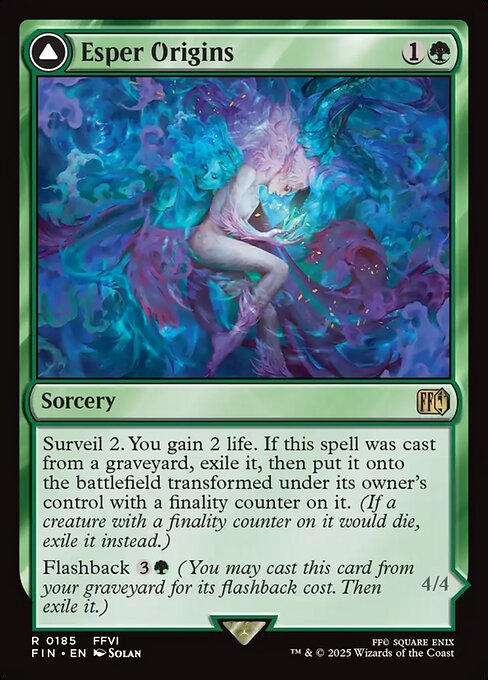
2. Esper Origins // Summon: Esper Maduin
Rating9.3BombWhy this rating?
One of the 3 best cards of the set (9.3/10).
Why. Two cards in one. For two mana you get Surveil 2 and two life; later, from the graveyard, it returns as a Saga creature that can hand you a permanent card, add two green mana, then give your other creatures +2/+2 and trample.
Risks. The first cast does nothing to the board, and the Summon side costs four mana from the graveyard. Chapter I gives nothing if the top card is not a permanent.
In the draft. A very high pick in a green deck: it smooths your draws early and becomes a late threat. Play plenty of creatures so chapter III hits hard.
Results in the games of the set
When it is in hand, the deck wins 63.6% of its games (set average: 56.4%, 10th of 341 cards).
In the opening hand: 62.7% wins (55.2% on average).
Drawn during the game: 64.3% (57.2% on average).
When it is drawn, the deck wins 8.0 points more than when it is not.
When it is drafted, it is played 90% of the time (set average: 62%).
Taken as the first pick (143 drafts), it ends in the deck 91% of the time.
It is played about as much in every archetype.
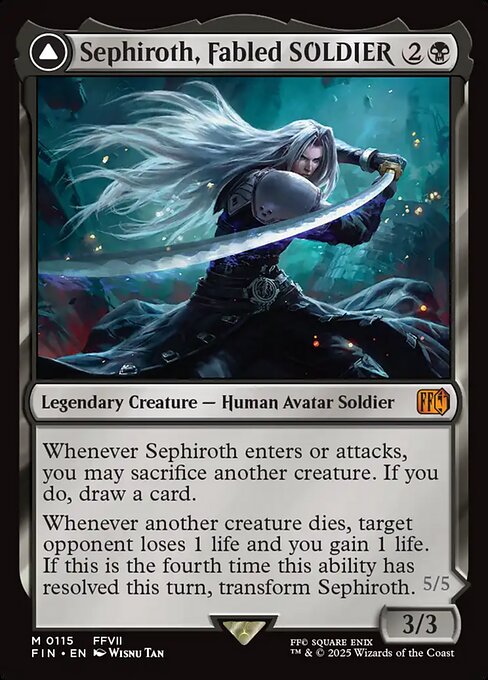
3. Sephiroth, Fabled SOLDIER // Sephiroth, One-Winged Angel
Rating9.1BombWhy this rating?
One of the 3 best cards of the set (9.1/10).
Why. A three-mana 3/3 that drains one life whenever another creature dies, and can sacrifice another creature to draw when it enters and each time it attacks. After four drains in one turn it flips into a flier, and an emblem drains on every creature death.
Risks. One life per death is modest, and the transform needs four drains in a single turn, which is rare without a plan. With no fodder it is still a decent 3/3.
In the draft. A bomb for a black deck that likes trades and small creatures. Take it high and look for tokens or cheap creatures to sacrifice.
Results in the games of the set
When it is in hand, the deck wins 62.1% of its games (set average: 56.4%, 18th of 341 cards).
In the opening hand: 60.0% wins (55.2% on average).
Drawn during the game: 63.4% (57.2% on average).
When it is drawn, the deck wins 9.6 points more than when it is not.
When it is drafted, it is played 92% of the time (set average: 62%).
Taken as the first pick (52 drafts), it ends in the deck 94% of the time.
It is played about as much in every archetype.
 Rating9.0Bomb
Why this rating?
One of the 10 best cards of the set (9.0/10).
Why. A 3/5 that, during your turn, has trample, lifelink and ward 2, as do your enchantment creatures. At your end step it brings an enchantment card back from the graveyard with a finality counter: a value engine in a Summon deck.
Risks. It costs five mana and two colours. On the opponent's turn it has none of those abilities. With no enchantment card in your graveyard, its second ability does nothing.
In the draft. A bomb for green-white decks full of Summon creatures and enchantments. Playable as a plain body otherwise, but first take the cards that fill its graveyard.
Results in the games of the set
When it is in hand, the deck wins 60.4% of its games (set average: 56.4%, 26th of 341 cards).
In the opening hand: 58.3% wins (55.2% on average).
Drawn during the game: 61.8% (57.2% on average).
When it is drawn, the deck wins 8.1 points more than when it is not.
When it is drafted, it is played 72% of the time (set average: 62%).
Taken as the first pick (42 drafts), it ends in the deck 60% of the time.
It is played about as much in every archetype.
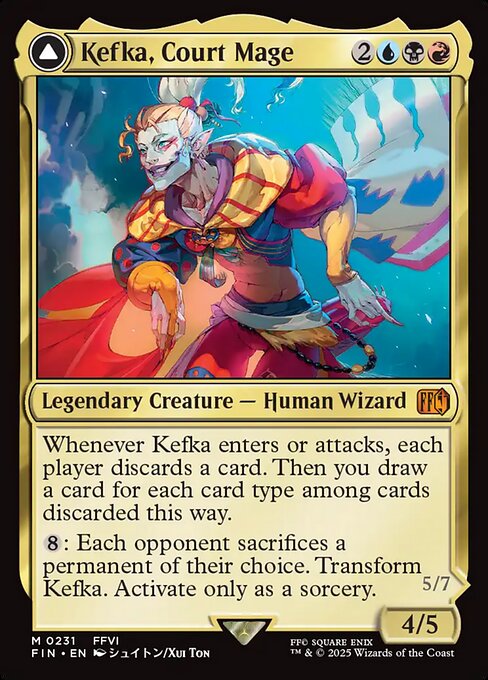
5. Kefka, Court Mage // Kefka, Ruler of Ruin
Rating8.9BombWhy this rating?
One of the 10 best cards of the set (8.9/10).
Why. A 4/5 that makes each player discard when it enters and each time it attacks, then draws you a card for each card type among those discarded. For eight mana, at sorcery speed, each opponent sacrifices a permanent and Kefka flips into a flying card-drawing engine.
Risks. Three colours: the mana is the real cost. The discard is symmetrical and gives you nothing if your hand is empty.
In the draft. A bomb only if you are already in all three colours. Do not force it: take it if your fixing supports it.
Results in the games of the set
When it is in hand, the deck wins 62.6% of its games (set average: 56.4%, 12th of 341 cards).
In the opening hand: 61.1% wins (55.2% on average).
Drawn during the game: 63.4% (57.2% on average).
When it is drawn, the deck wins 12.8 points more than when it is not.
When it is drafted, it is played 90% of the time (set average: 62%).
Taken as the first pick (76 drafts), it ends in the deck 89% of the time.
It is played about as much in every archetype.
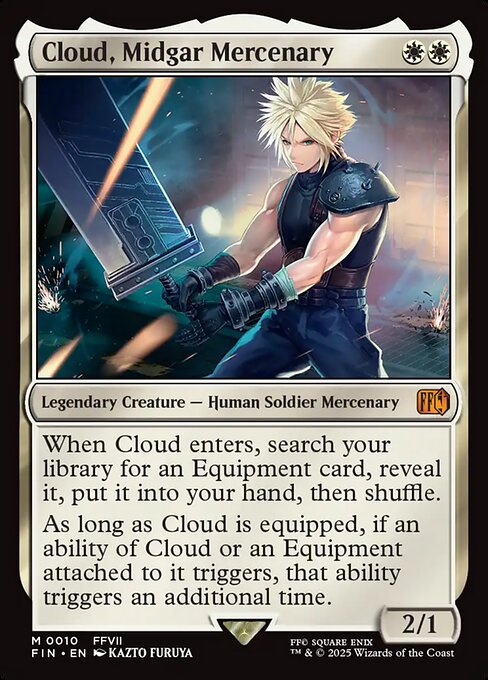 Rating8.9Bomb
Why this rating?
One of the 10 best cards of the set (8.9/10).
Why. A 2/1 for two white mana that fetches an Equipment when it enters: a guaranteed extra card in a deck that plays them. When equipped, its triggers and those of the Equipment trigger a second time.
Risks. Fragile body, and double white on turn two. The main effect depends on how many Equipment are in your deck; without them it is just a 2/1.
In the draft. A very good pick in a white deck with several Equipment: grab those first. Without that base, let it go.
Results in the games of the set
When it is in hand, the deck wins 58.7% of its games (set average: 56.4%, 64th of 341 cards).
In the opening hand: 60.2% wins (55.2% on average).
Drawn during the game: 57.5% (57.2% on average).
When it is drawn, the deck wins 3.0 points more than when it is not.
When it is drafted, it is played 85% of the time (set average: 62%).
Taken as the first pick (43 drafts), it ends in the deck 84% of the time.
It is played about as much in every archetype.
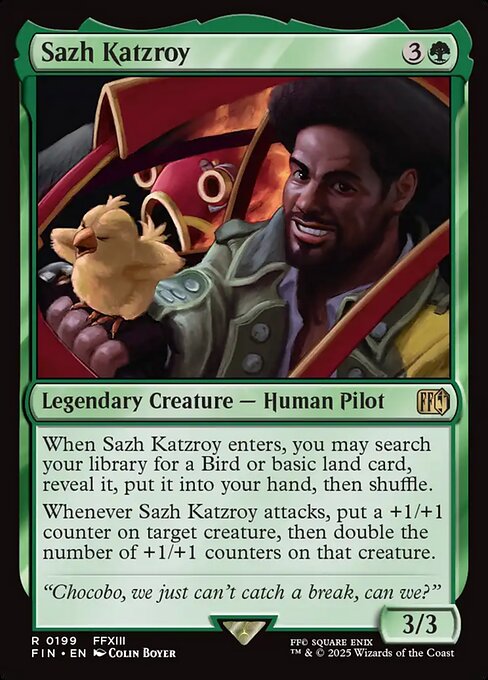
7. Sazh Katzroy
Rating8.8BombWhy this rating?
One of the 10 best cards of the set (8.8/10).
Why. A 3/3 that gets you a card on entry (a Bird or a basic land) and whose every attack puts a counter on a creature, then doubles its counters. Turn after turn one creature becomes huge, Sazh included.
Risks. It has to attack to do anything, and a 3/3 attacks badly into a stalled board. The counters pile onto one target, so a single removal wipes them all out.
In the draft. A very high pick in a green deck, especially one that can protect its creature. Even without a perfect target, the search on entry makes it a value 3/3.
Results in the games of the set
When it is in hand, the deck wins 64.2% of its games (set average: 56.4%, 7th of 341 cards).
In the opening hand: 65.9% wins (55.2% on average).
Drawn during the game: 63.0% (57.2% on average).
When it is drawn, the deck wins 10.8 points more than when it is not.
When it is drafted, it is played 92% of the time (set average: 62%).
Taken as the first pick (114 drafts), it ends in the deck 92% of the time.
It is played about as much in every archetype.
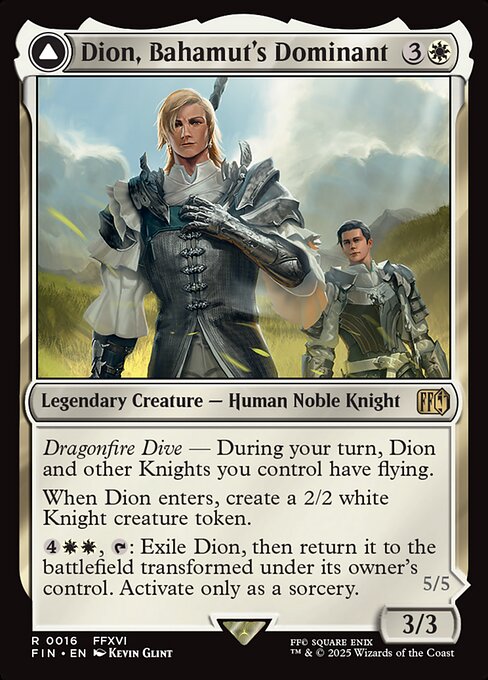
8. Dion, Bahamut's Dominant // Bahamut, Warden of Light
Rating8.7BombWhy this rating?
One of the 10 best cards of the set (8.7/10).
Why. A four-mana 3/3 that brings a 2/2 Knight creature token, both flying during your turn. Later, for six mana, it becomes Bahamut: two turns of counters and flying for your team, then it destroys a permanent.
Risks. The flying only works on your turn, so on defence they are plain ground bodies. The transformation is slow, sorcery speed, and taps Dion.
In the draft. A bomb in a white deck: real value on entry and a possible late game. Take it very high in any pair with white.
Results in the games of the set
When it is in hand, the deck wins 64.5% of its games (set average: 56.4%, 2nd of 341 cards).
In the opening hand: 64.0% wins (55.2% on average).
Drawn during the game: 64.8% (57.2% on average).
When it is drawn, the deck wins 10.8 points more than when it is not.
When it is drafted, it is played 94% of the time (set average: 62%).
Taken as the first pick (113 drafts), it ends in the deck 92% of the time.
It is played about as much in every archetype.
 Rating8.7Bomb
Why this rating?
One of the 10 best cards of the set (8.7/10).
Why. A three-mana 3/2 that lets you look at the top card of your library at any time and play lands and Birds from it: extra cards whenever the top is useful. It also doubles triggers caused by your lands or Birds entering, Landfall included.
Risks. Only two toughness, so it dies fast and the advantage goes with it. It really needs Birds or Landfall abilities in the deck.
In the draft. A bomb in a green deck built around Birds and Landfall; otherwise it is a good 3/2, not worth a high pick.
Results in the games of the set
When it is in hand, the deck wins 58.9% of its games (set average: 56.4%, 52nd of 341 cards).
In the opening hand: 57.8% wins (55.2% on average).
Drawn during the game: 59.8% (57.2% on average).
When it is drawn, the deck wins 5.7 points more than when it is not.
When it is drafted, it is played 87% of the time (set average: 62%).
Taken as the first pick (61 drafts), it ends in the deck 85% of the time.
It is played about as much in every archetype.
 Rating8.6Bomb
Why this rating?
One of the 10 best cards of the set (8.6/10).
Why. An eight-mana 4/4 whose every beginning of combat exiles a creature card from a graveyard and makes a 5/5 Demon copy: with menace, lifelink and haste it attacks right away. A long game is a won game with it.
Risks. Eight mana including three black: it arrives late and can rot in hand. It needs creature cards in a graveyard, and it dies to removal before it ever triggers.
In the draft. A late-game bomb in black, especially in a slow deck with removal. Take it as a single top-end finisher, not as a pair.
Results in the games of the set
When it is in hand, the deck wins 64.5% of its games (set average: 56.4%, 3rd of 341 cards).
In the opening hand: 60.0% wins (55.2% on average).
Drawn during the game: 67.3% (57.2% on average).
When it is drawn, the deck wins 12.0 points more than when it is not.
When it is drafted, it is played 91% of the time (set average: 62%).
Taken as the first pick (185 drafts), it ends in the deck 89% of the time.
It is played about as much in every archetype.
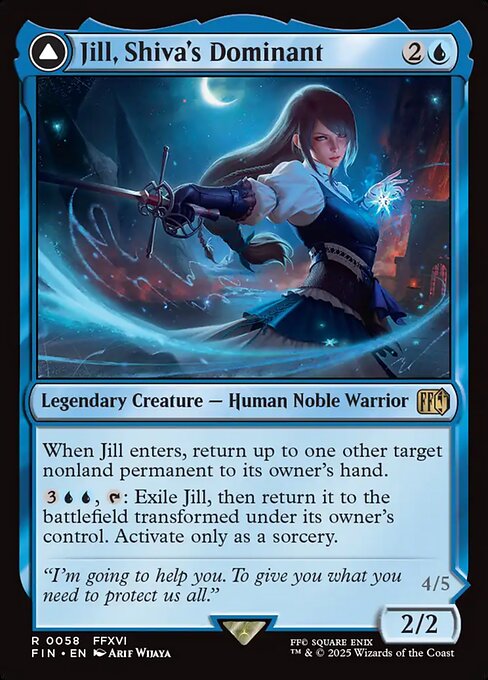
11. Jill, Shiva's Dominant // Shiva, Warden of Ice
Rating8.5BombWhy this rating?
Incredible bomb, but not unbeatable (8.5/10).
Why. A three-mana 2/2 that bounces another nonland permanent when it enters: tempo against a threat, or a chance to replay one of your own permanents for its entry effect. Later, Shiva makes a creature unblockable two turns running, then taps the opponent's lands.
Risks. A fragile 2/2 body, and a bounce does not answer a threat for good. The transform costs five mana at sorcery speed and leaves Jill exposed.
In the draft. A very good blue rare: flexible tempo plus a finisher. Take it high in blue decks that like to replay their creatures.
Results in the games of the set
When it is in hand, the deck wins 62.6% of its games (set average: 56.4%, 11th of 341 cards).
In the opening hand: 61.1% wins (55.2% on average).
Drawn during the game: 63.6% (57.2% on average).
When it is drawn, the deck wins 9.4 points more than when it is not.
When it is drafted, it is played 95% of the time (set average: 62%).
Taken as the first pick (154 drafts), it ends in the deck 92% of the time.
It is played about as much in every archetype.
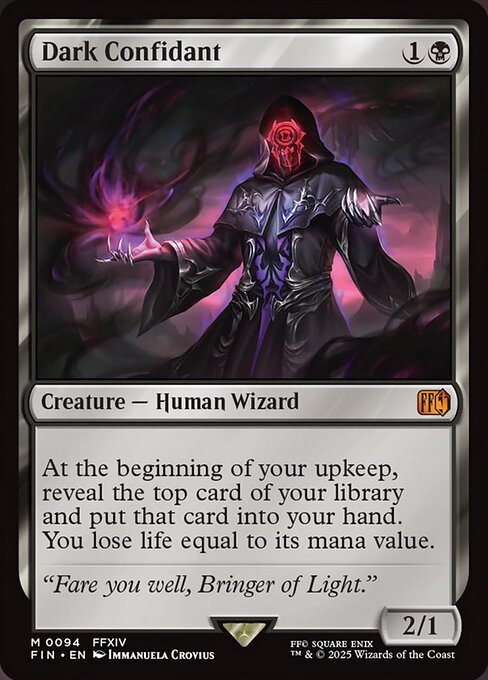
12. Dark Confidant
Rating8.4BombWhy this rating?
One of the very best mythics of the format (8.5/10).
Why. A two-mana 2/1 that gives you an extra card each upkeep, in exchange for life equal to the mana value of the card revealed. In a low-curve deck, it is a stream of cards the opponent has to kill fast.
Risks. The life loss can be heavy with expensive cards, and a 2/1 body dies to anything. In a fast game against an aggressive deck, it can turn against you.
In the draft. Take it in a low-curve black deck with few high-mana-value cards. In a top-heavy deck, leave it.
Results in the games of the set
When it is in hand, the deck wins 59.4% of its games (set average: 56.4%, 39th of 341 cards).
In the opening hand: 63.9% wins (55.2% on average).
Drawn during the game: 56.2% (57.2% on average).
When it is drawn, the deck wins 5.2 points more than when it is not.
When it is drafted, it is played 81% of the time (set average: 62%).
Taken as the first pick (52 drafts), it ends in the deck 87% of the time.
It is played about as much in every archetype.
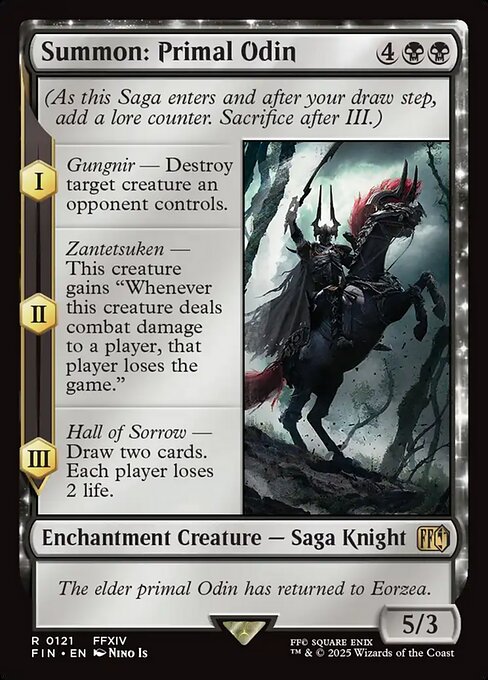 Rating8.4Very good
Why this rating?
One of the very best rares of the format (8.4/10).
Why. Six mana for a 5/3 that destroys an opposing creature right away, then, one chapter later, wins the game if it hits a player. Chapter III draws two cards: removal, threat and cards in one permanent.
Risks. It is sacrificed after chapter III, so it has only one turn to attack after chapter II, and the opponent can just block. Chapter III also costs each player 2 life.
In the draft. A very high pick in black: a removal that leaves a body and two cards. Six mana is an acceptable price for all that.
Results in the games of the set
When it is in hand, the deck wins 62.3% of its games (set average: 56.4%, 16th of 341 cards).
In the opening hand: 59.4% wins (55.2% on average).
Drawn during the game: 64.2% (57.2% on average).
When it is drawn, the deck wins 9.2 points more than when it is not.
When it is drafted, it is played 93% of the time (set average: 62%).
Taken as the first pick (158 drafts), it ends in the deck 91% of the time.
It is played about as much in every archetype.
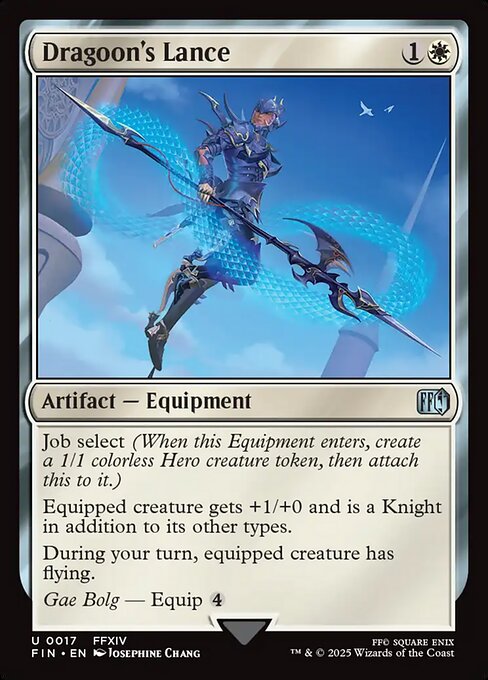
14. Dragoon's Lance
Rating8.3Very goodWhy this rating?
One of the very best uncommons of the format (8.3/10).
Why. A two-mana Equipment that brings its own 1/1 Hero, which becomes a 2/1 Knight with flying during your turn. That is an air attacker for two mana, and Job select saves you the equip cost.
Risks. The Equipment stays if the token dies, but re-equipping costs four mana. The 2/1 Hero is fragile and only flies on your turn.
In the draft. A high pick in white, especially in an aggressive deck. Look for more light creatures to carry it afterward.
Results in the games of the set
When it is in hand, the deck wins 61.6% of its games (set average: 56.4%, 20th of 341 cards).
In the opening hand: 63.2% wins (55.2% on average).
Drawn during the game: 60.4% (57.2% on average).
When it is drawn, the deck wins 6.3 points more than when it is not.
When it is drafted, it is played 89% of the time (set average: 62%).
Taken as the first pick (297 drafts), it ends in the deck 92% of the time.
It is played mostly in U/W decks (43% of them) and B/W (37%).
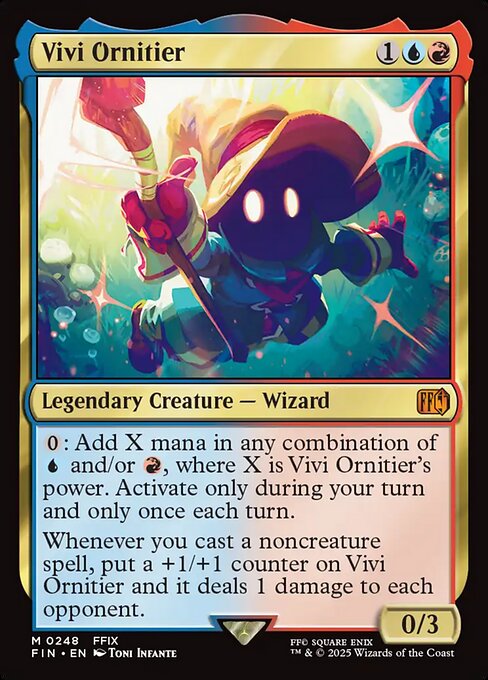
15. Vivi Ornitier
Rating8.2Very goodWhy this rating?
One of the very best mythics of the format (8.2/10).
Why. A 0/3 that grows and pings the opponent for one with every noncreature spell, and whose power turns into blue or red mana on your turn, once per turn. With enough spells it pays for part of your follow-ups.
Risks. With no noncreature spells it is a 0/3 that makes nothing. It wants two specific colours and dies to removal before it has built up value.
In the draft. Good in a blue-red deck rich in spells. In a creature deck it stays a wall. Take it alongside instants and sorceries.
Results in the games of the set
When it is in hand, the deck wins 59.0% of its games (set average: 56.4%, 50th of 341 cards).
In the opening hand: 59.2% wins (55.2% on average).
Drawn during the game: 59.0% (57.2% on average).
When it is drawn, the deck wins 7.1 points more than when it is not.
When it is drafted, it is played 84% of the time (set average: 62%).
Taken as the first pick (62 drafts), it ends in the deck 85% of the time.
It is played about as much in every archetype.
 Rating8.2Very good
Why this rating?
One of the very best mythics of the format (8.2/10).
Why. Eight mana for an indestructible 3/3 that makes three 2/2 Knight creature tokens each turn for four turns, then gives +2/+2 and an indestructible counter to your whole army. If it takes over, the game is over.
Risks. Eight mana: it arrives very late and often rots in hand. A fast deck beats you before it acts, and the Saga is sacrificed after chapter V.
In the draft. A single finisher for a slow white deck. Do not take a second copy; look for mana and removal to survive until then.
Results in the games of the set
When it is in hand, the deck wins 59.2% of its games (set average: 56.4%, 47th of 341 cards).
In the opening hand: 56.3% wins (55.2% on average).
Drawn during the game: 61.1% (57.2% on average).
When it is drawn, the deck wins 5.9 points more than when it is not.
When it is drafted, it is played 87% of the time (set average: 62%).
Taken as the first pick (57 drafts), it ends in the deck 88% of the time.
It is played about as much in every archetype.

17. Buster Sword
Rating8.1Very goodWhy this rating?
One of the very best mythics of the format (8.1/10).
Why. A three-mana Equipment that gives +3/+2 for an equip cost of two. Each time the creature deals combat damage to a player, you draw, then may cast a spell from hand for free with mana value up to the damage dealt.
Risks. It has no body: you need a creature, ideally an evasive one. A block or removal in response to equipping costs tempo.
In the draft. A high pick in a deck with evasive creatures. It rewards a deck of light creatures that get through the board.
Results in the games of the set
When it is in hand, the deck wins 60.8% of its games (set average: 56.4%, 23rd of 341 cards).
In the opening hand: 61.4% wins (55.2% on average).
Drawn during the game: 60.5% (57.2% on average).
When it is drawn, the deck wins 6.9 points more than when it is not.
When it is drafted, it is played 99% of the time (set average: 62%).
Taken among the first three picks (260 drafts), it ends in the deck 99% of the time.
It is played about as much in every archetype.

18. Summon: Fenrir
Rating8.0Very goodWhy this rating?
One of the very best uncommons of the format (8.0/10).
Why. A three-mana 3/2 that fetches a tapped basic land, puts a counter on your next creature and can draw a card. It is ramp and value, with a body that gets one attack.
Risks. The Saga is sacrificed after chapter III, and it has only two toughness. Chapter III only draws if you control the biggest creature (or tie for it).
In the draft. A very good green uncommon for any green deck. Take it high, especially with creatures to follow next turn.
Results in the games of the set
When it is in hand, the deck wins 61.1% of its games (set average: 56.4%, 21st of 341 cards).
In the opening hand: 63.9% wins (55.2% on average).
Drawn during the game: 59.1% (57.2% on average).
When it is drawn, the deck wins 7.1 points more than when it is not.
When it is drafted, it is played 91% of the time (set average: 62%).
Taken as the first pick (363 drafts), it ends in the deck 92% of the time.
It is played mostly in G/R decks (33% of them) and G/U (32%).
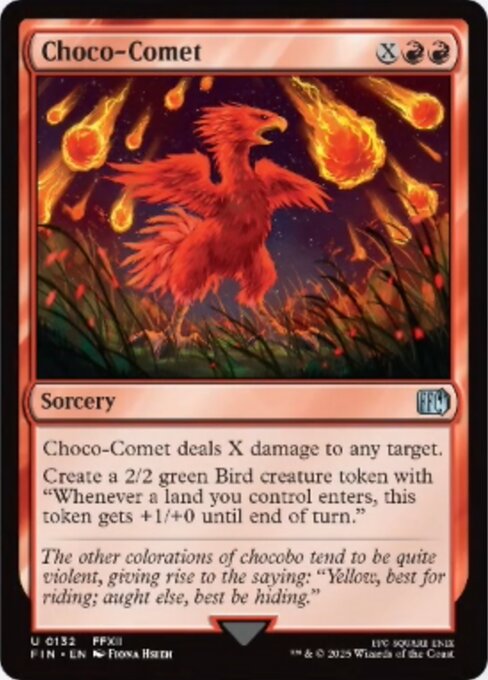
19. Choco-Comet
Rating8.0Very goodWhy this rating?
One of the very best uncommons of the format (8.0/10).
Why. A sorcery that deals X damage to any target and leaves you a 2/2 Bird creature token that gets +1/+0 until end of turn whenever a land enters under your control. A flexible removal or finisher that scales with the game, with a body attached.
Risks. It costs two more than the damage it deals, plus two red mana. Sorcery speed means no answer mid-combat.
In the draft. A red uncommon to take high in nearly any red deck. It replaces a removal and a body in a single card.
Results in the games of the set
When it is in hand, the deck wins 61.0% of its games (set average: 56.4%, 22nd of 341 cards).
In the opening hand: 57.7% wins (55.2% on average).
Drawn during the game: 63.2% (57.2% on average).
When it is drawn, the deck wins 6.9 points more than when it is not.
When it is drafted, it is played 89% of the time (set average: 62%).
Taken as the first pick (372 drafts), it ends in the deck 95% of the time.
It is played mostly in G/R decks (38% of them) and R/U (37%).
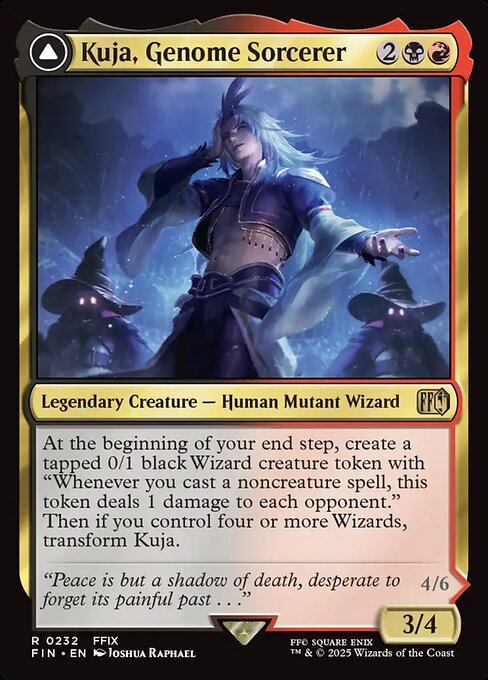
20. Kuja, Genome Sorcerer // Trance Kuja, Fate Defied
Rating7.9Very goodWhy this rating?
One of the very best rares of the format (7.9/10).
Why. A four-mana 3/4 that creates a tapped 0/1 Wizard creature token at each of your end steps, each dealing 1 damage to the opponent whenever you cast a noncreature spell. With four Wizards, Kuja included, it transforms and doubles the damage of your Wizards.
Risks. The tokens are fragile and do nothing without noncreature spells. The transform needs three tokens besides Kuja, which takes time.
In the draft. A good black-red card: a solid body and value that builds up. Take it fairly high, with spells to feed the tokens.
Results in the games of the set
When it is in hand, the deck wins 62.1% of its games (set average: 56.4%, 17th of 341 cards).
In the opening hand: 62.5% wins (55.2% on average).
Drawn during the game: 61.8% (57.2% on average).
When it is drawn, the deck wins 10.2 points more than when it is not.
When it is drafted, it is played 88% of the time (set average: 62%).
Taken as the first pick (159 drafts), it ends in the deck 94% of the time.
It is played about as much in every archetype.
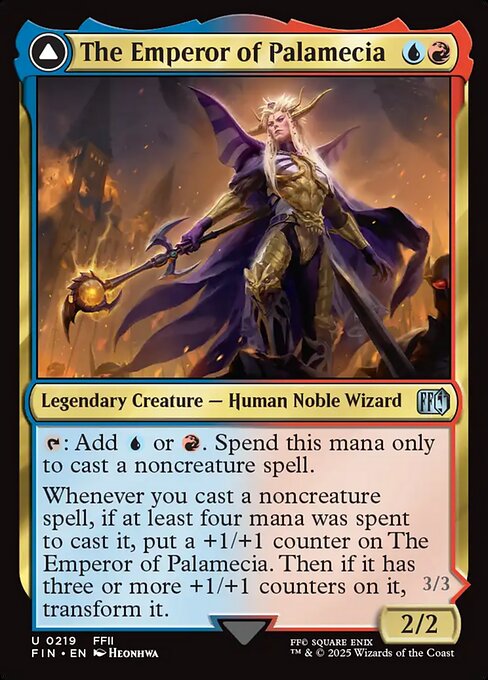
21. The Emperor of Palamecia // The Lord Master of Hell
Rating7.8Very goodWhy this rating?
One of the very best uncommons of the format (7.8/10).
Why. A two-mana 2/2 that makes blue or red mana for your noncreature spells, and gets a counter whenever you cast one with at least four mana. Transformed, it deals damage each attack based on the spells in your graveyard.
Risks. Two colours: it only fits one specific pair. It needs three noncreature spells cast with at least four mana to transform, and its mana does not pay for creatures.
In the draft. A good two-drop for a blue-red spells deck. Do not take it high if you lack noncreature spells.
Results in the games of the set
When it is in hand, the deck wins 59.1% of its games (set average: 56.4%, 49th of 341 cards).
In the opening hand: 60.5% wins (55.2% on average).
Drawn during the game: 58.2% (57.2% on average).
When it is drawn, the deck wins 4.8 points more than when it is not.
When it is drafted, it is played 75% of the time (set average: 62%).
Taken as the first pick (198 drafts), it ends in the deck 86% of the time.
It is played mostly in R/U decks (51% of them).

22. Delivery Moogle
Rating7.8Very goodWhy this rating?
One of the very best uncommons of the format (7.8/10).
Why. A four-mana 3/2 flier that fetches an artifact with mana value 2 or less from your library or graveyard. It is an evasive creature that replaces itself with a cheap artifact.
Risks. Only two toughness, so it is fragile against damage-based removal. Its value depends on how many cheap artifacts are in your deck.
In the draft. A good white uncommon, especially with light artifacts. Take it at a fair price, without overpaying.
Results in the games of the set
When it is in hand, the deck wins 60.0% of its games (set average: 56.4%, 31st of 341 cards).
In the opening hand: 59.5% wins (55.2% on average).
Drawn during the game: 60.4% (57.2% on average).
When it is drawn, the deck wins 2.9 points more than when it is not.
When it is drafted, it is played 83% of the time (set average: 62%).
Taken as the first pick (206 drafts), it ends in the deck 95% of the time.
It is played mostly in R/W decks (40% of them) and U/W (40%).

23. Sazh's Chocobo
Rating7.7Very goodWhy this rating?
One of the very best uncommons of the format (7.7/10).
Why. A one-mana 0/1 with Landfall: every land gives it a counter. A fine opening that becomes a real threat by turn four or five, especially if you run plenty of lands.
Risks. On turn one it is a 0/1 that does nothing, and with no lands to play it stalls. It dies easily before it has grown.
In the draft. A good green uncommon in a Landfall deck. Better as a second or third pick, after the power cards.
Results in the games of the set
When it is in hand, the deck wins 60.0% of its games (set average: 56.4%, 32nd of 341 cards).
In the opening hand: 66.4% wins (55.2% on average).
Drawn during the game: 55.0% (57.2% on average).
When it is drawn, the deck wins 5.7 points more than when it is not.
When it is drafted, it is played 89% of the time (set average: 62%).
Taken as the first pick (272 drafts), it ends in the deck 94% of the time.
It is played mostly in G/R decks (34% of them) and G/U (33%).

24. Samurai's Katana
Rating7.6Very goodWhy this rating?
One of the very best uncommons of the format (7.6/10).
Why. A three-mana Equipment that creates a 1/1 Hero and gives it +2/+2, trample and haste: a hasty 3/3 trampler that attacks the turn it arrives. Pure tempo for an aggressive deck.
Risks. Re-equipping costs five mana, so if the Hero dies the Equipment loses most of its value. The Hero is a 3/3 that dies to removal or a block.
In the draft. A high pick in red, especially in an aggressive deck. It shines alongside more light creatures.
Results in the games of the set
When it is in hand, the deck wins 60.0% of its games (set average: 56.4%, 30th of 341 cards).
In the opening hand: 60.3% wins (55.2% on average).
Drawn during the game: 59.9% (57.2% on average).
When it is drawn, the deck wins 4.6 points more than when it is not.
When it is drafted, it is played 85% of the time (set average: 62%).
Taken as the first pick (262 drafts), it ends in the deck 92% of the time.
It is played mostly in R/W decks (44% of them) and B/R (28%).
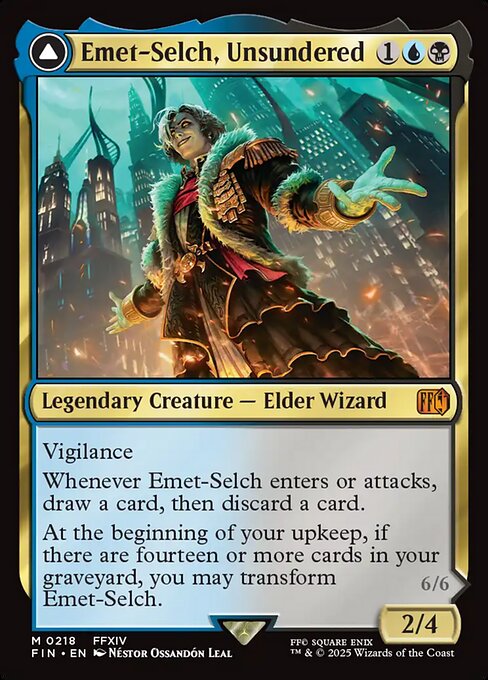
25. Emet-Selch, Unsundered // Hades, Sorcerer of Eld
Rating7.6Very goodWhy this rating?
One of the very best mythics of the format (7.6/10).
Why. A three-mana 2/4 vigilance that loots when it enters and each time it attacks. A good filter that holds the ground well. If your graveyard fills up, it transforms and lets you replay cards from it.
Risks. It needs fourteen cards in the graveyard to flip, which is rare in draft before the late game. A blue-black gold card with no board impact by itself.
In the draft. A solid 2/4 for a blue-black control deck. Do not take it high: the transform is a bonus, not a plan.
Results in the games of the set
When it is in hand, the deck wins 58.5% of its games (set average: 56.4%, 69th of 341 cards).
In the opening hand: 58.5% wins (55.2% on average).
Drawn during the game: 58.5% (57.2% on average).
When it is drawn, the deck wins 8.1 points more than when it is not.
When it is drafted, it is played 83% of the time (set average: 62%).
Taken as the first pick (54 drafts), it ends in the deck 83% of the time.
It is played about as much in every archetype.
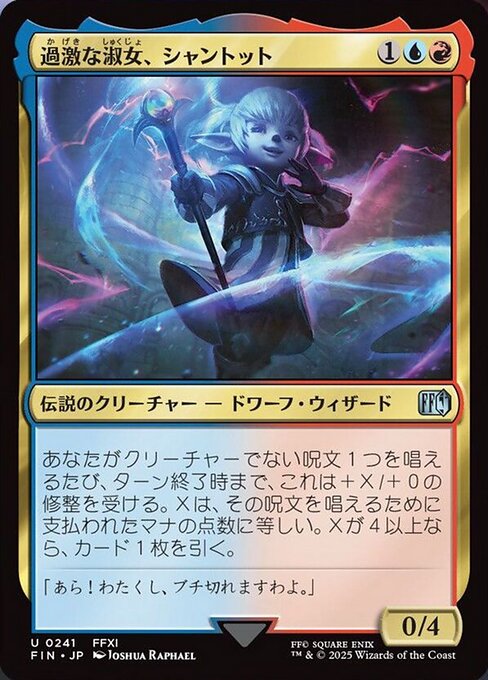
26. Shantotto, Tactician Magician
Rating7.6Very goodWhy this rating?
One of the very best uncommons of the format (7.6/10).
Why. A three-mana 0/4 that blocks well and gets +X/+0 whenever you cast a noncreature spell, plus a card drawn if X is at least four. Big spells turn it into a sudden attacker.
Risks. With no noncreature spells it is just a 0/4 wall. Blue-red gold, and it only attacks if you cast a spell before combat.
In the draft. A good uncommon for a blue-red spells deck. In a creature deck you will barely play it.
Results in the games of the set
When it is in hand, the deck wins 59.0% of its games (set average: 56.4%, 51st of 341 cards).
In the opening hand: 59.2% wins (55.2% on average).
Drawn during the game: 58.9% (57.2% on average).
When it is drawn, the deck wins 5.0 points more than when it is not.
When it is drafted, it is played 78% of the time (set average: 62%).
Taken as the first pick (291 drafts), it ends in the deck 87% of the time.
It is played mostly in R/U decks (57% of them).
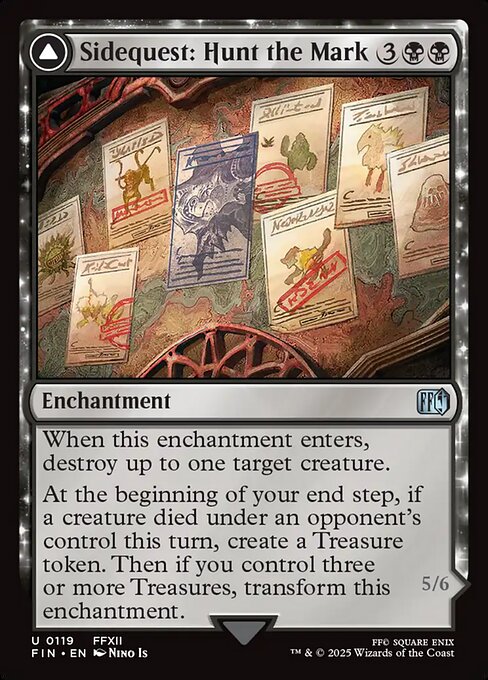
27. Sidequest: Hunt the Mark // Yiazmat, Ultimate Mark
Rating7.6Very goodWhy this rating?
One of the very best uncommons of the format (7.6/10).
Why. A five-mana removal: it destroys a creature when it enters, then makes a Treasure token at each end step in a turn when an opposing creature died. With three Treasures, it transforms into a Dragon.
Risks. Five mana with two black, and no body. The transform needs three Treasures, so several turns of opposing deaths; killing on entry already gives a first Treasure.
In the draft. A removal to take fairly high in black: it destroys any creature. Play it in almost any black deck.
Results in the games of the set
When it is in hand, the deck wins 59.9% of its games (set average: 56.4%, 33rd of 341 cards).
In the opening hand: 57.3% wins (55.2% on average).
Drawn during the game: 61.7% (57.2% on average).
When it is drawn, the deck wins 6.1 points more than when it is not.
When it is drafted, it is played 92% of the time (set average: 62%).
Taken as the first pick (364 drafts), it ends in the deck 92% of the time.
It is played mostly in B/G decks (30% of them) and B/R (30%).
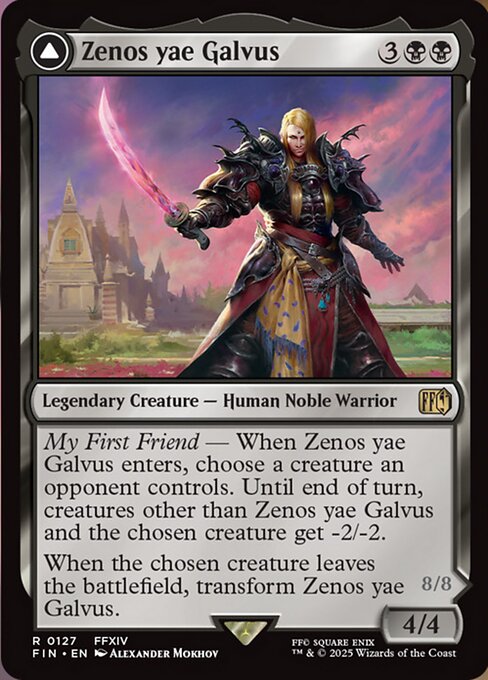
28. Zenos yae Galvus // Shinryu, Transcendent Rival
Rating7.6Very goodWhy this rating?
One of the very best rares of the format (7.6/10).
Why. A five-mana 4/4 that gives -2/-2 to every other creature until end of turn, except the chosen opposing creature. It sweeps small bodies, and transforms into a flier when the chosen creature leaves the battlefield.
Risks. The -2/-2 also hits your own creatures. You must spare one opposing creature, which may be their best. The transform depends on that creature leaving.
In the draft. A good black card against decks of small bodies. A fairly high pick; weaker with your own small creatures.
Results in the games of the set
When it is in hand, the deck wins 59.2% of its games (set average: 56.4%, 46th of 341 cards).
In the opening hand: 57.4% wins (55.2% on average).
Drawn during the game: 60.4% (57.2% on average).
When it is drawn, the deck wins 6.1 points more than when it is not.
When it is drafted, it is played 91% of the time (set average: 62%).
Taken as the first pick (129 drafts), it ends in the deck 97% of the time.
It is played about as much in every archetype.
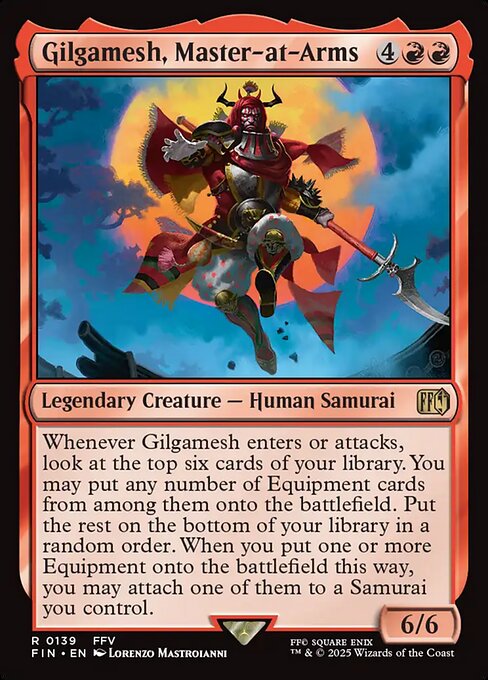 Rating7.5Very good
Why this rating?
A very good rare of the format (7.5/10).
Why. A six-mana 6/6 that looks at six cards when it enters and each time it attacks, putting Equipment onto the battlefield for free, with one attached to a Samurai (itself, for example). With plenty of Equipment, it is a value machine.
Risks. With no Equipment in the deck it is just a 6/6 with no effect. Six mana with two red, and the cards you do not choose go to the bottom in random order.
In the draft. A good card for a red-white deck full of Equipment. Without that base it is an average finisher.
Results in the games of the set
When it is in hand, the deck wins 57.5% of its games (set average: 56.4%, 109th of 341 cards).
In the opening hand: 56.5% wins (55.2% on average).
Drawn during the game: 58.2% (57.2% on average).
When it is drawn, the deck wins 3.9 points more than when it is not.
When it is drafted, it is played 65% of the time (set average: 62%).
Taken as the first pick (69 drafts), it ends in the deck 74% of the time.
It is played about as much in every archetype.

30. Absolute Virtue
Rating7.4Very goodWhy this rating?
A very good mythic of the format (7.4/10).
Why. An uncounterable 8/8 flier that gives you protection from each opponent: no damage, targeting or enchanting from them. Once in play, the opponent can no longer deal damage to you.
Risks. Eight mana in two colours, so it arrives very late. The protection covers neither life loss, discard nor sacrifice effects; the creature itself dies to removal.
In the draft. A finisher for a slow blue-white deck. Barely playable otherwise: do not take it high.
Results in the games of the set
When it is in hand, the deck wins 58.6% of its games (set average: 56.4%, 66th of 341 cards).
In the opening hand: 53.2% wins (55.2% on average).
Drawn during the game: 61.9% (57.2% on average).
When it is drawn, the deck wins 7.9 points more than when it is not.
When it is drafted, it is played 72% of the time (set average: 62%).
Taken as the first pick (33 drafts), it ends in the deck 73% of the time.
It is played about as much in every archetype.
 Rating7.4Very good
Why this rating?
A very good mythic of the format (7.4/10).
Why. An 8/20 vigilance with ward 3 that soaks up all damage meant for you and your other permanents. Damage never wears off: it takes twenty to kill it, and it leaves ten tapped Treasure tokens.
Risks. Eight mana with three green. Damage accumulates, so a removal that destroys or exiles it solves the problem. It does not protect you from life loss or sacrifice.
In the draft. A late-game finisher in green. Take it as the single huge card in a slow deck, but not high.
Results in the games of the set
When it is in hand, the deck wins 58.0% of its games (set average: 56.4%, 88th of 341 cards).
In the opening hand: 53.3% wins (55.2% on average).
Drawn during the game: 61.0% (57.2% on average).
When it is drawn, the deck wins 4.5 points more than when it is not.
When it is drafted, it is played 81% of the time (set average: 62%).
Taken as the first pick (48 drafts), it ends in the deck 81% of the time.
It is played about as much in every archetype.
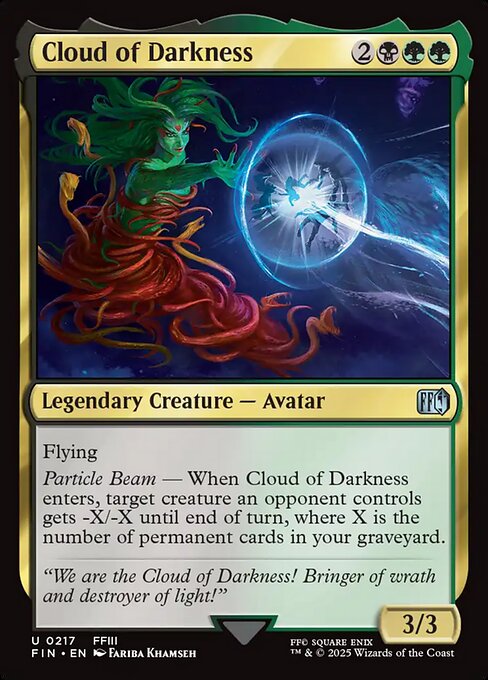 Rating7.4Very good
Why this rating?
A solid uncommon of the format (7.4/10).
Why. A five-mana 3/3 flier whose entry gives -X/-X to an opposing creature, X being the number of permanent cards in your graveyard. A flier and a removal in one card.
Risks. Demanding mana: black plus two green. Early in the game the graveyard is empty and the effect kills nothing.
In the draft. A good black-green uncommon. Take it high if you are in that pair, lower otherwise.
Results in the games of the set
When it is in hand, the deck wins 60.0% of its games (set average: 56.4%, 29th of 341 cards).
In the opening hand: 56.5% wins (55.2% on average).
Drawn during the game: 62.3% (57.2% on average).
When it is drawn, the deck wins 5.6 points more than when it is not.
When it is drafted, it is played 83% of the time (set average: 62%).
Taken as the first pick (224 drafts), it ends in the deck 93% of the time.
It is played mostly in B/G decks (59% of them).
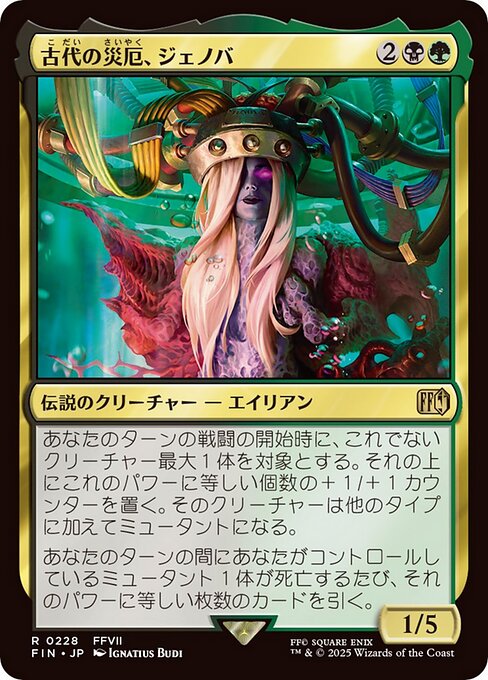 Rating7.4Very good
Why this rating?
A very good rare of the format (7.4/10).
Why. A four-mana 1/5 that puts a number of +1/+1 counters equal to its power on one other creature each turn, and draws cards when a Mutant dies on your turn. A wall that feeds your team.
Risks. Its power is 1, so the counters come slowly. If the Mutant dies on the opponent's turn, nothing is drawn. It is worth little alone.
In the draft. A fair card in black-green. Take it at a middling price, with creatures to improve.
Results in the games of the set
When it is in hand, the deck wins 60.5% of its games (set average: 56.4%, 25th of 341 cards).
In the opening hand: 60.6% wins (55.2% on average).
Drawn during the game: 60.4% (57.2% on average).
When it is drawn, the deck wins 8.2 points more than when it is not.
When it is drafted, it is played 89% of the time (set average: 62%).
Taken as the first pick (114 drafts), it ends in the deck 89% of the time.
It is played about as much in every archetype.

34. Magitek Infantry
Rating7.4Very goodWhy this rating?
One of the best commons of the format (7.4/10).
Why. A one-mana 1/1 artifact creature that becomes 2/1 with another artifact, and can call another copy of itself for three mana. It is good filler for an artifact deck.
Risks. A 1/1 for one mana loses power as the game goes on. Its ability only finds copies of the same name, so without several copies it is useless.
In the draft. A fair common in an aggressive or artifact white deck. Do not take it before stronger cards.
Results in the games of the set
When it is in hand, the deck wins 58.1% of its games (set average: 56.4%, 85th of 341 cards).
In the opening hand: 60.4% wins (55.2% on average).
Drawn during the game: 55.9% (57.2% on average).
When it is drawn, the deck wins 0.8 points less than when it is not.
When it is drafted, it is played 68% of the time (set average: 62%).
Taken as the first pick (401 drafts), it ends in the deck 78% of the time.
It is played mostly in U/W decks (54% of them) and R/W (52%).

35. Seifer Almasy
Rating7.4Very goodWhy this rating?
A very good rare of the format (7.4/10).
Why. A sturdy four-mana 3/4 that gets scary once it attacks alone: double strike makes it hard to block profitably. If it connects, it recasts a cheap instant or sorcery from your graveyard for free, and that spell is then exiled.
Risks. Attacking alone keeps your other creatures at home, and Fire Cross needs a cheap spell already in the graveyard. Removal or a well-placed blocker shuts it down.
In the draft. A good mid-pack pick for a red deck with enough cheap spells. It improves with a healthy count of instants and sorceries at mana value three or less.
Results in the games of the set
When it is in hand, the deck wins 59.4% of its games (set average: 56.4%, 40th of 341 cards).
In the opening hand: 58.4% wins (55.2% on average).
Drawn during the game: 60.1% (57.2% on average).
When it is drawn, the deck wins 6.1 points more than when it is not.
When it is drafted, it is played 89% of the time (set average: 62%).
Taken as the first pick (132 drafts), it ends in the deck 95% of the time.
It is played about as much in every archetype.
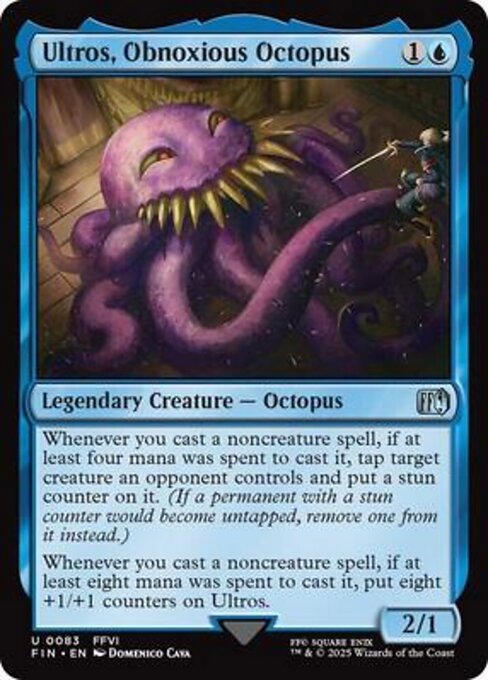 Rating7.4Very good
Why this rating?
A solid uncommon of the format (7.4/10).
Why. A two-drop that rewards expensive spells: each noncreature spell cast with at least four mana taps an opposing creature and puts a stun counter on it. In a deck full of pricey spells, it keeps handing you tempo.
Risks. It is a fragile 2/1 that does nothing without costly noncreature spells. The eight-mana trigger is a late-game bonus, not a plan.
In the draft. Take it in a blue deck with plenty of noncreature spells costing four or more. In a creature-heavy build it loses nearly all its value.
Results in the games of the set
When it is in hand, the deck wins 58.2% of its games (set average: 56.4%, 76th of 341 cards).
In the opening hand: 56.8% wins (55.2% on average).
Drawn during the game: 59.2% (57.2% on average).
When it is drawn, the deck wins 3.7 points more than when it is not.
When it is drafted, it is played 84% of the time (set average: 62%).
Taken as the first pick (278 drafts), it ends in the deck 92% of the time.
It is played mostly in R/U decks (43% of them) and U/W (29%).
 Rating7.3Very good
Why this rating?
A very good rare of the format (7.3/10).
Why. Pure card advantage: you reveal five and keep three, while the opponent only gets to bottom two. The nine-mana flashback gives you a second helping late in the game.
Risks. Four mana for a sorcery that does nothing to the board, so you fall behind if you are already under pressure. The double blue cost is a little demanding in a two-color deck.
In the draft. A good control card, best in a blue deck with enough defense to go long. Skip it in a very aggressive build.
Results in the games of the set
When it is in hand, the deck wins 60.0% of its games (set average: 56.4%, 28th of 341 cards).
In the opening hand: 57.4% wins (55.2% on average).
Drawn during the game: 61.6% (57.2% on average).
When it is drawn, the deck wins 6.0 points more than when it is not.
When it is drafted, it is played 91% of the time (set average: 62%).
Taken as the first pick (181 drafts), it ends in the deck 97% of the time.
It is played about as much in every archetype.

38. Adelbert Steiner
Rating7.3Very goodWhy this rating?
A solid uncommon of the format (7.3/10).
Why. A two-drop with lifelink that gets +1/+1 for every Equipment you control. With just one Equipment it is a 3/2 lifelinker for two mana, which is excellent early.
Risks. With no Equipment it is a fragile 2/1 lifelinker. It depends on the Equipment you draw, so it is best in a deck that runs several.
In the draft. A good pick for a white deck running several Equipment, especially those with Job select. More modest in a deck with none.
Results in the games of the set
When it is in hand, the deck wins 58.1% of its games (set average: 56.4%, 83rd of 341 cards).
In the opening hand: 58.6% wins (55.2% on average).
Drawn during the game: 57.7% (57.2% on average).
When it is drawn, the deck wins 1.5 points more than when it is not.
When it is drafted, it is played 88% of the time (set average: 62%).
Taken as the first pick (206 drafts), it ends in the deck 90% of the time.
It is played mostly in R/W decks (42% of them) and U/W (37%).

39. Cecil, Dark Knight // Cecil, Redeemed Paladin
Rating7.2Very goodWhy this rating?
A very good rare of the format (7.2/10).
Why. A one-mana 2/3 deathtouch that blocks or attacks like a wall nobody wants to face. When your life falls to half your starting total or less, it untaps and transforms into a lifelinker whose attacks make the other attackers indestructible.
Risks. Every point of damage it deals costs you that much life, blocking included. Played carelessly it puts you in danger by itself, especially against aggro.
In the draft. A very good early play in a black midrange or control deck. Riskier if you are already under pressure.
Results in the games of the set
When it is in hand, the deck wins 58.3% of its games (set average: 56.4%, 75th of 341 cards).
In the opening hand: 60.0% wins (55.2% on average).
Drawn during the game: 57.1% (57.2% on average).
When it is drawn, the deck wins 4.9 points more than when it is not.
When it is drafted, it is played 89% of the time (set average: 62%).
Taken as the first pick (108 drafts), it ends in the deck 88% of the time.
It is played about as much in every archetype.
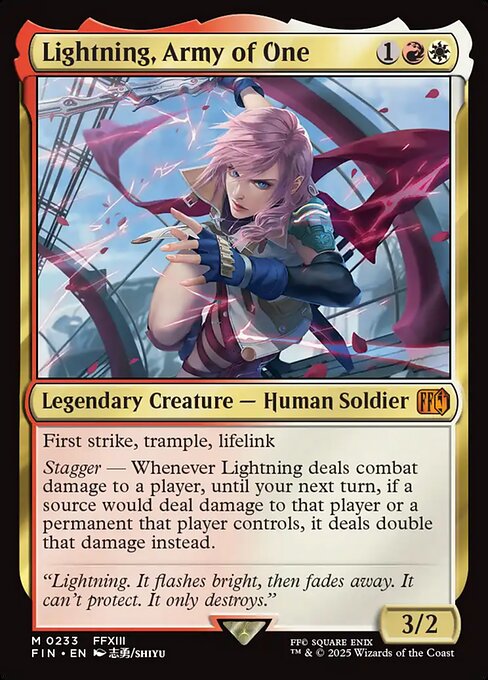 Rating7.2Very good
Why this rating?
A very good mythic of the format (7.2/10).
Why. A three-mana 3/2 with first strike, trample and lifelink, so it is very hard to face in combat. When it connects, all damage dealt to that player and their permanents is doubled until your next turn, setting up a lethal swing.
Risks. It only fits a precise red-white deck, and two toughness leaves it open to small damage spells. It also has to connect to trigger its ability.
In the draft. Take it if you are heading toward red-white, or fairly early if both colors appeal. Outside that pair it is unplayable.
Results in the games of the set
When it is in hand, the deck wins 56.3% of its games (set average: 56.4%, 139th of 341 cards).
In the opening hand: 55.3% wins (55.2% on average).
Drawn during the game: 57.1% (57.2% on average).
When it is drawn, the deck wins 2.9 points more than when it is not.
When it is drafted, it is played 79% of the time (set average: 62%).
Taken as the first pick (33 drafts), it ends in the deck 82% of the time.
It is played about as much in every archetype.
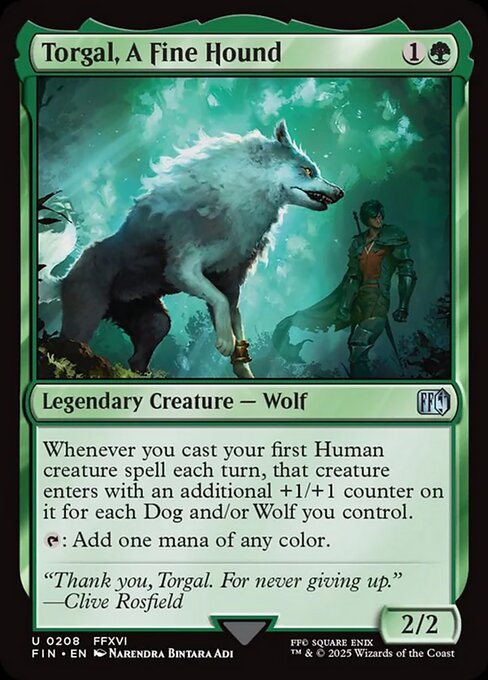 Rating7.2Very good
Why this rating?
A solid uncommon of the format (7.2/10).
Why. A two-drop that taps for mana of any color, which is excellent fixing for a green deck with a splash. The first Human creature spell you cast each turn enters with at least one extra +1/+1 counter, since Torgal itself is a Wolf.
Risks. A 2/2 that taps for mana does not defend. The bonus only applies to the first Human each turn, and it is worth little without Humans.
In the draft. A good mid-pack pick for any green deck, especially one with a splash or plenty of Humans. The fixing alone often justifies playing it.
Results in the games of the set
When it is in hand, the deck wins 58.6% of its games (set average: 56.4%, 68th of 341 cards).
In the opening hand: 61.5% wins (55.2% on average).
Drawn during the game: 56.4% (57.2% on average).
When it is drawn, the deck wins 4.3 points more than when it is not.
When it is drafted, it is played 89% of the time (set average: 62%).
Taken as the first pick (276 drafts), it ends in the deck 93% of the time.
It is played mostly in G/W decks (32% of them) and B/G (31%).

42. Venat, Heart of Hydaelyn // Hydaelyn, the Mothercrystal
Rating7.2Very goodWhy this rating?
A very good rare of the format (7.2/10).
Why. A three-mana 3/3 that draws a card each turn you cast a legendary spell. For seven mana it exiles a nonland permanent, then transforms into an indestructible creature that puts a +1/+1 counter on another creature of yours every combat.
Risks. The draw depends on how many legendary cards are in your deck. The seven-mana ability is a big investment, taps Venat, and only works at sorcery speed.
In the draft. A solid three-mana 3/3 for a white deck with a huge late-game ceiling. Gather legendary cards for the full effect.
Results in the games of the set
When it is in hand, the deck wins 58.2% of its games (set average: 56.4%, 80th of 341 cards).
In the opening hand: 57.7% wins (55.2% on average).
Drawn during the game: 58.6% (57.2% on average).
When it is drawn, the deck wins 3.6 points more than when it is not.
When it is drafted, it is played 89% of the time (set average: 62%).
Taken as the first pick (109 drafts), it ends in the deck 89% of the time.
It is played about as much in every archetype.
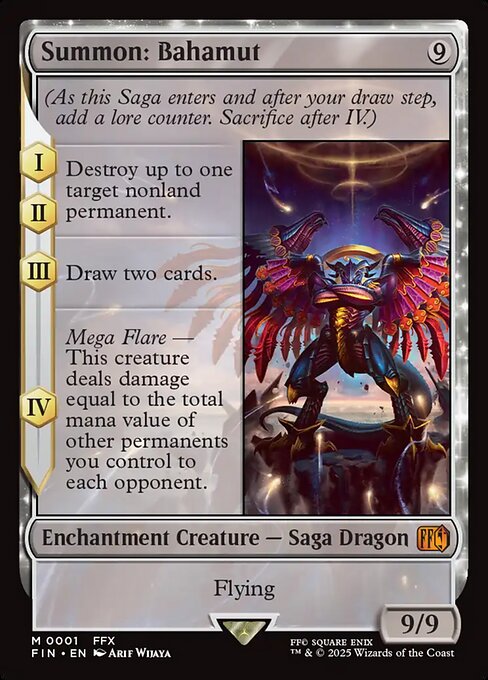
43. Summon: Bahamut
Rating7.1GoodWhy this rating?
A very good mythic of the format (7.1/10).
Why. Nine mana for a 9/9 flier, colorless so it fits any deck: at chapters I and II it can destroy a nonland permanent, then chapter III has you draw two cards. At chapter IV it deals damage to each opponent equal to the total mana value of your other permanents.
Risks. Nine mana is extremely heavy: in most decks it will never get cast. It is sacrificed after chapter IV, so it does not stay long.
In the draft. Only for a control deck with mana acceleration. A late pick: in a normal deck it is a gamble.
Results in the games of the set
When it is in hand, the deck wins 56.7% of its games (set average: 56.4%, 127th of 341 cards).
In the opening hand: 51.4% wins (55.2% on average).
Drawn during the game: 59.9% (57.2% on average).
When it is drawn, the deck wins 4.6 points more than when it is not.
When it is drafted, it is played 89% of the time (set average: 62%).
Taken as the first pick (46 drafts), it ends in the deck 91% of the time.
It is played about as much in every archetype.
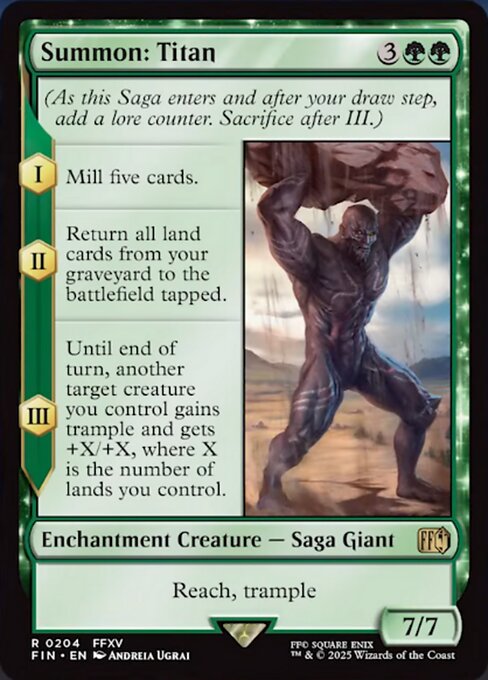
44. Summon: Titan
Rating7.1GoodWhy this rating?
A very good rare of the format (7.1/10).
Why. A five-mana 7/7 with reach and trample, huge for the cost. Chapter II returns every land from your graveyard to the battlefield tapped, and chapter III gives another creature trample and +X/+X, where X is your land count.
Risks. It is sacrificed after chapter III, so it only stays for three of your turns. Milling five cards at chapter I is a risk in a deck with a thin library.
In the draft. A good pick for a green deck that can attack or block right away. The chapter III swing can end a game.
Results in the games of the set
When it is in hand, the deck wins 60.1% of its games (set average: 56.4%, 27th of 341 cards).
In the opening hand: 58.7% wins (55.2% on average).
Drawn during the game: 61.1% (57.2% on average).
When it is drawn, the deck wins 7.1 points more than when it is not.
When it is drafted, it is played 89% of the time (set average: 62%).
Taken as the first pick (119 drafts), it ends in the deck 92% of the time.
It is played about as much in every archetype.

45. Dragoon's Wyvern
Rating7.0GoodWhy this rating?
One of the best commons of the format (7.0/10).
Why. An efficient common: a 2/1 flier and a 1/1 colorless Hero creature token for three mana, so two bodies from one card. The flier attacks in the air and the Hero can carry an Equipment.
Risks. Both bodies are fragile: a single damage spell kills the flier. It is not scary on its own.
In the draft. A good filler for a blue deck, taken ahead of vanilla creatures. It is especially good in a deck that plays Equipment.
Results in the games of the set
When it is in hand, the deck wins 58.7% of its games (set average: 56.4%, 61st of 341 cards).
In the opening hand: 57.6% wins (55.2% on average).
Drawn during the game: 59.4% (57.2% on average).
When it is drawn, the deck wins 3.6 points more than when it is not.
When it is drafted, it is played 90% of the time (set average: 62%).
Taken as the first pick (628 drafts), it ends in the deck 94% of the time.
It is played mostly in R/U decks (78% of them) and G/U (67%).

46. Ignis Scientia
Rating7.0GoodWhy this rating?
A solid uncommon of the format (7.0/10).
Why. A three-mana 2/2 that looks at six cards and may put a land onto the battlefield tapped. Its three-mana ability exiles a card from a graveyard and makes a Food token if it was a creature.
Risks. If there is no land in the top six it is just a mediocre 2/2. It needs a precise green-blue deck, and its three-mana ability slows your turn.
In the draft. Fine in a green-blue deck. Take it for smoother mana, not for power.
Results in the games of the set
When it is in hand, the deck wins 58.8% of its games (set average: 56.4%, 58th of 341 cards).
In the opening hand: 59.0% wins (55.2% on average).
Drawn during the game: 58.7% (57.2% on average).
When it is drawn, the deck wins 6.1 points more than when it is not.
When it is drafted, it is played 72% of the time (set average: 62%).
Taken as the first pick (176 drafts), it ends in the deck 85% of the time.
It is played mostly in G/U decks (54% of them).
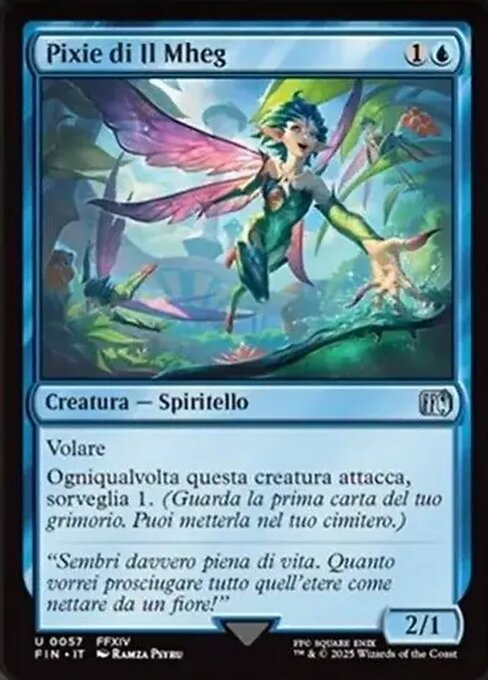
47. Il Mheg Pixie
Rating7.0GoodWhy this rating?
A solid uncommon of the format (7.0/10).
Why. A two-mana 2/1 flier that improves your draws with surveil 1 every time it attacks. A cheap flier is always useful: it pecks, blocks small fliers and filters your library.
Risks. One toughness: any damage spell or flying blocker kills it. It loses value when the opponent has bigger fliers.
In the draft. A good card for a slightly aggressive blue deck. Lower priority than removal, but a fine second or third creature.
Results in the games of the set
When it is in hand, the deck wins 58.0% of its games (set average: 56.4%, 86th of 341 cards).
In the opening hand: 58.7% wins (55.2% on average).
Drawn during the game: 57.6% (57.2% on average).
When it is drawn, the deck wins 3.4 points more than when it is not.
When it is drafted, it is played 92% of the time (set average: 62%).
Taken as the first pick (313 drafts), it ends in the deck 95% of the time.
It is played mostly in R/U decks (32% of them) and U/W (29%).
 Rating7.0Good
Why this rating?
A very good rare of the format (7.0/10).
Why. With Job select it enters with a 1/1 colorless Hero token already attached, and since it is itself an artifact the Hero is at least a 3/3 for five mana. Each other artifact you control adds another +2/+2.
Risks. With no other artifacts it is a modest 3/3 for five mana, and the four-mana equip cost makes moving it very slow. The equipped creature is still vulnerable to removal.
In the draft. A good pick for a white deck with several artifacts. Without extra artifacts it is merely playable.
Results in the games of the set
When it is in hand, the deck wins 58.9% of its games (set average: 56.4%, 56th of 341 cards).
In the opening hand: 57.5% wins (55.2% on average).
Drawn during the game: 59.8% (57.2% on average).
When it is drawn, the deck wins 4.1 points more than when it is not.
When it is drafted, it is played 88% of the time (set average: 62%).
Taken as the first pick (121 drafts), it ends in the deck 90% of the time.
It is played about as much in every archetype.
 Rating7.0Good
Why this rating?
A very good rare of the format (7.0/10).
Why. A six-mana 6/6 with ward 2. Chapter I bounces every creature that is not one of its types, wrecking the opposing board, and chapters II and III draw cards when creatures of those types attack.
Risks. Chapter I also bounces your own creatures (and your tokens vanish), which costs tempo. It is sacrificed after chapter III, so it only sticks around a few turns.
In the draft. A good card for a blue deck with few creatures or creatures with enter abilities. Useful as a reset when you are behind.
Results in the games of the set
When it is in hand, the deck wins 58.9% of its games (set average: 56.4%, 55th of 341 cards).
In the opening hand: 55.8% wins (55.2% on average).
Drawn during the game: 60.6% (57.2% on average).
When it is drawn, the deck wins 5.7 points more than when it is not.
When it is drafted, it is played 90% of the time (set average: 62%).
Taken as the first pick (153 drafts), it ends in the deck 84% of the time.
It is played about as much in every archetype.
 Rating7.0Good
Why this rating?
A solid uncommon of the format (7.0/10).
Why. A three-mana instant that counters a spell unless its controller pays one for each card in your graveyard. Surveil 2 fills the graveyard before it resolves, so the counter gets stronger as the game goes on.
Risks. Early in the game your graveyard is nearly empty and the opponent pays easily. Holding three mana open costs tempo.
In the draft. A good counterspell for a blue tempo or control deck. It is best mid-to-late game rather than early.
Results in the games of the set
When it is in hand, the deck wins 59.3% of its games (set average: 56.4%, 44th of 341 cards).
In the opening hand: 56.4% wins (55.2% on average).
Drawn during the game: 61.0% (57.2% on average).
When it is drawn, the deck wins 4.7 points more than when it is not.
When it is drafted, it is played 82% of the time (set average: 62%).
Taken as the first pick (209 drafts), it ends in the deck 93% of the time.
It is played mostly in G/U decks (36% of them) and R/U (31%).
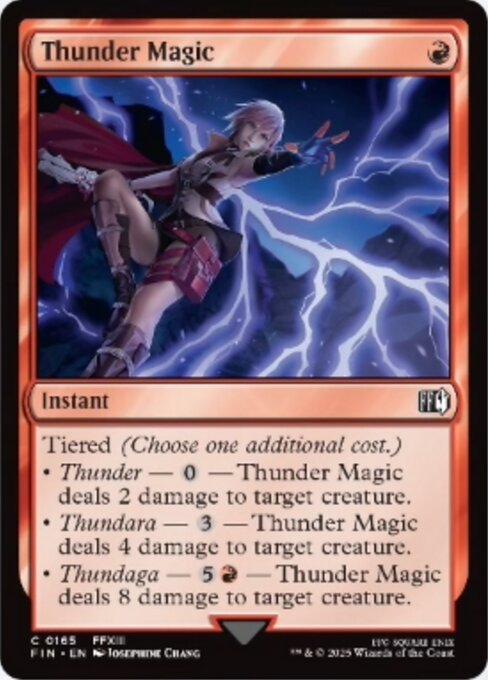
51. Thunder Magic
Rating7.0GoodWhy this rating?
One of the best commons of the format (7.0/10).
Why. A flexible common removal: one red mana deals two damage, four mana deals four, and seven mana deals eight. You tune it to the threat and the stage of the game, at instant speed.
Risks. The cheap mode only kills small creatures, and the expensive modes take a lot of mana. It only hits creatures.
In the draft. A good pick for any red deck, ahead of most other commons. It stays useful from early game to late game.
Results in the games of the set
When it is in hand, the deck wins 58.4% of its games (set average: 56.4%, 73rd of 341 cards).
In the opening hand: 56.6% wins (55.2% on average).
Drawn during the game: 59.6% (57.2% on average).
When it is drawn, the deck wins 3.7 points more than when it is not.
When it is drafted, it is played 90% of the time (set average: 62%).
Taken as the first pick (750 drafts), it ends in the deck 94% of the time.
It is played mostly in R/U decks (64% of them) and B/R (61%).

52. Y'shtola Rhul
Rating7.0GoodWhy this rating?
A very good mythic of the format (7.0/10).
Why. A six-mana 3/5 that blinks one of your creatures at the beginning of your end step each turn, with an extra end step that repeats the effect. In practice you trigger the chosen creature's enter ability twice every turn.
Risks. Without creatures that have enter abilities it is just a heavy body. It is expensive and does not protect itself from removal.
In the draft. A niche card, for a blue deck with many creatures that have enter abilities. Otherwise leave it.
Results in the games of the set
When it is in hand, the deck wins 55.6% of its games (set average: 56.4%, 162nd of 341 cards).
In the opening hand: 53.1% wins (55.2% on average).
Drawn during the game: 57.1% (57.2% on average).
When it is drawn, the deck wins 4.5 points more than when it is not.
When it is drafted, it is played 75% of the time (set average: 62%).
Taken as the first pick (57 drafts), it ends in the deck 72% of the time.
It is played about as much in every archetype.
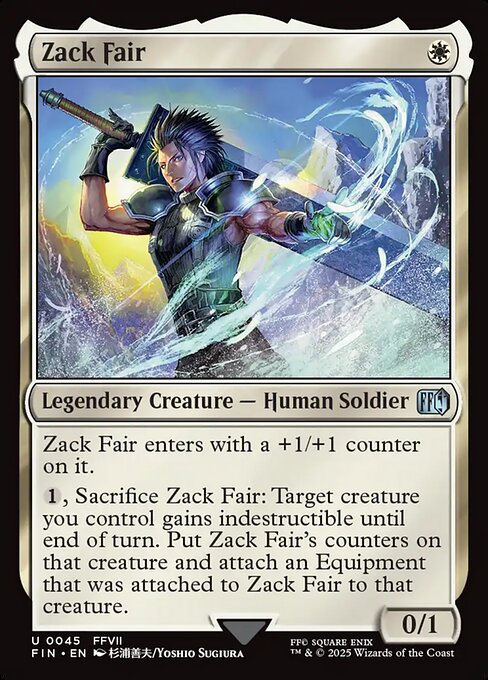
53. Zack Fair
Rating7.0GoodWhy this rating?
A solid uncommon of the format (7.0/10).
Why. A one-mana 1/2 that can sacrifice itself to give another creature indestructible, transfer its counters and move its Equipment over. It protects your best creature and keeps the Equipment investment.
Risks. A small body that does not attack well alone. Its ability costs one mana and needs another creature worth protecting.
In the draft. A good card in a white deck with Equipment or quality creatures to protect. Less useful with no worthwhile targets.
Results in the games of the set
When it is in hand, the deck wins 57.7% of its games (set average: 56.4%, 98th of 341 cards).
In the opening hand: 58.9% wins (55.2% on average).
Drawn during the game: 56.8% (57.2% on average).
When it is drawn, the deck wins 1.3 points more than when it is not.
When it is drafted, it is played 85% of the time (set average: 62%).
Taken as the first pick (164 drafts), it ends in the deck 92% of the time.
It is played mostly in R/W decks (32% of them) and G/W (28%).

54. Overkill
Rating7.0GoodWhy this rating?
A solid uncommon of the format (7.0/10).
Why. An unconditional three-mana instant removal: -0/-9999 kills any creature, even an indestructible one. A clean, reliable black answer.
Risks. It only hits creatures and brings no card advantage. Save it for a real threat.
In the draft. A solid pick for any black deck, taken ahead of most creatures. Unconditional removal should not be passed.
Results in the games of the set
When it is in hand, the deck wins 58.7% of its games (set average: 56.4%, 62nd of 341 cards).
In the opening hand: 55.7% wins (55.2% on average).
Drawn during the game: 60.7% (57.2% on average).
When it is drawn, the deck wins 5.5 points more than when it is not.
When it is drafted, it is played 94% of the time (set average: 62%).
Taken as the first pick (381 drafts), it ends in the deck 94% of the time.
It is played mostly in B/W decks (26% of them) and B/G (25%).
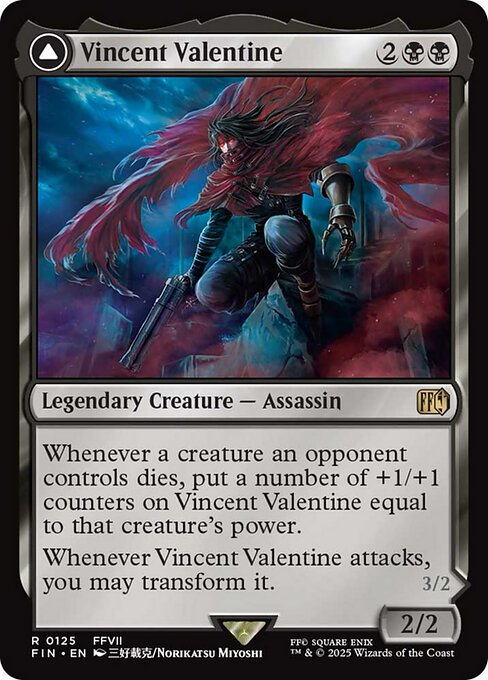
55. Vincent Valentine // Galian Beast
Rating6.9GoodWhy this rating?
A very good rare of the format (6.9/10).
Why. A four-mana 2/2 that grows whenever an opposing creature dies, by +1/+1 counters equal to that creature's power. When it attacks you may transform it into Galian Beast, a trample lifelinker that returns tapped, front face up, when it dies.
Risks. Without opposing creatures dying it is an expensive 2/2. The double black cost is demanding, and removal on the front face stops it.
In the draft. A good pick for a black deck that trades a lot of creatures. It shines in games that turn into a grind.
Results in the games of the set
When it is in hand, the deck wins 57.9% of its games (set average: 56.4%, 89th of 341 cards).
In the opening hand: 56.7% wins (55.2% on average).
Drawn during the game: 58.7% (57.2% on average).
When it is drawn, the deck wins 4.6 points more than when it is not.
When it is drafted, it is played 91% of the time (set average: 62%).
Taken as the first pick (100 drafts), it ends in the deck 95% of the time.
It is played about as much in every archetype.

56. Sidequest: Card Collection // Magicked Card
Rating6.8GoodWhy this rating?
A solid uncommon of the format (6.9/10).
Why. Draw three, discard two: solid filtering that also fills the graveyard. Once eight or more cards are in there, the enchantment becomes a flying Vehicle with Crew 1, a free aerial threat.
Risks. Four mana for an effect that does not touch the board. The transformation needs a stocked graveyard, which does not always come fast.
In the draft. A good card for a blue deck with graveyard effects. A mid-pack pick rather than a priority.
Results in the games of the set
When it is in hand, the deck wins 59.1% of its games (set average: 56.4%, 48th of 341 cards).
In the opening hand: 54.9% wins (55.2% on average).
Drawn during the game: 61.7% (57.2% on average).
When it is drawn, the deck wins 4.6 points more than when it is not.
When it is drafted, it is played 75% of the time (set average: 62%).
Taken as the first pick (161 drafts), it ends in the deck 90% of the time.
It is played mostly in R/U decks (33% of them) and G/U (25%).
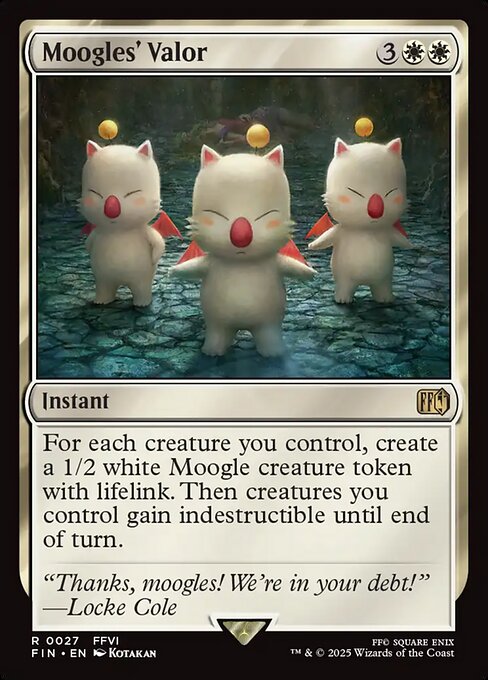
57. Moogles' Valor
Rating6.8GoodWhy this rating?
A very good rare of the format (6.8/10).
Why. For five mana at instant speed, you create a 1/2 white Moogle creature token with lifelink for each creature you control, then your creatures gain indestructible until end of turn. In the middle of combat it is a huge swing.
Risks. The cost is high and you need a board of creatures already. With few creatures it does almost nothing.
In the draft. A good pick for a white creature deck. Worse in a deck that plays few creatures.
Results in the games of the set
When it is in hand, the deck wins 58.9% of its games (set average: 56.4%, 53rd of 341 cards).
In the opening hand: 56.5% wins (55.2% on average).
Drawn during the game: 60.6% (57.2% on average).
When it is drawn, the deck wins 4.0 points more than when it is not.
When it is drafted, it is played 85% of the time (set average: 62%).
Taken as the first pick (96 drafts), it ends in the deck 92% of the time.
It is played about as much in every archetype.

58. Sleep Magic
Rating6.8GoodWhy this rating?
A solid uncommon of the format (6.8/10).
Why. A temporary removal for one blue mana: the creature taps and stays tapped. For the price, it often neutralizes the best creature on the other side.
Risks. It is sacrificed as soon as the enchanted creature is dealt damage, even by the opponent, who also keeps the creature and its abilities that do not require tapping.
In the draft. A good pick for a blue deck, especially against a big threat. Its one-mana cost makes it easy to fit in.
Results in the games of the set
When it is in hand, the deck wins 58.8% of its games (set average: 56.4%, 60th of 341 cards).
In the opening hand: 56.0% wins (55.2% on average).
Drawn during the game: 60.5% (57.2% on average).
When it is drawn, the deck wins 4.3 points more than when it is not.
When it is drafted, it is played 90% of the time (set average: 62%).
Taken as the first pick (289 drafts), it ends in the deck 95% of the time.
It is played mostly in G/U decks (29% of them) and R/U (28%).

59. Town Greeter
Rating6.8GoodWhy this rating?
One of the best commons of the format (6.8/10).
Why. A two-mana 1/1 that smooths your land drops: you mill four cards and may take a land into your hand. If it is a Town you also gain 2 life.
Risks. A 1/1 that does nothing in combat, and the mill strips your own library. A deck with few lands gets less from it.
In the draft. A fine filler for a green graveyard deck. Take it earlier if your pool is short on cheap creatures.
Results in the games of the set
When it is in hand, the deck wins 58.8% of its games (set average: 56.4%, 59th of 341 cards).
In the opening hand: 59.4% wins (55.2% on average).
Drawn during the game: 58.4% (57.2% on average).
When it is drawn, the deck wins 3.7 points more than when it is not.
When it is drafted, it is played 81% of the time (set average: 62%).
Taken as the first pick (360 drafts), it ends in the deck 95% of the time.
It is played mostly in B/G decks (81% of them) and G/U (63%).
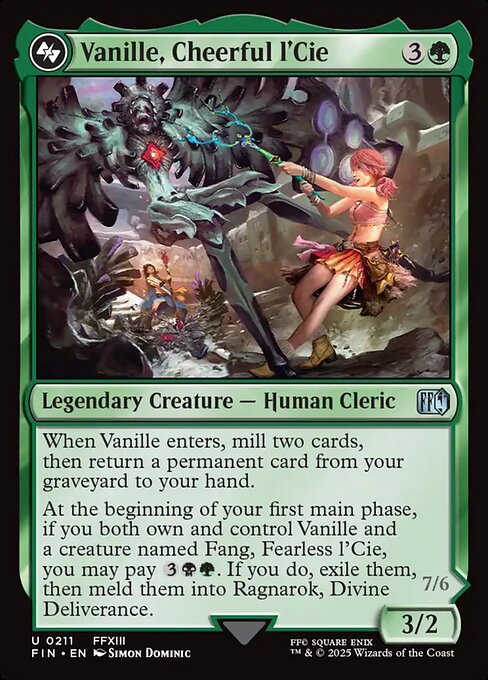 Rating6.8Good
Why this rating?
A solid uncommon of the format (6.8/10).
Why. A four-mana 3/2 that gives you value on arrival: you mill two, then return a permanent card to your hand. You can easily get back a creature or a land.
Risks. A modest body that dies to a lot. Its meld ability needs one specific partner you will almost never have: ignore it in draft.
In the draft. A good mid-pack pick for a green deck, especially with black. It replaces itself and leaves a decent body.
Results in the games of the set
When it is in hand, the deck wins 58.5% of its games (set average: 56.4%, 71st of 341 cards).
In the opening hand: 56.0% wins (55.2% on average).
Drawn during the game: 60.1% (57.2% on average).
When it is drawn, the deck wins 4.0 points more than when it is not.
When it is drafted, it is played 89% of the time (set average: 62%).
Taken as the first pick (258 drafts), it ends in the deck 95% of the time.
It is played mostly in B/G decks (41% of them) and G/W (28%).

61. White Auracite
Rating6.8GoodWhy this rating?
One of the best commons of the format (6.8/10).
Why. An efficient common: four mana to exile any opposing nonland permanent, and the artifact then taps for white mana. It is a flexible removal that also improves your mana.
Risks. The exile is temporary: if the artifact leaves the battlefield, the permanent comes back. Artifact removal undoes it.
In the draft. A good pick for any white deck, taken ahead of most commons. Best when the opponent has little artifact destruction.
Results in the games of the set
When it is in hand, the deck wins 59.4% of its games (set average: 56.4%, 42nd of 341 cards).
In the opening hand: 57.9% wins (55.2% on average).
Drawn during the game: 60.4% (57.2% on average).
When it is drawn, the deck wins 3.5 points more than when it is not.
When it is drafted, it is played 89% of the time (set average: 62%).
Taken as the first pick (618 drafts), it ends in the deck 96% of the time.
It is played mostly in R/W decks (65% of them) and U/W (63%).
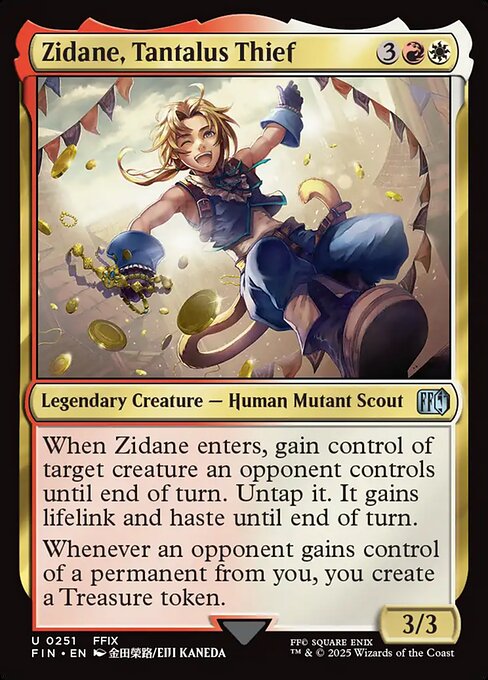 Rating6.8Good
Why this rating?
A solid uncommon of the format (6.8/10).
Why. A five-mana 3/3 that steals an opposing creature until end of turn: you untap it, give it lifelink and haste, and swing with it. You also get a Treasure token when an opponent gains control of one of your permanents.
Risks. This is not removal: the stolen creature goes back at end of turn. It needs two exact colors and five mana.
In the draft. Fine in a red-white deck, no more. It makes for a powerful attack but does not solve anything permanently.
Results in the games of the set
When it is in hand, the deck wins 58.2% of its games (set average: 56.4%, 81st of 341 cards).
In the opening hand: 55.5% wins (55.2% on average).
Drawn during the game: 60.1% (57.2% on average).
When it is drawn, the deck wins 3.0 points more than when it is not.
When it is drafted, it is played 53% of the time (set average: 62%).
Taken as the first pick (51 drafts), it ends in the deck 82% of the time.
It is played mostly in R/W decks (47% of them).

63. Battle Menu
Rating6.8GoodWhy this rating?
A solid uncommon of the format (6.8/10).
Why. A two-mana instant with four choices: a 2/2 white Knight creature token, +0/+4 on a creature, destroying a creature with power 4 or greater, or gaining 4 life. It adapts to the situation.
Risks. Each mode is modest, and the removal mode only touches big creatures. It does not win the game on its own.
In the draft. A good filler for a white deck. It is a flexible tool, never a first pick.
Results in the games of the set
When it is in hand, the deck wins 58.2% of its games (set average: 56.4%, 82nd of 341 cards).
In the opening hand: 56.6% wins (55.2% on average).
Drawn during the game: 59.4% (57.2% on average).
When it is drawn, the deck wins 1.9 points more than when it is not.
When it is drafted, it is played 88% of the time (set average: 62%).
Taken as the first pick (204 drafts), it ends in the deck 92% of the time.
It is played mostly in G/W decks (29% of them) and R/W (29%).
 Rating6.7Good
Why this rating?
A solid uncommon of the format (6.7/10).
Why. For four mana you return an instant or sorcery from your graveyard (or an exiled card with flashback) to your hand and add a red mana. Its five-mana flashback lets you recast it from the graveyard.
Risks. It does nothing without a good spell to retrieve, and it leaves the board alone. It is slow against an aggressive deck.
In the draft. A value card for a red deck with plenty of strong spells. Take it after your removal and quality creatures.
Results in the games of the set
When it is in hand, the deck wins 57.6% of its games (set average: 56.4%, 104th of 341 cards).
In the opening hand: 53.0% wins (55.2% on average).
Drawn during the game: 60.4% (57.2% on average).
When it is drawn, the deck wins 2.1 points more than when it is not.
When it is drafted, it is played 63% of the time (set average: 62%).
Taken as the first pick (98 drafts), it ends in the deck 95% of the time.
It is played mostly in R/U decks (43% of them) and B/R (33%).
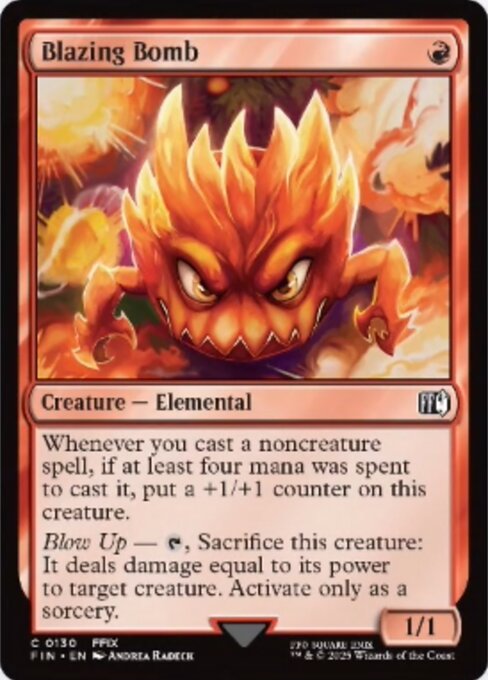
65. Blazing Bomb
Rating6.6GoodWhy this rating?
One of the best commons of the format (6.6/10).
Why. A one-mana 1/1 that becomes a small removal spell: sacrifice it at sorcery speed to deal damage equal to its power to a creature. It grows every time you cast a noncreature spell paid with at least four mana.
Risks. It cannot activate the turn it enters, since it has to tap, and a 1/1 does almost nothing on its own. It needs expensive noncreature spells to matter.
In the draft. A playable pick for a red deck with lots of noncreature spells. In a creature-heavy deck it is a weak card.
Results in the games of the set
When it is in hand, the deck wins 57.3% of its games (set average: 56.4%, 114th of 341 cards).
In the opening hand: 57.9% wins (55.2% on average).
Drawn during the game: 56.9% (57.2% on average).
When it is drawn, the deck wins 1.8 points more than when it is not.
When it is drafted, it is played 59% of the time (set average: 62%).
Taken as the first pick (103 drafts), it ends in the deck 95% of the time.
It is played mostly in R/U decks (89% of them) and B/R (42%).
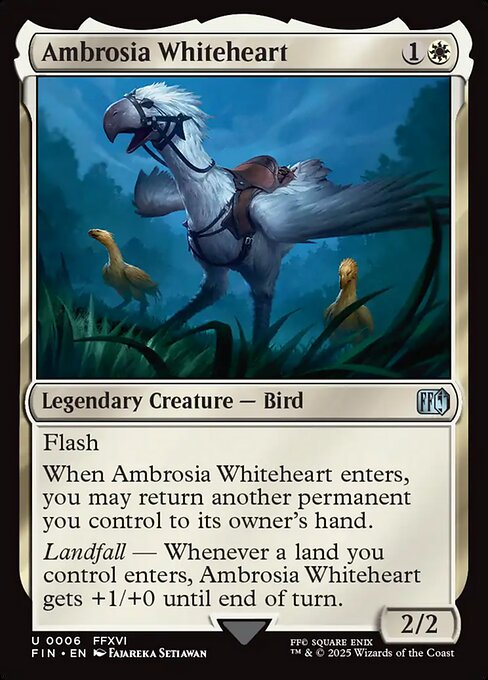 Rating6.6Good
Why this rating?
A solid uncommon of the format (6.6/10).
Why. A two-mana 2/2 with flash that can return another permanent you control to hand, say to replay an enter ability or save a creature from removal. Landfall gives it +1/+0 whenever a land enters under your control.
Risks. Its effect needs another permanent to return and only pays off in certain decks. Otherwise it is a decent 2/2 and nothing more.
In the draft. A decent filler for a white deck. Take it if you have creatures with enter abilities.
Results in the games of the set
When it is in hand, the deck wins 56.4% of its games (set average: 56.4%, 135th of 341 cards).
In the opening hand: 56.3% wins (55.2% on average).
Drawn during the game: 56.5% (57.2% on average).
When it is drawn, the deck wins 0.3 points more than when it is not.
When it is drafted, it is played 86% of the time (set average: 62%).
Taken as the first pick (196 drafts), it ends in the deck 92% of the time.
It is played mostly in G/W decks (29% of them) and R/W (29%).
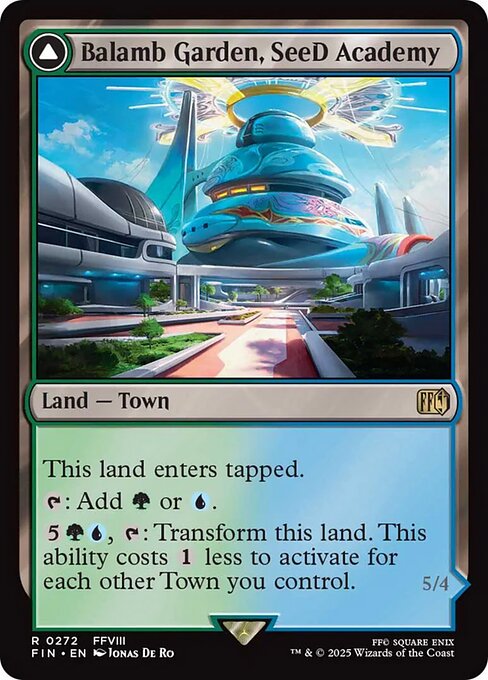
67. Balamb Garden, SeeD Academy // Balamb Garden, Airborne
Rating6.6GoodWhy this rating?
A very good rare of the format (6.6/10).
Why. A tapped Town land that taps for green or blue, giving green-blue fixing at no card cost. Late in the game, for seven mana (one less per other Town), it becomes a flying Vehicle that draws a card whenever it attacks.
Risks. It enters tapped, the transformation is very expensive, and it stops making mana once transformed. It offers little outside green-blue.
In the draft. A good pick for a green-blue deck, adding fixing and late-game utility without taking a spell slot. Do not take it outside those colors.
Results in the games of the set
When it is in hand, the deck wins 58.2% of its games (set average: 56.4%, 79th of 341 cards).
In the opening hand: 58.9% wins (55.2% on average).
Drawn during the game: 57.7% (57.2% on average).
When it is drawn, the deck wins 4.0 points more than when it is not.
When it is drafted, it is played 81% of the time (set average: 62%).
Taken as the first pick (99 drafts), it ends in the deck 91% of the time.

68. Bartz and Boko
Rating6.6GoodWhy this rating?
A very good rare of the format (6.6/10).
Why. A five-mana 4/3 whose cost drops for each Bird you control, and when it enters each of your other Birds deals damage to a creature an opponent controls. With Birds it is both removal and a big body.
Risks. Without Birds it is an expensive 4/3 that does nothing when it enters. It depends on having Birds in your deck.
In the draft. Take it only in a green deck with several Birds. In a deck without them it is filler.
Results in the games of the set
When it is in hand, the deck wins 56.2% of its games (set average: 56.4%, 141st of 341 cards).
In the opening hand: 55.2% wins (55.2% on average).
Drawn during the game: 57.0% (57.2% on average).
When it is drawn, the deck wins 2.6 points more than when it is not.
When it is drafted, it is played 66% of the time (set average: 62%).
Taken as the first pick (74 drafts), it ends in the deck 81% of the time.
It is played about as much in every archetype.

69. Clive, Ifrit's Dominant // Ifrit, Warden of Inferno
Rating6.6GoodWhy this rating?
A very good mythic of the format (6.6/10).
Why. A 5/5 for six whose enter trigger lets you discard your hand and draw cards equal to your devotion to red, a real refill when your hand is nearly empty. Six mana later it transforms: a fight with a creature, then a big burst of red mana.
Risks. Six mana for a body with no evasion, then six more to transform at sorcery speed: it is slow. Discarding your hand with low devotion is a bad trade.
In the draft. A solid top-end card for a red deck with plenty of red permanents. Take it, but not over removal or good cheap creatures.
Results in the games of the set
When it is in hand, the deck wins 55.1% of its games (set average: 56.4%, 186th of 341 cards).
In the opening hand: 53.1% wins (55.2% on average).
Drawn during the game: 56.4% (57.2% on average).
When it is drawn, the deck wins 2.9 points more than when it is not.
When it is drafted, it is played 86% of the time (set average: 62%).
Taken as the first pick (53 drafts), it ends in the deck 87% of the time.
It is played about as much in every archetype.
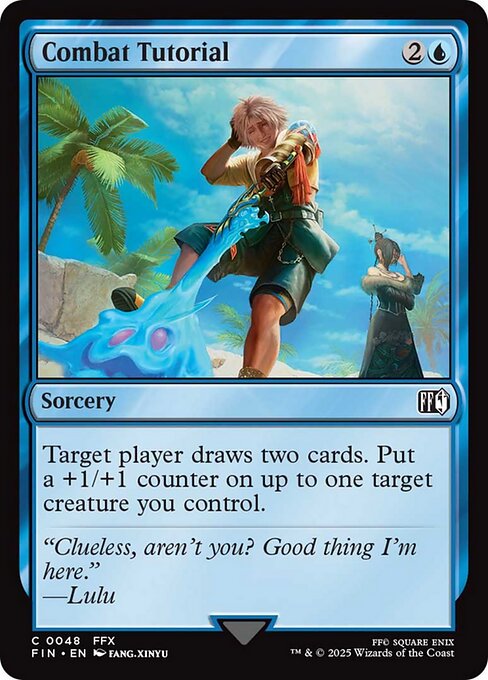
70. Combat Tutorial
Rating6.6GoodWhy this rating?
One of the best commons of the format (6.6/10).
Why. Draw two cards for three mana, plus a +1/+1 counter on one of your creatures. A straightforward card-advantage sorcery that fits any blue deck.
Risks. It puts nothing on the battlefield the turn you cast it, and at three mana it costs you tempo. The counter only matters if you already control a creature.
In the draft. A good blue playable, taken after removal and quality creatures. Two or three copies are plenty in a control or tempo deck.
Results in the games of the set
When it is in hand, the deck wins 58.9% of its games (set average: 56.4%, 54th of 341 cards).
In the opening hand: 57.0% wins (55.2% on average).
Drawn during the game: 60.1% (57.2% on average).
When it is drawn, the deck wins 4.6 points more than when it is not.
When it is drafted, it is played 84% of the time (set average: 62%).
Taken as the first pick (494 drafts), it ends in the deck 93% of the time.
It is played mostly in R/U decks (67% of them) and G/U (62%).

71. Fire Magic
Rating6.6GoodWhy this rating?
A solid uncommon of the format (6.6/10).
Why. A flexible instant-speed sweeper for one red mana: no additional cost for 1 damage to each creature, two more mana for 2, five more for 3. A good answer to tokens and small creatures.
Risks. It hits your own creatures too. The first two modes kill nothing sturdy, and the top mode is very expensive.
In the draft. Good in a red deck with high-toughness creatures or one that is behind on board. Weaker in an aggro deck full of small creatures.
Results in the games of the set
When it is in hand, the deck wins 57.5% of its games (set average: 56.4%, 106th of 341 cards).
In the opening hand: 54.6% wins (55.2% on average).
Drawn during the game: 59.4% (57.2% on average).
When it is drawn, the deck wins 4.3 points more than when it is not.
When it is drafted, it is played 74% of the time (set average: 62%).
Taken as the first pick (167 drafts), it ends in the deck 84% of the time.
It is played mostly in R/U decks (27% of them).

72. Garland, Knight of Cornelia // Chaos, the Endless
Rating6.6GoodWhy this rating?
A solid uncommon of the format (6.6/10).
Why. A 3/2 for two that surveils 1 whenever you cast a noncreature spell. From the graveyard it can return transformed, with flying, for seven mana: if it dies early, it leaves you a late-game threat.
Risks. It is a black-red gold card with only two toughness. Coming back needs seven mana including two black and two red, at sorcery speed, and the back face goes to the bottom of your library if it dies.
In the draft. A good black-red card, taken as a solid two-drop. Keep it for a deck with enough noncreature spells to trigger the surveil.
Results in the games of the set
When it is in hand, the deck wins 56.5% of its games (set average: 56.4%, 133rd of 341 cards).
In the opening hand: 57.6% wins (55.2% on average).
Drawn during the game: 55.7% (57.2% on average).
When it is drawn, the deck wins 3.3 points more than when it is not.
When it is drafted, it is played 58% of the time (set average: 62%).
Taken as the first pick (84 drafts), it ends in the deck 85% of the time.
It is played mostly in B/R decks (51% of them).
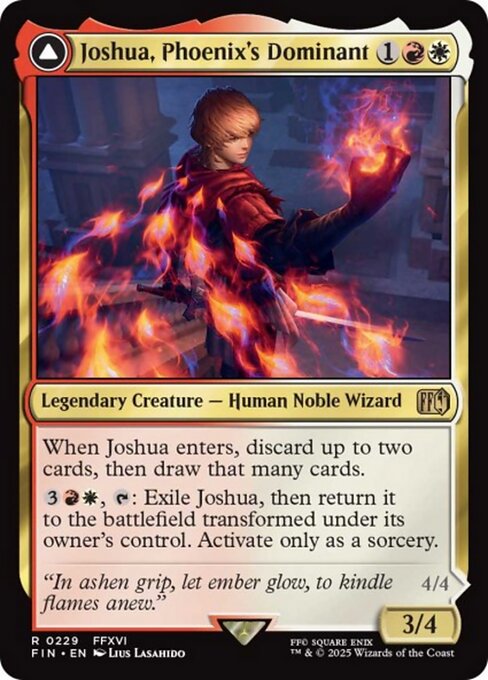
73. Joshua, Phoenix's Dominant // Phoenix, Warden of Fire
Rating6.6GoodWhy this rating?
A very good rare of the format (6.6/10).
Why. A 3/4 for three that discards up to two cards and draws that many on entering. For five more mana it transforms into a flying, lifelink Saga: 2 damage to each opponent on chapters I and II, then creatures return from your graveyard up to total mana value six.
Risks. It is a red-white gold card, so demanding on mana. The transformation costs five mana plus tapping it, at sorcery speed, and only pays off fully with creatures in your graveyard.
In the draft. Take it fairly high in red-white: the body is already good and the transformation gives plenty of late-game value. Best in a deck that trades its creatures.
Results in the games of the set
When it is in hand, the deck wins 58.0% of its games (set average: 56.4%, 87th of 341 cards).
In the opening hand: 57.3% wins (55.2% on average).
Drawn during the game: 58.4% (57.2% on average).
When it is drawn, the deck wins 4.7 points more than when it is not.
When it is drafted, it is played 80% of the time (set average: 62%).
Taken as the first pick (95 drafts), it ends in the deck 76% of the time.
It is played about as much in every archetype.

74. Sahagin
Rating6.6GoodWhy this rating?
One of the best commons of the format (6.6/10).
Why. A 1/3 for two that holds the ground early. Whenever you cast a noncreature spell with at least four mana spent, it gets a +1/+1 counter and can't be blocked that turn.
Risks. Without expensive spells it is just a 1/3 blocker. The trigger needs at least four mana spent, so cheap spells do not count.
In the draft. A fine blue common, best in a deck with several spells costing four or more. Do not overvalue it in a creature-heavy build.
Results in the games of the set
When it is in hand, the deck wins 58.1% of its games (set average: 56.4%, 84th of 341 cards).
In the opening hand: 58.2% wins (55.2% on average).
Drawn during the game: 58.0% (57.2% on average).
When it is drawn, the deck wins 3.0 points more than when it is not.
When it is drafted, it is played 82% of the time (set average: 62%).
Taken as the first pick (453 drafts), it ends in the deck 93% of the time.
It is played mostly in R/U decks (78% of them) and U/W (52%).
 Rating6.6Good
Why this rating?
One of the best commons of the format (6.6/10).
Why. Unconditional instant-speed removal: it destroys any creature and gains you 2 life. The four-mana price is its only real drawback.
Risks. Four mana is slow and costs tempo against a fast deck. It only answers creatures.
In the draft. Take it in black ahead of most creatures. It is a common, so you can gather several copies.
Results in the games of the set
When it is in hand, the deck wins 58.6% of its games (set average: 56.4%, 65th of 341 cards).
In the opening hand: 55.1% wins (55.2% on average).
Drawn during the game: 60.9% (57.2% on average).
When it is drawn, the deck wins 5.1 points more than when it is not.
When it is drafted, it is played 94% of the time (set average: 62%).
Taken as the first pick (884 drafts), it ends in the deck 95% of the time.
It is played mostly in B/W decks (56% of them) and B/G (53%).
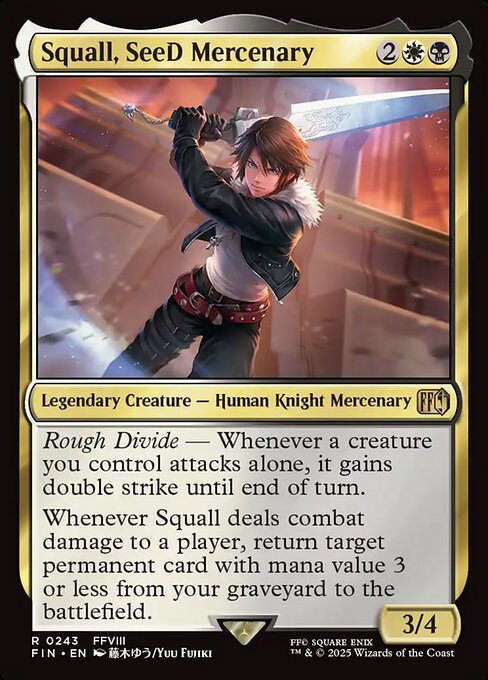 Rating6.6Good
Why this rating?
A very good rare of the format (6.6/10).
Why. A 3/4 that gives double strike to a creature attacking alone, itself included. When it deals combat damage to a player, it returns a permanent card with mana value three or less from your graveyard to the battlefield.
Risks. It is a white-black gold card, and its bonus only works when you attack with a single creature. The opponent can simply block or kill it.
In the draft. A good white-black card, taken fairly high. You need enough cheap permanents to rebuy, and enough defense to hold the ground.
Results in the games of the set
When it is in hand, the deck wins 57.7% of its games (set average: 56.4%, 97th of 341 cards).
In the opening hand: 57.2% wins (55.2% on average).
Drawn during the game: 58.1% (57.2% on average).
When it is drawn, the deck wins 5.5 points more than when it is not.
When it is drafted, it is played 80% of the time (set average: 62%).
Taken as the first pick (103 drafts), it ends in the deck 82% of the time.
It is played about as much in every archetype.

77. The Lunar Whale
Rating6.6GoodWhy this rating?
A very good rare of the format (6.6/10).
Why. A 3/5 flying Vehicle with crew 1. You can look at the top card of your library any time, and play it once the Vehicle has attacked this turn: a big aerial threat that also generates value.
Risks. It needs a creature to crew it, and like any Vehicle it is exposed to artifact removal. If it does not attack, you cannot play the top card.
In the draft. Good in blue: it attacks in the air for 3 while giving card advantage. Take it fairly high and play small creatures to crew it.
Results in the games of the set
When it is in hand, the deck wins 59.3% of its games (set average: 56.4%, 43rd of 341 cards).
In the opening hand: 58.2% wins (55.2% on average).
Drawn during the game: 60.0% (57.2% on average).
When it is drawn, the deck wins 5.8 points more than when it is not.
When it is drafted, it is played 96% of the time (set average: 62%).
Taken as the first pick (165 drafts), it ends in the deck 96% of the time.
It is played about as much in every archetype.
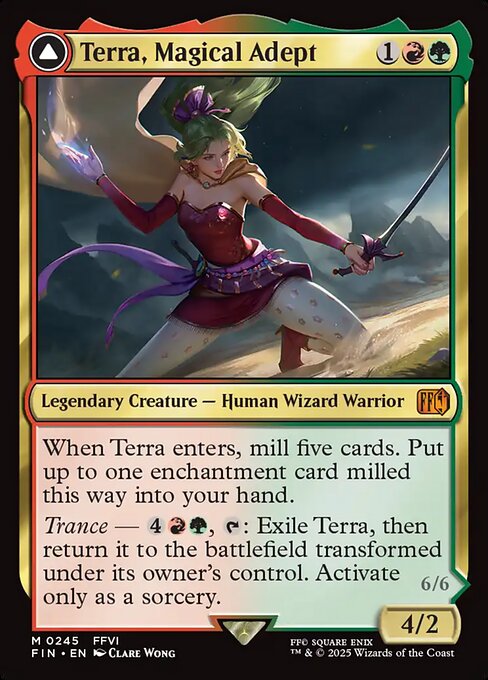
78. Terra, Magical Adept // Esper Terra
Rating6.5GoodWhy this rating?
A very good mythic of the format (6.5/10).
Why. A 4/2 for three that puts the top five cards of your library into your graveyard and may take an enchantment from among them. For six mana its back face flies, temporarily copies your nonlegendary enchantments, then makes a lot of mana on chapter IV.
Risks. With no enchantments in your deck, the back face does almost nothing. It is a red-green gold card, fragile at two toughness, and the transformation costs six mana at sorcery speed.
In the draft. A niche card: take it high only if you already have several enchantments. In a red-green deck without them it is a passable 4/2.
Results in the games of the set
When it is in hand, the deck wins 54.6% of its games (set average: 56.4%, 198th of 341 cards).
In the opening hand: 54.1% wins (55.2% on average).
Drawn during the game: 55.0% (57.2% on average).
When it is drawn, the deck wins 3.5 points more than when it is not.
When it is drafted, it is played 52% of the time (set average: 62%).
Taken among the first three picks (106 drafts), it ends in the deck 59% of the time.
It is played about as much in every archetype.

79. Prompto Argentum
Rating6.5GoodWhy this rating?
Good playable that always makes the cut (6.5/10).
Why. A 2/2 haste for two that creates a Treasure token whenever you cast a noncreature spell with at least four mana spent. Your big spells pay a little mana back.
Risks. It stays a 2/2 with no evasion and dies to any removal. Without expensive spells, its trigger does nothing.
In the draft. A useful red two-drop, best in a spell-heavy deck. A solid playable rather than a priority.
Results in the games of the set
When it is in hand, the deck wins 56.4% of its games (set average: 56.4%, 136th of 341 cards).
In the opening hand: 57.0% wins (55.2% on average).
Drawn during the game: 56.0% (57.2% on average).
When it is drawn, the deck wins 1.5 points more than when it is not.
When it is drafted, it is played 77% of the time (set average: 62%).
Taken as the first pick (92 drafts), it ends in the deck 90% of the time.
It is played mostly in R/U decks (29% of them).

80. Eject
Rating6.4GoodWhy this rating?
Good playable that always makes the cut (6.4/10).
Why. An instant that returns any nonland permanent to its owner's hand and draws you a card. It can't be countered, and it replaces itself.
Risks. Four mana for a tempo effect: it does not answer a threat for good. Against a token it is a kill, but not against anything else.
In the draft. A good blue tempo card, taken after your best creatures and removal. Especially effective against a creature carrying an Aura.
Results in the games of the set
When it is in hand, the deck wins 59.2% of its games (set average: 56.4%, 45th of 341 cards).
In the opening hand: 55.9% wins (55.2% on average).
Drawn during the game: 61.2% (57.2% on average).
When it is drawn, the deck wins 5.0 points more than when it is not.
When it is drafted, it is played 91% of the time (set average: 62%).
Taken as the first pick (315 drafts), it ends in the deck 95% of the time.
It is played mostly in R/U decks (39% of them) and G/U (34%).
 Rating6.4Good
Why this rating?
Good playable that always makes the cut (6.4/10).
Why. For two mana you get a 1/1 colorless Hero token already equipped: the creature is a Wizard in addition to its other types and gets a +1/+1 counter whenever you cast a noncreature spell and whenever you draw your third card each turn. It grows quickly in a spell deck.
Risks. The 1/1 Hero is fragile before it grows, and you need noncreature spells to make it big. If the bearer dies, the Equipment stays but costs two to re-equip.
In the draft. Good in a blue deck full of noncreature spells. Take it fairly high if you already have several.
Results in the games of the set
When it is in hand, the deck wins 57.7% of its games (set average: 56.4%, 99th of 341 cards).
In the opening hand: 58.7% wins (55.2% on average).
Drawn during the game: 57.0% (57.2% on average).
When it is drawn, the deck wins 4.5 points more than when it is not.
When it is drafted, it is played 92% of the time (set average: 62%).
Taken as the first pick (142 drafts), it ends in the deck 95% of the time.
It is played about as much in every archetype.
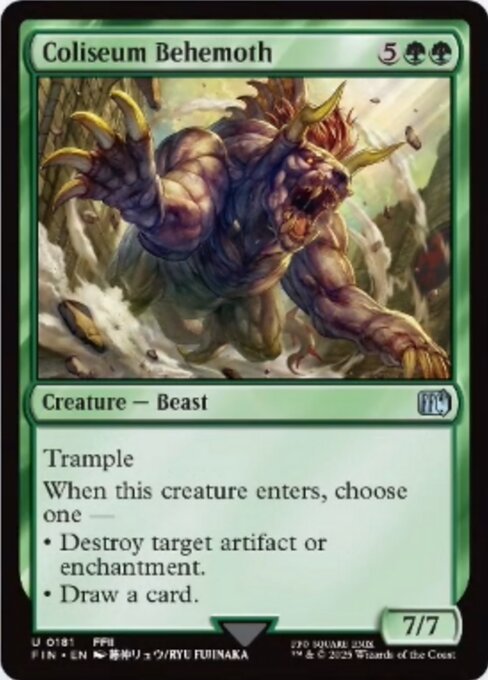 Rating6.4Good
Why this rating?
Good playable that always makes the cut (6.4/10).
Why. A 7/7 trampler that either draws a card or destroys an artifact or enchantment when it enters. Once it lands, it dominates the board.
Risks. Seven mana is a lot: you have to survive that long. Removal or a bounce effect costs you a whole turn of mana.
In the draft. A fine green finisher. One copy in a slower deck is enough; do not take too many.
Results in the games of the set
When it is in hand, the deck wins 58.2% of its games (set average: 56.4%, 77th of 341 cards).
In the opening hand: 54.6% wins (55.2% on average).
Drawn during the game: 60.6% (57.2% on average).
When it is drawn, the deck wins 4.1 points more than when it is not.
When it is drafted, it is played 85% of the time (set average: 62%).
Taken as the first pick (165 drafts), it ends in the deck 93% of the time.
It is played mostly in B/G decks (30% of them) and G/R (30%).
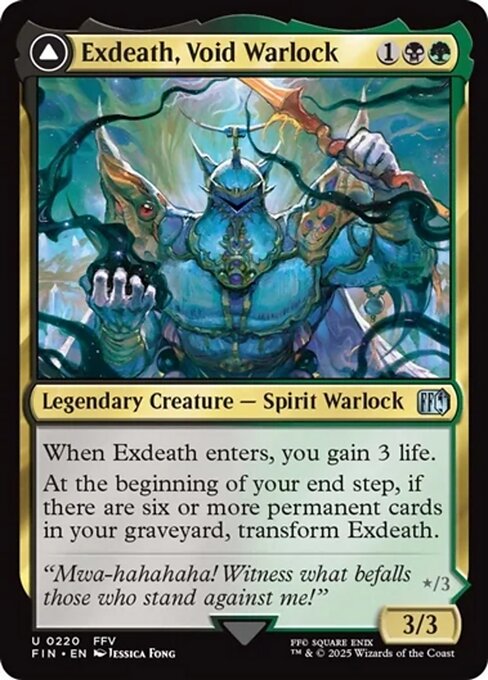
83. Exdeath, Void Warlock // Neo Exdeath, Dimension's End
Rating6.4GoodWhy this rating?
Good playable that always makes the cut (6.4/10).
Why. A 3/3 for three that gains you 3 life when it enters. If six or more permanent cards are in your graveyard at the beginning of your end step, it transforms into a trampler whose power equals the permanent cards in your graveyard.
Risks. It is a black-green gold card. The transformation takes time, and the back face depends entirely on your graveyard, which can stay nearly empty.
In the draft. A good black-green three-drop: the body alone is already solid. Take it fairly high and play cards that fill your graveyard.
Results in the games of the set
When it is in hand, the deck wins 57.8% of its games (set average: 56.4%, 94th of 341 cards).
In the opening hand: 55.7% wins (55.2% on average).
Drawn during the game: 59.4% (57.2% on average).
When it is drawn, the deck wins 3.4 points more than when it is not.
When it is drafted, it is played 72% of the time (set average: 62%).
Taken as the first pick (99 drafts), it ends in the deck 98% of the time.
It is played mostly in B/G decks (49% of them).
 Rating6.4Good
Why this rating?
Good playable that always makes the cut (6.4/10).
Why. A 3/3 for three that gives haste to your equipped creatures. Whenever a nontoken Equipment enters under your control, it makes a temporary copy whose equip abilities cost two less.
Risks. Without Equipment, it is just a 3/3 for three. The copies are sacrificed at the beginning of the next upkeep.
In the draft. A good body in a red deck with several Equipment. Without them it is a passable creature.
Results in the games of the set
When it is in hand, the deck wins 56.5% of its games (set average: 56.4%, 132nd of 341 cards).
In the opening hand: 58.5% wins (55.2% on average).
Drawn during the game: 55.1% (57.2% on average).
When it is drawn, the deck wins 2.0 points more than when it is not.
When it is drafted, it is played 75% of the time (set average: 62%).
Taken as the first pick (79 drafts), it ends in the deck 78% of the time.
It is played about as much in every archetype.

85. Giott, King of the Dwarves
Rating6.4GoodWhy this rating?
Good playable that always makes the cut (6.4/10).
Why. A 1/1 with double strike for two. Whenever it, another Dwarf or an Equipment enters under your control, you may discard a card to draw one, a nice hand filter.
Risks. It is a red-white gold card and only deals 1 damage per strike, so without Equipment it is a small, fragile body.
In the draft. A good red-white card in a deck with Equipment. A two-drop that becomes dangerous once equipped.
Results in the games of the set
When it is in hand, the deck wins 56.3% of its games (set average: 56.4%, 138th of 341 cards).
In the opening hand: 57.7% wins (55.2% on average).
Drawn during the game: 55.2% (57.2% on average).
When it is drawn, the deck wins 0.2 points less than when it is not.
When it is drafted, it is played 49% of the time (set average: 62%).
Taken as the first pick (61 drafts), it ends in the deck 82% of the time.
It is played mostly in R/W decks (53% of them).
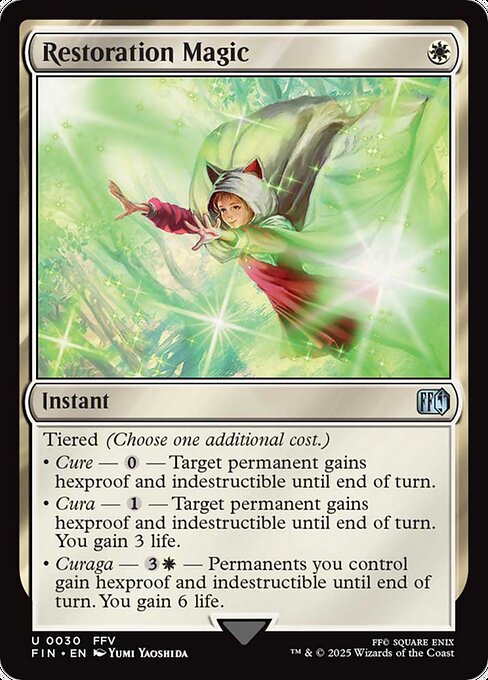 Rating6.4Good
Why this rating?
Good playable that always makes the cut (6.4/10).
Why. A flexible protection spell for one white mana: with no additional cost, a permanent gains hexproof and indestructible until end of turn; one more mana also gains you 3 life. The top mode protects all your permanents and gains 6 life.
Risks. It is reactive and does nothing alone. It only beats targeted removal, damage or destruction, not mass effects that exile or force a sacrifice.
In the draft. A good white trick. Take it after creatures and removal: it shines in decks with a key threat to protect.
Results in the games of the set
When it is in hand, the deck wins 57.1% of its games (set average: 56.4%, 118th of 341 cards).
In the opening hand: 55.3% wins (55.2% on average).
Drawn during the game: 58.3% (57.2% on average).
When it is drawn, the deck wins 1.4 points more than when it is not.
When it is drafted, it is played 65% of the time (set average: 62%).
Taken as the first pick (61 drafts), it ends in the deck 90% of the time.
It is played about as much in every archetype.
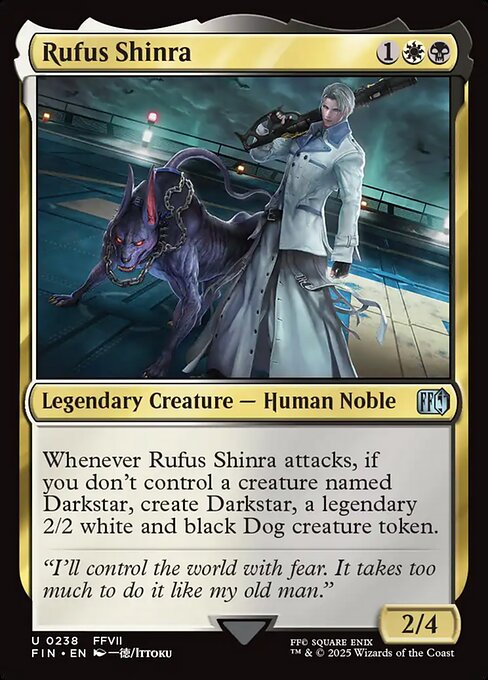
87. Rufus Shinra
Rating6.4GoodWhy this rating?
Good playable that always makes the cut (6.4/10).
Why. A solid 2/4 that, when it attacks, creates a legendary 2/2 white and black Dog creature token if you don't already control a creature with that name. It brings reinforcements whenever the Dog is gone.
Risks. It is a white-black gold card. It must attack to make the token, and a 2/4 attacks poorly into bigger blockers.
In the draft. A good white-black three-drop, taken fairly high. It fits both aggro and control builds.
Results in the games of the set
When it is in hand, the deck wins 56.7% of its games (set average: 56.4%, 125th of 341 cards).
In the opening hand: 58.6% wins (55.2% on average).
Drawn during the game: 55.3% (57.2% on average).
When it is drawn, the deck wins 2.3 points more than when it is not.
When it is drafted, it is played 55% of the time (set average: 62%).
Taken as the first pick (59 drafts), it ends in the deck 76% of the time.
It is played mostly in B/W decks (55% of them).
 Rating6.4Good
Why this rating?
Good playable that always makes the cut (6.4/10).
Why. A 2/3 for three that mills three cards and gains you 3 life when it enters. A decent defensive body that fills your graveyard for decks that care.
Risks. It has no evasion and a modest effect. Milling can also bury good cards in your graveyard.
In the draft. A fine common to round out the curve, especially in a graveyard deck. Not a priority.
Results in the games of the set
When it is in hand, the deck wins 57.0% of its games (set average: 56.4%, 121st of 341 cards).
In the opening hand: 55.9% wins (55.2% on average).
Drawn during the game: 57.7% (57.2% on average).
When it is drawn, the deck wins 1.8 points more than when it is not.
When it is drafted, it is played 57% of the time (set average: 62%).
Taken as the first pick (89 drafts), it ends in the deck 87% of the time.
It is played mostly in B/G decks (76% of them) and B/W (35%).
 Rating6.4Good
Why this rating?
Good playable that always makes the cut (6.4/10).
Why. A 2/2 with menace for two that gets a +1/+1 counter whenever one of your other creatures or artifacts dies. It is hard to block and gains value in trades.
Risks. It is a white-black gold card and fragile at two toughness. If you lose nothing, it stays a 2/2.
In the draft. A good white-black two-drop, especially in an aggro deck that trades a lot.
Results in the games of the set
When it is in hand, the deck wins 56.1% of its games (set average: 56.4%, 144th of 341 cards).
In the opening hand: 56.8% wins (55.2% on average).
Drawn during the game: 55.5% (57.2% on average).
When it is drawn, the deck wins 1.1 points more than when it is not.
When it is drafted, it is played 58% of the time (set average: 62%).
Taken as the first pick (70 drafts), it ends in the deck 87% of the time.
It is played mostly in B/W decks (54% of them).
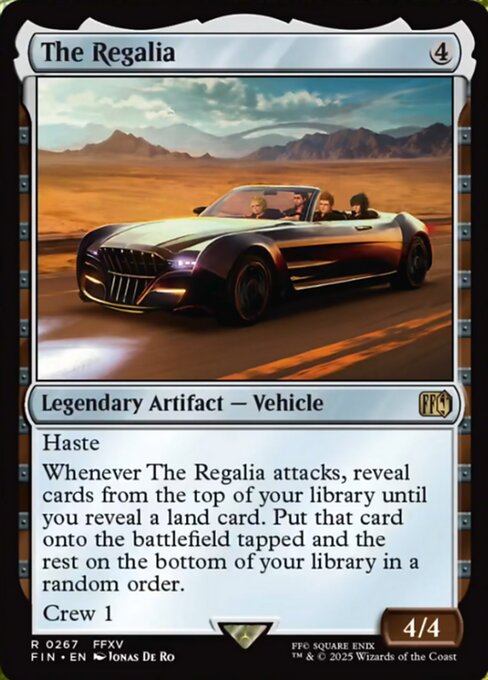
90. The Regalia
Rating6.3GoodWhy this rating?
Good playable that always makes the cut (6.3/10).
Why. A 4/4 haste Vehicle for four colorless mana with crew 1. Each attack puts the first land from your library onto the battlefield tapped, which ramps your mana and thins lands from your library.
Risks. It needs a creature to crew it, and like any Vehicle it is exposed to artifact removal. It attacks poorly into bigger blockers.
In the draft. It fits any deck since it is colorless. A good card to take in the middle of the pack.
Results in the games of the set
When it is in hand, the deck wins 57.7% of its games (set average: 56.4%, 100th of 341 cards).
In the opening hand: 57.8% wins (55.2% on average).
Drawn during the game: 57.6% (57.2% on average).
When it is drawn, the deck wins 3.9 points more than when it is not.
When it is drafted, it is played 99% of the time (set average: 62%).
Taken as the first pick (113 drafts), it ends in the deck 99% of the time.
It is played about as much in every archetype.
 Rating6.3Good
Why this rating?
Good playable that always makes the cut (6.3/10).
Why. A sorcery that forces an opponent to sacrifice a creature of their choice and gives you a 0/1 black Wizard that pings each opponent whenever you cast a noncreature spell. An imperfect removal that leaves a body behind.
Risks. Your opponent chooses the victim, so against several creatures they sacrifice the weakest. It needs two black mana.
In the draft. Good in black against an opponent with few creatures. Take it as removal, but after removal that picks the target.
Results in the games of the set
When it is in hand, the deck wins 58.3% of its games (set average: 56.4%, 74th of 341 cards).
In the opening hand: 57.2% wins (55.2% on average).
Drawn during the game: 59.1% (57.2% on average).
When it is drawn, the deck wins 4.1 points more than when it is not.
When it is drafted, it is played 85% of the time (set average: 62%).
Taken as the first pick (496 drafts), it ends in the deck 93% of the time.
It is played mostly in B/R decks (77% of them) and B/W (68%).
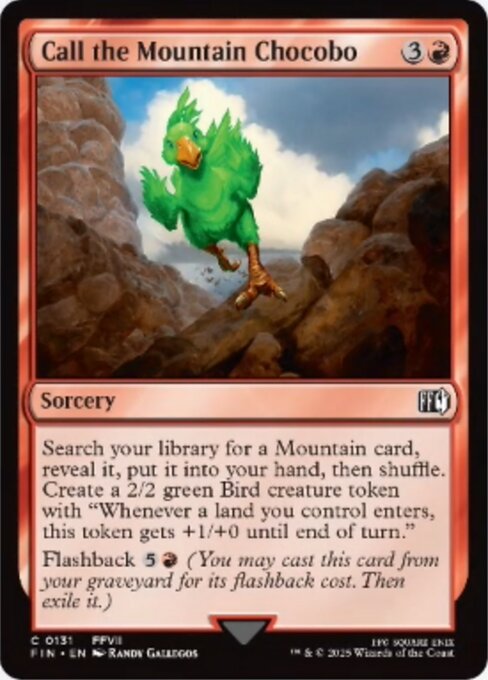 Rating6.2Good
Why this rating?
Good playable that always makes the cut (6.2/10).
Why. A sorcery that fetches a Mountain card into your hand, then creates a 2/2 green Bird token that gets +1/+0 whenever a land enters under your control. Flashback for six lets you cast it again: lots of value from one card.
Risks. Four mana for a sorcery that does little by itself. It only finds Mountains, so it is weaker without several red lands.
In the draft. A good red common, especially in a deck that makes use of lands. Take it as card advantage, not removal.
Results in the games of the set
When it is in hand, the deck wins 57.4% of its games (set average: 56.4%, 112th of 341 cards).
In the opening hand: 55.4% wins (55.2% on average).
Drawn during the game: 58.7% (57.2% on average).
When it is drawn, the deck wins 2.6 points more than when it is not.
When it is drafted, it is played 75% of the time (set average: 62%).
Taken as the first pick (223 drafts), it ends in the deck 87% of the time.
It is played mostly in R/U decks (76% of them) and G/R (71%).
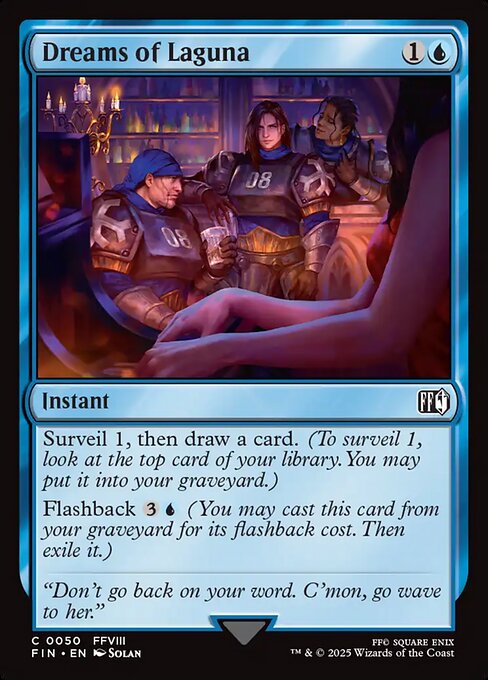
93. Dreams of Laguna
Rating6.2GoodWhy this rating?
Good playable that always makes the cut (6.2/10).
Why. A two-mana instant that surveils 1 then draws a card, with a four-mana Flashback. A clean cantrip that gives you two uses.
Risks. It does nothing to the board and costs tempo. The Flashback is pricey.
In the draft. A good common for blue spell decks. Take it after creatures and removal.
Results in the games of the set
When it is in hand, the deck wins 57.9% of its games (set average: 56.4%, 91st of 341 cards).
In the opening hand: 55.9% wins (55.2% on average).
Drawn during the game: 59.1% (57.2% on average).
When it is drawn, the deck wins 3.1 points more than when it is not.
When it is drafted, it is played 82% of the time (set average: 62%).
Taken as the first pick (267 drafts), it ends in the deck 96% of the time.
It is played mostly in R/U decks (73% of them) and G/U (62%).

94. Ice Magic
Rating6.2GoodWhy this rating?
Good playable that always makes the cut (6.2/10).
Why. A flexible tiered instant: for two mana, bounce a creature; for four, its owner puts it on the top or bottom of their library; for eight, they shuffle it in. Cheap tempo early, or a heavier answer late.
Risks. The first mode only bounces, and the second lets the owner choose the top of their library. The expensive modes are slow, and nothing here touches noncreature permanents.
In the draft. A good blue common that adapts to the game. Take it fairly high in a tempo deck.
Results in the games of the set
When it is in hand, the deck wins 58.2% of its games (set average: 56.4%, 78th of 341 cards).
In the opening hand: 54.5% wins (55.2% on average).
Drawn during the game: 60.5% (57.2% on average).
When it is drawn, the deck wins 3.5 points more than when it is not.
When it is drafted, it is played 89% of the time (set average: 62%).
Taken as the first pick (489 drafts), it ends in the deck 96% of the time.
It is played mostly in R/U decks (72% of them) and G/U (66%).
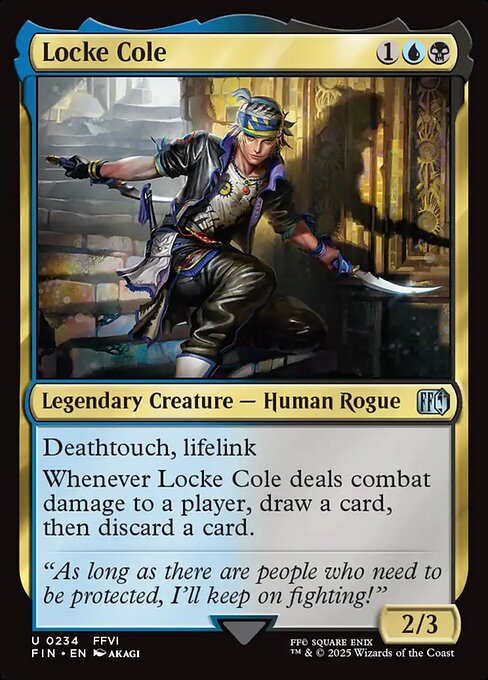
95. Locke Cole
Rating6.2GoodWhy this rating?
Good playable that always makes the cut (6.2/10).
Why. A 2/3 with deathtouch and lifelink for three: it blocks and attacks well. When it deals combat damage to a player, you draw then discard a card.
Risks. It is a blue-black gold card. It dies to removal and only deals 2 damage when it connects.
In the draft. A good blue-black three-drop, taken fairly high. It deters bigger attackers.
Results in the games of the set
When it is in hand, the deck wins 57.3% of its games (set average: 56.4%, 115th of 341 cards).
In the opening hand: 56.6% wins (55.2% on average).
Drawn during the game: 57.6% (57.2% on average).
When it is drawn, the deck wins 5.1 points more than when it is not.
When it is drafted, it is played 72% of the time (set average: 62%).
Taken as the first pick (124 drafts), it ends in the deck 89% of the time.
It is played mostly in B/U decks (40% of them).

96. Omega, Heartless Evolution
Rating6.2GoodWhy this rating?
Good playable that always makes the cut (6.2/10).
Why. An 8/8 for seven whose enter trigger taps an opposing nonland permanent, puts X stun counters on it and gains you X life, X being the nonbasic lands you control. With many nonbasic lands, the entry is strong.
Risks. It is a green-blue gold card costing seven. With few nonbasic lands X stays near zero, and it merely taps a permanent with no notable life gain.
In the draft. A niche green-blue finisher, taken if you have nonbasic lands. Otherwise it is an expensive 8/8.
Results in the games of the set
When it is in hand, the deck wins 57.9% of its games (set average: 56.4%, 90th of 341 cards).
In the opening hand: 52.9% wins (55.2% on average).
Drawn during the game: 60.9% (57.2% on average).
When it is drawn, the deck wins 5.4 points more than when it is not.
When it is drafted, it is played 67% of the time (set average: 62%).
Taken as the first pick (120 drafts), it ends in the deck 84% of the time.
It is played mostly in G/U decks (57% of them).
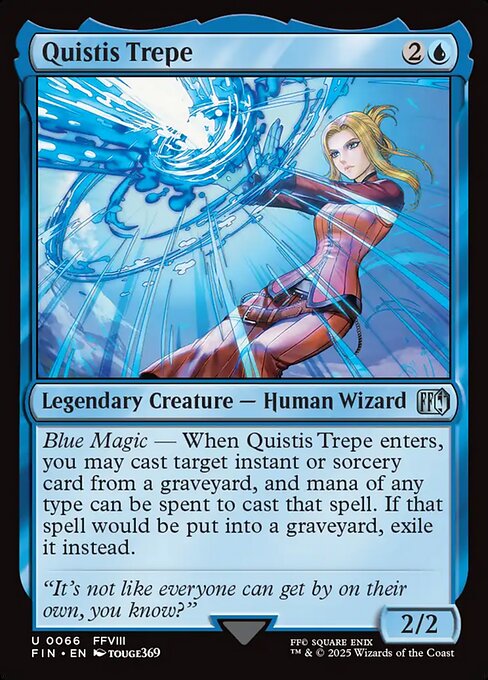
97. Quistis Trepe
Rating6.2GoodWhy this rating?
Good playable that always makes the cut (6.2/10).
Why. A 2/2 for three that, when it enters, lets you cast an instant or sorcery from any graveyard, paying with any type of mana. You can even cast an opponent's spell.
Risks. If no instant or sorcery is in a graveyard, it is a 2/2 for three. The spell is exiled afterward.
In the draft. A fine body in a blue spell deck, taken mid-pack. Best in a deck full of instants and sorceries.
Results in the games of the set
When it is in hand, the deck wins 55.9% of its games (set average: 56.4%, 151st of 341 cards).
In the opening hand: 51.1% wins (55.2% on average).
Drawn during the game: 58.8% (57.2% on average).
When it is drawn, the deck wins 2.4 points more than when it is not.
When it is drafted, it is played 88% of the time (set average: 62%).
Taken as the first pick (238 drafts), it ends in the deck 92% of the time.
It is played mostly in R/U decks (31% of them).

98. Rinoa Heartilly
Rating6.2GoodWhy this rating?
Good playable that always makes the cut (6.2/10).
Why. A 4/4 for five that arrives with a legendary 1/1 green and white Dog creature token. When it attacks, another creature you control gets +1/+1 for each creature you control.
Risks. It is a green-white gold card and costs five. The bonus needs other creatures, and it dies to removal.
In the draft. A good green-white five-drop, taken fairly high. Two bodies in one card.
Results in the games of the set
When it is in hand, the deck wins 57.1% of its games (set average: 56.4%, 117th of 341 cards).
In the opening hand: 56.2% wins (55.2% on average).
Drawn during the game: 57.8% (57.2% on average).
When it is drawn, the deck wins 3.4 points more than when it is not.
When it is drafted, it is played 59% of the time (set average: 62%).
Taken as the first pick (77 drafts), it ends in the deck 84% of the time.
It is played mostly in G/W decks (52% of them).
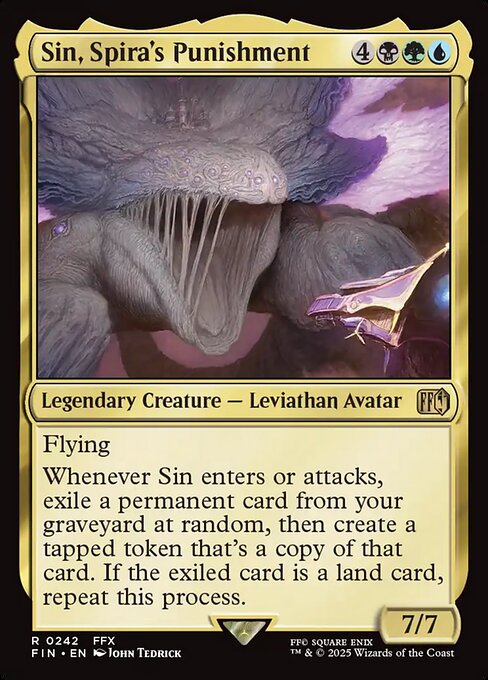 Rating6.2Good
Why this rating?
Good playable that always makes the cut (6.2/10).
Why. A 7/7 flier for seven. When it enters or attacks, a random permanent card from your graveyard is exiled and you create a tapped token copy of it; if it was a land, the process repeats. It takes over the game if it survives.
Risks. It is three colors and seven mana, so the mana is demanding. With an empty graveyard its trigger does nothing, and the exiled card is chosen at random.
In the draft. Play it only in a true three-color deck, such as blue-black-green. In a two-color base, do not take it high.
Results in the games of the set
When it is in hand, the deck wins 59.4% of its games (set average: 56.4%, 41st of 341 cards).
In the opening hand: 55.9% wins (55.2% on average).
Drawn during the game: 61.4% (57.2% on average).
When it is drawn, the deck wins 8.6 points more than when it is not.
When it is drafted, it is played 89% of the time (set average: 62%).
Taken as the first pick (136 drafts), it ends in the deck 87% of the time.
It is played about as much in every archetype.
 Rating6.2Good
Why this rating?
Good playable that always makes the cut (6.2/10).
Why. A Summon: a 3/3 flier that, on chapter I, deals 4 damage to a tapped creature an opponent controls. On chapters II and III, another creature you control gets +1/+0 and flying until end of turn. It combines removal and an aerial threat.
Risks. It is sacrificed after chapter III, so it does not stay long. Chapter I only hits a creature that is already tapped, so it is weak against a defensive opponent.
In the draft. A good white four-drop that does two things. Take it fairly high, especially against aggressive opponents.
Results in the games of the set
When it is in hand, the deck wins 56.7% of its games (set average: 56.4%, 129th of 341 cards).
In the opening hand: 55.4% wins (55.2% on average).
Drawn during the game: 57.6% (57.2% on average).
When it is drawn, the deck wins 1.7 points more than when it is not.
When it is drafted, it is played 77% of the time (set average: 62%).
Taken as the first pick (112 drafts), it ends in the deck 92% of the time.
It is played about as much in every archetype.

101. The Final Days
Rating6.2GoodWhy this rating?
Good playable that always makes the cut (6.2/10).
Why. Two tapped 2/2 Horror tokens for four mana is fine and no more. The real payoff comes later: cast from the graveyard with Flashback, it makes one token for each creature card in your graveyard.
Risks. The tokens enter tapped, so they do not block right away. Flashback costs six mana and is only strong once your graveyard holds a good number of creatures.
In the draft. A fair card for black decks that fill their graveyard. One copy is plenty; it gets better with cheap creatures that trade early.
Results in the games of the set
When it is in hand, the deck wins 56.6% of its games (set average: 56.4%, 131st of 341 cards).
In the opening hand: 54.4% wins (55.2% on average).
Drawn during the game: 58.0% (57.2% on average).
When it is drawn, the deck wins 1.6 points more than when it is not.
When it is drafted, it is played 71% of the time (set average: 62%).
Taken as the first pick (132 drafts), it ends in the deck 86% of the time.
It is played mostly in B/G decks (30% of them).
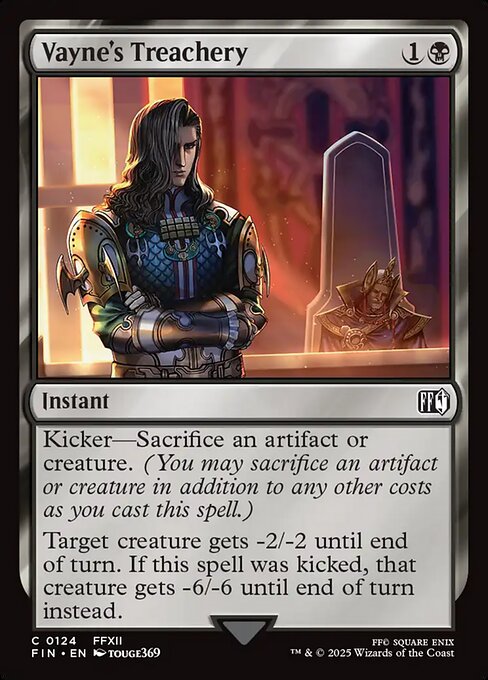
102. Vayne's Treachery
Rating6.2GoodWhy this rating?
Good playable that always makes the cut (6.2/10).
Why. A cheap removal: for two mana, -2/-2 at instant speed, enough to kill small creatures. Sacrifice an artifact or a creature and the target gets -6/-6 instead, which kills nearly anything.
Risks. Unkicked, it only kills small creatures. The kicker costs an artifact or a creature, so a card or a body.
In the draft. A solid pick among black commons. Look for tokens or low-value creatures to feed the kicker.
Results in the games of the set
When it is in hand, the deck wins 57.5% of its games (set average: 56.4%, 110th of 341 cards).
In the opening hand: 55.1% wins (55.2% on average).
Drawn during the game: 59.1% (57.2% on average).
When it is drawn, the deck wins 3.2 points more than when it is not.
When it is drafted, it is played 92% of the time (set average: 62%).
Taken as the first pick (682 drafts), it ends in the deck 95% of the time.
It is played mostly in B/W decks (62% of them) and B/G (59%).

103. White Mage's Staff
Rating6.2GoodWhy this rating?
Good playable that always makes the cut (6.2/10).
Why. For two mana, Job select gives you a 2/2 Hero right away that gains one life each time it attacks. It is a creature and an Equipment in one card, which is very efficient.
Risks. The Hero is still a fragile 2/2. If the token dies, the Equipment stays but costs three mana to re-attach, which is steep.
In the draft. A good white common for curve and aggro. Take it higher in decks with more Equipment or lifegain payoffs.
Results in the games of the set
When it is in hand, the deck wins 57.8% of its games (set average: 56.4%, 95th of 341 cards).
In the opening hand: 59.4% wins (55.2% on average).
Drawn during the game: 56.5% (57.2% on average).
When it is drawn, the deck wins 1.3 points more than when it is not.
When it is drafted, it is played 90% of the time (set average: 62%).
Taken as the first pick (417 drafts), it ends in the deck 96% of the time.
It is played mostly in U/W decks (75% of them) and B/W (72%).

104. Gaelicat
Rating6.2PlayableWhy this rating?
Good playable that always makes the cut (6.2/10).
Why. A 1/3 with flying and vigilance for three mana: it blocks well and attacks without exposing you. With two artifacts it becomes a 3/3 flyer, a real threat.
Risks. On its own it deals a single point per turn. The bonus relies on your artifacts, so it wants a deck built around them.
In the draft. A good white common in a deck with Equipment and Vehicles. Without artifacts it is playable but ordinary.
Results in the games of the set
When it is in hand, the deck wins 56.7% of its games (set average: 56.4%, 128th of 341 cards).
In the opening hand: 56.2% wins (55.2% on average).
Drawn during the game: 57.0% (57.2% on average).
When it is drawn, the deck wins 0.3 points less than when it is not.
When it is drafted, it is played 78% of the time (set average: 62%).
Taken as the first pick (237 drafts), it ends in the deck 93% of the time.
It is played mostly in U/W decks (69% of them) and R/W (68%).
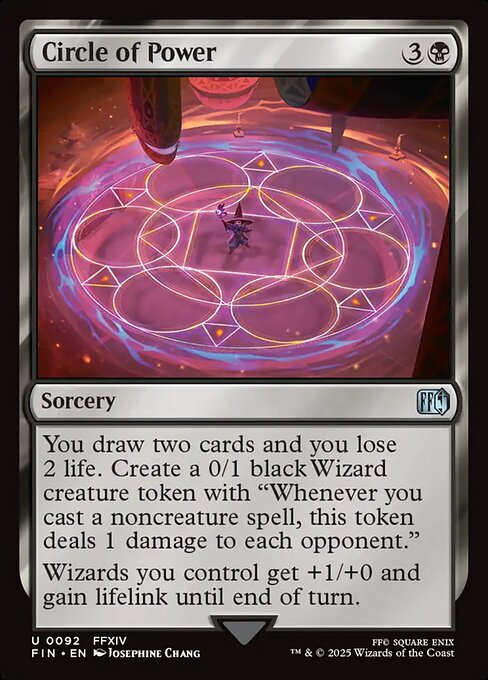
105. Circle of Power
Rating6.1PlayableWhy this rating?
Good playable that always makes the cut (6.1/10).
Why. A four-mana sorcery that draws two cards and makes a 0/1 Wizard that pings the opponent for each noncreature spell you cast. Wizards get +1/+0 and lifelink that turn. A lot of value in one card.
Risks. You lose two life and add almost nothing to the board against an aggressive opponent. The 0/1 Wizard dies to anything and only pays off in a deck full of noncreature spells.
In the draft. A good mid-pack pick for slower black decks with plenty of instants and sorceries. Weaker in an aggro deck.
Results in the games of the set
When it is in hand, the deck wins 57.5% of its games (set average: 56.4%, 111th of 341 cards).
In the opening hand: 55.1% wins (55.2% on average).
Drawn during the game: 59.0% (57.2% on average).
When it is drawn, the deck wins 3.7 points more than when it is not.
When it is drafted, it is played 79% of the time (set average: 62%).
Taken as the first pick (150 drafts), it ends in the deck 85% of the time.
It is played mostly in B/R decks (46% of them) and B/W (25%).

106. Magitek Armor
Rating6.0PlayableWhy this rating?
Good playable that always makes the cut (6.0/10).
Why. A 4/4 Vehicle for four mana with Crew 1 that comes with a 1/1 Hero. The Hero can crew it right away, so you get two bodies from one card.
Risks. If the Hero dies you need another creature to crew, and the Vehicle is vulnerable as an artifact. Crewing also taps a creature that could have attacked.
In the draft. A good white uncommon for decks that want artifacts and lots of small creatures. No need to take it very high, but it does its job.
Results in the games of the set
When it is in hand, the deck wins 57.1% of its games (set average: 56.4%, 116th of 341 cards).
In the opening hand: 57.6% wins (55.2% on average).
Drawn during the game: 56.8% (57.2% on average).
When it is drawn, the deck wins 0.5 points more than when it is not.
When it is drafted, it is played 78% of the time (set average: 62%).
Taken as the first pick (142 drafts), it ends in the deck 89% of the time.
It is played mostly in U/W decks (33% of them) and B/W (31%).

107. Al Bhed Salvagers
Rating6.0PlayableWhy this rating?
Good playable that always makes the cut (6.0/10).
Why. A decent 2/3 for three mana that drains one life whenever one of your creatures or artifacts dies, itself included. In a race those points add up.
Risks. It only works on deaths: without trades or sacrifices it does little. The body alone is below average for an uncommon.
In the draft. A fair pick for black decks with tokens, artifacts or sacrifice effects. Elsewhere it is mostly filler.
Results in the games of the set
When it is in hand, the deck wins 56.0% of its games (set average: 56.4%, 149th of 341 cards).
In the opening hand: 54.1% wins (55.2% on average).
Drawn during the game: 57.3% (57.2% on average).
When it is drawn, the deck wins 1.8 points more than when it is not.
When it is drafted, it is played 81% of the time (set average: 62%).
Taken as the first pick (136 drafts), it ends in the deck 86% of the time.
It is played mostly in B/W decks (32% of them) and B/R (27%).

108. Freya Crescent
Rating6.0PlayableWhy this rating?
Good playable that always makes the cut (6.0/10).
Why. A one-mana red 1/1 with flying during your turn that taps for red mana only for Equipment spells and equip abilities. In a deck packed with Equipment it makes equipping nearly free.
Risks. A 1/1 that dies to everything, and its mana only helps Equipment. Without them, it is a dead card.
In the draft. Play it only with several Equipment, especially in red-white. Otherwise leave it in the sideboard.
Results in the games of the set
When it is in hand, the deck wins 54.9% of its games (set average: 56.4%, 193rd of 341 cards).
In the opening hand: 58.0% wins (55.2% on average).
Drawn during the game: 52.6% (57.2% on average).
When it is drawn, the deck wins 0.3 points less than when it is not.
When it is drafted, it is played 47% of the time (set average: 62%).
Taken as the first pick (42 drafts), it ends in the deck 71% of the time.
It is played mostly in R/W decks (43% of them).
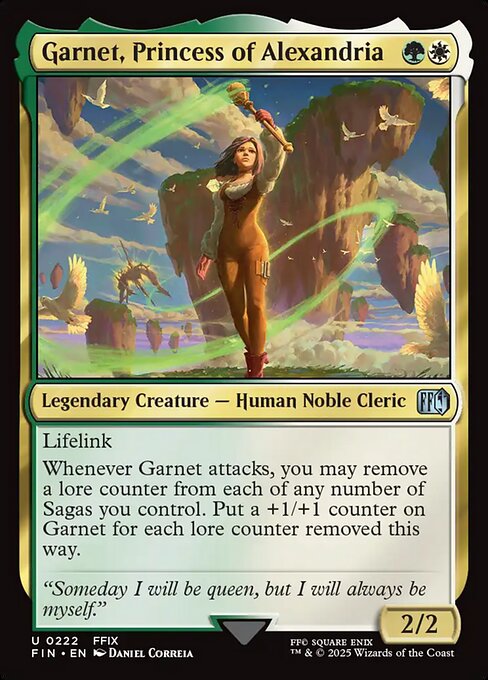
109. Garnet, Princess of Alexandria
Rating6.0PlayableWhy this rating?
Good playable that always makes the cut (6.0/10).
Why. A green-white gold 2/2 with lifelink for two mana. Each attack lets you remove lore counters from your Sagas to grow her with +1/+1 counters.
Risks. Without Sagas she is just a 2/2 lifelinker, which trades badly. She is locked into two colours, and removing lore counters shortens your Sagas.
In the draft. Play her in green-white if you have several Sagas, especially Summon ones. Otherwise treat her as a late pick.
Results in the games of the set
When it is in hand, the deck wins 55.7% of its games (set average: 56.4%, 160th of 341 cards).
In the opening hand: 57.0% wins (55.2% on average).
Drawn during the game: 54.7% (57.2% on average).
When it is drawn, the deck wins 1.0 points more than when it is not.
When it is drafted, it is played 46% of the time (set average: 62%).
Taken as the first pick (55 drafts), it ends in the deck 84% of the time.
It is played mostly in G/W decks (52% of them).

110. Gladiolus Amicitia
Rating6.0PlayableWhy this rating?
Good playable that always makes the cut (6.0/10).
Why. A six-mana 6/6 that fetches a land onto the battlefield tapped, then gives another of your creatures +2/+2 and trample whenever a land enters under your control. A big body and ramp in one card.
Risks. Six mana across two colours, and a legendary creature that dies to removal. Landfall does nothing without another creature, since it only targets others.
In the draft. A fair top-end red-green uncommon. Take it in a deck of big bodies that can trigger Landfall regularly.
Results in the games of the set
When it is in hand, the deck wins 57.5% of its games (set average: 56.4%, 107th of 341 cards).
In the opening hand: 53.8% wins (55.2% on average).
Drawn during the game: 59.9% (57.2% on average).
When it is drawn, the deck wins 5.4 points more than when it is not.
When it is drafted, it is played 70% of the time (set average: 62%).
Taken as the first pick (123 drafts), it ends in the deck 88% of the time.
It is played mostly in G/R decks (56% of them).

111. Magic Damper
Rating6.0PlayableWhy this rating?
Good playable that always makes the cut (6.0/10).
Why. For one blue mana: +1/+1, hexproof and an untap, at instant speed. It saves a creature from targeted removal, or untaps an attacker so it can block.
Risks. It is a protection spell: no target, no value, and if the opponent responds by killing the creature you lose a card. It does nothing against effects that do not target.
In the draft. A fine include in blue-red decks with creatures worth protecting. Do not take it over real threats or removal.
Results in the games of the set
When it is in hand, the deck wins 55.9% of its games (set average: 56.4%, 152nd of 341 cards).
In the opening hand: 53.1% wins (55.2% on average).
Drawn during the game: 57.6% (57.2% on average).
When it is drawn, the deck wins 2.5 points more than when it is not.
When it is drafted, it is played 32% of the time (set average: 62%).
Taken among the first three picks (138 drafts), it ends in the deck 63% of the time.
It is played mostly in R/U decks (30% of them).
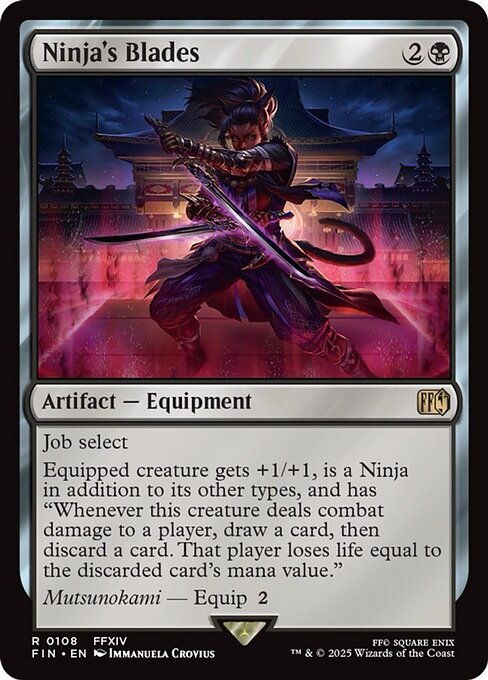
112. Ninja's Blades
Rating6.0PlayableWhy this rating?
Good playable that always makes the cut (6.0/10).
Why. A three-mana black Equipment that makes a 2/2 Ninja Hero with Job select. Each time it hits a player you loot, and the opponent loses life equal to the mana value of the discarded card.
Risks. The Hero is a fragile 2/2 and needs combat damage to connect. If the token dies, re-equipping costs two mana.
In the draft. A good rare for aggressive black decks with evasion. The more expensive cards you can pitch, the harder it hits.
Results in the games of the set
When it is in hand, the deck wins 57.6% of its games (set average: 56.4%, 103rd of 341 cards).
In the opening hand: 58.3% wins (55.2% on average).
Drawn during the game: 57.1% (57.2% on average).
When it is drawn, the deck wins 5.0 points more than when it is not.
When it is drafted, it is played 87% of the time (set average: 62%).
Taken as the first pick (99 drafts), it ends in the deck 92% of the time.
It is played about as much in every archetype.

113. Resentful Revelation
Rating6.0PlayableWhy this rating?
Good playable that always makes the cut (6.0/10).
Why. For two mana you look at three cards, keep one and put the other two in the graveyard. With Flashback you can cast it again for seven mana late in the game.
Risks. It does nothing on the board and slows you down. The other two cards go to the graveyard, so you can lose a good card there.
In the draft. A good common for black decks that care about the graveyard and card selection. Take it after your removal and solid creatures.
Results in the games of the set
When it is in hand, the deck wins 57.8% of its games (set average: 56.4%, 93rd of 341 cards).
In the opening hand: 56.3% wins (55.2% on average).
Drawn during the game: 59.0% (57.2% on average).
When it is drawn, the deck wins 3.0 points more than when it is not.
When it is drafted, it is played 75% of the time (set average: 62%).
Taken as the first pick (228 drafts), it ends in the deck 90% of the time.
It is played mostly in B/R decks (69% of them) and B/G (64%).

114. Summon: Fat Chocobo
Rating6.0PlayableWhy this rating?
Good playable that always makes the cut (6.0/10).
Why. A green 4/4 for five mana that immediately creates a 2/2 Bird token, which gets +1/+0 whenever a land enters. The later chapters give your creatures trample: two bodies and a big attack within a few turns.
Risks. Like any Summon, it is sacrificed after its last chapter, so you keep only the token. It also dies to removal, leaving you just the 2/2 Bird.
In the draft. A solid green common. Take it in decks that want strong, short bursts of pressure.
Results in the games of the set
When it is in hand, the deck wins 57.7% of its games (set average: 56.4%, 101st of 341 cards).
In the opening hand: 56.0% wins (55.2% on average).
Drawn during the game: 58.8% (57.2% on average).
When it is drawn, the deck wins 3.8 points more than when it is not.
When it is drafted, it is played 87% of the time (set average: 62%).
Taken as the first pick (379 drafts), it ends in the deck 95% of the time.
It is played mostly in G/W decks (74% of them) and G/R (70%).

115. Summon: Shiva
Rating6.0PlayableWhy this rating?
Good playable that always makes the cut (6.0/10).
Why. A 4/5 for five mana whose first two chapters tap an opposing creature and give it a stun counter. At chapter three you draw a card for each tapped creature your opponents control.
Risks. It is sacrificed after chapter three, so the effect is temporary. The final draw depends on how many opposing creatures are tapped at that point.
In the draft. A good blue uncommon for tempo decks. Take it in decks that want to neutralise attackers while pressing.
Results in the games of the set
When it is in hand, the deck wins 56.5% of its games (set average: 56.4%, 134th of 341 cards).
In the opening hand: 53.1% wins (55.2% on average).
Drawn during the game: 58.5% (57.2% on average).
When it is drawn, the deck wins 3.0 points more than when it is not.
When it is drafted, it is played 86% of the time (set average: 62%).
Taken as the first pick (197 drafts), it ends in the deck 93% of the time.
It is played mostly in R/U decks (25% of them).
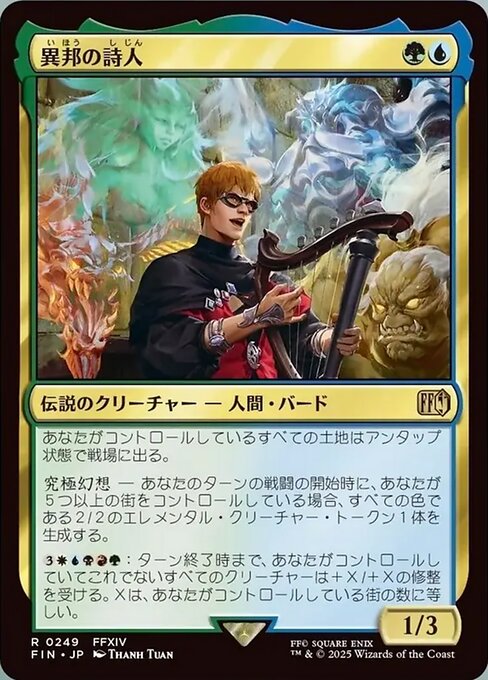 Rating6.0Playable
Why this rating?
Good playable that always makes the cut (6.0/10).
Why. A 1/3 for two mana that makes your lands enter untapped. Everything else needs five Towns: at the beginning of combat on your turn you then get a 2/2 Elemental token of all colours. The five-colour ability is too costly in practice.
Risks. Without several Towns it is just a 1/3 with little impact. The ability's cost needs all five colours, which is almost never realistic.
In the draft. Avoid it unless you have plenty of Towns. In most decks it is not worth a slot.
Results in the games of the set
When it is in hand, the deck wins 55.7% of its games (set average: 56.4%, 161st of 341 cards).
In the opening hand: 51.7% wins (55.2% on average).
Drawn during the game: 58.2% (57.2% on average).
When it is drawn, the deck wins 6.7 points more than when it is not.
When it is drafted, it is played 54% of the time (set average: 62%).
Taken as the first pick (52 drafts), it ends in the deck 67% of the time.
It is played mostly in G/U decks (30% of them).

117. Weapons Vendor
Rating6.0PlayableWhy this rating?
Good playable that always makes the cut (6.0/10).
Why. A 2/2 for four mana that draws a card on entering, so it replaces itself. At the beginning of combat on your turn you can pay one mana to move an Equipment onto a creature, making equipping cheap.
Risks. A 2/2 for four is a small body. Without Equipment it is just a cantrip, and you pay for it in tempo.
In the draft. A fair common in decks with several Equipment, particularly white-red. Elsewhere it is a simple mid-curve pick.
Results in the games of the set
When it is in hand, the deck wins 55.4% of its games (set average: 56.4%, 172nd of 341 cards).
In the opening hand: 54.5% wins (55.2% on average).
Drawn during the game: 56.1% (57.2% on average).
When it is drawn, the deck wins 1.6 points less than when it is not.
When it is drafted, it is played 64% of the time (set average: 62%).
Taken as the first pick (146 drafts), it ends in the deck 84% of the time.
It is played mostly in R/W decks (76% of them) and U/W (57%).

118. Zanarkand, Ancient Metropolis // Lasting Fayth
Rating6.0PlayableWhy this rating?
Good playable that always makes the cut (6.0/10).
Why. A Town land that enters tapped and taps for green mana, with an Adventure side: for six mana, a Hero token with a +1/+1 counter for each land you control. You can then play the land from exile, so nothing is lost.
Risks. The Adventure costs six mana and gives you a single body. The land enters tapped, which slows you down a bit.
In the draft. A fair pick for any deck with green: a land slot that turns into a late-game threat. It fits in almost every green deck.
Results in the games of the set
When it is in hand, the deck wins 56.2% of its games (set average: 56.4%, 142nd of 341 cards).
In the opening hand: 54.0% wins (55.2% on average).
Drawn during the game: 57.7% (57.2% on average).
When it is drawn, the deck wins 1.4 points more than when it is not.
When it is drafted, it is played 85% of the time (set average: 62%).
Taken as the first pick (74 drafts), it ends in the deck 93% of the time.

119. Aerith Gainsborough
Rating6.0PlayableWhy this rating?
Good playable that always makes the cut (6.0/10).
Why. A 2/2 lifelinker for three mana that gets a +1/+1 counter whenever you gain life. Her own lifelink counts, so she grows once she deals damage. When she dies, each of your legendary creatures gets as many counters as she had.
Risks. She is still a 2/2 that dies to cheap removal before she grows. The death effect only touches legendary creatures, which is rarely useful.
In the draft. A fair pick for white decks with lifegain. Take her if you have several ways to gain life.
Results in the games of the set
When it is in hand, the deck wins 55.2% of its games (set average: 56.4%, 180th of 341 cards).
In the opening hand: 55.6% wins (55.2% on average).
Drawn during the game: 54.9% (57.2% on average).
When it is drawn, the deck wins 1.0 points more than when it is not.
When it is drafted, it is played 80% of the time (set average: 62%).
Taken as the first pick (65 drafts), it ends in the deck 78% of the time.
It is played about as much in every archetype.

120. Syncopate
Rating5.9PlayableWhy this rating?
Good playable that always makes the cut (5.9/10).
Why. A flexible counterspell for one blue mana plus X: the opponent must pay X or the spell is countered and exiled. Late in the game it stops almost anything, especially expensive spells.
Risks. You must hold mana open, which costs tempo. An opponent with spare mana can simply pay. It only answers spells.
In the draft. A good include for blue-red and tempo decks that play on the opponent's turn. Less valuable in an aggro deck.
Results in the games of the set
When it is in hand, the deck wins 57.5% of its games (set average: 56.4%, 105th of 341 cards).
In the opening hand: 56.6% wins (55.2% on average).
Drawn during the game: 58.1% (57.2% on average).
When it is drawn, the deck wins 3.5 points more than when it is not.
When it is drafted, it is played 68% of the time (set average: 62%).
Taken as the first pick (121 drafts), it ends in the deck 87% of the time.
It is played mostly in R/U decks (58% of them) and G/U (47%).
121. Hecteyes
Rating5.8PlayableWhy this rating?
Good playable that always makes the cut (5.8/10).
Why. A 1/1 for two mana that makes each opponent discard a card. That trades card for card and leaves a body to chump or sacrifice.
Risks. A 1/1 is a very weak body, and the opponent chooses the discard, so they pitch their worst card. Against an empty hand it is just a 1/1.
In the draft. A filler pick for black decks, to take after the cards that matter. It mostly serves to fill out the curve.
Results in the games of the set
When it is in hand, the deck wins 56.0% of its games (set average: 56.4%, 147th of 341 cards).
In the opening hand: 55.5% wins (55.2% on average).
Drawn during the game: 56.4% (57.2% on average).
When it is drawn, the deck wins 1.2 points more than when it is not.
When it is drafted, it is played 80% of the time (set average: 62%).
Taken as the first pick (225 drafts), it ends in the deck 91% of the time.
It is played mostly in B/G decks (73% of them) and B/W (66%).
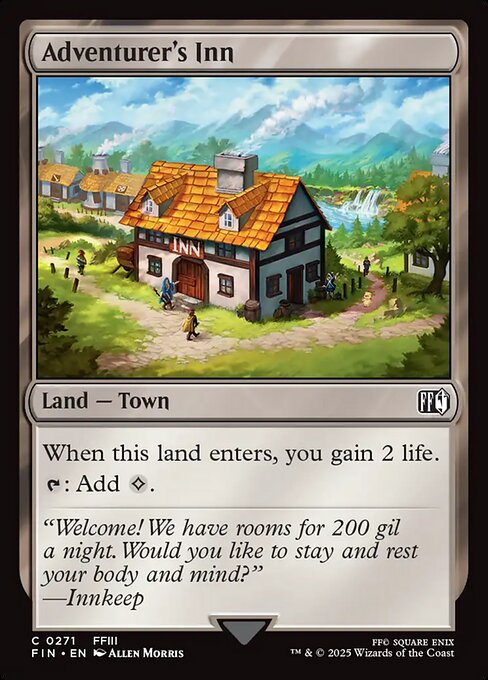
122. Adventurer's Inn
Rating5.8PlayableWhy this rating?
Good playable that always makes the cut (5.8/10).
Why. A colourless Town land that gains you two life on entering. It does not fix anything: it only offers lifegain and Town synergies.
Risks. It taps for colourless mana, which can hurt your coloured spells in a two-colour deck. Two life rarely changes the game.
In the draft. Play it only in a deck that counts Towns, or as a last land slot. Do not take it over a real card.
Results in the games of the set
When it is in hand, the deck wins 55.0% of its games (set average: 56.4%, 192nd of 341 cards).
In the opening hand: 52.7% wins (55.2% on average).
Drawn during the game: 56.4% (57.2% on average).
When it is drawn, the deck wins 2.1 points more than when it is not.
When it is drafted, it is played 15% of the time (set average: 62%).
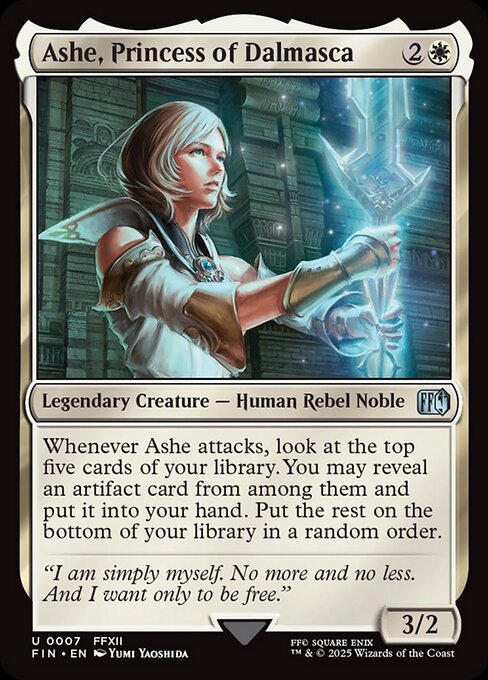
123. Ashe, Princess of Dalmasca
Rating5.8PlayableWhy this rating?
Good playable that always makes the cut (5.8/10).
Why. A 3/2 for three mana that looks at the top five cards each time it attacks and can take an artifact. In an artifact deck it provides repeated value.
Risks. A 3/2 dies easily, and attacking exposes it. Without many artifacts the trigger rarely finds a target.
In the draft. A fair pick for white decks with plenty of artifacts. Otherwise it is an ordinary three-mana attacker.
Results in the games of the set
When it is in hand, the deck wins 54.7% of its games (set average: 56.4%, 197th of 341 cards).
In the opening hand: 55.7% wins (55.2% on average).
Drawn during the game: 53.9% (57.2% on average).
When it is drawn, the deck wins 1.5 points less than when it is not.
When it is drafted, it is played 71% of the time (set average: 62%).
Taken as the first pick (66 drafts), it ends in the deck 86% of the time.
It is played mostly in R/W decks (26% of them) and U/W (26%).

124. Choco, Seeker of Paradise
Rating5.8PlayableWhy this rating?
Good playable that always makes the cut (5.8/10).
Why. A three-colour 3/5 for four mana. When Birds attack, it looks at that many cards from the top of your library, keeps one, puts lands of your choice onto the battlefield tapped and the rest into the graveyard. A solid body that generates value.
Risks. It needs green, white and blue, so the cost is hard to assemble. Alone it sees only one card, and its Landfall bonus is tiny.
In the draft. Play it only if you are already in all three colours, which is rare. Otherwise let it go.
Results in the games of the set
When it is in hand, the deck wins 55.0% of its games (set average: 56.4%, 188th of 341 cards).
In the opening hand: 55.3% wins (55.2% on average).
Drawn during the game: 54.8% (57.2% on average).
When it is drawn, the deck wins 4.4 points more than when it is not.
When it is drafted, it is played 58% of the time (set average: 62%).
Taken as the first pick (63 drafts), it ends in the deck 70% of the time.
It is played about as much in every archetype.

125. Chocobo Kick
Rating5.8PlayableWhy this rating?
Good playable that always makes the cut (5.8/10).
Why. A two-mana green removal sorcery: your creature deals damage equal to its power to an opposing creature, taking nothing back. With the kicker (return a land to hand) the damage doubles, which can kill even a big creature.
Risks. You need a creature with good power, or the spell does very little. The kicker costs you a land to replay. If your creature dies in response, the spell fizzles.
In the draft. A good common removal for green decks with big bodies. Take it high if you already have several powerful creatures.
Results in the games of the set
When it is in hand, the deck wins 57.5% of its games (set average: 56.4%, 108th of 341 cards).
In the opening hand: 54.3% wins (55.2% on average).
Drawn during the game: 59.7% (57.2% on average).
When it is drawn, the deck wins 3.1 points more than when it is not.
When it is drafted, it is played 87% of the time (set average: 62%).
Taken as the first pick (329 drafts), it ends in the deck 94% of the time.
It is played mostly in G/R decks (70% of them) and G/U (70%).
 Rating5.8Playable
Why this rating?
Good playable that always makes the cut (5.8/10).
Why. A 4/4 white-blue gold card for four mana. Artifact creatures and Heroes you control get +1/+1 for each Artificer you control and each Artificer card in your graveyard. It can also be cycled for two mana.
Risks. The bonus only affects artifact creatures and Heroes, not Cid himself. In a deck without them it is a vanilla 4/4. Two specific colours.
In the draft. A fair pick for white-blue with Heroes or artifact creatures. The cycling keeps it playable in any deck in those colours.
Results in the games of the set
When it is in hand, the deck wins 55.5% of its games (set average: 56.4%, 166th of 341 cards).
In the opening hand: 54.2% wins (55.2% on average).
Drawn during the game: 56.5% (57.2% on average).
When it is drawn, the deck wins 1.5 points more than when it is not.
When it is drafted, it is played 52% of the time (set average: 62%).
Taken as the first pick (60 drafts), it ends in the deck 83% of the time.
It is played mostly in U/W decks (50% of them).
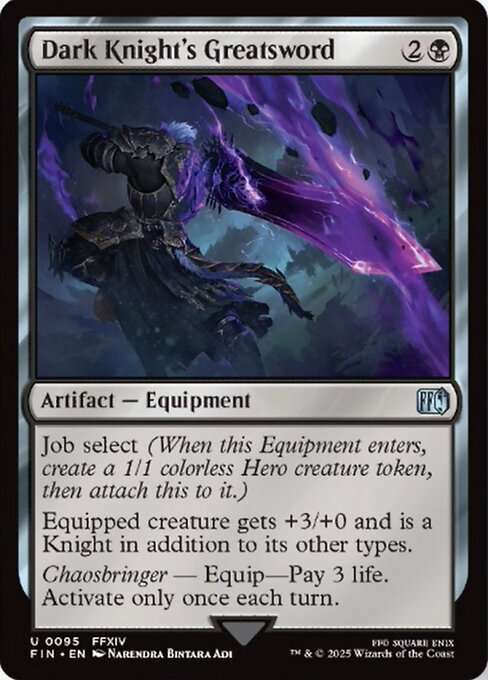 Rating5.8Playable
Why this rating?
Good playable that always makes the cut (5.8/10).
Why. For three mana, Job select creates a Hero that gets +3/+0: a 4/1 Knight right away. Equipping costs three life, once each turn, so you can move it without spending mana.
Risks. The 4/1 Hero dies to anything, and each equip costs three life. Against an aggressive opponent, that life matters.
In the draft. A fair pick for aggressive black decks, especially black-white. Avoid it in slow decks where life matters.
Results in the games of the set
When it is in hand, the deck wins 55.8% of its games (set average: 56.4%, 157th of 341 cards).
In the opening hand: 55.2% wins (55.2% on average).
Drawn during the game: 56.1% (57.2% on average).
When it is drawn, the deck wins 1.8 points more than when it is not.
When it is drafted, it is played 72% of the time (set average: 62%).
Taken as the first pick (75 drafts), it ends in the deck 84% of the time.
It is played mostly in B/W decks (27% of them).

128. Evil Reawakened
Rating5.8PlayableWhy this rating?
Good playable that always makes the cut (5.8/10).
Why. A five-mana reanimation sorcery that returns a creature card from your graveyard with two extra +1/+1 counters. You get your best creature back, bigger than before.
Risks. Five mana for a card that does nothing without a creature in the graveyard. It is slow and depends on your graveyard, so it is often awkward in hand.
In the draft. A fair pick in black-green or decks with big creatures. Do not play it without good targets.
Results in the games of the set
When it is in hand, the deck wins 57.0% of its games (set average: 56.4%, 119th of 341 cards).
In the opening hand: 53.9% wins (55.2% on average).
Drawn during the game: 59.1% (57.2% on average).
When it is drawn, the deck wins 3.9 points more than when it is not.
When it is drafted, it is played 85% of the time (set average: 62%).
Taken as the first pick (204 drafts), it ends in the deck 90% of the time.
It is played mostly in B/G decks (29% of them) and B/W (26%).

129. Jecht, Reluctant Guardian // Braska's Final Aeon
Rating5.8PlayableWhy this rating?
Good playable that always makes the cut (5.8/10).
Why. A 4/3 with menace for four mana. When he hurts a player you may transform him into a Saga: two chapters of opposing discard and draw, then the opponent sacrifices two creatures. Strong if it connects.
Risks. If Jecht does not deal combat damage to a player, he is an ordinary 4/3. The Saga is sacrificed after its last chapter, so you lose the creature.
In the draft. A good black rare for an attacking deck. Take it in decks that can push damage through with evasion.
Results in the games of the set
When it is in hand, the deck wins 56.3% of its games (set average: 56.4%, 140th of 341 cards).
In the opening hand: 55.4% wins (55.2% on average).
Drawn during the game: 56.9% (57.2% on average).
When it is drawn, the deck wins 3.4 points more than when it is not.
When it is drafted, it is played 93% of the time (set average: 62%).
Taken as the first pick (125 drafts), it ends in the deck 92% of the time.
It is played about as much in every archetype.

130. PuPu UFO
Rating5.8PlayableWhy this rating?
Good playable that always makes the cut (5.8/10).
Why. A 0/4 artifact flyer for two mana that blocks well in the air. It can also put a land from your hand onto the battlefield, and for three mana its base power becomes your Town count.
Risks. It has no offence without many Towns and costs three mana to get any. Dropping lands by tapping it is slow and needs lands in hand.
In the draft. A fair pick for a deck with Towns. Otherwise it is a cheap air blocker.
Results in the games of the set
When it is in hand, the deck wins 56.0% of its games (set average: 56.4%, 145th of 341 cards).
In the opening hand: 55.1% wins (55.2% on average).
Drawn during the game: 56.7% (57.2% on average).
When it is drawn, the deck wins 3.8 points more than when it is not.
When it is drafted, it is played 55% of the time (set average: 62%).
Taken among the first three picks (160 drafts), it ends in the deck 83% of the time.
It is played mostly in G/U decks (26% of them).
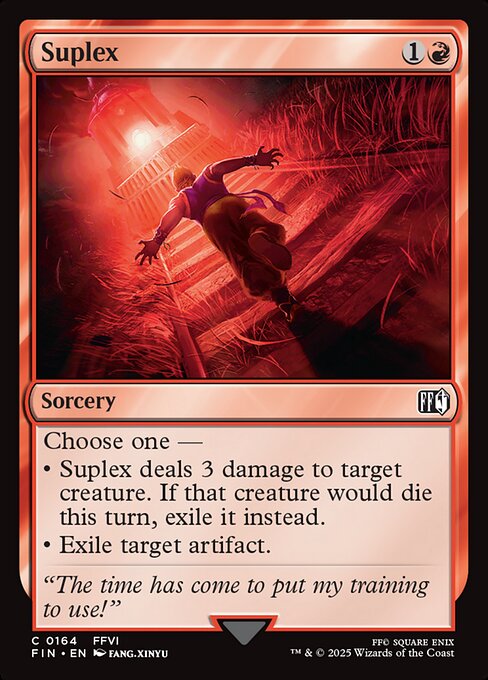
131. Suplex
Rating5.8PlayableWhy this rating?
Good playable that always makes the cut (5.8/10).
Why. A two-mana red removal: three damage to a creature (exiled if it would die), or exile an artifact. It kills most small and medium creatures for a modest price.
Risks. Three damage will not kill big creatures, and as a sorcery it cannot be used in response to anything. It does not solve an opponent who simply plays bigger.
In the draft. A solid pick for any red deck. Take it over most average creatures, especially in blue-red.
Results in the games of the set
When it is in hand, the deck wins 56.8% of its games (set average: 56.4%, 123rd of 341 cards).
In the opening hand: 54.9% wins (55.2% on average).
Drawn during the game: 58.1% (57.2% on average).
When it is drawn, the deck wins 2.6 points more than when it is not.
When it is drafted, it is played 90% of the time (set average: 62%).
Taken as the first pick (457 drafts), it ends in the deck 96% of the time.
It is played mostly in B/R decks (60% of them) and R/U (60%).

132. Tonberry
Rating5.8PlayableWhy this rating?
Good playable that always makes the cut (5.8/10).
Why. A 2/1 for a single black mana. During your turn it has first strike and deathtouch, so nothing blocks it well. Once untapped it is a very cheap attacker.
Risks. It enters tapped with a stun counter, so it cannot attack for two turns. It dies to anything on the opponent's turn, and its keywords do nothing on defence.
In the draft. A fair pick for aggressive black decks. Less good in slow decks that want to block.
Results in the games of the set
When it is in hand, the deck wins 55.1% of its games (set average: 56.4%, 185th of 341 cards).
In the opening hand: 59.3% wins (55.2% on average).
Drawn during the game: 52.0% (57.2% on average).
When it is drawn, the deck wins 1.6 points more than when it is not.
When it is drafted, it is played 65% of the time (set average: 62%).
Taken as the first pick (70 drafts), it ends in the deck 87% of the time.
It is played about as much in every archetype.

133. Ultima
Rating5.8PlayableWhy this rating?
Good playable that always makes the cut (5.8/10).
Why. A five-mana sweeper that destroys all artifacts and creatures, then ends the turn. In a slow deck that is behind on the board, it resets the game.
Risks. It destroys your own creatures and artifacts too, and only helps when you are behind. It is poor in a creature deck.
In the draft. A control pick, only for decks that can win after the sweep. Otherwise do not take it high.
Results in the games of the set
When it is in hand, the deck wins 55.2% of its games (set average: 56.4%, 183rd of 341 cards).
In the opening hand: 52.7% wins (55.2% on average).
Drawn during the game: 56.8% (57.2% on average).
When it is drawn, the deck wins 3.1 points more than when it is not.
When it is drafted, it is played 66% of the time (set average: 62%).
Taken as the first pick (49 drafts), it ends in the deck 78% of the time.
It is played about as much in every archetype.

134. You're Not Alone
Rating5.8PlayableWhy this rating?
Good playable that always makes the cut (5.8/10).
Why. For one white mana: +2/+2 at instant speed, or +4/+4 if you control three or more creatures. It swings a combat or saves a creature from damage-based removal.
Risks. It is a combat trick: if the opponent responds by killing the target you lose a card. It does little in a deck short on creatures.
In the draft. A fair pick for white aggro decks with many small creatures. Do not take it over your removal.
Results in the games of the set
When it is in hand, the deck wins 56.1% of its games (set average: 56.4%, 143rd of 341 cards).
In the opening hand: 55.1% wins (55.2% on average).
Drawn during the game: 56.9% (57.2% on average).
When it is drawn, the deck wins 1.1 points less than when it is not.
When it is drafted, it is played 47% of the time (set average: 62%).
Taken as the first pick (47 drafts), it ends in the deck 81% of the time.
It is played mostly in R/W decks (60% of them) and U/W (44%).

135. Zell Dincht
Rating5.8PlayableWhy this rating?
Good playable that always makes the cut (5.8/10).
Why. A 0/3 for three that gets +1/+0 for each land, so with four or five lands it already hits hard. The extra land drop each turn speeds up your development.
Risks. At your end step it bounces a land to your hand, so you keep replaying lands and your mana does not grow normally. It dies to removal and stays small while you have few lands.
In the draft. A fine playable in a red deck with a solid curve. Take it after your removal and your better creatures.
Results in the games of the set
When it is in hand, the deck wins 55.6% of its games (set average: 56.4%, 165th of 341 cards).
In the opening hand: 56.8% wins (55.2% on average).
Drawn during the game: 54.6% (57.2% on average).
When it is drawn, the deck wins 2.7 points more than when it is not.
When it is drafted, it is played 63% of the time (set average: 62%).
Taken as the first pick (37 drafts), it ends in the deck 78% of the time.
It is played about as much in every archetype.

136. Scorpion Sentinel
Rating5.8PlayableWhy this rating?
Good playable that always makes the cut (5.8/10).
Why. A 1/4 for two that walls small creatures early, then becomes a 4/4 once you control seven lands. A solid early play that stays relevant late.
Risks. Seven lands is a lot: most of the time it is a wall that does not attack. On its own it does not win games.
In the draft. A good mid-pack common for a defensive or controlling blue deck. Take it without hurry, after removal and evasive threats.
Results in the games of the set
When it is in hand, the deck wins 56.0% of its games (set average: 56.4%, 148th of 341 cards).
In the opening hand: 54.8% wins (55.2% on average).
Drawn during the game: 56.8% (57.2% on average).
When it is drawn, the deck wins 1.6 points more than when it is not.
When it is drafted, it is played 74% of the time (set average: 62%).
Taken as the first pick (137 drafts), it ends in the deck 91% of the time.
It is played mostly in U/W decks (57% of them) and G/U (49%).

137. Travel the Overworld
Rating5.7PlayableWhy this rating?
Good playable that always makes the cut (5.7/10).
Why. Drawing four cards is a big value effect, and each Town you control makes it cost one less. In a deck with several Towns it becomes a four- or five-mana sorcery that refills your hand in a slow game.
Risks. Without Towns, seven mana is too slow, and it does nothing to the board. It is poor against aggressive decks.
In the draft. A good top-end pick if you already have a few Towns. The set's Town lands count, so pick them up along the way.
Results in the games of the set
When it is in hand, the deck wins 56.6% of its games (set average: 56.4%, 130th of 341 cards).
In the opening hand: 53.1% wins (55.2% on average).
Drawn during the game: 58.7% (57.2% on average).
When it is drawn, the deck wins 4.8 points more than when it is not.
When it is drafted, it is played 63% of the time (set average: 62%).
Taken as the first pick (102 drafts), it ends in the deck 82% of the time.
It is played mostly in G/U decks (49% of them).
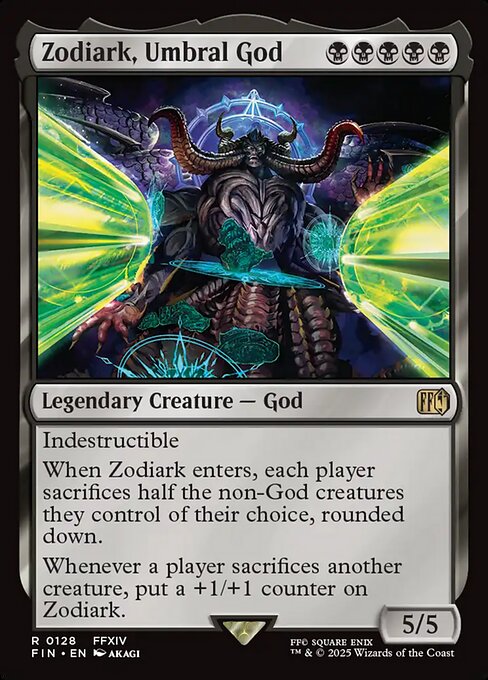
138. Zodiark, Umbral God
Rating5.7PlayableWhy this rating?
Good playable that always makes the cut (5.7/10).
Why. A 5/5 indestructible for five black mana. When it enters, each player sacrifices half their non-God creatures, rounded down, and it grows whenever another creature is sacrificed. In a near mono-black deck it can sweep a wider board than yours.
Risks. Five black mana demands a nearly mono-black deck. The sacrifice hits you too, and against a single opposing creature nothing is sacrificed.
In the draft. Play it only if you are heavily black. Otherwise pass it: it is too demanding for a regular two-colour deck.
Results in the games of the set
When it is in hand, the deck wins 54.1% of its games (set average: 56.4%, 218th of 341 cards).
In the opening hand: 51.0% wins (55.2% on average).
Drawn during the game: 56.1% (57.2% on average).
When it is drawn, the deck wins 3.0 points more than when it is not.
When it is drafted, it is played 48% of the time (set average: 62%).
Taken among the first three picks (117 drafts), it ends in the deck 76% of the time.
It is played about as much in every archetype.

139. Cargo Ship
Rating5.6PlayableWhy this rating?
Good playable that always makes the cut (5.6/10).
Why. A 2/3 Vehicle with flying and vigilance for two mana and crew 1, so any small creature can pilot it. It also taps for colorless mana usable only on artifacts, which helps an artifact deck.
Risks. Without a creature to crew it, it can neither attack nor block and only makes mana. That mana is limited to artifacts.
In the draft. A good turn-two play in a blue deck with many small creatures or artifacts. White-blue uses it best.
Results in the games of the set
When it is in hand, the deck wins 54.5% of its games (set average: 56.4%, 203rd of 341 cards).
In the opening hand: 54.9% wins (55.2% on average).
Drawn during the game: 54.2% (57.2% on average).
When it is drawn, the deck wins 1.8 points more than when it is not.
When it is drafted, it is played 40% of the time (set average: 62%).
Taken as the first pick (47 drafts), it ends in the deck 79% of the time.
It is played mostly in U/W decks (37% of them).

140. Coeurl
Rating5.6PlayableWhy this rating?
Good playable that always makes the cut (5.6/10).
Why. A 2/2 for two that can tap a target nonenchantment creature for two mana each turn. It is a pseudo-removal that neutralizes an attacker or a blocker, usable all game long.
Risks. Each activation costs two mana and taps Coeurl itself, so it never attacks. It is fragile to removal and cannot target enchantment creatures.
In the draft. A good common for a controlling or tempo white deck. A decent pick after your best removal.
Results in the games of the set
When it is in hand, the deck wins 53.9% of its games (set average: 56.4%, 224th of 341 cards).
In the opening hand: 54.0% wins (55.2% on average).
Drawn during the game: 53.8% (57.2% on average).
When it is drawn, the deck wins 1.5 points less than when it is not.
When it is drafted, it is played 36% of the time (set average: 62%).
Taken among the first three picks (160 drafts), it ends in the deck 65% of the time.
It is played mostly in R/W decks (34% of them) and B/W (30%).

141. Demon Wall
Rating5.6PlayableWhy this rating?
Good playable that always makes the cut (5.6/10).
Why. A 3/3 menace for two that starts with defender but can attack once it has a counter. Six mana adds two +1/+1 counters, turning it into a 5/5 menace that is hard to block.
Risks. It does nothing offensively until you have six mana to spend, and it stays a wall until then. The activation is expensive.
In the draft. A good early blocker and a late mana sink. Take it in a black deck that plays a ground game, but not ahead of your removal.
Results in the games of the set
When it is in hand, the deck wins 54.8% of its games (set average: 56.4%, 195th of 341 cards).
In the opening hand: 53.0% wins (55.2% on average).
Drawn during the game: 56.1% (57.2% on average).
When it is drawn, the deck wins 1.2 points more than when it is not.
When it is drafted, it is played 78% of the time (set average: 62%).
Taken as the first pick (98 drafts), it ends in the deck 90% of the time.
It is played about as much in every archetype.

142. Eden, Seat of the Sanctum
Rating5.6PlayableWhy this rating?
Good playable that always makes the cut (5.6/10).
Why. A colorless land that, for five mana and tapping it, mills two cards and can then be sacrificed to return another permanent card from your graveyard to your hand. It is late-game value that does not take a spell slot.
Risks. It only makes colorless mana and does not fix your colors. Five mana plus tapping the land is slow and costly, and you lose a land if you sacrifice it.
In the draft. Play it as a land slot in a slow deck with valuable permanents. Never take it over a good creature.
Results in the games of the set
When it is in hand, the deck wins 55.4% of its games (set average: 56.4%, 171st of 341 cards).
In the opening hand: 54.0% wins (55.2% on average).
Drawn during the game: 56.4% (57.2% on average).
When it is drawn, the deck wins 1.0 points more than when it is not.
When it is drafted, it is played 42% of the time (set average: 62%).
Taken among the first three picks (38 drafts), it ends in the deck 82% of the time.

143. Gaius van Baelsar
Rating5.6PlayableWhy this rating?
Good playable that always makes the cut (5.6/10).
Why. A 3/2 for four that, when it enters, makes each player sacrifice a creature token, a nontoken creature, or an enchantment, as you choose. It is a conditional removal that also costs you.
Risks. Each player sacrifices, so if Gaius is your only nontoken creature it sacrifices itself. Against several creatures the opponent gives up the worst.
In the draft. A good flexible removal in a black deck with few creatures or with tokens. Take it after your clean removal.
Results in the games of the set
When it is in hand, the deck wins 54.8% of its games (set average: 56.4%, 196th of 341 cards).
In the opening hand: 52.7% wins (55.2% on average).
Drawn during the game: 56.2% (57.2% on average).
When it is drawn, the deck wins 1.0 points more than when it is not.
When it is drafted, it is played 76% of the time (set average: 62%).
Taken as the first pick (90 drafts), it ends in the deck 83% of the time.
It is played mostly in B/W decks (27% of them).
 Rating5.6Playable
Why this rating?
Good playable that always makes the cut (5.6/10).
Why. A 2/4 for three that taps to copy one of your activated or triggered abilities X times, for twice X mana. With strong enters-the-battlefield effects or activations it can generate a lot of value.
Risks. It does nothing by itself: it needs abilities to copy and plenty of mana. Its 2/4 body is its only contribution without synergy.
In the draft. Keep it for a deck built around triggers. Otherwise it ranks behind your good creatures and removal.
Results in the games of the set
When it is in hand, the deck wins 51.7% of its games (set average: 56.4%, 286th of 341 cards).
In the opening hand: 48.7% wins (55.2% on average).
Drawn during the game: 53.5% (57.2% on average).
When it is drawn, the deck wins 0.2 points less than when it is not.
When it is drafted, it is played 75% of the time (set average: 62%).
Taken as the first pick (33 drafts), it ends in the deck 85% of the time.
It is played about as much in every archetype.

145. Goobbue Gardener
Rating5.6PlayableWhy this rating?
Good playable that always makes the cut (5.6/10).
Why. A 1/3 for two that taps for a green mana: it speeds up your turn three and blocks small creatures well. A staple for a green deck that wants to cast expensive cards sooner.
Risks. It does almost nothing on offense, and spending your turn two on it helps little against an aggressive deck. Its power of 1 is low.
In the draft. A good support common for a green deck with a high curve. Take it, but not over your best creatures.
Results in the games of the set
When it is in hand, the deck wins 55.1% of its games (set average: 56.4%, 184th of 341 cards).
In the opening hand: 56.5% wins (55.2% on average).
Drawn during the game: 54.1% (57.2% on average).
When it is drawn, the deck wins 0.6 points more than when it is not.
When it is drafted, it is played 83% of the time (set average: 62%).
Taken as the first pick (231 drafts), it ends in the deck 93% of the time.
It is played mostly in B/G decks (63% of them) and G/U (59%).
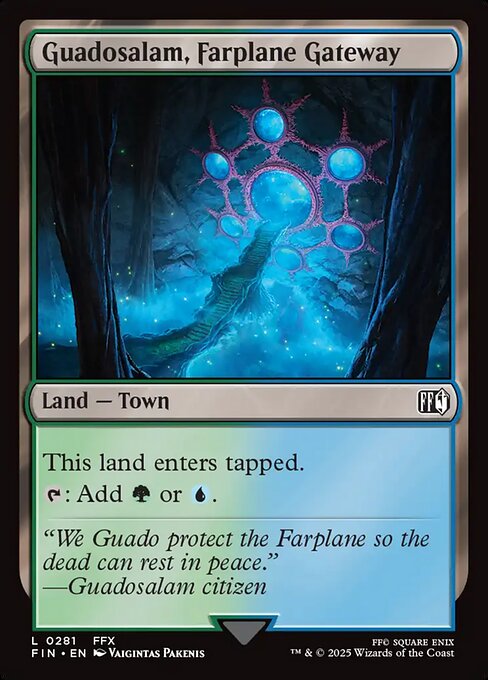
146. Guadosalam, Farplane Gateway
Rating5.6PlayableWhy this rating?
Good playable that always makes the cut (5.6/10).
Why. A green-blue dual land that enters tapped. It is a Town, so it counts for cards that count Towns.
Risks. It enters tapped, which slows down a fast deck. It only helps decks that play both green and blue.
In the draft. A fine pick if you are green-blue, especially to fix a splash. Take it late, after your playables.
Results in the games of the set
When it is in hand, the deck wins 55.4% of its games (set average: 56.4%, 173rd of 341 cards).
In the opening hand: 56.0% wins (55.2% on average).
Drawn during the game: 55.0% (57.2% on average).
When it is drawn, the deck wins 1.7 points more than when it is not.
When it is drafted, it is played 68% of the time (set average: 62%).
Taken as the first pick (114 drafts), it ends in the deck 90% of the time.

147. Ragnarok, Divine Deliverance
Rating5.6PlayableWhy this rating?
Good playable that always makes the cut (5.6/10).
Why. A 7/6 with reach, vigilance, menace, trample and haste. When it dies it destroys a target permanent and returns a nonlegendary permanent card from your graveyard to the battlefield, so even its death is strong.
Risks. It has no mana cost, so it cannot be cast normally: you need a way to get it onto the battlefield. Without one it stays unusable.
In the draft. Take it only if you are black-green and have the means to bring it in. Otherwise it is a curiosity that does not deserve a high pick.

148. Raubahn, Bull of Ala Mhigo
Rating5.6PlayableWhy this rating?
Good playable that always makes the cut (5.6/10).
Why. A 2/2 for two with ward that costs life equal to its power. When it attacks it attaches an Equipment to an attacking creature, making Equipment cheap to move around.
Risks. Without Equipment it is a vanilla 2/2 with ward. It dies quickly if it attacks alone.
In the draft. A good card in a red-white deck full of Equipment. Without those, do not rank it highly.
Results in the games of the set
When it is in hand, the deck wins 53.0% of its games (set average: 56.4%, 250th of 341 cards).
In the opening hand: 54.4% wins (55.2% on average).
Drawn during the game: 52.0% (57.2% on average).
When it is drawn, the deck wins 1.3 points less than when it is not.
When it is drafted, it is played 69% of the time (set average: 62%).
Taken as the first pick (34 drafts), it ends in the deck 91% of the time.
It is played about as much in every archetype.

149. Slash of Light
Rating5.6PlayableWhy this rating?
Good playable that always makes the cut (5.6/10).
Why. A two-mana instant that deals damage to a target creature equal to the number of creatures you control plus Equipment you control. With two or three creatures it kills small targets for a minimal cost.
Risks. With an empty board it deals almost no damage. If you lose your creatures, it loses power.
In the draft. A good common removal for a white deck with many creatures. Take it fairly high, before your mediocre creatures.
Results in the games of the set
When it is in hand, the deck wins 56.7% of its games (set average: 56.4%, 126th of 341 cards).
In the opening hand: 55.2% wins (55.2% on average).
Drawn during the game: 57.8% (57.2% on average).
When it is drawn, the deck wins 0.1 points more than when it is not.
When it is drafted, it is played 79% of the time (set average: 62%).
Taken as the first pick (169 drafts), it ends in the deck 93% of the time.
It is played mostly in U/W decks (69% of them) and R/W (68%).
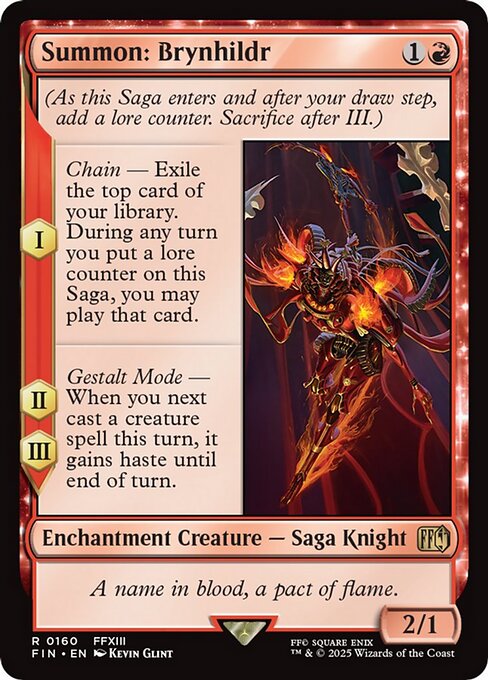
150. Summon: Brynhildr
Rating5.6PlayableWhy this rating?
Good playable that always makes the cut (5.6/10).
Why. A 2/1 Summon Saga for two: chapter I exiles the top card of your library, which you may play during any turn you put a lore counter on this Saga. On chapters II and III the next creature spell you cast that turn gains haste.
Risks. It is sacrificed after chapter III, so it is a 2/1 that sticks around for only a few turns. The haste effect depends on your hand.
In the draft. A good turn-two play for a red deck with many creatures. Do not take it before removal and your best creatures.
Results in the games of the set
When it is in hand, the deck wins 52.4% of its games (set average: 56.4%, 271st of 341 cards).
In the opening hand: 50.5% wins (55.2% on average).
Drawn during the game: 53.7% (57.2% on average).
When it is drawn, the deck wins 0.2 points less than when it is not.
When it is drafted, it is played 71% of the time (set average: 62%).
Taken as the first pick (41 drafts), it ends in the deck 80% of the time.
It is played about as much in every archetype.

151. The Crystal's Chosen
Rating5.6PlayableWhy this rating?
Good playable that always makes the cut (5.6/10).
Why. A seven-mana sorcery that creates four 1/1 colorless Hero creature tokens, then puts a +1/+1 counter on each creature you control. You get four 2/2s and your other creatures grow too.
Risks. Seven mana is slow, and a sweeper wipes the result. It has no immediate effect on the opponent's board.
In the draft. A white finisher that can win a stalled game on its own. Take it at a reasonable pick, with enough early plays to survive to seven mana.
Results in the games of the set
When it is in hand, the deck wins 57.0% of its games (set average: 56.4%, 120th of 341 cards).
In the opening hand: 54.7% wins (55.2% on average).
Drawn during the game: 58.5% (57.2% on average).
When it is drawn, the deck wins 2.2 points more than when it is not.
When it is drafted, it is played 67% of the time (set average: 62%).
Taken as the first pick (99 drafts), it ends in the deck 78% of the time.
It is played mostly in G/W decks (27% of them).

152. Treno, Dark City
Rating5.6PlayableWhy this rating?
Good playable that always makes the cut (5.6/10).
Why. A blue-black dual land that enters tapped. It is a Town, so it counts for cards that count Towns.
Risks. It enters tapped, which slows down a fast deck. It only helps blue-black decks or those splashing one of these colors.
In the draft. A fine pick if you are blue-black, especially for fixing. Take it late, after your playables.
Results in the games of the set
When it is in hand, the deck wins 55.3% of its games (set average: 56.4%, 177th of 341 cards).
In the opening hand: 55.5% wins (55.2% on average).
Drawn during the game: 55.2% (57.2% on average).
When it is drawn, the deck wins 1.9 points more than when it is not.
When it is drafted, it is played 74% of the time (set average: 62%).
Taken as the first pick (106 drafts), it ends in the deck 86% of the time.

153. Undercity Dire Rat
Rating5.6PlayableWhy this rating?
Good playable that always makes the cut (5.6/10).
Why. A 2/2 for two that creates a Treasure token when it dies. It trades with an opposing creature and leaves you a mana, which makes it a safe turn-two play.
Risks. It is a small body with no offensive ability, and a Treasure does not win the game. It is weak late.
In the draft. A solid common in a low-curve black deck. Take it without urgency, as a filler for your curve.
Results in the games of the set
When it is in hand, the deck wins 55.3% of its games (set average: 56.4%, 178th of 341 cards).
In the opening hand: 55.9% wins (55.2% on average).
Drawn during the game: 54.9% (57.2% on average).
When it is drawn, the deck wins 1.1 points more than when it is not.
When it is drafted, it is played 76% of the time (set average: 62%).
Taken as the first pick (128 drafts), it ends in the deck 91% of the time.
It is played mostly in B/W decks (61% of them) and B/R (60%).
 Rating5.6Playable
Why this rating?
Good playable that always makes the cut (5.6/10).
Why. A black-red dual land that enters tapped. It is a Town, so it counts for cards that count Towns.
Risks. It enters tapped, which slows down a fast deck. It only helps black-red decks or those splashing one of these colors.
In the draft. A fine pick if you are black-red, especially for fixing. Take it late, after your playables.
Results in the games of the set
When it is in hand, the deck wins 54.4% of its games (set average: 56.4%, 207th of 341 cards).
In the opening hand: 54.9% wins (55.2% on average).
Drawn during the game: 54.0% (57.2% on average).
When it is drawn, the deck wins 1.3 points more than when it is not.
When it is drafted, it is played 62% of the time (set average: 62%).
Taken as the first pick (67 drafts), it ends in the deck 79% of the time.

155. Malboro
Rating5.5PlayableWhy this rating?
A solid playable that rarely gets cut (5.5/10).
Why. A 4/4 for six that makes each opponent discard a card, lose 2 life and exile the top three cards of their library when it enters. Swampcycling for two means it is never dead in hand.
Risks. Six mana is a lot, and the effect does not change the board by itself. A 4/4 without evasion is vulnerable to removal.
In the draft. A good top-end common for a black deck: if you cannot cast it, it cycles into a Swamp. Take it fairly early.
Results in the games of the set
When it is in hand, the deck wins 56.0% of its games (set average: 56.4%, 146th of 341 cards).
In the opening hand: 53.2% wins (55.2% on average).
Drawn during the game: 58.0% (57.2% on average).
When it is drawn, the deck wins 1.6 points more than when it is not.
When it is drafted, it is played 75% of the time (set average: 62%).
Taken as the first pick (100 drafts), it ends in the deck 93% of the time.
It is played mostly in B/G decks (60% of them) and B/W (60%).
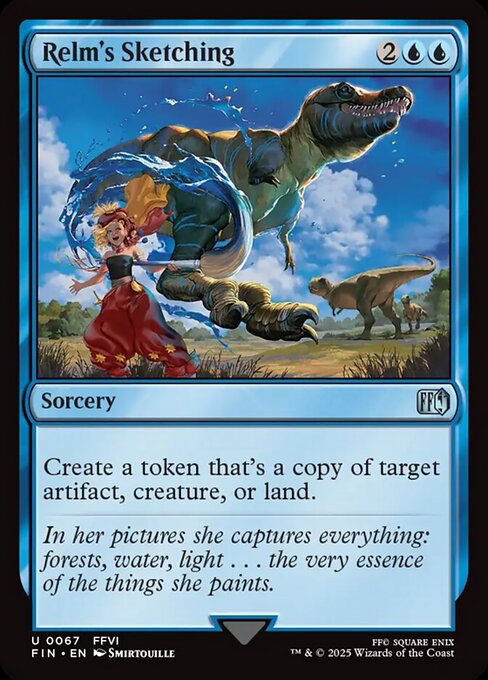
156. Relm's Sketching
Rating5.4PlayableWhy this rating?
A solid playable that rarely gets cut (5.4/10).
Why. A four-mana sorcery that creates a token copy of target artifact, creature or land. It copies your best permanent or the opponent's, so it works as a flexible clone.
Risks. It depends on targets on the battlefield: with no good target it is weak. It is expensive for a copy of an average creature.
In the draft. A fair choice in a blue deck with strong creatures or artifacts. Take it at a reasonable pick, nothing more.
Results in the games of the set
When it is in hand, the deck wins 55.5% of its games (set average: 56.4%, 169th of 341 cards).
In the opening hand: 51.4% wins (55.2% on average).
Drawn during the game: 57.9% (57.2% on average).
When it is drawn, the deck wins 2.6 points more than when it is not.
When it is drafted, it is played 80% of the time (set average: 62%).
Taken as the first pick (141 drafts), it ends in the deck 87% of the time.
It is played mostly in R/U decks (27% of them).
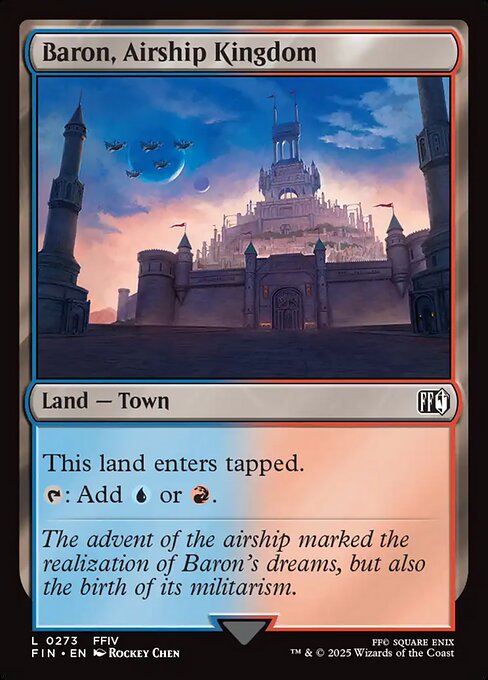 Rating5.4Playable
Why this rating?
A solid playable that rarely gets cut (5.4/10).
Why. A blue-red dual land that enters tapped. It is a Town, so it counts for cards that count Towns.
Risks. It enters tapped, which slows down a fast deck. It only helps blue-red decks or those splashing one of these colors.
In the draft. A fine pick if you are blue-red, especially for fixing. Take it late, after your playables.
Results in the games of the set
When it is in hand, the deck wins 55.6% of its games (set average: 56.4%, 164th of 341 cards).
In the opening hand: 56.2% wins (55.2% on average).
Drawn during the game: 55.2% (57.2% on average).
When it is drawn, the deck wins 1.3 points more than when it is not.
When it is drafted, it is played 72% of the time (set average: 62%).
Taken as the first pick (94 drafts), it ends in the deck 88% of the time.
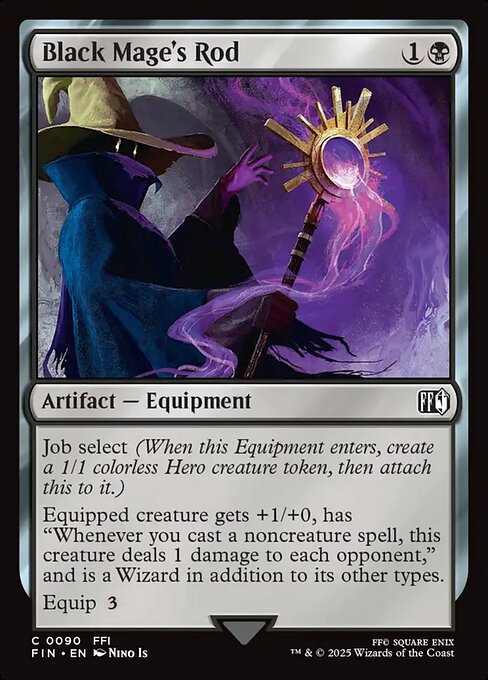
158. Black Mage's Rod
Rating5.4PlayableWhy this rating?
A solid playable that rarely gets cut (5.4/10).
Why. For two mana, Job select gives you an Equipment and a 1/1 Hero creature token carrying it. Equipped, it becomes a 2/1 Wizard that deals 1 damage to each opponent whenever you cast a noncreature spell: a body plus a source of damage.
Risks. It needs noncreature spells to matter, and the token dies easily. Moving the Equipment costs three mana.
In the draft. A good common for a black deck with many noncreature spells. Take it at a reasonable pick, after your removal.
Results in the games of the set
When it is in hand, the deck wins 55.7% of its games (set average: 56.4%, 159th of 341 cards).
In the opening hand: 55.2% wins (55.2% on average).
Drawn during the game: 56.1% (57.2% on average).
When it is drawn, the deck wins 1.6 points more than when it is not.
When it is drafted, it is played 82% of the time (set average: 62%).
Taken as the first pick (270 drafts), it ends in the deck 91% of the time.
It is played mostly in B/R decks (73% of them) and B/W (56%).

159. Dwarven Castle Guard
Rating5.4PlayableWhy this rating?
A solid playable that rarely gets cut (5.4/10).
Why. A 2/1 for two that leaves behind a 1/1 Hero creature token when it dies. You get two bodies for one card, which is good for trading and for sacrifice effects.
Risks. A 2/1 is small and the 1/1 token carries little weight on an advanced board. It is weak late.
In the draft. A good curve filler for an aggressive white deck. Take it without urgency, after your better cards.
Results in the games of the set
When it is in hand, the deck wins 54.1% of its games (set average: 56.4%, 216th of 341 cards).
In the opening hand: 54.8% wins (55.2% on average).
Drawn during the game: 53.6% (57.2% on average).
When it is drawn, the deck wins 1.5 points less than when it is not.
When it is drafted, it is played 51% of the time (set average: 62%).
Taken as the first pick (63 drafts), it ends in the deck 70% of the time.
It is played mostly in B/W decks (60% of them) and R/W (59%).
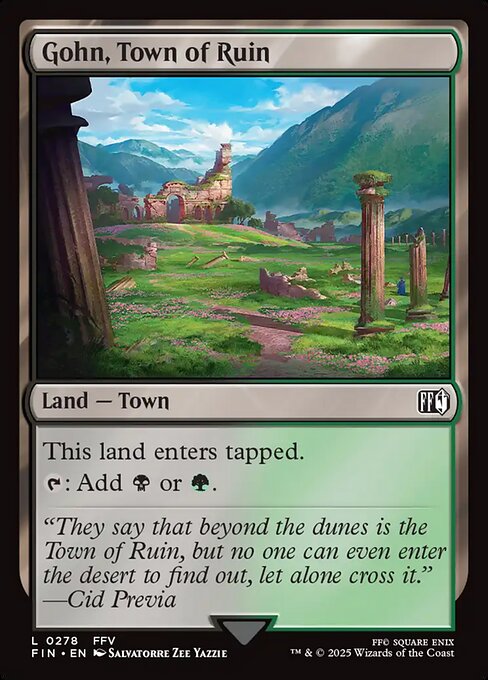
160. Gohn, Town of Ruin
Rating5.4PlayableWhy this rating?
A solid playable that rarely gets cut (5.4/10).
Why. A black-green dual land that enters tapped. It is a Town, so it counts for cards that count Towns.
Risks. It enters tapped, which slows down a fast deck. It only helps black-green decks or those splashing one of these colors.
In the draft. A fine pick if you are black-green, especially for fixing. Take it late, after your playables.
Results in the games of the set
When it is in hand, the deck wins 55.2% of its games (set average: 56.4%, 181st of 341 cards).
In the opening hand: 56.2% wins (55.2% on average).
Drawn during the game: 54.5% (57.2% on average).
When it is drawn, the deck wins 0.5 points more than when it is not.
When it is drafted, it is played 75% of the time (set average: 62%).
Taken as the first pick (82 drafts), it ends in the deck 94% of the time.
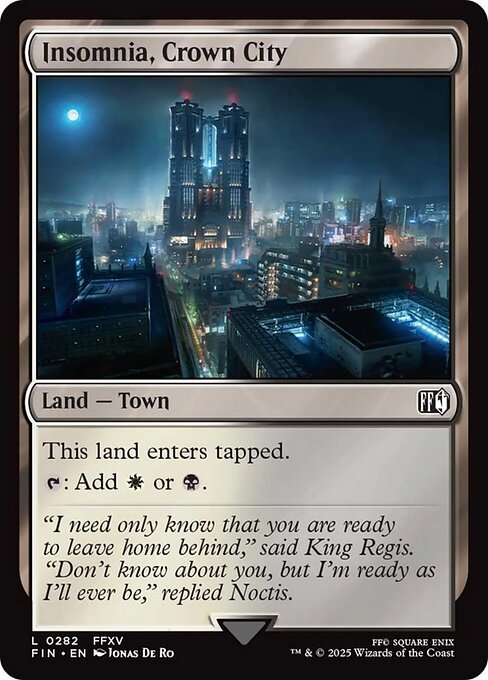
161. Insomnia, Crown City
Rating5.4PlayableWhy this rating?
A solid playable that rarely gets cut (5.4/10).
Why. A white-black dual land that enters tapped. It is a Town, so it counts for cards that count Towns.
Risks. It enters tapped, which slows down a fast deck. It only helps white-black decks or those splashing one of these colors.
In the draft. A fine pick if you are white-black, especially for fixing. Take it late, after your playables.
Results in the games of the set
When it is in hand, the deck wins 53.5% of its games (set average: 56.4%, 236th of 341 cards).
In the opening hand: 54.8% wins (55.2% on average).
Drawn during the game: 52.6% (57.2% on average).
When it is drawn, the deck wins 0.4 points less than when it is not.
When it is drafted, it is played 53% of the time (set average: 62%).
Taken as the first pick (36 drafts), it ends in the deck 81% of the time.

162. Item Shopkeep
Rating5.4PlayableWhy this rating?
A solid playable that rarely gets cut (5.4/10).
Why. A 2/2 for two that gives menace until end of turn to an attacking equipped creature whenever you attack. In a deck full of Equipment it makes your attackers much harder to block.
Risks. Without Equipment it is a vanilla 2/2. It does nothing if your equipped creature cannot attack.
In the draft. Play it in a red deck with several Equipment. Otherwise do not take it over your playables.
Results in the games of the set
When it is in hand, the deck wins 53.0% of its games (set average: 56.4%, 253rd of 341 cards).
In the opening hand: 52.9% wins (55.2% on average).
Drawn during the game: 53.1% (57.2% on average).
When it is drawn, the deck wins 1.8 points less than when it is not.
When it is drafted, it is played 26% of the time (set average: 62%).
Taken among the first three picks (90 drafts), it ends in the deck 79% of the time.
It is played mostly in R/W decks (55% of them).
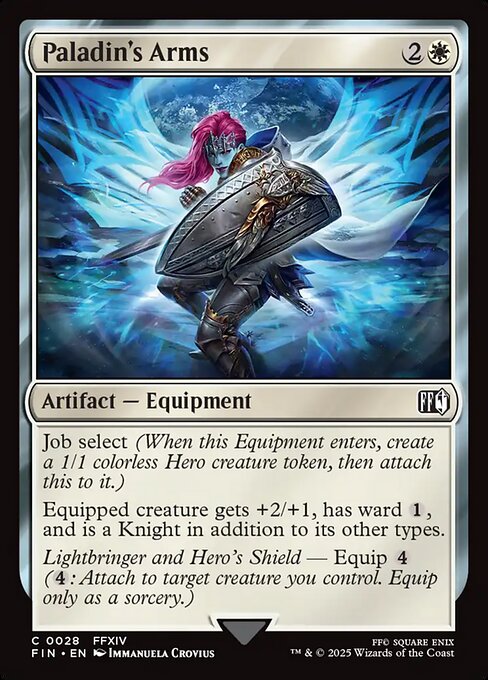
163. Paladin's Arms
Rating5.4PlayableWhy this rating?
A solid playable that rarely gets cut (5.4/10).
Why. For three mana, Job select gives you an Equipment and a 1/1 Hero creature token that becomes a 3/2 Knight with ward 1. A solid creature plus an Equipment to keep for later.
Risks. The token dies to removal or a bad attack, and moving the Equipment to another creature costs four mana.
In the draft. A good common for a white deck. Take it without urgency, after your removal.
Results in the games of the set
When it is in hand, the deck wins 55.8% of its games (set average: 56.4%, 156th of 341 cards).
In the opening hand: 55.9% wins (55.2% on average).
Drawn during the game: 55.6% (57.2% on average).
When it is drawn, the deck wins 0.9 points less than when it is not.
When it is drafted, it is played 82% of the time (set average: 62%).
Taken as the first pick (179 drafts), it ends in the deck 96% of the time.
It is played mostly in R/W decks (72% of them) and U/W (66%).
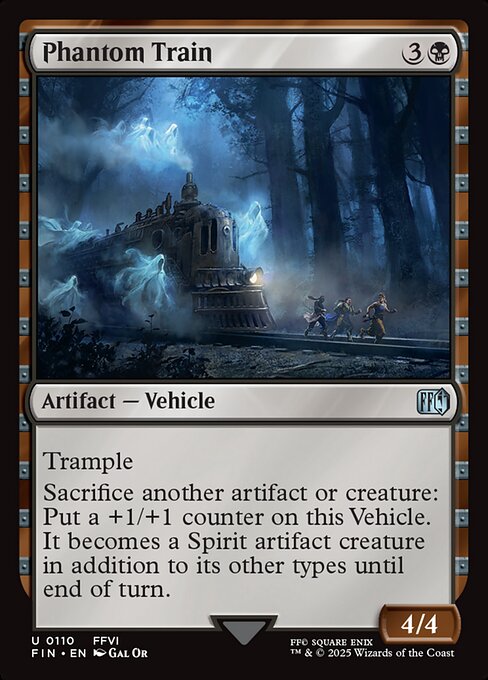
164. Phantom Train
Rating5.4PlayableWhy this rating?
A solid playable that rarely gets cut (5.4/10).
Why. A 4/4 trample Vehicle for four mana with no crew cost: it only becomes a creature when you sacrifice another artifact or creature, and it gains a +1/+1 counter each time. A finisher in a sacrifice deck.
Risks. It becomes a creature only at the price of a sacrifice, so it cannot block without that. With no fodder it sits idle.
In the draft. A fair pick in a black deck with creatures that leave tokens or Treasures. Otherwise pass it.
Results in the games of the set
When it is in hand, the deck wins 55.0% of its games (set average: 56.4%, 189th of 341 cards).
In the opening hand: 52.8% wins (55.2% on average).
Drawn during the game: 56.5% (57.2% on average).
When it is drawn, the deck wins 1.3 points more than when it is not.
When it is drafted, it is played 45% of the time (set average: 62%).
Taken as the first pick (44 drafts), it ends in the deck 70% of the time.
It is played mostly in B/W decks (25% of them).
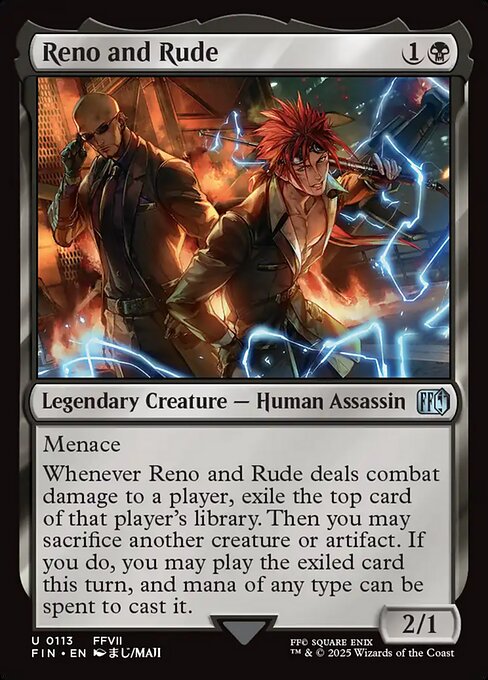
165. Reno and Rude
Rating5.4PlayableWhy this rating?
A solid playable that rarely gets cut (5.4/10).
Why. A 2/1 menace for two that, on dealing combat damage to a player, exiles the top card of that player's library. You may then sacrifice another creature or artifact to play it this turn, spending mana of any type.
Risks. A 2/1 is easy to kill or block, and the effect needs a sacrifice. Without fodder it stays a small attacker.
In the draft. Take it in an aggressive black deck with tokens or artifacts. Otherwise it is a fine 2/1 menace, nothing more.
Results in the games of the set
When it is in hand, the deck wins 53.4% of its games (set average: 56.4%, 238th of 341 cards).
In the opening hand: 53.8% wins (55.2% on average).
Drawn during the game: 53.1% (57.2% on average).
When it is drawn, the deck wins 0.3 points less than when it is not.
When it is drafted, it is played 72% of the time (set average: 62%).
Taken as the first pick (69 drafts), it ends in the deck 77% of the time.
It is played mostly in B/W decks (26% of them).

166. Starting Town
Rating5.4PlayableWhy this rating?
A solid playable that rarely gets cut (5.4/10).
Why. A land that enters untapped during your first three turns, taps for colorless mana or, for 1 life, one mana of any color. Full fixing for a three-color deck.
Risks. Each colored mana costs 1 life. After turn three it enters tapped, making it worse later in the game.
In the draft. A good pick for fixing a splash, in a deck of any color. Take it at a decent pick, after your playables.
Results in the games of the set
When it is in hand, the deck wins 55.4% of its games (set average: 56.4%, 175th of 341 cards).
In the opening hand: 56.8% wins (55.2% on average).
Drawn during the game: 54.3% (57.2% on average).
When it is drawn, the deck wins 2.0 points more than when it is not.
When it is drafted, it is played 96% of the time (set average: 62%).
Taken as the first pick (88 drafts), it ends in the deck 100% of the time.
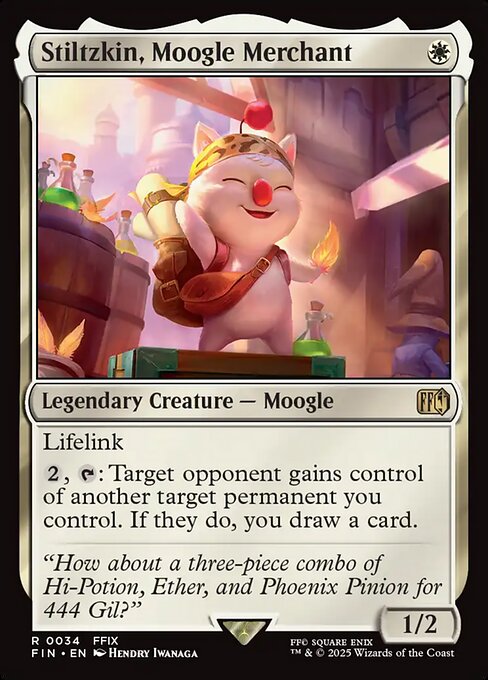
167. Stiltzkin, Moogle Merchant
Rating5.4PlayableWhy this rating?
A solid playable that rarely gets cut (5.4/10).
Why. A 1/2 lifelinker for one white mana. For two mana and tapping it, it gives the opponent control of another permanent you control, and you draw a card. You can hand over a useless or harmful permanent to draw.
Risks. You give the opponent a permanent: chosen badly, you strengthen them. The 1/2 body is small and the line of play is awkward.
In the draft. A niche card for a white deck that knows what to give away. Do not take it over your good creatures and removal.
Results in the games of the set
When it is in hand, the deck wins 52.8% of its games (set average: 56.4%, 261st of 341 cards).
In the opening hand: 53.6% wins (55.2% on average).
Drawn during the game: 52.2% (57.2% on average).
When it is drawn, the deck wins 1.7 points less than when it is not.
When it is drafted, it is played 52% of the time (set average: 62%).
Taken among the first three picks (113 drafts), it ends in the deck 74% of the time.
It is played about as much in every archetype.
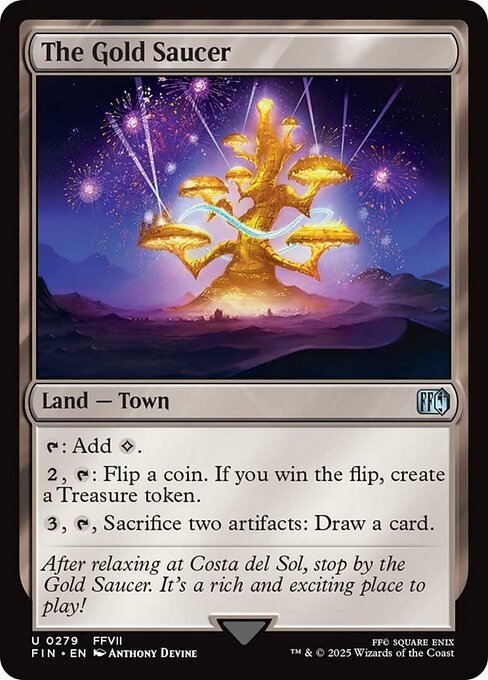
168. The Gold Saucer
Rating5.4PlayableWhy this rating?
A solid playable that rarely gets cut (5.4/10).
Why. A colorless land that, for two mana and tapping it, flips a coin and creates a Treasure token if you win. For three mana, tapping it and sacrificing two artifacts, you draw a card. A mana sink for a deck with artifacts.
Risks. It only taps for colorless mana, the effect is slow and depends on a coin flip. Without artifacts it is weak.
In the draft. Play it only in an artifact or Treasure deck. Otherwise do not take it over your playables.
Results in the games of the set
When it is in hand, the deck wins 53.3% of its games (set average: 56.4%, 243rd of 341 cards).
In the opening hand: 52.4% wins (55.2% on average).
Drawn during the game: 53.8% (57.2% on average).
When it is drawn, the deck wins 1.4 points more than when it is not.
When it is drafted, it is played 24% of the time (set average: 62%).

169. Windurst, Federation Center
Rating5.3PlayableWhy this rating?
A solid playable that rarely gets cut (5.3/10).
Why. A green-white dual land that enters tapped. It smooths the mana of a deck in those two colors at the price of a little tempo.
Risks. Entering tapped costs you development on the turn you play it, especially if you stack several. It does nothing outside those two colors.
In the draft. Take it late, once your colors are settled. One or two dual lands are plenty in a two-color deck.
Results in the games of the set
When it is in hand, the deck wins 54.0% of its games (set average: 56.4%, 220th of 341 cards).
In the opening hand: 54.6% wins (55.2% on average).
Drawn during the game: 53.5% (57.2% on average).
When it is drawn, the deck wins 0.1 points less than when it is not.
When it is drafted, it is played 56% of the time (set average: 62%).
Taken as the first pick (43 drafts), it ends in the deck 91% of the time.

170. Ultimecia, Time Sorceress // Ultimecia, Omnipotent
Rating5.3PlayableWhy this rating?
A solid playable that rarely gets cut (5.3/10).
Why. A five-mana 4/5 that surveils 2 when it enters and every time it attacks: a solid body that smooths your draws. The back face and its extra turn are an end-of-game bonus.
Risks. Transforming takes eight mana and eight cards exiled from your graveyard, so it rarely happens in a draft game. Without it you have a fair 4/5, and it needs both blue and black.
In the draft. A solid mid-pack pick for a blue-black deck. Do not build around the transformation; treat it as a surprise if it ever shows up.
Results in the games of the set
When it is in hand, the deck wins 55.0% of its games (set average: 56.4%, 190th of 341 cards).
In the opening hand: 51.1% wins (55.2% on average).
Drawn during the game: 57.2% (57.2% on average).
When it is drawn, the deck wins 3.5 points more than when it is not.
When it is drafted, it is played 66% of the time (set average: 62%).
Taken as the first pick (72 drafts), it ends in the deck 88% of the time.
It is played mostly in B/U decks (33% of them).
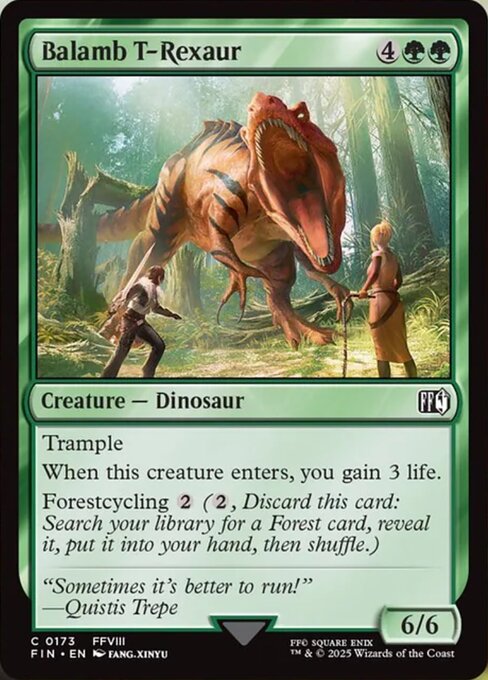
171. Balamb T-Rexaur
Rating5.2PlayableWhy this rating?
A solid playable that rarely gets cut (5.2/10).
Why. A 6/6 trampler that gains you 3 life on arrival, and that you can cycle for two mana to fetch a Forest when you are short on lands. It plays two roles depending on the stage of the game.
Risks. Six mana with two green: stuck in hand on turn 4 it does nothing. Forestcycling keeps it from being dead, but a removal on it costs you a full turn.
In the draft. A very playable common in any green deck, especially one afraid of missing land drops. One or two copies are ideal; past that your curve gets top-heavy.
Results in the games of the set
When it is in hand, the deck wins 56.0% of its games (set average: 56.4%, 150th of 341 cards).
In the opening hand: 53.3% wins (55.2% on average).
Drawn during the game: 57.8% (57.2% on average).
When it is drawn, the deck wins 1.6 points more than when it is not.
When it is drafted, it is played 83% of the time (set average: 62%).
Taken as the first pick (204 drafts), it ends in the deck 96% of the time.
It is played mostly in B/G decks (63% of them) and G/R (60%).
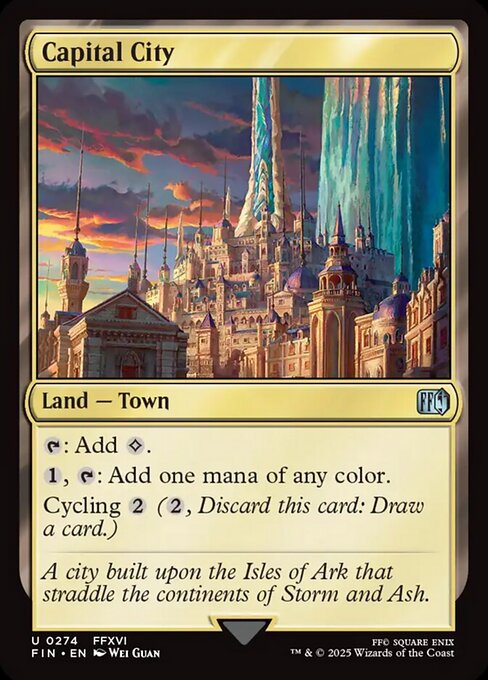
172. Capital City
Rating5.2PlayableWhy this rating?
A solid playable that rarely gets cut (5.2/10).
Why. A land that taps for colorless, and for one more mana makes any color. It fixes a three-color deck or a splash, and cycling turns it into a new card late in the game.
Risks. Making a colored mana costs an extra mana, which slows crowded turns. It does not replace a real dual land in a two-color deck.
In the draft. Take it if you plan a splash or three colors. In a settled two-color deck it adds little.
Results in the games of the set
When it is in hand, the deck wins 55.9% of its games (set average: 56.4%, 153rd of 341 cards).
In the opening hand: 54.0% wins (55.2% on average).
Drawn during the game: 57.3% (57.2% on average).
When it is drawn, the deck wins 1.7 points more than when it is not.
When it is drafted, it is played 85% of the time (set average: 62%).
Taken as the first pick (58 drafts), it ends in the deck 91% of the time.

173. Crystal Fragments // Summon: Alexander
Rating5.2PlayableWhy this rating?
A solid playable that rarely gets cut (5.2/10).
Why. A one-mana Equipment that gives +1/+1 for an equip cost of one. At seven mana it flips into a flying Summon creature: chapters I and II prevent all damage that would be dealt to your creatures, then chapter III taps every creature your opponents control.
Risks. The +1/+1 alone is weak, and flipping costs seven mana for a creature that is sacrificed after chapter III. Only the last chapter is offensive.
In the draft. A late-pack addition for an aggressive white deck with creatures to carry it. Do not take it for the flip.
Results in the games of the set
When it is in hand, the deck wins 52.4% of its games (set average: 56.4%, 269th of 341 cards).
In the opening hand: 52.5% wins (55.2% on average).
Drawn during the game: 52.4% (57.2% on average).
When it is drawn, the deck wins 1.7 points less than when it is not.
When it is drafted, it is played 52% of the time (set average: 62%).
Taken as the first pick (43 drafts), it ends in the deck 88% of the time.
It is played about as much in every archetype.
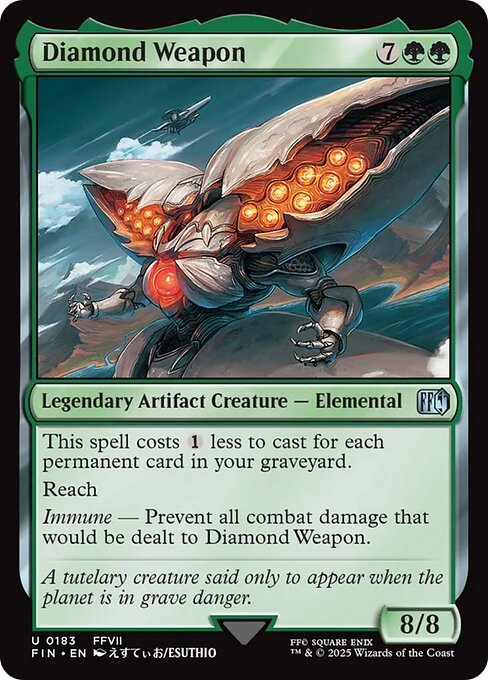
174. Diamond Weapon
Rating5.2PlayableWhy this rating?
A solid playable that rarely gets cut (5.2/10).
Why. An 8/8 with reach and all combat damage that would be dealt to it prevented, so it blocks and attacks without ever dying in combat. Its cost drops by one for each permanent card in your graveyard, so it arrives sooner in a long game.
Risks. Nine mana at full price, with two green. A removal, or an exile or sacrifice effect, stops it. Early in the game it is a dead card.
In the draft. A late-pack top end for a green-black deck that trades a lot. One copy, never more.
Results in the games of the set
When it is in hand, the deck wins 54.6% of its games (set average: 56.4%, 202nd of 341 cards).
In the opening hand: 50.5% wins (55.2% on average).
Drawn during the game: 57.1% (57.2% on average).
When it is drawn, the deck wins 0.8 points more than when it is not.
When it is drafted, it is played 75% of the time (set average: 62%).
Taken as the first pick (92 drafts), it ends in the deck 91% of the time.
It is played mostly in B/G decks (32% of them).
 Rating5.2Playable
Why this rating?
A solid playable that rarely gets cut (5.2/10).
Why. A six-mana 4/5 that draws a card for each artifact you control when it enters. In a deck with artifacts, Treasures or artifact tokens, the card advantage is real.
Risks. Without artifacts it is an expensive 4/5 that draws almost nothing. The coin ability does nothing unless you have ways to flip coins.
In the draft. A good pick if you already have several artifacts; otherwise pass it for a cheaper creature. Count your artifact sources before you play it.
Results in the games of the set
When it is in hand, the deck wins 53.4% of its games (set average: 56.4%, 240th of 341 cards).
In the opening hand: 49.6% wins (55.2% on average).
Drawn during the game: 55.7% (57.2% on average).
When it is drawn, the deck wins 1.6 points more than when it is not.
When it is drafted, it is played 56% of the time (set average: 62%).
Taken as the first pick (47 drafts), it ends in the deck 79% of the time.
It is played about as much in every archetype.

176. G'raha Tia
Rating5.2PlayableWhy this rating?
A solid playable that rarely gets cut (5.2/10).
Why. A five-mana 3/5 with reach that draws a card, once each turn, when another creature or an artifact you control dies. A good blocker that turns your trades into cards.
Risks. It does nothing offensively and only triggers if your permanents die. Five mana for a blocker is a bit pricey in a deck that wants to go fast.
In the draft. A fair pick for a white midrange or control deck. It is better in a deck that sacrifices creatures or trades a lot.
Results in the games of the set
When it is in hand, the deck wins 54.0% of its games (set average: 56.4%, 219th of 341 cards).
In the opening hand: 52.8% wins (55.2% on average).
Drawn during the game: 54.9% (57.2% on average).
When it is drawn, the deck wins 0.3 points less than when it is not.
When it is drafted, it is played 77% of the time (set average: 62%).
Taken as the first pick (116 drafts), it ends in the deck 94% of the time.
It is played mostly in B/W decks (31% of them).
 Rating5.2Playable
Why this rating?
A solid playable that rarely gets cut (5.2/10).
Why. A red-green dual land that enters tapped. It fixes both colors of a red-green deck at a fair price.
Risks. Entering tapped costs tempo, and it is useless outside those two colors.
In the draft. Take it late once you are red and green. One or two copies is enough.
Results in the games of the set
When it is in hand, the deck wins 53.9% of its games (set average: 56.4%, 225th of 341 cards).
In the opening hand: 54.6% wins (55.2% on average).
Drawn during the game: 53.4% (57.2% on average).
When it is drawn, the deck wins 0.6 points more than when it is not.
When it is drafted, it is played 56% of the time (set average: 62%).
Taken as the first pick (45 drafts), it ends in the deck 91% of the time.

178. Gran Pulse Ochu
Rating5.2PlayableWhy this rating?
A solid playable that rarely gets cut (5.2/10).
Why. A one-mana 1/1 with deathtouch: it deters attacks and trades with a big opposing creature. At eight mana it gets +1/+1 until end of turn for each permanent card in your graveyard.
Risks. A fragile 1/1 that dies to anything, and the big ability is too expensive to be regular. It does little on its own.
In the draft. A solid little common for a green deck, particularly black-green. A one-mana trade for a big opposing creature is always welcome.
Results in the games of the set
When it is in hand, the deck wins 55.4% of its games (set average: 56.4%, 174th of 341 cards).
In the opening hand: 55.2% wins (55.2% on average).
Drawn during the game: 55.6% (57.2% on average).
When it is drawn, the deck wins 1.1 points more than when it is not.
When it is drafted, it is played 65% of the time (set average: 62%).
Taken as the first pick (79 drafts), it ends in the deck 85% of the time.
It is played mostly in B/G decks (55% of them) and G/U (44%).

179. Midgar, City of Mako // Reactor Raid
Rating5.2PlayableWhy this rating?
A solid playable that rarely gets cut (5.2/10).
Why. A black land that enters tapped, with an adventure for three mana: sacrifice an artifact or a creature to draw two cards. You keep the land to play later from exile.
Risks. The adventure needs you to sacrifice something, and the land enters tapped. With no useful sacrifice it does nothing.
In the draft. A good addition to a black deck: it takes a land slot and gives you a bit of value. It is best with sacrifice fodder.
Results in the games of the set
When it is in hand, the deck wins 54.2% of its games (set average: 56.4%, 213th of 341 cards).
In the opening hand: 52.3% wins (55.2% on average).
Drawn during the game: 55.5% (57.2% on average).
When it is drawn, the deck wins 0.3 points less than when it is not.
When it is drafted, it is played 85% of the time (set average: 62%).
Taken as the first pick (48 drafts), it ends in the deck 96% of the time.
180. Namazu Trader
Rating5.2PlayableWhy this rating?
A solid playable that rarely gets cut (5.2/10).
Why. A four-mana 3/4 that creates a Treasure token on entry, at the cost of 1 life. It accelerates your next turn, and on attack you may sacrifice another creature or an artifact (the Treasure, say) to surveil 2.
Risks. It costs you 1 life, and the attack sacrifice needs another creature or artifact. With no fodder it is a fair body and little more.
In the draft. A solid black common, especially black-green. Take it mid-pack for its body and its Treasure.
Results in the games of the set
When it is in hand, the deck wins 54.5% of its games (set average: 56.4%, 204th of 341 cards).
In the opening hand: 53.3% wins (55.2% on average).
Drawn during the game: 55.2% (57.2% on average).
When it is drawn, the deck wins 0.8 points more than when it is not.
When it is drafted, it is played 47% of the time (set average: 62%).
Taken as the first pick (50 drafts), it ends in the deck 80% of the time.
It is played mostly in B/W decks (42% of them) and B/R (38%).
 Rating5.2Playable
Why this rating?
A solid playable that rarely gets cut (5.2/10).
Why. A red-white dual land that enters tapped. It fixes both colors of a red-white deck.
Risks. It enters tapped and does nothing outside those two colors.
In the draft. Take it late, once your colors are clear. In a red-white deck one or two copies are enough.
Results in the games of the set
When it is in hand, the deck wins 53.8% of its games (set average: 56.4%, 227th of 341 cards).
In the opening hand: 55.3% wins (55.2% on average).
Drawn during the game: 52.6% (57.2% on average).
When it is drawn, the deck wins 0.6 points less than when it is not.
When it is drafted, it is played 49% of the time (set average: 62%).
Taken as the first pick (36 drafts), it ends in the deck 83% of the time.
182. Sharlayan, Nation of Scholars
Rating5.2PlayableWhy this rating?
A solid playable that rarely gets cut (5.2/10).
Why. A white-blue dual land that enters tapped. It smooths the mana of a deck in those two colors.
Risks. It enters tapped and does nothing outside white and blue.
In the draft. Take it late once you are white-blue. One or two copies is enough.
Results in the games of the set
When it is in hand, the deck wins 54.3% of its games (set average: 56.4%, 211th of 341 cards).
In the opening hand: 54.8% wins (55.2% on average).
Drawn during the game: 54.0% (57.2% on average).
When it is drawn, the deck wins 0.8 points more than when it is not.
When it is drafted, it is played 58% of the time (set average: 62%).
Taken as the first pick (43 drafts), it ends in the deck 86% of the time.
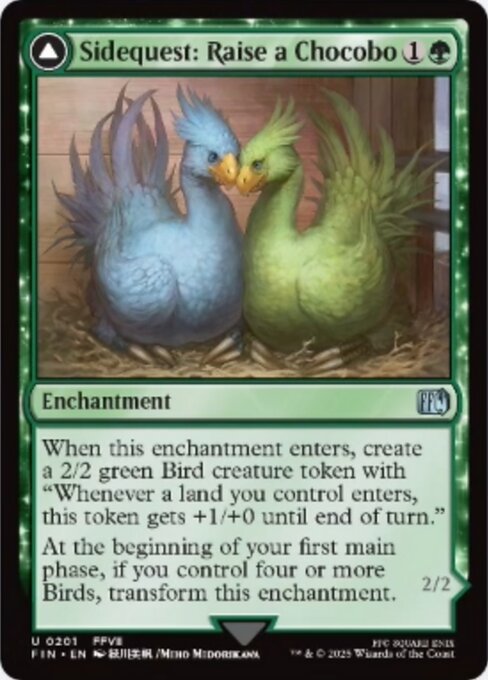
183. Sidequest: Raise a Chocobo // Black Chocobo
Rating5.2PlayableWhy this rating?
A solid playable that rarely gets cut (5.2/10).
Why. For two mana you get a green 2/2 Bird token that gets +1/+0 until end of turn whenever a land enters. If you control four Birds, the enchantment transforms: it fetches a land and gives all your Birds +1/+0 on each land.
Risks. Transforming needs four Birds, which is very hard without a dedicated build. In practice you get a 2/2 for two mana with a small Landfall bonus.
In the draft. A minor pick for a green deck that puts plenty of lands onto the battlefield. Do not take it for the transformed side.
Results in the games of the set
When it is in hand, the deck wins 54.1% of its games (set average: 56.4%, 215th of 341 cards).
In the opening hand: 54.2% wins (55.2% on average).
Drawn during the game: 54.1% (57.2% on average).
When it is drawn, the deck wins 0.3 points more than when it is not.
When it is drafted, it is played 67% of the time (set average: 62%).
Taken as the first pick (62 drafts), it ends in the deck 87% of the time.
It is played mostly in G/W decks (40% of them) and G/R (35%).
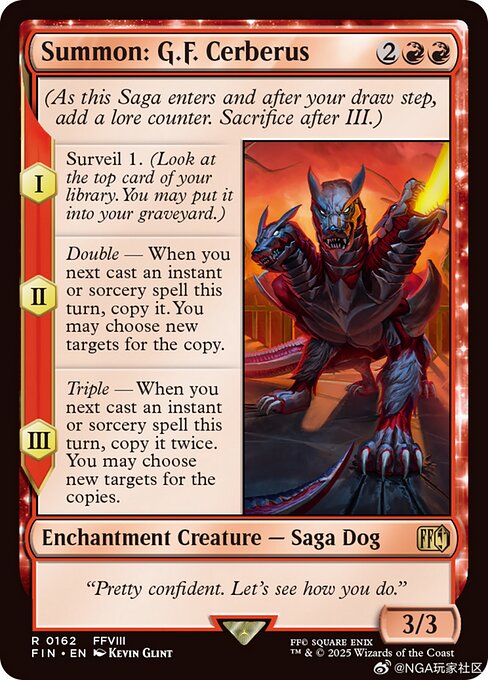 Rating5.2Playable
Why this rating?
A solid playable that rarely gets cut (5.2/10).
Why. A four-mana 3/3 that surveils 1, then copies the next instant or sorcery you cast that turn on chapter II, and twice on chapter III. With a good spell, it makes a big turn.
Risks. It is sacrificed after chapter III, and the copies only work if you cast an instant or sorcery that turn. Otherwise it is a temporary 3/3.
In the draft. A pick for a red deck with plenty of spells, often blue-red. In a deck with few spells, let it go.
Results in the games of the set
When it is in hand, the deck wins 52.4% of its games (set average: 56.4%, 270th of 341 cards).
In the opening hand: 51.3% wins (55.2% on average).
Drawn during the game: 53.1% (57.2% on average).
When it is drawn, the deck wins 0.4 points less than when it is not.
When it is drafted, it is played 81% of the time (set average: 62%).
Taken as the first pick (77 drafts), it ends in the deck 92% of the time.
It is played about as much in every archetype.

185. Tellah, Great Sage
Rating5.2PlayableWhy this rating?
A solid playable that rarely gets cut (5.2/10).
Why. A five-mana 3/3 that creates a 1/1 colorless Hero creature token whenever you cast a noncreature spell. If four or more mana was spent on it, you draw two cards. With eight or more, Tellah is sacrificed and deals that much damage to each opponent.
Risks. It needs both blue and red, and many noncreature spells to generate value. The eight-mana sacrifice is mandatory but rare. Without spells it is an expensive 3/3.
In the draft. A good pick for a blue-red deck that plays many instants, sorceries and artifacts. It pays off through its triggers, not its stats.
Results in the games of the set
When it is in hand, the deck wins 54.4% of its games (set average: 56.4%, 208th of 341 cards).
In the opening hand: 51.8% wins (55.2% on average).
Drawn during the game: 56.0% (57.2% on average).
When it is drawn, the deck wins 2.3 points more than when it is not.
When it is drafted, it is played 82% of the time (set average: 62%).
Taken as the first pick (108 drafts), it ends in the deck 87% of the time.
It is played about as much in every archetype.

186. Ahriman
Rating5.2PlayableWhy this rating?
A solid playable that rarely gets cut (5.2/10).
Why. A three-mana 2/2 with flying and deathtouch: it attacks in the air and trades with any creature that blocks it or that it blocks. For three mana, you can also sacrifice another creature or an artifact to draw a card.
Risks. A 2/2 dies to a lot of spells. The draw ability needs artifacts or creatures to sacrifice.
In the draft. A good black common at this price. It belongs in almost every black deck.
Results in the games of the set
When it is in hand, the deck wins 54.6% of its games (set average: 56.4%, 200th of 341 cards).
In the opening hand: 52.6% wins (55.2% on average).
Drawn during the game: 56.0% (57.2% on average).
When it is drawn, the deck wins 0.7 points more than when it is not.
When it is drafted, it is played 69% of the time (set average: 62%).
Taken as the first pick (98 drafts), it ends in the deck 85% of the time.
It is played mostly in B/R decks (56% of them) and B/W (53%).

187. The Darkness Crystal
Rating5.1PlayableWhy this rating?
A solid playable that rarely gets cut (5.1/10).
Why. A four-mana artifact that makes your black spells cost one less, exiles opposing nontoken creatures that die and gains you 2 life. For six mana and by tapping it, you can put a creature it exiled onto the battlefield tapped under your control with two extra +1/+1 counters.
Risks. It does not win the game on its own and is only worth it in a heavily black deck. The reanimation is expensive. Against a deck with few creatures it is weak.
In the draft. A mid-pack pick for a firmly black deck that will go long. Avoid it if black is only a second color.
Results in the games of the set
When it is in hand, the deck wins 53.6% of its games (set average: 56.4%, 232nd of 341 cards).
In the opening hand: 52.5% wins (55.2% on average).
Drawn during the game: 54.4% (57.2% on average).
When it is drawn, the deck wins 1.6 points more than when it is not.
When it is drafted, it is played 64% of the time (set average: 62%).
Taken as the first pick (35 drafts), it ends in the deck 77% of the time.
It is played about as much in every archetype.
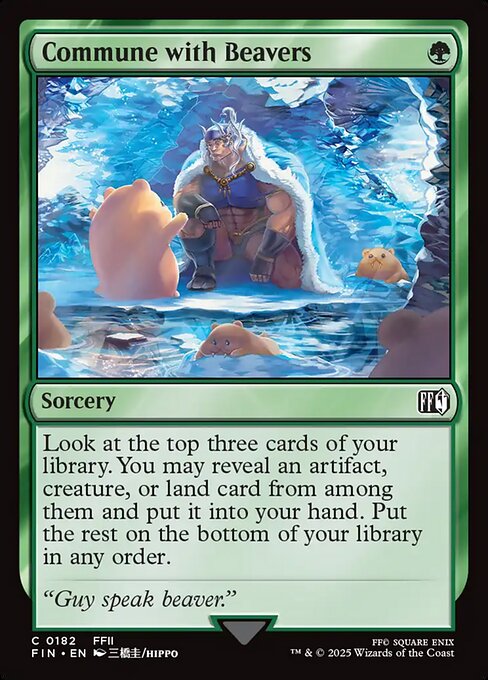
188. Commune with Beavers
Rating5.0PlayableWhy this rating?
A solid playable that rarely gets cut (5.0/10).
Why. For one green mana, you look at the top three cards of your library and take a creature, an artifact or a land. It is cheap smoothing that keeps you from running out of lands or plays.
Risks. It creates no pressure on its own, and if all three cards are spells other than artifacts you take nothing. The rest go to the bottom of your library.
In the draft. Late-pack filler. Only take it in a green deck short on cheap plays.
Results in the games of the set
When it is in hand, the deck wins 53.9% of its games (set average: 56.4%, 226th of 341 cards).
In the opening hand: 52.9% wins (55.2% on average).
Drawn during the game: 54.6% (57.2% on average).
When it is drawn, the deck wins 1.0 points more than when it is not.
When it is drafted, it is played 20% of the time (set average: 62%).
Taken among the first three picks (49 drafts), it ends in the deck 53% of the time.
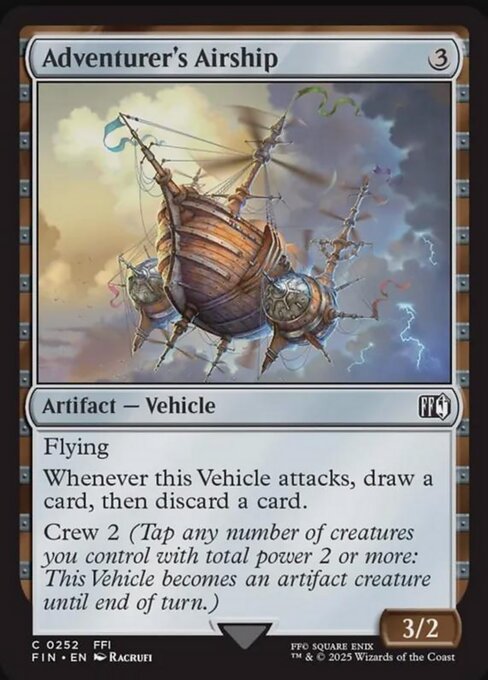
189. Adventurer's Airship
Rating5.0PlayableWhy this rating?
A solid playable that rarely gets cut (5.0/10).
Why. A three-mana Vehicle, a 3/2 flier, that lets you draw then discard a card on each attack. Crew 2 only needs a creature with power 2 to swing.
Risks. It needs creatures to pay Crew, and it is vulnerable as a 3/2 creature while attacking. With no creatures to tap it stays useless.
In the draft. A fair colorless artifact for a deck with plenty of small creatures. Take it mid-pack if your deck is aggressive.
Results in the games of the set
When it is in hand, the deck wins 54.0% of its games (set average: 56.4%, 221st of 341 cards).
In the opening hand: 54.3% wins (55.2% on average).
Drawn during the game: 53.8% (57.2% on average).
When it is drawn, the deck wins 0.8 points less than when it is not.
When it is drafted, it is played 19% of the time (set average: 62%).
Taken among the first three picks (43 drafts), it ends in the deck 63% of the time.
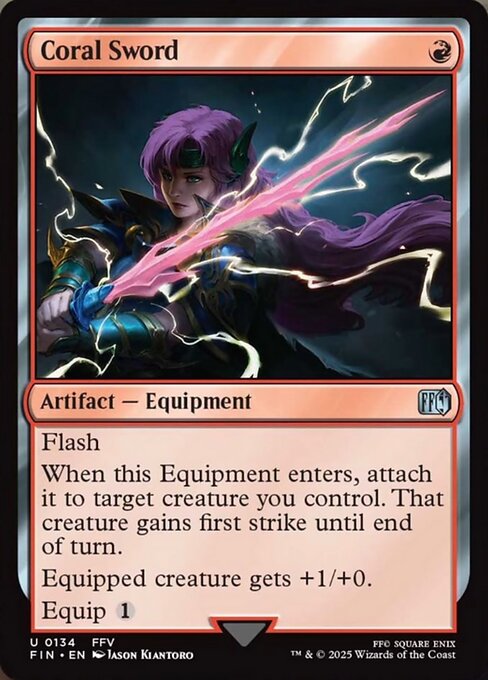
190. Coral Sword
Rating5.0PlayableWhy this rating?
A solid playable that rarely gets cut (5.0/10).
Why. A one-mana red Equipment with flash: it attaches to a creature you control on entry and gives it first strike until end of turn. That is a small combat trick, then +1/+0 for just one mana to equip.
Risks. +1/+0 is a thin bonus. It needs creatures on the battlefield and does not win games alone.
In the draft. A fair play for an aggressive red deck, especially red-white. Do not take it over real creatures.
Results in the games of the set
When it is in hand, the deck wins 54.5% of its games (set average: 56.4%, 205th of 341 cards).
In the opening hand: 54.3% wins (55.2% on average).
Drawn during the game: 54.6% (57.2% on average).
When it is drawn, the deck wins 0.4 points more than when it is not.
When it is drafted, it is played 40% of the time (set average: 62%).
Taken among the first three picks (93 drafts), it ends in the deck 72% of the time.
It is played mostly in R/W decks (27% of them).
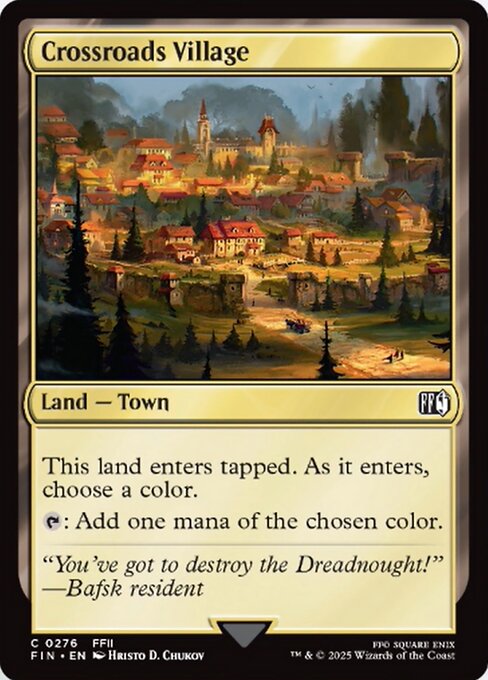
191. Crossroads Village
Rating5.0PlayableWhy this rating?
A solid playable that rarely gets cut (5.0/10).
Why. A land that enters tapped and taps for mana of the color you choose as it enters. It replaces a basic but adapts to what you need.
Risks. It enters tapped and taps for only one color, so it does not really fix. In a two-color deck a basic does almost the same job.
In the draft. Late-pack filler, useful if you have a distant splash. Do not take it over a dual land.
Results in the games of the set
When it is in hand, the deck wins 55.4% of its games (set average: 56.4%, 176th of 341 cards).
In the opening hand: 56.3% wins (55.2% on average).
Drawn during the game: 54.6% (57.2% on average).
When it is drawn, the deck wins 0.4 points more than when it is not.
When it is drafted, it is played 93% of the time (set average: 62%).
Taken as the first pick (158 drafts), it ends in the deck 98% of the time.

192. Ishgard, the Holy See // Faith & Grief
Rating5.0PlayableWhy this rating?
A solid playable that rarely gets cut (5.0/10).
Why. A white land that enters tapped, with a five-mana adventure: return up to two artifact and/or enchantment cards from your graveyard to your hand. The land stays playable from exile.
Risks. The adventure is expensive and does nothing without artifacts or enchantments in your graveyard. The land enters tapped.
In the draft. An extra land in a white deck with artifacts or enchantments. Without those, it is just a tapped land.
Results in the games of the set
When it is in hand, the deck wins 52.4% of its games (set average: 56.4%, 268th of 341 cards).
In the opening hand: 53.0% wins (55.2% on average).
Drawn during the game: 52.0% (57.2% on average).
When it is drawn, the deck wins 2.6 points less than when it is not.
When it is drafted, it is played 66% of the time (set average: 62%).
Taken as the first pick (30 drafts), it ends in the deck 87% of the time.

193. Lindblum, Industrial Regency // Mage Siege
Rating5.0PlayableWhy this rating?
A solid playable that rarely gets cut (5.0/10).
Why. A red land that enters tapped, with a three-mana instant-speed adventure: a 0/1 black Wizard creature token that deals 1 damage to each opponent whenever you cast a noncreature spell.
Risks. The 0/1 token dies to anything and does nothing without noncreature spells. The land enters tapped.
In the draft. A good land to run in a red deck with noncreature spells, especially blue-red. Extra value on a land slot.
Results in the games of the set
When it is in hand, the deck wins 53.1% of its games (set average: 56.4%, 248th of 341 cards).
In the opening hand: 52.4% wins (55.2% on average).
Drawn during the game: 53.6% (57.2% on average).
When it is drawn, the deck wins 0.5 points less than when it is not.
When it is drafted, it is played 75% of the time (set average: 62%).
Taken as the first pick (37 drafts), it ends in the deck 95% of the time.
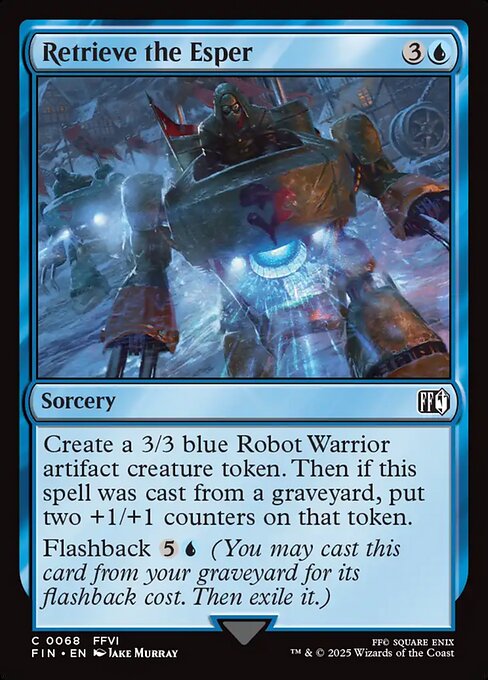
194. Retrieve the Esper
Rating5.0PlayableWhy this rating?
A solid playable that rarely gets cut (5.0/10).
Why. A four-mana sorcery that creates a 3/3 blue Robot Warrior artifact creature token, then comes back with flashback for six mana and two extra +1/+1 counters on the token, a 5/5. Two bodies for one card.
Risks. It is a sorcery: it cannot be cast on the opponent's turn. Flashback takes six mana and time.
In the draft. A good blue common for value, especially blue-red. Take it mid-pack; it is great in long games.
Results in the games of the set
When it is in hand, the deck wins 55.6% of its games (set average: 56.4%, 163rd of 341 cards).
In the opening hand: 53.0% wins (55.2% on average).
Drawn during the game: 57.2% (57.2% on average).
When it is drawn, the deck wins 1.8 points more than when it is not.
When it is drafted, it is played 76% of the time (set average: 62%).
Taken as the first pick (177 drafts), it ends in the deck 92% of the time.
It is played mostly in R/U decks (67% of them) and U/W (45%).

195. Ride the Shoopuf
Rating5.0PlayableWhy this rating?
A solid playable that rarely gets cut (5.0/10).
Why. A two-mana enchantment that puts a +1/+1 counter on target creature you control whenever a land enters under your control. With seven mana it becomes a 7/7 Beast. It plays early and pays off over time.
Risks. It does nothing without lands arriving or creatures to grow. Seven mana is expensive, and it is vulnerable once it is a creature.
In the draft. A pick for a green deck with many creatures and lands coming down. Do not take it in a deck short on creatures.
Results in the games of the set
When it is in hand, the deck wins 55.5% of its games (set average: 56.4%, 167th of 341 cards).
In the opening hand: 56.6% wins (55.2% on average).
Drawn during the game: 54.7% (57.2% on average).
When it is drawn, the deck wins 3.3 points more than when it is not.
When it is drafted, it is played 75% of the time (set average: 62%).
Taken as the first pick (70 drafts), it ends in the deck 90% of the time.
It is played mostly in G/R decks (26% of them).

196. Stuck in Summoner's Sanctum
Rating5.0PlayableWhy this rating?
A solid playable that rarely gets cut (5.0/10).
Why. A three-mana flash Aura that taps an artifact or a creature, keeps it from untapping and shuts off its activated abilities. A flexible removal you can cast on the opponent's turn before attacks.
Risks. The permanent stays on the battlefield and its static and triggered abilities keep working. A bounce or enchantment-removal effect frees it.
In the draft. A fair removal spell, worth taking fairly early in a blue deck. It works well in blue-red.
Results in the games of the set
When it is in hand, the deck wins 55.2% of its games (set average: 56.4%, 182nd of 341 cards).
In the opening hand: 51.4% wins (55.2% on average).
Drawn during the game: 57.5% (57.2% on average).
When it is drawn, the deck wins 1.8 points more than when it is not.
When it is drafted, it is played 81% of the time (set average: 62%).
Taken as the first pick (229 drafts), it ends in the deck 92% of the time.
It is played mostly in R/U decks (60% of them) and G/U (47%).

197. Summon: Choco/Mog
Rating5.0PlayableWhy this rating?
A solid playable that rarely gets cut (5.0/10).
Why. A three-mana 3/3 that gives your other creatures +1/+0 at each of its four chapters. It is sacrificed after the fourth, so it powers up your attacks for four turns.
Risks. It only stays a few turns and does nothing if you have no other creatures. It then disappears.
In the draft. An aggro pick, white and especially white-green or white-red. It is best in a deck with many small creatures.
Results in the games of the set
When it is in hand, the deck wins 53.4% of its games (set average: 56.4%, 237th of 341 cards).
In the opening hand: 52.6% wins (55.2% on average).
Drawn during the game: 54.1% (57.2% on average).
When it is drawn, the deck wins 1.9 points less than when it is not.
When it is drafted, it is played 48% of the time (set average: 62%).
Taken as the first pick (65 drafts), it ends in the deck 75% of the time.
It is played mostly in G/W decks (73% of them) and R/W (39%).

198. Summon: Esper Ramuh
Rating5.0PlayableWhy this rating?
A solid playable that rarely gets cut (5.0/10).
Why. A four-mana 3/3 whose chapter I deals damage to an opposing creature equal to the number of noncreature, nonland cards in your graveyard. Chapters II and III give your Wizards +1/+0.
Risks. The removal is weak early, when your graveyard is nearly empty. It is sacrificed after three turns.
In the draft. A pick for a red deck with many instants and sorceries, often blue-red. In a deck with few spells, pass it.
Results in the games of the set
When it is in hand, the deck wins 52.8% of its games (set average: 56.4%, 260th of 341 cards).
In the opening hand: 49.5% wins (55.2% on average).
Drawn during the game: 54.9% (57.2% on average).
When it is drawn, the deck wins 0.0 points more than when it is not.
When it is drafted, it is played 57% of the time (set average: 62%).
Taken as the first pick (50 drafts), it ends in the deck 84% of the time.
It is played mostly in R/U decks (28% of them) and B/R (25%).
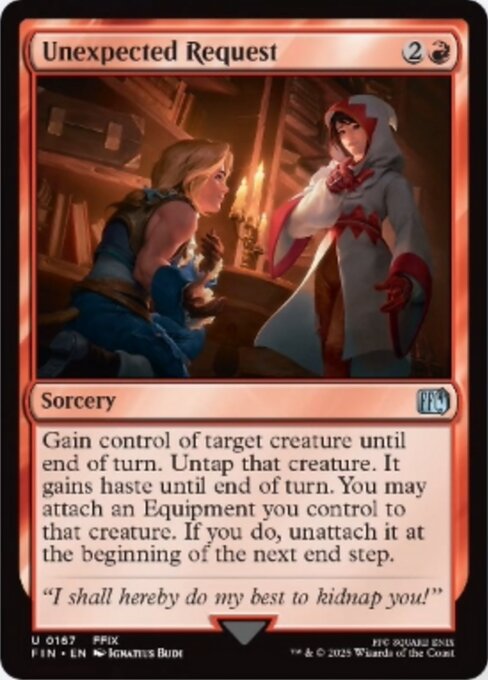
199. Unexpected Request
Rating5.0PlayableWhy this rating?
A solid playable that rarely gets cut (5.0/10).
Why. A three-mana sorcery that gains control of a creature until end of turn, untaps it and gives it haste. You may also attach an Equipment to it. A burst of damage that can also remove a blocker for the turn.
Risks. The effect lasts only a turn and does not kill the creature. Without a way to sacrifice or use it, it is a weak card.
In the draft. A niche card for a red sacrifice deck. Otherwise pass it.
Results in the games of the set
When it is in hand, the deck wins 53.0% of its games (set average: 56.4%, 251st of 341 cards).
In the opening hand: 49.7% wins (55.2% on average).
Drawn during the game: 55.4% (57.2% on average).
When it is drawn, the deck wins 0.6 points more than when it is not.
When it is drafted, it is played 17% of the time (set average: 62%).
Taken among the first three picks (48 drafts), it ends in the deck 63% of the time.
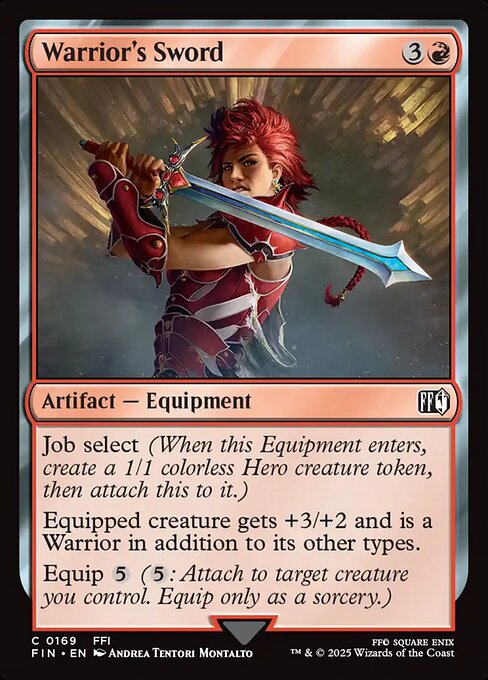
200. Warrior's Sword
Rating5.0PlayableWhy this rating?
A solid playable that rarely gets cut (5.0/10).
Why. For four mana you get a 1/1 colorless Hero token carrying +3/+2, so a 4/3 body through Job select. The Equipment stays on the battlefield if the Hero dies.
Risks. The Hero is vulnerable, and the equip cost of five is steep. A removal on the Hero leaves you with an Equipment that is slow to move.
In the draft. A good red common, particularly in blue-red or red-white. Take it mid-pack.
Results in the games of the set
When it is in hand, the deck wins 54.9% of its games (set average: 56.4%, 194th of 341 cards).
In the opening hand: 53.6% wins (55.2% on average).
Drawn during the game: 55.7% (57.2% on average).
When it is drawn, the deck wins 0.0 points more than when it is not.
When it is drafted, it is played 67% of the time (set average: 62%).
Taken as the first pick (96 drafts), it ends in the deck 91% of the time.
It is played mostly in R/W decks (75% of them) and R/U (47%).

201. Bard's Bow
Rating5.0WeakWhy this rating?
A solid playable that rarely gets cut (5.0/10).
Why. For three mana you effectively get a 3/3 Hero token with reach, a decent body that also holds off fliers. Job select makes it a two-for-one on arrival.
Risks. Equip costs six, so if the Hero token dies the Equipment is mostly dead weight on the battlefield. The token is exposed to any removal.
In the draft. Acceptable green filler for the three-drop slot, a mid or late pick. Take real removal and quality creatures before it.
Results in the games of the set
When it is in hand, the deck wins 55.2% of its games (set average: 56.4%, 179th of 341 cards).
In the opening hand: 54.3% wins (55.2% on average).
Drawn during the game: 55.9% (57.2% on average).
When it is drawn, the deck wins 0.7 points more than when it is not.
When it is drafted, it is played 61% of the time (set average: 62%).
Taken as the first pick (67 drafts), it ends in the deck 85% of the time.
It is played mostly in G/R decks (55% of them) and G/W (53%).
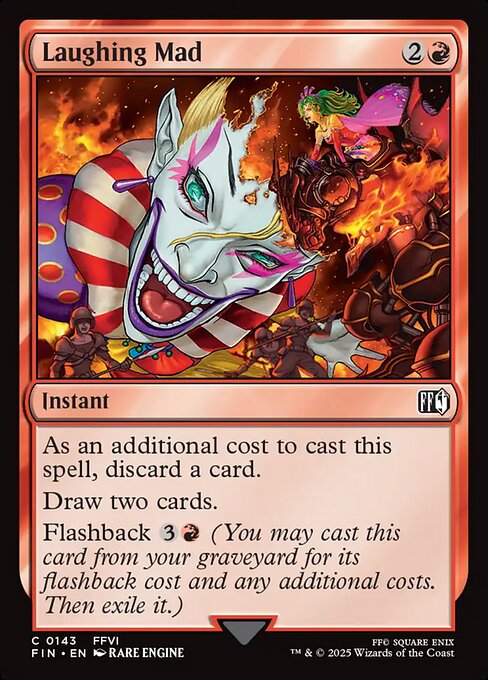
202. Laughing Mad
Rating4.9WeakWhy this rating?
A solid playable that rarely gets cut (4.9/10).
Why. It turns a dead card in hand into two fresh ones, and Flashback lets you do it again later. It is a filtering tool to find lands or threats.
Risks. It does nothing to the battlefield and costs three mana for filtering. You need cards worth discarding, otherwise you are throwing real cards away.
In the draft. Filler. A 23rd card in a red deck that wants to dig. Take it late, after creatures and removal.
Results in the games of the set
When it is in hand, the deck wins 53.6% of its games (set average: 56.4%, 233rd of 341 cards).
In the opening hand: 51.6% wins (55.2% on average).
Drawn during the game: 54.9% (57.2% on average).
When it is drawn, the deck wins 0.1 points less than when it is not.
When it is drafted, it is played 32% of the time (set average: 62%).
Taken among the first three picks (90 drafts), it ends in the deck 67% of the time.
It is played mostly in B/R decks (37% of them) and R/U (30%).

203. Phoenix Down
Rating4.8WeakWhy this rating?
A solid playable that rarely gets cut (4.8/10).
Why. A one-mana artifact that later puts a creature with mana value 4 or less from your graveyard onto the battlefield tapped. In a long game it replaces a dead creature with value.
Risks. You pay two more mana, tap it and exile it for a slow effect that does nothing for tempo. The second mode is very narrow, exiling only Skeletons, Spirits and Zombies.
In the draft. Play it in a grindy white deck with good creatures worth returning. A late pick; it does nothing in a fast deck.
Results in the games of the set
When it is in hand, the deck wins 52.2% of its games (set average: 56.4%, 273rd of 341 cards).
In the opening hand: 50.7% wins (55.2% on average).
Drawn during the game: 53.4% (57.2% on average).
When it is drawn, the deck wins 2.2 points less than when it is not.
When it is drafted, it is played 36% of the time (set average: 62%).
Taken among the first three picks (123 drafts), it ends in the deck 69% of the time.
 Rating4.8Weak
Why this rating?
A solid playable that rarely gets cut (4.8/10).
Why. A flexible sorcery: three 1/1 Hero creature tokens to widen your board, or tap up to three creatures and stun one to push through a big attack or buy a turn.
Risks. Four mana for three 1/1s is a steep price, and the tempo mode stuns only one target. It does not truly answer a threat.
In the draft. Good white filler in a go-wide deck. A mid-pack pick, after your removal and best creatures.
Results in the games of the set
When it is in hand, the deck wins 53.9% of its games (set average: 56.4%, 222nd of 341 cards).
In the opening hand: 51.8% wins (55.2% on average).
Drawn during the game: 55.5% (57.2% on average).
When it is drawn, the deck wins 1.2 points less than when it is not.
When it is drafted, it is played 32% of the time (set average: 62%).
Taken as the first pick (35 drafts), it ends in the deck 49% of the time.
It is played mostly in G/W decks (33% of them) and B/W (30%).

205. Auron's Inspiration
Rating4.8WeakWhy this rating?
A solid playable that rarely gets cut (4.8/10).
Why. An instant that gives all attacking creatures +2/+0, with Flashback for a second use. In a go-wide aggro deck it turns a combat into a lot of damage.
Risks. It also pumps the opponent's attackers if you cast it on defence. It does nothing without attackers, so if you do not attack the first cast is wasted (Flashback remains available).
In the draft. For very aggressive white decks with many small creatures only. Otherwise leave it in the sideboard; a late pick.
Results in the games of the set
When it is in hand, the deck wins 52.5% of its games (set average: 56.4%, 267th of 341 cards).
In the opening hand: 51.8% wins (55.2% on average).
Drawn during the game: 53.1% (57.2% on average).
When it is drawn, the deck wins 3.4 points less than when it is not.
When it is drafted, it is played 21% of the time (set average: 62%).
Taken among the first three picks (66 drafts), it ends in the deck 55% of the time.

206. Balthier and Fran
Rating4.8WeakWhy this rating?
A solid playable that rarely gets cut (4.8/10).
Why. A 4/3 with reach for three mana is a very good body already. Your Vehicles get +1/+1, reach and vigilance, and when a Vehicle he crewed attacks you can pay three mana for an extra combat phase.
Risks. Two colours, with both coloured mana needed early. Without Vehicles its abilities do nothing, and the extra combat costs three more mana.
In the draft. Play it in a red-green deck as an efficient creature. Move it up if you already have Vehicles; otherwise it is a decent mid pick.
Results in the games of the set
When it is in hand, the deck wins 52.6% of its games (set average: 56.4%, 263rd of 341 cards).
In the opening hand: 54.6% wins (55.2% on average).
Drawn during the game: 51.2% (57.2% on average).
When it is drawn, the deck wins 1.1 points more than when it is not.
When it is drafted, it is played 23% of the time (set average: 62%).
Taken among the first three picks (43 drafts), it ends in the deck 67% of the time.

207. Blitzball Shot
Rating4.8WeakWhy this rating?
A solid playable that rarely gets cut (4.8/10).
Why. A two-mana instant giving +3/+3 and trample: it wins a close combat or pushes through lots of damage at once.
Risks. Like any trick, you lose the card if the opponent answers with removal on the target. It does nothing without a creature on the battlefield.
In the draft. A fine trick in a green deck with plenty of creatures. One or two copies are enough, never before real removal.
Results in the games of the set
When it is in hand, the deck wins 53.4% of its games (set average: 56.4%, 239th of 341 cards).
In the opening hand: 51.0% wins (55.2% on average).
Drawn during the game: 55.1% (57.2% on average).
When it is drawn, the deck wins 0.2 points more than when it is not.
When it is drafted, it is played 23% of the time (set average: 62%).
Taken among the first three picks (63 drafts), it ends in the deck 67% of the time.
It is played mostly in G/R decks (44% of them) and G/W (32%).

208. Matoya, Archon Elder
Rating4.8WeakWhy this rating?
A solid playable that rarely gets cut (4.8/10).
Why. A 1/4 for three that blocks well and draws a card whenever you scry or surveil. With several sources it becomes a card engine.
Risks. Everything depends on your scry and surveil sources: without them it is a plain wall that does not attack. It adds little to the board.
In the draft. Only take it if your blue deck already has several scry or surveil sources. Otherwise it is defensive filler late in the pack.
Results in the games of the set
When it is in hand, the deck wins 51.7% of its games (set average: 56.4%, 288th of 341 cards).
In the opening hand: 50.2% wins (55.2% on average).
Drawn during the game: 52.6% (57.2% on average).
When it is drawn, the deck wins 1.2 points more than when it is not.
When it is drafted, it is played 38% of the time (set average: 62%).
Taken among the first three picks (97 drafts), it ends in the deck 59% of the time.

209. Minwu, White Mage
Rating4.8WeakWhy this rating?
A solid playable that rarely gets cut (4.8/10).
Why. A 3/3 with vigilance and lifelink that is itself a Cleric: each life gain puts a +1/+1 counter on each Cleric you control, itself included, so it grows as it hits or blocks.
Risks. Five mana, including two white, for a 3/3 that dies to removal before it grows. Synergy with other Clerics is a bonus, not a promise.
In the draft. A good top-end for a white deck, especially with other life gain. A fair pick, not a priority over removal.
Results in the games of the set
When it is in hand, the deck wins 51.6% of its games (set average: 56.4%, 292nd of 341 cards).
In the opening hand: 50.2% wins (55.2% on average).
Drawn during the game: 52.5% (57.2% on average).
When it is drawn, the deck wins 1.5 points less than when it is not.
When it is drafted, it is played 63% of the time (set average: 62%).
Taken as the first pick (34 drafts), it ends in the deck 76% of the time.
It is played about as much in every archetype.

210. Monk's Fist
Rating4.8WeakWhy this rating?
A solid playable that rarely gets cut (4.8/10).
Why. For two mana, Job select gives a 2/1 Hero token, and the Equipment stays useful for an equip cost of two. It is an efficient two-drop and a card that never quite dies.
Risks. The body is small and the +1/+0 bonus is modest. Against a deck that blocks well, a 2/1 Hero token does little.
In the draft. A solid colourless two-drop for an aggressive deck, playable in any colour. A mid to late pick to fill out the curve.
Results in the games of the set
When it is in hand, the deck wins 54.5% of its games (set average: 56.4%, 206th of 341 cards).
In the opening hand: 54.2% wins (55.2% on average).
Drawn during the game: 54.7% (57.2% on average).
When it is drawn, the deck wins 1.6 points less than when it is not.
When it is drafted, it is played 51% of the time (set average: 62%).
Taken among the first three picks (187 drafts), it ends in the deck 82% of the time.
It is played mostly in R/W decks (44% of them) and U/W (33%).
211. Opera Love Song
Rating4.8WeakWhy this rating?
A solid playable that rarely gets cut (4.8/10).
Why. A two-mana instant with two modes: exile the top two cards of your library and play them until your next end step, or give one or two creatures +2/+0.
Risks. The exiled cards are lost if you cannot play them in time. The combat mode is weaker than a real trick.
In the draft. Flexible filler for a red deck with spare mana. A late pick, playable but not a priority.
Results in the games of the set
When it is in hand, the deck wins 52.7% of its games (set average: 56.4%, 262nd of 341 cards).
In the opening hand: 50.6% wins (55.2% on average).
Drawn during the game: 54.2% (57.2% on average).
When it is drawn, the deck wins 1.1 points less than when it is not.
When it is drafted, it is played 27% of the time (set average: 62%).
Taken among the first three picks (68 drafts), it ends in the deck 65% of the time.
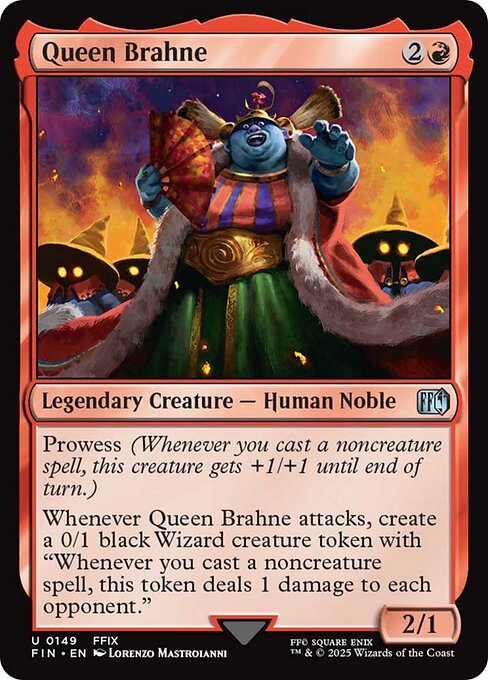
212. Queen Brahne
Rating4.8WeakWhy this rating?
A solid playable that rarely gets cut (4.8/10).
Why. A 2/1 prowess creature that makes a 0/1 Wizard creature token each time it attacks, and the token deals 1 damage to each opponent per noncreature spell you cast. In a spells deck the damage adds up.
Risks. It is fragile, a 2/1 for three, and attacks poorly into a busy board. Without many noncreature spells the Wizard tokens do little.
In the draft. For a red deck full of noncreature spells. Otherwise it is a mediocre creature to take late.
Results in the games of the set
When it is in hand, the deck wins 52.2% of its games (set average: 56.4%, 274th of 341 cards).
In the opening hand: 52.7% wins (55.2% on average).
Drawn during the game: 51.9% (57.2% on average).
When it is drawn, the deck wins 0.5 points less than when it is not.
When it is drafted, it is played 68% of the time (set average: 62%).
Taken as the first pick (73 drafts), it ends in the deck 82% of the time.
It is played mostly in B/R decks (36% of them) and R/U (27%).
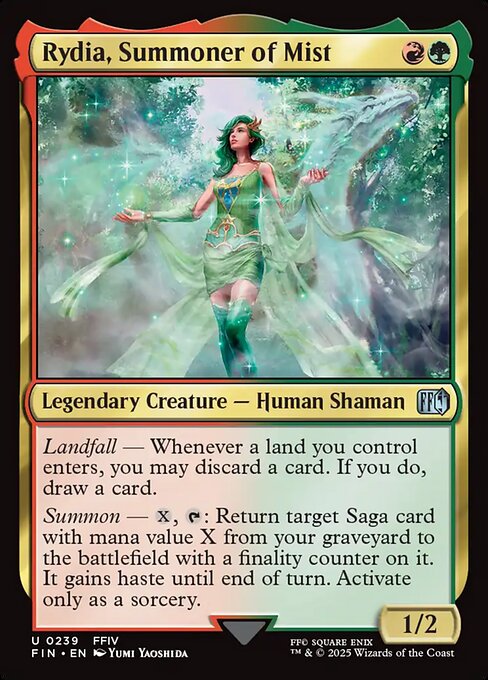 Rating4.8Weak
Why this rating?
A solid playable that rarely gets cut (4.8/10).
Why. A red-green two-drop that smooths your draws: whenever a land enters under your control, you may discard a card to draw one. The Summon ability is a bonus for decks with Sagas.
Risks. It is a 1/2 with no impact on the battlefield, and Summon requires tapping it and paying X for a very narrow effect.
In the draft. Decent red-green filler for a deck that wants to smooth its draws. Take it late unless you already have Sagas.
Results in the games of the set
When it is in hand, the deck wins 53.7% of its games (set average: 56.4%, 229th of 341 cards).
In the opening hand: 54.1% wins (55.2% on average).
Drawn during the game: 53.4% (57.2% on average).
When it is drawn, the deck wins 1.0 points more than when it is not.
When it is drafted, it is played 39% of the time (set average: 62%).
Taken as the first pick (39 drafts), it ends in the deck 79% of the time.
It is played mostly in G/R decks (53% of them).
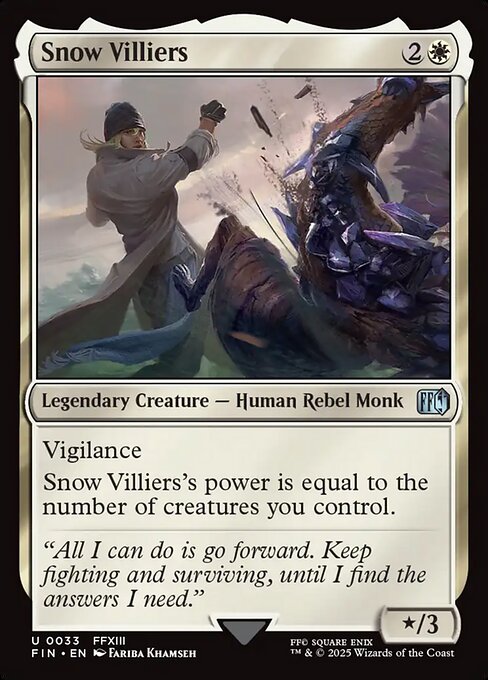
214. Snow Villiers
Rating4.8WeakWhy this rating?
A solid playable that rarely gets cut (4.8/10).
Why. A */3 with vigilance for three whose power equals the number of creatures you control, itself included. In a tokens deck it hits hard and keeps defending thanks to vigilance.
Risks. Alone on the battlefield it is just a 1/3. A removal spell or a well-placed block neutralises it easily.
In the draft. Good in a white deck that makes many creatures or tokens. Otherwise a mid to late pick.
Results in the games of the set
When it is in hand, the deck wins 51.8% of its games (set average: 56.4%, 282nd of 341 cards).
In the opening hand: 51.7% wins (55.2% on average).
Drawn during the game: 51.9% (57.2% on average).
When it is drawn, the deck wins 3.0 points less than when it is not.
When it is drafted, it is played 45% of the time (set average: 62%).
Taken among the first three picks (127 drafts), it ends in the deck 83% of the time.
It is played about as much in every archetype.
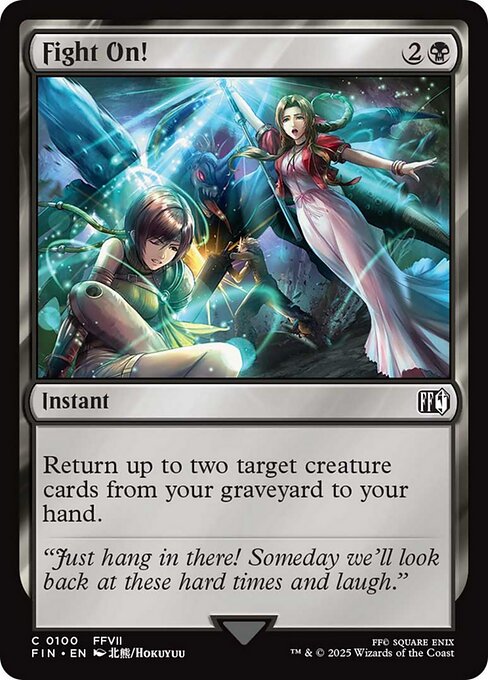
215. Fight On!
Rating4.8WeakWhy this rating?
A solid playable that rarely gets cut (4.8/10).
Why. An instant that returns up to two creature cards from your graveyard to your hand: a slow two-for-one that gives value in a long game.
Risks. Three mana that adds nothing to the battlefield, and you must then recast the creatures, so the tempo cost is high. Weak if your graveyard is empty.
In the draft. Value filler for a black control or grind deck. A late pick, after creatures and removal.
Results in the games of the set
When it is in hand, the deck wins 54.4% of its games (set average: 56.4%, 209th of 341 cards).
In the opening hand: 50.3% wins (55.2% on average).
Drawn during the game: 57.0% (57.2% on average).
When it is drawn, the deck wins 0.5 points more than when it is not.
When it is drafted, it is played 56% of the time (set average: 62%).
Taken as the first pick (67 drafts), it ends in the deck 81% of the time.
It is played mostly in B/G decks (62% of them) and B/W (44%).
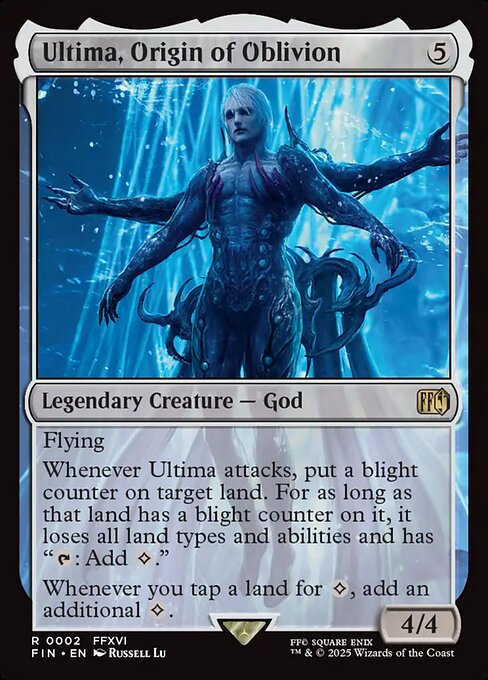
216. Ultima, Origin of Oblivion
Rating4.7WeakWhy this rating?
A solid playable that rarely gets cut (4.7/10).
Why. A colourless 4/4 flier for five, playable in any deck. Each attack puts a blight counter on a land, which loses its types and abilities and only taps for colourless mana; your colourless mana doubles.
Risks. Five mana for a creature that dies to removal without doing much. The blight can also strip your own lands of their colours if you aim badly.
In the draft. A good flying finisher that commits you to no colour. A mid-pack pick as a top-end threat.
Results in the games of the set
When it is in hand, the deck wins 53.0% of its games (set average: 56.4%, 254th of 341 cards).
In the opening hand: 50.5% wins (55.2% on average).
Drawn during the game: 54.6% (57.2% on average).
When it is drawn, the deck wins 1.0 points more than when it is not.
When it is drafted, it is played 87% of the time (set average: 62%).
Taken as the first pick (59 drafts), it ends in the deck 83% of the time.
It is played about as much in every archetype.
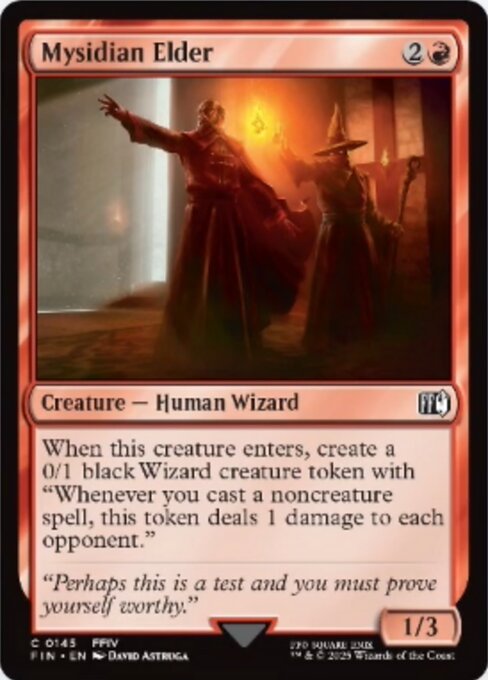
217. Mysidian Elder
Rating4.7WeakWhy this rating?
A solid playable that rarely gets cut (4.7/10).
Why. A 1/3 that arrives with a 0/1 Wizard token: two bodies for three mana, with the token dealing 1 damage per noncreature spell you cast. It blocks decently and chips in damage in a spells deck.
Risks. Neither body attacks well, and the token's damage depends on your noncreature spells. Alone it is a small effect.
In the draft. Decent red filler for a spells deck. A late pick, never a priority.
Results in the games of the set
When it is in hand, the deck wins 52.3% of its games (set average: 56.4%, 272nd of 341 cards).
In the opening hand: 50.7% wins (55.2% on average).
Drawn during the game: 53.4% (57.2% on average).
When it is drawn, the deck wins 0.6 points less than when it is not.
When it is drafted, it is played 46% of the time (set average: 62%).
Taken as the first pick (38 drafts), it ends in the deck 84% of the time.
It is played mostly in B/R decks (64% of them) and R/U (45%).

218. Clash of the Eikons
Rating4.6WeakWhy this rating?
A solid playable that rarely gets cut (4.6/10).
Why. For one mana, one of your creatures fights an opposing creature: cheap removal as soon as you have the bigger body. The Saga modes come on top if you have one.
Risks. It is a sorcery: the opponent can respond with removal or a trick and you lose the card. You need a creature bigger than the target.
In the draft. A decent conditional removal option in a green deck with big creatures. A mid pick, depending on your curve.
Results in the games of the set
When it is in hand, the deck wins 53.8% of its games (set average: 56.4%, 228th of 341 cards).
In the opening hand: 51.4% wins (55.2% on average).
Drawn during the game: 55.4% (57.2% on average).
When it is drawn, the deck wins 0.1 points less than when it is not.
When it is drafted, it is played 62% of the time (set average: 62%).
Taken as the first pick (46 drafts), it ends in the deck 80% of the time.
It is played mostly in G/W decks (26% of them).

219. Cloudbound Moogle
Rating4.6WeakWhy this rating?
A solid playable that rarely gets cut (4.6/10).
Why. A 2/3 flier that puts a +1/+1 counter on a target creature on arrival (on itself it becomes a 3/4 flier). Plainscycling costs two, so it is a land early and a threat late.
Risks. Five mana including two white: slow as a creature, and a 3/4 flier still dies to removal.
In the draft. A flexible white common that is never dead in hand. A mid pick to secure your lands and an aerial threat.
Results in the games of the set
When it is in hand, the deck wins 52.1% of its games (set average: 56.4%, 276th of 341 cards).
In the opening hand: 50.3% wins (55.2% on average).
Drawn during the game: 53.3% (57.2% on average).
When it is drawn, the deck wins 2.1 points less than when it is not.
When it is drafted, it is played 18% of the time (set average: 62%).
Taken among the first three picks (49 drafts), it ends in the deck 53% of the time.
 Rating4.6Weak
Why this rating?
A solid playable that rarely gets cut (4.6/10).
Why. A 2/4 for three that flies during your turn. If it connects, you draw that many cards, create that many tapped Treasure tokens and lose that much life.
Risks. If the hit lands, the opponent gains control of Kain: you hand them a 2/4. The effect is risky and costs you life.
In the draft. A hard card to use well, best left to a deck built to exploit it. A late pick, no priority.
Results in the games of the set
When it is in hand, the deck wins 51.6% of its games (set average: 56.4%, 291st of 341 cards).
In the opening hand: 50.1% wins (55.2% on average).
Drawn during the game: 52.7% (57.2% on average).
When it is drawn, the deck wins 0.5 points more than when it is not.
When it is drafted, it is played 30% of the time (set average: 62%).
Taken among the first three picks (43 drafts), it ends in the deck 58% of the time.

221. Lion Heart
Rating4.6WeakWhy this rating?
A solid playable that rarely gets cut (4.6/10).
Why. Four colourless mana: 2 damage to any target on arrival, then a +2/+1 Equipment for an equip cost of two. Removal against small creatures that stays useful afterward.
Risks. Four mana for 2 damage is slow, and the Equipment does nothing without a creature. A large target escapes the damage.
In the draft. Playable in any deck with creatures. Take it above filler, behind real removal.
Results in the games of the set
When it is in hand, the deck wins 54.1% of its games (set average: 56.4%, 217th of 341 cards).
In the opening hand: 51.4% wins (55.2% on average).
Drawn during the game: 56.0% (57.2% on average).
When it is drawn, the deck wins 0.4 points less than when it is not.
When it is drafted, it is played 75% of the time (set average: 62%).
Taken as the first pick (57 drafts), it ends in the deck 86% of the time.
It is played about as much in every archetype.

222. Poison the Waters
Rating4.6WeakWhy this rating?
A solid playable that rarely gets cut (4.6/10).
Why. A two-mana sorcery with two modes: -1/-1 to all creatures until end of turn, sweeping small creatures and tokens, or look at a player's hand and make them discard an artifact or creature card of your choice.
Risks. The sweep mode hits your own creatures too. Depending on the opposing board it may kill nothing.
In the draft. A situational tool, good against token or small-creature decks. Otherwise a sideboard card; a late pick.
Results in the games of the set
When it is in hand, the deck wins 52.8% of its games (set average: 56.4%, 259th of 341 cards).
In the opening hand: 51.5% wins (55.2% on average).
Drawn during the game: 53.7% (57.2% on average).
When it is drawn, the deck wins 0.6 points more than when it is not.
When it is drafted, it is played 35% of the time (set average: 62%).
Taken among the first three picks (94 drafts), it ends in the deck 63% of the time.

223. Qiqirn Merchant
Rating4.6WeakWhy this rating?
A solid playable that rarely gets cut (4.6/10).
Why. A 1/4 that blocks well and filters your hand: for one mana, draw then discard. Late in the game, sacrifice it to draw three cards.
Risks. It does not attack, and the filtering costs mana every turn. The seven-mana sacrifice is very slow without Towns.
In the draft. Useful defensive filler for a blue control deck. A mid to late pick.
Results in the games of the set
When it is in hand, the deck wins 52.8% of its games (set average: 56.4%, 257th of 341 cards).
In the opening hand: 50.1% wins (55.2% on average).
Drawn during the game: 54.6% (57.2% on average).
When it is drawn, the deck wins 0.8 points more than when it is not.
When it is drafted, it is played 35% of the time (set average: 62%).
Taken among the first three picks (135 drafts), it ends in the deck 67% of the time.
It is played mostly in G/U decks (58% of them).

224. Ring of the Lucii
Rating4.6WeakWhy this rating?
A solid playable that rarely gets cut (4.6/10).
Why. A four-mana artifact that makes two colourless mana, or for two mana and a life taps a target nonland permanent. A ramp piece that doubles as control.
Risks. It taps for one ability or the other, never both in a turn, and only makes colourless mana. Four mana for mana is slow.
In the draft. For a control or heavy top-end deck with big threats. Otherwise it is filler you can leave.
Results in the games of the set
When it is in hand, the deck wins 53.6% of its games (set average: 56.4%, 231st of 341 cards).
In the opening hand: 51.2% wins (55.2% on average).
Drawn during the game: 55.2% (57.2% on average).
When it is drawn, the deck wins 1.7 points more than when it is not.
When it is drafted, it is played 32% of the time (set average: 62%).
Taken among the first three picks (93 drafts), it ends in the deck 67% of the time.
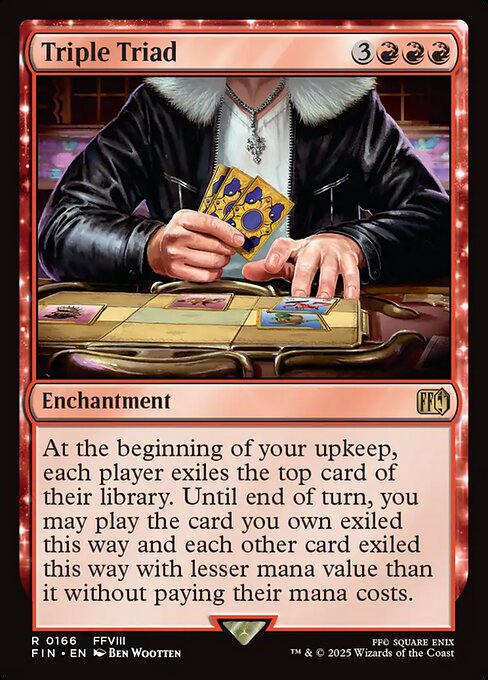
225. Triple Triad
Rating4.6WeakWhy this rating?
A solid playable that rarely gets cut (4.6/10).
Why. A six-mana enchantment that each upkeep has every player exile their top card; until end of turn you may play your own and the cheaper exiled ones for free. It can generate a lot of long-term value.
Risks. Six mana, including three red, for an effect that does nothing the turn you cast it. It is slow, random, and does not affect the board right away.
In the draft. A special case for a heavy, slow red deck. In most decks, do not play it; a very late pick.
Results in the games of the set
When it is in hand, the deck wins 51.5% of its games (set average: 56.4%, 296th of 341 cards).
In the opening hand: 48.8% wins (55.2% on average).
Drawn during the game: 53.1% (57.2% on average).
When it is drawn, the deck wins 1.0 points less than when it is not.
When it is drafted, it is played 27% of the time (set average: 62%).
Taken among the first three picks (61 drafts), it ends in the deck 64% of the time.

226. Valkyrie Aerial Unit
Rating4.6WeakWhy this rating?
A solid playable that rarely gets cut (4.6/10).
Why. A 5/4 flier with surveil 2, interesting once affinity for artifacts makes it cheaper. Each artifact you control takes one mana off its cost.
Risks. Seven mana without artifacts is too expensive and slow. It needs an artifact base that a normal deck does not have.
In the draft. Only take it if your blue deck runs many artifacts. Otherwise let it go.
Results in the games of the set
When it is in hand, the deck wins 52.6% of its games (set average: 56.4%, 265th of 341 cards).
In the opening hand: 49.9% wins (55.2% on average).
Drawn during the game: 54.2% (57.2% on average).
When it is drawn, the deck wins 0.2 points more than when it is not.
When it is drafted, it is played 52% of the time (set average: 62%).
Taken as the first pick (56 drafts), it ends in the deck 91% of the time.
It is played mostly in U/W decks (49% of them).
 Rating4.6Weak
Why this rating?
A solid playable that rarely gets cut (4.6/10).
Why. A two-mana instant with Tiered: until end of turn your creature returns to the battlefield tapped if it dies, and has base power and toughness of 3/2, 5/2 or 7/2 depending on the additional cost chosen. It blanks a destroy-based removal spell.
Risks. Base toughness drops to 2, so a big creature shrinks and dies more easily. It lasts one turn only and does not stop exile.
In the draft. A niche trick for a black deck that likes combat. Take it late, after removal.
Results in the games of the set
When it is in hand, the deck wins 52.0% of its games (set average: 56.4%, 277th of 341 cards).
In the opening hand: 49.7% wins (55.2% on average).
Drawn during the game: 53.6% (57.2% on average).
When it is drawn, the deck wins 0.3 points less than when it is not.
When it is drafted, it is played 21% of the time (set average: 62%).
Taken among the first three picks (62 drafts), it ends in the deck 58% of the time.

228. Instant Ramen
Rating4.5WeakWhy this rating?
A solid playable that rarely gets cut (4.5/10).
Why. A two-mana Food artifact with flash that draws a card on arrival: a cantrip that replaces itself, and gains 3 life later.
Risks. It does not change the board and costs two mana to replace a card. The life gain is slow.
In the draft. Filler playable in any deck, especially those that like artifacts. A late pick.
Results in the games of the set
When it is in hand, the deck wins 53.1% of its games (set average: 56.4%, 247th of 341 cards).
In the opening hand: 51.1% wins (55.2% on average).
Drawn during the game: 54.6% (57.2% on average).
When it is drawn, the deck wins 1.0 points more than when it is not.
When it is drafted, it is played 17% of the time (set average: 62%).

229. Sabotender
Rating4.4WeakWhy this rating?
A good playable, but is sometimes cut (4.4/10).
Why. A 2/1 with reach for two that deals 1 damage to each opponent whenever a land enters under your control. It blocks fliers and piles up damage over the game.
Risks. With 1 toughness it dies to almost anything. Landfall damage is slow and does little against a defensive deck.
In the draft. Red filler for an aggressive deck. A late pick, playable but not a good two-drop.
Results in the games of the set
When it is in hand, the deck wins 51.9% of its games (set average: 56.4%, 280th of 341 cards).
In the opening hand: 52.2% wins (55.2% on average).
Drawn during the game: 51.6% (57.2% on average).
When it is drawn, the deck wins 0.4 points less than when it is not.
When it is drafted, it is played 27% of the time (set average: 62%).
Taken among the first three picks (86 drafts), it ends in the deck 59% of the time.
It is played mostly in G/R decks (71% of them) and B/R (25%).

230. Aettir and Priwen
Rating4.4WeakWhy this rating?
A good playable, but is sometimes cut (4.4/10).
Why. A six-mana Equipment that makes the equipped creature X/X, where X is your life total. With a lot of life, the creature can become huge.
Risks. Six mana, then five to equip: eleven mana before any effect, and nothing happens by itself on the battlefield. It is far too slow for draft.
In the draft. Avoid it in nearly every deck. Do not play it except in an extreme life-gain case.
Results in the games of the set
When it is in hand, the deck wins 41.5% of its games (set average: 56.4%, 340th of 341 cards).
In the opening hand: 38.7% wins (55.2% on average).
Drawn during the game: 43.5% (57.2% on average).
When it is drawn, the deck wins 9.4 points less than when it is not.
When it is drafted, it is played only 13% of the time (set average: 62%): it almost always ends in the sideboard.
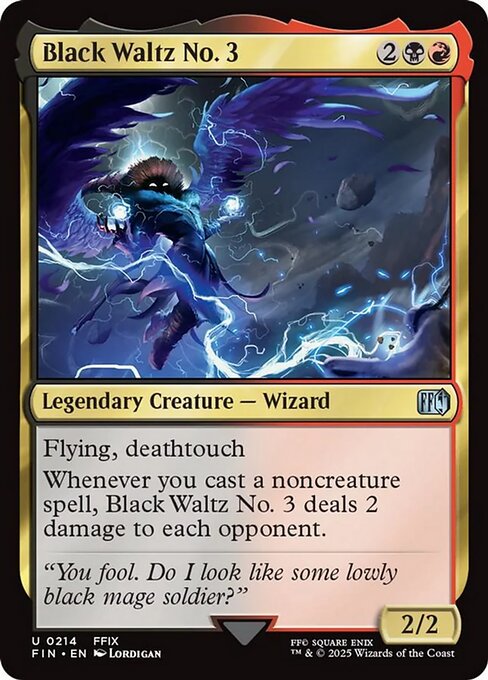
231. Black Waltz No. 3
Rating4.4WeakWhy this rating?
A good playable, but is sometimes cut (4.4/10).
Why. A 2/2 with flying and deathtouch for four: it blocks and deters attacks, and each noncreature spell you cast deals 2 damage to each opponent.
Risks. Two colours, black and red, and a fragile 2/2 that dies to a lot. The damage depends on your noncreature spells.
In the draft. A good card for a black-red deck full of spells. Otherwise a mid pick, below removal.
Results in the games of the set
When it is in hand, the deck wins 51.4% of its games (set average: 56.4%, 297th of 341 cards).
In the opening hand: 48.4% wins (55.2% on average).
Drawn during the game: 53.3% (57.2% on average).
When it is drawn, the deck wins 0.1 points more than when it is not.
When it is drafted, it is played 48% of the time (set average: 62%).
Taken as the first pick (48 drafts), it ends in the deck 83% of the time.
It is played mostly in B/R decks (47% of them).

232. Clive's Hideaway
Rating4.4WeakWhy this rating?
A good playable, but is sometimes cut (4.4/10).
Why. A colourless Town land with Hideaway 4: you exile one of the top four cards face down, but you can only play it, for two mana and a tap, if you control four legendary creatures.
Risks. Four legendary creatures is nearly impossible to assemble, so the effect almost never triggers. A colourless land can also strain your colours.
In the draft. Do not play it in a normal deck. Consider it only with many legendary creatures; otherwise a very late pick.
Results in the games of the set
When it is in hand, the deck wins 47.4% of its games (set average: 56.4%, 332nd of 341 cards).
In the opening hand: 43.6% wins (55.2% on average).
Drawn during the game: 49.9% (57.2% on average).
When it is drawn, the deck wins 0.7 points less than when it is not.
When it is drafted, it is played only 4% of the time (set average: 62%): it almost always ends in the sideboard.
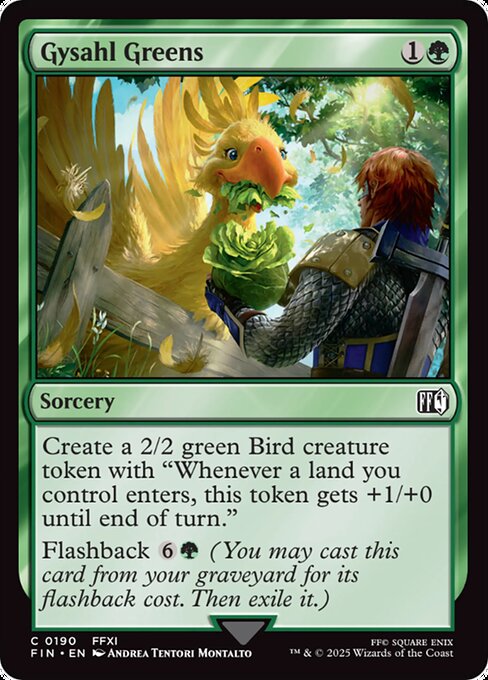
233. Gysahl Greens
Rating4.4WeakWhy this rating?
A good playable, but is sometimes cut (4.4/10).
Why. A two-mana sorcery that creates a 2/2 Bird creature token, and Flashback for seven gives you a second one. A two-for-one in a long game.
Risks. A 2/2 for two is an average body, and Flashback costs seven, which is slow. The Landfall bonus is modest.
In the draft. Decent green filler, useful to complete the two-drop slot. A mid to late pick.
Results in the games of the set
When it is in hand, the deck wins 54.4% of its games (set average: 56.4%, 210th of 341 cards).
In the opening hand: 54.5% wins (55.2% on average).
Drawn during the game: 54.3% (57.2% on average).
When it is drawn, the deck wins 0.3 points more than when it is not.
When it is drafted, it is played 65% of the time (set average: 62%).
Taken as the first pick (65 drafts), it ends in the deck 86% of the time.
It is played mostly in G/R decks (71% of them) and G/W (69%).

234. Ice Flan
Rating4.4WeakWhy this rating?
A good playable, but is sometimes cut (4.4/10).
Why. A 5/4 that taps an opposing artifact or creature on arrival and puts a stun counter on it: a big body with a tempo effect. Islandcycling for two keeps it from being dead in hand.
Risks. Six mana including two blue: slow, and the stun does not remove the threat. Early on you cycle it like a land.
In the draft. A decent blue top-end common, flexible thanks to cycling. A mid pick.
Results in the games of the set
When it is in hand, the deck wins 53.6% of its games (set average: 56.4%, 235th of 341 cards).
In the opening hand: 50.6% wins (55.2% on average).
Drawn during the game: 55.4% (57.2% on average).
When it is drawn, the deck wins 0.5 points more than when it is not.
When it is drafted, it is played 42% of the time (set average: 62%).
Taken among the first three picks (150 drafts), it ends in the deck 71% of the time.
It is played mostly in R/U decks (36% of them) and B/U (27%).

235. Prishe's Wanderings
Rating4.4WeakWhy this rating?
A good playable, but is sometimes cut (4.4/10).
Why. An instant-speed ramp spell: for three mana you put a basic land or Town onto the battlefield tapped and a creature gets a +1/+1 counter. Decent fixing that sets up your next turn.
Risks. It does nothing to the board on its own. With no creature to target you lose the counter, and spending turn three without a play can hurt against an aggressive deck.
In the draft. A fair filler pick for a green deck with expensive cards or several colours. Take it after your creatures and removal.
Results in the games of the set
When it is in hand, the deck wins 54.3% of its games (set average: 56.4%, 212th of 341 cards).
In the opening hand: 53.6% wins (55.2% on average).
Drawn during the game: 54.8% (57.2% on average).
When it is drawn, the deck wins 1.4 points more than when it is not.
When it is drafted, it is played 70% of the time (set average: 62%).
Taken as the first pick (102 drafts), it ends in the deck 93% of the time.
It is played mostly in G/R decks (57% of them) and B/G (52%).
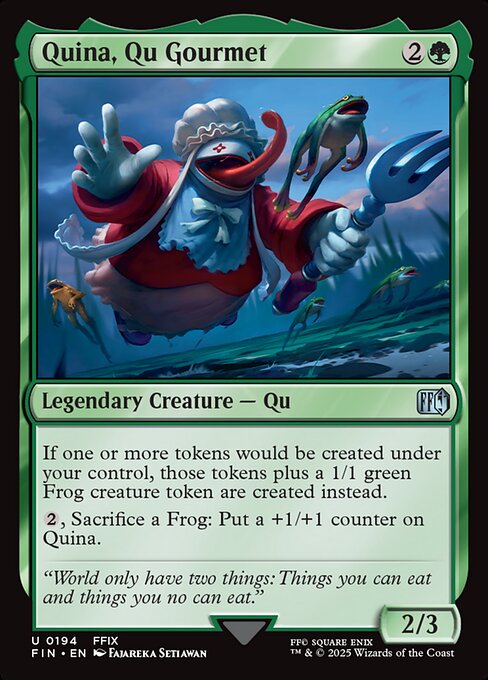
236. Quina, Qu Gourmet
Rating4.4WeakWhy this rating?
A good playable, but is sometimes cut (4.4/10).
Why. Whenever you create tokens, you also get a 1/1 green Frog creature token. A fine 2/3 body for three mana that becomes an engine only if your deck makes tokens.
Risks. On its own it is a 2/3 with little impact. The bonus relies on token makers your deck has to supply, and sacrificing a Frog for a counter costs two mana: slow.
In the draft. Take it if you already have cards that create tokens. Otherwise it is a late-pack playable in green.
Results in the games of the set
When it is in hand, the deck wins 52.2% of its games (set average: 56.4%, 275th of 341 cards).
In the opening hand: 52.1% wins (55.2% on average).
Drawn during the game: 52.3% (57.2% on average).
When it is drawn, the deck wins 1.4 points less than when it is not.
When it is drafted, it is played 57% of the time (set average: 62%).
Taken as the first pick (56 drafts), it ends in the deck 84% of the time.
It is played mostly in G/W decks (31% of them) and G/R (27%).
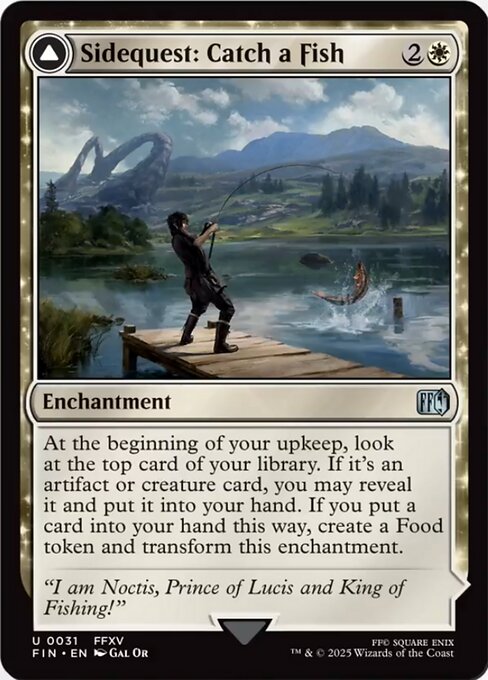
237. Sidequest: Catch a Fish // Cooking Campsite
Rating4.4WeakWhy this rating?
A good playable, but is sometimes cut (4.4/10).
Why. A slow value enchantment: each upkeep, if the top card of your library is an artifact or creature, you may reveal it and put it into your hand, then create a Food token and transform into a land that taps for white.
Risks. It does nothing the turn you cast it and depends on what sits on top of your library. Your deck needs enough artifacts and creatures for it to trigger.
In the draft. A late-pack playable for white decks with many creatures. Do not take it over a real threat or removal.
Results in the games of the set
When it is in hand, the deck wins 50.5% of its games (set average: 56.4%, 311th of 341 cards).
In the opening hand: 51.1% wins (55.2% on average).
Drawn during the game: 50.2% (57.2% on average).
When it is drawn, the deck wins 3.0 points less than when it is not.
When it is drafted, it is played 18% of the time (set average: 62%).
Taken among the first three picks (56 drafts), it ends in the deck 55% of the time.

238. Tifa's Limit Break
Rating4.4WeakWhy this rating?
A good playable, but is sometimes cut (4.4/10).
Why. A flexible combat trick: the first mode gives +2/+2 for a single green mana, and the second doubles power and toughness for two more. It wins a combat by surprise.
Risks. It is a conditional spell: if the opponent answers by killing the creature, you lose the card. The last mode is very expensive and rarely castable in time.
In the draft. A fine playable in a green deck with attackers. A late pick: look for creatures first.
Results in the games of the set
When it is in hand, the deck wins 53.2% of its games (set average: 56.4%, 245th of 341 cards).
In the opening hand: 50.4% wins (55.2% on average).
Drawn during the game: 55.2% (57.2% on average).
When it is drawn, the deck wins 0.5 points more than when it is not.
When it is drafted, it is played 37% of the time (set average: 62%).
Taken among the first three picks (68 drafts), it ends in the deck 74% of the time.

239. Sage's Nouliths
Rating4.3WeakWhy this rating?
A good playable, but is sometimes cut (4.4/10).
Why. With Job select, two mana gets you a 1/1 Hero that attacks as a 2/1 and untaps an attacking creature each combat, a kind of pseudo-vigilance. A card for blue decks with light creatures.
Risks. The body is small and re-equipping costs three. If the Hero is killed, you keep the Equipment but lose the body.
In the draft. A fair filler for aggressive blue decks or decks that like Equipment. Take it if your curve lacks two-mana cards.
Results in the games of the set
When it is in hand, the deck wins 52.8% of its games (set average: 56.4%, 258th of 341 cards).
In the opening hand: 51.8% wins (55.2% on average).
Drawn during the game: 53.6% (57.2% on average).
When it is drawn, the deck wins 0.1 points less than when it is not.
When it is drafted, it is played 39% of the time (set average: 62%).
Taken as the first pick (31 drafts), it ends in the deck 61% of the time.
It is played mostly in U/W decks (56% of them).

240. Shambling Cie'th
Rating4.3WeakWhy this rating?
A good playable, but is sometimes cut (4.3/10).
Why. A 3/3 for three mana. If you lose it, you get it back to hand by casting a noncreature spell and paying a black mana, so it keeps coming back.
Risks. It enters tapped, so it does no defending the turn it arrives. The recursion needs noncreature spells, which the deck must run in numbers.
In the draft. A middle-of-the-pack playable for a black deck. Better in lists with plenty of instants and sorceries.
Results in the games of the set
When it is in hand, the deck wins 51.2% of its games (set average: 56.4%, 302nd of 341 cards).
In the opening hand: 51.2% wins (55.2% on average).
Drawn during the game: 51.1% (57.2% on average).
When it is drawn, the deck wins 2.3 points less than when it is not.
When it is drafted, it is played 50% of the time (set average: 62%).
Taken as the first pick (38 drafts), it ends in the deck 82% of the time.
It is played about as much in every archetype.

241. Cactuar
Rating4.2WeakWhy this rating?
A good playable, but is sometimes cut (4.2/10).
Why. A 3/3 trampler for a single green mana that returns to hand at your end step unless it just entered. In practice it attacks every other turn and dodges slow removal.
Risks. You have to recast it constantly, and it is never there to block the turn after it returns to hand. It does not hold the board and is a 3/3 with no other effect.
In the draft. A card for a very aggressive deck with a low curve. In a slower deck, take something else.
Results in the games of the set
When it is in hand, the deck wins 51.2% of its games (set average: 56.4%, 300th of 341 cards).
In the opening hand: 52.2% wins (55.2% on average).
Drawn during the game: 50.4% (57.2% on average).
When it is drawn, the deck wins 0.8 points less than when it is not.
When it is drafted, it is played only 12% of the time (set average: 62%): it almost always ends in the sideboard.

242. Airship Crash
Rating4.2WeakWhy this rating?
A good playable, but is sometimes cut (4.2/10).
Why. A narrow but useful instant removal spell: it destroys an artifact, an enchantment or a creature with flying. With cycling, it is never a dead card when the opponent has no target.
Risks. It depends on what the opponent plays: against a deck with no fliers, artifacts or enchantments you just cycle it for two mana, which is a weak rate.
In the draft. A late pick in green, especially in the sideboard against decks with fliers. Cycling makes it playable in nearly every green deck.
Results in the games of the set
When it is in hand, the deck wins 53.2% of its games (set average: 56.4%, 246th of 341 cards).
In the opening hand: 50.0% wins (55.2% on average).
Drawn during the game: 55.5% (57.2% on average).
When it is drawn, the deck wins 0.4 points more than when it is not.
When it is drafted, it is played 26% of the time (set average: 62%).
Taken among the first three picks (43 drafts), it ends in the deck 53% of the time.
It is played mostly in G/R decks (28% of them).

243. Barret Wallace
Rating4.2WeakWhy this rating?
A good playable, but is sometimes cut (4.2/10).
Why. A 4/4 with reach for four mana, solid on defense against fliers. When it attacks, it deals extra damage to the player based on how many equipped creatures you control.
Risks. Without Equipment its trigger does nothing, leaving a big four-mana body that is fine but unexciting.
In the draft. A fine playable in a red deck with several Equipment, especially red-white. Otherwise it is filler.
Results in the games of the set
When it is in hand, the deck wins 51.6% of its games (set average: 56.4%, 289th of 341 cards).
In the opening hand: 51.1% wins (55.2% on average).
Drawn during the game: 52.0% (57.2% on average).
When it is drawn, the deck wins 1.4 points less than when it is not.
When it is drafted, it is played 29% of the time (set average: 62%).
Taken among the first three picks (71 drafts), it ends in the deck 69% of the time.
 Rating4.2Weak
Why this rating?
A good playable, but is sometimes cut (4.2/10).
Why. A very flexible instant removal spell: it destroys any nonland permanent. It costs only three mana if it targets a tapped creature, which often happens after an attack.
Risks. At five mana with no tapped target it is expensive and slow. It cannot target lands.
In the draft. A versatile removal spell to play in white, but not ahead of better cards. One or two copies are enough.
Results in the games of the set
When it is in hand, the deck wins 54.1% of its games (set average: 56.4%, 214th of 341 cards).
In the opening hand: 51.6% wins (55.2% on average).
Drawn during the game: 55.9% (57.2% on average).
When it is drawn, the deck wins 0.5 points less than when it is not.
When it is drafted, it is played 72% of the time (set average: 62%).
Taken as the first pick (116 drafts), it ends in the deck 87% of the time.
It is played mostly in B/W decks (45% of them) and G/W (44%).
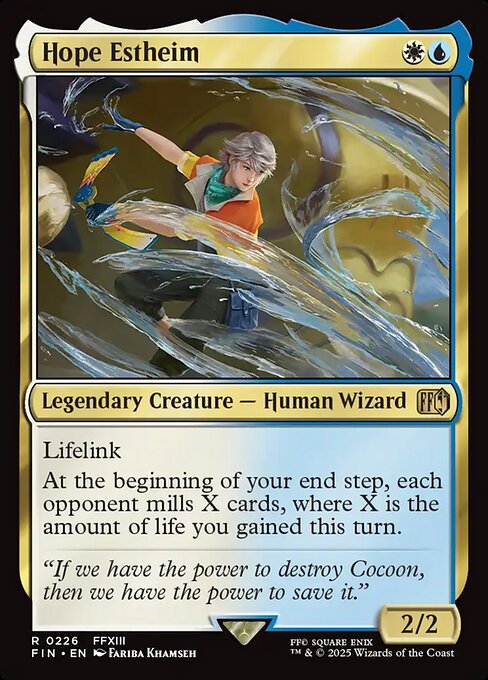
245. Hope Estheim
Rating4.2WeakWhy this rating?
A good playable, but is sometimes cut (4.2/10).
Why. A 2/2 lifelinker for two mana in blue and white. At end of turn it mills the opponent for as many cards as the life you gained this turn, but that is a slow way to win.
Risks. Two colours demand a specific deck, and the body is fragile. You need to gain a lot of life in one turn for the mill to matter.
In the draft. A playable for a white-blue deck that gains life. Do not take it early: it is filler.
Results in the games of the set
When it is in hand, the deck wins 51.5% of its games (set average: 56.4%, 294th of 341 cards).
In the opening hand: 51.1% wins (55.2% on average).
Drawn during the game: 51.8% (57.2% on average).
When it is drawn, the deck wins 1.4 points more than when it is not.
When it is drafted, it is played 30% of the time (set average: 62%).
Taken among the first three picks (51 drafts), it ends in the deck 71% of the time.

246. Relentless X-ATM092
Rating4.2WeakWhy this rating?
A good playable, but is sometimes cut (4.2/10).
Why. A colourless 6/5 for six mana that can't be blocked except by three or more creatures. Almost impossible to stop by blocking, it ends games in a few attacks.
Risks. Six mana with no enters effect: one removal spell and you have lost your turn. The graveyard return costs eight, only useful in a very long game.
In the draft. A fine finisher for a slow deck, playable in any colour. One copy is enough.
Results in the games of the set
When it is in hand, the deck wins 51.7% of its games (set average: 56.4%, 285th of 341 cards).
In the opening hand: 48.2% wins (55.2% on average).
Drawn during the game: 53.9% (57.2% on average).
When it is drawn, the deck wins 0.4 points less than when it is not.
When it is drafted, it is played 36% of the time (set average: 62%).
Taken among the first three picks (51 drafts), it ends in the deck 71% of the time.

247. Rook Turret
Rating4.2WeakWhy this rating?
A good playable, but is sometimes cut (4.2/10).
Why. A 3/3 flier for four mana, a good base for a blue deck. It also filters your hand whenever another artifact enters under your control.
Risks. The filtering needs artifacts, which the deck has to supply. Without them it is just a decent flying body that dies to removal.
In the draft. A solid playable in blue, especially in white-blue where it is played most. Take it as an average-quality flier.
Results in the games of the set
When it is in hand, the deck wins 51.8% of its games (set average: 56.4%, 283rd of 341 cards).
In the opening hand: 49.9% wins (55.2% on average).
Drawn during the game: 53.0% (57.2% on average).
When it is drawn, the deck wins 0.7 points more than when it is not.
When it is drafted, it is played 29% of the time (set average: 62%).
Taken among the first three picks (114 drafts), it ends in the deck 70% of the time.
It is played mostly in U/W decks (65% of them).

248. Summon: Anima
Rating4.2WeakWhy this rating?
A good playable, but is sometimes cut (4.2/10).
Why. A six-mana Summon Saga: a 4/4 with menace that draws you three cards, then makes the opponent sacrifice a creature and lose 3 life on the final chapter.
Risks. Six mana, and you lose life on each draw. After the final chapter the Saga is sacrificed, so the body does not stay.
In the draft. A good value play in black, especially black-green. Take it for the top of your curve, not as a priority.
Results in the games of the set
When it is in hand, the deck wins 52.6% of its games (set average: 56.4%, 264th of 341 cards).
In the opening hand: 49.0% wins (55.2% on average).
Drawn during the game: 54.9% (57.2% on average).
When it is drawn, the deck wins 0.1 points less than when it is not.
When it is drafted, it is played 68% of the time (set average: 62%).
Taken as the first pick (63 drafts), it ends in the deck 89% of the time.
It is played about as much in every archetype.
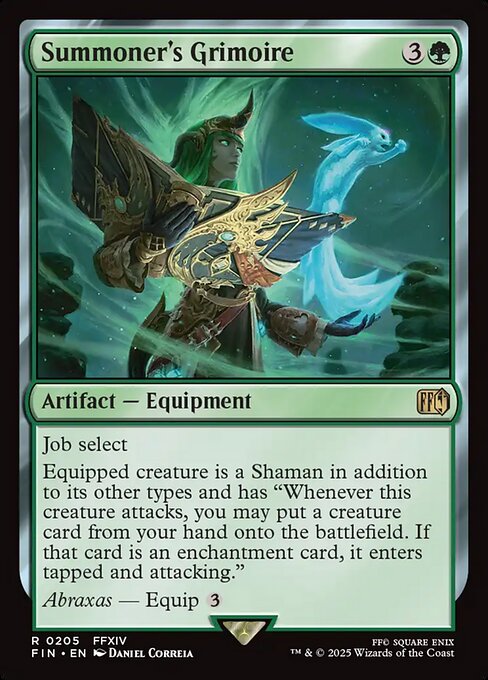
249. Summoner's Grimoire
Rating4.2WeakWhy this rating?
A good playable, but is sometimes cut (4.2/10).
Why. With Job select you get an equipped 1/1 Hero: when it attacks, you may put a creature card from your hand onto the battlefield. More of a combo card than a normal play.
Risks. A 1/1 Hero struggles to attack into a developed board, and the Equipment costs three to move. Four mana for an uncertain effect is heavy.
In the draft. Only play it in a green deck of big creatures. Generally, let it go.
Results in the games of the set
When it is in hand, the deck wins 51.0% of its games (set average: 56.4%, 304th of 341 cards).
In the opening hand: 50.3% wins (55.2% on average).
Drawn during the game: 51.5% (57.2% on average).
When it is drawn, the deck wins 0.4 points more than when it is not.
When it is drafted, it is played 35% of the time (set average: 62%).
Taken among the first three picks (56 drafts), it ends in the deck 63% of the time.
 Rating4.2Weak
Why this rating?
A good playable, but is sometimes cut (4.2/10).
Why. A white-blue 2/1 for three mana that taps an opposing creature each time it attacks, opening the way for your other attackers. It grows with artifacts.
Risks. It is fragile with one toughness, and the two colours make the deck demanding. Without artifacts it only has the attack ability.
In the draft. A playable for a white-blue artifacts deck. Do not take it over your best removal.
Results in the games of the set
When it is in hand, the deck wins 51.3% of its games (set average: 56.4%, 298th of 341 cards).
In the opening hand: 50.9% wins (55.2% on average).
Drawn during the game: 51.6% (57.2% on average).
When it is drawn, the deck wins 1.6 points less than when it is not.
When it is drafted, it is played 45% of the time (set average: 62%).
Taken as the first pick (43 drafts), it ends in the deck 91% of the time.
It is played mostly in U/W decks (57% of them).

251. Qutrub Forayer
Rating4.1WeakWhy this rating?
A good playable, but is sometimes cut (4.1/10).
Why. A 3/2 with a choice of enters effect: destroy a creature that was dealt damage this turn, or exile up to two cards from a graveyard. A good play after combat.
Risks. The first mode is conditional: a creature has to be damaged. Outside that situation the second mode is rarely useful.
In the draft. A good black common, especially in an attacking deck. Take it as a creature with a small removal effect.
Results in the games of the set
When it is in hand, the deck wins 51.2% of its games (set average: 56.4%, 299th of 341 cards).
In the opening hand: 49.0% wins (55.2% on average).
Drawn during the game: 52.8% (57.2% on average).
When it is drawn, the deck wins 0.2 points less than when it is not.
When it is drafted, it is played only 9% of the time (set average: 62%): it almost always ends in the sideboard.

252. Reach the Horizon
Rating4.1WeakWhy this rating?
A good playable, but is sometimes cut (4.1/10).
Why. A four-mana ramp sorcery that puts two basic lands or Town cards with different names onto the battlefield tapped. It accelerates toward your expensive cards and fixes colours.
Risks. It does nothing to the board at four mana. In a fast deck or one with no expensive cards, it is a lost turn.
In the draft. A good play in green with a high curve, or in a two-colour green deck for fixing. Otherwise a mid-pack pick.
Results in the games of the set
When it is in hand, the deck wins 53.3% of its games (set average: 56.4%, 241st of 341 cards).
In the opening hand: 52.8% wins (55.2% on average).
Drawn during the game: 53.7% (57.2% on average).
When it is drawn, the deck wins 1.3 points more than when it is not.
When it is drafted, it is played 61% of the time (set average: 62%).
Taken as the first pick (56 drafts), it ends in the deck 89% of the time.
It is played mostly in G/U decks (28% of them).

253. Fang, Fearless l'Cie
Rating4.0WeakWhy this rating?
A good playable, but is sometimes cut (4.0/10).
Why. A black 2/3 for three mana that draws you a card when cards leave your graveyard, once per turn, at the cost of 1 life. A mid-range body with value potential.
Risks. It needs cards leaving the graveyard, and few decks have many. Without that it is a 2/3 with little impact.
In the draft. A playable in black, better in a recursion deck, often black-green. Do not take it over solid creatures.
Results in the games of the set
When it is in hand, the deck wins 51.2% of its games (set average: 56.4%, 301st of 341 cards).
In the opening hand: 49.6% wins (55.2% on average).
Drawn during the game: 52.3% (57.2% on average).
When it is drawn, the deck wins 1.5 points less than when it is not.
When it is drafted, it is played 56% of the time (set average: 62%).
Taken as the first pick (80 drafts), it ends in the deck 78% of the time.
It is played about as much in every archetype.

254. Gigantoad
Rating4.0WeakWhy this rating?
A good playable, but is sometimes cut (4.0/10).
Why. A 4/4 for four mana, a good body for its mana value. With seven lands it becomes a 6/6, which happens late in the game.
Risks. No ability besides size: a removal spell or a double block handles it. It can't block fliers.
In the draft. A good green common filler for defense and board presence. Take a few, no more.
Results in the games of the set
When it is in hand, the deck wins 53.2% of its games (set average: 56.4%, 244th of 341 cards).
In the opening hand: 51.7% wins (55.2% on average).
Drawn during the game: 54.3% (57.2% on average).
When it is drawn, the deck wins 0.5 points more than when it is not.
When it is drafted, it is played 42% of the time (set average: 62%).
Taken among the first three picks (134 drafts), it ends in the deck 78% of the time.
It is played mostly in G/R decks (49% of them) and G/U (37%).
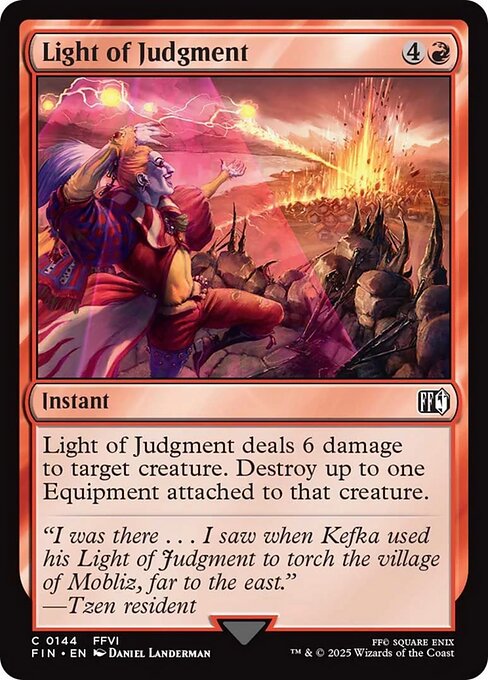
255. Light of Judgment
Rating4.0WeakWhy this rating?
A good playable, but is sometimes cut (4.0/10).
Why. A five-mana instant removal spell: 6 damage to a creature, plus it destroys one Equipment attached to it. It kills most creatures.
Risks. Five mana is expensive for a damage-based removal spell. It does not kill creatures with more than 6 toughness.
In the draft. Solid removal in red, especially red-blue. Take it after your best cheap removal.
Results in the games of the set
When it is in hand, the deck wins 53.7% of its games (set average: 56.4%, 230th of 341 cards).
In the opening hand: 50.2% wins (55.2% on average).
Drawn during the game: 55.8% (57.2% on average).
When it is drawn, the deck wins 0.5 points more than when it is not.
When it is drafted, it is played 61% of the time (set average: 62%).
Taken as the first pick (78 drafts), it ends in the deck 79% of the time.
It is played mostly in R/U decks (53% of them) and B/R (43%).
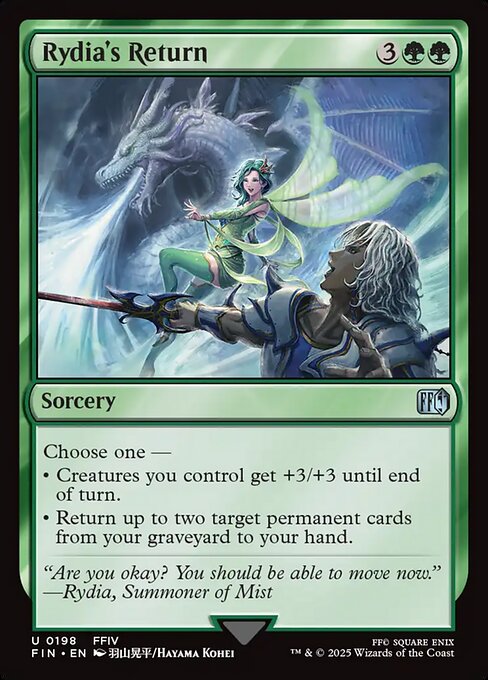
256. Rydia's Return
Rating4.0WeakWhy this rating?
A good playable, but is sometimes cut (4.0/10).
Why. A five-mana sorcery with two modes: give your whole team +3/+3 until end of turn to close out a game, or return up to two permanent cards from your graveyard to hand.
Risks. Five mana for a sorcery that adds nothing to the board is slow. The first mode needs a developed board, and the opponent can respond.
In the draft. A mid-pack playable in green, better in a creature deck. One copy is enough.
Results in the games of the set
When it is in hand, the deck wins 52.9% of its games (set average: 56.4%, 256th of 341 cards).
In the opening hand: 48.7% wins (55.2% on average).
Drawn during the game: 55.7% (57.2% on average).
When it is drawn, the deck wins 0.1 points more than when it is not.
When it is drafted, it is played 45% of the time (set average: 62%).
Taken among the first three picks (101 drafts), it ends in the deck 76% of the time.
It is played about as much in every archetype.
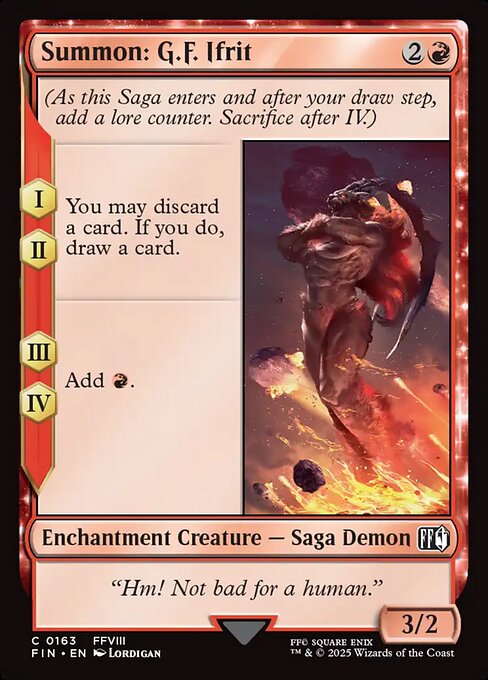
257. Summon: G.F. Ifrit
Rating4.0WeakWhy this rating?
A good playable, but is sometimes cut (4.0/10).
Why. A three-mana Summon Saga: a 3/2 that loots you on the first two chapters, then adds a red mana on the next two. A temporary body with light value.
Risks. The body goes away after the last chapter, and it is fragile with two toughness. The added mana is a small bonus, not a reason to play it.
In the draft. A filler playable in red for an aggressive deck. It does not deserve an early pick.
Results in the games of the set
When it is in hand, the deck wins 51.0% of its games (set average: 56.4%, 305th of 341 cards).
In the opening hand: 49.7% wins (55.2% on average).
Drawn during the game: 51.9% (57.2% on average).
When it is drawn, the deck wins 1.5 points less than when it is not.
When it is drafted, it is played 38% of the time (set average: 62%).
Taken as the first pick (34 drafts), it ends in the deck 68% of the time.
It is played mostly in G/R decks (60% of them) and B/R (43%).

258. Thief's Knife
Rating4.0WeakWhy this rating?
A good playable, but is sometimes cut (4.0/10).
Why. With Job select you get a 2/2 Hero that draws a card when it deals combat damage to a player. A good source of cards if the Hero gets past blockers.
Risks. A 2/2 for three mana has to get past blockers, and it dies quickly to removal. Re-equipping costs four mana: expensive.
In the draft. A fine playable in blue, especially white-blue. Take it as a value threat in a deck with fliers or evasion.
Results in the games of the set
When it is in hand, the deck wins 52.5% of its games (set average: 56.4%, 266th of 341 cards).
In the opening hand: 52.2% wins (55.2% on average).
Drawn during the game: 52.7% (57.2% on average).
When it is drawn, the deck wins 0.3 points more than when it is not.
When it is drafted, it is played 69% of the time (set average: 62%).
Taken as the first pick (81 drafts), it ends in the deck 83% of the time.
It is played mostly in U/W decks (29% of them).

259. World Map
Rating4.0WeakWhy this rating?
A good playable, but is sometimes cut (4.0/10).
Why. A one-mana artifact that fetches a basic land into your hand for one more mana, or any land for three. Fixing and land smoothing.
Risks. It does nothing on the board and slows your development. In a well-built two-colour deck it is often unnecessary.
In the draft. A filler pick for three-colour decks or splashes. Otherwise leave it.
Results in the games of the set
When it is in hand, the deck wins 51.8% of its games (set average: 56.4%, 284th of 341 cards).
In the opening hand: 51.0% wins (55.2% on average).
Drawn during the game: 52.3% (57.2% on average).
When it is drawn, the deck wins 0.4 points less than when it is not.
When it is drafted, it is played 40% of the time (set average: 62%).
Taken among the first three picks (92 drafts), it ends in the deck 80% of the time.
It is played about as much in every archetype.
260. Sandworm
Rating3.9WeakWhy this rating?
A good playable, but is sometimes cut (3.9/10).
Why. A 5/4 with haste for five mana that hits right away. Its enters effect destroys a land, but the opponent searches up a tapped basic, so the effect is weak.
Risks. The land destruction barely hurts the opponent, who gets a basic land back. The body costs five mana with no other useful effect.
In the draft. A playable filler body in red. You can also aim it at one of your own lands to fix your colours.
Results in the games of the set
When it is in hand, the deck wins 52.0% of its games (set average: 56.4%, 278th of 341 cards).
In the opening hand: 50.5% wins (55.2% on average).
Drawn during the game: 53.0% (57.2% on average).
When it is drawn, the deck wins 0.0 points more than when it is not.
When it is drafted, it is played 33% of the time (set average: 62%).
Taken among the first three picks (84 drafts), it ends in the deck 70% of the time.
It is played mostly in G/R decks (30% of them).
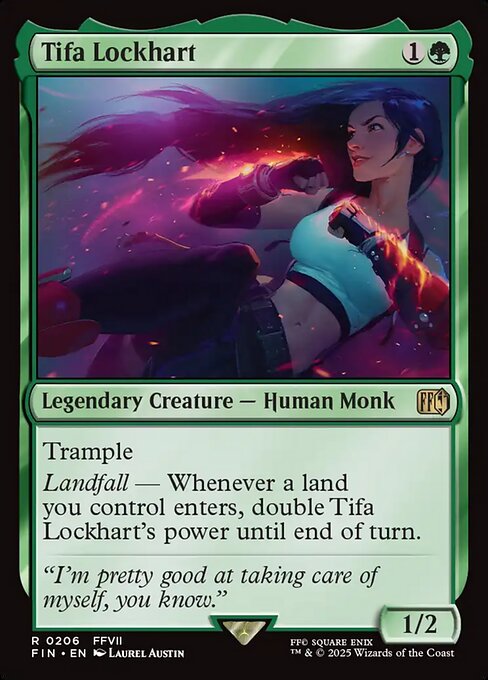
261. Tifa Lockhart
Rating3.9WeakWhy this rating?
A good playable, but is sometimes cut (3.9/10).
Why. A 1/2 trampler for two mana whose power doubles each time a land enters. A threat that needs lands entering to matter.
Risks. Tiny base power: with a single land drop it only hits for 2. It dies to any removal and blocks nothing useful.
In the draft. A weak card in practice unless the deck is full of land effects. Usually a late-pack pick.
Results in the games of the set
When it is in hand, the deck wins 50.2% of its games (set average: 56.4%, 313th of 341 cards).
In the opening hand: 51.8% wins (55.2% on average).
Drawn during the game: 49.0% (57.2% on average).
When it is drawn, the deck wins 1.4 points less than when it is not.
When it is drafted, it is played 49% of the time (set average: 62%).
Taken among the first three picks (73 drafts), it ends in the deck 70% of the time.
It is played about as much in every archetype.

262. Jidoor, Aristocratic Capital // Overture
Rating3.8WeakWhy this rating?
A good playable, but is sometimes cut (3.8/10).
Why. A land that taps for blue and enters tapped, with an adventure side that mills half the opponent's library for six mana. You can play the land from exile afterwards.
Risks. Milling rarely wins a draft game by itself. The land enters tapped, a small tempo cost.
In the draft. A land with a bonus: playable in blue in place of an Island. Do not take it over a playable spell.
Results in the games of the set
When it is in hand, the deck wins 49.3% of its games (set average: 56.4%, 321st of 341 cards).
In the opening hand: 48.8% wins (55.2% on average).
Drawn during the game: 49.6% (57.2% on average).
When it is drawn, the deck wins 1.1 points less than when it is not.
When it is drafted, it is played 33% of the time (set average: 62%).

263. Self-Destruct
Rating3.8WeakWhy this rating?
A good playable, but is sometimes cut (3.8/10).
Why. A two-mana instant: one of your creatures deals damage equal to its power to a target and takes the same damage itself. Removal when you have a creature to spare.
Risks. It often costs you a creature, so it is a bad two-for-one. With no good creature in play it is dead.
In the draft. A limited playable in red, better in a deck with high-toughness creatures. A late-pack pick.
Results in the games of the set
When it is in hand, the deck wins 50.6% of its games (set average: 56.4%, 310th of 341 cards).
In the opening hand: 47.7% wins (55.2% on average).
Drawn during the game: 52.6% (57.2% on average).
When it is drawn, the deck wins 0.8 points less than when it is not.
When it is drafted, it is played 16% of the time (set average: 62%).
Taken among the first three picks (42 drafts), it ends in the deck 67% of the time.

264. The Wind Crystal
Rating3.8WeakWhy this rating?
A good playable, but is sometimes cut (3.8/10).
Why. A four-mana artifact that makes white spells cheaper, doubles life gain, and can give your team flying and lifelink. It rewards a heavily white deck.
Risks. It does nothing to the board the turn you cast it. The activation costs six mana, and the main effect needs many white spells.
In the draft. A niche playable for a dense white deck. Otherwise pass it for a card that acts right away.
Results in the games of the set
When it is in hand, the deck wins 50.9% of its games (set average: 56.4%, 308th of 341 cards).
In the opening hand: 48.4% wins (55.2% on average).
Drawn during the game: 52.6% (57.2% on average).
When it is drawn, the deck wins 1.6 points less than when it is not.
When it is drafted, it is played 41% of the time (set average: 62%).
Taken among the first three picks (65 drafts), it ends in the deck 69% of the time.
It is played about as much in every archetype.

265. Chocobo Racetrack
Rating3.7WeakWhy this rating?
A good playable, but is sometimes cut (3.7/10).
Why. A five-mana artifact that creates a 2/2 green Bird creature token whenever a land enters under your control. It can build a board in a few turns if you keep making land drops.
Risks. Five mana with no immediate effect, and it only produces if you have lands to play. It does nothing against an opponent who pressures you right away.
In the draft. A slow playable in green, especially with effects that put lands onto the battlefield. Otherwise a late-pack pick.
Results in the games of the set
When it is in hand, the deck wins 51.5% of its games (set average: 56.4%, 295th of 341 cards).
In the opening hand: 49.5% wins (55.2% on average).
Drawn during the game: 52.9% (57.2% on average).
When it is drawn, the deck wins 0.7 points less than when it is not.
When it is drafted, it is played 61% of the time (set average: 62%).
Taken as the first pick (64 drafts), it ends in the deck 84% of the time.
It is played mostly in G/R decks (29% of them).
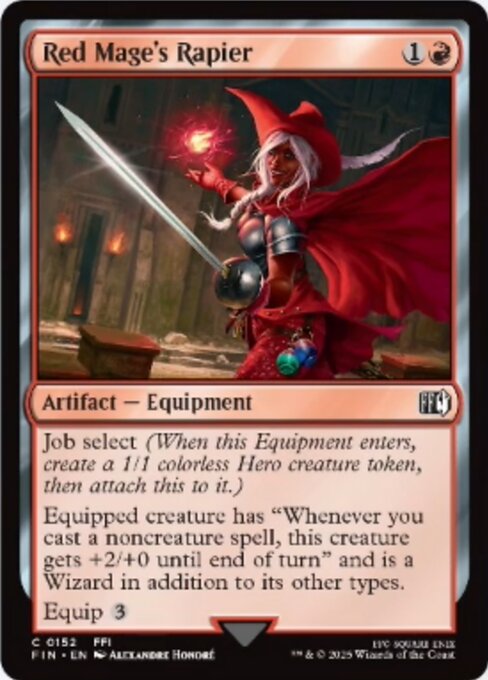
266. Red Mage's Rapier
Rating3.5WeakWhy this rating?
Filler card but sometimes gets cut (3.5/10).
Why. With Job select, you get a 1/1 Hero that gets +2/+0 whenever you cast a noncreature spell. A two-mana play for a deck full of instants and sorceries.
Risks. A 1/1 that is only a threat if you cast noncreature spells: very weak without them. Re-equipping costs three mana.
In the draft. Filler in red for a spells deck. Generally do not take it early.
Results in the games of the set
When it is in hand, the deck wins 50.7% of its games (set average: 56.4%, 309th of 341 cards).
In the opening hand: 50.5% wins (55.2% on average).
Drawn during the game: 50.9% (57.2% on average).
When it is drawn, the deck wins 2.4 points less than when it is not.
When it is drafted, it is played 34% of the time (set average: 62%).
Taken among the first three picks (152 drafts), it ends in the deck 74% of the time.
It is played mostly in B/R decks (49% of them) and R/W (42%).
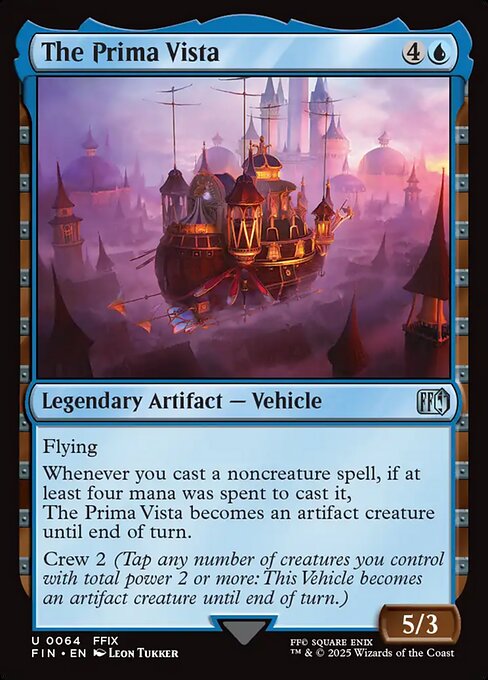
267. The Prima Vista
Rating3.2WeakWhy this rating?
Filler card but sometimes gets cut (3.2/10).
Why. A 5/3 flying Vehicle for five mana that also becomes a creature when you cast a noncreature spell with at least four mana spent. Crew 2 is easy to pay.
Risks. You have to tap creatures each turn, removing attackers or blockers. Five mana for a three-toughness body that dies to cheap removal.
In the draft. A late-pack playable for a blue-red deck or one with light creatures. Take it after your best cards.
Results in the games of the set
When it is in hand, the deck wins 52.0% of its games (set average: 56.4%, 279th of 341 cards).
In the opening hand: 49.4% wins (55.2% on average).
Drawn during the game: 53.5% (57.2% on average).
When it is drawn, the deck wins 0.0 points more than when it is not.
When it is drafted, it is played 23% of the time (set average: 62%).
Taken among the first three picks (45 drafts), it ends in the deck 76% of the time.

268. Golbez, Crystal Collector
Rating2.9WeakWhy this rating?
Filler card but sometimes gets cut (2.9/10).
Why. A blue-black 1/4 for two mana that surveils for each artifact and returns a creature card from the graveyard once you control four artifacts. A good blocker for little mana.
Risks. Without plenty of artifacts its effects almost never trigger: it stays a 1/4 with no attack. The deck has to be built around it.
In the draft. A card for a very specialised blue-black artifacts deck. In a normal deck it is a late-pack pick.
Results in the games of the set
When it is in hand, the deck wins 49.9% of its games (set average: 56.4%, 315th of 341 cards).
In the opening hand: 47.9% wins (55.2% on average).
Drawn during the game: 51.2% (57.2% on average).
When it is drawn, the deck wins 2.1 points more than when it is not.
When it is drafted, it is played 40% of the time (set average: 62%).
Taken among the first three picks (95 drafts), it ends in the deck 66% of the time.
It is played about as much in every archetype.

269. From Father to Son
Rating2.5WeakWhy this rating?
Filler card but sometimes gets cut (2.5/10).
Why. A two-mana tutor that fetches a Vehicle and nothing else. Its Flashback puts the Vehicle straight onto the battlefield, but it costs seven mana, so that is a late-game effect.
Risks. With no Vehicle in the deck the card is dead. Even with some, you spend a card and a turn to find something you could have simply drawn.
In the draft. Only play it with several good Vehicles. Otherwise pass it: it is very situational filler.
Results in the games of the set
When it is drafted, it is played only 1% of the time (set average: 62%): it almost always ends in the sideboard.
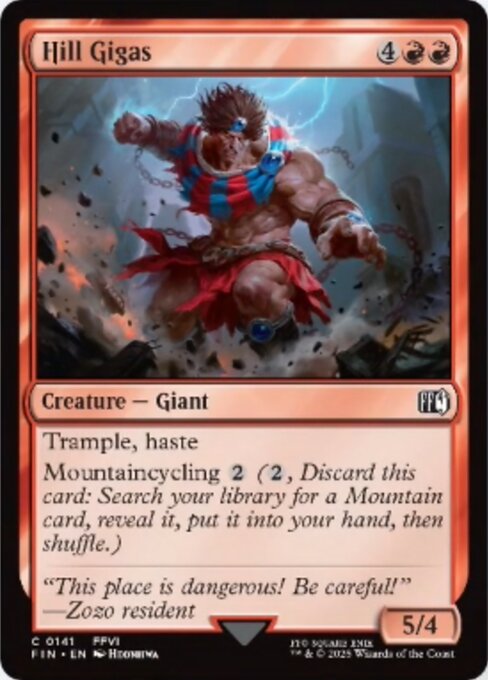
270. Hill Gigas
Rating2.2WeakWhy this rating?
Not good filler and often gets cut (2.2/10).
Why. A 5/4 with trample and haste for six: it hits hard the turn it lands. The real appeal is Mountaincycling: early on, you discard it to fetch a Mountain and hit your land drops.
Risks. Six mana including two red mana is expensive, and it has no evasion or protection. One well-timed removal answers it after a single attack.
In the draft. A fine late pick in red decks: it replaces a land or closes a game. Don't take it over a decent removal.
Results in the games of the set
When it is in hand, the deck wins 51.0% of its games (set average: 56.4%, 303rd of 341 cards).
In the opening hand: 48.8% wins (55.2% on average).
Drawn during the game: 52.7% (57.2% on average).
When it is drawn, the deck wins 1.3 points less than when it is not.
When it is drafted, it is played 28% of the time (set average: 62%).
Taken among the first three picks (68 drafts), it ends in the deck 62% of the time.
It is played mostly in G/R decks (39% of them) and R/W (37%).

271. A Realm Reborn
Rating2.0WeakWhy this rating?
Not good filler and often gets cut (2.0/10).
Why. Six mana so that all your other permanents can tap for one mana of any color. It fixes and ramps, but only after you pay six for a card that threatens nothing.
Risks. It doesn't act on the game, so you lose a whole turn, and creatures tapped for mana can't attack or block.
In the draft. Skip it. It is an exotic constructed-style effect, not a draft pick.
Results in the games of the set
When it is drafted, it is played only 0% of the time (set average: 62%): it almost always ends in the sideboard.

272. Blitzball
Rating2.0WeakWhy this rating?
Not good filler and often gets cut (2.0/10).
Why. A three-mana artifact that taps for one mana of any color. It is honest fixing and ramp; drawing two means sacrificing it after a legendary creature has dealt combat damage to an opponent that turn, so treat that as a bonus.
Risks. Three mana for a mana rock is a turn with no impact on the board. The draw clause is too conditional to count on.
In the draft. Playable filler in a three-color deck or one with a top-heavy curve. In a fast two-color deck it doesn't belong.
Results in the games of the set
When it is in hand, the deck wins 51.0% of its games (set average: 56.4%, 307th of 341 cards).
In the opening hand: 49.8% wins (55.2% on average).
Drawn during the game: 51.8% (57.2% on average).
When it is drawn, the deck wins 0.7 points less than when it is not.
When it is drafted, it is played 44% of the time (set average: 62%).
Taken as the first pick (36 drafts), it ends in the deck 72% of the time.
It is played mostly in G/U decks (31% of them).

273. Elixir
Rating2.0WeakWhy this rating?
Not good filler and often gets cut (2.0/10).
Why. A one-mana artifact that enters tapped. For five mana you exile it, shuffle every nonland card from your graveyard back into your library, and gain life equal to the number of cards shuffled in.
Risks. It is slow and does nothing to the board. It needs a full graveyard, which means you have already lost plenty of resources.
In the draft. Almost never main deck. Only a very slow control deck looking to stretch the game might consider it.
Results in the games of the set
When it is in hand, the deck wins 46.0% of its games (set average: 56.4%, 336th of 341 cards).
In the opening hand: 41.3% wins (55.2% on average).
Drawn during the game: 48.9% (57.2% on average).
When it is drawn, the deck wins 2.6 points less than when it is not.
When it is drafted, it is played only 4% of the time (set average: 62%): it almost always ends in the sideboard.
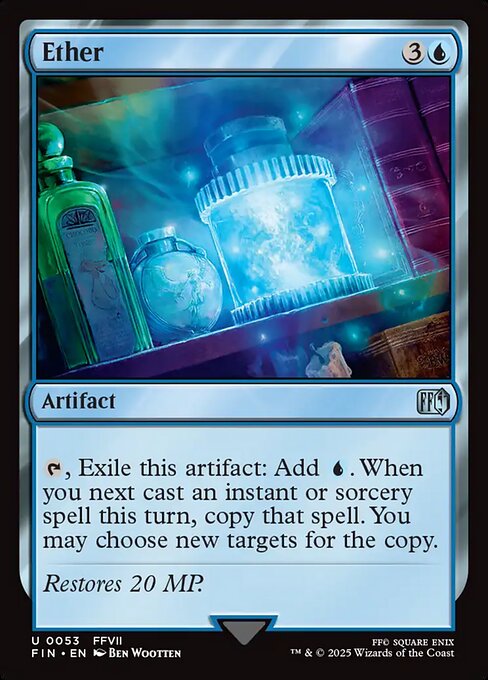
274. Ether
Rating2.0WeakWhy this rating?
Not good filler and often gets cut (2.0/10).
Why. A four-mana artifact you exile for one blue mana, with the bonus of copying the next instant or sorcery you cast this turn. The idea is to double a good spell, but you pay four mana to set it up.
Risks. Without good instants and sorceries the copy is empty. The tempo cost is heavy, because the artifact does nothing else but vanish.
In the draft. A late-pack pick for a blue deck full of spells. Don't take it over creatures and removal.
Results in the games of the set
When it is in hand, the deck wins 49.7% of its games (set average: 56.4%, 316th of 341 cards).
In the opening hand: 45.5% wins (55.2% on average).
Drawn during the game: 52.2% (57.2% on average).
When it is drawn, the deck wins 1.7 points less than when it is not.
When it is drafted, it is played only 14% of the time (set average: 62%): it almost always ends in the sideboard.
Taken among the first three picks (44 drafts), it ends in the deck 50% of the time.

275. Excalibur II
Rating2.0WeakWhy this rating?
Not good filler and often gets cut (2.0/10).
Why. A one-mana legendary Equipment that gets a charge counter each time you gain life. Each counter gives the equipped creature +1/+1.
Risks. It gains you no life itself: without lifelink or other life gain it stays without counters, and you still pay three to equip it.
In the draft. Only in a deck that already gains a lot of life. Otherwise it is filler you can pass.
Results in the games of the set
When it is in hand, the deck wins 45.1% of its games (set average: 56.4%, 338th of 341 cards).
In the opening hand: 45.1% wins (55.2% on average).
Drawn during the game: 45.1% (57.2% on average).
When it is drawn, the deck wins 5.7 points less than when it is not.
When it is drafted, it is played only 13% of the time (set average: 62%): it almost always ends in the sideboard.

276. Galuf's Final Act
Rating2.0WeakWhy this rating?
Not good filler and often gets cut (2.0/10).
Why. A two-mana instant: +1/+0 until end of turn, and if the creature dies, you put +1/+1 counters equal to its power on a target creature. It is a small combat trick that softens a trade.
Risks. It isn't removal and doesn't protect: the creature still dies. With no other creature to boost, the bonus is wasted.
In the draft. A last-resort playable in a creature-heavy green deck. Don't take it over cards that work on their own.
Results in the games of the set
When it is in hand, the deck wins 45.7% of its games (set average: 56.4%, 337th of 341 cards).
In the opening hand: 43.9% wins (55.2% on average).
Drawn during the game: 47.2% (57.2% on average).
When it is drawn, the deck wins 5.4 points less than when it is not.
When it is drafted, it is played only 6% of the time (set average: 62%): it almost always ends in the sideboard.

277. Genji Glove
Rating2.0WeakWhy this rating?
Not good filler and often gets cut (2.0/10).
Why. An Equipment that grants double strike; in the turn's first combat phase it untaps the attacking creature and adds a combat phase. A good creature wearing it hits very hard, but the total cost is steep: five to cast, then three to equip.
Risks. The tempo cost is huge and the card does nothing alone. If the creature is killed in response to equipping, the three mana you invested are lost.
In the draft. Play it in an aggressive deck with strong combat creatures, never as a priority. A deck without real threats gets nothing from it.
Results in the games of the set
When it is in hand, the deck wins 50.0% of its games (set average: 56.4%, 314th of 341 cards).
In the opening hand: 47.5% wins (55.2% on average).
Drawn during the game: 51.6% (57.2% on average).
When it is drawn, the deck wins 2.2 points less than when it is not.
When it is drafted, it is played 39% of the time (set average: 62%).
Taken among the first three picks (48 drafts), it ends in the deck 77% of the time.

278. Haste Magic
Rating2.0WeakWhy this rating?
Not good filler and often gets cut (2.0/10).
Why. A two-mana instant: +3/+1 and haste on a creature, then you exile the top card of your library and may play it until your next end step. It is a small trick that sometimes replaces itself.
Risks. An offensive trick, so it is exposed to removal in response. The exiled card is lost if you cannot play it in time.
In the draft. Decent filler in an aggressive red deck. Take it late, after your creatures and removal.
Results in the games of the set
When it is in hand, the deck wins 50.3% of its games (set average: 56.4%, 312th of 341 cards).
In the opening hand: 48.8% wins (55.2% on average).
Drawn during the game: 51.4% (57.2% on average).
When it is drawn, the deck wins 0.9 points less than when it is not.
When it is drafted, it is played only 7% of the time (set average: 62%): it almost always ends in the sideboard.

279. Jumbo Cactuar
Rating2.0WeakWhy this rating?
Not good filler and often gets cut (2.0/10).
Why. Seven mana for a 1/7 that gets +9999/+0 when it attacks: an opponent who doesn't block takes lethal damage. On defense, its huge toughness is a decent wall.
Risks. Seven mana is a lot, and one chump block or removal spell neutralizes it. Without trample, the attack is easy to sidestep.
In the draft. A possible top-end in a slow green deck, as a one-of. Don't take it early.
Results in the games of the set
When it is in hand, the deck wins 49.4% of its games (set average: 56.4%, 319th of 341 cards).
In the opening hand: 46.6% wins (55.2% on average).
Drawn during the game: 51.3% (57.2% on average).
When it is drawn, the deck wins 1.8 points less than when it is not.
When it is drafted, it is played 44% of the time (set average: 62%).
Taken among the first three picks (76 drafts), it ends in the deck 71% of the time.
It is played about as much in every archetype.
280. Loporrit Scout
Rating2.0WeakWhy this rating?
Not good filler and often gets cut (2.0/10).
Why. A three-mana 3/2 that gets +1/+1 until end of turn each time another creature enters under your control. It attacks well in a deck that deploys creatures often.
Risks. Its base body is fragile, and the bonus only matters the turn you play a creature. If you don't, it is just a plain 3/2.
In the draft. Playable filler in a green deck with a dense creature curve. A notch below the quality cards.
Results in the games of the set
When it is in hand, the deck wins 49.4% of its games (set average: 56.4%, 320th of 341 cards).
In the opening hand: 49.8% wins (55.2% on average).
Drawn during the game: 49.0% (57.2% on average).
When it is drawn, the deck wins 2.3 points less than when it is not.
When it is drafted, it is played only 7% of the time (set average: 62%): it almost always ends in the sideboard.

281. Louisoix's Sacrifice
Rating2.0WeakWhy this rating?
Not good filler and often gets cut (2.0/10).
Why. A counterspell for one blue mana plus two more, which counters an activated ability, a triggered ability or a noncreature spell. It hits targets that ordinary counterspells miss.
Risks. It can't counter creatures, which make up most of the threats in a draft. It also asks you to keep mana open, or to sacrifice a legendary creature.
In the draft. Marginal: playable as a one-of in a blue control deck. Don't take it over removal.
Results in the games of the set
When it is in hand, the deck wins 48.2% of its games (set average: 56.4%, 330th of 341 cards).
In the opening hand: 43.6% wins (55.2% on average).
Drawn during the game: 50.9% (57.2% on average).
When it is drawn, the deck wins 0.3 points less than when it is not.
When it is drafted, it is played only 5% of the time (set average: 62%): it almost always ends in the sideboard.

282. Magic Pot
Rating2.0WeakWhy this rating?
Not good filler and often gets cut (2.0/10).
Why. A three-mana artifact creature 1/4, a good blocker. When it dies it leaves behind a Treasure token, and for two mana and a tap you can exile a card from a graveyard.
Risks. It barely attacks and won't win the game. Its graveyard effect is rarely useful in draft.
In the draft. Solid filler for a defensive deck in any color. It doesn't deserve a pick over creatures that push the game forward.
Results in the games of the set
When it is in hand, the deck wins 48.9% of its games (set average: 56.4%, 324th of 341 cards).
In the opening hand: 47.6% wins (55.2% on average).
Drawn during the game: 49.8% (57.2% on average).
When it is drawn, the deck wins 0.3 points less than when it is not.
When it is drafted, it is played only 5% of the time (set average: 62%): it almost always ends in the sideboard.
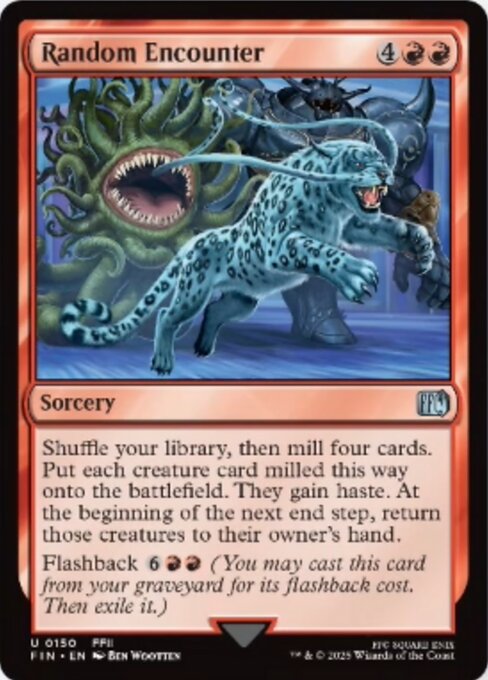
283. Random Encounter
Rating2.0WeakWhy this rating?
Not good filler and often gets cut (2.0/10).
Why. A six-mana sorcery that shuffles, mills four, and puts the milled creature cards onto the battlefield with haste before they return to hand at end of turn. It can produce a big attack, but it is random. Its Flashback lets you do it a second time for eight mana.
Risks. The result depends on your library: few creatures, little effect. The creatures go back to hand, so nothing stays, and it is expensive.
In the draft. Avoid it unless you are a red-green deck packed with expensive creatures. Even then it is a last choice.
Results in the games of the set
When it is in hand, the deck wins 48.7% of its games (set average: 56.4%, 325th of 341 cards).
In the opening hand: 45.1% wins (55.2% on average).
Drawn during the game: 51.1% (57.2% on average).
When it is drawn, the deck wins 0.5 points less than when it is not.
When it is drafted, it is played only 4% of the time (set average: 62%): it almost always ends in the sideboard.

284. Serah Farron // Crystallized Serah
Rating2.0WeakWhy this rating?
Not good filler and often gets cut (2.0/10).
Why. A green-white three-mana 2/2 that makes the first legendary creature spell you cast each turn cost two less. With at least two other legendary creatures you can transform it: it becomes an artifact giving your legendary creatures +2/+2.
Risks. It leans far too hard on legendary creatures, which are scarce in a draft deck. Without them it is just a three-mana 2/2.
In the draft. Only if you already have several legendary creatures in green-white. Otherwise it is filler better left alone.
Results in the games of the set
When it is in hand, the deck wins 51.0% of its games (set average: 56.4%, 306th of 341 cards).
In the opening hand: 49.9% wins (55.2% on average).
Drawn during the game: 51.7% (57.2% on average).
When it is drawn, the deck wins 0.1 points less than when it is not.
When it is drafted, it is played 38% of the time (set average: 62%).
Taken among the first three picks (62 drafts), it ends in the deck 74% of the time.

285. Stolen Uniform
Rating2.0WeakWhy this rating?
Not good filler and often gets cut (2.0/10).
Why. A one-mana instant: you gain control of an Equipment until end of turn and attach it to one of your creatures. It steals a temporary bonus that is sometimes decisive in combat.
Risks. An Equipment has to be on the battlefield, and the effect lasts a single turn. It is dead in most games.
In the draft. Pass it. It only belongs in a deck already packed with Equipment, and even there it is weak.
Results in the games of the set
When it is drafted, it is played only 0% of the time (set average: 62%): it almost always ends in the sideboard.

286. The Fire Crystal
Rating2.0WeakWhy this rating?
Not good filler and often gets cut (2.0/10).
Why. A four-mana legendary artifact: your red spells cost one less and all your creatures have haste. For six mana you create a token copy of one of your creatures, sacrificed at end of turn.
Risks. It does nothing to the board the turn you cast it: a four-mana turn with no pressure. Haste helps slow decks very little.
In the draft. Reserved for a red deck dense with cheap red spells. Otherwise it is too slow for draft.
Results in the games of the set
When it is in hand, the deck wins 40.8% of its games (set average: 56.4%, 341st of 341 cards).
In the opening hand: 39.7% wins (55.2% on average).
Drawn during the game: 41.6% (57.2% on average).
When it is drawn, the deck wins 9.3 points less than when it is not.
When it is drafted, it is played only 8% of the time (set average: 62%): it almost always ends in the sideboard.

287. The Masamune
Rating2.0WeakWhy this rating?
Not good filler and often gets cut (2.0/10).
Why. A three-mana Equipment: the equipped creature has first strike while attacking and must be blocked if able. Equipping costs only two, and the effect forces the opponent into a block with a creature of their choice.
Risks. Forcing a block can cost you a good creature, and the trigger-doubling clause is rarely relevant. It gives no power bonus.
In the draft. Filler in an aggressive deck with good combat creatures. Don't take it over removal or real threats.
Results in the games of the set
When it is in hand, the deck wins 44.2% of its games (set average: 56.4%, 339th of 341 cards).
In the opening hand: 43.2% wins (55.2% on average).
Drawn during the game: 44.8% (57.2% on average).
When it is drawn, the deck wins 6.3 points less than when it is not.
When it is drafted, it is played 25% of the time (set average: 62%).
Taken among the first three picks (47 drafts), it ends in the deck 66% of the time.

288. Vaan, Street Thief
Rating2.0WeakWhy this rating?
Not good filler and often gets cut (2.0/10).
Why. A three-mana legendary 2/2 that is itself a Scout. When a Scout, Pirate or Rogue you control deals combat damage to a player, you exile the top card of that player's library and may cast it; if you don't, you create a Treasure token. Casting a spell you don't own puts a +1/+1 counter on each of them.
Risks. Its 2/2 body dies easily before connecting, and without other Scouts, Pirates or Rogues the second ability stays modest. Everything depends on hitting the opponent.
In the draft. Mostly interesting in a red deck with several Scouts, Pirates or Rogues. Otherwise it is a filler 2/2.
Results in the games of the set
When it is in hand, the deck wins 46.5% of its games (set average: 56.4%, 334th of 341 cards).
In the opening hand: 44.6% wins (55.2% on average).
Drawn during the game: 47.8% (57.2% on average).
When it is drawn, the deck wins 4.4 points less than when it is not.
When it is drafted, it is played 39% of the time (set average: 62%).
Taken among the first three picks (60 drafts), it ends in the deck 67% of the time.
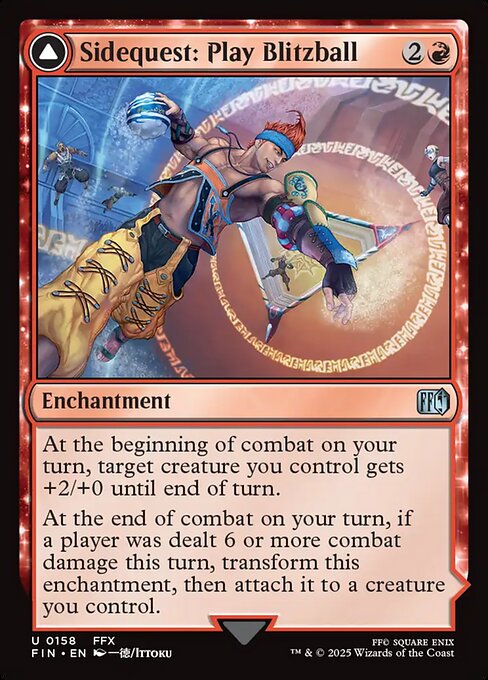
289. Sidequest: Play Blitzball // World Champion, Celestial Weapon
Rating1.8WeakWhy this rating?
Not good filler and often gets cut (1.8/10).
Why. A three-mana enchantment that gives a creature +2/+0 at the beginning of your combat. If a player takes six or more combat damage in a turn, it transforms into an Equipment granting +2/+0 and double strike, and attaches to one of your creatures.
Risks. It does nothing without a creature, and the transformation needs a big hit in a single turn. Against blockers it stays a small bonus.
In the draft. Playable filler in an aggressive red deck. Take it very late.
Results in the games of the set
When it is in hand, the deck wins 48.3% of its games (set average: 56.4%, 328th of 341 cards).
In the opening hand: 48.2% wins (55.2% on average).
Drawn during the game: 48.3% (57.2% on average).
When it is drawn, the deck wins 4.2 points less than when it is not.
When it is drafted, it is played 15% of the time (set average: 62%).
Taken among the first three picks (34 drafts), it ends in the deck 65% of the time.
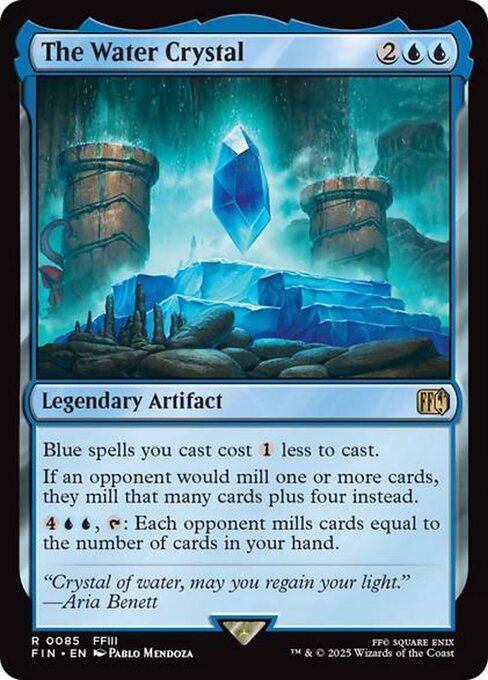
290. The Water Crystal
Rating1.6WeakWhy this rating?
Not good filler and often gets cut (1.6/10).
Why. A four-mana legendary artifact that makes your blue spells cost one less and makes an opponent mill four extra cards whenever they would mill. For six mana, each opponent mills cards equal to the number in your hand.
Risks. This is a mill-deck card, rare and slow in draft. Without other mill effects only the six-mana activation does anything, and it is expensive.
In the draft. Avoid unless your blue deck is truly built around mill. Otherwise it is dead.
Results in the games of the set
When it is in hand, the deck wins 46.7% of its games (set average: 56.4%, 333rd of 341 cards).
In the opening hand: 43.3% wins (55.2% on average).
Drawn during the game: 48.7% (57.2% on average).
When it is drawn, the deck wins 0.3 points more than when it is not.
When it is drafted, it is played only 9% of the time (set average: 62%): it almost always ends in the sideboard.
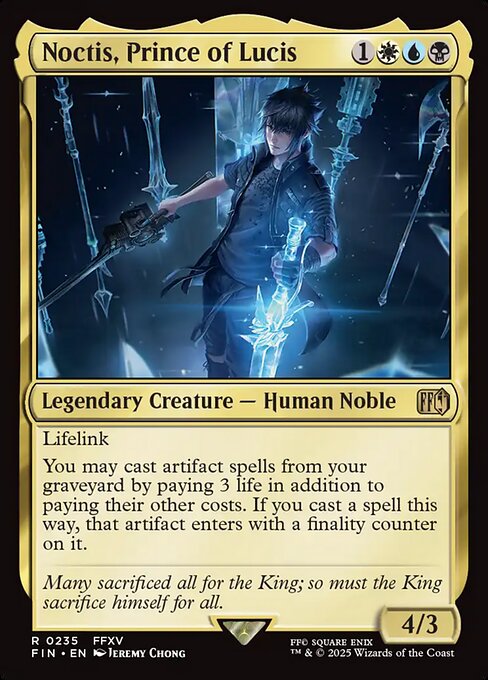 Rating1.4Weak
Why this rating?
Almost unplayable and mostly sideboard material (1.4/10).
Why. A four-mana 4/3 lifelinker: a good body, but it asks for three colors, white, blue and black. It can also cast artifact spells from your graveyard by paying 3 life, and the artifact enters with a finality counter.
Risks. The three-color cost is heavy and makes it hard to cast on time. Without artifacts in the deck, the second ability is useless.
In the draft. Only in a well-fixed white-blue-black deck with artifacts. Otherwise it is too greedy for what it does.
Results in the games of the set
When it is in hand, the deck wins 48.5% of its games (set average: 56.4%, 326th of 341 cards).
In the opening hand: 45.6% wins (55.2% on average).
Drawn during the game: 50.3% (57.2% on average).
When it is drawn, the deck wins 0.8 points more than when it is not.
When it is drafted, it is played 19% of the time (set average: 62%).
Taken among the first three picks (54 drafts), it ends in the deck 52% of the time.
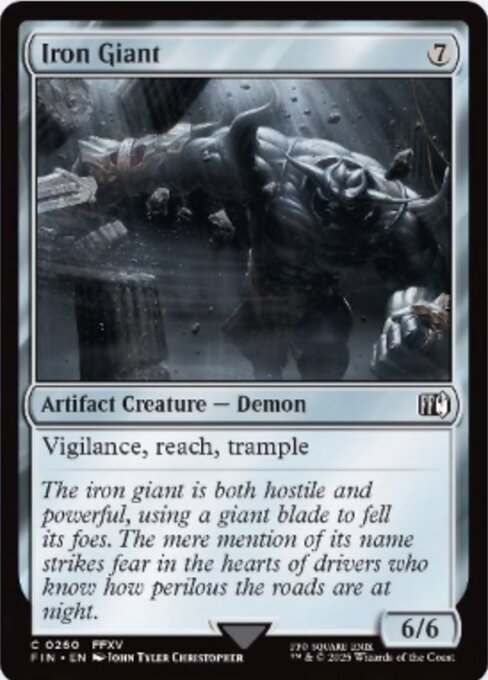
292. Iron Giant
Rating1.4WeakWhy this rating?
Almost unplayable and mostly sideboard material (1.4/10).
Why. A seven-mana 6/6 with reach, vigilance and trample. It attacks and defends at once and blocks fliers. No other ability, just a big body.
Risks. Seven mana with no enter-the-battlefield effect is a heavy turn, and removal takes it with no payoff. It arrives very late in the game.
In the draft. A last pick, for a deck that truly wants a colorless finisher. Don't take it if you have better.
Results in the games of the set
When it is in hand, the deck wins 46.0% of its games (set average: 56.4%, 335th of 341 cards).
In the opening hand: 42.1% wins (55.2% on average).
Drawn during the game: 48.6% (57.2% on average).
When it is drawn, the deck wins 3.1 points less than when it is not.
When it is drafted, it is played only 4% of the time (set average: 62%): it almost always ends in the sideboard.

293. Lunatic Pandora
Rating1.4WeakWhy this rating?
Almost unplayable and mostly sideboard material (1.4/10).
Why. A one-mana legendary artifact: for two mana you surveil 1. For six mana you sacrifice it and destroy a nonland permanent. It is a very slow removal, playable in any deck.
Risks. Six mana for the removal plus tapping: it is too slow against a fast deck. Surveil 1 is a small bonus, nothing more.
In the draft. Late-pick filler in slow decks, useful as backup removal. Take it after your real cards.
Results in the games of the set
When it is in hand, the deck wins 49.5% of its games (set average: 56.4%, 318th of 341 cards).
In the opening hand: 45.9% wins (55.2% on average).
Drawn during the game: 52.0% (57.2% on average).
When it is drawn, the deck wins 1.4 points less than when it is not.
When it is drafted, it is played only 11% of the time (set average: 62%): it almost always ends in the sideboard.
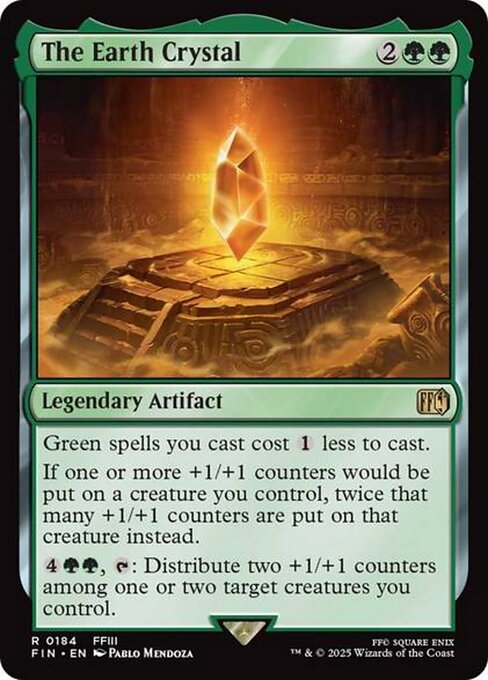
294. The Earth Crystal
Rating1.4WeakWhy this rating?
Almost unplayable and mostly sideboard material (1.4/10).
Why. A four-mana legendary artifact: your green spells cost one less, and the +1/+1 counters put on your creatures are doubled. For six mana it distributes two +1/+1 counters among one or two creatures.
Risks. It does nothing to the board the turn you cast it, and the doubling only helps if you have counter effects. Six mana to activate is slow.
In the draft. Reserved for a green deck with plenty of +1/+1 counters. Otherwise it is slow filler.
Results in the games of the set
When it is in hand, the deck wins 47.6% of its games (set average: 56.4%, 331st of 341 cards).
In the opening hand: 45.2% wins (55.2% on average).
Drawn during the game: 49.3% (57.2% on average).
When it is drawn, the deck wins 3.6 points less than when it is not.
When it is drafted, it is played 49% of the time (set average: 62%).
Taken among the first three picks (95 drafts), it ends in the deck 73% of the time.
It is played about as much in every archetype.
Intrinsic ratings: they do not take into account the cards you have already picked. They matter most for the first pick of the first pack.