Card ranking · Lorwyn Eclipsed (ECL)
← Lorwyn Eclipsed264 cards
- Bomb > 8.4
- Very good ≥ 7.2
- Good ≥ 6.2
- Playable ≥ 5.0
- Weak < 5.0
Ratings are out of 10. They combine experts' opinions, the statistics of thousands of drafts by experienced players (when a card is taken, played, and the wins of the decks that play it) and what is printed on the card. Click a card to enlarge it.

1. Wistfulness
Rating9.4BombWhy this rating?
The best card of the set (9.4/10).
Why. A 6/5 for five that also brings an effect depending on the mana spent: two green mana exile an opposing artifact or enchantment, two blue mana draw two cards then discard one. In a deck with both colours you pick whichever mode the board needs.
Risks. The effect requires two mana of the same colour, so a poorly paid Wistfulness is just a big body. The green mode only has a target if the opponent plays artifacts or enchantments.
In the draft. A bomb, take it very early, especially if you are green or blue. The hybrid cost makes it easy to cast in a deck with only one of the two colours. The evoke cost lets you keep just the effect.
Results in the games of the set
When it is in hand, the deck wins 60.7% of its games (set average: 55.7%, 27th of 264 cards).
In the opening hand: 58.5% wins (54.5% on average).
Drawn during the game: 62.0% (56.5% on average).
When it is drawn, the deck wins 9.5 points more than when it is not.
When it is drafted, it is played 93% of the time (set average: 61%).
Taken as the first pick (61 drafts), it ends in the deck 95% of the time.
It is played about as much in every archetype.

2. Vibrance
Rating9.3BombWhy this rating?
One of the 3 best cards of the set (9.3/10).
Why. A 4/4 for five whose enters trigger does the work: two red mana deal 3 damage to any target, two green mana fetch a land and gain 2 life. The first mode is removal attached to a body.
Risks. Each effect needs two mana of the same colour, so keep your mana base clean in an even two-colour deck. A 4/4 does not stop everything, and the green mode is much more modest than the red one.
In the draft. A bomb, take it very early. Ideally you are red, for the built-in removal. The evoke cost also turns it into a two-mana spell when you only need the effect.
Results in the games of the set
When it is in hand, the deck wins 61.5% of its games (set average: 55.7%, 19th of 264 cards).
In the opening hand: 60.2% wins (54.5% on average).
Drawn during the game: 62.3% (56.5% on average).
When it is drawn, the deck wins 10.0 points more than when it is not.
When it is drafted, it is played 90% of the time (set average: 61%).
Taken as the first pick (60 drafts), it ends in the deck 92% of the time.
It is played about as much in every archetype.
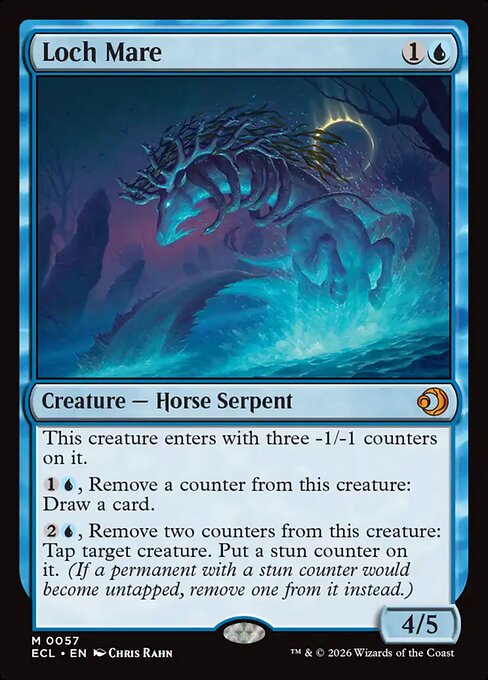
3. Loch Mare
Rating9.1BombWhy this rating?
One of the 3 best cards of the set (9.1/10).
Why. For two mana, a 4/5 that enters with three -1/-1 counters, so a 1/2 at first. Removing a counter draws a card for two mana; removing two taps a creature and puts a stun counter on it for three. Each removal also makes it bigger: a card engine, a tempo tool and a body that catches up.
Risks. Early on it is a 1/2 that dies to almost anything, and every activation eats your mana for the turn. There are only three counters to remove, so the value is capped.
In the draft. A bomb for blue decks, take it very early. It fits a deck with mana to spend. On turn two, only cast it if you plan to use it.
Results in the games of the set
When it is in hand, the deck wins 62.1% of its games (set average: 55.7%, 15th of 264 cards).
In the opening hand: 60.9% wins (54.5% on average).
Drawn during the game: 62.9% (56.5% on average).
When it is drawn, the deck wins 9.3 points more than when it is not.
When it is drafted, it is played 89% of the time (set average: 61%).
Taken as the first pick (75 drafts), it ends in the deck 93% of the time.
It is played about as much in every archetype.
 Rating9.0Bomb
Why this rating?
One of the 10 best cards of the set (9.0/10).
Why. An instant with two modes out of four: 2 damage to each creature a player controls, two cards drawn, two Treasure tokens, or a copy of an Elemental you control. Well picked, the two modes make it a two-for-one, a small sweeper and card draw in one.
Risks. Five mana for an effect that is often modest. The copy mode needs an Elemental of yours, and 2 damage only hits small creatures.
In the draft. A bomb for a blue-red deck, take it very early. The more Elementals you play, the more the copy mode matters, but the spell stands alone thanks to the draw and the sweep.
Results in the games of the set
When it is in hand, the deck wins 66.1% of its games (set average: 55.7%, 2nd of 264 cards).
In the opening hand: 63.4% wins (54.5% on average).
Drawn during the game: 67.8% (56.5% on average).
When it is drawn, the deck wins 14.8 points more than when it is not.
When it is drafted, it is played 87% of the time (set average: 61%).
Taken as the first pick (135 drafts), it ends in the deck 87% of the time.
It is played about as much in every archetype.
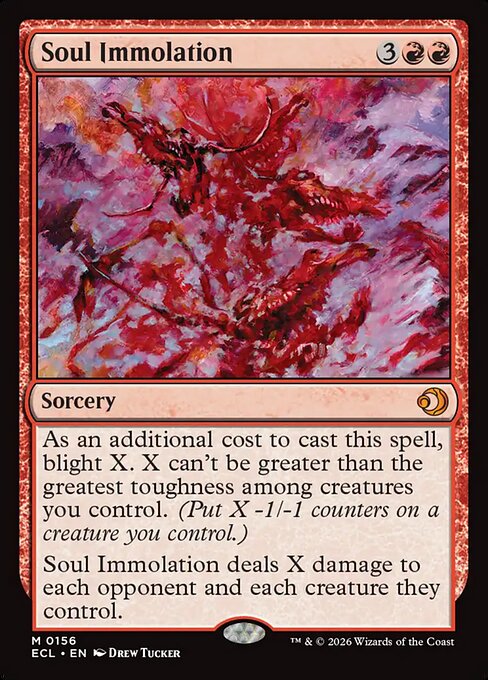 Rating8.9Bomb
Why this rating?
One of the 10 best cards of the set (8.9/10).
Why. A sorcery that scales with the game: you put X -1/-1 counters on one of your creatures, and X damage goes to the opponent and each of their creatures. Against a board full of small creatures it is a one-sided sweeper.
Risks. X cannot exceed the toughness of your sturdiest creature, and blight shrinks or kills the creature you choose. With no creature you can only cast it for X equal to zero.
In the draft. A bomb for a red deck with high-toughness creatures, take it very early. Save it for the turn when the opponent's board is wide.
Results in the games of the set
When it is in hand, the deck wins 63.2% of its games (set average: 55.7%, 8th of 264 cards).
In the opening hand: 58.6% wins (54.5% on average).
Drawn during the game: 66.0% (56.5% on average).
When it is drawn, the deck wins 11.9 points more than when it is not.
When it is drafted, it is played 89% of the time (set average: 61%).
Taken as the first pick (68 drafts), it ends in the deck 87% of the time.
It is played about as much in every archetype.
 Rating8.8Bomb
Why this rating?
One of the 10 best cards of the set (8.8/10).
Why. A 7/7 for seven whose enters trigger turns each creature an opponent controls into a 1/1 with no abilities. Most of the time that wins the game: the rest of their board neither blocks nor attacks well.
Risks. Seven mana, two of them white, is slow. The effect hits the creatures already there, not the ones the opponent plays later, and a removal spell can still answer the body afterwards.
In the draft. A top-end bomb, take it high in a white deck. Pick it especially if you can survive until seven mana, with extra mana sources or good blockers.
Results in the games of the set
When it is in hand, the deck wins 62.9% of its games (set average: 55.7%, 10th of 264 cards).
In the opening hand: 57.8% wins (54.5% on average).
Drawn during the game: 66.1% (56.5% on average).
When it is drawn, the deck wins 11.3 points more than when it is not.
When it is drafted, it is played 86% of the time (set average: 61%).
Taken as the first pick (75 drafts), it ends in the deck 87% of the time.
It is played about as much in every archetype.
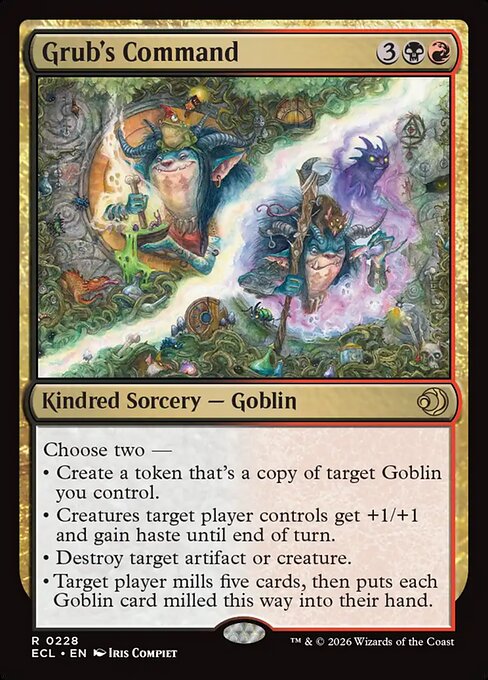 Rating8.7Bomb
Why this rating?
One of the 10 best cards of the set (8.7/10).
Why. A sorcery with two modes out of four, including removal for a creature or an artifact. The other mode adds to it: a copy of a Goblin you control, +1/+1 and haste for a whole team, or five cards milled with the Goblins among them going to your hand. Removal paired with an effect is exactly the value you want.
Risks. Five mana and two colours. The copy and mill modes depend on Goblins, so they matter less in a deck with few of them.
In the draft. A bomb for a black-red deck, take it very early. Even without Goblins, the removal and the team boost keep it playable.
Results in the games of the set
When it is in hand, the deck wins 62.7% of its games (set average: 55.7%, 11th of 264 cards).
In the opening hand: 61.5% wins (54.5% on average).
Drawn during the game: 63.5% (56.5% on average).
When it is drawn, the deck wins 11.8 points more than when it is not.
When it is drafted, it is played 71% of the time (set average: 61%).
Taken as the first pick (96 drafts), it ends in the deck 82% of the time.
It is played about as much in every archetype.
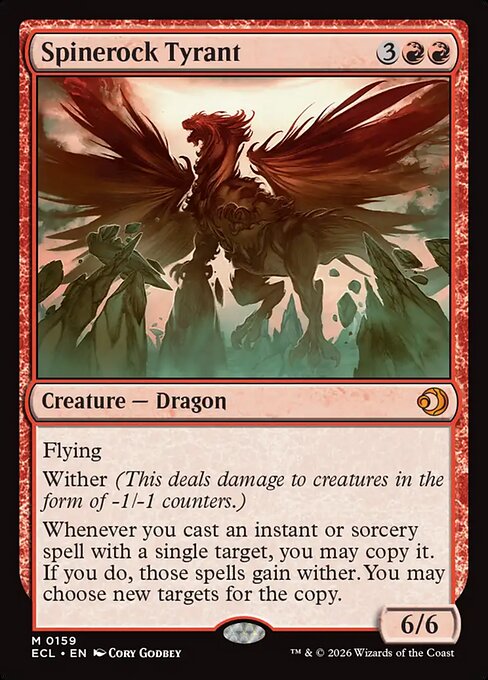 Rating8.7Bomb
Why this rating?
One of the 10 best cards of the set (8.7/10).
Why. A 6/6 flying Dragon for five with wither. It stands on its own, and every instant or sorcery with a single target that you cast can be copied, both the spell and the copy gaining wither.
Risks. Five mana with two red, and a removal spell takes it out before it connects. The copy bonus only matters if you play single-target spells.
In the draft. A bomb, take it very early. Once you are red it is already enough as a flying finisher, and each extra removal or damage spell adds to it.
Results in the games of the set
When it is in hand, the deck wins 61.8% of its games (set average: 55.7%, 17th of 264 cards).
In the opening hand: 61.1% wins (54.5% on average).
Drawn during the game: 62.3% (56.5% on average).
When it is drawn, the deck wins 11.5 points more than when it is not.
When it is drafted, it is played 86% of the time (set average: 61%).
Taken as the first pick (58 drafts), it ends in the deck 88% of the time.
It is played about as much in every archetype.

9. Gloom Ripper
Rating8.6BombWhy this rating?
One of the 10 best cards of the set (8.6/10).
Why. A 4/4 for five whose enters trigger gives +X/+0 to one of your creatures and -0/-X to an opposing creature, X being the Elves you control plus the Elf cards in your graveyard. In an Elf deck it is removal that kills a creature, or an attack turn that ends the game.
Risks. With few other Elves X stays small and the effect is weak. It only lasts until end of turn.
In the draft. Excellent in a black-green deck full of Elves, take it very early. Look for plenty of Elves alongside so that X is large the moment it lands.
Results in the games of the set
When it is in hand, the deck wins 66.2% of its games (set average: 55.7%, 1st of 264 cards).
In the opening hand: 64.6% wins (54.5% on average).
Drawn during the game: 67.3% (56.5% on average).
When it is drawn, the deck wins 13.0 points more than when it is not.
When it is drafted, it is played 84% of the time (set average: 61%).
Taken as the first pick (107 drafts), it ends in the deck 85% of the time.
It is played about as much in every archetype.
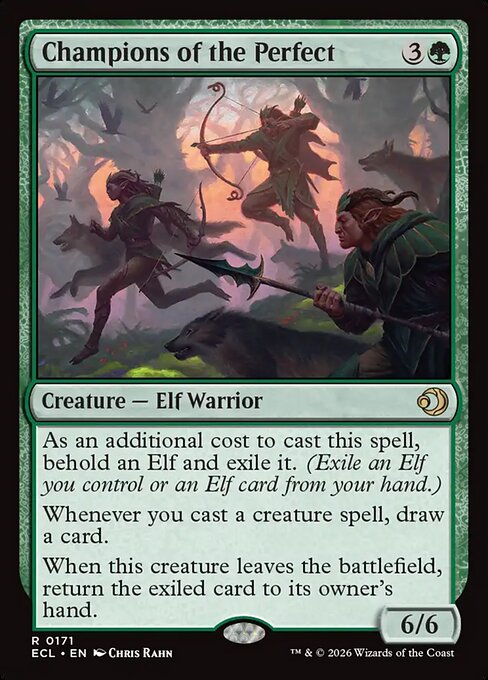 Rating8.5Bomb
Why this rating?
One of the 10 best cards of the set (8.5/10).
Why. A 6/6 for four that draws you a card every time you cast a creature spell. The cost is to behold an Elf and exile it: when the creature leaves the battlefield, the Elf returns to your hand. A big body that generates value turn after turn.
Risks. It needs an Elf on the battlefield or in hand, and exiles it. A removal spell takes it quickly, but the Elf comes back to your hand.
In the draft. A bomb for a black-green deck with many Elves, take it very early. It loses most of its value without enough Elves.
Results in the games of the set
When it is in hand, the deck wins 61.0% of its games (set average: 55.7%, 23rd of 264 cards).
In the opening hand: 61.9% wins (54.5% on average).
Drawn during the game: 60.3% (56.5% on average).
When it is drawn, the deck wins 8.3 points more than when it is not.
When it is drafted, it is played 86% of the time (set average: 61%).
Taken as the first pick (115 drafts), it ends in the deck 87% of the time.
It is played about as much in every archetype.
 Rating8.4Bomb
Why this rating?
One of the very best rares of the format (8.4/10).
Why. A 4/6 for four that taps an opposing creature and puts a stun counter on it when it enters and each time it becomes tapped. It attacks while neutralising an opposing creature, and its toughness helps on defence.
Risks. You must behold a Merfolk and exile it to cast it. If that Merfolk is your best card the cost is heavy, though it returns when the creature leaves.
In the draft. Excellent for a blue-white deck with many Merfolk, take it high. Without enough Merfolk it becomes unplayable.
Results in the games of the set
When it is in hand, the deck wins 62.4% of its games (set average: 55.7%, 13th of 264 cards).
In the opening hand: 61.5% wins (54.5% on average).
Drawn during the game: 62.9% (56.5% on average).
When it is drawn, the deck wins 9.9 points more than when it is not.
When it is drafted, it is played 81% of the time (set average: 61%).
Taken as the first pick (118 drafts), it ends in the deck 80% of the time.
It is played about as much in every archetype.
 Rating8.4Very good
Why this rating?
One of the very best rares of the format (8.4/10).
Why. A flexible instant: X damage to a creature for X plus a red mana, then if it dies this turn you exile cards from the top of your library equal to its power and may play one of them until the end of your next turn. Removal with a scalable cost that can pay back a card.
Risks. It costs more than a fixed removal spell against big creatures. It does nothing against a creature with zero power, and the exiled card must be played before the end of your next turn.
In the draft. A solid red removal spell, take it early. It suits every red deck, since X adapts to the threat.
Results in the games of the set
When it is in hand, the deck wins 60.2% of its games (set average: 55.7%, 36th of 264 cards).
In the opening hand: 58.4% wins (54.5% on average).
Drawn during the game: 61.4% (56.5% on average).
When it is drawn, the deck wins 7.8 points more than when it is not.
When it is drafted, it is played 89% of the time (set average: 61%).
Taken as the first pick (137 drafts), it ends in the deck 91% of the time.
It is played about as much in every archetype.

13. Brigid's Command
Rating8.3Very goodWhy this rating?
One of the very best rares of the format (8.3/10).
Why. A three-mana sorcery that picks two modes out of four: your creature fights an opposing one, +3/+3 on a creature, a 1/1 green and white Kithkin creature token, or a copy of a Kithkin you control. Fight plus the pump makes cheap, reliable removal.
Risks. The fight modes depend on a creature of yours on the battlefield. The copy mode is worth little without Kithkin.
In the draft. A good pick for a green-white deck with creatures, take it early. Pair the fight with the pump for three-mana removal, or the token with the pump for aggressive tempo.
Results in the games of the set
When it is in hand, the deck wins 59.8% of its games (set average: 55.7%, 41st of 264 cards).
In the opening hand: 58.2% wins (54.5% on average).
Drawn during the game: 61.0% (56.5% on average).
When it is drawn, the deck wins 6.4 points more than when it is not.
When it is drafted, it is played 74% of the time (set average: 61%).
Taken as the first pick (75 drafts), it ends in the deck 85% of the time.
It is played about as much in every archetype.
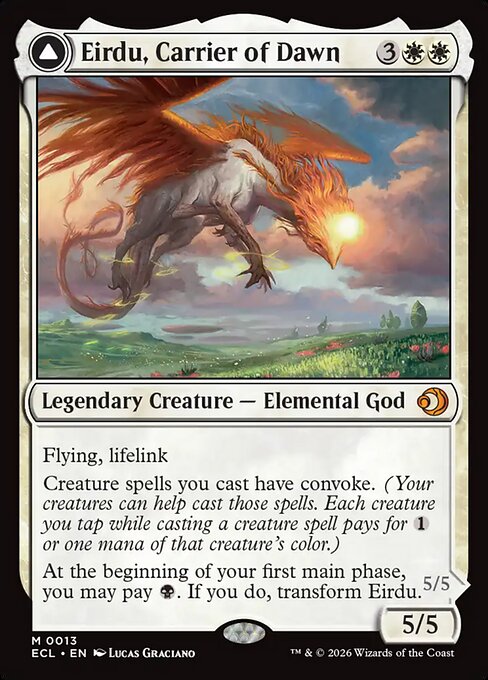
14. Eirdu, Carrier of Dawn // Isilu, Carrier of Twilight
Rating8.2Very goodWhy this rating?
One of the very best mythics of the format (8.2/10).
Why. A 5/5 flying lifelinker for five that gives convoke to your creature spells: tapping your creatures helps pay for them. The Isilu side gives persist to your other nontoken creatures; you transform by paying a black mana.
Risks. Most of the time the Eirdu side alone is why you play it; each transformation costs mana. Convoke means tapping creatures that then cannot attack.
In the draft. Take it early. A 5/5 flying lifelinker is already excellent in white. The black side is a bonus if you are white-black.
Results in the games of the set
When it is in hand, the deck wins 61.1% of its games (set average: 55.7%, 22nd of 264 cards).
In the opening hand: 57.9% wins (54.5% on average).
Drawn during the game: 63.2% (56.5% on average).
When it is drawn, the deck wins 9.6 points more than when it is not.
When it is drafted, it is played 89% of the time (set average: 61%).
Taken as the first pick (43 drafts), it ends in the deck 88% of the time.
It is played about as much in every archetype.
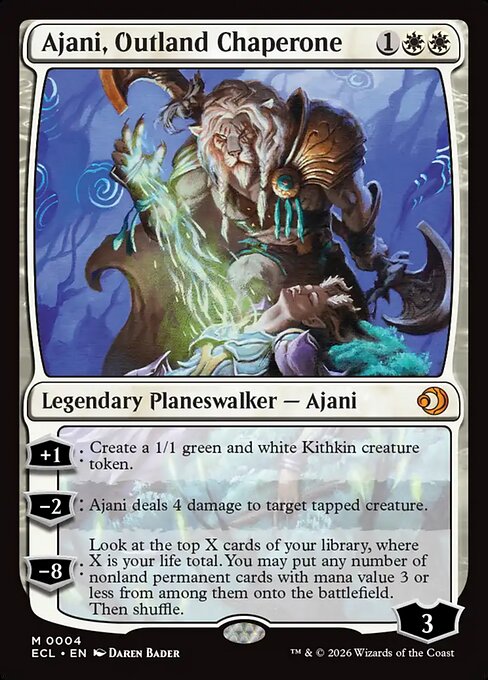 Rating8.1Very good
Why this rating?
One of the very best mythics of the format (8.1/10).
Why. A three-mana planeswalker that makes a 1/1 green and white Kithkin creature token each turn, or deals 4 damage to a tapped creature. It protects its own loyalty with tokens and doubles as removal against an attacker.
Risks. It is vulnerable to fliers or fast creatures if you have no blockers. The -2 only hits tapped creatures, so only those that attacked.
In the draft. Take it early in white. It comes down on turn three for a stream of tokens, best in a white-green deck.
Results in the games of the set
When it is in hand, the deck wins 60.9% of its games (set average: 55.7%, 25th of 264 cards).
In the opening hand: 62.8% wins (54.5% on average).
Drawn during the game: 59.5% (56.5% on average).
When it is drawn, the deck wins 8.7 points more than when it is not.
When it is drafted, it is played 85% of the time (set average: 61%).
Taken as the first pick (44 drafts), it ends in the deck 86% of the time.
It is played about as much in every archetype.
 Rating8.1Very good
Why this rating?
One of the very best rares of the format (8.1/10).
Why. A one-mana black creature that works as a filtering engine: with blight it surveils or exiles a card from a graveyard, then lets you cast from exile the creatures exiled with it. A slow engine, but a good late-game role.
Risks. A 1/2 whose two tap abilities need blight, so -1/-1 counters on your creatures. The last effect requires removing three counters and its value is slow to arrive.
In the draft. A rather selective card, take it at a middling pick. It is worth it in a black-green deck with ways to place counters, and less in a rushed deck.
Results in the games of the set
When it is in hand, the deck wins 58.9% of its games (set average: 55.7%, 50th of 264 cards).
In the opening hand: 59.6% wins (54.5% on average).
Drawn during the game: 58.4% (56.5% on average).
When it is drawn, the deck wins 6.2 points more than when it is not.
When it is drafted, it is played 88% of the time (set average: 61%).
Taken as the first pick (143 drafts), it ends in the deck 87% of the time.
It is played about as much in every archetype.

17. Moonshadow
Rating8.0Very goodWhy this rating?
One of the very best mythics of the format (8.0/10).
Why. For a black mana, a 7/7 menace creature that enters with six -1/-1 counters, so a 1/1 at first. Each time permanent cards hit your graveyard it loses a counter and grows. In a deck that fills the graveyard it gets huge.
Risks. A 1/1 on turn one that dies to the slightest hit. Its growth depends on what reaches the graveyard: without that, it stays small.
In the draft. A card for a black-green deck able to fill the graveyard, a middling pick. It is weaker when the deck does not fill it.
Results in the games of the set
When it is in hand, the deck wins 57.1% of its games (set average: 55.7%, 81st of 264 cards).
In the opening hand: 60.5% wins (54.5% on average).
Drawn during the game: 54.8% (56.5% on average).
When it is drawn, the deck wins 5.0 points more than when it is not.
When it is drafted, it is played 86% of the time (set average: 61%).
Taken as the first pick (40 drafts), it ends in the deck 98% of the time.
It is played about as much in every archetype.
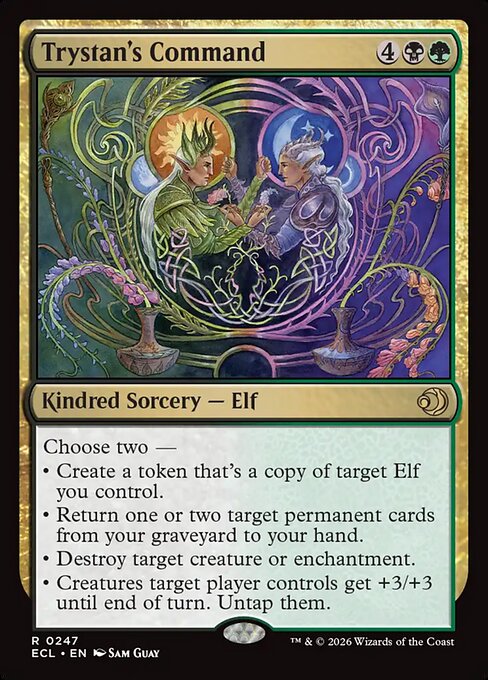 Rating7.9Very good
Why this rating?
One of the very best rares of the format (7.9/10).
Why. A six-mana sorcery with two modes out of four: destroy a creature or an enchantment, return one or two permanent cards from your graveyard, copy an Elf, or give +3/+3 and untap your creatures. Removal with value.
Risks. Six mana is a lot for a removal spell. The copy mode depends on Elves, and the pump only matters if your creatures can fight.
In the draft. Good for a black-green deck, take it early. Removal plus getting a card back is already a clean two-for-one, even without Elves.
Results in the games of the set
When it is in hand, the deck wins 63.7% of its games (set average: 55.7%, 5th of 264 cards).
In the opening hand: 59.8% wins (54.5% on average).
Drawn during the game: 66.2% (56.5% on average).
When it is drawn, the deck wins 11.3 points more than when it is not.
When it is drafted, it is played 88% of the time (set average: 61%).
Taken as the first pick (133 drafts), it ends in the deck 89% of the time.
It is played about as much in every archetype.
 Rating7.8Very good
Why this rating?
One of the very best mythics of the format (7.8/10).
Why. An instant that cannot be countered and counters all of the opponent's spells and abilities, giving you a 1/1 blue and black Faerie creature token with flying for each. At the right moment it is a complete swing.
Risks. It does nothing if the opponent has nothing on the stack, and permanents already in play stay. It means holding up four mana, two of them blue.
In the draft. A card for the patient player, take it at a middling pick. It earns its slot in a blue control deck, and less in a tempo deck.
Results in the games of the set
When it is in hand, the deck wins 59.3% of its games (set average: 55.7%, 46th of 264 cards).
In the opening hand: 55.6% wins (54.5% on average).
Drawn during the game: 61.5% (56.5% on average).
When it is drawn, the deck wins 6.2 points more than when it is not.
When it is drafted, it is played 68% of the time (set average: 61%).
Taken as the first pick (39 drafts), it ends in the deck 87% of the time.
It is played about as much in every archetype.
 Rating7.8Very good
Why this rating?
One of the very best rares of the format (7.8/10).
Why. A 2/2 flier for a blue mana that enters with a -1/-1 counter, so a 1/1 flier. By removing a counter you draw a card if a creature you control deals combat damage to a player or planeswalker this turn. A cheap air threat with value.
Risks. A fragile 1/1 against any damage or aerial blocker. The activation costs three mana and needs combat to go well.
In the draft. A good early card, take it high for a blue deck that attacks. It plays better alongside other attackers.
Results in the games of the set
When it is in hand, the deck wins 60.0% of its games (set average: 55.7%, 39th of 264 cards).
In the opening hand: 62.4% wins (54.5% on average).
Drawn during the game: 58.4% (56.5% on average).
When it is drawn, the deck wins 8.0 points more than when it is not.
When it is drafted, it is played 87% of the time (set average: 61%).
Taken as the first pick (108 drafts), it ends in the deck 87% of the time.
It is played about as much in every archetype.
 Rating7.7Very good
Why this rating?
One of the very best rares of the format (7.7/10).
Why. For two mana, a 6/6 trampler with ward 2 that enters with five -1/-1 counters, so a 1/1. Every other creature you play removes a counter. After a few creatures it is a huge attacker that resists removal.
Risks. Early on it is a 1/1 doing little against a faster opponent. It needs several creatures to grow large.
In the draft. Very good in a green deck with many creatures and a smooth curve, take it early. Poor in a deck that plays few creatures.
Results in the games of the set
When it is in hand, the deck wins 59.8% of its games (set average: 55.7%, 42nd of 264 cards).
In the opening hand: 63.6% wins (54.5% on average).
Drawn during the game: 56.9% (56.5% on average).
When it is drawn, the deck wins 6.3 points more than when it is not.
When it is drafted, it is played 88% of the time (set average: 61%).
Taken as the first pick (109 drafts), it ends in the deck 90% of the time.
It is played about as much in every archetype.
 Rating7.6Very good
Why this rating?
One of the very best rares of the format (7.6/10).
Why. A 5/5 for four with an aggressive streak: by paying 1 life and blighting 2, you make the opponent blight 2 as well. When it leaves, the beheld card returns to your hand.
Risks. You must behold a Goblin and exile it to cast it. The ability costs you life and counters on your own creatures.
In the draft. Good for a black-red deck with Goblins, take it at a middling-high pick. Without Goblins it is not playable.
Results in the games of the set
When it is in hand, the deck wins 59.5% of its games (set average: 55.7%, 43rd of 264 cards).
In the opening hand: 60.1% wins (54.5% on average).
Drawn during the game: 59.1% (56.5% on average).
When it is drawn, the deck wins 8.8 points more than when it is not.
When it is drafted, it is played 76% of the time (set average: 61%).
Taken as the first pick (77 drafts), it ends in the deck 79% of the time.
It is played about as much in every archetype.
 Rating7.6Very good
Why this rating?
One of the very best mythics of the format (7.6/10).
Why. A six-mana artifact that chooses a creature type: your creatures of that type get +2/+2, first strike and trample, and each spell of that type draws you a card. In a well-stocked tribal deck it transforms a whole army.
Risks. Six mana for an artifact that does nothing alone. It needs a specific creature type in numbers.
In the draft. Take it at a middling pick for a well-stocked tribal deck, or with changelings. Avoid it in a deck without a dominant type.
Results in the games of the set
When it is in hand, the deck wins 62.3% of its games (set average: 55.7%, 14th of 264 cards).
In the opening hand: 59.6% wins (54.5% on average).
Drawn during the game: 64.0% (56.5% on average).
When it is drawn, the deck wins 9.7 points more than when it is not.
When it is drafted, it is played 98% of the time (set average: 61%).
Taken among the first three picks (262 drafts), it ends in the deck 99% of the time.
It is played about as much in every archetype.
 Rating7.6Very good
Why this rating?
One of the very best uncommons of the format (7.6/10).
Why. A 2/2 for two mana that gives +1/+1 to other Merfolk and untaps a Merfolk you control at your end step. It grows an entire team and lets a Merfolk attack then block.
Risks. A 2/2 with no Merfolk around does little. It is fragile to removal, and its value depends on the tribe.
In the draft. Excellent in a blue-white deck with many Merfolk, take it high. It makes a strong early play in that deck.
Results in the games of the set
When it is in hand, the deck wins 63.3% of its games (set average: 55.7%, 7th of 264 cards).
In the opening hand: 64.0% wins (54.5% on average).
Drawn during the game: 62.8% (56.5% on average).
When it is drawn, the deck wins 8.9 points more than when it is not.
When it is drafted, it is played 80% of the time (set average: 61%).
Taken as the first pick (167 drafts), it ends in the deck 92% of the time.
It is played mostly in U/W decks (50% of them).
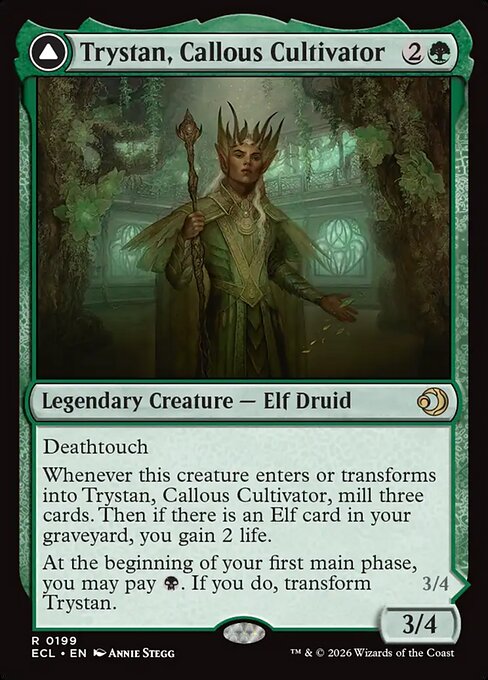
25. Trystan, Callous Cultivator // Trystan, Penitent Culler
Rating7.6Very goodWhy this rating?
One of the very best rares of the format (7.6/10).
Why. A 3/4 deathtouch creature for three that mills three cards when it enters and gains you 2 life if an Elf card is in your graveyard. A good blocker and attacker, which can transform by paying a black mana.
Risks. Milling three cards thins your library. The life gain needs an Elf in the graveyard, and the transformation needs black mana.
In the draft. A good body for a black-green deck, take it at a middling-high pick. The green side is enough to justify it, the transformation is a bonus.
Results in the games of the set
When it is in hand, the deck wins 60.6% of its games (set average: 55.7%, 28th of 264 cards).
In the opening hand: 61.5% wins (54.5% on average).
Drawn during the game: 60.1% (56.5% on average).
When it is drawn, the deck wins 6.3 points more than when it is not.
When it is drafted, it is played 87% of the time (set average: 61%).
Taken as the first pick (104 drafts), it ends in the deck 91% of the time.
It is played about as much in every archetype.
 Rating7.5Very good
Why this rating?
One of the very best rares of the format (7.5/10).
Why. A 4/7 that enters with two -1/-1 counters (a 2/5) and can remove one each end step to return a creature card with power 2 or less from your graveyard to the battlefield. Great toughness with a recursion effect.
Risks. Five mana for a 2/5 at first, and the effect only hits small creatures. It does nothing without a target in your graveyard.
In the draft. A solid body, take it at a middling pick, especially in white with small creatures worth recurring. It is stronger when you already have some in the graveyard.
Results in the games of the set
When it is in hand, the deck wins 59.4% of its games (set average: 55.7%, 45th of 264 cards).
In the opening hand: 57.2% wins (54.5% on average).
Drawn during the game: 60.8% (56.5% on average).
When it is drawn, the deck wins 5.9 points more than when it is not.
When it is drafted, it is played 84% of the time (set average: 61%).
Taken as the first pick (140 drafts), it ends in the deck 81% of the time.
It is played about as much in every archetype.
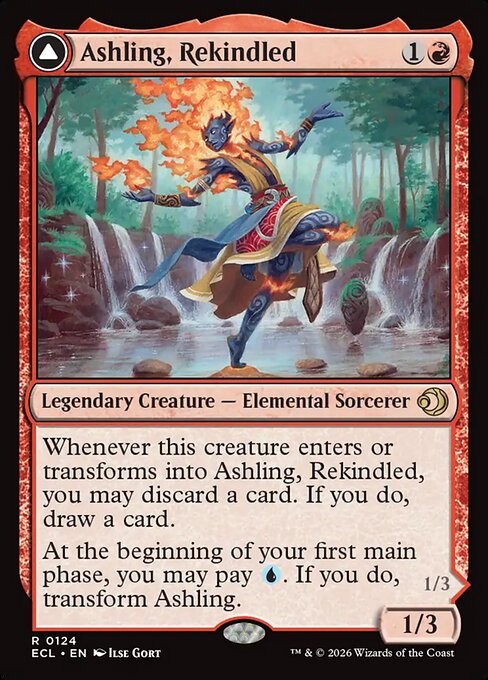
27. Ashling, Rekindled // Ashling, Rimebound
Rating7.4Very goodWhy this rating?
A very good rare of the format (7.4/10).
Why. A 1/3 for two mana that lets you discard to draw when it enters, then transforms by paying a blue mana into a mana source for spells with mana value 4 or greater. A good early play that accelerates later.
Risks. A 1/3 that does not attack well. Transforming needs blue mana, and the mana it makes only pays for spells with mana value 4 or greater.
In the draft. Good in a blue-red deck with expensive spells, take it at a middling pick. In mono-red its value drops.
Results in the games of the set
When it is in hand, the deck wins 60.5% of its games (set average: 55.7%, 32nd of 264 cards).
In the opening hand: 63.4% wins (54.5% on average).
Drawn during the game: 58.4% (56.5% on average).
When it is drawn, the deck wins 9.4 points more than when it is not.
When it is drafted, it is played 83% of the time (set average: 61%).
Taken as the first pick (106 drafts), it ends in the deck 85% of the time.
It is played about as much in every archetype.

28. Aurora Awakener
Rating7.4Very goodWhy this rating?
A very good mythic of the format (7.4/10).
Why. A 7/7 trampler for seven whose enters trigger reveals cards until X permanents, X being the number of colours among your permanents, and puts as many as you like onto the battlefield. In a multicolour deck the value can be huge.
Risks. Seven mana is late. With few colours X is small, and the effect is random.
In the draft. A late-game card, take it at a middling pick. It is worth more in a green deck that plays permanents of several colours.
Results in the games of the set
When it is in hand, the deck wins 60.6% of its games (set average: 55.7%, 31st of 264 cards).
In the opening hand: 56.6% wins (54.5% on average).
Drawn during the game: 63.2% (56.5% on average).
When it is drawn, the deck wins 10.5 points more than when it is not.
When it is drafted, it is played 89% of the time (set average: 61%).
Taken as the first pick (43 drafts), it ends in the deck 88% of the time.
It is played about as much in every archetype.

29. Eclipsed Elf
Rating7.4Very goodWhy this rating?
A solid uncommon of the format (7.4/10).
Why. A 3/2 for three that looks at the top four cards of your library and takes an Elf, a Swamp or a Forest. It holds your curve while giving you an extra card.
Risks. A 3/2 dies to a lot of things. The search finds nothing if your Elves and basic lands are scarce.
In the draft. A good card for a black-green deck, take it early. It wants Elves and Swamps or Forests in numbers to hit often.
Results in the games of the set
When it is in hand, the deck wins 63.0% of its games (set average: 55.7%, 9th of 264 cards).
In the opening hand: 63.2% wins (54.5% on average).
Drawn during the game: 62.9% (56.5% on average).
When it is drawn, the deck wins 8.1 points more than when it is not.
When it is drafted, it is played 83% of the time (set average: 61%).
Taken as the first pick (200 drafts), it ends in the deck 86% of the time.
It is played mostly in B/G decks (39% of them).

30. Figure of Fable
Rating7.4Very goodWhy this rating?
A very good rare of the format (7.4/10).
Why. A one-mana creature that grows at each step: a 2/3 for one mana, a 4/5 for three, then a 7/8 with protection from each of your opponents for six. It is useful at every stage of the game.
Risks. Each step needs mana and the previous one done. Removal in response to an activation costs you the mana invested.
In the draft. A very good card for any green or white deck, take it early. Hybrid mana: it is easy to play in a deck of either colour.
Results in the games of the set
When it is in hand, the deck wins 63.6% of its games (set average: 55.7%, 6th of 264 cards).
In the opening hand: 65.5% wins (54.5% on average).
Drawn during the game: 62.2% (56.5% on average).
When it is drawn, the deck wins 10.6 points more than when it is not.
When it is drafted, it is played 96% of the time (set average: 61%).
Taken as the first pick (85 drafts), it ends in the deck 94% of the time.
It is played about as much in every archetype.
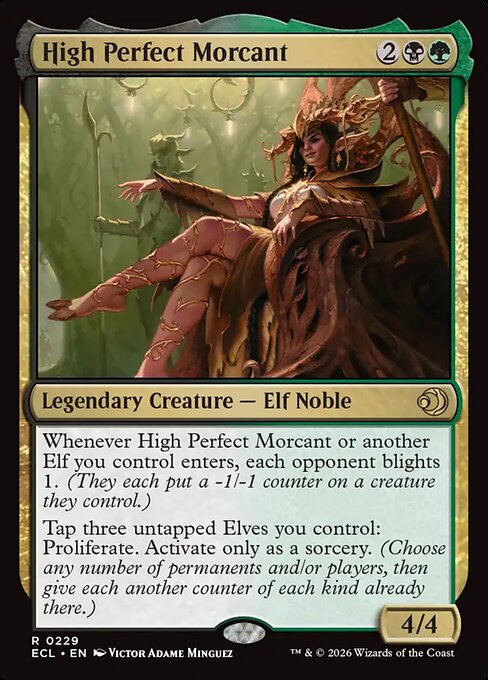 Rating7.4Very good
Why this rating?
A very good rare of the format (7.4/10).
Why. A 4/4 for four that makes each opponent blight 1 whenever it or another Elf enters under your control. By tapping three untapped Elves you proliferate. In an Elf deck it wears down the opposing creatures every time you play one.
Risks. It loses a lot of value without Elves, and proliferate requires three untapped Elves. With no opposing creature, the blight does nothing.
In the draft. Good in a black-green Elf deck, take it early. Outside that it is a decent body.
Results in the games of the set
When it is in hand, the deck wins 61.8% of its games (set average: 55.7%, 18th of 264 cards).
In the opening hand: 62.0% wins (54.5% on average).
Drawn during the game: 61.6% (56.5% on average).
When it is drawn, the deck wins 9.1 points more than when it is not.
When it is drafted, it is played 84% of the time (set average: 61%).
Taken as the first pick (98 drafts), it ends in the deck 81% of the time.
It is played about as much in every archetype.

32. Sunderflock
Rating7.4Very goodWhy this rating?
A very good rare of the format (7.4/10).
Why. A 5/5 flier whose cost is reduced by the greatest mana value among your Elementals, and which returns all non-Elemental creatures to their owners' hands when cast. With Elementals it is a finisher that resets the table.
Risks. With no Elemental it costs nine mana. It also bounces your own non-Elemental creatures, which costs you tempo.
In the draft. Good for a blue-red deck with Elementals, take it early. Outside that deck it is too expensive.
Results in the games of the set
When it is in hand, the deck wins 64.1% of its games (set average: 55.7%, 4th of 264 cards).
In the opening hand: 60.3% wins (54.5% on average).
Drawn during the game: 66.4% (56.5% on average).
When it is drawn, the deck wins 13.0 points more than when it is not.
When it is drafted, it is played 81% of the time (set average: 61%).
Taken as the first pick (127 drafts), it ends in the deck 84% of the time.
It is played about as much in every archetype.
 Rating7.4Very good
Why this rating?
A very good mythic of the format (7.4/10).
Why. A 1/1 flash flier for two black mana that creates a 1/1 blue and black Faerie creature token with flying at each of your upkeeps, at the cost of 1 life. Left alive, it fills the sky with threats.
Risks. It costs you 1 life per turn and stays a 1/1: removal or a block takes it. It is slow against an aggressive deck.
In the draft. A card to take at a middling pick for a black deck that can protect its life total. Control decks like it less.
Results in the games of the set
When it is in hand, the deck wins 57.9% of its games (set average: 55.7%, 67th of 264 cards).
In the opening hand: 60.6% wins (54.5% on average).
Drawn during the game: 56.0% (56.5% on average).
When it is drawn, the deck wins 6.6 points more than when it is not.
When it is drafted, it is played 85% of the time (set average: 61%).
Taken as the first pick (57 drafts), it ends in the deck 81% of the time.
It is played about as much in every archetype.

34. Eclipsed Merrow
Rating7.3Very goodWhy this rating?
A solid uncommon of the format (7.3/10).
Why. A 2/3 for three that looks at the top four cards of your library and takes a Merfolk, a Plains or an Island. It holds the curve while giving you an extra card.
Risks. A 2/3 is a modest body. The search finds nothing if your Merfolk and basic lands are scarce.
In the draft. A good card for a blue-white deck, take it early. It wants Merfolk and Plains or Islands in numbers to hit often.
Results in the games of the set
When it is in hand, the deck wins 61.8% of its games (set average: 55.7%, 16th of 264 cards).
In the opening hand: 61.9% wins (54.5% on average).
Drawn during the game: 61.8% (56.5% on average).
When it is drawn, the deck wins 6.8 points more than when it is not.
When it is drafted, it is played 78% of the time (set average: 61%).
Taken as the first pick (159 drafts), it ends in the deck 88% of the time.
It is played mostly in U/W decks (46% of them).

35. Taster of Wares
Rating7.2Very goodWhy this rating?
A very good rare of the format (7.2/10).
Why. A three-mana 3/2 that pays off on entering: the opponent reveals as many cards from hand as you control Goblins (at least one, itself) and you pick one to exile. If it's an instant or sorcery, you can cast it with mana of any type.
Risks. With a lone Goblin the opponent reveals just one card, so you get no real choice. The two-toughness body dies easily, and you can only cast the exiled spell while you control this creature.
In the draft. A good pick for black decks with Goblins, especially black-red. The more Goblins you line up, the more of the opponent's hand you see.
Results in the games of the set
When it is in hand, the deck wins 60.6% of its games (set average: 55.7%, 29th of 264 cards).
In the opening hand: 60.6% wins (54.5% on average).
Drawn during the game: 60.6% (56.5% on average).
When it is drawn, the deck wins 8.9 points more than when it is not.
When it is drafted, it is played 85% of the time (set average: 61%).
Taken as the first pick (113 drafts), it ends in the deck 82% of the time.
It is played about as much in every archetype.

36. Kinbinding
Rating7.2Very goodWhy this rating?
A very good rare of the format (7.2/10).
Why. A five-mana enchantment that makes a 1/1 green and white Kithkin creature token at the beginning of each combat, and that token pumps the team itself: every creature that entered this turn gives all your creatures +1/+1. Add flash creatures or extra tokens and attacks get huge.
Risks. Five mana with no impact on the board before combat, and it needs white twice. A deck with few creatures entering mid-turn gets little from it.
In the draft. A good pick in a white creature deck, especially green-white or blue-white. It rewards a base of cheap creatures.
Results in the games of the set
When it is in hand, the deck wins 64.3% of its games (set average: 55.7%, 3rd of 264 cards).
In the opening hand: 62.8% wins (54.5% on average).
Drawn during the game: 65.2% (56.5% on average).
When it is drawn, the deck wins 12.2 points more than when it is not.
When it is drafted, it is played 90% of the time (set average: 61%).
Taken as the first pick (125 drafts), it ends in the deck 86% of the time.
It is played about as much in every archetype.
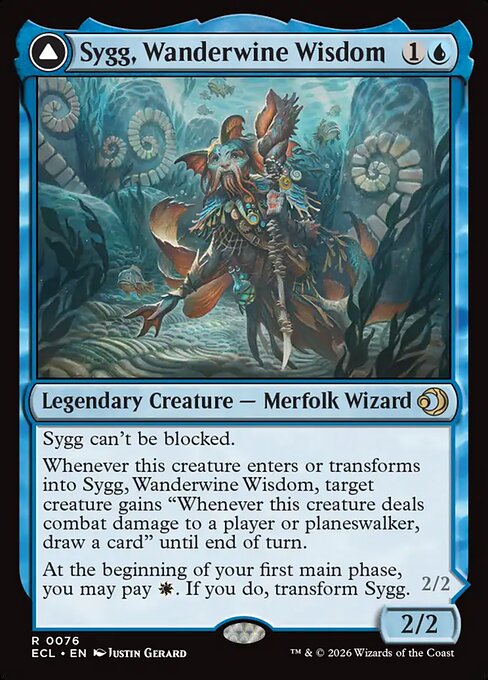
37. Sygg, Wanderwine Wisdom // Sygg, Wanderbrine Shield
Rating7.2Very goodWhy this rating?
A very good rare of the format (7.2/10).
Why. A two-mana 2/2 that can't be blocked. When it enters, a target creature gains 'draw a card when it deals combat damage to a player' until end of turn. Pay one white mana at the start of your turn and it transforms, giving one of your creatures protection from each color until your next turn.
Risks. A 2/2 is fragile, and each transformation costs a mana. The card draw only happens if the targeted creature actually hits a player.
In the draft. A good pick in blue-white, more situational elsewhere. It fits decks that attack with several small creatures.
Results in the games of the set
When it is in hand, the deck wins 60.6% of its games (set average: 55.7%, 30th of 264 cards).
In the opening hand: 60.8% wins (54.5% on average).
Drawn during the game: 60.5% (56.5% on average).
When it is drawn, the deck wins 8.8 points more than when it is not.
When it is drafted, it is played 91% of the time (set average: 61%).
Taken as the first pick (119 drafts), it ends in the deck 90% of the time.
It is played about as much in every archetype.
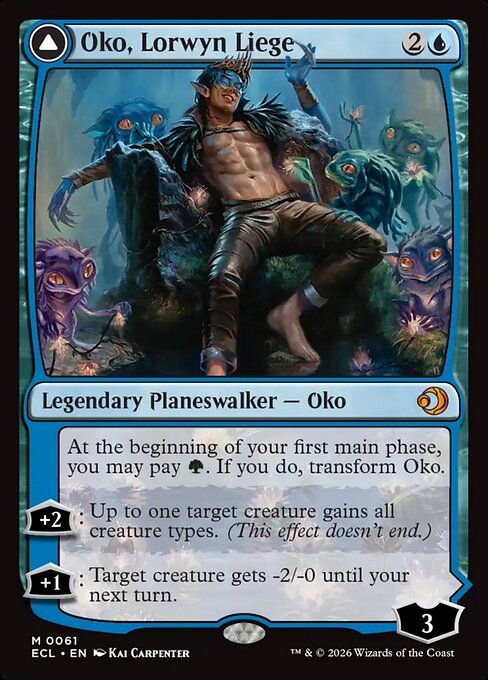
38. Oko, Lorwyn Liege // Oko, Shadowmoor Scion
Rating7.2GoodWhy this rating?
A very good mythic of the format (7.2/10).
Why. A three-mana planeswalker with two useful faces: the first gives a creature every creature type or shrinks an opposing attacker, the second makes two 3/3 green Elk creature tokens or digs through the library. Well managed, it covers both a removal and a threat.
Risks. Flipping costs a mana of the other face's color, and the first face does little for your board. With no creatures to defend it, it falls quickly.
In the draft. A decent pick, mostly in blue-red or blue-white. Don't take it over good removal; it shines in decks that defend well.
Results in the games of the set
When it is in hand, the deck wins 56.4% of its games (set average: 55.7%, 98th of 264 cards).
In the opening hand: 57.0% wins (54.5% on average).
Drawn during the game: 56.1% (56.5% on average).
When it is drawn, the deck wins 7.2 points more than when it is not.
When it is drafted, it is played 83% of the time (set average: 61%).
Taken as the first pick (62 drafts), it ends in the deck 85% of the time.
It is played about as much in every archetype.
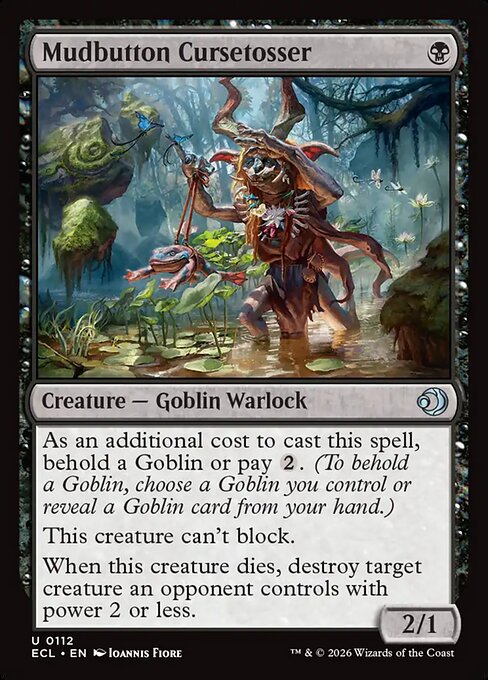 Rating7.1Good
Why this rating?
A solid uncommon of the format (7.1/10).
Why. A one-mana creature that attacks for 2 and, when it dies, destroys an opponent's creature with power 2 or less. The opponent is punished whether they block it or kill it. With a Goblin you control or in hand to behold, it costs just one mana.
Risks. It can't block, so it gives no defense. Without a Goblin to behold, it costs three mana, which hurts a lot. The death trigger only hits small creatures.
In the draft. A good uncommon for an aggressive black-red deck with Goblins. Avoid it in slower decks.
Results in the games of the set
When it is in hand, the deck wins 57.5% of its games (set average: 55.7%, 75th of 264 cards).
In the opening hand: 60.5% wins (54.5% on average).
Drawn during the game: 55.1% (56.5% on average).
When it is drawn, the deck wins 4.9 points more than when it is not.
When it is drafted, it is played 66% of the time (set average: 61%).
Taken as the first pick (75 drafts), it ends in the deck 88% of the time.
It is played mostly in B/R decks (54% of them).
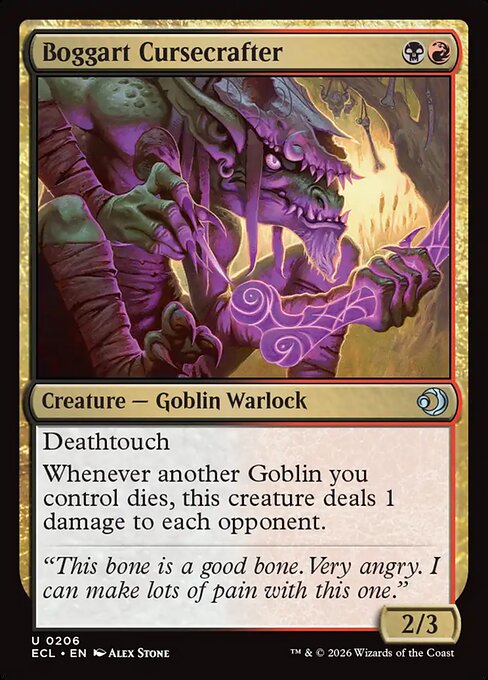 Rating7.0Good
Why this rating?
A solid uncommon of the format (7.0/10).
Why. A two-mana 2/3 deathtouch that holds the ground well and discourages attacks. In a Goblin deck, each other Goblin that dies deals 1 damage to each opponent.
Risks. It needs both black and red, so it's less flexible. With no other Goblins, the ability does nothing and it's just a good blocker.
In the draft. A solid pick for black-red. Even with few Goblins, deathtouch for two mana is enough to play it.
Results in the games of the set
When it is in hand, the deck wins 57.0% of its games (set average: 55.7%, 84th of 264 cards).
In the opening hand: 57.7% wins (54.5% on average).
Drawn during the game: 56.5% (56.5% on average).
When it is drawn, the deck wins 4.9 points more than when it is not.
When it is drafted, it is played 72% of the time (set average: 61%).
Taken as the first pick (105 drafts), it ends in the deck 88% of the time.
It is played mostly in B/R decks (56% of them).

41. Brigid, Clachan's Heart // Brigid, Doun's Mind
Rating7.0GoodWhy this rating?
A very good rare of the format (7.0/10).
Why. A three-mana 3/2 that creates a 1/1 green and white Kithkin creature token: two bodies for one card. Pay a green mana and she transforms, producing green or white mana based on your other creatures; flipping back costs a white mana and makes a fresh token.
Risks. The 3/2 is fragile, and each transformation costs a mana. The mana face does nothing if you have few creatures.
In the draft. A good pick in green-white, fine in blue-white. She's better in a deck with plenty of creatures.
Results in the games of the set
When it is in hand, the deck wins 60.9% of its games (set average: 55.7%, 24th of 264 cards).
In the opening hand: 61.7% wins (54.5% on average).
Drawn during the game: 60.4% (56.5% on average).
When it is drawn, the deck wins 8.6 points more than when it is not.
When it is drafted, it is played 86% of the time (set average: 61%).
Taken as the first pick (132 drafts), it ends in the deck 91% of the time.
It is played about as much in every archetype.
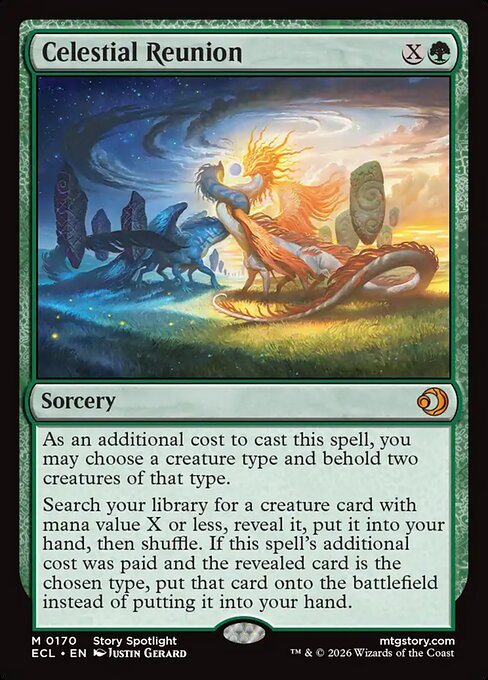 Rating7.0Good
Why this rating?
A very good mythic of the format (7.0/10).
Why. A flexible creature tutor: search for a creature with mana value X or less and put it into your hand. If you beheld two creatures of the chosen type and the revealed card is that type, it goes straight onto the battlefield.
Risks. A sorcery that doesn't affect the board right away. Its cost grows with the creature you fetch, and the bonus needs two creatures of the same type.
In the draft. A mid-pack pick, fine in a deck with a few big key creatures and one well-stocked type. It's best when you have a specific creature to find.
Results in the games of the set
When it is in hand, the deck wins 53.7% of its games (set average: 55.7%, 180th of 264 cards).
In the opening hand: 50.7% wins (54.5% on average).
Drawn during the game: 55.7% (56.5% on average).
When it is drawn, the deck wins 0.7 points more than when it is not.
When it is drafted, it is played 54% of the time (set average: 61%).
Taken among the first three picks (74 drafts), it ends in the deck 69% of the time.
It is played about as much in every archetype.

43. Deceit
Rating7.0GoodWhy this rating?
A very good mythic of the format (7.0/10).
Why. A six-mana 5/5, or a cheap spell via evoke. If you spent two blue mana, it returns another nonland permanent to its owner's hand; if you spent two black mana, the opponent reveals their hand and discards a nonland card of your choice.
Risks. Each effect needs two mana of the same color spent: in a balanced two-color deck you won't always manage it. Evoked, it's sacrificed on entering and leaves only one effect.
In the draft. A good pick for a blue or black deck with a solid base in one of those colors. It's best played in your dominant color.
Results in the games of the set
When it is in hand, the deck wins 58.9% of its games (set average: 55.7%, 49th of 264 cards).
In the opening hand: 55.0% wins (54.5% on average).
Drawn during the game: 61.5% (56.5% on average).
When it is drawn, the deck wins 7.5 points more than when it is not.
When it is drafted, it is played 87% of the time (set average: 61%).
Taken as the first pick (57 drafts), it ends in the deck 88% of the time.
It is played about as much in every archetype.

44. Eclipsed Kithkin
Rating7.0GoodWhy this rating?
A solid uncommon of the format (7.0/10).
Why. A two-mana hybrid 2/1 that looks at the top four cards of your library when it enters and can take a Kithkin, Forest or Plains. A good early play that secures your land drops or adds a creature.
Risks. A small, fragile body, and the search whiffs if the four cards hold no Kithkin, Forest or Plains. The rest go to the bottom of your library.
In the draft. A good pick for green-white, playable with either color. It's especially strong in decks packed with Kithkin.
Results in the games of the set
When it is in hand, the deck wins 62.4% of its games (set average: 55.7%, 12th of 264 cards).
In the opening hand: 64.5% wins (54.5% on average).
Drawn during the game: 60.6% (56.5% on average).
When it is drawn, the deck wins 7.7 points more than when it is not.
When it is drafted, it is played 80% of the time (set average: 61%).
Taken as the first pick (166 drafts), it ends in the deck 90% of the time.
It is played mostly in G/W decks (48% of them).

45. Morcant's Eyes
Rating7.0GoodWhy this rating?
A solid uncommon of the format (7.0/10).
Why. A two-mana enchantment that surveils 1 at the beginning of your upkeep, smoothing your draws all game and filling the graveyard. Late, you pay six mana and sacrifice it for a 2/2 black and green Elf creature token per Elf card in your graveyard.
Risks. It does nothing on the board for several turns. The payoff depends on how many Elves sit in your graveyard, and it can only be activated at sorcery speed.
In the draft. A pick for a black-green deck with plenty of Elves. Outside that shell, it loses most of its value.
Results in the games of the set
When it is in hand, the deck wins 60.4% of its games (set average: 55.7%, 34th of 264 cards).
In the opening hand: 58.6% wins (54.5% on average).
Drawn during the game: 61.8% (56.5% on average).
When it is drawn, the deck wins 4.4 points more than when it is not.
When it is drafted, it is played 76% of the time (set average: 61%).
Taken as the first pick (187 drafts), it ends in the deck 89% of the time.
It is played mostly in B/G decks (45% of them).
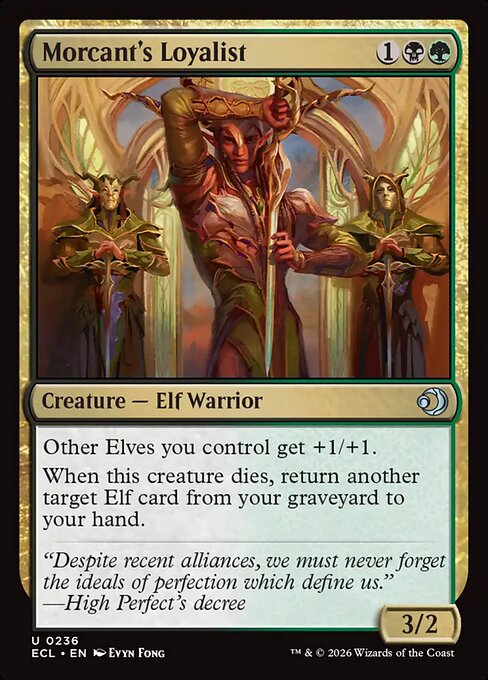 Rating7.0Good
Why this rating?
A solid uncommon of the format (7.0/10).
Why. A three-mana 3/2 that gives other Elves +1/+1. When it dies, it returns another Elf card from your graveyard to your hand, so you don't lose a card.
Risks. Without Elves it's just a two-color 3/2. The bonus only affects other Elves, and the recursion needs an Elf already in the graveyard.
In the draft. A strong pick in black-green, where Elves are plentiful. Take it fairly high if you're in that archetype.
Results in the games of the set
When it is in hand, the deck wins 61.3% of its games (set average: 55.7%, 20th of 264 cards).
In the opening hand: 59.5% wins (54.5% on average).
Drawn during the game: 62.5% (56.5% on average).
When it is drawn, the deck wins 6.8 points more than when it is not.
When it is drafted, it is played 85% of the time (set average: 61%).
Taken as the first pick (204 drafts), it ends in the deck 91% of the time.
It is played mostly in B/G decks (39% of them).
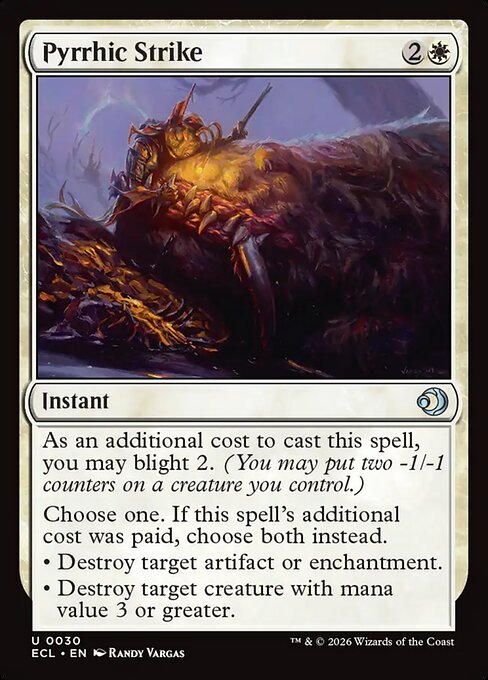
47. Pyrrhic Strike
Rating7.0GoodWhy this rating?
A solid uncommon of the format (7.0/10).
Why. A flexible instant: destroy a creature with mana value 3 or greater, or an artifact or enchantment. Pay blight 2 as an additional cost and you get both modes, a big two-for-one.
Risks. It can't answer small creatures. Blight shrinks one of your creatures, and without a target for the second mode the bonus is wasted.
In the draft. A decent removal spell for white decks, a mid-pack pick. It's better with creatures that can absorb the blight.
Results in the games of the set
When it is in hand, the deck wins 58.3% of its games (set average: 55.7%, 61st of 264 cards).
In the opening hand: 56.1% wins (54.5% on average).
Drawn during the game: 59.8% (56.5% on average).
When it is drawn, the deck wins 4.1 points more than when it is not.
When it is drafted, it is played 89% of the time (set average: 61%).
Taken as the first pick (239 drafts), it ends in the deck 92% of the time.
It is played mostly in B/W decks (30% of them) and G/W (26%).

48. Sygg's Command
Rating7.0GoodWhy this rating?
A very good rare of the format (7.0/10).
Why. A three-mana sorcery that picks two of four modes: copy a Merfolk, give a player's creatures lifelink, make a player draw a card, or tap a creature and put a stun counter on it. The flexibility makes it a tempo and value card.
Risks. It needs blue and white, and the copy mode only matters with a Merfolk. No mode destroys a creature outright.
In the draft. A good pick for blue-white decks with Merfolk. It fits a deck that wins through tempo.
Results in the games of the set
When it is in hand, the deck wins 58.7% of its games (set average: 55.7%, 54th of 264 cards).
In the opening hand: 56.6% wins (54.5% on average).
Drawn during the game: 60.1% (56.5% on average).
When it is drawn, the deck wins 5.2 points more than when it is not.
When it is drafted, it is played 77% of the time (set average: 61%).
Taken as the first pick (73 drafts), it ends in the deck 79% of the time.
It is played about as much in every archetype.

49. Sanar, Innovative First-Year
Rating7.0GoodWhy this rating?
A very good rare of the format (7.0/10).
Why. A four-mana hybrid 2/4 with a Vivid engine at the start of your turn: reveal cards until X nonland ones, X being the colors among your permanents (it counts as two itself), then exile one card of each color and cast them this turn. A strong card engine in a deck with several colors.
Risks. With few colors among your permanents, few cards get exiled. The body doesn't win games, and you need the mana to cast what you find.
In the draft. A good pick for blue-red, also fine in blue-white. It likes decks with several colors.
Results in the games of the set
When it is in hand, the deck wins 60.4% of its games (set average: 55.7%, 35th of 264 cards).
In the opening hand: 58.5% wins (54.5% on average).
Drawn during the game: 61.5% (56.5% on average).
When it is drawn, the deck wins 8.0 points more than when it is not.
When it is drafted, it is played 94% of the time (set average: 61%).
Taken as the first pick (136 drafts), it ends in the deck 96% of the time.
It is played about as much in every archetype.

50. Lluwen, Imperfect Naturalist
Rating6.9GoodWhy this rating?
A very good rare of the format (6.9/10).
Why. A two-mana hybrid 1/3 that mills four cards on entering and lets you put a creature or land card from among them on top of your library. Later, for five mana, it discards a land to make a 1/1 black and green Worm creature token per land card in your graveyard.
Risks. The body is weak, and the ability costs five mana, a land to discard and tapping Lluwen. It takes time to pay off.
In the draft. A fine pick for black-green. It's best in a deck that fills its graveyard with lands.
Results in the games of the set
When it is in hand, the deck wins 58.8% of its games (set average: 55.7%, 51st of 264 cards).
In the opening hand: 59.6% wins (54.5% on average).
Drawn during the game: 58.3% (56.5% on average).
When it is drawn, the deck wins 6.3 points more than when it is not.
When it is drafted, it is played 89% of the time (set average: 61%).
Taken as the first pick (92 drafts), it ends in the deck 87% of the time.
It is played about as much in every archetype.
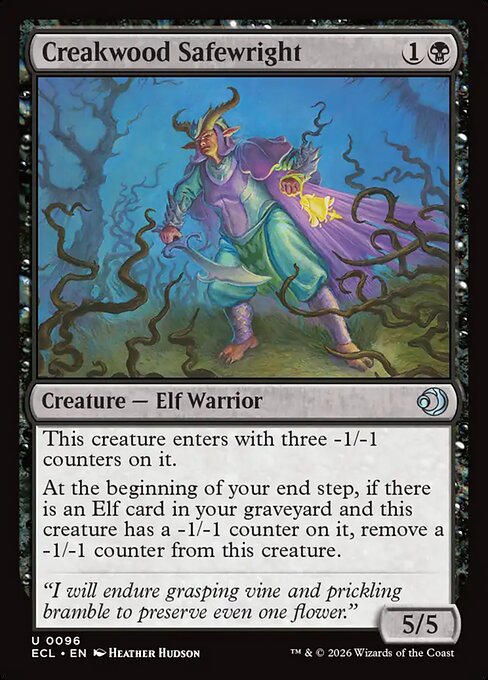 Rating6.8Good
Why this rating?
A solid uncommon of the format (6.8/10).
Why. A two-mana 5/5 that enters with three -1/-1 counters, so it starts as a 2/2. While an Elf card is in your graveyard, it removes a counter at the beginning of your end step and eventually grows into a 5/5.
Risks. With no Elf card in the graveyard, it stays a 2/2. The slow start leaves it vulnerable to cheap removal.
In the draft. A good pick for black-green with Elves. Outside that deck, it loses most of its value.
Results in the games of the set
When it is in hand, the deck wins 57.2% of its games (set average: 55.7%, 79th of 264 cards).
In the opening hand: 57.3% wins (54.5% on average).
Drawn during the game: 57.1% (56.5% on average).
When it is drawn, the deck wins 2.0 points more than when it is not.
When it is drafted, it is played 83% of the time (set average: 61%).
Taken as the first pick (165 drafts), it ends in the deck 92% of the time.
It is played mostly in B/G decks (39% of them).
 Rating6.8Good
Why this rating?
A solid uncommon of the format (6.8/10).
Why. A removal spell on a two-mana body: when it enters, its Vivid effect deals damage to an opponent's creature equal to the number of colors among your permanents. It counts at least its own, and the more colors you have, the bigger the target it kills.
Risks. In a two-color deck it mostly kills small creatures. The body is a 1/1, and the effect is weaker early in the game.
In the draft. A good pick for red, especially blue-red. The more colors your deck lines up, the stronger it gets.
Results in the games of the set
When it is in hand, the deck wins 58.0% of its games (set average: 55.7%, 66th of 264 cards).
In the opening hand: 56.1% wins (54.5% on average).
Drawn during the game: 59.3% (56.5% on average).
When it is drawn, the deck wins 5.6 points more than when it is not.
When it is drafted, it is played 87% of the time (set average: 61%).
Taken as the first pick (251 drafts), it ends in the deck 95% of the time.
It is played mostly in R/U decks (41% of them) and G/R (36%).
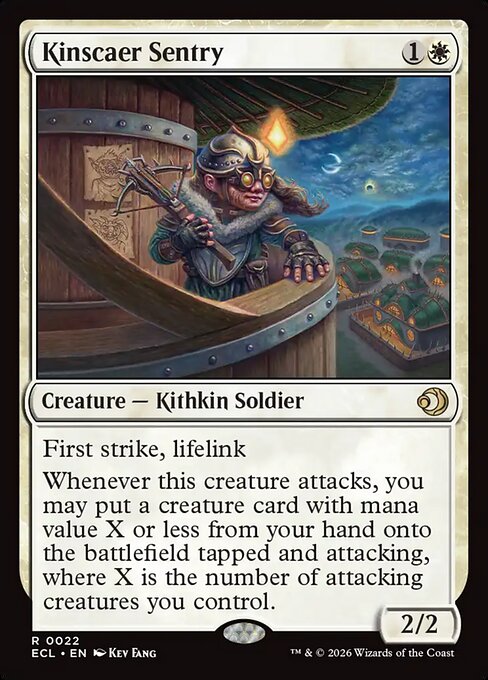
53. Kinscaer Sentry
Rating6.8GoodWhy this rating?
A very good rare of the format (6.8/10).
Why. A two-mana 2/2 with first strike and lifelink. Each time it attacks, it puts a creature card from your hand onto the battlefield tapped and attacking, with mana value up to the number of your attackers. A strong aggro engine.
Risks. Attacking alone, it only puts in one-mana creatures. A 2/2 is vulnerable to removal, and you need creatures in hand.
In the draft. A good pick for green-white, fine in blue-white. It's better in a deck that attacks with many creatures.
Results in the games of the set
When it is in hand, the deck wins 59.0% of its games (set average: 55.7%, 47th of 264 cards).
In the opening hand: 61.2% wins (54.5% on average).
Drawn during the game: 57.3% (56.5% on average).
When it is drawn, the deck wins 5.6 points more than when it is not.
When it is drafted, it is played 87% of the time (set average: 61%).
Taken as the first pick (85 drafts), it ends in the deck 87% of the time.
It is played about as much in every archetype.
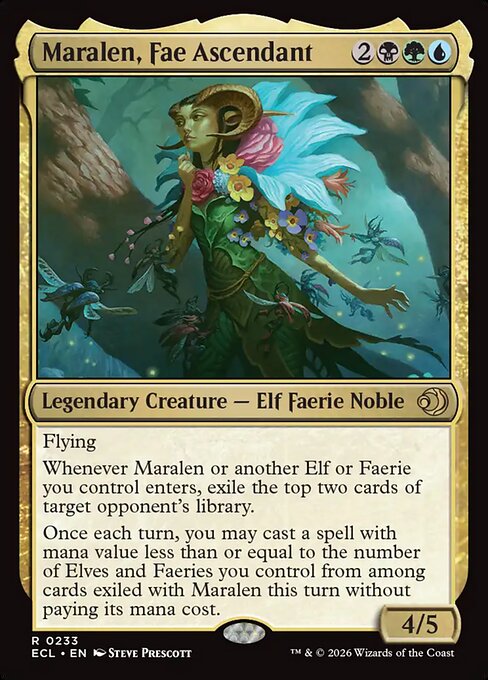 Rating6.8Good
Why this rating?
A very good rare of the format (6.8/10).
Why. A five-mana 4/5 flyer that exiles the top two cards of an opponent's library whenever she or another Elf or Faerie enters. Once each turn, you may cast for free a spell exiled this turn with mana value up to the number of your Elves and Faeries.
Risks. Three colors, so she's hard to cast. Her effect needs other Elves and Faeries; without them the body is her only argument.
In the draft. A pick for a black-green deck with a blue splash. Take her if your mana allows it.
Results in the games of the set
When it is in hand, the deck wins 60.4% of its games (set average: 55.7%, 33rd of 264 cards).
In the opening hand: 57.4% wins (54.5% on average).
Drawn during the game: 62.3% (56.5% on average).
When it is drawn, the deck wins 10.3 points more than when it is not.
When it is drafted, it is played 80% of the time (set average: 61%).
Taken as the first pick (102 drafts), it ends in the deck 77% of the time.
It is played about as much in every archetype.
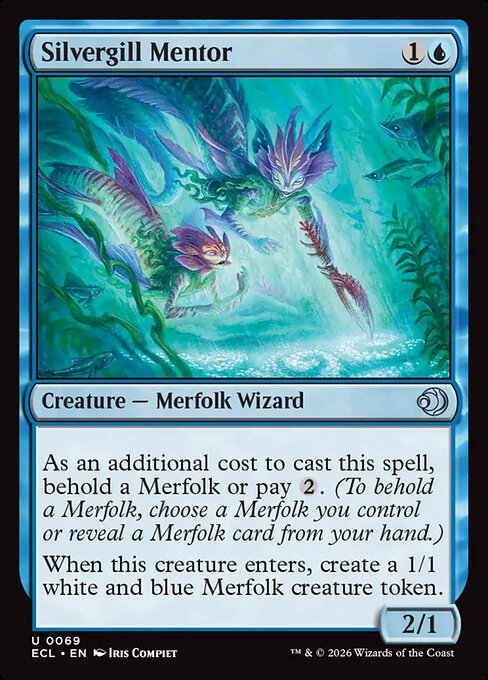 Rating6.8Good
Why this rating?
A solid uncommon of the format (6.8/10).
Why. A two-mana 2/1 that creates a 1/1 white and blue Merfolk creature token on entering: two bodies for one card. With a Merfolk to behold it costs just two mana, otherwise four.
Risks. With no Merfolk, it costs four mana, which makes it mediocre. Both bodies are small, and it does nothing against big creatures.
In the draft. A good pick for blue-white in a Merfolk deck. It stays fine in an aggressive creature deck.
Results in the games of the set
When it is in hand, the deck wins 60.1% of its games (set average: 55.7%, 38th of 264 cards).
In the opening hand: 61.9% wins (54.5% on average).
Drawn during the game: 58.8% (56.5% on average).
When it is drawn, the deck wins 5.2 points more than when it is not.
When it is drafted, it is played 77% of the time (set average: 61%).
Taken as the first pick (140 drafts), it ends in the deck 89% of the time.
It is played mostly in U/W decks (47% of them).
 Rating6.8Good
Why this rating?
A solid uncommon of the format (6.8/10).
Why. A one-mana 2/1. For one mana, you tap it and another untapped creature of yours to tap an opponent's creature. It's a cheap attacker early and a tempo tool later to get past blockers.
Risks. It needs two of your creatures tapped, which costs an attack or a block, and it can't use it the turn it enters. The 2/1 dies to everything.
In the draft. A useful pick for white, especially blue-white. It likes decks with many small creatures.
Results in the games of the set
When it is in hand, the deck wins 59.5% of its games (set average: 55.7%, 44th of 264 cards).
In the opening hand: 62.1% wins (54.5% on average).
Drawn during the game: 57.5% (56.5% on average).
When it is drawn, the deck wins 4.2 points more than when it is not.
When it is drafted, it is played 85% of the time (set average: 61%).
Taken as the first pick (194 drafts), it ends in the deck 94% of the time.
It is played mostly in U/W decks (40% of them).
 Rating6.7Good
Why this rating?
A very good rare of the format (6.7/10).
Why. A three-mana 3/4 flash flying Faerie that enters with a -1/-1 counter, so it's a 2/3 at first. For two mana, it removes a counter to counter a noncreature spell: the opponent draws a card, and the Faerie becomes a true 3/4.
Risks. The counter hands the opponent a card and works only once (a single counter). It does nothing against a creature-heavy deck.
In the draft. A fair pick for blue-white or blue-red. It's mostly good as a flash flyer.
Results in the games of the set
When it is in hand, the deck wins 56.6% of its games (set average: 55.7%, 91st of 264 cards).
In the opening hand: 54.9% wins (54.5% on average).
Drawn during the game: 57.8% (56.5% on average).
When it is drawn, the deck wins 3.8 points more than when it is not.
When it is drafted, it is played 88% of the time (set average: 61%).
Taken as the first pick (111 drafts), it ends in the deck 92% of the time.
It is played about as much in every archetype.
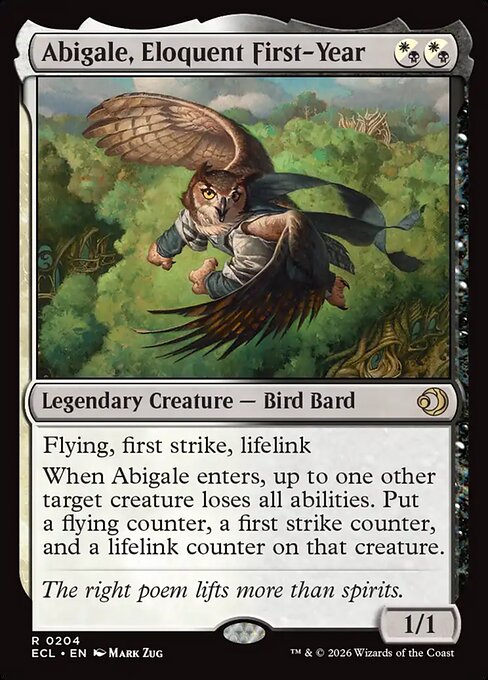
58. Abigale, Eloquent First-Year
Rating6.7GoodWhy this rating?
A very good rare of the format (6.7/10).
Why. A two-mana hybrid 1/1 with flying, first strike and lifelink. When it enters, another creature loses all abilities, then gets flying, first strike and lifelink counters: a way to turn a big vanilla creature into a real threat.
Risks. The 1/1 is very fragile, and the effect can strip a useful ability from the targeted creature. It needs a good target.
In the draft. A fair pick for white or black decks with big creatures. It finds a home in several archetypes.
Results in the games of the set
When it is in hand, the deck wins 58.4% of its games (set average: 55.7%, 60th of 264 cards).
In the opening hand: 55.8% wins (54.5% on average).
Drawn during the game: 60.3% (56.5% on average).
When it is drawn, the deck wins 5.2 points more than when it is not.
When it is drafted, it is played 95% of the time (set average: 61%).
Taken as the first pick (103 drafts), it ends in the deck 94% of the time.
It is played about as much in every archetype.
 Rating6.6Good
Why this rating?
A very good rare of the format (6.6/10).
Why. A three-mana 3/4 that gives indestructible to your other tapped creatures. When you attack, your attackers without vigilance survive blocks and damage.
Risks. The bonus doesn't protect against exile, sacrifice or negative stat changes, nor your untapped creatures. It does nothing on its own.
In the draft. A fair pick for white, especially blue-white. It makes attacks safer in an aggressive deck.
Results in the games of the set
When it is in hand, the deck wins 57.9% of its games (set average: 55.7%, 70th of 264 cards).
In the opening hand: 58.0% wins (54.5% on average).
Drawn during the game: 57.7% (56.5% on average).
When it is drawn, the deck wins 4.2 points more than when it is not.
When it is drafted, it is played 91% of the time (set average: 61%).
Taken as the first pick (115 drafts), it ends in the deck 93% of the time.
It is played about as much in every archetype.
 Rating6.6Good
Why this rating?
A very good rare of the format (6.6/10).
Why. A four-mana red-white 4/4: for two mana, she taps to give another creature flying and lifelink until end of turn. At your end step, if you gained life, you exile cards from the top until a nonland one, cast for free if its mana value is at most the life gained, otherwise put into your hand.
Risks. She needs red and white, and her ability taps her, so she doesn't attack if you use it. She only produces value if you gain life.
In the draft. A pick for red-white decks only, since she needs both colors. She's still an honest four-mana 4/4.
Results in the games of the set
When it is in hand, the deck wins 55.8% of its games (set average: 55.7%, 115th of 264 cards).
In the opening hand: 53.6% wins (54.5% on average).
Drawn during the game: 57.1% (56.5% on average).
When it is drawn, the deck wins 6.4 points more than when it is not.
When it is drafted, it is played 74% of the time (set average: 61%).
Taken as the first pick (85 drafts), it ends in the deck 80% of the time.
It is played about as much in every archetype.
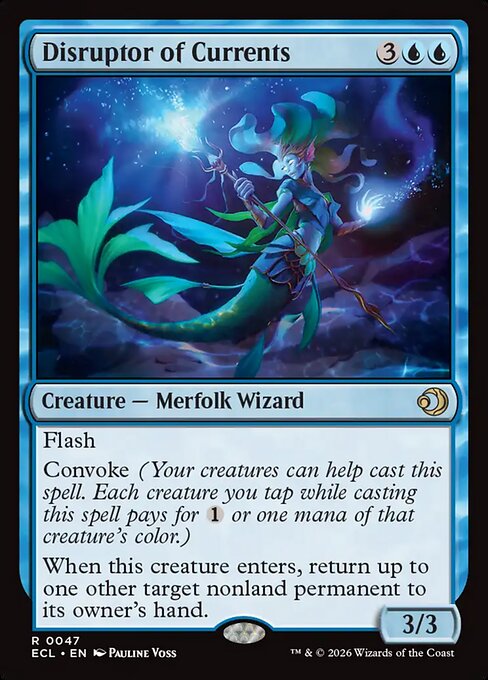 Rating6.6Good
Why this rating?
A very good rare of the format (6.6/10).
Why. A five-mana flash 3/3 with convoke. It returns another nonland permanent to its owner's hand when it enters. With creatures helping to cast it, it comes down much cheaper and surprises the opponent.
Risks. It's expensive without convoke, and bounce lets the opponent replay their card. Tapping creatures costs you an attack or a block.
In the draft. A good pick for blue-white or blue-red. It plays well in creature decks with lots of small bodies.
Results in the games of the set
When it is in hand, the deck wins 61.2% of its games (set average: 55.7%, 21st of 264 cards).
In the opening hand: 59.3% wins (54.5% on average).
Drawn during the game: 62.3% (56.5% on average).
When it is drawn, the deck wins 8.4 points more than when it is not.
When it is drafted, it is played 91% of the time (set average: 61%).
Taken as the first pick (144 drafts), it ends in the deck 91% of the time.
It is played about as much in every archetype.
 Rating6.6Good
Why this rating?
A very good rare of the format (6.6/10).
Why. A three-mana 2/4 that, by discarding a card when it enters, searches for the creature of your choice. For one mana it then untaps another permanent: a creature to block with, or a permanent with a tap ability.
Risks. It costs a card to tutor, so it improves your hand without giving card advantage. The untap ability only matters with good permanents to untap.
In the draft. A fair pick for green, especially black-green. It finds your best creature.
Results in the games of the set
When it is in hand, the deck wins 57.6% of its games (set average: 55.7%, 74th of 264 cards).
In the opening hand: 57.6% wins (54.5% on average).
Drawn during the game: 57.6% (56.5% on average).
When it is drawn, the deck wins 4.1 points more than when it is not.
When it is drafted, it is played 89% of the time (set average: 61%).
Taken as the first pick (98 drafts), it ends in the deck 84% of the time.
It is played about as much in every archetype.
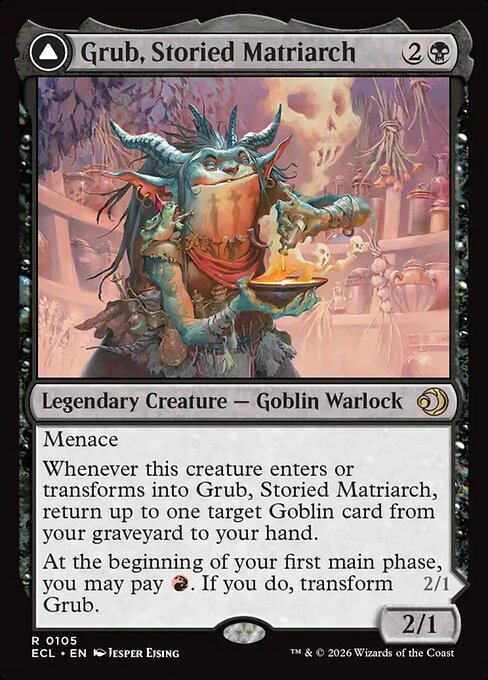
63. Grub, Storied Matriarch // Grub, Notorious Auntie
Rating6.6GoodWhy this rating?
A very good rare of the format (6.6/10).
Why. A three-mana 2/1 with menace that returns a Goblin card from your graveyard to your hand. Pay a red mana and he transforms: when he attacks, blight 1 creates a tapped and attacking copy of the creature that gets the counter, sacrificed at end of turn.
Risks. The 2/1 is fragile, and each transformation costs a mana. He's best when you have Goblins in the graveyard.
In the draft. A pick for black-red with Goblins. He stays fine in a black deck without red.
Results in the games of the set
When it is in hand, the deck wins 57.8% of its games (set average: 55.7%, 71st of 264 cards).
In the opening hand: 54.0% wins (54.5% on average).
Drawn during the game: 60.5% (56.5% on average).
When it is drawn, the deck wins 6.9 points more than when it is not.
When it is drafted, it is played 71% of the time (set average: 61%).
Taken as the first pick (70 drafts), it ends in the deck 77% of the time.
It is played about as much in every archetype.
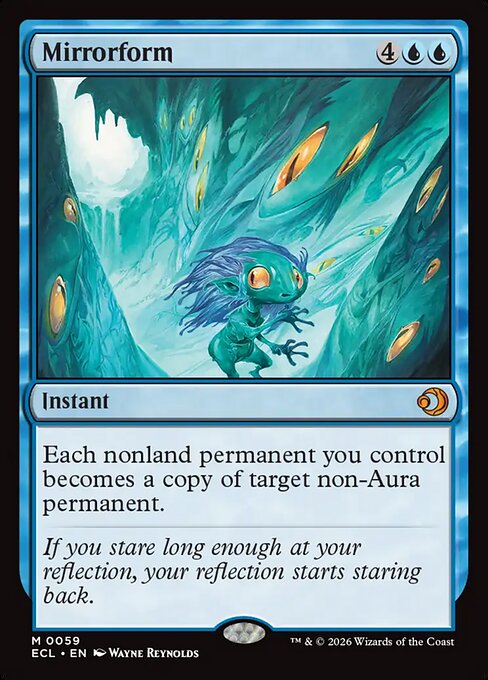
64. Mirrorform
Rating6.6GoodWhy this rating?
A very good mythic of the format (6.6/10).
Why. A six-mana instant that turns all your nonland permanents into copies of a target non-Aura permanent, with no time limit. When you have several small permanents and the opponent has a strong one, it's a blowout.
Risks. It costs six mana and does almost nothing if your board is empty or the target is weak. It all depends on the board.
In the draft. A late pick, playable in blue decks with many creatures. Don't take it over more reliable cards.
Results in the games of the set
When it is in hand, the deck wins 55.5% of its games (set average: 55.7%, 123rd of 264 cards).
In the opening hand: 50.3% wins (54.5% on average).
Drawn during the game: 58.7% (56.5% on average).
When it is drawn, the deck wins 3.5 points more than when it is not.
When it is drafted, it is played 72% of the time (set average: 61%).
Taken as the first pick (38 drafts), it ends in the deck 76% of the time.
It is played about as much in every archetype.

65. Personify
Rating6.6GoodWhy this rating?
A solid uncommon of the format (6.6/10).
Why. A two-mana instant that exiles then returns one of your creatures, retriggering its enters effect, and creates a 1/1 colorless Shapeshifter creature token with changeling. It can also save a creature from a removal spell.
Risks. With no creature that has an enters effect, you pay two mana for a 1/1 token. It doesn't win tempo on its own.
In the draft. An average pick, good in a white deck with enters-effect creatures. Take it after the more powerful cards.
Results in the games of the set
When it is in hand, the deck wins 55.0% of its games (set average: 55.7%, 142nd of 264 cards).
In the opening hand: 52.5% wins (54.5% on average).
Drawn during the game: 56.6% (56.5% on average).
When it is drawn, the deck wins 0.9 points more than when it is not.
When it is drafted, it is played 59% of the time (set average: 61%).
Taken as the first pick (61 drafts), it ends in the deck 79% of the time.
It is played about as much in every archetype.
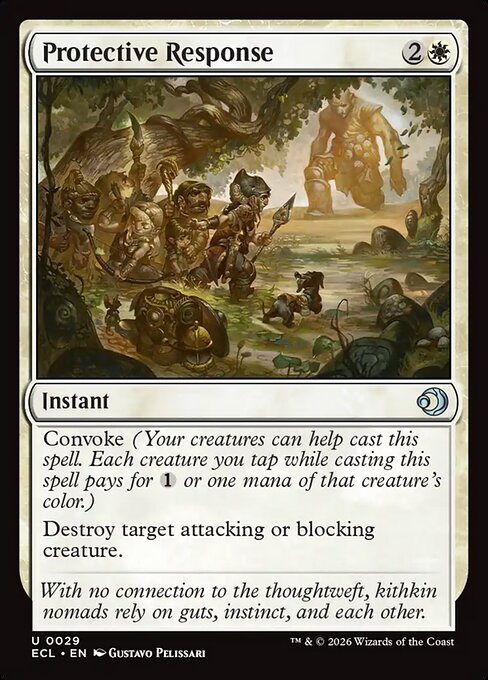 Rating6.6Good
Why this rating?
A solid uncommon of the format (6.6/10).
Why. A three-mana instant with convoke that destroys an attacking or blocking creature. Cast after blocks, your untapped creatures can tap to pay for it without leaving combat, covering part or all of the cost.
Risks. It only hits creatures in combat, so it's useless against one that stays back. Using convoke taps your creatures.
In the draft. A decent removal spell for white, especially blue-white or green-white. Take it for a deck that attacks or blocks actively.
Results in the games of the set
When it is in hand, the deck wins 57.2% of its games (set average: 55.7%, 78th of 264 cards).
In the opening hand: 54.9% wins (54.5% on average).
Drawn during the game: 58.8% (56.5% on average).
When it is drawn, the deck wins 2.8 points more than when it is not.
When it is drafted, it is played 89% of the time (set average: 61%).
Taken as the first pick (217 drafts), it ends in the deck 96% of the time.
It is played mostly in B/W decks (25% of them) and G/W (25%).

67. Rimekin Recluse
Rating6.6GoodWhy this rating?
A solid uncommon of the format (6.6/10).
Why. A three-mana 3/2 that returns another creature to its owner's hand when it enters. A good tempo play: the opponent loses the mana they spent and has to pay for the creature again.
Risks. A 3/2 is fragile, and bounce doesn't remove the threat. It can also bounce one of your own creatures to reuse its enters effect.
In the draft. A good pick for blue, especially blue-white or blue-red. It's solid in tempo decks.
Results in the games of the set
When it is in hand, the deck wins 60.2% of its games (set average: 55.7%, 37th of 264 cards).
In the opening hand: 59.0% wins (54.5% on average).
Drawn during the game: 61.0% (56.5% on average).
When it is drawn, the deck wins 6.6 points more than when it is not.
When it is drafted, it is played 90% of the time (set average: 61%).
Taken as the first pick (325 drafts), it ends in the deck 93% of the time.
It is played mostly in R/U decks (38% of them) and G/U (27%).
 Rating6.6Good
Why this rating?
A solid uncommon of the format (6.6/10).
Why. A two-mana 2/2 that gives one of your creatures +1/+1 and trample until end of turn when it enters, or when another Kithkin enters. In a Kithkin deck, each arrival makes the attack stronger.
Risks. It needs green and white, and the bonus lasts one turn. Without Kithkin it's a 2/2 with a single trigger.
In the draft. A solid pick for green-white, especially with Kithkin. It's good in a deck of cheap creatures.
Results in the games of the set
When it is in hand, the deck wins 58.8% of its games (set average: 55.7%, 52nd of 264 cards).
In the opening hand: 59.8% wins (54.5% on average).
Drawn during the game: 58.0% (56.5% on average).
When it is drawn, the deck wins 4.3 points more than when it is not.
When it is drafted, it is played 74% of the time (set average: 61%).
Taken as the first pick (133 drafts), it ends in the deck 87% of the time.
It is played mostly in G/W decks (49% of them).
 Rating6.6Good
Why this rating?
A solid uncommon of the format (6.6/10).
Why. A one-mana creature with deathtouch: it deters almost any attack and trades up for a much costlier creature. Each other creature that enters under your control gains you 1 life, which adds up over a long game.
Risks. A 1/1 dies to everything, and the life gain will not win a game by itself. Played late, it is little more than a blocker.
In the draft. A good early drop, especially in green. Take it in a deck with plenty of small creatures, but not over a removal.
Results in the games of the set
When it is in hand, the deck wins 58.3% of its games (set average: 55.7%, 63rd of 264 cards).
In the opening hand: 59.2% wins (54.5% on average).
Drawn during the game: 57.6% (56.5% on average).
When it is drawn, the deck wins 3.2 points more than when it is not.
When it is drafted, it is played 88% of the time (set average: 61%).
Taken as the first pick (155 drafts), it ends in the deck 92% of the time.
It is played mostly in B/G decks (32% of them).
 Rating6.5Good
Why this rating?
A very good rare of the format (6.6/10).
Why. A mass-reanimation sorcery: you choose a creature type and return every creature card of that type from your graveyard to the battlefield. With Convoke it comes down far earlier than its mana value of eight suggests, especially with a wide board.
Risks. It needs a graveyard already stuffed with creatures of one type, otherwise you pay a lot for next to nothing. It is a late-game effect and does nothing for the board.
In the draft. Play one copy in a deck with many creatures of a shared type. Creatures with changeling count, since they are every type. Do not take it early.
Results in the games of the set
When it is in hand, the deck wins 58.6% of its games (set average: 55.7%, 56th of 264 cards).
In the opening hand: 53.5% wins (54.5% on average).
Drawn during the game: 61.7% (56.5% on average).
When it is drawn, the deck wins 4.8 points more than when it is not.
When it is drafted, it is played 78% of the time (set average: 61%).
Taken as the first pick (80 drafts), it ends in the deck 78% of the time.
It is played about as much in every archetype.
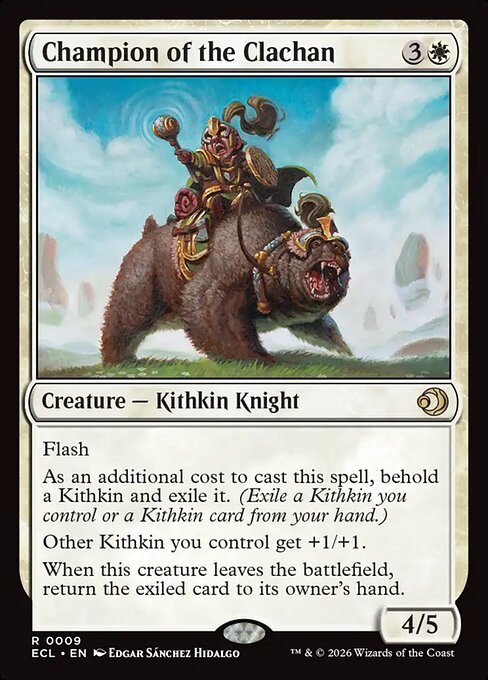 Rating6.5Good
Why this rating?
Good playable that always makes the cut (6.5/10).
Why. A 4/5 with flash for four mana: it ambushes an attacker or stops a swing mid-game. Your other Kithkin get +1/+1 while it stays on the battlefield.
Risks. Its cost makes you behold a Kithkin and exile it, from the battlefield or from your hand: without a Kithkin you cannot cast it. It costs you a card while it stays in play.
In the draft. Take it in a deck with enough Kithkin. Without that count it rots in hand. A bit higher if you are already white.
Results in the games of the set
When it is in hand, the deck wins 55.7% of its games (set average: 55.7%, 118th of 264 cards).
In the opening hand: 55.3% wins (54.5% on average).
Drawn during the game: 55.9% (56.5% on average).
When it is drawn, the deck wins 2.3 points more than when it is not.
When it is drafted, it is played 75% of the time (set average: 61%).
Taken as the first pick (61 drafts), it ends in the deck 72% of the time.
It is played about as much in every archetype.

72. Eclipsed Boggart
Rating6.4GoodWhy this rating?
Good playable that always makes the cut (6.4/10).
Why. A 2/3 for three mana that replaces itself: when it enters, you look at the top four cards and may take a Goblin, a Swamp or a Mountain. That smooths your lands or fetches a creature.
Risks. All three hybrid mana can be paid with black or red, but the effect only finds Goblins and two land types. The body is modest and the trigger can whiff.
In the draft. A solid mid-curve play for a black or red deck. Take it higher if you have Goblins; otherwise it is decent filler.
Results in the games of the set
When it is in hand, the deck wins 58.9% of its games (set average: 55.7%, 48th of 264 cards).
In the opening hand: 58.3% wins (54.5% on average).
Drawn during the game: 59.4% (56.5% on average).
When it is drawn, the deck wins 6.2 points more than when it is not.
When it is drafted, it is played 68% of the time (set average: 61%).
Taken as the first pick (106 drafts), it ends in the deck 88% of the time.
It is played mostly in B/R decks (56% of them).
 Rating6.4Good
Why this rating?
Good playable that always makes the cut (6.4/10).
Why. A 1/4 that blocks well, and its enter trigger looks at the top four cards for an Elemental, an Island or a Mountain. When it finds something, it hands you a card back.
Risks. It barely attacks, and the trigger can whiff if your deck is light on Elementals. The hybrid cost wants two blue or red mana, so it does not splash.
In the draft. A good uncommon for a blue-red deck or a heavy deck in either colour. Take it over filler, after removals.
Results in the games of the set
When it is in hand, the deck wins 59.9% of its games (set average: 55.7%, 40th of 264 cards).
In the opening hand: 59.2% wins (54.5% on average).
Drawn during the game: 60.3% (56.5% on average).
When it is drawn, the deck wins 6.7 points more than when it is not.
When it is drafted, it is played 84% of the time (set average: 61%).
Taken as the first pick (220 drafts), it ends in the deck 87% of the time.
It is played mostly in R/U decks (45% of them).
 Rating6.4Good
Why this rating?
Good playable that always makes the cut (6.4/10).
Why. A 5/4 for two mana that enters with three -1/-1 counters, so as a 2/1. Each time it becomes tapped it loses a counter: it grows from the very first attack and is a real 5/4 by the third.
Risks. It starts fragile: a single damage spell kills it before it has grown. It has to survive several attacks to reach its real size.
In the draft. A good two-drop for an aggressive white deck, with blue especially. Take it higher if you like aggro.
Results in the games of the set
When it is in hand, the deck wins 56.4% of its games (set average: 55.7%, 99th of 264 cards).
In the opening hand: 58.8% wins (54.5% on average).
Drawn during the game: 54.5% (56.5% on average).
When it is drawn, the deck wins 1.7 points more than when it is not.
When it is drafted, it is played 85% of the time (set average: 61%).
Taken as the first pick (158 drafts), it ends in the deck 97% of the time.
It is played mostly in U/W decks (34% of them) and R/W (25%).

75. Flamebraider
Rating6.4GoodWhy this rating?
Good playable that always makes the cut (6.4/10).
Why. A 2/2 for two mana that taps for two mana in any combination of colours. That mana only pays for Elemental spells or Elemental abilities, so it ramps and fixes an Elemental deck.
Risks. Without Elementals the mana is dead. The deck needs plenty of them, or you are playing a vanilla 2/2.
In the draft. A good uncommon in a blue-red Elemental deck. Outside of one, pass it. Look for expensive Elementals to cast ahead of schedule.
Results in the games of the set
When it is in hand, the deck wins 58.7% of its games (set average: 55.7%, 53rd of 264 cards).
In the opening hand: 62.7% wins (54.5% on average).
Drawn during the game: 56.0% (56.5% on average).
When it is drawn, the deck wins 5.8 points more than when it is not.
When it is drafted, it is played 81% of the time (set average: 61%).
Taken as the first pick (202 drafts), it ends in the deck 88% of the time.
It is played mostly in R/U decks (44% of them) and R/W (32%).
 Rating6.4Good
Why this rating?
Good playable that always makes the cut (6.4/10).
Why. A 2/1 for one mana if you behold a Kithkin, and it gets +1/+1 until end of turn whenever another creature enters under your control. In a deck that deploys creatures it hits far above its weight.
Risks. Without a Kithkin to behold it costs three mana: a pricey, fragile 2/1. It only grows on turns when you cast other creatures.
In the draft. Take it in white with a healthy count of Kithkin and cheap creatures. Count it as a three-drop in other decks.
Results in the games of the set
When it is in hand, the deck wins 58.1% of its games (set average: 55.7%, 65th of 264 cards).
In the opening hand: 61.9% wins (54.5% on average).
Drawn during the game: 55.1% (56.5% on average).
When it is drawn, the deck wins 3.3 points more than when it is not.
When it is drafted, it is played 71% of the time (set average: 61%).
Taken as the first pick (113 drafts), it ends in the deck 84% of the time.
It is played mostly in G/W decks (46% of them).
 Rating6.4Good
Why this rating?
Good playable that always makes the cut (6.4/10).
Why. A sorcery that exiles any number of target creatures until end of turn: you clear blockers before attacking, or reset your own creatures. You also take no damage until your next turn.
Risks. Nothing is destroyed: everything returns tapped at end of turn. You need a board ready to use the window, and the spell exiles itself, so it is one-shot.
In the draft. A way to close out a game in an aggressive white deck, but not a removal. Take it after your removals and good creatures.
Results in the games of the set
When it is in hand, the deck wins 54.0% of its games (set average: 55.7%, 165th of 264 cards).
In the opening hand: 49.1% wins (54.5% on average).
Drawn during the game: 57.2% (56.5% on average).
When it is drawn, the deck wins 1.3 points more than when it is not.
When it is drafted, it is played 65% of the time (set average: 61%).
Taken among the first three picks (105 drafts), it ends in the deck 81% of the time.
It is played about as much in every archetype.

78. Sear
Rating6.4GoodWhy this rating?
Good playable that always makes the cut (6.4/10).
Why. A two-mana instant that deals 4 damage to a creature or planeswalker. It kills most threats cheaply and can be cast on the opponent's turn.
Risks. Creatures with five toughness or more survive it. It cannot hit a player.
In the draft. A good red removal, to take ahead of average creatures. It finds a home in every red pair.
Results in the games of the set
When it is in hand, the deck wins 56.7% of its games (set average: 55.7%, 90th of 264 cards).
In the opening hand: 55.3% wins (54.5% on average).
Drawn during the game: 57.6% (56.5% on average).
When it is drawn, the deck wins 4.3 points more than when it is not.
When it is drafted, it is played 91% of the time (set average: 61%).
Taken as the first pick (249 drafts), it ends in the deck 94% of the time.
It is played mostly in R/U decks (29% of them) and R/W (29%).

79. Twilight Diviner
Rating6.4GoodWhy this rating?
Good playable that always makes the cut (6.4/10).
Why. A 3/3 for three mana that surveils 2 when it enters. When creatures enter or are cast from a graveyard, you create a token copy of one of them, once each turn: a recursion deck finds a real value engine here.
Risks. With nothing to bring creatures back from the graveyard, it is just a decent 3/3. Its second ability needs specific support.
In the draft. Take it in black with recursion. Otherwise it stays an honest three-drop body, not worth a high pick.
Results in the games of the set
When it is in hand, the deck wins 56.1% of its games (set average: 55.7%, 108th of 264 cards).
In the opening hand: 55.9% wins (54.5% on average).
Drawn during the game: 56.3% (56.5% on average).
When it is drawn, the deck wins 3.1 points more than when it is not.
When it is drafted, it is played 77% of the time (set average: 61%).
Taken as the first pick (75 drafts), it ends in the deck 83% of the time.
It is played about as much in every archetype.
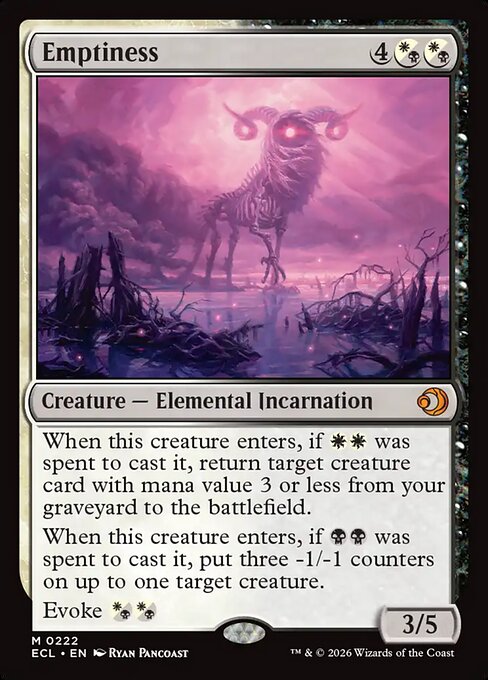
80. Emptiness
Rating6.4GoodWhy this rating?
Good playable that always makes the cut (6.4/10).
Why. A 3/5 with mana value six whose effect depends on the mana you spend: two white mana return a creature card with mana value 3 or less from your graveyard to the battlefield, and two black mana put three -1/-1 counters on a creature. Spend both and you get both.
Risks. Each effect needs the right mana spent. Cast with evoke for two mana, it is sacrificed on entering: a cheap effect, but no body.
In the draft. Take it if you play white or black: two mana of either colour is enough for an effect. Evoke makes it flexible. A stocked graveyard or a target for the counters is worth more than an empty hand.
Results in the games of the set
When it is in hand, the deck wins 56.8% of its games (set average: 55.7%, 87th of 264 cards).
In the opening hand: 53.6% wins (54.5% on average).
Drawn during the game: 59.0% (56.5% on average).
When it is drawn, the deck wins 5.6 points more than when it is not.
When it is drafted, it is played 88% of the time (set average: 61%).
Taken as the first pick (42 drafts), it ends in the deck 90% of the time.
It is played about as much in every archetype.
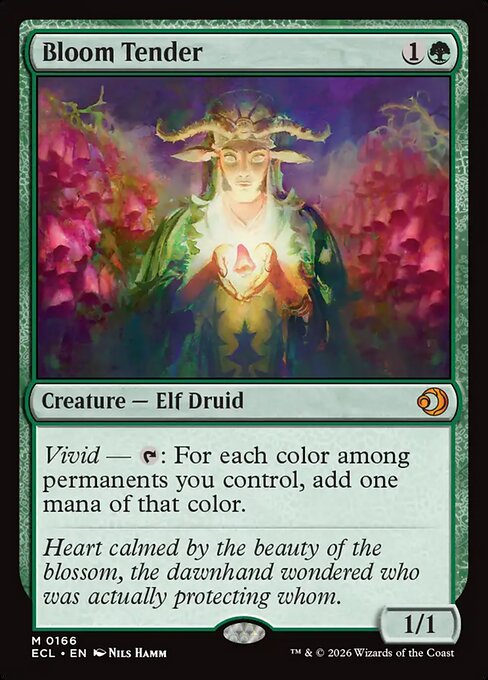
81. Bloom Tender
Rating6.3GoodWhy this rating?
Good playable that always makes the cut (6.3/10).
Why. A 1/1 for two mana that taps for one mana of each colour among your permanents. It counts green at minimum, and each colour you add to your board raises the ramp.
Risks. It is very fragile, and in a two-colour deck it makes two mana at best. It does nothing but make mana.
In the draft. Take it if you play three or more colours with Vivid cards. In a two-colour deck it stays a decent accelerator.
Results in the games of the set
When it is in hand, the deck wins 54.3% of its games (set average: 55.7%, 156th of 264 cards).
In the opening hand: 57.3% wins (54.5% on average).
Drawn during the game: 52.0% (56.5% on average).
When it is drawn, the deck wins 3.4 points more than when it is not.
When it is drafted, it is played 83% of the time (set average: 61%).
Taken as the first pick (54 drafts), it ends in the deck 93% of the time.
It is played about as much in every archetype.
 Rating6.2Good
Why this rating?
Good playable that always makes the cut (6.2/10).
Why. A two-mana 2/2 with flash: when it enters, it untaps your other Merfolk, so one team can attack and then block. If you attacked with three or more Merfolk this turn, all your Merfolk get +1/+0.
Risks. You need plenty of Merfolk for the team effect, and it does nothing without them. The lone 2/2 is modest, and its two fixed colours limit its flexibility.
In the draft. A good engine in a white-blue Merfolk deck. Outside that deck, let it go. Look for at least four or five Merfolk alongside.
Results in the games of the set
When it is in hand, the deck wins 56.3% of its games (set average: 55.7%, 104th of 264 cards).
In the opening hand: 56.5% wins (54.5% on average).
Drawn during the game: 56.2% (56.5% on average).
When it is drawn, the deck wins 1.9 points more than when it is not.
When it is drafted, it is played 78% of the time (set average: 61%).
Taken as the first pick (66 drafts), it ends in the deck 86% of the time.
It is played about as much in every archetype.

83. Boulder Dash
Rating6.2GoodWhy this rating?
Good playable that always makes the cut (6.2/10).
Why. A two-mana sorcery that deals 2 damage to any target and 1 damage to any other target. It kills two small creatures, or a creature and some damage to a player, and suits an aggressive opening.
Risks. The damage is low: on its own it kills no creature with three toughness. It is slower than an instant and only shines with two useful targets.
In the draft. A decent cheap removal in red, to take after the best spells. Weak against creatures with big toughness.
Results in the games of the set
When it is in hand, the deck wins 55.4% of its games (set average: 55.7%, 126th of 264 cards).
In the opening hand: 53.4% wins (54.5% on average).
Drawn during the game: 56.7% (56.5% on average).
When it is drawn, the deck wins 3.2 points more than when it is not.
When it is drafted, it is played 84% of the time (set average: 61%).
Taken as the first pick (136 drafts), it ends in the deck 95% of the time.
It is played mostly in R/U decks (30% of them) and R/W (26%).
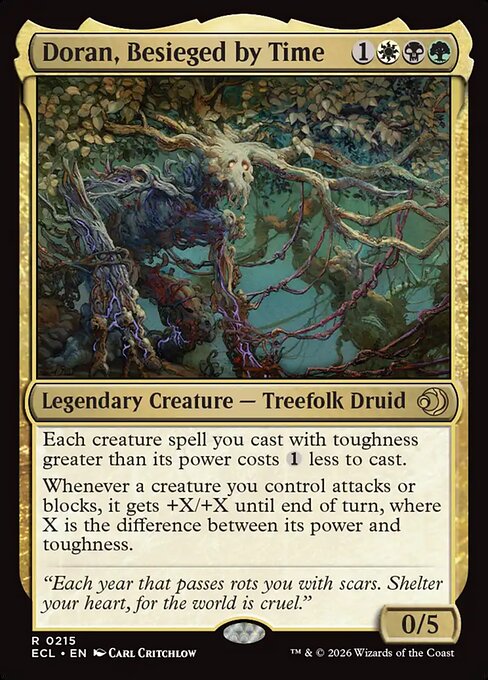 Rating6.2Good
Why this rating?
Good playable that always makes the cut (6.2/10).
Why. A 0/5 for four mana: creature spells you cast with toughness greater than power cost one less, and each creature that attacks or blocks gets +X/+X, X being the gap between its power and toughness. It attacks and blocks as a 5/10 itself.
Risks. It needs three fixed colours, which strains the mana. It dies to removal, and with no creatures that have a wide gap between power and toughness its bonus stays small.
In the draft. Take it if you play white, black and green with high-toughness creatures. Otherwise it is hard to cast. Make sure your mana is stable.
Results in the games of the set
When it is in hand, the deck wins 58.5% of its games (set average: 55.7%, 57th of 264 cards).
In the opening hand: 57.5% wins (54.5% on average).
Drawn during the game: 59.2% (56.5% on average).
When it is drawn, the deck wins 10.9 points more than when it is not.
When it is drafted, it is played 67% of the time (set average: 61%).
Taken as the first pick (71 drafts), it ends in the deck 73% of the time.
It is played about as much in every archetype.

85. Gathering Stone
Rating6.2GoodWhy this rating?
Good playable that always makes the cut (6.2/10).
Why. A four-mana artifact: you choose a type, spells of that type cost one less, and when it enters and at each upkeep you look at the top card of your library and take it if it is the chosen type, otherwise you may put it into your graveyard. It generates advantage in a typal deck.
Risks. It does nothing on the board and depends on a type that is well represented in your deck. In a deck with no theme it is a slow artifact.
In the draft. A good card in a tribal deck: take it if you already have a dominant type. Otherwise consider it filler.
Results in the games of the set
When it is in hand, the deck wins 58.3% of its games (set average: 55.7%, 64th of 264 cards).
In the opening hand: 58.1% wins (54.5% on average).
Drawn during the game: 58.4% (56.5% on average).
When it is drawn, the deck wins 3.6 points more than when it is not.
When it is drafted, it is played 86% of the time (set average: 61%).
Taken as the first pick (252 drafts), it ends in the deck 90% of the time.
It is played about as much in every archetype.

86. Iron-Shield Elf
Rating6.2GoodWhy this rating?
Good playable that always makes the cut (6.2/10).
Why. A two-mana 3/1: by discarding a card it gains indestructible until end of turn, but taps. It survives damage and destroy effects, and attacks without fear of a three-power blocker.
Risks. Each protection costs a card and taps it: used before blocks, it keeps the creature from blocking. It does not save it from an effect that lowers toughness.
In the draft. A good two-drop for an aggressive black deck, especially black-green. Take it as a two-drop, not ahead of removal.
Results in the games of the set
When it is in hand, the deck wins 57.8% of its games (set average: 55.7%, 72nd of 264 cards).
In the opening hand: 59.2% wins (54.5% on average).
Drawn during the game: 56.6% (56.5% on average).
When it is drawn, the deck wins 2.4 points more than when it is not.
When it is drafted, it is played 82% of the time (set average: 61%).
Taken as the first pick (154 drafts), it ends in the deck 92% of the time.
It is played mostly in B/G decks (38% of them).
 Rating6.2Good
Why this rating?
Good playable that always makes the cut (6.2/10).
Why. A 2/3 for two mana if you behold an Elf, otherwise four. Once an Elf card is in your graveyard it taps for two green mana: ramp that pays for big spells.
Risks. Without an Elf to behold it costs four mana. Until an Elf card is in your graveyard it does not ramp, and it dies to removal.
In the draft. Take it in green-black with many Elves. It is a good card in that deck and a plain 2/3 outside it.
Results in the games of the set
When it is in hand, the deck wins 57.6% of its games (set average: 55.7%, 73rd of 264 cards).
In the opening hand: 58.9% wins (54.5% on average).
Drawn during the game: 56.6% (56.5% on average).
When it is drawn, the deck wins 1.9 points more than when it is not.
When it is drafted, it is played 82% of the time (set average: 61%).
Taken as the first pick (152 drafts), it ends in the deck 88% of the time.
It is played mostly in B/G decks (41% of them).
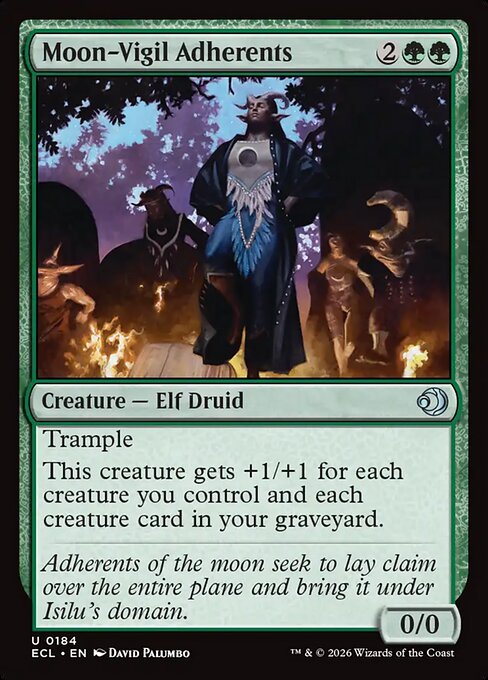 Rating6.2Good
Why this rating?
Good playable that always makes the cut (6.2/10).
Why. A four-mana 0/0 with trample that gets +1/+1 for each creature you control and each creature card in your graveyard. It counts itself, so it grows quickly in the mid-game.
Risks. Alone on the board it is only a 1/1: it depends on your other creatures and your graveyard. A removal kills it in one answer.
In the draft. A good uncommon in green, especially green-black. Take it in a deck with many creatures, more as an attacker than as a defender.
Results in the games of the set
When it is in hand, the deck wins 58.6% of its games (set average: 55.7%, 55th of 264 cards).
In the opening hand: 55.8% wins (54.5% on average).
Drawn during the game: 60.5% (56.5% on average).
When it is drawn, the deck wins 3.6 points more than when it is not.
When it is drafted, it is played 88% of the time (set average: 61%).
Taken as the first pick (208 drafts), it ends in the deck 92% of the time.
It is played mostly in B/G decks (33% of them).
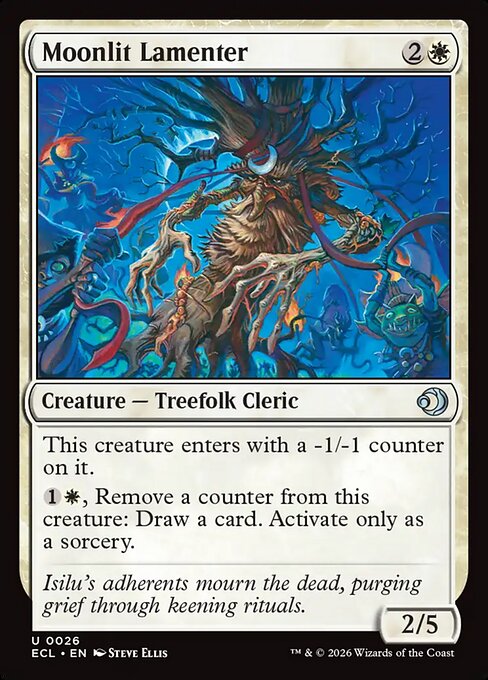
89. Moonlit Lamenter
Rating6.2GoodWhy this rating?
Good playable that always makes the cut (6.2/10).
Why. A 2/5 that enters with a -1/-1 counter, so as a 1/4. For two mana including a white one, you remove that counter to draw a card: it becomes a 2/5 and replaces itself. A sturdy blocker that draws.
Risks. The activation is sorcery speed and works only once, since it has just one counter. It does not attack well and will not win a game alone.
In the draft. A good blocker in white. Take it in a slow or controlling deck, after your removals and best creatures.
Results in the games of the set
When it is in hand, the deck wins 55.3% of its games (set average: 55.7%, 127th of 264 cards).
In the opening hand: 53.8% wins (54.5% on average).
Drawn during the game: 56.4% (56.5% on average).
When it is drawn, the deck wins 2.9 points more than when it is not.
When it is drafted, it is played 71% of the time (set average: 61%).
Taken as the first pick (119 drafts), it ends in the deck 77% of the time.
It is played mostly in B/W decks (44% of them) and R/W (31%).

90. Pitiless Fists
Rating6.2GoodWhy this rating?
Good playable that always makes the cut (6.2/10).
Why. A four-mana Aura: the enchanted creature gets +2/+2 and fights an opposing creature of your choice. It is a removal and a buff in one card, very strong with a big creature.
Risks. If your creature is killed in response, you lose the card. The fight depends on your creature's power, and you need a creature on your side.
In the draft. A good removal for green. Take it early in a deck with big creatures, in the green pairs.
Results in the games of the set
When it is in hand, the deck wins 58.5% of its games (set average: 55.7%, 59th of 264 cards).
In the opening hand: 56.5% wins (54.5% on average).
Drawn during the game: 59.8% (56.5% on average).
When it is drawn, the deck wins 3.8 points more than when it is not.
When it is drafted, it is played 88% of the time (set average: 61%).
Taken as the first pick (204 drafts), it ends in the deck 93% of the time.
It is played mostly in G/W decks (29% of them) and B/G (27%).
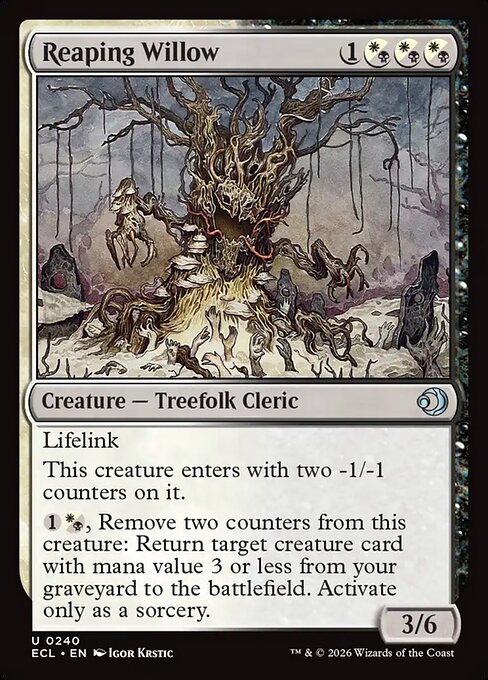
91. Reaping Willow
Rating6.2GoodWhy this rating?
Good playable that always makes the cut (6.2/10).
Why. A four-mana 3/6 with lifelink that enters with two -1/-1 counters, so as a 1/4. For two mana you remove both counters and return a creature card with mana value 3 or less from your graveyard to the battlefield: a blocker that becomes a 3/6 and generates value.
Risks. It starts as a 1/4 and its activation is sorcery speed: it takes time and mana. It does nothing useful without a good target in your graveyard.
In the draft. A good blocker in a slow deck, white or black. Its hybrid costs fit decks in either colour.
Results in the games of the set
When it is in hand, the deck wins 56.9% of its games (set average: 55.7%, 86th of 264 cards).
In the opening hand: 53.2% wins (54.5% on average).
Drawn during the game: 59.3% (56.5% on average).
When it is drawn, the deck wins 5.0 points more than when it is not.
When it is drafted, it is played 81% of the time (set average: 61%).
Taken as the first pick (189 drafts), it ends in the deck 88% of the time.
It is played mostly in B/W decks (45% of them).
 Rating6.2Good
Why this rating?
Good playable that always makes the cut (6.2/10).
Why. A five-mana 4/2 with flash and Convoke, so castable cheaply with your creatures. In response to removal or a combat trick, it gives your other permanents of a chosen type hexproof and indestructible.
Risks. It does not protect itself, and its effect only touches permanents of the chosen type. Without creatures to convoke with, it is expensive.
In the draft. A fair pick in a green deck with a well-represented type. Take it after the removals. It is better in a deck of creatures sharing a type.
Results in the games of the set
When it is in hand, the deck wins 56.4% of its games (set average: 55.7%, 97th of 264 cards).
In the opening hand: 53.4% wins (54.5% on average).
Drawn during the game: 58.5% (56.5% on average).
When it is drawn, the deck wins 3.0 points more than when it is not.
When it is drafted, it is played 89% of the time (set average: 61%).
Taken as the first pick (113 drafts), it ends in the deck 88% of the time.
It is played about as much in every archetype.
 Rating6.2Good
Why this rating?
Good playable that always makes the cut (6.2/10).
Why. A four-mana 0/5: when a creature you control attacks alone, it gets +X/+X, X being the number of Kithkin you control. It is a Kithkin itself, so X is at least 1: a sturdy blocker that pumps a lone attacker.
Risks. It does nothing if you attack with several creatures, and its own body has no power. Without many Kithkin the bonus stays modest.
In the draft. Take it in white in a Kithkin deck, especially white-green. In another deck it is a four-mana blocker and little more.
Results in the games of the set
When it is in hand, the deck wins 58.3% of its games (set average: 55.7%, 62nd of 264 cards).
In the opening hand: 57.0% wins (54.5% on average).
Drawn during the game: 59.3% (56.5% on average).
When it is drawn, the deck wins 4.2 points more than when it is not.
When it is drafted, it is played 72% of the time (set average: 61%).
Taken as the first pick (133 drafts), it ends in the deck 85% of the time.
It is played mostly in G/W decks (43% of them).

94. Boggart Mischief
Rating6.1PlayableWhy this rating?
Good playable that always makes the cut (6.1/10).
Why. A three-mana enchantment: if you blight 1, you create two 1/1 black and red Goblin creature tokens. When a Goblin you control dies, each opponent loses 1 life and you gain 1.
Risks. You need a creature to take the counter, or it creates nothing, and that counter weakens it. The drain only works with Goblins, and the tokens are fragile.
In the draft. Take it in a black-red deck with Goblins. Outside such decks it stays weak.
Results in the games of the set
When it is in hand, the deck wins 57.0% of its games (set average: 55.7%, 83rd of 264 cards).
In the opening hand: 54.7% wins (54.5% on average).
Drawn during the game: 58.8% (56.5% on average).
When it is drawn, the deck wins 5.1 points more than when it is not.
When it is drafted, it is played 71% of the time (set average: 61%).
Taken as the first pick (118 drafts), it ends in the deck 88% of the time.
It is played mostly in B/R decks (65% of them).
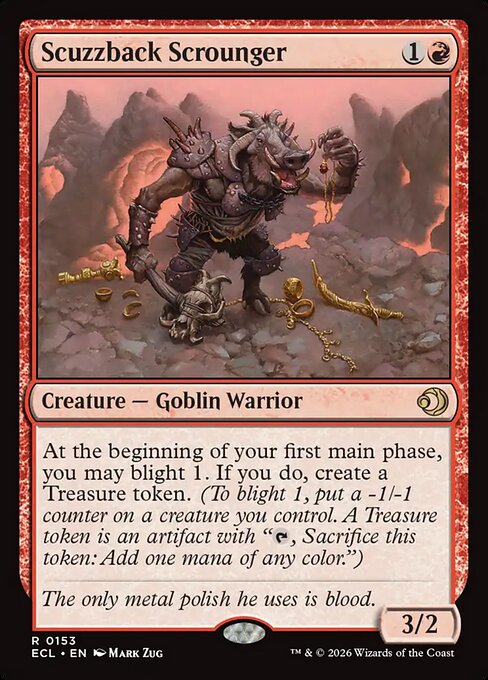 Rating6.0Playable
Why this rating?
Good playable that always makes the cut (6.1/10).
Why. A two-mana 3/2 that, at the beginning of your first main phase, may blight 1 to create a Treasure token. You attack hard early, and the Treasure token speeds up your later turns.
Risks. Each blight wears down one of your creatures: on itself it shrinks fast. With no other creature to take the counter, the Treasure token is expensive.
In the draft. A decent two-drop for an aggressive red deck. Take it after your best removals. It wants a board of creatures.
Results in the games of the set
When it is in hand, the deck wins 55.1% of its games (set average: 55.7%, 139th of 264 cards).
In the opening hand: 57.2% wins (54.5% on average).
Drawn during the game: 53.5% (56.5% on average).
When it is drawn, the deck wins 2.8 points more than when it is not.
When it is drafted, it is played 87% of the time (set average: 61%).
Taken as the first pick (81 drafts), it ends in the deck 93% of the time.
It is played about as much in every archetype.
 Rating6.0Playable
Why this rating?
Good playable that always makes the cut (6.0/10).
Why. A four-mana 3/5 that cannot be blocked by creatures with power 2 or less, and gets +2/+0 if another creature entered under your control this turn. It attacks as a 5/5 on turns when you cast a creature.
Risks. Its bonus depends on casting a creature before attacking. A creature with power 3 or more can block it.
In the draft. A good body in green, especially green-white. Take it as a mid-curve creature, after removals and the better creatures.
Results in the games of the set
When it is in hand, the deck wins 56.1% of its games (set average: 55.7%, 109th of 264 cards).
In the opening hand: 54.9% wins (54.5% on average).
Drawn during the game: 56.8% (56.5% on average).
When it is drawn, the deck wins 1.6 points more than when it is not.
When it is drafted, it is played 70% of the time (set average: 61%).
Taken as the first pick (81 drafts), it ends in the deck 90% of the time.
It is played mostly in G/W decks (39% of them).
 Rating6.0Playable
Why this rating?
Good playable that always makes the cut (6.0/10).
Why. A four-mana 7/3: whenever another Elemental enters under your control, it deals damage equal to its power to each opponent. In an Elemental deck each new Elemental becomes a source of direct damage.
Risks. It makes you behold an Elemental and exile it, and its three-toughness body dies easily. Without Elementals you cannot cast it.
In the draft. Take it only in a blue-red deck with many Elementals. Otherwise pass it, since it rots in hand.
Results in the games of the set
When it is in hand, the deck wins 54.4% of its games (set average: 55.7%, 155th of 264 cards).
In the opening hand: 52.2% wins (54.5% on average).
Drawn during the game: 55.7% (56.5% on average).
When it is drawn, the deck wins 4.0 points more than when it is not.
When it is drafted, it is played 79% of the time (set average: 61%).
Taken as the first pick (68 drafts), it ends in the deck 88% of the time.
It is played about as much in every archetype.

98. Glamer Gifter
Rating6.0PlayableWhy this rating?
Good playable that always makes the cut (6.0/10).
Why. A two-mana 1/2 with flash and flying: when it enters, another creature has base power and toughness 4/4 until end of turn and gains all creature types. It is a combat trick on a flying body.
Risks. It is only a 1/2 without the trick, and the effect is temporary. It does not protect your creature from removal.
In the draft. A good blue uncommon, especially white-blue. Take it in a tempo deck, after removals. Gaining all creature types helps tribal decks.
Results in the games of the set
When it is in hand, the deck wins 56.6% of its games (set average: 55.7%, 92nd of 264 cards).
In the opening hand: 54.5% wins (54.5% on average).
Drawn during the game: 58.0% (56.5% on average).
When it is drawn, the deck wins 3.2 points more than when it is not.
When it is drafted, it is played 83% of the time (set average: 61%).
Taken as the first pick (154 drafts), it ends in the deck 88% of the time.
It is played mostly in B/U decks (41% of them) and R/U (30%).

99. Gnarlbark Elm
Rating6.0PlayableWhy this rating?
Good playable that always makes the cut (6.0/10).
Why. A three-mana 3/4 that enters with two -1/-1 counters, so as a 1/2. For three mana you remove both counters: target creature gets -2/-2 until end of turn and it becomes a 3/4. A removal on a body, but slow.
Risks. It costs six mana in total for its effect, at sorcery speed. The -2/-2 only kills small creatures, and it starts out very weak.
In the draft. A filler pick in black. Take it after your best creatures, especially if you lack ways to kill small creatures.
Results in the games of the set
When it is in hand, the deck wins 54.0% of its games (set average: 55.7%, 168th of 264 cards).
In the opening hand: 51.7% wins (54.5% on average).
Drawn during the game: 55.6% (56.5% on average).
When it is drawn, the deck wins 2.4 points more than when it is not.
When it is drafted, it is played 75% of the time (set average: 61%).
Taken as the first pick (118 drafts), it ends in the deck 89% of the time.
It is played mostly in B/W decks (40% of them).

100. Goliath Daydreamer
Rating6.0PlayableWhy this rating?
Good playable that always makes the cut (6.0/10).
Why. A four-mana 4/4: instants and sorceries you cast from your hand are exiled with a dream counter, then each attack lets you cast one of them for free. In a spell-heavy deck, your spells work twice.
Risks. It needs two red mana and a deck full of instants and sorceries. Without them it is just a 4/4, and your exiled spells never reach your graveyard.
In the draft. Take it in a red deck with plenty of instants and sorceries, especially blue-red. Otherwise it stays a decent 4/4.
Results in the games of the set
When it is in hand, the deck wins 55.2% of its games (set average: 55.7%, 132nd of 264 cards).
In the opening hand: 54.1% wins (54.5% on average).
Drawn during the game: 55.9% (56.5% on average).
When it is drawn, the deck wins 3.6 points more than when it is not.
When it is drafted, it is played 85% of the time (set average: 61%).
Taken as the first pick (107 drafts), it ends in the deck 88% of the time.
It is played about as much in every archetype.

101. Meek Attack
Rating6.0PlayableWhy this rating?
Good playable that always makes the cut (6.0/10).
Why. An enchantment that turns small creatures in your hand into hasty attackers, for two mana including a red one each activation. It lets you deploy a creature a turn without waiting, but only if its power plus toughness is 5 or less.
Risks. The creature is sacrificed at end of turn, so each activation costs you a card. It does nothing without creatures of that size in hand, and it costs three mana without changing the board the turn you cast it.
In the draft. A niche card you can pass in most decks. Only play it if you already have plenty of small creatures with enter effects.
Results in the games of the set
When it is drafted, it is played only 0% of the time (set average: 61%): it almost always ends in the sideboard.

102. Noggle Robber
Rating6.0PlayableWhy this rating?
Good playable that always makes the cut (6.0/10).
Why. A 3/3 for three that makes a Treasure token on entering and another on dying. It is a body and ramp in one card, and the opponent has no clean way to deal with it without giving you value.
Risks. Its red-or-green hybrid cost is still demanding on coloured mana. A Treasure token does not win the game alone: without something expensive to cast next, it is just a solid body.
In the draft. A good mid-pool card, playable in any red or green deck. Take it when nothing stronger is waiting, especially if you have expensive spells.
Results in the games of the set
When it is in hand, the deck wins 57.3% of its games (set average: 55.7%, 77th of 264 cards).
In the opening hand: 57.5% wins (54.5% on average).
Drawn during the game: 57.1% (56.5% on average).
When it is drawn, the deck wins 4.6 points more than when it is not.
When it is drafted, it is played 83% of the time (set average: 61%).
Taken as the first pick (176 drafts), it ends in the deck 88% of the time.
It is played mostly in G/R decks (40% of them) and G/U (29%).

103. Shadow Urchin
Rating6.0PlayableWhy this rating?
Good playable that always makes the cut (6.0/10).
Why. A 3/4 for three that feeds on blight: each attack puts a -1/-1 counter on one of your creatures, and when a creature with counters dies, you exile that many cards from the top of your library and may play them.
Risks. It shrinks with each attack if you put the counter on it, and the exiled cards can only be played until your next end step. With no other creatures to mark, it wears itself down.
In the draft. Fine in an aggressive black or red deck that likes blight. Do not take it over a good removal spell, and avoid it if your deck is short on creatures.
Results in the games of the set
When it is in hand, the deck wins 53.7% of its games (set average: 55.7%, 179th of 264 cards).
In the opening hand: 52.5% wins (54.5% on average).
Drawn during the game: 54.5% (56.5% on average).
When it is drawn, the deck wins 2.0 points more than when it is not.
When it is drafted, it is played 81% of the time (set average: 61%).
Taken as the first pick (90 drafts), it ends in the deck 90% of the time.
It is played about as much in every archetype.

104. Spry and Mighty
Rating6.0PlayableWhy this rating?
Good playable that always makes the cut (6.0/10).
Why. A five-mana sorcery that rewards an uneven board: the bigger the power gap between the two chosen creatures, the more you draw and the more they grow, with trample. With one big and one small creature it draws a lot and sets up a big attack.
Risks. It needs exactly two creatures and a clear power gap, or it does almost nothing. It is slow, does not touch the opponent's board, and the bonus only lasts until end of turn.
In the draft. A situational card for a green deck with creatures of varied sizes. Do not take it early: a good removal spell or creature is better.
Results in the games of the set
When it is in hand, the deck wins 53.6% of its games (set average: 55.7%, 182nd of 264 cards).
In the opening hand: 50.6% wins (54.5% on average).
Drawn during the game: 55.7% (56.5% on average).
When it is drawn, the deck wins 1.2 points more than when it is not.
When it is drafted, it is played 79% of the time (set average: 61%).
Taken as the first pick (75 drafts), it ends in the deck 84% of the time.
It is played about as much in every archetype.

105. Twinflame Travelers
Rating6.0PlayableWhy this rating?
Good playable that always makes the cut (6.0/10).
Why. A 3/3 flyer for four, which is already a good threat in a blue-red deck. Its second ability makes triggered abilities of your other Elementals trigger an additional time, a bonus when your deck plays several.
Risks. Its ability only matters if you control other Elementals. Without them it is a plain four-mana flyer, vulnerable to damage spells, and its blue-red cost locks it into those two colours.
In the draft. A good card to take without hesitation if you are blue-red. Look for Elementals alongside it to get the most out of the second ability.
Results in the games of the set
When it is in hand, the deck wins 57.2% of its games (set average: 55.7%, 80th of 264 cards).
In the opening hand: 54.8% wins (54.5% on average).
Drawn during the game: 58.6% (56.5% on average).
When it is drawn, the deck wins 4.9 points more than when it is not.
When it is drafted, it is played 80% of the time (set average: 61%).
Taken as the first pick (192 drafts), it ends in the deck 89% of the time.
It is played mostly in R/U decks (48% of them).

106. Unwelcome Sprite
Rating6.0PlayableWhy this rating?
Good playable that always makes the cut (6.0/10).
Why. A 2/1 flyer for two, good for early evasive pressure. Each spell you cast during the opponent's turn triggers surveil 2, which helps smooth your draws when you hold up instant-speed plays.
Risks. With 1 toughness it dies to almost anything. The ability only matters if you cast spells on the opponent's turn, so a deck without instants or flash gets little from it.
In the draft. A solid mid-pool card for a blue tempo deck. Take it if you already have instants; otherwise do not rank it too high.
Results in the games of the set
When it is in hand, the deck wins 56.3% of its games (set average: 55.7%, 105th of 264 cards).
In the opening hand: 56.3% wins (54.5% on average).
Drawn during the game: 56.3% (56.5% on average).
When it is drawn, the deck wins 2.8 points more than when it is not.
When it is drafted, it is played 76% of the time (set average: 61%).
Taken as the first pick (124 drafts), it ends in the deck 87% of the time.
It is played mostly in B/U decks (51% of them) and R/U (28%).
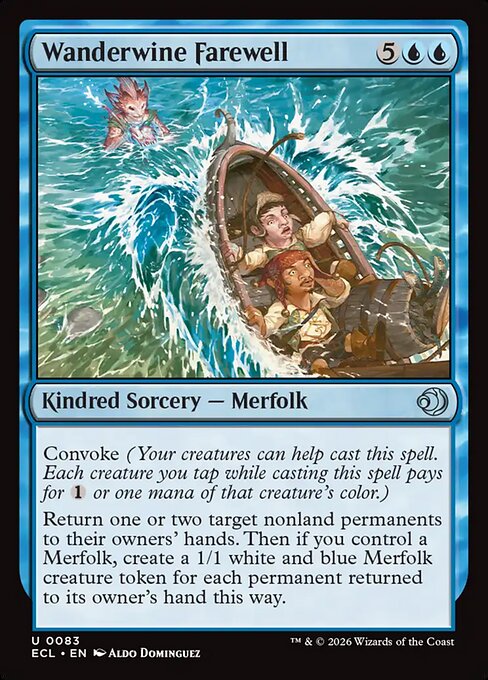
107. Wanderwine Farewell
Rating5.9PlayableWhy this rating?
Good playable that always makes the cut (5.9/10).
Why. A convoke sorcery that returns one or two nonland permanents to hand, then makes a 1/1 white and blue Merfolk creature token for each if you control a Merfolk. With creatures to help pay, it costs far less than its seven mana.
Risks. Without a Merfolk it is only a bounce: the opponent replays the permanents and you do not gain a card. Tapping your creatures to cast it also costs you pressure.
In the draft. A card for a white-blue tempo deck with Merfolk. Outside that plan it is mediocre: do not take it before your creatures and removal.
Results in the games of the set
When it is in hand, the deck wins 56.8% of its games (set average: 55.7%, 88th of 264 cards).
In the opening hand: 54.1% wins (54.5% on average).
Drawn during the game: 58.6% (56.5% on average).
When it is drawn, the deck wins 1.9 points more than when it is not.
When it is drafted, it is played 67% of the time (set average: 61%).
Taken as the first pick (108 drafts), it ends in the deck 90% of the time.
It is played mostly in U/W decks (39% of them).

108. Prismabasher
Rating5.9PlayableWhy this rating?
Good playable that always makes the cut (5.9/10).
Why. A 6/6 trampler for six that also gives +X/+X until end of turn to up to X creatures of your choice when it enters, where X is the number of colours among your permanents. With a wide board it can make a big attack that same turn.
Risks. Six mana is heavy, and Vivid counts your colours: a two-colour deck gets a modest bonus. The bonus only lasts this turn, and if it is killed you lose the body.
In the draft. A good top-end card for a green deck, better if you play several colours. One copy is usually enough, after your cheaper creatures.
Results in the games of the set
When it is in hand, the deck wins 56.5% of its games (set average: 55.7%, 95th of 264 cards).
In the opening hand: 52.5% wins (54.5% on average).
Drawn during the game: 59.2% (56.5% on average).
When it is drawn, the deck wins 4.8 points more than when it is not.
When it is drafted, it is played 77% of the time (set average: 61%).
Taken as the first pick (142 drafts), it ends in the deck 82% of the time.
It is played mostly in G/R decks (43% of them) and G/U (33%).

109. Bogslither's Embrace
Rating5.8PlayableWhy this rating?
Good playable that always makes the cut (5.8/10).
Why. A two-mana removal that exiles any creature, at the price of blight 1 or three extra mana. With a creature to mark, it is a very efficient answer with no restriction on power or type.
Risks. With no creature to mark, the spell costs five mana, which is expensive. The counter weakens your creature and can kill a 1/1 you wanted to keep.
In the draft. A common removal spell to take early in a black deck, and a strong fit for blight decks. Play as many as you can while keeping enough creatures.
Results in the games of the set
When it is in hand, the deck wins 56.1% of its games (set average: 55.7%, 107th of 264 cards).
In the opening hand: 53.5% wins (54.5% on average).
Drawn during the game: 57.9% (56.5% on average).
When it is drawn, the deck wins 2.9 points more than when it is not.
When it is drafted, it is played 89% of the time (set average: 61%).
Taken as the first pick (358 drafts), it ends in the deck 95% of the time.
It is played mostly in B/W decks (64% of them) and B/U (56%).
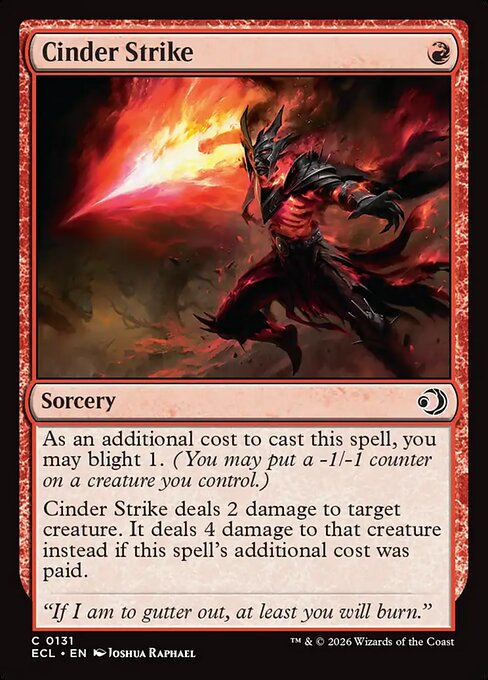
110. Cinder Strike
Rating5.8PlayableWhy this rating?
Good playable that always makes the cut (5.8/10).
Why. A one-mana red sorcery that deals 2 damage to a creature, or 4 if you pay blight 1. For one mana, it is a flexible removal that kills small creatures early and bigger ones later.
Risks. It is a sorcery, so no combat tricks or reactions. Reaching 4 damage means putting a counter on one of your creatures, which is a real cost on a small board.
In the draft. A good, cheap common removal for a red deck. Take it early, especially if your deck can pay blight without suffering.
Results in the games of the set
When it is in hand, the deck wins 55.7% of its games (set average: 55.7%, 119th of 264 cards).
In the opening hand: 54.2% wins (54.5% on average).
Drawn during the game: 56.6% (56.5% on average).
When it is drawn, the deck wins 2.7 points more than when it is not.
When it is drafted, it is played 88% of the time (set average: 61%).
Taken as the first pick (431 drafts), it ends in the deck 96% of the time.
It is played mostly in B/R decks (65% of them) and R/U (63%).

111. Clachan Festival
Rating5.8PlayableWhy this rating?
Good playable that always makes the cut (5.8/10).
Why. A three-mana enchantment that makes two 1/1 green and white Kithkin creature tokens on entering, then lets you make another for five mana at any time. It gives early bodies and a mana sink for the late game.
Risks. The tokens are small and do not hold up against large creatures. The five-mana activation is expensive and slow, and the opening play does not directly affect the opponent's board.
In the draft. A good card for a white deck, especially with effects that reward creature count. Take it in the middle of your pool.
Results in the games of the set
When it is in hand, the deck wins 56.5% of its games (set average: 55.7%, 94th of 264 cards).
In the opening hand: 55.7% wins (54.5% on average).
Drawn during the game: 57.2% (56.5% on average).
When it is drawn, the deck wins 2.2 points more than when it is not.
When it is drafted, it is played 78% of the time (set average: 61%).
Taken as the first pick (139 drafts), it ends in the deck 87% of the time.
It is played mostly in G/W decks (36% of them).

112. Dawnhand Eulogist
Rating5.8PlayableWhy this rating?
Good playable that always makes the cut (5.8/10).
Why. A 3/3 menace for four that mills three cards on entering and, if there is then an Elf card in your graveyard, drains the opponent for 2. A solid body with a good chance of a bonus.
Risks. The drain depends on an Elf in your graveyard: without enough Elves in the deck it does not always trigger. The mill can also hurt in long games.
In the draft. A good common for a black deck with Elves. Play a reasonable number of them and do not rank it above removal.
Results in the games of the set
When it is in hand, the deck wins 57.9% of its games (set average: 55.7%, 68th of 264 cards).
In the opening hand: 56.3% wins (54.5% on average).
Drawn during the game: 59.0% (56.5% on average).
When it is drawn, the deck wins 1.9 points more than when it is not.
When it is drafted, it is played 73% of the time (set average: 61%).
Taken as the first pick (170 drafts), it ends in the deck 95% of the time.
It is played mostly in B/G decks (79% of them).

113. Dundoolin Weaver
Rating5.8PlayableWhy this rating?
Good playable that always makes the cut (5.8/10).
Why. A 2/1 for two that returns a permanent card from your graveyard to hand when it enters, if you control three or more creatures, itself included. In a deck that fills the board, it is a creature that pays back a card.
Risks. Without three creatures it is just a 2/1, so playing it early is weak. A 2/1 is easy to block and kill.
In the draft. A card for a green deck with many creatures. It is better later in the game, so do not take it over more powerful cards.
Results in the games of the set
When it is in hand, the deck wins 56.1% of its games (set average: 55.7%, 111th of 264 cards).
In the opening hand: 53.0% wins (54.5% on average).
Drawn during the game: 58.2% (56.5% on average).
When it is drawn, the deck wins 1.5 points more than when it is not.
When it is drafted, it is played 87% of the time (set average: 61%).
Taken as the first pick (220 drafts), it ends in the deck 92% of the time.
It is played mostly in G/W decks (32% of them).
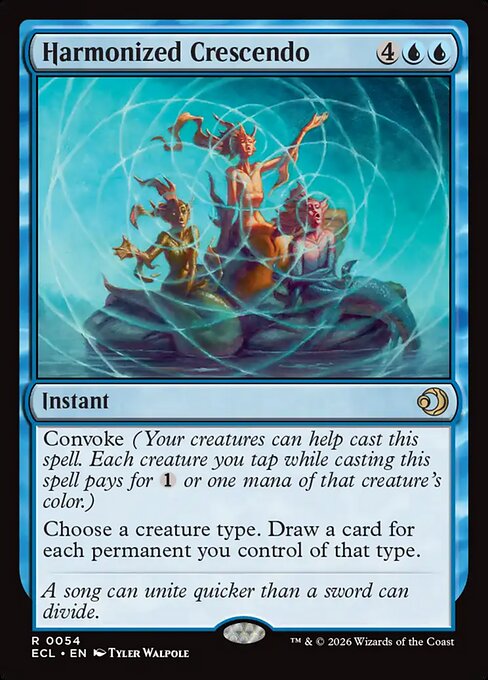
114. Harmonized Crescendo
Rating5.8PlayableWhy this rating?
Good playable that always makes the cut (5.8/10).
Why. A convoke instant that draws a card for each permanent of the chosen type you control. In a very tribal deck, or with changelings, it can draw several cards for almost nothing.
Risks. It needs a board full of permanents of the same type to be strong, and six mana without convoke is expensive. It does not affect the opponent's board and leaves your creatures tapped.
In the draft. A specialist card for a tribal blue deck. Do not take it early: it is only worth it if your deck really supports it.
Results in the games of the set
When it is in hand, the deck wins 53.2% of its games (set average: 55.7%, 192nd of 264 cards).
In the opening hand: 50.4% wins (54.5% on average).
Drawn during the game: 54.9% (56.5% on average).
When it is drawn, the deck wins 0.1 points more than when it is not.
When it is drafted, it is played 65% of the time (set average: 61%).
Taken as the first pick (41 drafts), it ends in the deck 85% of the time.
It is played about as much in every archetype.

115. Mutable Explorer
Rating5.8PlayableWhy this rating?
Good playable that always makes the cut (5.8/10).
Why. A 1/1 changeling for three that creates a tapped land token that can become a 2/2 creature for one mana. You gain an extra land and a threat that dodges sorcery-speed removal.
Risks. The 1/1 body is weak, and the land token turned creature is still vulnerable to removal. You invest three mana for slow value.
In the draft. A decent card for a green deck that benefits from an extra land. Take it in the middle of your pool, not before a good removal spell.
Results in the games of the set
When it is in hand, the deck wins 54.1% of its games (set average: 55.7%, 162nd of 264 cards).
In the opening hand: 52.9% wins (54.5% on average).
Drawn during the game: 55.1% (56.5% on average).
When it is drawn, the deck wins 0.9 points more than when it is not.
When it is drafted, it is played 85% of the time (set average: 61%).
Taken as the first pick (79 drafts), it ends in the deck 80% of the time.
It is played about as much in every archetype.

116. Requiting Hex
Rating5.8PlayableWhy this rating?
Good playable that always makes the cut (5.8/10).
Why. A one-mana black instant that destroys a creature with mana value 2 or less, and gains you 2 life if you pay blight 1. A very cheap answer to small creatures and early threats.
Risks. It only hits creatures with mana value 2 or less, so it is dead against big threats.
In the draft. A niche removal to take after your best cards. It is stronger if you have seen many small creatures in opposing pools.
Results in the games of the set
When it is in hand, the deck wins 52.7% of its games (set average: 55.7%, 207th of 264 cards).
In the opening hand: 52.5% wins (54.5% on average).
Drawn during the game: 52.8% (56.5% on average).
When it is drawn, the deck wins 0.9 points more than when it is not.
When it is drafted, it is played 64% of the time (set average: 61%).
Taken as the first pick (46 drafts), it ends in the deck 87% of the time.
It is played about as much in every archetype.
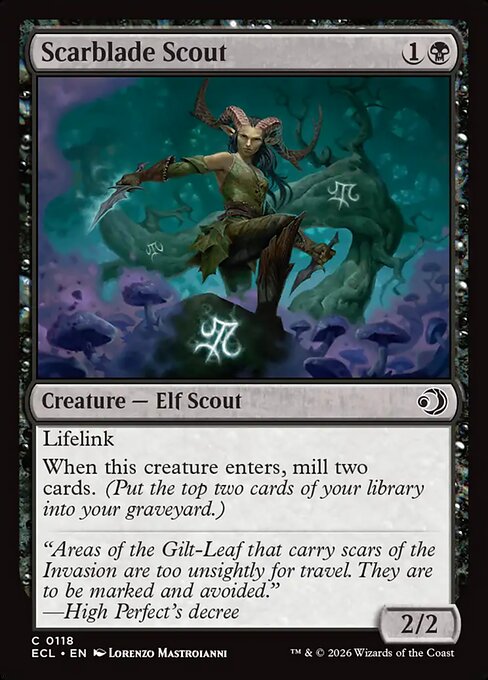
117. Scarblade Scout
Rating5.8PlayableWhy this rating?
Good playable that always makes the cut (5.8/10).
Why. A 2/2 lifelinker for two that mills two cards on entering. It is a solid early creature that also feeds graveyard effects.
Risks. A 2/2 is still fragile against bigger creatures, and the mill gives no direct advantage. Later in the game its impact is low.
In the draft. A good common for a black deck, especially with graveyard effects. Take it without urgency in the middle of your pool.
Results in the games of the set
When it is in hand, the deck wins 57.4% of its games (set average: 55.7%, 76th of 264 cards).
In the opening hand: 58.3% wins (54.5% on average).
Drawn during the game: 56.7% (56.5% on average).
When it is drawn, the deck wins 1.9 points more than when it is not.
When it is drafted, it is played 77% of the time (set average: 61%).
Taken as the first pick (205 drafts), it ends in the deck 89% of the time.
It is played mostly in B/G decks (76% of them) and B/W (39%).

118. Shinestriker
Rating5.8PlayableWhy this rating?
Good playable that always makes the cut (5.8/10).
Why. A 3/3 flyer for six that draws cards equal to the number of colours among your permanents when it enters. In a multicolour deck it refills your hand and puts an aerial threat on board.
Risks. Six mana is heavy, and a two-colour deck draws two cards at best. A removal before it attacks leaves you with just the drawn cards.
In the draft. A good top-end card for a blue deck, stronger with more colours. One copy is fine, after your cheaper plays.
Results in the games of the set
When it is in hand, the deck wins 58.5% of its games (set average: 55.7%, 58th of 264 cards).
In the opening hand: 54.5% wins (54.5% on average).
Drawn during the game: 60.9% (56.5% on average).
When it is drawn, the deck wins 6.4 points more than when it is not.
When it is drafted, it is played 82% of the time (set average: 61%).
Taken as the first pick (244 drafts), it ends in the deck 90% of the time.
It is played mostly in R/U decks (45% of them) and G/U (44%).
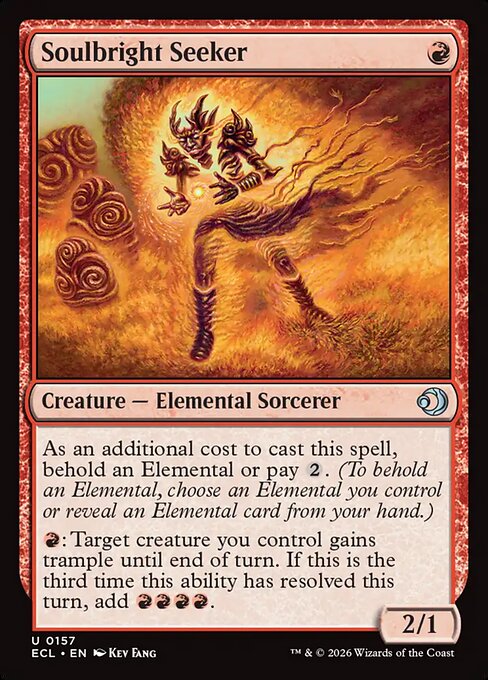
119. Soulbright Seeker
Rating5.8PlayableWhy this rating?
Good playable that always makes the cut (5.8/10).
Why. A 2/1 for one red mana, with behold an Elemental or two extra mana. Its activation gives trample to a creature for a red mana, and the third use in a turn adds four red mana.
Risks. Without an Elemental to behold, it costs three mana for a 2/1, which is weak. Its activation needs a lot of red mana to be interesting.
In the draft. A card for a red deck with Elementals. In other decks it is mediocre: take it cheaply only if you already have the plan.
Results in the games of the set
When it is in hand, the deck wins 55.1% of its games (set average: 55.7%, 137th of 264 cards).
In the opening hand: 56.6% wins (54.5% on average).
Drawn during the game: 54.2% (56.5% on average).
When it is drawn, the deck wins 1.5 points more than when it is not.
When it is drafted, it is played 64% of the time (set average: 61%).
Taken as the first pick (66 drafts), it ends in the deck 89% of the time.
It is played mostly in R/U decks (46% of them).

120. Thoughtweft Charge
Rating5.8PlayableWhy this rating?
Good playable that always makes the cut (5.8/10).
Why. A two-mana instant that gives +3/+3 to a creature and draws a card if a creature entered under your control this turn. A good combat trick that can pay for itself.
Risks. Like any combat trick, you lose the value if the target is killed in response. With no creature entering this turn, it does not draw.
In the draft. A good trick for a green deck, to take in the middle of your pool. It is better with flash or cheap creatures.
Results in the games of the set
When it is in hand, the deck wins 54.2% of its games (set average: 55.7%, 158th of 264 cards).
In the opening hand: 52.5% wins (54.5% on average).
Drawn during the game: 55.4% (56.5% on average).
When it is drawn, the deck wins 0.2 points more than when it is not.
When it is drafted, it is played 61% of the time (set average: 61%).
Taken as the first pick (43 drafts), it ends in the deck 86% of the time.
It is played about as much in every archetype.
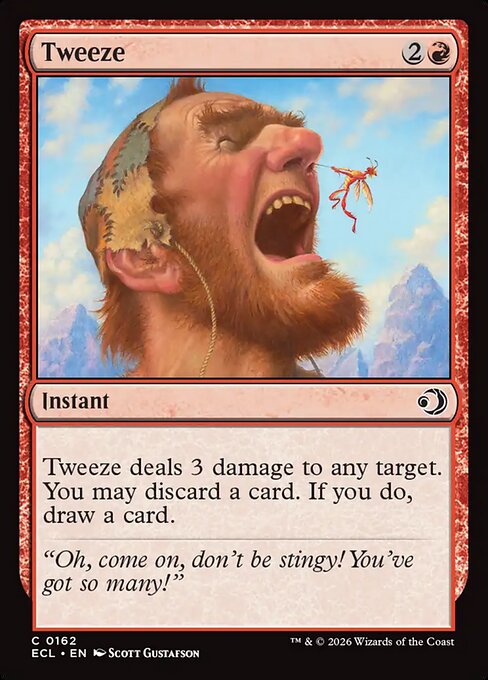
121. Tweeze
Rating5.8PlayableWhy this rating?
Good playable that always makes the cut (5.8/10).
Why. A three-mana instant that deals 3 damage to any target, with the option to discard a card to draw one. A classic removal spell that can also finish an opponent.
Risks. Three damage does not kill bigger creatures, and three mana for limited removal is fine but no more. Discarding to draw does not replace a real draw.
In the draft. A decent common removal spell for a red deck. Take it in the middle of your pool and add more efficient answers if you find them.
Results in the games of the set
When it is in hand, the deck wins 54.6% of its games (set average: 55.7%, 149th of 264 cards).
In the opening hand: 52.2% wins (54.5% on average).
Drawn during the game: 56.2% (56.5% on average).
When it is drawn, the deck wins 2.0 points more than when it is not.
When it is drafted, it is played 83% of the time (set average: 61%).
Taken as the first pick (228 drafts), it ends in the deck 92% of the time.
It is played mostly in R/U decks (61% of them) and R/W (53%).

122. Vinebred Brawler
Rating5.8PlayableWhy this rating?
Good playable that always makes the cut (5.8/10).
Why. An aggressive 4/2 for three that the opponent must block if able, and that gives +2/+1 to another Elf when it attacks. It hits hard early and rewards a deck that plays several Elves.
Risks. With 2 toughness, it dies to almost any block, and the must-be-blocked clause exposes it to a bigger blocker. Without other Elves its bonus is useless.
In the draft. A good card for a green deck with Elves. Take it in the middle of your pool, especially if your deck is aggressive.
Results in the games of the set
When it is in hand, the deck wins 55.9% of its games (set average: 55.7%, 113th of 264 cards).
In the opening hand: 55.0% wins (54.5% on average).
Drawn during the game: 56.6% (56.5% on average).
When it is drawn, the deck wins 0.7 points more than when it is not.
When it is drafted, it is played 77% of the time (set average: 61%).
Taken as the first pick (76 drafts), it ends in the deck 91% of the time.
It is played mostly in B/G decks (34% of them).

123. Flock Impostor
Rating5.7PlayableWhy this rating?
Good playable that always makes the cut (5.7/10).
Why. A 2/2 changeling with flash and flying for three that returns another creature you control to hand when it enters. It works as a flying ambush and can save a targeted creature or replay an enter effect.
Risks. A 2/2 is fragile, and the bounce costs tempo if you have no creature to save or replay. The enter effect is optional, which limits the risk.
In the draft. A good card for a white tempo deck. Take it in the middle of your pool, earlier if you have enter effects to replay.
Results in the games of the set
When it is in hand, the deck wins 55.2% of its games (set average: 55.7%, 135th of 264 cards).
In the opening hand: 53.4% wins (54.5% on average).
Drawn during the game: 56.5% (56.5% on average).
When it is drawn, the deck wins 0.8 points more than when it is not.
When it is drafted, it is played 82% of the time (set average: 61%).
Taken as the first pick (126 drafts), it ends in the deck 83% of the time.
It is played about as much in every archetype.

124. Lofty Dreams
Rating5.7PlayableWhy this rating?
Good playable that always makes the cut (5.7/10).
Why. A convoke Aura that draws a card on entering and gives the enchanted creature +2/+2 and flying. It replaces itself and turns any creature into an aerial threat.
Risks. If the creature is killed in response, the Aura is lost and you draw nothing; killed later, you keep the drawn card. Five mana without convoke is expensive.
In the draft. A good card for a blue deck with many creatures. Take it in the middle of your pool, later if you are short on creatures.
Results in the games of the set
When it is in hand, the deck wins 55.3% of its games (set average: 55.7%, 128th of 264 cards).
In the opening hand: 51.7% wins (54.5% on average).
Drawn during the game: 57.6% (56.5% on average).
When it is drawn, the deck wins 2.2 points more than when it is not.
When it is drafted, it is played 60% of the time (set average: 61%).
Taken as the first pick (64 drafts), it ends in the deck 84% of the time.
It is played about as much in every archetype.
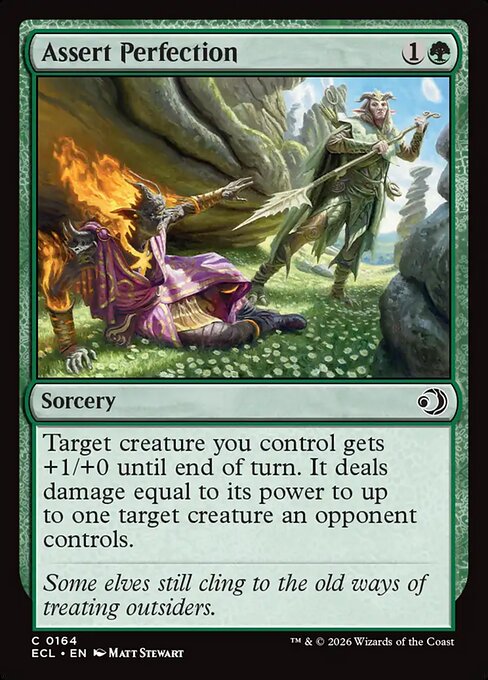
125. Assert Perfection
Rating5.6PlayableWhy this rating?
Good playable that always makes the cut (5.6/10).
Why. A two-mana sorcery where your creature gets +1/+0 and then deals damage equal to its power to an opposing creature. A cheap form of removal in a green deck with big creatures.
Risks. You need a creature on your side, and a removal in response loses you the card. Your creature's power limits what you can kill.
In the draft. A good common for a green deck. Take it fairly early, and make sure you have enough big creatures for it to work.
Results in the games of the set
When it is in hand, the deck wins 57.9% of its games (set average: 55.7%, 69th of 264 cards).
In the opening hand: 56.1% wins (54.5% on average).
Drawn during the game: 59.1% (56.5% on average).
When it is drawn, the deck wins 3.2 points more than when it is not.
When it is drafted, it is played 88% of the time (set average: 61%).
Taken as the first pick (355 drafts), it ends in the deck 95% of the time.
It is played mostly in G/W decks (72% of them) and B/G (58%).

126. Blood Crypt
Rating5.6PlayableWhy this rating?
Good playable that always makes the cut (5.6/10).
Why. A Swamp Mountain land that taps for black or red and enters untapped if you pay 2 life. Clean fixing for a black-red deck that does not slow your curve.
Risks. Paying 2 life is costly against a fast opponent, and otherwise the land enters tapped. It offers nothing outside those two colours.
In the draft. Take it for a black-red deck, after your good playables. Outside those colours, do not take it.
Results in the games of the set
When it is in hand, the deck wins 52.4% of its games (set average: 55.7%, 214th of 264 cards).
In the opening hand: 53.3% wins (54.5% on average).
Drawn during the game: 51.8% (56.5% on average).
When it is drawn, the deck wins 0.1 points more than when it is not.
When it is drafted, it is played 58% of the time (set average: 61%).
Taken as the first pick (34 drafts), it ends in the deck 82% of the time.

127. Catharsis
Rating5.6PlayableWhy this rating?
Good playable that always makes the cut (5.6/10).
Why. A red-white hybrid Incarnation for six, a 3/4 whose effect depends on the mana spent: two 1/1 green and white Kithkin creature tokens with two white mana, or +1/+1 and haste for your creatures with two red mana. It can also be cast for two with evoke.
Risks. Each effect needs two mana of the same colour, which is hard in an even two-colour deck. For six mana, the body and effect are modest.
In the draft. A card for a red-white deck, or for one of those colours as the main one. Do not take it before good creatures and removal.
Results in the games of the set
When it is in hand, the deck wins 53.1% of its games (set average: 55.7%, 194th of 264 cards).
In the opening hand: 49.9% wins (54.5% on average).
Drawn during the game: 55.2% (56.5% on average).
When it is drawn, the deck wins 2.6 points more than when it is not.
When it is drafted, it is played 81% of the time (set average: 61%).
Taken as the first pick (44 drafts), it ends in the deck 80% of the time.
It is played about as much in every archetype.

128. Giantfall
Rating5.6PlayableWhy this rating?
Good playable that always makes the cut (5.6/10).
Why. A two-mana instant with a choice: your creature deals damage equal to its power to an opposing creature, or destroy an artifact. A cheap, flexible removal when you have a big creature.
Risks. You need a creature on your side, and a removal in response blanks the spell. The artifact mode is rarely useful.
In the draft. A good removal spell for a red deck with big creatures. Take it in the middle of your pool, earlier if you have the bodies to use it.
Results in the games of the set
When it is in hand, the deck wins 53.4% of its games (set average: 55.7%, 184th of 264 cards).
In the opening hand: 50.6% wins (54.5% on average).
Drawn during the game: 55.2% (56.5% on average).
When it is drawn, the deck wins 2.0 points more than when it is not.
When it is drafted, it is played 63% of the time (set average: 61%).
Taken as the first pick (59 drafts), it ends in the deck 85% of the time.
It is played about as much in every archetype.
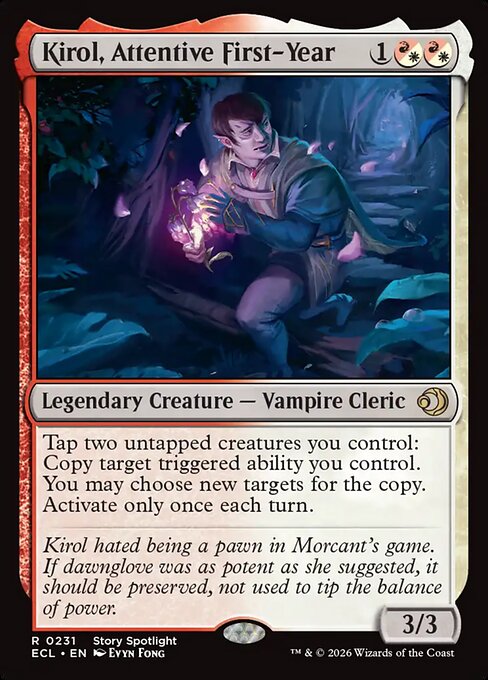
129. Kirol, Attentive First-Year
Rating5.6PlayableWhy this rating?
Good playable that always makes the cut (5.6/10).
Why. A legendary 3/3 for three, red-white hybrid, that copies a triggered ability you control by tapping two untapped creatures, once each turn. The body is decent, and the ability can double enter effects.
Risks. The ability means tapping two untapped creatures, so it needs a wide board and useful triggers. Without them it is a plain 3/3.
In the draft. A card for a deck with many triggered effects. Take it in the middle of your pool only if your deck uses its ability.
Results in the games of the set
When it is in hand, the deck wins 52.7% of its games (set average: 55.7%, 206th of 264 cards).
In the opening hand: 51.2% wins (54.5% on average).
Drawn during the game: 53.7% (56.5% on average).
When it is drawn, the deck wins 0.5 points more than when it is not.
When it is drafted, it is played 85% of the time (set average: 61%).
Taken as the first pick (86 drafts), it ends in the deck 81% of the time.
It is played about as much in every archetype.

130. Midnight Tilling
Rating5.6PlayableWhy this rating?
Good playable that always makes the cut (5.6/10).
Why. A two-mana instant that mills four cards, then you may return a permanent card from among them to hand. Cheap filtering and graveyard value, castable at the end of the opponent's turn.
Risks. It does not affect the board, and the mill can cost you important cards. With no good permanent among the four, it is a wasted play.
In the draft. A decent card for a green deck with graveyard effects. Take it in the middle of your pool, after your creatures and removal.
Results in the games of the set
When it is in hand, the deck wins 56.3% of its games (set average: 55.7%, 103rd of 264 cards).
In the opening hand: 55.8% wins (54.5% on average).
Drawn during the game: 56.7% (56.5% on average).
When it is drawn, the deck wins 0.4 points more than when it is not.
When it is drafted, it is played 50% of the time (set average: 61%).
Taken as the first pick (59 drafts), it ends in the deck 86% of the time.
It is played mostly in B/G decks (59% of them).

131. Nameless Inversion
Rating5.6PlayableWhy this rating?
Good playable that always makes the cut (5.6/10).
Why. A two-mana changeling instant that gives +3/-3 to a creature, which kills anything with 3 toughness or less. Cheap removal usable in combat.
Risks. It does not kill creatures with 4 or more toughness, which survive with +3 power until end of turn. Save it for a target whose toughness you are sure of.
In the draft. A good removal spell for a black deck. Take it fairly early: it kills every creature with 3 toughness or less.
Results in the games of the set
When it is in hand, the deck wins 56.4% of its games (set average: 55.7%, 101st of 264 cards).
In the opening hand: 55.5% wins (54.5% on average).
Drawn during the game: 57.0% (56.5% on average).
When it is drawn, the deck wins 3.1 points more than when it is not.
When it is drafted, it is played 90% of the time (set average: 61%).
Taken as the first pick (235 drafts), it ends in the deck 93% of the time.
It is played mostly in B/U decks (27% of them) and B/W (25%).

132. Pummeler for Hire
Rating5.6PlayableWhy this rating?
Good playable that always makes the cut (5.6/10).
Why. A 4/4 for five with reach, vigilance and ward 2, which gains you life equal to the greatest power among your Giants, at least 4 since it is one itself. It attacks and defends at once and is hard to target.
Risks. Five mana for a 4/4 with no offensive ability is fine but no more. It does not win the game alone.
In the draft. A good card for a green deck, to take in the middle of your pool. It is better in a defensive deck or with Giants.
Results in the games of the set
When it is in hand, the deck wins 55.6% of its games (set average: 55.7%, 120th of 264 cards).
In the opening hand: 52.6% wins (54.5% on average).
Drawn during the game: 57.6% (56.5% on average).
When it is drawn, the deck wins 2.9 points more than when it is not.
When it is drafted, it is played 72% of the time (set average: 61%).
Taken as the first pick (100 drafts), it ends in the deck 84% of the time.
It is played mostly in G/R decks (27% of them).
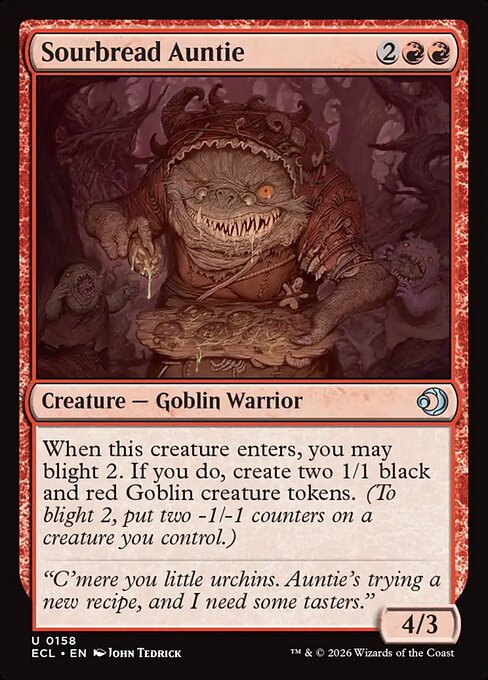
133. Sourbread Auntie
Rating5.6PlayableWhy this rating?
Good playable that always makes the cut (5.6/10).
Why. A 4/3 for four that may pay blight 2 on entering to create two 1/1 black and red Goblin creature tokens. A good body and three creatures from one card if you accept weakening it.
Risks. Blight 2 goes on a creature you control, often itself, shrinking it to a 2/1. It needs two red mana.
In the draft. A good card for a red deck, especially black-red. Take it in the middle of your pool, earlier if you want to fill the board.
Results in the games of the set
When it is in hand, the deck wins 55.3% of its games (set average: 55.7%, 129th of 264 cards).
In the opening hand: 53.3% wins (54.5% on average).
Drawn during the game: 56.7% (56.5% on average).
When it is drawn, the deck wins 2.3 points more than when it is not.
When it is drafted, it is played 67% of the time (set average: 61%).
Taken as the first pick (74 drafts), it ends in the deck 91% of the time.
It is played mostly in B/R decks (59% of them).
 Rating5.6Playable
Why this rating?
Good playable that always makes the cut (5.6/10).
Why. A legendary 2/2 for two, green-blue hybrid, that gives your other creatures hexproof from each of their own colours. Tapped, it makes a creature all colours until end of turn: another creature then has hexproof from every colour.
Risks. It does not protect against colourless removal or other colours, or against spells that do not target. The 2/2 body is modest.
In the draft. A decent card for a green or blue deck. Take it in the middle of your pool, after your best creatures.
Results in the games of the set
When it is in hand, the deck wins 53.7% of its games (set average: 55.7%, 176th of 264 cards).
In the opening hand: 53.2% wins (54.5% on average).
Drawn during the game: 54.1% (56.5% on average).
When it is drawn, the deck wins 1.0 points more than when it is not.
When it is drafted, it is played 94% of the time (set average: 61%).
Taken as the first pick (101 drafts), it ends in the deck 96% of the time.
It is played about as much in every archetype.

135. Tanufel Rimespeaker
Rating5.6PlayableWhy this rating?
Good playable that always makes the cut (5.6/10).
Why. A sturdy 2/4 body that draws a card each time you cast a spell with mana value 4 or greater. In a deck with a top-heavy curve it pays for itself quickly and blocks well in the meantime.
Risks. Without expensive spells it is just a decent wall. It does nothing to the board and dies to any removal before it has paid off.
In the draft. A mid-pack pick for a blue deck running several spells at four mana or more. Weaker in a low-curve aggressive deck.
Results in the games of the set
When it is in hand, the deck wins 56.3% of its games (set average: 55.7%, 102nd of 264 cards).
In the opening hand: 55.9% wins (54.5% on average).
Drawn during the game: 56.6% (56.5% on average).
When it is drawn, the deck wins 3.8 points more than when it is not.
When it is drafted, it is played 84% of the time (set average: 61%).
Taken as the first pick (196 drafts), it ends in the deck 87% of the time.
It is played mostly in R/U decks (36% of them) and G/U (25%).
 Rating5.6Playable
Why this rating?
Good playable that always makes the cut (5.6/10).
Why. A 2/3 flyer for three mana is already a good body. On top of that, each spell you cast during an opponent's turn (instants, flash) can cost you 1 life to draw a card.
Risks. You need spells to cast on the opponent's turn for the trigger to matter. The hybrid cost asks for three blue or black mana, so you want a deck firmly in those colors.
In the draft. Playable in any blue or black deck with a few instants or flash creatures. Take it as a good flyer; the card draw is a bonus.
Results in the games of the set
When it is in hand, the deck wins 52.9% of its games (set average: 55.7%, 202nd of 264 cards).
In the opening hand: 51.7% wins (54.5% on average).
Drawn during the game: 53.7% (56.5% on average).
When it is drawn, the deck wins 3.7 points more than when it is not.
When it is drafted, it is played 39% of the time (set average: 61%).
Taken as the first pick (35 drafts), it ends in the deck 71% of the time.
It is played mostly in B/U decks (76% of them).

137. Winnowing
Rating5.6PlayableWhy this rating?
Good playable that always makes the cut (5.6/10).
Why. An asymmetric sweeper: you choose one creature for each player, and that player sacrifices their other creatures that share no type with it. With a coherent tribe on your side you keep your team while the opponent loses most of theirs. Convoke makes it castable before six mana.
Risks. In a deck without type coherence you lose creatures too. An opposing changeling shares every type and always survives. It is a six-mana play before convoke, and it can leave your own board empty if you choose badly.
In the draft. Take it if you are white with a real tribe. In a pile of good but unrelated creatures it is too risky.
Results in the games of the set
When it is in hand, the deck wins 52.8% of its games (set average: 55.7%, 204th of 264 cards).
In the opening hand: 47.7% wins (54.5% on average).
Drawn during the game: 56.0% (56.5% on average).
When it is drawn, the deck wins 0.3 points more than when it is not.
When it is drafted, it is played 49% of the time (set average: 61%).
Taken as the first pick (31 drafts), it ends in the deck 71% of the time.
It is played about as much in every archetype.

138. Sting-Slinger
Rating5.6PlayableWhy this rating?
Good playable that always makes the cut (5.6/10).
Why. A 3/3 for three mana is already a fine body, and its ability deals 2 damage to each opponent every turn for two mana plus a blight 1. It closes games the board has stalled.
Risks. Each activation permanently shrinks one of your creatures, and it can drop to 2/2 and below itself. It taps to activate, so it will not be blocking.
In the draft. A good pick for a black-red blight deck. In a slow deck that wants to block it loses value.
Results in the games of the set
When it is in hand, the deck wins 52.1% of its games (set average: 55.7%, 220th of 264 cards).
In the opening hand: 50.6% wins (54.5% on average).
Drawn during the game: 53.1% (56.5% on average).
When it is drawn, the deck wins 0.3 points less than when it is not.
When it is drafted, it is played 55% of the time (set average: 61%).
Taken as the first pick (57 drafts), it ends in the deck 81% of the time.
It is played mostly in B/R decks (42% of them).
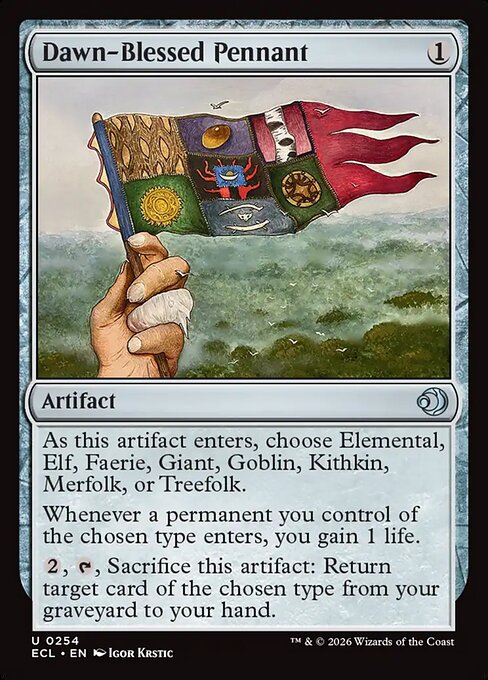
139. Dawn-Blessed Pennant
Rating5.5PlayableWhy this rating?
Good playable that always makes the cut (5.5/10).
Why. For one mana you gain 1 life whenever a permanent of the chosen type enters, and later you can sacrifice it to return a card of that type from your graveyard to your hand. In a tribal deck it is a quiet little value engine.
Risks. It does nothing for the board and will not stop an aggressive deck. Without enough permanents of the chosen type it barely does anything.
In the draft. A late pick for a heavily tribal deck (Elves, Merfolk, Kithkin...). Otherwise leave it.
Results in the games of the set
When it is in hand, the deck wins 53.8% of its games (set average: 55.7%, 171st of 264 cards).
In the opening hand: 51.6% wins (54.5% on average).
Drawn during the game: 55.3% (56.5% on average).
When it is drawn, the deck wins 0.5 points less than when it is not.
When it is drafted, it is played 50% of the time (set average: 61%).
Taken as the first pick (37 drafts), it ends in the deck 78% of the time.
It is played about as much in every archetype.

140. Puca's Eye
Rating5.4PlayableWhy this rating?
A solid playable that rarely gets cut (5.4/10).
Why. A two-mana artifact that replaces itself by drawing a card. If your permanents show five colors, its second ability draws again every turn for three mana.
Risks. It does nothing on the board. The draw ability needs five colors among your permanents, which is unrealistic in most decks.
In the draft. Playable filler, not a priority pick. Reserve it for decks that want a two-mana play or that aim for many colors.
Results in the games of the set
When it is in hand, the deck wins 54.6% of its games (set average: 55.7%, 150th of 264 cards).
In the opening hand: 50.7% wins (54.5% on average).
Drawn during the game: 57.2% (56.5% on average).
When it is drawn, the deck wins 5.0 points more than when it is not.
When it is drafted, it is played 28% of the time (set average: 61%).
Taken among the first three picks (74 drafts), it ends in the deck 61% of the time.
It is played mostly in G/U decks (25% of them).

141. Auntie's Sentence
Rating5.4PlayableWhy this rating?
A solid playable that rarely gets cut (5.4/10).
Why. A flexible two-mana sorcery: either look at the opponent's hand and make them discard a nonland permanent, or give a creature -2/-2. It kills small creatures and takes the best permanent in hand when needed.
Risks. The -2/-2 only handles small creatures, and as a sorcery it is no answer in combat. The discard mode leaves the opponent free to play cards that are not permanents.
In the draft. A good cheap removal in black, a mid-pack pick. It is mostly played in black-green.
Results in the games of the set
When it is in hand, the deck wins 53.4% of its games (set average: 55.7%, 185th of 264 cards).
In the opening hand: 53.1% wins (54.5% on average).
Drawn during the game: 53.7% (56.5% on average).
When it is drawn, the deck wins 0.4 points more than when it is not.
When it is drafted, it is played 53% of the time (set average: 61%).
Taken as the first pick (54 drafts), it ends in the deck 72% of the time.
It is played mostly in B/W decks (44% of them) and B/G (32%).

142. Blossoming Defense
Rating5.4PlayableWhy this rating?
A solid playable that rarely gets cut (5.4/10).
Why. For a single green mana, a creature gets +2/+2 and hexproof until end of turn. It counters a targeted removal spell and wins a combat in the same card.
Risks. It is a combat trick: with no creature worth protecting it is dead in hand. It does not answer effects that do not target.
In the draft. Good in a green deck full of threats to protect. Take it after your removal and your good creatures.
Results in the games of the set
When it is in hand, the deck wins 55.6% of its games (set average: 55.7%, 122nd of 264 cards).
In the opening hand: 53.9% wins (54.5% on average).
Drawn during the game: 56.7% (56.5% on average).
When it is drawn, the deck wins 0.9 points more than when it is not.
When it is drafted, it is played 80% of the time (set average: 61%).
Taken as the first pick (73 drafts), it ends in the deck 92% of the time.
It is played mostly in G/W decks (26% of them).

143. Burdened Stoneback
Rating5.4PlayableWhy this rating?
A solid playable that rarely gets cut (5.4/10).
Why. A 4/4 for two mana that enters with two -1/-1 counters, so it arrives as a 2/2. Each counter removed for two mana grows it back and gives a target indestructible, acting as protection or an attack boost.
Risks. It comes in small and needs mana to become a real threat. The ability can only be used at sorcery speed.
In the draft. A decent white pick, especially in a deck that likes counters. A flexible small body on turn 2, not a priority.
Results in the games of the set
When it is in hand, the deck wins 53.0% of its games (set average: 55.7%, 197th of 264 cards).
In the opening hand: 52.5% wins (54.5% on average).
Drawn during the game: 53.4% (56.5% on average).
When it is drawn, the deck wins 0.2 points less than when it is not.
When it is drafted, it is played 62% of the time (set average: 61%).
Taken as the first pick (54 drafts), it ends in the deck 80% of the time.
It is played mostly in R/W decks (36% of them) and B/W (28%).
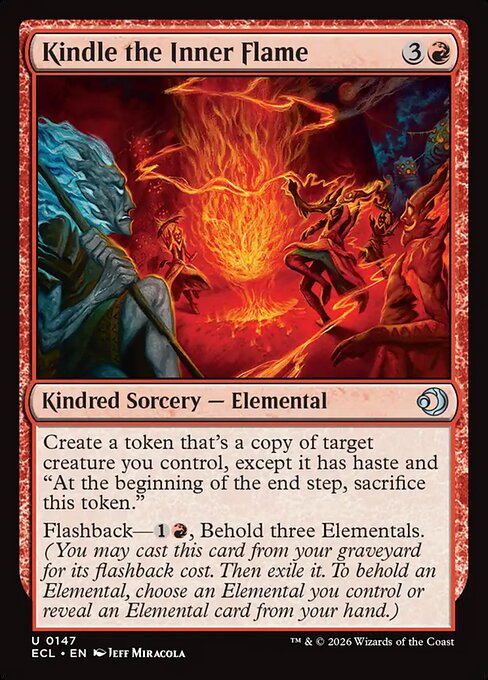 Rating5.4Playable
Why this rating?
A solid playable that rarely gets cut (5.4/10).
Why. A sorcery that copies one of your creatures with haste and sacrifices it at end of turn, doubling an enters trigger or a big attack. If you can behold three Elementals, the two-mana flashback gives you the same play again.
Risks. You need a good creature on the battlefield. With nothing to copy it is a wasted turn, and the flashback needs Elementals.
In the draft. A deck-dependent pick, not a priority. Good in a red Elemental deck with creatures that have strong enters effects.
Results in the games of the set
When it is in hand, the deck wins 55.3% of its games (set average: 55.7%, 130th of 264 cards).
In the opening hand: 51.3% wins (54.5% on average).
Drawn during the game: 57.7% (56.5% on average).
When it is drawn, the deck wins 3.3 points more than when it is not.
When it is drafted, it is played 41% of the time (set average: 61%).
Taken as the first pick (39 drafts), it ends in the deck 85% of the time.
It is played about as much in every archetype.
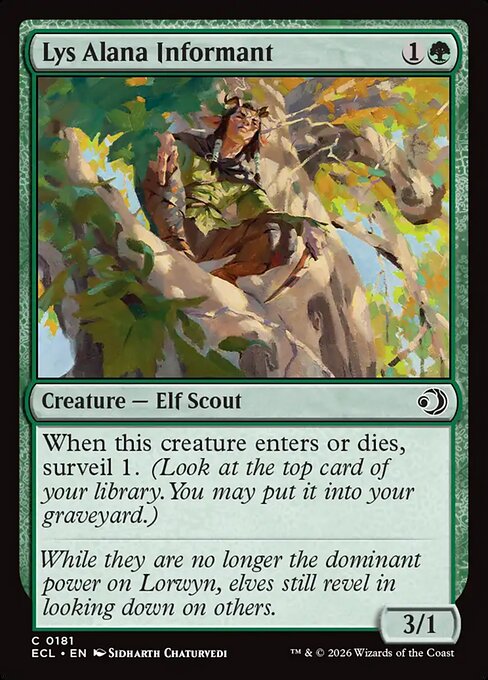
145. Lys Alana Informant
Rating5.4PlayableWhy this rating?
A solid playable that rarely gets cut (5.4/10).
Why. A 3/1 for two mana that surveils 1 when it enters and when it dies. It attacks well early and, even when traded, it smooths your draws.
Risks. One toughness makes it fragile: any creature with 1 power kills it. It blocks poorly.
In the draft. A good green common, especially in black-green. Take it as a reliable two-drop.
Results in the games of the set
When it is in hand, the deck wins 56.9% of its games (set average: 55.7%, 85th of 264 cards).
In the opening hand: 57.5% wins (54.5% on average).
Drawn during the game: 56.4% (56.5% on average).
When it is drawn, the deck wins 1.3 points more than when it is not.
When it is drafted, it is played 83% of the time (set average: 61%).
Taken as the first pick (184 drafts), it ends in the deck 95% of the time.
It is played mostly in B/G decks (69% of them) and G/U (50%).
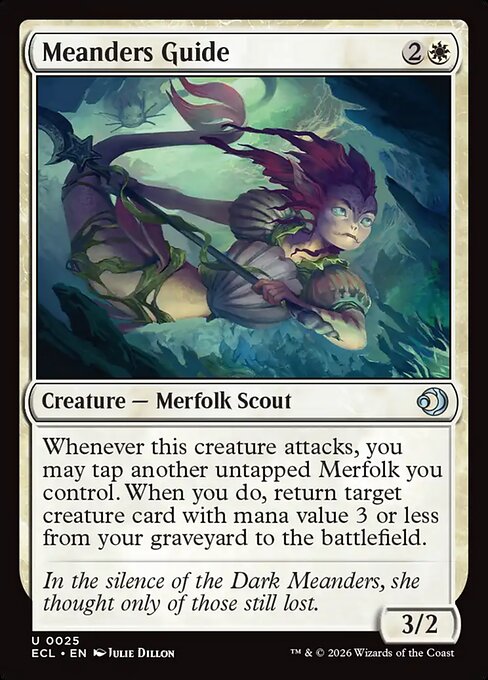
146. Meanders Guide
Rating5.4PlayableWhy this rating?
A solid playable that rarely gets cut (5.4/10).
Why. A 3/2 that, when it attacks, can tap another Merfolk to return a creature card with mana value 3 or less from your graveyard to the battlefield. When the setup is right it is a value engine every turn.
Risks. It needs another untapped Merfolk and a target in the graveyard. A 3/2 attacking into a stalled board dies easily.
In the draft. A mid-pack pick for a white-blue deck rich in Merfolk. In a deck without them it is too dependent.
Results in the games of the set
When it is in hand, the deck wins 54.1% of its games (set average: 55.7%, 163rd of 264 cards).
In the opening hand: 53.3% wins (54.5% on average).
Drawn during the game: 54.7% (56.5% on average).
When it is drawn, the deck wins 0.3 points less than when it is not.
When it is drafted, it is played 70% of the time (set average: 61%).
Taken as the first pick (72 drafts), it ends in the deck 88% of the time.
It is played mostly in U/W decks (31% of them).

147. Rhys, the Evermore
Rating5.4PlayableWhy this rating?
A solid playable that rarely gets cut (5.4/10).
Why. A two-mana 2/2 with flash that gives another creature persist until end of turn, protecting it from removal or combat. Its activated ability removes counters, which is useful with blight.
Risks. A small body, and the persist effect only lasts a turn. Counter removal only matters in decks that put counters on their creatures.
In the draft. A deck-dependent pick, mainly white with blight or counters. Handy as a flash play, not a decisive one.
Results in the games of the set
When it is in hand, the deck wins 52.7% of its games (set average: 55.7%, 208th of 264 cards).
In the opening hand: 51.3% wins (54.5% on average).
Drawn during the game: 53.7% (56.5% on average).
When it is drawn, the deck wins 0.3 points more than when it is not.
When it is drafted, it is played 81% of the time (set average: 61%).
Taken as the first pick (67 drafts), it ends in the deck 81% of the time.
It is played about as much in every archetype.

148. Silvergill Peddler
Rating5.4PlayableWhy this rating?
A solid playable that rarely gets cut (5.4/10).
Why. A 2/3 for three mana that filters your hand: each time it becomes tapped, you draw and then discard. Attacking, or being tapped by other effects, it keeps improving your draws.
Risks. The looting is slow and does not gain cards. A 2/3 attacking without support gets blocked and goes nowhere.
In the draft. A good common for a white-blue deck with effects that tap your creatures. A mid-pack pick.
Results in the games of the set
When it is in hand, the deck wins 55.0% of its games (set average: 55.7%, 143rd of 264 cards).
In the opening hand: 54.5% wins (54.5% on average).
Drawn during the game: 55.4% (56.5% on average).
When it is drawn, the deck wins 0.0 points more than when it is not.
When it is drafted, it is played 52% of the time (set average: 61%).
Taken as the first pick (45 drafts), it ends in the deck 89% of the time.
It is played mostly in U/W decks (70% of them).
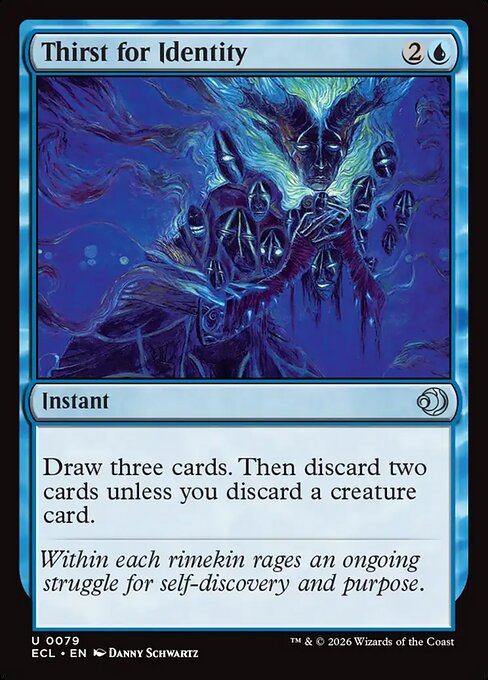
149. Thirst for Identity
Rating5.4PlayableWhy this rating?
A solid playable that rarely gets cut (5.4/10).
Why. A three-mana instant that draws three cards, then you discard two, or only one if it is a creature card. With a spare creature in hand it is a clean card gain at instant speed.
Risks. With no creature to discard, you pay three mana to net one extra card. It does nothing to the board.
In the draft. A good blue control spell, a mid-pack pick. Creature-heavy decks play it best.
Results in the games of the set
When it is in hand, the deck wins 53.2% of its games (set average: 55.7%, 191st of 264 cards).
In the opening hand: 51.3% wins (54.5% on average).
Drawn during the game: 54.5% (56.5% on average).
When it is drawn, the deck wins 0.9 points more than when it is not.
When it is drafted, it is played 42% of the time (set average: 61%).
Taken as the first pick (37 drafts), it ends in the deck 57% of the time.
It is played mostly in B/U decks (27% of them).

150. Unbury
Rating5.4PlayableWhy this rating?
A solid playable that rarely gets cut (5.4/10).
Why. A two-mana instant that returns one creature card from your graveyard to your hand, or two creature cards that share a type. Against removal-heavy opponents it is cheap card advantage.
Risks. It does nothing without dead creatures, and it only returns them to hand: you still have to pay to cast them. It is slow in an aggressive deck.
In the draft. Good in a black value deck, especially black-green. Take it as a deck card, not ahead of your removal.
Results in the games of the set
When it is in hand, the deck wins 55.0% of its games (set average: 55.7%, 141st of 264 cards).
In the opening hand: 51.6% wins (54.5% on average).
Drawn during the game: 57.4% (56.5% on average).
When it is drawn, the deck wins 1.3 points more than when it is not.
When it is drafted, it is played 81% of the time (set average: 61%).
Taken as the first pick (138 drafts), it ends in the deck 91% of the time.
It is played mostly in B/R decks (26% of them).
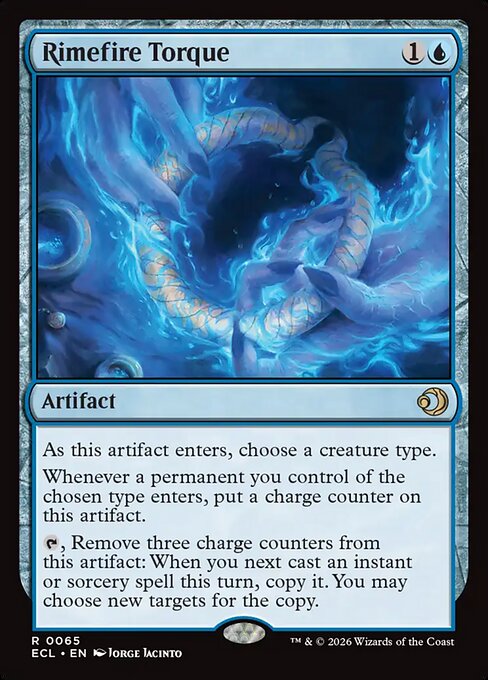
151. Rimefire Torque
Rating5.4PlayableWhy this rating?
A solid playable that rarely gets cut (5.4/10).
Why. A two-mana artifact that collects charge counters each time a permanent of the chosen type enters, then spends three to copy your next instant or sorcery this turn. There is potential in a tribal deck full of spells.
Risks. It is very slow: you need three permanents of the type, then a good spell to copy, for a one-shot effect. It does nothing on the board.
In the draft. Pass it in most decks. Only consider it in a very tribal deck that plays many instants and sorceries.
Results in the games of the set
When it is in hand, the deck wins 40.1% of its games (set average: 55.7%).
Drawn during the game: 0.0% (56.5% on average).
When it is drawn, the deck wins 7.9 points less than when it is not.
When it is drafted, it is played only 4% of the time (set average: 61%): it almost always ends in the sideboard.
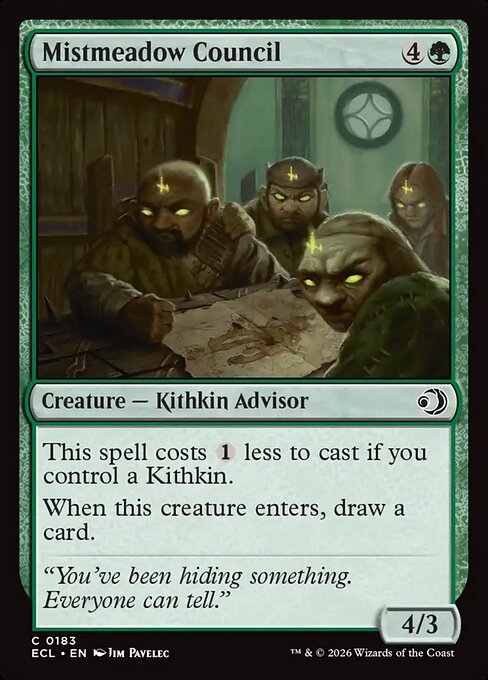
152. Mistmeadow Council
Rating5.3PlayableWhy this rating?
A solid playable that rarely gets cut (5.3/10).
Why. A 4/3 that draws a card when it enters, for five mana or four if you control a Kithkin. It replaces itself and leaves a decent body, which is what you want from a green common.
Risks. Five mana without a Kithkin is a bit steep for a 4/3. It has no evasion and no immediate effect on the board.
In the draft. A solid common for a green deck, especially green-white with Kithkin. Take it mid-pack.
Results in the games of the set
When it is in hand, the deck wins 56.6% of its games (set average: 55.7%, 93rd of 264 cards).
In the opening hand: 54.8% wins (54.5% on average).
Drawn during the game: 57.8% (56.5% on average).
When it is drawn, the deck wins 1.9 points more than when it is not.
When it is drafted, it is played 70% of the time (set average: 61%).
Taken as the first pick (157 drafts), it ends in the deck 89% of the time.
It is played mostly in G/W decks (79% of them) and G/R (32%).

153. Gravelgill Scoundrel
Rating5.2PlayableWhy this rating?
A solid playable that rarely gets cut (5.2/10).
Why. A two-mana 1/3 with vigilance that becomes unblockable if you tap another creature. It attacks without giving up defense, and its hits get through even on a stalled board.
Risks. A small body with little damage, and tapping another creature costs you a blocker or an attacker. It will not win the game by itself.
In the draft. A good two-drop for a white-blue deck. It likes decks that want steady small attacks.
Results in the games of the set
When it is in hand, the deck wins 55.8% of its games (set average: 55.7%, 117th of 264 cards).
In the opening hand: 56.5% wins (54.5% on average).
Drawn during the game: 55.3% (56.5% on average).
When it is drawn, the deck wins 0.6 points more than when it is not.
When it is drafted, it is played 62% of the time (set average: 61%).
Taken as the first pick (87 drafts), it ends in the deck 94% of the time.
It is played mostly in U/W decks (80% of them).

154. Enraged Flamecaster
Rating5.2PlayableWhy this rating?
A solid playable that rarely gets cut (5.2/10).
Why. A 3/2 with reach that deals 2 damage to each opponent whenever you cast a spell with mana value 4 or greater. It blocks flyers and adds extra damage in a top-heavy deck.
Risks. Two toughness makes it fragile, and without expensive spells the trigger almost never happens. It does little by itself.
In the draft. A filler pick for a red deck with a high curve. A fine mid-pack play in a blue-red deck.
Results in the games of the set
When it is in hand, the deck wins 52.8% of its games (set average: 55.7%, 203rd of 264 cards).
In the opening hand: 51.9% wins (54.5% on average).
Drawn during the game: 53.4% (56.5% on average).
When it is drawn, the deck wins 1.5 points more than when it is not.
When it is drafted, it is played 38% of the time (set average: 61%).
Taken among the first three picks (138 drafts), it ends in the deck 69% of the time.
It is played mostly in R/U decks (55% of them).
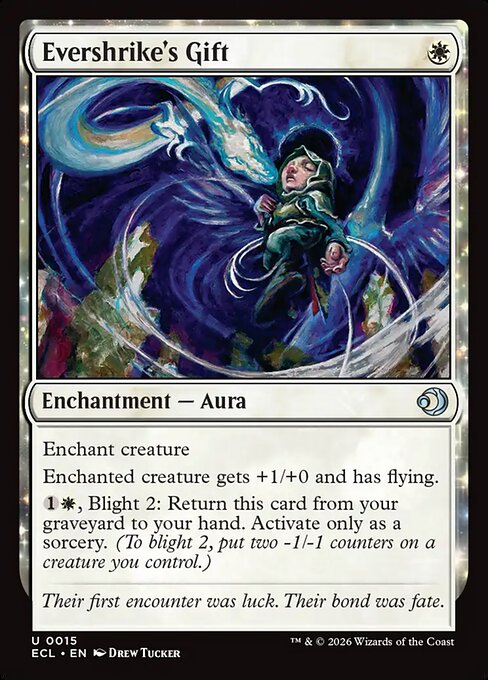
155. Evershrike's Gift
Rating5.2PlayableWhy this rating?
A solid playable that rarely gets cut (5.2/10).
Why. A one-mana aura that gives +1/+0 and flying, and can come back to your hand from the graveyard for a blight 2. Even when the creature dies you can recover it, so it is a recurring threat.
Risks. A removal spell on the enchanted creature costs you a card and tempo, and the blight 2 to recover it is a real cost. It does nothing without a creature.
In the draft. A white deck pick, especially white-green or with blight. Not ahead of your removal and good creatures.
Results in the games of the set
When it is in hand, the deck wins 53.2% of its games (set average: 55.7%, 190th of 264 cards).
In the opening hand: 50.2% wins (54.5% on average).
Drawn during the game: 55.3% (56.5% on average).
When it is drawn, the deck wins 0.5 points less than when it is not.
When it is drafted, it is played 42% of the time (set average: 61%).
Taken as the first pick (32 drafts), it ends in the deck 75% of the time.
It is played about as much in every archetype.

156. Hexing Squelcher
Rating5.2PlayableWhy this rating?
A solid playable that rarely gets cut (5.2/10).
Why. A two-mana 2/2 whose spell can't be countered, with ward (pay 2 life), that gives the same ward to your other creatures. It also makes your other spells uncounterable. It taxes targeted removal aimed at your board.
Risks. A 2/2 with no evasion, and ward does nothing against sweepers or effects that do not target. The anti-counterspell clause matters little against an opponent without counters.
In the draft. A pick for a red deck that likes protecting its creatures. Weak outside that plan.
Results in the games of the set
When it is in hand, the deck wins 50.7% of its games (set average: 55.7%, 242nd of 264 cards).
In the opening hand: 50.2% wins (54.5% on average).
Drawn during the game: 51.0% (56.5% on average).
When it is drawn, the deck wins 0.6 points less than when it is not.
When it is drafted, it is played 72% of the time (set average: 61%).
Taken as the first pick (40 drafts), it ends in the deck 88% of the time.
It is played about as much in every archetype.
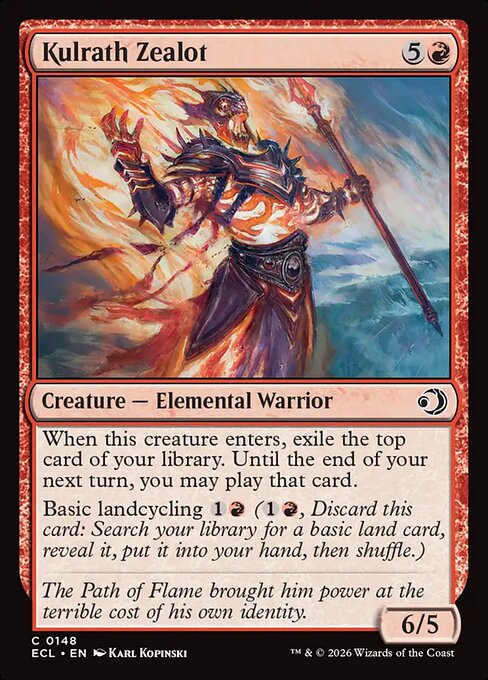
157. Kulrath Zealot
Rating5.2PlayableWhy this rating?
A solid playable that rarely gets cut (5.2/10).
Why. A six-mana 6/5 that exiles the top card of your library and lets you play it until the end of your next turn. And if you are short on lands, the two-mana basic landcycling solves the problem.
Risks. Six mana is heavy, and the exiled card is lost if you can't play it in time. It is slow in an aggressive deck.
In the draft. A good common for a red deck, especially blue-red. It is flexible: a land early, a big threat late.
Results in the games of the set
When it is in hand, the deck wins 56.7% of its games (set average: 55.7%, 89th of 264 cards).
In the opening hand: 53.9% wins (54.5% on average).
Drawn during the game: 58.5% (56.5% on average).
When it is drawn, the deck wins 4.0 points more than when it is not.
When it is drafted, it is played 76% of the time (set average: 61%).
Taken as the first pick (195 drafts), it ends in the deck 92% of the time.
It is played mostly in R/U decks (72% of them) and R/W (70%).

158. Noggle the Mind
Rating5.2PlayableWhy this rating?
A solid playable that rarely gets cut (5.2/10).
Why. A two-mana aura with flash that turns any creature into a colorless 1/1 Noggle with no abilities. It is a cheap quasi-removal that also shuts off abilities on the opponent's best creatures.
Risks. The creature stays on the battlefield and can still block or be sacrificed. If the enchanted creature dies you lose the aura, and an effect that removes the aura frees it.
In the draft. A good blue removal, a mid-pack pick. Especially good in white-blue or blue-red.
Results in the games of the set
When it is in hand, the deck wins 55.2% of its games (set average: 55.7%, 133rd of 264 cards).
In the opening hand: 52.5% wins (54.5% on average).
Drawn during the game: 56.9% (56.5% on average).
When it is drawn, the deck wins 2.4 points more than when it is not.
When it is drafted, it is played 76% of the time (set average: 61%).
Taken as the first pick (105 drafts), it ends in the deck 89% of the time.
It is played mostly in B/U decks (28% of them).
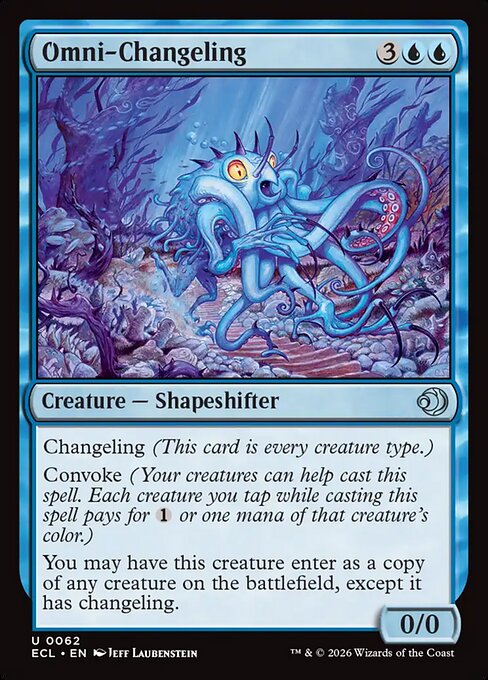
159. Omni-Changeling
Rating5.2PlayableWhy this rating?
A solid playable that rarely gets cut (5.2/10).
Why. For five mana, or less with convoke, it enters as a copy of any creature on the battlefield, with changeling. It copies the best creature on the board, yours or your opponent's.
Risks. With no creature to copy it enters as a 0/0 and dies. It depends on what is on the board, and removal kills it like anything else.
In the draft. A good blue pick, flexible in almost any blue deck. Take it mid-pack, higher if the board tends to be rich.
Results in the games of the set
When it is in hand, the deck wins 56.0% of its games (set average: 55.7%, 112th of 264 cards).
In the opening hand: 52.4% wins (54.5% on average).
Drawn during the game: 58.2% (56.5% on average).
When it is drawn, the deck wins 2.5 points more than when it is not.
When it is drafted, it is played 86% of the time (set average: 61%).
Taken as the first pick (205 drafts), it ends in the deck 92% of the time.
It is played mostly in R/U decks (30% of them) and B/U (25%).

160. Pestered Wellguard
Rating5.2PlayableWhy this rating?
A solid playable that rarely gets cut (5.2/10).
Why. A 3/2 that creates a 1/1 blue and black Faerie creature token with flying each time it becomes tapped. Attacking, or being tapped by an effect, gives you a flying token, and they add up quickly.
Risks. A 3/2 for four mana is a small body, and it dies when attacking into a block. It has to tap to produce anything.
In the draft. A good blue pick, especially for a white-blue deck that taps its creatures. Take it as a value source.
Results in the games of the set
When it is in hand, the deck wins 54.5% of its games (set average: 55.7%, 151st of 264 cards).
In the opening hand: 53.1% wins (54.5% on average).
Drawn during the game: 55.4% (56.5% on average).
When it is drawn, the deck wins 0.5 points more than when it is not.
When it is drafted, it is played 76% of the time (set average: 61%).
Taken as the first pick (99 drafts), it ends in the deck 88% of the time.
It is played mostly in U/W decks (34% of them).

161. Retched Wretch
Rating5.2PlayableWhy this rating?
A solid playable that rarely gets cut (5.2/10).
Why. A 4/2 for three mana that returns to the battlefield, without abilities, if it dies with a -1/-1 counter on it. If you put a counter on it with blight, it comes back as a vanilla 4/2, which is a good body at this price.
Risks. Without a -1/-1 counter it dies and stays dead. It comes back stripped of abilities, so you only get the body.
In the draft. A pick for a black-red blight deck. Outside that plan it is just another fragile 4/2.
Results in the games of the set
When it is in hand, the deck wins 53.3% of its games (set average: 55.7%, 188th of 264 cards).
In the opening hand: 52.4% wins (54.5% on average).
Drawn during the game: 53.9% (56.5% on average).
When it is drawn, the deck wins 1.2 points more than when it is not.
When it is drafted, it is played 56% of the time (set average: 61%).
Taken as the first pick (33 drafts), it ends in the deck 91% of the time.
It is played mostly in B/R decks (36% of them) and B/W (28%).

162. Safewright Cavalry
Rating5.2PlayableWhy this rating?
A solid playable that rarely gets cut (5.2/10).
Why. A 4/4 for four mana that can't be blocked by more than one creature, so it can't be double-blocked. Late in the game, five mana gives an Elf +2/+2.
Risks. It has no evasion and no enters effect. A nearly vanilla 4/4 is solid, but removal handles it easily.
In the draft. A good green common, especially in black-green. Take it as a solid body mid-pack.
Results in the games of the set
When it is in hand, the deck wins 56.2% of its games (set average: 55.7%, 106th of 264 cards).
In the opening hand: 54.3% wins (54.5% on average).
Drawn during the game: 57.6% (56.5% on average).
When it is drawn, the deck wins 1.1 points more than when it is not.
When it is drafted, it is played 73% of the time (set average: 61%).
Taken as the first pick (161 drafts), it ends in the deck 89% of the time.
It is played mostly in B/G decks (68% of them) and G/U (39%).

163. Sapling Nursery
Rating5.2PlayableWhy this rating?
A solid playable that rarely gets cut (5.2/10).
Why. A very expensive enchantment that creates a 3/4 green Treefolk creature token with reach each time a land enters under your control. With plenty of Forests its cost drops and it takes over the board within a few turns.
Risks. Eight mana before affinity is impractical without Forests. It produces nothing until a land enters after it, so hold your land drop.
In the draft. A pick for a near mono-green deck with lots of Forests. Otherwise leave it.
Results in the games of the set
When it is in hand, the deck wins 56.4% of its games (set average: 55.7%, 100th of 264 cards).
In the opening hand: 55.5% wins (54.5% on average).
Drawn during the game: 56.9% (56.5% on average).
When it is drawn, the deck wins 4.6 points more than when it is not.
When it is drafted, it is played 81% of the time (set average: 61%).
Taken as the first pick (67 drafts), it ends in the deck 85% of the time.
It is played about as much in every archetype.

164. Tributary Vaulter
Rating5.2PlayableWhy this rating?
A solid playable that rarely gets cut (5.2/10).
Why. A 1/3 flyer for three mana that gives another Merfolk +2/+0 each time it becomes tapped. It attacks in the air and makes another Merfolk more dangerous, a good tribal foundation.
Risks. Its air attack is weak, and it is no air blocker once it has tapped. Without another Merfolk, it loses its bonus.
In the draft. A solid common for a white-blue Merfolk deck. Take it mid-pack.
Results in the games of the set
When it is in hand, the deck wins 55.4% of its games (set average: 55.7%, 125th of 264 cards).
In the opening hand: 54.8% wins (54.5% on average).
Drawn during the game: 55.9% (56.5% on average).
When it is drawn, the deck wins 0.1 points more than when it is not.
When it is drafted, it is played 60% of the time (set average: 61%).
Taken as the first pick (81 drafts), it ends in the deck 89% of the time.
It is played mostly in U/W decks (78% of them).
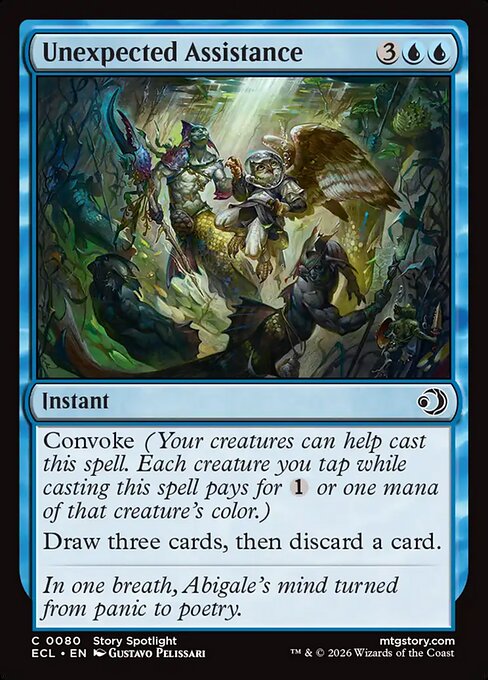 Rating5.2Playable
Why this rating?
A solid playable that rarely gets cut (5.2/10).
Why. An instant that draws three cards then discards one, with convoke to cast it earlier. With a few creatures to tap it costs almost nothing and nets you two cards.
Risks. Five mana without convoke is expensive for a spell that does nothing to the board. It asks you to keep creatures untapped.
In the draft. A good blue card advantage common, a mid-pack pick. Especially for a white-blue or blue-red deck.
Results in the games of the set
When it is in hand, the deck wins 55.8% of its games (set average: 55.7%, 116th of 264 cards).
In the opening hand: 53.5% wins (54.5% on average).
Drawn during the game: 57.2% (56.5% on average).
When it is drawn, the deck wins 1.7 points more than when it is not.
When it is drafted, it is played 72% of the time (set average: 61%).
Taken as the first pick (155 drafts), it ends in the deck 93% of the time.
It is played mostly in R/U decks (64% of them) and U/W (62%).
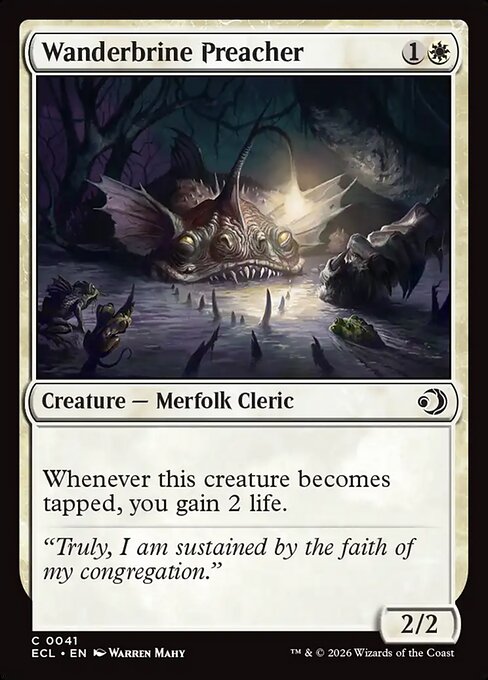
166. Wanderbrine Preacher
Rating5.2PlayableWhy this rating?
A solid playable that rarely gets cut (5.2/10).
Why. A two-mana 2/2 that gains you 2 life each time it becomes tapped. Attacking, or being tapped by other effects, it gains life every turn.
Risks. A plain 2/2 is quickly outclassed, and gaining life does not stop attackers. It does little against threats that ignore your life total.
In the draft. A good two-drop for a white-blue deck. Fine mid-pack, no more.
Results in the games of the set
When it is in hand, the deck wins 55.6% of its games (set average: 55.7%, 121st of 264 cards).
In the opening hand: 56.2% wins (54.5% on average).
Drawn during the game: 55.1% (56.5% on average).
When it is drawn, the deck wins 0.6 points more than when it is not.
When it is drafted, it is played 71% of the time (set average: 61%).
Taken as the first pick (118 drafts), it ends in the deck 92% of the time.
It is played mostly in U/W decks (69% of them) and B/W (34%).

167. Mornsong Aria
Rating5.2PlayableWhy this rating?
A solid playable that rarely gets cut (5.2/10).
Why. A strange legendary enchantment: nobody draws cards or gains life, and at each draw step that player loses 3 life and searches their library for any card. You find exactly what you need, but so does your opponent.
Risks. It is symmetric and very dangerous for you as well: three life per turn each, and you can't gain life. It is hard to use well in draft.
In the draft. Leave it in almost every case. Only for a very aggressive deck that can finish the game before the opponent.
Results in the games of the set
When it is drafted, it is played only 4% of the time (set average: 61%): it almost always ends in the sideboard.
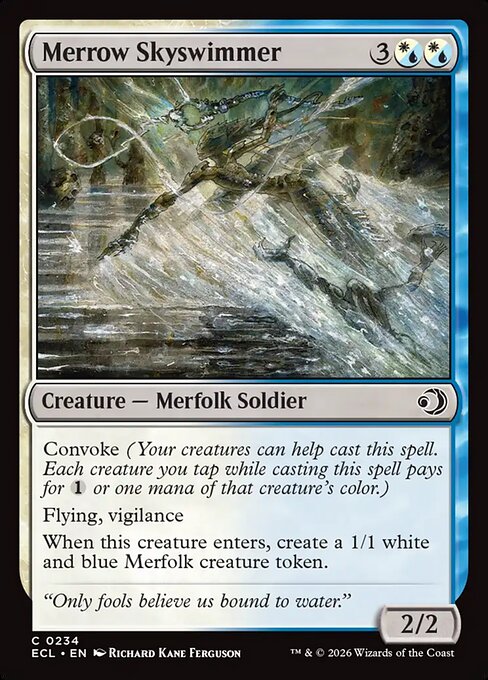
168. Merrow Skyswimmer
Rating5.1PlayableWhy this rating?
A solid playable that rarely gets cut (5.1/10).
Why. A 2/2 with flying and vigilance that creates a 1/1 white and blue Merfolk creature token when it enters, with convoke to cast it earlier. Two bodies for one card, one of them a flyer, is very good in white-blue.
Risks. Five mana without convoke is expensive, and the 2/2 flyer dies to any removal. The hybrid cost needs white or blue.
In the draft. A good common for a white-blue deck, a mid-pack pick. Playable in any deck with white or blue.
Results in the games of the set
When it is in hand, the deck wins 57.1% of its games (set average: 55.7%, 82nd of 264 cards).
In the opening hand: 55.2% wins (54.5% on average).
Drawn during the game: 58.4% (56.5% on average).
When it is drawn, the deck wins 2.5 points more than when it is not.
When it is drafted, it is played 81% of the time (set average: 61%).
Taken as the first pick (271 drafts), it ends in the deck 91% of the time.
It is played mostly in U/W decks (72% of them).

169. Feed the Flames
Rating5.0PlayableWhy this rating?
A solid playable that rarely gets cut (5.0/10).
Why. A sturdy red instant removal: five damage handles most threats in the format, and the exile clause stops graveyard recursion.
Risks. Four mana for a removal with no bonus, and it only hits creatures. It is a bit slow against an aggressive deck.
In the draft. A fair pick if you are red, ahead of interchangeable creatures. A deck is happy to run two.
Results in the games of the set
When it is in hand, the deck wins 54.4% of its games (set average: 55.7%, 153rd of 264 cards).
In the opening hand: 51.2% wins (54.5% on average).
Drawn during the game: 56.4% (56.5% on average).
When it is drawn, the deck wins 2.4 points more than when it is not.
When it is drafted, it is played 81% of the time (set average: 61%).
Taken as the first pick (175 drafts), it ends in the deck 93% of the time.
It is played mostly in R/U decks (66% of them) and R/W (53%).

170. Crossroads Watcher
Rating5.0PlayableWhy this rating?
A solid playable that rarely gets cut (5.0/10).
Why. A trampling 3/3 for three mana is already a solid baseline. Each other creature that enters gives it +1/+0 for the turn, so it hits harder when you curve out.
Risks. With no other creature to play, it is just a 3/3. The bonus only lasts a turn.
In the draft. A good turn-three body for creature decks, especially green-white. A mid-list pick if your deck is creature-heavy.
Results in the games of the set
When it is in hand, the deck wins 55.3% of its games (set average: 55.7%, 131st of 264 cards).
In the opening hand: 55.6% wins (54.5% on average).
Drawn during the game: 55.0% (56.5% on average).
When it is drawn, the deck wins 0.6 points more than when it is not.
When it is drafted, it is played 59% of the time (set average: 61%).
Taken as the first pick (58 drafts), it ends in the deck 84% of the time.
It is played mostly in G/W decks (75% of them).

171. Dawn's Light Archer
Rating5.0PlayableWhy this rating?
A solid playable that rarely gets cut (5.0/10).
Why. A 4/2 with flash and reach for three mana. It holds off fliers and can ambush an attacker as a surprise blocker.
Risks. Only two toughness: a small removal or a trade with any creature with two power kills it. It has no enter effect.
In the draft. A good mid-list pick for a green deck, all the more so when air threats matter. Take it over vanilla creatures.
Results in the games of the set
When it is in hand, the deck wins 54.8% of its games (set average: 55.7%, 145th of 264 cards).
In the opening hand: 54.0% wins (54.5% on average).
Drawn during the game: 55.5% (56.5% on average).
When it is drawn, the deck wins 0.6 points less than when it is not.
When it is drafted, it is played 60% of the time (set average: 61%).
Taken as the first pick (48 drafts), it ends in the deck 85% of the time.
It is played mostly in B/G decks (59% of them) and G/U (27%).

172. Flamekin Gildweaver
Rating5.0PlayableWhy this rating?
A solid playable that rarely gets cut (5.0/10).
Why. A trampling 4/3 that comes with a Treasure token: you get a mana back, and the body is big enough to attack freely. Good value for four mana.
Risks. A 4/3 is still vulnerable to trade removals, and the Treasure only matters if you have something to cast afterwards.
In the draft. A very playable red card, especially in blue-red. The Treasure helps with fixing or chaining expensive spells.
Results in the games of the set
When it is in hand, the deck wins 56.5% of its games (set average: 55.7%, 96th of 264 cards).
In the opening hand: 55.3% wins (54.5% on average).
Drawn during the game: 57.3% (56.5% on average).
When it is drawn, the deck wins 3.7 points more than when it is not.
When it is drafted, it is played 68% of the time (set average: 61%).
Taken as the first pick (136 drafts), it ends in the deck 86% of the time.
It is played mostly in R/U decks (68% of them) and R/W (63%).

173. Flaring Cinder
Rating5.0PlayableWhy this rating?
A solid playable that rarely gets cut (5.0/10).
Why. A hybrid 3/2 for three mana that smooths your hand: on enter, and whenever you cast a spell with mana value four or greater, you may discard a card to draw one. It turns extra lands into spells.
Risks. The body is small, and the looting needs discards you do not always want to make. Few expensive spells in the deck means few triggers.
In the draft. A decent support card, playable in blue or red thanks to the hybrid cost. Take it when nothing stronger is available.
Results in the games of the set
When it is in hand, the deck wins 55.2% of its games (set average: 55.7%, 134th of 264 cards).
In the opening hand: 53.6% wins (54.5% on average).
Drawn during the game: 56.2% (56.5% on average).
When it is drawn, the deck wins 2.1 points more than when it is not.
When it is drafted, it is played 60% of the time (set average: 61%).
Taken as the first pick (97 drafts), it ends in the deck 90% of the time.
It is played mostly in R/U decks (64% of them) and G/R (31%).

174. Hovel Hurler
Rating5.0PlayableWhy this rating?
A solid playable that rarely gets cut (5.0/10).
Why. A big hybrid body: it enters with two -1/-1 counters, making a 4/5 for five mana, and each counter removed makes it bigger while giving another creature +1/+0 and flying. It pushes an air attack.
Risks. Five mana for a 4/5 without flying is slow, and the ability works only at sorcery speed, one counter at a time, for two mana each time.
In the draft. A decent uncommon in a red or white deck with creatures to send into the air. Do not take it early.
Results in the games of the set
When it is in hand, the deck wins 53.1% of its games (set average: 55.7%, 195th of 264 cards).
In the opening hand: 49.3% wins (54.5% on average).
Drawn during the game: 55.5% (56.5% on average).
When it is drawn, the deck wins 2.0 points more than when it is not.
When it is drafted, it is played 74% of the time (set average: 61%).
Taken as the first pick (110 drafts), it ends in the deck 76% of the time.
It is played mostly in R/W decks (40% of them).

175. Keep Out
Rating5.0PlayableWhy this rating?
A solid playable that rarely gets cut (5.0/10).
Why. A two-mana instant removal: four damage to a tapped creature, or destroy an enchantment. It punishes creatures that attacked and stays flexible.
Risks. It only hits tapped creatures, so you must wait for them to attack or tap for an ability. Against a defensive deck, it can rot in hand.
In the draft. A fair pick for a white deck, after unconditional removal. The enchantment mode keeps it from ever being fully dead.
Results in the games of the set
When it is in hand, the deck wins 52.6% of its games (set average: 55.7%, 211th of 264 cards).
In the opening hand: 51.1% wins (54.5% on average).
Drawn during the game: 53.6% (56.5% on average).
When it is drawn, the deck wins 0.6 points less than when it is not.
When it is drafted, it is played 54% of the time (set average: 61%).
Taken as the first pick (51 drafts), it ends in the deck 78% of the time.
It is played mostly in G/W decks (46% of them) and B/W (37%).

176. Lavaleaper
Rating5.0PlayableWhy this rating?
A solid playable that rarely gets cut (5.0/10).
Why. A 4/4 for four mana, but its text benefits both players: all creatures have haste, and every basic land tapped for mana gives an extra mana. It is a very specific deck tool.
Risks. It helps your opponent too, who gains mana and haste. That is a real risk, and only an aggressive plan or a ramp-heavy deck justifies it.
In the draft. Pass it in most decks. The 4/4 body alone is not worth the gamble; play it only if you built around it.
Results in the games of the set
When it is in hand, the deck wins 48.6% of its games (set average: 55.7%, 259th of 264 cards).
In the opening hand: 45.6% wins (54.5% on average).
Drawn during the game: 50.4% (56.5% on average).
When it is drawn, the deck wins 0.1 points less than when it is not.
When it is drafted, it is played only 8% of the time (set average: 61%): it almost always ends in the sideboard.

177. Scarblade's Malice
Rating5.0PlayableWhy this rating?
A solid playable that rarely gets cut (5.0/10).
Why. A one-mana combat trick: your creature gains deathtouch and lifelink, and if it dies this turn you get a 2/2 black and green Elf creature token. Combat rarely goes badly for you.
Risks. It does nothing without a creature to target, and if the opponent responds with removal you lose the spell along with the creature, with no token.
In the draft. A good complement to a black-green deck, taken after your removal. One or two copies are enough.
Results in the games of the set
When it is in hand, the deck wins 54.1% of its games (set average: 55.7%, 161st of 264 cards).
In the opening hand: 52.1% wins (54.5% on average).
Drawn during the game: 55.6% (56.5% on average).
When it is drawn, the deck wins 1.6 points more than when it is not.
When it is drafted, it is played 36% of the time (set average: 61%).
Taken among the first three picks (114 drafts), it ends in the deck 76% of the time.
It is played mostly in B/G decks (30% of them).

178. Stratosoarer
Rating5.0PlayableWhy this rating?
A solid playable that rarely gets cut (5.0/10).
Why. A 3/5 flier for five mana that defends well, with basic landcycling for two mana. On enter, a creature also gains flying until end of turn, which helps an attack.
Risks. Five mana for a 3/5 without much offensive pressure. It is more of a control card than a threat.
In the draft. A flexible pick for a blue deck: it fixes land troubles or ends up as a good flying blocker. Especially in blue-red.
Results in the games of the set
When it is in hand, the deck wins 54.7% of its games (set average: 55.7%, 147th of 264 cards).
In the opening hand: 51.0% wins (54.5% on average).
Drawn during the game: 57.0% (56.5% on average).
When it is drawn, the deck wins 2.9 points more than when it is not.
When it is drafted, it is played 51% of the time (set average: 61%).
Taken as the first pick (35 drafts), it ends in the deck 86% of the time.
It is played mostly in R/U decks (49% of them) and G/U (39%).

179. Swat Away
Rating5.0PlayableWhy this rating?
A solid playable that rarely gets cut (5.0/10).
Why. A blue instant that costs two less if a creature is attacking you. It targets a spell or a creature, which its owner puts on top or bottom of their library at their choice.
Risks. The opponent can put their card on top and redraw it. It is tempo, not a true answer, and at full cost it is expensive.
In the draft. A good uncommon for a blue control-style deck. Take it as a tempo piece, after your best removal.
Results in the games of the set
When it is in hand, the deck wins 54.7% of its games (set average: 55.7%, 148th of 264 cards).
In the opening hand: 51.7% wins (54.5% on average).
Drawn during the game: 56.5% (56.5% on average).
When it is drawn, the deck wins 1.2 points more than when it is not.
When it is drafted, it is played 66% of the time (set average: 61%).
Taken as the first pick (65 drafts), it ends in the deck 80% of the time.
It is played mostly in B/U decks (34% of them) and R/U (25%).

180. Temporal Cleansing
Rating5.0WeakWhy this rating?
A solid playable that rarely gets cut (5.0/10).
Why. A blue sorcery with convoke that sends a nonland permanent to second from the top or the bottom of the library: it handles almost any threat, and your creatures help pay for it.
Risks. The owner can redraw the card two turns later if it goes second from the top, so it is not a true removal. It is slow if you have no creatures.
In the draft. A good tempo card for a blue deck with plenty of creatures, especially white-blue. Take it gladly.
Results in the games of the set
When it is in hand, the deck wins 56.1% of its games (set average: 55.7%, 110th of 264 cards).
In the opening hand: 53.2% wins (54.5% on average).
Drawn during the game: 57.8% (56.5% on average).
When it is drawn, the deck wins 1.4 points more than when it is not.
When it is drafted, it is played 64% of the time (set average: 61%).
Taken as the first pick (77 drafts), it ends in the deck 82% of the time.
It is played mostly in R/U decks (62% of them) and U/W (56%).
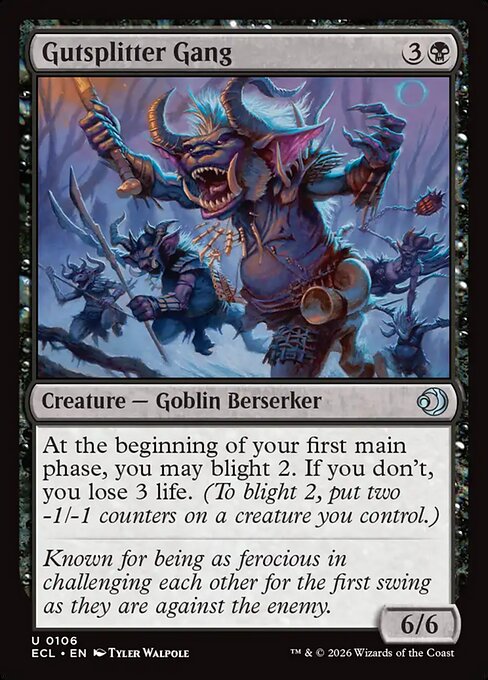
181. Gutsplitter Gang
Rating4.9WeakWhy this rating?
A solid playable that rarely gets cut (4.9/10).
Why. A 6/6 for four mana: huge at that price. Each turn you pay either with blight 2 or by losing three life.
Risks. The price is heavy. Blight 2 shrinks your creatures, and losing life every turn exposes you to a fast deck. You need games that end quickly.
In the draft. An aggressive uncommon for a black-red deck. Only take it if you can win before the cost catches up with you.
Results in the games of the set
When it is in hand, the deck wins 51.9% of its games (set average: 55.7%, 224th of 264 cards).
In the opening hand: 51.4% wins (54.5% on average).
Drawn during the game: 52.2% (56.5% on average).
When it is drawn, the deck wins 0.6 points more than when it is not.
When it is drafted, it is played 51% of the time (set average: 61%).
Taken as the first pick (32 drafts), it ends in the deck 78% of the time.
It is played mostly in B/R decks (34% of them) and B/W (27%).

182. Gilt-Leaf's Embrace
Rating4.8WeakWhy this rating?
A solid playable that rarely gets cut (4.8/10).
Why. A green Aura with flash: the creature gets +2/+0 for as long as the Aura stays, plus trample and indestructible until end of turn. In combat it wins a trade and can blank damage-based or destroy removal.
Risks. Like any Aura, it can cost you two cards if the opponent responds with removal. It does nothing without a creature.
In the draft. A good combat trick for a green, black-green or white-green deck. Take it mid-list, not ahead of your creatures.
Results in the games of the set
When it is in hand, the deck wins 54.9% of its games (set average: 55.7%, 144th of 264 cards).
In the opening hand: 52.9% wins (54.5% on average).
Drawn during the game: 56.3% (56.5% on average).
When it is drawn, the deck wins 0.4 points more than when it is not.
When it is drafted, it is played 43% of the time (set average: 61%).
Taken among the first three picks (127 drafts), it ends in the deck 80% of the time.
It is played mostly in G/W decks (33% of them) and B/G (31%).

183. Gallant Fowlknight
Rating4.8WeakWhy this rating?
A solid playable that rarely gets cut (4.8/10).
Why. A 3/4 for four mana whose enter effect gives your creatures +1/+0, and first strike to Kithkin, for a turn. It kicks off a big attack, especially with several Kithkin.
Risks. With no other creatures it is a plain 3/4. The first strike only applies to Kithkin.
In the draft. A decent common for a white creature deck, especially white-green. Do not take it over a removal.
Results in the games of the set
When it is in hand, the deck wins 54.2% of its games (set average: 55.7%, 160th of 264 cards).
In the opening hand: 52.7% wins (54.5% on average).
Drawn during the game: 55.2% (56.5% on average).
When it is drawn, the deck wins 0.6 points less than when it is not.
When it is drafted, it is played 48% of the time (set average: 61%).
Taken as the first pick (38 drafts), it ends in the deck 87% of the time.
It is played mostly in G/W decks (69% of them).

184. Graveshifter
Rating4.8WeakWhy this rating?
A solid playable that rarely gets cut (4.8/10).
Why. A 2/2 changeling for four mana that returns a creature card from your graveyard on enter. It is two-for-one value, and a changeling counts for every tribe.
Risks. The body is small for the cost, and with no creature in the graveyard the effect does nothing. It is a slow card.
In the draft. A good value uncommon for a black deck, especially black-green. Take it mid-list.
Results in the games of the set
When it is in hand, the deck wins 54.0% of its games (set average: 55.7%, 166th of 264 cards).
In the opening hand: 50.9% wins (54.5% on average).
Drawn during the game: 56.2% (56.5% on average).
When it is drawn, the deck wins 0.7 points more than when it is not.
When it is drafted, it is played 88% of the time (set average: 61%).
Taken as the first pick (186 drafts), it ends in the deck 93% of the time.
It is played mostly in B/W decks (26% of them).

185. Gristle Glutton
Rating4.8WeakWhy this rating?
A solid playable that rarely gets cut (4.8/10).
Why. A 1/3 for two mana that loots: tap it and pay blight 1 to discard a card and draw one. It blocks well early, then turns extra lands into spells.
Risks. Blight 1 puts a -1/-1 counter on one of your creatures each activation, sometimes on itself, so you pay in bodies. It eventually stops defending much.
In the draft. A support card for a black-red or blue-red deck. Do not take it early, but it fills the curve.
Results in the games of the set
When it is in hand, the deck wins 53.8% of its games (set average: 55.7%, 170th of 264 cards).
In the opening hand: 54.0% wins (54.5% on average).
Drawn during the game: 53.6% (56.5% on average).
When it is drawn, the deck wins 0.9 points more than when it is not.
When it is drafted, it is played 63% of the time (set average: 61%).
Taken as the first pick (108 drafts), it ends in the deck 95% of the time.
It is played mostly in B/R decks (79% of them) and R/W (47%).

186. Liminal Hold
Rating4.8WeakWhy this rating?
A solid playable that rarely gets cut (4.8/10).
Why. A white removal in enchantment form: it exiles a nonland permanent an opponent controls for as long as it stays, and you gain two life. It answers almost any threat.
Risks. If the enchantment is destroyed or removed, the permanent comes back. Four mana, and it is not a permanent answer.
In the draft. A good pick for a white deck, among your first removal spells. Take it over decent creatures.
Results in the games of the set
When it is in hand, the deck wins 55.8% of its games (set average: 55.7%, 114th of 264 cards).
In the opening hand: 52.9% wins (54.5% on average).
Drawn during the game: 57.8% (56.5% on average).
When it is drawn, the deck wins 1.9 points more than when it is not.
When it is drafted, it is played 87% of the time (set average: 61%).
Taken as the first pick (316 drafts), it ends in the deck 94% of the time.
It is played mostly in B/W decks (58% of them) and G/W (54%).
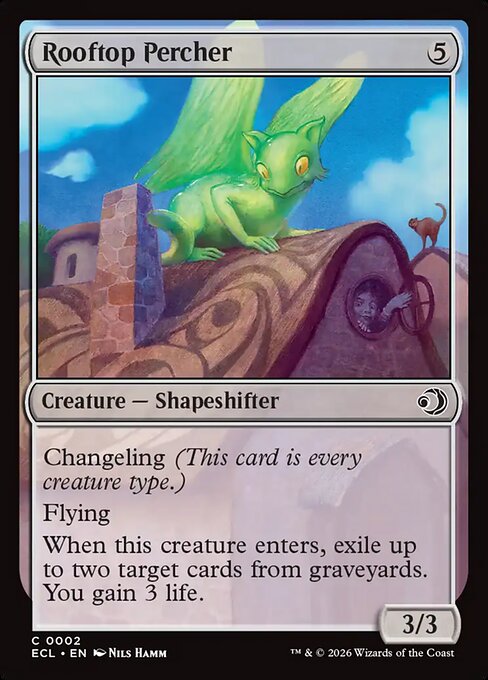
187. Rooftop Percher
Rating4.8WeakWhy this rating?
A solid playable that rarely gets cut (4.8/10).
Why. A colourless 3/3 flying changeling for five mana that exiles up to two cards from graveyards and gains you three life. It fits any deck and works as a curve-topper.
Risks. Five colourless mana is expensive for a 3/3, and the graveyard effect is secondary. It stays a filler card.
In the draft. A mid-list pick you can play in any deck. Useful if you want some flying for your curve.
Results in the games of the set
When it is in hand, the deck wins 55.0% of its games (set average: 55.7%, 140th of 264 cards).
In the opening hand: 52.0% wins (54.5% on average).
Drawn during the game: 57.1% (56.5% on average).
When it is drawn, the deck wins 1.6 points more than when it is not.
When it is drafted, it is played 52% of the time (set average: 61%).
Taken as the first pick (56 drafts), it ends in the deck 82% of the time.
It is played about as much in every archetype.

188. Shimmercreep
Rating4.8WeakWhy this rating?
A solid playable that rarely gets cut (4.8/10).
Why. A 3/5 with menace for five mana whose Vivid enter effect drains the opponent for X and gains you X, X being the number of colours among your permanents. In a two-colour deck it is a modest drain, but the body holds up well.
Risks. The drain stays small since it depends on the colours of your permanents, and the body alone is not spectacular. Five mana is the top of the curve.
In the draft. A decent uncommon for a multicolour black deck. It is better with permanents of varied colours.
Results in the games of the set
When it is in hand, the deck wins 54.4% of its games (set average: 55.7%, 154th of 264 cards).
In the opening hand: 50.0% wins (54.5% on average).
Drawn during the game: 57.1% (56.5% on average).
When it is drawn, the deck wins 4.8 points more than when it is not.
When it is drafted, it is played 58% of the time (set average: 61%).
Taken as the first pick (70 drafts), it ends in the deck 63% of the time.
It is played mostly in G/R decks (25% of them).
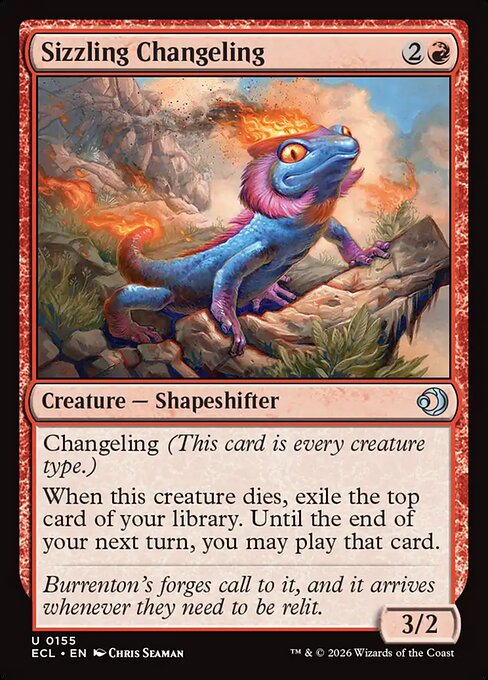
189. Sizzling Changeling
Rating4.8WeakWhy this rating?
A solid playable that rarely gets cut (4.8/10).
Why. A 3/2 changeling for three mana that leaves value behind: when it dies you exile the top card of your library and may play it until the end of your next turn. It trades with no loss.
Risks. A 3/2 is small and you will not always be able to play the exiled card, especially if it is expensive.
In the draft. A good red uncommon for an aggressive deck. For a deck that wants to attack and trade, it is worth the pick.
Results in the games of the set
When it is in hand, the deck wins 54.1% of its games (set average: 55.7%, 164th of 264 cards).
In the opening hand: 53.3% wins (54.5% on average).
Drawn during the game: 54.7% (56.5% on average).
When it is drawn, the deck wins 1.3 points more than when it is not.
When it is drafted, it is played 84% of the time (set average: 61%).
Taken as the first pick (119 drafts), it ends in the deck 94% of the time.
It is played mostly in B/R decks (29% of them) and R/W (29%).

190. Summit Sentinel
Rating4.8WeakWhy this rating?
A solid playable that rarely gets cut (4.8/10).
Why. A blue 1/3 for two mana that blocks small creatures and replaces itself when it dies. It is solid on defence and loses nothing in a trade.
Risks. It attacks poorly, so it is of little use in a deck that wants to pressure. Mostly a defensive piece.
In the draft. A card for control decks, especially blue-red. Take it to fill out the curve.
Results in the games of the set
When it is in hand, the deck wins 53.7% of its games (set average: 55.7%, 177th of 264 cards).
In the opening hand: 53.0% wins (54.5% on average).
Drawn during the game: 54.2% (56.5% on average).
When it is drawn, the deck wins 1.0 points more than when it is not.
When it is drafted, it is played 51% of the time (set average: 61%).
Taken as the first pick (45 drafts), it ends in the deck 93% of the time.
It is played mostly in R/U decks (58% of them) and B/U (34%).
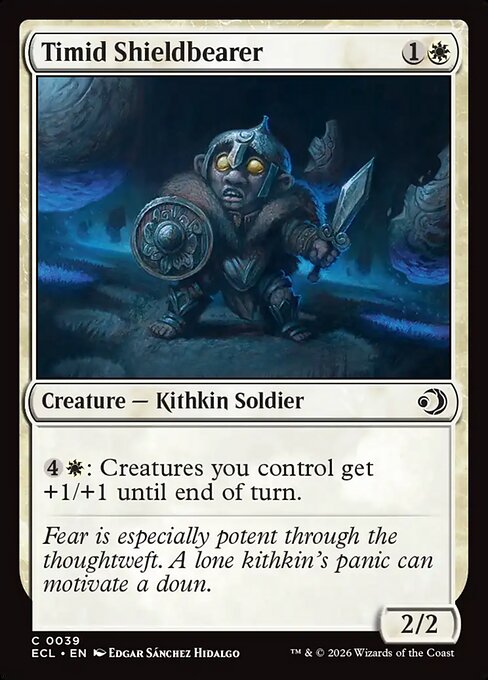
191. Timid Shieldbearer
Rating4.8WeakWhy this rating?
A solid playable that rarely gets cut (4.8/10).
Why. A 2/2 for two mana that stays useful late: for five mana, all your creatures get +1/+1 until end of turn. It wins combats or finishes a game with a wide board.
Risks. Five mana for a temporary effect is expensive, and you need creatures. A lone 2/2 is weak.
In the draft. A decent common for a white creature deck, especially white-green. It opens the curve and stays useful late.
Results in the games of the set
When it is in hand, the deck wins 55.1% of its games (set average: 55.7%, 136th of 264 cards).
In the opening hand: 54.5% wins (54.5% on average).
Drawn during the game: 55.6% (56.5% on average).
When it is drawn, the deck wins 0.0 points more than when it is not.
When it is drafted, it is played 69% of the time (set average: 61%).
Taken as the first pick (87 drafts), it ends in the deck 89% of the time.
It is played mostly in G/W decks (70% of them) and R/W (52%).

192. Unforgiving Aim
Rating4.8WeakWhy this rating?
A solid playable that rarely gets cut (4.8/10).
Why. A green instant with three modes: destroy a creature with flying, destroy an enchantment, or create a 2/2 black and green Elf creature token. It is never dead, but not great in any mode.
Risks. Each mode is situational: the first depends on opposing fliers, the second on enchantments, and the 2/2 token is weak for three mana.
In the draft. A mid-to-late pick for a green deck. Good as a sideboard card against fliers, but not a priority.
Results in the games of the set
When it is in hand, the deck wins 51.2% of its games (set average: 55.7%, 233rd of 264 cards).
In the opening hand: 49.1% wins (54.5% on average).
Drawn during the game: 52.7% (56.5% on average).
When it is drawn, the deck wins 0.9 points less than when it is not.
When it is drafted, it is played 17% of the time (set average: 61%).
Taken among the first three picks (33 drafts), it ends in the deck 42% of the time.
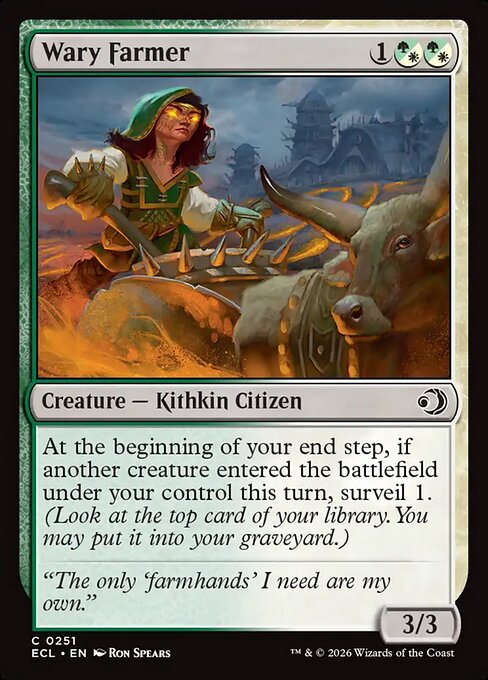
193. Wary Farmer
Rating4.8WeakWhy this rating?
A solid playable that rarely gets cut (4.8/10).
Why. A hybrid 3/3 for three mana, a good body for the cost. If another creature entered under your control this turn, you surveil 1 at your end step.
Risks. The bonus is minor: the surveil needs you to play other creatures, and the 3/3 has no other ability.
In the draft. A good mid-curve common for a green or white deck. It slots easily into green-white.
Results in the games of the set
When it is in hand, the deck wins 54.8% of its games (set average: 55.7%, 146th of 264 cards).
In the opening hand: 54.8% wins (54.5% on average).
Drawn during the game: 54.8% (56.5% on average).
When it is drawn, the deck wins 0.3 points more than when it is not.
When it is drafted, it is played 67% of the time (set average: 61%).
Taken as the first pick (99 drafts), it ends in the deck 89% of the time.
It is played mostly in G/W decks (72% of them) and B/W (26%).

194. Goldmeadow Nomad
Rating4.7WeakWhy this rating?
A solid playable that rarely gets cut (4.7/10).
Why. A 1/2 for one mana with a second life: from the graveyard, for a white mana, you exile it to create a 1/1 green and white Kithkin creature token. Two bodies from one card.
Risks. A 1/2 weighs little on the game, and the 1/1 token stays small. A filler card.
In the draft. A piece for a white creature deck, especially white-green. Do not take it ahead of stronger cards.
Results in the games of the set
When it is in hand, the deck wins 52.6% of its games (set average: 55.7%, 212th of 264 cards).
In the opening hand: 53.7% wins (54.5% on average).
Drawn during the game: 51.6% (56.5% on average).
When it is drawn, the deck wins 1.7 points less than when it is not.
When it is drafted, it is played 36% of the time (set average: 61%).
Taken among the first three picks (125 drafts), it ends in the deck 80% of the time.
It is played mostly in G/W decks (60% of them).

195. Glamermite
Rating4.7WeakWhy this rating?
A solid playable that rarely gets cut (4.7/10).
Why. A 2/2 flier with flash for three mana that, on enter, taps a creature or untaps one. It wins a combat or an air race by surprise.
Risks. A 2/2 is easy to kill, and the effect is temporary. It generates no card advantage.
In the draft. A tempo common for a blue deck, especially white-blue. Take it mid-list.
Results in the games of the set
When it is in hand, the deck wins 53.2% of its games (set average: 55.7%, 189th of 264 cards).
In the opening hand: 50.7% wins (54.5% on average).
Drawn during the game: 54.9% (56.5% on average).
When it is drawn, the deck wins 2.4 points more than when it is not.
When it is drafted, it is played 32% of the time (set average: 61%).
Taken as the first pick (35 drafts), it ends in the deck 71% of the time.
It is played mostly in B/U decks (79% of them) and U/W (27%).
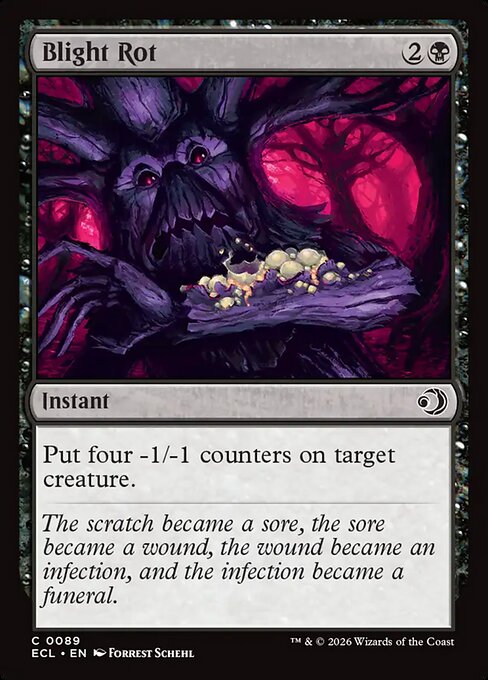
196. Blight Rot
Rating4.6WeakWhy this rating?
A solid playable that rarely gets cut (4.6/10).
Why. A three-mana black instant removal: four -1/-1 counters on a creature kill almost anything, even indestructible creatures.
Risks. It does not handle very large creatures, and counters can be removed or offset. It only hits creatures.
In the draft. A solid removal for a black deck: take it over average creatures. A black deck wants several copies.
Results in the games of the set
When it is in hand, the deck wins 55.4% of its games (set average: 55.7%, 124th of 264 cards).
In the opening hand: 53.6% wins (54.5% on average).
Drawn during the game: 56.7% (56.5% on average).
When it is drawn, the deck wins 2.4 points more than when it is not.
When it is drafted, it is played 87% of the time (set average: 61%).
Taken as the first pick (297 drafts), it ends in the deck 93% of the time.
It is played mostly in B/W decks (56% of them) and B/U (53%).

197. Blossombind
Rating4.6WeakWhy this rating?
A solid playable that rarely gets cut (4.6/10).
Why. A two-mana blue Aura that taps the creature and keeps it from untapping or receiving counters. A cheap pseudo-removal that neutralises an attacking or blocking threat.
Risks. The creature keeps its abilities, so non-tap effects stay active, and the Aura falls off if destroyed or removed. It is exposed to bounce.
In the draft. A decent pick for a blue deck, among your removal. It fits well in blue-red or white-blue.
Results in the games of the set
When it is in hand, the deck wins 55.1% of its games (set average: 55.7%, 138th of 264 cards).
In the opening hand: 52.2% wins (54.5% on average).
Drawn during the game: 57.0% (56.5% on average).
When it is drawn, the deck wins 1.2 points more than when it is not.
When it is drafted, it is played 83% of the time (set average: 61%).
Taken as the first pick (205 drafts), it ends in the deck 95% of the time.
It is played mostly in R/U decks (59% of them) and G/U (51%).

198. Kulrath Mystic
Rating4.6WeakWhy this rating?
A solid playable that rarely gets cut (4.6/10).
Why. A 2/4 for three mana that blocks well, and gets +2/+0 and vigilance when you cast a spell with mana value four or greater. It can attack and defend in a deck with expensive spells.
Risks. Without expensive spells, it is a plain 2/4. The bonus lasts one turn and only when you cast the spell.
In the draft. A support common for a blue-red deck. Take it mid-list, especially if your deck is top-heavy.
Results in the games of the set
When it is in hand, the deck wins 53.9% of its games (set average: 55.7%, 169th of 264 cards).
In the opening hand: 53.1% wins (54.5% on average).
Drawn during the game: 54.5% (56.5% on average).
When it is drawn, the deck wins 1.4 points more than when it is not.
When it is drafted, it is played 34% of the time (set average: 61%).
Taken among the first three picks (158 drafts), it ends in the deck 71% of the time.
It is played mostly in R/U decks (41% of them).

199. Mirrormind Crown
Rating4.6WeakWhy this rating?
A solid playable that rarely gets cut (4.6/10).
Why. A colourless Equipment that, while attached to a creature, lets you replace the first token creation each turn with copies of the equipped creature. It is powerful with cards that make tokens.
Risks. Four mana plus two to equip, for an effect that only works with token makers: without them it does nothing. It is a gamble.
In the draft. A card for a very specialised deck. Only take it if you already have several token sources; otherwise leave it.
Results in the games of the set
When it is in hand, the deck wins 39.4% of its games (set average: 55.7%).
Drawn during the game: 0.0% (56.5% on average).
When it is drawn, the deck wins 7.4 points less than when it is not.
When it is drafted, it is played only 5% of the time (set average: 61%): it almost always ends in the sideboard.
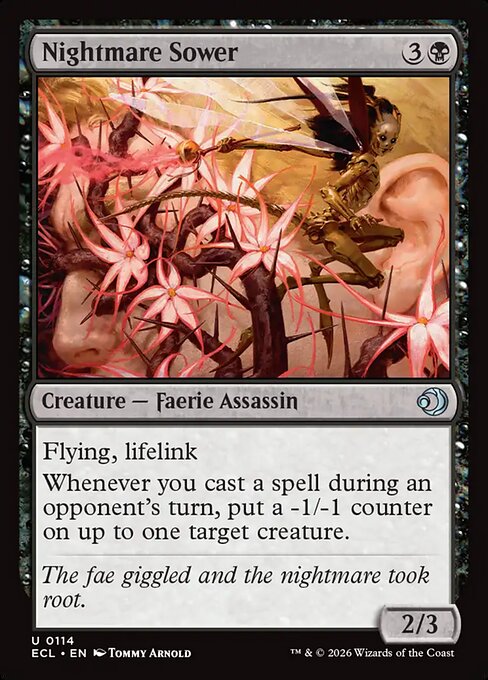
200. Nightmare Sower
Rating4.6WeakWhy this rating?
A solid playable that rarely gets cut (4.6/10).
Why. A 2/3 with flying and lifelink for four mana. Every spell cast during the opponent's turn lets you put a -1/-1 counter on a creature, wearing down small enemy creatures.
Risks. It only triggers if you have instants or flash to cast on the opponent's turn, and a 2/3 is fragile.
In the draft. A decent uncommon for a black deck that casts spells on the opponent's turn, especially blue-black. On its own, the flying lifelink body stays playable.
Results in the games of the set
When it is in hand, the deck wins 51.3% of its games (set average: 55.7%, 231st of 264 cards).
In the opening hand: 48.9% wins (54.5% on average).
Drawn during the game: 52.8% (56.5% on average).
When it is drawn, the deck wins 2.8 points more than when it is not.
When it is drafted, it is played 41% of the time (set average: 61%).
Taken as the first pick (35 drafts), it ends in the deck 63% of the time.
It is played mostly in B/U decks (55% of them).

201. Shore Lurker
Rating4.6WeakWhy this rating?
A solid playable that rarely gets cut (4.6/10).
Why. A 3/3 flier for four with a free surveil 1 on entry. It is quality filler in white: a solid aerial threat that blocks as well as it attacks.
Risks. Nothing flashy. Three toughness dies to plenty of removal and to a bigger flier, and it will not win the game alone.
In the draft. A fine mid-pack pick for a white deck that wants fliers. Take it happily when there is no removal or stronger threat in the pack.
Results in the games of the set
When it is in hand, the deck wins 53.7% of its games (set average: 55.7%, 173rd of 264 cards).
In the opening hand: 51.5% wins (54.5% on average).
Drawn during the game: 55.2% (56.5% on average).
When it is drawn, the deck wins 0.2 points more than when it is not.
When it is drafted, it is played 42% of the time (set average: 61%).
Taken as the first pick (32 drafts), it ends in the deck 81% of the time.
It is played mostly in U/W decks (45% of them).
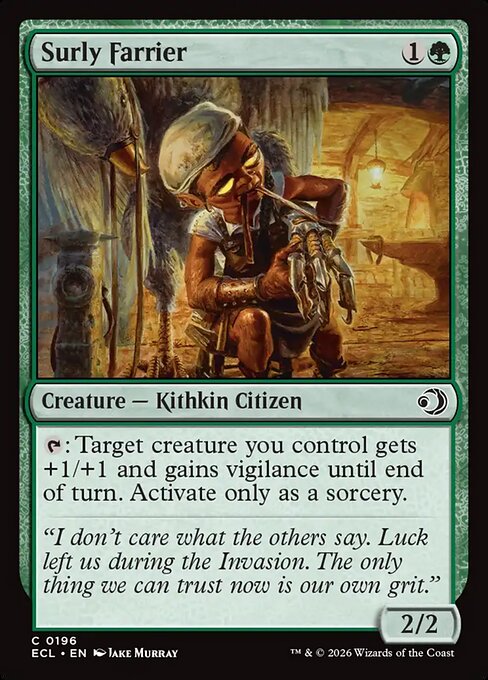
202. Surly Farrier
Rating4.6WeakWhy this rating?
A solid playable that rarely gets cut (4.6/10).
Why. A 2/2 for two that gives a creature you control +1/+1 and vigilance until end of turn, but only at sorcery speed. It nudges an attack through or tilts a combat in your favour.
Risks. It has to tap, so it will not block if you use it. Sorcery speed means no combat surprises.
In the draft. A decent two-drop for an aggressive green deck with plenty of creatures. Do not take it over good removal or a real threat.
Results in the games of the set
When it is in hand, the deck wins 53.7% of its games (set average: 55.7%, 178th of 264 cards).
In the opening hand: 54.2% wins (54.5% on average).
Drawn during the game: 53.2% (56.5% on average).
When it is drawn, the deck wins 1.0 points less than when it is not.
When it is drafted, it is played 55% of the time (set average: 61%).
Taken as the first pick (47 drafts), it ends in the deck 83% of the time.
It is played mostly in G/W decks (65% of them).

203. Wild Unraveling
Rating4.6WeakWhy this rating?
A solid playable that rarely gets cut (4.6/10).
Why. A two-mana counterspell with an extra cost: pay one more mana or blight 2. It answers any spell, creature or removal alike.
Risks. It is reactive: you hold mana up and develop nothing. Blight 2 damages one of your creatures, and the counter is dead if the opponent plays nothing worth stopping.
In the draft. Playable in a blue control or tempo deck, not a priority. One copy is usually enough.
Results in the games of the set
When it is in hand, the deck wins 53.4% of its games (set average: 55.7%, 187th of 264 cards).
In the opening hand: 50.9% wins (54.5% on average).
Drawn during the game: 54.9% (56.5% on average).
When it is drawn, the deck wins 2.0 points more than when it is not.
When it is drafted, it is played 24% of the time (set average: 61%).
Taken among the first three picks (76 drafts), it ends in the deck 63% of the time.
It is played mostly in B/U decks (63% of them).
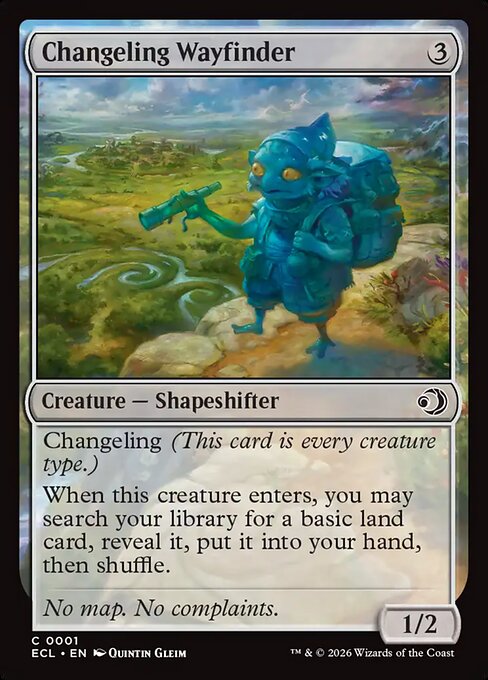
204. Changeling Wayfinder
Rating4.6WeakWhy this rating?
A solid playable that rarely gets cut (4.6/10).
Why. A colourless 1/2 changeling for three that fetches a basic land into your hand. It smooths your land drops and colours, and it counts as every creature type.
Risks. The body is tiny and the effect is slow. Three mana for a card that does not swing the game on its own.
In the draft. Useful filler in two- and three-colour decks. Take it late, after your real creatures and removal.
Results in the games of the set
When it is in hand, the deck wins 53.6% of its games (set average: 55.7%, 183rd of 264 cards).
In the opening hand: 51.8% wins (54.5% on average).
Drawn during the game: 54.9% (56.5% on average).
When it is drawn, the deck wins 1.0 points more than when it is not.
When it is drafted, it is played 73% of the time (set average: 61%).
Taken as the first pick (174 drafts), it ends in the deck 80% of the time.
It is played mostly in G/U decks (43% of them) and R/U (43%).
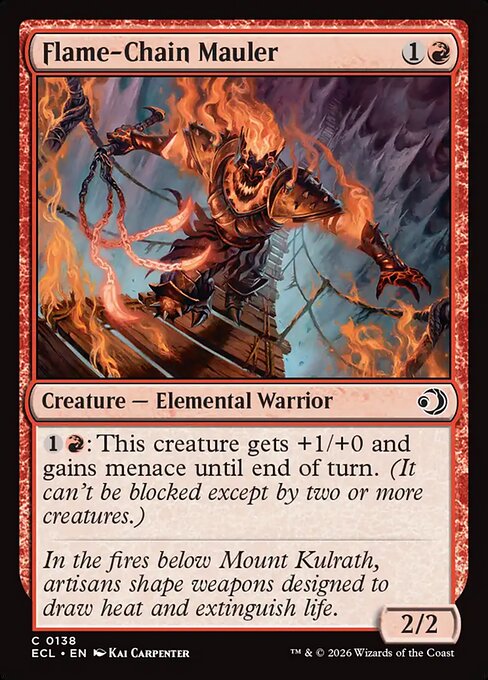
205. Flame-Chain Mauler
Rating4.5WeakWhy this rating?
A good playable, but is sometimes cut (4.5/10).
Why. A 2/2 for two that can spend two mana for +1/+0 and menace until end of turn. In an aggressive deck it is a late-game mana sink that is hard to block.
Risks. With no spare mana it is a vanilla 2/2. Every activation costs development, and good blockers still get in its way.
In the draft. A two-drop for an aggressive red deck. Fine, never exciting: take it when you need curve.
Results in the games of the set
When it is in hand, the deck wins 53.2% of its games (set average: 55.7%, 193rd of 264 cards).
In the opening hand: 52.6% wins (54.5% on average).
Drawn during the game: 53.5% (56.5% on average).
When it is drawn, the deck wins 0.3 points more than when it is not.
When it is drafted, it is played 51% of the time (set average: 61%).
Taken as the first pick (39 drafts), it ends in the deck 82% of the time.
It is played mostly in R/U decks (75% of them) and R/W (40%).

206. Aquitect's Defenses
Rating4.4WeakWhy this rating?
A good playable, but is sometimes cut (4.4/10).
Why. A flash Aura: on entry the enchanted creature gains hexproof until end of turn, and it keeps +1/+2. Cast in response to removal, it fizzles the spell and leaves a lasting bonus.
Risks. It needs a creature worth protecting. If the opponent answers some other way, or you cast it for nothing, you lose a card.
In the draft. A good tool for a blue deck built around a few key creatures. Take it after your creatures and removal.
Results in the games of the set
When it is in hand, the deck wins 53.0% of its games (set average: 55.7%, 198th of 264 cards).
In the opening hand: 50.7% wins (54.5% on average).
Drawn during the game: 54.5% (56.5% on average).
When it is drawn, the deck wins 1.2 points more than when it is not.
When it is drafted, it is played 21% of the time (set average: 61%).
Taken among the first three picks (60 drafts), it ends in the deck 57% of the time.
It is played mostly in B/U decks (43% of them).

207. Barbed Bloodletter
Rating4.4WeakWhy this rating?
A good playable, but is sometimes cut (4.4/10).
Why. A flash Equipment: it attaches for free on entry, grants wither until end of turn, then gives +1/+2 for as long as it stays attached. In combat it wins a block or an attack by surprise.
Risks. The bonus is modest for an equip cost of two. Without a creature it does nothing, and removal in response costs you the tempo.
In the draft. A fair playable for a black deck with good creatures. Not a priority pick.
Results in the games of the set
When it is in hand, the deck wins 53.4% of its games (set average: 55.7%, 186th of 264 cards).
In the opening hand: 52.4% wins (54.5% on average).
Drawn during the game: 54.1% (56.5% on average).
When it is drawn, the deck wins 1.7 points more than when it is not.
When it is drafted, it is played 18% of the time (set average: 61%).
Taken among the first three picks (42 drafts), it ends in the deck 55% of the time.
It is played mostly in B/U decks (27% of them).
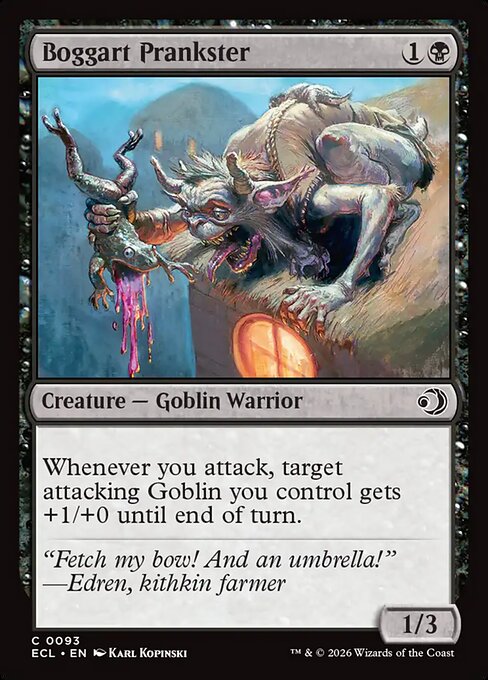
208. Boggart Prankster
Rating4.4WeakWhy this rating?
A good playable, but is sometimes cut (4.4/10).
Why. A 1/3 for two that gives an attacking Goblin +1/+0 whenever you attack. It blocks well early and gets better in a Goblin-heavy deck, itself included.
Risks. Without other Goblins the bonus barely matters. The 1/3 body wins few combats and attacks poorly.
In the draft. A good two-drop for a black-red Goblin deck. Outside that plan, let it go.
Results in the games of the set
When it is in hand, the deck wins 52.5% of its games (set average: 55.7%, 213th of 264 cards).
In the opening hand: 53.8% wins (54.5% on average).
Drawn during the game: 51.6% (56.5% on average).
When it is drawn, the deck wins 0.1 points more than when it is not.
When it is drafted, it is played 46% of the time (set average: 61%).
Taken among the first three picks (177 drafts), it ends in the deck 91% of the time.
It is played mostly in B/R decks (69% of them).

209. Brambleback Brute
Rating4.4WeakWhy this rating?
A good playable, but is sometimes cut (4.4/10).
Why. A 4/5 for three that enters with two -1/-1 counters, so a 2/3 at first. For two mana you remove a counter: it grows and a target creature cannot block this turn.
Risks. Early on it is a small, fragile body. The effect is slow, only works at sorcery speed, and needs spare mana.
In the draft. A playable for a red deck with attackers. Take it as filler, never over removal.
Results in the games of the set
When it is in hand, the deck wins 52.1% of its games (set average: 55.7%, 218th of 264 cards).
In the opening hand: 49.3% wins (54.5% on average).
Drawn during the game: 54.2% (56.5% on average).
When it is drawn, the deck wins 1.3 points more than when it is not.
When it is drafted, it is played 31% of the time (set average: 61%).
Taken among the first three picks (118 drafts), it ends in the deck 65% of the time.
It is played mostly in R/W decks (51% of them) and B/R (33%).
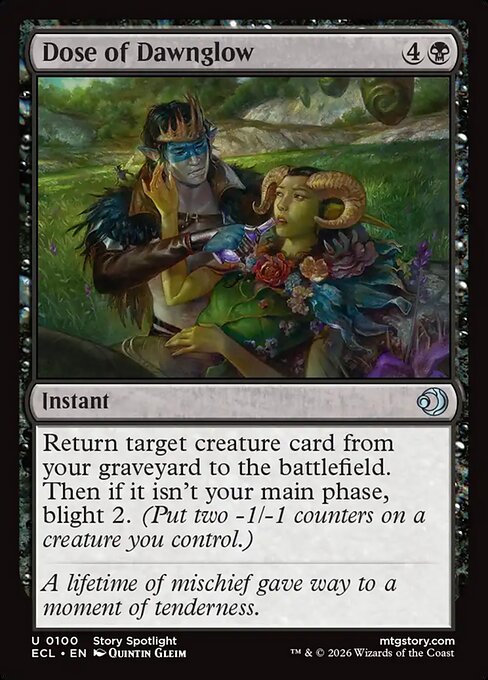
210. Dose of Dawnglow
Rating4.4WeakWhy this rating?
A good playable, but is sometimes cut (4.4/10).
Why. A five-mana instant that returns a creature card from your graveyard to the battlefield. Cast on the opponent's turn it gives a surprise swing, with blight 2 as the price.
Risks. Five mana for an effect that depends on what has already died. Outside your main phase, blight 2 costs you.
In the draft. Filler for a black deck with big creatures. There are better cards to take, so leave it mid-pack.
Results in the games of the set
When it is in hand, the deck wins 50.9% of its games (set average: 55.7%, 238th of 264 cards).
In the opening hand: 47.1% wins (54.5% on average).
Drawn during the game: 53.5% (56.5% on average).
When it is drawn, the deck wins 0.7 points less than when it is not.
When it is drafted, it is played 38% of the time (set average: 61%).
Taken among the first three picks (86 drafts), it ends in the deck 67% of the time.

211. Gangly Stompling
Rating4.4WeakWhy this rating?
A good playable, but is sometimes cut (4.4/10).
Why. A 4/2 changeling with trample for three, hybrid red or green. It hits hard early and punishes small blockers.
Risks. Only two toughness: it dies to any blocker with two power or more. A plain body with no extra effect.
In the draft. A good three-drop for an aggressive red or green deck. It happily goes mid-pack.
Results in the games of the set
When it is in hand, the deck wins 53.7% of its games (set average: 55.7%, 175th of 264 cards).
In the opening hand: 52.9% wins (54.5% on average).
Drawn during the game: 54.3% (56.5% on average).
When it is drawn, the deck wins 0.4 points more than when it is not.
When it is drafted, it is played 67% of the time (set average: 61%).
Taken as the first pick (81 drafts), it ends in the deck 78% of the time.
It is played mostly in G/R decks (45% of them) and B/G (29%).

212. Kithkeeper
Rating4.4WeakWhy this rating?
A good playable, but is sometimes cut (4.4/10).
Why. Seven mana for a 3/3 that makes as many 1/1 green and white Kithkin creature tokens as there are colours among your permanents (Vivid). Tapping three untapped creatures gives it +3/+0 and flying until end of turn, a decent finisher.
Risks. Seven mana is a lot, and Vivid gives little in two colours. Removal on the 3/3 leaves only a few small tokens.
In the draft. Top-end for a slow deck. Play no more than one, and take it late.
Results in the games of the set
When it is in hand, the deck wins 53.7% of its games (set average: 55.7%, 174th of 264 cards).
In the opening hand: 48.8% wins (54.5% on average).
Drawn during the game: 56.7% (56.5% on average).
When it is drawn, the deck wins 3.7 points more than when it is not.
When it is drafted, it is played 52% of the time (set average: 61%).
Taken as the first pick (66 drafts), it ends in the deck 71% of the time.
It is played about as much in every archetype.
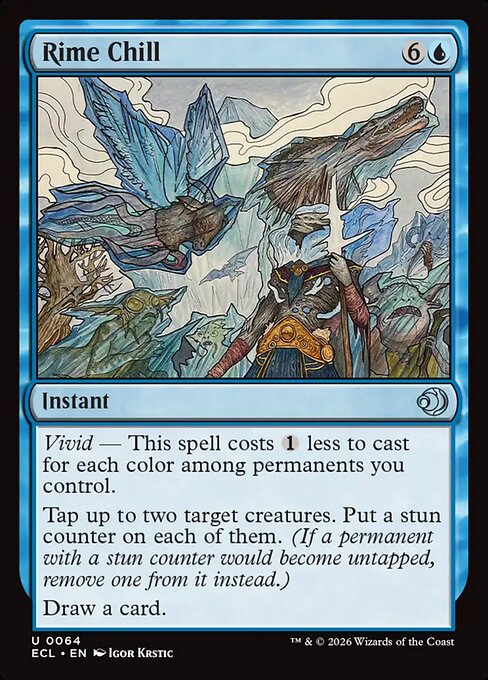
213. Rime Chill
Rating4.4WeakWhy this rating?
A good playable, but is sometimes cut (4.4/10).
Why. An instant that taps up to two creatures, puts a stun counter on each, and draws you a card. With Vivid it gets cheaper as your colours add up.
Risks. A temporary effect: it does not deal with the creatures, it buys turns. With few colours it stays expensive.
In the draft. A tempo tool for an aggressive blue deck. Playable, never essential.
Results in the games of the set
When it is in hand, the deck wins 52.4% of its games (set average: 55.7%, 216th of 264 cards).
In the opening hand: 47.8% wins (54.5% on average).
Drawn during the game: 55.0% (56.5% on average).
When it is drawn, the deck wins 1.7 points more than when it is not.
When it is drafted, it is played 37% of the time (set average: 61%).
Taken as the first pick (35 drafts), it ends in the deck 63% of the time.
It is played mostly in G/U decks (27% of them).
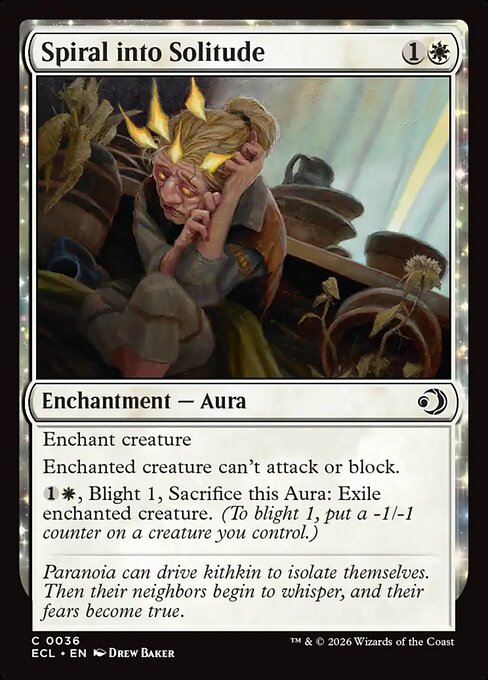
214. Spiral into Solitude
Rating4.4WeakWhy this rating?
A good playable, but is sometimes cut (4.4/10).
Why. A two-mana Aura that stops a creature from attacking or blocking, with the option to sacrifice it later to exile the creature (two mana and blight 1). A clean, cheap removal.
Risks. The creature keeps its abilities, and anything that removes the Aura frees it. The exile mode costs mana and a blight.
In the draft. A genuine common removal in white: take it over most average creatures.
Results in the games of the set
When it is in hand, the deck wins 54.3% of its games (set average: 55.7%, 157th of 264 cards).
In the opening hand: 51.6% wins (54.5% on average).
Drawn during the game: 56.3% (56.5% on average).
When it is drawn, the deck wins 0.0 points more than when it is not.
When it is drafted, it is played 85% of the time (set average: 61%).
Taken as the first pick (197 drafts), it ends in the deck 93% of the time.
It is played mostly in G/W decks (58% of them) and R/W (56%).
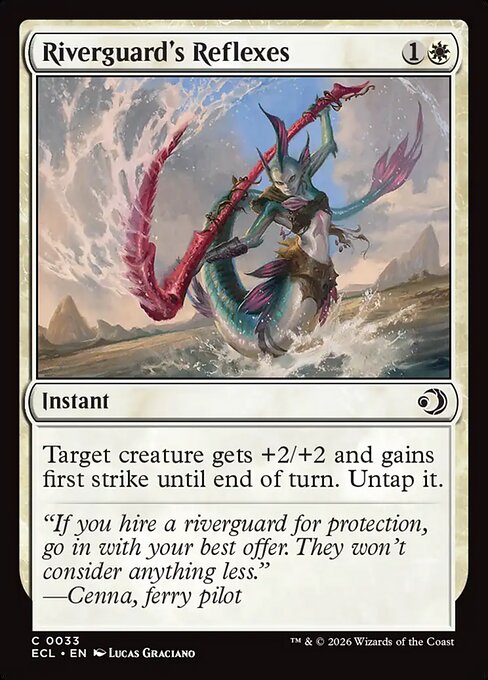 Rating4.3Weak
Why this rating?
A good playable, but is sometimes cut (4.3/10).
Why. A two-mana instant: +2/+2, first strike and an untap. It wins a combat, and the untap lets the creature block after attacking.
Risks. A combat trick loses to removal in response, a two-for-one against you. It needs a creature in play.
In the draft. A good tool for a white deck that picks fights. Take it after your creatures and removal.
Results in the games of the set
When it is in hand, the deck wins 52.7% of its games (set average: 55.7%, 205th of 264 cards).
In the opening hand: 50.8% wins (54.5% on average).
Drawn during the game: 54.1% (56.5% on average).
When it is drawn, the deck wins 1.0 points less than when it is not.
When it is drafted, it is played 22% of the time (set average: 61%).
Taken among the first three picks (47 drafts), it ends in the deck 55% of the time.
It is played mostly in G/W decks (25% of them).

216. Great Forest Druid
Rating4.3WeakWhy this rating?
A good playable, but is sometimes cut (4.3/10).
Why. A 0/4 for two that taps for one mana of any colour. It ramps and fixes, and the 0/4 body holds off small attackers.
Risks. It does not attack (zero power) and has no board impact. Late in the game it does almost nothing.
In the draft. Good in a three-colour deck or one with a splash, since it fixes. In a two-colour deck it is filler.
Results in the games of the set
When it is in hand, the deck wins 54.0% of its games (set average: 55.7%, 167th of 264 cards).
In the opening hand: 56.3% wins (54.5% on average).
Drawn during the game: 52.2% (56.5% on average).
When it is drawn, the deck wins 2.5 points more than when it is not.
When it is drafted, it is played 70% of the time (set average: 61%).
Taken as the first pick (141 drafts), it ends in the deck 86% of the time.
It is played mostly in G/U decks (70% of them) and G/R (68%).

217. Dream Harvest
Rating4.2WeakWhy this rating?
A good playable, but is sometimes cut (4.2/10).
Why. Seven mana for a sorcery: the opponent exiles cards from the top of their library until total mana value reaches 5 or more, then you may cast those cards for free this turn. When it hits, it is a big turn.
Risks. The result is random: if the exiled cards are lands or duds, you spent your whole turn. And seven mana is late.
In the draft. Too random and too expensive for a serious pick. Leave it unless your deck is already full.
Results in the games of the set
When it is in hand, the deck wins 50.3% of its games (set average: 55.7%, 246th of 264 cards).
In the opening hand: 45.6% wins (54.5% on average).
Drawn during the game: 53.0% (56.5% on average).
When it is drawn, the deck wins 0.8 points more than when it is not.
When it is drafted, it is played 52% of the time (set average: 61%).
Taken among the first three picks (111 drafts), it ends in the deck 68% of the time.
It is played about as much in every archetype.

218. Foraging Wickermaw
Rating4.2WeakWhy this rating?
A good playable, but is sometimes cut (4.2/10).
Why. A 1/3 artifact creature for two with a free surveil 1 on entry. For one mana, once each turn, it adds one mana of any colour, which fixes your mana.
Risks. It makes no net mana: it turns one mana into another. The body is small and wins no combats.
In the draft. Decent fixing for a three-colour deck. A late-pack pick.
Results in the games of the set
When it is in hand, the deck wins 53.6% of its games (set average: 55.7%, 181st of 264 cards).
In the opening hand: 53.4% wins (54.5% on average).
Drawn during the game: 53.8% (56.5% on average).
When it is drawn, the deck wins 2.5 points more than when it is not.
When it is drafted, it is played 59% of the time (set average: 61%).
Taken as the first pick (90 drafts), it ends in the deck 82% of the time.
It is played mostly in R/U decks (77% of them) and G/R (66%).
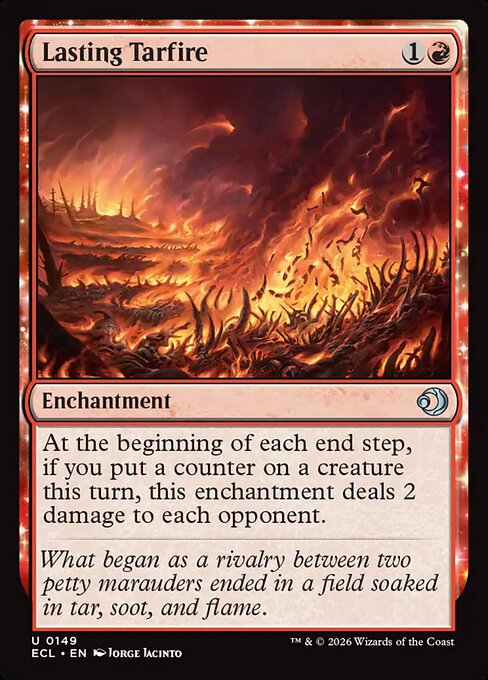
219. Lasting Tarfire
Rating4.2WeakWhy this rating?
A good playable, but is sometimes cut (4.2/10).
Why. A two-mana enchantment that deals 2 damage to each opponent at each end step in a turn you put a counter on a creature. It does nothing on its own and relies on other cards.
Risks. It has no board impact and needs counters, so a deck built around it. Without them it is a dead card.
In the draft. A trap: take it only if your deck generates plenty of counters. Otherwise pass.
Results in the games of the set
When it is in hand, the deck wins 46.9% of its games (set average: 55.7%, 263rd of 264 cards).
In the opening hand: 43.9% wins (54.5% on average).
Drawn during the game: 48.9% (56.5% on average).
When it is drawn, the deck wins 3.5 points less than when it is not.
When it is drafted, it is played 36% of the time (set average: 61%).
Taken among the first three picks (95 drafts), it ends in the deck 83% of the time.
It is played mostly in B/R decks (30% of them).

220. Moonglove Extractor
Rating4.2WeakWhy this rating?
A good playable, but is sometimes cut (4.2/10).
Why. A 2/1 for three that draws you a card and costs you 1 life each time it attacks. If it survives it is a steady card source.
Risks. A 2/1 attacks poorly: any blocker kills it, and you lose life each swing. It needs a clear board.
In the draft. Fine in a black-green deck that controls the board. A mid-pack pick.
Results in the games of the set
When it is in hand, the deck wins 52.1% of its games (set average: 55.7%, 219th of 264 cards).
In the opening hand: 51.9% wins (54.5% on average).
Drawn during the game: 52.2% (56.5% on average).
When it is drawn, the deck wins 1.5 points less than when it is not.
When it is drafted, it is played 40% of the time (set average: 61%).
Taken among the first three picks (166 drafts), it ends in the deck 77% of the time.
It is played mostly in B/G decks (33% of them).
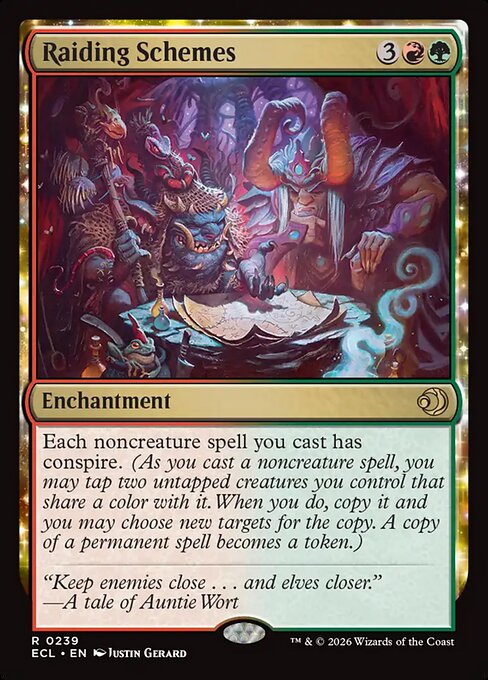
221. Raiding Schemes
Rating4.2WeakWhy this rating?
A good playable, but is sometimes cut (4.2/10).
Why. A five-mana enchantment that gives each noncreature spell you cast conspire. You tap two creatures sharing a colour with the spell to copy it.
Risks. It does nothing alone, costs a lot, and needs many noncreature spells and matching creatures. Far too slow.
In the draft. Pass it in nearly every deck. Only a red-green deck packed with spells could justify it.
Results in the games of the set
When it is drafted, it is played only 3% of the time (set average: 61%): it almost always ends in the sideboard.

222. Squawkroaster
Rating4.2WeakWhy this rating?
A good playable, but is sometimes cut (4.2/10).
Why. A */4 with double strike for four, power equal to the number of colours among your permanents (Vivid). In two colours it already deals 4 damage per unblocked attack.
Risks. Its power depends on your colours: in one colour it is a modest 1/4. Removal answers it easily.
In the draft. Best in a multicolour red deck. A mid-pack pick.
Results in the games of the set
When it is in hand, the deck wins 51.9% of its games (set average: 55.7%, 222nd of 264 cards).
In the opening hand: 50.2% wins (54.5% on average).
Drawn during the game: 53.0% (56.5% on average).
When it is drawn, the deck wins 2.1 points more than when it is not.
When it is drafted, it is played 48% of the time (set average: 61%).
Taken as the first pick (40 drafts), it ends in the deck 75% of the time.
It is played mostly in G/R decks (26% of them).

223. Stoic Grove-Guide
Rating4.2WeakWhy this rating?
A good playable, but is sometimes cut (4.2/10).
Why. A 5/4 for five, hybrid black or green. From your graveyard you can exile it for two mana to create a 2/2 black and green Elf creature token. Two bodies for one card.
Risks. Five mana for a body with no ability on the battlefield. The token only comes at sorcery speed and only after it dies.
In the draft. Solid filler for a black-green deck. A mid-pack pick.
Results in the games of the set
When it is in hand, the deck wins 52.6% of its games (set average: 55.7%, 210th of 264 cards).
In the opening hand: 51.0% wins (54.5% on average).
Drawn during the game: 53.9% (56.5% on average).
When it is drawn, the deck wins 3.1 points less than when it is not.
When it is drafted, it is played 59% of the time (set average: 61%).
Taken as the first pick (47 drafts), it ends in the deck 83% of the time.
It is played mostly in B/G decks (53% of them).
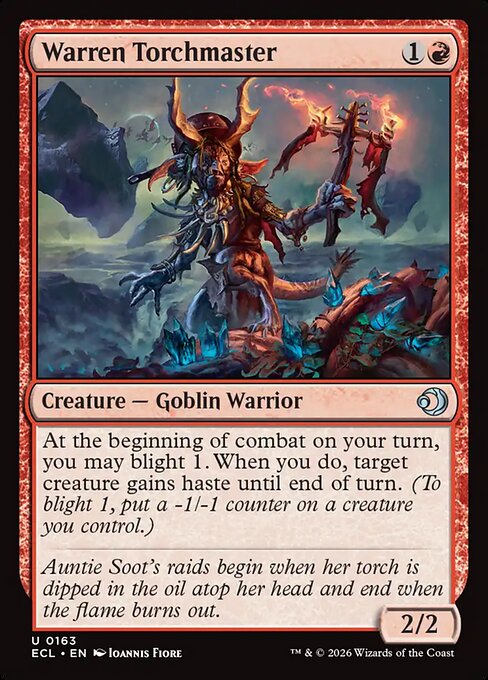
224. Warren Torchmaster
Rating4.2WeakWhy this rating?
A good playable, but is sometimes cut (4.2/10).
Why. A 2/2 for two that, at the beginning of combat, can blight 1 to give a creature haste. A big creature can attack the turn it arrives.
Risks. Each use costs you a -1/-1 counter. With no big creatures to push, the effect is wasted.
In the draft. A two-drop for a red-black deck that likes blight. Elsewhere, let it pass.
Results in the games of the set
When it is in hand, the deck wins 51.1% of its games (set average: 55.7%, 236th of 264 cards).
In the opening hand: 50.4% wins (54.5% on average).
Drawn during the game: 51.6% (56.5% on average).
When it is drawn, the deck wins 1.2 points less than when it is not.
When it is drafted, it is played 53% of the time (set average: 61%).
Taken as the first pick (35 drafts), it ends in the deck 83% of the time.
It is played mostly in B/R decks (34% of them).

225. Prideful Feastling
Rating4.2WeakWhy this rating?
A good playable, but is sometimes cut (4.2/10).
Why. A 2/3 changeling with lifelink for three, hybrid white or black. It holds the ground and gains life attacking or blocking.
Risks. A modest body that never wins a game alone. Easy to replace.
In the draft. Fair filler, playable in several decks. Take it late in the pack.
Results in the games of the set
When it is in hand, the deck wins 52.9% of its games (set average: 55.7%, 199th of 264 cards).
In the opening hand: 51.8% wins (54.5% on average).
Drawn during the game: 53.8% (56.5% on average).
When it is drawn, the deck wins 0.1 points more than when it is not.
When it is drafted, it is played 72% of the time (set average: 61%).
Taken as the first pick (98 drafts), it ends in the deck 90% of the time.
It is played mostly in B/W decks (52% of them) and B/G (33%).
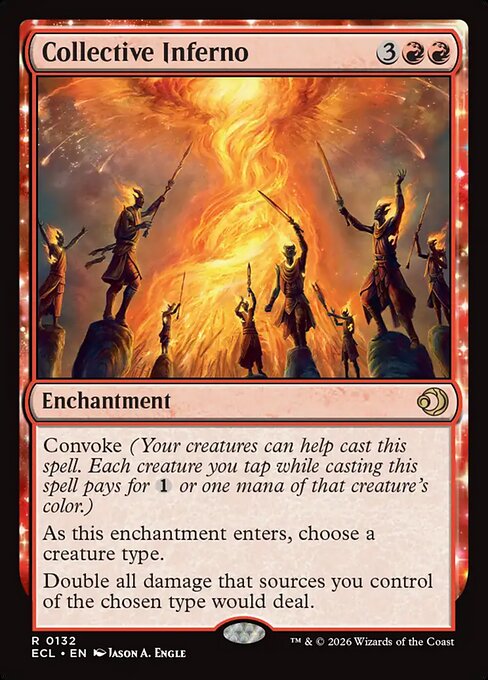
226. Collective Inferno
Rating4.1WeakWhy this rating?
A good playable, but is sometimes cut (4.1/10).
Why. An enchantment with convoke that doubles all damage dealt by your sources of the chosen creature type. In a deck attacking with many creatures of one type, the effect is strong.
Risks. It does nothing without a solid base of creatures of the right type, and it costs a lot. It does not answer opposing creatures either.
In the draft. A build-around. Take it only if your deck already has a shared type and plenty of creatures.
Results in the games of the set
When it is in hand, the deck wins 48.6% of its games (set average: 55.7%, 258th of 264 cards).
In the opening hand: 46.8% wins (54.5% on average).
Drawn during the game: 49.7% (56.5% on average).
When it is drawn, the deck wins 1.9 points less than when it is not.
When it is drafted, it is played 39% of the time (set average: 61%).
Taken among the first three picks (78 drafts), it ends in the deck 68% of the time.

227. Bile-Vial Boggart
Rating4.0WeakWhy this rating?
A good playable, but is sometimes cut (4.0/10).
Why. A 1/1 for one black mana that puts a -1/-1 counter on a target creature when it dies. It picks off X/1s and trades up with a better creature.
Risks. A 1/1 with little impact itself. The counter only kills very small targets.
In the draft. A late pick for an aggressive black-red deck. Easy to replace.
Results in the games of the set
When it is in hand, the deck wins 51.9% of its games (set average: 55.7%, 223rd of 264 cards).
In the opening hand: 53.3% wins (54.5% on average).
Drawn during the game: 50.8% (56.5% on average).
When it is drawn, the deck wins 0.6 points more than when it is not.
When it is drafted, it is played 41% of the time (set average: 61%).
Taken among the first three picks (150 drafts), it ends in the deck 89% of the time.
It is played mostly in B/R decks (62% of them) and B/W (46%).

228. Crib Swap
Rating4.0WeakWhy this rating?
A good playable, but is sometimes cut (4.0/10).
Why. A three-mana instant that exiles a target creature. Its controller gets a 1/1 colourless Shapeshifter creature token with changeling. A clean removal at instant speed with a consolation prize.
Risks. The opponent keeps a small body, so it is weaker than a pure removal. The token can also help a tribal deck.
In the draft. A playable removal in white, to take when nothing better is on offer. Do not overvalue it.
Results in the games of the set
When it is in hand, the deck wins 50.2% of its games (set average: 55.7%, 247th of 264 cards).
In the opening hand: 48.7% wins (54.5% on average).
Drawn during the game: 51.3% (56.5% on average).
When it is drawn, the deck wins 0.7 points less than when it is not.
When it is drafted, it is played 31% of the time (set average: 61%).
Taken among the first three picks (59 drafts), it ends in the deck 81% of the time.

229. Illusion Spinners
Rating4.0WeakWhy this rating?
A good playable, but is sometimes cut (4.0/10).
Why. A 4/3 flier for five that has hexproof while untapped. If you control a Faerie, you may cast it as though it had flash. Hard to target, it is a solid aerial threat.
Risks. Once it attacks, it taps and loses hexproof. Three toughness makes it fragile in combat.
In the draft. A fair five-drop in an aerial blue deck. A middling pick, not a priority.
Results in the games of the set
When it is in hand, the deck wins 51.2% of its games (set average: 55.7%, 232nd of 264 cards).
In the opening hand: 47.8% wins (54.5% on average).
Drawn during the game: 53.4% (56.5% on average).
When it is drawn, the deck wins 2.1 points more than when it is not.
When it is drafted, it is played 30% of the time (set average: 61%).
Taken among the first three picks (88 drafts), it ends in the deck 59% of the time.
It is played mostly in B/U decks (47% of them).

230. Reluctant Dounguard
Rating4.0WeakWhy this rating?
A good playable, but is sometimes cut (4.0/10).
Why. A 4/4 for three that enters with two -1/-1 counters, so a 2/2. Each other creature you control that enters removes a counter, quickly turning it into a 4/4.
Risks. Alone it stays a 2/2. It needs more creatures to follow, and it is fragile while it carries its counters.
In the draft. A good three-drop in a white deck with plenty of creatures. Mid-pack.
Results in the games of the set
When it is in hand, the deck wins 51.6% of its games (set average: 55.7%, 227th of 264 cards).
In the opening hand: 51.2% wins (54.5% on average).
Drawn during the game: 51.8% (56.5% on average).
When it is drawn, the deck wins 1.5 points less than when it is not.
When it is drafted, it is played 34% of the time (set average: 61%).
Taken among the first three picks (108 drafts), it ends in the deck 69% of the time.
It is played mostly in G/W decks (64% of them) and B/W (30%).
 Rating4.0Weak
Why this rating?
A good playable, but is sometimes cut (4.0/10).
Why. A 5/6 with vigilance and convoke for six. With several creatures it comes down earlier, and its size dominates combat.
Risks. Six mana without convoke is expensive, and tapping creatures to cast it costs you blockers. No board effect.
In the draft. A big body for a white deck full of small creatures. Take it as solid filler.
Results in the games of the set
When it is in hand, the deck wins 52.9% of its games (set average: 55.7%, 201st of 264 cards).
In the opening hand: 51.1% wins (54.5% on average).
Drawn during the game: 54.1% (56.5% on average).
When it is drawn, the deck wins 0.5 points more than when it is not.
When it is drafted, it is played 43% of the time (set average: 61%).
Taken as the first pick (42 drafts), it ends in the deck 69% of the time.
It is played mostly in B/W decks (41% of them) and R/W (36%).
 Rating4.0Weak
Why this rating?
A good playable, but is sometimes cut (4.0/10).
Why. A 4/3 for four that gives a creature an opponent controls -3/-0 whenever it becomes tapped, such as by attacking. Attacks get safer because the most dangerous blocker loses its power.
Risks. It only helps when it taps. Three toughness is fragile, and the effect removes nothing from the board.
In the draft. A good four-drop body in a blue deck. A mid-pack pick.
Results in the games of the set
When it is in hand, the deck wins 50.9% of its games (set average: 55.7%, 239th of 264 cards).
In the opening hand: 49.6% wins (54.5% on average).
Drawn during the game: 51.8% (56.5% on average).
When it is drawn, the deck wins 1.6 points less than when it is not.
When it is drafted, it is played 17% of the time (set average: 61%).
Taken among the first three picks (34 drafts), it ends in the deck 59% of the time.
 Rating4.0Weak
Why this rating?
A good playable, but is sometimes cut (4.0/10).
Why. A 2/2 changeling with flash for two, hybrid blue or black. It ambushes an attacker or lands at the end of the opponent's turn.
Risks. A plain body with no impact. It never wins a game on its own.
In the draft. Curve filler for several decks. Take it late in the pack.
Results in the games of the set
When it is in hand, the deck wins 52.4% of its games (set average: 55.7%, 215th of 264 cards).
In the opening hand: 52.0% wins (54.5% on average).
Drawn during the game: 52.8% (56.5% on average).
When it is drawn, the deck wins 0.5 points less than when it is not.
When it is drafted, it is played 75% of the time (set average: 61%).
Taken as the first pick (109 drafts), it ends in the deck 88% of the time.
It is played mostly in B/U decks (58% of them) and U/W (34%).

234. Perfect Intimidation
Rating3.9WeakWhy this rating?
A good playable, but is sometimes cut (3.9/10).
Why. A four-mana sorcery: the opponent exiles two cards from hand, and/or all counters are removed from a target creature. One mode shrinks their hand, the other wipes counters (yours or theirs).
Risks. Neither mode reliably answers a creature. The hand mode is slow, and the other depends on the target.
In the draft. A niche card, leave it unless a specific case calls for it. Too weak for a normal deck.
Results in the games of the set
When it is in hand, the deck wins 47.4% of its games (set average: 55.7%, 262nd of 264 cards).
In the opening hand: 44.9% wins (54.5% on average).
Drawn during the game: 49.2% (56.5% on average).
When it is drawn, the deck wins 0.5 points less than when it is not.
When it is drafted, it is played only 9% of the time (set average: 61%): it almost always ends in the sideboard.
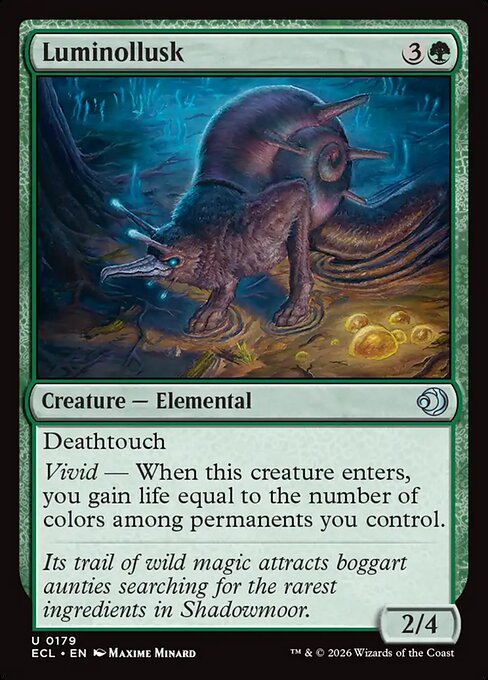
235. Luminollusk
Rating3.8WeakWhy this rating?
A good playable, but is sometimes cut (3.8/10).
Why. A 2/4 deathtouch for four mana: it holds off nearly every ground attacker and makes opponents think twice. The Vivid life gain is a small bonus, better in a deck with several colors.
Risks. The body does nothing offensively and the life gain stays modest in a two-color deck. Removal or a flier gets around it easily.
In the draft. A solid defensive four-drop, fine in one or two copies. Take it when nothing more active is on offer, especially in a green deck that wants a long game.
Results in the games of the set
When it is in hand, the deck wins 51.1% of its games (set average: 55.7%, 235th of 264 cards).
In the opening hand: 47.4% wins (54.5% on average).
Drawn during the game: 53.4% (56.5% on average).
When it is drawn, the deck wins 1.6 points more than when it is not.
When it is drafted, it is played 42% of the time (set average: 61%).
Taken among the first three picks (131 drafts), it ends in the deck 68% of the time.
It is played mostly in G/U decks (36% of them) and G/R (31%).

236. Chaos Spewer
Rating3.8WeakWhy this rating?
A good playable, but is sometimes cut (3.8/10).
Why. A 5/4 for three mana is a huge body for the price. If you pay two more mana as it enters, you keep the whole creature. If not, blight 2 shrinks it, but it is still a strong attacker for its cost.
Risks. Without the payment you must put two -1/-1 counters on a creature you control, often itself, and you may have no better target. It still dies to any removal.
In the draft. A playable common for aggressive decks, especially black-red (its hybrid cost works in either color). A fair mid-pack pick that wants a decent curve to shine.
Results in the games of the set
When it is in hand, the deck wins 50.4% of its games (set average: 55.7%, 245th of 264 cards).
In the opening hand: 48.7% wins (54.5% on average).
Drawn during the game: 51.6% (56.5% on average).
When it is drawn, the deck wins 0.2 points less than when it is not.
When it is drafted, it is played 38% of the time (set average: 61%).
Taken among the first three picks (141 drafts), it ends in the deck 76% of the time.
It is played mostly in B/R decks (66% of them) and B/W (37%).

237. Stalactite Dagger
Rating3.8WeakWhy this rating?
A good playable, but is sometimes cut (3.8/10).
Why. Two cards in one: a 1/1 Shapeshifter token with changeling arrives right away, then the Equipment gives +1/+1 to any creature. It is colorless, so it fits every deck and helps creature-type archetypes.
Risks. The 1/1 token is small, and attaching the Equipment costs two more mana. It will not win a game on its own.
In the draft. Quality filler, playable in any deck. Take it later in the pack for your curve or when you need a two-drop.
Results in the games of the set
When it is in hand, the deck wins 51.3% of its games (set average: 55.7%, 229th of 264 cards).
In the opening hand: 49.9% wins (54.5% on average).
Drawn during the game: 52.4% (56.5% on average).
When it is drawn, the deck wins 0.7 points less than when it is not.
When it is drafted, it is played 19% of the time (set average: 61%).
Taken among the first three picks (67 drafts), it ends in the deck 36% of the time.

238. Run Away Together
Rating3.7WeakWhy this rating?
A good playable, but is sometimes cut (3.7/10).
Why. An instant that bounces one of your creatures and one of theirs: clean tempo for two mana. You can save your creature from removal or replay it, while setting the opponent back.
Risks. It needs a creature on each side, so it is dead in hand otherwise. It solves nothing permanently: the tempo only matters if you capitalize on it.
In the draft. A tempo play, not removal. Useful in aggressive blue decks or ones with enter-the-battlefield creatures; a middling pick otherwise.
Results in the games of the set
When it is in hand, the deck wins 51.2% of its games (set average: 55.7%, 234th of 264 cards).
In the opening hand: 47.6% wins (54.5% on average).
Drawn during the game: 53.5% (56.5% on average).
When it is drawn, the deck wins 1.0 points less than when it is not.
When it is drafted, it is played 20% of the time (set average: 61%).
Taken among the first three picks (57 drafts), it ends in the deck 61% of the time.
It is played mostly in B/U decks (47% of them).

239. Elder Auntie
Rating3.4WeakWhy this rating?
Filler card but sometimes gets cut (3.4/10).
Why. A 2/2 plus a 1/1 black and red Goblin creature token for three mana: two bodies, handy for defense or to carry equipment or auras. Honest filler in a Goblin deck.
Risks. Both bodies are small and plain, so the pair gets outclassed by the bigger creatures of the midgame.
In the draft. A solid three-drop for black-red. A middling pick, higher if you already have Goblins or effects that reward many bodies.
Results in the games of the set
When it is in hand, the deck wins 51.9% of its games (set average: 55.7%, 225th of 264 cards).
In the opening hand: 51.3% wins (54.5% on average).
Drawn during the game: 52.3% (56.5% on average).
When it is drawn, the deck wins 0.0 points more than when it is not.
When it is drafted, it is played 41% of the time (set average: 61%).
Taken as the first pick (50 drafts), it ends in the deck 86% of the time.
It is played mostly in B/R decks (66% of them).
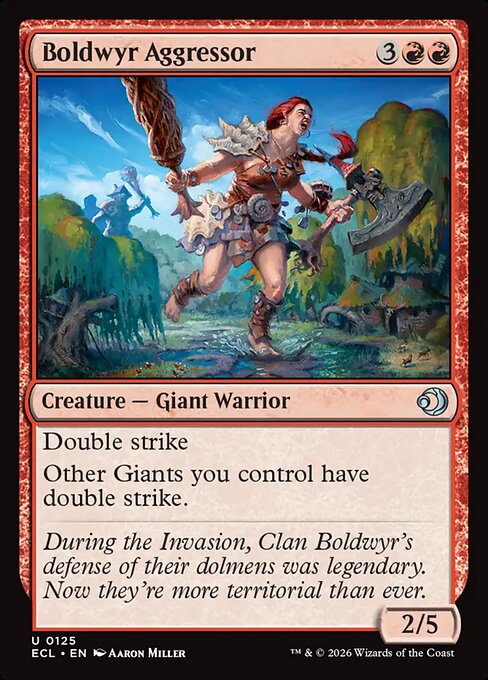
240. Boldwyr Aggressor
Rating3.1WeakWhy this rating?
Filler card but sometimes gets cut (3.1/10).
Why. A 2/5 double striker for five mana: a good blocker that hits twice when attacking. Other Giants you control also get double strike, which lifts every Giant you play.
Risks. Only 2 power, so alone it does not hurt much, and the Giant bonus needs other Giants to matter. Five mana with two red is pricey.
In the draft. A fair pick in a red deck with several Giants. Otherwise it is just a big red blocker you can do without.
Results in the games of the set
When it is in hand, the deck wins 51.4% of its games (set average: 55.7%, 228th of 264 cards).
In the opening hand: 49.7% wins (54.5% on average).
Drawn during the game: 52.6% (56.5% on average).
When it is drawn, the deck wins 2.7 points more than when it is not.
When it is drafted, it is played 26% of the time (set average: 61%).
Taken among the first three picks (77 drafts), it ends in the deck 68% of the time.
It is played mostly in R/W decks (31% of them).
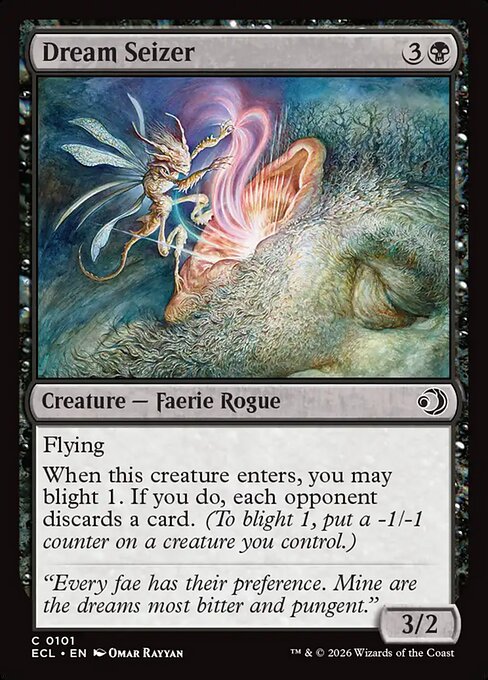
241. Dream Seizer
Rating2.8WeakWhy this rating?
Filler card but sometimes gets cut (2.8/10).
Why. A 3/2 flier for four mana, with a bonus discard from each opponent if you pay blight 1. An evasive threat that also takes a card, when the cost is worth it.
Risks. Blight 1 must go on a creature you control, often itself, turning it into a fragile 2/1. Without the blight you just have a plain 3/2 flier.
In the draft. A decent black common for decks that want fliers. A middling to fair pick, better if you have another creature to absorb the blight.
Results in the games of the set
When it is in hand, the deck wins 51.3% of its games (set average: 55.7%, 230th of 264 cards).
In the opening hand: 48.9% wins (54.5% on average).
Drawn during the game: 52.9% (56.5% on average).
When it is drawn, the deck wins 1.5 points more than when it is not.
When it is drafted, it is played 27% of the time (set average: 61%).
Taken among the first three picks (91 drafts), it ends in the deck 70% of the time.
It is played mostly in B/W decks (54% of them) and B/U (50%).

242. Bark of Doran
Rating2.4WeakWhy this rating?
Not good filler and often gets cut (2.4/10).
Why. A two-mana Equipment that gives +0/+1 and makes the creature deal damage equal to its toughness when toughness exceeds power. On a big-toughness defender it turns defense into offense. Equip costs just one mana.
Risks. It does nothing without creatures whose toughness exceeds their power, and the +0/+1 alone is weak. A niche card that needs the right support.
In the draft. Filler for defensive decks. Take it only if you already have several wide-bodied, low-power creatures; otherwise let it go.
Results in the games of the set
When it is in hand, the deck wins 49.4% of its games (set average: 55.7%, 253rd of 264 cards).
In the opening hand: 47.2% wins (54.5% on average).
Drawn during the game: 50.8% (56.5% on average).
When it is drawn, the deck wins 1.7 points less than when it is not.
When it is drafted, it is played 15% of the time (set average: 61%).
Taken among the first three picks (47 drafts), it ends in the deck 60% of the time.
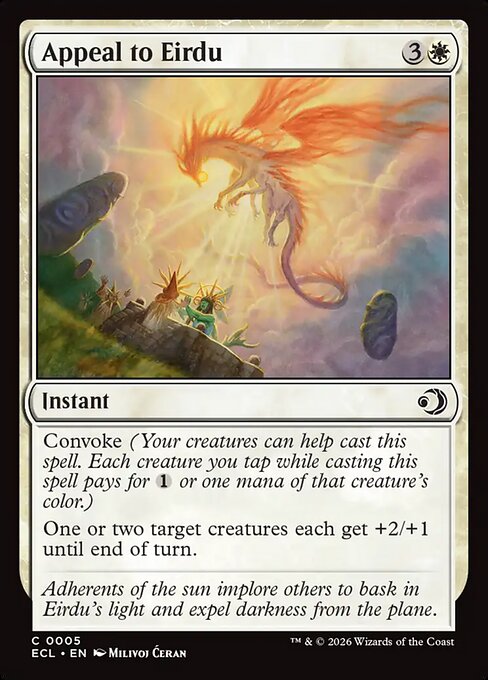
243. Appeal to Eirdu
Rating2.0WeakWhy this rating?
Not good filler and often gets cut (2.0/10).
Why. An instant that gives one or two creatures +2/+1, with convoke to lower the cost. It blows out a block or a combat and can swing tempo with a wide board.
Risks. It is a combat trick, not removal: if the opponent kills the target in response, you lose the card. It needs creatures and does nothing without combat.
In the draft. Filler for creature-heavy decks. A late pick, mainly useful in white with plenty of small bodies.
Results in the games of the set
When it is in hand, the deck wins 50.0% of its games (set average: 55.7%, 251st of 264 cards).
In the opening hand: 46.8% wins (54.5% on average).
Drawn during the game: 52.1% (56.5% on average).
When it is drawn, the deck wins 3.1 points less than when it is not.
When it is drafted, it is played only 9% of the time (set average: 61%): it almost always ends in the sideboard.

244. Blighted Blackthorn
Rating2.0WeakWhy this rating?
Not good filler and often gets cut (2.0/10).
Why. A 3/7 for five mana that draws a card (and loses you 1 life) when it enters and on each attack if you pay blight 2. A huge wall that, well fed, produces card advantage over time.
Risks. Each blight puts two -1/-1 counters on one of your creatures, possibly itself, which then shrinks. It has no evasion, so it blocks well but attacks poorly.
In the draft. A playable black common, especially in a blight deck with other creatures. A middling pick; without a blight plan it is just a big blocker.
Results in the games of the set
When it is in hand, the deck wins 50.8% of its games (set average: 55.7%, 240th of 264 cards).
In the opening hand: 47.5% wins (54.5% on average).
Drawn during the game: 53.0% (56.5% on average).
When it is drawn, the deck wins 1.0 points more than when it is not.
When it is drafted, it is played 29% of the time (set average: 61%).
Taken among the first three picks (91 drafts), it ends in the deck 68% of the time.
It is played mostly in B/W decks (62% of them).
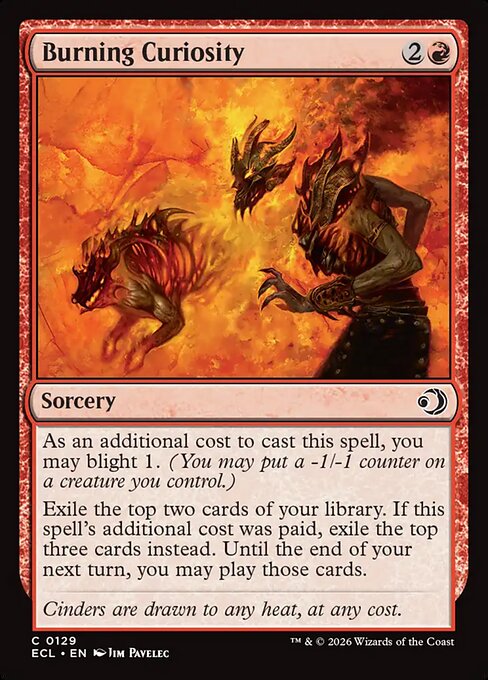
245. Burning Curiosity
Rating2.0WeakWhy this rating?
Not good filler and often gets cut (2.0/10).
Why. A sorcery that exiles the top two cards of your library, or three if you pay blight 1 as an additional cost, and lets you play them until the end of your next turn. Card advantage, if your mana keeps up.
Risks. If you cannot play the exiled cards by the end of your next turn, they are lost. It does nothing on the board and depends on what you exile.
In the draft. A fair value play in red. A middling pick, better in a low-curve deck that can use the cards quickly.
Results in the games of the set
When it is in hand, the deck wins 51.6% of its games (set average: 55.7%, 226th of 264 cards).
In the opening hand: 48.2% wins (54.5% on average).
Drawn during the game: 53.9% (56.5% on average).
When it is drawn, the deck wins 0.1 points less than when it is not.
When it is drafted, it is played 33% of the time (set average: 61%).
Taken among the first three picks (152 drafts), it ends in the deck 70% of the time.
It is played mostly in B/R decks (43% of them) and R/W (32%).
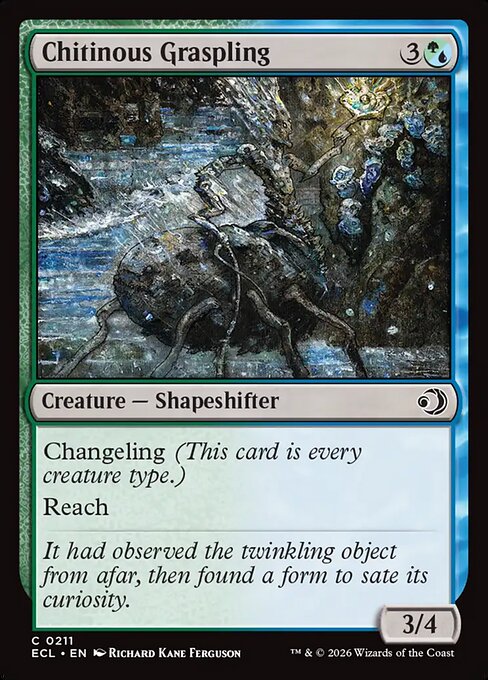
246. Chitinous Graspling
Rating2.0WeakWhy this rating?
Not good filler and often gets cut (2.0/10).
Why. A 3/4 with reach and changeling for four mana, playable in green or blue. A solid defensive body that stops fliers and counts for creature-type archetypes.
Risks. No offensive ability, so it is mostly filler. It is quickly outclassed by bigger creatures.
In the draft. A sound but unexciting four-drop for green or blue. Take it as a quality body when nothing stronger is available.
Results in the games of the set
When it is in hand, the deck wins 51.0% of its games (set average: 55.7%, 237th of 264 cards).
In the opening hand: 48.6% wins (54.5% on average).
Drawn during the game: 52.6% (56.5% on average).
When it is drawn, the deck wins 0.6 points less than when it is not.
When it is drafted, it is played 44% of the time (set average: 61%).
Taken among the first three picks (182 drafts), it ends in the deck 66% of the time.
It is played mostly in G/U decks (32% of them).

247. Eclipsed Realms
Rating2.0WeakWhy this rating?
Not good filler and often gets cut (2.0/10).
Why. A land that makes colorless mana, or one mana of any color for spells of the type chosen as it enters and abilities of sources of that type. It enters untapped, avoiding the tempo cost of tapped lands, and helps fix a deck built around one type.
Risks. The colored mana is restricted to the chosen type, so it fixes poorly in a deck without a clear type theme. In a multicolor deck with no dominant type it is often just a colorless land.
In the draft. A useful land for a tribal archetype with many creatures of the chosen type. Otherwise take it late.
Results in the games of the set
When it is in hand, the deck wins 53.7% of its games (set average: 55.7%, 172nd of 264 cards).
In the opening hand: 54.0% wins (54.5% on average).
Drawn during the game: 53.6% (56.5% on average).
When it is drawn, the deck wins 0.0 points more than when it is not.
When it is drafted, it is played 65% of the time (set average: 61%).
Taken among the first three picks (97 drafts), it ends in the deck 94% of the time.

248. Evolving Wilds
Rating2.0WeakWhy this rating?
Not good filler and often gets cut (2.0/10).
Why. A simple fixing land: it taps and sacrifices itself to fetch a basic land that enters tapped. It helps you play two colors and thins the library a little.
Risks. It costs tempo, since the fetched land enters tapped, which hurts an aggressive deck. It only fixes with the basic lands left in your library.
In the draft. Filler for two or three color decks. Take it when your fixing is weak; otherwise a low-stakes late pick.
Results in the games of the set
When it is in hand, the deck wins 54.5% of its games (set average: 55.7%, 152nd of 264 cards).
In the opening hand: 56.4% wins (54.5% on average).
Drawn during the game: 53.0% (56.5% on average).
When it is drawn, the deck wins 0.4 points more than when it is not.
When it is drafted, it is played 89% of the time (set average: 61%).
Taken as the first pick (156 drafts), it ends in the deck 91% of the time.
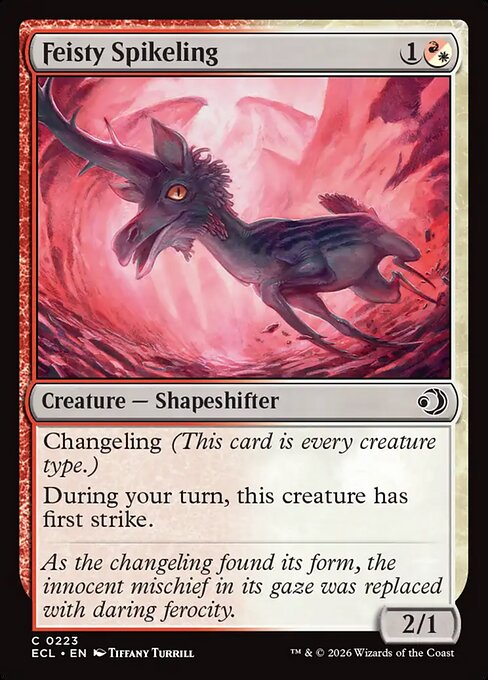
249. Feisty Spikeling
Rating2.0WeakWhy this rating?
Not good filler and often gets cut (2.0/10).
Why. A two-mana 2/1 with changeling, hybrid red-white, and first strike during your turn. It attacks well into small blockers and counts as every creature type.
Risks. A 2/1 is fragile and loses first strike on defense. It is quickly outclassed by bigger midgame creatures.
In the draft. A fair aggro two-drop for red or white. A middling pick, better if your deck has a low curve.
Results in the games of the set
When it is in hand, the deck wins 50.7% of its games (set average: 55.7%, 243rd of 264 cards).
In the opening hand: 50.8% wins (54.5% on average).
Drawn during the game: 50.6% (56.5% on average).
When it is drawn, the deck wins 1.8 points less than when it is not.
When it is drafted, it is played 60% of the time (set average: 61%).
Taken as the first pick (46 drafts), it ends in the deck 76% of the time.
It is played mostly in R/W decks (45% of them) and G/W (35%).
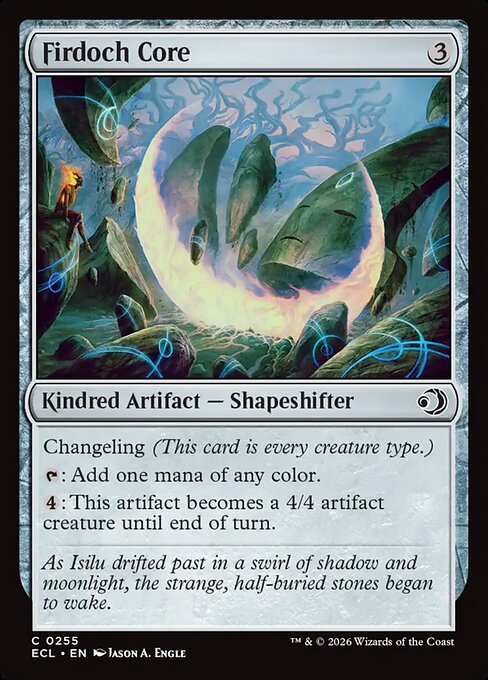
250. Firdoch Core
Rating2.0WeakWhy this rating?
Not good filler and often gets cut (2.0/10).
Why. A three-mana artifact that taps for any color, usable the turn you play it, and can become a 4/4 for four mana. It helps fixing and ramp, with a late-game backup plan.
Risks. Three mana for a mana rock is slow, and the 4/4 is expensive and lasts a single turn. It does nothing for an aggressive deck.
In the draft. Filler for three-color or controlling decks. A late pick, but useful when your fixing is weak.
Results in the games of the set
When it is in hand, the deck wins 50.8% of its games (set average: 55.7%, 241st of 264 cards).
In the opening hand: 49.1% wins (54.5% on average).
Drawn during the game: 52.0% (56.5% on average).
When it is drawn, the deck wins 1.3 points more than when it is not.
When it is drafted, it is played 29% of the time (set average: 61%).
Taken among the first three picks (83 drafts), it ends in the deck 61% of the time.

251. Glister Bairn
Rating2.0WeakWhy this rating?
Not good filler and often gets cut (2.0/10).
Why. A 1/4 that gives another creature +X/+X at the beginning of combat, X being the number of colors among your permanents. With two colors that is +2/+2 each attack: a decent combat engine.
Risks. It needs another creature to boost and costs five with three green-blue hybrid. It has almost no power of its own, and removal on it shuts the effect off.
In the draft. A fair filler pick for green-blue, or green with blue support. Take it if your deck has evasive creatures to make use of it.
Results in the games of the set
When it is in hand, the deck wins 52.3% of its games (set average: 55.7%, 217th of 264 cards).
In the opening hand: 48.9% wins (54.5% on average).
Drawn during the game: 54.4% (56.5% on average).
When it is drawn, the deck wins 2.8 points more than when it is not.
When it is drafted, it is played 54% of the time (set average: 61%).
Taken as the first pick (55 drafts), it ends in the deck 75% of the time.
It is played mostly in G/U decks (40% of them).

252. Goatnap
Rating2.0WeakWhy this rating?
Not good filler and often gets cut (2.0/10).
Why. A sorcery that steals a creature until end of turn, untaps it and gives it haste. It steals an attack or sets up a sacrifice, but removes nothing permanently.
Risks. Without a way to sacrifice the creature, you only gain one attack. It is a one-turn effect that needs a specific plan. The +3/+0 for a Goat is rarely relevant.
In the draft. A weak card outside a sacrifice deck. Do not take it before the end of the pack.
Results in the games of the set
When it is in hand, the deck wins 48.4% of its games (set average: 55.7%, 261st of 264 cards).
In the opening hand: 43.1% wins (54.5% on average).
Drawn during the game: 51.9% (56.5% on average).
When it is drawn, the deck wins 0.5 points more than when it is not.
When it is drafted, it is played only 4% of the time (set average: 61%): it almost always ends in the sideboard.

253. Impolite Entrance
Rating2.0WeakWhy this rating?
Not good filler and often gets cut (2.0/10).
Why. A one-mana sorcery that gives a creature trample and haste and draws a card. It replaces itself and wins a little tempo from a freshly played creature without haste.
Risks. Without a creature to target it is dead, and it neither kills nor protects anything: it only pushes an attack.
In the draft. One of the weakest cards in the set. Take it last, unless you are in a very aggressive deck.
Results in the games of the set
When it is in hand, the deck wins 43.6% of its games (set average: 55.7%, 264th of 264 cards).
In the opening hand: 42.9% wins (54.5% on average).
Drawn during the game: 44.1% (56.5% on average).
When it is drawn, the deck wins 4.5 points less than when it is not.
When it is drafted, it is played only 7% of the time (set average: 61%): it almost always ends in the sideboard.
 Rating2.0Weak
Why this rating?
Not good filler and often gets cut (2.0/10).
Why. An enchantment that fetches up to X basic lands to your hand, X being the number of colors among your permanents, and lets you play an extra land each turn. It guarantees land drops and fixes your colors.
Risks. It costs four mana and does nothing on the board, and the number of lands depends on your colors. A deck without a land plan gets little from it.
In the draft. A niche card for a multicolor ramp deck. Otherwise skip it.
Results in the games of the set
When it is in hand, the deck wins 48.9% of its games (set average: 55.7%, 256th of 264 cards).
In the opening hand: 45.4% wins (54.5% on average).
Drawn during the game: 51.2% (56.5% on average).
When it is drawn, the deck wins 1.5 points more than when it is not.
When it is drafted, it is played 24% of the time (set average: 61%).
Taken among the first three picks (102 drafts), it ends in the deck 70% of the time.

255. Reckless Ransacking
Rating2.0WeakWhy this rating?
Not good filler and often gets cut (2.0/10).
Why. A two-mana instant that gives a creature +3/+2 and creates a Treasure token. It wins a combat or saves a creature from a damage spell, and the Treasure helps fixing or tempo.
Risks. Like any trick, if the target dies in response you lose the card. It needs a creature and does nothing alone on the board.
In the draft. Filler for red creature decks. A late pick; the Treasure makes it a bit better than other tricks.
Results in the games of the set
When it is in hand, the deck wins 50.1% of its games (set average: 55.7%, 249th of 264 cards).
In the opening hand: 49.0% wins (54.5% on average).
Drawn during the game: 50.9% (56.5% on average).
When it is drawn, the deck wins 0.9 points more than when it is not.
When it is drafted, it is played only 9% of the time (set average: 61%): it almost always ends in the sideboard.

256. Shimmerwilds Growth
Rating2.0WeakWhy this rating?
Not good filler and often gets cut (2.0/10).
Why. A two-mana Aura on a land: it becomes the chosen color and adds an extra mana of that color whenever it is tapped for mana. Ramp and fixing for a two-mana card.
Risks. It does nothing directly on the board and loses its effect if the land goes away. The gain is slow and of little use to a deck without big spells.
In the draft. A ramp card for a green deck with big spells. Otherwise skip it.
Results in the games of the set
When it is in hand, the deck wins 50.2% of its games (set average: 55.7%, 248th of 264 cards).
In the opening hand: 49.9% wins (54.5% on average).
Drawn during the game: 50.3% (56.5% on average).
When it is drawn, the deck wins 0.3 points more than when it is not.
When it is drafted, it is played 53% of the time (set average: 61%).
Taken as the first pick (69 drafts), it ends in the deck 83% of the time.
It is played mostly in G/U decks (42% of them) and G/R (38%).

257. Spell Snare
Rating2.0WeakWhy this rating?
Not good filler and often gets cut (2.0/10).
Why. A one-mana instant that counters a spell with mana value 2. It can stop an important two-drop for almost nothing.
Risks. It only hits spells with mana value exactly 2, so it is often a dead card in hand. It depends on what the opponent casts and on you having a spare mana.
In the draft. Too narrow for draft. Play it only if nothing else is available.
Results in the games of the set
When it is in hand, the deck wins 48.7% of its games (set average: 55.7%, 257th of 264 cards).
In the opening hand: 48.8% wins (54.5% on average).
Drawn during the game: 48.6% (56.5% on average).
When it is drawn, the deck wins 0.2 points more than when it is not.
When it is drafted, it is played only 10% of the time (set average: 61%): it almost always ends in the sideboard.
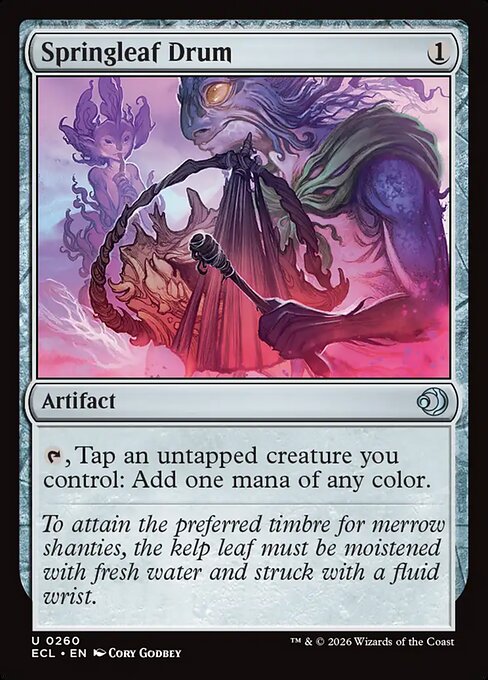
258. Springleaf Drum
Rating2.0WeakWhy this rating?
Not good filler and often gets cut (2.0/10).
Why. A one-mana artifact that taps itself and an untapped creature you control for one mana of any color. It gives fixing and light ramp in a creature-heavy deck.
Risks. It taps a creature each time, so that creature cannot attack or block, and it does nothing without creatures. Slow and marginal.
In the draft. Filler for multicolor decks with cheap creatures. A late pick.
Results in the games of the set
When it is in hand, the deck wins 50.0% of its games (set average: 55.7%, 250th of 264 cards).
In the opening hand: 51.4% wins (54.5% on average).
Drawn during the game: 49.0% (56.5% on average).
When it is drawn, the deck wins 0.5 points less than when it is not.
When it is drafted, it is played 23% of the time (set average: 61%).
Taken among the first three picks (48 drafts), it ends in the deck 44% of the time.
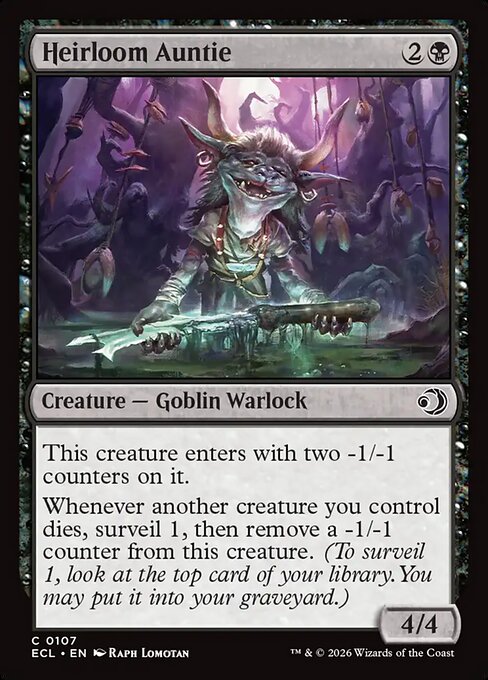
259. Heirloom Auntie
Rating1.9WeakWhy this rating?
Not good filler and often gets cut (1.9/10).
Why. A 4/4 for three mana that enters with two -1/-1 counters, so it starts as a 2/2. Whenever another creature you control dies, you surveil 1 and remove a counter, so it grows.
Risks. It is a 2/2 for three until something dies, and it only grows if your creatures die. In a deck that does not trade much it stays small.
In the draft. A weak three-drop outside a deck that trades its creatures. A late pick, better in a black-red Goblin deck.
Results in the games of the set
When it is in hand, the deck wins 48.5% of its games (set average: 55.7%, 260th of 264 cards).
In the opening hand: 47.1% wins (54.5% on average).
Drawn during the game: 49.6% (56.5% on average).
When it is drawn, the deck wins 2.4 points less than when it is not.
When it is drafted, it is played 32% of the time (set average: 61%).
Taken among the first three picks (100 drafts), it ends in the deck 80% of the time.
It is played mostly in B/R decks (60% of them) and B/W (34%).
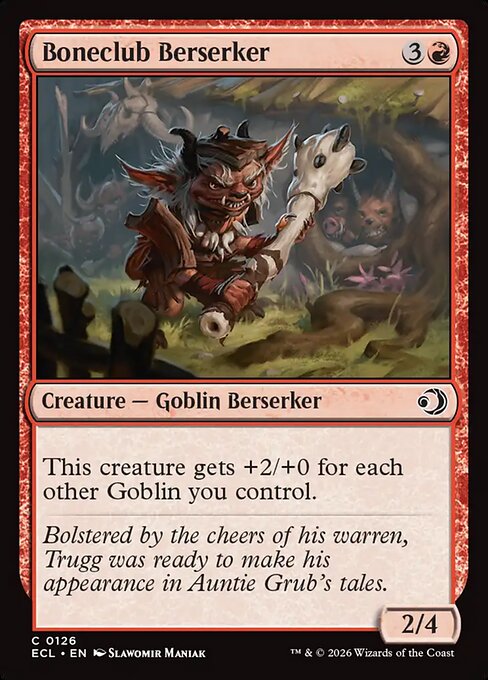
260. Boneclub Berserker
Rating1.7WeakWhy this rating?
Not good filler and often gets cut (1.7/10).
Why. A 2/4 for four mana that gets +2/+0 for each other Goblin you control. With several Goblins it becomes a real threat; alone it is an average blocker.
Risks. With no other Goblins it is a mediocre 2/4 for the price. It depends entirely on your deck.
In the draft. A card for black-red Goblin decks. A late pick outside that archetype; inside it, it is playable.
Results in the games of the set
When it is in hand, the deck wins 50.5% of its games (set average: 55.7%, 244th of 264 cards).
In the opening hand: 49.2% wins (54.5% on average).
Drawn during the game: 51.3% (56.5% on average).
When it is drawn, the deck wins 0.4 points less than when it is not.
When it is drafted, it is played 25% of the time (set average: 61%).
Taken among the first three picks (70 drafts), it ends in the deck 83% of the time.
It is played mostly in B/R decks (81% of them).

261. Chomping Changeling
Rating1.5WeakWhy this rating?
Almost unplayable and mostly sideboard material (1.5/10).
Why. A 1/2 with changeling that destroys up to one target artifact or enchantment when it enters. It answers opposing Equipment or enchantments when the chance arises.
Risks. The body is small and the ability depends on what the opponent plays. Often it has no target.
In the draft. A sideboard-style card or filler body. A late pick; worth more if you see opposing artifacts.
Results in the games of the set
When it is in hand, the deck wins 49.3% of its games (set average: 55.7%, 254th of 264 cards).
In the opening hand: 46.3% wins (54.5% on average).
Drawn during the game: 51.5% (56.5% on average).
When it is drawn, the deck wins 3.3 points less than when it is not.
When it is drafted, it is played 52% of the time (set average: 61%).
Taken as the first pick (33 drafts), it ends in the deck 70% of the time.
It is played about as much in every archetype.

262. Darkness Descends
Rating1.4WeakWhy this rating?
Almost unplayable and mostly sideboard material (1.4/10).
Why. A sorcery that puts two -1/-1 counters on each creature, yours included. A sweeper that kills creatures with toughness 2 or less, useful against an opponent who plays many small bodies.
Risks. It hits your own creatures too and does not kill big ones. You must build around it, with creatures that survive or a deck that plays after the sweep.
In the draft. A niche card for a black control deck. A late pick, unless your deck is built to benefit from it.
Results in the games of the set
When it is in hand, the deck wins 49.1% of its games (set average: 55.7%, 255th of 264 cards).
In the opening hand: 45.9% wins (54.5% on average).
Drawn during the game: 51.1% (56.5% on average).
When it is drawn, the deck wins 0.5 points more than when it is not.
When it is drafted, it is played 17% of the time (set average: 61%).
Taken among the first three picks (44 drafts), it ends in the deck 61% of the time.

263. Tend the Sprigs
Rating1.4WeakWhy this rating?
Almost unplayable and mostly sideboard material (1.4/10).
Why. A three-mana sorcery that fetches a basic land onto the battlefield tapped, then creates a 3/4 green Treefolk creature token with reach if you control at least seven permanents that are lands and/or Treefolk. Ramp with a late bonus.
Risks. The token only comes late in the game, and ramp alone is slow. Without big spells to cast, it does almost nothing.
In the draft. Green ramp filler. A late pick, unless you are in a big-spell or Treefolk deck.
Results in the games of the set
When it is in hand, the deck wins 49.6% of its games (set average: 55.7%, 252nd of 264 cards).
In the opening hand: 45.3% wins (54.5% on average).
Drawn during the game: 52.7% (56.5% on average).
When it is drawn, the deck wins 1.1 points more than when it is not.
When it is drafted, it is played 22% of the time (set average: 61%).
Taken among the first three picks (75 drafts), it ends in the deck 65% of the time.
It is played mostly in G/U decks (37% of them) and G/R (30%).

264. Wildvine Pummeler
Rating1.4WeakWhy this rating?
Almost unplayable and mostly sideboard material (1.4/10).
Why. A 6/5 with reach and trample whose cost drops by one for each color among your permanents. In a two-color deck it costs five, a huge body that stops fliers and crushes the ground.
Risks. It stays expensive until your permanents have several colors: six mana with a single color, seven with none. Removal on it is a big tempo swing.
In the draft. A decent top-end for green decks with two or more colors. A middling pick, good in one or two copies.
Results in the games of the set
When it is in hand, the deck wins 51.9% of its games (set average: 55.7%, 221st of 264 cards).
In the opening hand: 48.4% wins (54.5% on average).
Drawn during the game: 54.1% (56.5% on average).
When it is drawn, the deck wins 2.8 points more than when it is not.
When it is drafted, it is played 45% of the time (set average: 61%).
Taken as the first pick (30 drafts), it ends in the deck 63% of the time.
It is played mostly in G/U decks (61% of them) and G/R (56%).
Intrinsic ratings: they do not take into account the cards you have already picked. They matter most for the first pick of the first pack.