Card ranking · Foundations (FDN)
← Foundations271 cards
- Bomb > 8.4
- Very good ≥ 7.2
- Good ≥ 6.2
- Playable ≥ 5.0
- Weak < 5.0
Ratings are out of 10. They combine experts' opinions, the statistics of thousands of drafts by experienced players (when a card is taken, played, and the wins of the decks that play it) and what is printed on the card. Click a card to enlarge it.
 Rating9.4Bomb
Why this rating?
The best card of the set (9.4/10).
Why. A flash Equipment that protects and threatens at once. When it enters it attaches to a creature you control, granting hexproof and indestructible until end of turn, which can blank a removal spell or a bad combat. After that, +2/+0 and flying make almost any creature a real threat.
Risks. It does nothing without a creature. Re-equipping costs four mana, one of it white, so moving it is slow. The protection lasts a single turn.
In the draft. A very high pick for any white deck with enough creatures. Hold it to answer your opponent's removal rather than casting it for no reason.
Results in the games of the set
When it is in hand, the deck wins 62.2% of its games (set average: 55.7%, 7th of 274 cards).
In the opening hand: 61.0% wins (54.8% on average).
Drawn during the game: 62.9% (56.4% on average).
When it is drawn, the deck wins 7.6 points more than when it is not.
When it is drafted, it is played 89% of the time (set average: 61%).
Taken as the first pick (156 drafts), it ends in the deck 88% of the time.
It is played about as much in every archetype.
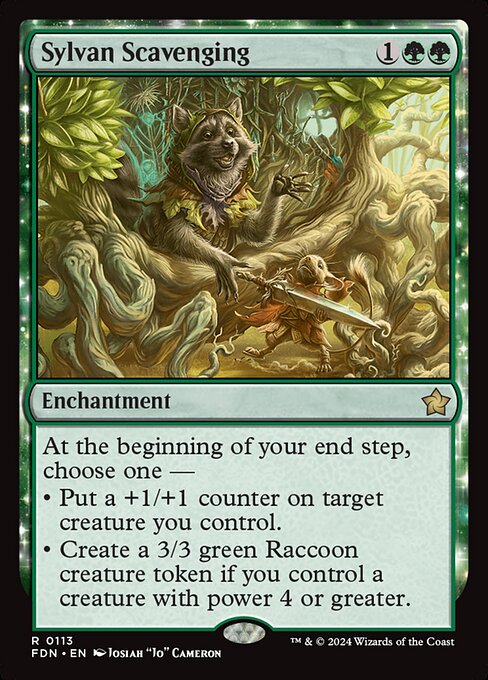 Rating9.3Bomb
Why this rating?
One of the 3 best cards of the set (9.3/10).
Why. An enchantment that generates value every single turn. At your end step you either put a +1/+1 counter on a creature you control or, if you control a creature with power 4 or greater, create a 3/3 green Raccoon creature token. The second mode takes over a game quickly.
Risks. With no creature in play the first mode does nothing. The second needs a big body already on the battlefield, and two green mana asks for a properly green deck.
In the draft. A great pick for a green deck with real creatures. The more creatures with power 4 or greater you have, the better it gets, so look for them alongside it.
Results in the games of the set
When it is in hand, the deck wins 62.0% of its games (set average: 55.7%, 10th of 274 cards).
In the opening hand: 65.0% wins (54.8% on average).
Drawn during the game: 59.9% (56.4% on average).
When it is drawn, the deck wins 8.5 points more than when it is not.
When it is drafted, it is played 89% of the time (set average: 61%).
Taken as the first pick (104 drafts), it ends in the deck 91% of the time.
It is played about as much in every archetype.
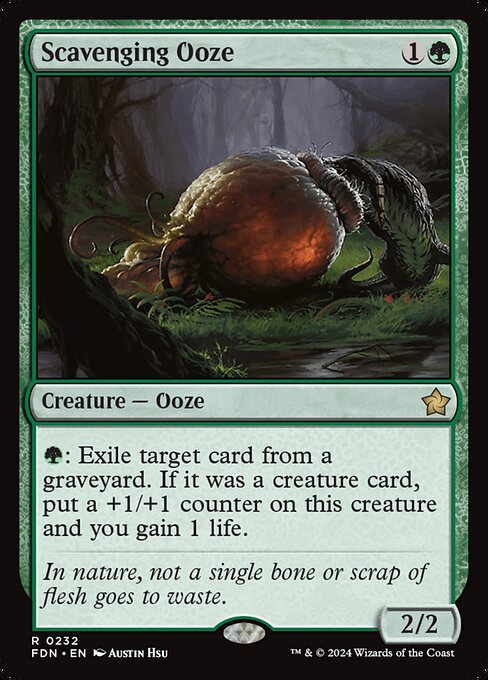 Rating9.1Bomb
Why this rating?
One of the 3 best cards of the set (9.1/10).
Why. A two-mana 2/2 that keeps growing all game. Each green mana you spend exiles a card from a graveyard and, if it was a creature card, adds a +1/+1 counter and gains you 1 life. Late in the game the graveyards are full and she becomes huge.
Risks. She starts slowly, since you need creatures in graveyards. She is still just a 2/2 against removal, and feeding her uses mana you could spend elsewhere.
In the draft. A very good pick for any green deck. She is fine early and great late, and the exile also denies the opponent graveyard recursion.
Results in the games of the set
When it is in hand, the deck wins 61.8% of its games (set average: 55.7%, 13th of 274 cards).
In the opening hand: 61.2% wins (54.8% on average).
Drawn during the game: 62.2% (56.4% on average).
When it is drawn, the deck wins 8.4 points more than when it is not.
When it is drafted, it is played 86% of the time (set average: 61%).
Taken as the first pick (139 drafts), it ends in the deck 86% of the time.
It is played about as much in every archetype.
 Rating9.0Bomb
Why this rating?
One of the 10 best cards of the set (9.0/10).
Why. A six-mana 5/5 flyer that can't be countered and refills your hand when it enters. You look at the top five cards of your library, split them into a face-down pile and a face-up pile, and the opponent chooses which goes to your hand. The other goes to your graveyard.
Risks. Six mana, including two blue. If it gets removed you still got cards, but you lost tempo. The opponent can hand you the pile that helps you least.
In the draft. Take it high in a blue deck that can afford to be a bit slow. Split your piles so that either choice is good for you.
Results in the games of the set
When it is in hand, the deck wins 62.2% of its games (set average: 55.7%, 5th of 274 cards).
In the opening hand: 59.0% wins (54.8% on average).
Drawn during the game: 64.1% (56.4% on average).
When it is drawn, the deck wins 9.3 points more than when it is not.
When it is drafted, it is played 90% of the time (set average: 61%).
Taken as the first pick (175 drafts), it ends in the deck 89% of the time.
It is played about as much in every archetype.

5. Liliana, Dreadhorde General
Rating8.9BombWhy this rating?
One of the 10 best cards of the set (8.9/10).
Why. A planeswalker that wins the game by itself if left alone. The +1 makes a 2/2 black Zombie creature token every turn, and every creature of yours that dies draws you a card. The -4 is a sweeper: each player sacrifices two creatures, and yours draw you cards.
Risks. Six mana with two black, so you have to survive to cast it. Fast or flying attackers can pressure her loyalty quickly. The -9 is rarely reached.
In the draft. An easy first pick if you are black. Use the -4 when behind, then rebuild with Zombies.
Results in the games of the set
When it is in hand, the deck wins 64.1% of its games (set average: 55.7%, 1st of 274 cards).
In the opening hand: 61.9% wins (54.8% on average).
Drawn during the game: 65.5% (56.4% on average).
When it is drawn, the deck wins 13.1 points more than when it is not.
When it is drafted, it is played 95% of the time (set average: 61%).
Taken as the first pick (31 drafts), it ends in the deck 97% of the time.
It is played about as much in every archetype.

6. Leyline Axe
Rating8.8BombWhy this rating?
One of the 10 best cards of the set (8.8/10).
Why. A colourless Equipment that fits in any deck. If it is in your opening hand you may start the game with it on the battlefield. It gives +1/+1, double strike and trample, so an average creature hits like a big one.
Risks. It costs four to cast and three to equip, so it is slow when drawn late. Double strike is worthless on a creature that does not survive.
In the draft. A good pick for almost any deck with creatures. It is especially strong in an aggressive deck, since every creature becomes a threat.
Results in the games of the set
When it is in hand, the deck wins 61.1% of its games (set average: 55.7%, 16th of 274 cards).
In the opening hand: 66.4% wins (54.8% on average).
Drawn during the game: 57.0% (56.4% on average).
When it is drawn, the deck wins 6.8 points more than when it is not.
When it is drafted, it is played 97% of the time (set average: 61%).
Taken as the first pick (121 drafts), it ends in the deck 97% of the time.
It is played about as much in every archetype.
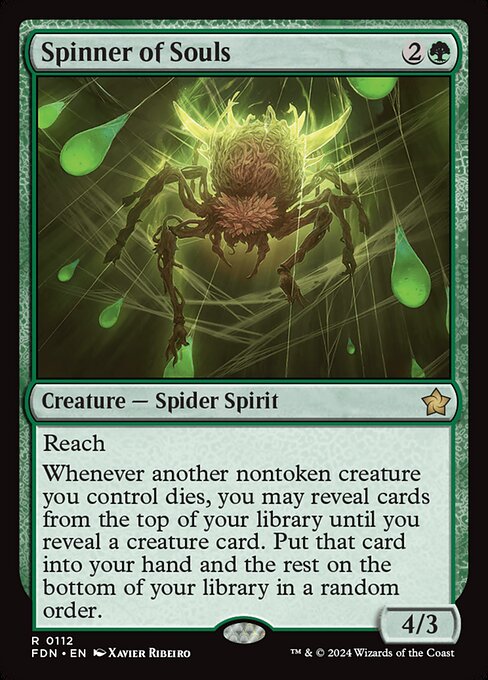 Rating8.8Bomb
Why this rating?
One of the 10 best cards of the set (8.8/10).
Why. A three-mana 4/3 with reach, which is already a very good body. Whenever another nontoken creature you control dies, you may reveal cards until you reveal a creature card and put it into your hand. Trading creatures turns into card advantage.
Risks. It is a 4/3 that dies to removal, and the ability does nothing for tokens. The rest of the revealed cards go to the bottom of your library in a random order, so your next draws change.
In the draft. A very good pick for a green deck. It is strong at every stage: a great body early and a stream of creatures late.
Results in the games of the set
When it is in hand, the deck wins 62.1% of its games (set average: 55.7%, 8th of 274 cards).
In the opening hand: 62.4% wins (54.8% on average).
Drawn during the game: 61.8% (56.4% on average).
When it is drawn, the deck wins 9.1 points more than when it is not.
When it is drafted, it is played 88% of the time (set average: 61%).
Taken as the first pick (117 drafts), it ends in the deck 87% of the time.
It is played about as much in every archetype.
 Rating8.7Bomb
Why this rating?
One of the 10 best cards of the set (8.7/10).
Why. A seven-mana planeswalker that does several things at once. The +2 adds three red mana and exiles the top three cards of your library, one of which you may play this turn. The +1 makes a hasty copy of one of your creatures for a turn. The -4 deals 8 damage divided as you choose, a targeted sweeper.
Risks. Seven mana with two red is very expensive, especially if you are behind on board. The two other exiled cards are lost. She does not defend herself.
In the draft. A very good pick for a red deck that plays the long game. In a fast deck seven mana is too much.
Results in the games of the set
When it is in hand, the deck wins 61.8% of its games (set average: 55.7%, 12th of 274 cards).
In the opening hand: 58.2% wins (54.8% on average).
Drawn during the game: 64.2% (56.4% on average).
When it is drawn, the deck wins 9.2 points more than when it is not.
When it is drafted, it is played 87% of the time (set average: 61%).
Taken as the first pick (66 drafts), it ends in the deck 88% of the time.
It is played about as much in every archetype.
 Rating8.6Bomb
Why this rating?
One of the 10 best cards of the set (8.6/10).
Why. A one-drop that gets better the more mana you pour into it. First a 2/1 for a red mana, then a Detective that exiles a card whenever it deals combat damage to a player (you may play it this turn), then a 3/2 with double strike. It has a use at every stage of the game.
Risks. It is fragile, and both upgrades cost mana that does not develop your board. A block or a removal spell kills it before it does anything.
In the draft. A very good pick for an aggressive red deck. Much weaker in a slow deck that can't attack with it.
Results in the games of the set
When it is in hand, the deck wins 59.2% of its games (set average: 55.7%, 28th of 274 cards).
In the opening hand: 63.0% wins (54.8% on average).
Drawn during the game: 56.2% (56.4% on average).
When it is drawn, the deck wins 4.1 points more than when it is not.
When it is drafted, it is played 86% of the time (set average: 61%).
Taken as the first pick (126 drafts), it ends in the deck 90% of the time.
It is played about as much in every archetype.
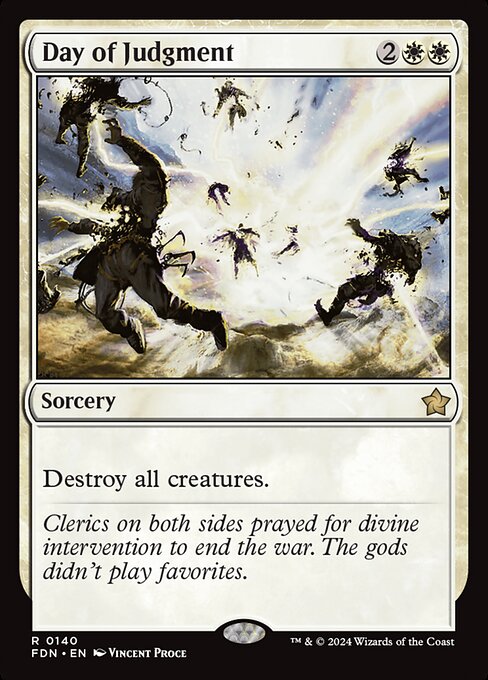
10. Day of Judgment
Rating8.5BombWhy this rating?
One of the 10 best cards of the set (8.5/10).
Why. A simple sweeper: destroy all creatures. When you are behind on board it resets the game. In a deck with planeswalkers, Equipment, or other non-creature threats, it is a powerful tool.
Risks. It destroys your own creatures too. In a creature deck it often comes at the wrong time. It is dead when you are already ahead on board.
In the draft. An interesting pick for a slower white control deck. Avoid it in an aggressive deck, and take it lower if you like to attack.
Results in the games of the set
When it is in hand, the deck wins 59.4% of its games (set average: 55.7%, 23rd of 274 cards).
In the opening hand: 58.0% wins (54.8% on average).
Drawn during the game: 60.4% (56.4% on average).
When it is drawn, the deck wins 5.6 points more than when it is not.
When it is drafted, it is played 82% of the time (set average: 61%).
Taken as the first pick (117 drafts), it ends in the deck 88% of the time.
It is played about as much in every archetype.
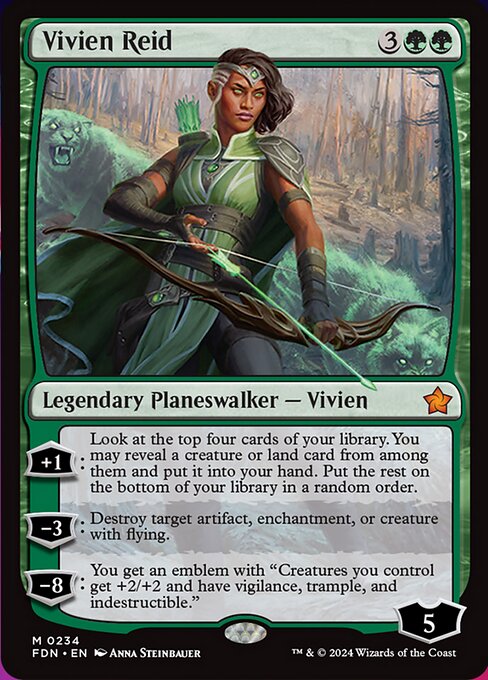
11. Vivien Reid
Rating8.5BombWhy this rating?
One of the very best mythics of the format (8.5/10).
Why. A five-mana planeswalker that gives card advantage. The +1 looks at the top four cards and lets you take a creature or land. The -3 destroys an artifact, an enchantment, or a creature with flying, a good answer to air threats.
Risks. She does not protect the board herself. The -3 leaves her with very little loyalty, and the +1 does not win the game alone. Two green mana are required.
In the draft. A good pick for a green deck that can defend its planeswalker with creatures. She is especially valuable against flying decks.
Results in the games of the set
When it is in hand, the deck wins 62.1% of its games (set average: 55.7%, 9th of 274 cards).
In the opening hand: 59.7% wins (54.8% on average).
Drawn during the game: 63.7% (56.4% on average).
When it is drawn, the deck wins 9.4 points more than when it is not.
When it is drafted, it is played 85% of the time (set average: 61%).
Taken as the first pick (40 drafts), it ends in the deck 83% of the time.
It is played about as much in every archetype.
 Rating8.4Very good
Why this rating?
One of the very best rares of the format (8.4/10).
Why. An aggressive two-drop. With Raid, at the beginning of your end step, if you attacked this turn, you create a 1/1 red Goblin creature token. Each turn that you attack with anything, you add another body to the board.
Risks. It is a 2/1 that dies to almost anything, and Raid needs an attack, so you need an attacker willing to go in. It is mediocre in a deck without pressure.
In the draft. A good pick for an aggressive red deck. Take it higher if you have good cheap creatures to attack early.
Results in the games of the set
When it is in hand, the deck wins 60.4% of its games (set average: 55.7%, 20th of 274 cards).
In the opening hand: 63.1% wins (54.8% on average).
Drawn during the game: 58.3% (56.4% on average).
When it is drawn, the deck wins 5.3 points more than when it is not.
When it is drafted, it is played 87% of the time (set average: 61%).
Taken as the first pick (140 drafts), it ends in the deck 85% of the time.
It is played about as much in every archetype.
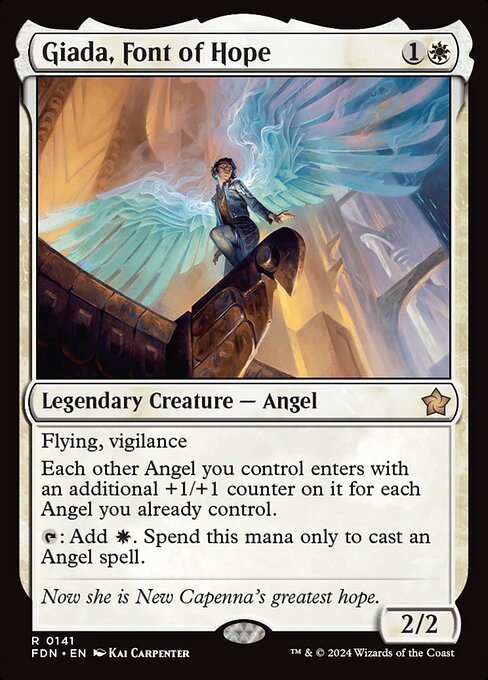 Rating8.3Very good
Why this rating?
One of the very best rares of the format (8.3/10).
Why. A two-drop with flying and vigilance, a good early body. Each other Angel you control enters with an additional +1/+1 counter for each Angel you already control. Her mana can only be spent on Angel spells.
Risks. Without other Angels she is just a 2/2 flyer, and her mana is limited to Angel spells. She dies to any removal.
In the draft. A good pick for a white deck even without many Angels. She improves a lot if you have several, so look for them alongside her.
Results in the games of the set
When it is in hand, the deck wins 60.3% of its games (set average: 55.7%, 22nd of 274 cards).
In the opening hand: 63.2% wins (54.8% on average).
Drawn during the game: 58.1% (56.4% on average).
When it is drawn, the deck wins 5.9 points more than when it is not.
When it is drafted, it is played 91% of the time (set average: 61%).
Taken as the first pick (128 drafts), it ends in the deck 90% of the time.
It is played about as much in every archetype.
 Rating8.2Very good
Why this rating?
One of the very best rares of the format (8.2/10).
Why. A three-drop that gives you two bodies at once: when she enters, you create a 1/1 white Cat creature token. Your other Cats get +1/+1, so the token is a 2/2. Every nontoken Cat that enters later also creates a token.
Risks. She is much weaker without other Cats. A removal spell kills her and leaves the token without the bonus.
In the draft. A good pick for white even with few Cats. She is already two bodies for three mana.
Results in the games of the set
When it is in hand, the deck wins 60.8% of its games (set average: 55.7%, 17th of 274 cards).
In the opening hand: 62.1% wins (54.8% on average).
Drawn during the game: 59.9% (56.4% on average).
When it is drawn, the deck wins 6.5 points more than when it is not.
When it is drafted, it is played 89% of the time (set average: 61%).
Taken as the first pick (146 drafts), it ends in the deck 87% of the time.
It is played about as much in every archetype.
 Rating8.2Very good
Why this rating?
One of the very best rares of the format (8.2/10).
Why. A three-mana 3/2 that filters your hand: draw two, then discard two, which also fills your graveyard. With Threshold, when she attacks and you have seven or more cards in your graveyard, you may create a legendary 8/8 blue Octopus creature token.
Risks. Drawing two and discarding two leaves your card count the same, so the value comes from the filtering. Threshold takes time, and a 3/2 attacker is easily blocked or killed first.
In the draft. A good pick for a blue deck that fills its graveyard. In a deck with no way to fill it she is mediocre.
Results in the games of the set
When it is in hand, the deck wins 60.6% of its games (set average: 55.7%, 19th of 274 cards).
In the opening hand: 59.7% wins (54.8% on average).
Drawn during the game: 61.1% (56.4% on average).
When it is drawn, the deck wins 7.7 points more than when it is not.
When it is drafted, it is played 91% of the time (set average: 61%).
Taken as the first pick (161 drafts), it ends in the deck 93% of the time.
It is played about as much in every archetype.

16. Valkyrie's Call
Rating8.1Very goodWhy this rating?
One of the very best mythics of the format (8.1/10).
Why. An enchantment that makes your creatures sticky. Whenever a nontoken, non-Angel creature you control dies, it returns with a +1/+1 counter, flying, and the Angel type. With many creatures, every death becomes a favourable trade.
Risks. Five mana for an effect that does nothing by itself: it does not act on the board the turn you cast it. It does not work with tokens, and exile effects get around it.
In the draft. A middling pick for a slow white deck with many creatures. In a typical deck it is too slow and you can do without it.
Results in the games of the set
When it is in hand, the deck wins 57.3% of its games (set average: 55.7%, 67th of 274 cards).
In the opening hand: 56.0% wins (54.8% on average).
Drawn during the game: 58.1% (56.4% on average).
When it is drawn, the deck wins 3.9 points more than when it is not.
When it is drafted, it is played 87% of the time (set average: 61%).
Taken as the first pick (57 drafts), it ends in the deck 86% of the time.
It is played about as much in every archetype.
 Rating8.0Very good
Why this rating?
One of the very best mythics of the format (8.0/10).
Why. A five-mana 5/5 with flying and deathtouch: it attacks and blocks very well. Whenever an opponent loses life, you gain that much life. Games where it survives end quickly in your favour.
Risks. It costs two black mana and dies to removal. Against decks full of removal it may do nothing.
In the draft. A very good pick for any black deck. It is hard to fight in combat and swings life-total races.
Results in the games of the set
When it is in hand, the deck wins 62.2% of its games (set average: 55.7%, 6th of 274 cards).
In the opening hand: 59.9% wins (54.8% on average).
Drawn during the game: 63.7% (56.4% on average).
When it is drawn, the deck wins 11.8 points more than when it is not.
When it is drafted, it is played 94% of the time (set average: 61%).
Taken as the first pick (48 drafts), it ends in the deck 98% of the time.
It is played about as much in every archetype.

18. Faebloom Trick
Rating7.9Very goodWhy this rating?
One of the very best uncommons of the format (7.9/10).
Why. A three-mana instant that creates two 1/1 blue Faerie creature tokens with flying, then taps a creature an opponent controls. Use it to tap a blocker before an attack, or to tap an attacker before combat on their turn while keeping two flying blockers.
Risks. Two 1/1 tokens are fragile and weigh little alone. It does not solve a big enemy threat, it only slows it down.
In the draft. A good pick for a blue deck with flyers or token payoffs. Cast it before combat, never at the end of the opponent's turn, where the tap would be wasted.
Results in the games of the set
When it is in hand, the deck wins 59.3% of its games (set average: 55.7%, 26th of 274 cards).
In the opening hand: 57.3% wins (54.8% on average).
Drawn during the game: 60.6% (56.4% on average).
When it is drawn, the deck wins 5.1 points more than when it is not.
When it is drafted, it is played 90% of the time (set average: 61%).
Taken as the first pick (305 drafts), it ends in the deck 94% of the time.
It is played mostly in R/U decks (41% of them) and U/W (36%).

19. Skyknight Squire
Rating7.9Very goodWhy this rating?
One of the very best rares of the format (7.9/10).
Why. A two-mana 1/1 that grows. Whenever another creature enters under your control, it gets a +1/+1 counter, and with three or more counters it has flying and becomes a Knight. The more cheap creatures you play, the more it becomes a real threat.
Risks. It starts weak and dies to any removal. In a deck with few creatures it stays a useless 1/1.
In the draft. A decent pick for a white deck full of creatures. Play it early, on turn two, to get the most out of it.
Results in the games of the set
When it is in hand, the deck wins 58.9% of its games (set average: 55.7%, 31st of 274 cards).
In the opening hand: 63.0% wins (54.8% on average).
Drawn during the game: 55.9% (56.4% on average).
When it is drawn, the deck wins 4.8 points more than when it is not.
When it is drafted, it is played 90% of the time (set average: 61%).
Taken as the first pick (116 drafts), it ends in the deck 89% of the time.
It is played about as much in every archetype.
 Rating7.8Very good
Why this rating?
One of the very best uncommons of the format (7.8/10).
Why. A three-mana instant removal spell: 5 damage to a creature, which kills almost anything. It also exiles an Equipment attached to the target, and the creature is exiled instead if it would die this turn. It beats graveyard recursion.
Risks. It only hits creatures, not planeswalkers. Creatures with toughness 6 or more survive it.
In the draft. A solid, high-priority pick for a red deck. It is the kind of removal you are happy to draw in almost every game.
Results in the games of the set
When it is in hand, the deck wins 58.3% of its games (set average: 55.7%, 42nd of 274 cards).
In the opening hand: 57.4% wins (54.8% on average).
Drawn during the game: 59.0% (56.4% on average).
When it is drawn, the deck wins 3.1 points more than when it is not.
When it is drafted, it is played 88% of the time (set average: 61%).
Taken as the first pick (262 drafts), it ends in the deck 94% of the time.
It is played mostly in R/U decks (34% of them) and G/R (33%).

21. Empyrean Eagle
Rating7.7Very goodWhy this rating?
One of the very best uncommons of the format (7.7/10).
Why. A three-mana 2/3 flyer that gives other creatures you control with flying +1/+1. In a deck with many flyers, it makes every air attacker hit harder.
Risks. It needs both white and blue, so it only fits in a white-blue deck. Without other flyers it is just a 2/3 flyer with no bonus.
In the draft. A good pick for a white-blue deck with flyers. In other decks, do not take it early.
Results in the games of the set
When it is in hand, the deck wins 59.2% of its games (set average: 55.7%, 29th of 274 cards).
In the opening hand: 58.4% wins (54.8% on average).
Drawn during the game: 59.7% (56.4% on average).
When it is drawn, the deck wins 3.9 points more than when it is not.
When it is drafted, it is played 70% of the time (set average: 61%).
Taken as the first pick (148 drafts), it ends in the deck 82% of the time.
It is played mostly in U/W decks (79% of them).
 Rating7.6Very good
Why this rating?
One of the very best rares of the format (7.6/10).
Why. A five-mana sorcery that makes each player sacrifice thirteen creatures, which is almost a full sweeper. If there are thirteen or more creatures on the battlefield, you may pay a black mana instead. It resets the board when you are behind.
Risks. It hits your own creatures too, so it is poor in an aggressive deck. Five mana is a lot, and it is dead when you are ahead on board.
In the draft. An interesting pick for a black control deck. Avoid it in a deck full of creatures.
Results in the games of the set
When it is in hand, the deck wins 59.4% of its games (set average: 55.7%, 24th of 274 cards).
In the opening hand: 56.4% wins (54.8% on average).
Drawn during the game: 61.3% (56.4% on average).
When it is drawn, the deck wins 6.6 points more than when it is not.
When it is drafted, it is played 90% of the time (set average: 61%).
Taken as the first pick (177 drafts), it ends in the deck 93% of the time.
It is played about as much in every archetype.
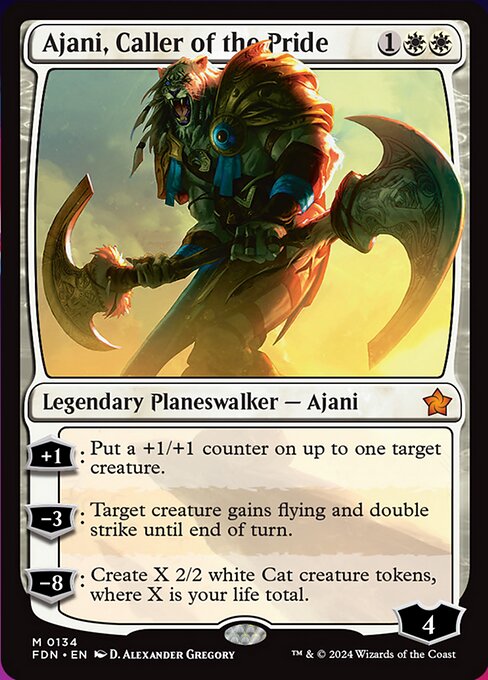
23. Ajani, Caller of the Pride
Rating7.6Very goodWhy this rating?
One of the very best mythics of the format (7.6/10).
Why. A three-mana planeswalker that improves your creatures. The +1 puts a +1/+1 counter on a creature, so your board grows turn after turn. The -3 gives flying and double strike until end of turn, a surprise finisher.
Risks. He does not protect himself. Without creatures he does nothing useful, and the -8 is rarely reached. Two white mana.
In the draft. A good pick for a white deck with creatures. Cast him when you already have a board that can defend him.
Results in the games of the set
When it is in hand, the deck wins 58.0% of its games (set average: 55.7%, 50th of 274 cards).
In the opening hand: 58.3% wins (54.8% on average).
Drawn during the game: 57.8% (56.4% on average).
When it is drawn, the deck wins 4.1 points more than when it is not.
When it is drafted, it is played 90% of the time (set average: 61%).
Taken as the first pick (42 drafts), it ends in the deck 83% of the time.
It is played about as much in every archetype.
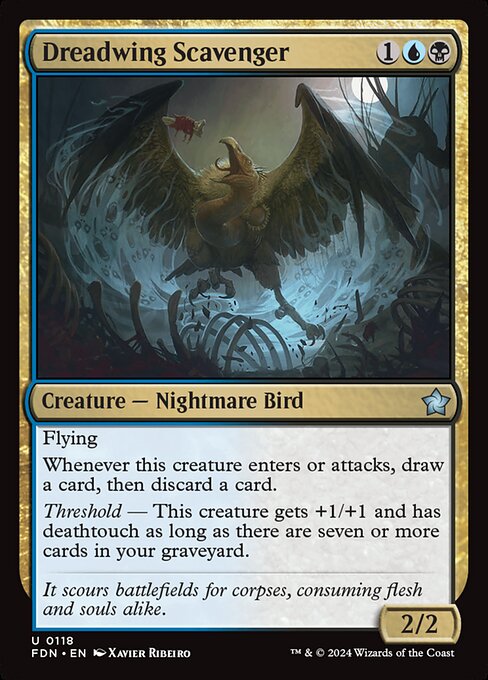 Rating7.6Very good
Why this rating?
One of the very best uncommons of the format (7.6/10).
Why. A three-mana 2/2 flyer that filters your cards. When it enters or attacks, you draw a card, then discard a card. With Threshold it gets +1/+1 and deathtouch. It is a good air attacker that also improves your hand.
Risks. It costs one blue and one black mana, so it is limited to a blue-black deck. It is a fragile 2/2 until Threshold.
In the draft. A very good pick for a blue-black deck. The filtering also fills your graveyard for Threshold.
Results in the games of the set
When it is in hand, the deck wins 61.4% of its games (set average: 55.7%, 14th of 274 cards).
In the opening hand: 59.9% wins (54.8% on average).
Drawn during the game: 62.3% (56.4% on average).
When it is drawn, the deck wins 9.1 points more than when it is not.
When it is drafted, it is played 79% of the time (set average: 61%).
Taken as the first pick (237 drafts), it ends in the deck 87% of the time.
It is played mostly in B/U decks (52% of them).
 Rating7.6Very good
Why this rating?
One of the very best uncommons of the format (7.6/10).
Why. A two-mana 3/1 with lifelink, good early. With Kicker, for four mana in total, it returns a nonland permanent card with mana value 2 or less from your graveyard to the battlefield. It is useful both early and late.
Risks. It has only one toughness and dies to almost anything. The Kicker needs a good permanent in your graveyard.
In the draft. A good pick for a white deck, especially an aggressive one. Hold it for the Kicker if you have already lost a good cheap permanent.
Results in the games of the set
When it is in hand, the deck wins 58.7% of its games (set average: 55.7%, 36th of 274 cards).
In the opening hand: 57.9% wins (54.8% on average).
Drawn during the game: 59.3% (56.4% on average).
When it is drawn, the deck wins 3.3 points more than when it is not.
When it is drafted, it is played 90% of the time (set average: 61%).
Taken as the first pick (334 drafts), it ends in the deck 93% of the time.
It is played mostly in R/W decks (32% of them) and U/W (31%).

26. Slagstorm
Rating7.5Very goodWhy this rating?
One of the very best rares of the format (7.6/10).
Why. A three-mana sorcery that deals 3 damage to each creature, or 3 damage to each player. It clears a board of small creatures. The second mode can help finish a game.
Risks. It kills your own creatures too and does not touch big ones. In a creature deck it is often counterproductive. Two red mana.
In the draft. A niche pick for a red control deck. Few draft decks use it well.
Results in the games of the set
When it is in hand, the deck wins 55.6% of its games (set average: 55.7%, 113th of 274 cards).
In the opening hand: 54.0% wins (54.8% on average).
Drawn during the game: 56.7% (56.4% on average).
When it is drawn, the deck wins 2.5 points more than when it is not.
When it is drafted, it is played 60% of the time (set average: 61%).
Taken as the first pick (39 drafts), it ends in the deck 74% of the time.
It is played about as much in every archetype.
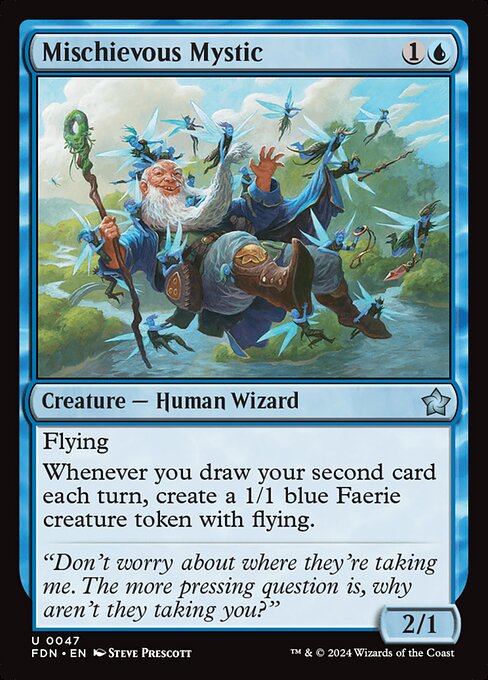 Rating7.5Very good
Why this rating?
A solid uncommon of the format (7.5/10).
Why. A two-mana 2/1 flyer. Whenever you draw your second card each turn, you create a 1/1 blue Faerie creature token with flying. With draw effects, it generates air threats continuously.
Risks. It has one toughness and dies easily. Without extra card draw it is just a 2/1 flyer.
In the draft. A good pick for a blue deck, especially with card draw effects. It is already fine on its own.
Results in the games of the set
When it is in hand, the deck wins 60.4% of its games (set average: 55.7%, 21st of 274 cards).
In the opening hand: 61.5% wins (54.8% on average).
Drawn during the game: 59.7% (56.4% on average).
When it is drawn, the deck wins 6.8 points more than when it is not.
When it is drafted, it is played 92% of the time (set average: 61%).
Taken as the first pick (366 drafts), it ends in the deck 95% of the time.
It is played mostly in U/W decks (40% of them) and B/U (39%).

28. Abrade
Rating7.4Very goodWhy this rating?
A solid uncommon of the format (7.4/10).
Why. A flexible two-mana instant: 3 damage to a creature, or destroy an artifact. It kills cheap small creatures and answers Equipment or other artifacts.
Risks. Three damage does not kill big creatures. The artifact mode depends on what the opponent plays.
In the draft. A solid pick for a red deck. Take it without hesitation if you are short on removal.
Results in the games of the set
When it is in hand, the deck wins 57.3% of its games (set average: 55.7%, 65th of 274 cards).
In the opening hand: 57.1% wins (54.8% on average).
Drawn during the game: 57.6% (56.4% on average).
When it is drawn, the deck wins 2.3 points more than when it is not.
When it is drafted, it is played 88% of the time (set average: 61%).
Taken as the first pick (203 drafts), it ends in the deck 95% of the time.
It is played mostly in R/U decks (35% of them) and G/R (34%).
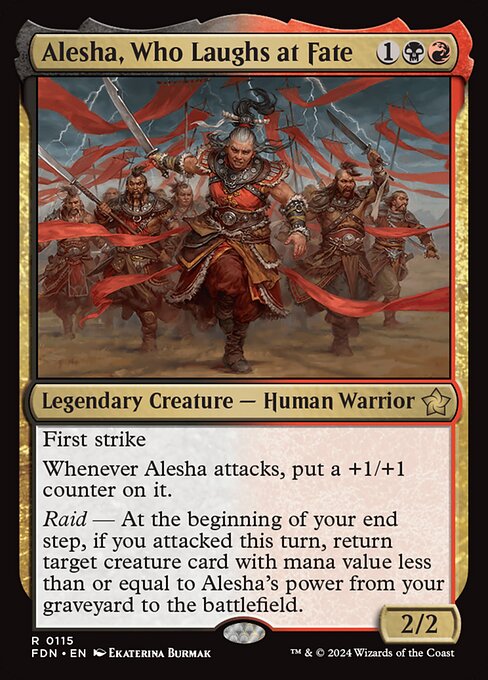
29. Alesha, Who Laughs at Fate
Rating7.4Very goodWhy this rating?
A very good rare of the format (7.4/10).
Why. A 2/2 with first strike that puts a +1/+1 counter on itself whenever it attacks. With Raid, at your end step if you attacked this turn, it returns a creature card with mana value less than or equal to its power from your graveyard to the battlefield. Every attack generates value.
Risks. She needs to survive combat to grow, and her two colours, black and red, limit her. A good early block neutralizes her.
In the draft. A very good pick for an aggressive black-red deck. Attack as soon as you can so she grows.
Results in the games of the set
When it is in hand, the deck wins 61.9% of its games (set average: 55.7%, 11th of 274 cards).
In the opening hand: 62.5% wins (54.8% on average).
Drawn during the game: 61.6% (56.4% on average).
When it is drawn, the deck wins 10.1 points more than when it is not.
When it is drafted, it is played 83% of the time (set average: 61%).
Taken as the first pick (122 drafts), it ends in the deck 83% of the time.
It is played mostly in B/R decks (31% of them).
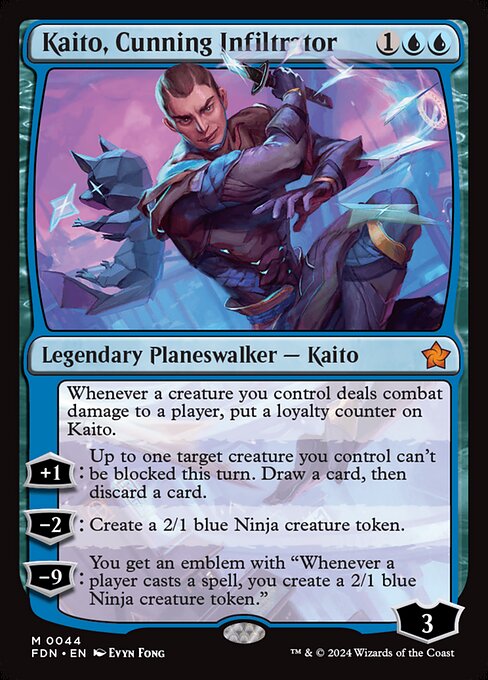
30. Kaito, Cunning Infiltrator
Rating7.4Very goodWhy this rating?
A very good mythic of the format (7.4/10).
Why. A three-mana planeswalker that rewards attacking. The +1 makes a creature of yours unblockable and lets you loot. The -2 creates a 2/1 blue Ninja creature token. Each creature of yours that connects with a player adds a loyalty counter to him.
Risks. He needs creatures of your own to be good and is vulnerable to attacks. Without a good board he falls quickly. Two blue mana.
In the draft. A decent pick for a blue deck with creatures and evasion. Cast him when the board is in your favour.
Results in the games of the set
When it is in hand, the deck wins 58.7% of its games (set average: 55.7%, 38th of 274 cards).
In the opening hand: 57.4% wins (54.8% on average).
Drawn during the game: 59.5% (56.4% on average).
When it is drawn, the deck wins 6.2 points more than when it is not.
When it is drafted, it is played 89% of the time (set average: 61%).
Taken as the first pick (61 drafts), it ends in the deck 92% of the time.
It is played about as much in every archetype.
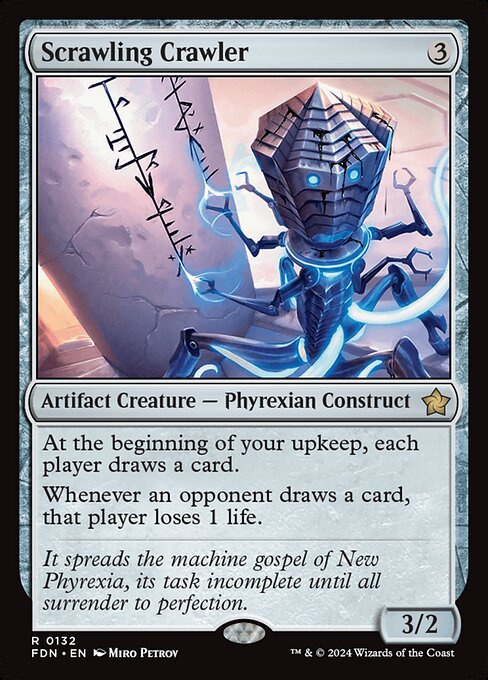 Rating7.4Very good
Why this rating?
A very good rare of the format (7.4/10).
Why. A three-mana colourless 3/2 artifact creature that fits in any deck. At the beginning of your upkeep each player draws a card, and whenever an opponent draws a card, that player loses 1 life, on their own turn too. It is a clock that also gives the opponent cards.
Risks. The opponent draws as many cards as you do. It is a fragile 3/2 that dies to removal, and it helps an opponent with a better deck.
In the draft. A decent pick for an aggressive deck, preferably when you have creatures to win the race. Avoid it if you are behind.
Results in the games of the set
When it is in hand, the deck wins 58.1% of its games (set average: 55.7%, 48th of 274 cards).
In the opening hand: 57.7% wins (54.8% on average).
Drawn during the game: 58.4% (56.4% on average).
When it is drawn, the deck wins 4.1 points more than when it is not.
When it is drafted, it is played 97% of the time (set average: 61%).
Taken as the first pick (138 drafts), it ends in the deck 99% of the time.
It is played about as much in every archetype.

32. Spectral Sailor
Rating7.4Very goodWhy this rating?
A solid uncommon of the format (7.4/10).
Why. A one-mana 1/1 flyer with Flash. Later, for four mana, you draw a card: it gives you a mana sink for the late game. It can ambush-block or attack in the air.
Risks. It is a 1/1: it dies to anything and attacks weakly. Drawing costs four mana each time.
In the draft. A good pick for a blue deck, especially control or tempo. It is solid but not exceptional.
Results in the games of the set
When it is in hand, the deck wins 58.8% of its games (set average: 55.7%, 33rd of 274 cards).
In the opening hand: 57.9% wins (54.8% on average).
Drawn during the game: 59.4% (56.4% on average).
When it is drawn, the deck wins 5.2 points more than when it is not.
When it is drafted, it is played 91% of the time (set average: 61%).
Taken as the first pick (292 drafts), it ends in the deck 93% of the time.
It is played mostly in U/W decks (34% of them) and B/U (32%).
 Rating7.4Very good
Why this rating?
A very good mythic of the format (7.4/10).
Why. A 1/4 that makes your board grow. At the beginning of combat on your turn, she puts a +1/+1 counter on each of up to two target creatures you control. For a green and a blue mana plus tapping, she doubles the counters on up to two targets. She takes over a game quickly.
Risks. She needs green and blue, so a specific deck. Without creatures to improve she does little, and she dies to removal.
In the draft. A very good pick for a green-blue deck with creatures. Counters stack up fast, so play her early.
Results in the games of the set
When it is in hand, the deck wins 62.5% of its games (set average: 55.7%, 3rd of 274 cards).
In the opening hand: 61.7% wins (54.8% on average).
Drawn during the game: 63.0% (56.4% on average).
When it is drawn, the deck wins 12.8 points more than when it is not.
When it is drafted, it is played 87% of the time (set average: 61%).
Taken as the first pick (57 drafts), it ends in the deck 77% of the time.
It is played about as much in every archetype.
 Rating7.4Very good
Why this rating?
A very good rare of the format (7.4/10).
Why. A four-mana 4/4 with lifelink that gains life as it attacks. When your life total is greater than your starting life total, she gets +1/+1 and has menace, then another +5/+5 when you are at least 10 above it. Hexproof from instants means instants can't target her.
Risks. She needs white and black. Sorceries, enchantments and abilities can still target her, and removal that is not an instant kills her.
In the draft. A very good pick for a white-black deck. She is good early and becomes huge once you gain life.
Results in the games of the set
When it is in hand, the deck wins 61.2% of its games (set average: 55.7%, 15th of 274 cards).
In the opening hand: 61.2% wins (54.8% on average).
Drawn during the game: 61.1% (56.4% on average).
When it is drawn, the deck wins 9.2 points more than when it is not.
When it is drafted, it is played 87% of the time (set average: 61%).
Taken as the first pick (151 drafts), it ends in the deck 88% of the time.
It is played about as much in every archetype.
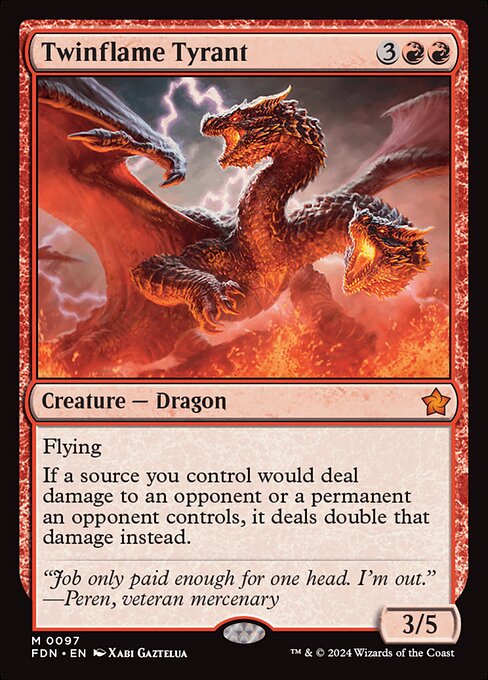
35. Twinflame Tyrant
Rating7.3Very goodWhy this rating?
A very good mythic of the format (7.3/10).
Why. A 3/5 flying Dragon that doubles all damage your sources deal to the opponent and their permanents. Your creatures, burn spells and attacks all scale up: a small ground attacker suddenly becomes a real threat.
Risks. It costs five mana with two red, and it does nothing on its own if your board has no threats. One removal spell answers it, and you have spent a full turn for nothing.
In the draft. Take it early if you are red, especially in an aggressive or burn-heavy deck. The red pairs with black, white or green play it best.
Results in the games of the set
When it is in hand, the deck wins 60.7% of its games (set average: 55.7%, 18th of 274 cards).
In the opening hand: 57.7% wins (54.8% on average).
Drawn during the game: 62.9% (56.4% on average).
When it is drawn, the deck wins 6.8 points more than when it is not.
When it is drafted, it is played 85% of the time (set average: 61%).
Taken as the first pick (58 drafts), it ends in the deck 79% of the time.
It is played about as much in every archetype.

36. Micromancer
Rating7.2Very goodWhy this rating?
A solid uncommon of the format (7.2/10).
Why. A 3/3 for four that tutors up an instant or sorcery with mana value 1 when it enters. You get a solid body plus an extra card, usually your cheap removal or a combat trick.
Risks. Its value depends on how many one-mana spells are in your deck: with no target it is just a vanilla 3/3. It has no flying or combat ability.
In the draft. A good pick in blue if you already have a few one-mana spells to fetch. Count them before putting it in your main deck.
Results in the games of the set
When it is in hand, the deck wins 59.4% of its games (set average: 55.7%, 25th of 274 cards).
In the opening hand: 57.3% wins (54.8% on average).
Drawn during the game: 60.6% (56.4% on average).
When it is drawn, the deck wins 5.1 points more than when it is not.
When it is drafted, it is played 70% of the time (set average: 61%).
Taken as the first pick (201 drafts), it ends in the deck 75% of the time.
It is played mostly in B/U decks (53% of them) and R/U (37%).

37. Drake Hatcher
Rating7.2Very goodWhy this rating?
A very good rare of the format (7.2/10).
Why. A two-mana 1/3 with vigilance and prowess that blocks well early. Every time it connects with a player it stacks incubation counters, and every three of them can become a 2/2 blue Drake creature token with flying.
Risks. It has to actually hit the opponent, which is hard against bigger blockers. On its own it is slow to produce Drakes.
In the draft. A solid two-drop for a spell-heavy blue deck. Take it higher if you have enough instants and sorceries to trigger prowess.
Results in the games of the set
When it is in hand, the deck wins 56.9% of its games (set average: 55.7%, 74th of 274 cards).
In the opening hand: 59.5% wins (54.8% on average).
Drawn during the game: 55.1% (56.4% on average).
When it is drawn, the deck wins 4.2 points more than when it is not.
When it is drafted, it is played 89% of the time (set average: 61%).
Taken as the first pick (127 drafts), it ends in the deck 87% of the time.
It is played about as much in every archetype.
 Rating7.2Very good
Why this rating?
A very good rare of the format (7.2/10).
Why. A two-mana 1/3 that blocks well. It exiles cards the opponent discards and lets you play them during your turn with mana of any type. For four mana including a black one, tapping it forces a discard, at sorcery speed.
Risks. Without opposing discard it is just a small, slow blocker. Forcing a discard costs four mana and taps it, so it takes your whole turn.
In the draft. Fine in a grindy black control deck that wants long games. Do not take it over good creatures or removal.
Results in the games of the set
When it is in hand, the deck wins 57.4% of its games (set average: 55.7%, 63rd of 274 cards).
In the opening hand: 59.2% wins (54.8% on average).
Drawn during the game: 56.1% (56.4% on average).
When it is drawn, the deck wins 4.4 points more than when it is not.
When it is drafted, it is played 89% of the time (set average: 61%).
Taken as the first pick (124 drafts), it ends in the deck 94% of the time.
It is played about as much in every archetype.
 Rating7.2Good
Why this rating?
A very good rare of the format (7.2/10).
Why. A two-mana enchantment that gives all your creatures +1/+1. In a deck of small creatures and tokens it wins combats and trades, and speeds up the game.
Risks. It needs both green and white, and does nothing without creatures. Against an empty board or a sweeper it brings nothing.
In the draft. Only take it if you are green-white with lots of creatures. In other decks it is not worth a pick over real creatures.
Results in the games of the set
When it is in hand, the deck wins 56.0% of its games (set average: 55.7%, 99th of 274 cards).
In the opening hand: 56.8% wins (54.8% on average).
Drawn during the game: 55.3% (56.4% on average).
When it is drawn, the deck wins 3.5 points more than when it is not.
When it is drafted, it is played 62% of the time (set average: 61%).
Taken as the first pick (53 drafts), it ends in the deck 79% of the time.
It is played mostly in G/W decks (27% of them).

40. Essence Scatter
Rating7.1GoodWhy this rating?
A solid uncommon of the format (7.1/10).
Why. A two-mana counterspell for creature spells. It answers the opponent's most expensive card for minimal cost, and you can hold it while you develop your own plays.
Risks. It does nothing against noncreature spells, and creatures already on the battlefield are out of reach. You must leave two mana open, which costs tempo.
In the draft. A decent pick for a blue tempo or control deck. Avoid taking more than one or two copies.
Results in the games of the set
When it is in hand, the deck wins 58.4% of its games (set average: 55.7%, 41st of 274 cards).
In the opening hand: 57.3% wins (54.8% on average).
Drawn during the game: 59.0% (56.4% on average).
When it is drawn, the deck wins 4.8 points more than when it is not.
When it is drafted, it is played 89% of the time (set average: 61%).
Taken as the first pick (196 drafts), it ends in the deck 96% of the time.
It is played mostly in R/U decks (37% of them) and B/U (36%).

41. Felling Blow
Rating7.0GoodWhy this rating?
A solid uncommon of the format (7.0/10).
Why. A three-mana removal: it puts a +1/+1 counter on your creature, then that creature deals damage equal to its power to an opposing creature. You improve your board and kill a target in a single spell.
Risks. It needs a creature of yours on the battlefield, and it is cast as a sorcery. If the opponent kills your creature in response, the target survives.
In the draft. A very good removal for any green deck, especially with big creatures. Take it without hesitation in green.
Results in the games of the set
When it is in hand, the deck wins 59.1% of its games (set average: 55.7%, 30th of 274 cards).
In the opening hand: 58.1% wins (54.8% on average).
Drawn during the game: 59.8% (56.4% on average).
When it is drawn, the deck wins 4.9 points more than when it is not.
When it is drafted, it is played 87% of the time (set average: 61%).
Taken as the first pick (182 drafts), it ends in the deck 95% of the time.
It is played mostly in G/R decks (37% of them) and G/W (35%).

42. Ashroot Animist
Rating7.0GoodWhy this rating?
A very good rare of the format (7.0/10).
Why. A 4/4 for four with trample. Whenever it attacks, another creature gains trample and +X/+X, where X is its power: a single attack can swing combat and end the game.
Risks. It needs both red and green, and another creature to benefit from its bonus: without one, nothing. A removal spell before the attack or a double block neutralizes it.
In the draft. Take it in red-green, where it is a very good four-drop. Look for other creatures to take advantage of its bonus.
Results in the games of the set
When it is in hand, the deck wins 58.9% of its games (set average: 55.7%, 32nd of 274 cards).
In the opening hand: 59.0% wins (54.8% on average).
Drawn during the game: 58.8% (56.4% on average).
When it is drawn, the deck wins 5.7 points more than when it is not.
When it is drafted, it is played 73% of the time (set average: 61%).
Taken as the first pick (78 drafts), it ends in the deck 77% of the time.
It is played mostly in G/R decks (31% of them).
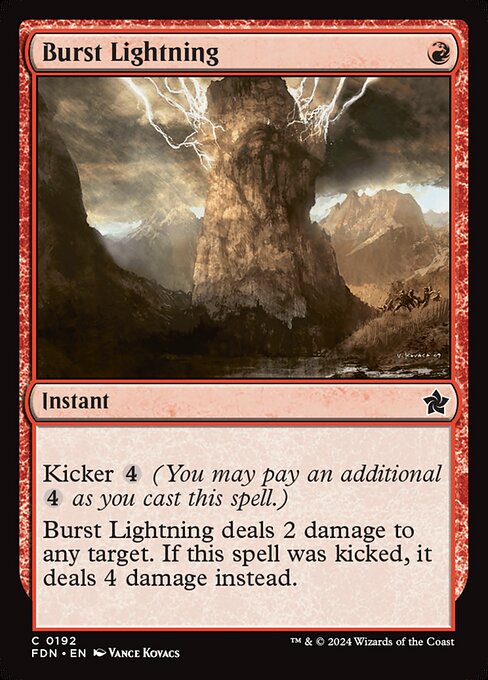
43. Burst Lightning
Rating7.0GoodWhy this rating?
One of the best commons of the format (7.0/10).
Why. A one-mana red instant that deals 2 damage to any target, or 4 when kicked. It is flexible removal: cheap early, and strong enough late to kill a big creature or finish a player.
Risks. Two damage does not kill bigger creatures. The kicked version needs five mana in total.
In the draft. A very good common to take in red. The red pairs with black, blue or white use it best.
Results in the games of the set
When it is in hand, the deck wins 58.3% of its games (set average: 55.7%, 43rd of 274 cards).
In the opening hand: 57.0% wins (54.8% on average).
Drawn during the game: 59.3% (56.4% on average).
When it is drawn, the deck wins 3.1 points more than when it is not.
When it is drafted, it is played 87% of the time (set average: 61%).
Taken as the first pick (615 drafts), it ends in the deck 93% of the time.
It is played mostly in R/U decks (70% of them) and G/R (67%).
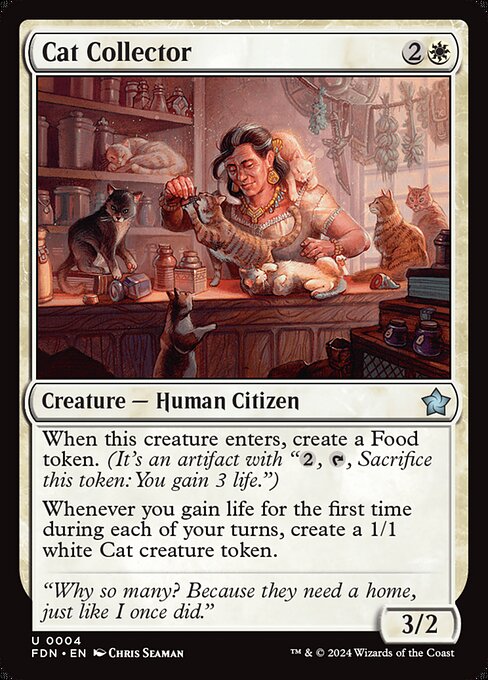
44. Cat Collector
Rating7.0GoodWhy this rating?
A solid uncommon of the format (7.0/10).
Why. A 3/2 for three that creates a Food token when it enters and a 1/1 white Cat creature token the first time you gain life each turn. With the Food it produces a Cat almost on its own, giving steady value.
Risks. Its 3/2 body is fragile. Without other lifegain sources you depend on the Food (two mana and a turn) to get a Cat token.
In the draft. A very good uncommon in white, especially with white-black, white-blue or white-green. Take it ahead of most three-drops.
Results in the games of the set
When it is in hand, the deck wins 58.7% of its games (set average: 55.7%, 37th of 274 cards).
In the opening hand: 57.9% wins (54.8% on average).
Drawn during the game: 59.2% (56.4% on average).
When it is drawn, the deck wins 3.4 points more than when it is not.
When it is drafted, it is played 89% of the time (set average: 61%).
Taken as the first pick (316 drafts), it ends in the deck 94% of the time.
It is played mostly in B/W decks (31% of them) and U/W (31%).
 Rating7.0Good
Why this rating?
A very good rare of the format (7.0/10).
Why. A 3/3 flying Angel for four. Whenever you gain life it gets a +1/+1 counter, and the first counter each turn draws you a card: it grows and gives you card advantage.
Risks. Without lifegain it remains a plain 3/3 flier. It needs two white mana and a removal spell stops it before it grows.
In the draft. A very good pick in white, especially with black, blue or green. Look for lifegain sources to give it value.
Results in the games of the set
When it is in hand, the deck wins 59.3% of its games (set average: 55.7%, 27th of 274 cards).
In the opening hand: 58.2% wins (54.8% on average).
Drawn during the game: 60.0% (56.4% on average).
When it is drawn, the deck wins 5.6 points more than when it is not.
When it is drafted, it is played 90% of the time (set average: 61%).
Taken as the first pick (119 drafts), it ends in the deck 91% of the time.
It is played about as much in every archetype.
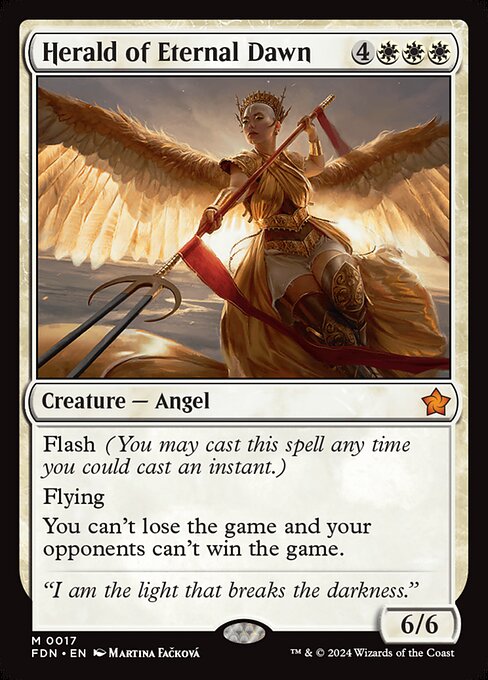 Rating7.0Good
Why this rating?
A very good mythic of the format (7.0/10).
Why. A 6/6 flying Angel with flash, costing seven mana with three white. It can ambush an attacker as a blocker, and while it is out you cannot lose the game and your opponents cannot win it.
Risks. Seven mana is very heavy, and the triple white makes it hard outside a nearly mono-white deck. A removal spell answers it and you have lost your top end.
In the draft. A decent finisher for a white control deck. Take only one, and only after your good cheap cards.
Results in the games of the set
When it is in hand, the deck wins 57.5% of its games (set average: 55.7%, 61st of 274 cards).
In the opening hand: 54.9% wins (54.8% on average).
Drawn during the game: 59.2% (56.4% on average).
When it is drawn, the deck wins 3.6 points more than when it is not.
When it is drafted, it is played 79% of the time (set average: 61%).
Taken as the first pick (53 drafts), it ends in the deck 87% of the time.
It is played about as much in every archetype.
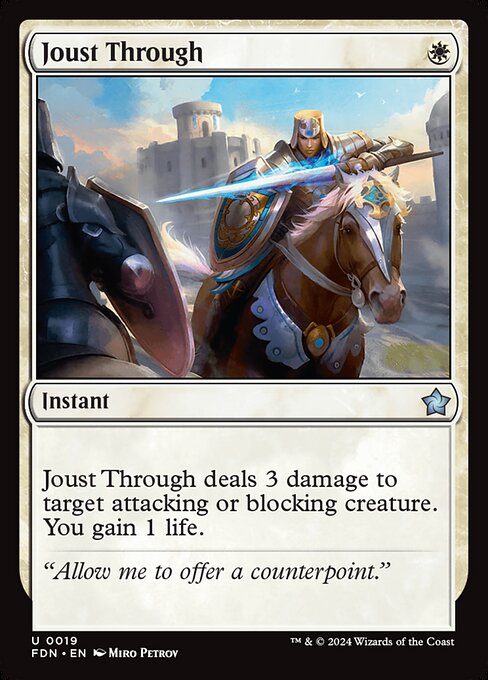
47. Joust Through
Rating7.0GoodWhy this rating?
A solid uncommon of the format (7.0/10).
Why. A one-mana white instant that deals 3 damage to an attacking or blocking creature and gains you 1 life. It is very efficient removal for almost no cost, and the life matters for lifegain payoffs.
Risks. It only hits creatures that attack or block: a creature that stays back is out of reach. Three damage does not kill the biggest ones.
In the draft. A good cheap removal in white, worth taking fairly high. It is especially useful in a lifegain deck.
Results in the games of the set
When it is in hand, the deck wins 56.4% of its games (set average: 55.7%, 91st of 274 cards).
In the opening hand: 55.6% wins (54.8% on average).
Drawn during the game: 57.0% (56.4% on average).
When it is drawn, the deck wins 1.5 points more than when it is not.
When it is drafted, it is played 87% of the time (set average: 61%).
Taken as the first pick (119 drafts), it ends in the deck 93% of the time.
It is played mostly in U/W decks (28% of them).
 Rating7.0Good
Why this rating?
A very good mythic of the format (7.0/10).
Why. A colorless 7/7 for seven with reach, first strike, vigilance, menace, trample, lifelink and ward (pay 7 life). It attacks, blocks, heals you and resists almost everything: it can win the game on its own.
Risks. Seven mana takes a long time to reach, and it does nothing in the turns before. A sweeper, a forced sacrifice or any non-targeted effect can still handle it.
In the draft. Being colorless, it fits any slower or controlling deck. Take one, but make sure you have enough lands and cheap cards.
Results in the games of the set
When it is in hand, the deck wins 62.3% of its games (set average: 55.7%, 4th of 274 cards).
In the opening hand: 58.8% wins (54.8% on average).
Drawn during the game: 64.7% (56.4% on average).
When it is drawn, the deck wins 10.2 points more than when it is not.
When it is drafted, it is played 98% of the time (set average: 61%).
Taken among the first three picks (253 drafts), it ends in the deck 98% of the time.
It is played about as much in every archetype.
 Rating7.0Good
Why this rating?
A very good rare of the format (7.0/10).
Why. A land that taps for colorless mana and can become a 3/3 creature with vigilance for four mana. It is both a land and a late-game threat, without taking a spell slot.
Risks. It makes no colored mana, which can hurt a multicolor deck. Animating it costs four mana, and it stays a creature afterwards, so it dies like one.
In the draft. A decent utility land for a well-built two-color deck. Do not take it before good playables.
Results in the games of the set
When it is in hand, the deck wins 57.3% of its games (set average: 55.7%, 66th of 274 cards).
In the opening hand: 55.7% wins (54.8% on average).
Drawn during the game: 58.4% (56.4% on average).
When it is drawn, the deck wins 2.3 points more than when it is not.
When it is drafted, it is played 82% of the time (set average: 61%).
Taken as the first pick (44 drafts), it ends in the deck 89% of the time.
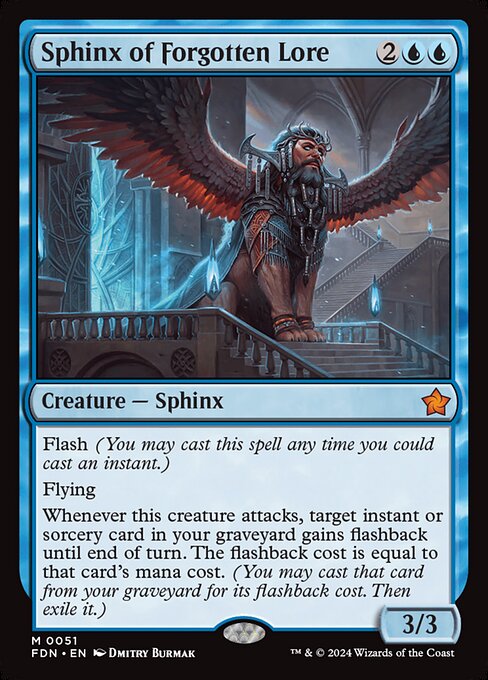 Rating7.0Good
Why this rating?
A very good mythic of the format (7.0/10).
Why. A 3/3 flying creature with flash for four. Whenever it attacks, it gives flashback to an instant or sorcery in your graveyard at that card's mana cost: you replay your removal or card draw.
Risks. It needs two blue mana. With no instants or sorceries in the graveyard its ability does nothing, and it has to attack to trigger it.
In the draft. A good pick in blue, especially in a spell-rich deck. Flash lets you play it at the end of the opponent's turn.
Results in the games of the set
When it is in hand, the deck wins 58.0% of its games (set average: 55.7%, 49th of 274 cards).
In the opening hand: 55.1% wins (54.8% on average).
Drawn during the game: 59.7% (56.4% on average).
When it is drawn, the deck wins 5.9 points more than when it is not.
When it is drafted, it is played 89% of the time (set average: 61%).
Taken as the first pick (65 drafts), it ends in the deck 91% of the time.
It is played about as much in every archetype.
 Rating6.9Good
Why this rating?
A very good rare of the format (6.9/10).
Why. A 3/2 for three that taps to exile a creature card put into a graveyard this turn and create a token copy of it. After a combat where creatures die, it grabs the best one.
Risks. It needs two black mana, its 3/2 body is fragile, and it must be untapped to use its ability, so it does nothing the turn it arrives. The ability does nothing until a creature has died this turn.
In the draft. A middling pick in black, better in a deck full of trades. Take it after removal and good creatures.
Results in the games of the set
When it is in hand, the deck wins 55.8% of its games (set average: 55.7%, 104th of 274 cards).
In the opening hand: 55.8% wins (54.8% on average).
Drawn during the game: 55.8% (56.4% on average).
When it is drawn, the deck wins 2.9 points more than when it is not.
When it is drafted, it is played 92% of the time (set average: 61%).
Taken as the first pick (166 drafts), it ends in the deck 93% of the time.
It is played about as much in every archetype.
 Rating6.8Good
Why this rating?
A solid uncommon of the format (6.8/10).
Why. A four-mana instant that deals 10 damage to the targeted player, but only if they have exactly 10 life. It is an extremely situational card.
Risks. It does nothing almost all the time. You need the opponent to land on exactly 10 life, which is rarely under your control.
In the draft. Do not play it in general: it is a weak draft card. Let it go by unless you are curious.
Results in the games of the set
When it is in hand, the deck wins 56.5% of its games (set average: 55.7%, 89th of 274 cards).
In the opening hand: 53.3% wins (54.8% on average).
Drawn during the game: 58.9% (56.4% on average).
When it is drawn, the deck wins 2.0 points more than when it is not.
When it is drafted, it is played only 9% of the time (set average: 61%): it almost always ends in the sideboard.
 Rating6.8Good
Why this rating?
A solid uncommon of the format (6.8/10).
Why. A 3/4 for four that, whenever you attack, gives one of your creatures +1/+0 and menace. It makes an attacker hard to block each turn, and its body survives a lot of burn.
Risks. It does not hit hard itself, and its bonus only matters if you have other creatures ready to attack. A deck without pressure does not use it well.
In the draft. A good pick for an aggressive red deck, with black, green or white. It is stronger when you already have a good creature to attack with.
Results in the games of the set
When it is in hand, the deck wins 57.9% of its games (set average: 55.7%, 52nd of 274 cards).
In the opening hand: 57.4% wins (54.8% on average).
Drawn during the game: 58.3% (56.4% on average).
When it is drawn, the deck wins 2.0 points more than when it is not.
When it is drafted, it is played 80% of the time (set average: 61%).
Taken as the first pick (129 drafts), it ends in the deck 89% of the time.
It is played mostly in G/R decks (42% of them) and B/R (36%).
 Rating6.8Good
Why this rating?
A very good rare of the format (6.8/10).
Why. A 5/3 flier for five that can sacrifice another creature when it attacks to gain a +1/+1 counter. Whenever another nontoken creature dies, yours or the opponent's, you draw a card.
Risks. It needs two black mana, and its toughness of 3 makes it vulnerable to removal. Sacrificing a nontoken creature draws you a card, but still costs you a body.
In the draft. A very good black rare for a deck that trades a lot. The black pairs with white, blue or red play it well.
Results in the games of the set
When it is in hand, the deck wins 58.7% of its games (set average: 55.7%, 35th of 274 cards).
In the opening hand: 56.4% wins (54.8% on average).
Drawn during the game: 60.2% (56.4% on average).
When it is drawn, the deck wins 6.0 points more than when it is not.
When it is drafted, it is played 93% of the time (set average: 61%).
Taken as the first pick (147 drafts), it ends in the deck 93% of the time.
It is played about as much in every archetype.
 Rating6.8Good
Why this rating?
A solid uncommon of the format (6.8/10).
Why. A two-mana red-green 1/2 with haste that taps for red or green mana. It speeds up your development and attacks as a 3/4 if you control a creature with power 4 or greater.
Risks. Alone it is a small, fragile creature, and its bonus needs a big creature. It is limited to two specific colors.
In the draft. A very good two-drop for a red-green deck with big creatures. Elsewhere, do not take it.
Results in the games of the set
When it is in hand, the deck wins 56.9% of its games (set average: 55.7%, 76th of 274 cards).
In the opening hand: 59.5% wins (54.8% on average).
Drawn during the game: 54.6% (56.4% on average).
When it is drawn, the deck wins 0.9 points more than when it is not.
When it is drafted, it is played 57% of the time (set average: 61%).
Taken as the first pick (68 drafts), it ends in the deck 79% of the time.
It is played mostly in G/R decks (59% of them).
 Rating6.8Good
Why this rating?
A very good rare of the format (6.8/10).
Why. A 2/2 Golem for four that fetches a basic land onto the battlefield tapped, then lets you draw a card when it dies. It ramps your mana, fixes your colors and never loses value.
Risks. Its 2/2 body is small for four mana. It has little impact on the board and ramps less late in the game.
In the draft. A solid value pick for any deck, especially three-color or splash decks. Not a priority, but never dead in your deck.
Results in the games of the set
When it is in hand, the deck wins 56.7% of its games (set average: 55.7%, 83rd of 274 cards).
In the opening hand: 56.2% wins (54.8% on average).
Drawn during the game: 57.0% (56.4% on average).
When it is drawn, the deck wins 4.0 points more than when it is not.
When it is drafted, it is played 95% of the time (set average: 61%).
Taken as the first pick (119 drafts), it ends in the deck 96% of the time.
It is played about as much in every archetype.
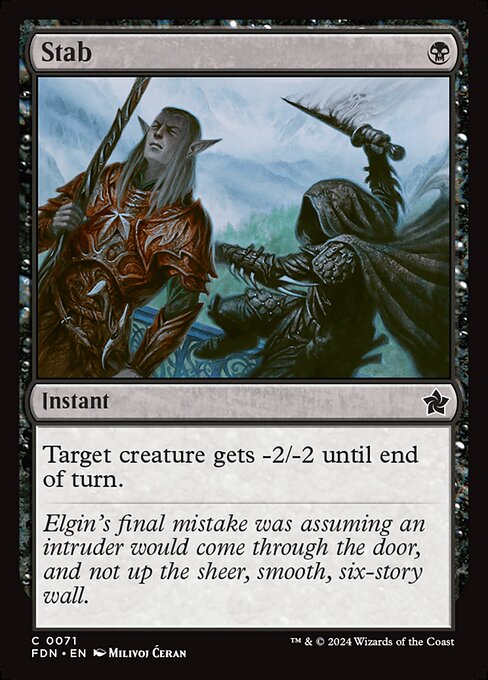
57. Stab
Rating6.8GoodWhy this rating?
One of the best commons of the format (6.8/10).
Why. A one-mana black instant that gives a creature -2/-2 until end of turn. It is very cheap removal against small creatures, and it also works as a combat trick.
Risks. It only kills creatures with toughness 2 or less. Bigger ones survive, except in combat.
In the draft. A good black common, worth playing in reasonable numbers. The black pairs with white, blue or red use it well.
Results in the games of the set
When it is in hand, the deck wins 58.0% of its games (set average: 55.7%, 51st of 274 cards).
In the opening hand: 57.0% wins (54.8% on average).
Drawn during the game: 58.6% (56.4% on average).
When it is drawn, the deck wins 4.5 points more than when it is not.
When it is drafted, it is played 91% of the time (set average: 61%).
Taken as the first pick (691 drafts), it ends in the deck 95% of the time.
It is played mostly in B/U decks (70% of them) and B/W (60%).
 Rating6.8Good
Why this rating?
A very good rare of the format (6.8/10).
Why. A 3/4 white-blue flier for four. Whenever you cast a noncreature spell, you choose: create a 1/1 white Spirit creature token with flying, or exile another creature of yours and return it at the beginning of the next end step, replaying its enters effect.
Risks. It needs both white and blue, and a good number of noncreature spells to produce value. A removal spell answers it quickly.
In the draft. A good pick in white-blue, especially with many instants and sorceries. Outside that pair, pass it.
Results in the games of the set
When it is in hand, the deck wins 57.7% of its games (set average: 55.7%, 56th of 274 cards).
In the opening hand: 56.9% wins (54.8% on average).
Drawn during the game: 58.2% (56.4% on average).
When it is drawn, the deck wins 4.9 points more than when it is not.
When it is drafted, it is played 78% of the time (set average: 61%).
Taken as the first pick (131 drafts), it ends in the deck 77% of the time.
It is played mostly in U/W decks (29% of them).

59. Banishing Light
Rating6.7GoodWhy this rating?
One of the best commons of the format (6.7/10).
Why. A three-mana enchantment that exiles an opposing nonland permanent for as long as it stays on the battlefield. It answers almost any threat: creature, artifact, enchantment or planeswalker.
Risks. If the enchantment is destroyed or bounced, the target comes back. It is slow and cannot deal with lands.
In the draft. A very good white common, worth taking fairly high. The white pairs with black, blue or green use it well.
Results in the games of the set
When it is in hand, the deck wins 57.5% of its games (set average: 55.7%, 60th of 274 cards).
In the opening hand: 55.5% wins (54.8% on average).
Drawn during the game: 58.9% (56.4% on average).
When it is drawn, the deck wins 2.4 points more than when it is not.
When it is drafted, it is played 91% of the time (set average: 61%).
Taken as the first pick (555 drafts), it ends in the deck 95% of the time.
It is played mostly in U/W decks (58% of them) and B/W (55%).
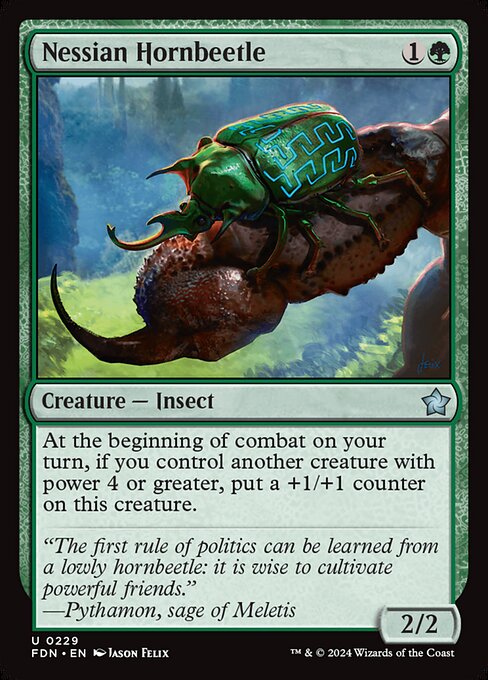 Rating6.6Good
Why this rating?
A solid uncommon of the format (6.6/10).
Why. A two-mana green 2/2 that gets a +1/+1 counter at the beginning of combat on your turn if you control another creature with power 4 or greater. With big creatures it grows every turn.
Risks. Without another creature of power 4 or more it stays a vanilla 2/2. It is a conditional card.
In the draft. A good two-drop for a green deck with big creatures. Look for those creatures alongside it, for example in red-green.
Results in the games of the set
When it is in hand, the deck wins 56.9% of its games (set average: 55.7%, 73rd of 274 cards).
In the opening hand: 58.1% wins (54.8% on average).
Drawn during the game: 55.9% (56.4% on average).
When it is drawn, the deck wins 1.9 points more than when it is not.
When it is drafted, it is played 88% of the time (set average: 61%).
Taken as the first pick (145 drafts), it ends in the deck 95% of the time.
It is played mostly in G/R decks (46% of them) and G/W (40%).
 Rating6.6Good
Why this rating?
A solid uncommon of the format (6.6/10).
Why. A 3/4 flying Angel for four that exiles a player's graveyard when it enters. Its solid flying body is a good threat, and the exile can deny the opponent threshold or graveyard effects.
Risks. Exiling a graveyard does not always have a useful target. Without it, it is a vanilla 3/4 flier with no other ability.
In the draft. A good white four-drop, playable in any white deck. Take it ahead of most creatures at the same cost.
Results in the games of the set
When it is in hand, the deck wins 56.6% of its games (set average: 55.7%, 88th of 274 cards).
In the opening hand: 55.6% wins (54.8% on average).
Drawn during the game: 57.2% (56.4% on average).
When it is drawn, the deck wins 1.6 points more than when it is not.
When it is drafted, it is played 84% of the time (set average: 61%).
Taken as the first pick (135 drafts), it ends in the deck 93% of the time.
It is played mostly in U/W decks (26% of them).
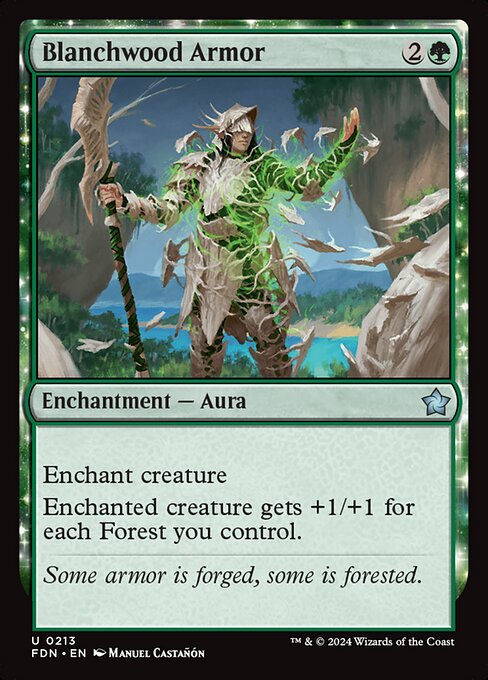
62. Blanchwood Armor
Rating6.6GoodWhy this rating?
A solid uncommon of the format (6.6/10).
Why. A three-mana Aura that gives +1/+1 for each Forest you control. In a nearly mono-green deck the enchanted creature becomes huge very fast.
Risks. Like any Aura, you lose two cards if the creature is killed in response. It is weak if you have few Forests.
In the draft. Only for a green deck with plenty of Forests. In a two-color deck it is too risky.
Results in the games of the set
When it is in hand, the deck wins 53.2% of its games (set average: 55.7%, 184th of 274 cards).
In the opening hand: 51.9% wins (54.8% on average).
Drawn during the game: 54.2% (56.4% on average).
When it is drawn, the deck wins 0.2 points less than when it is not.
When it is drafted, it is played only 12% of the time (set average: 61%): it almost always ends in the sideboard.
 Rating6.6Good
Why this rating?
A solid uncommon of the format (6.6/10).
Why. A two-mana 2/2 with prowess. For a red mana you can sacrifice it to deal damage equal to its power to a creature or planeswalker: it attacks early, then turns into removal.
Risks. It is fragile, and its power of 2 limits its damage without a noncreature spell. Sacrificing it costs you your creature.
In the draft. A very good red two-drop that plays two roles. Take it fairly high in an aggressive deck.
Results in the games of the set
When it is in hand, the deck wins 57.2% of its games (set average: 55.7%, 69th of 274 cards).
In the opening hand: 58.5% wins (54.8% on average).
Drawn during the game: 56.2% (56.4% on average).
When it is drawn, the deck wins 1.7 points more than when it is not.
When it is drafted, it is played 85% of the time (set average: 61%).
Taken as the first pick (179 drafts), it ends in the deck 91% of the time.
It is played mostly in R/U decks (42% of them) and R/W (34%).

64. Hero's Downfall
Rating6.6GoodWhy this rating?
A solid uncommon of the format (6.6/10).
Why. A three-mana instant that destroys a creature or planeswalker. It is simple removal with no size restriction, answering almost every threat.
Risks. It needs two black mana. It is expensive against two-drops and does not touch other permanents.
In the draft. Unconditional removal: take it high in black. The black pairs with white, blue or red use it well.
Results in the games of the set
When it is in hand, the deck wins 57.3% of its games (set average: 55.7%, 68th of 274 cards).
In the opening hand: 54.1% wins (54.8% on average).
Drawn during the game: 59.3% (56.4% on average).
When it is drawn, the deck wins 4.3 points more than when it is not.
When it is drafted, it is played 93% of the time (set average: 61%).
Taken as the first pick (339 drafts), it ends in the deck 96% of the time.
It is played mostly in B/R decks (28% of them) and B/G (27%).
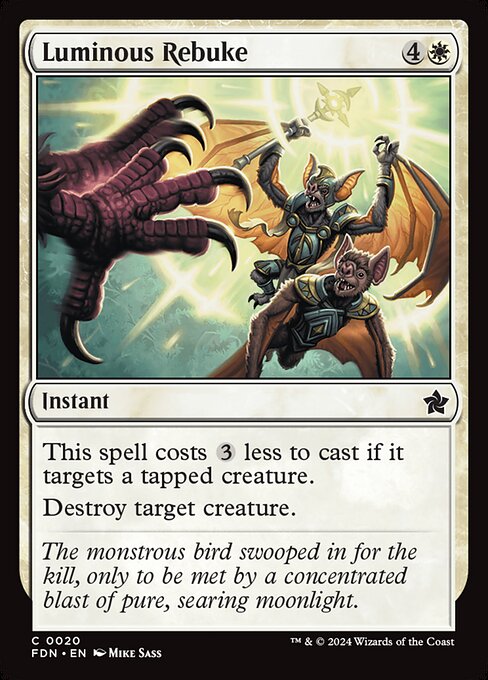
65. Luminous Rebuke
Rating6.6GoodWhy this rating?
One of the best commons of the format (6.6/10).
Why. An instant that destroys a creature and costs three less if the target is tapped. Against an attacker without vigilance it only costs two mana, so it is efficient removal in combat.
Risks. Against an untapped creature it costs five mana, which is slow. It does not deal with other permanent types.
In the draft. A good white common, worth taking fairly high. It is useful in every white deck.
Results in the games of the set
When it is in hand, the deck wins 57.7% of its games (set average: 55.7%, 55th of 274 cards).
In the opening hand: 55.5% wins (54.8% on average).
Drawn during the game: 59.3% (56.4% on average).
When it is drawn, the deck wins 2.5 points more than when it is not.
When it is drafted, it is played 87% of the time (set average: 61%).
Taken as the first pick (327 drafts), it ends in the deck 93% of the time.
It is played mostly in B/W decks (56% of them) and G/W (56%).
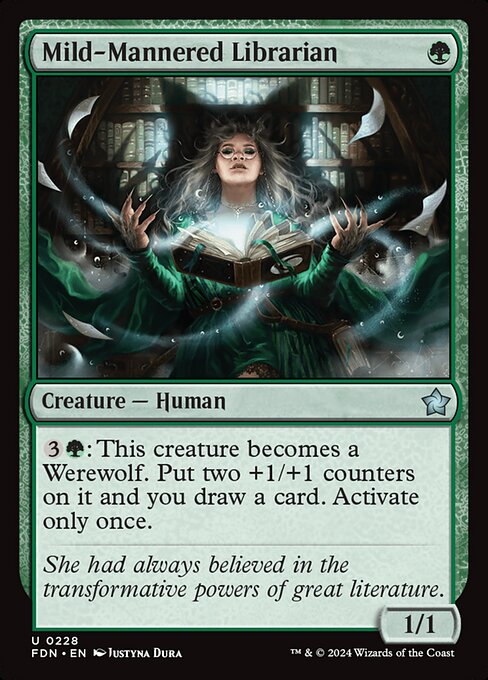 Rating6.6Good
Why this rating?
A solid uncommon of the format (6.6/10).
Why. A one-mana green 1/1 that for four mana becomes a Werewolf, gets two +1/+1 counters and draws you a card. It is a cheap creature early and a value card later.
Risks. Its transformation costs four mana and only works once. Before that it is a 1/1 with no impact.
In the draft. A good flexible green pick that fits every game pace. Take it after your removal.
Results in the games of the set
When it is in hand, the deck wins 56.9% of its games (set average: 55.7%, 75th of 274 cards).
In the opening hand: 57.1% wins (54.8% on average).
Drawn during the game: 56.8% (56.4% on average).
When it is drawn, the deck wins 2.6 points more than when it is not.
When it is drafted, it is played 80% of the time (set average: 61%).
Taken as the first pick (108 drafts), it ends in the deck 93% of the time.
It is played mostly in G/U decks (33% of them) and G/W (32%).
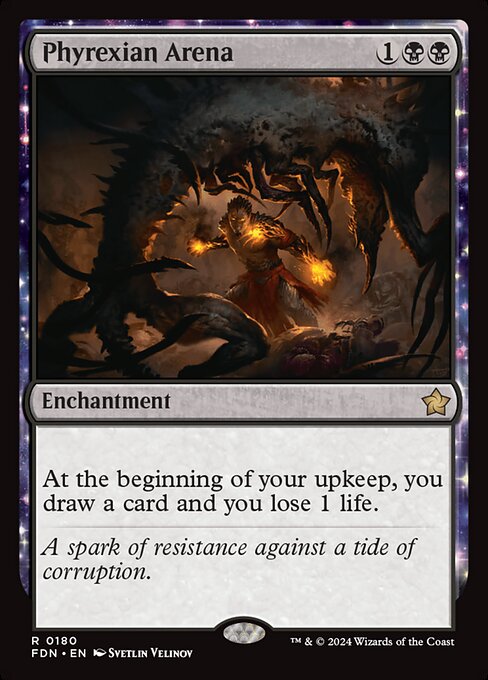
67. Phyrexian Arena
Rating6.6GoodWhy this rating?
A very good rare of the format (6.6/10).
Why. A three-mana enchantment that draws you an extra card at the beginning of your upkeep, at the cost of 1 life. In a long game it is a steady source of cards.
Risks. It does nothing on the board, and the life loss adds up against an aggressive deck. It is slow in a format where tempo matters.
In the draft. Only for a black control deck with a good defense. In other decks, take creatures and removal first.
Results in the games of the set
When it is in hand, the deck wins 54.2% of its games (set average: 55.7%, 156th of 274 cards).
In the opening hand: 54.7% wins (54.8% on average).
Drawn during the game: 53.8% (56.4% on average).
When it is drawn, the deck wins 2.1 points more than when it is not.
When it is drafted, it is played 85% of the time (set average: 61%).
Taken as the first pick (110 drafts), it ends in the deck 86% of the time.
It is played about as much in every archetype.
 Rating6.6Good
Why this rating?
A very good rare of the format (6.6/10).
Why. A 6/6 flying Demon for seven that searches your library for any card when it enters. It gives you both a huge body and the exact answer to your situation.
Risks. Seven mana with two black is very heavy. A removal spell can kill it, although the tutored card stays.
In the draft. A good finisher for a black control deck. Take only one, after your cheap cards.
Results in the games of the set
When it is in hand, the deck wins 57.6% of its games (set average: 55.7%, 59th of 274 cards).
In the opening hand: 52.6% wins (54.8% on average).
Drawn during the game: 60.7% (56.4% on average).
When it is drawn, the deck wins 6.0 points more than when it is not.
When it is drafted, it is played 87% of the time (set average: 61%).
Taken as the first pick (119 drafts), it ends in the deck 85% of the time.
It is played about as much in every archetype.

69. Vampire Gourmand
Rating6.6GoodWhy this rating?
A solid uncommon of the format (6.6/10).
Why. A two-drop that turns spare bodies into cards. When it attacks, you may sacrifice another creature: you draw and it can't be blocked this turn. Best when you have creatures you're happy to lose.
Risks. With no other creature to sacrifice it is a plain 2/2. You pay a creature to draw a card, so the gain is only real if the sacrificed creature was about to die anyway.
In the draft. A fine pick in black if your deck has small creatures or tokens. Weaker in a value deck with no fodder.
Results in the games of the set
When it is in hand, the deck wins 58.7% of its games (set average: 55.7%, 34th of 274 cards).
In the opening hand: 58.8% wins (54.8% on average).
Drawn during the game: 58.7% (56.4% on average).
When it is drawn, the deck wins 4.7 points more than when it is not.
When it is drafted, it is played 92% of the time (set average: 61%).
Taken as the first pick (303 drafts), it ends in the deck 94% of the time.
It is played mostly in B/R decks (45% of them) and B/W (39%).
 Rating6.6Good
Why this rating?
A solid uncommon of the format (6.6/10).
Why. Flying, deathtouch and lifelink on a three-mana body: it attacks in the air, blocks and kills any ground creature, and gains you life. Few cards in the set do this much for the price.
Risks. Two black mana means you need a properly black deck. At 2/3 any removal spell deals with it easily.
In the draft. A solid pick in black. It makes every black deck, whatever the archetype, and is as good on defence as on offence.
Results in the games of the set
When it is in hand, the deck wins 58.2% of its games (set average: 55.7%, 46th of 274 cards).
In the opening hand: 56.8% wins (54.8% on average).
Drawn during the game: 59.1% (56.4% on average).
When it is drawn, the deck wins 5.1 points more than when it is not.
When it is drafted, it is played 92% of the time (set average: 61%).
Taken as the first pick (355 drafts), it ends in the deck 95% of the time.
It is played mostly in B/R decks (28% of them) and B/U (27%).
 Rating6.6Good
Why this rating?
A solid uncommon of the format (6.6/10).
Why. A two-mana 1/3 flyer: it blocks small fliers well and pecks for one in the air. Each other Angel that enters under your control puts a +1/+1 counter on it.
Risks. Without Angels in your deck it stays a modest 1/3. One power makes it a slow attacker.
In the draft. A solid white two-drop. It gets better the more Angels you pick up, but take real removal ahead of it.
Results in the games of the set
When it is in hand, the deck wins 56.3% of its games (set average: 55.7%, 93rd of 274 cards).
In the opening hand: 57.4% wins (54.8% on average).
Drawn during the game: 55.5% (56.4% on average).
When it is drawn, the deck wins 0.8 points more than when it is not.
When it is drafted, it is played 83% of the time (set average: 61%).
Taken as the first pick (156 drafts), it ends in the deck 88% of the time.
It is played mostly in U/W decks (30% of them).
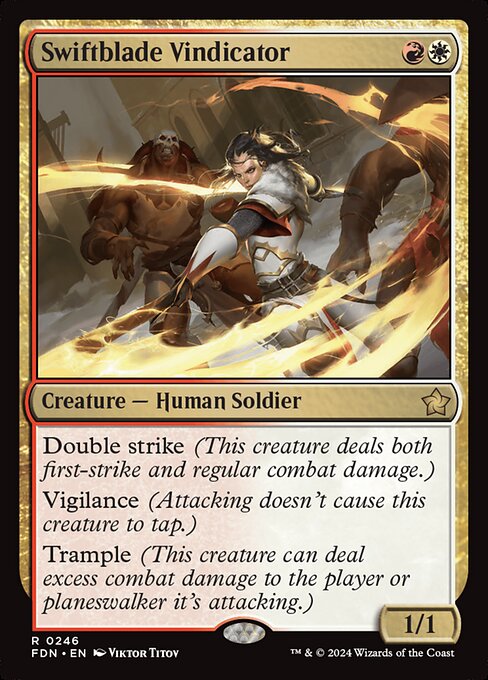 Rating6.5Good
Why this rating?
A very good rare of the format (6.5/10).
Why. A 1/1 with double strike, vigilance and trample: it deals damage twice each combat. Every point of added power counts double, so any pump turns it into a real threat.
Risks. It costs red and white, so only one archetype wants it. With one toughness any burn spell or block kills it.
In the draft. Only for a red-white deck with pump effects or counters. Otherwise pass: a 1/1 depends too much on what surrounds it.
Results in the games of the set
When it is in hand, the deck wins 52.9% of its games (set average: 55.7%, 193rd of 274 cards).
In the opening hand: 55.4% wins (54.8% on average).
Drawn during the game: 50.8% (56.4% on average).
When it is drawn, the deck wins 2.8 points less than when it is not.
When it is drafted, it is played 48% of the time (set average: 61%).
Taken among the first three picks (132 drafts), it ends in the deck 79% of the time.
It is played mostly in R/W decks (27% of them).

73. Refute
Rating6.5GoodWhy this rating?
Good playable that always makes the cut (6.5/10).
Why. A clean counterspell: it stops any spell, then you draw and discard to smooth your hand. Even a one-for-one trade leaves you slightly ahead.
Risks. It asks you to hold up three mana, so you do nothing on your own turn. Against an opponent who casts few key spells it can rot in your hand.
In the draft. Fine in a patient blue deck with defensive creatures. Don't take it over good removal or threats.
Results in the games of the set
When it is in hand, the deck wins 58.2% of its games (set average: 55.7%, 47th of 274 cards).
In the opening hand: 56.3% wins (54.8% on average).
Drawn during the game: 59.3% (56.4% on average).
When it is drawn, the deck wins 4.2 points more than when it is not.
When it is drafted, it is played 78% of the time (set average: 61%).
Taken as the first pick (256 drafts), it ends in the deck 93% of the time.
It is played mostly in B/U decks (75% of them) and R/U (75%).
 Rating6.4Good
Why this rating?
Good playable that always makes the cut (6.4/10).
Why. A two-mana 2/2 that gets a +1/+1 counter each time you gain life. With a handful of life-gain sources it turns into a real threat by the midgame.
Risks. With no life gain it is just a 2/2. It dies to removal before it can grow.
In the draft. Take it in white if your deck has lifelinkers or small life gain. Otherwise it is a mid-pack card.
Results in the games of the set
When it is in hand, the deck wins 55.6% of its games (set average: 55.7%, 116th of 274 cards).
In the opening hand: 57.1% wins (54.8% on average).
Drawn during the game: 54.4% (56.4% on average).
When it is drawn, the deck wins 0.3 points more than when it is not.
When it is drafted, it is played 89% of the time (set average: 61%).
Taken as the first pick (190 drafts), it ends in the deck 90% of the time.
It is played mostly in B/W decks (34% of them) and G/W (28%).

75. Dazzling Angel
Rating6.4GoodWhy this rating?
Good playable that always makes the cut (6.4/10).
Why. A three-mana 2/3 flyer: a solid aerial blocker that also attacks. Each other creature entering under your control gains you 1 life, which feeds the life-gain cards.
Risks. Nothing explosive: the one life is a small bonus. It dies to removal like anything else.
In the draft. A very playable white common that fits nearly every white deck. Take it ahead of non-flying creatures of the same mana value.
Results in the games of the set
When it is in hand, the deck wins 57.8% of its games (set average: 55.7%, 53rd of 274 cards).
In the opening hand: 58.1% wins (54.8% on average).
Drawn during the game: 57.7% (56.4% on average).
When it is drawn, the deck wins 2.5 points more than when it is not.
When it is drafted, it is played 91% of the time (set average: 61%).
Taken as the first pick (553 drafts), it ends in the deck 95% of the time.
It is played mostly in U/W decks (63% of them) and B/W (60%).

76. Fleeting Flight
Rating6.4GoodWhy this rating?
Good playable that always makes the cut (6.4/10).
Why. A one-mana instant: a permanent +1/+1 counter, flying until end of turn and all combat damage that would be dealt to the creature prevented. Use it to push damage through on attack or to win a combat safely on defence.
Risks. It does nothing without a creature. If the opponent kills it in response, you lose the card.
In the draft. A decent trick in a white deck with good creatures. Don't take it early: creatures and removal come first.
Results in the games of the set
When it is in hand, the deck wins 56.6% of its games (set average: 55.7%, 85th of 274 cards).
In the opening hand: 55.6% wins (54.8% on average).
Drawn during the game: 57.4% (56.4% on average).
When it is drawn, the deck wins 1.3 points more than when it is not.
When it is drafted, it is played 62% of the time (set average: 61%).
Taken as the first pick (89 drafts), it ends in the deck 89% of the time.
It is played mostly in R/W decks (54% of them) and U/W (53%).

77. Healer's Hawk
Rating6.4GoodWhy this rating?
Good playable that always makes the cut (6.4/10).
Why. A one-mana 1/1 flier with lifelink: it gains you a point of life per attack, which turns on the life-gain cards.
Risks. It is small: it dies to everything and cannot win a game alone. Opposing fliers block it easily.
In the draft. A fine late pick in white, especially if you have cards that reward life gain. Of little use if you don't.
Results in the games of the set
When it is in hand, the deck wins 57.4% of its games (set average: 55.7%, 64th of 274 cards).
In the opening hand: 60.2% wins (54.8% on average).
Drawn during the game: 55.3% (56.4% on average).
When it is drawn, the deck wins 1.8 points more than when it is not.
When it is drafted, it is played 89% of the time (set average: 61%).
Taken as the first pick (433 drafts), it ends in the deck 96% of the time.
It is played mostly in R/W decks (64% of them) and U/W (64%).
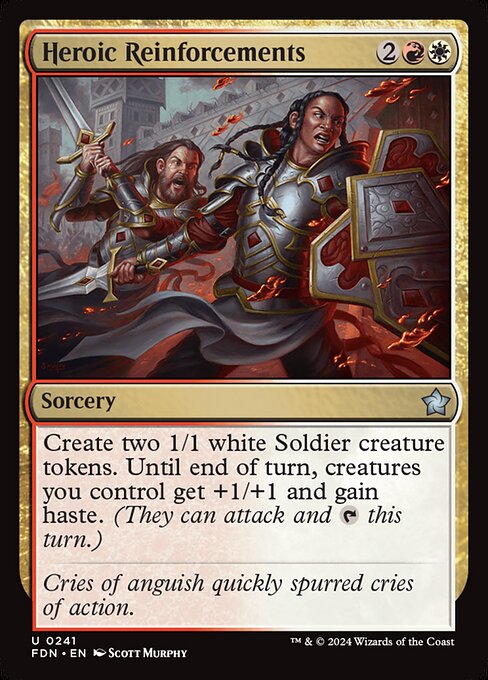 Rating6.4Good
Why this rating?
Good playable that always makes the cut (6.4/10).
Why. Create two 1/1 white Soldier creature tokens, then all your creatures get +1/+1 and haste until end of turn. The turn you cast it you swing for a lot, which can end the game.
Risks. It costs four mana and both red and white, so only one archetype wants it. Without other creatures already on the battlefield it only gives two hasty 2/2s.
In the draft. Take it in an aggressive red-white deck with lots of small creatures. Elsewhere it isn't worth the slot.
Results in the games of the set
When it is in hand, the deck wins 55.5% of its games (set average: 55.7%, 118th of 274 cards).
In the opening hand: 53.3% wins (54.8% on average).
Drawn during the game: 57.2% (56.4% on average).
When it is drawn, the deck wins 0.8 points more than when it is not.
When it is drafted, it is played 57% of the time (set average: 61%).
Taken as the first pick (86 drafts), it ends in the deck 77% of the time.
It is played mostly in R/W decks (65% of them).

79. Infernal Vessel
Rating6.4GoodWhy this rating?
Good playable that always makes the cut (6.4/10).
Why. A 2/1 that returns as a 4/3 Demon with two +1/+1 counters when it dies. The opponent has to deal with it twice. It also pairs nicely with sacrifice effects.
Risks. The first body is fragile at one toughness. Exile or a second removal ends it, and it does not return if it was already a Demon.
In the draft. A good black pick, especially in decks that sacrifice creatures. It also makes a blocker that comes back bigger.
Results in the games of the set
When it is in hand, the deck wins 58.2% of its games (set average: 55.7%, 44th of 274 cards).
In the opening hand: 57.7% wins (54.8% on average).
Drawn during the game: 58.6% (56.4% on average).
When it is drawn, the deck wins 4.4 points more than when it is not.
When it is drafted, it is played 91% of the time (set average: 61%).
Taken as the first pick (258 drafts), it ends in the deck 94% of the time.
It is played mostly in B/R decks (33% of them) and B/W (33%).
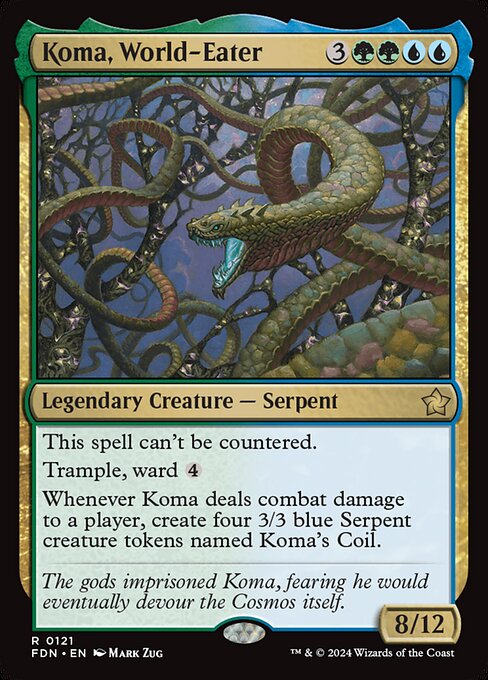 Rating6.4Good
Why this rating?
Good playable that always makes the cut (6.4/10).
Why. An 8/12 whose spell can't be countered, with trample and ward 4. Whenever it deals combat damage to a player you create four 3/3 blue Serpent creature tokens, which nearly ends the game.
Risks. It costs seven mana including two green and two blue, so it needs a specific two-colour deck. A chump blocker slows it down, and a removal spell that pays the ward kills it.
In the draft. Take it as a finisher in a slow green-blue deck. Outside those colours don't force it: seven mana is too much for a fast deck.
Results in the games of the set
When it is in hand, the deck wins 57.1% of its games (set average: 55.7%, 70th of 274 cards).
In the opening hand: 53.5% wins (54.8% on average).
Drawn during the game: 59.3% (56.4% on average).
When it is drawn, the deck wins 8.8 points more than when it is not.
When it is drafted, it is played 71% of the time (set average: 61%).
Taken as the first pick (71 drafts), it ends in the deck 75% of the time.
It is played mostly in G/U decks (46% of them).
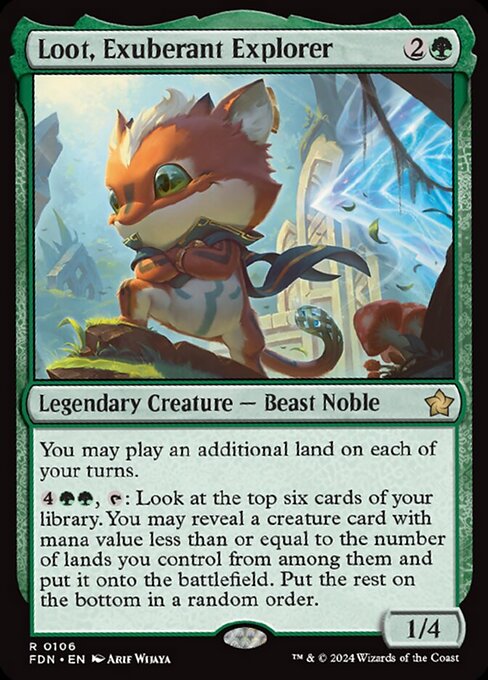 Rating6.4Good
Why this rating?
Good playable that always makes the cut (6.4/10).
Why. A 1/4 that lets you play an extra land each turn, which helps landfall decks and ramps you. Its six-mana ability looks at the top six cards of your library and can put onto the battlefield a creature with mana value up to your number of lands.
Risks. One power means no offence. The ability is slow, and without a spare land in hand the first effect does nothing.
In the draft. For a green deck with landfall or big creatures. A mid-pack pick: don't take it over good creatures or removal.
Results in the games of the set
When it is in hand, the deck wins 55.9% of its games (set average: 55.7%, 101st of 274 cards).
In the opening hand: 55.7% wins (54.8% on average).
Drawn during the game: 56.0% (56.4% on average).
When it is drawn, the deck wins 3.4 points more than when it is not.
When it is drafted, it is played 86% of the time (set average: 61%).
Taken as the first pick (90 drafts), it ends in the deck 90% of the time.
It is played about as much in every archetype.
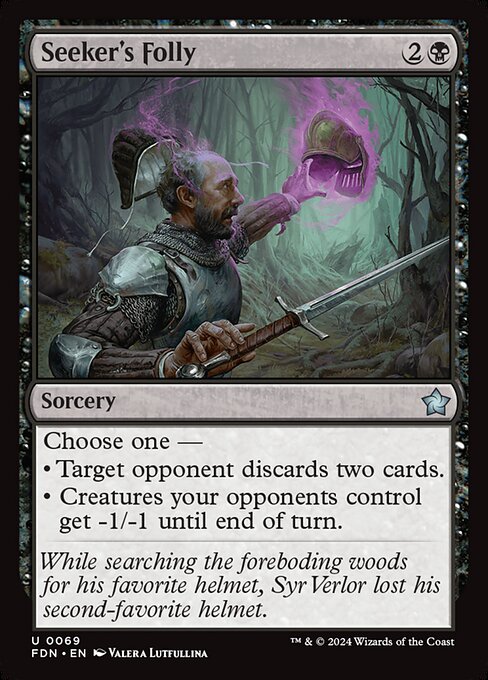
82. Seeker's Folly
Rating6.4GoodWhy this rating?
Good playable that always makes the cut (6.4/10).
Why. A two-mode sorcery: the opponent discards two cards, or their creatures get -1/-1 until end of turn. The discard shines early, while the second mode can wipe a board of small tokens.
Risks. The discard mode does nothing on board, and -1/-1 only kills creatures with one toughness. Against a deck that empties its hand fast it is weak.
In the draft. A black support spell. Take it after removal and good creatures, as a flexible card.
Results in the games of the set
When it is in hand, the deck wins 56.7% of its games (set average: 55.7%, 82nd of 274 cards).
In the opening hand: 54.7% wins (54.8% on average).
Drawn during the game: 58.0% (56.4% on average).
When it is drawn, the deck wins 3.4 points more than when it is not.
When it is drafted, it is played 68% of the time (set average: 61%).
Taken as the first pick (64 drafts), it ends in the deck 80% of the time.
It is played about as much in every archetype.
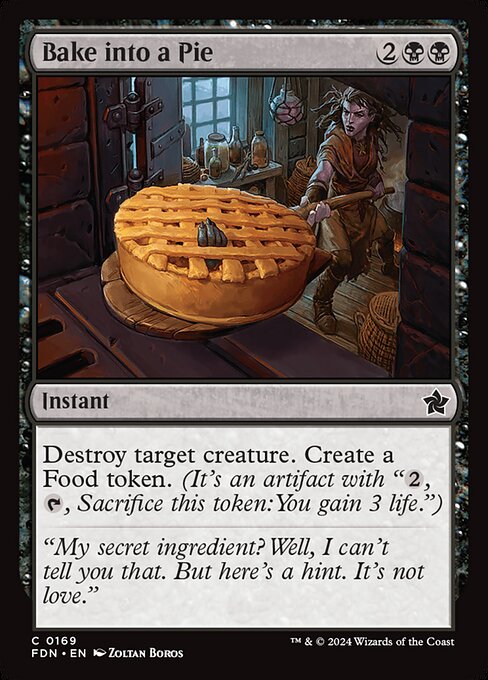
83. Bake into a Pie
Rating6.3GoodWhy this rating?
Good playable that always makes the cut (6.3/10).
Why. An unconditional instant-speed removal: destroy any creature and create a Food token as a bonus. It answers the most dangerous threats and can be cast at any time.
Risks. Four mana including two black is steep for removal. It doesn't beat indestructible creatures or ones that come back.
In the draft. Take it early in black: one of the best answers at common. You want two or three copies.
Results in the games of the set
When it is in hand, the deck wins 58.5% of its games (set average: 55.7%, 40th of 274 cards).
In the opening hand: 55.1% wins (54.8% on average).
Drawn during the game: 60.6% (56.4% on average).
When it is drawn, the deck wins 5.3 points more than when it is not.
When it is drafted, it is played 92% of the time (set average: 61%).
Taken as the first pick (770 drafts), it ends in the deck 95% of the time.
It is played mostly in B/U decks (61% of them) and B/W (61%).
 Rating6.3Good
Why this rating?
Good playable that always makes the cut (6.3/10).
Why. A 3/6 that makes your instants and sorceries cost one less and draws a card each time you cast one. In a deck full of spells it buries the opponent in cards.
Risks. It costs five mana and does little without spells. With too few instants and sorceries it is just a slow big body.
In the draft. Play it in a blue deck with plenty of instants and sorceries. Otherwise take it later: it isn't worth more than removal or a good creature.
Results in the games of the set
When it is in hand, the deck wins 55.7% of its games (set average: 55.7%, 108th of 274 cards).
In the opening hand: 52.9% wins (54.8% on average).
Drawn during the game: 57.3% (56.4% on average).
When it is drawn, the deck wins 3.8 points more than when it is not.
When it is drafted, it is played 86% of the time (set average: 61%).
Taken as the first pick (121 drafts), it ends in the deck 87% of the time.
It is played about as much in every archetype.

85. Arbiter of Woe
Rating6.2GoodWhy this rating?
Good playable that always makes the cut (6.2/10).
Why. A six-mana 5/4 flier: when it enters, each opponent discards a card and loses 2 life, while you draw a card and gain 2 life. That value makes up for the sacrifice.
Risks. You must sacrifice a creature as an additional cost: with no good fodder it is a real cost. If it is countered, you have lost the sacrificed creature too.
In the draft. Good with tokens or creatures you want to get rid of. Take it in black if your deck has fodder to sacrifice.
Results in the games of the set
When it is in hand, the deck wins 58.6% of its games (set average: 55.7%, 39th of 274 cards).
In the opening hand: 55.2% wins (54.8% on average).
Drawn during the game: 60.7% (56.4% on average).
When it is drawn, the deck wins 5.0 points more than when it is not.
When it is drafted, it is played 87% of the time (set average: 61%).
Taken as the first pick (246 drafts), it ends in the deck 92% of the time.
It is played mostly in B/W decks (35% of them) and B/G (31%).
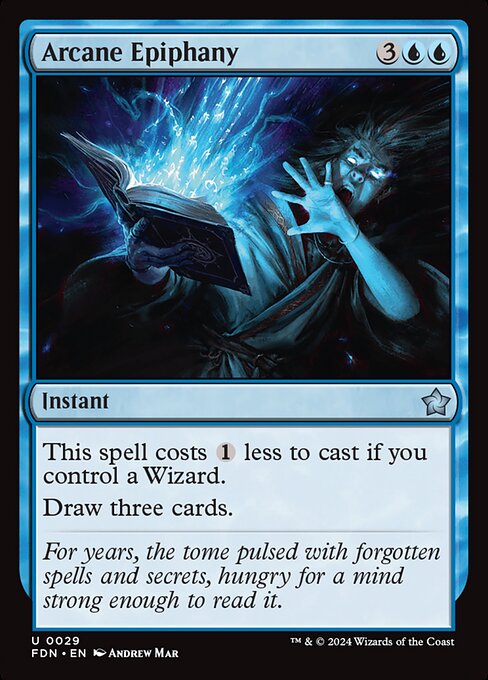
86. Arcane Epiphany
Rating6.2GoodWhy this rating?
Good playable that always makes the cut (6.2/10).
Why. An instant that draws three cards, costing one less if you control a Wizard. Cast at the end of the opponent's turn it gives a nice card advantage.
Risks. Five mana without a Wizard is slow, and it does nothing to the board. Most decks don't have many Wizards.
In the draft. For a defensive blue deck with good blockers. Take it as a value card, after removal and solid creatures.
Results in the games of the set
When it is in hand, the deck wins 56.1% of its games (set average: 55.7%, 97th of 274 cards).
In the opening hand: 52.6% wins (54.8% on average).
Drawn during the game: 58.1% (56.4% on average).
When it is drawn, the deck wins 2.8 points more than when it is not.
When it is drafted, it is played 78% of the time (set average: 61%).
Taken as the first pick (157 drafts), it ends in the deck 80% of the time.
It is played mostly in R/U decks (37% of them) and U/W (32%).
 Rating6.2Good
Why this rating?
Good playable that always makes the cut (6.2/10).
Why. For one mana, opposing creatures enter tapped and you gain 1 life for each. In an aggressive deck they can't block right away.
Risks. It does nothing alone: if you aren't the beatdown it is a dead card. It only slows each opposing creature for one turn, after which it untaps normally.
In the draft. Only for a very fast white deck. Elsewhere it is weak and goes late in the pack.
Results in the games of the set
When it is in hand, the deck wins 52.0% of its games (set average: 55.7%, 212th of 274 cards).
In the opening hand: 54.7% wins (54.8% on average).
Drawn during the game: 50.0% (56.4% on average).
When it is drawn, the deck wins 0.3 points less than when it is not.
When it is drafted, it is played 43% of the time (set average: 61%).
Taken among the first three picks (72 drafts), it ends in the deck 63% of the time.
It is played about as much in every archetype.
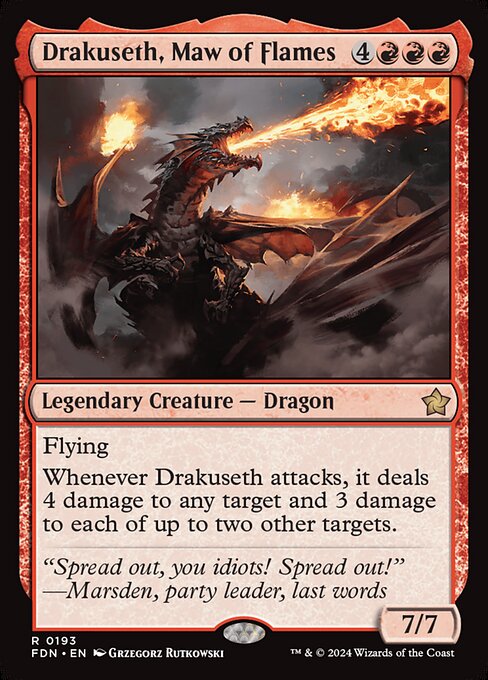 Rating6.2Good
Why this rating?
Good playable that always makes the cut (6.2/10).
Why. A 7/7 flying Dragon: each attack deals 4 damage to one target and 3 to each of up to two others. One attack often kills several creatures. The game-winning potential is huge.
Risks. It costs seven mana including three red, which is heavy. Removal before it attacks makes it useless, and waiting for it can lose you the game.
In the draft. A finisher for a slow red deck that can survive to turn seven. One copy is enough.
Results in the games of the set
When it is in hand, the deck wins 54.6% of its games (set average: 55.7%, 144th of 274 cards).
In the opening hand: 50.9% wins (54.8% on average).
Drawn during the game: 57.1% (56.4% on average).
When it is drawn, the deck wins 2.3 points more than when it is not.
When it is drafted, it is played 71% of the time (set average: 61%).
Taken as the first pick (65 drafts), it ends in the deck 80% of the time.
It is played about as much in every archetype.
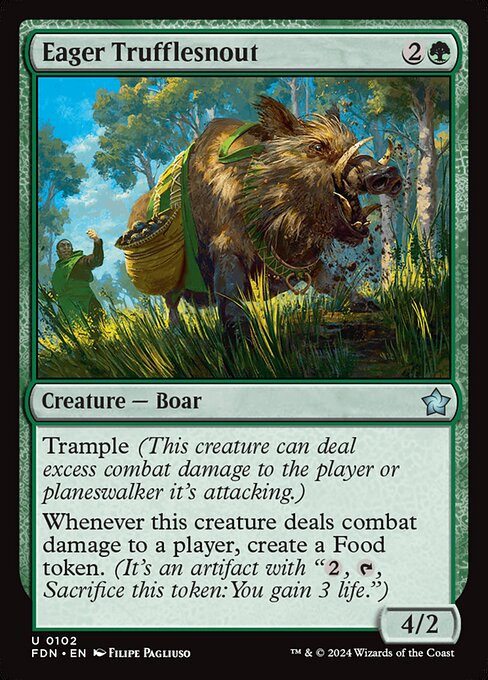 Rating6.2Good
Why this rating?
Good playable that always makes the cut (6.2/10).
Why. A three-mana 4/2 with trample: aggressive, and trample pushes damage through even a small blocker. Each time it deals combat damage to a player you create a Food token, giving you life later.
Risks. At two toughness it dies to a block or small removal. It loses value against solid blockers.
In the draft. A good attacker in green, especially red-green. It likes aggressive decks with tricks and trades well with small blockers.
Results in the games of the set
When it is in hand, the deck wins 56.1% of its games (set average: 55.7%, 96th of 274 cards).
In the opening hand: 56.5% wins (54.8% on average).
Drawn during the game: 55.8% (56.4% on average).
When it is drawn, the deck wins 1.4 points more than when it is not.
When it is drafted, it is played 81% of the time (set average: 61%).
Taken as the first pick (90 drafts), it ends in the deck 91% of the time.
It is played mostly in G/R decks (38% of them) and G/W (32%).

90. Eaten Alive
Rating6.2GoodWhy this rating?
Good playable that always makes the cut (6.2/10).
Why. A one-mana removal that exiles a creature or planeswalker, with a sacrificed creature as the additional cost. Instead you can pay four more mana: five in total, expensive but flexible.
Risks. It is a sorcery, so it can't answer on the opponent's turn. The sacrifice is a real cost, and the no-sacrifice option is pricey.
In the draft. Clean removal in black, worth taking without waiting too long among commons. It works especially well with creatures you want to sacrifice.
Results in the games of the set
When it is in hand, the deck wins 56.2% of its games (set average: 55.7%, 94th of 274 cards).
In the opening hand: 52.8% wins (54.8% on average).
Drawn during the game: 58.4% (56.4% on average).
When it is drawn, the deck wins 3.0 points more than when it is not.
When it is drafted, it is played 90% of the time (set average: 61%).
Taken as the first pick (462 drafts), it ends in the deck 95% of the time.
It is played mostly in B/R decks (65% of them) and B/U (64%).
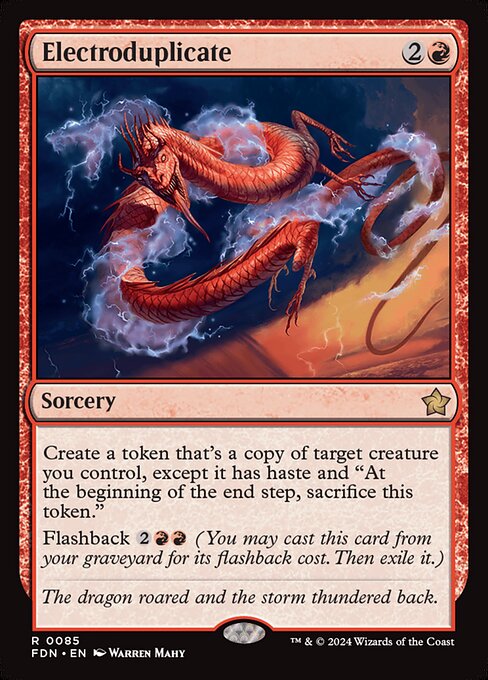
91. Electroduplicate
Rating6.2GoodWhy this rating?
Good playable that always makes the cut (6.2/10).
Why. A sorcery that creates a token copy of one of your creatures with haste, sacrificed at end of turn. With a creature that has a strong enter effect it does the job twice, and flashback lets you do it again.
Risks. It does nothing without a good creature, and the copy doesn't stay. Its value depends entirely on your board, and if the opponent kills the target in response the spell is lost.
In the draft. Very narrow. Only play it if your deck has several creatures with big enter effects; otherwise leave it.
Results in the games of the set
When it is in hand, the deck wins 50.6% of its games (set average: 55.7%, 238th of 274 cards).
In the opening hand: 49.1% wins (54.8% on average).
Drawn during the game: 51.6% (56.4% on average).
When it is drawn, the deck wins 0.2 points more than when it is not.
When it is drafted, it is played only 14% of the time (set average: 61%): it almost always ends in the sideboard.
Taken among the first three picks (34 drafts), it ends in the deck 47% of the time.
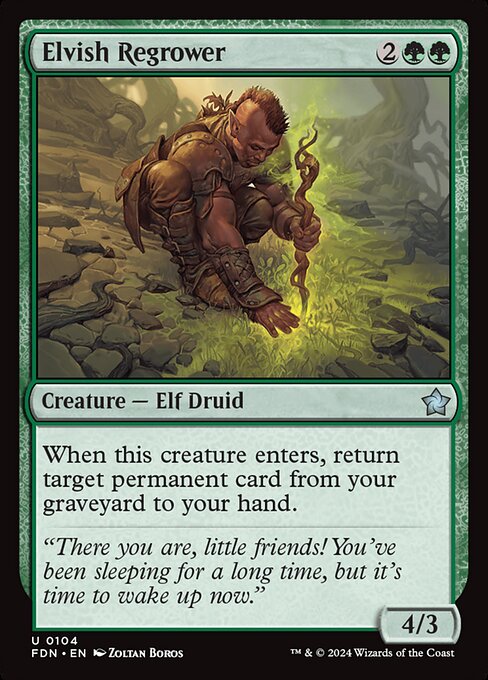
92. Elvish Regrower
Rating6.2GoodWhy this rating?
Good playable that always makes the cut (6.2/10).
Why. A four-mana 4/3 that returns a permanent card from your graveyard to your hand when it enters. It is a solid body with immediate card advantage.
Risks. It only pays off if your graveyard has a good target. Two green mana means you need a properly green deck.
In the draft. A good midrange creature in green that fits every deck of that colour. Take it without hesitation after your removal.
Results in the games of the set
When it is in hand, the deck wins 57.0% of its games (set average: 55.7%, 72nd of 274 cards).
In the opening hand: 54.4% wins (54.8% on average).
Drawn during the game: 58.8% (56.4% on average).
When it is drawn, the deck wins 2.5 points more than when it is not.
When it is drafted, it is played 89% of the time (set average: 61%).
Taken as the first pick (188 drafts), it ends in the deck 97% of the time.
It is played mostly in G/U decks (37% of them) and G/W (35%).
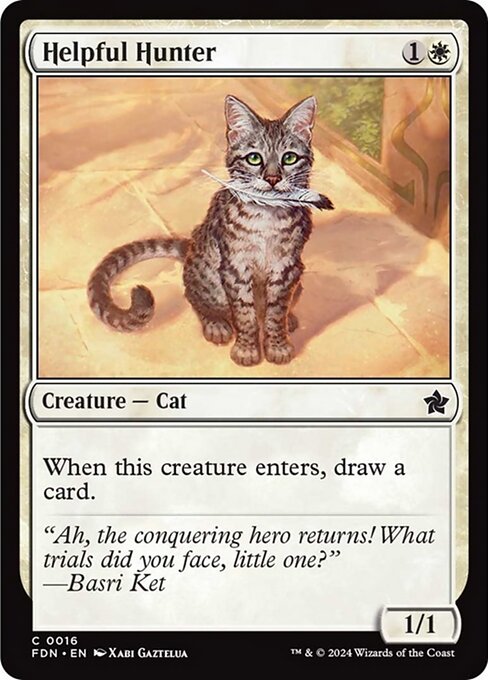
93. Helpful Hunter
Rating6.2GoodWhy this rating?
Good playable that always makes the cut (6.2/10).
Why. A 1/1 that draws a card when it enters: a card that replaces itself and leaves a small body behind. It fits aggro and control, and can be traded or sacrificed freely.
Risks. The body is tiny and has no impact. It won't win the game, it is just a fair trade.
In the draft. A solid support card in white, an easy pick. It gets better in decks with enter or sacrifice synergies.
Results in the games of the set
When it is in hand, the deck wins 57.7% of its games (set average: 55.7%, 57th of 274 cards).
In the opening hand: 57.8% wins (54.8% on average).
Drawn during the game: 57.6% (56.4% on average).
When it is drawn, the deck wins 2.0 points more than when it is not.
When it is drafted, it is played 90% of the time (set average: 61%).
Taken as the first pick (560 drafts), it ends in the deck 93% of the time.
It is played mostly in B/W decks (68% of them) and R/W (65%).
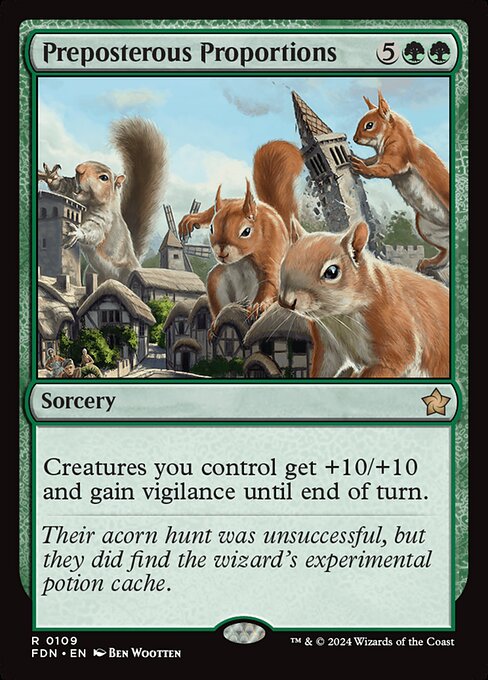 Rating6.2Good
Why this rating?
Good playable that always makes the cut (6.2/10).
Why. A sorcery that gives all your creatures +10/+10 and vigilance until end of turn. With a few creatures on the battlefield it is a finishing attack that wins in one swing.
Risks. It costs seven mana, which is very slow, and it does nothing without creatures. Removal or a chump block in response ruins the plan.
In the draft. A fun card for a very wide green deck. In most decks, creatures and removal are better.
Results in the games of the set
When it is in hand, the deck wins 53.6% of its games (set average: 55.7%, 175th of 274 cards).
In the opening hand: 50.4% wins (54.8% on average).
Drawn during the game: 55.8% (56.4% on average).
When it is drawn, the deck wins 0.5 points more than when it is not.
When it is drafted, it is played 39% of the time (set average: 61%).
Taken among the first three picks (87 drafts), it ends in the deck 76% of the time.
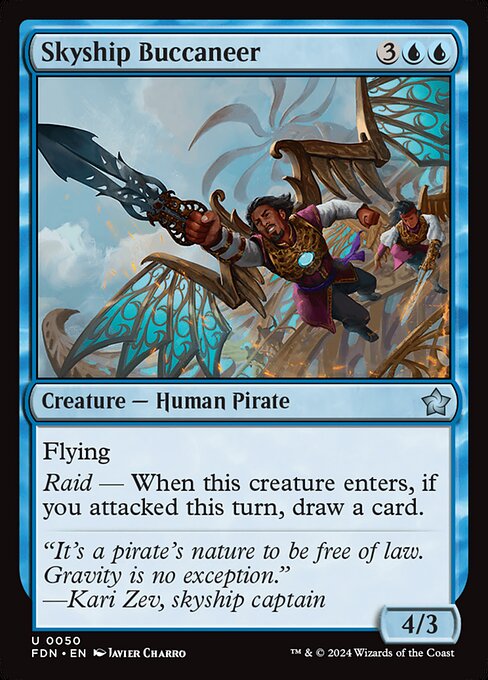 Rating6.2Good
Why this rating?
Good playable that always makes the cut (6.2/10).
Why. A five-mana 4/3 flier: a big aerial threat. With Raid, if you attacked this turn you draw a card when it enters.
Risks. It costs five mana including two blue, and its bonus needs an attack before you cast it, which isn't always possible. A removal spell trades with it.
In the draft. A good blue creature, especially in aggressive decks. Take it as an aerial finisher, after removal.
Results in the games of the set
When it is in hand, the deck wins 56.8% of its games (set average: 55.7%, 78th of 274 cards).
In the opening hand: 53.6% wins (54.8% on average).
Drawn during the game: 58.7% (56.4% on average).
When it is drawn, the deck wins 2.9 points more than when it is not.
When it is drafted, it is played 81% of the time (set average: 61%).
Taken as the first pick (162 drafts), it ends in the deck 90% of the time.
It is played mostly in U/W decks (33% of them) and R/U (28%).
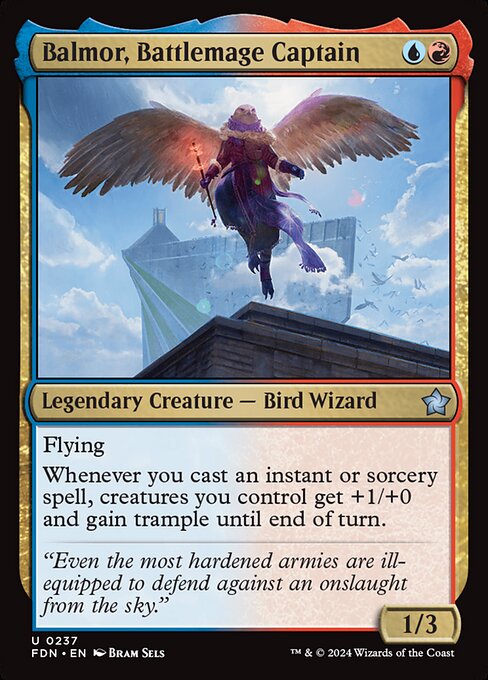
96. Balmor, Battlemage Captain
Rating6.2PlayableWhy this rating?
Good playable that always makes the cut (6.2/10).
Why. A two-mana 1/3 flier that blocks well and attacks in the air for little. Each instant or sorcery you cast gives all your creatures +1/+0 and trample until end of turn.
Risks. It does almost nothing without spells and needs two specific colours. At three toughness removal handles it easily.
In the draft. Take it in a blue-red deck with plenty of instants and sorceries. Elsewhere it is just a 1/3 flier.
Results in the games of the set
When it is in hand, the deck wins 55.8% of its games (set average: 55.7%, 106th of 274 cards).
In the opening hand: 56.1% wins (54.8% on average).
Drawn during the game: 55.6% (56.4% on average).
When it is drawn, the deck wins 3.7 points more than when it is not.
When it is drafted, it is played 57% of the time (set average: 61%).
Taken as the first pick (90 drafts), it ends in the deck 71% of the time.
It is played mostly in R/U decks (73% of them).
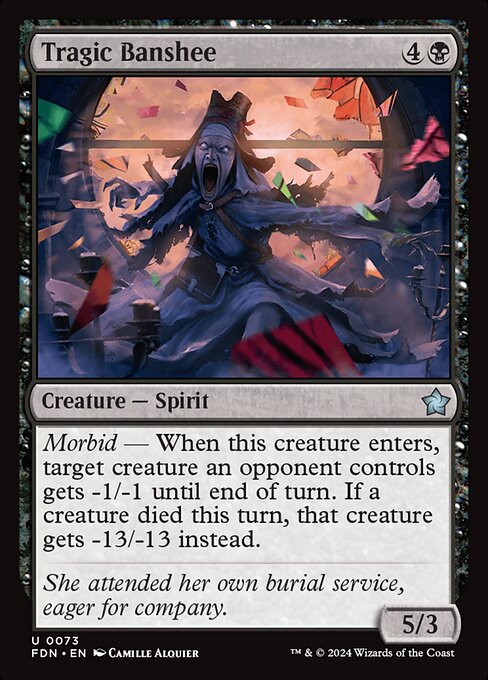
97. Tragic Banshee
Rating6.1PlayableWhy this rating?
Good playable that always makes the cut (6.1/10).
Why. A five-mana 5/3 whose arrival gives -1/-1 to an opposing creature, or -13/-13 if a creature died this turn. With Morbid on, it is removal and a big body in one card.
Risks. If nothing died this turn the -1/-1 kills almost nothing. You have to set it up with a combat or a sacrifice.
In the draft. A good black card: take it fairly high. It works in every black deck, especially with trades or sacrifices.
Results in the games of the set
When it is in hand, the deck wins 58.2% of its games (set average: 55.7%, 45th of 274 cards).
In the opening hand: 55.6% wins (54.8% on average).
Drawn during the game: 59.8% (56.4% on average).
When it is drawn, the deck wins 4.6 points more than when it is not.
When it is drafted, it is played 91% of the time (set average: 61%).
Taken as the first pick (265 drafts), it ends in the deck 94% of the time.
It is played mostly in B/G decks (32% of them) and B/R (32%).

98. Think Twice
Rating6.0PlayableWhy this rating?
Good playable that always makes the cut (6.0/10).
Why. A two-mana instant that draws a card, and flashback lets you draw again for three mana. Two cards for one deck slot, spread over time.
Risks. It doesn't change the game: no effect on board, just smoothness. In a fast deck it costs tempo.
In the draft. A decent blue filler spell, a late pick. Useful in a control deck that has spare mana.
Results in the games of the set
When it is in hand, the deck wins 56.8% of its games (set average: 55.7%, 77th of 274 cards).
In the opening hand: 54.9% wins (54.8% on average).
Drawn during the game: 58.0% (56.4% on average).
When it is drawn, the deck wins 3.0 points more than when it is not.
When it is drafted, it is played 85% of the time (set average: 61%).
Taken as the first pick (246 drafts), it ends in the deck 94% of the time.
It is played mostly in R/U decks (74% of them) and B/U (68%).
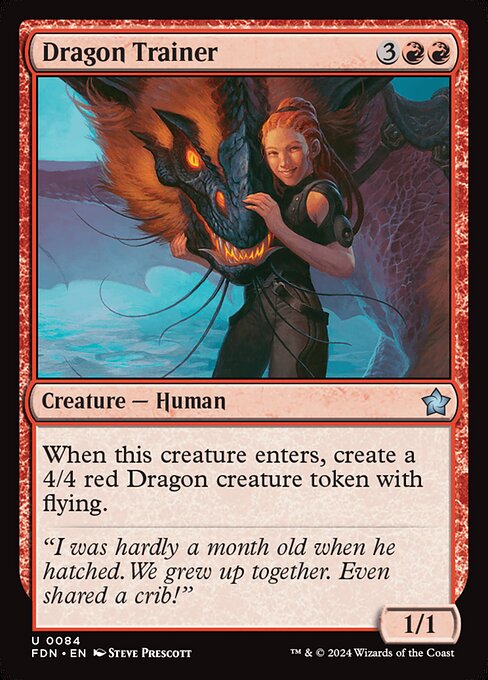
99. Dragon Trainer
Rating6.0PlayableWhy this rating?
Good playable that always makes the cut (6.0/10).
Why. A 1/1 that creates a 4/4 red Dragon creature token with flying when it enters. For five mana you get a big aerial threat and an extra small body.
Risks. It costs five mana including two red. The Dragon token dies to removal, and the 1/1 is easy to ignore.
In the draft. A good red card, played on turn five. It suits every red deck as a value creature, after removal.
Results in the games of the set
When it is in hand, the deck wins 56.8% of its games (set average: 55.7%, 79th of 274 cards).
In the opening hand: 54.9% wins (54.8% on average).
Drawn during the game: 58.2% (56.4% on average).
When it is drawn, the deck wins 1.4 points more than when it is not.
When it is drafted, it is played 80% of the time (set average: 61%).
Taken as the first pick (158 drafts), it ends in the deck 95% of the time.
It is played mostly in G/R decks (35% of them) and B/R (32%).
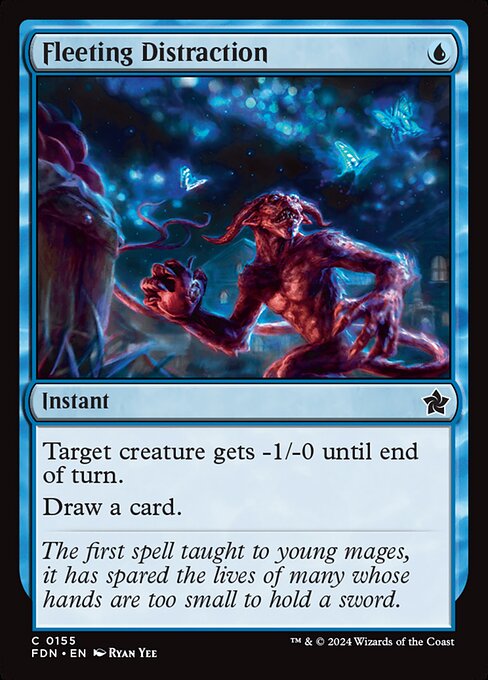
100. Fleeting Distraction
Rating6.0PlayableWhy this rating?
Good playable that always makes the cut (6.0/10).
Why. A one-mana instant: -1/-0 on a creature and you draw a card. It replaces itself while sometimes shaving combat damage or tipping a trade.
Risks. It does almost nothing besides draw: a minimal effect on board. It kills nothing on its own.
In the draft. Blue filler, a late pick. It is mostly good in decks full of instants and sorceries.
Results in the games of the set
When it is in hand, the deck wins 55.1% of its games (set average: 55.7%, 127th of 274 cards).
In the opening hand: 52.9% wins (54.8% on average).
Drawn during the game: 56.5% (56.4% on average).
When it is drawn, the deck wins 1.7 points more than when it is not.
When it is drafted, it is played 73% of the time (set average: 61%).
Taken as the first pick (131 drafts), it ends in the deck 94% of the time.
It is played mostly in R/U decks (79% of them) and B/U (75%).
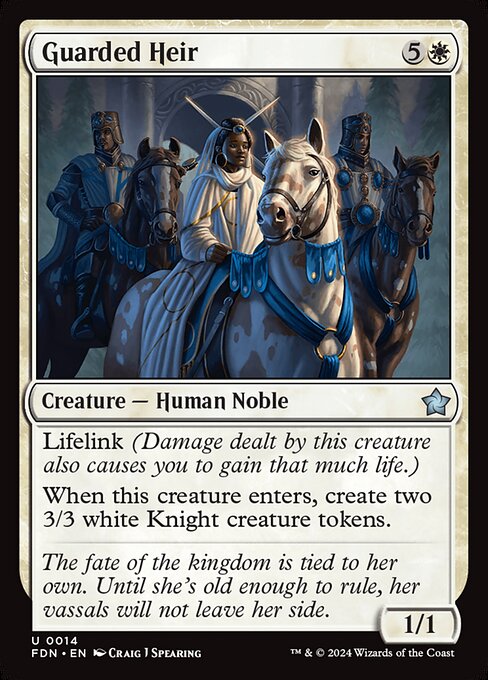
101. Guarded Heir
Rating6.0PlayableWhy this rating?
Good playable that always makes the cut (6.0/10).
Why. Six mana for three bodies: a 1/1 lifelinker and two 3/3 white Knight creature tokens. It is a big chunk of value in one card, and it plays around single-target removal because the tokens stay behind.
Risks. Six mana is heavy, and you do nothing else that turn. A sweeper wipes out all the value at once.
In the draft. A solid top-end uncommon for white midrange or control. Take one or two at most: any more and your hand clogs up.
Results in the games of the set
When it is in hand, the deck wins 56.6% of its games (set average: 55.7%, 87th of 274 cards).
In the opening hand: 53.8% wins (54.8% on average).
Drawn during the game: 58.5% (56.4% on average).
When it is drawn, the deck wins 1.8 points more than when it is not.
When it is drafted, it is played 78% of the time (set average: 61%).
Taken as the first pick (129 drafts), it ends in the deck 85% of the time.
It is played mostly in B/W decks (28% of them) and U/W (28%).

102. High Fae Trickster
Rating6.0PlayableWhy this rating?
Good playable that always makes the cut (6.0/10).
Why. A 4/2 flyer with flash for four mana: ambush an attacker in the air or hit at the end of the opponent's turn. Its last ability lets you cast every spell with flash, which makes your turns very flexible.
Risks. Only two toughness, so almost any removal or a trade in combat kills it. The last ability only matters if your deck has sorceries or other spells worth casting at the right moment.
In the draft. A good blue creature, especially in blue-white. Even without using its last ability, a 4/2 flash flyer earns its slot.
Results in the games of the set
When it is in hand, the deck wins 55.0% of its games (set average: 55.7%, 131st of 274 cards).
In the opening hand: 53.4% wins (54.8% on average).
Drawn during the game: 55.9% (56.4% on average).
When it is drawn, the deck wins 2.7 points more than when it is not.
When it is drafted, it is played 87% of the time (set average: 61%).
Taken as the first pick (94 drafts), it ends in the deck 91% of the time.
It is played about as much in every archetype.

103. Mossborn Hydra
Rating6.0PlayableWhy this rating?
Good playable that always makes the cut (6.0/10).
Why. It comes in as a 1/1 trampler on turn three, then, with Landfall, doubles its counters every time a land enters under your control: 2, 4, 8... A few turns of growth and it is huge without costing you any extra mana.
Risks. While small it is fragile, and a well-timed removal spell is a clean answer. If you stumble on lands it stays unimpressive.
In the draft. A good rare for green decks running a full land count. Take it mid-pack and favor a deck that can protect its creatures.
Results in the games of the set
When it is in hand, the deck wins 54.5% of its games (set average: 55.7%, 145th of 274 cards).
In the opening hand: 56.1% wins (54.8% on average).
Drawn during the game: 53.3% (56.4% on average).
When it is drawn, the deck wins 2.9 points more than when it is not.
When it is drafted, it is played 87% of the time (set average: 61%).
Taken as the first pick (79 drafts), it ends in the deck 86% of the time.
It is played about as much in every archetype.
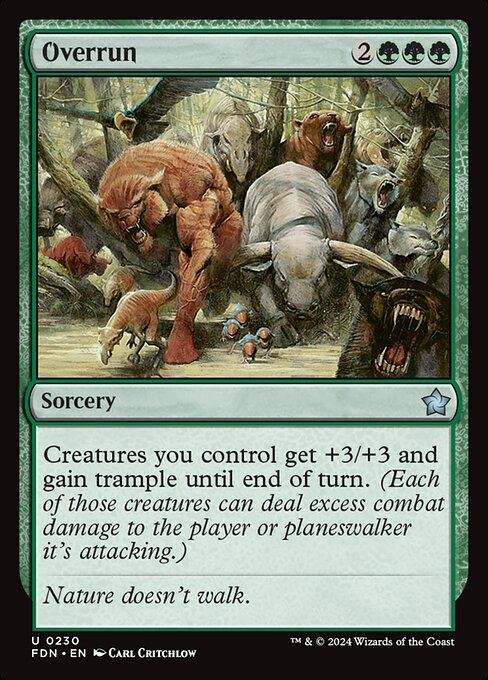
104. Overrun
Rating6.0PlayableWhy this rating?
Good playable that always makes the cut (6.0/10).
Why. An end-game sorcery: all your creatures get +3/+3 and trample for the turn. With four or five creatures out, it turns a stalled board into an immediate win.
Risks. It costs five mana, three of them green, and does nothing without creatures. Against blockers plus a removal spell in response, it disappoints.
In the draft. Take it in a green deck with plenty of creatures, such as green-white or red-green. One copy is enough; it is not a priority pick.
Results in the games of the set
When it is in hand, the deck wins 55.1% of its games (set average: 55.7%, 128th of 274 cards).
In the opening hand: 52.0% wins (54.8% on average).
Drawn during the game: 57.3% (56.4% on average).
When it is drawn, the deck wins 0.7 points more than when it is not.
When it is drafted, it is played 69% of the time (set average: 61%).
Taken as the first pick (82 drafts), it ends in the deck 85% of the time.
It is played mostly in G/W decks (34% of them) and G/R (30%).

105. Perforating Artist
Rating6.0PlayableWhy this rating?
Good playable that always makes the cut (6.0/10).
Why. A 3/2 deathtouch for three mana that discourages blocks and attacks alike. With Raid, at the end of each turn you attacked, each opponent loses 3 life unless they sacrifice a nonland permanent or discard a card.
Risks. It needs both black and red. It does nothing extra if you cannot attack, and the opponent will pick whichever option hurts least.
In the draft. A good uncommon for aggressive black-red. Outside those two colors, pass it: it has no role as a splash.
Results in the games of the set
When it is in hand, the deck wins 57.8% of its games (set average: 55.7%, 54th of 274 cards).
In the opening hand: 58.4% wins (54.8% on average).
Drawn during the game: 57.3% (56.4% on average).
When it is drawn, the deck wins 3.9 points more than when it is not.
When it is drafted, it is played 66% of the time (set average: 61%).
Taken as the first pick (112 drafts), it ends in the deck 81% of the time.
It is played mostly in B/R decks (55% of them).

106. Quilled Greatwurm
Rating6.0PlayableWhy this rating?
Good playable that always makes the cut (6.0/10).
Why. A 7/7 trampler for six: every creature you control that deals combat damage during your turn gets that many +1/+1 counters, if it survives. If it dies, you can cast it from your graveyard by removing six counters from among your creatures.
Risks. Six mana is steep, and the recursion needs a lot of counters you will not have in a deck without support. Cheap removal handles it, though it can come back.
In the draft. A good finisher for a green deck that already applies pressure and generates counters. One copy is plenty; take it after removal and quality curve creatures.
Results in the games of the set
When it is in hand, the deck wins 55.3% of its games (set average: 55.7%, 121st of 274 cards).
In the opening hand: 53.1% wins (54.8% on average).
Drawn during the game: 56.9% (56.4% on average).
When it is drawn, the deck wins 3.1 points more than when it is not.
When it is drafted, it is played 86% of the time (set average: 61%).
Taken as the first pick (34 drafts), it ends in the deck 82% of the time.
It is played about as much in every archetype.

107. Slumbering Cerberus
Rating6.0PlayableWhy this rating?
Good playable that always makes the cut (6.0/10).
Why. A 4/2 for two mana, which hits hard early. It does not untap during your untap step, but with Morbid it untaps at the end of any turn in which a creature died, which happens fast in an aggressive deck.
Risks. It stays tapped until a creature dies, so it rarely blocks. With only two toughness it dies to almost any small blocker.
In the draft. A good pick for aggressive red decks with removal and frequent trades. In a slower deck, its drawback becomes a real burden.
Results in the games of the set
When it is in hand, the deck wins 56.1% of its games (set average: 55.7%, 95th of 274 cards).
In the opening hand: 57.1% wins (54.8% on average).
Drawn during the game: 55.3% (56.4% on average).
When it is drawn, the deck wins 0.0 points more than when it is not.
When it is drafted, it is played 76% of the time (set average: 61%).
Taken as the first pick (96 drafts), it ends in the deck 94% of the time.
It is played mostly in G/R decks (40% of them) and B/R (32%).

108. Snakeskin Veil
Rating6.0PlayableWhy this rating?
Good playable that always makes the cut (6.0/10).
Why. For one green mana you put a +1/+1 counter on a creature you control and give it hexproof for the turn. It blanks an opposing targeted removal spell and can also win a combat.
Risks. It is a protection spell: it does nothing without a creature worth saving. Against non-targeted removal or a sweeper, it is useless.
In the draft. A fine pick for a green deck with valuable creatures, but not a priority. Take it after removal and good creatures.
Results in the games of the set
When it is in hand, the deck wins 54.8% of its games (set average: 55.7%, 137th of 274 cards).
In the opening hand: 53.7% wins (54.8% on average).
Drawn during the game: 55.6% (56.4% on average).
When it is drawn, the deck wins 0.8 points more than when it is not.
When it is drafted, it is played 79% of the time (set average: 61%).
Taken as the first pick (70 drafts), it ends in the deck 91% of the time.
It is played mostly in G/R decks (31% of them) and G/W (30%).

109. Zul Ashur, Lich Lord
Rating6.0PlayableWhy this rating?
Good playable that always makes the cut (6.0/10).
Why. A legendary 2/2 for two mana with ward that makes opponents pay 2 life to target it. By tapping it, you may cast a Zombie from your graveyard this turn, but only if you actually have one.
Risks. Without Zombies in your deck it is just a decent 2/2. The ability requires tapping it, so it cannot attack or block that turn, and you still pay the Zombie's cost.
In the draft. Playable in black decks with several Zombies; otherwise it is only a curve creature. Do not take it early unless you already see Zombies flowing.
Results in the games of the set
When it is in hand, the deck wins 54.2% of its games (set average: 55.7%, 154th of 274 cards).
In the opening hand: 53.1% wins (54.8% on average).
Drawn during the game: 55.0% (56.4% on average).
When it is drawn, the deck wins 1.6 points more than when it is not.
When it is drafted, it is played 71% of the time (set average: 61%).
Taken as the first pick (72 drafts), it ends in the deck 78% of the time.
It is played about as much in every archetype.

110. Rogue's Passage
Rating5.9PlayableWhy this rating?
Good playable that always makes the cut (5.9/10).
Why. A utility land that taps for colorless mana and, for four mana plus tapping the land, makes a creature unblockable this turn. It does not enter tapped, and in a board stall it is a reliable way to close the game.
Risks. It makes colorless mana and does not fix your colors. Activating the ability is expensive and takes up your whole turn.
In the draft. A fine late pick if you have big creatures and a deck built for the long game. Otherwise a basic land does nearly as well.
Results in the games of the set
When it is in hand, the deck wins 55.6% of its games (set average: 55.7%, 110th of 274 cards).
In the opening hand: 54.1% wins (54.8% on average).
Drawn during the game: 56.7% (56.4% on average).
When it is drawn, the deck wins 0.5 points more than when it is not.
When it is drafted, it is played 39% of the time (set average: 61%).
Taken among the first three picks (32 drafts), it ends in the deck 84% of the time.
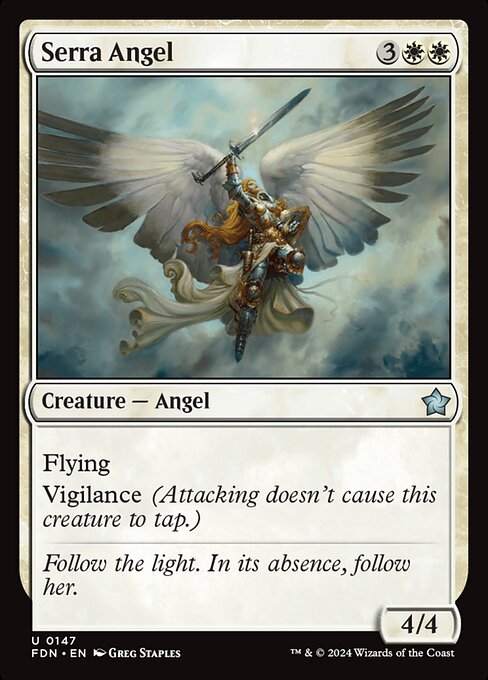
111. Serra Angel
Rating5.8PlayableWhy this rating?
Good playable that always makes the cut (5.9/10).
Why. A 4/4 flying vigilance creature for five mana: it attacks in the air while staying back to block, on the ground or in the air. A reliable body that holds the board well.
Risks. It needs two white mana. Ordinary removal trades one for one, and it has no extra ability to protect itself.
In the draft. A good uncommon to take in a white deck. It makes a solid top of the curve.
Results in the games of the set
When it is in hand, the deck wins 54.8% of its games (set average: 55.7%, 133rd of 274 cards).
In the opening hand: 53.3% wins (54.8% on average).
Drawn during the game: 55.9% (56.4% on average).
When it is drawn, the deck wins 0.4 points more than when it is not.
When it is drafted, it is played 85% of the time (set average: 61%).
Taken as the first pick (135 drafts), it ends in the deck 94% of the time.
It is played mostly in U/W decks (26% of them).
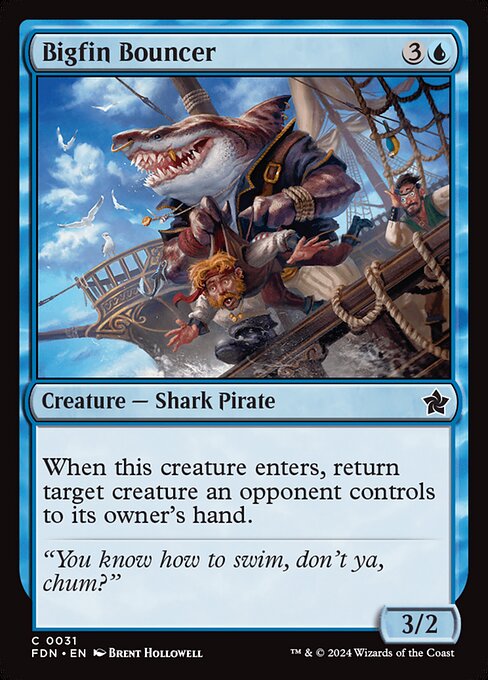
112. Bigfin Bouncer
Rating5.8PlayableWhy this rating?
Good playable that always makes the cut (5.8/10).
Why. A 3/2 that returns an opposing creature to its owner's hand when it enters: a clean tempo gain, especially against an expensive creature or a token, which disappears for good. Two effects for four mana.
Risks. Only two toughness and the effect is temporary, since the opponent can recast the creature. It loses value against cheap creatures.
In the draft. A good blue common, worth taking fairly high among the color's commons. It suits every tempo-oriented blue deck.
Results in the games of the set
When it is in hand, the deck wins 57.6% of its games (set average: 55.7%, 58th of 274 cards).
In the opening hand: 55.1% wins (54.8% on average).
Drawn during the game: 59.1% (56.4% on average).
When it is drawn, the deck wins 3.7 points more than when it is not.
When it is drafted, it is played 84% of the time (set average: 61%).
Taken as the first pick (357 drafts), it ends in the deck 92% of the time.
It is played mostly in R/U decks (65% of them) and G/U (61%).
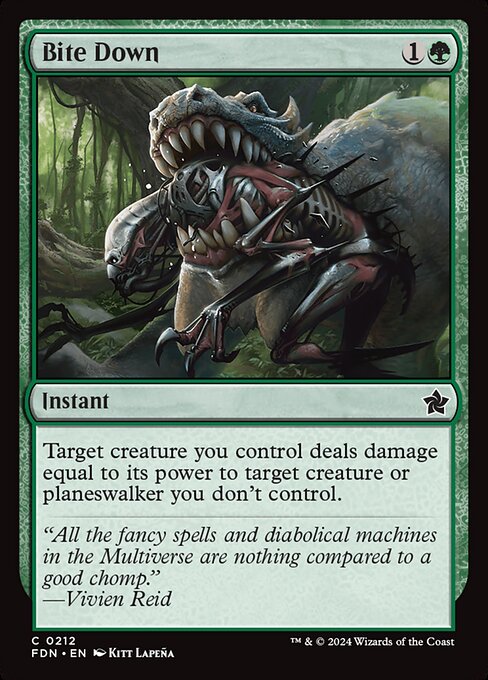
113. Bite Down
Rating5.8PlayableWhy this rating?
Good playable that always makes the cut (5.8/10).
Why. A two-mana instant removal: your creature deals damage equal to its power to an opposing creature or planeswalker, and takes none back. With a big creature, it is a great trade.
Risks. You need a creature of your own, and the opponent can respond by killing it. Without enough power, it kills nothing.
In the draft. A good green removal, worth taking fairly high. It is better with big creatures in your deck, so look for them alongside.
Results in the games of the set
When it is in hand, the deck wins 55.8% of its games (set average: 55.7%, 105th of 274 cards).
In the opening hand: 53.9% wins (54.8% on average).
Drawn during the game: 57.2% (56.4% on average).
When it is drawn, the deck wins 1.5 points more than when it is not.
When it is drafted, it is played 86% of the time (set average: 61%).
Taken as the first pick (244 drafts), it ends in the deck 96% of the time.
It is played mostly in G/R decks (67% of them) and G/U (67%).

114. Cathar Commando
Rating5.8PlayableWhy this rating?
Good playable that always makes the cut (5.8/10).
Why. A 3/1 flash creature for two mana: ambush an attacker or drop it at end of turn. For one mana it can also sacrifice itself to destroy an artifact or enchantment, which helps against cards that are otherwise hard to handle.
Risks. One toughness means it dies to any small blocker. The destruction mode only matters when there is a target.
In the draft. A good white common, especially in aggressive decks. Take it in the middle of the pack; the destruction mode is a bonus.
Results in the games of the set
When it is in hand, the deck wins 55.6% of its games (set average: 55.7%, 112th of 274 cards).
In the opening hand: 55.9% wins (54.8% on average).
Drawn during the game: 55.3% (56.4% on average).
When it is drawn, the deck wins 0.0 points more than when it is not.
When it is drafted, it is played 77% of the time (set average: 61%).
Taken as the first pick (118 drafts), it ends in the deck 92% of the time.
It is played mostly in U/W decks (60% of them) and R/W (58%).

115. Elvish Archdruid
Rating5.8PlayableWhy this rating?
Good playable that always makes the cut (5.8/10).
Why. It gives other Elves +1/+1 and, by tapping, adds a green mana for each Elf you control. In an Elf-heavy deck it accelerates hard and makes the whole board more dangerous.
Risks. Without several Elves it is only a 2/2 that taps for one mana. It needs two green mana and dies to any removal.
In the draft. A synergy card: take it only for a green deck with plenty of Elves. Otherwise do not force it.
Results in the games of the set
When it is in hand, the deck wins 54.5% of its games (set average: 55.7%, 146th of 274 cards).
In the opening hand: 55.4% wins (54.8% on average).
Drawn during the game: 53.8% (56.4% on average).
When it is drawn, the deck wins 2.2 points more than when it is not.
When it is drafted, it is played 72% of the time (set average: 61%).
Taken as the first pick (53 drafts), it ends in the deck 85% of the time.
It is played mostly in B/G decks (27% of them).
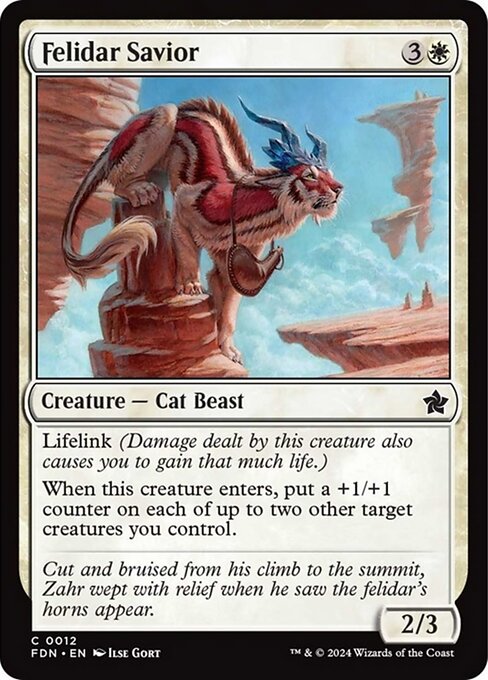
116. Felidar Savior
Rating5.8PlayableWhy this rating?
Good playable that always makes the cut (5.8/10).
Why. A 2/3 lifelinker that puts a +1/+1 counter on each of up to two other creatures you control when it enters. It improves your board while gaining life, which makes it very effective in a deck with several creatures.
Risks. It does almost nothing without other creatures already out. At four mana it can be slow in a very aggressive deck.
In the draft. A good white common, particularly in decks with many small creatures. Take it fairly high among the commons.
Results in the games of the set
When it is in hand, the deck wins 57.4% of its games (set average: 55.7%, 62nd of 274 cards).
In the opening hand: 56.5% wins (54.8% on average).
Drawn during the game: 58.1% (56.4% on average).
When it is drawn, the deck wins 2.1 points more than when it is not.
When it is drafted, it is played 88% of the time (set average: 61%).
Taken as the first pick (358 drafts), it ends in the deck 95% of the time.
It is played mostly in B/W decks (64% of them) and R/W (64%).

117. Garruk's Uprising
Rating5.8PlayableWhy this rating?
Good playable that always makes the cut (5.8/10).
Why. An enchantment that gives your creatures trample and draws a card when it enters if you control a creature with power four or greater, then again each time such a creature enters. It is a card engine for big-creature decks.
Risks. It does not change the board on its own and does very little without big creatures. In a deck of small creatures it is a disappointing three-drop.
In the draft. Play it only in a green deck with several creatures of power four or more. Take it mid-pack, not before you have the big creatures.
Results in the games of the set
When it is in hand, the deck wins 52.2% of its games (set average: 55.7%, 207th of 274 cards).
In the opening hand: 50.3% wins (54.8% on average).
Drawn during the game: 53.6% (56.4% on average).
When it is drawn, the deck wins 2.5 points less than when it is not.
When it is drafted, it is played 55% of the time (set average: 61%).
Taken as the first pick (49 drafts), it ends in the deck 73% of the time.
It is played mostly in G/R decks (43% of them).

118. Gorehorn Raider
Rating5.8PlayableWhy this rating?
Good playable that always makes the cut (5.8/10).
Why. A 4/4 for five mana that, with Raid, deals 2 damage to any target when it enters if you attacked this turn. A solid body plus a small removal effect, best cast after combat.
Risks. You must have attacked to trigger it, which is hard if your board is empty. Without the trigger it is just an ordinary 4/4 for five.
In the draft. A good red common for a deck that attacks consistently. Take it fairly high among the commons.
Results in the games of the set
When it is in hand, the deck wins 56.6% of its games (set average: 55.7%, 86th of 274 cards).
In the opening hand: 55.3% wins (54.8% on average).
Drawn during the game: 57.6% (56.4% on average).
When it is drawn, the deck wins 0.6 points more than when it is not.
When it is drafted, it is played 55% of the time (set average: 61%).
Taken as the first pick (92 drafts), it ends in the deck 83% of the time.
It is played mostly in B/R decks (75% of them) and R/W (68%).

119. Heraldic Banner
Rating5.8PlayableWhy this rating?
Good playable that always makes the cut (5.8/10).
Why. It ramps your mana in the chosen color and gives +1/+0 to all your creatures of that color. In a heavily one-color deck it is both acceleration and extra pressure.
Risks. Three mana for an effect that does not develop your board: on turn three it does nothing immediate. In a multicolor deck, its bonus reaches fewer creatures.
In the draft. A fine artifact for a deck leaning strongly into one color, particularly aggro. Take it mid-pack, and never ahead of removal.
Results in the games of the set
When it is in hand, the deck wins 54.7% of its games (set average: 55.7%, 141st of 274 cards).
In the opening hand: 54.7% wins (54.8% on average).
Drawn during the game: 54.8% (56.4% on average).
When it is drawn, the deck wins 0.1 points more than when it is not.
When it is drafted, it is played 60% of the time (set average: 61%).
Taken as the first pick (57 drafts), it ends in the deck 75% of the time.
It is played about as much in every archetype.
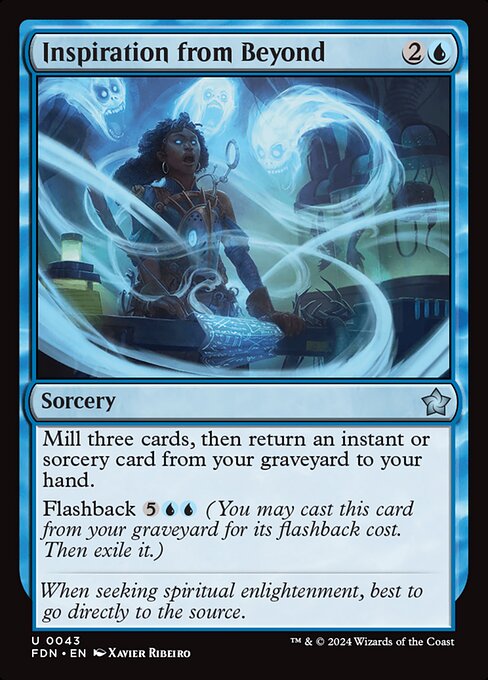 Rating5.8Playable
Why this rating?
Good playable that always makes the cut (5.8/10).
Why. It mills three cards then returns an instant or sorcery to your hand, and it can be cast again later with flashback. It gives value over time and helps reach Threshold.
Risks. Without good instants or sorceries in your graveyard it returns nothing. It does not affect the board, and the flashback cost is steep.
In the draft. Play it in a blue-black or blue-red deck full of spells. Otherwise let it go: it is a late addition at best.
Results in the games of the set
When it is in hand, the deck wins 53.4% of its games (set average: 55.7%, 179th of 274 cards).
In the opening hand: 48.9% wins (54.8% on average).
Drawn during the game: 56.2% (56.4% on average).
When it is drawn, the deck wins 1.8 points more than when it is not.
When it is drafted, it is played 27% of the time (set average: 61%).
Taken among the first three picks (85 drafts), it ends in the deck 66% of the time.
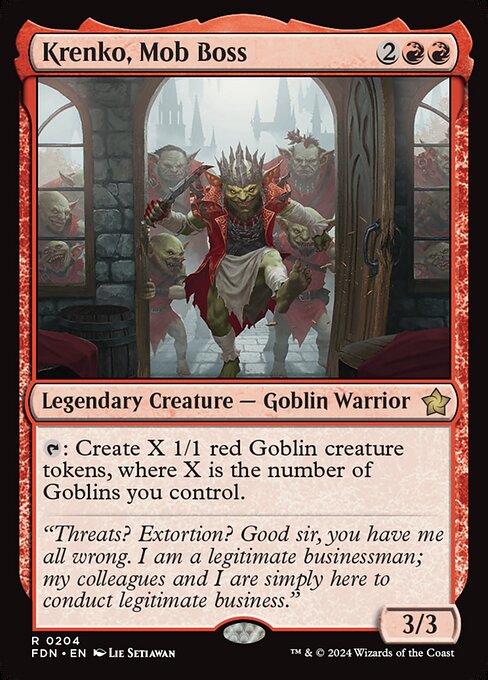
121. Krenko, Mob Boss
Rating5.8PlayableWhy this rating?
Good playable that always makes the cut (5.8/10).
Why. A 3/3 that, each turn it can tap, creates as many 1/1 red Goblin creature tokens as you control Goblins, itself included. The count doubles every turn: if it survives, the game ends quickly.
Risks. It is legendary, costs four mana including two red, and draws the opponent's removal. It must survive a full turn on the battlefield before it can first tap.
In the draft. A strong rare for a red deck. Cast it when you can defend it, or once the opponent has spent their removal.
Results in the games of the set
When it is in hand, the deck wins 55.1% of its games (set average: 55.7%, 129th of 274 cards).
In the opening hand: 55.0% wins (54.8% on average).
Drawn during the game: 55.1% (56.4% on average).
When it is drawn, the deck wins 1.8 points more than when it is not.
When it is drafted, it is played 87% of the time (set average: 61%).
Taken as the first pick (116 drafts), it ends in the deck 87% of the time.
It is played about as much in every archetype.
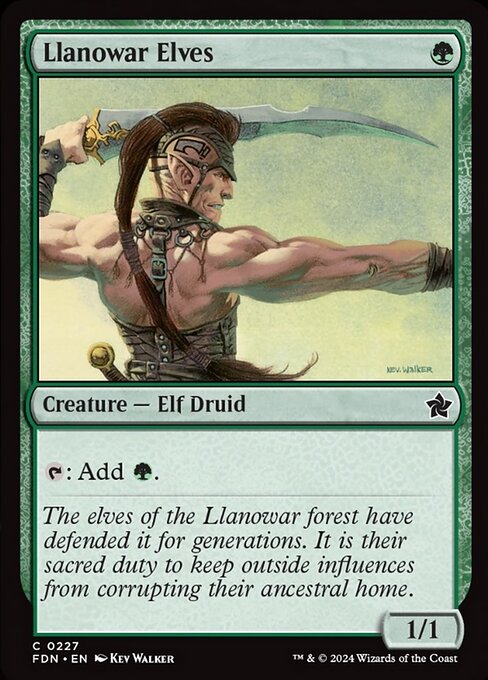
122. Llanowar Elves
Rating5.8PlayableWhy this rating?
Good playable that always makes the cut (5.8/10).
Why. A 1/1 for one green mana that ramps from turn two: you can play a three-drop on turn two. Acceleration is valuable in green, and it is also an Elf.
Risks. A very fragile 1/1 that is weak late in the game. It is vulnerable to small removal and sweepers.
In the draft. A good pick for any green deck with three- and four-drops. Take it before filler, but not before good removal.
Results in the games of the set
When it is in hand, the deck wins 57.0% of its games (set average: 55.7%, 71st of 274 cards).
In the opening hand: 61.8% wins (54.8% on average).
Drawn during the game: 52.9% (56.4% on average).
When it is drawn, the deck wins 2.9 points more than when it is not.
When it is drafted, it is played 89% of the time (set average: 61%).
Taken as the first pick (318 drafts), it ends in the deck 97% of the time.
It is played mostly in G/U decks (70% of them) and G/R (69%).
 Rating5.8Playable
Why this rating?
Good playable that always makes the cut (5.8/10).
Why. Every instant or sorcery you cast creates a 5/5 red Dragon creature token with flying. In a spell-heavy deck it is a game-winning machine within a few turns.
Risks. Six mana for an enchantment that does nothing right away. It needs plenty of instants and sorceries, and it is slow against aggressive decks.
In the draft. Only play it in a red deck packed with spells. In a typical deck it is too slow; do not take it early.
Results in the games of the set
When it is in hand, the deck wins 51.3% of its games (set average: 55.7%, 228th of 274 cards).
In the opening hand: 49.4% wins (54.8% on average).
Drawn during the game: 52.6% (56.4% on average).
When it is drawn, the deck wins 0.7 points more than when it is not.
When it is drafted, it is played 56% of the time (set average: 61%).
Taken as the first pick (31 drafts), it ends in the deck 68% of the time.
It is played about as much in every archetype.
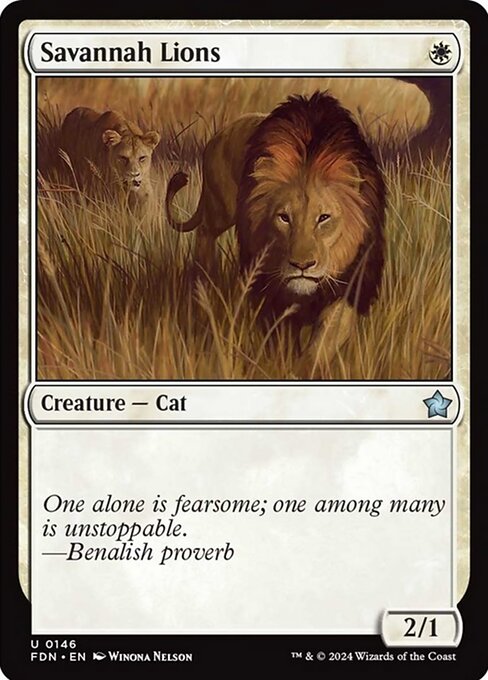
124. Savannah Lions
Rating5.8PlayableWhy this rating?
Good playable that always makes the cut (5.8/10).
Why. A 2/1 for one white mana that applies pressure on turn one. In a very aggressive deck a fast start is hard to come back from.
Risks. It has no ability and quickly becomes outdated: a 2/1 is blocked by most midgame creatures.
In the draft. Reserved for aggressive white decks, notably white-red. In a slower deck it has no place; take it late.
Results in the games of the set
When it is in hand, the deck wins 53.0% of its games (set average: 55.7%, 190th of 274 cards).
In the opening hand: 54.9% wins (54.8% on average).
Drawn during the game: 51.4% (56.4% on average).
When it is drawn, the deck wins 1.7 points less than when it is not.
When it is drafted, it is played 53% of the time (set average: 61%).
Taken among the first three picks (143 drafts), it ends in the deck 75% of the time.
It is played mostly in R/W decks (27% of them).

125. Uncharted Voyage
Rating5.8PlayableWhy this rating?
Good playable that always makes the cut (5.8/10).
Why. An instant that makes the owner put a creature on the top or bottom of their library, their choice, then you surveil 1. It costs the opponent a draw step or the creature.
Risks. It costs four mana, and the opponent can put the creature on top and redraw it: you gain tempo rather than a card.
In the draft. A good blue common, especially in tempo decks. Take it after the best removal; tokens disappear for good.
Results in the games of the set
When it is in hand, the deck wins 56.7% of its games (set average: 55.7%, 84th of 274 cards).
In the opening hand: 53.6% wins (54.8% on average).
Drawn during the game: 58.5% (56.4% on average).
When it is drawn, the deck wins 2.5 points more than when it is not.
When it is drafted, it is played 68% of the time (set average: 61%).
Taken as the first pick (112 drafts), it ends in the deck 91% of the time.
It is played mostly in R/U decks (68% of them) and B/U (59%).
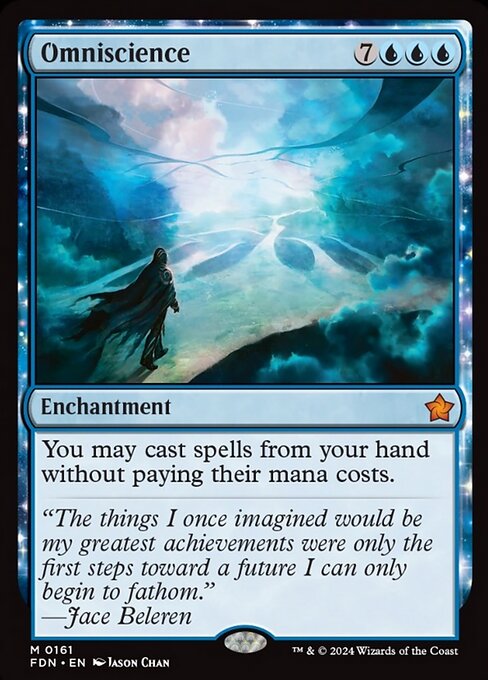
126. Omniscience
Rating5.7PlayableWhy this rating?
Good playable that always makes the cut (5.7/10).
Why. Ten mana to cast every spell from your hand for free. In theory everything after that is free; in practice the game is almost always decided long before.
Risks. Ten mana is unrealistic in a draft format. While you build up lands, the opponent beats you with ordinary creatures.
In the draft. Not a draft pick: ignore it. Even in a blue control deck it will almost never be castable.
Results in the games of the set
When it is drafted, it is played only 0% of the time (set average: 61%): it almost always ends in the sideboard.
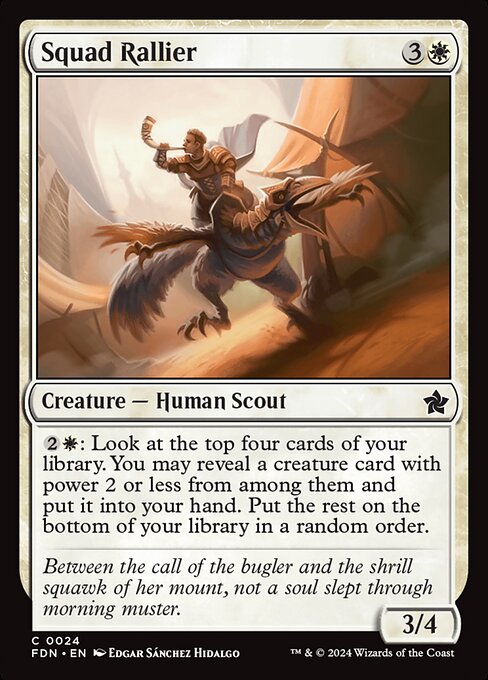
127. Squad Rallier
Rating5.7PlayableWhy this rating?
Good playable that always makes the cut (5.7/10).
Why. A 3/4 for four mana, a good defensive body, that can also look at the top four cards of your library for a creature with power two or less. In long games it is a steady card engine.
Risks. The activation costs three mana and does not always find an eligible creature. It slows your development if you use it too early.
In the draft. A good white common, especially in decks with many small creatures. Take it for its solidity; it fills the middle of the curve well.
Results in the games of the set
When it is in hand, the deck wins 55.9% of its games (set average: 55.7%, 102nd of 274 cards).
In the opening hand: 54.5% wins (54.8% on average).
Drawn during the game: 56.8% (56.4% on average).
When it is drawn, the deck wins 0.4 points more than when it is not.
When it is drafted, it is played 46% of the time (set average: 61%).
Taken as the first pick (46 drafts), it ends in the deck 80% of the time.
It is played mostly in B/W decks (40% of them) and U/W (33%).
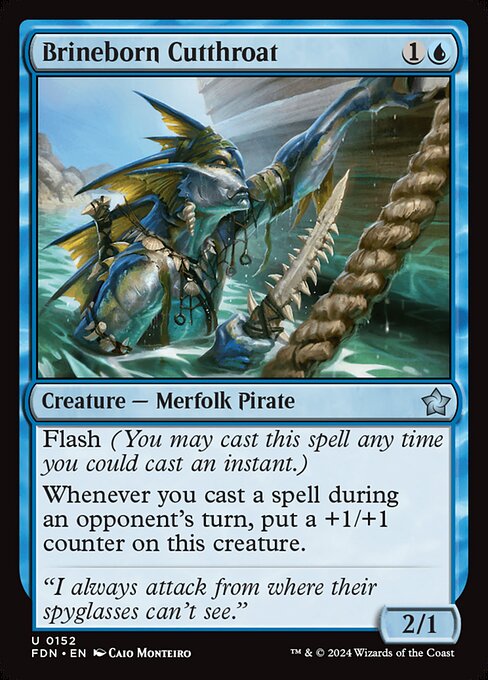
128. Brineborn Cutthroat
Rating5.6PlayableWhy this rating?
Good playable that always makes the cut (5.6/10).
Why. A 2/1 flash creature for two mana that gains a +1/+1 counter whenever you cast a spell during an opponent's turn. By playing your instants and flash creatures then, it grows at no extra mana cost.
Risks. It only grows if you have spells to cast on your opponent's turn. Without them it is a fragile, ordinary 2/1.
In the draft. A reasonable pick for a blue deck with flash cards and instants. Otherwise let it go without regret.
Results in the games of the set
When it is in hand, the deck wins 54.4% of its games (set average: 55.7%, 150th of 274 cards).
In the opening hand: 54.1% wins (54.8% on average).
Drawn during the game: 54.6% (56.4% on average).
When it is drawn, the deck wins 1.1 points more than when it is not.
When it is drafted, it is played 82% of the time (set average: 61%).
Taken as the first pick (113 drafts), it ends in the deck 90% of the time.
It is played mostly in R/U decks (34% of them) and G/U (30%).

129. Bushwhack
Rating5.6PlayableWhy this rating?
Good playable that always makes the cut (5.6/10).
Why. A flexible one-mana green sorcery: fetch a basic land to your hand to fix your mana, or have your creature fight an opposing creature. The fight mode is removal when your creature is bigger.
Risks. The fight can go wrong if the opponent responds with a spell. Without a big creature the fight mode is weak, and the land mode just replaces one card with another.
In the draft. A decent common for its flexibility. Take it after the best removal and play one or two copies in a deck with big creatures.
Results in the games of the set
When it is in hand, the deck wins 53.9% of its games (set average: 55.7%, 166th of 274 cards).
In the opening hand: 52.5% wins (54.8% on average).
Drawn during the game: 54.9% (56.4% on average).
When it is drawn, the deck wins 0.2 points more than when it is not.
When it is drafted, it is played 80% of the time (set average: 61%).
Taken as the first pick (133 drafts), it ends in the deck 97% of the time.
It is played mostly in G/U decks (58% of them) and B/G (57%).

130. Dismal Backwater
Rating5.6PlayableWhy this rating?
Good playable that always makes the cut (5.6/10).
Why. A blue-black dual land that enters tapped and gains you one life. It smooths out the colors of a blue-black deck at no real cost besides tempo.
Risks. It enters tapped, which can cost a turn in a very fast deck. Outside those two colors it adds nothing.
In the draft. Take it late for a blue-black deck, or as fixing for a deck splashing one of the two colors. Do not take it over a good spell.
Results in the games of the set
When it is in hand, the deck wins 56.5% of its games (set average: 55.7%, 90th of 274 cards).
In the opening hand: 56.7% wins (54.8% on average).
Drawn during the game: 56.4% (56.4% on average).
When it is drawn, the deck wins 3.7 points more than when it is not.
When it is drafted, it is played 65% of the time (set average: 61%).
Taken as the first pick (60 drafts), it ends in the deck 78% of the time.

131. Fake Your Own Death
Rating5.6PlayableWhy this rating?
Good playable that always makes the cut (5.6/10).
Why. An instant that gives a creature +2/+0 until end of turn and returns it tapped if it dies, plus a Treasure token. It is a good combat trick that blanks removal or wins a trade.
Risks. It does nothing without a creature and only protects for the turn; exile or bounce effects get around it. The creature returns tapped.
In the draft. A good black common, stronger in a creature-heavy deck. Take it mid-pack and look for creatures of value alongside.
Results in the games of the set
When it is in hand, the deck wins 55.8% of its games (set average: 55.7%, 103rd of 274 cards).
In the opening hand: 53.7% wins (54.8% on average).
Drawn during the game: 57.2% (56.4% on average).
When it is drawn, the deck wins 2.4 points more than when it is not.
When it is drafted, it is played 58% of the time (set average: 61%).
Taken as the first pick (67 drafts), it ends in the deck 78% of the time.
It is played mostly in B/W decks (47% of them) and B/R (46%).

132. Flamewake Phoenix
Rating5.6PlayableWhy this rating?
Good playable that always makes the cut (5.6/10).
Why. A 2/2 flying haste creature for three mana: it hits right away. At the beginning of combat on your turn, if you control a creature with power four or greater, you may pay one red mana to return it from your graveyard.
Risks. It must attack each combat, so it dies to a flying or reach blocker. Without a power-four creature it cannot come back.
In the draft. Fairly aggressive: take it in a red deck with several big creatures. In any other deck it is mediocre.
Results in the games of the set
When it is in hand, the deck wins 51.9% of its games (set average: 55.7%, 213th of 274 cards).
In the opening hand: 51.2% wins (54.8% on average).
Drawn during the game: 52.5% (56.4% on average).
When it is drawn, the deck wins 2.3 points less than when it is not.
When it is drafted, it is played 78% of the time (set average: 61%).
Taken as the first pick (66 drafts), it ends in the deck 85% of the time.
It is played about as much in every archetype.

133. Giant Growth
Rating5.6PlayableWhy this rating?
Good playable that always makes the cut (5.6/10).
Why. For one green mana, a creature gets +3/+3 until end of turn. An efficient combat trick that wins a combat or blanks a damage-based removal spell.
Risks. It does nothing without a creature, and destroy or exile removal blanks it completely. You lose two cards for one if the opponent responds.
In the draft. Fine in an aggressive green deck, but not a priority. Take it after removal and good creatures.
Results in the games of the set
When it is in hand, the deck wins 54.2% of its games (set average: 55.7%, 158th of 274 cards).
In the opening hand: 52.8% wins (54.8% on average).
Drawn during the game: 55.2% (56.4% on average).
When it is drawn, the deck wins 0.2 points less than when it is not.
When it is drafted, it is played 41% of the time (set average: 61%).
Taken among the first three picks (149 drafts), it ends in the deck 77% of the time.
It is played mostly in G/R decks (41% of them) and G/W (41%).

134. Make Your Move
Rating5.6PlayableWhy this rating?
Good playable that always makes the cut (5.6/10).
Why. A three-mana instant that destroys an artifact, an enchantment, or a creature with power four or greater. It removes the opponent's biggest threats at a fair price.
Risks. It cannot touch creatures with power three or less, which lets many threats through. Against small creatures it sits in your hand.
In the draft. A decent white removal spell, worth taking mid-pack. It is better against decks of big creatures, and its other targets (artifacts, enchantments) keep it useful.
Results in the games of the set
When it is in hand, the deck wins 55.3% of its games (set average: 55.7%, 123rd of 274 cards).
In the opening hand: 52.9% wins (54.8% on average).
Drawn during the game: 56.9% (56.4% on average).
When it is drawn, the deck wins 1.1 points more than when it is not.
When it is drafted, it is played 56% of the time (set average: 61%).
Taken as the first pick (62 drafts), it ends in the deck 77% of the time.
It is played mostly in U/W decks (41% of them) and G/W (38%).

135. Pilfer
Rating5.6PlayableWhy this rating?
Good playable that always makes the cut (5.6/10).
Why. Two mana to see the opponent's hand and take their best nonland card. It is a one-for-one, but the information is a bonus: you know exactly what you still have to beat.
Risks. It does nothing on the battlefield. Late in the game the opponent's hand is often empty and the spell is a dead draw.
In the draft. Fine in black as a filler slot, not a mid-pack priority. Best in a controlling deck that wants to see the threat before answering it.
Results in the games of the set
When it is in hand, the deck wins 55.6% of its games (set average: 55.7%, 111th of 274 cards).
In the opening hand: 55.0% wins (54.8% on average).
Drawn during the game: 56.0% (56.4% on average).
When it is drawn, the deck wins 2.5 points more than when it is not.
When it is drafted, it is played 45% of the time (set average: 61%).
Taken as the first pick (34 drafts), it ends in the deck 79% of the time.
It is played mostly in B/U decks (37% of them) and B/R (27%).
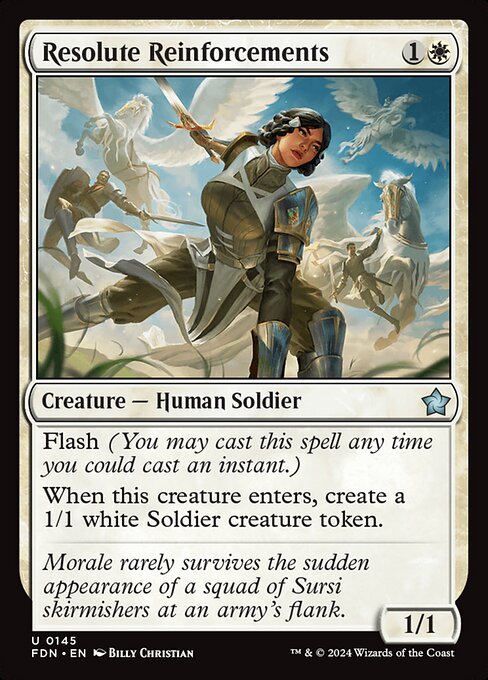 Rating5.6Playable
Why this rating?
Good playable that always makes the cut (5.6/10).
Why. Two 1/1 bodies for two mana, with flash: a 1/1 and a Soldier token. Cast it at the end of the opponent's turn, or ambush an attacker with two blockers. It suits decks that want many creatures for a wide attack.
Risks. Two 1/1s count for little against bigger bodies. On its own it does not change the plan of the game.
In the draft. A solid white pick, especially for an aggressive deck or one that wants a wide board. No need to take it early.
Results in the games of the set
When it is in hand, the deck wins 54.1% of its games (set average: 55.7%, 159th of 274 cards).
In the opening hand: 53.9% wins (54.8% on average).
Drawn during the game: 54.4% (56.4% on average).
When it is drawn, the deck wins 1.1 points less than when it is not.
When it is drafted, it is played 84% of the time (set average: 61%).
Taken as the first pick (106 drafts), it ends in the deck 89% of the time.
It is played mostly in R/W decks (35% of them).
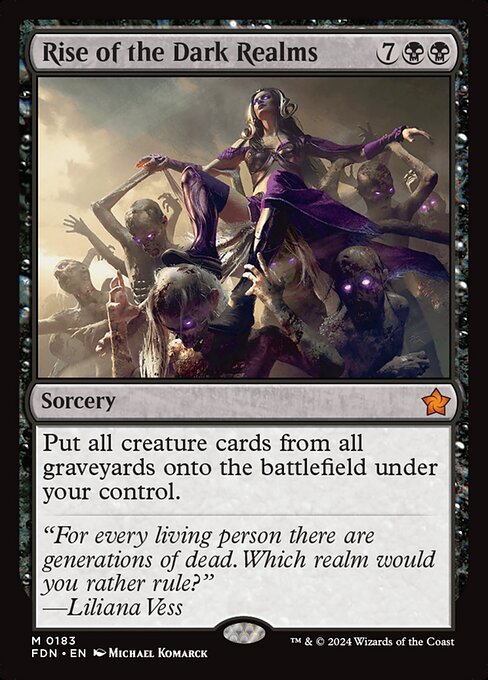 Rating5.6Playable
Why this rating?
Good playable that always makes the cut (5.6/10).
Why. Nine mana to put every creature card from every graveyard onto the battlefield under your control. When the board is clear and both graveyards are full, it swings the whole game.
Risks. Nine mana is huge; the game is often decided before you get there. It also needs full graveyards and does nothing if no creature has died.
In the draft. A niche finisher for a very slow control deck with lots of lands and card flow. One copy at most, and not before the middle of the pack.
Results in the games of the set
When it is in hand, the deck wins 53.5% of its games (set average: 55.7%, 176th of 274 cards).
In the opening hand: 47.5% wins (54.8% on average).
Drawn during the game: 57.1% (56.4% on average).
When it is drawn, the deck wins 3.8 points more than when it is not.
When it is drafted, it is played 46% of the time (set average: 61%).
Taken among the first three picks (63 drafts), it ends in the deck 49% of the time.
It is played about as much in every archetype.

138. Scoured Barrens
Rating5.6PlayableWhy this rating?
Good playable that always makes the cut (5.6/10).
Why. A white-black dual land that enters tapped and gains you 1 life. It smooths your mana across two colours, and the life point matters in a deck with life gain payoffs.
Risks. It enters tapped, which costs tempo in an aggressive deck. Outside its two colours it is useless.
In the draft. Late-pack pick if you are white-black, or a mid-pack pick once the pair is clear. Do not take it over a real playable.
Results in the games of the set
When it is in hand, the deck wins 54.8% of its games (set average: 55.7%, 136th of 274 cards).
In the opening hand: 56.1% wins (54.8% on average).
Drawn during the game: 53.8% (56.4% on average).
When it is drawn, the deck wins 0.1 points less than when it is not.
When it is drafted, it is played 62% of the time (set average: 61%).
Taken as the first pick (34 drafts), it ends in the deck 71% of the time.
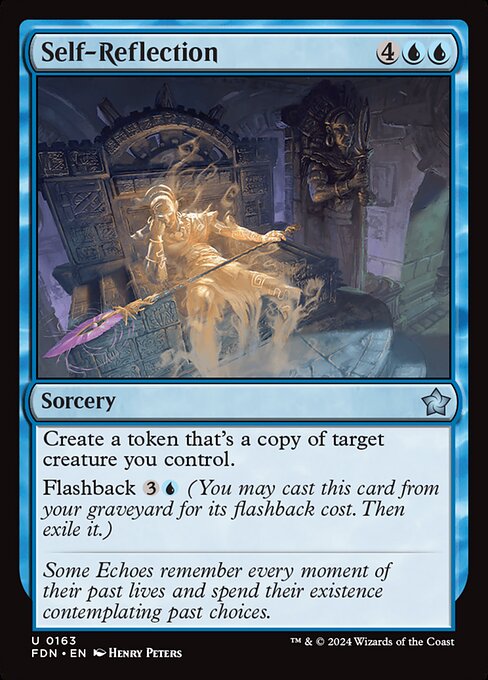
139. Self-Reflection
Rating5.6PlayableWhy this rating?
Good playable that always makes the cut (5.6/10).
Why. It creates a token copy of one of your creatures, then comes back from the graveyard with flashback for four mana. Two copies of a good creature is a lot of value over a long game.
Risks. Six mana for a sorcery that does nothing alone: you need a creature to copy, and if it dies in response the spell is lost. Very slow.
In the draft. Only for a blue control deck with strong creatures that do something when they enter. A mid-to-late pack pick, never a priority.
Results in the games of the set
When it is in hand, the deck wins 54.8% of its games (set average: 55.7%, 138th of 274 cards).
In the opening hand: 51.8% wins (54.8% on average).
Drawn during the game: 56.6% (56.4% on average).
When it is drawn, the deck wins 2.4 points more than when it is not.
When it is drafted, it is played 26% of the time (set average: 61%).
Taken among the first three picks (75 drafts), it ends in the deck 59% of the time.
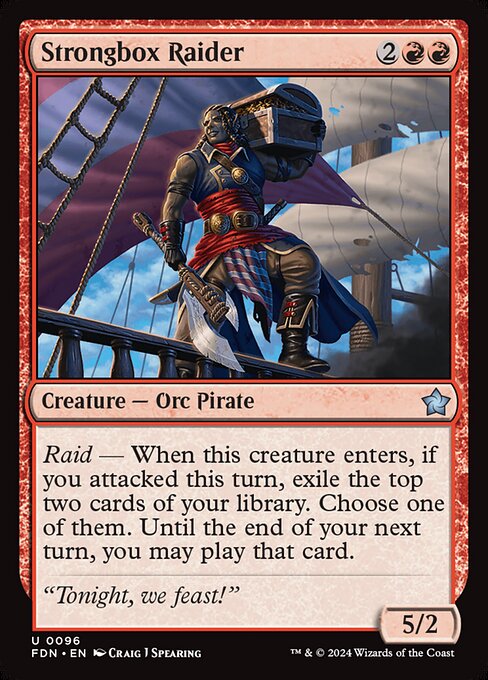
140. Strongbox Raider
Rating5.6PlayableWhy this rating?
Good playable that always makes the cut (5.6/10).
Why. A 5/2 for four mana that hits hard. With raid, you exile the top two cards and may play one of them until the end of your next turn, a real value bonus.
Risks. Two toughness, so it dies to nearly anything. The bonus needs an attack first, which is not guaranteed if combat goes badly. Needs two red mana.
In the draft. A good red pick for aggressive decks that attack early and cast it after combat. Slightly worse in a slow deck.
Results in the games of the set
When it is in hand, the deck wins 55.3% of its games (set average: 55.7%, 124th of 274 cards).
In the opening hand: 54.0% wins (54.8% on average).
Drawn during the game: 56.2% (56.4% on average).
When it is drawn, the deck wins 0.0 points more than when it is not.
When it is drafted, it is played 70% of the time (set average: 61%).
Taken as the first pick (95 drafts), it ends in the deck 92% of the time.
It is played mostly in B/R decks (35% of them) and G/R (35%).

141. Tranquil Cove
Rating5.6PlayableWhy this rating?
Good playable that always makes the cut (5.6/10).
Why. A white-blue dual land that enters tapped and gains 1 life. It fixes the mana of a white-blue deck.
Risks. It enters tapped, so a turn of tempo is lost. It has no value outside its two colours.
In the draft. Take it late if you are white-blue. Do not take it over a real playable unless it completes an already clear mana base.
Results in the games of the set
When it is in hand, the deck wins 55.7% of its games (set average: 55.7%, 109th of 274 cards).
In the opening hand: 57.0% wins (54.8% on average).
Drawn during the game: 54.7% (56.4% on average).
When it is drawn, the deck wins 0.6 points more than when it is not.
When it is drafted, it is played 57% of the time (set average: 61%).
Taken among the first three picks (172 drafts), it ends in the deck 80% of the time.

142. Fiendish Panda
Rating5.6PlayableWhy this rating?
Good playable that always makes the cut (5.6/10).
Why. A 3/2 that gets a +1/+1 counter whenever you gain life. When it dies, it returns another non-Bear creature card from your graveyard whose mana value is at most its power. In a white-black life gain deck it is a value engine.
Risks. It needs a life gain deck to grow. Without that, it is a 3/2 for four mana, and its death trigger cannot return a Bear or an expensive creature.
In the draft. A mid-pack pick for white-black, especially with the lands that gain 1 life. Both colours are required.
Results in the games of the set
When it is in hand, the deck wins 55.0% of its games (set average: 55.7%, 130th of 274 cards).
In the opening hand: 53.0% wins (54.8% on average).
Drawn during the game: 56.4% (56.4% on average).
When it is drawn, the deck wins 1.6 points more than when it is not.
When it is drafted, it is played 74% of the time (set average: 61%).
Taken as the first pick (132 drafts), it ends in the deck 81% of the time.
It is played mostly in B/W decks (49% of them).

143. Wind-Scarred Crag
Rating5.5PlayableWhy this rating?
A solid playable that rarely gets cut (5.5/10).
Why. A red-white dual land that enters tapped and gains 1 life. It fixes an aggro deck's mana, and the life point helps against fast decks.
Risks. It enters tapped, which slows an attacking deck. It is useless outside its two colours.
In the draft. A late-pack pick if you are red-white. Do not take it over a real playable.
Results in the games of the set
When it is in hand, the deck wins 53.7% of its games (set average: 55.7%, 170th of 274 cards).
In the opening hand: 56.0% wins (54.8% on average).
Drawn during the game: 51.8% (56.4% on average).
When it is drawn, the deck wins 1.5 points less than when it is not.
When it is drafted, it is played 43% of the time (set average: 61%).
Taken among the first three picks (103 drafts), it ends in the deck 79% of the time.

144. Swiftwater Cliffs
Rating5.4PlayableWhy this rating?
A solid playable that rarely gets cut (5.4/10).
Why. A blue-red dual land that enters tapped and gains 1 life. It fixes the mana of a blue-red deck.
Risks. It enters tapped, so a turn of tempo is lost. No value outside its two colours.
In the draft. Take it late if you are blue-red. Like all these lands, it comes after playables.
Results in the games of the set
When it is in hand, the deck wins 54.7% of its games (set average: 55.7%, 139th of 274 cards).
In the opening hand: 56.0% wins (54.8% on average).
Drawn during the game: 53.8% (56.4% on average).
When it is drawn, the deck wins 1.6 points more than when it is not.
When it is drafted, it is played 44% of the time (set average: 61%).
Taken as the first pick (30 drafts), it ends in the deck 73% of the time.

145. Bloodfell Caves
Rating5.4PlayableWhy this rating?
A solid playable that rarely gets cut (5.4/10).
Why. A black-red dual land that enters tapped and gains 1 life. It helps a black-red deck cast both colours smoothly.
Risks. It enters tapped, which costs tempo. It does nothing outside its two colours.
In the draft. A late-pack pick if you are black-red. Do not take it over a playable.
Results in the games of the set
When it is in hand, the deck wins 54.4% of its games (set average: 55.7%, 148th of 274 cards).
In the opening hand: 56.3% wins (54.8% on average).
Drawn during the game: 52.9% (56.4% on average).
When it is drawn, the deck wins 0.4 points less than when it is not.
When it is drafted, it is played 54% of the time (set average: 61%).
Taken among the first three picks (161 drafts), it ends in the deck 78% of the time.

146. Blossoming Sands
Rating5.4PlayableWhy this rating?
A solid playable that rarely gets cut (5.4/10).
Why. A green-white dual land that enters tapped and gains 1 life. It fixes the mana of a green-white deck.
Risks. It enters tapped, so a turn of tempo is lost. Useless outside its two colours.
In the draft. Take it late if you are green-white. After any playable.
Results in the games of the set
When it is in hand, the deck wins 53.5% of its games (set average: 55.7%, 178th of 274 cards).
In the opening hand: 55.3% wins (54.8% on average).
Drawn during the game: 52.0% (56.4% on average).
When it is drawn, the deck wins 0.6 points less than when it is not.
When it is drafted, it is played 45% of the time (set average: 61%).
Taken among the first three picks (72 drafts), it ends in the deck 75% of the time.
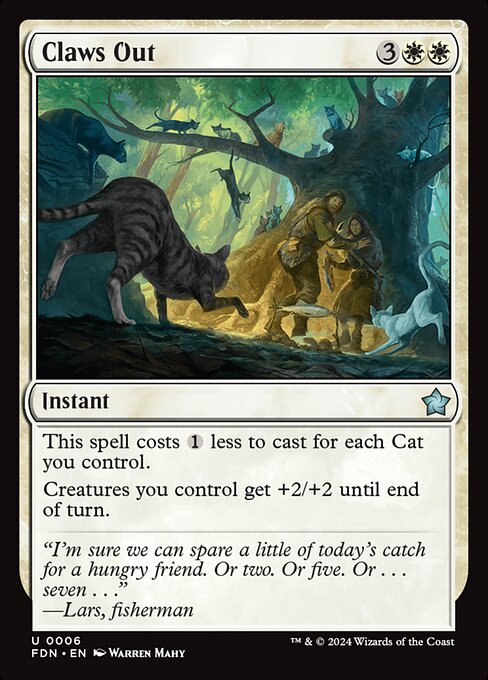
147. Claws Out
Rating5.4PlayableWhy this rating?
A solid playable that rarely gets cut (5.4/10).
Why. An instant that gives all your creatures +2/+2 until end of turn. In combat it flips blocks and can finish the opponent. It costs one mana less for each Cat you control.
Risks. Five mana with no Cats, and dead without creatures in play. It is a mass combat trick, and removal in response on one of your creatures blunts it.
In the draft. A mid-pack pick, good in a white deck with many small creatures. Worse in a deck with few creatures.
Results in the games of the set
When it is in hand, the deck wins 53.8% of its games (set average: 55.7%, 169th of 274 cards).
In the opening hand: 51.8% wins (54.8% on average).
Drawn during the game: 55.1% (56.4% on average).
When it is drawn, the deck wins 1.2 points less than when it is not.
When it is drafted, it is played 51% of the time (set average: 61%).
Taken as the first pick (39 drafts), it ends in the deck 77% of the time.
It is played mostly in R/W decks (35% of them).
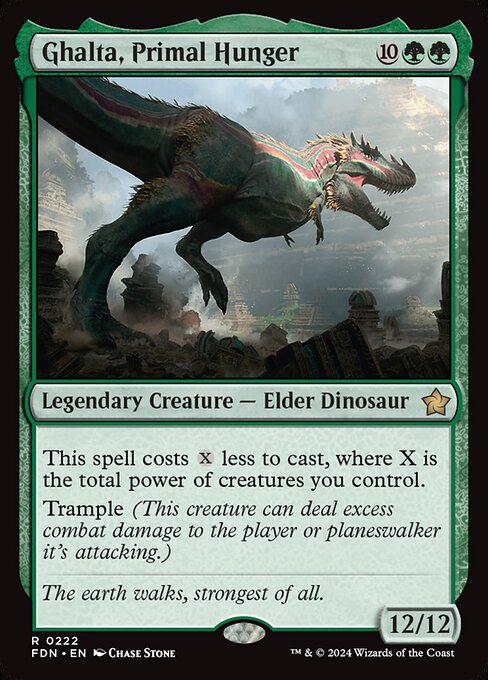 Rating5.4Playable
Why this rating?
A solid playable that rarely gets cut (5.4/10).
Why. A 12/12 with trample whose cost goes down by the total power of your creatures. With eight power on board it costs four mana: a threat that ends the game in a hit.
Risks. With no board it is stuck in hand. It needs two green mana, and a removal spell or a tempo play in response neutralises it.
In the draft. For a green deck of big creatures, a good mid-pack pick. In a deck of small creatures it sits in hand too long.
Results in the games of the set
When it is in hand, the deck wins 55.4% of its games (set average: 55.7%, 120th of 274 cards).
In the opening hand: 51.6% wins (54.8% on average).
Drawn during the game: 58.0% (56.4% on average).
When it is drawn, the deck wins 2.7 points more than when it is not.
When it is drafted, it is played 87% of the time (set average: 61%).
Taken as the first pick (83 drafts), it ends in the deck 92% of the time.
It is played about as much in every archetype.
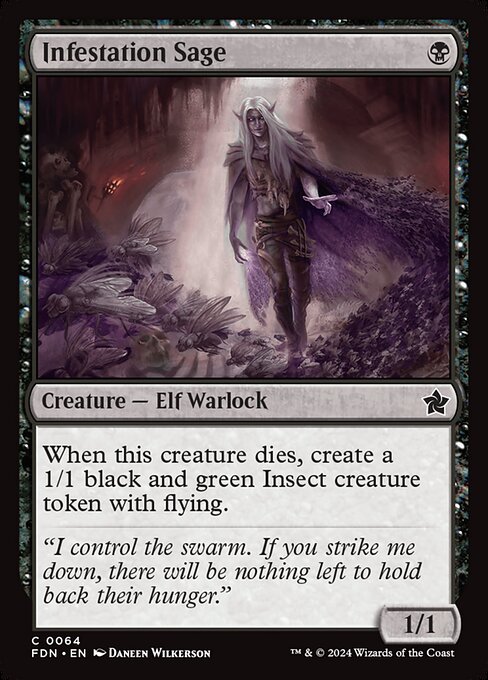
149. Infestation Sage
Rating5.4PlayableWhy this rating?
A solid playable that rarely gets cut (5.4/10).
Why. A one-mana 1/1 that leaves a 1/1 Insect token with flying when it dies. Two bodies for one mana and one card, great for chump blocks, trades, or sacrifice effects.
Risks. A very small body: it will not win the game alone. Late in the game it matters less.
In the draft. A good black common that fits almost any black deck. A mid-pack pick, best in a sacrifice or trading deck.
Results in the games of the set
When it is in hand, the deck wins 56.8% of its games (set average: 55.7%, 80th of 274 cards).
In the opening hand: 57.2% wins (54.8% on average).
Drawn during the game: 56.5% (56.4% on average).
When it is drawn, the deck wins 2.8 points more than when it is not.
When it is drafted, it is played 81% of the time (set average: 61%).
Taken as the first pick (230 drafts), it ends in the deck 94% of the time.
It is played mostly in B/R decks (71% of them) and B/G (69%).
 Rating5.4Playable
Why this rating?
A solid playable that rarely gets cut (5.4/10).
Why. You take a creature until end of turn, untap it, give it haste, and create a Treasure token. You attack with it, then sacrifice it or throw it into a block.
Risks. For four mana, the opponent gets the creature back at end of turn unless you can sacrifice it. The Treasure only partly makes up for it.
In the draft. A fair red pick for decks with sacrifice outlets or an aggressive plan. Otherwise, a mid-to-late pack pick.
Results in the games of the set
When it is in hand, the deck wins 55.7% of its games (set average: 55.7%, 107th of 274 cards).
In the opening hand: 52.8% wins (54.8% on average).
Drawn during the game: 57.8% (56.4% on average).
When it is drawn, the deck wins 1.3 points more than when it is not.
When it is drafted, it is played 36% of the time (set average: 61%).
Taken as the first pick (49 drafts), it ends in the deck 78% of the time.
It is played mostly in B/R decks (87% of them).

151. Jungle Hollow
Rating5.4PlayableWhy this rating?
A solid playable that rarely gets cut (5.4/10).
Why. A black-green dual land that enters tapped and gains 1 life. It smooths the mana of a black-green deck.
Risks. It enters tapped, so a turn of tempo is lost. Useless outside its two colours.
In the draft. Take it late if you are black-green. After any playable.
Results in the games of the set
When it is in hand, the deck wins 53.2% of its games (set average: 55.7%, 186th of 274 cards).
In the opening hand: 53.9% wins (54.8% on average).
Drawn during the game: 52.6% (56.4% on average).
When it is drawn, the deck wins 2.4 points more than when it is not.
When it is drafted, it is played 46% of the time (set average: 61%).
Taken among the first three picks (99 drafts), it ends in the deck 77% of the time.

152. Lunar Insight
Rating5.4PlayableWhy this rating?
A solid playable that rarely gets cut (5.4/10).
Why. Draw a card for each different mana value among your nonland permanents. With a varied board, three or four cards for three mana is a big card advantage swing.
Risks. It depends entirely on your board. Without permanents of different values, it draws one or two cards and disappoints.
In the draft. A mid-pack pick for a blue deck with a well-spread curve. Without that, let it go.
Results in the games of the set
When it is in hand, the deck wins 53.6% of its games (set average: 55.7%, 173rd of 274 cards).
In the opening hand: 49.6% wins (54.8% on average).
Drawn during the game: 56.2% (56.4% on average).
When it is drawn, the deck wins 2.6 points more than when it is not.
When it is drafted, it is played 35% of the time (set average: 61%).
Taken among the first three picks (76 drafts), it ends in the deck 62% of the time.
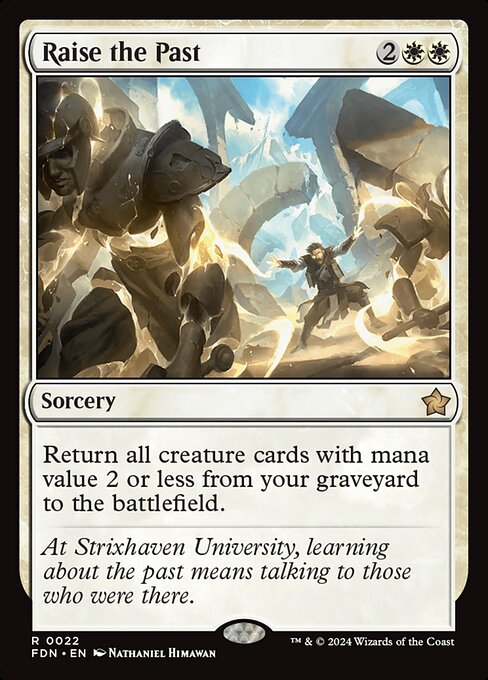
153. Raise the Past
Rating5.4PlayableWhy this rating?
A solid playable that rarely gets cut (5.4/10).
Why. It returns all creature cards with mana value 2 or less from your graveyard to the battlefield. In a deck of small creatures that have already traded, it is a second wave.
Risks. Four mana for a sorcery that does nothing if your graveyard is empty or full of pricier creatures. Very situational.
In the draft. A late-pack pick for a white deck with many cheap creatures. Otherwise it sits in hand.
Results in the games of the set
When it is in hand, the deck wins 51.1% of its games (set average: 55.7%, 233rd of 274 cards).
In the opening hand: 47.6% wins (54.8% on average).
Drawn during the game: 53.5% (56.4% on average).
When it is drawn, the deck wins 1.2 points less than when it is not.
When it is drafted, it is played 27% of the time (set average: 61%).
Taken among the first three picks (52 drafts), it ends in the deck 58% of the time.

154. Thornwood Falls
Rating5.4PlayableWhy this rating?
A solid playable that rarely gets cut (5.4/10).
Why. A green-blue dual land that enters tapped and gains 1 life. It smooths the mana of a green-blue deck.
Risks. It enters tapped, so a turn of tempo is lost. Useless outside its two colours.
In the draft. Take it late if you are green-blue. After any playable.
Results in the games of the set
When it is in hand, the deck wins 54.1% of its games (set average: 55.7%, 160th of 274 cards).
In the opening hand: 54.2% wins (54.8% on average).
Drawn during the game: 54.0% (56.4% on average).
When it is drawn, the deck wins 2.4 points more than when it is not.
When it is drafted, it is played 48% of the time (set average: 61%).
Taken among the first three picks (125 drafts), it ends in the deck 83% of the time.
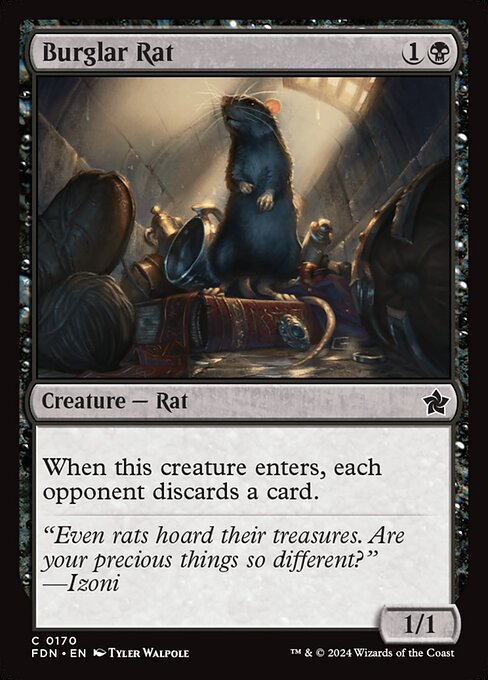
155. Burglar Rat
Rating5.4PlayableWhy this rating?
A solid playable that rarely gets cut (5.4/10).
Why. A two-mana 1/1 that makes each opponent discard a card. It is a one-for-one with a body attached, useful for trading or chump blocking.
Risks. A 1/1 body: it does not pressure the board. Late in the game, the opponent often has no cards left to discard.
In the draft. A good black common that fits nearly any black deck. A mid-pack pick, best in a sacrifice or control deck.
Results in the games of the set
When it is in hand, the deck wins 56.7% of its games (set average: 55.7%, 81st of 274 cards).
In the opening hand: 56.2% wins (54.8% on average).
Drawn during the game: 57.1% (56.4% on average).
When it is drawn, the deck wins 2.4 points more than when it is not.
When it is drafted, it is played 90% of the time (set average: 61%).
Taken as the first pick (342 drafts), it ends in the deck 96% of the time.
It is played mostly in B/R decks (68% of them) and B/W (68%).

156. Strix Lookout
Rating5.3PlayableWhy this rating?
A solid playable that rarely gets cut (5.3/10).
Why. A two-mana 1/2 with flying and vigilance that can also loot for two mana. It blocks small fliers and improves your hand late in the game.
Risks. It is small, so it attacks for little and dies easily. Its ability costs mana and tempo, which does not help an aggressive deck.
In the draft. A good blue common for a control or flying deck. A mid-pack pick.
Results in the games of the set
When it is in hand, the deck wins 55.1% of its games (set average: 55.7%, 125th of 274 cards).
In the opening hand: 54.6% wins (54.8% on average).
Drawn during the game: 55.5% (56.4% on average).
When it is drawn, the deck wins 1.7 points more than when it is not.
When it is drafted, it is played 81% of the time (set average: 61%).
Taken as the first pick (149 drafts), it ends in the deck 93% of the time.
It is played mostly in U/W decks (72% of them) and R/U (68%).

157. Evolving Wilds
Rating5.2PlayableWhy this rating?
A solid playable that rarely gets cut (5.2/10).
Why. Tap and sacrifice it to fetch a basic land that enters tapped. It fixes two colours and fills your graveyard a little.
Risks. It costs a turn of tempo because the basic enters tapped. In a one-colour deck it does nothing.
In the draft. A late-pack pick in two or three colour decks. It never goes ahead of a playable.
Results in the games of the set
When it is in hand, the deck wins 54.8% of its games (set average: 55.7%, 135th of 274 cards).
In the opening hand: 55.9% wins (54.8% on average).
Drawn during the game: 53.9% (56.4% on average).
When it is drawn, the deck wins 0.0 points more than when it is not.
When it is drafted, it is played 93% of the time (set average: 61%).
Taken as the first pick (125 drafts), it ends in the deck 96% of the time.

158. Affectionate Indrik
Rating5.2PlayableWhy this rating?
A solid playable that rarely gets cut (5.2/10).
Why. A six-mana 4/4 that can fight a creature you do not control when it enters. It is a removal spell with a body, often killing a smaller creature without losing itself.
Risks. Six mana is slow. If the opponent has a bigger creature, the fight goes badly. The fight is optional, which limits the risk.
In the draft. A mid-pack pick for green, especially in a creature deck that needs removal. One copy is usually enough.
Results in the games of the set
When it is in hand, the deck wins 55.5% of its games (set average: 55.7%, 117th of 274 cards).
In the opening hand: 52.8% wins (54.8% on average).
Drawn during the game: 57.4% (56.4% on average).
When it is drawn, the deck wins 1.5 points more than when it is not.
When it is drafted, it is played 78% of the time (set average: 61%).
Taken as the first pick (98 drafts), it ends in the deck 95% of the time.
It is played mostly in G/R decks (32% of them) and G/W (31%).

159. Ambush Wolf
Rating5.2PlayableWhy this rating?
A solid playable that rarely gets cut (5.2/10).
Why. A three-mana 4/2 with flash. Cast it at the end of the opponent's turn, or to block and kill an attacker. Its enters effect also exiles a card from a graveyard.
Risks. Two toughness, so it dies to almost anything and trades with a small creature. The exile effect rarely matters.
In the draft. A good green common, especially for a combat deck. A mid-pack pick.
Results in the games of the set
When it is in hand, the deck wins 55.3% of its games (set average: 55.7%, 122nd of 274 cards).
In the opening hand: 54.8% wins (54.8% on average).
Drawn during the game: 55.7% (56.4% on average).
When it is drawn, the deck wins 0.6 points more than when it is not.
When it is drafted, it is played 57% of the time (set average: 61%).
Taken as the first pick (38 drafts), it ends in the deck 87% of the time.
It is played mostly in G/R decks (76% of them) and G/W (47%).
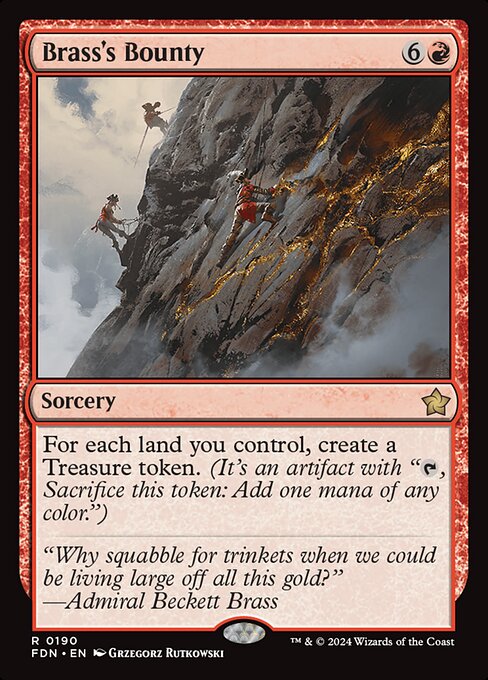
160. Brass's Bounty
Rating5.2PlayableWhy this rating?
A solid playable that rarely gets cut (5.2/10).
Why. Seven mana to create a Treasure token for each land you control. That is a lot of mana at once for a big follow-up turn.
Risks. Seven mana for a spell that does nothing to the board. You lose the turn, and the mana only helps if you have something to spend it on.
In the draft. Almost never playable in draft. Let it pass unless your deck is very unusual.
Results in the games of the set
When it is drafted, it is played only 0% of the time (set average: 61%): it almost always ends in the sideboard.
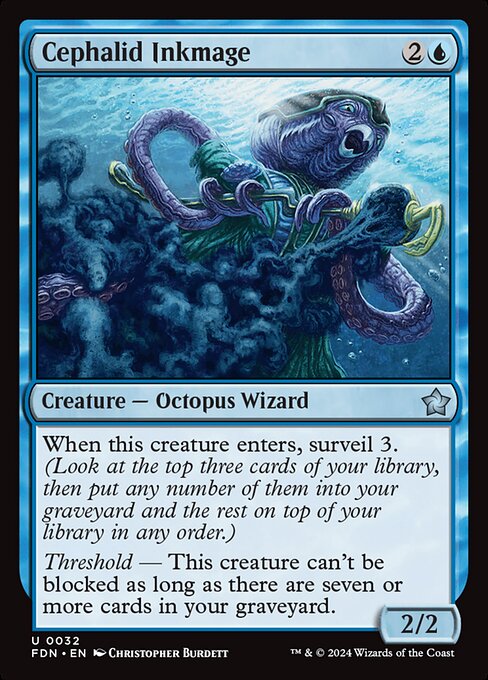
161. Cephalid Inkmage
Rating5.2PlayableWhy this rating?
A solid playable that rarely gets cut (5.2/10).
Why. A three-mana 2/2 that surveils 3 when it enters. With threshold it can't be blocked, a good threat for decks that fill their graveyard.
Risks. A small body, and threshold needs seven cards in your graveyard, which takes time. Before that it is an ordinary 2/2.
In the draft. A mid-to-late pack pick for a blue-black control or graveyard deck. Not a priority.
Results in the games of the set
When it is in hand, the deck wins 53.6% of its games (set average: 55.7%, 174th of 274 cards).
In the opening hand: 51.7% wins (54.8% on average).
Drawn during the game: 54.8% (56.4% on average).
When it is drawn, the deck wins 1.5 points more than when it is not.
When it is drafted, it is played 51% of the time (set average: 61%).
Taken as the first pick (38 drafts), it ends in the deck 87% of the time.
It is played about as much in every archetype.
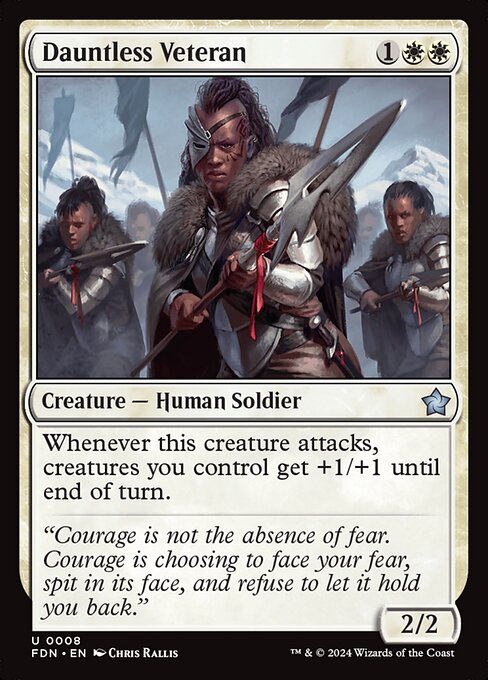
162. Dauntless Veteran
Rating5.2PlayableWhy this rating?
A solid playable that rarely gets cut (5.2/10).
Why. A three-mana 2/2 that gives all your creatures +1/+1 when it attacks. In a deck with many small creatures, every attack hits much harder.
Risks. It is fragile and has to attack to matter, which exposes it. Needs two white mana, and it is weak in a deck with few creatures.
In the draft. A mid-to-late pack pick for an aggressive white deck. In a slow or control deck, let it go.
Results in the games of the set
When it is in hand, the deck wins 51.7% of its games (set average: 55.7%, 218th of 274 cards).
In the opening hand: 51.4% wins (54.8% on average).
Drawn during the game: 51.9% (56.4% on average).
When it is drawn, the deck wins 2.2 points less than when it is not.
When it is drafted, it is played 67% of the time (set average: 61%).
Taken as the first pick (58 drafts), it ends in the deck 84% of the time.
It is played mostly in R/W decks (33% of them).
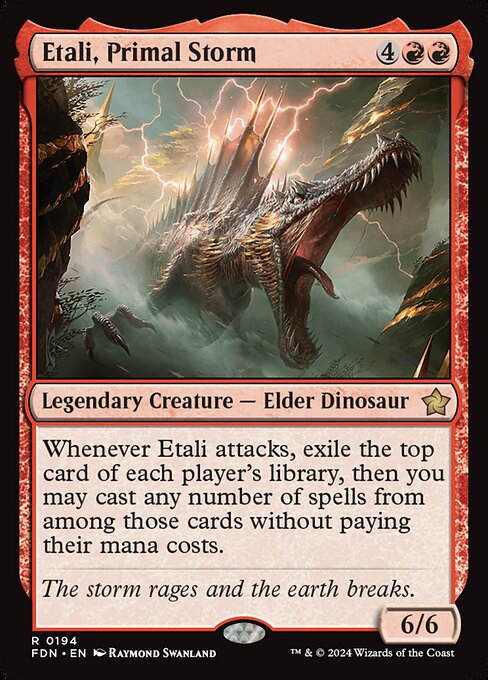
163. Etali, Primal Storm
Rating5.2PlayableWhy this rating?
A solid playable that rarely gets cut (5.2/10).
Why. A six-mana 6/6. Whenever it attacks, it exiles the top card of each player's library, and you may cast the spells among them for free. Each attack can bring several cards.
Risks. It is expensive and dies to removal before attacking. The exiled cards are random and sometimes lands. Needs two red mana.
In the draft. A decent finisher for red, as a single copy. A mid-pack pick.
Results in the games of the set
When it is in hand, the deck wins 53.0% of its games (set average: 55.7%, 189th of 274 cards).
In the opening hand: 51.5% wins (54.8% on average).
Drawn during the game: 54.2% (56.4% on average).
When it is drawn, the deck wins 0.2 points more than when it is not.
When it is drafted, it is played 82% of the time (set average: 61%).
Taken as the first pick (89 drafts), it ends in the deck 78% of the time.
It is played about as much in every archetype.
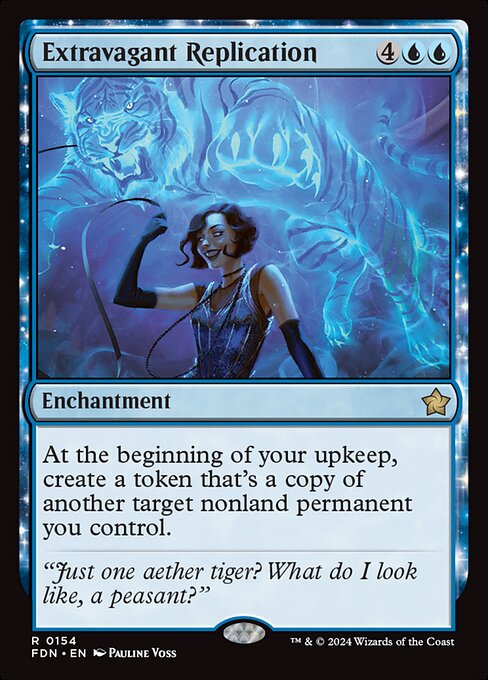 Rating5.2Playable
Why this rating?
A solid playable that rarely gets cut (5.2/10).
Why. At the beginning of your upkeep, you create a token copy of another nonland permanent you control. With a good creature or one with an enters effect, the value stacks up every turn.
Risks. Six mana for an enchantment that does nothing the turn you play it. You need to survive, have a good permanent to copy, and avoid removal on it.
In the draft. A mid-to-late pack pick for a blue control deck with strong permanents. Not a priority.
Results in the games of the set
When it is in hand, the deck wins 52.2% of its games (set average: 55.7%, 206th of 274 cards).
In the opening hand: 48.0% wins (54.8% on average).
Drawn during the game: 54.6% (56.4% on average).
When it is drawn, the deck wins 1.4 points more than when it is not.
When it is drafted, it is played 67% of the time (set average: 61%).
Taken as the first pick (53 drafts), it ends in the deck 83% of the time.
It is played about as much in every archetype.

165. Genesis Wave
Rating5.2PlayableWhy this rating?
A solid playable that rarely gets cut (5.2/10).
Why. Reveal the top X cards and put permanents with mana value X or less onto the battlefield. At high X it is a gamble that can put several permanents in at once.
Risks. Cards not put onto the battlefield go to the graveyard, and the result is random. Three green mana plus X is expensive for an unreliable effect.
In the draft. A late-pack pick. Only for a green ramp deck with few instants and sorceries, and even there it is often bad.
Results in the games of the set
When it is in hand, the deck wins 49.4% of its games (set average: 55.7%, 250th of 274 cards).
In the opening hand: 45.4% wins (54.8% on average).
Drawn during the game: 52.1% (56.4% on average).
When it is drawn, the deck wins 1.9 points less than when it is not.
When it is drafted, it is played 16% of the time (set average: 61%).

166. Goblin Negotiation
Rating5.2PlayableWhy this rating?
A solid playable that rarely gets cut (5.2/10).
Why. A flexible removal spell: X damage to a creature, with a 1/1 Goblin token for each point of excess damage. Against a small creature, you kill it and keep an army.
Risks. It costs two red mana on top of X, so it is pricey for killing a big creature. It does nothing against an opponent with no creatures.
In the draft. A mid-pack pick for red. Useful as late-game removal when you have plenty of mana.
Results in the games of the set
When it is in hand, the deck wins 51.7% of its games (set average: 55.7%, 220th of 274 cards).
In the opening hand: 49.0% wins (54.8% on average).
Drawn during the game: 53.6% (56.4% on average).
When it is drawn, the deck wins 0.4 points less than when it is not.
When it is drafted, it is played 27% of the time (set average: 61%).
Taken among the first three picks (84 drafts), it ends in the deck 63% of the time.

167. Homunculus Horde
Rating5.2PlayableWhy this rating?
A solid playable that rarely gets cut (5.2/10).
Why. A four-mana 2/2 that makes a token copy of itself whenever you draw your second card each turn. With card draw, it can snowball within a few turns.
Risks. Without extra draw it is a 2/2 for four mana that dies easily. It needs a lot of card draw support.
In the draft. A late-pack pick for a blue deck with lots of card draw. Otherwise leave it.
Results in the games of the set
When it is in hand, the deck wins 51.3% of its games (set average: 55.7%, 232nd of 274 cards).
In the opening hand: 48.7% wins (54.8% on average).
Drawn during the game: 52.8% (56.4% on average).
When it is drawn, the deck wins 0.9 points more than when it is not.
When it is drafted, it is played 70% of the time (set average: 61%).
Taken as the first pick (64 drafts), it ends in the deck 81% of the time.
It is played about as much in every archetype.

168. Lightshell Duo
Rating5.2PlayableWhy this rating?
A solid playable that rarely gets cut (5.2/10).
Why. A four-mana 3/4 with prowess and surveil 2 when it enters. The body holds the ground well in the midgame, and the surveil improves your next draws.
Risks. Nothing flashy: a solid body without a game-winning effect. Prowess matters little without many noncreature spells.
In the draft. A solid blue common, a mid-pack pick that fits blue decks.
Results in the games of the set
When it is in hand, the deck wins 56.0% of its games (set average: 55.7%, 98th of 274 cards).
In the opening hand: 54.0% wins (54.8% on average).
Drawn during the game: 57.2% (56.4% on average).
When it is drawn, the deck wins 2.9 points more than when it is not.
When it is drafted, it is played 44% of the time (set average: 61%).
Taken as the first pick (58 drafts), it ends in the deck 74% of the time.
It is played mostly in R/U decks (40% of them) and B/U (37%).

169. Prideful Parent
Rating5.2PlayableWhy this rating?
A solid playable that rarely gets cut (5.2/10).
Why. Two bodies for three mana: a 2/2 with vigilance and a 1/1 Cat creature token. It feeds a wide attack or chump-blocks without regret, and vigilance lets the 2/2 stay home on defense.
Risks. No standout effect, and two small bodies fall quickly to a sweeper or bigger creatures.
In the draft. A filler white three-drop you will usually play, but it does not deserve a high pick. Take it to fill the curve.
Results in the games of the set
When it is in hand, the deck wins 54.6% of its games (set average: 55.7%, 143rd of 274 cards).
In the opening hand: 54.6% wins (54.8% on average).
Drawn during the game: 54.7% (56.4% on average).
When it is drawn, the deck wins 0.9 points less than when it is not.
When it is drafted, it is played 81% of the time (set average: 61%).
Taken as the first pick (222 drafts), it ends in the deck 91% of the time.
It is played mostly in R/W decks (76% of them) and B/W (64%).

170. Rugged Highlands
Rating5.2PlayableWhy this rating?
A solid playable that rarely gets cut (5.2/10).
Why. A red-green dual land that enters tapped and gains you 1 life. It smooths the mana of a red-green deck at no card cost.
Risks. Entering tapped costs tempo in an aggressive deck, and it does nothing outside those two colors.
In the draft. Take it when you are red-green, late in a pack. Do not take it over a real playable.
Results in the games of the set
When it is in hand, the deck wins 54.2% of its games (set average: 55.7%, 157th of 274 cards).
In the opening hand: 57.2% wins (54.8% on average).
Drawn during the game: 51.5% (56.4% on average).
When it is drawn, the deck wins 1.0 points less than when it is not.
When it is drafted, it is played 44% of the time (set average: 61%).
Taken among the first three picks (80 drafts), it ends in the deck 76% of the time.

171. Secluded Courtyard
Rating5.2PlayableWhy this rating?
A solid playable that rarely gets cut (5.2/10).
Why. It taps for colorless, or for any color when spent on creatures of the chosen type or their abilities. In a deck built around one creature type, it lets you cast those creatures off-color.
Risks. In a deck without a dominant type it is a colorless land whose fixing almost never matters. It does not fix instants or sorceries.
In the draft. Skip it unless you already have many creatures of the same type. Otherwise a basic land does just as well.
Results in the games of the set
When it is in hand, the deck wins 46.6% of its games (set average: 55.7%, 268th of 274 cards).
In the opening hand: 44.8% wins (54.8% on average).
Drawn during the game: 48.0% (56.4% on average).
When it is drawn, the deck wins 3.7 points less than when it is not.
When it is drafted, it is played only 3% of the time (set average: 61%): it almost always ends in the sideboard.

172. Beast-Kin Ranger
Rating5.1PlayableWhy this rating?
A solid playable that rarely gets cut (5.1/10).
Why. A 3/3 trampler for three that gets +1/+0 whenever another creature enters under your control. Cast a creature before combat and it hits harder.
Risks. The bonus lasts only until end of turn and needs another creature to cast. Without one, it is a plain 3/3.
In the draft. A solid mid-pack pick for a green creature deck. It works well in a deck full of small bodies.
Results in the games of the set
When it is in hand, the deck wins 55.4% of its games (set average: 55.7%, 119th of 274 cards).
In the opening hand: 56.3% wins (54.8% on average).
Drawn during the game: 54.8% (56.4% on average).
When it is drawn, the deck wins 0.8 points more than when it is not.
When it is drafted, it is played 73% of the time (set average: 61%).
Taken as the first pick (104 drafts), it ends in the deck 95% of the time.
It is played mostly in B/G decks (70% of them) and G/U (70%).

173. Needletooth Pack
Rating5.1PlayableWhy this rating?
A solid playable that rarely gets cut (5.1/10).
Why. A 4/5 for five, big enough to hold the ground. With Morbid it puts two +1/+1 counters on a creature of your choice at end step, so combat trades make your creatures grow.
Risks. Five mana for a body with no immediate effect, and Morbid needs a creature to die this turn. Removal in response costs you the tempo.
In the draft. A fine pick for a green deck that trades creatures. Not a priority, but a good five-drop to round out the curve.
Results in the games of the set
When it is in hand, the deck wins 53.2% of its games (set average: 55.7%, 183rd of 274 cards).
In the opening hand: 52.0% wins (54.8% on average).
Drawn during the game: 54.1% (56.4% on average).
When it is drawn, the deck wins 0.1 points less than when it is not.
When it is drafted, it is played 76% of the time (set average: 61%).
Taken as the first pick (82 drafts), it ends in the deck 84% of the time.
It is played mostly in G/R decks (30% of them) and G/W (29%).

174. Consuming Aberration
Rating5.0PlayableWhy this rating?
A solid playable that rarely gets cut (5.0/10).
Why. Its power and toughness equal the cards in your opponents' graveyards, and each spell you cast mills them until a land. In a long game it gets huge and can also win by decking.
Risks. It can arrive tiny, or 0/0 if opposing graveyards are empty, and die at once. It also demands two specific colors and five mana.
In the draft. Reserved for a blue-black deck that controls the early game. Take it highly only if you already have ways to survive until it matters.
Results in the games of the set
When it is in hand, the deck wins 52.0% of its games (set average: 55.7%, 210th of 274 cards).
In the opening hand: 47.3% wins (54.8% on average).
Drawn during the game: 54.7% (56.4% on average).
When it is drawn, the deck wins 2.9 points more than when it is not.
When it is drafted, it is played 70% of the time (set average: 61%).
Taken as the first pick (66 drafts), it ends in the deck 83% of the time.
It is played about as much in every archetype.
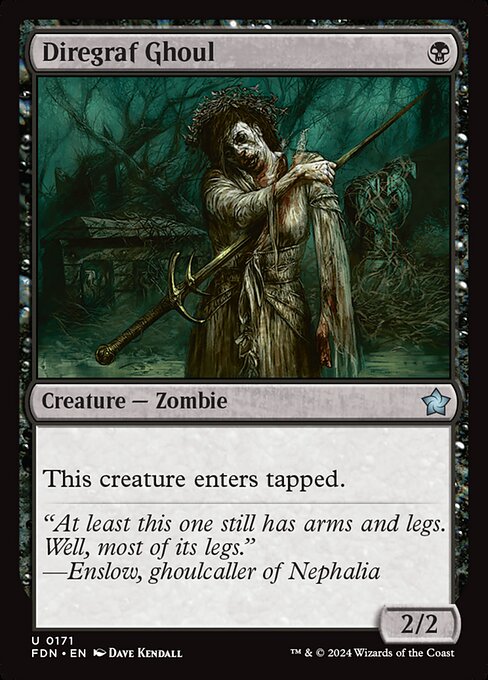
175. Diregraf Ghoul
Rating5.0PlayableWhy this rating?
A solid playable that rarely gets cut (5.0/10).
Why. A 2/2 for one mana: very efficient for the price, it attacks or blocks early in an aggressive deck. The tapped drawback matters little on turn one.
Risks. It loses value in long games, since a plain 2/2 is quickly outclassed. It does nothing else.
In the draft. A late-pack pick for an aggressive black deck. Nothing more than a cheap body.
Results in the games of the set
When it is in hand, the deck wins 54.3% of its games (set average: 55.7%, 152nd of 274 cards).
In the opening hand: 57.1% wins (54.8% on average).
Drawn during the game: 52.2% (56.4% on average).
When it is drawn, the deck wins 1.4 points more than when it is not.
When it is drafted, it is played 53% of the time (set average: 61%).
Taken as the first pick (35 drafts), it ends in the deck 77% of the time.
It is played about as much in every archetype.

176. Fanatical Firebrand
Rating5.0PlayableWhy this rating?
A solid playable that rarely gets cut (5.0/10).
Why. A 1-mana 1/1 with haste that sacrifices itself to deal 1 damage to any target. It kills a small blocker, finishes a wounded creature or pings the opponent.
Risks. A 1/1 matters little once the ground slows down, and it usually trades itself for one damage.
In the draft. A late-pack pick for an aggressive red deck. Take it for the curve rather than the impact.
Results in the games of the set
When it is in hand, the deck wins 52.4% of its games (set average: 55.7%, 202nd of 274 cards).
In the opening hand: 54.1% wins (54.8% on average).
Drawn during the game: 51.0% (56.4% on average).
When it is drawn, the deck wins 2.5 points less than when it is not.
When it is drafted, it is played 34% of the time (set average: 61%).
Taken among the first three picks (133 drafts), it ends in the deck 72% of the time.
It is played mostly in R/W decks (63% of them) and B/R (46%).

177. Frenzied Goblin
Rating5.0PlayableWhy this rating?
A solid playable that rarely gets cut (5.0/10).
Why. A 1-mana 1/1 that, when attacking, can pay a red mana to stop a creature from blocking. It clears the way for a bigger attack.
Risks. The body is tiny and dies to any resistance. It needs aggression and spare mana to be worth a slot.
In the draft. A very aggressive red deck can use it, but it quickly falls behind sturdier creatures. Take it late.
Results in the games of the set
When it is in hand, the deck wins 51.5% of its games (set average: 55.7%, 222nd of 274 cards).
In the opening hand: 53.1% wins (54.8% on average).
Drawn during the game: 50.2% (56.4% on average).
When it is drawn, the deck wins 3.0 points less than when it is not.
When it is drafted, it is played 39% of the time (set average: 61%).
Taken among the first three picks (99 drafts), it ends in the deck 78% of the time.
It is played mostly in R/W decks (37% of them).

178. Goldvein Pick
Rating5.0PlayableWhy this rating?
A solid playable that rarely gets cut (5.0/10).
Why. A two-mana Equipment that gives +1/+1 for a cheap equip and makes a Treasure whenever the equipped creature deals combat damage to a player. On an evasive creature it also ramps you.
Risks. It does nothing on a blocked creature, and the Treasure only comes if damage connects. It needs a reliable carrier.
In the draft. A decent tool for a deck with evasive creatures, especially white. A mid-pack pick, happy in a tempo deck.
Results in the games of the set
When it is in hand, the deck wins 53.8% of its games (set average: 55.7%, 167th of 274 cards).
In the opening hand: 54.2% wins (54.8% on average).
Drawn during the game: 53.6% (56.4% on average).
When it is drawn, the deck wins 0.5 points less than when it is not.
When it is drafted, it is played 60% of the time (set average: 61%).
Taken as the first pick (51 drafts), it ends in the deck 76% of the time.
It is played mostly in U/W decks (34% of them) and R/W (29%).

179. Hungry Ghoul
Rating5.0PlayableWhy this rating?
A solid playable that rarely gets cut (5.0/10).
Why. A two-mana 2/2 that can sacrifice another creature for a +1/+1 counter. It turns a lost block or a doomed creature into value.
Risks. It needs creatures to sacrifice and spare mana. Alone, it is a 2/2 without a notable effect.
In the draft. A good two-drop for a black creature deck. A fine pick, but not an exciting one.
Results in the games of the set
When it is in hand, the deck wins 55.6% of its games (set average: 55.7%, 114th of 274 cards).
In the opening hand: 54.9% wins (54.8% on average).
Drawn during the game: 56.0% (56.4% on average).
When it is drawn, the deck wins 1.6 points more than when it is not.
When it is drafted, it is played 82% of the time (set average: 61%).
Taken as the first pick (232 drafts), it ends in the deck 92% of the time.
It is played mostly in B/R decks (83% of them) and B/G (69%).

180. Mischievous Pup
Rating5.0PlayableWhy this rating?
A solid playable that rarely gets cut (5.0/10).
Why. A 3/1 with flash that can return one of your other permanents to your hand. You can ambush an attacker, or save a permanent from removal.
Risks. The 3/1 is fragile, and the bounce only shines when you have something worth returning. Without a target it is just a 3/1.
In the draft. A mid-pack pick for a white tempo deck. It rewards a deck with enter effects.
Results in the games of the set
When it is in hand, the deck wins 51.5% of its games (set average: 55.7%, 225th of 274 cards).
In the opening hand: 49.3% wins (54.8% on average).
Drawn during the game: 53.0% (56.4% on average).
When it is drawn, the deck wins 3.1 points less than when it is not.
When it is drafted, it is played 50% of the time (set average: 61%).
Taken among the first three picks (158 drafts), it ends in the deck 75% of the time.
It is played about as much in every archetype.
 Rating5.0Playable
Why this rating?
A solid playable that rarely gets cut (5.0/10).
Why. A 6/6 for six that lets you play a land and a permanent of each type from your graveyard every turn. In a long game it generates huge value.
Risks. It needs three colors, which is heavy in draft, and it is a six-drop with no immediate effect. Removal kills it before it pays off.
In the draft. Reserved for a well-fixed three-color deck. Otherwise do not force it.
Results in the games of the set
When it is in hand, the deck wins 54.7% of its games (set average: 55.7%, 140th of 274 cards).
In the opening hand: 48.4% wins (54.8% on average).
Drawn during the game: 58.4% (56.4% on average).
When it is drawn, the deck wins 8.2 points more than when it is not.
When it is drafted, it is played 68% of the time (set average: 61%).
Taken as the first pick (31 drafts), it ends in the deck 87% of the time.
It is played about as much in every archetype.
 Rating5.0Playable
Why this rating?
A solid playable that rarely gets cut (5.0/10).
Why. A 1/1 that comes back from the graveyard tapped for two mana. It chump-blocks again and again, and gives any sacrifice deck a steady resource.
Risks. It stays a 1/1 that kills little, and every return costs mana. An opponent who exiles graveyards shuts it down.
In the draft. A good pick for a black deck with sacrifice effects. Without them, it is just a chump blocker.
Results in the games of the set
When it is in hand, the deck wins 52.4% of its games (set average: 55.7%, 204th of 274 cards).
In the opening hand: 50.0% wins (54.8% on average).
Drawn during the game: 54.1% (56.4% on average).
When it is drawn, the deck wins 0.8 points less than when it is not.
When it is drafted, it is played 77% of the time (set average: 61%).
Taken as the first pick (85 drafts), it ends in the deck 94% of the time.
It is played mostly in B/R decks (32% of them) and B/G (29%).
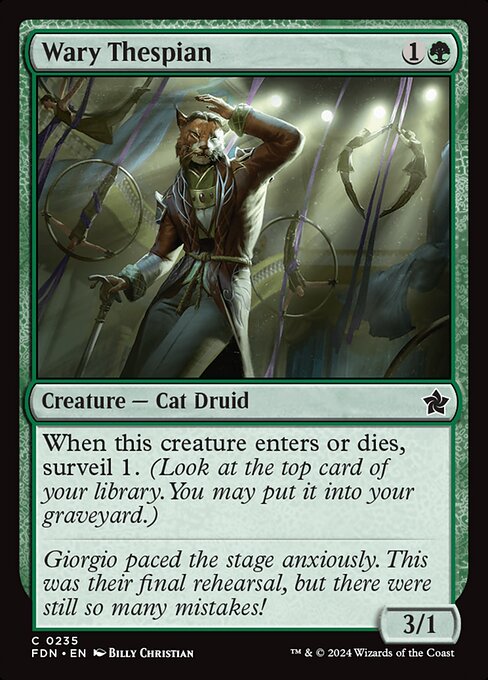
183. Wary Thespian
Rating5.0PlayableWhy this rating?
A solid playable that rarely gets cut (5.0/10).
Why. A 3/1 for two that surveils 1 when it enters and when it dies. It attacks hard early and smooths your draws even when it dies.
Risks. Its toughness of 1 lets it die to almost anything. It trades poorly on defense.
In the draft. A good green two-drop for an aggressive deck. Take it without hesitation in the middle of the pack.
Results in the games of the set
When it is in hand, the deck wins 55.6% of its games (set average: 55.7%, 115th of 274 cards).
In the opening hand: 56.4% wins (54.8% on average).
Drawn during the game: 54.9% (56.4% on average).
When it is drawn, the deck wins 1.3 points more than when it is not.
When it is drafted, it is played 73% of the time (set average: 61%).
Taken as the first pick (95 drafts), it ends in the deck 96% of the time.
It is played mostly in B/G decks (63% of them) and G/U (56%).

184. Zombify
Rating5.0PlayableWhy this rating?
A solid playable that rarely gets cut (5.0/10).
Why. A four-mana sorcery that returns a creature card from your graveyard to the battlefield. After a big loss you get your best creature back.
Risks. It does nothing without a creature in your graveyard, and it has no immediate value. It depends on what died.
In the draft. Reserved for a black deck with big creatures and graveyard effects. Otherwise leave it.
Results in the games of the set
When it is in hand, the deck wins 53.3% of its games (set average: 55.7%, 181st of 274 cards).
In the opening hand: 49.2% wins (54.8% on average).
Drawn during the game: 55.9% (56.4% on average).
When it is drawn, the deck wins 2.7 points more than when it is not.
When it is drafted, it is played 46% of the time (set average: 61%).
Taken as the first pick (36 drafts), it ends in the deck 78% of the time.
It is played about as much in every archetype.

185. Stroke of Midnight
Rating5.0WeakWhy this rating?
A solid playable that rarely gets cut (5.0/10).
Why. A three-mana instant that destroys any nonland permanent. It is flexible removal that also handles artifacts and enchantments.
Risks. The opponent gets a 1/1 Human creature token, which costs some value. It cannot answer lands.
In the draft. White removal worth taking mid-pack. It is good in any white deck short on answers.
Results in the games of the set
When it is in hand, the deck wins 51.1% of its games (set average: 55.7%, 234th of 274 cards).
In the opening hand: 48.9% wins (54.8% on average).
Drawn during the game: 52.6% (56.4% on average).
When it is drawn, the deck wins 0.7 points less than when it is not.
When it is drafted, it is played 44% of the time (set average: 61%).
Taken among the first three picks (64 drafts), it ends in the deck 72% of the time.
It is played about as much in every archetype.

186. Courageous Goblin
Rating4.9WeakWhy this rating?
A solid playable that rarely gets cut (4.9/10).
Why. A two-mana 2/2 that gets +1/+0 and menace when attacking while you control a creature with power 4 or greater. With a big partner it becomes hard to block.
Risks. Without a power-4 creature it is a plain 2/2. It relies on a big partner on the battlefield.
In the draft. A good two-drop for a red deck with big creatures, especially red-green. An average pick elsewhere.
Results in the games of the set
When it is in hand, the deck wins 53.8% of its games (set average: 55.7%, 168th of 274 cards).
In the opening hand: 55.1% wins (54.8% on average).
Drawn during the game: 52.6% (56.4% on average).
When it is drawn, the deck wins 2.1 points less than when it is not.
When it is drafted, it is played 54% of the time (set average: 61%).
Taken as the first pick (55 drafts), it ends in the deck 78% of the time.
It is played mostly in G/R decks (72% of them) and B/R (56%).

187. Cackling Prowler
Rating4.8WeakWhy this rating?
A solid playable that rarely gets cut (4.8/10).
Why. A 4/3 with ward 2 for four that grows with Morbid when a creature dies. Targeting it costs the opponent two extra mana, and it grows in trades.
Risks. Its toughness of 3 leaves it exposed to damage, and the counter only arrives at end step if something died.
In the draft. A solid green four-drop worth taking fairly early. It fits any green creature deck.
Results in the games of the set
When it is in hand, the deck wins 54.4% of its games (set average: 55.7%, 151st of 274 cards).
In the opening hand: 54.1% wins (54.8% on average).
Drawn during the game: 54.6% (56.4% on average).
When it is drawn, the deck wins 0.5 points more than when it is not.
When it is drafted, it is played 52% of the time (set average: 61%).
Taken as the first pick (56 drafts), it ends in the deck 79% of the time.
It is played mostly in G/R decks (59% of them) and G/W (51%).
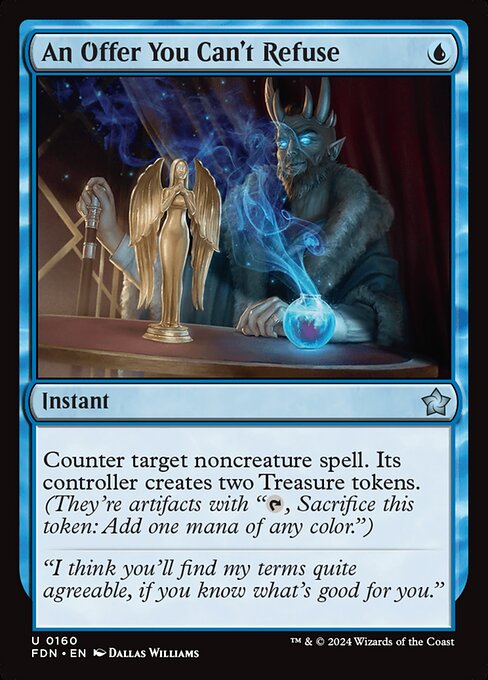
188. An Offer You Can't Refuse
Rating4.8WeakWhy this rating?
A solid playable that rarely gets cut (4.8/10).
Why. A one-mana instant that counters a noncreature spell, but gives the countered spell's controller two Treasure tokens. It answers a removal spell or a key spell cheaply.
Risks. It cannot counter creatures, and the opponent gets mana. It also needs blue mana held open, which strains a tempo deck.
In the draft. A niche counterspell, taken late in a blue control deck. Do not take it over a real playable.
Results in the games of the set
When it is in hand, the deck wins 48.2% of its games (set average: 55.7%, 257th of 274 cards).
In the opening hand: 45.7% wins (54.8% on average).
Drawn during the game: 50.0% (56.4% on average).
When it is drawn, the deck wins 0.7 points more than when it is not.
When it is drafted, it is played only 4% of the time (set average: 61%): it almost always ends in the sideboard.

189. Billowing Shriekmass
Rating4.8WeakWhy this rating?
A solid playable that rarely gets cut (4.8/10).
Why. A 2/3 flyer for four that mills three cards on arrival. With Threshold it becomes a 4/4 flyer, a real aerial threat.
Risks. Without Threshold it is a modest 2/3 flyer. The mill fills your graveyard, but you may need to wait.
In the draft. A good mid-pack pick for a black deck seeking flyers. It pairs well with graveyard effects.
Results in the games of the set
When it is in hand, the deck wins 53.7% of its games (set average: 55.7%, 171st of 274 cards).
In the opening hand: 50.0% wins (54.8% on average).
Drawn during the game: 56.0% (56.4% on average).
When it is drawn, the deck wins 2.3 points more than when it is not.
When it is drafted, it is played 62% of the time (set average: 61%).
Taken as the first pick (78 drafts), it ends in the deck 86% of the time.
It is played about as much in every archetype.
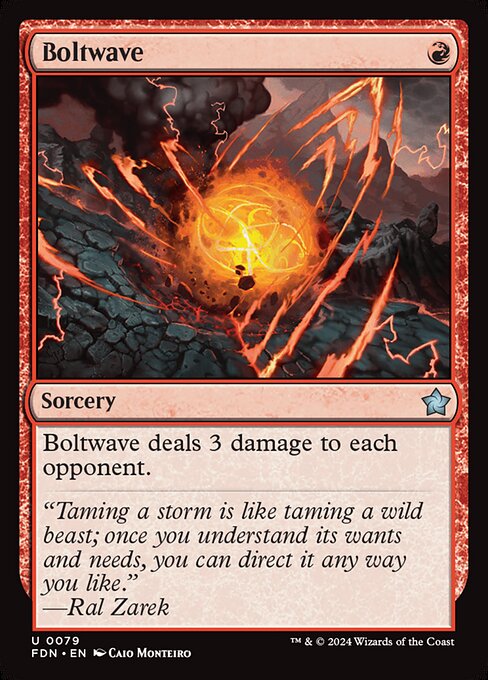
190. Boltwave
Rating4.8WeakWhy this rating?
A solid playable that rarely gets cut (4.8/10).
Why. A one-mana sorcery that deals 3 damage to each opponent. It can finish a game when the opponent is low, but touches no creatures.
Risks. It does not affect the board and is only good in a very aggressive deck. When defending, it is a dead card.
In the draft. For a very aggressive red deck, late in a pack. Most decks would rather have a real removal spell.
Results in the games of the set
When it is in hand, the deck wins 43.8% of its games (set average: 55.7%, 271st of 274 cards).
In the opening hand: 42.0% wins (54.8% on average).
Drawn during the game: 45.2% (56.4% on average).
When it is drawn, the deck wins 5.1 points less than when it is not.
When it is drafted, it is played only 7% of the time (set average: 61%): it almost always ends in the sideboard.
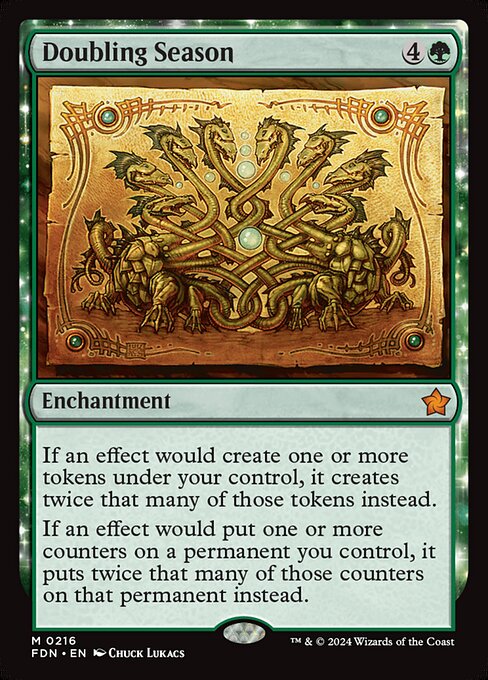
191. Doubling Season
Rating4.8WeakWhy this rating?
A solid playable that rarely gets cut (4.8/10).
Why. This enchantment doubles the tokens you create and the counters you place. In a deck full of such effects, it blows up the board.
Risks. It does nothing on its own for five mana, and changes nothing on the board without the right effects. It is unreliable in draft.
In the draft. Take it only in a deck already built around tokens and counters. Otherwise pass it.
Results in the games of the set
When it is in hand, the deck wins 39.4% of its games (set average: 55.7%, 274th of 274 cards).
In the opening hand: 37.5% wins (54.8% on average).
Drawn during the game: 40.8% (56.4% on average).
When it is drawn, the deck wins 9.8 points less than when it is not.
When it is drafted, it is played 22% of the time (set average: 61%).
Taken among the first three picks (33 drafts), it ends in the deck 42% of the time.
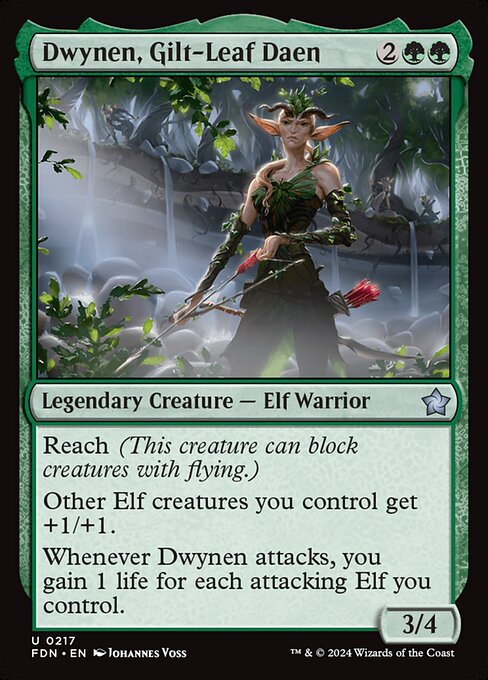 Rating4.8Weak
Why this rating?
A solid playable that rarely gets cut (4.8/10).
Why. A 3/4 reach creature for four that gives other Elves +1/+1 and gains life when attacking. Alone, it holds the ground well and blocks flyers.
Risks. Its bonuses depend on how many Elves you have, and it is legendary. Without Elves it is just a good body.
In the draft. A mid-pack pick for a green Elf deck. Otherwise it is a decent 3/4 with reach.
Results in the games of the set
When it is in hand, the deck wins 53.1% of its games (set average: 55.7%, 187th of 274 cards).
In the opening hand: 51.9% wins (54.8% on average).
Drawn during the game: 54.0% (56.4% on average).
When it is drawn, the deck wins 0.6 points more than when it is not.
When it is drafted, it is played 62% of the time (set average: 61%).
Taken as the first pick (52 drafts), it ends in the deck 85% of the time.
It is played mostly in B/G decks (51% of them) and G/R (36%).

193. Goblin Surprise
Rating4.8WeakWhy this rating?
A solid playable that rarely gets cut (4.8/10).
Why. A three-mana instant that gives your creatures +2/+0 or creates two 1/1 Goblin creature tokens. It adapts to the situation and surprises in combat.
Risks. It does not solve anything alone, and the pump mode needs creatures on board. It is a support card.
In the draft. A good pick for an aggressive red-white deck. Take it mid-pack.
Results in the games of the set
When it is in hand, the deck wins 52.4% of its games (set average: 55.7%, 200th of 274 cards).
In the opening hand: 50.8% wins (54.8% on average).
Drawn during the game: 53.7% (56.4% on average).
When it is drawn, the deck wins 1.8 points less than when it is not.
When it is drafted, it is played 51% of the time (set average: 61%).
Taken as the first pick (49 drafts), it ends in the deck 88% of the time.
It is played mostly in R/W decks (74% of them) and R/U (70%).
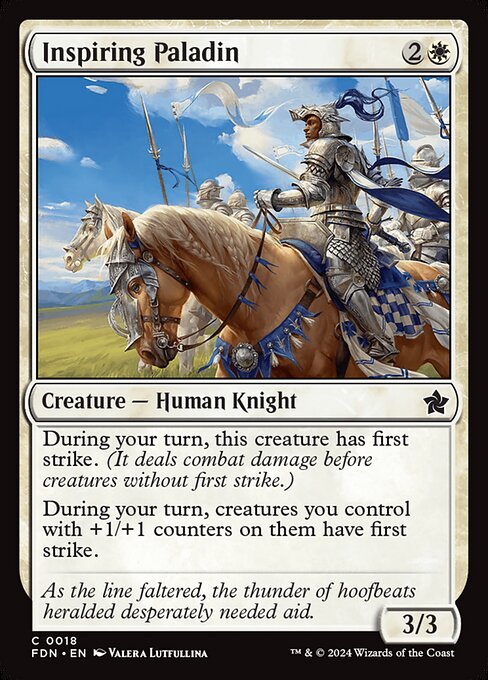
194. Inspiring Paladin
Rating4.8WeakWhy this rating?
A solid playable that rarely gets cut (4.8/10).
Why. A 3/3 with first strike on your turn for three, and it grants first strike to your creatures with +1/+1 counters. It wins combats on offense.
Risks. First strike applies only on your turn, so it defends as a plain 3/3. The second effect needs counters.
In the draft. A good white three-drop and a solid pick. It is even better with counter effects.
Results in the games of the set
When it is in hand, the deck wins 53.7% of its games (set average: 55.7%, 172nd of 274 cards).
In the opening hand: 54.4% wins (54.8% on average).
Drawn during the game: 53.1% (56.4% on average).
When it is drawn, the deck wins 1.1 points less than when it is not.
When it is drafted, it is played 62% of the time (set average: 61%).
Taken as the first pick (60 drafts), it ends in the deck 80% of the time.
It is played mostly in R/W decks (52% of them) and G/W (49%).
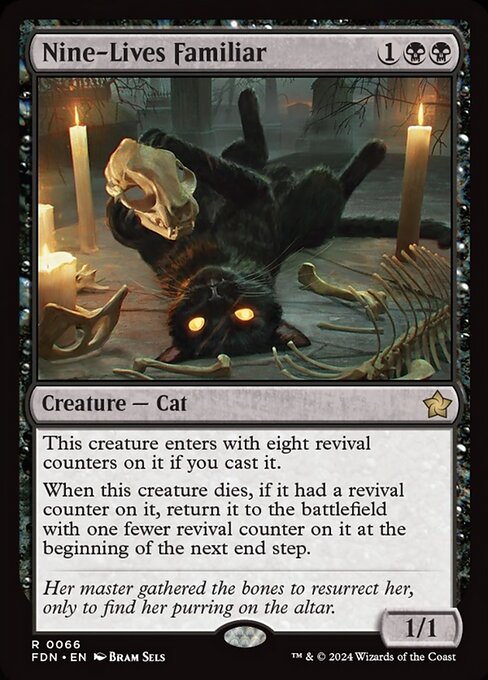
195. Nine-Lives Familiar
Rating4.8WeakWhy this rating?
A solid playable that rarely gets cut (4.8/10).
Why. A 1/1 that returns up to eight times, at the next end step after it dies. It is a recurring blocker and a resource for sacrifice effects.
Risks. It stays a very weak 1/1, and its return is slow. It needs two black mana and is answered by exile.
In the draft. A late-pack pick for a black sacrifice deck. Without synergies, it lacks power.
Results in the games of the set
When it is in hand, the deck wins 53.3% of its games (set average: 55.7%, 180th of 274 cards).
In the opening hand: 52.3% wins (54.8% on average).
Drawn during the game: 54.0% (56.4% on average).
When it is drawn, the deck wins 1.9 points more than when it is not.
When it is drafted, it is played 79% of the time (set average: 61%).
Taken as the first pick (68 drafts), it ends in the deck 88% of the time.
It is played about as much in every archetype.

196. Seismic Rupture
Rating4.8WeakWhy this rating?
A solid playable that rarely gets cut (4.8/10).
Why. A three-mana sorcery that deals 2 damage to each creature without flying. It sweeps small enemy creatures, and your own too.
Risks. It hits your own creatures, and does nothing against flyers. It is situational and unreliable.
In the draft. Take it late, for a deck with few ground creatures or with flyers. A sideboard-type choice.
Results in the games of the set
When it is in hand, the deck wins 50.3% of its games (set average: 55.7%, 240th of 274 cards).
In the opening hand: 47.0% wins (54.8% on average).
Drawn during the game: 52.6% (56.4% on average).
When it is drawn, the deck wins 1.3 points less than when it is not.
When it is drafted, it is played 15% of the time (set average: 61%).
Taken among the first three picks (54 drafts), it ends in the deck 67% of the time.

197. Sower of Chaos
Rating4.8WeakWhy this rating?
A solid playable that rarely gets cut (4.8/10).
Why. A 4/3 for four whose ability makes a creature unable to block for three mana. It helps push damage and break a stalled board.
Risks. The body is average and the ability is costly each turn. It loses value in a slow game.
In the draft. A good pick for an aggressive red deck, especially red-green. A fine four-drop.
Results in the games of the set
When it is in hand, the deck wins 54.2% of its games (set average: 55.7%, 155th of 274 cards).
In the opening hand: 53.0% wins (54.8% on average).
Drawn during the game: 55.1% (56.4% on average).
When it is drawn, the deck wins 1.4 points less than when it is not.
When it is drafted, it is played 15% of the time (set average: 61%).
Taken among the first three picks (47 drafts), it ends in the deck 57% of the time.
It is played mostly in G/R decks (25% of them).
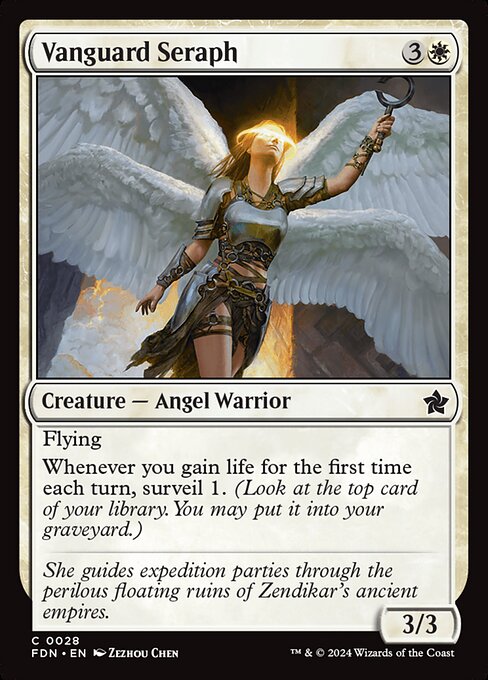
198. Vanguard Seraph
Rating4.8WeakWhy this rating?
A solid playable that rarely gets cut (4.8/10).
Why. A 3/3 flyer for four that surveils 1 the first time you gain life each turn. A solid aerial body.
Risks. The ability needs life gain, and the body alone is average. Removal kills it easily.
In the draft. A good mid-pack pick for a white deck. Flyers of this size are often sought after.
Results in the games of the set
When it is in hand, the deck wins 54.3% of its games (set average: 55.7%, 153rd of 274 cards).
In the opening hand: 52.9% wins (54.8% on average).
Drawn during the game: 55.1% (56.4% on average).
When it is drawn, the deck wins 0.6 points less than when it is not.
When it is drafted, it is played 62% of the time (set average: 61%).
Taken as the first pick (88 drafts), it ends in the deck 77% of the time.
It is played mostly in B/W decks (48% of them) and U/W (45%).
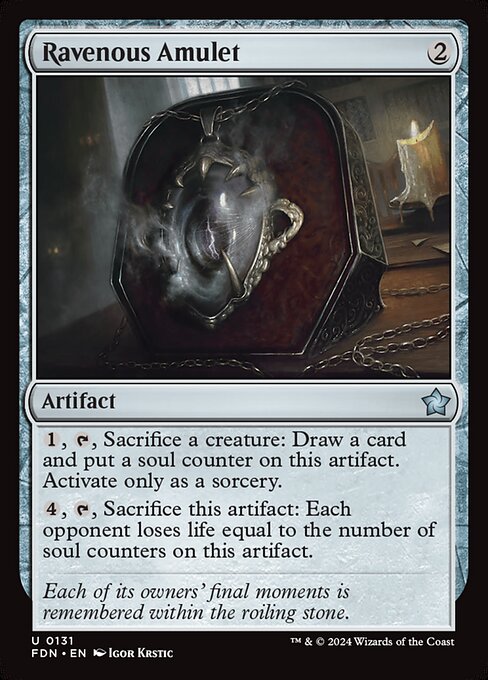
199. Ravenous Amulet
Rating4.7WeakWhy this rating?
A solid playable that rarely gets cut (4.7/10).
Why. A two-mana artifact that sacrifices a creature to draw, then, for four mana and a sacrifice, drains the opponent based on soul counters. It can serve as an engine in a sacrifice deck.
Risks. It costs mana and creatures without improving the board. It is slow and does nothing without creatures to sacrifice.
In the draft. Take it late, only in a sacrifice deck, typically black. Other decks have no use for it.
Results in the games of the set
When it is in hand, the deck wins 51.3% of its games (set average: 55.7%, 229th of 274 cards).
In the opening hand: 49.3% wins (54.8% on average).
Drawn during the game: 52.7% (56.4% on average).
When it is drawn, the deck wins 1.9 points less than when it is not.
When it is drafted, it is played 34% of the time (set average: 61%).
Taken among the first three picks (101 drafts), it ends in the deck 75% of the time.

200. Incinerating Blast
Rating4.7WeakWhy this rating?
A solid playable that rarely gets cut (4.7/10).
Why. A five-mana sorcery that deals 6 damage to a creature, then lets you discard a card to draw one. It kills almost anything and filters your hand.
Risks. Five mana is expensive for removal, and it can only be cast on your turn, so it cannot answer a threat mid-combat.
In the draft. A decent red removal spell for mid-pack. Take cheaper removal first.
Results in the games of the set
When it is in hand, the deck wins 52.4% of its games (set average: 55.7%, 203rd of 274 cards).
In the opening hand: 50.2% wins (54.8% on average).
Drawn during the game: 53.9% (56.4% on average).
When it is drawn, the deck wins 1.0 points less than when it is not.
When it is drafted, it is played 34% of the time (set average: 61%).
Taken among the first three picks (112 drafts), it ends in the deck 71% of the time.
It is played mostly in R/U decks (43% of them) and G/R (29%).
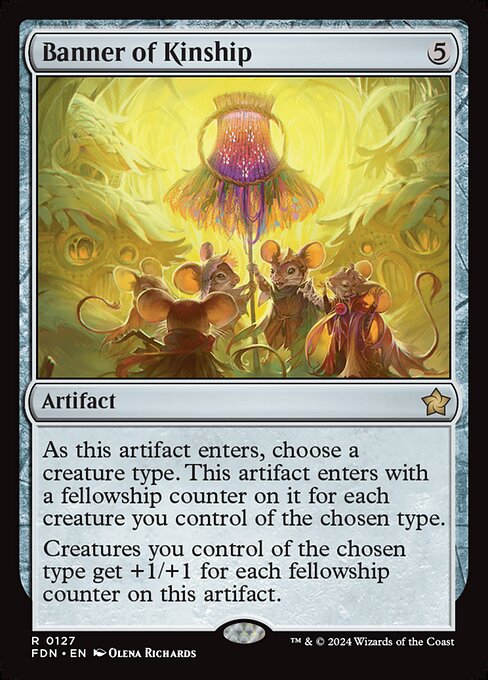
201. Banner of Kinship
Rating4.6WeakWhy this rating?
A solid playable that rarely gets cut (4.6/10).
Why. A five-mana artifact that rewards a deck built around one creature type. It enters with a counter for each creature of the chosen type you control, and creatures of that type get +1/+1 per counter, including ones that arrive later: with four of the right type, the whole team gets +4/+4.
Risks. The type is chosen as it enters, and the number of counters is fixed then, so with an empty or mixed board it does almost nothing. You also spend your turn five without affecting the opposing board.
In the draft. Keep it for a committed tribal deck with plenty of creatures sharing a type. In a regular deck it stays in the sideboard, so do not take it over solid playables.
Results in the games of the set
When it is in hand, the deck wins 50.1% of its games (set average: 55.7%, 242nd of 274 cards).
In the opening hand: 48.4% wins (54.8% on average).
Drawn during the game: 51.4% (56.4% on average).
When it is drawn, the deck wins 2.0 points less than when it is not.
When it is drafted, it is played 24% of the time (set average: 61%).
Taken among the first three picks (72 drafts), it ends in the deck 47% of the time.
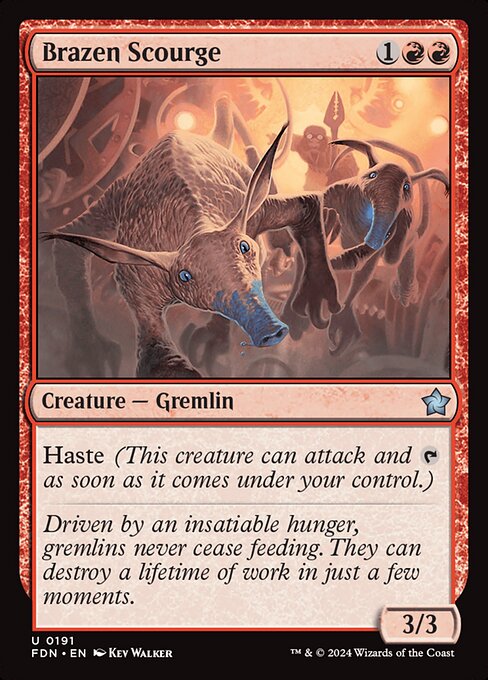
202. Brazen Scourge
Rating4.6WeakWhy this rating?
A solid playable that rarely gets cut (4.6/10).
Why. A 3/3 with haste for three mana: it hits the turn it arrives, and the solid size for the cost keeps it useful on defence. A good aggressive body, nothing more.
Risks. It needs two red mana on turn three, which strains two-colour decks. It has no ability beyond haste, so once the opponent has a 3/3 or bigger it gets stopped quickly.
In the draft. A solid filler for an aggressive red deck. Take it when there is no removal or better creature on offer, and play it as part of a low curve.
Results in the games of the set
When it is in hand, the deck wins 52.1% of its games (set average: 55.7%, 208th of 274 cards).
In the opening hand: 52.5% wins (54.8% on average).
Drawn during the game: 51.8% (56.4% on average).
When it is drawn, the deck wins 2.2 points less than when it is not.
When it is drafted, it is played 55% of the time (set average: 61%).
Taken as the first pick (38 drafts), it ends in the deck 68% of the time.
It is played mostly in R/W decks (36% of them) and B/R (29%).
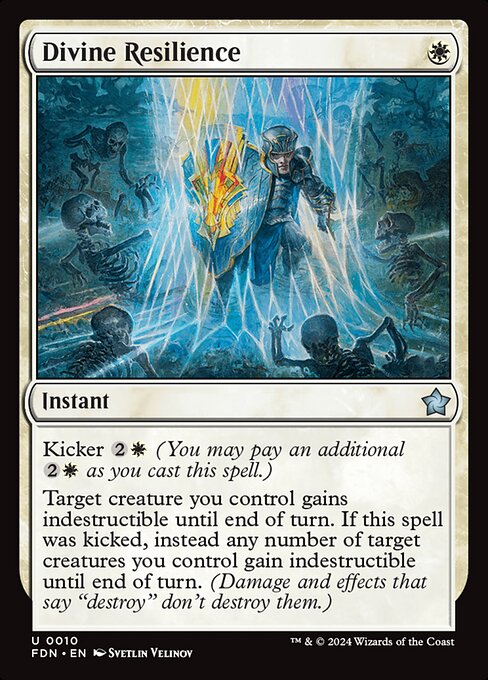
203. Divine Resilience
Rating4.6WeakWhy this rating?
A solid playable that rarely gets cut (4.6/10).
Why. A one-mana instant that makes a creature indestructible for the turn. It blanks a destroy-based removal spell or wins a combat. Kicked, it protects your whole team against a sweeper or a big attack.
Risks. A reactive spell that does nothing alone. It does not stop exile, bounce, sacrifice or -X/-X effects, and the kicked version costs four mana in total.
In the draft. A late pick for a white deck full of creatures worth protecting. Do not take it over removal or good creatures.
Results in the games of the set
When it is in hand, the deck wins 50.7% of its games (set average: 55.7%, 237th of 274 cards).
In the opening hand: 49.8% wins (54.8% on average).
Drawn during the game: 51.3% (56.4% on average).
When it is drawn, the deck wins 2.0 points less than when it is not.
When it is drafted, it is played 29% of the time (set average: 61%).
Taken among the first three picks (49 drafts), it ends in the deck 61% of the time.

204. Progenitus
Rating4.6WeakWhy this rating?
A solid playable that rarely gets cut (4.6/10).
Why. A 10/10 with protection from everything: it cannot be targeted, blocked or damaged, and it is shuffled into the library if it would go to the graveyard. On paper it is the perfect threat.
Risks. It costs two mana of each of the five colours, ten mana in all: nearly impossible to cast in a draft, even with heavy fixing. Most of the time it is a dead card in hand.
In the draft. Do not play it outside of a joke deck. It does not deserve a pick when a playable card is available.
Results in the games of the set
When it is drafted, it is played only 1% of the time (set average: 61%): it almost always ends in the sideboard.
 Rating4.6Weak
Why this rating?
A solid playable that rarely gets cut (4.6/10).
Why. A vanilla 12/8 for six mana. Once it lands it dominates combat: almost no creature can kill it by blocking or being blocked, and the opponent has to find another way to deal with it.
Risks. It needs three green mana in a six-mana cost, which is slow and demanding on colours. It has no trample, flying or ability, so removal, a chump blocker or bounce takes away all its value.
In the draft. A fair top-end for a green deck with ramp or a defensive plan. One copy is usually enough, and it goes after removal and good cheap creatures.
Results in the games of the set
When it is in hand, the deck wins 52.5% of its games (set average: 55.7%, 199th of 274 cards).
In the opening hand: 49.5% wins (54.8% on average).
Drawn during the game: 54.6% (56.4% on average).
When it is drawn, the deck wins 0.3 points less than when it is not.
When it is drafted, it is played 30% of the time (set average: 61%).
Taken among the first three picks (62 drafts), it ends in the deck 73% of the time.
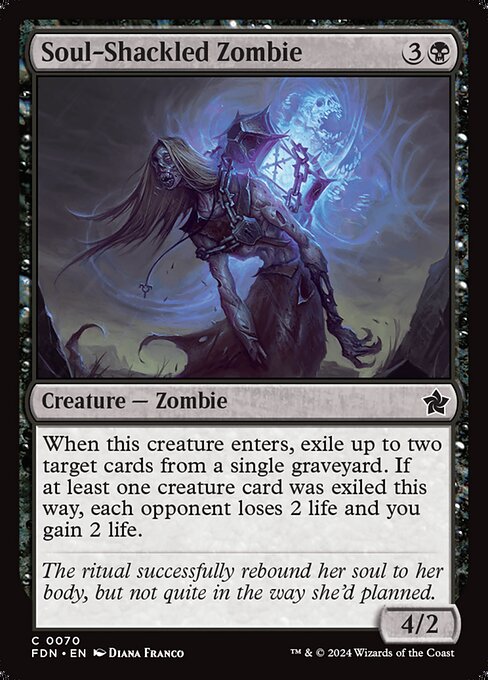
206. Soul-Shackled Zombie
Rating4.6WeakWhy this rating?
A solid playable that rarely gets cut (4.6/10).
Why. A 4/2 for four mana that exiles up to two cards from a single graveyard as it enters. If at least one creature card was exiled this way, each opponent loses 2 life and you gain 2. Most of the time it is a decent body with a small bonus.
Risks. Two toughness is fragile, and the bonus depends on a creature card being in a graveyard. The life swing does not win a game by itself. It can still hurt an opponent who recurs creatures.
In the draft. A perfectly playable black filler common for a midrange deck. It does better than it looks, but look for removal and creatures with a real ability first.
Results in the games of the set
When it is in hand, the deck wins 55.1% of its games (set average: 55.7%, 126th of 274 cards).
In the opening hand: 51.4% wins (54.8% on average).
Drawn during the game: 57.5% (56.4% on average).
When it is drawn, the deck wins 1.3 points more than when it is not.
When it is drafted, it is played 49% of the time (set average: 61%).
Taken as the first pick (41 drafts), it ends in the deck 85% of the time.
It is played mostly in B/W decks (40% of them) and B/R (39%).

207. Treetop Snarespinner
Rating4.6WeakWhy this rating?
A solid playable that rarely gets cut (4.6/10).
Why. A 1/4 with reach and deathtouch: it blocks nearly anything, on the ground or in the air, and discourages attacks. Later, its three-mana ability, usable only at sorcery speed, adds a +1/+1 counter to one of your creatures, which gives it a late-game use.
Risks. With one power it does not win games on its own. You need to spend mana each turn for it to do more than a wall, and removal handles it like any other creature.
In the draft. A solid green defensive common, welcome in control or midrange decks. Take it when nothing better is on offer.
Results in the games of the set
When it is in hand, the deck wins 54.8% of its games (set average: 55.7%, 134th of 274 cards).
In the opening hand: 52.8% wins (54.8% on average).
Drawn during the game: 56.2% (56.4% on average).
When it is drawn, the deck wins 1.5 points more than when it is not.
When it is drafted, it is played 71% of the time (set average: 61%).
Taken as the first pick (97 drafts), it ends in the deck 92% of the time.
It is played mostly in B/G decks (58% of them) and G/W (56%).

208. Vengeful Bloodwitch
Rating4.6WeakWhy this rating?
A solid playable that rarely gets cut (4.6/10).
Why. A two-mana 1/1 that drains 1 life each time it or another creature you control dies. In a deck that trades a lot of creatures, those points add up and bother the opponent.
Risks. On its own it has almost no impact: a fragile 1/1 with a small drain. It needs a deck where your creatures actually die, otherwise it does nothing.
In the draft. A card for an aggressive or sacrifice-minded black deck that likes to trade. In a deck without those synergies it is bottom-of-the-deck filler.
Results in the games of the set
When it is in hand, the deck wins 53.9% of its games (set average: 55.7%, 165th of 274 cards).
In the opening hand: 51.6% wins (54.8% on average).
Drawn during the game: 55.5% (56.4% on average).
When it is drawn, the deck wins 1.2 points more than when it is not.
When it is drafted, it is played 80% of the time (set average: 61%).
Taken as the first pick (105 drafts), it ends in the deck 90% of the time.
It is played mostly in B/W decks (29% of them) and B/R (28%).

209. Meteor Golem
Rating4.6WeakWhy this rating?
A solid playable that rarely gets cut (4.6/10).
Why. A seven-mana 3/3 that destroys a nonland permanent an opponent controls as it enters. Universal removal on a body, it answers almost anything, including a big threat or an enchantment.
Risks. Seven mana is a lot: you will not cast it before turn seven, often later. You spend your whole turn to act once, and a fast deck beats you before it matters.
In the draft. A useful one-of in a slow or ramp deck, especially in colours short on removal. Other decks will prefer cheaper removal.
Results in the games of the set
When it is in hand, the deck wins 55.0% of its games (set average: 55.7%, 132nd of 274 cards).
In the opening hand: 49.8% wins (54.8% on average).
Drawn during the game: 58.1% (56.4% on average).
When it is drawn, the deck wins 2.3 points more than when it is not.
When it is drafted, it is played 55% of the time (set average: 61%).
Taken as the first pick (36 drafts), it ends in the deck 72% of the time.
It is played about as much in every archetype.

210. Witness Protection
Rating4.5WeakWhy this rating?
A solid playable that rarely gets cut (4.5/10).
Why. A one-mana Aura that turns the enchanted creature into a 1/1 Citizen with no abilities. It shuts down a big threat or an ability creature for next to nothing: an imperfect but cheap removal.
Risks. The creature stays on the battlefield and can still block, be sacrificed or carry counters. Bounce or destroying the Aura frees it, and you risk a two-for-one if the target leaves play in response.
In the draft. A fair blue common, taken as cheap removal. It is better against big threats than against small creatures.
Results in the games of the set
When it is in hand, the deck wins 52.8% of its games (set average: 55.7%, 194th of 274 cards).
In the opening hand: 50.0% wins (54.8% on average).
Drawn during the game: 54.6% (56.4% on average).
When it is drawn, the deck wins 1.3 points more than when it is not.
When it is drafted, it is played 52% of the time (set average: 61%).
Taken as the first pick (54 drafts), it ends in the deck 87% of the time.
It is played mostly in B/U decks (45% of them) and G/U (44%).

211. Rune-Sealed Wall
Rating4.4WeakWhy this rating?
A good playable, but is sometimes cut (4.4/10).
Why. A three-mana 0/6 Wall with defender that can surveil 1 each turn by tapping. It blocks mid-sized attackers very well and improves your draws over the course of a game.
Risks. It does not attack and does not win games. It stops neither fliers nor spells. In a deck that wants to push damage, it just slows your plan.
In the draft. A card for a blue control deck that wants to survive until its late-game plan. In an aggressive deck, leave it out.
Results in the games of the set
When it is in hand, the deck wins 51.7% of its games (set average: 55.7%, 215th of 274 cards).
In the opening hand: 50.2% wins (54.8% on average).
Drawn during the game: 52.7% (56.4% on average).
When it is drawn, the deck wins 0.3 points more than when it is not.
When it is drafted, it is played 51% of the time (set average: 61%).
Taken as the first pick (39 drafts), it ends in the deck 79% of the time.
It is played mostly in B/U decks (25% of them).
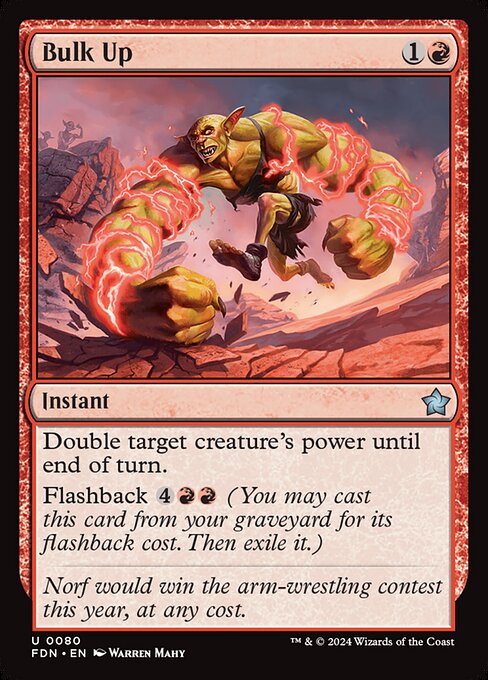
212. Bulk Up
Rating4.4WeakWhy this rating?
A good playable, but is sometimes cut (4.4/10).
Why. A two-mana instant that doubles a creature's power for the turn, with a six-mana flashback. It wins a combat or finishes an attack, and flashback lets you use it a second time late in the game.
Risks. It is a combat trick, so it risks a two-for-one: in response, the opponent kills the target and you lose the card. Without creatures of the right size, it does little.
In the draft. A bottom-of-the-pile card for a very aggressive red deck. Do not take it over removal or good creatures.
Results in the games of the set
When it is in hand, the deck wins 47.9% of its games (set average: 55.7%, 261st of 274 cards).
In the opening hand: 44.6% wins (54.8% on average).
Drawn during the game: 50.4% (56.4% on average).
When it is drawn, the deck wins 2.9 points less than when it is not.
When it is drafted, it is played only 11% of the time (set average: 61%): it almost always ends in the sideboard.
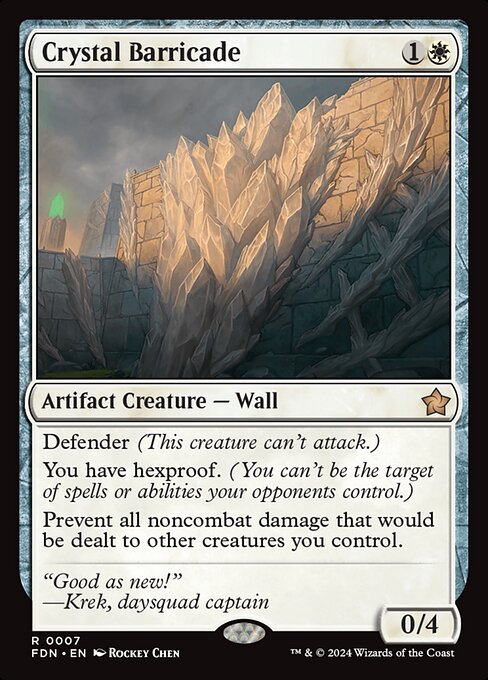
213. Crystal Barricade
Rating4.4WeakWhy this rating?
A good playable, but is sometimes cut (4.4/10).
Why. A two-mana 0/4 Wall that gives you hexproof and prevents all noncombat damage to your other creatures. It blocks small attackers well.
Risks. It cannot attack and does nothing about combat damage. The hexproof and damage prevention come up rarely, so the card has little effect on the game.
In the draft. A niche card for a white control deck, for use against an opponent full of direct damage. In general it stays in the sideboard.
Results in the games of the set
When it is in hand, the deck wins 48.2% of its games (set average: 55.7%, 259th of 274 cards).
In the opening hand: 49.2% wins (54.8% on average).
Drawn during the game: 47.5% (56.4% on average).
When it is drawn, the deck wins 2.7 points less than when it is not.
When it is drafted, it is played 29% of the time (set average: 61%).
Taken among the first three picks (40 drafts), it ends in the deck 55% of the time.

214. Icewind Elemental
Rating4.4WeakWhy this rating?
A good playable, but is sometimes cut (4.4/10).
Why. A five-mana 3/4 flier that draws then discards a card as it enters. A solid aerial body that improves your hand, and a fair common at the top of the curve.
Risks. Five mana for a 3/4 is a full price, and the looting is modest. Removal deals with it, and it is slow against an aggressive deck that has already pressed you.
In the draft. Decent blue filler, useful in flying or midrange decks. Take one or two, without overpaying.
Results in the games of the set
When it is in hand, the deck wins 53.9% of its games (set average: 55.7%, 164th of 274 cards).
In the opening hand: 50.8% wins (54.8% on average).
Drawn during the game: 55.7% (56.4% on average).
When it is drawn, the deck wins 0.9 points more than when it is not.
When it is drafted, it is played 49% of the time (set average: 61%).
Taken as the first pick (46 drafts), it ends in the deck 67% of the time.
It is played mostly in U/W decks (48% of them) and B/U (44%).
 Rating4.4Weak
Why this rating?
A good playable, but is sometimes cut (4.4/10).
Why. A three-mana Aura that turns a creature, land or planeswalker into a colorless land that taps for colorless mana, with no other ability. A flexible removal that answers almost any threat.
Risks. The target stays on the battlefield and the opponent can use it for colorless mana. Bounce or enchantment removal undoes it, and the Aura exposes you to a two-for-one in response.
In the draft. A playable removal for a blue deck, taken below the best cards. It is most useful against big threats or planeswalkers.
Results in the games of the set
When it is in hand, the deck wins 50.0% of its games (set average: 55.7%, 244th of 274 cards).
In the opening hand: 46.1% wins (54.8% on average).
Drawn during the game: 52.4% (56.4% on average).
When it is drawn, the deck wins 0.4 points more than when it is not.
When it is drafted, it is played 40% of the time (set average: 61%).
Taken among the first three picks (88 drafts), it ends in the deck 68% of the time.
It is played about as much in every archetype.
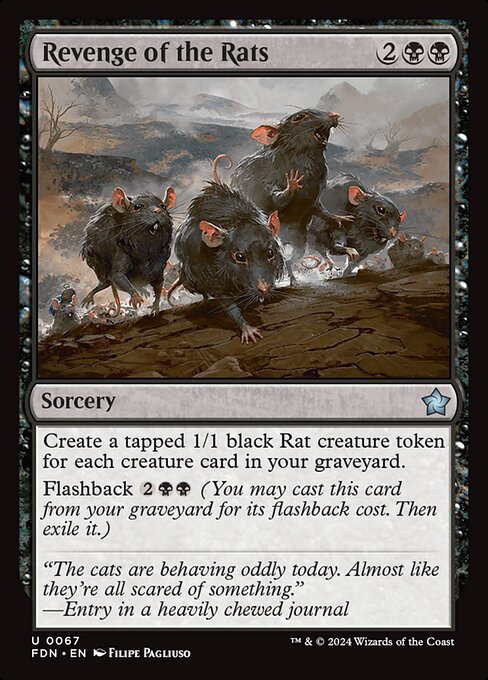
216. Revenge of the Rats
Rating4.4WeakWhy this rating?
A good playable, but is sometimes cut (4.4/10).
Why. A four-mana sorcery that creates a tapped 1/1 black Rat creature token for each creature card in your graveyard, with flashback. Late in the game it gives you a wide army across two casts.
Risks. It depends on your graveyard: early on it does almost nothing. The tokens enter tapped and are small 1/1s, vulnerable to a sweeper, and the spell is slow.
In the draft. A card for a black control or attrition deck with plenty of creatures. Elsewhere it is filler and does not deserve a high pick.
Results in the games of the set
When it is in hand, the deck wins 51.0% of its games (set average: 55.7%, 236th of 274 cards).
In the opening hand: 46.6% wins (54.8% on average).
Drawn during the game: 53.9% (56.4% on average).
When it is drawn, the deck wins 0.6 points less than when it is not.
When it is drafted, it is played 28% of the time (set average: 61%).
Taken among the first three picks (93 drafts), it ends in the deck 70% of the time.

217. Run Away Together
Rating4.4WeakWhy this rating?
A good playable, but is sometimes cut (4.4/10).
Why. A two-mana instant that returns two creatures controlled by different players to their owners' hands: one of yours and one of the opponent's. You can reuse an enters-the-battlefield effect or save a targeted creature, while upsetting the opponent's tempo.
Risks. It solves nothing permanently: the opponent just replays the creature. It needs a creature on each side, and it is a tempo card with no direct card gain.
In the draft. A filler for a blue deck with enter effects or a tempo plan. Without those it is weak, so do not take it early.
Results in the games of the set
When it is in hand, the deck wins 51.5% of its games (set average: 55.7%, 224th of 274 cards).
In the opening hand: 48.1% wins (54.8% on average).
Drawn during the game: 53.5% (56.4% on average).
When it is drawn, the deck wins 0.5 points more than when it is not.
When it is drafted, it is played 28% of the time (set average: 61%).
Taken among the first three picks (106 drafts), it ends in the deck 49% of the time.
It is played mostly in R/U decks (34% of them) and U/W (32%).
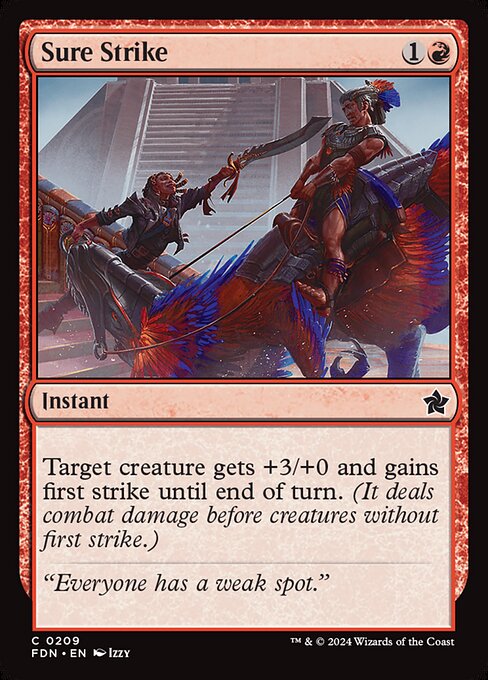
218. Sure Strike
Rating4.4WeakWhy this rating?
A good playable, but is sometimes cut (4.4/10).
Why. A two-mana instant that gives a creature +3/+0 and first strike for the turn. It wins a combat against a bigger creature or deals a lot of damage on an attack.
Risks. A combat trick exposes you to a two-for-one: if the target is killed in response, the card is lost. It does nothing without a creature, and it is not removal.
In the draft. A low pick for an aggressive red deck with plenty of creatures. Take it after removal and good creatures.
Results in the games of the set
When it is in hand, the deck wins 52.4% of its games (set average: 55.7%, 201st of 274 cards).
In the opening hand: 51.5% wins (54.8% on average).
Drawn during the game: 53.1% (56.4% on average).
When it is drawn, the deck wins 1.8 points less than when it is not.
When it is drafted, it is played 30% of the time (set average: 61%).
Taken among the first three picks (72 drafts), it ends in the deck 72% of the time.
It is played mostly in R/W decks (48% of them) and R/U (47%).
 Rating4.4Weak
Why this rating?
A good playable, but is sometimes cut (4.4/10).
Why. A two-mana instant that costs an extra discard and draws two cards. It turns a dead card into two fresh ones and improves your hand.
Risks. It does not change the board and nets no extra cards: you discard one to draw two. It does nothing for your tempo and is worth little if you have no spare card to discard.
In the draft. Filler for a red deck that likes to filter its draws. It does not deserve a high pick, but it is playable.
Results in the games of the set
When it is in hand, the deck wins 51.7% of its games (set average: 55.7%, 217th of 274 cards).
In the opening hand: 50.1% wins (54.8% on average).
Drawn during the game: 53.0% (56.4% on average).
When it is drawn, the deck wins 1.2 points less than when it is not.
When it is drafted, it is played 36% of the time (set average: 61%).
Taken among the first three picks (123 drafts), it ends in the deck 89% of the time.
It is played mostly in R/U decks (55% of them).

220. Goblin Boarders
Rating4.4WeakWhy this rating?
A good playable, but is sometimes cut (4.4/10).
Why. A three-mana 3/2 that enters with a +1/+1 counter if you attacked this turn, thanks to Raid. Cast after an attack, it becomes a 4/3, a good body for the cost.
Risks. Without an earlier attack it is just a fragile 3/2. The bonus requires attacking first and casting it in the second main phase, which is not always possible.
In the draft. A decent red filler common for an aggressive deck that attacks often. It goes after removal and stronger creatures.
Results in the games of the set
When it is in hand, the deck wins 53.5% of its games (set average: 55.7%, 177th of 274 cards).
In the opening hand: 54.3% wins (54.8% on average).
Drawn during the game: 52.9% (56.4% on average).
When it is drawn, the deck wins 1.4 points less than when it is not.
When it is drafted, it is played 49% of the time (set average: 61%).
Taken as the first pick (38 drafts), it ends in the deck 79% of the time.
It is played mostly in B/R decks (58% of them) and G/R (57%).

221. Gnarlid Colony
Rating4.3WeakWhy this rating?
A good playable, but is sometimes cut (4.3/10).
Why. A two-mana 2/2, or a 4/4 for five mana when kicked, that gives trample to each of your creatures with a +1/+1 counter. You can play it early or late, which makes it flexible.
Risks. The 2/2 is weak alone, and the 4/4 is a bit pricey for its size. The trample only matters if you have other creatures with counters.
In the draft. A flexible green common, good in a deck with +1/+1 counters. Take it as solid filler rather than for its effect.
Results in the games of the set
When it is in hand, the deck wins 52.9% of its games (set average: 55.7%, 192nd of 274 cards).
In the opening hand: 52.0% wins (54.8% on average).
Drawn during the game: 53.7% (56.4% on average).
When it is drawn, the deck wins 1.3 points less than when it is not.
When it is drafted, it is played 74% of the time (set average: 61%).
Taken as the first pick (86 drafts), it ends in the deck 93% of the time.
It is played mostly in G/R decks (67% of them) and G/W (61%).

222. Good-Fortune Unicorn
Rating4.2WeakWhy this rating?
A good playable, but is sometimes cut (4.2/10).
Why. A three-mana green-white 2/2 that puts a +1/+1 counter on each other creature that enters under your control. With a good curve of creatures, it grows your whole army.
Risks. It is two-coloured and fragile at two toughness: with no creatures coming after it, it does nothing. It does not protect the board, and removal erases all its value.
In the draft. Play it in a green-white deck with plenty of creatures. Outside that pair, do not take it, and even inside it goes after the best cards.
Results in the games of the set
When it is in hand, the deck wins 52.1% of its games (set average: 55.7%, 209th of 274 cards).
In the opening hand: 52.4% wins (54.8% on average).
Drawn during the game: 51.8% (56.4% on average).
When it is drawn, the deck wins 0.6 points less than when it is not.
When it is drafted, it is played 62% of the time (set average: 61%).
Taken as the first pick (45 drafts), it ends in the deck 87% of the time.
It is played mostly in G/W decks (50% of them).

223. Axgard Cavalry
Rating4.2WeakWhy this rating?
A good playable, but is sometimes cut (4.2/10).
Why. A two-mana 2/2 that can give haste to a creature by tapping. It lets a big creature hit as soon as it arrives, and it is still a fair body on turn two.
Risks. It must tap to act, so it neither attacks nor blocks that turn. Alone it is a plain 2/2 with little effect.
In the draft. Red filler for an aggressive deck with big creatures. Take it late, after the cards that win games.
Results in the games of the set
When it is in hand, the deck wins 51.8% of its games (set average: 55.7%, 214th of 274 cards).
In the opening hand: 53.2% wins (54.8% on average).
Drawn during the game: 50.7% (56.4% on average).
When it is drawn, the deck wins 3.8 points less than when it is not.
When it is drafted, it is played 40% of the time (set average: 61%).
Taken among the first three picks (151 drafts), it ends in the deck 69% of the time.
It is played mostly in R/W decks (54% of them) and B/R (49%).

224. Dwynen's Elite
Rating4.2WeakWhy this rating?
A good playable, but is sometimes cut (4.2/10).
Why. A two-mana 2/2 that creates a 1/1 green Elf Warrior creature token as it enters if you control another Elf. In a deck with Elves, that is two bodies from one two-mana card.
Risks. With no other Elf it is a plain vanilla 2/2. The bonus depends on a type condition that needs a deck built for it.
In the draft. A fine green common in an Elf deck, otherwise bottom-of-the-pile filler. Do not take it early outside a dedicated deck.
Results in the games of the set
When it is in hand, the deck wins 53.3% of its games (set average: 55.7%, 182nd of 274 cards).
In the opening hand: 53.2% wins (54.8% on average).
Drawn during the game: 53.3% (56.4% on average).
When it is drawn, the deck wins 0.0 points more than when it is not.
When it is drafted, it is played 63% of the time (set average: 61%).
Taken as the first pick (75 drafts), it ends in the deck 87% of the time.
It is played mostly in B/G decks (87% of them) and G/R (66%).
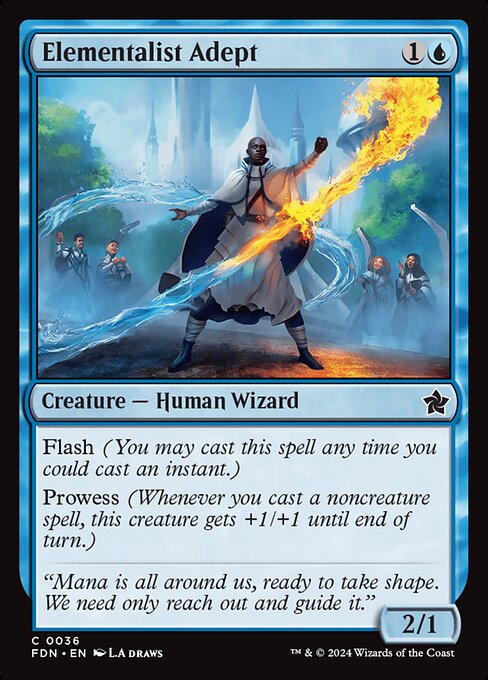
225. Elementalist Adept
Rating4.2WeakWhy this rating?
A good playable, but is sometimes cut (4.2/10).
Why. A two-mana 2/1 with flash and prowess. You can play it at the end of the opponent's turn, then it gets +1/+1 until end of turn when you cast a noncreature spell. It suits decks with plenty of instants and sorceries.
Risks. With one toughness it dies to nearly anything. Without enough noncreature spells it is just a small 2/1, and it has little impact on its own.
In the draft. A blue filler for a deck with a number of noncreature spells. Outside that plan it is weak, so do not take it early.
Results in the games of the set
When it is in hand, the deck wins 52.7% of its games (set average: 55.7%, 195th of 274 cards).
In the opening hand: 52.3% wins (54.8% on average).
Drawn during the game: 53.0% (56.4% on average).
When it is drawn, the deck wins 0.3 points more than when it is not.
When it is drafted, it is played 45% of the time (set average: 61%).
Taken as the first pick (39 drafts), it ends in the deck 69% of the time.
It is played mostly in R/U decks (46% of them) and U/W (38%).

226. Firespitter Whelp
Rating4.2WeakWhy this rating?
A good playable, but is sometimes cut (4.2/10).
Why. A three-mana 2/2 flier that deals 1 damage to each opponent whenever you cast a noncreature spell or a Dragon spell. In a spell-heavy deck it chips in steady damage from the air.
Risks. At two toughness it is fragile. Without enough noncreature spells the damage is small, and cheap removal kills it.
In the draft. A fair card for a red spells or Dragons deck. In a creature-based deck it is just average filler.
Results in the games of the set
When it is in hand, the deck wins 51.7% of its games (set average: 55.7%, 216th of 274 cards).
In the opening hand: 51.7% wins (54.8% on average).
Drawn during the game: 51.7% (56.4% on average).
When it is drawn, the deck wins 0.8 points less than when it is not.
When it is drafted, it is played 57% of the time (set average: 61%).
Taken as the first pick (43 drafts), it ends in the deck 81% of the time.
It is played mostly in R/U decks (35% of them).

227. Macabre Waltz
Rating4.2WeakWhy this rating?
A good playable, but is sometimes cut (4.2/10).
Why. A two-mana sorcery that returns up to two creature cards from your graveyard to your hand, then makes you discard a card. It recovers two good creatures for very little and provides value in attrition games.
Risks. It does nothing without creatures in the graveyard, and it does not affect the board. It is slow, and the discard reduces the gain a little.
In the draft. Black filler for an attrition deck with good creatures. Elsewhere it does not deserve a high pick.
Results in the games of the set
When it is in hand, the deck wins 52.0% of its games (set average: 55.7%, 211th of 274 cards).
In the opening hand: 47.5% wins (54.8% on average).
Drawn during the game: 54.8% (56.4% on average).
When it is drawn, the deck wins 1.2 points less than when it is not.
When it is drafted, it is played 43% of the time (set average: 61%).
Taken among the first three picks (144 drafts), it ends in the deck 69% of the time.
It is played mostly in B/R decks (37% of them) and B/W (34%).

228. Stromkirk Bloodthief
Rating4.2WeakWhy this rating?
A good playable, but is sometimes cut (4.2/10).
Why. A three-mana 2/2 that puts a +1/+1 counter on a Vampire you control at the beginning of your end step if an opponent lost life this turn. It can target itself and grows if you connect.
Risks. It needs the opponent to lose life, so you must attack or drain. Without that it stays a plain 2/2, vulnerable to removal.
In the draft. A card for an aggressive black deck, especially with other Vampires. Elsewhere it is average filler, to take after safer cards.
Results in the games of the set
When it is in hand, the deck wins 52.5% of its games (set average: 55.7%, 197th of 274 cards).
In the opening hand: 51.8% wins (54.8% on average).
Drawn during the game: 53.1% (56.4% on average).
When it is drawn, the deck wins 0.7 points more than when it is not.
When it is drafted, it is played 56% of the time (set average: 61%).
Taken as the first pick (30 drafts), it ends in the deck 57% of the time.
It is played about as much in every archetype.
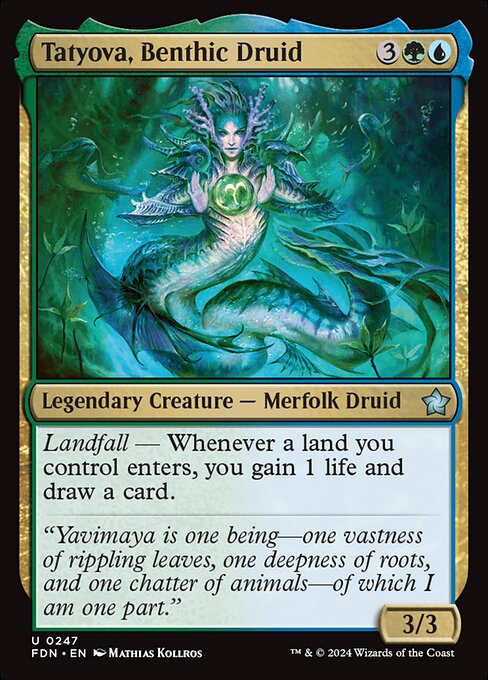 Rating4.2Weak
Why this rating?
A good playable, but is sometimes cut (4.2/10).
Why. A five-mana 3/3 that gains you 1 life and draws a card whenever a land enters under your control, thanks to Landfall. Every land drop becomes an advantage, and the long game favours it.
Risks. It is two-coloured and costs five: it does nothing until you have a land to play. Removal kills it before it draws, and the draw stops once your hand is out of lands.
In the draft. A good card for a green-blue deck with plenty of lands or other Landfall effects. Outside that pair, leave it.
Results in the games of the set
When it is in hand, the deck wins 53.0% of its games (set average: 55.7%, 191st of 274 cards).
In the opening hand: 49.8% wins (54.8% on average).
Drawn during the game: 55.0% (56.4% on average).
When it is drawn, the deck wins 2.8 points more than when it is not.
When it is drafted, it is played 68% of the time (set average: 61%).
Taken as the first pick (87 drafts), it ends in the deck 82% of the time.
It is played mostly in G/U decks (58% of them).
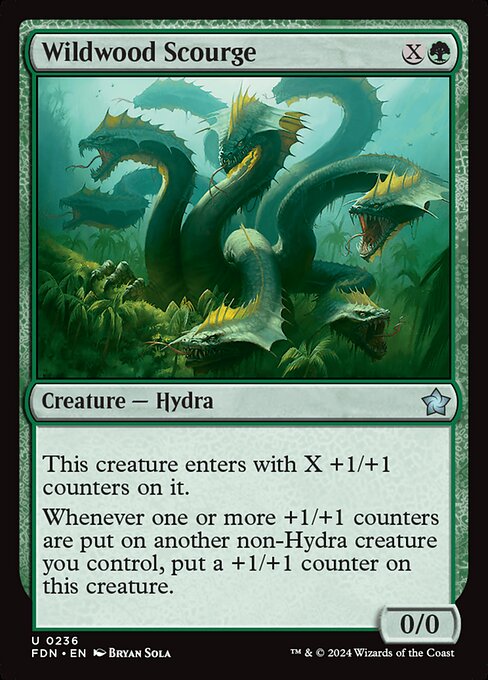
230. Wildwood Scourge
Rating4.2WeakWhy this rating?
A good playable, but is sometimes cut (4.2/10).
Why. A flexible-cost creature that enters with X +1/+1 counters and gets another whenever one or more counters are put on another non-Hydra creature you control. It adapts to your curve and grows in a counters deck.
Risks. Without other counters it costs one more mana than its size, which is pricey. It is fragile to removal, and its growth depends on other cards.
In the draft. A fair card for a green +1/+1 counters deck. In a deck without those effects it is pricey filler, to take late.
Results in the games of the set
When it is in hand, the deck wins 51.4% of its games (set average: 55.7%, 226th of 274 cards).
In the opening hand: 49.1% wins (54.8% on average).
Drawn during the game: 53.1% (56.4% on average).
When it is drawn, the deck wins 1.6 points less than when it is not.
When it is drafted, it is played 64% of the time (set average: 61%).
Taken as the first pick (40 drafts), it ends in the deck 85% of the time.
It is played mostly in G/W decks (25% of them).
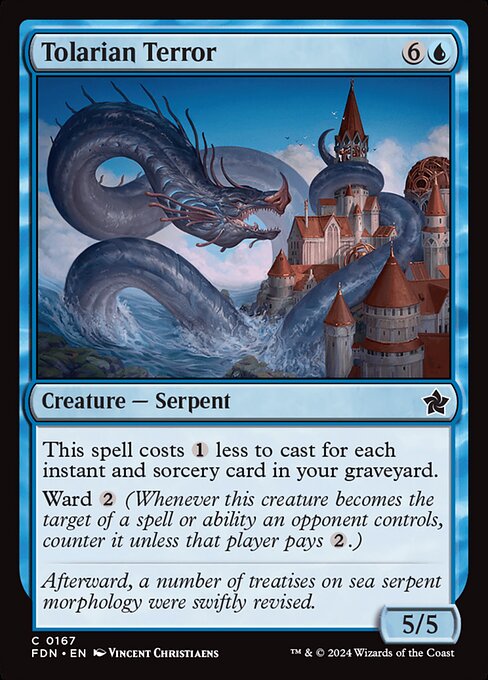
231. Tolarian Terror
Rating4.2WeakWhy this rating?
A good playable, but is sometimes cut (4.2/10).
Why. A 5/5 with ward 2 whose cost drops by one for each instant and sorcery card in your graveyard. In a spells deck it arrives at four or five mana in the mid-game, and ward makes removal cost more.
Risks. With no instants or sorceries in your graveyard it costs seven mana, so it is dead in hand early. It has no flying or trample and stays slow in a creature-heavy deck.
In the draft. A fair blue common for a spells deck, pairing well with filtering and instants. A single copy is enough in other decks.
Results in the games of the set
When it is in hand, the deck wins 52.5% of its games (set average: 55.7%, 198th of 274 cards).
In the opening hand: 48.3% wins (54.8% on average).
Drawn during the game: 54.9% (56.4% on average).
When it is drawn, the deck wins 0.1 points less than when it is not.
When it is drafted, it is played 59% of the time (set average: 61%).
Taken as the first pick (131 drafts), it ends in the deck 83% of the time.
It is played mostly in R/U decks (85% of them) and B/U (56%).

232. Quick-Draw Katana
Rating4.1WeakWhy this rating?
A good playable, but is sometimes cut (4.1/10).
Why. A two-mana Equipment with equip two that gives the equipped creature +2/+0 and first strike during your turn. It makes a small creature dangerous on offence and often wins the combat.
Risks. It does nothing without a creature, and equipping is sorcery-speed only. It does not help on defence, and removal in response to the equip costs you tempo.
In the draft. A fair card for an aggressive white or red deck with plenty of small creatures. One copy is usually enough.
Results in the games of the set
When it is in hand, the deck wins 51.1% of its games (set average: 55.7%, 235th of 274 cards).
In the opening hand: 50.8% wins (54.8% on average).
Drawn during the game: 51.3% (56.4% on average).
When it is drawn, the deck wins 2.5 points less than when it is not.
When it is drafted, it is played only 11% of the time (set average: 61%): it almost always ends in the sideboard.
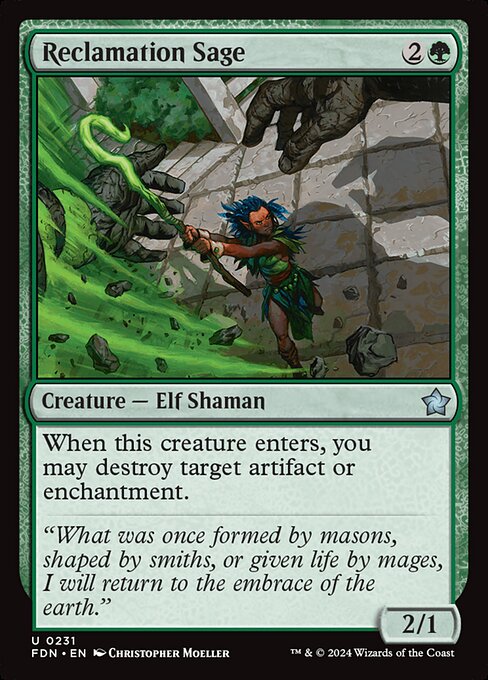
233. Reclamation Sage
Rating4.0WeakWhy this rating?
A good playable, but is sometimes cut (4.0/10).
Why. A three-mana 2/1 that may destroy an artifact or enchantment as it enters. Against an opponent with control Auras or artifacts, it is a clean two-for-one.
Risks. Without a target it is a plain, fragile 2/1 for three. The effect is optional so it is never dead, but it is weak against a deck without artifacts or enchantments.
In the draft. A sideboard card at heart: take it late, and main-deck it only if you have seen plenty of Auras and artifacts go by.
Results in the games of the set
When it is in hand, the deck wins 49.6% of its games (set average: 55.7%, 246th of 274 cards).
In the opening hand: 47.3% wins (54.8% on average).
Drawn during the game: 51.4% (56.4% on average).
When it is drawn, the deck wins 3.1 points less than when it is not.
When it is drafted, it is played 47% of the time (set average: 61%).
Taken as the first pick (31 drafts), it ends in the deck 81% of the time.
It is played mostly in B/G decks (26% of them).

234. Broken Wings
Rating4.0WeakWhy this rating?
A good playable, but is sometimes cut (4.0/10).
Why. A three-mana instant that destroys an artifact, an enchantment or a creature with flying. It can deal with an aerial threat or a troublesome Aura, which gives it a narrow removal role.
Risks. It is very situational: without a valid target it is a dead card. It does not touch ground creatures, and it loses value against an opponent without fliers.
In the draft. A sideboard card: do not take it early, and main-deck it only if you have seen plenty of aerial threats or enchantments.
Results in the games of the set
When it is in hand, the deck wins 49.6% of its games (set average: 55.7%, 248th of 274 cards).
In the opening hand: 46.7% wins (54.8% on average).
Drawn during the game: 51.5% (56.4% on average).
When it is drawn, the deck wins 0.9 points less than when it is not.
When it is drafted, it is played only 10% of the time (set average: 61%): it almost always ends in the sideboard.
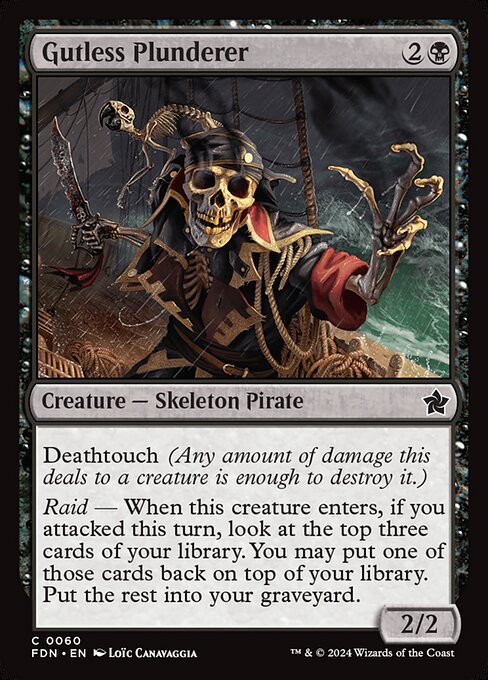
235. Gutless Plunderer
Rating4.0WeakWhy this rating?
A good playable, but is sometimes cut (4.0/10).
Why. A 2/2 deathtouch for three mana, so it trades with nearly anything on defense. If you attacked this turn, Raid lets you look at the top three cards of your library, put one back on top and put the rest into your graveyard.
Risks. Raid needs an attack before you cast it, so you play it in your second main phase. The 2/2 body dies to any small burn spell.
In the draft. Solid filler for black decks, better in aggressive builds. Take it when nothing stronger is on offer.
Results in the games of the set
When it is in hand, the deck wins 54.0% of its games (set average: 55.7%, 162nd of 274 cards).
In the opening hand: 51.8% wins (54.8% on average).
Drawn during the game: 55.4% (56.4% on average).
When it is drawn, the deck wins 1.5 points more than when it is not.
When it is drafted, it is played 53% of the time (set average: 61%).
Taken as the first pick (61 drafts), it ends in the deck 84% of the time.
It is played mostly in B/R decks (50% of them) and B/G (36%).
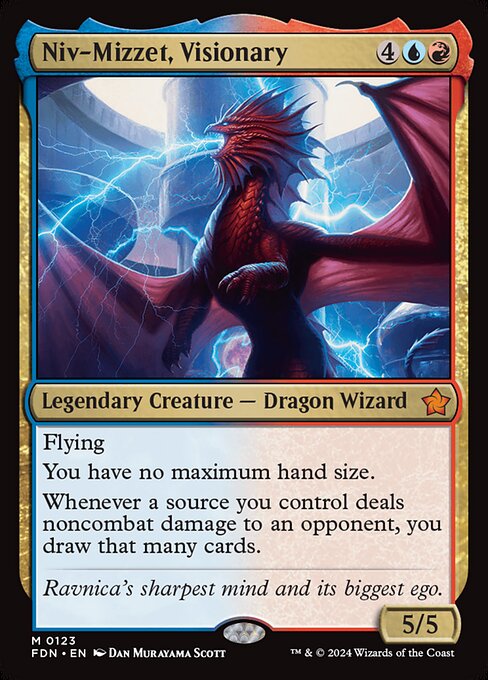 Rating4.0Weak
Why this rating?
A good playable, but is sometimes cut (4.0/10).
Why. A 5/5 flyer for six mana is a fine body on its own. The card draw only triggers off noncombat damage dealt to an opponent, so without the right sources it's mostly a big flyer.
Risks. Two colours, six mana, and a payoff that needs direct damage your deck may not have. One removal spell answers it before it does anything.
In the draft. Playable in blue-red as a big evasive finisher, no more. Don't pick it highly for the draw; you play it for the body.
Results in the games of the set
When it is in hand, the deck wins 46.8% of its games (set average: 55.7%, 265th of 274 cards).
In the opening hand: 41.7% wins (54.8% on average).
Drawn during the game: 50.0% (56.4% on average).
When it is drawn, the deck wins 1.0 points less than when it is not.
When it is drafted, it is played 39% of the time (set average: 61%).
Taken among the first three picks (65 drafts), it ends in the deck 55% of the time.

237. Sanguine Syphoner
Rating4.0WeakWhy this rating?
A good playable, but is sometimes cut (4.0/10).
Why. A black two-drop that drains 1 each time it attacks. Its 3 toughness lets it survive combat with small creatures, so it can start pecking early.
Risks. With 1 power it kills nothing, and it stops attacking once the opponent lands bigger blockers. The drain is tiny.
In the draft. A fair pick for aggressive or life gain decks, especially black-white. Mid-pack, for the curve.
Results in the games of the set
When it is in hand, the deck wins 53.1% of its games (set average: 55.7%, 188th of 274 cards).
In the opening hand: 53.7% wins (54.8% on average).
Drawn during the game: 52.5% (56.4% on average).
When it is drawn, the deck wins 0.6 points more than when it is not.
When it is drafted, it is played 40% of the time (set average: 61%).
Taken among the first three picks (140 drafts), it ends in the deck 61% of the time.
It is played mostly in B/W decks (68% of them).

238. Vampire Soulcaller
Rating4.0WeakWhy this rating?
A good playable, but is sometimes cut (4.0/10).
Why. A 3/2 flyer for five mana that returns a creature card from your graveyard to your hand: immediate value plus an evasive threat. Fine in a value deck.
Risks. It can't block, so it never protects you. At 2 toughness it dies to nearly everything, and the enter effect does nothing with no creature card in your graveyard.
In the draft. Playable in black, with white as the natural partner. Take it mid-pack, after your removal.
Results in the games of the set
When it is in hand, the deck wins 53.9% of its games (set average: 55.7%, 163rd of 274 cards).
In the opening hand: 49.8% wins (54.8% on average).
Drawn during the game: 56.5% (56.4% on average).
When it is drawn, the deck wins 0.9 points more than when it is not.
When it is drafted, it is played 51% of the time (set average: 61%).
Taken as the first pick (47 drafts), it ends in the deck 66% of the time.
It is played mostly in B/R decks (53% of them) and B/W (43%).
 Rating4.0Weak
Why this rating?
A good playable, but is sometimes cut (4.0/10).
Why. A 3/2 for three whose ability makes each opponent lose 1 life whenever you gain life. It's a fair body with a small bonus in a life gain deck.
Risks. With no other life gain it's a vanilla 3/2 for three. It gets outclassed fast by any creature with 3 toughness.
In the draft. A pick for life gain decks, mostly black-white. Elsewhere it's curve filler.
Results in the games of the set
When it is in hand, the deck wins 52.4% of its games (set average: 55.7%, 205th of 274 cards).
In the opening hand: 50.2% wins (54.8% on average).
Drawn during the game: 53.9% (56.4% on average).
When it is drawn, the deck wins 0.1 points less than when it is not.
When it is drafted, it is played 34% of the time (set average: 61%).
Taken among the first three picks (141 drafts), it ends in the deck 64% of the time.
It is played mostly in B/W decks (77% of them).

240. Aetherize
Rating3.9WeakWhy this rating?
A good playable, but is sometimes cut (3.9/10).
Why. An instant that returns all attacking creatures to their owner's hand. Against an opponent who swings with the whole board, it's a huge tempo swing.
Risks. It only hits attackers and destroys nothing, so the opponent simply recasts them. It does nothing against an opponent who attacks lightly, and recasting a creature with an enter effect helps them.
In the draft. A card for defensive blue decks. Not a high pick; take it only if your deck plays the control role.
Results in the games of the set
When it is in hand, the deck wins 50.2% of its games (set average: 55.7%, 241st of 274 cards).
In the opening hand: 46.3% wins (54.8% on average).
Drawn during the game: 52.5% (56.4% on average).
When it is drawn, the deck wins 0.4 points more than when it is not.
When it is drafted, it is played 37% of the time (set average: 61%).
Taken among the first three picks (102 drafts), it ends in the deck 69% of the time.

241. Inspiring Call
Rating3.8WeakWhy this rating?
A good playable, but is sometimes cut (3.8/10).
Why. An instant that draws a card for each creature you control with a +1/+1 counter, and makes them indestructible until end of turn. In a deck full of counters, it can draw a lot.
Risks. It needs creatures with a +1/+1 counter on the battlefield, otherwise it does nothing. It depends on your board surviving until you cast it.
In the draft. Only worth it in a green deck built around counters. Otherwise let it go.
Results in the games of the set
When it is in hand, the deck wins 46.3% of its games (set average: 55.7%, 269th of 274 cards).
In the opening hand: 43.4% wins (54.8% on average).
Drawn during the game: 48.6% (56.4% on average).
When it is drawn, the deck wins 4.8 points less than when it is not.
When it is drafted, it is played only 11% of the time (set average: 61%): it almost always ends in the sideboard.

242. Adventuring Gear
Rating3.8WeakWhy this rating?
A good playable, but is sometimes cut (3.8/10).
Why. A one-mana equipment, equip one, that gives the equipped creature +2/+2 until end of turn whenever a land enters under your control (Landfall). Equip before your land drop to win a combat.
Risks. It needs a land to play at the right time, after equipping; with none in hand it does nothing. Late game, with an empty hand, it's dead.
In the draft. A pick for aggressive Landfall decks. For most decks it's a last-pick card.
Results in the games of the set
When it is in hand, the deck wins 46.8% of its games (set average: 55.7%, 266th of 274 cards).
In the opening hand: 46.9% wins (54.8% on average).
Drawn during the game: 46.8% (56.4% on average).
When it is drawn, the deck wins 3.5 points less than when it is not.
When it is drafted, it is played only 4% of the time (set average: 61%): it almost always ends in the sideboard.

243. Spitfire Lagac
Rating3.8WeakWhy this rating?
A good playable, but is sometimes cut (3.8/10).
Why. A 3/4 for four mana, which blocks well, with Landfall that deals 1 damage to each opponent whenever a land enters. A solid body that adds a little reach each turn.
Risks. The damage is slow and won't win on its own. With no land to play it does nothing, and it dies to removal like anything else.
In the draft. Reasonable red filler for a midrange deck. Take it around the middle of the pack.
Results in the games of the set
When it is in hand, the deck wins 48.5% of its games (set average: 55.7%, 254th of 274 cards).
In the opening hand: 47.6% wins (54.8% on average).
Drawn during the game: 49.1% (56.4% on average).
When it is drawn, the deck wins 2.7 points less than when it is not.
When it is drafted, it is played only 3% of the time (set average: 61%): it almost always ends in the sideboard.
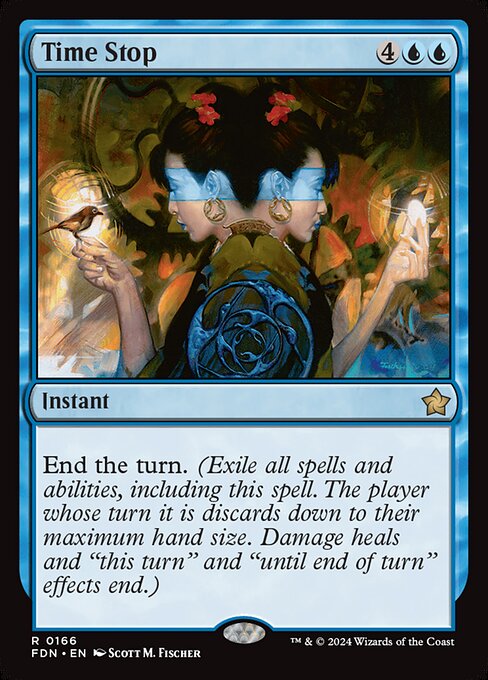
244. Time Stop
Rating3.8WeakWhy this rating?
A good playable, but is sometimes cut (3.8/10).
Why. A six-mana instant that ends the turn: all spells and abilities are exiled and damage heals. Cast on the opponent's turn, it cuts short their combat and the rest of their turn. It does nothing for your own board.
Risks. Six mana with two blue for one turn of breathing room and no lasting effect. A draft deck that isn't already in control can't afford the tempo loss.
In the draft. Avoid in most decks. Only take it late for a blue control deck.
Results in the games of the set
When it is in hand, the deck wins 47.5% of its games (set average: 55.7%, 264th of 274 cards).
In the opening hand: 42.5% wins (54.8% on average).
Drawn during the game: 50.5% (56.4% on average).
When it is drawn, the deck wins 1.8 points less than when it is not.
When it is drafted, it is played 30% of the time (set average: 61%).
Taken among the first three picks (69 drafts), it ends in the deck 64% of the time.

245. Elfsworn Giant
Rating3.5WeakWhy this rating?
A good playable, but is sometimes cut (3.5/10).
Why. A 5/3 reach for five mana that makes a 1/1 green Elf Warrior creature token whenever a land enters under your control (Landfall). It covers the air and widens your board each turn.
Risks. Only 3 toughness for five mana, so a trade or removal handles it. Its value depends on land drops, so it slows down late.
In the draft. Decent green filler, useful for its reach. Take it mid-pack if green is open.
Results in the games of the set
When it is in hand, the deck wins 52.5% of its games (set average: 55.7%, 196th of 274 cards).
In the opening hand: 50.7% wins (54.8% on average).
Drawn during the game: 53.9% (56.4% on average).
When it is drawn, the deck wins 0.1 points less than when it is not.
When it is drafted, it is played 46% of the time (set average: 61%).
Taken as the first pick (33 drafts), it ends in the deck 79% of the time.
It is played mostly in B/G decks (57% of them) and G/W (52%).

246. Aegis Turtle
Rating3.2WeakWhy this rating?
Filler card but sometimes gets cut (3.2/10).
Why. A 0/5 for one mana. It holds the ground early and blocks small creatures, and that's all. No rules text, no threat.
Risks. It never deals damage and advances no plan. Against a creature with 5 power or more, or against flyers, it stops mattering.
In the draft. Filler for a very defensive blue control deck. As a rule, it doesn't deserve a pick.
Results in the games of the set
When it is in hand, the deck wins 49.6% of its games (set average: 55.7%, 249th of 274 cards).
In the opening hand: 48.5% wins (54.8% on average).
Drawn during the game: 50.3% (56.4% on average).
When it is drawn, the deck wins 0.8 points less than when it is not.
When it is drafted, it is played only 11% of the time (set average: 61%): it almost always ends in the sideboard.

247. Painful Quandary
Rating2.9WeakWhy this rating?
Filler card but sometimes gets cut (2.9/10).
Why. A five-mana enchantment: whenever an opponent casts a spell, that player loses 5 life unless they discard a card. It squeezes the opponent but affects nothing on the board.
Risks. It does nothing on the battlefield and costs a lot. The opponent just picks the discard, and you spent a turn on a slow effect.
In the draft. A card to avoid in draft. It only works in a very specific black control deck.
Results in the games of the set
When it is in hand, the deck wins 45.0% of its games (set average: 55.7%, 270th of 274 cards).
In the opening hand: 41.7% wins (54.8% on average).
Drawn during the game: 47.0% (56.4% on average).
When it is drawn, the deck wins 3.4 points less than when it is not.
When it is drafted, it is played 17% of the time (set average: 61%).
Taken among the first three picks (32 drafts), it ends in the deck 47% of the time.
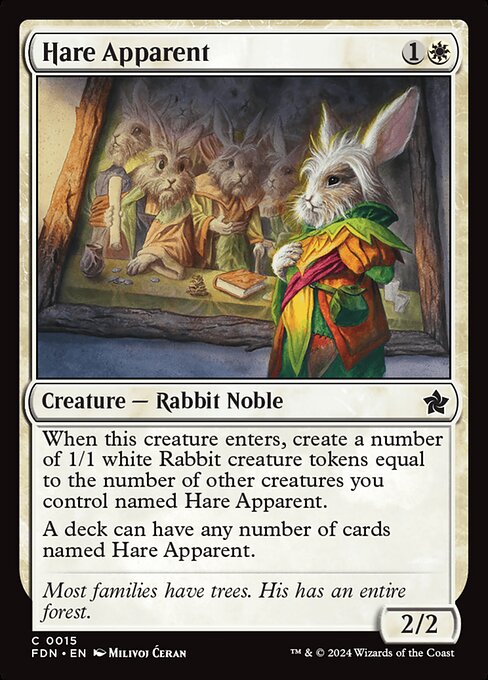
248. Hare Apparent
Rating2.5WeakWhy this rating?
Filler card but sometimes gets cut (2.5/10).
Why. A 2/2 for two mana. Its 1/1 white Rabbit creature tokens only come if you control other Hare Apparents, so in a normal deck it's a vanilla 2/2.
Risks. Without more copies it's just a two-mana body. You'd need several, which is unlikely in a draft.
In the draft. White curve filler. Don't build around it; take it late.
Results in the games of the set
When it is in hand, the deck wins 51.3% of its games (set average: 55.7%, 231st of 274 cards).
In the opening hand: 52.3% wins (54.8% on average).
Drawn during the game: 50.5% (56.4% on average).
When it is drawn, the deck wins 1.6 points less than when it is not.
When it is drafted, it is played 30% of the time (set average: 61%).
Taken as the first pick (33 drafts), it ends in the deck 58% of the time.

249. Wardens of the Cycle
Rating2.1WeakWhy this rating?
Not good filler and often gets cut (2.2/10).
Why. A 3/4 for four mana, large for its cost. With Morbid, at the beginning of your end step, if a creature died this turn, you gain 2 life or draw a card and lose 1 life.
Risks. Morbid needs a creature to have died this turn, so the effect is inconsistent. The cost asks for two green mana and a black one, which narrows the deck.
In the draft. Fair black-green filler. Take it around mid-pack if you're in those colours.
Results in the games of the set
When it is in hand, the deck wins 51.7% of its games (set average: 55.7%, 219th of 274 cards).
In the opening hand: 49.4% wins (54.8% on average).
Drawn during the game: 53.3% (56.4% on average).
When it is drawn, the deck wins 1.9 points more than when it is not.
When it is drafted, it is played 54% of the time (set average: 61%).
Taken as the first pick (52 drafts), it ends in the deck 77% of the time.
It is played mostly in B/G decks (54% of them).

250. Apothecary Stomper
Rating2.0WeakWhy this rating?
Not good filler and often gets cut (2.0/10).
Why. A 4/4 vigilance for six that enters with a choice: two +1/+1 counters on a creature you control, itself included, or 4 life. It holds the ground well and can attack too.
Risks. Six mana for a 4/4 is expensive, even if the enter effect can make it a 6/6 when there's no other target. It doesn't win games alone.
In the draft. Green top-end filler. One copy is enough for a deck; take it late in the pack.
Results in the games of the set
When it is in hand, the deck wins 51.6% of its games (set average: 55.7%, 221st of 274 cards).
In the opening hand: 49.1% wins (54.8% on average).
Drawn during the game: 53.3% (56.4% on average).
When it is drawn, the deck wins 1.2 points less than when it is not.
When it is drafted, it is played 24% of the time (set average: 61%).
Taken among the first three picks (62 drafts), it ends in the deck 58% of the time.
It is played mostly in G/W decks (34% of them) and B/G (26%).
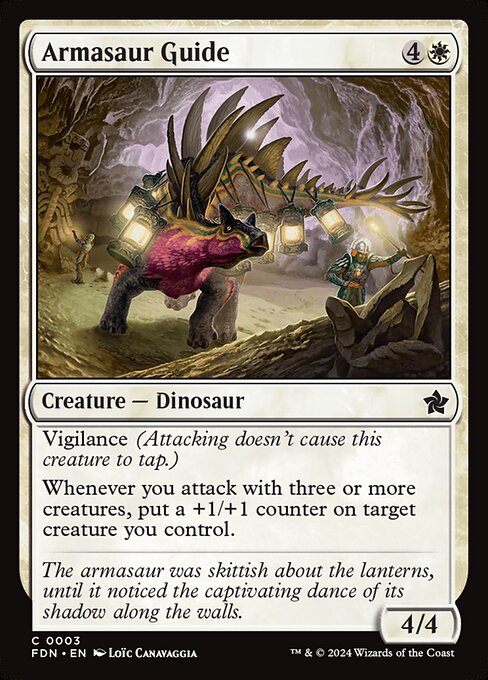
251. Armasaur Guide
Rating2.0WeakWhy this rating?
Not good filler and often gets cut (2.0/10).
Why. A 4/4 vigilance for five that puts a +1/+1 counter on a creature you control whenever you attack with three or more creatures. It attacks without exposing itself and grows a go-wide deck.
Risks. You need three attackers to trigger it, which is hard against a defensive board. Five mana for a 4/4 is an average rate.
In the draft. Filler for aggressive white decks. Take it mid or late in the pack.
Results in the games of the set
When it is in hand, the deck wins 50.4% of its games (set average: 55.7%, 239th of 274 cards).
In the opening hand: 49.0% wins (54.8% on average).
Drawn during the game: 51.4% (56.4% on average).
When it is drawn, the deck wins 2.4 points less than when it is not.
When it is drafted, it is played only 13% of the time (set average: 61%): it almost always ends in the sideboard.
Taken among the first three picks (33 drafts), it ends in the deck 36% of the time.
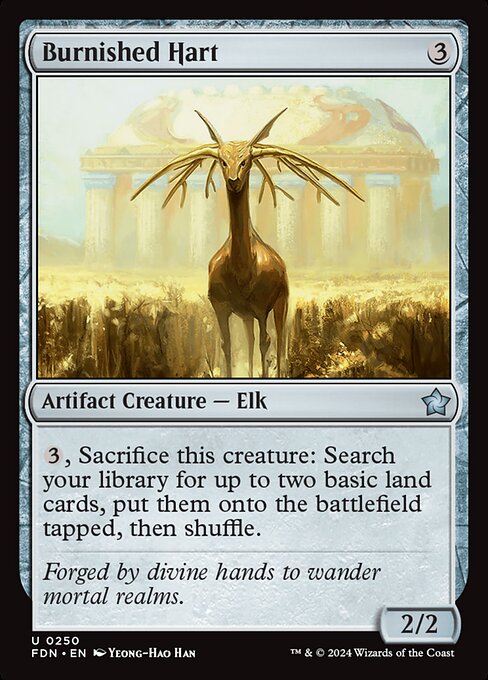
252. Burnished Hart
Rating2.0WeakWhy this rating?
Not good filler and often gets cut (2.0/10).
Why. A 2/2 artifact creature for three that, for three mana and a sacrifice, puts two basic lands onto the battlefield tapped. It's ramp and fixing, not a threat.
Risks. The activation is expensive and the 2/2 body is weak. It leaves you behind in a deck without big spells to cast.
In the draft. A pick for decks with a heavy top end, mostly green. Without that, it isn't worth a slot.
Results in the games of the set
When it is in hand, the deck wins 48.3% of its games (set average: 55.7%, 255th of 274 cards).
In the opening hand: 46.2% wins (54.8% on average).
Drawn during the game: 49.9% (56.4% on average).
When it is drawn, the deck wins 0.9 points less than when it is not.
When it is drafted, it is played 37% of the time (set average: 61%).
Taken among the first three picks (65 drafts), it ends in the deck 71% of the time.

253. Campus Guide
Rating2.0WeakWhy this rating?
Not good filler and often gets cut (2.0/10).
Why. A 2/1 artifact creature for two that can search for a basic land, reveal it, and put it on top of your library. It guarantees your next land drop and fits in any deck.
Risks. It doesn't draw a card; it just makes your next draw a land. The 2/1 body is fragile, and it doesn't advance your plan.
In the draft. Colourless filler, take it late. Useful in decks that want to guarantee their land drops.
Results in the games of the set
When it is in hand, the deck wins 51.5% of its games (set average: 55.7%, 223rd of 274 cards).
In the opening hand: 50.9% wins (54.8% on average).
Drawn during the game: 52.0% (56.4% on average).
When it is drawn, the deck wins 1.0 points less than when it is not.
When it is drafted, it is played 41% of the time (set average: 61%).
Taken among the first three picks (106 drafts), it ends in the deck 68% of the time.
It is played mostly in G/U decks (25% of them).

254. Clinquant Skymage
Rating2.0WeakWhy this rating?
Not good filler and often gets cut (2.0/10).
Why. A 1/1 flyer for four that gets a +1/+1 counter whenever you draw a card. It grows with every draw, so it becomes a real threat if left alone.
Risks. A 1/1 for four mana is weak until it grows, and any removal or small burn kills it. It only starts growing on your next draw.
In the draft. A pick for blue tempo or control decks with card draw. Otherwise skip it.
Results in the games of the set
When it is in hand, the deck wins 48.6% of its games (set average: 55.7%, 253rd of 274 cards).
In the opening hand: 45.9% wins (54.8% on average).
Drawn during the game: 50.3% (56.4% on average).
When it is drawn, the deck wins 0.0 points more than when it is not.
When it is drafted, it is played 48% of the time (set average: 61%).
Taken as the first pick (35 drafts), it ends in the deck 94% of the time.
It is played about as much in every archetype.

255. Erudite Wizard
Rating2.0WeakWhy this rating?
Not good filler and often gets cut (2.0/10).
Why. A 2/3 for three that gets a +1/+1 counter whenever you draw your second card each turn. With blue card draw it becomes a decent body.
Risks. You need a second draw in a turn, so without extra draw it's a 2/3 with no ability. It dies to any removal.
In the draft. Decent blue filler, better in decks with plenty of draw. Take it late in the pack.
Results in the games of the set
When it is in hand, the deck wins 51.3% of its games (set average: 55.7%, 230th of 274 cards).
In the opening hand: 50.6% wins (54.8% on average).
Drawn during the game: 51.7% (56.4% on average).
When it is drawn, the deck wins 0.9 points more than when it is not.
When it is drafted, it is played 35% of the time (set average: 61%).
Taken among the first three picks (127 drafts), it ends in the deck 64% of the time.
It is played mostly in R/U decks (43% of them) and B/U (40%).

256. Firebrand Archer
Rating2.0WeakWhy this rating?
Not good filler and often gets cut (2.0/10).
Why. A 2/1 for two that deals 1 damage to each opponent whenever you cast a noncreature spell. In a deck full of instants and sorceries it adds some reach.
Risks. A 2/1 is fragile, and the trigger isn't frequent enough. With few noncreature spells it's mediocre.
In the draft. Filler for a red spells deck. Take it only to fill out your two-drops.
Results in the games of the set
When it is in hand, the deck wins 49.6% of its games (set average: 55.7%, 247th of 274 cards).
In the opening hand: 49.7% wins (54.8% on average).
Drawn during the game: 49.5% (56.4% on average).
When it is drawn, the deck wins 2.7 points less than when it is not.
When it is drafted, it is played 31% of the time (set average: 61%).
Taken among the first three picks (126 drafts), it ends in the deck 69% of the time.
It is played mostly in R/U decks (55% of them) and R/W (30%).

257. Grappling Kraken
Rating2.0WeakWhy this rating?
Not good filler and often gets cut (2.0/10).
Why. A 5/6 for six mana that, through Landfall, taps a creature an opponent controls and puts a stun counter on it whenever a land enters under your control. It slows the opponent down while your team attacks, and its body rules the ground.
Risks. Six mana with two blue is slow, and the effect depends on land drops. After a turn without a land, it just blocks.
In the draft. A decent blue finisher for a controlling deck. Take it a little higher than its rank suggests if you're blue.
Results in the games of the set
When it is in hand, the deck wins 53.2% of its games (set average: 55.7%, 185th of 274 cards).
In the opening hand: 49.9% wins (54.8% on average).
Drawn during the game: 55.0% (56.4% on average).
When it is drawn, the deck wins 3.0 points more than when it is not.
When it is drafted, it is played 37% of the time (set average: 61%).
Taken as the first pick (31 drafts), it ends in the deck 65% of the time.

258. Juggernaut
Rating2.0WeakWhy this rating?
Not good filler and often gets cut (2.0/10).
Why. A colourless 5/3 artifact creature for four that hits hard early. It attacks each combat if able, so it applies pressure in any deck.
Risks. It must attack every combat, which gets it killed by a good block or removal. Only 3 toughness, so a double block kills it.
In the draft. Aggressive filler that goes in any colours. Take it mid-pack for an aggro deck.
Results in the games of the set
When it is in hand, the deck wins 49.1% of its games (set average: 55.7%, 252nd of 274 cards).
In the opening hand: 47.0% wins (54.8% on average).
Drawn during the game: 50.6% (56.4% on average).
When it is drawn, the deck wins 3.6 points less than when it is not.
When it is drafted, it is played 15% of the time (set average: 61%).
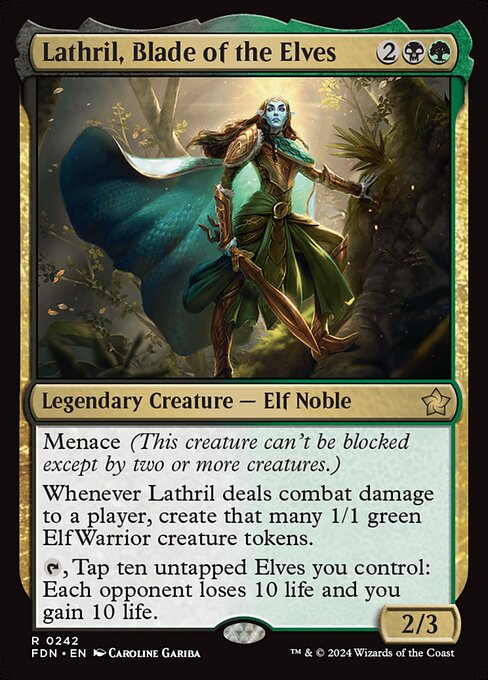
259. Lathril, Blade of the Elves
Rating2.0WeakWhy this rating?
Not good filler and often gets cut (2.0/10).
Why. A 2/3 menace for four that creates that many 1/1 green Elf Warrior creature tokens when it deals combat damage to a player. If it connects, it builds a board in one hit.
Risks. Menace doesn't always get through; two blockers stop it. Its last ability needs ten untapped Elves besides her: the tokens help, but don't count on it.
In the draft. Fair black-green filler. Play it for the body and the tokens, not for the last ability.
Results in the games of the set
When it is in hand, the deck wins 49.1% of its games (set average: 55.7%, 251st of 274 cards).
In the opening hand: 47.6% wins (54.8% on average).
Drawn during the game: 50.3% (56.4% on average).
When it is drawn, the deck wins 0.7 points more than when it is not.
When it is drafted, it is played 55% of the time (set average: 61%).
Taken as the first pick (33 drafts), it ends in the deck 73% of the time.
It is played mostly in B/G decks (37% of them).

260. Midnight Snack
Rating2.0WeakWhy this rating?
Not good filler and often gets cut (2.0/10).
Why. A three-mana enchantment that, through Raid, creates a Food token at the beginning of your end step if you attacked. You can sacrifice the enchantment (three mana with a black one) to make an opponent lose life equal to what you gained this turn.
Risks. It does nothing on the board and asks you to attack every turn. The final drain is slow and rarely decisive.
In the draft. A pick for aggressive white-black life gain decks. Otherwise it goes last.
Results in the games of the set
When it is in hand, the deck wins 47.9% of its games (set average: 55.7%, 262nd of 274 cards).
In the opening hand: 44.9% wins (54.8% on average).
Drawn during the game: 49.9% (56.4% on average).
When it is drawn, the deck wins 1.9 points less than when it is not.
When it is drafted, it is played only 9% of the time (set average: 61%): it almost always ends in the sideboard.

261. Mocking Sprite
Rating2.0WeakWhy this rating?
Not good filler and often gets cut (2.0/10).
Why. A 2/1 flyer for three that makes your instants and sorceries cost one less. In a spells deck it's an evasive body that smooths your curve.
Risks. With few instants and sorceries, it's a 2/1 flyer for three, which is weak. It dies to any removal.
In the draft. Blue filler for a spells deck. Take it mainly for the evasion, late in the pack.
Results in the games of the set
When it is in hand, the deck wins 49.8% of its games (set average: 55.7%, 245th of 274 cards).
In the opening hand: 48.2% wins (54.8% on average).
Drawn during the game: 50.8% (56.4% on average).
When it is drawn, the deck wins 1.1 points less than when it is not.
When it is drafted, it is played 29% of the time (set average: 61%).
Taken among the first three picks (111 drafts), it ends in the deck 68% of the time.
It is played mostly in R/U decks (36% of them) and U/W (27%).

262. Shivan Dragon
Rating2.0WeakWhy this rating?
Not good filler and often gets cut (2.0/10).
Why. A 5/5 flyer for six that gets +1/+0 until end of turn for each red mana you pay. A classic finisher: in the air with plenty of mana, it ends the game quickly.
Risks. Six mana with two red is slow. A removal spell stops it before it attacks, and it's too expensive for a fast deck.
In the draft. A decent finisher for midrange red. Take it mid-pack; one copy is enough.
Results in the games of the set
When it is in hand, the deck wins 51.4% of its games (set average: 55.7%, 227th of 274 cards).
In the opening hand: 49.3% wins (54.8% on average).
Drawn during the game: 53.0% (56.4% on average).
When it is drawn, the deck wins 0.7 points less than when it is not.
When it is drafted, it is played 39% of the time (set average: 61%).
Taken as the first pick (33 drafts), it ends in the deck 73% of the time.

263. Swiftfoot Boots
Rating2.0WeakWhy this rating?
Not good filler and often gets cut (2.0/10).
Why. A two-mana equipment, equip one, that grants the equipped creature hexproof and haste. It shields your best creature from targeted removal.
Risks. It doesn't make any creature stronger, and costs two plus one to equip. A deck with no key threat gains nothing from it.
In the draft. A pick for decks with one or two key threats. In most decks, it stays in the sideboard.
Results in the games of the set
When it is in hand, the deck wins 43.7% of its games (set average: 55.7%, 272nd of 274 cards).
In the opening hand: 42.5% wins (54.8% on average).
Drawn during the game: 44.6% (56.4% on average).
When it is drawn, the deck wins 7.6 points less than when it is not.
When it is drafted, it is played 15% of the time (set average: 61%).
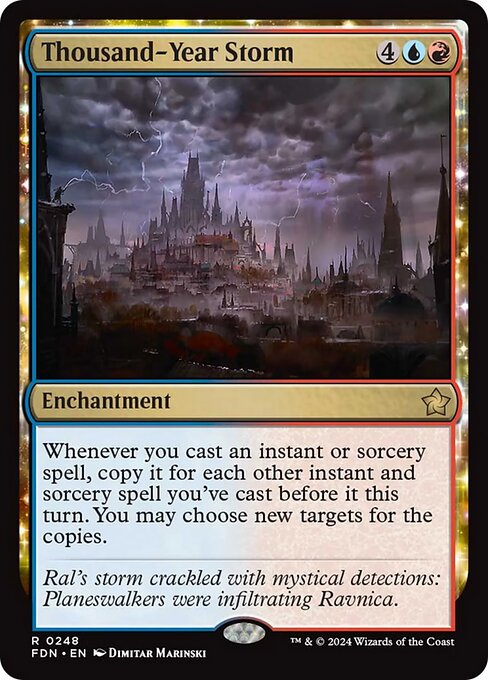
264. Thousand-Year Storm
Rating2.0WeakWhy this rating?
Not good filler and often gets cut (2.0/10).
Why. A six-mana enchantment: whenever you cast an instant or sorcery, copy it for each other instant and sorcery you've cast before it this turn. It needs a very specific spells deck with good spells to duplicate.
Risks. Six mana for an effect that does nothing to the board, and you need to chain several spells in one turn. That's close to impossible in a normal draft deck.
In the draft. Let it go. Even in a blue-red spells deck, better not to play it.
Results in the games of the set
When it is in hand, the deck wins 35.6% of its games (set average: 55.7%).
In the opening hand: 0.0% wins (54.8% on average).
Drawn during the game: 37.9% (56.4% on average).
When it is drawn, the deck wins 12.3 points less than when it is not.
When it is drafted, it is played only 5% of the time (set average: 61%): it almost always ends in the sideboard.

265. Twinblade Blessing
Rating2.0WeakWhy this rating?
Not good filler and often gets cut (2.0/10).
Why. A three-mana Aura with flash that gives the enchanted creature double strike. In combat it can swing an exchange, especially on a creature with high power.
Risks. It's an Aura, so removal in response is a two-for-one against you. It does nothing without a quality creature to enchant.
In the draft. Filler for aggressive white decks. Don't take it highly; it's a late pick.
Results in the games of the set
When it is in hand, the deck wins 46.8% of its games (set average: 55.7%, 267th of 274 cards).
In the opening hand: 44.0% wins (54.8% on average).
Drawn during the game: 48.7% (56.4% on average).
When it is drawn, the deck wins 4.8 points less than when it is not.
When it is drafted, it is played only 11% of the time (set average: 61%): it almost always ends in the sideboard.

266. Grow from the Ashes
Rating1.9WeakWhy this rating?
Not good filler and often gets cut (1.9/10).
Why. A three-mana sorcery that puts a basic land onto the battlefield, or two with the two-mana kicker. It ramps and fixes your colours.
Risks. It does nothing on the board and takes your turn. In a deck without big spells, it's a dead card.
In the draft. A pick for green or three-colour decks with a high curve. Otherwise it's end-of-pack filler.
Results in the games of the set
When it is in hand, the deck wins 48.1% of its games (set average: 55.7%, 260th of 274 cards).
In the opening hand: 46.3% wins (54.8% on average).
Drawn during the game: 49.5% (56.4% on average).
When it is drawn, the deck wins 1.6 points less than when it is not.
When it is drafted, it is played 33% of the time (set average: 61%).
Taken among the first three picks (136 drafts), it ends in the deck 69% of the time.
It is played mostly in G/U decks (78% of them) and G/R (31%).

267. Fishing Pole
Rating1.7WeakWhy this rating?
Not good filler and often gets cut (1.7/10).
Why. A one-mana equipment, equip two. The equipped creature gains an ability: pay one mana, tap it and tap the equipment to put a bait counter on it. Whenever the creature untaps, you remove a bait counter and create a 1/1 blue Fish creature token. It's very slow.
Risks. It burns a lot of mana for an occasional 1/1 and keeps your creature tapped. Slow and inefficient.
In the draft. A last-resort pick. Leave it in the sideboard in most decks.
Results in the games of the set
When it is in hand, the deck wins 43.2% of its games (set average: 55.7%, 273rd of 274 cards).
In the opening hand: 39.5% wins (54.8% on average).
Drawn during the game: 45.6% (56.4% on average).
When it is drawn, the deck wins 6.7 points less than when it is not.
When it is drafted, it is played only 5% of the time (set average: 61%): it almost always ends in the sideboard.

268. Exsanguinate
Rating1.5WeakWhy this rating?
Almost unplayable and mostly sideboard material (1.5/10).
Why. An X sorcery that makes each opponent lose X life while you gain that much. With a lot of mana, it's a finisher and a huge life swing in one go.
Risks. It does nothing for the board and gives little for its cost at a small X. A deck without extra mana can't use it.
In the draft. A finisher for a slow black deck. It doesn't deserve a high pick, only late for a control deck.
Results in the games of the set
When it is in hand, the deck wins 48.2% of its games (set average: 55.7%, 258th of 274 cards).
In the opening hand: 43.4% wins (54.8% on average).
Drawn during the game: 51.5% (56.4% on average).
When it is drawn, the deck wins 0.4 points less than when it is not.
When it is drafted, it is played only 4% of the time (set average: 61%): it almost always ends in the sideboard.
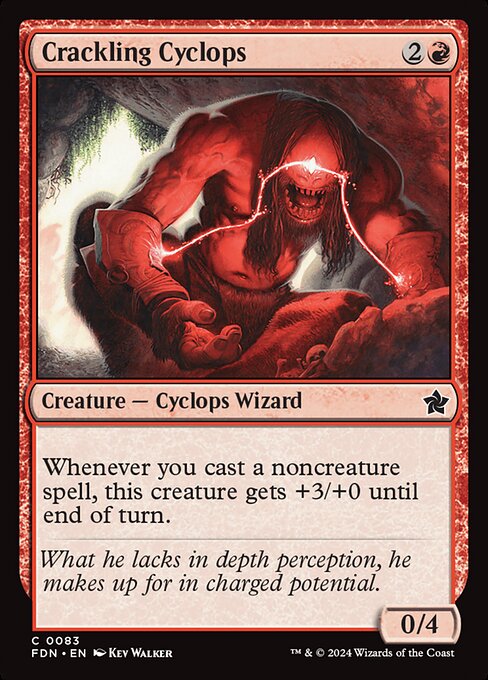
269. Crackling Cyclops
Rating1.4WeakWhy this rating?
Almost unplayable and mostly sideboard material (1.4/10).
Why. A 0/4 for three mana that only becomes threatening on turns when you cast noncreature spells: each one gives it +3/+0 until end of turn. In a deck full of instants and sorceries it blocks well and can hit for 3 or 6.
Risks. With no noncreature spell to cast it is a 0-power wall that kills nothing. It needs a spell-heavy deck, and the bonus ends with the turn.
In the draft. Playable filler only in a deck with plenty of spells. Do not take it before your removal and your good creatures.
Results in the games of the set
When it is in hand, the deck wins 48.3% of its games (set average: 55.7%, 256th of 274 cards).
In the opening hand: 48.0% wins (54.8% on average).
Drawn during the game: 48.4% (56.4% on average).
When it is drawn, the deck wins 2.4 points less than when it is not.
When it is drafted, it is played only 10% of the time (set average: 61%): it almost always ends in the sideboard.
Taken among the first three picks (30 drafts), it ends in the deck 60% of the time.
It is played mostly in R/U decks (28% of them).

270. Crypt Feaster
Rating1.4WeakWhy this rating?
Almost unplayable and mostly sideboard material (1.4/10).
Why. A 3/4 with menace for four mana, decent for attacking through an ordinary defence. The Threshold bonus makes it hit for 5 once your graveyard is well stocked, which only happens late in the game.
Risks. Threshold is slow to reach without a way to fill the graveyard, so most of the time it is just a 3/4 menace. It has no ability that changes the game.
In the draft. A mid-pack playable for black decks: take it when nothing better sits at four mana. It fits best in an aggressive deck or one that fills its graveyard.
Results in the games of the set
When it is in hand, the deck wins 50.1% of its games (set average: 55.7%, 243rd of 274 cards).
In the opening hand: 48.0% wins (54.8% on average).
Drawn during the game: 51.4% (56.4% on average).
When it is drawn, the deck wins 0.2 points less than when it is not.
When it is drafted, it is played only 7% of the time (set average: 61%): it almost always ends in the sideboard.
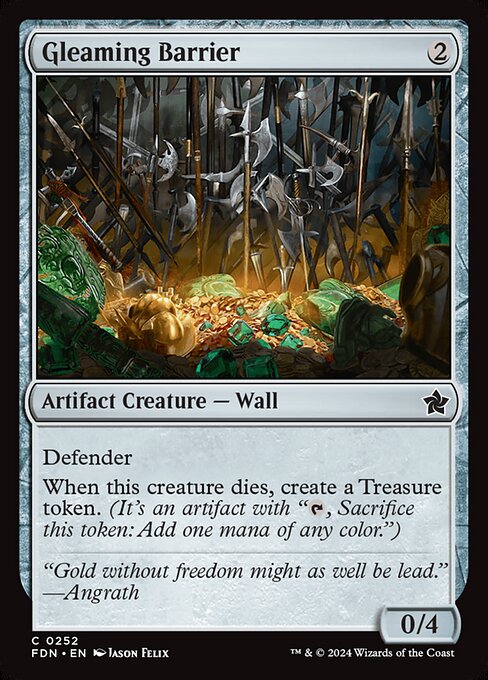
271. Gleaming Barrier
Rating1.4WeakWhy this rating?
Almost unplayable and mostly sideboard material (1.4/10).
Why. A colourless two-mana wall, 0/4 with defender, that stops small creatures early. When it dies it leaves a Treasure token, so you get a mana back and the trade is not a total loss.
Risks. It never attacks and cannot win a game by itself. In a deck that wants to pressure the opponent it is too passive, and flyers ignore it.
In the draft. Defensive filler, playable in any colour. Useful in a controlling deck or to survive the early turns; do not take it over real removal.
Results in the games of the set
When it is in hand, the deck wins 47.8% of its games (set average: 55.7%, 263rd of 274 cards).
In the opening hand: 45.0% wins (54.8% on average).
Drawn during the game: 49.9% (56.4% on average).
When it is drawn, the deck wins 1.9 points less than when it is not.
When it is drafted, it is played only 14% of the time (set average: 61%): it almost always ends in the sideboard.
Intrinsic ratings: they do not take into account the cards you have already picked. They matter most for the first pick of the first pack.