Card ranking · Modern Horizons 3 (MH3)
← Modern Horizons 3302 cards
- Bomb > 8.4
- Very good ≥ 7.2
- Good ≥ 6.2
- Playable ≥ 5.0
- Weak < 5.0
Ratings are out of 10. They combine experts' opinions, the statistics of thousands of drafts by experienced players (when a card is taken, played, and the wins of the decks that play it) and what is printed on the card. Click a card to enlarge it.
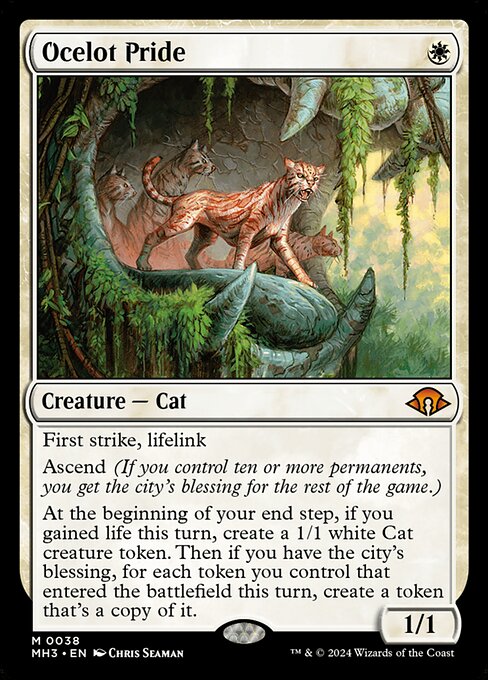
1. Ocelot Pride
Rating9.4BombWhy this rating?
The best card of the set (9.4/10).
Why. One mana, and it snowballs. First strike and lifelink mean any damage it deals gains you life, and at your end step you get a 1/1 white Cat creature token. Once you hold ten permanents, the city's blessing copies every token that entered this turn.
Risks. It is a 1/1: any removal spell or a bigger blocker shuts it down. If you did not gain life that turn it does nothing, and the city's blessing needs a wide board.
In the draft. A very high pick, best in an aggressive white deck that keeps attacking or that has other ways to gain life. Take it over almost any other one-drop.
Results in the games of the set
When it is in hand, the deck wins 65.6% of its games (set average: 56.2%, 2nd of 298 cards).
In the opening hand: 72.4% wins (55.6% on average).
Drawn during the game: 59.2% (56.7% on average).
When it is drawn, the deck wins 10.3 points more than when it is not.
When it is drafted, it is played 90% of the time (set average: 67%).
Taken as the first pick (55 drafts), it ends in the deck 91% of the time.
It is played about as much in every archetype.
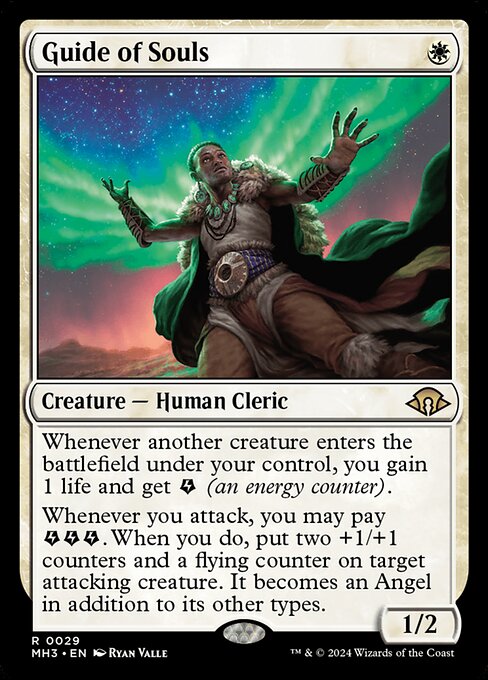 Rating9.3Bomb
Why this rating?
One of the 3 best cards of the set (9.3/10).
Why. A one-drop that pays you for playing creatures: each other creature entering gives you 1 life and an energy counter. Three energy turns an attack into two +1/+1 counters, flying and the Angel type on an attacker, which makes a small creature a real threat.
Risks. It is a 1/2 that dies to anything. With no creatures behind it, it does nothing, and the energy only pays off if you attack with a creature.
In the draft. Take it early if you are building a white deck with lots of cheap creatures. Look for a low curve so the energy builds up in the first turns.
Results in the games of the set
When it is in hand, the deck wins 67.5% of its games (set average: 56.2%, 1st of 298 cards).
In the opening hand: 72.0% wins (55.6% on average).
Drawn during the game: 63.6% (56.7% on average).
When it is drawn, the deck wins 11.4 points more than when it is not.
When it is drafted, it is played 94% of the time (set average: 67%).
Taken as the first pick (140 drafts), it ends in the deck 91% of the time.
It is played about as much in every archetype.

3. Ajani, Nacatl Pariah // Ajani, Nacatl Avenger
Rating9.1BombWhy this rating?
One of the 3 best cards of the set (9.1/10).
Why. Two bodies for two mana: Ajani enters with a 2/1 white Cat Warrior creature token. When another Cat you control dies he flips into a planeswalker that grows your Cats, makes a new Cat Warrior and, with a red permanent, deals damage to any target.
Risks. Ajani himself is a 1/2, and the flip needs a Cat to die. The opponent can ignore the token or let it live. Without red, the back side loses a lot of its bite.
In the draft. Take it very high, especially in red-white. You want Cats and cheap creatures that will attack or block and trigger the flip.
Results in the games of the set
When it is in hand, the deck wins 64.2% of its games (set average: 56.2%, 6th of 298 cards).
In the opening hand: 67.9% wins (55.6% on average).
Drawn during the game: 60.9% (56.7% on average).
When it is drawn, the deck wins 9.1 points more than when it is not.
When it is drafted, it is played 92% of the time (set average: 67%).
Taken as the first pick (41 drafts), it ends in the deck 93% of the time.
It is played about as much in every archetype.

4. Tamiyo, Inquisitive Student // Tamiyo, Seasoned Scholar
Rating9.0BombWhy this rating?
One of the 10 best cards of the set (9.0/10).
Why. A one-mana flyer that builds value: every time it attacks you investigate. With Clues, drawing your third card in a turn is realistic, and it then flips into a planeswalker that recovers an instant or sorcery or slows attackers.
Risks. It has no power, so it deals no damage. Flipping needs three draws in a turn, and each Clue costs two mana to cash in, which does not suit every deck.
In the draft. A very good pick in blue, best in a slower deck that likes drawing cards. Look for instants and sorceries to recover as well.
Results in the games of the set
When it is in hand, the deck wins 62.8% of its games (set average: 56.2%, 10th of 298 cards).
In the opening hand: 66.5% wins (55.6% on average).
Drawn during the game: 60.3% (56.7% on average).
When it is drawn, the deck wins 10.8 points more than when it is not.
When it is drafted, it is played 91% of the time (set average: 67%).
Taken as the first pick (52 drafts), it ends in the deck 88% of the time.
It is played about as much in every archetype.

5. Phlage, Titan of Fire's Fury
Rating8.9BombWhy this rating?
One of the 10 best cards of the set (8.9/10).
Why. Three mana for 3 damage to any target and 3 life, then it is sacrificed. Later, escape brings it back as a 6/6 that repeats the effect each time it enters and attacks: a removal spell that returns as a bomb.
Risks. It needs two colours, and escape costs four mana plus five other cards from your graveyard, which takes time. Cast too early, it is only a removal spell.
In the draft. A no-brainer first pick in red-white. Even if escape never comes online it is a fine removal spell that gains life.
Results in the games of the set
When it is in hand, the deck wins 65.0% of its games (set average: 56.2%, 3rd of 298 cards).
In the opening hand: 64.1% wins (55.6% on average).
Drawn during the game: 65.7% (56.7% on average).
When it is drawn, the deck wins 9.0 points more than when it is not.
When it is drafted, it is played 87% of the time (set average: 67%).
Taken as the first pick (46 drafts), it ends in the deck 80% of the time.
It is played about as much in every archetype.
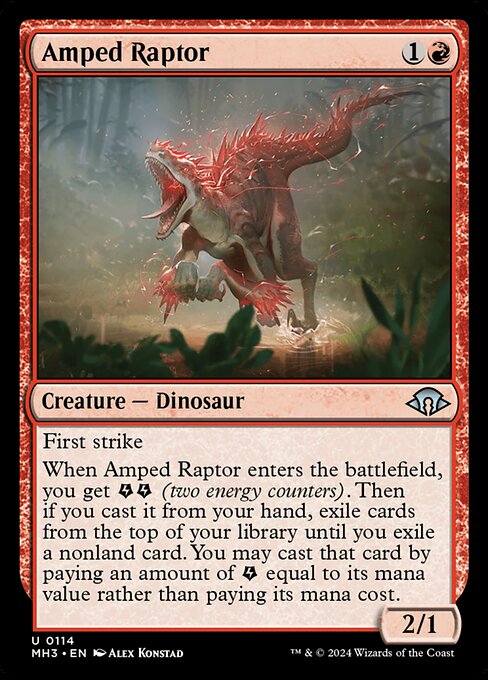
6. Amped Raptor
Rating8.9BombWhy this rating?
One of the 10 best cards of the set (8.9/10).
Why. A 2/1 with first strike that gives you two energy and exiles cards until a nonland one, which you can cast by paying energy instead of its cost. If that card has mana value 2 or less, it is a free card on a cheap creature.
Risks. If the exiled card is worth more than your energy, it stays exiled for good, like any lands exiled before it. The effect only happens if you cast it from your hand.
In the draft. A good pick for a low curve with cheap spells. The more energy your deck makes elsewhere, the better it gets.
Results in the games of the set
When it is in hand, the deck wins 64.2% of its games (set average: 56.2%, 7th of 298 cards).
In the opening hand: 65.4% wins (55.6% on average).
Drawn during the game: 63.1% (56.7% on average).
When it is drawn, the deck wins 7.3 points more than when it is not.
When it is drafted, it is played 90% of the time (set average: 67%).
Taken as the first pick (317 drafts), it ends in the deck 93% of the time.
It is played mostly in R/W decks (40% of them) and R/U (35%).
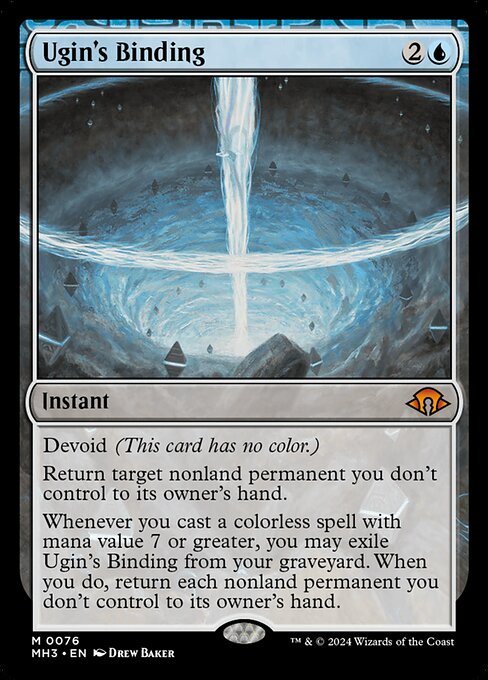 Rating8.8Bomb
Why this rating?
One of the 10 best cards of the set (8.8/10).
Why. A three-mana instant that returns a nonland permanent you don't control to its owner's hand. It gains tempo, kills a token outright and answers an Aura. Later, casting a colourless spell with mana value 7 or greater lets you exile it from your graveyard to send back the whole opposing board.
Risks. The permanent just goes back to hand unless it is a token, so this is tempo, not removal. Without very big colourless spells, the second effect stays theoretical.
In the draft. A good pick for blue tempo or control decks. Weaker if your deck cannot use the tempo it gains.
Results in the games of the set
When it is in hand, the deck wins 60.3% of its games (set average: 56.2%, 20th of 298 cards).
In the opening hand: 57.2% wins (55.6% on average).
Drawn during the game: 62.4% (56.7% on average).
When it is drawn, the deck wins 6.6 points more than when it is not.
When it is drafted, it is played 72% of the time (set average: 67%).
Taken as the first pick (37 drafts), it ends in the deck 73% of the time.
It is played about as much in every archetype.
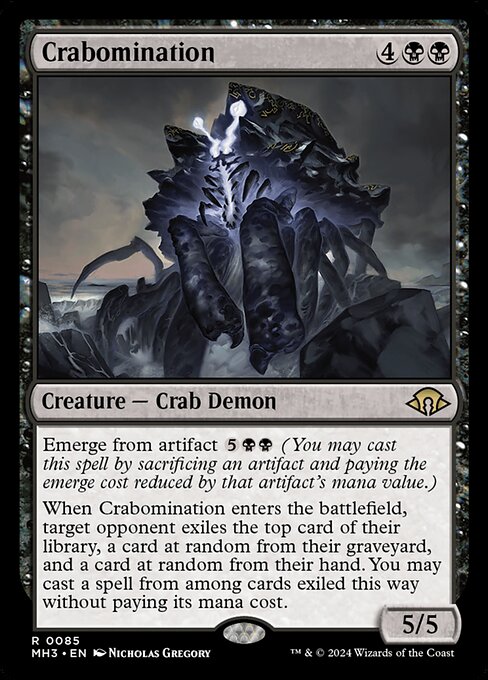 Rating8.7Bomb
Why this rating?
One of the 10 best cards of the set (8.7/10).
Why. Six mana for a 5/5 that exiles the top card of the opponent's library, a random card from their graveyard and a random card from their hand. You can cast one of those spells for free: usually a second big effect on top of the body.
Risks. It is expensive and you have to survive until then. If all three cards are lands or useless spells, you only get the 5/5. The opponent can still save a removal spell for the body.
In the draft. A very good top-end finisher in black, worth taking fairly high. With an artifact of mana value 2 or more to sacrifice, emerge makes it cheaper, but you will not always have one.
Results in the games of the set
When it is in hand, the deck wins 64.2% of its games (set average: 56.2%, 5th of 298 cards).
In the opening hand: 62.2% wins (55.6% on average).
Drawn during the game: 65.5% (56.7% on average).
When it is drawn, the deck wins 12.5 points more than when it is not.
When it is drafted, it is played 92% of the time (set average: 67%).
Taken as the first pick (120 drafts), it ends in the deck 93% of the time.
It is played about as much in every archetype.
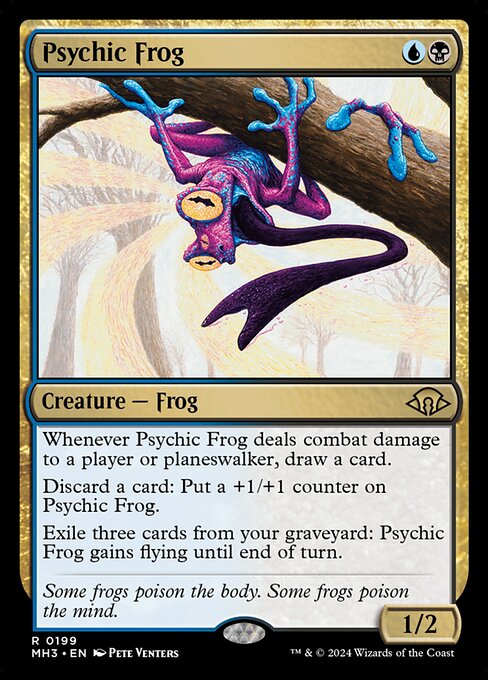
9. Psychic Frog
Rating8.7BombWhy this rating?
One of the 10 best cards of the set (8.7/10).
Why. A 1/2 that becomes a real threat: whenever it connects with a player or planeswalker you draw a card, and discarding a card gives it a +1/+1 counter. Exiling three cards from your graveyard grants flying until end of turn so it gets through. It turns spare cards into power.
Risks. It needs two exact colours and is fragile early. Each discard costs a card, and it only draws if it hits a player or planeswalker, not if a creature blocks.
In the draft. A very good pick in blue-black. Look for a tempo deck with removal to clear the way.
Results in the games of the set
When it is in hand, the deck wins 62.3% of its games (set average: 56.2%, 12th of 298 cards).
In the opening hand: 67.2% wins (55.6% on average).
Drawn during the game: 59.5% (56.7% on average).
When it is drawn, the deck wins 11.3 points more than when it is not.
When it is drafted, it is played 80% of the time (set average: 67%).
Taken as the first pick (83 drafts), it ends in the deck 82% of the time.
It is played mostly in B/U decks (26% of them).
 Rating8.6Bomb
Why this rating?
One of the 10 best cards of the set (8.6/10).
Why. A 1/4 mana creature that blocks well early. With a creature of power 4 or greater, it adds four green mana at once, enough for a huge spell. Later, eternalize brings it back as a 4/4 token.
Risks. It makes no mana the turn it arrives. The four-mana mode needs a creature of power 4 or greater; without one it gives a single green mana.
In the draft. A good pick for a green deck with big creatures. It replaces a mana source and lets you cast a huge spell far earlier than planned.
Results in the games of the set
When it is in hand, the deck wins 60.6% of its games (set average: 56.2%, 17th of 298 cards).
In the opening hand: 64.8% wins (55.6% on average).
Drawn during the game: 57.2% (56.7% on average).
When it is drawn, the deck wins 6.6 points more than when it is not.
When it is drafted, it is played 89% of the time (set average: 67%).
Taken as the first pick (108 drafts), it ends in the deck 93% of the time.
It is played about as much in every archetype.
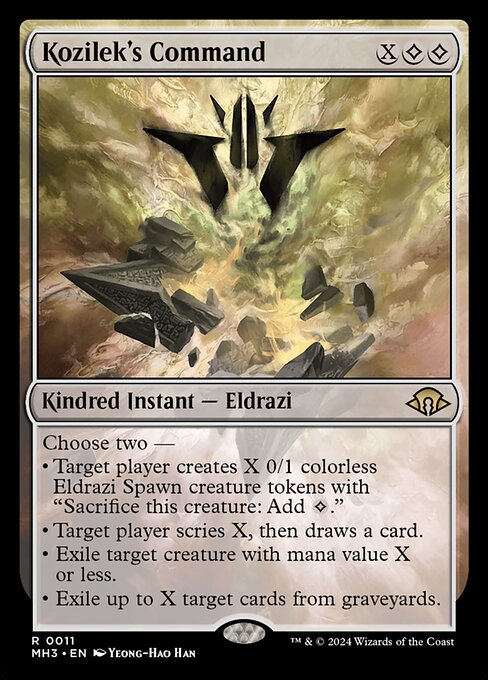 Rating8.5Bomb
Why this rating?
Incredible bomb, but not unbeatable (8.5/10).
Why. A flexible instant: choose two among Eldrazi Spawn creature tokens, scry then draw, exiling a creature with mana value X or less, or exiling cards from graveyards. Depending on X it is removal plus value, or two useful effects at once.
Risks. It needs two exact colourless mana, which only some sources produce, and the effect scales on X. In a deck without colourless mana it sits in your hand.
In the draft. A fair pick for Eldrazi or Spawn decks, not for a two-colour deck with no colourless source. Count your colourless sources before making room for it.
Results in the games of the set
When it is in hand, the deck wins 60.0% of its games (set average: 56.2%, 23rd of 298 cards).
In the opening hand: 57.4% wins (55.6% on average).
Drawn during the game: 61.7% (56.7% on average).
When it is drawn, the deck wins 7.1 points more than when it is not.
When it is drafted, it is played 80% of the time (set average: 67%).
Taken as the first pick (65 drafts), it ends in the deck 95% of the time.
It is played about as much in every archetype.
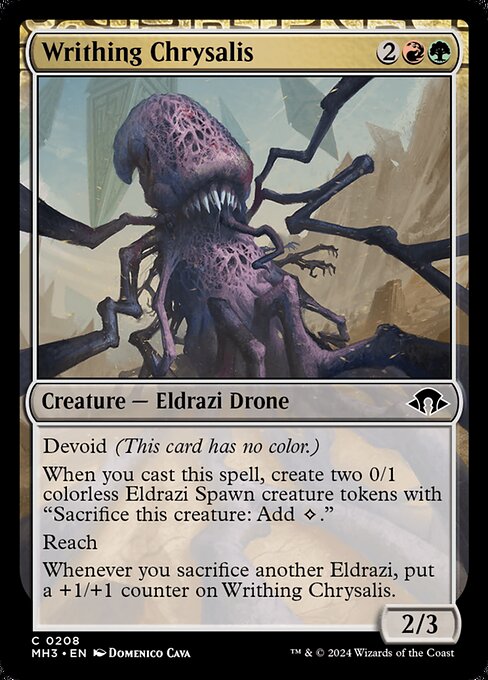 Rating8.5Bomb
Why this rating?
One of the very best commons of the format (8.5/10).
Why. Four mana for a 2/3 with reach and two Eldrazi Spawn creature tokens made as soon as you cast it. The Spawn fuel ramp and grow it when you sacrifice them. A common that brings board and value.
Risks. It needs red and green. The body alone is modest, and if you sacrifice the Spawn too early you lose chump blockers.
In the draft. A very good common for red-green. Do not let it wheel.
Results in the games of the set
When it is in hand, the deck wins 64.1% of its games (set average: 56.2%, 8th of 298 cards).
In the opening hand: 64.2% wins (55.6% on average).
Drawn during the game: 63.9% (56.7% on average).
When it is drawn, the deck wins 9.1 points more than when it is not.
When it is drafted, it is played 88% of the time (set average: 67%).
Taken as the first pick (793 drafts), it ends in the deck 91% of the time.
It is played mostly in G/R decks (75% of them) and R/U (55%).
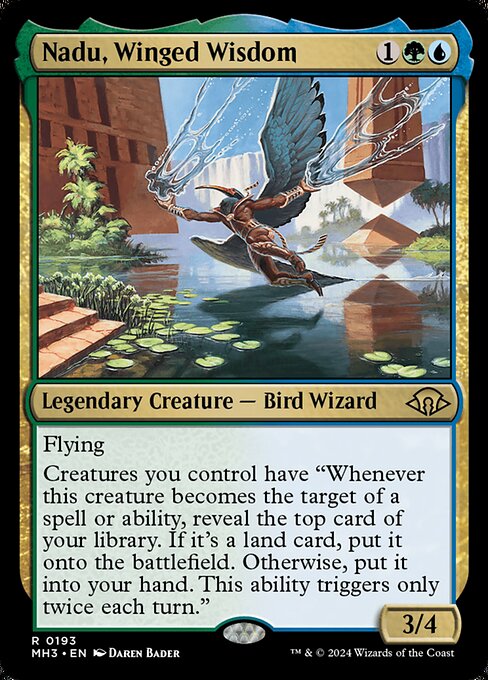 Rating8.4Bomb
Why this rating?
One of the very best rares of the format (8.4/10).
Why. A 3/4 flyer for three mana, already very solid. Whenever one of your creatures becomes the target of a spell or ability, you reveal the top card: a land goes onto the battlefield, anything else goes to your hand. At most twice per turn for each creature.
Risks. You need effects that target your own creatures to use the ability, and opposing targeted removal gives you a card but Nadu still dies. It needs green and blue.
In the draft. Take it as an excellent flying body in green-blue, with a bonus if you have ways to target your own creatures.
Results in the games of the set
When it is in hand, the deck wins 60.6% of its games (set average: 56.2%, 16th of 298 cards).
In the opening hand: 60.8% wins (55.6% on average).
Drawn during the game: 60.5% (56.7% on average).
When it is drawn, the deck wins 8.2 points more than when it is not.
When it is drafted, it is played 87% of the time (set average: 67%).
Taken as the first pick (108 drafts), it ends in the deck 89% of the time.
It is played about as much in every archetype.

14. Laelia, the Blade Reforged
Rating8.3Very goodWhy this rating?
One of the very best rares of the format (8.3/10).
Why. A 2/2 with haste that exiles the top card of your library each time it attacks, and you may play it that turn. Every exile also puts a +1/+1 counter on it: it grows every turn while feeding you cards.
Risks. It has to attack to do anything, and it can run into bigger blockers. The exiled card is lost if you cannot play it that turn.
In the draft. A very good red pick for an aggressive deck. Keep mana open to play the exiled card.
Results in the games of the set
When it is in hand, the deck wins 60.9% of its games (set average: 56.2%, 14th of 298 cards).
In the opening hand: 61.5% wins (55.6% on average).
Drawn during the game: 60.4% (56.7% on average).
When it is drawn, the deck wins 5.0 points more than when it is not.
When it is drafted, it is played 95% of the time (set average: 67%).
Taken as the first pick (114 drafts), it ends in the deck 96% of the time.
It is played about as much in every archetype.
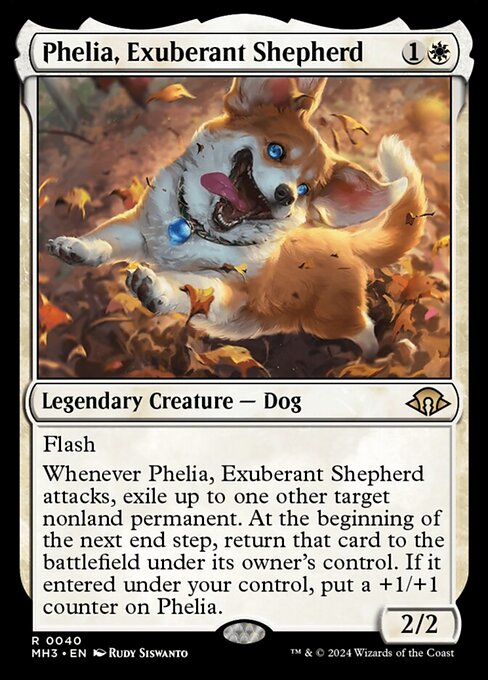
15. Phelia, Exuberant Shepherd
Rating8.3Very goodWhy this rating?
One of the very best rares of the format (8.3/10).
Why. A 2/2 with flash that exiles another nonland permanent when it attacks, until the next end step. It removes a blocker for the combat or resets one of your own permanents, and grows if the permanent returns under your control.
Risks. The effect is temporary: the opponent gets their permanent back at end of turn, and an exiled token never returns. The body is small and the attack is risky on a closed board.
In the draft. A fair pick in white, best in an aggressive red-white deck. Flash lets you cast it at the end of the opponent's turn, ready to attack.
Results in the games of the set
When it is in hand, the deck wins 60.1% of its games (set average: 56.2%, 21st of 298 cards).
In the opening hand: 63.3% wins (55.6% on average).
Drawn during the game: 57.3% (56.7% on average).
When it is drawn, the deck wins 4.2 points more than when it is not.
When it is drafted, it is played 92% of the time (set average: 67%).
Taken as the first pick (130 drafts), it ends in the deck 89% of the time.
It is played about as much in every archetype.
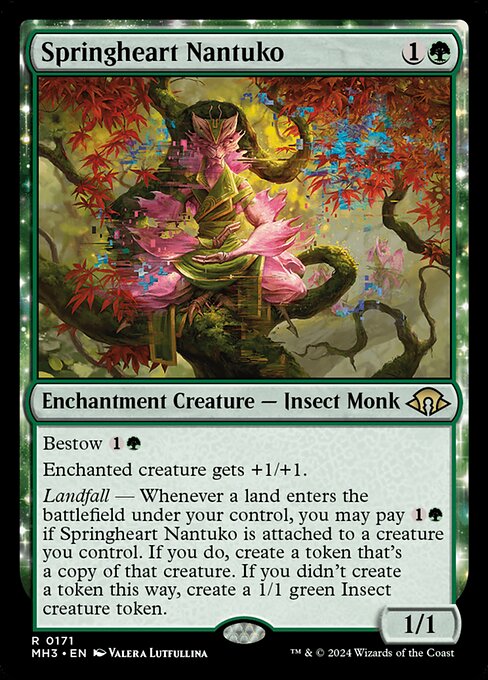 Rating8.2Very good
Why this rating?
One of the very best rares of the format (8.2/10).
Why. A 1/1 creature that can also bestow onto another creature for two mana, giving +1/+1. Whenever a land enters, you either make a 1/1 green Insect creature token or, if it is attached, pay two mana to copy the enchanted creature: a good value engine.
Risks. The body is weak and copying needs a good creature, two more mana on each land, and so lands. If the enchanted creature dies, it stays behind as a plain 1/1.
In the draft. A good pick in a green deck with plenty of lands. Better with strong creatures to copy, average otherwise.
Results in the games of the set
When it is in hand, the deck wins 59.1% of its games (set average: 56.2%, 33rd of 298 cards).
In the opening hand: 61.1% wins (55.6% on average).
Drawn during the game: 57.5% (56.7% on average).
When it is drawn, the deck wins 5.7 points more than when it is not.
When it is drafted, it is played 91% of the time (set average: 67%).
Taken as the first pick (106 drafts), it ends in the deck 91% of the time.
It is played about as much in every archetype.
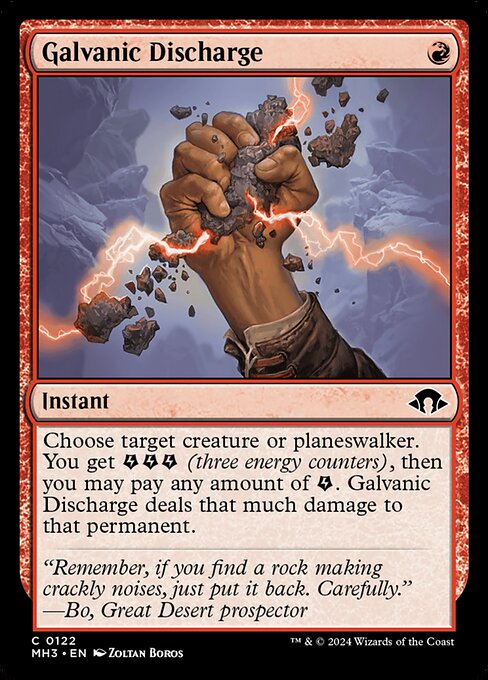 Rating8.1Very good
Why this rating?
One of the very best commons of the format (8.1/10).
Why. A one-mana removal spell: you get three energy and may pay any amount to deal that much damage to a creature or planeswalker. A tiny investment for killing almost anything that costs little.
Risks. With no other energy source you cap at three damage. Energy you don't pay stays, but only helps if your deck has uses for it.
In the draft. A top-quality removal spell for its cost: take it very high in red. Every extra source of energy makes it hit harder.
Results in the games of the set
When it is in hand, the deck wins 60.1% of its games (set average: 56.2%, 22nd of 298 cards).
In the opening hand: 60.2% wins (55.6% on average).
Drawn during the game: 60.1% (56.7% on average).
When it is drawn, the deck wins 3.1 points more than when it is not.
When it is drafted, it is played 93% of the time (set average: 67%).
Taken as the first pick (780 drafts), it ends in the deck 95% of the time.
It is played mostly in R/U decks (65% of them) and R/W (65%).
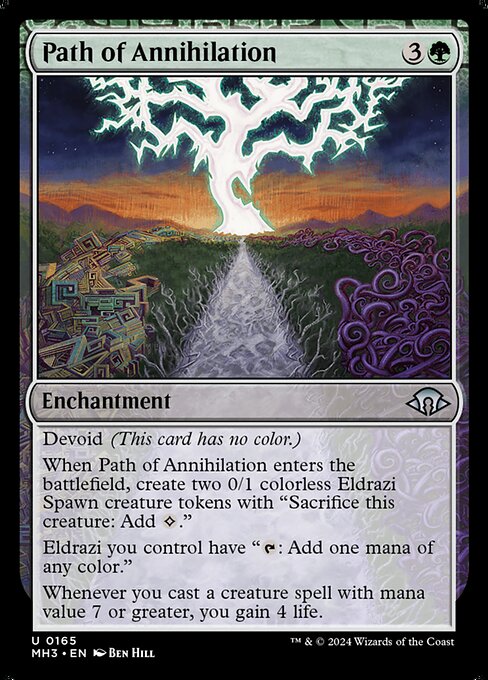 Rating8.1Very good
Why this rating?
One of the very best uncommons of the format (8.1/10).
Why. Four mana for two Eldrazi Spawn creature tokens, and your Eldrazi gain the ability to tap for mana of any colour. It fixes your colours and ramps toward big spells, with 4 life each time you cast a creature of mana value 7 or greater.
Risks. It does nothing to the board: your turn-four play puts no threat out. It relies on Spawn and other Eldrazi, and is weak without them.
In the draft. A fair pick in a green Eldrazi or ramp deck, not elsewhere. Take it after your removal and threats.
Results in the games of the set
When it is in hand, the deck wins 61.1% of its games (set average: 56.2%, 13th of 298 cards).
In the opening hand: 61.9% wins (55.6% on average).
Drawn during the game: 60.6% (56.7% on average).
When it is drawn, the deck wins 7.1 points more than when it is not.
When it is drafted, it is played 84% of the time (set average: 67%).
Taken as the first pick (230 drafts), it ends in the deck 86% of the time.
It is played mostly in G/R decks (31% of them) and G/U (28%).

19. Ophiomancer
Rating8.0Very goodWhy this rating?
One of the very best rares of the format (8.0/10).
Why. A 2/2 that creates a 1/1 black Snake creature token with deathtouch at each upkeep, yours or the opponent's, when you control no Snakes. You nearly always have a deathtouch blocker, which discourages big attackers.
Risks. It is a 2/2 with no protection from removal, and the Snake does not give you more if you keep it alive: it only comes back after it dies. The effect is defensive and slow.
In the draft. A good pick in a black control or sacrifice deck. It is a little worse in an aggressive deck.
Results in the games of the set
When it is in hand, the deck wins 59.7% of its games (set average: 56.2%, 25th of 298 cards).
In the opening hand: 59.2% wins (55.6% on average).
Drawn during the game: 60.1% (56.7% on average).
When it is drawn, the deck wins 7.8 points more than when it is not.
When it is drafted, it is played 89% of the time (set average: 67%).
Taken as the first pick (98 drafts), it ends in the deck 89% of the time.
It is played about as much in every archetype.
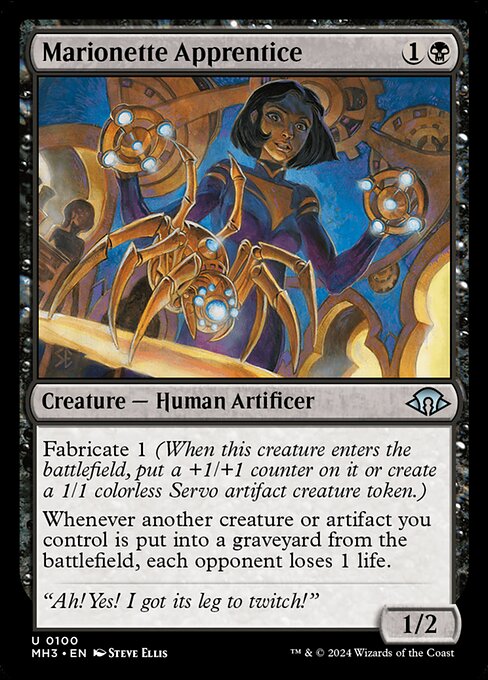 Rating7.9Very good
Why this rating?
One of the very best uncommons of the format (7.9/10).
Why. A flexible two-drop: fabricate gives it a +1/+1 counter or a 1/1 Servo token. Whenever another creature or artifact you control is put into a graveyard from the battlefield, each opponent loses 1 life, which makes trades and chump blocks worth more.
Risks. On its own it does almost nothing: the drain needs your creatures to die. The body is small and the drain is slow.
In the draft. A fair pick in black, best in decks that sacrifice or trade a lot of creatures. A good support piece, not a threat.
Results in the games of the set
When it is in hand, the deck wins 60.5% of its games (set average: 56.2%, 18th of 298 cards).
In the opening hand: 60.6% wins (55.6% on average).
Drawn during the game: 60.5% (56.7% on average).
When it is drawn, the deck wins 7.1 points more than when it is not.
When it is drafted, it is played 89% of the time (set average: 67%).
Taken as the first pick (239 drafts), it ends in the deck 94% of the time.
It is played mostly in B/R decks (39% of them) and B/W (37%).

21. Toxic Deluge
Rating7.9Very goodWhy this rating?
One of the very best rares of the format (7.9/10).
Why. A three-mana sorcery that gives all creatures -X/-X until end of turn for X life you pay: you pick X to fit the situation. It resets the game when you are behind or sweeps small enemy creatures while your bigger ones survive.
Risks. It is symmetrical and costs life. In a creature deck it removes your own board, and it is poor against an aggressive opponent when your life total is low.
In the draft. A fair pick for a black control deck with few creatures and some life gain. Skip it in aggressive decks.
Results in the games of the set
When it is in hand, the deck wins 58.9% of its games (set average: 56.2%, 37th of 298 cards).
In the opening hand: 56.2% wins (55.6% on average).
Drawn during the game: 60.8% (56.7% on average).
When it is drawn, the deck wins 6.3 points more than when it is not.
When it is drafted, it is played 89% of the time (set average: 67%).
Taken as the first pick (72 drafts), it ends in the deck 86% of the time.
It is played about as much in every archetype.

22. Static Prison
Rating7.8Very goodWhy this rating?
One of the very best uncommons of the format (7.8/10).
Why. One mana to exile a nonland permanent an opponent controls, with two starting energy to keep it there. You gain a lot of tempo by removing a threat while you deploy yours, even though it is not permanent.
Risks. The enchantment is sacrificed when you can no longer pay the energy, and the permanent returns. Without other energy sources it holds for about two turns.
In the draft. A good pick in white for tempo decks or ones with energy. Race while the threat is exiled.
Results in the games of the set
When it is in hand, the deck wins 58.8% of its games (set average: 56.2%, 43rd of 298 cards).
In the opening hand: 57.6% wins (55.6% on average).
Drawn during the game: 59.8% (56.7% on average).
When it is drawn, the deck wins 1.2 points more than when it is not.
When it is drafted, it is played 80% of the time (set average: 67%).
Taken as the first pick (153 drafts), it ends in the deck 91% of the time.
It is played mostly in R/W decks (35% of them) and U/W (35%).
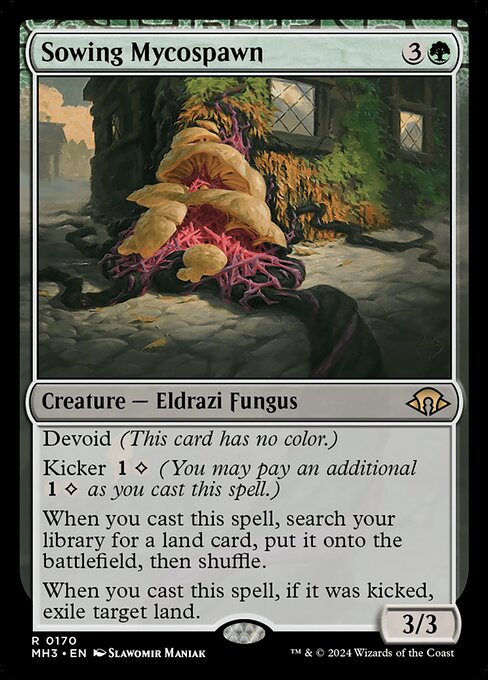
23. Sowing Mycospawn
Rating7.7Very goodWhy this rating?
One of the very best rares of the format (7.7/10).
Why. A four-mana devoid 3/3 that fetches a land onto the battlefield as soon as you cast it: ramp and colour fixing with a decent body. With kicker it also exiles a target land.
Risks. The kicker needs a specific colourless mana that many decks lack. Without it, it is a 3/3 with no attack or defence ability.
In the draft. A fair pick in green, better with colourless sources. The free land helps a two- or three-colour deck.
Results in the games of the set
When it is in hand, the deck wins 59.0% of its games (set average: 56.2%, 35th of 298 cards).
In the opening hand: 59.2% wins (55.6% on average).
Drawn during the game: 58.9% (56.7% on average).
When it is drawn, the deck wins 5.9 points more than when it is not.
When it is drafted, it is played 88% of the time (set average: 67%).
Taken as the first pick (84 drafts), it ends in the deck 93% of the time.
It is played about as much in every archetype.

24. Party Thrasher
Rating7.7Very goodWhy this rating?
One of the very best rares of the format (7.7/10).
Why. A two-mana 1/4 that blocks well. At the beginning of your first main phase you may discard a card to exile the top two cards and play one of them this turn: card filtering that turns extra lands into spells.
Risks. It needs a card to discard each turn, and the chosen card must be playable at once or it is lost, like the other one. It barely attacks, so its effect depends on your hand.
In the draft. An average pick in red, better in decks with spare lands. Do not take it over your removal.
Results in the games of the set
When it is in hand, the deck wins 58.4% of its games (set average: 56.2%, 50th of 298 cards).
In the opening hand: 60.1% wins (55.6% on average).
Drawn during the game: 57.0% (56.7% on average).
When it is drawn, the deck wins 2.6 points more than when it is not.
When it is drafted, it is played 89% of the time (set average: 67%).
Taken as the first pick (70 drafts), it ends in the deck 96% of the time.
It is played about as much in every archetype.
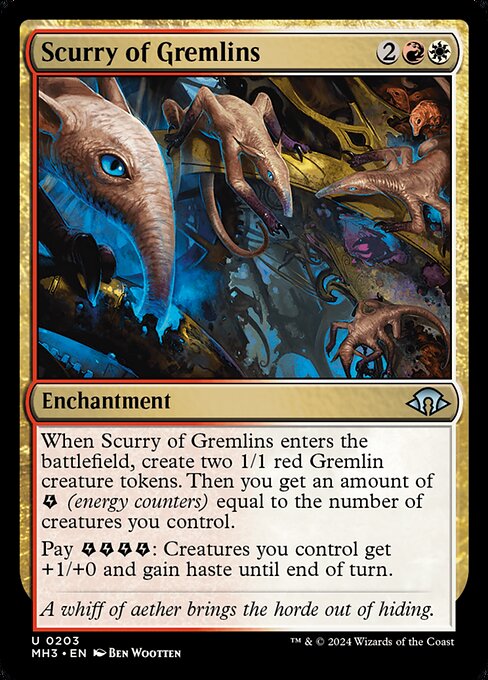 Rating7.6Very good
Why this rating?
One of the very best uncommons of the format (7.6/10).
Why. Four mana for two 1/1 red Gremlin creature tokens and energy equal to your creature count. With four energy, all your creatures get +1/+0 and haste for a turn: a way to finish a game with a wide board.
Risks. The enchantment has no body of its own and the tokens are fragile. It needs red and white, and the burst turns assume you already have several creatures.
In the draft. A good pick in red-white with cheap creatures. Better in aggressive decks, worse in control.
Results in the games of the set
When it is in hand, the deck wins 60.8% of its games (set average: 56.2%, 15th of 298 cards).
In the opening hand: 59.4% wins (55.6% on average).
Drawn during the game: 62.1% (56.7% on average).
When it is drawn, the deck wins 3.3 points more than when it is not.
When it is drafted, it is played 85% of the time (set average: 67%).
Taken as the first pick (267 drafts), it ends in the deck 91% of the time.
It is played mostly in R/W decks (48% of them) and U/W (35%).
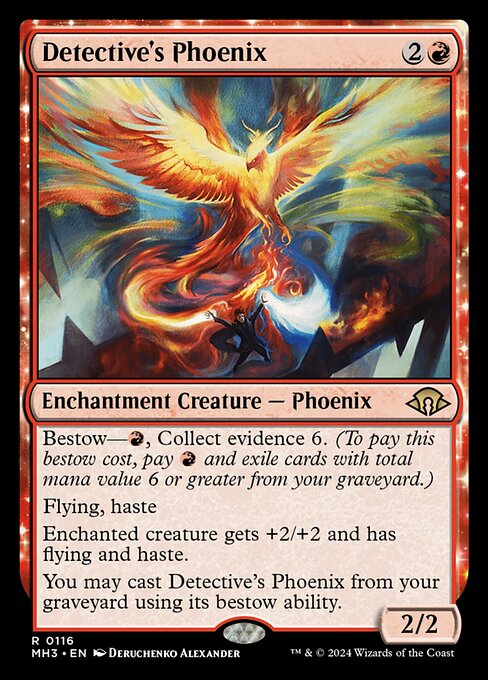 Rating7.6Very good
Why this rating?
One of the very best rares of the format (7.6/10).
Why. A 2/2 flyer with haste for three mana. It can also be cast with bestow for a red mana by exiling cards with total mana value 6 or more from your graveyard, giving +2/+2, flying and haste to a creature, and it can be recast that way from the graveyard.
Risks. Collect evidence 6 empties your graveyard and takes time. The body is small, and a removal spell costs you tempo, even though it can come back.
In the draft. A good pick in red, best in aggressive decks that fill their graveyard. It is resilient to removal.
Results in the games of the set
When it is in hand, the deck wins 58.9% of its games (set average: 56.2%, 41st of 298 cards).
In the opening hand: 57.6% wins (55.6% on average).
Drawn during the game: 59.9% (56.7% on average).
When it is drawn, the deck wins 2.4 points more than when it is not.
When it is drafted, it is played 94% of the time (set average: 67%).
Taken as the first pick (120 drafts), it ends in the deck 97% of the time.
It is played about as much in every archetype.
 Rating7.6Very good
Why this rating?
One of the very best rares of the format (7.6/10).
Why. A three-mana 3/3 with trample. At the beginning of combat, one of your creatures gains haste and +X/+0 where X is the number of Eldrazi you control, itself included: it quickly turns into a very dangerous attack.
Risks. The cost needs a specific colourless mana, which is hard without matching sources. The effect depends on how many Eldrazi you have, and the target creature must survive combat.
In the draft. A fair pick in a red-green Eldrazi deck with colourless mana sources. Otherwise let it go.
Results in the games of the set
When it is in hand, the deck wins 58.5% of its games (set average: 56.2%, 48th of 298 cards).
In the opening hand: 57.9% wins (55.6% on average).
Drawn during the game: 59.0% (56.7% on average).
When it is drawn, the deck wins 4.1 points more than when it is not.
When it is drafted, it is played 85% of the time (set average: 67%).
Taken as the first pick (104 drafts), it ends in the deck 88% of the time.
It is played about as much in every archetype.
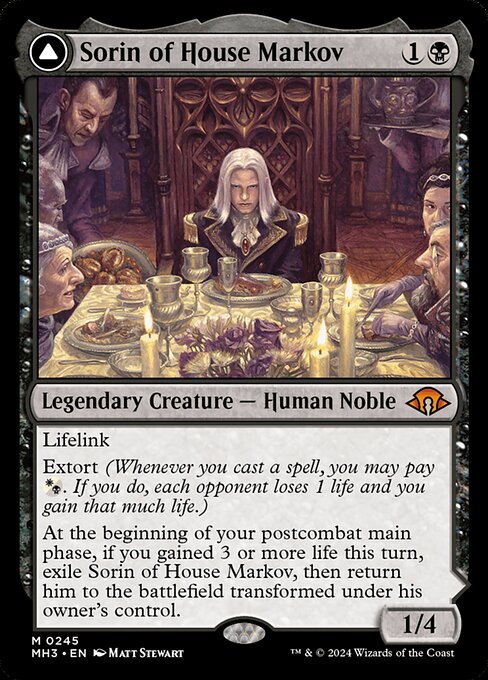
28. Sorin of House Markov // Sorin, Ravenous Neonate
Rating7.6Very goodWhy this rating?
One of the very best mythics of the format (7.6/10).
Why. A two-mana 1/4 with lifelink and extort. Each time you pay for extort, the opponent loses 1 life and you gain that much, and once you have gained 3 or more life in a turn it flips into a planeswalker that makes Food tokens and deals damage.
Risks. Flipping needs life gain before the second main phase, which does not always happen. Extort costs mana on every spell, and its body does not deal damage quickly.
In the draft. A fair pick in a black lifegain deck, average otherwise. Look for other sources of life gain around it.
Results in the games of the set
When it is in hand, the deck wins 57.3% of its games (set average: 56.2%, 68th of 298 cards).
In the opening hand: 57.1% wins (55.6% on average).
Drawn during the game: 57.4% (56.7% on average).
When it is drawn, the deck wins 5.4 points more than when it is not.
When it is drafted, it is played 92% of the time (set average: 67%).
Taken as the first pick (33 drafts), it ends in the deck 88% of the time.
It is played about as much in every archetype.
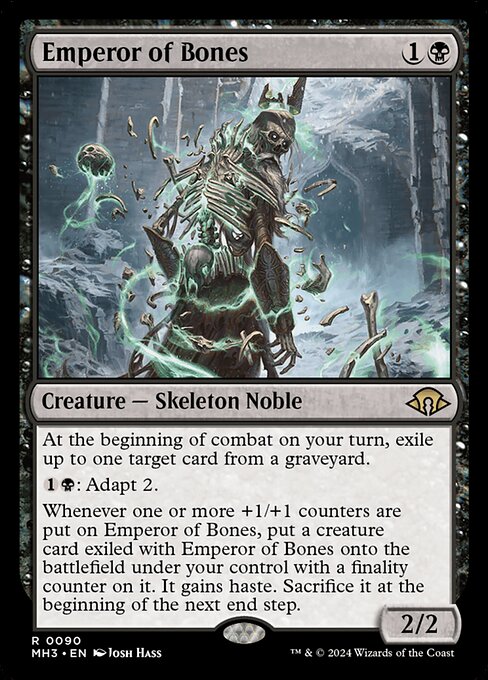
29. Emperor of Bones
Rating7.5Very goodWhy this rating?
One of the very best rares of the format (7.6/10).
Why. A two-mana 2/2 that exiles a card from a graveyard at the beginning of your combat. Its two-mana adapt puts two +1/+1 counters on it and brings back an exiled creature for a turn with haste, on top of being a fine blocker.
Risks. It needs a creature it has exiled for the effect. Adapt only works with no counters on it, so it is limited, and the returned creature is sacrificed at end of turn.
In the draft. A fair pick in black, especially when graveyards fill with creatures. A solid two-drop body.
Results in the games of the set
When it is in hand, the deck wins 58.9% of its games (set average: 56.2%, 39th of 298 cards).
In the opening hand: 57.6% wins (55.6% on average).
Drawn during the game: 59.8% (56.7% on average).
When it is drawn, the deck wins 6.8 points more than when it is not.
When it is drafted, it is played 90% of the time (set average: 67%).
Taken as the first pick (87 drafts), it ends in the deck 87% of the time.
It is played about as much in every archetype.

30. Signature Slam
Rating7.5Very goodWhy this rating?
A solid uncommon of the format (7.5/10).
Why. A three-mana instant that puts a +1/+1 counter on your creature, then each modified creature you control deals damage equal to its power to a creature you don't control. It is removal with a small bonus on your board.
Risks. It needs a creature of your own, and it is vulnerable to the opponent responding by killing your creature. Without extra modified creatures you only deal one creature's power.
In the draft. A good pick in green, especially in decks with counters or Equipment. Treat it as reliable removal.
Results in the games of the set
When it is in hand, the deck wins 59.2% of its games (set average: 56.2%, 30th of 298 cards).
In the opening hand: 57.1% wins (55.6% on average).
Drawn during the game: 60.7% (56.7% on average).
When it is drawn, the deck wins 4.2 points more than when it is not.
When it is drafted, it is played 89% of the time (set average: 67%).
Taken as the first pick (210 drafts), it ends in the deck 95% of the time.
It is played mostly in B/G decks (31% of them) and G/W (30%).
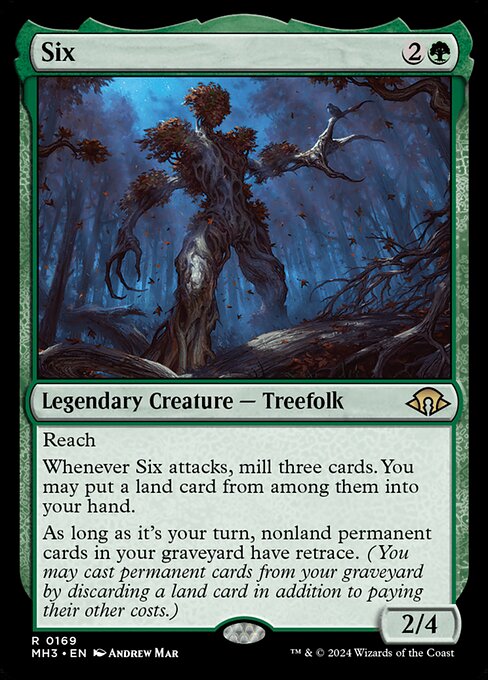
31. Six
Rating7.4Very goodWhy this rating?
A very good rare of the format (7.4/10).
Why. A three-mana 2/4 with reach, solid on defence. When it attacks you mill three cards and may put a land from among them into your hand, while your nonland permanent cards in the graveyard gain retrace on your turn.
Risks. It attacks poorly with two power, and retrace requires discarding lands. Milling three cards can also bin good cards.
In the draft. An average pick in green, fine as a good blocker. Better in decks with permanents worth recasting from the graveyard.
Results in the games of the set
When it is in hand, the deck wins 59.0% of its games (set average: 56.2%, 36th of 298 cards).
In the opening hand: 59.5% wins (55.6% on average).
Drawn during the game: 58.6% (56.7% on average).
When it is drawn, the deck wins 5.2 points more than when it is not.
When it is drafted, it is played 90% of the time (set average: 67%).
Taken as the first pick (104 drafts), it ends in the deck 88% of the time.
It is played about as much in every archetype.
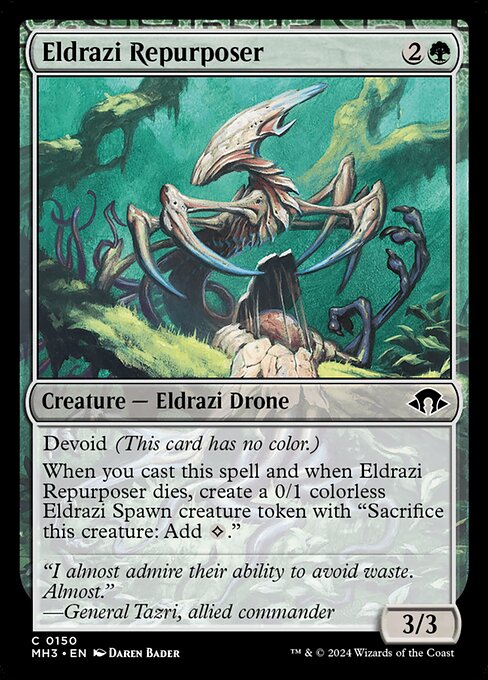 Rating7.4Very good
Why this rating?
One of the best commons of the format (7.4/10).
Why. A three-mana devoid 3/3 that creates a 0/1 colourless Eldrazi Spawn creature token when you cast it and another when it dies. It leaves mana behind, ramps and often trades in your favour.
Risks. It has no evasion and remains a simple 3/3. It needs green, and it is less interesting if you have no big spells to use the extra mana on.
In the draft. A good common to take fairly high in a green deck. It makes almost every green deck.
Results in the games of the set
When it is in hand, the deck wins 59.8% of its games (set average: 56.2%, 24th of 298 cards).
In the opening hand: 60.4% wins (55.6% on average).
Drawn during the game: 59.3% (56.7% on average).
When it is drawn, the deck wins 4.1 points more than when it is not.
When it is drafted, it is played 91% of the time (set average: 67%).
Taken as the first pick (515 drafts), it ends in the deck 95% of the time.
It is played mostly in G/R decks (64% of them) and G/W (58%).

33. Horrific Assault
Rating7.4Very goodWhy this rating?
One of the best commons of the format (7.4/10).
Why. A one-mana sorcery: your creature deals damage equal to its power to a creature or planeswalker you don't control, and takes none back. If you control an Eldrazi, you also gain 3 life.
Risks. You need a creature with decent power, and the opponent can respond by killing it. It is a sorcery, so you can't use it mid-combat.
In the draft. A good green common removal, worth taking fairly high in a deck with big creatures. Better with Eldrazi.
Results in the games of the set
When it is in hand, the deck wins 58.9% of its games (set average: 56.2%, 42nd of 298 cards).
In the opening hand: 57.1% wins (55.6% on average).
Drawn during the game: 60.1% (56.7% on average).
When it is drawn, the deck wins 3.4 points more than when it is not.
When it is drafted, it is played 90% of the time (set average: 67%).
Taken as the first pick (457 drafts), it ends in the deck 96% of the time.
It is played mostly in G/R decks (64% of them) and G/W (58%).
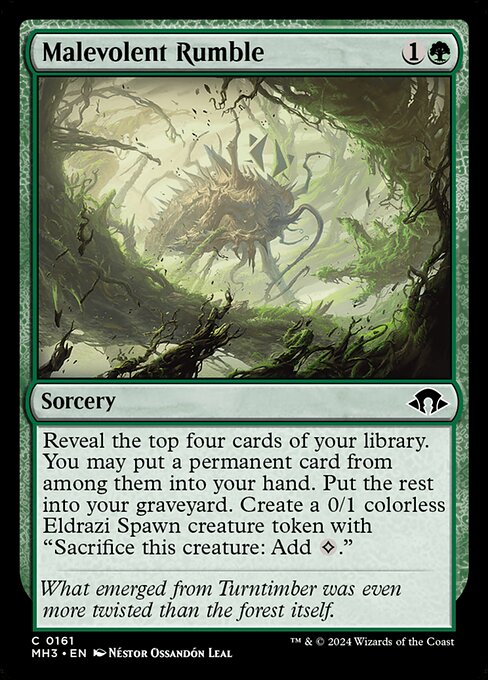 Rating7.4Very good
Why this rating?
One of the best commons of the format (7.4/10).
Why. A two-mana sorcery that reveals the top four cards, lets you take a permanent into your hand and creates a 0/1 colourless Eldrazi Spawn creature token. It smooths your draws, helps hit land drops and ramps.
Risks. It puts nothing important on the board and mills the rest, so it can waste good cards. It depends on how many good permanents your deck has.
In the draft. A fair pick in green, more useful in a deck that can use the extra mana. Do not take it over your removal.
Results in the games of the set
When it is in hand, the deck wins 60.4% of its games (set average: 56.2%, 19th of 298 cards).
In the opening hand: 60.8% wins (55.6% on average).
Drawn during the game: 60.0% (56.7% on average).
When it is drawn, the deck wins 4.4 points more than when it is not.
When it is drafted, it is played 85% of the time (set average: 67%).
Taken as the first pick (272 drafts), it ends in the deck 96% of the time.
It is played mostly in G/R decks (69% of them) and G/W (60%).

35. Nethergoyf
Rating7.4Very goodWhy this rating?
A very good mythic of the format (7.4/10).
Why. A one-mana black creature that grows by itself: each different card type in your graveyard gives it +1/+1. Once your graveyard fills up, it can also come back from there with escape.
Risks. On turn one it is a 0/1, and it stays small while your graveyard is empty. A deck that does not fill its graveyard keeps it small.
In the draft. A good pick in black, especially in decks that put cards of varied types in the graveyard. Take it early if you are black; it stays playable as a second colour.
Results in the games of the set
When it is in hand, the deck wins 56.9% of its games (set average: 56.2%, 75th of 298 cards).
In the opening hand: 57.1% wins (55.6% on average).
Drawn during the game: 56.8% (56.7% on average).
When it is drawn, the deck wins 6.0 points more than when it is not.
When it is drafted, it is played 71% of the time (set average: 67%).
Taken among the first three picks (100 drafts), it ends in the deck 74% of the time.
It is played about as much in every archetype.
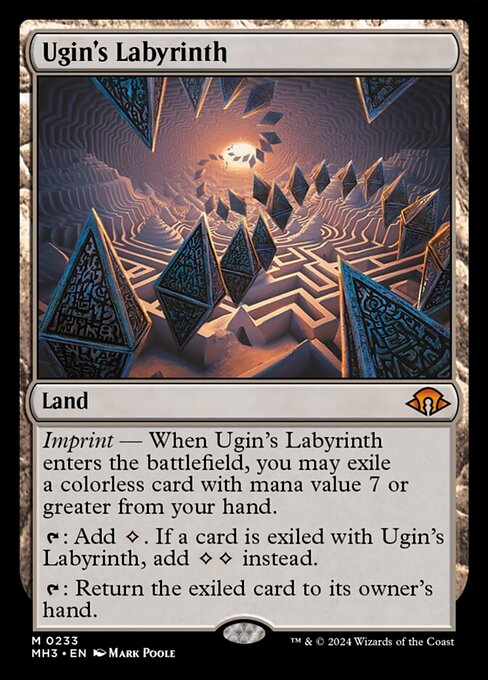
36. Ugin's Labyrinth
Rating7.4Very goodWhy this rating?
A very good mythic of the format (7.4/10).
Why. A colourless land that makes two colourless mana if you exiled a colourless card with mana value 7 or greater from your hand. You can tap it to take that card back to your hand.
Risks. Without a colourless card of high mana value it is a plain colourless land that hurts your colours. Such cards are few in draft.
In the draft. Play it only with several big colourless cards. Otherwise leave it in the sideboard and take a card that actually does something.
Results in the games of the set
When it is in hand, the deck wins 54.1% of its games (set average: 56.2%, 189th of 298 cards).
In the opening hand: 54.3% wins (55.6% on average).
Drawn during the game: 54.0% (56.7% on average).
When it is drawn, the deck wins 3.7 points more than when it is not.
When it is drafted, it is played 62% of the time (set average: 67%).
Taken among the first three picks (87 drafts), it ends in the deck 63% of the time.
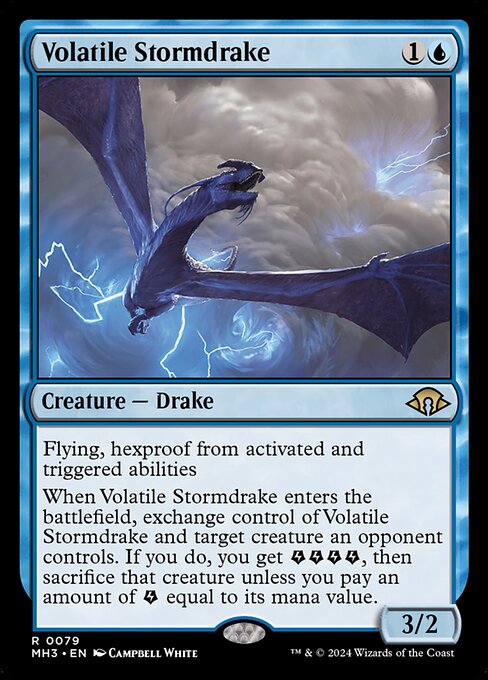 Rating7.4Very good
Why this rating?
A very good rare of the format (7.4/10).
Why. For two mana you swap this 3/2 flier for the opposing creature of your choice. You get four energy: keep the stolen creature by paying energy equal to its mana value, or sacrifice it, which works as removal.
Risks. Your opponent gets a 3/2 flier with hexproof from activated and triggered abilities (spells can still target it). Trading for a small creature is a bad deal.
In the draft. A good blue pick. Against a big creature it is removal; against a creature of mana value 4 or less it is outright theft. Keep an answer ready for the 3/2 flier you hand over.
Results in the games of the set
When it is in hand, the deck wins 58.2% of its games (set average: 56.2%, 58th of 298 cards).
In the opening hand: 57.1% wins (55.6% on average).
Drawn during the game: 58.9% (56.7% on average).
When it is drawn, the deck wins 4.4 points more than when it is not.
When it is drafted, it is played 79% of the time (set average: 67%).
Taken as the first pick (72 drafts), it ends in the deck 89% of the time.
It is played about as much in every archetype.

38. Glyph Elemental
Rating7.3Very goodWhy this rating?
A solid uncommon of the format (7.4/10).
Why. A two-mana 2/2 that gets a +1/+1 counter with every landfall, or an Aura (bestow) that gives the enchanted creature +1/+1 for each +1/+1 counter on it. A creature early, a bonus later.
Risks. It only grows if you play lands: with no land drops it stalls. As a 2/2 it dies to small removal.
In the draft. A good pick for a white deck with a low curve. White-red and white-green are the pairs where it has played best.
Results in the games of the set
When it is in hand, the deck wins 58.4% of its games (set average: 56.2%, 51st of 298 cards).
In the opening hand: 62.1% wins (55.6% on average).
Drawn during the game: 55.1% (56.7% on average).
When it is drawn, the deck wins 1.9 points more than when it is not.
When it is drafted, it is played 91% of the time (set average: 67%).
Taken as the first pick (246 drafts), it ends in the deck 94% of the time.
It is played mostly in B/W decks (34% of them) and G/W (32%).
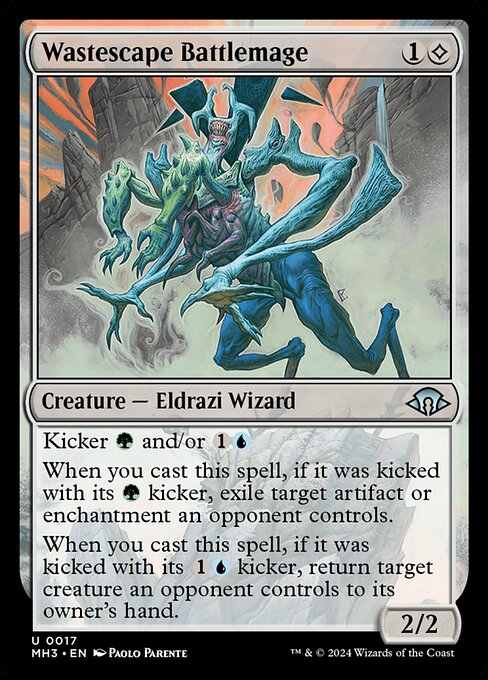 Rating7.3Very good
Why this rating?
A solid uncommon of the format (7.3/10).
Why. A two-mana 2/2 that becomes a spell with an effect if you add green (exile an artifact or enchantment an opponent controls) and/or blue (bounce an opposing creature). Both together cost five mana.
Risks. Its cost requires a specific colourless mana that only some sources produce. Without support it is hard to cast on turn two.
In the draft. A fair mid-pack pick in a deck with green, blue or both. Look for lands that produce colourless mana alongside it.
Results in the games of the set
When it is in hand, the deck wins 58.0% of its games (set average: 56.2%, 61st of 298 cards).
In the opening hand: 55.6% wins (55.6% on average).
Drawn during the game: 59.5% (56.7% on average).
When it is drawn, the deck wins 3.5 points more than when it is not.
When it is drafted, it is played 84% of the time (set average: 67%).
Taken as the first pick (156 drafts), it ends in the deck 89% of the time.
It is played mostly in G/U decks (31% of them) and G/R (30%).
 Rating7.2Very good
Why this rating?
A solid uncommon of the format (7.2/10).
Why. A 1/3 that blocks small creatures well early and gives you one energy with each landfall. At six energy it taps to draw three cards: your lands turn into cards.
Risks. You need six lands for the first draw, and the next one takes six more. Once tapped to draw, it no longer blocks.
In the draft. A good blue pick for a control or midrange deck. It fits less in a very aggressive deck.
Results in the games of the set
When it is in hand, the deck wins 58.4% of its games (set average: 56.2%, 53rd of 298 cards).
In the opening hand: 59.4% wins (55.6% on average).
Drawn during the game: 57.8% (56.7% on average).
When it is drawn, the deck wins 4.9 points more than when it is not.
When it is drafted, it is played 82% of the time (set average: 67%).
Taken as the first pick (191 drafts), it ends in the deck 90% of the time.
It is played mostly in U/W decks (41% of them) and R/U (40%).

41. Depth Defiler
Rating7.2Very goodWhy this rating?
A solid uncommon of the format (7.2/10).
Why. A solid 3/5 that when cast bounces a creature or has a target player draw two cards then discard one. With an extra colourless mana (kicker), you do both.
Risks. The bounce mode is tempo, not removal, and the kicker needs a specific colourless mana. Five mana is slow if you are already behind.
In the draft. A good blue pick: a solid body that replaces itself. Look for colourless mana sources to turn on the kicker.
Results in the games of the set
When it is in hand, the deck wins 59.7% of its games (set average: 56.2%, 26th of 298 cards).
In the opening hand: 56.5% wins (55.6% on average).
Drawn during the game: 61.5% (56.7% on average).
When it is drawn, the deck wins 6.6 points more than when it is not.
When it is drafted, it is played 88% of the time (set average: 67%).
Taken as the first pick (264 drafts), it ends in the deck 92% of the time.
It is played mostly in B/U decks (28% of them) and G/U (28%).

42. Nightshade Dryad
Rating7.2Very goodWhy this rating?
One of the best commons of the format (7.2/10).
Why. A mana creature that also blocks: deathtouch discourages attacks, and it taps for mana of any colour. Perfect for supporting a splash.
Risks. A 1/2 that dies to the smallest spells, and when tapped for mana it cannot block.
In the draft. Happily take it in green, especially in a three-colour deck or with a splash. Easy to slot in mid-pack.
Results in the games of the set
When it is in hand, the deck wins 58.7% of its games (set average: 56.2%, 44th of 298 cards).
In the opening hand: 61.6% wins (55.6% on average).
Drawn during the game: 56.4% (56.7% on average).
When it is drawn, the deck wins 3.5 points more than when it is not.
When it is drafted, it is played 91% of the time (set average: 67%).
Taken as the first pick (461 drafts), it ends in the deck 95% of the time.
It is played mostly in G/R decks (60% of them) and G/W (60%).
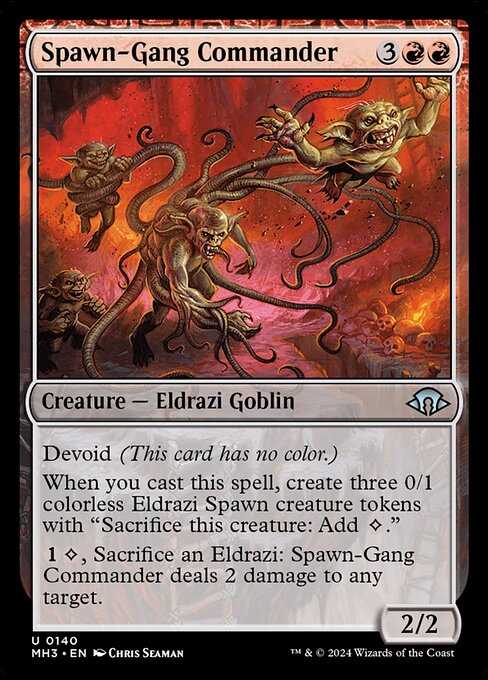 Rating7.2Very good
Why this rating?
A solid uncommon of the format (7.2/10).
Why. Five mana for a 2/2 and three Eldrazi Spawn tokens as soon as you cast it. After that, for one generic plus one colourless mana, sacrifice an Eldrazi: 2 damage to any target. The tokens are Eldrazi, and they supply the colourless mana.
Risks. The body is modest, and if your opponent kills the Commander the damage ability is gone (the tokens stay).
In the draft. A good red pick, especially in a deck with other Eldrazi. The tokens also speed you up toward your big cards.
Results in the games of the set
When it is in hand, the deck wins 59.3% of its games (set average: 56.2%, 28th of 298 cards).
In the opening hand: 57.0% wins (55.6% on average).
Drawn during the game: 61.1% (56.7% on average).
When it is drawn, the deck wins 3.9 points more than when it is not.
When it is drafted, it is played 86% of the time (set average: 67%).
Taken as the first pick (274 drafts), it ends in the deck 88% of the time.
It is played mostly in G/R decks (32% of them) and B/R (31%).
 Rating7.2Good
Why this rating?
A very good rare of the format (7.2/10).
Why. Two mana for three energy: by paying X energy, sacrificing a creature and returning the enchantment to hand, you bring back a creature with mana value X from your graveyard (sorcery speed only). Then you can replay the enchantment.
Risks. You need a creature to sacrifice and a target in the graveyard. Without a good target it does nothing, and energy limits the size of what you bring back.
In the draft. A synergy card: take it lower than its rarity suggests. It shines in a deck with many creatures that have enter-the-battlefield effects.
Results in the games of the set
When it is in hand, the deck wins 56.6% of its games (set average: 56.2%, 89th of 298 cards).
In the opening hand: 52.4% wins (55.6% on average).
Drawn during the game: 59.4% (56.7% on average).
When it is drawn, the deck wins 4.4 points more than when it is not.
When it is drafted, it is played 84% of the time (set average: 67%).
Taken as the first pick (108 drafts), it ends in the deck 90% of the time.
It is played about as much in every archetype.

45. Titans' Vanguard
Rating7.1GoodWhy this rating?
A solid uncommon of the format (7.1/10).
Why. A 5/5 trampler that puts a +1/+1 counter on each of your colourless creatures when cast and each time it attacks, itself included on attack. It takes over combat within a few turns.
Risks. It needs red and green: outside those colours it is unplayable. The best of it is on attack: if it does not survive, you only get the cast effect.
In the draft. Gladly take it in a red-green deck. With few other colourless creatures the team bonus is smaller, but the 5/5 trampler is still solid.
Results in the games of the set
When it is in hand, the deck wins 59.2% of its games (set average: 56.2%, 31st of 298 cards).
In the opening hand: 58.3% wins (55.6% on average).
Drawn during the game: 59.9% (56.7% on average).
When it is drawn, the deck wins 4.3 points more than when it is not.
When it is drafted, it is played 85% of the time (set average: 67%).
Taken as the first pick (246 drafts), it ends in the deck 90% of the time.
It is played mostly in G/R decks (34% of them) and R/U (27%).
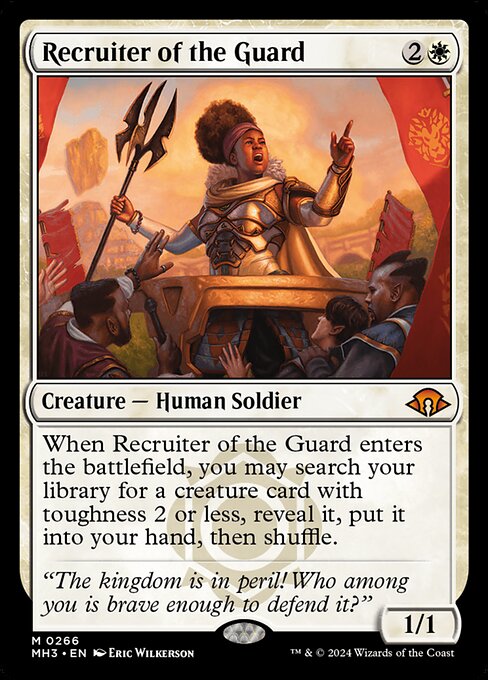 Rating7.0Good
Why this rating?
A very good mythic of the format (7.0/10).
Why. A 1/1 that replaces itself: on arrival it searches your library for the creature with toughness 2 or less that you are missing, a threat or a blocker.
Risks. The body is thin, and it only finds low-toughness creatures: with a deck of big creatures, the list is short.
In the draft. Play it if your deck has several good creatures with toughness 2 or less, as in an aggressive white deck. Otherwise it is a mediocre three-mana 1/1.
Results in the games of the set
When it is in hand, the deck wins 57.0% of its games (set average: 56.2%, 72nd of 298 cards).
In the opening hand: 57.1% wins (55.6% on average).
Drawn during the game: 56.9% (56.7% on average).
When it is drawn, the deck wins 1.1 points more than when it is not.
When it is drafted, it is played 66% of the time (set average: 67%).
Taken among the first three picks (63 drafts), it ends in the deck 73% of the time.
It is played about as much in every archetype.

47. Conduit Goblin
Rating7.0GoodWhy this rating?
One of the best commons of the format (7.0/10).
Why. A two-mana 2/2 for an aggressive red-white deck. Its two energy give another creature +1/+0 and haste twice, letting a freshly cast creature attack right away.
Risks. Two exact colours from turn two, and the energy allows only two activations. The body is just a 2/2.
In the draft. A good common for the red-white pair. Let it go if you are not in those colours.
Results in the games of the set
When it is in hand, the deck wins 58.9% of its games (set average: 56.2%, 40th of 298 cards).
In the opening hand: 60.9% wins (55.6% on average).
Drawn during the game: 57.0% (56.7% on average).
When it is drawn, the deck wins 0.3 points more than when it is not.
When it is drafted, it is played 76% of the time (set average: 67%).
Taken as the first pick (320 drafts), it ends in the deck 93% of the time.
It is played mostly in R/W decks (85% of them) and U/W (40%).
 Rating7.0Good
Why this rating?
A very good rare of the format (7.0/10).
Why. A solid 2/5: whenever another nontoken permanent leaves the battlefield under your control, it creates a creature token (three modes, one of each per turn: 2/2 Fox with vigilance, 1/2 Moonfolk with flying, 1/1 Rat with lifelink). Its five-mana ability puts a +1/+1 counter on all your creatures.
Risks. The body hits softly and the tokens need you to lose permanents: without trades it is a blocker. It draws removal.
In the draft. A good rare for a white-blue deck, more modest elsewhere: its two colours cannot be splashed.
Results in the games of the set
When it is in hand, the deck wins 58.1% of its games (set average: 56.2%, 59th of 298 cards).
In the opening hand: 56.6% wins (55.6% on average).
Drawn during the game: 59.1% (56.7% on average).
When it is drawn, the deck wins 5.5 points more than when it is not.
When it is drafted, it is played 88% of the time (set average: 67%).
Taken as the first pick (134 drafts), it ends in the deck 92% of the time.
It is played mostly in U/W decks (30% of them).
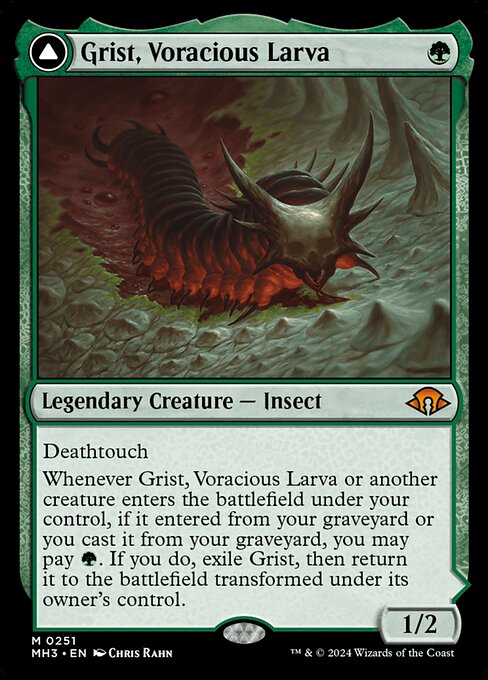
49. Grist, Voracious Larva // Grist, the Plague Swarm
Rating7.0GoodWhy this rating?
A very good mythic of the format (7.0/10).
Why. One green mana for a 1/2 deathtouch that blocks well. If a creature enters from your graveyard (or is cast from it), you pay one green mana to transform it into a planeswalker that makes a 1/1 Insect token each turn.
Risks. Few decks bring creatures back from the graveyard: most of the time you play a 1/2 deathtouch, and the planeswalker is hard to trigger.
In the draft. Play it only with several ways to reanimate or cast from the graveyard. Otherwise it is a good one-mana blocker, nothing more.
Results in the games of the set
When it is in hand, the deck wins 53.9% of its games (set average: 56.2%, 198th of 298 cards).
In the opening hand: 54.9% wins (55.6% on average).
Drawn during the game: 53.1% (56.7% on average).
When it is drawn, the deck wins 2.5 points more than when it is not.
When it is drafted, it is played 64% of the time (set average: 67%).
Taken among the first three picks (94 drafts), it ends in the deck 72% of the time.
It is played about as much in every archetype.
 Rating7.0Good
Why this rating?
A solid uncommon of the format (7.0/10).
Why. Three mana for a 3/3 Zombie Army token on arrival. Each time you draw your third card of the turn, it gets three more counters (or a new token arrives if the Army is dead).
Risks. Everything rides on a single token: removal takes it with all its counters. Drawing three cards in a turn is rare without draw effects.
In the draft. A good pick in blue-black, where draw effects are more common. Elsewhere it is a 3/3 for three mana with a little extra upside.
Results in the games of the set
When it is in hand, the deck wins 58.9% of its games (set average: 56.2%, 38th of 298 cards).
In the opening hand: 58.2% wins (55.6% on average).
Drawn during the game: 59.3% (56.7% on average).
When it is drawn, the deck wins 6.1 points more than when it is not.
When it is drafted, it is played 62% of the time (set average: 67%).
Taken as the first pick (79 drafts), it ends in the deck 94% of the time.
It is played mostly in B/U decks (48% of them).
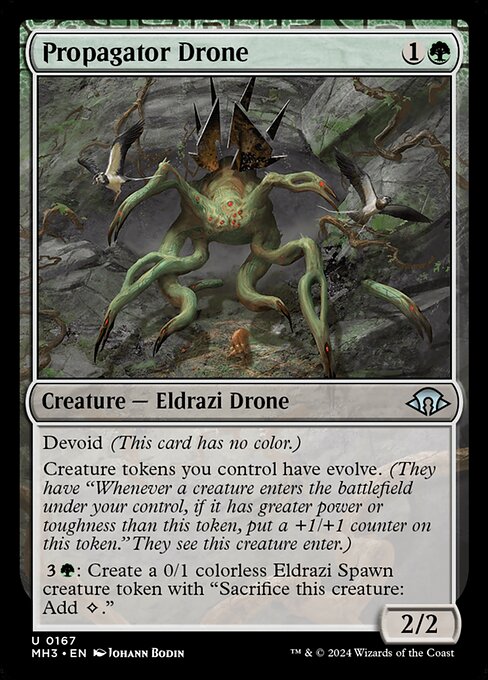
51. Propagator Drone
Rating7.0GoodWhy this rating?
A solid uncommon of the format (7.0/10).
Why. A two-mana 2/2 that later turns your mana into Eldrazi Spawn tokens. All your creature tokens gain evolve and grow when a bigger creature arrives.
Risks. The body is ordinary, and paying four mana for a 0/1 is slow. Evolve only matters if you have creature tokens.
In the draft. A fair filler pick for a green deck with creature tokens. No priority outside that plan.
Results in the games of the set
When it is in hand, the deck wins 56.4% of its games (set average: 56.2%, 102nd of 298 cards).
In the opening hand: 55.9% wins (55.6% on average).
Drawn during the game: 56.7% (56.7% on average).
When it is drawn, the deck wins 1.8 points more than when it is not.
When it is drafted, it is played 90% of the time (set average: 67%).
Taken as the first pick (217 drafts), it ends in the deck 93% of the time.
It is played about as much in every archetype.
 Rating7.0Good
Why this rating?
One of the best commons of the format (7.0/10).
Why. A two-mana 2/2 flier, well placed in an aggressive white-blue deck. Its three energy let you give one of your creatures lifelink once when you attack.
Risks. Two exact colours early, and a 2/2 is fragile against any removal or a flying blocker.
In the draft. A good common in a white-blue deck.
Results in the games of the set
When it is in hand, the deck wins 58.4% of its games (set average: 56.2%, 54th of 298 cards).
In the opening hand: 58.9% wins (55.6% on average).
Drawn during the game: 58.0% (56.7% on average).
When it is drawn, the deck wins 3.1 points more than when it is not.
When it is drafted, it is played 58% of the time (set average: 67%).
Taken as the first pick (180 drafts), it ends in the deck 89% of the time.
It is played mostly in U/W decks (86% of them) and R/U (35%).
 Rating7.0Good
Why this rating?
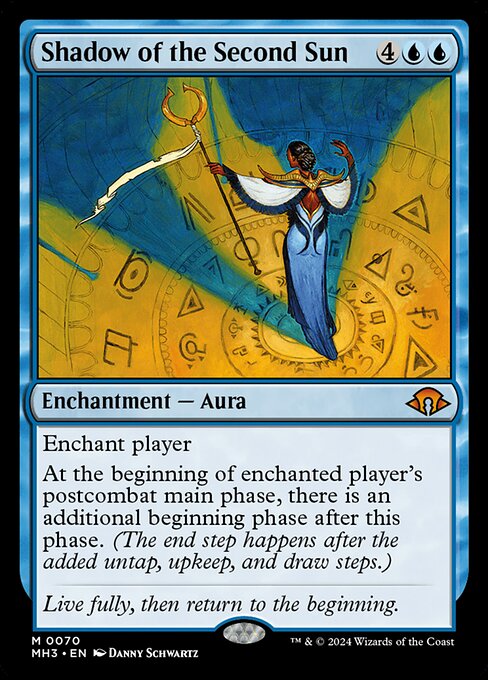
A very good mythic of the format (7.0/10).
Why. Enchanting yourself, it adds an extra beginning phase (untap, upkeep, draw) after each of your postcombat main phases: two cards a turn, and mana available on your opponent's turn.
Risks. Six mana for an effect with no immediate impact on the battlefield: very slow, and useless if you are already behind.
In the draft. For a slow, controlling blue deck. Cast it before combat to benefit this turn. Do not take it high in an aggressive deck.
Results in the games of the set
When it is in hand, the deck wins 58.4% of its games (set average: 56.2%, 55th of 298 cards).
In the opening hand: 57.6% wins (55.6% on average).
Drawn during the game: 58.8% (56.7% on average).
When it is drawn, the deck wins 5.0 points more than when it is not.
When it is drafted, it is played 64% of the time (set average: 67%).
Taken as the first pick (30 drafts), it ends in the deck 77% of the time.
It is played about as much in every archetype.
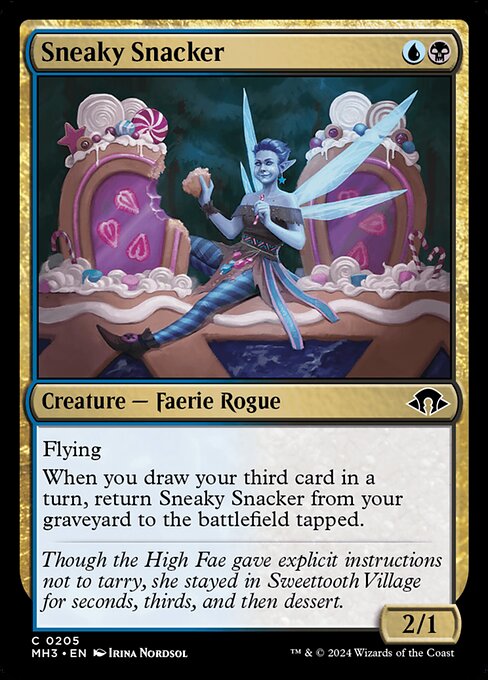
54. Sneaky Snacker
Rating7.0GoodWhy this rating?
One of the best commons of the format (7.0/10).
Why. A two-mana 2/1 flier, a good aggressive creature for a blue-black deck. It can come back from the graveyard if you draw three cards in a turn.
Risks. It only has 1 toughness, and coming back needs multiple draws, often out of reach without draw effects.
In the draft. A good common for a blue-black deck. Outside those colours, do not take it high.
Results in the games of the set
When it is in hand, the deck wins 59.3% of its games (set average: 56.2%, 29th of 298 cards).
In the opening hand: 57.6% wins (55.6% on average).
Drawn during the game: 60.2% (56.7% on average).
When it is drawn, the deck wins 6.5 points more than when it is not.
When it is drafted, it is played 61% of the time (set average: 67%).
Taken as the first pick (198 drafts), it ends in the deck 90% of the time.
It is played mostly in B/U decks (89% of them).
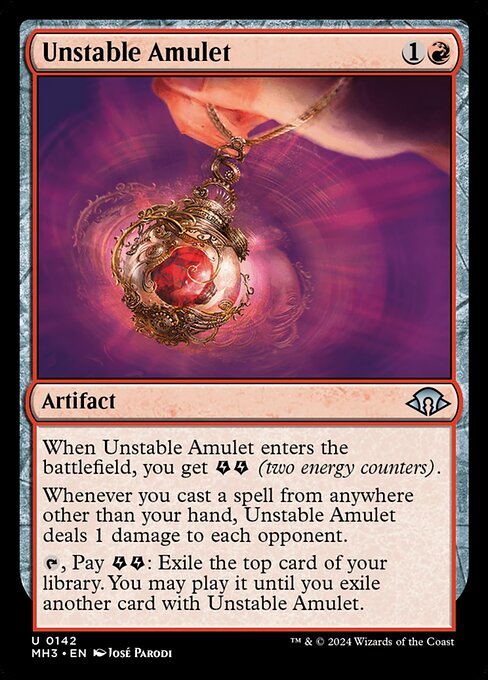
55. Unstable Amulet
Rating7.0GoodWhy this rating?
A solid uncommon of the format (7.0/10).
Why. Two mana for two energy: you convert them into one extra playable card. Each spell cast from anywhere other than your hand, like the exiled card if it is a spell, deals 1 damage to each opponent.
Risks. After the first activation the energy is gone: you are left with the damage from spells cast outside your hand, unless you have other energy sources.
In the draft. A middling pick, playable in red decks with energy. Not before the good creatures.
Results in the games of the set
When it is in hand, the deck wins 57.5% of its games (set average: 56.2%, 66th of 298 cards).
In the opening hand: 57.3% wins (55.6% on average).
Drawn during the game: 57.7% (56.7% on average).
When it is drawn, the deck wins 0.9 points more than when it is not.
When it is drafted, it is played 77% of the time (set average: 67%).
Taken as the first pick (132 drafts), it ends in the deck 88% of the time.
It is played mostly in R/U decks (43% of them) and R/W (43%).
 Rating7.0Good
Why this rating?
A very good rare of the format (7.0/10).
Why. A variable sweeper: you choose X, then pay as much energy as you want to destroy artifacts, creatures and enchantments with mana value up to that amount. Unpaid energy stays with you.
Risks. It also destroys your own permanents of that mana value. Anything above the energy paid survives, your big creatures included.
In the draft. A fair pick in a white control deck. Leave it in an aggressive creature deck.
Results in the games of the set
When it is in hand, the deck wins 55.4% of its games (set average: 56.2%, 148th of 298 cards).
In the opening hand: 54.7% wins (55.6% on average).
Drawn during the game: 55.9% (56.7% on average).
When it is drawn, the deck wins 2.1 points more than when it is not.
When it is drafted, it is played 75% of the time (set average: 67%).
Taken as the first pick (85 drafts), it ends in the deck 79% of the time.
It is played about as much in every archetype.
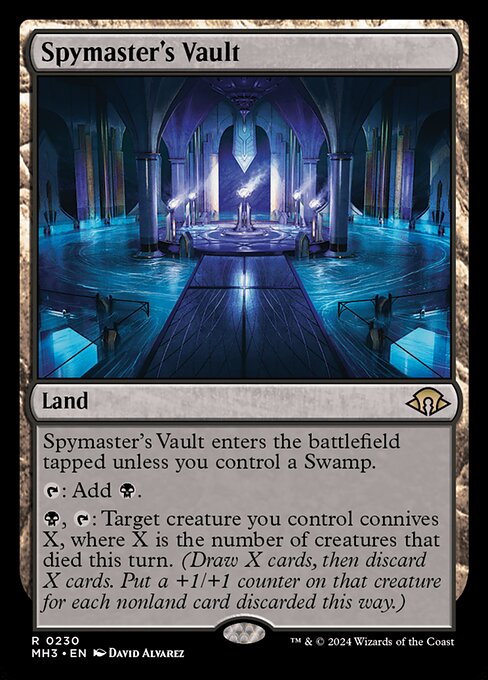 Rating6.9Good
Why this rating?
A very good rare of the format (6.9/10).
Why. A land that taps for black and enters untapped if you control a Swamp. Late in the game, after creatures have died, it draws then discards that many cards, with a +1/+1 counter for each nonland card discarded.
Risks. It enters tapped without a Swamp, only makes black, and its effect needs creatures to die that turn.
In the draft. Play it in any black deck with several Swamps: one more land that offers a late-game action.
Results in the games of the set
When it is in hand, the deck wins 57.0% of its games (set average: 56.2%, 73rd of 298 cards).
In the opening hand: 55.9% wins (55.6% on average).
Drawn during the game: 57.7% (56.7% on average).
When it is drawn, the deck wins 3.9 points more than when it is not.
When it is drafted, it is played 78% of the time (set average: 67%).
Taken as the first pick (38 drafts), it ends in the deck 97% of the time.

58. Hope-Ender Coatl
Rating6.8GoodWhy this rating?
A solid uncommon of the format (6.8/10).
Why. A 2/2 flier with flash: cast it on your opponent's turn in response to a spell. If they cannot spare a mana, their spell is countered and you gain an air threat.
Risks. If the opponent keeps one mana up, the counter does nothing: it is a 2/2 flier for three mana, fine but no more.
In the draft. A good blue pick for a tempo deck. Cast it when the opponent has tapped out.
Results in the games of the set
When it is in hand, the deck wins 57.7% of its games (set average: 56.2%, 65th of 298 cards).
In the opening hand: 57.2% wins (55.6% on average).
Drawn during the game: 58.0% (56.7% on average).
When it is drawn, the deck wins 4.2 points more than when it is not.
When it is drafted, it is played 87% of the time (set average: 67%).
Taken as the first pick (165 drafts), it ends in the deck 95% of the time.
It is played mostly in U/W decks (29% of them) and B/U (25%).
 Rating6.8Good
Why this rating?
A very good rare of the format (6.8/10).
Why. An instant-speed removal for any nonland permanent, plus the option to cast the exiled card yourself, spending colourless mana as any colour. Ideal against the opponent's biggest threat.
Risks. Four mana in two exact colours, white and black: unplayable outside them. Casting the exiled card costs its full price, and an exiled token is gone.
In the draft. A good pick for a white-black deck as flexible removal. Take it ahead of average creatures.
Results in the games of the set
When it is in hand, the deck wins 56.6% of its games (set average: 56.2%, 91st of 298 cards).
In the opening hand: 54.4% wins (55.6% on average).
Drawn during the game: 58.1% (56.7% on average).
When it is drawn, the deck wins 5.7 points more than when it is not.
When it is drafted, it is played 74% of the time (set average: 67%).
Taken as the first pick (89 drafts), it ends in the deck 85% of the time.
It is played about as much in every archetype.

60. Aerie Auxiliary
Rating6.8GoodWhy this rating?
One of the best commons of the format (6.8/10).
Why. A four-mana 3/3 flier that puts a +1/+1 counter on two other creatures when it arrives. It gives value immediately and hurts in the air.
Risks. You need other creatures to benefit from support. Alone, it is a 3/3 flier vulnerable to removal.
In the draft. A very good white common, to take in a white deck with many creatures, especially an aggressive one.
Results in the games of the set
When it is in hand, the deck wins 59.1% of its games (set average: 56.2%, 34th of 298 cards).
In the opening hand: 59.2% wins (55.6% on average).
Drawn during the game: 59.0% (56.7% on average).
When it is drawn, the deck wins 1.6 points more than when it is not.
When it is drafted, it is played 89% of the time (set average: 67%).
Taken as the first pick (401 drafts), it ends in the deck 98% of the time.
It is played mostly in R/W decks (77% of them) and U/W (71%).
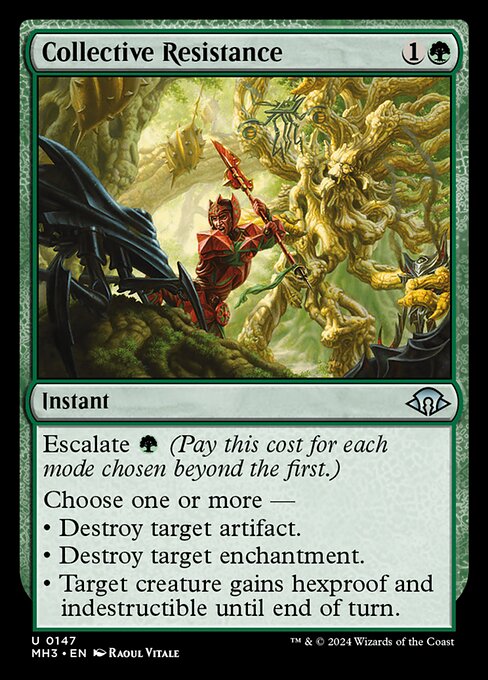 Rating6.8Good
Why this rating?
A solid uncommon of the format (6.8/10).
Why. A flexible instant: protect a creature from removal (hexproof and indestructible), or destroy an artifact, or an enchantment, or several modes for one extra green mana each.
Risks. Reactive and target-dependent: with no artifact or enchantment to destroy and no creature to protect, it does nothing.
In the draft. A good mid-pack pick for a green deck with important creatures to protect. One or two copies are enough.
Results in the games of the set
When it is in hand, the deck wins 57.8% of its games (set average: 56.2%, 63rd of 298 cards).
In the opening hand: 56.0% wins (55.6% on average).
Drawn during the game: 59.1% (56.7% on average).
When it is drawn, the deck wins 2.4 points more than when it is not.
When it is drafted, it is played 75% of the time (set average: 67%).
Taken as the first pick (53 drafts), it ends in the deck 89% of the time.
It is played mostly in G/R decks (26% of them).

62. Mandibular Kite
Rating6.8GoodWhy this rating?
One of the best commons of the format (6.8/10).
Why. One white mana for a 1/1 flying Phyrexian Germ token on turn one, thanks to living weapon. Later, the Equipment can move to another creature to give it flying.
Risks. The 1/1 Germ is fragile, and re-equipping costs four mana: too expensive to do regularly.
In the draft. A fair pick for an aggressive white deck, notably white-red. Solid at common, but not a priority.
Results in the games of the set
When it is in hand, the deck wins 58.4% of its games (set average: 56.2%, 52nd of 298 cards).
In the opening hand: 60.6% wins (55.6% on average).
Drawn during the game: 56.4% (56.7% on average).
When it is drawn, the deck wins 0.3 points more than when it is not.
When it is drafted, it is played 78% of the time (set average: 67%).
Taken as the first pick (229 drafts), it ends in the deck 94% of the time.
It is played mostly in R/W decks (75% of them) and B/W (61%).
 Rating6.8Good
Why this rating?
A solid uncommon of the format (6.8/10).
Why. An aggressive two-mana 3/1 that proliferates each time another nontoken creature arrives. Useful with +1/+1 counters or energy.
Risks. It only has 1 toughness, and without counters on your permanents, proliferate does nothing.
In the draft. A pick for an aggressive deck with counters, notably red-white. Otherwise it is a playable but replaceable two-mana 3/1.
Results in the games of the set
When it is in hand, the deck wins 56.5% of its games (set average: 56.2%, 95th of 298 cards).
In the opening hand: 58.2% wins (55.6% on average).
Drawn during the game: 55.0% (56.7% on average).
When it is drawn, the deck wins 0.2 points less than when it is not.
When it is drafted, it is played 91% of the time (set average: 67%).
Taken as the first pick (213 drafts), it ends in the deck 92% of the time.
It is played mostly in G/W decks (32% of them) and B/W (31%).
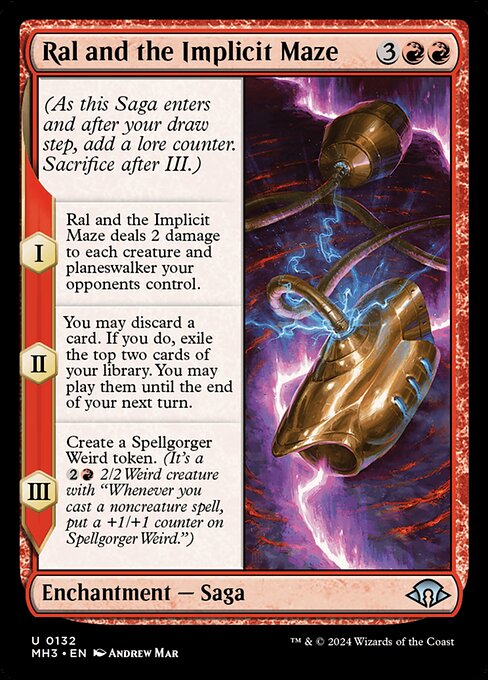 Rating6.8Good
Why this rating?
A solid uncommon of the format (6.8/10).
Why. A one-sided sweeper: two damage to each creature and planeswalker your opponents control, then card advantage if you discard, then a 2/2 Spellgorger Weird token that grows with your noncreature spells.
Risks. Five mana for an effect that only kills creatures with toughness 2 or less. Chapter II requires a discard, and the token arrives two turns after chapter I.
In the draft. A good red uncommon, to take in an aggressive or tempo deck, notably red-white and red-green.
Results in the games of the set
When it is in hand, the deck wins 58.7% of its games (set average: 56.2%, 45th of 298 cards).
In the opening hand: 57.4% wins (55.6% on average).
Drawn during the game: 59.7% (56.7% on average).
When it is drawn, the deck wins 2.6 points more than when it is not.
When it is drafted, it is played 80% of the time (set average: 67%).
Taken as the first pick (144 drafts), it ends in the deck 86% of the time.
It is played mostly in R/U decks (33% of them) and G/R (27%).

65. Revitalizing Repast // Old-Growth Grove
Rating6.8GoodWhy this rating?
A solid uncommon of the format (6.8/10).
Why. A one-mana trick that saves a creature from destroy removal or a lost combat with a +1/+1 counter and indestructible. When you do not need it, it is a tapped land that makes black or green.
Risks. The trick does not beat exile or -X/-X effects. The land enters tapped, which costs tempo.
In the draft. A mid-pack pick: a land that can also serve as a trick. Play it in black-green or with either of the two colours.
Results in the games of the set
When it is in hand, the deck wins 56.3% of its games (set average: 56.2%, 104th of 298 cards).
In the opening hand: 55.1% wins (55.6% on average).
Drawn during the game: 57.3% (56.7% on average).
When it is drawn, the deck wins 2.0 points more than when it is not.
When it is drafted, it is played 92% of the time (set average: 67%).
Taken as the first pick (116 drafts), it ends in the deck 99% of the time.
 Rating6.7Good
Why this rating?
A solid uncommon of the format (6.7/10).
Why. A two-mana 2/2 with haste. Each landfall gives it battle cry until end of turn: +1/+0 to each other attacker. It shines in a deck that attacks wide.
Risks. Alone it is a vulnerable 2/2, and battle cry does nothing without another attacker. The land must be played before the attack.
In the draft. A fair pick for an aggressive red deck, especially red-white with many small creatures.
Results in the games of the set
When it is in hand, the deck wins 56.5% of its games (set average: 56.2%, 93rd of 298 cards).
In the opening hand: 58.0% wins (55.6% on average).
Drawn during the game: 55.2% (56.7% on average).
When it is drawn, the deck wins 1.1 points less than when it is not.
When it is drafted, it is played 81% of the time (set average: 67%).
Taken as the first pick (147 drafts), it ends in the deck 96% of the time.
It is played mostly in R/W decks (38% of them) and G/R (31%).
 Rating6.6Good
Why this rating?
A very good rare of the format (6.6/10).
Why. A 1/1 that protects your creatures from removal by sacrificing a land: the chosen creature gains shroud until end of turn, so nobody can target it, you included.
Risks. The price is huge: losing a land each time, and a 1/1 does almost nothing else.
In the draft. Rarely a good pick: play it only if your creatures are so valuable that protecting them is worth a land. Otherwise, pass.
Results in the games of the set
When it is in hand, the deck wins 55.9% of its games (set average: 56.2%, 116th of 298 cards).
In the opening hand: 56.7% wins (55.6% on average).
Drawn during the game: 55.3% (56.7% on average).
When it is drawn, the deck wins 0.9 points more than when it is not.
When it is drafted, it is played 60% of the time (set average: 67%).
Taken among the first three picks (58 drafts), it ends in the deck 90% of the time.
It is played about as much in every archetype.
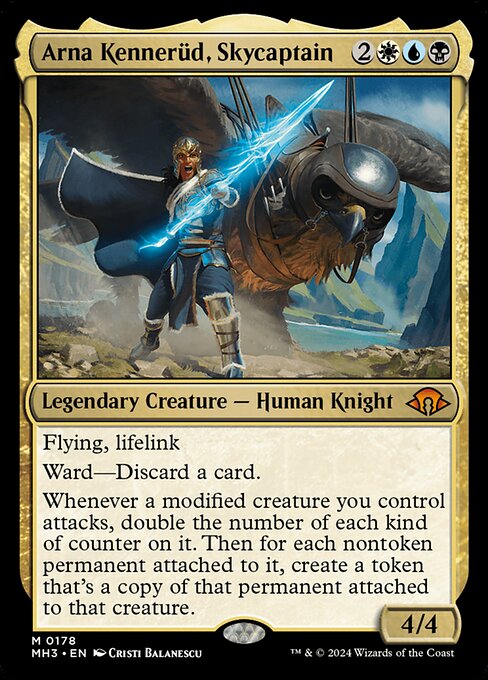 Rating6.6Good
Why this rating?
A very good mythic of the format (6.6/10).
Why. A 4/4 with flying and lifelink plus ward (discard a card): hard to kill, hard to face. When a modified creature attacks, it doubles its counters and copies its nontoken Equipment and Auras.
Risks. Three exact colours, white, blue and black: hard to cast without perfect mana. Without modified creatures, its last ability is inactive.
In the draft. Only in a three-colour deck that is already settled: do not force these colours for it.
Results in the games of the set
When it is in hand, the deck wins 55.4% of its games (set average: 56.2%, 145th of 298 cards).
In the opening hand: 54.4% wins (55.6% on average).
Drawn during the game: 56.0% (56.7% on average).
When it is drawn, the deck wins 5.3 points more than when it is not.
When it is drafted, it is played 67% of the time (set average: 67%).
Taken among the first three picks (109 drafts), it ends in the deck 75% of the time.
It is played about as much in every archetype.
 Rating6.6Good
Why this rating?
One of the best commons of the format (6.6/10).
Why. A two-mana 2/2 that grows on demand. Adapt puts a +1/+1 counter on it, which can also make an Eldrazi Spawn, so you end up with a 3/3 and spare mana for the next turn.
Risks. The activation costs two mana, so it often eats your development turn. Once the counter is on, the ability does nothing while it stays. Removal in response wastes that mana.
In the draft. A solid green two-drop, fine in decks that want counters or extra mana. No need to take it early, but it fills the curve well.
Results in the games of the set
When it is in hand, the deck wins 57.0% of its games (set average: 56.2%, 71st of 298 cards).
In the opening hand: 58.3% wins (55.6% on average).
Drawn during the game: 55.9% (56.7% on average).
When it is drawn, the deck wins 1.6 points more than when it is not.
When it is drafted, it is played 92% of the time (set average: 67%).
Taken as the first pick (325 drafts), it ends in the deck 96% of the time.
It is played mostly in G/R decks (61% of them) and G/W (55%).

70. Brainsurge
Rating6.6GoodWhy this rating?
A solid uncommon of the format (6.6/10).
Why. An instant that draws four for three mana, then you put two cards from your hand back on top of your library. In the end you are up two cards, and you choose which ones you redraw over the next turns.
Risks. It is a slow tempo play: it does not change the board. Against an aggressive deck, spending your turn on it can lose you the game. The put-back also means you skip your next fresh draws.
In the draft. A good draw spell for the more controlling blue decks. Take it as a complement, not before a removal or a good creature.
Results in the games of the set
When it is in hand, the deck wins 58.6% of its games (set average: 56.2%, 47th of 298 cards).
In the opening hand: 55.5% wins (55.6% on average).
Drawn during the game: 60.5% (56.7% on average).
When it is drawn, the deck wins 5.2 points more than when it is not.
When it is drafted, it is played 73% of the time (set average: 67%).
Taken as the first pick (77 drafts), it ends in the deck 94% of the time.
It is played mostly in B/U decks (36% of them).
 Rating6.6Good
Why this rating?
A solid uncommon of the format (6.6/10).
Why. A two-mana 2/1 flier that makes an Eldrazi Spawn each time you draw your second card in a turn. In a deck with card draw, it speeds up your mana while it attacks in the air.
Risks. It has one toughness, so any ping or aerial block kills it. Without draw effects, the second ability almost never triggers.
In the draft. A good flying two-drop for blue decks with card draw. Take it mostly if you already have a few cards that draw.
Results in the games of the set
When it is in hand, the deck wins 56.8% of its games (set average: 56.2%, 78th of 298 cards).
In the opening hand: 56.5% wins (55.6% on average).
Drawn during the game: 57.0% (56.7% on average).
When it is drawn, the deck wins 3.9 points more than when it is not.
When it is drafted, it is played 87% of the time (set average: 67%).
Taken as the first pick (150 drafts), it ends in the deck 89% of the time.
It is played mostly in B/U decks (30% of them) and U/W (28%).
 Rating6.6Good
Why this rating?
A solid uncommon of the format (6.6/10).
Why. A one-mana 1/1 flier for a single black mana. It is a cheap aerial threat that turns into a 5/5 flier late if you pay for Adapt, which gets cheaper the more other artifacts you control.
Risks. It can only block creatures with flying, so it defends poorly. Without artifacts, Adapt costs seven mana, which is heavy. A 1/1 dies to nearly anything.
In the draft. A playable in aggressive or artifact black decks. Not a priority, but a fine early play for your curve.
Results in the games of the set
When it is in hand, the deck wins 55.7% of its games (set average: 56.2%, 132nd of 298 cards).
In the opening hand: 56.4% wins (55.6% on average).
Drawn during the game: 55.1% (56.7% on average).
When it is drawn, the deck wins 3.1 points more than when it is not.
When it is drafted, it is played 66% of the time (set average: 67%).
Taken as the first pick (52 drafts), it ends in the deck 96% of the time.
It is played mostly in B/R decks (44% of them) and B/W (27%).

73. Invert Polarity
Rating6.6GoodWhy this rating?
A very good rare of the format (6.6/10).
Why. An instant that targets a spell and flips a coin: if you lose, the spell is countered; if you win, you gain control of it and may choose new targets. When it lands well, you steal a big spell; otherwise you get a plain counterspell.
Risks. It needs two blue and a red mana and you must keep mana open. The coin flip makes the result random, and a counterspell does nothing against creatures already on the battlefield.
In the draft. Reserved for blue-red decks that like counterspells. Take it late; it is a playable rather than a first-choice tool.
Results in the games of the set
When it is in hand, the deck wins 56.3% of its games (set average: 56.2%, 103rd of 298 cards).
In the opening hand: 54.4% wins (55.6% on average).
Drawn during the game: 57.5% (56.7% on average).
When it is drawn, the deck wins 5.2 points more than when it is not.
When it is drafted, it is played 67% of the time (set average: 67%).
Taken as the first pick (65 drafts), it ends in the deck 83% of the time.
It is played mostly in R/U decks (26% of them).
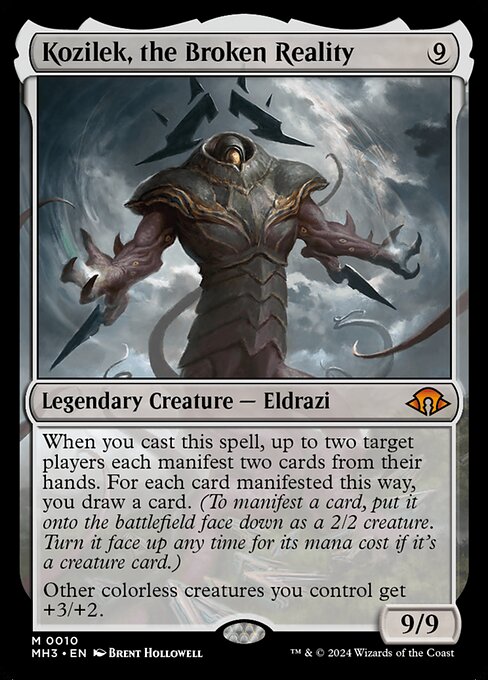
74. Kozilek, the Broken Reality
Rating6.6GoodWhy this rating?
A very good mythic of the format (6.6/10).
Why. Nine mana for a 9/9: when you cast it, up to two players each manifest two cards from their hand, and you draw a card for each card manifested. Your other colorless creatures get +3/+2, and manifested cards are colorless 2/2s.
Risks. Nine mana is a huge cost, and you will only reach it in long games. The bonus only helps colorless creatures, and your manifested cards come in face down.
In the draft. A finisher for Eldrazi or ramp decks. In other decks it is a risk of a dead card. Take it if you already have the mana and the colorless creatures.
Results in the games of the set
When it is in hand, the deck wins 56.0% of its games (set average: 56.2%, 114th of 298 cards).
In the opening hand: 53.0% wins (55.6% on average).
Drawn during the game: 57.8% (56.7% on average).
When it is drawn, the deck wins 4.6 points more than when it is not.
When it is drafted, it is played 89% of the time (set average: 67%).
Taken as the first pick (36 drafts), it ends in the deck 94% of the time.
It is played about as much in every archetype.
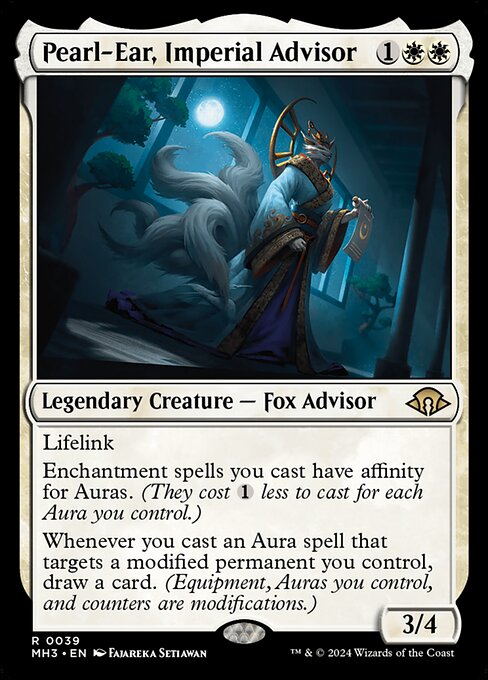
75. Pearl-Ear, Imperial Advisor
Rating6.6GoodWhy this rating?
A very good rare of the format (6.6/10).
Why. A three-mana 3/4 with lifelink: a solid body that blocks well and gains life when it attacks. Enchantments cost less based on your Auras, and you draw when you cast an Aura on a modified permanent you control.
Risks. It needs two white mana right away. The draw bonus only works if you play Auras and modified creatures, which is a real constraint.
In the draft. Fine even without the Auras, thanks to its body. Take it in white, especially in a deck with modified creatures.
Results in the games of the set
When it is in hand, the deck wins 55.2% of its games (set average: 56.2%, 154th of 298 cards).
In the opening hand: 56.2% wins (55.6% on average).
Drawn during the game: 54.4% (56.7% on average).
When it is drawn, the deck wins 0.7 points less than when it is not.
When it is drafted, it is played 80% of the time (set average: 67%).
Taken as the first pick (77 drafts), it ends in the deck 96% of the time.
It is played about as much in every archetype.
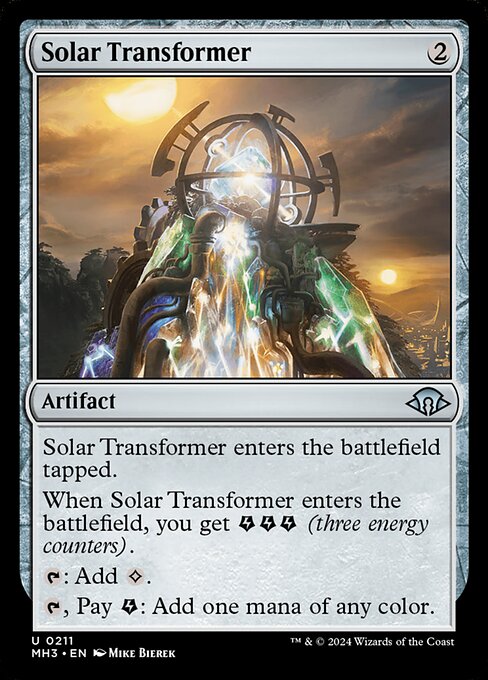 Rating6.6Good
Why this rating?
A solid uncommon of the format (6.6/10).
Why. A two-mana artifact that enters tapped and gives you three energy counters. It taps for colorless mana, or for one mana of any color by paying energy: fixing for three-color decks.
Risks. It enters tapped, so it only helps the following turn. Once the energy is spent (three uses), it only makes colorless mana. It does nothing on the board.
In the draft. A good mana tool, mostly for three-color decks or ones that need colorless mana. Take it when you splash.
Results in the games of the set
When it is in hand, the deck wins 56.7% of its games (set average: 56.2%, 84th of 298 cards).
In the opening hand: 58.6% wins (55.6% on average).
Drawn during the game: 55.1% (56.7% on average).
When it is drawn, the deck wins 2.4 points more than when it is not.
When it is drafted, it is played 86% of the time (set average: 67%).
Taken as the first pick (153 drafts), it ends in the deck 92% of the time.
It is played about as much in every archetype.

77. Stump Stomp // Burnwillow Clearing
Rating6.6GoodWhy this rating?
A solid uncommon of the format (6.6/10).
Why. A two-mana sorcery where your creature deals damage equal to its power to an opposing creature or planeswalker, with no damage back. It is also a red-green land that enters tapped, so you never lose a card.
Risks. You need a creature with real power, and the removal fails if it is removed in response. The land enters tapped and only makes red or green mana.
In the draft. Flexible removal plus a free land for red-green. Take it fairly high, even if you are only partly in those colors.
Results in the games of the set
When it is in hand, the deck wins 56.4% of its games (set average: 56.2%, 100th of 298 cards).
In the opening hand: 55.8% wins (55.6% on average).
Drawn during the game: 56.9% (56.7% on average).
When it is drawn, the deck wins 0.8 points more than when it is not.
When it is drafted, it is played 95% of the time (set average: 67%).
Taken as the first pick (231 drafts), it ends in the deck 99% of the time.
 Rating6.6Good
Why this rating?
A very good rare of the format (6.6/10).
Why. A two-mana 2/2 with vigilance that grows for each creature card in your graveyard. By tapping, it can sacrifice another creature to search for a land, which helps fix and fills your graveyard.
Risks. It needs black and green on turn two. With no creatures in the graveyard, it is a plain 2/2, and the land ability costs you a creature.
In the draft. A good two-drop for black-green, stronger in a deck where creatures die. Nothing urgent, but useful for the plan of those colors.
Results in the games of the set
When it is in hand, the deck wins 55.6% of its games (set average: 56.2%, 139th of 298 cards).
In the opening hand: 55.3% wins (55.6% on average).
Drawn during the game: 55.8% (56.7% on average).
When it is drawn, the deck wins 4.6 points more than when it is not.
When it is drafted, it is played 68% of the time (set average: 67%).
Taken as the first pick (59 drafts), it ends in the deck 78% of the time.
It is played about as much in every archetype.
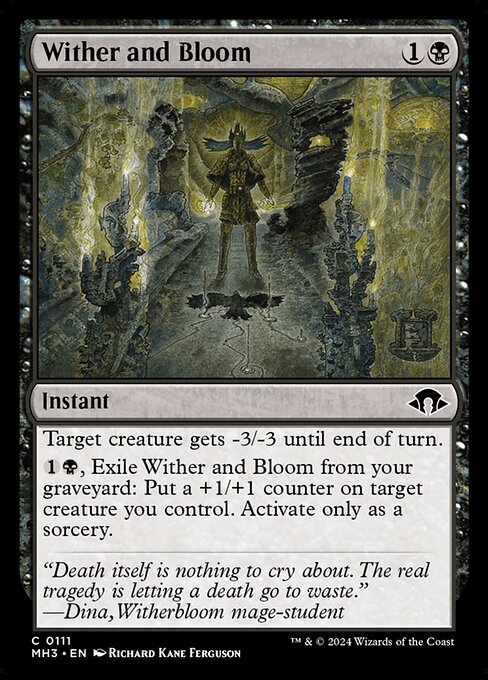
79. Wither and Bloom
Rating6.6GoodWhy this rating?
One of the best commons of the format (6.6/10).
Why. A two-mana instant that gives a creature -3/-3 until end of turn: it handles small and medium creatures. Later, you can exile it from your graveyard to put a +1/+1 counter on one of your creatures.
Risks. It leaves the biggest creatures alive. The second ability can only be activated at sorcery speed and costs two more mana.
In the draft. A cheap common removal with two uses. Take it fairly high in black.
Results in the games of the set
When it is in hand, the deck wins 58.0% of its games (set average: 56.2%, 60th of 298 cards).
In the opening hand: 56.7% wins (55.6% on average).
Drawn during the game: 59.0% (56.7% on average).
When it is drawn, the deck wins 5.2 points more than when it is not.
When it is drafted, it is played 89% of the time (set average: 67%).
Taken as the first pick (415 drafts), it ends in the deck 96% of the time.
It is played mostly in B/U decks (63% of them) and B/R (62%).
 Rating6.6Good
Why this rating?
A solid uncommon of the format (6.6/10).
Why. A three-mana 2/3 with lifelink that filters your hand: whenever it attacks, you may draw cards equal to its power, then discard that many. It smooths your draws and fuels your graveyard.
Risks. It has to attack to do anything, which exposes it in combat. Two power only means two cards filtered, and the discard is mandatory if you draw.
In the draft. A good blue-black body for a control or grind deck. Take it in that pair; it earns its slot without being a pillar.
Results in the games of the set
When it is in hand, the deck wins 57.9% of its games (set average: 56.2%, 62nd of 298 cards).
In the opening hand: 55.9% wins (55.6% on average).
Drawn during the game: 59.0% (56.7% on average).
When it is drawn, the deck wins 5.7 points more than when it is not.
When it is drafted, it is played 56% of the time (set average: 67%).
Taken as the first pick (50 drafts), it ends in the deck 86% of the time.
It is played mostly in B/U decks (48% of them).

81. Flare of Malice
Rating6.5GoodWhy this rating?
A very good rare of the format (6.5/10).
Why. A four-mana instant where each opponent sacrifices the creature or planeswalker with the greatest mana value. It is reliable removal against threats you cannot target, and it can even be free by sacrificing a nontoken black creature.
Risks. It hits the highest mana value, not necessarily the best threat: the opponent can shield it with a more expensive creature, and picks on ties. The alternative cost costs you a card.
In the draft. A good black removal for decks that want to hit the biggest threats. Take it fairly high; it is best against decks with a single big threat.
Results in the games of the set
When it is in hand, the deck wins 56.7% of its games (set average: 56.2%, 82nd of 298 cards).
In the opening hand: 53.8% wins (55.6% on average).
Drawn during the game: 58.5% (56.7% on average).
When it is drawn, the deck wins 4.3 points more than when it is not.
When it is drafted, it is played 81% of the time (set average: 67%).
Taken as the first pick (48 drafts), it ends in the deck 88% of the time.
It is played about as much in every archetype.
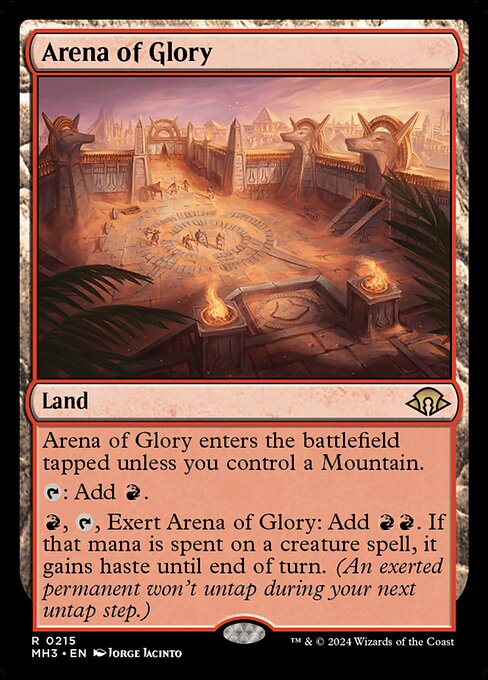
82. Arena of Glory
Rating6.4GoodWhy this rating?
Good playable that always makes the cut (6.4/10).
Why. A land that taps for red and enters untapped if you control a Mountain. Its exert ability pays one red to make two, a net extra red mana, and gives haste to a creature cast with that mana: a small utility bonus.
Risks. It enters tapped without a Mountain, and exerting prevents it from untapping next turn. It does no fixing.
In the draft. A red land that is almost free to play, good in decks with several Mountains. Take it for the utility, not before a real spell.
Results in the games of the set
When it is in hand, the deck wins 55.8% of its games (set average: 56.2%, 125th of 298 cards).
In the opening hand: 56.2% wins (55.6% on average).
Drawn during the game: 55.5% (56.7% on average).
When it is drawn, the deck wins 0.7 points less than when it is not.
When it is drafted, it is played 70% of the time (set average: 67%).
Taken among the first three picks (93 drafts), it ends in the deck 89% of the time.
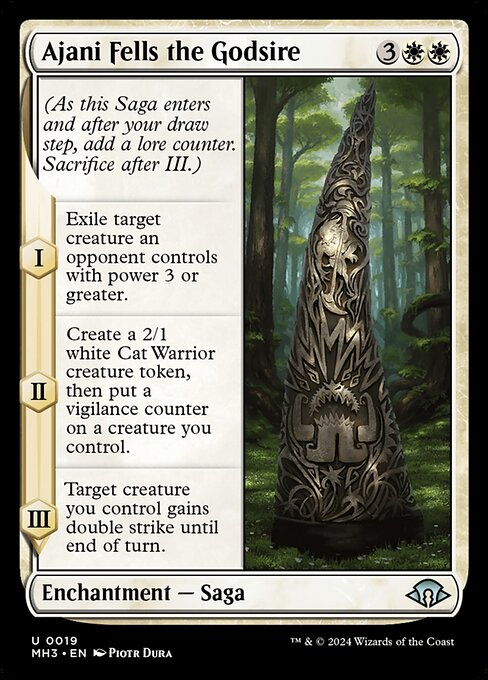 Rating6.4Good
Why this rating?
Good playable that always makes the cut (6.4/10).
Why. A five-mana Saga that first exiles an opposing creature with power three or greater, then makes a 2/1 white Cat Warrior creature token and puts a vigilance counter on a creature you control, and finishes by giving one double strike. A lot of value over three turns.
Risks. The removal needs a target with power three or more, and it is slow: you pay five mana and only see the rest on later turns. Chapter one is what matters.
In the draft. A good value removal in white. Take it in midrange white decks, especially red-white.
Results in the games of the set
When it is in hand, the deck wins 57.4% of its games (set average: 56.2%, 67th of 298 cards).
In the opening hand: 56.3% wins (55.6% on average).
Drawn during the game: 58.3% (56.7% on average).
When it is drawn, the deck wins 0.7 points more than when it is not.
When it is drafted, it is played 83% of the time (set average: 67%).
Taken as the first pick (162 drafts), it ends in the deck 95% of the time.
It is played mostly in U/W decks (30% of them) and B/W (29%).
 Rating6.4Good
Why this rating?
Good playable that always makes the cut (6.4/10).
Why. A 12/12 flier that, when you cast it, gains control of all creatures target player controls. If you ever manage to pay for it, it is a total takeover of the board.
Risks. Twelve mana is almost unreachable in draft: you need to discard it and cast it with madness, paying six colorless mana. If it leaves the battlefield, you sacrifice all your creatures.
In the draft. A gamble. Only take it if you have a very specific colorless ramp deck; otherwise leave it.
Results in the games of the set
When it is in hand, the deck wins 58.4% of its games (set average: 56.2%, 56th of 298 cards).
In the opening hand: 53.0% wins (55.6% on average).
Drawn during the game: 61.3% (56.7% on average).
When it is drawn, the deck wins 8.2 points more than when it is not.
When it is drafted, it is played 80% of the time (set average: 67%).
Taken as the first pick (30 drafts), it ends in the deck 90% of the time.
It is played about as much in every archetype.

85. Ghostfire Slice
Rating6.4GoodWhy this rating?
Good playable that always makes the cut (6.4/10).
Why. An instant that deals four damage to any target. It costs two less if an opponent controls a multicolored permanent, so it can cost just a single red mana.
Risks. At three mana with no multicolored target, it is less efficient. It is colorless (devoid), but still needs red mana to cast.
In the draft. A flexible red removal that can also finish an opponent. Take it fairly high in red decks.
Results in the games of the set
When it is in hand, the deck wins 56.7% of its games (set average: 56.2%, 83rd of 298 cards).
In the opening hand: 54.8% wins (55.6% on average).
Drawn during the game: 58.3% (56.7% on average).
When it is drawn, the deck wins 1.3 points more than when it is not.
When it is drafted, it is played 92% of the time (set average: 67%).
Taken as the first pick (203 drafts), it ends in the deck 94% of the time.
It is played about as much in every archetype.
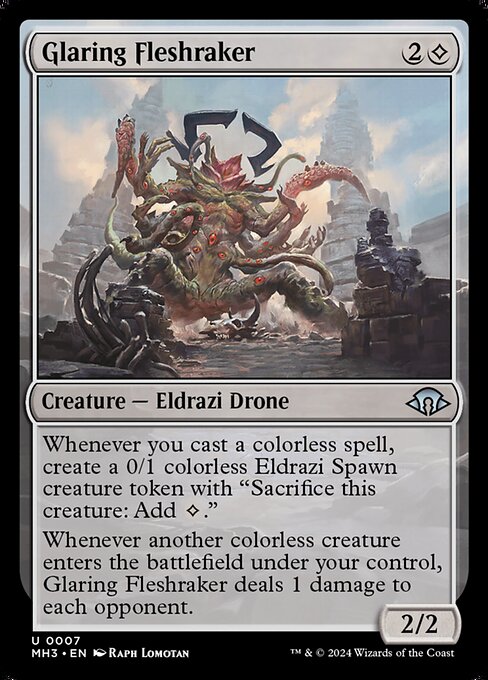 Rating6.4Good
Why this rating?
Good playable that always makes the cut (6.4/10).
Why. A three-mana colorless 2/2 that makes an Eldrazi Spawn whenever you cast a colorless spell, and deals one damage to each opponent when another colorless creature enters under your control. In an Eldrazi deck, it generates value every turn.
Risks. Its cost needs colorless mana, and you need a deck with enough colorless cards, otherwise it does nothing. It is a fragile 2/2.
In the draft. Take it in Eldrazi decks, after the good removals. Outside that plan, it is a barely playable 2/2 for three.
Results in the games of the set
When it is in hand, the deck wins 56.2% of its games (set average: 56.2%, 108th of 298 cards).
In the opening hand: 55.5% wins (55.6% on average).
Drawn during the game: 56.7% (56.7% on average).
When it is drawn, the deck wins 2.7 points more than when it is not.
When it is drafted, it is played 85% of the time (set average: 67%).
Taken as the first pick (130 drafts), it ends in the deck 88% of the time.
It is played mostly in G/R decks (26% of them).

87. Serum Visionary
Rating6.4GoodWhy this rating?
Good playable that always makes the cut (6.4/10).
Why. A three-mana 2/2 that draws a card and scries 2 when it enters. The body replaces itself and helps you sort your draws. It is a safe value play.
Risks. It has no ability on the board. The 2/2 is a small body that wins no combat.
In the draft. A good blue common for almost every blue deck. Take it as a safe playable.
Results in the games of the set
When it is in hand, the deck wins 58.7% of its games (set average: 56.2%, 46th of 298 cards).
In the opening hand: 56.6% wins (55.6% on average).
Drawn during the game: 60.0% (56.7% on average).
When it is drawn, the deck wins 4.8 points more than when it is not.
When it is drafted, it is played 84% of the time (set average: 67%).
Taken as the first pick (266 drafts), it ends in the deck 90% of the time.
It is played mostly in B/U decks (68% of them) and R/U (66%).
 Rating6.4Good
Why this rating?
Good playable that always makes the cut (6.4/10).
Why. A three-mana sorcery that returns a permanent card with mana value three or less from your graveyard to the battlefield. With flashback you can cast it again later and even copy the spell for a second return.
Risks. Without a good target in the graveyard, it does nothing. The flashback costs five mana, and the gain depends on what died earlier.
In the draft. A playable in white decks with valuable creatures. Take it late, after creatures and removals.
Results in the games of the set
When it is in hand, the deck wins 55.8% of its games (set average: 56.2%, 126th of 298 cards).
In the opening hand: 54.8% wins (55.6% on average).
Drawn during the game: 56.5% (56.7% on average).
When it is drawn, the deck wins 0.8 points more than when it is not.
When it is drafted, it is played 80% of the time (set average: 67%).
Taken as the first pick (58 drafts), it ends in the deck 90% of the time.
It is played about as much in every archetype.
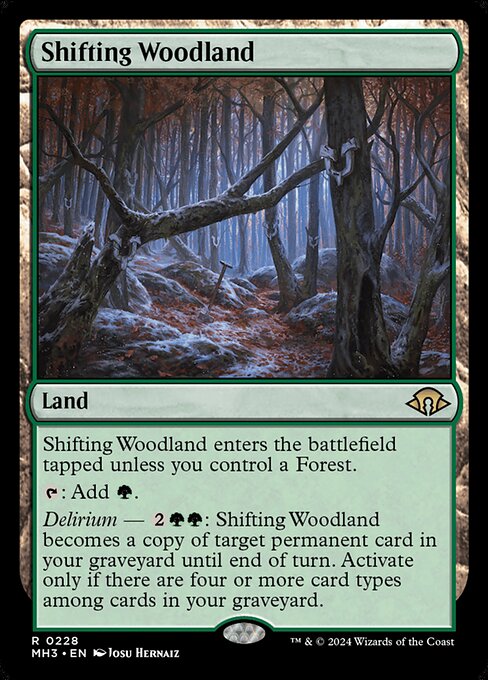 Rating6.4Good
Why this rating?
Good playable that always makes the cut (6.4/10).
Why. A green land that enters untapped if you control a Forest. Late in the game, with delirium, it can become a copy of a permanent card in your graveyard until end of turn.
Risks. It enters tapped without a Forest, and needs four card types in the graveyard plus four mana to use. It is slow.
In the draft. A utility land to play in a green deck. Take it if you have nothing better, without overrating it.
Results in the games of the set
When it is in hand, the deck wins 55.2% of its games (set average: 56.2%, 152nd of 298 cards).
In the opening hand: 54.4% wins (55.6% on average).
Drawn during the game: 56.0% (56.7% on average).
When it is drawn, the deck wins 1.8 points more than when it is not.
When it is drafted, it is played 73% of the time (set average: 67%).
Taken among the first three picks (86 drafts), it ends in the deck 87% of the time.
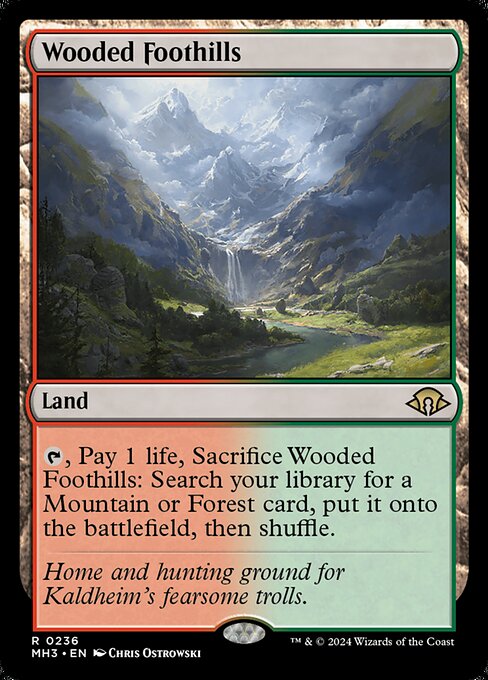
90. Wooded Foothills
Rating6.4GoodWhy this rating?
Good playable that always makes the cut (6.4/10).
Why. A land that, for one life, fetches a Mountain or a Forest. It fixes between red and green and slightly fills your graveyard, which helps delirium.
Risks. It costs one life each time. In a deck not playing both colors, it does almost nothing. It is not worth a real spell pick.
In the draft. A fixing land for red-green. Take it late, only if you are firmly in those colors.
Results in the games of the set
When it is in hand, the deck wins 55.5% of its games (set average: 56.2%, 141st of 298 cards).
In the opening hand: 56.6% wins (55.6% on average).
Drawn during the game: 54.5% (56.7% on average).
When it is drawn, the deck wins 0.8 points more than when it is not.
When it is drafted, it is played 76% of the time (set average: 67%).
Taken among the first three picks (81 drafts), it ends in the deck 89% of the time.
 Rating6.4Good
Why this rating?
Good playable that always makes the cut (6.4/10).
Why. A four-mana colorless 6/6 with trample. That is huge for the price: it dominates the board and ends the game fast.
Risks. If you do not spend colorless mana to cast it, the opponent may put a creature card from their hand onto the battlefield. That is a real price if your deck makes little colorless mana.
In the draft. Excellent in a deck that makes colorless mana. Otherwise it is a gamble. Take it in green if you have Eldrazi Spawn or colorless lands.
Results in the games of the set
When it is in hand, the deck wins 56.2% of its games (set average: 56.2%, 107th of 298 cards).
In the opening hand: 55.7% wins (55.6% on average).
Drawn during the game: 56.6% (56.7% on average).
When it is drawn, the deck wins 2.0 points more than when it is not.
When it is drafted, it is played 90% of the time (set average: 67%).
Taken as the first pick (185 drafts), it ends in the deck 97% of the time.
It is played about as much in every archetype.

92. Bridgeworks Battle // Tanglespan Bridgeworks
Rating6.4GoodWhy this rating?
Good playable that always makes the cut (6.4/10).
Why. A three-mana sorcery that gives your creature +2/+2 until end of turn, then has it fight an opposing creature if you choose. It is also a green land, so you never lose a card.
Risks. If your creature is killed in response, you lose the spell. The land costs three life to enter untapped; otherwise it enters tapped.
In the draft. Flexible green removal. Take it fairly high, since it is always playable, as a spell or a land.
Results in the games of the set
When it is in hand, the deck wins 56.0% of its games (set average: 56.2%, 115th of 298 cards).
In the opening hand: 54.4% wins (55.6% on average).
Drawn during the game: 57.3% (56.7% on average).
When it is drawn, the deck wins 1.3 points more than when it is not.
When it is drafted, it is played 91% of the time (set average: 67%).
Taken as the first pick (180 drafts), it ends in the deck 96% of the time.
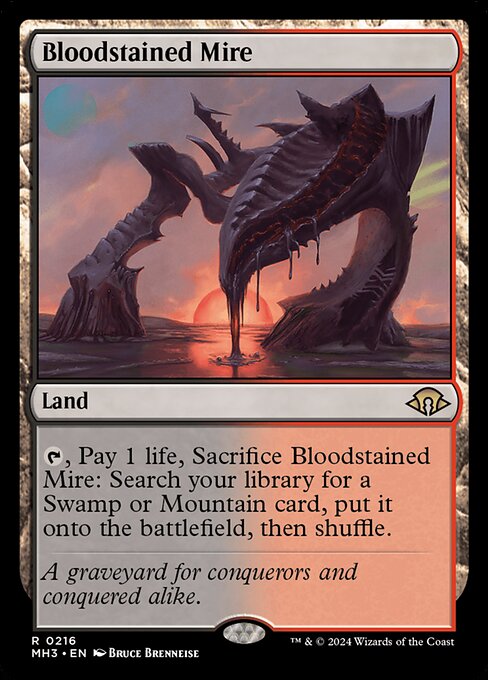 Rating6.3Good
Why this rating?
Good playable that always makes the cut (6.3/10).
Why. A land that, for one life, fetches a Swamp or a Mountain. It fixes between black and red and slightly fills the graveyard.
Risks. It costs one life, and in a deck not playing both colors it brings almost nothing. It does not replace a real spell.
In the draft. A fixing land for black-red. Take it late, only if you play those colors.
Results in the games of the set
When it is in hand, the deck wins 54.4% of its games (set average: 56.2%, 176th of 298 cards).
In the opening hand: 53.9% wins (55.6% on average).
Drawn during the game: 54.9% (56.7% on average).
When it is drawn, the deck wins 1.6 points more than when it is not.
When it is drafted, it is played 59% of the time (set average: 67%).
Taken among the first three picks (88 drafts), it ends in the deck 78% of the time.
 Rating6.2Good
Why this rating?
Good playable that always makes the cut (6.2/10).
Why. A four-color 4/4 that makes two 1/1 blue Thopter artifact creature tokens with flying. Later, for two mana, it can sacrifice two artifacts to deal three damage to a player or planeswalker, give -4/-4 to a creature, or gain five life.
Risks. Four colors make the cost almost impossible to pay in a normal deck. You also need artifacts to sacrifice.
In the draft. Only take it if you are already in those four colors with fixing. Otherwise, leave it.
Results in the games of the set
When it is in hand, the deck wins 55.9% of its games (set average: 56.2%, 117th of 298 cards).
In the opening hand: 53.0% wins (55.6% on average).
Drawn during the game: 57.9% (56.7% on average).
When it is drawn, the deck wins 9.0 points more than when it is not.
When it is drafted, it is played 33% of the time (set average: 67%).
Taken among the first three picks (38 drafts), it ends in the deck 37% of the time.
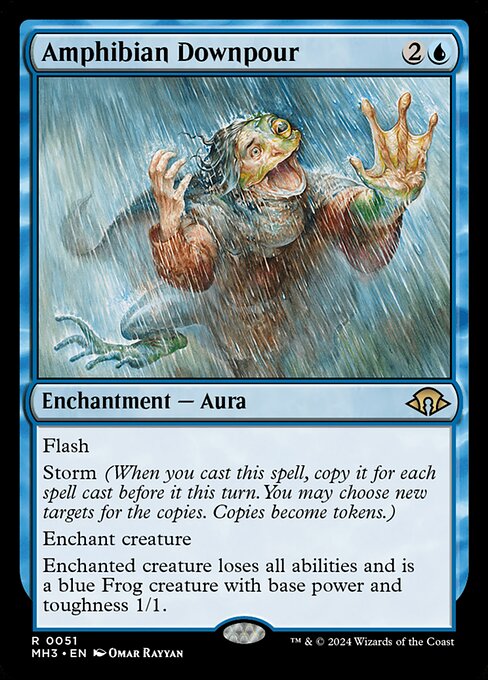 Rating6.2Good
Why this rating?
Good playable that always makes the cut (6.2/10).
Why. An Aura with flash that turns a creature into a 1/1 blue Frog that loses all abilities. With storm, it copies itself if you cast other spells this turn. It is removal for three mana.
Risks. The creature stays on the battlefield: it still blocks, and bounce or a sacrifice gets its abilities back. An Aura is vulnerable to responses.
In the draft. Decent removal for almost any blue deck. Take it if you are short on removal.
Results in the games of the set
When it is in hand, the deck wins 55.3% of its games (set average: 56.2%, 151st of 298 cards).
In the opening hand: 51.6% wins (55.6% on average).
Drawn during the game: 57.6% (56.7% on average).
When it is drawn, the deck wins 3.1 points more than when it is not.
When it is drafted, it is played 81% of the time (set average: 67%).
Taken as the first pick (58 drafts), it ends in the deck 86% of the time.
It is played about as much in every archetype.

96. Birthing Ritual
Rating6.2GoodWhy this rating?
Good playable that always makes the cut (6.2/10).
Why. A two-mana enchantment that, at your end step, looks at the top seven cards of your library and may sacrifice a creature to put one onto the battlefield, with mana value at most one more than the sacrificed creature's.
Risks. It needs a creature to sacrifice and does nothing on the battlefield right away. It depends on the makeup of your library and can cost you tempo.
In the draft. A gamble that needs a well-built creature deck. Take it late, after real cards.
Results in the games of the set
When it is in hand, the deck wins 51.3% of its games (set average: 56.2%, 248th of 298 cards).
In the opening hand: 0.0% wins (55.6% on average).
Drawn during the game: 51.3% (56.7% on average).
When it is drawn, the deck wins 1.5 points more than when it is not.
When it is drafted, it is played only 12% of the time (set average: 67%): it almost always ends in the sideboard.
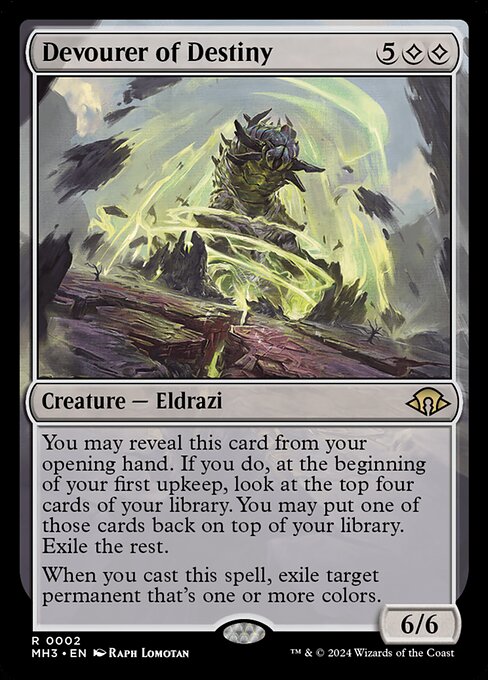 Rating6.2Good
Why this rating?
Good playable that always makes the cut (6.2/10).
Why. A seven-mana colorless 6/6, two of which must be colorless. When you cast it, it exiles a permanent that is one or more colors: removal included. Revealed in your opening hand, it looks at the top four cards, keeps one on top and exiles the rest.
Risks. Seven mana with two colorless is very heavy, and that cost needs a deck that makes colorless mana. Without it, it rots in your hand.
In the draft. A decent Eldrazi finisher, but you need the means to pay for it. Take it in a deck that makes colorless mana.
Results in the games of the set
When it is in hand, the deck wins 56.6% of its games (set average: 56.2%, 87th of 298 cards).
In the opening hand: 55.5% wins (55.6% on average).
Drawn during the game: 57.4% (56.7% on average).
When it is drawn, the deck wins 4.0 points more than when it is not.
When it is drafted, it is played 84% of the time (set average: 67%).
Taken as the first pick (63 drafts), it ends in the deck 87% of the time.
It is played about as much in every archetype.
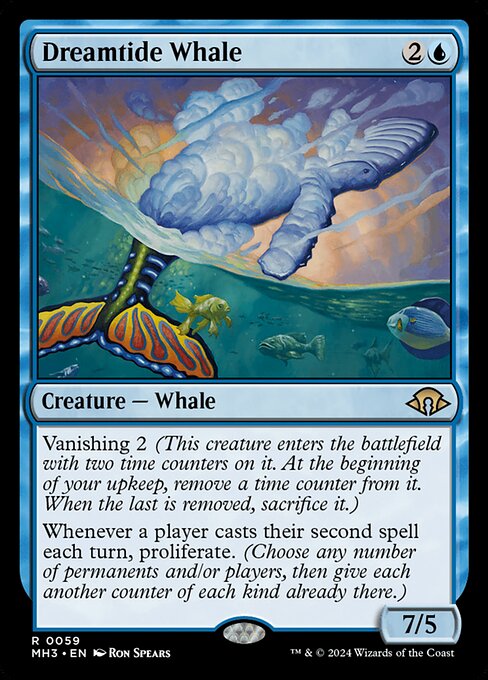
98. Dreamtide Whale
Rating6.2GoodWhy this rating?
Good playable that always makes the cut (6.2/10).
Why. A three-mana 7/5 that disappears after two turns thanks to vanishing. It is a big, fast attack, and it proliferates whenever a player casts their second spell each turn, which can give it a time counter back.
Risks. It only stays two turns and basically gets one attack. The opponent can chump it or simply wait for it to leave.
In the draft. A gamble in aggressive decks or ones that play proliferate. In most decks it is too limited to be a priority.
Results in the games of the set
When it is in hand, the deck wins 55.2% of its games (set average: 56.2%, 153rd of 298 cards).
In the opening hand: 52.6% wins (55.6% on average).
Drawn during the game: 56.9% (56.7% on average).
When it is drawn, the deck wins 3.0 points more than when it is not.
When it is drafted, it is played 74% of the time (set average: 67%).
Taken as the first pick (53 drafts), it ends in the deck 87% of the time.
It is played about as much in every archetype.
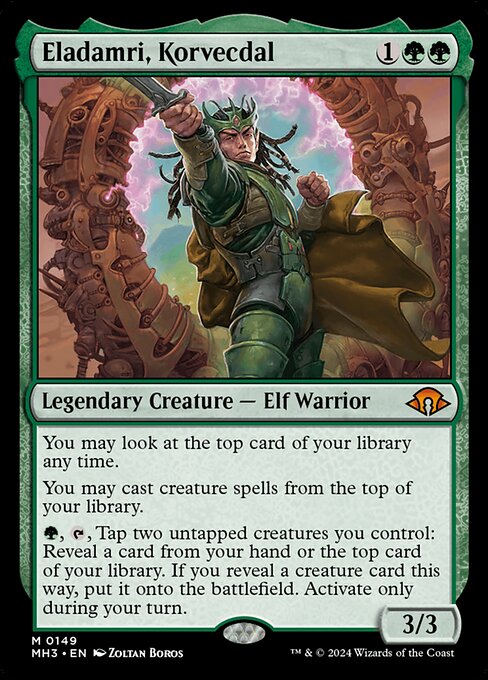 Rating6.2Good
Why this rating?
Good playable that always makes the cut (6.2/10).
Why. A three-mana 3/3 that lets you look at the top of your library and cast creature spells from it. Its ability can also put a creature onto the battlefield without paying its cost, by tapping two of your creatures.
Risks. You need two other untapped creatures to activate it, and it taps too; a 3/3 is fragile against removal. It does a lot, but slowly.
In the draft. A decent green body for a creature deck. Take it if your deck is full of creatures.
Results in the games of the set
When it is in hand, the deck wins 53.5% of its games (set average: 56.2%, 205th of 298 cards).
In the opening hand: 52.3% wins (55.6% on average).
Drawn during the game: 54.5% (56.7% on average).
When it is drawn, the deck wins 0.2 points more than when it is not.
When it is drafted, it is played 88% of the time (set average: 67%).
Taken as the first pick (41 drafts), it ends in the deck 88% of the time.
It is played about as much in every archetype.

100. Fanged Flames
Rating6.2GoodWhy this rating?
Good playable that always makes the cut (6.2/10).
Why. A two-mana sorcery that deals four damage to a creature or planeswalker, and exiles it if it would die. Efficient removal that handles most creatures, in red.
Risks. It is a sorcery, so it cannot respond mid-combat. It cannot hit players, and four damage is not enough for the biggest bodies.
In the draft. A very cheap common removal. Take it fairly high if you play red.
Results in the games of the set
When it is in hand, the deck wins 56.1% of its games (set average: 56.2%, 111th of 298 cards).
In the opening hand: 55.5% wins (55.6% on average).
Drawn during the game: 56.6% (56.7% on average).
When it is drawn, the deck wins 0.3 points more than when it is not.
When it is drafted, it is played 91% of the time (set average: 67%).
Taken as the first pick (375 drafts), it ends in the deck 95% of the time.
It is played mostly in G/R decks (59% of them) and R/W (53%).
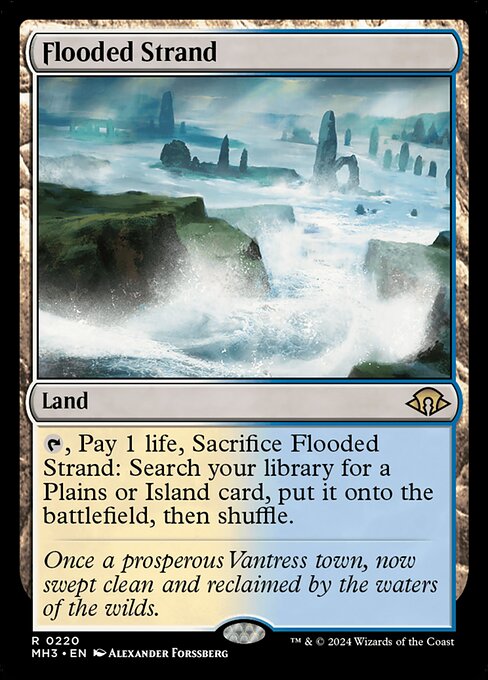
101. Flooded Strand
Rating6.2GoodWhy this rating?
Good playable that always makes the cut (6.2/10).
Why. A fixing land: sacrifice it to search for a Plains or Island card and put it onto the battlefield untapped. It smooths your colours without costing tempo and takes a land out of your library.
Risks. It costs a life point and makes no mana until sacrificed. In a deck without blue or white it does nothing.
In the draft. A fine pick if you play blue or white, but never over a real playable. Skip it outside those two colours.
Results in the games of the set
When it is in hand, the deck wins 54.8% of its games (set average: 56.2%, 168th of 298 cards).
In the opening hand: 55.4% wins (55.6% on average).
Drawn during the game: 54.2% (56.7% on average).
When it is drawn, the deck wins 0.2 points more than when it is not.
When it is drafted, it is played 66% of the time (set average: 67%).
Taken among the first three picks (89 drafts), it ends in the deck 76% of the time.
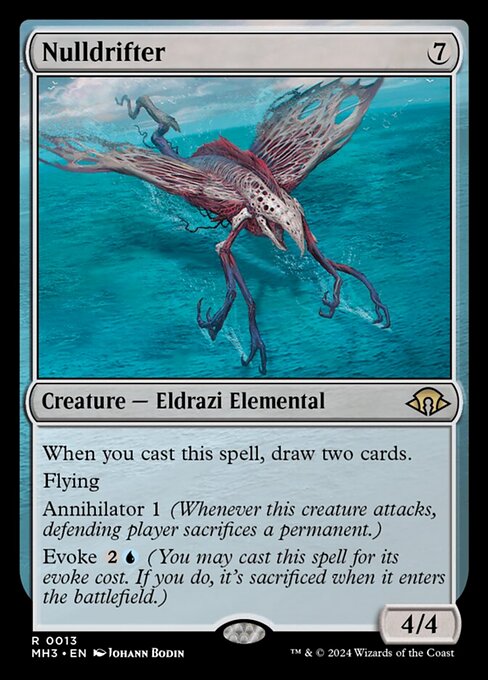
102. Nulldrifter
Rating6.2GoodWhy this rating?
Good playable that always makes the cut (6.2/10).
Why. Drawing two cards when you cast it means it always replaces itself, even if it is countered. At seven mana it is a 4/4 flyer with annihilator 1: each attack, the defender sacrifices a permanent of their choice. Evoked, it leaves no creature, but you draw two cards for three mana.
Risks. Seven mana is a lot, and evoke needs blue mana and leaves nothing on the battlefield. It is slow against an aggressive deck.
In the draft. A good top-end card for a blue deck that reaches the late turns. One is usually enough, two with ramp; not over your removal.
Results in the games of the set
When it is in hand, the deck wins 56.5% of its games (set average: 56.2%, 94th of 298 cards).
In the opening hand: 53.7% wins (55.6% on average).
Drawn during the game: 58.4% (56.7% on average).
When it is drawn, the deck wins 3.9 points more than when it is not.
When it is drafted, it is played 93% of the time (set average: 67%).
Taken as the first pick (97 drafts), it ends in the deck 91% of the time.
It is played about as much in every archetype.

103. Proud Pack-Rhino
Rating6.2GoodWhy this rating?
Good playable that always makes the cut (6.2/10).
Why. A 3/3 for three that enters with a choice: a shield counter on a permanent soaks up damage or destruction once, or you can proliferate. The shield protects a key attacker well.
Risks. The shield works only once and does not stop exile or bounce. With no counters in play, the proliferate mode does nothing.
In the draft. A good white uncommon, fine in any white deck and better with counters. A solid support piece, not a pillar.
Results in the games of the set
When it is in hand, the deck wins 56.6% of its games (set average: 56.2%, 90th of 298 cards).
In the opening hand: 58.0% wins (55.6% on average).
Drawn during the game: 55.4% (56.7% on average).
When it is drawn, the deck wins 0.5 points less than when it is not.
When it is drafted, it is played 87% of the time (set average: 67%).
Taken as the first pick (153 drafts), it ends in the deck 93% of the time.
It is played mostly in B/W decks (33% of them) and R/W (31%).
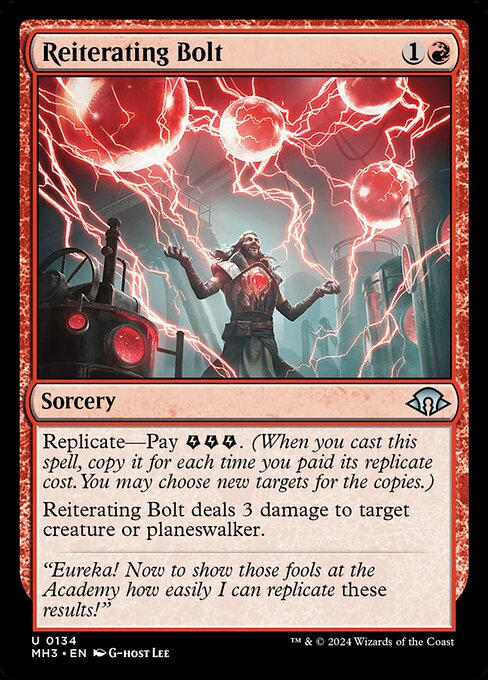
104. Reiterating Bolt
Rating6.2GoodWhy this rating?
Good playable that always makes the cut (6.2/10).
Why. A two-mana removal spell: three damage to a creature or planeswalker. Each time you pay three energy as you cast it, it is copied, possibly onto different targets.
Risks. It is a sorcery, so it cannot answer things mid-combat. With no energy it is a plain three-damage removal: fine, not exceptional.
In the draft. Take it in a red deck, higher if you have other energy sources. With little energy it is a good basic removal, nothing more.
Results in the games of the set
When it is in hand, the deck wins 54.9% of its games (set average: 56.2%, 162nd of 298 cards).
In the opening hand: 54.2% wins (55.6% on average).
Drawn during the game: 55.6% (56.7% on average).
When it is drawn, the deck wins 0.6 points less than when it is not.
When it is drafted, it is played 87% of the time (set average: 67%).
Taken as the first pick (173 drafts), it ends in the deck 94% of the time.
It is played mostly in R/U decks (39% of them) and R/W (37%).
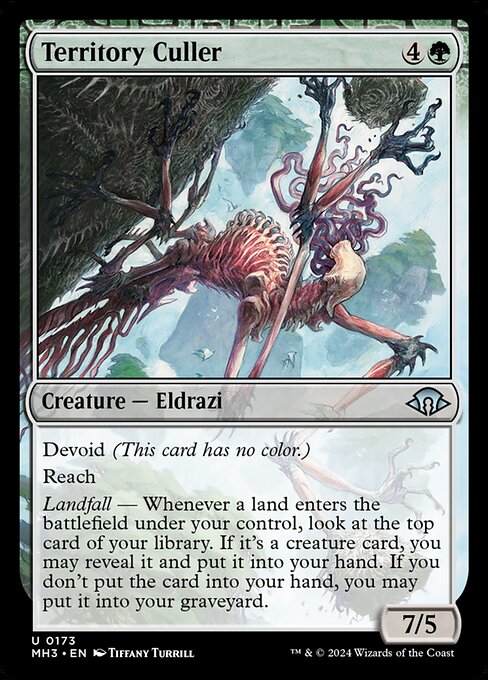
105. Territory Culler
Rating6.2GoodWhy this rating?
Good playable that always makes the cut (6.2/10).
Why. A 7/5 with reach for five mana is an enormous body that blocks anything, on the ground or in the air. Whenever a land enters under your control (landfall), you look at the top card: if it is a creature, you may take it into your hand.
Risks. It is colourless (devoid) but still needs green mana. With no land drops the ability sits idle, and removal answers it.
In the draft. A good uncommon for green decks, to take fairly high if you are green. An enormous body at this price matters a lot in draft.
Results in the games of the set
When it is in hand, the deck wins 56.7% of its games (set average: 56.2%, 81st of 298 cards).
In the opening hand: 55.6% wins (55.6% on average).
Drawn during the game: 57.5% (56.7% on average).
When it is drawn, the deck wins 2.4 points more than when it is not.
When it is drafted, it is played 91% of the time (set average: 67%).
Taken as the first pick (176 drafts), it ends in the deck 94% of the time.
It is played about as much in every archetype.
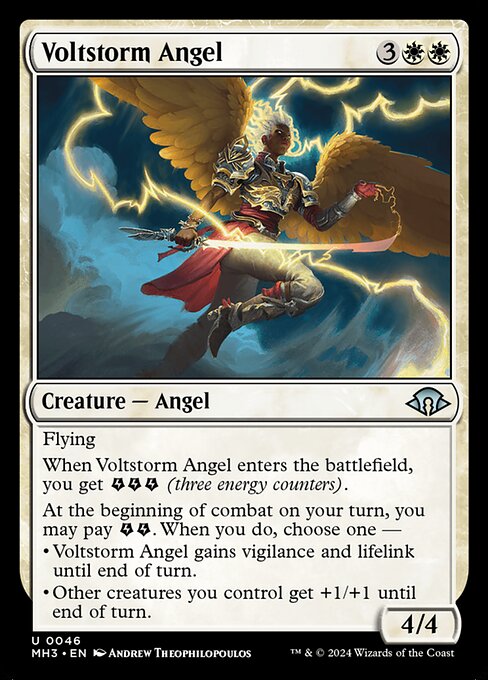
106. Voltstorm Angel
Rating6.2GoodWhy this rating?
Good playable that always makes the cut (6.2/10).
Why. A 4/4 flyer for five that arrives with three energy counters. At the beginning of combat you can pay two energy to give it vigilance and lifelink, or to give your other creatures +1/+1.
Risks. Three energy pays for only one activation without another source. The cost needs two white mana, and removal kills it easily.
In the draft. A good white uncommon: take it in a white deck. With other energy sources it gives more value.
Results in the games of the set
When it is in hand, the deck wins 56.6% of its games (set average: 56.2%, 88th of 298 cards).
In the opening hand: 55.5% wins (55.6% on average).
Drawn during the game: 57.4% (56.7% on average).
When it is drawn, the deck wins 0.2 points more than when it is not.
When it is drafted, it is played 86% of the time (set average: 67%).
Taken as the first pick (157 drafts), it ends in the deck 94% of the time.
It is played mostly in U/W decks (32% of them) and R/W (31%).

107. Legion Leadership // Legion Stronghold
Rating6.2PlayableWhy this rating?
Good playable that always makes the cut (6.2/10).
Why. An instant that doubles a creature's power and gives it first strike until end of turn: a combat trick that can swing a block. When you don't need it, it is a red and white dual land, so it is never a dead card.
Risks. Like any trick it does nothing without a creature, and it is lost if the target dies in response. The land side enters tapped.
In the draft. A good pick, best in red-white but playable in either colour. As a flexible card it replaces a land for free.
Results in the games of the set
When it is in hand, the deck wins 56.4% of its games (set average: 56.2%, 101st of 298 cards).
In the opening hand: 56.5% wins (55.6% on average).
Drawn during the game: 56.2% (56.7% on average).
When it is drawn, the deck wins 0.9 points less than when it is not.
When it is drafted, it is played 91% of the time (set average: 67%).
Taken as the first pick (135 drafts), it ends in the deck 97% of the time.

108. Flare of Denial
Rating6.1PlayableWhy this rating?
Good playable that always makes the cut (6.1/10).
Why. A universal counterspell for three mana, with a no-mana option: sacrifice a nontoken blue creature. That lets you counter a spell while keeping all your mana for something else.
Risks. The cost needs two blue mana, and the free option costs a real card. A counterspell is reactive: you hold mana open without doing anything.
In the draft. Playable in a blue deck that likes reactive play, but not a priority. Creatures and removal come first.
Results in the games of the set
When it is in hand, the deck wins 55.9% of its games (set average: 56.2%, 118th of 298 cards).
In the opening hand: 52.9% wins (55.6% on average).
Drawn during the game: 57.5% (56.7% on average).
When it is drawn, the deck wins 3.7 points more than when it is not.
When it is drafted, it is played 62% of the time (set average: 67%).
Taken among the first three picks (103 drafts), it ends in the deck 82% of the time.
It is played about as much in every archetype.
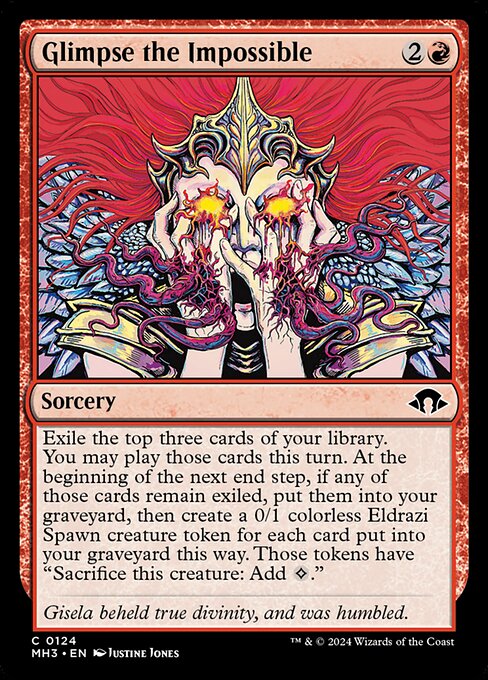 Rating6.0Playable
Why this rating?
Good playable that always makes the cut (6.1/10).
Why. You exile the top three cards of your library and may play them this turn. Whatever you don't play goes to the graveyard, and you create a colorless 0/1 Eldrazi Spawn creature token for each card lost this way, so you always keep something.
Risks. The spell costs three mana, and you need more to play the exiled cards: early in the game you often play only one or two. You can still play only one land.
In the draft. A good red pick from the mid-game on, when you have spare mana. Add it without overdoing it.
Results in the games of the set
When it is in hand, the deck wins 57.7% of its games (set average: 56.2%, 64th of 298 cards).
In the opening hand: 55.9% wins (55.6% on average).
Drawn during the game: 59.3% (56.7% on average).
When it is drawn, the deck wins 1.3 points more than when it is not.
When it is drafted, it is played 72% of the time (set average: 67%).
Taken as the first pick (134 drafts), it ends in the deck 87% of the time.
It is played mostly in G/R decks (69% of them) and R/U (57%).

110. Aether Revolt
Rating6.0PlayableWhy this rating?
Good playable that always makes the cut (6.0/10).
Why. A red enchantment that deals damage to any target equal to the energy you get, each time you get some. With revolt (a permanent you control left the battlefield this turn), your noncombat damage to the opponent or their permanents goes up by two.
Risks. Without energy it does nothing. It costs four mana including two red and does nothing on arrival: it only pays off in a deck built around it.
In the draft. Only take it if you already have several red energy sources. Otherwise let it go by.
Results in the games of the set
When it is in hand, the deck wins 54.2% of its games (set average: 56.2%, 184th of 298 cards).
In the opening hand: 53.6% wins (55.6% on average).
Drawn during the game: 54.7% (56.7% on average).
When it is drawn, the deck wins 1.0 points less than when it is not.
When it is drafted, it is played 77% of the time (set average: 67%).
Taken as the first pick (101 drafts), it ends in the deck 79% of the time.
It is played mostly in R/U decks (31% of them) and R/W (26%).

111. Bountiful Landscape
Rating6.0PlayableWhy this rating?
Good playable that always makes the cut (6.0/10).
Why. A three-colour fixing land: it makes colourless mana and can be sacrificed to fetch a basic Forest, Island or Mountain tapped. It can also be cycled by paying a green, a blue and a red mana.
Risks. It doesn't make coloured mana until sacrificed, and the fetched land comes in tapped, which costs tempo. It only helps a deck in these three colours.
In the draft. A useful pick for decks in these colours, especially three-colour ones. Take it mid-pack, not over a good playable.
Results in the games of the set
When it is in hand, the deck wins 56.6% of its games (set average: 56.2%, 85th of 298 cards).
In the opening hand: 57.1% wins (55.6% on average).
Drawn during the game: 56.3% (56.7% on average).
When it is drawn, the deck wins 1.3 points more than when it is not.
When it is drafted, it is played 88% of the time (set average: 67%).
Taken as the first pick (121 drafts), it ends in the deck 94% of the time.

112. Cranial Ram
Rating6.0PlayableWhy this rating?
Good playable that always makes the cut (6.0/10).
Why. An Equipment with living weapon: it arrives with a 0/0 black Phyrexian Germ creature token and attaches to it, so you get a creature right away. It gives +X/+1, X being the number of artifacts you control (itself included), and stays behind to equip another creature for two.
Risks. It needs black and red. With few artifacts the Germ is barely a 1/1, and it dies if the Equipment moves off.
In the draft. Filler for a black-red deck with several artifacts. Otherwise don't take it early.
Results in the games of the set
When it is in hand, the deck wins 56.0% of its games (set average: 56.2%, 112th of 298 cards).
In the opening hand: 56.9% wins (55.6% on average).
Drawn during the game: 55.3% (56.7% on average).
When it is drawn, the deck wins 2.8 points more than when it is not.
When it is drafted, it is played 55% of the time (set average: 67%).
Taken as the first pick (113 drafts), it ends in the deck 90% of the time.
It is played mostly in B/R decks (90% of them).
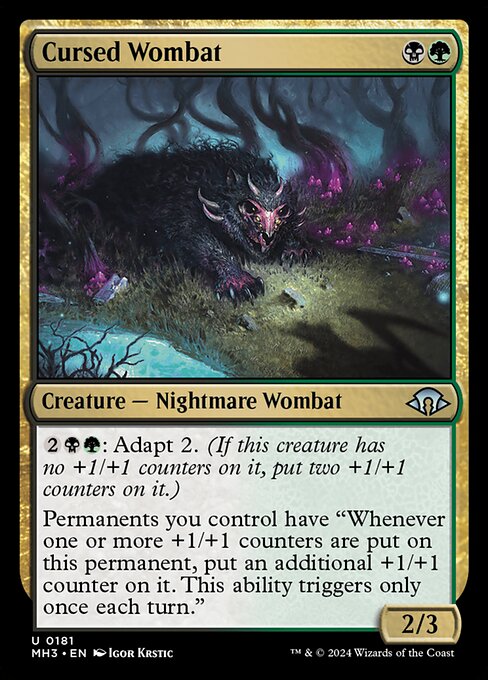
113. Cursed Wombat
Rating6.0PlayableWhy this rating?
Good playable that always makes the cut (6.0/10).
Why. A 2/3 for two that can pay for Adapt 2: its own ability adds one more counter, so it becomes a 5/6. That ability applies to all your permanents that get +1/+1 counters, once each turn for each.
Risks. It needs black and green, and Adapt costs four mana and works only once, while it has no +1/+1 counter. Without other counters its ability does little.
In the draft. A good pick in a black-green counters deck; without synergy it is a decent 2/3 that gets big later.
Results in the games of the set
When it is in hand, the deck wins 54.9% of its games (set average: 56.2%, 164th of 298 cards).
In the opening hand: 56.1% wins (55.6% on average).
Drawn during the game: 53.9% (56.7% on average).
When it is drawn, the deck wins 3.1 points more than when it is not.
When it is drafted, it is played 71% of the time (set average: 67%).
Taken as the first pick (83 drafts), it ends in the deck 89% of the time.
It is played mostly in B/G decks (67% of them).

114. Fell the Profane // Fell Mire
Rating6.0PlayableWhy this rating?
Good playable that always makes the cut (6.0/10).
Why. A four-mana instant-speed removal that destroys any creature or planeswalker. When you don't need it, it is a black land: never a dead card, and a flexible choice.
Risks. It costs four mana including two black, which is pricey. The land side enters tapped unless you pay three life.
In the draft. A good pick in a black deck. Take it over more conditional removal, since it hits everything.
Results in the games of the set
When it is in hand, the deck wins 55.6% of its games (set average: 56.2%, 135th of 298 cards).
In the opening hand: 53.0% wins (55.6% on average).
Drawn during the game: 57.6% (56.7% on average).
When it is drawn, the deck wins 3.2 points more than when it is not.
When it is drafted, it is played 90% of the time (set average: 67%).
Taken as the first pick (180 drafts), it ends in the deck 96% of the time.
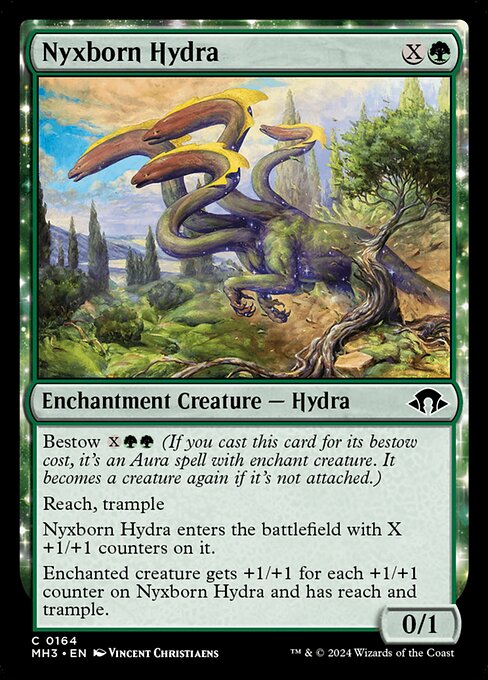
115. Nyxborn Hydra
Rating6.0PlayableWhy this rating?
Good playable that always makes the cut (6.0/10).
Why. A flexible card: cast with X it is a creature with reach and trample that enters with X +1/+1 counters. With bestow it is an Aura giving +1/+1 per counter, reach and trample to a creature, and it becomes a creature again if the host goes away.
Risks. At low X it is a small creature, and bestow costs one more green mana. It needs two green mana for bestow.
In the draft. A good pick in green, playable in nearly every green deck. It fits any curve: take it mid-pack.
Results in the games of the set
When it is in hand, the deck wins 56.2% of its games (set average: 56.2%, 106th of 298 cards).
In the opening hand: 53.5% wins (55.6% on average).
Drawn during the game: 58.3% (56.7% on average).
When it is drawn, the deck wins 1.4 points more than when it is not.
When it is drafted, it is played 86% of the time (set average: 67%).
Taken as the first pick (133 drafts), it ends in the deck 96% of the time.
It is played mostly in G/R decks (60% of them) and B/G (51%).

116. Ral, Monsoon Mage // Ral, Leyline Prodigy
Rating6.0PlayableWhy this rating?
Good playable that always makes the cut (6.0/10).
Why. A two-mana creature that makes your instants and sorceries cost one less, and can flip into a planeswalker if you win a coin flip when you cast one on your turn. The planeswalker deals divided damage and draws if you control another blue permanent.
Risks. It depends on a coin flip and can deal damage to you. In a draft deck with few spells it is a 1/3 that does almost nothing.
In the draft. Only take it if you play lots of instants and sorceries. Otherwise let it go by.
Results in the games of the set
When it is in hand, the deck wins 50.6% of its games (set average: 56.2%, 258th of 298 cards).
In the opening hand: 51.8% wins (55.6% on average).
Drawn during the game: 49.7% (56.7% on average).
When it is drawn, the deck wins 1.1 points less than when it is not.
When it is drafted, it is played 56% of the time (set average: 67%).
Taken among the first three picks (89 drafts), it ends in the deck 58% of the time.
It is played about as much in every archetype.
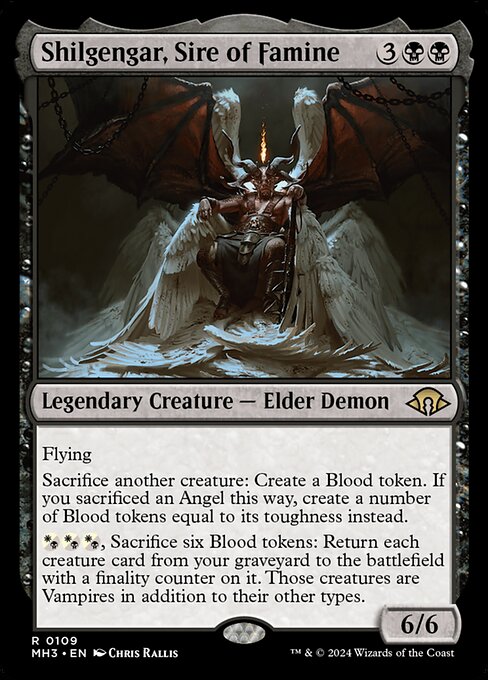
117. Shilgengar, Sire of Famine
Rating6.0PlayableWhy this rating?
Good playable that always makes the cut (6.0/10).
Why. A 6/6 flyer for five is a big threat on arrival. Sacrificing another creature makes a Blood token; with six Blood and three mana you return every creature card from your graveyard with a finality counter.
Risks. It needs two black mana, and you must sacrifice many creatures to stockpile Blood. One removal answers it.
In the draft. A good black pick as a flying finisher even without building Blood. Don't overpay for the recursion ability.
Results in the games of the set
When it is in hand, the deck wins 55.0% of its games (set average: 56.2%, 160th of 298 cards).
In the opening hand: 51.6% wins (55.6% on average).
Drawn during the game: 57.1% (56.7% on average).
When it is drawn, the deck wins 3.8 points more than when it is not.
When it is drafted, it is played 89% of the time (set average: 67%).
Taken as the first pick (86 drafts), it ends in the deck 90% of the time.
It is played about as much in every archetype.

118. Smelted Chargebug
Rating6.0PlayableWhy this rating?
Good playable that always makes the cut (6.0/10).
Why. A 1/3 menace creature for two that arrives with two energy. When it attacks, it can give another attacker +1/+0 and menace, making your attacks harder to block. It is also an artifact.
Risks. A 1/3 is slow alone, and two energy pays for only two activations. You need other attackers for its ability to matter.
In the draft. A decent red common, to take in aggressive decks. Look for more creatures to make it count.
Results in the games of the set
When it is in hand, the deck wins 56.6% of its games (set average: 56.2%, 92nd of 298 cards).
In the opening hand: 57.2% wins (55.6% on average).
Drawn during the game: 56.0% (56.7% on average).
When it is drawn, the deck wins 0.4 points less than when it is not.
When it is drafted, it is played 81% of the time (set average: 67%).
Taken as the first pick (214 drafts), it ends in the deck 97% of the time.
It is played mostly in B/R decks (73% of them) and R/W (65%).
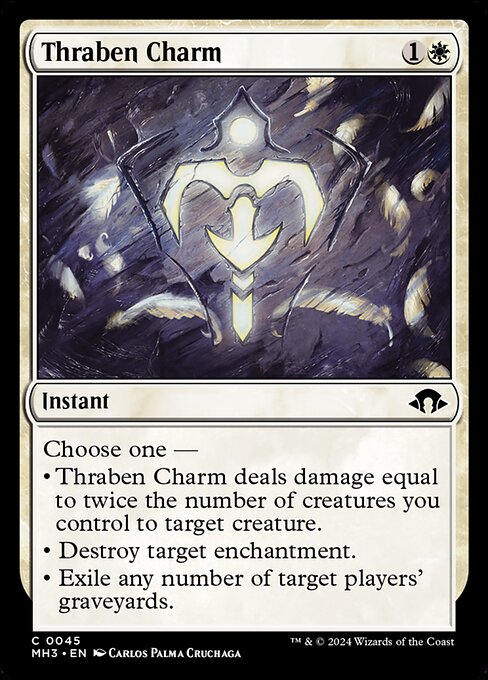
119. Thraben Charm
Rating6.0PlayableWhy this rating?
Good playable that always makes the cut (6.0/10).
Why. A flexible two-mana white instant: it deals damage to a creature equal to twice the number of creatures you control, or destroys an enchantment, or exiles graveyards. With three creatures that is six damage: good removal for two mana.
Risks. With few creatures the first mode does little. The other two modes are rarely relevant in draft.
In the draft. A good common in a white deck with plenty of creatures. Take it fairly high among white removal.
Results in the games of the set
When it is in hand, the deck wins 57.1% of its games (set average: 56.2%, 70th of 298 cards).
In the opening hand: 56.5% wins (55.6% on average).
Drawn during the game: 57.7% (56.7% on average).
When it is drawn, the deck wins 0.2 points less than when it is not.
When it is drafted, it is played 80% of the time (set average: 67%).
Taken as the first pick (183 drafts), it ends in the deck 93% of the time.
It is played mostly in R/W decks (67% of them) and U/W (63%).
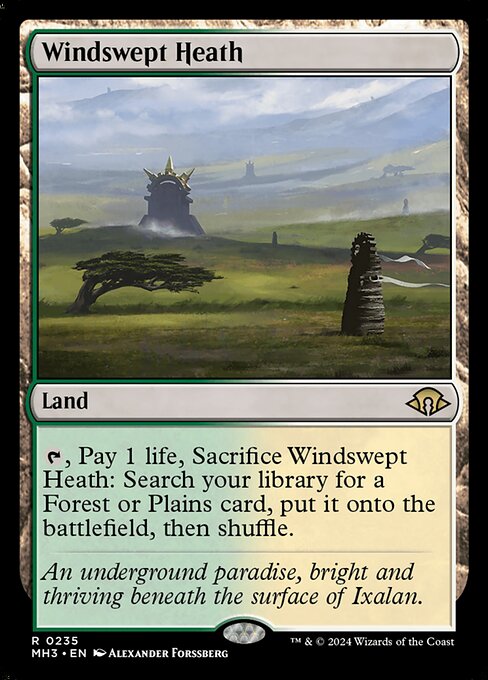
120. Windswept Heath
Rating6.0PlayableWhy this rating?
Good playable that always makes the cut (6.0/10).
Why. A fixing land: sacrifice it to search for a Forest or Plains card and put it onto the battlefield untapped. It smooths your colours without losing tempo and takes a land out of your library.
Risks. It costs a life point and makes no mana until sacrificed. It does nothing in a deck with neither green nor white.
In the draft. A fine pick if you play green or white, but never over a real playable.
Results in the games of the set
When it is in hand, the deck wins 54.1% of its games (set average: 56.2%, 191st of 298 cards).
In the opening hand: 55.2% wins (55.6% on average).
Drawn during the game: 53.1% (56.7% on average).
When it is drawn, the deck wins 0.1 points less than when it is not.
When it is drafted, it is played 51% of the time (set average: 67%).
Taken among the first three picks (55 drafts), it ends in the deck 76% of the time.

121. Witch Enchanter // Witch-Blessed Meadow
Rating6.0PlayableWhy this rating?
Good playable that always makes the cut (6.0/10).
Why. A 2/2 for four that destroys an opposing artifact or enchantment on arrival, and a white land when you don't need it. Even with no target, the land side means it is never a dead card.
Risks. A 2/2 for four mana is weak, and the effect only matters if the opponent has a target. The land side enters tapped unless you pay three life.
In the draft. A good pick in a white deck: it takes the place of a land at no cost. Take it mid-pack.
Results in the games of the set
When it is in hand, the deck wins 56.7% of its games (set average: 56.2%, 79th of 298 cards).
In the opening hand: 56.8% wins (55.6% on average).
Drawn during the game: 56.7% (56.7% on average).
When it is drawn, the deck wins 0.2 points less than when it is not.
When it is drafted, it is played 88% of the time (set average: 67%).
Taken as the first pick (155 drafts), it ends in the deck 96% of the time.

122. Monumental Henge
Rating6.0PlayableWhy this rating?
Good playable that always makes the cut (6.0/10).
Why. A white land that enters untapped if you control a Plains. Later, for four mana and by tapping it, you look at five cards and may take a historic one: a late-game source of value.
Risks. It enters tapped without a Plains, and its ability only pays off with historic cards. That is little value in an average draft deck.
In the draft. A marginal pick: only play it in a white deck with many artifacts, legendaries or Sagas.
Results in the games of the set
When it is in hand, the deck wins 54.1% of its games (set average: 56.2%, 188th of 298 cards).
In the opening hand: 54.7% wins (55.6% on average).
Drawn during the game: 53.7% (56.7% on average).
When it is drawn, the deck wins 2.1 points less than when it is not.
When it is drafted, it is played 42% of the time (set average: 67%).
Taken among the first three picks (39 drafts), it ends in the deck 67% of the time.

123. Lethal Throwdown
Rating5.9PlayableWhy this rating?
Good playable that always makes the cut (5.9/10).
Why. A one-mana black removal spell that destroys any creature or planeswalker. It draws a card if you sacrificed a modified creature, which offsets part of the cost.
Risks. It costs you a creature on top, so it is a two-for-one against you. It is a sorcery, and you need a creature to sacrifice.
In the draft. Take it in a black deck with expendable creatures or counters. Without that it is decent removal, not a first pick.
Results in the games of the set
When it is in hand, the deck wins 55.0% of its games (set average: 56.2%, 158th of 298 cards).
In the opening hand: 52.4% wins (55.6% on average).
Drawn during the game: 56.7% (56.7% on average).
When it is drawn, the deck wins 2.1 points more than when it is not.
When it is drafted, it is played 74% of the time (set average: 67%).
Taken as the first pick (78 drafts), it ends in the deck 94% of the time.
It is played mostly in B/R decks (27% of them) and B/W (25%).

124. Sheltering Landscape
Rating5.8PlayableWhy this rating?
Good playable that always makes the cut (5.9/10).
Why. A three-colour fixing land: it makes colourless mana and can be sacrificed to fetch a basic Mountain, Forest or Plains tapped. It can also be cycled by paying a red, a green and a white mana.
Risks. It doesn't make coloured mana until sacrificed, and the fetched land arrives tapped. It only helps decks in these three colours.
In the draft. A useful pick for decks in these colours, especially three-colour ones. Take it after your playables.
Results in the games of the set
When it is in hand, the deck wins 56.5% of its games (set average: 56.2%, 97th of 298 cards).
In the opening hand: 57.5% wins (55.6% on average).
Drawn during the game: 55.6% (56.7% on average).
When it is drawn, the deck wins 0.0 points more than when it is not.
When it is drafted, it is played 85% of the time (set average: 67%).
Taken as the first pick (55 drafts), it ends in the deck 98% of the time.
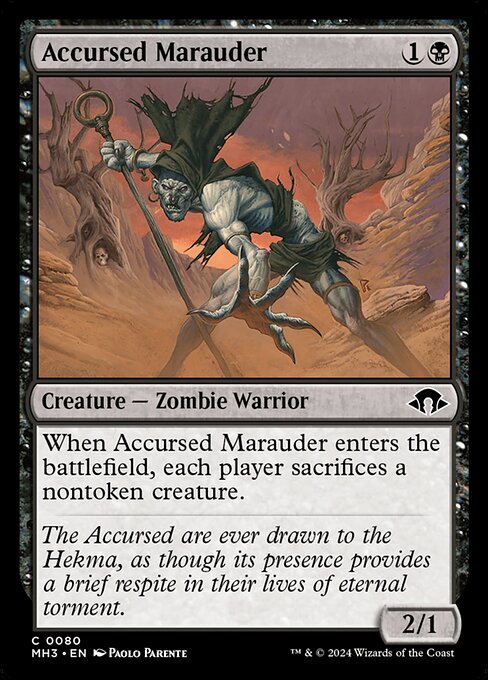
125. Accursed Marauder
Rating5.8PlayableWhy this rating?
Good playable that always makes the cut (5.8/10).
Why. A 2/1 for two: when it enters, each player sacrifices a nontoken creature of their choice. If the opponent has only one nontoken creature, it acts as removal; you can sacrifice the Marauder itself.
Risks. You also sacrifice a nontoken creature: if the Marauder is your only one, it sacrifices itself. Against an opponent with several creatures the effect is weak.
In the draft. A good black pick, strongest early while the opponent has few creatures. You must accept giving up a card on your side.
Results in the games of the set
When it is in hand, the deck wins 57.2% of its games (set average: 56.2%, 69th of 298 cards).
In the opening hand: 55.4% wins (55.6% on average).
Drawn during the game: 58.5% (56.7% on average).
When it is drawn, the deck wins 4.2 points more than when it is not.
When it is drafted, it is played 81% of the time (set average: 67%).
Taken as the first pick (209 drafts), it ends in the deck 94% of the time.
It is played mostly in B/U decks (68% of them) and B/G (63%).
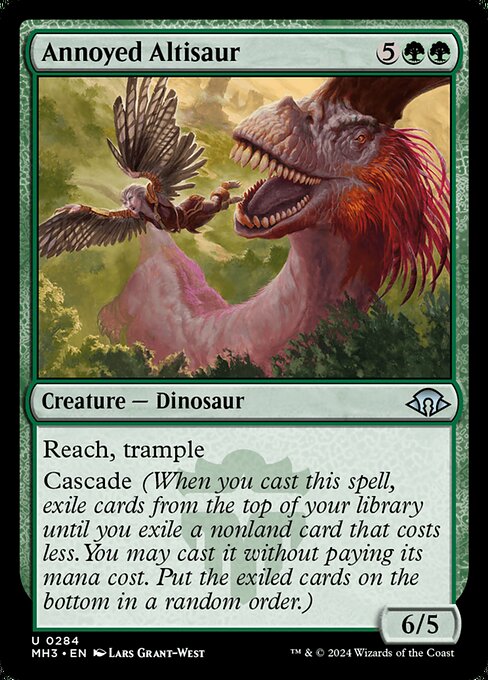
126. Annoyed Altisaur
Rating5.8PlayableWhy this rating?
Good playable that always makes the cut (5.8/10).
Why. A 6/5 with reach and trample for seven, with cascade: when you cast it, you cast another cheaper card for free. It blocks everything, hits hard, and gives value at once.
Risks. Seven mana including two green is a steep cost. It is slow against fast decks, and what cascade finds is random.
In the draft. A good green finisher. One copy is usually enough, two if you run ramp.
Results in the games of the set
When it is in hand, the deck wins 56.8% of its games (set average: 56.2%, 77th of 298 cards).
In the opening hand: 54.9% wins (55.6% on average).
Drawn during the game: 58.1% (56.7% on average).
When it is drawn, the deck wins 2.2 points more than when it is not.
When it is drafted, it is played 86% of the time (set average: 67%).
Taken as the first pick (137 drafts), it ends in the deck 94% of the time.
It is played mostly in G/R decks (26% of them) and G/W (26%).

127. Breathe Your Last
Rating5.8PlayableWhy this rating?
Good playable that always makes the cut (5.8/10).
Why. A three-mana instant removal that destroys any creature or planeswalker and gains you 1 life for each of its colours. Simple, reliable and unconditional.
Risks. It needs two black mana. A colourless target gains you nothing, and it provides no card advantage.
In the draft. A good common in black. Take it over more conditional removal.
Results in the games of the set
When it is in hand, the deck wins 56.4% of its games (set average: 56.2%, 98th of 298 cards).
In the opening hand: 53.2% wins (55.6% on average).
Drawn during the game: 58.5% (56.7% on average).
When it is drawn, the deck wins 3.9 points more than when it is not.
When it is drafted, it is played 89% of the time (set average: 67%).
Taken as the first pick (352 drafts), it ends in the deck 95% of the time.
It is played mostly in B/G decks (65% of them) and B/R (64%).
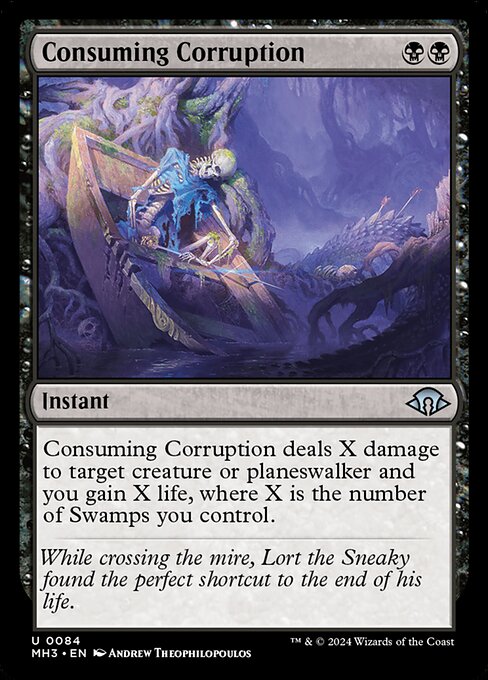
128. Consuming Corruption
Rating5.8PlayableWhy this rating?
Good playable that always makes the cut (5.8/10).
Why. A two-mana black instant that deals X damage to a creature or planeswalker and gains you X life, where X is the number of Swamps you control. In a heavily black deck it kills most creatures.
Risks. It is much more limited in a two-colour deck, where you will have few Swamps, especially early. It needs two black mana right away.
In the draft. Take it in a heavily black deck. In a balanced deck it is worth less than unconditional removal.
Results in the games of the set
When it is in hand, the deck wins 55.8% of its games (set average: 56.2%, 128th of 298 cards).
In the opening hand: 52.5% wins (55.6% on average).
Drawn during the game: 57.8% (56.7% on average).
When it is drawn, the deck wins 3.8 points more than when it is not.
When it is drafted, it is played 54% of the time (set average: 67%).
Taken as the first pick (43 drafts), it ends in the deck 81% of the time.
It is played about as much in every archetype.
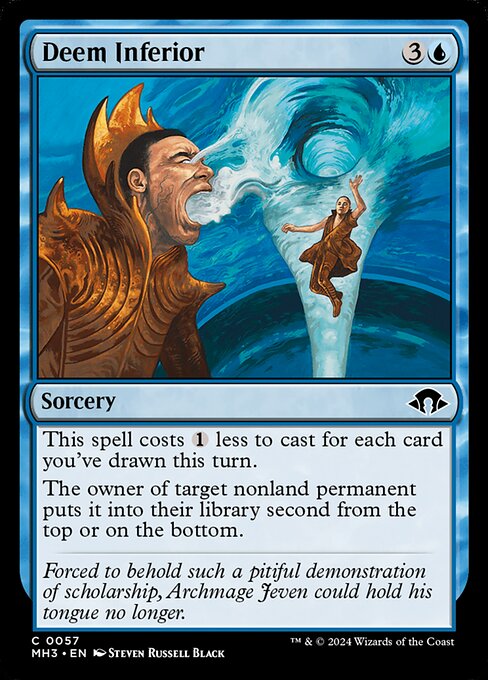
129. Deem Inferior
Rating5.8PlayableWhy this rating?
Good playable that always makes the cut (5.8/10).
Why. A blue sorcery: the owner of a target nonland permanent puts it second from the top or on the bottom of their library. It costs one less per card you've drawn this turn, so on your turn it already costs three.
Risks. With no other draw it stays at three or four mana, and the owner chooses: the permanent may come back two draws later. It is not a permanent answer.
In the draft. A good blue common, especially with draw effects. Take it mid-pack.
Results in the games of the set
When it is in hand, the deck wins 58.5% of its games (set average: 56.2%, 49th of 298 cards).
In the opening hand: 54.9% wins (55.6% on average).
Drawn during the game: 60.5% (56.7% on average).
When it is drawn, the deck wins 4.1 points more than when it is not.
When it is drafted, it is played 75% of the time (set average: 67%).
Taken as the first pick (161 drafts), it ends in the deck 89% of the time.
It is played mostly in B/U decks (68% of them) and R/U (59%).

130. Faithful Watchdog
Rating5.8PlayableWhy this rating?
Good playable that always makes the cut (5.8/10).
Why. A 3/3 with vigilance for two: a solid body very early that attacks and blocks. With its +1/+1 counters it is also a modified creature.
Risks. It needs green and white, two specific colours. It has no extra ability, and removal or a combat trick can handle it.
In the draft. A good pick for a green-white deck. Take it as a turn-two creature, not as a first pick.
Results in the games of the set
When it is in hand, the deck wins 55.9% of its games (set average: 56.2%, 123rd of 298 cards).
In the opening hand: 58.5% wins (55.6% on average).
Drawn during the game: 53.4% (56.7% on average).
When it is drawn, the deck wins 0.2 points more than when it is not.
When it is drafted, it is played 55% of the time (set average: 67%).
Taken as the first pick (85 drafts), it ends in the deck 86% of the time.
It is played mostly in G/W decks (84% of them).
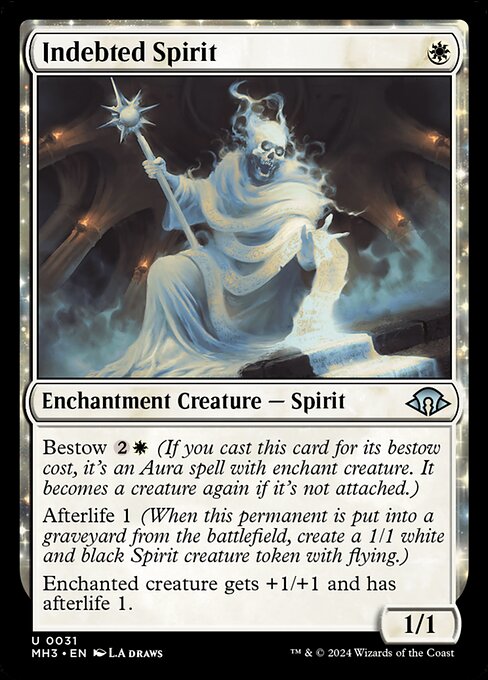
131. Indebted Spirit
Rating5.8PlayableWhy this rating?
Good playable that always makes the cut (5.8/10).
Why. A one-mana white 1/1 that leaves a white and black 1/1 flying Spirit behind when it dies (afterlife 1). Bestowed, it gives the enchanted creature +1/+1 and afterlife 1, and becomes a creature again if that creature goes away.
Risks. A 1/1 is weak alone, and bestow costs three mana. It doesn't really protect the creature: it only leaves a Spirit behind.
In the draft. A white filler pick. Take it in an aggro deck, after your best cards.
Results in the games of the set
When it is in hand, the deck wins 54.2% of its games (set average: 56.2%, 185th of 298 cards).
In the opening hand: 55.5% wins (55.6% on average).
Drawn during the game: 53.0% (56.7% on average).
When it is drawn, the deck wins 2.1 points less than when it is not.
When it is drafted, it is played 65% of the time (set average: 67%).
Taken as the first pick (43 drafts), it ends in the deck 79% of the time.
It is played mostly in B/W decks (28% of them).
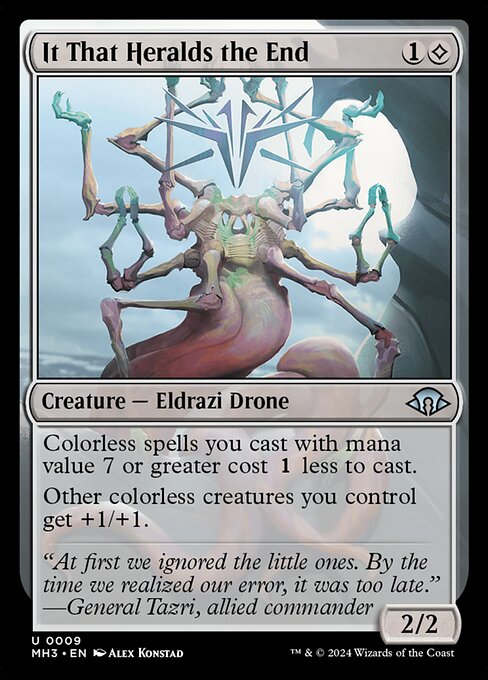 Rating5.8Playable
Why this rating?
Good playable that always makes the cut (5.8/10).
Why. A two-mana 2/2 that gives your other colourless creatures +1/+1 and makes your colourless spells with mana value seven or more cost one less. In a devoid and Eldrazi deck it makes your other colourless creatures bigger.
Risks. Its cost needs a specific colourless mana, which basic lands don't make. It needs other colourless creatures to matter, otherwise it is a plain 2/2.
In the draft. Only take it if you already have several colourless creatures and a way to make colourless mana. Otherwise let it go.
Results in the games of the set
When it is in hand, the deck wins 54.3% of its games (set average: 56.2%, 180th of 298 cards).
In the opening hand: 53.6% wins (55.6% on average).
Drawn during the game: 54.8% (56.7% on average).
When it is drawn, the deck wins 0.3 points more than when it is not.
When it is drafted, it is played 83% of the time (set average: 67%).
Taken as the first pick (84 drafts), it ends in the deck 90% of the time.
It is played mostly in G/R decks (25% of them).

133. Perilous Landscape
Rating5.8PlayableWhy this rating?
Good playable that always makes the cut (5.8/10).
Why. A three-colour fixing land: it makes colourless mana and can be sacrificed to fetch a basic Island, Mountain or Plains tapped. It can also be cycled by paying a blue, a red and a white mana.
Risks. It doesn't make coloured mana until sacrificed, and the fetched land arrives tapped. It only helps decks in these three colours.
In the draft. A useful pick for decks in these colours, especially three-colour ones. Take it after your playables.
Results in the games of the set
When it is in hand, the deck wins 56.2% of its games (set average: 56.2%, 110th of 298 cards).
In the opening hand: 56.9% wins (55.6% on average).
Drawn during the game: 55.5% (56.7% on average).
When it is drawn, the deck wins 0.2 points more than when it is not.
When it is drafted, it is played 83% of the time (set average: 67%).
Taken as the first pick (76 drafts), it ends in the deck 91% of the time.
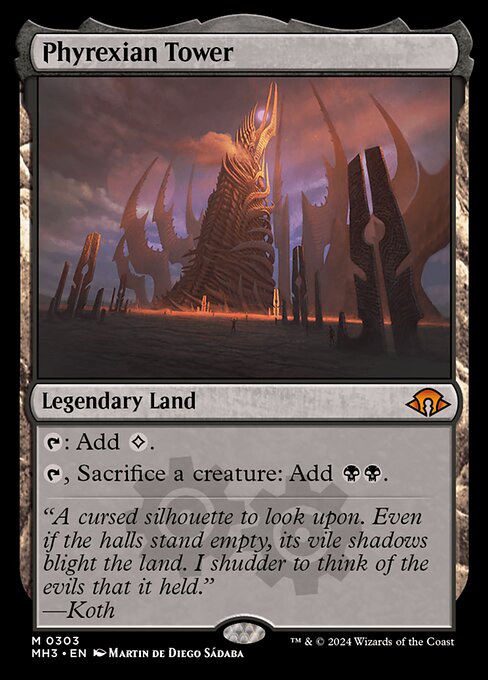
134. Phyrexian Tower
Rating5.8PlayableWhy this rating?
Good playable that always makes the cut (5.8/10).
Why. A legendary land that taps for colourless mana, or for two black mana by sacrificing a creature. In response to removal you can get black mana out of the dying creature, to spend right away.
Risks. It makes only colourless mana without a sacrifice, which strains your colours, and a draft deck rarely needs that black mana.
In the draft. A marginal pick: only play it in a black deck with plenty of creatures to sacrifice.
Results in the games of the set
When it is in hand, the deck wins 50.9% of its games (set average: 56.2%, 255th of 298 cards).
In the opening hand: 47.2% wins (55.6% on average).
Drawn during the game: 53.5% (56.7% on average).
When it is drawn, the deck wins 1.7 points more than when it is not.
When it is drafted, it is played 40% of the time (set average: 67%).
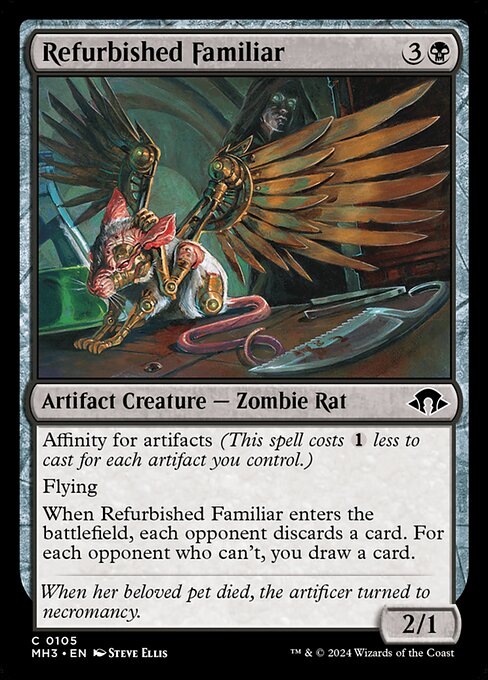
135. Refurbished Familiar
Rating5.8PlayableWhy this rating?
Good playable that always makes the cut (5.8/10).
Why. A flier that gets cheaper for every artifact you control and makes the opponent discard when it enters. If their hand is empty, you draw instead, so the trigger is useful at any point in the game.
Risks. With no artifacts it is four mana for a 2/1 that dies to nearly anything. Most of the value is in the enter trigger.
In the draft. A solid black playable, better with a few artifacts. Take it without hurry after your removal.
Results in the games of the set
When it is in hand, the deck wins 56.9% of its games (set average: 56.2%, 74th of 298 cards).
In the opening hand: 55.5% wins (55.6% on average).
Drawn during the game: 58.0% (56.7% on average).
When it is drawn, the deck wins 3.9 points more than when it is not.
When it is drafted, it is played 73% of the time (set average: 67%).
Taken as the first pick (201 drafts), it ends in the deck 88% of the time.
It is played mostly in B/W decks (96% of them) and B/R (79%).

136. Skittering Precursor
Rating5.8PlayableWhy this rating?
Good playable that always makes the cut (5.8/10).
Why. A 3/3 with menace for three mana is already a good body. Whenever you sacrifice a nontoken permanent you get an Eldrazi Spawn token, which means extra mana and chump blockers.
Risks. Without sacrifice effects it is just a 3/3 menace with no extra value. Devoid only matters in that the card is colorless.
In the draft. Playable in any red deck on the strength of the body. Rate it higher if you have other ways to sacrifice permanents.
Results in the games of the set
When it is in hand, the deck wins 55.0% of its games (set average: 56.2%, 159th of 298 cards).
In the opening hand: 54.7% wins (55.6% on average).
Drawn during the game: 55.2% (56.7% on average).
When it is drawn, the deck wins 0.8 points less than when it is not.
When it is drafted, it is played 79% of the time (set average: 67%).
Taken as the first pick (64 drafts), it ends in the deck 95% of the time.
It is played mostly in G/R decks (29% of them) and B/R (25%).

137. Tune the Narrative
Rating5.8PlayableWhy this rating?
Good playable that always makes the cut (5.8/10).
Why. A one-mana instant: draw a card and get two energy counters. It replaces itself and feeds the energy cards in your deck.
Risks. On its own it is a cantrip with no impact on the board. Without other cards that spend energy the bonus is wasted.
In the draft. A late addition to a blue deck, handy if you already have several energy cards. Do not take it over your creatures.
Results in the games of the set
When it is in hand, the deck wins 55.6% of its games (set average: 56.2%, 137th of 298 cards).
In the opening hand: 54.0% wins (55.6% on average).
Drawn during the game: 56.7% (56.7% on average).
When it is drawn, the deck wins 2.2 points more than when it is not.
When it is drafted, it is played 64% of the time (set average: 67%).
Taken as the first pick (135 drafts), it ends in the deck 87% of the time.
It is played mostly in R/U decks (72% of them) and U/W (67%).

138. White Orchid Phantom
Rating5.8PlayableWhy this rating?
Good playable that always makes the cut (5.8/10).
Why. A 2/2 with flying and first strike for two white mana: an aggressive creature that is hard to block and wins combats against small creatures. When it enters it can destroy a nonbasic land, which hurts an opponent whose mana relies on such lands.
Risks. It needs two white mana right away. Its toughness of 2 is vulnerable to removal, and the opponent may fetch a tapped basic land in return.
In the draft. A good card for an aggressive white deck, but the land effect will often do nothing, so do not count on it.
Results in the games of the set
When it is in hand, the deck wins 53.2% of its games (set average: 56.2%, 207th of 298 cards).
In the opening hand: 53.9% wins (55.6% on average).
Drawn during the game: 52.6% (56.7% on average).
When it is drawn, the deck wins 4.3 points less than when it is not.
When it is drafted, it is played 69% of the time (set average: 67%).
Taken as the first pick (32 drafts), it ends in the deck 75% of the time.
It is played about as much in every archetype.
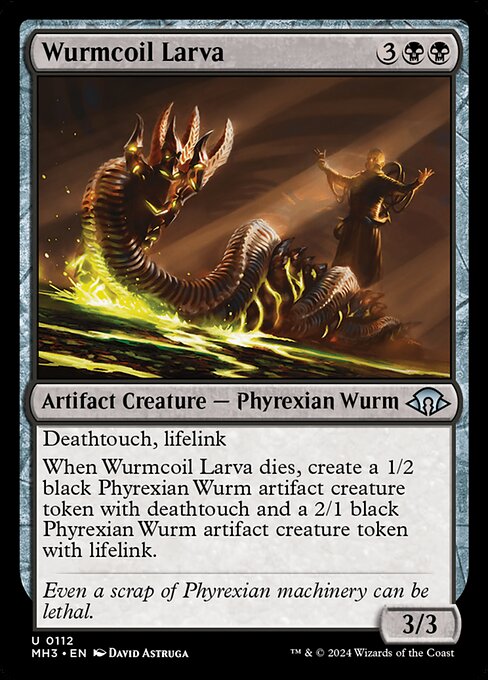
139. Wurmcoil Larva
Rating5.8PlayableWhy this rating?
Good playable that always makes the cut (5.8/10).
Why. A 3/3 deathtouch lifelinker for five that leaves behind two tokens when it dies: a 1/2 with deathtouch and a 2/1 with lifelink. It is a nightmare to fight, and every trade against it goes badly for the opponent.
Risks. It needs two black mana and costs five, so it arrives late. Exile, or an effect that neutralizes it without killing it, cancels the advantage.
In the draft. A good black uncommon for control or midrange decks. Take it ahead of most creatures at the same cost.
Results in the games of the set
When it is in hand, the deck wins 56.8% of its games (set average: 56.2%, 76th of 298 cards).
In the opening hand: 54.4% wins (55.6% on average).
Drawn during the game: 58.4% (56.7% on average).
When it is drawn, the deck wins 4.3 points more than when it is not.
When it is drafted, it is played 87% of the time (set average: 67%).
Taken as the first pick (152 drafts), it ends in the deck 93% of the time.
It is played mostly in B/R decks (35% of them) and B/W (27%).
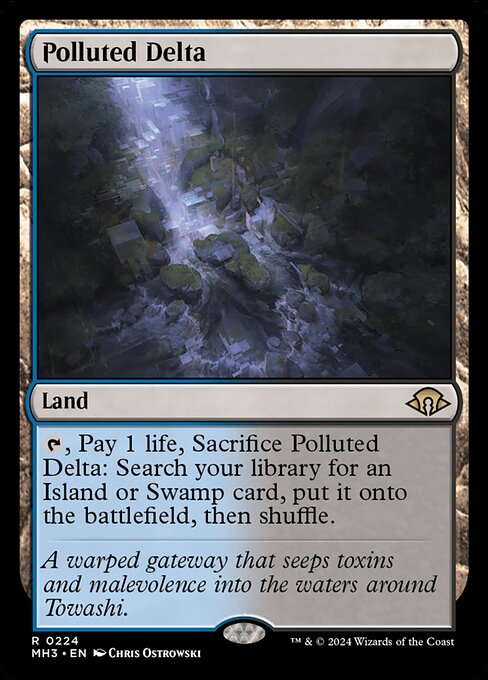
140. Polluted Delta
Rating5.8PlayableWhy this rating?
Good playable that always makes the cut (5.8/10).
Why. A land that sacrifices itself to search for an Island or Swamp card: it helps a blue-black deck fix its colors and thins your library a little. It can find any land with those types, not only basics.
Risks. It costs a life and does nothing else. In draft the difference from a basic land is small unless you have a way to use land types.
In the draft. Play it only if you are blue and black. Otherwise take it late.
Results in the games of the set
When it is in hand, the deck wins 54.0% of its games (set average: 56.2%, 192nd of 298 cards).
In the opening hand: 52.2% wins (55.6% on average).
Drawn during the game: 55.2% (56.7% on average).
When it is drawn, the deck wins 2.5 points more than when it is not.
When it is drafted, it is played 59% of the time (set average: 67%).
Taken among the first three picks (68 drafts), it ends in the deck 76% of the time.
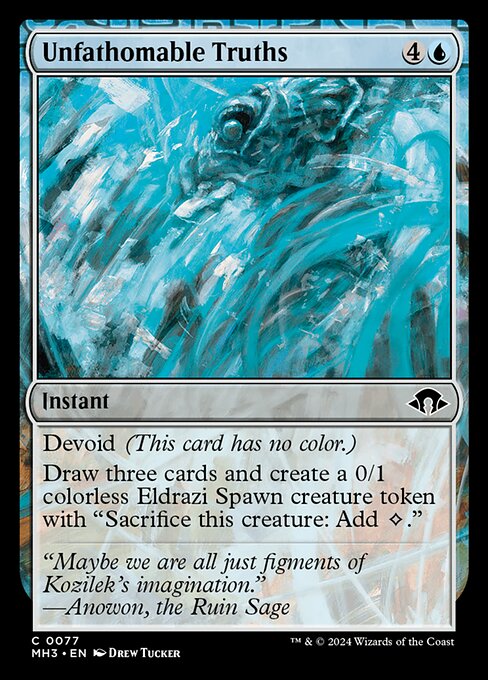
141. Unfathomable Truths
Rating5.7PlayableWhy this rating?
Good playable that always makes the cut (5.7/10).
Why. A five-mana instant that draws three cards and creates an Eldrazi Spawn token. It is a value card you can cast on the opponent's turn without breaking your rhythm.
Risks. Five mana for just a 0/1 on the battlefield: fine in a slow deck, a lost turn in an aggressive one. Devoid makes the card colorless.
In the draft. A good card-advantage pick for a blue deck that plays the long game. Take it after your removal and best creatures.
Results in the games of the set
When it is in hand, the deck wins 58.3% of its games (set average: 56.2%, 57th of 298 cards).
In the opening hand: 55.3% wins (55.6% on average).
Drawn during the game: 60.1% (56.7% on average).
When it is drawn, the deck wins 5.1 points more than when it is not.
When it is drafted, it is played 76% of the time (set average: 67%).
Taken as the first pick (121 drafts), it ends in the deck 89% of the time.
It is played mostly in B/U decks (56% of them) and G/U (48%).
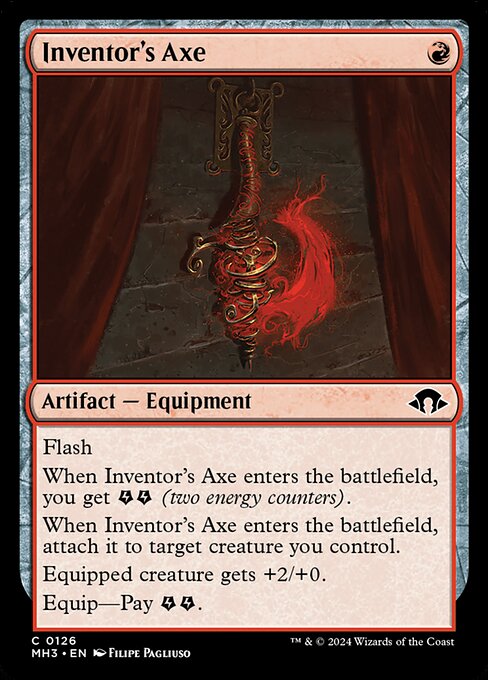
142. Inventor's Axe
Rating5.7PlayableWhy this rating?
Good playable that always makes the cut (5.7/10).
Why. A one-mana Equipment with flash: it attaches to a creature you control when it enters and gives +2/+0, so it can win a combat by surprise. It also gives you two energy counters.
Risks. The energy you get pays for only one re-equip afterwards, so you need other sources to move it often. It does nothing to protect the creature from removal.
In the draft. A good card for an aggressive red deck with plenty of creatures. Take it in the middle of the pack, especially with other energy cards.
Results in the games of the set
When it is in hand, the deck wins 54.7% of its games (set average: 56.2%, 169th of 298 cards).
In the opening hand: 55.2% wins (55.6% on average).
Drawn during the game: 54.3% (56.7% on average).
When it is drawn, the deck wins 0.8 points less than when it is not.
When it is drafted, it is played 35% of the time (set average: 67%).
Taken among the first three picks (113 drafts), it ends in the deck 70% of the time.
It is played mostly in B/R decks (42% of them) and R/W (29%).
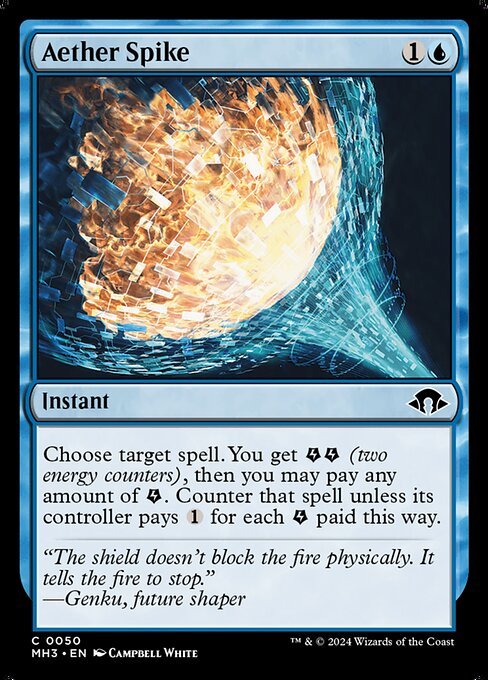
143. Aether Spike
Rating5.6PlayableWhy this rating?
Good playable that always makes the cut (5.6/10).
Why. A two-mana counterspell: you get two energy counters, then pay as many as you like, and the opponent must pay one mana for each one you paid. Against an opponent who has spent almost all their mana, it does the job.
Risks. A conditional counter: if the opponent has enough spare mana, they pay. Holding two mana open for it also leaves your own turn empty.
In the draft. A reasonable counterspell for a blue control deck that is happy to pass with mana open.
Results in the games of the set
When it is in hand, the deck wins 56.2% of its games (set average: 56.2%, 109th of 298 cards).
In the opening hand: 55.7% wins (55.6% on average).
Drawn during the game: 56.5% (56.7% on average).
When it is drawn, the deck wins 3.2 points more than when it is not.
When it is drafted, it is played 64% of the time (set average: 67%).
Taken as the first pick (117 drafts), it ends in the deck 90% of the time.
It is played mostly in R/U decks (63% of them) and U/W (55%).
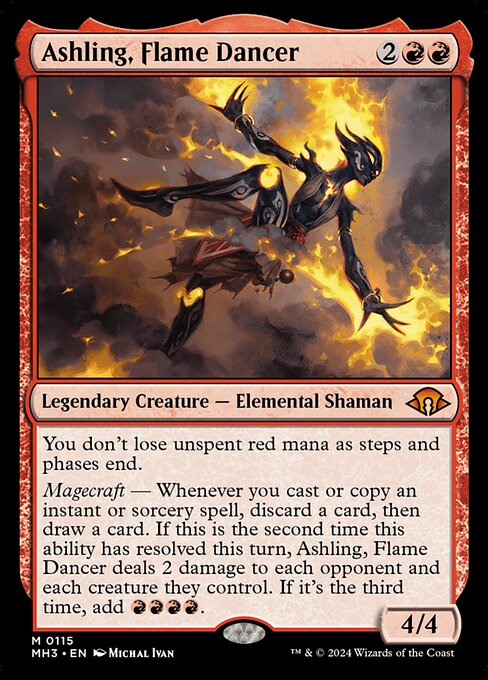 Rating5.6Playable
Why this rating?
Good playable that always makes the cut (5.6/10).
Why. A 4/4 for four mana, already a large body in red. Its magecraft ability makes you discard a card, then draw a card, each time you cast or copy an instant or sorcery; the second time in a turn it deals 2 damage to the opponent and each of their creatures.
Risks. You need plenty of instants and sorceries to use it fully, and the discard is mandatory. Without them it is a plain 4/4.
In the draft. Playable in any red deck for the body. Rate it higher only if you have lots of instants and sorceries.
Results in the games of the set
When it is in hand, the deck wins 51.6% of its games (set average: 56.2%, 245th of 298 cards).
In the opening hand: 50.8% wins (55.6% on average).
Drawn during the game: 52.1% (56.7% on average).
When it is drawn, the deck wins 1.5 points less than when it is not.
When it is drafted, it is played 70% of the time (set average: 67%).
Taken as the first pick (31 drafts), it ends in the deck 74% of the time.
It is played about as much in every archetype.

145. Deep Analysis
Rating5.6PlayableWhy this rating?
Good playable that always makes the cut (5.6/10).
Why. A sorcery that draws two cards for four mana, and you can cast it again from the graveyard for two mana, one of them blue, and 3 life. That is four cards from a single card.
Risks. It does nothing on the battlefield, and the life you pay matters against an aggressive deck. It is slow if you need to hold the board.
In the draft. A good value card for a blue control deck. Take it mid-pack, after your removal.
Results in the games of the set
When it is in hand, the deck wins 56.5% of its games (set average: 56.2%, 96th of 298 cards).
In the opening hand: 52.9% wins (55.6% on average).
Drawn during the game: 58.6% (56.7% on average).
When it is drawn, the deck wins 4.0 points more than when it is not.
When it is drafted, it is played 72% of the time (set average: 67%).
Taken as the first pick (88 drafts), it ends in the deck 88% of the time.
It is played mostly in B/U decks (34% of them).

146. Dog Umbra
Rating5.6PlayableWhy this rating?
Good playable that always makes the cut (5.6/10).
Why. A two-mana Aura with flash. On an opposing creature it stops it from attacking and blocking, which makes it cheap removal. On your own creature, umbra armor protects it from destruction.
Risks. The enchanted creature keeps its abilities, so it does not answer creatures that have a useful effect without attacking. It loses value if the opponent can sacrifice or bounce the creature.
In the draft. A good removal spell for a white deck. Take it fairly high, especially in an aggressive deck.
Results in the games of the set
When it is in hand, the deck wins 55.9% of its games (set average: 56.2%, 119th of 298 cards).
In the opening hand: 55.0% wins (55.6% on average).
Drawn during the game: 56.6% (56.7% on average).
When it is drawn, the deck wins 0.8 points less than when it is not.
When it is drafted, it is played 79% of the time (set average: 67%).
Taken as the first pick (155 drafts), it ends in the deck 92% of the time.
It is played mostly in R/W decks (56% of them) and B/W (55%).

147. Emissary of Soulfire
Rating5.6PlayableWhy this rating?
Good playable that always makes the cut (5.6/10).
Why. A 1/4 that gives three energy counters when it enters, enough to put an exalted counter on a creature. When it attacks alone it gets +1/+1 for each instance of exalted you control. The sturdy body holds the ground meanwhile.
Risks. You have to attack with a single creature, which limits the plan. It is two colors, and a power of 1 does nothing on offense.
In the draft. Playable in a white-blue deck built around energy. Take it mid-pack, not over simpler creatures.
Results in the games of the set
When it is in hand, the deck wins 54.1% of its games (set average: 56.2%, 190th of 298 cards).
In the opening hand: 53.4% wins (55.6% on average).
Drawn during the game: 54.6% (56.7% on average).
When it is drawn, the deck wins 0.6 points less than when it is not.
When it is drafted, it is played 58% of the time (set average: 67%).
Taken as the first pick (65 drafts), it ends in the deck 88% of the time.
It is played mostly in U/W decks (52% of them).

148. Foreboding Landscape
Rating5.6PlayableWhy this rating?
Good playable that always makes the cut (5.6/10).
Why. A land that makes colorless mana and can be sacrificed to fetch a basic Swamp, Forest, or Island tapped. It fixes colors, and you can cycle it by paying one mana of each of the three colors when you no longer need it.
Risks. It gives no colored mana: sacrificing it costs you tempo. The cycling cost needs three exact colors, so it is hard to use early.
In the draft. Play it if you are in two of the colors involved. Take it late, but it beats a basic land in a two- or three-color deck.
Results in the games of the set
When it is in hand, the deck wins 55.6% of its games (set average: 56.2%, 138th of 298 cards).
In the opening hand: 55.2% wins (55.6% on average).
Drawn during the game: 55.9% (56.7% on average).
When it is drawn, the deck wins 1.8 points more than when it is not.
When it is drafted, it is played 83% of the time (set average: 67%).
Taken as the first pick (63 drafts), it ends in the deck 95% of the time.

149. Hexgold Slith
Rating5.6PlayableWhy this rating?
Good playable that always makes the cut (5.6/10).
Why. A two-mana 2/1 that gives two energy counters when it enters. Paying that energy when it attacks gives it first strike, so it beats a blocker with toughness 2 without dying. It grows each time it hits the player.
Risks. The energy pays for first strike only once. It stays a fragile 2/1 against a block or removal, and loses its edge quickly if the board is clogged.
In the draft. A good two-drop for an aggressive white deck. Take it fairly high, especially with other red or energy cards.
Results in the games of the set
When it is in hand, the deck wins 56.0% of its games (set average: 56.2%, 113th of 298 cards).
In the opening hand: 58.6% wins (55.6% on average).
Drawn during the game: 53.6% (56.7% on average).
When it is drawn, the deck wins 1.6 points less than when it is not.
When it is drafted, it is played 86% of the time (set average: 67%).
Taken as the first pick (258 drafts), it ends in the deck 93% of the time.
It is played mostly in R/W decks (71% of them) and U/W (60%).

150. Jolted Awake
Rating5.6PlayableWhy this rating?
Good playable that always makes the cut (5.6/10).
Why. A one-mana sorcery that gives you two energy counters, then returns a creature or artifact card from your graveyard to the battlefield if you pay energy equal to its mana value. It cycles for two mana.
Risks. Without other energy sources it only brings back cards with mana value 2 or less. With no target it is just an expensive cycler.
In the draft. Playable in a white deck with cheap creatures and energy. Take it fairly late.
Results in the games of the set
When it is in hand, the deck wins 55.2% of its games (set average: 56.2%, 157th of 298 cards).
In the opening hand: 54.8% wins (55.6% on average).
Drawn during the game: 55.5% (56.7% on average).
When it is drawn, the deck wins 2.3 points less than when it is not.
When it is drafted, it is played 38% of the time (set average: 67%).
Taken among the first three picks (144 drafts), it ends in the deck 72% of the time.
It is played mostly in R/W decks (39% of them) and U/W (33%).
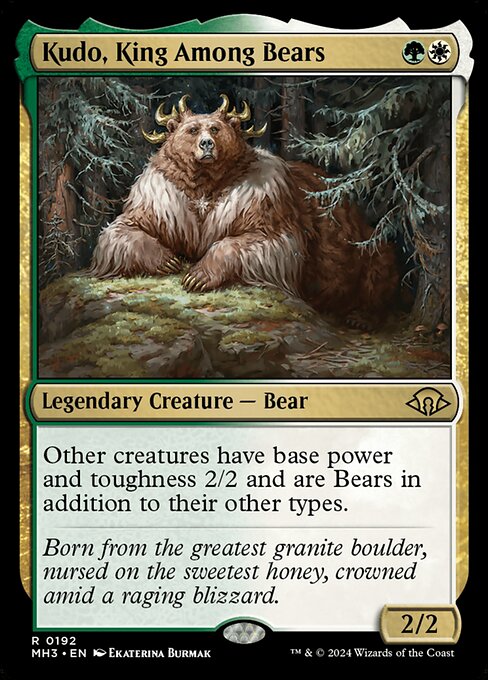 Rating5.6Playable
Why this rating?
Good playable that always makes the cut (5.6/10).
Why. A two-mana 2/2 that sets the base power and toughness of all other creatures to 2/2, including the opponent's. It shrinks their big threats and lifts your small creatures.
Risks. It also weakens your own big creatures, and removal makes the effect vanish. It needs two exact colors, which makes it inflexible.
In the draft. A niche card for a green-white deck of small creatures. Take it late; it needs a specific plan.
Results in the games of the set
When it is in hand, the deck wins 53.1% of its games (set average: 56.2%, 212th of 298 cards).
In the opening hand: 53.9% wins (55.6% on average).
Drawn during the game: 52.4% (56.7% on average).
When it is drawn, the deck wins 2.1 points less than when it is not.
When it is drafted, it is played 34% of the time (set average: 67%).
Taken among the first three picks (55 drafts), it ends in the deck 78% of the time.
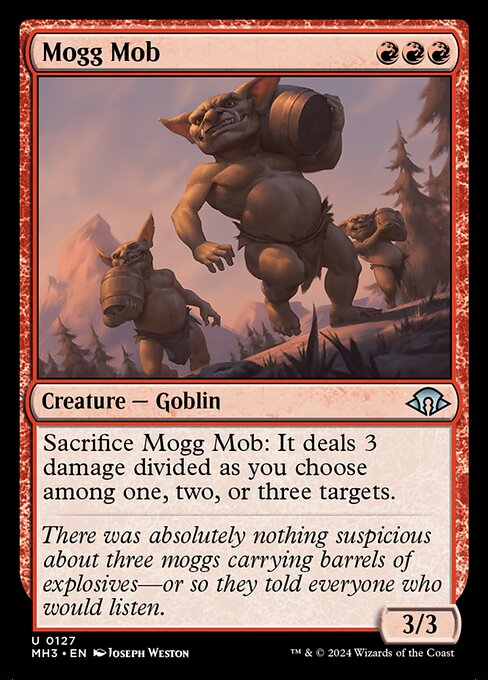
152. Mogg Mob
Rating5.6PlayableWhy this rating?
Good playable that always makes the cut (5.6/10).
Why. A 3/3 for three red mana that can sacrifice itself to deal 3 damage divided as you choose among one, two, or three targets. It is a good body that turns into removal when threatened.
Risks. Three red mana on turn three: it fits poorly in a balanced two-color deck. Sacrificing it costs you the body, and the ability is wasted without good targets.
In the draft. A good addition for a heavy red deck. Take it fairly high, but only play it if red is your main color.
Results in the games of the set
When it is in hand, the deck wins 54.4% of its games (set average: 56.2%, 179th of 298 cards).
In the opening hand: 53.1% wins (55.6% on average).
Drawn during the game: 55.5% (56.7% on average).
When it is drawn, the deck wins 0.7 points less than when it is not.
When it is drafted, it is played only 13% of the time (set average: 67%): it almost always ends in the sideboard.

153. Seething Landscape
Rating5.6PlayableWhy this rating?
Good playable that always makes the cut (5.6/10).
Why. A land that makes colorless mana and can be sacrificed to fetch a basic Island, Swamp, or Mountain tapped. It fixes colors, and you can cycle it by paying one mana of each of the three colors when you no longer need it.
Risks. It gives no colored mana: sacrificing it costs you tempo. The cycling cost needs three exact colors, so it is hard to use early.
In the draft. Play it if you are in two of the colors involved. Take it late, but it beats a basic land in a three-color deck.
Results in the games of the set
When it is in hand, the deck wins 55.7% of its games (set average: 56.2%, 130th of 298 cards).
In the opening hand: 55.5% wins (55.6% on average).
Drawn during the game: 55.8% (56.7% on average).
When it is drawn, the deck wins 1.9 points more than when it is not.
When it is drafted, it is played 81% of the time (set average: 67%).
Taken as the first pick (61 drafts), it ends in the deck 90% of the time.
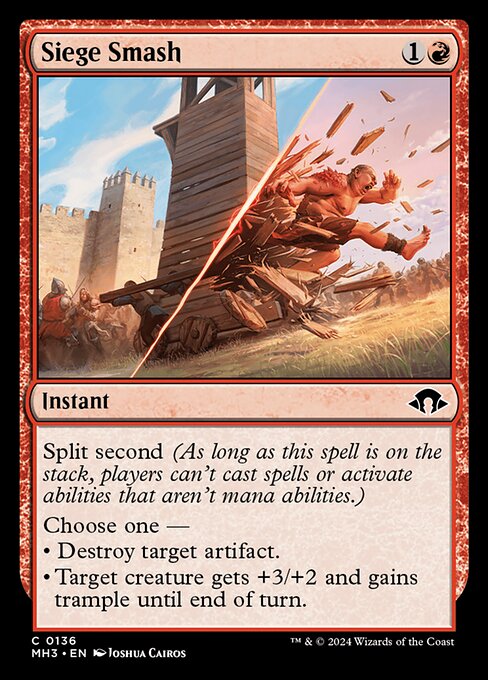
154. Siege Smash
Rating5.6PlayableWhy this rating?
Good playable that always makes the cut (5.6/10).
Why. A two-mana instant with split second and two modes: destroy an artifact, or give a creature +3/+2 and trample. Nobody can respond, so the pump wins a combat with no risk of an answer.
Risks. Both modes are situational: the artifact mode depends on what the opponent plays, and the pump only lasts until end of turn.
In the draft. A good combat trick for an aggressive red deck. Take it mid-pack.
Results in the games of the set
When it is in hand, the deck wins 55.2% of its games (set average: 56.2%, 156th of 298 cards).
In the opening hand: 54.6% wins (55.6% on average).
Drawn during the game: 55.7% (56.7% on average).
When it is drawn, the deck wins 1.9 points less than when it is not.
When it is drafted, it is played 35% of the time (set average: 67%).
Taken among the first three picks (76 drafts), it ends in the deck 66% of the time.
It is played mostly in G/R decks (32% of them) and R/W (31%).

155. Solstice Zealot
Rating5.6PlayableWhy this rating?
Good playable that always makes the cut (5.6/10).
Why. A 2/3 for three mana that gives two energy counters when it enters. Each energy lets you tap a creature: twice to slow an attack or to open the way for your own attackers.
Risks. The energy is limited: after two uses it is a plain 2/3. It taps to use the ability, and it does not answer a big creature, only slows it.
In the draft. A good common creature for a white deck. Take it fairly high, especially in an aggressive deck.
Results in the games of the set
When it is in hand, the deck wins 56.6% of its games (set average: 56.2%, 86th of 298 cards).
In the opening hand: 56.9% wins (55.6% on average).
Drawn during the game: 56.4% (56.7% on average).
When it is drawn, the deck wins 1.5 points less than when it is not.
When it is drafted, it is played 71% of the time (set average: 67%).
Taken as the first pick (114 drafts), it ends in the deck 94% of the time.
It is played mostly in R/W decks (66% of them) and U/W (57%).

156. Tranquil Landscape
Rating5.6PlayableWhy this rating?
Good playable that always makes the cut (5.6/10).
Why. A land that makes colorless mana and can be sacrificed to fetch a basic Forest, Plains, or Island tapped. It fixes colors, and you can cycle it by paying one mana of each of the three colors when you no longer need it.
Risks. It gives no colored mana: sacrificing it costs you tempo. The cycling cost needs three exact colors, so it is hard to use early.
In the draft. Play it if you are in two of the colors involved. Take it late, but it beats a basic land in a three-color deck.
Results in the games of the set
When it is in hand, the deck wins 55.5% of its games (set average: 56.2%, 142nd of 298 cards).
In the opening hand: 55.7% wins (55.6% on average).
Drawn during the game: 55.2% (56.7% on average).
When it is drawn, the deck wins 1.0 points more than when it is not.
When it is drafted, it is played 80% of the time (set average: 67%).
Taken as the first pick (37 drafts), it ends in the deck 86% of the time.
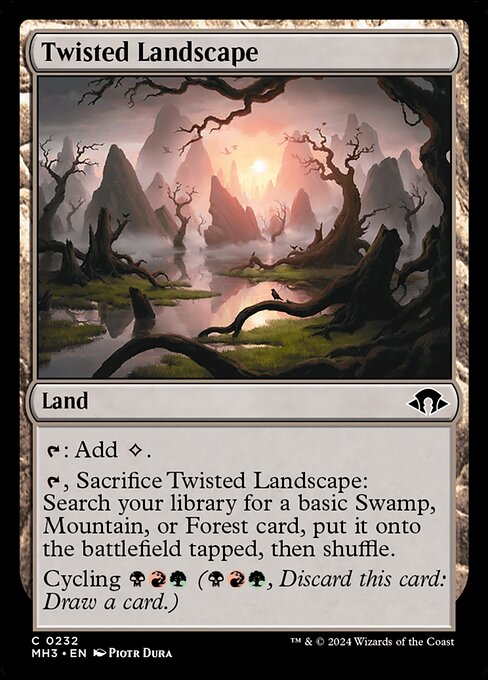
157. Twisted Landscape
Rating5.6PlayableWhy this rating?
Good playable that always makes the cut (5.6/10).
Why. A land that makes colorless mana and can be sacrificed to fetch a basic Swamp, Mountain, or Forest tapped. It fixes colors, and you can cycle it by paying one mana of each of the three colors when you no longer need it.
Risks. It gives no colored mana: sacrificing it costs you tempo. The cycling cost needs three exact colors, so it is hard to use early.
In the draft. Play it if you are in two of the colors involved. Take it late, but it beats a basic land in a three-color deck.
Results in the games of the set
When it is in hand, the deck wins 55.5% of its games (set average: 56.2%, 140th of 298 cards).
In the opening hand: 56.3% wins (55.6% on average).
Drawn during the game: 54.9% (56.7% on average).
When it is drawn, the deck wins 0.5 points more than when it is not.
When it is drafted, it is played 83% of the time (set average: 67%).
Taken as the first pick (71 drafts), it ends in the deck 90% of the time.

158. Tempest Harvester
Rating5.5PlayableWhy this rating?
Good playable that always makes the cut (5.5/10).
Why. A two-mana 2/1 that gives two energy counters when it enters. Paying energy lets it loot: draw then discard, twice in all. It smooths your draws and fills the graveyard.
Risks. A 2/1 body that blocks poorly. Once the energy is spent it does nothing special.
In the draft. A passable filler creature in blue. Take it late, in a deck with other energy cards.
Results in the games of the set
When it is in hand, the deck wins 55.6% of its games (set average: 56.2%, 136th of 298 cards).
In the opening hand: 54.9% wins (55.6% on average).
Drawn during the game: 56.1% (56.7% on average).
When it is drawn, the deck wins 2.4 points more than when it is not.
When it is drafted, it is played 67% of the time (set average: 67%).
Taken as the first pick (108 drafts), it ends in the deck 88% of the time.
It is played mostly in B/U decks (68% of them) and R/U (64%).

159. Strength of the Harvest // Haven of the Harvest
Rating5.5PlayableWhy this rating?
A solid playable that rarely gets cut (5.5/10).
Why. A flexible spell-or-land card: an Aura giving +1/+1 for each creature and enchantment you control, itself included, or a tapped land that taps for green or white. You always have a use, early or late.
Risks. On the Aura side you can lose two cards if the creature is killed in response. The land side enters tapped, which is awkward in a fast hand.
In the draft. A good late-deck choice in green or white: it replaces a land without costing a spell slot. Take it mid-pack.
Results in the games of the set
When it is in hand, the deck wins 55.7% of its games (set average: 56.2%, 129th of 298 cards).
In the opening hand: 55.6% wins (55.6% on average).
Drawn during the game: 55.8% (56.7% on average).
When it is drawn, the deck wins 0.1 points less than when it is not.
When it is drafted, it is played 88% of the time (set average: 67%).
Taken as the first pick (98 drafts), it ends in the deck 94% of the time.
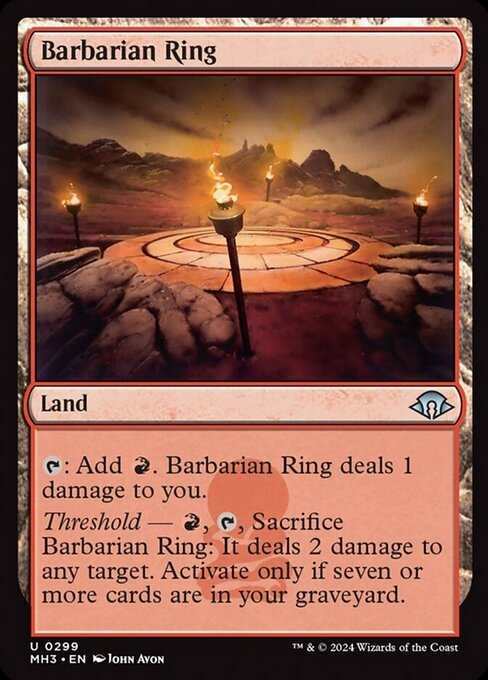
160. Barbarian Ring
Rating5.4PlayableWhy this rating?
A solid playable that rarely gets cut (5.4/10).
Why. A land that taps for red mana and deals 1 damage to you, and can be sacrificed with a red mana to deal 2 damage to any target once you have seven or more cards in your graveyard. A small late removal.
Risks. The seven-card threshold arrives late. Every red mana costs you life, which hurts against an aggressive deck, and the land fixes no other color.
In the draft. A decent utility land if you are red. Take it late; it replaces a basic land at no spell-slot cost.
Results in the games of the set
When it is in hand, the deck wins 53.1% of its games (set average: 56.2%, 213th of 298 cards).
In the opening hand: 53.2% wins (55.6% on average).
Drawn during the game: 53.1% (56.7% on average).
When it is drawn, the deck wins 2.8 points less than when it is not.
When it is drafted, it is played 18% of the time (set average: 67%).

161. Bespoke Battlewagon
Rating5.4PlayableWhy this rating?
A solid playable that rarely gets cut (5.4/10).
Why. A 5/6 Vehicle that makes energy when it taps, then lets you spend that energy to tap a creature or draw a card. It has several uses without attacking, and can become a creature by paying four energy.
Risks. Every ability requires tapping it, so only one use per turn. It takes several turns to build energy, and it is an artifact that is easy to destroy.
In the draft. A middle-of-the-deck choice for a blue energy deck, ideally with creatures big enough to crew it. Take it without hurry.
Results in the games of the set
When it is in hand, the deck wins 54.6% of its games (set average: 56.2%, 173rd of 298 cards).
In the opening hand: 52.2% wins (55.6% on average).
Drawn during the game: 56.1% (56.7% on average).
When it is drawn, the deck wins 2.2 points more than when it is not.
When it is drafted, it is played 63% of the time (set average: 67%).
Taken as the first pick (76 drafts), it ends in the deck 80% of the time.
It is played mostly in R/U decks (46% of them) and U/W (40%).
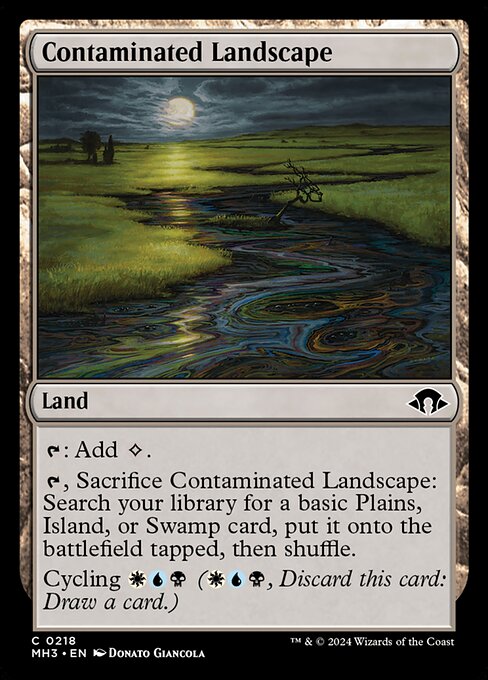 Rating5.4Playable
Why this rating?
A solid playable that rarely gets cut (5.4/10).
Why. A land that makes colorless mana and can be sacrificed to fetch a basic Plains, Island, or Swamp tapped. It fixes colors, and you can cycle it by paying one mana of each of the three colors when you no longer need it.
Risks. It gives no colored mana: sacrificing it costs you tempo. The cycling cost needs three exact colors, so it is hard to use early.
In the draft. Play it if you are in two of the colors involved. Take it late, but it beats a basic land in a three-color deck.
Results in the games of the set
When it is in hand, the deck wins 55.4% of its games (set average: 56.2%, 144th of 298 cards).
In the opening hand: 54.7% wins (55.6% on average).
Drawn during the game: 55.9% (56.7% on average).
When it is drawn, the deck wins 2.2 points more than when it is not.
When it is drafted, it is played 71% of the time (set average: 67%).
Taken as the first pick (35 drafts), it ends in the deck 89% of the time.

163. Deceptive Landscape
Rating5.4PlayableWhy this rating?
A solid playable that rarely gets cut (5.4/10).
Why. A land that makes colorless mana and can be sacrificed to fetch a basic Plains, Swamp, or Forest tapped. It fixes colors, and you can cycle it by paying one mana of each of the three colors when you no longer need it.
Risks. It gives no colored mana: sacrificing it costs you tempo. The cycling cost needs three exact colors, so it is hard to use early.
In the draft. Play it if you are in two of the colors involved. Take it late, but it beats a basic land in a three-color deck.
Results in the games of the set
When it is in hand, the deck wins 54.2% of its games (set average: 56.2%, 186th of 298 cards).
In the opening hand: 54.6% wins (55.6% on average).
Drawn during the game: 53.9% (56.7% on average).
When it is drawn, the deck wins 0.6 points more than when it is not.
When it is drafted, it is played 69% of the time (set average: 67%).
Taken as the first pick (31 drafts), it ends in the deck 94% of the time.
 Rating5.4Playable
Why this rating?
A solid playable that rarely gets cut (5.4/10).
Why. A 2/3 for three that grows with Outlast and gives lifelink to your modified creatures. It rewards counters, Auras, and Equipment, and becomes modified itself once it has a counter.
Risks. Outlast is slow and taps the creature. Without ways to modify your creatures, the lifelink does very little.
In the draft. A good support card in a white deck with Auras, Equipment, or counters. Otherwise take it late.
Results in the games of the set
When it is in hand, the deck wins 54.0% of its games (set average: 56.2%, 195th of 298 cards).
In the opening hand: 54.0% wins (55.6% on average).
Drawn during the game: 54.0% (56.7% on average).
When it is drawn, the deck wins 1.6 points less than when it is not.
When it is drafted, it is played 78% of the time (set average: 67%).
Taken as the first pick (86 drafts), it ends in the deck 90% of the time.
It is played mostly in B/W decks (34% of them) and G/W (29%).
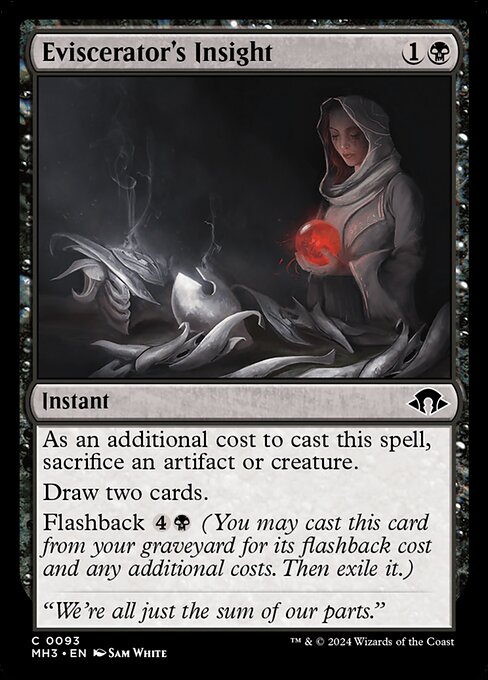 Rating5.4Playable
Why this rating?
A solid playable that rarely gets cut (5.4/10).
Why. A two-mana instant that draws two cards for sacrificing an artifact or creature. It can be flashed back from the graveyard for five mana, with another sacrifice: a good value engine.
Risks. The sacrifice is a real cost: without tokens or small creatures it costs you a useful card. The flashback cost is high.
In the draft. A good late-pack pick for a black deck with Eldrazi Spawn, tokens, or creatures that still give value when they die. Otherwise let it go.
Results in the games of the set
When it is in hand, the deck wins 55.9% of its games (set average: 56.2%, 121st of 298 cards).
In the opening hand: 52.5% wins (55.6% on average).
Drawn during the game: 58.0% (56.7% on average).
When it is drawn, the deck wins 2.6 points more than when it is not.
When it is drafted, it is played 64% of the time (set average: 67%).
Taken as the first pick (100 drafts), it ends in the deck 92% of the time.
It is played mostly in B/U decks (78% of them) and B/R (53%).

166. Gift of the Viper
Rating5.4PlayableWhy this rating?
A solid playable that rarely gets cut (5.4/10).
Why. A one-mana instant: a creature gets a +1/+1 counter, a reach counter, and a deathtouch counter, then untaps. The counters stay, and deathtouch on defense swings a block.
Risks. A combat trick that loses a card if the creature is killed in response. It does nothing without a creature on the battlefield.
In the draft. A good one-mana trick for a green deck. Take it mid-pack, especially in an aggressive or combat-heavy deck.
Results in the games of the set
When it is in hand, the deck wins 55.7% of its games (set average: 56.2%, 133rd of 298 cards).
In the opening hand: 54.5% wins (55.6% on average).
Drawn during the game: 56.5% (56.7% on average).
When it is drawn, the deck wins 1.5 points more than when it is not.
When it is drafted, it is played 53% of the time (set average: 67%).
Taken among the first three picks (119 drafts), it ends in the deck 77% of the time.
It is played mostly in B/G decks (44% of them) and G/R (37%).

167. Glasswing Grace // Age-Graced Chapel
Rating5.4PlayableWhy this rating?
A solid playable that rarely gets cut (5.4/10).
Why. A spell-or-land card: an Aura that gives a creature +2/+2, flying, and lifelink, or a tapped land that taps for white or black. A creature with this Aura quickly becomes an aerial threat that gains life.
Risks. Five mana for an Aura: you lose two cards if the creature is killed in response. The land side enters tapped.
In the draft. A good late-deck choice for white or black: it replaces a land without costing a spell slot. Take it mid-pack.
Results in the games of the set
When it is in hand, the deck wins 55.7% of its games (set average: 56.2%, 134th of 298 cards).
In the opening hand: 54.0% wins (55.6% on average).
Drawn during the game: 57.0% (56.7% on average).
When it is drawn, the deck wins 1.5 points more than when it is not.
When it is drafted, it is played 90% of the time (set average: 67%).
Taken as the first pick (128 drafts), it ends in the deck 97% of the time.

168. Kappa Cannoneer
Rating5.4PlayableWhy this rating?
A solid playable that rarely gets cut (5.4/10).
Why. A 4/4 with ward 4 that grows and becomes unblockable that turn each time it or another artifact you control enters. With artifacts around it costs far less than six mana thanks to improvise.
Risks. Six mana with no artifacts is slow. In a deck without them it triggers only once, when it enters.
In the draft. A finisher for a blue deck full of artifacts. Otherwise take it late.
Results in the games of the set
When it is in hand, the deck wins 54.3% of its games (set average: 56.2%, 181st of 298 cards).
In the opening hand: 52.3% wins (55.6% on average).
Drawn during the game: 55.6% (56.7% on average).
When it is drawn, the deck wins 4.4 points more than when it is not.
When it is drafted, it is played 66% of the time (set average: 67%).
Taken as the first pick (39 drafts), it ends in the deck 67% of the time.
It is played about as much in every archetype.
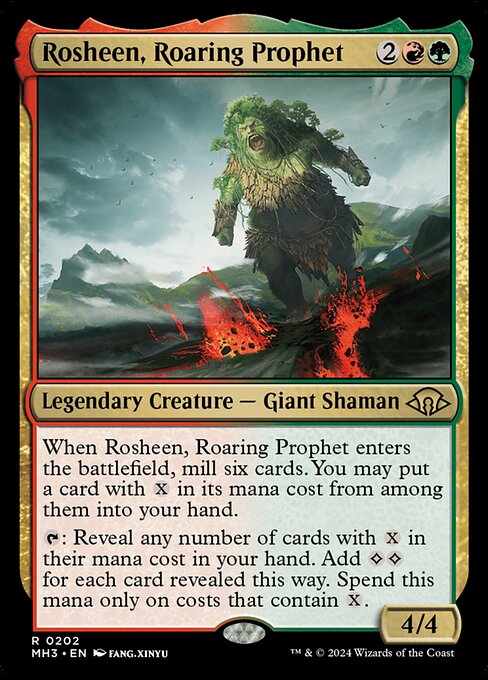 Rating5.4Playable
Why this rating?
A solid playable that rarely gets cut (5.4/10).
Why. A 4/4 for four mana that holds the ground. Entering mills six cards and may fetch one with X in its cost; its mana can only pay costs that contain X.
Risks. Without X cards in your deck, half the text does nothing and you are left with a decent body. It is legendary and has no evasion.
In the draft. A fine playable in red-green, not a card to force. Only pick it early if you already have several X spells.
Results in the games of the set
When it is in hand, the deck wins 52.6% of its games (set average: 56.2%, 222nd of 298 cards).
In the opening hand: 51.4% wins (55.6% on average).
Drawn during the game: 53.5% (56.7% on average).
When it is drawn, the deck wins 0.8 points less than when it is not.
When it is drafted, it is played only 9% of the time (set average: 67%): it almost always ends in the sideboard.

170. Rush of Inspiration // Crackling Falls
Rating5.4PlayableWhy this rating?
A solid playable that rarely gets cut (5.4/10).
Why. Drawing two at instant speed for three mana is good value, and the land face means it never rots in hand. As a land it enters tapped and makes blue or red, so it often replaces a land slot.
Risks. Unless you pay two energy, you discard a random card, sometimes your best one. The hybrid cost needs two blue or red mana.
In the draft. A blue-red deck pick and its variants. Take it without rush: it doubles as a fixing land when you need one.
Results in the games of the set
When it is in hand, the deck wins 55.3% of its games (set average: 56.2%, 150th of 298 cards).
In the opening hand: 54.6% wins (55.6% on average).
Drawn during the game: 55.8% (56.7% on average).
When it is drawn, the deck wins 0.8 points more than when it is not.
When it is drafted, it is played 82% of the time (set average: 67%).
Taken as the first pick (69 drafts), it ends in the deck 91% of the time.

171. Shattered Landscape
Rating5.4PlayableWhy this rating?
A solid playable that rarely gets cut (5.4/10).
Why. A fixing land for red, white and black: it sacrifices to fetch a basic Mountain, Plains or Swamp tapped. When flooding, cycling turns it into a fresh card.
Risks. It taps for colorless mana and the fetch costs tempo since the land arrives tapped. Cycling needs all three colors.
In the draft. Play it once you are in two of those three colors, red-white especially. Take it late, it is a utility land.
Results in the games of the set
When it is in hand, the deck wins 54.9% of its games (set average: 56.2%, 165th of 298 cards).
In the opening hand: 55.9% wins (55.6% on average).
Drawn during the game: 54.0% (56.7% on average).
When it is drawn, the deck wins 0.1 points less than when it is not.
When it is drafted, it is played 73% of the time (set average: 67%).
Taken as the first pick (36 drafts), it ends in the deck 83% of the time.

172. Sundering Eruption // Volcanic Fissure
Rating5.4PlayableWhy this rating?
A solid playable that rarely gets cut (5.4/10).
Why. Mostly a red land that can enter untapped by paying 3 life. As a sorcery, destroying a land while stopping non-flyers from blocking can set up one big attack.
Risks. The sorcery is rarely good: the opponent may search for a basic land in return. It is a tempo play, not removal.
In the draft. A land for red decks with an occasional finisher mode. Do not take it for the spell side.
Results in the games of the set
When it is in hand, the deck wins 55.9% of its games (set average: 56.2%, 120th of 298 cards).
In the opening hand: 55.0% wins (55.6% on average).
Drawn during the game: 56.6% (56.7% on average).
When it is drawn, the deck wins 1.7 points less than when it is not.
When it is drafted, it is played 86% of the time (set average: 67%).
Taken as the first pick (68 drafts), it ends in the deck 97% of the time.
 Rating5.3Playable
Why this rating?
A solid playable that rarely gets cut (5.3/10).
Why. A 1/3 deathtouch for three mana: it trades with or deters almost any attacker. Later, its five-mana drain gives you a way to close the game.
Risks. It does not attack well and the drain is pricey unless you drew three cards this turn, when it is free. Removal handles it.
In the draft. A good defensive common, especially in blue-black. Take it as a solid three-drop.
Results in the games of the set
When it is in hand, the deck wins 56.2% of its games (set average: 56.2%, 105th of 298 cards).
In the opening hand: 51.8% wins (55.6% on average).
Drawn during the game: 58.7% (56.7% on average).
When it is drawn, the deck wins 4.3 points more than when it is not.
When it is drafted, it is played 54% of the time (set average: 67%).
Taken as the first pick (78 drafts), it ends in the deck 87% of the time.
It is played mostly in B/U decks (70% of them).
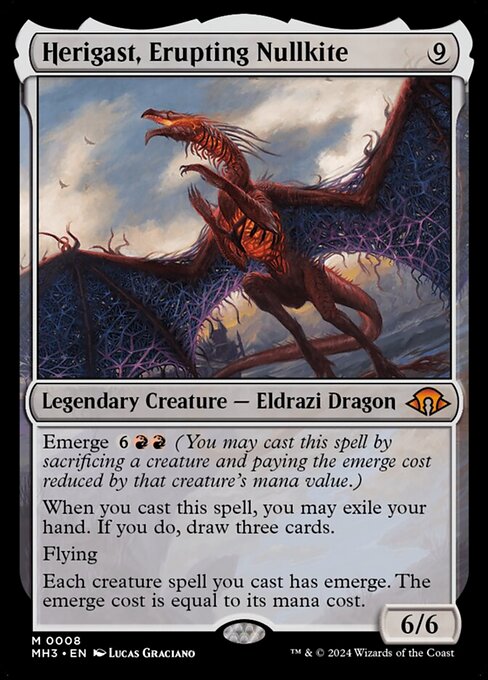
174. Herigast, Erupting Nullkite
Rating5.3PlayableWhy this rating?
A solid playable that rarely gets cut (5.3/10).
Why. A 6/6 flier, but at nine mana unless you emerge by sacrificing a creature. When you cast it you may exile your hand to draw three, and while it is out each creature spell you cast has emerge.
Risks. Nine mana, or eight including two red, reduced by the sacrificed creature's mana value: slow and costly. Exiling your hand costs real cards.
In the draft. A slow-deck finisher, ideally red. Do not take it early, since most decks want cheaper cards.
Results in the games of the set
When it is in hand, the deck wins 52.5% of its games (set average: 56.2%, 225th of 298 cards).
In the opening hand: 50.6% wins (55.6% on average).
Drawn during the game: 53.8% (56.7% on average).
When it is drawn, the deck wins 0.4 points more than when it is not.
When it is drafted, it is played 85% of the time (set average: 67%).
Taken as the first pick (40 drafts), it ends in the deck 83% of the time.
It is played about as much in every archetype.
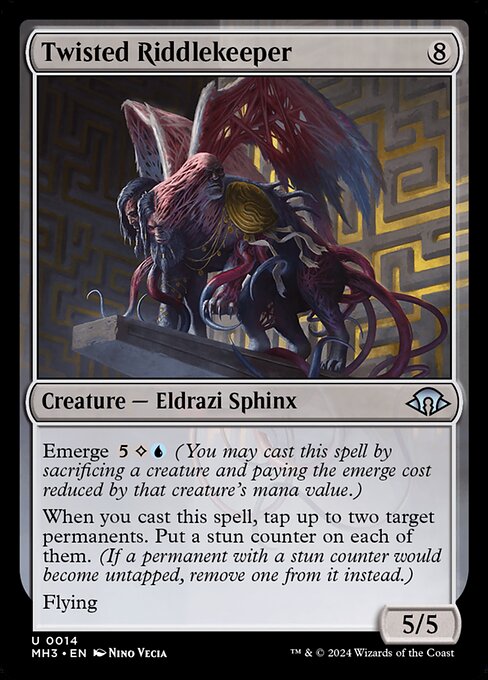
175. Twisted Riddlekeeper
Rating5.2PlayableWhy this rating?
A solid playable that rarely gets cut (5.2/10).
Why. A 5/5 flier whose cast trigger taps up to two permanents and puts a stun counter on each. Sacrificing a creature to emerge brings its cost well under eight.
Risks. Emerge needs colorless mana, and the full cost is huge. With no creature to sacrifice you wait a long time.
In the draft. A finisher for blue decks with colorless sources. Take it mid-pack, not above core playables.
Results in the games of the set
When it is in hand, the deck wins 56.4% of its games (set average: 56.2%, 99th of 298 cards).
In the opening hand: 52.2% wins (55.6% on average).
Drawn during the game: 59.0% (56.7% on average).
When it is drawn, the deck wins 3.4 points more than when it is not.
When it is drafted, it is played 86% of the time (set average: 67%).
Taken as the first pick (145 drafts), it ends in the deck 91% of the time.
It is played mostly in G/U decks (27% of them) and B/U (26%).

176. Cephalid Coliseum
Rating5.2PlayableWhy this rating?
A solid playable that rarely gets cut (5.2/10).
Why. A blue land that hurts you for 1 on each tap but offers a late-game filter: draw three, discard three. It replaces a basic in a deck that fills its graveyard.
Risks. The pain adds up and threshold needs seven cards in the graveyard. In a slow deck it is just a land that hurts.
In the draft. A last-slot land for blue decks that fill the graveyard. Not a card to take early.
Results in the games of the set
When it is in hand, the deck wins 51.8% of its games (set average: 56.2%, 238th of 298 cards).
In the opening hand: 48.4% wins (55.6% on average).
Drawn during the game: 53.8% (56.7% on average).
When it is drawn, the deck wins 1.3 points more than when it is not.
When it is drafted, it is played only 13% of the time (set average: 67%): it almost always ends in the sideboard.

177. Disciple of Freyalise // Garden of Freyalise
Rating5.2PlayableWhy this rating?
A solid playable that rarely gets cut (5.2/10).
Why. Mostly valuable as a green land that enters untapped for 3 life. As a six-mana creature, sacrificing another creature gains life and draws cards equal to that creature's power.
Risks. Three green mana in the cost makes the creature side hard outside a heavy-green deck. The sacrifice costs a card for variable gain.
In the draft. A good green include as a land that can become a spell. Take it without hurry.
Results in the games of the set
When it is in hand, the deck wins 55.9% of its games (set average: 56.2%, 124th of 298 cards).
In the opening hand: 54.5% wins (55.6% on average).
Drawn during the game: 57.0% (56.7% on average).
When it is drawn, the deck wins 0.6 points more than when it is not.
When it is drafted, it is played 88% of the time (set average: 67%).
Taken as the first pick (85 drafts), it ends in the deck 98% of the time.

178. Drowner of Truth // Drowned Jungle
Rating5.2PlayableWhy this rating?
A solid playable that rarely gets cut (5.2/10).
Why. A big 7/6 threat whose cast trigger makes two 0/1 colorless Eldrazi Spawn creature tokens when colorless mana was spent. If you do not need it, it is a tapped green-blue land that fixes.
Risks. Seven mana, and it has no evasion or protection. The trigger needs colorless mana spent to cast it.
In the draft. A good green-blue pick that works as a land and a finisher. Take it mid-pack.
Results in the games of the set
When it is in hand, the deck wins 55.8% of its games (set average: 56.2%, 127th of 298 cards).
In the opening hand: 54.4% wins (55.6% on average).
Drawn during the game: 56.8% (56.7% on average).
When it is drawn, the deck wins 2.1 points more than when it is not.
When it is drafted, it is played 91% of the time (set average: 67%).
Taken as the first pick (119 drafts), it ends in the deck 94% of the time.

179. Flare of Fortitude
Rating5.2PlayableWhy this rating?
A solid playable that rarely gets cut (5.2/10).
Why. Mass protection for one turn: your life total can't change and your permanents gain hexproof and indestructible. It can blank a big opposing turn.
Risks. Very situational and does nothing offensive. Sacrificing a nontoken white creature is costly, and so are four mana.
In the draft. Sideboard fodder in most decks. Only take it if you are short on playables.
Results in the games of the set
When it is in hand, the deck wins 51.2% of its games (set average: 56.2%, 252nd of 298 cards).
In the opening hand: 50.9% wins (55.6% on average).
Drawn during the game: 51.4% (56.7% on average).
When it is drawn, the deck wins 2.6 points less than when it is not.
When it is drafted, it is played only 10% of the time (set average: 67%): it almost always ends in the sideboard.
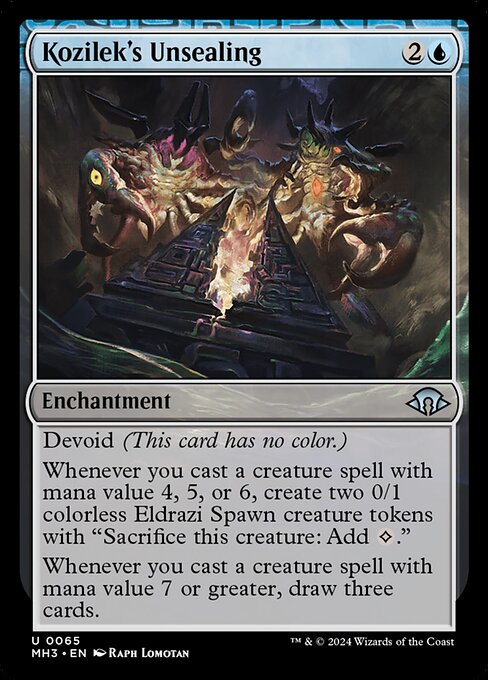
180. Kozilek's Unsealing
Rating5.2PlayableWhy this rating?
A solid playable that rarely gets cut (5.2/10).
Why. A ramp enchantment for big-creature decks: each creature spell you cast with mana value four to six makes two Eldrazi Spawn creature tokens, and seven or more draws three.
Risks. It does nothing alone and needs a deck full of expensive creatures. Early on it does not affect the board.
In the draft. Play it in slow blue-green decks with many expensive creatures. Otherwise leave it.
Results in the games of the set
When it is in hand, the deck wins 52.7% of its games (set average: 56.2%, 220th of 298 cards).
In the opening hand: 52.0% wins (55.6% on average).
Drawn during the game: 53.2% (56.7% on average).
When it is drawn, the deck wins 0.5 points more than when it is not.
When it is drafted, it is played 65% of the time (set average: 67%).
Taken as the first pick (69 drafts), it ends in the deck 72% of the time.
It is played mostly in R/U decks (26% of them) and G/U (25%).

181. Nyxborn Unicorn
Rating5.2PlayableWhy this rating?
A solid playable that rarely gets cut (5.2/10).
Why. A 2/2 for two with mentor that can also be cast for four mana as an Aura giving +2/+2 and mentor. That flexibility makes it a good aggressive common.
Risks. If the enchanted creature dies it becomes a creature again, so the risk is low; but the Aura costs four mana. The bare 2/2 body is ordinary.
In the draft. A good common for aggressive white decks, red-white especially. Take it without hesitation there.
Results in the games of the set
When it is in hand, the deck wins 54.9% of its games (set average: 56.2%, 166th of 298 cards).
In the opening hand: 55.6% wins (55.6% on average).
Drawn during the game: 54.2% (56.7% on average).
When it is drawn, the deck wins 2.5 points less than when it is not.
When it is drafted, it is played 75% of the time (set average: 67%).
Taken as the first pick (125 drafts), it ends in the deck 94% of the time.
It is played mostly in B/W decks (65% of them) and R/W (62%).

182. Pinnacle Monk // Mystic Peak
Rating5.2PlayableWhy this rating?
A solid playable that rarely gets cut (5.2/10).
Why. Mostly a flexible red land, entering untapped for 3 life. As a five-mana creature with prowess it returns an instant or sorcery from the graveyard to your hand for late value.
Risks. The body is a 2/2 for five, fragile and expensive. With no instant or sorcery in the graveyard, the trigger does nothing.
In the draft. A good spell-land for red decks with instants and sorceries. Take it without hurry.
Results in the games of the set
When it is in hand, the deck wins 55.9% of its games (set average: 56.2%, 122nd of 298 cards).
In the opening hand: 55.0% wins (55.6% on average).
Drawn during the game: 56.6% (56.7% on average).
When it is drawn, the deck wins 0.6 points less than when it is not.
When it is drafted, it is played 85% of the time (set average: 67%).
Taken as the first pick (83 drafts), it ends in the deck 89% of the time.
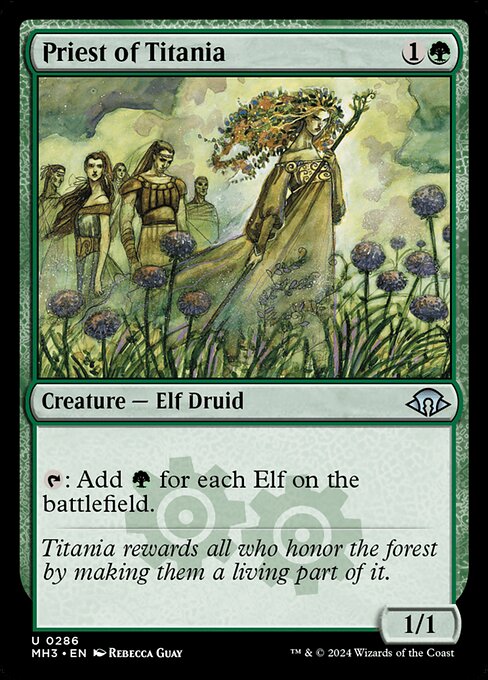
183. Priest of Titania
Rating5.2PlayableWhy this rating?
A solid playable that rarely gets cut (5.2/10).
Why. A two-mana ramp creature that taps for green for each Elf on the battlefield, including itself and the opponent's. At minimum it makes one green.
Risks. A fragile 1/1, and with no other Elves it is only one mana. It adds almost nothing late in the game.
In the draft. Play it in green with Elves or big costs. Take it mid-pack, higher in an Elf deck.
Results in the games of the set
When it is in hand, the deck wins 53.9% of its games (set average: 56.2%, 197th of 298 cards).
In the opening hand: 55.5% wins (55.6% on average).
Drawn during the game: 52.7% (56.7% on average).
When it is drawn, the deck wins 0.6 points less than when it is not.
When it is drafted, it is played 65% of the time (set average: 67%).
Taken among the first three picks (143 drafts), it ends in the deck 79% of the time.
It is played about as much in every archetype.
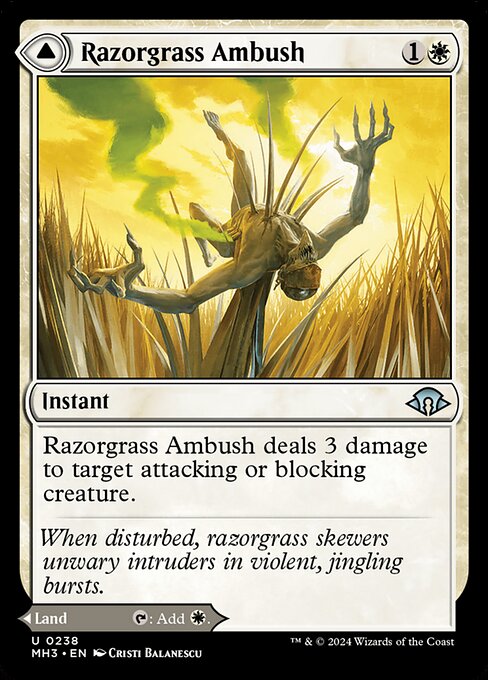
184. Razorgrass Ambush // Razorgrass Field
Rating5.2PlayableWhy this rating?
A solid playable that rarely gets cut (5.2/10).
Why. A two-mana instant removal: three damage to an attacking or blocking creature. When you do not need it, it is a white land.
Risks. It only hits creatures in combat, and three damage misses the biggest ones. It requires reading the opposing attack well.
In the draft. A good white pick, red-white especially. Do not wait too long: it is removal and a land in one.
Results in the games of the set
When it is in hand, the deck wins 54.0% of its games (set average: 56.2%, 194th of 298 cards).
In the opening hand: 54.6% wins (55.6% on average).
Drawn during the game: 53.4% (56.7% on average).
When it is drawn, the deck wins 2.0 points less than when it is not.
When it is drafted, it is played 85% of the time (set average: 67%).
Taken as the first pick (83 drafts), it ends in the deck 98% of the time.

185. Sarpadian Simulacrum
Rating5.2PlayableWhy this rating?
A solid playable that rarely gets cut (5.2/10).
Why. A one-mana 1/1 with haste that turns into removal: for four mana and a sacrifice it deals 4 damage to a creature.
Risks. The body is tiny and the removal is expensive. It trades one card for one, with no advantage.
In the draft. A solid red playable that doubles as late removal. Take it mid-pack.
Results in the games of the set
When it is in hand, the deck wins 53.8% of its games (set average: 56.2%, 199th of 298 cards).
In the opening hand: 54.8% wins (55.6% on average).
Drawn during the game: 53.0% (56.7% on average).
When it is drawn, the deck wins 0.8 points less than when it is not.
When it is drafted, it is played 40% of the time (set average: 67%).
Taken among the first three picks (111 drafts), it ends in the deck 81% of the time.
It is played mostly in B/R decks (67% of them) and R/W (31%).
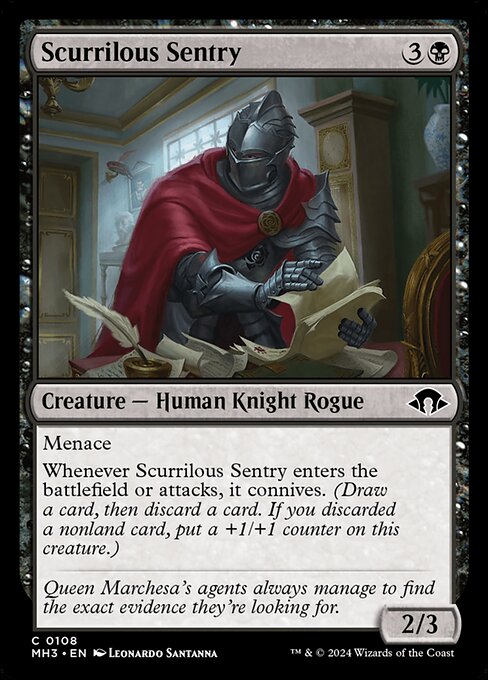
186. Scurrilous Sentry
Rating5.2PlayableWhy this rating?
A solid playable that rarely gets cut (5.2/10).
Why. A 2/3 menace that filters your hand on entering and on each attack: draw, then discard. Discarding a nonland card gives it a +1/+1 counter, making it a good value common.
Risks. Four mana for a 2/3, and if all your cards are precious you lose value. Removal stops it.
In the draft. A good black common, blue-black especially. Take it fairly high among black commons.
Results in the games of the set
When it is in hand, the deck wins 56.7% of its games (set average: 56.2%, 80th of 298 cards).
In the opening hand: 55.1% wins (55.6% on average).
Drawn during the game: 57.7% (56.7% on average).
When it is drawn, the deck wins 4.0 points more than when it is not.
When it is drafted, it is played 58% of the time (set average: 67%).
Taken as the first pick (69 drafts), it ends in the deck 83% of the time.
It is played mostly in B/U decks (53% of them) and B/G (42%).
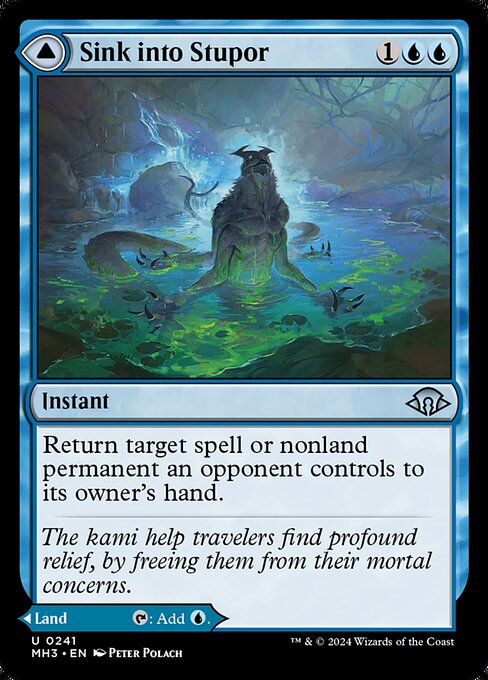
187. Sink into Stupor // Soporific Springs
Rating5.2PlayableWhy this rating?
A solid playable that rarely gets cut (5.2/10).
Why. A three-mana instant that bounces an opposing spell or nonland permanent. Otherwise it is a blue land that enters untapped for 3 life.
Risks. The bounce eliminates nothing and needs a good tempo window. The cost has double blue.
In the draft. A good spell-land for blue decks. Take it without hurry.
Results in the games of the set
When it is in hand, the deck wins 54.9% of its games (set average: 56.2%, 163rd of 298 cards).
In the opening hand: 52.2% wins (55.6% on average).
Drawn during the game: 56.7% (56.7% on average).
When it is drawn, the deck wins 1.6 points more than when it is not.
When it is drafted, it is played 82% of the time (set average: 67%).
Taken as the first pick (82 drafts), it ends in the deck 90% of the time.
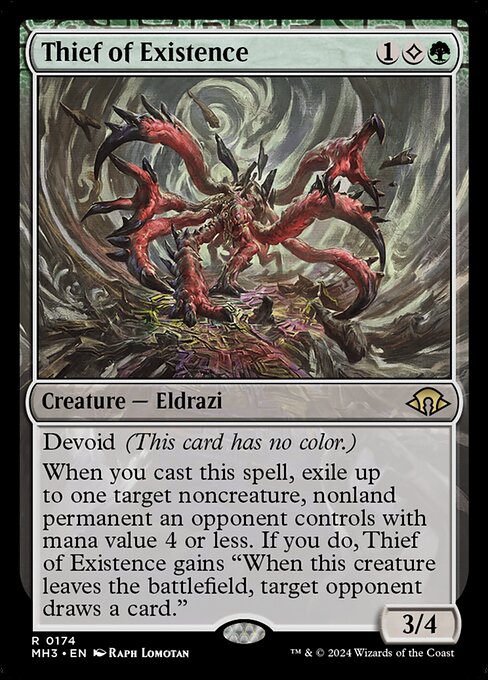
188. Thief of Existence
Rating5.2PlayableWhy this rating?
A solid playable that rarely gets cut (5.2/10).
Why. A 3/4 for three that exiles an opposing noncreature, nonland permanent with mana value 4 or less when cast. Immediate value on a solid body.
Risks. The cost needs colorless mana, so specific sources. If the exile happened, the opponent draws a card when this creature leaves the battlefield.
In the draft. A good playable if you have colorless-producing lands. Take it mid-pack, otherwise leave it.
Results in the games of the set
When it is in hand, the deck wins 51.6% of its games (set average: 56.2%, 244th of 298 cards).
In the opening hand: 50.1% wins (55.6% on average).
Drawn during the game: 52.6% (56.7% on average).
When it is drawn, the deck wins 1.0 points less than when it is not.
When it is drafted, it is played 80% of the time (set average: 67%).
Taken as the first pick (47 drafts), it ends in the deck 81% of the time.
It is played about as much in every archetype.

189. Warren Soultrader
Rating5.2PlayableWhy this rating?
A solid playable that rarely gets cut (5.2/10).
Why. A 3/3 for three that is a fine body on its own. It can sacrifice another creature for 1 life to make a Treasure token.
Risks. Sacrificing creatures for mana is rarely a real gain. The ability needs fodder and adds little alone.
In the draft. A playable black 3/3, nothing more. Do not take it high.
Results in the games of the set
When it is in hand, the deck wins 51.8% of its games (set average: 56.2%, 239th of 298 cards).
In the opening hand: 49.7% wins (55.6% on average).
Drawn during the game: 53.3% (56.7% on average).
When it is drawn, the deck wins 0.5 points less than when it is not.
When it is drafted, it is played 73% of the time (set average: 67%).
Taken as the first pick (46 drafts), it ends in the deck 80% of the time.
It is played about as much in every archetype.
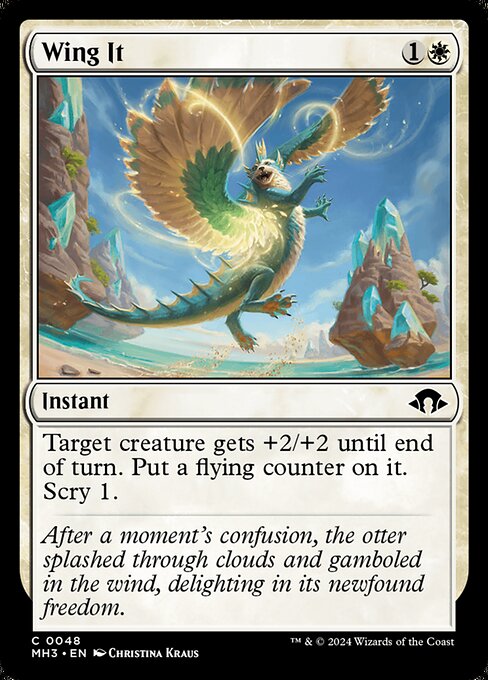
190. Wing It
Rating5.2PlayableWhy this rating?
A solid playable that rarely gets cut (5.2/10).
Why. A two-mana instant giving +2/+2 until end of turn and a permanent flying counter, plus scry 1. It wins a combat and leaves an evasive creature.
Risks. A combat trick can lose a card to removal in response. It needs a good creature.
In the draft. A good white common, red-white especially. Take it mid-pack in an aggressive deck.
Results in the games of the set
When it is in hand, the deck wins 54.5% of its games (set average: 56.2%, 174th of 298 cards).
In the opening hand: 53.9% wins (55.6% on average).
Drawn during the game: 55.0% (56.7% on average).
When it is drawn, the deck wins 2.2 points less than when it is not.
When it is drafted, it is played 41% of the time (set average: 67%).
Taken among the first three picks (102 drafts), it ends in the deck 84% of the time.
It is played mostly in G/W decks (40% of them) and R/W (40%).
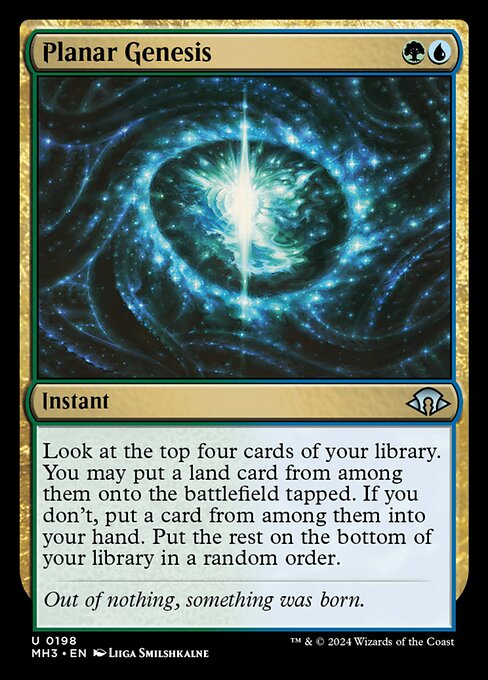
191. Planar Genesis
Rating5.2PlayableWhy this rating?
A solid playable that rarely gets cut (5.2/10).
Why. A green-blue instant that looks at the top four cards: a land can enter tapped, otherwise one card goes to your hand. It smooths your draws, nothing more.
Risks. It does not affect the board and depends on the four cards seen. It is locked to two specific colors.
In the draft. Filler for green-blue decks. Take it late.
Results in the games of the set
When it is in hand, the deck wins 53.2% of its games (set average: 56.2%, 208th of 298 cards).
In the opening hand: 51.5% wins (55.6% on average).
Drawn during the game: 54.4% (56.7% on average).
When it is drawn, the deck wins 0.3 points more than when it is not.
When it is drafted, it is played 61% of the time (set average: 67%).
Taken as the first pick (34 drafts), it ends in the deck 82% of the time.
It is played mostly in G/U decks (29% of them).

192. Nesting Grounds
Rating5.1PlayableWhy this rating?
A solid playable that rarely gets cut (5.1/10).
Why. A colorless land that moves a counter from a permanent you control onto another permanent, at sorcery speed. It can help with +1/+1 counters.
Risks. It taps for colorless, which strains your mana, and activating it costs one mana. With no counters to move it has no role.
In the draft. A niche card for counter decks. Take it late, or not at all.
Results in the games of the set
When it is in hand, the deck wins 51.3% of its games (set average: 56.2%, 249th of 298 cards).
In the opening hand: 50.7% wins (55.6% on average).
Drawn during the game: 51.7% (56.7% on average).
When it is drawn, the deck wins 1.2 points less than when it is not.
When it is drafted, it is played 43% of the time (set average: 67%).
Taken among the first three picks (39 drafts), it ends in the deck 92% of the time.

193. Voidpouncer
Rating5.0PlayableWhy this rating?
A solid playable that rarely gets cut (5.0/10).
Why. A 3/1 for two, aggressive. Kicked, it enters with two +1/+1 counters, a trample counter and haste: a 5/3 for five that attacks right away.
Risks. Unkicked, one toughness makes it fragile, and the kicker needs colorless mana. It is weaker if you have no colorless source.
In the draft. A decent aggressive common, red-green especially. Take it without hurry if you have colorless sources.
Results in the games of the set
When it is in hand, the deck wins 53.7% of its games (set average: 56.2%, 202nd of 298 cards).
In the opening hand: 53.8% wins (55.6% on average).
Drawn during the game: 53.7% (56.7% on average).
When it is drawn, the deck wins 2.1 points less than when it is not.
When it is drafted, it is played 62% of the time (set average: 67%).
Taken as the first pick (60 drafts), it ends in the deck 73% of the time.
It is played mostly in G/R decks (67% of them) and R/W (41%).
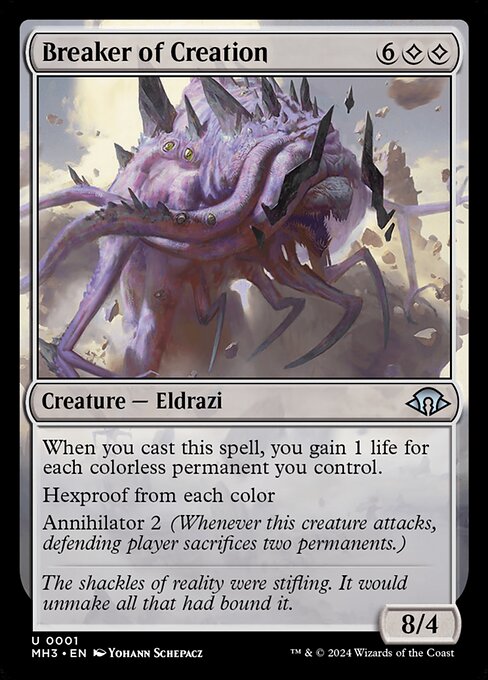
194. Breaker of Creation
Rating5.0PlayableWhy this rating?
A solid playable that rarely gets cut (5.0/10).
Why. An 8/4 for eight that forces the defending player to sacrifice two permanents on each attack. Cast, it gains you 1 life per colorless permanent you control, and hexproof from each color makes it hard to kill.
Risks. Eight mana including two colorless, and it dies to colorless effects, untargeted effects or blocks. Very slow.
In the draft. A finisher for ramp decks, ideally with Eldrazi Spawn. Take it mid-pack.
Results in the games of the set
When it is in hand, the deck wins 55.4% of its games (set average: 56.2%, 143rd of 298 cards).
In the opening hand: 52.9% wins (55.6% on average).
Drawn during the game: 57.1% (56.7% on average).
When it is drawn, the deck wins 2.6 points more than when it is not.
When it is drafted, it is played 86% of the time (set average: 67%).
Taken as the first pick (104 drafts), it ends in the deck 90% of the time.
It is played about as much in every archetype.
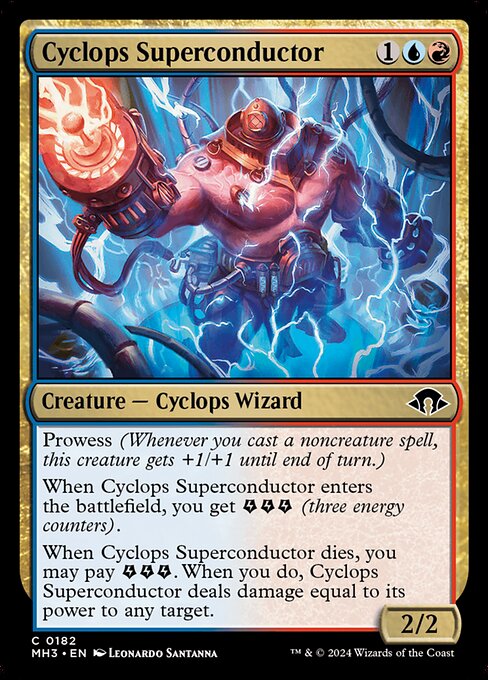 Rating5.0Playable
Why this rating?
A solid playable that rarely gets cut (5.0/10).
Why. A blue-red 2/2 with prowess that gives three energy. When it dies you may pay the energy to deal damage equal to its power to any target.
Risks. It needs two colors and a deck full of noncreature spells. If the opponent exiles it, the effect is lost.
In the draft. A good common for blue-red spell decks. Take it without hurry.
Results in the games of the set
When it is in hand, the deck wins 54.4% of its games (set average: 56.2%, 177th of 298 cards).
In the opening hand: 52.6% wins (55.6% on average).
Drawn during the game: 55.6% (56.7% on average).
When it is drawn, the deck wins 1.9 points more than when it is not.
When it is drafted, it is played 46% of the time (set average: 67%).
Taken as the first pick (69 drafts), it ends in the deck 78% of the time.
It is played mostly in R/U decks (83% of them) and U/W (53%).

196. Etched Slith
Rating5.0PlayableWhy this rating?
A solid playable that rarely gets cut (5.0/10).
Why. A two-mana 1/1 with menace that gets a +1/+1 counter on each combat damage to a player. It can then remove a counter from another permanent or an opponent.
Risks. Too small to attack early and dies to everything. Its effect depends on opposing counters.
In the draft. A black aggro playable, nothing more. Do not take it high.
Results in the games of the set
When it is in hand, the deck wins 52.4% of its games (set average: 56.2%, 226th of 298 cards).
In the opening hand: 54.5% wins (55.6% on average).
Drawn during the game: 50.8% (56.7% on average).
When it is drawn, the deck wins 0.5 points more than when it is not.
When it is drafted, it is played 77% of the time (set average: 67%).
Taken as the first pick (78 drafts), it ends in the deck 88% of the time.
It is played mostly in B/R decks (34% of them) and B/W (25%).
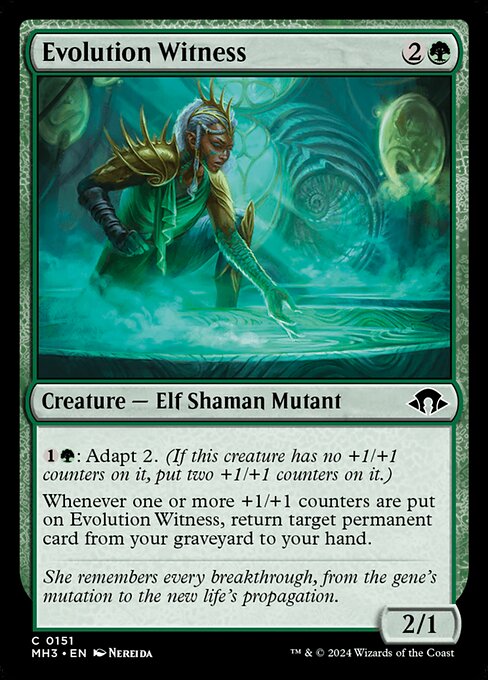
197. Evolution Witness
Rating5.0PlayableWhy this rating?
A solid playable that rarely gets cut (5.0/10).
Why. A 2/1 for three that can become a 4/3 for two more mana (Adapt 2). Whenever it gets +1/+1 counters it returns a permanent card from your graveyard to your hand: a value card that does two things.
Risks. The 2/1 is fragile before Adapt, and Adapt only works if it has no +1/+1 counters. It needs a permanent card in the graveyard to be useful.
In the draft. A good green common, red-green especially. Take it mid-pack.
Results in the games of the set
When it is in hand, the deck wins 54.3% of its games (set average: 56.2%, 182nd of 298 cards).
In the opening hand: 52.2% wins (55.6% on average).
Drawn during the game: 55.9% (56.7% on average).
When it is drawn, the deck wins 0.7 points less than when it is not.
When it is drafted, it is played 86% of the time (set average: 67%).
Taken as the first pick (181 drafts), it ends in the deck 94% of the time.
It is played mostly in B/G decks (62% of them) and G/R (52%).
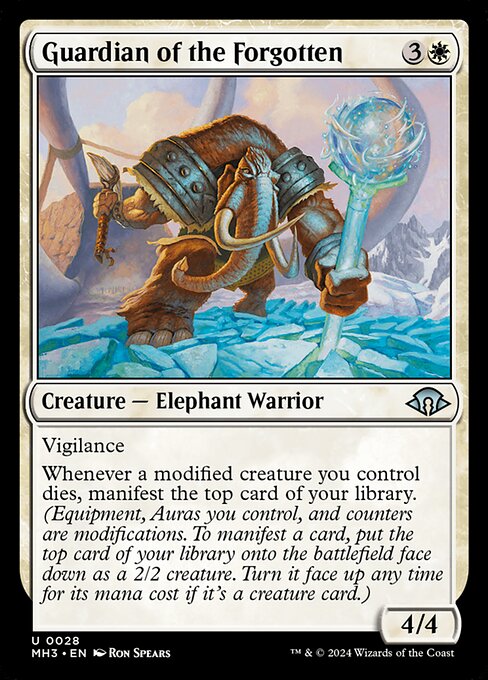
198. Guardian of the Forgotten
Rating5.0PlayableWhy this rating?
A solid playable that rarely gets cut (5.0/10).
Why. A 4/4 vigilance for four: a good body that attacks and defends. When a modified creature you control dies, you manifest the top card of your library as a face-down 2/2.
Risks. Without modified creatures the trigger does nothing. It stays a 4/4 with no protection.
In the draft. A good white body to take mid-pack, especially with Auras, Equipment or counters.
Results in the games of the set
When it is in hand, the deck wins 53.8% of its games (set average: 56.2%, 200th of 298 cards).
In the opening hand: 53.9% wins (55.6% on average).
Drawn during the game: 53.7% (56.7% on average).
When it is drawn, the deck wins 1.2 points less than when it is not.
When it is drafted, it is played 65% of the time (set average: 67%).
Taken as the first pick (49 drafts), it ends in the deck 88% of the time.
It is played mostly in B/W decks (30% of them) and G/W (26%).

199. Inspired Inventor
Rating5.0PlayableWhy this rating?
A solid playable that rarely gets cut (5.0/10).
Why. A 2/2 for three with three choices on entering: three energy, a +1/+1 counter on target creature, or a 1/1 colorless Servo artifact creature token. It adapts to the situation.
Risks. No mode is powerful and the body is a 2/2. It fills a curve more than it wins games.
In the draft. A solid white common, red-white especially. Take it mid-pack.
Results in the games of the set
When it is in hand, the deck wins 54.5% of its games (set average: 56.2%, 175th of 298 cards).
In the opening hand: 55.0% wins (55.6% on average).
Drawn during the game: 54.1% (56.7% on average).
When it is drawn, the deck wins 2.2 points less than when it is not.
When it is drafted, it is played 77% of the time (set average: 67%).
Taken as the first pick (116 drafts), it ends in the deck 90% of the time.
It is played mostly in R/W decks (59% of them) and B/W (53%).
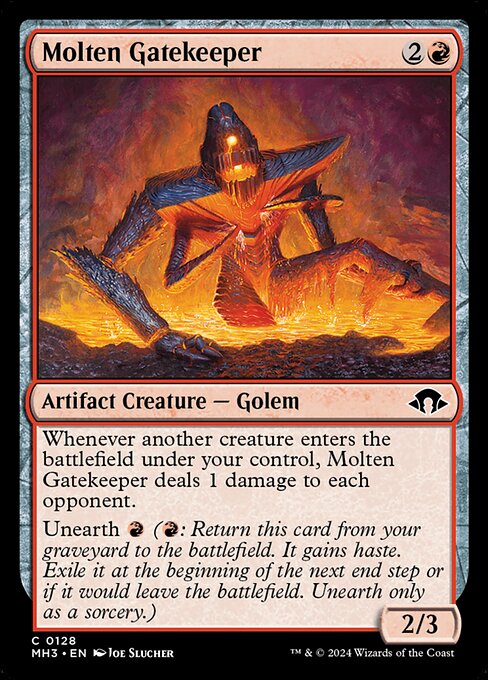
200. Molten Gatekeeper
Rating5.0PlayableWhy this rating?
A solid playable that rarely gets cut (5.0/10).
Why. A 2/3 for three that deals 1 damage to each opponent whenever another creature enters under your control. In a creature-heavy deck that adds up to steady pressure, and unearth for one red mana gives it a second life late in the game.
Risks. The body is modest and the ability only hits the opponent, never their creatures. Without enough creatures to cast behind it, it is just a 2/3.
In the draft. Solid filler for a red deck with plenty of creatures. Take it after your removal and your best creatures, not before.
Results in the games of the set
When it is in hand, the deck wins 54.3% of its games (set average: 56.2%, 183rd of 298 cards).
In the opening hand: 54.4% wins (55.6% on average).
Drawn during the game: 54.2% (56.7% on average).
When it is drawn, the deck wins 1.8 points less than when it is not.
When it is drafted, it is played 78% of the time (set average: 67%).
Taken as the first pick (128 drafts), it ends in the deck 92% of the time.
It is played mostly in B/R decks (69% of them) and R/W (58%).
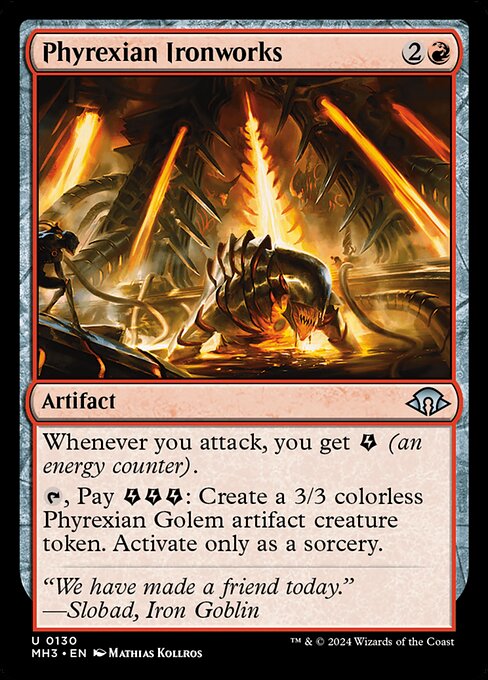
201. Phyrexian Ironworks
Rating5.0PlayableWhy this rating?
A solid playable that rarely gets cut (5.0/10).
Why. Every time you attack you get an energy, and three energy let you tap the artifact to create a 3/3 colorless Phyrexian Golem artifact creature token, at sorcery speed. In an aggressive deck that attacks every turn, it is a slow but steady source of bodies.
Risks. You need three attacks before the first Golem, and in the meantime the artifact blocks nothing. In a defensive or stalled game it produces almost nothing.
In the draft. A card for a very aggressive red deck, rarely for anyone else. A late pick, playable as a 23rd card.
Results in the games of the set
When it is in hand, the deck wins 52.5% of its games (set average: 56.2%, 224th of 298 cards).
In the opening hand: 52.3% wins (55.6% on average).
Drawn during the game: 52.6% (56.7% on average).
When it is drawn, the deck wins 2.0 points less than when it is not.
When it is drafted, it is played 71% of the time (set average: 67%).
Taken as the first pick (87 drafts), it ends in the deck 90% of the time.
It is played mostly in R/U decks (43% of them) and R/W (39%).
 Rating5.0Playable
Why this rating?
A solid playable that rarely gets cut (5.0/10).
Why. A 1/1 for one black mana that comes back from the graveyard for four, tapped with two +1/+1 counters. It is recursive value: a chump blocker early, a 3/3 later.
Risks. The starting 1/1 does almost nothing, and the return eats a full turn of mana in the midgame. An opponent who exiles your graveyard shuts off the return.
In the draft. Honest filler for a black deck that likes cheap creatures. A late pick, never ahead of removal.
Results in the games of the set
When it is in hand, the deck wins 54.7% of its games (set average: 56.2%, 171st of 298 cards).
In the opening hand: 55.1% wins (55.6% on average).
Drawn during the game: 54.3% (56.7% on average).
When it is drawn, the deck wins 1.8 points more than when it is not.
When it is drafted, it is played 64% of the time (set average: 67%).
Taken as the first pick (56 drafts), it ends in the deck 93% of the time.
It is played mostly in B/R decks (73% of them) and B/W (52%).
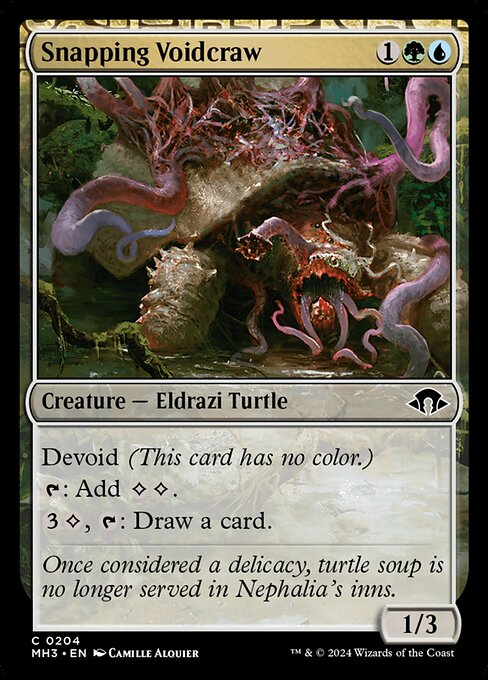
203. Snapping Voidcraw
Rating5.0PlayableWhy this rating?
A solid playable that rarely gets cut (5.0/10).
Why. A devoid 1/3 for three that taps for two colorless mana: it ramps toward your expensive cards and blocks small creatures well. It can also draw a card, but it has to tap itself to do so.
Risks. It needs both green and blue from the start, and its colorless mana only pays generic or colorless costs. Drawing needs four other mana including a colorless one: it never wins a game by itself.
In the draft. Playable in a green-blue deck with expensive or colorless cards. Otherwise let it go by.
Results in the games of the set
When it is in hand, the deck wins 53.6% of its games (set average: 56.2%, 203rd of 298 cards).
In the opening hand: 53.3% wins (55.6% on average).
Drawn during the game: 53.8% (56.7% on average).
When it is drawn, the deck wins 0.5 points more than when it is not.
When it is drafted, it is played 78% of the time (set average: 67%).
Taken as the first pick (174 drafts), it ends in the deck 90% of the time.
It is played mostly in G/U decks (62% of them) and G/R (47%).
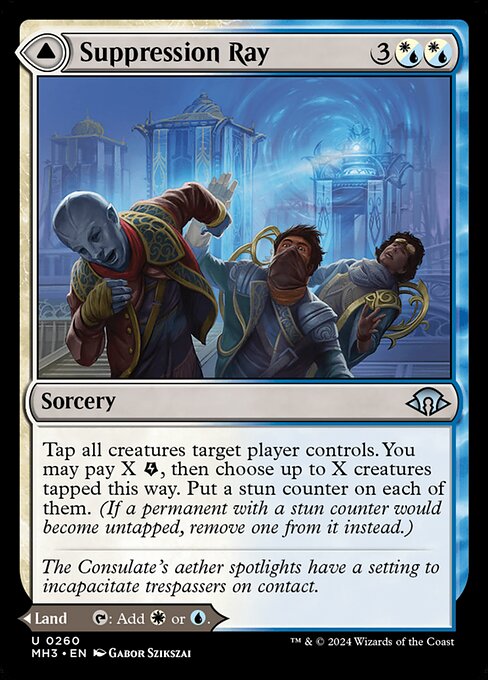
204. Suppression Ray // Orderly Plaza
Rating5.0PlayableWhy this rating?
A solid playable that rarely gets cut (5.0/10).
Why. A five-mana sorcery that taps all of a player's creatures, with energy to put stun counters on some of them: a one-sided attack turn. Its back face is a white-blue land that enters tapped, so the card is never dead.
Risks. You need energy for the effect to last beyond a turn, and five mana for a temporary effect is expensive. It is an aggressive deck's finisher, not a removal spell.
In the draft. A land with upside that you can cast with white or blue. Playable, especially if your deck makes energy, but with no urgency.
Results in the games of the set
When it is in hand, the deck wins 55.2% of its games (set average: 56.2%, 155th of 298 cards).
In the opening hand: 54.2% wins (55.6% on average).
Drawn during the game: 56.0% (56.7% on average).
When it is drawn, the deck wins 0.4 points more than when it is not.
When it is drafted, it is played 88% of the time (set average: 67%).
Taken as the first pick (113 drafts), it ends in the deck 96% of the time.

205. Utter Insignificance
Rating5.0PlayableWhy this rating?
A solid playable that rarely gets cut (5.0/10).
Why. A two-mana Aura with flash that strips all abilities from a creature and makes its base power and toughness 1/1. For three mana including a colorless one, it exiles the creature. It is flexible removal, even in response to an attack.
Risks. The creature stays on the battlefield until you pay for the exile, which needs colorless mana. Counters or bonuses already on the target survive the 1/1 base.
In the draft. A decent backup removal for blue. Take it when you are short on answers, after your better cards.
Results in the games of the set
When it is in hand, the deck wins 54.7% of its games (set average: 56.2%, 170th of 298 cards).
In the opening hand: 51.2% wins (55.6% on average).
Drawn during the game: 56.9% (56.7% on average).
When it is drawn, the deck wins 2.3 points more than when it is not.
When it is drafted, it is played 61% of the time (set average: 67%).
Taken as the first pick (47 drafts), it ends in the deck 89% of the time.
It is played mostly in U/W decks (44% of them) and G/U (41%).

206. Petrifying Meddler
Rating5.0WeakWhy this rating?
A solid playable that rarely gets cut (5.0/10).
Why. A devoid 4/5 with reach for five that taps an opposing creature and puts a stun counter on it as soon as you cast it. It gains tempo on arrival and holds both the ground and the air.
Risks. Five mana is a lot for an effect that kills nothing: the opposing creature soon returns to action. The trigger happens on cast, so a counterspell stops the body but not the effect.
In the draft. A good five-drop body for blue, especially with green. Take it as a solid creature, nothing more.
Results in the games of the set
When it is in hand, the deck wins 55.7% of its games (set average: 56.2%, 131st of 298 cards).
In the opening hand: 52.4% wins (55.6% on average).
Drawn during the game: 57.7% (56.7% on average).
When it is drawn, the deck wins 3.0 points more than when it is not.
When it is drafted, it is played 77% of the time (set average: 67%).
Taken as the first pick (128 drafts), it ends in the deck 82% of the time.
It is played mostly in G/U decks (53% of them) and R/U (47%).
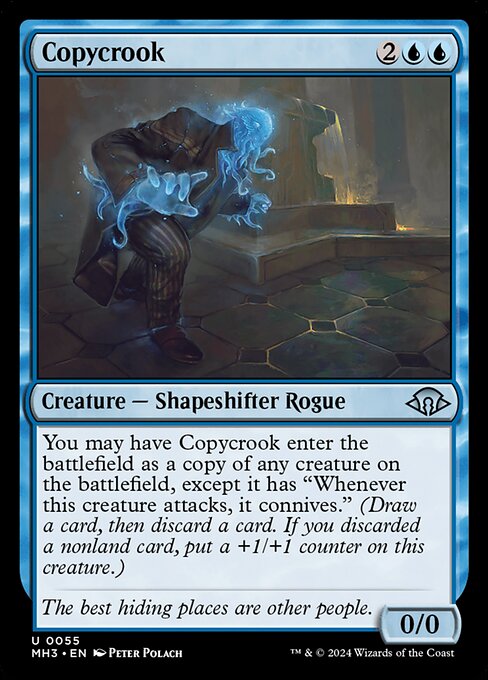
207. Copycrook
Rating4.9WeakWhy this rating?
A solid playable that rarely gets cut (4.9/10).
Why. It enters as a copy of any creature on the battlefield, including the opponent's best one, and gains connive when it attacks. Facing a big creature, it is a good use of four mana.
Risks. If there is no creature to copy, it enters as a 0/0 and dies. It depends entirely on what is already in play.
In the draft. Playable in a blue deck with several valuable creatures, but not a high pick. A mid to late pack choice.
Results in the games of the set
When it is in hand, the deck wins 53.0% of its games (set average: 56.2%, 215th of 298 cards).
In the opening hand: 49.6% wins (55.6% on average).
Drawn during the game: 54.9% (56.7% on average).
When it is drawn, the deck wins 2.8 points more than when it is not.
When it is drafted, it is played 62% of the time (set average: 67%).
Taken as the first pick (41 drafts), it ends in the deck 88% of the time.
It is played mostly in B/U decks (25% of them).
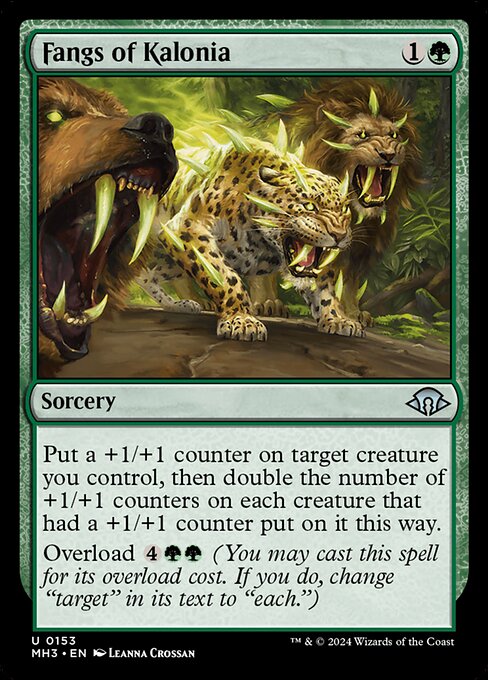
208. Fangs of Kalonia
Rating4.8WeakWhy this rating?
A solid playable that rarely gets cut (4.8/10).
Why. For two mana it puts a +1/+1 counter on one of your creatures, then doubles its counters: a way to grow fast a creature that already has some. Overloaded for six mana it hits all your creatures, which can win the game.
Risks. On its own it is a targeted sorcery, so an answer from the opponent leaves you behind. On a creature with no counters it only gives two.
In the draft. A card for counters decks, where it carries weight. Elsewhere, a late pick.
Results in the games of the set
When it is in hand, the deck wins 51.6% of its games (set average: 56.2%, 242nd of 298 cards).
In the opening hand: 49.4% wins (55.6% on average).
Drawn during the game: 53.2% (56.7% on average).
When it is drawn, the deck wins 1.5 points less than when it is not.
When it is drafted, it is played 64% of the time (set average: 67%).
Taken as the first pick (40 drafts), it ends in the deck 83% of the time.
It is played mostly in B/G decks (27% of them) and G/W (25%).
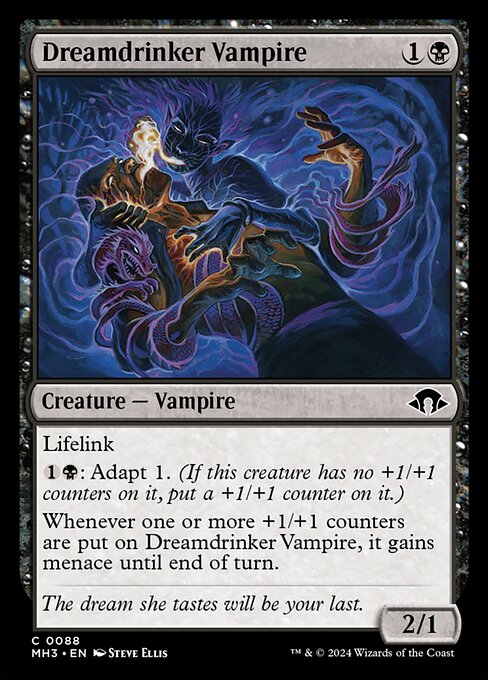
209. Dreamdrinker Vampire
Rating4.8WeakWhy this rating?
A solid playable that rarely gets cut (4.8/10).
Why. A 2/1 lifelinker for two that becomes a 3/2 for two more with adapt, and gains menace until end of turn when it receives a counter. A good late-game mana sink and a fine early drop.
Risks. The 2/1 is fragile before it adapts. The investment cannot be repeated once the counter is on, and removal in response wastes the mana.
In the draft. A solid two-drop for black, especially if you want +1/+1 counters. A fairly late pick.
Results in the games of the set
When it is in hand, the deck wins 53.8% of its games (set average: 56.2%, 201st of 298 cards).
In the opening hand: 53.7% wins (55.6% on average).
Drawn during the game: 53.8% (56.7% on average).
When it is drawn, the deck wins 1.8 points more than when it is not.
When it is drafted, it is played 61% of the time (set average: 67%).
Taken as the first pick (62 drafts), it ends in the deck 79% of the time.
It is played mostly in B/G decks (61% of them) and B/W (50%).
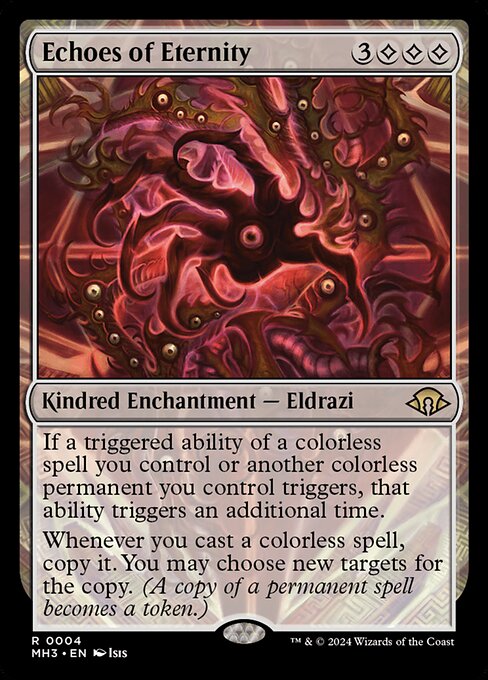
210. Echoes of Eternity
Rating4.8WeakWhy this rating?
A solid playable that rarely gets cut (4.8/10).
Why. A six-mana enchantment that copies every colorless spell you cast and triggers the abilities of your colorless spells and permanents an additional time. In a deck full of colorless cards it is a value engine.
Risks. It needs three colorless mana to cast, does nothing without colorless cards, and does not affect the board the turn it lands. In an ordinary deck it rots in hand.
In the draft. Only for decks that are already colorless. Take it only if there is a real theme around you.
Results in the games of the set
When it is in hand, the deck wins 51.8% of its games (set average: 56.2%, 236th of 298 cards).
In the opening hand: 48.3% wins (55.6% on average).
Drawn during the game: 54.1% (56.7% on average).
When it is drawn, the deck wins 0.2 points less than when it is not.
When it is drafted, it is played 59% of the time (set average: 67%).
Taken as the first pick (36 drafts), it ends in the deck 78% of the time.
It is played about as much in every archetype.
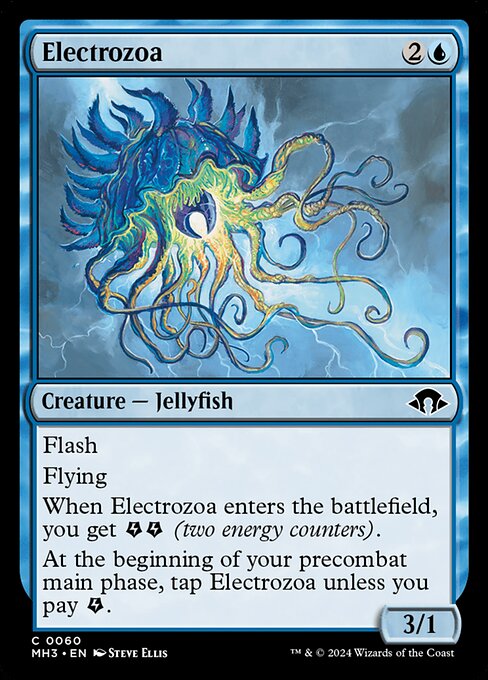
211. Electrozoa
Rating4.8WeakWhy this rating?
A solid playable that rarely gets cut (4.8/10).
Why. A 3/1 flash flyer for three that gives you two energy on arrival. It can ambush an attacker or strike in the air the next turn.
Risks. It needs an energy at the start of each of your turns or it taps: with two energy it lasts two turns, then it can neither attack nor block. One toughness is very fragile.
In the draft. Fine in a blue deck with energy sources; without them its appeal fades fast. A late pick.
Results in the games of the set
When it is in hand, the deck wins 53.5% of its games (set average: 56.2%, 204th of 298 cards).
In the opening hand: 51.6% wins (55.6% on average).
Drawn during the game: 54.9% (56.7% on average).
When it is drawn, the deck wins 0.9 points more than when it is not.
When it is drafted, it is played 36% of the time (set average: 67%).
Taken among the first three picks (130 drafts), it ends in the deck 77% of the time.
It is played mostly in R/U decks (55% of them) and U/W (41%).

212. Fowl Strike
Rating4.8WeakWhy this rating?
A solid playable that rarely gets cut (4.8/10).
Why. A two-mana instant that destroys a creature with flying. Against an air-heavy opponent it is clean, cheap removal; otherwise reinforce for three mana puts two +1/+1 counters on a creature from your hand.
Risks. It only hits flyers, so its value depends on the opponent. Reinforce is an average trick for three mana.
In the draft. More of a sideboard card in draft, useful for green when the air becomes a problem. A late pick.
Results in the games of the set
When it is in hand, the deck wins 52.7% of its games (set average: 56.2%, 221st of 298 cards).
In the opening hand: 50.8% wins (55.6% on average).
Drawn during the game: 54.0% (56.7% on average).
When it is drawn, the deck wins 0.7 points less than when it is not.
When it is drafted, it is played 32% of the time (set average: 67%).
Taken among the first three picks (42 drafts), it ends in the deck 76% of the time.
It is played mostly in B/G decks (29% of them).
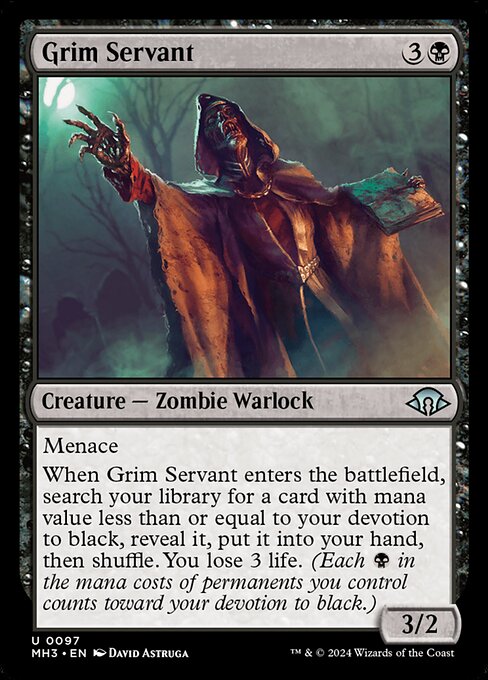
213. Grim Servant
Rating4.8WeakWhy this rating?
A solid playable that rarely gets cut (4.8/10).
Why. A 3/2 menace creature for four that searches your library for a card with mana value up to your devotion to black. In a heavily black deck it is a flexible tutor that replaces itself.
Risks. You lose 3 life, and devotion is often low early in the game. With few black symbols the search is limited to small cards.
In the draft. A decent four-drop in a black deck loaded with black symbols. Elsewhere, an average body.
Results in the games of the set
When it is in hand, the deck wins 53.0% of its games (set average: 56.2%, 217th of 298 cards).
In the opening hand: 49.4% wins (55.6% on average).
Drawn during the game: 55.4% (56.7% on average).
When it is drawn, the deck wins 0.8 points more than when it is not.
When it is drafted, it is played 55% of the time (set average: 67%).
Taken as the first pick (48 drafts), it ends in the deck 83% of the time.
It is played about as much in every archetype.
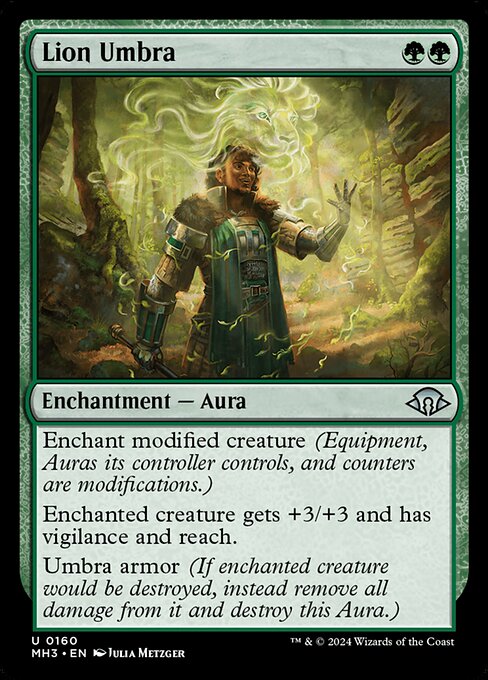
214. Lion Umbra
Rating4.8WeakWhy this rating?
A solid playable that rarely gets cut (4.8/10).
Why. A two-mana Aura that gives +3/+3, reach and vigilance to a modified creature and protects it from destruction with umbra armor. On the right target it turns a small body into a serious threat.
Risks. It can only enchant a modified creature, so it depends on a counter, Equipment or Aura already in place. Two green mana right away.
In the draft. A card for a green deck with plenty of counters or Equipment. Otherwise skip it; it is often dead in hand.
Results in the games of the set
When it is in hand, the deck wins 51.9% of its games (set average: 56.2%, 234th of 298 cards).
In the opening hand: 51.3% wins (55.6% on average).
Drawn during the game: 52.4% (56.7% on average).
When it is drawn, the deck wins 1.7 points less than when it is not.
When it is drafted, it is played 37% of the time (set average: 67%).
Taken among the first three picks (72 drafts), it ends in the deck 83% of the time.

215. Muster the Departed
Rating4.8WeakWhy this rating?
A solid playable that rarely gets cut (4.8/10).
Why. A three-mana enchantment that creates a 1/1 white Spirit creature token with flying, then populates at your end step if a creature died this turn. In a deck that trades a lot, the tokens pile up.
Risks. With no creature death it does nothing beyond the first token. A 1/1 flyer for three is a modest start.
In the draft. Filler for a white deck that likes trading. A late pick.
Results in the games of the set
When it is in hand, the deck wins 51.9% of its games (set average: 56.2%, 233rd of 298 cards).
In the opening hand: 52.3% wins (55.6% on average).
Drawn during the game: 51.6% (56.7% on average).
When it is drawn, the deck wins 1.4 points less than when it is not.
When it is drafted, it is played 33% of the time (set average: 67%).
Taken among the first three picks (89 drafts), it ends in the deck 65% of the time.
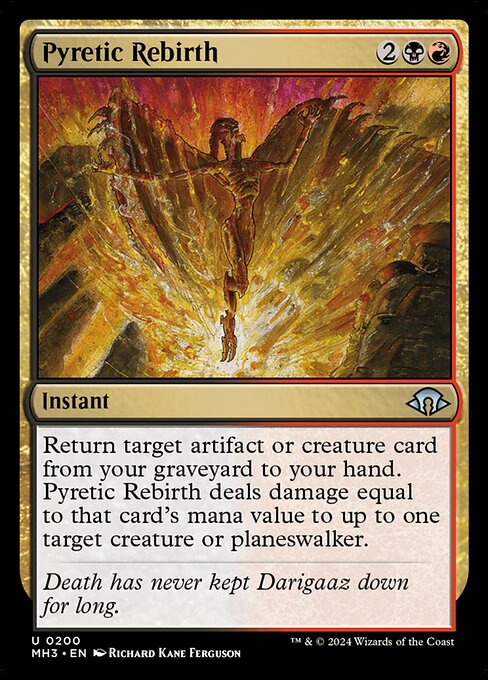
216. Pyretic Rebirth
Rating4.8WeakWhy this rating?
A solid playable that rarely gets cut (4.8/10).
Why. A four-mana instant that returns an artifact or creature card from your graveyard to your hand and deals damage equal to that card's mana value to a creature or planeswalker. Removal and recursion in one card.
Risks. You need a worthwhile artifact or creature in the graveyard, and the target is optional. Early in the game the effect is weak, and it is locked to two colors.
In the draft. A fair card in black-red when you have expensive creatures. A late pick.
Results in the games of the set
When it is in hand, the deck wins 52.8% of its games (set average: 56.2%, 219th of 298 cards).
In the opening hand: 49.2% wins (55.6% on average).
Drawn during the game: 55.4% (56.7% on average).
When it is drawn, the deck wins 0.0 points more than when it is not.
When it is drafted, it is played 55% of the time (set average: 67%).
Taken as the first pick (53 drafts), it ends in the deck 75% of the time.
It is played mostly in B/R decks (43% of them).

217. Skoa, Embermage
Rating4.8WeakWhy this rating?
A solid playable that rarely gets cut (4.8/10).
Why. A six-mana 4/4 that deals 4 damage to any target when it enters: removal and a big body at the same time. It solves a problem and leaves a threat on the battlefield.
Risks. Six mana is heavy, and a counterspell cancels everything. A second copy cannot join the battlefield (it is legendary) but can feed the grandeur ability, at the price of two Mountains.
In the draft. A decent top end for red, a two-for-one you should not overpay for.
Results in the games of the set
When it is in hand, the deck wins 55.0% of its games (set average: 56.2%, 161st of 298 cards).
In the opening hand: 53.4% wins (55.6% on average).
Drawn during the game: 56.1% (56.7% on average).
When it is drawn, the deck wins 0.9 points less than when it is not.
When it is drafted, it is played 57% of the time (set average: 67%).
Taken as the first pick (43 drafts), it ends in the deck 86% of the time.
It is played mostly in G/R decks (55% of them) and R/W (46%).
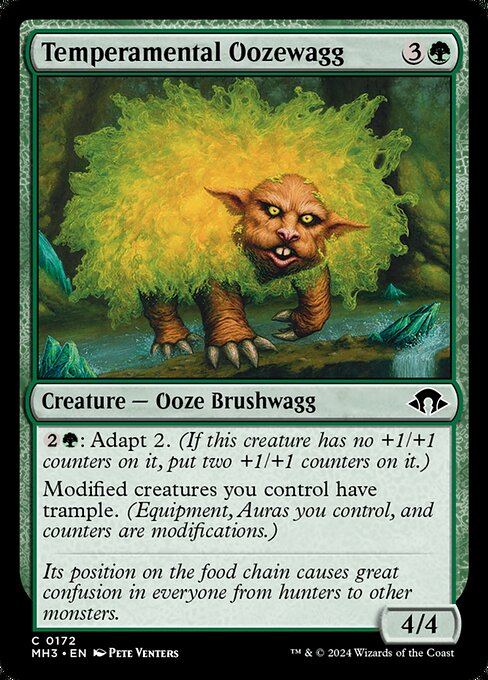 Rating4.8Weak
Why this rating?
A solid playable that rarely gets cut (4.8/10).
Why. A 4/4 for four that can grow into a 6/6 with adapt for three mana and gives trample to your modified creatures, itself included once adapted. A cheap big body that grows when mana allows.
Risks. It has no trample until it adapts, and it dies to removal like any creature. The trample bonus depends on counters or Equipment.
In the draft. A good four-drop for green: a 4/4 that grows. Take it for a green deck without making it a priority.
Results in the games of the set
When it is in hand, the deck wins 54.4% of its games (set average: 56.2%, 178th of 298 cards).
In the opening hand: 53.6% wins (55.6% on average).
Drawn during the game: 55.0% (56.7% on average).
When it is drawn, the deck wins 0.6 points less than when it is not.
When it is drafted, it is played 76% of the time (set average: 67%).
Taken as the first pick (72 drafts), it ends in the deck 97% of the time.
It is played mostly in B/G decks (70% of them) and G/R (53%).
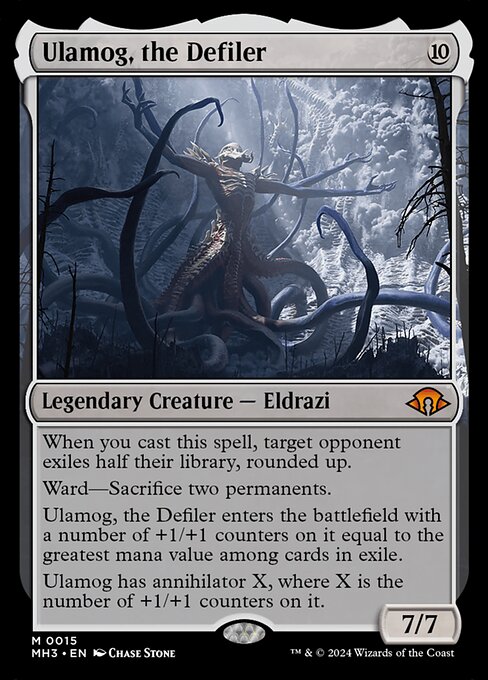
219. Ulamog, the Defiler
Rating4.8WeakWhy this rating?
A solid playable that rarely gets cut (4.8/10).
Why. A ten-mana 7/7 that makes the opponent exile half their library as you cast it, with annihilator scaling with its counters and ward, sacrifice two permanents. If it lands, it wins the game nearly by itself.
Risks. Ten mana is almost out of reach, even with ramp, and a counterspell stops the body (the exile still happens). In draft most games end before then.
In the draft. Close to unplayable outside an extreme ramp deck. Take it very late, as a curiosity.
Results in the games of the set
When it is in hand, the deck wins 51.7% of its games (set average: 56.2%, 240th of 298 cards).
In the opening hand: 48.7% wins (55.6% on average).
Drawn during the game: 53.5% (56.7% on average).
When it is drawn, the deck wins 0.3 points more than when it is not.
When it is drafted, it is played 83% of the time (set average: 67%).
Taken among the first three picks (139 drafts), it ends in the deck 84% of the time.
It is played about as much in every archetype.

220. Waterlogged Teachings // Inundated Archive
Rating4.8WeakWhy this rating?
A solid playable that rarely gets cut (4.8/10).
Why. A four-mana instant that searches for an instant or a card with flash, with a back face that is a blue-black land entering tapped. The card is usually a land, with a tutor option when you need one.
Risks. The tutor depends on how many instants and flash cards your deck has, often few, and costs four mana just to fetch a card.
In the draft. A fixing land for blue-black with a little extra value. Take it late, as a nearly free land.
Results in the games of the set
When it is in hand, the deck wins 55.4% of its games (set average: 56.2%, 146th of 298 cards).
In the opening hand: 53.6% wins (55.6% on average).
Drawn during the game: 56.6% (56.7% on average).
When it is drawn, the deck wins 3.0 points more than when it is not.
When it is drafted, it is played 64% of the time (set average: 67%).
Taken as the first pick (38 drafts), it ends in the deck 89% of the time.
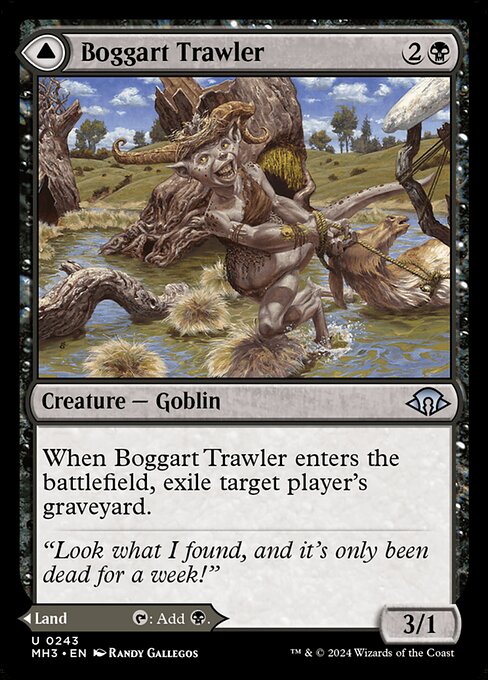
221. Boggart Trawler // Boggart Bog
Rating4.8WeakWhy this rating?
A solid playable that rarely gets cut (4.8/10).
Why. A 3/1 for three that exiles a player's graveyard when it enters, with a black land back face that enters untapped if you pay 3 life. The card stays useful early or late.
Risks. The body is weak and the graveyard exile is situational. Paying 3 life for an untapped land has a real cost.
In the draft. A flexible black land you play without regret. A late pick, when you have nothing better.
Results in the games of the set
When it is in hand, the deck wins 53.2% of its games (set average: 56.2%, 210th of 298 cards).
In the opening hand: 51.8% wins (55.6% on average).
Drawn during the game: 54.3% (56.7% on average).
When it is drawn, the deck wins 0.2 points less than when it is not.
When it is drafted, it is played 70% of the time (set average: 67%).
Taken as the first pick (32 drafts), it ends in the deck 91% of the time.

222. Worn Powerstone
Rating4.7WeakWhy this rating?
A solid playable that rarely gets cut (4.7/10).
Why. A three-mana artifact that enters tapped and adds two colorless mana. It ramps you toward your big cards starting next turn, which can matter a lot with finishers.
Risks. It does nothing else and enters tapped, so it slows your turn three. Colorless mana does not pay colored costs.
In the draft. For decks with several cards costing six or more. Otherwise leave it.
Results in the games of the set
When it is in hand, the deck wins 51.8% of its games (set average: 56.2%, 237th of 298 cards).
In the opening hand: 52.3% wins (55.6% on average).
Drawn during the game: 51.5% (56.7% on average).
When it is drawn, the deck wins 0.1 points more than when it is not.
When it is drafted, it is played 61% of the time (set average: 67%).
Taken as the first pick (35 drafts), it ends in the deck 86% of the time.
It is played about as much in every archetype.

223. Reef Worm
Rating4.6WeakWhy this rating?
A solid playable that rarely gets cut (4.6/10).
Why. A 0/1 for four that, when it dies, creates a 3/3 Fish creature token, then a 6/6 Whale, then a 9/9 Kraken. If the opponent kills it or you sacrifice it, value climbs in steps.
Risks. The 0/1 on its own is useless until it dies. An opponent who ignores it leaves you with a dead card and four mana wasted.
In the draft. A card for a blue-black deck. Mid-pack, playable but no more.
Results in the games of the set
When it is in hand, the deck wins 53.0% of its games (set average: 56.2%, 218th of 298 cards).
In the opening hand: 50.3% wins (55.6% on average).
Drawn during the game: 54.6% (56.7% on average).
When it is drawn, the deck wins 3.5 points more than when it is not.
When it is drafted, it is played 46% of the time (set average: 67%).
Taken as the first pick (30 drafts), it ends in the deck 80% of the time.
It is played about as much in every archetype.
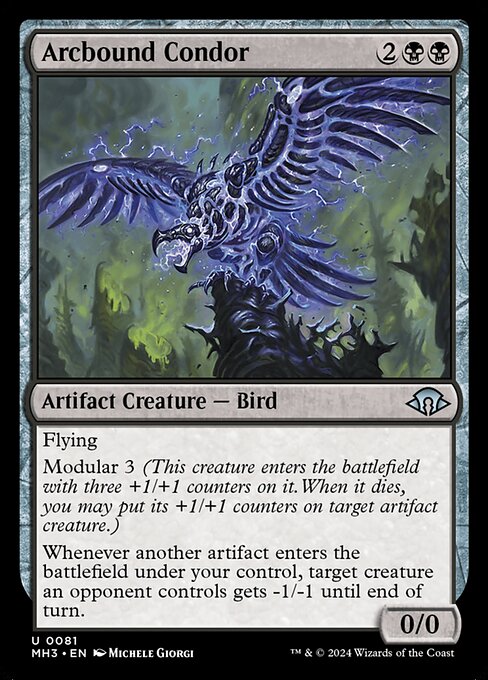
224. Arcbound Condor
Rating4.6WeakWhy this rating?
A solid playable that rarely gets cut (4.6/10).
Why. A 3/3 flyer for four (three counters, thanks to modular) that gives an opposing creature -1/-1 until end of turn whenever another artifact enters under your control. A solid aerial body, more interesting in an artifacts deck.
Risks. Two black mana required, and without artifacts it is just a 3/3 flyer. The -1/-1 only kills very small creatures.
In the draft. A 3/3 flyer for four is still decent. Take it in a black deck, and higher if you have artifacts.
Results in the games of the set
When it is in hand, the deck wins 52.1% of its games (set average: 56.2%, 228th of 298 cards).
In the opening hand: 50.8% wins (55.6% on average).
Drawn during the game: 53.0% (56.7% on average).
When it is drawn, the deck wins 0.3 points more than when it is not.
When it is drafted, it is played 64% of the time (set average: 67%).
Taken as the first pick (61 drafts), it ends in the deck 87% of the time.
It is played mostly in B/R decks (39% of them) and B/W (27%).

225. Decree of Justice
Rating4.6WeakWhy this rating?
A solid playable that rarely gets cut (4.6/10).
Why. A flexible sorcery: X 4/4 white Angel creature tokens with flying late in the game, or, cycled, X 1/1 white Soldier creature tokens at instant speed. It scales with your mana, and the late-game payoff can be huge.
Risks. Each Angel costs two more mana beyond the base four: at seven mana a single Angel is a poor rate. The cycling Soldiers are more modest.
In the draft. A decent late-game spell for white. Quality filler, not a priority pick.
Results in the games of the set
When it is in hand, the deck wins 52.0% of its games (set average: 56.2%, 232nd of 298 cards).
In the opening hand: 49.1% wins (55.6% on average).
Drawn during the game: 54.0% (56.7% on average).
When it is drawn, the deck wins 0.5 points less than when it is not.
When it is drafted, it is played 25% of the time (set average: 67%).
Taken among the first three picks (45 drafts), it ends in the deck 62% of the time.
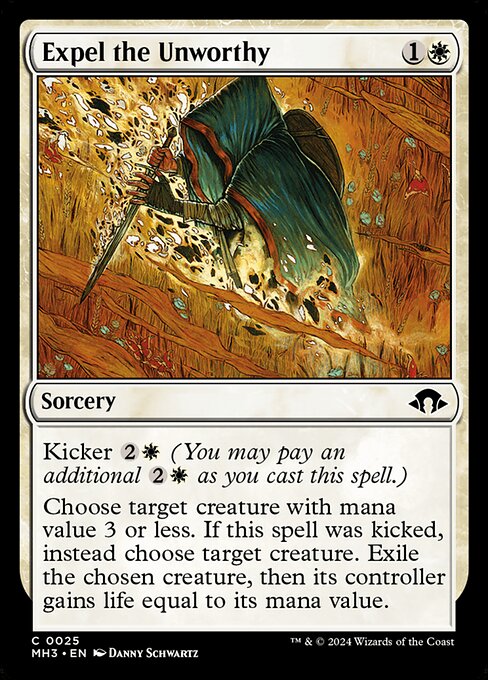
226. Expel the Unworthy
Rating4.6WeakWhy this rating?
A solid playable that rarely gets cut (4.6/10).
Why. A two-mana sorcery that exiles a creature with mana value 3 or less, or any creature when kicked for five. Cheap, flexible removal that exiles. Its controller gains life equal to its mana value.
Risks. Unkicked, it cannot hit big threats. It is a sorcery, so it is slow, and the opponent's life gain is not free.
In the draft. Decent white removal, worth taking mid-pack in a white deck. No hype, but reliable.
Results in the games of the set
When it is in hand, the deck wins 52.1% of its games (set average: 56.2%, 230th of 298 cards).
In the opening hand: 51.7% wins (55.6% on average).
Drawn during the game: 52.4% (56.7% on average).
When it is drawn, the deck wins 2.6 points less than when it is not.
When it is drafted, it is played 42% of the time (set average: 67%).
Taken as the first pick (39 drafts), it ends in the deck 67% of the time.
It is played mostly in U/W decks (32% of them) and B/W (31%).

227. Hydroelectric Specimen // Hydroelectric Laboratory
Rating4.6WeakWhy this rating?
A solid playable that rarely gets cut (4.6/10).
Why. A 1/4 with flash for three that can redirect an instant or sorcery with a single target onto itself, with a blue land on the back that enters untapped if you pay 3 life. A good blocker and never a dead card.
Risks. The redirect depends on timing and on the opponent casting a single-target spell. The 1/4 body threatens nobody.
In the draft. A blue creature-land to play almost for free. A fine late pick.
Results in the games of the set
When it is in hand, the deck wins 53.4% of its games (set average: 56.2%, 206th of 298 cards).
In the opening hand: 51.5% wins (55.6% on average).
Drawn during the game: 54.7% (56.7% on average).
When it is drawn, the deck wins 0.3 points more than when it is not.
When it is drafted, it is played 70% of the time (set average: 67%).
Taken among the first three picks (107 drafts), it ends in the deck 92% of the time.

228. Infernal Captor
Rating4.6WeakWhy this rating?
A solid playable that rarely gets cut (4.6/10).
Why. A 3/3 for four with exploit: sacrifice a creature and you gain control of an artifact or creature until end of turn, untapped and with haste. That can set up a big attack or finish a game.
Risks. You need to sacrifice a creature, and the effect is temporary. Without a creature to sacrifice it is just a 3/3 for four.
In the draft. Decent filler for an aggressive red deck that can sacrifice small creatures.
Results in the games of the set
When it is in hand, the deck wins 53.0% of its games (set average: 56.2%, 216th of 298 cards).
In the opening hand: 51.3% wins (55.6% on average).
Drawn during the game: 54.4% (56.7% on average).
When it is drawn, the deck wins 2.1 points less than when it is not.
When it is drafted, it is played 30% of the time (set average: 67%).
Taken among the first three picks (71 drafts), it ends in the deck 61% of the time.
It is played mostly in B/R decks (30% of them) and R/W (28%).
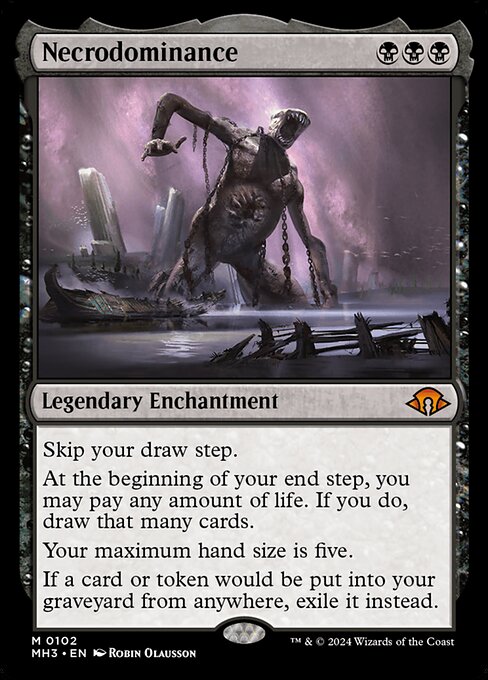
229. Necrodominance
Rating4.6WeakWhy this rating?
A solid playable that rarely gets cut (4.6/10).
Why. A very risky black enchantment: you skip your draw step and pay life to draw cards. In an extremely defensive deck it can become a card engine, but mostly it is dangerous to you.
Risks. It needs three black mana, your maximum hand size drops to five, your cards go to exile instead of the graveyard, and you pay real life. Against an aggressive deck it kills you.
In the draft. Almost unplayable in a normal draft. Take it very late, or never.
Results in the games of the set
When it is in hand, the deck wins 44.3% of its games (set average: 56.2%).
In the opening hand: 0.0% wins (55.6% on average).
Drawn during the game: 46.9% (56.7% on average).
When it is drawn, the deck wins 4.7 points less than when it is not.
When it is drafted, it is played only 14% of the time (set average: 67%): it almost always ends in the sideboard.
Taken among the first three picks (32 drafts), it ends in the deck 44% of the time.

230. Thriving Skyclaw
Rating4.6WeakWhy this rating?
A solid playable that rarely gets cut (4.6/10).
Why. A 3/2 flyer for four that gives you three energy on entering, then spends them on attack to add a +1/+1 counter. It becomes a 4/3 flyer on its first attack, which makes it efficient.
Risks. It needs two red mana and is fragile at first. Without extra energy it only grows once.
In the draft. A fair red flyer, especially alongside white. A thoroughly honest late-pack pick.
Results in the games of the set
When it is in hand, the deck wins 53.2% of its games (set average: 56.2%, 209th of 298 cards).
In the opening hand: 52.4% wins (55.6% on average).
Drawn during the game: 53.8% (56.7% on average).
When it is drawn, the deck wins 1.9 points less than when it is not.
When it is drafted, it is played 48% of the time (set average: 67%).
Taken among the first three picks (148 drafts), it ends in the deck 86% of the time.
It is played mostly in R/W decks (48% of them) and R/U (47%).

231. Trickster's Elk
Rating4.6WeakWhy this rating?
A solid playable that rarely gets cut (4.6/10).
Why. A 3/3 for three that can also be cast as an Aura with bestow for two, making a creature lose all abilities and become a green Elk with base 3/3. A neutralizer that becomes a creature again when the target goes away.
Risks. The target stays on the battlefield and can become dangerous again if the Aura leaves. On a small creature you are even giving it a 3/3 base.
In the draft. Flexible pseudo-removal for green. A fair late pick, well behind real removal.
Results in the games of the set
When it is in hand, the deck wins 51.5% of its games (set average: 56.2%, 246th of 298 cards).
In the opening hand: 50.6% wins (55.6% on average).
Drawn during the game: 52.2% (56.7% on average).
When it is drawn, the deck wins 3.0 points less than when it is not.
When it is drafted, it is played 62% of the time (set average: 67%).
Taken among the first three picks (95 drafts), it ends in the deck 86% of the time.
It is played about as much in every archetype.
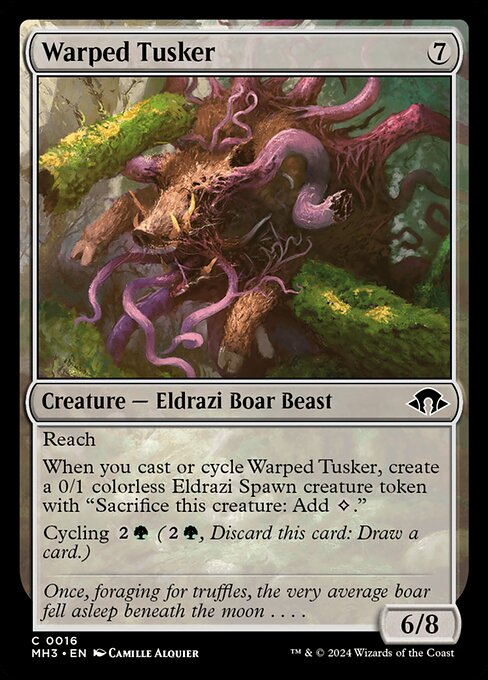
232. Warped Tusker
Rating4.6WeakWhy this rating?
A solid playable that rarely gets cut (4.6/10).
Why. A 6/8 with reach for seven, but with cycling for three, and a 0/1 colorless Eldrazi Spawn creature token on cast or cycle. The card is never dead: it ramps or draws early and dominates late.
Risks. Seven mana to cast, and cycling needs green. Cycling it loses the big body.
In the draft. Solid filler for green, especially with ramp. A mid-pack pick.
Results in the games of the set
When it is in hand, the deck wins 55.4% of its games (set average: 56.2%, 147th of 298 cards).
In the opening hand: 53.3% wins (55.6% on average).
Drawn during the game: 56.9% (56.7% on average).
When it is drawn, the deck wins 0.7 points more than when it is not.
When it is drafted, it is played 83% of the time (set average: 67%).
Taken as the first pick (73 drafts), it ends in the deck 99% of the time.
It is played mostly in G/R decks (52% of them) and G/U (46%).
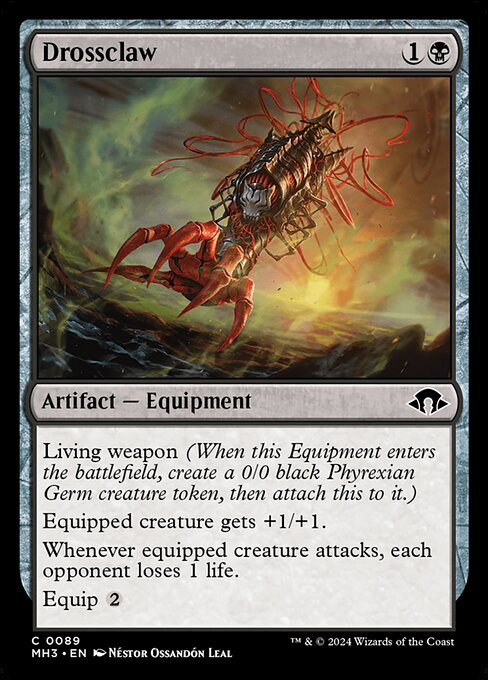
233. Drossclaw
Rating4.6WeakWhy this rating?
A solid playable that rarely gets cut (4.6/10).
Why. A two-mana Equipment with living weapon: it comes with a 0/0 black Phyrexian Germ creature token that becomes 1/1 thanks to it, and makes each opponent lose 1 life whenever the equipped creature attacks. It applies pressure and can be moved later.
Risks. The Germ is a fragile 1/1, and re-equipping costs two mana. The life loss is small without several attacks.
In the draft. Honest filler for an aggressive black deck. A late pick.
Results in the games of the set
When it is in hand, the deck wins 52.1% of its games (set average: 56.2%, 229th of 298 cards).
In the opening hand: 51.8% wins (55.6% on average).
Drawn during the game: 52.3% (56.7% on average).
When it is drawn, the deck wins 0.2 points less than when it is not.
When it is drafted, it is played 39% of the time (set average: 67%).
Taken among the first three picks (114 drafts), it ends in the deck 82% of the time.
It is played mostly in B/R decks (60% of them) and B/W (36%).

234. Colossal Dreadmask
Rating4.5WeakWhy this rating?
A solid playable that rarely gets cut (4.5/10).
Why. For six mana you get a 6/6 trampling Phyrexian Germ through Living weapon, and an Equipment that stays behind. If the Germ dies, the Equipment can move to another creature and give it +6/+6.
Risks. The Germ is an easy target: one removal spell or a double block and you paid six mana for an Equipment with an expensive equip cost. It is slow and costly.
In the draft. A fine top-end in a green deck that can survive to turn six. A middling pick, take it after your removal and your good creatures, not before.
Results in the games of the set
When it is in hand, the deck wins 54.6% of its games (set average: 56.2%, 172nd of 298 cards).
In the opening hand: 53.0% wins (55.6% on average).
Drawn during the game: 55.8% (56.7% on average).
When it is drawn, the deck wins 0.6 points less than when it is not.
When it is drafted, it is played 68% of the time (set average: 67%).
Taken as the first pick (62 drafts), it ends in the deck 87% of the time.
It is played mostly in G/R decks (55% of them) and B/G (43%).
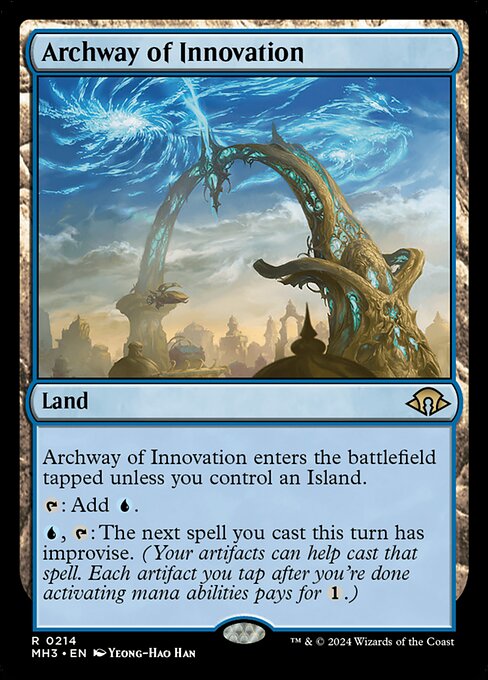 Rating4.4Weak
Why this rating?
A good playable, but is sometimes cut (4.4/10).
Why. A blue land that enters untapped if you control an Island, which happens quickly in a blue deck. Its second ability gives the next spell you cast this turn improvise, which only matters with plenty of artifacts.
Risks. Without artifacts it is an Island that sometimes enters tapped. The real gain is tiny in an ordinary draft deck.
In the draft. Play it as an extra Island if you are blue and already have artifacts to tap. Otherwise let it go: this is never a pick to fight for.
Results in the games of the set
When it is in hand, the deck wins 44.4% of its games (set average: 56.2%, 293rd of 298 cards).
In the opening hand: 43.3% wins (55.6% on average).
Drawn during the game: 45.1% (56.7% on average).
When it is drawn, the deck wins 2.7 points less than when it is not.
When it is drafted, it is played only 6% of the time (set average: 67%): it almost always ends in the sideboard.
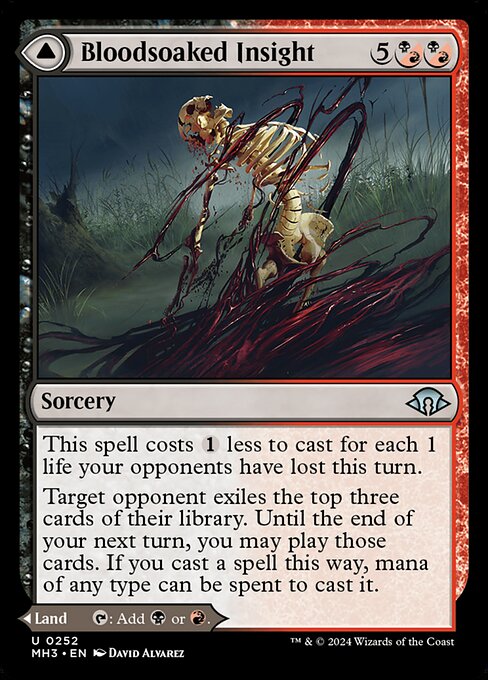
236. Bloodsoaked Insight // Sanguine Morass
Rating4.4WeakWhy this rating?
A good playable, but is sometimes cut (4.4/10).
Why. A flexible Spell // Land. As a spell, the opponent exiles the top three cards of their library and you may play them until the end of your next turn, using mana of any type. As a land, it is a tapped black or red source.
Risks. The sorcery costs seven mana, and only gets cheaper if the opponent lost life this turn. It is slow, and the exiled cards may be unusable for you.
In the draft. An acceptable land-spell in black-red that stops you from missing a land drop and gives late-game value. A mid-pack pick, nothing more.
Results in the games of the set
When it is in hand, the deck wins 54.0% of its games (set average: 56.2%, 196th of 298 cards).
In the opening hand: 53.4% wins (55.6% on average).
Drawn during the game: 54.4% (56.7% on average).
When it is drawn, the deck wins 0.3 points less than when it is not.
When it is drafted, it is played 82% of the time (set average: 67%).
Taken as the first pick (72 drafts), it ends in the deck 94% of the time.
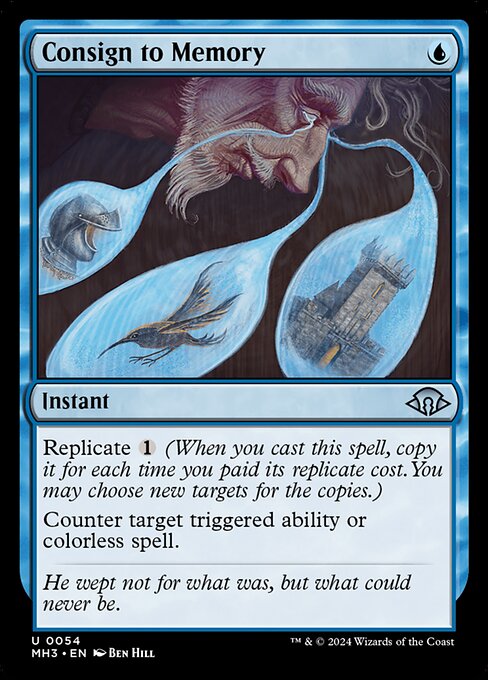
237. Consign to Memory
Rating4.4WeakWhy this rating?
A good playable, but is sometimes cut (4.4/10).
Why. A very narrow one-mana instant: it counters a triggered ability or a colorless spell. Replicate adds copies, for one more mana each, that can pick other targets.
Risks. In many matches there will be nothing to counter. It cannot touch any colored spell, so no colored creatures, removal or sorceries. A dead card in hand far too often.
In the draft. A sideboard pick, or a late-pack pick if you have seen several colorless threats. Only main-deck it when you know what your opponent is playing.
Results in the games of the set
When it is in hand, the deck wins 51.2% of its games (set average: 56.2%, 250th of 298 cards).
In the opening hand: 48.9% wins (55.6% on average).
Drawn during the game: 52.6% (56.7% on average).
When it is drawn, the deck wins 0.1 points more than when it is not.
When it is drafted, it is played 16% of the time (set average: 67%).
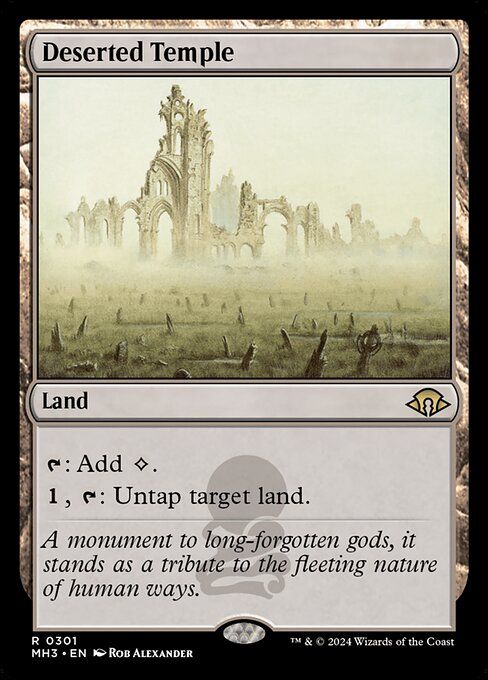
238. Deserted Temple
Rating4.4WeakWhy this rating?
A good playable, but is sometimes cut (4.4/10).
Why. A colorless land whose ability untaps another land for one mana. With a land that makes a single mana the trade is neutral: only a land that makes more than one mana gets a real gain from it.
Risks. It only taps for colorless mana, which hurts your colors. In an ordinary deck it does almost nothing.
In the draft. Pass it in the vast majority of decks. Only a deck loaded with lands that make several mana might find a home for it.
Results in the games of the set
When it is in hand, the deck wins 46.0% of its games (set average: 56.2%, 291st of 298 cards).
In the opening hand: 43.8% wins (55.6% on average).
Drawn during the game: 47.5% (56.7% on average).
When it is drawn, the deck wins 2.4 points less than when it is not.
When it is drafted, it is played only 6% of the time (set average: 67%): it almost always ends in the sideboard.

239. Drownyard Lurker
Rating4.4WeakWhy this rating?
A good playable, but is sometimes cut (4.4/10).
Why. A seven-mana 7/7 with vigilance, but its real strength is flexibility: cycling for a blue mana and two others draws a card and gives you an Eldrazi Spawn token. Casting it also gives you an Eldrazi Spawn token.
Risks. Seven mana is a lot, and it has no immediate effect when it enters. You must keep it for cycling or play it late.
In the draft. A solid common for a blue-green or slower deck, working as a finisher or a cycler depending on the game. Never a first pick, but a very comfortable playable.
Results in the games of the set
When it is in hand, the deck wins 54.2% of its games (set average: 56.2%, 187th of 298 cards).
In the opening hand: 52.0% wins (55.6% on average).
Drawn during the game: 55.5% (56.7% on average).
When it is drawn, the deck wins 1.6 points more than when it is not.
When it is drafted, it is played 70% of the time (set average: 67%).
Taken as the first pick (61 drafts), it ends in the deck 90% of the time.
It is played mostly in G/R decks (53% of them) and G/U (50%).
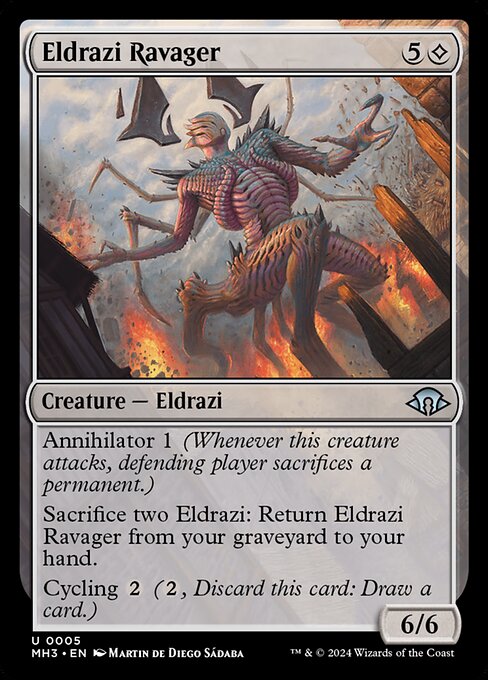
240. Eldrazi Ravager
Rating4.4WeakWhy this rating?
A good playable, but is sometimes cut (4.4/10).
Why. A 6/6 with annihilator 1: every attack, the opponent sacrifices a permanent. Its cost asks for a colorless mana, which Eldrazi Spawn tokens and some lands provide. Cycling for two keeps it from rotting in hand.
Risks. Six mana including a specific colorless one, which makes it hard to cast in a two-color deck with no sources. Cycling softens the blow but gives up its power.
In the draft. Playable in a deck with a few colorless sources or Eldrazi Spawn tokens. Otherwise it is a cycling card; a mid-pack pick.
Results in the games of the set
When it is in hand, the deck wins 51.7% of its games (set average: 56.2%, 241st of 298 cards).
In the opening hand: 49.9% wins (55.6% on average).
Drawn during the game: 53.0% (56.7% on average).
When it is drawn, the deck wins 1.7 points less than when it is not.
When it is drafted, it is played 84% of the time (set average: 67%).
Taken as the first pick (71 drafts), it ends in the deck 92% of the time.
It is played about as much in every archetype.
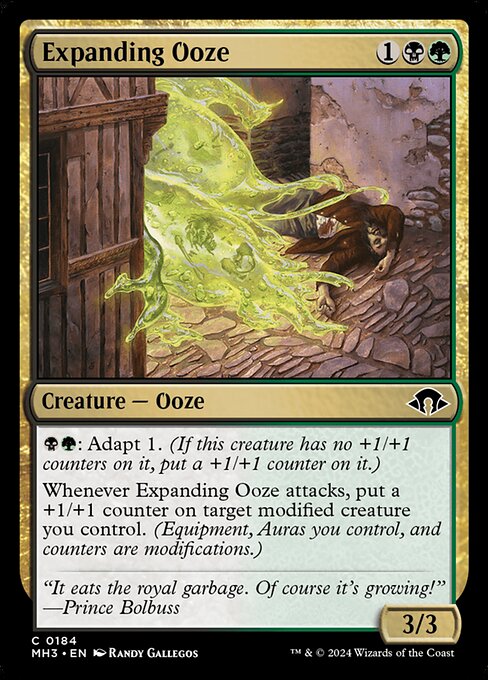
241. Expanding Ooze
Rating4.4WeakWhy this rating?
A good playable, but is sometimes cut (4.4/10).
Why. A three-mana 3/3 in black-green that can grow once with Adapt 1 when you have a black and a green mana to spare. When it attacks, it puts a +1/+1 counter on a modified creature you control, itself included if it already carries one.
Risks. Two colors required for a vanilla-sized body with no evasion. Without Equipment or counters around, its second ability does almost nothing.
In the draft. A decent mid-curve body for black-green, or a fair pick for a modified-creatures deck. Do not take it outside its colors.
Results in the games of the set
When it is in hand, the deck wins 51.4% of its games (set average: 56.2%, 247th of 298 cards).
In the opening hand: 50.8% wins (55.6% on average).
Drawn during the game: 51.8% (56.7% on average).
When it is drawn, the deck wins 0.5 points less than when it is not.
When it is drafted, it is played 53% of the time (set average: 67%).
Taken as the first pick (62 drafts), it ends in the deck 89% of the time.
It is played mostly in B/G decks (84% of them).
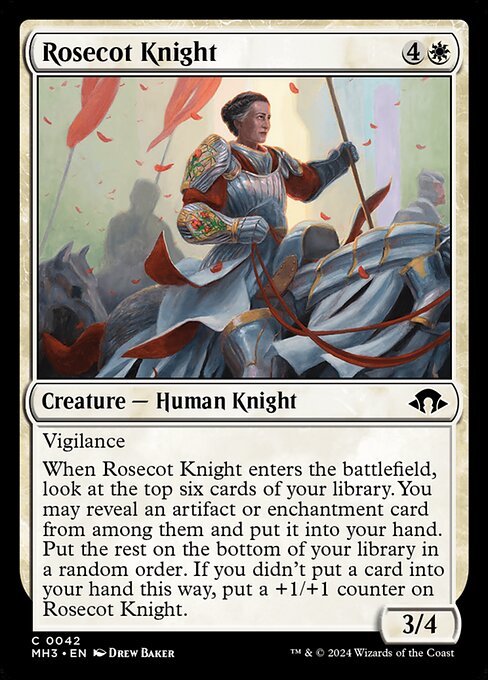
242. Rosecot Knight
Rating4.4WeakWhy this rating?
A good playable, but is sometimes cut (4.4/10).
Why. A five-mana 3/4 with vigilance. When it enters you look at six cards: you may take an artifact or enchantment, and if you do not, the creature gets a +1/+1 counter. Either way you get some value.
Risks. A five-mana body with no evasion that impresses nobody. The cards you do not take go to the bottom of your library.
In the draft. A decent white filler common, best in white-red. Nothing spectacular, but you will not regret playing it.
Results in the games of the set
When it is in hand, the deck wins 53.1% of its games (set average: 56.2%, 214th of 298 cards).
In the opening hand: 52.1% wins (55.6% on average).
Drawn during the game: 53.8% (56.7% on average).
When it is drawn, the deck wins 2.1 points less than when it is not.
When it is drafted, it is played 25% of the time (set average: 67%).
Taken among the first three picks (43 drafts), it ends in the deck 67% of the time.
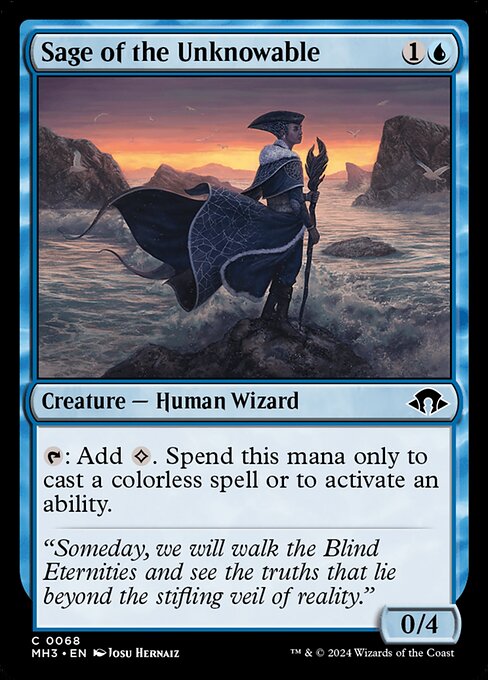 Rating4.4Weak
Why this rating?
A good playable, but is sometimes cut (4.4/10).
Why. A two-mana 0/4 that blocks small creatures well and taps for colorless mana. That mana only pays for colorless spells and abilities, which suits the set's colorless cards such as the Eldrazi.
Risks. It deals no damage, and its mana is very restricted: in a deck without colorless cards it is just a wall.
In the draft. Playable filler in blue-green with Eldrazi and costly abilities. Take it late, and only if your deck can use that mana.
Results in the games of the set
When it is in hand, the deck wins 51.6% of its games (set average: 56.2%, 243rd of 298 cards).
In the opening hand: 52.3% wins (55.6% on average).
Drawn during the game: 51.1% (56.7% on average).
When it is drawn, the deck wins 0.3 points less than when it is not.
When it is drafted, it is played 49% of the time (set average: 67%).
Taken among the first three picks (159 drafts), it ends in the deck 84% of the time.
It is played mostly in R/U decks (52% of them) and G/U (49%).

244. Strix Serenade
Rating4.4WeakWhy this rating?
A good playable, but is sometimes cut (4.4/10).
Why. A one-mana counterspell that stops an artifact, creature or planeswalker spell. The price: its controller gets a 2/2 blue Bird creature token with flying, so you only really erase the big threats.
Risks. It leaves the opponent with a flying 2/2 Bird, and does nothing to sorceries or instants. Against a small creature you trade one card for an equivalent body.
In the draft. Too weak for most draft decks. Only consider it if you have room and your opponent plays big threats.
Results in the games of the set
When it is in hand, the deck wins 43.7% of its games (set average: 56.2%, 296th of 298 cards).
In the opening hand: 0.0% wins (55.6% on average).
Drawn during the game: 45.7% (56.7% on average).
When it is drawn, the deck wins 3.4 points less than when it is not.
When it is drafted, it is played only 4% of the time (set average: 67%): it almost always ends in the sideboard.
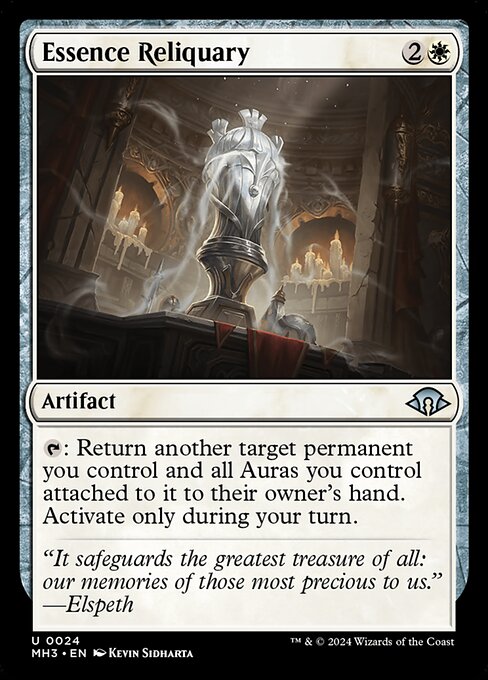
245. Essence Reliquary
Rating4.4WeakWhy this rating?
A good playable, but is sometimes cut (4.4/10).
Why. A white artifact that returns another permanent you control, with its Auras, to its owner's hand, once per turn and only during your turn. It lets you replay a creature with an enter effect or save a threatened permanent.
Risks. It does nothing on its own, and each use costs tempo. Without creatures with enter effects it is a slow engine.
In the draft. A pick for value decks, best in white-red. Take it mid-pack if you lack synergy pieces, not otherwise.
Results in the games of the set
When it is in hand, the deck wins 51.2% of its games (set average: 56.2%, 251st of 298 cards).
In the opening hand: 49.8% wins (55.6% on average).
Drawn during the game: 52.3% (56.7% on average).
When it is drawn, the deck wins 3.8 points less than when it is not.
When it is drafted, it is played 44% of the time (set average: 67%).
Taken as the first pick (50 drafts), it ends in the deck 90% of the time.
It is played about as much in every archetype.
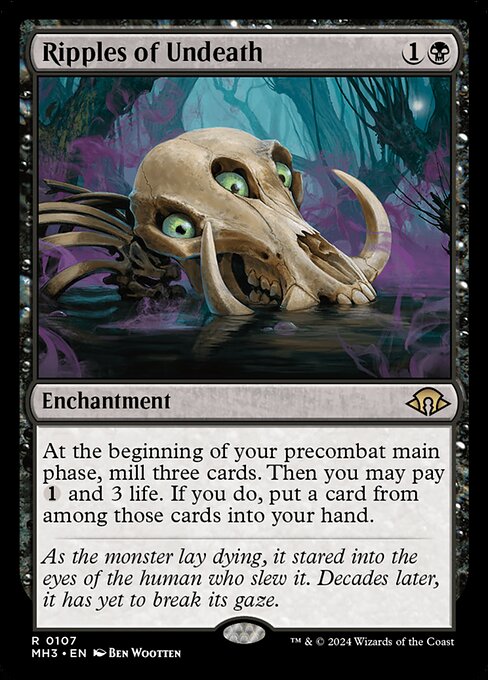
246. Ripples of Undeath
Rating4.3WeakWhy this rating?
A good playable, but is sometimes cut (4.3/10).
Why. A black enchantment that mills three cards at the start of each of your turns, then lets you pay one mana and three life to take one of them into your hand. A very slow value engine.
Risks. Each card you recover costs a mana and three life, and the enchantment does nothing for your board. It also endangers your library in a long game.
In the draft. Avoid it in draft except in a fully committed graveyard deck. Take it very late, if at all.
Results in the games of the set
When it is in hand, the deck wins 43.3% of its games (set average: 56.2%).
In the opening hand: 0.0% wins (55.6% on average).
Drawn during the game: 0.0% (56.7% on average).
When it is drawn, the deck wins 5.5 points less than when it is not.
When it is drafted, it is played only 4% of the time (set average: 67%): it almost always ends in the sideboard.

247. Angel of the Ruins
Rating4.2WeakWhy this rating?
A good playable, but is sometimes cut (4.2/10).
Why. A 5/7 flying Angel that exiles up to two artifacts and/or enchantments when it enters. With Plainscycling for two you can also discard it to fetch a Plains, so it never rots in hand.
Risks. Seven mana with two white, so it is very slow. The enter effect depends on what targets your opponent has, and cycling gives up the body.
In the draft. A decent finisher for a white deck, especially as insurance against land problems. A middling pick, take it mid-pack.
Results in the games of the set
When it is in hand, the deck wins 52.4% of its games (set average: 56.2%, 227th of 298 cards).
In the opening hand: 50.4% wins (55.6% on average).
Drawn during the game: 54.0% (56.7% on average).
When it is drawn, the deck wins 0.0 points more than when it is not.
When it is drafted, it is played 43% of the time (set average: 67%).
Taken as the first pick (33 drafts), it ends in the deck 76% of the time.
It is played about as much in every archetype.

248. Argent Dais
Rating4.2WeakWhy this rating?
A good playable, but is sometimes cut (4.2/10).
Why. A two-mana white artifact that enters with two oil counters and gains one whenever two or more creatures attack. For two mana and two counters it exiles a nonland permanent, but its controller draws two cards.
Risks. Its removal gives the opponent two cards: a poor trade except against a game-winning threat. Once the counters are spent, it needs attacks with several creatures to recharge.
In the draft. An emergency removal, fine in aggressive white. Take it late, after your creatures and real removal.
Results in the games of the set
When it is in hand, the deck wins 49.3% of its games (set average: 56.2%, 270th of 298 cards).
In the opening hand: 47.9% wins (55.6% on average).
Drawn during the game: 50.4% (56.7% on average).
When it is drawn, the deck wins 2.6 points less than when it is not.
When it is drafted, it is played only 9% of the time (set average: 67%): it almost always ends in the sideboard.
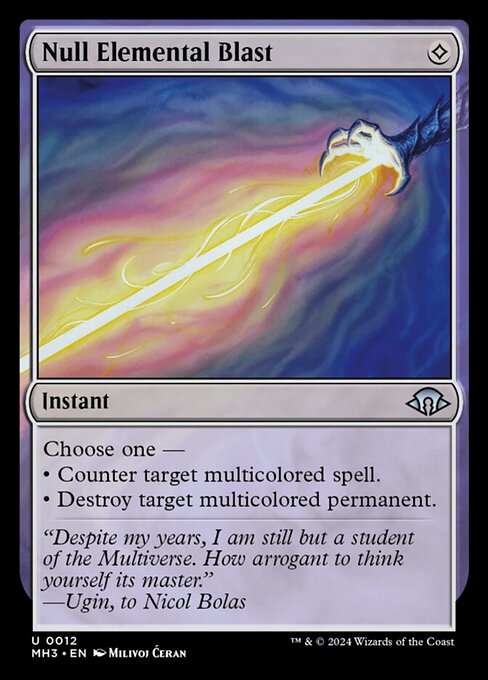
249. Null Elemental Blast
Rating4.2WeakWhy this rating?
A good playable, but is sometimes cut (4.2/10).
Why. A one-mana colorless instant that counters a multicolored spell or destroys a multicolored permanent. Against a gold card it is perfect removal, but there are few targets.
Risks. It needs a specific colorless mana, and does nothing to mono-colored cards. It can sit dead in hand all game.
In the draft. A sideboard pick: only play it if your opponents have many multicolored cards. Otherwise do not take it.
Results in the games of the set
When it is in hand, the deck wins 46.6% of its games (set average: 56.2%, 288th of 298 cards).
In the opening hand: 44.7% wins (55.6% on average).
Drawn during the game: 47.9% (56.7% on average).
When it is drawn, the deck wins 0.6 points less than when it is not.
When it is drafted, it is played only 3% of the time (set average: 67%): it almost always ends in the sideboard.

250. Ondu Knotmaster // Throw a Line
Rating4.2WeakWhy this rating?
A good playable, but is sometimes cut (4.2/10).
Why. A two-in-one card: the Adventure puts two +1/+1 counters on one or two creatures for two mana, and the 2/2 lifelink creature comes down later from exile. It grows by two counters whenever another modified creature you control dies.
Risks. Two colors, a 2/2 body with no evasion, and a growth ability that depends on modified creatures. It is easy for it to stay in hand.
In the draft. A fair two-for-one in white-black, which uses counters and Equipment. A decent pick, take it mid-pack in those colors.
Results in the games of the set
When it is in hand, the deck wins 50.1% of its games (set average: 56.2%, 262nd of 298 cards).
In the opening hand: 48.7% wins (55.6% on average).
Drawn during the game: 51.1% (56.7% on average).
When it is drawn, the deck wins 1.3 points less than when it is not.
When it is drafted, it is played 51% of the time (set average: 67%).
Taken as the first pick (32 drafts), it ends in the deck 81% of the time.
It is played mostly in B/W decks (52% of them).
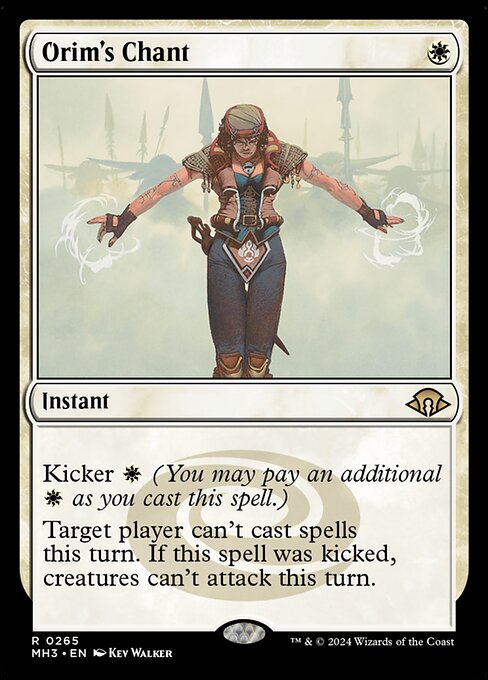
251. Orim's Chant
Rating4.2WeakWhy this rating?
A good playable, but is sometimes cut (4.2/10).
Why. A one-mana instant: the targeted player cannot cast spells this turn, and with kicker, one more white mana, no creatures can attack either. It buys a turn of breathing room or a tempo swing.
Risks. It draws no cards and solves no lasting problem: the opponent resumes their plan next turn. In limited, a single turn delayed is not enough.
In the draft. Avoid it in draft except in a very specific deck. A last-pack card, or just leave it.
Results in the games of the set
When it is drafted, it is played only 3% of the time (set average: 67%): it almost always ends in the sideboard.
 Rating4.2Weak
Why this rating?
A good playable, but is sometimes cut (4.2/10).
Why. A three-mana green Saga that creates a 1/1 black and green Insect creature token at each of its first three chapters. The last chapter lets you sacrifice creatures to find a creature in your library or graveyard.
Risks. The final chapter is not always profitable: sacrificing creatures for a single one is costly. The tokens are fragile and arrive slowly.
In the draft. A decent value playable in green, particularly with black or red. A complement rather than a standout: take it mid-pack.
Results in the games of the set
When it is in hand, the deck wins 49.7% of its games (set average: 56.2%, 265th of 298 cards).
In the opening hand: 49.8% wins (55.6% on average).
Drawn during the game: 49.7% (56.7% on average).
When it is drawn, the deck wins 3.1 points less than when it is not.
When it is drafted, it is played 33% of the time (set average: 67%).
Taken among the first three picks (47 drafts), it ends in the deck 83% of the time.
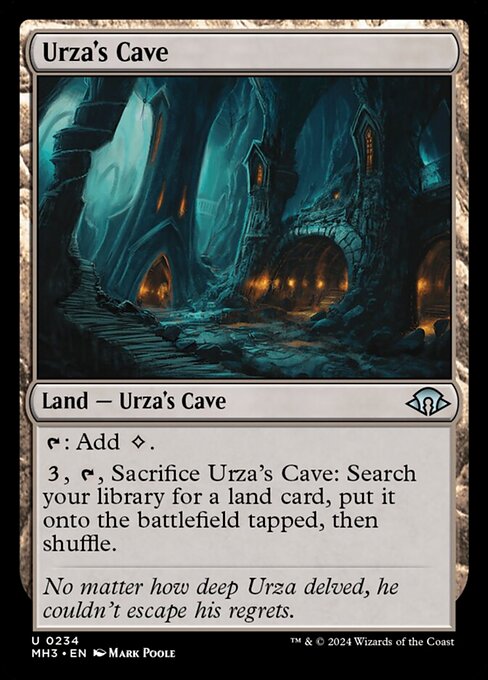
253. Urza's Cave
Rating4.2WeakWhy this rating?
A good playable, but is sometimes cut (4.2/10).
Why. A colorless land that can sacrifice itself, for three mana, to fetch a land and put it onto the battlefield tapped. It fixes a color or fills a missing land drop mid-game.
Risks. Only producing colorless mana strains your colors, and the activation is expensive. It slows your game.
In the draft. Playable as a seventeenth land in a three-color deck. Otherwise leave it: it fits no simple deck.
Results in the games of the set
When it is in hand, the deck wins 49.1% of its games (set average: 56.2%, 274th of 298 cards).
In the opening hand: 46.9% wins (55.6% on average).
Drawn during the game: 50.7% (56.7% on average).
When it is drawn, the deck wins 1.0 points less than when it is not.
When it is drafted, it is played only 12% of the time (set average: 67%): it almost always ends in the sideboard.

254. Victimize
Rating4.2WeakWhy this rating?
A good playable, but is sometimes cut (4.2/10).
Why. A black sorcery that sacrifices a creature to bring back two creature cards from your graveyard tapped. When it is live, it is a big value swing.
Risks. It needs two creatures in your graveyard and one to sacrifice: it is dead early and can cost you card advantage. The creatures come back tapped.
In the draft. Take it in a black deck that plays many creatures with enter effects. A mid-pack pick, otherwise leave it.
Results in the games of the set
When it is in hand, the deck wins 51.1% of its games (set average: 56.2%, 253rd of 298 cards).
In the opening hand: 46.7% wins (55.6% on average).
Drawn during the game: 53.9% (56.7% on average).
When it is drawn, the deck wins 0.0 points more than when it is not.
When it is drafted, it is played 55% of the time (set average: 67%).
Taken as the first pick (44 drafts), it ends in the deck 80% of the time.
It is played about as much in every archetype.
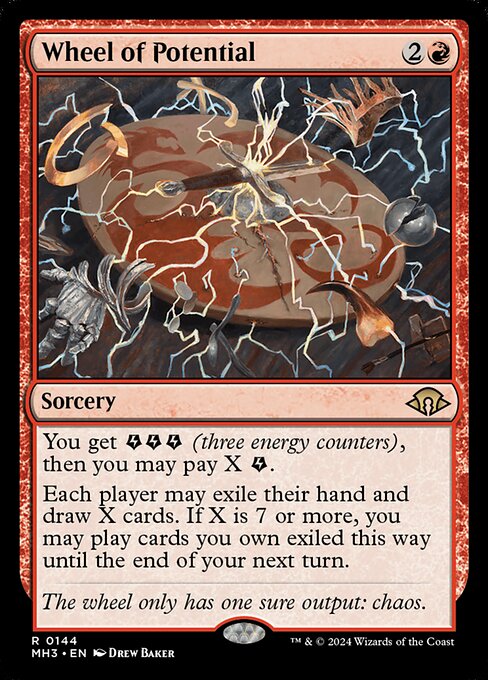
255. Wheel of Potential
Rating4.2WeakWhy this rating?
A good playable, but is sometimes cut (4.2/10).
Why. A three-mana red sorcery that gives you three energy counters, then you pay as many as you like: each player may exile their hand and draw cards equal to the energy paid. It is a symmetrical and risky effect.
Risks. The opponent benefits as much as you, and you may trade a good hand for fewer cards. It is bad when you are ahead and weak when you are behind.
In the draft. A very late pick, or just leave it. It only makes sense in a deck that has already emptied its hand.
Results in the games of the set
When it is in hand, the deck wins 48.7% of its games (set average: 56.2%, 276th of 298 cards).
In the opening hand: 0.0% wins (55.6% on average).
Drawn during the game: 51.4% (56.7% on average).
When it is drawn, the deck wins 1.8 points less than when it is not.
When it is drafted, it is played only 5% of the time (set average: 67%): it almost always ends in the sideboard.
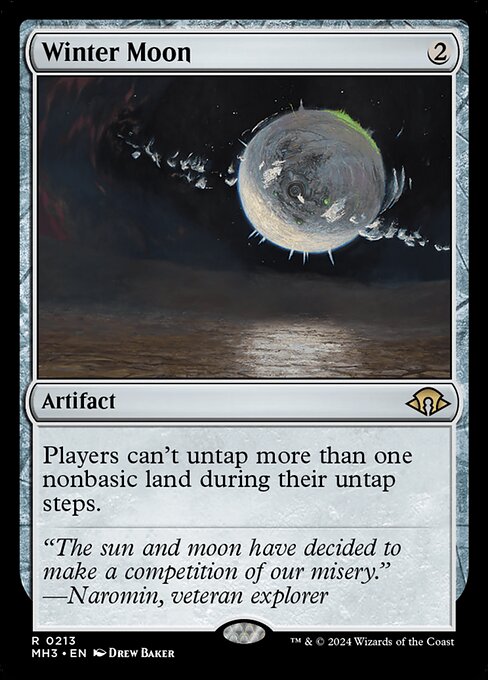
256. Winter Moon
Rating4.2WeakWhy this rating?
A good playable, but is sometimes cut (4.2/10).
Why. A two-mana artifact that limits each player to untapping one nonbasic land per untap step. It does almost nothing in draft, where basic lands dominate.
Risks. It does nothing in an ordinary limited game, and it is symmetrical. A dead card.
In the draft. Do not play it. Leave it at the bottom of the pack.
Results in the games of the set
When it is drafted, it is played only 0% of the time (set average: 67%): it almost always ends in the sideboard.

257. Fetid Gargantua
Rating4.2WeakWhy this rating?
A good playable, but is sometimes cut (4.2/10).
Why. A five-mana 4/4 whose Adapt 2 you pay later. Whenever +1/+1 counters are put on it, you may draw two cards and lose two life, which makes it a real value engine.
Risks. Adapt only works if it has no counters, so in practice you get one draw unless other counters arrive. The life loss can be dangerous against aggressive decks.
In the draft. A decent black common for a value deck. Take it before filler, especially in blue-black or black-green.
Results in the games of the set
When it is in hand, the deck wins 52.0% of its games (set average: 56.2%, 231st of 298 cards).
In the opening hand: 49.3% wins (55.6% on average).
Drawn during the game: 53.7% (56.7% on average).
When it is drawn, the deck wins 0.0 points more than when it is not.
When it is drafted, it is played 53% of the time (set average: 67%).
Taken as the first pick (41 drafts), it ends in the deck 85% of the time.
It is played mostly in B/G decks (56% of them) and B/U (44%).
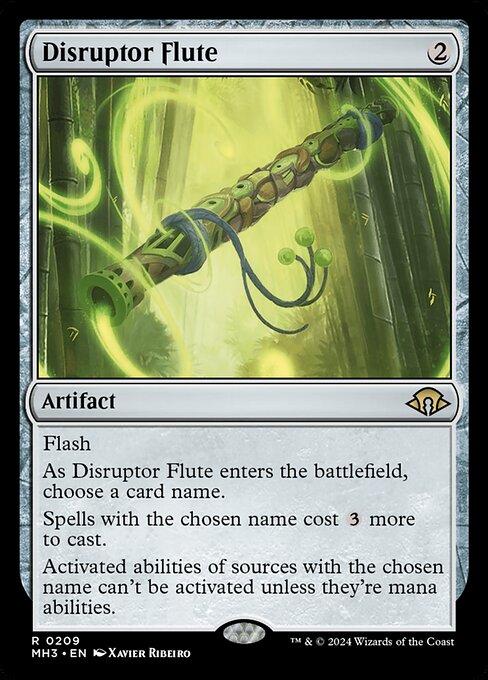
258. Disruptor Flute
Rating4.1WeakWhy this rating?
A good playable, but is sometimes cut (4.1/10).
Why. A two-mana flash artifact that names a card: spells with that name cost three more, and activated abilities of sources with that name are shut off (mana abilities excepted). It is only useful if you know the opposing threat.
Risks. In draft you often do not know the name to choose until the card has been played. It does nothing for your board.
In the draft. Leave it. A barely playable sideboard card.
Results in the games of the set
When it is drafted, it is played only 0% of the time (set average: 67%): it almost always ends in the sideboard.

259. Gravedig
Rating4.0WeakWhy this rating?
A good playable, but is sometimes cut (4.1/10).
Why. A two-mana black sorcery with two modes: give a player a 2/2 black Zombie creature token, or return a creature card from your graveyard. With entwine you do both for four mana.
Risks. A 2/2 Zombie for two mana is an average rate, and the recursion mode depends on your graveyard. It has no standout effect on the board.
In the draft. Playable black filler, nothing more. Take it late if you lack value cards.
Results in the games of the set
When it is in hand, the deck wins 50.6% of its games (set average: 56.2%, 257th of 298 cards).
In the opening hand: 47.0% wins (55.6% on average).
Drawn during the game: 53.0% (56.7% on average).
When it is drawn, the deck wins 0.9 points less than when it is not.
When it is drafted, it is played 36% of the time (set average: 67%).
Taken among the first three picks (129 drafts), it ends in the deck 74% of the time.
It is played mostly in B/G decks (46% of them) and B/W (39%).
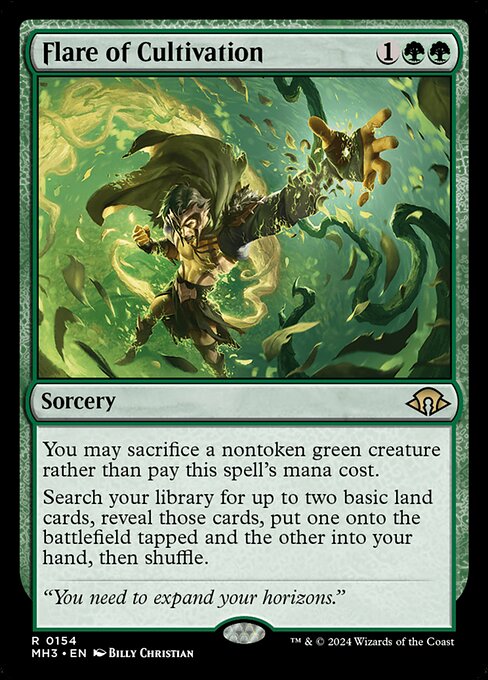
260. Flare of Cultivation
Rating4.0WeakWhy this rating?
A good playable, but is sometimes cut (4.0/10).
Why. A three-mana green sorcery, or free by sacrificing a nontoken green creature. It searches for up to two basic lands: one onto the battlefield tapped, one into your hand.
Risks. It gives fixing and slow value but no pressure. It does nothing for your board and costs tempo.
In the draft. Fine for a three-color deck, notably blue-green. A modest pick: leave it mid-pack.
Results in the games of the set
When it is in hand, the deck wins 50.4% of its games (set average: 56.2%, 259th of 298 cards).
In the opening hand: 49.6% wins (55.6% on average).
Drawn during the game: 50.9% (56.7% on average).
When it is drawn, the deck wins 0.5 points less than when it is not.
When it is drafted, it is played 42% of the time (set average: 67%).
Taken among the first three picks (50 drafts), it ends in the deck 76% of the time.
It is played about as much in every archetype.

261. Flare of Duplication
Rating4.0WeakWhy this rating?
A good playable, but is sometimes cut (4.0/10).
Why. A red instant that copies any instant or sorcery spell, yours or your opponent's, for three mana or by sacrificing a nontoken red creature. It doubles a removal or damage spell.
Risks. It depends on a good spell to copy and does nothing without a target. Often a failed two-for-one.
In the draft. A very marginal pick. Only play it with many instants and sorceries.
Results in the games of the set
When it is in hand, the deck wins 45.5% of its games (set average: 56.2%, 292nd of 298 cards).
In the opening hand: 46.3% wins (55.6% on average).
Drawn during the game: 45.0% (56.7% on average).
When it is drawn, the deck wins 5.1 points less than when it is not.
When it is drafted, it is played only 5% of the time (set average: 67%): it almost always ends in the sideboard.
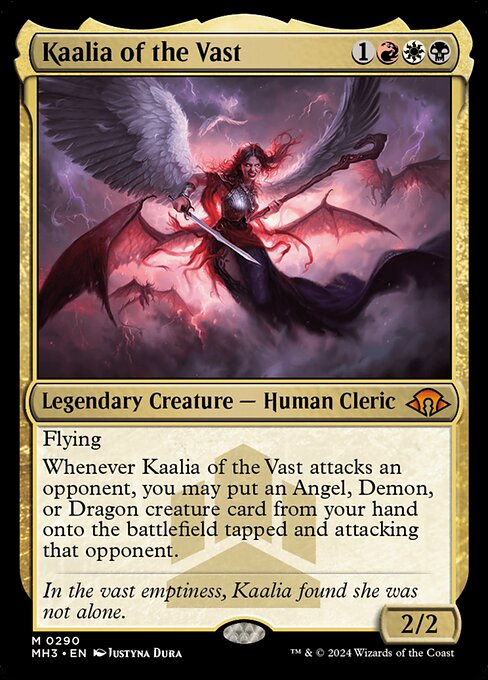
262. Kaalia of the Vast
Rating4.0WeakWhy this rating?
A good playable, but is sometimes cut (4.0/10).
Why. A 2/2 flyer in three colors. Each time it attacks an opponent it can put an Angel, Demon or Dragon creature card from your hand onto the battlefield tapped and attacking. Powerful in theory.
Risks. Three exact colors for a fragile body, and you need Angels, Demons or Dragons in hand. Nearly unplayable in draft.
In the draft. Only take it if you are already white, black and red with those creatures. Otherwise pass it.
Results in the games of the set
When it is drafted, it is played only 2% of the time (set average: 67%): it almost always ends in the sideboard.

263. Obstinate Gargoyle
Rating4.0WeakWhy this rating?
A good playable, but is sometimes cut (4.0/10).
Why. A three-mana 2/2 Artifact Creature that comes back through persist and flies while it is modified. The -1/-1 counter that persist leaves also counts as a modification.
Risks. Two colors for a modest 2/2. Without Equipment it only flies if it returns with a counter.
In the draft. Fair filler for white-black, hard to get rid of cleanly. Take it as a complement, not before.
Results in the games of the set
When it is in hand, the deck wins 50.8% of its games (set average: 56.2%, 256th of 298 cards).
In the opening hand: 49.9% wins (55.6% on average).
Drawn during the game: 51.5% (56.7% on average).
When it is drawn, the deck wins 0.6 points less than when it is not.
When it is drafted, it is played 30% of the time (set average: 67%).
Taken among the first three picks (101 drafts), it ends in the deck 79% of the time.
It is played mostly in B/W decks (67% of them).

264. Ruby Medallion
Rating4.0WeakWhy this rating?
A good playable, but is sometimes cut (4.0/10).
Why. A two-mana artifact that makes red spells cost one less. In a heavily red deck it speeds up your curve.
Risks. It does nothing on its own, and every non-red spell stays at the same price. It is rarely worth it in draft.
In the draft. Leave it except in a mono-red deck. A last-pack pick.
Results in the games of the set
When it is drafted, it is played only 1% of the time (set average: 67%): it almost always ends in the sideboard.

265. Vexing Bauble
Rating4.0WeakWhy this rating?
A good playable, but is sometimes cut (4.0/10).
Why. A one-mana artifact that counters spells cast without spending mana, yours or your opponent's, and can be sacrificed for one mana to draw a card. In practice it mostly replaces itself with another card.
Risks. There are almost no free spells in draft, so its first ability is irrelevant. It costs two mana total to cycle.
In the draft. Last-resort filler, acceptable in a deck that wants a cheap artifact. Take it late.
Results in the games of the set
When it is in hand, the deck wins 49.2% of its games (set average: 56.2%, 272nd of 298 cards).
In the opening hand: 47.3% wins (55.6% on average).
Drawn during the game: 50.8% (56.7% on average).
When it is drawn, the deck wins 2.0 points less than when it is not.
When it is drafted, it is played only 6% of the time (set average: 67%): it almost always ends in the sideboard.
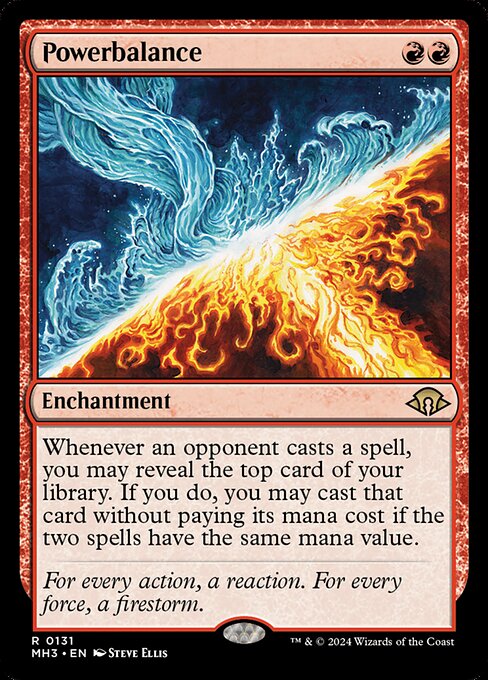
266. Powerbalance
Rating4.0WeakWhy this rating?
A good playable, but is sometimes cut (4.0/10).
Why. A two-mana red enchantment that, whenever an opponent casts a spell, lets you reveal your top card and cast it for free if it has the same mana value. The two values have to match, which is rare.
Risks. Two red mana for a random effect that only works occasionally. It does nothing for your board.
In the draft. Leave it. Too inconsistent for a draft deck.
Results in the games of the set
When it is drafted, it is played only 1% of the time (set average: 67%): it almost always ends in the sideboard.

267. Shrieking Drake
Rating3.9WeakWhy this rating?
A good playable, but is sometimes cut (3.9/10).
Why. A one-mana blue 1/1 flyer that returns a creature you control to your hand when it enters. If it is your only creature, it returns itself. With creatures that have enter effects, it is a small bonus.
Risks. It can bounce itself and do nothing. A 1/1 flyer for one mana is weak and fragile.
In the draft. Weak blue filler, playable in a deck of creatures with enter effects. Otherwise let it pass.
Results in the games of the set
When it is in hand, the deck wins 48.0% of its games (set average: 56.2%, 278th of 298 cards).
In the opening hand: 44.0% wins (55.6% on average).
Drawn during the game: 50.6% (56.7% on average).
When it is drawn, the deck wins 2.0 points less than when it is not.
When it is drafted, it is played only 12% of the time (set average: 67%): it almost always ends in the sideboard.
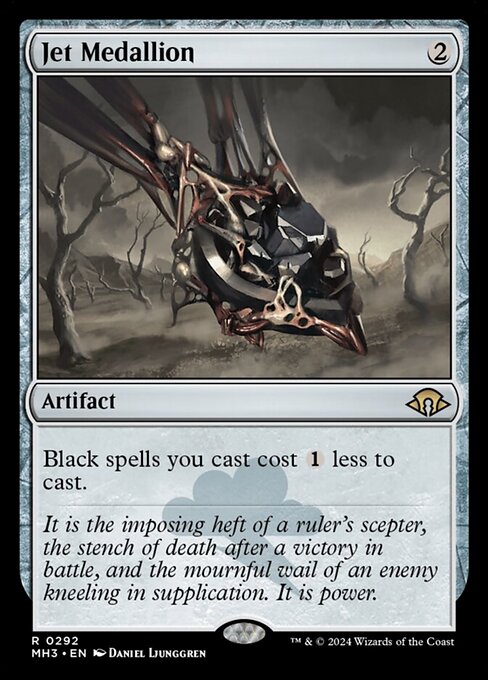
268. Jet Medallion
Rating3.9WeakWhy this rating?
A good playable, but is sometimes cut (3.9/10).
Why. A two-mana artifact that makes your black spells cost one less. It does nothing on the board by itself: in a heavily black deck it speeds you up a little and allows double-spell turns.
Risks. It blocks nothing, attacks nothing and is not a creature. On turn two it slows your development, and drawn late it is nearly dead.
In the draft. Filler. Play it only in a deck that is almost mono-black with plenty of black spells. In most decks, any solid playable beats it.
Results in the games of the set
When it is in hand, the deck wins 49.4% of its games (set average: 56.2%).
Drawn during the game: 0.0% (56.7% on average).
When it is drawn, the deck wins 0.4 points less than when it is not.
When it is drafted, it is played only 4% of the time (set average: 67%): it almost always ends in the sideboard.

269. Cursed Mirror
Rating3.8WeakWhy this rating?
A good playable, but is sometimes cut (3.8/10).
Why. An artifact that taps for a red mana, with a small bonus as it enters: it can copy any creature on the battlefield, with haste, until end of turn. Mostly a mana rock that can hit once.
Risks. The copy lasts one turn only, and with no good creature on the table it does nothing. Afterwards it is just an artifact that does not defend you.
In the draft. A fair playable in red decks that want to ramp into expensive cards. Take it after your removal and good creatures, not before.
Results in the games of the set
When it is in hand, the deck wins 49.0% of its games (set average: 56.2%, 275th of 298 cards).
In the opening hand: 46.3% wins (55.6% on average).
Drawn during the game: 51.3% (56.7% on average).
When it is drawn, the deck wins 2.2 points less than when it is not.
When it is drafted, it is played 28% of the time (set average: 67%).

270. Izzet Generatorium
Rating3.8WeakWhy this rating?
A good playable, but is sometimes cut (3.8/10).
Why. It gives you one extra energy counter whenever you would get any, and taps to draw a card if you paid or lost four or more in a turn. It is a payoff for a blue-red Energy deck, not a standalone card.
Risks. Without several energy sources and several ways to spend it, it never draws. It has no effect on the board and blocks nothing.
In the draft. Play it only in a blue-red deck loaded with energy cards. Otherwise it is end-of-pack filler.
Results in the games of the set
When it is in hand, the deck wins 49.4% of its games (set average: 56.2%, 268th of 298 cards).
In the opening hand: 48.0% wins (55.6% on average).
Drawn during the game: 50.4% (56.7% on average).
When it is drawn, the deck wins 3.2 points less than when it is not.
When it is drafted, it is played 36% of the time (set average: 67%).
Taken as the first pick (42 drafts), it ends in the deck 81% of the time.
It is played mostly in R/U decks (61% of them).
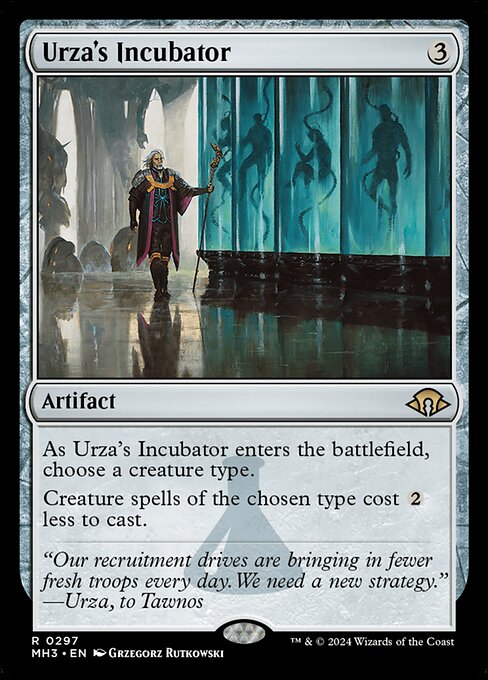
271. Urza's Incubator
Rating3.8WeakWhy this rating?
A good playable, but is sometimes cut (3.8/10).
Why. You choose a creature type, and creature spells of that type cost two less. In a very tribal deck it produces explosive turns.
Risks. A draft rarely gives you enough creatures of one type. On turn three you lose tempo, and outside the chosen type it does nothing.
In the draft. Avoid it unless your deck is already built around a specific type, with around ten creatures sharing it. Otherwise leave it in the pack.
Results in the games of the set
When it is in hand, the deck wins 42.2% of its games (set average: 56.2%, 298th of 298 cards).
In the opening hand: 40.2% wins (55.6% on average).
Drawn during the game: 43.6% (56.7% on average).
When it is drawn, the deck wins 6.7 points less than when it is not.
When it is drafted, it is played only 7% of the time (set average: 67%): it almost always ends in the sideboard.
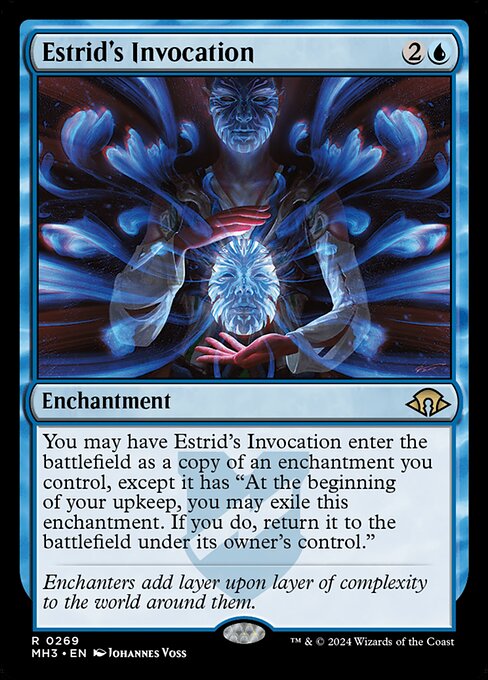
272. Estrid's Invocation
Rating3.8WeakWhy this rating?
A good playable, but is sometimes cut (3.8/10).
Why. It enters as a copy of an enchantment you control, with an ability: at the beginning of your upkeep, you may exile it to bring it back, which can restart enter effects. It doubles a good enchantment.
Risks. With no enchantment on the table it does nothing. Even with one, its value depends entirely on what it copies.
In the draft. A niche card for a deck full of enchantments. In an ordinary deck, do not play it.
Results in the games of the set
When it is in hand, the deck wins 49.3% of its games (set average: 56.2%).
In the opening hand: 0.0% wins (55.6% on average).
Drawn during the game: 49.8% (56.7% on average).
When it is drawn, the deck wins 2.7 points more than when it is not.
When it is drafted, it is played only 6% of the time (set average: 67%): it almost always ends in the sideboard.
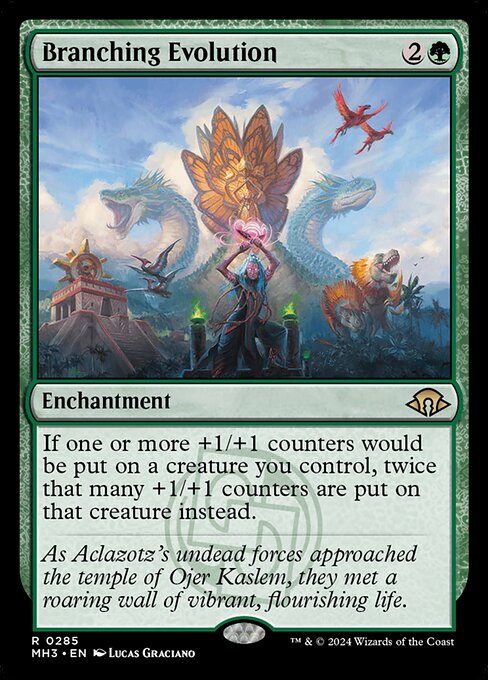
273. Branching Evolution
Rating3.5WeakWhy this rating?
Filler card but sometimes gets cut (3.5/10).
Why. It doubles the +1/+1 counters your creatures receive. With Adapt and other counter sources, each effect becomes twice as strong.
Risks. It does nothing alone and brings no body. If you control no creature that receives counters, you have wasted a turn.
In the draft. Only for green decks that already have several +1/+1 counter sources. Otherwise it is a dead enchantment in hand.
Results in the games of the set
When it is in hand, the deck wins 43.8% of its games (set average: 56.2%, 295th of 298 cards).
In the opening hand: 43.1% wins (55.6% on average).
Drawn during the game: 44.4% (56.7% on average).
When it is drawn, the deck wins 7.6 points less than when it is not.
When it is drafted, it is played 38% of the time (set average: 67%).
Taken among the first three picks (46 drafts), it ends in the deck 78% of the time.
 Rating3.2Weak
Why this rating?
Filler card but sometimes gets cut (3.2/10).
Why. For one black mana, it gains a counter each time you play a land, then reanimates any creature card from any graveyard at a cost that drops with counters. Slow, but it gives late-game value.
Risks. It does nothing for several turns and does not defend you. It needs creature cards in a graveyard, and you can only activate it at sorcery speed.
In the draft. A playable in slow black decks with little pressure. Take it late, after your creatures and removal.
Results in the games of the set
When it is in hand, the deck wins 49.5% of its games (set average: 56.2%, 267th of 298 cards).
In the opening hand: 48.8% wins (55.6% on average).
Drawn during the game: 50.0% (56.7% on average).
When it is drawn, the deck wins 0.8 points less than when it is not.
When it is drafted, it is played 38% of the time (set average: 67%).
Taken among the first three picks (100 drafts), it ends in the deck 83% of the time.
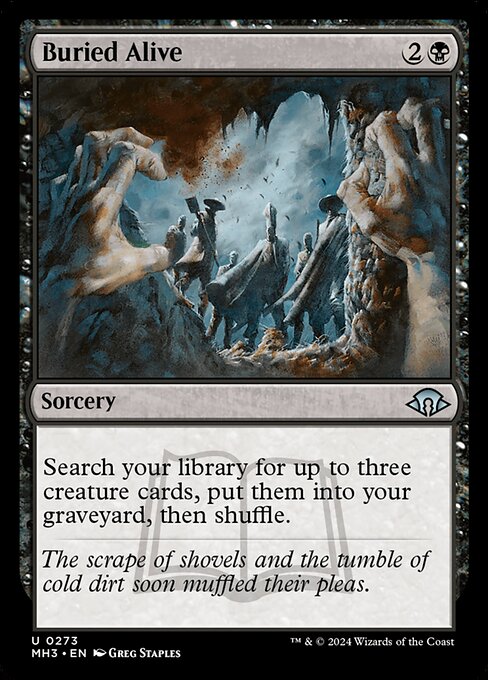
275. Buried Alive
Rating2.9WeakWhy this rating?
Filler card but sometimes gets cut (2.9/10).
Why. It puts up to three creature cards from your library into your graveyard. It is a setup sorcery for a reanimation deck, not a card that acts on the game.
Risks. It puts no creature on the battlefield. Without a way to reanimate or use the graveyard, you spent three mana and a card for nothing.
In the draft. Only in a reanimation deck that is already well advanced. Otherwise do not play it.
Results in the games of the set
When it is in hand, the deck wins 51.8% of its games (set average: 56.2%, 235th of 298 cards).
In the opening hand: 47.5% wins (55.6% on average).
Drawn during the game: 54.5% (56.7% on average).
When it is drawn, the deck wins 1.9 points more than when it is not.
When it is drafted, it is played only 4% of the time (set average: 67%): it almost always ends in the sideboard.
 Rating2.6Weak
Why this rating?
Filler card but sometimes gets cut (2.6/10).
Why. A 1/2 for two that gains you a life whenever another creature enters. Later it can exile one of your creatures and bring it back to replay its enter effect.
Risks. The body is small, and the activation costs five mana and taps it. The life gain is too small to swing games.
In the draft. A filler playable in a white deck with creatures that do something on entering. Not a priority pick.
Results in the games of the set
When it is in hand, the deck wins 49.6% of its games (set average: 56.2%, 266th of 298 cards).
In the opening hand: 50.2% wins (55.6% on average).
Drawn during the game: 49.1% (56.7% on average).
When it is drawn, the deck wins 3.2 points less than when it is not.
When it is drafted, it is played 41% of the time (set average: 67%).
Taken among the first three picks (105 drafts), it ends in the deck 67% of the time.
It is played about as much in every archetype.
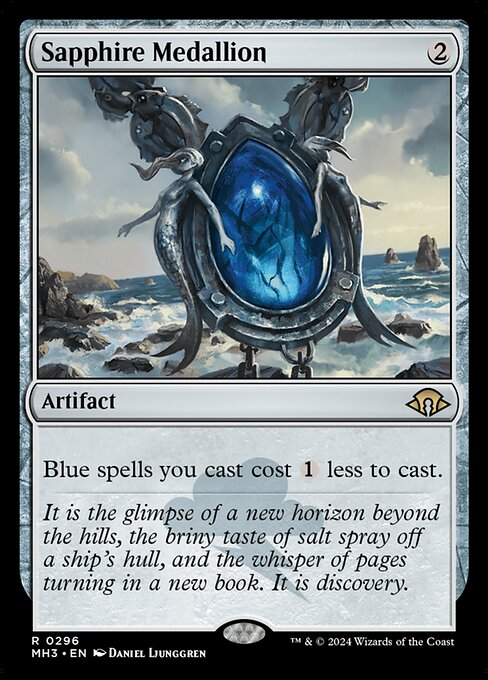
277. Sapphire Medallion
Rating2.3WeakWhy this rating?
Not good filler and often gets cut (2.3/10).
Why. A two-mana artifact that makes your blue spells cost one less. It speeds up a very blue deck, but does nothing else.
Risks. No effect on the board: it does not block, attack or replace a creature. Drawn late, it is dead.
In the draft. Filler. Play it only in a nearly mono-blue deck that is short on playables.
Results in the games of the set
When it is drafted, it is played only 1% of the time (set average: 67%): it almost always ends in the sideboard.

278. Dreadmobile
Rating2.0WeakWhy this rating?
Not good filler and often gets cut (2.0/10).
Why. A three-mana Vehicle, a 3/3 with menace and crew 1. Any small creature can pilot it, and it can grow by sacrificing another artifact or creature for one mana.
Risks. It does nothing without a creature to crew it, and removal on the crew leaves it parked. Sacrificing to grow costs you cards.
In the draft. A fair playable in black decks with cheap creatures. Take it mid-pack, not ahead of your removal.
Results in the games of the set
When it is in hand, the deck wins 50.3% of its games (set average: 56.2%, 260th of 298 cards).
In the opening hand: 50.4% wins (55.6% on average).
Drawn during the game: 50.2% (56.7% on average).
When it is drawn, the deck wins 2.5 points less than when it is not.
When it is drafted, it is played 33% of the time (set average: 67%).
Taken among the first three picks (72 drafts), it ends in the deck 71% of the time.
It is played mostly in B/R decks (26% of them).
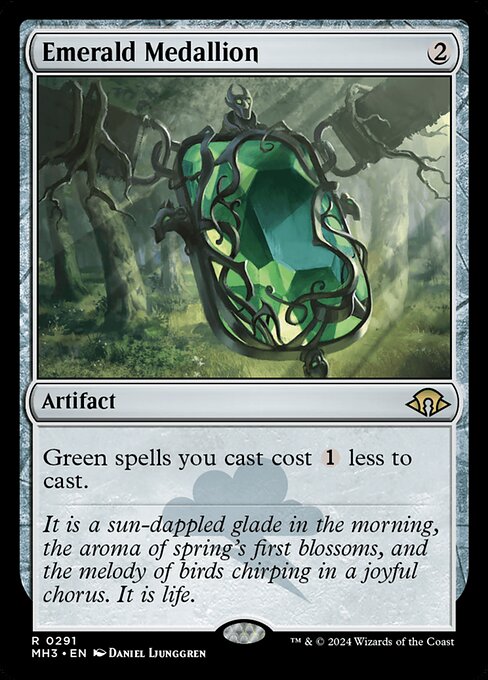
279. Emerald Medallion
Rating2.0WeakWhy this rating?
Not good filler and often gets cut (2.0/10).
Why. A two-mana artifact that makes your green spells cost one less. In a very green deck it speeds up crowded turns.
Risks. It does nothing on the battlefield, and on turn two it slows your development. Drawn late, it is dead.
In the draft. End-of-pack filler. Only in a nearly mono-green deck, and even then a real creature is better.
Results in the games of the set
When it is drafted, it is played only 1% of the time (set average: 67%): it almost always ends in the sideboard.

280. Fledgling Dragon
Rating2.0WeakWhy this rating?
Not good filler and often gets cut (2.0/10).
Why. A four-mana 2/2 flyer that becomes a 5/5 with a pump ability once your graveyard holds seven cards. Late in the game, it is a big flyer.
Risks. Seven cards in the graveyard comes late in limited. Until then it is an expensive 2/2 flyer that dies to anything.
In the draft. An average playable for red decks that fill their graveyard. Take it after removal and solid creatures.
Results in the games of the set
When it is in hand, the deck wins 47.9% of its games (set average: 56.2%, 279th of 298 cards).
In the opening hand: 44.5% wins (55.6% on average).
Drawn during the game: 50.3% (56.7% on average).
When it is drawn, the deck wins 5.2 points less than when it is not.
When it is drafted, it is played 15% of the time (set average: 67%).
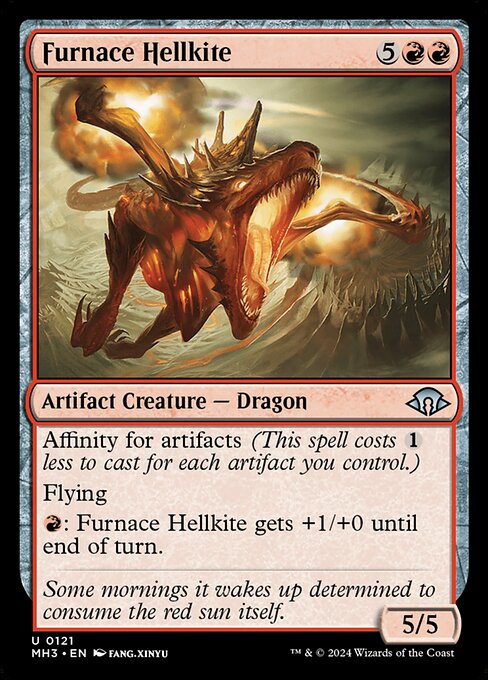
281. Furnace Hellkite
Rating2.0WeakWhy this rating?
Not good filler and often gets cut (2.0/10).
Why. A 5/5 flyer with a firebreathing ability, but it costs seven minus one for each artifact you control. In a deck full of artifacts, it comes down early and owns the sky.
Risks. Without artifacts it costs seven mana: it arrives too late and dies to removal. It needs a deck built for it.
In the draft. A card for a red artifact deck. If you have plenty, it is a good finisher; otherwise leave it.
Results in the games of the set
When it is in hand, the deck wins 50.9% of its games (set average: 56.2%, 254th of 298 cards).
In the opening hand: 48.8% wins (55.6% on average).
Drawn during the game: 52.5% (56.7% on average).
When it is drawn, the deck wins 1.1 points less than when it is not.
When it is drafted, it is played 46% of the time (set average: 67%).
Taken among the first three picks (111 drafts), it ends in the deck 85% of the time.
It is played mostly in B/R decks (46% of them).
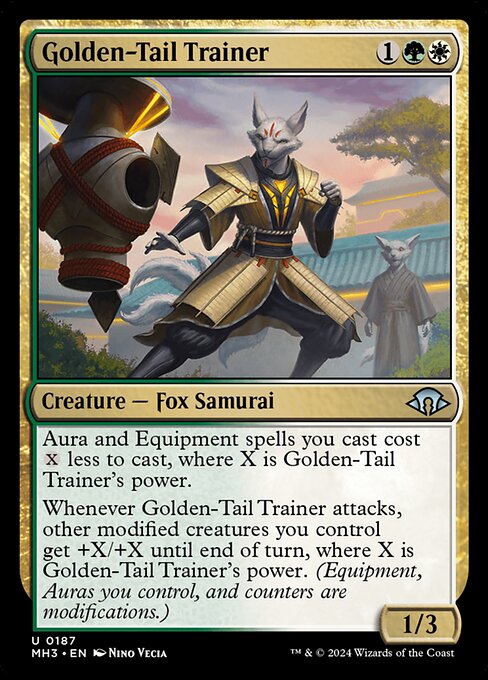
282. Golden-Tail Trainer
Rating2.0WeakWhy this rating?
Not good filler and often gets cut (2.0/10).
Why. A 1/3 that makes your Auras and Equipment cost less by its power, and gives other modified creatures +X/+X (X being its power) when it attacks. In a modified-creatures deck it has a role.
Risks. Its power is 1, so the discount is tiny. It needs modified creatures, and a 1/3 is a poor attacker to start the effect.
In the draft. For a green-white deck with Equipment, Auras and counters. Otherwise it is a fine body with no real effect.
Results in the games of the set
When it is in hand, the deck wins 47.7% of its games (set average: 56.2%, 281st of 298 cards).
In the opening hand: 47.5% wins (55.6% on average).
Drawn during the game: 47.9% (56.7% on average).
When it is drawn, the deck wins 6.6 points less than when it is not.
When it is drafted, it is played 38% of the time (set average: 67%).
Taken among the first three picks (92 drafts), it ends in the deck 82% of the time.
It is played mostly in G/W decks (38% of them).
 Rating2.0Weak
Why this rating?
Not good filler and often gets cut (2.0/10).
Why. A three-mana 2/2 whose ability turns every nonbasic land into an Island. It is a combo or land-hate piece, not a good limited creature.
Risks. It also disrupts your own nonbasic lands and fixing. The body is weak for three mana, and it needs two blue mana.
In the draft. Leave it. It only helps if the opponent relies on nonbasic lands, which is rarely the case.
Results in the games of the set
When it is drafted, it is played only 2% of the time (set average: 67%): it almost always ends in the sideboard.

284. Hydra Trainer
Rating2.0WeakWhy this rating?
Not good filler and often gets cut (2.0/10).
Why. A two-mana 1/1 that can be exerted on attack to give a creature +X/+X, where X is the number of counters you control. With Adapt it becomes a 3/3.
Risks. It attacks poorly while small, and exerting keeps it from untapping. With no counters on the board the effect is weak.
In the draft. A fair playable in green decks with +1/+1 counters. Otherwise a filler creature.
Results in the games of the set
When it is in hand, the deck wins 50.2% of its games (set average: 56.2%, 261st of 298 cards).
In the opening hand: 51.0% wins (55.6% on average).
Drawn during the game: 49.5% (56.7% on average).
When it is drawn, the deck wins 3.2 points less than when it is not.
When it is drafted, it is played 61% of the time (set average: 67%).
Taken among the first three picks (129 drafts), it ends in the deck 87% of the time.
It is played mostly in B/G decks (26% of them).
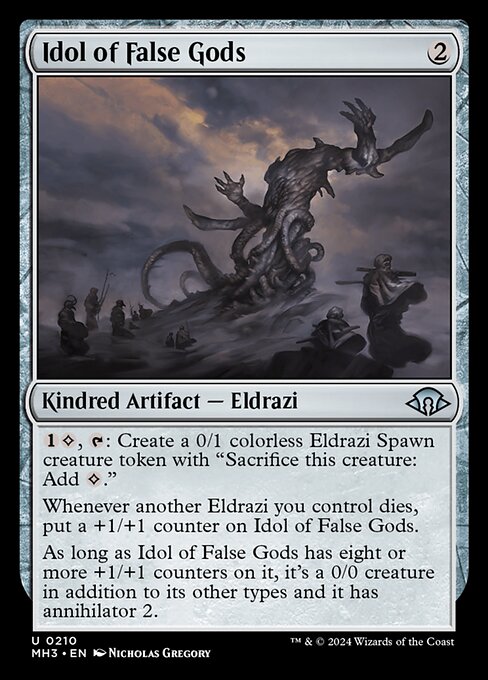
285. Idol of False Gods
Rating2.0WeakWhy this rating?
Not good filler and often gets cut (2.0/10).
Why. A two-mana artifact that taps to make an Eldrazi Spawn token, for one generic mana and one colorless mana. It only becomes a creature with eight +1/+1 counters, gained when other Eldrazi die, which is very unlikely in limited.
Risks. Colorless mana is hard to produce in most decks. Each token costs tempo, and the artifact does nothing else.
In the draft. A card for an Eldrazi deck, to play only with colorless mana sources. Otherwise it is slow filler.
Results in the games of the set
When it is in hand, the deck wins 49.9% of its games (set average: 56.2%, 264th of 298 cards).
In the opening hand: 48.1% wins (55.6% on average).
Drawn during the game: 51.3% (56.7% on average).
When it is drawn, the deck wins 1.8 points less than when it is not.
When it is drafted, it is played 57% of the time (set average: 67%).
Taken among the first three picks (101 drafts), it ends in the deck 82% of the time.
It is played about as much in every archetype.
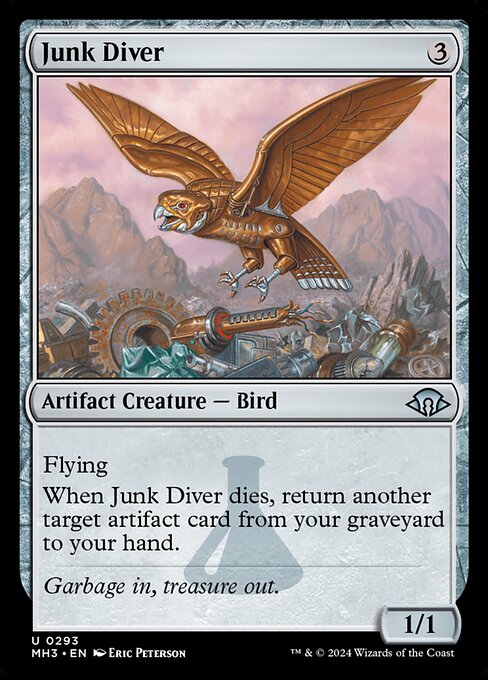
286. Junk Diver
Rating2.0WeakWhy this rating?
Not good filler and often gets cut (2.0/10).
Why. A three-mana 1/1 flying artifact creature that returns another artifact card from your graveyard to your hand when it dies. It makes sense in an artifact deck.
Risks. A 1/1 for three mana is small. With no other artifact in the graveyard, its death gives nothing.
In the draft. Filler for artifact decks. Play it if you have artifacts worth getting back.
Results in the games of the set
When it is in hand, the deck wins 47.3% of its games (set average: 56.2%, 285th of 298 cards).
In the opening hand: 45.9% wins (55.6% on average).
Drawn during the game: 48.5% (56.7% on average).
When it is drawn, the deck wins 3.4 points less than when it is not.
When it is drafted, it is played 15% of the time (set average: 67%).

287. Meltdown
Rating2.0WeakWhy this rating?
Not good filler and often gets cut (2.0/10).
Why. A red sorcery that destroys each artifact with mana value X or less, yours and your opponent's. It is not creature removal: it only hits artifacts.
Risks. It also destroys your own artifacts, and most opponents have almost none. Outside narrow cases it does nothing.
In the draft. Take it only if you see lots of artifacts around the table. Otherwise it is a dead card.
Results in the games of the set
When it is drafted, it is played only 0% of the time (set average: 67%): it almost always ends in the sideboard.
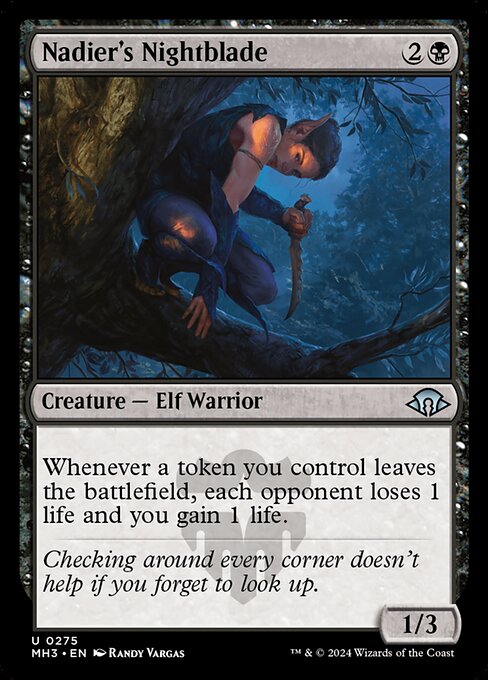
288. Nadier's Nightblade
Rating2.0WeakWhy this rating?
Not good filler and often gets cut (2.0/10).
Why. A three-mana 1/3 that drains one life each time a token you control leaves the battlefield. With several tokens, the small drains add up.
Risks. It makes no tokens itself. With no token source it is a vanilla 1/3 for three.
In the draft. Filler for black token decks. Without that, leave it.
Results in the games of the set
When it is in hand, the deck wins 46.8% of its games (set average: 56.2%, 287th of 298 cards).
In the opening hand: 43.6% wins (55.6% on average).
Drawn during the game: 49.2% (56.7% on average).
When it is drawn, the deck wins 3.7 points less than when it is not.
When it is drafted, it is played 20% of the time (set average: 67%).
Taken among the first three picks (41 drafts), it ends in the deck 56% of the time.

289. Pearl Medallion
Rating2.0WeakWhy this rating?
Not good filler and often gets cut (2.0/10).
Why. A two-mana artifact that makes your white spells cost one less. It speeds up a very white deck and does nothing else.
Risks. No effect on the board. It slows your development and is dead if drawn late.
In the draft. Filler. Only in a nearly mono-white deck, and even there a playable creature is better.
Results in the games of the set
When it is drafted, it is played only 1% of the time (set average: 67%): it almost always ends in the sideboard.

290. Primal Prayers
Rating2.0WeakWhy this rating?
Not good filler and often gets cut (2.0/10).
Why. A four-mana enchantment that gives you two energy and lets you cast creature spells with mana value 3 or less by paying energy, with flash. That is two free creatures, and that is all.
Risks. Only two energy: two creatures, then it does nothing. It costs four mana for no body.
In the draft. Close to unplayable. It only makes sense in an Energy deck with many cheap creatures; elsewhere leave it.
Results in the games of the set
When it is in hand, the deck wins 40.7% of its games (set average: 56.2%).
Drawn during the game: 0.0% (56.7% on average).
When it is drawn, the deck wins 6.8 points less than when it is not.
When it is drafted, it is played only 1% of the time (set average: 67%): it almost always ends in the sideboard.
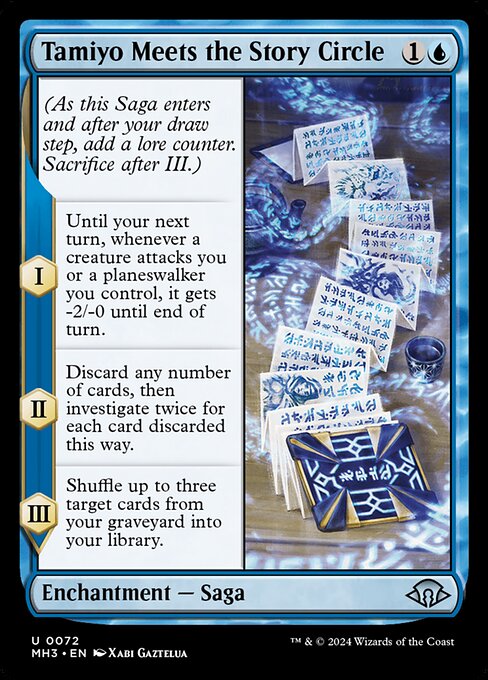
291. Tamiyo Meets the Story Circle
Rating2.0WeakWhy this rating?
Not good filler and often gets cut (2.0/10).
Why. A two-mana blue Saga: the first chapter gives -2/-0 to creatures attacking you, the second turns each discarded card into two Clues, the third shuffles up to three cards from your graveyard back into your library. A slow filter.
Risks. It has no body and rarely changes the game. Clues cost mana to use.
In the draft. A filler playable for slow blue decks. Take it late.
Results in the games of the set
When it is in hand, the deck wins 49.2% of its games (set average: 56.2%, 271st of 298 cards).
In the opening hand: 43.4% wins (55.6% on average).
Drawn during the game: 52.8% (56.7% on average).
When it is drawn, the deck wins 1.4 points less than when it is not.
When it is drafted, it is played 37% of the time (set average: 67%).
Taken among the first three picks (105 drafts), it ends in the deck 76% of the time.
 Rating2.0Weak
Why this rating?
Not good filler and often gets cut (2.0/10).
Why. A black Saga that searches for any card, exiles it face down, then lets you put it onto the battlefield if it is a creature, or take it into your hand otherwise. A slow tutor.
Risks. It takes three turns, does nothing right away, and can cost you life if the card is a big creature.
In the draft. An average playable in a black deck with a big threat to find. Rarely a first choice.
Results in the games of the set
When it is in hand, the deck wins 46.3% of its games (set average: 56.2%, 289th of 298 cards).
In the opening hand: 45.3% wins (55.6% on average).
Drawn during the game: 47.1% (56.7% on average).
When it is drawn, the deck wins 3.3 points less than when it is not.
When it is drafted, it is played only 6% of the time (set average: 67%): it almost always ends in the sideboard.
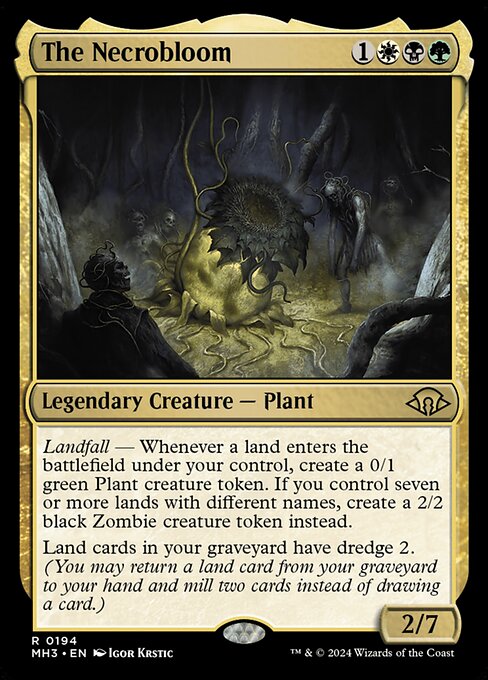
293. The Necrobloom
Rating2.0WeakWhy this rating?
Not good filler and often gets cut (2.0/10).
Why. A four-mana 2/7 that creates a 0/1 green Plant creature token each time you play a land. It blocks very well and gives steady tokens. With seven lands of different names, the tokens become 2/2 black Zombies.
Risks. Three colors: very hard to cast. Seven different land names is almost impossible in limited.
In the draft. Only in a white-black-green deck that is already well fixed. Otherwise leave it.
Results in the games of the set
When it is in hand, the deck wins 46.9% of its games (set average: 56.2%, 286th of 298 cards).
In the opening hand: 46.3% wins (55.6% on average).
Drawn during the game: 47.3% (56.7% on average).
When it is drawn, the deck wins 0.0 points more than when it is not.
When it is drafted, it is played 28% of the time (set average: 67%).
Taken among the first three picks (58 drafts), it ends in the deck 66% of the time.
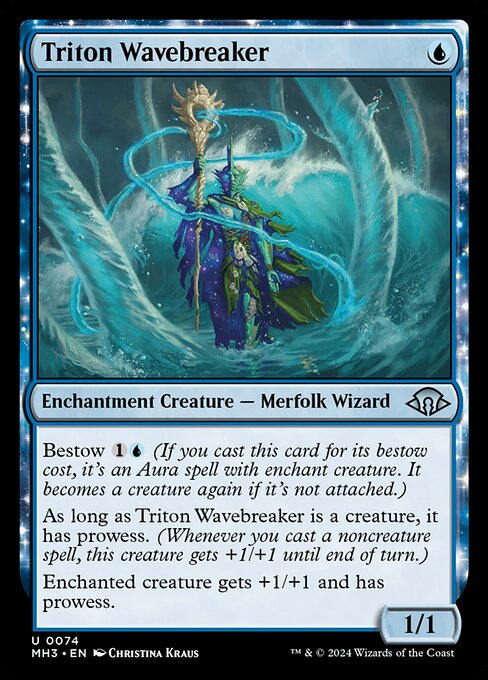
294. Triton Wavebreaker
Rating2.0WeakWhy this rating?
Not good filler and often gets cut (2.0/10).
Why. A one-mana 1/1 with prowess, or a bestow Aura that gives a creature +1/+1 and prowess. It is flexible, but the effect stays modest.
Risks. As an Aura it costs two mana for a mere +1/+1 and prowess; if the enchanted creature dies, it becomes a 1/1 creature again. A 1/1 does not last long on the battlefield.
In the draft. Filler for blue decks with many noncreature spells. Take it late.
Results in the games of the set
When it is in hand, the deck wins 47.7% of its games (set average: 56.2%, 282nd of 298 cards).
In the opening hand: 46.8% wins (55.6% on average).
Drawn during the game: 48.3% (56.7% on average).
When it is drawn, the deck wins 1.6 points less than when it is not.
When it is drafted, it is played only 13% of the time (set average: 67%): it almost always ends in the sideboard.

295. Wirewood Symbiote
Rating2.0WeakWhy this rating?
Not good filler and often gets cut (2.0/10).
Why. A one-mana 1/1 that can return an Elf you control to hand to untap a creature, once each turn. It replays enter effects and can fake out a combat, but only with Elves.
Risks. It is an Insect, not an Elf, so it cannot return itself. Without Elves it does nothing.
In the draft. A niche card for an Elf deck. In any other deck, do not play it.
Results in the games of the set
When it is in hand, the deck wins 47.5% of its games (set average: 56.2%).
Drawn during the game: 0.0% (56.7% on average).
When it is drawn, the deck wins 1.8 points more than when it is not.
When it is drafted, it is played only 1% of the time (set average: 67%): it almost always ends in the sideboard.
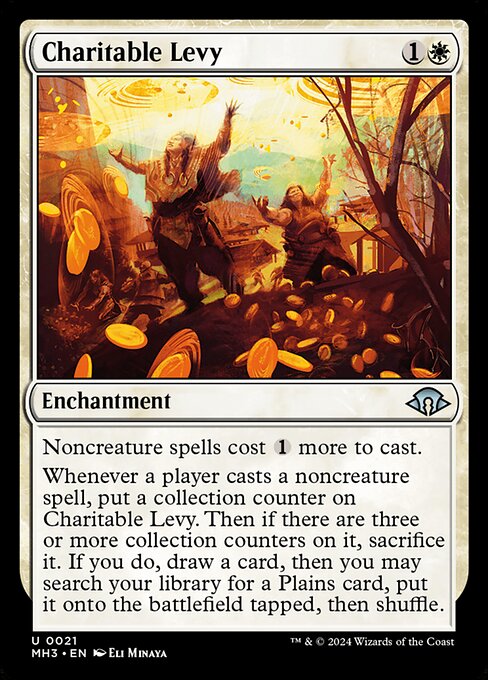
296. Charitable Levy
Rating2.0WeakWhy this rating?
Not good filler and often gets cut (2.0/10).
Why. A two-mana white enchantment that makes noncreature spells cost more for every player, then sacrifices itself after the third such spell to draw a card and fetch a Plains. A symmetrical control effect.
Risks. It taxes your own noncreature spells as much as your opponent's. It has no body and its payoff is thin.
In the draft. Almost never playable in limited. A creature-heavy deck can try it, but let it pass.
Results in the games of the set
When it is drafted, it is played only 1% of the time (set average: 67%): it almost always ends in the sideboard.
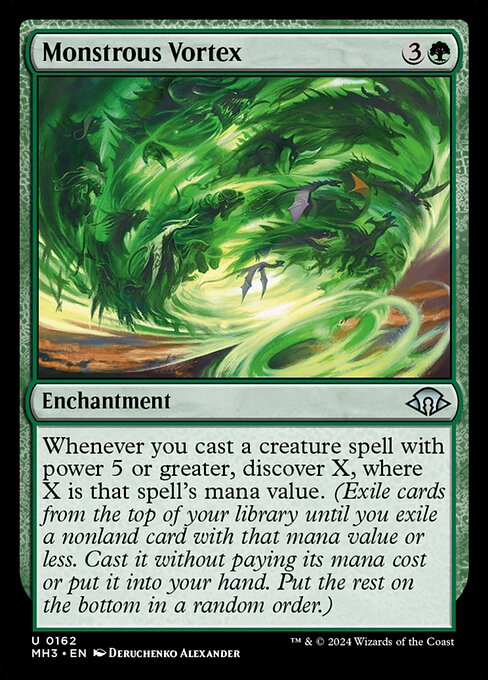
297. Monstrous Vortex
Rating1.8WeakWhy this rating?
Not good filler and often gets cut (1.8/10).
Why. A four-mana green enchantment: each creature spell with power 5 or greater you cast makes you discover X, where X is its mana value. It gives value, but needs a deck of big creatures.
Risks. It does nothing the turn it comes down, and only triggers on creatures with power 5 or greater. Outside a deck of big monsters it stays dead.
In the draft. At best for a green deck of big creatures. Otherwise do not play it.
Results in the games of the set
When it is in hand, the deck wins 46.2% of its games (set average: 56.2%, 290th of 298 cards).
In the opening hand: 44.2% wins (55.6% on average).
Drawn during the game: 47.5% (56.7% on average).
When it is drawn, the deck wins 2.6 points less than when it is not.
When it is drafted, it is played only 5% of the time (set average: 67%): it almost always ends in the sideboard.
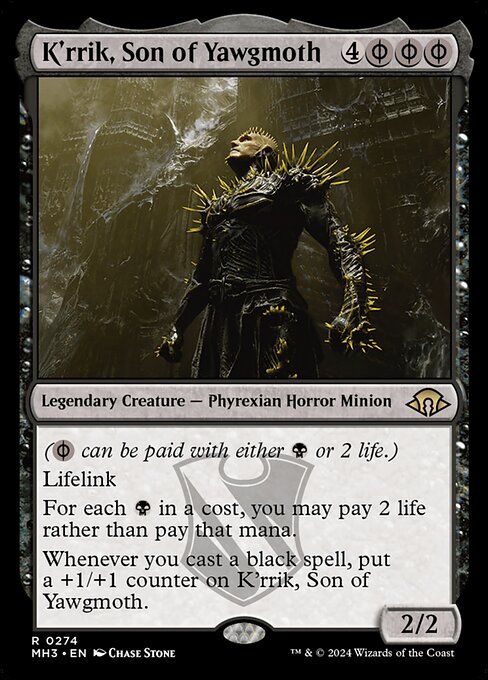 Rating1.6Weak
Why this rating?
Not good filler and often gets cut (1.6/10).
Why. A black legendary 2/2 with lifelink, in which each black mana in a cost can be paid with two life. It gets a +1/+1 counter whenever you cast a black spell.
Risks. It costs seven mana, or four mana and up to six life, for a 2/2. It dies to any removal before it grows.
In the draft. A slow playable for heavy-black decks. It is too expensive for most decks; let it pass.
Results in the games of the set
When it is in hand, the deck wins 43.5% of its games (set average: 56.2%, 297th of 298 cards).
In the opening hand: 38.9% wins (55.6% on average).
Drawn during the game: 46.9% (56.7% on average).
When it is drawn, the deck wins 5.5 points less than when it is not.
When it is drafted, it is played only 14% of the time (set average: 67%): it almost always ends in the sideboard.
 Rating1.4Weak
Why this rating?
Almost unplayable and mostly sideboard material (1.4/10).
Why. A colorless (devoid) common for four that needs blue mana: as it enters it becomes a 3/3 with flying, a 2/5 with vigilance, or a 0/12 with defender. A four-mana 3/3 flyer is an honest playable, and the flexibility lets you adapt.
Risks. Nothing exceptional: once chosen it never changes, and every form dies to removal. The 0/12 never attacks.
In the draft. Honest filler for a blue deck. Take it to fill your curve, not ahead of your removal.
Results in the games of the set
When it is in hand, the deck wins 49.2% of its games (set average: 56.2%, 273rd of 298 cards).
In the opening hand: 46.2% wins (55.6% on average).
Drawn during the game: 51.0% (56.7% on average).
When it is drawn, the deck wins 0.2 points more than when it is not.
When it is drafted, it is played 26% of the time (set average: 67%).
Taken among the first three picks (43 drafts), it ends in the deck 70% of the time.
It is played mostly in R/U decks (25% of them).
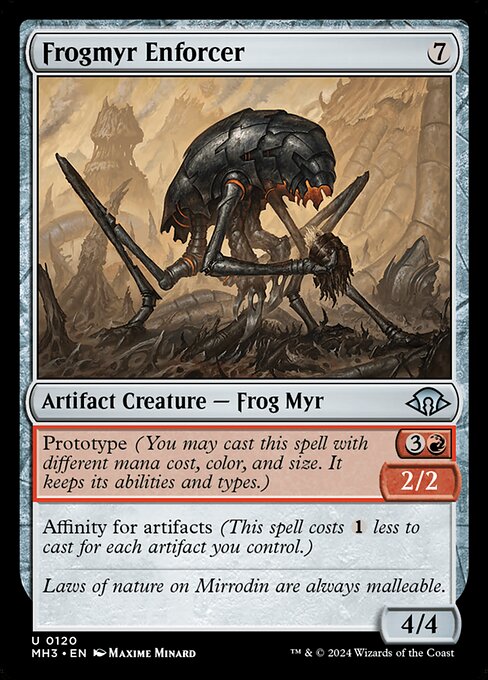
300. Frogmyr Enforcer
Rating1.4WeakWhy this rating?
Almost unplayable and mostly sideboard material (1.4/10).
Why. An artifact creature with two forms: a red 2/2 prototype for four mana, or a colorless 4/4 for seven mana minus one per artifact you control. In an artifact deck it is a flexible body.
Risks. A 2/2 for four is weak. As a 4/4 it is expensive without artifacts, and it does nothing else.
In the draft. Filler for artifact decks, in red. Without artifacts, leave it.
Results in the games of the set
When it is in hand, the deck wins 47.7% of its games (set average: 56.2%, 280th of 298 cards).
In the opening hand: 46.2% wins (55.6% on average).
Drawn during the game: 48.9% (56.7% on average).
When it is drawn, the deck wins 4.3 points less than when it is not.
When it is drafted, it is played 26% of the time (set average: 67%).
Taken among the first three picks (35 drafts), it ends in the deck 80% of the time.
It is played mostly in B/R decks (32% of them).

301. Imskir Iron-Eater
Rating1.4WeakWhy this rating?
Almost unplayable and mostly sideboard material (1.4/10).
Why. A black-red legendary 5/5 with affinity for artifacts: it costs eight minus one per artifact. On entering you draw cards equal to half your artifacts (rounded down), and for four mana including a red one you can sacrifice an artifact to deal damage equal to its mana value to any target.
Risks. Without many artifacts it costs eight mana, and you lose as much life as the cards you draw.
In the draft. A finisher for a black-red artifact deck. Outside that deck, do not play it.
Results in the games of the set
When it is in hand, the deck wins 47.3% of its games (set average: 56.2%, 284th of 298 cards).
In the opening hand: 44.4% wins (55.6% on average).
Drawn during the game: 49.6% (56.7% on average).
When it is drawn, the deck wins 5.0 points less than when it is not.
When it is drafted, it is played 47% of the time (set average: 67%).
Taken among the first three picks (100 drafts), it ends in the deck 75% of the time.
It is played mostly in B/R decks (25% of them).
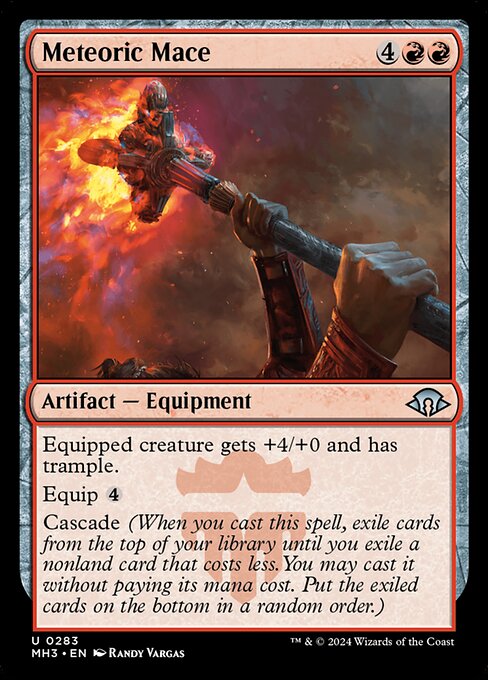
302. Meteoric Mace
Rating1.4WeakWhy this rating?
Almost unplayable and mostly sideboard material (1.4/10).
Why. The cascade hands you a free card when you cast it, which softens the six-mana price tag. After that, the Equipment gives +4/+0 and trample, turning a small creature into a real threat. It is slow and expensive for what it does, though.
Risks. Six mana for an Equipment, then four more to equip it: that is close to two turns for a single effect. The cascade is random and can hit something unexciting, and the equipped attacker is still exposed to removal in response.
In the draft. Mediocre filler: take it late, and only if you are red and short on options. Decks with plenty of cheap creatures get more out of it than others. In a slower deck with little top end it is playable, rarely exciting.
Results in the games of the set
When it is in hand, the deck wins 48.6% of its games (set average: 56.2%, 277th of 298 cards).
In the opening hand: 45.5% wins (55.6% on average).
Drawn during the game: 50.9% (56.7% on average).
When it is drawn, the deck wins 4.4 points less than when it is not.
When it is drafted, it is played only 9% of the time (set average: 67%): it almost always ends in the sideboard.
Intrinsic ratings: they do not take into account the cards you have already picked. They matter most for the first pick of the first pack.