Card ranking · Avatar: The Last Airbender (TLA)
← Avatar: The Last Airbender281 cards
- Bomb > 8.4
- Very good ≥ 7.2
- Good ≥ 6.2
- Playable ≥ 5.0
- Weak < 5.0
Ratings are out of 10. They combine experts' opinions, the statistics of thousands of drafts by experienced players (when a card is taken, played, and the wins of the decks that play it) and what is printed on the card. Click a card to enlarge it.
 Rating9.4Bomb
Why this rating?
The best card of the set (9.4/10).
Why. A flexible threat at every stage of the game. With flash you cast it at the end of the opponent's turn with whatever X your mana allows: a growing flying vigilance body that draws cards from X=2. Every library search by the opponent gives it another counter and a card.
Risks. At low X it is a fragile 1/1 that draws little or nothing. It demands two blue mana, and a removal spell in response to the enters trigger leaves you without the counters.
In the draft. A very high first pick for any blue deck, and a bomb. It adapts to your curve, so it is rarely a dead card in hand.
Results in the games of the set
When it is in hand, the deck wins 65.1% of its games (set average: 56.2%, 7th of 279 cards).
In the opening hand: 62.2% wins (55.4% on average).
Drawn during the game: 66.8% (56.8% on average).
When it is drawn, the deck wins 11.9 points more than when it is not.
When it is drafted, it is played 93% of the time (set average: 61%).
Taken as the first pick (87 drafts), it ends in the deck 92% of the time.
It is played about as much in every archetype.

2. The Rise of Sozin // Fire Lord Sozin
Rating9.3BombWhy this rating?
One of the 3 best cards of the set (9.3/10).
Why. A board wipe followed by a finisher. Chapter I destroys all creatures, chapter II exiles up to four cards with a chosen name from the opponent's graveyard, hand and library, then the Saga returns as Fire Lord Sozin with menace and Firebending 3. When it connects, it can put creatures from their graveyard onto the battlefield for X mana.
Risks. Six mana with two black, and the wipe hits your own creatures too: cast at the wrong time it costs you your board. Fire Lord Sozin only shows up on the third chapter.
In the draft. A bomb: take it high if you are black. It shines when you are behind on board; avoid casting it while you are ahead.
Results in the games of the set
When it is in hand, the deck wins 67.4% of its games (set average: 56.2%, 2nd of 279 cards).
In the opening hand: 66.1% wins (55.4% on average).
Drawn during the game: 68.2% (56.8% on average).
When it is drawn, the deck wins 14.6 points more than when it is not.
When it is drafted, it is played 90% of the time (set average: 61%).
Taken as the first pick (70 drafts), it ends in the deck 89% of the time.
It is played about as much in every archetype.
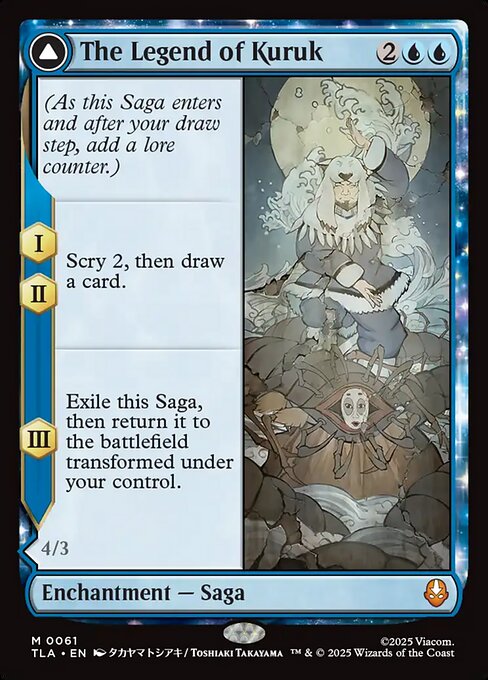
3. The Legend of Kuruk // Avatar Kuruk
Rating9.1BombWhy this rating?
One of the 3 best cards of the set (9.1/10).
Why. Two chapters that scry 2 then draw, for quality and volume at four mana. Then the Avatar arrives: every spell you cast makes a 1/1 colorless Spirit creature token that only Spirits can block, and Exhaust offers an extra turn late in the game.
Risks. The creature only arrives on the third chapter, and nothing affects the board before that. The extra turn costs twenty Waterbend mana, which your artifacts and creatures can help pay by tapping.
In the draft. A bomb for blue decks. Take it very high: it replaces at least two cards, then generates threats in a deck that casts a lot of spells.
Results in the games of the set
When it is in hand, the deck wins 66.0% of its games (set average: 56.2%, 4th of 279 cards).
In the opening hand: 66.5% wins (55.4% on average).
Drawn during the game: 65.8% (56.8% on average).
When it is drawn, the deck wins 12.6 points more than when it is not.
When it is drafted, it is played 95% of the time (set average: 61%).
Taken as the first pick (83 drafts), it ends in the deck 98% of the time.
It is played about as much in every archetype.
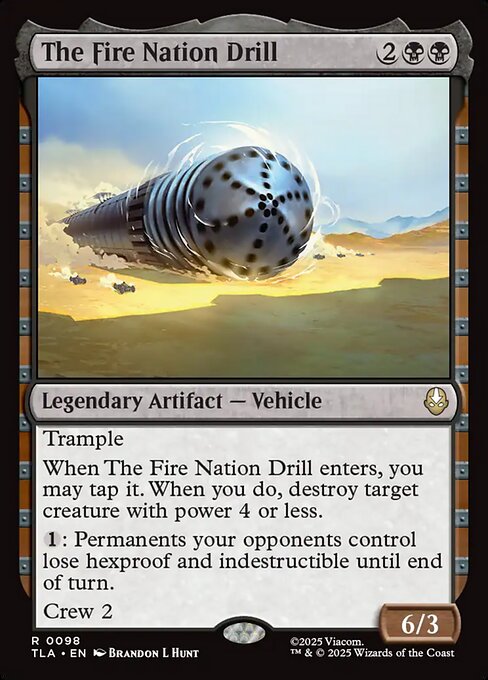 Rating9.0Bomb
Why this rating?
One of the 10 best cards of the set (9.0/10).
Why. A removal spell that leaves a big Vehicle behind. When it enters you may tap it to destroy a creature with power 4 or less; it then stays a 6/3 trampler once you crew it (Crew 2). The one-mana ability also strips hexproof and indestructible from the opponent's permanents.
Risks. A Vehicle is exposed to artifact removal and needs creatures to crew it. The removal cannot hit creatures with power 5 or more, and tapping it for the trigger means it cannot block during the opponent's turn.
In the draft. An excellent pick for any black deck: a removal spell that leaves a threat. Take it very high; it is better with a few cheap creatures to crew it.
Results in the games of the set
When it is in hand, the deck wins 66.5% of its games (set average: 56.2%, 3rd of 279 cards).
In the opening hand: 67.0% wins (55.4% on average).
Drawn during the game: 66.2% (56.8% on average).
When it is drawn, the deck wins 13.4 points more than when it is not.
When it is drafted, it is played 87% of the time (set average: 61%).
Taken as the first pick (175 drafts), it ends in the deck 86% of the time.
It is played about as much in every archetype.

5. The Legend of Yangchen // Avatar Yangchen
Rating8.9BombWhy this rating?
One of the 10 best cards of the set (8.9/10).
Why. Chapter I exiles two opposing permanents with mana value 3 or greater: the one you choose, then one the opponent picks among their own. Chapter II is optional and draws three cards for each player, then the Avatar is a flier that exiles other nonland permanents with Airbend.
Risks. Five mana, and the opponent picks their own exiled permanent, so it is their least valuable. If you use chapter II they draw as many cards as you, and the creature only arrives on the third chapter.
In the draft. A bomb for white decks. Take it very high; chapter II is optional, so only use it when you benefit more from the draw.
Results in the games of the set
When it is in hand, the deck wins 65.9% of its games (set average: 56.2%, 5th of 279 cards).
In the opening hand: 65.4% wins (55.4% on average).
Drawn during the game: 66.2% (56.8% on average).
When it is drawn, the deck wins 11.7 points more than when it is not.
When it is drafted, it is played 91% of the time (set average: 61%).
Taken as the first pick (99 drafts), it ends in the deck 92% of the time.
It is played about as much in every archetype.
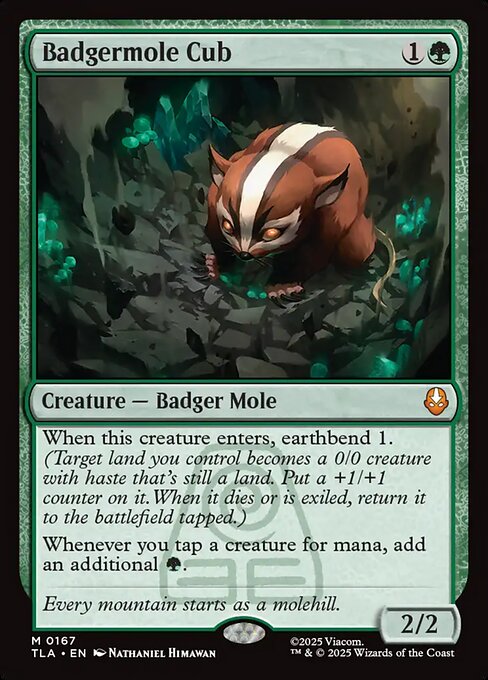 Rating8.8Bomb
Why this rating?
One of the 10 best cards of the set (8.8/10).
Why. A two-drop that does two things: Earthbend 1 turns a land into a 1/1 with haste, then every creature you tap for mana adds an extra green mana. The animated land benefits: you can have up to four mana on turn 3.
Risks. A fragile 2/2, and the animated land is exposed: if it dies it comes back tapped, but the acceleration pauses for a while. Without creatures that produce mana, the ability does almost nothing.
In the draft. A bomb: take it high if you play green with ramp. Earthbend 1 gives a useful body even when the follow-up does not show up.
Results in the games of the set
When it is in hand, the deck wins 62.8% of its games (set average: 56.2%, 14th of 279 cards).
In the opening hand: 66.1% wins (55.4% on average).
Drawn during the game: 60.3% (56.8% on average).
When it is drawn, the deck wins 9.7 points more than when it is not.
When it is drafted, it is played 86% of the time (set average: 61%).
Taken as the first pick (79 drafts), it ends in the deck 90% of the time.
It is played about as much in every archetype.
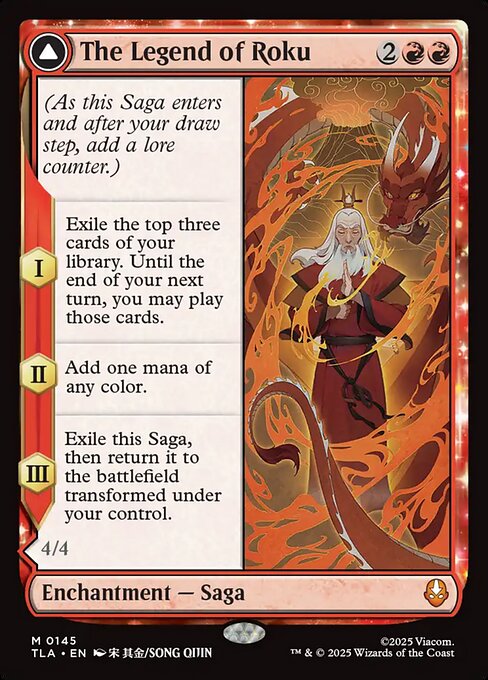
7. The Legend of Roku // Avatar Roku
Rating8.8BombWhy this rating?
One of the 10 best cards of the set (8.8/10).
Why. Chapter I exiles three cards you may play until the end of your next turn, II adds one mana of any color, then the Avatar arrives with Firebending 4. At eight mana it creates a 4/4 red Dragon creature token with flying and Firebending 4.
Risks. The exiled cards are lost if you lack the mana to play them. The Avatar arrives late and can die before attacking; the eight-mana ability is a late-game option.
In the draft. A bomb: four mana for up to three cards to play, take it high in a red deck. To make the most of it, keep a curve that leaves you mana on the following turn.
Results in the games of the set
When it is in hand, the deck wins 63.0% of its games (set average: 56.2%, 12th of 279 cards).
In the opening hand: 63.0% wins (55.4% on average).
Drawn during the game: 63.1% (56.8% on average).
When it is drawn, the deck wins 9.0 points more than when it is not.
When it is drafted, it is played 91% of the time (set average: 61%).
Taken as the first pick (69 drafts), it ends in the deck 87% of the time.
It is played about as much in every archetype.
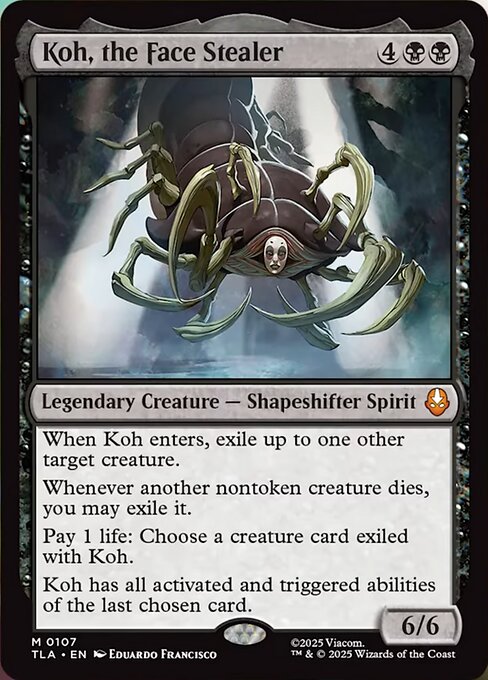 Rating8.7Bomb
Why this rating?
One of the 10 best cards of the set (8.7/10).
Why. A 6/6 that exiles a creature when it enters, then may exile nontoken creatures that die. For a point of life it takes the activated and triggered abilities of the last creature card you chose among those it exiled.
Risks. Six mana with two black, so slow. The enters exile is optional and hits only one creature; the rest depends on creatures dying, so on a board that is already engaged.
In the draft. A bomb for black decks: take it high. A removal spell and a 6/6 in one card, fine even when its second half does not work.
Results in the games of the set
When it is in hand, the deck wins 64.3% of its games (set average: 56.2%, 9th of 279 cards).
In the opening hand: 61.8% wins (55.4% on average).
Drawn during the game: 65.8% (56.8% on average).
When it is drawn, the deck wins 11.1 points more than when it is not.
When it is drafted, it is played 90% of the time (set average: 61%).
Taken as the first pick (76 drafts), it ends in the deck 92% of the time.
It is played about as much in every archetype.

9. United Front
Rating8.6BombWhy this rating?
One of the 10 best cards of the set (8.6/10).
Why. A sorcery that scales with mana: you create X 1/1 white Ally creature tokens, then each creature you control gets a +1/+1 counter, tokens included. With X=3 you add three 2/2s and boost the rest of your board in a single card.
Risks. Two white mana required, and at low X the result stays modest. It is a sorcery: an opposing sweeper afterwards cancels the whole thing.
In the draft. A bomb, to take high in a white deck with some creatures. It is flexible: good on turn 4 and in the late game, with a board already in place.
Results in the games of the set
When it is in hand, the deck wins 65.1% of its games (set average: 56.2%, 6th of 279 cards).
In the opening hand: 63.0% wins (55.4% on average).
Drawn during the game: 66.5% (56.8% on average).
When it is drawn, the deck wins 11.2 points more than when it is not.
When it is drafted, it is played 93% of the time (set average: 61%).
Taken as the first pick (93 drafts), it ends in the deck 97% of the time.
It is played about as much in every archetype.

10. Bumi, Unleashed
Rating8.6BombWhy this rating?
One of the 10 best cards of the set (8.6/10).
Why. A 5/4 trampler that animates a land into a 4/4 with haste when it enters (Earthbend 4). If it connects with a player you untap your lands and get an extra combat where only land creatures can attack, so they swing a second time.
Risks. Five mana in two colors, red and green, and it loses a lot of value if the animated land is killed. The extra combat requires Bumi to hit a player, so it must get past blockers.
In the draft. A bomb for red-green decks: take it high if you are in those colors. It is not worth a pick in a deck outside red-green.
Results in the games of the set
When it is in hand, the deck wins 63.3% of its games (set average: 56.2%, 11th of 279 cards).
In the opening hand: 62.6% wins (55.4% on average).
Drawn during the game: 63.7% (56.8% on average).
When it is drawn, the deck wins 10.8 points more than when it is not.
When it is drafted, it is played 87% of the time (set average: 61%).
Taken as the first pick (78 drafts), it ends in the deck 82% of the time.
It is played about as much in every archetype.

11. Aang, Swift Savior // Aang and La, Ocean's Fury
Rating8.5BombWhy this rating?
One of the very best rares of the format (8.5/10).
Why. A three-drop with flash and flying that exiles another creature or a spell with Airbend. Excellent tempo: you delay an opposing threat or put one of your own out of harm's way. At eight mana, Waterbend transforms it and every attack boosts your tapped creatures.
Risks. You need white and blue on turn 3. The opponent can recast the exiled card for two mana, so it is a tempo gain more than a removal.
In the draft. A very good pick for white-blue decks; take it right after the strongest cards. Outside those colors it loses almost all of its value.
Results in the games of the set
When it is in hand, the deck wins 64.8% of its games (set average: 56.2%, 8th of 279 cards).
In the opening hand: 63.5% wins (55.4% on average).
Drawn during the game: 65.7% (56.8% on average).
When it is drawn, the deck wins 11.2 points more than when it is not.
When it is drafted, it is played 88% of the time (set average: 61%).
Taken as the first pick (155 drafts), it ends in the deck 91% of the time.
It is played about as much in every archetype.

12. The Earth King
Rating8.4BombWhy this rating?
One of the very best rares of the format (8.4/10).
Why. Two bodies for four mana: a 2/2 and a 4/4 green Bear creature token. When your creatures with power 4 or greater attack, you search for as many basic lands as there are such attackers and put them onto the battlefield tapped.
Risks. The 2/2 is fragile and the Bear is a token: a removal spell or a trade on the Bear cuts off the search. Without a creature with power 4 or greater, the ability never triggers.
In the draft. A very good pick in a green deck: it gives value even without a ramp plan. Look for a few high-power creatures to go with it.
Results in the games of the set
When it is in hand, the deck wins 64.3% of its games (set average: 56.2%, 10th of 279 cards).
In the opening hand: 66.4% wins (55.4% on average).
Drawn during the game: 62.7% (56.8% on average).
When it is drawn, the deck wins 11.0 points more than when it is not.
When it is drafted, it is played 91% of the time (set average: 61%).
Taken as the first pick (127 drafts), it ends in the deck 88% of the time.
It is played about as much in every archetype.
 Rating8.3Very good
Why this rating?
One of the very best rares of the format (8.3/10).
Why. A two-drop that solves your color problems: each land and each Ally you control taps for one mana of any color. Allies also accelerate you, and the fixing lets you play three colors.
Risks. A 2/3 that does nothing else. If it dies you lose all that fixing, and an Ally tapped for mana cannot attack.
In the draft. Take it in a green deck that wants extra colors, especially with Allies. On its own it is a decent body more than a powerful card.
Results in the games of the set
When it is in hand, the deck wins 62.2% of its games (set average: 56.2%, 17th of 279 cards).
In the opening hand: 66.5% wins (55.4% on average).
Drawn during the game: 58.9% (56.8% on average).
When it is drawn, the deck wins 8.6 points more than when it is not.
When it is drafted, it is played 87% of the time (set average: 61%).
Taken as the first pick (139 drafts), it ends in the deck 89% of the time.
It is played about as much in every archetype.
 Rating8.3Very good
Why this rating?
One of the very best mythics of the format (8.3/10).
Why. A 4/4 flying Vehicle with Crew 1: little investment for a solid aerial attack. If you sacrificed a permanent this turn, it copies itself at your end step, which grows your fleet.
Risks. It does nothing without a creature to crew it, and its copy effect needs sacrifice sources that few decks provide. Artifact removal neutralizes it.
In the draft. A good flying Vehicle even without the copy effect; take it in a black deck with cheap creatures. The sacrifice is a bonus, not the plan.
Results in the games of the set
When it is in hand, the deck wins 62.0% of its games (set average: 56.2%, 18th of 279 cards).
In the opening hand: 61.6% wins (55.4% on average).
Drawn during the game: 62.3% (56.8% on average).
When it is drawn, the deck wins 10.2 points more than when it is not.
When it is drafted, it is played 85% of the time (set average: 61%).
Taken as the first pick (73 drafts), it ends in the deck 86% of the time.
It is played about as much in every archetype.

15. Raven Eagle
Rating8.2Very goodWhy this rating?
One of the very best rares of the format (8.2/10).
Why. A 2/3 flier for three mana that exiles a card from a graveyard when it enters and when it attacks; if it was a creature card, you get a Clue token. When you draw your second card in a turn (with a Clue, for example), each opponent loses 1 life and you gain 1.
Risks. The drain needs a second draw in the same turn, so you need card draw. The body is modest, and with empty graveyards the exile produces nothing.
In the draft. A good mid-curve card for black decks, to take fairly high. It is better with draw effects but does not depend on them.
Results in the games of the set
When it is in hand, the deck wins 62.7% of its games (set average: 56.2%, 15th of 279 cards).
In the opening hand: 60.6% wins (55.4% on average).
Drawn during the game: 64.0% (56.8% on average).
When it is drawn, the deck wins 9.4 points more than when it is not.
When it is drafted, it is played 91% of the time (set average: 61%).
Taken as the first pick (175 drafts), it ends in the deck 92% of the time.
It is played about as much in every archetype.
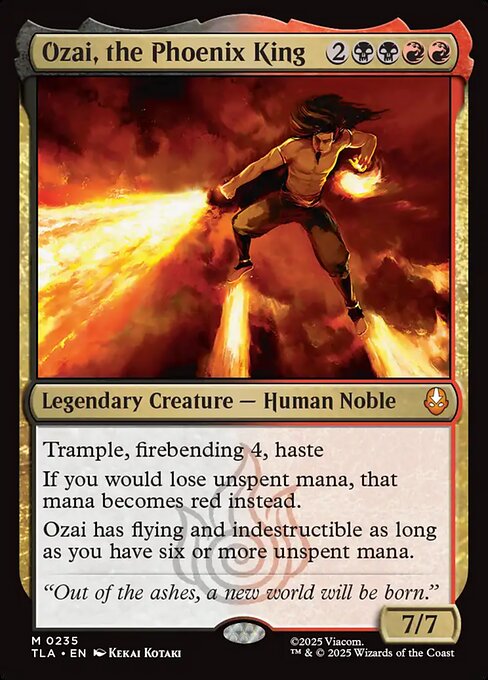 Rating8.1Very good
Why this rating?
One of the very best mythics of the format (8.1/10).
Why. A 7/7 with trample and haste that attacks the turn it arrives, with Firebending 4. Unspent mana becomes red instead of disappearing, and with six unspent mana it gains flying and indestructible.
Risks. Six mana including two black and two red, on a turn where you do nothing else. Without six unspent mana it is still vulnerable to chump blocks and removal, and the colors are demanding.
In the draft. More fragile than its size suggests: take it only if you are already black-red. Not a strong pick if you are undecided, but a decent late-game threat.
Results in the games of the set
When it is in hand, the deck wins 58.9% of its games (set average: 56.2%, 44th of 279 cards).
In the opening hand: 57.0% wins (55.4% on average).
Drawn during the game: 60.2% (56.8% on average).
When it is drawn, the deck wins 8.7 points more than when it is not.
When it is drafted, it is played 69% of the time (set average: 61%).
Taken as the first pick (49 drafts), it ends in the deck 71% of the time.
It is played about as much in every archetype.
 Rating8.1Very good
Why this rating?
One of the very best rares of the format (8.1/10).
Why. A 2/4 for three mana that gives your other creatures +1/+0 and makes a 1/1 white Ally creature token when another permanent leaves the battlefield during your turn. A good support piece in an aggressive deck.
Risks. Two white mana on turn 3, and its best effect depends on permanents leaving: sacrifice, combat or bounce. With no creatures to boost, it is a defensive body.
In the draft. A solid card for white aggro or token decks; take it mid-pack. Look for cheap creatures to make the most of the bonus.
Results in the games of the set
When it is in hand, the deck wins 61.4% of its games (set average: 56.2%, 23rd of 279 cards).
In the opening hand: 61.9% wins (55.4% on average).
Drawn during the game: 61.1% (56.8% on average).
When it is drawn, the deck wins 6.6 points more than when it is not.
When it is drafted, it is played 93% of the time (set average: 61%).
Taken as the first pick (139 drafts), it ends in the deck 89% of the time.
It is played about as much in every archetype.

18. Fated Firepower
Rating8.0Very goodWhy this rating?
One of the very best mythics of the format (8.0/10).
Why. A flash enchantment that adds as much damage as it has fire counters to every source you control that hurts the opponent or their permanents. With a board of attackers or small damage spells, every hit does a lot more.
Risks. Three red mana on top of X, and it does nothing alone: with no damage sources it is a dead enchantment. Enchantment removal or an empty board makes it useless.
In the draft. A card for a dedicated red deck with plenty of creatures or small damage spells. Better picked mid-pack than as a first choice.
Results in the games of the set
When it is in hand, the deck wins 57.5% of its games (set average: 56.2%, 73rd of 279 cards).
In the opening hand: 56.3% wins (55.4% on average).
Drawn during the game: 58.4% (56.8% on average).
When it is drawn, the deck wins 3.0 points more than when it is not.
When it is drafted, it is played 64% of the time (set average: 61%).
Taken as the first pick (48 drafts), it ends in the deck 75% of the time.
It is played about as much in every archetype.
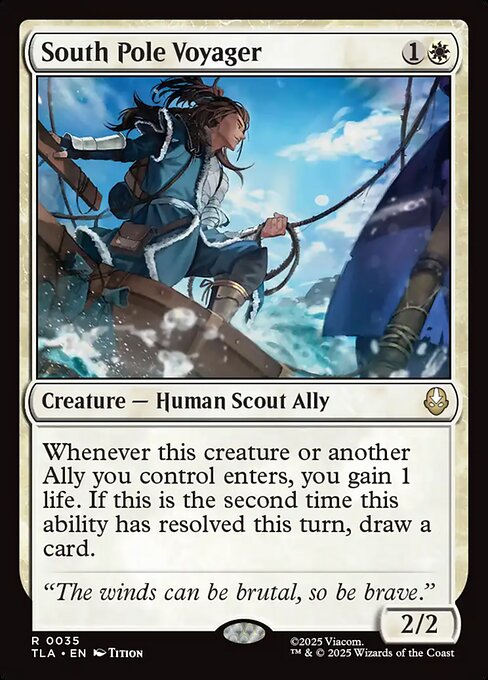 Rating7.9Very good
Why this rating?
One of the very best rares of the format (7.9/10).
Why. A two-mana 2/2 that gains you 1 life whenever an Ally enters, and draws a card the second time that happens in a turn. In an Ally deck, it can replace itself.
Risks. Without other Allies it does almost nothing apart from the life gain. The draw only happens with two Allies entering in the same turn.
In the draft. A good support card for white Ally decks, to take fairly high. Outside those decks it is just a 2/2 with minor life gain.
Results in the games of the set
When it is in hand, the deck wins 61.1% of its games (set average: 56.2%, 24th of 279 cards).
In the opening hand: 62.6% wins (55.4% on average).
Drawn during the game: 60.1% (56.8% on average).
When it is drawn, the deck wins 6.3 points more than when it is not.
When it is drafted, it is played 94% of the time (set average: 61%).
Taken as the first pick (132 drafts), it ends in the deck 92% of the time.
It is played about as much in every archetype.
 Rating7.8Very good
Why this rating?
One of the very best rares of the format (7.8/10).
Why. A two-drop with trample that puts a +1/+1 counter on each other Ally creature when it enters and grows with each new Ally. In an Ally deck it is an excellent board accelerator.
Risks. A 1/1 without Allies, and it needs exactly two colors, green and white. Without an Ally base it does almost nothing.
In the draft. Take it in green-white decks with plenty of Allies. Outside those colors it is not worth the pick.
Results in the games of the set
When it is in hand, the deck wins 59.8% of its games (set average: 56.2%, 35th of 279 cards).
In the opening hand: 61.4% wins (55.4% on average).
Drawn during the game: 58.5% (56.8% on average).
When it is drawn, the deck wins 5.1 points more than when it is not.
When it is drafted, it is played 75% of the time (set average: 61%).
Taken as the first pick (77 drafts), it ends in the deck 84% of the time.
It is played about as much in every archetype.
 Rating7.8Very good
Why this rating?
One of the very best rares of the format (7.8/10).
Why. Value for three mana: Earthbend 2 animates a land into a 2/2, then you fetch a basic land tapped, which already gives a first quest counter. After that, each further land moves you toward +1/+1 counters and trample.
Risks. You need lands to feed the enchantment, and the animated land is exposed to removal. With no creatures to boost, the payoff comes slowly.
In the draft. A good ramp and value card for green decks. Take it fairly high.
Results in the games of the set
When it is in hand, the deck wins 62.5% of its games (set average: 56.2%, 16th of 279 cards).
In the opening hand: 67.0% wins (55.4% on average).
Drawn during the game: 59.2% (56.8% on average).
When it is drawn, the deck wins 8.8 points more than when it is not.
When it is drafted, it is played 91% of the time (set average: 61%).
Taken as the first pick (140 drafts), it ends in the deck 92% of the time.
It is played about as much in every archetype.
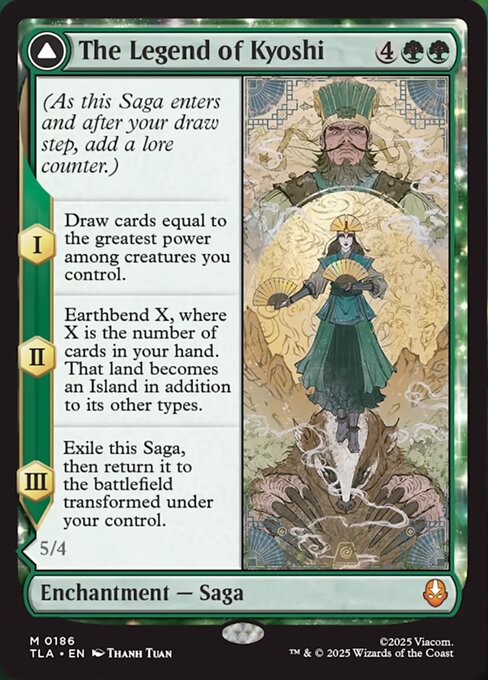
22. The Legend of Kyoshi // Avatar Kyoshi
Rating7.7Very goodWhy this rating?
One of the very best mythics of the format (7.7/10).
Why. A powerful Saga: chapter I draws cards equal to your greatest power, II animates a land with as many counters as cards in your hand, then the Avatar gives your lands trample and hexproof and produces a lot of mana.
Risks. Six mana with two green, and everything depends on having big creatures. Without high power, chapter I is mediocre and the Avatar produces little mana.
In the draft. Strong in a green deck of big creatures, but not for others. Take it mid-pack, once your creatures are secured.
Results in the games of the set
When it is in hand, the deck wins 59.7% of its games (set average: 56.2%, 36th of 279 cards).
In the opening hand: 58.1% wins (55.4% on average).
Drawn during the game: 60.7% (56.8% on average).
When it is drawn, the deck wins 6.4 points more than when it is not.
When it is drafted, it is played 89% of the time (set average: 61%).
Taken as the first pick (91 drafts), it ends in the deck 85% of the time.
It is played about as much in every archetype.
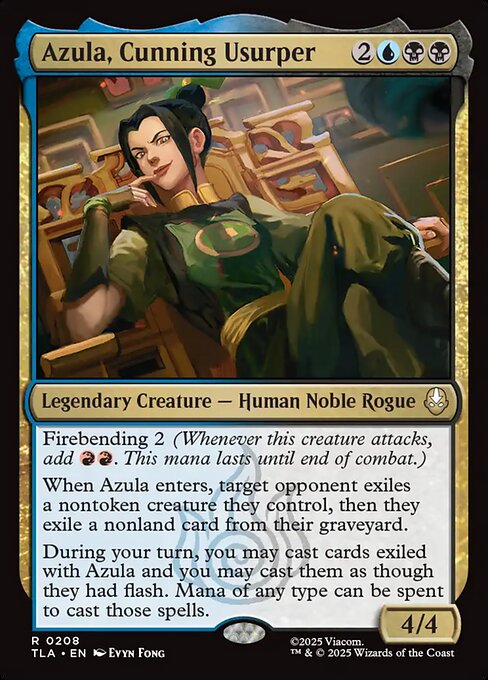 Rating7.6Very good
Why this rating?
One of the very best rares of the format (7.6/10).
Why. A five-mana 4/4 with Firebending 2: when it enters, the opponent exiles a nontoken creature of their choice, then a nonland card from their graveyard. You may then cast those cards during your turn, as though they had flash, with mana of any type.
Risks. Demanding colors, with two black mana and one blue. The opponent chooses what to exile, so it is their least valuable creature, and their graveyard may be empty.
In the draft. A good card for blue-black decks. Take it fairly high: it gives value and a big body in one turn.
Results in the games of the set
When it is in hand, the deck wins 62.9% of its games (set average: 56.2%, 13th of 279 cards).
In the opening hand: 60.8% wins (55.4% on average).
Drawn during the game: 64.1% (56.8% on average).
When it is drawn, the deck wins 11.2 points more than when it is not.
When it is drafted, it is played 88% of the time (set average: 61%).
Taken as the first pick (157 drafts), it ends in the deck 94% of the time.
It is played about as much in every archetype.
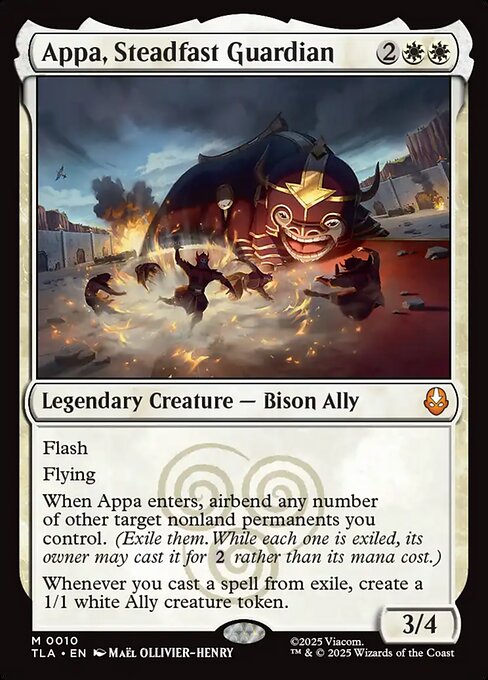 Rating7.6Very good
Why this rating?
One of the very best mythics of the format (7.6/10).
Why. A four-mana 3/4 flier with flash that exiles your other nonland permanents with Airbend, for example in response to removal. You recast them for two mana, and every spell cast from exile creates a 1/1 white Ally creature token.
Risks. Two white mana and a synergy that needs you to recast the exiled permanents: with no targets, it is a plain 3/4 flier. Recasting costs mana, so tempo.
In the draft. A good pick for white decks, stronger with creatures that have enter effects. Take it mid-pack, ahead of vanilla creatures.
Results in the games of the set
When it is in hand, the deck wins 59.2% of its games (set average: 56.2%, 40th of 279 cards).
In the opening hand: 57.0% wins (55.4% on average).
Drawn during the game: 60.6% (56.8% on average).
When it is drawn, the deck wins 4.7 points more than when it is not.
When it is drafted, it is played 92% of the time (set average: 61%).
Taken as the first pick (60 drafts), it ends in the deck 93% of the time.
It is played about as much in every archetype.
 Rating7.6Very good
Why this rating?
One of the very best uncommons of the format (7.6/10).
Why. A three-mana 3/3 that exiles an opposing artifact, creature or enchantment with mana value 3 or greater. A removal spell attached to a good body, for very little mana.
Risks. It only hits permanents with mana value 3 or greater, and if this creature leaves the battlefield the exiled card returns. It is poor against a deck of small creatures.
In the draft. A very good uncommon, to take high in a white deck. Cast it when the opponent has a real threat, rather than wasting the trigger.
Results in the games of the set
When it is in hand, the deck wins 60.6% of its games (set average: 56.2%, 26th of 279 cards).
In the opening hand: 59.8% wins (55.4% on average).
Drawn during the game: 61.2% (56.8% on average).
When it is drawn, the deck wins 4.6 points more than when it is not.
When it is drafted, it is played 92% of the time (set average: 61%).
Taken as the first pick (328 drafts), it ends in the deck 91% of the time.
It is played mostly in B/W decks (27% of them).
 Rating7.6Very good
Why this rating?
One of the very best rares of the format (7.6/10).
Why. A 2/1 with flash and prowess that taps a creature and keeps it from untapping as long as you control Ty Lee. A temporary removal for three mana that also serves as an attacker.
Risks. A fragile 2/1: if it dies, the opposing creature untaps. The target keeps its abilities that do not require tapping.
In the draft. A good blue tempo card, to take fairly high. Play it at the end of the opponent's turn to tap a blocker before your attack, or at the start of their combat to stop an attacker.
Results in the games of the set
When it is in hand, the deck wins 60.2% of its games (set average: 56.2%, 29th of 279 cards).
In the opening hand: 58.5% wins (55.4% on average).
Drawn during the game: 61.3% (56.8% on average).
When it is drawn, the deck wins 6.0 points more than when it is not.
When it is drafted, it is played 94% of the time (set average: 61%).
Taken as the first pick (185 drafts), it ends in the deck 94% of the time.
It is played about as much in every archetype.
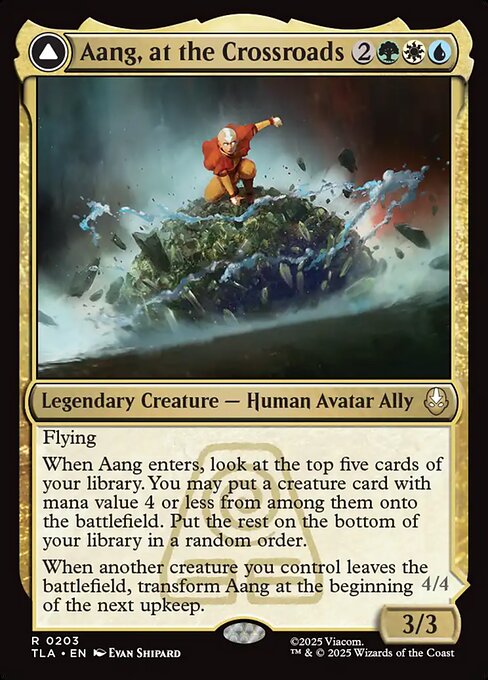
27. Aang, at the Crossroads // Aang, Destined Savior
Rating7.5Very goodWhy this rating?
One of the very best rares of the format (7.5/10).
Why. A five-mana 3/3 flier that looks at the top five cards of your library and puts a creature with mana value 4 or less onto the battlefield. Once transformed, it animates a land every combat with Earthbend 2.
Risks. Three colors, green, white and blue, which makes it hard to cast. It only transforms if another of your creatures leaves the battlefield.
In the draft. Strong only in a three-color deck with fixing. Take it if you are already in two of its colors; otherwise leave it.
Results in the games of the set
When it is in hand, the deck wins 61.8% of its games (set average: 56.2%, 21st of 279 cards).
In the opening hand: 61.1% wins (55.4% on average).
Drawn during the game: 62.2% (56.8% on average).
When it is drawn, the deck wins 9.7 points more than when it is not.
When it is drafted, it is played 85% of the time (set average: 61%).
Taken as the first pick (152 drafts), it ends in the deck 88% of the time.
It is played about as much in every archetype.
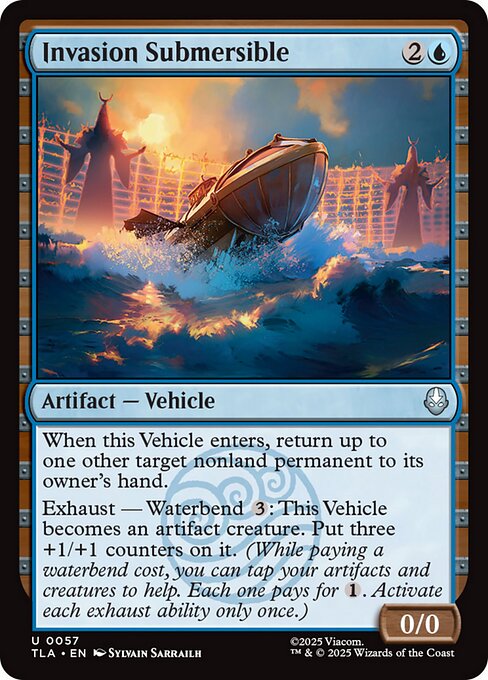 Rating7.5Very good
Why this rating?
A solid uncommon of the format (7.5/10).
Why. A three-mana Vehicle that bounces another nonland permanent when it enters, then becomes a 3/3 artifact creature through Exhaust and Waterbend 3. Tempo followed by a decent body.
Risks. A 0/0 until you activate it, and Exhaust works only once. The bounce solves nothing permanently, and the body comes late.
In the draft. A good blue tempo uncommon, to take mid-pack. It is better if your artifacts or creatures can help pay for Waterbend.
Results in the games of the set
When it is in hand, the deck wins 61.9% of its games (set average: 56.2%, 19th of 279 cards).
In the opening hand: 60.3% wins (55.4% on average).
Drawn during the game: 62.9% (56.8% on average).
When it is drawn, the deck wins 7.2 points more than when it is not.
When it is drafted, it is played 93% of the time (set average: 61%).
Taken as the first pick (439 drafts), it ends in the deck 94% of the time.
It is played mostly in R/U decks (31% of them) and U/W (31%).
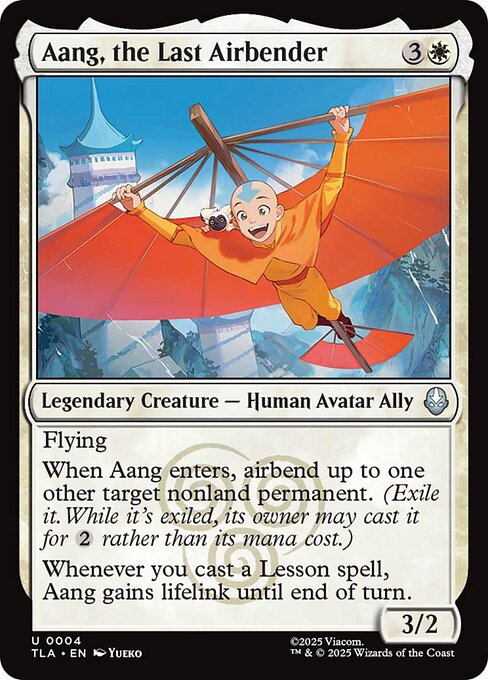 Rating7.4Very good
Why this rating?
A solid uncommon of the format (7.4/10).
Why. A four-mana 3/2 flier that exiles another nonland permanent with Airbend when it enters. It gains lifelink when you cast a Lesson spell. Tempo and an aerial attacker.
Risks. A fragile 3/2. The opponent can recast the exiled permanent for two mana, so it is not a removal spell. Lifelink only comes with Lessons.
In the draft. A good white uncommon, to take mid-pack. Target an expensive opposing threat to get the most out of the tempo.
Results in the games of the set
When it is in hand, the deck wins 60.6% of its games (set average: 56.2%, 27th of 279 cards).
In the opening hand: 59.8% wins (55.4% on average).
Drawn during the game: 61.1% (56.8% on average).
When it is drawn, the deck wins 4.8 points more than when it is not.
When it is drafted, it is played 93% of the time (set average: 61%).
Taken as the first pick (328 drafts), it ends in the deck 93% of the time.
It is played about as much in every archetype.
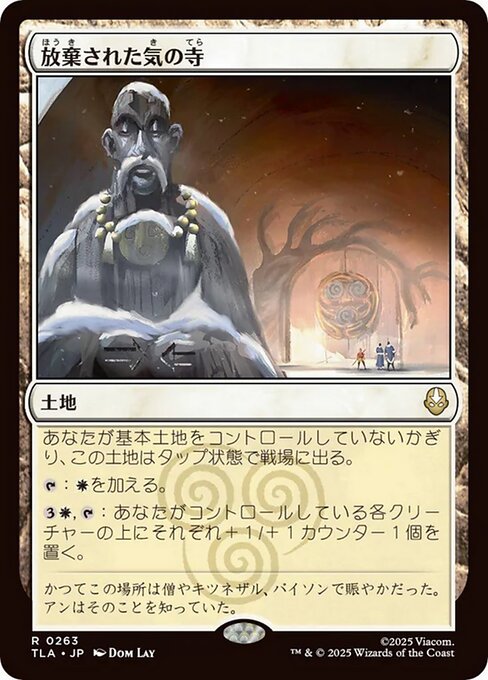 Rating7.4Very good
Why this rating?
A very good rare of the format (7.4/10).
Why. A white land that enters untapped as long as you control a basic land, and can put a +1/+1 counter on each of your creatures for four mana. Good late-game utility.
Risks. It enters tapped if you have no basic land, and its activation is expensive. It only fixes white.
In the draft. It replaces a Plains at no real cost in any white deck, so take it fairly high. Especially good in a deck with many creatures.
Results in the games of the set
When it is in hand, the deck wins 61.6% of its games (set average: 56.2%, 22nd of 279 cards).
In the opening hand: 61.3% wins (55.4% on average).
Drawn during the game: 61.8% (56.8% on average).
When it is drawn, the deck wins 6.5 points more than when it is not.
When it is drafted, it is played 91% of the time (set average: 61%).
Taken as the first pick (157 drafts), it ends in the deck 92% of the time.

31. Gran-Gran
Rating7.4Very goodWhy this rating?
A solid uncommon of the format (7.4/10).
Why. A one-mana 1/2 that filters your hand each time it becomes tapped, through attacking or Waterbend. With three Lessons in your graveyard, your noncreature spells cost one less.
Risks. A small body that does nothing alone. The cost reduction is very hard to reach in draft, and attacking with a 1/2 is risky.
In the draft. A filler card, except in a deck that plays many Lessons. Take it late.
Results in the games of the set
When it is in hand, the deck wins 59.3% of its games (set average: 56.2%, 39th of 279 cards).
In the opening hand: 63.4% wins (55.4% on average).
Drawn during the game: 56.6% (56.8% on average).
When it is drawn, the deck wins 4.3 points more than when it is not.
When it is drafted, it is played 86% of the time (set average: 61%).
Taken as the first pick (266 drafts), it ends in the deck 93% of the time.
It is played mostly in R/U decks (33% of them) and B/U (31%).

32. Katara, Water Tribe's Hope
Rating7.4Very goodWhy this rating?
A very good rare of the format (7.4/10).
Why. A five-mana 3/3 with vigilance that creates a 1/1 white Ally creature token when it enters. Waterbend X sets the base power and toughness of all your creatures to X during your turn: a finisher for a wide board.
Risks. Demanding costs with white and two blue, and the ability needs many creatures or artifacts to tap to pay for it. Tapping them stops them from attacking.
In the draft. A good white-blue card, to take mid-pack in that pair. Outside those colors, leave it.
Results in the games of the set
When it is in hand, the deck wins 61.8% of its games (set average: 56.2%, 20th of 279 cards).
In the opening hand: 59.2% wins (55.4% on average).
Drawn during the game: 63.4% (56.8% on average).
When it is drawn, the deck wins 7.9 points more than when it is not.
When it is drafted, it is played 87% of the time (set average: 61%).
Taken as the first pick (188 drafts), it ends in the deck 87% of the time.
It is played about as much in every archetype.
 Rating7.4Very good
Why this rating?
A very good rare of the format (7.4/10).
Why. A one-mana 1/1 flier that makes the first non-Lemur creature spell with flying you cast each turn cost one less, and gets +1/+1 until end of turn whenever another creature with flying enters. A small support card for a fliers deck.
Risks. A fragile 1/1, with no effect if you have no fliers. Outside a fliers deck it is a tiny body.
In the draft. Play it in a white deck with several fliers. Take it mid-pack, not before.
Results in the games of the set
When it is in hand, the deck wins 58.3% of its games (set average: 56.2%, 55th of 279 cards).
In the opening hand: 63.0% wins (55.4% on average).
Drawn during the game: 54.8% (56.8% on average).
When it is drawn, the deck wins 3.3 points more than when it is not.
When it is drafted, it is played 76% of the time (set average: 61%).
Taken as the first pick (76 drafts), it ends in the deck 84% of the time.
It is played about as much in every archetype.
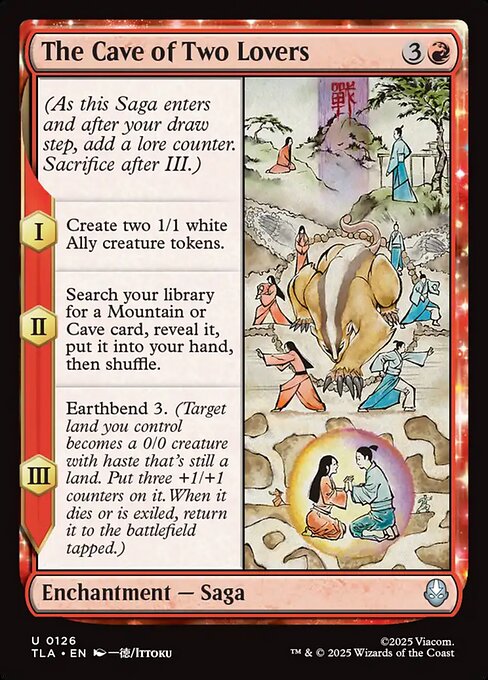 Rating7.4Very good
Why this rating?
A solid uncommon of the format (7.4/10).
Why. A Saga that gives a lot for four mana: two 1/1 white Ally creature tokens, a Mountain or Cave in hand, then an animated land with Earthbend 3. Three effects from a single card.
Risks. It acts slowly: the animated land only comes at chapter III, and chapter II needs a Mountain or Cave in your library. The animated land is exposed.
In the draft. A good uncommon for red decks, to take mid-pack. It replaces several cards without being spectacular.
Results in the games of the set
When it is in hand, the deck wins 59.9% of its games (set average: 56.2%, 33rd of 279 cards).
In the opening hand: 60.5% wins (55.4% on average).
Drawn during the game: 59.5% (56.8% on average).
When it is drawn, the deck wins 3.5 points more than when it is not.
When it is drafted, it is played 81% of the time (set average: 61%).
Taken as the first pick (184 drafts), it ends in the deck 91% of the time.
It is played mostly in G/R decks (29% of them) and R/W (28%).
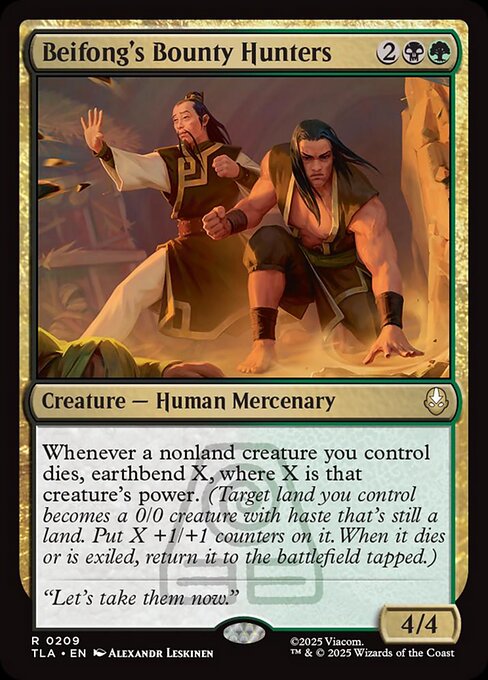 Rating7.4Very good
Why this rating?
A very good rare of the format (7.4/10).
Why. A 4/4 for four that turns each death of your nonland creatures into an animated land carrying counters equal to the dead creature's power. Trades start favouring you: the creature dies and a land creature steps in.
Risks. You need lands to animate, and a land creature is exposed to removal and combat. A creature with no power gives nothing. If nothing trades, it is just a solid body.
In the draft. A good pick for a black-green deck that trades a lot. Add sturdy creatures around it: the bigger they are, the better each death pays.
Results in the games of the set
When it is in hand, the deck wins 60.0% of its games (set average: 56.2%, 30th of 279 cards).
In the opening hand: 60.5% wins (55.4% on average).
Drawn during the game: 59.6% (56.8% on average).
When it is drawn, the deck wins 7.1 points more than when it is not.
When it is drafted, it is played 79% of the time (set average: 61%).
Taken as the first pick (130 drafts), it ends in the deck 85% of the time.
It is played about as much in every archetype.
 Rating7.3Very good
Why this rating?
A solid uncommon of the format (7.3/10).
Why. A 2/4 lifelinker for three that holds the ground well from the start. Whenever you draw a second card in a turn, it makes a 1/1 colorless Spirit creature token that is nearly unblockable.
Risks. You need to draw outside your draw step: Clues, cantrips, card draw. Without that it is just a good wall. The Spirit token also cannot block creatures that are not Spirits.
In the draft. A good pick for blue-black decks with extra draw sources. Take it as a solid midrange body that gets better with several Clues.
Results in the games of the set
When it is in hand, the deck wins 59.8% of its games (set average: 56.2%, 34th of 279 cards).
In the opening hand: 58.9% wins (55.4% on average).
Drawn during the game: 60.3% (56.8% on average).
When it is drawn, the deck wins 6.4 points more than when it is not.
When it is drafted, it is played 75% of the time (set average: 61%).
Taken as the first pick (225 drafts), it ends in the deck 89% of the time.
It is played mostly in B/U decks (50% of them).
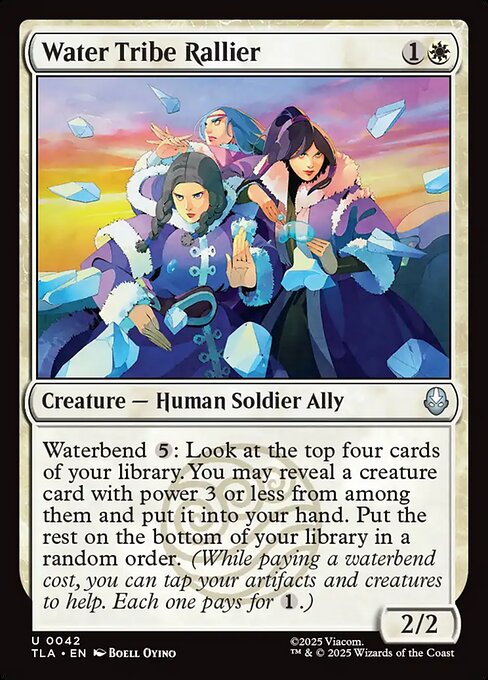 Rating7.2Very good
Why this rating?
A solid uncommon of the format (7.2/10).
Why. A 2/2 for two that turns into a late-game engine: its waterbend ability looks at the top four cards and lets you take a creature with power 3 or less. It can be repeated as often as you can pay.
Risks. Five mana per activation, even paid by tapping creatures and artifacts, is a lot. It only finds creatures with power 3 or less, and the lone 2/2 dies quickly.
In the draft. A good pick for white decks full of creatures. It fills your turn-two slot and keeps you from running out of cards later.
Results in the games of the set
When it is in hand, the deck wins 59.6% of its games (set average: 56.2%, 37th of 279 cards).
In the opening hand: 59.8% wins (55.4% on average).
Drawn during the game: 59.4% (56.8% on average).
When it is drawn, the deck wins 3.0 points more than when it is not.
When it is drafted, it is played 92% of the time (set average: 61%).
Taken as the first pick (311 drafts), it ends in the deck 92% of the time.
It is played mostly in B/W decks (30% of them) and G/W (28%).

38. Day of Black Sun
Rating7.2Very goodWhy this rating?
A very good rare of the format (7.2/10).
Why. A flexible sweeper: you choose X and destroy every creature with mana value X or less after they lose all abilities, so even indestructible creatures die. Against a board of small creatures it is a huge swing.
Risks. It hits your own creatures too. Tokens have mana value zero and die even for X of zero. The bigger X is, the more it costs, and as a sorcery it is slow against one big threat.
In the draft. Take it in a more controlling black deck with expensive creatures or few small ones. In an aggressive deck it is too symmetrical.
Results in the games of the set
When it is in hand, the deck wins 60.3% of its games (set average: 56.2%, 28th of 279 cards).
In the opening hand: 57.0% wins (55.4% on average).
Drawn during the game: 62.3% (56.8% on average).
When it is drawn, the deck wins 6.9 points more than when it is not.
When it is drafted, it is played 85% of the time (set average: 61%).
Taken as the first pick (129 drafts), it ends in the deck 90% of the time.
It is played about as much in every archetype.
 Rating7.2Very good
Why this rating?
A solid uncommon of the format (7.2/10).
Why. A two-mode sorcery for two: four damage to a creature, or one damage to each creature your opponents control. Efficient removal either way, and the sweep mode cleans up small tokens or creatures already damaged. It is also a Lesson.
Risks. Four damage does not kill the biggest creatures, and as a sorcery it cannot answer an attack in progress. The sweep mode leaves most creatures alive.
In the draft. Solid red removal that you take without hesitation in a red deck. It also counts as a Lesson, which helps cards that count them.
Results in the games of the set
When it is in hand, the deck wins 58.8% of its games (set average: 56.2%, 47th of 279 cards).
In the opening hand: 57.6% wins (55.4% on average).
Drawn during the game: 59.7% (56.8% on average).
When it is drawn, the deck wins 4.1 points more than when it is not.
When it is drafted, it is played 92% of the time (set average: 61%).
Taken as the first pick (289 drafts), it ends in the deck 94% of the time.
It is played mostly in R/U decks (31% of them) and G/R (30%).

40. The Unagi of Kyoshi Island
Rating7.2Very goodWhy this rating?
A very good rare of the format (7.2/10).
Why. A 5/5 with flash and ward that you land at the end of the opponent's turn or as a surprise blocker. The ward, paid with waterbend, makes removal expensive. And whenever an opponent draws a second card in a turn, you draw two.
Risks. Five mana with two blue, and the ward costs four, which an opponent can pay by tapping creatures and artifacts. An opponent who draws one card per turn never triggers the ability.
In the draft. A good pick for blue decks. It plays easily as a big top-end body, and the card draw is a bonus depending on the opponent.
Results in the games of the set
When it is in hand, the deck wins 59.9% of its games (set average: 56.2%, 32nd of 279 cards).
In the opening hand: 59.9% wins (55.4% on average).
Drawn during the game: 60.0% (56.8% on average).
When it is drawn, the deck wins 6.6 points more than when it is not.
When it is drafted, it is played 93% of the time (set average: 61%).
Taken as the first pick (184 drafts), it ends in the deck 93% of the time.
It is played about as much in every archetype.
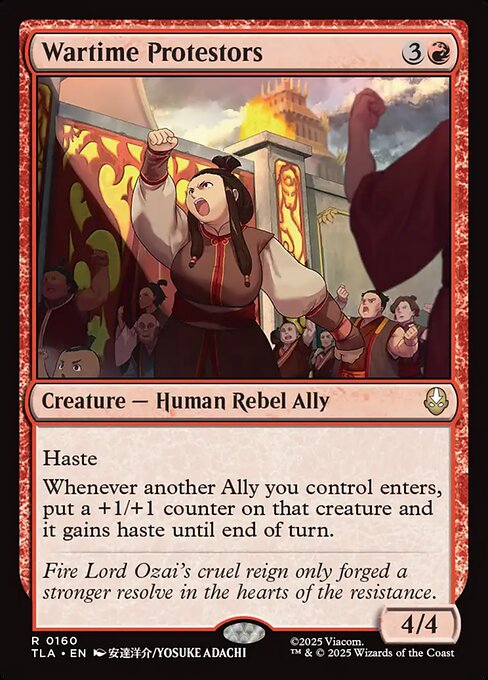 Rating7.1Good
Why this rating?
A very good rare of the format (7.1/10).
Why. A 4/4 with haste for four that attacks immediately. Every other Ally that enters gets a +1/+1 counter and haste, which makes it a strong engine in a deck full of Allies.
Risks. With no Allies around it is just a 4/4 with haste. A removal spell kills it before you play another Ally, and it only affects Allies that arrive after it.
In the draft. A good pick for red-white, or any deck with Allies. Count your Allies before overvaluing it.
Results in the games of the set
When it is in hand, the deck wins 59.1% of its games (set average: 56.2%, 41st of 279 cards).
In the opening hand: 59.8% wins (55.4% on average).
Drawn during the game: 58.6% (56.8% on average).
When it is drawn, the deck wins 4.9 points more than when it is not.
When it is drafted, it is played 88% of the time (set average: 61%).
Taken as the first pick (134 drafts), it ends in the deck 88% of the time.
It is played about as much in every archetype.
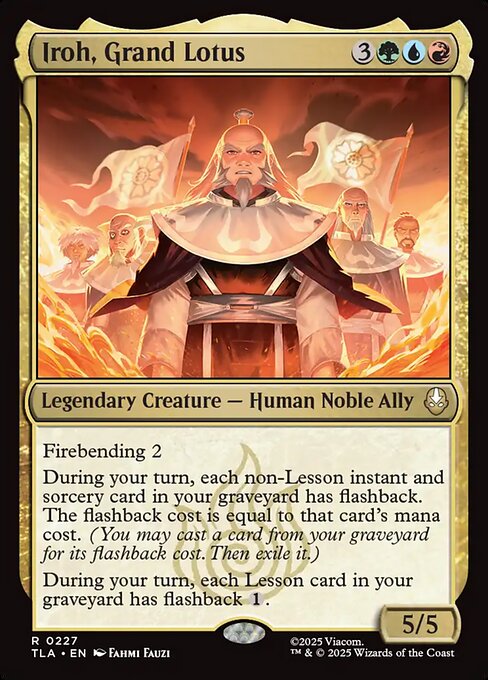 Rating7.1Good
Why this rating?
A very good rare of the format (7.1/10).
Why. A 5/5 with firebending 2 for six. During your turn, the instants and sorceries in your graveyard gain flashback at their own cost, and your Lessons cost just one mana. Each spell becomes a second card.
Risks. Three colors and six mana: the cost is heavy. You need instants and sorceries in your graveyard for the ability to matter. Without them it is just an expensive 5/5.
In the draft. Play it in a blue-red-green deck that is already well set up. Do not take it early before your colors are settled, and look for cheap spells.
Results in the games of the set
When it is in hand, the deck wins 58.9% of its games (set average: 56.2%, 46th of 279 cards).
In the opening hand: 54.2% wins (55.4% on average).
Drawn during the game: 61.4% (56.8% on average).
When it is drawn, the deck wins 7.9 points more than when it is not.
When it is drafted, it is played 79% of the time (set average: 61%).
Taken as the first pick (132 drafts), it ends in the deck 86% of the time.
It is played mostly in G/U decks (25% of them).

43. Avatar Aang // Aang, Master of Elements
Rating7.0GoodWhy this rating?
A very good mythic of the format (7.0/10).
Why. A 4/4 flier with firebending 2 in four colors. Each time you waterbend, earthbend, firebend or airbend you draw a card, and if you have done all four in one turn it transforms into a huge threat.
Risks. It needs four colors on turn four, which is very hard without fixing. Doing all four effects in one turn is rare. Without that it is an expensive, fragile 4/4 flier.
In the draft. Not an early-draft pick. Play it only if your deck already runs four colors with good fixing; otherwise let it go.
Results in the games of the set
When it is in hand, the deck wins 53.9% of its games (set average: 56.2%, 191st of 279 cards).
In the opening hand: 50.8% wins (55.4% on average).
Drawn during the game: 55.6% (56.8% on average).
When it is drawn, the deck wins 4.1 points more than when it is not.
When it is drafted, it is played 66% of the time (set average: 61%).
Taken as the first pick (56 drafts), it ends in the deck 82% of the time.
It is played about as much in every archetype.

44. Ba Sing Se
Rating7.0GoodWhy this rating?
A very good rare of the format (7.0/10).
Why. A green-producing land that enters untapped if you control a basic land. For three mana and by tapping itself it does earthbend 2 at sorcery speed: late in the game it turns a land into a 2/2 creature every turn.
Risks. It enters tapped when you control no basic land, which only happens with many nonbasic lands. The animated land can die, but it returns tapped. It only produces green.
In the draft. A free utility land to play in any deck with green. Take it as a land that gives you late-game value.
Results in the games of the set
When it is in hand, the deck wins 59.4% of its games (set average: 56.2%, 38th of 279 cards).
In the opening hand: 59.2% wins (55.4% on average).
Drawn during the game: 59.6% (56.8% on average).
When it is drawn, the deck wins 4.6 points more than when it is not.
When it is drafted, it is played 87% of the time (set average: 61%).
Taken as the first pick (122 drafts), it ends in the deck 94% of the time.
 Rating7.0Good
Why this rating?
A solid uncommon of the format (7.0/10).
Why. A two-mana instant that deals two damage plus one for each Lesson in your graveyard, and exiles the creature if it would die. Cheap removal that scales with Lessons.
Risks. With no Lessons, two damage kills few creatures. It does not handle the set's big creatures. It is itself a Lesson, so it helps the next ones but not itself.
In the draft. A good removal spell to take in a red deck. It scales with more Lessons, so it is best in decks that play several.
Results in the games of the set
When it is in hand, the deck wins 58.6% of its games (set average: 56.2%, 50th of 279 cards).
In the opening hand: 57.2% wins (55.4% on average).
Drawn during the game: 59.6% (56.8% on average).
When it is drawn, the deck wins 3.9 points more than when it is not.
When it is drafted, it is played 90% of the time (set average: 61%).
Taken as the first pick (263 drafts), it ends in the deck 90% of the time.
It is played mostly in R/U decks (36% of them) and G/R (32%).

46. Dragonfly Swarm
Rating7.0GoodWhy this rating?
A solid uncommon of the format (7.0/10).
Why. A flier with ward 1 for three. Its power equals the noncreature, nonland cards in your graveyard, so it grows more dangerous as the game goes on. It replaces itself when it dies if you have a Lesson.
Risks. It arrives with zero power early, and a game with few spells leaves it weak. Its power shrinks if your graveyard gets exiled. Two specific colors: blue and red.
In the draft. A good pick for blue-red decks with plenty of instants and sorceries. In a deck with few spells it loses a lot of value.
Results in the games of the set
When it is in hand, the deck wins 57.9% of its games (set average: 56.2%, 64th of 279 cards).
In the opening hand: 54.5% wins (55.4% on average).
Drawn during the game: 59.8% (56.8% on average).
When it is drawn, the deck wins 3.2 points more than when it is not.
When it is drafted, it is played 76% of the time (set average: 61%).
Taken as the first pick (178 drafts), it ends in the deck 88% of the time.
It is played mostly in R/U decks (50% of them).
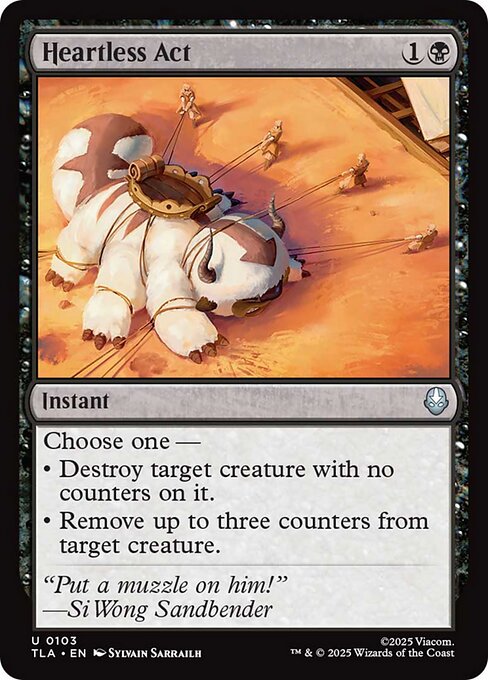
47. Heartless Act
Rating7.0GoodWhy this rating?
A solid uncommon of the format (7.0/10).
Why. A two-mana instant that destroys a creature with no counters on it, or removes up to three counters from a creature. Cheap, instant-speed removal that works against most creatures.
Risks. It cannot destroy creatures with counters, such as ones that grow or lands animated by earthbend. The second mode does not kill anything on its own.
In the draft. Good two-mana removal: take it early in any black deck. It answers most midrange creatures.
Results in the games of the set
When it is in hand, the deck wins 60.0% of its games (set average: 56.2%, 31st of 279 cards).
In the opening hand: 58.5% wins (55.4% on average).
Drawn during the game: 60.9% (56.8% on average).
When it is drawn, the deck wins 6.2 points more than when it is not.
When it is drafted, it is played 90% of the time (set average: 61%).
Taken as the first pick (247 drafts), it ends in the deck 90% of the time.
It is played mostly in B/G decks (28% of them) and B/R (28%).
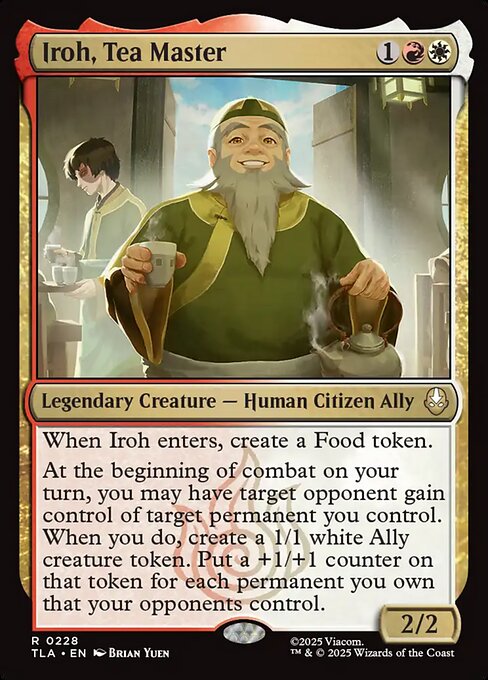
48. Iroh, Tea Master
Rating7.0GoodWhy this rating?
A very good rare of the format (7.0/10).
Why. A 2/2 for three that makes a Food token when it enters. Its second ability is unusual: at the beginning of combat on your turn you may give an opponent a permanent to create a white 1/1 Ally creature token, which gets a +1/+1 counter for each permanent you own that your opponents control.
Risks. Giving a permanent to the opponent is risky: you help them if it is good. You have to pick unimportant permanents, like the Food. The 2/2 body is fragile.
In the draft. A pick for red-white decks, to be played thoughtfully. It is not a card to take early: its value depends on how you use it.
Results in the games of the set
When it is in hand, the deck wins 57.6% of its games (set average: 56.2%, 72nd of 279 cards).
In the opening hand: 58.1% wins (55.4% on average).
Drawn during the game: 57.1% (56.8% on average).
When it is drawn, the deck wins 2.7 points more than when it is not.
When it is drafted, it is played 62% of the time (set average: 61%).
Taken as the first pick (59 drafts), it ends in the deck 80% of the time.
It is played about as much in every archetype.

49. Planetarium of Wan Shi Tong
Rating7.0GoodWhy this rating?
A very good mythic of the format (7.0/10).
Why. A six-mana artifact that lets you scry 2 for one mana, then look at the top card and cast it for free once each turn. You find and cast cards without paying, which offsets its cost.
Risks. Six mana for a permanent with no immediate effect on the board is slow. If you are losing on the ground before you cast it, it does nothing.
In the draft. Not a first choice: play it in a slow deck facing little pressure. The cost is too high for a fast deck.
Results in the games of the set
When it is in hand, the deck wins 58.2% of its games (set average: 56.2%, 59th of 279 cards).
In the opening hand: 55.3% wins (55.4% on average).
Drawn during the game: 60.0% (56.8% on average).
When it is drawn, the deck wins 4.7 points more than when it is not.
When it is drafted, it is played 96% of the time (set average: 61%).
Taken as the first pick (76 drafts), it ends in the deck 93% of the time.
It is played about as much in every archetype.

50. Ran and Shaw
Rating7.0GoodWhy this rating?
A very good rare of the format (7.0/10).
Why. A 4/4 flier with firebending 2 for five. With three or more Dragon and/or Lesson cards in your graveyard when it enters, you get a nonlegendary copy. For four mana, your Dragons get +2/+0 until end of turn.
Risks. The copy needs three specific cards in the graveyard and that you cast it. Without that it is just a five-mana 4/4 flier. It requires two red mana.
In the draft. A good pick for red decks, especially with Lessons. Even without the copy it is a decent finisher to take.
Results in the games of the set
When it is in hand, the deck wins 58.3% of its games (set average: 56.2%, 54th of 279 cards).
In the opening hand: 54.7% wins (55.4% on average).
Drawn during the game: 60.5% (56.8% on average).
When it is drawn, the deck wins 4.6 points more than when it is not.
When it is drafted, it is played 88% of the time (set average: 61%).
Taken as the first pick (159 drafts), it ends in the deck 92% of the time.
It is played about as much in every archetype.

51. The Mechanist, Aerial Artisan
Rating7.0GoodWhy this rating?
A very good rare of the format (7.0/10).
Why. A 1/3 for three that creates a Clue token whenever you cast a noncreature spell. It can tap to turn an artifact token into a 3/1 Construct artifact creature with flying until end of turn, so a Clue becomes an attacker.
Risks. A 1/3 body that does not attack itself if it taps for its ability. With no noncreature spells it makes no Clues. The 3/1 Construct is fragile in combat.
In the draft. A good pick for blue decks with plenty of noncreature spells. Avoid it in a pure creature deck.
Results in the games of the set
When it is in hand, the deck wins 58.9% of its games (set average: 56.2%, 43rd of 279 cards).
In the opening hand: 59.6% wins (55.4% on average).
Drawn during the game: 58.6% (56.8% on average).
When it is drawn, the deck wins 5.6 points more than when it is not.
When it is drafted, it is played 94% of the time (set average: 61%).
Taken as the first pick (189 drafts), it ends in the deck 94% of the time.
It is played about as much in every archetype.

52. The Lion-Turtle
Rating7.0GoodWhy this rating?
A very good rare of the format (7.0/10).
Why. A 3/6 with reach and vigilance for three that gains you 3 life and taps for mana of any color. It is mainly fixing and acceleration for three-color decks.
Risks. It cannot attack or block unless you have three Lesson cards in your graveyard; without them it is just a mana source. Removal on it takes away your fixing.
In the draft. Take it in a blue-green deck that plays several colors. In a two-color deck without Lessons it is of little use.
Results in the games of the set
When it is in hand, the deck wins 57.1% of its games (set average: 56.2%, 81st of 279 cards).
In the opening hand: 55.7% wins (55.4% on average).
Drawn during the game: 58.0% (56.8% on average).
When it is drawn, the deck wins 6.0 points more than when it is not.
When it is drafted, it is played 66% of the time (set average: 61%).
Taken as the first pick (73 drafts), it ends in the deck 73% of the time.
It is played mostly in G/U decks (27% of them).

53. Epic Downfall
Rating6.9GoodWhy this rating?
A solid uncommon of the format (6.9/10).
Why. A two-mana sorcery that exiles a creature with mana value 3 or greater. For two mana it answers the important threats, and exile deals with creatures that come back.
Risks. It cannot hit creatures with mana value 2 or less, or most tokens. As a sorcery it cannot answer an attack in progress.
In the draft. Good black removal to take early. Keep other answers for the small creatures.
Results in the games of the set
When it is in hand, the deck wins 58.8% of its games (set average: 56.2%, 48th of 279 cards).
In the opening hand: 56.4% wins (55.4% on average).
Drawn during the game: 60.4% (56.8% on average).
When it is drawn, the deck wins 4.6 points more than when it is not.
When it is drafted, it is played 90% of the time (set average: 61%).
Taken as the first pick (250 drafts), it ends in the deck 91% of the time.
It is played mostly in B/G decks (30% of them) and B/W (29%).
 Rating6.8Good
Why this rating?
A solid uncommon of the format (6.8/10).
Why. A 1/1 flier with vigilance for one mana. When it leaves the battlefield you choose: a Food token, a +1/+1 counter on one of your creatures, or scry 2. So it replaces itself.
Risks. A 1/1 that deals little damage on its own. It is at its best when it dies or is sacrificed. In a slow deck a 1/1 weighs little.
In the draft. A good pick for white decks, especially aggressive ones or those with Allies. Take it early as a good one-drop or two-drop.
Results in the games of the set
When it is in hand, the deck wins 57.8% of its games (set average: 56.2%, 67th of 279 cards).
In the opening hand: 60.2% wins (55.4% on average).
Drawn during the game: 55.9% (56.8% on average).
When it is drawn, the deck wins 1.7 points more than when it is not.
When it is drafted, it is played 89% of the time (set average: 61%).
Taken as the first pick (213 drafts), it ends in the deck 92% of the time.
It is played mostly in B/W decks (29% of them) and R/W (26%).
 Rating6.8Good
Why this rating?
A solid uncommon of the format (6.8/10).
Why. A five-mana sorcery that creates a 1/1 white Ally creature token for each Plains you control, then scry 2. In a heavily white deck that is a whole board at once.
Risks. It only counts Plains: a two-color deck gets far fewer tokens. It is slow, and the tokens are fragile against a sweeper.
In the draft. Take it in a white deck with many Plains, ideally mono-white or close. In a balanced two-color deck it is mediocre.
Results in the games of the set
When it is in hand, the deck wins 57.3% of its games (set average: 56.2%, 76th of 279 cards).
In the opening hand: 55.3% wins (55.4% on average).
Drawn during the game: 58.7% (56.8% on average).
When it is drawn, the deck wins 0.1 points more than when it is not.
When it is drafted, it is played 58% of the time (set average: 61%).
Taken as the first pick (114 drafts), it ends in the deck 68% of the time.
It is played mostly in B/W decks (42% of them) and G/W (27%).

56. Knowledge Seeker
Rating6.8GoodWhy this rating?
A solid uncommon of the format (6.8/10).
Why. A 2/1 with vigilance for two that gets a +1/+1 counter each time you draw your second card in a turn. It leaves a Clue when it dies, so it replaces itself for two more mana.
Risks. It dies easily until it grows. Without draw sources it is a small 2/1. It loses value in a pure aggro deck.
In the draft. A good pick for blue decks, worth taking for the turn-two slot. It does best with Clues and extra draw sources.
Results in the games of the set
When it is in hand, the deck wins 58.3% of its games (set average: 56.2%, 52nd of 279 cards).
In the opening hand: 59.3% wins (55.4% on average).
Drawn during the game: 57.8% (56.8% on average).
When it is drawn, the deck wins 3.1 points more than when it is not.
When it is drafted, it is played 92% of the time (set average: 61%).
Taken as the first pick (379 drafts), it ends in the deck 94% of the time.
It is played mostly in B/U decks (34% of them) and R/U (34%).
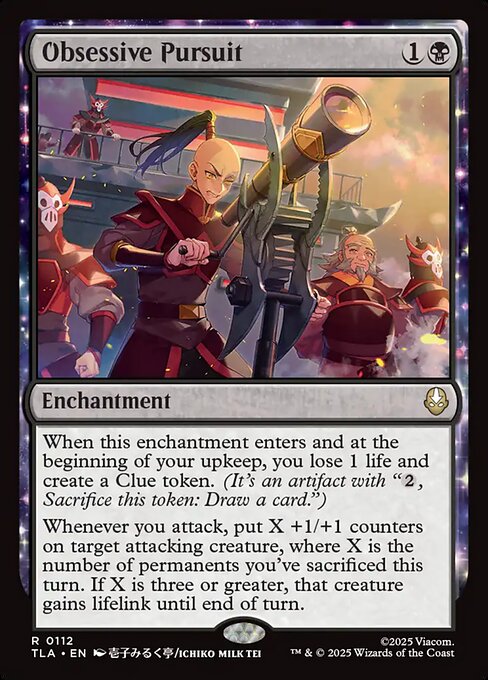 Rating6.8Good
Why this rating?
A very good rare of the format (6.8/10).
Why. A two-mana enchantment that creates a Clue when it enters and at each upkeep, at the price of 1 life. When you attack, +1/+1 counters go on an attacker based on permanents sacrificed this turn, with lifelink at three or more.
Risks. You lose 1 life at each upkeep, which hurts against an aggressive deck. The counters need an attacker and sacrificed permanents, and each Clue costs two mana to cash in.
In the draft. A pick for slower black decks with sacrifices or Clues. In a deck without sacrifices it is mostly card draw that costs life.
Results in the games of the set
When it is in hand, the deck wins 58.9% of its games (set average: 56.2%, 45th of 279 cards).
In the opening hand: 59.5% wins (55.4% on average).
Drawn during the game: 58.5% (56.8% on average).
When it is drawn, the deck wins 6.1 points more than when it is not.
When it is drafted, it is played 91% of the time (set average: 61%).
Taken as the first pick (138 drafts), it ends in the deck 88% of the time.
It is played about as much in every archetype.
 Rating6.8Good
Why this rating?
A solid uncommon of the format (6.8/10).
Why. A 2/4 with vigilance for three, castable in white or blue thanks to the hybrid mana. Each time it attacks with at least one other creature you draw, and it attacks without leaving you defenseless.
Risks. You need another creature attacking with it to draw. A 2/4 does not attack well alone into a crowded opposing board. It loses value in a slow deck.
In the draft. A good pick for white or blue decks with creatures. It fits almost any creature deck, as long as you have two sources of white or blue.
Results in the games of the set
When it is in hand, the deck wins 58.3% of its games (set average: 56.2%, 53rd of 279 cards).
In the opening hand: 59.6% wins (55.4% on average).
Drawn during the game: 57.5% (56.8% on average).
When it is drawn, the deck wins 3.1 points more than when it is not.
When it is drafted, it is played 96% of the time (set average: 61%).
Taken as the first pick (317 drafts), it ends in the deck 97% of the time.
It is played mostly in U/W decks (26% of them).

59. Tolls of War
Rating6.8GoodWhy this rating?
A solid uncommon of the format (6.8/10).
Why. A white-black enchantment for two that creates a Clue, then a 1/1 white Ally creature token each time you sacrifice a permanent during your turn (once per turn). Sacrificing the Clue (two mana) is enough to start the engine.
Risks. Two specific colors, and you need to sacrifice permanents to get value. It does nothing on the board otherwise. One token per turn stays modest.
In the draft. A good pick for white-black decks, especially with sacrifices. Without other sacrifice sources it is limited to a slow card-draw piece.
Results in the games of the set
When it is in hand, the deck wins 58.7% of its games (set average: 56.2%, 49th of 279 cards).
In the opening hand: 58.1% wins (55.4% on average).
Drawn during the game: 59.1% (56.8% on average).
When it is drawn, the deck wins 5.0 points more than when it is not.
When it is drafted, it is played 59% of the time (set average: 61%).
Taken as the first pick (103 drafts), it ends in the deck 79% of the time.
It is played mostly in B/W decks (58% of them).

60. Allies at Last
Rating6.8GoodWhy this rating?
A solid uncommon of the format (6.8/10).
Why. A green instant that costs one less for each Ally you control. Up to two of your creatures each deal damage equal to their power to an opposing creature: one-sided removal with no damage coming back.
Risks. You need creatures with decent power, and if the opponent kills them in response, the effect shrinks or vanishes. With no Allies it costs three mana.
In the draft. Good green removal to take in a deck of big creatures. It improves with Allies but is playable without.
Results in the games of the set
When it is in hand, the deck wins 59.0% of its games (set average: 56.2%, 42nd of 279 cards).
In the opening hand: 56.9% wins (55.4% on average).
Drawn during the game: 60.4% (56.8% on average).
When it is drawn, the deck wins 3.8 points more than when it is not.
When it is drafted, it is played 86% of the time (set average: 61%).
Taken as the first pick (166 drafts), it ends in the deck 97% of the time.
It is played mostly in G/W decks (35% of them) and G/R (31%).

61. Secret Tunnel
Rating6.7GoodWhy this rating?
A very good rare of the format (6.7/10).
Why. A colorless land that cannot be blocked, which only matters if it becomes a creature. For four mana and by tapping itself it makes two creatures that share a creature type unblockable this turn: a useful finisher.
Risks. It only produces colorless, which strains a deck with demanding colors. You need two creatures of the same type, and four extra mana.
In the draft. A utility land for two-color decks with Allies or shared types. Skip it if your colors are demanding.
Results in the games of the set
When it is in hand, the deck wins 57.8% of its games (set average: 56.2%, 65th of 279 cards).
In the opening hand: 56.3% wins (55.4% on average).
Drawn during the game: 58.8% (56.8% on average).
When it is drawn, the deck wins 2.9 points more than when it is not.
When it is drafted, it is played 85% of the time (set average: 61%).
Taken as the first pick (112 drafts), it ends in the deck 90% of the time.

62. Glider Staff
Rating6.6GoodWhy this rating?
A solid uncommon of the format (6.6/10).
Why. A three-mana Equipment that airbends a creature when it enters, then gives +1/+1 and flying. You can gain tempo against an opposing creature, or save your own. The Equipment stays useful afterwards.
Risks. Airbend lets the owner recast the creature for two, so it is tempo, not removal. Re-equipping costs two mana.
In the draft. A good pick for white decks. It gives flying to almost any creature and stays useful late in the game.
Results in the games of the set
When it is in hand, the deck wins 57.9% of its games (set average: 56.2%, 61st of 279 cards).
In the opening hand: 56.0% wins (55.4% on average).
Drawn during the game: 59.3% (56.8% on average).
When it is drawn, the deck wins 1.8 points more than when it is not.
When it is drafted, it is played 87% of the time (set average: 61%).
Taken as the first pick (270 drafts), it ends in the deck 94% of the time.
It is played mostly in B/W decks (28% of them) and R/W (28%).
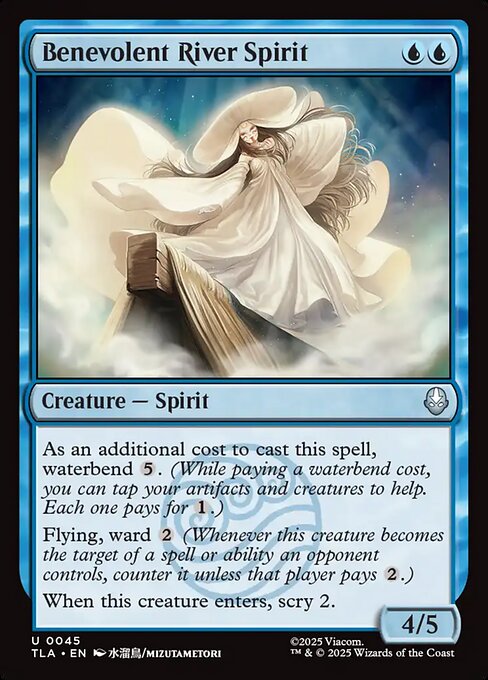 Rating6.6Good
Why this rating?
A solid uncommon of the format (6.6/10).
Why. A 4/5 flier with ward 2 that scries 2 when it enters, for two blue mana plus the waterbend 5 additional cost, paid by tapping creatures or artifacts, or with mana.
Risks. The additional cost is very heavy: it taps down your permanents until your next turn, or costs seven mana in total. It is fragile against removal that gets through the ward.
In the draft. A good pick for blue decks that want to win in the air. It is better with plenty of small creatures or artifacts to tap.
Results in the games of the set
When it is in hand, the deck wins 57.1% of its games (set average: 56.2%, 84th of 279 cards).
In the opening hand: 54.5% wins (55.4% on average).
Drawn during the game: 58.6% (56.8% on average).
When it is drawn, the deck wins 2.4 points more than when it is not.
When it is drafted, it is played 84% of the time (set average: 61%).
Taken as the first pick (189 drafts), it ends in the deck 93% of the time.
It is played mostly in B/U decks (28% of them) and U/W (28%).
 Rating6.6Good
Why this rating?
A very good rare of the format (6.6/10).
Why. A 3/3 for three with firebending 1. By tapping an untapped Ally you exile a card from a graveyard, and when it attacks you may cast an Ally spell exiled that way, as long as you own it. A solid body that can take over.
Risks. Everything depends on Allies: without other Allies half the card does nothing. Tapping Allies keeps them from attacking or blocking. It dies to removal.
In the draft. A good pick for black decks with Allies. Otherwise it is just a decent three-mana 3/3.
Results in the games of the set
When it is in hand, the deck wins 56.2% of its games (set average: 56.2%, 118th of 279 cards).
In the opening hand: 55.5% wins (55.4% on average).
Drawn during the game: 56.6% (56.8% on average).
When it is drawn, the deck wins 2.4 points more than when it is not.
When it is drafted, it is played 81% of the time (set average: 61%).
Taken as the first pick (81 drafts), it ends in the deck 85% of the time.
It is played about as much in every archetype.

65. Boomerang Basics
Rating6.6GoodWhy this rating?
A solid uncommon of the format (6.6/10).
Why. A one-mana Lesson sorcery that returns a nonland permanent to its owner's hand, and draws you a card if it was yours. It gains tempo, saves a creature, or replays an enters effect.
Risks. Bouncing kills nothing but tokens: the opponent just replays the card. It loses value against cheap creatures, and as a sorcery it is slow.
In the draft. A pick for blue decks that play tempo or enters effects. It counts as a Lesson, but do not take it early.
Results in the games of the set
When it is in hand, the deck wins 56.6% of its games (set average: 56.2%, 98th of 279 cards).
In the opening hand: 53.2% wins (55.4% on average).
Drawn during the game: 58.7% (56.8% on average).
When it is drawn, the deck wins 2.3 points more than when it is not.
When it is drafted, it is played 86% of the time (set average: 61%).
Taken as the first pick (228 drafts), it ends in the deck 87% of the time.
It is played mostly in B/U decks (26% of them) and R/U (25%).
 Rating6.6Good
Why this rating?
A very good rare of the format (6.6/10).
Why. A 4/4 for four that gives each non-Human creature you control +1/+1 for each of its creature types, to a maximum of 10. Many creatures have two or three types, so your board grows noticeably.
Risks. It is Human itself and does not buff itself. Human creatures get nothing. The bonus depends on your deck's makeup.
In the draft. A fair pick for green decks with plenty of non-Human creatures. Count your creature types before ranking it highly.
Results in the games of the set
When it is in hand, the deck wins 56.4% of its games (set average: 56.2%, 109th of 279 cards).
In the opening hand: 56.5% wins (55.4% on average).
Drawn during the game: 56.3% (56.8% on average).
When it is drawn, the deck wins 2.2 points more than when it is not.
When it is drafted, it is played 70% of the time (set average: 61%).
Taken as the first pick (66 drafts), it ends in the deck 82% of the time.
It is played about as much in every archetype.
 Rating6.6Good
Why this rating?
A solid uncommon of the format (6.6/10).
Why. A 1/1 with vigilance for one mana. By sacrificing it, another Ally you control gains indestructible until end of turn. It protects a valuable Ally from destroy removal or a bad combat.
Risks. A 1/1 with no impact alone. It only protects Allies, and against exile or sacrifice, indestructible does nothing.
In the draft. A pick for white decks with several important Allies. It remains a fine one-drop for aggression.
Results in the games of the set
When it is in hand, the deck wins 57.0% of its games (set average: 56.2%, 87th of 279 cards).
In the opening hand: 58.5% wins (55.4% on average).
Drawn during the game: 55.8% (56.8% on average).
When it is drawn, the deck wins 0.1 points less than when it is not.
When it is drafted, it is played 86% of the time (set average: 61%).
Taken as the first pick (176 drafts), it ends in the deck 93% of the time.
It is played mostly in B/W decks (34% of them) and G/W (32%).

68. Earthen Ally
Rating6.6GoodWhy this rating?
A very good rare of the format (6.6/10).
Why. A 0/2 for one green mana that gets +1/+0 for each color among your Allies, itself included. Its second ability, earthbend 5, needs all five colors of mana, so it only matters in an extreme deck.
Risks. Alone it has power 1: a small body. It is only strong in a very multicolor Ally deck. The seven-mana ability is nearly unusable.
In the draft. A marginal pick, for a multicolor Ally deck. Do not take it early: it is weak in a two-color deck.
Results in the games of the set
When it is in hand, the deck wins 54.8% of its games (set average: 56.2%, 161st of 279 cards).
In the opening hand: 56.6% wins (55.4% on average).
Drawn during the game: 53.4% (56.8% on average).
When it is drawn, the deck wins 0.8 points more than when it is not.
When it is drafted, it is played 44% of the time (set average: 61%).
Taken among the first three picks (121 drafts), it ends in the deck 72% of the time.
It is played about as much in every archetype.
 Rating6.6Good
Why this rating?
A solid uncommon of the format (6.6/10).
Why. A 2/3 for two that doubles as a mana source of any color: it smooths a three-color mana base and ramps you toward your four- and five-drops. It even makes two mana for your Lessons.
Risks. It taps to produce mana, and once tapped it no longer blocks. Without Lessons in the deck its second ability does nothing, and any cheap removal kills it.
In the draft. A fair pick for a green-blue deck, especially with several Lessons or a splash. Take it mid-pack rather than as a priority.
Results in the games of the set
When it is in hand, the deck wins 57.1% of its games (set average: 56.2%, 83rd of 279 cards).
In the opening hand: 59.4% wins (55.4% on average).
Drawn during the game: 55.6% (56.8% on average).
When it is drawn, the deck wins 4.2 points more than when it is not.
When it is drafted, it is played 70% of the time (set average: 61%).
Taken as the first pick (140 drafts), it ends in the deck 87% of the time.
It is played mostly in G/U decks (47% of them).

70. Sokka's Haiku
Rating6.6GoodWhy this rating?
A solid uncommon of the format (6.6/10).
Why. A five-mana counterspell that replaces itself and untaps a target land, so you can cast it, draw, and still have mana left over for your turn. It is a Lesson, so it counts for the set's synergies.
Risks. Five mana is a lot for a counterspell: you let the opponent develop their board while you wait. The three-card mill also eats into your own library in long games.
In the draft. A control card for a patient blue deck with enough creatures to hold the ground. One or two copies is plenty.
Results in the games of the set
When it is in hand, the deck wins 56.5% of its games (set average: 56.2%, 100th of 279 cards).
In the opening hand: 54.1% wins (55.4% on average).
Drawn during the game: 57.9% (56.8% on average).
When it is drawn, the deck wins 2.1 points more than when it is not.
When it is drafted, it is played 48% of the time (set average: 61%).
Taken as the first pick (38 drafts), it ends in the deck 82% of the time.
It is played about as much in every archetype.

71. Tiger-Dillo
Rating6.6GoodWhy this rating?
A solid uncommon of the format (6.6/10).
Why. A 4/3 for two mana looks huge on paper. In a deck full of big creatures it attacks and blocks from the early turns and outclasses small enemy creatures.
Risks. It can't attack or block without another creature with power 4 or greater: alone it is useless. Lose your big creature and it goes back to being a spectator.
In the draft. Play it only if your deck has enough power-4 creatures, typically in red-green. Otherwise let it go.
Results in the games of the set
When it is in hand, the deck wins 55.8% of its games (set average: 56.2%, 124th of 279 cards).
In the opening hand: 58.4% wins (55.4% on average).
Drawn during the game: 53.9% (56.8% on average).
When it is drawn, the deck wins 1.4 points more than when it is not.
When it is drafted, it is played 29% of the time (set average: 61%).
Taken as the first pick (31 drafts), it ends in the deck 81% of the time.
It is played mostly in G/R decks (30% of them).
 Rating6.6Good
Why this rating?
A very good rare of the format (6.6/10).
Why. A 3/4 that can return an instant or sorcery from your graveyard on entering (by discarding a card), then earthbends 1 whenever you cast a spell, with an extra counter for Lessons. She produces threats nonstop in a spell-heavy deck.
Risks. Getting the spell back costs a discard, and you need an instant or sorcery in the graveyard already. Her value follows your spell count: in a creature-heavy deck she is more ordinary.
In the draft. A good rare for a red-green deck with plenty of instants and sorceries. Take her fairly early if that plan appeals.
Results in the games of the set
When it is in hand, the deck wins 58.3% of its games (set average: 56.2%, 56th of 279 cards).
In the opening hand: 56.6% wins (55.4% on average).
Drawn during the game: 59.4% (56.8% on average).
When it is drawn, the deck wins 5.4 points more than when it is not.
When it is drafted, it is played 84% of the time (set average: 61%).
Taken as the first pick (121 drafts), it ends in the deck 86% of the time.
It is played about as much in every archetype.

73. White Lotus Reinforcements
Rating6.6GoodWhy this rating?
A solid uncommon of the format (6.6/10).
Why. A 2/3 vigilance for three that gives all your other Allies +1/+1. In an Ally-heavy deck with Ally tokens it turns every small body into a real threat while vigilance keeps your defense up.
Risks. The effect depends on how many Allies you control: without them it is a plain 2/3. It is also two colors, so it is harder to cast early.
In the draft. Very good in a green-white Ally deck. Move it up your list if you already have several Allies.
Results in the games of the set
When it is in hand, the deck wins 57.3% of its games (set average: 56.2%, 77th of 279 cards).
In the opening hand: 57.3% wins (55.4% on average).
Drawn during the game: 57.2% (56.8% on average).
When it is drawn, the deck wins 1.7 points more than when it is not.
When it is drafted, it is played 76% of the time (set average: 61%).
Taken as the first pick (149 drafts), it ends in the deck 87% of the time.
It is played mostly in G/W decks (51% of them).
 Rating6.6Good
Why this rating?
A solid uncommon of the format (6.6/10).
Why. A 4/4 reach Vehicle for three that leaves a Clue token when it dies. Once crewed it blocks fliers and hits hard, and it never really costs you a card.
Risks. It needs a crew of total power 2: tapping a creature to run it reduces your attack or block. It is poor in a deck with few creatures.
In the draft. A solid pick in nearly any deck with enough creatures to crew it. More interesting than many three-drop creatures.
Results in the games of the set
When it is in hand, the deck wins 57.7% of its games (set average: 56.2%, 68th of 279 cards).
In the opening hand: 57.6% wins (55.4% on average).
Drawn during the game: 57.7% (56.8% on average).
When it is drawn, the deck wins 1.6 points more than when it is not.
When it is drafted, it is played 61% of the time (set average: 61%).
Taken as the first pick (63 drafts), it ends in the deck 83% of the time.
It is played about as much in every archetype.

75. Realm of Koh
Rating6.5GoodWhy this rating?
A very good rare of the format (6.5/10).
Why. A land that taps for black, enters untapped if you control a basic land, and can spend four mana (one of them black) and tap itself to make a 1/1 colorless Spirit creature token that can't block or be blocked by non-Spirit creatures. It gives late-game value without taking a spell slot.
Risks. It enters tapped if you control no basic land, which can slow an early game. The Spirit token stays small: it is an extra, not a win on its own.
In the draft. Play it in any black deck: it costs almost nothing to include. Take it as a good utility land, not ahead of a strong spell.
Results in the games of the set
When it is in hand, the deck wins 57.7% of its games (set average: 56.2%, 69th of 279 cards).
In the opening hand: 56.7% wins (55.4% on average).
Drawn during the game: 58.3% (56.8% on average).
When it is drawn, the deck wins 3.2 points more than when it is not.
When it is drafted, it is played 83% of the time (set average: 61%).
Taken as the first pick (79 drafts), it ends in the deck 96% of the time.

76. Guru Pathik
Rating6.4GoodWhy this rating?
Good playable that always makes the cut (6.4/10).
Why. A 2/4 that looks at the top five cards of your library for a Lesson, Saga, or Shrine on entering, then puts a +1/+1 counter on another creature each time you cast one. Steady value and a good defensive body.
Risks. It needs Lessons, Sagas, or Shrines in the deck, or the effect is weak. The hybrid cost makes it castable with green or blue, but its power depends on your list.
In the draft. Good in a green or blue deck with several Lessons. Take it mid-pack if your deck already has some.
Results in the games of the set
When it is in hand, the deck wins 57.5% of its games (set average: 56.2%, 74th of 279 cards).
In the opening hand: 55.7% wins (55.4% on average).
Drawn during the game: 58.6% (56.8% on average).
When it is drawn, the deck wins 3.1 points more than when it is not.
When it is drafted, it is played 80% of the time (set average: 61%).
Taken as the first pick (201 drafts), it ends in the deck 88% of the time.
It is played mostly in G/U decks (42% of them).
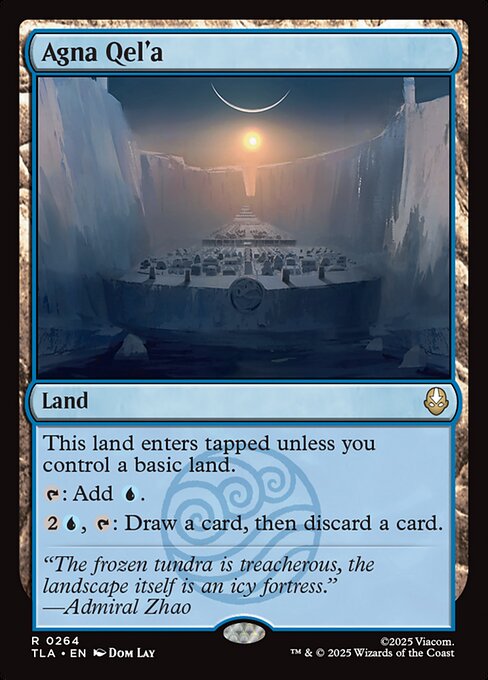
77. Agna Qel'a
Rating6.4GoodWhy this rating?
Good playable that always makes the cut (6.4/10).
Why. A blue land that enters untapped if you control a basic land and lets you loot (draw, then discard) for three mana, one of them blue, by tapping itself. It smooths your hand in the late game.
Risks. It enters tapped without a basic land. The activation is expensive and taps the land: it does not replace a real spell.
In the draft. Play it in any blue deck: it costs almost nothing. Not a priority, but a good utility land to take late.
Results in the games of the set
When it is in hand, the deck wins 57.1% of its games (set average: 56.2%, 80th of 279 cards).
In the opening hand: 56.1% wins (55.4% on average).
Drawn during the game: 57.8% (56.8% on average).
When it is drawn, the deck wins 2.8 points more than when it is not.
When it is drafted, it is played 89% of the time (set average: 61%).
Taken as the first pick (111 drafts), it ends in the deck 95% of the time.

78. Cat-Gator
Rating6.4GoodWhy this rating?
Good playable that always makes the cut (6.4/10).
Why. A 3/2 lifelink for seven that deals damage equal to the number of Swamps you control to any target. In a heavy black deck it is removal or a finisher that leaves a lifelinking creature behind.
Risks. Seven mana is very expensive, and without many Swamps the damage is small. With only two or three Swamps you pay a lot for little.
In the draft. Best in a heavy black deck with a Swamp-heavy mana base. In a multicolor deck, count your Swamps before playing it.
Results in the games of the set
When it is in hand, the deck wins 57.8% of its games (set average: 56.2%, 66th of 279 cards).
In the opening hand: 52.9% wins (55.4% on average).
Drawn during the game: 60.8% (56.8% on average).
When it is drawn, the deck wins 3.5 points more than when it is not.
When it is drafted, it is played 53% of the time (set average: 61%).
Taken as the first pick (82 drafts), it ends in the deck 82% of the time.
It is played mostly in B/W decks (34% of them) and B/U (28%).
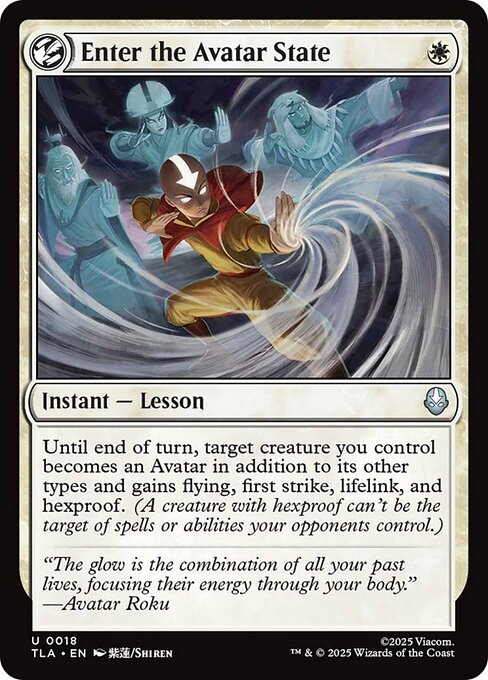 Rating6.4Good
Why this rating?
Good playable that always makes the cut (6.4/10).
Why. For one white mana, one of your creatures gains flying, first strike, lifelink, and hexproof until end of turn. In combat it is a blowout: win a duel, dodge targeted removal, or hit in the air.
Risks. It is a one-turn spell: with no creature to protect or support, it does nothing. If they respond by killing the creature, you lose the card.
In the draft. Good in an aggressive white deck or one with many small creatures. It is a Lesson, so it helps the synergies. Take it mid-pack.
Results in the games of the set
When it is in hand, the deck wins 56.3% of its games (set average: 56.2%, 113th of 279 cards).
In the opening hand: 55.4% wins (55.4% on average).
Drawn during the game: 56.9% (56.8% on average).
When it is drawn, the deck wins 0.8 points more than when it is not.
When it is drafted, it is played 74% of the time (set average: 61%).
Taken as the first pick (78 drafts), it ends in the deck 87% of the time.
It is played about as much in every archetype.
 Rating6.4Good
Why this rating?
Good playable that always makes the cut (6.4/10).
Why. A one-mana removal that deals 2 damage to a creature, or 5 damage for five mana total when kicked. That flexibility keeps it useful from the opening turns to the late game, and it is a Lesson for the synergies.
Risks. Two damage does not kill much, and the five-mana kicked version is expensive. High-toughness creatures escape it, and it can't hit players.
In the draft. A decent common removal in a red deck. Take it after the better removal, but look for a few copies.
Results in the games of the set
When it is in hand, the deck wins 58.2% of its games (set average: 56.2%, 57th of 279 cards).
In the opening hand: 57.7% wins (55.4% on average).
Drawn during the game: 58.6% (56.8% on average).
When it is drawn, the deck wins 3.3 points more than when it is not.
When it is drafted, it is played 90% of the time (set average: 61%).
Taken as the first pick (699 drafts), it ends in the deck 93% of the time.
It is played mostly in G/R decks (64% of them) and R/U (64%).
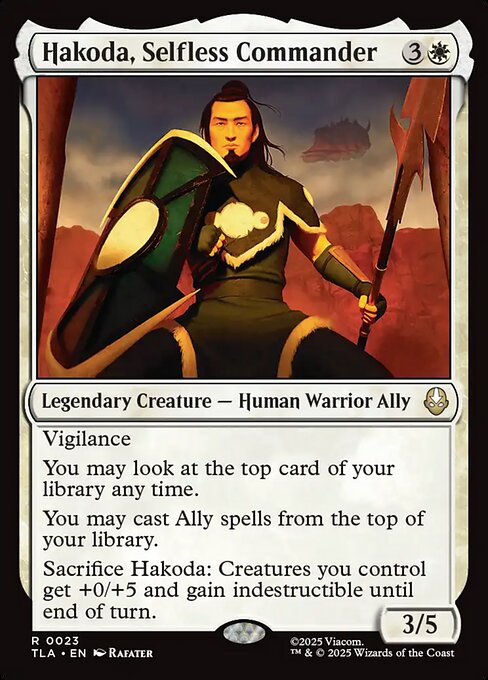
81. Hakoda, Selfless Commander
Rating6.4GoodWhy this rating?
Good playable that always makes the cut (6.4/10).
Why. A 3/5 vigilance that looks at the top of your library and casts Allies from there. It gives you value whenever the top card is an Ally, and can sacrifice itself to make your whole team indestructible with +0/+5.
Risks. Its edge depends on your Allies: without them it is a good body and not much more. The sacrifice is a one-shot combat effect that costs the creature.
In the draft. Very good in a white deck full of Allies. Take it fairly early if you already have Allies, otherwise as a good 3/5 defensive body.
Results in the games of the set
When it is in hand, the deck wins 57.6% of its games (set average: 56.2%, 70th of 279 cards).
In the opening hand: 57.0% wins (55.4% on average).
Drawn during the game: 58.0% (56.8% on average).
When it is drawn, the deck wins 2.5 points more than when it is not.
When it is drafted, it is played 94% of the time (set average: 61%).
Taken as the first pick (143 drafts), it ends in the deck 94% of the time.
It is played about as much in every archetype.
 Rating6.4Good
Why this rating?
Good playable that always makes the cut (6.4/10).
Why. A 1/1 flash that creates a 1/1 white Ally creature token: two bodies for two mana, which you can play by surprise to block or at the end of the opponent's turn. It feeds Ally synergies.
Risks. Two small bodies do not weigh much in combat and die to any sweeper. By itself it has little impact.
In the draft. Good in a white deck with Allies or an aggressive plan. A fair mid-pack pick.
Results in the games of the set
When it is in hand, the deck wins 57.0% of its games (set average: 56.2%, 86th of 279 cards).
In the opening hand: 57.8% wins (55.4% on average).
Drawn during the game: 56.5% (56.8% on average).
When it is drawn, the deck wins 0.3 points more than when it is not.
When it is drafted, it is played 91% of the time (set average: 61%).
Taken as the first pick (252 drafts), it ends in the deck 97% of the time.
It is played mostly in B/W decks (33% of them) and G/W (33%).

83. Ozai's Cruelty
Rating6.4GoodWhy this rating?
Good playable that always makes the cut (6.4/10).
Why. A three-mana sorcery that deals 2 damage to a player and makes them discard two cards. It works well against an opponent who has held their hand, and it is a Lesson for your synergies.
Risks. It does nothing to the board, and if the opponent has already emptied their hand it is weak. Against an aggressive deck you lose a turn without improving your position.
In the draft. A filler card for a black control or Lessons deck. Do not take it over removal or good creatures.
Results in the games of the set
When it is in hand, the deck wins 56.4% of its games (set average: 56.2%, 110th of 279 cards).
In the opening hand: 55.3% wins (55.4% on average).
Drawn during the game: 57.1% (56.8% on average).
When it is drawn, the deck wins 2.3 points more than when it is not.
When it is drafted, it is played 47% of the time (set average: 61%).
Taken as the first pick (30 drafts), it ends in the deck 80% of the time.
It is played about as much in every archetype.
 Rating6.4Good
Why this rating?
Good playable that always makes the cut (6.4/10).
Why. A three-mana sorcery that draws two cards. With waterbend 6 as an additional cost it shuffles your graveyard into your library and draws seven with no maximum hand size: a huge late-game effect.
Risks. It does nothing to the board, and it exiles itself after use. The waterbend 6 mode costs nine mana in total, with plenty of artifacts and creatures to tap to help pay.
In the draft. A slow blue deck card, not a priority. Play it if you have enough good creatures to hold on while you wait.
Results in the games of the set
When it is in hand, the deck wins 55.6% of its games (set average: 56.2%, 129th of 279 cards).
In the opening hand: 51.5% wins (55.4% on average).
Drawn during the game: 58.1% (56.8% on average).
When it is drawn, the deck wins 1.9 points more than when it is not.
When it is drafted, it is played 84% of the time (set average: 61%).
Taken as the first pick (107 drafts), it ends in the deck 94% of the time.
It is played about as much in every archetype.
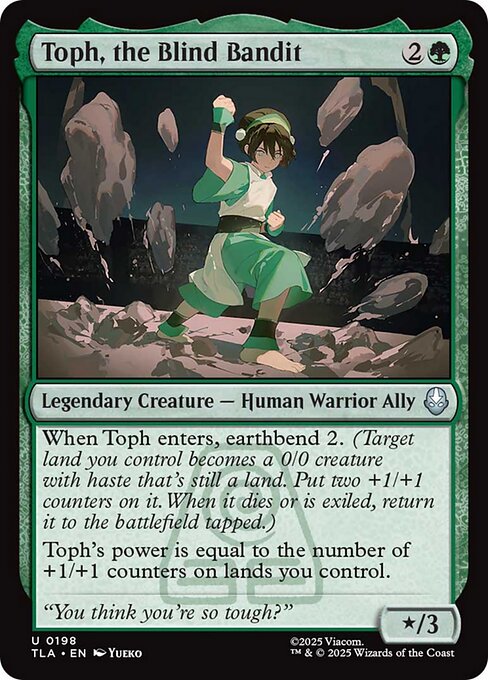 Rating6.4Good
Why this rating?
Good playable that always makes the cut (6.4/10).
Why. A three-mana creature that earthbends 2 on entering: her power is at least 2 while the animated land stays around, and you also get a 2/2 haste land. Two bodies for three mana, and her power grows with every counter on your lands.
Risks. The animated land is a target: if it dies it returns tapped, but its counters are gone and Toph loses power. Without more counters she stays modest.
In the draft. A good card for a green deck, especially with effects that add counters. Take her ahead of most other three-drop creatures.
Results in the games of the set
When it is in hand, the deck wins 58.2% of its games (set average: 56.2%, 58th of 279 cards).
In the opening hand: 58.2% wins (55.4% on average).
Drawn during the game: 58.1% (56.8% on average).
When it is drawn, the deck wins 3.2 points more than when it is not.
When it is drafted, it is played 88% of the time (set average: 61%).
Taken as the first pick (173 drafts), it ends in the deck 93% of the time.
It is played mostly in G/R decks (36% of them) and B/G (33%).
 Rating6.3Good
Why this rating?
Good playable that always makes the cut (6.3/10).
Why. A two-mana 1/1 that replaces up to two cards on entering and grows with every artifact or Lesson you cast. In a spell-heavy deck it smooths your hand and can become a threat.
Risks. It is a fragile 1/1 without synergy: it does almost nothing in a deck short on artifacts and Lessons. Blue-red makes it hard to cast early.
In the draft. A specialist card for a blue-red deck with plenty of Lessons. In other decks, let it pass.
Results in the games of the set
When it is in hand, the deck wins 54.3% of its games (set average: 56.2%, 176th of 279 cards).
In the opening hand: 53.6% wins (55.4% on average).
Drawn during the game: 54.7% (56.8% on average).
When it is drawn, the deck wins 2.5 points more than when it is not.
When it is drafted, it is played 62% of the time (set average: 61%).
Taken as the first pick (49 drafts), it ends in the deck 84% of the time.
It is played about as much in every archetype.
 Rating6.3Good
Why this rating?
Good playable that always makes the cut (6.3/10).
Why. A 3/1 that deals damage equal to the number of creatures you control, himself included, to a creature an opponent controls on entering, and puts a +1/+1 counter on each of up to two creatures when he dies. A creature that acts as removal.
Risks. It costs five mana, three of them hybrid red or white, so you need at least one of those colors. With no other creatures the damage is small, and the 3/1 body dies to anything.
In the draft. Good in a red or white deck with a developed board. Take it as conditional removal that comes with a body.
Results in the games of the set
When it is in hand, the deck wins 57.0% of its games (set average: 56.2%, 85th of 279 cards).
In the opening hand: 55.7% wins (55.4% on average).
Drawn during the game: 58.0% (56.8% on average).
When it is drawn, the deck wins 0.8 points more than when it is not.
When it is drafted, it is played 87% of the time (set average: 61%).
Taken as the first pick (178 drafts), it ends in the deck 90% of the time.
It is played mostly in R/W decks (39% of them).

88. Aang's Iceberg
Rating6.2GoodWhy this rating?
Good playable that always makes the cut (6.2/10).
Why. An enchantment with flash that exiles a nonland permanent for as long as it stays on the battlefield. It can also sacrifice itself with waterbend 3 to scry 2, which returns the permanent to its owner.
Risks. If the enchantment is removed or you sacrifice it, the target comes back. The exile is temporary and does not deal with an opponent who has answers to enchantments.
In the draft. A good flexible removal for a white deck, helped by flash. Take it mid-pack.
Results in the games of the set
When it is in hand, the deck wins 56.9% of its games (set average: 56.2%, 88th of 279 cards).
In the opening hand: 55.4% wins (55.4% on average).
Drawn during the game: 58.0% (56.8% on average).
When it is drawn, the deck wins 1.8 points more than when it is not.
When it is drafted, it is played 93% of the time (set average: 61%).
Taken as the first pick (141 drafts), it ends in the deck 93% of the time.
It is played about as much in every archetype.
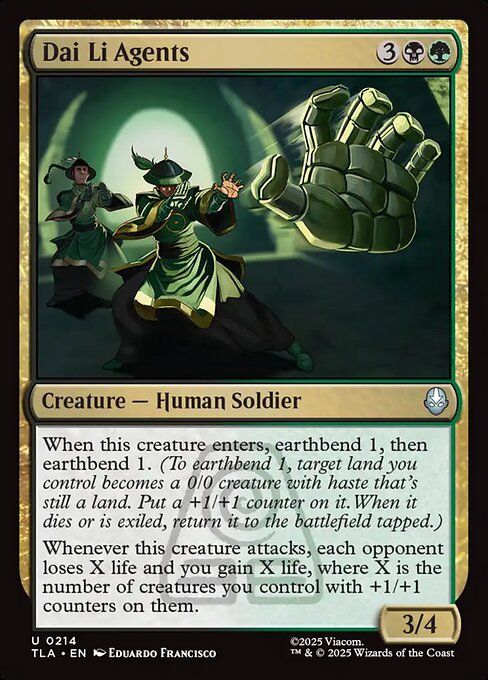
89. Dai Li Agents
Rating6.2GoodWhy this rating?
Good playable that always makes the cut (6.2/10).
Why. A 3/4 that earthbends 1 twice on entering, then drains the opponent each time it attacks based on the number of creatures with +1/+1 counters. It makes up to two small bodies and a steady drain.
Risks. Five mana in two colors, and the drain depends on your counters. If the animated lands die or the creature is killed before attacking, the value is gone.
In the draft. Good in a black-green deck with counters. Take it ahead of most five-drops in those colors.
Results in the games of the set
When it is in hand, the deck wins 57.9% of its games (set average: 56.2%, 63rd of 279 cards).
In the opening hand: 55.7% wins (55.4% on average).
Drawn during the game: 59.2% (56.8% on average).
When it is drawn, the deck wins 4.1 points more than when it is not.
When it is drafted, it is played 57% of the time (set average: 61%).
Taken as the first pick (58 drafts), it ends in the deck 84% of the time.
It is played mostly in B/G decks (55% of them).
 Rating6.2Good
Why this rating?
Good playable that always makes the cut (6.2/10).
Why. A one-mana 1/2 that gains firebending 2 once a Lesson is in your graveyard, and gets +1/+0 for two mana. The added mana can pay for that bonus or an instant during combat.
Risks. A 1/2 is very small and dies to nearly everything. With no Lesson in your graveyard, firebending is useless.
In the draft. A red aggro card to play with several Lessons. On its own it is mediocre; do not take it over removal or good creatures.
Results in the games of the set
When it is in hand, the deck wins 56.5% of its games (set average: 56.2%, 104th of 279 cards).
In the opening hand: 59.3% wins (55.4% on average).
Drawn during the game: 54.4% (56.8% on average).
When it is drawn, the deck wins 0.2 points more than when it is not.
When it is drafted, it is played 65% of the time (set average: 61%).
Taken as the first pick (156 drafts), it ends in the deck 84% of the time.
It is played mostly in R/U decks (78% of them) and B/R (65%).

91. Forecasting Fortune Teller
Rating6.2GoodWhy this rating?
Good playable that always makes the cut (6.2/10).
Why. A two-mana 1/3 that creates a Clue token on entering. It blocks small creatures well and gives you a card to draw later: a good early body that replaces itself.
Risks. One power threatens nothing, and the Clue costs two mana to crack. It does not win the game on its own.
In the draft. A solid blue common, especially in a control or defensive deck. An Ally, so it helps the synergies.
Results in the games of the set
When it is in hand, the deck wins 57.5% of its games (set average: 56.2%, 75th of 279 cards).
In the opening hand: 56.9% wins (55.4% on average).
Drawn during the game: 57.9% (56.8% on average).
When it is drawn, the deck wins 2.4 points more than when it is not.
When it is drafted, it is played 92% of the time (set average: 61%).
Taken as the first pick (558 drafts), it ends in the deck 93% of the time.
It is played mostly in U/W decks (66% of them) and B/U (64%).
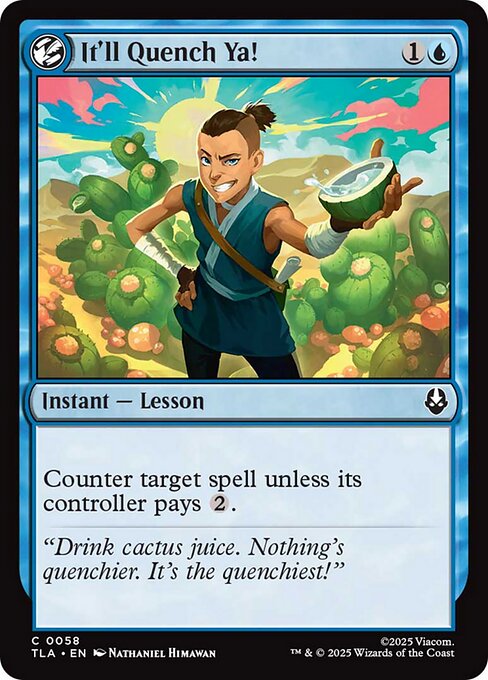
92. It'll Quench Ya!
Rating6.2GoodWhy this rating?
Good playable that always makes the cut (6.2/10).
Why. A two-mana counterspell unless the opponent pays two more. Early in the game, or when the opponent has tapped out, it neutralizes a spell for cheap. It is a Lesson.
Risks. An opponent with two spare mana walks around it easily. You must keep two mana open, which costs you tempo.
In the draft. Fine in a blue control deck. A conditional counterspell: take it after removal and good creatures.
Results in the games of the set
When it is in hand, the deck wins 58.0% of its games (set average: 56.2%, 60th of 279 cards).
In the opening hand: 58.5% wins (55.4% on average).
Drawn during the game: 57.6% (56.8% on average).
When it is drawn, the deck wins 3.0 points more than when it is not.
When it is drafted, it is played 83% of the time (set average: 61%).
Taken as the first pick (277 drafts), it ends in the deck 94% of the time.
It is played mostly in R/U decks (70% of them) and G/U (67%).
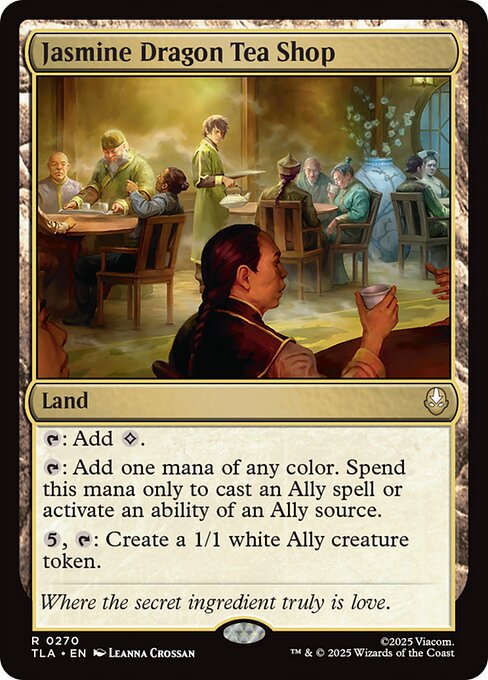 Rating6.2Good
Why this rating?
Good playable that always makes the cut (6.2/10).
Why. A land that taps for colorless, or for any color to cast an Ally spell or activate an Ally source's ability, and makes a 1/1 white Ally creature token for five mana plus tapping itself. It supports an Ally deck in the late game.
Risks. It makes only colorless mana for non-Ally spells, which can strain your mana base. The token is slow and small.
In the draft. Play it in an Ally deck that wants utility from a land. A late pick: do not lean on it as a main mana source.
Results in the games of the set
When it is in hand, the deck wins 56.7% of its games (set average: 56.2%, 95th of 279 cards).
In the opening hand: 56.4% wins (55.4% on average).
Drawn during the game: 57.0% (56.8% on average).
When it is drawn, the deck wins 2.4 points more than when it is not.
When it is drafted, it is played 90% of the time (set average: 61%).
Taken as the first pick (58 drafts), it ends in the deck 95% of the time.

94. Lightning Strike
Rating6.2GoodWhy this rating?
Good playable that always makes the cut (6.2/10).
Why. A two-mana instant that deals 3 damage to any target. It kills most early creatures, or finishes an opponent at low life.
Risks. Three damage does not cut it against big creatures. It is a straight one-for-one trade and no more.
In the draft. Solid removal to take in a red deck. Look for several; it earns its slot in every red archetype.
Results in the games of the set
When it is in hand, the deck wins 57.2% of its games (set average: 56.2%, 78th of 279 cards).
In the opening hand: 55.7% wins (55.4% on average).
Drawn during the game: 58.2% (56.8% on average).
When it is drawn, the deck wins 2.5 points more than when it is not.
When it is drafted, it is played 82% of the time (set average: 61%).
Taken as the first pick (498 drafts), it ends in the deck 86% of the time.
It is played mostly in G/R decks (60% of them) and B/R (54%).
 Rating6.2Good
Why this rating?
Good playable that always makes the cut (6.2/10).
Why. A five-mana 2/2 that tutors for a Lesson or Noble on entering and gives lifelink to your Nobles and Lessons. It replaces itself and adds life gain in a Lessons deck.
Risks. Five mana for a 2/2 is expensive, and its effect depends on having Lessons or Nobles to find. Without them it loses almost all its value.
In the draft. A specialist choice for a black Lessons deck. Elsewhere, let it pass.
Results in the games of the set
When it is in hand, the deck wins 55.0% of its games (set average: 56.2%, 155th of 279 cards).
In the opening hand: 52.9% wins (55.4% on average).
Drawn during the game: 56.3% (56.8% on average).
When it is drawn, the deck wins 0.6 points more than when it is not.
When it is drafted, it is played 26% of the time (set average: 61%).
Taken among the first three picks (93 drafts), it ends in the deck 62% of the time.

96. Pillar Launch
Rating6.2GoodWhy this rating?
Good playable that always makes the cut (6.2/10).
Why. For one green mana, a creature gets +2/+2 and reach until end of turn, and untaps. A very cheap combat trick that saves a creature from damage-based removal or wins a duel, while letting it attack and still block.
Risks. Like any trick, you lose the card if the opponent responds by killing the target. With no creature to support, it does nothing.
In the draft. A fair trick for an aggressive or creature-heavy green deck. A mid- to late-pack pick.
Results in the games of the set
When it is in hand, the deck wins 55.9% of its games (set average: 56.2%, 122nd of 279 cards).
In the opening hand: 54.7% wins (55.4% on average).
Drawn during the game: 56.7% (56.8% on average).
When it is drawn, the deck wins 0.5 points less than when it is not.
When it is drafted, it is played 21% of the time (set average: 61%).
Taken among the first three picks (51 drafts), it ends in the deck 67% of the time.
It is played mostly in G/W decks (28% of them) and G/R (25%).
 Rating6.2Good
Why this rating?
Good playable that always makes the cut (6.2/10).
Why. A 1/4 flier for four. Whenever creatures with flying attack, you loot, and you put a +1/+1 counter on a target creature if you discard a nonland card. It gives a solid aerial block and some filtering.
Risks. It has only 1 power and kills nothing alone. Its plan needs fliers attacking, which exposes them.
In the draft. Good in a blue deck with several fliers. A mid-pack pick.
Results in the games of the set
When it is in hand, the deck wins 56.4% of its games (set average: 56.2%, 108th of 279 cards).
In the opening hand: 55.2% wins (55.4% on average).
Drawn during the game: 57.2% (56.8% on average).
When it is drawn, the deck wins 2.7 points more than when it is not.
When it is drafted, it is played 84% of the time (set average: 61%).
Taken as the first pick (194 drafts), it ends in the deck 94% of the time.
It is played mostly in U/W decks (34% of them) and B/U (25%).

98. Tiger-Seal
Rating6.2GoodWhy this rating?
Good playable that always makes the cut (6.2/10).
Why. A 3/3 vigilance for a single blue mana. It taps at the start of each upkeep and untaps only when you draw your second card each turn; if you can enable that, it is very strong for its cost.
Risks. Without a second draw each turn it stays tapped and does not block. That makes it unreliable in most decks.
In the draft. Play it only with plenty of extra card draw. In other decks, skip it.
Results in the games of the set
When it is in hand, the deck wins 53.7% of its games (set average: 56.2%, 196th of 279 cards).
In the opening hand: 52.6% wins (55.4% on average).
Drawn during the game: 54.4% (56.8% on average).
When it is drawn, the deck wins 2.3 points more than when it is not.
When it is drafted, it is played 17% of the time (set average: 61%).
Taken among the first three picks (50 drafts), it ends in the deck 46% of the time.

99. Toph, the First Metalbender
Rating6.2GoodWhy this rating?
Good playable that always makes the cut (6.2/10).
Why. A 3/3 for four that earthbends 2 at the start of each of your end steps and makes your nontoken artifacts lands. It produces a new land creature every turn: a steady stream of threats.
Risks. Three colors (red, green, white) make its mana base hard. It dies quickly, and your artifacts that become lands are exposed to land effects.
In the draft. A pick for a three-color red-green-white deck only. It is not playable elsewhere.
Results in the games of the set
When it is in hand, the deck wins 56.5% of its games (set average: 56.2%, 102nd of 279 cards).
In the opening hand: 56.7% wins (55.4% on average).
Drawn during the game: 56.4% (56.8% on average).
When it is drawn, the deck wins 4.7 points more than when it is not.
When it is drafted, it is played 69% of the time (set average: 61%).
Taken as the first pick (90 drafts), it ends in the deck 76% of the time.
It is played about as much in every archetype.

100. Jet's Brainwashing
Rating6.1PlayableWhy this rating?
Good playable that always makes the cut (6.1/10).
Why. A one-mana sorcery that stops a creature from blocking this turn and creates a Clue token. Kicked, you gain control of the creature until end of turn, untap it, and give it haste.
Risks. It does not solve any lasting problem. With no offensive plan, its effects are weak, and the kicked version costs four mana.
In the draft. A late-pack aggro card. Play it only in a very offensive red deck.
Results in the games of the set
When it is in hand, the deck wins 53.1% of its games (set average: 56.2%, 209th of 279 cards).
In the opening hand: 49.2% wins (55.4% on average).
Drawn during the game: 55.9% (56.8% on average).
When it is drawn, the deck wins 0.1 points less than when it is not.
When it is drafted, it is played 17% of the time (set average: 61%).
Taken among the first three picks (46 drafts), it ends in the deck 48% of the time.

101. Professor Zei, Anthropologist
Rating6.1PlayableWhy this rating?
Good playable that always makes the cut (6.1/10).
Why. A two-mana hand filter: she taps to discard a card and draw one, turning extra lands or dead cards into live ones. The 0/3 body blocks small creatures, and she can sacrifice herself to rebuy an instant or sorcery.
Risks. She never attacks and does not move the board on her own. The recursion only works on your turn and costs you the creature. With no good instants or sorceries in the graveyard, she is just a looter.
In the draft. A mid-pack pick, fine in a blue-red deck full of spells. Take her when nothing more proactive is on offer, especially if your deck wants smoother draws.
Results in the games of the set
When it is in hand, the deck wins 55.6% of its games (set average: 56.2%, 128th of 279 cards).
In the opening hand: 54.8% wins (55.4% on average).
Drawn during the game: 56.2% (56.8% on average).
When it is drawn, the deck wins 1.8 points more than when it is not.
When it is drafted, it is played 74% of the time (set average: 61%).
Taken as the first pick (96 drafts), it ends in the deck 81% of the time.
It is played mostly in R/U decks (37% of them).

102. Accumulate Wisdom
Rating6.0PlayableWhy this rating?
Good playable that always makes the cut (6.0/10).
Why. A two-mana instant that digs three cards deep and keeps one, with the rest going to the bottom. Clean selection at the end of the opponent's turn. With three Lessons in your graveyard you keep all three cards, which is a big swing.
Risks. Without Lessons it is a one-for-one that does nothing to the board. Reaching three Lessons takes a deck built for it, and too much selection slows you down.
In the draft. A support card for a blue Lessons or control deck. Take it after your creatures and removal. One or two copies is plenty.
Results in the games of the set
When it is in hand, the deck wins 56.5% of its games (set average: 56.2%, 103rd of 279 cards).
In the opening hand: 53.6% wins (55.4% on average).
Drawn during the game: 58.3% (56.8% on average).
When it is drawn, the deck wins 2.7 points more than when it is not.
When it is drafted, it is played 90% of the time (set average: 61%).
Taken as the first pick (301 drafts), it ends in the deck 90% of the time.
It is played mostly in R/U decks (30% of them) and G/U (29%).
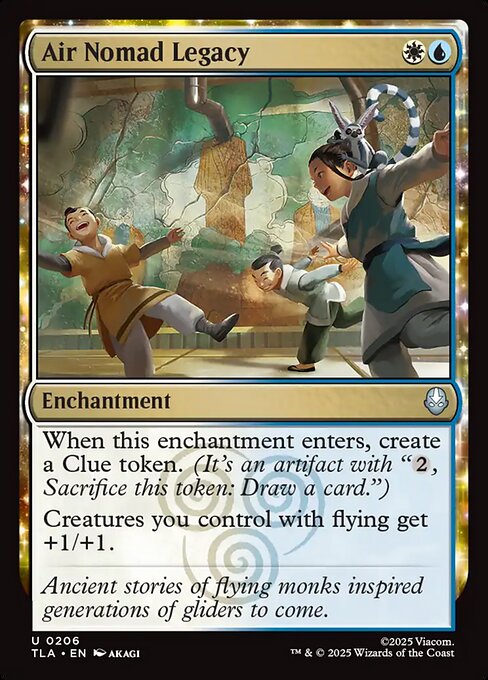
103. Air Nomad Legacy
Rating6.0PlayableWhy this rating?
Good playable that always makes the cut (6.0/10).
Why. A white-blue enchantment that makes a Clue token on arrival, then gives all your creatures with flying +1/+1. In a deck stuffed with flyers, the Clue replaces the card and the bonus is permanent for your air force.
Risks. It does nothing without creatures with flying and is slow in a deck that lacks them. It does not block anything, and its two colours make it rigid.
In the draft. Take it in white-blue with a healthy flyer count; otherwise let it go. Do not rate it over good removal or a good creature.
Results in the games of the set
When it is in hand, the deck wins 54.7% of its games (set average: 56.2%, 164th of 279 cards).
In the opening hand: 55.0% wins (55.4% on average).
Drawn during the game: 54.5% (56.8% on average).
When it is drawn, the deck wins 0.9 points more than when it is not.
When it is drafted, it is played 44% of the time (set average: 61%).
Taken as the first pick (66 drafts), it ends in the deck 64% of the time.
It is played mostly in U/W decks (55% of them).

104. Fire Sages
Rating6.0PlayableWhy this rating?
Good playable that always makes the cut (6.0/10).
Why. A two-drop that scales: Firebending 1 adds a red mana when it attacks, and the three-mana ability adds a +1/+1 counter each time you pay it. It becomes a real threat whenever you have spare mana.
Risks. A turn-two 2/2 attacks poorly into bigger blockers. Activating the ability eats three mana, most of your turn, and removal kills it before it has grown.
In the draft. A good two-drop for aggressive or tempo red decks. A mid-pack pick when you need a cheap creature.
Results in the games of the set
When it is in hand, the deck wins 55.8% of its games (set average: 56.2%, 125th of 279 cards).
In the opening hand: 57.7% wins (55.4% on average).
Drawn during the game: 54.4% (56.8% on average).
When it is drawn, the deck wins 0.3 points more than when it is not.
When it is drafted, it is played 85% of the time (set average: 61%).
Taken as the first pick (134 drafts), it ends in the deck 91% of the time.
It is played mostly in B/R decks (37% of them) and G/R (35%).

105. Lost Days
Rating6.0PlayableWhy this rating?
Good playable that always makes the cut (6.0/10).
Why. A five-mana temporary answer: the targeted creature or enchantment goes back into its owner's library, second from the top or on the bottom, and you create a Clue token. An instant that replaces itself.
Risks. Five mana is a lot for a removal that does not kill. If the owner picks second from the top, they redraw the card in two turns, so the tempo you gain is limited.
In the draft. A blue deck card, more solid than exciting. Take it once your cheap creatures are in place. One copy is fine, two if your curve is low.
Results in the games of the set
When it is in hand, the deck wins 58.6% of its games (set average: 56.2%, 51st of 279 cards).
In the opening hand: 55.1% wins (55.4% on average).
Drawn during the game: 60.6% (56.8% on average).
When it is drawn, the deck wins 3.1 points more than when it is not.
When it is drafted, it is played 87% of the time (set average: 61%).
Taken as the first pick (395 drafts), it ends in the deck 96% of the time.
It is played mostly in B/U decks (71% of them) and R/U (71%).
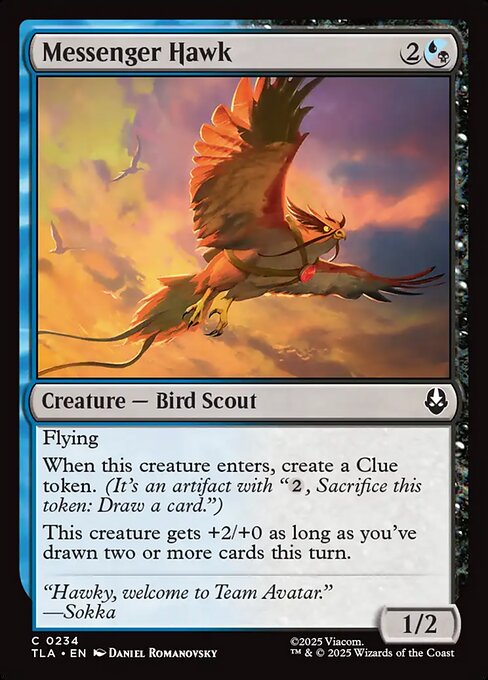
106. Messenger Hawk
Rating6.0PlayableWhy this rating?
Good playable that always makes the cut (6.0/10).
Why. A three-mana flyer that makes a Clue token on arrival: immediate value and a body in the air to chip in and block opposing flyers. When you have drawn two cards in a turn it becomes a 3/2, which the Clue can enable on your turn.
Risks. A 1/2 is fragile and hits for little. The bonus needs two draws in a turn, which is not reliable. It can be paid with blue or black mana.
In the draft. A good common for blue or black decks that want value. Take it mid-pack; it fills the curve in tempo or control decks.
Results in the games of the set
When it is in hand, the deck wins 57.6% of its games (set average: 56.2%, 71st of 279 cards).
In the opening hand: 55.7% wins (55.4% on average).
Drawn during the game: 58.7% (56.8% on average).
When it is drawn, the deck wins 2.2 points more than when it is not.
When it is drafted, it is played 91% of the time (set average: 61%).
Taken as the first pick (392 drafts), it ends in the deck 95% of the time.
It is played mostly in B/U decks (64% of them) and R/U (47%).

107. Octopus Form
Rating6.0PlayableWhy this rating?
Good playable that always makes the cut (6.0/10).
Why. A one-mana instant: +1/+1, hexproof and an untap on target creature until end of turn. It saves your best creature from removal, or wins a combat by untapping a surprise blocker.
Risks. It is a trick: if the opponent has no removal or you have no creature worth protecting, it does nothing. It does not protect against a spell that doesn't target.
In the draft. A fine last slot for a blue deck with creatures worth protecting. Take it after your creatures and removal; one copy is enough.
Results in the games of the set
When it is in hand, the deck wins 57.2% of its games (set average: 56.2%, 79th of 279 cards).
In the opening hand: 54.8% wins (55.4% on average).
Drawn during the game: 58.6% (56.8% on average).
When it is drawn, the deck wins 2.7 points more than when it is not.
When it is drafted, it is played 75% of the time (set average: 61%).
Taken as the first pick (154 drafts), it ends in the deck 95% of the time.
It is played mostly in R/U decks (64% of them) and G/U (58%).
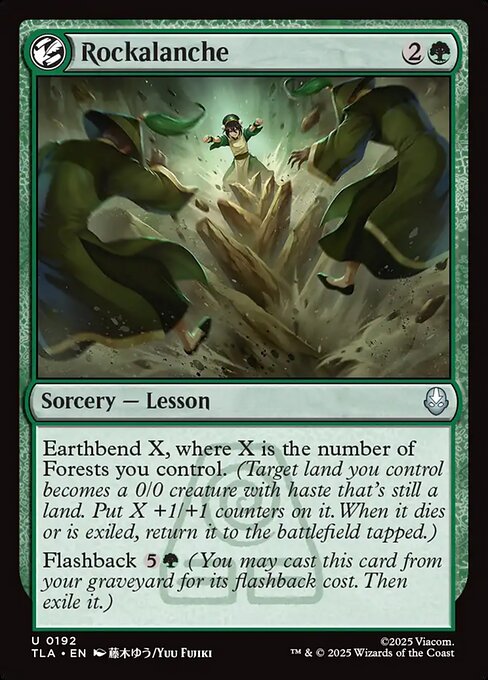
108. Rockalanche
Rating6.0PlayableWhy this rating?
Good playable that always makes the cut (6.0/10).
Why. A three-mana sorcery that earthbends for the number of Forests you control, and comes back with a six-mana flashback. In a heavy green deck that is a large hasty land creature, twice in a game.
Risks. It needs many Forests: with few, the land is small. The land creature is exposed in combat and to removal, even though it returns tapped when it dies. A sorcery is also slower than a creature.
In the draft. Take it in an almost mono-green deck. Elsewhere it is mediocre; let it go if you are not heavily green.
Results in the games of the set
When it is in hand, the deck wins 54.8% of its games (set average: 56.2%, 162nd of 279 cards).
In the opening hand: 51.8% wins (55.4% on average).
Drawn during the game: 57.0% (56.8% on average).
When it is drawn, the deck wins 0.0 points more than when it is not.
When it is drafted, it is played 40% of the time (set average: 61%).
Taken as the first pick (42 drafts), it ends in the deck 76% of the time.
It is played mostly in B/G decks (27% of them) and G/R (26%).
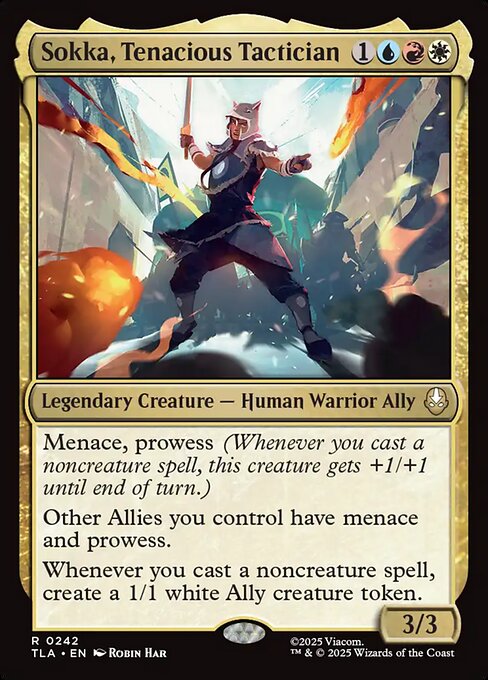
109. Sokka, Tenacious Tactician
Rating6.0PlayableWhy this rating?
Good playable that always makes the cut (6.0/10).
Why. A four-mana 3/3 with menace and prowess that gives other Allies the same abilities and makes a 1/1 white Ally creature token whenever you cast a noncreature spell. In a deck full of spells and Allies, it keeps producing attackers.
Risks. It costs three colours: red, blue and white, which is very demanding. You also need many noncreature spells, and removal kills it before it has produced anything.
In the draft. Take it only if you are already in these three colours or close to it. Otherwise it rots in hand; do not take it early.
Results in the games of the set
When it is in hand, the deck wins 54.7% of its games (set average: 56.2%, 163rd of 279 cards).
In the opening hand: 53.7% wins (55.4% on average).
Drawn during the game: 55.4% (56.8% on average).
When it is drawn, the deck wins 3.8 points more than when it is not.
When it is drafted, it is played 69% of the time (set average: 61%).
Taken as the first pick (85 drafts), it ends in the deck 76% of the time.
It is played about as much in every archetype.
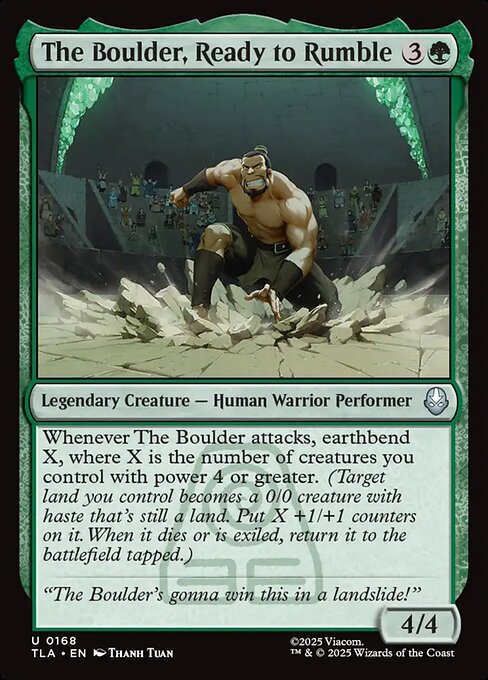
110. The Boulder, Ready to Rumble
Rating6.0PlayableWhy this rating?
Good playable that always makes the cut (6.0/10).
Why. A four-mana 4/4 that earthbends each time it attacks, for the number of creatures you control with power 4 or greater. At minimum it counts itself, so each attack makes at least one new land creature.
Risks. It has to attack to generate value, and a 4/4 attacking into a defended board gets blocked. It dies to removal, and the animated land can die too.
In the draft. A good green creature, much better with other big bodies. A mid-pack pick in a green deck with large creatures alongside.
Results in the games of the set
When it is in hand, the deck wins 56.2% of its games (set average: 56.2%, 115th of 279 cards).
In the opening hand: 56.4% wins (55.4% on average).
Drawn during the game: 56.1% (56.8% on average).
When it is drawn, the deck wins 1.6 points more than when it is not.
When it is drafted, it is played 75% of the time (set average: 61%).
Taken as the first pick (83 drafts), it ends in the deck 80% of the time.
It is played mostly in G/R decks (39% of them) and B/G (30%).
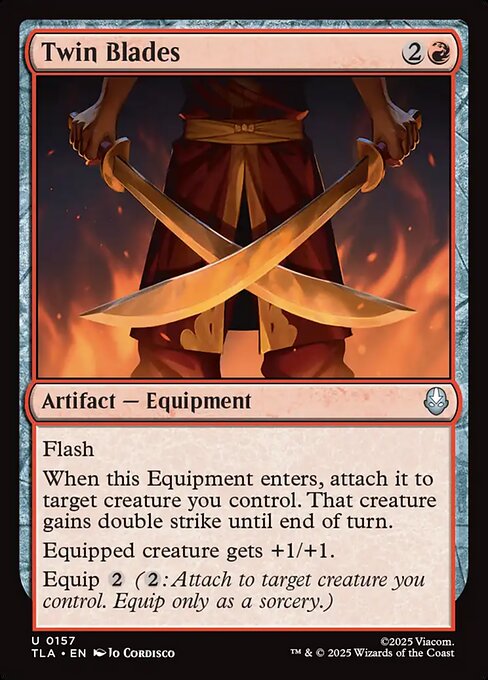
111. Twin Blades
Rating6.0PlayableWhy this rating?
Good playable that always makes the cut (6.0/10).
Why. An Equipment with flash: it enters mid-combat, attaches to one of your creatures that gains double strike until end of turn, and gives +1/+1 while attached. Attacking or blocking, it can turn a lost combat into a win.
Risks. It does nothing without a creature. Attaching to a target exposes you to a response in the middle of the trick. Re-equipping costs two mana, at sorcery speed.
In the draft. A good card for a red deck with plenty of creatures. A mid-pack pick; one copy is enough.
Results in the games of the set
When it is in hand, the deck wins 56.3% of its games (set average: 56.2%, 114th of 279 cards).
In the opening hand: 54.4% wins (55.4% on average).
Drawn during the game: 57.6% (56.8% on average).
When it is drawn, the deck wins 1.1 points more than when it is not.
When it is drafted, it is played 59% of the time (set average: 61%).
Taken as the first pick (74 drafts), it ends in the deck 86% of the time.
It is played mostly in B/R decks (26% of them) and R/U (25%).

112. Watery Grasp
Rating6.0PlayableWhy this rating?
Good playable that always makes the cut (6.0/10).
Why. A one-mana aura that keeps the enchanted creature from untapping: a tapped creature stays out of action, and an untapped one can attack only once more. Later, Waterbend 5 shuffles it into its owner's library.
Risks. It is weak on an untapped creature that stays home, since it keeps blocking. The creature's abilities that do not need it to tap stay active.
In the draft. A very solid blue removal for its price. Take it high, ahead of average creatures. Look for artifacts and creatures to help pay for Waterbend.
Results in the games of the set
When it is in hand, the deck wins 57.9% of its games (set average: 56.2%, 62nd of 279 cards).
In the opening hand: 54.7% wins (55.4% on average).
Drawn during the game: 59.9% (56.8% on average).
When it is drawn, the deck wins 2.4 points more than when it is not.
When it is drafted, it is played 82% of the time (set average: 61%).
Taken as the first pick (312 drafts), it ends in the deck 91% of the time.
It is played mostly in B/U decks (65% of them) and G/U (63%).
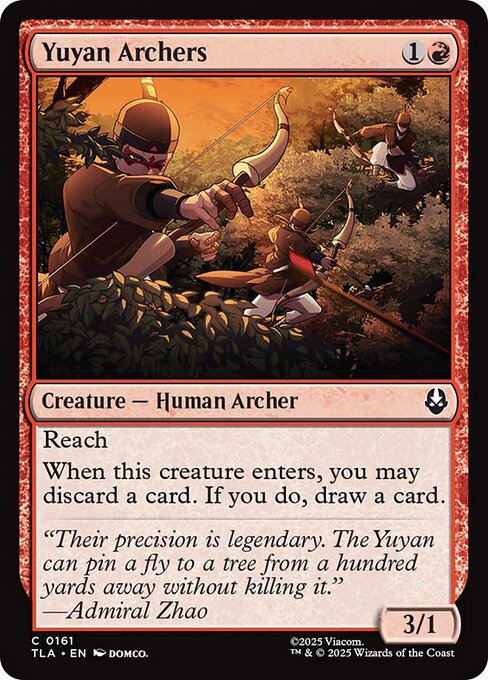
113. Yuyan Archers
Rating6.0PlayableWhy this rating?
Good playable that always makes the cut (6.0/10).
Why. A two-mana 3/1 with reach that can discard a card to draw one when it enters. It blocks flyers, smooths out extra lands, and is a good early attacker.
Risks. With 1 toughness it dies to nearly anything and trades poorly with bigger creatures. The loot is optional and only swaps one card for another.
In the draft. A good two-drop for aggressive or tempo red decks. A mid-pack pick, especially if you lack answers to flyers.
Results in the games of the set
When it is in hand, the deck wins 56.7% of its games (set average: 56.2%, 97th of 279 cards).
In the opening hand: 57.8% wins (55.4% on average).
Drawn during the game: 55.8% (56.8% on average).
When it is drawn, the deck wins 0.0 points more than when it is not.
When it is drafted, it is played 72% of the time (set average: 61%).
Taken as the first pick (131 drafts), it ends in the deck 89% of the time.
It is played mostly in B/R decks (64% of them) and R/W (63%).

114. Ostrich-Horse
Rating5.9PlayableWhy this rating?
Good playable that always makes the cut (5.9/10).
Why. A three-mana 3/1 that mills three: if a land is among them you may take it to hand, otherwise the creature gets a +1/+1 counter and becomes a 4/2. Either way you get value.
Risks. It has low toughness and dies easily. The mill empties your library, which rarely matters in draft but does not help slow decks long term.
In the draft. A solid green common. A mid-pack pick, in any green deck that wants decent three-drops.
Results in the games of the set
When it is in hand, the deck wins 56.9% of its games (set average: 56.2%, 89th of 279 cards).
In the opening hand: 57.1% wins (55.4% on average).
Drawn during the game: 56.8% (56.8% on average).
When it is drawn, the deck wins 0.8 points more than when it is not.
When it is drafted, it is played 61% of the time (set average: 61%).
Taken as the first pick (112 drafts), it ends in the deck 91% of the time.
It is played mostly in B/G decks (67% of them) and G/R (61%).
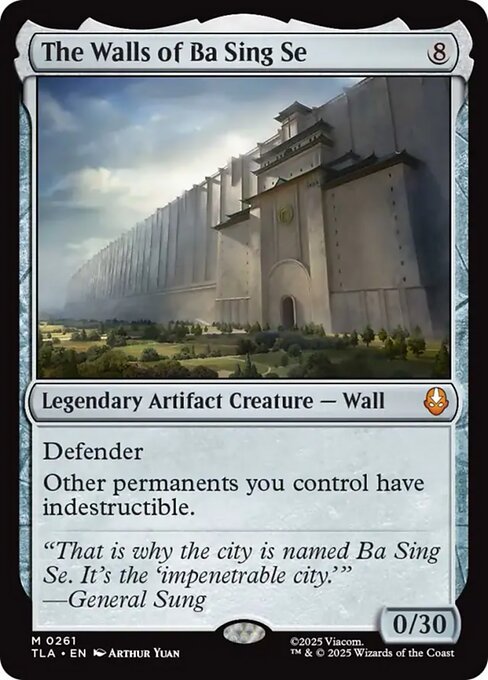 Rating5.9Playable
Why this rating?
Good playable that always makes the cut (5.9/10).
Why. An eight-mana 0/30 wall that gives all your other permanents indestructible. It blocks anything and protects your board from destroy effects and sweepers that destroy.
Risks. Eight mana is huge, and it can't attack because of defender. It is not indestructible itself, and exile or sacrifice effects get around the protection.
In the draft. Nearly unplayable in a normal deck. Take it only for a very slow control deck with lots of mana. Otherwise ignore it.
Results in the games of the set
When it is in hand, the deck wins 41.4% of its games (set average: 56.2%).
In the opening hand: 0.0% wins (55.4% on average).
Drawn during the game: 0.0% (56.8% on average).
When it is drawn, the deck wins 5.4 points less than when it is not.
When it is drafted, it is played only 7% of the time (set average: 61%): it almost always ends in the sideboard.
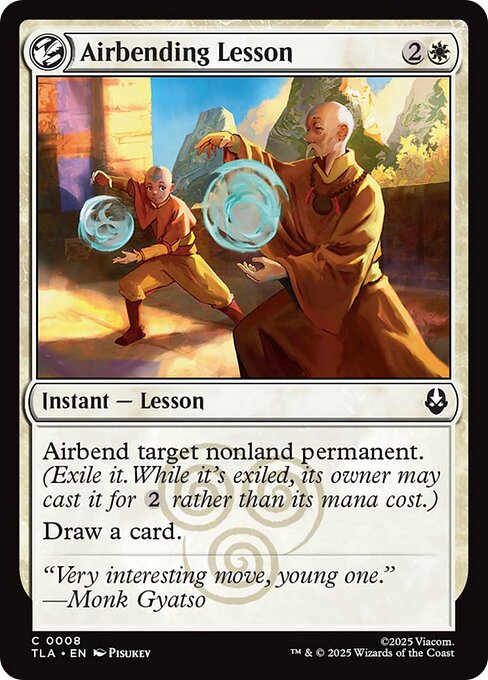
116. Airbending Lesson
Rating5.8PlayableWhy this rating?
Good playable that always makes the cut (5.8/10).
Why. A three-mana instant that airbends a nonland permanent and draws you a card. The owner can recast it for two mana, so you gain tempo and a card, but not permanent removal.
Risks. It is not real removal: the opponent can recast the card for two mana, and an enter-the-battlefield trigger fires again. Against a cheap creature it is weak.
In the draft. A good tempo card for a white deck. A mid-pack pick, aimed at a big permanent or to set the opponent back. One copy is enough.
Results in the games of the set
When it is in hand, the deck wins 56.7% of its games (set average: 56.2%, 93rd of 279 cards).
In the opening hand: 55.3% wins (55.4% on average).
Drawn during the game: 57.7% (56.8% on average).
When it is drawn, the deck wins 0.6 points more than when it is not.
When it is drafted, it is played 86% of the time (set average: 61%).
Taken as the first pick (339 drafts), it ends in the deck 94% of the time.
It is played mostly in U/W decks (54% of them) and B/W (53%).

117. Avatar's Wrath
Rating5.8PlayableWhy this rating?
Good playable that always makes the cut (5.8/10).
Why. A four-mana sorcery that airbends every creature except one you choose: a powerful sweeper. Until your next turn the opponent can only cast spells from their hand, so they cannot recast their exiled creatures yet.
Risks. It also sweeps your own creatures, except the one you keep, and you can recast them for two mana, but the opponent will do the same on their next turn. It does not help a deck that builds the board.
In the draft. A sweeper for white control decks or those light on creatures. Take it if you are behind on board. In an aggressive deck, leave it.
Results in the games of the set
When it is in hand, the deck wins 54.4% of its games (set average: 56.2%, 172nd of 279 cards).
In the opening hand: 51.1% wins (55.4% on average).
Drawn during the game: 56.6% (56.8% on average).
When it is drawn, the deck wins 0.8 points more than when it is not.
When it is drafted, it is played 76% of the time (set average: 61%).
Taken as the first pick (73 drafts), it ends in the deck 75% of the time.
It is played about as much in every archetype.

118. Compassionate Healer
Rating5.8PlayableWhy this rating?
Good playable that always makes the cut (5.8/10).
Why. A two-mana 2/2 that gains you 1 life and scries 1 each time it becomes tapped. You collect the bonus on every attack, and an untap effect makes it repeatable.
Risks. A 2/2 with nothing else, valuable mostly for the tap trigger; it is vulnerable attacking into bigger blockers. Tapped from attacking, it does not block on the opponent's turn.
In the draft. A good two-drop for a white deck, especially aggro or Allies. A mid-pack pick, ahead of filler cards.
Results in the games of the set
When it is in hand, the deck wins 56.7% of its games (set average: 56.2%, 92nd of 279 cards).
In the opening hand: 59.0% wins (55.4% on average).
Drawn during the game: 55.0% (56.8% on average).
When it is drawn, the deck wins 0.4 points less than when it is not.
When it is drafted, it is played 87% of the time (set average: 61%).
Taken as the first pick (260 drafts), it ends in the deck 93% of the time.
It is played mostly in R/W decks (64% of them) and G/W (62%).
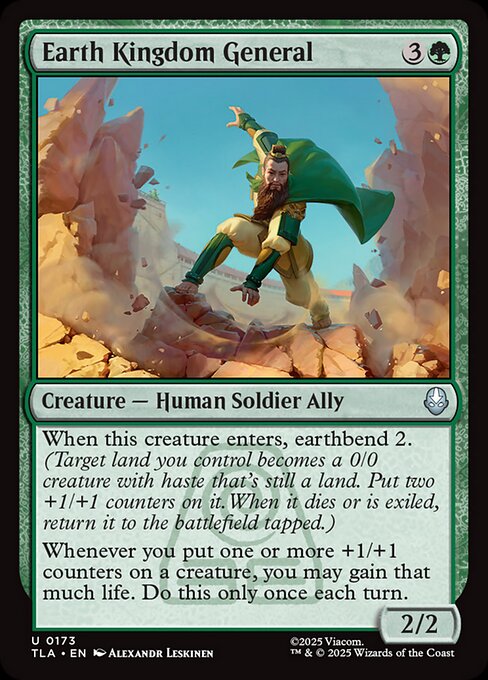 Rating5.8Playable
Why this rating?
Good playable that always makes the cut (5.8/10).
Why. A four-mana creature that earthbends 2 on arrival: two bodies for one card, a 2/2 and a hasty 2/2 land creature. You also gain life whenever you put +1/+1 counters on a creature, once each turn.
Risks. The 2/2 is fragile and not worth four mana alone. The land creature is exposed in combat and to removal, even though it returns tapped when it dies. The life gain doesn't win games.
In the draft. A good mid-pack green card, better with other +1/+1 counters. Take it in a green deck that needs bodies.
Results in the games of the set
When it is in hand, the deck wins 56.3% of its games (set average: 56.2%, 112th of 279 cards).
In the opening hand: 54.3% wins (55.4% on average).
Drawn during the game: 57.8% (56.8% on average).
When it is drawn, the deck wins 1.5 points more than when it is not.
When it is drafted, it is played 83% of the time (set average: 61%).
Taken as the first pick (99 drafts), it ends in the deck 92% of the time.
It is played mostly in B/G decks (32% of them) and G/R (29%).

120. Joo Dee, One of Many
Rating5.8PlayableWhy this rating?
Good playable that always makes the cut (5.8/10).
Why. A two-mana 2/2 whose ability surveils 1, makes a token copy of itself, then has you sacrifice an artifact or creature. You can recycle Clues or tokens to fill the board, but it costs mana.
Risks. It needs a black mana and a tap, and only works at sorcery speed. The copy costs you an artifact or creature, so it only generates value with fodder.
In the draft. A niche card, playable in a black deck with artifacts or tokens to sacrifice. Take it late, unless your deck is full of fodder.
Results in the games of the set
When it is in hand, the deck wins 55.6% of its games (set average: 56.2%, 132nd of 279 cards).
In the opening hand: 55.6% wins (55.4% on average).
Drawn during the game: 55.6% (56.8% on average).
When it is drawn, the deck wins 1.6 points more than when it is not.
When it is drafted, it is played 83% of the time (set average: 61%).
Taken as the first pick (115 drafts), it ends in the deck 91% of the time.
It is played mostly in B/W decks (43% of them) and B/G (37%).

121. Master Piandao
Rating5.8PlayableWhy this rating?
Good playable that always makes the cut (5.8/10).
Why. A five-mana 4/4 with first strike that looks at the top four cards each time it attacks and may take an Ally, Equipment or Lesson. It wins combats well and brings back a card.
Risks. It has to attack to produce value and costs five. With few Allies, Equipment or Lessons in the deck, the trigger has no targets. It dies to removal.
In the draft. A good top-end creature for a white deck, especially Allies. A mid-pack pick; don't overpay.
Results in the games of the set
When it is in hand, the deck wins 54.9% of its games (set average: 56.2%, 157th of 279 cards).
In the opening hand: 53.8% wins (55.4% on average).
Drawn during the game: 55.6% (56.8% on average).
When it is drawn, the deck wins 1.0 points less than when it is not.
When it is drafted, it is played 85% of the time (set average: 61%).
Taken as the first pick (99 drafts), it ends in the deck 94% of the time.
It is played mostly in G/W decks (25% of them).
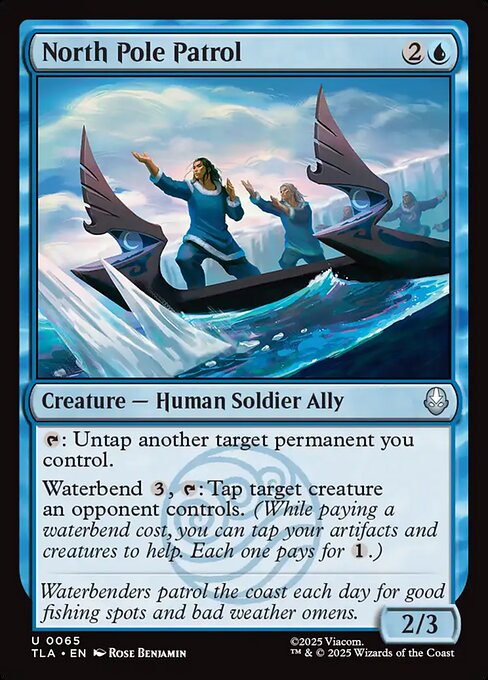
122. North Pole Patrol
Rating5.8PlayableWhy this rating?
Good playable that always makes the cut (5.8/10).
Why. A three-mana 2/3 that untaps another permanent you control and, with Waterbend 3, taps an opposing creature. It blocks well, and its second ability neutralises an attacker or a blocker every turn.
Risks. The tap ability costs mana every turn, and Waterbend wants artifacts and creatures to tap. It doesn't win alone and is slow.
In the draft. A good card for a blue control or tempo deck with Clues or creatures to tap. A mid-pack pick.
Results in the games of the set
When it is in hand, the deck wins 55.6% of its games (set average: 56.2%, 133rd of 279 cards).
In the opening hand: 54.6% wins (55.4% on average).
Drawn during the game: 56.1% (56.8% on average).
When it is drawn, the deck wins 1.2 points more than when it is not.
When it is drafted, it is played 77% of the time (set average: 61%).
Taken as the first pick (118 drafts), it ends in the deck 83% of the time.
It is played about as much in every archetype.
 Rating5.8Playable
Why this rating?
Good playable that always makes the cut (5.8/10).
Why. A flexible two-mana instant: destroy an artifact or enchantment, or put a +1/+1 counter on your creature and make it indestructible until end of turn. The second mode wins a combat or counters a destroy removal.
Risks. Targets for the first mode are rare; the second is a plain trick. It doesn't protect against exile or non-destroy effects.
In the draft. A good last slot for a green deck. A mid-pack pick; its flexibility makes it playable almost anywhere.
Results in the games of the set
When it is in hand, the deck wins 55.8% of its games (set average: 56.2%, 126th of 279 cards).
In the opening hand: 53.8% wins (55.4% on average).
Drawn during the game: 57.2% (56.8% on average).
When it is drawn, the deck wins 1.5 points more than when it is not.
When it is drafted, it is played 50% of the time (set average: 61%).
Taken as the first pick (37 drafts), it ends in the deck 89% of the time.
It is played mostly in G/R decks (46% of them) and B/G (40%).

124. Path to Redemption
Rating5.8PlayableWhy this rating?
Good playable that always makes the cut (5.8/10).
Why. A two-mana aura that stops the creature from attacking or blocking, an efficient removal for a low price. Later, for five mana during your turn, you sacrifice the aura to exile the creature and create a 1/1 white Ally creature token.
Risks. The creature's other abilities stay active, such as ones that don't need to attack or block. Enchantment removal frees it, and the opponent can sacrifice the creature for value.
In the draft. A decent white removal. Take it over mediocre creatures. In a white deck it does the job of a cheap removal.
Results in the games of the set
When it is in hand, the deck wins 56.9% of its games (set average: 56.2%, 90th of 279 cards).
In the opening hand: 54.9% wins (55.4% on average).
Drawn during the game: 58.2% (56.8% on average).
When it is drawn, the deck wins 0.5 points more than when it is not.
When it is drafted, it is played 89% of the time (set average: 61%).
Taken as the first pick (413 drafts), it ends in the deck 94% of the time.
It is played mostly in B/W decks (57% of them) and R/W (54%).
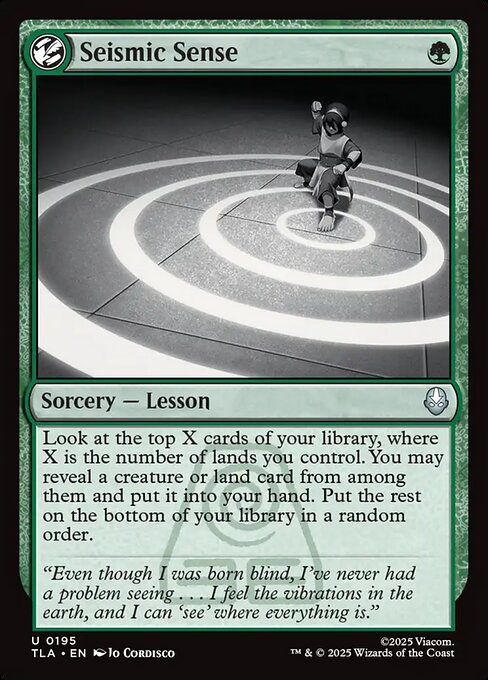
125. Seismic Sense
Rating5.8PlayableWhy this rating?
Good playable that always makes the cut (5.8/10).
Why. A one-mana sorcery that looks at as many cards as you have lands and lets you take a creature or land. With four lands you see four cards, and the rest go to the bottom. It is a cheap way to find your next piece.
Risks. It only takes creatures or lands and does nothing for the board. Early in the game it sees few cards. It counts as a Lesson but does nothing else.
In the draft. A support card for a green Lessons deck or one with a heavy creature count. Take it late, after your creatures.
Results in the games of the set
When it is in hand, the deck wins 55.6% of its games (set average: 56.2%, 130th of 279 cards).
In the opening hand: 53.3% wins (55.4% on average).
Drawn during the game: 57.3% (56.8% on average).
When it is drawn, the deck wins 1.1 points more than when it is not.
When it is drafted, it is played 71% of the time (set average: 61%).
Taken as the first pick (70 drafts), it ends in the deck 91% of the time.
It is played mostly in G/U decks (29% of them) and G/R (28%).

126. Sozin's Comet
Rating5.8PlayableWhy this rating?
Good playable that always makes the cut (5.8/10).
Why. A five-mana sorcery, or two now and three later with foretell, that gives all your creatures Firebending 5 for the turn. Each attacker adds five red mana, usable until end of combat.
Risks. It does nothing without several creatures, and the mana can only be used during combat. It doesn't protect against blocks or removal.
In the draft. A combo card for a red deck with many creatures. In a normal deck it is weak; do not take it high.
Results in the games of the set
When it is in hand, the deck wins 43.0% of its games (set average: 56.2%).
Drawn during the game: 0.0% (56.8% on average).
When it is drawn, the deck wins 9.3 points less than when it is not.
When it is drafted, it is played only 5% of the time (set average: 61%): it almost always ends in the sideboard.

127. Tundra Tank
Rating5.8PlayableWhy this rating?
Good playable that always makes the cut (5.8/10).
Why. A three-mana 4/4 Vehicle with Crew 1 that gives one of your creatures indestructible on arrival and adds a red mana when it attacks. It is big for its cost and easy to crew.
Risks. It needs a creature to crew and is vulnerable to artifact removal. The red mana only lasts until end of combat. It sits idle on an empty board.
In the draft. A good Vehicle for a black deck with cheap creatures. A mid-pack pick; it shines with red.
Results in the games of the set
When it is in hand, the deck wins 53.9% of its games (set average: 56.2%, 188th of 279 cards).
In the opening hand: 53.6% wins (55.4% on average).
Drawn during the game: 54.1% (56.8% on average).
When it is drawn, the deck wins 0.2 points less than when it is not.
When it is drafted, it is played 20% of the time (set average: 61%).
Taken among the first three picks (69 drafts), it ends in the deck 58% of the time.

128. Yip Yip!
Rating5.8PlayableWhy this rating?
Good playable that always makes the cut (5.8/10).
Why. A one-mana instant that gives +2/+2 to one of your creatures until end of turn, plus flying if it is an Ally. It wins a combat, or pushes an attack through a block cheaply.
Risks. It is a trick: if the opponent kills the creature in response, you lose a card. It is half as good without Allies, and weak in a slow deck.
In the draft. A good trick for aggressive or Ally white decks. A mid-pack pick. One copy is fine, two are acceptable if your deck is aggressive.
Results in the games of the set
When it is in hand, the deck wins 56.2% of its games (set average: 56.2%, 119th of 279 cards).
In the opening hand: 54.8% wins (55.4% on average).
Drawn during the game: 57.1% (56.8% on average).
When it is drawn, the deck wins 1.0 points less than when it is not.
When it is drafted, it is played 59% of the time (set average: 61%).
Taken as the first pick (52 drafts), it ends in the deck 85% of the time.
It is played mostly in B/W decks (53% of them) and G/W (51%).
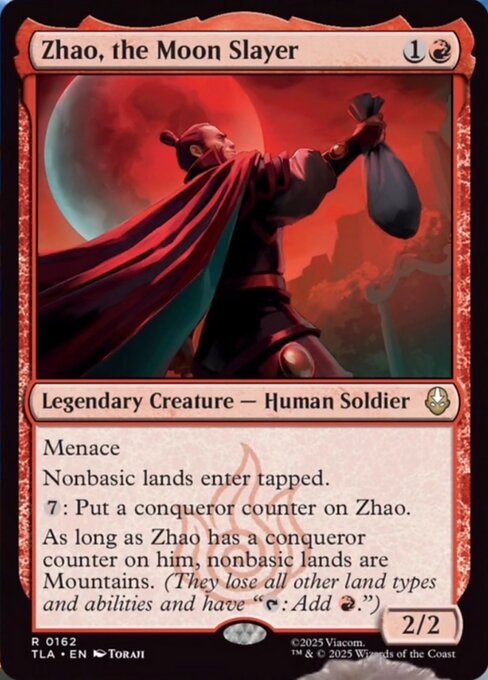 Rating5.8Playable
Why this rating?
Good playable that always makes the cut (5.8/10).
Why. A two-mana 2/2 with menace that makes all nonbasic lands enter tapped. With seven mana, he gets a conqueror counter and turns nonbasic lands into Mountains.
Risks. The effect also hits your own nonbasic lands, and the counter costs seven mana. A 2/2 with menace is fine but unimpressive.
In the draft. A filler red 2/2 for an aggressive deck with few nonbasic lands. Take it late; do not count on his ability.
Results in the games of the set
When it is in hand, the deck wins 52.0% of its games (set average: 56.2%, 239th of 279 cards).
In the opening hand: 53.3% wins (55.4% on average).
Drawn during the game: 51.0% (56.8% on average).
When it is drawn, the deck wins 2.7 points less than when it is not.
When it is drafted, it is played 48% of the time (set average: 61%).
Taken among the first three picks (99 drafts), it ends in the deck 75% of the time.
It is played about as much in every archetype.

130. Fire Nation Palace
Rating5.8PlayableWhy this rating?
Good playable that always makes the cut (5.8/10).
Why. A land that taps for red mana and enters untapped if you control a basic land. For two mana and a tap, it gives a creature Firebending 4, adding four red mana when attacking.
Risks. It only matters in a red deck with good attackers. It enters tapped if you have no basic land. Activating it costs two mana plus the land itself.
In the draft. A useful land in a red deck, taking the slot of a basic land. Take it late, after your playables.
Results in the games of the set
When it is in hand, the deck wins 52.7% of its games (set average: 56.2%, 217th of 279 cards).
In the opening hand: 53.8% wins (55.4% on average).
Drawn during the game: 51.9% (56.8% on average).
When it is drawn, the deck wins 1.4 points less than when it is not.
When it is drafted, it is played 55% of the time (set average: 61%).
Taken among the first three picks (41 drafts), it ends in the deck 73% of the time.

131. True Ancestry
Rating5.7PlayableWhy this rating?
Good playable that always makes the cut (5.7/10).
Why. A two-mana sorcery that returns a permanent card from your graveyard to your hand and creates a Clue token. You get back a creature or land, and the Clue replaces the card. It is steady value.
Risks. With no good target in the graveyard it is just a slow Clue. It does nothing to the board and runs slowly in a deck without an active graveyard.
In the draft. A value card for a slower green deck. Take it mid-pack, after your creatures and removal.
Results in the games of the set
When it is in hand, the deck wins 54.9% of its games (set average: 56.2%, 156th of 279 cards).
In the opening hand: 51.5% wins (55.4% on average).
Drawn during the game: 57.2% (56.8% on average).
When it is drawn, the deck wins 0.8 points more than when it is not.
When it is drafted, it is played 79% of the time (set average: 61%).
Taken as the first pick (95 drafts), it ends in the deck 89% of the time.
It is played mostly in G/U decks (31% of them) and G/R (30%).
 Rating5.6Playable
Why this rating?
Good playable that always makes the cut (5.6/10).
Why. A two-mana 2/2 with first strike that makes any player who casts a noncreature spell lose 2 life, you included. She attacks and blocks well and punishes spell-heavy decks.
Risks. She costs you life too when you cast your own spells. She doesn't survive removal and is weak in a spell-heavy deck.
In the draft. A creature for an aggressive black deck packed with creatures. Take her late; avoid her in a deck that casts many spells.
Results in the games of the set
When it is in hand, the deck wins 53.9% of its games (set average: 56.2%, 189th of 279 cards).
In the opening hand: 53.9% wins (55.4% on average).
Drawn during the game: 53.9% (56.8% on average).
When it is drawn, the deck wins 1.1 points more than when it is not.
When it is drafted, it is played 70% of the time (set average: 61%).
Taken as the first pick (41 drafts), it ends in the deck 88% of the time.
It is played about as much in every archetype.

133. Cunning Maneuver
Rating5.6PlayableWhy this rating?
Good playable that always makes the cut (5.6/10).
Why. A two-mana instant that gives +3/+1 to a creature until end of turn and creates a Clue token. It wins a combat on attack or defence, and the Clue replaces the card.
Risks. A trick is still a trick: an opposing response costs you the card, and +1 toughness protects little. It is weak in a deck without creatures.
In the draft. A fine trick for an aggressive red deck. A mid-pack pick, after your creatures and removal.
Results in the games of the set
When it is in hand, the deck wins 54.2% of its games (set average: 56.2%, 178th of 279 cards).
In the opening hand: 52.6% wins (55.4% on average).
Drawn during the game: 55.3% (56.8% on average).
When it is drawn, the deck wins 0.9 points less than when it is not.
When it is drafted, it is played 31% of the time (set average: 61%).
Taken among the first three picks (100 drafts), it ends in the deck 73% of the time.
It is played mostly in R/U decks (38% of them) and B/R (37%).

134. Deadly Precision
Rating5.6PlayableWhy this rating?
Good playable that always makes the cut (5.6/10).
Why. A very cheap black removal: destroy any creature for one black mana, with an extra cost of four mana or sacrificing an artifact or creature. It kills almost anything and plays two ways.
Risks. It is pricey when you pay four extra mana, and the sacrifice costs you a card. It is a sorcery, so slower than an instant.
In the draft. A good black removal. Take it ahead of ordinary creatures. Look for Clues or tokens to feed the sacrifice.
Results in the games of the set
When it is in hand, the deck wins 56.7% of its games (set average: 56.2%, 96th of 279 cards).
In the opening hand: 53.5% wins (55.4% on average).
Drawn during the game: 58.7% (56.8% on average).
When it is drawn, the deck wins 2.4 points more than when it is not.
When it is drafted, it is played 81% of the time (set average: 61%).
Taken as the first pick (233 drafts), it ends in the deck 96% of the time.
It is played mostly in B/U decks (68% of them) and B/W (68%).

135. Fire Nation Attacks
Rating5.6PlayableWhy this rating?
Good playable that always makes the cut (5.6/10).
Why. An instant that makes two 2/2 Soldier tokens with Firebending 1. You can cast it at the end of the opponent's turn or as a combat surprise, and every attack adds red mana. Flashback gives a second wave late in the game.
Risks. Five mana for two 2/2s is slow and does nothing to the board right away. The flashback cost is huge and only matters in long games.
In the draft. A fine filler card in a red deck that wants bodies and value. Take it after your removal and your better creatures.
Results in the games of the set
When it is in hand, the deck wins 55.0% of its games (set average: 56.2%, 154th of 279 cards).
In the opening hand: 53.7% wins (55.4% on average).
Drawn during the game: 55.9% (56.8% on average).
When it is drawn, the deck wins 0.1 points less than when it is not.
When it is drafted, it is played 63% of the time (set average: 61%).
Taken as the first pick (83 drafts), it ends in the deck 83% of the time.
It is played mostly in B/R decks (34% of them) and R/U (31%).

136. Fire Nation Engineer
Rating5.6PlayableWhy this rating?
Good playable that always makes the cut (5.6/10).
Why. A 2/3 for three that blocks well early and, if you attacked, puts a +1/+1 counter on another creature or Vehicle at end of turn. In a deck that attacks regularly it slowly grows your team.
Risks. If you don't attack, it does nothing. It can't target itself, and a defensive deck or one behind on board will get little out of it.
In the draft. A solid midrange playable for a proactive black deck. Take it as a complement, not over removal or a quality creature.
Results in the games of the set
When it is in hand, the deck wins 56.2% of its games (set average: 56.2%, 117th of 279 cards).
In the opening hand: 56.7% wins (55.4% on average).
Drawn during the game: 55.9% (56.8% on average).
When it is drawn, the deck wins 2.5 points more than when it is not.
When it is drafted, it is played 75% of the time (set average: 61%).
Taken as the first pick (101 drafts), it ends in the deck 91% of the time.
It is played mostly in B/R decks (27% of them) and B/G (25%).

137. Firebender Ascension
Rating5.6PlayableWhy this rating?
Good playable that always makes the cut (5.6/10).
Why. For two mana you immediately get a 2/2 Soldier token with Firebending 1, which already makes it a fair two-drop. The rest is upside: with four or more quest counters you can copy a creature's ability that triggers when it attacks.
Risks. The copy effect needs several attack triggers and a lot of time, so it's very situational. The enchantment doesn't protect the token, which dies to any removal.
In the draft. Playable in red as an extra 2/2 with long-game upside. Don't take it high: look for creatures with attack triggers first.
Results in the games of the set
When it is in hand, the deck wins 52.6% of its games (set average: 56.2%, 223rd of 279 cards).
In the opening hand: 54.2% wins (55.4% on average).
Drawn during the game: 51.4% (56.8% on average).
When it is drawn, the deck wins 1.9 points less than when it is not.
When it is drafted, it is played 78% of the time (set average: 61%).
Taken as the first pick (65 drafts), it ends in the deck 92% of the time.
It is played about as much in every archetype.

138. Glider Kids
Rating5.6PlayableWhy this rating?
Good playable that always makes the cut (5.6/10).
Why. A 2/3 flier for three with scry 1 on entry. It attacks in the air, blocks small ground creatures well and smooths your next draw. A clean white common, especially in evasive decks.
Risks. With 2 power it doesn't close the game quickly. It's vulnerable to bigger fliers and removal, and its effect is modest.
In the draft. A good curve filler for any white deck. Take it over similarly costed creatures without evasion.
Results in the games of the set
When it is in hand, the deck wins 55.9% of its games (set average: 56.2%, 121st of 279 cards).
In the opening hand: 55.8% wins (55.4% on average).
Drawn during the game: 56.0% (56.8% on average).
When it is drawn, the deck wins 0.6 points less than when it is not.
When it is drafted, it is played 87% of the time (set average: 61%).
Taken as the first pick (247 drafts), it ends in the deck 92% of the time.
It is played mostly in U/W decks (57% of them) and R/W (56%).
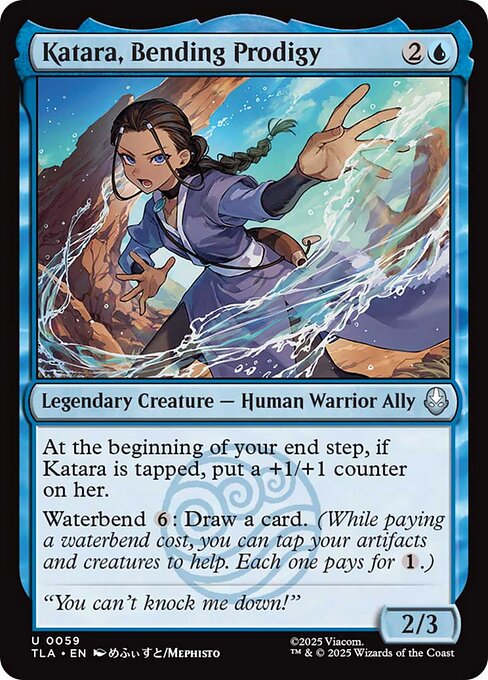 Rating5.6Playable
Why this rating?
Good playable that always makes the cut (5.6/10).
Why. A 2/3 for three that grows at each end step where she's tapped, so if she attacks she gets a +1/+1 counter. The Waterbend ability gives late-game card draw by tapping your artifacts and creatures.
Risks. She has to survive combat to grow, and a lone 2/3 attacker is easy to block. The draw ability is expensive and needs a wide board.
In the draft. A decent blue uncommon that gets strong in a deck that attacks early. Take it as a quality playable, not a priority.
Results in the games of the set
When it is in hand, the deck wins 55.1% of its games (set average: 56.2%, 151st of 279 cards).
In the opening hand: 53.7% wins (55.4% on average).
Drawn during the game: 55.9% (56.8% on average).
When it is drawn, the deck wins 1.6 points more than when it is not.
When it is drafted, it is played 92% of the time (set average: 61%).
Taken as the first pick (249 drafts), it ends in the deck 95% of the time.
It is played about as much in every archetype.

140. Razor Rings
Rating5.6PlayableWhy this rating?
Good playable that always makes the cut (5.6/10).
Why. A two-mana instant that deals 4 damage to an attacking or blocking creature. An efficient combat removal, and any excess damage gains you life. It kills most midrange creatures.
Risks. It only hits creatures that attack or block, so a creature that stays home can't be targeted. You have to read tempo well.
In the draft. A very cheap white common removal, worth taking in a white deck despite its condition. Take it over filler creatures.
Results in the games of the set
When it is in hand, the deck wins 55.4% of its games (set average: 56.2%, 139th of 279 cards).
In the opening hand: 54.2% wins (55.4% on average).
Drawn during the game: 56.2% (56.8% on average).
When it is drawn, the deck wins 0.4 points less than when it is not.
When it is drafted, it is played 77% of the time (set average: 61%).
Taken as the first pick (159 drafts), it ends in the deck 91% of the time.
It is played mostly in U/W decks (48% of them) and G/W (46%).
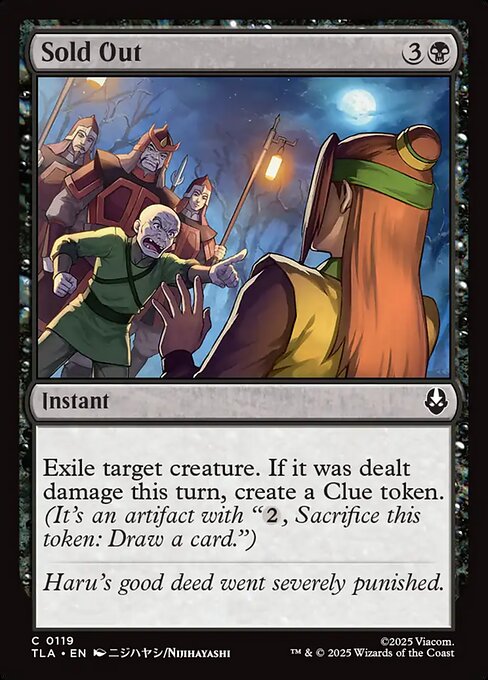
141. Sold Out
Rating5.6PlayableWhy this rating?
Good playable that always makes the cut (5.6/10).
Why. An instant that exiles any creature for four mana, with no size restriction. If it was dealt damage this turn, you also make a Clue token. It answers big threats cleanly.
Risks. Four mana is pricier than the cheapest removal. The Clue only comes if damage was already dealt, so timing matters.
In the draft. A reliable, unconditional black removal: take it early among black removal. After a block or combat damage, the Clue bonus becomes real value.
Results in the games of the set
When it is in hand, the deck wins 56.9% of its games (set average: 56.2%, 91st of 279 cards).
In the opening hand: 53.4% wins (55.4% on average).
Drawn during the game: 59.0% (56.8% on average).
When it is drawn, the deck wins 2.6 points more than when it is not.
When it is drafted, it is played 85% of the time (set average: 61%).
Taken as the first pick (299 drafts), it ends in the deck 92% of the time.
It is played mostly in B/G decks (65% of them) and B/U (64%).
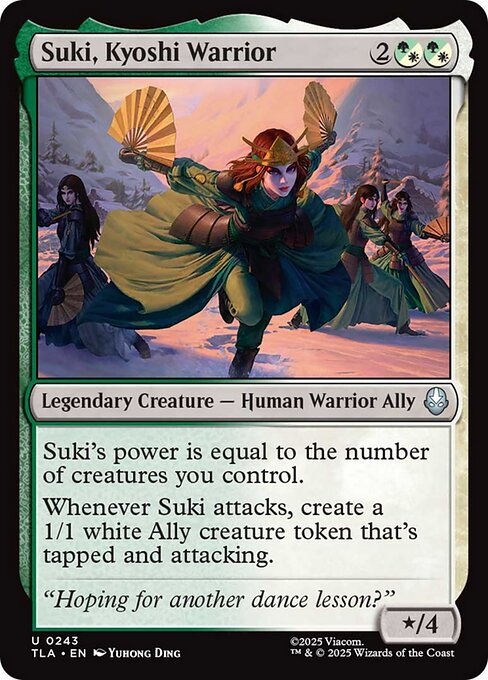
142. Suki, Kyoshi Warrior
Rating5.6PlayableWhy this rating?
Good playable that always makes the cut (5.6/10).
Why. A green-white hybrid legend whose power equals the number of creatures you control, with 4 toughness. Each attack creates a tapped, attacking 1/1 white Ally token, so she grows while she hits.
Risks. Alone she's a mediocre 1/4. Removal or a mass block neutralizes her, and she needs other creatures to shine.
In the draft. Good in a green-white deck with plenty of bodies, since the hybrid cost can be paid with either colour. Take her once your deck has lots of creatures.
Results in the games of the set
When it is in hand, the deck wins 55.2% of its games (set average: 56.2%, 143rd of 279 cards).
In the opening hand: 55.4% wins (55.4% on average).
Drawn during the game: 55.0% (56.8% on average).
When it is drawn, the deck wins 0.2 points more than when it is not.
When it is drafted, it is played 87% of the time (set average: 61%).
Taken as the first pick (160 drafts), it ends in the deck 88% of the time.
It is played mostly in G/W decks (28% of them).

143. Vindictive Warden
Rating5.6PlayableWhy this rating?
Good playable that always makes the cut (5.6/10).
Why. A 2/3 with menace and Firebending 1 that can also deal 1 damage to each opponent for three mana. It's hard to block and works as a late-game mana sink.
Risks. With 2 power it doesn't deal much damage alone, and the damage ability is slow. The red mana from Firebending disappears at end of combat.
In the draft. A black-red hybrid common that fits any black or red deck. Take it as a curve complement, not over removal.
Results in the games of the set
When it is in hand, the deck wins 54.1% of its games (set average: 56.2%, 183rd of 279 cards).
In the opening hand: 53.5% wins (55.4% on average).
Drawn during the game: 54.5% (56.8% on average).
When it is drawn, the deck wins 0.9 points less than when it is not.
When it is drafted, it is played 38% of the time (set average: 61%).
Taken among the first three picks (144 drafts), it ends in the deck 74% of the time.
It is played mostly in B/R decks (58% of them) and R/W (26%).
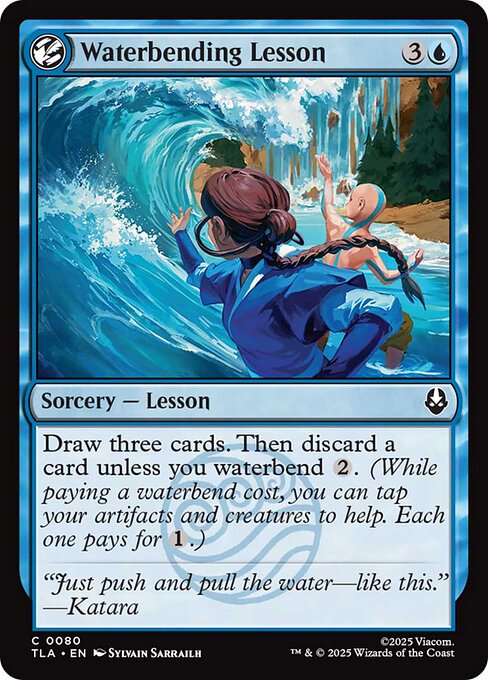
144. Waterbending Lesson
Rating5.6PlayableWhy this rating?
Good playable that always makes the cut (5.6/10).
Why. A sorcery that draws three cards, then discards one unless you Waterbend 2. By tapping creatures or artifacts you keep all three. A good value source.
Risks. Four mana with no board impact costs you tempo if you're under pressure. Without two mana or two permanents to tap, you discard a card.
In the draft. A good blue draw common, useful in a controlling deck or one with many creatures. It counts as a Lesson for the cards that care.
Results in the games of the set
When it is in hand, the deck wins 56.6% of its games (set average: 56.2%, 99th of 279 cards).
In the opening hand: 54.3% wins (55.4% on average).
Drawn during the game: 58.0% (56.8% on average).
When it is drawn, the deck wins 1.9 points more than when it is not.
When it is drafted, it is played 80% of the time (set average: 61%).
Taken as the first pick (194 drafts), it ends in the deck 90% of the time.
It is played mostly in R/U decks (62% of them) and B/U (57%).

145. Waterbending Scroll
Rating5.6PlayableWhy this rating?
Good playable that always makes the cut (5.6/10).
Why. A two-mana artifact that draws for six by tapping it, costing one less for each Island you control. With four Islands the draw costs only two mana, every turn.
Risks. It does nothing on the board and needs lots of Islands. In a two-colour deck it's often too expensive to be useful.
In the draft. A card for nearly mono-blue decks that want late-game draw. In most decks it's a late pick.
Results in the games of the set
When it is in hand, the deck wins 53.9% of its games (set average: 56.2%, 186th of 279 cards).
In the opening hand: 50.0% wins (55.4% on average).
Drawn during the game: 56.4% (56.8% on average).
When it is drawn, the deck wins 1.7 points more than when it is not.
When it is drafted, it is played 47% of the time (set average: 61%).
Taken as the first pick (70 drafts), it ends in the deck 81% of the time.
It is played mostly in B/U decks (28% of them).

146. White Lotus Tile
Rating5.6PlayableWhy this rating?
Good playable that always makes the cut (5.6/10).
Why. A four-mana artifact that enters tapped and adds mana of one colour equal to your biggest group of creatures sharing a type. In a heavily tribal deck it gives a huge ramp.
Risks. It does nothing without creatures sharing a type, and it costs four mana to enter tapped, which is very slow. In a normal deck it produces little and doesn't affect the board.
In the draft. A mythic for a committed tribal deck, not a general-purpose card. Only take it if your deck has a dominant creature type, such as Allies.
Results in the games of the set
When it is drafted, it is played only 2% of the time (set average: 61%): it almost always ends in the sideboard.

147. Master Pakku
Rating5.6PlayableWhy this rating?
Good playable that always makes the cut (5.6/10).
Why. A 1/3 for two with prowess. When it becomes tapped, target player mills as many cards as there are Lessons in your graveyard. It blocks well early and grows with your noncreature spells.
Risks. Without Lessons its ability does nothing, and it stays a 1/3 that deals little damage. It needs a dedicated deck with many noncreature spells.
In the draft. Reserved for blue spells-and-Lessons decks. In other decks it's a late pick.
Results in the games of the set
When it is in hand, the deck wins 52.8% of its games (set average: 56.2%, 214th of 279 cards).
In the opening hand: 50.7% wins (55.4% on average).
Drawn during the game: 54.1% (56.8% on average).
When it is drawn, the deck wins 0.6 points less than when it is not.
When it is drafted, it is played 49% of the time (set average: 61%).
Taken as the first pick (53 drafts), it ends in the deck 74% of the time.
It is played about as much in every archetype.

148. Curious Farm Animals
Rating5.5PlayableWhy this rating?
Good playable that always makes the cut (5.5/10).
Why. A one-mana 1/1 that gains you 3 life when it dies and can be sacrificed for two mana to destroy an artifact or enchantment. A utility body against the opponent's artifacts and enchantments.
Risks. A 1/1 for one barely affects the board. Its value depends on the opponent's targets, and otherwise it just gains life.
In the draft. A white filler playable, useful against equipment and enchantments. Take it late unless you meet a dangerous target.
Results in the games of the set
When it is in hand, the deck wins 53.9% of its games (set average: 56.2%, 192nd of 279 cards).
In the opening hand: 53.9% wins (55.4% on average).
Drawn during the game: 53.8% (56.8% on average).
When it is drawn, the deck wins 0.1 points less than when it is not.
When it is drafted, it is played only 12% of the time (set average: 61%): it almost always ends in the sideboard.
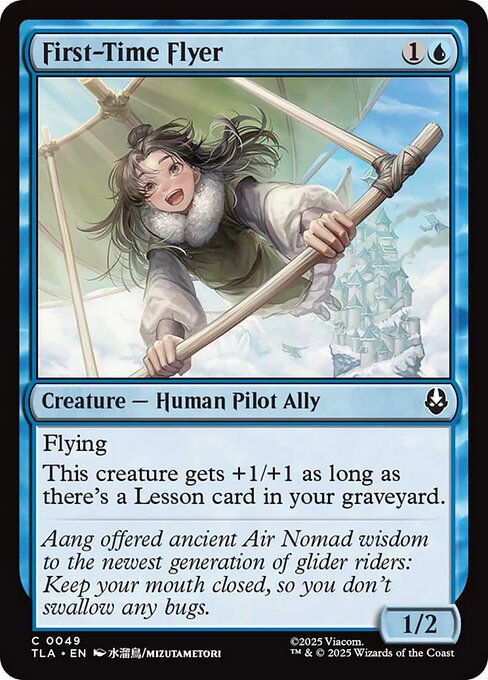
149. First-Time Flyer
Rating5.4PlayableWhy this rating?
A solid playable that rarely gets cut (5.4/10).
Why. A two-mana 1/2 flier that becomes a 2/3 as soon as a Lesson is in your graveyard. It blocks small fliers and attacks in the air, especially in blue decks with Lessons.
Risks. Without a Lesson in the graveyard it's a 1/2 that hits for little. A cheap removal or a bigger flier shuts it down.
In the draft. A decent blue two-drop for an evasive deck. It gets good with a few Lessons in your deck but stays a mid-list playable.
Results in the games of the set
When it is in hand, the deck wins 56.4% of its games (set average: 56.2%, 111th of 279 cards).
In the opening hand: 55.4% wins (55.4% on average).
Drawn during the game: 57.0% (56.8% on average).
When it is drawn, the deck wins 1.6 points more than when it is not.
When it is drafted, it is played 83% of the time (set average: 61%).
Taken as the first pick (236 drafts), it ends in the deck 90% of the time.
It is played mostly in U/W decks (65% of them) and R/U (55%).
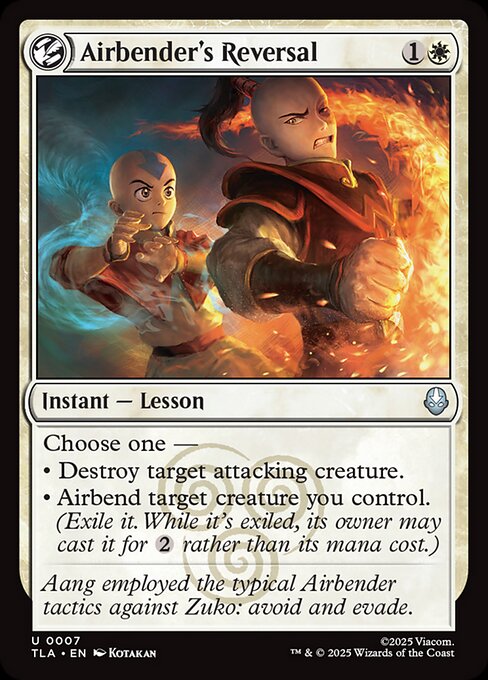
150. Airbender's Reversal
Rating5.4PlayableWhy this rating?
A solid playable that rarely gets cut (5.4/10).
Why. A two-mana Lesson instant with two modes: destroy an attacking creature, or Airbend one of your creatures to save it from removal and recast it for two. A flexible trick.
Risks. The first mode only hits an attacker. The second costs you tempo by exiling your creature, which then costs two to recast.
In the draft. A quality white playable in defensive or control decks. It's not unconditional removal, so take it after your best cards.
Results in the games of the set
When it is in hand, the deck wins 53.9% of its games (set average: 56.2%, 190th of 279 cards).
In the opening hand: 52.3% wins (55.4% on average).
Drawn during the game: 55.0% (56.8% on average).
When it is drawn, the deck wins 0.9 points less than when it is not.
When it is drafted, it is played 87% of the time (set average: 61%).
Taken as the first pick (181 drafts), it ends in the deck 91% of the time.
It is played about as much in every archetype.

151. Azula Always Lies
Rating5.4PlayableWhy this rating?
A solid playable that rarely gets cut (5.4/10).
Why. A two-mana Lesson instant with two modes you can combine: -1/-1 on one creature and a +1/+1 counter on another. It kills a small creature while buffing yours, a good combat swing.
Risks. The -1/-1 only kills 1-toughness creatures. Without a good target it's just a single counter, and it doesn't answer big threats.
In the draft. A good black trick at common, especially in a Lessons deck. Take it as a complement, after your removal.
Results in the games of the set
When it is in hand, the deck wins 55.2% of its games (set average: 56.2%, 145th of 279 cards).
In the opening hand: 53.8% wins (55.4% on average).
Drawn during the game: 56.1% (56.8% on average).
When it is drawn, the deck wins 1.6 points more than when it is not.
When it is drafted, it is played 42% of the time (set average: 61%).
Taken among the first three picks (183 drafts), it ends in the deck 71% of the time.
It is played mostly in B/R decks (41% of them) and B/U (36%).
 Rating5.4Playable
Why this rating?
A solid playable that rarely gets cut (5.4/10).
Why. A four-mana legendary Shrine that creates a 1/1 red Monk token with prowess for each Shrine you control, and another whenever another Shrine enters. With several Shrines it builds a small swarm.
Risks. On its own it's one 1/1 Monk token for four mana, which is weak. It depends on a deck full of Shrines, and having enough is rare.
In the draft. A gamble for Shrine decks and one to avoid outside that. Only take it if you already have several Shrines.
Results in the games of the set
When it is in hand, the deck wins 54.3% of its games (set average: 56.2%, 177th of 279 cards).
In the opening hand: 48.7% wins (55.4% on average).
Drawn during the game: 57.5% (56.8% on average).
When it is drawn, the deck wins 10.6 points more than when it is not.
When it is drafted, it is played 22% of the time (set average: 61%).
Taken among the first three picks (143 drafts), it ends in the deck 55% of the time.
 Rating5.4Playable
Why this rating?
A solid playable that rarely gets cut (5.4/10).
Why. A five-mana 3/4 with vigilance, green-white hybrid, that puts a +1/+1 counter on each of up to two of your creatures on entry. It holds the board and improves two creatures at once.
Risks. Five mana for a 3/4 is expensive, and the value depends on other creatures already in play. Without them it's just a decent body.
In the draft. A solid green or white common, payable with either colour. Take it in a creature deck.
Results in the games of the set
When it is in hand, the deck wins 55.5% of its games (set average: 56.2%, 136th of 279 cards).
In the opening hand: 54.5% wins (55.4% on average).
Drawn during the game: 56.2% (56.8% on average).
When it is drawn, the deck wins 0.5 points less than when it is not.
When it is drafted, it is played 42% of the time (set average: 61%).
Taken among the first three picks (143 drafts), it ends in the deck 62% of the time.
It is played mostly in G/W decks (30% of them) and B/W (27%).

154. Fancy Footwork
Rating5.4PlayableWhy this rating?
A solid playable that rarely gets cut (5.4/10).
Why. A three-mana Lesson instant that untaps one or two creatures and gives them +2/+2 until end of turn. In combat it lets you win a trade, or block with creatures that attacked.
Risks. It's a trick: with no creature to target it does nothing, and it exposes you to a two-for-one if the opponent answers with removal.
In the draft. A situational white trick for an aggressive deck. Take it late, after your creatures and removal.
Results in the games of the set
When it is in hand, the deck wins 53.6% of its games (set average: 56.2%, 200th of 279 cards).
In the opening hand: 52.2% wins (55.4% on average).
Drawn during the game: 54.6% (56.8% on average).
When it is drawn, the deck wins 2.0 points less than when it is not.
When it is drafted, it is played 56% of the time (set average: 61%).
Taken as the first pick (44 drafts), it ends in the deck 75% of the time.
It is played about as much in every archetype.
 Rating5.4Playable
Why this rating?
A solid playable that rarely gets cut (5.4/10).
Why. A two-mana 1/2 that puts a +1/+1 counter on target creature on entry, itself included. A flexible two-drop that becomes a 2/3 or boosts a bigger creature.
Risks. It stays small and has no evasion. Alone it's a decent 2/3 that won't win games, and it loses value late.
In the draft. A useful white two-drop for the curve. Take it as a quality complement.
Results in the games of the set
When it is in hand, the deck wins 55.6% of its games (set average: 56.2%, 131st of 279 cards).
In the opening hand: 56.7% wins (55.4% on average).
Drawn during the game: 54.8% (56.8% on average).
When it is drawn, the deck wins 1.7 points less than when it is not.
When it is drafted, it is played 85% of the time (set average: 61%).
Taken as the first pick (190 drafts), it ends in the deck 91% of the time.
It is played mostly in R/W decks (64% of them) and B/W (62%).

156. June, Bounty Hunter
Rating5.4PlayableWhy this rating?
A solid playable that rarely gets cut (5.4/10).
Why. A two-mana 2/2 legend that can't be blocked if you've drawn two or more cards this turn. She can sacrifice another creature for a Clue, handy to turn a doomed creature into a Clue.
Risks. She needs an extra draw to become unblockable, and her sacrifice ability costs you a creature and works only on your turn. Alone she's a plain 2/2.
In the draft. A black playable for a draw-and-sacrifice deck. Take her if you already have draw sources.
Results in the games of the set
When it is in hand, the deck wins 54.6% of its games (set average: 56.2%, 168th of 279 cards).
In the opening hand: 53.0% wins (55.4% on average).
Drawn during the game: 55.6% (56.8% on average).
When it is drawn, the deck wins 0.1 points more than when it is not.
When it is drafted, it is played 83% of the time (set average: 61%).
Taken as the first pick (129 drafts), it ends in the deck 95% of the time.
It is played mostly in B/W decks (39% of them) and B/U (35%).
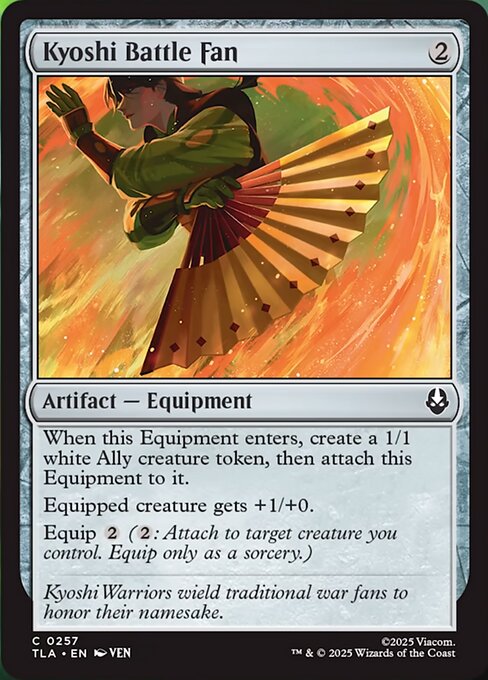
157. Kyoshi Battle Fan
Rating5.4PlayableWhy this rating?
A solid playable that rarely gets cut (5.4/10).
Why. A two-mana Equipment that creates a 1/1 white Ally token and attaches to it, giving an immediate 2/1. It stays around to equip other creatures later. A flexible two-drop.
Risks. The 2/1 token is fragile and moving the Equipment costs two mana. It stays modest against bigger creatures.
In the draft. A good colourless common for any deck, especially white with Allies. Take it as a curve complement.
Results in the games of the set
When it is in hand, the deck wins 55.5% of its games (set average: 56.2%, 134th of 279 cards).
In the opening hand: 55.4% wins (55.4% on average).
Drawn during the game: 55.7% (56.8% on average).
When it is drawn, the deck wins 1.5 points less than when it is not.
When it is drafted, it is played 66% of the time (set average: 61%).
Taken as the first pick (91 drafts), it ends in the deck 84% of the time.
It is played mostly in B/W decks (35% of them) and R/W (35%).
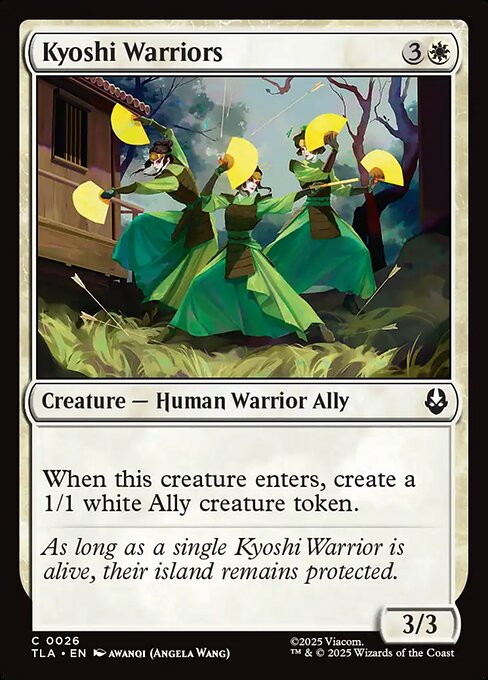
158. Kyoshi Warriors
Rating5.4PlayableWhy this rating?
A solid playable that rarely gets cut (5.4/10).
Why. A four-mana 3/3 that creates a 1/1 white Ally token on entry. Two bodies for one card: solid and consistent.
Risks. It has no evasion and no big impact. Against removal you lose the 3/3 but keep the token.
In the draft. A solid white common for the curve of any white deck. An easy mid-pack pick.
Results in the games of the set
When it is in hand, the deck wins 56.4% of its games (set average: 56.2%, 107th of 279 cards).
In the opening hand: 56.4% wins (55.4% on average).
Drawn during the game: 56.5% (56.8% on average).
When it is drawn, the deck wins 0.3 points less than when it is not.
When it is drafted, it is played 84% of the time (set average: 61%).
Taken as the first pick (222 drafts), it ends in the deck 91% of the time.
It is played mostly in B/W decks (65% of them) and G/W (62%).

159. Raucous Audience
Rating5.4PlayableWhy this rating?
A solid playable that rarely gets cut (5.4/10).
Why. A two-mana 2/1 that taps for a green mana, or two green mana if you control a creature with power 4 or greater. Ramp that sets up your big creatures.
Risks. A 2/1 is fragile and dies to almost anything. Without a power-4 creature its mana stays modest, and it attacks poorly.
In the draft. A good green mana creature for a deck of big creatures. Take it without overpaying if you're green.
Results in the games of the set
When it is in hand, the deck wins 56.5% of its games (set average: 56.2%, 105th of 279 cards).
In the opening hand: 59.3% wins (55.4% on average).
Drawn during the game: 54.3% (56.8% on average).
When it is drawn, the deck wins 0.9 points more than when it is not.
When it is drafted, it is played 77% of the time (set average: 61%).
Taken as the first pick (167 drafts), it ends in the deck 89% of the time.
It is played mostly in G/R decks (72% of them) and B/G (67%).

160. Water Tribe Captain
Rating5.4PlayableWhy this rating?
A solid playable that rarely gets cut (5.4/10).
Why. A three-mana 3/3, a good stat-to-cost ratio, with an ability that gives all your creatures +1/+1 for five mana. It holds the ground early and becomes a mana sink late.
Risks. No evasion and the ability is expensive. Removal simply answers it.
In the draft. A solid white common for the curve, good in decks with many bodies. Take it mid-pack.
Results in the games of the set
When it is in hand, the deck wins 55.7% of its games (set average: 56.2%, 127th of 279 cards).
In the opening hand: 55.8% wins (55.4% on average).
Drawn during the game: 55.7% (56.8% on average).
When it is drawn, the deck wins 1.3 points less than when it is not.
When it is drafted, it is played 73% of the time (set average: 61%).
Taken as the first pick (110 drafts), it ends in the deck 90% of the time.
It is played mostly in B/W decks (66% of them) and R/W (63%).
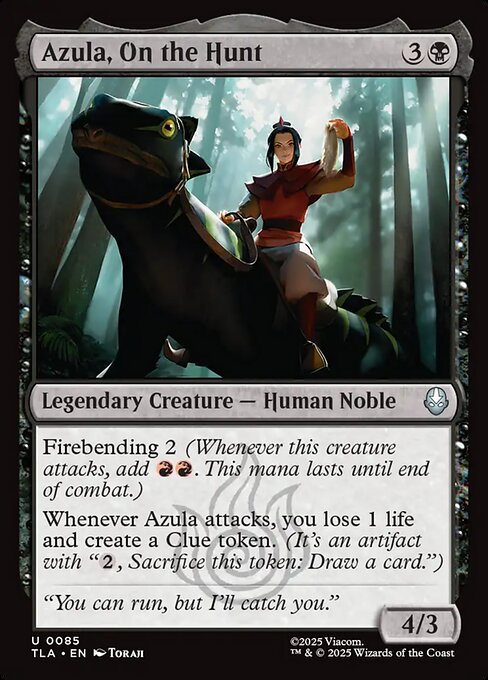
161. Azula, On the Hunt
Rating5.4PlayableWhy this rating?
A solid playable that rarely gets cut (5.4/10).
Why. A four-mana 4/3 legend with Firebending 2. Each attack costs you 1 life and creates a Clue token: she generates value as long as she survives, and her red mana can pay to crack the Clue during combat.
Risks. She attacks as a 4/3 and gets blocked by a 3/3 or 4/4. The life loss adds up in tight games, and the red mana disappears at end of combat.
In the draft. A decent black uncommon in a deck that attacks. Take her over average playables, but keep removal to protect her.
Results in the games of the set
When it is in hand, the deck wins 54.9% of its games (set average: 56.2%, 158th of 279 cards).
In the opening hand: 54.2% wins (55.4% on average).
Drawn during the game: 55.3% (56.8% on average).
When it is drawn, the deck wins 1.1 points more than when it is not.
When it is drafted, it is played 84% of the time (set average: 61%).
Taken as the first pick (123 drafts), it ends in the deck 90% of the time.
It is played mostly in B/G decks (31% of them) and B/W (31%).
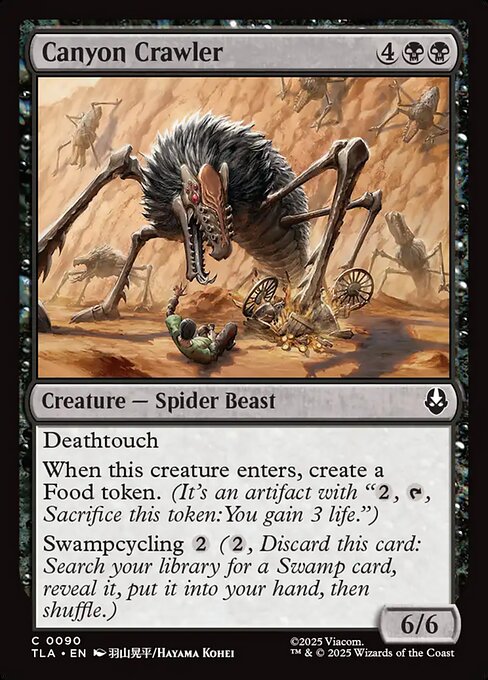
162. Canyon Crawler
Rating5.3PlayableWhy this rating?
A solid playable that rarely gets cut (5.3/10).
Why. A six-mana 6/6 with deathtouch that creates a Food token and can also be discarded for swampcycling 2 to find a Swamp when you need lands. It's a solid finisher or a land, depending on your hand.
Risks. Six mana, with two black mana, is heavy. Removal or exile answers it, and it costs your whole turn.
In the draft. A good top-end black common that's never dead thanks to cycling. Run one or two in any black deck.
Results in the games of the set
When it is in hand, the deck wins 55.3% of its games (set average: 56.2%, 141st of 279 cards).
In the opening hand: 52.5% wins (55.4% on average).
Drawn during the game: 57.1% (56.8% on average).
When it is drawn, the deck wins 1.0 points more than when it is not.
When it is drafted, it is played 43% of the time (set average: 61%).
Taken among the first three picks (108 drafts), it ends in the deck 68% of the time.
It is played mostly in B/U decks (43% of them) and B/G (42%).
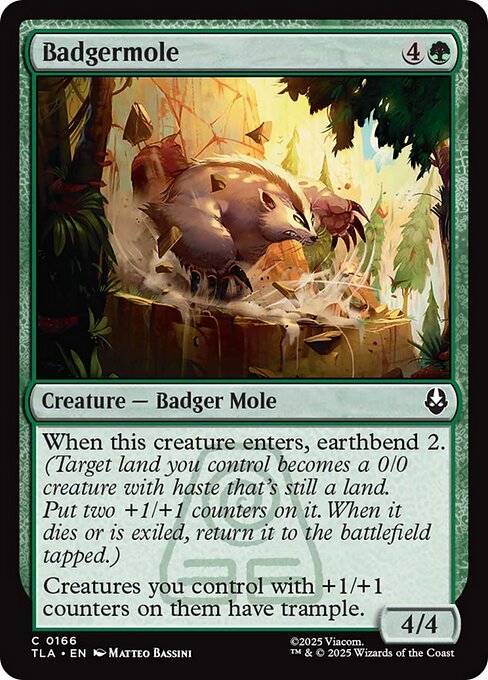
163. Badgermole
Rating5.2PlayableWhy this rating?
A solid playable that rarely gets cut (5.2/10).
Why. A five-mana 4/4 that Earthbends 2 on entry: a land becomes a 0/0 haste creature with two +1/+1 counters. Your creatures with +1/+1 counters, that land included, have trample, so you get two bodies.
Risks. Five mana, and the animated land is exposed to removal and blocks, even though it returns tapped if it dies or is exiled. Trample only applies to creatures with +1/+1 counters.
In the draft. A good green common for a deck of big creatures. Take it fairly high if you're green.
Results in the games of the set
When it is in hand, the deck wins 56.7% of its games (set average: 56.2%, 94th of 279 cards).
In the opening hand: 55.1% wins (55.4% on average).
Drawn during the game: 57.9% (56.8% on average).
When it is drawn, the deck wins 1.5 points more than when it is not.
When it is drafted, it is played 64% of the time (set average: 61%).
Taken as the first pick (89 drafts), it ends in the deck 89% of the time.
It is played mostly in G/R decks (72% of them) and B/G (71%).

164. Aang's Journey
Rating5.2PlayableWhy this rating?
A solid playable that rarely gets cut (5.2/10).
Why. A two-mana Lesson sorcery that puts a basic land from your library into your hand and gains you 2 life. Kicked, it also finds a Shrine. A fixing and consistency card that counts as a Lesson.
Risks. It has no board impact and takes a deck slot. The Shrine only has value if you play some.
In the draft. A fixing playable for three-colour or Shrine decks. In a normal deck it's weak, so take it late.
Results in the games of the set
When it is in hand, the deck wins 55.5% of its games (set average: 56.2%, 137th of 279 cards).
In the opening hand: 54.5% wins (55.4% on average).
Drawn during the game: 56.2% (56.8% on average).
When it is drawn, the deck wins 2.4 points more than when it is not.
When it is drafted, it is played 64% of the time (set average: 61%).
Taken as the first pick (108 drafts), it ends in the deck 82% of the time.
It is played mostly in G/U decks (57% of them) and R/U (55%).

165. Abandon Attachments
Rating5.2PlayableWhy this rating?
A solid playable that rarely gets cut (5.2/10).
Why. A two-mana blue-red hybrid Lesson instant: you may discard a card to draw two. A flexible hand filter that improves card quality and counts as a Lesson.
Risks. It only turns two cards (the spell and the discard) into two cards: it filters without gaining advantage. Without a spare card to discard it does nothing useful.
In the draft. A common for blue or red decks that want to draw and feed Lessons. Take it as a complement, not over solid creatures.
Results in the games of the set
When it is in hand, the deck wins 55.3% of its games (set average: 56.2%, 142nd of 279 cards).
In the opening hand: 54.0% wins (55.4% on average).
Drawn during the game: 56.1% (56.8% on average).
When it is drawn, the deck wins 0.9 points more than when it is not.
When it is drafted, it is played 77% of the time (set average: 61%).
Taken as the first pick (169 drafts), it ends in the deck 93% of the time.
It is played mostly in R/U decks (60% of them) and B/U (40%).
 Rating5.2Playable
Why this rating?
A solid playable that rarely gets cut (5.2/10).
Why. A two-mana 1/1 that makes target opponent discard a card on entry. A one-for-one with a body attached, useful early in the game.
Risks. The body is small and the opponent chooses the discard, usually their worst card. The effect is weak late, when their hand is empty.
In the draft. A decent black playable for a value deck. Take it as a curve complement.
Results in the games of the set
When it is in hand, the deck wins 56.2% of its games (set average: 56.2%, 116th of 279 cards).
In the opening hand: 56.0% wins (55.4% on average).
Drawn during the game: 56.4% (56.8% on average).
When it is drawn, the deck wins 1.3 points more than when it is not.
When it is drafted, it is played 76% of the time (set average: 61%).
Taken as the first pick (162 drafts), it ends in the deck 93% of the time.
It is played mostly in B/U decks (70% of them) and B/W (64%).
 Rating5.2Playable
Why this rating?
A solid playable that rarely gets cut (5.2/10).
Why. A six-mana 4/4 legend that puts a +1/+1 counter on each creature you control on entry. Your creatures with power 4 or greater can't be blocked by more than one creature, making your army hard to stop.
Risks. Six mana with two green mana is slow. She's weaker with few creatures, and removal answers her.
In the draft. A decent green top-end uncommon for a creature deck. Take her if you already have a wide board.
Results in the games of the set
When it is in hand, the deck wins 55.1% of its games (set average: 56.2%, 148th of 279 cards).
In the opening hand: 53.0% wins (55.4% on average).
Drawn during the game: 56.5% (56.8% on average).
When it is drawn, the deck wins 0.7 points more than when it is not.
When it is drafted, it is played 78% of the time (set average: 61%).
Taken as the first pick (89 drafts), it ends in the deck 87% of the time.
It is played mostly in G/R decks (31% of them) and B/G (30%).

168. Misty Palms Oasis
Rating5.2PlayableWhy this rating?
A solid playable that rarely gets cut (5.2/10).
Why. A white-black dual land that enters tapped and can be sacrificed, for four mana and by tapping it, to draw a card. It fixes your colours and guards against flood late.
Risks. It enters tapped, which costs tempo, and it only has value in a white or black deck.
In the draft. Play it in a white-black deck or with a splash of one of those colours. Take it fairly late: good fixing, not a priority.
Results in the games of the set
When it is in hand, the deck wins 55.8% of its games (set average: 56.2%, 123rd of 279 cards).
In the opening hand: 56.8% wins (55.4% on average).
Drawn during the game: 55.1% (56.8% on average).
When it is drawn, the deck wins 1.7 points more than when it is not.
When it is drafted, it is played 52% of the time (set average: 61%).
Taken among the first three picks (127 drafts), it ends in the deck 76% of the time.

169. Mongoose Lizard
Rating5.2PlayableWhy this rating?
A solid playable that rarely gets cut (5.2/10).
Why. A 5/6 with menace for six mana that pings any target on entering, enough to finish a small creature or a damaged one. Mountaincycling for two means it is never a dead card when you are short on lands.
Risks. Six mana is heavy and it needs two red mana. One removal spell on a body that already got its enter value costs you a whole turn.
In the draft. A solid top-end for red decks: cycle it early for a land, cast it late as a finisher. One or two copies is plenty; never take it over real threats or removal.
Results in the games of the set
When it is in hand, the deck wins 52.7% of its games (set average: 56.2%, 218th of 279 cards).
In the opening hand: 50.9% wins (55.4% on average).
Drawn during the game: 54.0% (56.8% on average).
When it is drawn, the deck wins 1.2 points less than when it is not.
When it is drafted, it is played 18% of the time (set average: 61%).
Taken among the first three picks (33 drafts), it ends in the deck 52% of the time.
It is played mostly in G/R decks (26% of them).

170. Rocky Rebuke
Rating5.2PlayableWhy this rating?
A solid playable that rarely gets cut (5.2/10).
Why. A two-mana instant removal spell: your creature deals damage equal to its power to an opposing creature and takes nothing back. With a big green creature it kills almost anything, and mid-combat it swings a trade.
Risks. You need a creature of your own in play, and if the opponent responds by killing it, the spell is wasted. With small creatures it kills little.
In the draft. A solid common removal spell for green: take it if your creatures are decently sized. Worse in a deck of small bodies or one light on creatures.
Results in the games of the set
When it is in hand, the deck wins 56.5% of its games (set average: 56.2%, 101st of 279 cards).
In the opening hand: 54.7% wins (55.4% on average).
Drawn during the game: 57.8% (56.8% on average).
When it is drawn, the deck wins 1.3 points more than when it is not.
When it is drafted, it is played 79% of the time (set average: 61%).
Taken as the first pick (163 drafts), it ends in the deck 94% of the time.
It is played mostly in G/R decks (68% of them) and G/W (67%).

171. Serpent's Pass
Rating5.2PlayableWhy this rating?
A solid playable that rarely gets cut (5.2/10).
Why. A blue-black dual land that enters tapped and can be sacrificed later to draw a card. It fixes your mana and fights flood late in the game: unexciting, but it does two jobs.
Risks. It enters tapped, which slows an aggressive curve, and it does nothing outside those two colors. Drawing costs four mana, plus sacrificing the land.
In the draft. Take it if you are blue-black, after your good playables. If you only play one of these colors, a basic land does almost as well.
Results in the games of the set
When it is in hand, the deck wins 57.1% of its games (set average: 56.2%, 82nd of 279 cards).
In the opening hand: 57.3% wins (55.4% on average).
Drawn during the game: 56.9% (56.8% on average).
When it is drawn, the deck wins 3.0 points more than when it is not.
When it is drafted, it is played 65% of the time (set average: 61%).
Taken as the first pick (47 drafts), it ends in the deck 81% of the time.

172. Sun Warriors
Rating5.2PlayableWhy this rating?
A solid playable that rarely gets cut (5.2/10).
Why. A red-white 3/5 with Firebending that scales with your creature count: when it attacks, you get red mana to cast extra spells mid-combat. With five mana it also makes a 1/1 white Ally creature token late in the game.
Risks. Two colors required. With few creatures out, Firebending gives little, and a 3/5 attacking alone can run into a bigger blocker.
In the draft. Good in a creature-heavy red-white deck, where it is both a sturdy body and a mana sink. Do not force the pair for it.
Results in the games of the set
When it is in hand, the deck wins 53.7% of its games (set average: 56.2%, 197th of 279 cards).
In the opening hand: 53.7% wins (55.4% on average).
Drawn during the game: 53.6% (56.8% on average).
When it is drawn, the deck wins 1.0 points less than when it is not.
When it is drafted, it is played 63% of the time (set average: 61%).
Taken as the first pick (70 drafts), it ends in the deck 83% of the time.
It is played mostly in R/W decks (40% of them).

173. Turtle-Duck
Rating5.2PlayableWhy this rating?
A solid playable that rarely gets cut (5.2/10).
Why. A one-mana green 0/4 that blocks well early. For three mana it has base power 4 and trample until end of turn: a wall that turns into a threat when you have spare mana.
Risks. On its own it deals no damage, and the ability is expensive to repeat every turn. It cannot block flyers.
In the draft. A fine one-drop for defensive or midrange green decks, but not a priority. Take it as a curve filler.
Results in the games of the set
When it is in hand, the deck wins 53.3% of its games (set average: 56.2%, 204th of 279 cards).
In the opening hand: 53.2% wins (55.4% on average).
Drawn during the game: 53.4% (56.8% on average).
When it is drawn, the deck wins 0.0 points more than when it is not.
When it is drafted, it is played 17% of the time (set average: 61%).
Taken among the first three picks (35 drafts), it ends in the deck 71% of the time.
 Rating5.2Playable
Why this rating?
A solid playable that rarely gets cut (5.2/10).
Why. A three-mana red 3/2 with prowess that can pay one mana when it attacks to stop a creature from blocking this turn. A handy tool for pushing damage through in an aggressive deck.
Risks. Its 2 toughness is fragile, and prowess is weak if your deck has few noncreature spells. Each attack also costs an extra mana.
In the draft. A solid card for aggressive red decks, especially red-white. Take it over average commons, but not over removal.
Results in the games of the set
When it is in hand, the deck wins 53.8% of its games (set average: 56.2%, 195th of 279 cards).
In the opening hand: 54.0% wins (55.4% on average).
Drawn during the game: 53.6% (56.8% on average).
When it is drawn, the deck wins 1.0 points less than when it is not.
When it is drafted, it is played 69% of the time (set average: 61%).
Taken as the first pick (60 drafts), it ends in the deck 85% of the time.
It is played mostly in B/R decks (30% of them) and R/U (29%).
 Rating5.2Playable
Why this rating?
A solid playable that rarely gets cut (5.2/10).
Why. A two-mana 2/2 that creates a Food token on entering. If you sacrifice a Food, you may fetch a basic land onto the battlefield tapped: ramp, but the creature then goes to the bottom of your library.
Risks. As soon as it fetches a land it goes to the bottom of your library, so you lose the body. Sacrificing the token also costs two mana.
In the draft. Fine in a green deck with Food, mediocre otherwise. An honest two-drop filler, not a card to hunt for.
Results in the games of the set
When it is in hand, the deck wins 53.9% of its games (set average: 56.2%, 187th of 279 cards).
In the opening hand: 54.0% wins (55.4% on average).
Drawn during the game: 53.9% (56.8% on average).
When it is drawn, the deck wins 0.3 points less than when it is not.
When it is drafted, it is played 78% of the time (set average: 61%).
Taken as the first pick (103 drafts), it ends in the deck 89% of the time.
It is played mostly in B/G decks (30% of them) and G/R (28%).

176. Wandering Musicians
Rating5.2PlayableWhy this rating?
A solid playable that rarely gets cut (5.2/10).
Why. A four-mana 2/5 castable with red or white, which gives all your creatures +1/+0 when it attacks. Its toughness makes it hard to kill in combat, and the bonus helps a team of attackers get through.
Risks. A 2/5 attacks poorly: it runs into big blockers and kills almost nothing. The bonus matters mostly when several creatures attack with it.
In the draft. A fair mid-curve common for creature decks, especially red-white. Easy to cast from either color.
Results in the games of the set
When it is in hand, the deck wins 54.8% of its games (set average: 56.2%, 160th of 279 cards).
In the opening hand: 55.1% wins (55.4% on average).
Drawn during the game: 54.6% (56.8% on average).
When it is drawn, the deck wins 2.2 points less than when it is not.
When it is drafted, it is played 57% of the time (set average: 61%).
Taken as the first pick (47 drafts), it ends in the deck 85% of the time.
It is played mostly in R/W decks (55% of them) and B/W (42%).

177. Wolfbat
Rating5.2PlayableWhy this rating?
A solid playable that rarely gets cut (5.2/10).
Why. A three-mana 2/2 flyer: cheap and evasive. If you draw a second card in a turn, you can pay a black mana to return it from the graveyard with a finality counter.
Risks. Drawing two cards a turn needs specific draw effects, so the recursion is rare in a standard deck. A 2/2 body dies to everything.
In the draft. A decent flyer for black, especially blue-black. Take it if your deck can draw plenty of cards, otherwise it is simple three-mana filler.
Results in the games of the set
When it is in hand, the deck wins 54.1% of its games (set average: 56.2%, 182nd of 279 cards).
In the opening hand: 51.8% wins (55.4% on average).
Drawn during the game: 55.5% (56.8% on average).
When it is drawn, the deck wins 0.6 points more than when it is not.
When it is drafted, it is played 45% of the time (set average: 61%).
Taken among the first three picks (118 drafts), it ends in the deck 72% of the time.
It is played about as much in every archetype.

178. Energybending
Rating5.2PlayableWhy this rating?
A solid playable that rarely gets cut (5.2/10).
Why. A two-mana Lesson instant that draws a card and gives your lands all basic land types until end of turn. It replaces itself, but the bonus effect only helps specific cards.
Risks. Without cards that care about land types it only cantrips for two mana, which is slow. No impact on the board.
In the draft. A niche card: take it only if your deck has plenty of Lessons or land-type payoffs. Otherwise it goes after good creatures.
Results in the games of the set
When it is in hand, the deck wins 51.4% of its games (set average: 56.2%, 248th of 279 cards).
In the opening hand: 49.7% wins (55.4% on average).
Drawn during the game: 52.6% (56.8% on average).
When it is drawn, the deck wins 0.7 points more than when it is not.
When it is drafted, it is played 23% of the time (set average: 61%).
Taken among the first three picks (36 drafts), it ends in the deck 53% of the time.
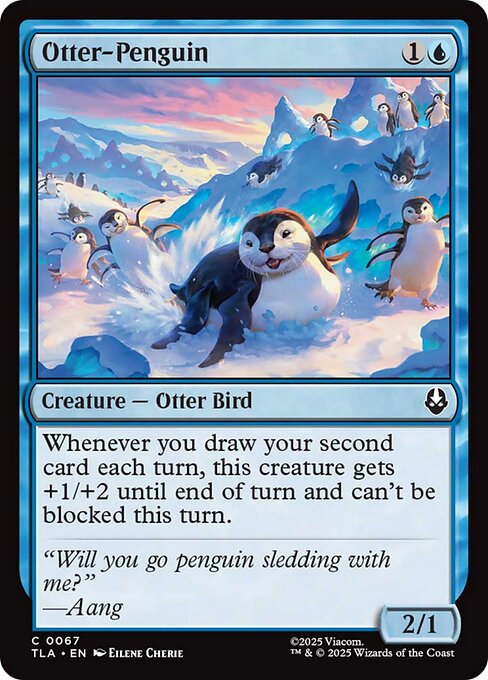
179. Otter-Penguin
Rating5.1PlayableWhy this rating?
A solid playable that rarely gets cut (5.1/10).
Why. A two-mana blue 2/1 that becomes 3/3 and unblockable when you draw your second card each turn. With some card-draw effects it hits hard for its cost.
Risks. Without extra draw it is a plain, fragile 2/1. It dies to nearly everything and blocks nothing useful.
In the draft. A fair two-drop for a blue deck with card-draw spells. In a deck without draw, pass it.
Results in the games of the set
When it is in hand, the deck wins 55.0% of its games (set average: 56.2%, 152nd of 279 cards).
In the opening hand: 53.8% wins (55.4% on average).
Drawn during the game: 55.8% (56.8% on average).
When it is drawn, the deck wins 0.8 points more than when it is not.
When it is drafted, it is played 55% of the time (set average: 61%).
Taken as the first pick (86 drafts), it ends in the deck 86% of the time.
It is played mostly in B/U decks (51% of them) and R/U (45%).

180. Katara, the Fearless
Rating5.0PlayableWhy this rating?
A solid playable that rarely gets cut (5.0/10).
Why. A three-mana 3/3 that makes triggered abilities of your Allies trigger an additional time. In a deck full of Allies, it doubles many enter effects.
Risks. Three colors: green, white and blue are all required by turn 3. Without many Allies with triggered abilities, she is a vanilla 3/3.
In the draft. Do not take her early: she needs a three-color Ally-heavy deck. If your deck is already full of Allies, she is a bonus, not a cornerstone.
Results in the games of the set
When it is in hand, the deck wins 51.4% of its games (set average: 56.2%, 249th of 279 cards).
In the opening hand: 51.0% wins (55.4% on average).
Drawn during the game: 51.6% (56.8% on average).
When it is drawn, the deck wins 1.0 points more than when it is not.
When it is drafted, it is played 59% of the time (set average: 61%).
Taken as the first pick (54 drafts), it ends in the deck 78% of the time.
It is played about as much in every archetype.
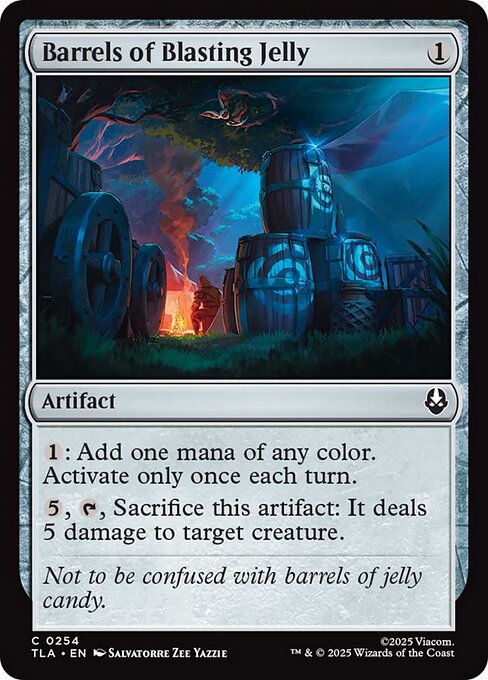
181. Barrels of Blasting Jelly
Rating5.0PlayableWhy this rating?
A solid playable that rarely gets cut (5.0/10).
Why. A one-mana artifact that fixes mana of any color once per turn and can be sacrificed later to deal 5 damage to a creature. It smooths mana and becomes slow removal late in the game.
Risks. It costs a mana to make a mana, so it does not ramp. The removal costs five mana plus tapping, so it is slow.
In the draft. A useful tool for two- or three-color decks: take it as a handy extra, after cheap removal and good creatures.
Results in the games of the set
When it is in hand, the deck wins 54.7% of its games (set average: 56.2%, 165th of 279 cards).
In the opening hand: 53.3% wins (55.4% on average).
Drawn during the game: 55.6% (56.8% on average).
When it is drawn, the deck wins 0.3 points more than when it is not.
When it is drafted, it is played 57% of the time (set average: 61%).
Taken as the first pick (45 drafts), it ends in the deck 87% of the time.
It is played mostly in G/U decks (30% of them) and R/U (29%).

182. Callous Inspector
Rating5.0PlayableWhy this rating?
A solid playable that rarely gets cut (5.0/10).
Why. A one-mana black 1/1 with menace. When it dies it deals 1 damage to you but creates a Clue token: it replaces itself. A fine early trade, and a disposable blocker on defense.
Risks. A 1/1 gets outclassed fast, and the Clue costs two mana to crack. The damage to your own life matters in an aggro deck.
In the draft. A fair one-drop for aggressive or sacrifice-leaning black decks, but never a priority. A curve filler.
Results in the games of the set
When it is in hand, the deck wins 55.4% of its games (set average: 56.2%, 138th of 279 cards).
In the opening hand: 56.7% wins (55.4% on average).
Drawn during the game: 54.5% (56.8% on average).
When it is drawn, the deck wins 1.1 points more than when it is not.
When it is drafted, it is played 65% of the time (set average: 61%).
Taken as the first pick (68 drafts), it ends in the deck 85% of the time.
It is played mostly in B/W decks (63% of them) and B/U (57%).
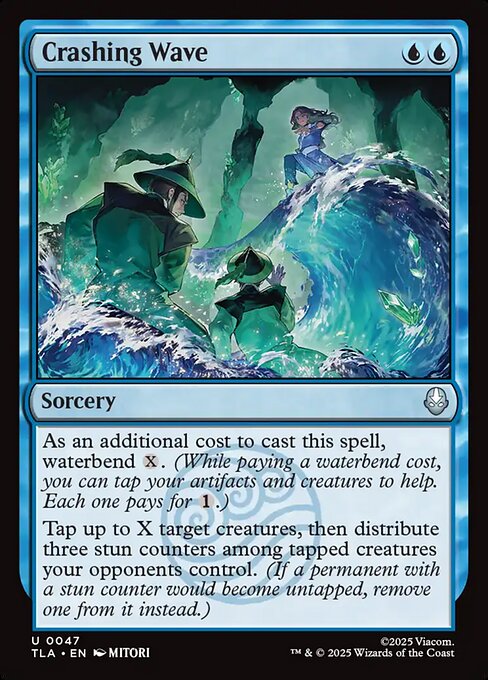
183. Crashing Wave
Rating5.0PlayableWhy this rating?
A solid playable that rarely gets cut (5.0/10).
Why. A two-mana blue sorcery that requires waterbend X as an additional cost: it taps up to X target creatures, then distributes three stun counters among tapped opposing creatures. A tempo swing at the right moment.
Risks. Costly to cast, since you tap your own creatures and artifacts, which removes your attackers or blockers. It kills nothing, it only slows.
In the draft. A tempo spell for a blue deck with a wide board. Take it if you build around a big attack, otherwise skip it.
Results in the games of the set
When it is in hand, the deck wins 52.2% of its games (set average: 56.2%, 234th of 279 cards).
In the opening hand: 47.3% wins (55.4% on average).
Drawn during the game: 55.1% (56.8% on average).
When it is drawn, the deck wins 0.5 points more than when it is not.
When it is drafted, it is played 25% of the time (set average: 61%).
Taken among the first three picks (84 drafts), it ends in the deck 58% of the time.
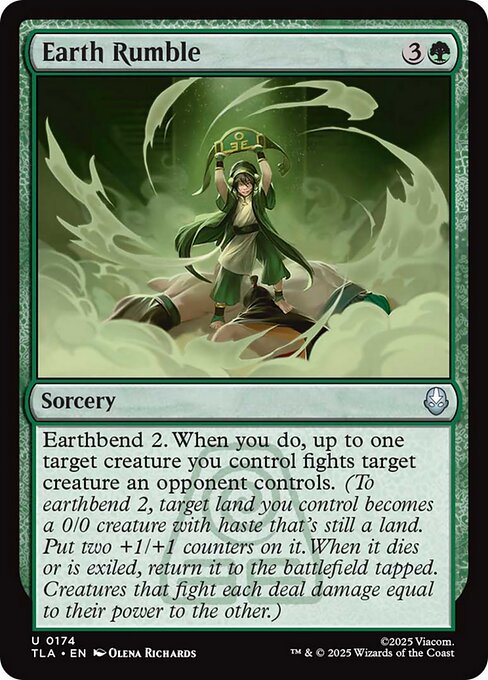
184. Earth Rumble
Rating5.0PlayableWhy this rating?
A solid playable that rarely gets cut (5.0/10).
Why. A four-mana sorcery: earthbend 2 turns one of your lands into a 2/2 haste creature, then up to one of your creatures fights an opposing creature. Removal that also leaves a body.
Risks. Four mana for a sorcery is slow, and if the opponent responds by killing your creature, the fight does not happen. If your creature is too small, the fight is lost.
In the draft. Good green removal if you have big creatures, but not a first choice. Take it as a second or third removal spell.
Results in the games of the set
When it is in hand, the deck wins 54.0% of its games (set average: 56.2%, 184th of 279 cards).
In the opening hand: 50.9% wins (55.4% on average).
Drawn during the game: 56.1% (56.8% on average).
When it is drawn, the deck wins 0.6 points less than when it is not.
When it is drafted, it is played 69% of the time (set average: 61%).
Taken as the first pick (78 drafts), it ends in the deck 86% of the time.
It is played mostly in B/G decks (31% of them) and G/R (30%).
 Rating5.0Playable
Why this rating?
A solid playable that rarely gets cut (5.0/10).
Why. A four-mana 3/4 with reach, castable in red or green, that gets +1/+0 and trample if you control a land creature or a land entered this turn. It attacks well on turns when you play a land.
Risks. With no land played that turn it is a plain 3/4. If you run out of lands to drop, the bonus goes away.
In the draft. A fair mid-curve body for green or red decks. Better with earthbend effects, but playable without.
Results in the games of the set
When it is in hand, the deck wins 53.2% of its games (set average: 56.2%, 206th of 279 cards).
In the opening hand: 52.2% wins (55.4% on average).
Drawn during the game: 53.9% (56.8% on average).
When it is drawn, the deck wins 1.1 points less than when it is not.
When it is drafted, it is played only 14% of the time (set average: 61%): it almost always ends in the sideboard.
Taken among the first three picks (31 drafts), it ends in the deck 58% of the time.
It is played mostly in G/R decks (29% of them).
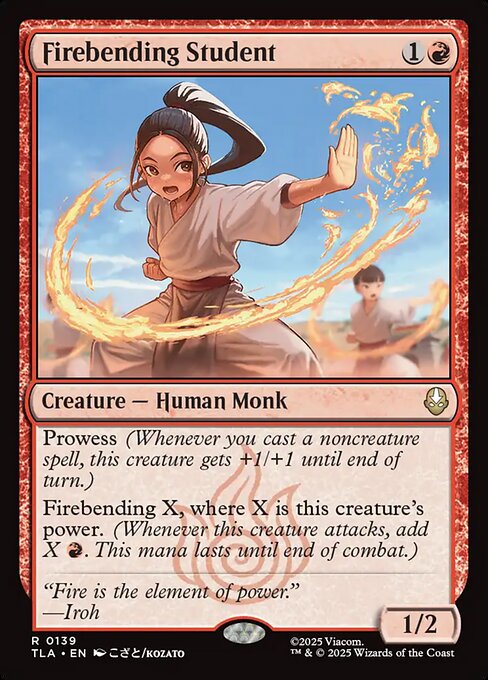
186. Firebending Student
Rating5.0PlayableWhy this rating?
A solid playable that rarely gets cut (5.0/10).
Why. A two-mana red 1/2 with prowess and Firebending equal to its power: each noncreature spell grows it and increases the mana gained on attack. In a spells deck it can get very strong.
Risks. Without noncreature spells it is a 1/2 that earns little mana. It is fragile and easy to block or kill.
In the draft. A rare for spell-heavy decks, notably blue-red. In a creature deck, avoid it.
Results in the games of the set
When it is in hand, the deck wins 51.8% of its games (set average: 56.2%, 244th of 279 cards).
In the opening hand: 52.9% wins (55.4% on average).
Drawn during the game: 50.9% (56.8% on average).
When it is drawn, the deck wins 1.6 points less than when it is not.
When it is drafted, it is played 71% of the time (set average: 61%).
Taken as the first pick (48 drafts), it ends in the deck 79% of the time.
It is played about as much in every archetype.

187. Flexible Waterbender
Rating5.0PlayableWhy this rating?
A solid playable that rarely gets cut (5.0/10).
Why. A four-mana blue 2/5 with vigilance that can become a 5/2 until end of turn with waterbend 3. It defends well while keeping an attacking option.
Risks. The ability costs three mana, or tapping your other creatures, and dropping to 2 toughness exposes it in combat. An average body without the effect.
In the draft. A decent body for defensive or midrange blue decks. Take it as filler, not a priority.
Results in the games of the set
When it is in hand, the deck wins 53.1% of its games (set average: 56.2%, 210th of 279 cards).
In the opening hand: 51.9% wins (55.4% on average).
Drawn during the game: 53.9% (56.8% on average).
When it is drawn, the deck wins 0.2 points less than when it is not.
When it is drafted, it is played only 13% of the time (set average: 61%): it almost always ends in the sideboard.
 Rating5.0Playable
Why this rating?
A solid playable that rarely gets cut (5.0/10).
Why. A two-mana white-black 1/1 that gets a +1/+1 counter whenever you sacrifice another permanent. When it dies, you may exile it to return a creature card from your graveyard with mana value up to its power.
Risks. Without sacrifices it stays a 1/1 that returns almost nothing. Two colors required, and it relies on a sacrifice deck.
In the draft. A card for a white-black sacrifice deck, poorly suited elsewhere. Do not take it early without the synergies.
Results in the games of the set
When it is in hand, the deck wins 51.4% of its games (set average: 56.2%, 250th of 279 cards).
In the opening hand: 50.7% wins (55.4% on average).
Drawn during the game: 51.8% (56.8% on average).
When it is drawn, the deck wins 1.4 points less than when it is not.
When it is drafted, it is played 43% of the time (set average: 61%).
Taken among the first three picks (106 drafts), it ends in the deck 71% of the time.
It is played mostly in B/W decks (26% of them).
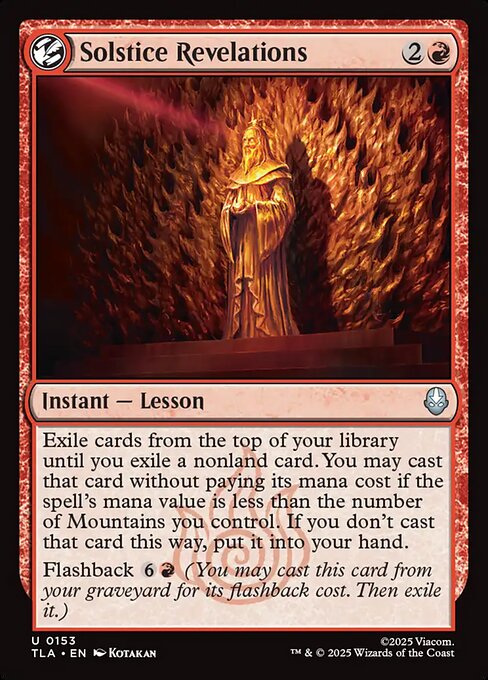
189. Solstice Revelations
Rating5.0PlayableWhy this rating?
A solid playable that rarely gets cut (5.0/10).
Why. A three-mana Lesson instant that exiles from the top of your library until a nonland card, which you cast free if its mana value is less than your number of Mountains, otherwise you take it into your hand. Flashback gives a second use.
Risks. The result is random, and with few Mountains the free cast is rare. In practice it is often three mana for a random card.
In the draft. A card for a nearly mono-red deck heavy on Mountains. Elsewhere it is too inconsistent to merit a pick.
Results in the games of the set
When it is in hand, the deck wins 51.1% of its games (set average: 56.2%, 257th of 279 cards).
In the opening hand: 49.8% wins (55.4% on average).
Drawn during the game: 52.0% (56.8% on average).
When it is drawn, the deck wins 1.8 points less than when it is not.
When it is drafted, it is played 18% of the time (set average: 61%).
Taken among the first three picks (63 drafts), it ends in the deck 60% of the time.

190. Team Avatar
Rating5.0PlayableWhy this rating?
A solid playable that rarely gets cut (5.0/10).
Why. A three-mana white enchantment that gives +X/+X to a creature that attacks alone, X being your number of creatures. If needed, you can discard it for three mana to deal damage equal to your creature count to a target creature.
Risks. Slow as an enchantment, and the discard mode depends on your creature count, so it is weak on an empty board. Attacking alone costs you against blockers.
In the draft. A flexible card that serves as conditional removal and offensive boost: good in a white deck with plenty of creatures. Take it as extra removal.
Results in the games of the set
When it is in hand, the deck wins 54.6% of its games (set average: 56.2%, 166th of 279 cards).
In the opening hand: 53.2% wins (55.4% on average).
Drawn during the game: 55.7% (56.8% on average).
When it is drawn, the deck wins 0.5 points less than when it is not.
When it is drafted, it is played 85% of the time (set average: 61%).
Taken as the first pick (158 drafts), it ends in the deck 83% of the time.
It is played about as much in every archetype.
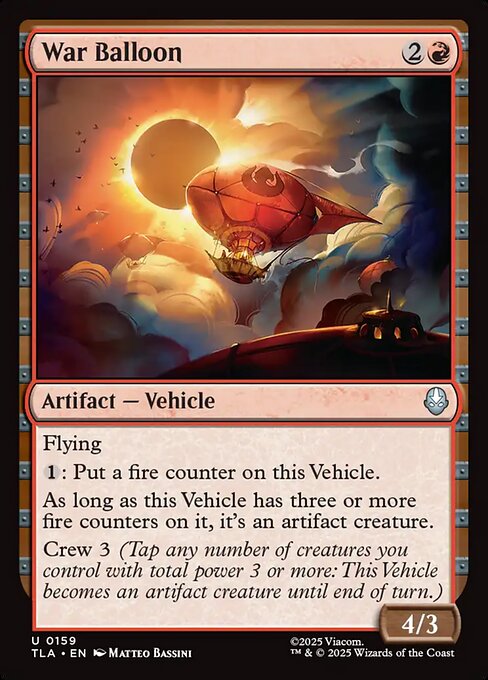
191. War Balloon
Rating5.0PlayableWhy this rating?
A solid playable that rarely gets cut (5.0/10).
Why. A three-mana 4/3 flying Vehicle. With Crew 3 it hits hard in the air, and you can pay one mana at a time to put fire counters on it: at three counters it becomes a creature without crewing.
Risks. You need creatures with total power 3 to crew it, which costs you blockers. With neither crew nor fire counters it does nothing, and artifact removal neutralizes it.
In the draft. A good Vehicle for a creature-heavy red deck, especially red-white. Stronger in an aggressive deck than a defensive one.
Results in the games of the set
When it is in hand, the deck wins 53.7% of its games (set average: 56.2%, 198th of 279 cards).
In the opening hand: 53.1% wins (55.4% on average).
Drawn during the game: 54.1% (56.8% on average).
When it is drawn, the deck wins 0.5 points less than when it is not.
When it is drafted, it is played 51% of the time (set average: 61%).
Taken as the first pick (51 drafts), it ends in the deck 82% of the time.
It is played mostly in B/R decks (25% of them).
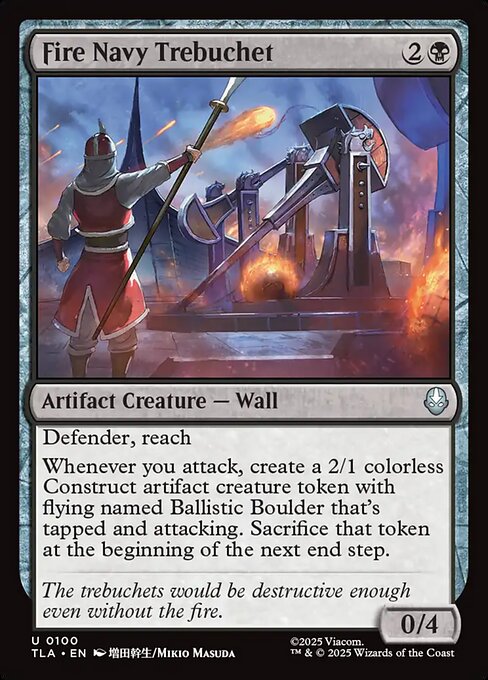
192. Fire Navy Trebuchet
Rating5.0WeakWhy this rating?
A solid playable that rarely gets cut (5.0/10).
Why. A three-mana black 0/4 Wall with defender and reach that, whenever you attack, creates a 2/1 flying Construct token tapped and attacking, sacrificed at end of turn. It defends well and adds damage to every attack.
Risks. It cannot attack itself and makes nothing without another attacker on your side. A token that dies in combat gives nothing more.
In the draft. A fair value defender for black decks that attack with other creatures. Take it over average commons, after removal.
Results in the games of the set
When it is in hand, the deck wins 55.1% of its games (set average: 56.2%, 147th of 279 cards).
In the opening hand: 53.4% wins (55.4% on average).
Drawn during the game: 56.3% (56.8% on average).
When it is drawn, the deck wins 2.6 points more than when it is not.
When it is drafted, it is played 76% of the time (set average: 61%).
Taken as the first pick (81 drafts), it ends in the deck 89% of the time.
It is played mostly in B/W decks (36% of them) and B/R (28%).

193. Mai, Jaded Edge
Rating4.9WeakWhy this rating?
A solid playable that rarely gets cut (4.9/10).
Why. A two-mana red 1/3 with prowess whose Exhaust ability for three mana gives it a double strike counter. A good early blocker that becomes a threat later.
Risks. You must invest three mana, once, to make her dangerous, and she stays a small body. Without noncreature spells, prowess rarely triggers.
In the draft. Fine for red spells decks, but not a standout. An honest two-drop, take it as filler.
Results in the games of the set
When it is in hand, the deck wins 53.1% of its games (set average: 56.2%, 211th of 279 cards).
In the opening hand: 54.1% wins (55.4% on average).
Drawn during the game: 52.4% (56.8% on average).
When it is drawn, the deck wins 1.6 points less than when it is not.
When it is drafted, it is played 74% of the time (set average: 61%).
Taken as the first pick (79 drafts), it ends in the deck 85% of the time.
It is played mostly in B/R decks (33% of them) and R/U (33%).

194. Leaves from the Vine
Rating4.8WeakWhy this rating?
A solid playable that rarely gets cut (4.8/10).
Why. A two-mana green Saga: it mills three cards and creates a Food token, then puts a +1/+1 counter on up to two of your creatures, and draws a card if your graveyard has a creature or Lesson card.
Risks. Slow and without immediate board impact, it needs creatures already out for chapter II. Chapter III depends on what is in your graveyard.
In the draft. A decent value card for a green creature deck, but no big impact. Take it late as filler.
Results in the games of the set
When it is in hand, the deck wins 52.4% of its games (set average: 56.2%, 229th of 279 cards).
In the opening hand: 52.2% wins (55.4% on average).
Drawn during the game: 52.5% (56.8% on average).
When it is drawn, the deck wins 0.5 points less than when it is not.
When it is drafted, it is played 25% of the time (set average: 61%).
Taken among the first three picks (91 drafts), it ends in the deck 58% of the time.
195. Airship Engine Room
Rating4.8WeakWhy this rating?
A solid playable that rarely gets cut (4.8/10).
Why. A blue-red dual land that enters tapped and can be sacrificed later to draw a card. It fixes your mana and fights flood late in the game.
Risks. It enters tapped, which slows an aggressive curve, and it only matters in blue-red. Drawing costs four mana, plus sacrificing the land.
In the draft. Take it if you are blue-red, after your good playables. Outside those colors, skip it.
Results in the games of the set
When it is in hand, the deck wins 55.5% of its games (set average: 56.2%, 135th of 279 cards).
In the opening hand: 56.6% wins (55.4% on average).
Drawn during the game: 54.8% (56.8% on average).
When it is drawn, the deck wins 1.5 points more than when it is not.
When it is drafted, it is played 69% of the time (set average: 61%).
Taken as the first pick (65 drafts), it ends in the deck 95% of the time.

196. Deserter's Disciple
Rating4.8WeakWhy this rating?
A solid playable that rarely gets cut (4.8/10).
Why. A two-mana red 2/2 Ally that can tap to make another creature you control with power 2 or less unblockable this turn. A good support piece for a deck of small aggressive creatures.
Risks. Tapping means it cannot attack, and the bonus only works on creatures with power 2 or less. A 2/2 body is fragile.
In the draft. A good common for aggressive red-white or Ally decks. Take it early for a deck of light creatures.
Results in the games of the set
When it is in hand, the deck wins 53.8% of its games (set average: 56.2%, 193rd of 279 cards).
In the opening hand: 54.6% wins (55.4% on average).
Drawn during the game: 53.2% (56.8% on average).
When it is drawn, the deck wins 2.1 points less than when it is not.
When it is drafted, it is played 46% of the time (set average: 61%).
Taken as the first pick (36 drafts), it ends in the deck 86% of the time.
It is played mostly in R/W decks (56% of them) and B/R (44%).
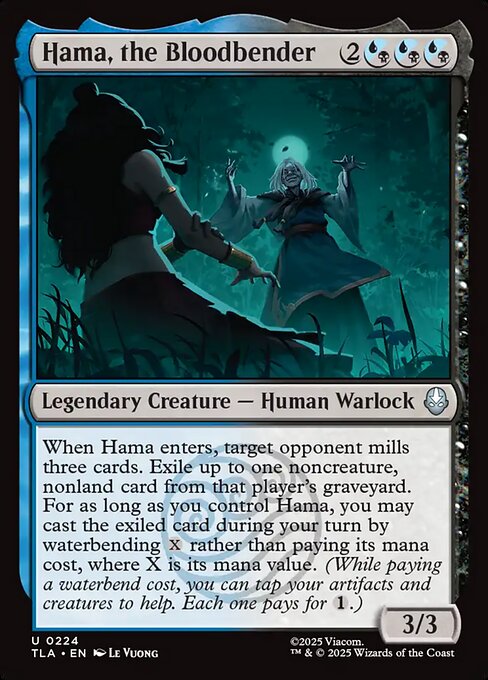 Rating4.8Weak
Why this rating?
A solid playable that rarely gets cut (4.8/10).
Why. A five-mana 3/3, castable with blue or black, that mills three from the opponent, then exiles a noncreature, nonland card from their graveyard that you can cast on your turn with waterbend. A decent body with value on top.
Risks. A 3/3 for five is mediocre, and the mill result is random. If Hama dies you lose access to the exiled card.
In the draft. A fair value card for a blue-black deck, playable with either color. A reasonable play, nothing more.
Results in the games of the set
When it is in hand, the deck wins 54.4% of its games (set average: 56.2%, 171st of 279 cards).
In the opening hand: 49.8% wins (55.4% on average).
Drawn during the game: 57.1% (56.8% on average).
When it is drawn, the deck wins 1.0 points more than when it is not.
When it is drafted, it is played 79% of the time (set average: 61%).
Taken as the first pick (119 drafts), it ends in the deck 90% of the time.
It is played mostly in B/U decks (38% of them).
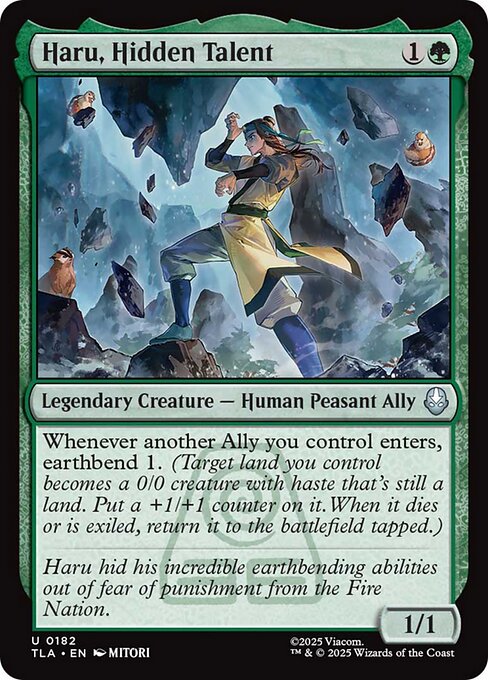
198. Haru, Hidden Talent
Rating4.8WeakWhy this rating?
A solid playable that rarely gets cut (4.8/10).
Why. A two-mana green 1/1 Ally that earthbends 1 whenever another Ally enters: a land becomes a 1/1 haste creature. With several Allies, it builds a board quickly.
Risks. On its own it does nothing and stays a 1/1. It depends on your Ally count, and turning lands into creatures exposes them.
In the draft. A card for Ally decks, especially green-white. Without a good Ally density, pass it.
Results in the games of the set
When it is in hand, the deck wins 53.2% of its games (set average: 56.2%, 207th of 279 cards).
In the opening hand: 54.4% wins (55.4% on average).
Drawn during the game: 52.2% (56.8% on average).
When it is drawn, the deck wins 1.4 points less than when it is not.
When it is drafted, it is played 69% of the time (set average: 61%).
Taken as the first pick (86 drafts), it ends in the deck 83% of the time.
It is played mostly in G/W decks (27% of them).

199. North Pole Gates
Rating4.8WeakWhy this rating?
A solid playable that rarely gets cut (4.8/10).
Why. A white-blue dual land that enters tapped and can be sacrificed later to draw a card. It fixes your mana and helps against flood.
Risks. It enters tapped, which slows an aggressive curve, and it only matters in white-blue. Drawing costs four mana, plus sacrificing the land.
In the draft. Take it if you are white-blue, after your good playables. In other colors it is a minor pick.
Results in the games of the set
When it is in hand, the deck wins 56.1% of its games (set average: 56.2%, 120th of 279 cards).
In the opening hand: 57.8% wins (55.4% on average).
Drawn during the game: 54.8% (56.8% on average).
When it is drawn, the deck wins 0.7 points more than when it is not.
When it is drafted, it is played 73% of the time (set average: 61%).
Taken as the first pick (43 drafts), it ends in the deck 86% of the time.
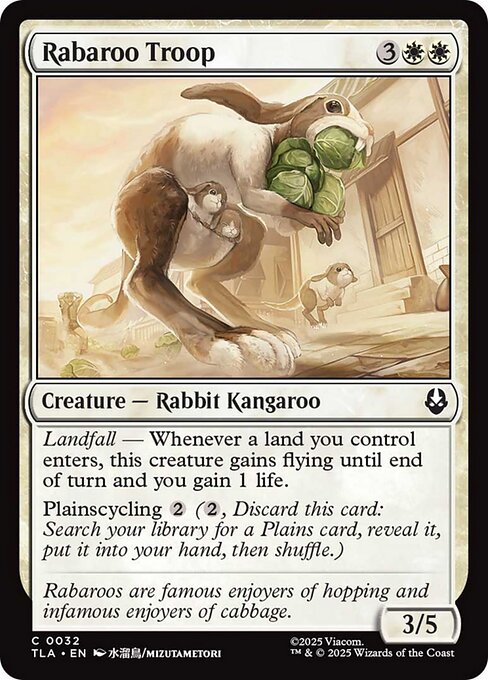
200. Rabaroo Troop
Rating4.8WeakWhy this rating?
A solid playable that rarely gets cut (4.8/10).
Why. A five-mana white 3/5: with Landfall, each land you play gives it flying until end of turn and gains you 1 life. Plainscycling for two keeps you from missing land drops.
Risks. Five mana with two white mana is heavy, and flying only lasts on turns when a land enters. A 3/5 is still slow.
In the draft. A fair, flexible white common: land early, creature late. One or two copies, never ahead of removal.
Results in the games of the set
When it is in hand, the deck wins 52.6% of its games (set average: 56.2%, 224th of 279 cards).
In the opening hand: 52.6% wins (55.4% on average).
Drawn during the game: 52.6% (56.8% on average).
When it is drawn, the deck wins 2.4 points less than when it is not.
When it is drafted, it is played 17% of the time (set average: 61%).
Taken among the first three picks (35 drafts), it ends in the deck 51% of the time.
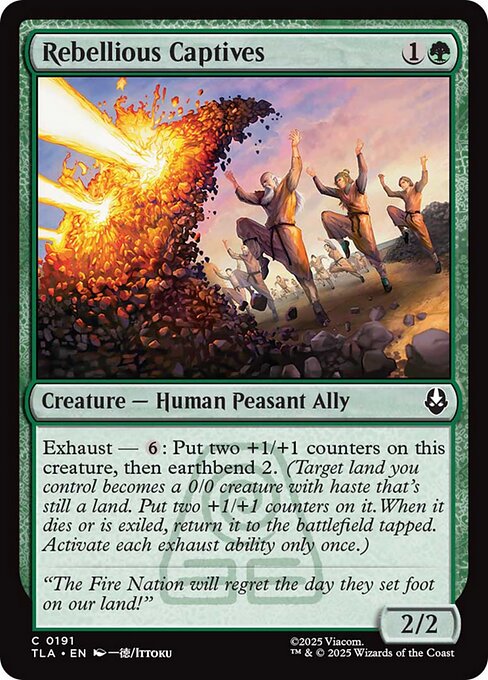
201. Rebellious Captives
Rating4.8WeakWhy this rating?
A solid playable that rarely gets cut (4.8/10).
Why. A two-mana 2/2 that fills turn two and keeps a late-game option: for six mana it gets two +1/+1 counters, then you Earthbend 2. It will not win games alone, but it is never dead in hand.
Risks. Exhaust: the ability works only once and costs six mana, so late on you spend a whole turn for a modest gain. Before that it is just a vanilla 2/2.
In the draft. Solid filler for a green deck that wants a smooth curve. Take it after your removal and better creatures; it makes a fine last two-drop.
Results in the games of the set
When it is in hand, the deck wins 55.1% of its games (set average: 56.2%, 146th of 279 cards).
In the opening hand: 54.8% wins (55.4% on average).
Drawn during the game: 55.4% (56.8% on average).
When it is drawn, the deck wins 0.9 points less than when it is not.
When it is drafted, it is played 72% of the time (set average: 61%).
Taken as the first pick (59 drafts), it ends in the deck 90% of the time.
It is played mostly in G/W decks (68% of them) and G/R (64%).

202. Shared Roots
Rating4.8WeakWhy this rating?
A solid playable that rarely gets cut (4.8/10).
Why. A ramp sorcery: for two mana you fetch a basic land and put it onto the battlefield tapped. It fixes your colours and speeds you toward your five- and six-drops. It is also a Lesson, which feeds cards that count them.
Risks. It does nothing on the board: if you are under pressure or lack powerful top-end, you spent a card and a turn for a land. No card advantage, just delayed tempo.
In the draft. Playable in a green deck with a top-heavy curve and Lesson payoffs. A late pick; never take it over a good creature.
Results in the games of the set
When it is in hand, the deck wins 54.3% of its games (set average: 56.2%, 175th of 279 cards).
In the opening hand: 57.0% wins (55.4% on average).
Drawn during the game: 52.3% (56.8% on average).
When it is drawn, the deck wins 1.3 points more than when it is not.
When it is drafted, it is played 81% of the time (set average: 61%).
Taken as the first pick (103 drafts), it ends in the deck 87% of the time.
It is played mostly in G/R decks (33% of them) and G/U (33%).

203. The Spirit Oasis
Rating4.8WeakWhy this rating?
A solid playable that rarely gets cut (4.8/10).
Why. For three mana you draw at least one card, since it counts itself as a Shrine you control. Each further Shrine that enters draws another. Without other Shrines it is slow card advantage.
Risks. It does nothing on the board: without other Shrines it is three mana to draw one card on turn three, a poor tempo trade. In draft you rarely see enough Shrines to feed it.
In the draft. Only take it if you already have several Shrines in your deck. Otherwise it is not a plan-A card and easily ends up in the sideboard.
Results in the games of the set
When it is in hand, the deck wins 54.1% of its games (set average: 56.2%, 181st of 279 cards).
In the opening hand: 50.9% wins (55.4% on average).
Drawn during the game: 56.2% (56.8% on average).
When it is drawn, the deck wins 10.1 points more than when it is not.
When it is drafted, it is played 23% of the time (set average: 61%).
Taken as the first pick (46 drafts), it ends in the deck 54% of the time.

204. White Lotus Hideout
Rating4.8WeakWhy this rating?
A solid playable that rarely gets cut (4.8/10).
Why. A land that taps for colourless, or any colour only to cast a Lesson or Shrine, or any colour by paying one extra mana. It enters untapped and helps with fixing, especially in a three-colour deck.
Risks. Outside Lessons and Shrines, getting a colour costs you a mana, so the land gains you nothing extra. In a deck with few Lessons its fixing is limited.
In the draft. A useful land for a splash or three colours. Nothing spectacular; pick it late, once your deck is settled and you genuinely need fixing.
Results in the games of the set
When it is in hand, the deck wins 52.7% of its games (set average: 56.2%, 220th of 279 cards).
In the opening hand: 52.0% wins (55.4% on average).
Drawn during the game: 53.2% (56.8% on average).
When it is drawn, the deck wins 1.7 points more than when it is not.
When it is drafted, it is played 41% of the time (set average: 61%).
Taken among the first three picks (57 drafts), it ends in the deck 89% of the time.
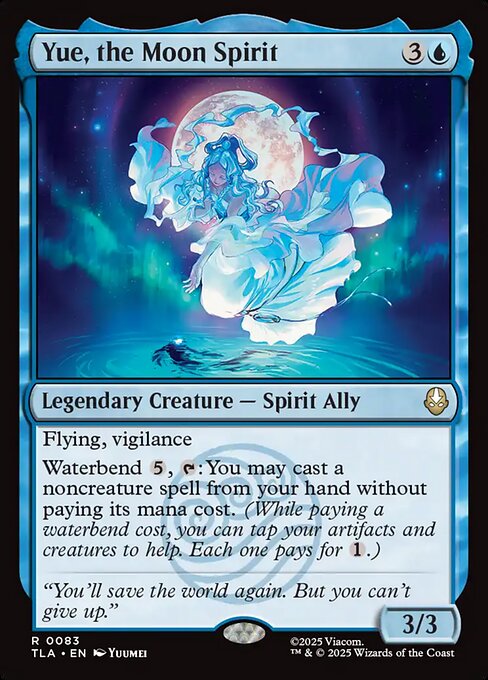
205. Yue, the Moon Spirit
Rating4.8WeakWhy this rating?
A solid playable that rarely gets cut (4.8/10).
Why. A four-mana 3/3 with flying and vigilance: a solid body that attacks and defends at once. Her Waterbend ability casts a noncreature spell from your hand for free, but that is a late-game luxury.
Risks. The ability costs five mana plus tapping Yue, which is heavy, and it needs a worthwhile noncreature spell in hand. Without that she is a decent flying 3/3, no more.
In the draft. A decent four-drop in blue: a flying 3/3 always has a place. Take her mid-pack, especially if you run several noncreature spells and enough creatures to help pay for Waterbend.
Results in the games of the set
When it is in hand, the deck wins 52.5% of its games (set average: 56.2%, 225th of 279 cards).
In the opening hand: 50.3% wins (55.4% on average).
Drawn during the game: 53.7% (56.8% on average).
When it is drawn, the deck wins 0.6 points more than when it is not.
When it is drafted, it is played 75% of the time (set average: 61%).
Taken as the first pick (63 drafts), it ends in the deck 78% of the time.
It is played about as much in every archetype.
206. Bender's Waterskin
Rating4.8WeakWhy this rating?
A solid playable that rarely gets cut (4.8/10).
Why. A three-mana artifact that taps for any colour and untaps during each other player's untap step, so you keep mana up for instants on their turn. It also helps pay for Waterbend.
Risks. It does nothing on the board, draws nothing, and costs your turn three. In a fast deck it is too slow, and the ramp is modest next to a real creature.
In the draft. A fixing tool for top-heavy or three-colour decks, or those that want an artifact to tap for Waterbend. A late pick, never above a good creature.
Results in the games of the set
When it is in hand, the deck wins 53.6% of its games (set average: 56.2%, 201st of 279 cards).
In the opening hand: 53.4% wins (55.4% on average).
Drawn during the game: 53.7% (56.8% on average).
When it is drawn, the deck wins 0.5 points more than when it is not.
When it is drafted, it is played 27% of the time (set average: 61%).
Taken among the first three picks (63 drafts), it ends in the deck 56% of the time.

207. Foggy Bottom Swamp
Rating4.7WeakWhy this rating?
A solid playable that rarely gets cut (4.7/10).
Why. A black-green dual that enters tapped, with a useful exit: for four mana you tap it, sacrifice it, and draw a card. It smooths your colours without being a dead card late in the game.
Risks. It enters tapped, which loses tempo, and the draw matters only late. Outside those two colours it is useless.
In the draft. Take it if you are black-green, without urgency; outside those colours, skip it. It stays a good playable, no more.
Results in the games of the set
When it is in hand, the deck wins 55.2% of its games (set average: 56.2%, 144th of 279 cards).
In the opening hand: 56.5% wins (55.4% on average).
Drawn during the game: 54.1% (56.8% on average).
When it is drawn, the deck wins 0.6 points more than when it is not.
When it is drafted, it is played 51% of the time (set average: 61%).
Taken among the first three picks (128 drafts), it ends in the deck 78% of the time.

208. Ruinous Waterbending
Rating4.6WeakWhy this rating?
A solid playable that rarely gets cut (4.6/10).
Why. A sorcery giving all creatures -2/-2 until end of turn: a sweeper against decks of small creatures or tokens. If you pay the Waterbend additional cost (four), you also gain 1 life whenever a creature dies this turn.
Risks. It hits your own creatures as well and does not kill big bodies. In a deck full of small creatures it hurts you more than your opponent.
In the draft. A card for a defensive or control black deck, good if your creatures have more than two toughness. Otherwise let it go; in blue-black it fits more easily.
Results in the games of the set
When it is in hand, the deck wins 51.2% of its games (set average: 56.2%, 254th of 279 cards).
In the opening hand: 48.9% wins (55.4% on average).
Drawn during the game: 52.6% (56.8% on average).
When it is drawn, the deck wins 0.2 points less than when it is not.
When it is drafted, it is played 16% of the time (set average: 61%).
Taken among the first three picks (38 drafts), it ends in the deck 63% of the time.

209. Airbender Ascension
Rating4.6WeakWhy this rating?
A solid playable that rarely gets cut (4.6/10).
Why. For two mana, Airbend exiles a target creature (tempo against an opposing creature, whose owner can recast it for two). Then the enchantment counts creatures entering under your control: from four counters on, each end step it exiles one of yours and returns it.
Risks. It does nothing concrete at first and needs a creature-heavy deck to fill its counter. Against an opponent who recasts for two, the effect is just a delay.
In the draft. A tempo tool more than a real priority. Take it in a white deck full of cheap creatures; otherwise it is a mid-pack playable.
Results in the games of the set
When it is in hand, the deck wins 53.0% of its games (set average: 56.2%, 212th of 279 cards).
In the opening hand: 52.6% wins (55.4% on average).
Drawn during the game: 53.3% (56.8% on average).
When it is drawn, the deck wins 1.3 points less than when it is not.
When it is drafted, it is played 80% of the time (set average: 61%).
Taken as the first pick (104 drafts), it ends in the deck 81% of the time.
It is played about as much in every archetype.

210. Avatar Enthusiasts
Rating4.6WeakWhy this rating?
A solid playable that rarely gets cut (4.6/10).
Why. A three-mana 2/2 that grows each time another Ally enters under your control. In a deck rich in Allies or Ally tokens it quickly becomes a respectable threat.
Risks. Without Allies it is a vanilla 2/2 for three, which is weak. It needs other Allies to come after it, so its place on the curve matters.
In the draft. A good card in a white deck built around Allies; elsewhere, a filler playable. Look for Ally creatures and tokens alongside it before taking it high.
Results in the games of the set
When it is in hand, the deck wins 54.4% of its games (set average: 56.2%, 169th of 279 cards).
In the opening hand: 55.8% wins (55.4% on average).
Drawn during the game: 53.4% (56.8% on average).
When it is drawn, the deck wins 2.0 points less than when it is not.
When it is drafted, it is played 77% of the time (set average: 61%).
Taken as the first pick (102 drafts), it ends in the deck 94% of the time.
It is played mostly in G/W decks (61% of them) and B/W (60%).
211. Boiling Rock Prison
Rating4.6WeakWhy this rating?
A solid playable that rarely gets cut (4.6/10).
Why. A black-red dual that enters tapped, with a useful exit: for four mana you tap it, sacrifice it, and draw a card. It smooths your colours without being a dead card late in the game.
Risks. It enters tapped, which costs tempo, and the draw is only relevant late. Outside those two colours it is useless.
In the draft. Take it if you are black-red, mid to late in a pack. Otherwise skip it; it is never more than a good playable.
Results in the games of the set
When it is in hand, the deck wins 54.4% of its games (set average: 56.2%, 173rd of 279 cards).
In the opening hand: 55.5% wins (55.4% on average).
Drawn during the game: 53.6% (56.8% on average).
When it is drawn, the deck wins 1.4 points more than when it is not.
When it is drafted, it is played 50% of the time (set average: 61%).
Taken among the first three picks (110 drafts), it ends in the deck 76% of the time.

212. Bumi, King of Three Trials
Rating4.6WeakWhy this rating?
A solid playable that rarely gets cut (4.6/10).
Why. A six-mana 4/4 whose enter trigger picks up to as many modes as Lessons in your graveyard: three +1/+1 counters on it, a target player scries 3, or Earthbend 3. With three Lessons it does everything.
Risks. It costs six, and with no Lessons in the graveyard it is an expensive vanilla 4/4. It relies on a deck full of Lessons cast before it.
In the draft. A green top-end for a Lesson deck. Without at least a few Lessons, do not play it; otherwise take it as a mid-pack finisher.
Results in the games of the set
When it is in hand, the deck wins 54.0% of its games (set average: 56.2%, 185th of 279 cards).
In the opening hand: 50.0% wins (55.4% on average).
Drawn during the game: 56.5% (56.8% on average).
When it is drawn, the deck wins 1.2 points more than when it is not.
When it is drafted, it is played 67% of the time (set average: 61%).
Taken as the first pick (97 drafts), it ends in the deck 85% of the time.
It is played mostly in G/R decks (30% of them) and G/U (30%).

213. Foggy Swamp Hunters
Rating4.6WeakWhy this rating?
A solid playable that rarely gets cut (4.6/10).
Why. A four-mana 3/4: a solid body that blocks well. As long as you have drawn two or more cards this turn, it has lifelink and menace, which makes it dangerous on offence.
Risks. The condition needs extra draws beyond your normal draw, so draw effects in your deck. Most of the time it is a 3/4 with no active ability.
In the draft. A decent four-mana playable, especially in blue-black where drawing is more common. Not a priority, but a useful body to round out the curve.
Results in the games of the set
When it is in hand, the deck wins 52.5% of its games (set average: 56.2%, 226th of 279 cards).
In the opening hand: 51.3% wins (55.4% on average).
Drawn during the game: 53.2% (56.8% on average).
When it is drawn, the deck wins 0.2 points more than when it is not.
When it is drafted, it is played only 10% of the time (set average: 61%): it almost always ends in the sideboard.

214. Platypus-Bear
Rating4.6WeakWhy this rating?
A solid playable that rarely gets cut (4.6/10).
Why. A two-mana 2/3 defender in green or blue that mills two cards when it enters. With a Lesson in your graveyard it can attack. It blocks well early and feeds a Lesson deck.
Risks. It has defender and attacks only with a Lesson in the graveyard; otherwise it has no offensive impact. Milling also shrinks your library, which is a risk in long games.
In the draft. A decent defensive two-drop in a Lesson or control deck. It has no place in an aggressive deck. Take it mid-pack if you are blue or green.
Results in the games of the set
When it is in hand, the deck wins 52.8% of its games (set average: 56.2%, 216th of 279 cards).
In the opening hand: 52.3% wins (55.4% on average).
Drawn during the game: 53.1% (56.8% on average).
When it is drawn, the deck wins 1.4 points less than when it is not.
When it is drafted, it is played 29% of the time (set average: 61%).
Taken among the first three picks (143 drafts), it ends in the deck 69% of the time.
It is played mostly in G/U decks (36% of them).

215. Sparring Dummy
Rating4.6WeakWhy this rating?
A solid playable that rarely gets cut (4.6/10).
Why. A two-mana 1/3 defender that blocks small creatures. Tapping it mills a card: if it is a land you may put it into your hand, and if it is a Lesson you gain 2 life.
Risks. It does not attack, and milling your own cards shrinks your library. The effect is slow and minor: it does not replace a real active creature.
In the draft. Filler for a green Lesson or control deck. Otherwise a late-pack card that helps you find land drops.
Results in the games of the set
When it is in hand, the deck wins 52.4% of its games (set average: 56.2%, 228th of 279 cards).
In the opening hand: 53.2% wins (55.4% on average).
Drawn during the game: 51.8% (56.8% on average).
When it is drawn, the deck wins 1.2 points less than when it is not.
When it is drafted, it is played 43% of the time (set average: 61%).
Taken as the first pick (35 drafts), it ends in the deck 74% of the time.
It is played about as much in every archetype.
 Rating4.6Weak
Why this rating?
A solid playable that rarely gets cut (4.6/10).
Why. For three mana you get two bodies: a 2/1 with haste and a 1/1 white Ally creature token. A good card for aggressive red or Ally decks, with value as soon as it lands.
Risks. Both bodies are small and die to any block or sweeper. On defence or against big creatures it loses its impact.
In the draft. A good common for white-red and Ally decks. Take it mid-pack if you are red; otherwise it is only a decent playable.
Results in the games of the set
When it is in hand, the deck wins 54.4% of its games (set average: 56.2%, 174th of 279 cards).
In the opening hand: 54.1% wins (55.4% on average).
Drawn during the game: 54.5% (56.8% on average).
When it is drawn, the deck wins 0.9 points less than when it is not.
When it is drafted, it is played 51% of the time (set average: 61%).
Taken as the first pick (46 drafts), it ends in the deck 85% of the time.
It is played mostly in R/W decks (58% of them) and G/R (39%).
217. Rumble Arena
Rating4.6WeakWhy this rating?
A solid playable that rarely gets cut (4.6/10).
Why. A land that enters untapped with a scry 1, and taps for colourless, or any colour by paying one extra mana. The scry improves your draws, and it helps a multicolour deck.
Risks. It mostly makes colourless: getting a colour costs a mana, so it is no substitute for a real basic or dual. In a deck hungry for coloured mana it hurts.
In the draft. A good utility land, useful in almost any two- or three-colour deck. Take it fairly late, when you have no more important playable.
Results in the games of the set
When it is in hand, the deck wins 56.4% of its games (set average: 56.2%, 106th of 279 cards).
In the opening hand: 55.9% wins (55.4% on average).
Drawn during the game: 56.9% (56.8% on average).
When it is drawn, the deck wins 1.5 points more than when it is not.
When it is drafted, it is played 72% of the time (set average: 61%).
Taken as the first pick (34 drafts), it ends in the deck 94% of the time.

218. Meditation Pools
Rating4.5WeakWhy this rating?
A solid playable that rarely gets cut (4.5/10).
Why. A green-blue dual that enters tapped, with a useful exit: for four mana you tap it, sacrifice it, and draw a card. It smooths your colours without being a dead card late in the game.
Risks. It enters tapped, which costs tempo, and the draw only matters late. Outside those two colours it is useless.
In the draft. Take it if you are green-blue; otherwise pass. At best a good late-pack playable.
Results in the games of the set
When it is in hand, the deck wins 55.1% of its games (set average: 56.2%, 149th of 279 cards).
In the opening hand: 56.1% wins (55.4% on average).
Drawn during the game: 54.4% (56.8% on average).
When it is drawn, the deck wins 0.8 points more than when it is not.
When it is drafted, it is played 68% of the time (set average: 61%).
Taken as the first pick (52 drafts), it ends in the deck 96% of the time.
 Rating4.4Weak
Why this rating?
A good playable, but is sometimes cut (4.4/10).
Why. A two-mana 2/2 that returns from your graveyard to your hand for three mana. It supplies a steady flow of bodies to chump, block, or sacrifice, useful in a black long-game value deck.
Risks. It is a 2/2 with no on-board ability, and the recursion cost slows your development. In a fast race it is too passive to matter.
In the draft. Decent filler in black, especially with sacrifice or value effects. Take it mid-pack for a two-drop that is never truly lost.
Results in the games of the set
When it is in hand, the deck wins 54.6% of its games (set average: 56.2%, 167th of 279 cards).
In the opening hand: 54.7% wins (55.4% on average).
Drawn during the game: 54.6% (56.8% on average).
When it is drawn, the deck wins 0.1 points less than when it is not.
When it is drafted, it is played 55% of the time (set average: 61%).
Taken as the first pick (44 drafts), it ends in the deck 93% of the time.
It is played mostly in B/W decks (58% of them) and B/G (53%).
 Rating4.4Weak
Why this rating?
A good playable, but is sometimes cut (4.4/10).
Why. A two-mana sorcery with a choice: the opponent reveals their hand and discards a nonland permanent card of your pick, or Earthbend 2 for a land creature. It is a Lesson.
Risks. Neither mode kills a threat on the board, and the first is poor against an opponent who has already emptied their hand. The gain is modest.
In the draft. A flexible black playable, especially with Lessons or other Earthbend effects. Take it toward the end of the pack as useful filler.
Results in the games of the set
When it is in hand, the deck wins 52.8% of its games (set average: 56.2%, 215th of 279 cards).
In the opening hand: 52.3% wins (55.4% on average).
Drawn during the game: 53.1% (56.8% on average).
When it is drawn, the deck wins 0.3 points more than when it is not.
When it is drafted, it is played 20% of the time (set average: 61%).
Taken among the first three picks (53 drafts), it ends in the deck 66% of the time.
 Rating4.4Weak
Why this rating?
A good playable, but is sometimes cut (4.4/10).
Why. A five-mana sorcery that copies one of your creatures as a 4/4 token, or an opposing creature as a 2/2 token for you. At best you double your best creature or take the ability of an opponent's.
Risks. It is expensive and does nothing without a good target. Copying an opposing creature as a 2/2 overrides its original stats, so sometimes you get a small body for five mana.
In the draft. A blue tool when you have good creatures to copy. Not a priority: take it late if you already have creatures with enter effects.
Results in the games of the set
When it is in hand, the deck wins 52.1% of its games (set average: 56.2%, 236th of 279 cards).
In the opening hand: 48.7% wins (55.4% on average).
Drawn during the game: 54.0% (56.8% on average).
When it is drawn, the deck wins 0.2 points less than when it is not.
When it is drafted, it is played 23% of the time (set average: 61%).
Taken among the first three picks (72 drafts), it ends in the deck 64% of the time.
 Rating4.4Weak
Why this rating?
A good playable, but is sometimes cut (4.4/10).
Why. A two-mana 2/1, white or black, that leaves a 1/1 white Ally creature token when it dies. Its hybrid cost can be paid with white or black, so it is easy to cast. A good two-drop for Ally decks.
Risks. It stays small: a 2/1 that barely trades with an average creature. Against big creatures it stops nothing.
In the draft. Good filler for white or black. Take it mid-pack to secure your curve and feed an Ally deck.
Results in the games of the set
When it is in hand, the deck wins 55.3% of its games (set average: 56.2%, 140th of 279 cards).
In the opening hand: 56.1% wins (55.4% on average).
Drawn during the game: 54.7% (56.8% on average).
When it is drawn, the deck wins 1.0 points less than when it is not.
When it is drafted, it is played 83% of the time (set average: 61%).
Taken as the first pick (167 drafts), it ends in the deck 91% of the time.
It is played mostly in B/W decks (71% of them) and G/W (40%).
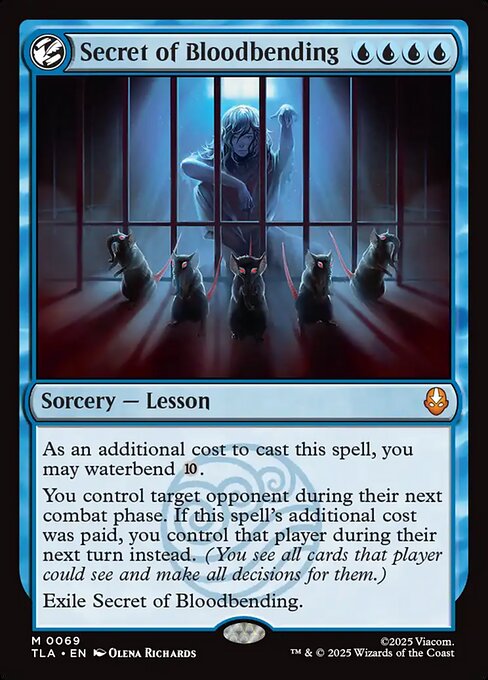 Rating4.4Weak
Why this rating?
A good playable, but is sometimes cut (4.4/10).
Why. A sorcery that needs four blue mana to control your opponent during their next combat phase, or, with Waterbend 10 as an additional cost, their whole next turn. It is a Lesson, but mostly a curiosity: it exiles itself afterwards.
Risks. It demands four blue mana up front and does nothing lasting: a one-shot effect that is hard to turn into a win. A two-colour blue deck struggles to cast it on time.
In the draft. A fun card to let pass. Only play it in a nearly mono-blue deck that wants a spectacular effect, never as a priority pick.
Results in the games of the set
When it is in hand, the deck wins 48.1% of its games (set average: 56.2%, 272nd of 279 cards).
In the opening hand: 0.0% wins (55.4% on average).
Drawn during the game: 51.4% (56.8% on average).
When it is drawn, the deck wins 0.7 points less than when it is not.
When it is drafted, it is played only 12% of the time (set average: 61%): it almost always ends in the sideboard.
Taken among the first three picks (35 drafts), it ends in the deck 37% of the time.

224. Serpent of the Pass
Rating4.4WeakWhy this rating?
A good playable, but is sometimes cut (4.4/10).
Why. A seven-mana 6/5 that costs one less for each noncreature, nonland card in your graveyard. With three Lessons in the graveyard you may cast it as though it had flash. In a spell-heavy deck it arrives early and weighs on the game.
Risks. Without a graveyard full of spells it costs seven, which is far too slow. It depends on a deck of spells, not creatures.
In the draft. A good top-end card for a spell-heavy deck. Take it mid-pack only if you play enough noncreature cards.
Results in the games of the set
When it is in hand, the deck wins 53.4% of its games (set average: 56.2%, 203rd of 279 cards).
In the opening hand: 49.1% wins (55.4% on average).
Drawn during the game: 55.7% (56.8% on average).
When it is drawn, the deck wins 0.7 points more than when it is not.
When it is drafted, it is played 67% of the time (set average: 61%).
Taken as the first pick (70 drafts), it ends in the deck 77% of the time.
It is played mostly in R/U decks (27% of them).

225. Uncle Iroh
Rating4.4WeakWhy this rating?
A good playable, but is sometimes cut (4.4/10).
Why. A three-mana 4/2, red or green, with Firebending 1: it adds red mana when it attacks. Lesson spells you cast cost one less: in a Lesson deck it is a good offensive card.
Risks. Two toughness makes it fragile against any block or removal. Without Lessons it has only its size and Firebending.
In the draft. A good three-drop for red-green or a Lesson deck. Take it mid-pack; without Lessons it is a decent attacker, no more.
Results in the games of the set
When it is in hand, the deck wins 52.7% of its games (set average: 56.2%, 219th of 279 cards).
In the opening hand: 52.4% wins (55.4% on average).
Drawn during the game: 52.9% (56.8% on average).
When it is drawn, the deck wins 0.4 points less than when it is not.
When it is drafted, it is played 61% of the time (set average: 61%).
Taken as the first pick (54 drafts), it ends in the deck 81% of the time.
It is played mostly in G/R decks (28% of them).

226. Walltop Sentries
Rating4.4WeakWhy this rating?
A good playable, but is sometimes cut (4.4/10).
Why. A three-mana 2/3 with reach and deathtouch: a great wall that stops nearly any creature, ground or air. If it dies with a Lesson in your graveyard, you gain 2 life.
Risks. It is defensive and does not win games alone. Three toughness leaves it open to removal, and it does not push your offence.
In the draft. A good defensive common in green. Take it mid-pack, especially in a control deck or one that wants to hold the board while it builds its threats.
Results in the games of the set
When it is in hand, the deck wins 55.1% of its games (set average: 56.2%, 150th of 279 cards).
In the opening hand: 54.3% wins (55.4% on average).
Drawn during the game: 55.7% (56.8% on average).
When it is drawn, the deck wins 0.4 points more than when it is not.
When it is drafted, it is played 70% of the time (set average: 61%).
Taken as the first pick (67 drafts), it ends in the deck 90% of the time.
It is played mostly in G/W decks (52% of them) and G/U (49%).

227. Zuko's Conviction
Rating4.4WeakWhy this rating?
A good playable, but is sometimes cut (4.4/10).
Why. A one-mana black instant that returns a creature card from your graveyard to your hand. Kicked, for five mana in total, it puts that creature straight onto the battlefield tapped. A way to claw back value.
Risks. Without a good creature in the graveyard it does nothing. It is neither removal nor a threat and relies on having already lost something useful.
In the draft. A value playable in black, with creatures that have enter effects. Take it late, after your removal and best creatures.
Results in the games of the set
When it is in hand, the deck wins 52.3% of its games (set average: 56.2%, 231st of 279 cards).
In the opening hand: 47.9% wins (55.4% on average).
Drawn during the game: 55.1% (56.8% on average).
When it is drawn, the deck wins 1.3 points less than when it is not.
When it is drafted, it is played 49% of the time (set average: 61%).
Taken among the first three picks (150 drafts), it ends in the deck 79% of the time.
It is played about as much in every archetype.

228. Zuko, Conflicted
Rating4.4WeakWhy this rating?
A good playable, but is sometimes cut (4.4/10).
Why. A two-mana 2/3 that, at the beginning of your first main phase, makes you choose a mode not yet chosen and lose 2 life: draw, a +1/+1 counter, red mana, or give Zuko to the opponent. Useful if you take the lead fast.
Risks. Each choice costs 2 life, and the last mode hands Zuko to the opponent, which you eventually get forced into. Against an aggressive deck the lost life quickly becomes dangerous.
In the draft. Only for an aggressive black-red deck that takes over before paying too much life. Otherwise let it pass: it is a risk, not safe value.
Results in the games of the set
When it is in hand, the deck wins 49.8% of its games (set average: 56.2%, 268th of 279 cards).
In the opening hand: 49.9% wins (55.4% on average).
Drawn during the game: 49.7% (56.8% on average).
When it is drawn, the deck wins 0.7 points less than when it is not.
When it is drafted, it is played 25% of the time (set average: 61%).
Taken among the first three picks (56 drafts), it ends in the deck 70% of the time.

229. Omashu City
Rating4.3WeakWhy this rating?
A good playable, but is sometimes cut (4.3/10).
Why. A red-green dual that enters tapped, with a useful exit: for four mana you tap it, sacrifice it, and draw a card. It smooths your colours without being a dead card late in the game.
Risks. It enters tapped, which costs tempo, and the draw only matters late. Outside those two colours it is useless.
In the draft. Take it if you are red-green; otherwise pass. A late-pack land, never a priority.
Results in the games of the set
When it is in hand, the deck wins 55.0% of its games (set average: 56.2%, 153rd of 279 cards).
In the opening hand: 56.3% wins (55.4% on average).
Drawn during the game: 54.1% (56.8% on average).
When it is drawn, the deck wins 0.7 points more than when it is not.
When it is drafted, it is played 67% of the time (set average: 61%).
Taken as the first pick (44 drafts), it ends in the deck 86% of the time.
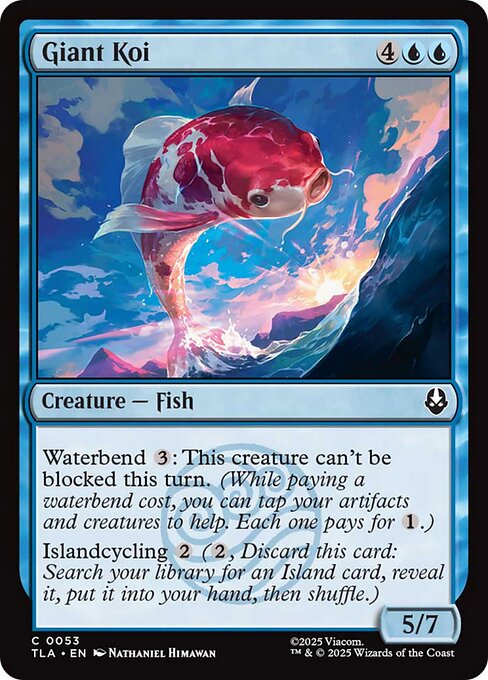
230. Giant Koi
Rating4.2WeakWhy this rating?
A good playable, but is sometimes cut (4.2/10).
Why. A six-mana 5/7: a huge body that dominates the ground. With Waterbend 3 it cannot be blocked that turn. Islandcycling 2 makes it playable early by trading it in for an Island.
Risks. It costs six with two blue mana, so it arrives late. It has no flying or trample, and removal handles it easily.
In the draft. A good top-end common for blue, flexible thanks to its Islandcycling. Take it mid-pack for a finisher that is never dead in hand.
Results in the games of the set
When it is in hand, the deck wins 53.7% of its games (set average: 56.2%, 199th of 279 cards).
In the opening hand: 50.9% wins (55.4% on average).
Drawn during the game: 55.4% (56.8% on average).
When it is drawn, the deck wins 0.3 points more than when it is not.
When it is drafted, it is played 41% of the time (set average: 61%).
Taken among the first three picks (113 drafts), it ends in the deck 72% of the time.
It is played mostly in B/U decks (37% of them) and U/W (30%).
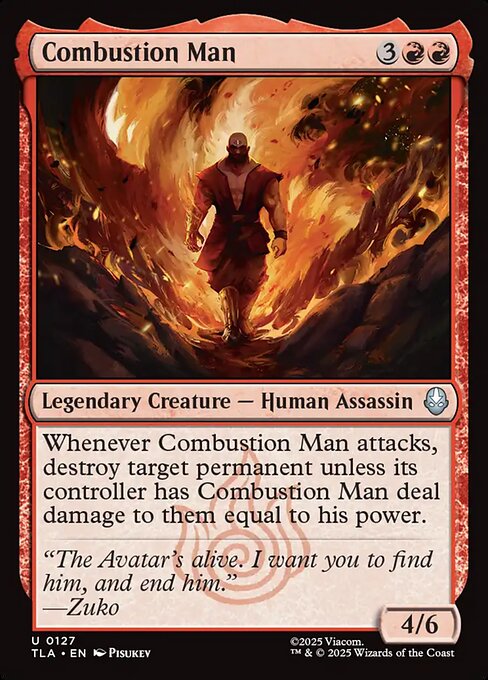
231. Combustion Man
Rating4.2WeakWhy this rating?
A good playable, but is sometimes cut (4.2/10).
Why. A five-mana 4/6 that, whenever it attacks, destroys a target permanent unless its controller has it deal damage to them equal to its power. Big body, and every attack forces a painful choice.
Risks. It costs five with two red mana, and the opponent can simply take the damage to save their permanent. Removal neutralises it.
In the draft. A good red top-end, especially against a low-life opponent. Take it mid-pack; it makes a good finisher in a heavily red deck.
Results in the games of the set
When it is in hand, the deck wins 52.7% of its games (set average: 56.2%, 221st of 279 cards).
In the opening hand: 51.2% wins (55.4% on average).
Drawn during the game: 53.7% (56.8% on average).
When it is drawn, the deck wins 0.6 points more than when it is not.
When it is drafted, it is played 56% of the time (set average: 61%).
Taken as the first pick (40 drafts), it ends in the deck 75% of the time.
It is played about as much in every archetype.
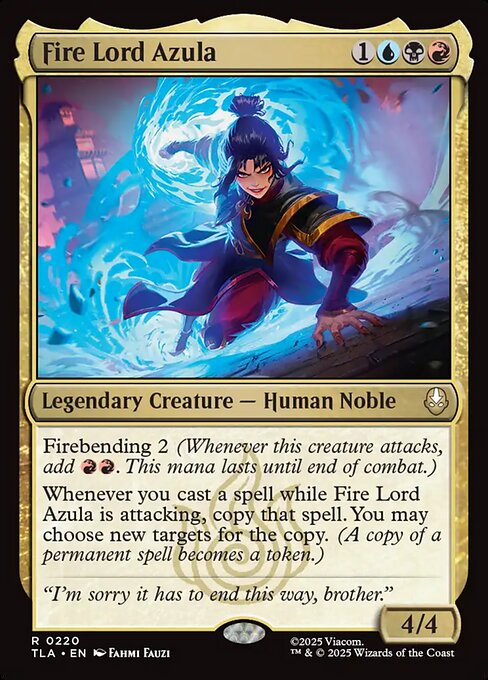
232. Fire Lord Azula
Rating4.2WeakWhy this rating?
A good playable, but is sometimes cut (4.2/10).
Why. A four-mana 4/4 with Firebending 2. When you cast a spell while she is attacking, it gets copied: only instants and flash spells qualify, but her red mana makes them easy to pay for.
Risks. She needs three colours, blue, black, and red, making her hard to cast. She must survive and attack, and without spells to copy she is a three-colour 4/4.
In the draft. Only if you are already blue-black-red with a good mana base. Do not force her: a late-pack pick for a specialised deck.
Results in the games of the set
When it is in hand, the deck wins 50.7% of its games (set average: 56.2%, 262nd of 279 cards).
In the opening hand: 49.8% wins (55.4% on average).
Drawn during the game: 51.2% (56.8% on average).
When it is drawn, the deck wins 1.5 points more than when it is not.
When it is drafted, it is played 46% of the time (set average: 61%).
Taken as the first pick (46 drafts), it ends in the deck 74% of the time.
It is played about as much in every archetype.

233. Hei Bai, Spirit of Balance
Rating4.2WeakWhy this rating?
A good playable, but is sometimes cut (4.2/10).
Why. A four-mana 3/3, white or black, that can sacrifice another creature or artifact on entering or attacking to gain two +1/+1 counters. When it leaves the battlefield, it puts its counters on a creature of yours.
Risks. Each sacrifice costs a creature or artifact, so it costs you cards. Without fodder it is a decent 3/3 for four.
In the draft. A good playable for a white-black deck with Ally tokens or sacrifice fodder. Take it mid-pack; it grows fast when the board clogs.
Results in the games of the set
When it is in hand, the deck wins 53.5% of its games (set average: 56.2%, 202nd of 279 cards).
In the opening hand: 52.5% wins (55.4% on average).
Drawn during the game: 54.1% (56.8% on average).
When it is drawn, the deck wins 0.2 points less than when it is not.
When it is drafted, it is played 74% of the time (set average: 61%).
Taken as the first pick (84 drafts), it ends in the deck 83% of the time.
It is played mostly in B/W decks (43% of them).

234. How to Start a Riot
Rating4.2WeakWhy this rating?
A good playable, but is sometimes cut (4.2/10).
Why. A three-mana instant that gives one creature menace and +2/+0 to all creatures of a target player. On offence, a single big turn can finish the game or break through blockers. It is a Lesson.
Risks. It is a one-turn combat effect with no lasting value: if the opponent has removal in response, you lose the card. Without a wide board it does nothing.
In the draft. A decent trick for a white-red creature and Ally deck. Take it fairly late, after your creatures and removal.
Results in the games of the set
When it is in hand, the deck wins 52.2% of its games (set average: 56.2%, 232nd of 279 cards).
In the opening hand: 49.9% wins (55.4% on average).
Drawn during the game: 53.8% (56.8% on average).
When it is drawn, the deck wins 2.6 points less than when it is not.
When it is drafted, it is played 31% of the time (set average: 61%).
Taken among the first three picks (104 drafts), it ends in the deck 76% of the time.
It is played mostly in R/W decks (39% of them) and R/U (36%).

235. Iguana Parrot
Rating4.2WeakWhy this rating?
A good playable, but is sometimes cut (4.2/10).
Why. A 2/2 flier with vigilance for three mana that can attack and still stay back on defence. Prowess gives it a small boost when you cast a noncreature spell, enough to win an air fight now and then.
Risks. Low raw power: any removal or a slightly bigger flier handles it. Without enough noncreature spells, prowess is a footnote.
In the draft. A fine playable for a blue deck, nothing more. Take it mid-pack to fill your curve with fliers, especially in a spell-heavy build.
Results in the games of the set
When it is in hand, the deck wins 54.1% of its games (set average: 56.2%, 180th of 279 cards).
In the opening hand: 53.1% wins (55.4% on average).
Drawn during the game: 54.7% (56.8% on average).
When it is drawn, the deck wins 1.0 points more than when it is not.
When it is drafted, it is played 49% of the time (set average: 61%).
Taken as the first pick (30 drafts), it ends in the deck 70% of the time.
It is played mostly in U/W decks (59% of them) and R/U (29%).

236. Kyoshi Village
Rating4.2WeakWhy this rating?
A good playable, but is sometimes cut (4.2/10).
Why. A green-white dual land that enters tapped, with a late-game escape hatch: pay four mana, sacrifice it and draw a card. It fixes your colours and keeps you from flooding out.
Risks. It enters tapped, which costs tempo in an aggressive deck. The draw mode costs four mana and the land itself.
In the draft. Take it if you are green-white or close, after your real playables. A solid late pick to smooth out your mana.
Results in the games of the set
When it is in hand, the deck wins 54.8% of its games (set average: 56.2%, 159th of 279 cards).
In the opening hand: 56.7% wins (55.4% on average).
Drawn during the game: 53.3% (56.8% on average).
When it is drawn, the deck wins 0.3 points less than when it is not.
When it is drafted, it is played 69% of the time (set average: 61%).
Taken as the first pick (38 drafts), it ends in the deck 84% of the time.

237. Price of Freedom
Rating4.2WeakWhy this rating?
A good playable, but is sometimes cut (4.2/10).
Why. A two-mana sorcery that destroys an opponent's artifact or land and draws you a card. The opponent may fetch a tapped basic land in return, so it is mostly a cantrip with a narrow upside against the right artifact.
Risks. Very situational: most of the time there is nothing worth destroying. Aimed at a land, it practically gives your opponent fixing.
In the draft. Close to sideboard material in game one. Only play it if you have seen important artifacts across the table; otherwise let it go.
Results in the games of the set
When it is in hand, the deck wins 48.6% of its games (set average: 56.2%, 271st of 279 cards).
In the opening hand: 46.5% wins (55.4% on average).
Drawn during the game: 50.0% (56.8% on average).
When it is drawn, the deck wins 3.0 points less than when it is not.
When it is drafted, it is played only 7% of the time (set average: 61%): it almost always ends in the sideboard.
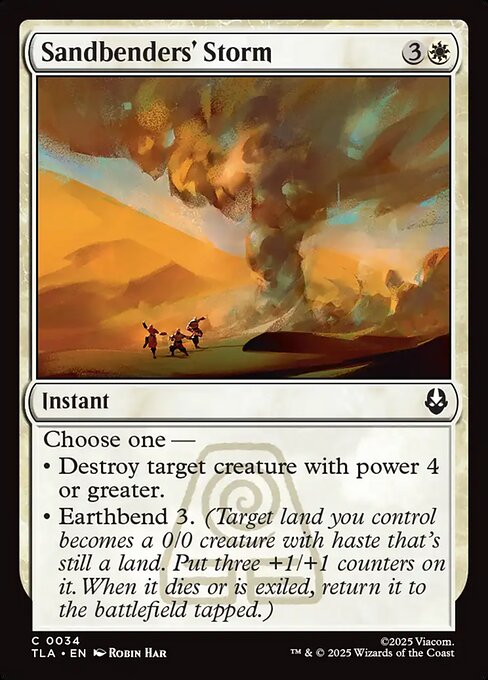
238. Sandbenders' Storm
Rating4.2WeakWhy this rating?
A good playable, but is sometimes cut (4.2/10).
Why. A flexible four-mana instant: destroy a creature with power 4 or greater, or Earthbend 3 for a hasty land creature. It adapts to whatever your opponent is doing.
Risks. The removal mode only hits big creatures, and the Earthbend mode is just a body, not real removal. Four mana is a lot for a middling effect.
In the draft. A fair playable in a white deck. Take it after your unconditional removal, as a second or third piece of interaction.
Results in the games of the set
When it is in hand, the deck wins 52.6% of its games (set average: 56.2%, 222nd of 279 cards).
In the opening hand: 50.3% wins (55.4% on average).
Drawn during the game: 54.2% (56.8% on average).
When it is drawn, the deck wins 2.2 points less than when it is not.
When it is drafted, it is played 31% of the time (set average: 61%).
Taken among the first three picks (78 drafts), it ends in the deck 79% of the time.
It is played mostly in G/W decks (25% of them).

239. Sun-Blessed Peak
Rating4.2WeakWhy this rating?
A good playable, but is sometimes cut (4.2/10).
Why. A red-white dual land that enters tapped, with the same late-game option as its siblings: pay four mana, sacrifice it and draw a card. It smooths a two-colour mana base.
Risks. It enters tapped and does nothing else early. In a very fast deck that lost tempo hurts.
In the draft. Take it if you are red-white, but after your real playables. A good late pick to improve your mana.
Results in the games of the set
When it is in hand, the deck wins 54.2% of its games (set average: 56.2%, 179th of 279 cards).
In the opening hand: 56.0% wins (55.4% on average).
Drawn during the game: 52.8% (56.8% on average).
When it is drawn, the deck wins 0.7 points less than when it is not.
When it is drafted, it is played 62% of the time (set average: 61%).
Taken as the first pick (32 drafts), it ends in the deck 78% of the time.

240. Jeong Jeong, the Deserter
Rating4.1WeakWhy this rating?
A good playable, but is sometimes cut (4.1/10).
Why. A 2/3 for three with Firebending 1: it adds a red mana when it attacks, lasting through combat. Its Exhaust ability puts a +1/+1 counter on it for three mana, once, and copies the next Lesson you cast this turn.
Risks. The payoff is modest: one counter, once, for three mana. The Lesson copy only matters if you actually play Lessons.
In the draft. A curve filler in red, better with a few Lessons. Without them it is a fair body, no more. Take it mid-pack.
Results in the games of the set
When it is in hand, the deck wins 52.4% of its games (set average: 56.2%, 230th of 279 cards).
In the opening hand: 52.2% wins (55.4% on average).
Drawn during the game: 52.5% (56.8% on average).
When it is drawn, the deck wins 1.8 points less than when it is not.
When it is drafted, it is played 74% of the time (set average: 61%).
Taken as the first pick (84 drafts), it ends in the deck 86% of the time.
It is played mostly in R/U decks (26% of them).
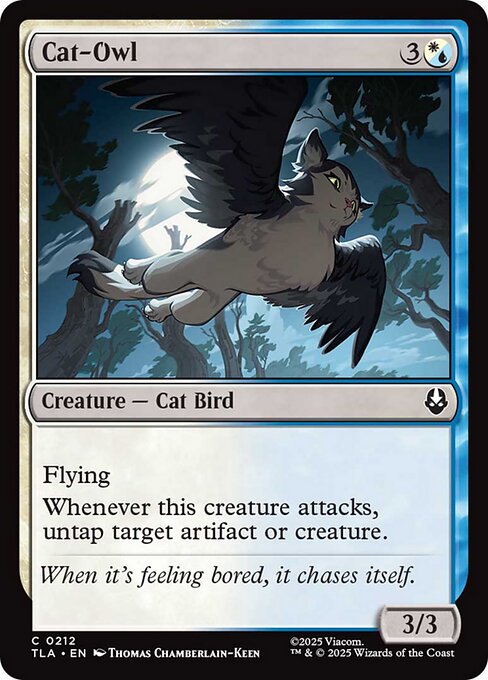
241. Cat-Owl
Rating4.1WeakWhy this rating?
A good playable, but is sometimes cut (4.1/10).
Why. A 3/3 flier for four mana, playable in either white or blue thanks to the hybrid cost. When it attacks it untaps an artifact or creature, itself included, so it can swing in the air and still be back on defence.
Risks. A 3/3 dies to ordinary removal, and for four mana it is not much more than a flying body. The untap only matters if you have something useful to untap.
In the draft. A solid, flexible flier for blue or white. Take it as a good filler, earlier if you are short on fliers.
Results in the games of the set
When it is in hand, the deck wins 53.2% of its games (set average: 56.2%, 205th of 279 cards).
In the opening hand: 51.7% wins (55.4% on average).
Drawn during the game: 54.2% (56.8% on average).
When it is drawn, the deck wins 0.8 points less than when it is not.
When it is drafted, it is played 33% of the time (set average: 61%).
Taken among the first three picks (104 drafts), it ends in the deck 63% of the time.
It is played mostly in U/W decks (53% of them).
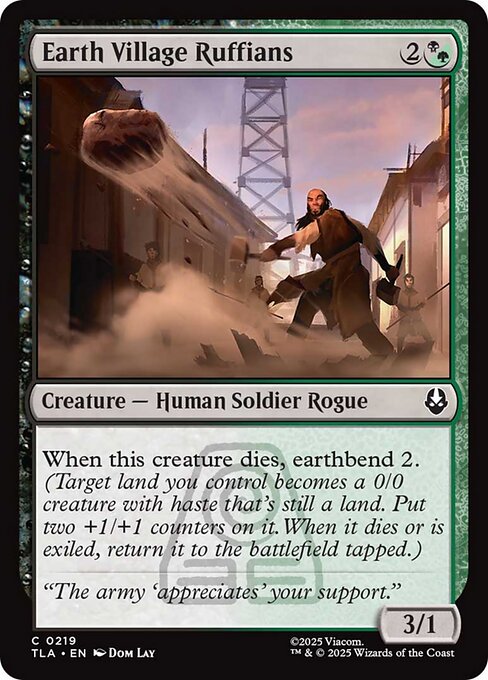 Rating4.0Weak
Why this rating?
A good playable, but is sometimes cut (4.0/10).
Why. A 3/1 for three in black or green that leaves behind a hasty land creature through Earthbend 2 when it dies. It trades happily with a pricier creature and still leaves a body.
Risks. One toughness means it dies to nearly anything. The land it animates also puts your mana at risk if it gets killed later.
In the draft. A modest two-for-one for aggressive black or green decks. Take it mid-pack to fill the curve.
Results in the games of the set
When it is in hand, the deck wins 53.8% of its games (set average: 56.2%, 194th of 279 cards).
In the opening hand: 53.1% wins (55.4% on average).
Drawn during the game: 54.2% (56.8% on average).
When it is drawn, the deck wins 0.8 points less than when it is not.
When it is drafted, it is played 43% of the time (set average: 61%).
Taken as the first pick (37 drafts), it ends in the deck 78% of the time.
It is played mostly in B/G decks (50% of them).

243. Honest Work
Rating4.0WeakWhy this rating?
A good playable, but is sometimes cut (4.0/10).
Why. For a single blue mana you tap an opposing creature, strip its counters and abilities, and turn it into a 1/1 that taps for colourless mana. It is cheap removal, even against a strong threat.
Risks. The opponent keeps a 1/1 that can chump block and tap for colourless mana, and the creature untaps normally afterwards. If it leaves the battlefield, you lose the Aura.
In the draft. Decent removal in blue, especially against a single big threat. Take it higher if the format is full of creatures with abilities.
Results in the games of the set
When it is in hand, the deck wins 50.8% of its games (set average: 56.2%, 261st of 279 cards).
In the opening hand: 47.0% wins (55.4% on average).
Drawn during the game: 53.1% (56.8% on average).
When it is drawn, the deck wins 0.7 points more than when it is not.
When it is drafted, it is played 21% of the time (set average: 61%).
Taken among the first three picks (42 drafts), it ends in the deck 76% of the time.
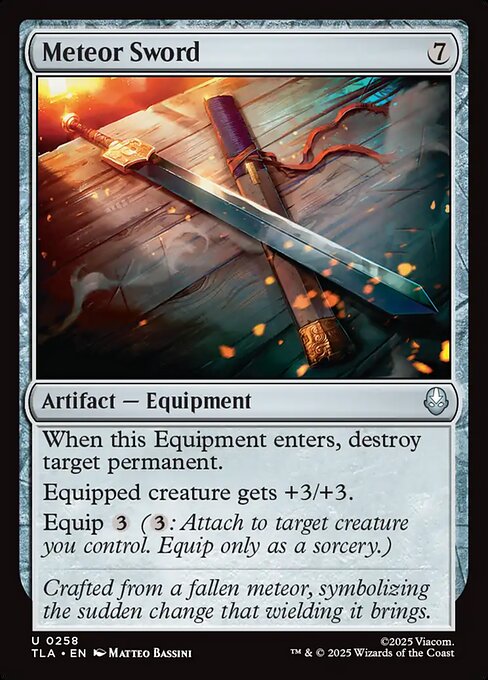
244. Meteor Sword
Rating4.0WeakWhy this rating?
A good playable, but is sometimes cut (4.0/10).
Why. A colourless seven-mana artifact that destroys any permanent when it enters, then gives +3/+3 for an equip cost of three. It fits in any deck and answers almost any problem.
Risks. Seven mana is a lot: it takes your whole turn and you have to survive until then. The removal arrives late and the equip is not cheap.
In the draft. A top-end one-of for slower decks. Do not take it early: the real question is whether you can survive until seven mana.
Results in the games of the set
When it is in hand, the deck wins 51.5% of its games (set average: 56.2%, 247th of 279 cards).
In the opening hand: 46.9% wins (55.4% on average).
Drawn during the game: 54.5% (56.8% on average).
When it is drawn, the deck wins 2.2 points less than when it is not.
When it is drafted, it is played 32% of the time (set average: 61%).
Taken among the first three picks (51 drafts), it ends in the deck 73% of the time.

245. Northern Air Temple
Rating4.0WeakWhy this rating?
A good playable, but is sometimes cut (4.0/10).
Why. A one-mana black Shrine that drains for the number of Shrines you control, itself included, then again for each other Shrine that arrives. In a deck full of Shrines it becomes a steady source of drain.
Risks. On its own it does almost nothing: one point of drain for a mana and no board presence. It depends heavily on other Shrines.
In the draft. Only if you already have several Shrines. Otherwise let it go: it does not improve a normal deck.
Results in the games of the set
When it is in hand, the deck wins 52.0% of its games (set average: 56.2%, 240th of 279 cards).
In the opening hand: 46.0% wins (55.4% on average).
Drawn during the game: 55.5% (56.8% on average).
When it is drawn, the deck wins 8.4 points more than when it is not.
When it is drafted, it is played 19% of the time (set average: 61%).
Taken among the first three picks (69 drafts), it ends in the deck 64% of the time.

246. Trusty Boomerang
Rating4.0WeakWhy this rating?
A good playable, but is sometimes cut (4.0/10).
Why. A one-mana Equipment that you equip for one and that lets the creature tap an opposing creature, after which the Boomerang returns to your hand. It can neutralise an attacker or blocker each turn for almost nothing.
Risks. Every use costs a mana, taps your creature, and then you have to recast and re-equip. The tempo cost adds up and the effect is slow.
In the draft. Very marginal: take it only late in a pack, for a controlling deck short on playables.
Results in the games of the set
When it is in hand, the deck wins 45.3% of its games (set average: 56.2%, 278th of 279 cards).
In the opening hand: 42.1% wins (55.4% on average).
Drawn during the game: 47.4% (56.8% on average).
When it is drawn, the deck wins 7.9 points less than when it is not.
When it is drafted, it is played only 2% of the time (set average: 61%): it almost always ends in the sideboard.
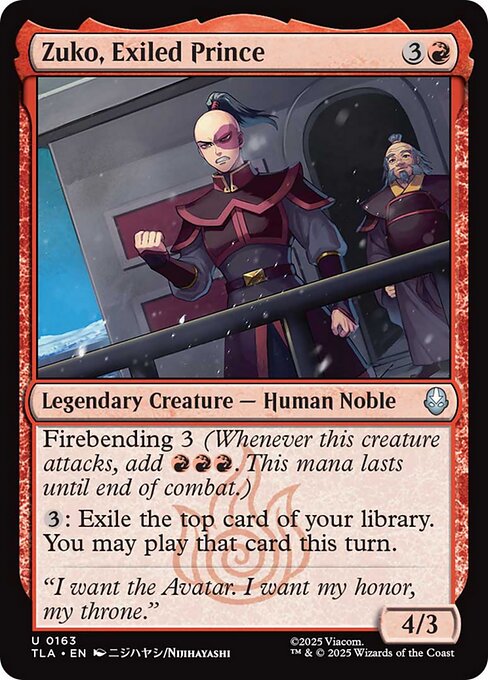
247. Zuko, Exiled Prince
Rating4.0WeakWhy this rating?
A good playable, but is sometimes cut (4.0/10).
Why. A 4/3 for four with Firebending 3: when it attacks it adds three red mana for the combat. For three mana it also exiles the top card of your library, which you may play this turn, a slow source of card advantage.
Risks. To use the Firebending mana you need spells to cast during combat. A 4/3 without evasion often gets blocked or killed before it attacks.
In the draft. A playable red card, stronger with instants. Take it mid-pack rather than spending a high pick.
Results in the games of the set
When it is in hand, the deck wins 53.0% of its games (set average: 56.2%, 213th of 279 cards).
In the opening hand: 52.1% wins (55.4% on average).
Drawn during the game: 53.6% (56.8% on average).
When it is drawn, the deck wins 1.1 points less than when it is not.
When it is drafted, it is played 71% of the time (set average: 61%).
Taken as the first pick (73 drafts), it ends in the deck 93% of the time.
It is played mostly in B/R decks (31% of them) and G/R (27%).

248. Swampsnare Trap
Rating4.0WeakWhy this rating?
A good playable, but is sometimes cut (4.0/10).
Why. A three-mana removal Aura that gives -5/-3 and costs one less against a flier. It kills most small fliers and shrinks the power of big creatures to almost nothing.
Risks. Like any Aura, it does not always kill: a large toughness survives, and the opponent can sacrifice the creature or return it to hand to get out. It also stays on the battlefield.
In the draft. A reliable common removal in black. Take it above filler creatures, but after unconditional removal.
Results in the games of the set
When it is in hand, the deck wins 54.4% of its games (set average: 56.2%, 170th of 279 cards).
In the opening hand: 51.8% wins (55.4% on average).
Drawn during the game: 56.1% (56.8% on average).
When it is drawn, the deck wins 0.9 points more than when it is not.
When it is drafted, it is played 66% of the time (set average: 61%).
Taken as the first pick (106 drafts), it ends in the deck 86% of the time.
It is played mostly in B/U decks (58% of them) and B/G (50%).

249. Redirect Lightning
Rating3.9WeakWhy this rating?
A good playable, but is sometimes cut (3.9/10).
Why. A one-mana red instant that changes the target of a spell or ability with a single target, at the price of five life or two extra mana. A fun trick against opposing removal or targeted spells.
Risks. Very situational: a spell or ability with a single target has to be on the stack, and there has to be a useful new target. The life or mana cost is real.
In the draft. A specialist card, not a first pick. Play it only in a controlling deck that knows how to use it; otherwise let it go.
Results in the games of the set
When it is in hand, the deck wins 50.5% of its games (set average: 56.2%, 264th of 279 cards).
In the opening hand: 48.4% wins (55.4% on average).
Drawn during the game: 51.9% (56.8% on average).
When it is drawn, the deck wins 1.5 points less than when it is not.
When it is drafted, it is played 55% of the time (set average: 61%).
Taken as the first pick (30 drafts), it ends in the deck 83% of the time.
It is played about as much in every archetype.
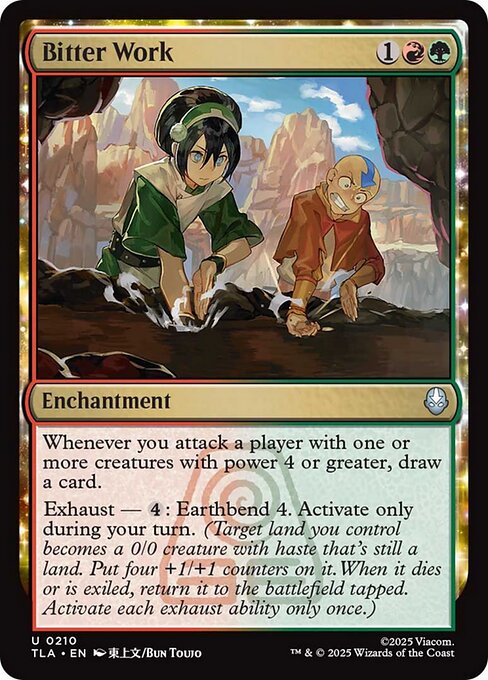
250. Bitter Work
Rating3.8WeakWhy this rating?
A good playable, but is sometimes cut (3.8/10).
Why. A three-mana red-green enchantment that draws you a card when you attack a player with one or more creatures of power 4 or greater. Its Exhaust ability makes an Earthbend 4 for four mana, during your turn only: a hasty 4/4 land creature.
Risks. It does nothing alone: without big creatures in your deck the draw never triggers. It costs three mana with no immediate effect on the board.
In the draft. Only for a real red-green deck with big creatures. Take it after your good creatures, not before.
Results in the games of the set
When it is in hand, the deck wins 52.2% of its games (set average: 56.2%, 233rd of 279 cards).
In the opening hand: 50.4% wins (55.4% on average).
Drawn during the game: 53.6% (56.8% on average).
When it is drawn, the deck wins 1.1 points less than when it is not.
When it is drafted, it is played 46% of the time (set average: 61%).
Taken as the first pick (41 drafts), it ends in the deck 80% of the time.
It is played mostly in G/R decks (50% of them).
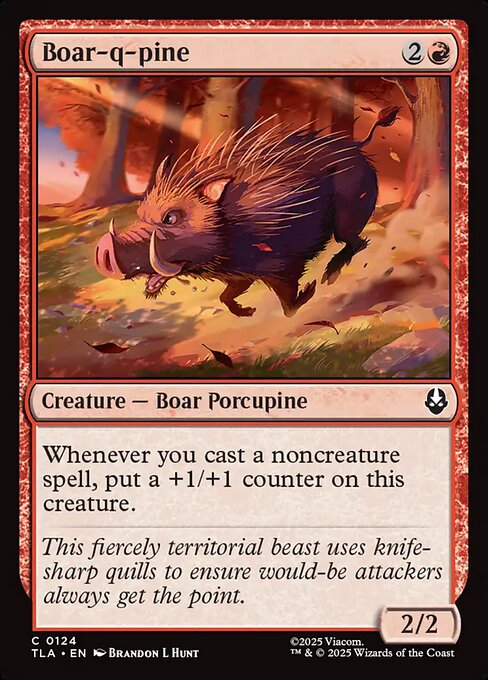
251. Boar-q-pine
Rating3.8WeakWhy this rating?
A good playable, but is sometimes cut (3.8/10).
Why. A 2/2 for three that gets a +1/+1 counter every time you cast a noncreature spell. In a deck with many spells it grows quickly and becomes hard to block profitably.
Risks. It does nothing useful until you cast noncreature spells, and a 2/2 dies easily before it grows. It needs a spells deck rather than a creature deck.
In the draft. A playable in a red spells deck. Take it mid-pack, but only if you have plenty of instants and sorceries.
Results in the games of the set
When it is in hand, the deck wins 51.6% of its games (set average: 56.2%, 246th of 279 cards).
In the opening hand: 51.6% wins (55.4% on average).
Drawn during the game: 51.6% (56.8% on average).
When it is drawn, the deck wins 1.2 points less than when it is not.
When it is drafted, it is played 21% of the time (set average: 61%).
Taken among the first three picks (42 drafts), it ends in the deck 62% of the time.
It is played mostly in R/U decks (25% of them).

252. Buzzard-Wasp Colony
Rating3.8WeakWhy this rating?
A good playable, but is sometimes cut (3.8/10).
Why. A 2/2 flier for four that can sacrifice an artifact or creature on entering to draw a card. It also takes the counters of another creature that dies, which can make it grow.
Risks. A 2/2 for four is expensive, and the draw costs you a permanent. It only grows if your creatures actually carry counters.
In the draft. A playable in black decks with counters or artifacts to sacrifice. Not a high pick; take it only if it fits your plan.
Results in the games of the set
When it is in hand, the deck wins 51.0% of its games (set average: 56.2%, 258th of 279 cards).
In the opening hand: 47.6% wins (55.4% on average).
Drawn during the game: 53.2% (56.8% on average).
When it is drawn, the deck wins 1.6 points less than when it is not.
When it is drafted, it is played 42% of the time (set average: 61%).
Taken among the first three picks (110 drafts), it ends in the deck 72% of the time.
It is played mostly in B/W decks (27% of them).
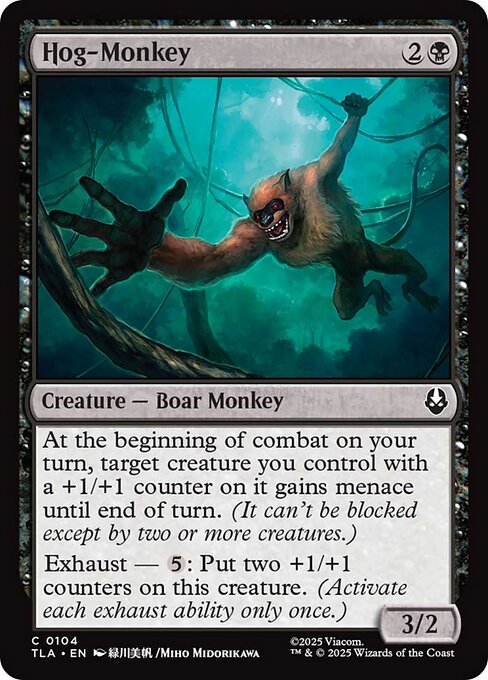
253. Hog-Monkey
Rating3.8WeakWhy this rating?
A good playable, but is sometimes cut (3.8/10).
Why. A 3/2 for three that gives menace to a creature with a +1/+1 counter on it at the beginning of combat. Its Exhaust puts two +1/+1 counters on it for five mana, once.
Risks. Without counters in your deck, its first ability does nothing. Five mana for two counters is slow, and it remains a plain 3/2 in the meantime.
In the draft. A fair body for a counters deck. Otherwise it is second-line filler, to be taken late in a pack.
Results in the games of the set
When it is in hand, the deck wins 52.0% of its games (set average: 56.2%, 238th of 279 cards).
In the opening hand: 50.5% wins (55.4% on average).
Drawn during the game: 53.1% (56.8% on average).
When it is drawn, the deck wins 0.2 points more than when it is not.
When it is drafted, it is played only 8% of the time (set average: 61%): it almost always ends in the sideboard.
 Rating3.5Weak
Why this rating?
A good playable, but is sometimes cut (3.5/10).
Why. A legendary 4/4 flier for six that, when it enters and each time it attacks, either gives one of your creatures flying or Airbends another nonland permanent of yours. Exiled permanents can be recast for two.
Risks. Six mana with two white is expensive. If the opponent kills it right away, you only got one trigger. The Airbend only pays off if you have good targets.
In the draft. A decent top-end in white, but not a standout. Take it mid-pack, especially if you are short on fliers.
Results in the games of the set
When it is in hand, the deck wins 51.8% of its games (set average: 56.2%, 242nd of 279 cards).
In the opening hand: 48.4% wins (55.4% on average).
Drawn during the game: 54.2% (56.8% on average).
When it is drawn, the deck wins 2.3 points less than when it is not.
When it is drafted, it is played 60% of the time (set average: 61%).
Taken as the first pick (47 drafts), it ends in the deck 81% of the time.
It is played about as much in every archetype.
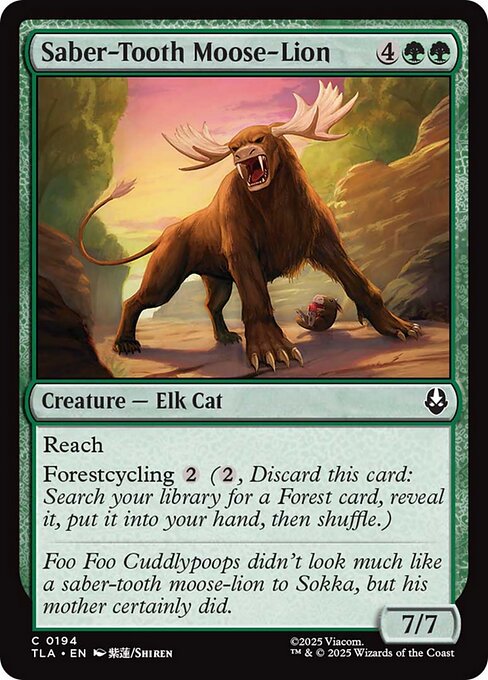 Rating3.2Weak
Why this rating?
Filler card but sometimes gets cut (3.2/10).
Why. A 7/7 reach creature for six that doubles as mana fixing thanks to Forestcycling for two. It is rarely a dead card: early it finds a land, late it dominates the board.
Risks. Six mana for a creature with no other ability, and it still dies to removal. If you cycle it, it is no longer there to close the game.
In the draft. A good green common top-end. Take it as a flexible playable, but do not run too many six-drops in the same deck.
Results in the games of the set
When it is in hand, the deck wins 53.2% of its games (set average: 56.2%, 208th of 279 cards).
In the opening hand: 51.0% wins (55.4% on average).
Drawn during the game: 54.7% (56.8% on average).
When it is drawn, the deck wins 0.8 points less than when it is not.
When it is drafted, it is played 42% of the time (set average: 61%).
Taken among the first three picks (94 drafts), it ends in the deck 74% of the time.
It is played mostly in G/R decks (46% of them) and B/G (42%).

256. Invasion Tactics
Rating2.9WeakWhy this rating?
Filler card but sometimes gets cut (2.9/10).
Why. A five-mana enchantment that gives your creatures +2/+2 for the turn when it enters, then draws you a card whenever Allies deal combat damage to a player. A burst in an Ally deck.
Risks. Five mana for an effect with no lasting impact without Allies. It does little that turn if you have no creatures ready to attack.
In the draft. Only in a well-stocked Ally deck. Otherwise let it go: the cost is too high for a one-shot effect.
Results in the games of the set
When it is in hand, the deck wins 50.8% of its games (set average: 56.2%, 260th of 279 cards).
In the opening hand: 49.1% wins (55.4% on average).
Drawn during the game: 52.1% (56.8% on average).
When it is drawn, the deck wins 4.6 points less than when it is not.
When it is drafted, it is played 35% of the time (set average: 61%).
Taken among the first three picks (89 drafts), it ends in the deck 73% of the time.
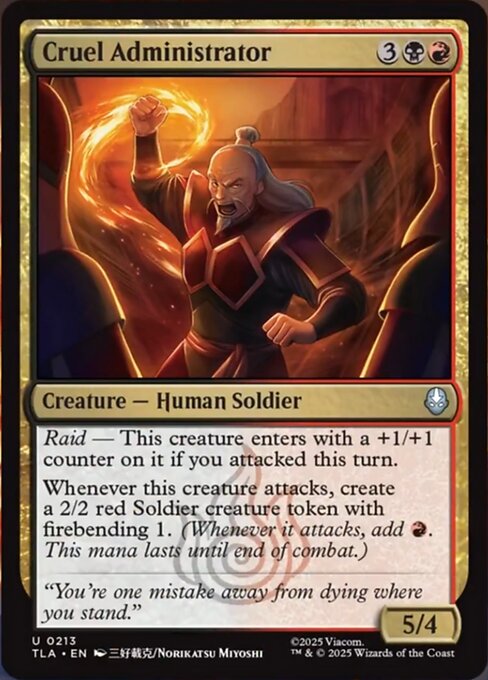
257. Cruel Administrator
Rating2.6WeakWhy this rating?
Filler card but sometimes gets cut (2.6/10).
Why. A black-red 5/4 for five that enters with a +1/+1 counter if you attacked this turn and creates a 2/2 red Soldier creature token with Firebending 1 each time it attacks. It fills the board quickly.
Risks. Five mana in two colours with no evasion. The counter requires having already attacked, and swinging into a crowded board exposes a 5/4 to a double block.
In the draft. A fair body for a black-red deck, but not a first choice. Take it mid-pack if you are already in those two colours.
Results in the games of the set
When it is in hand, the deck wins 51.3% of its games (set average: 56.2%, 251st of 279 cards).
In the opening hand: 50.3% wins (55.4% on average).
Drawn during the game: 51.9% (56.8% on average).
When it is drawn, the deck wins 0.3 points less than when it is not.
When it is drafted, it is played 38% of the time (set average: 61%).
Taken among the first three picks (113 drafts), it ends in the deck 81% of the time.
It is played mostly in B/R decks (40% of them).

258. Vengeful Villagers
Rating2.2WeakWhy this rating?
Not good filler and often gets cut (2.2/10).
Why. A 3/3 for four that taps an opposing creature when it attacks and can sacrifice an artifact or creature to put a stun counter on it. It clears the way for your other attackers.
Risks. The sacrifice is a real card cost. A 3/3 with no evasion can be blocked and killed before attacking usefully. The stun only happens if you sacrifice.
In the draft. A fair body in white, better with tokens or artifacts to sacrifice. Not a high pick.
Results in the games of the set
When it is in hand, the deck wins 50.8% of its games (set average: 56.2%, 259th of 279 cards).
In the opening hand: 51.0% wins (55.4% on average).
Drawn during the game: 50.7% (56.8% on average).
When it is drawn, the deck wins 3.7 points less than when it is not.
When it is drafted, it is played 21% of the time (set average: 61%).
Taken among the first three picks (43 drafts), it ends in the deck 72% of the time.

259. Avatar Destiny
Rating2.0WeakWhy this rating?
Not good filler and often gets cut (2.0/10).
Why. A four-mana green Aura that gives +1/+1 for each creature card in your graveyard. When the creature dies you mill cards equal to its power, get the Aura back and put a creature card milled this way onto the battlefield.
Risks. A four-mana Aura risks a two-for-one against removal. The bonus depends on your graveyard, which is empty early, and the return effect is random.
In the draft. Avoid it in normal builds. Only for a very specific green graveyard deck; otherwise let it go.
Results in the games of the set
When it is in hand, the deck wins 46.7% of its games (set average: 56.2%, 275th of 279 cards).
In the opening hand: 45.5% wins (55.4% on average).
Drawn during the game: 47.5% (56.8% on average).
When it is drawn, the deck wins 5.6 points less than when it is not.
When it is drafted, it is played 20% of the time (set average: 61%).
Taken among the first three picks (54 drafts), it ends in the deck 59% of the time.
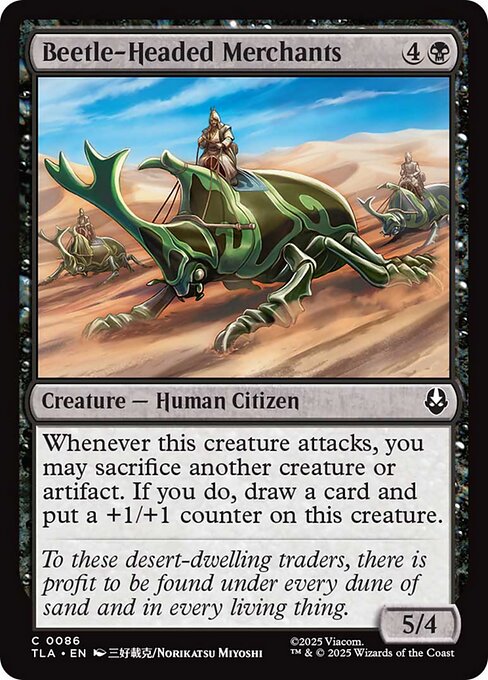 Rating2.0Weak
Why this rating?
Not good filler and often gets cut (2.0/10).
Why. A 5/4 for five that can sacrifice another creature or artifact when it attacks to draw a card and gain a +1/+1 counter. It turns tokens and small creatures into cards.
Risks. You have to sacrifice something each attack, which costs board presence. With no evasion it often gets blocked, and five mana for a 5/4 is the standard rate.
In the draft. A fair body in black with tokens or small creatures. Take it as mid-pack filler, nothing more.
Results in the games of the set
When it is in hand, the deck wins 52.1% of its games (set average: 56.2%, 237th of 279 cards).
In the opening hand: 49.7% wins (55.4% on average).
Drawn during the game: 53.5% (56.8% on average).
When it is drawn, the deck wins 1.2 points less than when it is not.
When it is drafted, it is played 31% of the time (set average: 61%).
Taken among the first three picks (73 drafts), it ends in the deck 74% of the time.
It is played mostly in B/W decks (55% of them) and B/G (32%).

261. Bumi Bash
Rating2.0WeakWhy this rating?
Not good filler and often gets cut (2.0/10).
Why. A four-mana sorcery that deals damage equal to the number of lands you control to a creature, or destroys a land creature or nonbasic land. As the game goes on, it kills nearly anything.
Risks. Four mana at sorcery speed is slow, and the damage stays close to four until the mid-game. The second mode is very situational.
In the draft. A decent red removal spell, better in the late game. Take it after your cheaper removal, as a second or third piece.
Results in the games of the set
When it is in hand, the deck wins 52.2% of its games (set average: 56.2%, 235th of 279 cards).
In the opening hand: 49.5% wins (55.4% on average).
Drawn during the game: 53.9% (56.8% on average).
When it is drawn, the deck wins 0.7 points less than when it is not.
When it is drafted, it is played 45% of the time (set average: 61%).
Taken as the first pick (33 drafts), it ends in the deck 76% of the time.
It is played mostly in G/R decks (36% of them) and R/U (31%).
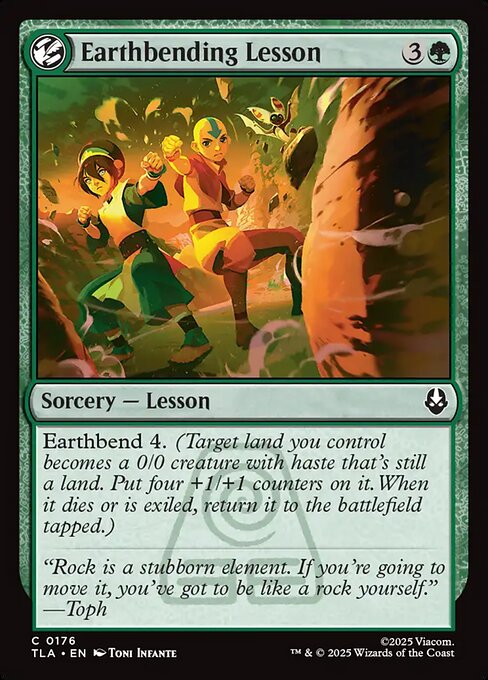
262. Earthbending Lesson
Rating2.0WeakWhy this rating?
Not good filler and often gets cut (2.0/10).
Why. A four-mana Lesson that does Earthbend 4: a land becomes a 4/4 creature with haste, and it comes back tapped if it dies. It is a creature in sorcery form, resilient to removal.
Risks. You expose a land: if it dies it returns tapped, but you lose tempo. Four mana for a 4/4 is the usual rate, with no bonus.
In the draft. Fair green filler. Take it after your better creatures, especially if you have effects that count Lessons.
Results in the games of the set
When it is in hand, the deck wins 51.8% of its games (set average: 56.2%, 243rd of 279 cards).
In the opening hand: 49.2% wins (55.4% on average).
Drawn during the game: 53.5% (56.8% on average).
When it is drawn, the deck wins 1.5 points less than when it is not.
When it is drafted, it is played 37% of the time (set average: 61%).
Taken among the first three picks (109 drafts), it ends in the deck 78% of the time.
It is played mostly in G/R decks (40% of them) and G/U (36%).

263. Elemental Teachings
Rating2.0WeakWhy this rating?
Not good filler and often gets cut (2.0/10).
Why. A five-mana instant that searches for up to four lands with different names. The opponent picks two for your graveyard and the rest enter tapped on the battlefield. It is ramp, nothing more.
Risks. It does nothing on the board and gives you only two lands. Five mana for fixing and ramp is too slow, and the opponent chooses the two you lose.
In the draft. Pass it in nearly every deck. Only play it if you have a specific reason to fetch several lands.
Results in the games of the set
When it is drafted, it is played only 2% of the time (set average: 61%): it almost always ends in the sideboard.

264. Fatal Fissure
Rating2.0WeakWhy this rating?
Not good filler and often gets cut (2.0/10).
Why. A two-mana black instant: if the chosen creature dies this turn, you Earthbend 4. It is a bonus, not removal, that rides along with a combat trade or another spell.
Risks. It kills nothing by itself. Without another way to kill the creature it is a dead card, and the bonus puts your mana at risk if the land dies.
In the draft. Avoid it while you have alternatives. A late-pack option for a black deck that trades a lot.
Results in the games of the set
When it is in hand, the deck wins 46.3% of its games (set average: 56.2%, 276th of 279 cards).
In the opening hand: 44.7% wins (55.4% on average).
Drawn during the game: 47.5% (56.8% on average).
When it is drawn, the deck wins 3.7 points less than when it is not.
When it is drafted, it is played only 8% of the time (set average: 61%): it almost always ends in the sideboard.

265. Fire Lord Zuko
Rating2.0WeakWhy this rating?
Not good filler and often gets cut (2.0/10).
Why. A three-colour 2/4 for three with Firebending equal to its power: it adds two red mana when it attacks. It puts a +1/+1 counter on each creature you control whenever you cast a spell from exile or a permanent enters from exile.
Risks. Three colours demand perfect fixing. Without spells from exile its second ability is nearly dead, and a 2/4 is just a body.
In the draft. Only in a real red-white-black deck with exile effects. Do not take it to force that deck: two-colour pairs are better.
Results in the games of the set
When it is in hand, the deck wins 46.3% of its games (set average: 56.2%, 277th of 279 cards).
In the opening hand: 46.8% wins (55.4% on average).
Drawn during the game: 45.9% (56.8% on average).
When it is drawn, the deck wins 0.9 points more than when it is not.
When it is drafted, it is played only 12% of the time (set average: 61%): it almost always ends in the sideboard.
Taken among the first three picks (47 drafts), it ends in the deck 38% of the time.
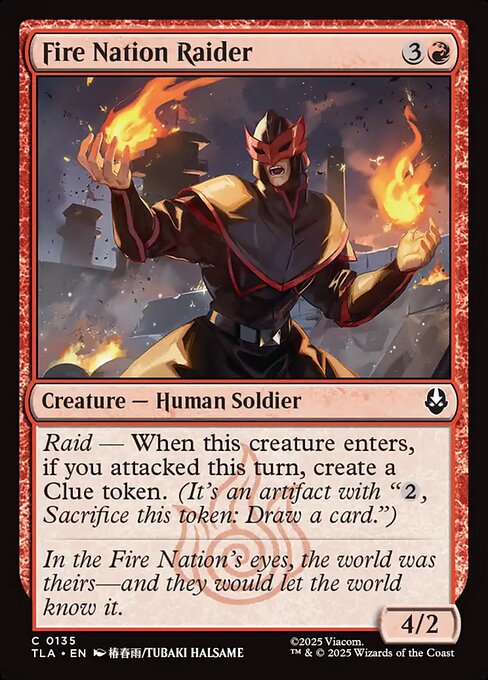
266. Fire Nation Raider
Rating2.0WeakWhy this rating?
Not good filler and often gets cut (2.0/10).
Why. A 4/2 for four that creates a Clue token with Raid if you attacked this turn. It gives you a body and a delayed draw when one of your creatures has already attacked.
Risks. Two toughness makes it fragile, and you must attack before casting it to get the Clue. It costs four mana for a middling effect.
In the draft. Red filler for an aggressive deck. Take it late in a pack; it is not worth a high pick.
Results in the games of the set
When it is in hand, the deck wins 50.4% of its games (set average: 56.2%, 265th of 279 cards).
In the opening hand: 50.1% wins (55.4% on average).
Drawn during the game: 50.7% (56.8% on average).
When it is drawn, the deck wins 2.9 points less than when it is not.
When it is drafted, it is played 15% of the time (set average: 61%).
Taken among the first three picks (46 drafts), it ends in the deck 54% of the time.
 Rating2.0Weak
Why this rating?
Not good filler and often gets cut (2.0/10).
Why. A 4/3 for four that cannot be blocked by creatures with power 2 or less. Waterbend 5 adds a +1/+1 counter during your turn, with help from tapping your creatures and artifacts.
Risks. Any creature with power 3 or more stops it. Waterbend costs a lot of mana or tapped creatures, so it only matters late in the game.
In the draft. A fair green body for the curve. Take it mid-pack; it is better than a vanilla creature, but not by much.
Results in the games of the set
When it is in hand, the deck wins 52.4% of its games (set average: 56.2%, 227th of 279 cards).
In the opening hand: 51.6% wins (55.4% on average).
Drawn during the game: 53.0% (56.8% on average).
When it is drawn, the deck wins 1.7 points less than when it is not.
When it is drafted, it is played 25% of the time (set average: 61%).
Taken among the first three picks (66 drafts), it ends in the deck 68% of the time.

268. Foggy Swamp Visions
Rating2.0WeakWhy this rating?
Not good filler and often gets cut (2.0/10).
Why. A three-mana black sorcery with an additional Waterbend X cost: it exiles X creature cards from graveyards and creates a token copy of each, sacrificed at your next end step. A graveyard trick, not a board play.
Risks. The additional cost is huge and the gain is temporary: the tokens vanish quickly. You need creature cards in graveyards and enough mana or creatures to tap.
In the draft. Pass it almost always. Only in a very specific black graveyard deck, which is rare.
Results in the games of the set
When it is in hand, the deck wins 47.8% of its games (set average: 56.2%, 273rd of 279 cards).
In the opening hand: 42.6% wins (55.4% on average).
Drawn during the game: 51.4% (56.8% on average).
When it is drawn, the deck wins 1.2 points less than when it is not.
When it is drafted, it is played only 6% of the time (set average: 61%): it almost always ends in the sideboard.
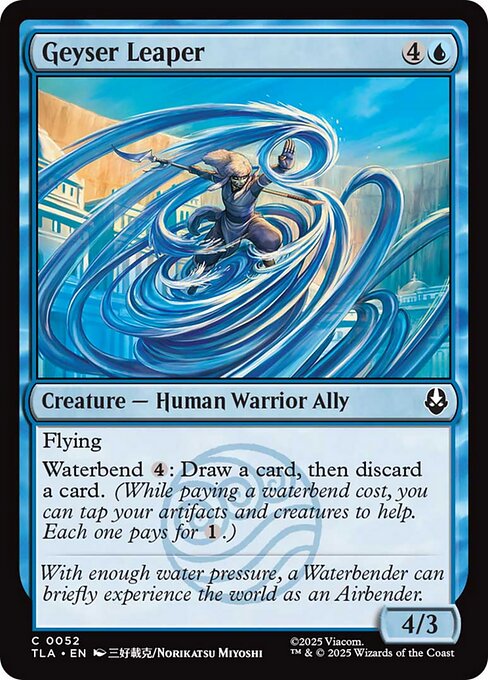
269. Geyser Leaper
Rating2.0WeakWhy this rating?
Not good filler and often gets cut (2.0/10).
Why. A 4/3 flyer for five with a late-game loot (draw, then discard) through Waterbend 4. It is a solid body, not a card that wins on its own.
Risks. Five mana for a creature with no enter effect: it is slow and gets replaced by more efficient cards. The loot is expensive and only matters once the board is stable.
In the draft. Decent blue filler, especially if you are short on evasive creatures. Take it late, after removal and cheap creatures.
Results in the games of the set
When it is in hand, the deck wins 51.2% of its games (set average: 56.2%, 253rd of 279 cards).
In the opening hand: 48.2% wins (55.4% on average).
Drawn during the game: 53.0% (56.8% on average).
When it is drawn, the deck wins 1.4 points less than when it is not.
When it is drafted, it is played 25% of the time (set average: 61%).
Taken among the first three picks (50 drafts), it ends in the deck 56% of the time.
It is played mostly in U/W decks (36% of them).

270. Long Feng, Grand Secretariat
Rating2.0WeakWhy this rating?
Not good filler and often gets cut (2.0/10).
Why. A 2/3 for three that fits a black or green deck thanks to its hybrid cost. Whenever another creature or a land you control goes to the graveyard from the battlefield, it puts a +1/+1 counter on a creature you control.
Risks. Combat trades can trigger it, but without sacrifice or lands that die it stays slow. It is still a small body that draws removal.
In the draft. A card for sacrifice decks or decks where lands die, not an opening pick. Take it late, once you already have ways to trigger it.
Results in the games of the set
When it is in hand, the deck wins 51.9% of its games (set average: 56.2%, 241st of 279 cards).
In the opening hand: 50.9% wins (55.4% on average).
Drawn during the game: 52.7% (56.8% on average).
When it is drawn, the deck wins 0.9 points less than when it is not.
When it is drafted, it is played 67% of the time (set average: 61%).
Taken as the first pick (56 drafts), it ends in the deck 84% of the time.
It is played mostly in B/G decks (37% of them).

271. Pirate Peddlers
Rating2.0WeakWhy this rating?
Not good filler and often gets cut (2.0/10).
Why. A 2/2 deathtouch for three: it stops any attack and trades with a far more expensive creature. It gets a +1/+1 counter whenever you sacrifice another permanent.
Risks. A small, fragile body, and the bonus needs sacrifice outlets you will not always have. Without them it is just a defensive blocker.
In the draft. Useful black filler, especially for a control or sacrifice deck. A fine three-drop to take late.
Results in the games of the set
When it is in hand, the deck wins 51.7% of its games (set average: 56.2%, 245th of 279 cards).
In the opening hand: 50.1% wins (55.4% on average).
Drawn during the game: 52.7% (56.8% on average).
When it is drawn, the deck wins 0.2 points less than when it is not.
When it is drafted, it is played 36% of the time (set average: 61%).
Taken among the first three picks (119 drafts), it ends in the deck 84% of the time.
It is played mostly in B/W decks (63% of them) and B/R (37%).

272. Rough Rhino Cavalry
Rating2.0WeakWhy this rating?
Not good filler and often gets cut (2.0/10).
Why. A 5/5 for five, with Firebending 2 adding red mana when it attacks. The body is big for the price and lands well on turn five.
Risks. The eight-mana Exhaust is nearly out of reach: do not count it as a real ability. The Firebending mana only lasts until end of combat, so you need an instant or ability to spend it on.
In the draft. Decent red filler, not a priority pick. A big body for a deck that lacks weight at the top of the curve.
Results in the games of the set
When it is in hand, the deck wins 51.1% of its games (set average: 56.2%, 255th of 279 cards).
In the opening hand: 50.7% wins (55.4% on average).
Drawn during the game: 51.4% (56.8% on average).
When it is drawn, the deck wins 2.1 points less than when it is not.
When it is drafted, it is played only 10% of the time (set average: 61%): it almost always ends in the sideboard.
Taken among the first three picks (31 drafts), it ends in the deck 58% of the time.

273. Rowdy Snowballers
Rating2.0WeakWhy this rating?
Not good filler and often gets cut (2.0/10).
Why. A 2/2 for three that taps an opposing creature and puts a stun counter on it, so it stays tapped through its next untap. Good for gaining tempo or pushing through an attack.
Risks. The effect does not remove the creature, it only delays it a turn. Against a board that already has weight, the edge is slim.
In the draft. A card for aggro or tempo blue decks. Fine, but take it late: do not prefer it to real removal.
Results in the games of the set
When it is in hand, the deck wins 51.2% of its games (set average: 56.2%, 252nd of 279 cards).
In the opening hand: 47.3% wins (55.4% on average).
Drawn during the game: 53.7% (56.8% on average).
When it is drawn, the deck wins 0.8 points less than when it is not.
When it is drafted, it is played 31% of the time (set average: 61%).
Taken among the first three picks (120 drafts), it ends in the deck 68% of the time.
It is played mostly in U/W decks (27% of them).

274. The Last Agni Kai
Rating2.0WeakWhy this rating?
Not good filler and often gets cut (2.0/10).
Why. A two-mana instant fight: your creature fights an opposing creature. If the opposing creature takes excess damage, you add that much red mana, and unspent red mana stays until end of turn. Cheap, conditional removal.
Risks. You need a creature bigger than the target, otherwise yours can die for nothing. A response that kills your creature makes the fight fizzle.
In the draft. Playable in a red deck with big bodies, but risky. Take it late, after more direct removal.
Results in the games of the set
When it is in hand, the deck wins 49.4% of its games (set average: 56.2%, 269th of 279 cards).
In the opening hand: 47.4% wins (55.4% on average).
Drawn during the game: 50.7% (56.8% on average).
When it is drawn, the deck wins 2.9 points less than when it is not.
When it is drafted, it is played 46% of the time (set average: 61%).
Taken among the first three picks (97 drafts), it ends in the deck 64% of the time.
It is played about as much in every archetype.
 Rating2.0Weak
Why this rating?
Not good filler and often gets cut (2.0/10).
Why. A 3/4 for four that fits a black or red deck thanks to its hybrid cost. Firebending 2, and your creatures get +1/+0 until end of turn whenever you sacrifice another permanent.
Risks. The bonus needs sacrifice outlets your deck must supply. Without them it is a decent 3/4, nothing more, and it draws removal.
In the draft. A decent body for a sacrifice or aggressive deck in black or red. Take it late, especially if you have no sacrifice.
Results in the games of the set
When it is in hand, the deck wins 51.1% of its games (set average: 56.2%, 256th of 279 cards).
In the opening hand: 50.4% wins (55.4% on average).
Drawn during the game: 51.6% (56.8% on average).
When it is drawn, the deck wins 0.9 points less than when it is not.
When it is drafted, it is played 31% of the time (set average: 61%).
Taken among the first three picks (104 drafts), it ends in the deck 61% of the time.
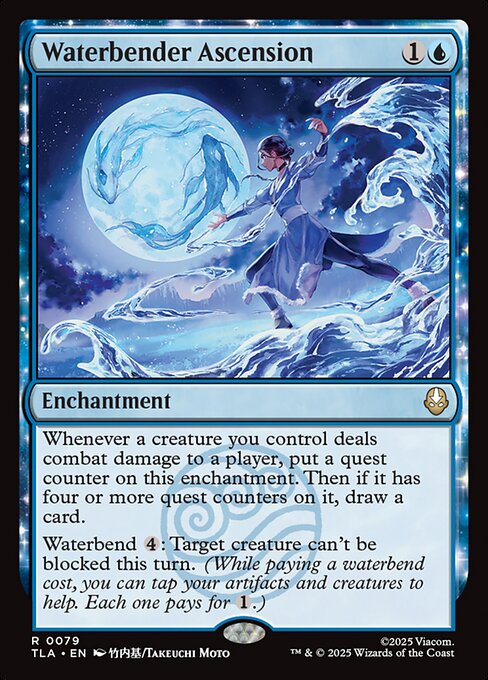 Rating1.9Weak
Why this rating?
Not good filler and often gets cut (1.9/10).
Why. A two-mana enchantment that gets a quest counter whenever one of your creatures deals combat damage to a player; with four or more counters, you draw. Waterbend 4 makes a creature unblockable.
Risks. Slow, no board impact and heavily reliant on attacks connecting. It takes four hits before the first card, which is too slow for what it gives.
In the draft. Weak. Let it go, and play it only as a last resort in a very aggressive blue deck.
Results in the games of the set
When it is in hand, the deck wins 45.2% of its games (set average: 56.2%, 279th of 279 cards).
In the opening hand: 41.9% wins (55.4% on average).
Drawn during the game: 47.4% (56.8% on average).
When it is drawn, the deck wins 4.6 points less than when it is not.
When it is drafted, it is played 46% of the time (set average: 61%).
Taken as the first pick (30 drafts), it ends in the deck 50% of the time.
It is played about as much in every archetype.

277. Kyoshi Island Plaza
Rating1.7WeakWhy this rating?
Not good filler and often gets cut (1.7/10).
Why. Four mana to fetch tapped basic lands, as many as the Shrines you control. On its own it fetches a single land. It also fetches one whenever another Shrine enters.
Risks. On its own it is slow ramp with no board impact. You need other Shrines to get value.
In the draft. Weak outside a Shrine-focused deck. Do not take it before the end of the pack.
Results in the games of the set
When it is in hand, the deck wins 50.3% of its games (set average: 56.2%, 267th of 279 cards).
In the opening hand: 47.9% wins (55.4% on average).
Drawn during the game: 51.8% (56.8% on average).
When it is drawn, the deck wins 6.6 points more than when it is not.
When it is drafted, it is played 21% of the time (set average: 61%).
Taken among the first three picks (108 drafts), it ends in the deck 65% of the time.

278. Cycle of Renewal
Rating1.4WeakWhy this rating?
Almost unplayable and mostly sideboard material (1.4/10).
Why. A three-mana instant Lesson: you sacrifice a land and fetch two basics, tapped. You gain a net land and a bit of fixing.
Risks. No board impact: you spend three mana just to ramp. It is slow ramp, only good if your deck has something big to cast afterwards.
In the draft. Filler for green decks with expensive spells, not a real pick. Play it only if you already have many costly cards and little fixing.
Results in the games of the set
When it is in hand, the deck wins 50.6% of its games (set average: 56.2%, 263rd of 279 cards).
In the opening hand: 49.9% wins (55.4% on average).
Drawn during the game: 51.2% (56.8% on average).
When it is drawn, the deck wins 1.4 points less than when it is not.
When it is drafted, it is played 45% of the time (set average: 61%).
Taken as the first pick (42 drafts), it ends in the deck 79% of the time.
It is played mostly in G/U decks (59% of them) and G/R (56%).
 Rating1.4Weak
Why this rating?
Almost unplayable and mostly sideboard material (1.4/10).
Why. A four-mana sorcery that forces each player to keep only creatures with total power 4 or less and sacrifice the rest. It can clean up a loaded opposing board if you have few creatures.
Risks. It hits your side too: a creature deck suffers from it. The effect is symmetrical and hard to use well, so you want few big bodies.
In the draft. A niche card for small-creature or control decks. Take it very late, and only with a clear plan.
Results in the games of the set
When it is in hand, the deck wins 47.0% of its games (set average: 56.2%, 274th of 279 cards).
In the opening hand: 43.8% wins (55.4% on average).
Drawn during the game: 49.0% (56.8% on average).
When it is drawn, the deck wins 5.3 points less than when it is not.
When it is drafted, it is played only 7% of the time (set average: 61%): it almost always ends in the sideboard.

280. Southern Air Temple
Rating1.4WeakWhy this rating?
Almost unplayable and mostly sideboard material (1.4/10).
Why. Four mana to put +1/+1 counters on each creature you control, as many as the Shrines you control. With a wide board it is a real swing.
Risks. With no creatures it does nothing, and it is a slow enchantment. Extra counters depend on other Shrines, so mostly count on one counter per creature.
In the draft. Playable in a deck of small creatures, but not a strong pick. Take it late in white.
Results in the games of the set
When it is in hand, the deck wins 50.4% of its games (set average: 56.2%, 266th of 279 cards).
In the opening hand: 46.1% wins (55.4% on average).
Drawn during the game: 53.1% (56.8% on average).
When it is drawn, the deck wins 3.1 points more than when it is not.
When it is drafted, it is played 32% of the time (set average: 61%).
Taken as the first pick (41 drafts), it ends in the deck 59% of the time.
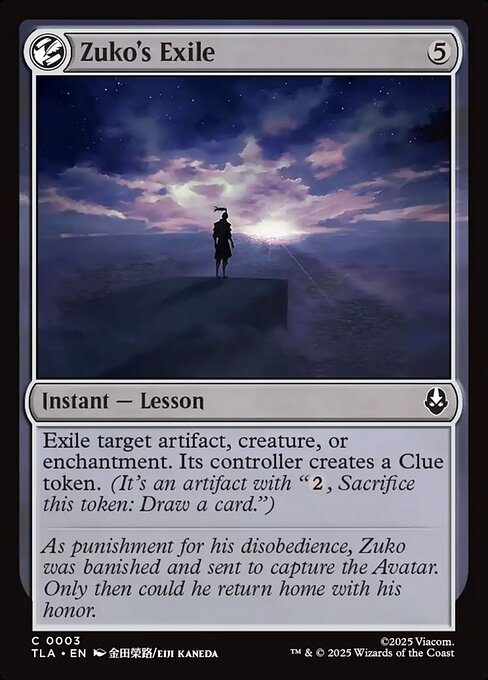
281. Zuko's Exile
Rating1.4WeakWhy this rating?
Almost unplayable and mostly sideboard material (1.4/10).
Why. A colorless five-mana instant Lesson removal that exiles an artifact, creature or enchantment. It fits in any deck.
Risks. Five mana is expensive, and the target's controller gets a Clue token, so a card to draw later for two mana. Slow removal that costs you tempo.
In the draft. A backup removal, not a first choice. Take it late if you lack answers in your colors.
Results in the games of the set
When it is in hand, the deck wins 48.7% of its games (set average: 56.2%, 270th of 279 cards).
In the opening hand: 46.0% wins (55.4% on average).
Drawn during the game: 50.5% (56.8% on average).
When it is drawn, the deck wins 2.3 points less than when it is not.
When it is drafted, it is played 17% of the time (set average: 61%).
Intrinsic ratings: they do not take into account the cards you have already picked. They matter most for the first pick of the first pack.